In The Top Tens, Top 10 Greatest Unexplained Mysteries of All Time – of which there are currently 62 listings, one of the most tragic and shocking events of the twentieth century – the assassination of the 35th American president John F Kennedy is ranked number 21 (registered from the votes of a mere 1% of readers).
Yet, it is an intriguing and infuriating component of this mystery which is ranked as the 1st yes 1st, greatest unexplained mystery of all time as voted by 10% of readers.
Number 2, being Jack the Ripper (9%) – refer article: Jack the Ripper.
The fact this mystery is nearly sixty-three years old – and candidly, unlikely to ever be solved – yet still grips the public’s fascination to such a high degree is remarkable. The reason for this undying and inordinate fascination will be investigated in this article.
While Kennedy’s tragic murder is clearly central to the discussion, it is not the prime focus here; providing rather a necessary albeit brief background to instead a mysterious woman known as:
The Babushka Lady
The Babushka Lady is an unidentified woman who was present and uniquely situated during the presidential assassination at 12.30 pm on November 22, 1963 – Article: 33.
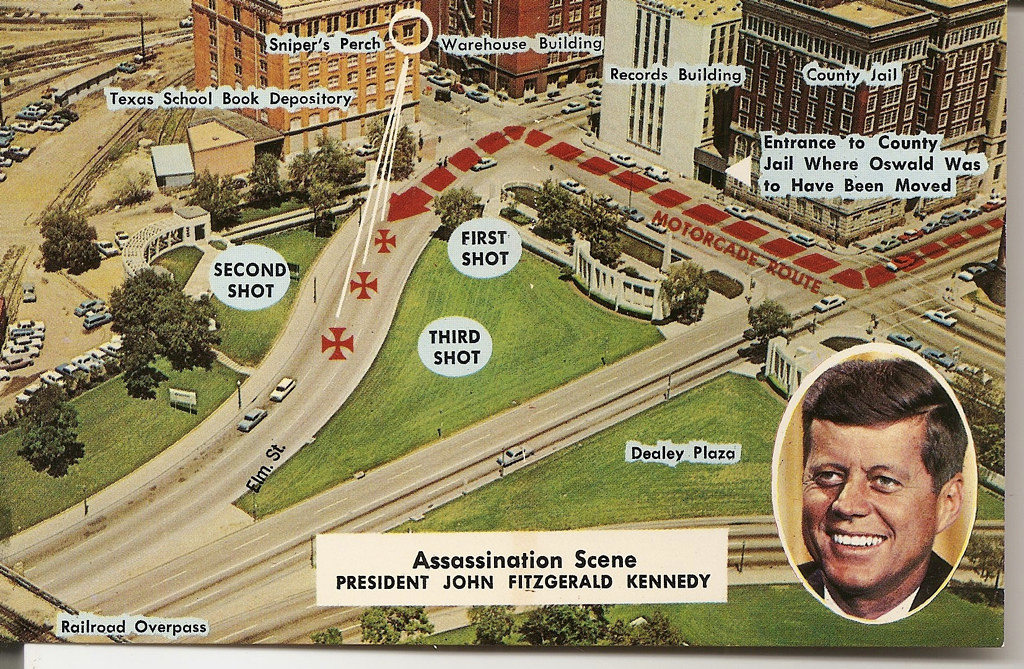
She is believed to have possibly photographed (probably filmed) the exact moments Kennedy was critically shot at Dealey Plaza in Dallas, Texas. Her nickname derives from the headscarf she wore, resembling those worn by elderly Russian women – babushka meaning ‘grandmother’ or ‘old woman’ in Russian.
Categorised as a key witness, law enforcement agencies have never located her or potentially, the most valuable footage of the assassination.
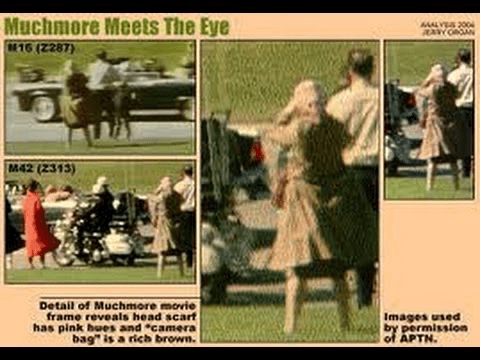
The Babushka lady (aka: Babushka, Babushka 1 or B1)
Appearance and Clothing:
The Babushka Lady was dressed in a tan* or light brown,** ‘knee’ length overcoat. Which conveniently covered not only the clothes underneath but also her shape and body type. Importantly though as we shall focus, not her calves.
A number of photos (stills) reveal a woman wearing a coat just above* the knee (B1); while another woman is observed in different photos wearing a slightly darker coat just below** the knee (B2b).
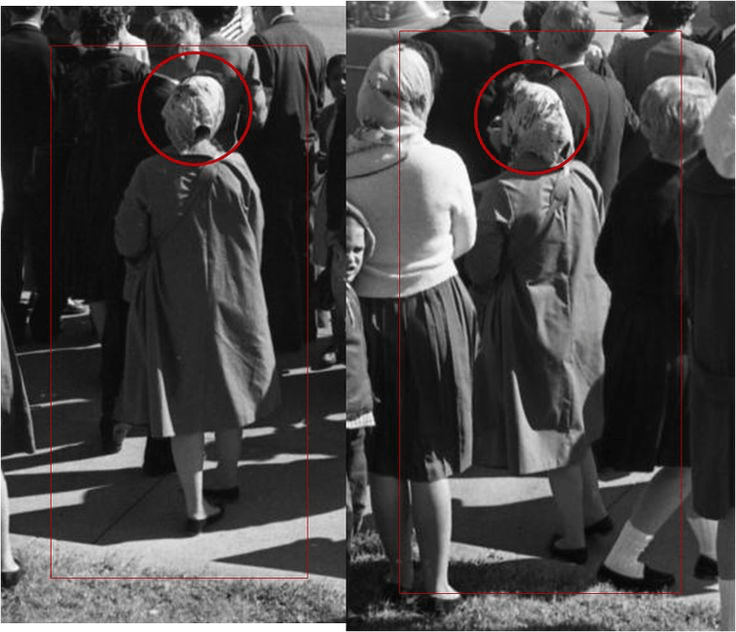
Babushka 2b
Similarly, the Babushka Lady wore a headscarf tied under her chin – as do (confusingly) her seeming doppelgängers on the day. The scarf conveniently assisted in predominantly masking the Babushka Lady’s hair and facial features.
Added to this, eyewitnesses noted that she ‘may have also worn sunglasses’.
Though we will discover this seems to apply to a look alike (B2a) and not the Babushka Lady.
She looked quite simply ordinary, not dramatic or theatrical but merely blending in without bringing attention to herself with bright colours or latest fashion. Note the lady near her – which we will repeatedly witness – in the bright red dress (second photo above).
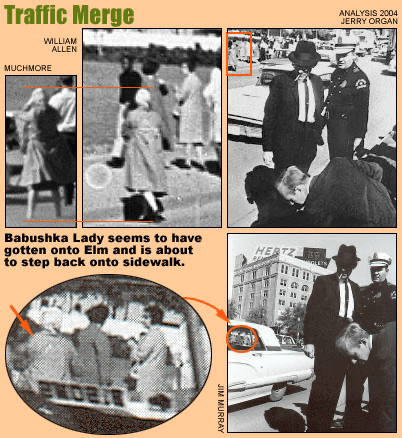
The montage (above) clearly delineates between Babushka (B1) in the upper left image and Babushka 2b in the upper middle still.
The length of their overcoats are different and as subsequent photos will show, the overcoat worn by Babushka 2b hangs more loosely (open), not seemingly pulled in at the waist as is evident on Babushka 1.
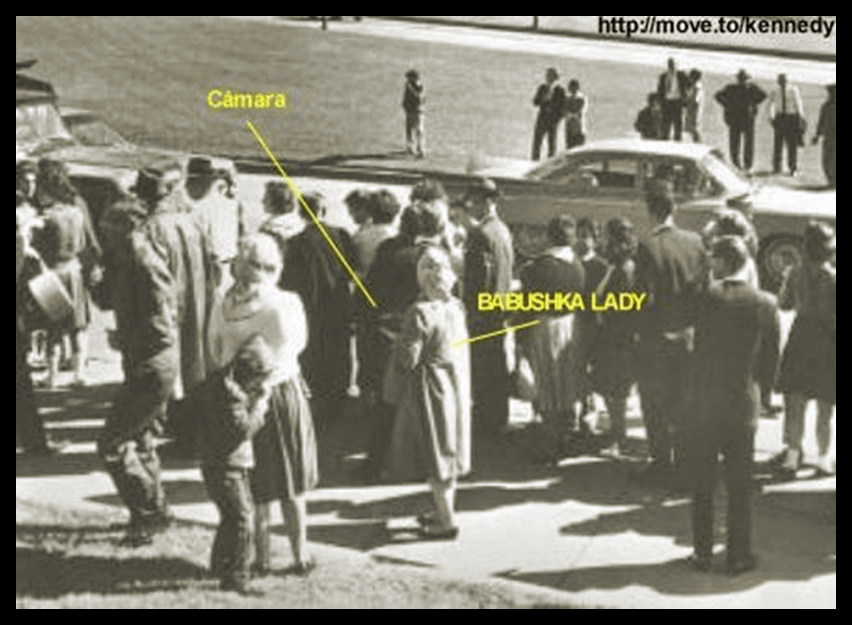
Babushka 2b with a camera and situated on the right hand side of the road where President Kennedy would be driven.
Babushka 2b looks shorter and plumper with thicker calves – and perhaps a little pigeon-toed – compared with Babushka 1.
The shoes worn by Babushka 2b are dark and flat. While we do not get a clear sighting of Babushka’s (B1) shoes, they do not appear to stand out as being a dark coloured material.
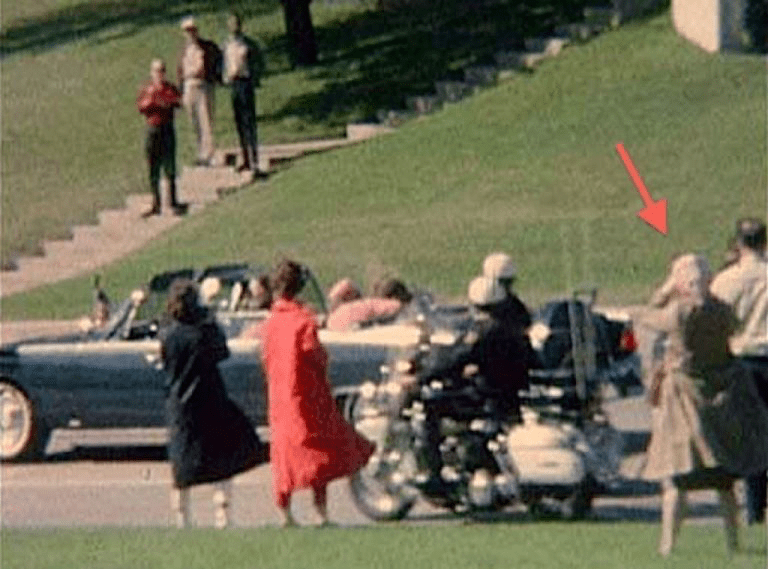
Babushka 2b exhibits calves which do not have socks or tights. From her foot and ankle to the hem of her coat (beneath her knee), her legs are bare. Whereas Babushka (B1) is wearing something(?) of a light colour which ends beneath her knees and then a darker shade of something(?) else is visible from the top of her calves (just below the knee) to the hem of her coat which is above the knees.
In the still above, note Babushka’s solid stance while filming – as it turned out – the critical shot fired that took John F Kennedy’s life. Her close and clear view of the cavalcade while positioned on the left hand side of Elm Street: happened from chance or by design?
Further photos will confirm that Babushka’s (B1) scarf hangs lower than the one worn by Babushka 2b.
Certain footage shows a woman wearing pale blue trousers or perhaps even blue jeans. Jeans were slowly coming into fashion for women in America during the early 1960’s but were still not yet common amongst the female populace. Yet a Babushka look alike (B4) is wearing them underneath her overcoat.
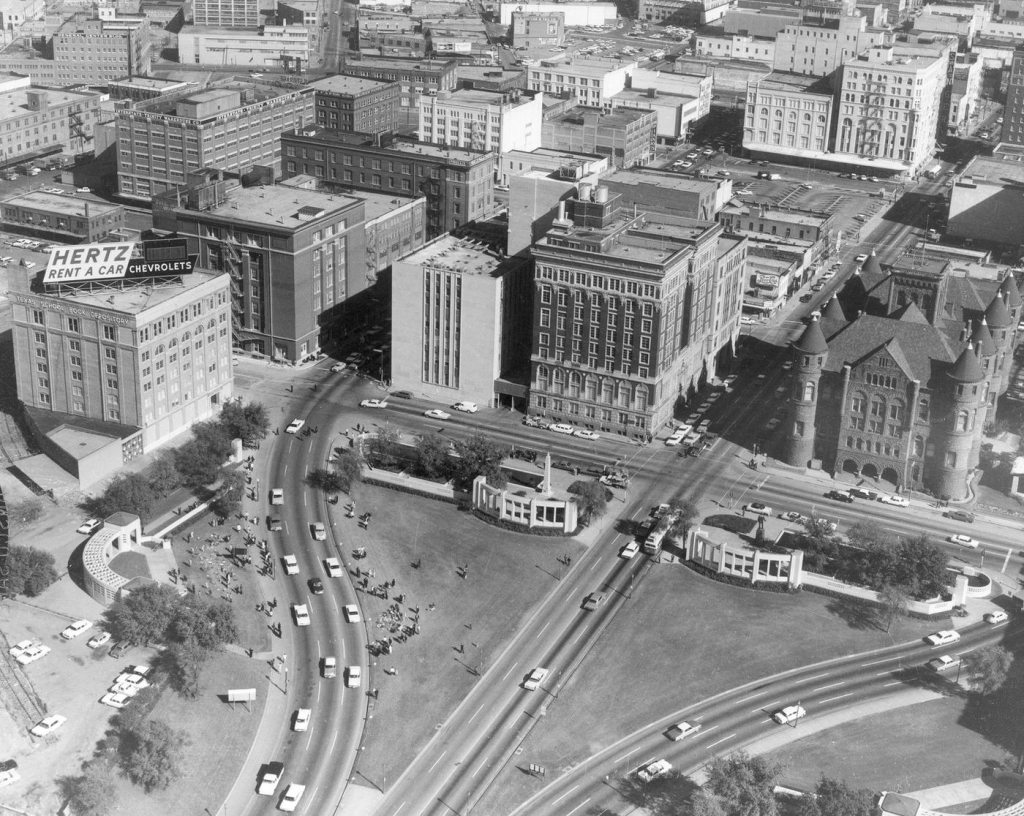
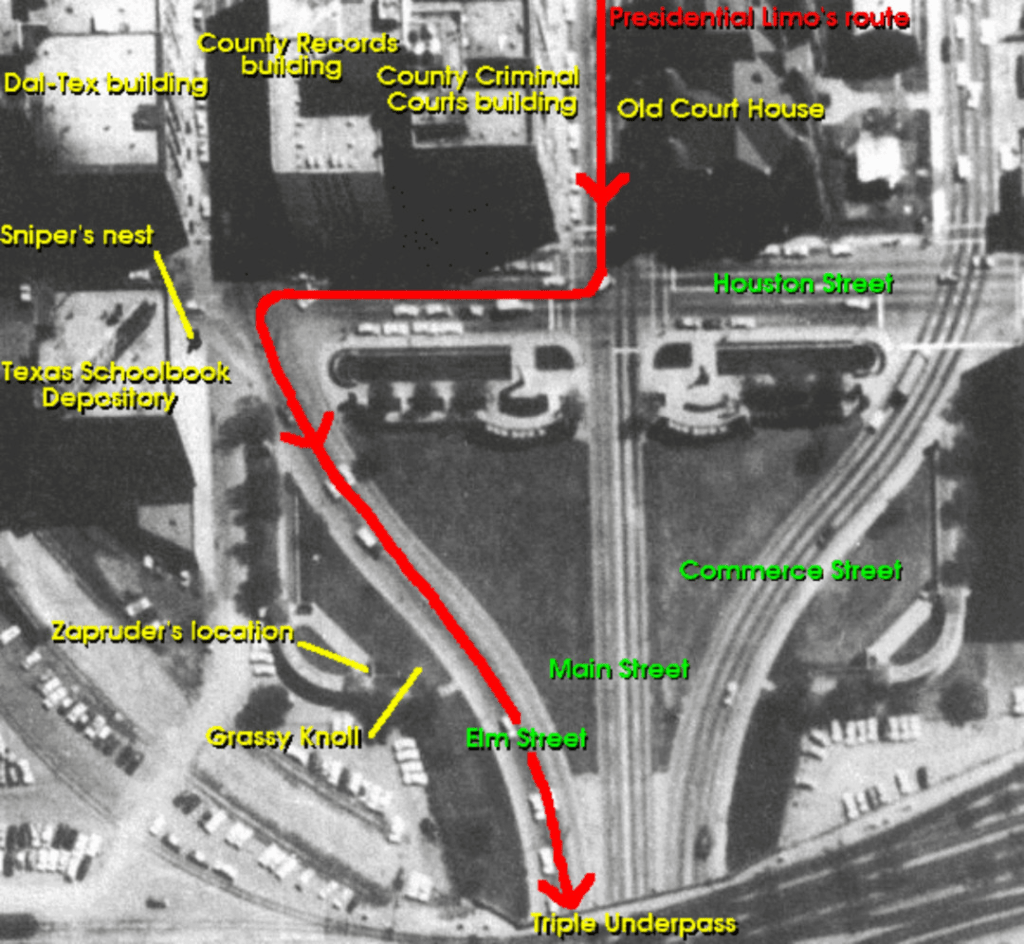
Dealey Plaza during the 1960’s
Behavior and Actions
Babushka’s appearance coupled with the fact she was seen (and photographed) holding a camera of some type are not suspicious of themselves. But add these details to the woman remaining absolutely preternaturally still – the exact opposite to those around her who were instinctually panicking in the split seconds after the gunfire began and the tirade of fired shots ominously rang out and therefore turning away, dropping to the ground or running (and screaming) – creates obvious questions.
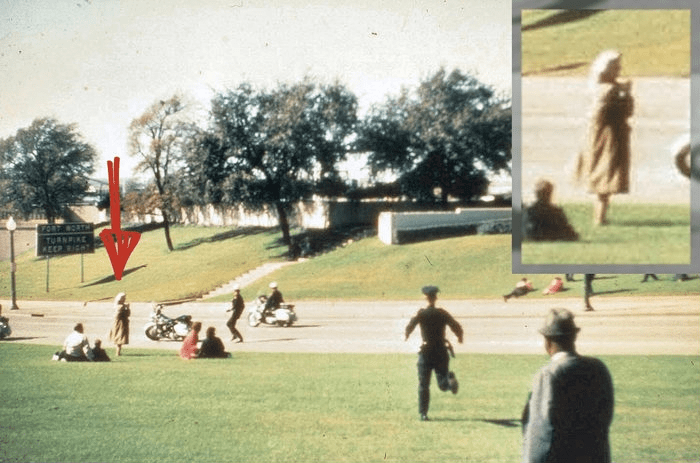
This exhibition of such a calm demeanour is eerily notable because she continued to keep her camera raised, filming (or photographing) the motor cavalcade during the whole duration of the horrifying history that tore violently open before her.
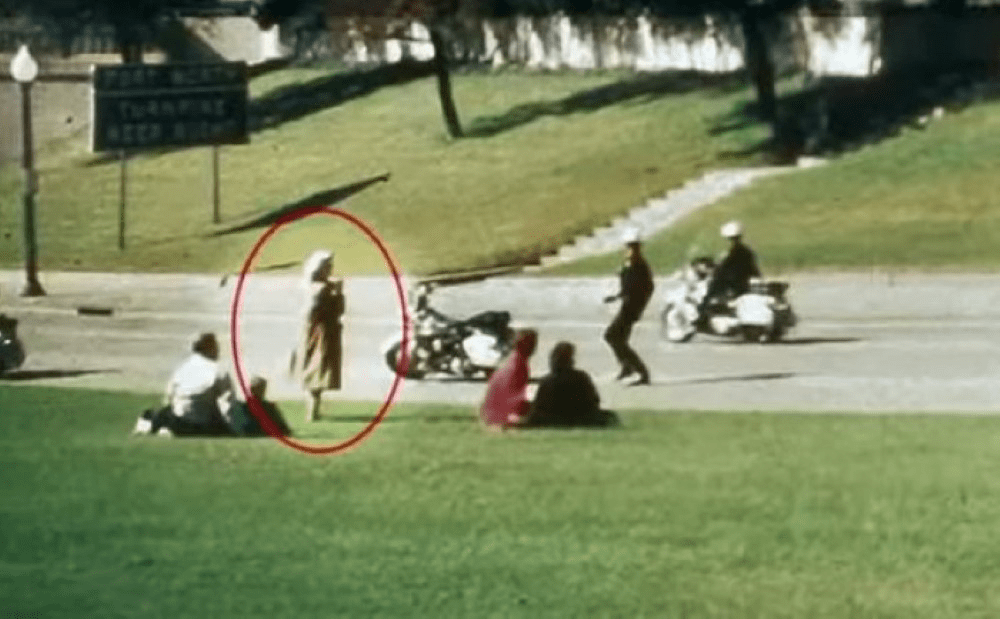
A Woman I Know:
‘Was the Babushka Lady completely overlooked for sixty years because she was a woman? She was [a mere] 33 feet away from the President aiming her camera at him when he was shot in the head, yet, unlike Abraham Zapruder, no mad dash ensued to locate her or her precious footage [Article: 33].
Mary Haverstick takes a much closer and less forgiving look at the Babushka’s movements on Dealey Plaza, including a thorough exploration of the possibility that the Babushka may have been central to the crime.’
‘This footage, originally filmed by Marie Muchmore and stabilized by Mary Haverstick, gives us the best view of Babushka’s movements during the fatal strike.
Notice how she prematurely [swivelled] her view away from Kennedy and Jackie’s faces in order to set up a [clear] shot of the back of Kennedy’s head as he moved away from her.’
By adopting the adjusted stance, the Babushka Lady (B1) had a perfect angle to capture the bullet hitting Kennedy in the head (evidenced by the white plume upon impact, though the frame in question has been deleted from the Zapruder film available to the public) which had come from the direction of the grassy knoll.
Sightings and Evidence
The Babushka Lady is visible in several film footages, including the immensely significant Zapruder film and in various photographs taken by others present that day. She (B1) was positioned perfectly on the grass between Elm and Main streets.
This then raises an intriguing question as the collection of photos and stills reveal four different women – as intimated earlier – yet each are labelled as the Babushka Lady.
For the purpose of this investigation the woman caught in Marie Muchmore’s film is considered the Babushka and others have been given numbers – as already delineated. Thus confirming that this Babushka (B1) is the original and primary person (suspect) of interest.
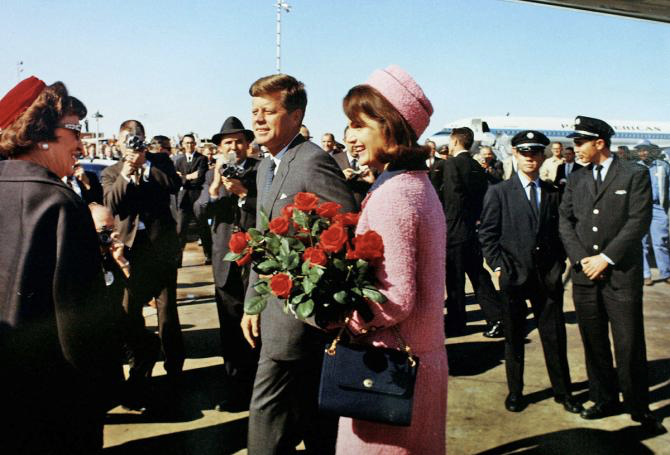
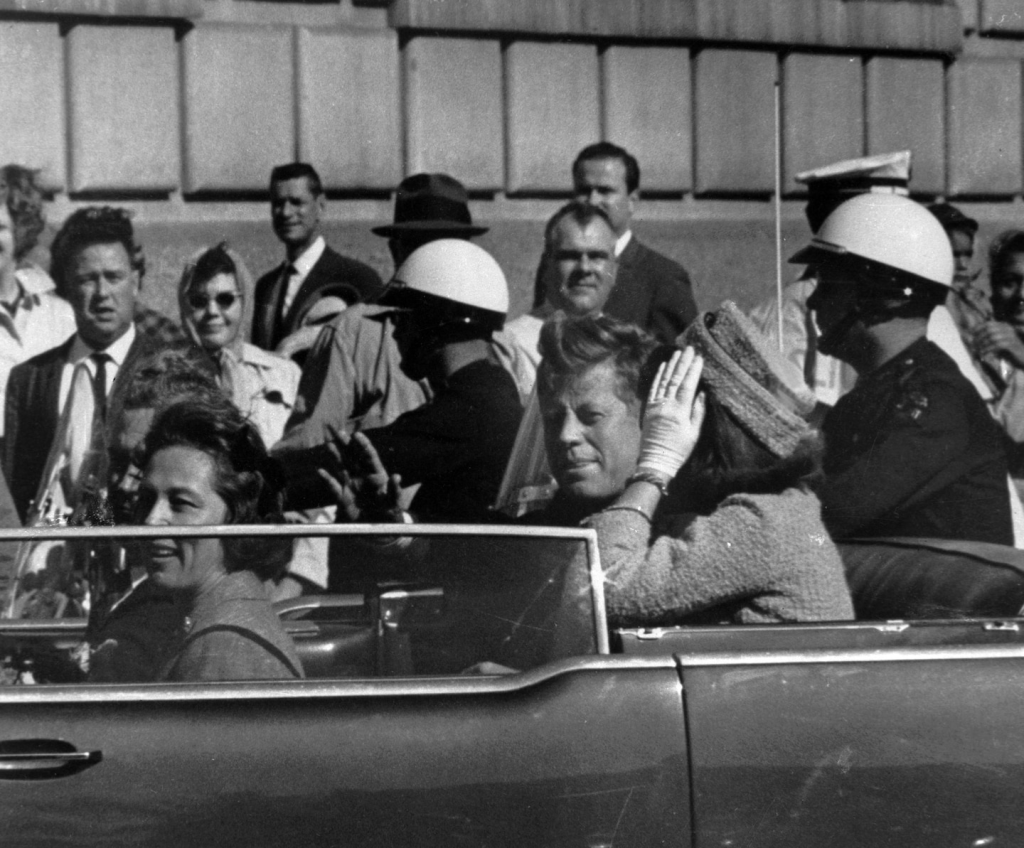
President Kennedy and the first lady at Love Field Airport in Dallas the morning of their fateful day with destiny. Unbeknown to Jack and Jacqueline, their happiness and lives together were to be tragically cut short a few hours later.
A Woman I Know:
‘Abraham Zapruder panned quickly by the Babushka Lady as he followed the President’s limousine with his camera. In this modified Zapruder clip, the section capturing the Babushka is stabilized and slowed down to better scrutinize her movements.’
https://vimeo.com/877222412?fl=pl&fe=cm
‘Babushka’s appearance* in the Zapruder film is brief, but he did manage to capture her pivot as she re-positioned her aim for a shot of the President as he drifted away from her.’
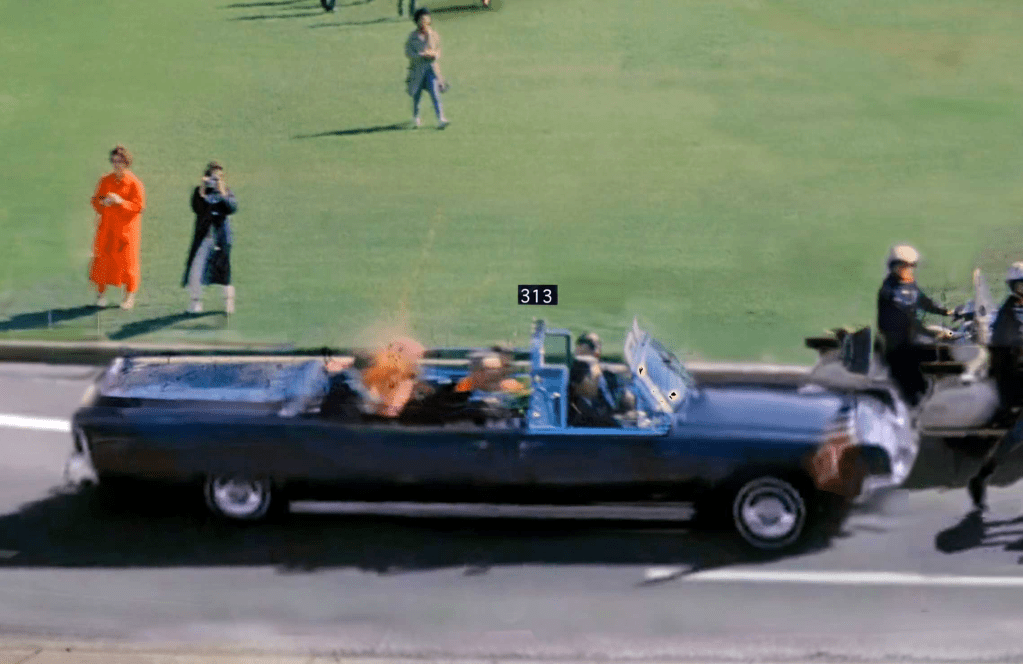
This still is the infamous frame number 313 from the (edited) Zapruder film. It captures the moment just after Kennedy’s fateful head wound, where the initial white spray of brain matter has become red with the addition of spurting blood.
The Babushka Lady (B1) is to the left of the lady in red, back and behind, slightly offset from two or three other people. She is not visible in frame 313 but is briefly in the frames* preceding as shown in the Zapruder film.
Thus Babushka as explained had an advantageous position to film in more detail and perhaps longer for example than Marie Muchmore.
The woman in the top of frame 313 is Babushka 4. Note the ‘jeans’ and similar coloured overcoat and a dark covering of some sort over it appears blond hair.
Online Encyclopaedia – emphasis mine:
‘Her first appearance on film chronologically is on the sidewalk in front of the Dallas County Building, which is visible in an image as being on Kennedy’s right. She would have crossed Houston Street and onto Dealey Plaza in order to be visible in the Dealey Plaza images.
This may imply that the images show two different women of similar appearance.’
Babushka 2a, wearing a light coloured overcoat, a scarf and sunglasses.
Agreed, this is undoubtedly Babushka 2. While she does look remotely suspicious in the way she is dressed and standing – with a rather unsettling smile – this woman in the view of this writer looks little like Babushka (B1) and rightly or wrongly more in keeping with Babushka 2b (below).
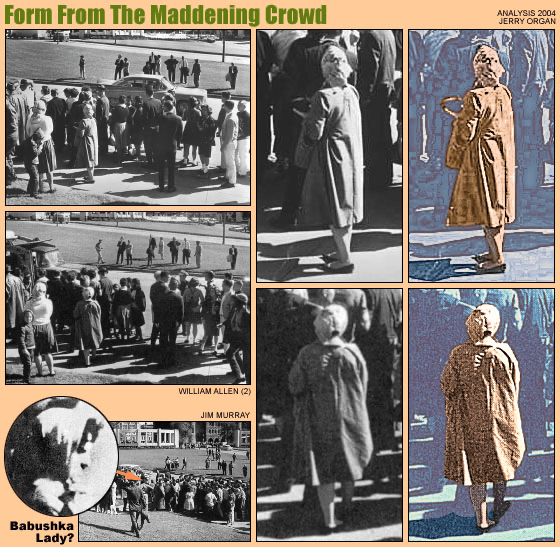
In this montage, there is an invaluable side profile of seemingly, Babushka 2b. She has dark hair like Babushka 2a though is without sunglasses.
Encyclopaedia:
‘It is plausible [though unlikely] that once the motorcade passed by she was able to cross the street to catch a second motorcade drive past on Dealey Plaza where she would be on Kennedy’s left.’
Thus Babushka (B1) was visible enough to be noticed, she was not clear enough to identify. Her face was obscured and her clothing was generic. Her angle in the surviving images does not reveal anything more than her posture and position. It was as if one of if not the most potentially important witnesses of the day had been recorded just well enough to become (in)famous, and just poorly enough to remain forever out of reach – it would seem.
The mystery does not end there as the plot thickens.
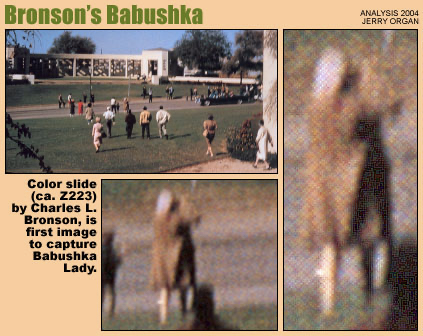
Who pray tell, is this woman?
For while this Babushka (B3) is dressed almost identically to Babushka 1, she
a. has an overcoat which is open like Babushka 2b;
b. does not have a visible line at the top of the calves with a different colour continuing to the hem of her coat as Babushka 1; and
c. in addition, her calves are not only thinner than Babushka 2b but also compared with Babushka 1.
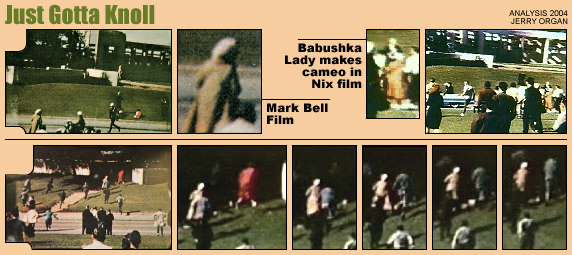
Even more confusing is how it appears to be Babushka 3 who has been captured on film vacating Dealey Plaza up the steps heading north on the grassy knoll.
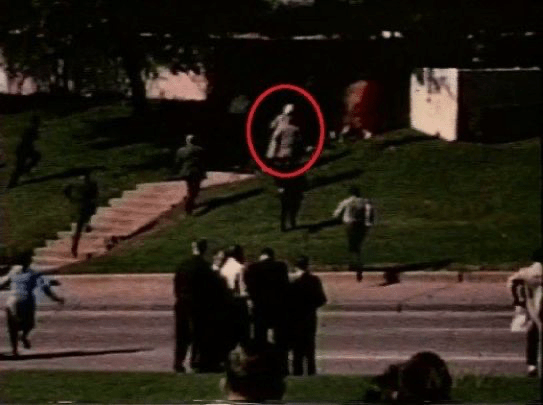
Whoever this woman is, Babushka 3 is following close behind the lady in red as they flee the aftermath of the daytime Dallas nightmare.
Stranger still is how the only other picture of a face aside from the profile of Babushska 2a and the side profile of Babushka 2b (likely the same person) is the still below.
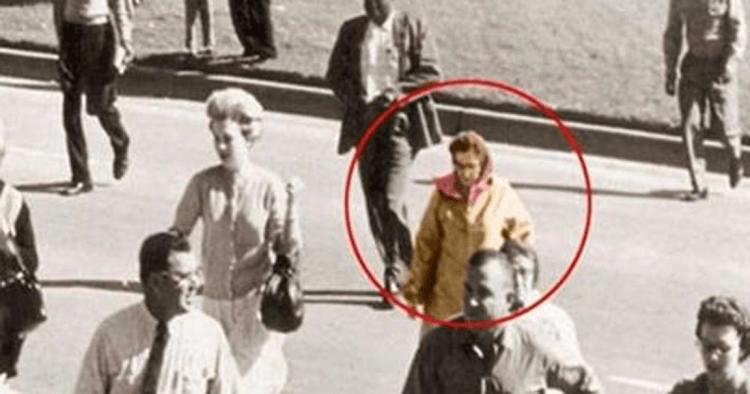
This woman appears to have red hair; her scarf is lowered; and her coat is buttoned. She appears diminutive and older; not resembling the straight posture and more youthful demeanour reflected by Babushka 1.
Is this another woman entirely? Or is this the facial identity of Babushka 3? How many Babushkas were there exactly?
The whole assassination of John F Kennedy is a surreal event, with many of its component parts equally as disorientating. Even in this aspect, the Babushka Lady is enigmatic enough without the addition of multiple look a likes.
If these images existed for Babushka 3 and Babushka 2a, then why did the authorities not track them down? Did they realise they were different people from Babushka 1? As it is for Babushka 1 where there does not appear to be a photo of any part of her face.
She has so easily slipped through the net. Yet why more than one Babushka, all dressed in tan/light brown overcoats and pink shades of head scarves?
This is an extraordinary coincidence. Palpably, the woman all received the memo that morning – but this of itself is highly suspicious. Multiple agents used as decoys, so as to confuse and deflect from one in particular perhaps? One agent tasked with getting as near as possible to the President’s car on Elm Street and the very segment of road where the key bullet fired would find its (lethal) mark.
Is this why the Babushka Lady was ignored and allowed to disappear into obscurity, because she was a (CIA) agent performing a mission to film the crucial seconds when Kennedy died. For logically, relying on a civilian to capture the exact moment was risky.
Abraham Zapruder was one of at least 32 people in Dealey Plaza known to have made a film or take photographs at or around the time of the shooting. The Babushka Lady would be interestingly, number 33 – Article: 33.
A Woman I Know:
‘In an effort to understand how events on Dealey Plaza unfolded, Haverstick created a Multicam video composite from all the primary angles filmed of the Kennedy assassination. Of particular interest were the movements of the Babushka Lady before and after the fatal shot.’
‘Notice how quickly the scene evolved, and how the Babushka first stood motionless after the fatal shot was fired, then was among the first onlookers to exit the scene to the parking area beyond the grassy knoll.’
Online Encyclopaedia:
‘Although it is not the only film of the shooting, the Zapruder film has been described as the most complete, offering a relatively clear view from a somewhat elevated position on the side from which the president’s fatal head wound is visible. Given the camera’s 18.3 frames-per-second speed [and a running time of 26 seconds, containing 486 frames], the film served as a “clock” to construct a detailed timeline of the shots fired.’
Even so, enough evidence exists to expose the Zapruder film made available to the public – and used by the Warren Commission – is an edited (spliced in more than one place) version, so that the conclusions drawn on:
a. how many shots were fired;
b. when they were fired;
c. from where they originated; and
d. fired by whom, are all called into question.
Encyclopaedia – emphasis mine:
‘JFK assassination conspiracy theorists have long questioned whether the film known to the public as the Zapruder film is identical to what Abraham Zapruder recorded in his camera, or whether the film was subsequently altered.
For example, critics point to the fact that the Zapruder film seems to show the presidential limousine moving at a steady rate throughout, whereas numerous eyewitnesses testified that the limousine briefly came to a stop or near-stop during the shooting.
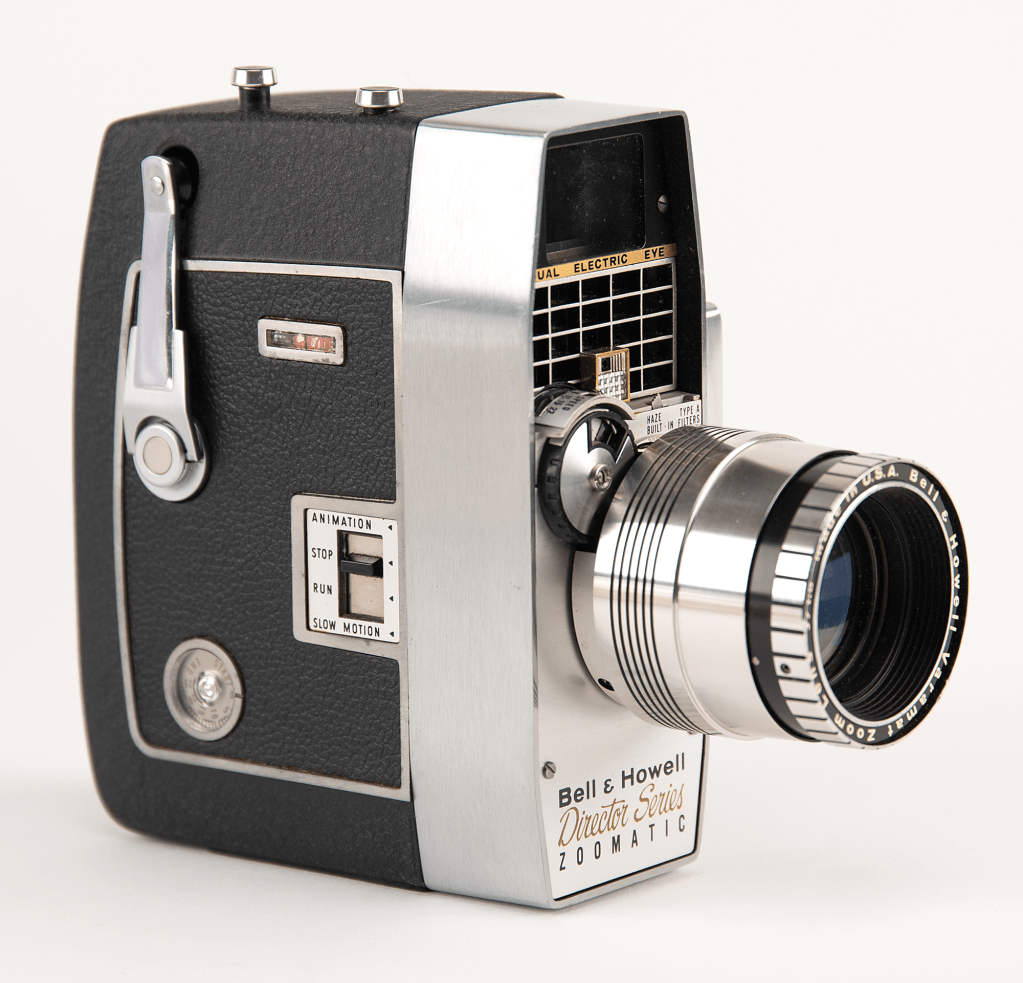
The camera model used by Abraham Zapruder
In October 1965, JFK assassination researcher David Lifton went to the UCLA Law School office of Professor Wesley Liebeler, the former Warren Commission staff attorney who had taken Zapruder’s testimony. Lifton referred Liebeler to a page in the Warren Commission Hearings and Exhibits, Volume 18, where an apparent splice could be seen in a printed Zapruder frame:
The splice was clearly visible in frame 212. A thick black horizontal line ran across the center of the frame where the film had been cut, frames removed, and the two ends spliced together. Liebeler practically did a double take.
Liebeler initially made a wry comment that the splice was a “very unlawyerlike” way of handling evidence. He then wrote a letter to Warren Commission General Counsel J. Lee Rankin, asking if there was “a ready explanation for the omission of the frames”, and if the matter should be formally raised with the FBI for follow-up.
Liebeler received two replies, one from Rankin’s assistant Norman Redlich suggesting that “the frames you have in mind were deleted… because… they were of little value because during those frames the Presidential limousine was almost completely hidden by the (Stemmons Freeway) sign”, and one from Rankin saying that Redlich’s reply disposed of the matter.
In January 1967, Life magazine issued a statement that the splice was a result of a photo lab technician accidentally damaging the footage near frame 212, which had to be repaired with a splice. In early 1969, assassination researcher Josiah Thompson discovered a second splice, near frame 155.
In addition to concerns about possible alterations, the claim that the Zapruder film covers the entire shooting from beginning to end has been called into question. Max Holland, author of The Kennedy Assassination Tapes, and professional photographer Johann Rush, wrote a joint editorial piece, published by The New York Times on November 22, 2007.
It noted that Zapruder paused filming at around frame 132, when only police motorcycles were visible. When Zapruder resumed filming, frame 133 already shows the presidential motorcade in view. Holland and Rush suggest that the pause could have great significance for interpreting the assassination.
One of the controversies with the Warren Report is its difficulty in satisfactorily accounting for the sequencing of the assassination, in particular, what happened to the one shot that missed, and how Lee Harvey Oswald came to miss at what was assumed to be close range.
Holland and Rush argue that the break in the Zapruder film might conceal a first shot earlier than analysts have hitherto assumed. In that scenario, a horizontal traffic mast would temporarily have obstructed Oswald’s line of sight.
In the authors’ words,
“The film, we realize, does not depict an assassination about to commence. It shows one that had already started.”
The evidence offered by Holland and Rush to support their theory was challenged in a series of 2007–08 articles by computer animator Dale K. Myers and assassination researcher Todd W. Vaughan, who defended the prevailing belief that Zapruder’s film captured the entire shooting sequence.
The authenticity of the image in frame 313 [fatal head shot] was disputed by Douglas Horne, Senior Analyst for the Assassination Records Review Board, and by Dino Brugioni of the CIA’s National Photographic Interpretation Center (NPIC), who was considered one of the world’s foremost imagery analysts.
Horne learned that the NPIC worked on two different versions of the Zapruder film on Saturday and Sunday nights immediately following the Friday assassination.
The NPIC analysis was done by separate teams, which had been compartmentalized and ordered not to speak of their work. When Horne showed his findings and evidence to Brugioni, the latter re-examined a copy of the extant Zapruder film, provided by Horne. Brugioni concluded that the Zapruder film in the National Archives and available to the public, specifically frame 313, is an altered version of the film he saw and worked with on November 23–24, the earlier of the two versions handled by the NPIC.
Brugioni recalled seeing a “white cloud” of brain matter, three or four feet (91 or 122 cm) above Kennedy’s head, and said that this “spray” lasted for more than one frame of the film.
The version of the Zapruder film available to the public depicts the fatal head shot on only one frame of the film, frame 313.
Brugioni was certain that the set of briefing boards available to the public in the National Archives is not the set that he and his team produced on November 23–24.’
The Kennedy family purchased the Zapruder film from Life magazine in 1999 for $16 million. Meanwhile, the ‘original’ Zapruder film is stored in the National Archives and Records Administration (NARA) in College Park, Maryland. Yet the copyright restrictions mean the Kennedy family retains control over commercial use of the film.
So while the Zapruder footage was filmed from left to right; conversely, footage filmed from right to left would have been invaluable if the Babushka Lady had indeed been filming from the other side of Elm Street – like Marie Muchmore but closer. It is also noteworthy either by accident or preparation that Babushka… was on the side less likely to have been hit when additional shots was fired (or misfired) from another direction, as well as the added benefit of being in a prime position to film.
As an aside, it is wondered if this Elm Street was the inspiration for Wes Craven’s block buster and classic horror film, A Nightmare on Elm Street (1984). Upon checking, it sadly seems it was.
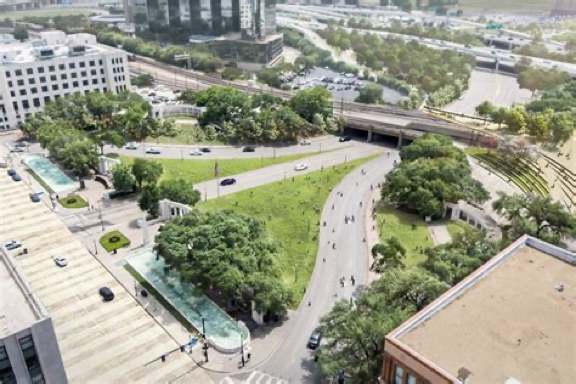
Dealey Plaza viewed from the east with the corner of the Texas Schools Book Depository building in the lower right hand corner.
There was circumstantial evidence that (three) shots had been fired from the Texas Schools Book Depository (TSBD) building. Three empty bullet casings, and a conveniently hidden rifle, were found on the sixth floor of the building. The shells were matched to the rifle (originally identified as a German Mauser, subsequently changed to an Italian Carcano rifle to implicate Lee Harvey Oswald) and to some but not all, of the bullet fragments retrieved from President Kennedy’s car.
Howard Brennan was standing opposite the TSBD, and saw a man with a gun in a sixth-floor window.
Geneva Hine was on the second floor: “[the shots] came from inside the building … the building vibrated from the result of the explosion.”
Patricia Lawrence was standing outside the TSBD: “I thought the shots had come from right over my head.”
Approximately forty witnesses claimed that at least one bullet was fired from the direction of the infamous grassy knoll in the northwest corner of Dealey Plaza, or to have seen smoke or smelled gunpowder in that area – about a hundred yards to the west of the TSBD* – in front of President Kennedy instead of from behind.*
The Warren Commission in 1964 had been given the task of showing that the assassination was the work of one person (Oswald) and that all the shots had come from one direction* – so as to hide the reality of ‘official’ involvement.
Consequently, the Commission brushed aside the evidence of any shots from the front. However, the House Select Committee on Assassinations in 1979 accepted that at least one shot had been fired from behind the fence on the grassy knoll.
Encyclopaedia:
‘In March 1965, Harold Feldman wrote that there were 121 witnesses to the assassination listed in the Warren Report [out of approximately six hundred people at the Dealey Plaza that day], 51 of whom indicated that the shots that killed Kennedy came from the grassy knoll, while [only] 32 said the shots originated from the Texas School Book Depository.
In 1967, Josiah Thompson examined the statements of 64 witnesses and concluded that 33 [half] of them thought that the shots emanated from the grassy knoll.’
Jean Hill was standing on the south side of Elm Street, just a few yards from President Kennedy when he was shot in the head. Mrs. Hill stated she heard from four to six shots [at least four] in all and believes they came from a spot on the grassy knoll just west of the Texas School Book Depository Building – March 13, 1964.
Sam Holland was standing on the railway bridge known as the triple underpass, at the west end of Dealey Plaza.
“When they got just about to the Arcade I heard what I thought for the moment was a fire cracker and he slumped over [a bullet which some believe entered Kennedy’s neck and was not an exit wound from one entering his upper back]…”
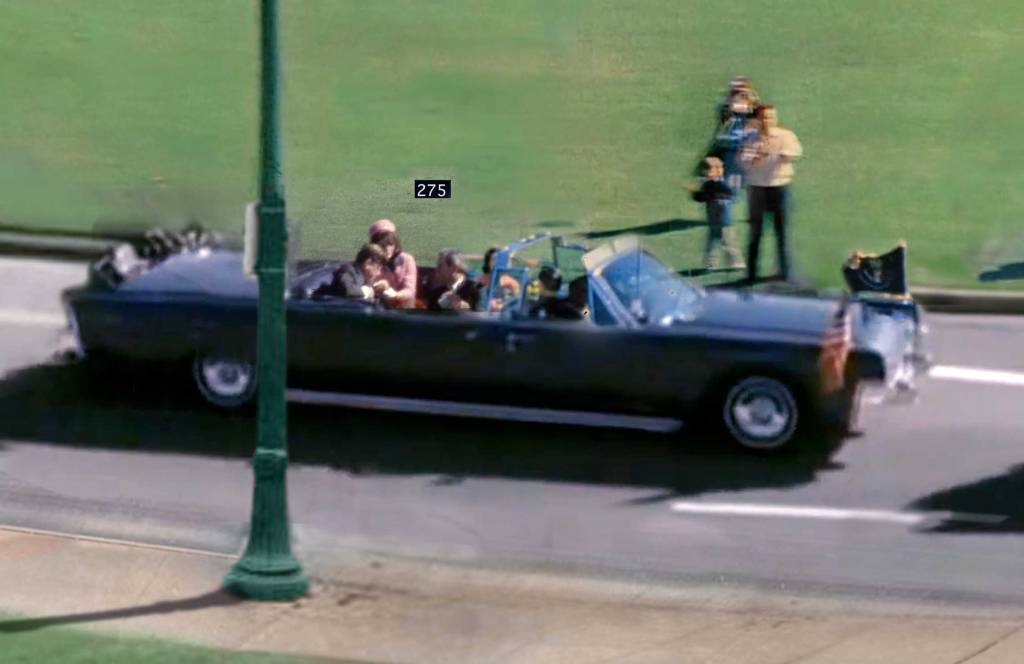
“… and I looked over toward the arcade and trees and saw a puff of smoke come from the trees and I heard three more shots after the first shot but that was the only puff of smoke I saw… But the puff of smoke I saw definitely came from behind the arcade through the trees” – November 22, 1963
Mr Holland: “I counted four shots and about the same time all this was happening, and in this group of trees – [indicating].”
Mr Stern: “Now, you are indicating trees on the north side of Elm Street?”
Mr Holland: “These trees right along here [indicating].”
Mr Stern: “Let’s mark this Exhibit C and draw a circle around the trees you are referring to.”
Mr Holland: “Right in there. [Indicating]… And a puff of smoke came out about 6 or 8 feet above the ground right out from under those trees. And at just about this location from where I was standing you could see that puff of smoke, like someone had thrown a fire-cracker or something out, and that is just about the way it sounded… There were definitely four reports [4 total].”
Mr Stern: “You have no doubt about that?”
Mr Holland: “I have no doubt about it. I have no doubt about seeing that puff of smoke come out from under those trees either” – April 8, 1964.
A J Millican: “I was standing on the North side of Elm Street, about half way between Houston and the Underpass… I heard three shots come from up toward Houston and Elm right by the Book Depository Building, and then immediately I heard two more shots come from the Arcade between the Book Store and the Underpass, and then three more shots [at least four] came from the same direction only sounded further back” – November 22, 1963.
Luke Mooney, a deputy sheriff, was standing on Main Street, on the edge of Dealey Plaza. He was one of the officers who later found the rifle hidden (planted) under boxes on the sixth floor of the book depository.
Mr Ball: “Why did you go over to the railroad yard?
Mr Mooney: “Well, that was – from the echo of the shots, we thought they came from that direction” – March 25, 1964.
The key word here is echo and so the minimum of four shots witnesses agree upon – even if not always the direction – were plausibly caused by the initial sound of guns being fired. The confusion of further rifle reports could be accounted for by the echoes of the original four bullets. Which not only blurs the sound of how many shots may have been fired, especially if someone happens to be very close to a passing bullet, but also can make it difficult to know exactly which direction the bullet has travelled from.
Support for this is found in the fact the amount of shots reported and confirmed by witnesses tended to be an even number.
Encyclopaedia:
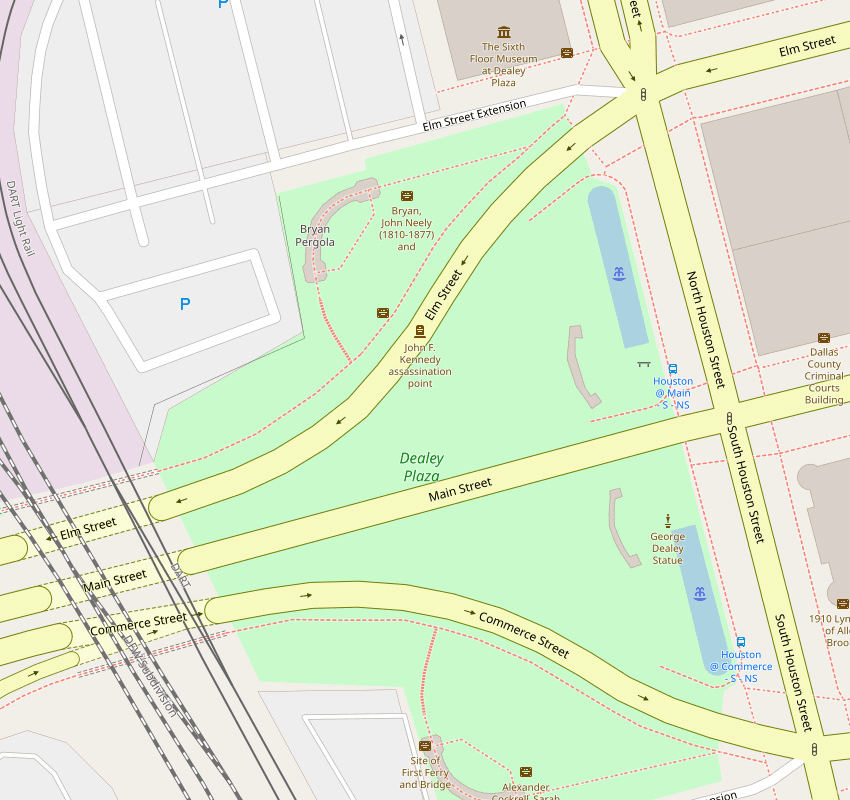
‘Lee Bowers operated a railroad tower that overlooked the parking lot on the north side of the grassy knoll. When interviewed by the Warren Commission in 1964, he reported that he saw two men behind the grassy knoll’s stockyard fence before the shooting took place. The men did not appear to be acting together or doing anything suspicious. After the shooting, Bowers said that one of the men remained behind the fence, but that he lost track of the second man whose clothing blended into the foliage.
When interviewed… in 1966… Bowers noted that he saw something that attracted his attention, either a flash of light [muzzle flash] or smoke from the knoll, allowing him to believe “something out of the ordinary” had occurred there. Bowers told Lane that he heard three shots, the last two in quick succession [two sharpshooters?].’
The Warren Commission made a concerted effort to convince the public that there was one ‘crazy’ assassin (Lee Harvey Oswald) working alone and fired (three bullets) from behind President Kennedy’s car once it had turned left onto Elm Street; thereby endeavouring to conceal that there were at least two assassins, with another shooting from the other direction on Elm Street towards the front of the president’s car.
It is logical (common sense) to ensure that the mission to kill Kennedy was enacted with a successful outcome and so the tactic used was the formation of a pincer position with snipers either end of Elm Street. Perhaps there were four (or more), with likely two either end.
For what are deemed the ‘first’ two shots were only 1.6 seconds apart.
The sniper(s) stationed on the east end of Elm Street had arguably the more difficult position and it may explain a shot which missed(?); but certainly the bullet (1) that hit Governor John Connally (the ‘magic bullet’ erroneously believed to have passed through Kennedy before seriously wounding the Governor) instead of the intended mark the president; and the bullet (2) which hit Kennedy in the upper back and supposedly [yet unrealistically] exited from his neck/throat.
Though as mentioned, there is reason to consider that a different bullet entirely entered Kennedy’s neck (from the front).
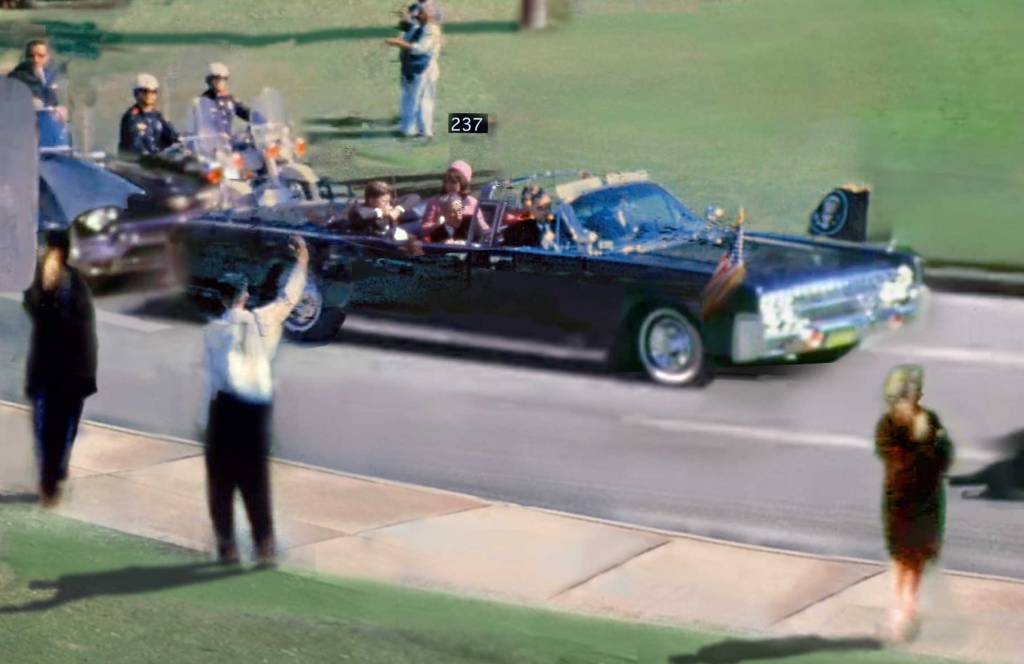
Once the motor cavalcade had moved further along Elm Street, then at least one shot (of two)* appears to have originated from the west end of Elm Street – the Grassy Knoll – and these were allegedly 6 seconds later and 0.7 seconds apart.
Note, these timings are based on the edited Zapruder film and therefore contain a margin of error.
It is of significant interest how the two shots labelled as ‘first’ and ‘second’ were some six to seven seconds prior to the ‘third’ and ‘fourth’ shots. Therefore these four shots (in the least) were fired chronologically in pairs. This gives credence to perhaps four marksmen, in pairs and stationed at opposite ends of the Elm Street assassination zone.
Encyclopaedia:
‘Several conspiracy theories posit that at least one shooter was located in the Dal-Tex Building, located across the street from the [TSBD]. According to L. Fletcher Prouty, the physical location of James Tague when he was injured by a bullet fragment is not consistent with the trajectory of a missed shot from the Texas School Book Depository, leading Prouty to theorize that Tague was instead wounded by a missed shot from the second floor of the Dal-Tex Building.’
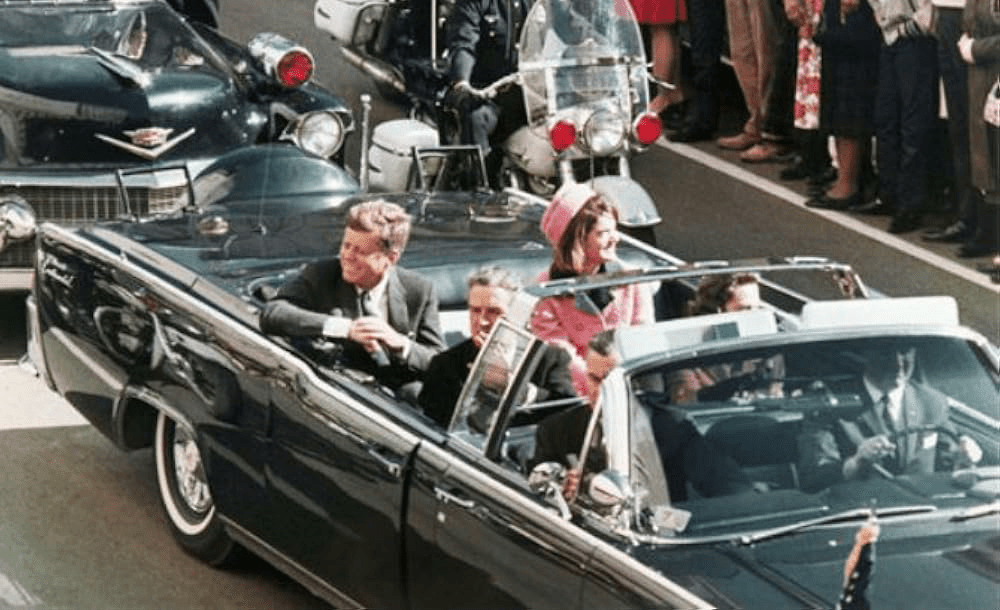
Tellingly, ‘some researchers claim that FBI photographs of the presidential limousine show a bullet hole in its windshield above the rear-view mirror, and a crack in the windshield itself. When Robert Groden, author of The Killing of a President, asked for an explanation, the FBI responded that what Groden thought was a bullet hole “occurred prior to Dallas”.
In 1993, George Whitaker, a manager at the Ford Motor Company’s Rouge Plant in Detroit, told attorney and criminal justice professor Doug Weldon that after reporting to work on November 25, 1963, he discovered the presidential limousine in the Rouge Plant’s B building with its windshield removed. Whitaker said that the limousine’s removed windshield had a through-and-through bullet hole from the front.* He said that he was directed by one of Ford’s vice presidents to use the windshield as a template to fabricate a new windshield for installation in the limousine. Whitaker also said he was told to destroy the old one.’
Some might argue that the bullet hole in the windscreen could have been caused by a shot from the TSBD building. Against this is the impossible trajectory from the building and whether it had ricocheted through either Kennedy or Connally first. Whereas a lower elevated shooter from the grassy knoll area – one who hit Kennedy in the head (or throat) – may have had no other choice but to shoot through the windscreen first. A further explanation is the hole in the windscreen may be evidence of the ‘missing’ bullet.
Others will also ask, where were the bullets which were fired on the day? Spectators in their dispersal from Dealey Plaza during the aftermath no doubt may have happened on the bullets laying on the road or anywhere else nearby and pocketed them – whether civilian, police or security agents.
More significantly than shots fired from a different direction than the TSBD building, is the fact that when the fatal shot struck; ‘the President’s head and upper torso moved rapidly backwards – indicating, to many observers, a shot from the right front.
Sherry Gutierrez, a certified crime scene and bloodstain pattern analyst, concluded “the head injury to President Kennedy was the result of a single gunshot fired from the right front of the President.”
‘Paul Chambers believes that the fatal head shot is consistent with a high velocity (approx. 1,200 m/s; 3,900 ft/s) rifle rather than the medium-velocity (600 m/s; 2,000 ft/s) Mannlicher–Carcano [or in actuality the originally identified German 7.65 mm Mauser rifle].
Close inspection of the Zapruder film (frames 312 and 313) show Kennedy’s head moves downward immediately before it moves rapidly backwards. Anthony Marsh suggests that this downward motion was caused by driver William Greer’s deceleration of the car.
… Josiah Thompson, Robert Groden and Cyril Wecht, suggest that this downward-and-then-backward motion was caused by two* near-simultaneous bullets: one from the rear and the other from the right front.’
An explanation from another investigator concluded the double movement of Kennedy’s head in this manner was indicative of the recoil caused by a shot from behind.
Even more damning evidence that an effort was made to cover up the multiple gunmen scenario in favour of a lone assassin are the discrepancies between the Parkland Memorial Hospital (Dallas) where the body of John F Kennedy was first taken and later Bethesda Naval Hospital (Maryland) afterwards.
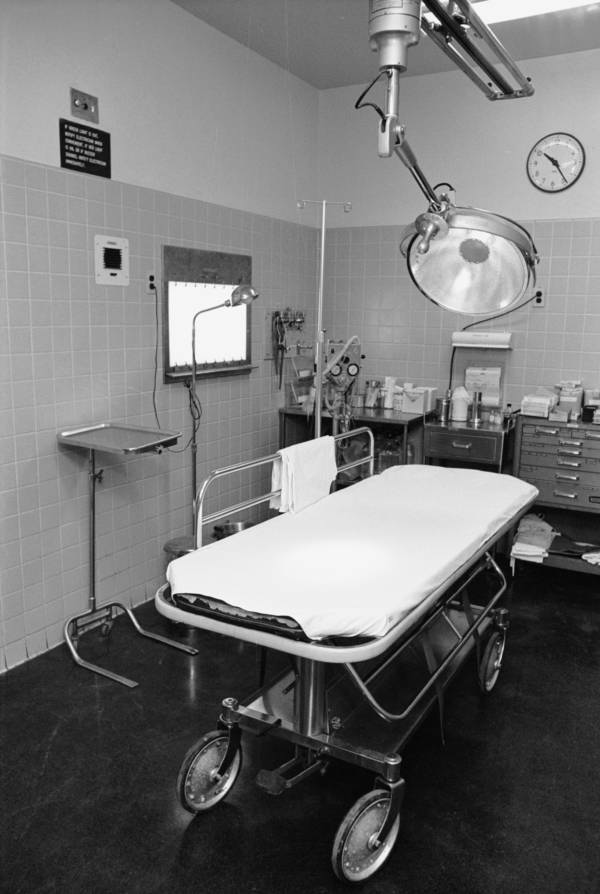
The Emergency room at Parkland Memorial Hospital
Encyclopaedia:
‘There is a conflicting testimony regarding the autopsy performed on Kennedy’s body, particularly during the examination on his brain and whether or not the photos submitted as evidence are the same as those taken during the examination. At [BNH], Commander J. J. Humes, the chief autopsy pathologist noted that Kennedy’s brain weighed 1,500 grams following formalin fixation.
Douglas Horne, the Assassination Record Review Board’s chief analyst for military records, said he was “90 to 95% certain” that the photographs in the National Archives are not really of Kennedy’s brain. Some conspiracy theorists have said that Kennedy’s brain was stolen to cover up evidence that he was shot from the front.
David Lifton presented a scenario in which conspirators on Air Force One removed Kennedy’s body from its original bronze casket and placed it in a shipping casket, while en route from Dallas to Washington. Once the presidential plane arrived at Andrews Air Force Base, the shipping casket with the President’s body in it was surreptitiously taken by helicopter from the side of the plane that was out of the television camera’s view.
Kennedy’s body was then taken to an unknown location – most likely Walter Reed Army Medical Center – to surgically alter the body [head, brain] to make it appear that he was shot only from the rear.
Laboratory technologist Paul O’Connor was one of the major witnesses supporting another part of David Lifton’s theory that somewhere between Parkland and Bethesda the President’s body was made to appear as if it had been shot only from the rear.
O’Connor said that President Kennedy’s body arrived at Bethesda inside a body bag in “a cheap, shipping-type of casket”, which differed from the description of the ornamental bronze casket and sheet that the body had been wrapped in at Parkland Hospital.
O’Connor [who assisted in the President’s autopsy], said that the brain had already been removed by the time it got to Bethesda, and that there were “just little pieces” of brain matter left inside the skull.
In August 1977, Paul O’Connor… told investigators for the HSCA that there was “nothing left in the cranium but splattered brain matter” and “there was no use me opening the skull because there were no brains.”
The identity of the snipers may never be revealed, yet the confession from former CIA agent Howard Hunt perhaps is the simplest and most accurate in that ‘all the clues lead’ to the CIA and Lyndon B Johnson.
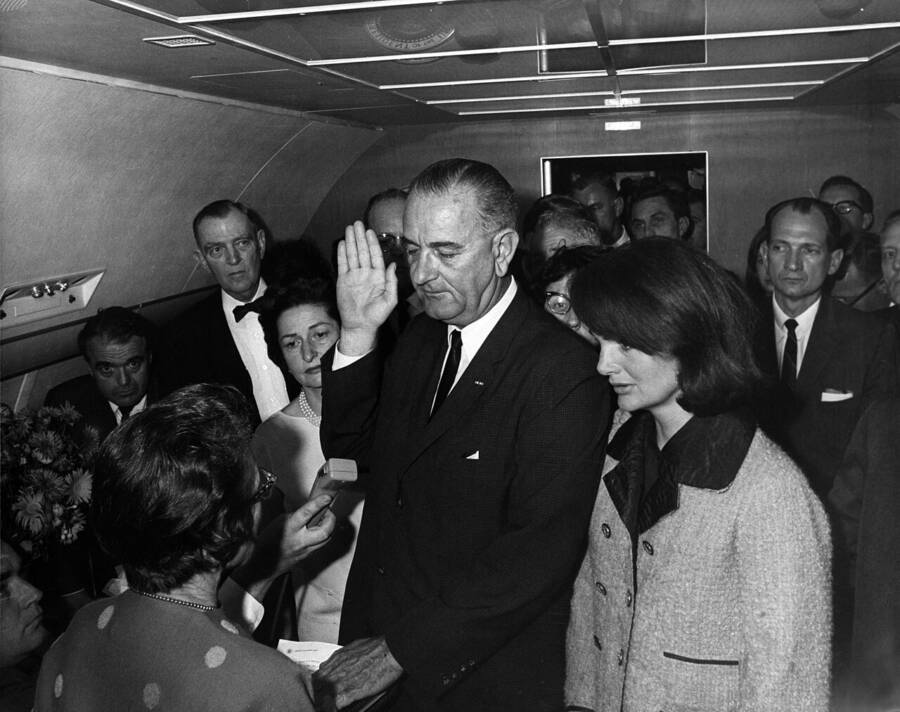
Lyndon B Johnson (August 27, 1908 – January 22, 1973) takes the oath of office aboard Air Force One just two hours (2.30pm) after the assassination (12.30pm) while Jackie Kennedy (right), still in her blood-soaked clothes, looks on.
Encyclopaedia:
‘The theory that the former CIA agent and Watergate burglar E. Howard Hunt was a participant in the assassination of Kennedy garnered much publicity from 1978 to 2000. In 1981, Hunt won a libel judgment against Liberty Lobby’s paper The Spotlight, which in 1978 printed an allegation by Victor Marchetti stating that Hunt was in Dallas on the day of the assassination and suggesting Hunt’s involvement in a conspiracy…
After Hunt’s death in 2007, an audio-taped “deathbed confession” in which Hunt claimed first-hand knowledge of a conspiracy, as a co-conspirator, was released by his son Saint John Hunt. In the confession, Hunt claimed to have been a “benchwarmer” in Dallas during the events, and he named several high-level CIA operatives as those who likely carried out the logistics of the assassination. Hunt named Vice President Lyndon Johnson as the most likely figure behind the main impetus of the conspiracy.’
“I will splinter the CIA into a thousand pieces and scatter it into the winds” – John F Kennedy.
It looks like they got to him first.
While Kennedy garnered numerous enemies from a number of quarters due to his policies and decisions, it was firstly, planning to drop (the unsavoury) Lyndon Johnson as his vice presidential running mate in the 1964 election and secondly, the signing of Executive Order 11110^ nearly six months earlier which undoubtedly led to
a. Johnson’s involvement; and
b. the Establishment’s decision to eliminate a problematic president – Article: The Establishment: Who are they… What do they want?
In this regard, most Americans at the time did not realise just how much of a true patriot^ John F Kennedy was to the American people and on behalf of the American nation.
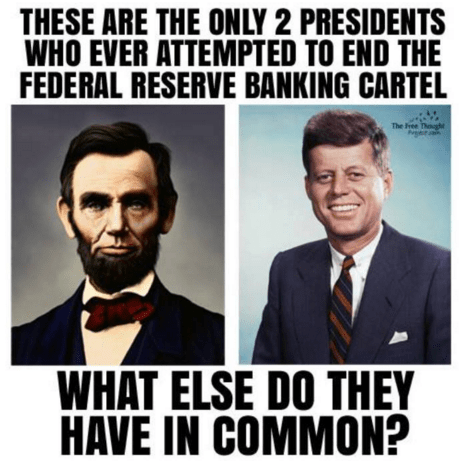
For in time, the transference^ of the money supply from the privately owned Federal Reserve to the United States Treasury would have eventually eliminated the national debt; returning usury free fiscal power back to the American people – Article: The Establishment: Who are they… What do they want?
Identity and Claims
One of the Babushkas was last seen (after the shooting had ended) crossing Elm Street – the street the motorcade turned onto before the first shots were fired – and joining the throng escaping up the steps of the grassy knoll. Any hope of learning her identity or finding valuable potential footage she may have possessed frustratingly disappeared forever.
That said, Gary Mack who testified before the Assassination Records Review Board (ARRB) in 1994, explained how he had been told by a Kodak executive from the Dallas office that a woman in her early thirties (with brunette hair) brought in film purported to be of the assassination scene while they were at the time processing the Zapruder film.
Apparently the woman (Kodak Lady 1) had explained to federal investigators at the film processing office that she ran from Main Street across the grass to Elm Street where she stopped and snapped a photo – just one? Supposedly, the photo was blurry and ‘virtually useless’ and so it is probable the woman went home without anyone recording her identity.
A similar account was shared by Kodak technician Jack Harrison, who claimed to have developed a colour film for a brunette woman (Kodak Lady 2) in her 30s or 40s on the day of the assassination.
Was this Babushka?
Possibly… if she was a regular civilian.
Probably not… if she was a CIA agent.
In 1970, a woman named Beverly Oliver came forward, purporting to be the Babushka Lady. Oliver claimed she had filmed the assassination, handing the undeveloped film to men she believed were FBI agents. However, her claims have been met with skepticism due to inconsistencies; including
a. an age discrepancy;
b. a contradictory physical description of her compared to the Babushka Lady; and
c. the type of camera she claimed to have used not being in existence in 1963.
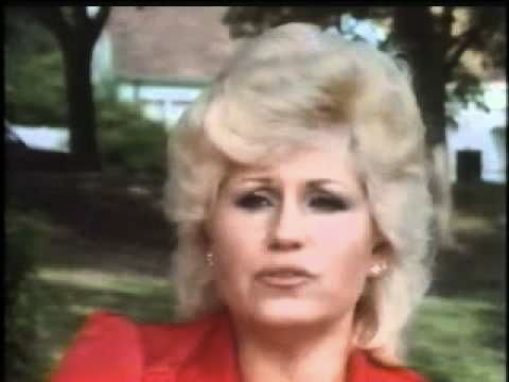
Unraveling The Mystery Of The Babushka Lady Who Witnessed JFK’s Assassination, Katie Serena (September 17, 2022), John Kuroski (March 12, 2024):
‘In 1970, a woman named Beverly Oliver was at a church revival meeting in Texas, when she revealed to a conspiracy researcher named Gary Shaw that she was the Babushka Lady. She claimed she had filmed the entire assassination on a Super 8 film Yashica camera [on the south side of Elm Street, making her one of the closest witnesses to the fatal shot], but that before she could develop the film two FBI agents had confiscated it [on November 25].
She admitted that she never saw their credentials, but that they had claimed that they were agents. They told her they would return the film within 10 days, but she never received any kind of confirmation, nor did she ever see the video again [The agent she claimed had taken her camera was coincidentally named Regis Kennedy. However, he was in New Orleans at the time]. She did admit… that she never followed up herself, for fear of being arrested for possessing marijuana.
As vehemently as she touted her story, those who opposed it did so with as much vigor. Doubters were quick to point out that the camera she claimed to have used, the Yashica Super 8, hadn’t even been produced until 1969, six years after the assassination. Confronted with this fact, she brushed it off, insisting it was an “experimental” model that she got before it was made widely available, and that it didn’t even have a name on it at the time.’
Encyclopaedia:
‘Critics have pointed out that Oliver’s physical description – a 17-year-old [tall] slender blonde in 1963 – contrasts sharply with the Babushka Lady’s apparent age of 30 to 40, stockier build, and darker hair visible beneath the headscarf in Dealey Plaza films.’
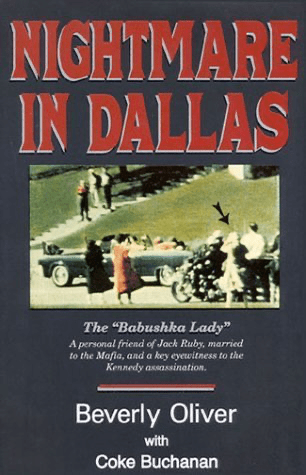
Katie Serena:
‘The most common theories were that Babushka Lady was a Russian spy or that she was a dirty government official. Some speculated that she was a member of the Secret Service or that the camera she was holding was actually a gun. Given that Oliver had seemingly come out of nowhere and didn’t fit the description of the lady in the photos, theorists immediately began to suspect that she had a sinister background.’
The Babushka Lady, Ian W Granstra, November 9, 2023:
‘Oliver was a dancer at the Colony Club in Dallas, located next to the Carousel Club owned by Jack Ruby. Two days after President Kennedys’ assassination, Ruby shot presumed killer Lee Harvey Oswald to death. When questioned, Oliver said Ruby had introduced her to Oswald several weeks earlier at the Carousel Club. She also claimed to have seen David Ferrie and Jack Lawrence at the club, two men frequently mentioned as having involvement in President Kennedy’s assassination.’
Encyclopaedia:
‘In 2023, filmmaker Mary Haverstick proposed in her book [A Woman I Know: Female Spies, Double Identities and a New Story of the Kennedy Assassination] that the Babushka Lady could have been pioneering aviator Jerrie Cobb (1931–2019), a member of the Mercury 13 astronaut candidate group, or possibly CIA operative June Cobb (1928–2005), due to alleged identity overlaps and circumstantial ties to Dallas on November 22, 1963.’
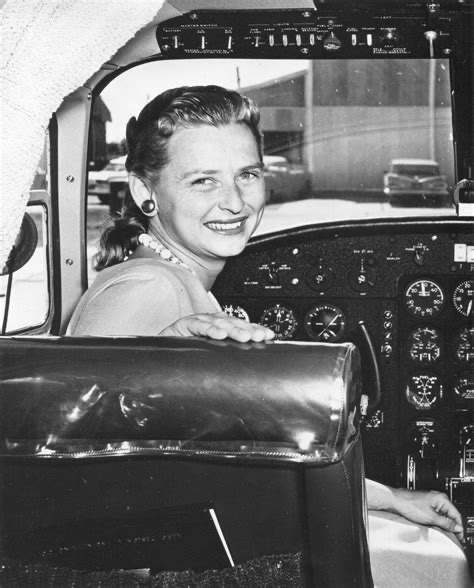
Geraldyn Meron “Jerrie” Cobb
‘Haverstick’s theory draws on Jerrie Cobb’s aviation activities, including her self-reported piloting of a small aircraft at Redbird Airport south of Dallas that day, and June Cobb’s espionage background in anti-Castro plots. This identification remains speculative and has not been widely accepted by assassination researchers.’
‘My friend was a secret CIA agent – and I think she was the second JFK shooter’, Gordon Rayner, November 19, 2023 – emphasis mine:
‘What Haverstick found out was that [Jerrie] Cobb flew a light aircraft in and out of a private airport in Dallas on the day of the assassination, in such peculiar circumstances that she became convinced she played a role in the murder, possibly as an intended getaway pilot for [an] assassin…
If that were not startling enough, she also came to suspect that Cobb was a mysterious character known to Kennedy investigators as the Babushka Lady, who was the closest person filming the president at the moment he was shot, but who vanished after the assassination, along with her all-important footage.
… another woman, June Cobb… appears in declassified CIA files as an agent who worked as Fidel Castro’s secretary in Communist revolutionary Cuba in the late 1950s.
June Cobb’s name also appears repeatedly in files relating to the Kennedy murder, not least because she alerted the CIA to the suspicious behaviour of Lee Harvey Oswald in Mexico City weeks before Kennedy’s assassination. Intriguingly, at least one 20-page file on June Cobb is among the 3,000-4,000 documents relating to the assassination that Joe Biden is still refusing to release.’
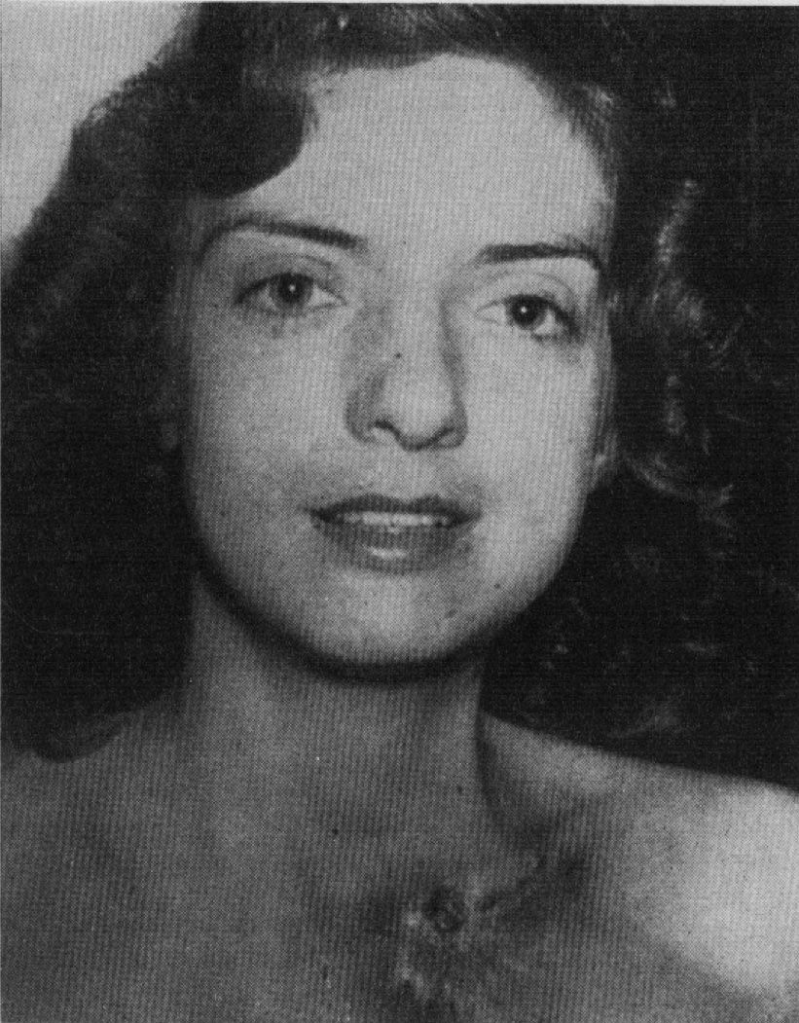
June Cobb (1)
‘Haverstick discovered what she describes as an astonishing list of similarities between June Cobb and Jerrie Cobb, and became so convinced that they were either the same person or that they had been swapping identities that she had to confront Jerrie with what she had found.
“Her answers were bizarre, off the rails,” she says. “She seemed first of all thrilled that I had found June Cobb. I expected her to walk out in a huff that I was looking into this or I had come up with a wild theory.
“But she was happy; she technically denied being June, then proceeded to tell me lots of things about June that no one would know unless they worked closely with June or were June.”
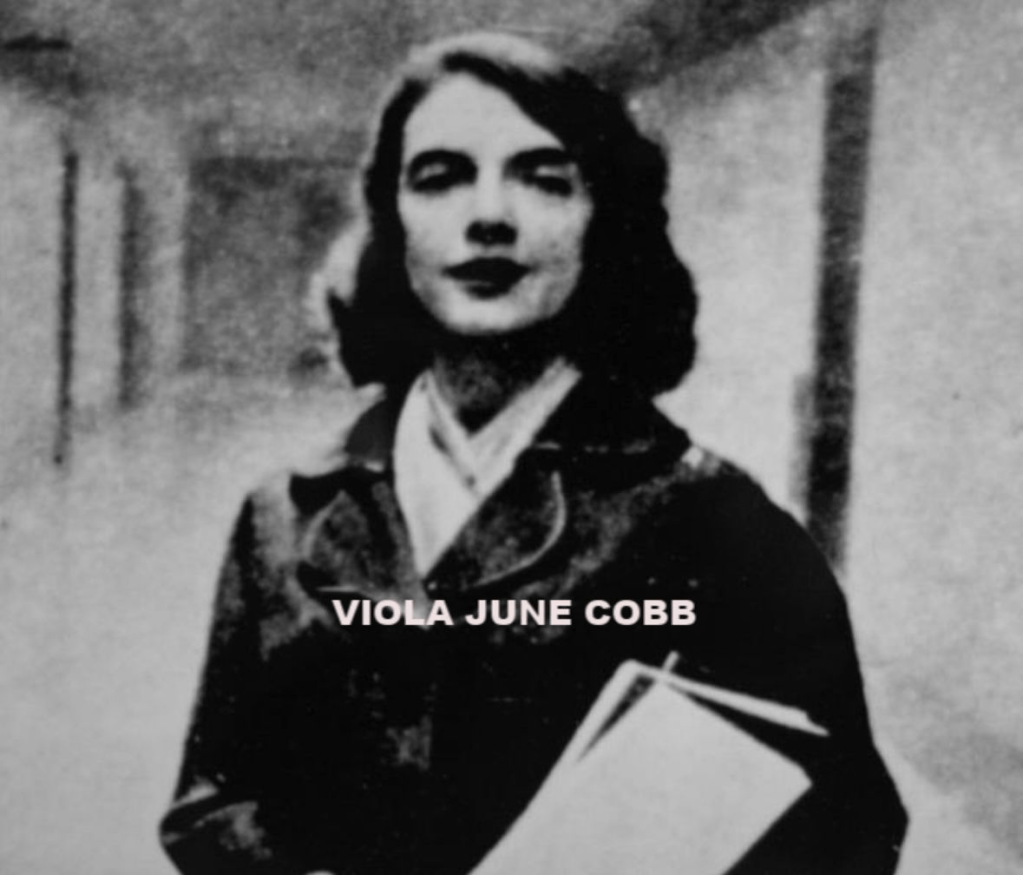
June Cobb (2)
“She said that June had impersonated her for a while. I think Jerrie was the one doing the impersonating.” Jerrie also told her in later conversations that she knew Castro, as well as Kennedy.
Given June’s presence in the Kennedy archives, Haverstick decided to look for any evidence of Jerrie in the documents, and discovered a reference to a small twin-engined plane, of the kind that Jerrie flew at the time, that witnesses reported standing for hours with its engines running at Redbird private airport in Dallas that day.
“I took a giant guess,” says Haverstick, 63, “and I said to her that I thought June Cobb flew to Redbird. Jerrie broke into almost tears, was extremely emotional and then she told me it had been her.”
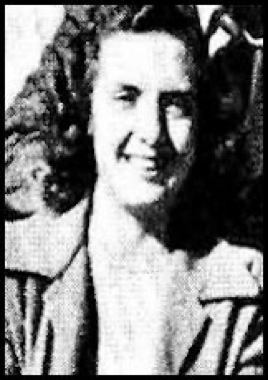
June Cobb (3)
As with the Babushka Lady, there are different photos for the woman pertaining to be June Cobb.
‘Jerrie’s explanation for what she was doing there stretched credibility to the limit: she said she had been hired by Life magazine to fly a reporting team to Dallas to cover the presidential visit, but that when they heard he had been assassinated they abandoned the assignment and left.
The suggestion that a team of reporters and photographers would sit in an aeroplane waiting to leave, instead of running to cover the biggest story of the decade, made Haverstick “100 per cent certain” that Jerrie was lying.
She decided to look at photographs to see if she could spot Jerrie in Dallas, and came across the “anomaly” of the Babushka Lady.
“I was worried enough that the Babushka Lady could be Jerrie that I confronted Jerrie,” she says. “It took me a while to be able to work up to the conversation with Jerrie and her answers to that conversation were not particularly reassuring to me.”
One theory around the Babushka Lady is that she was holding a gun concealed in her camera, and took a shot at Kennedy. Haverstick is convinced there was a second shooter and says the Babushka Lady was ideally placed to be that person, just 33ft away from him with the legendary grassy knoll as the perfect ballistic backstop if she missed [Article: 33].’
In Murder Most Foul, ‘a musical meditation on JFK’s assassination and its effect on American counterculture, Bob Dylan strangely sings:
“Zapruder’s film I’ve seen that before / seen it 33 times maybe more”.
Rayner:
‘She says that while she cannot be certain who the Babushka Lady is:
“I am certain that the Babushka [Lady] is an under-researched character, that she was completely overlooked. If that happened today there would be a manhunt for her and you would expect to see the footage.”
“I felt [Jerrie Cobb] had some culpability in the assassination because of the role she described to me and because of what she was hiding about her double identities,”
Yet despite calling her book A Woman I Know, Haverstick admits:
“I think she was to some extent unknowable at her core. I did feel an emotional disconnect, I didn’t observe her having empathy, so that was troubling to me.
“I felt that she presented a facade, some of which was true. She was a pioneering woman, that was true, she was a very capable woman, but there is an enigma that is almost impossible to pin down.”
Before Jerrie died in 2019 at the age of 88, she took Haverstick on a road trip to see a solar eclipse, which both women instinctively knew was likely to be their last meeting, as Jerrie’s health was failing. There was no deathbed confession, no tell-all letter, no smoking gun document left for the chronicler of her life.
“I did hope there might be a document or something but I had got to know her ground rules pretty well,” Haverstick says. “I had come to realise that she would never tell an overt story of what she did. I came away thinking she’s as enigmatic and more so as the day I met her.”
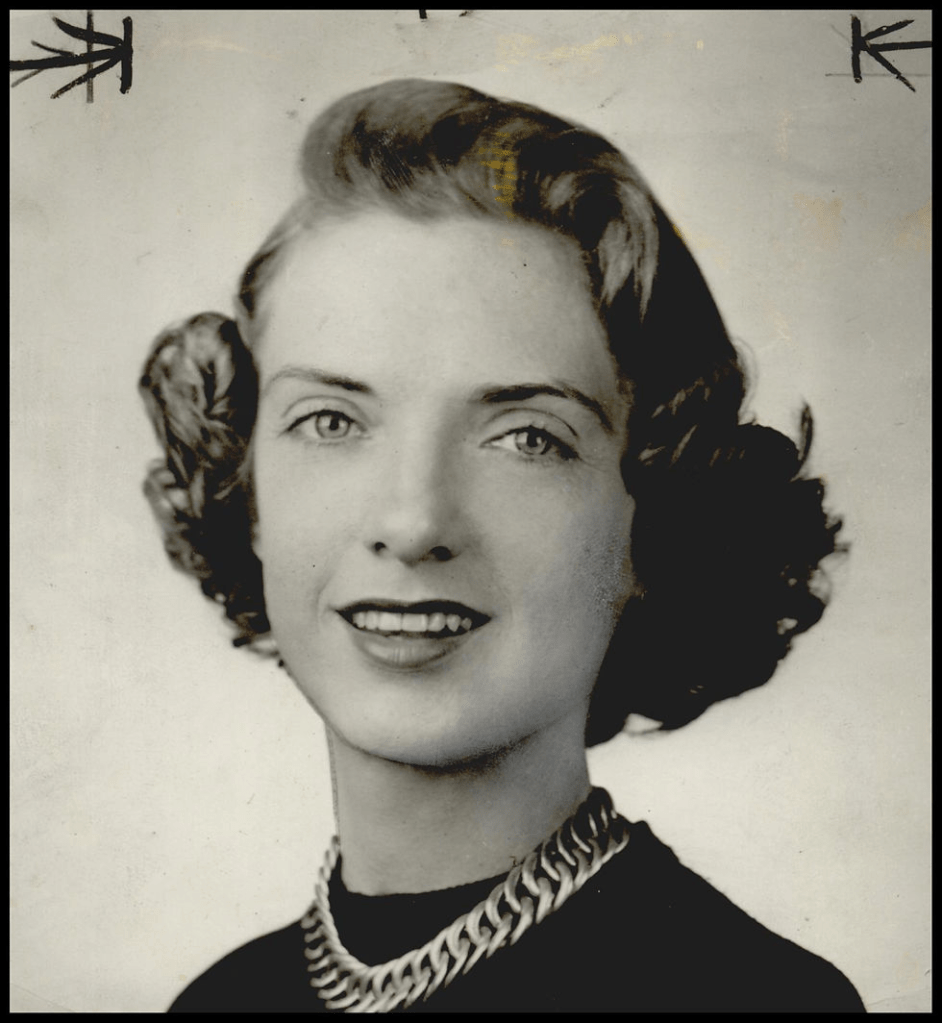
Jerrie Cobb
Over time, the focus expanded to include conspiracy theories suggesting Babushka was a government agent, spy, or even an assassin, though no definitive evidence has ever confirmed any of these claims.
While an assassin on the day seems improbable, a photographer cannot be so easily dismissed.
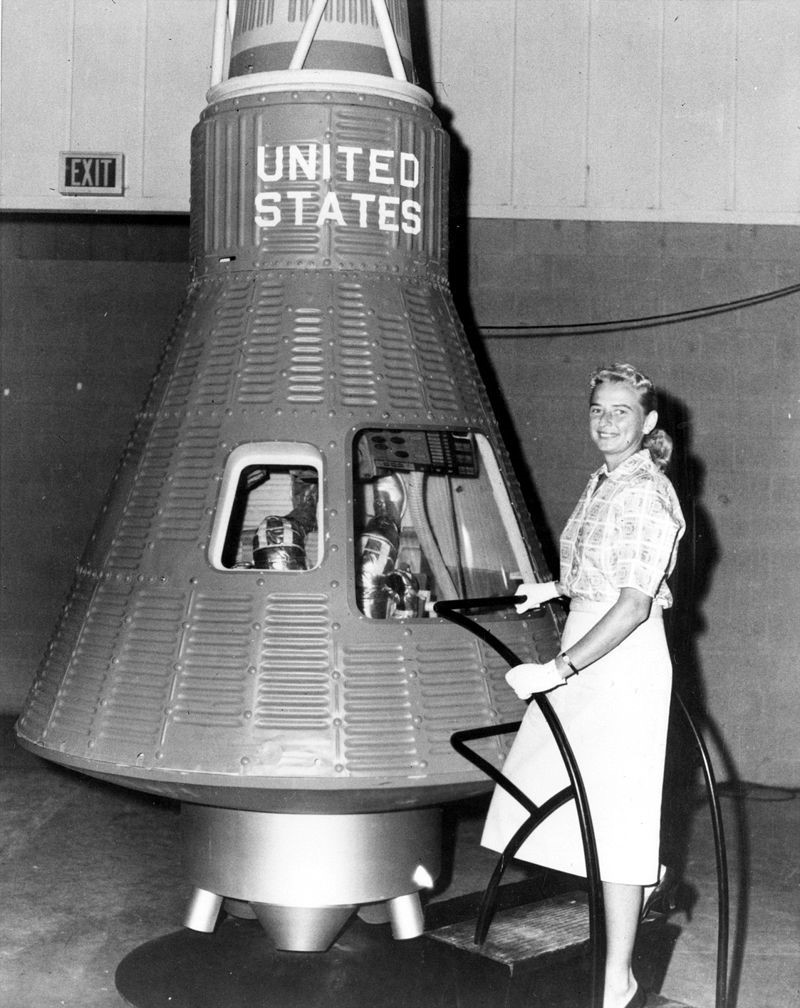
Of all the photos (and stills) of Babushka, it is Babushka 1 which a person could be forgiven for believing bears a bodily resemblance in stature, upright bearing and form with… Jerrie Cobb.
Explore More:
‘The Babushka Lady’s presence contributed to the mystique and intrigue surrounding the JFK assassination, as her potential footage could have provided crucial evidence about the event. Her unidentified status and the speculation about her role have [fuelled] numerous conspiracy theories, keeping public interest alive for decades.’
The reason Babushka has never faded from interest is due to the fact she was not just another bystander. If she actually recorded the tragic events unfolding before her, then her film could have captured the assassination from an invaluably unique angle, potentially a pivotal visual record from the front left hand side of the motorcade. In a case where timing, direction and movement have been argued over for generations, even a few seconds of alternative missing footage could matter significantly.
Of course, Babushka may never have captured anything usable at all. Merely innocuously holding a camera but not filming; the camera suffering a malfunction; or footage filmed was of poor quality. Babushka may have left Dealey Plaza, Dallas, Texas (the country even) before understanding how significant her position was. She may have actually been interviewed in some form but later lost amidst poor record keeping (Kodak Lady 2), a memory gap, or mistaken identity.
‘In a chaotic national trauma, not every loose end means [a] conspiracy.’
On the other hand, if Babushka did capture something important and the film disappeared, then it has been taken, hidden or deliberately withheld. That suspicion thrives because the Kennedy assassination has become a permanent debate revolving around trust, secrecy and whether the truth has ever been made public.
This writer believes it hasn’t.
‘In a story already crowded with disputed evidence, an unidentified witness with missing footage is almost guaranteed to become legend.’
Was Babushka an operative of some kind, instructed to film the tragedy and then quietly slip away forever with her crucial footage?
If Babushka had nothing to hide, surely she would have come forward when she learned of the furore over her identity and seeing her picture repeatedly broadcast. Babushka remaining in the shadows is somewhat suspicious. Surely someone she knew would have recognised her from the film footage and stills and known she had been at Dealey Plaza on that fateful day, yet no one came forward about her either.
The following points (as is the observation) are coincidentally relevant and suitably appropriate with regard to the mystery Babushka woman and her movements at Dealey Plaza on November 22, 1963.
Russia Beyond, 10 unwritten rules of Russian babushkas, Yekaterina Sinelschikova, March 12, 2020 – emphasis mine:
‘A Russian babushka (elderly woman or grandma) is not just a charming old lady.
She is a hurricane in a dress and if you have a brush with her you are unlikely to forget it in a hurry.
2. Going somewhere at six in the morning
3. Guarding territory
7. Instilling fear
10. Following a strict routine
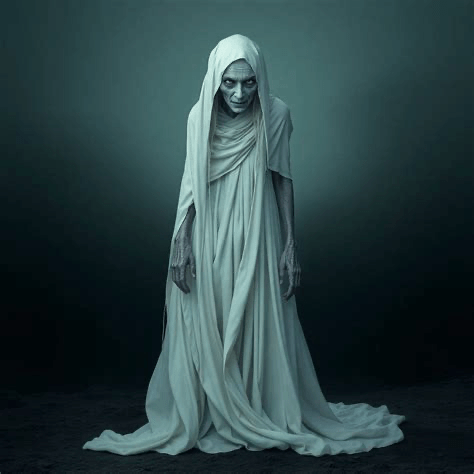
Strikingly, a banshee (in Irish folklore) is a spirit in the form of a wailing (screaming) woman who appears before or is heard by, members of a family as a sign that one of them is about to die.
All four of Kennedy’s grandparents were children of Irish immigrants.
Read the Real Story, The Babushka Lady – The Woman Who Filmed the JFK Assassination and Then Disappeared From History:
‘Many JFK witnesses became known because they spoke, testified, or were pulled into the machinery of the investigation. The Babushka Lady became famous precisely because she did not. She is remembered for absence. No interview that settled things. No confirmed name. No recovered reel. Just the image of someone who may have seen history more clearly than almost anyone else, and then slipped away before history could question her.
People are not just asking who the Babushka Lady was. They are asking whether some missing fragment of film could have changed how the Kennedy assassination was understood.
The mystery survives because it combines three things that pull readers in every time:
a famous event, a missing witness, and a vanished piece of possible evidence.
It also survives because visual evidence carries unusual emotional power. A testimony can be doubted. A memory can blur. But footage feels like a machine that witnessed the truth. Whether that faith is always justified is another question entirely. Even so, the idea that one unidentified woman may have held a camera on the most disputed seconds in American political history is almost impossible to let go…
That is why the Babushka Lady keeps resurfacing in books, documentaries, and long-night forum threads. She is not merely an extra standing in the background of the JFK assassination. She represents the part of the story that still feels unfinished. Somewhere between the official investigation, public suspicion, and the limits of what images can prove, she remains one of Dealey Plaza’s last great ghosts.’
If Babushka was about thirty-five years of age in 1963, then it is possible she is still alive now at the grand old age of ninety-eight. Though with time inexorably passing… Babushka still being alive becomes less likely and learning her identity increasingly improbable.
Babushka’s destiny to remain a phantom ghost in death, joining John F Kennedy in the hallowed halls traversing from this dark world to the light of the next.
So do not be afraid of these people. They hide the things that they do. But there will be a time when other people will see those things. Everyone will know all their secrets.
Matthew 10:26, Easy English Bible
“People are mysterious, even to themselves.”
Frank Lentricchia
“A man may die, nations may rise and fall, but an idea lives on.”
John F Kennedy
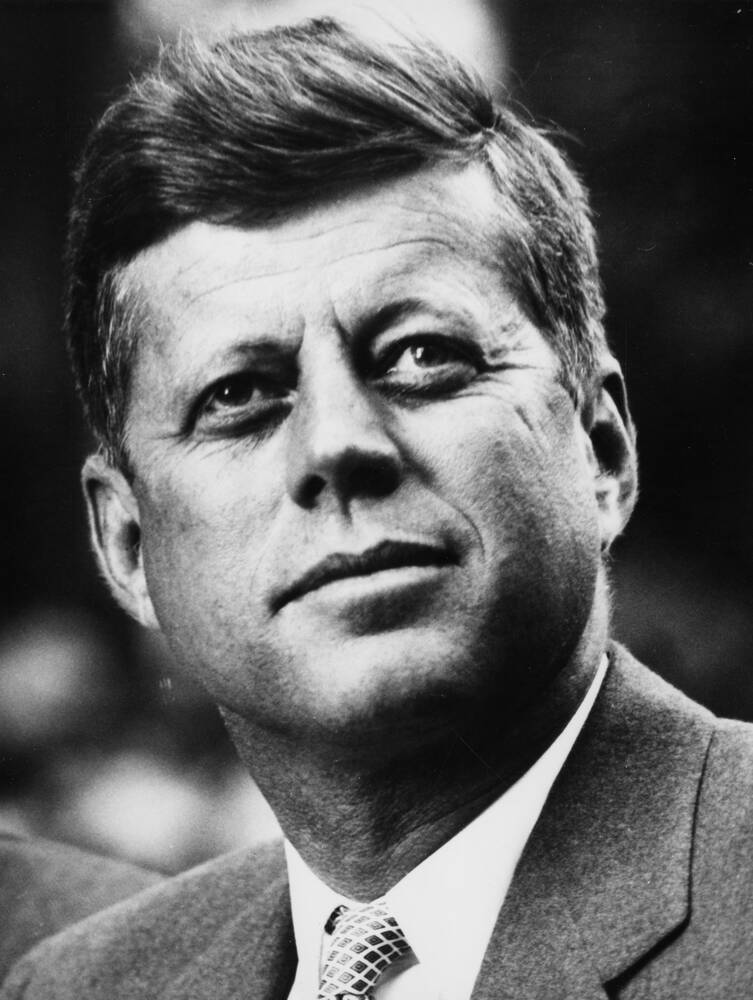
John Fitzgerald Kennedy
May 29, 1917 – November 22, 1963
Rest in Peace
© Orion Gold 2026 – All rights reserved. Permission to copy, use or distribute, if acknowledgement of the original authorship is attributed to orion-gold.com