
What is the actual gospel message as outlined in the New Testament?
This might appear an unnecessary question, yet is it
a. a gospel of (about) Christ;
b. a gospel of salvation;
c. a gospel of grace;
d. a gospel of peace;
e. a gospel of citizenship (in heaven);
f. a gospel of Christ’s rule; or
g. a gospel of the kingdom (of God).
First, what does the word gospel mean?
The English word gospel literally means ‘good news’ or ‘glad tidings’ and is derived from the Greek word euangelion. To evangelise, means to bring good news.
But good news about what precisely?
And is there more than one gospel message?
The standard understanding on what the gospel comprises, is based on the writings of Paul and it is these which are the predominant inspiration for the views held by mainstream (orthodox) Christianity.
Herein lays a significant stumbling block in regard to seeking answers on this issue of the real gospel. For at this point it is only fair to mention the status of the man originally called Saul and later, Paul. While the vast majority of Christians recognise Paul as a prominent figure in the early New Testament church, the truth of the matter is that Paul was actually the founder of a new religion called Christianity – refer article: The Pauline Paradox.
His teachings are contrary to the apostles and in variance with that of Christ and the true followers of the Way – Acts 9:2. Importantly, anything written by Paul (seven New Testament letters) and any credited to him (six New Testament books) are of little or no value in any serious theological debate.
That said, his interpretation of the gospel is where this investigation will begin.
AI equates the ‘term “The True Gospel” [as a reference] to the authentic and unadulterated message of salvation as presented in the New Testament of the Bible… and… [as] the foundation of Christian faith and doctrine.’
Similarly, AI’s answer in response to the query, ‘What is the true gospel’… results in an answer in line with the following:
‘The true gospel message centres on the life, death, burial and resurrection of Jesus Christ, which offers salvation and eternal life to those who believe in faith.’
This is based on Paul’s comments to the brethren in Corinth (1 Corinthians 15:1-4), where ‘Paul tells us to “hold firmly” to this true gospel, the only one which saves’ – Got Questions.
1 Corinthians 15:1-4
Living Bible
“Now let me remind you, brothers, of what the Gospel really is, for it has not changed – it is the same Good News I preached to you before. You welcomed it then and still do now, for your faith is squarely built upon this wonderful message; and it is this Good News that saves you if you still firmly believe it, unless of course you never really believed it in the first place.
I passed on to you right from the first what had been told to me, that Christ died for our sins just as the Scriptures said he would, and that he was buried, and that three days afterwards he arose from the grave just as the prophets foretold.”
Paul claims that it is on his good news (gospel), their faith is based upon and that it is through his gospel they are saved (Romans 1:16).
Yet by Paul’s own admission, he received this gospel from others.*
Paul never met Christ. Paul was not taught by Christ. Paul was not commissioned by Christ with a different ministry from the apostles.
Nor was Paul given a new gospel message or good news tailored for a Gentile audience (Galatians 1:11-12 not withstanding*) – Articles: The Pauline Paradox; and The Seven Churches: A Message for the Church of God in the Latter Days.
These four points cast a long shadow over the veracity of Paul’s gospel and this even before the additional aspects of Christ’s testimony and the teaching of the apostles are considered.
In Romans 10:9, ESV, Paul states: “… because, if you confess with your mouth that Jesus is Lord and believe in your heart that God raised him from the dead, you will be saved.’
While believing in the credentials of the Saviour – his sinless life and resurrection from the dead – is a requirement for salvation, it is not the gospel.
In the article: What Is the True Gospel of Jesus Christ? A Comprehensive Guide to the Core Message, April 12, 2026, Rob Luvren lists key elements of the core message of the gospel. Ten no less, yet of these ten key elements, the one actually proclaimed by the Messiah is not included.
So effective the false gospel of Paul has been in transplanting the true gospel.
In fact, in a rather lengthy, comprehensive article with not one scripture quoted or referenced, the real gospel is indirectly mentioned via a partially correct and consequently weakened interpretation.
Under the heading… ‘Kingdom* life now:
The gospel announces that the reign* of God is present in the church and in individual lives as people submit to Christ and cultivate righteousness, peace, and joy in the Holy Spirit.’
Notice the word kingdom has been substituted with the word reign instead.
In the book of Mark, Jesus instructed to ‘repent and believe in the gospel’.
But what is the gospel he is referring to?
Well, the beginning of Christ’s words reveal it to be about a kingdom.
Mark 1:15
English Standard Version
‘… and saying, “The time is fulfilled, and the kingdom of God is at hand; repent and believe in the gospel”.’
Only a very small number of believers understand the nature of the true gospel. One such church affiliation is the following.
United Church of God, 2021 – emphasis theirs:
‘What was Jesus Christ’s message? He preached “the gospel of the kingdom of God” (Matthew 4:23; 9:35).
The Old English word gospel, or “good spell,” means “good news.”
The good news was the centerpiece of His message. He defined His mission with these words: “I must preach the kingdom of God…because for this purpose I have been sent” (Luke 4:43).
What did He command His disciples to teach? “He sent them to preach the kingdom of God…” (Luke 9:2-6).’
The article accurately highlights that the gospel about the Kingdom of God proclaimed by Jesus (Luke 8:1; 9:11; 12:31; 13:18) was a continuing message delivered by the Israelite prophets in the Old Testament, including Isaiah, Jeremiah, Ezekiel, Daniel and Zechariah.
Luke 16:16
English Standard Version
“The Law and the Prophets were until John; since then the good news of the kingdom of God is preached…”
Matthew 3:1-2
English Standard Version
In those days John the Baptist came preaching in the wilderness of Judea, “Repent, for the kingdom of heaven [God] is at hand.”
Incredibly, Paul once adhered to the Way centred on the message of the Kingdom of God only to later depart from its path (Acts 19:8-9) with his own gospel.
Got Questions:
‘… the term translated “kingdom” is the Greek word basileia, which means “the realm in which a sovereign king rules”.’
George Eldon Ladd:
‘The primary meaning of both the Hebrew word malkuth in the Old Testament and of the Greek word basileia in the New Testament is the rank, authority and sovereignty exercised by a king. A basileia may indeed be a realm over which a sovereign exercises his authority; and it may be the people who belong to that realm and over whom authority is exercised; but these are secondary and derived meanings. First of all, a kingdom is the authority to rule, the sovereignty of the king.’
United Church of God:
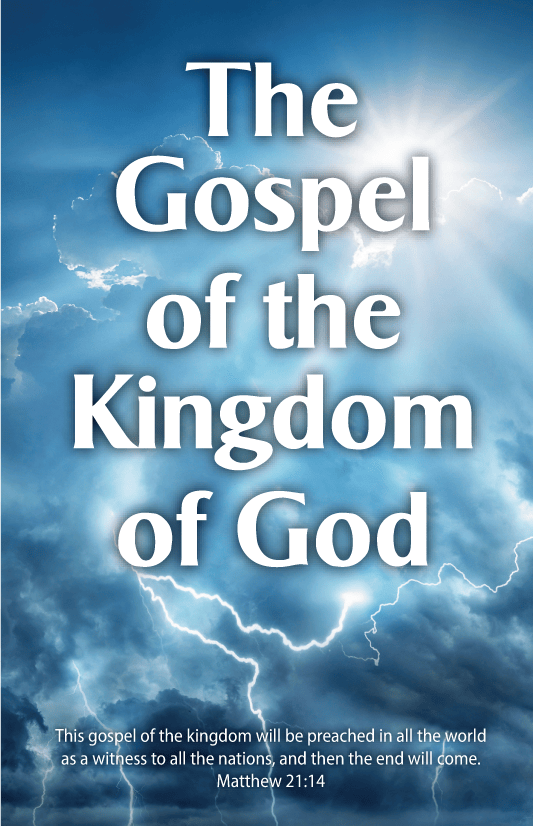
‘For God had inspired such faithful men as to look beyond the difficulties and destruction of the kingdoms of Israel and Judah to a magnificent future when God would establish His world-ruling kingdom on earth under the reign of the Messiah.’
Numerous Old Testament depictions of a changed and peaceful world were predicted – portraits of a time when Christ has returned… establishing the Kingdom of God on Earth.
This would certainly be the good news of the ages.
Above and beyond any message about Christ himself as later altered by Paul and appropriated by (false) Christianity.
United:
‘Notice some of their prophecies describing this wonderful age to come:
“The wolf also shall dwell with the lamb, the leopard shall lie down with the young goat, the calf and the young lion and the fatling together; and a little child shall lead them” (Isaiah 11:6).
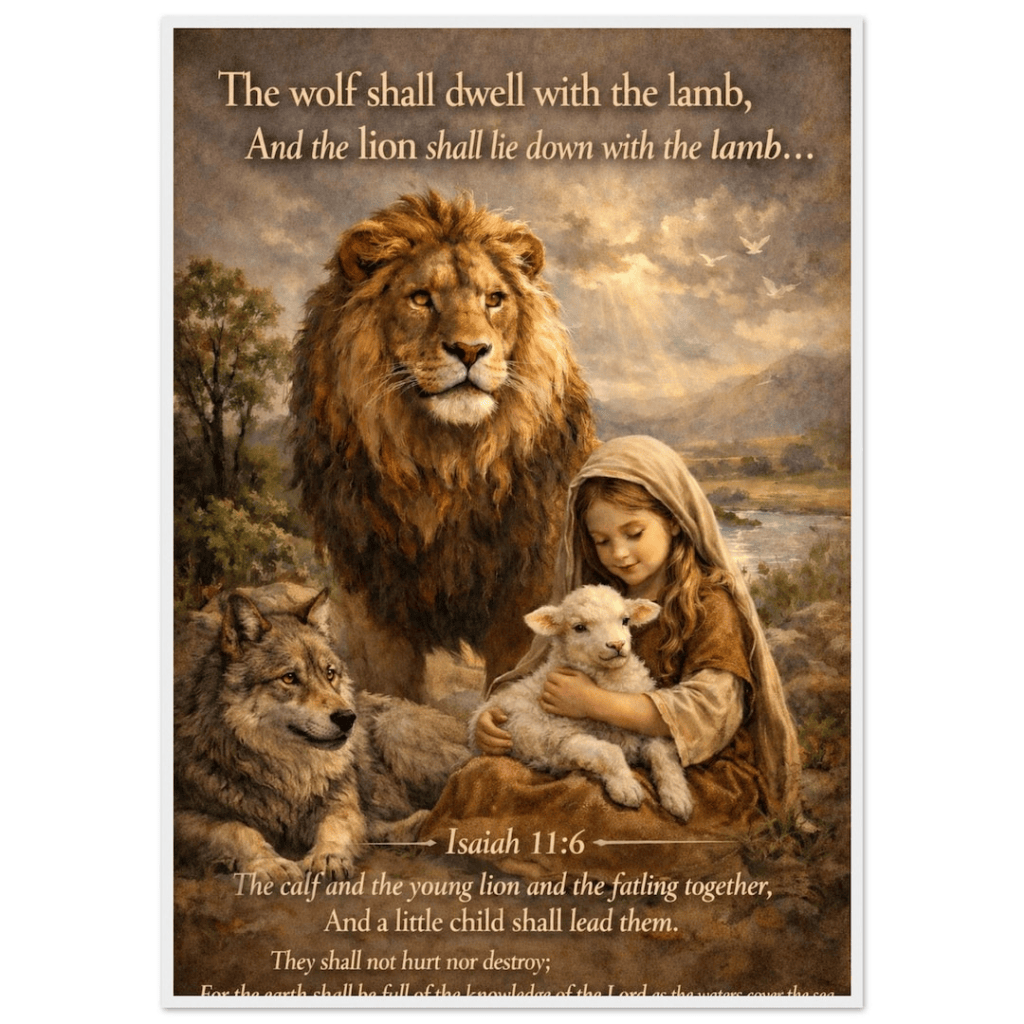
“They shall not hurt nor destroy in all My holy mountain, for the earth shall be full of the knowledge of the Lord as the waters cover the sea. And in that day there shall be a Root of Jesse, who shall stand as a banner to the people; for the Gentiles shall seek Him, and His resting place shall be glorious” (Isaiah 11:9-10).
“I was watching in the night visions, and behold, One like the Son of Man, coming with the clouds of heaven! He came to the Ancient of Days, and they brought Him near before Him. Then to Him was given dominion and glory and a kingdom, that all peoples, nations, and languages should serve Him. His dominion is an everlasting dominion, which shall not pass away, and His kingdom the one which shall not be destroyed” (Daniel 7:13-14).
“Then the Lord will go forth… And in that day His feet will stand on the Mount of Olives, which faces Jerusalem on the east. And the Mount of Olives shall be split in two, from east to west, making a very large valley… Thus the Lord my God will come, and all the saints with You… And the Lord shall be King over all the earth” (Zechariah 14:3-9).’
Christ warned of precursory signs heralding his return and before the establishment of the Kingdom of God on Earth. Those people living during this momentous time will still be alive when the kingdom on Earth is fulfilled. What is clear is that the Kingdom of God is yet future and has not been established on Earth already or in some vaporous fashion, merely symbolising Christ’s rule within Christians.
Jesus leaves little room for doubt about what the kingdom of God is and is not.
John 18:36
English Standard Version
‘Jesus answered, “My kingdom is not of this world. If my kingdom were of this world, my servants would have been fighting, that I might not be delivered over to the Jews. But my kingdom is not from the world”.’
Even though Christianity recognises that the word kingdom throughout the New Testament consistently refers to the rule of Christ, they somehow equate it ‘to the rule of Christ in the hearts of believers, since, for the time being, Christ’s kingdom is not of this world’ – Got Questions.
This is a misunderstanding of what ‘not of this world’ means.
Luke 21:25-32
English Standard Version
“And there will be signs in sun and moon and stars, and on the earth distress of nations in perplexity because of the roaring of the sea and the waves, people fainting with fear and with foreboding of what is coming on the world. For the powers of the heavens will be shaken.
And then they will see the Son of Man coming in a cloud with power and great glory. Now when these things begin to take place, straighten up and raise your heads, because your redemption is drawing near… So also, when you see these things taking place, you know that the kingdom of God is near.”
The Kingdom of God will be a literal government which will replace the ruling kingdoms of this present world.
Revelation 11:15
English Standard Version
‘Then the seventh angel blew his trumpet, and there were loud voices in heaven, saying, “The kingdom of the world has become the kingdom of our Lord and of his Christ, and he shall reign forever and ever”.’
Unbelievably, Paul complained to the brethren in Galatia about another gospel in conflict with his own message about the person of Jesus and set a double curse no less on who else but the apostles who were not speaking the same as Paul and rather about the kingdom instead as he had once done (Galatians 1:6-9; 2:14). Yet, it was discussion about this self same kingdom – which the Jewish authorities grew greatly wary of in misunderstanding its timing – that ultimately led to Christ’s death (John 11:48).
While Christianity reluctantly acknowledges a ‘gospel of the Kingdom of God’, it then waters it down by including a number of aspects which diminish the central core of its fulfilment as a future earthly kingdom.
So that its definition is described much like the following:
‘The gospel of the Kingdom of God is the central message that Jesus preached during his ministry. Whereby he focussed on how God’s saving rule and reign have come near to us through Jesus Christ. This gospel offers salvation and a new life to all those who believe; as well as encompassing both spiritual and physical healing and the promise of a future Kingdom established on earth where Jesus will reign.’
By itself, this definition appears biblically sound. It is only when it is
a. relegated in the shadows as part of a gospel of salvation (or grace) as espoused by Paul;
b. actually deemed a secondary gospel; or
c. a distinct gospel for a different audience, that there is a contradictory understanding scripturally and theologically.
It seems that the gospel of the Kingdom of God is accepted on the proviso that it is joined with and merely a (third) part of the following key aspects.
Salvation:
‘The gospel invites individuals to enter into a relationship with God, promising forgiveness and eternal life.’
Healing:
‘It encompasses both spiritual healing from sin and physical healing, reflecting God’s compassion and power.’
Future Kingdom:
‘The gospel also includes the promise of a future Kingdom where Jesus will reign on earth, fulfilling God’s ultimate plan for creation.’
Yet as touched upon, the Kingdom of God is embedded in scripture, connecting the Old and New Testaments. In the Old Testament, God’s reign over Israel and the promise of a Messiah are implicit. Then with the advent of the Saviour, the kingdom and God’s rule is explicitly preached.
Where Christianity deviates is in the belief that not only the New Covenant has been ushered in now – following the death and resurrection of Christ – but also the arrival of God’s kingdom. Then it is taught that the kingdom will be ‘fully realised’ at Christ’s second coming.
Either the Kingdom of God has begun now (in our hearts) or it is yet future.
Similarly, the New Covenant has not yet been established. In reality, true believers find themselves in an inter-covenantal period until the New Covenant is ushered in and initially agreed with the Israelite peoples at the beginning of the Kingdom of God and then all the other nations and peoples on Earth – Articles: The Sabbath Secrecy; and The Seven Churches – A Message for the Church of God in the Latter Days.
Jesus in a discussion with Nicodemus a convert to the Way, explains how one enters the kingdom and in the process describes the requirement to be resurrected (born again) as a spirit being. A spirit being is like the wind and so the prevalent understanding that a Christian can be born again (or transform) while as a physical human being is false – Article: The Seven Churches: A Message for the Church of God in the Latter Days.
John 3:1-8
English Standard Version
‘Now there was a man of the Pharisees named Nicodemus, a ruler of the Jews. This man came to Jesus by night and said to him, “Rabbi, we know that you are a teacher come from God, for no one can do these signs that you do unless God is with him.”
Jesus answered him, “Truly, truly, I say to you, unless one is born again he cannot see the kingdom of God.”
Nicodemus said to him, “How can a man be born when he is old? Can he enter a second time into his mother’s womb and be born?” Jesus answered, “Truly, truly, I say to you, unless one is born of water [baptism] and the Spirit [resurrection] , he cannot enter the kingdom of God.
That which is born of the flesh is flesh, and that which is born of the Spirit is spirit. Do not marvel that I said to you, ‘You must be born again.’
The wind blows where it wishes, and you hear its sound, but you do not know where it comes from or where it goes. So it is with everyone who is born of the Spirit” [Job 14:14].’
Thus the Kingdom of God is clearly a future hope and decidedly not a present reality as erroneously taught by modern Christendom.
Nor is the church – the body of Christ – the kingdom. The church is conceivably an embryonic symbol of the future ideal of the kingdom, though no more.
What is the TRUE GOSPEL? Herbert W Armstrong, 1970 – capitalisation his:
‘… a mortal human – cannot enter IN to the Kingdom of God. The Church, then, cannot be the Kingdom of God, for it is composed of flesh-and-blood mortals. It is not, either, an ethereal something “set up in the hearts of men.” Jesus went on to show Nicodemus that we who are born of the flesh ARE flesh – just mortal flesh and blood. We were BORN that way – HUMAN – MORTAL. But it is possible for us to be BORN AGAIN – next time, not as a mortal flesh-and-blood baby, but born of the SPIRIT. Then we shall be spirit – composed of spirit!’
Christ gave believers an example of how to pray, commonly known as the Lord’s prayer. The opening of the prayer specifically mentions the kingdom and that it will be earthbound – in the future, not now – in likeness and in mirror image of God’s rule in Heaven.
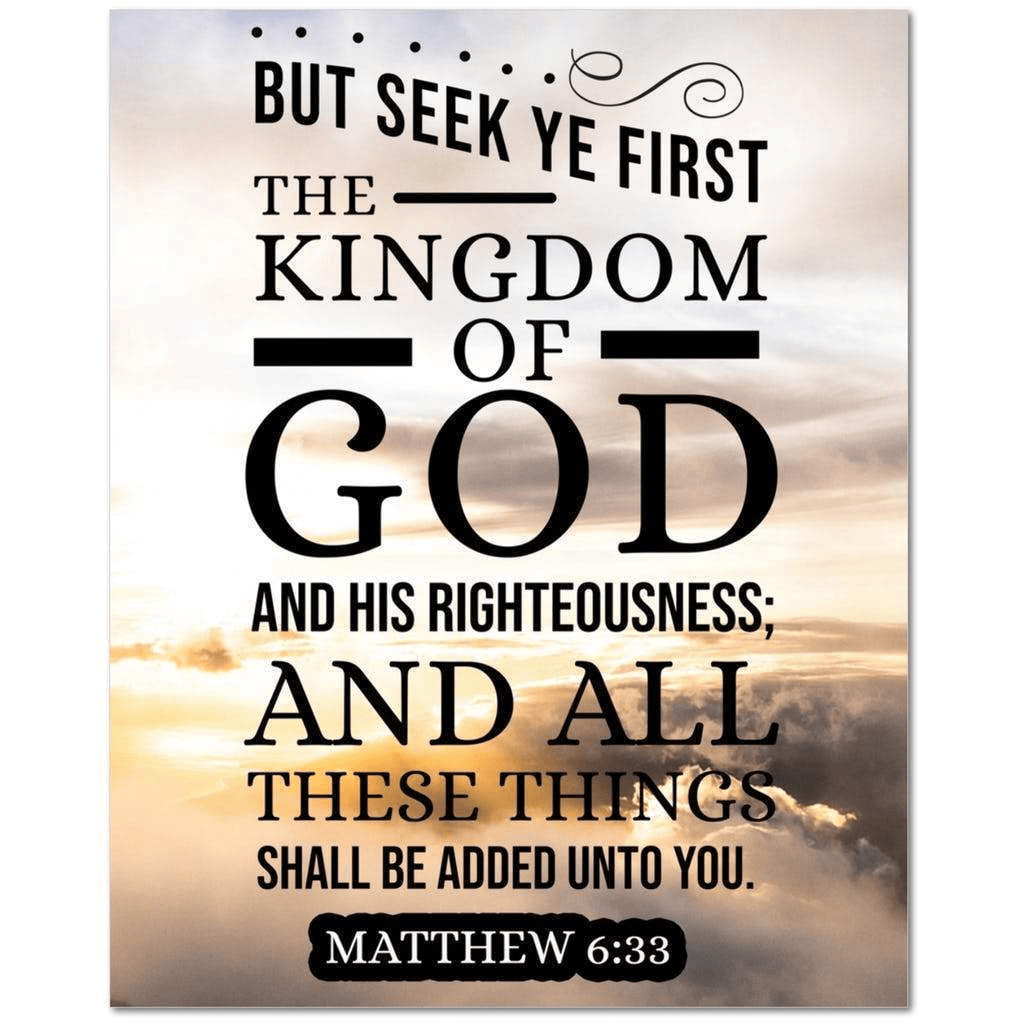
Pray then like this: “Our Father in heaven, hallowed be your name. Your kingdom come, your will be done, on earth as it is in heaven” – Matthew 6:9-10, ESV.
Luke records – and misleadingly translated by most Bible versions – that God’s kingdom is within us. Though other translations write ‘in the midst of you’. This has been misunderstood to refer to the kingdom somehow being inside a believer, instead of in their midst while Christ was with them.
A few translations helpfully translate the verse to show the true intention of what Christ was expressing.
Luke 17:20-21
Common English Bible
‘Pharisees asked Jesus when God’s kingdom was coming. He replied, “God’s kingdom isn’t coming with signs that are easily noticed. Nor will people say, ‘Look, here it is!’ or ‘There it is!’
Don’t you see? God’s kingdom is already among you” [by the presence of Jesus in their midst].’
Got Questions – emphasis mine:
‘Many dispensationalists make a distinction between the gospel of the kingdom proclaimed by Jesus (Matthew 4:23) and the gospel of grace mentioned later in the New Testament (Acts 20:24).
According to this view, the gospel of the kingdom announces the Messiah’s kingdom to Israel, while the gospel of grace focuses on salvation through Jesus, proclaimed after His death and resurrection.
These proclamations have different emphases, but reflect one way of salvation.’
This quote highlights the ongoing and widespread confusion abounding on not only what the true gospel is but whether there is more than one gospel and at the same time forcing separate gospels for physical Israel and spiritual Israel (the Church).
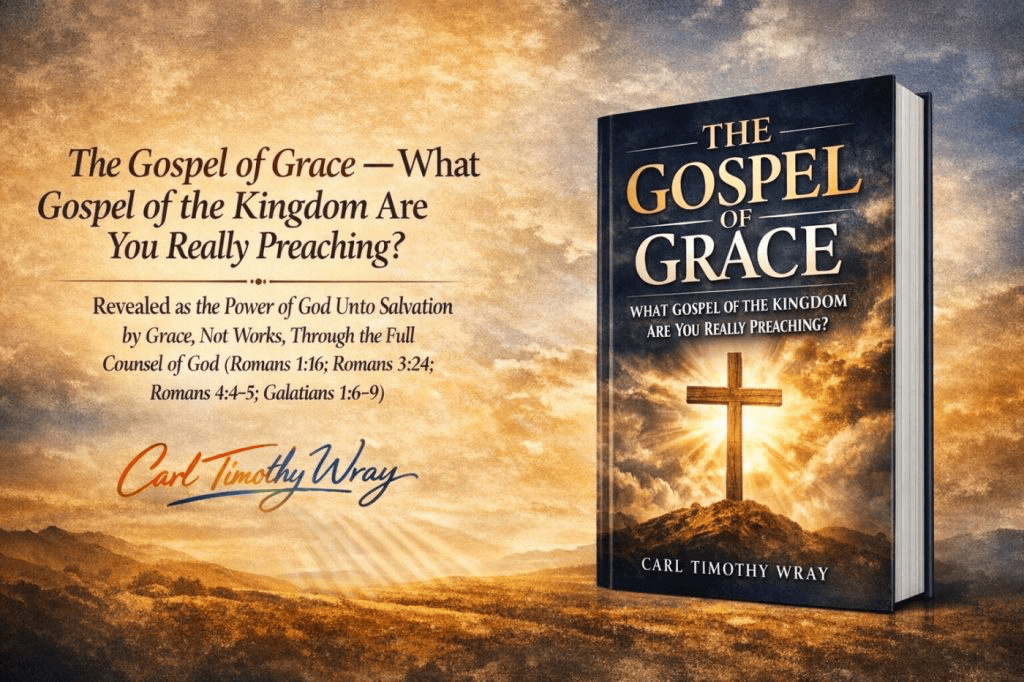
An example of the false gospel so widely promulgated as the true gospel
Paul’s gospel of grace (Acts 20:24) masquerades as the true gospel but it is not the gospel preached by Christ and there wasn’t a separate, later commission to convert Gentiles – article: Black Hebrew Israelite – An Oxymoron.
Rather, Christ directed the apostles to preach the kingdom of God to the Israelites.
Matthew 10:5-7
English Standard Version
‘These twelve Jesus sent out, instructing them, “Go nowhere among the Gentiles and enter no town of the Samaritans, but go rather to the lost sheep of the house of Israel. And proclaim as you go, saying, ‘The kingdom of heaven [God] is at hand.’
Acts 8:12
English Standard Version
‘But when they believed Philip [the Deacon] as he preached good news* about the kingdom [1] of God [the gospel*] and the name [2] of Jesus Christ [not the gospel], they were baptized, both men and women.’
Herbert W Armstrong – capitalisation his:
‘Notice carefully these points:
1) With whom did this Message – this Gospel – originate? Peter said: “The word which GOD sent.”
2) TO WHOM did God send it? Peter said: “unto the children of Israel”… it was sent to the CHILDREN OF ISRAEL, and it was sent by GOD THE FATHER. It did not originate with Jesus Christ, nor with Peter, nor with… Paul. It was sent by GOD the Father of Jesus Christ!
3) BY WHOM was it sent? Who was the divine Messenger who brought and preached the message? Peter said: “by Jesus Christ.” Jesus Christ was the divine MESSENGER. Malachi called Him the Messenger of the COVENANT. That message, then, is the NEW Covenant Message; for Moses was the mediator of the Old Covenant, and Jesus Christ of the NEW, as affirmed by many scriptures. This message, then, is the NEW TESTAMENT GOSPEL. Now,
4) WHERE was it first preached! To what geographical location shall we look for its beginning? Peter said: It “began from Galilee.” Yes, GALILEE, then, is the place where it was first preached. Not Jerusalem! Galilee! When did Jesus begin to preach this particular Gospel in Galilee? Peter said: “after the baptism which John preached.” The true GOSPEL of the NEW Covenant, then, did not begin with John the Baptist. It began after John had completed his baptismal ministry.
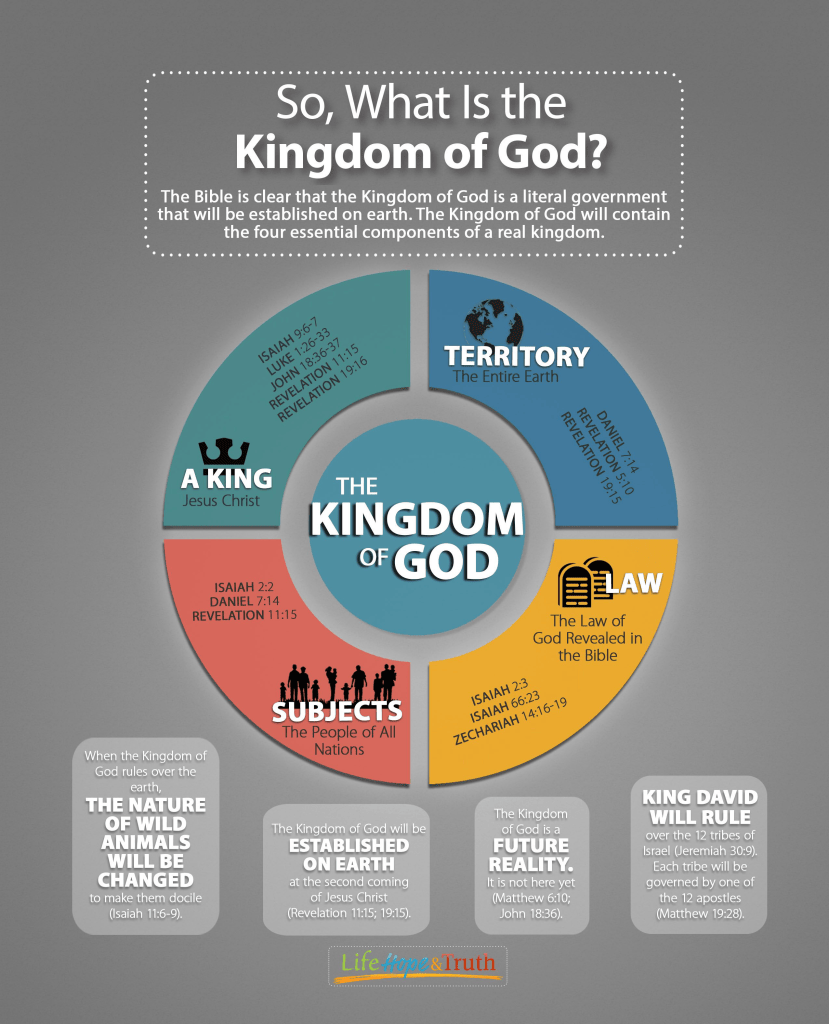
Four things are necessary to constitute a KINGDOM:
1) The TERRITORY, with its specific location and definite boundary lines, with
2) a KING or Supreme Ruler or governing agent, ruling over
3) SUBJECTS or citizens within that territorial jurisdiction, with
4) LAWS and a form of GOVERNMENT.
If we leave out any one of these vital requisites, we do not have, and cannot BELIEVE, the true GOSPEL for this time. We must know whether the Kingdom of God is here NOW, or coming later; whether its territory is THE EARTH, or up in heaven; whether it is a literal kingdom of human mortals, or a kingdom of immortals; whether it is literal or figurative, real or unreal. And on many of these things, a great many people are ALL MIXED UP!’
It is of interest and germane to this discussion in noting just how often the gospel of the Kingdom of God is mentioned in the New Testament. The phrase ‘kingdom of God’ is used 66 times and once as ‘kingdom of Christ and of God’ making 67 times in the New Testament (refer 67, Addendum II, article: 42); with the most significant portions appearing in the Gospels as utterances of Christ.
The Gospel of Matthew is of particular interest as while it is universally credited to the Apostle Matthew, it was in fact written by John Mark, the son of Simon Peter on behalf of his father, the Apostle Peter – refer article: The Pauline Paradox.
The author of Matthew (Mark) mentions the Kingdom of God a mere five times (6:33; 12:28; 19:24; 21:31, 43) and ‘kingdom of their/my Father’, twice. Yet unlike any other New Testament writer, Matthew uniquely chooses to describe the Kingdom of God predominately as the commonly translated ‘kingdom of heaven’ – though more accurately, it is the kingdom of the heavens – 32** times.
In the past, biblical scholars sought to make a distinction between the kingdom of God and the kingdom of heaven as having two different meanings, though this explanation is now universally discredited by theologians who consider them one and the same.
The Bible Study:
‘… if you compare the synoptic gospels – Matthew, Mark and Luke, you will find that Matthew’s “kingdom of heaven” exactly parallels Mark’s and Luke’s “kingdom of God.” So there is no doubt that they are different terms describing the same thing. The “kingdom of heaven” and “kingdom of God” are synonymous.’
Whereas the author of the Gospel of Mark – actually the Apostle Matthew – states the Kingdom of God 14 times and ‘kingdom of our father’, once.
In contrast, the physician Luke – a close associate of Paul – only uses the phrase ‘kingdom of God’ and does so – a coincidental – 32** times. In the Book of Acts, Luke uses the phrase ‘kingdom of God’, six times.
The Apostle John uses the expression ‘kingdom of God’, yet he only does so twice (John 3:3, 5). John prefers to use the phrase ‘eternal life’ in reference to the kingdom throughout his gospel. In the Book of Revelation, John refers to the kingdom on occasion yet singularly, without the word God and just once as the ‘kingdom of our God’ (Revelation 12:10).
In the Book of Romans, Paul uses ‘kingdom of God’ once; while in 1 Corinthians he mentions it four times. In the Letter to the Galatians, Paul says: ‘God’s kingdom.’ Paul does not use the expression anywhere else and so his total use is 5 (or including Galatians, 6) times like the Gospel of Matthew. Though Paul does link God with the kingdom in 1 Thessalonians.
In books credited to Paul, though not written by him (Article: The Pauline Paradox^); the author of Ephesians (Tychicus^) says, ‘kingdom of Christ and God; and the author of Colossians (Epaphras^) says both ‘kingdom of his beloved son’ and once, ’kingdom of God’ [1].
Meanwhile the author of 2 Thessalonians (Silas^), uses ‘kingdom of God’ [2] once. The author of 2 Timothy (Timothy^), says ‘heavenly kingdom’ once. Finally, the author of 2 Peter [not Peter the apostle] states: ‘the eternal kingdom of our Lord and saviour Jesus Christ.’
The total tally for these New testament authors adding up to 2 (or including Ephesians, 3) times.
It is therefore interesting to compare how Paul does include the phrase ‘kingdom of God’ in his letters, though sparingly. Whereas James, Peter and John in the General Epistles do not use the phrase at all.
Scholars cannot satisfactorily explain why ‘Matthew’ would use ‘kingdom of heaven’ instead of the Kingdom of God. This coupled with John refraining from its use is odd, until one realises – as the constant reader will be aware – that Paul was an antagonistic rival of Peter and John. Thus both Peter (Gospel of Matthew) and John (Gospel of John, 1 John, Revelation), distancing themselves from Paul – and Luke (Gospel of Luke, Acts) – in using different phrases is understandable.
Therefore ironically, Paul and others using the phrase ‘kingdom of God’, are all the while adding elements to the gospel of the Kingdom of God. The author of Ephesians speaks of a ‘gospel of peace’ (Ephesians 6:15); Paul is recorded by Luke as saying a ‘gospel of grace’ (Acts 20:24); and in Romans 1:16, Paul names a ‘gospel of salvation’. Yet none of these are referring to the Kingdom of God, but rather the aspects associated with the sinless life of the Saviour and his resurrection.
Paul teaches about a believer’s citizenship reserved in heaven as they await the resurrection and alluded by other New Testament authors as well – Philippians 3:20 (Ephesians 2:19, Hebrews 11:16. 1 Peter 1:3-4). Admittedly, this is in keeping with the gospel of the Kingdom of God and not with the false gospel about Christ.
The following article is a good (or rather bad) example of the duplicitously false doctrine which erroneously teaches a gospel of Paul has any place, whether as a. a sole gospel; or b. an arbitrary second gospel to the true gospel delivered by Christ.
Understanding The Similarities And The Differences In The Gospel Jesus Preached And The One He Had Paul Preach, April 14, 2024, ourCOG – emphasis mine:
‘Jesus preached the Kingdom of Heaven while Paul preached the Kingdom of God, yet both gospels come from the Lord and are meant for different dispensations’ [really? there are not two gospels. Only one directive from Christ to go to the ‘lost sheep of the House (tribes) of Israel’ (Matthew 10:5-7*); while Pauls’s decision to go to the Gentiles was entirely his own mis-directed decision – Article: The Seven Churches – A Message for the Church of God in the Latter Days].
‘In our daily morning Bible study this week, we’ve been going through the first 8 chapters of the book of Matthew, and what a wonderful walk through scripture it has been. Everything related to the Sermon on the Mount is directly connected to what we call the ‘constitution of the Kingdom’ that will be present during the Millennium.’
‘One thing that stands out right away is how very different [only because one is true and one is false] it is from what Jesus commissioned Paul to preach in the book of Acts. The Kingdom of Heaven versus the Kingdom of God’ [there is no one gospel versus another – this immediately raises a red flag for the discerning believer (Article: The Pauline Paradox)].
“Therefore say I unto you, The kingdom of God shall be taken from you, and given to a nation bringing forth the fruits thereof” – Matthew 21:43 (KJB).
‘On this episode of Rightly Dividing, they make Bibles with the word of Jesus printed in red so they stand out, but that is perhaps not the best way to present the Lord’s gospel. Why? Because everything that the apostle Paul taught in what he calls “my gospel” is also the words of the Lord Jesus Christ, just different from Matthew, Mark and Luke’ [this is 100% incorrect – they are the words of Paul – not Christ – and contrary].
‘Jesus presents one gospel on salvation, Paul presents a different one’ [yes Paul does, agreed – only it is not the gospel proclaimed by Christ and commissioned* to the 12 apostles].
‘Jesus says one thing about marriage and divorce, Paul has a different take on it [one not inspired by Christ]. Jesus shows you people who at one time were believers who lose their salvation, Paul shows you that born again believers are sealed and can never lose it’ [a false teaching on salvation and also on being born again].
‘Paul’s gospel is clearly not the same as the gospel Jesus preached, but he received it from Jesus and was commanded to preach it’ [proof?].
‘Are you confused? [God is not the author of confusion – 1 Corinthians 14:33] Many people are who have bibles with the words ‘rightly dividing’ removed from it, for in that lies the key to understand the differences, and similarities, in the gospel of Jesus and the gospel of Paul [this last sentence makes no sense as does two different gospels for two different audiences].’
Why is the Kingdom of God so important?
Because it represents the return of Jesus Christ and the establishment of God’s Kingdom (or government) on the Earth. In the Book of Revelation it is pictured by a millennial rule.
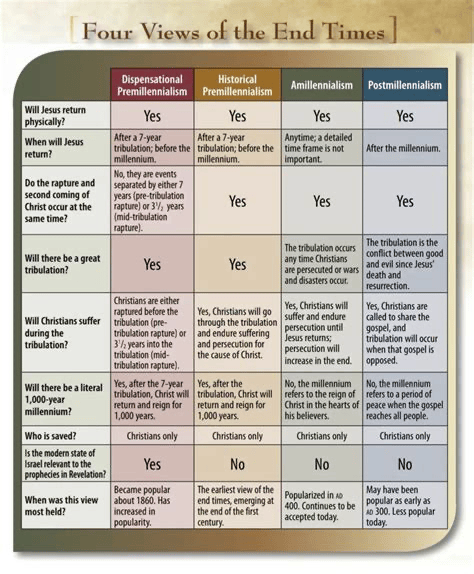
To complicate matters, there are four primary theories which seek to interpret the eschatological millennial period, the duration and its time frame in accordance with related prophesied events.
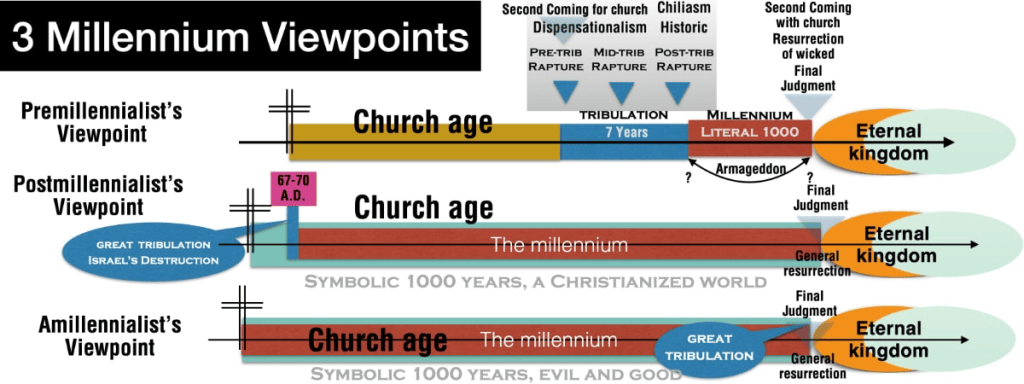
Amillennialism views the millennium as a symbolic period that coincides with the current church age.
Its key beliefs include:
a. Christ reigns spiritually in heaven;
b. the binding of Satan is seen as effective during this entire period; and
c. there is no future, literal millennium, so that believers live in the ‘millennial’ age now.
Postmillennialism believes that Christ will return after a future golden age of Christian prosperity.
Its key beliefs include:
a. the millennium is a time of widespread peace and righteousness brought about by the Gospel;
b. society will be transformed as more people come to faith; and
c. Christ’s return occurs after this period of spiritual and societal improvement.
In the opinion of this writer, both these doctrines are not biblical and seek to water down the scriptural depiction of the Millennium.
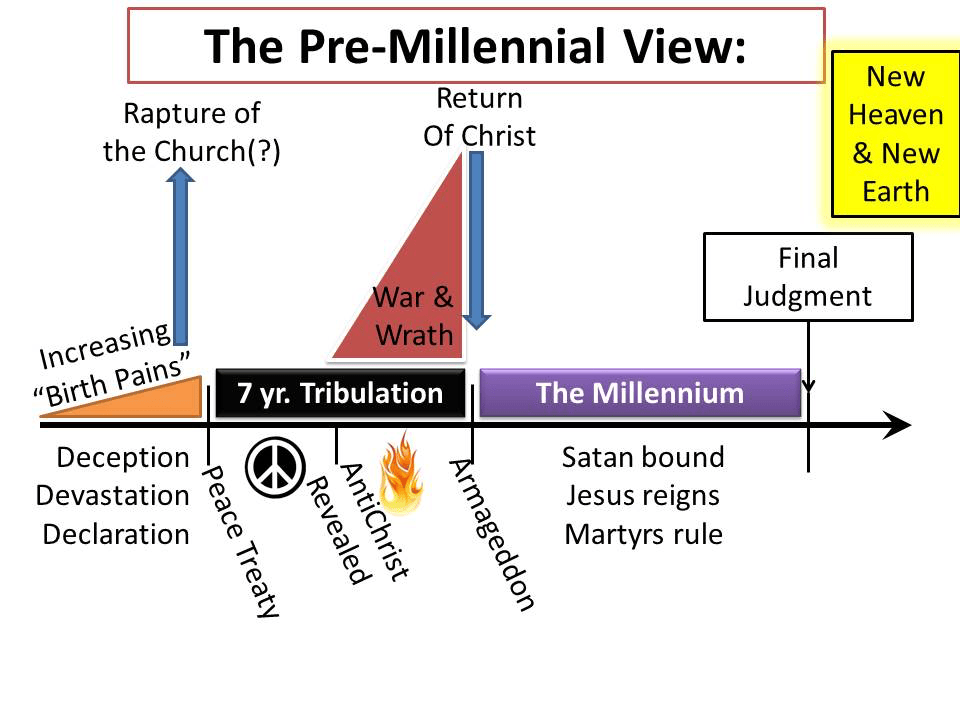
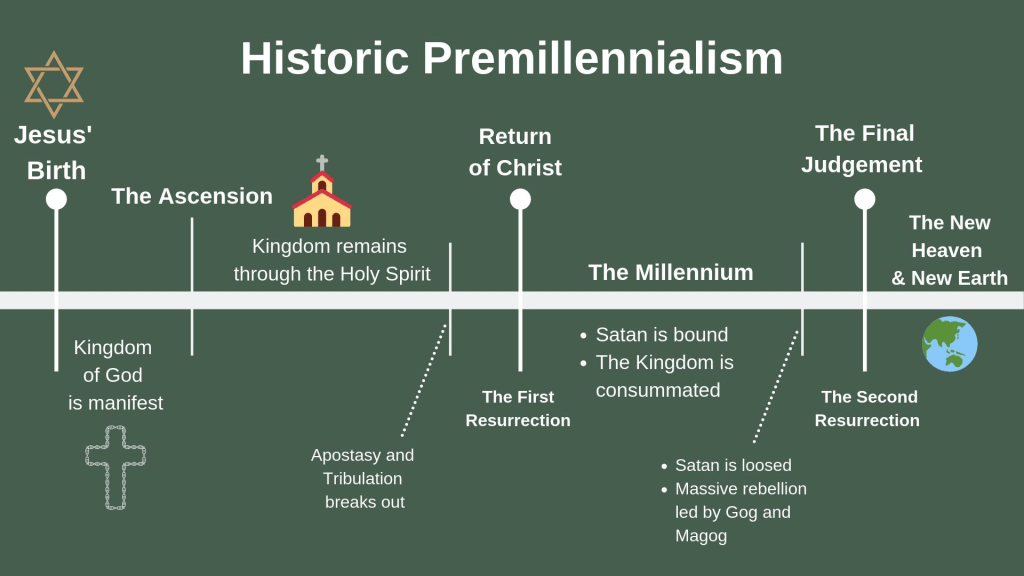
Historic Premillennialism holds that Christ will return before a literal thousand-year reign on earth.
Its key beliefs include:
a. there will be a period of great tribulation before Christ’s return;
b. after his return, Christ will reign on Earth for a thousand years; and
c. this view emphasises a physical presence of Christ during the millennium.
Dispensational Premillennialism is a more detailed interpretation that includes a rapture and a literal thousand-year reign following the tribulation.
Its key beliefs include:
a. believers will be raptured before, during, or after a seven-year tribulation;
b. Christ will establish His kingdom on Earth, centred in Jerusalem, after the tribulation; and
c. this view emphasises distinct periods in God’s plan for humanity.
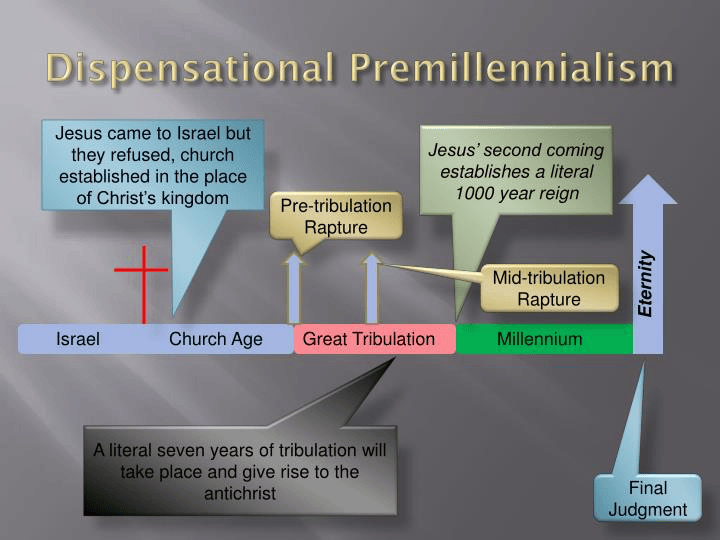
It is the thinking of this writer that premillennialism is biblically accurate with both the historic and dispensational interpretations being partially correct. Though overall, the dispensational explanation aligns with scripture more closely.
Historic premillennialism teaches the ‘church was in the fore-vision of Old Testament prophecy, while dispensationalism teaches that the church is hardly, if at all, mentioned by the Old Testament prophets.’
Historic premillennialism teaches the ‘present age of grace was predicted in the Old Testament. Dispensationalism holds that the present age was unforeseen in the Old Testament and thus is a “great parenthesis” in history introduced because the [Israelites] rejected the kingdom.’
Historic premillennialism teaches a millennium after the second advent of Christ but is not concerned with classifying other epochs of history. Dispensationalism teaches seven divisions of time. The present age is the sixth dispensation. The final one being the millennial age following the second coming of Christ.
Historic premillennialism was held by the majority of Christians during the first three centuries of the era beginning after the death of Christ. Many of the early church fathers such as Irenaeus, Papias, Justin Martyr, Tertullian and Hippolytus taught that there would be a tangible kingdom of God upon the Earth after the return of Christ; though apocalyptic prophecies were not always interpreted literally.
Historic premillennialism also taught that the ‘Antichrist’ would appear on Earth and the ‘seven-year’ tribulation would begin. Next would be the ‘rapture’, and then Jesus and His church would return to Earth to rule for a thousand years. The faithful would then spend eternity in the New Jerusalem.
Christianity became the official religion of Rome in the fourth century and many things began to change, including acceptance of historic premillennialism – Article: The Seven Churches – A Message for the Church of God in the Latter Days.
Amillennialism soon became the prevailing doctrine of the Roman Catholic Church.
‘One of the most influential historic premillennialists was George Eldon Ladd [1911-1982], an evangelical New Testament scholar and professor of New Testament exegesis and theology at Fuller Theological Seminary. It was through Ladd’s work that historic premillennialism gained scholarly respect and popularity among evangelical and Reformed theologians of the twentieth century.’
The placement of the rapture (not the 1st Resurrection) in relation to the tribulation is one of the key differences between historic premillennialism (after the tribulation) and premillennial dispensationalism (beginning of seven years or start of final three and a half years).
Thus Historic premillennialism differs from dispensational premillennialism in that it only has one view of the rapture, and does not require a literal seven-year tribulation. Historic premillennialists hold to a posttribulational rapture, meaning the church is raised to meet Christ in the air after the trials experienced during the Great Tribulation.
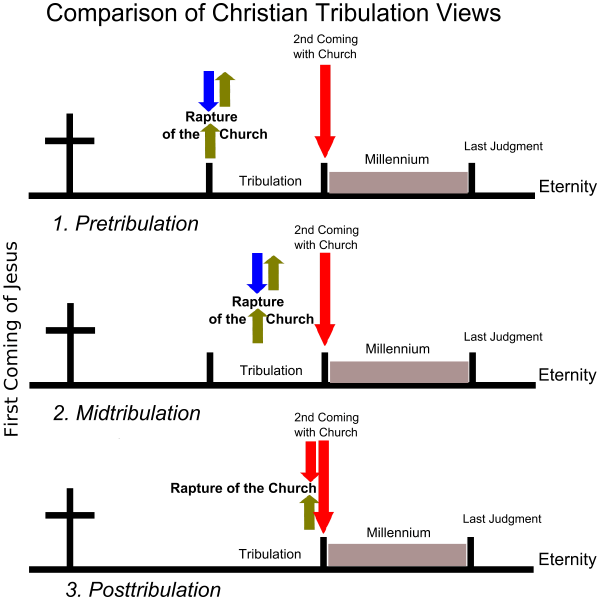
Support for the rapture (Matthew 24:40-42, 1 Corinthians 15:51, 1 Thessalonians 4:17) taking place half way during the final seven years preceding Christ’s return is found in the Books of Daniel and Revelation – Daniel 9:27, Revelation 11:2-3; 12:6.
Rapture:
‘the act of carrying off’
‘the carrying of a person to another place or sphere of existence’
‘the experience, anticipated by some fundamentalist Christians, of meeting Christ midway in the air upon his return to earth’
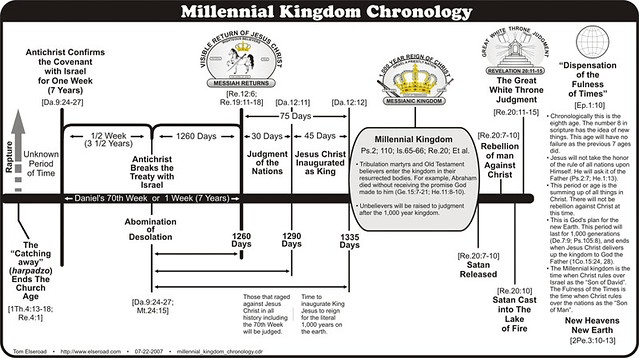
Whereas the first resurrection (1 Corinthians 15:18, 20, 23, 52) occurs immediately after Christ has returned (at the end of the Tribulation – 3 1/2 years) and at the beginning of the millennial rule (1,000 years) – 1 Thessalonians 1:10; 4:16, James 1:18, Revelation 20:4-6.
The second Resurrection takes place at the end of the Millennium – Revelation 7:9-17; 20:5, 7, 11-13.
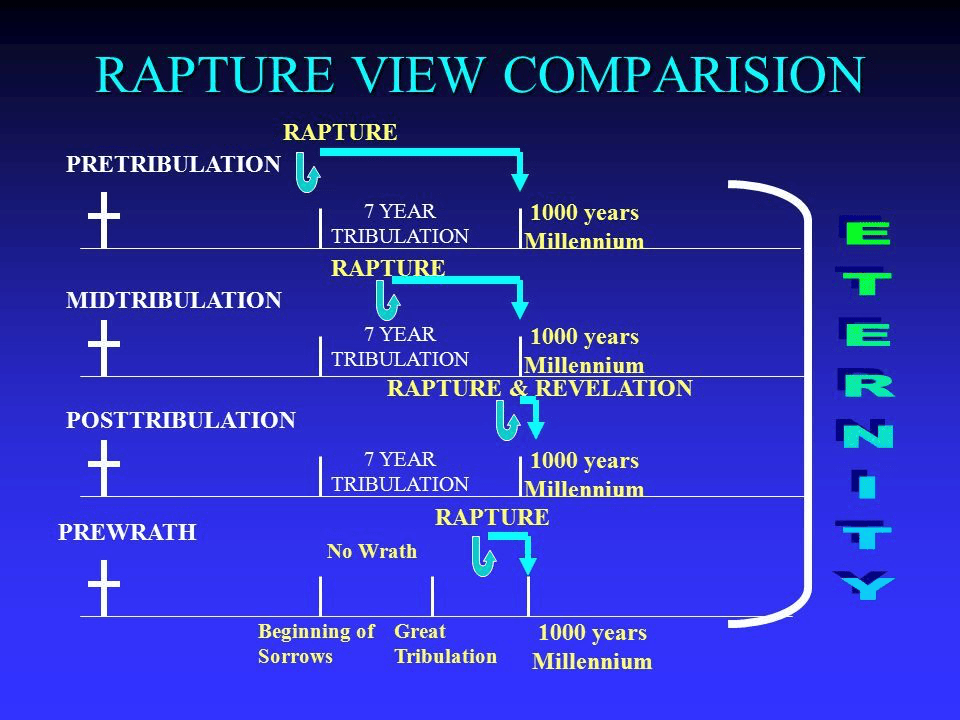
Therefore, the sequence of events answering how the two teachings of premillennialism result in three explanations for the timing of the ‘rapture’ is as follows.
The rapture is the translating of saints^ who are alive at the beginning of the Antichrist’s (first Beast, Revelation 13:1-10 – Article: Is America Babylon?) rule – the 144,000^ (Revelation 7:1-8; 14:1-5*). Just like Enoch and Elijah who were taken while still alive – Genesis 5:24, Hebrews 11:5, 2 Kings 2:11.
Hebrews 11:5
English Standard Version
‘By faith Enoch was taken up so that he should not see death, and he was not found, because God had taken him. Now before he was taken he was commended as having pleased God.’
2 Kings 2:11
English Standard Version
‘And as they still went on and talked, behold, chariots of fire and horses of fire separated the two of them [Elisha]. And Elijah went up by a whirlwind into heaven.’
The saints [144,000 – refer 144,000, article: The Pyramid Perplexity] who are alive will meet Christ before he overthrows the kingdoms of this world – Revelation 19:11-21.
They will share in the marriage supper with the Lamb of God.
Revelation 19:7
English Standard Version
‘Let us rejoice and exult and give him the glory, for the marriage of the Lamb has come, and his Bride has made herself ready…’
Matthew 22:2
English Standard Version
“The kingdom of heaven may be compared to a king who gave a wedding feast for his son…”
Matthew 25:10
English Standard Version
‘And while [the virgins*] were going to buy [oil (Holy Spirit)], the bridegroom came, and those who were ready went in with him to the marriage feast, and the door was shut’ (Matthew 25:1-12).
Revelation 21:2
English Standard Version
‘And I saw the holy city, new Jerusalem, coming down out of heaven from God, prepared as a bride adorned for her husband.’
Meanwhile, all those faithful believers from righteous Abel to those who have died prior to Christ’s return – including those who have been called and martyred during the tribulation – will be resurrected just prior to the establishing of the Kingdom of God on Earth for a thousand years.
Hence the confusion regarding the rapture’s timing either at the beginning or ending of the Great Tribulation, when in fact the rapture (beginning) and 1st resurrection (ending) are two different events.
The second resurrection then takes place at the end of the Millennium and includes all those who have ever lived. They are judged and if not found in the Book of Life, they will cease to exist – Revelation 20:11-15. There is no third resurrection as taught by certain groups.
Can the reader understand how judgement, the rapture, resurrection, eternal life, the Millennium and the Kingdom of God are inextricably linked?
The preaching of Paul’s false gospel of salvation and grace, no matter how interesting, important or profound, deflects from the truth of God’s plan proclaimed by His son.
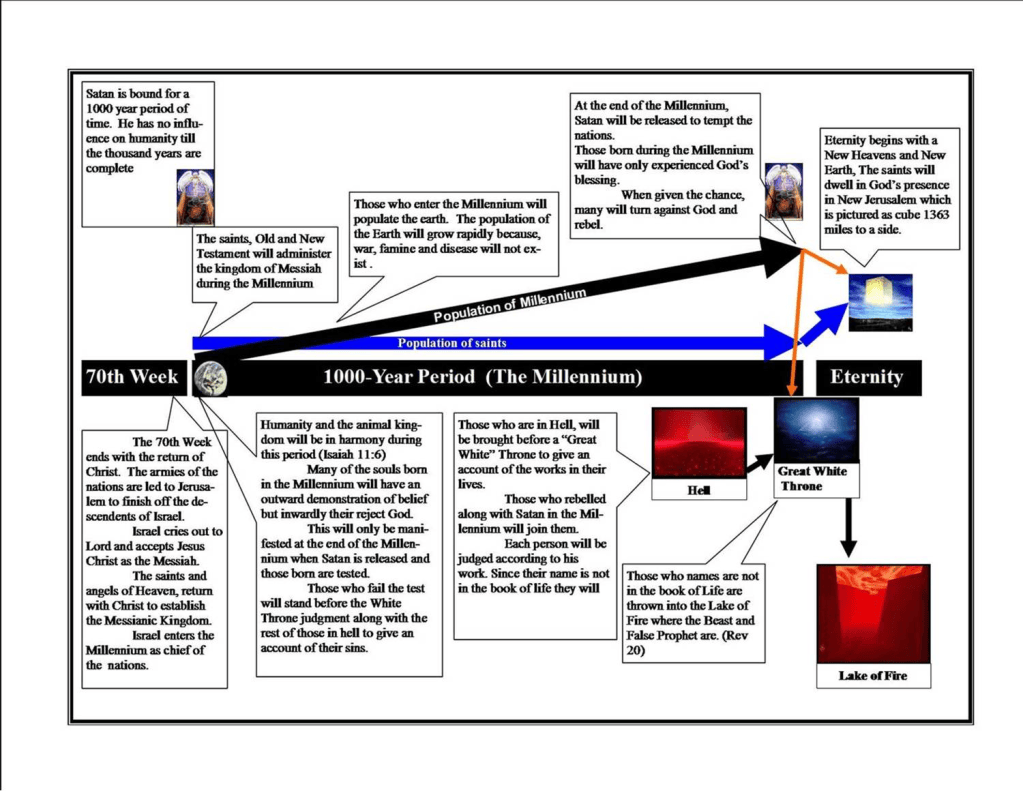
A further paramount difference between historic premillennialists and dispensational premillennialists is the emphasis that each gives to the nation of Israel during the millennium.
‘Historic premillennialists believe that scriptural prophecy, especially the passages in Daniel and Revelation, give the entire history of the Church in symbolic form. Thus, they look into the Church’s past and present to find prophetic [fulfilment] and to see where they are in God’s prophetic timetable.
Most historic premillennialists hold that the nation of Israel will undergo a national salvation immediately before the millennium is established [incorrect], but there will be no national restoration of Israel [correct]. Thus, the nation of Israel will not have a special role or function [prior to the tribulation] that is distinct from the Church [correct (refer Chapter XXIX Esau: The Thirteenth Tribe**)].
In contrast to historic premillennialism, dispensational premillennialism has gained popularity among modern evangelicals. Dispensational premillennialists hold that the second coming of Christ, and subsequent establishment of the millennial kingdom, is to be preceded by a seven-year-long period known as the “Tribulation,” [technically 42 months or 3 1/2 years] the earthly activity of the Antichrist as well as the outpouring of God’s wrath on mankind [Day of the Lord].
Dispensational premillennialists are of the conviction that the nation of Israel will be saved and restored to a place of preeminence in the millennium [not the nation of Israel**, but rather the true Israelite tribes – Chapter XXX Judah & Benjamin – the Regal Tribes]. Thus, Israel[ites] will have a special function of service in the millennium that is different from that of the Church [correct].
According to dispensationalists, the millennium will be a period of history in which God reverts back to fulfilling His Old Testament promises made to ethnic Israel, after this modern “Church Age” in which we live today is concluded. As such, the millennium will be a state of Jewish [rather Israelite] dominion over all the world, along with a newly restored Jewish [Israelite] temple and priesthood.
The [Saints] who reign with Christ will all have been given eternal, glorified bodies [Rapture and 1st Resurrection], and will reign spiritually, while the Jews [tribes of Israel and true Judah] will own the world physically, and will live, marry, and die (although evincing incredible longevity), just as people have throughout the history of the world. It is only after this thousand-year period, in which God [fulfils] His promises to ethnic Israel, that Christ will put down a final rebellion and usher in the eternal state with its New Heaven and New Earth (Revelation 21-22).
Historic premillennialism, conversely, requires none of this strict dichotomy between God’s spiritual people, the Church, and His physical people, ethnic Israel; it merely looks ahead to a time when Christ will reign visibly on the earth, before He brings in the eternal state.’
In this instance the dispensational understanding is correct and the historic view is a watered down version, falling into error on specific points.
‘A dispensation is a way of ordering things – an administration, a system, or a management. In theology, a dispensation is the divine administration of a period of time; each dispensation is a divinely appointed age. Dispensationalism is a theological system that recognizes these ages ordained by God to order the affairs of the world.
Dispensationalism has two primary distinctives:
1) a consistently literal interpretation of Scripture, especially Bible prophecy, and 2) a view of the uniqueness of Israel as separate from the Church in God’s program.
Classical dispensationalism identifies seven dispensations in God’s plan for humanity.
Dispensationalists understand the Bible to be organized into seven dispensations:
Innocence (Genesis 1:1-3:7)
Conscience (Genesis 3:8-8:22)
Human Government (Genesis 9:1-11:32)
Promise (Genesis 12:1-Exodus 19:25)
Law (Exodus 20:1-Acts 2:4)
Grace (Acts 2:4-Revelation 20:3)
Millennial Kingdom (Revelation 20:4-6)
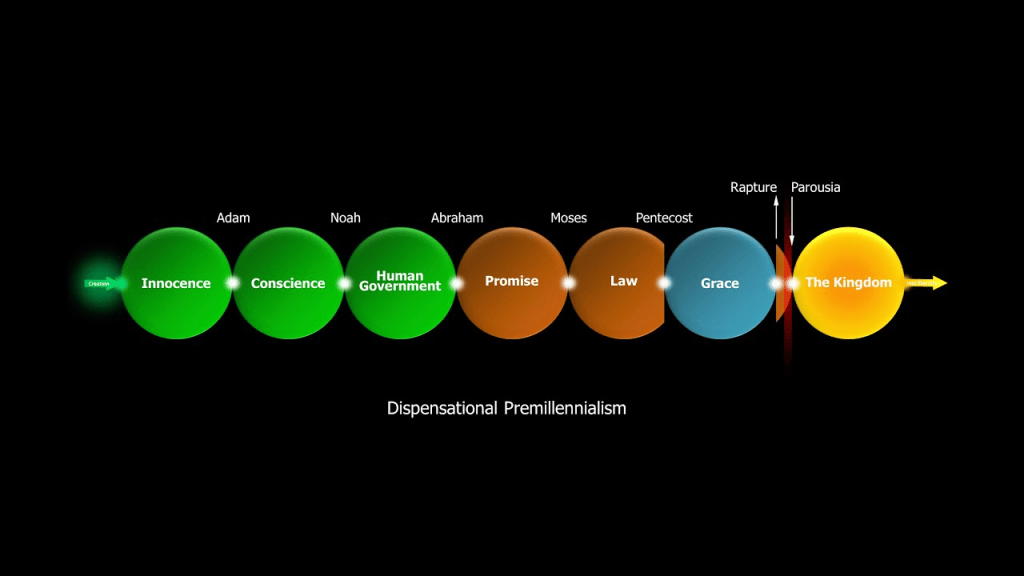
‘Each dispensation includes a recognizable pattern of how God worked with people living in the dispensation. That pattern is 1) a responsibility, 2) a failure, 3) a judgment, and 4) grace to move on.
Dispensationalism, as a system, results in a premillennial interpretation of Christ’s second coming [correct] and usually a pretribulational interpretation of the rapture [correct].’
In summary: dispensationalism is a theological system that
a. emphasises the literal interpretation of Biblical prophecy;
b. recognises a distinction between physical Israel and the spiritual body of Christ; and
c. organises the Bible into different dispensations or administrations.
As the following article concisely and comprehensively describes the Millennium, it is reprinted in its entirety.
What is the millennial kingdom, and should it be understood literally? Got Questions – emphasis mine:
‘The millennial kingdom is the title given to the 1,000-year reign of Jesus Christ on the earth. Some seek to interpret the 1,000 years in an allegorical manner. They understand the 1,000 years as merely a figurative way of saying “a long period of time,” not a literal, physical reign of Jesus Christ on the earth. However, six times in Revelation 20:2-7, the millennial kingdom is specifically said to be 1,000 years in length. If God wished to communicate “a long period of time,” He could have easily done so without explicitly and repeatedly mentioning an exact time frame.
Revelation… gives the precise time period of the millennial kingdom. There are countless other passages that point to a literal reign of the Messiah on the earth. The [fulfilment] of many of God’s covenants and promises rests on a literal, physical, future kingdom. There is no solid basis for denying the literal interpretation of the millennial kingdom and its duration being 1,000 years.
The Bible tells us that when Christ returns to the earth He will establish Himself as king in Jerusalem, sitting on the throne of David (Luke 1:32-33). The unconditional covenants demand a literal, physical return of Christ to establish the kingdom.
The Abrahamic covenant promised Israel a land, a posterity and ruler, and a spiritual blessing (Genesis 12:1-3). The [Land (Mosaic)] covenant promised Israel a restoration to the land and occupation of the land (Deuteronomy 30:1-10). The Davidic covenant promised Israel a king from David’s line who would rule forever [while obedient] – giving the nation rest from all their enemies (2 Samuel 7:10-13).
At the second coming, these covenants will be fulfilled as Israel [the true tribes] is re-gathered from the nations (Matthew 23:31), converted (Zechariah 12:10-14), and restored to the land under the rule of the Messiah, Jesus Christ.
The Bible speaks of the conditions during the millennium as a perfect environment physically and spiritually. It will be a time of peace (Micah 4:2-4; Isaiah 32:17-18), joy (Isaiah 61:7, 10), and comfort (Isaiah 40:1-2).
The Bible also tells us that only believers will enter the millennial kingdom. Because of this, it will be a time of obedience (Jeremiah31:33 [New Covenant]), holiness (Isaiah 35:8), truth (Isaiah 65:16), and the knowledge of God (Isaiah 11:9; Habakkuk 2:14). Christ will rule as king (Isaiah 9:3-7; 11:1-10). Nobles and governors will also rule (Isaiah 32:1; Matthew 19:28), and Jerusalem will be the political center of the world (Zechariah 8:3).’
What is the purpose of the thousand-year reign of Christ? Got Questions:
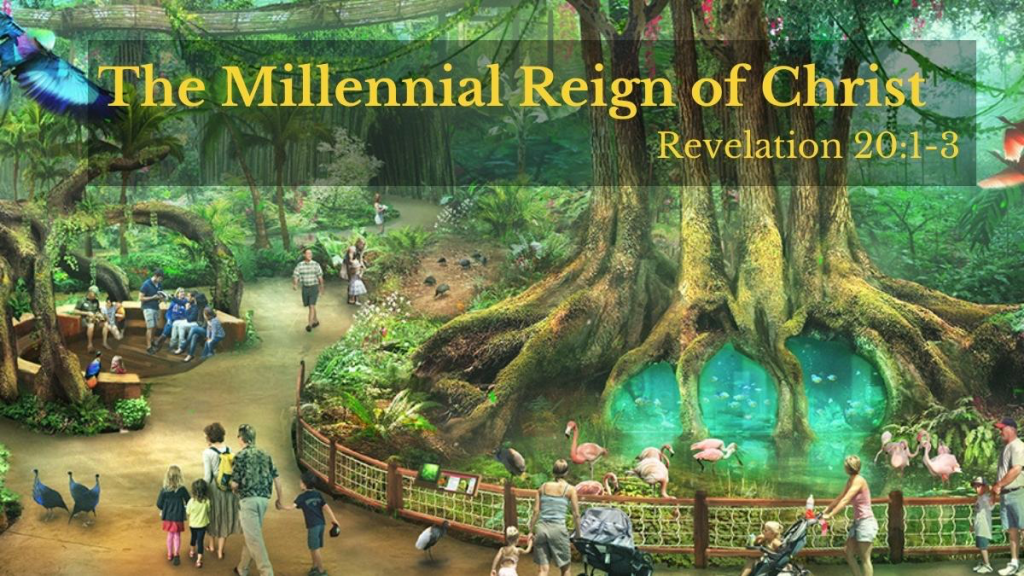
‘The millennium (also known as the millennial kingdom) is the 1,000-year reign of Jesus after the tribulation and before the Great White Throne Judgment of the wicked [second resurrection]. During the millennium, Jesus will reign as king over Israel and all the nations of the world (Isaiah 2:4; 42:1 [Daniel 7:11-14]).
The world will live in peace [and prosperity] (Isaiah 11:6-9; 32:[13-15], 18 [Ezekiel 34:16, Micah 4:4, Isaiah 19:23-25]), Satan will be bound (Revelation 20:1-3), and, at the beginning, everyone will worship God (Isaiah 2:2-3 [Psalm 110]).
The purpose of the 1,000-year reign is to [fulfil] various promises God made to the world. Some of these promises, called covenants, were given specifically to Israel. Others were given to Jesus, the nations of the world, and creation. Jesus’ 1,000-year reign will be a time of promises kept.’
Of course, it suits mainstream Christianity to deflect from the true gospel about the millennial kingdom with a false gospel and therefore further the falsehood that when we die we go to heaven or hell – Article: Heaven & Hell.
Thereby hiding the truth about the resurrection from the dead.
The true church and body of believers by faith, hold to the ‘testimony of Jesus’ – Revelation 12:17; 14:12. Meaning the prophecies uttered by Christ and these in the main pertain to the coming Kingdom of God – Revelation 19:10.
The Son of God delivered a message on behalf of the Father about His coming kingdom and its establishment on Earth.
Jesus Christ’s life was supremely important and his death and resurrection on behalf of the world’s inhabitants without comparison. Even so, the messenger was not more important than the message.
And that message was the good news about his Father’s kingdom. In other words, the lasting liberation of all of humanity from the bondage imposed by the Adversary and finally freedom from death.
And this gospel of the kingdom will be proclaimed throughout the whole world as a testimony to all nations, and then the end will come.
Matthew 24:14 English Standard Version
Not everyone who says to me, ‘Lord, Lord,’ will enter the kingdom of heaven, but the one who does the will of my Father who is in heaven.
Matthew 7:21 English Standard Version
“The Kingdom of Heaven is not for the well-meaning: it is for the desperate.”
James Denney
“The trouble with kingdoms… on earth is that they’re liable to come to pass, and then their fraudulence is apparent for all to see. We need a kingdom of heaven…”
Malcolm Muggeridge
© Orion Gold 2026 – All rights reserved. Permission to copy, use or distribute, if acknowledgement of the original authorship is attributed to Orion Gold

