Victims – Part I
Motivation for investigating the identity of the Zodiac Killer was inspired by two occurrences.
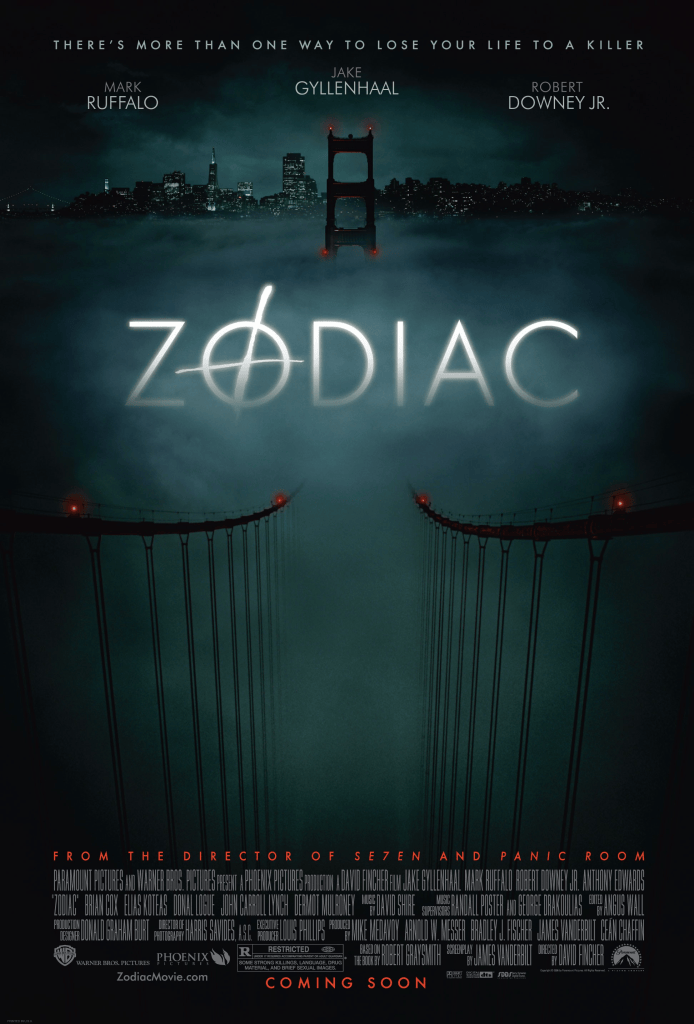
The first being the 2007 motion picture Zodiac – recently viewed for the first time by this writer – directed by David Fincher and starring the gifted and heavily underrated actor, Jake Gyllenhaal. The film is written by James Vanderbilt and based on the non-fiction books by Robert Graysmith: Zodiac (1986) and Zodiac Unmasked Zodiac (2002).
The second being the unanticipated satisfaction experienced from the unexpected unmasking of the identity of Jack the Ripper – Article: Jack the Ripper.
Even if Jack the Ripper’s identity has not been answered – to the satisfaction of every reader – the case presented in establishing without doubt the number one prime suspect, is compelling and yet to be satisfactorily refuted.
Armed with an albeit new but avid interest in the Zodiac; supported by confidence in successfully dissecting the very cold case of Jack the Ripper, it is with gusto that this writer attempts to shed light on another cold case which has similarly gripped the public’s fascination… the identity of the Zodiac Killer.
In The Top Tens, Top 10 Greatest Unexplained Mysteries of All Time – of which there are currently 62 listings – the Zodiac Killer is ranked number 17, as voted by 2% of readers.
Number 2, being Jack the Ripper with 9% of readers votes.
Between 1968 and 1983, a political cartoonist for the San Francisco Chronicle (Robert Graysmith) morphed into an amateur detective obsessed with tracking down the Zodiac Killer, an individual who terrorised the San Francisco Bay area with a killing spree lasting during the late 1960s and early 1970s at least, if not longer.
All the while taunting police with letters, bloodstained clothing and ciphers mailed to newspapers. To this day the killer remains ‘officially’ unidentified, despite decades of intensive police investigation and numerous amateur sleuthing efforts. The police believe five killings were committed by Zodiac, including two failed attempts resulting in survivors thus totalling seven definite victims. Although other murders have been attributed to the killer.
In 2004 the San Francisco Police Department marked the case inactive, though subsequently re-opened the case in 2006. The California Department of Justice, the Federal Bureau of Investigation, the city of Vallejo and the Napa and Solano county sheriffs maintain the case status as open.
As well as endeavouring to unmask the Zodiac Killer’s identity, we will scrutinise some of the murders either claimed by the Zodiac (37 in one instance and 100+ in another) or attributed to them and whether they are guilty of any of them or not.
As we discovered with Jack the Ripper, the total tally of deaths committed by a serial killer is not always accurate, whether claimed by:
a. the killer themselves;
b. resulting from police investigation; or
c. from the public’s own conclusions.
We will begin tragically with the victims – later focussing on the suspects (and after that, the letters) – aiming to discover who were actually killed by the Zodiac and who were sadly (and mercifully in some cases) not.
The seven victims of the Zodiac Killer officially recognised by law enforcement – based on
a. physical evidence linking the scenes; and
b. the killer providing non-public details in their letters which only the true perpetrator could know – include:
David Faraday, Betty Lou Jensen, Darlene Ferrin, Cecelia Shepard and Paul Stine, the five who were murdered between December 1968 and October 1969; and Michael Mageau and Bryan Hartnell, the two who survived.
Investigators have never found forensic evidence to substantiate the additional 32 claims.
Tera Box:
‘The shadow cast by the Zodiac Killer over Northern California in the late 1960s remains one of the most heavily analyzed chapters in American criminal history. Yet, in the decades since the attacks, popular culture has often focused more on the killer’s cryptic letters, his executioner costume, and his unverified claims than on the actual lives he took. The disparity between the killer’s self-reported body count and the forensic reality is stark.
Understanding the Zodiac case requires separating the killer’s carefully constructed mythology from the documented crime scenes. By examining the confirmed victims, the survivors, and the highly debated “possible” victims, we can gain a clearer picture of the reality behind the letters.’
The Zodiac Killer may have conceivably killed previously – ‘practicing’ prior to their first officially admitted and recognised murders involving the ‘first’ two teenagers following.
David Arthur Faraday – Betty Lou Jensen
Case number: V-25564
Tera Box:
‘The first confirmed attack occurred on the frigid night of [Friday] December 20, 1968 [at approximately 11.15 pm], on [remote] Lake Herman Road, [a gravel turnout at the entrance to the Benicia Water Pumping Station] a secluded lovers’ lane just inside the city limits of Benicia [on the eastern outskirts of Vallejo], California.
The victims were 17-year-old David Arthur Faraday…’
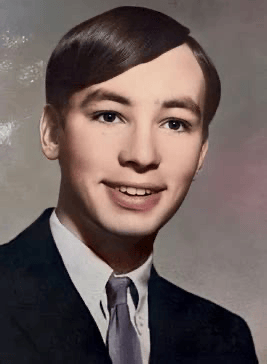
David at age 17 in 1968
‘… and 16-year-old Betty Lou Jensen, two high school students on their first official date [the first date Jensen had ever been allowed on in fact].’
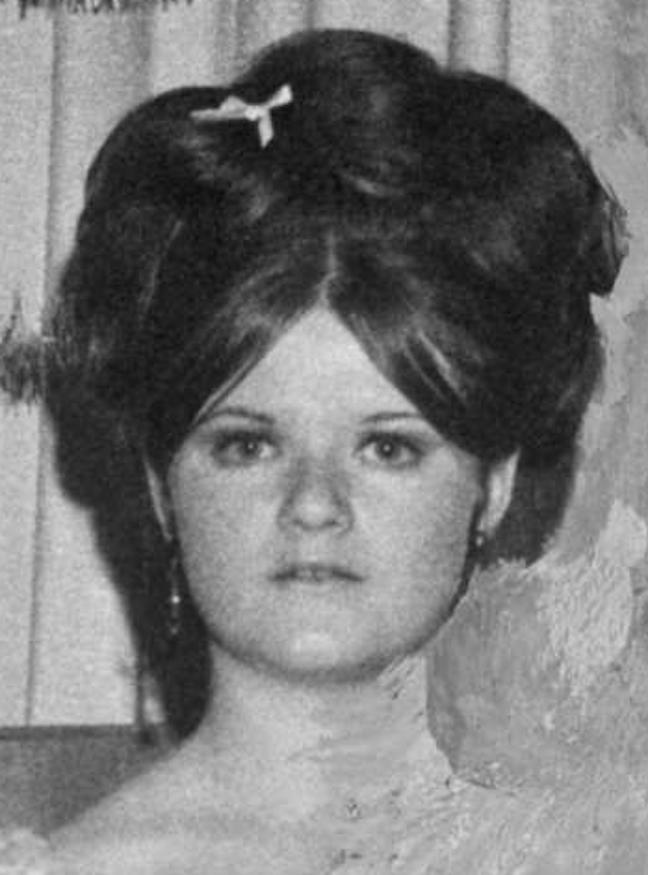
Betty Lou at Age 16 in 1968
‘Faraday was a highly regarded student and an Eagle Scout who had recently earned the “God and Country Award.”
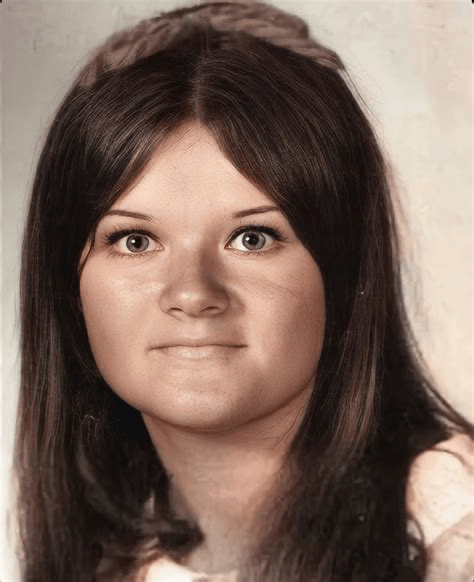
‘Jensen was an honor student and a member of the Pythian Sisters, a charitable fraternal organization.
Their backgrounds stand in stark contrast to the brutal nature of their deaths, highlighting the tragic loss of youth that characterized the killer’s early crimes.’
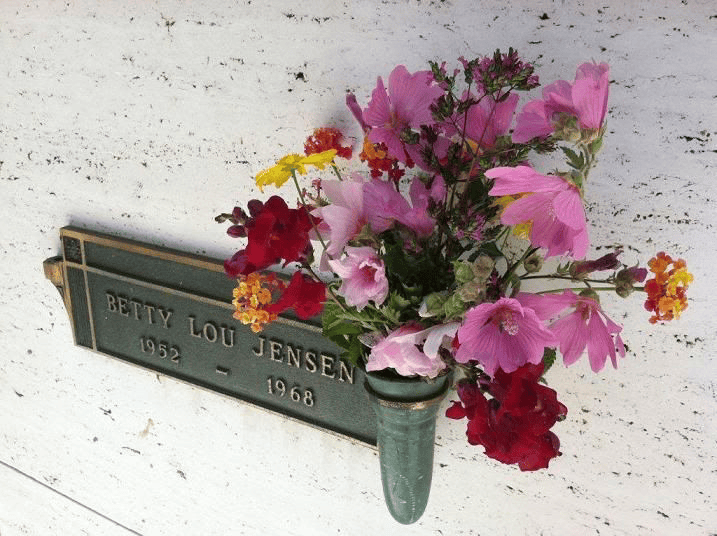
‘According to historical research summaries, the couple was parked in Faraday’s mother’s Rambler station wagon when another vehicle pulled alongside them.
The assailant forced them out of the car [with two shots fired into the vehicle].
Jensen exited the front passenger door first, followed by Faraday. Faraday was shot as he emerged from the car… once in the head at close range and… [was found still breathing and taken to Vallejo General Hospital where he was pronounced D.O.A. at 12:05 AM].’
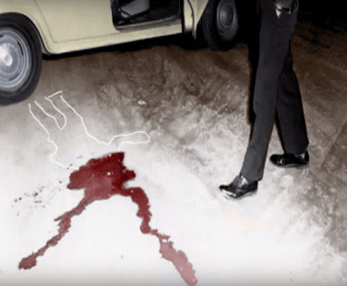
‘Jensen attempted to flee on foot but was struck by five [out of six] bullets in the back [and was found lying on the ground 10 feet behind the station wagon]. She was pronounced dead at the scene.’
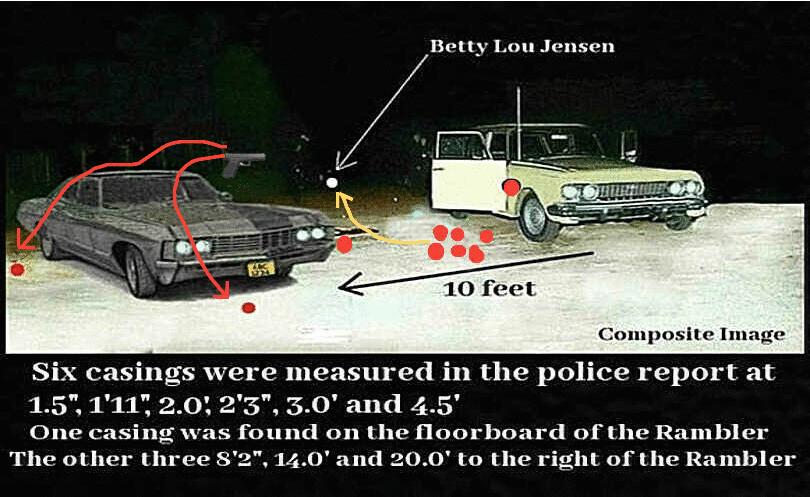
A total of ten shots were fired, with five hitting Jensen; one hit Faraday; two were shot into the car; and two bullets were unaccounted for (including one which had been fired at the fleeing Jensen and missed).
Zodiac Killer:
‘The weapon was a .22 caliber semi-automatic pistol. The ammunition was Winchester Western Super X copper-coated long rifle. There was no indication of robbery or sexual molestation. While there were no witnesses, several vehicles were seen in the area just prior to local resident Stella** Borges discovering the crime scene.
In the early 1990s, former Vallejo Police Department detective John Lynch said the couple was killed because Faraday had learned of a major drug deal and had been talking openly about who was involved.
Other sources have speculated that Zodiac wasn’t responsible because no taunting letters or phone calls were received until months after the murders. However, when Zodiac finally took credit for this attack, he provided many details that were not known to the general public [and only to the police].’
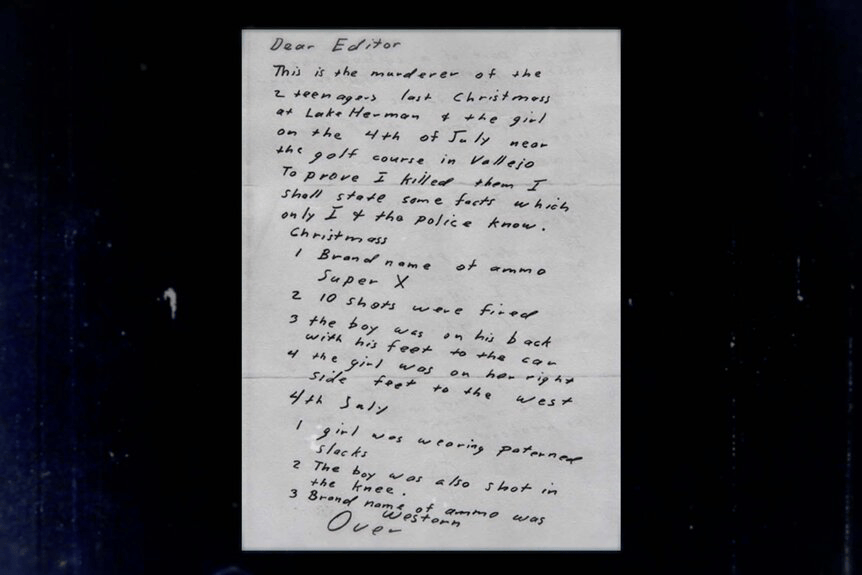
‘Perhaps Zodiac’s sense of fulfillment following the Faraday-Jensen murders was so strong that he didn’t feel the need to immediately brag to the news media.
More than 30 years later [1998], local residents still haven’t forgotten this crime.’
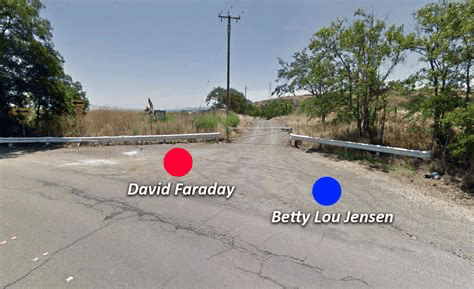
‘And the secluded area of the murders hasn’t changed very much at all.’
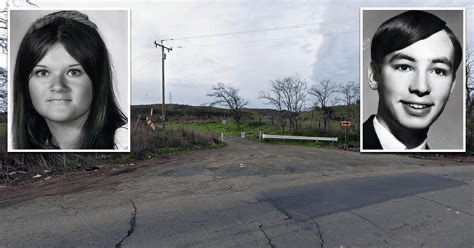
Specific details of particular interest leading up to the murder of Faraday and Jensen include the following witness testimony.
Zodiac Killer Info – emphasis mine:
‘Russell Butterbach of the Solano County Sheriff’s Department was with his partner Wayne Waterman on the night of the murder. “We got a call from the Sergeant that a man from Benicia who fishes at Lake Berryessa [location of third attempted double homicide] wasn’t home, and that was [well after] 7 o’clock, 8 o’clock. He asked us to look down Lake Herman Road and see if his truck was there. It was a blue truck.”
At around 9 PM, two raccoon hunters, Robert Connelly and Frank Gasser, observed a white 1959 or 1960 4-door hardtop Chevy Impala* parked at the pumping station gate.
Between 9:30 and 10 PM, William Crow was out with his girlfriend. The couple were trying out her sports car, and Crow was making adjustments to the motor. While parked at turnout, they observed a car coming west down the road from Benicia towards Vallejo.
The car passed, then stopped and reversed towards them. Worried, Crow sped off east towards Benicia, followed by the other car. They abruptly turned off on a road towards Benicia (Reservoir Road?), and the other car continued east on Lake Herman Road.
The police report suggests there were two subjects in the car, both caucasians.
In the Police report the car is described as a blue car, “possibly a Valiant”. Many years later, Crow stated that he never told police the car was a Plymouth Valiant, and said instead that he believed the car was a “four-door light-colored Chevy.”*
He also said: “I could not see the passenger seat, but the driver was a man [1] with short hair [2] and glasses [3].”
NOTE: Crow’s testimony is interesting, as it seems to suggest that the Zodiac may have been cruising around the area for some time, looking for a couple to murder. Crow’s statement about a light colored Chevy, driven by a man with short hair and glasses matches Kathleen Johns’ statement about a “late model vehicle, light in color driven by a man with “dark hair, wearing black rimmed plastic glasses.”
At “approximately 10 PM” a rancher named Bingo Wesher was checking on his sheep in an area east of the pumping station entrance, when he observed a white Chevrolet Impala sedan parked by the south fence at the pumping station entrance.
David Faraday and Betty Lou Jensen attended a Christmas concert at Vallejo’s Hogan high school, which they left around 10:00 PM. David was driving his mother’s 1961 AMC Rambler station-wagon.
At 10:15 PM a young woman named Helen Axe drove past the pumping station entrance with her boyfriend and reported seeing the Rambler parked at the turnout, facing the gate. She recognized Faraday and Jensen in the car. When she returned about 15 minutes later, the car was still there, but “turned around and the front was facing the field, a little to the side.”
At sometime around 11 PM… Peggy Your… driving west on Lake Herman Road… observed Faraday’s car parked “facing east towards the field at the left of the gate.” Mrs. Your “described the location of the car as the front facing the fence, the rear section of the station wagon facing directly west towards Vallejo.”
Sometime around 11:15 PM, a car pulled into the turnout and parked to the right of Faraday’s station wagon. The driver (the Zodiac killer) apparently sat in the car for a brief period, either to intimidate his victims, or perhaps to build up the courage to go through with the murder. Or maybe he saw the lights of an approaching car (see below) and waited for the car to pass.
Apparently just after the Zodiac killer pulled into the turnout, a man named James Owen was driving east on Lake Herman Road, going from his home in Vallejo to^ work at Humble Oil in Benicia. As he passed the turnout, he observed two cars parked 10 feet apart. Owen estimated the time to be 11:20 PM.
(NOTE: It seems likely that the actual time was slightly earlier… around 11:15-11:18 PM. This is based on the below testimony regarding Stella** Borges.)
In the police report, there are two separate statements given by James Owen – the first on December 21 and the second on December 24. In the latter statement, Owen said the distance between the cars was “three or four feet,” and that he “did not see anyone in the cars or around them.”
He also said that after driving about a quarter mile past the turnout, he thought he heard a gunshot. Just before reaching the turnout he had been passed by a car going in the opposite direction (west) toward Vallejo, but could give no description of the vehicle. This car has never been identified.
NOTE: Owen’s initial statement in the police report is a bit confusing as it says that he was “driving home from^ work at Humble Oil, Benicia.” This is an error – Owen was in fact driving to^ work, as he worked the graveyard shift. The diagram [not shown] showing the cars as he saw them indicates he was driving east, which would make sense only if he was driving to work.
The killer seems to have have waited for Owen’s car to pass, then exited his vehicle and approached the station wagon. It is not entirely clear what sequence of events followed… The entire murder, from the point where zodiac exited his vehicle, to the time when he drove away, probably took no more than 1 or 2 minutes.
At around 11:20 PM, Stella** Medeiros was driving east on Lake Herman Road. When she passed the pumping station turnout, she saw Faraday and Jensen lying on the ground. The boy “”looked like he had fallen out of the open door,” and the girl was “lying on her side facing the road.” There was only one car at the scene (the Rambler).
Medeiros drove to Benicia to report the incident to Police, and flagged down Captain Daniel Pitta and Officer William Warner at 11:25 pm on East 2nd Street (approximately a 3 minutes drive from the turnout).
… there are a couple of fairly specific times logged In Captain Pitta’s report, and it is possible that the times were accurately logged while looking at a clock. Pitta’s report states that Mrs. Madeiros flagged them down at 11:25 PM, and that they then drove to the crime scene, arriving there at 11:28 PM… [meaning] Stella Madeiros would have passed the turnout at around 11:22 PM. This would allow the time the Zodiac LEFT the turnout to be as late as about 11:20 PM.
The police report on the Lake Herman Road murder mentioned an incident that happened at “the Pancake House” on Tennessee St. This was The International House of Pancakes (IHOP) where Darlene Ferrin [next case below] worked in 1966-67.’
“Mrs. _____ is the mother of SHARON HENSLIN, BETTY LOU’s friend. She relates that, in a conversation with her daughter, a subject identified as MARK ____ of 137 ___ way, had spoken of an incident that happened at the Pancake House on Tennessee Street. The story went on to say that DAVID was going to turn in a subject for pushing grass (or Marijuana), and the man had threatened him.”
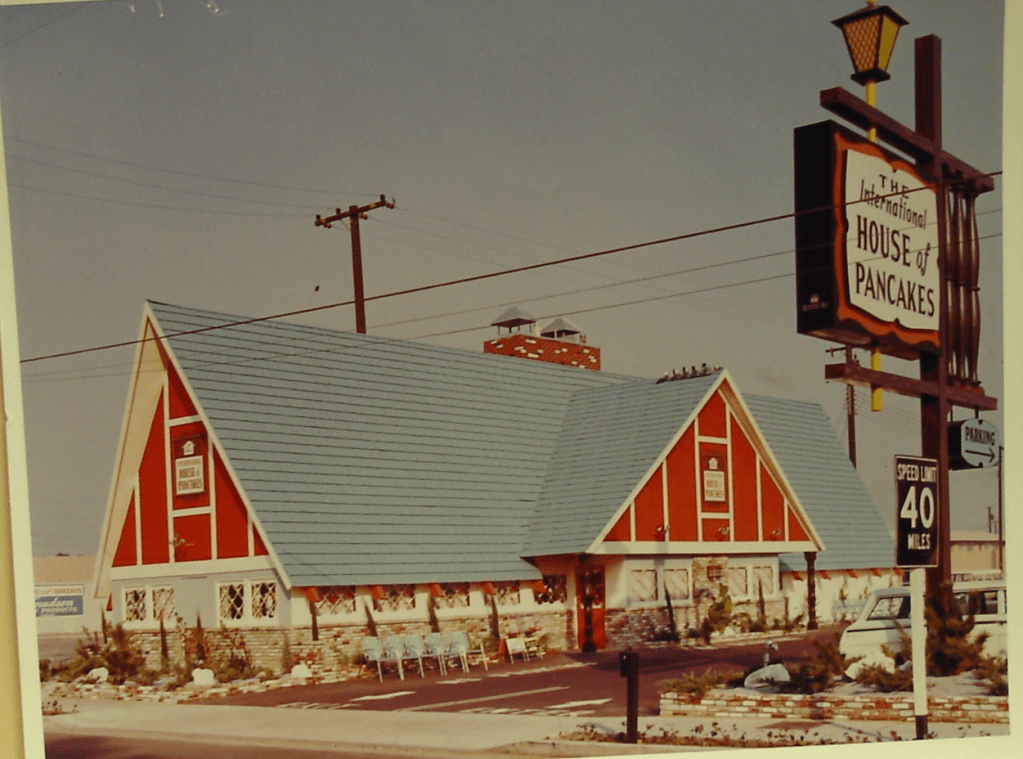
The IHOP (International House of Pancakes) at 1400 Tennessee Street
Salient observations about the double homicide which may prove relevant or pivotal as this investigation progresses include the following points.
The killer, rightly or wrongly appears to have been on edge and nervous. Perhaps orchestrating their first kill – in this ambush like manner at least. Firing panicky shots wildly into the car, rather than calmly telling the victims to get out of the car.
This is amplified by how the killer fired only one shot (under kill) at David Faraday, failing to kill him outright, yet fired five rounds (over kill) into Betty Jensen, undoubtedly killing her in seconds.
The excess of bullets fired at Jensen possibly indicates a greater degree of anger towards her because she was female.
The episode overall reflects an inexperienced or anxious individual who was either
a. not use to firearms;
b. was not a professional assassin; or
c. whom was fearful of being seen by another car passing or stopping and therefore acted with intentional alacrity.
We learn that the crime was not overtly sexual as in the perpetrator molesting or raping either of the victims. Though the act of an execution type killing of two young people on a renowned lover’s lane and who were likely to become intimate in some fashion, hints at the killer gaining a measure of sexual satisfaction in interrupting their amorous intent.
It may also reveal some form of impotency on the killer’s part, by virtue of
a. they did not have sexual contact with either victim; yet
b. brutally killed both victims – while displaying a violent rage – who were in a situation promising sexual activity.
Four key deductions to ponder are:
1. a hurried attack (perhaps due to location);
2. leading to an amateur (unprofessional) ambush;
3. with an excessive amount of ammunition fired and
4. non-sexual (or asexual) motivated violence.
Possible facts are the sighting of a suspicious white Chevy car (thrice) – which may have had two occupants – and was driven by a man with short hair and wearing glasses.
The aspect of an accomplice will be discussed further and we will learn the description of short hair and eye glasses is repeated. The glasses may have been part of a disguise as could the dyeing of the killer’s hair due to descriptions ranging from light to dark brown.
A coincidence which could be much more than that, is the alleged altercation between David Faraday and another man at the International House of Pancakes; where a subsequent murder victim, Darlene Ferrin had previously worked. Ferrin meanwhile had been the focus of interest from the man who would become the prime Zodiac Killer murder suspect: Arthur Leigh Allen.
Notice Allen has the same first name as Faraday’s middle name. Whether it was Allen or somebody else, did they know (of) both Faraday and Ferrin? Is there a connection between the murder of Faraday (and Jensen) with the later killing of Ferrin?
Darlene Elizabeth (“Dee” nee Suennen) Ferrin – Michael Renault Mageau
Case number: 243146
Tera Box:
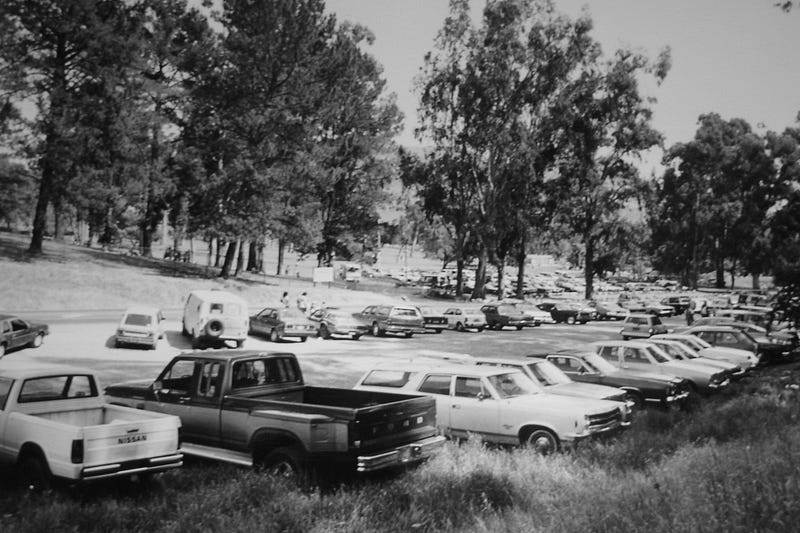
Approximately six and a half months later on Friday, July 4, 1969, at approximately 11.55 pm, ‘the killer struck again at [a parking lot in] Blue Rock Springs Park… [on the eastern outskirts of] Vallejo, just a few miles from the site of the first murders.’
‘Darlene Elizabeth Ferrin, a 22-year-old popular waitress, wife, and mother, was parked in the lot with her friend, 19-year-old Michael Mageau.
Zodiac Killer:
‘Ferrin was married and worked as a waitress at Terry’s Restaurant. Mageau was single and worked as a laborer. Ferrin’s husband, Dean, was initially a suspect in the murder, however, was ruled out once it was established he was working as a cook at Caesar’s Restaurant at the time of the murder. Ferrin’s first husband, James Phillips Crabtree, was also briefly a suspect.’
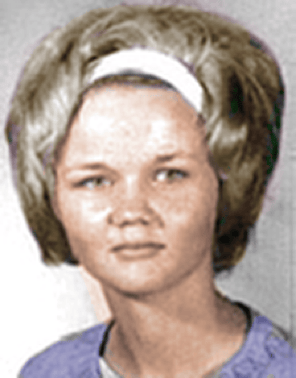
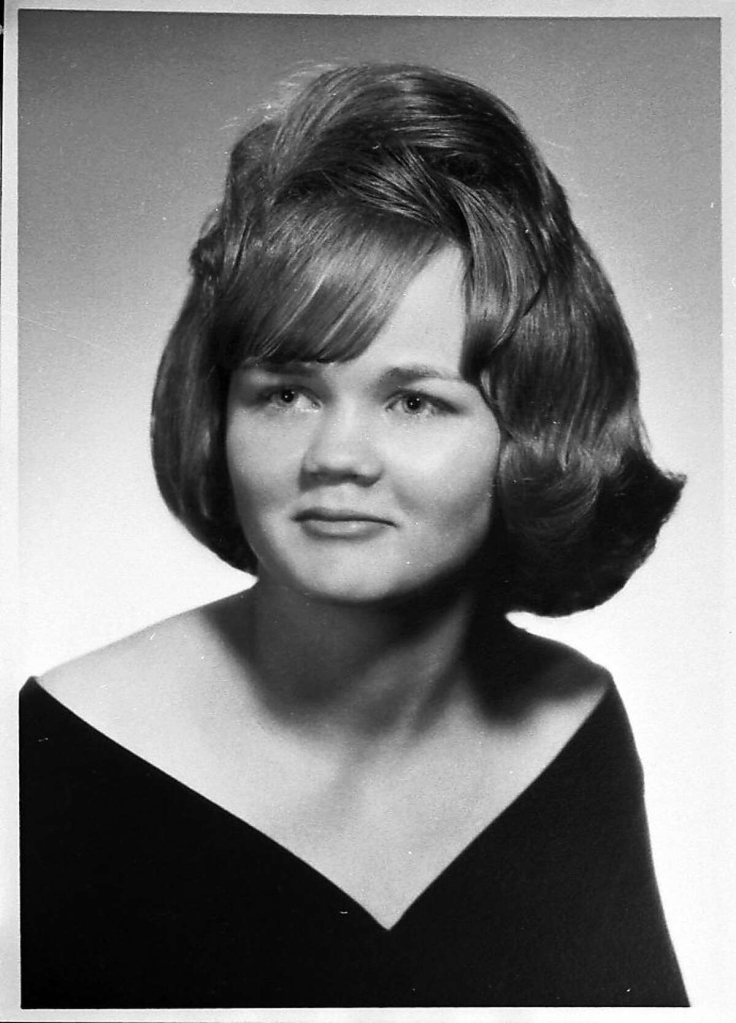
Darlene at age 18 in 1966
‘Darlene and Dean lived at 1300 Virginia Street, Vallejo. Darlene’s sister, Linda Del Buono, lived at 449 Cedar Street. Darlene’s parents were Mr. and Mrs. Leo Suennen of 130 Jordan St, Vallejo. One of Darlene’s babysitters said that she covered up for “Darlene’s running around with other men while she was married to Dean. One of the men mentioned was… Michael Mageau.”
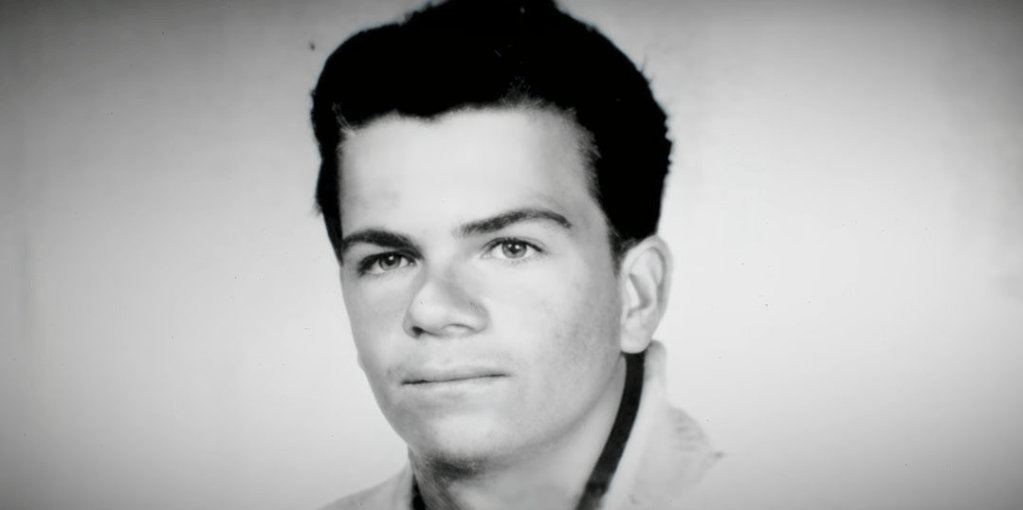
Michael at age 16 in 1966
‘According to surviving victim Mageau, he and Ferrin had parked at the isolated location to talk. A car, possibly a light-brown Ford Mustang or Chevrolet Corvair, pulled into the lot just a few feet away. A man with a flashlight exited the vehicle and approached them. There were no other cars in the parking lot. Thinking it was a police officer, the couple had their identification ready.’
Tera Box:
‘The attacker approached their vehicle with a flashlight [taped to the firearm], blinding the occupants… [and without warning] opening fire with a 9mm Luger. Ferrin was struck multiple times and was pronounced dead upon arrival at the hospital.’
Zodiac Killer:
‘After five shots were fired, the man walked slowly back to his car. Mageau screamed in pain, at which point the man returned and fired two more shots into each victim [and Marceau got a look at the killer].
No conversation between the victims and the man occurred.’
Tera Box:
‘… Despite being shot in the jaw, shoulder, [hip] and leg, Mageau survived.
His initial description of the killer – a heavy-set [1] white [2] male [3], roughly 5’8” to 5’9” [4], with a round [5] face – formed the basis of the early police profile.’
Zodiac Killer adds:
‘The man was… in his late 20s to early 30s [6], stocky build, round face, and brown [7] hair.’
Tera Box:
‘Mageau’s involvement in the case resurfaced dramatically in 1991. According to biographical profiles of the case, Vallejo police [George Bawart] presented Mageau with a photo lineup 22 years after the attack. He pointed to a photo of Arthur Leigh Allen, a long-time suspect, and identified him as the shooter.
However, because the identification relied on a “cold” memory from a highly traumatic event over two decades prior, prosecutors felt it was not strong enough to secure an indictment before Allen’s death in 1992.’
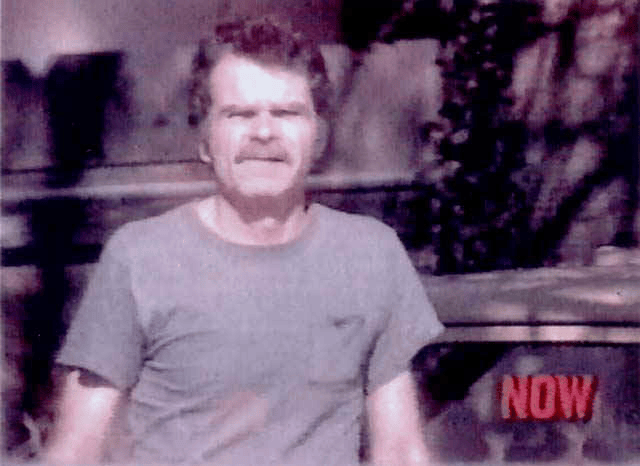
Michael Mageau in 1998
Zodiac Killer:
‘When Bawart asked Mageau why he had never identified Allen in the 20 years Allen had been the top suspect, Mageau said that he had never been shown any pictures of suspects and he had only been asked if he recognized certain names. If Mageau’s statement is true, it’s probably the biggest law-enforcement blunder of modern times.’
Tera Box:
‘Shortly after the attack [forty-five minutes later], a man called the Vallejo Police Department from a public payphone, claiming responsibility for the shooting and explicitly taking credit for the murders of Faraday and Jensen the previous year. This phone call marked the beginning of the killer’s direct communication with law enforcement.’
Specific details of particular interest leading up to the attack on Mageau and Ferrin include witness testimony, as well as pertinent facts.
Zodiac Killer Info:
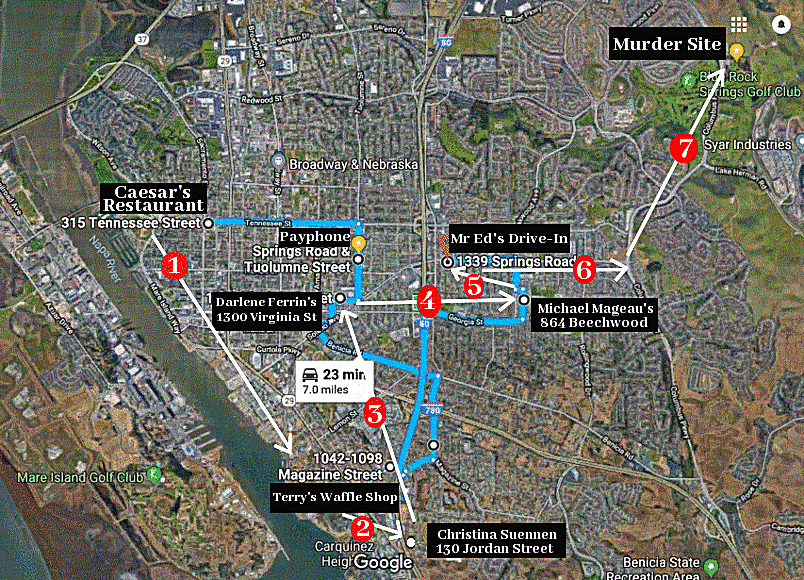
“At approximately 11:30 or shortly thereafter [nearer 11:40]” Darlene Ferrin picked up Mike Mageau at his house at 864 Beechwood Ave, Vallejo, a 5 minute drive from Darlene’s house. According to Mageau, they were going to “have a lover’s lane type thing, and kiss, and talk and hold each others’ hands.” Mageau also said that he and Darlene were dating and that her husband was aware of this.
They were both hungry and decided to get something to eat. But after briefly heading west down Springs Road, Darlene said she wanted to talk to him about something, so they turned the car around and headed to Blue Rock Springs Park. They turned around at “approximately the location of Mr. Ed’s” at 1339 Springs Road – an 8 minute drive from Blue Springs Park.’
‘At sometime around 11:45 to 11:48 PM, Darlene and Mike arrived at Blue Rock Springs Park. After parking, Darlene turned off the headlights and the motor, but left the radio playing. After being in the park for “a very short time, a few minutes,” three cars pulled in… some young kids laughing and carrying on lighting firecrackers. The three vehicles left “within a short time.” “This was just a very short space of time, a few minutes,” according to Mageau.
“Shortly after this [11:50],” another car pulled into the lot, coming from the direction of Springs Road and Vallejo. The driver pulled to the left or east of their car and turned off the headlights and sat there for a minute. Michael asked Darlene if she knew who it was and she said, “Oh, never mind.” (Note: in 2007, Mageau said “She told me it was a friend of hers and not to worry. He was just jealous.”)
Mageau could not see the car very well, or the color of the car, but said it was similar in shape to Darlene’s [Chevrolet] Corvair. The car then drove off at a fast rate of speed back towards Vallejo to the south.
Approximately 5 minutes after driving away [11:55], the same car returned and parked about 10 feet behind and to the right of them.’
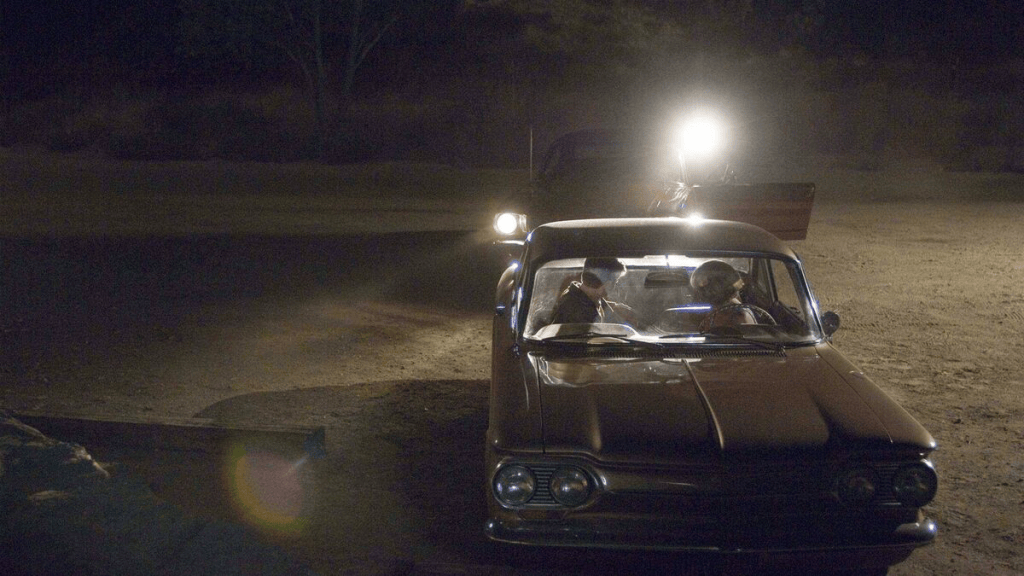
‘The driver exited the vehicle, approaching the passenger side door of Ferrin’s car, carrying a flashlight and a 9 mm pistol. The killer shined the flashlight into Mageau’s and Ferrin’s eyes before shooting at them, firing five times. Both victims were hit, and several bullets had passed through Mageau and into Ferrin. After the shooting the car drove off again towards Vallejo.
At “approximately midnight” gunshots were heard by a witness named George Bryant who lived 800 ft from the Blue Rock Springs parking lot. George then heard the car “take off at super speed and it burned rubber and was squealing its tires as it sped along the road.”
In the 2007 documentary “This is the Zodiac Speaking” Mageau said that someone in another car chased him and Darlene from the restaurant, all the way to the park. The car drove off, and then came back, at which time the driver got out and shot them.
In what seemed to Mageau to be 8 or 10 minutes later [12:05], a car came by with three “hippy types” in it: Debra ___, 19, Roger ___ 17, and Jerry ___, 17. The teens later said that they “guess the time they were at the park as real close to midnite, possibly a little before midnite.”
Mageau told them, “I’m shot and the girl’s shot. Get a doc.” The teens drove off to call police from Jerry’s house at 938 Castlewood Drive, Vallejo, which was 2.4 miles from the park (a 5 minute drive).
At 12:10 AM, police dispatch operator Nancy Stover received a call from a female stating that 2 juveniles were being shot at Blue Rock Springs parking lot. Officers were then dispatched to the scene.’
‘Approximately 40 minutes after the shooting, the killer called Vallejo police and spoke with dispatcher Nancy Slover:
“I want to report a double murder. If you will go 1 mile east to the public park on Columbus Parkway you will find the kids in a brown car. They were shot with a 9mm Luger. I also killed those kids last year. Goodbye.”
By 12:47, a PT&T (Pacific Telephone and Telegraph Company) operator called Vallejo Police to report that the call had been traced to a payphone at Joe’s Union, at the corner of Springs Road and Tuolumne Street.’
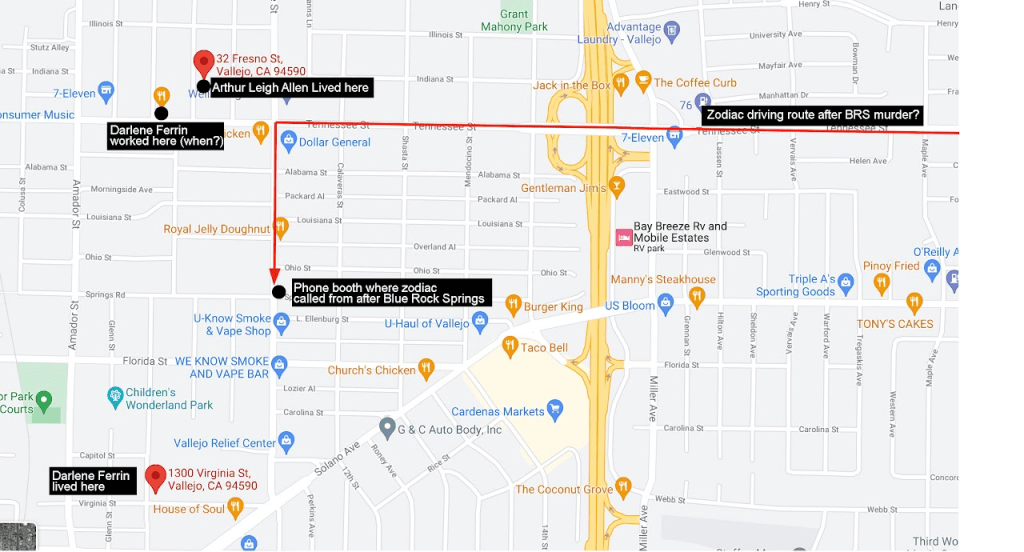
‘The phone booth where Zodiac called Vallejo PD… was… a 9 minute walk from Arthur Leigh Allen’s house, roughly between Allen’s house and Darlene Ferrin’s house on Virginia Street. It seems likely that Zodiac may have also called Ferrin’s house at this time, which would indicate that Zodiac knew Ferrin.’
Recall, the killer may have known both Darlene and David Faraday.
Therefore it is critical information which supports Darlene Ferrin’s association with either prime suspect, Arthur Leigh Allen or someone else.
Zodiac Killer Info:
‘Among Darlene’s closest friends, according to Darlene’s sister Linda Doris Del Buono, was a man described as:
“Lee who used to bring Darlene presents from Tia Juana” – statement of Linda Doris Del Buono, on the morning after the murder.
… [a] babysitter of Darlene’s named Karen___, 17 years-old, was contacted by Vallejo PD in June 1977. When babysitting in [February] or March 1969 at Dean and Darlene’s previous address of 560 Wallace Ave, at approx 10 PM, she noticed [a] middle-aged man sitting in [a] white [American made] sedan, watching the [apartment]. He was there for several hours, but left before Dean returned home from work at midnight.
The following day, she told Darlene… Darlene asked her what the car and the man looked like, and after relating a description to her, Dee said something to the effect, ‘I guess he’s checking up on me again. I heard he was back from out of state.’ Followed by, ‘He doesn’t want anyone to know what I (meaning Darlene) saw him do. I saw him murder someone.”
Karen stated that sometime during this conversation Darlene mentioned the man’s name, and that the first name was very short, three or four letters, and that the second name was just slightly longer. The name was quite common. Karen stated that Dee appeared to be genuinely frightened of this individual and mentioned sometime that he had been checking up on her at Terry’s Restaurant where Darlene was employed.’
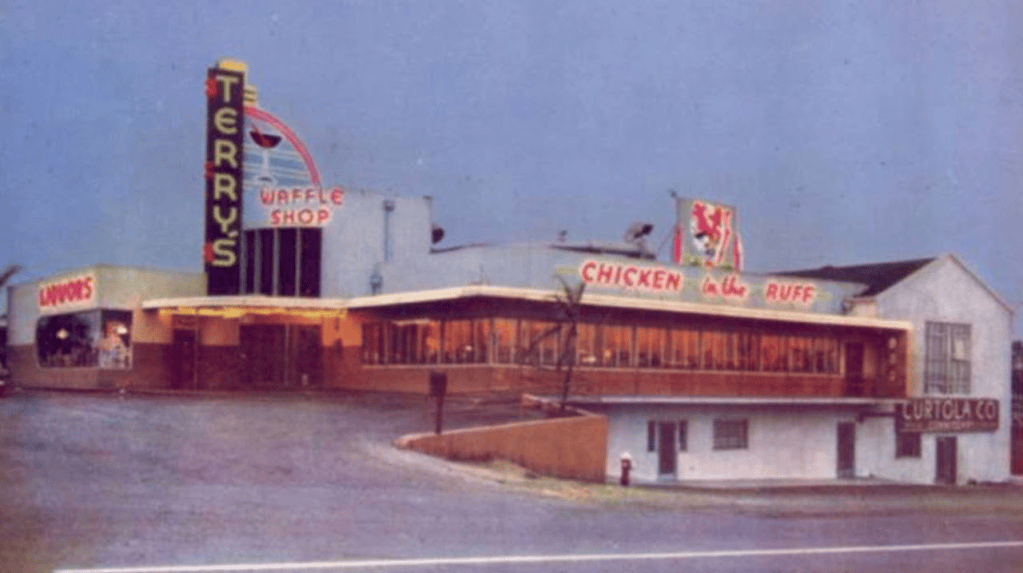
Terry’s Waffle Shop on Magazine Street, where Darlene Ferrin worked in 1969, at the time of the murder.
‘Under hypnosis, Karen described the man as “heavy-set [1], middle-aged [2] white [3] male [4] adult, very round [5] face, curly, wavy [6] dark brown [7] hair. The vehicle was a white sedan with a large windshield.”
This description is telling, for it closely matches the Zodiac killer with the additional detail of curly or wavy hair.
Zodiac Killer Info:
‘In his book Zodiac, Robert Graysmith claimed that Darlene spoke to an older man in a white car at Terry’s Waffle Shop at around 10:30 PM on the night of the murder [the killer drove a light brown vehicle].
There has been much speculation and debate about a supposed “painting party” that may or may not have taken place at Darlene Ferrin’s house [May 1969, at 1300 Virginia Street] prior to the murder.
Police interviewed Darlene’s sisters, Pam and Linda. Both sisters recalled a “painting party” held at Darlene’s home several months before her murder, and a mysterious, well-dressed man who attended and scared Darlene.
Karen, the babysitter, said she was there taking care of Darlene’s daughter, and that “three unidentified white males arrived, and that she soon left the residence, due to the fact she was uncomfortable with these strange individuals.”
… later versions of the painting party story would focus on the individual allegedly seen by Steve Baldino and Darlene’s sisters Pam and Linda – a sinister, well-dressed yet older man.
… Linda (Darlene’s sister) told investigators that the menacing stranger had been following and bothering Darlene and brought her gifts he purchased in Mexico. In 1969, Linda had mentioned a man who brought Darlene presents from “Tia Juana”, and said that the man was named “Lee” and further described him as one of Darlene’s “three closest friends,” and not a menacing stranger.
Pam would later claim that she had seen this mysterious man on at least eight occasions, and that Darlene warned her to stay away from him because he was a murderer. Like Linda, Pam failed to mention this potentially important information during her many interviews with police, and her selective silence and sensational stories cast doubt on her credibility.
Vallejo police detective George Bawart had come to know Pam after investigating claims that she was the victim of harassment by an anonymous and threatening stalker. Bawart once told a television producer that Pam was “nutso.” Darlene’s husband Dean Ferrin told the same producer that Pam and Linda were prone to prevarication.
Pam had claimed that Darlene’s cousin Sue Ayers had visited surviving victim Michael Mageau as he recovered in the hospital. According to Pam, Mike told Sue that he and Darlene had [been] chased to the crime scene and the gunman had uttered Darlene’s nickname, “Dee,” just before the shooting started.’
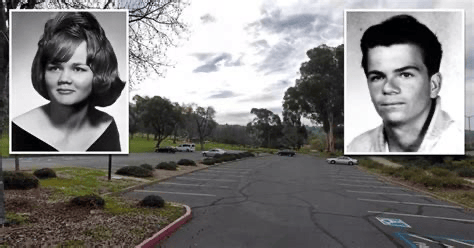
‘Mike Mageau later claimed that he and Darlene were chased around town by another car prior to the shooting. He did not tell this to police at the time. Graymith claimed that Darlene and Mike were trailed by a “light-colored car that had been parked in the shadows of the tree-lined street.”
Joseph Shores, August 10, 2024:
‘Zodiac Victim Michael Mageau was interviewed for the 2007 documentary “This is the Zodiac [Speaking.”]
Michael Mageau:
“We were chased by this guy we [were] chased by him from the restaurant[,] he was chasing us and I told her to pull off at the park. He chased me all night long [from the] restaurant Paul’s or whatever it was called, and he chased us all the way to the park that’s where we ended up Blue Rock Springs Park, I thought he drove off drove away, but he came back later on and shot us.
It was like a Brown Raunair [Corvair] Car a small compact car. [But] it could of been a Cadillac too. I’m not really sure. I don’t really remember[,] she told me it was a friend of [hers and] not to worry about [it], he [is] just jealous that is all, she said about it he’s just jealous.
[She] didn’t mention a name, but somehow Richard his name was Richard I had heard Richard and I think that was his name, she referred to him as Richard. It’s all I have of the guy.
She says mean temper and if he ever found out he’d kill her. [He] was jealous she mentioned the words he would kill me if I knew she was talking to you[,] about that she told me that. We were on the run, literally on the run literally. This guy was chasing us big time.”
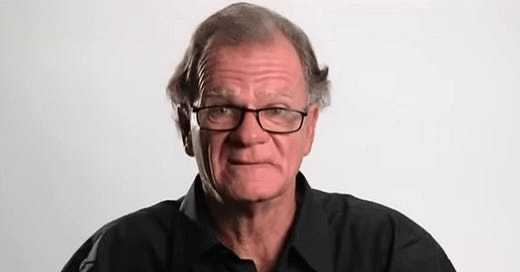
Michael Margeau in the 2007 documentary
Shores:
‘I know what you are thinking.
In 1969 when Mike Mageau was interviewed by the Vallejo Police he said nothing about [a] Richard… Michael states a vehicle pulled into the lot, coming from the direction of Springs Road around to the left or east side of their car, approximately six or eight feet away and sat there for a minute. Michael states he asked Dea if she knew who it was and she stated, “Oh never mind.”
Michael stated at this time he is always kidding Dea about knowing so many people and does not know whether she meant this as she knew the fellow or not…
But [let’s] give Michael Mageau the benefit of the doubt maybe the Vallejo cops somehow did not get this important piece of information out of one of the few witnesses in one of the most infamous crimes in history.’
This may also be critical information and relate to Darlene’s mystery stalker, if their identity was not Arthur Leigh Allen. Thus not only, according to Michael Mageau – if we can wholly rely on his testimony – did he not
a. see photos of prime suspects in the case, but
b. the police crucially, may not have extracted this vital piece of information about the suspects first name.
Of course, that is if we can trust Michael Mageau. For there is a seeming discrepancy between sighting Allen in a photograph line up, yet naming a ‘Richard’ some sixteen years later.
Mageau may have known the killer and for whatever reason – perhaps fear of reprisal – sought to protect their identity. Or it could be – Mageau suffering from severe shock – his mind did not think clearly at the time and his memory grew clearer later. Lastly, he may have been influenced by police reports, the media and civilian investigations; whereby Arthur Allen and or a Richard ‘someone’ became a real recollection to Mageau.
We will return to this potential mind boggling oversight when investigating the extensive list of Zodiac suspects and particularly anyone called, you guessed it… Richard.
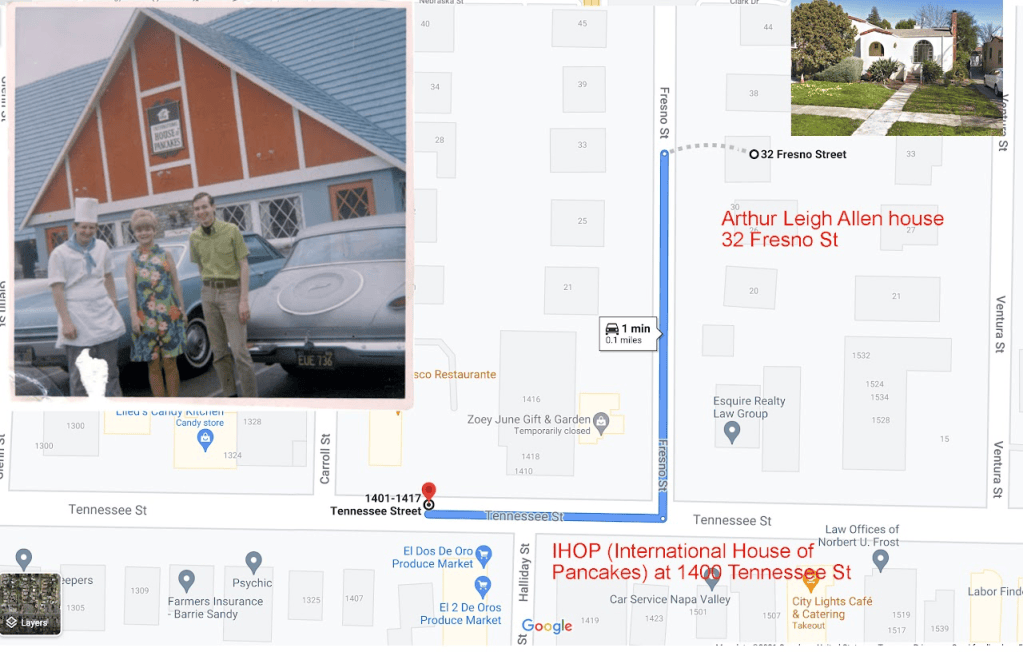
Zodiac Killer Info:
‘The IHOP at 1400 Tennessee St, where Darlene Ferrin worked in 1966-1967 was right around the corner from Arthur Leigh Allen’s house at 32 Fresno Street. Don Cheney told Tom Voigt in an interview that Leigh had been interested in a waitress that worked at the “pancake house” around the corner from Leigh’s house.’
While the Zodiac Killer initiated his first communication directed to the police with a phone call after the shooting of Ferrin and Mageau on July 5, 1969, it was nearly four weeks later when he wrote and sent on July 31 three identical letters.
Zodiac Killer:
‘For the next few weeks, the investigation went nowhere. Then, on July 31, 1969, letters were sent to the Vallejo Times-Herald, San Francisco Examiner, and San Francisco Chronicle. The letters claimed to be from the killer of Faraday, Jensen, and Ferrin. Details were included that only the killer could have known. And each letter contained one-third of a cipher that, if solved, supposedly contained the killer’s identity [which it did not]. While the killer hadn’t yet given himself the name “Zodiac,” [this occurred in their second letter] this marked the beginning of a letter-writing spree [of over twenty letters] that would go on for more than five years.’
Certain of the Zodiac letters will be scrutinised after the investigation of
a. definite;
b. probable; and
c. possible victims of the killer; and
d. the examining of the prime suspects in the case.
Salient observations on the death of Darlene Ferrin and the attempted murder of Michael Mageau which may prove relevant or pivotal as this investigation progresses, include the following points.
The time of death was again close to midnight and on the weekend. The murder site was very close to the first murders. This does not mean the Zodiac was from the same area, but it cannot be ruled out; as in the case of Arthur Leigh Allen who lived close by for example.
Darlene Ferrin was shot five times… the same number as Betty Lou Jensen. Michale Mageau was shot four times: three more than David Faraday.
Even so, the killer was sloppy for not only did they walk back to their vehicle thinking they were done – returning when they heard the cries of Mageau – they did not include a chest or head shot on Mageau.
Richard Grinell:
‘That is…7 exit wounds in total (as noted at autopsy). This shows that Darlene Ferrin was struck by 7 bullets, two of which passed through Michael Mageau into her. It cannot be claimed with certainty that Darlene Ferrin was targeted first that morning [just past midnight on July 5th], but the coinciding bullet wounds to her right and left wrist, in addition to her vehicle being “primed” to drive away, could suggest an uneasiness in Darlene Ferrin caused by the approaching man at Blue Rock Springs. If the Zodiac Killer had suspected this, it would have made sense to target the driver first.’
So while the killer was definitely more methodical and clinical than the Faraday and Jensen killings, the assassin still displayed an amateurish approach. One wonders, if they were under the influence of a substance or drunk and acting during some type of trance during the attack.
As with the previous murder, there was no indication of robbery, sexual molestation and critically, no witnesses.
This ‘second’ attack by the Zodiac as with the ‘first’ is not based on overt sexual satisfaction or control and rather seems to have stemmed from a form of frustration towards sexually active heterosexual couples. There is a sense of either impotency on the killer’s part or a sexual interest (deviancy) out of the norm – such as paedophilia, as will be investigated later.
The motivation – with the above in mind – appears to be fuelled by anger and jealousy. Control is certainly a factor, just not a sexual dominance typically sought through an assault or rape.
What does stand out, is that – though all attacks and rape are tragically horrific – the Zodiac upped the ante by making the experience for both couples truly intimidating and frightening in the manner of the alacrity of the surprise ambush and the severity of the attack, firing a hail of bullets in a confined space.
One cannot imagine the shock and terror of such loud shots and painful bullet wounds in only a few short seconds for all four victims and certainly the ordeal of the aftermath for the survivor, Michael Mageau.
The Zodiac now felt powerful and perhaps invincible but with no one to tell, craved attention. Thus the phone call shortly after the ‘second’ attack and nearly a month later, the first letter.
Understandably, the killer’s car has changed some six months later and is not a Chevrolet Impala, but a Chevrolet [still] Corvair. And again, light coloured.
According to Mageau, he and Ferrin were being stalked and chased around town. It is difficult to know how much credence can be placed on this information, for it was issued much later rather than at the time. Just as Mageau claiming this person was a ‘Richard’ years after the event. When earlier, he had described and visually confirmed a person who looked like Arthur Allen.
Online Encyclopaedia:
‘Ferrin did know Betty Lou Jensen and David Faraday. She lived less than two blocks from Jensen and attended Hogan High School. She was also familiar with Lake Herman Road’s status as a lover’s lane. There is a picture [see below] of Ferrin and an unknown man who closely resembles a composite sketch of the Zodiac [yet does not possess a round face or a husky build]. In a 2011 episode of America’s Most Wanted, police stated they believe the photo was taken in San Francisco in either 1966 or 1967.’
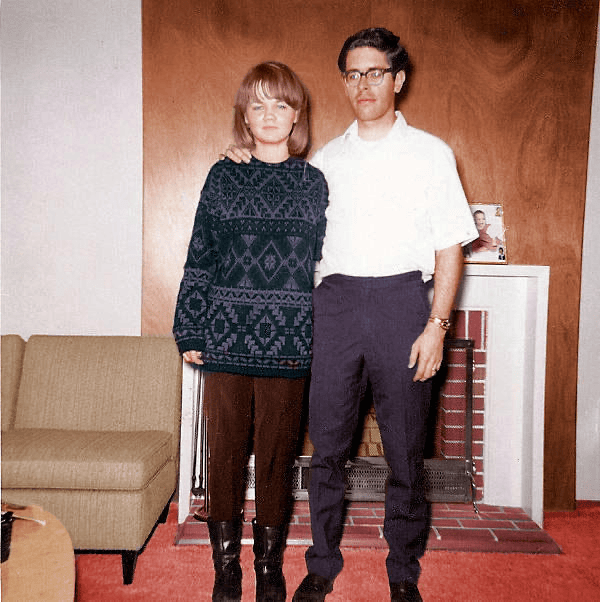
Regarding the physical appearance of the Zodiac Killer, the early details after the ‘first’ attack describe a white male with short hair and glasses. Margeau as a surviving witness is crucial and he adds that he was short, heavyset with a round face.
Zodiac killer Info:
‘Mike Mageau described the suspect as a white male “older than me.” He also described the man as young and heavyset, “short, possibly 5’ 8”, real heavy set, beefy build… not blubbery fat, but real beefy, possibly 195 to 200 [pounds], or maybe even larger… short curly hair, almost light blond [with a large face]” Approximately 26-to-30-year-old. He also said that “it was dark out and hard to see the subject.” He said the car was brown.’
Yet in all this, no mention of glasses.
The use of glasses in the ‘first’ attack may have been part of a disguise. If for example the killer was Arthur Allen – who had very short hair due to balding – then the Zodiac may have worn wigs of different colours. Ruling out dyeing their hair in this instance.
Cecelia Ann Shepard – Bryan Calvin Hartnell
Case number: 105907
Tera Box – emphasis mine:
‘The third confirmed attack demonstrated a chilling evolution in the killer’s methods.
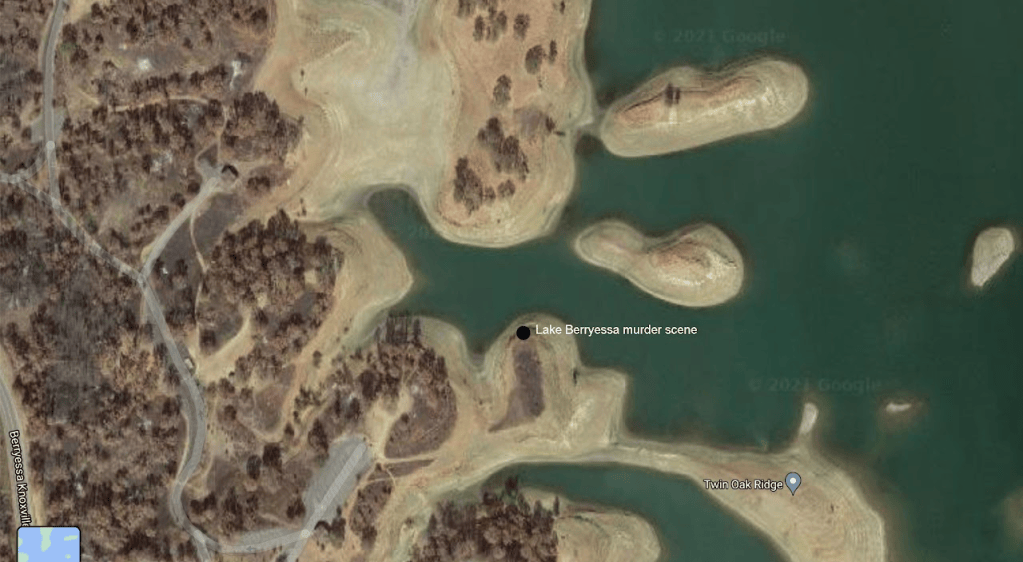
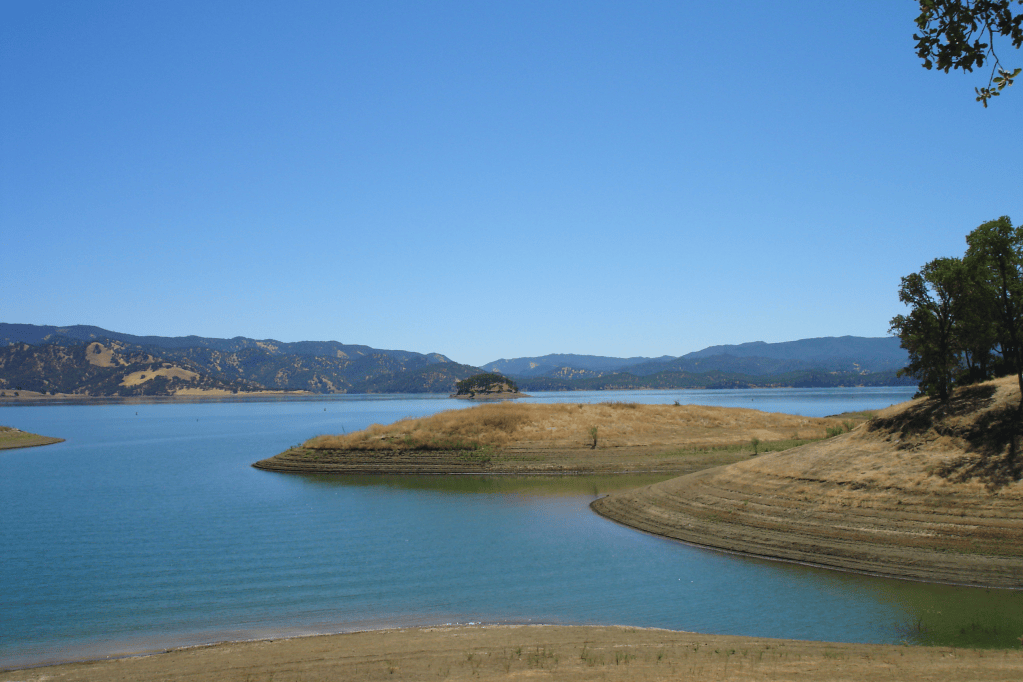
On [Saturday] September 27, 1969, [Pacific Union College students] 22-year-old Cecelia Ann Shepard and 20-year-old Bryan Hartnell were [at four pm] relaxing [picnicking] on a remote peninsula [a small island connected by a sand spit to Twin Oak Ridge] at Lake Berryessa in Napa County.’
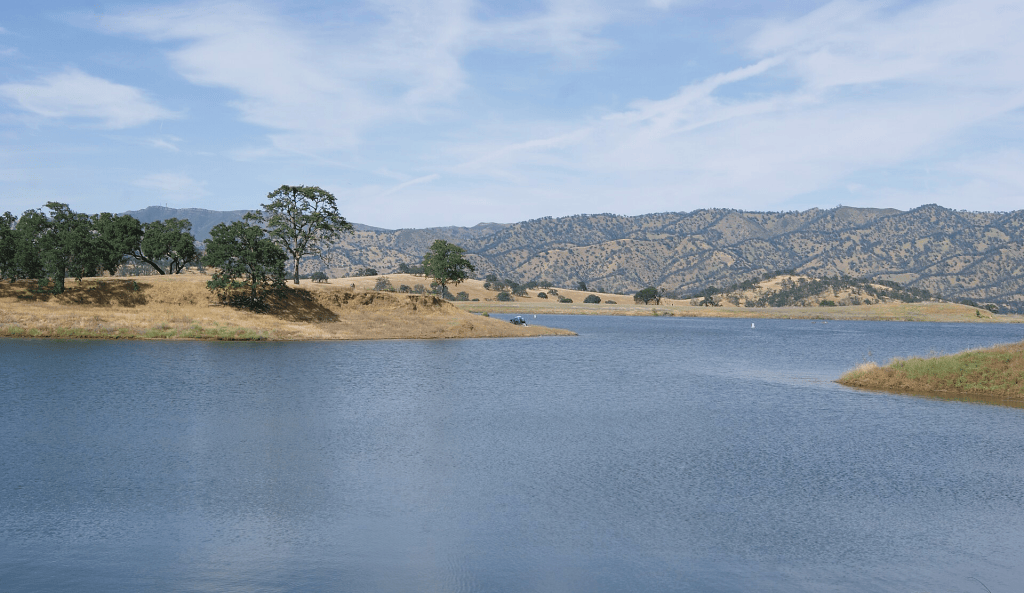
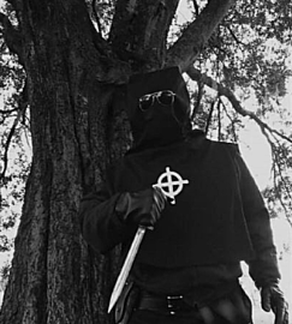
‘Shepard noticed a man approaching them, hiding behind trees. When the man emerged, he was wearing a meticulously crafted executioner-style hood with a white cross-circle symbol – the same symbol used to sign the Zodiac letters – stitched onto the chest.’
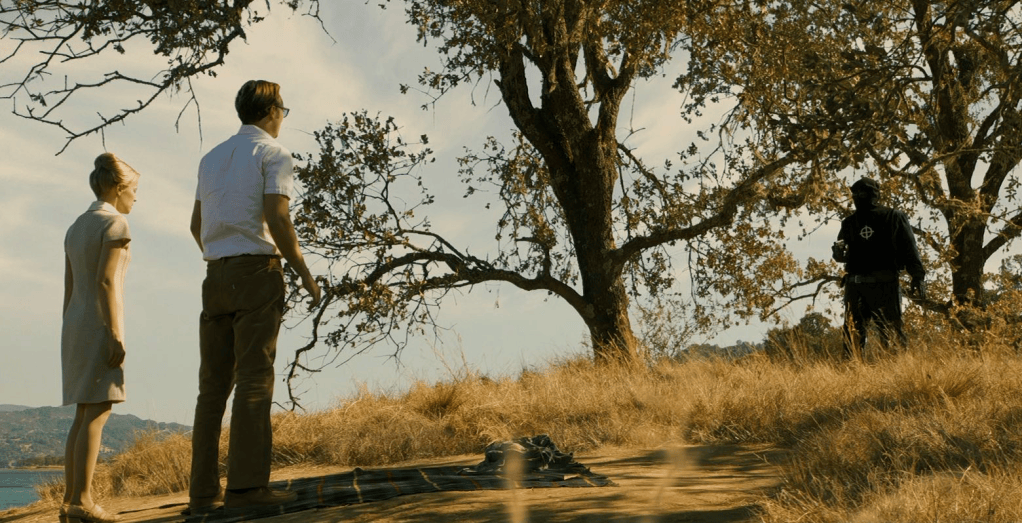
‘He held them at gunpoint, claimed to be an escaped convict [after killing a guard] from Montana, and ordered Shepard to bind Hartnell with pre-cut plastic clothesline [He tightened Hartnell’s bonds because Shepard’s knots were too loose]. The killer then bound Shepard and viciously attacked them both with a 10-to-12-inch knife [with a wooden handle].
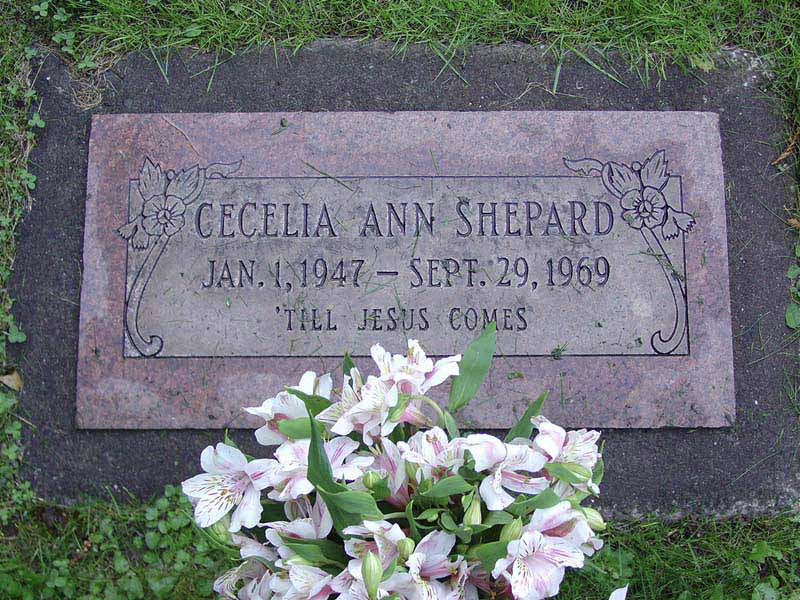
Shepard suffered 10 stab wounds [five in the front and five in the back]. Despite her severe injuries, she remained conscious long enough to provide a detailed description of the attacker to responding officers before slipping into a coma [during transport]. Tragically, she [never regained consciousness and] succumbed to her injuries two days later [Monday, September 29, 1969] in the hospital.
Bryan Hartnell’s survival at Lake Berryessa is remarkable given the severity of the attack. He suffered six to eight deep stab wounds to his back and was left for dead on the shoreline.
Hartnell’s experience is unique because he engaged in a prolonged conversation with the killer before the violence began.
Hartnell noted the killer’s distinct cadence, his nervous demeanor, and the bizarre, elaborate nature of his costume.
Hartnell later recovered from his injuries, completed his education, and went on to have a successful career as an attorney [in southern California]. His detailed account of the Lake Berryessa attack remains one of the most chilling and thoroughly documented encounters with an unidentified serial killer in modern history.’
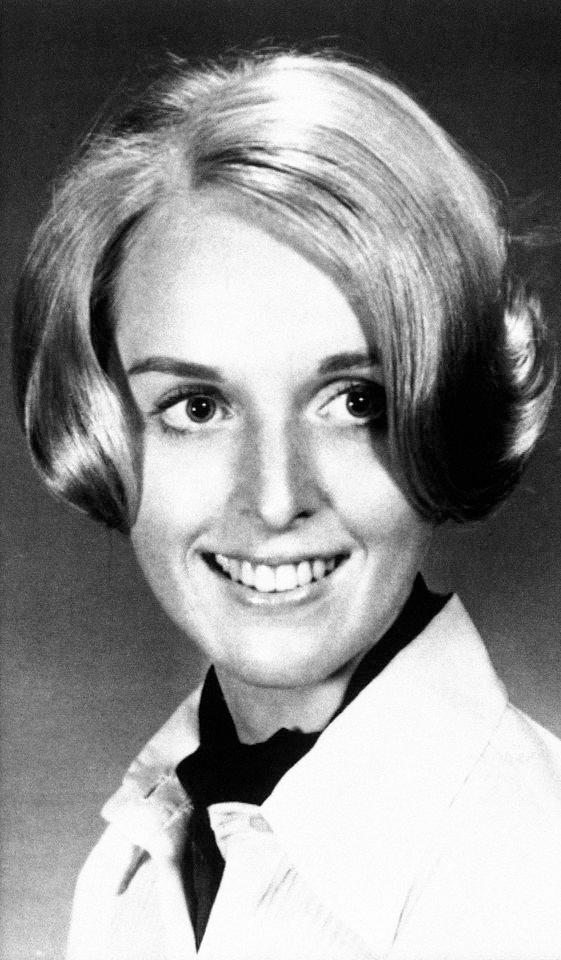
Cecelia Ann Shepard age 22 in 1969
Zodiac Killer:
‘According to the police report… Shepard noticed a man approaching them [at approximately six pm] wearing an unusual costume and holding a gun [a .45]. He appeared to be more than 6’0” tall with a heavy build.’
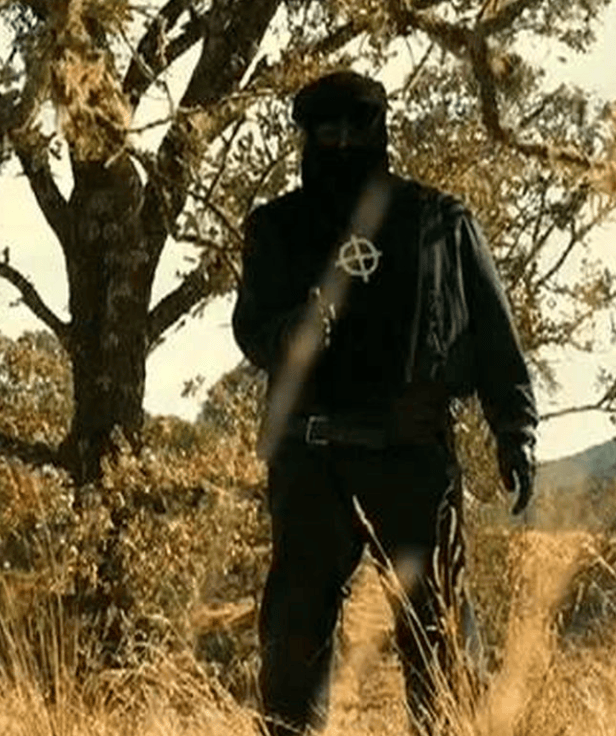
‘The man claimed he was a prison escapee from either Montana or Colorado and needed money and a car to flee to Mexico. Hartnell offered his wallet and car keys, which weren’t taken.
After several minutes of conversation, the man tied the couple with plastic clothesline and began stabbing them [at approximately 6.15 pm]. Hartnell was attacked first, then Shepard. After the assault, the man walked casually away from the scene [and hiked 500 yards to Knoxville Road, leaving several footprints for investigators to study].
After several minutes, a nearby fisherman [and his son] heard the couple screaming and alerted [two] park rangers [who tended to the stricken couple until the ambulance arrived]. By the time help arrived, Shepard and Hartnell had managed to untie their restraints [Hartnell untied Shepard’s ropes with his teeth, and she freed him]. It took nearly an hour for an ambulance to arrive, at which time both victims were in critical condition.
Just over an hour after the attack, the Napa Police Department received a call from a man claiming responsibility for the stabbing. The call was quickly traced to a phone booth in downtown Napa and fingerprints were later recovered.
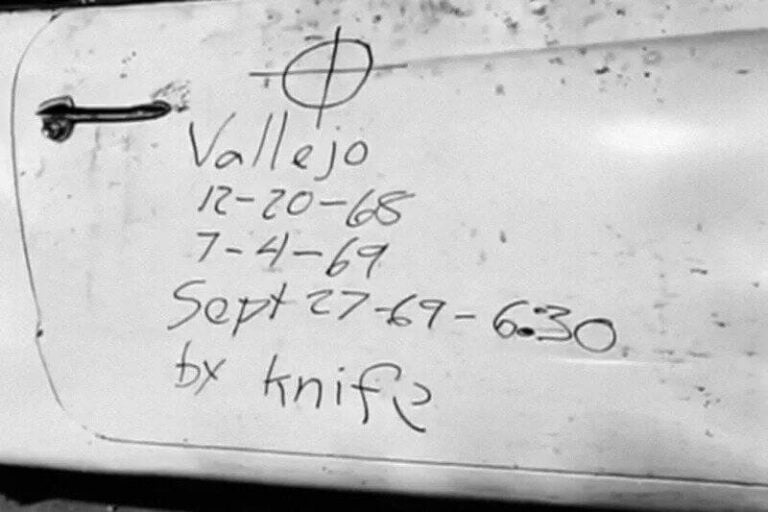
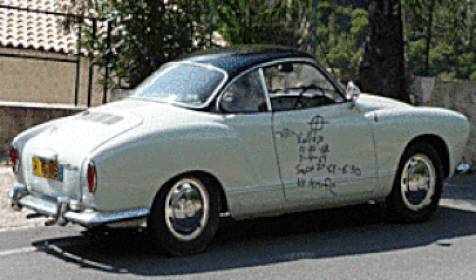
Meanwhile, Napa County Sheriff’s Department deputies [Dave Collins and Ray Land] were responding to the crime scene. They found that the attacker had written a message on the victim’s car door [with a black felt-tip pen]. The message included the dates of the Faraday-Jensen and Ferrin-Mageau attacks and was signed with a cross-circle symbol. Tire tracks indicated the killer had parked behind the victim’s car.
While Bryan gave many interviews in the first few years after the attack, he is no longer discussing the case with the news media. Many suspects were scrutinized, including serial killer Ted Bundy [1974-1978]. A February 1989 comparison of fingerprints helped clear Bundy of this crime.’
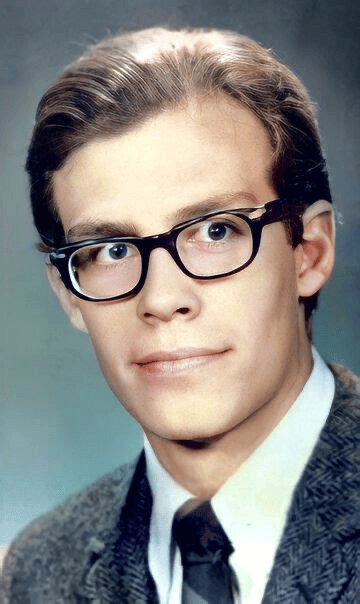
Bryan Calvin Hartnell age 20 in 1969
Encyclopaedia:
‘Earlier that day, a suspicious man had been seen around Lake Berryessa by several people. A dentist and his son saw a heavyset man looking at them from a distance before he hurried off… three women noticed a strange man… [after] they had arrived to sunbathe…
Since they had potentially seen the Zodiac without his hood, the women worked with Napa Valley Register photographer Robert McKenzie to create a composite sketch using an Identi-Kit facial compositing device. Police showed the image to other potential witnesses.
The suspect was described as being roughly 6’ tall and weighing 200 pounds, which matched the descriptions by Shepard and Hartnell. Graysmith also drew a sketch of the Zodiac’s costume after Hartnell described it to him.
The Zodiac drove 27 miles from the crime scene to a car wash in downtown Napa [forty-six minute drive]. He used a payphone to call the Napa County Sheriff’s Department at 7:40 p.m. He told the dispatcher he wished to “report a murder – no, a double murder” and confessed to the crime.’
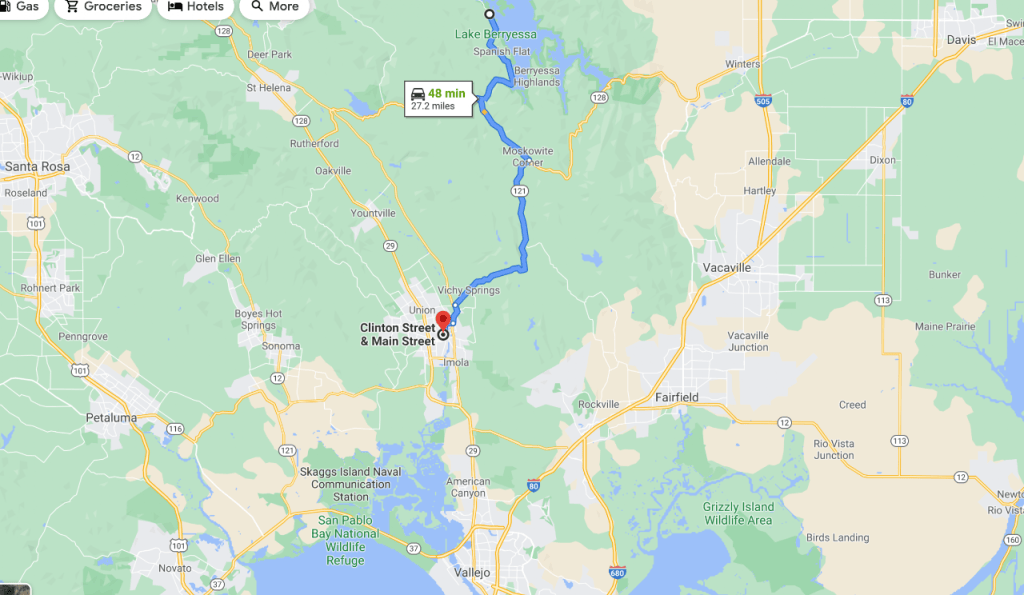
‘He did not hang up the phone. KVON radio reporter Pat Stanley found the phone off the hook a few minutes later. The payphone was located a few blocks from the sheriff’s office. Detectives lifted [35 latent prints and] a wet palm print from the phone but were never able to match it to any suspect [including chief suspect, Arthur Leigh Allen].’
A latent print is the ‘chance recording of friction ridges deposited on the surface of an object or a wall. Latent prints are invisible to the naked eye, whereas patent prints (or plastic prints) are viewable with the unaided eye.
Zodiac Killer Info:
Det. Slaight: “Napa Police department, Officer Slaight.”
Zodiac: “I want to report a murder. No, a double murder. They are 2 miles north of park headquarters. They were in a white Karmann Ghia.”
Det. Slaight: “Where are you now?”
Zodiac: “I’m the one that did it.” (phone put down but not hung up).
Det. Slaight: “Is anyone there? … Is anyone there?” (No response. Sounds of traffic driving by etc).
Zodiac Killer:
‘This was a bizarre and horrifying crime. A careful consideration of the facts should dispel all myths that Zodiac was simply a super-criminal only intent on taunting the police. Rather, he was a very warped individual who apparently had grown bored with mere killing. He now apparently needed to implement extremely bizarre behavior in order to achieve satisfaction.’
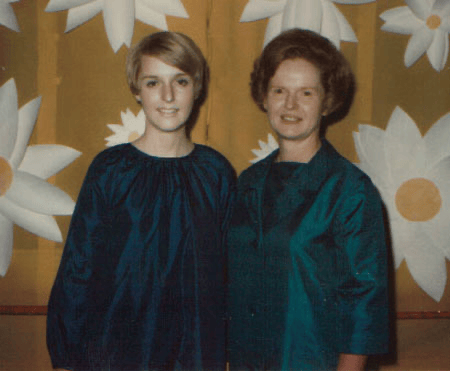
Cecelia stands with her mother, Wilma, just months before Cecelia’s death at the hands of Zodiac.
There had been disturbing activity at Lake Berryessa prior to the attack on Hartnell and Shepard.
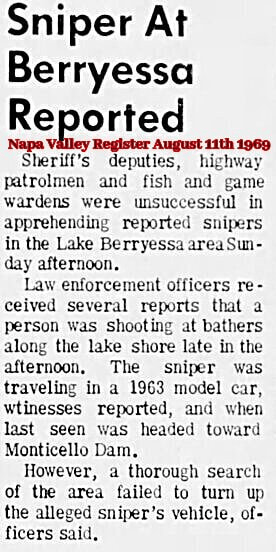
Remember this later.
Additional details of special interest leading up to the murder of Cecelia Shepard and the attempted murder of Bryan Hartnell, including witness testimony.
Zodiac Killer Info – emphasis mine:
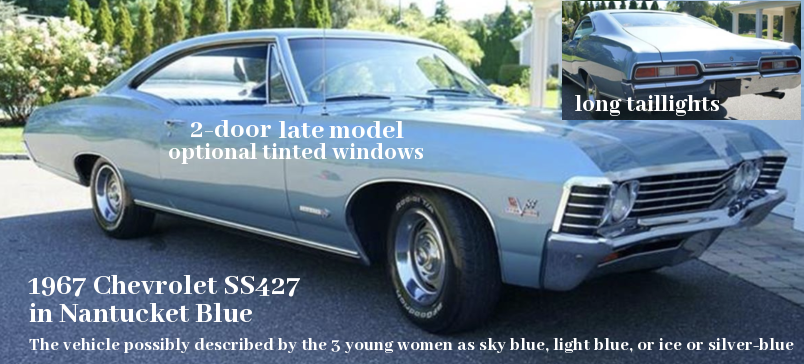
‘At around 3:30 PM on September 27, 1969, three college girls parked their car in a lot about 2 miles north of the A&W Root beer stand on [5100] Knoxville Road at Lake Berryessa. As they left their car they noticed a light blue Chevy [Chevrolet] pull into the parking area, drive past their vehicle, then back up so their rear bumpers were nearly touching. The girls did not observe the driver leave the vehicle.’
Zodiac Ciphers, Richard Grinell:
“Vehicle described as a 1966 or 1967 light blue Chevrolet with California plates. Witness believes the vehicle was a 2-door sedan and described the taillights as long rather than round”.
Zodiac Killer Info:
‘The girls then walked to the beach at the Lake and were sunbathing in their bikinis. About a half hour later [3.45 to 4.00 pm], they witnessed the same man standing at the edge of some trees, observing them from a distance of about 50 feet. The man was staring at them, but when they looked up at him, he would look away. Sometime later, the man came down to the beach and passed within 20 feet of the girls. The suspect hung around the area for about 45 minutes, then left walking back up the hill. The girls left the area around 4:30 PM.
NOTE: It is unclear to me exactly where the girls were parked, and where the suspect was seen. They may have parked at the North Smittle Creek Trailhead parking lot, which is 2.6 miles north of the A&W root beer stand location.
At around 6:30 PM, Dr. Clifton Rayfield and his 16-year-old son David parked their car north of Park Headquarters “in the general area of the crime scene.” They walked down towards the beach where they saw a man walking in the area. They also noticed a man with two young boys in the area shooting BB guns. The location was described as being “approximately 8/10 of a mile from the scene of the victim’s vehicle.”
The R/Os who interviewed Dr. Rayfield and his son thought it was unlikely that the male suspect could have walked from this area to the crime scene on foot, as there were 4 coves of water between the scene of the crime, and the place where the subject was seen.
NOTE: It is unclear to me exactly where Rayfield was parked, and where the suspect was seen.’
Zodiac Ciphers, Richard Grinell – emphasis mine:
‘The couple were enjoying a pleasant picnic… when Cecelia Shepard became aware of a man close by acting strangely. The man was observed taking refuge behind a tree before adorning himself with a black executioner hood and a waistline bib, decorated with the now familiar trademark Zodiac crossed circle, along with a pair of clip-on sunglasses. He then approached the young couple pointing a gun, to which Cecelia would alert Bryan with the words, “Oh my God he’s gotta gun”.
Cecelia Shepard would later recall these details to Deputy Dave Collins after the attack, to which Dave Collins was recalling in the 2007 Zodiac documentary.
She said:
“Brian and I were here on the blanket, down by the water and we’re just enjoying the afternoon having a nice time talking and I saw this guy, he was coming down the hillside and he seemed to stop and watch us, looking at us”.
Dave Collins asked Cecelia “what distance, how far away was he”, to which Cecelia pointed to an area and I said “that’s about 200-300 yards away”. She added “that’s where I first saw him”.
“And then as we continued enjoying the afternoon watching the water, reading, I glanced and noticed he would get closer and closer, and pretty soon he was within 75-100 feet away, and I told Brian that guy has come down here”.
Dave Collins recalled the conversation between him and Cecelia, stating that “she then looked again and he had gone, and I said where did he go. She said he stepped behind a tree. And I asked her if she saw him clearly before he put the hood on and she said she did. And I said what did he look like, and she said well he… I said what color was his hair and she said it was brown. What race was he… he was white, and I said how about his eyes, could you see the color of his eyes and she said no, he had dark glasses on underneath the hood. But she said his hair hung down across his forehead and was showing through the eye-holes”…
David Collins (Retired Napa County Sheriff) speaking on the 2007 documentary This is the Zodiac Speaking, stated “The information I am relaying to you now, is information I got directly from Cecelia Shepard. It is accurate for what she told me, because I kept notes and I immediately did a report the following morning”.’
Zodiac Killer Info:
‘A white man, about 5 feet 11 inches, weighing more than 170 pounds, approached them wearing a black executioner’s-type hood, and glasses, with clip-on sunglasses over the hood. The hooded man claimed to be an escaped convict from a jail with a two-word name, in either Colorado or Montana (a police officer later inferred that the man had been referring to a jail in Deer Lodge, Montana), where he had killed a guard and subsequently stolen a car, explaining that he now needed their car and money to travel to Mexico because the vehicle that he had been driving was “too hot”.’
Zodiac Ciphers, Richard Grinell – emphasis mine:
‘The man.. requested Bryan Hartnell’s car keys and money, to which Bryan Hartnell duly obliged. He then spoke to the man for several minutes to try and form some sort of rapport in an attempt to protect them both from any harm but the man appeared on a mission, taking some white plastic clothesline from his belt and ordering Cecelia Shepard to tie up Bryan Hartnell.’
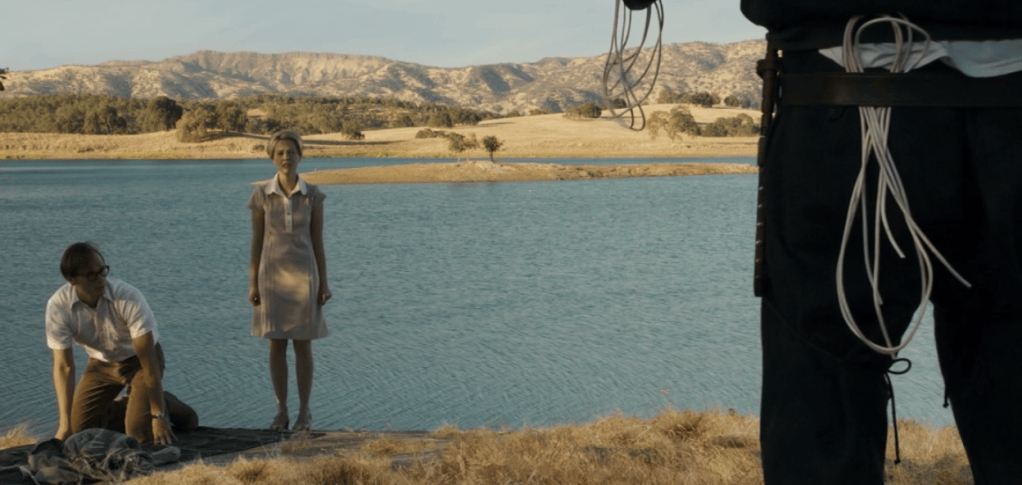
‘It was at this point that Bryan Hartnell suggested to his companion he felt he could make a grab for the gun, but Cecelia warned him not to risk anything, fearing it may make the situation worse. During this brief exchange the assailant had stepped back two or thee feet – just out of reach – and the chance was lost forever. The hooded figure then bound up Cecelia Shepard.
While the couple were hogtied on the ground Bryan Hartnell asked the assailant if the gun was really loaded, to which the man pulled out the gun, took out the clip and showed Bryan Hartnell that indeed it was.
He then proceeded to stab the victims numerous times. Bryan Hartnell was stabbed six times in the back, with Cecelia Shepard receiving ten wounds to her back and abdomen as she frantically rolled around attempting to minimize the impact of the blade and clearly terrified by her ordeal. Bryan, obviously fearing they were about to lose their lives, stopped breathing in an attempt to feign death, realizing if he thrashed around the killer would return to finish him off. Fortunately for Bryan his tactic worked and the cold-blooded executioner ceased his attack and walked off into the distance, back up the hillside trail.
Once the couple had managed to loosen their bindings, Bryan Hartnell valiantly struggled his way back up the incline towards the nearby road where he was eventually aided by park ranger Dennis Land. Immediately after the 6:30 pm attack on Bryan Hartnell and Cecelia Shepard at Lake Berryessa, one key eyewitness, Ronald Henry Fong was circling the lake in his boat and responded to the cries of Bryan Hartnell. Ronald Fong turned his engine on and motored away to seek help at the Rancho Monticello Resort.
It was at this point Ranger Sergeant William White on his routine patrol of Lake Berryessa received a call from Park Headquarters regarding the attack and proceeded to the Rancho Monticello Resort at 6:55 pm. It is here Ronald Fong relayed his observations to Sgt William White as to the young couple in distress, and both, along with Archie White and Elizabeth White traveled via speedboat to the crime scene to offer assistance to both Bryan Hartnell and Cecelia Shepard. The time was now 7:10 pm.
At this time, Ranger Dennis Land arrived in his truck carrying the stricken Bryan Hartnell, who had managed to crawl his way towards the road. At approximately 7:10 pm or very shortly after, Sgt William White radioed Park Headquarters to summon an ambulance and deputies to the crime scene. We know the 7:10 pm estimate is about right because help arrived via Piner’s ambulance from Napa to the crime scene at approximately 7:55 pm and returned back to the Queen of the Valley Hospital, arriving at 8:50 pm. That is an approximate journey time of 45 minutes each way, including 10 minutes negotiating the crime scene.
Bryan Hartnell described his attacker as having brown hair, 225-250 lbs in weight and 5’8” to 5’10” in height, but admitted he was a bad judge of height because he was so tall. Bryan also stated that the assailant had a unique way of talking, with John Robertson (his interviewer) correcting himself, stating “Bryan, you mentioned a drawl. Well not a drawl, an accent”.
He further stated the assailant wore a black-hooded mask made of a cloth material covering his entire head and shoulders and reaching down to the waist. On the front of the four cornered mask at the chest area was a white circle (3 x 3 inches inches in diameter) and a symmetrical cross. In the police report Bryan Hartnell backed up Cecelia Shepard and stated that “he could see hair through the mask’s eyelets and observed the hair to be dark brown”.
Bryan Hartnell in the 2007 documentary remarked that Cecelia Shepard “saw a man over there” and “he went behind a tree”. He went on to say “I’ll tell you another thing that probably made me think that it was somebody over there, it wasn’t an improved park site, there wasn’t regular established bathroom, so if you had to go to the restroom you’d just kinda get outta eye-shot of whoever you were with or go behind a tree like that”.
Cecelia Shepard was still conscious when Deputy Dave Collins arrived on the scene and was told by Shepard that her assailant was “just may’be a little taller than you, may’be an inch”. Deputy Collins was 5’10”. It would be later that Sergeant David Collins would head towards the roadside to examine the tire impressions and car door. He said “After the ambulance took the victims to the hospital in Napa (remember it arrived at approximately 7:55 pm, so likely left around 8:05 pm, to arrive at the Queen of the Valley Hospital at 8:50 pm), and while waiting for detectives from the Sheriff’s Department to arrive Deputy Land talked to the witnesses and obtained statements from them.
The autopsy report on Cecelia Shepard read ‘Dr DE Petris further stated that after examining the wounds inflicted on Miss Shepard it was his opinion that the weapon used would be from 9 to 11 inches in length and one inch in width and possibly sharpened on both sides on the top of the blade similar to a bayonet type weapon. In addition the wounds indicated it would be a heavy or sturdy type blade.’
‘Earlier on in the day, the three women from Pacific Union College “parked their vehicle at a location two miles north of the A & W Root Beer stand on Knoxville Road”. The Sugar Loaf Park A & W was situated at 5100 Knoxville Road, so the three women would have parked their vehicle somewhere in or between the region of the Smittle Creek Trailhead and Smittle Creek Day Use Area. They estimated their arrival at 3:30 pm.
As they left their vehicle to go sunbathing, a white male, driving a silver or light blue Chevrolet 2-door sedan with California plates pulled up to the rear of their car, bumper to bumper, yet remained inside his vehicle. This man would seemingly remain in his vehicle for approximately 30 minutes before they spotted him again, observing them from about 40 to 50 feet away while they were sunbathing. Each time they looked at him he seemingly evaded eye contact, thus drawing suspicion from the three women.
He was described as being between 28 and 40 years, 200-225 pounds, 6 feet tall, styled black hair, with rounded eyes and thin lips – he was good looking, with a muscular or stocky build, wearing dark pants and a dark pullover shirt. He remained observing them, by their accounts, for between 30-45 minutes and then left. At 4:30 pm they decided to leave the shores of Lake Berryessa and noticed his vehicle had gone. But in a curious observation, one of the girls thought he was wearing a white belt around his back – or possibly what could have been a tee shirt hanging out. Another girl stated he was wearing a black short-sleeved sweater shirt, bunched up at the front, again describing a white tee shirt hanging out the back.
The police report stated that after they had arrived at 3:30 pm “approximately one-half hour had passed (4:00 pm), they observed what appeared to be the same subject standing with 40 or 50 feet of them, apparently observing them. The subject hung around the area for approximately 30 to 45 minutes (4:30pm-4:45 pm) and then the girls observed him walk up the hill”. The subject then had to traverse the hillside to his vehicle (several minutes). However, one page later in the police report, it stated “The three girls left the area about 4:30 pm and the subject’s vehicle was gone”. Therefore, we have to estimate the man left that location sometime between 4:30 pm and 4:55 pm.
Did the bunched up sweater shirt hide anything sinister?
Bryan Hartnell thought the attacker to be 20-30 years (by voice concept), with dark brown hair visible through the hood, wearing dark blue or black pleated slacks, 5’8” to 6’0” tall and 225-250 pounds. He also noticed a knife in a case on the right side of his belt near the front of his trousers, and cut up rope in the assailant’s rear pocket. It was the type similar to white plastic clothesline. Could the descriptions given by two of the girls, describing a white belt around his back or white tee shirt “hanging out”, actually have been the cut lengths of plastic clothesline trailing from his rear pocket in anticipation of a prepared attack on the girls, but for whatever reason got cold feet, changed his mind and turned to Bryan Hartnell and Cecelia Shepard approximately two hours later?
Their descriptions, including reiterations, are as follows;
#1. “A subject driving a late model silver-blue Chevrolet, 2-door sedan. This subject was described as 6’ tall, weighing 200/210 pounds, muscular build, rather nice looking”.
#2. “Vehicle described as a 1966 or 1967 light blue Chevrolet with California plates. Witness believes the vehicle was a 2-door sedan and described the taillights as long rather than round”.
#3. “Subject was described as approximately 28 years of age, 6’1” to 6’2” tall, 200/225 lbs, black hair possibly styled, with a part on the left, rounded eyes, thin lips, medium nose, straight eyebrows, small ears, well built, rather nice looking”.
#4. “Vehicle was described as a late model Chevrolet, sky blue in color. The rear taillights appeared to be long rather than round. She described the subject as 6’ tall, stocky build, about 200 lbs, black short-sleeved sweater shirt, dark blue slacks, and straight dark hair neatly combed. She guessed his age at approximately 30 years”.
Despite this attack being the most theatrical offering yet from the Zodiac Killer, he failed to capitalize on this crime in subsequent communications to the San Francisco Chronicle, never once detailing his involvement in the Lake Berryessa stabbings.
The Zodiac Killer would wait only two weeks to commit his fifth murder in ten short months, when in San Francisco he callously executed [a] taxicab driver… on October 11th 1969. Subsequent to this crime he had no difficultly in resuming his correspondence with newspapers, mailing a letter to the San Francisco Chronicle just two days after the murder, including a blood-stained section of Paul Stine’s shirt within the correspondence so as to validate its authenticity. This would be the last confirmed murder of the Zodiac Killer.
Zodiac Killer Info:
NAPA COUNTY SHERIFF’S OFFICE – DIALOGUE BETWEEN AN UNKNOWN ASSAILANT AND BRYAN HARTNELL
C: What do you want?
A: Now take it easy – all I want’s your money. There is nothing to worry about – all I want is your money.
B: O.K. – whatever you say, I want you to know that I will cooperate so you don’t have to worry – whatever you say we’ll do. Do you want us to come up with our hands up or down?
A: Just don’t make any fast moves – come up slowly.
B: But we don’t have any money – all I have is 75¢.
A: That doesn’t matter – every little bit helps ( pause ) – I’m on my way to Mexico – I escaped from Deer Lodge Prison in Montana, Deer Lodge. I need some money to get there.
B: You’re welcome to the money I have, but isn’t there something else I can do for you? Give you a check or get some more?
A: No.
B: I can give you my phone number and you can call me.
A: (no reply)
B: I want to get in contact with you. I am a sociology major and maybe I can even offer you more help than you think you need.
A: No.
B: Well, is there any other thing you need?
A: Yes. One more thing – I want your car keys. My car is hot.
B: (Reaching into pockets, then patting first front then back pockets) I guess in all the excitement I don’t remember where I put them. Let’s see. Are they in my shirt, in the ignition, on the blanket… Say! Would you answer a question for me? I’ve always wondered. On T.V. movies and in an article in the Readers Digest they say that thieves really keep their guns loaded?
A: (excited slightly) Yes, it is! (then calm and matter-of-fact) I killed a couple of men before.
B: What? I didn’t hear you…
A: I killed a couple of guards getting out of prison. And I’m not afraid to kill again.
C: Bryan – do what he says!
A: Now I want the girl to tie you up.
C: (reaches for rope that he pulls from back pocket)
B: This is really strange. I wonder why someone hasn’t thought of this before. I’ll bet there’s good money in it.
A: (no reply)
B: What was the name of that prison?
A: (no reply)
B: No really, what did you say the name of it was? I’m just curious.
A: (begrudgingly) Deer Lodge in Montana.
(There must have been some dialogue at this point but I can’t remember any until we are both tied up.)
A: Now I want you both to lay face down so I can tie up your feet.
B: Come on – we could be out here for a long time and it could get cold at night.
A: Come on – get down!
B: Listen, I didn’t complain when you tied our hands, but this is ridiculous…
A: I told you…
B: We aren’t going anywhere – Anyway, I don’t think that it’s necessary (or – Aw, come on – we don’t want to. )
A: (pointing gun directly at me at point blank range) I told you to get down!
B: Your hands are shaking? Are you nervous?
A: Yes, I guess so. (laughed in a very relaxed manner)
B: Well, I suppose that I’d be nervous, too.
(Then after we were tied and hog-tied)
B: Now that everything is all said and done, could you show me that your gun is loaded? (Or, and probably this: “Now that all is said and done, was that gun really loaded?”)
A: Yes, it was! ( or ) Sure, I’ll show you. (He then opened cartridge or whatever)
(That was the last thing I remember him saying.)
(signed) BRYAN HARTNELL
‘After they were tied up the assailant said “I’m going to have to stab you.”
Hartnell said “Stab me first. I can’t stand to see her stabbed first.”
The assailant stabbed Hartnell first, then stabbed Shepard. [Hartnell] stated that the suspect stabbed Miss Shepard “much worse than him”. Suspect went into “some sort of frenzy” when stabbing Miss Shepard.
The entire interaction with Zodiac took approximately 15 minutes, from the time of first observing suspect until he departed.’
Pertinent facts:
‘Brian Hartnell parked his 1956 Karmann Ghia 7/10 of a mile north of the Lake Berryessa Park Headquarters. Written on the passenger door in black felt-tip pen was:
(Zodiac symbol)
Vallejo
12-20-68
7-4-69
Sept 27-69-6:30
by Knife
‘[Describing] the knife as a long bread knife, 12” blade, ¾” wide, hardwood handle, 2 brass rivets holding handle in place, knife’s case possibly made of wood. Gun in black holster. Large bullets. Hartnell believed the bullets could be .45 caliber but is not certain.’
Notice the date given for the attack on Michael Mageau and Darlene Ferrin is July 4th and not the 5th as some conjecture. The date of the Lake Berryessa attack is written differently from the previous two attacks. The time is included, though 6.30 pm is when the killer likely returned to the car and not the time of the actual stabbings at approximately 6.15 pm. Plus Vallejo is included, tying perhaps the murderer to this location rather than any of the killings. It seems strange they would do that, while omitting Lake Berryessa for the third attack.
Zodiac Killer Info:
‘Bryan Hartnell seems to have been worried that his girlfriend who lived in Portland might have been jealous that he was out with his previous girlfriend. Hartnell said that he and Shepard were “good friends,” and that they used to go out two years previously. In any case, Hartnell wanted to call his girlfriend in Portland from the hospital to tell her what happened before she heard it on the news. It seems possible that Hartnell and Shepard had sex before going out to Lake Berryessa.’
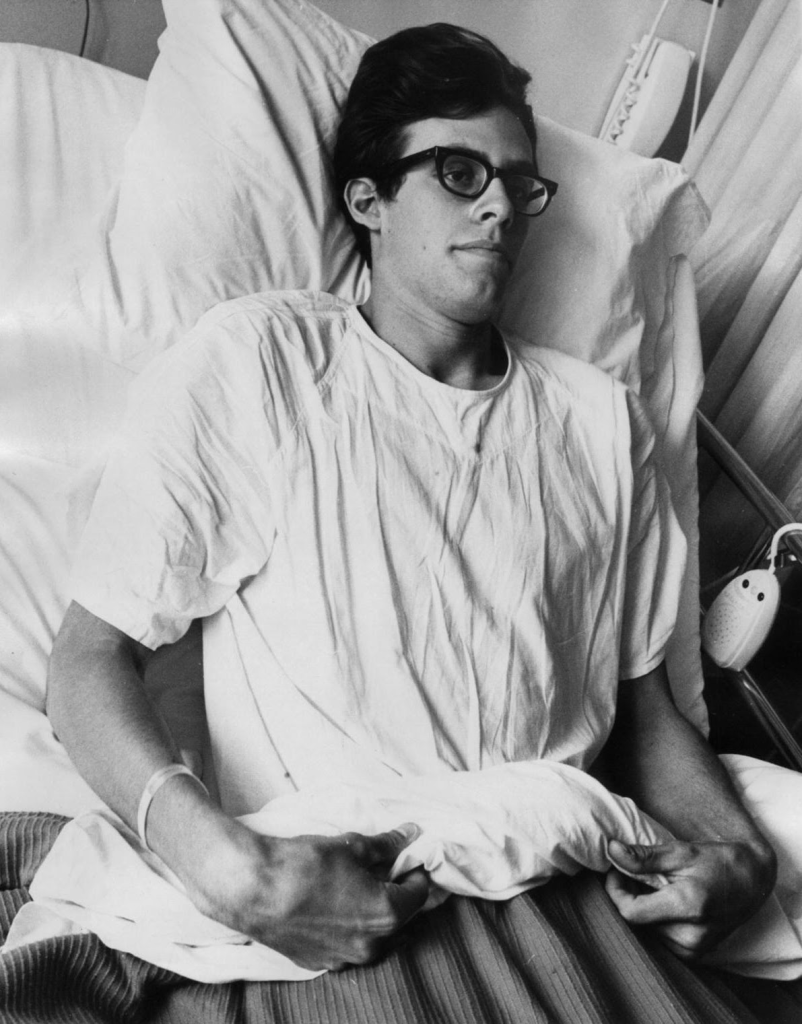
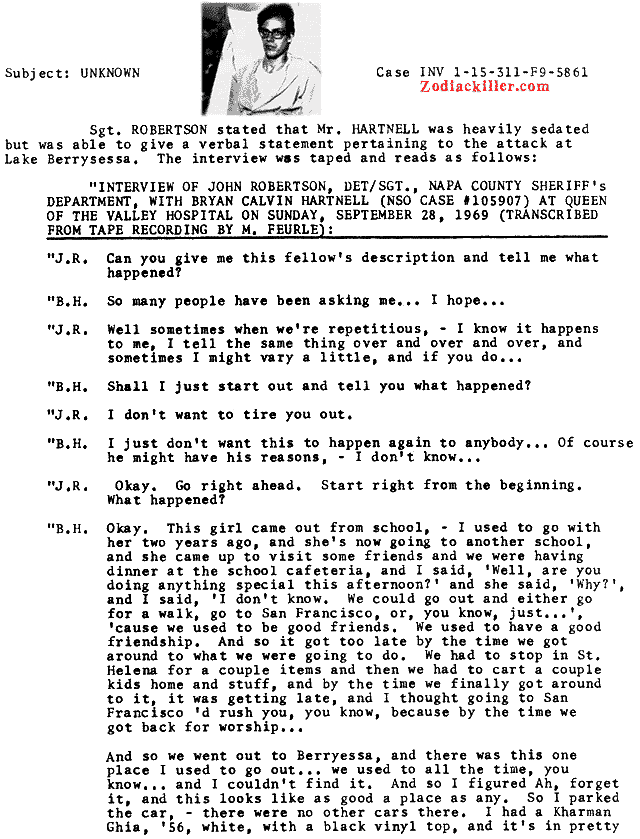
“This girl came out from school, – I used to go with her two years ago, and she’s now going to another school, and she came up to visit some friends and we were having dinner at the school cafeteria and I said ‘Well, are you doing anything special this afternoon?’ and she said ‘Why?’ and I said ‘I don’t know. We could go out and either go for a walk, go to San Francisco, or, you know, just…’, cause we used to be good friends. We used to have a good friendship. And so it got too late by the time we got around to what we were going to do” – Police interview with Bryan Hartnell, September 28, 1969.
‘SFPD photographed all people who attended Cecelia Shepard’s funeral – where are these photos?’
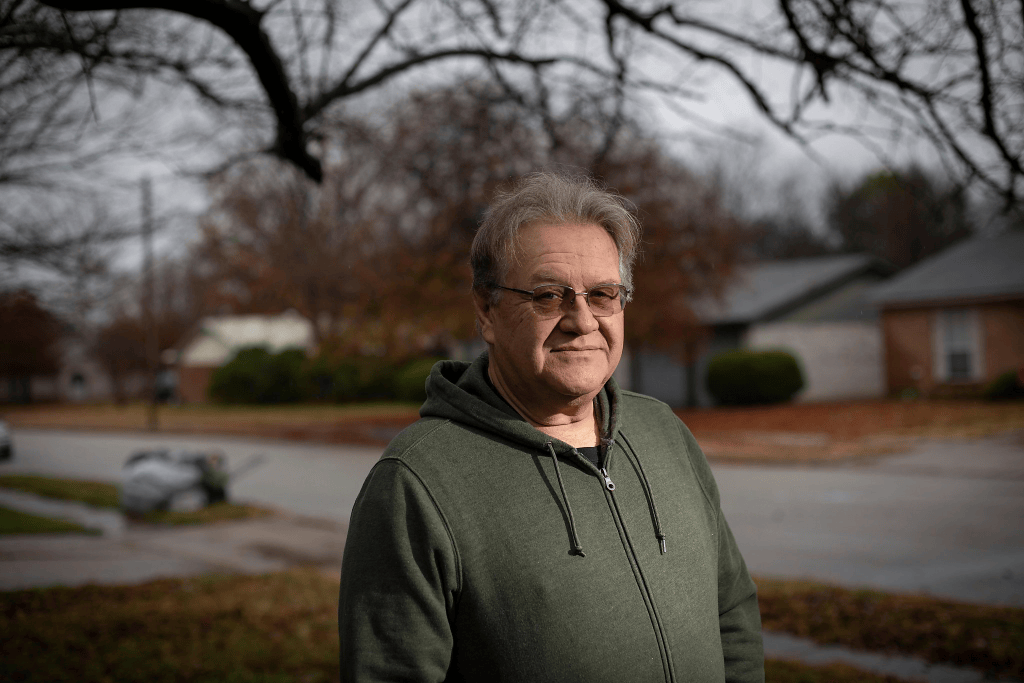
Bryan Hartnell
‘Footprints were observed leading from a wooden foot stile over the fence to the passenger side of he car. Plaster casts were made of the boot impressions. Boot print left by size 10.5 Government-issue Wing walker boots at were both Air Force and Navy issue. Plaster casts were made of the bootprints.’
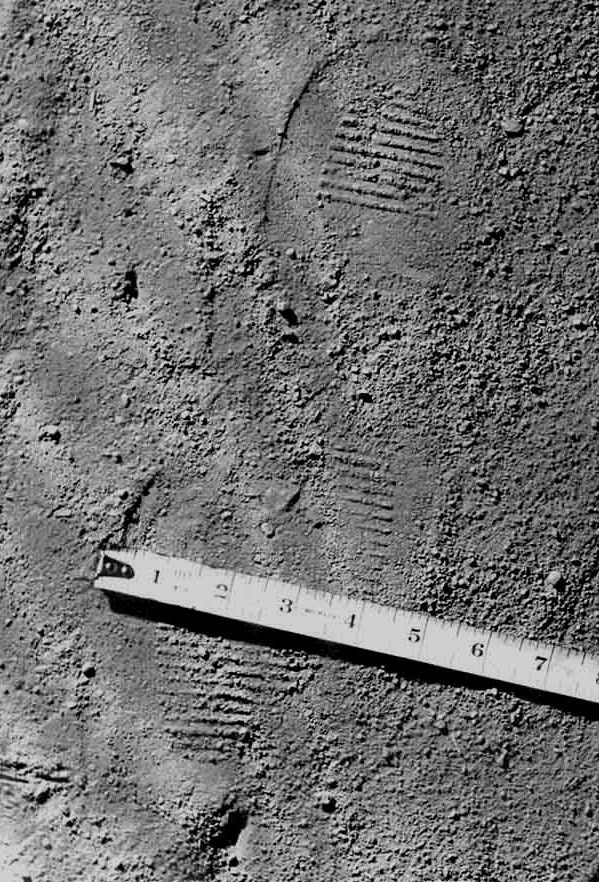
‘Special agent Donald ___, OSI, Travis Air Force Base, reported that 500-1000 of that type of wing-walker shoe had been sold as surplus on the base, over and above those sold at the Sales Store. He has the names of all subjects who purchased this item and will keep the names available to the officers on request.’
Encyclopaedia:
‘Arthur Leigh Allen served in the U.S. Navy from 1951 until his honorable discharge in 1959. He spent most of his service in the reserves and served on multiple submarines.’
Zodiac Killer Info:
‘Compaction tests on the boot print gave a calculated weight “in excess of 220 pounds.”
Tire impressions were observed 20 feet to the rear of Hartnell’s car. The distance between the inside of the left and right tread was measure to be approximately 52 inches. Plaster casts were made of the tire impressions.
Eight prints were lifted from the car door.
A green bottle found near a stump on the suspected approach to the crime scene was processed for fingerprints and placed in evidence. 5 fingerprints were lifted.’
Salient observations regarding the death of Cecelia Shepard and the attempted murder of Bryan Hartnell which may have pivotal relevancy as the investigation progresses.
There are a number of points which standout in the ‘third’ attack from the closely similar circumstances of the previous two attacks. Still, there are number of similarities which remain the same and include the fact that a young heterosexual couple (1) were targeted by a killer in an isolated location (2) – on a weekend (3). Also, there was no indication of robbery (4) or sexual molestation (5). Additionally, there were no witnesses to the act (6) and the killer(s) favours Chevrolet cars for the third straight time (7).
Yet after this the similarities abruptly end. Even to the degree that one wonders if it was even the same killer, so unlike the first two incidents is the one which occurred at Lake Berryessa nearly three months after the ‘second’ attack. This incidentally, was half the time of the elapsed period between the ‘first’ and ‘second’ murders (of six and a half months).
1. The killer travels a sizeable distance (500 yards or more) away from their vehicle.
2. The killer comes out of the shadows near midnight (twice) and ventures out into the daylight for the ‘first’ time.
The killer from witness accounts was in the area well before the attack at six o’clock. They may have been scouting the area from early afternoon and had arrived sometime near noon midday. If the killer had journeyed from Vallejo for example, they would have departed home at around ten in the morning.
3. The killer in so doing, allowed himself to be seen prior to the attack by the three girls and (accidentally) again after the attack by the dentist and his son.
4. The killer departs from a built up outskirts area – perhaps closer to their own home – to a distinctly rural location (far from home) instead.
5. The killer proceeds to dress in dark (black) clothing on a warm day, subsequently standing out so as to get attention in a woodland), while carrying a folded executioners mask. Which they then put on prior to Cecelia Shepard spotting them coming out from lurking behind a tree.
Added to this is the fact the killer is wearing sun glasses clipped to the mask. Does this confirm the glasses were part of a disguise and not required? (Recall Michael Mageau does not mention glasses being on the perpetrator during his attack. Thus the sunglasses were placed to hide the killer’s eyes.
Tellingly, it is the first and last time the killer wears the mask – of which we are aware. Why? Why did the killer shy away from using it again? Did it have to do with the two victims almost surviving? Seemingly, the Zodiac didn’t kill in daylight again, or ambush a couple in the wilderness again.
6. The killer carried a gun (as back up if something were to go wrong), though decided to use a knife instead – which also drew less attention than a fired gun and gave the killer a certain amount of extra time.
7. The killer by doing this chose to have closer physical contact with their victims – for the ‘first’ time?
8 The killer would then have experienced blood certainly getting on them in a way they probably avoided previously in shooting from even relatively close range.
9 The killer who had parked behind the victim’s car, took the time to scrawl murder details on their car door.
An observation glaringly leaps out from these nine points.
The killer – if it was the same person – upped the ante, warp factor ten when it came to risk.
The adrenaline must certainly have been pumping differently from the prior attacks when it would have soared for those brief seconds the killer exited their vehicle, strode to the victims’ car and fired a hail of bullets, then quickly departing the scene. Merely taking seconds adding to what? One minute, two minutes, three or four at most.
In this instance the killer would have been anxious as he drove around the Lake Berryessa area and then considering the three young women sunbathing and thinking better of the idea. Then the trek to where Bryan and Cecelia were laying, hiding and deciding to take their lives. This sustained adrenaline release over the course of a few hours would have been draining even before the killer initiated contact with the couple.
If one considers all nine points, they each involve very high risk on the killer’s part. Keep in mind, (serial) killers either possess a base where they take their victim (for example Jeffrey Dahmer) or kill their victim quickly and flee (for example the Yorkshire Ripper, Peter Sutcliffe).
The Zodiac killer was now doing something quite different as if he had tired of his previous modus operandi and changed to a diametrically opposite one. This is a very unusual abrupt turn.
Yet just as the killer had shown on the two attacks previously, there was an element of amateur sloppiness in the bungled stabbings. This time instead of leaving one survivor, they incredibly left two, albeit Shepard died two days later. Why did the killer not perform an executionary shot to the head on each victim before leaving?
Just as sloppy is the leaving of finger and hand prints on the car door, the plastic green bottle – if it was theirs – and on the payphone left dangling off its hook. This is a person who is not a convicted felon and hasn’t been previously arrested and whom is either supremely confident in not being caught – indicated in not wearing gloves – or, is mentally scatter-brained and a dishevelled individual. The killer was undoubtedly anxious and nervous as displayed in the previous two attacks.
Returning to the aspect of no sexual molestation or rape, this is also unusual behaviour for a serial killer. While not unheard of, such as the Son of Sam killer, David Berkowitz – who it appears drew his inspiration for shooting couples in parked cars from the Zodiac Killer – it is still rare.
Berkowitz was in his own words, fuelled by anger and frustration – after meeting his biological mother and being less than impressed – became agitated how young couples made out in cars, carelessly having babies who were accidents like himself.
The Son of Sam killer found it difficult to have a normal relationship with a woman and so was the Zodiac killer like this too? It may be that simple, or the Zodiac as mentioned suffered from some form of impotency or worse still, his sexual interest lay somewhere else such as paedophilia.
Zodiac Killer Info – emphasis mine:
‘Witness descriptions of the likely perpetrator.
Bryan Hartnell:
20-30, 5’8” to 6’, 225-250 lbs, dark brown “greasy” hair, sloppy dresser, stomach hanging over trousers. Pleated pants dark blue or black. Cotton windbreaker with a zipper, dark blue.
Dr. Clifton Rayfield and his 16-year-old son David:
At around 6:30 PM, saw a white male adult, 5’ 10”, heavy build. Saw this person from a distance of about 100 yards. Dark trousers, and a “dark shirt with red in it.” (The red may have been blood).
3 female college students, Joanne ___, Linda ___, and Linda Lee ___, from Pacific Union College.
Joanne ___:
Observed male in late model (‘66-67), light blue Chevrolet. Headlights were long rather than round. Rear window glass was tinted dark. This person observed the girls while they were sunbathing from 40-50 feet away. 40 years old, 6’ tall, 200-210 lbs. Muscular. Rather nice looking. dark.
Linda ___ :
Other girl said the subject passed within 20 ft of witnesses. [Age] 28, 6’ to 6’ 2”. 200/225 lbs. Black hair, possibly styled, parted on the left. Well built, nice looking. clothing. (This witness got the best look at the suspect, and was the source for the police sketch.)
Linda Lee ___:
Standing 45 yards away watching them. 6’, stocky build, ~200 lbs, dark clothes, straight dark hair neatly combed. 30 years old. Not wearing glasses. Fairly nice looking with a round face. Thought she saw a white belt around his back, but it was possibly a t-shirt hanging out. (Could this have been the rope?)
A police sketch was made from Linda’s description of the suspect seen that day (not Linda Lee). (See below)’
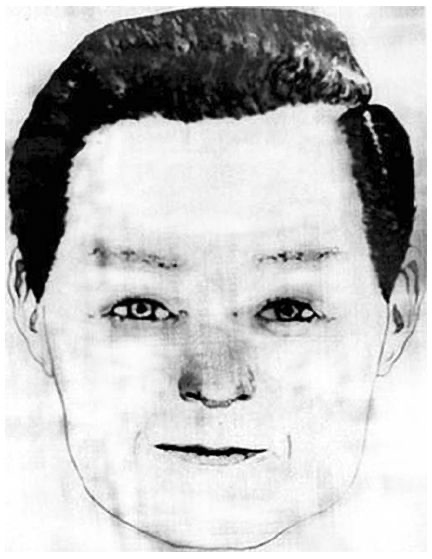
The sketch above does not look like Arthur Leigh Allen, nor does it look the same as the other later sketches (Presidio Heights) showing the Zodiac killer with light hair and glasses.
The Zodiac had his hooded mask on when interacting with Hartnell, yet Bryan saw the colour of his hair?
Actually, he and Cecelia did.
Zodiac Ciphers, Richard Grinell:
Recall, ‘Bryan Hartnell backed up Cecelia Shepard and stated that “he could see hair through the mask’s eyelets and observed the hair to be dark brown”.
Other Lake Berryessa witnesses agree it was of a dark shade, whether black or brown and this fits with most descriptions supplied by others.
Interesting though that Hartnell remembers the killer being a sloppy dresser as well as having a paunch. Like Arthur Leigh Allen?
There is a notable discrepancy in the killer’s height amongst the witnesses and compared with Michael Mageau. Perhaps because Mageau was seriously wounded and fallen down, judging their height accurately was difficult. For the Lake Berryessa witnesses agree the killer was taller than 5’8’’ or 5’9’’ and rather between 5’10’’ and 6’2’’. Though Hartnell does say 5’8’’ to 6’0’’ which is a range of four inches and again may be influenced by the fact he was looking up at the killer as Mageau – another survivor – had done.
An average height given for the killer is six foot and interestingly, Arthur Leigh Allen was six foot.
Whereas there is agreement that the killer was heavy and (well) over 200 pounds or 14 stone in weight. Arthur Leigh Allen was approximately 250 pounds (17 stone).
The age ranges from 20 to 40 and this is more difficult for people to ascertain being peculiarly subjective for each individual. At the time of the Lake Berryessa attack, Arthur Allen was 35 years old.
‘[Film director] David Fincher has carried the case forward by locating statements by the Washington and Stine witness and the officer who passed Zodiac who identified Allen as the man they saw. I located witnesses at Berryessa who identified Allen as being at the lake that day – the son of the now deceased dentist and one of the college women.
The boy at Lake Berryessa, Sept. 27, 1969, told me when I found him, “Man, I thought they caught that dude. Nobody ever questioned me after that day.” He picked out Allen as being there that day. “I thought he was so young to be bald,” he said’ – Robert Graysmith.
So, we have two police sketches – based on eye witnesses – which do not look alike, nor do either look like Arthur Leigh Allen, whom witnesses have identified as being at Lake Berryessa.
What on earth does this mean?
Are we dealing with two different men based on the two different drawings?
Both stocky, but one is approximately 25 to 30 years of age; about 5’9”; weighs 200 to 210 pounds; could have fairer hair; and wears glasses. Whereas the other male is 30 to 40 years old; about 6’0”; 220 to 250 pounds; has darker hair; and does not wear glasses.
Recall the police reported a car with two men inside it prior to the Faraday and Jensen murders. Michael Mageau would not have seen or known if another person was in the killer’s car, due to it being night time and the glare from the flash light attached to the killer’s gun.
Alternatively if there was only a lone killer, they may have been a master of disguise stemming from a background in theatre and acting and therefore savvy in the professional use of make up and props.
Or as the killer allegedly looked like Arthur Leigh Allen, yet as forensic DNA reveals cannot be Allen (something Robert Graysmith appears to either forget or ignore); does Allen then have a doppelgänger (evil twin).
While the evil twin comment is a (poor) attempt at humour, the idea of a real look alike killer is not and a deadly serious consideration.
Paul Lee Stine
Case number: 696314
Tera Box:
‘The final confirmed murder occurred on [Saturday] October 11, 1969 [again the weekend], and represented a significant departure from the killer’s established pattern. Instead of targeting a couple in a rural area, the killer murdered 29-year-old Paul Lee Stine in the affluent, urban neighborhood of Presidio Heights in San Francisco [on the northeast corner of Washington and Cherry Streets].’
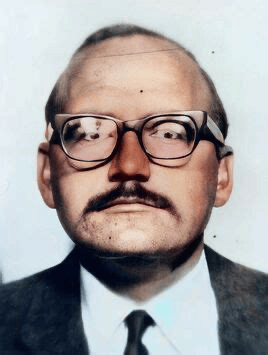
‘Stine was a dedicated [doctoral] student working as a cab driver to support his education. The killer entered Stine’s cab, directed him to a specific intersection, and shot him once [at about 9.55 pm] in the head [behind the right ear] with a 9mm pistol [but not the same 9mm used in the Ferrin murder].
To prove his identity and mock the police, the killer tore a large swatch of fabric from Stine’s blood-soaked shirt. Over the following weeks, he mailed pieces of this shirt to the San Francisco Chronicle alongside his taunting letters, providing undeniable proof that the letter-writer and the murderer were the same person.’
Zodiac Killer:
‘Stine’s cab was hailed at Mason and Geary Streets [at approximately 9.40 pm], with the intended destination being Washington and Maple Streets near the Presidio. For reasons unknown, the cab ended up at Washington and Cherry Streets, a block away from the original destination. Stine’s wallet and keys were taken and a large portion of his shirt was carefully torn off.
Bloody [partial] fingerprints [from a right hand], potentially of the suspect, were recovered from the vehicle. According to a police document, a pair of men’s Size Seven black-leather gloves was also found… three [teenage] witnesses watched the suspect from approximately 60 feet away as he wiped down the cab with a cloth after killing Stine.
They called the police and described a white male, 25 to 30 years old, 5’8” to 5’9” [is this the correct height and perhaps influenced by the height of the witnesses], stocky [“husky”] build, reddish-brown hair [dyed?*] worn in a crew cut, heavy-rimmed glasses [disguise or required?] and dark [“or black jacket”] clothing.
They last saw him casually walking north on Cherry Street.’
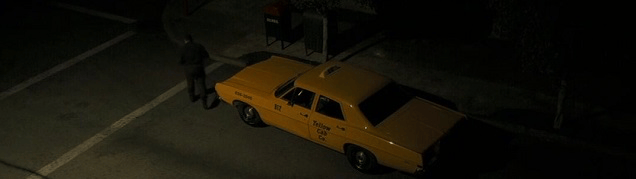
‘Unfortunately, the police dispatcher mistakingly described the suspect as being a black male adult. As a result, when patrol officers Donald Fouke and Eric Zelms minutes later observed a white man walking east on Jackson Street, he was [according to them] never stopped and questioned. The officers did get a good look at him, however. When the correct description of the suspect was finally broadcast, the officers realized they might have encountered him.
A search of the area where the man had been observed was conducted, to no avail [for he would have fled in his own earlier parked car]. The man seen by Fouke and Zelms was very similar to the suspect observed by the three witnesses. He was white, 35 to 45 years old, 5’10”, between 180 and 200 pounds, barrel chested, with light-colored*, crewcut hair and wearing glasses.’
The police description is likely more accurate as they saw the killer from eye (street) level in their patrol car instead of from a height. If the Zodiac was a ‘big’ man, his height may have been distorted by his girth and breadth and thus his height may have been closer to 5’11” or 6’0”. His age again, was probably closer to 35 years old.
Zodiac Killer:
‘The man didn’t appear to be carrying anything and no conversation between the man and the officers took place [according to Police]. The Stine murder was initially thought to be a routine cabbie-killing, a robbery gone bad. However, on Oct. 13, 1969, the San Francisco Chronicle received a letter from Zodiac containing a portion of bloody shirt and taking credit for the killing [where he boasted about the murder and claimed to have clandestinely watched SFPD search for him. The Zodiac also threatened to shoot a tire on a school bus and kill children as they exited].
SFPD Inspectors Dave Toschi and Bill Armstrong, who were assigned the case, were shocked to realize the shirt belonged to Stine. Still later, Zodiac would claim he actually spoke with the patrolmen the night of the murder, leading them astray.’
Encyclopaedia:
‘They pulled alongside the man and asked if he had seen anything suspicious [according to the Zodiac]. The man confirmed he had seen someone waving a gun and heading east. The officers hurried away.’
Zodiac Killer:
‘The three witnesses, though hampered by poor lighting conditions and fog during their observation of the crime, worked with a police composite artist to put a face on Zodiac. A few days after the sketch was circulated throughout the Bay Area in the form of a wanted poster, the witnesses requested the sketch be altered to make it more accurate. Thus another version was made.
More than a month after Stine’s murder, Officer Fouke finally came forward about his possible encounter with the killer. In early 2004, the decision was made to close the case, much to the outrage of one recently-retired detective.’
Encyclopaedia:
‘Toschi ended up working on the case by himself and filled eight filing cabinets with potential suspects. In 1976, he told the Associated Press that Zodiac’s letters were an “ego game”. He believed the killer lived in the San Francisco Bay Area, “He’s a weekend killer.
Why can’t he get away Monday through Thursday? Does his job keep him close to home? I would speculate he maybe has a menial job, is well thought of and blends into the crowd… I think he’s quite intelligent and better educated than someone who misspells words as frequently as he does in his letters”.’
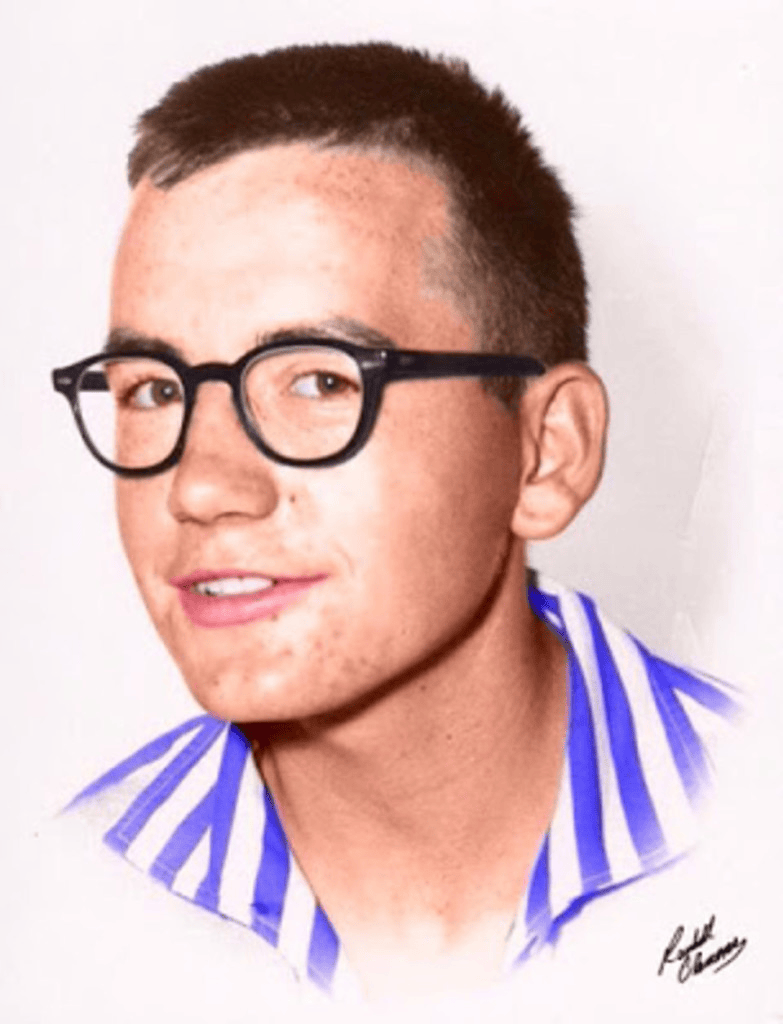
Additional details of interest leading up to the murder of Paul Lee Stine including witness testimony.
Zodiac Killer Info:
After shooting Paul Stine, the ‘killer exited the cab, and went into the front seat where he took Stine’s wallet and car keys, and cut away a section of Stine’s bloodstained shirt. He also apparently wiped away fingerprints on the cab interior. He then left and walked away.’
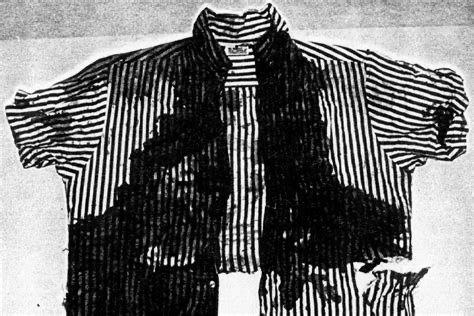
‘The duration of the crime, from the gunshot to the time Zodiac left the cab, was probably no more than 3 minutes. When Officers Pelissetti and Peda arrived at 9:58 (approx), the killer had only walked away moments before – probably less than a minute earlier. If Pelissetti’s arrival time of 9:58 PM is correct, it suggests that Zodiac probably shot Stine around 9:55 PM.
The Robbins kids, Lindsey (16) and Rebecca (13) had some friends over watching TV. Although none of them heard the gunshot, one of the teens noticed the cab outside with the interior light on, brightly lit. The teenagers watched from an upper story window in the house across the street…’
“The first kid at the window said the driver looked “sick, or something”. Lindsey and Rebecca went to the window and saw the driver laying across the front seat, head toward the passenger door. His head was in the lap of another man (passenger). Rebecca saw blood and said out loud, “he’s stabbing that man.” She saw blood on the victim and saw the glint of a knife, so she assumed a stabbing was taking place. (No shots were heard by anyone). We know now that Zodiac was cutting off a large piece of Stine’s shirt with the knife” – Vallejo Police Officer Jim Dean.
“They saw the below described suspect in the front seat of the Yellow cab, mid to passenger side, with the victim slumped partially over his lap. The suspect appeared to be searching the victim’s pockets. (Witnesses never heard a gunshot.) The suspect then appeared to be wiping (fingerprints) on the interior of the cab, leaning over the victim to the driver’s compartment. The suspect then exited the cab by the passenger side front door, also wiping with a white rag, possibly a handkerchief. The suspect then walked around the cab to the driver’s side and proceeded to wipe the exterior of the left door area. The suspect then fled (walking) north on Cherry Street toward the Presidio” – Armond Pelissetti San Francisco Police Report.’
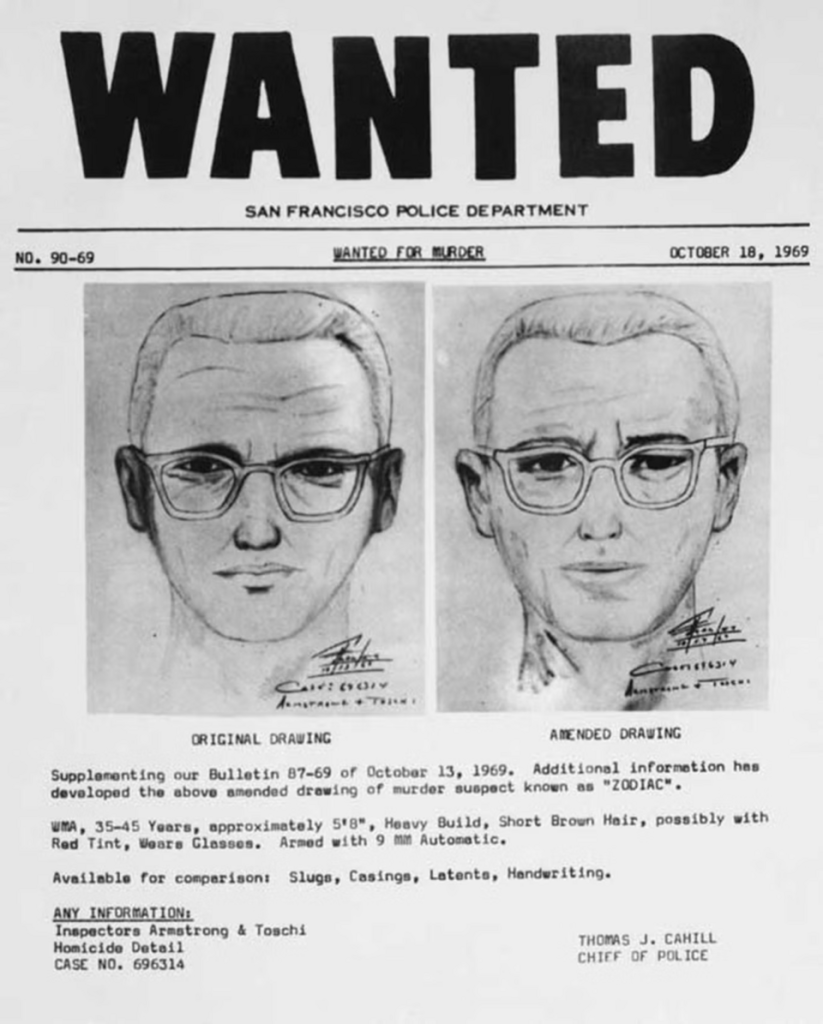
‘The teenagers described the suspect as a white male “in his early forties, 5’ 8”, heavy build, reddish blond [brown], crew cut hair, wearing [heavy-rimmed] eyeglasses, dark brown trousers, dark (navy blue or black) ‘parka’ jacket, dark shoes” – Armond Pelissetti San Francisco Police Report.
‘One of the teens upstairs called the police to report the crime while it was still underway. Police then radioed an APB alerting police patrols about the crime and mistakenly identifying the suspect as a NMA (negro male adult). The [mix up] in descriptions given by the police dispatch remains unexplained.
At around the same time, Lindsey and Rebecca went downstairs to watch from a closer window. They saw the suspect push Stine into an upright position, then exit the cab, walk around the rear of the car, and open the driver’s side door. Stine had slumped over again, and the man tried pulling Stine into an upright position, then wiped down parts of the door and dashboard with a rag.
The suspect then left and started calmly walking north on Cherry Street. Lindsey went outside to watch where he was going. The time was approximately 9:58 PM’ – Vallejo Police Officer Jim Dean.
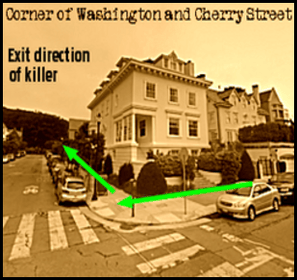
Zodiac Killer Info:
‘At around 9:58 PM, SFPD Officers Armond Pelissetti and Frank Peda arrived at the scene of the crime, at which time, according to Lindsey Robbins, the killer was still in sight walking up Cherry Street.’
“At this exact point, the first SFPD car arrives with two officers. One, Pelissetti, approached Lindsey and tried to extract what was happening. The other officer went to the cab and found the bloody victim. While Pelissetti was asking questions, Lindsey was trying to explain that the suspect was in sight on Cherry St. By the time Pelissetti got the point, they both looked and the Zodiac was gone” – Vallejo Police Officer Jim Dean.
‘In a 2007 interview, Pelissetti said that after arriving, he saw three teens in the street heading over to the car, and herded them back to the alcove at their house, out of concern that the suspect might still be there. He claimed that he then went to the cab and ascertained that Stine was dead, and then went to retake the description from the teens. And it was then that he was told the suspect was a white male. He then ran to the car to radio this correction to dispatch. Pelissetti then walked north up Cherry Street, turned right and walked east on Jackson St, to the corner of Jackson and Maple St, where he saw a man out walking his dog’ – Armond Pelissetti
Zodiac Killer Info – emphasis mine:
When the police radio call went out at 9:56 PM alerting patrols about the crime, patrol officers Don Fouke and Eric Zelms were only a few minutes away driving north on Presidio Ave just north of Washington Street. They turned left on Jackson and sped toward the crime scene. About 3 minutes later, at approximately 10:00 PM, just two blocks from the crime scene, Fouke and Zelms observed a white man walking east along the sidewalk on the north side of Jackson Street, just west of Maple Street.
As they passed, the man turned as if stepping into a stairway leading up to the front yard of one of the homes on the north side of the street. However, since the police radio dispatcher had mistakenly alerted officers to be on the look out for a black suspect, Fouke just briefly slowed the car then drove past without stopping. He only observed the man for a few seconds.
Fouke estimated the white male pedestrian to be 35 to 45 years old, 5’10” tall with a crew cut, similar to but slightly older than the description provided by the teenagers who observed the killer in and out of Stine’s cab.
“My regular partner was off. I don’t recall the reason why he was not working that night. However, Eric Zelms was assigned as my partner that night. We were patrolling the eastern side of the Richmond district, going northbound on Presidio Avenue. We had passed Washington Street when a broadcast came in [about] a shooting at Cherry and Washington Street.
We turned west on Jackson Street, as we approached Maple Street I noticed on the north side of the street a white male adult… The initial radio description of the suspect was that of a black male, 5’ 10” or something like that. Seeing that it was a white male in an affluent neighborhood walking alone along a street, we didn’t think it was a suspect. So we proceeded to the next block which was Jackson and Cherry. Turned southbound on Cherry Street, saw Armond Pelissetti.”
“We slowed down as we passed him, I don’t know, we were still rolling, saw that it was a white male, step on the gas, 5, 10, 15 seconds tops from first spotting him to passing him…
We never stopped the man, we never talked to him. That is an emphatic statement by me…
He sort of looked down, perhaps this lumbering gait, stumbling along, like a semi-limp might have come up in my mind, because he was putting his head down when he spotted the police car, and turned into the entrance way of a house. By entrance way I mean stairs that are leading up that are concrete to a path, that leads to a front door.
Never saw him get to the top of the stairs. You want the address of that residence, 3712 Jackson Street” – Interview with Donald Fouke in the documentary This is the Zodiac Speaking, from the special edition DVD of Zodiac (2007).
Zodiac Killer Info:
‘Only moments after seeing the suspect on Jackson St, Officers Fouke and Zelms stopped and spoke to Officer Pelissetti on Cherry Street near the corner of Jackson. At that time, Pelissetti informed Fouke and Zelms that the suspect was in fact a white male. After this, Fouke and Zelms turned around and went back to the corner of Maple and Jackson St, then entered the Presidio and searched the area around Julius Kahn Playground.’
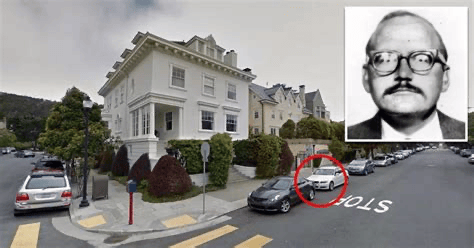
‘The following is from an Interview with Don Fouke by retired Vallejo PD Detective Jim Dean, and author Mike Rodelli:
Rodelli: Which way was he [Pelissetti] headed? Was he headed anywhere? He was headed north?
Fouke: He was walking towards the corner of Cherry and Jackson.
Rodelli: I see. He hadn’t made it to the corner yet.
Fouke: Not quite. A few feet…
Rodelli: OK. And… did he tell… what was the context of the conversation?
Fouke: I… “Had you seen anybody?”
Rodelli: OK. Right…
Fouke: We replied we had seen a white guy but no Negro male.
Rodelli: OK.
Fouke: And he says, “That’s what we’re looking for.” Shortly after that the description comes out on the radio.’
“He stopped us and said that he was looking for the white male that had just gone down the street. There was a little conversation about what the initial description was, and he said no, he was a white male. I then used a… slang term, and said, “Oh, that was the suspect” – Patrol Officer Don Fouke interviewed in This is the Zodiac Speaking.
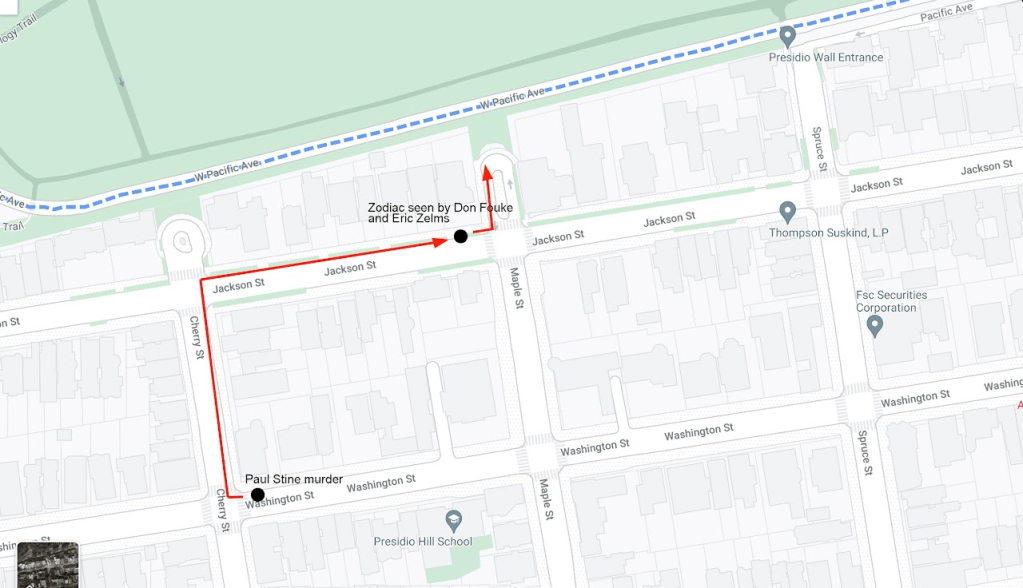
After murdering Paul Stine, Zodiac walked around the corner and apparently entered the Presidio via Maple Street. He was seen by Officers Fouke and Zelms shuffling along Jackson Street. It is unclear if the officers stopped and spoke to Zodiac. They claimed that they did not, but Zodiac claimed that they did.
Zodiac Killer Info:
‘A month after the murder, Fouke submitted a memo stating that he had in fact seen a suspect that night who fit the description of Zodiac:
“I respectfully wish to report, that while responding to the area of Cherry and Washington Streets a suspect fitting the description of the Zodiac killer was observed walking in an easterly direction on Jackson street and then turn north on Maple Street. This subject was not stopped as the description received from communications was that of a negro male. When the right description was broadcast reporting officer informed communications that a possible suspect has been seen going north on Maple Street into the Presidio, the area of Julius Kahn playground and a search was started which had negative results” – Donald Fouke November 12, 1969.
‘A month after the murder, the Zodiac sent a letter in which he claimed that he spoke to the police, presumably Fouke and Zelms:
“p.s. 2 cops pulled a goof [about] 3 min after I left the cab. I was walking down the hill to the park when this cop car pulled up + one of them called me over & asked if I saw anyone acting suspicious or strange in the last 5 to 10 min & I said yes there was this man who was [running] by [waving] a gun & the cops peeled rubber & went around the corner as I directed them & I disappeared into the park a block & a half away never to be seen again” – Zodiac letter, November 9, 1969.
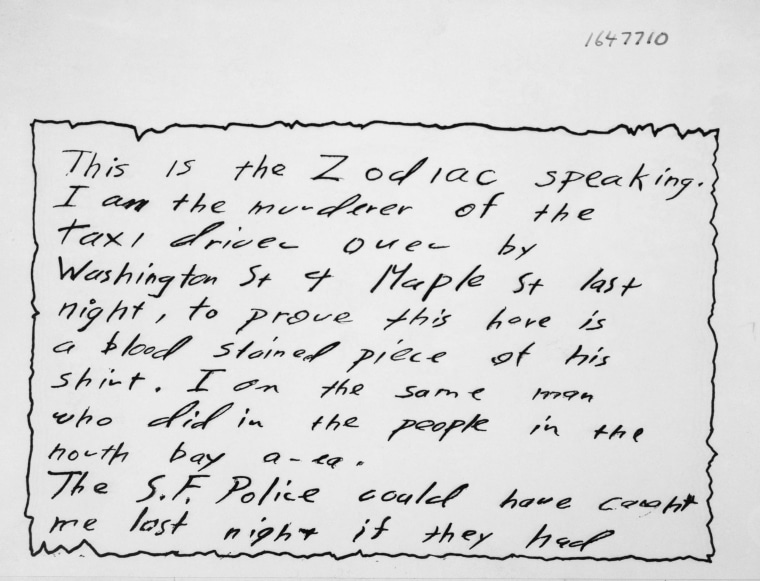
‘Although Fouke adamantly and repeatedly stated that he and Zelms did not stop and speak with the suspect on Jackson Street, according to Eric Zelms’s widow Diana, Zelms told her that they did in fact stop the car and speak to the man:
“Diana said that Eric closely followed the Stine murder on television. He told her that when he and Fouke saw a WMA they quickly decided to question him. He said that they spoke to this man “face to face!” The man was polite, calm and answered all of their questions. There was nothing suspicious about him. They then quickly left to continue their search for a BMA as had been broadcast in the APB.”
‘It is difficult to square some of the apparent discrepancies between the testimony of Armond Pelissetti and Officer Don Fouke. Pelissetti claimed that he walked to the corner of Jackson and Maple Street at around 9:59. If Fouke, a minute or so after this, saw a man (believed to be Zodiac) on the north side of Jackson Street, it is a hard to understand why Pelissetti did not also see this man.
One possibility is that the Zodiac was hiding at this time, perhaps behind the bushes in one of the walkways on the north side of the street. Or it is possible that Pelissetti never in fact walked to the corner of Jackson and Maple as he claimed. Remember that Fouke claimed that when they turned south onto Cherry Street, they encountered Pelissetti walking north.
There is also nothing in the initial report indicating that Fouke told Pelissetti that he has seen a man on Jackson Street. Pelissetti later stated that “[Fouke] did not mention to me that he has seen anybody at that point, or had stopped anybody.” This is a point of disagreement between Fouke and Pelissetti over what happened that night.
It seems possible that either Pelissetti or Fouke or both lied somewhat to cover the fact that… the police apparently saw and may have even spoken to Zodiac on Jackson Street. This could explain why it took a month for Fouke to submit a memo admitting that they had seen a man on Jackson Street only minutes after the murder. It could also explain why there was no mention of Fouke telling Pelissetti about this encounter in Pelissetti’s initial report.
In an earlier interview, Fouke gave a somewhat different story. He claimed that after seeing the white male… “we proceeded on Jackson Street towards Arguello continuing our search, as we arrived at Arguello Street the description of the suspect was changed to a white male adult, believing this suspect was possibly the one involved in the shooting we entered the Presidio of San Francisco and conducted a search on West Pacific Avenue, the opposite side of the wall and the last direction we observed the suspect going, we did not find the suspect.”
Zodiac Killer Info:
‘The San Francisco Police Department investigated an estimated 2,500 suspects over a period of years.
Fingerprints were lifted from the taxicab. (See below)
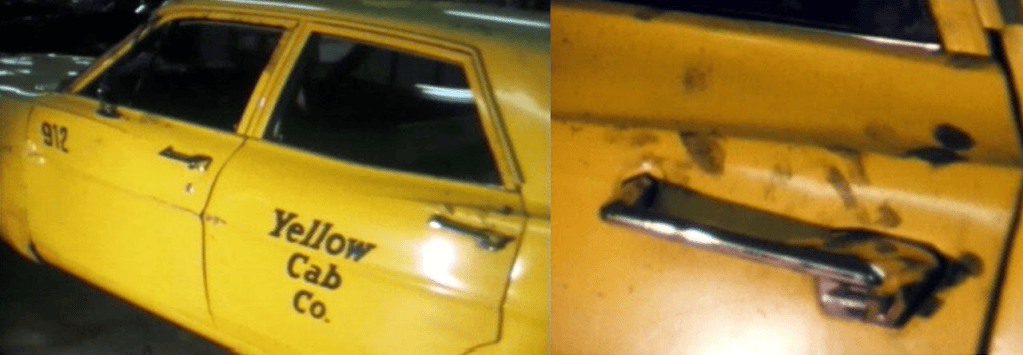
October 19, 1969
Intra-departmental Memorandum
San Francisco Police Department to Vallejo PD
Subject: SFPD Homicide Case #696314
“All of the latent prints in our case were obtained from a taxi cab. The latent prints that show traces of blood are believed to be prints of the suspect. The latent prints from right front door handle are also believed to be prints of the suspect. The other latent prints many of which are very good prints, may or may not be prints of the suspect in this case.”
‘The gun used in the murder was described as a “9mm semi-automatic, possibly new model Browning. (Not same 9mm as used in Vallejo Police Department case.) Ammunition: 9mm Winchester Western.”
This was the last officially confirmed murder by the Zodiac Killer. The case was officially closed (unsolved) by SFPD in 2004.
A pair of men’s size 7 black-leather gloves was found in the cab.’ Why would the killer leave them behind?
‘Witness Descriptions
Patrol officers Donald Fouke and Eric Zelms observed a white man walking east on Jackson Street. According to Fouke, he was not stopped or questioned. (Zodiac in one of his letters claimed that he spoke to police at this time). The officers did get a good look at him.
White Male
35 to 45 years old
5’10”
between 180 and 200 pounds
Medium heavy build, barrel chested
light-colored, crew cut hair, possibly graying in back
Medium complexion
wearing glasses
Dark blue, waist-length, zipper type jacket (Navy or Royal Blue) zipped part-way up, elastic cuffs and waistband
Brown wool pants, pleated-type, baggy in rear
May have been wearing low-cut shoes
Subject at no time appeared to be in a hurry, walking with a shuffling lope, slightly bent forward, head down
The subject’s general appearance suggested Welsh ancestry
The police description contains more details than the Robbins teenagers because they ‘spoke’ face to face with Stine’s killer. That aside the Robbins and police descriptions tally almost exactly.
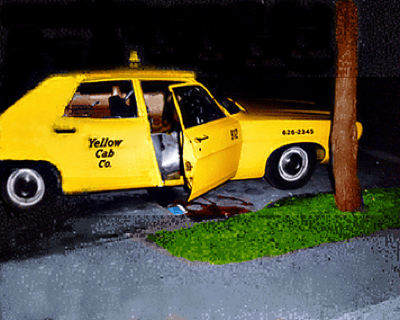
Salient observations on the death of Paul Stine which may have relevancy for the investigation.
Notice Paul Stine has the same middle name (Lee) as prime police suspect, Arthur (Leigh) Allen, albeit spelt differently.
An important point is made by Robert Graysmith – shown in the 2007 film, Zodiac – in which he deduces that certain books on codes and ciphers (undoubtedly referenced by the Zodiac) were stolen from a library in Presidio heights, no less. Did the Zodiac live there at the time and so was he able to melt into the night after killing Paul Stine because he did not need to collect his car and drive away to another suburb, but rather made his way close to home on foot after entering a Park.
The police displayed ineptitude of the highest order in incorrectly assuming the perpetrator was black and then when the actual suspect was being questioned on the sidewalk, allowing him to disappear without a trace. Of course, when they did realise who they had been speaking with, why did they not thoroughly comb the Presidio Heights neighbourhood in search of the Zodiac?
It was a huge risk for the Zodiac killing Paul Stine so close to home but would explain how he easily slipped away. His adrenaline must have gone through the roof when accosted by the officers and his satisfaction must have also soared when he knew he had fooled them by not going to his own house when he climbed/descended steps to another house first. One the cops took note of its address. Even more so, when he read that Lindsey Robbins had tracked him walking away and had visual sight on him when talking to the police, yet they nonsensically prevaricated in allowing him to get cleanly away.
Remember, ‘despite this attack being the most theatrical offering yet from the Zodiac Killer, he failed to capitalize on this crime in subsequent communications to the San Francisco Chronicle, never once detailing his involvement in the Lake Berryessa stabbings.’
How odd.
Is it because the Lake Berryessa stabber/attacker was not the same individual as the Vallejo shooter/killer?
Still, the Lake Berryessa killer made a phone call as did the killer after the attack on Mageau and Ferrin. Only after that call did they begin correspondence via letters a month later.
Recall, the Zodiac Killer would wait only two weeks to commit his ‘fifth’ murder in ten short months… subsequently having ‘no difficultly in resuming his correspondence with newspapers, mailing a letter to the San Francisco Chronicle just two days after the murder, including a blood-stained section of Paul Stine’s shirt’.
Again, strange to claim responsibility boastfully through mail so quickly after this murder but did not do the same after the attack just two weeks earlier, phoning instead.
And why kill just two weeks later, making a song and dance about it. Over-seeking attention perhaps, because someone else had appropriated the Zodiac’s name and symbol; dressing up as him no less – with more razzamatazz – and committing a crime with little resemblance to the previous two accredited to the ‘real’ Zodiac.
Thus, there is plausible and serious doubt about whether the killer at Lake Berryessa was the same person of Presidio Heights. This is not just highlighted by the two-week interval between the two attacks and the drastic shift in modus operandi, but underlined in the about shift in the Zodiac’s attack in Presidio Heights compared even with Lake Herman Road and Blue Rock Springs Park.
The Zodiac did not target a couple in a secluded ‘rural’ setting, ambushing with a hail of bullets and fleeing quickly. This time, he chose a cab; calmly shot the cab driver Paul Stine with just one cartridge; took his time to wipe prints (but accidentally omitted to get them all- on door handle); used further time to cut cloth from Stine’s shirt, even trying to prop him up in the seat; and then causally walks away from the car along a number of streets.
All this was high risk compared to the first two murders and compares with the risks taken by the Lake Berryessa killer. It’s as if Stine’s killer was eager to grab police attention with a different type of kill from not just the Lake Berryessa killer but even from his own earlier attacks. This is evident from his sending in bloody material from Stine’s shirt to the Newspapers.
The fact the Presidio heights murder was a mere two weeks after the Lake Berryessa attack is suspicious in regard to the killer being the same person. Particularly when just over six months separated the Lake Herman Road attack with the Blue Rock Springs murder. Then there is an interval of just over three months between Blue Rock Springs and Presidio Heights. One can’t help think it was a knee jerk reaction to the Lake Berryessa murder and was forced three months early.
Remember, the Zodiac never mentions the Lake Berryessa attack in any of his many letters. Yet it would seem, they probably included it in their total tally of early victims (likely comprising both the injured and murdered).
As the Zodiac did not appear to lie (initially), there is little reason to believe they falsified the total number of victims at the beginning at least. Regardless, there could be additional murders certainly subsequent to the four attacks, five murders and two attempted murders and possibly preceding them as well – if the tally truly did reach 37 victims.
The police clearly did not want to open up this can of worms and therefore, clearly content to progress no further than the ascribed five murders. Privately, they probably considered more than one perpetrator; though pragmatically decided not to publicly follow this line of reasoning in which they would look even more incompetent if admitting there was more than one killer and more than five deaths.
It then begs the question of whether the Zodiac worked alone or with another? Or was there one or more copycat killers?
This writer for the time being – unless evidence comes to light to think otherwise – considers the Lake Berryessa attack as the work of a fiendishly opportunistic ‘copycat’ (of sorts) killer.
For here was someone who took their time during daylight and crept up on his eventual targets, showing no panic or hastiness, willing to interact with the victims, taking time to build mounting terror in Cecelia Shepard and Bryan Hartnell. Whereas the other three shootings were enacted by someone who got pleasure from a surprise ambushing of their victims in the dark and frightening them with the alacrity of the attack, where they were shot (dead) before they knew what had literally hit them.
It just doesn’t add up and the word odd just doesn’t begin to explain the differences.
The two different sketches for two different men two weeks apart alone, should ring alarm bells for any discerning reader.
There is the Presidio Heights killer who is probably the true Zodiac Killer – aka the Zodiac or Zodiac 1, the shooter/killer – and the Copy Cat Killer at Lake Berryessa – aka Zodiac 2, the stabber/attacker.
Prior to studying a sample of murder victims prior to and following the official Zodiac deaths, the question of multiple Zodiac killers has been posited by others with two opposite view points.
A case against is presented by previously quoted Richard Grinell, who possesses comprehensive knowledge about the Zodiac case and delivers expert opinion on the subject.
Zodiac Ciphers, Cecelia Shepard murder – conceived 4th August 1969:
‘The… Zodiac Killer mailed three letters to the San Francisco Chronicle, San Francisco Examiner and Vallejo Times-Herald announcing that he was responsible for the three murders and attempted murder, while challenging authorities to decode a 408 character cipher. The Zodiac Killer threatened the newspapers, stating
“If you do not print this cipher by the afternoon of Fry.1st of Aug 69, I will go on a kill ram-Page Fry. night. I will cruse around all weekend killing lone people in the night then move on to kill again, until I end up with a dozen people over the weekend”.
Imagine his horror when the two main newspapers failed to bow to his threats, with the San Francisco Chronicle placing the story on page 4 of the August 2nd 1969 edition, and the San Francisco Examiner demoting him to a lowly page 9 on August 3rd 1969. The problem was further compounded, with Vallejo Police Chief Jack E. Stiltz even questioning the validity of the author and “urged the writer to send more letters, with more facts to prove his connections to the crimes.”
The Zodiac Killer in his haste to prove he was the killer responsible for three people, immediately sent a letter to the San Francisco Examiner on August 4th 1969 – and despite the Examiner printing his letter the same day, in which he declared
“This is the Zodiac Speaking” and that he “was not happy to see that he did not get front page coverage”, imagine his utter disbelief when he discovered that the San Francisco Examiner had again relegated his letter supplying more details of the crimes to page 4.
It equally wouldn’t have escaped his attention, that on the front page of the same paper it featured the double knife slaying of two young girls from San Jose. Deborah Furlong (14) and Kathy Snoozy (15) had been brutally stabbed while picnicking on a grassy knoll on August 3rd 1969.’
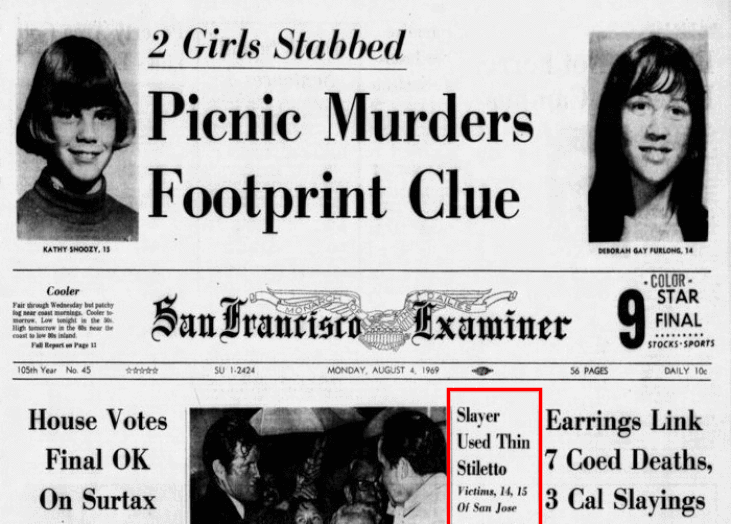
‘The Zodiac Killer had now murdered three people, nearly killed Michael Mageau and sent four communications (including three cryptograms), yet he was still unable to command front page coverage. But now he knew exactly what was required – and it was staring him squarely in the face on page one. August 4th 1969 was not only the day he announced his pseudonym to the world, but the day he realized that a brutal stabbing was required to secure himself front page coverage. This was the day the fate of Bryan Hartnell and Cecelia Shepard would be sealed, almost two months in the making.’
This is conjecture on Grinell’s part and purely speculative. It is a plausible theory, if one is eager to defend the Lake Berryessa killer as the Zodiac. While the San Jose murder of two teenage girls was clearly not the work of Zodiac 1 (the shooter/killer), it may well have been a crime committed by Zodiac 2 (the stabber/attacker).
Zodiac 2 had plenty of time – nearly two months – to plan his next (stabbing) attack and design his Zodiac costume and mask. In so doing he in turn upstaged the real Zodiac and at the same time, enhanced Zodiac 1’s profile, furthering his mythos while remaining in the shadows himself.
‘Forever the narcissist, the Zodiac Killer couldn’t believe his luck when he happened upon three young girls on the shores of Lake Berrryessa by Smittle Creek. I am sure for a brief moment he could see the headlines flash in front of his eyes:
“3 Girls Stabbed, Sunbathing Murders, Footprint Clue”.
However, the Zodiac Killer for whatever reason, decided against the attack, returned to his vehicle and drove away. Fortunately, the three young women from Pacific Union College would escape the wrath of the Zodiac Killer – but he was not done yet.’
Fascinatingly and coincidently, one of the girls mentioned above has made her view on the killer public, which we will address shortly.
‘Approximately two hours later and eight tenths of a mile south, the Zodiac Killer would reappear and set his sights on the 1956 White Karmann Ghia of Bryan Hartnell and Cecelia Shepard, before traversing the 510 yard hillside descent to the area of the picnicking couple.
Driven by an insatiable desire to secure front page coverage, he proceeded to callously stab the young couple sixteen times before finally returning up the hillside and out of sight. The thoughts of the San Jose murders of Deborah Furlong and Kathy Snoozy – and the headline news they generated – were probably in the forefront of his mind when he approached the Volkswagen Karmann Ghia and pulled the black marker pen from his pocket. He proceeded to write on the car door of Bryan Hartnell’s vehicle, to leave you in no doubt that he was mimicking the murders of the two young girls from San Jose.
He wrote “Vallejo 12-20-68, 7-4-69, Sept 27-69 – 6:30 by knife”.
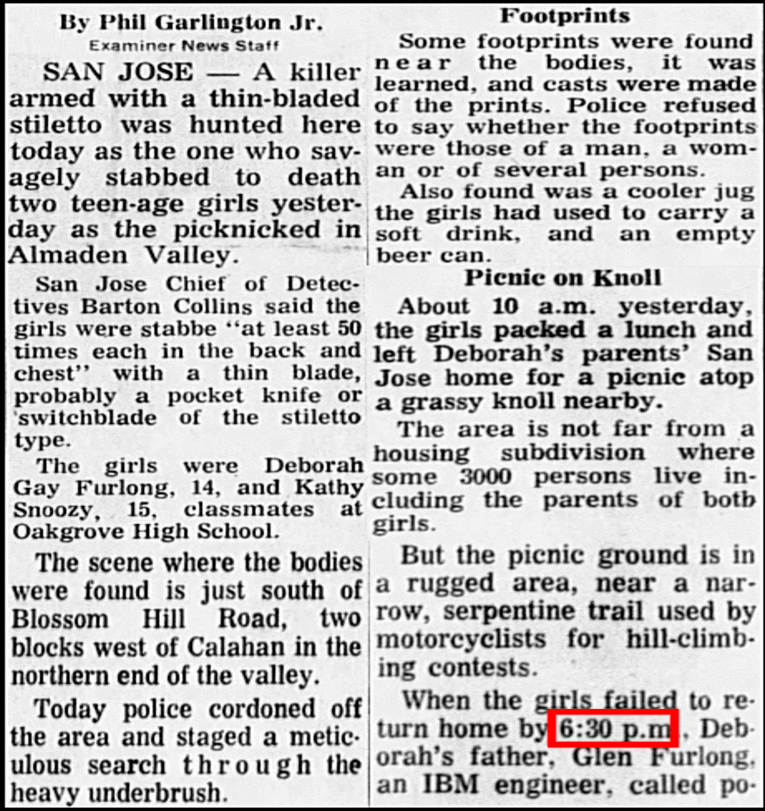
‘If you ever wondered why he wrote the time 6:30 on the car door, even though he rang in the crime just seventy minutes later, then the newspaper article [above] may give you a clue. This is the article from the San Francisco Examiner on August 4th 1969 – the very reason why the Zodiac Killer arrived at Lake Berryessa on September 27th 1969 in the first place. This annotation of 6:30 on the car door of Bryan Hartnell’s vehicle was supposed to mark the time that the young couple at Lake Berryessa failed to return home also.’
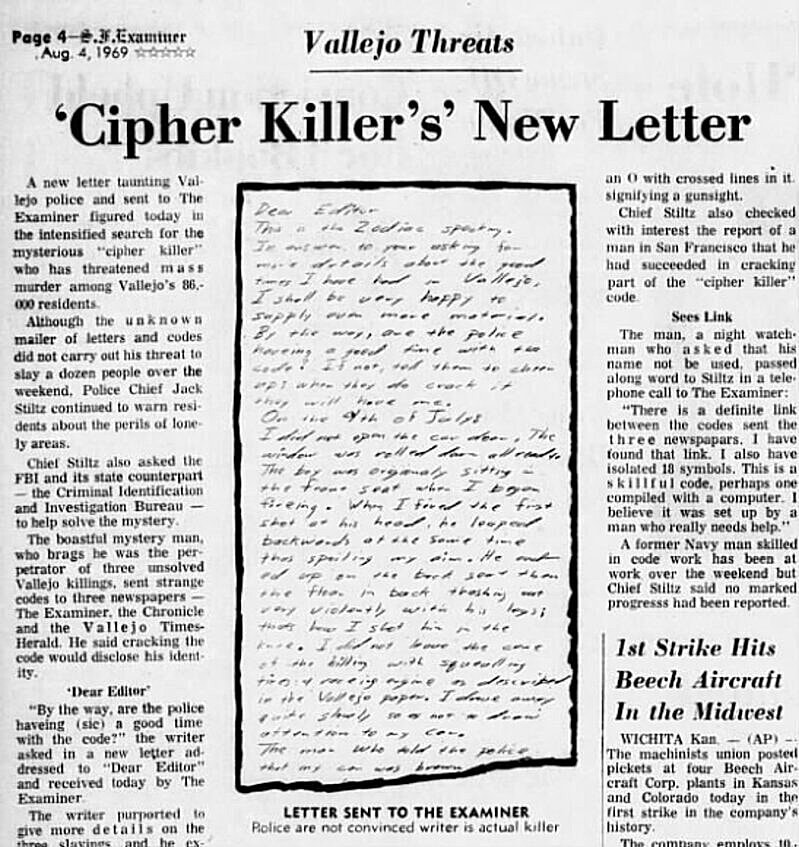
Grinell’s theory was likely actualised by Zodiac 2, who had possibly killed Furlong and Snoozy just two months previously and hence the chilling references to ‘6.30 pm’ and ‘by knife’. Granted, Zodiac 1 was also spurred on to kill, though it was Zodiac 2’s shocking stabbing of Shepard and Hartnell which motivated Zodiac 1 to strike two weeks later with their own brutal assassination of Paul Stine.
Richard Grinell continues with arguments against the Lake Berryessa incident being a Zodiac copycat killer.
Zodiac Ciphers: Was the Berryessa crime a copycat? June 25, 2017 – emphasis mine:
‘The double stabbing at Lake Berryessa on September 27th 1969 has been constantly questioned as a Zodiac crime, often backed up by the argument that the Zodiac Killer never bragged to newspapers in the following weeks.’
Thus is hardly a surprise the Lake Berryessa crime has been routinely questioned. Not because Zodiac 1 did not lay claim to it, but because any thinking person with an ounce of sense can clearly see the crime does not fit the established pattern of the Lake Herman Road and Blue Rock Springs Park murders. Why the police did not question this anomaly in the modus operandi of the ‘third’ attack is beyond comprehension.
Grinell:
‘On the face of it he didn’t really have to, as Bryan Hartnell was able to recall virtually every chilling detail in the aftermath of the attack. To claim that the lack of correspondence by the Zodiac Killer after this crime is evidence of a copycat killer is a false dichotomy. They are not the only two options.
There are many[?] features of this crime that suggest a Zodiac connection, but there is actually no[?] evidence whatsoever to the contrary.
The first claim is that the modus operandi (MO) of the crime was totally different from the other three attacks. This is clearly not true. It was an attack on a young couple, seemingly random, just like the first two crimes preceding it, despite the sample size being relatively small and statistically weak.’
Recall, the nine differences – and there may be more – between the Lake Berryessa attack and the ‘first two’. Grinell only highlights an attack on a young couple and then conveniently ignores the substantial list of differences. Just because Zodiac 2 scrawled ‘Zodiac’ details on a car door and later phoned the police does not make them Zodiac 1. And herein lay the problem, for Grinell labours under the stubborn conviction there is/was only one killer. Thus his paradigm rejects the evidence to the contrary regarding the killer at Lake Berryessa.
Grinell:
‘Had the killer not mailed pieces of Paul Stine’s shirt with three subsequent letters or written to the newspapers, neither the police or anybody else would have likely connected his murder to the Zodiac Killer. The modus operandi would have been called into question. So claiming the Lake Berryessa crime as not that of the Zodiac Killer because it didn’t marry up perfectly with the first two crimes, is again, not evidence of anything. Absence of perfect continuity is not evidence to the absence of Zodiac.’
Though accepting the shooter/killer MO of Zodiac 1 – targeting parked cars – would lend to considering the murder of Paul Stine as a crime of Zodiac 1 and not one committed by Zodiac 2, particularly only two weeks after Lake Berryessa.
Grinell:
‘The message on the car door detailing his crimes to date shows distinct Zodiac traits in the handwriting, but expecting it to match up perfectly with his mailed correspondence is not a reasonable premise. He had just stabbed a couple sixteen times, his adrenaline was likely raised, he had then traversed back up the hill and proceeded to write on the car door of Bryan Hartnell’s car, on a different surface, in larger handwriting, in a totally different position he would adopt if he were writing calmly on a desktop. The comparison between the two must take this into account, so the fact it looks somewhat similar to his mailed correspondence is actually quite an achievement. Had this been written by a copycat it would actually have been a lot harder, who not only had all of the above to contend with, but had to replicate the handwriting from an awkward stance or seated position, side on to the vehicle.’
This whole paragraph can be ignored, as Grinell is grasping at straws in the vain hope of defending a single killer paradigm which just doesn’t hold water – especially so as one more closely inspects it.
Grinell:
‘The phraseology of the killer in both phone calls to the police is virtually identical. After the Blue Rock Springs Park attack he stated
“I wish to report a double murder. If you will go one mile east on Columbus Parkway to a public park, you will find the kids in a brown car. They have been shot by a 9 mm Luger. I also killed those kids last year…. Good-bye”.
After Lake Berryessa he stated
“I want to report a murder, no, a double murder. They are two miles north of Park Headquarters. They were in a white Volkswagen Karmann Ghia” and after a brief pause uttered the words “I’m the one that did it”.
It is possible a copycat read the transcript of the Zodiac Killer’s first payphone call to police in the newspapers and reproduced its phraseology during the Napa payphone call, but why is it easier to believe that, rather than believing it was the Zodiac Killer?’
Because it was Zodiac 2 making the second call and they clearly mimicked Zodiac 1’s phone call following the Blue Rock Springs Park murder some three months earlier.
Grinell:
‘In terms of the content of the handwriting, it is often said it was not the Zodiac Killer because his November 8th 1969 ‘Dripping Pen’ card [to be discussed in the section discussing letters] made reference to a murder or possible double murder in August, which the killer at Lake Berryessa did not refer to on the car door.’
This is an important point and will be discussed shortly when addressing possible additional Zodiac murders.
Grinell:
‘But the reverse could be argued, that the reference to September in the ‘Dripping Pen’ card is equal proof that he was claiming the Lake Berryessa crime as his, particularly in light of no other valid murders in September where a killer wore a crossed circle costume and made a phone call with all the hallmarks of Blue Rock Springs Park. This again is a false argument. Even if the Zodiac Killer had murdered in August, the police were apparently unaware of this fact prior to the Lake Berryessa attack, so he simply wrote the dates of the crimes he knew the police would recognize.’
Yes, this is a plausible argument if there was only one killer, but if there were two, then clearly Zodiac 1 is claiming murders preceding the Lake Berryessa murder committed by Zodiac 2.
Grinell:
‘At the top of the Karmann Ghia door the Zodiac wrote ‘Vallejo,’ so any murder outside of this area would have been unnecessary to include in the message. This indicated that the Zodiac believed that both the Lake Herman Road murders and the attack at Blue Rock Springs Park were both committed in the jurisdiction of Vallejo. This is understandable, because the jurisdictional line that separates Benicia and Vallejo is a short distance from the Lake Herman Road turnout. The Zodiac never mentioned Benicia in any of his correspondence to the newspapers, however, he did refer to Vallejo several times.
Curious then, that a copycat would make the same mistake and lump the 12-20-68 on the car door under the banner of Vallejo also. If this alleged copycat had read the newspaper transcripts of the Blue Rock Springs Park phone call, he certainly didn’t take the time to read the multiple references in the newspapers to Benicia when referring to the first crime on the car door. It could be argued that he studied the Zodiac letters intently and knew the tendencies of the Zodiac Killer, or we could opt for the more likely reasoning, that he was the Zodiac Killer.’
This is non-argument and proves nothing either way.
Grinell:
‘Much debate has occurred on whether the man spotted by the three girls at Lake Berryessa was the assailant of Bryan Hartnell and Cecelia Shepard, with comparisons made of this man to the Presidio Heights sketch. Many have stated the two artist impressions are dissimilar in appearance, yet with a quick hair change and slight alteration to the eyebrows, the difference is much less significant between the two. Eyewitness recollections are also proven to be notoriously unreliable. These hair changes have been made to the Lake Berryessa sketch below, without altering any of the facial features.’
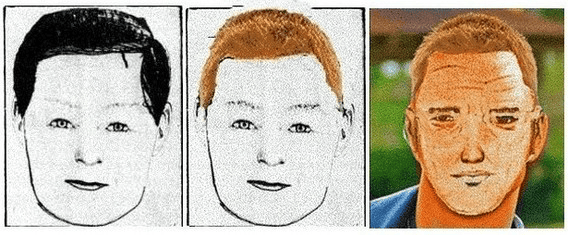
Alter anything and one can reach a sought after result. This really is grasping at thin air by someone who resolutely seeks to hold on to a flawed supposition of a single killer. Endeavouring to morph Zodiac 2 into Zodiac 1 just highlights the ridiculousness in sustaining a single killer theory over a two killer hypothesis.
Grinell:
‘The executioner’s costume at Lake Berryessa is often used to discredit this as a Zodiac crime. It is claimed it wasn’t his modus operandi [and rightly so]. In this instance what MO? We only have two confirmed attacks by the Zodiac Killer as of September 27th 1969 [according to the police, though is may be shown to be inaccurate] – one of which we have no idea what he was wearing – and both committed in virtual darkness [yes, there is a clue here that something is wrong].
So, in terms of clothing we would actually be deducing that Lake Berryessa wasn’t the Zodiac Killer because he didn’t wear the costume at Blue Rock Springs Park [faulty argument]. Not a really convincing argument [nor is Grinell’s]. When the scientific community needs to draw any conclusions from trials, or politicians from polls, the larger the sample the better. Drawing conclusions from a pool of one or two crimes is utterly meaningless [not so], and falls into the category of subjective opinion [only if incorrect].
In an ABC Primetime documentary the narration was as follows
“However if Doctor Cydne Holt can find enough genetic material from Zodiac’s stamps and letters, she can compare it to a wafer thin slice of brain tissue from Arthur Leigh Allen’s autopsy.”
Dr Cydne Holt
“This brain tissue from Arthur Leigh Allen is the reference sample that I would use for the comparison.”
Narrator
“Dr Holt has already detected the possible presence of Zodiac’s DNA in the seal of the envelope that contained the greeting card (Dripping Pen Card and 340 cipher), and just in case that test fails to provide a full DNA profile, she also prepares to look for DNA beneath the stamps on two of these three letters (July 31st letters).”
Dr Cydne Holt
“Depending on whether those DNA’s match each other, might allow me to include or exclude Arthur Leigh Allen as potentially contributing the DNA on the Zodiac letters.”
She was able to exclude [include?] Arthur Leigh Allen as the contributor, indicating a positive match[?] was found between the letters. So if we maintain that the ‘Dripping Pen’ card and August 31st letters were mailed by Zodiac – and he claimed September as his crime – it lends credence to the Lake Berryessa crime being committed by Zodiac (this DNA has subsequently been questioned).
The Zodiac Killer [Zodiac 2] probably believed that by writing on the car door and making the telephone call, it would be enough for people to conclude he was the killer. However, this has not proved to be the case. He [Zodiac 1] probably believed that mailing a section of Paul Stine’s bloody shirt would be proof enough. This has also failed in certain quarters. The details only known to him [Zodiac 1] and the police at Lake Herman Road and Blue Rock Springs Park he thought would be enough, but it wasn’t.
The reality: is that for some people there is nothing he could have done to prove he was the killer. If it’s claimed that this crime had a totally different modus operandi to the first two crimes and was therefore not the Zodiac Killer [Zodiac 1], then the copycat was obviously not doing a particularly good job [how so?].
A copycat [Zodiac 2] attempts to replicate the crimes of a known killer [no they didn’t – they only used the same identity and let’s face it, did a more terrifying job in doing so]. Therefore, we could conclude that by failing to stick to the known MO at Lake Herman Road and Blue Rock Springs [because they were a different person], the Lake Berryessa perpetrator was more than likely the Zodiac Killer after all [?]. But the fact remains, that not one piece of tangible evidence points to a copycat killer, only the idea that such a person exists.’
Not so, far more evidence points to a copycat killer than to a lone Zodiac killer.
Richard Grinell while quick to dismiss a copycat killer, contradictorily entertains the idea of more than one killer at the Lake Herman Road attack. Remember police noted two people in a car acting suspiciously the night of the shooting.
Zodiac Ciphers, Two shooters at Lake Hermon Road? July 22, 201 – emphasis mine:
‘… some detectives and Zodiac researchers [are] of the opinion these murders were not part of the Zodiac crimes, only a crime that the Zodiac Killer would belatedly lay claim to just over seven months later, after the murder and attempted murder of Darlene Ferrin and Michael Mageau at Blue Rock Springs Park.
Some argue for multiple assailants at Lake Herman Road, or at the very least, more than one person being involved in the crime. There were claims by William Crow of suspicious activity between 9:30 pm and 10:00 pm that night, 75 minutes prior to the murders and detailed in the police report:
“He stated he was driving his girlfriend’s sports car and he was testing it out and adjusting the motor. He was parked in the open area by the pump station and he observed a blue car, possibly a Valiant coming down the road from Benicia towards Vallejo. They passed his location, stopped in the middle of the road and he saw the white lights of the reverse come on and the car started backing up towards them. Mr Owen put the car in gear and took off at a high rate of speed and the car followed him at a high rate of speed. They did not attempt to gain on him, but when they got to the turn off towards Benicia, William Crow turned towards Benicia and the other car went straight ahead. The subjects were both Caucasians and there is no further identification on the car or the subjects”.
William Crow would later change some details in his account, but this was the original statement typed up by police.
Approximately 30 minutes later, Stan (a 14 year old) described a 1963 Chevrolet Impala, blue in color [below], with two occupants heading from Lake Herman Road towards Columbus Parkway in the direction of Blue Rock Springs Park.’
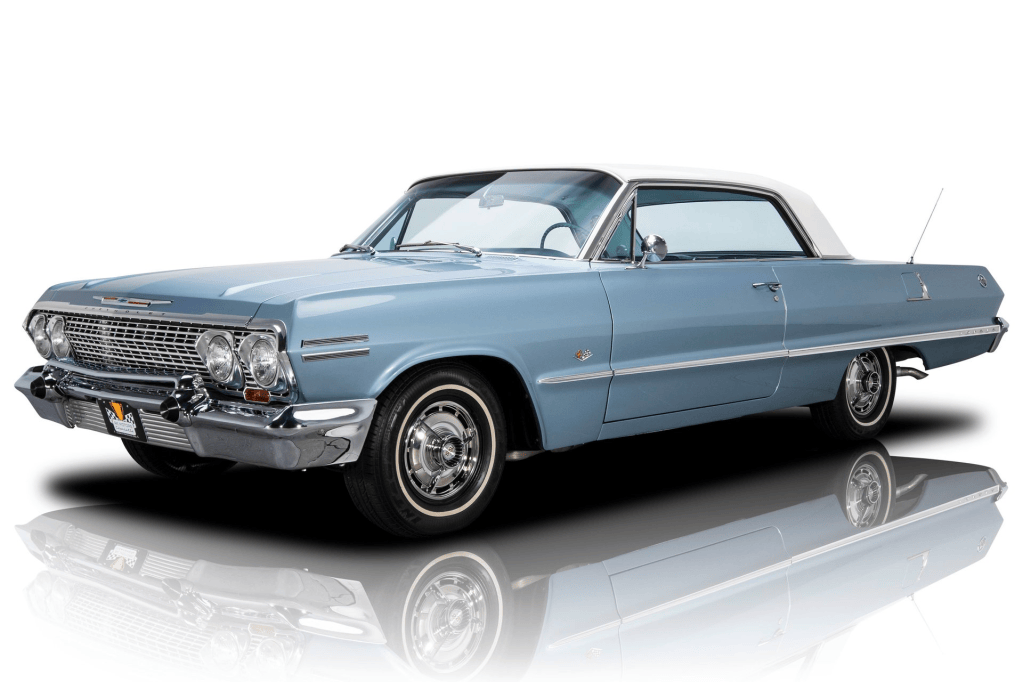
‘In later years, William Crow would later recall “I never told the sheriff who interviewed me that the car I encountered was a Valiant. As I recall, as I was attempting to describe the car, the sheriff came up with a “Valiant”. In the years that have passed, when I have shared the events of that night, I have described the car as a four-door light-colored Chevy”. The question arises, how do we interpret these overlapping features?
The recollection of William Crow often appears an overlooked feature of this case – and if true – the activity he described within 75-90 minutes of the actual double murder at the identical location should not be underestimated. Whether William Crow saw one or two Caucasians is open to scrutiny – and although he claimed the Sheriff ‘suggested’ the Valiant to him, his later recollection of the number of occupants was less than clear, stating
“After some moments, the other car turned around in the roadway and went back down the road from which we had come. I kept making macho statements, but not totally without some sense about me, I drove home. I did not see the car again. I could not see the passenger seat, but the driver was a man with short hair and glasses [Zodiac 1]. I did not see his specific facial features”.
Reading between the lines, if he couldn’t see the passenger seat, there could have been two occupants. This may be significant when considering the sighting of Stan, and more importantly, the report issued by the Department of Justice, Bureau of Criminal Identification and Investigation, conducted by David Burd regarding the murder of David Faraday and Betty Lou Jensen.’
This raises important questions.
If there were two assailants the night of the Lake Herman Road murder, were the two criminals together again the night of the Blue Rock Springs murder?
If so, this would be an unusual serial killer double act. It means there was back up if the killer somehow got into difficulty. There was always a chance that the victims had a weapon (even a gun) and would retaliate themselves.
It may answer as we shall discover why not all the Zodiac letters appear to be written by the same person.
If we negate the possibility that the these two murders (Herman and Blue Rock) were committed by completely different individuals – because the driver fits the description of Zodiac 1 and the common sighting of a light coloured Chevrolet car – then either Zodiac 1 was aided by Zodiac 2 or a different individual entirely. This person would then be Zodiac 3.
The support for another person with Zodiac 1 is that if Zodiac 1 killed Faraday and Jensen as well as Paul Stine, then we can conclude they were relatively calm and proficient. But if Zodiac 1 had an accomplice, then they may have been the shooter the night Mageau and Ferrin were shot. For let’s be honest, the attack was not as well handled and while not bungled, it was clumsy.
Why did the shooter (Zodiac 3) walk back to their car and then turn around and go back to fire again at Michael Mageau? Did the passenger (Zodiac 1) advise Zodiac 3 to double check and finish the job.
Remember too, the car that night had possibly been following Mageau and Ferrin (by Mageau’s account) and proceeded to drive erratically from the car park at high speed, then only to return. The accomplice to the ‘first’ murder in the driver’s seat that night?
This may well have led to the accomplice committing their theatrically staged killing by knife at Lake Berryessa.
In this writer’s view this seems perhaps unlikely as the Berryessa killer was alone and did not act panicky as did – let’s name them – Zodiac 3 during the Blue Rock Springs attack.
What now becomes interesting, is that while prime suspect Arthur Leigh Allen has myriad strands linking him to the Zodiac murders, no forensic evidence implicates him. Perhaps because he was not Zodiac 1 or Zodiac 2, for being honest, neither police sketch looks like Allen. Yet if Mageau really did see Allen that night pointing a gun at him and firing, then Allen may be the mysterious Zodiac 3.
This would explain three things.
One, if having a limited or secondary role to Zodiac 1, he had less opportunity (or was more careful) to leave prints and DNA evidence as Zodiac 1 had on the handle of the taxi cab during Stine’s murder and as Zodiac 2 had on the public telephone after the attack on Shepard and Hartnell.
Two, Allen had said certain applicable and revealing things related to the case, as well as appearing to have been at certain locations which link him to other killings which we will study and not just to the two Vallejo murders.
Three, Allen had a pronounced interest in codes and ciphers, demonstrating this in the classroom when he was a teacher. While he may not have been the main letter writer (Zodiac 1), Allen as Zodiac 3 may have been instrumental in the composing of the Zodiac ciphers – of which we will include when investigating the Zodiac letters.
A further detail to remember is the fact that Arthur Leigh Allen lived near Darlene Ferrin and she may have been the waitress he had an interest in and the ‘Lee’ Darlene knew.
Grinell:
‘Whenever a firearm is discharged, ballistic evidence left at a crime scene will come into play, such as firing pin impressions and breech marks on bullet casings. These can help identify a seized weapon, or be used to compare expended casings from a crime scene and determine whether they were fired from the same gun, or whether multiple shooters may be involved. The analysis of recovered bullets for imparted lands and grooves has similar benefits.
So, was there more than one shooter at Lake Herman Road? Did it require two or more assailants to control a situation in which two people were removed from a vehicle in pitch darkness, unlike the scenario at Blue Rock Springs, where the lone assailant kept the couple contained within the vehicle? Did one assailant have control of David Faraday, while the other fired five shots into Betty Lou Jensen? Were both killed by the same person? – enter the ballistics evidence.
The logical approach would be to examine the bullets recovered from Betty Lou Jensen at autopsy, along with the single bullet recovered from David Faraday, hoping they haven’t been completely disfigured on impact, and thereby make a comparison. The same is true for the casings. Here are some excerpts from the Department of Justice report.’
“The following exhibits were submitted [1] Bullet from Faraday’s body. [2] Two bullets from Jensen’s body. [3] Bullet found in panties of Jensen. [4] Five Super X .22 cartridge cases found at scene by coroner. [5] Four Super X cartridge cases found at scene by Sgt Silva. [6] One bullet found on top of 1961 Rambler. [7] One bullet found in floor mat, left side storage area of 1961 Rambler. [8] One bullet found on ground near Jensen’s body. [9] Purple dress of Jensen.”
‘What is important, is how you interpret these findings. The report continued
“[Inter-comparison] of the cartridge cases in items [4] and [5] indicate that all were probably fired from the same weapon and all are the same make and type of ammunition. Due to the lack of sufficient unique structure it appears that considerable difficulty will be encountered in positively identifying the responsible weapon if it should be recovered.”
‘This seems to indicate that nine of the casings found at the crime scene were likely fired from one weapon. However, there were ten casings recovered. Did the final casing match the other nine, and why is this not mentioned in [1] through [9]? The following statement in the Department of Justice report is crucial:
“All bullets submitted were Western copper coated .22 long rifle bullets, Although some were damaged, it was possible to determine ALL had 6 right hand groove class characteristics. apart from item [1]”
‘Item [1] was the bullet recovered from David Faraday and it didn’t exhibit these characteristics.
Is this the proof that more than one person was involved in the Lake Herman Road murders?
It would seem highly unlikely that the Zodiac Killer fired 9 shots with one weapon, then switched to a similar model, but separate gun, to murder David Faraday.
Was the murderer of David Faraday, the assailant given the responsibility of subduing him – possibly restraining him from behind by a left-handed shooter, while a second subject initiated the attack and murdered Betty Lou Jensen? Does this ballistics evidence suggest there were two shooters at Lake Herman Road on December 20th 1968, especially considering the suspicious activities experienced by William Crow only 75 minutes earlier, possibly involving two Caucasian males?
The pervading notion is that the killer or killers were opportunistic by nature, cruising up and down Lake Herman Road looking for potential victims. Or, were the murders planned in advance by two or more assailants? The answer, in part, may lie with Item [1].’
Expanding on the scenario presented earlier, Zodiac 1 is still responsible for killing Betty Lou Jensen but seemingly not David Faraday who was put to death by Zodiac 3 (Arthur Leigh Allen).
The case for multiple Zodiac killers is presented in an article by Alex Mitchell in the New York Post.
Zodiac killer may have been more than one person, July 10, 2023 – emphasis mine:
‘As if one Zodiac killer wasn’t scary enough – there may have been killers, plural. The horrifying new theory, explored in the Peacock docuseries, “Myth of the Zodiac Killer,”… suggests a surplus of sickos may have been responsible for the various confirmed atrocities attributed to one mythical murderer. For half a century, the notorious killer – whose real identity remains a mystery – was believed to be a sole actor.
“It’s very unusual for cold cases to have this much information. But if you read all the police files, you see that there’s very little linking these crimes together.
Different weapons, different M.O., different victim profile, even eyewitness statements, different locations –
or a trophy being taken from one, but none of the others,” director Andrew Nock told The Post.
“The letters are really the only thing that anchors these crimes together. There’s strong evidence to suggest that not only were the crimes committed by separate people,
but the letters were written by more than one person as well [Zodiac 1 and possibly Zodiac 3 (Arthur Leigh allen?) or even Zodiac 2].”
‘First letters were sent at the end of July 1969.
In those letters was a confession to the two murders – along with an ultimatum that he would kill “a dozen” over the weekend, if the Chronicle did not print his cipher inside its next issue. The paper complied on Aug. 2.’
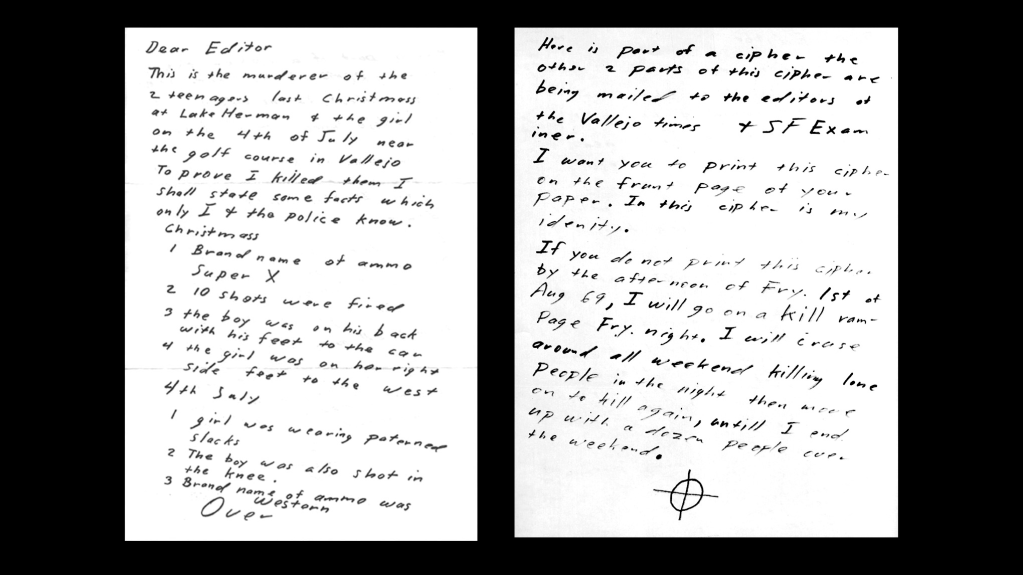
‘The Zodiac’s third and fourth acts in the following months are where the irregularities in the pattern began.
The description of Stine’s murderer is inconsistent with a man seen at Lake Berryessa, witness Linda Jensen, who is coming forward publicly for the first time, says on camera.
“There are other drawings that came out, of the Zodiac, that looked nothing like what I saw that day,” Jensen says, referring to the famed sketch.’
Notice Linda has the same last name as Betty Lou Jensen murdered on December 20, 1968.
Mitchell:
‘Prior to the stabbings, Jensen was at the lake sunbathing with friends when a strange man had stalked the group and hid behind a tree for around 45 minutes. She said the group merely pretended he wasn’t there, for their own safety.
Notably, the picture that she describes shows major differences to the hair, eyes and facial features, compared to the image that ran after Stine’s death.’
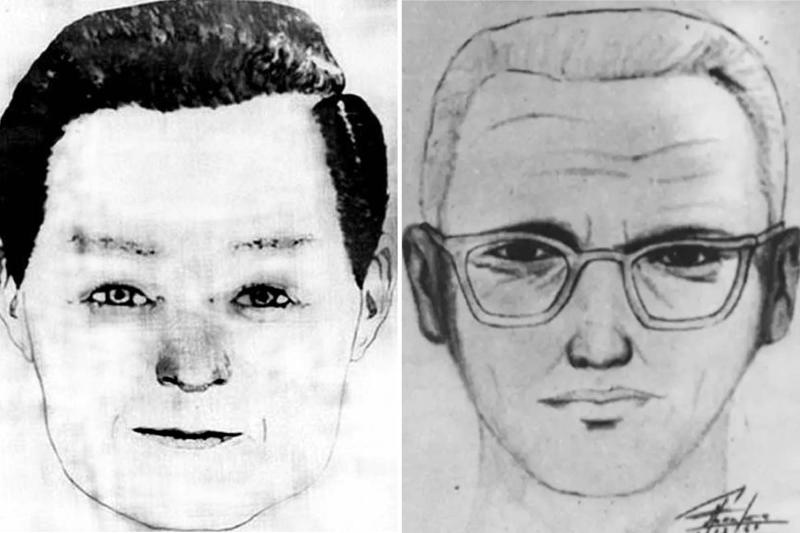
The left hand police sketch is consistent with the recollection of witness Linda Jensen. The Zodiac sketch on the right was released after the murder of Paul Stine.
Jensen:
“He had very smooth, parted hair and combed [it] really straight… [he looked] just very intense, like focused,”
Jensen, who stayed quiet for years because of fear of retribution from the killer, added.
“The vibes coming off of him were bad, were dark. All of us felt that.”
‘Jensen’s recollection is also consistent with a description that Shepard gave to Napa County Sgt. David Collins on scene after her stabbing, Nock said.
“It’s very, very different from the sketch that you see in San Francisco [in the taxi murder]. So that’s just one of many, many inconsistencies.”
‘Along with a different suspect description, Stine’s killing also represents a huge shift in the forensic language that the Zodiac had used in his letter – in addition to sending in physical evidence for the first time.
“The changing point [in the letters] is before and after the Stine murder. In the first four letters, what distinguishes the text is use of ‘the,’” computational linguistics expert Florian Cafiero, who analyzed all of the Zodiac’s correspondence, says in the series.
“Then the other set of text after the Paul Stine letters is the use of ‘like,’ ‘you,’ ‘rather,’ ‘her,’ and so on and so forth…that could indicate a change not [just] in style, but even in author.”
A switch between Zodiac 1 and Zodiac 3 (Arthur Leigh Allen?).
Mitchell:
‘Although Nock says it will take a “deathbed” confession to know for sure, he prefers the multiple killer theory – and the possibility that it was “some sort of team” working in tandem.
Whoever the Zodiac – or Zodiacs – were, they may have stepped up their dark campaign to keep up with an in-state rival. The Charles Manson family began carrying out the murders of pregnant actress Sharon Tate and eight others Aug. 8, 1969 – just days after the Zodiac’s first letter was published. Nock pointed out that it was only after the Manson killings that the Zodiac’s killing behavior became more erratic – beginning at Lake Berryessa that following month.
“You could argue that the biggest story in America at that time – certainly California – was the Sharon Tate murder. If you wanted to get on the page and knock off the Tate killings – they didn’t know it was Charles Manson yet – you had to commit a crime that was just as brutal and just shocking,” Nock said.
“So obviously, [the killer or killers] switch to daylight [copycat killer*]… that’s the way to get more attention. So maybe there was a team [Zodiac 1 and Zodiac 3], or a couple [Zodiac 2*] of people who felt they wanted the publicity. They liked the press,” he said. “It’s interesting that as the revelations about the Manson family were revealed, the more letters came into the San Francisco Chronicle.”
The four official police confirmed attacks – five murders and two attempted murders – include:
A. Lake Herman Road – December 20, 1968 – on the eastern outskirts of Vallejo, California
B. Blue Rock Springs Park – July 4, 1969 – on the eastern outskirts of Vallejo, California
C. The shoreline of Lake Berryessa – September 27, 1969 – near Napa, California
D. The northeast corner of Washington and Cherry Streets in Presidio Heights – October 11, 1969 – neighbourhood of San Francisco, California
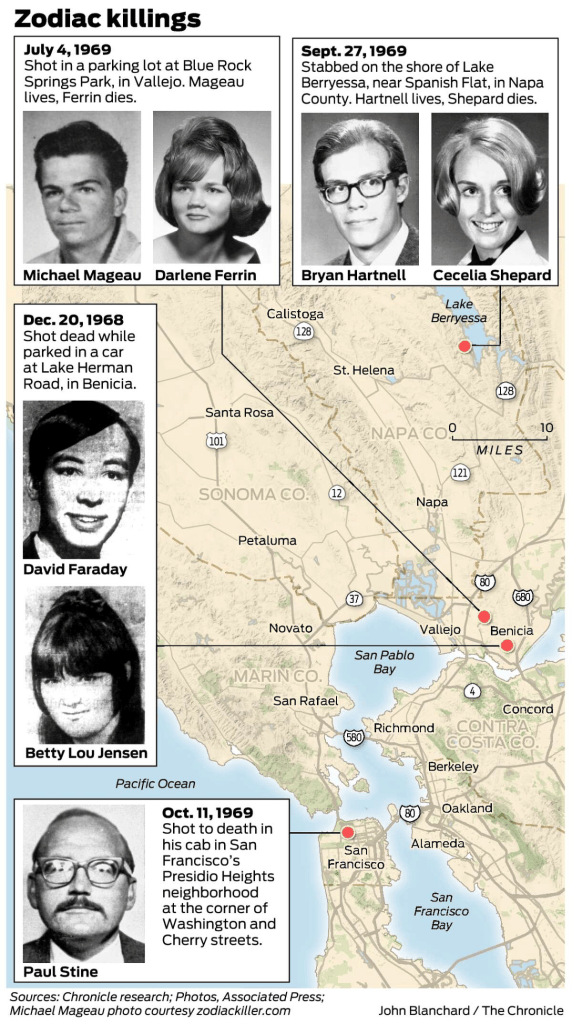
We will now investigate murders – with probable (and possible) connections – chronologically falling after Paul Stine’s murder in October, 1969 (Article: Gemini Game II) and then those suspicious deaths occurring prior to the killing of Faraday and Jensen in December, 1968 (Article: Gemini Game III).
© Orion Gold 2026 – All rights reserved. Permission to copy, use or distribute, if acknowledgement of the original authorship is attributed to orion-gold.com