
What if you were happily minding your own business during a pleasant day out, casually walking with no great purpose to be anywhere in particular and you are suddenly overcome from behind by more than one attacker; a hood thrust over your head and then you are bundled quickly into a vehicle and driven away.
It is dark inside your restraint and you feel a prick on your arm, a needle, a sedative and that is the last thing you remember.
The next conscious moment you are stirring and your eyes adjust to your new environment, whether it be a room in a house or a deserted island, it matters not.
Would the most pressing question formulating in your mind not be:
Where am I?
Hastily followed by:
Why am I here?
A plot which has been viewed a number of times in film and television, continuing with the protagonist investigating and exploring their environment for clues to not only answer these important questions but as we will discover, the most vital enquiry in this scenario:
How do I escape?
This is a telling question and aspect to a desperate problem requiring a solution.
In, how does one evade and escape from their captors now they are in captivity?
Incongruous then that in this hypothetical kidnap scenario, nearly all would seek to find answers and a way of escape, yet in real life the converse is true in that most people live their lives as if none of this matters.
How extraordinary that the majority of people – perhaps as extreme as 99.9% (of which will become clearer as we progress) – who have ever lived… are born, exist and die without ever truly assessing their new (rather malign and hostile) environment which they have suddenly been propelled into via a traumatic for the mother (and child, who forgets) birthing experience.

Most humans come into existence and are content to go through the motions of school, work, old age and ultimately death without actually answering this profound conundrum of life.
As one gets older, it becomes unfortunately abundantly obvious that this world is not a fair or happy place for the vast bulk of its inhabitants who live in severe abject poverty, suffering from a lack of adequate food, running water, electricity and suitable shelter.
While the more privileged spend their lives seeking temporary and superficial happiness through the accrual of either material goodies; whether it be sought through houses, cars, possessions, technology, hobbies, holidays, food, alcohol and drugs… or emotional (physical) gratification in a litany of failed relationships and unsatisfying sex.
Either way, the end result is the black (spiritual) void inside everyone is never fully filled – even in those who claim to be religious – and people die wondering what this life was all about, or worse, think they have worked it out (from religion or science), but have only really found false security in a partial (and often misleading) ‘truth’ at best.
One would have to give kudos to every atheist for actually questioning the status quo and doubting what religion says on these questions of importance as inadequate. In fact the world’s religions (and primarily Christianity in this discussion) have a lot to answer for in not only misrepresenting what the actual truth (of the Bible) entails but in deliberately hiding the truth about the Creator and what His plan is.
Therefore the message contained herein, is not addressed to atheists alone… but equally as much – and importantly – to theists (and deists alike).
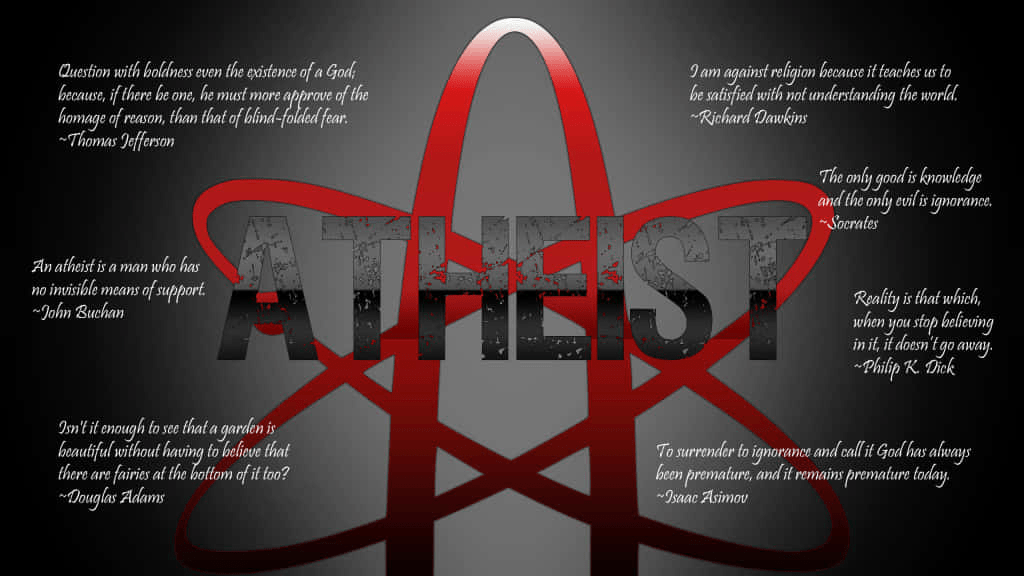
The purpose of this article is not to convince anyone to change their view, whether an atheist or not; but rather to ponder carefully, why they possess the opinions (beliefs) they hold so dear and which often define their own image of themselves and their place in this world.
While this writer is not an atheist, they readily concur with many of their questions and arguments in which those who proclaim a religious persuasion are sorely lacking in answering and thereby also incur this writer’s exasperation and frustration at some of their simple mindedness and folly.
A response of many atheists is to then develop an arrogant stance towards those who support a flawed religious position, which then hinders the atheist from perceiving how their own paradigm is invariably myopically limiting.
Atheists and theists are opposite ends of a spectrum, with arguably deists bridging the gap.
Defining each one may be helpful at this point.
Online definitions include the following, yet not a simple task for there are numerous definitions (below) just for atheism.
Atheism
‘Atheism, in the broadest sense, is an absence of belief in the existence of deities. Less broadly, atheism is a rejection of the belief that any deities exist. In an even narrower sense, atheism is specifically the position that there are no deities. Atheism is contrasted with theism, which is the belief that at least one deity exists.’
Atheist
1. One who disbelieves or denies the existence of a God, or supreme intelligent Being.
2. A godless person.
3. A person who believes that no deities exist (especially, one who has no other religious belief).
4. A person who rejects belief that any deities exist (whether or not that person believes that deities do not exist).
5. A person who has no belief in any deities, such as a person who has no concept of deities.
6. A person who does not believe in a particular deity (or any deity in a particular pantheon), notwithstanding that they may believe in another deity.
7. Someone who denies the existence of god.
The comment this writer would make, is that there is only one Deity (unitarian [not to be confused with monotheism]); not many (polytheism); not two (binitarian); and definitely not three (trinitarian) – Article: Arius, Alexander & Athanasius.
Deism
1 One who believes in the existence of a God, but denies revealed religion; a freethinker.
2 A person who believes that God created the universe and then abandoned it.’
‘Deism is the belief, based solely upon logic and observation while rejecting any supernatural speculation, that a Supreme Being or God created the universe. As a philosophical position and rationalistic theology that rejects prophecies, revelations, and religious texts as legitimate or reliable sources of divine knowledge, Deism instead asserts that empirical reason and observation of the natural world are exclusively logical, reliable, and sufficient to determine the existence of a creator God.
Unlike classical theism, many Deists believe in the existence of a creator God who simply does not intervene anymore after creating the universe, again solely based on rational thought without any reliance on revealed religions or religious authorities. Fundamentally, Deism emphasizes the concept of natural theology – that is, God’s existence is revealed through nature itself… [and] that God created the universe but does not intervene in its operations.’
This is certainly a thought provoking definition for it is in some ways closer to the truth than the definition for theism.
Three major points worth highlighting include the reality (truth) that God (the Creator) does not (1) intervene directly in the affairs of humanity and will be elaborated on as we progress.
This is probably quite a surprise for many Christians.
Yet this intrinsic sense of abandonment is a real one, with an explanation.
Deists are correct by degree in (2) rejecting philosophies and theology espoused by religion as well as revelations and prophecies which do not find their source in the scriptures of the Bible.
While (3) evidencing the existence of a Creator just through science and by the means of the observable natural world around us is limiting on one hand for those who seek spiritual answers (and a relationship), it may be the most appropriate route to take in endeavouring to reach an open-minded atheist.
Even the false apostle Paul (refer article: The Pauline Paradox), addresses the early Christian fellowship in Rome about the clearly obvious demonstration of a Creator by virtue of the existence of a creation (Third proof of God’s existence: Creation, the immense variety and number of species requires a Creator and originator) – Article: Chance Chaos or Designated Design?
Romans 1:18-22
Good News Translation
‘God’s anger is revealed from heaven against all the sin and evil of the people whose evil ways prevent the truth from being known…. because what can be known about God is plain to them, for God himself made it plain. Ever since God created the world, his invisible qualities, both his eternal power and his divine nature, have been clearly seen; they are perceived in the things that God has made.
So those people have no excuse at all! They know God, but they do not give him the honor that belongs to him, nor do they thank him. Instead, their thoughts have become complete nonsense, and their empty minds are filled with darkness. They say they are wise, but they are fools…’
Theism
1 One who believes in the existence of a God; especially, one who believes in a personal God; – opposed to atheist.
2 One who believes in the existence of a god, goddess, gods and/or goddesses.
3 One who believes in the existence of a god or gods.
‘Theism is broadly defined as the belief in the existence of at least one deity. In common parlance, or when contrasted with deism, the term often describes the philosophical conception of God that is found in classical theism – or the conception found in monotheism – or deities found in polytheistic religions – or a belief in God or gods without the rejection of revelation, as is characteristic of deism.’
Definition one is biblically supported, whereas points two and three are not, unless one is referring to and intending angelic beings as the ‘gods’ in question.
One would assume that these three ideologies cover everyone on Earth. Yet each one is flawed and lacking in providing the real answers to: ‘where am I’, ‘why am I’ and ‘how do I escape’ my confinement and not to place too fine a point on it, but rather starkly, really ‘my captivity’ – Articles: Principalities & Potentates: What they Want… Who they are; and Floating Sphere or Fixed Circle?
“The difference between a theist and an atheist is the degree to which God has revealed himself to them” – Anonymous
If you are still reading this, you either believe in a spirit world beyond our own – and by extension responsible for our existence (and future) – or simply, you do not.
Regardless, there is a simple answer to why the world is the way it is – a mixture of good and evil – yet it eludes practically all the world’s inhabitants, religious or not. And that is the fact, that the ‘God’ of this world is not the supreme Creator who is the source of all life.
Thus prominent atheists such as Stephen Fry are one hundred percent correct in their view, comments and conclusions regarding ‘God’. For unbeknown to them, they are speaking about and describing in accurate detail the Adversary of the true God – Article: Asherah; and Chapter XXII Alpha & Omega.
A vainglorious, violent, capricious and wicked being who does not have humankind’s interests at heart and who being the source of the Tree of Knowledge of Good and Evil in the Book of Genesis – note evil AND good – rules the Earth in like manner.
And so not only atheists are blinded to this central truth but even religious believers who may comprehend that there is another adversarial ‘God’ (Satan); in turn, do not realise that nearly all the doctrines they believe in and the interpretation of the scriptures they know, derive from them and are false. And so unwittingly, they too are blinded like the atheist by the god of this world and in essence by following erroneous dogma and doctrine are serving and perhaps in worst case scenario, worshipping this dark, evil and false imposter god.
To say this is merely one issue or component in the history (and future) of this world, just might be the biggest understatement in the chronicling of understatements.
In understanding this vital piece of the jigsaw that is the panorama of humankind’s civilisation from time immemorial to the present day, it may be helpful to endeavour to answer or respond to penetrating questions asked by atheists which Christians have difficulty in answering regarding the existence of God – Article: The Creator Criterion.
Similarly, a survey of common arguments put forward by atheists in doubting God’s existence will also be examined.
The springboard for these questions and arguments are found in two articles.
Before we begin it is important the reader remembers that it is the god of this world whom atheists inadvertently are questioning in regard to its omnipotence and its moral behaviour – not the true God.
Perhaps graphically illustrated by the ninth studio album released by Thrash Metal titans Slayer on the auspicious date of September 11, 2001 (Twin Towers “terrorist attack”), titled: God Hates Us All.
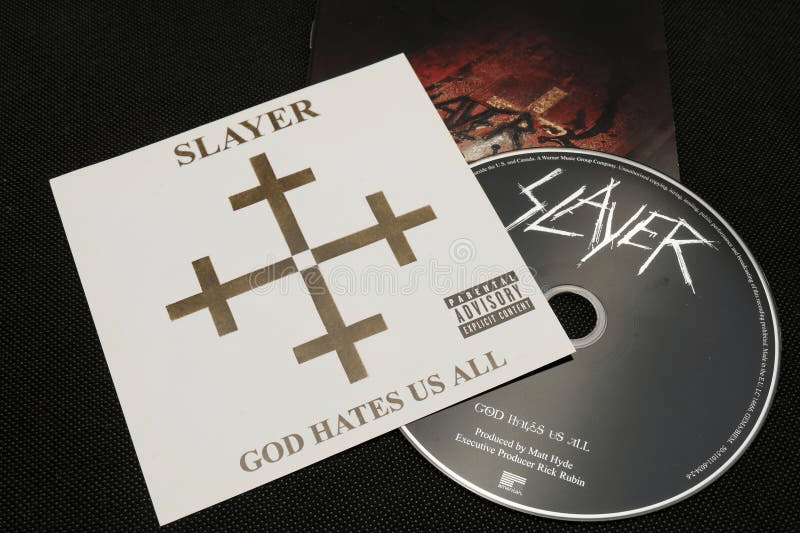
Unbeknown to Kerry King who wrote most of the album, the god of which he speaks is not the God everyone thinks it is.
This deception has existed since the beginning. When the Serpent deceived Eve, she thought he was the Lord – Genesis 3:1; 4:1.
Following the death of Christ, Paul as an inroad to introducing Christ and his resurrection from the dead was inspired by a sign he spied in Athens.
Acts 17:22-31
English Standard Version
22 So Paul, standing in the midst of the Areopagus, said:
“Men of Athens, I perceive that in every way you are very religious. 23 For as I passed along and observed the objects of your worship, I found also an altar with this inscription:
‘To the unknown god.’
What therefore you worship as unknown, this I proclaim to you.
24 The God who made the world and everything in it, being Lord of heaven and earth, does not live in temples made by man, 25 nor is he served by human hands, as though he needed anything, since he himself gives to all mankind life and breath and everything. 26 And he made from one man every nation of mankind to live on all the face of the earth, having determined allotted periods and the boundaries of their dwelling place, 27 that they should seek God, and perhaps feel their way toward him and find him.
Yet he is actually not far from each one of us,
28 for “‘In him we live and move and have our being’; as even some of your own poets have said,
“‘For we are indeed his offspring.’
29 Being then God’s offspring, we ought not to think that the divine being is like gold or silver or stone, an image formed by the art and imagination of man. 30 The times of ignorance God overlooked, but now he commands all people everywhere to repent, 31 because he has fixed a day on which he will judge the world in righteousness by a man whom he has appointed; and of this he has given assurance to all by raising him from the dead.”
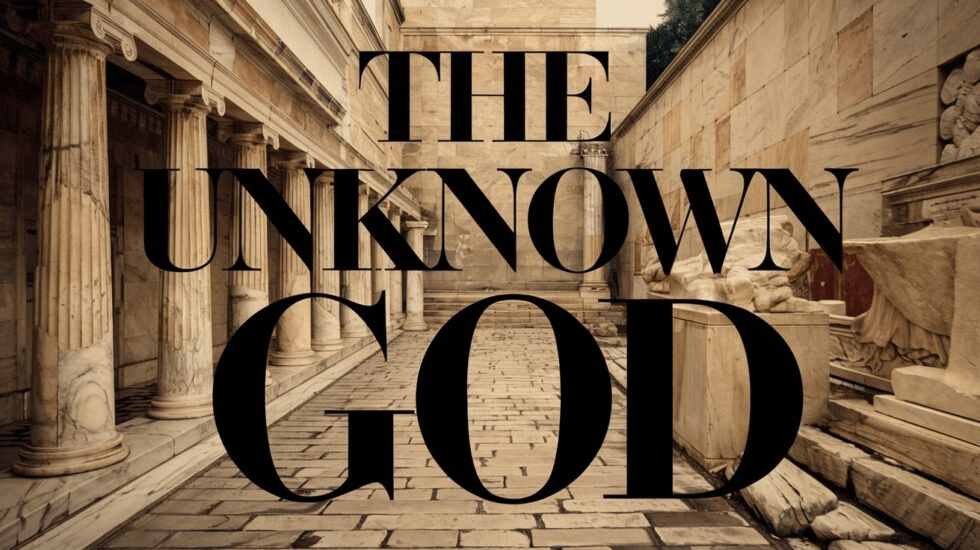
This unknown god is not the entity which Kerry King is referring. Yet in striking irony, it could be paradoxically said that the god he is referring to is also unknown to most of the world.
Both the Adversary and the true God are a mystery only because religion has masked their true identities and believers have not desired to earnestly contend for the true Way taught by Christ and the apostles – Jude 3.
For there is the teaching of Christ and the theology of Paul. A line divides them and Christians choose a side.
Regrettably, the vast majority of people make an uninformed and unwise choice. In this regard, what chance do Jews, Muslims, Hindus, Buddhists, Agnostics and yes Atheists have in finding the true path when even Christianity is also a false religion.
Perhaps most important of all and the crux of why the Serpent deceived Eve, was its intention to try and derail the Creator’s plan for humanity – refer article: DEATH: Dead End or New Beginning?
10 Atheist Arguments That Actually Deserve Our Attention, Julia Davis, March 20, 2026:
“The religious tend to see atheists as sad and lost, while the atheists see them as delusional.”
‘Religion Is a Political Tool’
Yes undoubtedly true.
False religion is used as a political tool. We have catalogued the immense political clout wielded by the Roman Catholic Church over two millennia in a number of articles. The true church of the Way was prophesied to be a ‘little flock’ (Luke 12:32) unencumbered by an unscriptural governmental hierarchy or driven by the pursuit of mammon (and power). Thus, today’s Universal Church is a far cry from what Christ and the apostles established or envisioned.
Does this mean organised religion is to be mistrusted as false? Yes.
But, does it mean God does not exist? No.
Does it mean the Bible is untrue? No.
Does it mean faith is a human invention for control? No.
Whereas religion is about control and division and successfully divides Christians and society.
Is this not a huge red flag to people that there are many thousands of religions in the world, with forty-five thousand Christian denominations alone. They cannot all be right…
The Adversary is the political animal and not God. It is the Adversary which encourages political control, competition, dissension, turmoil and subjugation.
‘Holy Books Are Filled with Violence and Misdeeds’
Julia Davis:
“Atheists often lead with this argument: If religion is truly moral, why are its sacred texts riddled with violence and slavery? Both the Bible and the Quran contain stories of revenge, genocide, and suffering of the innocent that are often supported by holy figures or even by God Himself.
Whether that was the goal or not, these texts are often cited to justify real-world violence. Atheists also point out glaring moral contradictions, and they express concern that these acts are seen as divine commands that we ought to emulate in real life.
Can we even counter this argument?”
Yes, we can.
It does not seem to have occurred to Christians and Atheists alike, that there is a serious dichotomy between the Old and New Testaments in the Bible. Or if they have reasoned as such, in investigating satisfactorily as to the reason why. As we have addressed this subject previously, it will not be laboured here. Suffice to say, there are are two aspects to consider.
Firstly, much was expected, still the physical Israelites continuously acted in a carnal, sinful manner and as unconverted people were subsequently dealt with accordingly – with much blood, betrayal, murder and mayhem. Whereas following Christ’s death, the focus became spiritual Israel adhering to a totally different standard – of peace, forgiveness and love.
Secondly, it appears in certain instances – yet not all – the stand in (adversarial) god of the Old Testament was not the same being as God (the Father) introduced by Christ in the New Testament.
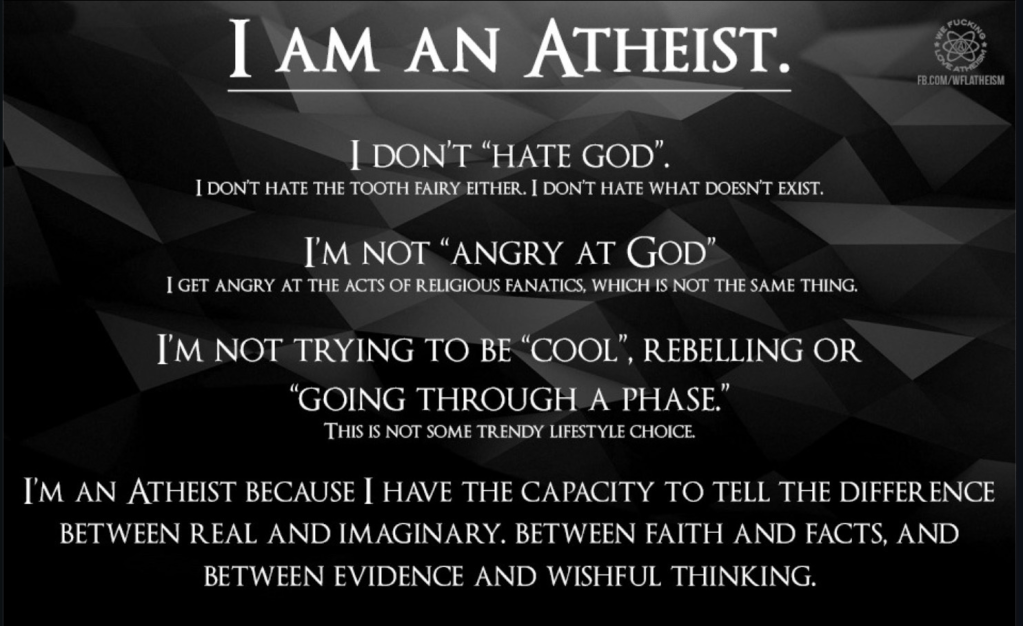
‘Jesus Never Claimed to Be a God’
Davis:
“In Christianity, Jesus is divine [incorrect] and human [correct]; however, many atheists claim that the Gospels don’t explicitly state that He ever claimed to be God [true]. Some scholars argue that the divine status was a later theological addition, not part of His original teachings [true].
This distinction matters because it suggests that the core of Christian faith may have been invented by later followers [true]. If Jesus never personally claimed to be God, then much of Christian doctrine is built on a misinterpretation or a myth [true], and that’s a pretty big argument to consider” – refer article: The Pauline Paradox.
Now in this, atheists are entirely correct as we have already touched upon. Christ was not God and is not God now. Nor was he God while a human on Earth – Article: Arius, Alexander & Athanasius.
God (the Father) is singular and not a Trinity of gods, nor is Christ part of a Trinity. While nearly the entirety of Christendom believes God to be a Trinity it is nevertheless a blatantly false doctrine and a teaching nowhere to be found in the pages of the Bible.
Christ’s role – through his sinless life, death and resurrection – was to mediate a connecting link between humanity and the hitherto unknown God Himself.
‘The Gospels Misquote Jesus’
Admittedly, there are alterations – whether by accident or intention – not just in the Gospels, including words added or omitted, a different word used or meaning ascribed.
Overall, the impact is minimal when compared with other verses on a subject. If one verse stands out in opposition to others, then it is likely suspicious for whatever reason.
For scholars and atheists to use this as an excuse that ‘core stories are unreliable’ and that ‘the entire foundation of the Christian faith becomes shaky’ is an exaggeration. It is a weak attempt to discredit the four gospels overall and the remainder of the Bible.
It is the view of this writer that of all the the books comprising the New Testament Canon, it is the four gospels which are the most reliable – Articles: The Pauline Paradox; and The Sabbath Secrecy.
Logically, it would need to be this way as the words of Christ are the most important to have been committed in writing and oral traditions.
‘The Pagan Roots of Monotheistic Religions’
Davis:
“Many of the stories and symbols in Judaism, Christianity, and Islam have clear parallels to older pagan religions. Sun gods, resurrection myths, flood stories – they all appear in cultures predating these religions.
For instance, the story of a dying and rising god is common in ancient mythologies like Egyptian (Osiris) or Greek (Dionysus).
These similarities suggest that the major religions borrowed from older myths, rebranding them within monotheistic frames. These connections show that these faiths aren’t entirely original or new, but rooted in pre-existing cults and practices.
Atheists often use this argument to ask why we wouldn’t then worship the older Sumerian or Egyptian gods, since they seem to be the blueprint of monotheistic traditions anyway.”
The Adversary has the advantage of not just inside knowledge, but not being governed by physical laws. Therefore it has not been difficult to replicate certain pre-emptive analogous events and inject them into history’s timeline in an attempt to discredit biblical prophecies (later events). The story of the resurrection of Osiris and then later Christ a prime example.
The question surrounding monotheism is not applicable as
a. the existence and worship of one God existed from the very beginning, starting with Abel; and
b. monotheism is not the correct definition for the one true God.
First, it could be argued that all the myths surrounding other gods have stemmed from the unknown God in the first place, not the other way around and second, a more accurate position on God is a Unitarian definition as opposed to a monotheistic one.
Monotheism
The doctrine or belief that there is only one God.
The doctrine or belief that there is but one God.
The belief in a single god (one God); especially within an organised religion.
‘Monotheism is the belief in only one deity, or God. A distinction may be made between exclusive monotheism, in which the one God is a singular existence, and both inclusive and pluriform monotheism, in which multiple gods or godly forms are recognized, but each are postulated as extensions of the same God.’
Unitarianism
The meaning of Unitarian is one who believes that the deity exists only in one person.
‘Unitarianism is a nontrinitarian movement of Christianity, which affirms the unitary nature of God as the singular and unique creator of the universe. Unitarian theology critiques the traditional Christian theology of the Trinity, which regarded God as three distinct but unified beings – transcendent Creator God, human Savior God, and immanent Spiritual God.’
There is one God as defined by monotheism, but God is not a Trinity. So by that definition, the Unitarian view is more accurate. Christ is the Son of God and the Holy Spirit is God’s essence and power. Neither are God.
‘Atheist Countries Tend to Be More Prosperous’
The ancient Israelites were intended to be an example nation, obeying God and reaping the benefits. Yet the periods of obedience were few and far between and hence God’s displeasure with them and ultimately going into captivity – Chapter XXX Judah & Benjamin – the Regal Tribes.
This was readdressed by the promise to Abraham of a future fulfilment of a nation greatly blessed regardless of obedience or not; which would become the most impressive power the world has known. That promise has been fulfilled in the United States of America; predicted to be a company of nations which can be alternatively and correctly rendered a ‘union of states’ – Chapter XXXIII Manasseh & Ephraim – the Birthright Tribes.
The question is asked, ‘if religion were essential for morality and a successful society, wouldn’t religious countries be the most prosperous?’
Davis:
“Data shows that many of the wealthiest nations, like Norway, Sweden, or Japan, are largely secular. These countries tend to have higher standards of living, better education, and more social equality compared to religious societies. In fact, the more religious a country is, the worse its education and living standards seem to be.
Atheists argue that the idea of religion being necessary for progress doesn’t hold up when you look at these facts. Secular nations prove that morality and prosperity can thrive without divine authority, making this argument very compelling in debates.”
This is an interesting though relative non-argument. It may prove that false religion is worse that no religion. It does not prove that no religion is better than true ‘religion.’
The United States in the western world at least, is a fascinating example of being the most (‘non-fanatical’) religious nation in the world. This status has not held it back in any manner. In fact when one understands their biblical identity, the prosperity being afforded to America will continue while the majority of its citizens profess a belief in God and an acknowledgement of Him being the source of their blessings.
‘Our Morality Is Innate’
This argument may be the most important one of all.
Yes, one does not need a religion to be a good person or live by a moral or ethical code.
Atheists are correct that humans have an innate sense of right and wrong and evolutionary psychologists are right that moral instincts (empathy, fairness, cooperation) are built into our biology.
Even animals, particularly mammals can exhibit some of these same traits.
Recall, the Tree of Knowledge of Good and Evil mentioned earlier. This was when Adam and Eve transitioned from the mind and body offered by God to a mind and body we all possess now.
Thus every human does have a moral compass within them and unless completely psychopathic, understands right from wrong.
Davis:
“The main argument atheists make here is that the very idea that we need divine commandments to be moral is flawed. Morality based on instinct and social cooperation is more flexible and universal than religious rules. Recognizing that morality stems from our nature rather than divine decree challenges the notion that faith is necessary for ethical behavior.”
Atheists are right again. We do not need commandments to be moral, though humans being flawed with a mixture of good and evil in their hearts and minds do require Law.
Agreed, faith is not required for ethical behaviour.
But where faith is required and the mind of a converted person, a true follower of the Way comprehends this deeply, is the requirement to have faith in endeavouring to always choose the right over wrong. This process requires building character so as to have character; thereby choosing more times than not – for no human is perfect – good over evil in our thoughts, deeds and how we treat other people.
When Christ came to the Earth, he overturned the 613 laws, statutes and judgements contained in the first five books of the Old Testament with just two.
This great or royal law is to first love God with all our heart, soul and mind and second, to love other people as we ourselves would like to be treated.
If the world lived by at least the second command (law) what a different world we would all be living in.
‘Jesus Is a Sun Deity’
Davis:
“Many scholars and mythologists see Jesus as an archetype of a Sun god; He dies, then rises again, promising renewal and eternal life. This motif appears across all ancient religions, since every culture celebrated the life-giving Sun. The story of Jesus… mirrors these solar myths, symbolizing the cycle of death and rebirth.
The “light in darkness” theme also neatly fits into this symbolism…[John 8:12]”
This argument is grasping at straws somewhat. Additionally, we have discovered on our journey, outlined in previous articles that if anyone is a sun god, it is not Christ but his arch-nemesis Azazel (probably) or Samael (possibly) – Chapter XXI The Incredible Identity, Origin & Destiny of Nimrod; and Chapter XXII Alpha & Omega.
In scripture, Christ is called a ‘Morning Star’ which is usually equated with the planet Venus, third brightest body in the sky after the Sun and Moon; which appears in the morning before sunrise – Revelation 2:28; 22:16.
If any being could or should be equated as the Sun God, giving life and possessing the power to resurrect it would be God, the Most High. Others may have assumed or striven for a role already originally in existence in the form of the Source of all life.
‘Faith Opposes Critical Thinking’
This is an argument born from those who do not understand or perhaps in essence, do not appreciate what real faith is.
A person with this kind of faith does not believe anything without good cause. The faith that a true follower of the Way possesses is one that has been tested through trials and experiencing answered prayer. These are the evidence of a relationship with God. Concerning beliefs (doctrine), no one should believe anything without evidence, whether biblical or scientific – Acts 17:11. Each complement the other and do not contradict as many assume.
‘Modern Christianity Is a Roman Invention’
Now ain’t that the truth, brother.
This argument runs parallel with ‘Religion is a political tool’.
Christianity is not reflective of Christ, the apostles or the true gospel of the Kingdom of God and was shaped largely by Emperor Constantine for his own selfish motives in stabilising and consolidating the Roman Empire.
Davis:
“He convened the First Council of Nicaea [in 325 CE] and played a major role in defining Christian doctrine, turning it into an instrument of imperial power [Articles: Arius, Alexander & Athanasius; and The Calendar Conspiracy]. Constantine’s conversion was political as much as it was spiritual… [if at all].”
But, which reality?
Hopefully as enlightening to the reader, are the following perceptive yet difficult questions.
10 Questions Atheists Ask That Christians Struggle To Answer, Yvonne Gabriel, March 23, 2026
‘The Problem Of Suffering’
“If God is all good and all-powerful, then why do bad things happen to good people who simply do not deserve such pain?
This ancient riddle keeps many awake at night, wondering why a benevolent creator allows heartbreak, disease, and tragedy to run rampant. It is the heavy rock in the shoe of theology that just will not go away, no matter how you adjust your step.
A 2025 Pew Research Center report highlights this disconnect, noting that for every one converted to Christianity, there are now six former Christians walking away. That statistic suggests that for many, the silence of God in the face of suffering is simply too loud to ignore.”
This is a nitty-gritty question which cuts right to the heart and core of why many people – especially those who were once religious – turn to atheism ironically, as a form of comfort. Hoping to escape the mental and emotional anguish in thinking there is a God who is ambivalent about the horrendous suffering inflicted daily on the majority of Earth’s inhabitants. Or worse yet, is the source of the miserable conditions and afflictions besetting humankind.
This writer would also become an agnostic or atheist even, if they thought a loving, merciful Creator had truly orchestrated such a terrible mess.
Of course, this is not what has happened, but rather the ‘god of this world’ is the architect and instigator of a bipolar world, where there is:
joy and agony, happiness and sadness, laughter and tears, kindness and selfishness, patience and anger, forgiveness and hate, healing and murder, life and death.
The Bible reveals that the Adversary was once the closet companion of God. The process of their turning against the Almighty is complex and has been discussed at length – Article: Asherah; and Chapter XXII Alpha & Omega.
While it may seem simplistic to lay the blame at the feet of just one being, the simple answer is… that is the answer.
Readers will be thinking, okay, God isn’t all powerful, all knowing and all present if he could allow a Frankenstein monster of this kind to be created. Yet, that monster fulfils a special purpose.
Humanity is a unique project, whereby the Creator seeks to fashion beings like himself. Angelic beings while termed ‘sons of God’ in the scriptures, have not undergone a demanding process like Christ did.
Jesus accomplished a number of things while a physical being on the Earth.
He overcame the Adversary (1), Sin (2) and Death (3) all while a fragile human who endured everything we do. That included pain, loss (remember, his adoptive father Joseph, died while he was young) and suffering.
This is why humanity has a Saviour who has experienced life like us and thus is not only the perfect mediator to make intercession on our behalf, between us and God, but has qualified to be our (righteous) judge.
Though the most dramatic consequence of his victory over a flawed human state has been to become God’s Son. This has occurred through a process which has resulted in his adoption as the first son of God and is an opportunity made possible by him to be available to those in this life who truly respond to the call to walk in the same Way – Matthew 22:14.
The upside in becoming a son or daughter of God, is living a perfect fulfilling life of happiness with God and Christ… forever.
And there it is.
The real kicker… being given eternal life and becoming immortal.
Think of it from God’s perspective. He cannot have another disaster like the Adversary (Satan) and so the only way to be sure is to put humans through an intense and brutal regime so as to be tested to see if they are wanting to habitually choose good over evil. A person who makes this their number one desire in life, shows God that they are worthy to become part of his family and dwell with Him – always.
‘The Silence Of God’
Yvonne Gabriel:
“If the creator of the universe wanted a relationship with us, why does he seem to be playing the ultimate game of hide and seek? Skeptics argue that a God who wants to save everyone would make his presence undeniable rather than relying on ancient texts and invisible promptings. It feels less like a relationship and more like a one-sided conversation where you are never quite sure if the phone is connected.
Believers often say that God reveals himself to those who seek him, but that answer can feel dismissive to those who have tried and felt nothing. It is difficult to maintain a connection with a being who refuses to show up for coffee or even send a text message confirmation. The ambiguity of his existence is a stumbling block that faith alone often struggles to vault over.”
This is another profound aspect of an atheists opinion:
Where is God?
Unfortunately, it is a truism that God reveals Himself to those who seek Him. If He doesn’t, then giving up doesn’t help at all. God is looking for tenacious people who won’t let go and would rather die than give up on something – Genesis 32:26, Matthew 9:21-22.
Similarly if someone finds it difficult to build or maintain a connection, then they should ask God for the faith required to know Him – Luke 18:8, Hebrews 11:6. God always answers those who genuinely seek Him – Matthew 21:22.
Simply, this is the person God is looking for.
Isaiah 66:2
New English Translation
“I show special favor to the humble and contrite, who respect what I have to say.”
If only people but realised, God is not silent to those who obey Him, only to those who are not being truly honest with Him or themselves. It is not pleasant looking in a mirror and seeing what one really is, but this is a necessity if one wishes to not just talk with God, but walk with him – 1 Corinthians 13:12, Genesis 6:9.
Jeremiah 17:9-10
English Standard Version
‘The heart is deceitful above all things, and desperately sick; who can understand it?
“I the Lord search the heart and test the mind, to give every man according to his ways, according to the fruit of his deeds.”
‘Hell And Good People’
Gabriel:
“The idea that a kind, moral person could face eternal torment simply for checking the wrong religious box sits very poorly with modern sensibilities. It seems incredibly harsh to think that Gandhi or your sweet agnostic neighbor might be doomed while a repentant murderer gets a pass. This concept of exclusive salvation feels less like justice and more like a cosmic club with an arbitrary bouncer.”
This is why God judges a person’s heart. If we judge a person, we do not know their whole story or what is really in their mind and truly in their heart. God is fair as people will one day discover.
There is no such thing as Hell as taught by Christianity – Article: Heaven & Hell.
It is an invention of the Roman Catholic Church – Article: The Seven Churches – A Message for the Church of God in the Latter Days.
“Most people instinctively feel that character should count for more than the specific label you wear on your soul [true]. According to a 2025 Pew Research Center survey, 48% of Americans now say that many religions may be true [or rather contain truthful elements], reflecting a major shift away from exclusive dogmas. We are moving toward a view where goodness is recognized regardless of the name you use when you pray.”
There is only one name [Jesus Christ] whereby someone can be saved and one being [God] one should pray to – Acts 4:10-12, Matthew 6:9.
‘Science Versus Genesis’
Gabriel:
“Trying to reconcile the six-day creation story with dinosaurs and carbon dating is a mental gymnastics routine that leaves many exhausted. The scientific consensus on the age of the Earth and evolution is overwhelming, making the literal interpretation of Genesis a hard pill to swallow. For many, choosing between their faith and their high school biology textbook feels like an unfair ultimatum.
While some Christians view the creation story as a metaphor, others insist on a literal reading that clashes directly with modern geology and physics. A Gallup poll found that only 20% of Americans now view the Bible as the literal Word of God, the lowest point on record. This dropping number shows that fewer people are willing to deny visible evidence for the sake of ancient tradition.”
And rightly so.
The Genesis account has been misunderstood. It is not describing literal days but rather ages or epochs. The Earth is far older than creationists recognise and way younger than scientists realise – Appendix IV: An Unconventional Chronology; Chapter XXII Alpha & Omega; and article: Chance Chaos or Designated Design?
There is no mental gymnastics required in reconciling science with the Bible. In fact the Bible is streets ahead of science and continually waits for it to catch up as we have confirmed in a series of articles – Chapter I Noah Antecessor Nulla; articles: The Younger Dryas Stadial: Ending of the Earth… Beginning of the World; and Floating Sphere or Fixed Circle?
“Gods are fragile things, they may be killed by a whiff of science or a dose of common sense” – Chapman Cohen
‘The Geographic Lottery’
Gabriel:
“If you had been born in India, you would likely be Hindu; if you were born in Tibet, you would almost certainly be Buddhist. This simple fact of geography claims that one religion is the “absolute truth” seems incredibly dependent on your zip code. It raises the uncomfortable suspicion that your faith is less about divine revelation and more about where your parents decided to settle down.
Christians often struggle to explain why a just God would base salvation on a game of geographic chance that billions are destined to lose. It implies that the vast majority of the human population was born in the wrong place at the wrong time. Realizing that your belief system is largely an accident of birth can be a disorienting moment for anyone.”
Ah, Pandora’s Box is open now…
For the truth, as unpalatable as it may be for most to learn, is that God originally worked (primarily) with the physical Israelites (not the Jews – Chapter XXIX Esau: The Thirteenth Tribe) and today works (primarily) with their descendants (Chapter XXX Judah & Benjamin – the Regal Tribes; and Chapter XXXIII Manasseh & Ephraim – the Birthright Tribes) who now form spiritual Israel – Deuteronomy 14:2, James 1:1, Revelation 7:4-8.
Salvation will be opened to all at a later time when the Kingdom of God is established at Christ’s return. This truth has been completely hidden from the world by organised religion and orthodox Christianity.
‘Old Testament Morality’
Gabriel:
“Reading the Old Testament can be a shocking experience, filled with stories of sanctioned slavery, genocide, and harsh retributions that would be illegal today. It is jarring to see the same God who is described as love also commanding armies to wipe out entire civilizations. Trying to square these violent ancient commands with modern ethics is like trying to fit a square peg into a round hole.
Apologists will talk about historical context or a progressive revelation, but those explanations often sound like excuses for behavior we would condemn in any other leader. Skeptics point out that objective morality should not have an expiration date or a cultural loophole. If God is the standard of goodness, his past resume should probably not include war crimes.”
This question parallels the argument previously, ‘Holy Books Are Filled with Violence and Misdeeds’.
There remains a powerful question mark on the identity of the God of the Old Testament in a number of instances.
For no one has seen God (John 6:46) and Christ came to reveal the Father (Luke 10:22).
Richard Dawkins:
“The God of the Old Testament is arguably the most unpleasant character in all fiction: jealous and proud of it; a petty, unjust, unforgiving control-freak; a vindictive, bloodthirsty ethnic cleanser; a misogynistic, homophobic, racist, infanticidal, genocidal, filicidal, pestilential, megalomaniacal, sadomasochistic, capriciously malevolent bully.”
An important note to clarify is that the command to wipe out certain peoples in Canaan were in reference to evil Nephilim and Elioud giant clans. Not the wholesale genocide of innocent peoples.
‘Unanswered Prayers’
Gabriel:
“You may have heard stories of miraculous healing, but for every success, thousands of prayers seem to hit the ceiling and bounce back. It is heartbreaking to watch faithful people pray fervently for a sick child, only to face the same outcome as those who never prayed at all. The inconsistency makes prayer look less like a direct line to heaven and more like a roll of the dice.
When statistically analyzed, the outcomes for prayed-for patients often look indistinguishable from those without prayer, which is a hard pill to swallow. A 2025 Gallup poll indicates that 59% of Americans believe religion is losing its influence on society, perhaps partly due to this lack of tangible results. When the rubber meets the road, people want to see a vehicle that actually starts.”
This writer rarely speaks on a personal level, though as this question regarding prayer (seventh proof God exists: Answered Prayer) is perhaps the most important of all the questions and arguments against
a. God existing and
b. a silent God;
it concerns me deeply that people have to go through the heavy heart rending disappointment of having a prayer (especially for healing for example) seemingly ignored.
There are a number of reasons for this.
This is what has been humbly learned over many years. Like all relationships and friendships they grow deeper the more you talk and… the more you listen.
God speaks to us through his word in the Bible – Proverbs 4:20-21, John 10:27. This is how we get to know Him.
When you talk with God, keep it casual and friendly as if talking to your best friend. While it is natural to make requests of God, imagine it from His side, if all you hear is ‘give me this’ and ‘I need that’.
Try to ask God instead for help in things you are trying to solve, do better in or to overcome. Even better, pray for others. Though the best prayers are like many of King David’s Psalms where he
a. speaks to God about his thoughts, feelings and fears and
b. praises God and gives Him thanks.
It is always gratifying when someone thanks us for a small act of kindness and especially for a selfless act of service. God is no different – Philippians 4:6.
Again, imagine it from His perspective, where He would perhaps feel more fondly towards those who regularly thank Him for their blessings and thus may feel more compelled to answer when they are in genuine distress and trouble.
Further, believers who have their prayers consistently answered have the following traits in common.
They ask in faith (Matthew 21:22); they are righteous in God’s eyes and pray with power (James 5:16); and finally, they pray for God’s will to be done above their own will.
Something Christ taught in the Lord’s Prayer (Matthew 6:10), as well as exhibiting during his final hours before his severe beatings and gruesome death (Luke 22:42) – Appendix VIII: When the Creator came to dwell with His Creation.
Personally, it began as a child, where I started asking God for help. Whether it was a childish trivial matter (in anyone else’s eyes), or a more important situation, I found God answered. Some prayers were not answered immediately and some were answered many years later. But I would have to be honest and admit God has answered every prayer in my life; has never let me down; and always protected me and taken care of my family.
It is very humbling to think our Creator would ever take an interest in anyone who is flawed, vulnerable, weak and shallow in comparison to Himself.
Yet like all good parents, God wants the best for us and the more we rely on Him and acknowledge His saving grace, the more he does for us. It is a living law.
The idea of manifesting items or thanking the universe instead of the Creator are rebellious and inferior counterfeits compared to the real living power of God. If only people trusted their Heavenly Father and gave themselves entirely to Him.
‘Free Will And Omniscience’
Gabriel:
“If God knows everything that will happen before it happens [Matthew 6:8], then your future choices are already set in stone, effectively before you are born. This creates a paradox where you are told you have free will, yet the script has already been written by an all-knowing author. It is like being told you can drive anywhere you want, but the car is on a fixed track at an amusement park.
Theological attempts to explain this away often end up in a dizzying loop of logic that satisfies almost no one. If the ending is already known to the director, then the actors are just going through the motions without any real agency. The tension between being free to choose and being destined to act is a knot that theology cannot quite untie.”
This writer appreciates the exasperation felt by all about this conundrum of how God knows the outcome, but we don’t – Article: Predestination & Free Will.
The best way this writer can explain the interplay between freedom to choose and fate is that this world is like the matrix, an artificial construct, akin to a sophisticated computer program and composed of a physical reality enclosed inside a spiritual one.
So that the laws which govern our reality (three dimensions plus space and time) are different to and subservient to the spiritual laws which govern dimensions four to nine.
And so like a computer game, we may have tens, hundreds, or thousands of different responses to any given situation, so that it appears to us that we have free will, yet all those options to make different choices all lead to the same outcome, of which God is fully aware. So while life is a great mystery to us, it certainly isn’t for those outside the program.
This is why spirit entities can enter and leave our linear timeline at will and as if by magic; knowing the ‘future’ in a way we cannot. This is how Christ was miraculously inserted into our timeline at the precise moment in history he was supposed to be. Every generation had to be worked back from the final one prior to Christ’s second coming (return). This reveals all life has been planned and prepared for (Romans 9:21-22).
Thus, God already knows the hearts of those He calls; that they will heed the call, follow the call and successfully complete the calling given to them.
‘Verification Of Miracles’
True miracle workers keep their work secret. Allied to this in the New Testament and the early church following Christ’s death, miracles were primarily performed on those who invariably underwent a conversion experience at the same time. A flippant or irreverent approach to miracles and healing is not the sign of a true servant of God – Article: Seventh Son of a Seventh Son.
From personal experience, this writer does not know many people who have undergone a miraculous healing or intervention, though they have heard a number of first hand stories claiming such. Closer to home, this writer has witnessed a miraculous healing on themselves and thus is fully convinced miracles do occur.
Apart from having faith, the most important aspect to this question, is who is asking for a miracle and why are they asking one from God. This perhaps answers why there are few genuine miracles witnessed in the world today.
‘One Way To God’
Gabriel:
“The assertion that Jesus is the only way to salvation automatically condemns billions of non-Christians to an eternity without God. This exclusivity is a tough sell in a globalized world where we interact with wonderful people of different faiths every day. It feels incredibly arrogant to claim that your specific group holds the only key to the only door that matters.
Christians often try to soften this by talking about God’s mysterious mercy, but the core text is pretty rigid on the matter. Recent Pew Research data shows that 35% of U.S. adults have switched religions since childhood, often searching for a more inclusive spiritual home. People are voting with their feet, moving away from rigid boundaries and toward a more open horizon.”
It is understood how this is upsetting, yet as we have discussed already, God has chosen who He desires to work with in this life before Christ establishes the Kingdom of God on Earth. It is through Jesus Christ that the way to eternal life is accessed – clear and simple.
Acts 4:10-12
English Standard Version
‘… let it be known to all of you and to all the people of Israel that by the name of Jesus Christ of Nazareth, whom you crucified, whom God raised from the dead – by him this man… Jesus… that was rejected by you… And there is salvation in no one else, for there is no other name under heaven given among men by which we must be saved.”
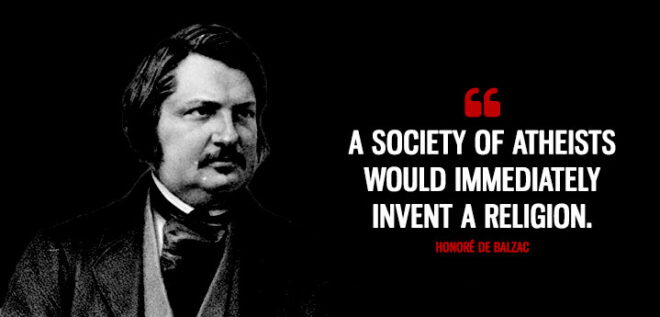
There are a number of influential atheists as well as famous celebrities who have embraced atheism. A survey of some and their thoughts might be insightful. While certain ones were to be expected, others were a disappointment to this writer in learning they had accepted atheism as an acceptable explanation for the world in which they have been richly favoured.
Top 10 Atheists Who Changed The World, Jonathon Kantor, 2019 – emphasis mine:
Stephen Hawking – Theoretical Physics
‘Stephen Hawking was one of the most brilliant physicists ever to live, and his work stands on par with that of Einstein… Hawking wrote… The Grand Design, in which he wrote,
“Because there is a law such as gravity, the universe can and will create itself from nothing. Spontaneous creation is the reason there is something rather than nothing, why the universe exists, why we exist… science can explain the universe, and that we don’t need God to explain why there is something rather than nothing or why the laws of nature are what they are.”
He spent his life working to find the Grand Unified Theory, though it remained unproven during his lifetime.’
Which it will continue to remain beyond scientists grasp to quantify until their acknowledging of a spirit essence and the spiritual dimensions beyond our own – Article: The Truly Big Questions.
There is reasonable doubt about the theory of gravity* and whether it is in fact correct – Article: Floating Sphere or Fixed Circle?
Maybe we don’t ‘need’ God to explain our world and solar system but nor can we ignore God as the source of all of it either.
Hawking:
“It is my view [so he does not know] that the simplest explanation [it would actually be the most complicated] is there is no God. No one created the universe and no one directs our fate [so we are rudderless and out of control. God help us, no pun intended].
This leads me to a profound realization [how ironic, when it is God who is truly profound]. There is probably [he is still unsure] no heaven, and no afterlife either.
We have this one life to appreciate the grand design of the universe [so he admits to the universe having design. Which is the fifth proof of God’s existence: Design and the myriad intricate patterns within the Universe at the macro cosmos level or at the micro sub-atomic level demand a Designer and inventor – refer article: Chance Chaos or Designated Design?], and for that, I am extremely grateful.”
Thomas Edison – Inventor
Jonathon Kantor:
‘Thomas Edison was one of the most prolific inventors of his time… well known for being the father of the modern incandescent bulb, the phonograph, motion picture camera, and many more incredible inventions that are still in use.
Edison once said,
“So far as religion is concerned, it’s a damned fake [true]. Religion is all bunk.” He also suggested that all religions were created by men [true], and that “All Bibles are man-made [partly true, some more than others].”
… he was certainly not a traditional believer, at least where any established religion was concerned. That being said, he could have had a personal belief in some form of supernatural deity or another, but he clearly had no time for others’ beliefs in a personal god or afterlife. If he were to be labeled as anything, he might be better described as a pantheist, which is a belief that equates all of reality with divinity.’
If so, then equating reality with divinity is admitting physical existence (‘reality’) originates from a spiritual source. Not very atheistic.
Albert Einstein – Theoretical Physics
Kantor:
‘Albert Einstein’s beliefs have been the subject of debate for decades, which leaves many to refer to his own words on the subject, of which there are few. Einstein declared himself an agnostic, and specifically said in an interview in 1929, “I am not an atheist.”
He also said he didn’t believe in life after death, once claiming that “one life is enough for me.”
Well, Einstein is in for a surprise and might change his tune when he realises eternity is on the line – Article: DEATH: Dead End or New Beginning?
Kantor:
‘His theories on Relativity have been tested and proven[?] time and time again, and they make it possible to predict gravitational interactions… especially useful in determining how to navigate in spaceflight[?], learning how stars and planets form, and pretty much anything to do with space, time, or gravity.*
Karl Marx – Philosopher
Kantor:
‘Karl Marx is widely revered in many parts of the world due to his writings, which established the modern concepts of Communism [that went well, not (past)], Socialism [no good will come of it (future)], Historical Materialism, and Marxism. His work influenced that of Lenin, Stalin, Mao, and many others who became dictators [great result, not]…
Marx… argued that a society without social classes would enable all men to be free, working together to achieve for the common good of humanity. Unfortunately, his writing has never been tested [nor will they ever be] in the manner he theorized, as modern undertakings of Socialism and Communism perverted his desire for a classless society.
Marx was an avowed atheist, and he didn’t just disbelieve in gods, he opposed the worship of them [correct, for these ‘gods’ would not be the true God].’
Sigmund Freud – Psychiatry
‘The famous founding father of psychoanalysis described himself as an anti-theist. He considered God a fantasy. In his earliest writing about religion, Freud suggests that religion and neurosis are similar products of the human mind.’
Andrei Sakharov – Nuclear Scientist
Alan Turing – Polymath
J. Robert Oppenheimer – Theoretical Physics
Oliver Sacks – Scientist
Isaac Asimov
“Properly read, the Bible is the most potent force for atheism ever conceived.”
Douglas Adams (refer article: 42)
The argument goes something like this: “I refuse to prove that I exist,” says God, “for proof denies faith, and without faith I am [“you are”] nothing.”
John Steinbeck
Kurt Vonnegut
Penn Jillete
Teller
Britney Spears
Stanley Kubrick
Orson Welles

Brad Pitt
‘… BILD magazine asked him if he believes in God, Brad just smiled and said, “No, no, no!”
‘Pitt has described his spiritual stance as oscillating between agnosticism and atheism.’
Jodie Foster
“… I absolutely love religions and the rituals. Even though I don’t believe in god, we celebrate pretty much every religion in our family with the kids.”
Daniel Radcliffe
‘The actor has identified himself as a militant atheist in various interviews.’
Cillian Murphy
‘Murphy admires the complexity of the universe without attributing it to a creator.’
Hugh Grant
‘He has mentioned in interviews that he is an atheist. Grant does not believe in fate or divine intervention in his life. He attributes his success to luck and hard work rather than blessings. The actor maintains a cynical but humorous outlook on life and spirituality.’
James McAvoy
‘James McAvoy… was raised Catholic but has stated that he no longer holds those beliefs. McAvoy identifies as an atheist and jokes about his lack of faith. He believes in kindness and empathy without a religious motivation.’
Jude Law
‘Jude Law… has stated that he has never been a believer in God. Law finds the concept of religion interesting but not personally convincing. The actor approaches life with curiosity but without a need for supernatural answers.’
Daniel Day-Lewis
‘Daniel Day-Lewis… has described himself as agnostic but leans heavily toward a non-religious worldview. Day-Lewis does not practice any religion… The actor retired from the screen without ever attributing his success to a higher power.’
George Clooney
‘George Clooney… was raised Catholic but has stated that he does not believe in Heaven or Hell. Clooney identifies as agnostic or atheist depending on the interview. He focuses his immense influence on human rights and political activism. The actor believes in accountability to one another rather than to a deity.’
Ian McKellen
‘He has been an open atheist for many years and frequently discusses his secular worldview. McKellen often advocates for rational thinking and human rights without religious influence. He believes that morality is derived from human empathy rather than scripture. The actor remains a powerful voice for… secular values.’
Stellan Skarsgеrd
‘Stellan Skarsgård… is a vocal critic of religion and has written articles defending secularism. Skarsgård raised his children without religious indoctrination and encouraged them to think for themselves. He believes that religion often causes more conflict than peace in the world. The actor remains a staunch advocate for a society based on reason.’
Alexander Skarsgеrd
Keanu Reeves
Kevin Bacon
Hugh Laurie
Paul Giamatti
John Malkovich
Joaquin Phoenix
Jack Black
Tom Roth
Clive Owen
Brian Cox
Christopher Eccleston
Viggo Mortensen
Guy Pearce
Rowan Atkinson
Sean Penn
Simon Pegg
Larry David
Billy Connolly
‘Billy Connolly… has been an atheist for his entire adult life and often jokes about religion. Connolly believes that nature and the universe are enough to inspire awe. He rejects the idea of a judgmental deity watching over him. The comedian finds humor and beauty in the absurdity of existence.’
Ricky Gervais
‘Ricky Gervais… is perhaps one of the most vocal atheists in the entertainment industry today. Gervais frequently uses his platform to challenge religious dogmas through humor and logic. He advocates for science and critical thinking as the best tools for understanding the universe. The entertainer often engages in public discourse regarding the separation of church and state.’
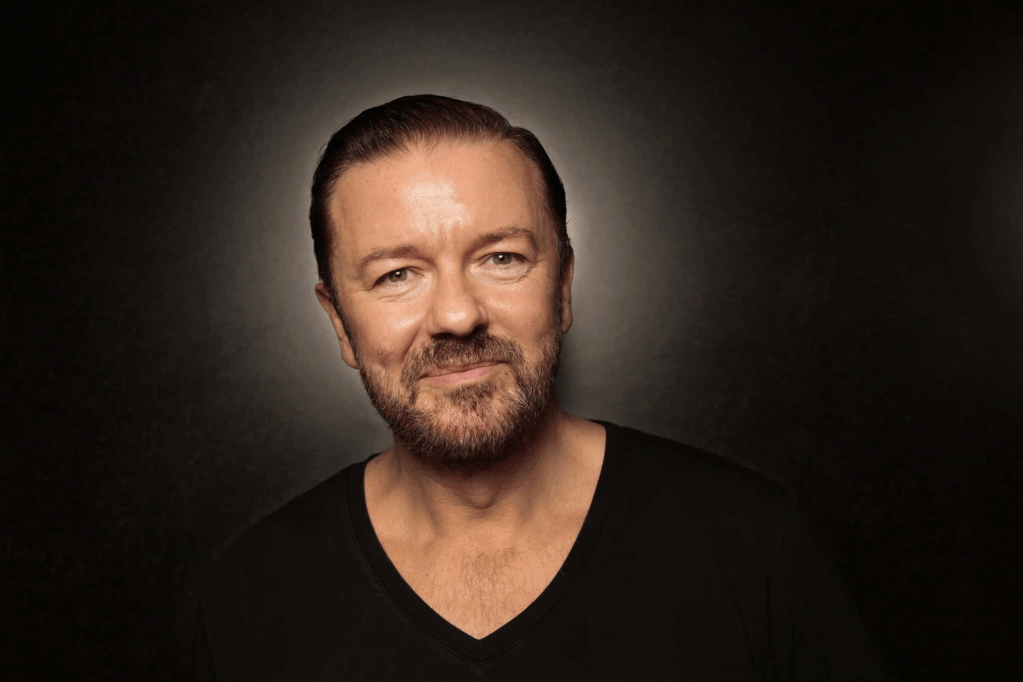
“I don’t need a god.”
Ricky Gervais may be in for a rude awakening one day, when God replies:
“I don’t need you Ricky.”
“I don’t believe in God because there is absolutely no scientific evidence for his existence…”
Apart from the complex structure and beauty of galaxies, stars, planets, the Earth, precious stones, water, plant life, insects, reptiles, birds, mammals, humans, sex, reproduction, birth, the human body, the eye, the mind, emotions… ad infinitum.
“The existence of God is not subjective [agreed, it is objective*]. He either exists or he doesn’t. It’s not a matter of opinion. You can have your own opinions. But you can’t have your own facts” [the facts* are the natural world and the laws which underpin it] – Article: The Creator Criterion.
Stephen Fry
‘Stephen Fry… is a prominent humanist and atheist who has debated religion on numerous public platforms. Fry argues that the existence of suffering in the world makes the concept of a benevolent god illogical. He champions education and curiosity as the keys to a fulfilling life. The actor uses his intellect and wit to promote secular values globally.’
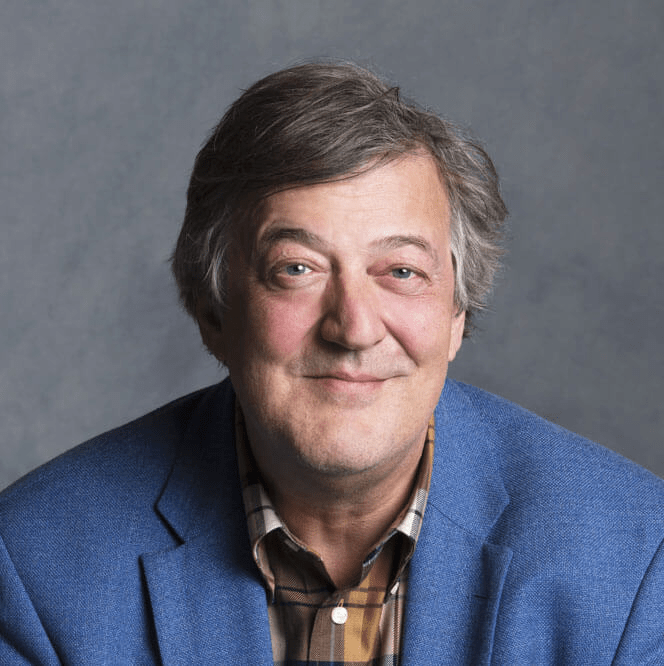
Gay Bryne (The Meaning of Life):
“Suppose it’s all true, and you walk up to the pearly gates, and are confronted by God. What will Stephen Fry say to him, her, or it?”
Fry:
“I’d say, bone cancer in children? What’s that about? How dare you? How dare you create a world to which there is such misery that is not our fault. It’s not right, it’s utterly, utterly evil. Why should I respect a capricious, mean-minded, stupid God who creates a world that is so full of injustice and pain. That’s what I would say. ”
Bryne:
“And you think you are going to get in, like that?”
Fry:
“But I wouldn’t want to. I wouldn’t want to get in on his terms. They are wrong.
So, atheism isn’t not just about not believing there’s a God, but on the assumption there is one, what kind of God is he?”
Stephen Fry unknowingly hits the nail on the head.
Yes, what kind of god indeed has the current over lordship of this world? One which is coming to an end perhaps a few centuries from now, for Christ has qualified to rule in their place and establish God’s kingdom on the Earth – Article: The Seven Churches – A Message for the Church of God in the Latter Days.
One point worth highlighting is disease and the suffering which accompanies it. Bone cancer in children is provocative, though an investigation into the causes of illness reveals that it is mankind who is responsible for the world’s evils.
Diet is the main contributing factor in most of the modern diseases which afflict humanity, including heart disease, cancer and dementia. Food is riddled with chemicals and meat and dairy for example, with steroids and hormones. Each of which are to blame for the soaring rise in cancer particularly of the prostrate, testes, ovaries and breasts.
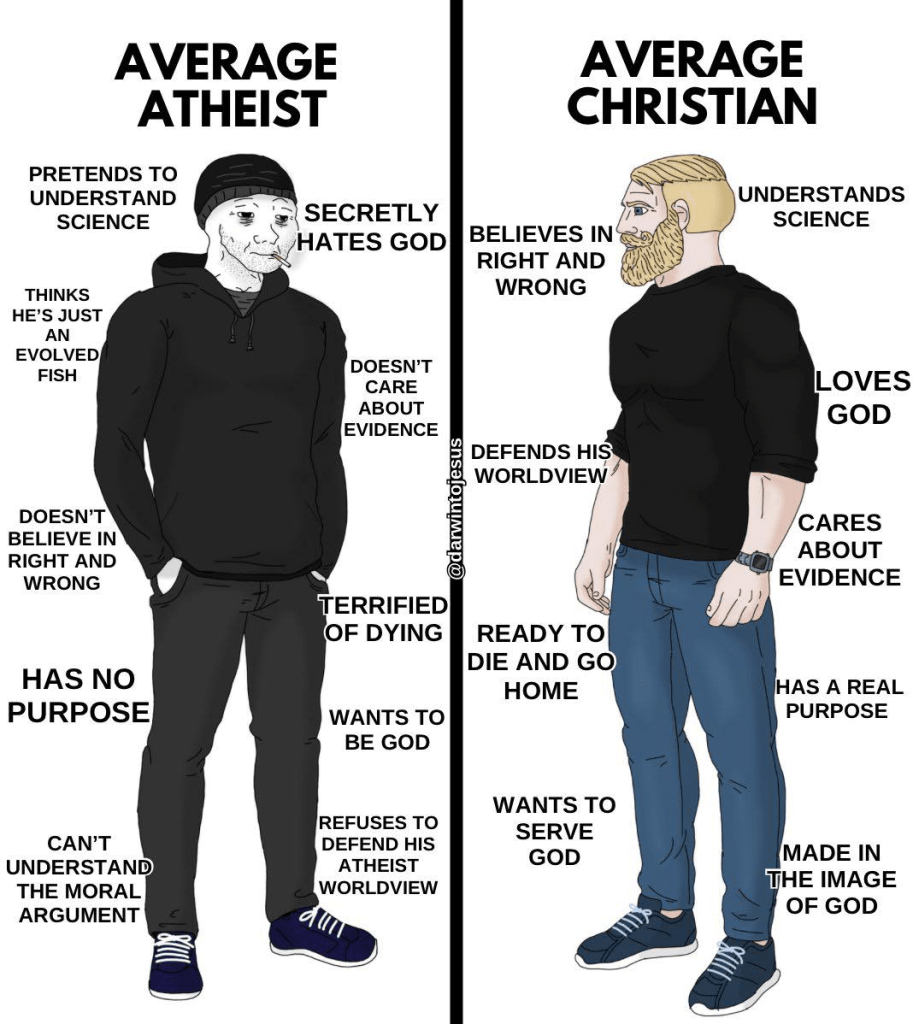
On a lighter note, the thought has occurred to this writer that an atheist is a theist with a letter ‘a’ added (a + theist = atheist)
It is extraordinary how a whole (minority yet growing) section of society should be identified with a word that is predominantly comprised of the very thing they decry, deny – and so oft – despise and detest.
If this writer were an atheist they surely would not be content with this tag at all.
Though there is no small irony in a label which defines someone who has willingly (stemming invariably from intellectual vanity) constrained their mind within a paradigm subset of something that is beyond themselves literally and figuratively.
A final thought:
Our common affliction as a species is that we take our lives for granted, we live selfish lives and then we die.
Yet our life was given to us by God.
Why would we not want to thank Him for every breath we take during our fleeting time on Earth. Would any sane person not want to get to know the One who has the power over life and death; and if there was a way to escape eternal death and gain immortal life, would not everyone want to sign up for that program? It seems very few wish to do that.
What about you sincere reader?
Is there anything more important to do with your time than getting to know your Maker and becoming immortal with Him?
Stop fooling yourselves. If you count yourself above average in intelligence, as judged by this world’s standards, you had better put this all aside and be a fool rather than let it hold you back from the true wisdom from above.
For the wisdom of this world is foolishness to God… God uses man’s own brilliance to trap him; he stumbles over his own “wisdom” and falls… the Lord knows full well how the human mind reasons and how foolish and futile it is.
I Corinthians 3:18-20 Living Bible
The unbeliever does not receive the things of the Spirit of God, for they are foolishness to him. And he cannot understand them, because they are spiritually discerned. The one who is spiritual discerns all things, yet he himself is understood by no one. For… we have the mind of Christ.
1 Corinthians 2:14-16 New English Translation
“No one is more dangerous than someone who thinks he has “The Truth”. To be an atheist is almost as arrogant as to be a fundamentalist.”
Tom Lehrer
“If there is a God, atheism must seem to Him as less of an insult than religion.”
Edmond de Goncourt
© Orion Gold 2026 – All rights reserved. Permission to copy, use or distribute, if acknowledgement of the original authorship is attributed to orion-gold.com
Post Scriptum
While comments are welcome if they are constructive…

… they are not so much if the person has not even read the article and then makes an asinine assumption.
For example, Club Schadenfreude – meaning “malicious joy” or “gloating” in relation to ‘self-satisfaction that comes from learning of the troubles, failures, pain, suffering, or humiliation of another’ (vile, evil choice of name) – even before the whole article was uploaded.
Go figure?

Their comment (and website) has not served to show atheists in a better light, but regrettably has only confirmed a stereotype of an intellectually arrogant, embittered individual with a large axe to grind.
My “imaginary friend” is the same one who helped David defeat Goliath…
One wonders what triggers someone to waste their time relentlessly attacking something they don’t even believe in – Article: The Creator Criterion.
At the end of the day, there are always two sides to any debate and one is correct and the other isn’t. In this instance of whether there is a God or not, one side is right and one side is not. What can be said with surety is that when He does reveal Himself to all, one side is going to be a lot more surprised (and concerned) than the other.
Think on this…

