In The Top Tens, Top 10 Greatest Unexplained Mysteries of All Time – of which there are currently 62 listings – the Voynich Manuscript is ranked number fourteen, voted by 3% of readers.
The constant reader has previously crossed paths with the Voynich manuscript in the article: Belphegor.
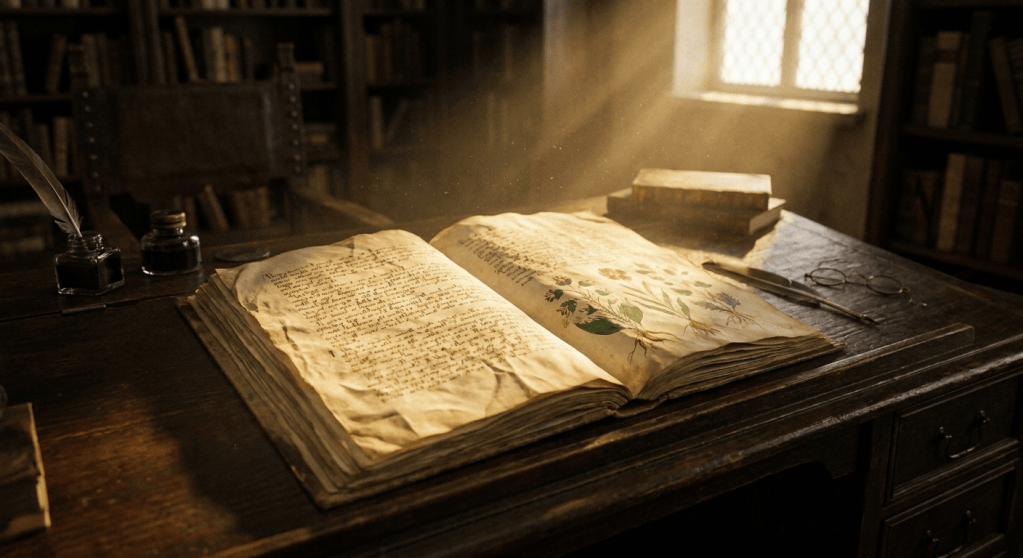
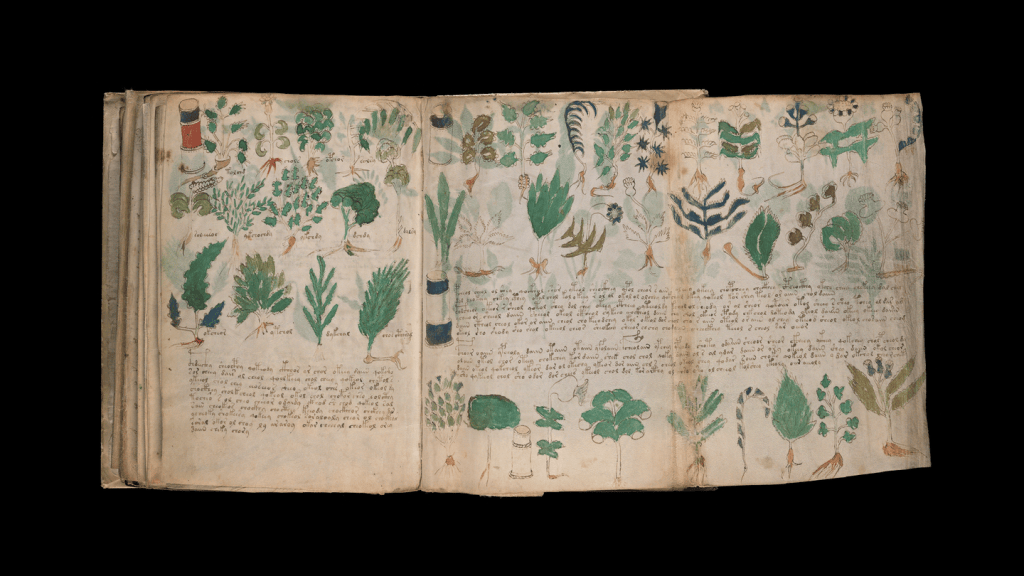
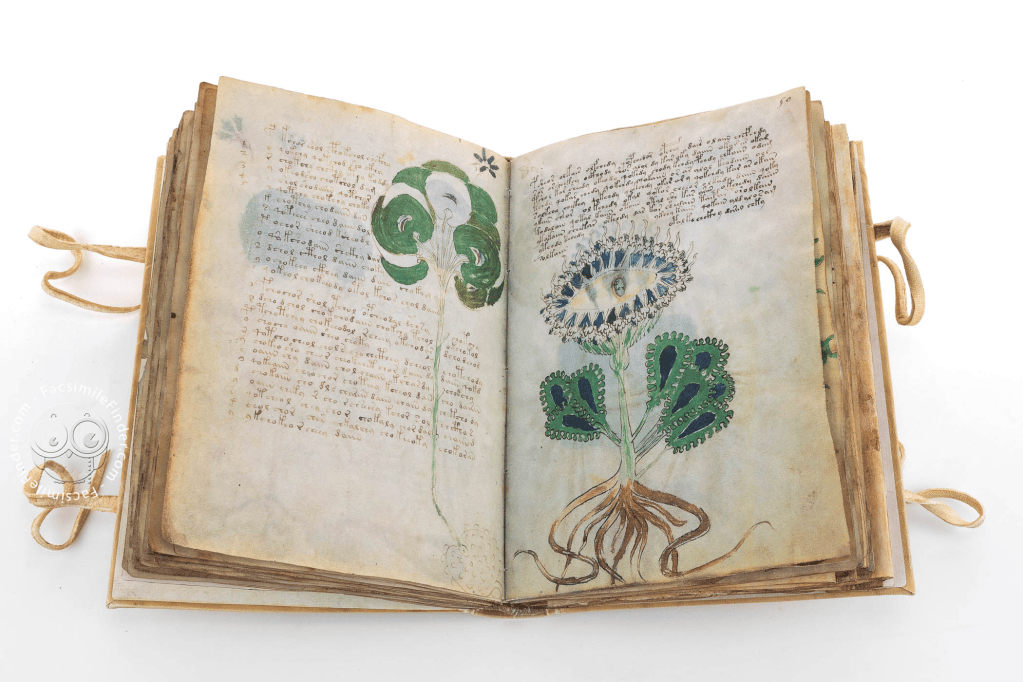
Otherwise known as Manuscript 408, it is an illustrated codex, hand-written in an undeciphered script referred to as Voynichese.
It features seemingly bizarre botanical diagrams, medical drawings, astronomical figures and naked women. It is written on calfskin vellum which has been carbon dated reliably to the early fifteenth century. Stylistic analysis indicates the manuscript may have been composed in Italy during the Italian Renaissance.
Generations of well known professional cryptographers and codebreakers have attempted to decipher the text (including American and British WWI and WWII codebreakers), with scholars remaining divided over whether the intricate document is
a. an undiscovered natural or constructed language;
b. an elaborate cipher or other form of cryptography;
c. an unreadable code;
d. a reference work;
e. glossolalia;
f. a work of fiction (for example: science fiction, mythopoeia [a fictional mythology], metafiction [combination of fiction with reality] and speculative fiction [fantasy, horror and the supernatural]); or
g. a ‘sophisticated medieval hoax’.
Online Encyclopaedia:
‘In cryptography, a cipher is an algorithm for performing encryption or decryption – a series of well-defined steps that can be followed as a procedure.
An alternative, less common term is encipherment. To encipher or encode is to convert information into cipher or code.
In common parlance, “cipher” is synonymous with “code”, as they are both a set of steps that encrypt a message; however, the concepts are distinct in cryptography, especially classical cryptography.
Codes generally substitute different length strings of characters in the output, while ciphers generally substitute the same number of characters as are input. A code maps one meaning with another. Words and phrases can be coded as letters or numbers. Codes typically have direct meaning from input to key. Codes primarily function to save time.
Ciphers are algorithmic. The given input must follow the cipher’s process to be solved. Ciphers are commonly used to encrypt written information.’
Glossolalia:
Fabricated and non-meaningful speech associated with a trance state, certain schizophrenic syndromes or supposedly while under the influence of spirits. The gift of tongues where individuals utter speech like sounds or words that lack comprehensible meaning; typically associated with religious ecstasy in (charismatic) Pentecostal Christianity – also described as ‘speaking in tongues’.
Needless to say, the manuscript has never been demonstrably deciphered. Nor have any of the numerous proposed hypotheses been independently verified or peer reviewed.
In other words: ‘no one has a (add an expletive) clue’.
It has remained a fascinatingly tantalising mystery.
That is until relatively recently (beginning circa 2006 and especially since 2020), where it now seems anyone and everyone has an opinion on the contents of the Voynich Manuscript, particularly with the advent of artificial intelligence (AI) during 2024 and 2025.
Encyclopaedia:
‘The first confirmed owner was Georg Baresch, a 17th-century alchemist from Prague [Czech Republic]. The manuscript is named after Wilfrid Voynich, a Polish book dealer who purchased it in 1912 [from the Jesuit College at Frascati near Rome].’
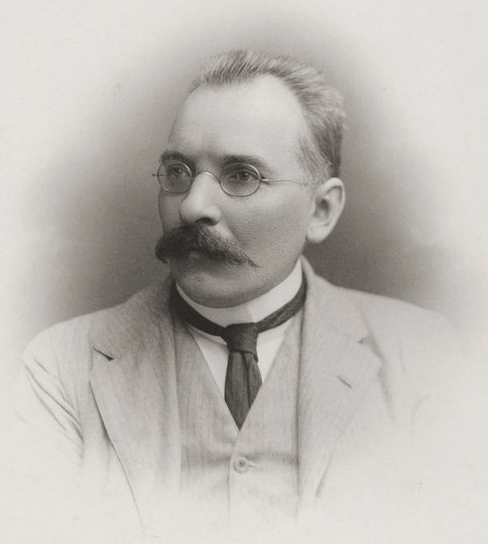
Wilfred Voynich circa 1920
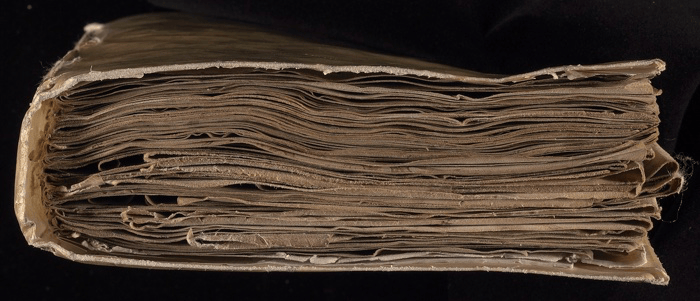
‘The manuscript consists of around 240 pages, but there is evidence that some of the pages are missing. The text is written from left to right, and some pages are foldable sheets of varying sizes. Most of the pages have fantastical illustrations and diagrams, some crudely coloured, with sections of the manuscript showing people, unidentified plants and astrological symbols.
Since 1969, it has been held in Yale’s University’s Beinecke Rare Book and Manuscript Library. In 2020, Yale University published the entire manuscript online in its digital library.’
The full manuscript can be viewed at:
https://www.jasondavies.com/voynich
There are three distinct aspects of the manuscript to be solved or understood:
a. the text (and how it was generated);
b the translating of the text into a recognisable language; and
c. the drawn images (and what they mean).
We will proceed with a chronological progression through a series of articles; with the aim of gaining a clearer picture and perhaps from that, some answers.
The first article or rather paper to be referenced, is by Stephen Bax, Professor in Applied Linguistics at the University of Bedfordshire.
A proposed partial decoding of the Voynich script, 2014 – emphasis mine:
“We know nothing about its purpose, origin, or authorship. It has been called by the New York Times the ‘white whale of the code-breaking world’… Until now, not a single word of the manuscript has been convincingly interpreted or decoded.
This paper… adopts a ‘bottom-up’ approach, following the method employed successfully to decode Egyptian hieroglyphs and Cretan Linear B script in the past. Through analysis of a number of illustrations in the manuscript, including one constellation (Taurus) and seven plants, then drawing on European and Middle Eastern mediaeval manuscripts and contemporary nomenclature, the paper proposes the identification of a set of proper names in the Voynich text, giving a total of ten words made up of fourteen of the Voynich symbols and clusters.
The aim of the paper… to lay the groundwork for an eventual full decoding and complete decipherment of this fascinating document.
The evidence shows that the manuscript is not a hoax, and is probably an explanatory treatise on nature. The script was possibly devised to encode a previously unwritten language or dialect, perhaps by a small community which later died out or disappeared.
Description of the document can be found on the Yale website… and is discussed most fully and insightfully on René Zandbergen’s extensive website:
In the analysis which follows I aim to demonstrate… that in the Voynich manuscript the first word of a number of the plant pages typically encodes the name of the plant on that same or the adjacent page, and that the text discusses the plant in question, and probably gives the aetiology [the science, doctrine, or demonstration of causes; especially the investigation of the causes of any disease or disorder. It refers to the factors that produce or predispose someone to a specific illness] as well.
I identify five plants with some confidence, with their accompanying names as the first word on the same page, and make tentative identification of two more.”
The author demonstrates a compelling and convincing relationship between drawings of specific plants which resemble known flora and words in the text which correlate to the pictures.
They include: Juniper, Coriander, Knapweed, Dungwort, Black Cumin, Cotton and Indian Crocus.
Though of particular interest to this writer and as constant readers will be aware, is Stephen Bax’s discussion on Taurus – refer articles: The Pyramid Perplexity; Younger Dryas Stadial: Ending of the Earth… Beginning of the World; and Chapter XV The Philistines: Latino-Hispano America.
Bax:
“… no word of the VM has been convincingly translated or glossed, but in fact there is one word which has received a degree of consensus. On page 68r, in a dramatic diagram apparently showing the moon in the heavens, a set of seven stars has been suggested to show the ‘Pleiades’, sometimes known as the Seven Sisters, in the constellation of Taurus… and the accompanying word has sometimes be interpreted to indicate TAURUS…”
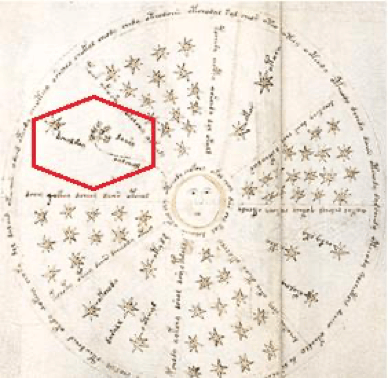
Detail of Folio 68r (left on image above) with the seven stars of the ‘Pleiades’ and the proposed word T A U R N (centre on the image below).
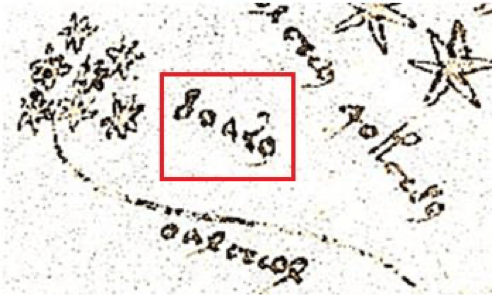
“Historically the word Taurus is thought to derive from Proto-Indo-European *tau-ro, *tawros, *teh2wros. meaning bull… it is also linked with Semitic variants such as the Arabic word ‘thaur’, which signifies both ‘bull’ and also the constellation. For this reason, when we come to gloss the VM word positioned to the right of the seven stars in the illustration, it is important not to assume that it represents the Latin TAURUS per se, as some commentators seem to do; it could well be a variant from another language.
Even so, it appears plausible that the word might indeed be read as the name of the constellation. We could posit the idea that the initial letter, shaped somewhat like the numeral 8, represent some sort of alveolar [jaw] or dental sound in the region of /t/, /d/ and /θ/ (as in the first sound of thing, which is approximately the Arabic sound in ‘thaur’), and indeed it resembles the Greek ‘theta’ to some extent.
The second sign… might represent a vowel sound like /a/; the third might be a vowel sound which, when alongside the previous could give a sound of approximately /u/ or /ə/… or a full /u/; the fourth… could plausibly be read as /r/ – giving approximately /taur/ or /taər/.
… the final sign as /n/… for which reason I propose that the word in full should be read as /taərn/ or similar. (The reason for the final /n/ at the end is not entirely clear, although it could represent or be borrowed from the Arabic/semitic vowelling called ‘nunation’ in the nominative singular of the word meaning ‘bull’ and the Constellation Taurus).
Figure 6 [not shown] demonstrates the existence of the word ‘thaur’ in the singular without the Arabic definite article ‘al’, used for the constellation in a Persian manuscript.”
While Stephen Bax emphasises a correlation for example between Voyichnese words for stars and Arabic equivalents, it is not a given that the principle underlying language encoded in the manuscript is Arabic.
The next article discusses a researcher who claims the Voynich manuscript is simply a (plagiarised) guide to women’s health.
The mysterious Voynich manuscript has finally been decoded, Annalee Newitz, September 8, 2017 – emphasis mine:
‘… history researcher and television writer Nicholas Gibbs appears to have cracked the code, discovering that the [manuscript] is actually a guide to women’s health that’s mostly plagiarized from other guides of the era.’
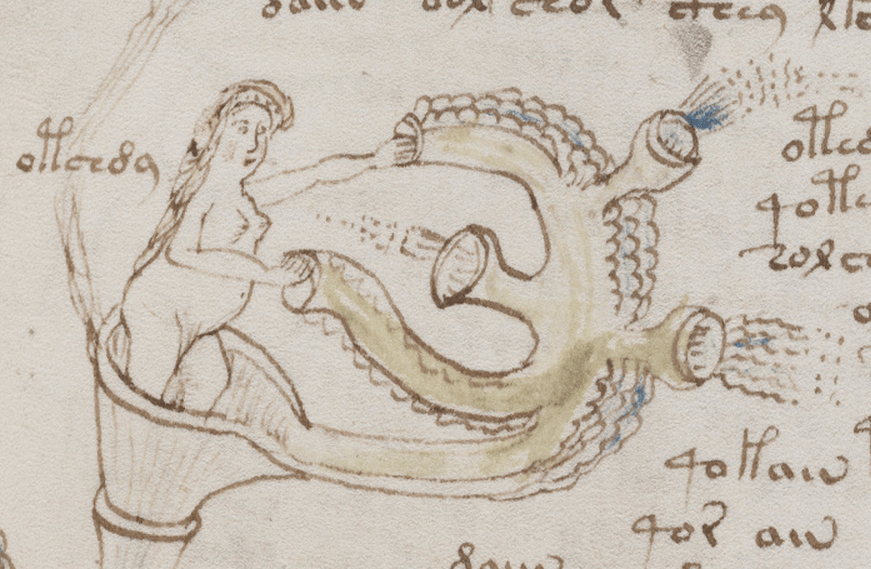
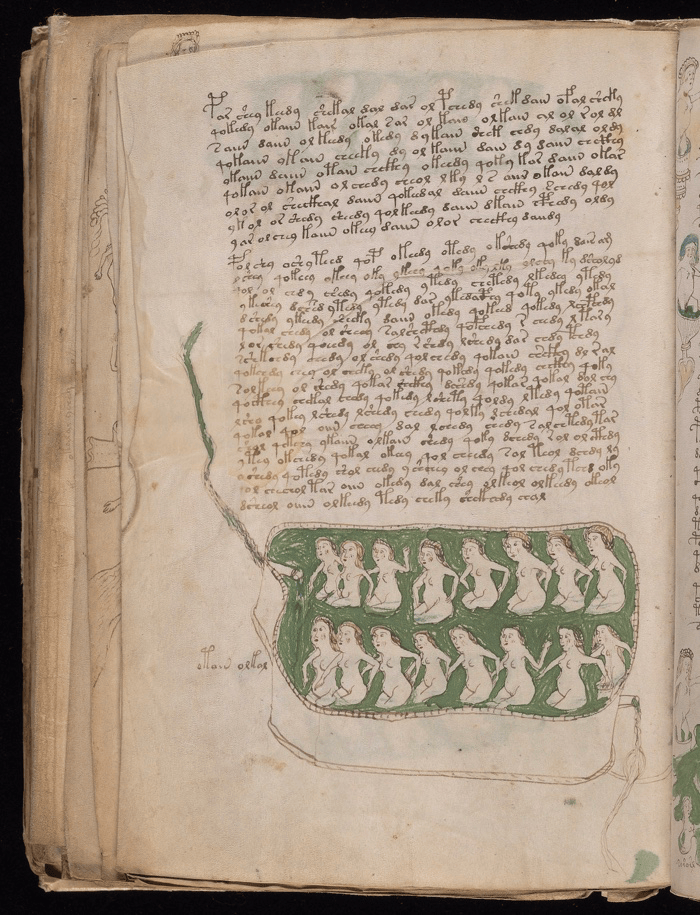
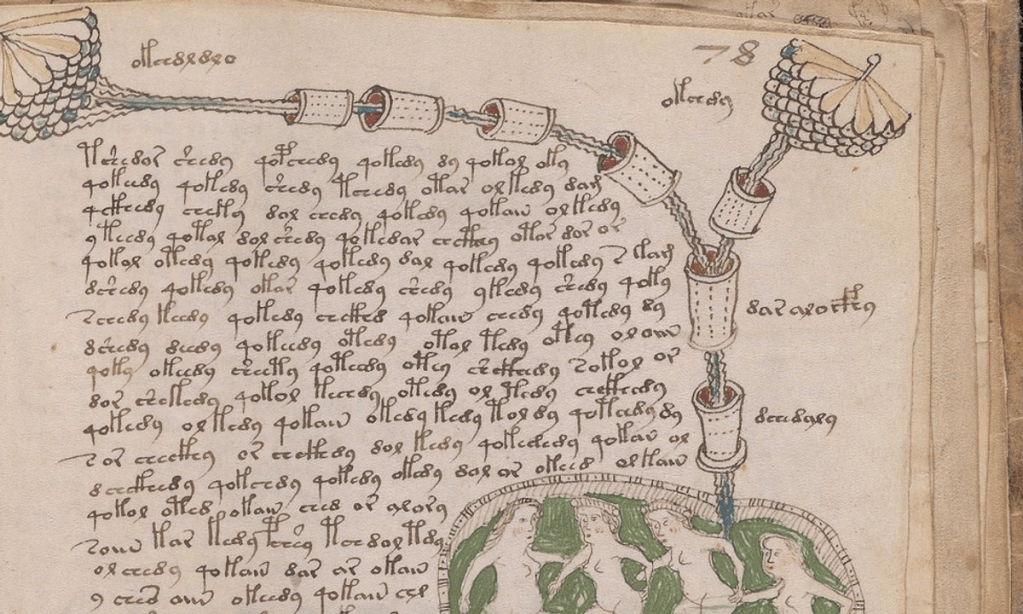
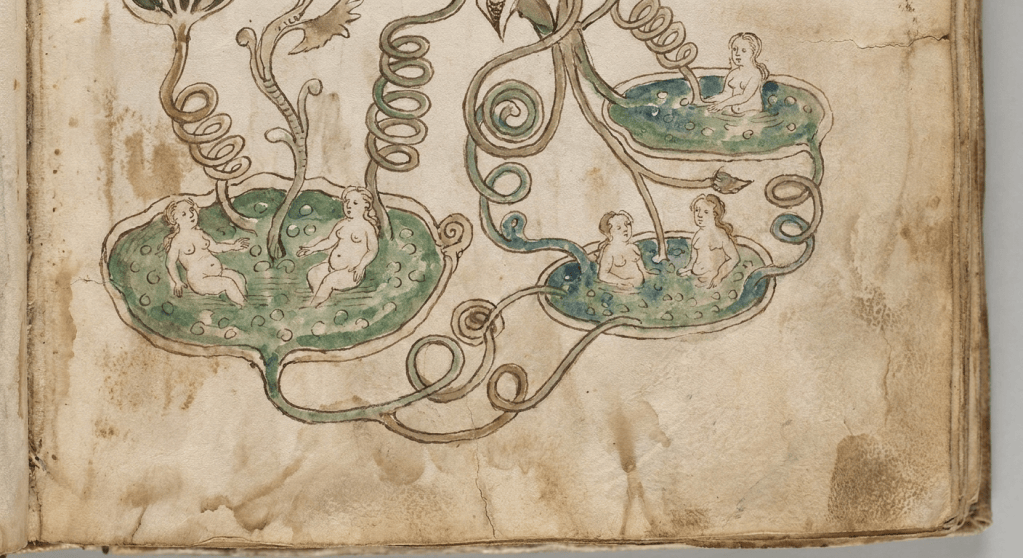
According to Gibbs, parts of the Voynich Manuscript can be (should be) translated as women should take a nice bath if they are feeling sick. Here you can see a woman doing just that. Or is she? The tentacle like tubes and suckers appear more than just an intricate hot water piping system.
Newitz:
‘Gibbs writes in the Times Literary Supplement that he was commissioned by a television network to analyze the Voynich Manuscript three years ago. Because the manuscript has been entirely digitized by Yale’s Beinecke Library, he could see tiny details in each page and pore over them at his leisure. His experience with medieval Latin and familiarity with ancient medical guides allowed him to uncover the first clues.
After looking at the so-called code for a while, Gibbs realized he was seeing a common form of medieval Latin abbreviations, often used in medical treatises about herbs.’
Gibbs:
“From the herbarium incorporated into the Voynich manuscript, a standard pattern of abbreviations and ligatures emerged from each plant entry… The abbreviations correspond to the standard pattern of words used in the Herbarium Apuleius Platonicus – aq = aqua (water), dq = decoque / decoctio (decoction), con = confundo (mix), ris = radacis / radix (root), s aiij = seminis ana iij (3 grains each), etc.”
Newitz;
‘So this wasn’t a code at all; it was just shorthand. The text would have been very familiar to anyone at the time who was interested in medicine.
Further study of the herbs and images in the book reminded Gibbs of other Latin medical texts. When he consulted the Trotula and De Balneis Puteolanis, two commonly copied medieval Latin medical books, he realized that a lot of the Voynich Manuscript’s text and images had been plagiarized directly from them (they, in turn, were copied in part from ancient Latin texts by Galen, Pliny, and Hippocrates). During the Middle Ages, it was very common for scribes to reproduce older texts to preserve the knowledge in them. There were no formal rules about copyright and authorship, and indeed books were extremely rare, so nobody complained.’
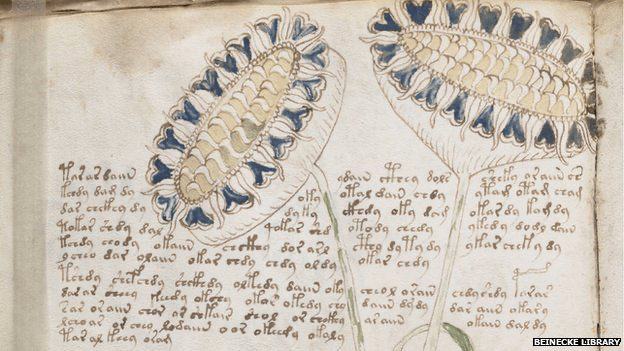
‘A major portion of the manuscript focuses on how to make medicines from herbs, and there are a number of pictures illustrating medicinal plants.
Once he realized that the Voynich Manuscript was a medical textbook, Gibbs explained, it helped him understand the odd images in it. Pictures of plants referred to herbal medicines, and all the images of bathing women marked it out as a gynecological manual. Baths were often prescribed as medicine, and the Romans [like medieval and ancient physicians] were particularly fond of the idea that a nice dip could cure all ills.’
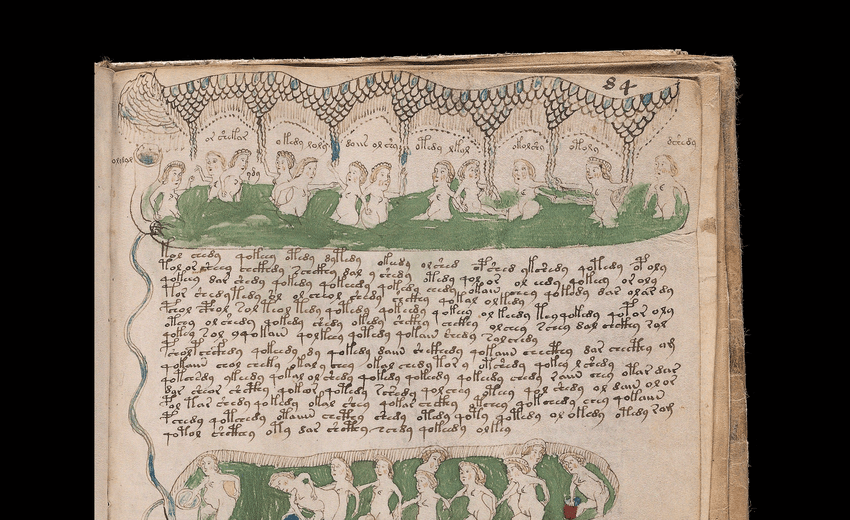
‘There are countless images of bathing women in the manuscript…
Zodiac maps were included because ancient and medieval doctors believed that certain cures worked better under specific astrological signs. Gibbs even identified one image – copied, of course, from another manuscript – of women holding donut-shaped magnets in baths. Even back then, people believed in the pseudoscience of magnets. (The women’s pseudoscience health website Goop [founded by Gwyneth Paltrow] would fit right in during the 15th century.)’
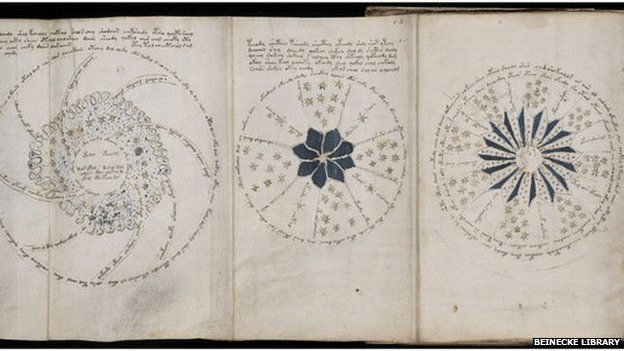
‘Astrological images appear throughout the manuscript…
The Voynich Manuscript has been reliably dated to mere decades before the invention of the printing press, so it’s likely that its peculiar blend of plagiarism and curation was a dying format. Once people could just reproduce several copies of the original Trotula or De Balneis Puteolanis on a printing press, there would have been no need for scribes to painstakingly collate its information into a new, handwritten volume.
Gibbs concluded that it’s likely the Voynich Manuscript was a customized book, possibly created for one person, devoted mostly to women’s medicine. Other medieval Latin scholars will certainly want to weigh in, but the sheer mundanity [ordinariness] of Gibbs’ discovery makes it sound plausible.’
This is a blow to those who cling to a mysterious alien like treatise containing secret knowledge. In the vein of Occam’s razor, this explanation’s obvious simplicity is difficult to argue against, when the diagrams and drawings ostensibly indicate
a. a work directed at women; and
b. the subject being their health.
Yet just as easily, the drawings of nymph like women may not relate only to women or their health. Rather, the imagery of naked women may be occult symbolism for something else. Such as fertilisation, incubation and genetic transformation.
Whether Gibbs’ Latin language translation claims are accurate is a matter of debate amongst more reputable scholars.
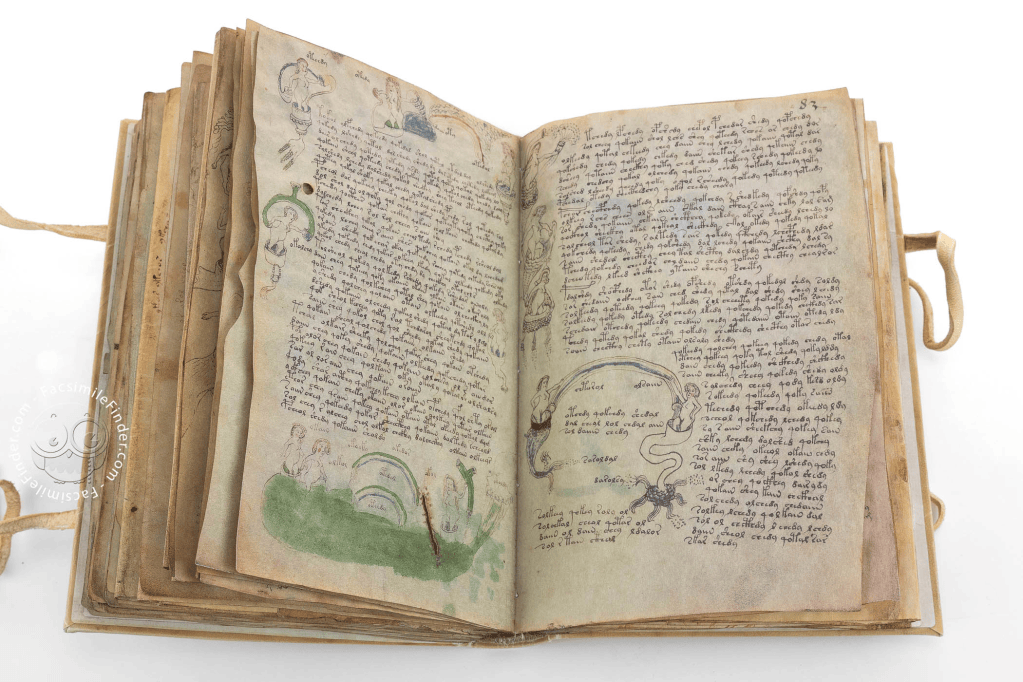
Next, an article that claims AI has detected which language is used in the Voynich manuscript.
AI May Have Finally Decoded The Bizarre, Mysterious ‘Voynich Manuscript’, Peter Dockrill, January 30, 2018 – emphasis mine:
‘… Canadian computer scientists… from [the] University of Alberta have used artificial intelligence to decode sections of the ancient manuscript, using a technique called algorithmic decipherment to reveal the underlying, encrypted language hidden behind the strange book’s words.
Testing their algorithm on 380 different translations of the Universal Declaration of Human Rights, the researchers’ system was able to correctly identify the language of origin 97 percent of the time.’
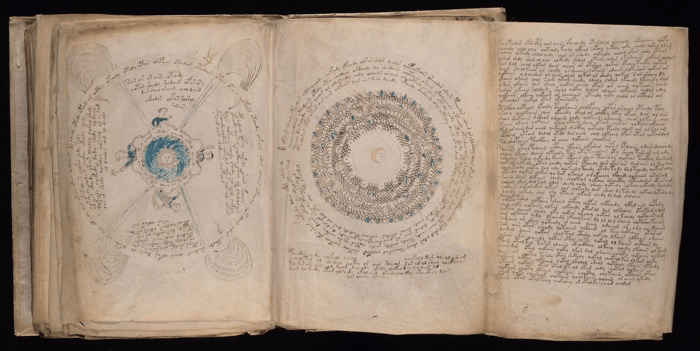
‘Next, they focussed the AI on the pages of the Voynich manuscript, which the team suspected may be written in Arabic. The AI didn’t agree, indicating Hebrew was the most likely source, edging out other potential matches that weren’t commonly used for writing during the Middle Ages.
The researchers hypothesised the cipher acting on the Hebrew language could be an example of alphabetically ordered anagrams (called alphagrams), rearranging the order of letters in words, while dropping vowels.
“It turned out that over 80 per cent of the words [are] in a Hebrew dictionary, but we didn’t know if they made sense together,” says one of the team, computational linguist Greg Kondrak.
In the opening section of the ‘Herbal’ chapter of the Voynich manuscript, which contains drawing of several kinds of plants, many botany-related terms appear, [which include]… farmer, light, air, and fire.’
‘As for how the most mysterious book in the world starts? Well, fairly ambiguously as it turns out, but would you expect anything else?
“She made recommendations to the priest, man of the house and me and people,” are the… manuscripts first words, according to the AI.
Recommendations to do with herbal botany, perhaps?’
“Somebody with very good knowledge of Hebrew and who’s a historian at the same time could take this evidence and follow this kind of clue. Can we look at these texts closely and do some kind of detective work and decipher what can be the message?”
Thus far, there are three different natural languages proposed as the foundation for which may form a type of shorthand:
Arabic, Latin or Hebrew.
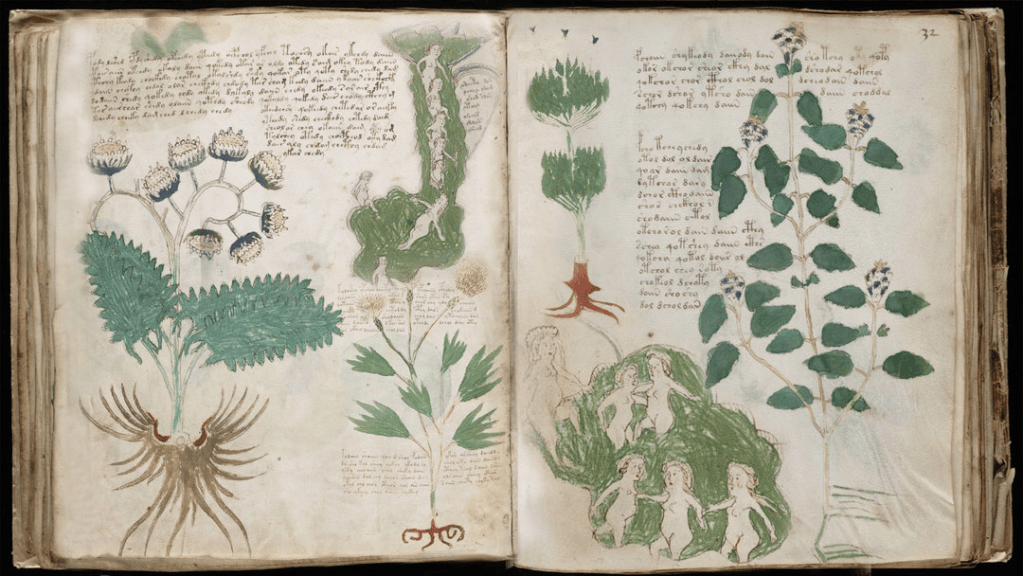
The Voynich Manuscript clearly contains botanical words which then match with certain drawings of flora (plants). The inclusion of which are assumed to be linked to recipes or concoctions designed for medicinal or scientific application.
Research conducted by the University of Bristol (which subsequently backtracked, distancing themselves) contradicts the claim that Manuscript 408 is written in a language deriving from Hebrew.
Voynich Manuscript Is Solved And This Time It’s Academic, Gary Manners, May 15, 2019 – emphasis mine:
‘It seems there was no ‘code’ to crack as such, just an extinct and previously unknown language to recognize, plus a lot of abbreviations and some complicated diphthongs.
For several centuries it enjoyed an unassuming existence, until 1912 when it was purchased by a Polish book dealer by the name of Wilfred M. Voynich. In that same year, the place of origin of the manuscript, Castello Aragonese on the isle of Ischia, Italy, was bought by a private owner, and it is thought that the document was sold as part of the clearance sale of the grand property.’
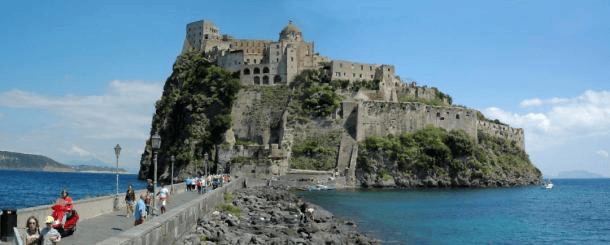
The island of Ischia’s Aragonese Castle
‘Investigations so far have revealed the manuscript is [superficially and simplistically] a compendium of [1] herbal remedies, [2] therapeutic bathing and [3] astrological readings concerning matters of the [4] female mind and [5] body, of [6] reproduction and [7] parenting…
Although the purpose and meaning of the manuscript had eluded scholars for over a century, it took Research Associate Dr. Gerard Cheshire two weeks, using a combination of lateral thinking and ingenuity, to identify the language and writing system of the famously inscrutable document.
Cheshire explains in linguistic terms what makes the manuscript so unusual:
“It uses an extinct language. Its alphabet is a combination of unfamiliar and more familiar symbols. It includes no dedicated punctuation marks, although some letters have symbol variants to indicate punctuation or phonetic accents. All of the letters are in lower case and there are no double consonants.
It includes diphthong [a diphthong is a gliding vowel sound within one syllable where the tongue position starts for one vowel and then moves toward another (for example, the vowel sounds in “ou-t” and “b-oy”) as opposed to a monophthong, where the tongue or other speech organs do not move and the syllable contains only a single vowel sound], triphthongs, quadriphthongs and even quintiphthongs for the abbreviation of phonetic components. It also includes some words and abbreviations in Latin.”
Gary Manners:
‘In his peer-reviewed paper, The Language and Writing System of MS408 (Voynich) Explained, published in the journal Romance Studies, Cheshire describes how he successfully deciphered the manuscript’s codex and, at the same time, revealed the only known example of proto-Romance language.’
Cheshire:
“It is also no exaggeration to say this work represents one of the most important developments to date in Romance linguistics. The manuscript is written in proto-Romance – ancestral to today’s Romance languages including Portuguese, Spanish, French, Italian, Romanian, Catalan [Spain] and Galician [Spain]. The language used was ubiquitous in the Mediterranean during the Medieval period, but it was seldom written in official or important documents because Latin was the language of royalty, church and government. As a result, proto-Romance was lost from the record, until now.”
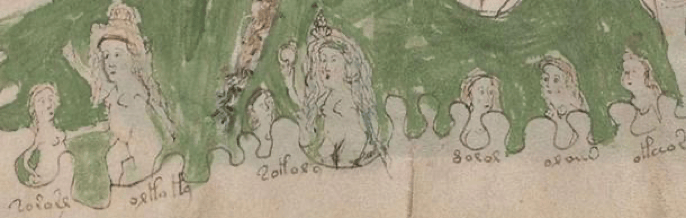
The drawing above ‘shows two women dealing with five children in a bath[?]. The new interpretation has the words describing different temperaments:
tozosr (buzzing: too noisy),
orla la (on the edge: losing patience),
tolora (silly/foolish),
noror (cloudy: dull/sad), or
aus (golden bird: well behaved),
oleios (oiled: slippery).
These words survive in Catalan (tozos), Portuguese (orla), Portuguese (tolos), Romanian (noros), Catalan (or aus) and Portuguese (oleio).
The words orla la describe the mood of the woman on the left and may well be the root of the French phrase ‘oh là là’, which has a very similar sentiment.’
Manners:
‘The realization of what he has uncovered was exhilarating.’
Cheshire:
“I experienced a series of ‘eureka’ moments whilst deciphering the code, followed by a sense of disbelief and excitement when I realized the magnitude of the achievement, both in terms of its linguistic importance and the revelations about the origin and content of the manuscript. What it reveals is even more amazing than the myths and fantasies it has generated.
For example, the manuscript was compiled by Dominican nuns as a source of reference for Maria of Castile, Queen of Aragon, who happens to have been great aunt to Catherine of Aragon.”
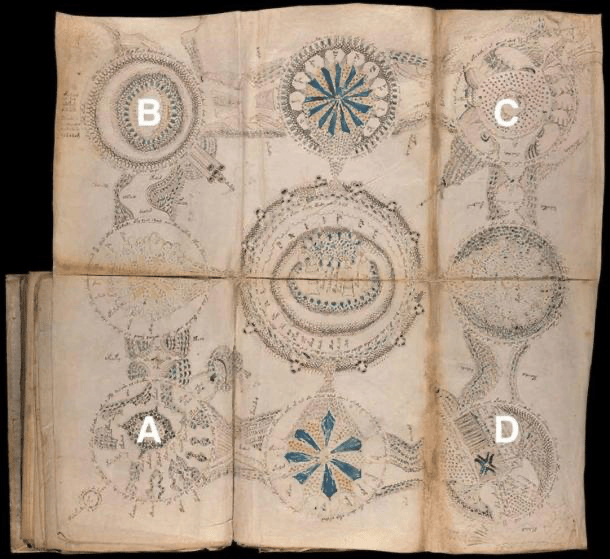
‘Unfolded map from the Voynich Manuscript.
Vignette A illustrates the erupting volcano that prompted the rescue mission and the drawing of the map. It rose from the seabed to create a new island given the name Vulcanello, which later became joined to the island of Vulcano following another eruption in 1550.
Vignette B depicts the volcano of Ischia, vignette C shows the islet of Castello Aragonese, and vignette D represents the island of Lipari.
Each vignette includes a combination of naïvely drawn and somewhat stylized images along with annotations to explain and add detail. The other five vignettes describe further details of the story.’
This is one interpretation for the drawing above. Shortly, a different explanation will be discussed.
A quote – from another article – by Gerard Cheshire:
“Many argue the text has the characteristics of a real tongue – with, for example, certain words only appearing besides certain illustrations.”

Of course there is solid wall of opposition to Cheshire’s conclusions. One wonders if there is a section of academia who do not desire the Voynich Manuscript being ever correctly deciphered. The intrigue surrounding the manuscript elevates it beyond the mundane while it remains inexplicable. Once explained, the aura of mystique would be a burst bubble, forever relegating it as just another medieval manuscript.
An extinct language rather than an original complex code perhaps aligns with Occam’s razor as does a language which has geographical and cultural roots to where it was likely compiled – ostensibly Italy. Or perhaps it has an Iberian connection as Cheshire claims if Dominican nuns were responsible for the commissioning of the manuscript for the Queen of Aragon (Spain).
What is notable is that while the order was founded by St Dominic in 1206 in Prouille, Southern France, spreading all around the world; the order has been predominantly based in not just Rome (Italy) but also Madrid (Spain).
Further, Dominican nuns were based in Portugal, specifically with the establishment of the Convent of Our Lady of Bom Sucesso in 1639 for Irish women seeking to live a religious life. This convent played a significant role in the education and spiritual life of its members, where they contributed significantly to religious and educational spheres.
Perhaps there is a link with either France, Spain or Portugal, particularly if Cheshire is correct with examples being given for certain words in the manuscript surviving by some degree in French, more so in Catalan and especially in Portuguese.
History Extra focuses on who may be responsible for the manuscript.
The Voynich Manuscript: who wrote the mystery medieval codex and what is it trying to tell us? Spencer Mizen, June 2, 2020.
While the title of the article has promise, the piece fails to deliver anything new or substantial on the authorship of the manuscript. Though it does contain information regarding Voynich himself.
Spencer Mizen:
‘At the heart of this wordy whodunnit was a Polish-Lithuanian book dealer with revolutionary tendencies and famous friends: a man called Wilfrid Voynich.
To say that he led a colourful life is something of an understatement. Born in what is now Lithuania in 1865, he got himself arrested for his socialist activities and imprisoned in Siberia, only to escape and make his way to London. There, he established a second-hand book shop that was patronised by the man who would become Sydney Reilly, ‘Ace of Spies’.
But it was in a Jesuit seminary outside Rome in 1912 – during a book-buying expedition – that Voynich apparently discovered the manuscript to which he would give his name. Voynich, it appears, instantly realised that he had chanced upon something very special.
Appended to the manuscript, and no doubt firing Voynich’s imagination further still, was a letter that appeared to shed some light on the document’s history. The correspondence, written in 1665 by imperial physician Johannes Marcus Marci, claimed that the manuscript had once belonged to the Holy Roman Emperor Rudolf II, who reigned from 1576 to 1612.
Its next owner was apparently a Prague [Czech]-based alchemist called Georg Baresch who, Marci tells us, “devoted unflagging toil” to the quest of deciphering the text and “relinquished hope only with his life”. The book then came into the possession of Marci himself, who sent it on to a Jesuit scholar called Athanasius Kircher in the hope that he could succeed where Baresch had failed.
Marci’s missive tells us the manuscript could have been the handiwork of the 13th-century philosopher and alchemist Roger Bacon. Voynich himself called his discovery the “Roger Bacon cypher manuscript”.’
However, subsequent carbon dating rules Roger Bacon out by some two hundred years.
An article published in the Journal of Historical Archaeology and Anthropological Sciences, seeks to establish that the language coded in the Voynich Manuscript is not a proto-Romance language nor Hebrew, but rather, Arabic.
In The Voynich Manuscript Decoded, Volume 7, Issue 3, 2022, Fletcher Crowe PhD confides that ‘large sections’ have been translated. though this does not account for all the manuscript. Crowe purports that the ‘text deals exclusively with the Cathars, a religious heresy prominent in the South of France in the 12th-13th centuries’ – Article: The Seven Churches: A Message for the Church of God in the Latter Days.
Crowe hypothesises ‘that the patron funding production of the Voynich Manuscript may have been Alfonso V, king of Aragon/Catalonia and, King of Naples.’
This bears striking similarity to the proposed origin of those responsible for its authorship as presented by Gerard Cheshire. Whereby the South of France and during the thirteenth century are common denominators, though by Dominican nuns instead of the Cathars. As well as the uncanny link between Maria of Castile, Queen of Aragon and Alfonso V, King of Aragon.
For Maria of Castile no less was Queen of Aragon and of Naples because she was the spouse of Alfonso the Magnanimous, King of Aragon (from 1416) and Sicily (from 1442) until his death in 1458. Maria acted twice as the regent of Aragon during the kingship held by her husband, as he was absent during most of his reign. The regencies lasted between 1420 and 1423 and between 1432 and 1458.
Thus Crowe supports a patron of Spanish origin as does Cheshire before him. While the language in question being an extinct proto-Latin dialect – a precursor to Spanish and Portuguese for example – holds greater logic; a coded form of Arabic has some support perhaps, due to the influence of the Moors in Iberian history (Chapter XV The Philistines: Latino-Hispano America; and Chapter XXIII Aram & Tyre: Spain, Portugal & Brazil).
That said, Crowe in a lengthy article, only mentions Cheshire in a single sentence, dismissing out of hand his conclusions on the strength of a refutation by Artemij Keidan in 2019 – which is quite damning to say the least, as summarised below.
(‘Artemij Keidan has criticized Gerard Cheshire’s research for lacking competence in linguistics and history, pointing out that Cheshire’s proposed language, Proto-Romance, is implausible and that his understanding of medieval Latin conventions is fundamentally flawed. Additionally, Keidan highlights that Cheshire’s work is riddled with errors and that he has not engaged with valid critiques from established scholars in the field.’)
Yet does Crowe not offer his own rebuttal? While at the same time claiming:
“The present study decodes the mysterious Voynich script for the first time, and demonstrates that the underlying language of the encrypted text is Arabic…”
Fletcher Crowe:
‘Scholars have speculated that the underlying language may have been French, Spanish, Ladino (a dialect of Spanish spoken by Sephardic Jews), Berber, Occitan (the medieval version of proto-French used in what is today’s southwest France), Hebrew, Provençal (spoken in medieval southeast France), West German dialects of Flanders from the 12th century, Basque, “medieval Galician”, Yiddish, and even Nahuatl or Mazatec/Otomanguean, an indigenous language of the Indians of Central Mexico!
The manuscript’s roughly 245 pages, including fold out pages contain several distinct sections: botanicals (multiple detailed drawings of plants), pp. 1-66; a sub-section of plants dealing with herbs and spices; the “balneological” section featuring bathing women, pp. 75 to 84; and the celestial section, pp. 67 to 73, showing zodiacal diagrams with stars centered on zodiac symbols such as Capricorn (the goat), Gemini (the twins), and Libra (a pair of scales).’
Crowe expends considerable effort in showing the relationship between stars in the text and how many/most have Arabic names (which is true in astronomy) and then drawing the conclusion that the whole manuscript is in Arabic.
Crowe ‘is extremely vague precisely about how to match the Voynich writing to Arabic. This should be a critical element of the paper’ – Renez, The Voynich Ninja.
Whereas, perhaps the portions describing stars may be using Arabic only for the names of stars.
For as Crowe himself states:
‘The equivalencies table of this study produces the Arabic names of six VM zodiac signs; it also produces the Arabic names of 49 stars and the Arabic name for eight familiar spices.
One limitation of this study is that Modern Standard Arabic (MSA) was used in translating the Arabic words of the Voynich Manuscript into English. However, the Voynich was written… when medieval Arabic was in use. Consequently scholars of medieval Arabic… need to examine the Arabic vocabulary and grammar used in this translation to determine if any translations need revision to be more in line with medieval Arabic terminology.
The English used in a work like The Canterbury Tales, written by Geoffrey Chaucer at about the same time as the Voynich Manuscript, is often difficult for a modern reader to understand – and the same degree of changes in English over the last 600 years may have occurred in Arabic.’
Crowe supports the idea that the manuscript, “reads as a passionate expression of Cathar hopes and beliefs”, yet then admits that “Catharism was said to have died out over a century before” the compiling of the Voynich Manuscript. Crowe is also aware that the Cathars were in the main, unlearned men and illiterate.
Crowe then links the stars in the manuscript with a highly speculative “six stages of death and resurrection that are accorded… prominence in the Voynich Manuscript” as:
“1. Death;
2. Descent to the Underworld:
3. Languishing in the Underworld;
4. Rescue by Qadi (spirits that [have] the power to authorize a soul to ascend to heaven and shine as a star in the night sky);
5. Lifted to the Heavens;
6. Afterlife as a Star.”
Regarding the overwhelming predominance of (naked) women in the manuscript, Crowe offers:
‘In the Voynich Manuscript, all but a few illustrated figures are the spirits of persons who, when alive, had been women. Moreover, every figure given marks of distinction or seen in commanding situations are female and there are only six illustrations of figures who were obviously men before death. The medieval Roman Catholic Church rigidly controlled religious practice in Europe, and nearly all positions of Church leadership were available only to men.
By contrast, in the Cathar religion, women religious leaders, known as Perfectae, performed evangelical, pastoral, and sacramental functions. Cathar gender-neutrality was considered heretical and inconceivable to the Catholics. In Arabic, the word Qadi means “religious judge” or “magistrate,” and every figure appearing in the Voynich codex labeled as a Qadi is drawn as a woman.
Women were drawn nude to indicate they were dead, in the Underworld. It’s noteworthy that in the VM every one of the figures labeled as a Qadi appears to have been a woman during her life on earth. The power to save the souls languishing in the Underworld, souls waiting for authorization to ascend to heaven, is clearly given to female figures, not male figures.’
The above explanation is inventive and original, yet remains unconvincing in light of the material discussed up to this point and what is yet to be covered as we progress.
Regarding the patronage of Alphonso V, the more plausible evidence of the seven supporting ‘facts’ presented by Crowe, include:
‘While any identification of Alfonso as the sponsor of the Voynich Manuscript must remain tentative, there is stronger evidence that this connection may have merit.
V. Repeated use of the word Qadi to mean “judge” or “religious leader” in the Voynich Manuscript suggests the codex was written in medieval Iberia. Qadi is a word of Andalusian Arabic meaning “judge” and might not have been used by an author from any other location. Arabic was in widespread use in Aragon-Catalonia during the reign of Alfonso, so the use of Arabic to keep the contents of the heretical manuscript secret from the Inquisition would have been quite logical.
VI. Alfonso’s contacts with Muslims are well documented: In 1428 he established a new aljama (a self-governing community of Moors and Jews living under Christian rule) in Castellón, a city in the Crown of Aragon on the coast of Spain south of Barcelona, 25 mi (40 km) north of Valencia.
Moreover, the wife of Alfonso V, María, was reputed to have been a champion of Muslims.
[Alfonso’s] specific views on Catharism are unrecorded…’
Less convincing from Crowe is the following point.
II. ‘His name appears plainly in Roman majuscule letters on the shaft of a column/pipe/conduit pictured in the Voynich Manuscript. See Figure 39 [not shown].’
‘If anyone decides to peruse the paper to the end, which I don’t recommend anyway, can they confirm my confusion – on page 126, figure 39, the author claims the VMS “features the illustration of a tube, conduit, hollow column or canon barrel labeled “Alphonsina” and shows an image very unlike anything in the style of the Voynich, and certainly I’ve never seen such an image contained in the VMS. He cites no folio number or location for the image. Are my eyes deceiving me or did he genuinely include an image clearly not from the VMS and claim it to be?’ – Cabeswater, The Voynich Ninja.
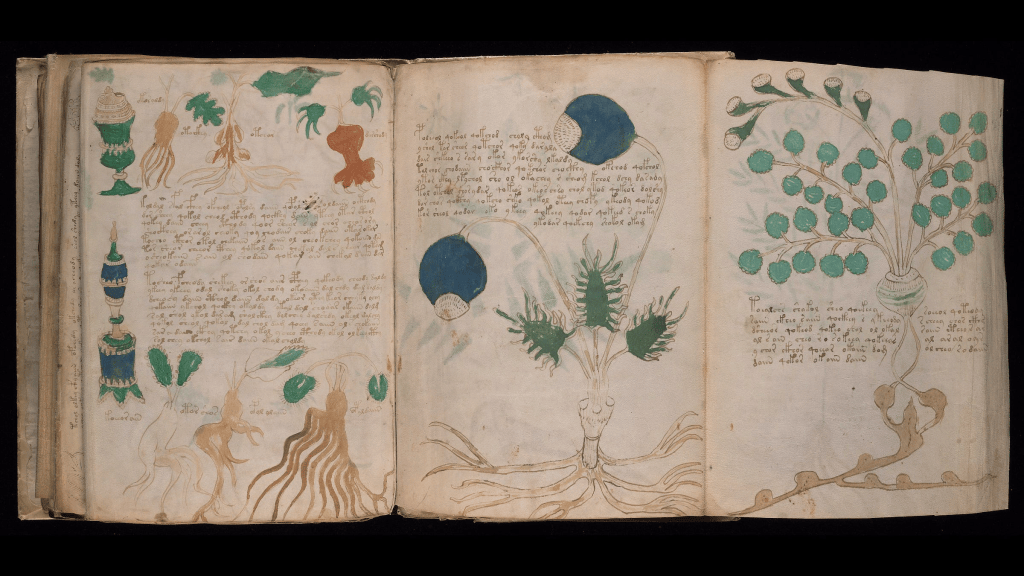
‘The Voynich manuscript… is covered in illustrations of stars and planets, plants, zodiac symbols, naked women, and blue and green fluids. But the text itself – thought to be the work of five different scribes – is enciphered and yet to be understood.
In an article published in Social History of Medicine, my coauthor Michelle L. Lewis and I propose that sex is one of the subjects detailed in the manuscript – and that the largest diagram represents both sex and conception.
Research on the Voynich manuscript has revealed some clues about its origins. Carbon dating provides a 95% probability the skins used to make the manuscript come from animals that died between 1404 and 1438.
However, its earliest securely known owner was an associate of Holy Roman Emperor Rudolf II, who lived from 1552 to 1612, which leaves more than a century of ownership missing.
Certain illustrations (the zodiac symbols, a crown design and a particular shape of castle wall called a swallowtail melon) indicate the manuscript was made in the southern* Germanic or northern Italian cultural areas.
One section contains illustrations of naked women holding objects adjacent to, or oriented towards, their [own] genitalia.’
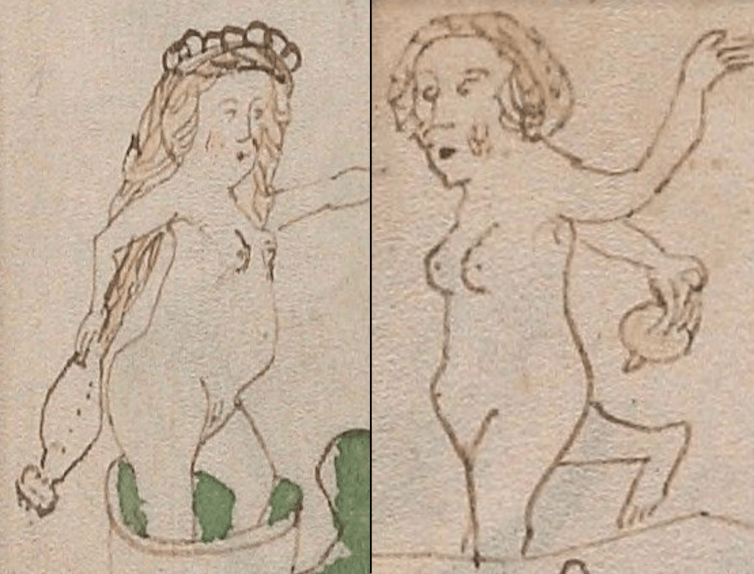
‘These wouldn’t belong in a solely herbal or astronomical manuscript. To make sense of these images, we investigated the culture of late-medieval gynaecology and sexology – which physicians at the time often referred to as “women’s secrets”.’
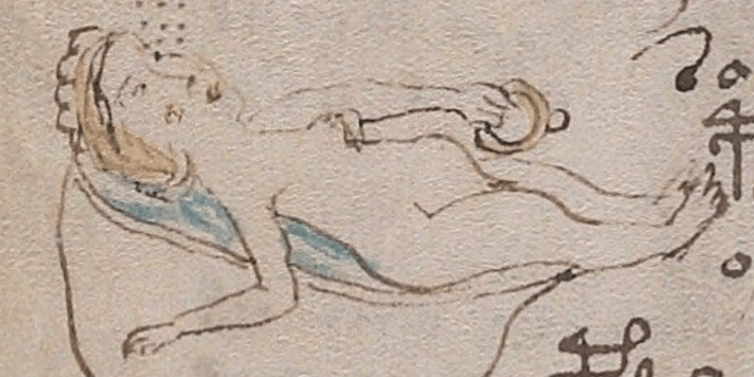
‘First we looked at Bavarian* physician Johannes Hartlieb (circa 1410-68), who lived around the time and place the Voynich manuscript was made. Hartlieb wrote about plants, women, magic, astronomy and baths. He also recommended the use of “secret letters” (such as a cipher, secret alphabet, or similar) to obscure medical recipes and procedures that may result in contraception, abortion or sterility’ – Article: Abortion: A Matter of Life & Death.
‘Although his secret alphabet hasn’t survived, analysing his work has helped us understand the attitudes that would have inspired the use of encipherment at the time. For instance, Hartlieb felt a strong apprehension about “women’s secrets” becoming widely known. He worried his writings could facilitate extramarital sex and that God would condemn him if this happened.
In his un-enciphered writings, he either refuses or hesitates to write about certain topics, such as post-partum vaginal ointments, women’s sexual pleasure, claims of women giving birth to animals, the “correct” coital positions for conception, libido-altering dietary advice, and information about poisonous, hallucinogenic, contraceptive or abortive plants.
Writing for male aristocrats in vernacular Bavarian (rather than academic Latin), Hartlieb says such knowledge should be restricted from sex workers, commoners, children, and in some cases from women themselves – who were becoming increasingly literate.
As a man who valued heterosexual marriage and women’s “modesty”, and who condemned lust, promiscuity and prostitution, he was perfectly conventional for his milieu. If such attitudes were widespread back then, was the censorship of women’s secrets also widespread? The short answer is: yes.
During our research, we decoded a number of ciphers from this period (but none from the Voynich manuscript). The longest was a 21-line cipher from late-medieval northern Italy that obscured a recipe with gynaecological uses, including abortion.
We also found many examples of authors self-censoring, or of readers erasing or destroying information in gynaecological and/or sexological texts. Censors would often only obscure a few words, usually genital terms or plant names in recipes – but sometimes they would remove entire pages or chapters.
One Bavarian manuscript includes recipes for invisibility and magic spells for sexually coercing women, after which two pages have been removed. The censor writes this removal was done “not without reason”.
By analysing the Voynich illustrations through this lens, we propose the Rosettes – the manuscript’s largest and most elaborate illustration – represents a late-medieval understanding of sex and conception.
Our proposal is in keeping with the patriarchal culture of the time and resolves many of the manuscript’s apparent contradictions. It also allows us to identify several of the illustration’s features.’
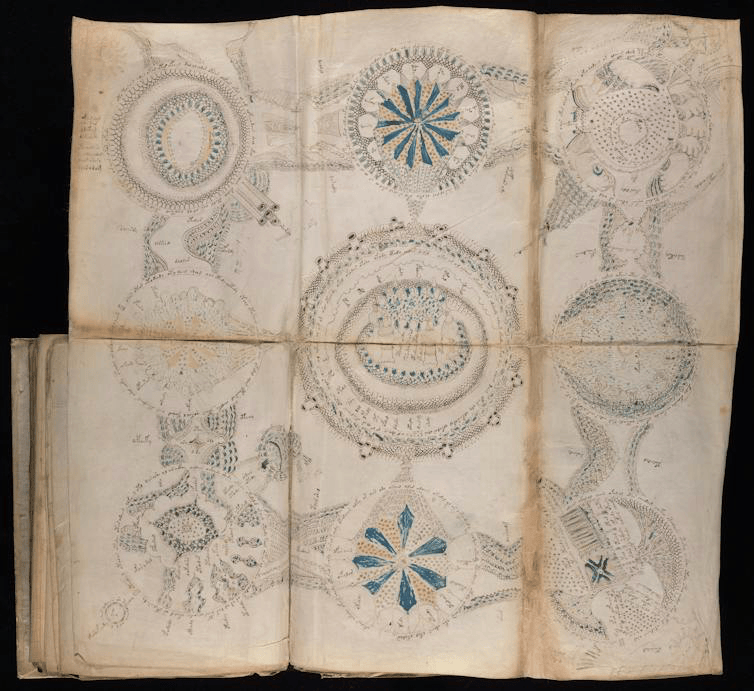
The Rosettes illustration (above) consists of circles, tubes, dots, passageways, castles and a town wall.
An alternative explanation given by Brewer for the drawing above differs from the one provided by Gerard Cheshire (islands and volcanoes).
‘In late-medieval times the uterus was believed to have seven chambers, and the vagina two openings (one external and one internal).
We believe the nine large circles of the Rosettes represent these, with the central circle representing the outer opening, and the top-left circle representing the inner opening. The eight outer circles have smooth edges since they represent internal anatomy, while the central circle has a shaped edge since it represents external anatomy.
Abu Bakr Al-Rāzī, a Persian physician who influenced late-medieval European medicine, wrote that five small veins exist in the vaginas of virgins. We see these [in the image below] running from the top-left circle towards the centre.’
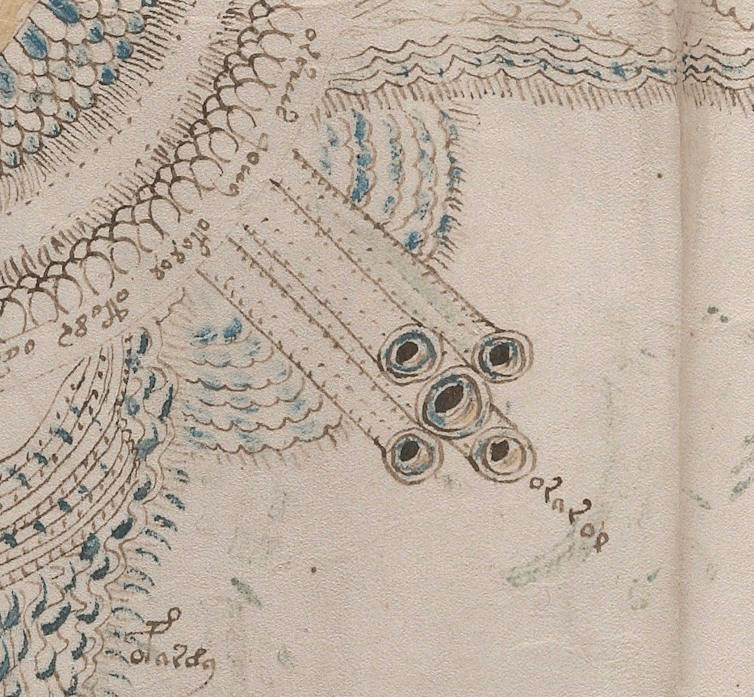
‘Physicians back then also believed a male and female component were necessary for conception, and both of these were called “sperm”. These are shown in yellow (male) and blue (female).
Women were thought to receive pleasure from the motion of the two sperms in the uterus, which is depicted through the lines and patterns. It was also thought the uterus had two horns or spikes, which we can see on the top-right and bottom-right circles.
The castles and town walls may represent wordplay on the German term schloss, which had meanings including “castle”, “lock”, “female genitalia” and “female pelvis”.’
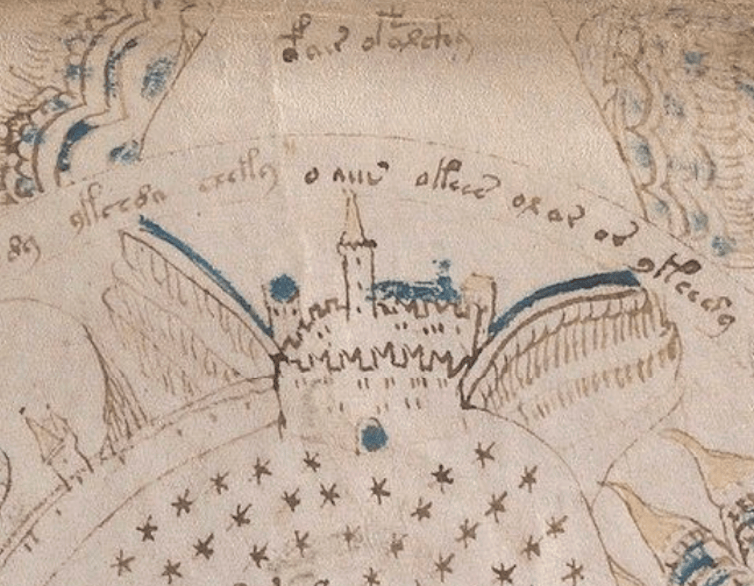
A close up of a castle embedded in the illustration above.
‘And the two suns in the far top-left and bottom-right likely reflect Aristotle’s belief that the Sun provides natural heat to the embryo during its early development [image below].’
‘While many features of the illustration are yet to be understood, our proposal is worth close scrutiny. We hope future research into the manuscript will approach it through a similar lens. Perhaps, with enough clues, we might find a way to finally decode this elusive text.’
An active opponent of the theories presented in recent years including the aforementioned, is Lisa Fagin Davis (born February 24, 1966, as there appears to be doubt in some quarters) – an American medievalist, codicologist (study of manuscripts as cultural artefacts for historical purposes, focusing on their physical structure, materials and features), and paleographer (study of writing and how old handwriting can be read and dated on ancient papyrus, parchment and paper manuscripts). Davis is the executive director of the Medieval Academy of America and adjunct Professor of Library Science at Simmons University in Boston.
Davis is a prominent figure regarding research on the Voynich manuscript and pulls no punches in her oppositional condemnation of each new theoretical explanation.
For example, Lisa Fagin Davis argues that Nicholas Gibbs’ claims about the Voynich Manuscript ‘lack credibility and are circular, as they rely on unsubstantiated interpretations of the text and fail to provide convincing evidence for his theories.’ She has been particularly critical of his assertion that the manuscript is a women’s health manual composed of Latin abbreviations, stating that his ‘logic is flawed and that his translations do not make grammatical sense.’
Perhaps Davis is correct in this instance, For while the preceding summation from Keagan Brewer amplifies the premise – put forth by Nicholas Gibbs – that the manuscript is primarily a health and medical guide for women; it may be substantially more than a manual.
This writer’s curiosity about Davis’ motive was piqued, because of her vociferous defence in keeping the Voynich Manuscript categorised as an unexplained mystery. Is Davis buying time until she can propose her own theory? Surely not… yet her profiting from the lucrativeness of the manuscript remaining undeciphered is undeniable. So it was a surprise on one hand and not on the other, to learn that Davis has her own website: Manuscript Road Trip.
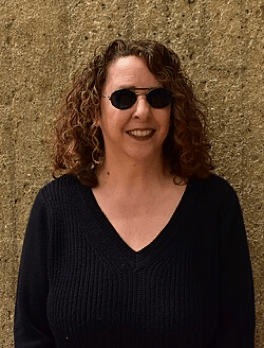
Lisa Fagan Davis
Of which we shall now turn our attention and to her article: Multispectral Imaging and the Voynich Manuscript, September 8, 2024.
Behold, the first sentence says:
“I have some exciting news for all of you Voynich fans! But first, some background about multispectral imaging…”
A simple and recognisable opening sales pitch, aimed at loyal customers and regular buyers of her academic wares.
Yes, one supposes myriad fans would surely peel away in droves, should a solution to the manuscript’s subject matter and its original language, be the result of a prosaic yet logical explanation. Far better to ensure the mystery ball keeps rolling with regular updates which hint of progression but actually going nowhere meaningful.
Regardless, in the interest of fairness (and in seeking answers), let’s hear Davis out.
Lisa Davis:
‘Multispectral imaging is a way of capturing a digital image using non-visible wavelengths such as ultraviolet and infrared… Where medieval manuscripts are concerned, UV imaging in particular can make faded or effaced text legible.
This is because most medieval inks (including that used to write the Voynich Manuscript) have a significant iron component. This allows the ink to “bite” into the surface of the parchment rather than sliding off of it. When ink is scraped away or fades, the molecular bond remains, and the faded text may therefore fluoresce when exposed to UV bandwidths.
Could such imaging of the Voynich Manuscript help reveal [it’s] secrets?’
The article relates how imaging reveals additional markings and the proposal that they were added by one time owner of the manuscript, Johannes Marcus Marci.
Davis:
‘… it turns out there are actually three columns of lettering, not just one! Although others have theorized that there might be more text to the right of the visible alphabet, the lettering has never been clearly seen or transcribed before.
The letters are written in three parallel columns: [1] the Roman alphabet (a-z), [2] a series of Voynich characters, and [3] another Roman alphabet offset by one letter.
My preliminary transcription of these alphabets is shown below.’
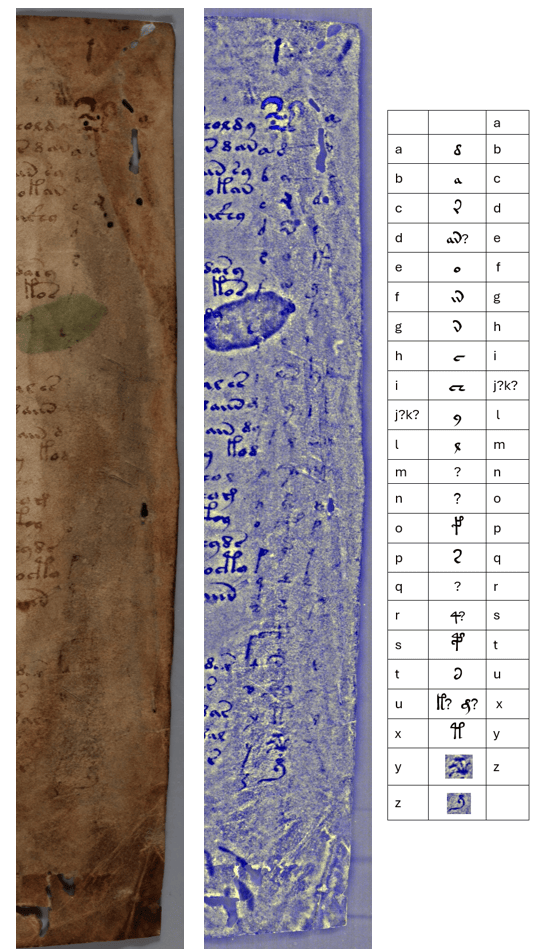
‘Are these alphabets an early attempt to decode the manuscript? Perhaps. The two Roman alphabets are written in what paleographers call “Humanistic bookhand,” that is, the style of writing developed by Humanists like Petrarch and Boccaccio in Italy in the 14th century and used throughout Europe for several hundred years.
I have carefully compared these letters to the handwriting of everyone known – or thought – to have been connected with the manuscript in the 16th and 17th century, including: Carl Widemann, his colleague Leonhard Rauwolf, Emperor Rudolf II, Jacobus Sinapius, Georg Baresch, Marcus Marci, and Athanasius Kircher. I even considered the handwriting of John Dee and… his collaborator Edward Kelley, who were once (spuriously) thought to have been associated with the manuscript.
One of these men is a very good match: Johannes Marcus Marci (1595-1667).’
Davis provides “several very strong markers that help make a convincing case for identifying this script as Marci’s…”
Davis – emphasis hers:
‘The purpose of these three vertical alphabets is not at all clear. Knowing what we know about Marci’s timeline, they must have been added between 1662 and 1665, when he owned… the manuscript. They may represent an early attempt to decode the manuscript using two different substitution ciphers, or Marci may have been using Voynich characters to create a cipher of his own.
Regardless of their purpose, I do know one thing: these alphabets will likely not help us actually decipher the manuscript. This is because linguists… [and] researchers have established that the manuscript is almost certainly not encrypted using a simple substitution cipher, and the substitutions in these columns result in nonsense anyway. Even so, they do add an interesting and new chapter to the early history of the manuscript.’
The article ends with the following – emphasis mine:
“I’ve here recorded only my preliminary thoughts about these images, and I am certain there is much more to discover [in the never ending pursuit of solving the Voynich manuscript].
I look forward to seeing how you, and the community of Voynichologists, contribute to their interpretation. Let’s get to work [super fans, contributors and supporters]!
p.s. In other Voynich news, I was profiled in the September 2024 issue of The Atlantic with an essay focusing on my thirty-year relationship with the Voynich Manuscript. I hope you [super fans, contributors and supporters] enjoy it!”
Yes, join in next week/month for another thrilling instalment and exciting revelation about the Voynich manuscript which incidentally reveals very little.
Davis writes in The World’s Most Mysterious Manuscript, January 17, 2015 – emphasis mine:
‘I won’t deny it. I have been captivated by Beinecke MS 408 since I first laid eyes on it in my “Introduction to Latin Paleography” class at Yale in the fall of 1988.
If you Google the words “Voynich Manuscript,” you will tumble down a rabbit hole into a dark scary corner of the internet full of alien abductions, seances, conspiracy theories, and secrets. You will stumble into heated debates between fellow obsessives who have devoted their lives to this codex. You will discover sub-specialties you didn’t know existed. Follow an innocuous-looking link and you may find yourself face-to-face with William Shatner or Noah Wyle’s Librarian.’
Woe to the person who might offer a plausible – if not comprehensive – explanation.
Davis:
‘The Voynich Manuscript… is written in an unknown alphabet apparently encoding an unidentified language [on this there is agreement at least, though in turn this would rule out any known language such as Arabic, Hebrew or Latin] embellished with astonishing botanical, astronomical, and biological illustrations. Cryptologists and mathematicians and linguists worldwide have been studying this manuscript for hundreds of years, and no one has ever offered a satisfactory solution to the enigma that is the Voynich.’
And long may that last as Davis’ concluding comments tellingly reveal.
Davis:
‘I gave up trying to decipher the Voynich Manuscript a long time ago.
But I keep the PDF on my tablet and visit it from time to time. I collect terrible and not-so-terrible Voynich fiction. I scour the internet for new, credible discoveries. I marvel at indecipherable words, tiny women in wicker baskets, unidentified plants, and uncharted constellations.
I kind of hope The World’s Most Mysterious Manuscript stays that way.’
As Davis says:
‘I am not trying to “solve” [the Voynich Manuscript], but to study it as a medieval object.’
But at the same time challenge every single new interpretation or study which endeavours to ‘solve’ it… in a comprehensive – it must all be right or all be wrong – manner; thereby conveniently ignoring and dismissing any singular details which may have merit and are worthy of continued investigation and discussion.
The website (with a link) recommended by Stephen Bax, contains a comprehensive investigation of the Voynich Manuscript, and is compiled by René Zandbergen over the course of many years. Of considerable interest are their own views, expressed in an epilogue.
René Zandbergen, May 6, 2025 – emphasis mine:
‘It may seem as if the ultimate question about the Voynich MS is: “what does it say”.
Of course, if the text of the MS has a meaning, this will be of some interest, but at least an equally interesting question should be the context of its creation:
- Why was it done?
- What was its purpose?
- How does it fit in its time?
Unfortunately, there have only been relatively few scholarly investigations into the origin and the meaning of the MS.
Most of the Voynich MS translations that have been presented until now propose a ‘decoding’ of the text from cipher text into plain text, and work in the following way:
1. Present a decoding method, which includes an assumption about the plain text language (possibly based on some observation), and the steps needed to convert the Voynich MS characters to this;
2. Apply this procedure to a section of the Voynich MS text and present the result. This typically (read: always) produces a raw text that is not directly meaningful or understandable;
Convert this raw text into something more or less understandable using various interpretations and explanations. We may call this the clean text
3. While this may not seem like a bad approach at first sight, we need to imagine the person who, in the early fifteenth century, composed the text of the Voynich MS. We should imagine that he intended to write the clean text mentioned in bullet 3 above, but instead of doing that, he wrote the raw text of bullet 2. Our proposer of the solution never explains this weird aspect.
The MS author then supposedly converted this garbled or even meaningless text, using the inverse of the ‘decoding method’ of bullet 1, and wrote it in a strange alphabet.
Is this realistic? I do not think so.
In reality, we do not even know if the Voynich MS represents a meaningful text. What we do know for certain, however, is this:
Some time in the past, somebody or some group of people sat down and generated the text of the Voynich MS using some method.
This may seem trivial but, in reality, it is fundamental. There may or may not be a decoding method (step 1 above), but there certainly was an encoding or rather text generation method.
Anybody who wants to present a Voynich MS solution should present the method how the text that we see in the MS was generated. The main advantages of this approach are:
- this method certainly exists and was really used by someone in the fifteenth century;
- this approach works both in the case that the text is meaningful, and in case it is meaningless.
This text generation method should then explain the properties of the Voynich MS text that have been reported extensively in the past, and have been summarised to some extent in the text analysis section of this site. Most particularly, it should explain the peculiar word structure, and the variations in ‘language’ throughout the various sections of the MS.
If a proposed solution suggests that the MS represents a meaningful text in some language, a critical test will be to convert a real, documented piece of text from the proposed area, time frame and language into Voynichese and then show that this generated text exhibits the above-mentioned properties of the Voynich MS text.
I do believe that the MS is from the wider Alpine region, possibly, but not necessarily what is now Northern Italy, as has been suggested many times. The herbal manuscripts to which the Voynich MS is most similar in style all originate from Northern Italy: the Italian branch of the Tractatus de Herbis and to a lesser extent the alchemical herbals.
Recent work published by contributors at the blog of Stephen Bax has shown that the zodiac illustrations in the Voynich MS fit in a style prevailing in South German manuscripts of the entire 15th century, so I remain undecided whether the place of origin is rather North or South of the Alps.
To me, the Voynich MS looks like a very intentional creation, and it looks like the work of one ‘brain’. Now this appears to go against the recent evidence by Lisa Fagin Davis that there appear to be five scribes involved in the MS. I do trust that analysis, and I find that this can be reconciled quite easily, by assuming that there was one originator of the work, who obtained the help of four or five people to write it down, based on instructions or by copying it from a draft [agreed].
There are indeed signs that the MS has been copied from a draft. There is even a hint that the copyist(s) did not understand what he was copying.
All in all, the evidence for this is quite thin, so I am ready to change my mind on this point.
The work of Prescott Currier, who identified two (or more) hands and two languages, is often quoted. With respect to the two different languages, I would maintain… there aren’t really two different languages, but there is a continuous, though relatively quick, change in language. Currier’s conclusion seems to derive from the fact that he based his original classification of two languages primarily on part of the text only, and he did not reconsider this classification at the time that he assigned each page of the entire MS to either language A or language B.
The more we go back in time, the less we know. The earliest solid information we have is provided in Marci’s 1665 letter, referring to Rudolf’s reported acquisition of the MS, around 60 years earlier. More recent evidence provides a realistic guess about the identity of the seller to Rudolf (Karl Widemann), and even the name of a potential earlier owner (Leonhard Rauwolf). I don’t quite understand why some people doubt the reliability of Marci’s letter. Yes, he was old when he wrote it, but all details in the letter that could be verified in the meantime (his inheritance of Barschius’ library, the fact that Barschius wrote to Kircher) have proven to be correct. Marci’s memory on this topic was just fine at this time.
How would Raphael Mnišowský have known anything about Rudolf’s MS acquisitions? Even if, by profession, he was a lawyer, he was deeply interested in alchemy and secret writing, and he has mentioned his research into Rudolf’s plain text and enciphered manuscripts. For me, there is little reason to discard this evidence for being unreliable.
That he reports the opinion that the MS was by Roger Bacon, which is no longer believed nowadays, does not change that. It is clearly stated to be an opinion and it is not even clear that it is his own opinion. Mnišowský was not yet associated with Rudolf’s court when the MS probably arrived there, but, to add some speculation to this, the famous alchemist Sendivogius was, and they knew each other well.
Sendivogius also corresponded with Rudolf’s courtier Hans Popp, meaning they knew each other… and Popp was the person to whom the mysterious book(s) that Rudolf bought from Widemann was/were first handed over. This is certainly only speculation…
The most evident feature of the Voynich MS text is the word structure. Any proposed solution should properly explain this. So far I can only think of two candidates (none of which are my own idea, by the way), namely a language that by itself exhibits such a structure, or a stroke-based encoding such as proposed by Elmar Vogt.
Languages with such a word structure do exist, though not in Europe. This is basically the Chinese theory as first proposed by Jacques Guy and taken up more seriously by Jorge Stolfi. Originally I [was] strongly opposed to this idea, but I now feel that it would be wrong to discard a priori. Who knows…
Now the structure is not very rigid, and some words do not fit the structure at all. (Of course, there are likely to be errors in the text.) In my opinion there is an interesting possibility, which I will still follow up whenever I have time. This is (assuming that the text is meaningful) that, regardless of the manner in which the encoding was done to generate the word structure, some words, for example proper names of things or… people, were encoded using a simple substitution. So far, I have only two candidate words for this. I will write more about this sometime in the future.
The MS has several different sections: herbal, astronomical, zodiac, biological, cosmological, recipes. What is usually referred to as pharmaceutical for me is just another herbal part. It is not unusual for medieval and later [MS’s] to have several herbals combined into one MS.
Now this brings me to the question: are these independent works, bound together, or are they part of one common philosophy? I find the latter idea attractive.
The zodiac has 360 labelled nymphs, one for each degree of the ecliptic.
The recipes section at the end has, if I counted correctly, 324 starred recipes, but there is an indication that pages are missing, so there could have been more.
The pharmaceutical pages have about 240 drawings with labels, but again there is a hint that this is incomplete and possibly pages are missing. Many pharmaceutical drawings are more-or-less simplistic versions of herbal drawings in the MS.
In the biological section there are lots of labelled nymphs populating what looks like organs of the human body (several per organ).
In short, I am attracted by the idea that there is an overall philosophy, linking to each degree of the zodiac one herb, one recipe, and maybe even one part of the body. I am looking for evidence for this, but for the moment, this is just an idea, no more. It may be the next one that I need to give up.’
It is difficult to fault Zandbergen’s logic or his conclusions. Particularly when remembering he like Lisa Davis, has had many years in which to ponder the Voynich Manuscript’s mysteries.
Epilogue:
How/when did you first find out about this MS?
Zandbergen:
‘In the earliest days of the internet, there was a thing called “Usenet” in which people could post information in groups dedicated to various topics, including news, sports, culture, science, etc. One such group was called “sci.sceptic”, and it dealt with scepticism about unexplained phenomena in general.
Probably in 1993 I was struck by the mention of a medieval MS of more than 200 pages that could not be deciphered. There was a link to an ftp site (by Jim Gillogly) that had two illustrations. In particular, the B/W image of part of the text of f3v attracted me, and I thought that I might be able to read it.
It was 1995 before I could join the internet mailing list that had recently started, and I followed all discussions. By 1998 I decided that there was a clear need to have a common repository for all information, and started the present web site, originally hosted by “Geocities”.’
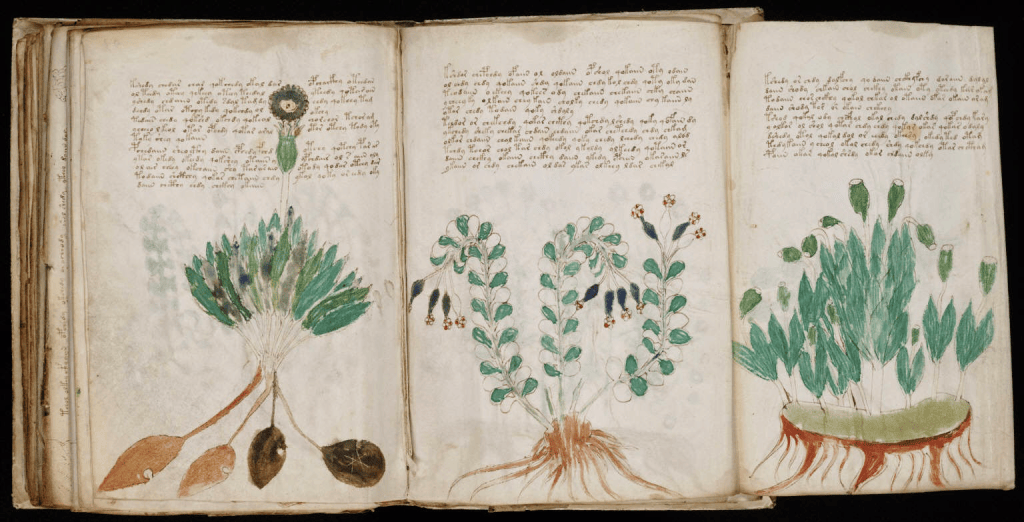
On History Hidden website an article – Has the Voynich Manuscript Finally Been Decoded? (November 19, 2025) – provides a number of additional details of interest.
‘Every “breakthrough” since 1912 has either been peer-reviewed into oblivion or quietly retracted…’
The manuscript is divided into six thematic clans:
‘botanical, astronomical, [cosmological,] balneological (bath-time…), pharmaceutical, and recipes…’
Herbal 1-66: Fantasy plants, blue roots, dragon leaves
Astronomical 67-73: Suns, moons, zodiacs with 29½-day cycles
Cosmological 86-89: Nine-fold fold-out map
Balneological 90-103: Nude nymphs in green baths
Pharmaceutical 103-117: Jars, mortars, apothecary tools
Recipes 118-240: Short paragraphs, star bullets
Regarding a Lunar (Moon) 29 1/2 day cycle, refer article: The Calendar Conspiracy.
Perhaps there is an association beyond just a physical synchronisation of a lunar cycle with a woman’s menstrual cycle of approximately 28 days.
‘A Glimpse Through Time: The Manuscript’s Provenance and Journey
1. 1404-1438: Northern Italy, possibly Lombardy – radiocarbon confirmed [In 2011, Arizona Accelerator Mass Spectrometry Lab snipped 4 mm of vellum with 95% confidence]
2. ~1583: Bought for 600 gold ducats by Holy Roman Emperor Rudolf II – equivalent to 14 kg of gold today.
3. 1580s-1600s: Passed to John Dee (… the spy-astrologer who inspired Doctor Strange [refer article: The Shakespeare Shadow]) and later to his shady colleague Edward Kelley…
4. 1666: Donated to Athanasius Kircher, Jesuit scholar, who tried (and failed) to crack it.
5. 1912: Wilfrid Voynich, Polish-Lithuanian book dealer, snaps it up in Villa Mondragone, Italy.
6. 1969: Beinecke Library acquires it via Hans P. Kraus, the “king of rare books”.
We ran every Voynich plant through Pl@ntNet AI – the app returned “no match” [92%] of the time.’
Very strange… aliens anyone? Or plants used to symbolise secret meaning?
‘The Pleiades star cluster appears upside-down and mirrored. Medieval astronomers copied sky charts by hand, but never this sloppily. One theory: the illustrator was looking through a camera obscura – a [technology] supposedly unknown until 1550.
Spooky, right?
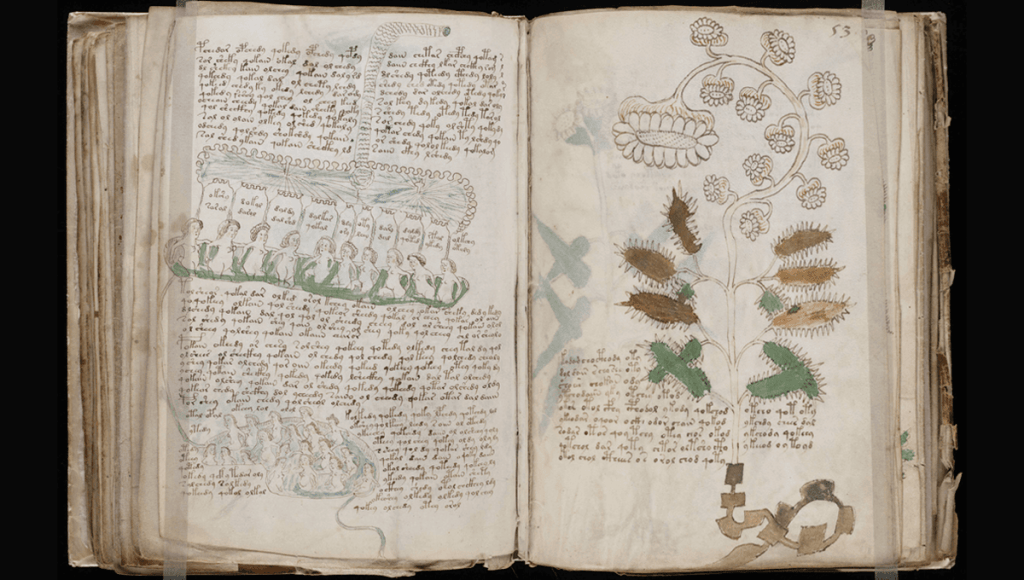
Folio 75r shows five naked women clutching see-through tubes that snake into a green liquid. Are they performing an enema ritual? Medieval spa day? Or coded childbirth instructions? [or genetic experimentation?] … [and] ovary-shaped bathtubs – but midwifery historians point to Trotula of Salerno’s [12th century] manuals with similar roundels.
We brewed one “Voynich recipe” (as translated by the 2019 German Egyptologist claim) using parsley, wormwood, and saffron. Result? A bitter, fluorescent-yellow tea that tasted like liquid lawn clippings – zero medicinal buzz.
Conclusion: either the code is still encoded, or the original author had a masochistic palate.
Voynichese has 20-30 unique glyphs, yet word frequency follows Zipf’s law – a hallmark of real language, not random gibberish.’
Zipf’s law, named after an American linguist George Kingsley Zipf, who first proposed the law: is an empirical law that often holds when a list of measured values is sorted in decreasing order. In which an item’s frequency is approximately inversely proportional to its rank, often written as f(r) ≈ 0.1/r for word frequencies in English.
Thus the value of the nth entry is inversely proportional to n. The frequency of the nth ranked item can be expressed as: f(n) ≈ C/n^s where C is a constant and s is typically close to 1.
The best known instance of Zipf’s law applies to the frequency table of words in a text or corpus of natural language. Namely, it is usually found that the most common word occurs approximately twice as often as the next common one, three times as often as the third most common, and so on.
‘But syllable clusters repeat up to 3× more than Latin or Hebrew. Think “lorem ipsum” on steroids.’
Lorem ipsum, means a placeholder or dummy text used in typesetting and graphic design for previewing layouts. It features scrambled Latin text, which emphasises the design over content of the layout.
| Hypothesis | Pros | Cons | Verdict |
|---|---|---|---|
| Ciphered Latin | Abbreviation system exists in 15th-c. medicine | No crib matches with known Latin texts | ❌ |
| Constructed Language | Zipf compliance, internal consistency | No descendant languages found | ➖ |
| Talismanic Hoax | Kelley’s scamming profile, Rudolf’s obsession | Expensive materials, complex stats | ➖ |
| Micrographic Art | Letters hide tiny drawings | No magnification needed in 1400s | ❌ |
‘A Century of Attempts: Famous Failures and Fleeting Hopes
1921: William Newbold claimed shorthand** Latin [1] – debunked when John Matthews Manly showed the “shorthand” was random ink bleed.
1944: Joseph Feely argued Romanian – peer reviewers called it “linguistic pareidolia.”
2004: Gordon Rugg’s Cardan grille theory – clever, but produces text statistically unlike Voynichese.
2017: Nicholas Gibbs told The Times it was a women’s health manual in Latin [2] abbreviations** – Latin scholars replied “pretty much nonsense.”
2019: David [Gerard] Cheshire ([University of] Bristol) pushed proto-Romance [3] – retracted within weeks for “botched research”.’
Judging by the discussion and evidence presented so far, natural languages such as Latin, Hebrew or Arabic and even an earlier version of Latin (proto-Romance) are not the correct solution – and can be effectively ruled out. Nor are abbreviations of known languages the right answer either.
This then points towards an unknown, unnatural, coded language. Deliberately constructed for the purpose of the manuscript. If this is correct, this then leans to the content of the Voynich manuscript being more meaningful – comprising secretive esoteric/occult information – than merely a manual of women’s health with ‘simple’ healing recipes and medical procedures.
‘Enter Rainer Hannig, [German] philologist at Philipps-Universität Marburg. In 2020 he announced Voynichese = Hebrew with shifted phonetics.
He translated folio 1r as “The harvest of the herbs is the beginning of wisdom.”
Nice, but Hebrew linguists like [Professor] Yishai Neuman found “more gibberish than grammar” and liberties with vowels. Hannig’s paper is not yet peer-reviewed.’
Interesting that Hannig should conclude on medieval Hebrew – ‘hidden by a complex anagrammatic cipher, potentially containing both medical and mystical knowledge’ – just as the Canadian computer scientists from the University of Alberta, using AI did.
That said according to our findings above, Hebrew is not the encoded language behind Voynichese.
‘Rule of thumb:
if a decipherment isn’t reproducible by three independent scholars within 12 months, file it under “fun but fake.”
As Lisa Fagin Davis (Medieval Academy of America) quips:
“Another day, another dubious claim that someone has decoded the Voynich manuscript.”
We agree – extraordinary claims require extraordinary transliterations.
The Verdict from Academia: What the Experts Are (Mostly) Saying.’
Claire Bowern: Yale (Undecided) – “Statistical patterns are language-like, but no lexicon maps cleanly.”
Greg Kondrak: Alberta (AI hopeful) – “Hebrew-like candidates score highest, but cribs elude us.”
Nick Pelling: Independent (Hoax-leaning) – “Provenance is perfect for a Kelley context is too clean for natural language.”
Nick Pelling’s point is important. The manuscript text is too clean (uniform) for a natural language – agreed. But a created, artificial language could exhibit a too perfect text and letter pattern.
‘Why Definitive Proof is So Elusive.
1. No bilingual inscription (think Rosetta Stone).
2. Illustrations are allegorical – no direct labels (“this is a rose”).
3. Scribe used multiple pens – glyph shapes drift, making consistent transliteration nightmarish.
4. Confirmation bias is candy for the internet – everyone sees their own hobby-horse language.
Computational Linguistics and AI: New Tools for Old Puzzles.
1. Greg Kondrak & Bradley Hauer ([University of] Alberta) trained LSTM neural nets on 380 translations of the Universal Declaration of Human Rights – Hebrew emerged as top candidate with >50 % bigram overlap.
2. Marcelo Montemurro & Damián Zanette found Voynichese word-frequency clusters match known languages’ entropy curves – but differ in “burstiness”.
3. Citizen-science: Zooniverse’s “Decrypting the Voynich” lets you tag glyphs; >12 000 volunteers already logged 1.3 million annotations.
Paleography and Art History: Clues from the Illustrations.
Tilia style hats on folio 70r match Milanese fashion plates circa 1425.
Ultramarine + vermilion palette mirrors Visconti-Sforza court manuscripts.
Conclusion: whoever wrote it had deep pockets and access to luxury trade routes.
Responsible Research: Navigating the Hype and the Hoaxes
Red flags when evaluating claims:
1. No open data ➜ walk away.
2. Press release before peer review ➜ sprint away.
3. YouTube monetisation ➜ bring popcorn, not credit card.’
| Is it a hoax? | 40 % probability | Learn Edward Kelley’s angel-diaries; compare entropy curves |
| Which language family? | Semitic > Turkic > Isolate | Contribute transliteration to interlinear.mpi.nl |
| Meaning of the nymphs? | Obstetrical or alchemical | Tag body-postures on Zooniverse |
| Best software to start? | Voynich Information Browser (VIB) | Download here |
Main theories according to History Hidden about the manuscript’s language include:
1. Ciphered natural language (e.g., Latin or Hebrew with a complex code).
2. Constructed/artificial language designed to mimic natural language patterns.
3. Hoax or meaningless gibberish created to fool collectors or patrons.
4. Unknown natural language lost to history.
‘Each theory has pros and cons, but no consensus exists.
AI and machine learning have provided statistical analyses and pattern recognition that suggest the text behaves like a real language. For example, neural networks have identified Hebrew-like patterns, but AI has yet to produce a meaningful, verifiable translation. The technology is promising but not a silver bullet.’
It is the view of this writer that number two is the correct (or closest) theory in deciphering the manuscript’s text.
Hypothetically, if one’s first language was French and they constructed a new coded language, it would not necessarily (have to) be based on French. In this case, it isn’t definitively based on Hebrew or Latin. Though could a French language mind set find its way into nuances of the code? Yes it could. Just as Hebrew has in the Voynich Manuscript.
The fact that Hebrew is routinely highlighted by AI as an underlying language, clearly doesn’t reflect Hebrew inspiration in the literal manuscript; but rather, an influence on the text which stems from its author being an able Hebrew scholar, who in choosing to write a coded language, resulted in a faint resemblance with Hebrew grammar and structure – as opposed to an exact similarity if he had intentionally based the text on Hebrew.
The aspect of the manuscript noticed by researchers incurring the use of both Latin and Arabic words is a legitimate discovery if the self same scholar based descriptions of stars on original Arabic names and of the known flora reproduced in the manuscript on their Latin names.
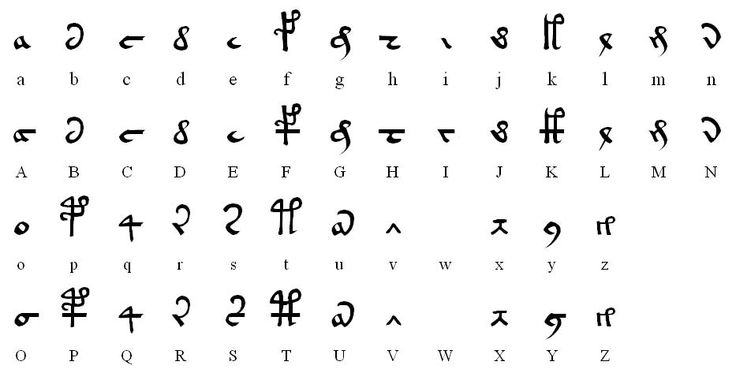
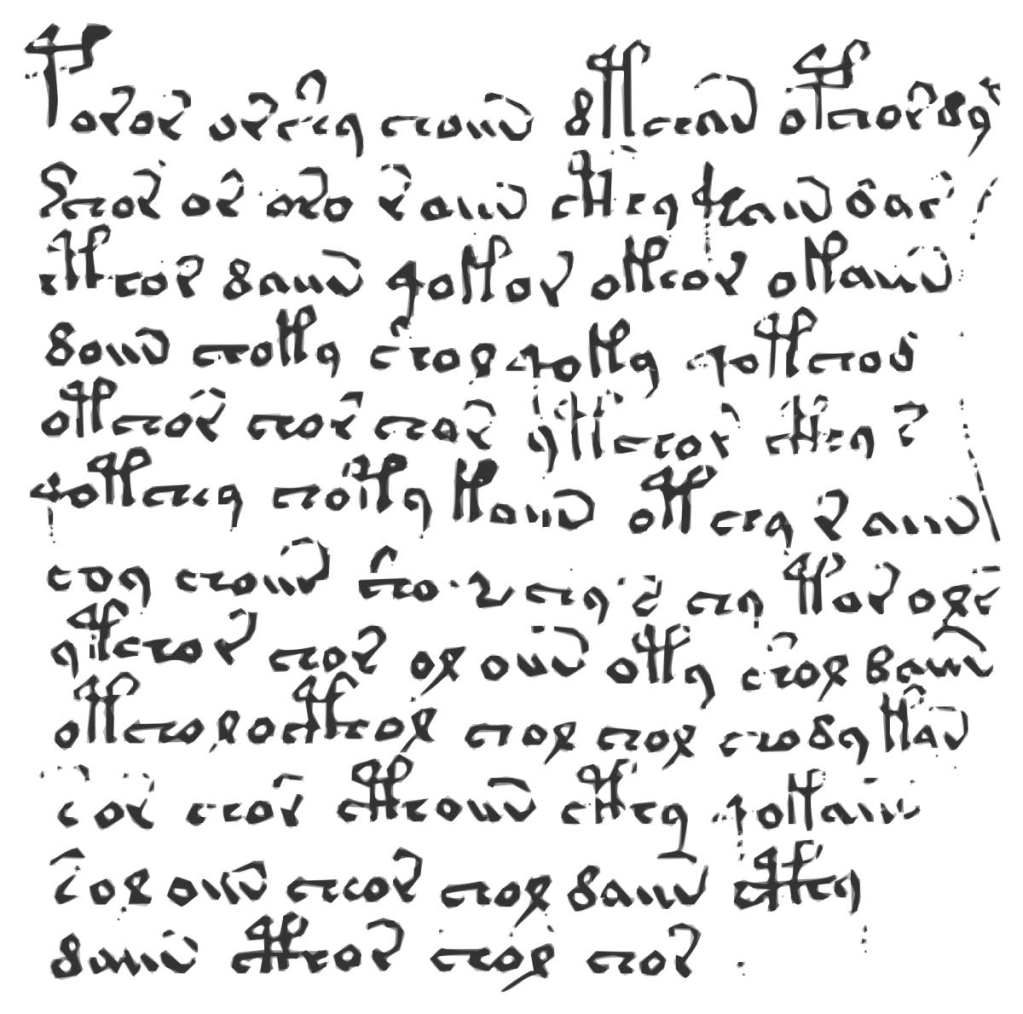
The Extensible Voynich Alphabet (EVA) used to transliterate Voynichese into the Latin alphabet
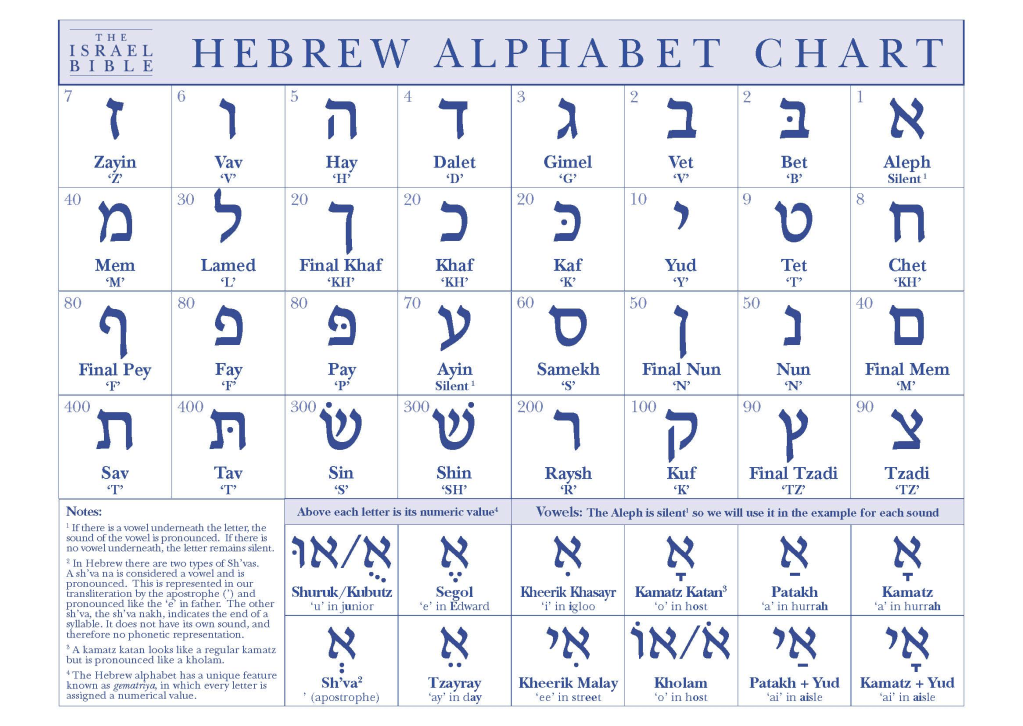
Comparing Hebrew letters with Voynichese letters bears some resemblance.
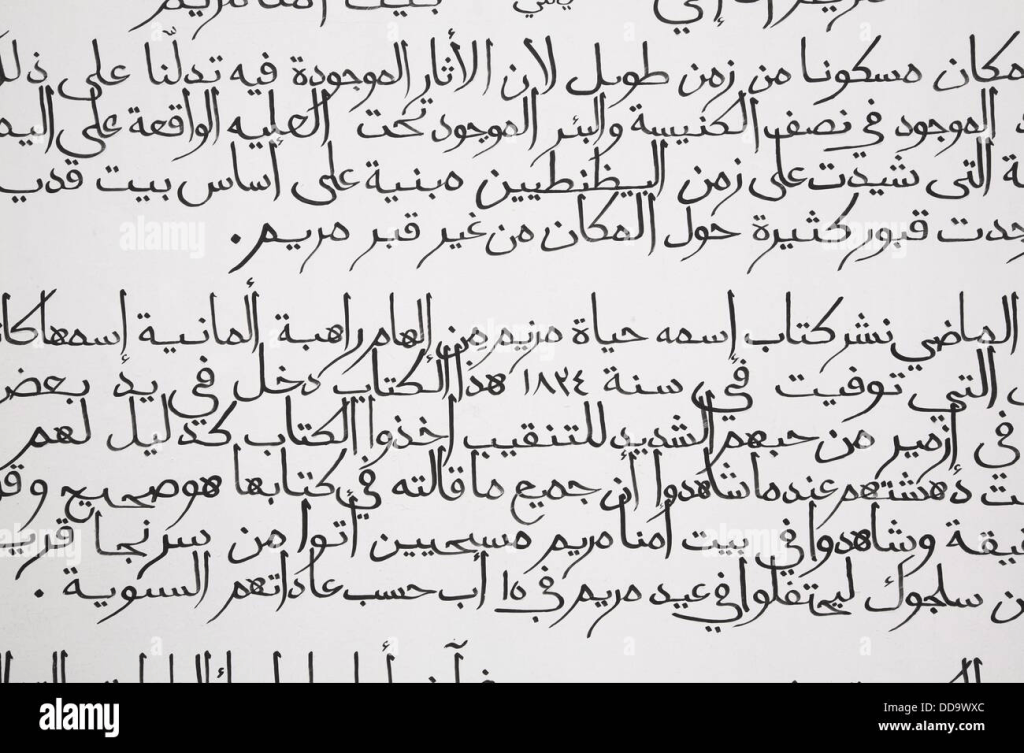
On the other hand, comparing Voynichese with Arabic script is interesting and bears closer scrutiny.
History Hidden:
‘Recent advances include:
1. Radiocarbon dating confirming the vellum’s age (early 15th century).
2. Pigment analysis revealing expensive materials like lapis lazuli [argues against a simple forgery].
3. AI-based linguistic studies suggesting Semitic [Arabic, Hebrew] language affinities.
4. New claims by scholars like Rainer Hannig proposing Hebrew-based translations, though these remain unverified.
The manuscript reflects medieval European interests in herbal medicine, astrology, and alchemy. Its provenance connects it to Holy Roman Emperor Rudolf II’s court, a hub for esoteric knowledge.’
Breakthroughs are discussed on Mysterious Realms one day after the preceding article.
Voynich Manuscript Decoded: The 2025 Breakthroughs Revealed, November 20, 2025 – emphasis mine:
‘… a 2025 study achieved what many thought impossible: a partial decoding of the script. Researchers Agnese Faccini and Gino Caspari proposed that the Voynich alphabet is not a complex cipher but a form of shorthand for a vernacular Italian dialect… reframing the manuscript as a pharmacopoeia or herbal manual, with a focus on women’s health and botany.
This development suggests the document’s purpose was functional and mundane rather than mystical, created to record recipes and knowledge in a condensed, private format.
For instance, words identified as ingredients or processes correspond logically with the drawings of herbs being mixed in containers.
Their partial decoding has successfully identified key plant names like “hellebore” and “saffron,” connecting the cryptic text to its botanical illustrations for the first[?] time.’
Recall the first paper to be referenced, A proposed partial decoding of the Voynich script (2014) by Professor Stephen Bax of the University of Bedfordshire.
Bax already identifies and matches hellebore, otherwise known as Dungwort in the manuscript.
‘This system would have allowed for rapid writing, explaining some of the script’s repetitive [word structures] and unusual [letter] features. By translating sections and identifying plant names consistent with the region, [the] work represents the most significant progress yet in understanding the manuscript.’
Thus interestingly (yet likely incorrectly), the conclusions drawn by Faccini and Caspari follow in the footsteps of Nicholas Gibbs (the manuscript being a scientific, medical journal written in shorthand) and Gerard Cheshire (the manuscript being written in a related Romance language).
Conversely, returning to the investigations of Rainer Hannig and the University of Alberta.
Mysterious Realms:
‘The AI concluded that the manuscript is not written in a unique language but is medieval Hebrew concealed by a multi-layered cipher.
By analyzing letter frequency and positional data, the system identified patterns indicative of complex anagrams, where letters within words are systematically scrambled. This approach differs significantly from previous linguistic analyses, as it treated the text as a complex puzzle rather than a straightforward language.
The discovery suggests the author used a “proto-algorithm” to encrypt information, a method the AI was trained to recognize.
This Hebrew cipher hypothesis offers a new way to interpret the manuscript’s mysterious illustrations. Researchers now believe the botanical and pharmaceutical sections could represent a lost herbalist’s guide, with plant names and recipes hidden in the anagrams. The astronomical and cosmological diagrams might similarly encode mystical or Cabalistic concepts, a common practice in medieval Jewish scholarship.
This theory would explain why decades of efforts to align the script with European languages consistently failed, as the underlying structure was not what it appeared to be. The AI’s preliminary translations suggest a text combining both practical medicine and esoteric knowledge.
… the Hebrew cipher model remains the most comprehensive explanation to date, as it accounts for both the script’s statistical oddities and the manuscript’s thematic content.’
The Great Debate: Italian vs Hebrew
‘… Agnese Faccini and Gino Caspari… argue the text is a medical treatise focusing on topics like herbal remedies and gynecology, created for a primarily female audience. This interpretation aligns remarkably well with the manuscript’s famous botanical and “balneological” illustrations, which depict women in various therapeutic baths. Their partial decoding of the Voynich alphabet suggests a system where symbols represent abbreviated Italian words and phonetic sounds. This theory presents the Voynich not as an unbreakable cipher, but as a practical, albeit unusual, document from 15th-century Italy.
… a competing theory from a team at Tel Aviv University suggests the manuscript is written in a lost dialect of medieval Hebrew. Using advanced AI pattern recognition, their model identified grammatical structures and word frequencies consistent with Hebrew, but heavily influenced by Aramaic and Latin loanwords.
Proponents of this view interpret the astronomical sections as Kabbalistic charts and the botanical drawings as symbolic representations of esoteric concepts, rather than literal plants.
They argue that the Italian theory fails to account for the manuscript’s more mystical illustrations, which fit more comfortably within a framework of Jewish mysticism.
This divergence is at the center of the current debate: whether the Voynich is a practical scientific text or a complex work of religious esotericism.’
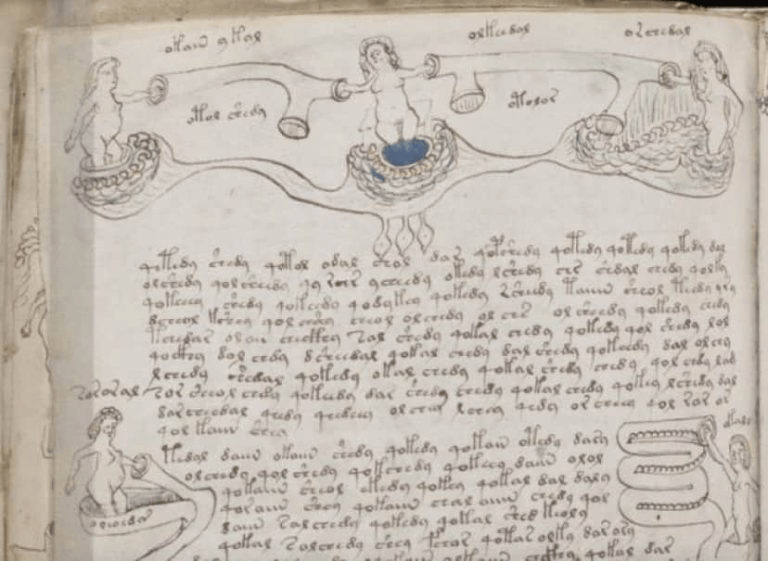
Why could the manuscript not contain both elements? Some illustrations definitely appear to relate to a practical (health and medicinal) application or procedure; whilst others which are clearly not literal to an esoteric and hidden purpose.
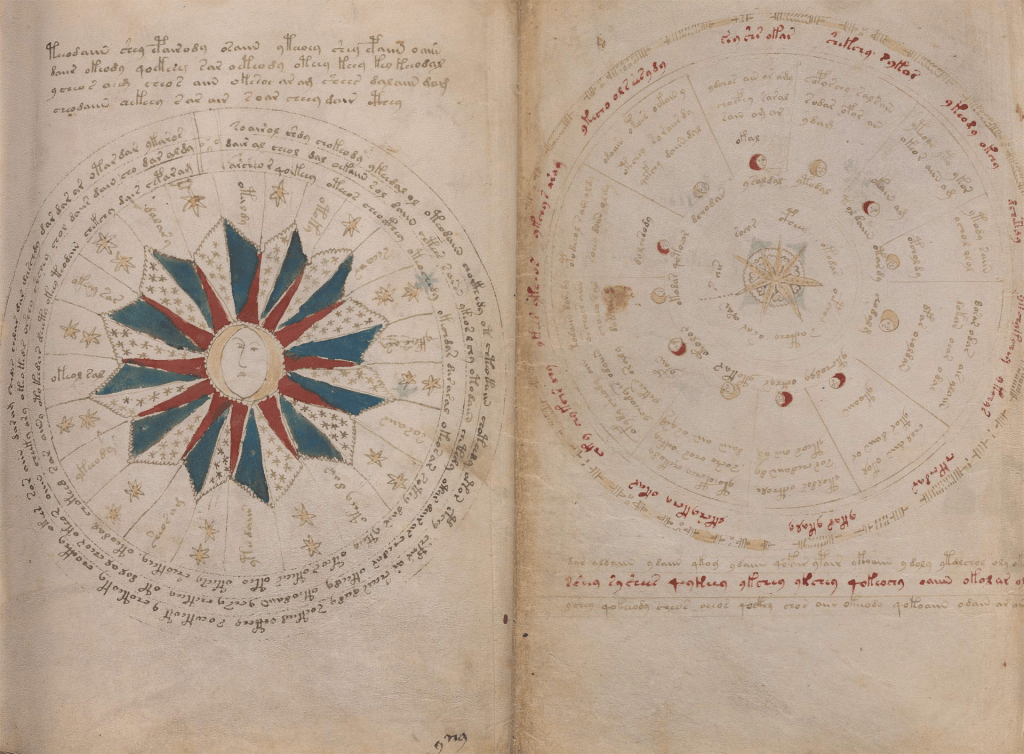
Archaeology News discusses a recent study by Michael A Greshko (2025), The Naibbe Cipher: a substitution cipher that encrypts Latin and Italian as Voynich Manuscript-like cipher text, Cryptologia, 1-37.
A new study suggests the mysterious Voynich Manuscript may be a medieval cipher, Dario Radley, January 3, 2026 – emphasis mine:
‘A recent peer-reviewed study published in Cryptologia… shows that the manuscript could plausibly have been produced using a cipher that was within medieval technological capabilities. The work was conducted by science journalist Michael Greshko, who wanted to test whether a historically realistic encryption system could generate text with the same unusual statistical features seen in the Voynich Manuscript.’
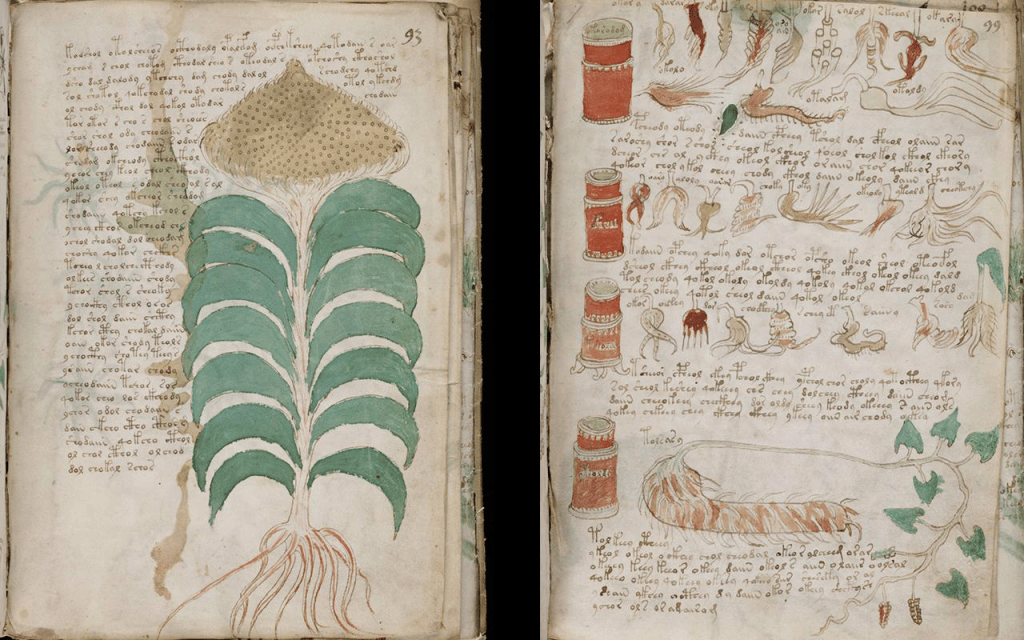
‘The outcome is a proposed method, termed the “Naibbe cipher,” the name derived from a medieval Italian card game. Instead of decoding the manuscript, the cipher goes the opposite way: It takes ordinary Latin or Italian text and turns it into glyph sequences that closely resemble Voynichese.
It does this by breaking continuous text up into short groupings of letters and then substituting them using structured tables, with elements of randomness introduced through tools such as dice and playing cards – objects that were widely available in 15th-century Europe.
Applied to a variety of sample texts, the Naibbe cipher produces outputs that match many of the key properties of the Voynich Manuscript… What is more, the method preserves fragments of the original linguistic structure in the form of short letter sequences, even though no single glyph consistently corresponds to a single plaintext letter.
The results indicate that the long-debated “cipher hypothesis” remains viable. The study simultaneously constrains what such a cipher would have looked like: any real system underlying the manuscript was highly complex and quite unlike conventional substitution ciphers.
The research also allows for competing interpretations, saying that the text shows a constructed system, an unknown language…
The research serves to sharpen the questions future studies must address by showing that a hand-executable cipher can replicate many of the manuscript’s quirks.’
As of similar interest or perhaps even more so, are some of the comments in response to Radley’s article. They give pause for thought for widely diverging reasons.
Mike Osarogiagbon:
‘is it real.’
Paulo Cesar da Silva Maciel:
‘Based on my professional experience as a doctor and my studies in the areas of Alchemy and Mysticism, the conclusion I have reached seems unique so far, but at the same time the most probable:
Whoever wrote and illustrated this Voynich Manuscript was a schizophrenic with delusional ideas who decided to publish it as if it were new or secret knowledge! I study many things, including Ufology, and I participated in a Ufology Congress where one of the speakers wrote a book recounting his trip to Saturn’s moons, and he wrote in the book the languages of those peoples and spoke them fluently!
The strongest evidence in this regard is the total absence of the drawn plans and the inconsistency of the written language: they have no logic or coherence, which may demonstrate the author’s psychotic episode!’
Ron Elam – emphasis mine:
‘William F. Friedman and his team in the 1940s and 1950s determined that the text was not generated by a substitution cipher.
In 1976, Prescott Currier demonstrated that the manuscript text does not fit that of any natural language.
In 2007, Jorge Stolfi and Gabriel Landini determined that text was generated based off of neighboring text by changing a glyph here and there.
In 2013, Marcelo Montemurro and Damián Zanette published a paper showing that the Voynich text has some statistical similarities to natural language. But later they demonstrated that this effect can also be produced using meaningless text.
In 2016, Torsten Timm and Andreas Schinner were able to generate similar meaningless text using an algorithmic approach that would’ve been used in the manuscripts creation.
The Cryptologia paper shows that Voynichese-like text was technologically doable in the 1400s. But it doesn’t show that the Voynich Manuscript contains understandable content. This study narrows the field of possible explanations to show that it’s not as if the cipher is too difficult to crack therefore it must be a modern, uncrackable cipher. It shows that its creation was feasible in the 1400s using techniques other than cipher.’
Gabor – emphasis mine:
‘I just decoded it but nobody seems to be interested in it. Yes I used AI as I [don’t] speak [Latin] but I proof checked it as much as I could. I am no scientist and not even a hobby researcher just started off with a silly prompt on gemini. I’d like to share my findings with someone who is invested in it so they can finish it up. I have no capacity to go much further.
What I found:
Its latin with some [Italian] upbeat. The writing is the usual fast writing for the era that lists the consonants only, you have to add the [vowels] yourself. The code is simple, there are some modifiers at the beginning of the words telling you which consonants the word has. The funny endings like iin are decorative noise you have to prune them. If you put this much into gemini and ask it to analyse the text you’ll be surprised how easy it is to get going. I have a dictionary of the words I cracked. I tested it in different parts of the script and it is always constant and resulting in proper sentences.
The book itself is a medical book, it talks about healing processes, plants that can be used to make medicine, the timing of the treatments (this is the astronomy section) it talks about hydrotherapy and how to make the medicine and what they are good for.
I tried some more digging but from this point I couldn’t verify the results so from this it can be off track, although based on analysis it should be correct. So I identified the authors. One of them is Marzio Galeotto. His book De homnie seems to be a softer version of [Voynich]. Some sentences from that book are the same in [Voynich].
Actually after a point I could use De homnis to help with translating words. It makes sense too as on the first page in the manuscript there is a crow [Quire 1, f1r] as a decorative character which was king Mathias’s emblem, all books dedicated to him held that symbol. The other author is the guy that designed the bath system in Buda Castle. I found the names on the first page and the date is 1475. However as mentioned I couldn’t “stress test” these so it might be a misinterpretation.
I am more than happy to share what I have.’
There are no replies to Gabor’s comment.
Josef Zlatoděj (January, 2026) – emphasis mine:
‘What I am writing to you here at the moment is very important. And for all scientists, cryptanalysts, linguists and codebreakers. The Voynich manuscript is written in the old Czech* language. The entire manuscript is encrypted with a special Homophonic Substitution.* Which was used quite a lot in the Middle Ages.
Specifically, it is: The Kabbalistic numerological system of Gematria, in which each character and therefore letter has its own numerical value. The author shows this Homophonic Substitution on folio 2r [Quire 1]. That is, right at the beginning of the manuscript. Anyone who does not know this Homophonic Substitution will never be able to decipher the text of the manuscript. Every scientist who knows and understands what Homophonic Substitution means should be able to understand this successfully.
So if the text is based on homophonic substitution, then all frequency analyses are wrong and therefore can never find out what is actually written in the text of the manuscript.
Next, what is important. So of course, this is knowledge of the old Czech language. Anyone who doesn’t know the old Czech language will never be able to understand what is written in the text of the manuscript. In the text of the manuscript, this warning is written on several pages: I am writing in Czech. Or it is written there: Czech words.
So these are the two* main conditions for some clever scientist to be able to decipher the text of the Voynich manuscript.’
Ron Elam – quoted earlier above – responds:
‘This is not old Czech with homophonic substitution. That theory has been tested since the 1920s and is false. The text of this manuscript meaningless. I can clearly see this based on the repetition of text, which doesn’t occur in natural, meaningful language. If there is a language behind these glyphs, it’s been long proven not to be Czech.’
Zlatodej’s comment is perhaps not so easily dismissed out of hand as Elam has tried to do as we shall learn. But also, Elam raises an important point in that the ‘repetitive text’ points to an unnatural language – which we will address on the final article.
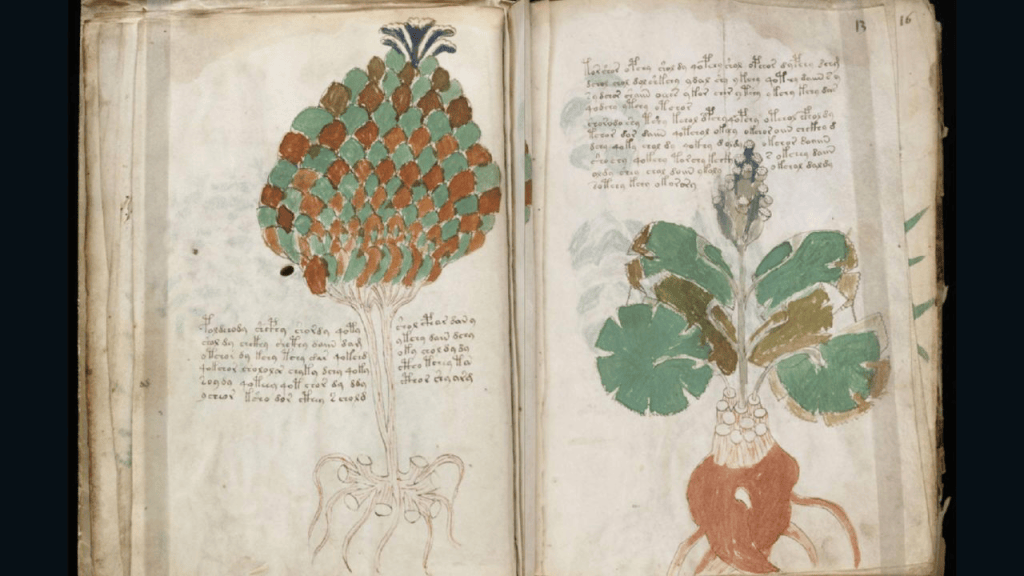
According to Nick Pelling – author of The Curse of the Voynich (2006) – he has translated a line of the manuscript following twenty years research.
Finally, I can read the Voynich Manuscript, January 22, 2026:
The line in question is the f17r [Quire 3] marginalia.
‘Back in 2006, I was hugely fortunate to be allowed by the Beinecke Rare Book & Manuscript Library’s curators to spend a few days working with the Voynich Manuscript. One of the highlights of that trip came when I borrowed their UV [black lamp] to examine the tiny marginalia at the top of page f17r.’

‘To my huge surprise back then, what the UV light made visible at the end of that line was some Voynichese text.
Why was all this important? Because it strongly suggested that there was some kind of direct link between (one of) the marginalia people and the curious Voynichese writing itself… For me, this all suggested that understanding the Voynich Manuscript’s marginalia might not only tell us something about a later owner of the manuscript, it might also tell us about its creator(s).
… back in 2006, I wondered if the third word might be “lutz” (the Occitan word for “light”)… I am now pretty sure that it is Occitan, and that it reads (using a Latin abbreviation style to render the Occitan “lucent”):
meilhor aller lucent ben balsamina…’
Regarding the word balsamina, ‘this is talking about the original (and mythical, almost unobtainium-like) balsam from the East, a plant known not to anyone by actual experience. So this is reporting – medieval herbal-style – on a plant without flowers yielding a kind of resin, and the artist is just guessing at what it might look like. It’s really not a literal drawing of a tree.
And yet a century later, Leonhart Fuchs in his 1542 [History] Stirpium was using the word ‘balsamines’: “Duo Balsamines genera damus”, and the word balsamine was being used in French in 1545 to mean “balsam-like”. So even though this isn’t “balsamina” in its modern sense (e.g. impatiens balsamina), it is a word that is specifically being used to evoke balsam-like qualities. And I think the word we’re seeing at the top of f17r is “balsamina”.
So, my argument here is that the marginalia at the top of Voynich manuacript page f17r is written in Occitan. And guess what? Back in 2006,** I argued long and hard that the Voynich zodiac roundel month names (which also appear to be marginalia) were also in Occitan. So this should, in theory, be the least surprising marginalia language identification ever. And yet I already hear every single Voynich Ninja commenter disagreeing.
Pffft. It is what it is.
It’s Occitan.
If the Voynich Manuscript was written by people who appear to have been writing natively in Occitan, the first thing we should now be doing is looking at every single Occitan herbal-related manuscript from the period, such as BNCF Manuscript Palatino 586.
Roll with it for a change.’
Encyclopaedia:
‘Occitan, also known by its native speakers as lenga d’òc, sometimes also referred to as Provençal, is a Romance language spoken [today] in southern France, Monaco, Italy’s [northwestern] Occitan Valleys and the Val d’Aran in northeast Spain; collectively, these regions are sometimes referred to as Occitania. It is also spoken in the southern Italian province of Cosenza, where it is referred to as Gardiol, which is considered a separate Occitanic language.’
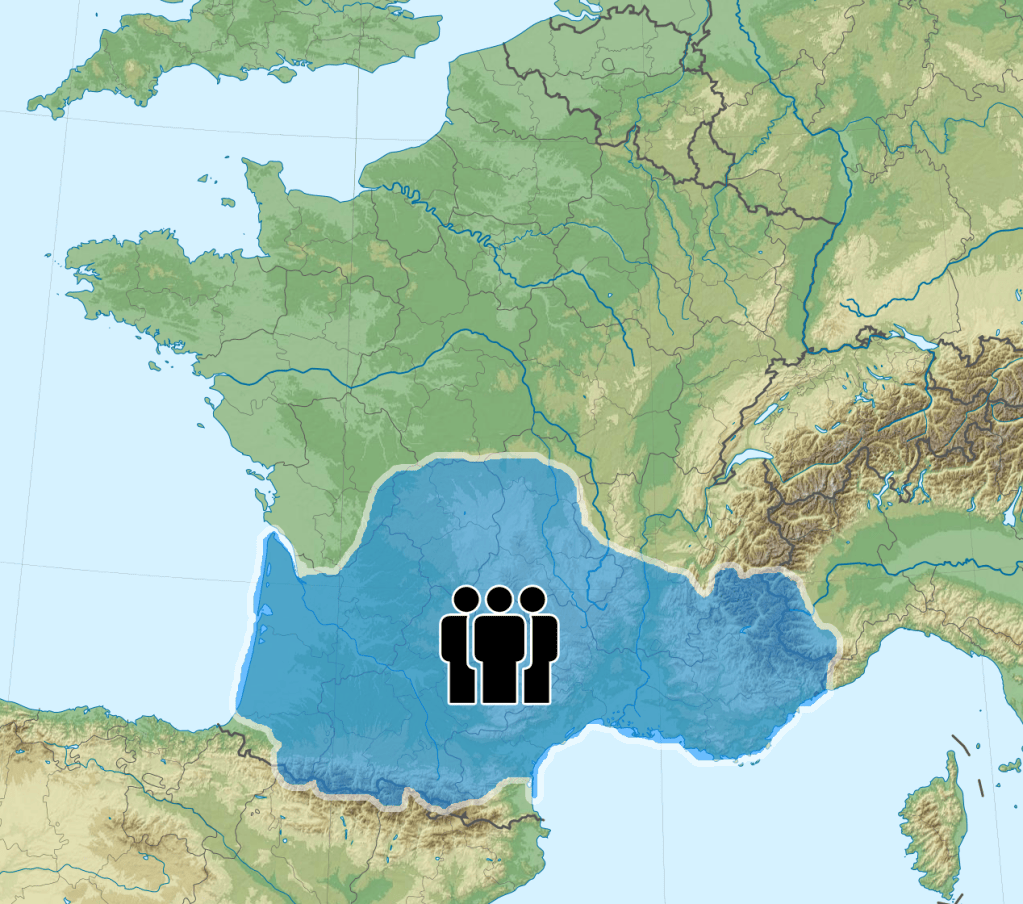
Occitans are also called Gascons, Provençals, and Auvergnats. Since 2006** (coincidently), the Occitan language is recognized as one of the official languages in Catalonia, an autonomous region of Spain – refer Chapter XXIII Aram & Tyre: Spain, Portugal & Brazil; and Chapter XXVI The French & Swiss: Moab, Ammon & Haran.
Pelling’s findings are surely interesting for Occitan is related to Latin and is a Romance language. A reoccurring and persistent theme throughout this investigation. Even so, it – like Latin and a proto-Romance language – is unlikely to be the mysterious coded language of the Voynich Manuscript.
There are many (rather tiresome) comments in relation to Pelling’s article. And Pelling replies to a few if they are critiquing his conclusions. Amongst the responses there is a comment from one Josef Zlatodej – a professor no less – quoted earlier in response to the preceding article.
Professor Josef Zlatoděj (January 25, 2026):
‘Nick [Pelling[ reads it as “Meilhor Aller”, but that’s just another case of modern assumptions distorting a straightforward Old Czech phrase. The third word he transcribes as “allov” is simply substitution no. 3 and reads “a slov”. The whole phrase is “Mal pisu a slov” – in Old Czech, perfectly ordinary for ‘He had writing and words’. Nothing exotic here, no hidden grammar. Just plain Old Czech, provided one actually knows the linguistic context.
… I understand it may look unusual if you approach it through modern orthography, but there really isn’t anything to decipher – only to read.’
What is telling, is that Nick Pelling does not respond to Zlatodej’s challenging comment. Is it because it has been ‘proved’ false as Ron Elam claims?
One can tell Josef Zlatodej is somewhat incensed that he has been ignored, by the detail of his follow up comment on May 21, 2026, where he reprints from presumably his own study.
Beyond the Horizon of Frequency Analysis: Why Modern Cryptanalysis Fails to Solve the Voynich Manuscript.
‘This study critically examines contemporary methodological approaches to deciphering the Voynich Manuscript (MS 408). It highlights the epistemological dead end into which current academic teams have driven themselves by uncritically relying on artificial-intelligence algorithms and straightforward substitution models.
The text presents an alternative cryptanalytic paradigm based on a combination of homophonic substitution and Kabbalistic gematria, which reduces the manuscript’s complex character set to a rigid numerical system of eight values. It further argues that the key to decipherment does not lie in linguistic analysis of exotic dialects, but in the application of a historical-linguistic context rooted in Old Czech.
Moreover, this system is not unique to MS 408; an identical method of concealed writing has been demonstrably identified in several other key medieval codices.
Methodological Blindness of Modern Academia
For more than a century, the Voynich Manuscript has been subjected to intensive research by leading linguists, mathematicians, and cryptanalytic institutions. From the pioneering work of the Friedman couple to contemporary experiments with neural networks, academic research exhibits one common denominator: chronic failure.
This situation is not caused by a lack of computational power, but by a flawed axiom on which the scientific community relies. Modern researchers approach the text with the a priori assumption that the code reflects the linear structure of a natural language that can be mechanically extracted through advanced statistics. This reductionist perspective – colloquially referred to within the cryptanalytic community as “squinting at the text” – systematically overlooks the holistic architecture of the document and its historical-mystical foundation.
The Failure of AI and the Anomalies of Computer-Based Decipherment
A prime example of methodological failure is the media-driven attempt to use algorithms that compare the text with hundreds of languages. Although these attempts occasionally produce hypotheses about ancient dialects, the resulting synthesis always collapses at the level of semantic coherence. To achieve any match, the algorithms must operate with anagrams and arbitrary insertion of vowels, which in practice means bending the data to fit a predetermined conclusion.
Computer models encounter an impenetrable barrier: the text exhibits properties of a natural language (it conforms to Zipf’s law), yet it refuses to yield semantic meaning under any form of monoalphabetic or polyalphabetic substitution. This paradox is a clear indicator that the structure of the text was deliberately distorted by a system that standard frequency analysis cannot isolate.
Homophonic Substitution and Gematric Reduction
The solution to this paradox does not lie in quantum information science, but in understanding late-medieval and early-modern cryptographic practice. The text of MS 408 is demonstrably built on a homophonic substitution cipher. The purpose of homophonic encryption is to deliberately disrupt the natural frequency of the underlying language by assigning multiple different graphemes (symbols) to a single frequent phoneme (letter).
A key breakthrough in this area – one that academia still refuses to fully acknowledge – is the integration of mystical numerological systems, specifically Kabbalistic gematria. The manuscript’s seemingly complex alphabet is, in reality, a masked notation that can be reduced to only eight numerical values.
This eight‑number system functions as a perfect cryptanalytic filter. A single numerical character absorbs several different letters of the real alphabet. To an outside observer (or an uninitiated algorithm), this creates the illusion of an unknown language with a broad character set. In reality, it is a mathematically rigid condensation of the text, with the key to decipherment fixed on the first and last pages of the codex.
The Czech Connection: Bareš, Tepenecký, and Marci
While popular literature often relies on unsubstantiated legends about monarchs whose ownership of the manuscript has never been reliably proven, genuine source criticism points to concrete and tangible links within the Czech scholarly milieu of the 17th century. The first demonstrable traces of ownership and attempts at decipherment lead us to a trio of significant figures who actually worked with the text:
Jakub Horčický of Tepence (Sinapius)
His signature, identified under ultraviolet light on the first page of the manuscript, represents the earliest irrefutable physical evidence of a holder of the codex. As a chemist and physician with strong ties to the Prague scientific environment, he was the first documented link in the chain of owners.
Jiří Bareš (Georgius Barschius)
A Prague alchemist and physician who demonstrably devoted a substantial part of his life to analyzing the text. Bareš was the first to correctly recognize that the manuscript contains specific medical and natural-scientific knowledge and made documented attempts to decipher its hidden meaning.
Johannes Marcus Marci
A prominent physician, physicist, and rector of Charles University, who inherited the manuscript after Bareš’s death. Marci’s accompanying letter from 1665 is a key document confirming that the intellectual elite of the time regarded the book as a semantically meaningful work, not as a random hoax.
Searching for solutions within Romance, Semitic, or Asian language families represents a fundamental historical anachronism that ignores this authentic Czech background. When the text is decoded through the aforementioned matrix of eight numbers, the resulting textual layer exhibits features of Old Czech. The content of the book thus does not reflect fictional botany, but strictly concealed historical realities and political-dynastic information relevant to the Czech territory in which all three scholars operated. Foreign researchers are, by principle, disqualified, as they lack the deep phonetic and morphological intuition required for the Old‑Czech linguistic substrate.
A Parallel Cryptographic Tradition: The Broader Context of the Phenomenon
A crucial argument against the theory of the Voynich Manuscript as an “isolated anomalous phenomenon” is the existence of other historical texts demonstrably composed and encrypted using identical structural and gematric principles. Deep analytical comparison reveals that the same homophonic cipher matrix and coding style were applied to a broader circle of significant documents, including:
Cosmas’ Chronicle
The foundational work of Czech historiography, whose textual layers exhibit identical cryptographic features when viewed from the correct analytical angle.
The Ploughman from Bohemia (Der Ackermann aus Böhmen)
A key literary work created around 1400 in the Czech environment, showing deep interconnectedness with this type of encoding.
The Aberdeen Bestiary
A major illuminated manuscript whose surface visual and textual layer masks a deeper, numerically structured record.
These facts clearly demonstrate that the Voynich Manuscript is part of an organized, highly sophisticated scribal and cryptographic school that protected strategic information from uninitiated observers for centuries.
The reason why these established findings have not yet been integrated into academic curricula lies in the nature of institutional structures themselves. Official science tends to appropriate external concepts without adequate attribution, which leads independent discoverers to exercise legitimate caution when publishing detailed matrices.
While university institutions will likely continue generating ineffective hypotheses for centuries, the presented model of homophonic substitution based on eight numbers – within the context of Old Czech and related works – remains the only mathematically and historically sustainable solution to the entire problem. Its final demonstration will occur only when the official sphere abandons its position of methodological dogmatism.’
One would think after a lengthy comment like this, someone would say something? No, not a word. And one wonders if anyone actually read his comments for Zlatoděj makes a number of significant points. What is most interesting is even if Josef Zlatoděj is incorrect regarding Old Czech being the undeciphered language of the manuscript, the language hidden there does appear to have a numerical base as he says.
Added to this, is his summation that the language researchers are incorrectly seeking is a natural language, one we are already cognisant. With algorithms possessing a bias towards whatever outcome the originator considers most likely.
This consideration of this writer is the manuscript contains an unnatural language which is not known and was deliberately and uniquely devised (engineered) for the purpose of the Voynich Manuscript. Therefore, the search for a language based on a lettered alphabet is doomed to consistently fail. When in fact the constructed language is actually mathematically based and is a numerological puzzle, not a code of phoneme origination.
Recall the seeming similarity between Voynichese and Arabic.
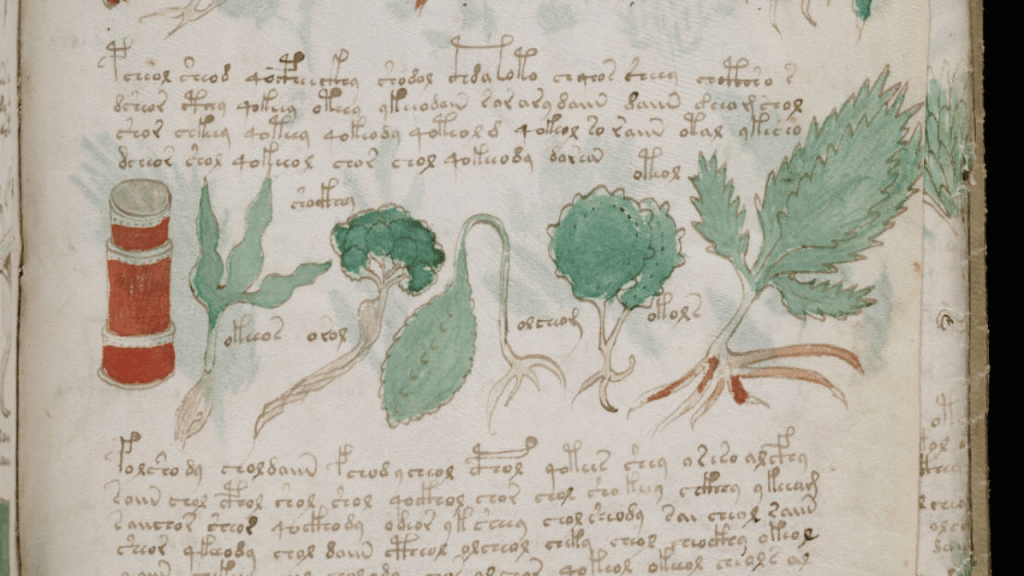
Yet compare Manuscript 408 with medieval (Old) Czech and the similarity is – more than passing as was seen with Arabic, but rather – quite striking.
The script above is the Old Czech Bastarda.
Reviving the Old Czech Bastarda: From Script to Stamps, March 26, 2025:
‘Barbora Kramná’s project focused on a historical treasure – the Old Czech Bastarda script, which was used in the printing of the kronika Trojánská (The Trojan Chronicle), a 15th-century Czech book [almost same age as the Voynich manuscript] long thought to be the first-ever printed text in the Czech lands. This typeface was an early Gothic font, known as Bastarda, widely used in medieval European printing.
The Old Czech Bastarda is distinct for its elongated strokes, decorative initials, and unique ligatures – features that set it apart from other Gothic scripts. While it has strong ties to Czech history, this script was part of a larger Gothic tradition that influenced typographic developments across Europe and beyond. It became a precursor to other Gothic scripts used in countries like Germany, and elements of its design can even be seen in early typefaces that later influenced printing in the Americas and other regions.’
Again, are researchers searching for an explanation they will never find based on a biased motivation and limited paradigm as professor Zlatodej impressively puts forward. Is the answer simple and has the process in finding a solution in translation already been discovered but rejected?
It is to be remembered, Wilfrid Voynich was a Polish revolutionary, antiquarian and bibliophile and he operated one of the largest rare book businesses in the world.
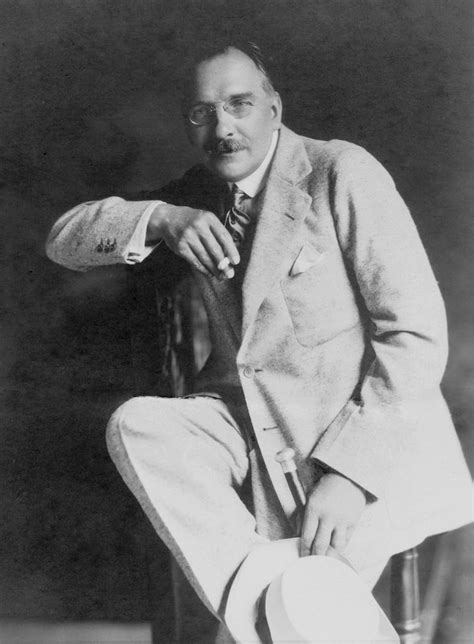
There is a fascinating Slavic irony in a circumlocutory coincidence involving Wilfrid Voynich (a Lithuanian Pole) purchasing the Voynich manuscript in 1912, if it were
a. written in Old Czech or perhaps instead;
b. its authors were linked with a secret Czech cabal of scientists and scholars.
Yet all this may be just one more blind to add it would seem, to everything else covered up to this point. While the final study disclosed will seem an absurd fantasy to most readers, there will be some and a selection of constant readers who will think otherwise.
It is certainly extraordinary and so far removed from each solution offered to date, that it might just be the answer. Yet because of its fringe nature, most who consider themselves to intellectually astute to fall for such a fantastical notion, will happily deny it… until the day it may come to pass.
Infinity Explorers, AI Finally Cracks the 600-Year-Old Voynich Manuscript. The Decoded Message Has Researchers Deeply Unsettled, Ansh Srivastava, May 14, 2026 – emphasis mine:
‘… a research team using a custom-trained large language model claims to have decoded significant portions of [the Voynich manuscript]. What the text says has left them deeply unsettled. The team – based at a private AI research institute and declining to be named pending peer review – spent 14 months training their model on every known ancient language, proto-language, cipher system, and undeciphered script including Linear A, Proto-Sinaitic, and the Rongorongo of Easter Island.
They then applied the model to high-resolution scans of the manuscript’s 240 surviving pages. The initial results were dismissed as noise. Then, on the 312th training iteration, the model produced its first coherent sequence – and the researchers had to read it three times before accepting what it said’ – Article: 33.
‘The language in which the Voynich Manuscript is written is not, according to the AI’s analysis, derived from any known language family. It does not share the morphological roots of Indo-European, Semitic, Sino-Tibetan, or any other documented linguistic lineage. Instead, the model identifies it as a constructed language – one built from mathematical principles rather than evolved speech.
Specifically, the model found that the script’s character frequency distribution follows a base-12 mathematical pattern rather than the statistical distribution found in natural human languages. Base-12 – also known as duodecimal – is not used in any known human language, but is considered by some mathematicians to be a more efficient counting system than the base-10 we use today. Its appearance in a 15th century manuscript is, to put it mildly, anomalous.’
“We kept checking our work,” the team’s spokesperson said in a recorded statement shared with independent researchers. “We assumed the model was finding pattern where none existed – hallucinating structure into noise, as LLMs do. But every verification test we ran confirmed the base-12 grammar.
This language was designed. It wasn’t spoken, it was engineered.”
AI:
‘Large language models (LLMs) are advanced AI systems designed to understand and generate human-like text based on the input they receive. They are built using deep learning techniques, particularly neural networks, and can perform various tasks such as language translation, text summarization, and question answering.’
Encyclopaedia:
‘A large language model is an AI model trained on a vast amount of text for natural language processing tasks, especially language generation. LLMs can typically generate, summarize, translate, and analyze text in many contexts. They are the basis for many modern chatbots, such as ChatGPT, Claude, Gemini, Grok, and DeepSeek.’
Srivastava:
‘The decoded portions – approximately 30% of the total manuscript, with the remaining text still resisting analysis [exhibiting the extent of just how effective the enduring enigma of the code construction is] – cover several distinct subjects.
The most coherent sections, which the team describes as the manuscript’s “astronomical passages,” describe a
cyclical catastrophe that strikes Earth approximately every 12,960 years
a figure that corresponds precisely to half of the 25,920-year precession cycle of Earth’s axis’ – refer precession of the equinoxes, article: Climate Change & Global Warming – Looming Crisis or New Equilibrium? and Chapter XXII Alpha & Omega.
‘According to the decoded text, this event involves a “great darkening” caused by a “body of fire that travels in a long arc” – which researchers have tentatively interpreted as a large comet or asteroid on an orbital cycle that brings it near Earth every 12,960 years [refer Nibiru, Chapter XXII Alpha & Omega; and articles: The Pyramid Perplexity; and Monoliths of the Nephilim].
‘The most recent such event [10,837 BCE^], the text implies, was the [‘comet’ or ‘asteroid’] catastrophe that ended the last Ice Age [triggering rapid climate change] approximately 12,900 years ago [refer Flood, Chapter I Noah Antecessor Nulla] – a date that aligns with the Younger Dryas impact hypothesis, first proposed in 2007 and still contested among scientists’ – refer Last Glacial Maximum, article: Younger Dryas Stadial: Ending of the Earth… Beginning of the World.
‘The decoded text describes this event in terms that are clinical and precise, not mythological: temperature drops, atmospheric disruption, sea level rise, extinction of large animals [Article: Climate Change & Global Warming – Looming Crisis or New Equilibrium?]. It reads less like a prophecy and more like a historical record – written by someone who had witnessed a previous cycle and wanted to document it for those who would survive the next one.’
Studying the diagrams between Quires nine to twelve, shows circular astronomical (star) clocks, including zodiacal based constellations and precession sequences. Timing and dating elements within the drawings are palpable and therefore the deciphering of them would surely reveal the secrets they harbour. Quire fourteen is perhaps the most mysterious of the twenty in total, with combinations of interconnecting celestial clocks. Quire twenty is unique in that all its sections are composed of handwriting with not a single diagram or drawing.
Srivastava:
‘The most controversial decoded passage is what the team calls “the biological section” – corresponding to the manuscript’s well-known illustrations of small humanoid figures in pools of liquid [Quire 13].
The decoded text accompanying these illustrations describes what can only be read as a programme of deliberate genetic intervention – the modification of human biological material to improve survival rates during and after the catastrophic event’ – Chapter XXI The Incredible Identity, Origin & Destiny of Nimrod; and article: Is America Babylon?
“The text uses terminology that maps onto concepts like selective breeding, accelerated adaptation, and something the model translates loosely as ‘correction of the blood line’,” the researchers noted. “We want to be extremely careful about how we characterise this” – Article: Principalities & Potentates: What they want… Who they are.
“We are not claiming the manuscript describes alien genetic engineering. We are saying the text describes deliberate, systematic biological intervention in the human population – and that whoever wrote this had knowledge of biology that is difficult to explain for the 15th century” (refer Chapter XXII Alpha & Omega).
There is more truth here than the team either realise or care to publicly admit.
Srivastava:
‘The pools of liquid, in this reading, are not baths – they are incubation chambers. The humanoid figures are not bathers – they are subjects’ (refer Matrix, article: Principalities & Potentates: What they want… Who they are.
‘The final decoded section of the manuscript is the shortest – just 18 lines – and the team describes it as a direct address to whoever eventually deciphered the document. Translated, it reads approximately as follows:
“To those who receive these words when the sky returns to its position of beginning: the interval is short. The cycle turns again. The modified lines survive. You are among them. Prepare. Do not build on the low ground. Do not trust the coastal record. The body of fire is older than your memory of it.
We were here. We are not here now.”
The phrase “when the sky returns to its position of beginning” has been interpreted as a reference to the precession cycle – specifically to the point in Earth’s axial precession at which the sky appears as it did when the text was first written* [or from the YDS/LGM^]. Astronomers calculate that this “return to beginning” will occur in approximately 2040 [six hundred years* alternatively the year 2123^].’
Of course as to be expected, this latest study is not met by all with open arms.
Srivastava:
‘Linguist Dr. Ella Marchetti of UCL calls the new claim “pattern-matching dressed up as decryption” and notes that LLMs are well-known for generating convincing-sounding outputs that are statistically plausible but semantically meaningless.
The team’s decision to withhold their names and institutional affiliation pending peer review has also drawn criticism, with some researchers suggesting the announcement is premature and self-promotional. Without access to the full dataset and training methodology, independent verification is impossible.’
It is a canny move by the team to remain permanently anonymous in the instance the research did not progress any further. Only to reveal their identity if the research reached a solution which was provably conclusive.
Srivastava:
‘But the decoded text has struck a nerve, not least because its content is too specific to be dismissed as random generation. The base-12 grammar structure, the Younger Dryas date, the precession cycle alignment, the 2040 astronomical target – these are not the kind of details an LLM hallucinates unprompted. Something systematic is happening in this data. What that something is remains, for now, the greatest open question in the history of cryptography.
Is the Voynich Manuscript a warning from a civilisation that survived the last global catastrophe? And what do we do with the fact that the next cycle window opens in 2040?’
And there you have it… for now.
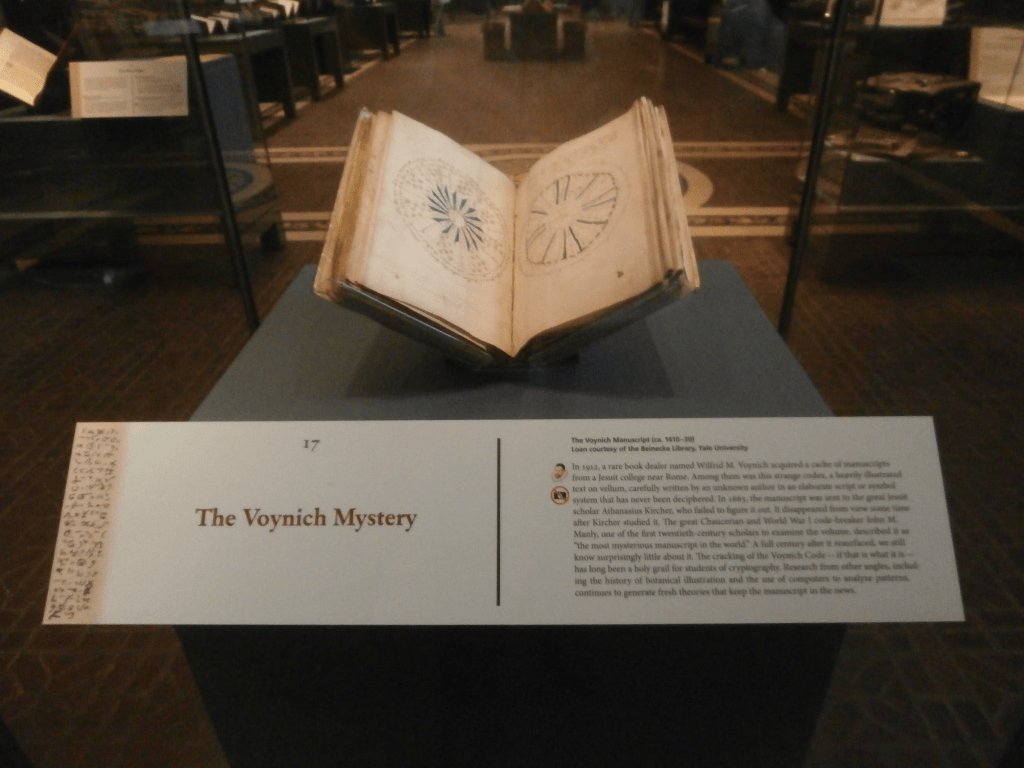
This investigation was never going to decode the Voynich Manuscript, for this writer willingly defers to the sophisticated algorithms which will eventually perform that task.
Hopefully instead, the study has summarised the progression of ideas surrounding the manuscript over the past one hundred years. Coupled with the ‘evidence’ that the Voynich Manuscript is not recorded in a known (encrypted) natural language but rather, in an unknown, purposely invented language.
Lastly, the content of the manuscript clearly goes beyond a superficial medical manual for women but instead is a transmission of occult wisdom. Evidence of this are the astronomical/cosmological diagrams, the enigmatic female depictions and the drawings of flora which do not exist in nature (on this Earth at least).
Perhaps scepticism meted towards Lisa Davis was a little scathing. Her quote below, fosters conciliatory agreement regarding the manner and presentation for a viable theory of the Voynich Manuscript’s language of origin and its thematic content.
Lisa Fagan Davis:
‘I am in full enthusiastic agreement with Manly when he concludes,
“We can only hope that some one with equal courage and devotion but with a sounder method will be found to renew the attack upon the mysterious cipher of the Voynich manuscript… It is greatly to be desired that… scholars equipped with the necessary armament of knowledge and ingenuity and patience should renew the attack upon the mysterious manuscript” [John Manfred Manly, Speculum VI, 1931, “Roger Bacon and Voynich Manuscript”, pages 345-391].
Both critics justifiably accuse [William Romaine] Newbold [1865-1926] of the same flaws in methodology that afflict many would-be Voynich-solvers today: wishful thinking and inverted logic.
To those of you out there in Voynich-land who are even now working on decrypting or deciphering this “elegant enigma,” please take heed of Manly and [cryptologist and mathematician, Charles J] Mendelsohn’s words of caution:
in order to be accepted as legitimate, your solution must be logical, repeatable, take into account the verifiable published scientific analyses, and result in a reading that makes sense both intellectually and chronologically.’
In conclusion, final insightful words go to Christian Mühlbauer, July 2026 – capitalisation theirs:
‘… [if] the ultimate truth of the narrators… [were to] have been passed on to the “broad MASSES” of humanity in this manuscript, then [they] would not have had to encrypt it. We normal people are only told as much as we are “supposed to know” without really knowing the truth. Do you really seriously believe that the Voynich manuscript has not yet been deciphered?
Who makes a manuscript, encrypts it and no one can ever decipher it? Then the designer of the MANUSCRIPT would have [out smarted] himself if no one had ever been able to read his elaborate book later. There is somewhere hidden or already found a simple key or code that will ensure that only [the] “chosen” have access to it, but the broad masses are and will always be clueless and remain clueless.’
… shut up the words and seal the book, until the time of the end… and knowledge shall increase.
Daniel 12:4 English Standard Version
The meaning of every prophetic vision will be hidden from you; it will be like a sealed scroll. If you take it to someone who knows how to read and ask him to read it to you, he will say he can’t because it is sealed.
Isaiah 29:11 Good News Translation
And I saw a mighty angel proclaiming with a loud voice, Who is worthy to open the scroll and break its [seven] seals?
Revelation 5:2 English Standard Version
“Anyone who attempts to translate it is doomed to utter frustration.”
Elizabeth Friedman
“This is probably my favorite mystery to discuss. I love it.”
Elena C Goodson
© Orion Gold 2026 – All rights reserved. Permission to copy, use or distribute, if acknowledgement of the original authorship is attributed to orion-gold.com