
With events occurring rapidly in Eastern Europe and the world watching with bated breath, it is timely that Chapter XXIV Arphaxad & Joktan: Balts, Slavs & the Balkans has just been posted. The vast array of peoples of European or western descent, those of Western Eurasia if you will – which is beginning to sound like George Orwell’s 1984 with three superstates ruling the world – excepting Russia, Turkey, Portugal and Spain descend from Shem’s son, Arphaxad.
It is worth noting that George Orwell by sound insight rather than biblical acumen, called it very close to how events will play out as we lurch then speed towards the end of this age. His three powers were: 1. Oceania which included all of North and South America, Australia, New Zealand, the southern third of Africa and the British Isles; of which is the main location for the novel and its new name is Airstrip One 2. Eurasia which covered all of Europe and Russia and 3. Eastasia which included China, Japan, the Koreas and South East Asia. The remaining region comprising the bulk of Africa, the Middle East and Southwest Asia is disputed and fought over by the three superstates.
Please refer to the article Four Kings & One Queen for more detail, though briefly: the Bible predicts that eventually Russia as the King of the North, will align with a German led Europe – and without the United Kingdom. A China led Asia is referred to as the Kings of the East in the Bible and will spell the final chapters of our current history, when they finally confront the King of the North at a battle prophesied with the name of Armageddon.
The only slight discrepancy in Orwell’s geopolitical structure is that the nations of Celtic-Saxon-Viking descent will be left in the cold as the (non-biblical though appropriate moniker) King of the West. The nations of Central and South America will align as an economic and political unit according to Bible prophecy – and not as allies of the United States or Canada. Though difficult to envision now, the future for the British descended peoples is bleak, as the Bible predicts that the United States and a considerably stronger Canada will one day fall out. Coupled with this, they will both turn against what is left of a dissolved United Kingdom, namely England. The final pieces of these nations downfall is that – as will happen within Australia, New Zealand and South Africa – the effects of mass immigration into the United States and Canada will affect the stability of these nations, the political unity and consequently their economic dominance.
This will lead to a lessening of their literal military might but also their confidence in using it. The coup de grace is that it is very conceivable that with rapidly changing economic and political conditions, sections of the fifty states of America will form new geopolitical entities that while remaining powerful, will lose their collective standing and influence, as will definitely occur in the United Kingdom – refer article: 2050. For Scotland will seek and gain independence and Northern Ireland will eventually leave the Union and form a federated Ireland with the Republic. It is not clear whether Wales which with England, constitutes the Kingdom of England will stay or leave. Judging by events, history and prophecy it appears Wales may become independent in the future.
Some will be thinking, how will America ever fall with their military might, backed up by the world’s premier arsenal of military technology and nuclear warheads. Briefly, the main powers of the world – by deciding who enters and who doesn’t join the ‘nuclear club’ – have been able to maintain their control of the masses that bit more effectively by keeping the world firmly under the mushroom-like umbrella of an ominous nuclear threat of mass destruction that is not as dangerous as governments would have you believe – refer article: Nuclear Nefariousness.
Nuclear weapons not withstanding; the current situation in Ukraine is not as potentially deadly as one would surmise. From a geopolitical and biblical perspective it is the ominous rumblings of “no good will come of this”. It is the continuation of the dominoes – by design – systematically being placed in the overall scheme of those in the highest authority who seek to continually strengthen their control and power – Article: The Establishment: Who are they… What do they want?
The land of Ophir is mentioned a number of times in the Bible and a few times is actually a lot; as most of the two hundred countries in the world are not mentioned specifically outside of the genealogical table of nations in Genesis chapter ten and I Chronicles chapter one. Would a nation comparable to Ukraine’s size be omitted from the Bible discourse? Ophir was a son of Joktan, who was the great grandson of Arphaxad, the third son of Shem.
1 Kings 22:48
English Standard Version
‘Jehoshaphat made ships of Tarshish to go to Ophir for gold, but they did not go, for the ships were wrecked at Ezion-geber.’
1 kings 10.11
English Standard Version
‘Moreover, the fleet of Hiram [King of Tyre], which brought gold from Ophir [H211 – ‘Owphiyr: ‘gold region in the east’], brought from Ophir a very great amount of almug [H484 – ‘almuggiym: a tree from Lebanon (sandalwood?)] wood* and precious stones.’
Job 28:16
English Standard Version
‘It cannot be valued in the gold of Ophir, in precious onyx or sapphire.’
Psalm 45:9
English Standard Version
‘… daughters of kings are among your ladies of honor; at your right hand stands the queen in gold of Ophir.’
Isaiah 13:12
English Standard Version
‘I will make people more rare than fine gold, and mankind than the gold of Ophir.’
Ophir is mentioned in a number of verses throughout the Old Testament and always in context of its gold and mineral wealth. One would expect this nation to standout amongst Joktan’s descendants today, just by sheer size of either resources and or, its economy. The meaning of Ophir is contradictory as it can mean, ‘exhausted, depleted’ and ‘reducing to ashes’ – ‘which is what remains when all useful energy is extracted from a fuel’ – or conversely: ‘rich, abundance’ a ‘mark of wealth’ or a ‘coast of riches’ according to Abarim Publications.
Glenn Webb – emphasis & bold mine:
‘Excerpt from Peresopnytsia Gospel (Matthew 19:1) (1556) where the word ukrainy (оукраины) corresponds to ‘coasts’ (KJV Bible) or ‘region’ (NIV Bible). [The] Ukrainian symbol is a trident and has a coastline to its south.’
Rare Gold Nuggets – emphasis mine:
‘Gold mining is still a young and growing industry in Ukraine. As with many regions in the world with a turbulent political history, the economic development in the mining industry has been limited… Ukraine holds large reserves of gold in several regions… some suggestions that there is as much as 3,000 tons of gold to be found all around Ukraine…’
This is the equivalent of 2,722 tonnes and would place Ukraine 5th in countries with the largest gold mine reserves, behind Australia at number one with 10,000 tonnes; Russia with 5,300 tonnes; South Africa with 3,200 tonnes; and the United States with 3,000 tonnes. The value of 2,722 tonnes of gold is a staggering USD $209,005,228,637.00.
‘… there are more than two hundred locations around Ukraine that gold is known to be found. The potential for gold… is amazingly vast… These are huge expectations for a huge country.’
A Short History of the Ukrainian Tryzub, Gary Sohayda, January 2022 – emphasis mine:
‘A trident with a crossed central prong was… confirmed in 1918 as the emblem of the Ukrainian Black Sea Fleet. In 1939, the Diet of Carpatho-Ukraine, the short-lived independent Ukrainian state that emerged from Czecho-Slovakia, adopted the trident with a cross as its official coat of arms. Finally, in 1992, following the restoration of Ukraine’s independence the previous year, Ukraine’s Parliament adopted the trident as the chief element in its coat of arms. The trident is today shown on Ukraine’s monetary emissions (coins as well as some bank notes or their watermark) and on its postage stamps.’
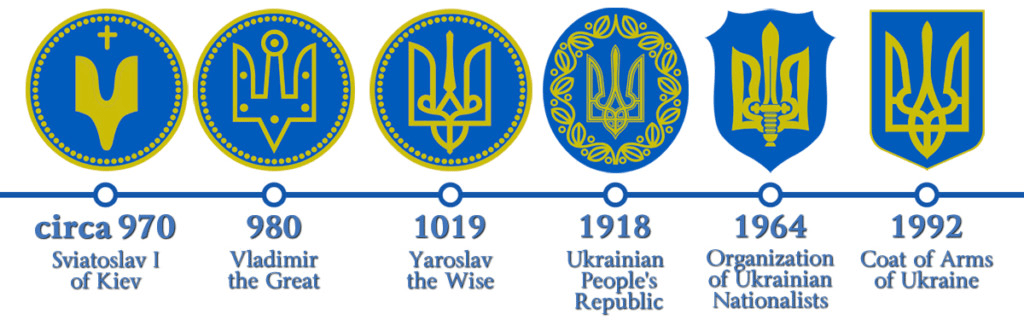
The Trident is a potent symbol of the god of the sea and water, Neptune and Poseidon. A link to Ophir’s strategic importance for gold via its position in ancient mercantile trade routes – once located in Sumer near the Persian Gulf, then later during the United Kingdom of Israel and the reign of King Solomon, on the southern coast of the Arabian Peninsula. Today, Ukraine represents a vital ‘warm water port’ for itself and Russia and hence, the obvious importance of the Crimea.

The trident is a weapon, whether for spear fishing or as a pole arm. The significance as a weapon of Neptune is the fact that it symbolises his control over the seas. Though its wider application is that the three prongs reflect his mastery over the three principalities of heaven, earth and hell. Neptune’s power does not stop there, for it is also linked with birth, life and death; mind, body and spirit; and the past, present and future – Article: DEATH: A Dead End or a New beginning?
Ukraine is Ophir, the eleventh son of Joktan. All the conflicting definitions for Ophir’s name are strangely specific and accurate about Ukraine and parallel the rather schizophrenic history and destiny of Ukraine as an unhappy and unwilling junior partner of Russia. The verb even means ‘to desire or draw near’ exactly typifying the relationship which Little Russia has with Great Russia.
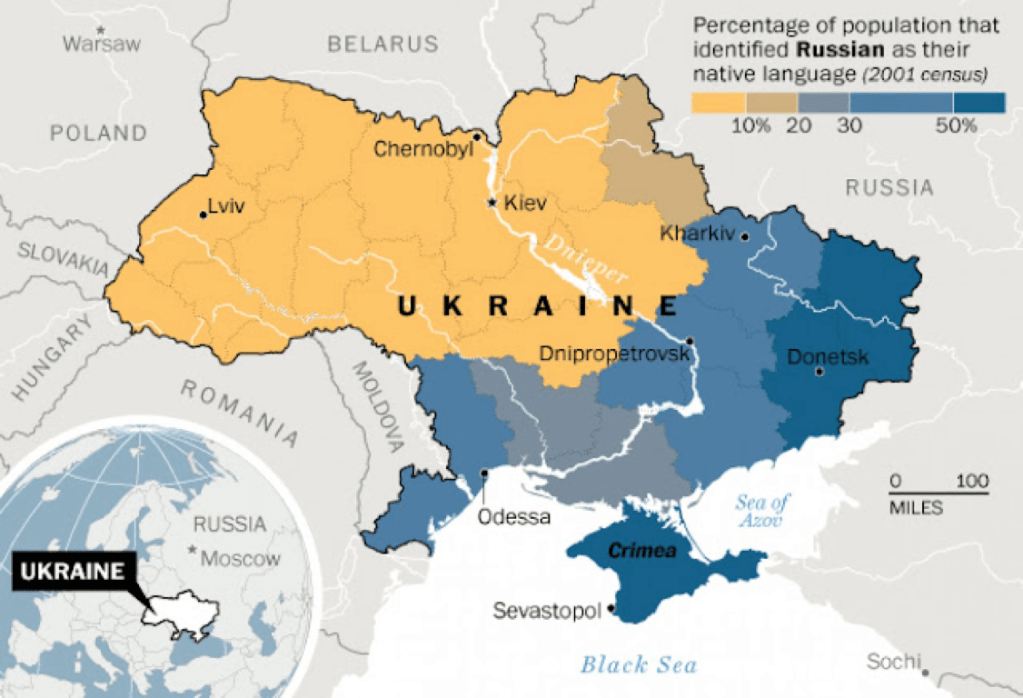
For the largest Russian diaspora in the world are the 8,334,100 Russian people living in Ukraine (2001 Census). To complicate matters, a third of the Ukrainian population in the eastern part of the country identify as Russian, speaking Russian. Other Ukrainians also speak Russian and higher percentages of Russians live in the western and central regions of the nation, as well as in the industrialised city centres. The total population of Ukraine is 38,911,001 people – the seventh highest in Europe.
Ukraine is the 4th biggest mineral producer in the world, behind South Africa in first place, Russia and Australia. Ukraine has up to $510 billion in iron ore reserves alone. Apart from the presence of many mineral reserves, Ukraine is best known for its productive mining sector. There are over three hundred mining facilities actively operating across Ukraine. As an aside, both South Africa and Australia were foreordained to be rich in natural resources and consequently mineral powers – Chapter XXXII Issachar, Zebulun, Asher & Naphtali – the Antipodean Tribes.

Ukrainian man and woman

Europe’s second largest country, is a land of vast fertile agricultural plains and large pockets of heavy industry in the east. Ukraine is known as the ‘breadbasket’ of Europe and is amongst the top three exporters of grain in the world. It has some of the most fertile land on earth with rich black soil called chernozem – literally, ‘black dirt.’
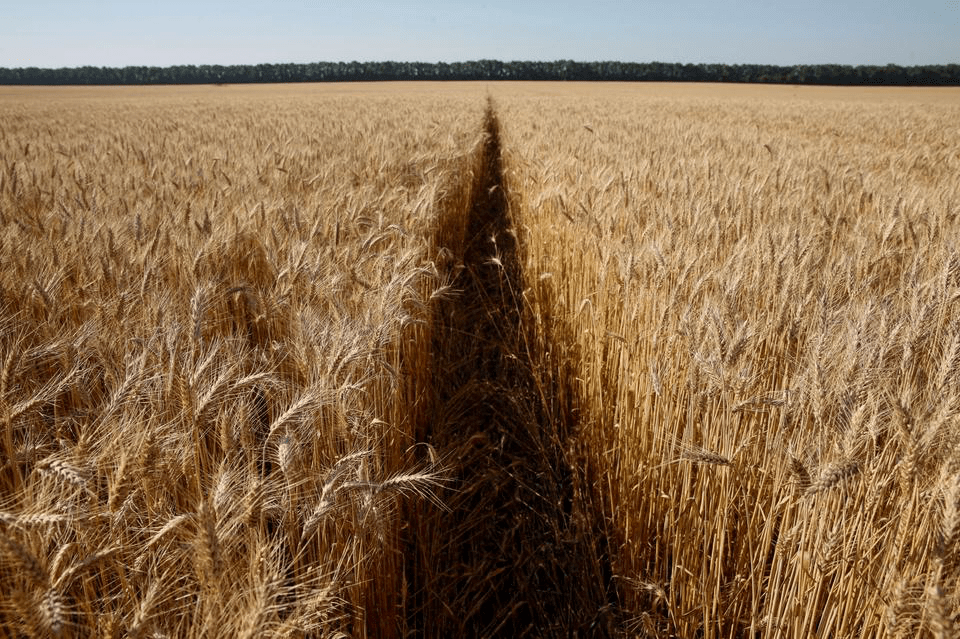
This soil produces considerable agricultural yields due to its high moisture storage capacity and levels of humus; with more than seventy percent of the country comprising prime agricultural land. Parts of Russia and the United States of America also have rich soils with high organic content called mollisols. It is estimated that Ukraine can feed at least half a billion people.
Its main crops include corn, soybeans, rye, oats, beets and barley. With Russia, Ukraine supplies a quarter of the world’s wheat and half of its sunflower products. Ukraine is the fourth largest producer of potatoes in the world.
‘The following export product groups represent the highest dollar value in Ukrainian global shipments during 2021…
- Iron, steel: US$13.1 billion
- Cereals: $11.8 billion
- Ores, slag, ash: $7 billion
- Animal/vegetable fats, oils, waxes: $6.9 billion
- Electrical machinery, equipment: $3.2 billion
- Machinery including computers: $2.1 billion
- Oil seeds: $2.1 billion
- Wood: $1.9 billion*
- Food industry waste, animal fodder: $1.7 billion
- Articles of iron or steel: $1.2 billion
Iron and steel was the fastest grower among the top 10 export categories, up by 70.8% from 2020 to 2021. In second place for improving export sales was cereals via a 25.8% gain led by higher international sales of corn, wheat and barley.’
The word Ukraine literally means, on the outskirts and from a Russian imperial perspective, that has been true. Ukraine has been ‘the borderland’ for much of its existence, enduring its role as a convergence point between the East and the West; partly including territory once occupied by the Scythian and Sarmatian peoples. Ukraine and Russia share common historical origins, especially in the East; whereas the west of the country has closer ties with its European neighbours and particularly Poland.

Early Germanic tribes from Jutland and surrounding environs migrated and in time some of them would filter down towards western Ukraine, including the mighty Goths who would control a vast swathe of Ukraine for a couple of centuries. Following this, Ukraine was home to some of the earliest Slav states – descendants of the earlier Sarmatians – and notably, the grand principality of Kiev in the tenth and eleventh centuries made it a focus of East Slavic cultural development.

The Cossack Hetmanate republic emerged in central Ukraine in the seventeenth century. The region only gained more permanent borders during the Soviet era and independence as a sovereign nation wasn’t achieved until 1991, upon the collapse of the Soviet Union. Ukraine is a unitary republic governed under a semi-presidential system which has been moving increasingly towards strengthening ties with the rest of Europe, until the 2022 invasion by Russia.
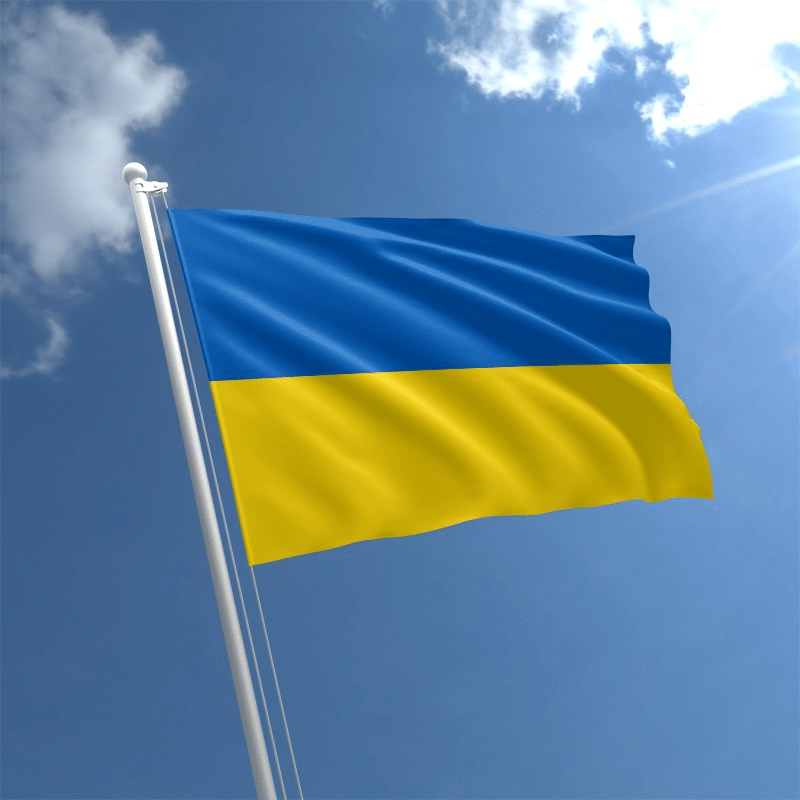
Flag of Ukraine
Referring to the modern state as The Ukraine is incorrect both grammatically and politically, says ‘Oksana Kyzyma of the embassy of Ukraine in London. “Ukraine is both the conventional short and long name of the country.” The use of the article relates to the time before independence in 1991, when Ukraine was a republic of the Soviet Union. After the collapse of the Soviet Union, Ukrainians probably decided that the article denigrated their country (by identifying it as part of Russia) and abolished ‘the’ while speaking English… As well as being a form of linguistic independence in Europe, it is also hugely symbolic for Ukrainians.’
Ukraine Is the Most Important Country for the European Union… Ivan Dikov, 2019:
‘Which is the most important “outside’ country for the European Union at the present moment and for the foreseeable future… It’s Ukraine. The reason… Ukraine is the largest country that has the realistic potential, the desire, and a wide range of prerequisites to become a member state of the European Union… Of course, that is a very long shot: Ukraine hasn’t even been recognized as an official EU candidate country yet, and it’s not even sure when it will be, or even that it ever will be… [yet it’s] population seemingly has the desire to do so, and, what’s ever more important, whose society wishes to change correspondingly in the process.
… Ukraine is what Poland was among the countries that joined the EU in the three “Eastern Enlargements” in the decade between 2004 and 2013… the great thing about the European Union is that it is a Union of “losers”: countries which either built empires to see them crashing down, or which were otherwise crushed, mauled, or severely threatened by empires… Ukraine… is quite big but not too big, so that… the Union as a whole… will be able to “swallow” its accession with relative ease. If or when Ukraine becomes a member of the EU, it would naturally assume a spot among the Big Six – which are now about to become the Big Five… (Germany, France, Italy, Spain, Poland)… while this is still a very long shot, and Britain’s departure (which itself was a long shot for a while) is regrettable, but such a set up would bring a better East – West balance inside the EU… It would be very shrewd of the entire European Union to take notice of that fact.’
Any movement by Ukraine towards the European Union have been stopped in its tracks at time of writing; with Russian forces entering the Ukraine on February 24, 2022, with a build up of Russian troops in the Crimea beginning on the formidable date of 22.02.2022. Events today were created centuries ago. Between 1772 and 1795, the Russian Empire and Hapsburg Austria as a result of the Partitions of Poland each had control of the territory which comprises modern day Ukraine for a hundred years or more. The Russian Revolution led to the Ukraine’s own civil war and then war with the Soviet Union from 1917 to 1921. In 1922, one hundred years ago, the Ukrainian Soviet Socialist Republic was established. Leap ahead to 1954 and new Soviet leader Khrushchev who succeeded Stalin; himself a Ukrainian, transferred Crimea to Ukraine to mark the 300th anniversary of the Russian-Ukraine Union. When the Soviet Union dissolved in 1991, Crimea became independent.
Late 2013 President Viktor Yanukovych, suspended preparations for the implementation of an association agreement with the European Union. This decision resulted in months of mass protests. The Ukrainian parliament impeached Yanukovych on 22 February 2014. During the 22nd and 23rd February – exactly eight years previously – the Russo-Ukrainian War began with Russian forces entering Crimea. It was not an invasion as such since Russia had a naval base in Sevastopol. A referendum in the largely ethnic Russian autonomous region of Crimea was held and with a ninety-five percent majority mandate, Crimea was de facto annexed by Russia in March 2014.
The Crimean Peninsula has key strategic importance as the Black Sea region is pivotal to Russia, for it is the only gateway to the Mediterranean, Africa and beyond. Access is vital for shipping, oil and gas pipelines, as well as for military operations. Russia could and would, never give up this most important warm water sea gate.

It was during the Crimean War between 1853 to 1856 that a coalition comprising Britain, France and Turkey won Crimea from Russia. Russia’s mistrust of the West is reasonable and the threat of Ukraine joining the European Union and or Nato with possible foreign military presence on Russia’s border, led to its preemptive strike on Ukraine, to topple a puppet regime with links to and support from, the West.
Ukraine is very unstable with its ‘debt-to-GDP ratio [doubling] and close to 60% of the people [living] below the poverty line. Its industries are crumbling, and pensions/social welfare have been deeply slashed. Neo-Nazi groups are on the rise, and 80% of young people are desperate to leave the country’ now with no end in sight.
Ukraine is very unstable with its ‘debt-to-GDP ratio [doubling] and close to 60% of the people [living] below the poverty line. Its industries are crumbling, and pensions/social welfare have been deeply slashed. Neo-Nazi groups are on the rise, and 80% of young people are desperate to leave the country’ now with no end in sight.
And so like its name Ophir, Ukraine is at once a nation ‘exhausted, depleted’ and is being ‘[reduced] to ashes’ – yet Ukraine remains a nation potentially ‘rich, [with] abundance’ having a ‘mark of wealth’ and a ‘coast of riches.’
Edited excerpt from Chapter XXIV – Arphaxad & Joktan: Balts, Slavs & the Balkans
© Orion Gold 2020-2022 – All rights reserved. Permission to copy, use or distribute, if acknowledgement of the original authorship is attributed to orion-gold.com
 The Lightkeeper
After reading a few of your articles, I have learned a lot and like your presentation.