
The following is an answer reproduced from Quora, to the question: Which countries will be major world powers in 2050?
This is a fascinating question.
In many ways, it is more of a curiosity to know how the geopolitical order will look not just in 2050 but in 2100, or even 2250…
In thinking about this question seriously, it seemed delving into the past was required to discern the future more knowledgeably. A study of the powers of the past, both small and great, highlighted a couple of salient points.
Firstly, while some countries – as either regional or great powers – wax and wane, there are those nations which have remained relatively constant as world powers over the past five hundred years.
Secondly, even though a nation may have a large population, economic clout or a formidable military, they are not necessarily a threat to world peace. They may have the form or substance of a power but it does not necessarily translate towards affecting the world’s stability or order.
A people or national identity which has a proclivity towards policies of imperialism, militarism and is prepared to use their weaponry to achieve their aims on the other hand, is surely to be considered a (major) power.
It is primarily from this perspective that this article will focus with regard to potential major world powers in 2050 and beyond.
Historically, it has taken many decades or centuries even, for a nation’s status to change. For instance, the United Kingdom has transitioned from the world’s dominant power in 1820 to a (global?) regional power in 2022.
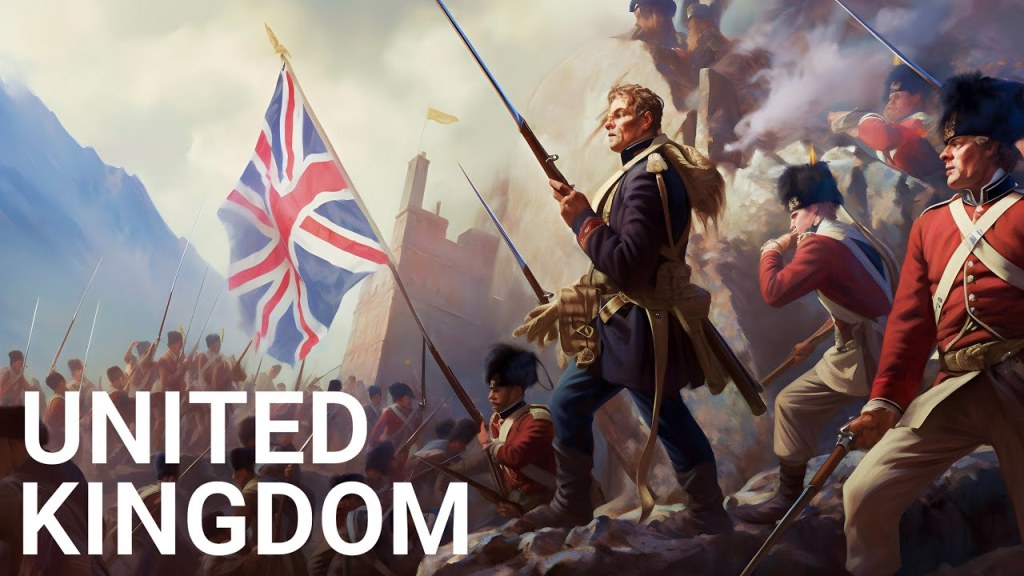
What is partially surprising – reflecting its very gradual decline over two hundred years – is that Great Britain (and Northern Ireland) has slipped from the world’s third largest economy in 1820, to only the sixth largest in 2019.
We now live in an interconnected world which is far more precarious; one that seems to be close to a tipping point at any given moment financially and economically. It is impossible to calculate how quickly circumstances could change globally, let alone for individual nations.
A further factor, is how quickly nations can adapt to a fast paced changing world in the 21st Century and how much investment they spend on the cutting edge technologies that will have an immeasurable influence on the pecking order of the major world powers in the future. Three of these immensely important sectors include AI development, DNA and genetic research and Space exploration. The winners of these contests, will likely surge ahead of their rivals – refer article: The Great Reset & the Fourth Industrial Revolution.
Before concentrating on the prime powerful players in the world, past and present, let’s look initially at the minor (or lesser) powers of the past and today.
Both Portugal (1400s) and the Netherlands (1600s) are examples of minor powers who followed a different trajectory. Whereas the Netherlands still retains wealth and investment derived from its trading empire; Portugal does not reflect the wealth it once had stemming from its colonial empire. One would not consider them powers today. Similarly with the nation of Austria, which through its network of monarchy descended from the Hapsburg royal family throughput Europe and particularly in Spain and the Low Countries, created an extensive empire wielding considerable influence. Even with the dissipation of most of the European Monarchies, Austria has retained a measure of wealth much like the Netherlands, yet with a parallel loss of status in power.
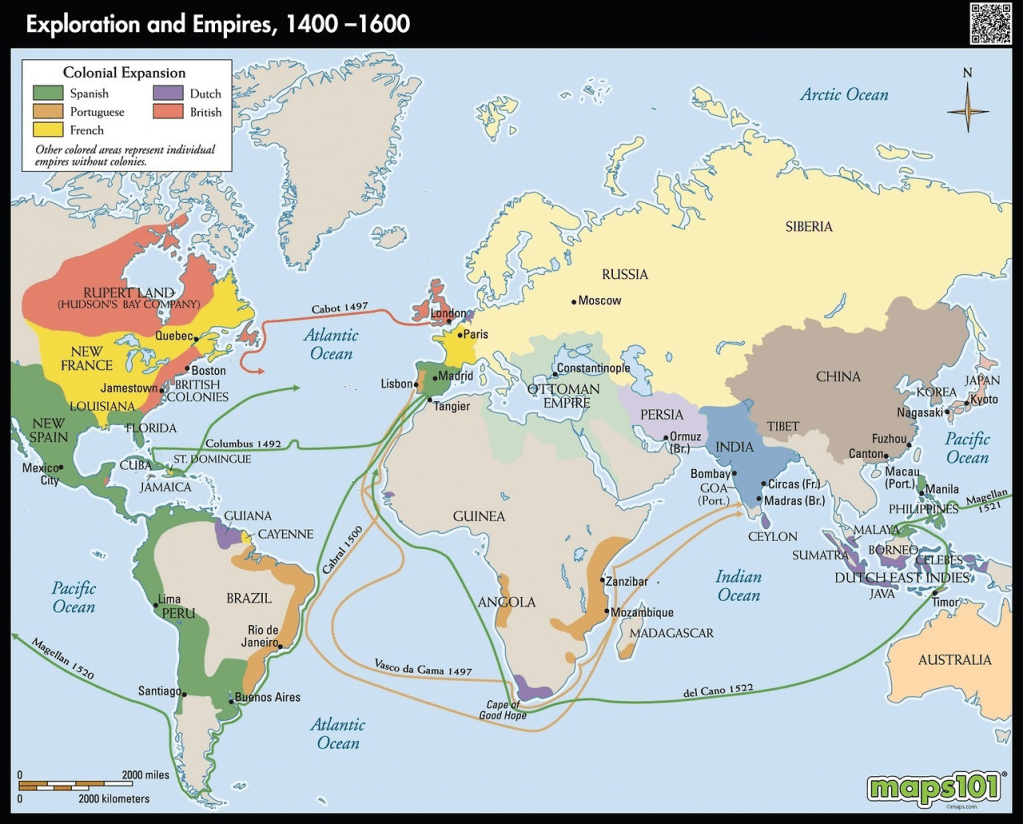
Spain (1500s), France (1700s) and Great Britain (1800s) are examples of once being major powers, who combined trade with an expansionist colonial policy. To protect their claims and possessions it necessitated becoming naval and military powers, as was the case with the Netherlands. Each still retains economic wealth, with the United Kingdom and France having descended into lesser regional powers.

It is unlikely either could become major powers again, outside of the European Union at least. Nor have the French or English employed an overtly imperialistic policy since. Each during their mutual ascendancies, grew colonial empires, endeavouring to out do one another. As old rivals, both have settled into a grudgingly accepted stalemate draw.
A nation which does not fit into a power stereotype is Italy. It is a relatively young nation, created in 1861, though it did pursue a colonial expansion principally in Africa and briefly exhibited an imperialist motivation while under Mussolini’s rule. Yet, Italy’s national character does not appear to be predominantly thus focused and as a regional power, sits somewhere between Spain and France.
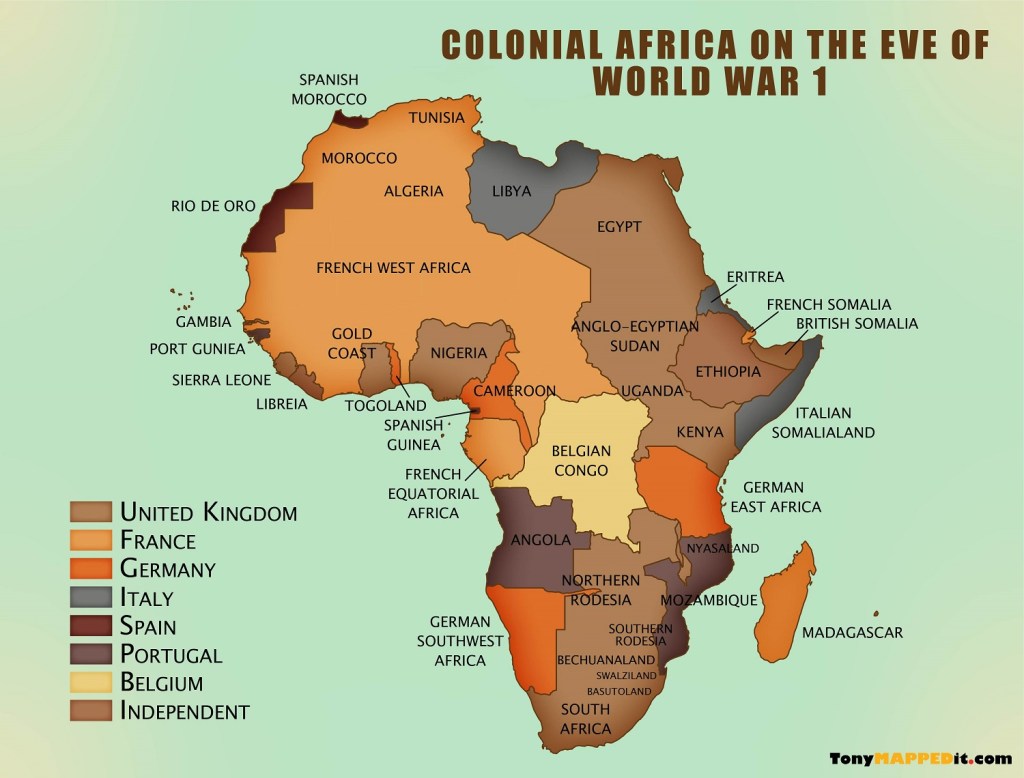
Today, there are a handful of nations which are regional powers that weren’t in the past. It would seem that each will grow in strength and stature; though it remains to be seen, which will become major powers.
Those nations include Brazil, Mexico, Indonesia, Iran, Pakistan, in part Turkey and perhaps the Koreas. The interesting exception in the list is Turkey, which was a major power in the past, in the guise of the Ottoman Empire.
There is a coded book which mentions these seven peoples (eight nations) – in fact all the peoples of the world either directly or indirectly – in both an historical and a modern context. Like the saying: ‘the truth is stranger than fiction’, their futures can be determined. Credence in this coded book is ridiculed by many, for they do not understand it. Besides, any acknowledgement that its words are true would then lead to admitting one who is superior, had authored and inspired it. So from here on, it is not just canny insight alone, but an accurate interpretation of its message, unforeseen prior to now – refer The Noachian Legacy.
Brazil will stand to become a major economic power on the world stage, and all the Latino-Hispano nations of the Americas, led by the regional power Mexico, will align with Brazil in an economic trading bloc.

In large part to offset the dominance of the United States of America. Though Brazil will reach major power status, it will be primarily as an economic giant and not entirely in a military sense. Saying that, both Brazil and Mexico will increase their military capability in accord with their growing economic stature and one day will not be reticent in using them.
Brazilian Flag
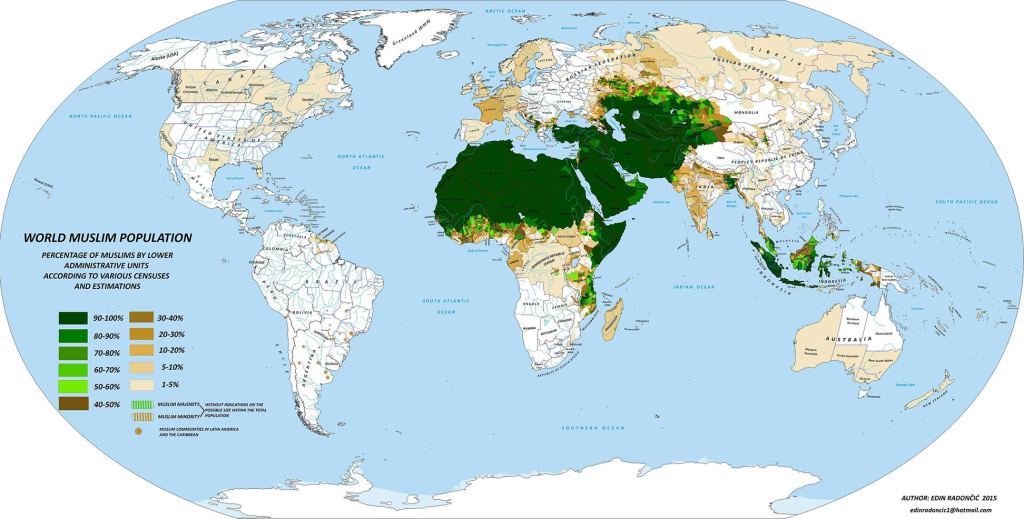
Indonesia, Iran, Pakistan and Turkey all have something in common and that is their Muslim faith. At a certain point, the dominant Islamic nations will amalgamate into a unified body with a single voice and purpose. Egypt also may have a prominent role, with the aforementioned four nations. How many other Arab peoples and Islamic nations, such as Bangladesh are part of this confederacy is not clear, though it will be a formidable military bloc and a series of wars will rage involving their alliance – refer article: Four Kings & One Queen. Again, it is not clear who the leader will be, though politically, the three countries comprising Turkey, Iran and Pakistan are clearly the dominant nucleus of nations. Turkey superficially seems to be the main contender, when considering its imperialistic role in the past and in possessing the strongest and fastest growing economy amongst the Muslim nations, aside from Indonesia.
The indication is that like any artificial joining, for instance the coterminous Yugoslavia and Czechoslovakia, or separation, such as East Germany and West Germany and North Vietnam and South Vietnam; eventually, no matter how unlikely, it will be undone. A reunified and far stronger Korea would be a fascinating scenario, added to the complex relationship currently amongst the northeastern Asian nations. Worryingly, it appears that a united Korea in the future could favour a Chinese inspired political model and focus on policy, as opposed to a Japanese one. This would indicate that any future support for reunification, is lead by China and or Russia and not from the United States.
Just before we turn to the major powers of the past and today, there is one nation, which is always forgotten. In fact, it was only in one person’s comments, though there may be more mentions as not every answer has been read. Ironically, this nation’s original name in the Hebrew language means: forgotten. Yet this nation is in the top ten nations of the world for largest economy by GDP. It is a unique country and the only one in the world which has the following combination of factors: for not only does it have vast resources on a huge landmass; it most importantly, has the infrastructure and space to host a vast number of new immigrants, thereby exponentially increasing its population. As a result, this nation’s economic, political and military influence would expand, as the most important ally of the United States.
That nation is… Canada.

Canadian Flag
Whether it will become a major power or a considerably stronger regional power remains to be seen, though its closet parallel would be Brazil in this regard.
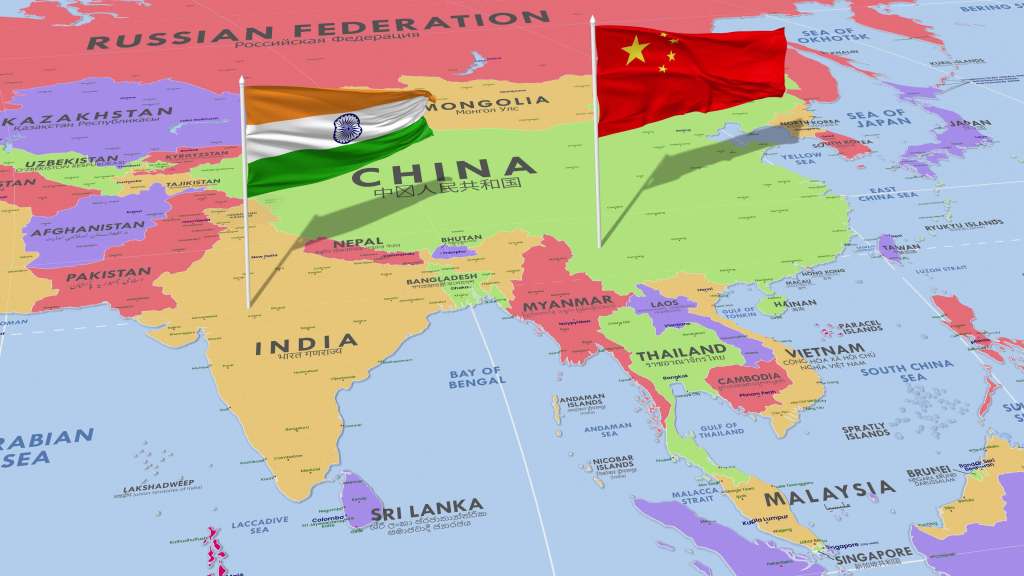
This leaves the historical major powers over the past five hundred years, depending on how one ranks them: China, Germany, India, Japan, Russia and the United States of America. A helpful article by Wendell Cox, highlights the points raised earlier regarding a large population or GDP and how it does not mean that particular nation wields global political, financial or military dominance. They can be a passive major power, or even dormant. What drives a nation to be an active major power is drawn from multiple variables – which makes this discussion interesting from an historical as well as a futuristic perspective. Also, a nation may become an active major power but only in a regional sense and not necessarily as a global presence.
500 Years of GDP: A tale of Two Countries, New Geography, Wendell Cox, 2015:
‘Over the 515 years from 1500 to 2015, the available data seems to suggest that the largest economy in the world [has] almost always been either China or the United States (for most years there is only incomplete data). In 1500, China was the largest economy in the world, followed closely by India, both with estimated GDP’s of approximately $100 billion. France was a distant third at approximately 18 billion… What is now the United Kingdom ranked 10th, at barely one quarter the output of France.
[The year 1700] was the only reported year between 1500 and 2015 that China or the United States did not lead the world. India had the strongest economy in 1700, closely followed by China. Throughout the entire period to the middle of the 20th century, China’s economy was larger than India’s by a relatively small margin. At the same time “the great powers” of the West were still well behind China and India…’
‘By 1820… India [in] second, [was] slightly more than one half that of China. The United Kingdom finally appears, in third-place with a GDP one sixth that of China… By 1890, the United States had emerged as the world’s largest economy, opening up an approximately five percent lead over China. India ranked third, followed by the United Kingdom [4th] and Japan [5th].
By 1930, the ascendancy of the United States was clear. China… still remained the second largest economy, but trailed the United States by approximately [two-thirds]. There was little difference between China and the next three largest economies, Germany [3rd], the United Kingdom [4th] and India [5th].’

The Flag of the United States of America
‘Half a century later, in 1980, the United States retained a similar lead, but now over second-ranked Japan. Germany was a close third… India ranked ninth, approximately 30 percent ahead of 10th ranked China. China’s ascendancy was obvious by 2010, reaching within 20 percent of the United States, which remained number one.
This had been a dramatic reversal, since China’s GDP had been little more than one tenth that of the United States only 30 years earlier (1980). India was also restored to a leadership position, ranking third. Japan was fourth and Germany was fifth.’
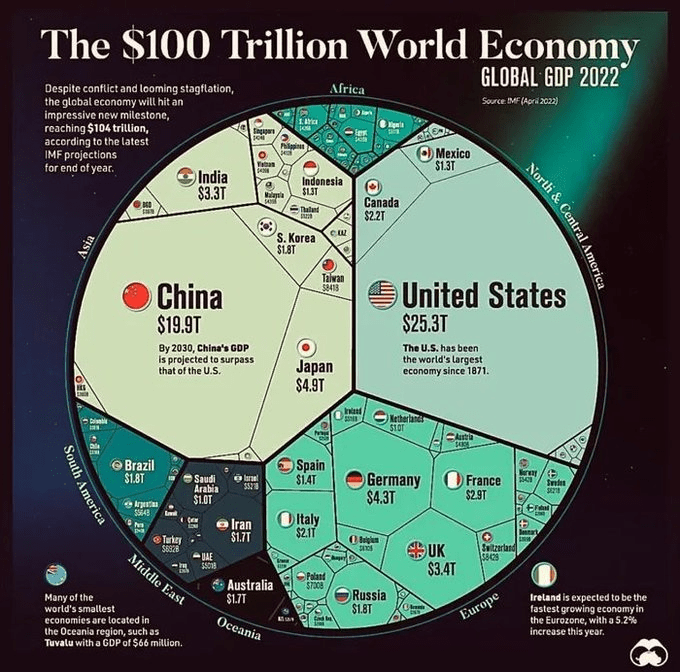
In 2019 these major powers according to GDP were ranked: 1. United States of America 2. China 3. Japan 4. Germany 5 India and 11. Russia.
In 2025, these same nations are ranked as: 1. United States of America (30.50 Trillion) 2. China (19.23 Trillion) 3. Germany (4.74 Trillion) 4. India (4.18 Trillion) 5 Japan (4.18 Trillion) and 11 Russia (2.07 Trillion).
‘It is notable that through much of their empire-colonial relationship between the United Kingdom and India, the colony had the larger GDP. This was the case from 1820 through 1900. This is principally due to the larger population of India. For example, in 1870, India’s GDP was one-third larger than that of the United Kingdom. In the same year, however, the UK GDP per capita was six times that of India.
GDP projections produced for 2050, by… Price Waterhouse Coopers indicate that even more significant changes could be ahead. PWC expects China to have GDP of $61 trillion (US$2014). India is projected to be restored to its previous second place, at $42 trillion, just ahead of the United States ($41 trillion).
BRIICs members Indonesia [currently 17th] and Brazil [currently 10th] would be 4th and 5th, while BRIICs Russia would be 8th. Mexico [6th] and Japan [7th] would follow Brazil, with Nigeria [9th] and Germany [10th] rounding out the top ten. If PWC is right, the dominance of China and the United States might be supplanted by the historically dominant duo of China and India. Of course, no one knows for sure. Forecasting economics is even harder than forecasting population.’
The inclusion of Indonesia, Mexico, Russia and Nigeria in the top ten would come at the expense of the United Kingdom (6), France (7), Italy (8) and Canada (9) dropping out of the top ten largest economies in the world.
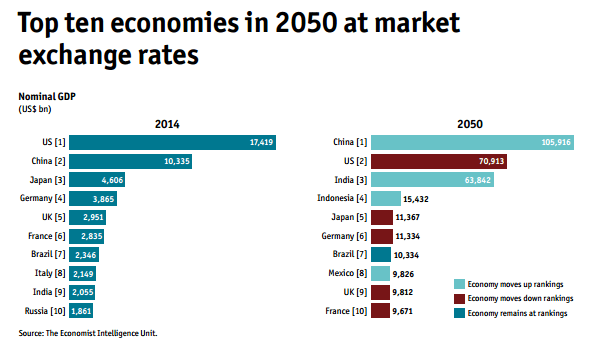
We learn some very salient points from this data.
First: Only China, India or the United States have ever been number one with regard to being the world’s biggest economy (GDP).
Second: It took nearly four hundred years [of a 500 year period], for a nation outside of Asia to catch up to China and India and then surpass them.
Third: China has fluctuated the most out of the major powers. It was marginally ahead of second place India for centuries, then in the 1800s gained a substantial lead and then by the 1900s was substantially behind India as well as other nations. Now, China has sensationally regained second spot.
Four: It is China which has witnessed the most dramatic economic reversal, being one-tenth the size of the United states in 1980 and within 30 years – a similar time frame we have now before us from 2022 to 2050 – moved from tenth to second in the world.
Five: The example comparing the former major power the United Kingdom and its former subservient colony India, exposes the active and dormant natures these powers respectively exhibited.
Six: Both Japan an island nation on the periphery of a continent the same as Great Britain and Germany, a young nation like Italy, have been major economic powers since the late 1800s and early 1900s and as with the United Kingdom, have shown a desire to follow an expansionist policy; creating military capability to match their economic prosperity and demonstrating the will to put it to use. They have all been active powers unlike the two major dormant powers, China and India. Some would argue credibly that China is now no longer dormant.
Seven: The predictions by PWC are enlightening and if correct, a circle is being completed with China and India regaining the lengthy historical positions of number one and two. Is the United States ascendancy on the wane, has it been an aberration of history. Will they dip forever, or only for a period, to resurface at number one again?
Eight: The key economic growth forecast, resulting in the improved standings for Indonesia, Brazil and Mexico, all corroborate what has been foretold. All three, have the wherewithal to achieve major power status and all will strengthen their military arsenals over ensuing decades (and centuries).
Nine: There is a glaring omission in the statistics, apart from the 2050 projection of Russia at number eight. Where has Russia been in this period? It has more often than not been in the top ten and in its guise as a modern empire – the Union of Soviet Socialist Republics – it was the second biggest economy in the world, consecutively from 1960 to 1985.
Ten: As only three nations have held number one and if the United States concedes to China, could another nation, a fourth nation, ever achieve number one spot and if so which one perchance?
Yes, a new nation will one day break into the club of three, exclusively held by China, India and the United States for the past five hundred years. Based on a number of observations and factors, that nation is… Russia.
Of course, many will smile at this and think this view simplistic and naive; based on inadequate information, limited knowledge and a shallow grasp of geo-economics and financial forecasts.

Russian Flag
The world has changed and the last century was very different from the four that preceded it. Was it far-fetched for China to move from tenth to second in the space of thirty years? No, it wasn’t. There is good cause to consider a similar scenario with Russia. It may not happen by 2050, but happen, it will.
This highlights important additional points, which tie Russia and Germany together.
While Japan experienced an imperialistic moment in history, much like Italy and Great Britain – which is remembered for its globe encircling empire that is undoubtedly the most famous in modern history, standing out in the annals of time, as does the Roman Empire of the past, which still impacts our civilisation – it is the militaristic nation of Germany, (whether one studies the two prime influences of the German people’s history: Austria in the south and Prussia in the north) with Russia, who possesses an even longer pedigree of imperialism, that are most likely to return to or further respectively, these inherent ambitions.

History is set to repeat itself.
At this point, Great Britain is not included in the rest of the discussion, for it has fallen from being a major power. The English people do not truly possess an imperialistic nature, nor the motive to maintain one; for the United Kingdom primarily pursued a defensive role in strategically maintaining an overseas empire built on colonialism for the purpose of trade.
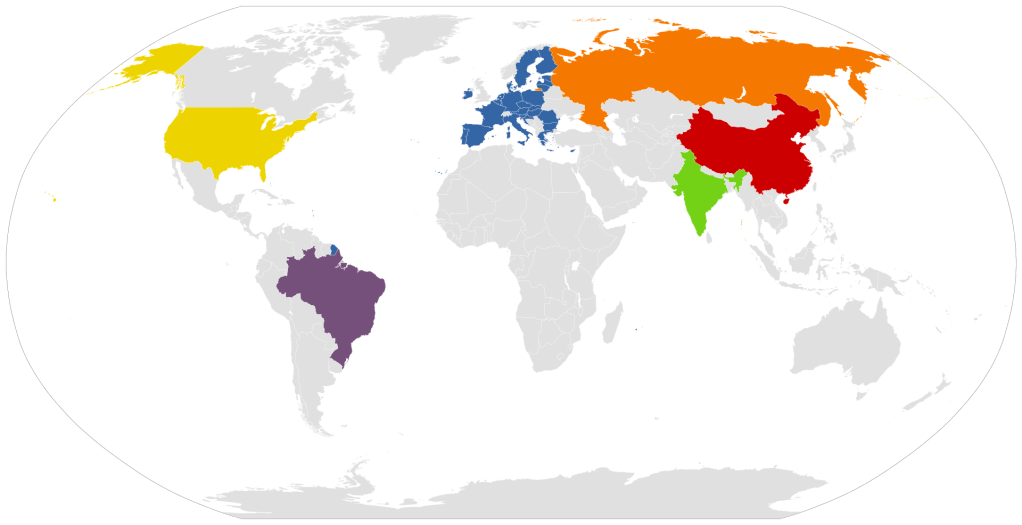
Map of the future predominant global economic-military powers
Comparing the six major powers today, both China and India if no longer dormant, remain relatively passive – particularly India. Saying that, both nations have the potential to become superpowers and this is very likely. Judging from modern history, it is a nation of formidable economic size which makes that quantum step from a major power to a super power.
For instance, Japan is a technological leader and economic giant. Some may think it could revert to a warlike footing, though this is not what is predicted; nor will Japan ever make the critical step to superpower status. It will likely remain a passive major power. In this regard, Germany as a major power, is similar to Japan. Two world wars revealed that Germany as a regional power took that next step to impact on a European regional scale; though it did not have the capability to extend itself beyond a certain parameter – a victim, of imperial overstretch. Of course, all that has changed now it is the economic driver of a new empire, currently called the European Union.

Flag of the European… German Union
Germany ultimately wields immense power. As a single nation, the leap to superpower status is beyond it. Not so with twenty-six nations in its close orbit and potentially many more to fall under its influence. For now, Germany is somewhere between a dormant and passive major power. In complete irony to the objective of “let’s contain and bind Germany in a unified Europe, so that it is shackled and unable to act aggressively ever again” – time will show it to be one of the worst decisions ever made in the history of our civilisation.
Russia’s ambitions in recapturing its lost satellite nations after the dissolving of the Soviet Union are palpable. Strategic buffer nations with vast natural resources such as Ukraine and Kazakstan are too valuable to ever relinquish permanent control; with Ukraine a case in point. All eyes have been glued on China for the past decade or two, though casting a wary eye on Russia would be more prudent.
It is Russia which was once a superpower and is not so far distantly removed in regaining that status. Its threat is real, not imagined and has not ever gone away. Russia is a constant active major power, with hundreds of years of successive imperialistic endeavours – the scourge of its neighbouring countries.

Russia – like the United States – has its proverbial ‘fingers in many pies’ with regard to geo-political interventions and associated intrigue. Admittedly, it was less overtly active between 1991 and 2014, though the signs of its stirring with the help of western provocation, are plain to see.
What lies ahead for these six major powers – with Japan as an exception, plausibly being reduced in stature and joined by the new and growing powers comprising Brazil, Mexico, Indonesia, Pakistan, Iran, Turkey and eventually a dramatic re-unification of Korea – is the transition to superpower status for China, India, a German led United States of Europe and the reinstatement of a resurrected Russian Empire. These four territories (GRIC) will eventually surpass the world’s only hyper power, the United States of America.

A potent symbol and reminder of America’s power – but for how much longer?
America is compellingly and utterly unique in all history, in the modern world and in our life times. No single nation has been so materially blessed or prosperous beyond belief. No country has so heavily influenced the rest of the whole world in its export of its culture through film, television, literature and music. Never, has a people so comprehensively dominated civilisation in its development of trade, information technology, media, telecommunications, popular culture, munitions, missiles and defence systems.
As an active superpower (and hyper power since 1991), the United States has undeniably built an empire unlike anything seen in the world, for though they do not have a mass of territorial conquests or colonies like the British Empire, their financial investment and diplomatic influence worldwide intertwines the global economy and its geo-political fabric like the roots of a tree that grow underground, wrapping themselves around everything in its path.
Yet, the United States of America reached its economic peak during the 1960s contributing approximately 40% of world GDP. Since then, it has decreased some 50% to approximately 20% or just over, in recent years. The United States took the mantle from the United Kingdom of world policeman and this is no coincidence; yet, as Great Britain suffered from imperial overstretch so too will America, with all its naval and military base presence worldwide coming at a huge cost – Chapter XXX Judah & Benjamin – the Regal Tribes. Eventually it will contract like all great empires have; experiencing an inevitable path of power shrinkage and the lessening of its global influence in every quarter; politically, militarily, economically and geographically – Chapter XXXIII Manasseh & Ephraim – the Birthright Tribes.
Its demise is predicted and it will be both swift and spectacular. A complete role reversal will occur involving its nemesis Russia, that will astound the world. Triggers for this will include other powers ‘ganging up’ on the United States, particularity from a trade stance. Historically, trade wars have led to military conflict. If such occurs, the United States will find itself out-numbered. There may even be a ‘third World War’ scenario. A NATO falling out could also go against the United States. Respect and confidence for the American dollar will continue to diminish and it will surely be replaced by another currency.
All this would impact the American domestic economy adversely; possibly leading to disenfranchised states seeking to secede from the Union; thereby fragmenting into individual states or groups of states as they seek their own independence from the federal government. Thus, seriously impacting America’s collective economic power, its global political influence and crucially, its military might.

In turn, this could be hastened in a Catch-22 by America’s increasing population; for the burgeoning, exponential growth rate of the Latino-Hispano demographic, coupled with the ever increasing African-American and Asian-American population, will lead to significant changes in American ideology, policy and purpose; shifting from the historic WASP dominance, further weakening America’s strength and resolve at home and abroad.
The result of America’s phenomenal prosperity, is a spoiled, arrogant and soulless nation that has well and truly begun its moral decline. For as author John Steinbeck said:
“If you want to destroy a nation, give it too much – make it greedy, miserable and sick.”
Coupled with this, the American civilisation’s eventual loss of wealth and riches will be when the majority of believers either cease to remember or honour the source of their opportunities, bounty and blessings; or when they are eventually outnumbered. For the United States, while not founded as a Christian or even a ‘religious’ nation, did provide through its Constitution, the freedom to worship in a manner that is entirely unique in the world.
When the United States finally arrives at its lowest ebb and becomes the Dis-united States of America; it’s wealth, purpose, resolve and pride in its own power will have dwindled to the point that it is a shadow of itself, a paper tiger. For many, this seems an impossibility or a state of affairs that would take centuries to achieve, but it would seem this may not be the case.
In tandem with America’s demise, will be the rise of the two preeminent European major powers, Russia and Germany. These two nations will form an alliance, that will reshape the global power structure and together the two superpowers will become the world’s hyper power, filling the vacuum left by the disintegrating United States.
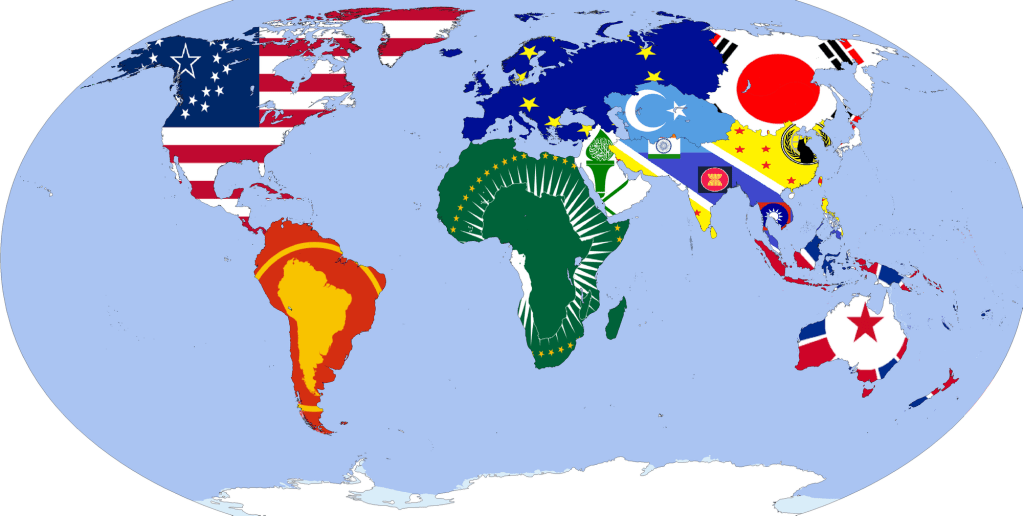
This imagined future world view rather accurately reflects the amalgamation of Russia and a German led Europe; as well as the portrayal of the geo-economic trading blocs of North America, Latin America, Africa, the complex Islamic sphere and the enlarged East Asian region.
It is to Russia that America will one day turn, cap in hand. The eventual outcome is not good, as the independent American polarities will be defeated by a coalition, constituting the northern alliance of Russia and Germany (Europe); in turn collaborating with a Brazilian and Mexican led Latin America.
In this new world order, the Islamic nations as discussed earlier, possibly led by a reincarnation of the Ottoman Turks, Turkey; will challenge the northern alliance hegemony. In a war that stages three major conflagrations, with the North winning the decisive third battle, the southern confederacy of Islam falls to the subjugation and occupation of Russia and a German led Europe. India too, a bystander – or ally of the southern confederacy – will also fall prey to Russian and German domination.

Aside from the intriguing date, the rendition of this world view prescribes the lands – North Africa, the Middle East, as well as India – which will ultimately fall into the hands of a Russian and German alliance. The artwork hinting of an ancient Roman resurrection coupled with Jewish hegemony is uncannily close to the mark.
At this point the Eastern hordes, comprising China and its allies, decide ‘enough is enough’ and face off against the northern alliance in the mother of all battles that is actually predicted by name. What happens next, is the subject for a different question and another time…
“There is nothing new in the world except the history you do not know.”
Harry S Truman
© Orion Gold 2022 – All rights reserved. Permission to copy, use or distribute, if acknowledgement of the original authorship is attributed to Orion Gold
 The Lightkeeper