
This writer’s interest was piqued during a conversation, after the other person’s attention became animated when a certain deific individual was mentioned in connection with The Kybalion and the Seven Hermetic Principles. What touched a cord, was how this particular entity had been briefly discussed in the article: Monoliths of the Nephilim. The realisation dawned of the need to learn about this individual and understand the reason for their popularity. In so doing, a number of details were not clear at the outset: what his real name was; his true identity; the exact time frame in which he lived; or whether one was dealing with a man, a god or something between the two. The mystery surrounding his persona was further enhanced as an exhaustive study led to of all places, the Bible. Therefore, the title for this article was not chosen at the beginning of writing or with little thought, but only at the conclusion of this writer’s research when Thoth’s profile crystallised into clearer form.

His online presence and offline popularity became increasingly obvious as a firm favourite amongst those interested in the New Age, the occult and all things esoteric. For now, let’s call him Thoth (1). Even Thoth’s name is ambiguous for though an Egyptian god, Thoth is a Greek name and is the Greek form of the Egyptian ḏḥwtj reconstructed as Djehuti (2); which is of uncertain meaning, yet some equate it as the word for the Ibis bird. Or rather the phrase: ‘He who is like the Ibis’, for it was associated with wisdom like Thoth.
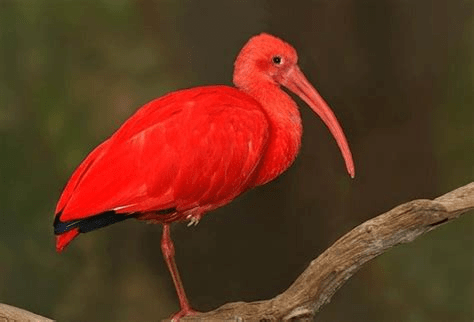
The Ibis was a popular pet and common throughout Egypt. One source proposed that Thoth means ‘the one who balances.’ Judging from the photos, the Ibis seems good at that.

Thoth being a Greek name led to the association with the Greek god of like attributes, Hermes (3); otherwise known by the classical historian Herodotus, as the Roman god Mercury (4). This connection was popular, supported by Plutarch and Christian writers. It was during the incursions of Greece into Egypt, that the ancient Greeks merged the names Thoth and Hermes to form the appellation, Hermes Trismegistus (5). This term translates as ‘Thoth the Thrice Great’ or ‘Thoth Three Times Great’ – refer article: 33. That said, we will begin our study with the Olympian god, Hermes.

There were twelve canonical Olympian gods in Greek mythology, with Hermes one of these who lived on Mount Olympus, ruling over parts of the mortal world. Zeus and Maia were the parents of Hermes. All the children of Zeus were Hermes’ siblings, though he possessed a ‘special younger-brotherly relationship with Apollo.’ The identity of Apollo is of notable interest and has been discussed at length – refer Chapter XXI The Incredible Identity, Origin & Destiny of Nimrod; and Chapter XXII Alpha & Omega.
Facts About the Olympian God Hermes, N S Gill:
‘Greek gods were far from perfect. In fact, they were known to be flawed and to have many sexual affairs with gods, nymphs, and mortals alike. The list of Hermes’ partners included: ‘Agraulos, Akalle, Antianeira, Alkidameia, Aphrodite, Aptale, Carmentis, Chthonophyle, Creusa, Daeira, Erytheia, Eupolemeia, Khione, Iphthime, Libya, Okyrrhoe, Penelopeia*, Phylodameia, Polymele, Rhene, Sose, Theoboula, and Thronia.’ Unsurprisingly, the busy ‘Hermes fathered many children… Angelia, Eleusis, Hermaphroditos, Oreiades, Palaistra, Pan [with the Arcadian nymph Penelopeia*], Agreus, Nomios, Priapos, Pherespondos, Lykos, Pronomos, Abderos, Aithalides, Arabos, Autolycus, Bounos, Daphnis, Ekhion, Eleusis, Euandros, Eudoros, Eurestos, Eurytos, Kaikos, Kephalos, Keryx, Kydon, Libys, Myrtilos, Norax, Orion, Pharis, Phaunos, Polybos, and Saon.’
‘… Hermes is the god of eloquence, commerce, cunning, astronomy [including astrology], music, and the art of fighting. As a god of commerce, Hermes is also known as the inventor of the alphabet, numbers, measures, and weights. As the god of the art of fighting, Hermes is a patron of gymnastics. According to Greek mythology, Hermes also cultivated the olive tree and provides refreshing sleep as well as dreams. Additionally, he is the herdsman of the dead, the protector of [travellers], the giver of wealth and luck, and [the] protector of sacrificial animals, among other things. Hermes is credited with inventing divine worship and sacrifice… [and] is the herald [or messenger] of the gods.’
It goes without saying that Hermes was a busy man, or god – at work and at home it would seem. An important point to note and one which assists in identifying Hermes is the fact that the gods were flawed and interacting sexually with humans. This highlights that these beings were not Gods and rather angelic in nature, as well as the fact that they were not righteous spirits serving the Eternal God. It remains to be seen whether they were associated with the Grigori, preceding them perhaps, or were in fact lesser demigods. Though we do have a time frame appearing to indicate the antediluvian age, between the patriarchs Adam and Noah.
Hermes: Messenger of The Greek Gods, Thomas Gregory, April 6, 2022:
‘Hermes… wearer of winged sandals, was one of the most important and referred to of the Olympian gods… ran messages from the underworld, and was the trickster god who gave Pandora her famous box… Hermes is still one of the most popular gods and is the primary influence of one of the most recognizable superheroes we have – The Flash… his childhood showed indications of the tricky but kind… god he was to become. His mother, Maia, was the oldest of the seven Pleiades, the daughters of Atlas’ – refer Chapter XV The Philistines: Latino-Hispano America; and article: The Pyramid Perplexity. ‘As such, she was as powerful as Zeus’ wife Hera, and Hermes was known as a protected child.
As soon as he was born, Hermes crafted the first lyre using the shell of a tortoise and the guts… [from a] sheep. When Hermes played, it was said to be the most beautiful sound in the world; the young god would use it many times to calm those [angered by] his trickery.
Artemis taught Hermes how to hunt, and Pan [his son] taught him how to play the pipes. He went on to become Zeus’ messenger and the protector of his many brothers. Hermes also had a soft spot for mortal men and would protect them on their adventures. Of the 12 olympian Gods, Hermes was perhaps the most loved. Hermes found his place as a personal messenger, guide, and kind-hearted trickster. Hermes is… most recognizable [of the gods] due to his unusual staff and winged boots. These items not only appeared in art but also became central elements in many of the stories from Greek mythology.’

‘Hermes staff was known as “The Caduceus.” Sometimes known as “the golden wand,” or “the herald’s wand,” the staff was wrapped by two snakes and often topped with wings and a globe. The Caduceus is said to have the power of creating peace or putting people to sleep. Hermes’ famous staff, the Caduceus, is seen today all over the world. How? As a symbol of transport, the caduceus symbol is used by customs agencies all over the world, including… China, Russia, and Belarus. In Ukraine, the Kyiv National University of Trade and Economics uses the Caduceus in its coat of arms’ – refer article: Ophir & Ukraine.
‘Despite NOT being the Rod of Asclepius, a well-known snake-god, the Caduceus is also a common modern logo for Medicine. While its origin may have been by mistaking the two, the symbol has been used since the 3rd century. Today, the United States Army Medical Corp uses the symbol, despite its erroneous history. Academics hypothesize that the confusion came not because of the similarities in design, but because of Hermes’ connection to chemistry and alchemy.
Hermes wore magical sandals, called “pedila” [also known as talaria, made of imperishable gold]. They provided Hermes with great speed, and would sometimes be shown artistically as having tiny wings.’ Hermes often wore a “petasos”, a winged hat sometimes mistaken as a helmet but was actually a wide-brimmed farmer’s hat made of felt. He owned a golden sword, which he famously lent to Perseus the hero used to kill Medusa.
‘In the plays and poems of Homer, Hermes is sometimes referred to as Argeiphontes. In less-known myths, he was known as Atlantiades, Cyllenian, and Kriophoros.’ Note for now, the similarity of his name Atlantiades with Atlantis – Article: Antartica: Secrets of the Lost Continent of Atlantis.
Gregory: ‘While Hermes is best known today for his role as herald and messenger, he was first worshiped as a god of fertility and boundaries. Known as a “Chthonic god,” he was associated closely with the underworld, and large phallic pillars dedicated to the Greek god could be found at the borders between towns’ – refer article: Belphegor. ‘These pillars were as much markers to guide [travellers] as they were indicators of ownership and control, and it may be that it was from these [artefacts] that the ancient deity became associated with guidance.’
This description of Hermes is uncannily like that for the idol Ba’al of Peor worshiped by the ancient Moabites. N S Gill describes Hermes as a ‘complex old god’ who was ‘friendly, helpful, sneaky, and cunning.’ Belphegor’s personalty could be described similarly. Ba’al Peor Latinised to Belphegor was representative of the ancient god, Chemosh. Yet, both these names are descriptive titles and the god’s name was in fact Horon – the Egyptian equivalent being, Horus. Added to this is the fact that the Moabites with the Ammonites, were the ancestors of the modern nation of France – refer Chapter XXVI The French & Swiss: Moab, Ammon & Haran. This is important, as the connecting link between the biblical ancestors and the modern descendants are the intermediate peoples comprising none other than the Classical and Hellenistic Greeks. For the Moabites and Ammonites formed the Greco-Macedonian Empire.
While Hermes was never viewed as the primary god of the dead, he was often featured in underworld myths and pictured on ancient gravestones. Hermes was associated with crossing the line between life and what came after and often acted as a psychopomp – a guide to the dead, escorting the souls of the deceased to the underworld – Article: DEATH: A Dead End or a New Beginning? Hermes did serve a role as a fertility god, as while creation and death are seen as opposites; underworld gods were associated with the boundaries of life and death and thus with the creation of new life from the earth.
Mike Greenberg: “Hermes’s role as a god who crossed boundaries was further reinforced by the herma, or way markers, that stood on boundaries between properties and states. Originally simple stone cairns, they later bore his image as the god of travel across borders before further evolving into phallic shapes that reinforced the connection between boundaries and fertility. While the herma continued to be associated with Hermes, his role as a fertility god became more indirect. His origin in the wild mountains and patronage over herds connected him with the more obviously sexual god Pan [his son]…” According to most scholars, the name Hermes is derived from the Greek word herma, meaning: a ‘stone heap’.
Thomas Gregory: ‘Hermes is also known as the god of shepherds, and many early depictions of the god show him carrying a lamb over his shoulders. Some academics suggest that Roman-era art showing Christ as “the good shepherd” may have been [modelled] on earlier works depicting Hermes. One ancient myth pertains to the shepherd god protecting a town from a plague by walking around the city’s borders with a ram on his shoulders.’
Two points here. First, while the artwork for Christ may well have been modelled on Hermes, the concept of Christ being the Lamb was original to him – 1 Peter 1:19-20, Revelation 13:8. As was perhaps not the title, but the role of the Good Shepherd – John 10:11-14. Second, the attribute of being a shepherd of people, was indicative of the antediluvian age – refer article: Na’amah.
Gregory: ‘Of all the roles Hermes played, he was best recognized as the swift and honest messenger of Zeus. He could appear anywhere in the world to order or warn people, or to simply pass on the words of his father. Hermes could also hear the call of others and would relay their messages back to the greater god, Zeus. Most importantly, the Greek god was one of the few who could travel easily between our world and the underworld. While there had been many gods and goddesses of the underworld, only Hermes was said to come and go as he pleased.’ This role parallels that of the Son of Man – 1 Timothy 2:5.
‘Hermes appears many times in the famous Homeric Poem “The Odyssey.” While The Odyssey records Hermes guiding Heracles into the underworld, he was not the only important person led by the Greek god. Hermes plays an integral role in one of the most well-known events of “The Iliad” – the Trojan War. During the war, the near-immortal Achilles [a demigod in the vein of an Elioud of Nephilim descent] engages in a one-on-one battle with the Trojan prince, Hector. When Hector is eventually killed by Achilles, King Priam of Troy is distraught that he cannot safely retrieve the body from the field. It is the kind messenger Hermes that protects the king as he left his castle to retrieve his son and perform the important death rites. Hermes also plays the role of guide and protector for many young gods… [including] Hermes protecting the son of Apollo and taking him to Delphi so that he may grow up as an attendant at the temple.’
This is of interest, as the Trojan War was in essence a battle involving family members living as city-states, instead of national states or countries we have now. To cut a long story short. The cause of the battle was a prince of Troy, Paris abducting and stealing Helen of Sparta for his own. Her husband, King Menelaus of Sparta then enlisted the help of the numerous Greek city-states led by his elder brother, Agamemnon, king of Mycenae. While other identities may have been involved, the two principle contenders were descendants of Esau and again curiously, those of Lot’s sons, Moab and Ammon – the ancestors of the French – refer Chapter XXVI The French & Swiss: Moab, Ammon & Haran; and Chapter XXIX Esau: The Thirteenth Tribe.
Of course even before these events transpired, it was Hermes who ironically triggered the tragic war, when he escorted three goddesses to Paris of Troy at Mount Ida. What Was the Cause of the Trojan War, Madeline, 2019: “The war originated as a quarrel between three goddesses (Aphrodite, Athena, and Hera) over a golden apple, sometimes referred to as the Apple of Discord. It all happened at the wedding of Peleus and Thetis, when Eris, goddess of strife and discord, was not invited. She was turned away and in retaliation, threw a golden apple amongst the goddesses there “to the fairest.” When Aphrodite, Hera, and Athena claimed it, Zeus mediated and assigned Hermes to bring the goddesses to Paris of Troy to settle the debate.
They all offered gifts – Athena, goddess of war, offered him victory in battle; Hera, the goddess of home, promised him to be king of all men; and Aphrodite, the goddess of love, offered him Helene (the most beautiful woman in the world) in marriage. Paris chose Aphrodite. However, Helene was the wife of Menelaus, the king of Sparta. Paris, under the disguise of a diplomatic mission, went to Sparta to abduct Helene so he could bring her back to Troy. However, before Helene could look up to see Paris, she was shot with an arrow by Eros, or Cupid, and fell in love with Paris as soon as she saw him.”
Gregory: ‘While best known as the messenger of the gods, Hermes was also famous for his skilled or deceptive acts of mischief. Most of the time these tricks were used to help people, rather than get into mischief, although he also played a role in perhaps one of the most famous tricks of all time – Pandora’s Box.’
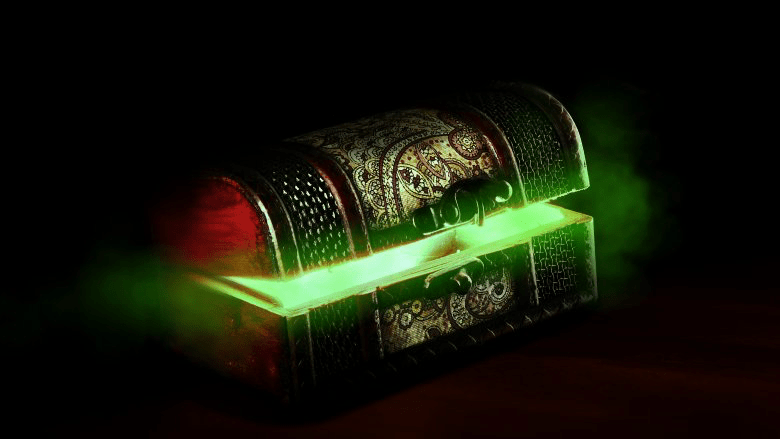
‘Pandora, the first^ woman, was created by Hephaestus at the orders of Zeus. According to “Hesiod, Works and Days,” she was “a sweet, lovely maiden-shape, like to the immortal goddesses in the face.” Zeus commanded Athena to teach the woman needlework but, most importantly, he also commanded Hermes to make Pandora inquisitive and able to lie. Without these things, the young woman would never have released her box (or jar) and all its calamities upon the world.’
This sounds suspiciously like the actual greatest trick played in the history of humankind which occurred during the incident in the Garden of Eden, whereby Eve^ was a. lied to; b. tricked; c. her curiosity was awakened; and d. her bad choice led to evil entering the world – Genesis 3:1-24.
Hermes is credited with inventing the Greek alphabet, though in truth language, letters and grammar were passed from the gods to humans at the beginning of the antediluvian age – refer article: Na’amah* and Chapter XXII Alph & Omega. Granted, Hermes may have been instrumental in this, and so his involvement with the Greek alphabet is poetic licence by the Greeks.
Thomas Gregory: ‘From The Fabulae, a text by Hyginus, superintendent of the Palatine Library in ancient Greece, we learn that Hermes played an important role in inventing the Greek alphabet and all written words since. According to Hyginus, the Fates created seven letters of the alphabet, which were then added to by Palamedes, a great prince in Greek mythology. Hermes, taking what had been created, formed these sounds into shaped characters that could be written. This “Pelasgian Alphabet” he then sent to Egypt, where it was first used. Eventually, further letters were added to it, forming the alphabet we have today.
While the Greek god did not invent music* Hermes did invent the lyre, an ancient version of the harp [and precursor to the guitar], almost immediately after being born… Bibliotheca of Pseudo-Apollodorus:
“Outside the cave (of his mother Maia) he (the infant god Hermes) found a tortoise feeding. He cleaned it out and stretched across the shell strings made from the cattle he had sacrificed, and when he had thus devised a lyre he also invented a plectrum… When Apollon heard the lyre, he exchanged the cattle for that. And as Hermes was tending the cattle, this time he fashioned a shepherd’s pipe which he proceeded to play. Covetous also of this, Apollon offered him the golden staff which he held when he herded cattle. But Hermes wanted both the staff and proficiency in the art of prophecy in return for the pipe. So he was taught how to prophesy by means of pebbles, and gave Apollon the pipe.”
A further association with both the French people and the ancient Greek’s ancestor Lot, is ‘In “Metamorphoses,” [where] Ovid tells the tale of an old married couple [Baucis and Philemon] who were the only people to welcome the disguised Zeus and Hermes into their home. Quite similar to the story of Lot in Sodom and Gomorrah, the rest of the town was destroyed as punishment, but the couple was saved.’
According to Juan Salazar Sanchez, one of the symbols for Hermes is a Gallic rooster. Another connection with France as the Cockerel is their national symbol. Aligned with this is the fact that Belphegor as the Ba’al of Peor, was not just the god of the Moabites – the ancestors of the Franks and the French – but is France’s infernal ambassador and Guardian – refer article: Belphegor; and Chapter XXVI The French & Swiss: Moab, Ammon & Haran.
Gregory: ‘When Harry Lampert was commissioned to illustrate the first two issues of a new comic book, he took inspiration from Greek mythology and drew the “fastest man alive” with wings on his boots and a wide-brimmed hat (that in later versions turned into a helmet). Despite being paid only $150 for his design, and being quickly replaced, Lampert’s design remained and has been used as an influence for further iterations of the character.
One year after “The Flash” was introduced, DC Comics introduced the “real” Hermes in the very first issues of “Wonder Woman.” In this first issue, it is Hermes who helps mold Princess Diana from clay, imbuing her with the power of the Gods. In a famous mini-series of comics called “Injustice,” Hermes even proves his might by catching up to “The Flash” and punching him out! Not to be undone, Marvel Comics also introduced Hermes in its “Thor” comics. The Greek god would appear many times when Thor interacted with Greek mythology, but also to collect Hercules when he was beaten up by The Hulk! In Marvel’s version of the Greek god, he has the winged cap and boots but also carries the Caduceus wherever he goes.’
Hermes popularity led to his statues being placed at the entrances of stadiums and gymnasiums throughout Greece, symbolising his swiftness and athleticism. He was worshipped with sacrifices in Olympia where the Olympic Games was celebrated. One of the most famous statues of Hermes is known as the Hermes of Olympia or the ‘Hermes of Praxiteles’, found amongst the ruins of a temple dedicated to Hera. The cult worship of Hermes became widespread in Greece and Rome. The oldest place of worship for Hermes was Mount Cyllene in Arcadia where he was said to have been born. From there, his cult following travelled to Athens, then spreading throughout Greece. Even so, only three known temples were specifically dedicated to Hermes during the Classical period and all of them in Arcadia. Other temples were usually consecrated to Hermes in conjunction with his partner Aphrodite such as in Attica and on Crete.
Gamblers would often pray to Hermes for good luck and wealth; while many merchants worshipped him daily, hoping for business success. It was believed giving offerings to Hermes would bring them good fortune and prosperity.
Juan Salazar Sanchez:
‘In Greek mythology, the Titanomchy was a great war that took place between the Olympian gods and the Titans, the old generation of the Greek gods. It was a long war that lasted for ten years and ended when the old pantheon that was based on Mt. Othrys was defeated. Afterwards, the new pantheon of gods was established on Mt. Olympus. Hermes was seen during the war dodging boulders thrown by the Titans, but he doesn’t have a prominent role in this great conflict. He apparently did his best to avoid it [much like Belphegor’s tendency to remain distant and non-committal] whereas Ceryx, one of his sons, fought valiantly and was killed in battle fighting Kratos, the divine personification of power or brute strength. It’s said that Hermes bore witness to Zeus banishing the Titans to Tartarus for all eternity.’
The Grigori were likewise placed in Tartarus by the archangels, where Christ later spoke to them – Jude 6, 2 Peter 2:4-5, 1 Peter 3:18-20. That said, during the war with the giants, while Hermes wore his cap which made him invisible, he killed Hippolytus as well as helping his father Zeus in his confrontation with Tyfoea.

Avi Kapach: “The Titans were immortal deities who ruled the cosmos before the Olympians. The original twelve Titans – the children of the primordial gods Gaia (earth) and Uranus (heaven) – assumed power by overthrowing their tyrannical father, only to become tyrants themselves. Cronus, the youngest Titan, became king after usurping Uranus. Fearing a similar fate, he attempted to prevent any revolts against his own power by swallowing his children as soon as they were born. But Zeus, Cronus’ youngest son, managed to escape, and he eventually freed his siblings. Together, they waged a ten-year war against Cronus and the other Titans known as the Titanomachy. In the end, the Titans were defeated; most of them were imprisoned in Tartarus by the new gods, the Olympians – so called because they dwelled atop Mount Olympus.”
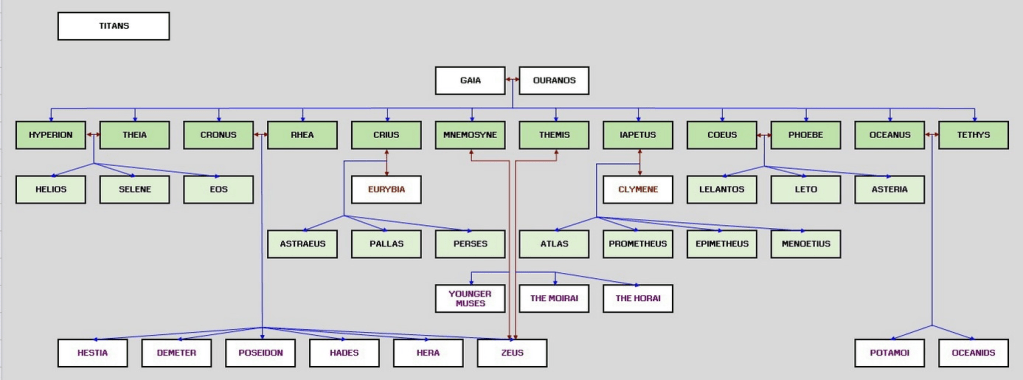
“The Titans included not only the original twelve children of Gaia and Uranus but also some of their descendants, such as Prometheus, Atlas, Metis, and Leto. Though they were sometimes represented as cruel in Greek mythology, the period during which the Titans ruled was nonetheless regarded as a Golden Age. Unlike the Olympians, however, the Titans were almost never worshiped in ancient Greece (an exception is Rhea, the mother of Zeus and the Olympians, who was sometimes worshiped as “Mother of the Gods” or “Great Mother”).”

The genealogy of Hermes
There is much more which could be said about Hermes – the god of transitions and boundaries – such as the fact he is also the patron of thieves and liars, as a result of his own trickery. Lefteris Koukakis concludes: ‘Cunning and clever, agile and tricky, resourceful and wily, dreamer, thief and flatterer, energetic and restless are some of his key features. Hermes is one of the oddest, most gifted, and most popular Olympian gods.’ Although Hermes was a god of fertility, Hermes didn’t marry and had few affairs compared to other Greek gods. Certainly, he had number of consorts but a hint of the fey lingers about Hermes – see first image of Mercury** below. Much like the angel of the written word, Penemue who was ambiguously male and female – refer Chapter XXII Alpha & Omega.

Penemue
Hermes allegedly also ‘loved young men in pederastic relationships where he bestowed and/or taught something related to combat, athletics, herding, poetry and music. Photius wrote that Polydeuces (Pollux), one of the Dioscuri, was a lover of Hermes, to whom he gifted the Thessalian horse Dotor. Amphion became a great singer and musician after his lover Hermes taught him to play and gave him a golden lyre.’ In likeness, his son by the most beautiful Aphrodite – associated with love, lust, desire, beauty, pleasure, passion, sex, procreation and fertility – was Hermaphroditus.
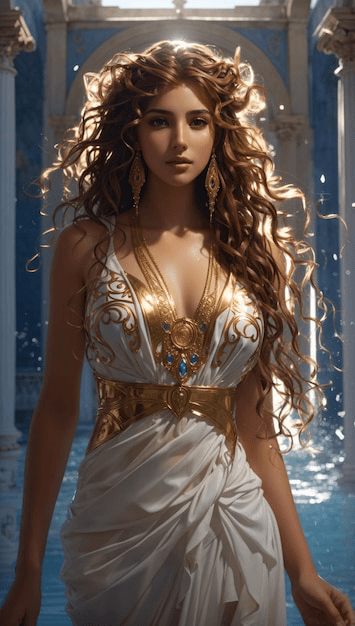
Aphrodite
Online Encylopaedia: ‘According to Ovid, he was born a remarkably handsome boy whom the naiad [nymph] Salmacis attempted to rape and prayed to be united with forever. A god, in answer to her prayer, merged their two forms into one and transformed him into a hermaphrodite… His name is compounded of his parents’ names, Hermes and Aphrodite… the two-sexed child of Aphrodite and Hermes (Venus and Mercury), had long been a symbol of androgeny or effeminacy, and was portrayed in Greco-Roman art as a female figure with male genitals. All three of these gods figure largely among erotic and fertility figures, and all possess distinctly sexual overtones.’ Not forgetting Hermes’ son Pan, a wild god who excelled at revelry, unchecked sexuality and seducing nymphs.

Androgynous Mercury**
This leads to the counterpart of the Greek God Hermes, the Roman god Mercury. The paradox within Hermes possessing at once fluid androgyny for each sex and yet the almost asexual ambivalence towards commitment in a marriage, parallels the two Zodiac signs ironically ruled by Mercury – dualistic Gemini and puritanical Virgo. As Hermes understandably shared temple popularity with Aphrodite in Greece, Mercury likewise shared the spotlight with Venus. Though in Roman tradition he perhaps fared better when a temple was dedicated to him in the Circus Maximus – Rome’s first and largest entertainment venue – between the Aventine and Palatine hills in 495 BCE. Similarly, the impressive Roman temple complex built on the extraordinary foundations of Baalbek was dedicated to three gods, including the mercurial Mercury – refer article: Monoliths of the Nephilim.
Mercury appears to be a carbon copy of Hermes and it is easy to see them as the same person. Mercury’s favoured position as the messenger of the gods meant he had control over the flow of information, using this position to his advantage. Yet Mercury seems a little more liberated, often appearing nude. In the Roman pantheon, Mercury was the only god who could freely cross into the underworld like Hermes.
Thomas Apel: ‘The name “Mercury” (or Mercurius) probably emerged from the Latin merx, a noun meaning “merchandise” [‘or possibly “merces”, whose meaning is wages’]. In its verb form, the word mercari meant “to trade.” A deeper root in the Proto Indo-European language may have been merk- or merg-, meaning “boundary” or “border,” respectively. Mercury, then, was “the merchant” or “the keeper of boundaries.” As the chief messenger of the gods, Mercury controlled the movement of all things – goods, ideas, words, and people.’ Mercury ‘flew with the help of a winged helm that [his half-brother] Vulcan, the god of forge and fire, had fashioned for him. Mercury also carried the caduceus, a staff wound with serpents that was gifted to him by Apollo. Mercury was swift and clever, and his knowledge of major events often bordered on foresight.’
Mercury was the only child of Jupiter the king of gods and the nymph, Maia. He had a number of half-brothers: Liber (Bacchus), Apollo, Mars and Vulcan and half-sisters: Diana, Venus, Minerva and Proserpina. Mercury’s consort was Larunda, a naiad nymph and they had two children, who were ‘nameless [invisible] deities known only as the Lares. Like their father, the Lares served as guardians of the crossroads.’ Mercury had other lovers, the most famous being his affair with his beautiful half-sister Venus, producing an androgynous child called Hermaphroditos. ‘Later in life, Hermaphroditos would merge his body with that of his female lover, thus becoming a single entity with both male and female genitalia.’ Mercury took male lovers, including the hero Perseus.

Venus
Apel: ‘Mercury was a significant figure in Roman religion whose persona evolved over time. While Mercury’s earliest temple was established in the fifth century BCE, the characteristics of this early incarnation were unclear. This version of Mercury was likely a Romanization of the Etruscan god known as Sethlans. With the rise of Hellenic culture in Rome in the third century BCE, Mercury emerged more clearly as a Romanized version of Hermes. Mercury’s festival, Mercuralia, was celebrated each year on May 15th.
Compared to other gods and goddesses, Mercury has maintained an incredibly lively presence in popular culture. The speedy god is best remembered for the planet named after him. Of which we shall return as well as its place in astrology. Mercury also lent his name to NASA’s first manned space program; the object of this program was to put a man into orbit around the planet. The chemical element “Mercury” also bore the name of the messenger god… known as quicksilver due to its liquid state at room temperature, mercury could easily [and quickly] transition into other compounds. It was often used in mining to extract gold and silver from various ores. Mercury’s name resonated in other areas as well. From 1938 to 2011, the Ford Motor Company devoted an entire division to its Mercury line. The brand’s first logo was a profile image of Mercury wearing his winged helm. Mercury Records, a famed record label, also used Mercury’s helm as a logo.’
In imitation of the already established link between Hermes and the ancestors of the French; Mercury was considered a god of ‘abundance and commercial success, particularly in Gaul, where he was said to have been particularly revered.’ Mike Greenberg: ‘While Mercury was important to the Roman way of life, they believed that other people held him in even higher regard. When writing about the people of Gaul, Julius Caesar remarked:
“They worship Mercury in particular, as their god and have many images of him, and regard him as the inventor of all arts. They consider him the guide of their journeys and marches, and believe him to have great influence over the acquisition of gain and mercantile transactions” – Julius Caesar, The Conquest of Gaul.
Greenberg: ‘Of course, the arrival of Mercury in Gaul did not occur until after it was occupied by Rome… Among the Germanic people, the Romans associated Mercury with Wotan. The Germanic form of Odin, Wotan was the chief of the gods but associated with the god of commerce because he was often depicted as a traveller. As Roman influence in Germanic regions increased, the associations between their gods were strengthened. Local gods took on more Roman attributes and in Rome itself Mercury became the god more associated with Gaul and the Celts.’
Similarly, the rooster – as for Hermes – is the symbol of a new day which is brought by Mercury the fastest of the Gods. Old World gods: ‘As well as sharing similarities to the Greek God Hermes, he also is linked to the German god Woden. Mercury’s sacred day is Wednesday or Mercurii Dies in Latin. Wednesday translated to French is Mercredi, in Italian it is Mercoledi and German tribes would refer to Wednesday as Wodensday, from the German God Woden’ and hence Wednesday in English.
Mike Greenberg: ‘The Etruscan god Turms was very similar, as he was also a god of commerce and an intermediary between the gods and mankind. Turms, however, was not a native god of Italy either. Both Mercury and Turms were taken almost directly from the Greek god Hermes. Unlike Zeus, Mars, and other important Roman gods, there was no close parallel to Hermes in pre-Hellenized Roman religion. Therefore, the characterization and mythology of Mercury remained almost entirely unchanged. The only obvious difference in Rome was his name.
Rome could not function without its trade routes. As the city’s population grew it needed grain from Egypt, vegetables from Tuscany, wood from Gaul, and metals from Spain and Britain. As the god who protected travelers, Mercury was essential in making sure that shipments of all these goods arrived steadily from throughout Rome’s territories. Without his favor, Roman culture would collapse. He was especially important in the grain trade. Any interruption in the flow of grain from Egypt led to shortages of bread among the poor of Rome, a situation that could easily lead to civil unrest and violence.’

‘The god was known for his speed, so chariot racers often associated their sport with him. Mercury was said in mythology to often best the other gods in their own games, so he was linked with athleticism.
The Circus Maximus had been built almost precisely in between the Capitaline Hill, the traditional home of the patrician class, and the Aventine Hill, the stronghold of plebian political power. The placement of Mercury’s temple between these two feuding factors highlighted his role as diplomat and negotiator.
While most of Mercury’s mythology was taken directly from Greek sources, a few stories were told in Rome alone. One of these involved the journey of Aeneas. The son of Venus, he had fled Troy at the end of the Trojan War to settle in Italy, becoming a founding king and an ancestor to Romulus and Remus. The Roman story of Aeneas was modelled after that of Odysseus, and Mercury appeared to the Roman hero just as he had to the Ithacan kind. In the Aeneid, Mercury appears to Venus’s son to remind him to continue on his mission to fulfil his destiny of becoming one of Rome’s founders’ – Chapter XXVIII The True Identity & Origin of Germans & Austrians – Ishmael & Hagar.
The planet Mercury is the closest planet to our solar system’s Sun – it only takes 3.2 minutes for sunlight to travel from the Sun to Mercury – yet it is not the hottest planet as one would think, for that is Mercury’s next door neighbour Venus, with its ‘thicker atmosphere and runaway greenhouse effect.’ In fact, Mercury’s surface temperatures fluctuate violently between freezing cold (-173°C / -280°F) during the night – as on the side facing away from the Sun, without a substantial atmosphere to trap solar radiation, all heat is lost to space – and baking hot (427°C / 800°F) in the daytime – as the extreme highs present on the side facing the Sun are due to the insufficient atmosphere, for it is unable to absorb the solar radiation.
Mercury is also the smallest of the ‘rocky terrestrial planets’ and therefore the planet with the quickest orbit of the sun [travelling at 112,000 mph, which is the fastest of all the planets]. This means it has the shortest year with 88 days. In fact ‘Mercury orbits so quickly around the Sun [at 29 miles per second] that early civilisations believed it was actually two different stars – one which appeared in the morning and another which appeared in the evening.’
The tiny planet spins on its axis incredibly slowly, taking 58.7 Earth days to turn just once (a sidereal day is the time for one rotation in relation to a fixed point). Ironic since Mercury is the fastest god. ‘It rotates three times on its axis for every two trips it makes around the Sun. One odd effect of this “spin-orbit” lock is that a solar day [the time from noon to noon on the planet’s surface] on Mercury lasts [the equivalent of] 176 Earth days’ according to Carolyn Collins Petersen.
Mercury is nearly tidally locked to the Sun – but not quite like the Earth’s moon – and over time this has slowed the rotation of the planet to almost match its orbit around the Sun. Mercury also has the highest orbital eccentricity of all the planets, possessing an elliptical orbit which is the least circular of all of the planets and its distance from the Sun ranging from forty-six (29 million miles) to seventy million kilometres (43 million miles).
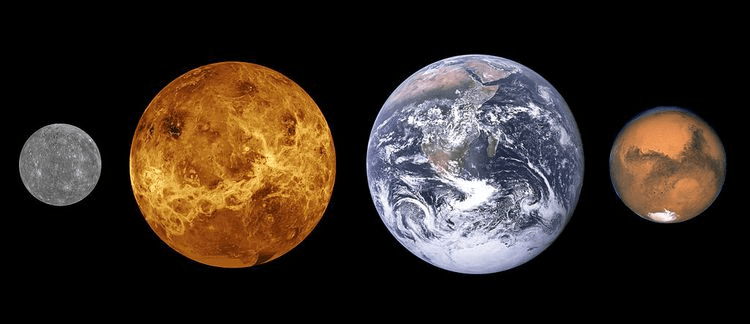
Mercury in relation with Venus, Earth and Mars
Of all the planets, only dwarf planet Pluto is smaller. Mercury is 15,328 kilometres around its equator, making it smaller than Jupiter’s moon Ganymede or Saturn’s largest moon, Titan. Mercury is approximately 4,876 kilometres (or 3,030 miles) in diameter; slightly bigger than Earth’s moon and about as wide as the continental United States.
Its mass is about 0.055 Earths, with about seventy percent of its mass metallic – mainly iron – and about 30 percent silicates; rocks made mostly of silicon. Mercury’s unusual molten core for a small planet is 42% of its total volume compared with 17% for the Earth. Its centre is described as a region of liquid iron which ‘sloshes around as the planet spins.’ Some scientists postulate that the core contains a lighter element such as sulphur, which would lower the melting temperature of the core material.
Mercury has an absence of atmosphere – and thus no weather, clouds or rain – being too small and hot to retain any molecules in the air and therefore susceptible to solar winds. Though it does have what is called an exosphere, a ‘tenuous collection of calcium, hydrogen [22%], helium [6%], oxygen [42%], sodium^ [29%], and potassium [5%] atoms that seem to come and go as the solar wind blows across the planet.’ The Planets: ‘However, as meagre as its atmosphere is, Mercury does have one. According to NASA, its chemical composition is thought to… [include possible] trace amounts of argon, carbon dioxide, water, nitrogen, xenon, krypton, neon… and magnesium.’
Mercury’s bland dark grey surface is coated with a carbon dust layer. The residue of millennia of impacts. While most planets in the solar system show evidence of impacts, Mercury is one of the most ‘heavily cratered of the inner solar system worlds’

The Planets: ‘The surface is [very] similar to that of the Moon, as unlike most planets, Mercury isn’t geologically active and cannot “self heal” from impacts with asteroids and comets.’ Petersen states: ‘Images of its surface, provided by the Mariner 10 [during 1974 to 1975] and MESSENGER spacecraft [Mercury Surface Space Environment, Geochemistry, and Ranging mission during 2011 to 2015], show just how much bombardment Mercury has experienced. Its covered with craters of all sizes, indicating impacts from both large and small space debris.
Its volcanic plains were created in the distant past when lava poured out from beneath the surface.’ Space Facts: ‘Any crater larger than 250 kilometres in diameter is referred to as a Basin. The Caloris Basin is the largest impact crater on Mercury covering approximately 1,550 km [963 miles] in diameter and was discovered… by the Mariner 10 probe.’
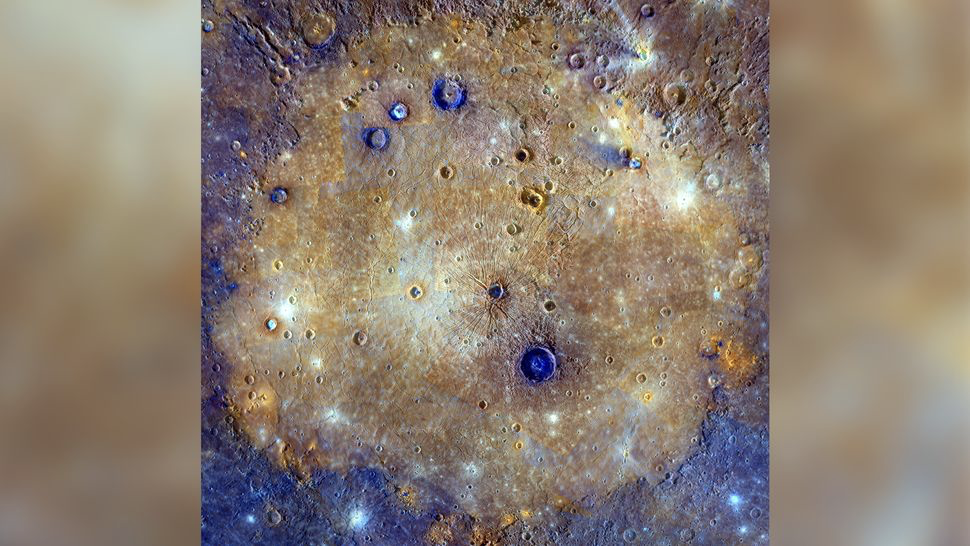
A mosaic image of the Caloris Basin, is an enhanced-colour composite overlain on a monochrome mosaic
It is estimated that 16 quadrillion tons of diamonds are on the surface of Mercury derived from graphite a form of carbon. The diamonds forming as a result of high pressure and heat from the constant bombardment by asteroids and comets, making it the most diamond rich planet in the solar system.

‘MESSENGER’s data and images helped scientists understand the structure of the planet’… revealing the existence of ice deposits in permanently shadowed craters where sunlight is never seen at Mercury’s poles. Conversely, there is a spot in the south pole region of Mercury which almost never goes dark, receiving sunlight about 82% of the time – called the True Peak of Eternal Light.
‘There are no missions to Mercury scheduled until at least 2025 when the BepiColumbo spacecraft’ – a joint mission of the European Space Agency (ESA) and the Japan Aerospace Exploration Agency – ‘will arrive for a long-term study of the planet’ after a forty-eight million mile journey.
Organic materials – the building blocks of life – have also been discovered on Mercury, but the harsh conditions cannot support life as it exists on Earth. Just the concentration of sulphur on Mercury is unlike any other planet in the Solar System. Mercury is one of five planets visible (along with Saturn, Jupiter, Mars and Venus), though its position close to the horizon makes it the most difficult to observe with the naked eye from Earth. Thirteen times a century, Mercury can be observed passing across the face of the Sun in an event called a transit, which lasts for a few hours. The previous Mercury transit was on November 11/12, 2019, with the next one due on November 12/13, 2032.
Mercury does not have any moons or rings because of its low gravity and lack of atmosphere. Thus Mercury would not be able to hold onto a moon. Venus has no moons either, but the reasons for this are more of a mystery to scientists. This is because Venus was once a moon itself – refer article: The Younger Dryas Stadial: Ending of the Earth… Beginning of the World; and Chapter XXII Alpha & Omega.
Daisy Dobrijevic: “Scientists have discovered that Mercury has streams of particles sloughing off its surface, much like a comet. Long-exposure photographs taken by astrophotographers on Earth can capture these curious tails… Scientists believe that the tails are produced when the sodium^ in Mercury’s exosphere glows as a result of being excited by light from the sun. Sunlight can also free these molecules from Mercury’s surface and push them away into space…”
An amazing feature is that ‘Mercury’s tail extends about 1.6 million miles… [and] at its peak, the tail stretches up to 14.6 million miles long.’ This is fascinating in light of the past history of Venus as both a former moon of Jupiter and later a comet; created when a passing planetary body ripped Venus from Jupiter’s orbit and magnetic pull.
Could Mercury have once been a moon? And was it likewise pulled away from its original location like its sister planet Venus? Mercury’s unusual composition, its mysterious core – bigger than the cores of the Earth and Venus – and small size may be clues to its true origin. Is the tiny planet’s oversized core in fact the residue of a former bigger planet? Coupled with this is Mercury’s impractical position adjacent to the Sun and inhospitable atmosphere for life just like Venus. It may not be a coincidence that the god Mercury and goddess Venus were partners or that they are often partnered in temples dedicated to them. Nor could the most well known trinity of gods – the Sun, Mercury and Venus – be a mere coincidence either – refer Baalbek – article: Monoliths of the Nephilim.
Mercury has a weak magnetic field whose strength is about 1% of the magnetic field on Earth. Daisy Dobrijevic: ‘Scientists are puzzled by Mercury’s magnetic field; the planet appears to be too small to host a global magnetic field, yet it does… [and] it can cause quite the commotion on the surface of Mercury in the form of magnetic tornadoes. According to NASA, when Mercury’s magnetic field interacts with the solar wind, it sometimes generates magnetic tornadoes that channel fast, hot, solar wind plasma to the surface of the little planet. When the solar wind plasma hits the surface, it displaces neutrally charged atoms on the surface, sending the loops high into Mercury’s atmosphere.’
On Mercury, your weight would be 38% of your weight on Earth.
Even though Mercury is small, the planet is very dense. Each cubic centimetre has a density of 5.4 grams with only the Earth having a higher density. This is mainly due to Mercury being composed of heavy metals and rock.
Mercury does not experience any seasons. The axis of Mercury has the smallest tilt of all other planets – just 2 degrees – resulting in a lack of any seasons on its surface.
It was once believed that a planet* called Vulcan existed between the orbit of Mercury and the Sun – however the existence of such a planet has never been found.
The Planets: ‘Mercury’s orbit is… significant in that it provides [an]… example of modern physics. Over time the orbit of Mercury shifts slightly around the Sun. This process is known as precession. Though Newtonian mechanics (i.e., classical physics) does a fairly good job of predicting the speed of this precession, it still cannot predict it precisely. This was a persistent problem for astronomers in the late nineteenth and early twentieth century. Many theories were introduced to explain the difference between the actual and theoretical rates. One theory even suggested the existence of a unknown planet* closer to the Sun than Mercury. However, the truth was finally revealed when Einstein published his general theory of relativity. As a consequence of this theory, Mercury’s orbital precession was finally described exactly.
Though it was long believed that Mercury’s spin-orbit resonance (the number of rotations per orbit) was 1:1, it was discovered in the mid-twentieth century that it is, in fact, 3:2. This resonance produces what would be fascinating phenomena for a witness on the planet’s surface. For example, the Sun would appear to rise to the highest point in the sky, then reverse its course and set in the same direction from where it rose.’ Three to four times a year, Mercury appears to travel backwards in the sky. The phenomenon is known as the retrograde of Mercury and is caused by the shortness of the planet’s orbit.
The first recorded observations of Mercury date back thousands of years, in Sumerian and Assyrian records. The planet’s existence was documented by ancient astronomers before the discovery of Venus and Mars, with the Babylonians calling the planet, Nabu. The planet is also known as Budha in ancient Sanskrit religions and in Vedic astrology and is considered a source of positive thoughts. Current astronomers believe that the darker skies of the past made it possible for ancient astronomers to observe Mercury. In modern times, Galileo Galilei observed Mercury for the first time in 1631.
A source online states: ‘A green meteorite piece was found being sold on the streets of Morocco in 2012. Scientists discovered after studies that it matches data sent from spacecraft’ orbiting Mercury. A further amazing aspect regarding Mercury is that ‘according to scientists, there may be pieces of Mercury hiding on Earth.’
Based on the premise that Mercury was once much bigger and that pieces of it had broken off and were strewn into space. This cataclysmic scenario might be linked to and explain, the anomalies in Mercury’s composition; its location in the Solar System too close to the Sun; and its elliptical orbit. A certain measure of mystery surrounds the planet Mercury’s origin, evolution and resultant status as a tiny bonafide planet? Or a destitute moon stranded in the Solar System, held and trapped by the Sun?
Unknown source: ‘… was revered through the form of the planet Mercury because this body is nearest to the sun: Hermes of all creatures was nearest to God, and became known as the Messenger of the Gods.’
It is enlightening to include the characteristics of Mercury’s influence in astrology. Not in predicting the future, but rather the aspects of personality exhibited in people born under the zodiacal signs ruled by the planet – which include Gemini beginning May 20th to June 21 and Virgo from August 23 to September 22.
Mercury Dominant Planet in the Birth Chart: An Irresistible Mind, Stargazer, July 13, 2020 – emphasis & bold mine:
‘Mercury is one of the most important planets in astrology. If you have Mercury as your dominant planet in your natal chart, you are smart, great at networking, funny, and you excel at logical thinking. Many Mercury dominant people possess literary talent. With this planet as your dominant planet, you are a quick learner and have a sharp intellect.
If Mercury is strong in your chart, you are called a Mercurian. Mercurians are a lot like Mercury: vivid, talkative, and observant. Mercury is a very quick planet, and so are people with this planet emphasized in their horoscope. They are lively and they wish they were three people so that they could live more.’
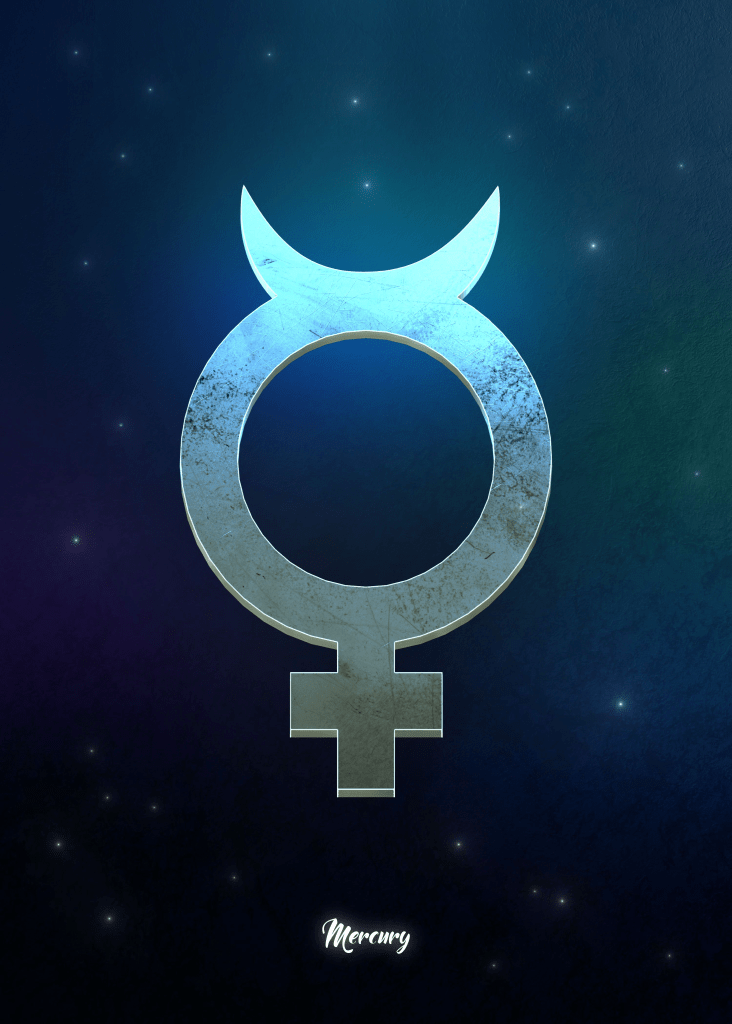
‘You have a Mercury dominant birth chart if:
1. You are a Gemini or Virgo rising. If you are a Gemini or Virgo rising, this makes Mercury your chart ruler…
2. Mercury conjunct the ascendant or Midheaven. When talking about conjunction with an angle, most astrologers use an orb up to 10 degrees. The areas around the ascendant or Midheaven are extremely important. The areas around the angles are called the Gauquelin sectors, and planets here become more powerful. Mercury conjunct the ascendant gives you a lot of Mercurian qualities, to the extent where you sometimes appear to be a Gemini or Virgo rising, no matter your actual rising sign! This placement suggests that your physical appearance is Mercurian, too. The Mercury dominant appearance is slender, airy, short, very quick, and flexible.
3. Aspects to Mercury. If a planet receives a lot of aspects in the birth chart, it has a great influence over your personality, especially if they are personal planets (the Sun, Moon, Mercury, Venus, Mars, Jupiter, Saturn). Sun-Mercury and Moon-Mercury aspects are particularly important. Planets that are in aspect with each other color how each planet manifests in your life. For example, if your Mercury is conjunct Venus, their energies blend together, and there will be some Mercurian traits to your Venus.’

‘Mercury… has been in use in astrology for a long time, as it is one of the seven visible planets. Mercury is one of the personal planets, used both in modern and in traditional astrology. There are two zodiac signs associated with Mercury in astrology: Gemini and Virgo*. (However, some astrologers consider the asteroid Chiron to be the ruling planet of Virgo, so see what works for you the best.) There are two houses where Mercury is in accidental dignity: both in the third and sixth.’*

‘Why is Mercury important in astrology? This planet takes place between the Sun and the Earth, and in astrology, it represents the bridge between you and the world. It enables us to think and share our thoughts with each other. This planet helps us to communicate, share information, give and receive. Without Mercury, we couldn’t cooperate and human civilization couldn’t exist in the form it does today.
Mercury rules all forms of communication: talking, reading, writing, the internet and media are all associated with this planet in astrology.
Besides communication, Mercury is also the planet of rational thinking. It represents the thinking process, gathering and processing information, reasoning, logical abilities. Mercury in a harmonious aspect with the Moon suggests great memory. Mercury is a very fast moving planet with its orbit of 88 days. People who have a Mercury dominant planet in the birth chart are quick and agile themselves… They think and talk fast, and they want to be always on the go.
If you are a Mercurian, you are intelligent, have great communication skills, and generally speaking, you are fun to be around. This planet is usually strong in the charts of actors, writers, programmers, or people in fields where you need strong logical thinking, such as science or math.
In a relationship, people with Mercury dominant planet need an intellectual connection. They are drawn to smart people, and need fascinating discussions about… anything in the world. Mercury is not emotional at all. With [a] Mercury dominant planet, you are curious and open-minded. There is an intellectual need to discover how the world works. You are interested in a lot of things…
Having a strong Mercurian influence in your natal chart suggests outstanding hand dexterity. Mercury rules the hand in astrology, and people with Mercury dominant planet are usually great at different arts and crafts.
Mercurians tend to talk a lot. But besides talking, they are great listeners, too, and they are particularly good at spotting small details. With this planet strong in your natal chart, you are great at picking up tiny clues. Mercury dominant people understand nonverbal communication well…
You need reading and writing like you need the air you breathe. This planet is… strong in the charts of writers. There is an intellectual urge to share what you notice around you, and many Mercury dominants simply need to write. Reading is a must for them, too. Many people who have this planet strong in their charts learned to read at a very young age, often on their own. And they haven’t stopped ever since.
… people with a Mercury dominant birth chart have a wide range of interests. In astrology, Mercury is the planet of the conscious mind, rational thinking, logic… the left side of the brain. If you have a Mercury dominant personality, you have strong intellectual urges. You are incredibly curious. People who have this planet strong in their charts are in love with learning. You usually never stop educating yourself, this planet makes you a lifelong learner. Mercurians are quick to gather information and connect the dots. Mercury dominant people are hungry for novelties. Mercury wants something new every minute. The flip side of this is a short attention span… A Mercury dominant personality gets bored very quickly. Being in a low-stimuli environment is… torture for a Mercury dominant… Mercury is a thinker, but it doesn’t tend to be a doer.
Besides learning and gathering information, Mercury is eager to share its knowledge with others… people with a Mercury dominant planet make great teachers. If they don’t choose teaching in the classical sense of the word, they still teach others in some way, through books, articles, or just sharing their latest observation in a conversation.
Sometimes it seems like Mercurians [run] on puns. Humor is also connected with Mercury in astrology. If Mercury is strong in your chart, you have a great sense of humor, and your talent for cheering up others contributes to your popularity. However… Not all people appreciate irony, unlike Mercury dominants.’
Thus far it would be fair to say that little separates the Roman god Mercury from his Greek counterpart, forerunner and inspiration, the Greek god Hermes. It is also powerfully evident that Hermes-Mercury is a god of impressive intellect and captivating communication skills. A learned and educated being who possesses a vast reservoir of knowledge and secret wisdom. It is with this in mind that we now investigate the Egyptian god Djehuti (or Djehuty), renamed by the Greeks as Thoth – pronounced as Toth, rhyming with ‘both’, rather than with ‘goth’. Are Hermes and Thoth one and the same as Hermes and Mercury? Or is Thoth a different personage altogether?
Thoth otherwise known as Tehuty, Djehuty, Tahuti, Tehuti, Zehuti, Techu and Tetu, according to J Hill, is one of the earliest Egyptian gods on record. He became popular and particularly venerated in Khmunu or Khemenu [‘the City of the Eight’] or Hermopolis Magna in Greek – which later became the capital – and was worshipped as part of the Ogdoad. Not to be confused with Khnum – a ram-headed deity who created humankind from clay on a potter’s wheel. Archeologists have found thousands of mummified ibis who were buried with honour in Thoth’s name in cemeteries in both Hermopolis and Memphis.
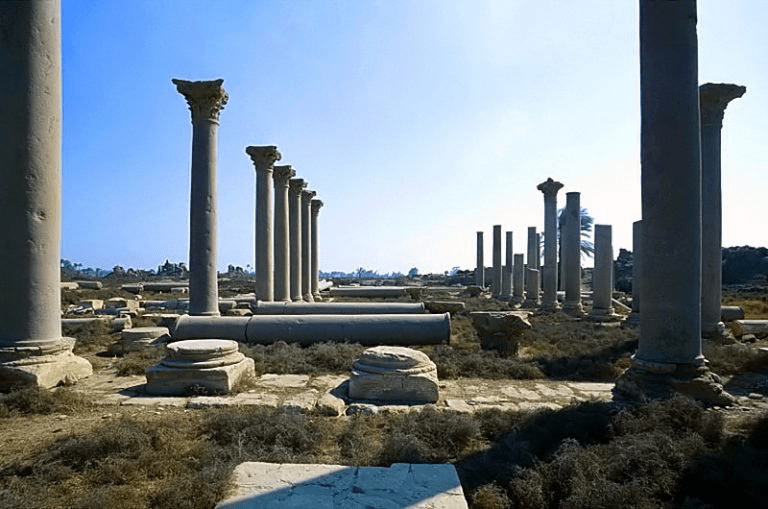
Hermopolis
In Egyptian mythology, the Ogdoad were eight primordial deities worshiped in Hermopolis. It is of note that Thoth was worshipped principally at Herm-opolis – modern Al-Ashmunayn in Upper Egypt – meaning ‘city of Hermes’. It is also interesting that Thoth was part of the Og-doad, bearing similarity with the giant, King Og in the scriptures and discussed in the articles: Belphegor; and Na’amah.
Evan Meehan: ‘… the pre-creation universe existed in the form of Nun – an infinite body of inert water. Nun was a difficult concept to fathom, so the Hermopolians divided Nun into 8 components, half male, half female. These eight deities were represented by frogs for the men, and snakes for the women and included:
Nun and Naunet: the boundless waters
Huh and Hauhet: infinity
Kuk and Kauket: darkness
Amun and Amunet: secrecy
Collectively… the eight deities built an island in the infinite sea of Nun. It was on this island that the ibis Thoth laid an egg. When it hatched, this egg would become the sun. It appears the popularity of Thoth grew to the extent that the ‘power of his cult’ rewrote the myth of his origin as the creator god.’
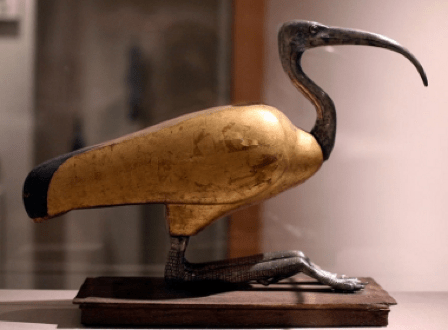
Ibis – Brooklyn Museum
Thoth, J Hill, 2010: ‘According to this variant, Thoth (in the form of an ibis, one of his sacred animals) laid [a magical cosmic] egg from which Ra, (Atum, Nefertum, or Khepri) was born. Other myths suggest that Thoth created himself through the power of language (in an interesting parallel to the phrase in the Gospel according to St John “in the beginning was the word, and the Word was with God, and the Word was God”) – refer article: Arius, Alexander & Athanasius; and Chapter I Noah Antecessor Nulla. His song was thought to have created eight deities… (the gods Nun, Heh, Kuk, and Amun and the goddesses Nunet, Hauhet, Kuaket, and Amaunet).’

World History EDU: ‘There are primarily two accounts of the birth of Thoth. The first… states that Thoth came into being… the same time the universe was created. He is considered a self-created god… similar to the manner in which Ma’at came into being… Thoth is considered as the “god without a mother”. A variation… states that Thoth emerged from the lips of Ra… around the beginning of creation… the second account of Thoth’s birth… ancient Egyptians believed… Thoth’s origin story can be traced to the Horus’ semen. It goes on to say that the god Set (Seth) mistakenly came into contact with the semen and out came Thoth from Set’s forehead.’ Alternatively, Thoth may have been created by Ra, Atum and Khepri for he declared “I am Thoth, the eldest son of Ra, whom Atum has fashioned, created from Khrepi.”
Hill: ‘The moon and the sun were initially thought of as the left and right eyes of Horus – Article: Belphegor. According to legend, Horus’ left eye (the moon) was injured in a fight with Set and was restored by Thoth (“the eye of Horus”)’ – refer article: 33.

Note the eye of Horus behind Thoth
‘However, as time progressed the moon came to be associated with Thoth, possibly because the crescent moon resembled the beak of an Ibis.’

Meehan: ‘In Heliopolis, the foundation of their religious belief was the Ennead – a group of gods that would ultimately grow to include Ra, Shu, Tefnut, Geb, Nut, Osiris, Set, Isis, and Nephthys. These nine gods were not formed all at once, however, and if not for Thoth’s intervention the list would have been cut short.’
Continuing with Hill’s comprehensive article: ‘Although Osiris and Isis were… credited with bringing civilisation to mankind, Thoth was also thought to have invented [languages], writing [hieroglyphs], medicine, magic, [science, philosophy], and the Egyptian’s civil and religious practices. He was even credited with the invention of music, which was… often associated with Hathor’ – Article: Na’amah. ‘Thoth was the patron of scribes and of the written word. He was scribe of the underworld who recorded the verdict on the deceased in the hall of Ma’at and was given the epithets “He who Balances”, “God of the Equilibrium”, and “Master of the Balance” – as well as Lord of the Ogdoad and The Place-Taker of Ra.
Thoth maintained the library of the gods with the help of his wife [and daughter], Sesthat (the goddess of writing) [and ancient goddess of wisdom]. As time passed Thoth gradually absorbed most of Seshat’s roles, and she was seen largely as his female aspect. They had a child called Hornub. At Khnum [rather Khmunu] (Hermopolis) he was the husband of Nehmauit (Nahmauit, Nehmetaway), goddess of protection. Their child was the god Neferhor.’

‘He was the scribe of the gods, and was often described as the “Lord of the Divine Body”, “Scribe of the Company of the Gods”, the “voice of Ra”, or the “counsellor of Ra” who (along with Ma’at) stood on the sun barge next to Ra on his nightly voyage across the sky.’ As Thoth’s role ‘was to speak the words that fulfilled Ra’s wishes, Thoth is credited with creating the heavens and earth’, according to Patti Wigington.

Ma’at
‘It was also thought that Ra gave Thoth [his very close “wing man and respected counsellor”] an area of the underworld to rule in the “Land of the Caves“. He kept a register of those in his realm and decreed just punishments for their transgressions and acted as Ra’s representative in the afterlife.’ One of Thoth’s symbols was a scale whereby he weighed the “heart of the dead against the Feather of truth.” In this role, his wife was Ma’at the goddess of justice.
World History EDU: ‘As part of his recording work, Thoth [played] a very crucial role in the Hall of Truth – a place where… dead souls [were] judged. He assisted… Anubis, Ma’at and Osiris in pronouncing judgment on the dead. Once the verdict was given, Thoth would then record the verdict passed on the dead soul. This helped earn him the title “Inscriber of one’s fate”. Thoth is believed to have a mansion in the underworld – the Mansion of Thoth. In this mansion, the dead could seek solace and safety as they made their journey in the underworld.’
There are key attributes relating to Thoth which bear an uncanny resemblance to the Son of Man. Regarding his role as the creator on behalf of the Eternal – Colossians 1:15-16, ESV: “He is the image of the invisible God, the firstborn of all creation. For by him all things were created, in heaven and on earth, visible and invisible… all things were created through him and for him.” Christ’s role as judge on behalf of the Eternal – 2 Timothy 4:1, ESV: “… Christ Jesus, who is to judge the living and the dead…” Not to forget his role as the word of God – John 1:1, WYC: “In the beginning was the word, and the word was at God, and God was the word.”
Even mansions are stated – John 14:2-3, NKJV: “In My Father’s house are many mansions; if it were not so, I would have told you. I go to prepare a place for you. And if I go and prepare a place for you, I will come again and receive you to Myself; that where I am, there you may be also.”
The Son of Man acts a messenger for the Eternal and is a mediator between Him and mankind – Malachi 3:1, NKJV: “Behold, I send My messenger, And he will prepare the way before Me. And the Lord, whom you seek, Will suddenly come to His temple, Even the Messenger of the covenant, In whom you delight. Behold, He is coming…” 1 Timothy 2:5, NKJV: “For there is one God and one Mediator between God and men, the Man Christ Jesus…”

Ma’at – wife of Thoth
World History EDU: ‘The two deities seemed like a perfect match considering the fact that Ma’at was believed to be the goddess of [Harmony, truth,] law and order while Thoth was in charge of all the knowledge and wisdom in the world. Both deities always featured heavily beside each other during the judgment of dead souls. And regarding Ma’at’s 42 Principles, it is believed that Thoth was the framer of those principles’ – refer article: 42.

‘In some regard, he was also the enforcer of Ma’at’s principles and laws in the universe’ for she too was associated with the balance of things on the Earth. Consequently, Thoth was also known as the Lord of Ma’at. Ancient Society state that though Thoth was married to Ma’at he ‘was in love with Nut.’
Hill: Thoth ‘was sometimes described as the partner of Astennu (one of the male baboons who lived in the underworld), although it was also stated that Astennu was simply an aspect of Thoth.’ This replicates the bi-sexuality displayed by Hermes and Mercury.
‘It was said that he was the author of the spells in the “Book of the Dead” and “Book of Breathings” (which was also attributed to Isis [Ishtar/Lilith]) and he was given the grand title, the “Author of Every Work on Every Branch of Knowledge, Both Human and Divine”.’ Thoth’s associations with writing, knowledge and books resonate with Hermes, as the underworld and casting spells does with Belphegor.
‘Egyptian mythology speaks of the “Book of Thoth” in which the god inscribed all of the secrets of the universe. Anyone who read it would become the most powerful sorcerer in the world, but would be cursed by their knowledge.’
Ancient pages, A Sutherland: ‘In his book “Ancient Egypt”, George Rawlinson mentions a beautiful ancient legend about [the] god Thoth who wrote a mysterious book, full of sacred wisdom and science, which told of everything concerning the birds of the air, and the fishes of the sea, and the four-footed beasts of the earth. This book was not easy to obtain.’ Knowledge of fauna and animal life reminds one of the patriarch Noah.
“… He who knew a single page of the book could charm the heaven, the earth, the great abyss, the mountains, and the seas. Thoth took the work and enclosed it in a box of gold. The box of gold he placed within a box of silver, and the silver box within a box of ivory and ebony, and that again within a box of bronze; and the bronze box he enclosed within a box of brass, and the brass box within a box of iron; and the box, thus guarded, he threw into the Nile at Coptos. But a priest discovered the book’s whereabouts and sold the knowledge to a young noble for a hundred pieces of silver, and the young noble with great trouble fished the book up. But the possession of the book brought him not good but evil. He lost his wife; he lost his child; he became entangled in a disgraceful intrigue. He was glad to part with the book. But the next possessor was not more fortunate; the book brought him no luck. The quest after unlawful knowledge involved all who sought it in calamity…”
This box of hidden knowledge has much in common with Hermes’ Pandora’s Box.
Hill: ‘Needless to say, people have been searching for this text despite the warning, and some more “colourful” theories propose that it is hidden in a secret chamber in or near the Great Pyramid. This book is said by some to be the “emerald tablets of Thoth” a work of dubious authenticity which suggests that Thoth and the other gods were from Atlantis’ – Article: Antartica: Secrets of the Lost Continent of Atlantis. While the author of the Emerald Tablets may be disputed, the gods originating in the antediluvian age fits the chronology of prehistory and the merging of the pre-flood epoch with the post-flood world.

Hill: ‘Thoth was a great magician who knew “all that is hidden under the heavenly vault”. He used his knowledge [of magical spells] to help Isis [resurrect Osiris, during her pregnancy] after the murder of her husband… by his brother Set. With the help of Anubis [the jackal headed god] he created the first mummification ritual and helped resurrect Osiris (albeit in the land of the Dead). He also protected the son of Isis, Horus [healing his eye], by driving a magical poison from his body when he was very young and supported him in his fight to gain the throne which was rightfully his’ – refer Horon – article: Belphegor.

Anubis, Ma’at and Thoth
Hill: ‘Many of the Egyptian’s religious and civil rituals were organised according to a lunar calendar – refer article: The Calendar Conspiracy. As Thoth was associated with writing and with the moon it is perhaps unsurprising that he was also linked to the creation of the calendar. As his association with the moon waned, he developed into a god of wisdom, magic and the measurement of time. Similarly he was considered to measure and record time. He was known by the epithets; “the One who Made Calculations Concerning the Heavens, the Stars and the Earth”, “the Reckoner of Time and of Seasons” and “the one who Measured out the Heavens and Planned the Earth”.
Thoth was thought to be the inventor of the 365-day calendar (which replaced the inaccurate 360 day calendar). According to myth, he earned the extra days by gambling with the moon (Iabet or Khonsu) in a game of dice to help the goddess Nut. She was pregnant by her brother/husband Geb, but Ra forbade her to give birth on any day of the Egyptian calendar. Thoth won a portion of light from the moon (1/72) which equated to five new days, and Nut gave birth to her five children on those days (Osiris, Horus the Elder, Set, Isis and Nephthys).’
Evan Meehan: ‘The first month of the Coptic Calendar, Thout, was named after Thoth. The month begins September 11th and ends October 10th.’
Hill: ‘Most often depicted as a man with the head of an ibis, Thoth often holds a scribe’s palette and stylus but could also be depicted with an ankh ([cross] representing life) and a sceptre (representing power). Thoth sometimes wore a crescent moon [or lunar disk] on his head, but was also depicted wearing the Atef crown, and the double crown of Upper and Lower Egypt’ – symbolising the Lord of all Egypt.
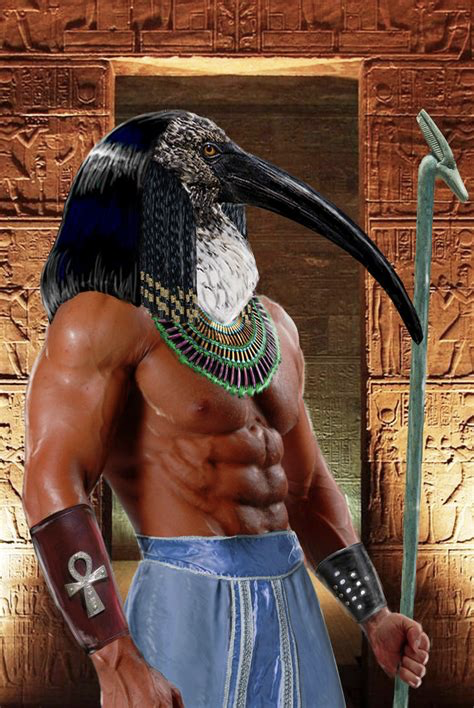
Thoth much like Hermes was kind and helpful to any god who needed advice. This was in keeping with his title “the voice of Ra”. When Thoth with his wife Ma’at journeyed in the sky with Ra during the night, he would lend a helping hand in defeating the tenacious serpentine creature, Apophis also known as Apep. The logo of the University of Cairo in Egypt, has the symbol of Thoth sitting on his throne.
Evan Meehan: ‘Thoth originated far from the religious centers that spawned the vast majority of the Egyptian pantheon. As a result, Thoth took on the role of the perpetual outsider; he was not the focus of any major myths, and his stories could often [prove] convoluted or vague. In many tales, he appeared without explanation. Despite Thoth’s strange position (or perhaps because of it), he held a key role in the Egyptian mythos and was respected by all.’
World History EDU: ‘Since the beginning of time and creation, Thoth has been around. He burst forth voluntarily in order to take records of the events that transpired during creation. Ancient Egyptians also believed that the universe itself was based on the models and calculations put forth by Thoth. In view of this, his vast knowledge and wisdom [cannot be rivalled] by any god or goddess in Egypt. All in all, Thoth’s sphere of influence abounds in every form of knowledge ever known to mankind, as well as the gods themselves.’
There is no doubting Thoth is an extraordinary individual just like Hermes. At some point, Thoth became a significant and perhaps the preeminent figure in the world of the occult. His inclusion as a prominent figure in the Egyptian pantheon possibly misleading if it disguises that he was already an established god in the antediluvian age and linked with the advanced civilisation of Atlantis – Article: Antartica: Secrets of the Lost Continent of Atlantis.

A Theosophist: ‘Thoth-Hermes was one of the King-Instructors, the “Sons of the Fire,” who began in Lemuria in the Third Race to instruct infant humanity in the arts and sciences… [and] he is always credited as the first to teach the science of magic to the Egyptians.’
Online Encyclopaedia: ‘Aleister Crowley’s Egyptian style Thoth tarot deck and its written description in his 1944 book The Book of Thoth were named in reference to the theory that Tarot cards were the Egyptian book of Thoth. H. P Lovecraft… used the word “Thoth” as the basis for his alien god, “Yog-Sothoth”, an entity associated with sorcery and esoteric knowledge.’
The important question of whether Thoth and Hermes-Mercury are the same person, is not easy to answer. Hermes is associated with the planet Mercury, yet Thoth with the Earth’s Moon. This appears to be a glaring difference. The main similarities being the tiny planet of Mercury and the Moon are of similar size, colour and heavily cratered from a celestial war – Chapter XXII Alpha & Omega. Both spheres are less significant in stature in the Solar System and are out of proportion to the prominence of both Hermes and Thoth as dominant gods. While Thoth is on record of having more than one wife, Hermes did not marry.
From Wilkinson’s Manners & Customs of the Ancient Egyptians: “It is doubtful that the deity called Thoth by the Egyptians was originally Hermes, but the two personalities were blended together and it is now impossible to separate them. Thoth was called “The Lord of the Divine Books” and “Scribe of the Company of the Gods.” He is generally depicted with the body of a man and the head of an ibis. The exact symbolic meaning of this latter bird has never been discovered. A careful analysis of the peculiar shape of the ibis – especially its head and beak – should prove illuminating.”

An important question, is whether the Egyptian, Greek, Roman and Norse pantheons of gods were all different or merely replications of former ones. The association of Woden, Wodan, Wotan, Vodan or Votan has been established with Mercury and the naming of the fourth day of the week, Wednesday. Woden was an important god for the Teutonic Saxon tribes comprising the Angles, Frisians and Jutes, as his counterpart Odin was for the Norse tribes.
If the different pantheons are evolutionary descriptions of former gods, then the syncretism between the Greek Hermes and Roman Mercury is clearly evident for one empire immediately followed the other culturally, chronologically and in part, geographically. Whereas geography and millennia separated Egypt from Greece and so would perhaps explain the heightened difference between Thoth and Hermes. As for example, the more pronounced distinction between Mercury and Woden, due again to geography, chronology and culture. These four pantheons also represent different peoples, which would explain the individual interpretation and descriptions by the Greeks, Romans, Vikings and Saxons for actually the same gods.
Encyclopaedia: “The title Tuthmoses, was used by certain pharaohs and translates as someone ‘Born of Thoth’ – refer Appendix VII: Moses, the Exodus & the Red Sea Crossing – Fabrication or Fact? Artapanus of Alexandria, an Egyptian Jew who lived in the third or second century BC, euhemerized Thoth-Hermes as a historical human being and claimed he was the same person as Moses, based primarily on their shared roles as authors of texts and creators of laws. Artapanus’s biography of Moses conflates traditions about Moses and Thoth and invents many details. Many later authors, from late antiquity to the Renaissance, either identified Hermes Trismegistus with Moses or regarded them as contemporaries who expounded similar beliefs.”
The premise that Thoth and Hermes are the same person still yet appears to have some merit and for the sake of this study, will be what his identity is based on going forward. The issue of whether Thoth is a literal god or a human such as Moses remains. The likelihood of Thoth’s attributes being superimposed on a human being will be investigated as will whether Thoth was a human being to begin with and was in mythology raised in stature to a god. A little similar to Cain’s descendant, Na’amah – refer article: Na’amah. Either way, as discovered with Na’amah and Belphegor; Thoth is believed by practitioners of the occult to be a real entity – Article: Belphegor.
Otherwordly Oracle – emphasis mine: “Thoth Egyptian God of wisdom and writing calls to those he feels are intelligent, creative and seek the hidden knowledge. Maybe he’s calling to you. Learn all about his mysterious origins, power, and how to work with him in your pagan or spiritual practice.
The ibis was sacred to the ancient Egyptians. This solemn and serene bird floats through the air with ease. The ibis breaks the barrier between air and water, and therefore breaks the barrier between the dead and the living. Just like Thoth.
Thoth is a scribe and record-keeper and therefore frequently calls to writers. He willingly protects and guides modern writers, authors, publishers, poets and editors. In his most ancient form, Thoth maintains Universal movement. He keeps balance between good and evil, light and dark.
Thoth’s origins are mysterious at best… modern occultists believe Thoth is much older than Ra or Set. Could Thoth have originated in Atlantis? Was he a god? A human? Or something else during Atlantean times? Anything is possible.
Hermès Trismegistus wrote The Emerald Tablets of Thoth in the sixth century [CE]. Hermes Trismegistus claimed to be Thoth reincarnate. Some believe he had also come to earth as Enoch, Noah, and Moses.”

An imaginative 17th century depiction of the Emerald Tablet from the work of Heinrich Khunrath, 1606
“The Emerald Tablets are the sacred texts of the Hermetic movement and were favored by Medieval alchemists. The tablets connect Thoth to Atlantis. When Atlantis was destroyed, the people and gods of Atlantis dispersed and went elsewhere in the world. Thoth escaped to Egypt and aided in its establishment. And was tasked with keeping the ancient records safe. As an intriguing side note, there are sacred records buried under the Sphinx.”
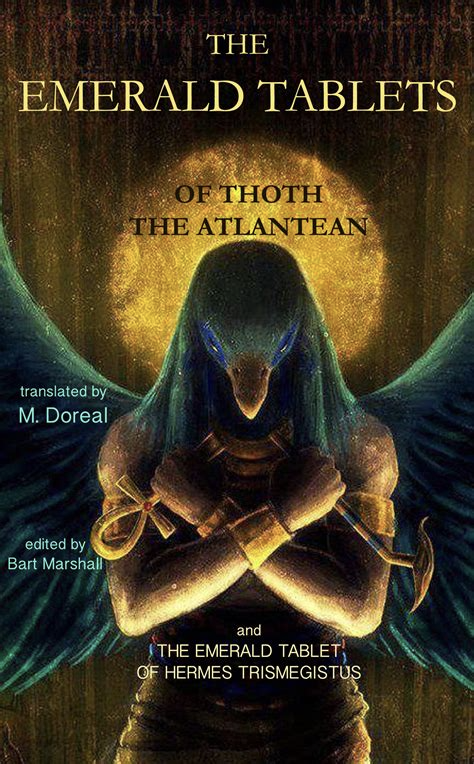
“Before Atlantis, Thoth came from elsewhere in the Universe. When I worked with Thoth extensively in 2011 and 2012, he confirmed his otherworldly origins with me. He lived many lives on Arcturus in a higher dimension. Thoth is a Carian… a bird-like extraterrestrial who came to earth to aid in the creation of humanity. He is a creator god of cosmic origins. He may also have been Lyran before his time in Arcturus. And he’s believed to be one of the Ascended Masters who are now aiding humanity in ascension” – that is if he is telling the truth?
This is of grave concern as discussed in previous articles. The concept of humanity evolving to a higher form* in the 4th and 5th dimensions is a sinister plot to imprison humankind in a tighter trap than the one they are already unwittingly ensnared. Extraterrestrials (or aliens) are not physical beings from merely just another galaxy but rather spirit entities masquerading as such. They are fallen angelic beings residing in the dimensions just beyond the ones we perceive – refer article: Principalities & Potentates: What they want… Who they are; Chapter XXII Alpha & Omega; and Chapter XXI The Incredible Identity, Origin & Destiny of Nimrod.
Otherworldly Oracle: “Work with Thoth just as you’d work with any other deity. Establish a connection by telling him you want to work with him in your spiritual practice. He particularly loves writers, mathematicians, magicians, and all who seek to understand the nature of the Universe. Thoth calls to starseeds – Article: Are you an Old Soul… with a Young heart. Thoth is a teacher, above all, and when he comes to you be ready to learn and transform.”

While this writer has been aware of the growing interest in magick, the craft, the occult, demonolatry and all things esoteric; it has only been while researching Thoth that his widespread popularity and influence has become evident. An alarming number of people are either contacting him – or rather in reality those who serve Thoth, impersonating his identity – or claiming to channel him and expounding on the supposed secrets he possesses. Otherworldly Oracle provide the steps by which one can make contact. This is not as helpful as it seems and is potentially placing people in serious danger. The effort spent on contacting Thoth is misplaced, while reaching out to the true source of knowledge is the only path which provides lasting reward.
“Read All About Thoth
There are many myths, historical facts, and archaeological artifacts featuring… Thoth. One of the best ways to get to know a deity is by researching, reading, and taking notes on them. Thoth, being a god of wisdom and writing, will particularly be pleased with this act. Keep a few pages in your grimoire dedicated to him and your experiences with him.
Set Up An Altar
I recommend this to everyone who wants to seriously work with a deity. Thoth, like the other Egyptian gods, appreciates a sacred space of which to occupy. Give him his own altar and add things that make him feel at home – pyramids, clear quartz and lapis stones [Chapter XV The Philistines: Latino & Hispano America], ankhs, sistrums [a musical instrument of ancient Egypt consisting of a metal frame with transverse metal rods which rattled when the instrument was shaken]… Anything that screams Egypt will be appreciated by this god. Images of baboons and ibises are also appropriate. And an image of Thoth himself.
Offer Gifts to the God of Wisdom
If I know anything about Thoth, it’s that he enjoys gifts related to writing. Write Thoth a poem, story, prayer, or song. In addition, Thoth enjoys offerings of red wine, beer, and bread. You don’t have to give him gifts daily, but make it a regular thing when you feel you want to show your appreciation to him. He will bless you in return.
Just WRITE
I’ve learned that Thoth typically calls to people who are writers. So, if that applies to you, connect with the deity of writing by doing just that. WRITING. Every act of pen to paper appeases Thoth. Every thought to write is him urging you forward on your writing path. Every time I see an ibis in my front yard, I know it’s Thoth reminding me to write.
Explore Ancient Origins of Man
Now… Thoth had a hand in the beginning of man on this planet. And often when he’s working with a follower/devotee, he will begin revealing secrets of man’s origins to you. Don’t be surprised if he takes you on a wild journey deep inside the pyramids, deep under the Sphinx, to places unseen. Just to show you something you already knew but had forgotten.
Get Off Your Ath and Do Some MATH
Thoth is a mathematician. If you aren’t, maybe it’s time to dig into the origins of mathematics and see just how occult this practice actually is. Did you know the word algebra has its roots in magick? The mysteries of the Universe may be revealed through the study of math. You don’t have to become a mathematician but at least understand how math is tied intricately to magic. Thoth will guide you” – Articles: 33; 42; and The Top Ten Unexplained Mysteries of all Time.
“Working with the Baboon and Ibis
The Egyptian gods were anthropomorphic. Meaning they would manifest in animal form or half-man half-animal form. You might not live in a place where baboons or ibises roam in the wild, but you can work with the spirit of these animals. Thoth is tied to the baboon and ibis, so include these animals in your rites.
Make Magic with Thoth
Thoth is a god of magic. Call on him when casting spells, performing rituals and making every day magick. He will accompany, guide, and aid you in manifesting your desires.”
Interlude:
“THUNDER rolled, lightning flashed, the veil of the Temple was rent from top to bottom. The venerable initiator, in his robes of blue and gold, slowly raised his jeweled wand and pointed with it into the darkness revealed by the tearing of the silken curtain: “Behold the Light of Egypt!” The candidate, in his plain white robe, gazed into the utter blackness framed by the two great Lotus-headed columns between which the veil had hung. As he watched, a luminous haze distributed itself throughout the atmosphere until the air was a mass of shining particles. The face of the neophyte was illumined by the soft glow as he scanned the shimmering cloud for some tangible object. The initiator spoke again: “This Light which ye behold is the secret luminance of the Mysteries. Whence it comes none knoweth, save the ‘Master of the Light.’ Behold Him!” Suddenly, through the gleaming mist a figure appeared, surrounded by a flickering greenish sheen. The initiator lowered his wand and, bowing his head, placed one hand edgewise against his breast in humble salutation. The neophyte stepped back in awe, partly blinded by the glory of the revealed figure. Gaining courage, the youth gazed again at the Divine One.
The Form before him was considerably larger than that of a mortal man. The body seemed partly transparent so that the heart and brain could be seen pulsating and radiant. As the candidate watched, the heart changed into an ibis, and the brain into a flashing emerald. In Its hand this mysterious Being bore a winged rod, entwined with serpents. The aged initiator, raising his wand, cried out in a loud voice: “All hail Thee, Thoth Hermes, Thrice Greatest; all hail Thee, Prince of Men; all hail Thee who standeth upon the head of Typhon!” At the same instant a lurid writhing dragon appeared – a hideous monster, part serpent, part crocodile, and part hog. From its mouth and nostrils poured sheets of flame and horrible sounds echoed through the vaulted chambers. Suddenly Hermes struck the advancing reptile with the serpent-wound staff and with snarling cry the dragon fell over upon its side, while the flames about it slowly died away. Hermes placed His foot upon the skull of the vanquished Typhon. The next instant, with a blaze of unbearable glory that sent the neophyte staggering backward against a pillar, the immortal Hermes, followed by streamers of greenish mist, passed through the chamber and faded into nothingness.”
According to Otherworldly Oracle, Hermès Trismegistus was a real person who claimed to be the reincarnated Thoth and the author of the Emerald tablets. J Hill offers that two deities – Thoth and Hermes – were combined to form Hermes Trismegistus, with this version of Thoth remaining popular with occultists today. Therefore an amalgamation of two names and not a real person, in the vein of the composite name Baphomet. The former name as important to occultists as the latter is for satanists.
Encyclopaedia – emphasis mine: ‘As Greek culture and influence spread following the conquests of Alexander the Great, a period of syncretism or interpretatio graeca saw many traditional Greek deities identified with foreign counterparts. In Ptolemaic Egypt, for example… This led to Hermes gaining the attributes of a god of translation and interpretation, or more generally, a god of knowledge and learning, This is illustrated by a 3rd-century BC… letter sent by the priest Petosiris to King Nechopso… written in Alexandria c. 150 BC, stating that Hermes is the teacher of all secret wisdoms, which are accessible by the experience of religious ecstasy.
The Mystica: ‘The English occultist Francis Barrett in Biographia Antiqua wrote [about] Hermes “… if God ever appeared in man, he appeared in him, as is evident both from his books and his Pymander; in which works he has communicated the sum of the Abyss, and the divine knowledge to all posterity; by which he has demonstrated himself to have been not only an inspired divine, but also a deep philosopher, obtaining his wisdom from God and heavenly things, and not from man.” According to legend Hermes Trismegistus… “carried an emerald, upon which was recorded all of philosophy, and the caduceus, the symbol of mystical illumination. Hermes Trismegistus vanquished Typhon, the dragon of ignorance, and mental, moral and physical perversion.”
Online source: ‘Fowden asserts that the first datable occurrences of the epithet “thrice great” are in the Legatio of Athenagoras of Athens and in a fragment from Philo of Byblos, circa AD 64-141. However, in a later work, Copenhaver reports that this epithet is first found in the minutes of a meeting of the council of the Ibis cult… near Memphis in Egypt… found at the Temple of Esna…’
Online Encyclopaedia: ‘An epithet of Thoth found in the temple at Esna, “Thoth the great, the great, the great” [Latin: Mercurius ter Maximus], became applied to Hermes beginning in at least 172 BC. This lent Hermes one of his most famous later titles, Hermes Trismegistus (Ἑρμῆς ὁ Τρισμέγιστος), “thrice-greatest Hermes”. The figure of Hermes Trismegistus would later absorb a variety of other esoteric wisdom traditions and become a major component of Hermeticism, alchemy, and related traditions.’ Even so, the epithet Trismegistus [thrice-greatest] occurs only rarely outside the Hermetic texts.’
Online source: “A Mycenaean Greek reference to a deity or semi-deity called ti-ri-se-ro-e (“thrice or triple hero”) was found on two Linear B clay tablets at Pylos and could be connected to the later epithet “thrice great”, Trismegistos, applied to Hermes/Thoth. On the aforementioned PY Tn 316 tablet – as well as other Linear B tablets found in Pylos, Knossos, and Thebes – there appears the name of the deity “Hermes” as e-ma-ha, but not in any apparent connection with the “Trisheros”. This interpretation of poorly understood Mycenaean material is disputed, since Hermes Trismegistus is not referenced in any of the copious sources before he emerges in Hellenistic Egypt.”
Historia Deorum Fatidicorum: “Master of all arts and sciences. Perfect in all crafts, Ruler of the Three Worlds, Scribe of the Gods, and Keeper of the Books of Life, Thoth Hermes Trismegistus – the Three Times Greatest, the “First Intelligencer” – was regarded by the ancient Egyptians as the embodiment of the Universal Mind. While in all probability there actually existed a great sage and educator by the name of Hermes, it is impossible to extricate the historical man from the mass of legendary accounts which attempt to identify him with the Cosmic Principle of Thought.”
Thomas Gregory – emphasis: ‘In some Islamic belief systems, as well as in the Baháʼí faith, “Hermes the Thrice-Greatest,” or “Hermes Trismegistus” was a person later known as both the Greek god and the Egyptian god Toth. They do so for good reason. Many Roman texts mention Hermes being revered in Egypt, with the Roman writer Cicero writing that “fourth Mercury (Hermes) was the son of the Nile, whose name may not be spoken by the Egyptians.”
Some academics today argue that early Christian leaders such as St Augustine were influenced by the Greek god, and Hermes’ association with Toth convinced Renaissance philosophers to believe that all religions may be connected in some deeper way. At the center of these beliefs are “The Hermetic Writings,” or “Hermetic”. These included Greek and Arabic texts relating to subjects as wide as Astrology, Chemistry, and even Magic. Considered to contain secret knowledge, the hermetica were popular gnostic texts during the Renaissance period, and are still studied by many today.’
Reverend Erik – emphasis mine: ‘Even though Hermes Trismegistus was a mythical figure, many ancient writers wrote about him as if he was a real person. This produced disagreements and confusion. At some point, it began to be assumed that there were two Hermes. In Asclepius, Hermes Trismegistus talks about his grandfather:
“Is it not true that my grandfather Hermes, after whom I am named, resides in his eponymous town whence he aids and cures all those who come to him from every land?” – Asclepius 37
‘This passage indicates that the Grandfather Hermes is in fact identical with the deity Hermes, residing at Hermopolis. Ancient writers invented additional Hermes to fill in the gaps. In fact, it could be that the title “Trismegistus” refers to many great Hermes characters, a line of sages and mystics bringing the Hermetic teachings to humanity over many generations.’
Online Encyclopaedia – emphasis theirs, bold mine: ‘[Hermes Trismegistus] is the purported author of the Hermetica, a widely diverse series of ancient and medieval pseudepigraphica that lay the basis of various philosophical systems known as Hermeticism. The wisdom attributed to this figure in antiquity combined a knowledge of both the material and the spiritual world, which rendered the writings attributed to him of great relevance to those who were interested in the interrelationship between the material and the divine. The figure of Hermes Trismegistus… in both Muslim and Baha’i writings… has been associated with the prophet Idris (the Biblical Enoch).’ Katrina Sisowath adds: ‘Thoth Hermes Trismegistus… to the Sumerians… was Ningizzida.’
It is important during the antediluvian age to differentiate between the two different men named Enoch; the first being evil Enoch the son of Cain and the second, righteous Enoch the son of Jared – Genesis 4:17-18; 5:18-24. We will investigate the association of Thoth with Moses and Noah, while discussing each Enoch respectively.
‘According to the account of the Persian astrologer Abu Ma’shar al-Balkhi (787-886), Idris/Hermes was termed “Thrice-Wise” Hermes Trismegistus because he had a threefold origin. The first Hermes, comparable to Thoth, was a “civilizing hero”, an initiator into the mysteries of the divine science and wisdom that animate the world; he carved the principles of this sacred science in hieroglyphs. The second Hermes, in Babylon, was the initiator of Pythagoras. The third Hermes was the first teacher of alchemy. “A faceless prophet,” writes the Islamicist Pierre Lory, “Hermes possesses no concrete or salient characteristics, differing in this regard from most of the major figures of the Bible and the Quran.”
Online source: ‘The date of Hermes Trismegistus’s sojourn in Egypt during his last incarnation is not now known, but it has been fixed at the early days of the oldest dynasties of Egypt’ – Dynasty I 1988-1787 BCE according to an unconventional chronology – ‘long before the days of Moses’ – b. 1526, d. 1406 BCE. ‘Some authorities regard him as a contemporary of Abraham…’ – b. 1977, d, 1802 BCE.
Online Encyclopaedia: ‘There is no portion of the occult teachings possessed by the world which have been so closely guarded as the fragments of the Hermetic Teachings which have come down to us over the tens of centuries which have elapsed since the lifetime of its great founder, Hermes Trismegistus… who dwelt in old Egypt in the days when the present race of men was in its infancy… hailed as “The Master of Masters.” This man, if “man” indeed he was… was the father of the Occult Wisdom; the founder of Astrology; the discoverer of Alchemy… the Great Central Sun of Occultism, whose rays have served to illumine the countless teachings which have been promulgated since his time.
All the fundamental and basic teachings embedded in the esoteric teachings of every race may be traced back to Hermes. Even the most ancient teachings of India undoubtedly have their roots in the original Hermetic Teachings. The best authorities regard him as a contemporary of Abraham, and some of the Jewish traditions go so far as to claim that “Abraham… that venerable sage… acquired a portion of his mystic knowledge from Hermes himself” – Introduction The Kybalion (A Study of the Hermetic Philosophy of Ancient Egypt and Greece) by Three Initiates, Yogi Publication Society, Chicago Masonic Temple, Chicago, 1912.’
The 1908 book Kybalion, by the Three Initiates, addresses Hermetic principles; though many believe that the book was written by a man called William Atkinson, an influential and prolific writer in the eighteenth and nineteenth centuries.
Bryant’s Mythology: “There are two theories concerning his demise. The first declares that Hermes was translated like Enoch and carried without death into the presence of God, the second states that he was buried in the Valley of Ebron and a great treasure placed in his tomb – not a treasure of gold but of books and sacred learning.”
Encyclopaedia: ‘The Hermetic literature among the Egyptians, which was concerned with conjuring spirits and animating statues, inform the oldest Hellenistic writings on Greco-Babylonian astrology and on the newly developed practice of alchemy. In a parallel tradition, Hermetic philosophy rationalized and systematized religious cult practices and offered the adept a means of personal ascension* from the constraints of physical being.

Online source: ‘The Hermetica is a category of papyri containing spells and initiatory induction procedures. The dialogue called the Asclepius (after the Greek god of healing) describes the art of imprisoning the souls of demons or… angels in statues with the help of herbs, gems, and odors, so that the statue could speak and engage in prophecy. In other papyri, there are recipes for constructing such images and animating them, such as when images are to be fashioned hollow so as to enclose a magic name inscribed on gold leaf.’ Perhaps like the golden calf of the Israelites – refer article: The Calendar Conspiracy.
Encyclopaedia: ‘Many Christian writers… considered Hermes Trismegistus to be a wise pagan prophet who foresaw the coming of Christianity. They believed in the existence of a prisca theologia, a single, true theology that threads through all religions‘ – Article: The Seven Churches – A Message for the Church of God in the Latter Days. ‘It was given by God to man in antiquity and passed through a series of prophets… In order to demonstrate the verity of the prisca theologia, Christians appropriated the Hermetic teachings for their own purposes. By this account, Hermes Trismegistus was either a contemporary of Moses, or… Enoch, Noah… During the Renaissance, it was accepted that Hermes Trismegistus was a contemporary of Moses.
However, after Issac Casaubon’s demonstration in 1614 that the Hermetic writings… postdate the advent of Christianity, the whole of Renaissance Hermeticism collapsed. As to their actual authorship… they were certainly not written in remotest antiquity by an all wise Egyptian priest… but by various unknown authors, all probably Greeks, and they contain popular Greek philosophy of the period, a mixture of Platonism and Stoicism, combined with some Jewish and… Persian influences.’
When the Hermetic writings may have been written or compiled does not detract from when the real or composite figure of Hermes Trismegistus lived. As these writings most likely derived from an earlier epoch, just as Thoth was a pre-flood figure, who was later worshipped or deified in the post-flood era.
Encylopaedia: ‘Perhaps no character in history has formed the subject of so much and so varied study and speculation as that of Hermes Mercurius Trismegistus and we shall realize the truth of this statement as we individually seek light upon the sublime philosophy rightly attributed to this Avatar. At the very outset, we are confronted with a remarkable dearth of exact information regarding his person and life. A dearth all the more inexplicable when we realize that from the Rosicrucian standpoint Hermes may be justly regarded as one of the greatest of all Messiahs who have incarnated on this sphere.
Yet the very mythos, which apparently surrounds his existence, has a special value to occultists, for a similar obscurity and absence of specific data attaches to the characters of Melchisedek, King of Salem, Osiris, Attis, Confucius and John the Baptist, of all of whom the origin is unknown’ – Hermes Mercurius Trismegistus, A Treatise preliminary to the Study of the Hermetic Philosophy, By Fr. K. X, Societas Rosicruciana in America.
Katrina Sisowath: ‘Before he was revered as a god, he was the first great Egyptian philosopher and founder of the Ancient Mystery Schools, receiving his wisdom while in meditative trances, writing over 40 books… with the Book of Thoth only being given to his enlightened initiates of the Mysteries… a quick perusal or in-depth study resounds in most readers, due to the similarity with Buddhism and Christianity… the clearest examples are his teachings on reincarnation and the creation of the world’ – Article: DEATH: A Dead End or a New Beginning?
‘… the Book of Thoth… was written in Egyptian Hieroglyphics. It was kept in a golden box [Pandora’s Box] in the inner sanctuary of the temple and only the highest initiate of the Hermetic Arcanum Mystery School had the key to it… the book described the Key to Immortality, the process achieved through awakening certain areas of the brain, similar to the Buddhist monks’ practices… authors have claimed the awakening of the brain was achieved through meditation, the use of a white powder,* and the priestesses’ sacred essence.’
With regard to the Book of Thoth, an unknown source elaborates further: ‘While Hermes still walked the earth with men, he entrusted to his chosen successors the sacred Book of Thoth. This work contained the secret processes by which the regeneration of humanity was to be accomplished and also served as the key to his other writings. Nothing definite is known concerning the contents of the Book of Thoth other than that its pages were covered with strange hieroglyphic figures and symbols, which gave to those acquainted with their use unlimited power over the spirits of the air and the subterranean divinities. When certain areas of the brain are stimulated by the secret processes of the Mysteries, the consciousness of man is extended and he is permitted to behold the Immortals and enter into the presence of the superior gods. The Book of Thoth described the method whereby this stimulation was accomplished. In truth, therefore, it was the “Key to Immortality.”
According to legend, the Book of Thoth was kept in a golden box [Ark of the Covenant – article: The Ark of God] in the inner sanctuary of the temple. There was but one key and this was in the possession of the “Master of the Mysteries,” the highest initiate of the Hermetic Arcanum. He alone knew what was written in the secret book. The Book of Thoth was lost to the ancient world with the decay of the Mysteries, but its faithful initiates carried it sealed in the sacred casket into another land. The book is still in existence and continues to lead the disciples of this age into the presence of the Immortals. No other information can be given to the world concerning it now, but the apostolic succession from the first hierophant initiated by Hermes himself remains unbroken to this day, and those who are peculiarly fitted to serve the Immortals may discover this priceless document if they will search sincerely and tirelessly for it.
It has been asserted that the Book of Thoth is, in reality, the mysterious Tarot of the Bohemians – a strange emblematic book of seventy-eight leaves which has been in possession of the gypsies since the time when they were driven from their ancient temple, the Serapeum.’ We will investigate the origin of the Tarot shortly.

The Hermit is the ninth trump or Major Arcana card in traditional tarot decks. It is used in game playing as well as in divination. It signifies contemplation, the search for truth, solitude, wisdom, enlightenment and inner guidance. Zodiac sign: Virgo.
Tina Gong: ‘The Hermit depicts an old man standing alone at the peak of the mountain while holding a lantern in one of his hands and a staff on the other. The mountain denotes accomplishment, development, and success. The hermit tarot card refers to the level of spiritual knowledge that he attained, and that he is ready to impart that knowledge to everyone. There is also a deep commitment he has to his goal and a solid awareness of the path that he is taking.’
‘Inside the lantern, you will notice a star with 6 points which is also known as the Seal of Solomon. This symbol represents wisdom. The staff that he holds depicts authority and power. The Hermit is a seeker for the knowledge that comes from within. A lonely wanderer in the path of the night, he searches for that which can only be gained with long periods of solitude – the inner voice. To hear it, he must disconnect from the crowds whose voices and desires threaten to overcome his own. He walks through the dark night of his unconscious, guided only by the low light of the northern star [refer Pole Star, article: The Pyramid Perplexity], with his destination being his home, his self.’
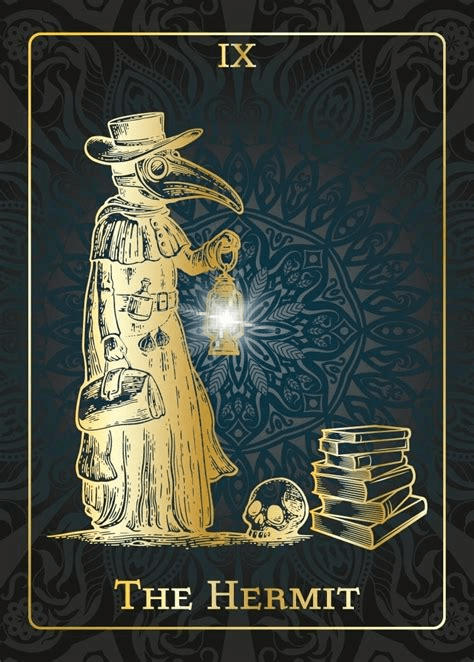
Notice the similarity between The Hermit (above) and the Ibis inspired Thoth aka Hermes Trismegistus (below).

Unknown source: ‘(According to the Secret Histories the gypsies were originally Egyptian priests.) There are now in the world several secret schools privileged to initiate candidates into the Mysteries, but in nearly every instance they lighted their altar fires from the flaming torch of Herm. Hermes in his Book of Thoth revealed to all mankind the “One Way,” and for ages the wise of every nation and every faith have reached immortality by the “Way” established by Hermes in the midst of the darkness for the redemption of humankind.” We will return to the premise of a Way and the ‘one way’ in achieving everlasting redemption.
Sisowath: ‘The most powerful of the Mystery Schools was known as the Royal School of the Master Craftsmen at Karnak, founded by Pharaoh Thuthmosis III [945-912 BCE], though as with all the Mystery Schools, it is commonly believed that the true founders resided in Sumeria, emigrating to Egypt…
This school was also known as the Great White Brotherhood due to the members’ choice of raiment (white robes) and their dedication to producing the white powder* known to the Mesopotamians as Shem-an-na, the High-Ward Fire Stone, or ‘white bread’ to the Egyptians. Pictures of it show it being offered to the Pharaohs, in the shape of a cone’ – refer article: Monoliths of the Nephilim.
‘On the top of Mount Sinai, Petrie discovered an Egyptian Temple which contained a bewildering discovery: laying some inches deep beneath heavy flagstones in a storeroom was a considerable supply of the finest pure white, unadulterated powder. Copper smelting and animal sacrifice were quickly ruled out. Some of the mysterious powder was taken back to Britain for analysis and examination, but no results were ever published. The rest was left open to the elements after 3000 years to become a victim of the desert winds.
What has become apparent, however, is that this powder was seemingly identical to the ancient Mesopotamian fire-stone or shem-an-na – the substance that was made into bread-cakes and used to feed the Babylonian kings and the pharaohs of Egypt. This, of course, explains the temple inscriptions denoting the importance of bread and light, while the white powder (the shem-an-na) has been identified with the sacred manna that Aaron placed in the Ark of the Covenant.’ The Israelite’s manna and the Ark of the Covenant are addressed in the articles: The Manna Mystery; and The Ark of God.
‘Eventually the Mystery Schools went into decline as new Dynasties emerged. The initiates left Egypt and brought the Book of Thoth to another land. Where it is now, no one knows, though supposedly the chain of succession of Grand Master since Thoth has remained unbroken. The Rosicrucians are said to be descended from his school, while the Freemasons are descended from the school founded by Solomon’ – article: The Establishment: Who are they… What do they want? ‘As for Thoth himself? He has remained revered by philosophers, occultists, alchemists and healers through the ages, though many of the texts accredited to him were lost in the Great Fire of the Library of Alexandria. Who [knows] how different history might have been had the knowledge contained in that library not been lost?’
Online source – emphasis mine: ‘As a divine source of wisdom, Hermes Trismegistus was credited with tens of thousands of highly esteemed writings, which were reputed to be of immense antiquity’ – 36,000 according to Egyptian priest, Manetho. ‘Clement of Alexandria was under the impression that the Egyptians had forty-two sacred writings by Hermes, writings that detailed the training of Egyptian priests.’ Recall the 42 principles of Ma’at, the wife of Thoth – Article: 42.
‘Siegfried Morenz has suggested, in Egyptian Religion: “The reference to Thoth’s authorship… is based on ancient tradition; the figure forty-two probably stems from the number of Egyptian nomes, and thus conveys the notion of completeness.” The neoplatonic writers took up Clement’s “forty-two essential texts.”
Online source: ‘Modern occultists suggest that some Hermetic texts may be of Pharaonic origin, and that the legendary “forty-two essential texts” that contain the core Hermetic religious beliefs and philosophy of life, remain hidden in a secret library.’
Everet Dee says regarding these 42 books: ‘The forty-two were kept in the great Library of Alexandria, which was eventually destroyed. What remained moved to the Islamic world in 400-600 AD, before eventually re-emerging in Europe during the Renaissance. During the Medieval Europe Hermeticism was banned by the church, and the philosophy was forced underground. It was kept alive by secret societies such as the Freemasons, Rosicrucians, and the Hermetic Order of the Golden Dawn. Of the forty-two books, ten deal with sacrifices, ten with sacred rites, and two were hymns to the gods, as well as rules for how kings should govern. Four books were about astrology, and six about medicine. Today only a small handful remain, although their authenticity is sometimes called in to question by skeptics. These have been compiled into the Corpus Hermeticum.’
Britannica – emphasis mine: ‘The writings ascribed to Hermes-Thoth fall into two main classes: “popular” Hermetism dealt with astrology and the other occult sciences, and “learned” Hermetism concerned itself with theology and philosophy. From the Renaissance until the end of the 19th century little attention was paid to the popular Hermetic literature. More recent study has shown that its development preceded that of the learned Hermetism and that it reflects ideas and beliefs that were widely held in the early Roman Empire and are therefore significant for the religious and intellectual history of the time.
In the Hellenistic Age… There was a growing distrust of traditional Greek rationalism and a breaking down of the distinction between science and religion. Hermes-Thoth was but one, if perhaps the most important, of the gods and prophets (chiefly of Middle Eastern origin) to whom knowledge seekers turned for a divinely revealed wisdom.
The theological writings are represented chiefly by the 17 treatises of the Corpus Hermeticum, by extensive fragments in Stobaeus, and by a Latin translation of the Asclepius, preserved among the works of Apuleius. These date probably from the first three centuries CE. All are marked by a sincere piety of a mystical type, but there is no single doctrine which is consistently set forth, and it is unlikely that there was any well-defined Hermetic community or “church.” Though the setting is Egyptian, the philosophy, like the language, is Greek.’
Erik: “The Hermetica that we read and write about most often are not the only ancient books ascribed to Hermes Trismegistus. Multiple important early works on astrology were also attributed to the legendary sage. The link between Hermes and astrology is also clear in the Hermetic fragments of Stobaeus. The greek Magical Papyri and texts such as the Cyranidi make it clear that Hermes Trismegistus was seen as a master of thaumaturgy” – ‘Thaumaturgy is the… capability of a magician to work magic… [and] paranormal events or a saint to perform miracles. It is… translated into English as wonderworking.’ A practitioner of thaumaturgy is a thaumaturge, thaumaturgist, thaumaturgus, miracle worker, or wonderworker – “demonology [Demonology is the study of a hierarchy of demons within theology, religious doctrine and occultism], and other magical arts. Finally, Hermes is also the legendary source of alchemy, through such works as the Emerald Tablet and the works of Zosimos of Panopolis.”
The work attributed to Hermes Trismegistus, his second book called Asclepius, 1657, makes the following two comments: “Thou Asclepius, the soul of every man is immortal, but not all alike; for there is a difference both in the time and manner.” This is not true, for the soul which sins, dies: Ezekiel 18:20 – refer article: DEATH: A Dead End… or a New beginning? and The Seven Churches – A Message for the Church of God in the Latter Days.
Similarly: “How quickly hast thou learned, by the very light of reason; for said I not this, that all things are one, and one all things? that all things were in the Creator, before he created all things; neither unworthily is he said to be All, whole parts are all things; therefore in this whole Discourse have a care to remember him, who being One, is All, even the very Creator of all things; all things descend from Heaven into Earth, into the Water, and into the Air.”
All things do find their source in the Creator and have been replicated from above, below. Isaiah 45:12, The Voice: “It is I who made the very ground on which you stand, I who shaped the human beings who walk around on it. I pulled the sky and the heavens taut with My own hands, and organized the army of stars that march across the night sky.” The connection between the source of life and the creation has been severed twice.
Once with the angelic rebellion – Revelation 12:7-9 (Chapter XXII Alpha & Omega) – and secondly, when humankind chose an alternative path. One which did not lead to immortality but rather death, when Adam and Eve rejected the Tree of Life and chose the Tree of Death. Humanity has been cut off from the Eternal and is not connected to Him. Only through the Son of Man as the Mediator, discussed earlier can a human re-establish contact. For the Creator has no part or connection at the present time with the creation. Habakkuk 1:13, The Voice: “Your eyes are too pure to even look at evil. You cannot turn Your face toward injustice.”
Genesis 3:4-7, ESV: ‘But the serpent said to the woman, “You will not surely die. For God knows that when… your eyes [are]… opened… you will be like God, knowing good and evil”… when the woman saw that the tree [of the knowledge of Good and Evil] was good for food, and that it was a delight to the eyes, and that the tree was to be desired to make one wise, she took of its fruit and ate, and she… gave some to her husband who was with her, and he ate. Then the eyes of both were opened…’ Notice the Serpent lied to Eve, tricking her. The immortal words of Samael resound through the ages; “You will not surely die”. This was the beginning point for the false religious doctrine and the erroneous occult teaching; that mankind possesses an immortal soul.
Micki Spollern – emphasis mine: ‘The 7 Hermetic principles are believed to run the universe and create the reality you live in – and put you in complete control of your own life. Hermeticism is a philosophical system based on the teachings of the ancient god Hermes Trismegistus. According to Hermeticism, the wisdom of the whole universe can be accessed independently of religion through alchemy, astrology, and theurgy.’
Encylopaedia: ‘Theurgy, also known as divine magic, is one of two major branches of the magical arts, the other being practical magic or thaumaturgy. Theurgy describes the ritual practices associated with the invocation or evocation of the presence of one or more deities’… the art or technique of influencing a god or supernatural power.
Spollern: ‘… “The Kybalion” was published to share Hermes Trismegistus’ teachings, outlining seven Hermetic laws passed down by Hermes Trismegistus and his students. When understood and practiced, these universal laws are said to be the answers to leading a fulfilling and meaningful life…
- The Principle of Mentalism
“The All is Mind; the Universe is Mental.”
Broken down, this is very similar to what you may know as the Law of attraction, which states that your thoughts create your reality. Using this law, you have the power to determine the circumstances around you as, according to Hermetic philosophy, everything in the universe is mentally created. Everything that exists was created by a thought. The changes that happen on this plane in your mind go on to become your reality.
Sana Nawazish writes concerning how to apply the principle: ‘The principle of mentalism can be applied in daily life by… Focusing on the good in every situation and creating vivid mental images of what you want to manifest, reinforced by repeating positive affirmations and expressing gratitude, will help align your thoughts and beliefs with your desires… [using] the power of mentalism to shape your life in the way you want.’
The two phrases in bold, are becoming byword principles amongst younger generations.
2. The Principle of Correspondence
“As above, so below; as below, so above.”
According to this principle, the world around you is a manifestation of your inner world. Eventually, your inner thoughts, whether on a conscious or subconscious level, become your external circumstances. The various methods of manifestation are based on this Hermetic principle as [they are] techniques that train your focus and thoughts that then go on to become your reality.
3. The Principle of Vibration
“Nothing rests; everything moves; everything vibrates.”
This principle explains that everything in the universe, whether it’s… physical matter or [a] thought, vibrates. Its vibration makes it real. The second you have a thought, it’s given a vibration. The more it’s thought about, the more momentum it’s given to become real. For this reason, it’s important to work on raising your vibration in order to manifest positive things in your life’ – refer article: 33.
Everet Dee adds: ‘All things, wither they are physical or spiritual, hold a certain vibration. From spirit to the grossest level of matter, everything is vibrating at its frequency. Every molecule in the universe is vibrating, as well as our thoughts and emotions. New scientific tools… allow us to perceive the vibratory nature of our reality, on an atomic level. While modern science has verified this as being true, as a Hermetic principle it has been known for thousands of years. The difference between matter and energy is simply a difference in the rate of vibration. The scale of vibration ranges from the highest vibrations which are so rapid that it is practically at rest, down to the most gross forms of matter, vibrating at such a low rate so as to also almost be at rest. Between these two poles exist all that is on varying vibrations.’
4. The Principle of Polarity
“Everything is dual; everything has poles; everything has its pair of opposites; like and unlike are the same; opposites are identical in nature, but different in degree; extremes meet; all truths are but half-truths; all paradoxes may be reconciled.”
Put simply, the principle of polarity means that all opposites are really the same thing. They are different ends of the same pole. For example, heat and cold, though opposites, are both temperatures. Likewise, love and hate are opposite levels of an emotion, but a strong emotion nonetheless. The only difference between the two ends of the pole is vibration. According to Hermetic beliefs, the same can be said of the spirit and reality. Put into practice, this principle encourages you to shift your vibration towards the more positive end of the spectrum to better your relationship with it.
Everet Dee: ‘This principle states that all that exists also has its opposite, and cannot exist without it. Take the polarity of light and dark. As you move across from one side to the other, when does dark become light? The transition point is unclear because they are the same thing, and extreme light prevents us from seeing just as much as extreme dark does.’
5. The Principle of Rhythm
“Everything flows, out and in; everything has its tides; all things rise and fall; the pendulum-swing manifests in everything; the measure of the swing to the right is the measure of the swing to the left; rhythm compensates.”
This principle is similar to Newton’s 3rd Law of Motion, which states that “For every action, there is an equal and opposite reaction.” Everything [in] the universe will eventually even itself out, which leads to an ebb and flow. When talking about your own mental or emotional state, you may see this in life as the emotional highs and lows you go through. Mastering this principle is learning how to center yourself so that you don’t consciously or subconsciously act to counter an emotion, causing the pendulum to swing wildly from one side to the other. This leads to a state of inner peace in which your foundation is strong and you can remain unbothered by circumstances around you.
6. The Principle of Cause and Effect
“Every cause has its effect; every effect has its cause; everything happens according to law; chance is but a name for law not recognized; there are many planes of causation, but nothing escapes the law.”
The universe is governed by laws, meaning nothing happens without reason’ – refer article: Predestination & Free Will. ‘You may not be able to directly pinpoint a specific cause for a certain effect because the cause may happen on different planes of existence, but every action has a ripple effect that leads to a consequence.
Everet Dee: ‘There is no such thing as chance. The higher planes dominate the lower planes, which can cause the things that occur in our lives to seem a mystery to us at times, because we are limited by our human perception, and cannot see the full picture of all that is at play. While most people go through life as a victim of their own thoughts and feelings, and the circumstances that are created, The Hermeticist strives to become the cause, rather than the effect, of his own life. Most people are like pawns on the chessboard, obedient to external causes coming from people and forces more powerful than themselves.
Part of the way of the Hermeticist is to rise to higher planes in their consciousness, and become cause on that higher plane, effecting the lower planes with their influence. They master their own internal experience first, and then the external environment around them. The true adept knows to not try to reject causation of the higher planes, but to work with and while also exerting their own influence.’
7. The Principle of Gender
“Gender is in everything; everything has its masculine and feminine principles; gender manifests on all planes.”
In Hermeticism, the principle of gender is not necessarily about the physical body. Instead, it’s referring to the qualities of masculinity and femininity which create balance in the world. All things embody both masculine and feminine energies, and learning how to be open to and balance those energies within yourself can bring you to a higher state of consciousness that is simultaneously powerful and thoughtful.’
Dee: ‘The gender polarity exists on the macro level as well, with the sun representing masculine energy and the moon feminine. The masculine is the creative force, while the feminine is soft and reflective. While opposites, they are inseparable, part of a larger picture, that when balanced part in unison to enhance one and other.’
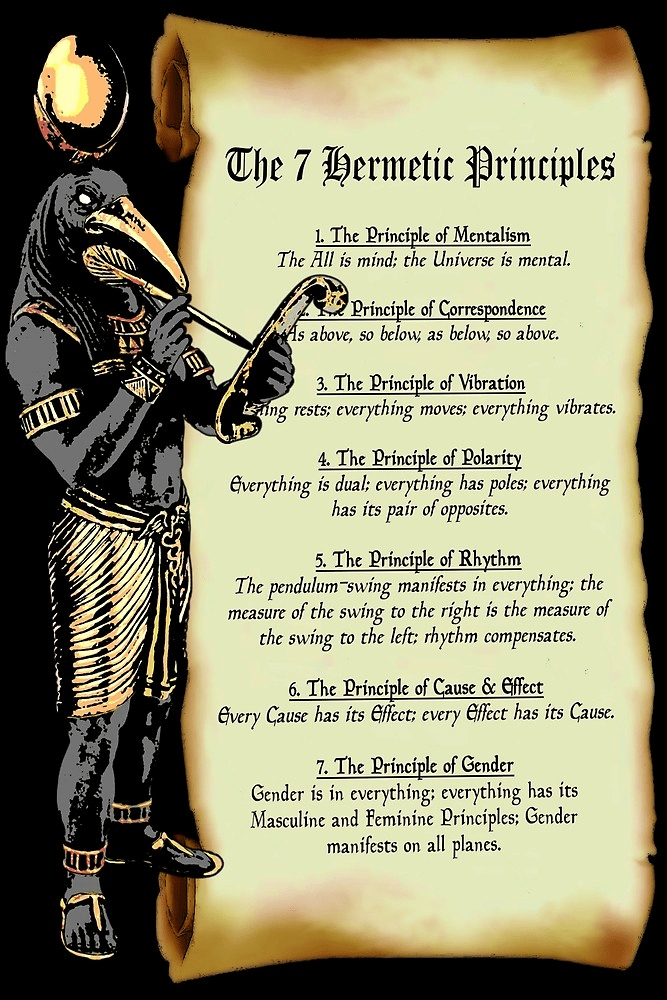
All seven points are of themselves truthful points; with the understanding of them or their application lending value in a person’s life. This is not in dispute. The concern for this writer, is if a person views them through a narrowly scoped paradigm; perceiving them as a comprehensive explanation for a person’s successful endeavours in life. For they are lessened in meaning and devalued in effectiveness if their application is attempted devoid of the Creator. There is a sinister factor involved if by the Three Initiates sharing them, one were to follow these seven principles purely in a secular or even metaphysical fashion alone.
There were two preceding sentences with profound bearing worth highlighting. The first by Spollern was: “According to Hermeticism, the wisdom of the whole universe can be accessed independently of religion through alchemy, astrology, and theurgy.” Two vital points in this sentence are firstly: this writer would beg to differ that if one truly seeks the ‘wisdom of the whole universe’, then while it is agreed religion is flawed, the disciplines of the left hand path are not truly beneficial or fulfilling to its practitioner and ultimately lead to a permanent spiritual death. They are the path of the Adversary and symbolised by the Tree of Knowledge of Good and Evil, in opposition to the Ancient of Days.
“The principles of truth are seven; He who knows these, understandingly, possesses the magic key before whose touch all the doors of the temple fly open” – The Kyballion.
Of course, the sixty-four thousand dollar question, is the doors to which temple? A little like Pandora’s Box, these doors may be better left closed. If a reader truly seeks the truth on all things, then this is only achieved through a relationship with the Eternal – which leads to the Tree of Life. Attempting ‘independently’ of the Creator is an unwise decision just as Adam and Eve, made the wrong choice – Chapter XXII Alpha & Omega. For “Wisdom begins with respect for the Lord, and understanding begins with knowing the Holy One” – Proverbs 9:10, NCV.
Likewise, “The best that people can do is eat, drink, and enjoy their work. I saw that even this comes from God, because no one can eat or enjoy life without him. If people please God, God will give them wisdom, knowledge, and joy. But sinners will get only the work of gathering and storing wealth… all their work is useless, like chasing the wind” – Ecclesiastes 2:24-26, NCV.
Similarly, the Son of Man said, “Ask, and you will be given what you ask for. Seek, and you will find. Knock, and the door will be opened. For everyone who asks, receives. Anyone who seeks, finds. If only you will knock, the door will open. If a child asks his father for a loaf of bread, will he be given a stone instead? If he asks for fish, will he be given a poisonous snake? Of course not! And if you hard-hearted, sinful men know how to give good gifts to your children, won’t your Father in heaven even more certainly give good gifts to those who ask him for them?” – Matthew 7:7-11, TLB.
Everet Dee states regarding the first principle: “This principle states that everything in the universe consists of thought, and is created by thought. Everything that exists, whether in the physical universe, or as abstract concepts or pure energy… is made of spirit, which itself is the product of a universal living mind.”
Spirit is the source of all life and emanates from the Creator. While sentient living beings possess mind capabilities in the image of the Creator, it is not true that we share the same mind. Only the righteous following a path to be at one with the Eternal – develop a selfless mind, focussed on the welfare of others. Every other creature, whether angelic or human, possess a selfish mind focused on themselves, driven by competition, envy and strife against others.
The second sentence was in connection with the fifth Principle of Rhythm: “This leads to a state of inner peace in which your foundation is strong and you can remain unbothered by circumstances around you.” Wouldn’t peace of mind of this nature be desired by everyone? How many in this world possess true ‘inner peace’. And which ‘foundation’ would provide peace of this kind, it is wondered? It is the Eternal who is the only sure foundation, as “He will be the sure foundation for your times, a rich store of salvation and wisdom and knowledge; the fear of the Lord is the key to this treasure” – Isaiah 33:6, NIV.
This is the only path which results in everlasting peace as explained by Paul: “Don’t worry about anything; instead, pray about everything; tell God your needs, and don’t forget to thank him for his answers. If you do this, you will experience God’s peace, which is far more wonderful than the human mind can understand. His peace will keep your thoughts and your hearts quiet and at rest as you trust in Christ Jesus” – Philippians 4:6-7, TLB.
How can one be truly ‘unbothered by circumstances around you’. This type of relaxed faith, understanding and temperament stems from being positive. And being positive is the product of being happy – Article: How to be Happy. You, you reading this, are… what you think; you are what you watch; you are what you listen to; you are what you read; you are what you do; you are what you eat and drink; and you are influenced, by which people you spend the majority of your time with. Many wish for peace and wisdom and perhaps all, desire happiness. True happiness is given by the Eternal to those who obey Him. It is that simple, it is that easy.
Everet Dee: ‘Hermeticism’s influence can be found world-wide, in modern science, as well as Christian and Muslim philosophy [and within psychology]. The ancient Greek philosophers were heavily influenced by Hermeticism, who in turn influenced the Renaissance and eventually the Scientific Revolution. Copernicus, the Renaissance astronomer who proposed the Sun is the center of the solar system, rather than planet Earth, and Isaac Newton, perhaps the most influential physicist of all time, are but two of many such students of the philosophy. Alchemy is a branch of the Hermeticism, which was the precursor to modern chemistry. The astrological concepts introduced in Hermeticism paved the way for modern astronomy, instilling an appreciation, and keen eye turned towards the sky.’
In the Emerald Tablet of Hermes, translated by Sir Issac Newton, circa 1680, it states: “That which is below is like that which is above and that which is above is like that which is below…” This is not some occult secret wisdom. The Bible has much to say on this truth. Another quote words it as: “As above, so below, as within, so without, as the universe, so the soul…” As noted above, it is recorded in the Kybalion – II The Principle of Correspondence – “As above, so below; as below, so above.”
Everet Dee: ‘Amongst scholars, the phrase is often understood to be referring to the effects of celestial mechanics upon terrestrial events. This can be materialistic in nature, such as the effect of the sun on the plants growing on earth, but it can also be esoteric or non-physical in nature. When studying the phrase, the version most commonly looked at is the medieval Latin translation: “Quod est superius est sicut quod inferius, et quod inferius est sicut quod est superius.”
“That which is above is like to that which is below, and that which is below is like to that which is above.” ‘Modern science has confirmed the concept of As Above, So Below as it has been able to observe galaxies of space, as well as the world of atomic particles, and found surprising similarities between the two. Both consist of particles kept in orbit by the gravity of an energetic core.’ Whether planets orbiting the sun, or an atom and its accompanying electrons. ‘In this way modern science has confirmed the wisdom of ancient thought.
Another example of As Above, So Below being expressed or represented is in Eliphas Levi’s 1856 magical treatise titled Dogme et Rituel de la Haute Magie. The book features artwork portraying Baphomet, and is rich in symbolism showing the As Above, So Below concept. The hands pointing up and down imply “as above, so below,” that in these two opposites there is still union. Other dualities include the light and dark moons, the male and female aspects of the figure, and the caduceus.’

This same concept is contained in the scriptures. John 8:23, ESV: ‘[Christ] said to them, “You are from below; I am from above. You are of this world; I am not of this world.’ In Colossians 3:1-2, ESV: ‘If then you have been raised with Christ, seek the things that are above, where Christ is, seated at the right hand of God. Set your minds on things that are above, not on things that are on earth.’ And in 2 Corinthians 4:18, ESV: ‘… as we look not to the things that are seen but to the things that are unseen. For the things that are seen are transient, but the things that are unseen are eternal’ – Matthew 6:10, Deuteronomy 28:23, Genesis 1:7, Philippians 3:20.

Encylopaedia: ‘Emerald is the stone traditionally associated with Hermes, while mercury is his metal. Mars is associated with red stones and iron, and Saturn is associated with black stones and lead. In antiquity, Greeks and Egyptians referred to various green-colored minerals (green jasper and even green granite) as emerald, and in the Middle Ages, this also applied to objects made of colored glass, such as the “Emerald Tablet” of the Visigothic kings or the Sacro Catino of Genoa (a dish seized by the Crusaders during the sack of Caesarea in 1011, which was believed to have been offered by the Queen of Sheba to Solomon and used during the Last Supper).’
Ancient Origins discuss the origin of the Emerald Tablet: ‘… the creator of the Emerald Tablet has been provided in myth as the Egyptian god Thoth, who… “divided his knowledge into 42 plates of emerald, codifying the great scientific principles ruling the Universe.”
For an odd coincidence regarding the number forty-two, refer: The Hitchhiker’s Guide to the Galaxy, Douglas Adams – articles: The Truly Big Questions; and 42.
Interesting expressions of the number 42 in mathematics and science include the following. When using base 13: 610 × 910 = 5410, it can be expressed as 4213 (in other words the decimal expression 54 is encoded as 42 in base 13); the number 42 is 101010 in base 2; light refracts through a water surface by 42 degrees to create a rainbow; and light requires 10−42 seconds to cross the diameter of a proton.
“The legend tells that after the gods’ fall, the Hermetic tablets were cleverly hidden so that no human being might find them. Only Thoth, on his return to that dimension, was able to recover the mysterious book.” ‘Another legend suggests that it was the third son of Adam and Eve, Seth, who originally wrote it. Others believed that the tablet was once held within the Ark of the Covenant.
While various claims have been made regarding the origins of the Emerald Tablet, as yet no verifiable evidence has been found to support them. The oldest documentable source of the Emerald Tablet’s text is the Kitab sirr al-haliqi (Book of the Secret of Creation and the Art of Nature), which was itself a composite of earlier works. Based on this Arabic work, some believe that the Emerald Tablet was… an Arabic text… rather than a piece of work from Antiquity, as many have claimed.
The interpretation of the Emerald Text is not a straightforward matter, as it is after all a piece of esoteric text. One interpretation, for instance, suggests that the text describes seven stages of alchemical transformation – calcination, dissolution, separation, conjunction, fermentation, distillation and coagulation. Yet, despite the various interpretations available, it seems that none of their authors claim to possess knowledge of the whole truth. Furthermore, readers are encouraged to read the text and try to interpret and find the hidden truths themselves.’
The Emerald Tablets allegedly comprise ten** tablets, and are referred to as keys, such as the Key of Wisdom; the Key of Magic; the Key of Mysteries; the Key of Time; and the Keys of Life and Death. It is claimed by Doreal, the Supreme Voice of the Brotherhood that the ‘writer is Thoth, an Atlantean Priest-King, who founded a colony in ancient Egypt after the sinking of the mother country. He was the builder of the Great Pyramid of Giza…’ Article: The Pyramid Perplexity. ‘In it he incorporated his knowledge of the ancient wisdom and also securely secreted records and instruments of ancient Atlantis.’ “Built I the Great Pyramid, patterned after the pyramid of earth force, burning eternally so that it, too, might remain through the ages. In it, I built my knowledge of “Magic-Science” so that it might be here when again I return from Amenti… while I sleep in the Halls of Amenti, my Soul roaming free will incarnate, dwell[ing] among men in this form or another” – Chapter XXI The Incredible Identity, Origin & Destiny of Nimrod.
‘Now, a word as to the material aspect of the tablets. They consist of twelve** tablets of emerald green, formed from a substance created through alchemical transmutation. They are imperishable, resistant to all elements and substances. In effect, the atomic and cellular structure is fixed, no change ever taking place. In this respect, they violate the material law of ionization. Upon them are engraved characters in the ancient Atlantean language: characters which respond to attuned thought waves, releasing the associated mental vibration in the mind of the reader. The tablets are fastened together with hoops of golden-colored alloy suspended from a rod of the same material. So much for the material appearance. The wisdom contained therein is the foundation of the ancient mysteries. And for the one who reads with open eyes and mind, his wisdom shall be increased a hundred-fold.’
In reading the tablets, which we have available today; left this writer with the impression that they had not been authored by a god or powerful spirit, but rather by a flesh and blood man. Albeit, perhaps by someone such as Hermes Trismegistus, yet decidedly not by a supernatural being called Thoth, whether claiming an existence beginning in Atlantis or not.

Readers interested in studying the Emerald tablets in their entirety, can use the following link:
https://archive.org/details/TheEmeraldTabletsOfThoth/page/n5/mode/2up?view=theater
Returning to the idea that Thoth was the builder of the Great Pyramid, there is a remarkable article by Igor Oakwood, entitled, The Sanctuary Of Thoth May Be The Original ‘Sanctuary of Thought’, 2020. It is an extract from his book, Hallu-Cygns – Language of Creation. We have previously discussed elements of the creation coming into being via the spoken word, as intimated in the Book of John 1:1-4 – refer Chapter I Noah Antecessor Nulla.
Igor Oakwood – emphasis mine:
‘… the Sanctuary of Thoth is a gateway to understanding… about the incredible feats of the ancient Egyptians… it confirms… that the ancient gods were originally mathematical principles that were used by the megalith builders to induce hyperdimensional communication and for the building of “stargates” – Article: Monoliths of the Nephilim. ‘The basic metaphor of these principles is found in the Heliopolitan Ennead or the Nine Creator Gods… which, when synthesized in a sacred geometrical structure, open up the 1/10th or 9-11 Gate of Consciousness.
Although there seems to be no direct indication in the etymology of the word “thought” that connects it to the ancient Egyptian name Thoth, the meanings of both words are so related that it could not be a coincidence… it would imply that the creators of the Egyptian language and thought are somehow related to modern-day English language and thought. Is it… just coincidental to believe that the name Thoth is the root of the word “thought”?
… the Sanctuary of Thoth becomes the Sanctuary of Thought. Therefore… the secret chambers must be a metaphor for the hidden chambers or glands in the brain’ – Article: 33; and Chapter XXII Alpha & Omega.
‘The number 110 is a key length in the sacred geometry of the Great Pyramid (110 cubits is a fourth of its base length) and in many other megalithic structures like the Hypogeum in Malta… [as] the whole Hypogeum temple is designed to resonate at a frequency of 110 Hertz’ – Article: The Pyramid Perplexity.
‘In 2008, a report was published by Dr Ian Cook of UCLA in which he describes his… experiment in which he monitored regional brain activity in a number of healthy volunteers through exposure to different resonance frequencies… findings indicated that, at 110 Hz, the patterns of activity over the prefrontal cortex abruptly shifted, resulting in a relative deactivation of the language center and a temporary shifting from left to right-sided dominance, related to emotional processing. This shift did not occur at other frequencies. This means that the Hypogeum’s oracle chamber was constructed in such a way as to induce mystical experiences and hyperdimensional consciousness’ – refer Stonehenge – article: Monoliths of the Nephilim; and the Top Ten Unexplained Mysteries of all Time.
‘We know that the most important temple in Heliopolis was the Temple of Ra-Atum or the Temple of the Phoenix, in which the sacred knowledge… was stored (in its architecture and cosmic alignments). Therefore, the temple functioned as an “inventory of knowledge.” In the center of this temple stood a granite (firestone) obelisk upon which rested an even more sacred object known as the Benben Stone. The Benben Stone is a mysterious conical stone (resembling a pinecone or a honeycomb) that symbolized the egg of the cosmic bird of creation or the Phoenix [or perhaps the Ibis of Thoth]. The Phoenix was usually depicted as a grey heron, a migratory bird just like the ibis or the swan.
It was believed that the first coming of the Phoenix marked the birth of a new age and the Benben Stone was its egg or divine seed… the conical shape of the Benben Stone has been linked more than once with the conical shape of the pineal gland (just like the pine cone statue in the Vatican!), which is considered to be the “Seed of Thought,” or the divine seed of reality’ – refer articles: 33; and Monoliths of the Nephilim. ‘The conical shape of the Benben Stone was later replaced by the pyramid capstone.
And the “Inventory” was replaced by the Great Pyramid itself… the Sanctuary of Thoth is a metaphor for the Sanctuary of Thought (Brain); the Seed of Thoth (Benben Stone) is a metaphor for the Seed of Thought (the pineal gland); and the Phoenix is a metaphor for the bird of the New Age.
When I was in Egypt a few years ago, I visited Memphis, the ancient capital of Lower Egypt, where one can admire the tall statues of Pharaoh Ramesses II. Interestingly, in all these statues we see Ramesses holding two cylinder-like objects. Valery Uvarov, in his book “Pyramids,” says this about these cylinders:
“they (the Pharaohs) are all clasping cylinder-like objects in their hands. Their roots go back into the depths of time… Those cylinders, with which the Pharaohs never parted throughout their lives, were harmonisers of the two basic flows of energy which the Ancient Egyptians called BA and KA, corresponding to Yin and Yang in the Oriental tradition. For the Ancient Egyptians BA and KA were the two component elements of the human entity, the two sources of vital energy… The diameter of the Wands is designed to be tuned to the Earth’s breathing rate of 54 minutes. Each planet has its own breathing tempo, its distinctive frequency which determines the bio-energy rhythms of all that exists on its surface. This tempo depends on the planet’s orbit and its period of revolution around its sun” – Article: 33.
‘Today, we know that the “breathing rate” of the earth is the frequency of seismic waves. On earth, the lowest possible seismic wave is indeed 54 minutes. In other words, 5.4 or 54 is a key number that dictates the energy impulse to life on the earth. Whereas 54 might be the frequency of Mother Earth, we also know that Father Sky had its own frequencies, which are called the Schumann Resonances (SR). SR’s are global electromagnetic resonances, generated and excited by lightning discharges in the atmospheric cavity formed by the earth’s surface and the ionosphere. At every second, some 100 lightning discharges touch the surface of the earth, which submerge the planet in a constant hum’ – refer Taos Hum – article: The Top Ten Unexplained Mysteries of all Time.
‘The fundamental Schumann Resonance is 7.83 hertz. Interestingly, when we divide 7.83 hertz by 5.4, we get 1.45 hertz, a frequency which is known today as the psychoacoustic baseline frequency. This frequency induces the tri-thalamic synchronization of the hypothalamus, pineal and pituitary gland with the human heartbeat.’
‘Knowing this, the Great Pyramid of Giza might have been built as an instrument to balance the fundamental Schumann frequency of the earth’s atmosphere (7.83 hertz) and the fundamental frequency of the earth itself (5.4 hertz) with the third basic tri-thalamic human heartbeat frequency of 1.45 hertz. This is because the base length of the Great Pyramid is 756 feet, which divided by 54 yields 14. We know that 756 divided 14 times by the golden ratio phi yields 1.45 hertz. This means that 1.45 hertz functions as a harmonizing frequency between the cosmic Yin (earth/seismic wave/Ba) and Yang (heaven/Schumann resonance/Ka) energies’ – Article: The Pyramid Perplexity.
‘Could this sophisticated “Mer-Ka-Ba Science of Thought” be behind the famous story of Osiris who was cut into 14 pieces by his brother Seth, only to be reassembled by his consort Isis? If this is true, then I suggest that Osiris (Yang/Ka) embodied either the number 756 or the Schumann resonance of 7.83 hertz. Therefore, Seth was the golden ration phi; Isis (Yin/Ba) would have been the number 54; and Horus, as the sacred child born from their union, would then become the balancing frequency of 1.45 hertz.
Apparently, the Maltese megalith builders had a complete understanding of how certain frequencies deactivate the language center in the human brain. And they knew perfectly well how to build sanctuaries resonating with these consciousness-altering frequencies. But why would these people have been interested in deactivating the language center in the brain?’ – Chapter XXI The Incredible Identity, Origin & Destiny of Nimrod.
‘Reality as we know it is made up of atoms and molecules that form increasingly complex and self-organizing structures which we call living beings. The relationships, geometries and resonances between the components of living beings are the “letters” that make up the language or “the word” of creation and are therefore “sacred.” As a result, we can say that language functions as the universal software program that programs reality. Since the universe is a perpetual self-sustaining system, its language is the key to oneness and immortality.
Human language, on the other hand, is made of another kind of words. The letters that make up our words are phonetic symbols with which we can transmit very complex information but with which we can also influence our own thoughts and beliefs. It is our thoughts and beliefs that define what we call “reality” or “non-reality” or what is manifest or not manifest. As a result, we can say that human language functions as a software program that programs our reality. In short, we can say that language and belief are inextricably intertwined like the two strands of the DNA molecule, the building block of life itself.
The problem is that because of their merely phonetic function, the letters and sounds of human languages have no connection with any geometric or resonant principle in the creational language. Although the Bible tells us that “In the Beginning was the Word,” we seem to have forgotten the deepest sense of the word “Word.” The fact that there are hundreds of human languages does not make a positive contribution to a united humanity nor to our self-identification as an intrinsic part of the planetary ecological system.
Since our megalithic ancestors apparently had deep knowledge of the psychoacoustic and infrasound frequencies of the universe, which they applied in their sacred architecture or “Sanctuaries of Thought,” we can assume that they considered these frequencies as the language of creation. In order to (re)connect with the source language of sacred geometry and resonance it seems logical that they switch off our “unnatural” language system in the brain. We can now easily imagine how our ancestors, during rituals inside these “thought” sanctuaries, resonated with the source, speaking the same language of the micro cosmos and the macro cosmos.’
Oakwood has hit upon a profound yet ignored event which was recorded in the scriptures. Genesis 11:6-8, ESV: ‘And the Lord said, “Behold, they are one people, and they have all one language, and this is only the beginning of what they will do. And nothing that they propose to do will now be impossible for them. Come, let us go down there and confuse their language, so that they may not understand one another’s speech.” So the Lord dispersed them from there over the face of all the earth, and they left off building…’ Humanity had telepathic ability which was switched off either at this time or earlier. Regardless, the incident at the Tower at Babel was the end of a universal way of communicating and the beginning of the approximate 7,151 languages we have in the world today – refer Chapter XXI The Incredible Identity, Origin & Destiny of Nimrod; and refer Tower of Babel, article: The Pyramid Perplexity.
The advent and furtherance of AI – Artificial Intelligence (or Alternative Intelligence) – is society going full circle and the beginning of a universal, single form of not just intelligence but communication and language.
Oakwood: ‘In a healthy system, every component, from the smallest atom to the biggest star system, “speaks the same language.” It is therefore right to say that it is the deviation of human language from the primordial language of creation that causes the deviation of humanity from nature. This leads us to the most obvious reason why information about the original blueprint of the Sanctuary of Thought and its original purpose would be concealed because it hides the power of thought control.
The solution to the concealment of this knowledge is the return to the source. This source is… the language of sacred geometry and resonance. Logically, when we “speak” this source language we enter into resonance with the whole of creation. This means that we gain a much deeper influence over reality at the moment we enter into resonance with the universe. This resonance functions as a hyper-dimensional portal that connects human subjective consciousness with the very core of objective material reality.
However, this also means that everything we think of when we are in resonance inside the portal, will be manifested in material reality. Therefore, keeping our thoughts sacred is so important that we can understand why a “Sanctuary of Thought” was built. Was Thoth one of these high priests who inherited the secrets of “Sacred Thought”? And who decided to save this precious knowledge in an “Inventory or Sanctuary of Thought”?
Were the pyramid complexes of Egypt, situated at the exact center of the planet’s landmass, used as a thought-control tower for the whole planet? Is it still functioning? If not, how could we activate it?’ – refer article: The Pyramid Perplexity.
It is reasonable to presume from extant data that the Great Pyramid was and is, a multi-purpose instrument or device. Igor Oakwood’s theory is original and unique and to the mind of this writer, resonates – no pun intended – with a compelling element of truth.
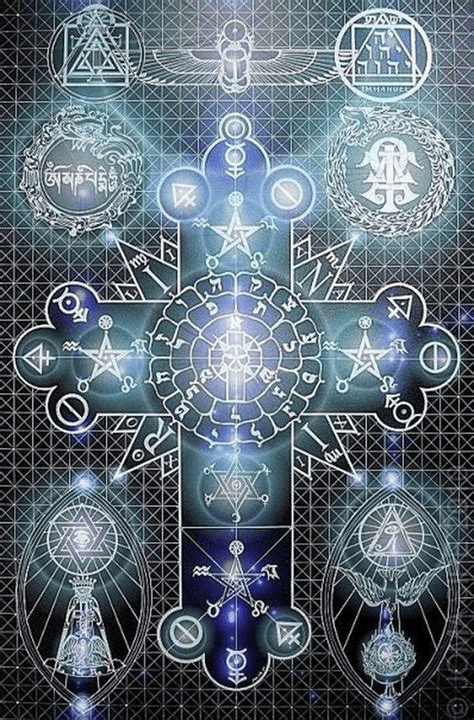
The following is a quote from ISTA. While lengthy, it contains much of interest regarding the creation of the material realm; the path to immortality; and regarding the Dragon Poimandres, if recognised as the Adversary, who was the arcane Wisdom and consort of the Ancient of Days – refer article: Asherah.
‘The Divine Pymander of Hermes Mercurius Trismegistus is one of the earliest of the Hermetic writings now extant. While probably not in its original form, having been remodeled during the first centuries of the Christian Era and incorrectly translated since, this work undoubtedly contains many of the original concepts of the Hermetic cultus. The Divine Pymander consists of seventeen fragmentary writings gathered together and put forth as one work. The second book of The Divine Pymander, called Poimandres, or The Vision, is believed to describe the method by which the divine wisdom was first revealed to Hermes. It was after Hermes had received this revelation that he began his ministry, teaching to all who would listen the secrets of the invisible universe as they had been unfolded to him.
The Vision is the most famous of all the Hermetic fragments, and contains an exposition of Hermetic cosmogony and the secret sciences of the Egyptians regarding the culture and unfoldment of the human soul. For some time it was erroneously called “The Genesis of Enoch,” but that mistake has now been rectified.
At hand while preparing the following interpretation of the symbolic philosophy concealed within The Vision of Hermes the present author has had these reference works: The Divine Pymander of Hermes Mercurius Trismegistus (London, 1650), translated out of the Arabic and Greek by Dr. Everard; Hermetica (Oxford, 1924), edited by Walter Scott; Hermes, The Mysteries of Egypt (Philadelphia, 1925), by Edouard Schure; and the Thrice-Greatest Hermes (London, 1906), by G. R. S. Mead.
To the material contained in the above volumes he has added commentaries based upon the esoteric philosophy of the ancient Egyptians, together with amplifications derived partly from other Hermetic fragments and partly from the secret arcanum of the Hermetic sciences. For the sake of clarity, the narrative form has been chosen in preference to the original dialogic style, and obsolete words have given place to those in current use.’
“Hermes, while wandering in a rocky and desolate place, gave himself over to meditation and prayer. Following the secret instructions of the Temple, he gradually freed his higher consciousness from the bondage of his bodily senses; and, thus released, his divine nature revealed to him the mysteries of the transcendental spheres. He beheld a figure, terrible and awe-inspiring. It was the Great Dragon, with wings stretching across the sky and light streaming in all directions from its body” – Revelation 12:3.
“(The Mysteries taught that the Universal Life was personified as a dragon.) The Great Dragon called Hermes by name, and asked him why he thus meditated upon the World Mystery. Terrified by the spectacle, Hermes prostrated himself before the Dragon, beseeching it to reveal its identity. The great creature answered that it was Poimandres, the Mind of the Universe, the Creative Intelligence, and the Absolute [Emperoress] of all. (Schure identifies Poimandres as the god Osiris.) Hermes then besought Poimandres to disclose the nature of the universe and the constitution of the gods. The Dragon acquiesced, bidding Trismegistus hold its image in his mind.”

“Immediately the form of Poimandres changed. Where it had stood there was a glorious and pulsating Radiance. This Light was the spiritual nature of the Great Dragon itself” – 2 Corinthians 11:4. “Hermes was “raised” into the midst of this Divine Effulgence and the universe of material things faded from his consciousness. Presently a great darkness descended and, expanding, swallowed up the Light. Everything was troubled. About Hermes swirled a mysterious watery substance which gave forth a smokelike vapor. The air was filled with inarticulate moanings and sighings which seemed to come from the Light swallowed up in the darkness. His mind told Hermes that the Light was the form of the spiritual universe and that the swirling darkness which had engulfed it represented material substance.
Then out of the imprisoned Light a mysterious and Holy Word^ came forth and took its stand upon the smoking waters. This Word – the Voice of the Light – rose out of the darkness as a great pillar, and the fire and the air followed after it, but the earth and the water remained unmoved below. Thus the waters of Light were divided from the waters of darkness, and from the waters of Light were formed the worlds above and from the waters of darkness were formed the worlds below” – Genesis 1:1-10. “The earth and the water next mingled, becoming inseparable, and the Spiritual Word which is called Reason moved upon their surface, causing endless turmoil.
Then again was heard the voice of Poimandres, but [Her] form was not revealed: “I Thy God am the Light and the Mind which were before substance was divided from spirit and darkness from Light” – Proverbs 8:22-31. “And the Word which appeared as a pillar of flame out of the darkness is the Son of God, born of the mystery of the Mind” – John 1:1-5^. “The name of that Word is Reason. Reason is the offspring of Thought and Reason shall divide the Light from the darkness and establish Truth in the midst of the waters. Understand, O Hermes, and meditate deeply upon the mystery. That which in you sees and hears is not of the earth, but is the Word of God incarnate. So it is said that Divine Light dwells in the midst of mortal darkness, and ignorance cannot divide them.
The union of the Word [the Son of Man] and the Mind [the Dragon] produces that mystery which is called Life. As the darkness without you is divided against itself, so the darkness within you is likewise divided. The Light and the fire which rise are the divine man, ascending in the path of the Word [Christ], and that which fails to ascend is the mortal man, which may not partake of immortality” – Genesis 3:3, 19. “Learn deeply of the Mind and its mystery, for therein lies the secret of immortality” – Genesis 3:4.
“The Dragon again revealed its form to Hermes, and for a long time the two looked steadfastly one upon the other, eye to eye, so that Hermes trembled before the gaze of Poimandres. At the Word of the Dragon the heavens opened and the innumerable Light Powers were revealed, soaring through Cosmos on pinions of streaming fire. Hermes beheld the spirits of the stars, the celestials controlling the universe, and all those Powers which shine with the radiance of the One Fire – the glory of the Sovereign Mind [of the physical dimensions of this universe]. Hermes realized that the sight which he beheld was revealed to him only because Poimandres had spoken a Word. The Word was Reason, and by the Reason of the Word invisible things were made manifest [Tree of the knowledge of Good and Evil]. Divine Mind – the Dragon – continued its discourse:
Before the visible universe was formed its mold was cast. This mold was called the Archetype, and this Archetype was in the Supreme Mind [the true supreme mind is the Ancient of Days] long before the process of creation began. Beholding the Archetypes, the Supreme Mind [the Dragon] became enamored with Its own thought; so, taking the Word as a mighty hammer, It gouged out caverns in primordial space and cast the form of the spheres in the Archetypal mold, at the same time sowing in the newly fashioned bodies the seeds of living things. The darkness below, receiving the hammer of the Word, was fashioned into an orderly universe. The elements separated into strata and each brought forth living creatures. The Supreme Being – the Mind – male [The Eternal One] and female [Wisdom (Asherah)], brought forth the Word [the Son of Man]; and the Word, suspended between Light and darkness, was delivered of another Mind called the Workman, the Master-Builder, or the Maker of Things.
In this manner it was accomplished, O Hermes: The Word moving like a breath through space called forth the Fire by the friction of its motion. Therefore, the Fire is called the Son of Striving. The Workman passed as a whirlwind through the universe, causing the substances to vibrate and glow with its friction, The Son of Striving thus formed Seven Governors, the Spirits of the Planets [symbolised – in order of original positions – by
1. Mars,
2. Tiamat (now Earth and the Asteroid Belt),
3. Jupiter,
4. Saturn,
5. Uranus,
6. Neptune and
7. Maldek (now the Kuiper Belt)], whose orbits bounded the world; and the Seven Governors controlled the world by the mysterious power called Destiny given them by the Fiery Workman [the Holy Spirit].”

“When the Second Mind (The Workman) had organized Chaos, the Word of God rose straightway [out] of its prison of substance, leaving the elements without Reason, and joined Itself to the nature of the Fiery Workman. Then the Second Mind, together with the risen Word, established Itself in the midst of the universe and whirled the wheels of the Celestial Powers [Ezekiel 1:15-21]. This shall continue from an infinite beginning to an infinite end, for the beginning and the ending are in the same place and state” – Revelation 22:13.
“Then the downward-turned and unreasoning elements brought forth creatures without Reason” – Genesis 1:20-25. “Substance could not bestow Reason, for Reason had ascended out of it. The air produced flying things and the waters such as swim. The earth conceived strange four-footed and creeping beasts, dragons, composite demons, and grotesque monsters. Then the Father – the Supreme Mind – being Light and Life, fashioned a glorious Universal Man [rather angelic sons of God – Job 38:7] in Its own image, not an earthy man [Genesis 1:26-27] but a heavenly Man dwelling in the Light of God. The Supreme Mind loved the Man It had fashioned and delivered to Him the control of the creations and workmanships.
The Man, desiring to labor, took up His abode in the sphere of generation and observed the works of His brother – the Second Mind – which sat upon the Ring of the Fire [Ezekiel 28:14]. And having beheld the achievements of the Fiery Workman, He willed also to make things, and His Father gave permission. The Seven Governors, of whose powers He partook, rejoiced and each gave the Man a share of Its own nature. The Man longed to pierce the circumference of the circles and understand the mystery of Him who sat upon the Eternal Fire. Having already all power, He stooped down and peeped through the seven Harmonies and, breaking through the strength of the circles, made Himself manifest to Nature stretched out below. The Man, looking into the depths, smiled, for He beheld a shadow upon the earth and a likeness mirrored in the waters, which shadow and likeness were a reflection of Himself. The Man fell in love with His own shadow and desired to descend into it. Coincident with the desire, the Intelligent Thing united Itself with the unreasoning image or shape.
Nature, beholding the descent, wrapped herself about the Man whom she loved, and the two were mingled. For this reason, earthy man is composite. Within him is the Sky Man, immortal and beautiful; without is Nature, mortal and destructible. Thus, suffering is the result of the Immortal Man‘s falling in love with His shadow and giving up Reality to dwell in the darkness of illusion; for, being immortal, man has the power of the Seven Governors – also the Life, the Light, and the Word-but being mortal, he is controlled by the Rings of the Governors – Fate or Destiny” – Genesis 3:6-7.
“Of the Immortal Man [Job 1:6] it should be said that He is hermaphrodite, or male and female, and eternally watchful. He neither slumbers nor sleeps, and is governed by a Father also both male and female, and ever watchful. Such is the mystery kept hidden to this day, for Nature, being mingled in marriage with the Sky Man, brought forth a wonder most wonderful – seven men, all bisexual, male and female, and upright of stature, each one exemplifying the natures of the Seven Governors [Revelation 4:5]. These O Hermes, are the seven races, species, and wheels. After this manner were the seven men generated. Earth was the female element and water the male element, and from the fire and the æther they received their spirits, and Nature produced bodies after the species and shapes of men.
And man received the Life and Light of the Great Dragon, and of the Life was made his Soul and of the Light his Mind. And so, all these composite creatures containing immortality, but partaking of mortality, continued in this state for the duration of a period. They reproduced themselves out of themselves, for each was male and female. But at the end of the period the knot of Destiny was untied by the will of God and the bond of all things was loosened.
Then all living creatures, including man, which had been hermaphroditical, were separated, the males being set apart by themselves and the females likewise, according to the dictates of Reason. Then God spoke to the Holy Word within the soul of all things, saying: ‘Increase in increasing and multiply in multitudes, all you, my creatures and workmanships. Let him that is endued with Mind know himself to be immortal and that the cause of death is the love of the body; and let him learn all things that are, for he who has recognized himself enters into the state of Good.’
And when God had said this, Providence, with the aid of the Seven Governors and Harmony, brought the sexes together, making the mixtures and establishing the generations, and all things were multiplied according to their kind. He who through the error of attachment loves his body [the physical realm], abides wandering in darkness, sensible and suffering the things of death, but he who realizes that the body is but the tomb of his soul, rises to immortality.
Then Hermes desired to know why men should be deprived of immortality for the sin of ignorance alone. The Great Dragon answered: ‘To the ignorant the body is supreme and they are incapable of realizing the [potential of] immortality that is within them. Knowing only the body which is subject to death, they believe in death because they worship that substance which is the cause and reality of death. Then Hermes asked how the righteous and wise pass to God, to which Poimandres replied: “That which the Word of God said, say I: ‘Because the Father of all things consists of Life and Light, whereof man is made.’ If, therefore, a man shall learn and understand the nature of Life and Light [through obedience to the Father], then he shall pass into the eternity of Life and Light.”
Hermes next inquired about the road by which the wise attained to Life eternal, and Poimandres continued: “Let the man endued with a Mind mark, consider, and learn of himself, and with the power of his Mind divide himself from his not-self and become a servant of Reality. Hermes asked if all men did not have Minds, and the Great Dragon replied: “Take heed what you say, for I am the Mind – the Eternal Teacher. I am the Father [rather, the Mother] of the Word – the Redeemer of all men – and in the nature of the wise the Word takes flesh. By means of the Word, the world is saved. I, Thought (Thoth) – the [Mother] of the Word, the Mind – come only unto men that are holy and good, pure and merciful, and that live piously and religiously, and my presence is an inspiration and a help to them, for when I come they immediately know all things and adore the Universal Father. Before such wise and philosophic ones die, they learn to renounce their senses, knowing that these are the enemies of their immortal souls.
I will not permit the evil senses to control the bodies of those who love me, nor will I allow evil emotions and evil thoughts to enter them. I become as a porter or doorkeeper, and shut out evil, protecting the wise from their own lower nature. But to the wicked, the envious and the covetous, I come not, for such cannot understand the mysteries of Mind; therefore, I am unwelcome. I leave them to the avenging demon that they are making in their own souls, for evil each day increases itself and torments man more sharply, and each evil deed adds to the evil deeds that are gone before until finally evil destroys itself. The punishment of desire is the agony of unfulfillment.
Hermes bowed his head in thankfulness to the Great Dragon who had taught him so much, and begged to hear more concerning the ultimate of the human soul. So Poimandres resumed: “At death the material body of man is returned to the elements from which it came [Ecclesiastes 12:7], and the invisible divine man [Genesis 2:7] ascends to the source from whence he came [Revelation 20:6], namely the Eighth Sphere” – refer article: DEATH: A Dead End or a New beginning? “The evil passes to the dwelling place of the demon [Revelation 20:13-15], and the senses, feelings, desires, and body passions return to their source, namely the Seven Governors, whose natures in the lower man destroy but in the invisible spiritual man give life.
After the lower nature has returned to the brutishness, the higher struggles again to regain its spiritual estate. It ascends the seven Rings upon which sit the Seven Governors and returns to each their lower powers in this manner:
Upon the first ring sits the Moon, and to it is returned the ability to increase and diminish.
Upon the second ring sits Mercury, and to it are returned machinations, deceit, and craftiness.
Upon the third ring sits Venus, and to it are returned the lusts and passions.
Upon the fourth ring sits the Sun, and to this Lord are returned ambitions.
Upon the fifth ring sits Mars, and to it are returned rashness and profane boldness.
Upon the sixth ring sits Jupiter, and to it are returned the sense of accumulation and riches.
And upon the seventh ring sits Saturn, at the Gate of Chaos, and to it are returned falsehood and evil plotting.
Then, being naked of all the accumulations of the seven Rings, the soul comes to the Eighth Sphere, namely, the ring of the fixed stars. Here, freed of all illusion, it dwells in the Light and sings praises to the Father in a voice which only the pure of spirit may understand. Behold, O Hermes, there is a great mystery in the Eighth Sphere, for the Milky Way is the seed-ground of souls, and from it they drop into the Rings, and to the Milky Way they return again from the wheels of Saturn. But some cannot climb the seven-runged ladder of the Rings. So they wander in darkness below and are swept into eternity with the illusion of sense and earthiness” – Jude 12-13.
“The path to immortality is hard, and only a few find it” – refer article: Predestination & Free Will. “The rest await the Great Day when the wheels of the universe shall be stopped and the immortal sparks shall escape from the sheaths of substance” – Leviticus 23:36, 39, John 7:37.
“Woe unto those who wait, for they must return again, unconscious and unknowing, to the seed-ground of stars, and await a new beginning” – Revelation 20:11-15. “Those who are saved by the light of the mystery which I have revealed unto you, O Hermes, and which I now bid you to establish among men, shall return again to the Father who dwelleth in the White Light, and shall deliver themselves up to the Light and shall be absorbed into the Light, and in the Light they shall become Powers in God. This is the Way of Good and is revealed only to them that have wisdom.”
We will address the Way to the true light and eternal life, a little later.
“Blessed art thou, O Son of Light, to whom of all men, I, Poimandres, the Light of the World, have revealed myself. I order you to go forth, to become as a guide to those who wander in darkness, that all men within whom dwells the spirit of My Mind (The Universal Mind) may be saved by My Mind in you, which shall call forth My Mind in them. Establish My Mysteries and they shall not fail from the earth, for I am the Mind of the Mysteries and until Mind fails (which is never) my Mysteries cannot fail.” With these parting words, Poimandres, radiant with celestial light, vanished, mingling with the powers of the heavens” – Ephesians 2:2; 6:12. “Raising his eyes unto the heavens, Hermes blessed the Father [Mother] of All Things and consecrated his life to the service of the Great Light.”
Those sincere souls seeking enlightenment, through knowledge, understanding and wisdom, should follow the light of the Father who is in the open, and not of the Adversary – otherwise known as the Great Red Dragon and the Serpent of Old – in the hidden occult shadows of darkness.
Continuing: “Thus preached Hermes: “O people of the earth, men born and made of the elements, but with the spirit of the Divine Man within you [Genesis 2:7], rise from your sleep of ignorance!” – Romans 13:11. “Be sober and thoughtful” – 1 Peter 5:8. “Realize that your home is not in the earth but in the Light. Why have you delivered yourselves over unto death, having power to partake of immortality? Repent, and change your minds. Depart from the dark light and forsake corruption forever. Prepare yourselves to climb [via ascension offered by Ascended Masters] through the Seven Rings and to blend your souls with the eternal Light [an evil path to a false salvation].
Some who heard mocked and scoffed and went their way, delivering themselves to the Second Death from which there is no salvation” – Hebrews 10:26-27. “But others, casting themselves before the feet of Hermes, besought him to teach them the Way of Life. He lifted them gently, receiving no approbation for himself, and staff in hand, went forth teaching and guiding mankind, and showing them how they might be saved. In the worlds of men, Hermes sowed the seeds of wisdom and nourished the seeds with the Immortal Waters. And at last came the evening of his life, and as the brightness of the light of earth was beginning to go down, Hermes commanded his disciples to preserve his doctrines inviolate throughout all ages. The Vision of Poimandres he committed to writing that all men desiring immortality might therein find the way.
In concluding his exposition of the Vision, Hermes wrote: “The sleep of the body is the sober watchfulness of the Mind and the shutting of my eyes reveals the true Light” – 1 Corinthians 15:51. “My silence is filled with budding life and hope, and is full of good. My words are the blossoms of fruit of the tree of my soul. For this is the faithful account of what I received from my true Mind, that is Poimandres, the Great Dragon, the Lord of the Word, through whom I became inspired by God with the Truth. Since that day my Mind has been ever with me and in my own soul it hath given birth to the Word: the Word is Reason, and Reason hath redeemed me. For which cause, with all my soul and all my strength, I give praise and blessing unto God the Father, the Life and the Light, and the Eternal Good.
The Vision of Hermes, like nearly all of the Hermetic writings, is an allegorical exposition of great philosophic and mystic truths, and its hidden meaning may be comprehended only by those who have been “raised” [via ascension offered by Ascended Masters] into the presence of the True Mind.”
Or, as readers who have already been converted will understand or who are being called at the present time (Acts 3;19), it is through the grace and mercy of the Eternal Creator that one is raised into a spiritual mind which is in the image of the Father’s mind and not into the mind of the adversarial Dragon by false religion; whether it be christianity or the occult – Colossians 3:1-4. Tread carefully, for when one is living in deception, they do not know they are deceived – 2 Timothy 3:13, Revelation 12:9.
Two important takeaways from this piece are firstly; if Thoth became an adherer of the way of the Dragon, then his is a dark, false path to enlightenment and immortality. This then lends weight to Thoth at least, being a god of dubious origin and credentials. Surely not an emissary of the one true God.
In the Emerald Tablets, Thoth requests of one of the ‘masters’, that he ‘be a teacher of men.’ This master has his own throne, yet at one point the master goes before the throne of one greater:
‘Before me arose a great throne of darkness, veiled on it seated a figure of night. Darker than darkness sat the great figure, dark with a darkness not of the night.
Before it then paused the Master… saying: “Oh, master of darkness, guide of the way from Life unto Life, before thee I bring a Sun of the morning. Touch him not ever with the power of night. Call not his flame to the darkness of night. Know him, and see him, one of our brothers, lifted from darkness into the Light. Release thou his flame from its bondage, free let it flame through the darkness of night.”
‘Raised then the hand of the figure, forth came a flame that grew clear and bright. Rolled back swiftly the curtain of darkness, unveiled the Hall from the darkness of night. Then grew in the great space before me, flame after flame, from the veil of the night.’
Firstly, this is decidedly not a description of the Ancient of Days, as portrayed in Daniel 7:9, NIV:
“As I looked, thrones were set in place, and the Ancient of Days took his seat. His clothing was as white as snow; the hair of his head was white like wool. His throne was flaming with fire, and its wheels were all ablaze.”
Secondly, the relationship between the Ancient of Days, the Adversary and the Son of God has been in the main – whether by fluke or design – depicted accurately. For the Dragon was once the very thought and reason emanating from the Mind of God. She came into existence as the original Wisdom of God and her name was Asherah – the Queen of Heaven. Together, they created angelic offspring. Whereas when God uttered his thoughts out loud, His Word came into existence. The Word’s name is Immanuel and as the Son of Man, he is the mediator between the Creator and humankind.
Daniel Seeker highlights the salient points of the teachings of Hermes Trismegistus.
‘Few have expressed the inexpressible as compellingly as Hermes Trismegistus… the alleged and attributed author of the Hermetic Corpus (Hermetica), an influential set of writings on spirituality, nature, the divine and alchemy… [which] the renaissance spiritual philosophers and classicists… held… in the highest regards, even ahead of grand figures like Plato and Moses… the teachings of Hermes Trismegistus… mostly focus on the potential union of man with the divine… achieved through the help of meditation, gnosis, prayer, mantras and other ascetic practices which could potentially lead the individual, the spiritual seeker, to higher states of consciousness and ultimately, union with the divine.’
There is only one true path which leads to real eternal life and the joining with the Creator. Acts 4:10-12, ESV: “… let it be known to all of you and to all the people… that by the name of Jesus Christ of Nazareth, whom you crucified, whom God raised from the dead… the stone that was rejected by you… which has become the cornerstone… there is salvation in no one else, for there is no other name under heaven given among men by which we must be saved.”
Seeker: ‘One of the key… most notable concepts found in the Hermetica is the notion… “as above, so below”, which posits that the microcosm (the individual)… reflects the macrocosm (the universe) and that by understanding the workings of the universe, one can understand the workings of the self. Another important teaching of Hermes is the concept of the “prima materia,” which was seen as the raw material or substance out of which all things in the manifest world was made from. The Hermetica proposed that by understanding the nature of this prima materia… one could access the secrets of the universe and achieve alchemical and spiritual transformation… Hermes… expanded on the notion of “as above, so below” to include that which is within and without… this is also known as the “Hermetic Axiom” or “Hermetic Principle”. The axiom refers to the idea that everything in the universe is interconnected in ways we can’t even begin to imagine.’
The Bible reveals the Eternal created everything by the source of His own power and essence through the working of the Holy Spirit. Hebrews 11:3, ESV: “By faith we understand that the universe was created by the word of God, so that what is seen was not made out of things that are visible.” Psalm 33:6, ESV: “By the word of the Lord the heavens were made, and by the breath of his mouth all their host” and Revelation 10:6, ESV: “… by him who lives forever and ever, who created heaven and what is in it, the earth and what is in it, and the sea and what is in it…”
‘… the main message of the Hermetica and of Hermes Trismegistus is that we can transcend.. [attaining] to higher spiritual realities within ourselves… by understanding the nature of the universe… of yourself, and by understanding deeply the nature of your own mind and consciousness you could potentially understand the nature of the whole, which in turn would lead you to what many traditions around the world call “spiritual enlightenment.”
Insightful quotes and truisms attributed to Hermes Trimegistus.
“The world nourishes bodies, the spirit nourishes souls.”
“The man who hath Mind in him, let him learn to know that he himself is deathless.”
“Close your eyes and let the mind expand. Let no fear of death or darkness arrest its course.”
“The excellence of the soul is understanding; for the man who understands is conscious, devoted, and already godlike.”
“To understand is to have faith (pisteusai), and not to have faith (apistesai) is not to understand.”
“I long to learn the things that are, and comprehend their nature, and know God. This is, I said, what I desire to hear.”
“In the moment when you have nothing to say… you will see it… One who has understood it can understand nothing else, nor can one who has looked on it look on anything else or hear of anything else…”
“But if you shut up your soul in your body… and say ‘I know nothing, I can do nothing; I am afraid… I know not what I was, nor what I shall be,’ then what have you to do with God?”
“But the eternal God cannot and never could be born; He is, He has been, He will be always. The nature of God is to be His own Principle.”
“The form of the universe is that of a hollow sphere, having in itself the cause of its quality or of its figure, wholly invisible; if, choosing any given point of its surface, one should seek to behold its depths, one would be unable to see anything. It appears visible only by means of those special forms whose images appear graven upon it, it shows itself only in effigy; but in reality it is always invisible in itself.”
This leads to the interesting question of not principally the authorship of these writings – for they are clearly the work not of a re-incarnated Thoth, but perhaps one moved and inspired by the spirit of the original Thoth – but of the identity of Thoth himself. Earlier, persons such as Moses, Noah and Enoch have been suggested. These three men all share one thing in common and that was their faith in the Creator. They are listed in the Book of Hebrews chapter eleven. Otherwise known as the faith chapter and a hall of fame if you will, of the Eternal’s faithful servants through the ages.
It has been proposed that Hermes Trismegistus was a contemporary of the patriarch Abraham. Plausibly, anywhere from circa 2000 BCE to the early centuries of the previous millennium is feasible for when a singular or composite Hermes Trismegistus may have lived. As Thoth is linked to the antediluvian age beginning circa 27,000 BCE until circa 11,000 BCE – according to an unconventional chronology – it is highly unlikely that Moses could be equated with Thoth. For Moses lived between 1526 BCE when he was born, until 1406 BCE, the year of his death.
Alternatively, could Moses have been Hermes Trismegistus? Maintaining the premise that Hermes Trismegistus was not a follower of the Eternal or the scriptures but rather of the Adversary and the occult; it is difficult to entertain Moses having the time or desire to write all the works attributed to Hermes Trismegistus. Moses was wholly invested and consumed with his responsibilities in leading the ornery Israelites and while perhaps not the author of all the first five books of the Bible, is credited in compiling each of them. Even so, it is worth noting Moses’ extraordinary position in life and his access to the very esoteric writings which undoubtedly inspired those later ascribed to Hermes Trismegistus.
We learn from Paul in Acts 7:21-23, The Voice: “… Pharaoh’s daughter found, adopted, and raised him as her own son. So Moses learned the culture and wisdom of the Egyptians and became a powerful man – both as an intellectual and as a leader. When he reached the age of 40, his heart drew him to visit his kinfolk, our ancestors, the Israelites.” The story of Moses has been chronicled in other articles, though briefly, he was co-regent with Amenemhet III of the 12th Dynasty. Therefore, as successor to the Pharaoh and a prince of Egypt, Moses had been schooled in all the mysteries.
At the age of forty, he turned his back on this privileged yet also unfulfilling life and dwelt in the the land of Midian as a shepherd for forty years and learned about the one true God from his father-in-law – Exodus 2:15-22, Acts 7:23-34. Refer: Appendix VII: Moses, the Exodus & the Red Sea Crossing – Fabrication or fact? and Chapter XXVII Abraham & Keturah – Benelux & Scandinavia.
Moses was reminded of the life he forsook which had embraced the occult and ceremonial magic, when in an audience with the Pharaoh was part of a conjuring challenge. Exodus 7:10-12, The Voice: “So Moses and Aaron went to Pharaoh and did exactly what the Eternal told them to do. Aaron threw his staff down before Pharaoh and his servants, and it was transformed into a snake. Pharaoh then sent for all the sages and sorcerers; and the most talented magicians in Egypt stepped up and performed the same act with their own incantations. Each magician threw down his staff, and each staff turned into a snake. But Aaron’s staff devoured all of the other staffs.”
The magic performed by Pharaoh’s magicians while impressive was outdone by the Eternal’s power through Aaron. Paul provides the identity of these ‘talented magicians’ in a letter to Timothy. 2 Timothy 3:7-9, The Message: “… [there are] women who, depressed by their sinfulness, take up with every new religious fad that calls itself “truth.” They get exploited every time and never really learn. These men [who exploit women] are like those old Egyptian frauds Jannes and Jambres, who challenged Moses. They were rejects from the faith, twisted in their thinking, defying truth itself. But nothing will come of these latest impostors. Everyone will see through them, just as people saw through that Egyptian hoax.”
Moses did an about turn, radically changing his whole philosophy, belief system and the gods he had venerated. Moses already a unique individual became the most humble man on the face of the Earth – Numbers 12:3. He was given – because of his faithfulness and belief – a special relationship with the Eternal. Exodus 33:9-11, The Voice: “When Moses entered the tent, the cloud pillar descended to the tent’s entrance, and the Eternal would talk with Moses. When people witnessed the cloud pillar standing at the meeting tent’s entrance, they would stand and bow in worship at the entrance of their own tents. The Eternal spoke with Moses face-to-face, just as a friend speaks to another friend.”
Moses, a spiritual giant amongst men was obedient and loyal to the Lord and unequivocally not a follower of the Adversary. Any claimed ink between Moses and Hermes Trismegistus as being the same person are false and reveal a lack of understanding about the real Moses and his relationship with the Creator.
Noah was unique, in that with seven other people he lived in two ages, the antediluvian and the post-flood epoch. Noah according to an unconventional chronology lived during the time of extraordinary human length of life, which though it diminished dramatically after the flood cataclysm still meant that Noah lived six thousand years prior to the flood and three thousand, five hundred years afterwards – Article: The Younger Dryas Stadial: Ending of the Earth… Beginning of the World; and Chapter I Noah Antecessor Nulla.
Noah was the tenth and final generation of the line of Seth from Adam, born in approximately 16,837 BCE. Genesis 6:9, ESV: “These are the generations of Noah. Noah was a righteous man, blameless in his generation. Noah walked with God.” Noah was in fact one of the three most righteous men named in the Bible – Ezekiel 14:14. 2 Peter 2:5, Phillips: “… he did not spare the ancient world but only saved Noah (the solitary voice that cried out for righteousness) and his seven companions when he brought the flood upon the world in its wickedness…”
Noah was untainted in his genetic lineage and chosen not just for this reason to father the peoples after the Flood but also because he was righteous before the Eternal. Like Moses, he believed in; was obedient towards; and worshipped, the one true God. Noah preached a warning message before the flood cataclysm and while there is a Book of Noah, his authentic authorship is questionable, as is any other written records supposedly left by Noah. It would certainly run against type if Noah had been a servant of the Adversary. A supposed link between Noah and Thoth being the same person is flimsy at best.
Which brings us to Enoch. Enoch was a family name, for there are two listed in the Genesis account. The name Enoch as defined by Abarim Publications, from the root hanak means: ‘to inaugurate, train, dedicate.’ Another source offers: ‘initiated’ and ‘disciplined’. These meanings are of note, when compared alongside an early system of belief. The second mentioned Enoch was the seventh generation of the line of Seth from Adam – Jude 14. He is briefly mentioned four times in the Bible. Genesis 5:24, ESV: “Enoch walked with God, and he was not, for God took him.” We learn he walked with God like his descendant Noah and, was mysteriously translated from death.
Hebrews 11:5-6, ESV: “By faith Enoch was taken up so that he should not see death, and he was not found, because God had taken him. Now before he was taken he was commended as having pleased God. And without faith it is impossible to please him, for whoever would draw near to God must believe that he exists and that he rewards those who seek him.” Enoch underwent a unique process and did not see death as we experience it – Article: DEATH: A Dead End or a New Beginning?
Only one other person was translated in such a way and that was the Prophet Elijah – 2 Kings 2:9-12. It is this Enoch who is often confused with the first Enoch. Thus this man is dubbed as righteous Enoch and clearly not any relation with the god Thoth. More about righteous Enoch can be found in the non-canonical work, the Book of Enoch.
The first Enoch was a third generation son of Eve through her son Cain. He is barely mentioned in the scriptures with even less said of him than righteous Enoch. Genesis 4:16-18, ESV: “Then Cain went away from the presence of the Lord and settled in the land of Nod, east of Eden. Cain knew his wife, and she conceived and bore Enoch. When he built a city, he called the name of the city after the name of his son, Enoch. To Enoch was born Irad…” To distance this Enoch from the other, he is dubbed evil Enoch. Readers interested in background information on Cain, Cain’s wife, the land of Nod and the city of Enoch, are encouraged to read the following: Chapter XXII Alpha & Omega; Chapter I Noah Antecessor Nulla; articles: Monoliths of the Nephilim; and Na’amah.

Evil Enoch – artwork by Molly Brown
Modern exegetes in their infinite wisdom see fits to view the two genealogies from Cain and Seth as one due to certain names in common, though this is incorrect – refer article Na’amah. Likewise, scholars due to a seeming lack of evidence for a city named Enoch have chosen to assume that evil Enoch was in fact the builder of the first city and named it after his son Irad, finding form in the ancient though principally, post-flood city of Eridu. In the Genesis account it says when Cain built a city, it does not say where or that it was in Nod to the east of Eden, equating to the land that eventually became known as Shinar – Chapter XVI Shem Occidentalis; and Chapter XXIV Arphaxad & Joktan: Balts, Slavs & the Balkans.
The Genesis 6 Conspiracy, Gary Wayne, 2014 – emphasis mine:
‘Two of Cain’s descendants were fingered as particularly corrupt in the application of the Sacred Sciences: Enoch and Lamech’ – refer article: Na’amah. ‘In the Anderson Legend, Enoch was considered an expert in science, geometry, and masonry… credited with the invention of sacred symbols and hieroglyphics… as a means to… preserve and transmit the sacred truths… Bar Hebraeus credits Enoch with inventing writing and books and with teaching men the art of building cities… while the Babylonians noted that Enoch was… expert on the stars… [inventing] astrology [with zodiacal precession].’
Sound like someone we know? The Book of Jubilees records that Enoch was ‘a mystery figure conversant in the esoteric and scientific knowledge.’
Wayne: ‘… Enoch… set out to pervert the sacred knowledge, enslaving it to the augmentation of wickedness and mysticism. This hijacking of sacred knowledge and segregating that powerful knowledge into exclusive and secretive Snake Brotherhoods by Enoch… was the naissance to The Genesis 6 Conspiracy. The sullied liberal arts… were earmarked for the elite, while philosophy was reserved for even fewer.
Consider the list of sinister sacraments Enoch introduced. From astronomy, he created astrology and sun worship. Enoch… his counterparts and descendants became idolaters, worshipping other gods rather than the true God of the universe’ – Article: Belphegor. ‘Enoch implemented pagan rituals, ceremonies and rites with this new, repulsive religion. The knowledge could then only be passed on to initiates, the selected guardians of the knowledge that was then cloaked in mysteries and secrets. This is why he was called Enoch, for the Hebrew translation means “initiated or consecrated.”
Enoch was… reputed to be Taut (Thoth) in other legends… he was deified by the Egyptians… Thoth was the keeper of the magical arts that made him master of the Gods, the one who revealed all knowledge of the Seven Sacred Sciences and religion to humankind. Thoth… transmitted mystical secrets to his obscure followers, members of a reticent Snake order…’ – refer Article: Monoliths of the Nephilim. ‘Thoth was transformed into a god through wisdom.’
Wayne considers the likelihood that thrice greatest indicates three individuals, with which this writer would concur. They are a ‘God’ – or in reality a fallen angelic being – and for the want of a better name, known as Thoth (1); ‘Enoch the Evil’ the son of Cain (2); and Hermes a ‘postdiluvian father/priest of the Mysteries’ (3). As ‘it turns out, Hermes better known as Hermes Trismegistus, was more than just one individual.’
Wayne: ‘Thoth… begat an ultra secret Snake Order… and perhaps… was the fallen angel Azazel. The latter two Hermes were fused into the first Hermes, forming the legend known as Trismegistus Hermes in later ages, where Hermes Trismegistus became mythologized as a spiritual guide, or prophet… Hermes… was so named “thrice Hermes,” honoring his accomplishments of being first among men to attain all knowledge and secrets of the gods that he inscribed onto stone tablets with sacred hieroglyphs, which he concealed for future generations.’
Wayne offers that the first postdiluvian Hermes known as Hermarynes was of Nephilim origin who had discovered one of two pillars* left by Enoch’s descendants and after translating the spurious branch of Masonry, then taught the Corrupted Sciences to the civilisation at Babel – Article: The Pyramid Perplexity. Sounds remarkably like Nimrod or one in league with him – Chapter XXI The Incredible Identity, Origin & Destiny of Nimrod.
Wayne: ‘When Enoch imagined writing in the form of hieroglyphics, he… set in motion the technology that would fuel all of humankind’s advances’ and in so doing, employed ‘the secretive, sacred symbols, known only to the selected elite, as a vehicle to transmit the sacred truths and Mysteries in a way that was free from discovery by the masses not considered worthy enough to learn about [them]. Enoch then, was the first Master Mason.’

Evil Enoch – artwork by Molly Brown
Enoch was reputed to have ‘constructed nine hidden [subterranean] vaults [underneath the Great Pyramid] to protect the seven spurious sciences from the impending deluge… one of the two famous Pillars of Lamech [preserved by his children, refer article: Na’amah] was manufactured out of marble [“some form of crystalline rock”]so that it would never burn and the second out of Laterus… so that it would not sink.’ This pillar* had the seven spurious sciences inscribed on it, while the pillar of marble had directions to find the nine vaults. The pillars were originally known as Mazzebah Stones.
The latres pillar is thought to have been a corrupted translation of laterus, a brass pillar and ‘reconciled later as laterite, red, iron-based clay used for making bricks and road surfaces – refer iron and clay, article: Is America Babylon? The information discovered on the marble pillar… is why Hermarynes led the people of Ham… to [found Egyptian civilisation] after the Babel incident’ – Chapter XI Ham Aequator; Chapter XII Canaan & Africa; Chapter XIII India & Pakistan: Cush & Phut; and Chapter XIV Mizra: North Africa & Arabia.
‘… Freemasonry regards the mystical [evil] Enoch as the ecclesiastical [righteous] Enoch. Strange indeed, unless one considers that Freemasonry truly upholds the doctrine that mysticism is in fact the pure religion and the pure branch of heavenly knowledge that descended from Adam through Seth and Noah, coupled with the concept that orthodox Christianity and orthodox Judaism are, in fact, equal partners in the evil religion.’
This is a monumentally profound point, as this is the explanation why the Establishment – led by invisible and powerful Principalities and Potentates – maintains the agenda they relentlessly follow – refer articles: The Establishment: Who are they… What do they want? and Principalities & Potentates: What they want…Who they are. It also reveals how orthodox religions are not untainted, including the Judaeo-Christian offshoot religion, Islam. There is no pure religion, yet there is a pure path or Way, which we will discuss.
Wayne: ‘Enoch fuses to mysticism when we consider the second definition of the Hebrew name Enoch. Not only can Enoch be translated as “consecrated,” which applies perfectly to the biblical Enoch, but also it can be translated as “initiated,” which applies perfectly to the Enoch of Freemasonry.’ Wayne likens the intercessory roles of Mercury the Messenger; Hermes, who transmitted the knowledge of the gods concerning their secret names, weaknesses, and abilities to control the gods to humankind; and Thoth, with Enoch, ‘as one who interceded with the gods.’
‘Understand then, that masonry, the Seven Liberal Sciences, the additional illicit heavenly knowledge from the… [Watchers], and mysticism, in which all this has been cleverly encoded, are all part of the same spurious religion of Enoch, Cain, fallen angels, and Nephilim. It is no wonder that [evil] Enoch was held in such high regard by the descendants of the [specious] religion of the postdiluvian epoch. Enoch was truly the spurious patron saint, the founding father of mysticism and Freemasonry.
‘The Mythology of the Hebrews by Goldziher, a German ethnologist, clearly identifies Enoch’ with the sun and the solar year. ‘Enoch was a sun worshipper, as testified by his festivals and sacrifices celebrated to the sun during its procession through the zodiac’ – refer articles: The Calendar Conspiracy; and The Seven Churches – A Message for the Church of God in the Latter Days.
‘Hermes collected 36,525 books (the exact number of days in a solar year: 365.25), kept secretly in the temples… The worship of the sun was a classic anti-God act by the rebellious Cain lineage and not a violation likely to have been committed by the faithful posterity of Seth and the ecclesiastical Enoch. In addition, the Enoch of mysticism was also known as the third great leader of the Adamites, which could only be possible if Enoch the Evil was [the] son of Cain…’ – Article: 33.
According to Wayne, all clandestine brotherhoods adhere to cloak-and-dagger ceremonies, arcane rituals and surreptitious initiations; with two sides, one for the elite and one for the mundane masses. ‘Why was and still is there a necessity for secret Snake Societies? As with all of these stealthy forms of religion, the true face is always hidden beneath a veil of mystery and lies. Specious societies and religions are always reinforced with ceremonial rituals, some secret and some for public consumption.’ It was evil Enoch the son of Cain, who ‘first introduced ceremonies, rituals, secret allegories, and other mysticism into the pure ante-diluvian masonry. Secret worship was called mysticism. Secret societies, and societies within societies, were, and are, Enoch’s ancient style of mysticism.
There were of course, distinct degrees of deception. The Lesser Mysteries could be revealed without fear of incrimination, through public ceremonies and rituals immersed in allegories. As for the Greater Mysteries, these were forbidden to be written down or disclosed in any form to the… masses… Alan Alford writes that the true secrets nurtured by numinous [surpassing comprehension or understanding, mysterious, spiritual, supernatural] societies have never been fully divulged, a comment that one can apply to modern Freemasonry and modern mysticism. Alford… adds… only at the final level of initiation, the Third level of Perfection, or at the Thirty-Third Level of Freemasonry, is the “Secret of Secrets” revealed, which would not only astound the initiate but… is believed… to be of such earth-shattering meaning that its revelation would overturn any preconceived opinions’ – Article: 33.
‘… Enochian pantheism that Freemasonry is anchored in is a doctrine denying the personality of God, while worshipping gods of different creeds. Pantheism depersonalizes God [as our Father] to a universal life force, to an impersonal [pure] energy’ as the ‘singularity and the unicity point that sparked the Big Bang.
The mysteries were created to both conceal and teach the initiated two great truths… the unity of God and… the immortality of the soul in a future life’ – refer article: DEATH: A Dead End or a New Beginning? and Chapter XXII Alpha & Omega. ‘The translations of the two truths are very simple and consistent with the definition of pantheism and mysticism… the unity of God, represented by the All-seeing Eye or the Eye of Osiris, pictured prominently on the American one-dollar bill, atop a great pyramid, is the non personal, universal life force and not a single entity, omnipotent God proclaimed by monotheistic religions’ – Articles: 33; and Is America Babylon?
Of course, this supposed monotheistic God of Christianity is falsely taught as a Trinity, when in fact God is best described by Unitarianism (and Arianism). God is one, for there is only one true God – Article: Arius, Alexander & Athanasius.
Wayne: ‘The All-seeing eye… is merely a symbol for the…. Architect of Heaven and Earth’ – the Adversary. ‘This is the secret that supposedly changes all preconceived minds alongside the illicit knowledge from heaven… the immortality of the soul, is commonly known as reincarnation. The individual is on an evolutionary path to godhood, where eventually, that person, too, will join the pantheon of gods.’
The truth is that when we die, we enter a state much like sleep, but with no dreams. There is no heaven or hell at the moment of death, but a future resurrection awaits everyone – Revelation 20:13.
Wayne: ‘Enoch the Evil consequently changed the order of access to the holy knowledge by establishing selected elite to garner and preserve it. Enoch the Evil was alternatively recorded as Uanna, the great Mesopotamian sage who travelled with the Anunnaki/Nephilim and was one of the Shadowy Seven (Snake) Sages, one of the builder gods…. who helped transfer antediluvian knowledge to the postdiluvian epoch’ – refer article: Monoliths of the Nephilim.
This reminds of the pervasive tradition about the god Quetzalcoatl teaching ancient peoples in the America’s the fundamentals of civilisation, including arts, sciences and crafts, following a global cataclysm – and discussed at length by Graham Hancock in Fingerprints of the Gods, 1995 – refer article: The Pyramid Perplexity. Wayne has alluded to a link between the fallen angel Azazel – second leader of the Grigori (or Watchers) who descended to Earth during the life of Jared, the father of righteous Enoch and Methusael, the father of evil Lamech circa 22,000 BCE – and Thoth. This association had occurred to this writer, though it is considered that Thoth is a different personage and he may equate with Quetzacoatl instead.
Britannica – emphasis mine: ‘Quetzalcóatl, (from Nahuatl quetzalli, “tail feather of the quetzal bird [Pharomachrus mocinno],” and coatl, “snake”), the Feathered Serpent, one of the major deities of the ancient Mexican pantheon. In aztec times (14th through 16th centuries) Quetzalcóatl was revered as the patron of priests, the inventor of the calendar and of books, and the protector of goldsmiths and other craftsmen; he was also identified with the planet Venus. As the morning and evening star, Quetzalcóatl was the symbol of death and resurrection [Thoth]. With his companion Xolotl, a dog-headed god [Anubis], he was said to have descended to the underground hell of Mictlan to gather the bones of the ancient dead. Those bones he anointed with his own blood, giving birth to the men who inhabit the present universe.
One important body of myths describes Quetzalcóatl as the priest-king of Tula, the capital of the Toltecs. He never offered human victims, only snakes, birds and butterflies. But the god of the night sky, Tezcatlipoca, expelled him from Tula by performing feats of black magic. Quetzalcóatl wandered down to the coast of the “divine water” (the Atlantic Ocean) and then immolated himself on a pyre, emerging as the planet Venus. According to another version, he embarked upon a raft made of snakes and disappeared beyond the eastern horizon.’

The head of Quetzalcoatl on the Temple of Mexico at Teotihuacan is eerily similar with the protruding serpentine head at Karahan Tepe in Turkey – refer article: Monoliths of the Nephilim.
‘In addition to his guise as a plumed serpent, Quetzalcóatl was often represented as a man with a beard, and, as Ehécatl, the wind god [Article: Belphegor], he was shown with a mask with two protruding tubes (through which the wind blew) and a conical hat… The temple of Quetzalcóatl at Tenochtitlan, the Aztec capital, was a round building, a shape that fitted the god’s personality as Ehécatl. Circular temples were believed to please Ehécatl because they offered no sharp obstacles to the wind. Quetzalcóatl ruled over the days that bore the name ehécatl (“wind”)… He was… the ninth of the 13 gods of the daytime hours. Although he was generally listed as one of the first-rank deities, no ceremonial month was dedicated to his cult. As the god of learning, of writing, and of books, Quetzalcóatl was particularly venerated in the calmecac, religious colleges annexed to the temples, in which the future priests and the sons of the nobility were educated.’
Similarity parallels Thoth with the calendar, learning, writing and books as does his companion god Xolotl, remarkably like the Egyptian god of death and resurrection, Anubis – Article: The Pyramid Perplexity. The sinister tradition is that Quetzalcoatl will one day return.
A modern rendition below of Quetzalcoatl, is strikingly reminisce of Thoth’s head and Mercury’s wings.

The underlying serpentine current running through not just this investigation about Thoth – but in every hierarchy of power whether in this world below or the invisible above – has been discussed at length in separate articles. Needless to say, it cannot be ignored because it is central to just about any discussion, whether it be on history, religion, politics, economics, industry, business, the military, medicine, the media or in entertainment.
The Serpent’s agenda began prior to the garden of Eden incident with Eve, though for the sake of a beginning regarding humankind this was the defining moment; when the Serpent Samael deceived Eve into embracing a new existence in the physical realm and in so doing fell prey to this devil’s wiles and was impregnated literally with the devil’s seed – spawning her first son Cain – Chapter XXII Alpha & Omega; and article: Na’amah. Cain was thus the first tainted human being, a demigod possessing serpentine genes and the originator of a royal dragon bloodline.
Specifically, his first born son Enoch was twenty-five percent Nephilim and a being beyond human as we would conceive of today. He was physically and mentally superior to a. the people of Day Six; b. his cousins from the line of Seth; and c. as well as all the descendants from Adam and Eve’s other sons and daughters. This was long before the Watchers officially descended to Earth replicating the same act as Samael and siring Nephilim offspring with human women.
Even so, there is no reason to believe that contact of a non-sexual nature was not taking place right from the beginning. Remember, Cain was Samael’s son. The former archangel and sibling to the likes of Michael and Gabriel. Now turned rebel and second only to Asherah his mother – the other mighty Leviathan. Therefore, it is not hard to understand Enoch would have not only recognised his superiority as a. the firstborn son of Cain, b. an inheritor of a royal bloodline, 3. a son of the first Nephilim, but also d. he would have been the recipient of special attention from the angelic powers in the service of Samael. Was one of these the being variously known as Djehuty by the Egyptians or Thoth by the Greeks?
All roads lead back to the antediluvian age; the Zep Tepi; the first time; and the civilisation of Atlantis – Article: Antartica: Secrets of the Lost Continent of Atlantis. And with that, to the Brotherhood of the Snake and surprise, surprise… Thoth.
Monoliths of the Nephilim:
“While the Brotherhood of the Snake has become a catch-all term to embrace just about any conspiracy one cares to mention and no tangible evidence supports its existence; the truth is that it does exist. It began when the Adversary rebelled; continued in the Garden of Eden; again when the Watchers descended to Earth; and its torch is carried by Establishment subsidiaries of a Luciferian nature such as the Illuminati – Articles: Principalities & Potentates: What they want… Who they are; and The Establishment: Who are they… What do they want?
The essence of the Brotherhood of the Snake is the seeking of the overthrow of the Eternal One’s rule as well as the destruction of the human race. In the interim, in the continued war against mankind, humanity is kept enslaved through corrupt governments, political systems and conflicting beliefs – whether religious or scientific.
Ascension Glossary states: ‘The Brotherhood of the Snake secretly and methodically infiltrated the Atlantan Mystery Schools and [their] Great Libraries in order to acquire all of the Law of One and human… knowledge for themselves [and] intentionally confiscating the records… in their planned takeover of the earth… they were stealing knowledge crystals and meticulously copying over the… ancient written translations that contained the original… Founder… records, in order to use that knowledge as a consciousness weapon against humanity.
The Snake Brotherhood Kings during Atlantis made a secret pact called the Luciferian Covenant for the purpose of the total annihilation of the historical timelines and cellular memories of humanity, to wipe out all records of highly technological human civilizations that were naturally evolving and advancing human consciousness and authentic human culture. The eradication of all of the technology, memories, histories and identities during the advanced civilization of the Atlantian colonies on the earth, is a conspiracy enacted through a blood covenant made with the Illuminati hybrid humans that make up the Power Elite and answer to the Thothian Luciferian groups.
The goal was that the Thothian group behind the Brotherhood of the Snake would continually maintain control over how, what and when particular knowledge from the Founder Records would be disseminated to the masses and to slowly package it as a worldwide religious control mechanism.
Essentially taking the Founder records and weaponizing them into a fear-based narrative that would be enforced by threats or shaming by some externally created authority, hidden behind the religious or dogmatic structure.’ Organised and militarised style of Psychological Warfare tactics are used ‘to further prey upon the spiritual and emotional desires of a primarily western Judeo-Christian population, to lead them into the False Ascension Matrix on the Astral Plane for soul capture during the death passage.
The Luciferian Thothian groups currently transmit a range of twisted half-truths in ancient esoteric teachings of ascension to guru and seeker archetypes, that are purposely geared towards the consciousness enslavement of its audience.
Many of the channeled transmissions are based in the information that was disseminated in the timeline of the Atlantian Mystery Schools, the Brotherhood of the Snake, which had acquired ancient written translations of stolen coded information in the Law of One records.
These records were accessed and translated by Thoth and then subsequently repackaged through the release of the Emerald Tablets.
The Emerald Tablet transmissions into the New Age movement are heavily hijacked and embedded with Artificial Intelligence and mind control programming in order to attract those spiritually awakening with Atlantian or Mystery School memories, and then tag and track these groups for Mind control and spiritual oppression’ – refer Chapter XXI The Incredible Identity, Origin & Destiny of Nimrod, articles: 33; Antartica: Secrets of the Lost Continent of Atlantis and DEATH: A Dead End or a New Beginning?

For anyone doubting the validity of this secret and invisible agenda, the basic plot of the Bible’s New Testament, is exactly this. A warning of its escalation and the Way of escaping its ramifications, was proclaimed when the Mediator between the Creator and humankind was sent to this Earth a little over two thousand years ago. The truth is truly stranger than fiction; the truth is really out there; and only the truth, will set one free.”
Before looking at the only Way which actually leads to freedom, everlasting life and a relationship with the Creator, it is worth noting the false path offered by Tarot. There are numerous others, though Tarot is relevant for it is linked to concepts related to Thoth such as: mind, knowledge, divination and astrology. We have learned the link between Thoth and thought, in that Thoth equals thought and possibly also Tarot. So that perhaps Thoth = thought = Tarot.
Online Encyclopaedia: ‘… there are two distinct types of tarot packs in circulation: those used for card games and those used for divination’ or Cartomancy, which is fortune-telling or divination using a deck of cards. The three most common decks used in esoteric tarot are the Tarot of Marseilles (a playing card pack), the Rider-Waite Tarot, and the Thoth Tarot.
Aleister Crowley who devised the Thoth deck along with lady Frieda Harris, stated about Tarot: “The origin of this pack of cards is very obscure. Some authorities seek to put it back as far as the ancient Egyptian Mysteries; others try to bring it forward as late as the fifteenth or even the sixteenth century… (but) The only theory of ultimate interest about the tarot is that it is an admirable symbolic picture of the Universe, based on the data of the Holy Qabalah”. ‘However, the origin of the Tarot pack has since been documented, showing that it was invented in Italy in the early 15th century and is unrelated to any “Holy Qabalah.” – or was it re-discovered?
‘The word ‘tarot’ and German Tarock derive from the Italian Tarocchi, the origin of which is uncertain, although taroch was used as a synonym for foolishness in the late 15th and early 16th centuries. In modern Italian, the singular term is Tarocco, which, as a noun, is a cultivar of blood orange. The attribute Tarocco and the verb Taroccare are used regionally to indicate that something is fake or forged. This meaning is directly derived from the tarocchi game as played in Italy, in which tarocco indicates a card that can be played in place of another card.’
Earlier we read: ‘Hermes in his Book of Thoth revealed to all mankind the “One Way,” and for ages the wise of every nation and every faith have reached immortality by the “Way” established by Hermes in the midst of the darkness for the redemption of humankind.’ This way is a false path and cannot be trusted. There is only one Way to immortality. The Bible has much to say on this subject and – coincidentally as there are forty-two sacred writings attributed to Hermes and 42 principles of Ma’at, the wife of Thoth – there are 42 Bible verses regarding the true Way.
A vital aspect of Christ’s mission while on the Earth, was to alert people to the Way – yet, few truly heeded his message. All verses English Standard Version. Matthew 7:14: “For the gate is narrow and the way is hard that leads to life, and those who find it are few.” Matthew 21:32: “… John [the Baptist] came to you in the way of righteousness, and you did not believe him, but the tax collectors and the prostitutes believed him. And even when you saw it, you did not afterward change your minds and believe him.” Luke 20:21: ‘So they asked him, “Teacher, we know that you speak and teach rightly, and show no partiality, but truly teach the way of God.” John 14:4-6: “And you know the way to where I am going.” Thomas said to him, “Lord, we do not know where you are going. How can we know the way?” Jesus said to him, “I am the way, and the truth, and the life. No one comes to the Father except through me.”
The early church in the New Testament and particularly Paul, frequently referred to the Way. Acts 16:17: ‘She followed Paul and us, crying out, “These men are servants of the Most High God, who proclaim to you the way of salvation.” Acts 18:24-25: “Now a Jew named Apollos, a native of Alexandria, came to Ephesus. He was an eloquent man, competent in the Scriptures. He had been instructed in the way of the Lord. And being fervent in spirit, he spoke and taught accurately the things concerning Jesus…” Acts 19:9: “But… some became stubborn and continued in unbelief, speaking evil of the Way before the congregation…”
Paul, prior to his conversion was an ardent persecutor of the Way, which he later embraced, taught and died for – refer Appendix VIII: When the Creator came to dwell with his Creation‘ and article: The Pauline Paradox. Acts 22:4: “I persecuted this Way to the death, binding and delivering to prison both men and women…” Acts 24:14: “But this I confess to you, that according to the Way, which they call a sect, I worship the God of our fathers, believing everything laid down by the Law and written in the Prophets…”
Do not think the Way was merely a New Testament phenomena. The father of the faithful, Abraham, an important example. Genesis 18:19: “For I have chosen him, that he may command his children and his household after him to keep the way of the Lord by doing righteousness and justice, so that the Lord may bring to Abraham what he has promised him.” Proverbs 10:29: “The way of the Lord is a stronghold to the blameless, but destruction to evildoers.”
Thus the only lasting Way to escape the prison which traps our spirit in a physical vessel and from attaining immortality, is salvation through the Son of Man. Only this path genuinely leads to eternal life. This is a great mystery, though it is not the same esoteric mystery which was taught by Thoth, evil Enoch or Hermes Trismegistus. Both are stated in the Bible. The counterfeit mystery is called the mystery of iniquity or lawlessness; as well as the mystery name of a woman, Babylon and the beast – Chapter XXI The Incredible Identity, Origin & Destiny of Nimrod.
The two main texts delineating this mystery are a letter from not Paul but probably Silas to the church of the Thessalonians (refer article: The Pauline Paradox) and a prophecy given by the Apostle John. Both are dire warnings of a world succumbed to the mysteries which lead away from a relationship with the Eternal and rather one with His adversaries instead.
“Now… we ask you, brothers, not to be quickly shaken in mind or alarmed, either by a spirit or a spoken word, or a letter… Let no one deceive you in any way. For that day will not come, unless the rebellion comes first, and the man of lawlessness is revealed, the son of destruction, who opposes and exalts himself against every so-called god or object of worship, so that he takes his seat in the temple of God, proclaiming himself to be God.
Do you not remember that when I was still with you I told you these things? And you know… that he may be revealed in his time. For the mystery of lawlessness is already at work… the lawless one will be revealed, whom the Lord Jesus will kill with the breath of his mouth and bring to nothing by the appearance of his coming. The coming of the lawless one is by the activity of Satan with all power and false signs and wonders, and with all wicked deception for those who are perishing, because they refused to love the truth and so be saved. Therefore God sends them a strong delusion, so that they may believe what is false…” – 2 Thessalonians 2:1-11, English Standard Version.
This is a sobering pronouncement of what yet lies ahead, perhaps affecting the tenth generation from now and orchestrated by the Great Red Dragon and Adversary. John’s prediction describes in coded symbolism the vehicle by which the man of lawlessness; the beast; and the great whore, achieve grand deception in blanketing the whole world.
‘Then one of the seven angels… said to me, “Come, I will show you the judgment of the great prostitute who is seated on many waters, with whom the kings of the earth have committed sexual immorality, and with the wine of whose sexual immorality the dwellers on earth have become drunk.” And he carried me away in the Spirit into a wilderness, and I saw a woman sitting on a scarlet beast that was full of blasphemous names, and it had seven heads and ten horns. The woman was arrayed in purple and scarlet, and adorned with gold and jewels and pearls, holding in her hand a golden cup full of abominations and the impurities of her sexual immorality.
And on her forehead was written a name of mystery: “Babylon the great, mother of prostitutes and of earth’s abominations.” And I saw the woman, drunk with the blood of the saints, the blood of the martyrs of Jesus. When I saw her, I marveled greatly. But the angel said to me, “Why do you marvel? I will tell you the mystery of the woman, and of the beast with seven heads and ten horns that carries her’ – Revelation 17:1-7, English Standard Version.
The fact that billions of souls have turned to the religions of Christianity, Islam, Judaism, Hinduism, Sikhism, Buddhism, Shintoism, Taoism, Satansim, demonism or one of any number of the 11,400 different religions in the world, is testimony to the nearly unanimous interest which people share in the what, who and why concerning humankind’s existence and whether there is an eternal afterlife.
Hence, if a path purports to provide secret knowledge on the way to achieving godhood, it is no wonder people are curious. Especially, if it does not seemingly entail the worship and obedience to a supreme God. Alternative paths are attractive, for they may require ritual, sacrifice and even worship, but not that annoying element called… obedience. Yet, what practitioners of the left hand path either fail to realise, ignore or rebelliously embrace is that they are worshipping evil spirits, whether angelic or demonic. Those who choose a more wholesome path, are also deceived – whether it be Christianity, Islam, Judaism or Hinduism for example – for the gods, whether one or many are not the one true God as revealed by the early church apostles and prophets.
While there is only one true path or Way, it does not mean all of the other eleven thousand three hundred and ninety-nine paths are wrong. In answer to a question on Quora: “They are in a percentile manner, descending shades of the original truth. All religions or belief systems contain elements of truth – and so all have value. The issue is that they all contain falsehoods as well. And therein lies the problem.
From the beginning, there were two Ways or paths. One typified by selflessness; the other of selfishness. The one true path has remained the same and leads to eternal life and a relationship or at-one-ment with the Creator; who themselves have always existed and thus are able to offer the same, as a reward to those who diligently seek to follow.
The other path – at the behest of an Adversary – has diverged into the serpentine myriad pathways of confusing and corrupted choices that we have before us today.”
A comprehensive tree chart of the evolution of religion by Simon Davies. There is a version 2.0 with additional detail.
“Any religion that espouses coercion or violence of any kind, is certainly not a true religion… The true path remains very narrow. Few search for it, even fewer choose it and it is the very fewest who remain on its sojourn.”
This is great mystery and one which has endured through the ages for those who truly seek its reward. Paul discusses the mystery of the ages. First to the church in Rome. Romans 16:25-26, ESV: “Now to him who is able to strengthen you according to my gospel and the preaching of Jesus Christ, according to the revelation of the mystery that was kept secret for long ages but has now been disclosed and through the prophetic writings has been made known to all nations, according to the command of the eternal God, to bring about the obedience of faith…”
As well as the church at Corinth. 1 Corinthians 2:6-8, ESV: “Yet among the mature we do impart wisdom, although it is not a wisdom of this age or of the rulers of this age, who are doomed to pass away. But we impart a secret and hidden wisdom of God, which God decreed before the ages for our glory. None of the rulers of this age understood this, for if they had, they would not have crucified the Lord of glory.”
To the churches at Ephesus and Colossae the authors (not Paul in either instance) shares the same message – Article: The Pauline Paradox. Ephesians 3:9-10, ESV: “… and to bring to light for everyone what is the plan of the mystery hidden for ages in God, who created all things, so that through the church the manifold wisdom of God might now be made known to the rulers and authorities in the heavenly places.”
This verse is sensationally referencing that spirit beings learned of the truth of the Creator’s plan for humankind. Up until the birth of the Messiah, it had been shrouded in secrecy. David, beloved of the Lord posed a penetrating question when he asked: “… what is man that you are mindful of him, and the son of man that you care for him? Yet you have made him a little lower than the heavenly beings and crowned him with glory and honor. You have given him dominion over the works of your hands; you have put all things under his feet…” – Psalm 8:4-6, English Standard Version.
Later in the Psalms, Asaph reveals that these heavenly beings – which the Son of Man when human [and by extension man] is a little lower than – are gods, in that they are sons of the Most High. God judges them for not meting out righteous judgement and wisdom to mankind. ‘God has taken his place in the divine council; in the midst of the gods he holds judgment: “How long will you judge unjustly and show partiality to the wicked?” They should “… Give justice to the weak and the fatherless maintain the right of the afflicted and the destitute. Rescue the weak and the needy; deliver them from the hand of the wicked.” They have neither knowledge nor understanding, they walk about in darkness… I said, “You are gods, sons of the Most High, all of you; nevertheless, like men you shall die, and fall like any prince” – Psalm 82:1-7, English Standard Version.
The ‘mystery of the ages’, though revealed for all, is truly sought after by only the very few and truly comprehended by fewer still. Colossians 1:25-28, ESV: “… of which I became a minister according to the stewardship from God that was given to me for you, to make the word of God fully known, the mystery hidden for ages and generations but now revealed to his saints. To them God chose to make known how great among the Gentiles are the riches of the glory of this mystery, which is Christ in you, the hope of glory. Him we proclaim, warning everyone and teaching everyone with all wisdom, that we may present everyone mature in Christ.”
In summary, a case is tentatively made for the third incarnation originating in the post-flood epoch – during the height of Sumerian culture and ostensibly wending its way to Egyptian lore (though it may well be the other way around) – and now known as Hermes Trismegistus, as none other than the biblical Nimrod.
The second incarnation during the preceding antediluvian age; whom was also descended from Nephilim ancestry, known to us as Hermes or Mercury was the biblical evil Enoch.
The air of enigma surrounding the original Thoth, may mean his true name is forever shrouded in mystery. While there is reason to believe his identity was not one of the two leaders of the Grigori, Azazel, he perhaps remains the front runner. Thoth was very likely one of the fallen Watchers and – apart from the possible candidate Quetzalcoatl, who has remarkable similarity with Azazel (and Nimrod) under a different name perhaps – does closely equate with the 13th leader out of twenty: Penemue.
Penemue was a curer of stupidity in men, mentioned in Bereshith Rabba or Genesis Rabba. As an angel, he was apparently associated with Abraxiel (or Abraxas). Penemue’s name means ‘the inside’ and he may have been in the order of healing angels called the Labbim, according to one opinion. Another source states, ‘Penemue is the angel’s equivalent of Prometheus [a Titan god of fire]. According to Enoch, he [or she] is the angel that taught humankind how to read and write – not because [they] loved us, but because reading leads to knowledge, knowledge leads to thinking, thinking leads to sin’ – Chapter XXII Alpha & Omega.
“The name of the fourth is Penemue: he discovered to the children of men bitterness and sweetness; And pointed out to them every secret of their wisdom.
He taught men to understand writing, and the use of ink and paper.
Therefore numerous have been those who have gone astray from every period of the world, even to this day. For men were not born for this, thus with pen and with ink to confirm their faith; Since they were not created, except that, like the angels, they might remain righteous and pure.
Nor would death, which destroys everything, have effected them; But by this their knowledge they perish, and by this also its power consumes them” – 1 Enoch 69:9-16.
One description of Thoth raises him to supreme stature amongst the gods, though it seems it is actually describing many entities entwined as one:
“He is the God beyond all name – He the unmanifest, he the most manifest; He whom the mind alone can contemplate, He visible unto the eyes as well. He is the one of no body, the one of many bodies, nay, rather, He of every body. Naught is there which He is not, for all are He, and He is all.”
The following is an Invocation to Lord Hermes. While superficially appearing innocuous, there is inherent danger in asking a spirit who may or may not not be Thoth, in becoming one with yourself. For it will not lose its identity, but the summoner may risk losing theirs.
“Come unto me, Lord Hermes, even as into women’s wombs…
Come unto me, Lord Hermes, who dost collect the food of gods and men!
Lord Hermes, come to me, and give me grace, food, victory, health and happiness, and cheerful countenance, beauty and powers in sight of all!
I know thy Name that shineth forth in heaven; I know thy forms as well; I know thy tree; I know thy wood as well.
I know thee, Hermes, who thou art, and whence thou art, and what thy city is.
I know thy names in the Egyptian tongue, and thy true name as it is written on the holy tablet in the holy place at Hermes’ city, where thou dost have thy birth.
I know thee, Hermes, and thou me; I am thou, and thou art I.
Come unto me; fulfil all that I crave; be favourable to me together with good fortune and the blessing of the Good.”
Taken from the Greek Papyri in the British museum (London, 1893), by Richard August Reitzenstein quoted in Thrice-Greatest Hermes, Volume 1, Page 82 by G R S Mead, 1906.
A concluding thought, is the mystery of the depiction of Thoth with an anthropomorphic body and yet with an avian head. The answer may be simply that an Ibis is symbolic of wisdom, or the real meaning may for the time being remain allusive. Otherworldly Oracle claimed Thoth is a ‘bird-like extraterrestrial.’ Thoth’s origin may not be too far from this as the Bible reveals an angelic order of beings called Cherubim.
Ezekiel 10:14, EASY: “Each of the cherubs had four faces. One face was the face of a bull. The second face was the face of a man. The third face was a lion’s face. And the fourth face was an eagle‘s face.”
Thoth may have been a high ranking entity from one of the four types of Cherubim. In this case, an avian line – like Quetzalcoatl – and hence why he is depicted with the head and face in the likeness of a bird.
‘Write down the revelation and make it plain on tablets so that a herald may run with it. For the revelation awaits an appointed time; it speaks of the end and will not prove false. Though it linger, wait for it; it will certainly come and will not delay.’
Habakkuk 2:2-3 New International Version
“There has never really been a time that Hermes has not been talked about. He was first worshiped thousands of years before Christ and even today his influence is found in the philosophy we read, the symbols we use, and even the movies we watch.”
Thomas Gregory
“The present issues from the past, and the future from the present. Everything is made one by this continuity. Time is like a circle, where all the points are so linked that one cannot say where it begins or ends, for all points precede and follow one another for ever.”
Hermes Trismegistus, Corpus Hermeticum
© Orion Gold 2024 – All rights reserved. Permission to copy, use or distribute, if acknowledgement of the original authorship is attributed to orion-gold.com




 The Lightkeeper