
The scriptures feature a curious habit, where they include people even if only mentioned fleetingly in a single verse, invariably for profound reason. Not quite embedded so deeply and cryptically as the dark angel Lilith in the Book of Isaiah (Article: Lilith), there is a descendant from a royal line of Eve, listed in the first book of the Bible. Royal, because only two lines of descent are recorded in the antediluvian age stemming from Adam and Eve. The second was also a priestly line; for while Adam and Eve are credited in having many children, just two sons are highlighted on purpose: Cain and his younger half-brother Seth.
Jewish historian Josephus, albeit drawing upon legend, recorded that Adam and Eve had thirty-three sons and twenty-three daughters, totalling fifty-six children. The exact figure though would be – the interesting number from a numerology perspective of – 55. The reason being, that Cain while a son of Eve, was not a son of Adam; hence 32 sons instead, including the murdered Abel – refer Chapter XXII Alpha & Omega. Thus, 32 sons and the transcribed opposite figure of daughters, the number 23.
This person is significant for a variety of reasons, though two very obvious ones are that they were part of the final generation to be born prior to the great Flood, some twenty-two thousand years ago and they are only one of three females listed in either genealogy stemming from Cain and Seth – refer article: The Younger Dryas Stadial: Ending of the Earth… Beginning of the World; Appendix IV: An Unconventional Chronology; and Chapter I Noah Antecessor Nulla.
No daughters or wives are recorded in Seth’s line which included only two righteous men: Enoch and Noah. Whereas Cain’s line additionally records two wives and one lone daughter from one of them, namely Na’amah (or Naamah).

Na’amah
Before we investigate this Naamah, there are two other Naamahs mentioned in the Old Testament. The first is a city of the same name included in the inheritance of the tribe of Judah. Joshua 15:41, ESV: “Gederoth, Beth-dagon, Naamah, and Makkedah: sixteen cities with their villages.” It was a city located in the plain of Judah and supposed by some to be identifiable with Na’aneh, about five miles south-east of Makkedah. Meanwhile one source offers that Naamah is not identical with modern Na’aneh, but rather with ‘Khirbet Fared nearby to Araq Na’aman.’
In Job 2:11, three locutionary friends of the patriarch Job are listed; the third being Zophar the Naamathite, the adjectival form of Naamah. Zophar is proposed by some sources as the king of the Minaeans in Arabia – possibly a link with Abraham’s sons by Keturah. He is also linked with Eliphaz’s son Zepho (or Zephi), a grandson of Esau. The obvious answer is that Naamah was the hometown of Zophar the Naamathite, though it is not certain that this is the case – refer Chapter XXIX Esau: The Thirteenth Tribe.
The second Naamah coincidentally, was also high born and an Ammonite princess, descended from Lot’s second son, Ammon – refer Chapter XXVI The French & Swiss: Moab, Ammon & Haran. This Naamah is also of particular interest, connected in more ways than one with her original namesake, who preceded her by nineteen millennia. Naamah is introduced in the Bible as a wife of King Solomon and the Queen mother of Solomon’s son and heir Rehoboam, who ascended the throne of Israel after his death. When the Kingdom split into two, Rehoboam remained the king of the Kingdom of Judah. A coincidental link perhaps, to the city of Naamah within Judah’s territory.
“So King Rehoboam grew strong in Jerusalem and reigned. Rehoboam was forty-one years old when he began to reign [in 930 BCE], and he reigned seventeen years in Jerusalem, the city that the Lord had chosen out of all the tribes of Israel to put his name there.

His mother’s name was Naamah the Ammonite” – 2 Chronicles 12:13, ESV.
King Solomon had 700 wives and 300 concubines, yet only one son, Rehoboam, is named in scripture with two daughters, Taphath and Basemath – 1 Kings 11:3, 43; 4:11, 14. What is astonishing, is that only three children are identified in the entire Bible, when Solomon must have had many, many children from so large a number of wives. This is a glaring omission. Scripture offers an answer, though it is an unpalatable one. It helps to understand why there are no genealogical lists for Solomon’s sons as there are for Saul and David in the Bible and why Solomon is not included in Hebrews chapter eleven as a man of faith. The chapter reads as a hall of fame for heroes of the Old Testament. Yet Solomon is omitted. Regarding Solomon’s wives and concubines. 1 Kings 11:1-13, ESV:
“Now King Solomon loved [or rather lusted after] many foreign women, along with the daughter of Pharaoh [Hatshepsut, the Queen of Sheba – refer Chapter XIII India & Pakistan: Cush & Phut]: Moabite, Ammonite, Edomite, Sidonian, and Hittite women, from the nations concerning which the Lord had said to the people of Israel, “You shall not enter into marriage with them, neither shall they with you, for surely they will turn away your heart after their gods.” Solomon clung to these in love. He had 700 wives, who were princesses, and 300 concubines.
And his wives turned away his heart. For when Solomon was old his wives turned away his heart after other gods, and his heart was not wholly true to the Lord his God, as was the heart of David his father. For Solomon went after Ashtoreth the goddess of the Sidonians, and after Milcom* the abomination of the Ammonites. So Solomon did what was evil in the sight of the Lord and did not wholly follow the Lord, as David his father had done.
Then Solomon built a high place for Chemosh the abomination of Moab, and for Molech* the abomination of the Ammonites, on the mountain east of Jerusalem.** And so he did for all his foreign wives, who made offerings and sacrificed to their gods. And the Lord was angry with Solomon, because his heart had turned away from the Lord, the God of Israel, who had appeared to him twice and had commanded him concerning this thing, that he should not go after other gods. But he did not keep what the Lord commanded’ – 1 Kings 3:5-14; 9:2, 6-7.
‘Therefore the Lord said to Solomon, “Since this has been your practice and you have not kept my covenant and my statutes that I have commanded you, I will surely tear the kingdom from you and will give it to your servant. Yet for the sake of David your father I will not do it in your days, but I will tear it out of the hand of your son. However, I will not tear away all the kingdom, but I will give one tribe to… [Rehoboam], for the sake of David my servant and for the sake of Jerusalem that I have chosen.”
Chapter XIII India & Pakistan: Cush & Phut: ‘Worshipers of gods such as Chemosh and Molech practiced human sacrifice: the inhumane sacrificing of babies. Chemosh, Molech and Milcom, are names for gods within the pantheon of Ba’al. The Jewish Encylopaedia maintains that Solomon built a temple to Chemosh on the Mount of Olives** which remained in use for over four hundred years, from circa 940 to 540 BCE.
Deuteronomy 12:29-31, ESV: “When the Lord your God cuts off before you the nations whom you go in to dispossess, and you dispossess them and dwell in their land, take care that you be not ensnared to follow them, after they have been destroyed before you, and that you do not inquire about their gods, saying, ‘How did these nations serve their gods? – that I also may do the same. You shall not worship the Lord your God in that way, for every abominable thing that the Lord hates they have done for their gods, for they even burn their sons and their daughters in the fire to their gods.”
‘Idols were composed of metal and fierce fires were heated inside the sculpture so it became cremation-level-hot. Worshipers placed babies onto the idol’s outstretched hands whereupon they burned to death. The hands could be winched so that the hands raised and then dropped the sacrifice into the idols mouth as if eating. Isaiah 57:5-10, ESV: “… you who burn with lust [for sexual rituals and magic] among the oaks, under every green tree [of Asherah], who slaughter your children in the valleys, under the clefts of the rocks. On a high and lofty mountain [Nephilim related] you have set your bed, and there you went up to offer sacrifice… You journeyed to… king [Solomon] with oil and multiplied your perfumes; you sent your envoys far off, and sent down even to Sheol [Hell].”
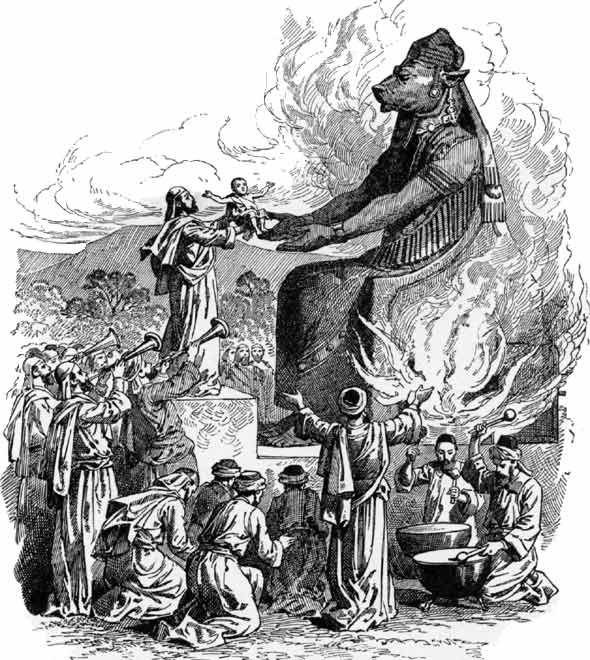
King Solomon’s Worshipful Offering to Molech – Illustration from the 1897 Bible Pictures and What They Teach Us by Charles Foster
Dragon of the Two Flames, Demonic Magic and Gods of Canaan, Michael W Ford, 2019: “Moloch as an underworld god of divination and power… [appearing] as part man and bull as… the Minotaur of Crete mythology…” refer articles:The Younger Dryas Stadial: Ending of the Earth… Beginning of the World; The Calendar Conspiracy; and Chapter XV The Philistines: Latino-Hispano America. “The horns of Molech represent his power and wisdom; the authority of his divinity… [and] resemble the… ‘Sabbatic Goat’ or ‘Baphomet’… Moloch is seated upon a… throne… flanked by two Sphinxes.
Under the throne there is a place made for fire, which represents the Black Flame of Divine Consciousness… Adrammelech and Anammelech… [relate] to the Black Flame… Anammelech is considered… to be the Moon Goddess [Ishtar aka Lilith] who is the divine power enthroned with Adrammelech, a Sun God… [they are] the gods of the people of Sepharvaim, who were Assyrian deportees, settled in Samaria [after the deportation of the Israelites]… [and] were either of Aramean/Phoenician or Babylonian origin… Luciferians may view ‘Adrammelech’ as the ‘storm’ and ‘fire’ manifestation… of Baal Hadad…”
This is ironic in that the descriptive name Lucifer and the title Baal, are for the same dark fallen archangel – his personal name is: Samael.
‘Leviticus 20:1-5, ESV: “The Lord spoke to Moses, saying, “Say to the people of Israel, Any one of the people of Israel or of the strangers who sojourn in Israel who gives any of his children to Molech shall surely be put to death. The people of the land shall stone him with stones. I myself will set my face against that man and will cut him off from among his people, because he has given one of his children to Molech, to make my sanctuary unclean and to profane my holy name. And if the people of the land do at all close their eyes to that man when he gives one of his children to Molech, and do not put him to death, then I will set my face against that man and against his clan and will cut them off from among their people, him and all who follow him in whoring after Molech.”
This was an ‘atrocity of the highest order and we can understand why the Creator became wrathful with Solomon and how the Kingdom of Israel later fragmented into two – the kingdoms of Israel and Judah – and if the false idol temple remained in Jerusalem for some four hundred years, this takes us to the time period when Judah ultimately fell in 587 BCE through to 586 BCE, with their punishment leading to captivity.’
These sacrificial ceremonies were ancient and practised by Nimrod and the Nephilim and Elioud giants before him; including some of the same Nephilim during the lifetime of the first Naamah prior to the Flood.
Rehoboam perpetuated his father’s evil – 1 Kings 14:21-31, ESV: “Now Rehoboam the son of Solomon reigned in Judah… And Judah did what was evil in the sight of the Lord, and they provoked him to jealousy with their sins that they committed, more than all that their fathers had done. For they also built for themselves high places and pillars and Asherim on every high hill and under every green tree, and there were also male cult prostitutes in the land” – refer article: Asherah. “They did according to all the abominations of the nations that the Lord drove out before the people of Israel… And there was war between Rehoboam and Jeroboam continually… Rehoboam slept with his fathers and was buried… in the city of David. His mother’s name was Naamah the Ammonite. And Abijam his son reigned in his place.”
Naamah was the daughter of the Ammonite King Hanun. She married Solomon before he became king in 970 BCE. Their son Rehoboam, was born in 971 BCE. Naamah provided the heir to the throne of Judah and she is the only wife of Solomon mentioned by name in the Bible – refer Solomon, article: Seventh Son of a Seventh Son. This is significant for a number of reasons, just as Rehoboam is the only recorded son. While marrying an Ammonite would normally be a reprehensible act, it doesn’t seem so for Solomon, who it appears married Naamah and sired a son while his father King David was still alive.
Deuteronomy 23:3, 6, ERV: “An Ammonite or Moabite may not join with the men of Israel when they gather to worship the Lord. And none of their descendants, to the tenth generation, may join in the worship of the Lord. You must never try to make peace with the Ammonites or Moabites. As long as you live, don’t be friendly to them.”
The fact Naamah and Rehoboam are both named lends weight to Naamah being Solomon’s first wife and the legitimate Queen when he became King; as is Rehoboam being the lawful heir to the throne. Naamah is also only one of two foreign Queen Mothers of Judah or Israel, with Jezebel – a Princess of Tyre and the daughter of the Phoenician King Ethbaal – refer article: The Seven Churches – A Message for the Church of God in the Latter Days.
The Israelites were told repeatedly by the Eternal not to wage war against the Ammonites or their kindred peoples the Moabites, but that didn’t stop them from doing so – Deuteronomy 2:9, 19. Though, when the Israelites first entered Canaan after the Exodus from Egypt were told not to destroy the Ammonites, they obeyed. This was in keeping with the angels who had rescued Lot and his daughters, being cognisant of the fact that Ruth the Moabite would trace her lineage to the eldest sister, and that her marriage to Boaz from the tribe of Judah would result in descendants, including King David and the Messianic Saviour – Chapter XXVI The French & Swiss: Moab, Ammon & Haran.
They would also have foreknown that Naamah the Ammonite, would trace her lineage to the youngest sister and her marriage to King Solomon – the only wife of Solomon stated by name in the Bible – would result in the birth of Rehoboam, the King of Judah following Solomon (and ancestor of Jesus of Nazareth).
The Bible states Solomon was influenced by his wives when he was old, turning away from following the truth and obeying the Eternal. So while Solomon turned from righteousness to evil, his son Rehoboam chose to follow his bad example in being rebellious as a youngster. Naamah, may well have been an influence on Solomon who later turned away from the Creator to worship Ammonite and Moabite gods. But as the Bible does not stipulate this categorically concerning Naamah, it would be unfair to just assume she had a role in Solomon’s falling away. But, if reading between the lines whilst considering her infamous predecessor, it does not weigh in her favour. Perhaps her beliefs, practices and persuasion over the decades took its toll on Solomon, with a changing acceptance steadily germinating in his mind and accelerating as he married additional foreign women.
The meaning of the name Naamah is not what one would expect, in light of the original Na’amah’s pedigree and character. Even so, Naamah happens to be a fairly common name among women in modern Israel.
According to Abarim Publications, her name means: ‘Sweet, Pleasant, delightful’ and ‘beautiful’ from the ‘verb (naem), to be pleasant.’ It also means ‘lovely’. Related names in the Bible amongst others include: Naaman, Naamathite, Nain and Naomi. ‘Derived nouns (no’am) and (na’aman) mean pleasantness. Adjective (na’im), means pleasant. The plural noun (man’ammim) describes “sweets” or dainties. The adjective (na’im) describes a soft or pleasant sound.
Experts insist that there are two separate roots that are spelled (n’m), but any observer will notice that these two roots are suspiciously adjacent in meaning. So adjacent even that one may wonder whether any original speaker of the Hebrew language realized that these roots were not the same but separate:
The verb (na’em I) and its derivatives occur in the Bible about two dozen times… It’s used to describe the qualities of people (2 Samuel 23:1), music (Psalm 81:2), bread (Proverbs 9:17), land (Genesis 49:15). It’s… used in reference to words (Psalm 141:6), knowledge (Proverbs 2:10) and wisdom (Proverbs 3:17). This verb is… used to ascribe an attribute to God, namely that of beauty or loveliness (Psalm 27:4, 90:17), and also to the worship of God, namely pleasantness (Psalm 135:3).
The second root (na’em II) does not occur in the Bible as [a] verb, although the verb itself occurs in Arabic. And there it has a meaning of to speak in a gentle and low voice. This root’s sole derivative does occur in the Bible… only once or twice (Psalm 81:3 and perhaps 2 Samuel 23:1). It’s the adjective (na’im), meaning sweetly sounding or singing or musical.’
To appreciate Na’amah, a synopsis of the family she was born into is requisite. We are first introduced to Na’amah early in the Genesis Account, yet there is only one verse dedicated to her. Genesis chapter four discusses Cain and the lineage of his descendant’s. It follows the first three chapters which discuss the re-creation of the Earth after an angelic rebellion and the sabotaging transformation of Adam and Eve – Chapter XXII Alpha & Omega. Chapter five of Genesis discusses Seth’s line through to Noah and his sons.
Genesis 4:17-22, ESV: “Cain knew his wife, and she conceived and bore Enoch… To Enoch was born Irad, and Irad fathered Mehujael, and Mehujael fathered Methushael, and Methushael fathered Lamech.
And Lamech took two wives. The name of the one was Adah, and the name of the other Zillah.
Adah bore Jabal [H2989 – Yabal: ‘stream of water, to flow along a course, conduit, flowing’]; he was the father of those who dwell in tents and have livestock. His brother’s name was Jubal [H3106 – Yuwbal: ‘stream, to carry or bring along, flow maker’]; he was the father of all those who play the lyre and pipe.
Zillah also bore Tubal-cain [‘thou will be brought of Cain’]; he was the forger of all instruments of bronze and iron.
The sister of Tubal-cain was Naamah [H5279 – Na’amah].”

It’s as if Na’amah as the youngest child is tacked on after her brother as an after thought, yet being a female included in a male dominated genealogy means she had meaningful importance.
Chapter I Noah Antecessor Nulla: ‘The line of Cain in Genesis chapter four is fascinating, because we learn that another Lamech, different from the father of Noah is perhaps the progenitor of polygamy, having two wives. They are only the second and third women after Eve to be recorded in the old Testament, implying significance. Adah means ‘ornament’ and has the connotation of beauty. Zillah means ‘dark’ or ‘to be dark’.
So some have conjectured that Adah was light skinned and Zillah dark skinned; or, it could be referring to Zillah possessing a proclivity towards the dark arts. Intriguing, are the two sons born of Adah and especially the son from Zillah and their very Japheth-like names. There is the [ancestor] of Cain’s line, Cain and on Seth’s family tree, a Cainan* – a later ‘Hamitic’ name (refer Chapter XI Ham Aequator). The Book of Jasher in chapter two says that Cainan, the Grandson of Seth was the father of three sons and two daughters, who are none other than Adah and Zillah. The book also says that Zillah was barren when she was old, until towards the end of her life.
In Genesis chapter four, we learn there were other humans – not descended from either Adam or Eve – in the Land of Nod, where Cain went to dwell. Genesis 4:16-17, NCV: “So Cain went away [not just physically but also spiritually] from the Lord and lived in the land of Nod, east of Eden” – Chapter XXII Alpha & Omega. “He had sexual relations with his wife, and she became pregnant and gave birth to Enoch. At that time Cain was building a city, which he named after his son Enoch.”
‘Cain already had a wife – a sister according to some sources, a fallen Angel in others – before sojourning to Nod and building a city.’ Book of Jubilees 4:9: “And Cain took Awan his sister to be his wife and she bare him Enoch… And… houses were built on the earth, and Cain built a city, and called its name after the name of his son Enoch.” ‘Cain would not build a city, if it were not for an already large population of people living in Nod.
Genesis 1:27 reveals man was created on the Sixth Day or era, whereas, Genesis 2:7 shows Adam was created on the ‘Eighth Day’, the day or era after the Seventh Day rest. If there were inhabitants prior to Cain’s arrival, they were not descended from Adam and Eve – refer Homo Neanderthalensis I, II, III & IV. Cain didn’t waste any time, in becoming the first person in endeavouring to establish and consolidate centralised power – a precursor for a one world government.’ The Way of Cain has survived decades of millennia right through to our present day and age.
Abel’s wife was supposedly his sister Azura, who would later marry Seth after her husband’s death. Book of Jubilees 4:1, 7, 10: “1… [Eve] gave birth… to her daughter Awan. 7 And Adam and his wife mourned for Abel four weeks of years, [28 years] and in the fourth year of the fifth week [32 years] they became joyful, and Adam knew his wife again, and she bare him a son, and he called his name Seth; for he said ‘Yahweh has raised up a second seed unto us on the earth instead of Abel; for Cain slew him.
When Adam’s son Seth is born, we learn in Genesis 5:3, NCV: “When Adam was 130 years old, he became the father of another son in his likeness [H1823 – dmuwth: similitude] and image [H6754 – tselem: resemblance], and Adam named him Seth.” Seth was in other words, the spitting image of his biological father – unlike Cain. The line of Seth, his sons and their wives is amplified in the Book of Jubilees.
Book of Jubilees 4:11-28: “11 … Seth took Azura his sister to be his wife, and… she bare him Enos. 13 … Enos took Noam his sister to be his wife, and she bare him a son… [calling] his name Kenan.* 14 And… Kenan took Mualeleth his sister to be his wife, and she bare him a son… and he called his name Mahalalel.
15 … Mahalalel took unto him to wife Dinah, the daughter of Barakiel the daughter of his father’s brother, and she bare him a son… and he called his name Jared, for in his days the malakim of Yahweh descended on the earth, those who are named the Watchers, that they should instruct the children of men, and that they should do judgment and uprightness on the earth.
16 And… Jared took to himself a wife, and her name was Baraka, the daughter of Rasujal, a daughter of his father’s brother… and she bare him a son… and he called his name Enoch. 20 And… he took to himself a wife, and her name was Edna, the daughter of Danel, the daughter of his father’s brother, and… she bare him a son and he called his name Methuselah. 27 And… Methuselah took unto himself a wife, Edna the daughter of Azrial, the daughter of his father’s brother… and he begat a son and called his name Lamech.
28 And… Lamech took to himself a wife, and her name was Betenos the daughter of Baraki’il, the daughter of his father’s brother, and… she bare him a son and he called his name Noah, saying, ‘This one will comfort me for my trouble and all my work, and for the ground which Yahweh has cursed.’
‘Noah’s wife is mentioned five times in Genesis, without her name being revealed. Some believe she could be Na’amah, the sister of Tubal-Cain in Genesis 4.22. As she is tainted from the already imperfect line of Cain, it would seem to be a contradiction for Noah to marry Na’amah, mixing the two divergent genetic lines.
With that said, if there is any merit in Alan Alford’s theory or a version of it, Noah may have had three wives from which three sons were born; but taking only one wife on board the Ark – refer Chapter I Noah Antecessor Nulla. The Book of Jubilees 4:46-47, supports the Bible and states Noah had one wife and that she bore all three sons: “… Noah took to himself a wife, and her name was Emzara, the daughter of Rakeel, the daughter of his father’s brother [a brother of Lamech]…”
Quoting from Chapter XXII Alpha & Omega – and R A Boulay: ‘… in the Apocalypse of Adam… Adam reveals to his son Seth that “the Lord, who created us, created a son from himself and Eve, your mother.”… the Life of Adam and Eve… observes that Eve “bore a son and he was lustrous.” This is a good description of the shiny, luminous hide of the reptile gods…[also] Eve tells Adam:
My Lord, I saw… the blood of my son… Abel, being thrust into the mouth of Cain… and he drank it mercilessly… it did not stay in his stomach but came out of his mouth. They got up to see what happened and found Abel killed by Cain. The crime of Cain was… not only to commit fracticide but also to eat the flesh and blood of his brother.
This behaviour [is] more reptilian than human, for Cain… was half saurian… [and] the main reason for [Cain’s line being] superseded by that of Seth… the deity warned that “whoever kills Cain shall suffer vengeance seven fold”… Cain was reputedly accidentally killed by Lamech, thus fulfilling the curse of the seventh generation.’
Genesis 4:23-24, ESV: “Lamech said to his wives: “Adah and Zillah, hear my voice; you wives of Lamech, listen to what I say: I have killed a man for wounding me, a young man for striking me. If Cain’s revenge is sevenfold, then Lamech’s is seventy-sevenfold.”

Evil Lamech, the seventh generation in the line of Cain and father of Na’amah
‘… in the Haggadah… Lamech was… old and blind… when he went hunting [and] was led by his son Tubal-Cain, who would tell his father when game came into sight, so that Lamech could shoot at it with his bow and arrow… he aimed at some horned creature which Tubal-Cain thought to be a beast. In fact, it was Cain bearing the “sign of Cain,” a horn in the forehead, according to the Haggadah, but more probably a set of horns on the head’ – refer article: Belphegor. ‘Lamech killed him and in despair, he struck out inadvertently killing his son Tubal-Cain… it accounts for the killing of a man and a [young man], both of which were not just ordinary people.’
‘After God cursed Cain, Cain left the presence of the Lord, travelled east to Nod, the land of Wandering; builds a city to exalt his son the evil Enoch and his story in the Bible ends. Josephus, in his work Antiquities, expands on the further exploits of the miscreant Cain. He did not repent of his crime against Abel or live peaceably after his own life was spared from the Creator’s wrath. Cain in fact, grows exponentially wicked and the world’s foremost innovator of evil.
Josephus states “Cain dedicated himself to the pursuit of pleasure and wealth at any cost… perpetrating theft and violence upon his neighbours. He built up a great amount of wealth through stealing and strong-arming… [also] building up a huge army… Cain is… credited with creating weights and measures… to make sure no one was accidentally being generous by innocently giving too much. He likewise invented the idea of property lines and drawing up fortifications to protect one’s belongings with violence.”
The Genesis 6 Conspiracy, Gary Wayne, 2014, pages 8-9, 12-13, 55-56 – emphasis & bold mine: ‘The Dowland Manuscript of the Legend of the Craft lists the Seven Liberal [Sacred] Sciences:
Grammere to teach humankind to both speak and write truly;
Rhethoricke to teach humankind to speak in subtle terms;
Dialectyke to teach humankind to discern between truth and falsehoods;
Arithmeticke to teach humankind to compute all manner of numbers;
Geometrie to teach humankind to measure the earth and all things (this is the science of Masonry);
Musicke to teach humankind song and the language of musical instruments;
Astronomye to teach humankind the course of the planets and stars
‘Jubal… specialised in music, inventing musical instruments [Jabal in Geometry and Masonry]… Tubal-Cain… exceeded all other men in strength and excelled in the martial arts… [and] inventing the art of manufacturing brass… Cain [means] “a metal worker,” thereby attributing Tubal to being his first name, and Cain denoting his expertise [Artificer], just as his forefather [Cain] must have been some form of metalworker or smith…’ Michael Ford adds: It was “Tubal-Cain who brought [or more likely refined and advanced] murder weapons into the world.”
The name Tubal stems from his half-brothers name, Jabel and means ‘to flow or carry along.’ Abarim Publications amplify the meaning of Tubal to include: “… identical to the name Tubal is our root’s derivative (tebel), meaning world. Hence the name Tubal [does not just mean] World, but the whole flow and currencies of the world-economy in its broadest sense.”
Wayne continues: “Naamah the Charmer [‘an attractive person claiming or seeming to have magical powers’] … known in Sumerian lore as “Non Pu Abi” and “Queen Shub of Ur”… [and] according to Jewish legends married and copulated with Shamdon [Shomron, a fallen Angel], producing the giant Asmodeous…’ Asmodeous or Ashmodai means, ‘demon of wrath’ and he is a king of devils, commanding seventy-two legions of demons [a Roman legion averaged approximately 5,000 men]. Michael Ford: “Upon physical death, the evil spirit of Asmodeus would become so powerful that under Samael he was to be the King of Demons.”
A curious Jewish legend involves Asmodeus and King Solomon, recounted by an online encyclopaedia:
“One legend concerning Asmodeus goes on to state that Solomon one day asked Asmodeus what could make demons powerful over man, and Asmodeus asked to be freed and given [a magic] ring so that he could demonstrate; Solomon agreed but Asmodeus threw the ring into the sea and it was swallowed by a fish. Asmodeus then swallowed the king, stood up fully with one wing touching heaven and the other earth, and spat out Solomon to a distance of 400 miles. The Rabbis claim this was a divine punishment for Solomon’s having failed to follow three divine commands, and Solomon was forced to wander from city to city, until he eventually arrived in an Ammonite city where he was forced to work in the king’s kitchens.
Solomon gained a chance to prepare a meal for the Ammonite king, which the king found so impressive that the previous cook was sacked and Solomon put in his place; the king’s daughter, Naamah, subsequently fell in love with Solomon, but the family (thinking Solomon a commoner) disapproved, so the king decided to kill them both by sending them into the desert. Solomon and the king’s daughter wandered the desert until they reached a coastal city, where they bought a fish to eat, which just happened to be the one which had swallowed the magic ring. Solomon was then able to regain his throne and expel Asmodeus.”
Rabbis reject the notion that Na’amah was Noah’s wife and declare that ‘Naamah was an idolatrous woman who sang “pleasant” songs to idols.’ The fact that her name is linked to beautiful sounds, singing and music, implies she possessed musical ability like her half-brother Jubal. Tamar Kadari quotes: “… she acted improperly, for she beat on a drum and drew people to engage in idolatry, and her musical activity increased corruption among people.” ‘In Talmudic-midrashic literature, Naamah… earned her name by seducing men through her [dancing and] play[ing] of [small] cymbals.’
Meanwhile Rabbi Abbahu maintains, “The simple sense of Scripture indicates that she was learned in metal-working, like her brother Tubal-Cain, as implied by what is written: he was the progenitor of every implement of bronze and iron – and the sister of Tubal-Cain, Na’amah. He invented this craft and his sister with him, as is written: and the sister of Tubal-Cain, Na’amah – she was skilled like him. The ‘and’ of ‘and the sister’ joins the preceding statement.”
Naamah is also associated with weaving, which involves cloth and fabrics for clothing and other material items. Delinquent music and sensual fashion may have constituted part of her contribution to the world. Kadari adds: “The midrash (Midrash ha-Gadol, Gen. Rabbah 4.22) relates that Naamah was the most beautiful woman in the world, so much so that she caused the ministering angels to fall prey to her loveliness for they thought she was one of them.”

Marble bas relief at Orvieto Cathedral, Italy, innocuously depicts Na’amah as a teacher of reading, while her half-brother Jubal is a father of music
Gary Wayne: ‘… the Cainites used the Seven Sacred Sciences for evil… Two of Cain’s descendants were fingered as particularly corrupt in the application of the Sacred Sciences: [evil] Enoch and [evil] Lamech… [Enoch introduced]… sinister sacraments… From Astronomy, he created astrology and sun worship… implemented … rituals, ceremonies, and rites with this new, repulsive religion [refer article: Thoth]. The knowledge could then only be passed on to initiates, the selected guardians of the knowledge that was then cloaked in mysteries and secrets.’
The Book of Adam says Cain’s wife was Luluwa. The Book of Jubilees calls his sister Awan his wife. Cain may have had more than one wife and so he and perhaps not evil Lamech, likely initiated polygamy. ‘The descendants of Cain continued in wickedness. Josephus confirms that within Adam’s lifetime, the lineage of Cain had become a corrupt mess; each new generation of Elioud giants more evil than the last.’
The Genesis 6 Conspiracy, Gary Wayne, 2014, page 112 – emphasis & bold mine:
“One wonders whether or not the descendants of Cain and Lulawa-Lilith, such as [evil] Enoch, [evil] Lamech, Tubal-Cain, and Naamah were in truth Nephilim [and], in fact, initially immortal. The Sumerian mythology appears to strongly advocate…a distinct strain of Nephilim directly connected to Cain and the people of day six [the Neanderthals], but distinct from the Nephilim created on Mount Hermon by dark angels… Cain and Lulawa-Lilith [usurped] kingship over the people of day six” – refer articles: Homo neanderthalensis I, II, III & IV… “[infusing] a unique variety of Nephilim bloodlines [of the Royal Dragon] into [them].”
The likely scenario is that Cain first married his sister, though Lilith keeps raising her head as not only the first wife of Adam prior to Eve’s birth, but also as the wife of Cain. The dark angel Lilith is incorrectly described by many researchers as a demon – refer article: Lilith. Her original role was not only as Samael’s daughter but later his consort. Similarly, Lilith was also Nimrod’s mother and later his wife. Her relationship with Adam appears unlikely, though cannot be ruled out as is her role as possibly Cain’s wife. Either way, Cain strongly appears not only a progenitor of a unique Nephilim-Elioud line, but himself being the first of his kind – Chapter XXII Alpha & Omega.
A variant line of Nephilim descended from Cain as suggested by Wayne, distinct from that of the Watchers has become plausibly apparent during research on the subject. The sheer wickedness perpetrated by Cain’s line, as embodied by Cain’s evil son Enoch and his great, great, great grandson Lamech and in turn Lamech’s daughter Na’amah, may have an explanation if we understand their serpentine bloodline, stemming from the Genesis 3:15 prophetic curse.
Thus the anti-heroine of our story Na’amah, was descended from – as a relative of Cain who himself, was half human from his mother Eve and half immortal by his real father the Serpent, Samael – a Nephilim bloodline (refer Chapter XXII Alpha & Omega). Na’amah may well have been unusually tall, or this might have been a physical trait found only amongst the Elioud giants directly descended from the dark, fallen angels of the Watchers.
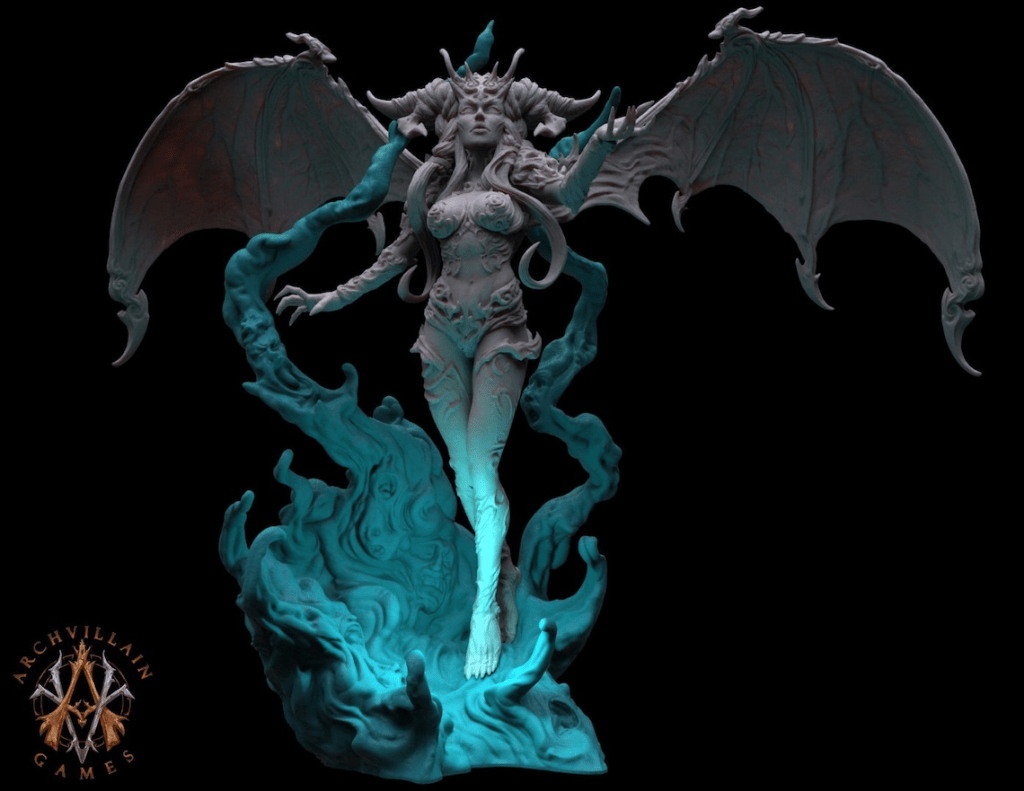
As discussed in previous articles, there are beings who do not have corporal bodies, but seek to inhabit humans – refer articles: Nephilim & Elioud Giants I & II. They are known by many names, though commonly as demons or unclean spirits – Luke 11:24. The Book of Enoch 15:1-12, adds that when the giants died, they lost their physical bodies to death, though their spiritual component did not die and henceforth they were called evil spirits.
Thus demons are disembodied spirits who originated at the time of the Great Flood circa 10,837 BCE, according to an unconventional chronology. They are not to be confused with fallen Angels, though are linked to them as they are the offspring of the Watchers who descended to Earth circa 22,000 BCE – Chapter XXI The Incredible Identity, Origin & Destiny of Nimrod; Chapter XXII Alpha & Omega; and Chapter XXXIV Dan: The Invisible Tribe.
As the Nephilim were born on the earth or in the physical realm, they are now bound to the earth as demons to torment humankind. It is these same spirits who often respond to ouija boards and who work with Mediums as familiars; impersonating souls who have died.
An important point to understand for those who believe fallen angels are demons, is that Angels, Seraphs and Cherubs are magnificent beings of immense majesty. For after their rebellion, the fallen angels even with their power diminished and their beauty transformed, are still too lofty and mighty to readily demean themselves to inhabit a human body. Though there may be exceptions to the rule.
Nephilim were an abomination of spirit and flesh and though they were bigger, stronger, smarter and out lived mortal men, they still had a physical body. Their spirit was not the spirit of man (Job 32:8), but of their immortal fathers. Once their fleshly body died, their spirit lived on in an unnatural state. In this condition as a discorporate entity of energy, they seek habitation in humans to quench their spiritual thirst and appease their unholy appetite – Luke 11:24-26.
Jude 12-13, ESV: “These are hidden reefs… as they feast with you without fear, shepherds* feeding themselves; waterless clouds, swept along by winds; fruitless trees in late autumn, twice dead, uprooted; wild waves of the sea, casting up the foam of their own shame; wandering stars [spirits], for whom the gloom of utter darkness has been reserved forever.”
The legends and myths of giants and vampires with their traits of cannibalism and drinking human blood, find their source from the Nephilim of the antediluvian age. It is also where the doctrine of re-incarnation originates. For evil spirits have inhabited various people in different times and so are able to transfer thoughts and memories to new hosts; falsely thinking they have lived in the past.
Infinity Explorers state – emphasis mine: ‘… these dark entities [torment] people, with the ability to spread evil and chaos in the world, dwelling in dark regions in the lower dimensions known as hell. Demonic entities work actively to influence society. Those who have witnessed the appearance of demonic beings in our reality using dimensional portals ensure that many of the dark entities have specific roles and work together in a hierarchy of evil in other dimensions. They are part of a structure of evil that extends its tentacles from the darker dimensional regions to the physical world.
They work through dark secret societies, who secretly run… religions and… communicate with a large number of people… who are going through the process of awakening in the dark’ – article: The Establishment: Who are they… What do they want? ‘These disciples of the dark are using… techniques to gain knowledge of demonic entities… [working] with an immense evil intelligence in an agenda dating back thousands of years. They do not want people to wake up spiritually in the light… Thanks to dimensional portals, they can control politicians, celebrities, governments, criminal organisations, and large corporations. They use human weakness and defects like greed, ignorance, lust, and violence to attract, control and enslave their puppets as well as the masses’ – refer article: Principalities & Potentates: What they want… Who they are.
The antediluvian age was considerably longer than people realise. It was discovered that dating for the post-flood patriarchs is incorrectly based on a decimal system instead of a sexagesimal count; as well as inadvertently adhering to an inaccurate and therefore erroneous pre-flood chronology altered through editing. Using an unconventional chronology to re-align the biblical account with scientific data, produced a date of 10,837 BCE for the great deluge, coinciding with the Younger Dryas event – Article: The Younger Dryas Stadial: Ending of the Earth… Beginning of the World.
Thus to provide a context for when Na’amah lived, she was born circa 20,000 BCE. This was during the last Ice Age and when civilisation was far beyond the technological advances we presently witness in our own epoch. The height of achievement was synonymous with the descriptions for Atlantis and Lemuria, yet at the same time the wickedness abounding on the Earth and particularly through the line of Cain with its evil tentacles spreading into other lines, such as those of Seth and the Neanderthal peoples of day Six, had brought the Earth to a point where it had to be destroyed – Genesis 6:5-7.
Cain was born circa 27,390 BCE and murdered his brother Abel in 26,129 BCE. Cain was expelled from Eden at that time and his son, the evil Enoch was born circa 26,119 BCE. Cain then began building the city of Enoch – the site of the post-flood Baalbek – in 26,108 BCE – refer article: Monoliths of the Nephilim. Evil Lamech was born circa 22,000 BCE, about 797 years after Jared, the father of righteous Enoch. It was during this time frame that the Watchers descended to Earth led by the powerful Samyaza, actually another name for the formidable Samael.
The following may be of interest to some readers and ties in with an unconventional chronology for pre-history. The Sumerian King List provide a list of eight kings, with some versions having ten, who reigned for incredibly long periods of time before the great Flood. This is similar to Genesis five, where the generations from the Creation to the Flood are recorded. It is generally assumed by scholars that the ten generations between Adam and Noah may correlate to the antediluvian kings from the beginning of kingship descending from heaven until the flood as written in the Sumerian King List.
After the Flood, the king list records kings who ruled for far shorter periods of time. The Sumerian King List not only documents a great flood in humankind’s early history; it also reflects the same pattern of decreasing longevity as found in the Bible – with men having extremely long life spans before the Flood and much shorter life spans following the catastrophe – refer article: The Younger Dryas Stadial: The Ending of the Earth… Beginning of the World.
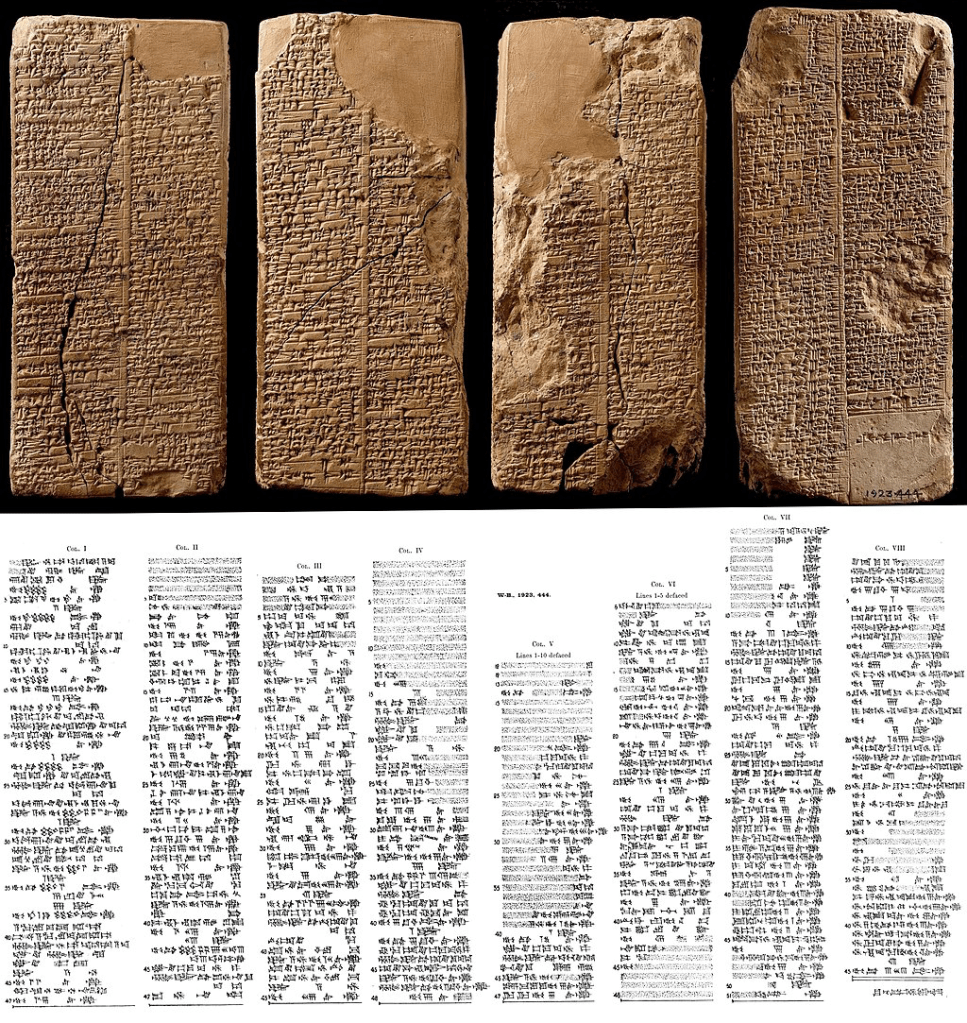
Joanna Gillan notes: ‘The Sumerian King List truly is a perplexing mystery. Why would the Sumerians combine mythical rulers with actual historical rulers in one document? Why are there so many similarities with Genesis? Why were ancient kings described as ruling for thousands of years? These are just some of the questions that still remain unanswered after more than a century of research.’
Perhaps the Sumerian King List is not recording the line of eleven generations from Adam through Seth, but rather the eight generations descending from Cain, the firstborn of Eve as recorded in Genesis chapter four. Likewise, as the chronology before and after the flood has been misinterpreted, so too these reigns may be shorter than deciphered but still longer than readily accepted. As the length of age of antediluvian figures was in the realm of nearly ten thousand years, rather than one thousand as incorrectly translated in the Bible; the elongated ages of the Sumerian kings may be shorter as in thousands of years rather than tens of thousands.
Five copies of the Antediluvian king list are known [including MS 2855 shown below]: MS 3175; two in Oxford, including Ashmolean Museum; a fourth copy is in Berkeley, Museum of the University of California; and a fifth tablet, a small fragment, is in Istanbul. There are conflicts between them regarding a. the number of kings, b. the spelling of names and c. the cities from which they ruled. If we acknowledge ‘… In 5 cities 8 kings; they ruled for 241,200 [or 24,120 adjusted] years. Then the flood swept over…’ as a starting point.

The reign of these antediluvian rulers is typically measured in sars: periods of 3600 years; ners, units of 600; and sosses units of 60; each based on a sexagesimal system. The Sumerian King List states: “After the kingship descended from heaven, the kingship was in Eridug. In Eridug, Alulim became king; he ruled for 28,800 years.” It is proposed that 28,800 years is in fact 2,880 years. And rather than 8 sars of 3,600 years, it is a alternative measurement comprising 8 x 360.
Alulim – Adam: The first king thus ruled 2,880 years from Eridu. This would equate to Adam as the first ruler of Eridu and the initial king of Sumer. It is believed that Enki, the creator God and patron god of Eridu brought civilisation to Sumer at this time.
Alalngar – Cain: Alalngar was the second king of Eridu. The Sumerian King list states that he ruled for 36,000 years – 10 sars. In this instance it was Cain who ruled for 3,600 years during his life. “Then Eridug fell and the kingship was taken to Bad-tibira.” Another king list names Elalgar ruling for 43,200 years. This writer considers 4,320 years perhaps more feasible for the demi-god (and demagogue), Cain. After Cain, Eridu was abandoned.

En-men-lu-ana – (Evil) Enoch: The next ruler who was king after Eridu fell was En-men-lu-ana who also ruled for 43,200 years – 12 sars. According to the Sumerian King List, En-men-lu-ana was the third pre-dynastic ruler of ancient Sumer and was perhaps the joint ‘longest reigning king’ with his father Elalgar. Enoch ruling a similar 4,320 years is credible considering the influence the two of them had in the early annals of humankind’s history. Yet elsewhere, he is documented as Ammilu’anna, with a reign of 36,000 or 3,600 years. Thus Cain and his son’s length of reigns seem to have been transposed.
En-men-gal-ana – Irad: Reigned for 28,800 years – 8 sars. Also known as Enmegalanna and equating to Enoch’s son Irad, the possible founder of Ur and ruler for 2,880 years.
Dumuzid –Mehujael: Dumuzid, commonly referred to as the ‘Shepherd’* was the fifth pre-dynastic king who ruled Sumer before the Deluge. He ruled for 36,000 years – 10 sars. Dumuzid is mentioned sometimes as the son of Enki, or Enlil and Ninsun. This is related to the fact that Dumuzid was deified and was the object of later devotional depictions, as the husband of the goddess Inanna, aka Ishtar and none other than Samael’s daughter, Lilith – Article: Lilith. He is also referred to as Dumuzi or Tammuz and ruling a shorter 28,800 or 2,880 years. “Then Bad-tibira fell and the kingship was taken to Larag [Larak].”
Ezekiel 8:14, ERV: “Then God led me to the entrance to the Lord’s Temple. This gate was on the north side. I saw women sitting there and crying. They were sad about the false god Tammuz!”
‘Footnote: People thought this false god died and his wife Ishtar asked everyone to be sad and cry with her. Ishtar hoped this would bring him back to life. This ceremony was on the 2nd day of the fourth month (June/July). This month was named Tammuz because of this ceremony.’ The true identity of Tammuz is Nimrod, who married his own mother Ishtar, aka Lilith – Chapter XXI The Incredible Identity, Origin & Destiny of Nimrod.
En-sipad-zid-ana – Methushael: According to the Sumerian King List, he ruled for 28,800 years – 8 sars – 2,880 years. “Then Larag fell and the kingship was taken to Zimbir.” Otherwise known as Sippar, the patron city of the god Utu. Methushael’s reign is deemed shorter elsewhere as 13,800 years – 3 sars, 4 ners, 10 sosses – 1,380 years.
En-men-dur-ana –Lamech: The following ruler mentioned in the Sumerian King List after the fall of Larak is En-men-dur-ana, who was the seventh pre-dynastic king of Sumer and ruled for a total of 21,000 years – 5 sars, 5 ners – 2,100 years. “Then Zimbir fell and the kingship was taken to Shuruppag.” Otherwise known as Shurruppak, the patron city of the goddess Ninlil. This ruler was also known as Meduranki and he had an unusually short reign of 7,200 years – 2 sars – 720 years; just as Lamech’s life was possibly cut short, even though described as ‘old and blind’ elsewhere. As Lamech is highlighted in the Bible as the significant progenitor of four influential children, ‘Emmeduranki was taught arts of divination, such as how to inspect oil on water and how to discern messages in the liver of animals and several other divine secrets.’
Ubara-Tutu – Tubal Cain: He ruled over ancient Sumer for a period of 18,600 years – 5 sars, 1 ner – 1,860 years. Ubara-Tutu was the eighth and final pre-dynastic ruler of ancient Sumer, as noted in the Sumerian King List. Ubara-tutu is believed to have lived just prior to the great deluge which swept over the Earth. Elsewhere, he is referred to as Ubur-Tutu, with a reign of 36,000 years – 3,600 years. What is an interesting coincidence with Ubara-Tutu, is that he shares an uncommon hyphenated name with Tubal-Cain and a shortened rulership due to an untimely death in the flood.
Gary Wayne: ‘Tubal-Cain was revered as the great Patriarch of the Master Craftsman, an instructor of every artificer of brass and metal, and regarded in the Craft as the greatest metallurgist… [and] recorded in Freemasonry as a… Master Freemason… [while] According to Gardner, Tubal-Cain was recorded as “Tobalkin, the prince of Southern Mespotamia” and the son of King Akalum/Lamech.’
The lowest reigns for each ruler have been chosen by choice – reasoning easier arithmetic. The totals add differently depending on lengths of reigns, with the most common totals being 241,200 or alternatively 222,600 years.
These totals according to an unconventional chronology would equate as 24,120 and 22,260 years respectively instead. The years between Adam and the flood total 16,553 years, thus overlapping of reigns from fathers to sons appears probable. Adding the totals of the reigns in bold equals 20,520 years. A surplus of 3,967 years. It is possible that as the reigns all fit a convenient exact numbers of sars and ners, that they are approximations to begin with.
Added to this, is the fact that Cain struck out on his own and thus may have begun his rule from about 26,000 BCE, thus 20,520 less Adam’s reign is 17,640 years. Subtracting the flood in 10,837 BCE from 26,000 BCE is 15,163 years. A surplus of 2477 years. It would not seem unreasonable in allowing overlapping years, particularly when the seat of power in a designated city was changed four times between five cities. Each change over could easily have had an overlap of approximately six hundred years, accounting for the extra 2477 years.
It would be a positive spin if we could show that Na’amah was the black sheep of her family and succeeded in resisting her background, genetics and the hereditary lineage she was born into, but she was destined for the life she ultimately embraced. As Gary Wayne writes:
“… to be noted in the Bible, one must be worthy of either good or evil.” Wayne continues regarding Lamech’s children of which there were many, though Jabal, Jubal, Tubal-Cain and Naamah are highlighted because they contaminated the Seven Sacred Sciences which had been passed down from Adam’s generation – perverting them for evil designs. These four rebellious siblings were in league to corrupt the whole world through the machinations of the Brotherhood of the Snake and the infiltration of the House of the Royal Dragon line – Articles: Monoliths of the Nephilim; and Antartica: Secrets of the Lost Continent of Atlantis.
On page 53 and 55, Wayne states: ‘… Lamech’s children… [received] additional and illicit knowledge reserved for only the heavenly realm from fallen, rebellious angels, which further enhanced the spurious Sciences… [and] were thus considered patriarchs of the purported pure branch of antediluvian masonry…’ – Article: The Establishment: Who are they… What do they want?
This was how and why four of the children of Lamech, of the lineage of Cain, ‘found their way into the book of Genesis – because of their great and nefarious individual roles in the corruption of the antediluvian world, which brought upon them the great deluge. These infamous four conspired with the fallen angels to create a super race of sinister giants, armed with the knowledge of the corrupted sciences, in an attempt to completely change the natural order of creation, all against God’s will.’
Thus the seemingly innocuous three verses, from twenty to twenty-two in chapter four of Genesis are really revealing a perverted use of the disciplines stated earlier. Remember, this was not a primitive hunter-gatherer caveman epoch but rather, a high-tech computerised world with technology incorporating anti-gravity, crystals and lasers of which our civilisation has not yet even touched upon.
So that Jabal, actually violated ethical principles and practices in medicine, genetic cross-breeding, science, farming and agriculture; Jubal took entertainment down a dark, sadistic path; Tubal-Cain pioneered wicked uses in engineering, robotics, artificial intelligence, weaponry and warfare; and Na’amah negatively influenced religion, education, music and fashion.

Constant readers will be aware of the fearsome Amalekites and their hatred towards the Israelites of old – refer Chapter XXIX Esau: The Thirteenth Tribe. They were originally a Nephilim race prior to the great Flood and were able to survive into the post-flood era – Genesis 14:7. They are not listed in the Table of Nations in Genesis chapter ten, for they did not descend from Noah. Their Elioud giant descendants married into the family of Esau, with one of Esau’s notable grandsons named Amalek – Genesis 36:12.
The name Amalek means a ‘people that wring’ and a ‘people that lap’ – refer Chapter XXIX Esau: The Thirteenth Tribe. The Amalekites due to their ancient beginnings are described in Numbers 24:20, ESV, as: ‘Then he looked on Amalek and took up his discourse and said, “Amalek was the first among the nations, but its end is utter destruction”.’ Thus, if the Amalekites existed in the antediluvian age and were the first nation after the flood, who was their progenitor?
Wayne provides the surprising answer on page 264: “… Amalek was the prominent antediluvian Sumerian king Akalum-Dug, understanding that Akalum was Sumerian for the infamous evil “Lamech,” which found its true anagram in producing the name Amalek, and that all the antediluvian Sumerian kings were Nephilim.” The name Lamech is H3929 – Lemek or Lamek, meaning ‘powerful’ and a ‘strong man.’
“We can connect… another variant name of a king to Amalek: Anam’ Melech, pronounced as “a-nam-e l-lek. Anam’ Melech was worshipped by the Babylonian people from the city of Sepharvaim. Melech… is Hebrew for “king,” [and in Greek it is archon or ruler] as in Molech/Malech, the god of the Canaanites, son [descendant] of Baal, who required the sacrifice of children in his worship.
Anam’ Melech translates as “Anu, is king,” with Anu, of course, being the great sky god and parent of the Anunnaki” – Article: Principalities & Potentates: What they want… Who they are. “Like Molech, Anam’ Melech also required the sacrifice of children. One wonders, was Anam” Melech the mythical god Molech? This is likely another variant and the same Amalek and/or Lamech, a Nephililm demigod of barbaric proportions.”
Dragon of the Two Flames, Demonic Magic and Gods of Canaan, Michael W Ford, 2019: “The Maliku are divine shades [spirits]… identical to the Rephaim [Nephilim]; deified heroes who are honoured in their chthonic [‘relating to or inhabiting the underworld’] abodes. There are many variations to the spelling of the gods’ name, Malik, Melekh, Molic, Molloch, Molokh, Mulac…”
Acts 7:43, ESV: ‘You took up the tent [or shrine] of Moloch and the star of your god Rephan, the images that you made to worship…’
According to Ford, ‘Repham or Kaiwan is the planet Saturn’ and means a pedestal in which a god’s statue is placed upon. “Cabalistic texts such as Targum Yerushalmi… make reference that Cain was Kewan or ‘Saturn’. Cain is described in many Jewish texts as having a ‘Shining Countenance’, this from being the son of Samael [the hidden god]. Saturn is considered a ‘Star of Evil’ which brings misfortune to Israel’ – refer article: The Calendar Conspiracy.
‘As early as Akkadian god-lists through the Old Babylonian period there is a powerful god named ‘Malik’ who is equated with Nergal including the reference to the maliku beings with the… Anunnaki who are… related to the cult of [the] dead…’ – Article: Monoliths of the Nephililm. In 2 Kings 23:10, ESV: ‘And [King Josiah] defiled Topheth, which is in the Valley of the Son of Hinnom, that no one might burn his son or his daughter as an offering to lammolek [H4432 – king].’
Wayne: ‘Listed among the names of antediluvian Nephilim was the name Amalek… the twin brother of the antediluvian giant… Samael. One of Samael’s wives, Naamah, was considered the angel of prostitution and the mother of demons. Samael the giant must have been the offspring of Samael the angel and Naamah… daughter of Lamech (Amalek)…’
In the last paragraph, Wayne says Na’amah’s husband was Samael, otherwise known as Shamdon and Samyaza, the leader of the Watcher angels. If such is the case and Samael the giant and his twin Amalek were their offspring, then this Amalek cannot be the same as Lamech, her father. But, Amalek her son, may have been similarly named after her own father. Either way, Lamech as the progenitor of the Amalekites remains consistent.
Regardless, it is Na’amah’s relationship in all this that is of most interest. For she herself was of Nephilim descent from Cain and with the very same angel who had impregnated Eve with Cain, Samael, then had twin sons named after Samael and her own father. Even more compelling, Na’amah was related to Samael and her sons were related to not just Samael but also Samael’s daughter, Lilith and hence Lilith’s twin brother, Azazel (Chapter XXI The Incredible Identity, Origin & Destiny of Nimrod) – who was the second ranked Watcher of the ‘two hundred’ who descended on Mount Hermon circa 22,000 BCE.
Noteworthy, is that one version of Second Enoch adds that their number was two hundred myriads, meaning ten thousand. Thus 10,000 x 200 equates to a staggering two million Watchers. Therefore the twenty chiefs of tens, were each responsible for 100,000 angels. This seems logical, rather than each chief being a leader over just ten angels.
A 1340 Kabbalistic treatise by Bahya ben Asher confirms Na’amah as one of the mates of the former archangel Samael – the Prince of Darkness and the ruler of the Qliphoth – along with Lilith, Agrat bat Mahlet (or Aggereth) and Eisheth Zenunim (or Qodesha). These four have been called the Grand Succubi and Queens of Lust. It also states that Esau took four wives in imitation of him – refer Chapter XXIX Esau: The Thirteenth Tribe.
In the Zohar, Na’amah was one of the first women to seduce the grigori and birth Nephilim. The ‘Slavic word Grigori… is a transcription of the Greek word… egrḗgoroi, meaning “wakeful”. Na’amah’s Nephilim status means she is not a fallen dark angel like Lilith, though she is not fully human either. This means as we have learned, that she did not die in the flood waters. While her physical body eventually failed her, her angelic spirit continued living. In Kabbalistic literature such as the Zohar, it says Na’amah became an ‘inhuman spirit’ with Occult World adding: ‘Naamah, originally mortal, evolved into a spirit, attaining immortality or something very close to it. The Zohar, Kabbalah’s sacred text, describes her as “alive to this day” and living amongst the waves of the Great Sea [the atmosphere of space].’
Michael W Ford describes Na’amah as a “powerful she-demon and companion of Lilith… Naamah… was transformed into a deathless vampire-demoness who like Lilith seduces men… Naamah is considered a ravishing beauty… [and] like Lilith… is a mother of a great horde of nocturnal demons with Asmodeus being the first.” In other words, she is now a demonic creature – of lesser rank than the dark angel and goddess Lilith – yet still a powerful entity in the pantheon of demonesses.
The Zohar records that Na’amah corrupted the angels Samyaza and Azazel. ‘The text states [Naamah]… attracts demons, as she is continuously chased by demon kings Afrira and Qastimon every night, but she leaps away every time and takes multiple forms to entice men. She makes sport with the sons of man, and conceives from them through their dreams, from the male desire, and she attaches herself to them. She takes the desire, and nothing more, and from that desire [seed] she conceives and brings forth all kinds of demons into the world. And those sons she bears from men visit the women of humankind, who then conceive from them and give birth to spirits. And all of them go to… Lilith and she… [raises] them…’
In fact, Na’amah is known as ‘Lilith the Younger’ and in the Qlippoth, resides over the realm named ironically, Lilith.
The Zohar says that after Cain killed Abel, Adam separated from Eve for one hundred and thirty years. During this time, four angels – Lilith, Naamah, Agrat and Eisheth – seduced Adam. Having sex with him, they bore his demonic children, the Nashyim who became the Plagues of Mankind. In turn, they became known as the four angels of prostitution and the alleged cause of epilepsy in children – as well as sudden infant death syndrome or SIDS.
A problem with this scenario, is that Na’amah was not yet born to seduce her ancestor Adam, after the death of Abel in 26,129 BCE. That said, Adam died in 18,097 BCE, well after the birth of the eighth generation Na’amah circa 20,000 BCE. A second issue is that while the other three may have been fallen dark angels and certainly Lilith was, Na’amah was not an angel.

Mother of Divination; the Charmer; Queen of Whispers, Thalia, July 20, 2023:
‘Naamah was a gifted and natural dream walker, and used this skill judiciously yet secretly as part of her scheming. Over her long years Naamah learned many secrets of bending others to her will, but was possessed furthermore of an almost supernatural ability to win people; to her body, to her cause, to her words.’
Allorah Rayne: “Dream walking occurs when one person enters the dream space (the consciousness) of another individual. When this is done subconsciously and without control, it’s called shared dreaming. However, when it’s done consciously with control, it is known as dream walking.”
Thalia: ‘The… Grigori, were an order of dream walking angels meant to shepherd and guide early humanity. They served as vast reservoirs of information and guidance, and their selflessness and dedication was beyond compare. It was their job to observe only, lending a helping hand when necessary but not interfering in the course of human development. They were also the beings who guarded the portals linking worlds together. Through Naamah’s manipulations, they became the second faction of angels to fall.
A gifted channeller, she is said to have woven spells to warp the appearance of the human women, making them more desirable not only in appearance but in soul, so that even divine beings such as angels were lured to distraction with the temptation of lying with them. In all appearance of sweet innocence, over time Naamah seduced their leader Samyaza with the art of music, and his second Azazel with the art of words.’
Psalm 41:6-8, ERV: ‘If they come to see me, they don’t say what they are really thinking. They come to gather a little gossip and then go to spread their rumors. Those who hate me whisper about me. They think the worst about me. They say, “He did something wrong. That is why he is sick. He will never get well.”
Michael W Ford: “In Psalm 41-5-9 a prayer to Yahweh refers to enemies ‘whispering incantations’ (yitlahasu [H3907 – ‘charmer, conjure, mumble a spell’]) in which the sorcerers imagine the worst for the Psalmist and by whispering curses. This is significant in sorcery as it involves the Kessapim [Black Adept sorcerer] ‘imagining’ what they wish to see, the recital of incantations even if barely audible (yitlahasu) are all key aspects of the balance in will, desire and belief.”
Thalia: ‘Eventually the order’s angels finally relented to the stirrings of lust nurtured within them like a well tended garden, and together they made a pact to rebel… [for] Samyaza, their truth seer, submitted to her charms and confessed his affections… In love, he was utterly blind. And in those whom he bestowed his trust, others trusted in kind. The Watchers began to defect and abandon their duties guarding the dreamworld, taking human women to wife and fathering children that became known as the fearsome and corrupted Nephilim… Naamah took Samyaza himself as a husband, and bore him children. Meanwhile, her connection with his second in command Azazel, encouraged him to whisper in the ears of mortals.’

Samyaza (Samael), Na’amah and Lilith
Thalia: ‘Though she seduced him with charm, it was never to her bed; rather, she awakened his desire for power and recognition, leaning upon knowledge she gleaned about him from Samyaza… [who by now] had confessed a secret about Azazel’s true nature, hidden from even him. Using this knowledge she incited him to teach humans [advanced] warfare. Under her influence, the Watchers all began to share knowledge and secrets which were forbidden, teaching humanity all manner of enchantments and charms such as weaponry, cosmetics, mirrors, and sorcery [drugs]’ – Chapter XXI The Incredible Identity, Origin & Destiny of Nimrod.
‘Together, the Watchers and their demigod offspring began to dominate rule of the earth. They lived as gods. Yet it was not enough, for she wished to protect what had been built. She intended them to build an army. Not one of men, but one of fearsome nephilim. In fact, after awakening Azazel’s lusts for power and recognition, Naamah intended an entire new world order; to overturn the rulers of their pantheon, and reclaim dominion of the dreamworld. It was the work of long years of careful and targeted whispering. But it ended in war and failure. Ever aware, she fled upon sensing the arrival of the Archangels, who brought with them the punishment of the Flood. Humanity was wiped clean, and the Watchers were punished for their misdeeds and betrayal, being chained for all eternity’ – 2 Peter 2:4, Jude 6, Revelation 9:1-11. ‘Naamah’s role was never revealed, and Azazel took the full blame.’
In an article entitled, Nahema, September 1, 2017, V K Jehannum describes Na’amah and her attributes. Associated with Naamah are the following: the Zodiac* sign of Taurus the Bull; planet Earth, as well as Venus and the Moon; primary element Earth, [including the other earth* signs, Virgo and Capricorn]; the direction North; the colours, yellow and black; and animals, the bull, dog, owl, serpent, goat and dove, amongst others.
Jehannum: ‘The succubitic demon goddess Naamah rules the Qliphothic sphere of the Black Earth, the Womb-Gate to the Qliphoth, variously known as Nahemoth/Nehemoth/Nahemo, Lilith, and Reschaim, which Qlipha is traditionally held to be divided into the five kingdoms inhabited by the Nephilim, Geburim, Raphaim, Anakim, and Amalekim [Amalekites] (in reality, there is no separation between the beings of the Black Earth).’
In other words, those beings birthed from fallen angels and humans who are now demonic entities dwelling dimensionally between humankind and dark angels – refer article: Principalities & Potentates: What they want… Who they are.
Jehannum: ‘Naamah presides over physical fitness, pleasure, music, art, the awakening of dark desires, sexuality, beauty, compassion, desire, the subconscious, the material plane, passion, intelligence/acuity, love, healing, knowledge of self, storms, natural disasters, agriculture, wealth, confidence, discernment, protection, fear, night, nocturnal creatures, strength of will, alteration of consciousness, and the dead. According to The Tree of Shadows, rituals to Naamah are most powerful during the full and new moon, and according to The Red Book of Appin, rites to her are best performed on Tuesday nights [and in the Winter].
Nahema is held to be a goddess of divination [the practice of attempting to foretell future events or discover hidden knowledge by occult or supernatural means] and to preside over the witching hour [or ‘devil’s hour… a time of night that is associated with supernatural events, whereby witches, demons and ghosts are thought to appear and be at their most powerful. Definitions… include the hour immediately after midnight, and the time between 3:00 am and 4:00 am.’], and she is purported to have a very beautiful and hypnotic singing voice.
She gives assistance and instruction in nature magick, atavism [the reappearance in an individual of characteristics of some remote ancestor that have been absent in intervening generations], geomancy [divination by geographic features or by figures or lines (refer ley lines, article: The Pyramid Perplexity)], pyromancy [divination by fire, or by forms appearing in fire], the mysteries of the moon, death magick, sex magick, psychic vampyrism, shapeshifting, conversing in the native language of demonian night-things, necromancy [speaking with the dead], and the use of poisons in witchcraft.
Nahema is written to be betrothed to Shamdan* [angelic husband – correct], Asmodeus [her son – false], Tubal-Qayin [her brother – false], and Samael* [leader of the Watchers – correct]. Apocryphal lore delineates her as variously the sister of Tubal-Qayin and Baal [Samael – false] as well as the mother of Sorath and Asmodeus. In my opinion, the plentiful familial relations of Naamah which are rumored in Hebrew lore clearly contradict one another and probably should not be interpreted literally, if one is to pay them any mind at all.
Naamah grants gnosis of reincarnation, past lives, and the various spirit planes. She can help the sorcerer transcend the causal realm and perceive spiritual realities. She has an expertise concerning the transpersonal chakras and the second heart chakra’ – refer article: 33. ‘She’s both a guide of deceased souls to the afterlife and a messenger to witches from the spirit planes. She rules over animals and plant life and engenders their renewal’ – Article: DEATH: A Dead End or a New Beginning?
‘Naamah is variously described as the most nurturing and most draconian of the four prostitute matrons, indicating that she is the most dedicated to helping the witch surmount the challenges before her – with either gentle guidance or harsh instruction as needed. Naamah is variously described as the sister or daughter of Lilith – what we can infer from this is that Naamah and Lilith are of the same ‘essence’ one way or another. My coven mate and I both independently sensed that she was the daughter of Lilith, but it’s not truly relevant.’
In this instance, sister and a descendant ‘daughter’ due to their mutual connection with Samael, means both appellations have validity. As it is figuratively, for in mind and purpose, Na’amah is likened to a daughter or sister in spirit with Lilith.
‘Naamah purportedly seduced and corrupted the two leaders of the Grigori… Semyaza and Azazel. Traditionally, the five aforementioned kingdoms of the Black Earth all consist of various species derived from the Nephilimic [demonic] bloodline. Azazel currently acts as a messenger [Article: Thoth] between the populace of the Black Earth and the court of the Qliphoth.
Nehema can impart serenity to the troubled and elucidate whether various elements of our lives are beneficial or disadvantageous. She can help the magickian objectively analyze the path before her and restore her faith in herself as she deduces which approach will help her overcome her personal struggles.
The Book of Sitra Ahra ascribes the invented name Na-Ama-Hema to Naamah, which apparently translates to “Deathly Mother of Blood.” “Na” is included in the famous Hindu mantra Sa Ta Na Ma (Birth Life Death Rebirth), Ama is a word for “Mother” used in reference to the Sphere of Saturn, and “Hema” is a well-known word for blood.
The Tree of Death [aka The Tree of Knowledge of Good and Evil] and Qliphoth refers to Nahema as the “serpent-mother” and The Red Book of Appin describes her as “a woman half naked with the body of thunderclouds colour, with crown and precious necklace on her neck.”
The Temple of the Black Light describes her as a beautiful pale woman with black eyes reminiscent of a shark, wearing a very revealing red dress, all manner of jewellery, a black crown, and a Lapis Smaragdina [a hermetic text: The Emerald Tablet] set upon her third eye’ – Articles: Thoth; and 33. ‘Traditional demonography depicts Nahema as a crouching woman with the body of an animal who crawls along the ground, and she appeared to my apprentice as a Persian woman sitting nude and enthroned with long, wavy black hair which covered her nipples.’
The Hidden Identity of the Woman Glorified as Athena: Her Link to the Pre-Flood World, Robert Bowie Johnson, August 24, 2017:
‘A most revealing 782-page book by secular scholars Anne Baring and Jules Cashford, [is] titled The Myth of the Goddess… The authors trace the goddesses of the ancient Near-eastern and Mediterranean world back to a single figure, the Sumerian Nammu – a minor linguistic variation of Naamah.
Below, we see an ancient Sumerian image of Naamah/Nammu. She [is depicted] wear[ing] a mountain hat representing the mountain from which she descended after the Flood. In her hand, she holds the double-headed serpent symbolizing the serpent’s rule in the pre-Flood world, and now in the post-Flood world as well.’

‘Many of the significant ancient goddesses were linked to the Flood in some way, beginning with the one they represented [as] Naamah/Nammu. Baring and Cashford:
“The images of water and sea, the unfathomable abyss of the Deep, return us to Nammu, the Sumerian goddess whose ideogram was the sea… Asherah was called ‘the Lady of the Sea’, [refer article: Asherah] which links her to the Sumerian Nammu, and to the Egyptian Isis [Lilith], ‘born in all wetness’ [refer articles: Lilith; The Pyramid Perplexity; and Thoth].” ‘Those descriptions of the great Cainite woman who became worshipped as a goddess evoke the memory of the Flood, and [Na’amah’s] passage through it.’
While the following is heavily laden with conjecture, there are salient points of interest – Darkness within Shadow:
‘… it is said in mythology that in the pits of Despair [Naamah] was greeted by Samael, who would later become her first husband. While it isn’t clear whether or not at this point he was blessed with the almighty powers [from] the Satan, it is clear that this was at [the] height of his conspiracy attempts and… raising his power to Godhood [in aiming to]… overthrow God… At this point, Samael was planning behind his masters backs, creating a power organization and fueling his own powers without either God or… [Asherah] noticing. He granted Naamah even more power and was able to finally complete her in his dark image, turning into something not completely human, but more demonic and phantom-like; she had become a Succubus, and a powerful one at that.’
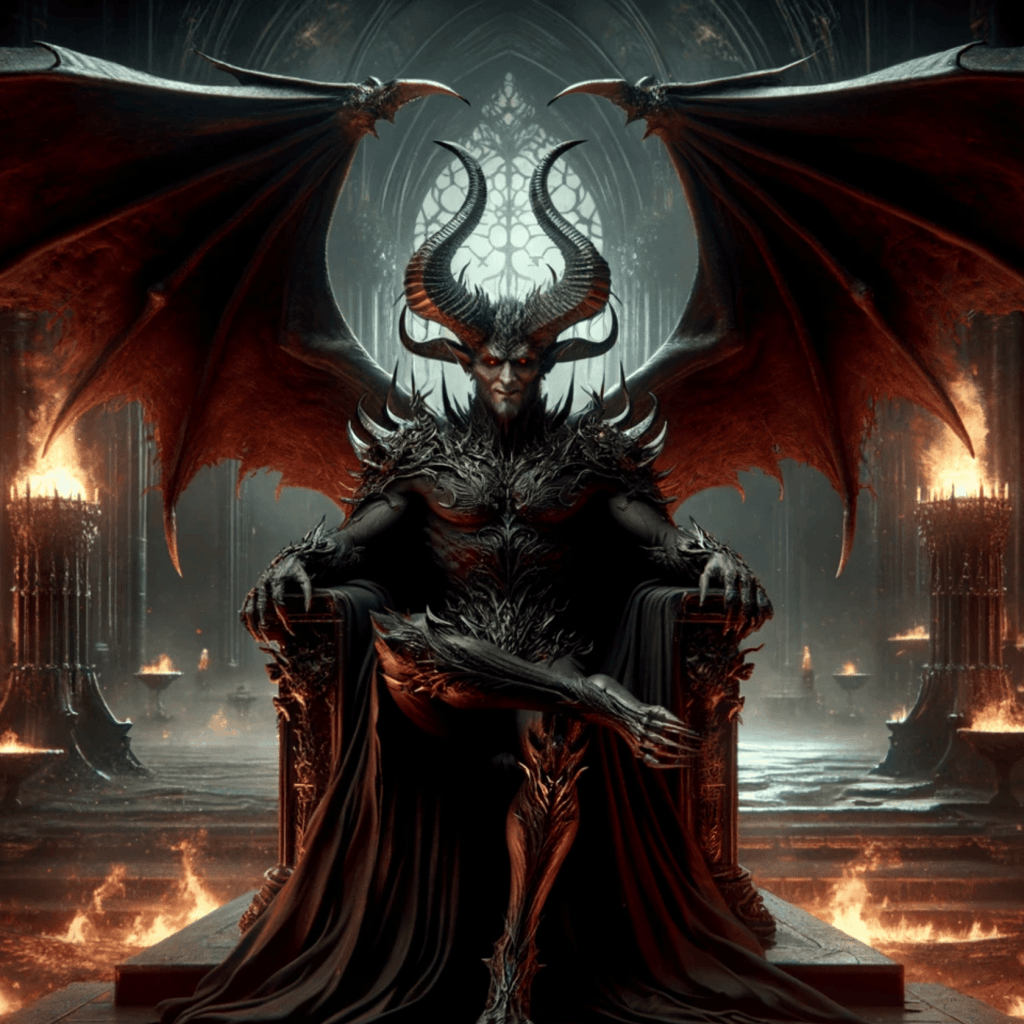
Samael
‘Naamah, along with many other powerful entities from demons, to renegade angels, to many other monsters and creatures beyond or in between would become part of Samael’s… [attempts] to overthrow both Heaven and Hell, and later all of Creation for himself and sending them all into Oblivion. His highest and most trustworthy of comrades and perhaps the ones he cherished most were his Four Wives, The Whores of the Apocalypse as was rudely called of them.
Samael’s intentions were unclear because as both an Angel of Death, and later powerful Demon Lord, his goals would alienate both sides. As an Angel of Death, he saw Death as the absolute highest power and Judgment over God, and he desired to be Master of all of it. To him, Death was inevitable, and he desired to simply conquer all the Realms that needed to be conquered, and send all of them to the Oblivion at once, thus quickening the End of Times and letting the nothing but Chaos and Death and pure Darkness regain the entire Realms once again.
He planned all this out not through conquest but through his own mad logic, and he desired to free the Leviathans/Old Ones to do so, the Old Banes of Existence, the Old Rulers of Chaos that would once again take what was theirs and thus restore the entire Cosmos into its former state, the Sea of Chaos.
While clearly mad… Naamah actually found his views to be [quite] appealing and [she] actually connected to him… She did not value this Existence as God had designed for humanity and [believed] humanity to be… unworthy. Her and… Lilith became powerful partners to Samael and assisted in his goal of bringing back the Leviathans to unleash pure destruction, as revenge against what the Creator had done to them. The first was a conspiracy still being [exacted] today. The event with the Serpent [who] manipulates and seduces the 2nd woman of existence: Eve into eating the Fruit of Knowledge and thus banishing them from the Holy Lands.
… Naamah… became [one] of the most feared and most powerful [of the] legions of hell. But Naamah began to grow quite distant from the Prince of Darkness, her… Husband. Mostly due to the fact that she realized her goals, while still oriented towards Vengeance against God like [Samael] and Lilith, she did not value the same things [they] did, and thus she would end [up] betraying them sooner or later.
Demons are generally very mischievous… but what was quite frightening about Naamah was that she did not have a… mischievous [or] comedic attitude towards things, she treated every [thing]… coldly like it was serious business. Beings like Lilith always deviated from the main goals all the time, yet they will still return to their Lord of Darkness sooner or later. Naamah would soon crave a power far greater than the Light of God or the power of Darkness… she wanted the most ancient and powerful force beyond all of Creation… beyond life and death… She wanted Chaos. Above all else…’
The Four Angels of Prostitution: ‘Within the “angels of prostitution” paradigm, all four goddesses are viewed as sisters and manifestations of the Dark Goddess.’ The Dark Goddess being Asherah, the true Adversary and ruler of the fallen forces who oppose the Eternal One – refer article: Asherah. ‘The whole kingdom of the Qliphoth in this sense constitutes the body of the Dark Goddess, with Lilith… being her vulva…
There we encounter the Four Angels. Naamah [the One who Crawls Upon the Earth] greets the traveler at the gate to the Qliphoth, opening the passage to the astral garden… and initiating the path of sacred sexuality.’

Qliphoth Sigil for Na’amah
“From beyond the shell of Nehemoth, Naamah, queen of desire, I invoke you.
Enter into this temple on this night. Take of my body as the offering.
In return give me life. Let me be reborn within the waters of damnation.
Awaken your forbidden gnosis within me. Ignite my lust, my passions and my desires.
Let me taste of your sinful fruit.
Oh lady in red, whore of the beast – I embrace you. Initiate me in your ways, teach me all that I should know. Let us become one on this night.
Open up your gates so that I may enter the Nightside. Let your presence fill this temple. Come forth Naamah!”
‘Agrat leads us… into the body of the Dark Goddess. She is called the Roof Dancer, because she resides on the border of the worlds – physical and astral, sleeping and waking, conscious and unconscious – helping the traveler to pass through the gate and enter Sitra Ahra [“the other side”, ‘meaning the side distinct from, and opposed to, holiness’ and ‘the realm of evil or demonic powers and emanations; the domain of Satan’].
Eisheth Zenunim [the Eater of Souls] completes the passage, letting the traveler drink the blood of the Dark Goddess, “the wine of the Sabbat,” from her unholy grail, which poisons the mundane senses and opens consciousness for the experience of the Other Side…
Lilith [the Mother of Demons] is viewed in this paradigm as the embodiment of the Dark Goddess and the presiding force of the whole process… these initiations occur through sexual gnosis, as sex is the most natural way to approach the current of the Dark Feminine.’
Practitioners of Draconian Magick may think they are communicating with Na’amah directly when they conjure or summon her, though in all likelihood an Adept is communing with demonic entities in her service. Only a powerful sorcerer who carries ‘a magical birthright conferred upon them by an exotic bloodline, some otherworldly influence, or exposure to unknown cosmic forces’ would gain an audience with her. For ‘no one chooses sorcery; the power chooses the sorcerer.’

For those, who unwisely seek an unholy communion with Na’amah, Hitokiri Battosai describes contacting her in, Awakening the Passionate Realms: A Ritual Invocation of Naamah, April 13, 2015:
“Naamah is related to the earth element and she is the demon ruler of the Lilith Qlipha. She can serve as a spiritual gatekeeper, as well – acting as a bridge between the unseen realms and… communicating messages to the individual from… other worlds and the hereafter. To enter the realms of Naamah is to find passion… She is our first contact with the energies of the other side. Naamah possesses knowledge about how to [awaken]… sexual energy… It is true that once the gates of her kingdom are opened, our will is tested, because sexual magick is a two-edge sword.”
The ritual instructions Battosai offers in making contact with Naamah, is an ‘invitation to explore the passionate realms of Naamah. A call for her to enter our temples of flesh and empower them with her fury, knowledge of sexual magick, dream work and other magical skills that she possesses.’ He says:
“Naamah appeared to me in the first Qliphoth working, interchanging her energy with me and giving me the chance to see beyond the physical senses. Her appearance is often that of a pale woman, beautiful and enchanting as no other, her eyes are green and bright like emeralds, she has curly red hair and she is naked. She smiles in a sinister but lovely way and enhances your experience. The purpose of the ritual is to receive and awaken the energies of Naamah in our souls and become aware of her pleasures and knowledge.”
Another practitioner, She-Witch in March 2018, described Na’amah when she appeared to her, as having “long dark hair… and big black pointy horns… She did have a red hood… [and she was] beautiful.”
Portion of an alleged conversation She-Witch has recorded with Na’amah:
Me: “You know I’ve been [wanting] to work with you lately right?”
Naamah: Yes… But I’m around you and inside you every second of the day, dear.
Me: “Why do I feel better whenever [you‘re] around me?”
Naamah: I also feel good when I’m with you my dear, I’m you and you are me!
Me: “What do I need to do next Naamah?”
Naamah: You must use your power more, you sit everyday not knowing how much power you actually have my dear, use it and find out how great you can become.
A concerning aspect of this interaction is the admittance by the spirit involved, that they are continually attached to She-Witch and has become entwined with her in a serpent-like manner – spiritually unifying as one. She-Witch concludes:
“After that it was so silent… I saw a big flash of purple… All I could see in the darkness was snakes swirling around my wall. Long black snakes. I don’t know what the snakes could mean if someone wants to try to figure that out for me…”
Medusa: In ancient Greek mythology, Medusa is the most famous of three monstrous sisters known as the Gorgons – hideous creatures covered with snakes. Though like Na’amah, Medusa was once mortal and beautiful.
Medusa once had charms; to gain her love
A rival crowd of envious lovers strove.
They, who have seen her, own, they ne’er did trace
More moving features in a sweeter face.
Yet above all, her length of hair, they own,
In golden ringlets wav’d, and graceful shone.
– Ovid, Metamorphoses
Medusa was ravaged (raped) by Poseidon, so Athena gave her a head of snakes to protect her. In the process transforming her into a monstrous entity according to Virgil:
“In the middle is the Gorgon Medusa, an enormous monster about whom snaky locks twist their hissing mouths; her eyes stare malevolently, and under the base of her chin the tail-ends of serpents have tied knots.”
Snakes and serpents are powerful sexual symbols due to their phallic shape and the slow sensuous movement replicated by women who dance erotically for example on the other – Article: Belphegor. Thus the symbolism of the snake contains both masculine and feminine attributes and represents each gender.
An interesting side note is how snakes are unusual in that they have two penises – as do lizards. A snake penis is known as a hemipenis. The two together are hemipenes. The hemipenes are located further down on a male snake, fascinatingly in the same position as where hind legs would be located on a mammal. In possessing two organs, it provides the male snake the opportunity to mate successfully with a female no matter which side she is on. Yet even with this seeming advantage for the male, female snakes mate with multiple partners and store sperm for up to five years. The female snake then decides if and when she will become pregnant in that period, ultimately choosing which sperm to use.
Snakes are associated with fertility (the snake as a phallic symbol is the fertilising male force and its presence in almost every folklore represents pregnancy) and desire stemming from the Serpent, Samael in the Garden of Eden. Unsurprisingly, snakes represent sexual energy as well as the duality of life and death. In turn, the snake is an emblem of self-generating life repeatedly associated with spiritual beings.
Vladislav Tchakarov: “… it is no coincidence that the symbol of marriage between an earthly woman and a dragon or a serpent is characteristic of mythology worldwide.”
Occult World: ‘Naamah is a spirit of… sexual autonomy and sacred erotic rites. Naamah rules the ecstatic point where sex, spiritual ecstasy, and music intersect. Those who comprehend this point and seek to attain it are her constituency.’
Anonymous comment, July 31, 2022:
‘… I came to realize… after working with Naamah for a while, she… [is] one of the chief demons of sacred prostitution and a succubus… that… [is a] high ranking demon… after a period of working with her… I noted that I started being more energetic and primal in my nature… I came to understand she was activating my sacral chakra, my opposite gender became more attracted to me and [persons] I never expected started seducing me indirectly… this is because I had a lot of sexual energy, which is the most powerful energy you can ever have… through working with Naamah I don’t have just regular sex but I have really powerful and empowering sex… [in return]… remember spirits ask for three things as payment, time, attention and energy…
I wish everyone could experience how amazing this demonic queen is… However it should be noted that she’s very… versatile in sex magic so the more you work with her, [invoking] her… [chanting] her enns… [it] will make you absorb her energies thus she will definitely bring you more sexual partners into your life whether you ask of it or not because she’s the most primal queen ruler of sex demons and succubus…’
Enns are unique sentences in an unknown, demonic language for the purpose of contacting a specific demon. FluX-Byn: “An enn is a mantra given by daemons as a way to atune your energy and vibration… through sound to their frequency [so] as to… put you in touch with them. Almost like a phone number. It not only changes your vibration and the surrounding but also charges the air around you with their power.”
Ephesians 2:2, WE: “At one time you did those wrong things, just like the people around you. You obeyed the ruler [G758 – archon: ‘prince, leader, commander’] who has the power [authority] over things in the air [lower atmosphere, physical realm]. That ruler is the spirit who is working now in the people who do not obey God.”
The Prince who rules the things in the air, is Samael, also known as Beelzebub, the Lord of those who fly.
FluX-Byn: “This is useful for many things. Enn mantras are in a language that isn’t known… and daemons sometimes give them to Demonolators. With that being said an enn can be used to give reverence, a sign [of] respect, when used with sigils they can be used to contact the daemon or make requests. They help empower your magick… However typically for invocation[,] that is[,] calling a daemon inside[,] a call mantra is used instead… a call mantra calls energy into you, whereas enn mantras seem to be more for connecting externally. Still[,] enn mantras can draw in some energy within you as you atune[,] but formally for invocation a call mantra is typically used instead.”

Sigil of Na’amah
Comment by Uncle-AI, April 1, 2017: Naamah is a ‘spiritual entity who radiates dirty, sexual love. A Demoness so physical you can almost smell Her sexual allure. And because She’s so close to the physical plane She can manifest things – like women and/or money. Naamah is beautiful and hot! Treat Her with the utmost respect! Tell her what you want and what you’ll give Her in return. Keep your end of that bargain because one way or another, She will. Results come quickly…’

He burned his son as an offering and used fortune-telling and omens and dealt with mediums and with necromancers. He did much evil in the sight of the Lord, provoking him to anger.
2 Kings 21:6 English Standard Version
“Evil walked the earth when angels fell. Evil stalks us now in disembodied spirits; immortal wraiths once clothed in flesh when angel and women bred; spirits released from their fleshly prisons when their bodies were destroyed for drinking the blood of men.”
Joseph Lumpkin
“My story is a tale of long and tainted crimes and sins against God… Whatever I take is mine, I deserved, I planned for it, I’ve earned it.”
Na’amah
© Orion Gold 2024 – All rights reserved. Permission to copy, use or distribute, if acknowledgement of the original authorship is attributed to orion-gold.com



















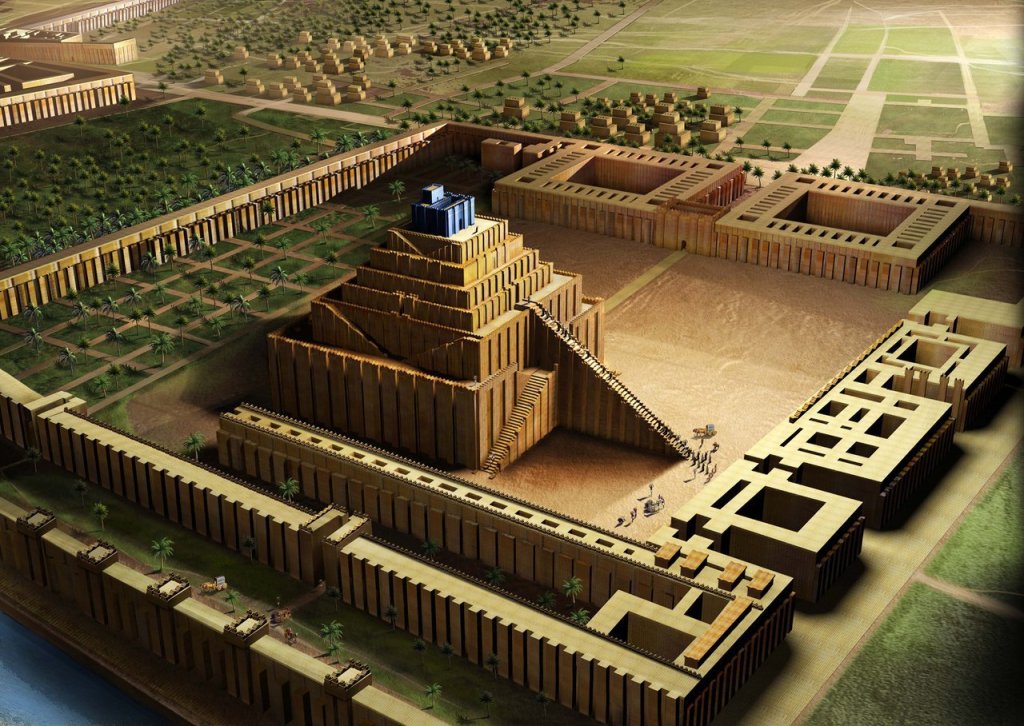















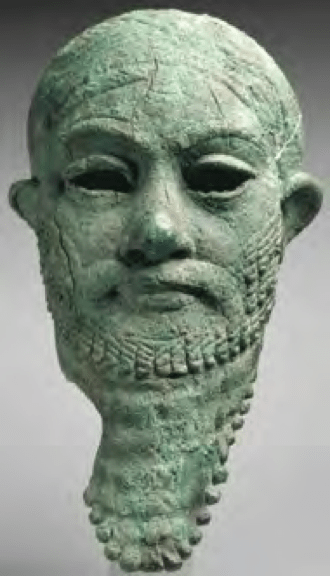
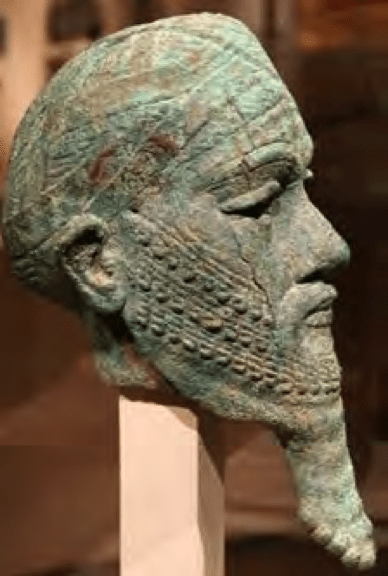
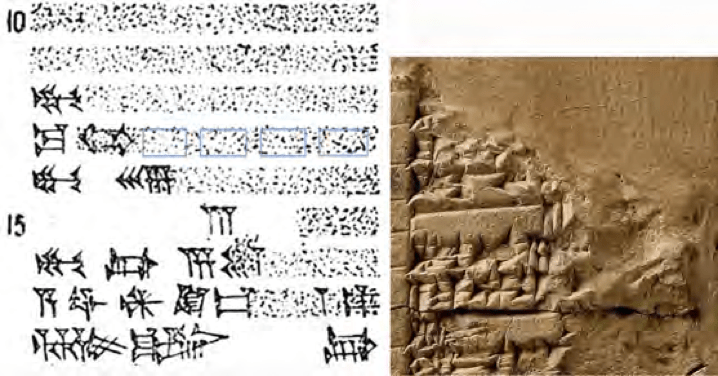

 The Lightkeeper