
Chapter III
Tiras is the seventh and youngest son born to Japheth. This writer had read Herman Hoeh’s article, Origin of the Nations, July 1957, in the 1980s while at University. When looking at the identities more closely in the 1990s, it was not clear who Tiras was definitively until all of Japheth’s other sons had been studied; for Tiras is next to impossible to identify solely from the Bible, as he is listed just twice in the genealogies of Genesis Ten and 1 Chronicles One.
It was therefore a process of elimination and once the other six sons of Japheth were conclusively identified, it cemented Tiras as the Indigenous Amerindians of North America, Central America and South America.
Ultimately, agreement was reached with Dr Hoeh’s findings on the Native American Indians – though not with the conclusion that Polynesians descend from Tiras – refer Chapter VII Javan: Archipelago South East Asia & Polynesia.
During the course of researching Tiras, the insight of Daniel Garrison Brinton (1837-1899) an American surgeon, historian, archaeologist and ethnologist was encouragingly stumbled upon. Brinton accurately identifies Tiras as the progenitor of the indigenous peoples of the Americas.
The descendants of Tiras are unusual, in that they are uniquely scattered throughout two vast continents and not identifiable in just one nation.

Tiras is mentioned in the Book of Jubilees 9:16
‘And For Tiras there came forth the seventh portion, four great islands in the midst of the sea, which reach to the portion of Ham…’
The islands at the time of writing would have been the Greek Isles and beyond in the Mediterranean Sea – refer Chapter II Japheth Orientalium. Remaining sons of Japheth also migrated to the Grecian Archipelago before moving further into Southern Europe and then migrating in a wide arc eastward towards central Asia – Chapter VII Javan: Archipelago South East Asia & Polynesia. The portion of Ham mentioned would have been dwelling in North Africa.
A H Sayce in The Races of the Old Testament, 1891, confirms the difficulty in tracing Tiras, for he confesses on page 48:
‘Tiras is the only son of Japhet whose name continues to be obscure. Future research can alone be expected to settle the question.’
Herman Hoeh’s invaluable research regarding Tiras – capitalisation his, emphasis mine:
‘The word “Tyrus” used for the city of Tyre in Palestine has no relationship with Tiras, the son of Japheth. Tiras journeyed to Asia Minor… there is more historical evidence concerning the migrations of Tiras than of any other son of Japheth. Yet the world has never guessed to what land the descendants of Tiras finally migrated!’
Tyre was southward, on the coast of present day Israel and in the opposite direction from that travelled by Tiras.
Hoeh:
‘The river Dniester, which flows into the Black Sea near the border of Romania was anciently called Tiras.’
There is a city called Tiraspol in Moldova, near the Romanian border in the region once known as Thrace. Though it was built in 1792, the city name recalls the ancient name of the Tearus or Tyras River as Hoeh acknowledges.
Hoeh: ‘That was the main seat of the people of Tiras for many centuries [later known as the Tyragetae]. These people migrated along the shores of the Black Sea, the Aegaean and the Mediterranean Seas – before the coming of the Greeks. The Greeks finally displaced them. Where were the people of Tiras driven to?
Before we can answer these questions we must first learn the tribal names into which the family of Tiras subdivided. Here are some of their names: Dyras, Teres, Tauri, Carians, Calybes, Thyni, Amazons, Maias, Milyaes, Mauri, Gasgars… (See SMITH’s CLASSICAL GREEK AND ROMAN DICTIONARY for most of these names.) Where, today, do we find these same people located among the nations? In the NEW WORLD: where the American Indians are!’

Note the Taras-co in Middle America
Regarding the Milyaes, Mauri and Gasgars. We will find that they are Malays and Polynesians and not the same as Amerindians, or descended from Tiras.
Additional interesting Indian tribal names include: Teyas in Texas; Tiwa in New Mexico; Tarahumara, Terocodane and Teroodane in Mexico; Terraba in Central America; Tairona in Colombia; Taruma in Guiana; and Tariano, Tariana and Terena in Brazil.
Hoeh:
‘The Amazons… in South America who gave their name[…] to the Amazon River. The Mayas live in Mexico and Guatemala. The Tinné Indians – the Greeks called them Thyni… live… in [Alberta] Canada. The Tarascan Indians of Mexico are called after “Taras, the name of a tribal god”, wrote Daniel G. Brinton in THE AMERICAN RACE… In South America live the Dures Indians, the Doraqsques, and the Turas, the Tauri and the Dauri; the Trios and Atures. In the Caribbean live Calybes – the same tribe that once lived by the Black Sea.
The people of Tiras are painted on the earliest monuments of the Mediterranean. The (colour) of their skin? – of “… reddish-brown complexion with their long black hair done up into a crest!” (quoted from THE SEA-KINGS OF CRETE, by James Baikie, [1926], page 74). From page 212 we read: “Judging from the surviving pictures, the Minoan men [the descendants of Tiras settled on the island of Crete prior to the Minoans – Chapter XV The Philistines: Latino-Hispano America] were bronzed, with dark hair and beardless faces.”
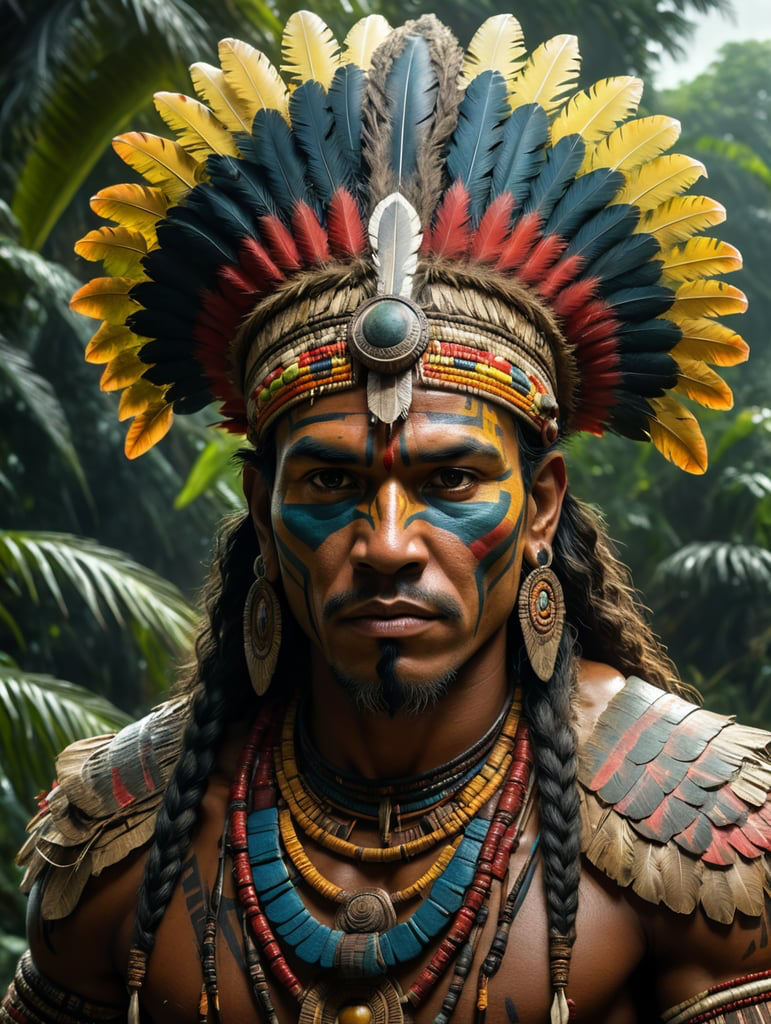
Interestingly, the Minoans were allied with the Amazon tribes in the Aegean; so that the name Amazonia later appearing in South America is of little surprise. Murals of the temple in Medinet Habu in Egypt, depict people with features akin to the American Indians; while certain peoples related to the Minoans wore plumes. ‘The tufts of feathers offer incontrovertible evidence, because no other people have worn them’ – The True Origin of the American Indian, B Rea, 1968, page 14.
Hoeh:
‘The Mexicans called their temple Teocallis. This word is directly related to the Greek, meaning “place of worship of God”. The Greeks called the sons of Tiras, “sea people”. The native Indian name Anahuac, which the Indians of Mexico apply to the Valley of Mexico, means “around the water”.
Further evidence of Tiras in the Mediterranean is provided by words from the Aegean finding their way to the Americas.
Xious – Sioux
Andros – Androa tribe in Oregon; both names mean the same: “One which lives amongst trees”
Piraeus – Piros of Chihuahua
Anafi – Anafes of Brazil
Karpathos – Karpazos of Colorado
One commentator observes how ‘Mayan hieroglyphics show affinity with those of Egypt and also to Cretan scripts. Even certain Mayan names of days resemble the names of letters in the Phoenician alphabet. Stone scripts with markings and language similar to the Minoan has also been found at Fort Benning, Georgia. The main streets of the Mayans were bordered by fountains from which sprung hot and cold water. Similar installations of like design have been found beneath the ruins of Minos’s palace in Crete.’
This is noteworthy, for it is an example of the American Indian sharing a past history with the peoples who would also later populate the Americas – refer Chapter XXIII Aram & Tyre: Spain, Portugal & Brazil; and Chapter XV The Philistines: Latino-Hispano America.
Hoeh:
‘An analysis of the ancient Indian traditions points universally to “an eastern origin” – across the Atlantic, not the Pacific. (See THE AMERICAN RACE, pages 98-99.) In fact, the word Atlantic was used 2000 years before Columbus discovered America… it is an American Indian word. Its root is atlan meaning “water”. Only a slight migration may have taken place across the Pacific from Asia to America. The overwhelming movement has been out of the Mediterranean to the new world!’
Hoeh raises a significant point regarding the migratory direction of the descendants of Tiras. Japheth’s remaining six sons travelled eastwards, predominantly across the vast Eurasian land mass. There were exceptions amongst the sons of Javan. Japheth’s grandson Tarshish sailed, travelling westward; establishing trade routes and ports along the Mediterranean Sea all the way to the Iberian Peninsula, before doubling back eastwards.
There is considerable conjecture and discussion from historians and scientists alike, regarding the Indians in the Americas. Most maintain they approached from the West via Russia passing over the Bering Strait – which is just 50 miles across – while others maintain a westerly direction from Europe and traversing the Atlantic Ocean as Herman Hoeh proposed.

Josephus in Antiquities of the Jews, held with other ancients that Tiras was the founder of the Thracians. The original Thracians were descended from Tiras. The 1946 edition of the Encyclopædia Britannica describes the people who anciently inhabited the region.
‘The name Thrace, because it has been used as a geographical term as well as an ethnic description, has added to the confusion. Thrace was inhabited by indigenous tribes, as well as by Celtic Tribes such as the Getas. The aboriginal inhabitants were the red-skinned Thracians mentioned by the Greek writers and they differed from the Celtic tribes not only in complexion but also in customs and religion (Herodotus, V. 14.)… The most outstanding archaeological monuments of this prehistoric period are the mound-like tombs, that were generally located in the outskirts of the ancient cities…’ and later found in the civilisations of the Mississippi and Mexico.
‘There is no well-defined difference between the aboriginal Thracians and the native Illyrians. All of the Thracian tribes and the Illyrian tribes practiced tattooing, which distinguished them from the Celtic tribes that had from time to time dominated them.’ The Universal Encyclopedia: ‘A custom unique to the Thracians was tattooing. The nobles painted the hair of their head blue.’
Whereas, later Thracians included red headed people who had the same name ascribed to them. Please refer to point number two in the introduction (primus verba). While other scholars consider Tiras as the founder of an ancient race of Pelasgian pirates and sea peoples called the Tursenich or Tursenioi, who once roamed the islands and coasts of the Aegean Sea. The name Thrusa or Turusha has been seen among Egyptian records, showing that they terrorised and invaded Syria and Egypt about 1250 BCE. They are referred to as Tursha in an inscription of Ramesses III and as Teresh of the Sea on the Merneptah Stele.
Regardless, the descendants of Tiras would have likely departed from the Mediterranean Sea prior to 1250 BCE, as would have all the sons of Japheth centuries before. Others have connected Tiras with the cities of Tarsus, Tarshish and even Troas, the city of Troy.
Some researchers link Tiras to the Etruscans of Italy – who had been living in Lydia as the Tyrsenoi, before emigrating via Greece to Italy in the Eighth century BCE. We will discover the Etruscans are not descended from Tiras at all – refer Chapter XXVII Abraham & Keturah – Benelux & Scandinavia.
Tiras in Hebrew means: ‘desire, desirable’ or ‘moisturiser’ The verb rasas means ‘to moisten’ and the noun rasis means a ‘drop (of dew)’ or ‘fragment.’

A Chickasaw Woman
The Bible does not mention any sons for Tiras, yet the Book of Jasher 7:9 and 10:14 records the sons of Tiras as:
Benib, Gera, Lupirion and Gilak
While asserting that Rushash, Cushni, and Ongolis are also among his descendants.
The name Cushni is interesting as it is similar to Cush, a son of Ham. We will refer back to this when investigating Cush – Chapter XIII India & Pakistan: Cush & Phut.
An earlier rabbinic compilation, the Yosippon claims the descendants of Tiras to be the Rossi of Kiv or the Kievan Rus, listing them together with his brother Meshech’s supposed descendants as ‘the Rossi; the Saqsni and the Iglesusi.’
The linking of Tiras with Meshech – a son of Japheth – and the Russians is an incorrect tangent though an understandable one, as we will find when studying Meshech – Chapter X China: Magog, Tubal & Meshech.
A mediaeval Hebrew compilation, the Chronicles of Jerahmeel, provides an alternative tradition for the sons of Tiras, naming them as Maakh, Tabel, Bal’anah, Shampla, Meah, and Elash. These names were based on Pseudo-Philo circa 75 CE, which lists the sons of Tiras as Maac, Tabel, Ballana, Samplameac, and Elaz.
The Persian historian Muhammad ibn Jarir al-Tabari circa 915 CE, states a tradition that Tiras had a son named Batawil and his daughters Qarnabil, Bakht, and Arsal, became wives for two of the sons of Ham: Cush and Phut – as well as for Canaan respectively.
Cush is mentioned again and we will return to this relationship. It is interesting Tiras may have had four to six sons, for though his descendants are not prolific, they are scattered over a vast section of the earth with a variety of ethnic characteristics; including Native American Indians stretching from Canada all the way to Argentina. If Tiras had three grand daughters, who married Cush, Put and Canaan, then his descendants in part, are innumerable. This is certainly plausible, as Noah’s grandsons would have had to take wives from their cousins when repopulating the earth.

Native American men

Genesis 9:1, 7
New Century Version
Then God blessed Noah and his sons and said to them, “Have many children; grow in number and fill the earth. “As for you, Noah, I want you and your family to have many children, to grow in number on the earth, and to become many.”
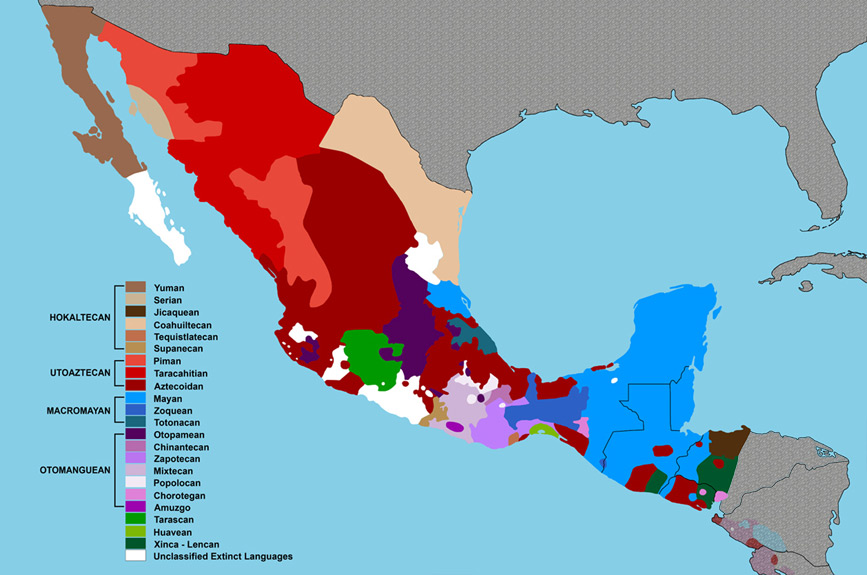
Linguistic map for Central America – note Taras-can in green
The nation with the most Amerindians is Mexico. We will study Mexico and its combination of people in more depth, though for now concentrating on its Indian population. They are known as Mexican Native Americans; Native Mexicans; or the Indigenous peoples of Mexico. These peoples trace their communities back to the population existing in Central America prior to the arrival of the Spanish.
Interestingly, The 2nd article of the Mexican constitution classifies and numbers Indians not according to racial-ethnicity but rather cultural-ethnicity of ‘indigenous communities that preserve their indigenous languages, traditions, beliefs, and cultures.’
The INEGI or official census institute, reported in 2015 that 25,694,928 people in Mexico self-identified as being indigenous of many different ethnic groups; which constitute 21.5% of Mexico’s population.
At the time of the Spanish conquest in the late fifteenth century, the indigenous population of Mexico had been estimated at about twenty-five million people and has only reached this figure again, over five hundred years later. A remarkable statistic and a tragic indictment of one peoples actions against another family member – Chapter XV The Philistines: Latino-Hispano America.
The Amerindian population of other nations in the Americas include 9.8 million in Bolivia the second highest; 5.2 million in the United States; 2.13 million in Canada; 997,000 in Brazil and 955,000 in Argentina; with a total of approximately seventy million people throughout the Americas.

Flags of the Indian Nation
Historically, the Church of Jesus Christ of latter-day Saints has taught that the American Indian are the descendants of one of the lost tribes of Israel.
Following are the opening remarks in an article by William Lobdell, a Times staff writer, 2006 – emphasis mine:
‘From the time he was a child in Peru, the Mormon Church instilled in Jose A. Loayza the conviction that he and millions of other Native Americans were descended from a lost tribe of Israel that reached the New World more than 2,000 years ago.
“We were taught all the blessings of that Hebrew lineage belonged to us and that we were special people,” said Loayza, now a Salt Lake City attorney. “It not only made me feel special, but it gave me a sense of transcendental identity, an identity with God.”
A few years ago, Loayza said, his faith was shaken and his identity stripped away by DNA evidence showing that the ancestors of American natives came from Asia, not the Middle East.’
We will study the unique lineage of the apparent ‘lost’ tribes of Israel. They are not related directly with the Amerindian descended from Tiras. The DNA evidence highlights the American Indians origin in common with the people of East Asia, but is not wholly accurate regarding their true origin of location.

Native American women

The Diego antigen, a blood group system composed of 21 blood factors or antigens are inherited through alleles. The Diego antigen is common in Indigenous peoples of the Americas and in East Asians, but very rare or absent in most other populations, reflecting that the two groups share common ancestry – refer articles: Homo neanderthalensis I, II, III & IV; and Chapter X China: Magog, Tubal & Meshech.
The Amerindians from Tiras are a lineage of the East Asian family of peoples who have sprung from Japheth. The Diego antigen discovered in 1953, is found in all the peoples of East Asia in varying percentages.
Conversely, the Dia antigen is very rare in African and European populations and the Dia antigen is either very rare or absent in Aboriginal Australians, Papuans, natives of New Britain and surprisingly, Polynesians – Chapter VII Javan: Archipelago South East Asia & Polynesia.
Whereas, the incidence of Diegoa+, relatively high in Siberian Eskimos and Aleut people (the levels of Diegoa+ in Aleuts is comparable to South American Indians), occurs at a much lower frequency (less than 0.5%) among Alaskan Eskimos and has not been found in the Inuit of Canada.
Retina, Fifth Edition, M Cristina Kenney & Nitin Udar, 2013:
‘Haplogroups are mtDNA sequence polymorphism variations that have occurred over [thousands of] years and correlate with the… origins of populations traced through the maternal lineages. The oldest haplogroups [originate] from [African peoples]… [of which]… European, Asian, and Native American haplogroups have evolved.
Each haplogroup has related patterns of mtDNA sequences (haplotypes) that represent that population. [Y-DNA] Haplogroup Q is found in Asia, the Americas, Europe, and the Middle East. One of its sub-clades, group Q3 [Q1a3] is almost exclusively associated with the Native Americans…’

The mtDNA Haplogroups for the Indigenous Amerindians of North, Central and South America
Regarding the genetic history of the Indigenous peoples of America, the occurrence of the mtDNA (maternal) Haplogroups A, B, C and D among the eastern Asian and Amerindian populations has been recognised for some time. Unlike Haplogroup X, that is not strongly associated with East Asia, yet is the fifth most frequent mtDNA Haplogroup in the Indigenous Amerindian peoples. Rather, Haplogroup X is more strongly present in the Near East, the Caucasus region and Mediterranean Europe.
Ninety-five percent of all Native Americans possess the sub-Haplogroups A2, B2, C1b, C1c, C1d, and D1. Haplogroup A being the predominant group overall in North America (and Central America); while Haplogroup C is most widespread throughout South America.
A study in 2009, A great diversity of Amerindian mitochondrial DNA ancestry is present in the Mexican mestizo population, found that in Mexico the ‘frequency of the Amerindian haplogroups A2, B2, C1 and D1 was 51.1, 17.8, 18.5 and 5.9%, respectively.’ The remaining five percent possess the sub-Haplogroups X2a, D2a, C4c, and D4h3a. As these four sub-Haplogroups are rare, studies tend to exclude them.
Whenever the results for any particular Amerindian population do not equal one hundred percent, it is because the remaining percent belongs to these rare sub-Haplogroups. This means that all Native Americans are descended from a small group of people, exhibiting a low genetic diversity, because they possessed only five mtDNA Haplogroups. A 2005 study conducted by Rutgers University, ‘concluded that the entire [Native American Indian] population of North America descended from just 70 individuals who arrived there about 14,000 years ago [after the global flood cataclysm]…’
In other words, the five principle mitochondrial DNA Haplogroups of the Indigenous Amerindian, are part of a single founding East Asian population. The link with East Asians, means scientists have assumed that migration had to be eastwards across the Bering Strait, based on the geography of similar related peoples. It does not seem to have occurred to the same scientists, that just because the Native American Indians are genetically related to East Asians, that it means they traveled together, or in the same direction – or even that it was the only migratory path.
Scientists base their theory heavily on the X2a and C4c lineages having a parallel genetic history, using this as proof that an Atlantic glacial entry route into North America is untenable; as C4c is a key Haplogroup in the East Asian portion of the mtDNA phylogeny.
Everything You Know Is Still Wrong, Lloyd Pye, 1997 & 2017, page 68:
‘Folsom points were supplanted in the 1930’s by an earlier, very distinctive type that came to be called “Clovis” points because the first were found near Clovis, New Mexico. These presented another unwanted mystery because they had no precedent in either Alaska or anywhere in Asia. The only precedent anyone could find was the Solutrean point culture of southwestern Europe.’
The Solutrean hypothesis is an alternative theory, that the Amerindians approached the Americas from Europe.
Pye:
‘By then every scientist in the world was wedded to the idea that the indigenous populations of the Americas came by the land bridge connecting Russian and Alaska (Beringia) during the tail end of the last Ice Age, so this was another one of those inconvenient facts that had to be swept under the rug and kept there.’

There is support for Amerindians once living in the British Isles, who were the original Picts. They painted and tattooed their bodies, which was copied by the fair-skinned Caledonian peoples, who later were also known as Picts by the Romans – Chapter XXX Judah & Benjamin – the Regal Tribes.
They had travelled from Spain in Western Europe – originating in Illyria and Thrace – as a warrior people who had been employed in the armies of Barbarians. They were ‘fierce, swarthy, half-naked, tattooed and painted.’ In Britain, they were called Attacotti, meaning the “very old ones”. They even used the totem-pole in Scotland.

The Attacotti were ruled over by a Pictish warrior aristocracy. The Attacotti were seen as aichechthúatha, meaning “client people”. The Caledonian Picts in Scotland adopted the matrilineal system of the Attacotti – like the Ohwachia Iroquois – and their reverence for a mother-goddess.
Sources refer to the original inhabitants of Scotland ‘as very dark, wild people with prominent cheek bones, living in the islands off Scotland.’ Another states: ‘Some were as Black and wild in their appearance as any American savages… like wild Indians, that a very little imagination was necessary to give one an impression of being upon an American river.’
Voltaire tellingly describes these early tribes in Britain:
“The inhabitants scarcely covered their nudity with a few skins of beast… and their ornaments were shapes that the men and women imprinted on the skin by pricking it and pouring on to it the juice of herbs, as the savages of America still do.”
In Scotland geographical place names resembling Tiras, included the River of Thurso, Tharsuinn Mountain and the Tarras River.
An interesting coincidence involves Tiras and another people descended from Japheth, discussed in the following chapter: Chapter IV Central Asia – Madai & the Medes.
Anthropologists and historians refer to a Turanid people which once populated Scotland.
Note the name Tura-nid resembles Tira of Tiras.
A commentators asks:
‘Who are the Turanid or Turanian peoples today? These are the Turkic peoples which occupy Central Asia and the territory north of the Caspian to the Black Sea, bordering on Thrace. This is mentioned because certain Turkic or Turanid tribes of Central Asia claim descent from Tiras. If so, the small Tirasian element would be totally absorbed by now into the Turkic masses…’
Another scholar writes:
“Close to the Black Sea are the Kabards and Abkasians, who speak a curious agglutinative speech. Its nearest allies are in far-off North America, though Basque is slightly akin in structure… These Caucasus people might be related to the North Amerinds… It may be noted that Roland Dixon finds the same type of skull in those two regions.”
‘John Beddoe, famous anthropologist of the late 19th and early 20th centuries, wrote in the classic work The Anthropological History of Europe, that a Mongoloid race once occupied Scotland as its earliest inhabitants. Further, he mentioned that traces of Turanian speech are still evident in the Scottish Gaelic language.’
An additional source adds, ‘most of the Attacotti suddenly disappeared in 503 AD with the arrival of the Scots (Gaels)… They left behind mounds of flint knives, stone-hewn tombs, and carvings. They were driven out of Britain and settled in Greenland for a time’ before migrating to Central America. ‘Toltec tradition say that they arrived in c. 503 AD to the already settled areas where Mexico City stands today.’
The base or core Y-DNA (paternal) Haplogroups for the Native American Indians are Q and C. There are a number of Indian tribes which also carry R1. This is somewhat of a mystery and thought to be the result of European colonisation at different stages of their history – refer Chapter XV The Philistines: Latino-Hispano America.
Notably, Haplogroup C is a key Haplogroup for Central Asians, yet for the American Indian, the ancient Haplogroup C is secondary to the far more recent Q mutation and can be rare. Therefore, Y-DNA Haplogroup Q,is the defining marker Haplogroup for male Amerindians.

Added to this, is the fact that only some branches of both Haplogroup Q and C are Native American. Specifically, subgroups Q1a3a and C3b (P39) alone, are found among the Native peoples of North America and South America. Other subgroups of Haplogroup Q and C are found elsewhere in the world, such as in Europe and Asia. This makes it very easy to determine if your direct paternal ancestor was or was not, Native American.

The Algonquian men of northeastern North America possess the following Haplogroup frequencies:
R1 [38%] – Q [34%] – C [8%],
while the Apache of the southwestern United States possess:
Q [78%] – C [15%] – R1 [5%].
The Cherokee of the eastern United States carry:
Q [50%] – R1 [47% ] – C [2%];
the Navajo of the southwestern United States:
Q [92%] – R1 [3%] – C [1%];
and the Sioux men of central North America have:
R1 [50%] – Q [25%] – C [11%].
Native North Americans overall, have the following paternal Haplogroup frequency:
Q [77%] – R1 [13% ] – C [6%];
and in the United States specifically:
Q [58%] – R1 [22%] – C [9%].

In contrast, the Inuit men of the Artic have: Q [80%] – R1 [11%];
while the Canadian Inuit have: Q [55%] – R1 [34%] – C [2%].
The Mixe of Mexico are untouched by western influence with remarkably:
Q [100%];
whereas the Mixtec have: Q [93%] – R1 [7%];
and the Zapotec: Q [75%] – R1 [6%].
As research and understanding of the relatively new field of Haplogroups advances, refinements in the myriads of clades continues to evolve. Subsequent studies have highlighted that Q1a3a now includes both Native American and European members. Q1a3a1 is now deemed a Native American only Haplogroup. There is also another recently discovered Haplogroup Q1a3a4, that has likewise been designated a purely Native American group.
It is worth noting that as Tiras is the seventh and youngest son of Japheth, the male descendants of Tiras also carry – relatively speaking – the very young Haplogroup, Q. The fact some men carry C-P39, shows a distant link with an early and ancient Haplogroup – in Japheth’s line – and the many subsequent generational mutations arriving at Q. Thus, unlike Central Asian men who carry Haplogroup C2 as their defining marker, the sons of Tiras are identified by Haplogroup Q, which while very common, is somewhat rare outside of the Americas.

Prior to 1952 and the use of DNA in hereditary research, scientists used blood proteins to study human genetic variation. The ABO blood group system is credited to the Austrian Karl Landsteiner, who found three different blood types in 1900 – refer article: Rhesus Negative Blood Factor. Blood groups are inherited from both parents and the ABO blood type is controlled by a single gene – the ABO gene – with three alleles: i, IA and IB.
Research by Ludwick and Hanka Herschfeld during World War I, found that the frequencies of blood groups A, B and O differed markedly around the world. The O blood type – resulting from the absence of both A and B alleles – is very common, with a rate of sixty-three percent in all human populations.
Type O happens to be the primary blood type among the indigenous populations of the Americas, in particular within Central and South American populations, with a frequency of nearly one hundred percent. In contrast, in indigenous North American populations the frequency of type A ranges from sixteen to eighty-two percent. This data supports the initial Amerindians descending from an isolated population with a minimal number of individuals.
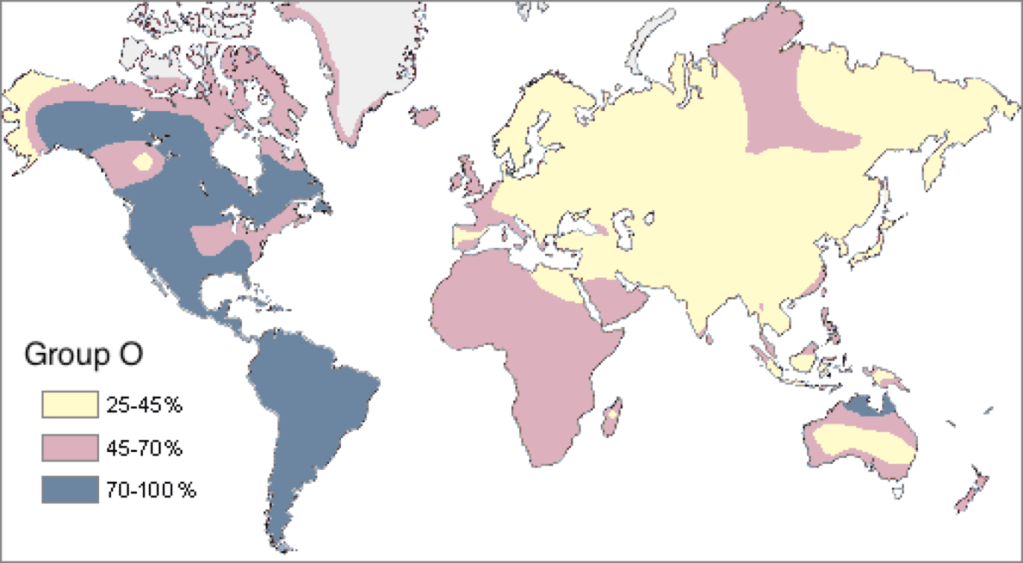
Map showing the dominance of blood type O amongst Native American Indians
There are two main hypotheses for the exceptionally high rate of type O blood amongst the Amerindians.
One is Genetic drift, in which the small number of Native American populations meant the almost complete absence of any other blood gene or type being passed down through the generations.
The other theory is the Bottleneck explanation, which proposes that there were high frequencies of blood type A and B among Native Americans but severe population decline during the sixteenth and seventeen centuries, caused by the introduction of disease from Europe resulted in a massive death toll of those with blood types A and B; leaving a large amount of type O survivors.
Chapter four investigates Japheth’s third son, Madai. Researchers have searched vainly for Madai’s descendants in Europe. Yet ironically, while they do not dwell in Europe, they have had historical ties with Europeans.
The mind of a person with understanding gets knowledge; the wise person listens to learn more.
Proverbs 18:15 New Century Version
“Rejecting God’s truth because of mankind’s hypocrisy is like rejecting mathematical truth because of mankind’s incompetence.”
Orrin Woodward
© Orion Gold 2020 – All rights reserved. Permission to copy, use or distribute, if acknowledgement of the original authorship is attributed to orion-gold.com
 The Lightkeeper