
Chapter XXIII
The fifth and youngest son of Shem, is Aram.
Aram is the only son of Shem in the Bible, to list Shem’s grandsons. This signifies that they must be identifiable nations and peoples over a large area as we learned with the sons of Gomer, Javan and Cush – though not as disparate or numerous as the Canaanites with over fifty nations of descent or Mizraim with over thirty nations.
It is recommended to read in tandem with this section: Chapter XV The Philistines: Latino-Hispano America.
Genesis 10:23
English Standard Version
The sons of Aram:
Uz, Hul, Gether, and Mash.
The Origin of the Nations, Herman Hoeh, 1957 – capitals his, emphasis mine:
‘Trouble is boiling up in the Middle East. Syria is now the focal point of intrigue [written in 1957]. Where is Syria mentioned in the Bible? Who are the Syrians? The Syrians are the descendants of Aram, a son of Shem. Everywhere in the Old Testament where the word “Syria” or “Syrian” appears in English, the word in Hebrew is Aram or Aramean. The Arameans were called Syrians by the Greeks because they once formed part of the Assyrian Empire dominated by Asshur, the Germanic [rather, Russian] people’ – refer Chapter XX Will the Real Assyria Stand Up: Asshur & Russia.
As previously discussed, the nation of Syria is an Arab nation and they descend from Ham’s son Mizra – Chapter XIV Mizra: North Africa & Arabia.
The words Aram and Aramaean are translated as Syria and Syrian in the Bible. The sons of Aram, dwelt to the northwest of Asshur in northern Mesopotamia and hence the similar sounding names of As-syria and Syria. Further descendants from Aram dwelt to the southwest – near and on the coast of northern Canaan, in juxtaposition to the later Philistines on the southern coast. The sons of Jacob inherited the central coastal region.
Hoeh:
‘Now we are about to find an unusual characteristic of the children of Aram. Aram had four sons listed in Genesis 10:23: Uz, Hul, Gether and Mash. Compare this with I Chronicles 1:17. Here the sons of Shem include “Aram, AND Uz, and Hul, and Gether, and Meshech.” First, notice that the sons of Aram are raised to the level of brothers in I Chronicles 1- they are on an equal footing with their uncles!* Further, the name Mash is changed into Meshech, because Mash became associated with Meshech, the son of Japheth!’
We will confirm that Mash from Aram, is not associated with Meshech descended from Japheth – Chapter X China: Magog, Tubal & Meshech.
Hoeh:
‘Why should these sons be elevated to the position of fathers of distinct peoples?
Because the sons of Aram must have possessed extremely divergent characteristics. Here is the proof! Where are the sons of Meshech or Mash today? We ought to find them in Russia, since that is where Meshech the son of Japheth is! And indeed we do find them there! In the far north of European Russia dwell the little-known Zyrians or Sirians or Syryenians – the name is spelled in half a dozen different ways.
They are related to numerous small tribes scattered throughout European Russia. And where are the sons of Hul? According to the Jewish historian Josephus, Hul, the brother of Mash, founded Armenia, a land in the Caucasus between the Black and Caspian Sea (Book I, chapter vi, section 4). The Armenians are a very business-like people. Many have migrated to America. The name “Armenian”, like the word “Syryenian” (applied to Mash or Meshech) means a son of Aram, or son of Syria. The ending “-ian” means “son of” in the Armenian tongue!’
We have heard repeatedly as the constant reader will testify that Gomer and a number of other identities are ascribed to either Armenia or Turkey. So many identities cannot all be Armenian or Turkish. What this shows, is how many diverse peoples at different times, lived at this strategic east-west crossroads in Asia Minor before continuing to migrate. The Armenians and Turks are just the last to arrive and dwell in a region of high migratory activity. Yet they are not descendants of Aram – Chapter XVII Lud & Iran; and Chapter XVIII Elam & Turkey.
Hoeh:
‘Present-day Syria, on the Mediterranean, was founded by Uz, according to Josephus. As the descendants of Gether are nowhere mentioned in prophecy, their movements do not need to be included here. See Josephus’ ANTIQUITIES and the article on “Afghanistan” in the BRITANNICA for their present location. No wonder the sons of Aram were raised to the rank of distinct people. They are extremely divergent in national characteristics.
Who would ever guess today that all these people had the same father, Aram?’
As it turns out, these divergent people are not all the sons of Aram. The people previously identified as Canaanites and Javan by Dr Hoeh are in fact Aram. Aram’s four sons are distinct yet separated peoples today, though their Haplogroups and autosomal DNA reveal they are closely related and not as diverse genetically as Hoeh proclaims.
Finally, relying on Josephus at best, has limited value as he addressed what he understood at the time of writing and at worst, he has been found to be less than reliable in numerous instances. Peoples and nations had a long way to travel in their respective migrations before a settled picture could come into somewhat clearer focus from circa 1600 when the American colonies were forming, more specifically by the 1870s when the German (1871) and Italian (1861) states had united to form nations and particularly from between 1918 to 1945 with the redrawing of European boundaries.
We have seen how the sons of Shem thus far, are located on the periphery of Europe proper:
Lud in Iran, Elam in Turkey and Asshur in Russia.
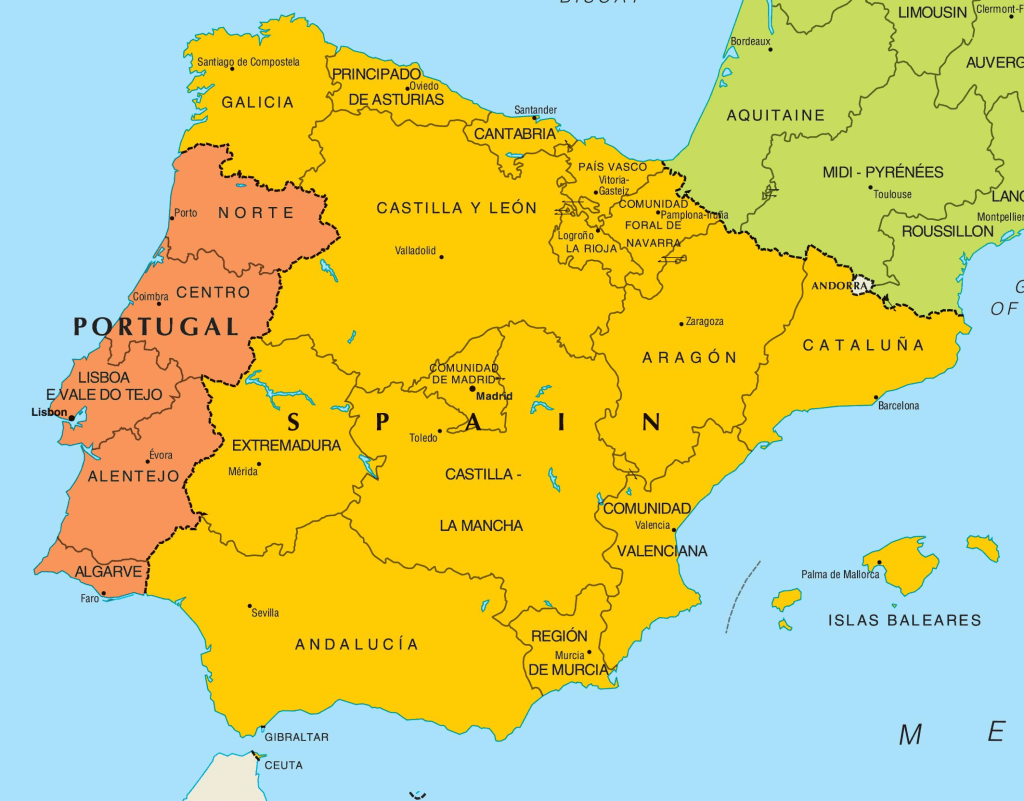
The four sons of Aram are similarly located on the outer edges of Europe, in principally Spain and Portugal on the Iberian Peninsula and stretching across the Atlantic Ocean in Brazil, South America.
Descendants of Aram are also located throughout the heavily mixed Hispanic nations of the Americas and particularly concentrated in Uruguay, Argentina and Chile – refer Chapter XV The Philistines: Latino-Hispano America.
Similarly, descendants of Aram are also located in Italy, though the Italian Peninsula contains more than one lineage of people as we will discover – Chapter XXV Italy: Nahor & the Chaldeans.
In Genesis 25:20, a wife was found for Isaac from Abraham’s brother’s family. This brother had a close association with Aram. Dwelling in the same territory as one of Aram’s sons Uz, so that a shared name of Paddan-Aram describes them both. We find in Genesis chapter twenty-two a list of sons, where Uz and Aram are both shared family names.
Genesis 25:20
English Standard Version
‘…and Isaac was forty years old when he took Rebekah, the daughter of Bethuel the Aramean of Paddan-aram, the sister of Laban [the father of Leah and Rachel] the Aramean, to be his wife.’
Genesis 22:21-23
English Standard Version
21 “Uz [or Huz] his [Nahor’s] firstborn,
Buz his brother,
Kemuel the father of Aram,
22 Chesed, Hazo, Pildash, Jidlaph, and Bethuel.” 23 (Bethuel fathered Rebekah)…”
The word Paddan in Hebrew means ‘a field’ or ‘a plain’ – therefore, the field or plain of Aram.
Both of the sons named Uz descending from Aram as well as from Nahor, are the firstborn of their brothers.
Jeremiah 25:19-22
English Standard Version
19 ‘Pharaoh king of Egypt, his servants, his officials, all his people, 20 and all the mixed tribes among them; all the kings of the land of Uz [Chapter XXV Italy: Nahor & the Chaldeans] and all the kings of the land of the Philistines (Ashkelon, Gaza, Ekron, and the remnant of Ashdod) [Spanish speaking Central and South America];
21 Edom, Moab, and the sons of Ammon; 22 all the kings of Tyre [Aram], all the kings of Sidon [South Africa], and the kings of the coastland across the sea [East Asia and South East Asia]…’

Abarim Publications – emphasis mine:
‘Uz in Hebrew means, ‘Contemplation, Inner Strength’, from the verb (‘us), to create inner strength by contemplation.
The name Uz is assigned four times in the Bible:
- A [firstborn] son of Aram, a son of Shem… (Genesis 10:23).
- The first-born son of Nahor and Milcah (Genesis 22:21).
- A descendant of Seir the Horite (Genesis 36:28)…
- A location… where Job lived (Job 1:1).
The name Uz probably arose in a language other than Hebrew… but spelled as is, it is identical to the verb (‘us) meaning to counsel, regard:
Noun (‘osma) means strength…Adjective (‘asum) means mighty or numerous. Noun (ta’asuma) is a plural and intensive form meaning might but a whole lot of it.
The very common noun (‘es) means tree (whose fruits proverbially show its “heart”). Collectively, trees are known as (‘esa)… [such as] the cedars of Tyre…
Probably a by-form of the previous, the verb (‘us) means to counsel or regard with deep inner contemplation. To a Hebrew audience the name Uz would have meant Counsel or Contemplation, an interpretation that is confirmed by Jones’ Dictionary of Old Testament Proper Names, which reads Counsellor. NOBSE Study Bible Name List takes a different approach and goes possibly through the root (‘sh) that yields the noun (es) meaning tree, wood or timber. Hence NOBSE reads Firmness.’
We will study Italy (and Uz) separately and so for now, concentrating on the remaining three sons of Aram; Hul, Gether and Mash who none of which are specifically mentioned again in the Bible, even though they are distinct peoples as advocated by Dr Hoeh. Two of the three are prominent and are stated, though with different nomenclature.
One is called Tyre throughout the Bible and the other sometimes as Aram or Syria, though invariably by its capital city, Damascus.
Damascus as the capital of Aram included primarily the descendants of Gether and today they equate to the Spaniards of Spain – and by extension, their descendants who migrated to the Americas.
Hul and Mash (or Meshech) are not so clear. It appears that one is associated with the Portuguese and Brazil and the other mixed throughout Latin America.
Abarim Publications – emphasis mine:
‘Aram meaning:
‘Elevated, Citadel’ from the verb (rum), to be high.
Altogether, the name Aram or Syria occurs 12 times in the New Testament. [Other] Biblical Arams are:
- A son of Shemer, son of Heber, son of Beriah, son of Asher, the eighth son of Jacob and the second of Zilpah (1 Chronicles 7:34).
- A district in Gilead (1 Chronicles 2:23).
- … the King James and the Darby translations list an Aram in the genealogy of Christ, but this Greek Aram is due to an odd transliteration of the Hebrew name Ram. Modern English versions of the Bible speak of Ram (Matthew 1:3, Luke 3:33).
The name Aram comes probably from the common Hebrew verb (rum) meaning to be high, rise up: The verb (rum) means to be high or high up in either a physical, social or even altitudinal sense, and may also refer to the apex in a natural process: the being ripe and ready-for-harvest of fruits. Subsequently, our verb may imply a state beyond ripe (higher than ripe, overripe), which thus refers to rotting and being maggot riddled. This means that to the ancients higher did not simply mean better, and an arrogant political status that was higher than it should be equaled rot and worms (Acts 12:23).
Derived nouns, such as (rum) and related forms, describe height or pride. Noun (ramut) describes some high thing. The noun (‘armon) refers to a society’s apex: a citadel or palace. The noun (re’em) describes the wild ox, which was named possibly for the same reason why we moderns call arising market a “bull” market. The similar verb (ra’am) means to rise.
The noun (‘armon), meaning citadel, is thought to derive from a root (‘rm), which, according to BDB Theological Dictionary, is probably a by-form of the Hebrew verb (rum) and which is identical to our name Aram. The name Aram, in fact, may derive from the idea of a global capital…‘
The aspect of being at high altitude is reflected in Spain’s capital Madrid perhaps, which averages 646 metres above sea level. This is not necessarily high for a number of towns or cities, though it is the highest capital in the world.
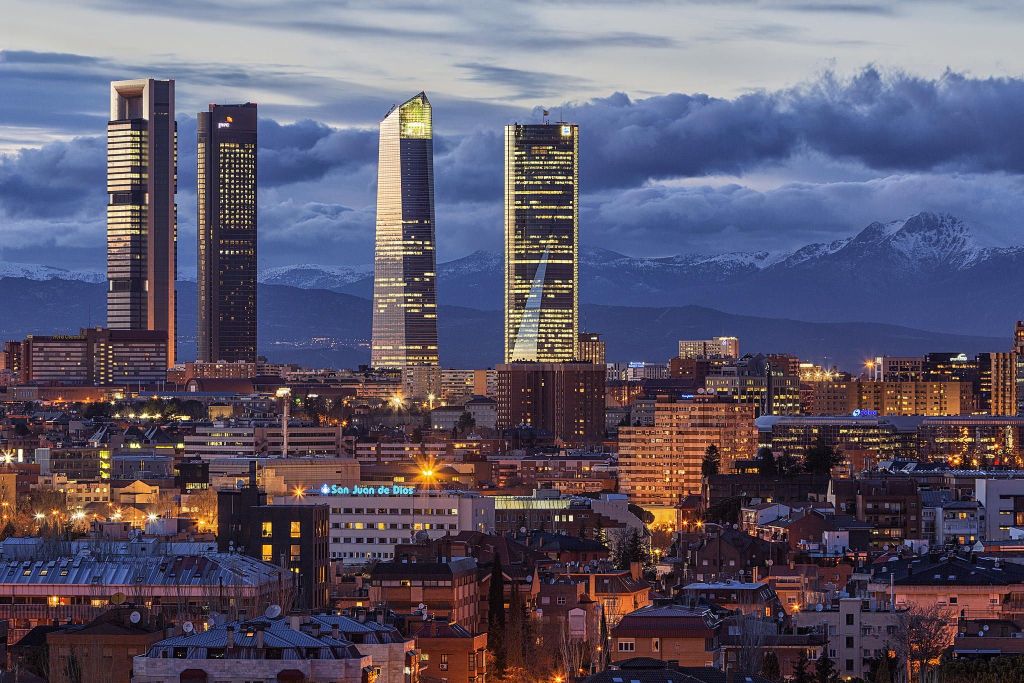
Madrid
‘The name Madrid is believed to originate from the Arabic word “Majrit,” meaning “water channel” or “stream,” which refers to the area’s abundant water sources.’
Parts of Madrid can be 750 meters above sea level. Some have made note of 666 metres for parts of Madrid and the correlation with the number of the Beast. A film incorporating Madrid as the birthplace of the Antichrist was made by Spanish film director Alex de la Iglesia called, The Day of the beast.
Notice the reference to the bull, recalling its strong link with the Philistines and still within Spain’s traditions today – refer Chapter XV The Philistines: Latino-Hispano America.
Additionally, the idea of a global capital is insightful (Article: Is America Babylon?); remember this point when we study Italy in Chapter XXV and when we identify Tyre shortly.
One source says Aram can mean a flaming fire. Aram’s capital – mirrored by Spain’s capital Madrid today – is represented by Damascus in the Bible and means, a sack of blood.
The son of Aram who principally populates Spain is Gether
– refer Goth: Chapter XV The Philistines: Latino-Hispano America.
Abarim Publications – emphasis mine:
‘Gether meaning:
‘Winepress of Vision, Circle of the Winepress’ or ‘Fear.’
From (1) the noun (gat), winepress [Spain is a wine producer and exporter], and (2) the verb (ra’a), to see or understand… and… the verb (tur), to explore or survey… From the verb (gur), to fear.
Jerome suggests that [Gether] consists of two elements. The verb (yagan) probably meant to beat or press… The second part of the name Gether, according to Jerome, may come from the verb (ra’a), meaning to see: The verb (ra’a) means to see, and by extension to understand. It may mean to become visible (of, say, an angel) or to become understandable (of, say, a theory). Noun (ro’eh) means either seer, or prophetic vision, and noun (mar’a) means either vision as means of revelation, or mirror.
The verb (garar) means to drag or drag away, mostly in a circular or repetitive* motion. The verb (gara) means to strive or agitate strife, obviously not by means of one singular assault but rather by repeated provocations and withdrawals. Noun (tigra) means contention or opposition.
Nouns (gor) and (gur) both denote lion cubs. Perhaps young male lions were named after the verb (gur) because they are expelled from the pride and are forced to roam adjacent territories. Perhaps a third identical verb (gur) means to dread, but perhaps it describes dread that is built up over time and from many little threats and suspicions. Nouns (magor) and (megora) mean fear or terror…’
Judges 10:6
New Century Version
‘Again the Israelites did what the Lord said was wrong. They worshiped Baal and Ashtoreth, the gods of Aram, Sidon, Moab, and Ammon, and the gods of the Philistines. The Israelites left the Lord and stopped serving him.’
Judges 18:7
Bible in Basic English
‘Then the five men [from Dan] went on their way and came to Laish and saw the people who were there, living without thought of danger, like the Zidonians, quiet and safe; for they had everything on earth for their needs, and they were far from the Zidonians and had no business with Aram.’
2 Samuel 8:6
English Standard Version
‘Then David put garrisons in Aram of Damascus, and the Syrians became servants to David and brought tribute. And the Lord gave victory to David wherever he went.’
Isaiah 7:8
New King James Version
‘For the head of Syria [Aram] is Damascus, And the head of Damascus is [King] Rezin…’
Isaiah 9:12
English Standard Version
‘The Syrians [Spanish] on the east and the Philistines [Central America and South America (excepting Brazil)] on the west devour Israel with open mouth. For all this his anger has not turned away, and his hand is stretched out still.’
A future prophecy (above) which will impact the United States of America.
Isaiah 22:6
Bible in Basic English
‘And Elam [Turkey] was armed with arrows, and Aram came on horseback; and the breastplate of Kir [wall or boundary with Moab] was uncovered.’
2 Kings 16:10
English Standard Version
‘When King Ahaz [of Judah] went to Damascus to meet Tiglath-pileser king of Assyria, he saw the altar that was at Damascus. And King Ahaz sent to Uriah the priest a model of the altar, and its pattern, exact in all its details.’
Jeremiah 49:23
English Standard Version
‘Concerning Damascus:
“Hamath [Nigeria*] and Arpad [Angola*] are confounded, for they have heard bad news; they melt in fear, they are troubled like the sea that cannot be quiet.’
Formerly cities peopled with descendants from Canaan which became cities in Aram’s territory. As a dual prophecy, it refers to Canaanites* in the future and not Aram.
Ezekiel 27:18-19
New Century Version
‘People of Damascus became traders for you because you have many good things and great wealth. They traded your goods for wine from Helbon, wool from Zahar, and barrels of wine from Izal. They received wrought iron, cassia, and sugar cane in payment for your good things.’
Amos 1:5
Amplified Bible
“I also will break the bar [of the gate] of Damascus, And cut off and destroy the inhabitant from the Valley of Aven (Wickedness), And the ruler who holds the scepter, from Beth-eden (Damascus); And the people of Aram [conquered by the Assyrians] will go into exile to Kir,” [Moab] Says the Lord.’
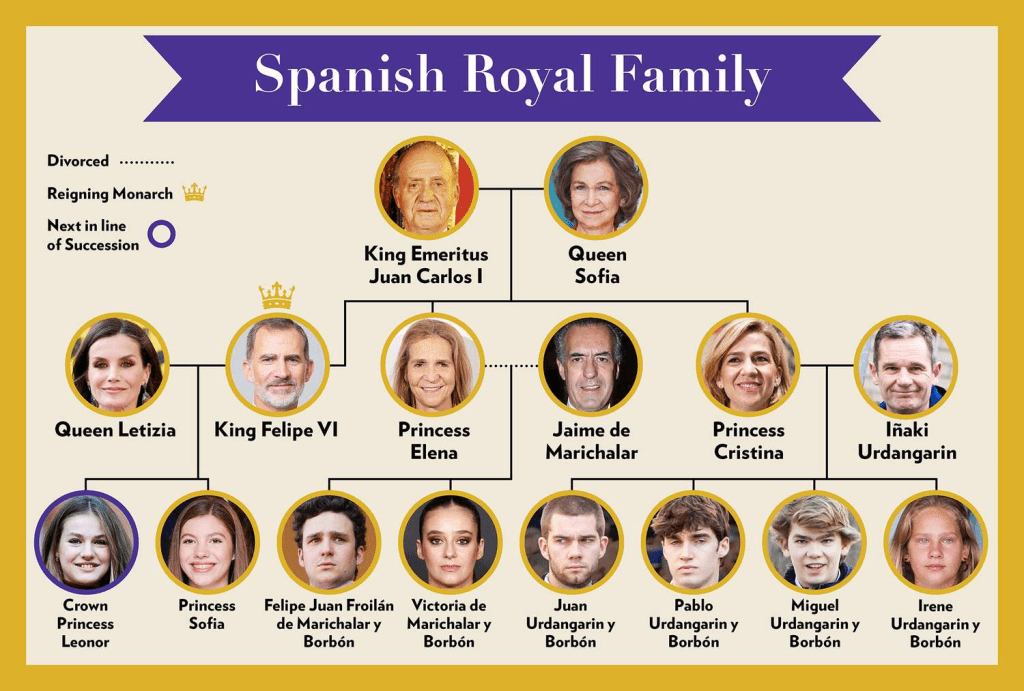
It is of note that the sceptre of royalty is attached with Damascus (of Aram); for Spain with its current king, Felipe VI – since 2014 – is one of the few nations in the world which possesses a (parliamentary) monarchy.
‘Beth-Eden’ means: The House of Eden. We will learn that Eden (not the Garden) are part of the lineage of Haran’s descendants; the brother of Abraham – refer Chapter XXVI The French & Swiss: Moab, Ammon & Haran.
The reference to ‘the gods of Aram, Baal and Ashteroth’ – their idols and altars – is the same religion of their neighbours or affiliated peoples. Today, the descendant religion of this ancient false system of worship is the Universal Church (or Catholicism) and its Protestant daughters – Article: Is America Babylon?
The Syrians and Philistines in the Bible are linked frequently, just as Spain and Spanish Central America and South America are closely linked by history, culture, religion, migration and ethnicity.
The Aramaeans have had an influential role in the affairs of Ephraim and Judah – refer Chapter XXX Judah & Benjamin – the Regal Tribes; and Chapter XXXIII Manasseh & Ephraim – the Birthright Tribes.
Biblically in the past, Damascus was representative of an economic power, just as the Spanish Empire historically was a dominant economic (and military) power principally during the sixteenth century.
Spain is located on the eastern Iberian Peninsula in south west Europe. The peninsula has witnessed considerable activity over the centuries with the influx of numerous peoples and consecutive empires. The Phoenicians arrived in the ninth century BCE or earlier, followed by the related Carthaginians, the Greeks and then the Romans With the Romans having a lasting impact on Spain’s culture, naming it Hispania.
The invading Visigoths drove out the Romans circa 500 CE. In 711 the Moors, including returning Alans and Vandals came across the Mediterranean Sea from North Africa and re-conquered most of Spain, naming it al-Andalus: al_An_s (Alans) and [V]Andal_s (Vandals). They would remain there for hundreds of years until the Europeans retook Spain as part of the Reconquista – refer Chapter XV The Philistines; Latino-Hispano America.
In 1137, the Kingdom of Aragon was formed and in 1139, the Kingdom of Portugal was established. In 1469, Isabella I of Castile and Ferdinand II of Aragon married. The infamous Spanish Inquisition began in 1478 and a year later, the Kingdom of Spain was formed when Isabella and Ferdinand were pronounced King and Queen uniting Aragon and Castile. In 1492, the Reconquista ended with the conquest of Grenada and Columbus (re)discovering the New World, while searching for India – hence the naming as the West Indies.
During the 1500s and the Age of Exploration, Spain became the most powerful country in Europe and realistically the world. Fuelled by their North and South American colonies and the great wealth of gold they acquired. A turning point occurred in the year 1588 during the battle between the world’s two greatest navies, with the British – led by Sir Francis Drake – (and the weather) defeating the Spanish Armada.

Spanish men

In 1761 Spain joined the Seven Years’ War against their old nemesis Great Britain. In 1808 the Peninsular War was fought against Napoleon’s French Empire and the Spanish American wars of independence began. By 1833 the majority of the Spanish territories in America had gained their independence. The Allies won the Peninsular War in 1814, with Spain being freed from French rule. Spain later lost the Spanish-American war of 1898 and ceded huge territory in the continental United States as well as Cuba, the Philippines, Puerto Rico, and Guam.

Spanish women

Spain became a republic in 1931 and in 1936, Spain endured a civil war. The nationalist forces won – beating the Republicans – with a General, Francisco Franco becoming leader and commencing a dictatorship lasting until 1975. From 1959 the Spanish miracle began; with a period of sustained economic growth and prosperity.
Spain had a GDP of $1.799 trillion in 2025, making it the 12th largest economy in the world.
‘The following export product groups represent the highest dollar value in Spanish global shipments during 2024.
- Vehicles: US$63.8 billion
- Mineral fuels including oil: $31.6 billion
- Machinery including computers: $30.9 billion
- Electrical machinery, equipment: $23.5 billion
- Pharmaceuticals: $19.2 billion
- Plastics, plastic articles: $14.9 billion
- Fruits, nuts: $12.1 billion
- Meat: $11.3 billion
- Vegetables: $10.2 billion
- Articles of iron or steel: $10.1 billion
Fruits and nuts represent the fastest grower among the top 10 export categories, up by 14.2% since 2023. In second place for improving export sales was mineral fuels including oil via a 12.9% advance. Spain’s shipments of vegetables posted the third-fastest gain in value up by 9.5%. The leading decliner among Spain’s top 10 export categories was pharmaceuticals which fell -12% year over year.’
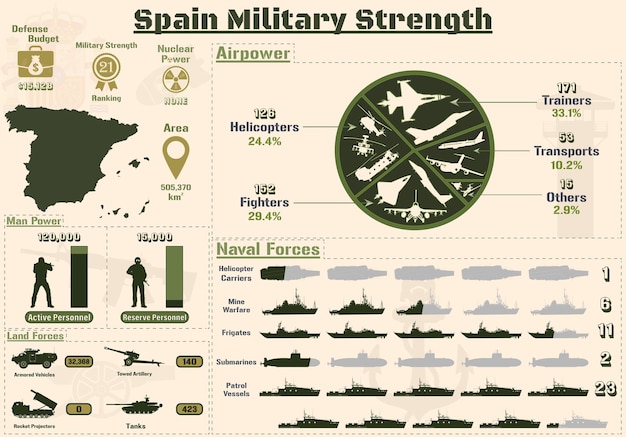
Spain has approximately 121,802 active military personnel and ranks among the smaller European armies, with a global military strength of seventeenth in the world. Spain is a member of NATO and had a defence budget of €33.123 billion for 2025 (2% of its GDP).
The population of Spain is 47,876,972 people.
Abarim Publications – emphasis mine:
‘Hul meaning:
‘Circle, Writhing.’ From the verb (hul), to writhe.
The name Hul comes from the root group (hul I & II): Verb (hul I) denotes a whirling in circular motions.* It comes with quite a cluster of derivatives, most notably the noun (hol), meaning sand; the noun (hil), meaning pain so bad that it makes one writhe (specifically childbirth*)… Verb (hul II) means to be strong, and the important derived noun (hayil) means might. A by-form of the previous: the verb (halam I) means to be strong.’
Hul’s meaning of strong is similar with that of Uz – the first born son – of strength and Hul’s circular motion is similar to Gether and its meaning, circle. Both Gether and Hul writhed in motion and gave ‘birth’* to nations.
Second born son Hul likely identifies with Portugal for it gave birth to the nation Brazil.
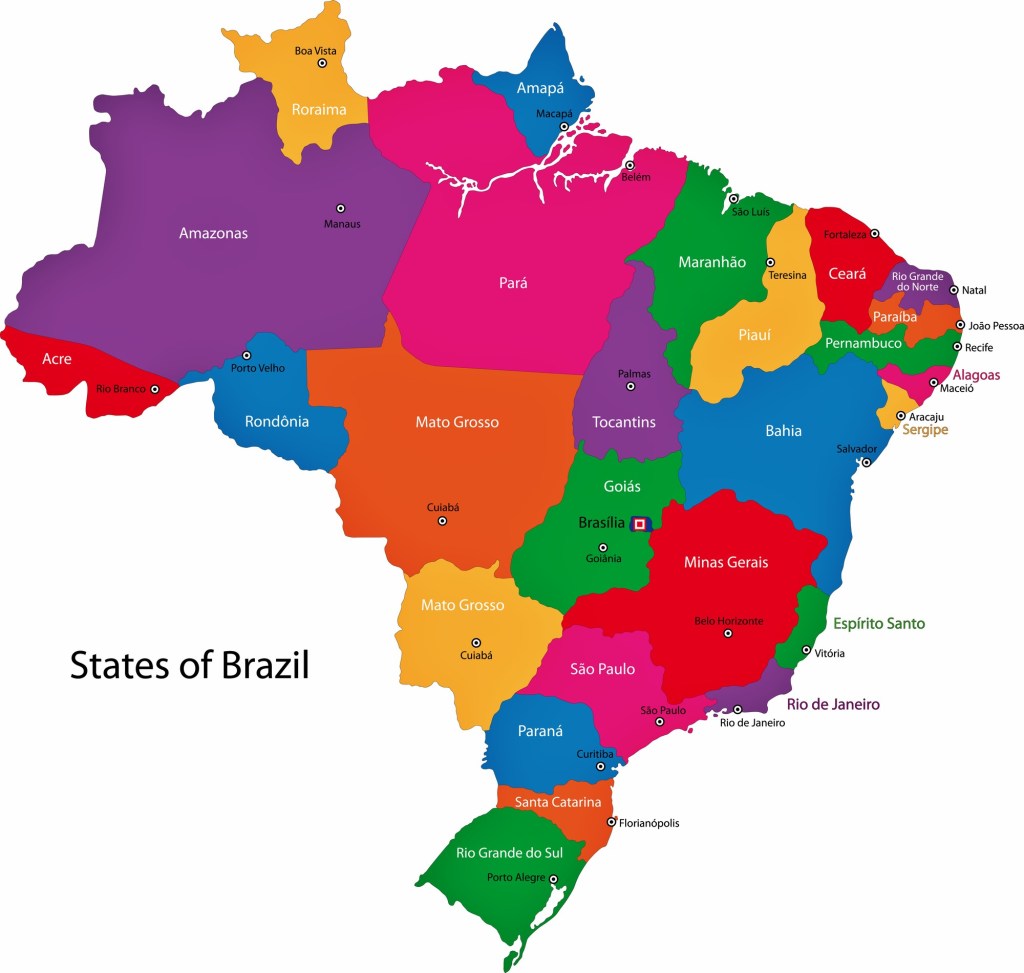
Brazil is specifically addressed (prophetically) as Tyre in the Bible, while Damascus refers to Spain – not to the city of Damascus in modern day Syria (Chapter XIV Mizra: North Africa & Arabia).
The youngest of Aram’s four sons Mash (or Meshech), may in like manner with the third born son Gether, be scattered far afield, ranging from Argentina to Mexico.
If so, Aram shares with Meshech from Japheth the trait of being part of or compressed with, a larger body of people. As Meshech of China is mixed with Tubal and Magog, Mash is merged with Gether; as well as with the descendants from Tiras (Japheth), Mizra (Ham) and Canaan throughout the Americas – Chapter X China: Magog, Tubal & Meshech; and Chapter XV The Philistines; Latino-Hispano America.
While Brazil has significant African and American Indian minorities added with the majority of Portuguese inhabitants; a large number of Italians also emigrated to Brazil, corresponding with the eldest brother Uz.
Thus as the two youngest sons, Gether and Mash are linked in possibly Spain and particularly in Spanish speaking America; the two eldest sons, Uz and Hul are linked in being
a. non-Spanish;
b. deriving from Italy and Portugal respectively; and
c. dwelling principally in Brazil.
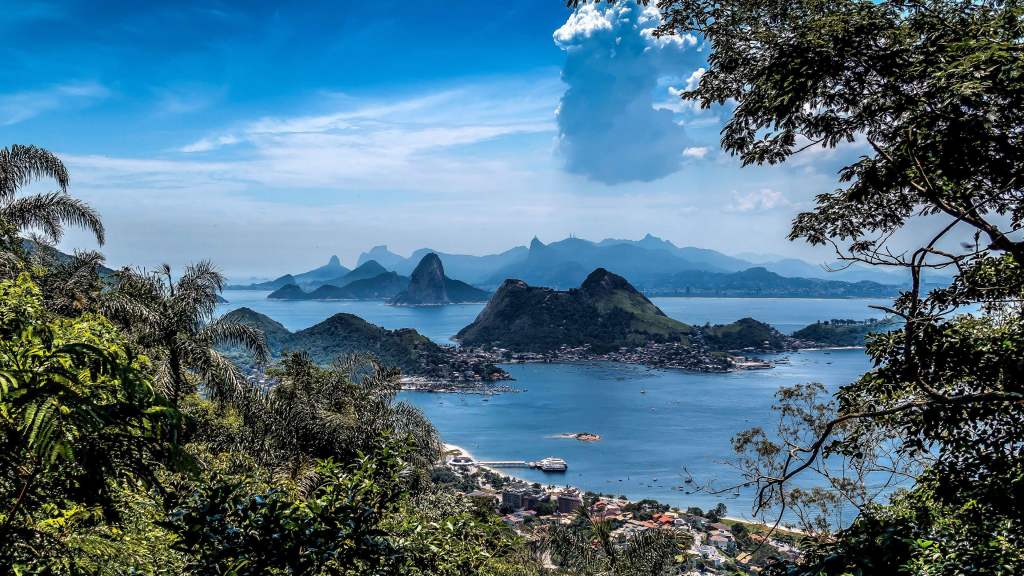
Brazil
Abarim Publications – emphasis mine:
‘Mash meaning:
‘Departed, Drawn Out’ From the verb (mush), to depart, or (masha), to draw out, or (mashak), to draw or drag.’
The definition of mash is relevant when viewed in the context of the formation of Latin America.
Abarim:
‘In Genesis 10:23, Mash is listed as a son of Aram, who is a son of Shem… In 1 Chronicles 1:17 the same genealogy occurs, although the various generations are now all listed as sons of Shem. And Mash is called (Meshech). Another man named Meshech is mentioned as a son of Japheth, who is another son of Noah (Genesis 10:2). He is mentioned about half a dozen times in the Bible… and it’s clear that these are the names of nations rather than individuals…
The name (Mash) does not occur as regular word in Hebrew, but it may be viewed as a contraction of the word (mush), meaning depart or remove (or rather: could be viewed as an expansion of an original): The verb (mashash) means to feel; to sense or search for tactilely. This verb has no derivatives but does show up in two alternate forms, namely (mush) and (mish).
An assumed whole other verb (mush) or (mish) means to depart or remove… Perhaps these two verbs relate in the sweeping or scanning motion* that usually accompanies tactile reconnaissance. This same motion could be applied to describe [as] being footloose or untethered. Verb (nasa’) describes an upward motion, generally of something that is being pulled up and out so as to remove it.
Noun (nasi’) describes a lifted-up one, i.e. (1) a captain or chief, or (2) a mist or vapor. Noun (si’) means loftiness or pride [note meaning of Aram]. Noun (se’et) means dignity, swelling or outburst, a rising-up. This noun is spelled the same as (she’t), ruin or devastation, from the verb (sha’a), to be noisy or ruinous.’
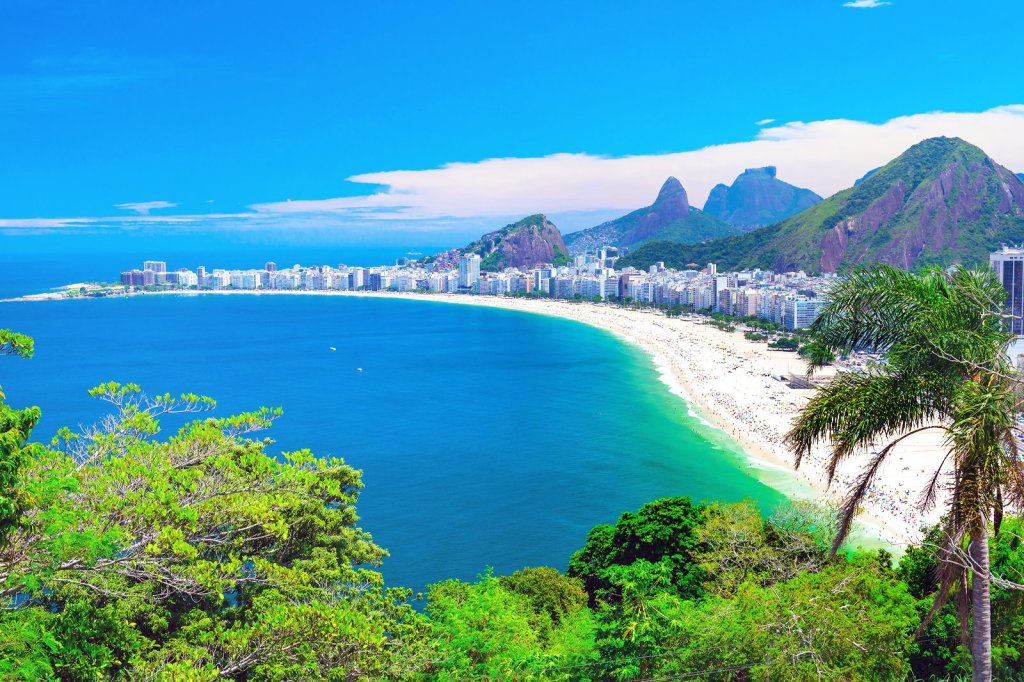
Brazil
Abarim Publications – emphasis mine:
‘Tyre meaning:
‘Rock’ From the noun (sur), rock.
Tyre is the Greek/Latin name for the famous Phoenician city often mentioned together with Sidon (Joshua 10:29). It still exists today, being situated south on the coast of Lebanon, just north of Israel. Famous Biblical Tyrians are Hiram, the builder of the temple of Solomon, and Jezebel the wife of king Ahab. Another famous Phoenician was Hannibal of Carthage, which was a Tyrian colony.
The name Tyre could be considered a Hebrew equivalent of the Greek name Peter, and when Jesus said that upon this “rock” he would build his church (Matthew 16:18), his original audience doubtlessly remembered how Solomon built the temple of YHWH on the rock of Phoenician knowledge and resources (1 Kings 5:1-12).
In New Testament times the city of Tyre was still a booming town (spelled in Greek as, Turos). Jesus referred to it (Matthew 11:21), preached to visitors from it (Luke 6:17) and retreated to its region (Matthew 15:21)… Paul spent seven days there while the ship he was travelling with was unloading…
The Semetic, and thus original, name for Tyre is pronounced Zor or Zur… scholars assume that the Hebrew name for Tyre, equals the regular word (sur) meaning rock (Jeremiah 21:13, Job 14:18). In Deuteronomy 32:31 the author compares the gods of the nations to the living God and says, “Indeed, their rock is not like our Rock”:
Verb (sur II) means to confine, secure or besiege. Noun (masor) means siege and (mesura) means stronghold. Verb (sur III) means to be an adversary. Verb (sur IV) means to form or fashion. Noun (sura) means form and noun (sir) means image. Verb (sur V)… probably means to be sharp.
The important noun (sur) means rock, and is equivalent to the Greek noun (petra), from which comes the name Peter. Verb (sarar I) means to bind… Adjective (sar) means narrow. Nouns (sar) and (sara) mean distress and yield denominative verb (sara), meaning to suffer^ distress. Verb (sarar II) means to show hostility and relates to verb (sur III). Noun (sara) means vexer or rival-wife. Verb (srh) probably describes the bleeding of an odoriferous tree. Noun (sari) denotes a kind of costly balsam.’

Keep in mind these definitions for Tyre: rock, narrow, sharp, confine, bind and secure.
In the future, Tyre will be become a powerful and problematic political entity. Especially, when allied with the Philistines – the Spanish speaking descended nations in Central America and South America, particularly Mexico – against the United States of America – Chapter XV The Philistines: Latino-Hispano America; and Chapter XXXIII Manasseh & Ephraim – the Birthright Tribes.
Joshua 19:29
English Standard Version
‘Then the boundary turns to Ramah, reaching to the fortified city of Tyre. Then the boundary turns to Hosah, and it ends at the sea…‘
1 Kings 7:14
English Standard Version
‘He was the son of a widow of the tribe of Naphtali, and his father was a man of Tyre, a worker in bronze. And he was full of wisdom, understanding, and skill for making any work in bronze. He came to King Solomon and did all his work.’
2 Chronicles 2:14
English Standard Version
‘… the son of a woman of the daughters of Dan [elder brother of Naphtali], and his father was a man of Tyre.
He is trained to work in gold, silver, bronze, iron, stone, and wood, and in purple, blue, and crimson fabrics and fine linen, and to do all sorts of engraving and execute any design that may be assigned him, with your craftsmen, the craftsmen of my lord, David your father’ – refer article: The Ark of God.
Psalm 87:4
New English Translation
I mention Rahab [Egypt] and Babylon to my followers. Here are Philistia [Central America and South America] and Tyre [Brazil], along with Ethiopia [Cush (India)]. It is said of them, “This one was born there.”
Isaiah 23:1, 8
New King James Version
‘The burden against Tyre. Wail, you ships of Tarshish! [Japan] For [Tyre] is laid waste, So that there is no house, no harbor; From the land of [Kittim (Indonesia)] it is revealed to them. Who has taken this counsel against Tyre, the crowning city, Whose merchants are princes, Whose traders are the honorable of the earth?’
Isaiah 23:15-17
Revised Standard Version
15 ‘In that day Tyre will be forgotten for seventy years, like the days of one king. At the end of seventy years, it will happen to Tyre as in the song of the harlot: 16 “Take a harp, go about the city, O forgotten harlot! Make sweet melody, sing many songs, that you may be remembered.”
17 At the end of seventy years, the Lord will visit Tyre, and she will return to her hire, and will play the harlot with all the kingdoms of the world upon the face of the earth’ – Chapter XXV Italy: Nahor & the Chaldeans; and articles: Asherah; and Is America Babylon?
Verse seventeen coincidentally yet importantly, links the descendants of Hul – (from Aram) in Brazil – with those of Uz – (from Aram) in Italy. Both Tyre and Babylon are referred to as harlots and this is in reference to their shared allegiance to the Universal Church and a united power of influence.
The prophecy regarding Tyre’s demise in Ezekiel chapter twenty-six is not a failed prophecy – as believed and taught by some – if one accepts what verses four and fourteen are actually saying. Tyre was to be destroyed and not to be rebuilt to its former glory. Not that it would cease to exist completely.
Originally, Tyre comprised an island fortress and the mainland. The prophecy was that the mainland city would be destroyed and it was by Nebuchadnezzar II – verses six to eight.
What most fail to recognise is that verses three and five state more than one nation would besiege Tyre. It was Alexander the Great who built a causeway between the mainland and the rock fortress and subsequently conquered the island – and it became ‘bare rock’ (verses four and fourteen). Thus fulfilling the prophecy as outlined in the first half of the chapter – verses one to fourteen.
Verses five and fourteen say it would be reduced to a fishing village of which it was for centuries. For example, in ‘1894 the population of Tyre was reported to be about [only] 200 people living in an obscure fishing village.’
Yes, in ‘more recent times, the country of Lebanon has been rebuilding Tyre and rebranding it as a tourist attraction.’ Even so, it is not a mighty city-state on the world stage replete with economic power, large navy and formidable walled defence.
The Phoenician descendants of Tyre now live predominantly in Brazil and so it is pivotal to understand that verses fifteen to twenty-one are a future prophecy regarding the complete and utter destruction of modern day Tyre.
Jeremiah 47:4
BBE
‘Because of the day which is coming with destruction on all the Philistines [Central and South America], cutting off from Tyre [Brazil] and Zidon [South Africa] the last of their helpers: for the Lord will send destruction on the Philistines, the rest of the sea-land of Caphtor.
Joel 3:4
English Standard Version
“What are you to me, O Tyre and Sidon, and all the regions of Philistia? Are you paying me back for something? If you are paying me back, I will return your payment on your own head swiftly and speedily.”
Zechariah 9:3
BBE
‘And Tyre made for herself a strong place, and got together silver like dust and the best gold like the earth of the streets.’
Acts 21:3
English Standard Version
‘When we had come in sight of Cyprus [Kittim (now Indonesia)], leaving it on the left [east] we sailed to Syria [Aram] and landed at Tyre [now Brazil]…’
Brazil was born in the modern age in the year 1500, when Portuguese explorer Pedro Alvarez Cabral, with thirteen ships and twelve hundred men discovered Brazil; thinking it was a large island, while on route to India – subsequently claiming the land for Portugal.
In 1532, Sao Vicente was established as the first permanent settlement in Brazil by Portuguese explorer Martim Afonso de Sousa. The primary export was sugar.
In 1565 the city of Rio de Janeiro was founded (below).

The Dutch established a colony called New Holland on the northwest coast of Brazil in 1640; while Portugal declared its independence from Spain. The following year, Portugal officially took over the territory of New Holland from the Dutch.
For the significance of this interaction between the Portuguese and the Dutch, refer Chapter XXVII Abraham & Keturah – Benelux & Scandinavia.
In 1727, the first coffee bush was planted in Brazil by Francisco de Melo Palheta. Brazil ultimately became the world’s largest producer of coffee.
Slaves were imported from the Sub-Sahara Western Africa slave trade – as well as the Portuguese colonies of Angola and Mozambique in East Africa – to work the fields (Chapter XII Canaan & Africa).
Nearly three million slaves were brought from Africa during the three centuries lasting from 1500 to 1800. The Portuguese during this time had defeated the French to re-take Rio de Janeiro; as well as taking control of several Dutch and British outposts. In 1763, the capital city was moved from Salvador to Rio de Janeiro.
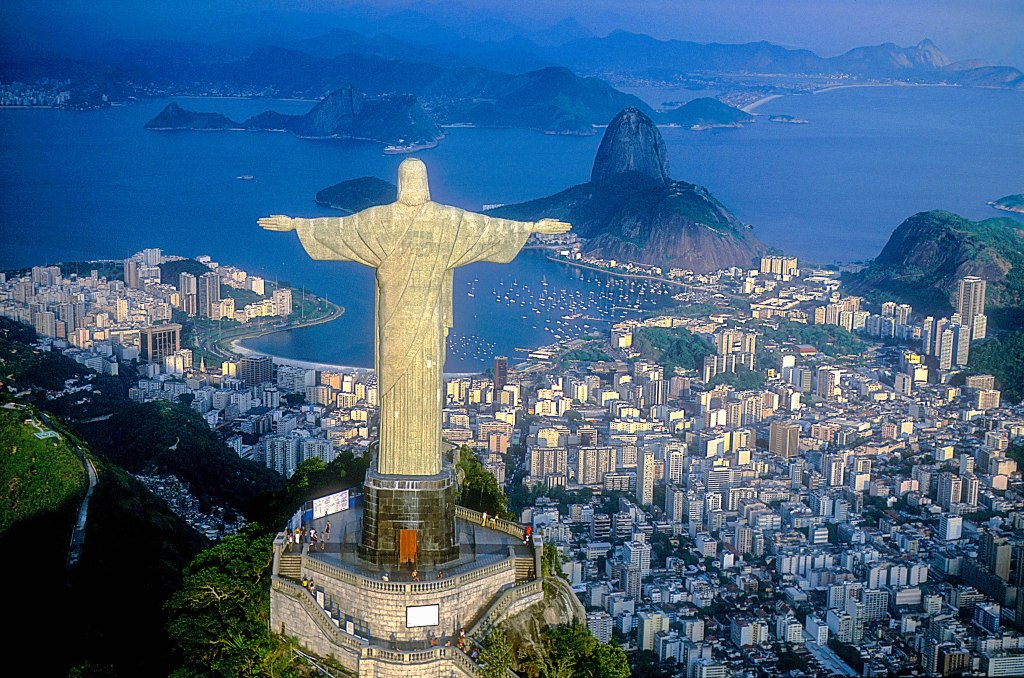
Rio de Janeiro ceased being the capital when it was replaced by Brasilia in 1960.
Recall some of the definitions for Tyre: rock, narrow, sharp, confine, bind and secure.
While Brazil equates to Tyre, it is no coincidence that Rio should have the rocky landscape that it does or that it is the third largest port in Brazil. The (rather ugly), yet unique and imposing statue of (a false) Christ the Redeemer, stands atop the city. A quiet and patient witness to the destiny of political and spiritual harlotry that awaits the city and the country – Isaiah 23:1-17.
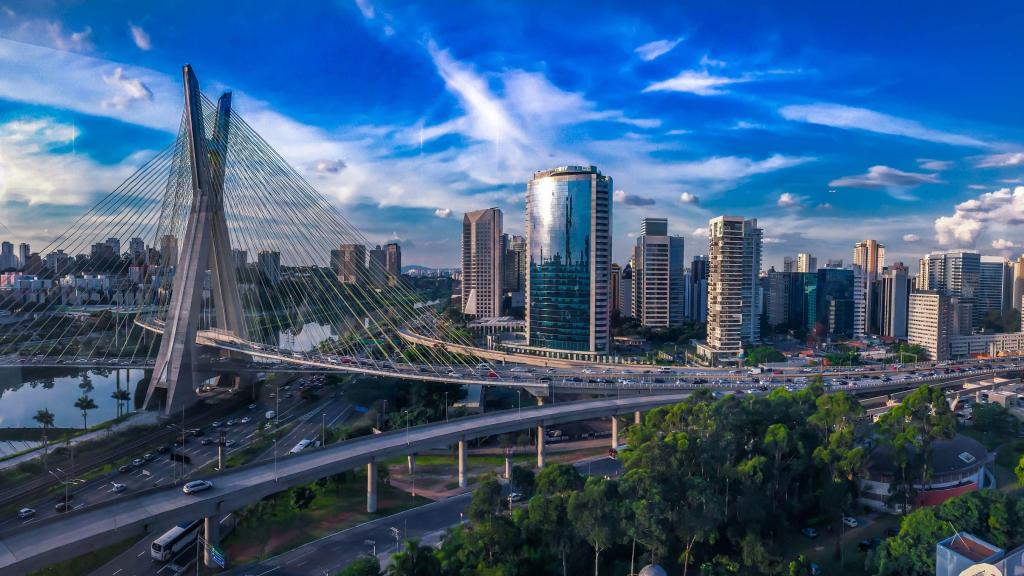
Encyclopaedia:
‘São Paulo [above and below] is the capital city of the state of São Paulo, as well as the most populous city in Brazil [with 11,895,578 residents and 23,169,000 people in the metropolitan area], South America, the Americas, and in the Western and Southern Hemispheres.
The city exerts international influence in commerce, finance, culture, gastronomy, arts, fashion, technology, entertainment and media, having been listed by… the Globalization and World Cities Research Network as an alpha global city. It is the largest urban area by population outside Asia and the most populous Portuguese-speaking city in the world.’
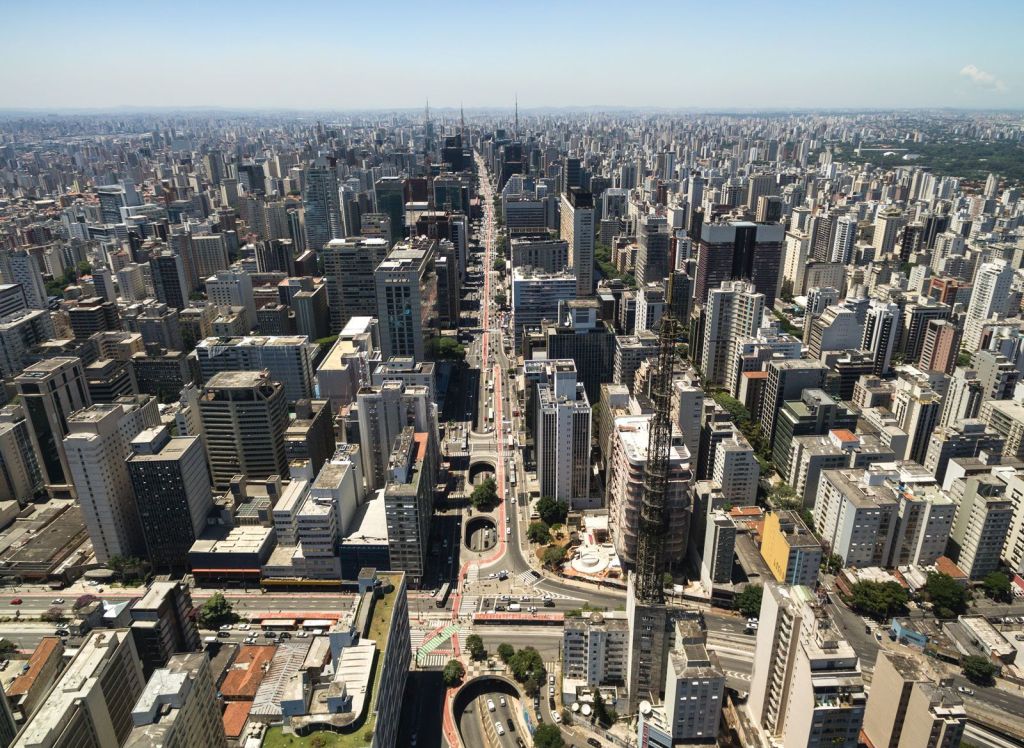
In 1807, the Portuguese royal family escaped from Napoleon and fled to Brazil. In 1815, the former colony was elevated to a kingdom. Although the king, Dom Joao VI, returned to Portugal in 1821, his son Pedro remained in Brazil; declaring Brazil’s independence in 1822, after annexing Uruguay as a province in 1821. Pedro I became emperor of the newly created Empire of Brazil.
In 1824, the first constitution of Brazil was adopted and the fledgling country was recognised by the United States. In 1888, slavery was abolished by the Golden Law, with four million slaves being set free. In 1889, the short-lived monarchy was overthrown by a military coup led by Deodoro da Fonseca and replaced with a federal republic. Since then, the country has been ruled by elected presidents as well as enduring^ military coups and martial rule.

Brazilian men

‘The following export product groups categorize the highest dollar value in Brazilian global shipments during 2024.
- Mineral fuels including oil: US$57.2 billion
- Oil seeds: $43.8 billion
- Ores, slag, ash: $35 billion
- Meat: $24.5 billion
- Sugar, sugar confectionery: $18.8 billion
- Machinery including computers: $13 billion
- Iron, steel: $11.92 billion
- Vehicles : $11.89 billion
- Coffee, tea, spices: $11.85 billion
- Food industry waste, animal fodder: $10.7 billion
Coffee, tea and spices was the fastest grower among the top 10 export categories, up by 52.3% from 2022 to 2023. In second place for improving export sales was sugar including sugar confectionery which was up by 17.9%. Brazil’s shipments of meat posted the third-fastest gain in value, rising 11.6% year over year. The leading decliner among Brazil’s top 10 export categories was oil seeds, pulled down by a -18.9% setback.’
Brazil has the tenth largest economy in the world and is the dominant economic power in South America, with a GDP of $2.125 trillion in 2025.
Brazil’s very ‘diversified economy runs the gamut from heavy industries, such as aircraft and automotive production, to mineral and energy resource extraction. It also has a large agricultural sector that makes it a major exporter of coffee and soy beans.’
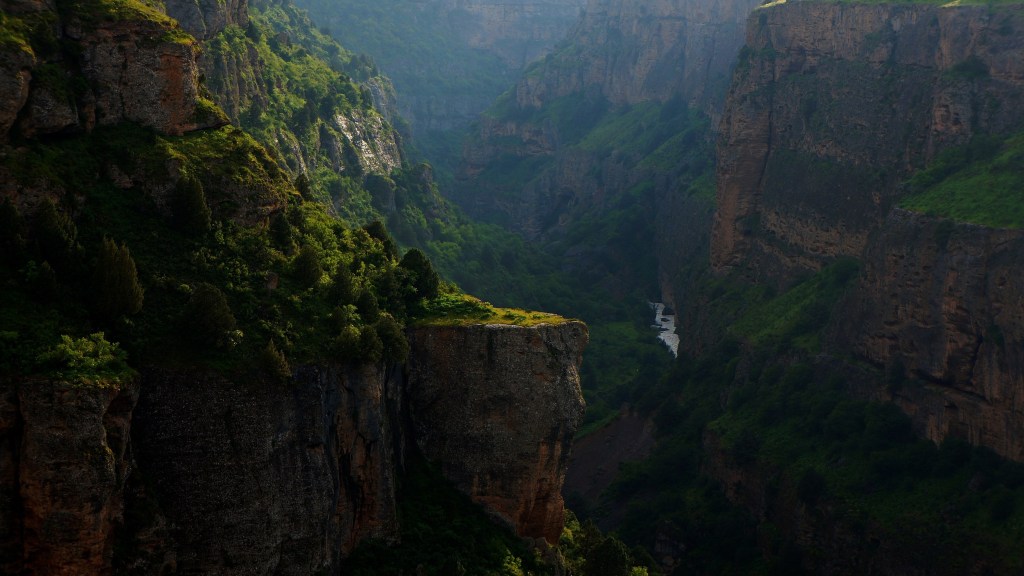
Brazil has steadily grown in importance as a prime breadbasket of the world; exporting five of the world’s major crops.
The country has two key agricultural regions; one in the Southern region which is fertile from higher rainfall and also a drier North Eastern region. The former is responsible for a big percentage of the nation’s grains, oil seeds and export crops while the latter produces its cocoa and tropical fruits.
Important agricultural products in the country include wheat, rice, sugarcane, corn, citrus and beef. Cattle farming in Brazil is massive with millions of tonnes produced yearly, so much so that deforestation of the Amazon Rain forest has become a critical issue. Nether-the-less, Brazil remains the world’s leading meat exporter.
Brazil is also the leading sugarcane producer in the world with a total yield of about six hundred million tonnes every year. Amongst the world’s top soybean producers, Brazil is ranked second. The country also produces vast amounts of corn and is the world’s third largest exporter.
Brazil ranks highly at number six of the top ten countries with the most natural resources, one place behind Russia.
‘Brazil possesses commodities worth $21.8 trillion, including gold, iron, oil and uranium. The mining industry focuses on bauxite, copper, gold, iron, and tin.’ Brazil impressively, contains the ‘largest gold and uranium deposits in the world and is the second-largest oil producer.’
Timber remains the country’s most valuable natural resource, which accounts for over 12.3% of the world’s total timber supplies. This has echoes of the Cedars of Lebanon, so important to the Phoenicians of Tyre and the Kingdom of Israel for ship building and subsequent mercantile and commercial trade routes throughout the Mediterranean and well beyond the Pillars of Hercules – the Straits of Gibraltar.

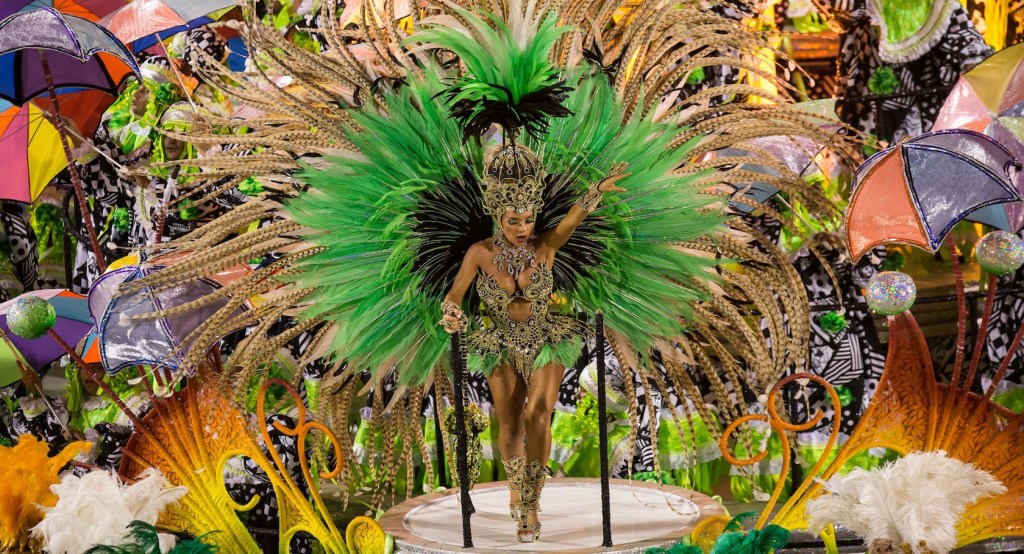
‘The Carnival of Brazil [above and below] is an annual festival held the Friday afternoon before Ash Wednesday at noon, which marks the beginning of Lent, the forty-day period before Easter. During Lent, Roman Catholics and some other Christians traditionally abstain from the consumption of meat and poultry, hence the term “carnival”, from carnelevare, “to remove meat.” Carnival is the most popular holiday in Brazil and has become an event of huge proportions. Except for industrial production, retail establishments such as malls, and carnival-related businesses, the country unifies completely for almost a week and festivities are intense, day and night, mainly in coastal cities.’
There are two distinct identities for Aram – apart from Uz which is incorporated within Italy – the Aram-Damascus component comprising Gether (Mash) in Spain and Hispanic America; and the descendants of Hul constituting Portugal and Brazil.
Aram-Damascus-Gether historically, were arch rivals of the sons of Jacob and up until the modern age remained so.
Tyre (Hul) had an economic-trading relationship with the Israelite Kingdom, which has been mirrored in recent history.
We will study Aram initially and then concentrate on Tyre.
The further we go back into pre-history these two identities are blurred, then as we enter the time of Abraham after 2000 BCE, the two begin to become clearer as separate entities.
One of the most distinctive identifying points of interest is language. Aramaean was one of the most prominent languages amongst the descendants of Shem (particularly during the time of Christ) and today, the descendant romance languages are equally influential and widespread.

Brazilian women

2 Kings 18:26
English Standard Version
‘Then Eliakim the son of Hilkiah, and Shebnah, and Joah, said to the Rabshakeh, “Please speak to your servants in Aramaic, for we understand it. Do not speak to us in the language of Judah [Hebrew] within the hearing of the people who are on the wall.”
The top ten spoken languages in the world today include three romance languages of which Spanish and Portuguese are included.
A numberof the top ten such as China, India, the Arab nations, Russia and Indonesia all have sizeable populations, or influence on near neighbours.
Whereas, England, France and especially Spain and Portugal exhibit smaller populations. Extensive colonies contributed to the volume of people who speak their languages. The ancient world was no different. The ancestors of the Spaniards and Portuguese travelled the breadth of the world via mercantile trade and in so doing, spread the Aramaic and Phoenician languages.
World Atlas:
1. English – 1.13 Billion Speakers
2. Mandarin – 1.12 Billion Speakers (China)
3. Hindi – 615 Million Speakers (India)
4. Spanish – 534 Million Speakers
5. French – 280 Million Speakers
6. Standard Arabic – 274 Million Speakers
7. Bengali – 265 Million Speakers (Bangladesh)
8. Russian – 258 Million Speakers
9. Portuguese – 234 Million Speakers
10. Indonesian – 199 Million Speakers
Aramaeans were distinctively defined by their use of either the West Semitic Old Aramaic Language between 1100 BCE and 200 CE, written using the Phoenician alphabet and also a modified Aramaic alphabet. As early as 900 BCE, Aramaic competed with the East Semitic Akkadian language and script of Assyria and Babylonia; spreading throughout the Middle East. By 800 BCE, Aramaic had become the lingua franca of the Neo Assyrian Empire and also ‘during the Achaemenid period as Imperial Aramaic. Although marginalised by Greek in the Hellenistic period, Aramaic in its varying dialects remained unchallenged as the common language of all Semitic peoples of the region until the Arab Islamic conquest of Mesopotamia in the [seventh century CE], when it [was] gradually superseded by Arabic.’
The Phoenician language was a member of the Canaanite branch of the Semitic languages. Its descendant language spoken in the Carthaginian Empire was Punic. Their evolved language descendant re-surfaced as Latin, from which we derive the Italian and French languages.
While it is Spanish, which is the predominant heir to ancient Aramaic; it is Portuguese which derives from a direct line of descent from the original Phoenician – notice the letter P in Phoenician, Punic and Portuguese.
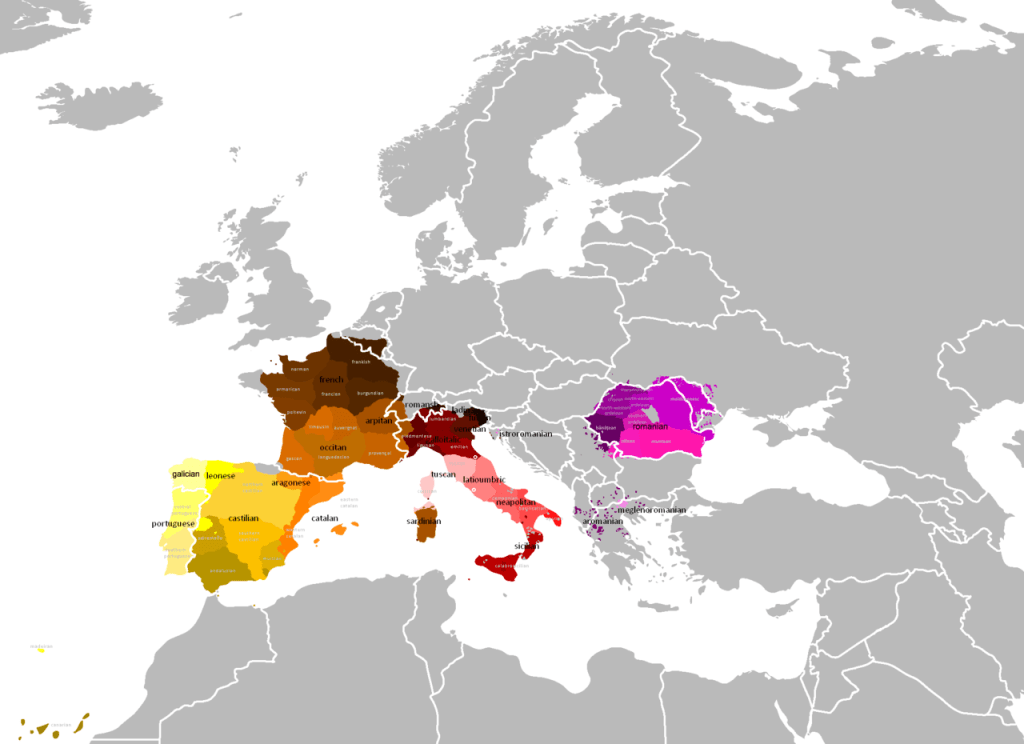
Romance Languages of Europe
Who were the Arameans? Is There a Connection Between the Amorites and the Arameans? Daniel Bodi – emphasis mine:
‘In Sumero-Akkadian texts from the period from 2400 to 1600 BCE, Sumerian MAR.TU, Akkadian amurru occur as a geographical term… In OB times, the Amurru region embraced the great Syrian desert, the Orontes River valley, and the Amanus Mountains. In later Assyrian texts, Amurru was an established name for Syria-Palestine.
While in the 24th century BCE, Eblaite sources refer to a “king (LUGAL) of Mar-tu,”… the specific reason why the Amorites began migrating to the south-east of Mesopotamia in the course of the 21st century BCE still eludes us. The period stretching from 2000 to 1595 BCE is sometimes called “The Amorite era,” with reference to the political influence assumed by the Amorites and their epigones. During the 17th century BCE the Amorite power began to decline with the final demise experienced under the attacks of the Hittite king Mursili I, around 1595.
There is no surviving Babylonian account of the conquest of Babylon by the Hittites. After this date the Amorite kingdoms are replaced by the establishment of new entities directed by new ethnic groups like the Hittites, the Kassites and the Hurrites. In Late Bronze Age, the kingdom of Mittani… also known as Ḫanigalbat and as Nahrin “Rivers” occupied northern Syria, between the Tigris and the Euphrates. Geographically, the Amorites and the Aramean clans originally occupied the same region.
Another valuable corpus of texts useful in the reconstruction of the geographic and linguistic continuity between the Amorites and the Arameans is provided by the so-called Suhu texts, from the MB period. Just as with the term Amorite, the term Aram can stand for a toponym [a name derived from the name of a place], a geographic region in Syria, a conglomerate of tribes, and a language.
The earliest attestation of the term Aramu appears as a toponym. The Ebla texts dating from the end of the 3rd millennium BCE mention a toponym a-ra-mu. The Aramean invasions of Mesopotamia from the west began at the latest during the late 2nd millennium BCE and are attested from the time of Tiglath-pileser I (1114-1076 BCE) of Assyria and Marduk-nadin-ahhe (1099-1082 BCE) of Babylonia.
Ahlamu, forerunners of the Arameans, had been present in Mesopotamia in the Kassite period… The Amorites spoke a language belonging to the Northwest Semitic ones to which Phoenician, Aramaic… represent some chronologically more recent offshoots.
There seems to exist a linguistic continuity between the Amorite and the Aramaic languages.
R. Zadok has suggested that certain eastern members of the Amorite dialect cluster, which were spoken in the Djezireh and on the fringe of the Syrian desert, were the ancestors of the Aramaic language.
In the Hebrew Bible there are two examples where two daughters are offered to the same man. First among the patriarchal stories, Laban offered Jacob two daughters for wives, Leah and Rachel, and later Saul offered David likewise his two daughters, first Merab then Michal. The coarse Jacob-Laban story in Genesis 29:26-28, narrates how the former obtained the two sisters Leah and Rachel for wives seems to serve the purpose of showing how the nemesis or divine retribution is at work.
Jacob cheated his older brother Esau, now he gets cheated in turn by waking up in the morning finding himself in bed with the older daughter Leah while he desired Rachel, the younger one. This patriarchal tradition of incestuous marriages chronologically precedes the strict prohibition of a marriage to two sisters at the same time found in Leviticus 18:18.
The ancestors of the Hebrew tribes issued from Laban’s sister Rebekah (with Isaac) and his two daughters Leah and Rachel (with Jacob, Rebekah’s son) lived in paddan-‘aram, an expression to be connected with Akkadian paddanu, padanu “the way, the path,” meaning in this case “the way of the Arameans” (Genesis 25:20 “Rebekah [Isaac’s wife], was the daughter of Bethuel the Aramean of Paddan-aram, the sister of Laban the Aramean”; After marrying Rachel and Leah the daughters of Laban the Aramean, Jacob returned to Canaan: Genesis 48:7 [Jacob says] “for when I came from Paddan, Rachel to my sorrow died in the land of Canaan”).
The incestuous practice of giving two daughters to the same man is attested among the Amorites as the Mari documents show. As R. Zadok suggests, the nucleus of some of the chronologically later Aramean tribes seems to have evolved from the previous conglomerate of the Amorite ones. They both occupied Northern Mesopotamia and thrived in the same geographical area.
Moreover, scholars are becoming increasingly aware of the similarities in the marriage transactions between the Amorite semi-nomads and the ancient Hebrews. J. Sasson compares the way Isaac obtained Rebekah, Laban’s sister from the “city of Nahor” in Haran, as a spouse as described in Genesis 24:1-27, with the way the Sim’alite Amorite warlord Zimri-Lim negotiated his marriage with Sibtum, the daughter of Yarim-Lim from Ḫalab (Aleppo), by a proxy as described in several cuneiform letters from Mari ARMT XXVI 10; 11; 13. Both marriage transactions share numerous specific details which are best explained as being due to the conservatism of marriage customs in Northern Syria.
They tend to confirm the continuity between the Amorite tribes and the Aramean ones…
Rebekah’s and Sibtu’s betrothals share the following elements:
long-distance negotiations by wise servants or ambassadors, rich gifts to the bride and the family of the bride, the veiling of the bride, her own acceptance of her new status, the attachment of maids to her person, the merging of two families, the anxiety of the bride’s family, the long trek back, and the preparation of a chamber for the new mistress of the house. In the case of Jacob being offered two sisters Leah and Rachel as wives, it reflects Laban the Aramean’s indelicate attempt to manipulate and control him.
As a result of intensive scholarly research on ancient Amorite traditions, history and customs, it has become increasingly evident that there exists a connection and a geographical, historical and linguistic continuity between the OB Amorite nomadic tribes and the MB Aramean ones.
The geographic area where the ancient Amorites settled corresponds to the area occupied by the Aramean tribes at the end of the second millennium BCE.’
The author’s expose of Jacob and his wives is included as we will study the family he married into, in Chapter XXV Italy: Nahor & the Chaldeans.
It is well to remember that the Paddan-Aram of Nahor’s family while linked, are distinct from the Aramaeans from Aram. Abraham’s brother Nahor is represented by the peoples known as the Mitanni, as we will uncover. The association between the Amorites of this period and the later Aramaeans is supported in the fact that these Amorites are described in historical sources as including people with blond hair. Therefore, they cannot be the original black peoples descended from Canaan; nor is it likely that they were all Nephilim of similar name – refer Chapter XII Canaan & Africa; and article: Nephilim & Elioud Giants II.
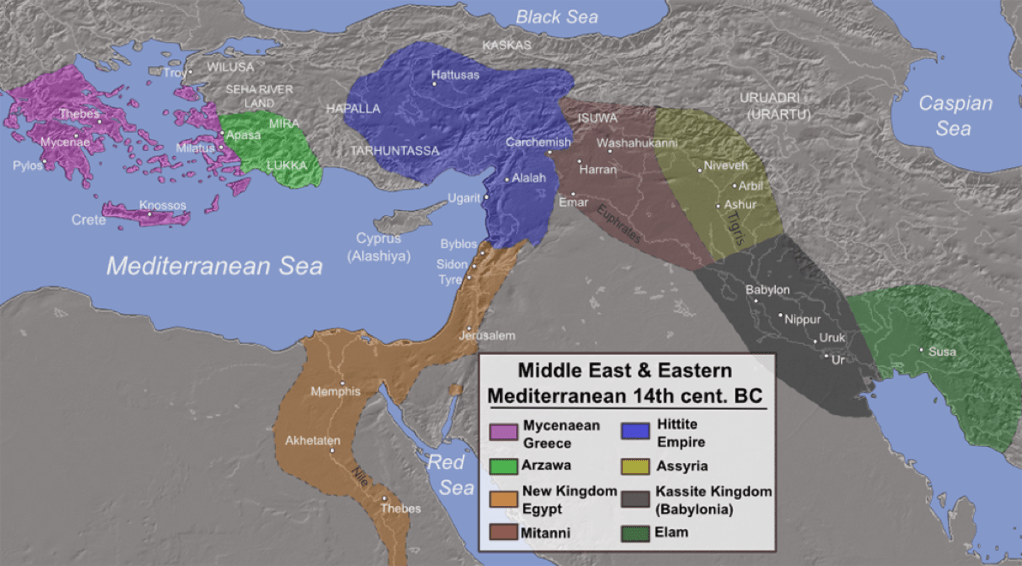
The Mitanni empire was composed of a variety of smaller kingdoms spread throughout the region between Anatolia and Babylon – modern Turkey and Iraq. The Mitanni took control of the Tigris and Euphrates basin after the fall of Amorite (Aramaean) Babylon to the Hittite King Mursili I, circa 1595 BCE and the Kassites in turn ruled the fallen Babylon. The Mitanni had good relations with the Kassites and Hurrians.
The Hurrians as we will learn, were descendants of Abraham’s other brother, Haran. Notice the word Hur-[ri]-an contains Haran – their original forefather – within its spelling. We will explore this relationship further when we study Abraham’s brothers, Nahor and Haran. After the Battle of Megiddo circa 1482 to 1457 BCE, Egypt and the Mitanni fought each other relentlessly. This was mirrored, when the Visi-goths of Geth-er clashed with the Alans, Vandals and Moors – of Mash, Casluh (and Caphtor) – the Philistines centuries later.
Prior to this, the Hurrians had been based in the region surrounding Urkesh and Arrapha in northern Ur; not Ur in southern Mesopotamia some six hundred miles away near Babylon. They appear to have formed a successful relationship with the Mitanni circa 1600 BCE. The Hurrian warrior nobility enabled the combined peoples to coalesce into a feudal state, that by 1500 BCE were dominating their neighbours. By 1420 BCE the domain of the Mitanni king Saustatar stretched from the Mediterranean all the way to the northern Zagros Mountains, in western Iran. Saustatar ‘sacked the Assyrian capital of Assur, and humiliated its inhabitants by sending the doors from the city’s famous temple to Wassukanni, the capital of Mitanni.’ This led to a cease fire between Egypt and the Mitanni kingdom and an alliance was forged between the next king of Mitanni, Artatama I – who succeeded Saustatar – and the Egyptians.
Wassukanni is thought to be Tell al-Fakhariyeh in present day Syria. The pharaohs of Egypt called the Mitanni region, Naharina – also Nahrin and Maryannu – after the Assyro-Akkadian word for river.
Notice the word Nahar-ina has Nahor, their original progenitor within its spelling. The Me-ta-ni region was also known as Aram-Naharaim, the Rivers of Syria.
‘Assyrians always referred to the Mitanni as Hanigalbat or Hani-Rabbat and the Hittites – a related people – used the appellation Hurri. ‘The earliest attestation of the term Hanigalbat can be read in Akkadian within the “Annals of Hattusili I” (circa 1650-1620 BCE) along with the Hittite version mentioning “the Hurrian enemy.”
The combined Hurrite-Mitanni kingdom was a regional power from circa 1500 to 1300 BCE. The Hurrians were gradually overshadowed by the Hittites on the west and the Assyrians to the east and weakened by internal strife; while the Mitanni kingdom was relegated to province status and a pawn within the Middle Assyrian Empire. The people of Mitanni have been incorrectly linked by some scholars with the Gutians, of Gether from the previous millennia.
We have spoken of the Guti previously, regarding the four northern king alliance led by Chedorlaomer of Elam – refer Chapter XIX Chedorlaomer & the War of Nine Kings.
The fourth King, Tidal king of Nations was a ruler of the Gutium and not from Assyria, as a number of biblical researchers propose. The Gutian’s early history is as mysterious as is the subsequent Mitanni’s. The Guti had lived in the Zagros Mountain range and had gradually settled in increasing numbers in Akkad and Sumer. Then circa 2200 BCE, had swept down in force; defeating the Akkadian Empire and subjugating most of Sumer, ruling for about a century before being driven westwards.
Going forward two thousand years, the ‘Germanic’ Visigoths were the Western Got-h-s, the descendants of the Gut-i from Get–h-er, separated from their Ostrogoth brethren in the Italian Peninsula by the divisions of their peoples circa 270 CE.

The Visigoth kingdom had been based north of the Danube, in the region of modern Bulgaria and Romania and was created with the consent of Rome. Later, falling out with Rome, the Goths after a sojourn via Scandinavia established their own kingdom with a capital in Tolosa, modern day Toulouse and the province of Gallia Aquitania in south western Gaul. The Goths then forced out the related Alani and Vandali (Alan and Vandal) tribes from the Iberian Peninsula, when they migrated southwards into Hispania.
The Visigoth Kingdom lasted for three centuries from 418 to 711 CE. In 507, they were defeated – and their king, Alaric II was killed in battle – by the Franks, led by Clovis I. The Visigoths were then hedged in and limited to Hispania south of the Pyrenees, with the Kingdom of the Suebi in northeastern Iberia. The word Got-h is a derivative name, for the Gut-ones, the people who migrated from Scandinavia and whom anciently in Mesopotamia were known as the Gut-i, descended from Get-her.
The origins of the Roman name Hispania and the modern Espana are presumed to have derived from the Phoenician and Carthaginian reference to the region as Spania, or from the Iberian word Hispalis meaning ‘city of the western world.’
The root of the Phoenician term span means to forge metals, thus i-spn-ya would mean, ‘the land where metals are forged.’ Another plausible explanation is the claim that Hispania derives from the Basque word Ezpanna meaning ‘edge, border,’ a reference to the Iberian Peninsula constituting the southwestern corner of continental Europe.
In 1492, ‘the combined forces of Castile and Aragon captured the Emirate of Granada from its last ruler Muhammad XII, ending the last remnant of a 781 year presence of Islamic [Moorish] rule in Iberia.’ The Austrian Hapsburg monarchy who ruled Spain, ‘was one of the leading world powers throughout the [1500s] and most of the 17th century, a position reinforced by trade and wealth from colonial possessions and became the world’s leading maritime power.’
Spain achieved the first circumnavigation of the world during 1519 to 1521. It was the first empire on which it was said that the sun never set. ‘It reached its apogee during the reigns of the first two Spanish Habsburgs – Charles I (1516-1556) and Philip II (1556-1598).’

Flag of Spain
The PLVS VLTRA on the Spanish flag means ‘further beyond’ in Latin. In the context of the coat of arms of Spain, it means beyond the Straits of Gibraltar, referring to the Americas and the former Spanish territories and to go beyond. In the modern era, ‘Spain ruled one of the largest empires in history which was also one of the first global empires, spawning a large cultural and linguistic legacy.’
The word Canaan, with regard to the land of (and pronounced ‘keinan’ since circa 1500, due to the Great Vowel Shift, beginning in southern England) comes from the Hebrew knʿn and the Greek Χανααν, Khanaan. It appears as ki-na-ah-na in the Amarna Letters (dated 14th century BCE), and knʿn is found on coins from Phoenicia in the last half of the 1st millennium. The etymology is uncertain, though the term derives from the Semitic root knʿ ‘to be low, humble, subjugated’ as studied in Chapter Twelve.
Some scholars have suggested that this implies an original meaning of lowlands, in contrast with Aram, which was located further east inland at higher altitude, in the highlands. Ephraim Avigdor Speiser in 1936 alternatively suggests, the term derives from the Hurrian, Kinahhu, purportedly referring to the colour purple; thus Canaan and Phoenicia would be synonyms for the Land of Purple, as previously discussed in Chapter XII Canaan & Africa.
‘Tablets found in the Hurrian city of Nuzi in the early 20th century appear to use the term Kinahnu as a synonym for red or purple dye, laboriously produced by the Kassite rulers of Babylon from murex molluscs as early as 1600 BC and on the Mediterranean coast by the Phoenicians from a byproduct of glassmaking.’ The Purple cloth of Tyre was a renowned Canaanite export mentioned in the Book of Exodus and the Romans attached nobility and royalty to it.
‘In 2003, Christine Marie Thompson identified the Cisjordan Corpus, a concentration of hacksilber hoards in Israel and Palestine.’ The hoards are all silver dominant; with the largest hoard found at Eshtemo’a, present-day as-Samu and contained 26 kg of silver – Zechariah 9:3. In this geographical region that was part of Phoenicia, the hoards date to circa 1200 to 800 BCE. There is no other known concentration of silver hoards in the Mediterranean and its date range overlaps with the reigns of King Solomon from 970 to 930 BCE and that of Hiram of Tyre between 980 and 947 BCE.
The Hacksilber objects in these Phoenician hoards, have lead isotope ratios that match ores in the silver producing regions of Sardinia and Spain. Anciently, the island of Sardinia was associated with metal trading and was also called by the ancient Greeks, ‘Argyrophleps nesos’ – Island of the silver veins. The Hacksilber evidence confirms what Homer and the Greek historians Herodotus and Diodorus Siculus all stated; that the Phoenicians were exploiting the metals in the western Mediterranean and Atlantic, prior to making them permanent colonies – 2 Chronicles 2:14. Well prior to the Phoenicians, Tarshish had dwelt in the same Mediterranean locations and similarly traded – refer Chapter IX Tarshish & Japan.
For the Phoenicians to successfully travel and trade, they needed the best ships.* From 1200 BCE the Phoenicians built large merchant ships and developed the Keel on the underside of the hull for ocean going stability. Pegged mortise and tenon joints proved an innovative forefront adaption for hundreds of years. The Phoenicians were possibly the first to introduce the bireme – two decks of oars, around 700 BCE – also used by the Greeks and Assyrians. An Assyrian account describes Phoenicians evading capture with these ships. The Phoenicians are also credited with inventing the trireme; regarded as the most advanced and powerful vessel in the ancient Mediterranean world, again adopted by the Greeks and Romans.
The Phoenicians developed several maritime inventions. The amphora, a type of container used for both dry and liquid goods, which became a standardised measurement of volume for nearly two thousand years. The remnants of self-cleaning artificial harbours have been discovered in Sidon, Tyre, Atlit and Acre.

Carthage
The first example of admiralty law appears in the Levant at this time and the Phoenicians also contributed greatly to cartography in succeeding centuries. In modern times, the Portuguese and Spanish – ancient ‘Phoenicians’ from Hul and ‘Arameans’ from Gether respectively – were many decades ahead of the Dutch, French and British who all later, developed successful mercantile and military navies.
Thought Co, N S Gill, 2018 – emphasis & bold mine:
‘Phoenicians from Tyre (Lebanon) founded Carthage, an ancient city-state in the area that is modern Tunisia. Carthage became a major economic and political power in the Mediterranean fighting over territory in Sicily with the Greeks and Romans. Eventually, Carthage fell to the Romans, but it took three wars. The Romans destroyed Carthage at the end of the Third Punic War, but then rebuilt it as a new Carthage. Although Alpha and Beta are Greek letters that give us our word alphabet, the alphabet itself comes from the Phoenicians, at least conventionally. Greek myth and legend credit the dragon-teeth-sowing Phoenician Cadmus as not only founding the Boeotian Greek city of Thebes but bringing the letters with him.
The 22-letter abecedary of the Phoenicians contained only consonants, some of which had no equivalent in Greek. So the Greeks substituted their vowels for the unused letters. Some say that without the vowels, it was not an alphabet. If vowels aren’t required, Egypt can also make a claim for the earliest alphabet. Were this the only contribution of the Phoenicians, their place in history would be assured, but they did more. So much, it seems as though jealousy prompted the Romans to set out to annihilate them in 146 B.C. when they razed Carthage and were [rumoured] to have salted its earth.’
The Phoenicians are… credited with:
- Inventing glass.
- The bireme (two tiers of oars) galley.
- The luxurious purple dye… known as Tyrian.
- Circumnavigating Africa.
- Navigating by the stars.

Notice the similarity between Tyre – subsequent to its being an island and later an outcrop – and Rio de Janeiro.

Gill:
‘The Phoenicians were merchants who developed an extensive empire almost as a by-product of their quality merchandise and trading routes.
They are believed to have gone as far as England to buy Cornish tin, but they started in Tyre, in an area now part of Lebanon, and expanded. By the time the Greeks were colonizing Syracuse and the rest of Sicily, the Phoenicians were already (9th century B.C.) a major power in the middle of the Mediterranean. The principal city of the Phoenicians, Carthage, was located near modern Tunis, on a promontory on the Northern Coast of Africa. It was a prime spot for access to all areas of the “known world.”
The people of Carthage seem more primitive compared to modern sensibilities than the Romans or Greeks for one main reason: They are said to have sacrificed humans, babies, and toddlers (possibly their first born to “ensure” fertility). Unlike the Romans of their time, the leaders of Carthage hired mercenary soldiers and had a capable navy.
They were extremely adept at trade, a fact that allowed them to rebuild a profitable economy even after the setbacks of military defeat during the Punic Wars, which included a yearly tribute to Rome of almost 10 tons of silver. Such wealth allowed them to have paved streets and multi-story homes, compared with which proud Rome looked shabby. According to Polybius (born circa 204 B.C.), the Greek historian Timaeus of Tauromenion (circa 357-260 B.C.), dated the founding of Carthage to 814 or 813 B.C.’

The author raises two salient points which show the link between the Phoenicians and their descendants, the Portuguese of Portugal and Brazil. The correlation of Greek stemming from Portuguese has been replicated with Latin deriving from Phoenician-Punic and then giving rise to the Romance languages. We will discover that the Greeks modern day descendants also speak a Romance language and are bound in language to the Portuguese as they were anciently – Chapter XXVI The French & Swiss: Moab, Ammon & Haran.
The Phoenicians like the Portuguese after them, were adept traders and capable ship builders, even possessing a Navy, though they were not imperialistic militarily and did not maintain an army in expressly seeking to fight wars.
The story of the Phoenicians is one of two halves, east and west. In the east with the rise of the merchant traders of Tyre and the other Phoenician coastal cities; then west, in Cyprus, Sicily, Sardinia, Spain and particularly Carthage. Carthage was an excellent location for commanding Mediterranean mercantile trade routes. It was halfway along the North African coast, perfectly situated for facilitating the commercial and mining transactions in copper and silver between the rich mines of Spain or Britain and the empires of the Eastern Mediterranean.
It is an obvious replication when twenty-three centuries later, we witness the East to west transference again; from Portugal of the Iberian Peninsula to Brazil in South America.
The Phoenicians: Mysterious Merchant Mariners Whose Inventions Impacted the World Forever, Dhwty, 2019 – emphasis mine:
‘The Phoenicians were an ancient people who once ruled the Mediterranean. Despite little being known about them as very few of their inscriptions have survived, their legacy has had an enormous impact on the world, which is still felt today.
Scholars have speculated that the Phoenicians referred to themselves as ‘Kena’ani’ (‘Kinahna’ in Akkadian, or ‘Canaanite’ in English). Interestingly, in Hebrew, this word also meant ‘merchant’, which is an apt description of the Phoenicians. The term ‘Phoenicians’, however, is commonly used today, as it was the Greeks who called these people by this name.
The ancient Greeks referred to the land of the Phoenicians as ‘Phoiniki’, which is derived from the Egyptian ‘Fnkhw’, meaning ‘Syrian’.
The Greek ‘Phoiniki’ is phonetically similar to their word for the color purple or crimson (‘phoinix’). This is due to the fact that one of the most valuable objects produced and exported by the Phoenicians was a dye known as Tyrian purple. Thus, the Phoenicians were known also as the ‘Purple People’ – refer Chapter XII Canaan^ & Africa.
‘According to the Greek historian Herodotus, the Phoenicians were originally from the Red Sea* area, but later emigrated to and settled along the eastern coast of the Mediterranean. Archaeologists today, however, regard Herodotus’ account of the Phoenicians’ origins as a myth.
In addition, there is a lack of evidence to support the claims that the Phoenicians emigrated to the eastern Mediterranean from other areas of the ancient world. Instead, it is accepted that the Phoenicians were originally from the eastern Mediterranean and may have developed from the Ghassulian culture, which is an archaeological stage in southern Palestine dating to the Middle Chalcolithic period, i.e. the 4th millennium BC.’
While this is certainly true (and a myth) in regard to the Phoenicians descending from Aram, settling in Tyre; it is true (and not a myth) in connection to those Phoenicians who settled in Sidon and were descended from Abraham’s son, Midian – refer Chapter XXVII Abraham & Keturah – Benelux & Scandinavia.
Dhwty:
‘The Phoenicians flourished during the 1st millennium BC. During that time, there were other Canaanite cultures inhabiting the region as well, and archaeologists are unable to differentiate between the Phoenicians and these other cultures* in terms of material culture, language and religious beliefs. This is due to the fact that the Phoenicians were themselves Canaanites’… as in inhabitants of the region not blood relatives of the original Canaan^.
There were other peoples and cultures in the densely populated and very popular land of Canaan. Other sons of Aram, the sons of Isaac, the sons of Lot and further sons of Abraham as well as Elioud giants. None of these peoples – just like the Phoenicians – were Canaanites by race, only by their residency in the land of Canaan. This is an extremely important point to comprehend and remember. The belief that all these peoples were ‘Canaanites’, has blurred and blinded the endeavour to actually identify all these disparate peoples.
Dhwty:
‘Glass was already being produced by other civilizations including the Mesopotamians and Egyptians. The glass produced by these civilizations was colored and it is speculated that the Phoenicians were the first ones to produce transparent glass. Yet another produce of Phoenicia was cedar wood, which the region is famous for, as far back as the Mesopotamian period. One of the main consumers of cedar wood during the 1st millennium BC was Egypt, as the demand for wood by the Egyptians was greater than the local supply. Therefore, cedar wood was imported into Egypt from Phoenicia. During the 14th century BC, for instance, the Phoenicians paid tribute to Egypt by offering cedar wood, as attested in the Amarna Letters.
We do not know to whether the Phoenicians had a shared identity* and if they considered themselves as a single nation [they did not].
Nevertheless, we do know that they established city states which were politically independent [correct].
It seems that each city state was ruled by a monarch, whose power was limited by a powerful oligarchy. In addition, there is no evidence that the cities banded together into a federation. Instead, they operated independently. Among the most notable Phoenician city states were Tyre, Sidon and Byblos.
Byblos (known today in Arabic as Jbail) is located about 30 kilometers (20 miles) to the north of modern day Beirut. Byblos is considered to be one of the oldest continuously inhabited cities in the world…
Like Byblos, Sidon (known today in Arabic as Saida) was already an ancient city by the time it became an independent city state. Sidon was established during the 3rd millennium BC and prospered in the following millennium as a result of trade.
On the other hand, Tyre (known today in Arabic as Sur) was probably originally founded as a colony of Sidon. In time, Tyre surpassed Sidon as the most important Phoenician city state as it traded and established its own colonies in other parts of the Mediterranean.
According to tradition, the famous city of Carthage was established as a colony of Tyre in 814 BC. Both Sidon and Tyre are also mentioned frequently in the Old Testament. For instance, the king of Tyre, Hiram, is recorded as providing Solomon the materials required for building the temple in Jerusalem [Articles: The Ark of God; and Seventh Son of a Seventh Son]. One of the major battles of Alexander’s campaign against the Persian Empire was the Siege of Tyre, which occurred in 332 BC.’
The early history of Sidon is difficult to ascertain. It may well have founded Tyre. The important point is that in time, Sidon though ‘Phoenician’ was peopled by different people to the Aramaeans of Tyre. We have studied Sidon briefly in Chapter XII Canaan & Africa, regarding Canaan’s descendants. We will also investigate the British descended peoples as well as the Dutch Afrikaners – Chapter XXVII Abraham & Keturah – Benelux & Scandinavia; and Chapter XXXII Issachar, Zebulun, Asher & Naphtali – the Antipodean Tribes.
It is these Dutch ancestors* who became the prominent peoples of Sidon and were also called Phoenicians. Again, their primary endeavour as was Tyre’s, was to create wealth through trade and not acting as a conventional empire based on an imperialist model. This was replicated by the Dutch millennia later, just like the Portuguese.
Spain tellingly on the other hand, was intent on building an empire and derived its wealth accordingly. To be clear, the Phoenicians were the Hul line of Aram; today featured as the Portuguese and Brazilians; whereas the Syrians of Damascus were from the Gether line of Aram corresponding to the Spaniards of Spain. The Uz line of Aram blended with Nahor’s children and we will investigate them separately – Chapter XXV Italy: Nahor & the Chaldeans.

The southwest of Iberia was already a very old Roman province founded in 27 BCE, when it was invaded in the fifth century. Named Lusitania after the Lusitani people, it comprised much of the southern half of modern Portugal and the westernmost parts of modern Spain.
The peninsula was successively invaded by first,
the Vandals (and Alans) descended from Mash; second,
the Suevi from Hul; third,
the Visigoths from Gether; and fourth,
the Moors descended from Caphtor and Casluh of Mizra
– Chapter XIV Mizra: North Africa & Arabia; and Chapter XV The Philistines: Latino-Hispano America.

Flag of Portugal
Portugal first emerged as a march, border county of the kingdom of Asturias in 868 CE. It was one of the few areas not fully conquered by the Umayyad Moors; though Portugal became a vassal of the Kingdom of Leon. It slowly grew in strength and in 1071 Garcia II of Galicia was declared King of Portugal. Portugal subsequently broke away from the Kingdom of Galicia in 1095.
Afonso Henriques proclaimed himself King of Portugal in 1139. Eventually in 1179 a papal bull officially recognised Afonso I as king. The Algarve was fully reconquered from the Moors in 1249 and in 1255 Lisbon became the capital. In 1373 Portugal formed an alliance with England:
‘… which is the longest-standing alliance in the world.
Over time, this went far beyond geo-political and military cooperation (protecting both nations’ interests in Africa, the Americas and Asia against French, Spanish and Dutch rivals) and maintained strong trade and cultural ties between the two old European allies.’
This alliance was ratified by the Treaty of Windsor in 1386 and has continued until the present day. When we study the identity of the four peoples of the United Kingdom, we will appreciate the significance of this alliance between the modern Phoenicians and England, which is more than a passing coincidence – Chapter XXX Judah & Benjamin – the Regal Tribes.
The early genesis of the Portuguese Empire began when the Portuguese Armada sailed to the rich Islamic region of Ceuta in North Africa in 1415. The decisive event though was when Portuguese explorer, Bartolomeu Dias discovered the southernmost part of Africa in 1487; the Cape of Good Hope in South Africa – modern day Sidon.
The Age of Discovery for European nations venturing outside the Mediterranean, began with Portugal, the principal descendants of the Phoenicians. During the 1400s and 1500s, Portugal ascended to the status of a world power, building a vast global maritime and commercial empire – economically, politically and culturally to rival England, France and Spain prior to their individual ascendancies. While Portugal was not a power within European affairs, its worldwide colonies and trade were supreme, founded on a strong thalassocracy.
A thalassocracy (or thalattocracy) is defined as a sea power:
‘… a state with primarily maritime realms, an empire at sea, or a seaborne empire. Traditional thalassocracies seldom dominate interiors, even in their home territories. Examples of this were the Phoenician states of Tyre, Sidon and Carthage and the Italian maritime republics of Venice and Genoa.
The Ancient Greeks first used the word thalassocracy to describe the government of the Minoan civilisation [the Philistines], whose power depended on its navy. Under the direction of Henry the Navigator, the Portuguese developed a new, much lighter* ship [as the Phoenicians before them], the caravel, which could sail farther and faster, and, above all, was highly maneuverable and could sail much nearer the wind, or into the wind.’
The Portuguese discovered the valuable Spice Islands in Indonesia and Malaysia in 1512, landing in China a year later. In 1513, Spaniard Vasco Nunez de Balboa crossed the Isthmus of Panama, reaching the ‘other sea’ from the New World. Europe first received news of the eastern and western Pacific within a one year span. ‘East and west exploration overlapped in 1522, when a Castilian expedition, led by Portuguese navigator Ferdinand Magellan and later by Spanish Basque navigator Juan Sebastian Elcano, sailing westward, completed the first circumnavigation of the world’ for Spain.
Joao Rodrigues Cabrilho, was a Portuguese navigator who sailed for the Spanish Crown and was the first European to set foot in California, landing on the shore of San Diego Bay on September 28, 1542; subsequently claiming California for Spain.
In 1543, the arrival of the Portuguese in Japan initiated the Nanban trade period, where the Japanese adopted several technologies and cultural practices, such as European styled ships. When the Chinese banned direct trade by Chinese merchants with Japan, the Portuguese filled this commercial vacuum as intermediaries between China and Japan.

The twist of the Phoenician descendants impacting the trading mercantile descendants of Tarshish during the modern age is not lost – refer Chapter IX Tarshish & Japan.
The Portuguese bought Chinese silk, selling it to the Japanese in return for Japanese mined silver. Silver was highly valued in China, so that the Portuguese could use Japanese silver to buy even larger stocks of Chinese silk. In 1573, when the Spanish established a trading base in Manila, the Portuguese intermediary trade was ended because of China’s new source of incoming silver originating from the Spanish Americas.
By the 1600s and early 1700s, Portugal retained most of its colonies, but had gradually lost its competitive edge in wealth as the Dutch, French and English beginning in 1495, entered and dominated the respective spice and slave trades. Portugal was progressively weakened by a series of events, including Spain’s abortive attempt to conquer England in 1588 by means of the Spanish Armada. Portugal found itself in an uncomfortable dynamic, having contributed many ships to the Spanish invasion fleet due to its union with Spain.
The country then suffered another setback when the destruction of much of its capital city occurred during an earthquake in 1755. The occupation by the French during the Napoleonic Wars and the subsequent loss of its largest and prized colony Brazil, in 1822 were decisive. Lastly, from the middle of the 1800s to the late 1950s, nearly two million Portuguese departed Portugal to live in Brazil (or the United States).
Today, Portugal has a stagnant (declining) population that currently stands at 10,403,301 people.
It is popularly proposed that Portugal derived its name from the Callaeci people of Calle. The Romans built a port at the mouth of the Douro, which they called Portus Calle in 200 BCE, after defeating the Carthaginians. Portus became Porto from which Oporto derives and Calle became Galle. Cale or Caileach was the name of a Celtic deity. Port of Cale became Portucale and by the seventh century, Portugale and finally by the eleventh century Portugal. The Celtic word cale or cala meant ‘port, an inlet’ or ‘harbour.’ It is likely that Galacia in Spain has derived from Callaeci and Gallaeci[a].

Portuguese men

Some scholars ‘propose that the Celtic branches [P-Celtic and Q-Celtic] all share the same origin, and place names such as Cale, Gal, Gaia, Calais, Galatia, Galicia, Gaul… all stem from one linguistic root.’
Certain French scholars support the belief that the name may have come from Portus Gallus, the Port of the Gauls.
In this there may be the truth, in not just a linguistic capacity but also an ethnic one. As Gael and Gaul are linked through the alternative ‘Port of the Gael.’ It is plausible that the Callaeci or Gallae-ci were originally Gaels. The Gaels eventually departed Portugal and migrated to Ireland. We will return to this journey in detail – Chapter XXXI Reuben, Simeon, Levi & Gad – the Celtic Tribes.

Portuguese women

The word Brazil is associated with the Portuguese word for brazilwood, a tree that once was plentiful along the Brazilian coast. In Portuguese, brazilwood is pau-brasil, with the word brasil commonly defined etymologically as ‘red like an ember’, formed from brasa (ember) and the suffix -il (from -iculum or -ilium). Brazilwood produces a deep red dye and was highly valued by the European textile industry. It was the ‘earliest commercially exploited product from Brazil.’
Not the coincidence, in that the Phoenicians were famous for their purple dye over 2,500 years earlier. Similarly, throughout the sixteenth century, huge amounts of brazilwood was harvested along the Brazilian coast. This has echoes of the vast quantity of Cedar trees planted and felled along the North Canaan coast by the Phoenicians.
The official Portuguese name in original Portuguese records was the Land of the Holy Cross – Terra da Santa Cruz. Sailors and merchants called it simply the Land of Brazil – Terra do Brasil – due to the brazilwood trade.
The Federative Republic of Brazil is the largest country in South America as well as in Latin America, with 213,330,260 people.

Brazil is the world’s fifth largest country by area and the seventh most populous. The federation is composed of the union of twenty-six states.
Brazil is one of the most multicultural and ethnically diverse nations in the world.
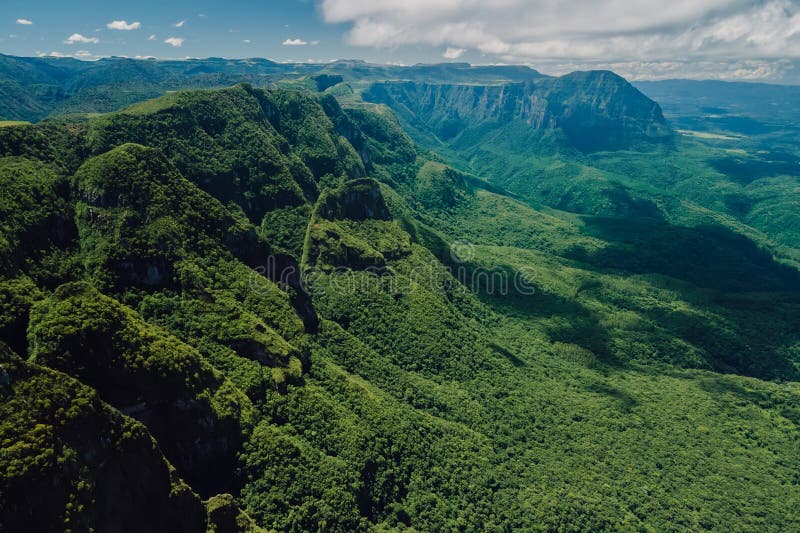
Brazil is a regional and middle power in international affairs. ‘On account of its international recognition and influence, the country is subsequently classified as an emerging, potential superpower. A potential superpower is a state or a political and economic entity that is speculated to be – or to have the potential to soon become – a superpower.’
The United States once a superpower became a hyper power – one that dominates all other states in military, culture, economy, technology and diplomacy – after the collapse of the former rival superpower, the Soviet Union in 1991. Several nation states are potential superpowers, though all have aspects that may hinder them attaining true superpower status.
They include the European Union and the prominent BRIC economies of Brazil, (Tyre-Hul-Aram); Russia, (Asshur); India, (Raamah-Cush); and China, (Magog, Tubal and Meshech).
Japan, (Tarshish); is labeled a cultural superpower due to the large scale influence of Japanese popular culture. Its status as a potential superpower has eroded due to an ageing, declining population since the 1990s and lack of substantial economic growth since the 1980s.

Brazil as the modern day fulfilment of Tyre in the scriptures, will ultimately become a world economic powerhouse; if not necessarily a political or military superpower. An article in The Diplomatic Courier, by former British Ambassador to Brazil, Peter Collecott, ‘identifies that Brazil’s recognition as a potential superpower largely stems from its own national identity and ambition. Collecott points out that for the past two hundred years Brazil has sought to emerge as a serious global economic and political power, a position “that [Brazil] instinctively feels is her due.”
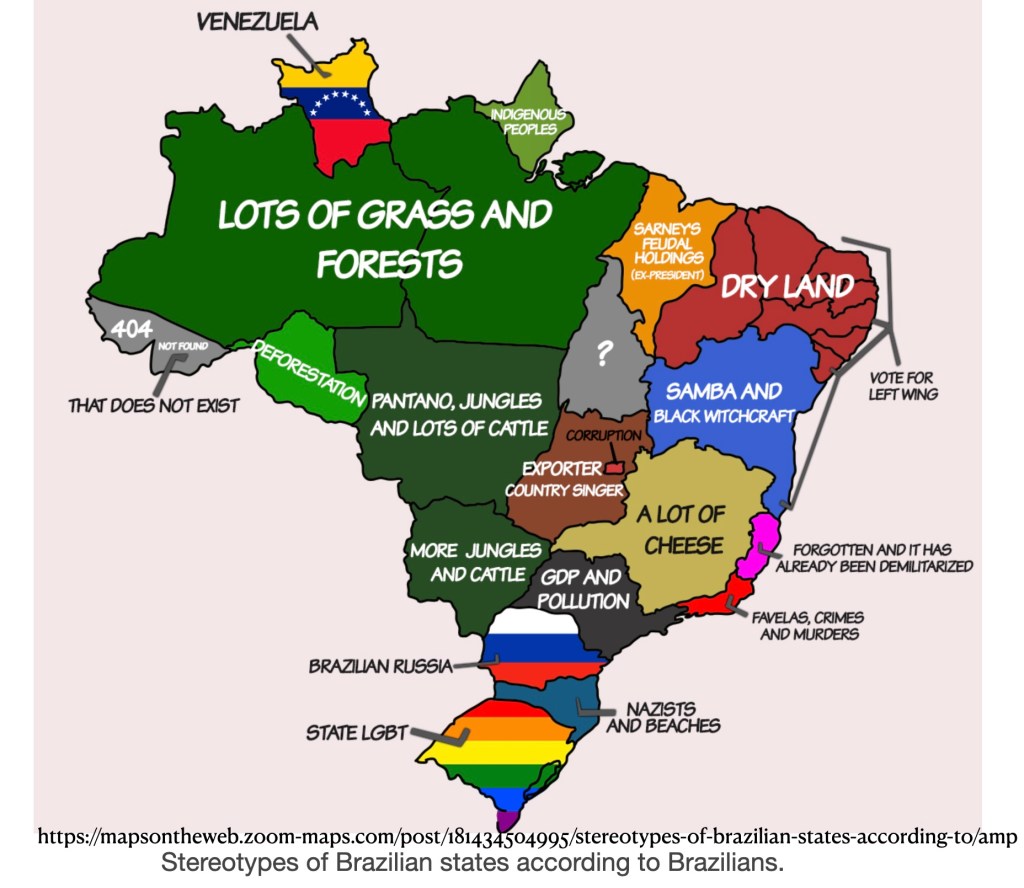
Prisoners of Geography, Tim Marshall, 2016 & 2019, pages 262, 264:
‘When one in four of a state’s population is in abject poverty it is difficult for that state to become rich. This does not mean Brazil is not a rising power, just that its rise will be limited [perhaps resembling India’s similar status]. A shortcut to growth could be soft power… Every few years, often led by Brazil, the South Americans attempt to launch their version of the EU – the latest incarnation being UNASUR… Its headquarters is in Ecuador but Brazil has the loudest voice. In this it resembles the EU, which has an HQ in Belgium and a leading power in Germany.
And there the comparison stops… the Latin Americans differ in politics, economics, currencies, education levels and labour laws. But Brazil will keep working to help create a South American powerhouse using its diplomatic and increasing economic strength. The country is by nature non-confrontational [as their Phoenician ancestors before them], its foreign policy is against intervention in other countries, and war with any of its neighbours seems highly unlikely. It has managed to maintain good relations with all the other eleven South American nations despite having a border with nine of them… the primary regional power in Latin America… looks to be Brazil’s destiny…’
Brazilian Coat of Arms
Encyclopaedia – emphasis mine:
‘In his 2014 publication, The BRICs Superpower Challenge: Foreign and Security Policy Analysis, professor Kwang Ho Chun carefully assesses the likelihood of the [major] BRICs countries [Brazil, Russia, India, China] attaining the status of superpowers.
Regarding Brazil, Kwang Ho Chun highlights that the country possesses enormous and almost untouched “strategic” natural resources, including valuable minerals, a tenth of the world’s fresh water and Earth’s largest remaining rainforest. Because of this, Kwang Ho Chun feels it is likely that Brazil could gain a dominant role in international relations, especially when it comes to environmental issues.This soft power influence is further enhanced by Brazil’s policy makers seeking to engage in as many international organizations as possible and forming alliances, most notably on social, diplomatic and economic issues.’
These traits and aspirations mirror ancient Tyre closely, as a state with considerable global economic influence. Brazil in the twenty-first century could realistically challenge Japan, 5th; India, 4th; and Germany, 3rd for number three ranking of largest world economy.
‘Despite its economic potential and Brazil’s “self-image as a country with a great destiny,” Kwang Ho Chun believes that the country “falls far short of the levels required for a superpower.” Supporting his belief, he emphasises Brazil’s apparent lack of “traditional hard power” (i.e. military power and global security influence) as a major obstacle. Kwang Ho Chun writes that Brazil has “little incentive to invest in its military” as “the country developed in an environment with hardly any inter-state security threats”, therefore Brazil “may never be in a position to accumulate enough influence on global security matters to meet the criteria of being a superpower.” Instead, Ho Chun feels that Brazil will emerge as a great power with an important position in some spheres of influence but limited in others such as international security.’
This is insightful, as again it describes ancient Tyre. Its military was simply to defend its isolationist ‘Rock-island’ position. Tyre was not interested in becoming an imperialistic military empire, as Brazil similarly seeks global economic and diplomatic influence ahead of military power… for now.
That said, a shift has taken place in the intervening twelve years, so that Brazil is ranked 11th out of 145 countries in terms of military strength according to the Global Firepower index for 2026, making it the largest military in Latin America.
Brazil’s 2023 Budget was approximately $24.8 billion, which was about 1.1% of Brazil’s GDP.
‘The Brazilian Armed Forces consist of approximately 334,500 active personnel and 1,340,000 reserves, emphasizing regional stability [and dominance] and territorial integrity.’
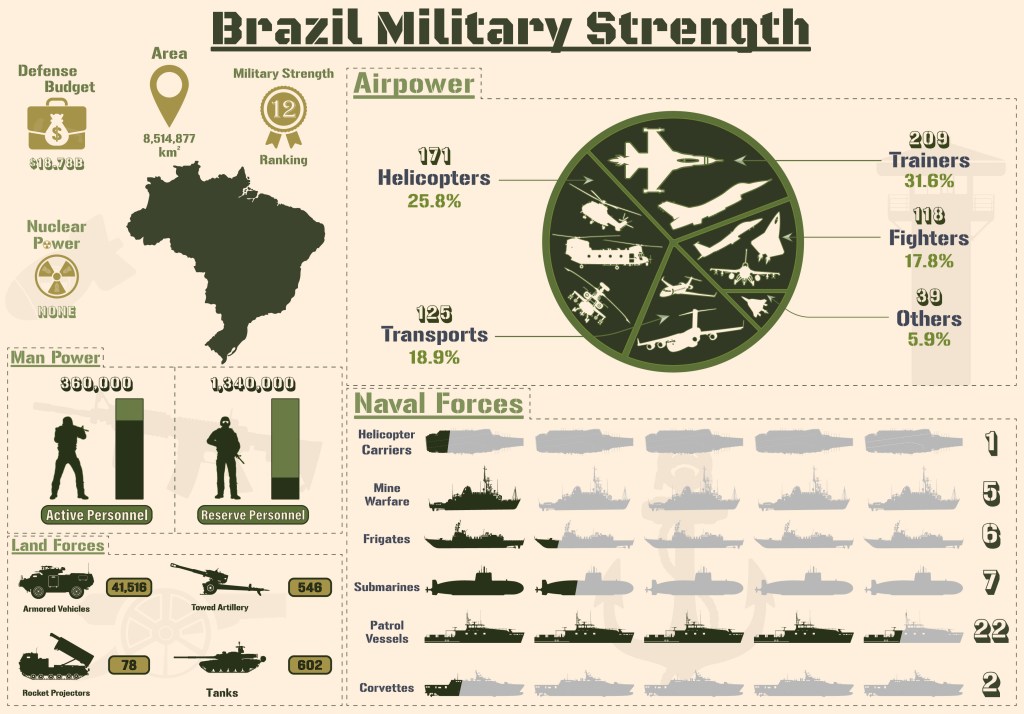
Brazil’s military is characterised by its industrial self-reliance and ongoing modernisation efforts, making it a formidable force in South America.
The motto of the flag of Brazil: Order and Progress
According to the Brazilian National Research by Household Sample (PNAD) in 2008:
48.43% of the population, approximately 103 million people, described themselves as White;
43.80% or 93 million as Pardo or Brown;
6.84% or 15 million as Black;
0.58% or 1.2 million as Asian;
0.28% or approximately 599,000 people as Amerindian (officially called Indigena or Indigenous); and
0.07% or approximately 150,000 people did not state their race.
It is probable that some people have self identified as white, when in fact they are mixed, even slightly and then a certain proportion of those who claim to be brown may be mixed in varying degree and are more white^^ than brown.
Thus the figure for White people may be higher than forty-eight percent and for Brown people lower than forty-three percent. As we have studied the Amerindian Haplogroups in Chapter II Tiras the Amerindian and the African Haplogroups in Chapter XII Canaan & Africa, we will concentrate on the people descended principally from Aram (and Shem).
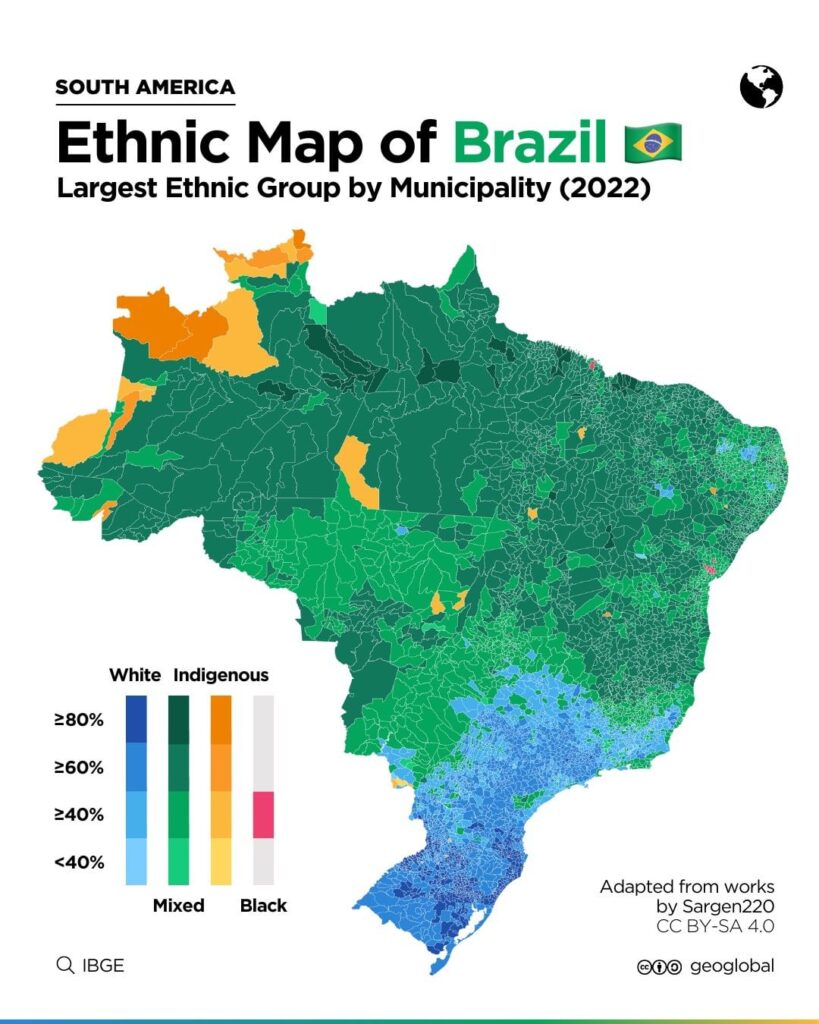
It is challenging – at time of initial writing – finding comprehensive research on the White population of Brazil, though what is available shows they are unsurprisingly, most similar to the Portuguese (Hul) and then Italians (Uz), the two dominant lines of Brazilian descent.

The Ancestry of Brazilian mtDNA Lineages, multiple authors, 2000 – emphasis & bold mine:
‘Brazilians form one of the most heterogeneous populations in the world, the result of 5 centuries of interethnic crosses between peoples from three continents: the European colonizers, represented mainly by the Portuguese; African slaves; and the autochthonous Amerindians.
When the Portuguese arrived, exactly 500 years ago, there were ~ 2.5 million indigenous people living in the area of what is now Brazil. The Portuguese-Amerindian admixture started soon after the arrival of the first colonizers. Mating between European men and indigenous women became commonplace and later (after 1755) was even encouraged as a strategy for population growth and colonial occupation of the country.’

‘The Amerindian tribes underwent a drastic demographic decline due to conflicts with the European colonizers and diseases to which they were not adapted. Today [2000] there are ~ 326,000 Amerindians in Brazil, living on land set aside for them by the federal government.
Africans were introduced beginning in the middle of the 16th century, brought to Brazil as slaves to work on sugarcane farms and, later, in the gold and diamond mines and on coffee plantations. Historical records suggest that between 1551 and 1850 (when the slave trade was abolished), ~ 3.5 million Africans arrived in Brazil.
As to the European immigration, it is estimated that ~ 500,000 Portuguese arrived in the country between 1500 and 1808. From then on, after the Brazilian ports were legally opened to all friendly nations, Brazil received increasing numbers of immigrants from several parts of the world.’

‘Portugal [1: Hul-Aram] remained by far the most important source of migrants, followed by Italy [2: Uz-Aram], Spain [3: Gether-Aram], and Germany.
In the 20th century, Asian immigration took place, mainly from Japan [Tarshish], as well as from Lebanon and Syria [Mizra].
According to Callegari-Jacques and Salzano (1999),
58% of the immigrants who arrived in Brazil between 1500 and 1972 were Europeans,
40% were Africans, and
2% were Asians.
The question that arises is, How much did these different groups actually contribute to the gene pool of present-day Brazilians?’
Haplogroup Frequencies within the Three Continental Fractions of Brazilian mtDNA Pool
| Frequency in brazil | |||||
| Haplogroup | Overall | Northern | Northeastern | Southeastern | Southern |
| NativeAmerican: | |||||
| A | 0.30 | 0.15 | 0.37 | 0.39 | 0.27 |
| B | 0.29 | 0.31 | 0.27 | 0.30 | 0.27 |
| C | 0.24 | 0.38 | 0.09 | 0.18 | 0.27 |
| D | 0.16 | 0.15 | 0.27 | 0.12 | 0.18 |
| Total | 1.00 | 1.00 | 1.00 | 1.00 | 1.00 |
| African: | |||||
| L1a | 0.10 | … | 0.18 | 0.06 | 0.17 |
| L1b | 0.04 | … | 0.05 | 0.03 | 0.17 |
| L1c | 0.19 | 0.29 | 0.09 | 0.23 | 0.17 |
| L2 | 0.20 | 0.14 | 0.23 | 0.23 | … |
| L3d | 0.06 | … | 0.09 | … | 0.33 |
| L3e | 0.30 | 0.43 | 0.32 | 0.32 | … |
| L3* | 0.04 | … | 0.05 | 0.06 | … |
| U6 | 0.06 | 0.14 | … | 0.06 | 0.17 |
| Total | 1.00 | 1.00 | 1.00 | 1.00 | 1.00 |
| European: | |||||
| H | 0.44 | 0.27 | 0.65 | 0.45 | 0.39 |
| pre*V | 0.03 | 0.07 | … | 0.03 | 0.03 |
| V | 0.06 | … | 0.06 | 0.13 | 0.03 |
| HV* | 0.01 | … | … | … | 0.03 |
| U | 0.16 | 0.13 | 0.18 | 0.16 | 0.15 |
| pre*HV | 0.01 | … | … | … | 0.03 |
| J | 0.11 | 0.20 | 0.06 | 0.03 | 0.18 |
| T | 0.14 | 0.27 | 0.06 | 0.13 | 0.12 |
| I | 0.01 | 0.07 | … | … | … |
| X | 0.03 | … | … | 0.06 | 0.03 |
| Total | 1.00 | 1.00 | 1.00 | 1.00 | 1.00 |
‘The Brazilian sample includes mtDNA lineages from almost all the familiar European haplogroups, except for some marginal ones, such as W and other quite-rare haplogroups related to haplogroup I.
The frequency of the dominant haplogroup H (44%); in the European fraction is somewhat higher, on average, than that observed in Europe but is well within the range of western-European H frequencies… [and] suggests predominantly western-European ancestry.
Considering that 30% of the European immigrants (including the Portuguese colonizers) to Brazil came from Italy, one can expect that a considerable number of mtDNA lineages in the Brazilian sample have Italian ancestry.’
The mtDNA Haplogroups for Brazil, Portugal, Spain, Catalonia and the Basque.
Brazil: H [44%] – U [16%] – T [14%] – J [11%] – V [9%] –
HV [2%] – X [3%] – I [1%]
Portugal: H [43.9%] – J [6.8%] – U5 [6.5%] – L [6.4%] –
T2 [6.3%] – K [6.1%] – HV0+V [4.8%] – T1 [3.3%] –
U [3%] – I [2.2%] – X [2%] – W [1.8%] – U4 [1.7%] –
U2 [1.2%] – U3 [0.9%] – HV [0.1%]
Spain: H [44.1%] – U5 [8.1%] – HV0+V [7.5%] – J [6.6%] –
T2 [6.4%] – K [6.3%] – L [2.4%] – T1 [2.1%] – U4 [1.9%] –
U [1.8%] – X [1.7%] – U3 [1.4%] – W [1.4%] –
U2 [1.1%] – I [1.1%] – HV [0.7%]
Catalonia: H [29.5%] – U5 [10.1%] – K [10%] – T2 [7.6%] –
HV0+V [7.5%] – J [7%] – W [5%] – U [3.9%] –
U4 [3.8%] – L [3.1%] – U3 [2.5%] –
X [2.5%] – T1 [1.3%] – U2 [1.3%] –
I [1.3%] – HV [0.5%]
Basque: H [49%] – U5 [11.7%] – HV0+V [7.9%] – J [7.6%] –
T2 [6%] – K [5.3%] – X [2.3%] – U [1.9%] – T1 [1.5%] –
W [1.1%] – U2 [1%] – HV [0.8%] – U4 [0.8%] –
I [0.6%] – L [0.3%] – U3 [0.3%]
When comparing the main mtDNA Haplogroups, the similarity between Portugal and Spain is surprisingly striking. The two distinct enclaves of settlement within Spain, Catalonia and the Basque country are quite different from each other in Haplogroup H and Catalonia appears the odd one out in the group; though only in comparison with Haplogroup H. The higher percentage of Haplogroup L in Portugal is a result of African slaves.
H HV0+V J T2 K U5 L
Portugal 44 5 7 6 6 7 6
Spain 44 8 7 6 6 8 2
Basque 49 8 8 6 5 12 0.3
Catalonia 30 8 7 8 10 10 3
Brazil’s maternal mtDNA Haplogroup percentage sequence is aligned unsurprisingly with Portugal, where its white population has predominantly originated.
H U T J HV X I
Brazil 44 16 14 11 2 3 1
Portugal 44 13 10 7 0.1 2 2
Spain 44 14 9 7 0.7 2 1
Basque 49 16 8 8 0.8 2 1
Catalonia 30 22 9 7 0.5 3 1
The ethnic relatedness of these peoples is highlighted by their common ancestry, cultures and languages. Identity experts have persistently taught that these Latin nations are Canaanites from Ham or sons of Japheth’s son, Javan.
The constant reader will hopefully discern that these explanations are lacking solid support – refer Chapter VII Javan: Archipelago South East Asia & Polynesia; and Chapter XII Canaan & Africa.
Spain: H [44.1%] – J [6.6%] – T2 [6.4%] – K [6.3%] – U [1.8%] – HV [0.7%]
Russia: H [41.2%] – J [7.8%] – T2 [6.5%] – K [3.7%] – U [2.2%] – HV [1.8%]
Turkey: H [30.8%] – J [8.9%] – U [6.3%] – K [5.6%] – HV [4.8%] – T2 [4.3%]
Iran: H [16.9%] – J [13.8%] – U [11.8%] – HV [7.4%] – K [7.3%] –
T2 [4.9%]
It is worth noting that as one heads west, principal Western Eurasian mtDNA Haplogroup H increases in the above prominent nations descended from Shem studied so far. Haplogroup T2 also increases; whereas Haplogroups J, U and HV decrease. In contrast with Haplogroup T, Haplogroup U is one of the oldest and most diverse of the European Haplogroups.
Of all the peoples investigated thus far – either descended from Japheth and his seven sons; Ham and his three sons; Canaan and his six sons; or Shem’s two out of five sons – who have exhibited black or brown hair and brown eyes regardless of skin tones and eye tints; it is the Russians descended from Asshur, who are the first peoples on our identity journey possessing a marked increase in fair hair and blue eyes.
The descendants of Aram are halfway between in that they possess higher levels of fair hair and blue eyes than the Turks of Elam and the Persians of Lud; yet markedly lower than the Russians of Asshur.
H HV HV0+V J T2 U U5 K
Brazil 44 2 11
Portugal 44 0.1 5 7 6 3 7 6
Spain 44 0.7 8 7 6 2 8 6
Russia 41 2 4 8 7 2 10 4
Turkey 31 5 0.7 9 4 6 3 6
Iran 17 7 0.6 14 5 12 3 7
Comparing Portugal, Spain and Brazil with Russia, Turkey and Iran reveals that Aram, Asshur, Elam and Lud respectively, are clearly distinct from one another; though still also visibly related as cousins. If we compared their Haplogroups with India or China it is palpable that these nations are descended from the separate and unique line of Shem rather than from either Ham or Japheth.
It also clearly delineates the similarity of Portugal and Brazil with Spain as brothers. As well as the fact that Russians though distantly – as evidenced by principal component analysis – as Asshur, are still closer genetically to the peoples of Iberia and therefore Aram, than those of Turkey or Iran.
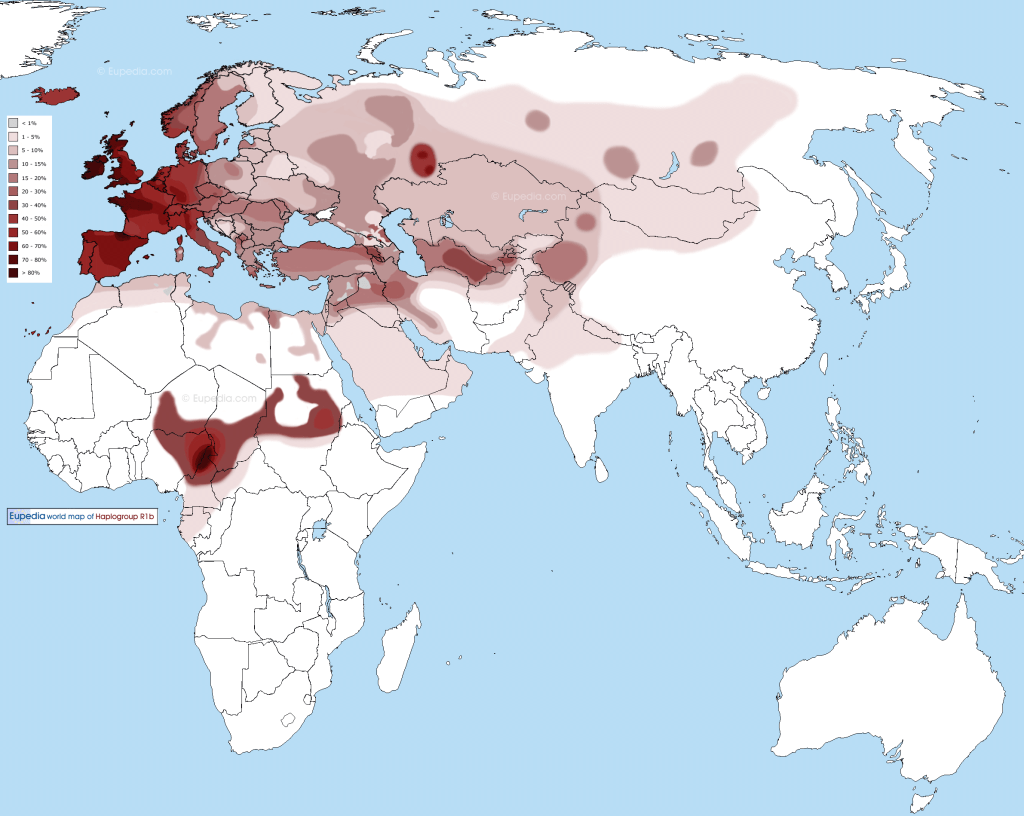
R1b M343 / M415
Eupedia, Phoenicians & Greeks – emphasis & bold mine:
‘The oldest city in Iberia is Cadiz, which was founded by the Phoenicians as Gadir or Agadir in 1104 BCE. The Phoenicians also founded Almunecar, Malaga, Cartaya and Huelva, and settled in other existing cities such as Tartessos and Carmona.
Based on the haplogroups found in modern Lebanon and in their former colonies, the Phoenicians seem to have carried a mixture of haplogroup J2a, J1, E1b1b, G, R1b-M269/L23, T, L, R1b-V88, R2 and Q1b, roughly in that order of frequency. It is not easy to assess the percentage of modern Iberian lineages of Phoenician origin because many other peoples brought similar haplogroups. The most uniquely Phoenician lineages, which were normally not found among the ancient Greeks and Romans, are Q1b, R1b-V88 and R2. And indeed all of them have been found, mostly in Portugal and south-west Andalusia, but only at trace frequencies (under 0.5%).’
It is the view of this writer that these Haplogroups are all examples of admixture and are doubtful as being typically ‘Phoenician.’
Whereas Haplogroup R1b-DF27 would intrinsically be the defining paternal Haplogroup.
The article has the preconceived view that Phoenician equals Levant or Arab related – as reflected by the first three listed Haplogroups – which is incorrect. Thus relying on the Lebanese sequence of Y-DNA Haplogroups which are J2 dominant with far less R1b.
Eupedia:
‘The island of Ibiza was another major Phoenician colony, which has the particularity of having been left in isolation for most of its subsequent history. It is therefore likely to have more Phoenician lineages than average. That is probably the case as Adams et al. (2008) found 17% of haplogroup T on Ibiza, by far the highest percentage in Europe for the Middle Eastern lineage, but also 13% of haplogroup G (more than anywhere else in Iberia) and 4% of E-M123 the Levantine variety of E1b1b.
Not surprisingly, the second highest percentage of haplogroup T identified in Iberia is in Cadiz (10%). Like haplogroup T, E-M123 is mostly found in Murcia, Andalusia, Extremadura and Portugal, suggesting that this is where the Phoenicians had the largest genetic impact. Not surprisingly haplogroups J1 and J2a also peak in these regions.’
Haplogroups J1 (and J2) are actually reflective of the Moors genetic legacy, rather than the Phoenicians. Whereas Haplogroup G is interesting, because it is an ancient lineage deriving from Shem – from which the R1b mutation eventually evolved.
Eupedia:
‘In 406, the Alans (who were not Germanic but of Iranic origin, the Suebi [modern day Portuguese (Hul)] and the Vandals [included in modern day Central and South America (Mash)] crossed the Rhine together, invading Gaul, then three years later, they crossed the Pyrenees into Roman Hispania.
The Suebi migrated to the western half of Iberia, where they established the Kingdom of Gallaecia (409–585).
The Vandals and the Alans went south to Andalusia, then crossed over [to] North Africa in 429, where they founded a kingdom that also comprised Sicily, Sardinia and Corsica.
The Suebi…As a Germanic tribe, they would have brought haplogroups I1, I2a2a, (M223, formerly known as I2b1), R1b-U106 [specifically, R1b-S116*] and R1a (L664, Z282 and Z283 subclades) to the Iberian peninsula, and indeed all of them except R1a are found essentially in the western half of the Iberian [Peninsula], especially in Portugal and Galicia. R1a is found in northern Castile, Asturias and Cantabria, and could… have been brought there by the Visigoths… [more likely, the Alans]
The Basques are indeed somewhat different genetically from other Spaniards. They have a bit more Northwest European ancestry [similar to southwest France]… The absence of Red Sea and Southwest Asian admixture indicates that the Basques do not have any Phoenician [Aramaean], Jewish, Greek, Roman or Arabic ancestry. Looking at maternal lineages, the Basques also stand out from the rest of the peninsula, lacking many haplogroups… This is in perfect agreement with the fact that Basque language is non-Indo-European. What generally comes as a surprise is that 85% of Basque paternal lineages belong to the Proto-Celtic R1b-P312 [S116, from which DF27 derives].
Interestingly the Catalans also lack the Southwest Asian ancestry, but do have some Red Sea and Caucasian genes. The Southwest Asian admixture is slightly more common in southern Portugal and Andalusia, which is consistent with the higher historical presence of Phoenician, Roman and Arabic people in that region. The Basques and the Catalans are the only Western European completely lacking genetic contribution from Southwest Asia.
This is also translated in an extreme scarcity of Y-haplogroups J1, E-M34 and T, which are all typically Southwest Asian linages.’
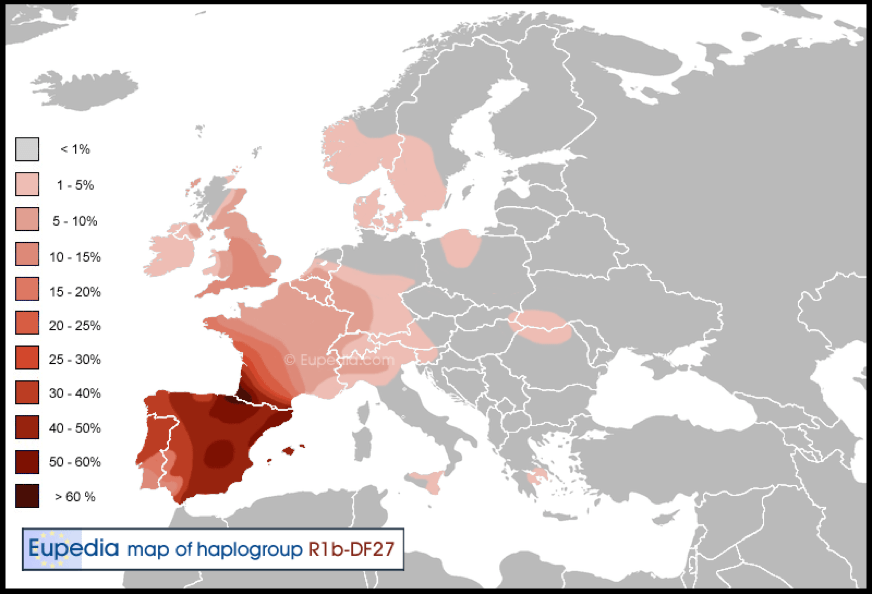
Khazaria, Portuguese Genetics: Abstracts and Summaries – emphasis & bold mine
‘Varieties of R1b, a common Y-DNA haplogroup in western Europe, are found in abundance among Portuguese men. About 60 percent of Southern Portuguese and about 83 percent of Northern Portuguese belong to the subclade of R1b known as the Atlantic Modal Haplotype (AMH). There are even some areas in [North-west] Portugal where the AMH is found in about 90% of men.’
The AMH corresponds most closely with subclade R1b1a1a2a1a (formerly R1b1a2a1a) or L11 – from which derives S116 and subsequently DF27.
‘The mtDNA haplogroups H, U, and L were found in substantial numbers in the population of Portugal in ancient times (including the Epipaleolithic, Neolithic, and Chalcolithic eras) just as they are today.
Millions of mixed-race (white/black/Amerindian) descendants of Portuguese live in Brazil today.
Some Portuguese of Portugal themselves have a small portion of black ancestry as well.
This is true of the mainland, in part since African slaves were brought to southwestern Portugal’s Alcacer do Sal region in the 1400s-1800s…
Portuguese people occasionally match European Jews in the autosomal DNA databases as a result of having shared Sephardic Jewish ancestors.’
Peter Ralph and Graham Coop. “The Geography of Recent Genetic Ancestry across Europe.” PLOS Biology (May 7, 2013). Excerpts:
“… Patterns for the Iberian peninsula are similar, with both Spain and Portugal showing very few common ancestors with other populations over the last 2,500 years. However, the rate of IBD [identical-by-descent] sharing within the peninsula is much higher than within Italy – during the last 1,500 years the Iberian peninsula shares fewer than two genetic common ancestors with other populations, compared to roughly 30 per pair within the peninsula – Italians share on average only about eight with each other during this period…”
“Genetic characterization of uni parental lineages in populations from Southwest Iberia with past malaria endemicity.” American Journal of Human Biology 22:5 (September-October 2010): multiple authors, pages 588-595. Excerpts from the Abstract:
‘…in Pias, the Mediterranean influence might be traced to ancient contacts with Greeks, Phoenicians, and Carthaginians, who established important trading networks in southern Iberia.’
“Relatedness among Basques, Portuguese, Spaniards, and Algerians studied by HLA allelic frequencies and haplotypes.” Immunogenetics 47:1 (1997): multiple authors, pages 37-43. Excerpts from the Abstract:
‘The results of the present HLA study in Portuguese populations show that they have features in common with Basques and Spaniards from Madrid…’
“Meta-Analysis of Mitochondrial DNA Variation in the Iberian Peninsula”, 2016, multiple authors: Excerpts from the Results section:
“… Within the Iberian Peninsula, Spain has overall higher values of haplotype diversity than Portugal… Nucleotide diversity has its highest value in the Mediterranean area, but it is also high in Portugal… The high frequency of haplogroup H in the North of Iberia spans all along the Portuguese territories, where frequencies range from 49% in the North to 45% in the South.
Haplogroup U constitutes the second most frequent haplogroup in Iberia; its frequency is similar in the main Iberian regions; it reaches the highest frequency in North of Portugal (26%)…”
“Portuguese mitochondrial DNA genetic diversity – An update and a phylogenetic revision”, multiple authors, 2015. Excerpts from the Abstract:
“In general, a typical Western European haplogroup composition was found in mainland Portugal, associated to high level of mitochondrial genetic diversity. Within the country, no signs of substructure were detected.”
“Diversity of mtDNA lineages in Portugal: Not a genetic edge of European variation”, Annals of Human Genetics 64:6, multiple authors, (November 2000): pages 491-506.
‘A study consisting of mitochondrial DNA samples from 100 Northern Portuguese, 82 Central Portuguese, and 59 Southern Portuguese. Portuguese people have more genetic diversity than some of their neighbors. They carry “all the most important European haplogroups…”
They also carry the mtDNA haplogroups U6 and L, both of African origin. U6 is “restricted to North Portugal whereas L was widespread all over the country.’
Catalonians and Gascons of France
Being Western Europeans, it is no surprise that the most common Y-DNA haplogroup among Catalans is a branch of the R1b haplogroup. R1b1b2a1 is nearly exclusive to western Europe, and the sub-haplogroup R1b1b2a1a2c is common among Catalans and Gascons.’
The Basques, Catalonians and Gascons have as much or more in common genetically with the southern French than Spaniards. We will delve into this further when France is studied – Chapter XXVI The French & Swiss; Moab, Ammon & Haran.
The Phylogeography of Brazilian Y-Chromosome Lineages, multiple authors, 2001 – emphasis & bold mine:
‘The Amerindians [from Tiras] originally peopled South America… Centuries later (on April 22, 1500), the Portuguese “discovered” Brazil, by then inhabited by 2.4 million Amerindians… Colonization of the new country initially involved men only; the immigration of European women during the first centuries was insignificant…
Thus, the first Brazilians arose by mating between European males and Amerindian females.
During the period 1500–1808, 500,000 Portuguese, mostly men, arrived in Brazil.
The most frequent Y chromosomes in white Brazilian males belonged to haplogroup 1 [R1b] (54%), which has been observed in high frequencies (40% – 80%) in Europe and seems to be absent from Africa and Japan. Accordingly, this haplogroup was seen in 60% of the Portuguese tested. In Brazil, haplogroup 1 showed discrete regional variation, with the lowest frequency in the south.
Second in frequency (18%) was haplogroup 2 [E1b1b], which has a rather wide geographical range that includes Europe, Africa, and Asia. This haplogroup was also the second most common among the Portuguese (13%) and is known to be especially frequent in Italy, from where 30% of the European immigrants to Brazil originated.
Haplogroup 2 showed regional variation, having the highest frequencies in the south (29%) and in the northeast (18%). Its relatively high frequency in the south of Brazil is probably related to the large Italian immigration to this area.
The same applies to haplogroup 3 [I1 and I2], geographically distributed in northeastern Europe and Asia, which was observed in 3.5% of the Brazilian males. The fact that it was seen almost exclusively in the south of Brazil suggests a European origin.
Haplogroup PN2 [J2] was the third in frequency, having been seen in 10% of Brazilians, with even regional distribution. This haplogroup is observed in 50% of the North Africans and in frequencies >29% in Egyptians, Greeks, Italians, and Lebanese.
Haplogroup 21 [J] has been shown to have a north-south cline in Portugal, climbing from a frequency of 10.6% in the north to 24.5% in southern Portugal.
Haplogroup M34 [J1], defined by the M34 mutation, is a subtype of haplogroup 21 and, apparently, has a low frequency but a quite broad geographical distribution in Europe, Asia, and the Middle East. It was seen in 3% of the Brazilians and 2% of the Portuguese samples.
The 12f2 deletion at DYS11 defines haplogroup 9 [G], the next most common Y-chromosome lineage observed in Brazil (8%).
This haplogroup shows maximum frequency in Jews and other Middle Eastern populations, but it is also found in North Africans and Europeans. Portugal, where haplogroup 9 was seen in 6% of the individuals studied, seems to be the major source of these Y chromosomes in Brazil.
There was a large Jewish population in Portugal until 1509, when Jews were deported during the Inquisition. To avoid expulsion, many Jews converted to Catholicism and became “New Christians,” many of whom immigrated to Brazil, carrying haplogroup 9 Y chromosomes. However, there were contributions from other populations. For example… haplogroup 9 shows the highest frequency (16%) in the north of Brazil. Intrigued by this observation, we searched the historical records and discovered that in the early 19th century there was a significant immigration wave of Moroccan Jews to the Amazon area, with eventual settlement in Manaus and Belem.
With the exception of an unknown number of colonizers who arrived during the Dutch 30-year domination of the northeast of Brazil in the 17th century, Portugal was the only significant source of European immigrants to Brazil until 1808.
Starting in the mid-16th century and continuing until 1855, 4 million African slaves were sent to Brazil…
In 1808 the Portuguese court, fleeing Napoleon’s army, moved to Brazil and opened its seaports to trade with all nations. This was soon followed by the arrival of settlers from other countries. During the period 1820-1975, 5,686,133 immigrants, mostly Europeans, arrived officially in Brazil… Portuguese [Hul] and Italian [Uz] immigrants arrived in almost equal numbers (comprising almost 70% of the total), followed by immigrants from Spain [Mash (Gether)], Germany, Syria [Mizra], Lebanon [Mizra], and Japan [Tarshish]’ – refer Chapter IX Tarshish & Japan.
The European element in Brazil’s demography has been populated by contributions principally from Hul (Portuguese) and from Uz (Italians). The descendants from Gether, the Spanish (Visigoth) of Spain are a minority; with the other lineage of Spaniards from Mash (Vandal), mainly migrating outside of Brazil throughout the Americas.
‘Now, after 500 years, it is worthwhile to ask about the genetic composition of the Brazilian population. We decided to try to partially answer this question by using lineage markers to ascertain the ancestry from different continents. In the first part of this project we analyzed 247 Brazilian mtDNAs and were surprised to find the high Amerindian (33%) and African (28%) contributions to the total mtDNA pool of white Brazilians… [total: 61%]
In the present study, we analyzed Y-chromosome UEPs in 200 Brazilian males from four different regions in Brazil (a subset of the 247 individuals typed for mtDNA). Our data demonstrate that the vast majority^^ of Y chromosomes in white Brazilian males, regardless of their regional source, is of European origin, with a very low frequency of sub-Saharan African chromosomes and a complete absence of Amerindian contributions. Together, our results configure a picture of strong directional mating in Brazil involving European males and Amerindian and African females. This is in consonance with the known history of the peopling of Brazil since 1500.’
Male Lineages in Brazil: Intercontinental Admixture and Stratification of the European Background, multiple authors, 2016 – emphasis & bold mine:
‘Brazil is a country of continental extension, and it is currently divided into five main geopolitical regions (North, Northeast, Central-West, Southeast and South) with diverse histories of colonization and settlement, a fact that is reflected in the genetic structure of the current Brazilian population.
The sample from the Northern region presented the highest Native American ancestry (8.4%), whereas the more pronounced African contribution could be observed in the Northeastern population (15.1%). The Central-Western and Southern samples showed the higher European contributions (95.7% and 93.6%, respectively). The Southeastern region presented significant European (86.1%) and African (12.0%) contributions.
The subtyping of the most frequent European lineage in Brazil (R1b1a-M269) allowed differences in the genetic European background of the five Brazilian regions to be investigated for the first time. Further studies using SNPs to increase the discrimination between lineages inside haplogroup R-M207 were performed in large samples from West Asian and European populations, revealing different gradients for R1b1a-M269 sub-clades inside Europe.
The L11-derived allele (also known as S127) separates Western European from the Eurasian lineages. Inside R-M207, the frequencies of these sub-haplogroups were all investigated in each geopolitical region [of Brazil].
The haplogroup Q1a2-M346 and its sub-lineages, mainly Q1a2-M3, are almost completely restricted to Native American populations… haplogroups E1b1b-M123 and J-P209 present higher frequencies in Central-Western Brazil (4.1% and 16.0%, respectively) than in Portugal (1.2% and 10.4%, respectively). More than 50% of the Y chromosomes belong to the R1 branch, namely to the sub-lineage R1b1a-M269…’
Haplogroups E1b1b and J are indicative of male lineages associated either indirectly or directly with Canaan or Ham’s son Mizra and his descendants through sons Casluh and Caphtor (Moors) – refer Chapter XV The Philistines: Latino-Hispano America.
‘Haplogroup R1b1a-S116*, which has its greatest frequency in Iberia was, by far, the most frequent haplogroup observed in our sample, representing 32.5% of the Y chromosomes investigated… the haplogroup R1b1a-S116* was the most frequent in the five geopolitical regions of the country emphasizing the strong influence of the early Portuguese colonization…
Portugal was estimated to be the main source of the male European lineages to Central-West, Southeast and South Brazil. The North and the Northeast showed the highest contribution from France and Italy^, respectively… [and] the Northeast appears to have a higher Eastern European^ contribution than do other Brazilian regions. The highest migration rate from Lebanon was to the Central-West, whereas a significant migration from Germany** was observed to the Central East, Southeast and South.
The sub-haplogroup R1b1a-U106** (S21) is more frequent in Central and Eastern Europe, reaching 66.8% in Germany, while R1b1a-S116, more frequent in the Western portion of the continent, is further subdivided into several haplogroups.
The sub-lineage R1b1a-S116 is the most frequent in the Iberian Peninsula,
R1b1a-U152 is more frequent in France and Italy,
and R1b1a-M529 has higher frequencies in England and Ireland.’
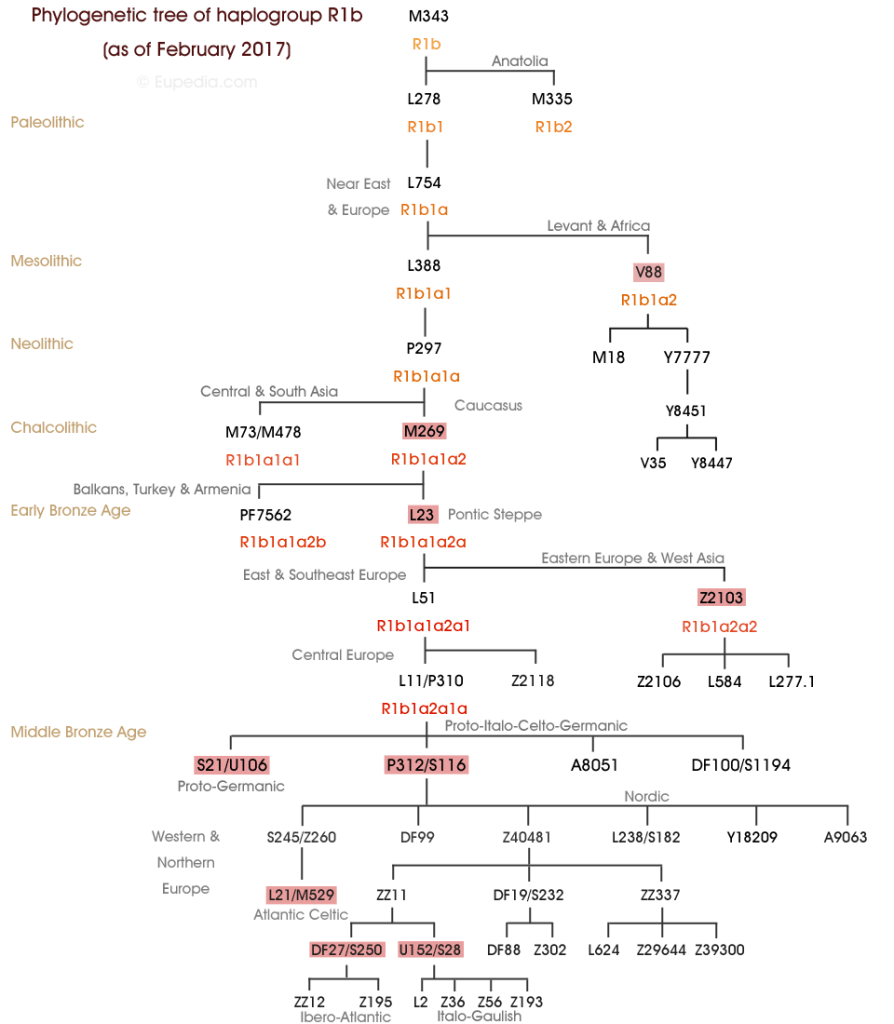
‘The sub-lineages R1b1a-M153 and R1b1a-M167 [both downstream from DF27] were described at high frequencies in Basque Country.
R1b1a-M167 was also found at high frequencies in the Pyrenees [Catalonia].’

The principal R1b sub-Haplogroups in Brazil are shown in the table below. Sub-clade L23 is ostensibly of Eastern European origin. The predominant R1b is S116 which originates in the Iberian Peninsula, stemming from both Portugal and Spain. The extent of Italian and German immigration is shown by the levels of (R1b) U152 and U106, respectively. Notice that the five geopolitical regions of Brazil are as expected, genetically closer to first Portugal and then Spain than any other nation of Europe.
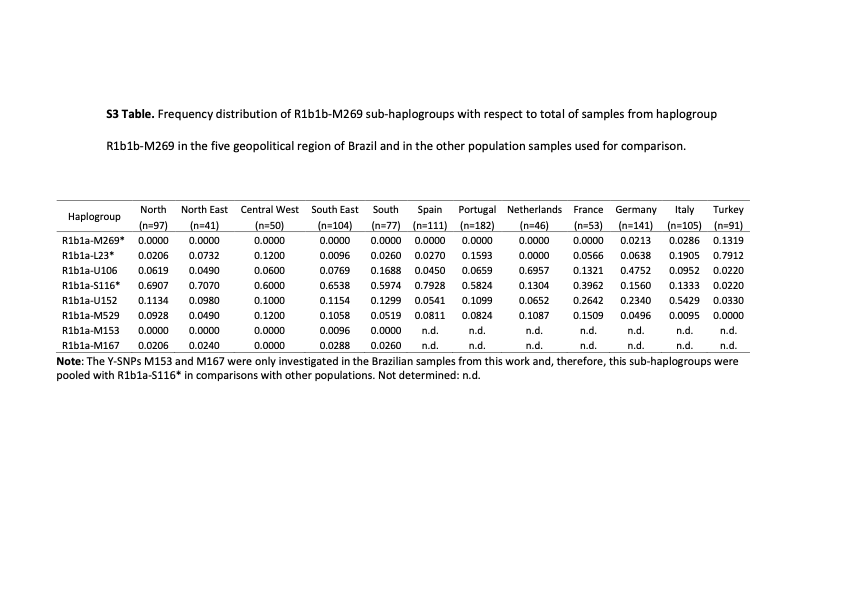
We will discover the English and Irish are from the same familial line – that is, they share the same paternal ancestor – and the French and northern Italians are related, in that their paternal ancestors were brothers. The peoples of the Iberian Peninsula share the same R1b-S116 with Brazil, confirming their shared status as brothers descending from the same father, Aram.
As a side note, this writer remains unconvinced in the exact thread of the R1b genetic tree at its tail end – that is, it’s most recent mutations. This is not the chapter to elaborate on this contention, though at some point it is hoped it can be addressed more fully, with input from geneticists welcome.
Briefly: the Atlantic Celtic M529 would seem logically to be either parallel with the Proto-Germanic U106 – immediately downstream from L11 – or deriving from U106 directly.
Similarly, the Italo-Gaulish U152 would seem more accurately placed deriving from L11 and in turn located between the Proto-Germanic U106 and P312 – from which the Ibero-Atlantic DF27 stems.
As we progress through the descendants of Shem, we will find the levels of R1b vary, though gradually increase. We will keep a record of the levels for the two main R1b sub-Haplogroups for a number of the nations we will study. R-M269 stretches across Europe, with levels increasing as one heads westwards. R-U106 covers western Europe eastwards with its epicentre in Central Europe.
Turkey and Russia are the first two nations and both have lower levels of R1b, possessing higher levels of other Haplogroups, for instance for Turkey, it is Haplogroups J1 and J2 at 33% and for Russia, Haplogroups R1a at 46% and N1c1 at 23%.
Turkey: R-M269 14% – R-U106 0.4%
Russia: R-M269 21% – R-U106 5.4%
Portugal: R-M269 60%
Adding Portugal’s R1b national percentage clearly highlights the marked difference between the eastern regions inhabited by Shem’s descendants from those of western Europe. We will continue to see evidence of this pronounced genetic demographic as we progress.
Y-DNA distribution across Brazilian regions and an intriguingly high % of Y-DNA I, 2017 – emphasis & bold mine:
‘I’ve just read this study (Male Lineages in Brazil: Intercontinental Admixture and Stratification of the European Background) on the distribution of male lineages of Brazilians and there is something that struck me as very intriguing and, I think, difficult to explain… what do you think can explain this:
There is a surprisingly high percentage of haplogroup I, 8.9% as a whole and reaching a (for me) astounding 11.5% in the Northeast^ of Brazil, the region that least received the post-1830 non-Iberian immigration, and until the 1880s the most populous region (now the 2nd one). I thought I1 and I2 lineages would correlate a more Eastern/Northeastern European influx, but that definitely is NOT the origin of most Northeastern colonial immigrants from Europe as far as I know.
Could the Dutch have left such a noticeable impact on Y-DNA when their Dutch Brazil in the northeast lasted less than 30 years, and also – according to their Portuguese defeaters, at least – they were expelled en masse from Brazil? There was also some short settlement and longer trading voyages by Frenchmen in the Northeastern coast. These hypotheses, though, wouldn’t solve the issue that I is also strong in the North (10%), never occupied by the Dutch or French.
I thought of a clear mistake in the analysis or a very skewed and misleading sample, but looking at the other Y-DNA percentage they look totally reasonable and explainable: highest E1b1a (8.2%) in the Northeast, the largest center for slaves in roughly ~1530-1780; highest R1(xR1b), i.e. mostly R1a, in the South (5.5%), by far the main destination of the Germans and Slavs; highest Q1a2 (8.1%) in the North, the last region to be effectively colonized outside the coastal region and still today with the largest Amerindian population. So, everything fits just right, except for that high I1+I2 percentage in the Northeast/North!
As an aside, I found it interesting that, even with the relatively minor contribution of non-Western European Y-DNA (Amerindians, Africans, other Europeans), the haplogroups E1b1b (10.9%), J (10.1%) and G (5.1%) are very present, adding to a full 26.1%, more than 1/4 of the male lineages. That really indicates how strongly the (traditionally/originally) non-IE lineages resisted in Portugal.’
Haplogroups E1b1b, J1 and J2 are a result of admixture and are not correctly labeled as either western or eastern European in origin.
‘Another interesting finding, though maybe coincidental due to patterns of the demographic formation, is that the Y-DNA distribution of the Brazilian Northeast appears as the most Central European-shifted among the 4 regions (i.e. a bit closer to France and, [less of] Italy), while the Southeast has the Y-DNA makeup closest to Portugal’s, even though it’s received the largest and most diversified number of immigrants from 1860 to our days. I really don’t know what to make of those results, how to explain them fitting into Brazilian history. What would you suggest/hypothesize?’
Judging from the preceding article, it would appear that the answer includes the presence of people from north-eastern Europe. High percentages of Y-DNA Haplogroup I2a1 (and lesser degree I1) are present in certain Slavic speaking nations from northern Europe and not just concentrated in south-eastern Europe – for instance, Russia, Ukraine and Belarus. Keeping in mind as well that certain areas of Spain have similar frequencies of Haplogroup I, such as Aragon, Andalusia, Valencia, Catalonia and not forgetting Portugal.
Just as Haplogroup G is an ancient male lineage from Shem, Haplogroups I1 and I2 are intermediary Haplogroups, which are relatively old and later mutations deriving from Haplogroup G. In turn, Haplogroups R1a and R1b are descendant mutations from Haplogroup I. The presence of I1 and I2 in Brazil is no more or less puzzling than Haplogroup G is. It just means that higher levels of older paternal lines have migrated to Brazil.
The Y-DNA Haplogroups for Brazil, Portugal, Spain, Catalonia and the Basque.
Brazil: R1b [54%] – E1b1b [10.9%] – J2 [10.1%] – I1/I2 [8.9%] –
G2a [5.1%] – R1a [4%] – J1 [3%] – E1b1a1 [3%] – Q1a2 [2%]
Portugal: R1b [56%] – E1b1b [14%] – J2 [9.5%] – G2a [6.5%] –
I2a2 [3%] – J1 [3%] – T1a [2.5%] – I1 [2%] – I2a1 [1.5%] –
R1a [1.5%] – Q [0.5%]
Spain: R1b [69%] – J2 [8%] – E1b1b [7%] – I2a1 [4.5%] –
G2a [3%] – T1a [2.5%] – R1a [2%] – J1 [1.5%] –
I1 [1.5%] – I2a2 [1%]
Catalonia: R1b [66.5%] – E1b1b [8.5%] – J2 [7.5%] –
G2a [4.5%] – I2a1 [3.5%] – I1 [2%] – I2a2 [1.5%] –
R1a [1.5%] – J1 [1.5%] – T1a [1%]
Basque: R1b [85%] – I2a1 [5%] – J2 [2.5%] – E1b1b [2.5%] –
G2a [1.5%] – I1 [0.5] – J1 [0.5%] – Q [0.5%]
From a Y-DNA Haplogroup sequence perspective, particularly the first key three Haplogroups for two of Aram’s sons, the strong regional identities of the Basque resemble the Spanish and Catalonia surprisingly, parallels Portugal. From a percentage perspective, the Catalonians sit with Spain as a whole and the Basque remain distinctly unique.
Brazil: R1b – E1b1b – J2 – I1/I2 – G2a – R1a – E1b1a1 – Q1a2
Portugal: R1b – E1b1b – J2 – G2a – I2a2 – J1 – T1a – I1 – I2a1 – R1a – Q
Catalonia: R1b – E1b1b – J2 – G2a – I2a1 – I1 – I2a2 – R1a – J1 – T1a
Spain: R1b – J2 – E1b1b – I2a1 – G2a – T1a – R1a I1 – J1 – I2a2
Basque: R1b – I2a1 – J2 – E1b1b – G2a – I1 – J1 – Q
It would be interesting to have more insight in how the Casluh* and Caphtor element has shaped Spain’s genetic history. Comments from a geneticist regarding Spain’s national ethnic genealogy would be welcome with regard to the impact on the Spanish Visigoths (Gether) who today principally reside on the Iberian Peninsula and those Spaniards who left for the New World – the Alans, Vandals (Mash) and Moors.*
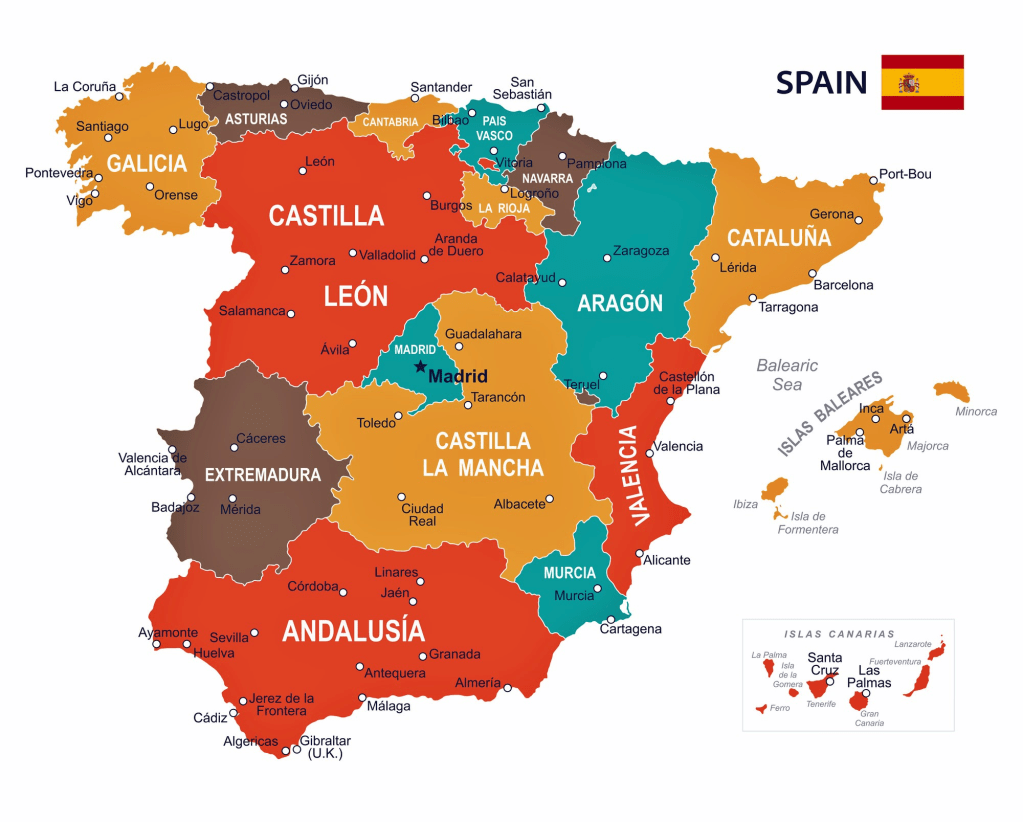
It is interesting to note that Spain without Portugal resembles the head of a Bull, with its horns of Galicia and Catalonia either side – refer Chapter XV The Philistines: Latino-Hispano America; and article: The Calendar Conspiracy.
After the Basque country and Catalonia, it is the men of Castille-La-Mancha with the highest frequency of R1b at 66%; yet neighbouring Extremadura has the lowest percentage of R1b at 50%. Extremadura in turn has the highest E1b1b at 18.5% and aside from the Basque, it is Aragon and Castille-La-Mancha with the lowest at 5%. It is again Extremadura which possesses the highest levels of J2 at 11.5% and aside from the Basque it is Cantabria with the lowest level of 3%.
Cantabria on the other hand has the highest percentage of G2a at 10.5%, with Aragon and Valencia the lowest with 1%. All Spanish regions are low in J1, I1 and I2a2. Regarding I2a1, Aragon has the highest levels at 14.5% and Asturias and Castile & Leon with the lowest at 2%. Haplogroup R1a is low throughout Spain with only Cantabria having a relatively higher percentage of 8.5%.
This disjointed regional Haplogroup cocktail is at first sight confusing and perhaps appears difficult in extrapolating meaningful data. Yet, it would seem that Extremadura shows the greatest evidence of a higher rate of admixture with the Moorish occupation. Confirmed by its lower levels of R1b and higher percentages of E1b1b and J2.
R1b E1b1b J2 I G R1a T
Mexico 50 10 [10] 4 4 4
Brazil 54 11 10 9 5 4
Portugal 56 14 10 7 7 1.5 3
Catalonia 67 9 8 7 5 1.5 1
Spain 69 7 8 7 3 2 3
Basque 85 3 3 6 1.5
What does this all mean?
Well, the paternal Y-DNA Haplogroup table explains why the Basques may not feel comfortable living as part of Spain and their desire to achieve independence as a separate state. It certainly confirms their isolation and non-mixing with neighbours over the centuries.
In marked contrast are the 7,710,126 people in Catalonia who are in fact very similar with the rest of Spain in their Y-DNA Haplogroups – confirmed by autosomal DNA as shown on the PCA plot below. Spain would not be supportive of any independence claims by Catalonia as was witnessed in 2017. The impact on Spain’s economy would be enormous should Catalonia gain independence, as it is the 2nd largest economy in Spain by nominal GDP.

This is in stark contrast to the mtDNA Haplogroups we saw earlier, which showed the opposite, in that the Basque though slightly removed were considerably more aligned with Brazil, Portugal and Spain. It was in fact the Catalonians, which stood out differently.
We will investigate the Basque and Catalonians more fully when we investigate the French, as the surprises do not end there.
The addition of Mexico appears to highlight a difference between Mexican’s of ‘Spanish’ descent and the Spanish within Spain; though in actuality it doesn’t when the Amerindian component (and Haplogroup Q for approximately twenty percent of Mexican men) is remembered – refer Chapter XV The Philistines: Latino-Hispano America.
Comparing the Y-DNA Haplogroups found more frequently in Southern Europe, where they have origins in peoples presently living in North Africa, the Middle East, Levant and Caucasus.
E1b1b J1 J2 G2a
Brazil 11 [10] 5
Portugal 14 1.5 10 7
Spain 7 1.5 8 3
Basque 3 0.5 3 1.5
Confirmation if required, how a Moorish (Berber) and Arabic genetic footprint in Iberian men is more than negligible. It is increasingly pronounced in Portugal and less so in Spain, with the Basque proving their isolation and lack of serious admixture.
Adding Spain’s Y-DNA Haplogroup sequence with those selected larger nations previously studied, highlights Aram’s paternal dominant R1b Haplogroup compared with the defining marker Haplogroups R1a (and N1c1) for Asshur-Russia; R1a (and J2) for Lud-Iran; and R1b (and J2) for Elam-Turkey.
Though recall, J2 is not the core lineal descent for Elamite and Luddite males. It is a result of frequent admixture with males from Southwest Asia – Chapter XIII India & Pakistan: Cush & Phut.
Likewise, Haplogroup N1c1 in Russian males is a result of admixture with descendants from Japheth.
Recapping from earlier chapters the defining Y-DNA Haplogroups:
In Iran the dominant paternal Haplogroups are J2 and R1a-Z93;
for Turkey they comprise J2 and R1b-Z2103; whereas in
Russia they include R1a–Z282 and N1c1; and now additionally for
Brazil, Portugal and Spain, it is R1b-DF27.
Latino-Hispano America including Mexico (and Brazil) shares with Spain and Portugal just one dominant Haplogroup and that is R1b (and principally DF27), with other lesser Haplogroups such as J2, J1 and E1b1b – in Latin America – revealing the Hamitic (and Canaanite) component of the Philistine peoples descended from Casluh and Caphtor via Mizra.
It will be shown that Shem’s remaining and middle son, Arphaxad and his male descendants are predominantly split between R1a and R1b, with a few exceptions; where I1, I2a1 and I2a2 are remaining earlier lines of descent from Shem, predominantly found amongst Arphaxad.
Spain: R1b – J2 – E1b1b – I2a1 – G2a – T1a – R1a I1 – J1 – I2a2
Russia: R1a – N1c – I2a1 – R1b – I1 – J2 – E1b1b – T1a – Q – G2a
Turkey: J2 – R1b – G2a – E1b1b – J1 – R1a – I2a1 – N – L – T1a –
Q – O – I1 – R2 – H – C – I2a2
Iran: J2 – R1a – G2a – R1b – J1 – E1b1b – L – Q – T1a – N1c2 – I
Continuing the Y-DNA comparison table begun with the Persians of Iran in chapter seventeen.
J J1 J2 E1b1b G R1a R1b R1
Georgia 43 16 27 2 30 9 10 19
Armenia 33 11 22 6 12 5 30 35
Turkey 33 9 24 11 11 8 16 24
Iran 32 9 23 7 10 16 10 26
Portugal 13 3 10 14 7 1.5 56 58
Brazil 10 10 11 5 4 54 58
Spain 10 1.5 8 7 3 2 69 71
Russia 3 3 3 1 46 6 52
Georgia still bookends one end with the highest Haplogroup J percentages and lowest R1 and Russia retains the other bookend, with the lowest Haplogroup J levels and contrastingly the highest R1a. Georgia possesses the highest level of J2 as well as Haplogroup G2a – which is its defining marker Haplogroup. While Russia has the highest percentages of R1a.
Portugal has the highest levels of E1b1b and Spain the highest percentage of R1b. Comparing Aram’s descendants with those of Shem’s studied so far, portrays the difference in their inherited levels of Y-DNA Haplogroup R1b as well as admixture in J and E1b1b.
Iran and Turkey though J2 and J1 driven – showing greater recent intermixing with Arab related men – are still defined by the Haplogroups from Shem of R1a, R1b and G.
As discussed previously, four of the five sons of Shem live on the periphery of Europe, surrounding where Arphaxad’s descendants dwell. Asshur, Elam and Lud – Russia, Turkey and Iran – live in the East and to the Southeast of Europe. The sons of Aram also dwell in peripheral locations within and outside Europe; in Italy, Iberia, Brazil and throughout the America’s, particularly the southern region of South America.
Focussing on the key Y-DNA Haplogroups associated with the majority of the European nations, Haplogroups R1a, R1b, I1 and I2 segment Europe roughly into quarters.
Haplogroup R1b is dominant in the West; R1a in the East; I1 and I2a2 in the North and west; with I2a1 in the South and east.
Added to this, is N1c1 from admixture with Japheth, prevalent in northern Europe and in counter balance to Haplogroups J2 and J1 from Ham, which are more frequent in southern Europe.
R1a R1b I1 I2a1 I2a2 N1c
Portugal 1.5 56 2 1.5 5
Spain 2 69 1.5 5 1
Brazil 4 54 [9]
Turkey 8 16 1 4 0.5 4
Iran 16 10 0.5 1
Russia 46 6 5 11 23
The comparison table shifts in emphasis (with the exception of N1c from admixture with Japheth) when northern European Y-DNA Haplogroups from Shem, comprising the intermediate, yet relatively old Haplogroups of I1 and I2a2 are included.
With the inclusion of Spain and Portugal for instance, the pattern shows an increase in R1b correlating with a decrease in R1a heading westwards. Nor are the northern Haplogroups of I1, I2a2 and N1c1 displayed more than minimally in the southern Latin nations comprising Iberia.
Brazil, Portugal and Spain are all similar, exhibiting low levels of R1a due to virtually no interaction with eastern Europe directly and principally received through the immigration of men to Brazil; plus, high levels of R1b, as is common with males throughout western Europe and their descendants in the Americas. As Russia has much in common with Slavic speaking eastern Europe genetically, we will learn that the Spanish and Portuguese share a closer genetic template with the Italians and French.
The next chapter focuses on the final son of five descended from Noah’s son Shem. The constant reader will be aware this means the majority of male Europeans are in fact descended from one paternal ancestor – numbering forty-one countries and three dependancies.
People with good sense know what I say is true; and those with knowledge know my words are right.
Proverbs 8:9 New Century Version
“Most people believe most of the things they believe only because they believe that most people believe them.”
Mokokoma Mokhonoana
© Orion Gold 2021 – All rights reserved. Permission to copy, use or distribute, if acknowledgement of the original authorship is attributed to orion-gold.com




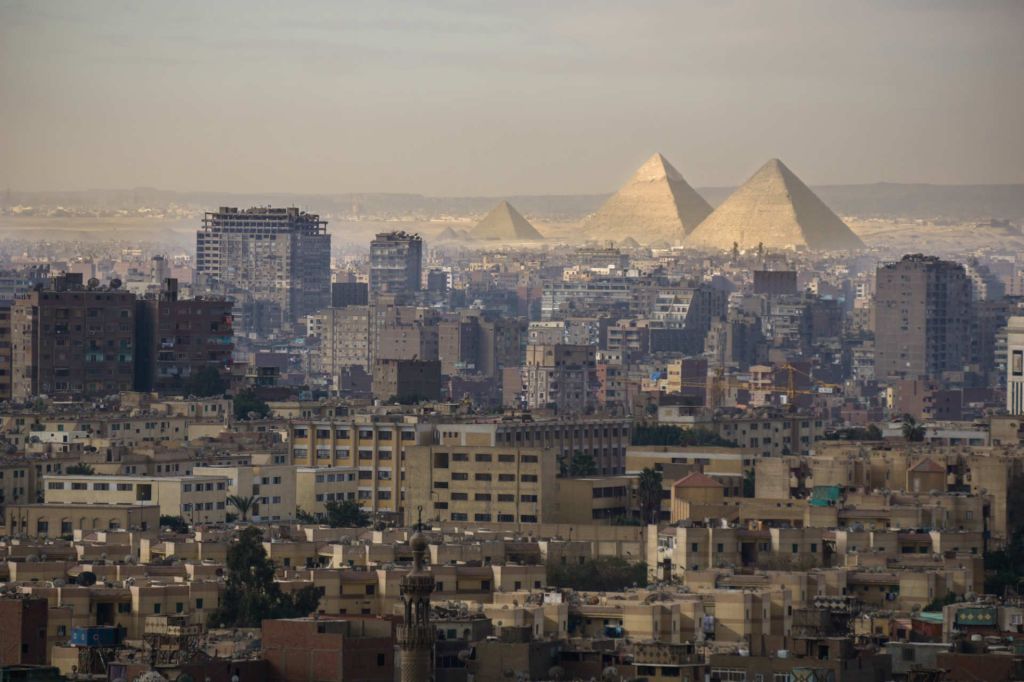

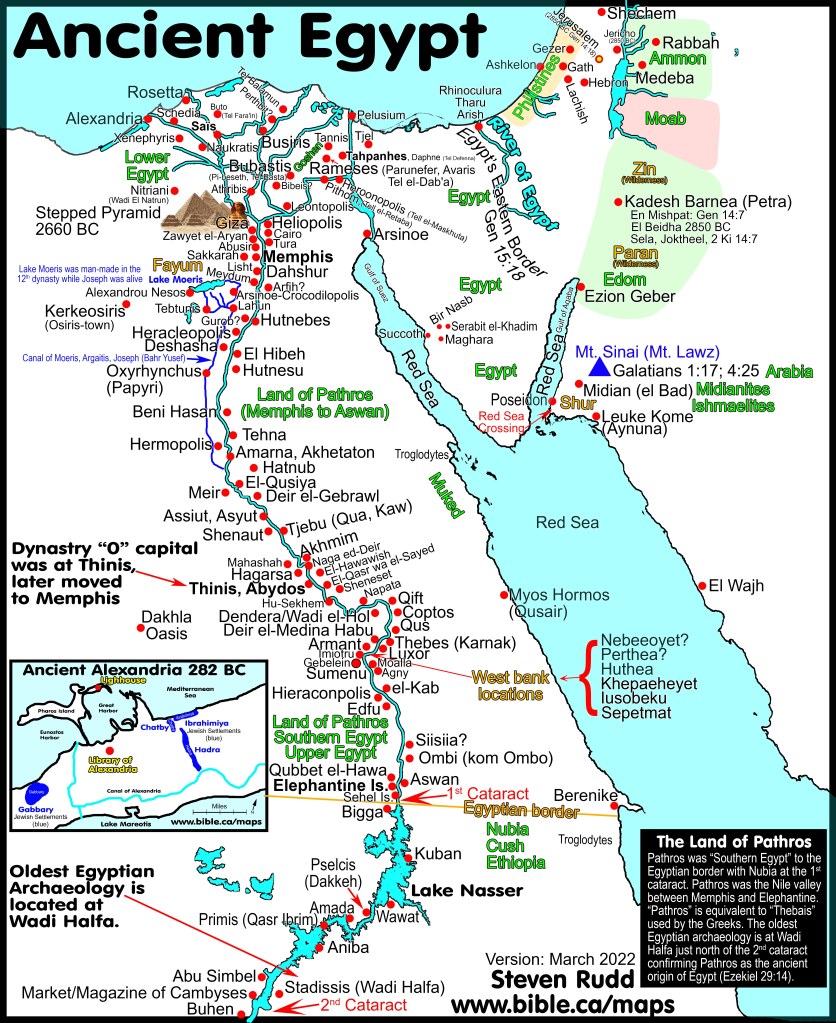


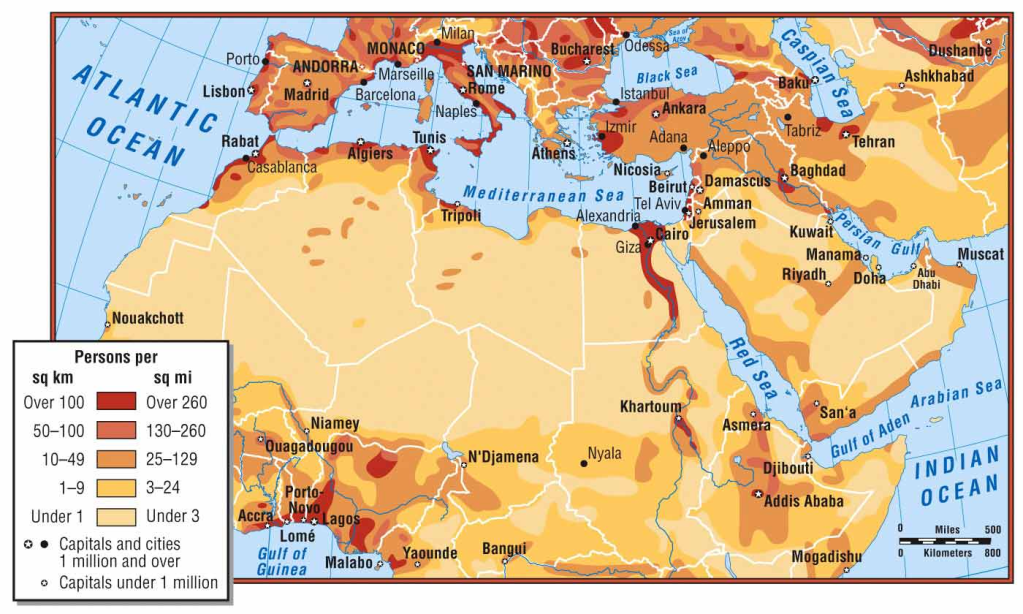
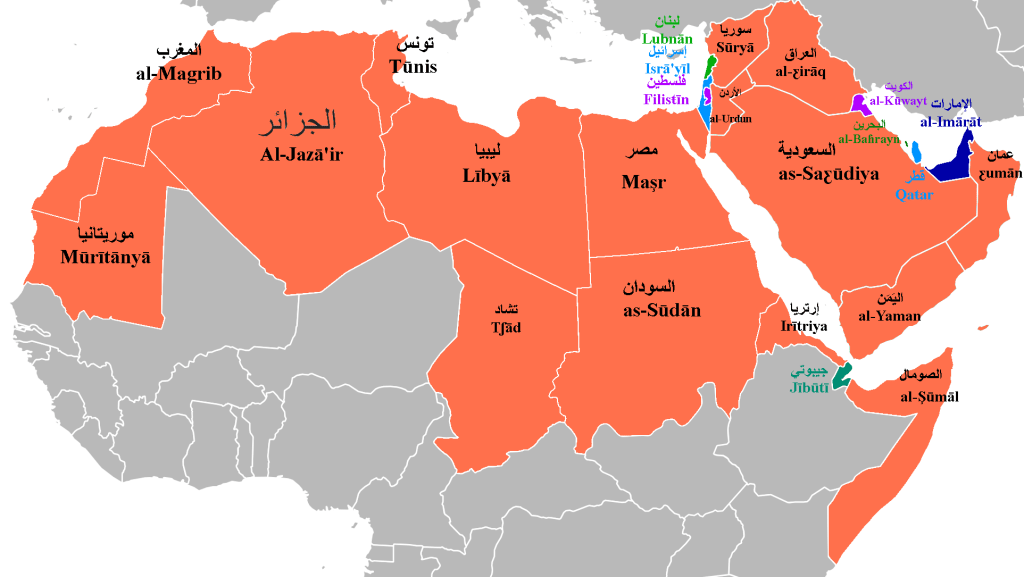


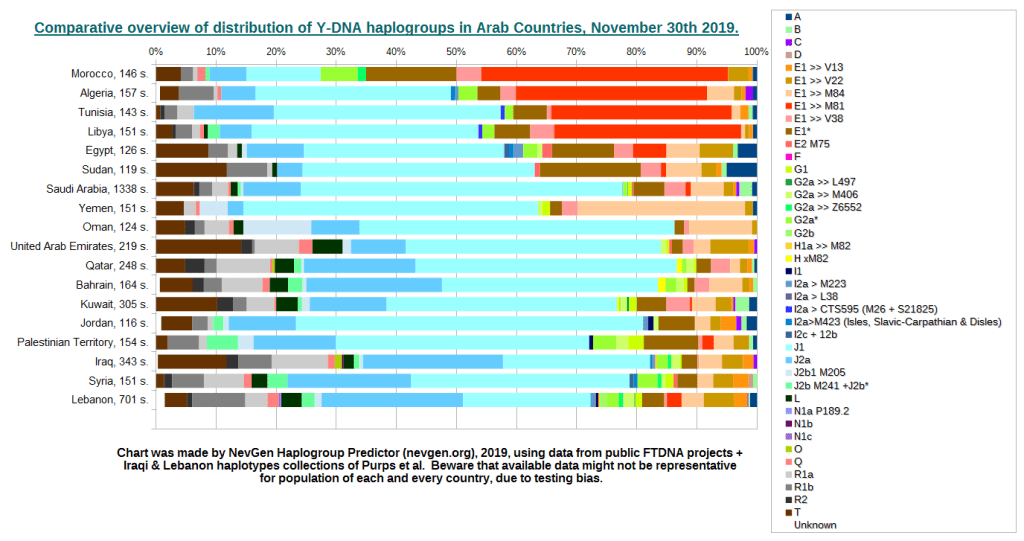
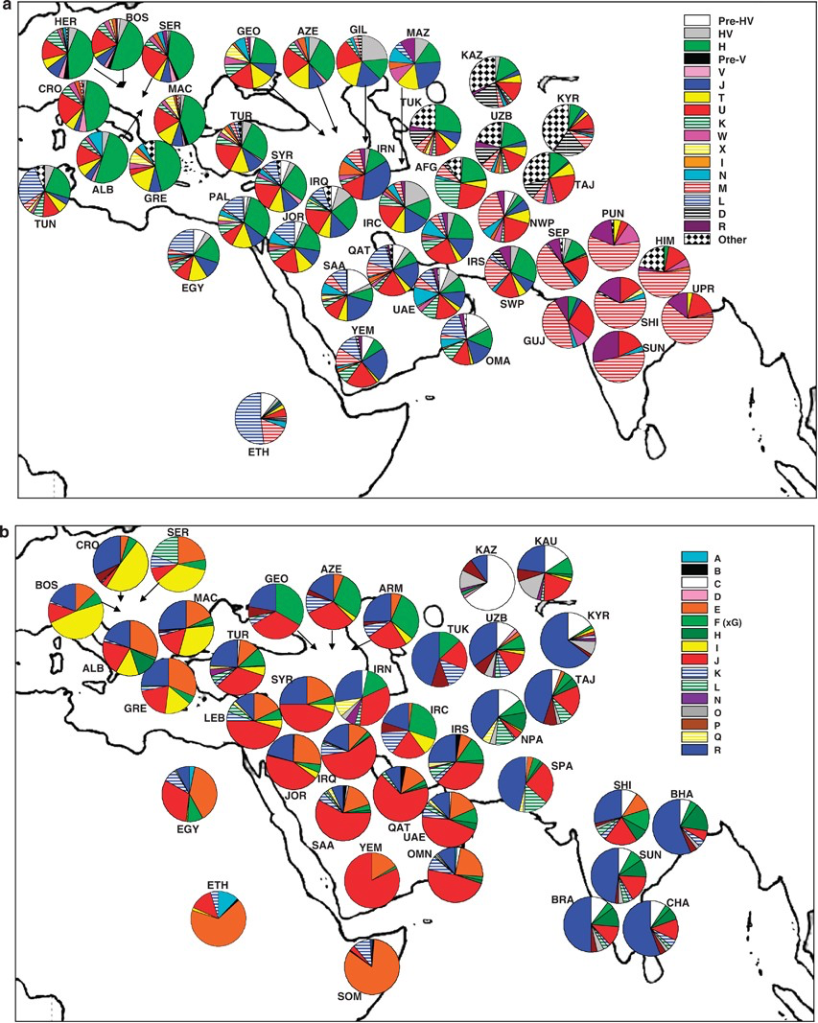


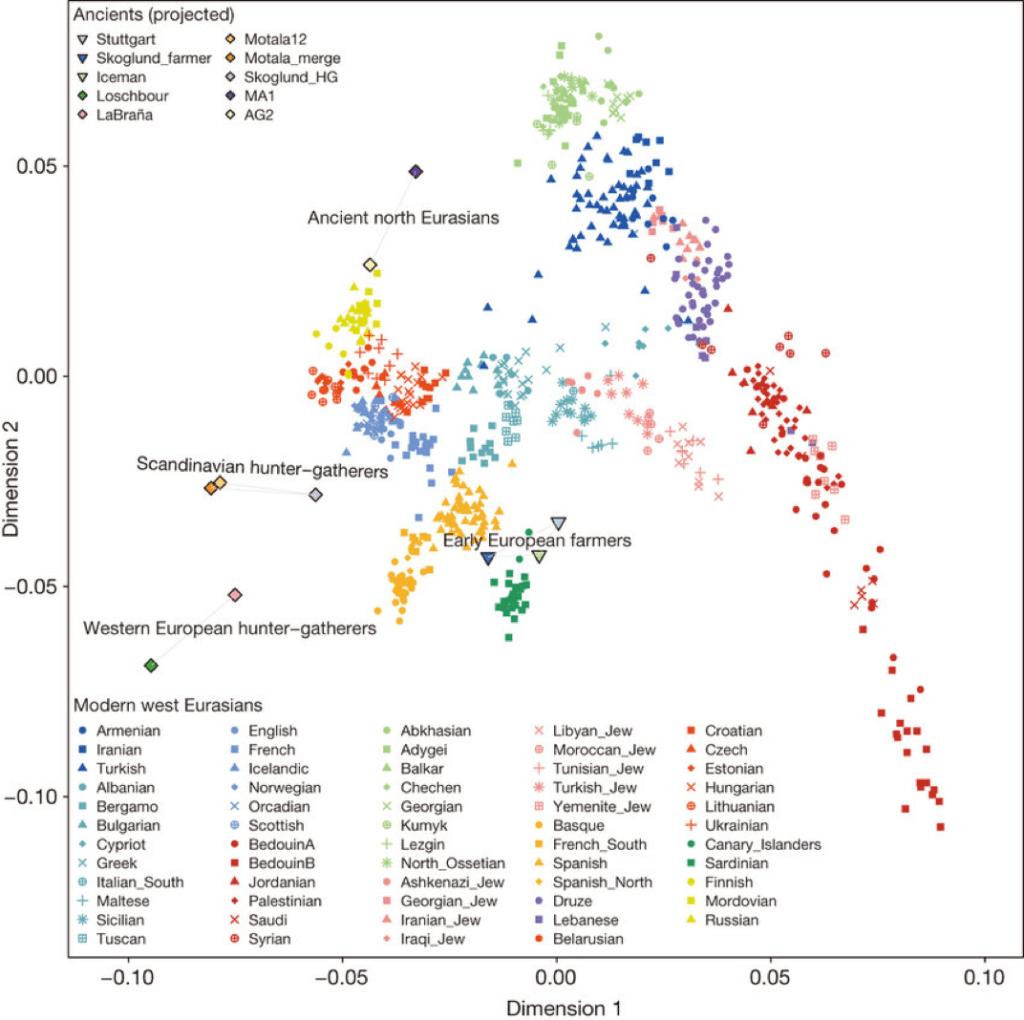
 The Lightkeeper