
Chapter XXIX
A handful of the biblical identity of nations attract the most interest in the subject, enthralling the attention of enthusiasts whether they be students or authorities on the matter.
The most popular include the mighty Assyrians descended from Asshur; the mysterious Israelite tribe of Dan; the violent and vicious Amalekites; the especially blessed birthright sons of Joseph, Ephraim and Manasseh;
and last but certainly not least, the mercurial twin brother of Jacob: Esau.
There is not a more contentious identity. For Esau or Edom, has been overly identified with a variety of peoples.
Principally with either Turkey, to go hand-in-hand with the Arabs being (incorrectly) labelled Ishmael – which has a measure of legitimacy, as the Ashkenazi branch of Jewry may have a genetic link with the Turks – or with Italy and Germany, which again has a degree of accuracy, as the ruling element of these nations has included infiltration by Esau, refer article: The Establishment: Who are they… What do they want?
The Jewish people – similarly like the Arabs, who make their own inaccurate assertion (refer Chapter XIV Mizra: North Africa & Arabia; and Chapter XXVIII The True Identity & Origin of Germans & Austrian – Ishmael & Hagar) – overtly claim descent from Judah, a son of Jacob.
Numerous researchers and commentators have arrived at the conclusion and offer convincing evidence to support, that modern Jewry is in fact descended, or in principle, from Esau. We will cover a large and significant body of material in seeking to verify if this is so. Incredibly, some Jews themselves not so secretly, admit to descending from Esau.
Yet, we will thoroughly and carefully examine the facts and clues to see if this is true. The magnitude of this revelation is enormous, for it would reveal a conspiracy of deliberate fraud and purposeful mistaken identity. The ramifications of which are immeasurable in themselves, yet would lead astonishingly, to the most pressing and urgent question one could formulate within all identity material:
If the Jews are the biblical Edomites, descended from Esau, and not from the tribe of Judah as claimed… then who pray tell, is the tribe of Judah, the fourth son of the Patriarch Jacob and the first of his two wives, Leah?
Esau’s father, Isaac – born in 1877 BCE – is sandwiched between two enormous presences in the biblical account: Abraham and Jacob. So it is easy to lessen or neglect Isaac’s role. Isaac though, rather like his father Abraham is a laid back, phlegmatic character with normal human failings, yet displaying an unflinching faith in the Almighty and His promises.
Evidenced in his willingness to be sacrificed at age thirty, if it meant the promises to his father Abraham were to be fulfilled by another person or in some other, unforeseen way such as through the miracle of his resurrection – refer Chapter XXVII Abraham & Keturah – Benelux & Scandinavia.
One can’t help think Isaac had a laconic nature and sense of humour which was epitomised by his name which means: laughter or he will laugh from the sahaq verb, ‘to laugh’ and ‘make fun.’
Isaac
We read about Isaac meeting and marrying Rebekah when he was age forty, some three years after his mother Sarah’s death, in 1840 BCE – according to an unconventional chronology. It is a true love story and provides encouragement for all hopeless romantics.
Rebekah’s name means: ‘Tied up, secured’ from the verb rbq, ‘to tie firmly.’ It also means, ‘bind, trap’ and ‘snare.’
Rebekah is one of the most prominent women in the Bible, in terms of her active role in steering events of far-reaching consequence.
Genesis 24:1-67
English Standard Version
1 ‘Now Abraham was old… 2 [and] said to his servant [Eliezer], the oldest of his household, who had charge of all that he had… 3 swear by the Lord… that you will not take a wife for my son from the daughters of the Canaanites, among whom I dwell, 4 but will go to my country and to my kindred, and take a wife for my son Isaac.” 5 The servant said to him, “Perhaps the woman may not be willing to follow me to this land. Must I then take your son back to the land from which you came?”
6 Abraham said to him, “See to it that you do not take my son back there.”
10 Then the servant took ten of his master’s camels and departed, taking all sorts of choice gifts from his master; and he arose and went to Mesopotamia to the city of Nahor’ – 11 ‘And he made the camels kneel down outside the city by the well of water at the time of evening, the time when women go out to draw water. 12 And he said,
“O Lord, God of my master Abraham, please grant me success today and show steadfast love to my master Abraham.”
15 Before he had finished speaking, behold, Rebekah… came out with her water jar on her shoulder.
16 The young woman was very [H3966, greatly, exceedingly] attractive [H2896, good, goodly] in appearance [H4758, to look upon, favoured], a maiden whom no man had known.’

Rebekah
17 ‘Then the servant ran to meet her and said, “Please give me a little water to drink from your jar.” 18 She said, “Drink, my lord.” And she quickly let down her jar upon her hand and gave him a drink.
19 When she had finished giving him a drink, she said, “I will draw water for your camels also, until they have finished drinking.”
20 So she quickly emptied her jar into the trough and ran again to the well to draw water, and she drew for all his camels. 21 The man gazed at her in silence to learn whether the Lord had prospered his journey or not.
22 When the camels had finished drinking, the man took a gold ring weighing a half shekel, and two bracelets for her arms weighing ten gold shekels, [0.25 pounds] 23 and said, “Please tell me whose daughter you are. Is there room in your father’s house for us to spend the night?”
24 She said to him, “I am the daughter of Bethuel the son of Milcah, whom she bore to Nahor” – refer Chapter XXV Italy: Nahor & the Chaldeans.
25 ‘She added, “We have plenty of both straw and fodder, and room to spend the night.”
28 Then the young woman ran and told her mother’s household about these things. 29 Rebekah had a brother whose name was Laban. Laban ran out toward the man, to the spring. 30 As soon as he saw the ring and the bracelets on his sister’s arms, and heard the words of Rebekah his sister, “Thus the man spoke to me,” he went to the man…
31 He said, “Come in, O blessed of the Lord. Why do you stand outside? For I have prepared the house and a place for the camels.”
34 So he said, “I am Abraham’s servant.
50 Then Laban and Bethuel answered and said, “The thing has come from the Lord; we cannot speak to you bad or good. 51 Behold, Rebekah is before you; take her and go, and let her be the wife of your master’s son, as the Lord has spoken.”
52 When Abraham’s servant heard their words, he bowed himself to the earth before the Lord. 53 And the servant brought out jewelry of silver and of gold, and garments, and gave them to Rebekah. He also gave to her brother and to her mother costly ornaments…
59 So they sent away Rebekah their sister and her nurse [Genesis 35:8, ESV: ‘And Deborah, Rebekah’s nurse, died, and she was buried (by Jacob) under an oak below Bethel. So he called its name Allon-bacuth (‘oak of weeping’)], and Abraham’s servant and his men. 60 And they blessed Rebekah and said to her,
“Our sister, may you become thousands of ten thousands, and may your offspring possess the gate of those who hate him!”
63 And Isaac went out to meditate in the field toward evening. And he lifted up his eyes and saw, and behold, there were camels coming. 64 And Rebekah lifted up her eyes, and when she saw Isaac, she dismounted from the camel 65 and said to the servant, “Who is that man, walking in the field to meet us?” The servant said, “It is my master.” So she took her veil and covered herself. 66 And the servant told Isaac all the things that he had done.
67 Then Isaac brought her into the tent of Sarah his mother and took Rebekah, and she became his wife, and he loved her. So Isaac was comforted after his mother’s death.’
Rebekah’s brother Laban, displays the traits which we observe later, when Jacob goes to live with him. He is bedazzled by the jewels and gifts just as much as being convinced of the demand of kinship or the will of the Almighty. Even so, it is Rebekah’s choice whether to leave with Abraham’s servant and marry Isaac. Eliezer must have been convincing.
Rebekah by her actions, reveals her outgoing personality and that she is a woman of action. In contrast to the laid-backness of Isaac. Rebekah is also shown in the account to be kind, generous and competent.
Her family’s blessing, meant simply that her descendants would have the upper hand and mastery over their enemies and the numbers to achieve that. History shows that sometimes this was dependant on their obedience and how much or how little they pleased the Creator.
Other times it had no bearing and they were blessed regardless and yet again, it sometimes meant battles would be lost, even for decades, but ultimately, not the war. What is especially curious, is that Esau’s descendants appear to be included in this prophetic blessing.
Recall, Abraham had married his niece Sarah on – his eldest brother – Haran’s, side of the family. Ethnically, she was similar to a Swiss (or French) woman – Chapter XXVI The French & Swiss: Moab, Ammon & Haran.
Yet Abraham’s servant had travelled to Abraham’s other (older) brother, Nahor, the father of the Chaldeans. Today – along with Aram’s son Uz – the Chaldeans equate to the Northern and by extension Central Italians. Nahor’s eighth and youngest son with his wife Milcah, was Bethuel, one of the original Italian paternal ancestors. Therefore, Rebekah was descended from this same lineage.
Genesis 25:20-34
English Standard Version
20 ‘and Isaac was forty years old [in 1837 BCE] when he took Rebekah [who was 20 years old], the daughter of Bethuel the Aramean of Paddan-aram, the sister of Laban the Aramean, to be his wife.
21 And Isaac prayed to the Lord for his wife, because she was barren [like his mother, Sarah]. And the Lord granted his prayer, and Rebekah his wife conceived. 22 The children struggled together within her, and she said, “If it is thus, why is this happening to me?” [or ‘why do I live’] So she went to inquire of the Lord. 23 And the Lord said to her…’
This was not the usual moving of arms and legs inside the womb which a mother feels when a foetus changes position or stretches. These two souls were at each other from the beginning. An inherent mistrust and misunderstanding of the other which would only deepen and worsen. These were very painful kicks and thrusts inside Rebekah.
It is said that Rebekah, while suffering from her pregnancy, went from neighbour to neighbour asking the women whether they had ever experienced the same. The answer she received is said to have come directly from the Almighty, speaking through an angel. It is also said that she should have borne twelve sons, the fathers of the future twelve tribes; but after the birth of Esau, she became barren once more.
“Two nations [H1471 – gowy] are in your womb, and two peoples [H3816 – l’owm] from within you [or ‘from birth’] shall be divided [CJB: they will be two rival peoples]; the one shall be stronger than the other, the older shall serve the younger.”
What is deeply significant in this verse and overlooked by nearly all is that two separate and distinct sons were fashioned in the womb.
They were not only to be non-identical twins who just were not going to get along; they were to be different peoples in nature, mind set, objectives, procedures and ideals. So that on one hand, one would wonder if they were really related at all. This makes their identification both clear and complex at one and the same time.
24 ‘When her days to give birth were completed [in 1817 BCE], behold, there were twins in her womb.
25 The first came out red, all his body like a hairy cloak [or garment], so they called his name Esau.’
The Midrash states that during Rebekah’s pregnancy, whenever ‘she would pass a house of Torah study, Jacob would struggle to come out; whenever she would pass a house of idolatry, Esau would agitate to come out.’
26 ‘Afterward his brother came out with his hand holding Esau’s heel, so his name was called Jacob [‘he takes by the heel’ or ‘he cheats’].’
Isaac was sixty years old when she bore them.
The exact meaning of the word Esau is disputed and is connected to a variety of definitions. It could be related to the Arabic* root gsw, meaning ‘to cover.’
Others have noted the similarity to the Arabic ‘athaa meaning hirsute. The ‘sau’ of Esau’s name in Hebrew means hairy. In Hebrew, the word ‘hairy’ [Hebrew: se’ir] is a wordplay on Seir, the region in which he later settled.
Esau became known as Edom, meaning ‘red’ [Hebrew: admoni]; the same colour used to describe Esau’s skin tone. Other traditional sources connect the word with the Hebrew sav’ meaning ‘worthless.’
Abarim Publications define Esau – reflective of Rebekah’s nature – as ‘Doer, Maker, Worker.’ From the verb ‘asa, ‘to do’ or ‘make’.
‘The two nicknames of Esau, Edom and Seir, are both obvious in meaning and have to do with Esau’s looks (red and hairy).
His proper name however is not as easily derived. Jones’ Dictionary of Old Testament Proper Names reports that there once was a root (‘asa) that meant to be hairy, and refers to an existing Arabic* verb that means just that. Hence Jones translates with Covered With Hair…’
One commentator states the root of the name in Hebrew is derived from the word asuy denoting ‘completion’, thus made and complete, ‘since Esau was born hairy and very strong, being “completed” and not infantile.’
It is possible that Esau was brown and hairy as some researchers do not think red, means red.
Though a red headed person with red body hair to match, is always associated with pale, fair or freckly skin. Granted, redheads vary from flaming red tresses to strawberry blond with brownish auburn inbetween, as it is a quantitative trait. Regardless if Esau did have red hair, Jacob was Esau’s twin brother, so it shouldn’t be surprising if both their descendants carry common genetic traits and thus exhibit red hair.
We have learned that red hair is indicative of the R1b Y-DNA Haplogroup which largely distinguishes Western Europeans from the rest of the world – refer Chapter I Noah Antecessor Nulla.
Red hair, like blue eyes is a recessive gene. Jacob would have carried the red hair gene which Esau inherited, even if he didn’t have red hair himself. Due to the recessive nature of this gene, both Isaac and Rebekah would have needed to be carriers for Esau to be born red.
What is significant is that Esau is the first person to be described emphatically as red – unlike Adam, who’s redness was the lifeblood within him, which was a combination of celestial spirit and earthly flesh – Chapter XXII Alpha & Omega.
Cornerstone Publications adds concerning Esau’s hairiness:
‘The reference to Esau having been hairy all over… can be related to the hair on his head as well, for he and many of his descendants became well-known for wearing long hair, long red hair…’
We are now searching for peoples on the Earth with a higher proportion of red hair as this is a sign for Esau’s and Jacob’s descendants. Interestingly, the same word used to describe Esau as red is also used of David in 1 Samuel 16:12 and 17:42. David is a descendant of Jacob, rather tantalisingly through his son, Judah – Chapter XXX Judah & Benjamin – the Regal Tribes.
Hair colour is the result of the balance between eumelanin and phaeomelanin – types of melanin.
Red hair derives from a genetic variant which causes the cell to produce phaeomelanin. It causes the melanocortin 1 receptor (MC1R), on chromosomes four and sixteen, to function differently on melanocytes, which leads to less eumelanin – the pigment that results in brown skin, hair and tanning of the skin – and more of the red pigment pheomelanin, present in our lips and nipples.

Red Head Day in Tilburg, Netherlands during the last weekend of August each year
Approximately two percent of the world’s population naturally has red hair, with the vast majority of red haired individuals having northwestern European ancestry. Western Europe, mainly comprising Abraham’s descendants has more red haired people than any other part of the world.
Approximately six to ten percent nationally and up to thirty percent regionally, of the Scottish population has red hair, with an additional forty percent of the population with other hair colourings carrying the gene responsible for red hair; while about ten to thirty percent of the Irish population, specifically in Northern Ireland, have red hair, making it the most red haired country in the world with Scotland. Red hair prevalence in England is around four percent.
Ashkenazi Jews also have red hair. About 3.6% of Jewish women have red hair, while 10% of Jewish men have red beards.

In the Americas, the emigration of Europeans has influenced the red haired population. Approximately two to six percent of the American population is redheaded; meaning the United States has the largest redhead population in the world somehwere between seven to twenty million people.
There are some who equate red hair with descending from the Neanderthal, such as the American anthropologist, Carleton Coon in the 1930s and there are some people who link red hair, freckles and pale skin with the Nephilim, which is probably more believable of the two hypotheses – Chapter XXII Alpha & Omega; and articles: Homo neanderthalensis I, II, III & IV.
Red hair, with blond hair, (fair skin) and blue eyes have all been genes carried by Noah and or, his son Shem and possibly their wives Emzara and Sedeqetelebab, respectively. The blue eyes and fair (blond) hair genes – as exhibited predominantly in men with Y-DNA Haplogroups I1 and R1a respectively – were evident in Asshur and Arphaxad’s descendnats and are features of people throughout Russia and Eastern Europe. Red hair associated with R1b on the other hand, appears specific to Arphaxad’s descendant, Abraham (R1b-U106) through Peleg rather than Aram and his male descendants (R1b-DF27).
There is one location with a high incidence of red hair outside northwestern Europe and they are the Udmurts of the Urmurtia Republic within Russia. Is this a residue of the Khazar nation?
The Romanov royal family of Russia – Nicolas II, Alexandra and their four daughters and one son – have been described as having red or red-gold (strawberry blond) hair and colour photos show this to be the case – Article: The Life & Death of Charles III.
Udmurts say ‘a person with red hair is the sun’s child’ and ‘a redheaded person is closest to the gods. The gods love them.’
Approximately seventeen percent of people on the earth have blues eyes – though by 2100 this figure will reduce to just 3% – and when combined with the one to two percent of people with red hair, the odds of having both traits diminish to 0.17%. For instance, of a world population of 8.2 billion, that would be only fourteen million people.
There are numerous mentions of red haired as well as fair skinned individuals in the Bible in reference to both lines descending from Isaac and Rebekah. We will look at them as we encounter each personality, though it may be of interest to look also at three people whom we have already previously discussed.
Sarah and Rebekah are both described as being fair:
“And it came to pass, when he was come near to enter into Egypt, that [Abram] said unto Sarai his wife, Behold now, I know that thou art a fair [H3303 – yapheh: fair, fair one, beautiful] woman to look upon [H4758 – mareh]…” – Genesis 12:11. “And it came to pass, that, when Abram was come into Egypt, the Egyptians beheld the woman [Sarah] that she was very fair [yapheh]” – Genesis 12:14, KJV.
“And the damsel [Rebekah] was very fair [H2896 – towb: good, fine, pleasant, beautiful] to look upon [H4758 – mareh]…” – Genesis 24:16.
“And the men of the place asked [Isaac] of his wife; and he said, She is my wife; lest, said he, the men of the place should kill me for Rebekah; because she was fair [towb] to look upon” – Genesis 26:7, KJV.
As we have touched upon previously, Esther who became Queen of the Persian Empire, was a fair skinned person. She was from the tribe of Benjamin – Esther 2:5.
“The young woman had a beautiful figure [H3303 – yapheh] and was lovely [H8389 – toar] to look at [H4758 – mareh: appearance, behold]…” – Esther 2:7, ESV.
The word ‘beautiful’ is the same word which was used when speaking about Sarah, though interestingly not for Rebekah. It stems from H3302 meaning ‘to be bright’ and is the only place in all of the book of Esther where this word is used. Esther had a bright or light skin.
The Hebrew word translated as ‘lovely’ in verse seven is in regard to a person’s ‘form’ or ‘shape’, meaning to delineate an ‘outline’, referring to their ‘appearance’. Thus Esther was not only fair and beautiful, she was a woman with an attractive figure. We read that Vashti, the former haughty queen, was also fair as in beautiful (towb) rather than light skinned (yapheh) – Esther 1:11.
Genesis: 27 ‘When the boys grew up, Esau was a skillful hunter [like Ishmael – Genesis 21:20], a man of the field [the outdoors], while Jacob was a quiet man, dwelling in tents.
28 Isaac loved Esau because he ate of his game, but Rebekah loved Jacob.’
And herein lay a key issue in the events which transpired. Each parent had a favourite and so this affected transparent lines of communication between Isaac and Rebekah when it really mattered.
Esau had rougher qualities which distinguished him from his twin brother. Jacob was a plainer or simpler man, depending on the translation of the Hebrew word tam which can also mean a ‘relatively perfect’ man. Esau was a strong, savvy hunter and like a beast he was physically fit and restlessly on the move. Esau bore some resemblance to Cain, another man of the field (Genesis 4:3) and with Nimrod, the mighty hunter (Genesis 10:9); who stood in front of (or against) the Eternal – Chapter XXI The Incredible Identity, Origin & Destiny of Nimrod; and article: The Pyramid Perplexity.
Jonathan ben Uzziel – Targums of Onkelos – states:
‘Esau was a man of idleness to catch birds and beasts, a man going forth into the field to kill lives, as Nimrod had killed, and Hanok his son.’
Esau is also described as being cunning. The Book of Jasher 28:19-20 reveals that Esau was a ‘designing and deceitful man, one who hunted after the hearts of men and inveigled them.’ A footnote says Esau stole the minds of people, an insightful interpretation when measured against the deceptive qualities being employed by the leading Edomites today.
Additional information is provided in the Book of Jubilees 19:12-19:
12 ‘… Rebecca bare to Isaac two sons, Jacob and Esau, and 13 Jacob was a smooth and upright man, and Esau was fierce, a man of the field, and hairy, and Jacob dwelt in tents.
14 And the youths grew, and Jacob learned to write; but Esau did not learn, for he was a man of the field and a hunter, and he learnt war, and all his deeds were fierce.
15 And Abraham loved Jacob, but Isaac loved Esau.
16 And Abraham saw the deeds of Esau, and he knew that in Jacob should his name and seed be called [Israelites]; and he called Rebecca and gave commandment regarding Jacob, for he knew that she (too) loved Jacob much more than Esau.
17 And he said to her: My daughter, watch over my [grand]son Jacob, For he shall be in my stead on the earth, And for a blessing in the midst of the children of men [through Abraham’s great grandson Joseph], And for the splendor of the whole seed of Shem. 18 For I know that Yahweh will choose him to be a people for possession unto Himself, above all peoples that are upon the face of the earth.
19 And behold, Isaac my son loves Esau more than Jacob, but I see that you truly love Jacob.’
Families… complicated.
Genesis: 29 ‘Once when Jacob was cooking stew, Esau came in from the field, and he was exhausted.
30 And Esau said to Jacob, “Let me eat some of that red stew, for I am exhausted!” (Therefore his name was called Edom [red]).
31 Jacob said, “Sell me your birthright now.”
32 Esau said, “I am about to die; of what use is a birthright to me?”
33 Jacob said, “Swear to me now.”
So he swore to him and sold his birthright to Jacob.
34 Then Jacob gave Esau bread and lentil [red pottage] stew, and he ate and drank and rose and went his way.
Thus Esau despised his birthright.’

Esau
Esau was not just tired or hungry, he was absolutely shattered and that way when you are so famished, you just need to eat immediately. It does not appear to be a typical situation of Esau returning from a normal hunt. Possibly, Esau had narrowly escaped with his life from a more serious situation. It is in this moment that Jacob chanced his arm and went for Esau while he was at his most vulnerable. Jacob would have been well aware of Esau’s personality and character weaknesses and vice-versa. The opportunity presented itself and he struck quickly and devastatingly.
In fact, the whole conversation and scenario only really makes sense if we appreciate the age of Esau and Jacob, as being much younger than usually assumed. Their abrupt language and petulant manner, is reflected by their level of maturity and is recognisable as teenage behaviour. The Talmud teaches that the sale of the birthright occurred straight after Abraham died in 1802 BCE, when Esau and Jacob were fifteen years of age. Jewish sources say Esau was considered a rebellious son; living a double life until he sold his birthright.
Apparently, the lentil stew Jacob was cooking was intended for his father Isaac, as lentils became the traditional mourner’s meal for Jews. Tradition teaches that on the day before returning home, in a wrathful rage over the death of Abraham, Esau committed five transgressions – (1) he raped a betrothed young woman; (2) he committed murder (Nimrod, according to Jewish sources); (3) he denied God; (4) he denied the resurrection of the dead – Job 14:14; and (5) he spurned his birthright.
Whether Esau committed the first two is not definitively known. The last three are plausible if he was angry and grief stricken.
Nimrod would have been somewhere near seven thousand years old according to an unconventional chronology. His age not so much the issue as a direct, first generation Nephilim, but rather if he were still alive, would he not have still been ruling Babylon and this does not seem to be the case, as we learned when studying Abraham – refer Chapter XIX Chedorlaomer & the War of Nine Kings; and Chapter XXVII Abraham & Keturah – Benelux & Scandinavia.
Rob Skiba remains convinced that Esau is linked with Nimrod:
‘In the context of the Jasher account, that story makes a whole lot more… sense… doesn’t it? I mean think about it. Without Jasher, the story in Genesis 25 makes no sense at all… After reading Jasher, you now completely understand what is going on and why.
Esau had just killed the king of the world! By the way, the “valuable garments” that Nimrod had, “with which he prevailed over the whole land” were the original garments God made for Adam and Eve back in the garden… so here Esau has chopped off Nimrod’s head and stolen his “magic garments.” The rest of Nimrod’s “mighty men” were after him now.
Esau came home famished from a very busy day! So, when Jacob says he wants his birthright, Esau basically said, “Look. What do I care about my birthright? I just killed King Nimrod! I’m a dead man. His warriors are probably coming for me as we speak. Just give me something to eat!” Esau was extremely vulnerable here and Jacob totally took advantage of the situation for his own selfish gain…’
Did Esau commit rape and murder? If so, he would have been on edge to say the least and very much of the rationale that his life was over, so why not sell a birthright he was not going to live to receive. The last three acts somewhat bundle together and committing the fifth, could well have meant him being guilty of the other two. A profound irony would be in place if Esau denied the resurrection, as it would be a prominent sect descended from Edom at the time of Christ, who would also deny the resurrection – Article: The Christ Chronology.
The meal Jacob gave Esau was pottage, a thick soup made of vegetables. This can contain meat, though as emphasis is given to it being red from lentils, this is unlikely, particularly with no mention of animal flesh. Some claim red or ruddy can mean a brownish colour, but again the colour red is emphasised, indicating vegetables and not meat that could begin red and turn brown.
Calling a spade a spade is required here and the sad fact of the matter, is that Esau – though undeniably charismatic – was an unsavoury character. As with Canaan and his descendants, because Ham and specifically his wife Na’eltama’uk sinned with Noah, it doesn’t mean every black person is an evil person – refer Chapter XI Ham Aequator; and Chapter XII Canaan & Africa.
Similarly, it would be unfair to tar every descendant of Esau with the same brush. Esau and Jacob were opposites in every way. Vitally, Esau was physically oriented and lacked true spiritual depth. He was a rugged, masculine rather, macho man of the moment, filled with passion. He did not perceive the end game or past the present today.
We will find in bitter irony, that the influential echelons of Esau’s descendants are visionary masters of the end game and have also perfected the guise of spirituality. Esau displayed his violent nature in impulsively and impetuously bargaining away his birthright for a pot of red lentil stew. His actions are hard to fathom in that he grossly under valued the birthright; deeming it as almost worthless; beneath him; and as if he did not need it. It really only leaves immense pride on Esau’s behalf, so much so that his pride either blinded him in really seeing the birthright’s worth; or worse, he really felt above it and didn’t need the birthright.
The Origin of the Nations, 1957, Herman Hoeh comments on Esau – capitalisation his, emphasis mine:
‘Abraham had another son, Isaac. Isaac had two sons, twins, named Esau and Jacob. Jacob was the younger and the stronger. These two brothers gave rise to two different nationalities.
“… And the first came forth ruddy, all over like a hairy mantle” (Genesis 25:23-25). Esau, the elder, was not properly developed. The lanugo or hair that covers a foetus through the sixth, seventh and eighth months failed to drop off Esau as it does with all normal children. Esau was weaker, not fully developed. His children, of course, did NOT inherit this peculiar characteristic.
Esau did not give rise to a different race, but to a different nationality. Esau’s children are white, as history proves. Esau’s descendants play a vital part in world affairs today! Where are his descendants?
Notice some of the sons of Esau: Teman, Omar, Amalek (Genesis 25:11). These are not Jewish names! Yet some claim that the Jews are the children of Esau. Nothing could be further from the truth – as we shall presently see.
Esau, or Edom, as he is also called, lived southeast of Palestine near Petra. Arab Bedouins live there now. Then where have Esau’s children gone? From the days of Nebuchadnezzar, who carried them captive, they disappear for 1000 years from history. Then suddenly we find Amalek the name of a city in Turkestan in Central Asia (from Paul Herrmann’s SIEBEN VORBEI UND ACHT VERWEHT, page 451). The Egyptians used to call the Amalekites Amu. In Turkestan is the River Amu today! In Bible times the Edomites inhabited Mt. Seir (Genesis 32:4). In Turkestan is the Syr Darya – the River of Syr or Seir. The leading Turkish tribe is the Ottoman.
The prophecies referring to Edom or Esau mention Teman as the leading tribe in these latter days (Obadiah 9).
The conclusion is inescapable.
The Otto-man Turks are the sons of Te-man. Merely the vowels in spelling have been changed over these past millenniums. From Central Asia the Turks or Edomites moved into Asia Minor. That is where Esau’s children live today! Turkey controls the “crossway” of the nations – the Dardanelles (Obadiah 14). How clear, ESAU OR EDOM IS TURKEY today!’
Dr Hoeh confidently claims a Turkish identity for Esau, though we have already addressed the convincing evidence of an Elamite identity for Turkey – refer Chapter XVIII Elam & Turkey; and Chapter XIX Chedorlaomer & the War of Nine Kings.
Additionally, the Turks are not renowned for their red hair and fair skin. Nor does their history, autosomal DNA or Haplogroups share a closeness with the northwestern European peoples. Paradoxically, it seems likewise, with the people who call themselves Jewish – particularly the Ashkenazi Jew. With regard to the ‘crossroads’, there is a modern nation which dramatically stands to fulfil this prophecy. It is not turkey.
Genesis 26:1-35
English Standard Version
1 ‘Now there was a famine in the land, besides the former famine that was in the days of Abraham. And Isaac went to Gerar to Abimelech king of the Philistines. 2 And the Lord appeared to him and said, “Do not go down to Egypt; dwell in the land of which I shall tell you.
3 Sojourn in this land, and I will be with you and will bless you, for to you and to your offspring I will give all these lands, and I will establish the oath that I swore to Abraham your father. 4 I will multiply your offspring as the stars of heaven and will give to your offspring all these lands. And in your offspring all the nations of the earth shall be blessed,
5 because Abraham obeyed my voice and kept my charge, my commandments, my statutes, and my laws.”
6 So Isaac settled in Gerar. 7 When the men of the place asked him about his wife, he said, “She is my sister,” for he feared to say, “My wife,” thinking, “lest the men of the place should kill me because of Rebekah,” because she was attractive in appearance.
8 When he had been there a long time, Abimelech king of the Philistines looked out of a window and saw Isaac laughing with Rebekah his wife [suggesting an intimate relationship]. 9 So Abimelech called Isaac and said, “Behold, she is your wife. How then could you say, ‘She is my sister?'” Isaac said to him, “Because I thought, ‘Lest I die because of her.'” 10 Abimelech said, “What is this you have done to us? One of the people might easily have lain with your wife, and you would have brought guilt upon us.” 11 So Abimelech warned all the people, saying, “Whoever touches this man or his wife shall surely be put to death.”
The King of the Philistines, Abimelech is not the Pharaoh of Egypt and nor is he likely the same Abimelech who Abraham and Sarah met in 1878 BCE. For Isaac and Rebekah meet Abimelech circa 1790 BCE. He was either very young with Sarah and very old with Rebekah; or the alternative explanation is that the word Abimelech is a title and not a personal, first name.
We learn that Isaac and Rebekah are close and happy, with Isaac living up to his name of laughter. Isaac though, passes Rebekah off as his sister, just as his father Abraham did with his mother Sarah. The narratives appear similar yet highlight an important difference, in differentiating Rebekah from Sarah.
In at least one of the two wife/sister episodes in which she figures, Sarah seems to have had a sexual relationship with Pharaoh (Genesis 12:13-14, 19) thus ensuring the safety of her husband and their household. Rebekah’s marital fidelity in contrast, is not compromised – Genesis 26:10. Her relationship with Isaac is ‘consistently monogamous, unlike that of Sarah, who not only has extramarital sex, but also provides her husband with [her servant or handmaiden] Hagar[;] and [that] of Rachel and Leah, who are co-wives and [whom] also provide [servant] wives to Jacob.’
Genesis: 12 ‘And Isaac sowed in that land and reaped in the same year a hundredfold. The Lord blessed him, 13 and the man became rich, and gained more and more until he became very wealthy.
14 He had possessions of flocks and herds and many servants, so that the Philistines envied him. 15 (Now the Philistines had stopped and filled with earth all the wells that his father’s servants had dug in the days of Abraham his father.) 16 And Abimelech said to Isaac, “Go away from us, for you are much mightier than we.”
We have learned how the Almighty blessed Abraham with great wealth, which was partly passed to his six sons with Keturah and also a substantial portion to his son, Ishmael – Chapter XXVII Abraham& Keturah – Benelux & Scandinavia; and Chapter XXVIII The True Identity & Origin of Germans & Austrians – Ishmael & Hagar.
The primary birthright blessing had been received by Isaac. Isaac now in his own right was being blessed immensely and adding substantial wealth to his inheritance. All this was destined for Esau as the birthright holder. Jacob would have benefited from gifts similar to that which Midian and his five brothers received.
Only Esau could ever answer the question as to how he could flippantly give this away. We will learn though as we continue, that Esau regretted his decision and reneged on the deal struck with his younger twin.
Genesis: 17 ‘So Isaac departed from there and encamped in the Valley of Gerar and settled there. 18 And Isaac dug again the wells of water that had been dug in the days of Abraham his father, which the Philistines had stopped after the death of Abraham. And he gave them the names that his father had given them. 19 But when Isaac’s servants dug in the valley and found there a well of spring water, 20 the herdsmen of Gerar quarreled with Isaac’s herdsmen, saying, “The water is ours.” So he called the name of the well Esek [contention], because they contended with him. 21 Then they dug another well, and they quarreled over that also, so he called its name Sitnah [enmity].
22 And he moved from there and dug another well, and they did not quarrel over it. So he called its name Rehoboth [broad places or room], saying, “For now the Lord has made room for us, and we shall be fruitful in the land.” 23 From there he went up to Beersheba. 24 And the Lord appeared to him the same night and said, “I am the God of Abraham your father.
Fear not, for I am with you and will bless you and multiply your offspring for my servant Abraham’s sake.”
25 So he built an altar there and called upon the name of the Lord and pitched his tent there. And there Isaac’s servants dug a well.’
Isaac in his usual casual manner, chose to avoid conflict with the Philistines over the original wells Abraham had dug. The Eternal told him not to be afraid. Isaac had made a habit of accepting what befell him in his life… ‘being used as the potential object of sacrifice; waiting for the selection of a bride; walking away from the strife over the first two wells; being heartsick over Esau’s foreign wives’ and allowing himself to be deceived by Rebekah and Jacob over Esau’s inheritance.
Genesis: 26 ‘When Abimelech went to him from Gerar with Ahuzzath his adviser and Phicol the commander of his army, 27 Isaac said to them, “Why have you come to me, seeing that you hate me and have sent me away from you?”
28 They said, “We see plainly that the Lord has been with you. So we said, let there be a sworn pact between us, between you and us, and let us make a covenant with you, 29 that you will do us no harm, just as we have not touched you and have done to you nothing but good and have sent you away in peace. You are now the blessed of the Lord.”
30 So he made them a feast, and they ate and drank. 31 In the morning they rose early and exchanged oaths. And Isaac sent them on their way, and they departed from him in peace. 32 That same day Isaac’s servants came and told him about the well that they had dug and said to him, “We have found water.” 33 He called it Shibah [oath]; therefore the name of the city is Beersheba to this day.’
Peace between the family of Isaac and the Philistines was relatively short-lived and had become full on aggression a few centuries later when the family of Jacob, then grown large returned – Chapter XV The Philistines: Latino-Hispano America.
Genesis: 34 ‘When Esau was forty years old, he took Judith the daughter of Beeri the Hittite to be his wife, and Basemath the daughter of Elon the Hittite, 35 and they made life bitter [they were bitterness of spirit, a grief of mind] for Isaac and Rebekah.’
Esau was forty years old in 1777 BCE – as was Jacob. There are two matters which arise from Esau’s marriages.
The first is that they are recorded in separate accounts with the wives possessing alternative names, therefore a reconciling of scripture and the number of wives is required.
The second matter is the ethnic identity of the wives and their fathers and the ramifications that entails.
Genesis 27:1-46
English Standard Version
1 ‘When Isaac was old [117 years of age in 1760 BCE] and his eyes were dim so that he could not see, he called Esau [who was 57 years of age] his older son and said to him, “My son”; and he answered, “Here I am.” 2 He said, “Behold, I am old; I do not know the day of my death. 3 Now then, take your weapons, your quiver and your bow, and go out to the field and hunt game for me, 4 and prepare for me delicious food, such as I love, and bring it to me so that I may eat, that my soul may bless you before I die.”
Rightly or wrongly as intimated, Isaac and Rebekah had their favourites. It is interesting that the phlegmatic yet light hearted Isaac did not favour the quieter and more serious son Jacob, but rather the robust, athletic and outgoing Esau, who was much like his uncle – Isaac’s older half-brother – Ishmael.
Genesis: 5 ‘Now Rebekah was listening when Isaac spoke to his son Esau. So when Esau went to the field to hunt for game and bring it, 6 Rebekah said to her son Jacob, “I heard your father speak to your brother Esau… 8 Now therefore, my son, obey my voice as I command you [1].
9 Go to the flock and bring me two good young goats, so that I may prepare… them… 10 And you shall bring it to your father to eat, so that he may bless you before he dies.” 11 But Jacob said to Rebekah his mother, “Behold, my brother Esau is a hairy man, and I am a smooth man. 12 Perhaps my father will feel me, and I shall seem to be mocking him and bring a curse upon myself and not a blessing.” 13 His mother said to him, “Let your curse be on me, my son; only obey my voice [2], and go, bring them to me”
Rebekah is again a woman of action in contrast with Isaac and as it was Jacob’s idea to take Esau’s birthright, it was actually his mother’s plan to fait accompli the blessing too. Esau was obviously not willing to relinquish this to Jacob, even though he had promised the birthright to him, some forty-two years previously. A possible factor in both Jacob’s and Rebekah’s actions, were the sentiments of Abraham before he died, in choosing Jacob to be the beneficiary of the Creator’s promises to Abraham.
Even so, Rebekah was taking matters into her own hands rather than relying on the Eternal. Perhaps this is why she is not listed (commended) in Hebrews eleven, the faith chapter.
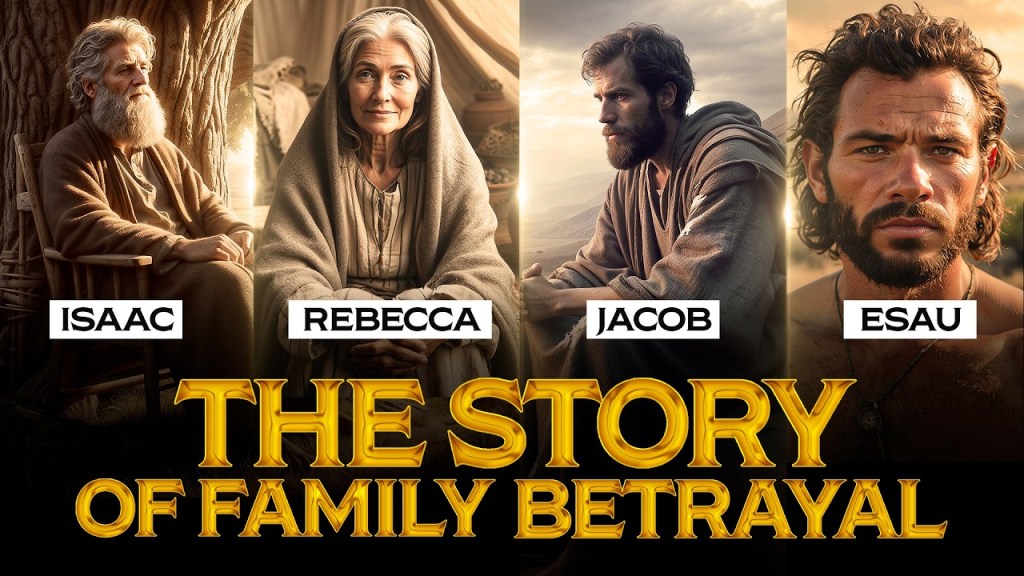
Genesis: 14 ‘So he went and took them and brought them to his mother, and his mother prepared delicious food, such as his father loved. 15 Then Rebekah took the best garments of Esau her older son, which were with her in the house, and put them on Jacob her younger son. 16 And the skins of the young goats she put on his hands and on the smooth part of his neck. 17 And she put the delicious food and the bread, which she had prepared, into the hand of her son Jacob.’
This clearly shows that not only was Esau hairy at birth, he had grown into a hairy man. Regarding Nimrod and the account of Adam and Eve’s original skins of clothing being in Noah’s possession and subsequently stolen by Ham, then given to Cush and finally to Nimrod.
There are some inconsistencies in that a. Cush was not Nimrod’s forefather; b. a chronology which includes Nimrod still being alive; and c. yet not ruling Babylon for Esau to then steal from him, all seems strongly untenable.
Though it makes for a good story in explaining why Esau was exhausted; flippantly selling his birthright – refer Chapter XXI The Incredible Identity, Origin & Destiny of Nimrod; and Chapter XXV Italy: Nahor & the Chaldeans.
It also raises the question as previously discussed, were the ‘magic garments’ really clothes?
If Adam and Eve as spiritual creatures, now turned physical as punishment for their taking the path offered by the Serpent Samael – the Tree of Knowledge of Good and Evil, symbolism for the mother goddess Asherah – then could these skins really be their physicalness (or literal skin) and something that could be passed on? – Chapter XXII Alpha & Omega.
Alternatively, would any garments survive twenty-five thousand years?
Various Jewish sources state the garments were animal skins passed down from Adam, finally to Esau and it was these which Rebekah took and had Jacob dress in before going to his father Isaac.
The Targum Pseudo-Jonathan:
‘Rebekah took the pleasant vestments of Esau her elder son which had formerly been Adam’s; but which that day Esau had not worn, but they remained with her in the house, and (with them) she dressed Jacob her younger son. And the skins of the kids she laid upon his hands and the smooth parts of his neck.’
Louis Ginzberg in Legends of the Jews, states:
‘[Rebekah] dressed [Jacob] in them, for those garments were the garb of the priesthood, and the Holy One… and prior to the construction of the Tabernacle, sacrificial worship was performed by firstborns. Since Esau had sold his birthright to Jacob, Rebekah considered that henceforth it was proper for Jacob to wear these garments, because he now had the status of firstborn.’
Though this version of events is more credible than the Nimrod legend, the clothes of Esau seem to be just his clothes and no more than that. It was the goat skin and hair – very much like human hair – on Jacob’s hands and neck that clinched the deception.
The Book of Jubilees 26:11
‘Rebecca took the goodly raiment of Esau, her elder son, which was with her in the house, and she clothed Jacob, her younger son, (with them)…’
The Ellicott Commentary on Genesis 27:15:
‘Evidently the clothing was something special, and such as was peculiar to Esau. For ordinary raiment, however handsome, would not have been kept in the mother’s tent.’
The Cambridge Bible:
“Goodly, literally ‘choice, desirable.’ [H2532 – chemdaw: precious, valuable, beloved. The root term is H2530 chamad, ‘desire or covet’]. By this is meant the clothes worn by Esau on festivals and solemn occasions.”
The Poole Commentary:
‘Either the sacerdotal garments which the eldest son wore in the administration of that office [of Priest] which belonged to him; or rather some other suit better than ordinary.’
Esau’s clothes at the least were ceremonial and more than just his best suit so-to-speak. Whether they were Adam’s garments is conjecture and not reliable.
In Genesis we read the following regarding Adam and Eve.
Genesis 3:21
English Standard Version
‘And the Lord God made [H6213 – asah] for Adam and for his wife garments [H3801 – kthoneth] of skins [H5785 – owr] and clothed them.’
Commentators authoritatively state, that these skins were made from animal hides, yet the original Hebrew does not state this at all.
Similar to the gopher wood of Noah’s Ark, which was not wood from a tree – refer Chapter I Noah Antecessor Nulla.
The word for skin is translated as skin 96 times in the KJV Bible, far more than any other word. Hide twice and leather once. The word for garment is translated as coat 23 times; garment 5 times; and robe once. It has the connotation of a long undergarment of linen. The words used for make are do (1333), make (653) and wrought (52), having the connotation of, to ‘fashion, appoint, ordain’ or ‘institute.’ It can also mean, ‘to press’ or ‘to squeeze.’
The garment as a coat or robe was long, covering the whole body – like a full body suit or integument. The fact that the word skin is used over hide, shows that it is not an animal skin being used. Thus, either literal new skin for a new physical body which covered all the body and that was fashioned by the Eternal and required squeezing into is an option; or it is about a one piece suit of clothing and an unknown material which fully clothed Adam and Eve. Either are plausible as it was designed to cover Adam and Eve’s ‘nakedness.’
It is universally assumed that their modesty was being covered, though it could just as much be referring to covering their exposure as new physical beings.
Genesis: 18 ‘So he went in to his father and said, “My father.” And he said, “Here I am. Who are you, my son?” 19 Jacob said to his father, “I am Esau your firstborn [1]. I have done as you told me [2]; now sit up and eat of my game, that your soul may bless me.”
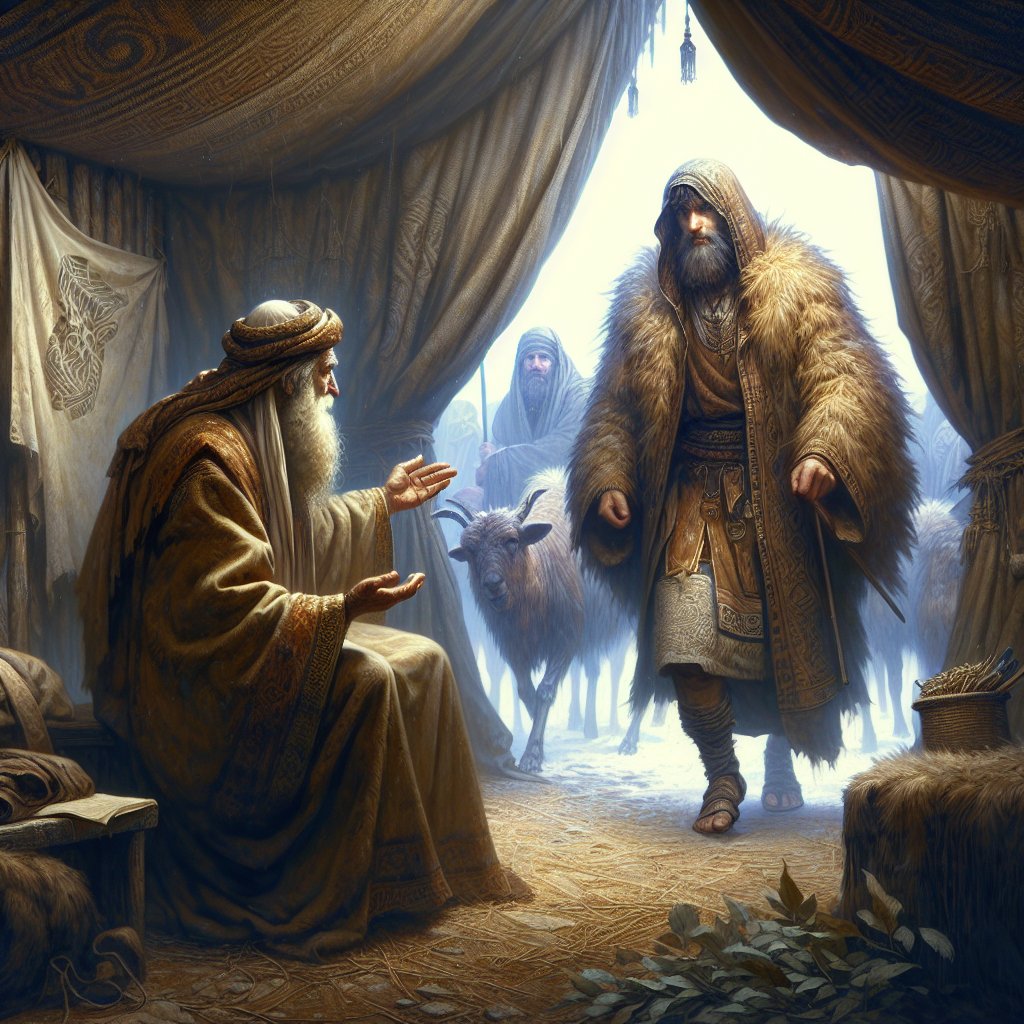
20 But Isaac said to his son, “How is it that you have found it so quickly, my son?” He answered, “Because the Lord your God granted me success [3].”
21 Then Isaac said to Jacob, “Please come near, that I may feel you, my son, to know whether you are really my son Esau or not.” 22 So Jacob went near to Isaac his father, who felt him and said, “The voice is Jacob’s voice, but the hands are the hands of Esau [4].” 23 And he did not recognize him, because his hands were hairy like his brother Esau’s hands. So he blessed him.
24 He said, “Are you really my son Esau?” He answered, “I am [5].” 25 Then he said, “Bring it near to me, that I may eat of my son’s game and bless you.” So he brought it near to him, and he ate; and he brought him wine, and he drank. 26 Then his father Isaac said to him, “Come near and kiss me, my son.” 27 So he came near and kissed him. And Isaac smelled the smell of his garments [6] and blessed him and said…’
It is easy to focus on the six lying deceptions against Isaac and the cheating and stealing by Jacob against Esau. The fact that Esau later plans to kill his brother is wholly understandable. The deception perpetrated by Jacob and Rebekah, towards Isaac was also a severe wound in family loyalty. We know from the biblical account that Jacob and his father had little interaction between this event and Isaac’s death.
Similarly, how did this affect an apparently great marriage and what was the true impact on Isaac’s and Rebekah’s relationship from then on. Did Isaac laugh as much as his name entails and his personality hints? Rebekah lived up (or down) to her name of binding, snaring and trapping and Jacob certainly fulfilled his own name by supplanting and cheating.
Abarim publications: ‘The name Jacob [means] ‘he who closely follows, supplanter’ From the verb ‘abaq, ‘to follow at the heel’ or ‘supplant.’
‘BDB Theological Dictionary and NOBSE Study Bible Name List both read Supplanter. BDB adds Heel, Overreach, One Closely Following. Jones’ Dictionary of Old Testament Proper Names reads He Will Supplant, A Heeler, One Who Trips Up or Takes Hold By The Heel. Besides in Genesis 27:36, the word occurs twice as [a] regular word in the text: in Job 37:4 [it is] used in the sense of ‘he holds back [thunderings]’ and in Jeremiah 9:4 as meaning ‘deal craftily’ (NAS) or ‘will supplant’ (KJV).’
“See, the smell of my son is as the smell of a field that the Lord has blessed!”
The Rabbi Rashi, states that when blessing Jacob, Isaac smelled the ‘heavenly scent of Gan Eden (Paradise) when Jacob entered his room and, in contrast, perceived Gehenna opening beneath Esau when the latter entered the room, showing him that he had been deceived all along by Esau’s show of piety.’
Genesis: 28 ‘May God give you of the dew of heaven and of the fatness of the earth and plenty of grain and wine. 29 Let peoples serve you, and nations bow down to you. Be lord over your brothers, and may your mother’s sons bow down to you.
Cursed be everyone who curses you, and blessed be everyone who blesses you!’
It is not clear why the plural use of brothers and sons is used, when Jacob only had the one brother, Esau… that we know about?
30 ‘As soon as Isaac had finished blessing Jacob, when Jacob had scarcely gone out from the presence of Isaac his father, Esau his brother came in from his hunting. 31 He also prepared delicious food and brought it to his father. And he said to his father, “Let my father arise and eat of his son’s game, that you may bless me.”
32 His father Isaac said to him, “Who are you?”
He answered, “I am your son, your firstborn, Esau.”
33 Then Isaac trembled very violently and said, “Who was it then that hunted game and brought it to me, and I ate it all before you came, and I have blessed him? Yes, and he shall be blessed.”
34 As soon as Esau heard the words of his father, he cried out with an exceedingly great and bitter cry and said to his father,
“Bless me, even me also, O my father!”
35 But he said, “Your brother came deceitfully, and he has taken away your blessing.”
36 Esau said, “Is he not rightly named Jacob? For he has cheated me these two times.
He took away my birthright, and behold, now he has taken away my blessing.”
Then he said, “Have you not reserved a blessing for me?”
37 Isaac answered and said to Esau, “Behold, I have made him lord over you, and all his brothers I have given to him for servants, and with grain and wine I have sustained him. What then can I do for you, my son?”
38 Esau said to his father, “Have you but one blessing, my father? Bless me, even me also, O my father.” And Esau lifted up his voice and wept. 39 Then Isaac his father answered and said to him…’
Hebrews 12:14-17
English Standard Version
‘Strive for peace with everyone, and for the holiness without which no one will see the Lord. See to it that no one fails to obtain the grace of God; that no “root of bitterness” springs up and causes trouble, and by it many become defiled; that no one is sexually immoral or unholy like Esau, who sold his birthright for a single meal. For you know that afterward, when he desired to inherit the blessing, he was rejected, for he found no chance to repent, though he sought it with tears.’
Hebrews 12:16-17
Amplified Bible
‘… and [see to it] that no one is immoral [‘wicked’ – The Voice] or godless [‘vile’ – The Voice] like Esau, who sold his own birthright for a single meal. For you know that later on, when he wanted (to regain title to) his inheritance of the blessing, he was rejected, for he found no opportunity for repentance (there was no way to repair what he had done, no chance to recall the choice he had made), even though he sought for it with (bitter) tears.’
Hebrews 12:16-17
New Century Version
‘Be careful that no one takes part in sexual sin or is like Esau and never thinks about God. As the oldest son, Esau would have received everything from his father, but he sold all that for a single meal. You remember that after Esau did this, he wanted to get his father’s blessing, but his father refused. Esau could find no way to change what he had done, even though he wanted the blessing so much that he cried.’
Hebrews 12:16-17
The Message
‘Watch out for the Esau syndrome: trading away God’s lifelong gift [Eternal life] in order to satisfy a short-term appetite [pleasures of this world]. You well know how Esau later regretted that impulsive act and wanted God’s blessing – but by then it was too late, tears or no tears.’
Genesis: “Behold, away from the fatness of the earth shall your dwelling be, and away from the dew of heaven on high.
40 By your sword you shall live [violence, danger], and you shall serve your brother; but when you grow restless [when thou shalt have the ‘dominion’ – KJV] you shall break his yoke from your neck.”
Many translations of verse thirty-nine state, as the ESV does, that Esau would live away from the fatness of the Earth which Jacob’s sons would inherit. This gives the impression that Esau either doesn’t receive a blessing and or, that he would be geographically removed from Jacob. The NCV a case in point. Yet other translations, including the KJV, choose to accurately say the opposite.
New Century Version
Isaac said to him, “You will live far away from the best land, far from the rain.”
Young’s Literal Translation
And Isaac his father answereth and saith unto him, ‘Lo, of the fatness of the earth is thy dwelling, and of the dew of the heavens from above…
King James Version
And Isaac his father answered and said unto him, Behold, thy dwelling shall be the fatness of the earth, and of the dew of heaven from above…
The Interlinear translates word for word verse thirty-nine and forty as follows – punctuation added:
‘And Isaac his father answered, said unto him behold thy dwelling shall (be the) fatness earth – dew heaven – and thy sword live; shalt serve thy brother, shall come pass when shalt have dominion that shalt break his yoke.’
The New English Translation helpfully translates the verse to give a more accurate geographic context.
Genesis 27:39
New English Translation
So his father Isaac said to him, “See here, your home will be by the richness of the earth, and by the dew of the sky above.
‘Footnotes: The particle (hinneh) calls for someone’s attention. Or “next to.” The preposition (min) generally indicates the source of something or separation from something, and so is often rendered “from.” Older translations (KJV, ASV, Douay-Rheims, Young’s, JPS) took the preposition as indicating source: “of the fatness of the earth.” More recent translations (NASB, NIV, ESV, NLV) take it as separative: “away from the fatness.” In Jacob’s blessing the preposition works with the verb “give” and indicates source.
In Esau’s blessing the preposition functions in a nominal clause and modifies “your dwelling.” HALOT says that [the preposition] can point “to the place… where something can be found” and thus means “in” in [Genesis 2:8, Leviticus 14:41, 2 Samuel 5:13, Ezra 1:4, Job 30:30, Isaiah 5:26, 23:7] (HALOT 597, s.v.).
In combination with the verb “to dwell,” the preposition means “by,” “next to,” or “across from” [Ruth 2:14, 1 Samuel 20:25, Ezekiel 16:46, Jonah 4:5]. The closest parallel for the noun “dwelling” is [Genesis 10:30] where [the preposition] as “away from” is not possible (rather “at” or “beginning at.”)
In contrast to Jacob, to whom God will give some of earth’s fatness and heaven’s dew, Esau will dwell next to these.
Esau himself continues to dwell with Isaac in Canaan, so perhaps he dwells “at” or “in” the richness of the land. But the land of his descendants, Edom, is more arid and might be considered “next to” or “across from” Canaan. The main contrast seems to be that God will give Jacob something, while Esau will have access to two of the same things. “Grain” and “wine” are not repeated for Esau, which may also reflect different conditions in Edom and Canaan.’
Most translations, lean towards Esau not receiving the fertility of the earth and dew of heaven; a minority that he would. Whereas the answer lies between the two, in that Esau would receive less than Jacob even though their people were originally adjacent to each other for many centuries and this makes sense, given that Esau’s blessing is meant to be inferior to Jacob’s birthright promises.
As we will discover, history has borne out that Esau’s descendants have not relied on living off the land as farmers (grain and wine) and have rather shared in the blessings aforded by dwelling amongst Jacob’s and Ishmael’s descendants. Esau was a twin and we would have reason to find him connected to his brother, Jacob.
Remember, Esau was like Ishmael who was also an outdoors man, a huntsman, militaristic, a proficient soldier, ‘setting his hand against others [of his family]’. Unsurprisingly, a militaristic state and a history of waging war is an identifying sign for a significant proportion of Esau’s descendants today.
The word dominion in the interlinear is a crux word in verse forty. It comes from the Hebrew word ruwd [H7300], which is translated as ‘dominion, lords, mourn and ruleth’. It means literally ‘to wander restlessly’ and ‘to roam, to be restless’ and ‘show restlessness.’ It derives from a primitive root, ‘to tramp about, ramble (free or disconsolate), have the dominion, be lord’ and ‘rule’.
In English, it derives from the latin, dominium or ‘ownership’ and dominus, ‘master.’
Interestingly, the word dominion was used as a name formerly applied to self-governing divisions of the British Empire. For example, the former Dominions of Canada and New Zealand.
Therefore, we are seeking a people which has a unique identity and yet struggles with Jacob – possessing a mix of emotions towards their sibling’s descendants. We would expect to find a ‘nation’ (or people) somewhere matching Esau, who is both connected to the sons of Jacob yet decidedly a distinct national (if not ethnic, from admixture) group.
As one Bible researcher astutely commented albiet from a different perspective: “[Edom] have not broken loose from Israel and are in fact part of Israel. Their lands… form part of Israel…”
A people by virtue of their assimilation, are recipients of the same fatness of the earth and blessings which were given to Jacob and specifically to his son Joseph. Wherever Jacob is today, that is where we will find Esau (in part). Wherever Joseph is today, that is where we will locate the greatest number of Esau’s descendants. We are also looking to identify a people who have come out from underneath Jacob’s shadow and are identifiable as a nation obtaining statehood relatively recently in history, finally achieving ‘dominion’ and appeasing migratory ‘restlessness.’
Genesis: 41 ‘Now Esau hated [H7852 – satam: ‘oppose, bear a grudge, retain (cherish) animosity against’ from root ‘to lurk for, persecute’] Jacob because of the blessing with which his father had blessed him, and Esau said to himself,
“The days of mourning for my father are approaching; then I will kill my brother Jacob.”
42 But the words of Esau her older son were told to Rebekah. So she sent and called Jacob her younger son and said to him, “Behold, your brother Esau comforts himself about you by planning to kill you.
43 Now therefore, my son, obey my voice [3]. Arise, flee to Laban my brother in Haran 44 and stay with him a while, until your brother’s fury turns away – 45 until your brother’s anger turns away from you, and he forgets what you have done to him. Then I will send and bring you from there. Why should I be bereft [deprived] of you both in one day?” 46 Then Rebekah said to Isaac, “I loathe my life because of the Hittite women. If Jacob marries one of the Hittite women like these, one of the women of the land, what good will my life be to me?”
It may be that Rebekah had to be firm in saying obey my voice – more than once (three times – Article: 33) – in that Jacob, like Esau is headstrong and stubborn, or it may be that Rebekah felt moved and inspired to advise Jacob. It is recorded elsewhere that Rebekah was a prophetess and therefore, she knew that Esau intended to slay Jacob after Isaac’s death and the words “Why should I be bereft of you both in one day” are ‘interpreted as being her prophecy to this effect.’
Jacob is displaying some of the laid back, casual approach to life that Isaac and Abraham exhibited. On the surface, it would seem that Rebekah’s issue with the Hittite women is that they are a different race, descendants of Heth, the son of Canaan. Though we will learn that it may be more serious and involve the old nemeses… the Nephilim – Articles: Nephilim & Elioud Giants I & II.
Genesis 28:1-22
English Standard Version
1 ‘Then Isaac called Jacob and blessed him and directed him, “You must not take a wife from the Canaanite women. 2 Arise, go to Paddan-aram to the house of Bethuel your mother’s father, and take as your wife from there one of the daughters of Laban your mother’s brother.
3 God Almighty [El Shaddai] bless you and make you fruitful and multiply you, that you may become a company of peoples [a plurality of nations, not singular]. 4 May he give the blessing of Abraham to you and to your offspring with you, that you may take possession of the land of your sojournings that God gave to Abraham!”
5 Thus Isaac sent Jacob away. And he went to Paddan-aram, to Laban, the son of Bethuel the Aramean, the brother of Rebekah, Jacob’s and Esau’s mother.’
Isaac must have spoken with Jacob relatively quickly after his deception, as it follows on the heels of Rebekah’s urgent advice to flee. The Book of Jubilees records just how concerned Rebekah was for Jacob’s life later in the story.
Book of Jubilees chapter thirty-five:
35:9 ‘And [Rebekah] went in to Isaac and said to him:
‘One petition I make unto you: make Esau swear that he will not injure Jacob, nor pursue him with enmity; for you know Esau’s thoughts that they are
perverse from his youth, and there is no goodness in him;
for he desires after your death to kill him. 10 And you know all that he has done since the day Jacob his brother went to Haran until this day: how
he has forsaken us with his whole heart, and has done evil to us; your flocks he has taken to himself, and carried off all your possessions from before your face.’
It appears Esau may have helped himself to more than his inheritance early. He obviously felt betrayed by his champion of the past, his father Isaac and released his anger by taking what he wanted from his parents. This may explain why Jacob after he returns from Haran, is described as ‘taking care of his parents’.
11 ‘And when we implored and besought him for what was our own, he did as a man who was taking pity on us. 12 And he is bitter against you because you did bless Jacob your perfect and upright son; for there is no evil but only goodness in him, and since he came from Haran unto this day he has not robbed us of aught, for he brings us everything in its season always, and rejoices with all his heart when we take at his hands and he blesses us, and has not departed from us since he came from Haran until this day, and he remains with us continually at home honoring us.’
13 And Isaac said to her:
‘I, too, know and see the deeds of Jacob who is with us, how that with all his heart he honors us; but I loved Esau formerly more than Jacob, because he was the firstborn; but now I love Jacob more than Esau,
for [Esau] has done manifold evil deeds, and there is no righteousness in him, for all his ways are unrighteousness and violence, and there is no righteousness around him.
14 And now my heart is troubled because of all his deeds,
and neither he nor his seed is to be saved, for they are those who will be destroyed from the earth and who will be rooted out from under heaven,
for he has forsaken Yahweh the Almighty of Abraham and gone after his wives and after their uncleanness [genetically] and after their error [spiritually], he and his children.’
These are heavy and grim words indeed from Isaac… revealing the level of Esau’s disobedient actions and rebellious attitude.
King Solomon would later, also exasperate and disappoint the Eternal in similar fashion – refer Chapter XIII India & Pakistan: Cush & Phut; and articles: Na’amah; and Seventh Son of a Seventh Son.
15 ‘And you do bid me make him swear that he will not slay Jacob his brother; even if he swear he will not abide by his oath, and he will not do good but evil only.
Yes, the chances of Esau honouring an oath were not good, considering he had placed little value on his birthright.
18 ‘And Rebecca sent and called Esau and he came to her, and she said to him:
‘I have a petition, my son, to make to you, and do you promise to do it, my son.’
19 And he said: ‘I will do everything that you say to me, and I will not refuse your petition.’
20 And she said to him: [1] ‘I ask you that the day I die, you will take me in and bury me near Sarah, your father’s mother, and [2] that you and Jacob will love each other and that neither will desire evil against the other, but mutual love only, and (so) you will prosper, my sons, and be honored in the midst of the land, and no enemy will rejoice over you, and you will be a blessing and a mercy in the eyes of all those that love you.’
21 And he said: ‘I will do all that you have told me, and I shall bury you on the day you die near Sarah, my father’s mother, as you have desired that her bones may be near your bones.
22 And Jacob, my brother, also, I shall love above all flesh; for I have not a brother in all the earth but him only: and this is no great merit for me if I love him; for he is my brother, and we were sown together in your body, and together came we forth from your womb, and if I do not love my brother, whom shall I love?
23 And I, myself, beg you to exhort Jacob concerning me and concerning my sons, for I know that he will assuredly be king over me and my sons, for on the day my father blessed him he made him the higher and me the lower. 24 And I swear unto you that I shall love him, and not desire evil against him all the days of my life but good only.’
25 And he swore unto her regarding all this matter.
And she called Jacob before the eyes of Esau, and gave him commandment [4] according to the words which she had spoken to Esau.
26 And he said: ‘I shall do your pleasure; believe me that no evil will proceed from me or from my sons against Esau, and I shall be first in naught save in love only.’
27 And they eat and drank, she and her sons that night, and she died, three jubilees [147] and one week [7] and one year [1] old [155 years old], on that night, and her two sons, Esau and Jacob, buried her in the double cave near Sarah, their father’s mother.’
Esau was as good as his word, in that he did not kill Jacob while he lived. Jacob had fled to Laban in 1760 BCE when he was fifty-seven. It would be forty years before Esau and Jacob would set eyes on each other again.
Genesis: 6 ‘Now Esau saw that Isaac had blessed Jacob and sent him away to Paddan-aram to take a wife from there, and that as he blessed him he directed him, “You must not take a wife from the Canaanite women,” 7 and that Jacob had obeyed his father and his mother and gone to Paddan-aram.
8 So when Esau saw that the Canaanite women did not please Isaac his father, 9 Esau went to Ishmael and took as his wife, besides the wives he had, Mahalath the daughter of Ishmael, Abraham’s son, the sister of Nebaioth.’
Esau married his ‘third’ wife seventeen years after his first two wives. Nebaioth was the eldest son of Ishmael, hence why his name is mentioned as the brother of Mahalath, even though she had twelve brothers.
Nebaioth equates with the Prussian and Low German speaking peoples of the state of Brandenburg and Berlin, the capital of Germany – refer Chapter XXVIII The True Identity & Origin of Germans & Austrians – Ishmael & Hagar.
Mahalath is also called Basemath in the Book of Genesis. One commentator has discussed that Ishmael’s wife was also called Mahalath; hand picked by his mother Hagar from Egyptian royalty. Hagar and Ishmael were banished by Abraham circa 1874 BCE, when Ishmael was about seventeen years old.
The Pharaoh ruling at the time was the third Pharaoh of the First Dynasty, Djer who ruled from 1922 to 1875 BCE – Appendix IV: An Unconventional Chronology.
Mahalath could have been a daughter of Djer, the same Pharaoh whom Abraham and Sarah met in 1902 BCE. Hagar was a gift from Djer to Sarah and it is believed she was a daughter, of the Pharaoh. If so, then Mahalath would conceivably be the younger sister of Hagar. The daughter of Ishmael may have had the same name as her mother, Mahalath.
When she married Esau, her name could have changed to Basemath as it was traditional for wives to accept new names upon marriage. This would account for the two different names for Ishmael’s daughter, who became Esau’s wife.
In the previous chapter, we learned of Ishmael’s identity today as the modern nation of Germany. The association between Esau and Germany in modern times will prove to be profoundly disturbing. Esau hoped this marriage would appease his parents, though they were not swayed by Esau’s late and half-hearted attempt to procure their favour. It was by this stage that even Isaac had seen through Esau, and their relationship was inevitably not the same as before that fateful day of the debacle surrounding the birthright blessing.
Genesis: 10 ‘Jacob left Beersheba and went toward Haran. 11 And he came to a certain place and stayed there that night, because the sun had set. Taking one of the stones of the place, he put it under his head and lay down in that place to sleep. 12 And he dreamed, and behold, there was a ladder [flight of steps] set up on the earth, and the top of it reached to heaven. And behold, the angels of God were ascending and descending on it!
13 And behold, the Lord stood above it [or beside him] and said, “I am the Lord, the God of Abraham your father and the God of Isaac. The land on which you lie I will give to you and to your offspring. 14 Your offspring shall be like the dust of the earth, and you shall spread abroad to the west and to the east and to the north and to the south, and in you and your offspring shall all the families of the earth be blessed.
15 Behold, I am with you and will keep you wherever you go, and will bring you back to this land.
For I will not leave you until I have done what I have promised you.”
16 Then Jacob awoke from his sleep and said, “Surely the Lord is in this place, and I did not know it.” 17 And he was afraid and said, “How awesome is this place! This is none other than the house of God, and this is the gate of heaven.”
Jacob had a lucid dream (or vision) of a portal between Earth and Heaven – the spirit realm – and the dimensions in between. We will discover that Jacob’s descendants have indeed ‘spread abroad’ to the west, east, north and south – the furthest reaches of the Earth.
18 ‘So early in the morning Jacob took the stone that he had put under his head and set it up for a pillar and poured oil on the top of it. 19 He called the name of that place Bethel [the house of God], but the name of the city was Luz at the first.
20 Then Jacob made a vow, saying, “If God will be with me and will keep me in this way that I go, and will give me bread to eat and clothing to wear, 21 so that I come again to my father’s [Isaac] house in peace, then the Lord shall be my God, 22 and this stone, which I have set up for a pillar, shall be God’s house. And of all that you give me I will give a full tenth to you.”
Jacob is a bit of a wheeler-dealer: ‘a person who makes deals in business or politics, in a skilful and sometimes less than honest way.’
First Esau, now the Eternal. Jacob was seeking a peaceful resolution with his brother and his father and so can be excused to a degree, for bargaining with the Creator.
We will study Jacob in detail in the following chapter and so for now we will skip a portion of his life – forty years to be precise – and rejoin him on his flight from his father-in-law Laban and his decision to reconcile with his brother Esau in the year 1720 BCE – Chapter XXX Judah & Benjamin – the Regal Tribes.
Genesis 32:1-32
English Standard Version
1 ‘Jacob went on his way, and the angels of God met him. 2 And when Jacob saw them he said, “This is God’s camp!” So he called the name of that place Mahanaim [two camps]. 3 And Jacob sent [had sent] messengers before him to Esau his brother in the land of Seir, the country of Edom, 4 instructing them,
“Thus you shall say to my lord Esau: Thus says your servant Jacob, ‘I have sojourned with Laban and stayed until now. 5 I have oxen, donkeys, flocks, male servants, and female servants. I have sent to tell my lord, in order that I may find favor in your sight.’
The angels of God may have been the same three – including the Son of Man (Genesis 18:1, 31) who visited Abraham with two companion, possibly Michael and Gabriel – whom rescued Lot and his family (Genesis 18:2; 19:1-2) from Sodom (refer Chapter XXVI The French & Swiss: Moab, Ammon & Haran).
It was both a brave and high risk decision to reach out to Esau, even after forty years had passed. Jacob had just fled from his father-in-law, Laban; putting himself between a rock and a hard place, so-to-speak. Esau had left home circa 1737 BCE and dwelt in an area known as Mount Seir. We will address the permutations of this move in detail shortly, as well as the forty years of Jacob’s sojourn in the next chapter.
The inhabitants of Seir were known as Horites. The head of the Horites had been an individual called Seir. We have encountered the Horites previously in Genesis chapter fourteen and the Battle of the Valley of Siddim – refer Chapter XIX Chedorlaomer & the War of Nine Kings; and Chapter XXVI The French & Swiss: Moab, Ammon & Haran.
They were one of the Nephilim descended, Elioud giants axis states in league against Chedorlaomer and his allies from southern Mesopotamia. It appears that Esau’s descendants may have eventually driven out the Horites or even killed them. Though at the time of Esau, he chose to dwell in Seir with the Horites. This amalgamation of Esau and the Horites produced a new nation called hence forth in the Bible: Edom.
Edom means ‘red’ from the verb adom, ‘to produce or be red.’ We will learn that the colour red is also heavily associated with Jacob’s son, Judah. The potential for mistaken identity and identity misplacement, magnifies exponentially as we proceed.
Genesis: 6 ‘And the messengers returned to Jacob, saying, “We came to your brother Esau, and he is coming to meet you, and there are four hundred men with him.” 7 Then Jacob was greatly afraid and distressed. He divided the people who were with him, and the flocks and herds and camels, into two camps, 8 thinking, “If Esau comes to the one camp and attacks it, then the camp that is left will escape.”
Jacob had just cause in being afraid. Esau had promised to kill Jacob. The possible annihilation of every single one of Jacob’s family was a frightening reality. Jacob was right to prepare and pray.
Recall, that Abraham was able to muster an able fighting force comprising three hundred and eighteen men from his household. Here, Esau had four hundred men. Later, Jacob had sixty-six family members who travelled to Egypt – not including servants.
Jacob was certainly ill-equipped to do battle with Esau, who overwhelmingly had the upper hand numerically. Esau had also married in 1777 BCE, twenty-four years before Jacob in 1753 BCE and two wives at that. Esau would have had grown up sons and grandsons who could have even already had teenagers aged fifteen to seventeen years of age as great grandsons by 1720 BCE. Additionally, Esau would have men possibly from the Horites at his disposal if required.
Genesis: 9 ‘And Jacob said, “O God of my father Abraham and God of my father Isaac, O Lord who said to me, ‘Return to your country and to your kindred, that I may do you good,’ 10 I am not worthy of the least of all the deeds of steadfast love and all the faithfulness that you have shown to your servant, for with only my staff I crossed this Jordan, and now I have become two camps.
11 Please deliver me from the hand of my brother, from the hand of Esau, for I fear him, that he may come and attack me, the mothers with the children. 12 But you said, ‘I will surely do you good, and make your offspring as the sand of the sea, which cannot be numbered for multitude.”
Jacob had fled, with the clothes on his back and his staff. The almighty had blessed Jacob, yet he had not received his inheritance from Isaac, while his father lived. It was certainly going to require a miracle from the Eternal, as Esau’s mind needed to be veered from possible vengeance to reconciliation.
Genesis: 13 ‘So he stayed there that night, and from what he had with him he took a present for his brother Esau, 14 two hundred female goats and twenty male goats, two hundred ewes and twenty rams, 15 thirty milking camels and their calves, forty cows and ten bulls, twenty female donkeys and ten male donkeys. 16 These he handed over to his servants, every drove by itself, and said to his servants, “Pass on ahead of me and put a space between drove and drove.”
17 He instructed the first, “When Esau my brother meets you and asks you, ‘To whom do you belong? Where are you going? And whose are these ahead of you?’ 18 then you shall say,
‘They belong to your servant Jacob. They are a present sent to my lord Esau.
And moreover, he is behind us.’ 19 He likewise instructed the second and the third and all who followed the droves, “You shall say the same thing to Esau when you find him, 20 and you shall say, ‘Moreover, your servant Jacob is behind us.”
For he thought, “I may appease him [appease his face] with the present that goes ahead of me, and afterward I shall see his face. Perhaps he will accept me.” [he will lift my face] 21 So the present passed on ahead of him, and he himself stayed that night in the camp.’
Not only was Jacob splitting up his entourage into many small groupings for safety, he was also softening any potential confrontation as well as playing up to his brother’s ego and going above and beyond on the honour being bestowed.
Genesis: 22 ‘The same night he arose and took his two wives, his two female servants, and his eleven children [or sons, as Dinah had been born, but not Benjamin], and crossed the ford of the Jabbok. 23 He took them and sent them across the stream, and everything else that he had.
24 And Jacob was left alone. And a man [in the form of a man] wrestled with him until the breaking of the day. 25 When the man saw that he did not prevail against Jacob, he touched his hip socket, and Jacob’s hip was put out of joint as he wrestled with him. 26 Then he said, “Let me go, for the day has broken.” But Jacob said, “I will not let you go unless you bless me.”
27 And he said to him, “What is your name?” And he said, “Jacob.”
28 Then he said, “Your name shall no longer be called Jacob, but Israel [‘He strives with God’ or God strives], for you have striven [to struggle vigorously] with God and with men, and have prevailed.”
29 Then Jacob asked him, “Please tell me your name.” But he said, “Why is it that you ask my name?” And there he blessed him.
30 So Jacob called the name of the place Peniel [H6439: the face of God*], saying, “For I have seen God [one like God] face to face, and yet my life has been delivered.”
31 The sun rose upon him as he passed Penuel [H6439 – Pnuw’el: ‘facing God’], limping because of his hip.
32 Therefore to this day the people of Israel do not eat the sinew of the thigh that is on the hip socket, because he touched the socket of Jacob’s hip on the sinew of the thigh.’
Jacob’s name is changed at age ninety-seven and the focus of his life shifts from his supplanting his brother Esau and a physical direction, to his wrestling with one representing the Creator and a spiritual orientation.
The passage is deliberately vague as to the identity of the mysterious man who wrestles with Jacob, yet has the authority to grant a blessing.
Who Was the Angel Who Wrestled With Jacob? Whitney Hopler, 2019 – emphasis mine:
‘… in the Book of Hosea, the Bible… [mentions] Jacob’s wrestling again. However, the way Hosea 12:3-4 refers to the event is just as unclear, because in verse 3 it says that Jacob “struggled with God” and in verse 4 it says that Jacob “struggled with the angel.”
Some people identify Archangel Phanuel as the man who wrestles with Jacob because of the connection between Phanuel’s name and the name “Peniel” – refer Phanuel, Chapter XXII Alpha & Omega.
‘In his book “Of Scribes And Sages: Early Jewish Interpretation And Transmission Of Scripture, Volume 2,” Craig A. Evans writes:
“In Gen. 32:31, Jacob names the place of his wrestling with God as ‘Peniel’ – the Face of God. Scholars believe that the angelic name ‘Phanuel’ and the place ‘Peniel’ are etymologically connected.”
Morton Smith writes in his book “Christianity, Judaism, and Other Greco-Roman Cults” that the earliest existing manuscripts indicate that Jacob was wrestling with God in angelic form. Later versions say that Jacob wrestled with an archangel. “According to this Biblical text… Jacob’s wrestle with a mysterious opponent… [Pointed] initially to his divine adversary, the name was in time attached to an angelic substitute.”
Some people say that the man who wrestles with Jacob is the Angel of the Lord. “So who is the ‘man’ who wrestles with Jacob on the riverbank and finally blesses him with a new name? God… the Angel of the Lord Himself,” writes Larry L. Lichtenwalter in his book “Wrestling with Angels: In the Grip of Jacob’s God.”
In her book “The Messenger of the Lord in Early Jewish Interpretations of Genesis,” Camilla Hélena von Heijne writes:
“Jacob’s naming of the place and the word ‘face’ in verse 30 is a key word. It denotes personal presence, in this case, divine presence. To seek God’s face is to seek His presence.”
The case for the Angel of the Lord is tentative, as the Angel of the Lord is always delineated as such in scripture, never hinted at.
In the Book of Enoch, Phanuel is listed with Michael, Gabriel and Raphael as one of the four chief messengers for the Eternal of Hosts. Yet, the case for Phanuel is based solely on word association and definition. As Phanuel is not mentioned directly in the Bible, his identity here is tentative and perhaps doubtful.
The clues to this being’s identity are possibly found earlier in the same chapter of Genesis thirty-two. Recall in verse one that the ‘angels of God met’ with Jacob and the consideration that these angels were the same three who met with Abraham and Lot – Genesis 18:1-2, 31; 19:1-2.
What is very interesting is that all three beings in Genesis eighteen are called men, including the one who was the Lord [H136 – ‘Adonay] and in Genesis nineteen, the two angels are also called lords [H113 – ‘adon]. In Genesis eighteen, Abraham ‘stood before the Lord’ and ‘spoke to the Lord’ – Genesis 18:22, 31. In a real sense, Abraham sparred verbally (or wrestled) with the one who was the Word in his presenting a case for sparing the city of Sodom. Was it this same man, who now met with Jacob?
A further clue is the fact that the being with Jacob when his identity was questioned, rather acerbically answered, ‘why are you asking my name’ for Jacob already knew it was the Word.
Matthew 16:13-17
Living Bible
‘… Jesus… asked his disciples, “Who are the people saying I am?”
“Well,” they replied, “some say John the Baptist; some, Elijah; some, Jeremiah or one of the other prophets.”
Then he asked them, “Who do you think I am?”
Simon Peter answered, “The Christ, the Messiah, the Son of the living God.”
“God has blessed you, Simon, son of Jonah,” Jesus said, “for my Father in heaven has personally revealed this to you – this is not from any human source.’
Only the Word could have represented God so that Jacob could say, ‘I have seen God face to face’. As Moses would do some three hundred years later, when facing the Word’s directness in response to being asked a similar question:
‘I am [who] I am’ (Exodus 3:14; 33:11).
Who else but the Word could say that Jacob had ‘striven with God and prevailed’ changing his name to Israel.
Lastly, only the Word representing the Eternal would divinely ‘bless him.’ Angels perform numerous functions in the scriptures, though this writer remains unaware of any instances where they directly confer a blessing.
The word or name Israel, has become synonymous with the state of Israel and the word Israelites with the people known as Jews and the Jewish people; yet, it does not convey the original identities.
For the purpose of this work, the name Jacob is more reflective of the patriarch himself, as well as that of the sons and tribes which descend from him.
In 1720 BCE, Jacob had twelve children, including Dinah, for Benjamin was not yet born. Thus it should be translated sons and not children in verse twenty-two. At the time of their encounter with Uncle Esau, Jacob’s eldest child Reuben, was thirty-two and his youngest Joseph was merely five years old.
Genesis 33:1-20
English Standard Version
1 ‘And Jacob lifted up his eyes and looked, and behold, Esau was coming, and four hundred men with him. So he divided the children among Leah and Rachel and the two female servants. 2 And he put the servants [Bilhah and Zilpah] with their children [Dan, Naphtali, Gad and Asher] in front, then Leah with her children [Reuben, Simeon, Levi, Judah, Issachar and Zebulon (with Dinah)], and Rachel and Joseph last of all. 3 He himself went on before them, bowing himself to the ground seven times, until he came near to his brother.
4 But Esau ran to meet him and embraced him and fell on his neck and kissed him, and they wept.’
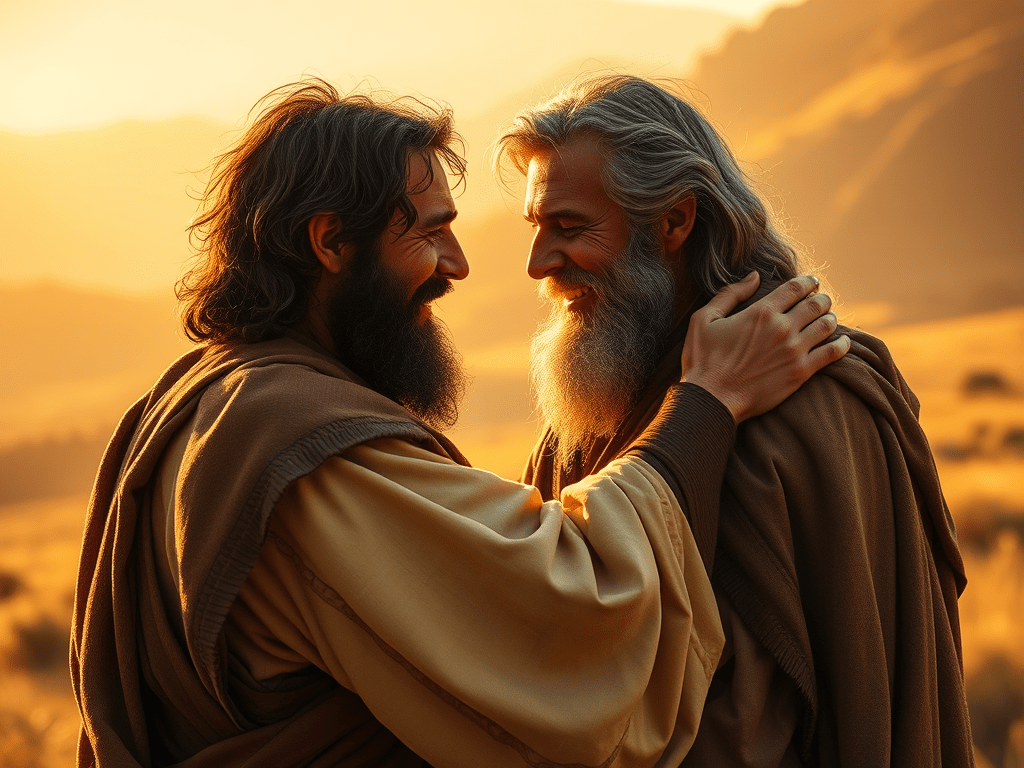
5 ‘And when Esau lifted up his eyes and saw the women and children, he said, “Who are these with you?” Jacob said, “The children whom God has graciously given your servant.” 6 Then the servants drew near, they and their children, and bowed down. 7 Leah likewise and her children drew near and bowed down. And last Joseph and Rachel drew near, and they bowed down.
8 Esau said, “What do you mean by all this company that I met?” Jacob answered, “To find favor in the sight of my lord.”
9 But Esau said, “I have enough, my brother; keep what you have for yourself.” 10 Jacob said, “No, please, if I have found favor in your sight, then accept my present from my hand. For I have seen your face, which is like seeing the face of God, and you have accepted me. 11 Please accept my blessing that is brought to you, because God has dealt graciously with me, and because I have enough.” Thus he urged him, and he took it.’
Esau could not have been more accepting, or put Jacob more at ease. A heart warming encounter, with Esau running to his younger brother – though Jacob’s heart may have skipped a beat in assessing whether Esau’s urgency was benign or not. At this moment of time, it is difficult to see any harbouring of revenge or hatred on Esau’s part towards his estranged twin.
And that is the key factor. Esau and Jacob were not just brothers, they were twins. The separation for forty years may have weighed heavily on Esau, as the protectively eldest twin.
Genesis: 12 ‘Then Esau said, “Let us journey on our way, and I will go ahead of you.” 13 But Jacob said to him, “My lord knows that the children are frail [tender], and that the nursing flocks and herds are a care to me. If they are driven hard for one day, all the flocks will die. 14 Let my lord pass on ahead of his servant, and I will lead on slowly, at the pace of the livestock that are ahead of me and at the pace of the children, until I come to my lord in Seir.”
Esau shows he is genuine, by wanting to travel together. Jacob being reticent as he wished to travel separately to be able to give thanks to the Creator for the miracle in Esau’s attitude and actions. It is worth remembering that both men were ninety-seven years old – Jacob lived to one hundred and forty-seven. It would appear that Esau possibly died not long after Jacob, at a similar age.
Genesis: 15 So Esau said, “Let me leave with you some of the people who are with me.” But he said, “What need is there? Let me find favor in the sight of my lord.” 16 So Esau returned that day on his way to Seir. 17 But Jacob journeyed to Succoth, and built himself a house and made booths for his livestock. Therefore the name of the place is called Succoth [booths].
18 And Jacob came safely [peacefully] to the city of Shechem, which is in the land of Canaan, on his way from Paddan-aram, and he camped before the city. 19 And from the sons of Hamor, Shechem’s father, he bought for a hundred pieces of money the piece of land on which he had pitched his tent. 20 There he erected an altar and called it El-Elohe-Israel [God, the God of Israel].’
Genesis 35:27-29
English Standard Version
27 ‘And Jacob came to his father Isaac at Mamre, or Kiriath-arba (that is, Hebron), where Abraham and Isaac had sojourned. 28 Now the days of Isaac were 180 years. 29 And Isaac breathed his last, and he died [in 1697 BCE] and was gathered to his people, old and full of days. And his sons Esau and Jacob [both 120 years old] buried him.’
Rabbis generally concur that Rebekah died at the age of one hundred and thirty-three years and ‘that her death occurred while Jacob was on his way back to his parents’ home; and it was coincident with that of Deborah’ – Genesis 35:8. Rebekah’s death is not mentioned and as Jacob does not arrive from Paddan-Aram, for another four years; it falls to Esau as the only son present to attend to her burial. The ceremony was supposedly ‘performed at night out of shame that her coffin should be followed by a son like Esau.’
Alternatively and accurately in my opinion – tying in with the Book of Jubilees 31:8-11, 48; 35:27 – Jacob found his mother alive when he returned home in 1720 BCE and she afterward accompanied him to Beth-el to accomplish his vow as per Genesis 28:19-20.
She would have died at the age of one hundred and fifty-five in 1702 BCE – coincidentally the same year that Joseph was propositioned by Potiphar’s wife in Egypt and – five years before Isaac’s death in 1697 BCE – Jubilees 35:1, 41. Thus determining her age when she married Isaac, who was forty, at twenty years of age.
Ishmael and Isaac had little contact, though together buried their father Abraham in 1802 BCE; so too, did Esau and Jacob bury their father Isaac, a little over one hundred years later. Just prior to Isaac’s death, he speaks to his sons.
Book of Jubilees chapter thirty-six:
1 ‘… Isaac called his two sons Esau and Jacob, and they came to him, and he said to them:
‘My sons, I am going the way of my fathers, to the eternal house where my fathers are. 2 Wherefore bury me near Abraham my father, in the double cave in the field of Ephron the Hittite, where Abraham purchased a sepulcher to bury in; in the sepulcher which I [dug] for myself… bury me [there].
3 And this I command you, my sons, that you practice righteousness and uprightness on the earth, so that Yahweh may bring upon you all that Yahweh said that he would do to Abraham and to his seed.
4 And love one another, my sons, your brothers as a man who loves his own soul, and let each seek in what he may benefit his brother, and act together on the earth; and let them love each other as their own souls’ – Matthew 7:12; Ephesians 4:31-32.
These are powerful last words from Isaac to his sons Esau and Jacob. If only their respective descendants had lived according to this entente cordiale, though alas it was not to be.
Notice Isaac included both sons together in jointly obeying the Eternal and being able to claim the blessings promised. His son Jacob and then his grandson Joseph did obey; serving the Eternal and thus the promise of blessings were made manifest. Whereas Esau, nor any of his sons, obeyed the Eternal and so the blessing given to Esau and his sons, though lesser than Jacob’s, was shrunken further due to their disobedience.
6 ‘Remember you, my sons, Yahweh Almighty of Abraham your father, and how I too worshipped Him and served Him in righteousness and in joy, that He might multiply you and increase your seed as the stars of heaven in multitude, and establish you on the earth…
7 And now I shall make you swear a great oath… by [He] which created the heavens and the earth… that you will fear… and worship Him. 8 And that each will love his brother… and that neither will desire evil against his brother… so that you may prosper in all your deeds and not be destroyed.
12 And he divided all his possessions between the two on that day… 13 And he said:
‘This larger portion I will give to the firstborn.’ 14 And Esau said, ‘I have sold to Jacob and given my birthright to Jacob; to him let it be given, and I have not a single word to say regarding it, for it is his.’ 15 And Isaac said, May a blessing rest upon you, my sons, and upon your seed this day, for you have given me rest, and my heart is not pained concerning the birthright, lest you should work wickedness on account of it…
17 And he ended commanding them and blessing them, and they [ate] and drank together before him, and he rejoiced because there was one mind between them, and they went forth from him and rested that day and slept. 18 And Isaac slept on his bed that day rejoicing; and he slept the eternal sleep, and died one hundred and eighty years old… and his two sons Esau and Jacob buried him.
19 And Esau went to the land of Edom, to the mountains of Seir, and dwelt there. 20 And Jacob dwelt in the mountains of Hebron [where Isaac had lived], in the tower of the land of the sojournings of his father Abraham, and he worshipped Yahweh with all his heart and according to the visible commands according as He had divided the days of his generations.’
It was now a time to be concerned, for if Esau had stayed his hand in harming Jacob while his father lived, then Jacob was now fair game. Amazingly, there appears to have been peace between Esau and Jacob for the next twenty-seven years until Jacob’s death in 1670 BCE. Before we look at the events surrounding the conflict that eventually arose between Esau’s and Jacob’s families, we will look more closely at Esau’s family and his descendants. In so doing, we will attempt to explain the apparent contradiction in the records of Esau’s wives and more importantly, unravel the difficulty in identifying Esau’s posterity today; which is made more challenging, due to his complicated family structure.
Genesis 36:1-43
English Standard Version
1 ‘These are the generations of Esau (that is, Edom). 2 Esau took his wives from the Canaanites:
Adah the daughter of Elon the Hittite,
Oholibamah** the daughter of Anah^^ the [grand?]daughter of Zibeon< the Hivite,
3 and Basemath, Ishmael’s daughter, the sister of Nebaioth.’
Esau’s family genealogy is also listed in an abridged form in 1 Chronicles 1:35-54. Recall earlier in the Book of Genesis, we were introduced to Esau’s wives and their fathers. In Genesis twenty-six, a few of the names differ.
Genesis 26:34: ‘When Esau was forty years old, he took Judith the daughter of Beeri the Hittite to be his wife, and Basemath the daughter of Elon the Hittite, 35 and they made life bitter [they were bitterness of spirit] for Isaac and Rebekah.’
Genesis 28:9: ‘Esau went to Ishmael and took as his wife, besides the wives he had, Mahalath the daughter of Ishmael, Abraham’s son, the sister of Nebaioth.’
Basemath or Adah – daughter of Elon the Hittite
Judith or Oholibamah – daughter of Beeri the Hittite or Anah/Zibeon the Hivite
Mahalath or Basemath – daughter of Ishmael
As Genesis thirty-six follows the first two listings it is presumed by scholars that the latter is the more accurate.
Basemath means: ‘sweet fragrance, pleasant smelling, precious’ and ‘pure’ while Adah means ‘ornamant.’
Judith means: ‘praised’ and ‘let him be praised’ and Oholibamah means ‘tent of the high plac’ (Mount Seir was located on elevated terrain).
Mahalath means: ‘dancing, sad song’ or ‘sickness.’
Some theologians have claimed that Esau actually had four, maybe five or even six wives. If such is the case, only three wives are listed as bearing children. This may have relevance, though nor does the Bible say the other one, two or three wives were barren. Beeri and Anah are possibly the same person as Be’er means ‘wellspring’, while Ayyin, phonetically similar to Anah means ‘spring.’ Likewise, the term Hittite is a hyponym (an inclusive term) for Hivite.
Some records reveal that Anah was a bastard and so, Esau sought to conceal the illegitimacy of Oholibamah’s family by changing her father’s name to Beeri from Anah and hers to Judith. It has been proposed that ‘Beeri alludes to Beer-lahai-roi, the place where Hagar encountered an angel (Genesis 16:13-14).’ Thus, Esau wished to convey that Judith was from a ‘righteous’ family. The identity change from Hivite to Hittite may reflect the attempt to hide the Hivite’s proclivity to idolatry and their Talmudic link with the Serpent in the Garden of Eden.
Anah is listed in verse twenty-four as a son, yet in verse two, the interlinear in Hebrew leaves it nebulous as to whether Anah is the daughter of Zibeon, not that Oholibamah is the grand daughter of Zibeon. If such is the case, then Anah is female. Rabbenu Tam states, this ‘disposes of the contradiction regarding Oholibamah/Judith’s parentage. Beeri the Hittite was her father and Anah the Hivite [or Horite*] daughter of Zibeon was her mother.’
As discussed previously, the reference to Hittites and Hivites could mean that the women Esau married first were original inhabitants of Canaan and therefore from the sons of Canaan, Heth and Hiv and therefore black women – Chapter XXII Canaan & Africa. Or worryingly, they could well be ‘Canaanites’ of an Elioud descent – Article: Nephilim & Elioud Giants II.
Remember, the Nephilim related giants preferred the higher ground to the plains – refer Chapter XXII Alpha & Omega.
In verse twenty, we see that Zibeon the ‘Hivite’ is in fact, a son of Seir the Horite.*
It is likely that Esau was hiding the Horite origin of at least one wife and probably both.
Even though Ishmael’s descendants were later known as Hittites, they were not so-called when Ishmael was alive and so the term Hittites is not referring to Ishmael’s descendants. In other words, the Bible isn’t saying Esau married two or three daughters of Ishmael, just the one daughter, Basemath formerly known as Mahalath.
A case for a fourth wife is made by the Sefer ha-Yashur which notes that ‘during Jacob’s fifth year [1755 BCE] in Haran [Paddan-Aram], Esau’s wife Judith daughter of Beeri died; she had borne daughters (named Marzith and Puith) to Esau, but no sons. In the sixth year [1754 BCE] of Jacob’s stay… Esau married Oholibamah… Esau married off his eldest daughter, Marzith, to Anah [of verse twenty-four] son of Zibeon, who was his wife’s brother.’ This would be why Judith is not mentioned again as she had died, without giving Esau any sons. Thus Oholibamah is not mentioned in Genesis chapter twenty-six, because Esau had not yet married her. A number of commentators subscribe to Esau having four wives.
The case for fives wives is presented by Nahmanides Ramban, in that Basemath of Elon the Hittite also died like Judith, yet childless. Both Judith and Basemath may have died prematurely in punishment for vexing Isaac and Rebekah and making them suffer with their idolatrous sacrifices and incense as their names suggest. This would account for why neither are mentioned in Genesis chapter thirty-six. Esau then married another two wives, Oholibamah and Adah, also the daughter of Elon the Hittite and therefore the sister of Basemath. This might explain why Ishmael’s daughter Mahalath had her name changed by Esau, if he was especially fond of either Basemath or Mahalath, his cousin and the one acceptable wife to his parents. The Targum Pseudo-Jonathan also supports the five wives hypothesis.
Rabbi Abraham Maimuni (1186 to 1237 CE) adopts a six wife model, in which there are two daughters of Ishmael as well, hence the two different names. It would seem to this writer that six wives is one wife at least too many and that the answer is somewhere in the middle of three and six; either four or five wives. Not withstanding Nahmanides conjecture, regarding Basemath and her supposed sister Adah, the Sefer ha-Yashur recording the death of Judith after bearing two daughters; would explain why there are two daughters names and especially, two fathers names for Esau’s second wife – because there are two separate women involved. The details on his first and third wives are less complicated – because there was only one woman each, with one father.
It would appear plausible that Esau may have changed Basemath’s name to Adah, so he could rename Mahalath, Basemath. There may be truth behind Esau liking that name and its sweet meaning. It would mean that Oholibamah is not only the grand daughter of Zibeon by inference, as she is the daughter of Anah, who is the son of Zibeon as per verse twenty-four; she is also a fourth wife married to Esau after his third wife Mahalath (or Basemath) and his second wife Judith’s death. A similarity occurs with his brother Jacob who had two wives and then the addition of their handmaids as wives, also numbering four in total.
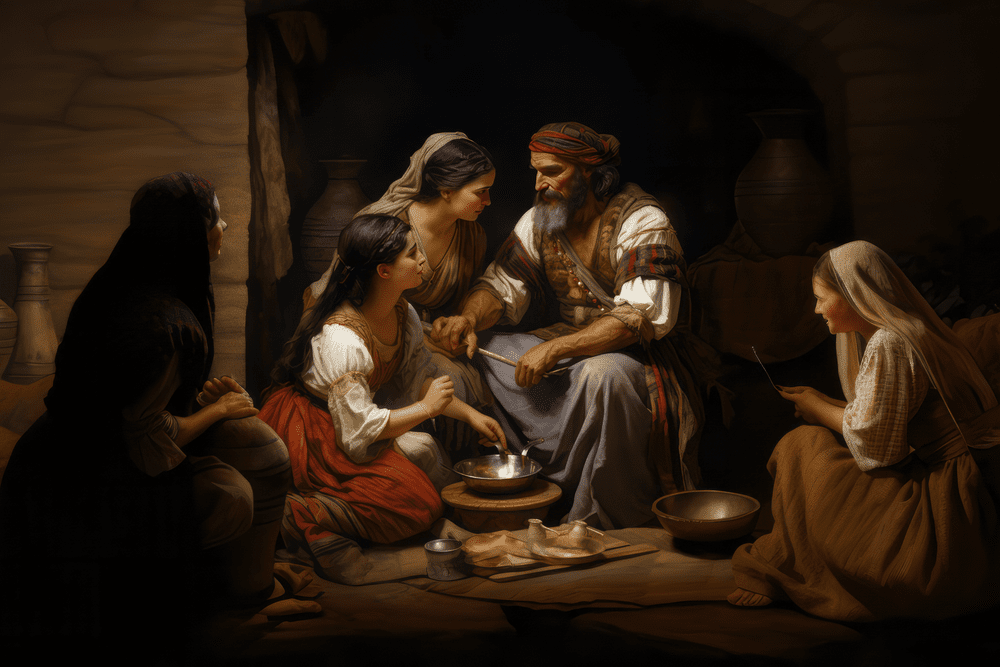
In Genesis chapter fourteen we learned that the Horites were a Nephilim tribe who fought Chedorlaomer, the King of Elam – refer Chapter XIX Chedorlaomer & the War of Nine Kings; and Chapter XXVI The French & Swiss: Moab, Ammon & Haran.
This could mean that Oholibamah was a Nephilim descended woman and that her genes were passed to her three sons. Basemath, the daughter of Ishmael was for the want of a better word, Teuton and so her son would have been half Ishmaelite (or Germanic) and half Edomite. The ancestry of Adah is not explained, so she was either a black Canaanite woman or just as likely, similar to Oholibamah (whether Hittite or Horite), a Nephilim descended Elioud too. Perhaps more likely as mtDNA Haplogroups do not seem to support the first option.
Either way, Isaac and Rebekah were vexed with both choices by Esau; due to either their Nephilim bloodlines or their idolatrous practices. The issue was not because Adah was Black, if she had been an original Canaanite.
Genesis: 4 ‘And Adah bore to Esau, Eliphaz;
Basemath bore Reuel;
5 and Oholibamah bore Jeush, Jalam, and Korah.
These are the sons of Esau who were born to him in the land of Canaan. 6 Then Esau took his wives, his sons, his daughters, and all the members of his household, his livestock, all his beasts, and all his property that he had acquired in the land of Canaan.
He went into a land away from his brother Jacob.
7 For their possessions were too great for them to dwell together. The land of their sojournings could not support them because of their livestock [the same situation as had previously occurred between Abraham and Lot in Genesis 13:5-6].
8 So Esau settled in the hill country of Seir. (Esau is Edom.)’
Jasher 10:28: ‘And Seir the son of Hur, son of Hivi, son of Canaan, went and found a valley opposite to Mount Paran, and he built a city there, and he and his seven sons and his household dwelt there, and he called the city which he built Seir, according to his name; that is the land of Seir unto this day.’
It is dubious that there would be only four generations from Noah to Seir after the flood, if merely human offspring. Not so, if Seir was an Elioud, and his father Hur had been Nephilim. Tradition substantiates that Sier lived at the time of Abraham’s father Terah, who lived between 4077 BCE and 1842 BCE and that his father Hur (or Hor), was a contemporary of Reu – who had lived from 6827 BCE to 4222 BCE, according to an unconventional chronology – the son of Peleg.
Esau was already living in Seir by 1720 BCE when he reconciles with Jacob. Esau married Basemath in 1760 BCE and had a son with her called Reuel, who was born in Canaan. Esau’s move to Canaan would have been between 1760 BCE to 1720 BCE – in approximately 1737 BCE. Yet Jacob had fled in 1760 BCE; thus their living together was not an issue.
Yet their flocks and herds by 1720 BCE would have been innumerable and therefore the statement in verse seven must therefore apply to this time frame and onwards as their respective wealth grew.
Notice that Basemath, the daughter of Ishmael names her son Reu-el, similar to Reu in the family genealogy of Peleg, the descendant of Arphaxad.
Recall in Chapter XXVII Abraham & Keturah – Benelux & Scandinavia, where Reuel was also the family (sur)name of Jethro, Moses’s father-in-law.
Jacob’s first son is named Reu-ben – Genesis 29:31.
Oholibamah’s son Jeu-sh, bears an uncanny resemblance to the word Jew-i-sh and the name Korah is also a (infamous) family name in the tribe of Levi, one of Jacob’s sons – Numbers 16:1-50, Genesis 29:34.
Deuteronomy 2:12
English Standard Version
‘The Horites also lived in Seir formerly, but the people of Esau dispossessed them and destroyed them from before them and settled in their place…’
At first, this appears contradictory as Esau intermarries heavily with the Horites before settling in the region of Seir. Mount Seir is mentioned prophetically in the Bible in connection with Esau, so it appears they are still a racial entity associated within Edom, due to the intermarriage and mixing. Or at the very least, a territory ascribed to them.
Esau’s children though, did wage war with the remaining Horites at a later date, due to a falling out. It is thought that the marriage with Ishmael’s daughter may have been fortuitous in gaining the Ishmaelite’s assistance in driving out those Horites who were not related to Esau by blood or marriage.
Genesis: 9 ‘These are the generations of Esau the father of the Edomites in the hill country of Seir.
10 These are the names of Esau’s sons: Eliphaz the son of Adah the wife of Esau, Reuel the son of Basemath the wife of Esau.
11 The sons of Eliphaz were Teman, Omar, Zepho, Gatam, and Kenaz>.
12 (Timna* was a concubine of Eliphaz, Esau’s son; she bore Amalek to Eliphaz.)’
Timna was the daughter of Seir the Horite. Again, in Genesis chapter fourteen, we read about the Amalekites who were a leading Nephilim tribe similar with the Horites and importantly, already in existence before Amalek the grandson of Esau is born.
Genesis 14:5-7
English Standard Version
‘In the fourteenth year Chedorlaomer and the kings who were with him came and defeated the Rephaim… and the Horites in their hill country of Seir as far as El-paran on the border of the wilderness. Then they turned back and came to En-mishpat (that is, Kadesh) and defeated all the country of the Amalekites…’
Notice that Eliphaz has a son called Kenaz>. Recall, that we have already met a Kenizzite in a previous chapter called Caleb, the second-in-command to Joshua of the Israelites.
In Numbers 32:12, ESV: “… none except Caleb the son of Jephunneh the Kenizzite and Joshua… have wholly followed the Lord.’
Interestingly, his genealogy is listed with the tribe of Judah. From this, we learn that Caleb was either part Kenizzite or his family had a historical association with the people or region – refer Chapter XXVII Abraham & Keturah – Benelux & Scandinavia>.
Caleb being a possible Edomite (and/or from Judah), in contrast with Joshua being an Ephraimite, is highly illuminating.
There is an interesting similarity between the name Kenaz and the branch of Judaism known as the Ash-kenaz-im.
The Kenizzites, like the Amalekites were already in existence as established peoples before Esau’s son Eliphaz, appropriated both as family names. Esau’s son Eliphaz is paying homage to the Kenizzites by calling Esau’s grandson Kenaz and it is very probably indicative, of intermarriage.
Esau and Eliphaz are not the progenitor of the Amalekites or Kenizzites. Esau’s son Eliphaz – as a son of Adah of probable Nephilim extraction – by interbreeding into the Horite-Nephilim line with Timna is merely cementing this relationship with one son having a Nephilim name.
We will discover the ancient origin of the Amalekites and their Nephilim beginnings. It is not so clear cut with the Kenizzites – or the Kenites for that matter – whether they have a Nephilim association.>
Recall the promise to Abraham regarding the land of Canaan as an inheritance.
Genesis 15:18-21, ESV: ‘On that day the Lord made a covenant with Abram, saying, “To your offspring I give this land, from the river of Egypt to the great river, the river Euphrates, the land of the Kenites, the Kenizzites, the Kadmonites, the Hittites, the Perizzites, the Rephaim, the Amorites, the Canaanites, the Girgashites and the Jebusites.”
It is worth noting that the Kenites and Kenizzites are nearly always linked together; that the Kenites are invariably associated with the Amalekites and Edom (Numbers 24:18, 20-21); and that both Caleb the Kenizzite and Jethro the Kenite are linked with the tribe of Judah. Judges 1:16, ESV: “And the descendants of the Kenite, Moses’ father-in-law, went up with the people of Judah… into the wilderness…”
We have discussed the link between the Kenites and Midian and the Kenites being metal craftsman, workers and smiths (H7117 – Qeyniy), and that some researchers believe that they trace their ancestry to Tubal-Cain before the flood.> Recall, Cain’s line was corrupted by the Serpent in the Garden of Eden with Eve. As Cain was Nephilim himself, so were his line of Elioud descendants, including Tubal-Cain – refer Chapter XXII Alpha & Omega; and article: Na’amah.
Cain’s line also married into and corrupted the people of Day Six of Creation, the Neanderthal. There is reason to believe certain Nephilim survived the Flood. If so, there is high probability that some of Cain’s Nephilim related descendants did also – Articles: Nephilim & Elioud Giants I & II.
Esau married at least one wife, probably two who were suspiciously Nephilim descended and his grandson Amalek it would seem, was keen to further amalgamate with corrupted lines – grafting into the Cainite-Nephilim bloodline.
A curious coincidence is that Esau’s wife Adah – who bore his first and most prominent son Eliphaz, from whom came Amalek – shares her name with an Adah in the antediluvian world. She was one of the two wives of evil Lamech, the great, great, great grandson of Cain – the lineage of ‘Cainites’.
This then is a notable synchronism, for Esau and Adah’s grandson Kenaz’s name is linked to the Cainite Kenites, who in turn are associated with Amalek and Edom. We will study Amalek in detail because in the past, though his line was related, it was distinct and separate from the main body of Edom; due to its amalgamation with the ancient Amalekite lineage. Today though, there is an association which unites Amalek and Edom as one people.
As we have previously discussed Cain at length; just a very brief reminder regarding his evil Nephilim lineage, given to him by his true father who was not Adam – refer Chapter XXII Alpha & Omega.
The original corruption of Cain himself, is made clear in 1 John 3:12, in various translations.
“Not as Cain, who was [G2258 – en: were, had been] of [G1537 – ek: from, out of, by, with] that wicked one [G4190 – poneros: ‘evil, bad nature, diseased’ as in ‘the devil’], and slew his brother…” (KJV)
“We are none of us to have the spirit of Cain, who was a son of the Devil…” (NTME)
“We must not be like Cain who was a child of the evil one…” (Smith and Goodspeed)
“…not as Cain who was from the evil one…” (NJB)
“Do not be like Cain, who belonged to the evil one and murdered his brother.” (NIV)
Genesis: 13 ‘These are the sons of Reuel: Nahath, Zerah^, Shammah, and Mizzah. These are the sons of Basemath, Esau’s wife.
14 These are the sons of Oholibamah the daughter of Anah the [grand]daughter of Zibeon, Esau’s wife: she bore to Esau Jeush, Jalam, and Korah.
15 These are the chiefs of the sons of Esau. The sons of Eliphaz the firstborn of Esau: the chiefs Teman, Omar, Zepho, Kenaz, 16 Korah, Gatam, and Amalek; these are the chiefs of Eliphaz in the land of Edom; these are the sons of Adah.
17 These are the sons of Reuel, Esau’s son: the chiefs Nahath, Zerah, Shammah, and Mizzah; these are the chiefs of Reuel in the land of Edom; these are the sons of Basemath, Esau’s wife.
18 These are the sons of Oholibamah, Esau’s wife: the chiefs Jeush, Jalam, and Korah; these are the chiefs born of Oholibamah the daughter of Anah, Esau’s wife. 19 These are the sons of Esau (that is, Edom), and these are their chiefs.’
Esau and Adah had Eliphaz [H464: god of gold]; and their grandsons from Eliphaz were
Teman [H8487/8486**: from the south] and ‘on the right’;
Omar [H201: talkative] and ‘eloquent’;
Zepho [H6825: observant] and ‘gaze’;
Gatam [H1609: a burnt valley];
Kenaz [H7073: to hunt, hunter]; and notably Amalek.
Naming a child Amalek, was paying palpable homage to the Nephilim clan of the same name and also a precursor of future intermixing. If the line from Adah was a black line of people, it would in time become diluted; while in contrast with grafting on to Amalek, it would have at the same time either gained or increased a Nephilim component.
Esau and Oholibamah, the definitely genuine and undisputed Nephilim line produced the sons:
Jeush [H3266: hasty] and ‘he will come to help’;
Jalam [H3281: occult] and ‘to conceal’; and
Korah [H7141: ice, bald, smooth].
The one wholly human and ‘European’ bloodline for certain, was Esau and Basemath the Ishmaelite.
Their son was Reuel [H7467: friend of God] and their grandsons from him;
Nahath [H5184: quiet(ness)] and ‘descent, rest’;
Zerah [H2226: a rising of light] and ‘sunrise’;
Shammah [H8040: ruin, astonishment dislocate(ion), waste] and ‘frightful’; and
Mizzah [H4199: to faint with fear].
Esau’s grandson Zerah – the father of Jobab – has the same name as Jacob’s grandson, the twin Zarah, who was the fifth son of Judah – Article: The Life & Death of Charles III.
It is of considerable interest reflecting on the definitions for Esau’s sons and grandsons names.
For the ones derived from Adah and Oholibamah are distinctly indicative of one side of Esau’s descendants who are wholly atheist or vehemently irreligious: ‘god of gold, talkative, eloquent, hunter[s], hasty and occult.’
The sons from Basemath on the other hand are indicative of the other side of Esau who are either traditionally religious or maintain a strict orthodoxy: ‘friend of God, quiet, rest, a rising of light and sunrise.’
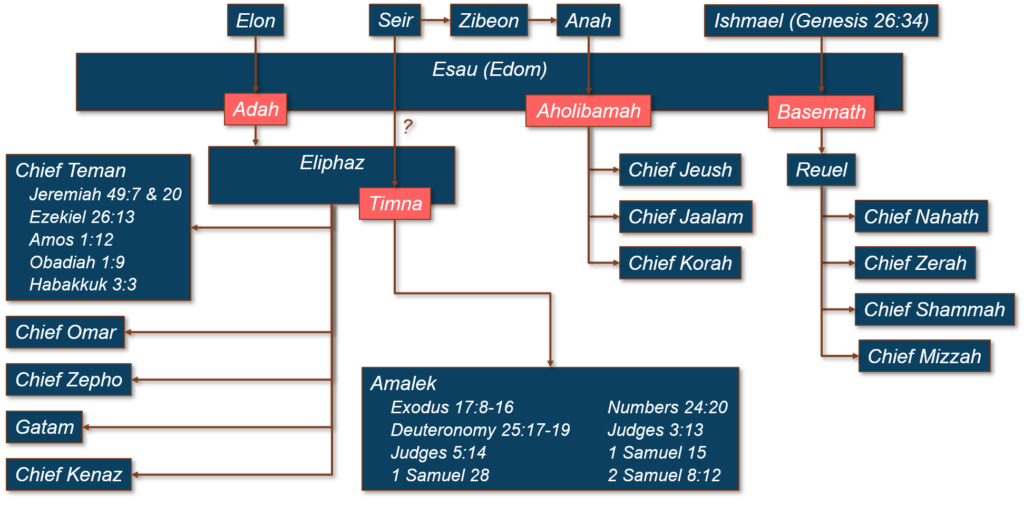
Genesis: 20 ‘These are the sons of Seir the Horite, the inhabitants* of the land:
Abarim Publications – emphasis & bold mine:
‘Seir From the root (s’r), which expresses intense negative emotion and the experience of violence.
For a meaning of the name Seir, NOBSE Study Bible Name List reads Hairy, Shaggy. Jones’ Dictionary of Old Testament Proper Names reads Rough, Bristly.
Noun (sa’r), means horror. Adjective (sa’ir) means hairy. Noun (sa’ir) denotes a he-goat [as in Baphomet – the Goat of Mendes] (a bristly guy…) and its feminine counterpart (sa’ira) means she-goat.
Verb (sha’ar) exists in other languages with the meaning of to break, tear through or split, which obviously repeats the general theme of the experience of violence. The adjective (sho’ar) means horrid or disgusting, and nouns (sha’arura), (sha’aruriya) and (sha’arurit) denote horror or horrible things.’
Genesis: ‘Lot-an [similar to Lot, (refer Chapter XXVI The French & Swiss: Moab, Ammon & Haran)],
Shobal, Zibeon<, Anah, 21 Dishon, Ezer, and Dishan; these are the chiefs of the Horites, the sons of Seir in the land of Edom.
22 The sons of Lotan were Hor-i [Horite] and Hemam [confusion]; and Lotan’s sister was Timna.*
23 These are the sons of Shobal [lion]:
Alvan [high, tall], Manahath, Ebal [also a name for a son of Joktan], Shepho, and Onam [vigorous].
24 These are the sons of Zibeon<:
Aiah [hawk] and Anah; he is the Anah who found the hot springs in the wilderness, as he pastured the donkeys of Zibeon his father.
25 These are the children of Anah^^:
Dishon and Oholibamah** the daughter of Anah.
26 These are the sons of Dishon:
Hemdan [beauty], Eshban [intelligent], Ithran [excellent], and Cheran.
27 These are the sons of Ezer:
Bilhan, Zaavan, and Akan.
28 These are the sons of Dishan:
Uz [family name for Nahor (brother of Abraham) and Aram (son of Shem)] and Aran.
29 These are the chiefs of the Horites: the chiefs Lotan, Shobal, Zibeon, Anah, 30 Dishon, Ezer, and Dishan; these are the chiefs of the Horites, chief by chief in the land of Seir.’
The land of Sier (or Mount Sier) was located in the northwestern region of Edom. A son of Seir was called Lotan similar to Lot, the father of Moab and Ammon. Lotan is another name for the seven headed dragon Leviathan, discussed in Job chapter forty-one – refer Chapter XXII Alpha & Omega; and article: Asherah.
A son of Lotan, Hori, appears to be named after the Horites. We have discussed the sons of Aram and Nahor, both of which include an Uz – Chapter XXIII Aram & Tyre: Spain, Portugal & Brazil; and Chapter XXV Italy: Nahor & the Chaldeans.
Uz’s brother Aran, has a name similar with the name Aram.
Abarim Publications – emphasis & bold mine:
‘Horite means ‘Caveman, Central Authority’ From the root (harar), to be a central hub of heat.
Genesis 36:4-6 lists the sons of Esau, who were born to him in Canaan. Then we are told that Esau took his family and his enormous herds and moved to another land, away from his brother Jacob (verse 6). And that’s how he ended up in the hill country of Seir, which was located to the south-east of the Salt [Dead] Sea, and about as far south as the Salt Sea is long. Whether patriarch Seir was happy with this mass immigration we’re not told.
The descendants of Esau (the Edomites) would eventually displace the Horites, but before they did, Seir appears to have wanted to honor and appease his mighty (and no-doubt customarily murderous) new neighbor by naming his own children after the family of the wives of Esau.
The Horites produced chiefs until the generation of Oholibamah the Horite. After that, the chiefs of that region are all Edomites (note, by the way, the Edomite chiefs Timna and Oholibamah; Genesis 36:40-41). The Horites were extinguished…
Traditionally, the names Hori and Horite have been explained… meaning cave or cavern.
Hence, for a meaning of the name Hori(te), both BDB Theological Dictionary and NOBSE Study Bible Name List read Cave Dweller. Jones’ Dictionary of Old Testament Proper Names proposes the slightly more fancy but similar Troglodytes (which means “A member of a people, esp. in prehistoric times, inhabiting caves or dens; a cave-dweller,” says the Oxford Dictionary).’
Rabbinical tradition explains the name Horite as meaning the free people, stemming from the Semetic root H-R-R meaning ‘free.’
One commentator offers, ‘bleached.’ The singular Horites do begin to fade away from this point in the Biblical narrative; whereas the remainder, fade into an amalgamation with Esau’s descendants; collectively known as Edom – apart from a selection of prophecies.
The Kenizzites are part of the wider Edom nation also, though the Kenites appear to remain distinct, yet closely allied with the Amalekites, who are a separate line joined by Eliphaz’s son Amalek. A people spoken of considerably in the scriptures as palpably different from Esau. Researchers and commentators alike either group Amalek with Edom today – correctly, by fluke – or leave them out entirely from any discussion on Edom (or Esau).
Understanding Esau has two sets of descendants is vital in unlocking the premise by some, that the Jews are offspring from Esau and not from Jacob’s son Judah.
Genesis: 31 ‘These are the kings who reigned in the land of Edom, before any king reigned over the Israelites.
32 Bela [1] the son of Beor [not from Edom, but from the people of Angeas, the king of Dinhabah] reigned in Edom [circa 1670 BCE to 1656 BCE], the name of his city being Dinhabah.
33 Bela died, and Jobab [2] the son of Zerah^ of Bozrah [capital of Edom] reigned [10 years] in his place.
34 Jobab died, and Husham [H2367* – haste] of the land of the Temanites [H8489** – temani: southward (possibly from Tema {H8485** – desert, Genesis 25:15}, son of Ishmael)] reigned [20 years] in his place.
35 Husham [3] died [the same year as Dan in 1626 BCE], and Hadad [4] the son of Bedad, who defeated Midian in the country of Moab, reigned [35 years from 1626 BCE to 1591 BCE] in his place, the name of his city being Avith.’
It is worth noting that Dan, one of the sons in Jacob’s family is uniquely recorded as having only one son in Genesis 46:23: Hushim (H2366* – who makes haste).
This definition is near identical to Husham the ‘Temanite.’ It is almost exactly the same as a son of Esau already mentioned, Jeush, which also means ‘hasty.’ These correlations between Hushim of Dan and Husham of Teman from Edom – or even Tema from Ishmael – coupled with the mutual definition of hastiness with the name Jeush, are more than incidental as we shall discover – Chapter XXXIV Dan: The Invisible Tribe.
Genesis: 36 ‘Hadad died, and Samlah [5] of Masrekah reigned [22 years] in his place.
37 Samlah died, and Shaul [6] of Rehoboth on the Euphrates reigned [circa 50 years] in his place.
38 Shaul died, and Baal-hanan [7] the son of Achbor reigned [circa 26 years] in his place.
39 Baal-hanan the son of Achbor died, and Hadar [8] reigned [47 years from 1493 BCE to 1446 BCE] in his place, the name of his city being Pau; his wife’s name was Mehetabel, the daughter of Matred, daughter of Mezahab.’
The genealogical listing of the kings of Edom abruptly ends and stands out for a couple of reasons.
First, it gives extra details on the last known king Hadar. Adding his wife’s ancestry but emphasising her ancestry for more than one generation and rather than stating her paternal line, it is her maternal descent which is preserved. This is unusual and possibly unique in the Bible. It parallels the Jewish practice of emphasising maternal descent in proving one is Jewish.
Second, Moses sent messengers to the King of Edom – shortly after his sister Miriam’s death in 1406 BCE – who was an unnamed king ruling after Hadar, as Hadar had died in 1446 BCE, the year of the Exodus – Numbers 20:14-21. A name of a king which would have been of interest in learning, is unaccountably not recorded.
Numbers 20:14-21
English Standard Version
14 ‘Moses sent messengers from Kadesh to the king of Edom:
“Thus says your brother Israel: You know all the hardship that we have met: 15 how our fathers went down to Egypt, and we lived in Egypt a long time. And the Egyptians dealt harshly with us and our fathers. 16 And when we cried to the Lord, he heard our voice and sent an angel and brought us out of Egypt. And here we are in Kadesh, a city on the edge of your territory. 17 Please let us pass through your land. We will not pass through field or vineyard, or drink water from a well. We will go along the King’s Highway. We will not turn aside to the right hand or to the left until we have passed through your territory.”
18 But Edom said to him, “You shall not pass through, lest I come out with the sword [Genesis 27:40] against you.”
19 And the people of Israel said to him, “We will go up by the highway, and if we drink of your water, I and my livestock, then I will pay for it. Let me only pass through on foot, nothing more.”
20 But he said, “You shall not pass through.”
And Edom came out against them with a large army and with a strong force.
21 Thus Edom refused to give Israel passage through his territory, so Israel turned away from him.’
Edom’s response to Moses’ reasonable and fair request certainly didn’t bury any hatchets and set the tone for future tension. Edom lived by its past prophecy; resorting to its sword and an open display of hostility and potential violence. Long forgotten was any peace that once existed between Esau and Jacob.
Genesis: 40 ‘These are the names of the chiefs of Esau, according to their clans and their dwelling places, by their names:
the chiefs Timna, Alvah, Jetheth,
41 Oholibamah, Elah, Pinon,
42 Kenaz, Teman, Mibzar, 43 Magdiel, and Iram;
these are the chiefs [or clans] of Edom (that is, Esau, the father of Edom), according to their dwelling places in the land of their possession.’
It appears that Eliphaz’s concubine and Esau’s fourth wife were clan chiefs. The Book of Jasher says [C]husham not to be confused with Dan’s son Hushim, died the same year as Dan in 1626 BCE and that Hadad the son of Bedad reigned for thirty-five years until 1591 BCE.
Jobab is the great grandson of Esau – though he is not the Job of the Book of Job fame as some commentators assert and first thought by this writer – who was born circa 1656 BCE. Job was a contemporary of Jacob’s birthright son for forty years until Joseph’s death – Article: Job.
Joseph dwelt in Egypt between 1709 BCE and 1616 BCE and became Vizier at age thirty in 1696 BCE, during the reign of Pharaoh Djoser (or Netjerikhet), the first king of the third Dynasty; who reigned circa 1700 BCE to 1672/71 BCE – Appendix VI: Joseph & Imhotep – One man, different name?
There is one other Jobab mentioned in Genesis chapter ten and he is the youngest son of Joktan’s thirteen sons – Chapter XXIV Arphaxad & Joktan: Balts, Slavs and the Balkans.
Jobab’s father Zerah was from Bozrah. Bozrah eventually became the capital of Edom and its principal city. The name Bozrah means: ‘Fortification, fortress’ or ‘fortified enclosure’ and from the verb basar, ‘to separate and protect for extraction’ as in placing a wall.
Abarim Publications – emphasis mine:
‘Noun (bissaron) means stronghold and noun… (basir) means vintage and noun (beser) probably denotes precious ore (a vineyard operation is not unlike a mining operation). Nouns (bassara) and (bassoret) denote destitution or scarcity and probably refer to residue that remains after the extraction of commodities.’
To fully appreciate the supportive material and evidence of scripture to follow, it is requisite to divulge in part, who Jacob and therefore Esau are today. The sons of Jacob are the British and Irish descended peoples, who originated from the migrations and invasions of the Celts, Saxons (Angles, Frisians and Jutes), Vikings (Norse and Danes) and Normans from Europe. From the Isles of Great Britain and Ireland they spread abroad and include the English speaking daughter nations in the New World of America, Australasia and the Old World of Africa. We will study each of Jacob’s twelve sons in turn. This is crucial understanding, in unlocking vast portions of the scriptures and the prophetic intent of the Bible.
Preceding even before this writer first began researching biblical identities, there has been a growing belief in two different theories on the ‘lost’ Tribes of Israel, which are completely in error yet have large appeal primarily for those who have only researched the topic superficially.
The first is that the Black peoples of Africa and the Americas are the descended sons of Jacob and particularly those in the United States are from the tribe of Judah. The sections on Canaan, hopefully dissuades any fair-minded reader from giving this theory any validity – refer Chapter XI Ham Aequator; and Chapter XII Canaan & Africa.
The alternative theory, is that the sons of Jacob were so comprehensively sifted throughout the nations – by their respective captors, the Assyrians and the Babylonian, Medo-Persian alliance – they have literally been lost ‘forever.’
As we have a handful of nations and peoples left to identify after addressing basically the entirety of the world in the twenty-eight chapters thus far, it would be difficult to insist that the Israelites are still lost. Regardless, we will give this theory due recognition when we study Jacob.
Those identity believers who already understand that the Jews are not the tribe of Judah are right, yet they do not provide a tangible or cognitive answer to who Judah actually is; thus falling short in fully cementing their argument about Esau. We will strive to uncover the truth regarding Judah in the following chapter, so that everything we investigate in this chapter is endorsed beyond any reasonable doubt.
Those who profess the Jews are Edom are correct, for the Jewish people are represented by the broad umbrella of peoples called Edom; which in itself, is an amalgamation of Esau and the Horites, with the addition of the Amalekites. The role of the Kenites and Kenizzites remains ambiguous and a subject that requires further research and perhaps enlightenment beyond that presented in Chapter XXVII Abraham & Keturah – Benelux & Scandinavia.
Just as we have seen in the Bible how complex Esau’s family lineage became straight from the outset, due to his marrying at least three different women and his sons continuing to marry in like fashion; it can be no surprise to learn that the genetic analysis and interpretation of the Jewish people is the most complex in the world. It is the subject of considerable discussion and debate. Evidenced as such in their varied Y-DNA and mtDNA Haplogroup structure and sequencing.
Even so, Edom today comprises a. the nation state of Israel;
b. the Jews who reside in numerous other nations; and
c. those people who identify on any level as Jewish ethnically – even though many experts would argue there is no such thing as a Jewish ‘race.’
There are many identity believers who cling to Edom being modern day Turkey – as they and many out side of identity circles, believe the Arab nations descend from Ishmael. Haplogroups and autosomal DNA support the inner family relationship of Jacob, Esau and Ishmael in being consistent; with the Bible revealing the identifying markers as accurate.
The Turks and the Arabs are not closely aligned with the British peoples on either score.
The truth is that the Israelite British and Irish peoples are palpably and profoundly related to the Ishmaelite Germans and the Edomite Jews – refer Chapter XIV Mizra: North Africa & Arabia; Chapter XVII Lud & Iran; Chapter XVIII Elam & Turkey; and Chapter XXVIII The True Identity & Origin of Germans & Austrians – Ishmael & Hagar.
Sea of Galilee – an area once very familar for Jesus and the disciples
Edom were not always small and once had a measure of power like the Midianites; the leading Ammonites; or of Moab. We will study scriptures that shows their prominence was diminished and their power smashed. Their recourse was to assimilate within other nations and particularly those of their brother Jacob and specifically his sons Joseph and Judah. In so doing, Edom has served and shared in the blessings afforded to Jacob. From the seventeenth century, Edom grew restless and a concerted effort was made to swap servitude for sovereignty; culminating in the creation of their own state in 1948.
It is appreciated for dyed-in-the-wool identity adherents believing the Jews are Judah… this will be news which stretches their understanding and patience like no other, up-and-till this point at least. There are many scriptures regarding Esau (or Edom); in fact only Judah has more verses ascribed to them. Thus, Edom is a major component, second only to Judah in understanding biblical prophecy and the ongoing family drama which continues to unfold, ultimately ushering in the tribulation and the time of Jacob’s trouble. A future prophecy in Obadiah shows that Edom does not help Jacob in his time of need and thus is not helped when Edom’s allies turn against them or when Jacob exacts revenge later still.
Obadiah
English Standard Version
1 ‘The vision of Obadiah. Thus says the Lord God concerning Edom:
We have heard a report from the Lord, and a messenger has been sent among the nations: “Rise up! Let us rise against her for battle!” 2 Behold, I will make you small [lesser or insignificant] among the nations; you shall be utterly despised [H959 – bazah: disdain, hold in contempt, despicable, vile, scorned].
3 The pride of your heart has deceived you, you who live in the clefts of the rock, in your lofty dwelling, who say in your heart, “Who will bring me down to the ground?” 4 Though you soar aloft like the eagle, though your nest* is set among the stars, from there I will bring you down, declares the Lord…
6 How Esau has been pillaged, his treasures sought out! 7 All your allies have driven you to your border; those at peace with you have deceived you; they have prevailed against you; those who eat your bread have set a trap beneath you – you have no understanding.’
The reference to nesting among the stars is alluding to their aligning with angelic entities and receiving the power of rulership as a benefit. The eagle builds its nest in places nearly inaccessible to man. Nest in the Hebrew means a cell or a nest that is a safe haven for producing offspring or specifically hatching eggs; as the Ark had individual nests for some of the animals and birds – Chapter I Noah Antecessor Nulla.
Among the stars in Hebrew is in connection with angelic progeny and their princely status. Esau married into at least one Nephilim bloodline with his first two wives and at least one of his sons followed suit. Their allegiance to a line likely linked to Cain and certainly fallen angels, is the result of their desire to share in ‘reaching unto Heaven’, to depose the Ancient of Days and rule over His creation.
An objective we are symbolically witnessing and being subjected to in our very lifetimes, as we will soon discover – refer Chapter XXI The Incredible Identity, Origin & Destiny of Nimrod; Chapter XXII Alpha & Omega; articles: The Establishment: Who are they… What do they want?; and Principalities & Potentates: What they want… Who they are.
Gill’s Exposition of the Entire Bible says: ‘… and though thou set thy nest among the stars; even higher than the eagle’s; an hyperbolical expression, supposing that which never was or can be done; yet, if it was possible, would not secure from danger: or should their castles and fortresses be built upon the top of the highest mountains, which seem to reach the heavens, and be among the stars…’
Obadiah and Jeremiah describe how Edom is like the eagle. Many Jews have made the United States their home. America is symbolised by an eagle, as a leading recipient of Jacob’s blessings – Chapter XXXIII Manasseh & Ephraim – the Birthright Tribes.
Deuteronomy 32:9-13
English Standard Version
‘… But the Lord’s portion is his people, Jacob his allotted heritage. “He found him in a desert land, and in the howling waste of the wilderness; he encircled him, he cared for him, he kept him as the apple of his eye. Like an eagle that stirs up its nest, that flutters over its young, spreading out its wings, catching them, bearing them on its pinions, the Lord alone guided him, no foreign god was with him. He made him ride on the high places of the land, and he ate the produce of the field, and he suckled him with honey out of the rock, and oil out of the flinty rock.’
The apple of the Creator’s eye has been changed by the designers of the United States Great Seal and turned into the all-seeing eye of the Architect of the Universe, the Adversary – Article: Asherah.
Edom though made small, exalts himself like an eagle. Eagles fly high in the air and Edom is high minded, prideful. The eagle swoops down from a great height and ambushes its prey. The Eternal is condemning of the abuse of that power, particularly when it is He that gives it – Article: The Establishment: Who are they… What do they want?
Habakkuk 2:9
English Standard Version
“Woe to him who gets evil gain for his house, to set his nest on high, to be safe from the reach of harm!”
Job 39:26-30
English Standard Version
“Is it by your understanding that the hawk soars and spreads his wings toward the south? 27 Is it at your command that the eagle mounts up and makes his nest on high. On the rock he dwells and makes his home, on the rocky crag and stronghold. From there he spies out the prey; his eyes behold it from far away. His young ones suck up blood, and where the slain are, there is he.”
Obadiah: 8 ‘Will I not on that day, declares the Lord, destroy the wise men out of Edom, and understanding out of Mount Esau? 9 And your mighty men shall be dismayed, O Teman, so that every man from Mount Esau will be cut off by slaughter.
10 Because of the violence done to your brother Jacob, shame shall cover you, and you shall be cut off forever.
11 On the day that you stood aloof, on the day that strangers carried off his wealth and foreigners entered his gates and cast lots for Jerusalem, you were like one of them. 12 But do not gloat over the day of your brother in the day of his misfortune; do not rejoice over the people of Judah in the day of their ruin; do not boast in the day of distress. 13 Do not enter the gate of my people in the day of their calamity; do not gloat over his disaster in the day of his calamity; do not loot his wealth in the day of his calamity. 14 Do not stand at the crossroads* to cut off his fugitives; do not hand over his survivors in the day of distress.”
Jerusalem is the capital of Judah. The modern day capital of Judah is not the capital of the state of Israel by the same name.
This Jerusalem is the equivalent of Edom’s capital, Bozrah.

Bozrah (aka Jerusalem)
The modern day fulfilment of Jerusalem in true Judah and the prophetic significance will be discussed in the next chapter.

Tel Aviv (above and below) was the former capital of Israel, until the United States and the Israeli Prime Minister both recognised Jerusalem in 2018.

One could say that Israel is at the crossroads* of three continents; bisecting Africa, Asia and Europe.
Obadiah: 15 ‘For the day of the Lord is near upon all the nations. As you have done, it shall be done to you; your deeds shall return on your own head… 17 But in Mount Zion there shall be those who escape, and it shall be holy, and the house of Jacob shall possess their own possessions.
18 The house of Jacob shall be a fire, and the house of Joseph a flame, and the house of Esau stubble; they shall burn them and consume them, and there shall be no survivor for the house of Esau, for the Lord has spoken.
19 Those of the Negeb [south] shall possess Mount Esau, and those of the Shephelah [plain] shall possess the land of the Philistines; they shall possess the land of Ephraim and the land of Samaria, and Benjamin shall possess Gilead. 20 The exiles of this host of the people of Israel shall possess the land of the Canaanites as far as Zarephath [a city in Sidon-South Africa? Or possibly Moab-France], and the exiles of Jerusalem who are in Sepharad [possibly Assyria-Russia or more likely Aram-Spain*] shall possess the cities of the Negeb. 21 Saviors shall go up to Mount Zion to rule Mount Esau, and the kingdom shall be the Lord’s.’
An interesting similarity between the word Sephar-ad and the branch of Judaism known as Sephar-dic, originating in Spain.*
Psalm 60:8-9
English Standard Version
‘Moab [France] is my washbasin;
upon Edom [state of Israel] I cast my shoe;
over Philistia [Mexico and Latino-Hispano America] I shout in triumph.” 9 Who will bring me to the fortified city [Jerusalem (Bozrah)]? Who will lead me to Edom?’
Jeremiah 49:7-22
English Standard Version
7 Concerning Edom. Thus says the Lord of hosts:
“Is wisdom no more in Teman?
Has counsel perished from the prudent? Has their wisdom vanished?
8 Flee, turn back, dwell in the depths, O inhabitants of Dedan [Wallonia, Brussells and Luxembourg in the West]! For I will bring the calamity of Esau [state of Israel in the East] upon him, the time when I punish him…
10 But I have stripped Esau bare; I have uncovered his hiding places, and he is not able to conceal himself. His children are destroyed, and his brothers, and his neighbors; and he is no more…13 For I have sworn by myself, declares the Lord, that Bozrah [Jerusalem, Israel] shall become a horror, a taunt, a waste, and a curse, and all her cities shall be perpetual wastes”…
16 The horror you inspire has deceived you, and the pride of your heart, you who live in the clefts of the rock, who hold the height of the hill. Though you make your nest* as high as the eagle’s, I will bring you down from there, declares the Lord.
17 “Edom shall become a horror. Everyone who passes by it will be horrified and will hiss because of all its disasters. 18 As when Sodom and Gomorrah and their neighboring cities were overthrown, says the Lord, no man shall dwell there, no man shall sojourn in her.
20 Therefore hear the plan that the Lord has made against Edom and the purposes that he has formed against the inhabitants of Teman:
Even the little ones of the flock shall be dragged away. Surely their fold shall be appalled at their fate. 21 At the sound of their fall the earth shall tremble; the sound of their cry shall be heard at the Red Sea. 22 Behold, one shall mount up and fly swiftly like an eagle and spread his wings against Bozrah, and the heart of the warriors [soldiers of the state of Israel] of Edom shall be in that day like the heart of a woman in her birth pains.”
Haifa the third largest city in Israel
Daniel 11:40-41
English Standard Version
“At the time of the end, the king of the south [Islamic alliance] shall attack him, but the king of the north [Assyria-Russia] shall rush upon him like a whirlwind, with chariots and horsemen, and with many ships. And he shall come into countries and shall overflow and pass through.
He shall come into the glorious land. And tens of thousands shall fall, but these shall be delivered out of his hand: Edom [state of Israel] and Moab [France] and the main part of the Ammonites [Paris].
Ezekiel 32:29
English Standard Version
“Edom is there, her kings and all her princes, who for all their might are laid with those who are killed by the sword; they lie with the uncircumcised, with those who go down to the pit.”
Jeremiah 9:26
English Standard Version
‘Egypt [literally, Egypt], Judah, Edom [state of Israel], the sons of Ammon, Moab [France], and all who dwell in the desert [Eastern Europe] who cut the corners of their hair [Western Europe], for all these nations are uncircumcised, and all the house of Israel are uncircumcised in heart.’
Ezekiel 25:13
English Standard Version
‘… therefore thus says the Lord God, I will stretch out my hand against Edom and cut off from it man and beast. And I will make it desolate; from Teman [state of Israel in the East] even to Dedan [Wallonia, Brussels and Luxembourg in the West] they shall fall by the sword.’
Isaiah 21:11-12
English Standard Version
The oracle concerning Dumah [H1746 – ‘silence of death’ the sixth son of Ishmael].
One is calling to me from Seir, “Watchman, what time of the night? Watchman, what time of the night?” [Luke 12:38-40]
The watchman says: “Morning comes, and also the night. If you will inquire, inquire; come back again.”
The link with Dumah from Ishmael is pertinent as the history of the Jewish people (Esau) is intrinsically entwined with Germany (Ishmael). As discussed, Dumah possibly equates with Hesse (Hessia or Hessen), which is not only linked with the British royal family, but contains the wealthiest city in Germany and its financial hub, Frankfurt am Main – Article: The Life & Death of Charles III; and Chapter XXVIII The True Identity & Origin of Germans & Austrians – Ishmael & Hagar.
Isaiah 11:12-14
English Standard Version
‘He will raise a signal for the nations and will assemble the banished of Israel, and gather the dispersed of Judah from the four corners of the earth. The jealousy of Ephraim shall depart, and those who harass Judah shall be cut off; Ephraim shall not be jealous of Judah, and Judah shall not harass Ephraim.
But they shall swoop down on the shoulder of the Philistines [Mexico and Latino-Hispano America] in the west, and together they shall plunder the people of the east. They shall put out their hand against Edom [state of Israel] and Moab [France], and the Ammonites [Paris] shall obey them.’
Numbers 24:17-19
English Standard Version
‘I see him, but not now; I behold him, but not near: a star [Joseph] shall come out of Jacob, and a scepter [Judah] shall rise out of Israel; it shall crush the forehead of Moab and break down all the sons of Sheth.
Edom shall be dispossessed; Seir also, his enemies, shall be dispossessed.
Israel is doing valiantly. And one from Jacob shall exercise dominion and destroy the survivors of cities!’
Malachi 1:1-5
English Standard Version
“I have loved you,” says the Lord. But you say, “How have you loved us?” “Is not Esau Jacob’s brother?” declares the Lord.
“Yet I have loved Jacob but Esau I have hated [H8130 – sane’: to hate, be hateful an enemy or foe].
I have laid waste [desolate, devastate] his hill country and left his heritage to jackals dragons [H8568 – tannah: dragon, sea monster from H8565 – tan: sea-serpent] of the desert^.”
If Edom says, “We are shattered but we will rebuild** the ruins,” the Lord of hosts says,
“They may build, but I will tear down, and they will be called ‘the wicked country,’ and ‘the people with whom the Lord is angry [H2194 – za’am: indignant, abhor, denounce] forever.’
Your own eyes shall see this, and you shall say, “Great is the Lord beyond the border of Israel!”
The utterly unique attribute of Esau is his adverse relationship with the Creator. No love has been lost between the two and the verse is not a mis-translation, for it is repeated in the New Testament. It is difficult to answer the strength of the Eternal’s feeling against Esau, even calling them, ‘the people of my curse’. Yet the Creator has good cause in all that He does and so we must accept these verses, as unsettling as they are. Some will say, but ‘God loves everyone.’ No He doesn’t. The Creator loves those who obey Him – John 14:21, 23; Jeremiah 7:23.
Isaiah 34:5*
King James Version
‘For my sword shall be bathed in heaven: behold, it shall come down upon Idumea, and upon the people of my curse, to judgment.’
New English Translation
He says, “Indeed, my sword has slaughtered heavenly powers. Look, it now descends on Edom, on the people I will annihilate in judgment.”
The state of Israel is principally composed of desert^ and has been rebuilt** by the Jewish people since 1881. Esau’s heritage was destroyed and yet Edom has inherited the ancient land of Esau and in a remarkable twist, the land of the former kingdoms of Israel and Judah.
In 2 Esdras 6:9, KJV it enigmatically says:
‘For Esau is the end of the world, and Jacob is the beginning of it that followeth.’
In the Book of Genesis, Esau was prophesied to be under the yoke of Jacob. It was foretold that Esau would come out from that bondage and from the 1680s onwards, Esau has. Esau’s destiny it would appear, is to be ruling at the culmination of this age and the climax of the history of our world.
In contrast, Jacob’s destiny, is to be at the forefront of the beginning of the new age and the future history of the world following the return of the Son of Man.
Jewish men

Amos 1:11-12
English Standard Version
‘Thus says the Lord: “For three transgressions of Edom, and for four, I will not revoke the punishment, because he pursued his brother with the sword and cast off all pity, and his anger tore perpetually, and he kept his wrath forever.
12 So I will send a fire upon Teman, and it shall devour the strongholds of Bozrah [Jerusalem in Israel].”
Isaiah 34:6-15
English Standard Version
‘The Lord has a sword; it is sated with blood… For the Lord has a sacrifice in Bozrah, a great slaughter in the land of Edom. Wild oxen [H7214 – r’em: unicorn, great aurochs (wild bulls) now extinct] shall fall with them, and young steers with the mighty bulls [H47 – ‘abbiyr: valiant, strong, angels]. Their land shall drink its fill of blood, and their soil shall be gorged with fat.
For the Lord has a day of vengeance, a year of recompense for the cause of Zion [Judah]. And the streams of Edom shall be turned into pitch, and her soil into sulfur [like Sodom]; her land shall become burning pitch. Night and day it shall not be quenched; its smoke shall go up forever.
From generation to generation it shall lie waste; none shall pass through it forever and ever. But the hawk and the porcupine shall possess it, the owl (Article: Lilith) and the raven shall dwell in it. He shall stretch the line of confusion over it, and the plumb line of emptiness. Its nobles – there is no one there to call it a kingdom, and all its princes shall be nothing.
Thorns shall grow over its strongholds, nettles and thistles in its fortresses. It shall be the haunt of jackals [dragons], an abode for ostriches. And wild animals shall meet with hyenas; the wild goat [satyr] shall cry to his fellow [H3917 – Liyliyth: the screech or barn owl – refer article: Lilith]; indeed, there the night bird [great owl] settles and finds for herself a resting place. There the owl nests and lays and hatches and gathers her young in her shadow; indeed, there the hawks are gathered, each one with her mate.’

Jewish women

Who is Esau-Edom? Charles A Weisman, 1991 – emphasis mine:
‘We can identity Edom today and in history as the Jews because they are the ones that are cursed and rejected by God, and are the ones who despise every godly thing as did Esau…
The curse of a desolate nation God put upon Edom is clearly evident in the Jewish people.’
Ezekiel 35:1-15
English Standard Version
1 ‘The word of the Lord came to me: 2 “Son of man, set your face against Mount Seir, and prophesy against it, 3 and say to it, Thus says the Lord God: Behold, I am against you, Mount Seir, and I will stretch out my hand against you… 4 I will lay your cities waste, and you shall become a desolation, and you shall know that I am the Lord.
5 Because you cherished perpetual enmity and gave over the people of Israel to the power of the sword at the time of their calamity, at the time of their final punishment, 6 therefore, as I live, declares the Lord God,
I will prepare you for blood, and blood shall pursue you; because you did not hate bloodshed, therefore blood shall pursue you’
This is a significant prophecy against the Jewish people, which has continued into modern times.
7 ‘I will make Mount Seir a waste and a desolation, and I will cut off from it all who come and go. 8 And I will fill its mountains with the slain. On your hills and in your valleys and in all your ravines those slain with the sword shall fall. 9 … your cities shall not be inhabited. Then you will know that I am the Lord.
10 “Because you said, ‘These two nations [Joseph and Judah] and these two countries [Joseph and Judah] shall be mine, and we will take possession of them’
– although the Lord was there – 11 therefore, as I live, declares the Lord God, I will deal with you according to the anger and envy that you showed because of your hatred against them. And I will make myself known among them, when I judge you.
12 And you shall know that I am the Lord. “I have heard all the revilings that you uttered against the mountains of Israel, saying, ‘They are laid desolate; they are given us to devour.’ 13 And you magnified yourselves against me with your mouth, and multiplied your words against me; I heard it. 14 Thus says the Lord God: While the whole earth rejoices, I will make you desolate. 15 As you rejoiced over the inheritance of the house of Israel, because it was desolate, so I will deal with you; you shall be desolate, Mount Seir, and all Edom, all of it. Then they will know that I am the Lord.’
Indication that at time of writing, Mount Seir and Edom are together as a land and people, yet still distinct. The Horites and the sons of Esau as Edom are one people. There is a lot of blood to be shed and spilled in the future as there has been in the past. It is very difficult not to associate the redness of blood with the red of Edom. All this, because of their penchant for the sword and the violence it brings; using it against their own brother, as prophesied by their father Isaac – Genesis 27:40.
Joel 3:19
English Standard Version
“Egypt shall become a desolation and Edom a desolate wilderness, for the violence done to the people of Judah, because they have shed innocent blood in their land.”
Psalm 137:7
English Standard Version
‘Remember, O Lord, against the Edomites the day of Jerusalem, how they said, “Lay it bare, lay it bare, down to its foundations!”
O daughter of Babylon, doomed to be destroyed, blessed shall he be who repays you with what you have done to us!’
We have read previously in Obadiah, how it reveals that Edom participated in the fall of Jerusalem when the Chaldeans invaded. The Edomites were directly involved in the destruction and burning of the First Temple built by King Solomon, when Nebuchadnezzar II laid waste to Judah in 587 BCE.
Edom is likened to a daughter of Babylon. In league with the ancient Chaldeans of the past; and in the future, involved in the final Babylonian system of rule which holds the whole world captive – Chapter XV Italy: Nahor & the Chaldeans; and article: Is America Babylon?

Jewish man and woman

Ezekiel 36:1-11
English Standard Version
1 “And you, son of man, prophesy to the mountains of Israel, and say, O mountains of Israel, hear the word of the Lord. 2 Thus says the Lord God: Because the enemy said of you, ‘Aha!’ and, ‘The ancient heights have become our possession,’ [control of the United States and the United Kingdom in furtherance of a one world government] 3 therefore prophesy, and say, Thus says the Lord God: Precisely because they made you desolate and crushed you from all sides, so that you became the possession of the rest of the nations [financial debt and ruin], and you became the talk and evil gossip of the people…
5 therefore thus says the Lord God: Surely I have spoken in my hot jealousy against the rest of the nations and against all Edom, who gave my land to themselves as a possession* with wholehearted joy and utter contempt, that they might make its pasturelands a prey. 7 Therefore thus says the Lord God: I swear that the nations that are all around you shall themselves suffer reproach.
8 “But you, O mountains of Israel, shall shoot forth your branches and yield your fruit to my people Israel, for they will soon come home. 10 And I will multiply people on you, the whole house of Israel, all of it. The cities shall be inhabited and the waste places rebuilt. 11 And I will multiply on you man and beast, and they shall multiply and be fruitful. And I will cause you to be inhabited as in your former times, and will do more good to you than ever before. Then you will know that I am the Lord.”
This prophesy in the Book of Ezekiel is dual – including the captivities of the past, yet – speaking about our present time and Edom’s possession of Israel’s former lands. It will be returned to the sons of Jacob during the Messiah’s millennial rule, when the Kingdom of God is established on the Earth.
Those who teach that it is the Israelites or the tribe of Judah now dwelling in the state of Israel are mis-interpreting scripture. We will look into this in more detail now, regarding Edom and also when we study Jacob’s sons and their locations in the world today. It will then be clear that Jacob’s sons have not converged on or returned to Palestine. Nor is it the promised land of this current age. We will also learn that the tribes of Israel and Judah did reconvene as the Bible predicted – before Christ’s return – just not in the Middle East as most have erroneously assumed.

Jewish man and woman

Amos 9:11-12
English Standard Version
“In that day I will raise up the booth of David that is fallen and repair its breaches, and raise up its ruins and rebuild it as in the days of old, that they may possess the remnant of Edom and all the nations who are called by my name,” declares the Lord who does this.
The Book of Job – Chronological, Historical and Archaeological Evidence, 2015, Gerard Gertoux – emphasis mine:
‘… most Jews no longer expect a human messiah, they hope rather in the coming of a collective Messiah (the State of Israel). Some Christian Zionists believe that the “ingathering” of Jews in Israel is a prerequisite for the Second Coming of Jesus. The idea that Christians should actively support a Jewish return to the Land of Israel, along with the parallel idea that the Jews ought to be encouraged to become Christian, as a means of fulfilling a Biblical prophecy has been common in Protestant circles since the Reformation. Christian Zionism is a belief among some Christians that the return of the Jews to the Holy Land, and the establishment of the State of Israel in 1948, is in accordance with Biblical prophecy.’
Who is Esau-Edom? Charles A Weisman, 1991 – emphasimine:
‘The common or popular doctrine among [people] is that the Jews are Israelites, and as such they must return to Palestine to fulfil Bible prophecy. This erroneous concept has become known as “Zionism,” which has developed into a political movement for the benefit of the Jew.
Zion, or mount Zion, was the highest of several hills on which Jerusalem was built, and thus represents the greatness and majesty of Jerusalem. Zion was… [where] David brought the Ark of God [2 Samuel 6:12-18]… the seat of David’s rule… where his… palace was erected and where the Tabernacle [before the Temple] was first set up’ – Article: The Ark of God.
‘Zion became a sacred site [Psalm 2:6]… loved by God [Psalm 87:2]… and… the place where God dwells’ – Psalm 9:11, 68:16, 132:13.
‘It is in the land of… prophetic Zion or Jerusalem [Isaiah 51:1, Revelation 21:2, 27] which God has promised to gather together his people Israel [Jeremiah 3:14].
God cast out His people [Israel] from the old land for their apostasy, never to return.’
Isaiah 52:2 and Micah 4:9-10 show that Zion is on Earth in the physical realm, now. Other scriptures reveal that Israel were to be transplanted to a new Zion, as Weisman states.
2 Samuel 7:10
English Standard Version
‘And I will appoint a place for my people Israel and will plant them, so that they may dwell in their own place and be disturbed no more. And violent men shall afflict them no more, as formerly…’
This is not a description of the state of Israel.
Lamentations 1:6
English Standard Version
‘From the daughter of Zion all her majesty has departed. Her princes have become like deer that find no pasture; they fled without strength before the pursuer.’
Micah 4:8
English Standard Version
‘And you, O tower of the flock, hill of the daughter of Zion, to you shall it come, the former dominion shall come, kingship for the daughter of Jerusalem.’
This new place of gathering – after the Kingdom of Israel and the Kingdom of Judah had respectively been taken captive and dispersed… the new Zion predicted, not the old Zion in ancient Canaan or present day Palestine – is the British Isles. This is a pivotal point to digest. To understand exactly who Esau and his twin Jacob are today, one must grasp that the sons of Jacob were promised a new home… not a return to their old home.
Weisman:
‘The following are some… proofs… [Zion is not Palestine]:
– The land Israel was to be gathered into is described as a “wilderness” or undeveloped land, but with their arrival “it shall blossom abundantly”… (Isaiah 35:1-2; Hosea 2:14-15).
Palestine [has]… never blossomed abundantly. God was to make Zion’s “wilderness like Eden” (Isaiah 51:3).
– Zion was to be a land from sea to sea (Zechariah 9:10; Psalm 72:8).
Palestine is not [bordered by seas].
– In the land where God “shall assemble the outcast of Israel, and gather the dispersed of Judah from the four corners of the earth,” Jesus Christ was to be “set up as an ensign” for God’s people (Isaiah 11:1-12).
In the state of Israel, even the mention of Jesus Christ is prohibited. America is the only nation that was ever legally established as a Christian nation’ – Chapter XXXIII Manasseh & Ephraim – the Birthright Tribes.
– ‘Israel’s restoration was to take place in a land “afar,” or “very far off,” where they would “Look upon Zion” (Isaiah 33:13-20; Jeremiah 30:10).
Since this was spoken in Palestine it could not include Palestine.
– Zion was to be bountiful in produce and resources, as indicated by its [“wheat, oil, flocks, herds, corn”] and a land “as a watered garden” (Jeremiah 31:12; Joel 2:15-19, 23-26)…
Palestine is rather barren in such resources.
– The New Jerusalem was to “be inhabited as towns without walls [to be at peace] for the multitude of men and cattle therein” (Zechariah 2:4).
Old Palestine is full of walled cities [and military zones].
– The New Jerusalem was to be a very large land, as indicated by the need for an angel to measure it, with its length and width being 12,000 furlongs (Zechariah 2:1-2, Revelation 21:15-16).
This could hardly be referring [of] little Palestine.’
The New Jerusalem Charles Weisman is referring to as his last point, is the one that is part of a future new Earth and where the Ancient of Days and the Son of Man will dwell.
Saying that, it does highlight the small size of the state of Israel at approximately 290 miles from north to south. A furlong is an eighth of a mile or 220 yards. Thus 12,000 furlongs is 1,500 miles.

The destruction and the end of their original homeland was prophesied to both Israel and later to Judah in the book of Ezekiel. We have read in Ezekiel chapter thirty-six that other nations would take possession of the original promised land and ultimately Edom would take repossession.*
The Jews are included with the ‘worst of the heathen’ and those who have ‘profaned’ the ancient holy places, polluting the land according to the Eternal. And as much as it is a massive shock for many, the Jews are not the sons of Jacob, true Israel or descended from the tribe of Judah.
Ezekiel 7:2-3, 5, 21,24
English Standard Version
2 “And you, O son of man, thus says the Lord God to the land of Israel… The end has come upon the four corners of the land. 3 Now the end is upon you, and I will send my anger upon you; I will judge you according to your ways, and I will punish you for all your abominations. 5 “Thus says the Lord God: Disaster after disaster! Behold… 21 And I will give it into the hands of foreigners for prey, and to the wicked of the earth for spoil, and they shall profane [KJV: pollute] it.
24 I will bring the worst of the nations [KJV: heathen] to take possession* of their houses. I will put an end to the pride of the strong, and their holy places shall be profaned [KJV: defiled].”
Weisman:
‘While Edom occupied parts of Judea at one time, they never had possession of this land at any time of biblical history… If Palestine was destined to be possessed by Edom, then the Jews must be Edom, and through their Zionist plans are fulfilling prophecy about Edom, not about Israel. The Zionist Jews have hidden their Edomite identity and true role in Palestine by claiming they are Israel returning to Zion.
The Jews are indeed fulfilling prophecy in Palestine, but it is the role of Esau-Edom they are acting out, not that of Jacob-Israel.’
Lamentations 4:21-22
English Standard Version
‘Rejoice and be glad, O daughter of Edom, you who dwell in the land of Uz; but to you also the cup shall pass; you shall become drunk and strip yourself bare. The punishment of your iniquity, O daughter of Zion, is accomplished; he will keep you in exile no longer; but your iniquity, O daughter of Edom, he will punish; he will uncover your sins.’
There is a genetic association between Edom, Aram, Nahor and Joktan for they all have sons and territories named after Uz (or derivatives thereof). They are represented by the Jews; Italians of Aramaean descent in central Italy; and Italians of Joktan descent in southern Italy – refer Chapter XXIII Aram & Tyre: Spain, Portugal & Brazil; Chapter XXV Italy: Nahor & the Chaldeans; and Chapter XXIV Arphaxad & Joktan: Balts, Slavs & the Balkans.
It cannot be a coincidence that Jews have an entwined history with Spain and Italy, either through the Sephardic Jew from Spain or the ancient Jewish presence in Italy during the early diaspora from Judea (Idumea).
Some identity adherents, accurately teach Edom’s link with governing hierarchies in Italy and Germany. The Bible indicates the relationship between Edom and Chaldea; while recent history has between Edom and Ishmael. Edom’s controlling tentacles run through the Vatican, the original banking families of Italy and the founding of the Illuminati in Germany – Article: The Establishment: Who are they… What do they want?
We will in turn investigate the possible relationship connection exhibited in ‘Job of the land of Uz’ – Article: Job.
Jeremiah 40:11-12
English Standard Version
‘Likewise, when all the Judeans [exiles from the true tribe of Judah] who were in Moab and among the Ammonites and in Edom and in other lands heard that the king of Babylon had left a remnant in Judah and had appointed Gedaliah the son of Ahikam, son of Shaphan, as governor over them, then all the Judeans returned from all the places to which they had been driven and came to the land of Judah, to Gedaliah at Mizpah. And they gathered wine and summer fruits in great abundance.’
Isaiah 63:1-6
English Standard Version
1 ‘Who is this who comes from Edom, in crimsoned garments from Bozrah, he who is splendid in his apparel, marching in the greatness of his strength? “It is I, speaking in righteousness, mighty to save.” 2 Why is your apparel red, and your garments like his who treads in the winepress? [burgundy, crimson] 3 “I have trodden the winepress alone, and from the peoples no one was with me; I trod them in my anger and trampled them in my wrath; their lifeblood spattered on my garments, and stained all my apparel. 4 For the day of vengeance was in my heart, and my year of redemption had come. 5 I looked, but there was no one to help; I was appalled, but there was no one to uphold; so my own arm brought me salvation, and my wrath upheld me. 6 I trampled down the peoples in my anger; I made them drunk in my wrath, and I poured out their lifeblood on the earth.”
This passage is describing the return of the Son of Man as a devouring Lion, not a gentle Lamb and inflicting vengeance on all those who oppose Him – sadly, pronouncedly typified by Edom. The city of Jerusalem in Israel – called Bozrah in the Bible or ‘the great city’ in Revelation 11:8 – figures prominently as the headquarters for the Beast and the second beast, the False Prophet and not Rome (or the Vatican) as nearly all think. It makes sense then, that this is where the Messiah returns and begins his retribution against all the enemies of the saints – Chapter XXI The Incredible Identity, Origin & Destiny of Nimrod; and article: Is America Babylon?
The Dead Sea
Exodus 15:15
English Standard Version
‘Now are the chiefs of Edom dismayed; trembling seizes the leaders of Moab; all the inhabitants of Canaan have melted away.’
This was after word reached the peoples of Canaan that the exiting sons of Jacob from Egypt, the Israelites, had somehow vanquished a superior, militarily savvy and vicious army of the Amalekites – the descendants of Esau’s son, Eliphaz amalgamated with the Elioud giants of the same name.
Deuteronomy 2:1-8
English Standard Version
1 “Then we turned and journeyed into the wilderness in the direction of the Red Sea, as the Lord told me. And for many days we traveled around Mount Seir. 2 Then the Lord said to me, 3 ‘You have been traveling around this mountain country long enough. Turn northward 4 and command the people, “You are about to pass through the territory of your brothers, the people of Esau, who live in Seir; and they will be afraid of you. So be very careful.
5 Do not contend with them, for I will not give you any of their land, no, not so much as for the sole of the foot to tread on, because I have given Mount Seir to Esau as a possession.
6 You shall purchase food from them with money, that you may eat, and you shall also buy water from them with money, that you may drink. 7 For the Lord your God has blessed you in all the work of your hands. He knows your going through this great wilderness. These forty years the Lord your God has been with you. You have lacked nothing.” 8 So we went on, away from our brothers, the people of Esau, who live in Seir, away from the Arabah road from Elath and Ezion-geber. “And we turned and went in the direction of the wilderness of Moab.”
1 Samuel 14:46-48
English Standard Version
‘Then Saul went up from pursuing the Philistines, and the Philistines went to their own place. When Saul had taken the kingship over Israel, he fought against all his enemies on every side, against Moab, against the Ammonites, against Edom, against the kings of Zobah, and against the Philistines. Wherever he turned he routed them.
And he did valiantly and struck the Amalekites and delivered Israel out of the hands of those who plundered them.’
2 Samuel 8:11-15
English Standard Version
‘These also King David dedicated to the Lord, together with the silver and gold that he dedicated from all the nations he subdued, from Edom, [state of Israel] Moab [southern French], the Ammonites [north western French], the Philistines [Latino-Hispano America], Amalek [scattered], and from the spoil of Hadadezer the son of Rehob, king of Zobah.
And David made a name for himself when he returned from striking down 18,000 Edomites in the Valley of Salt’ – Chapter XIX Chedorlaomer & the War of Nine Kings.
‘Then he put garrisons in Edom; throughout all Edom he put garrisons, and all the Edomites became David’s servants.
And the Lord gave victory to David wherever he went. So David reigned over all Israel. And David administered justice and equity to all his people.’
Notice Edom and Amalek are separate entities and both contain family lines from Esau. Edom was subjugated by King Saul and again by King David.
1 Kings 11:1-22
English Standard Version
1 ‘Now King Solomon loved many foreign women, along with the daughter of Pharaoh* [4]: Moabite, Ammonite, Edomite, Sidonian, and Hittite women, 2 from the nations concerning which the Lord had said to the people of Israel, “You shall not enter into marriage with them, neither shall they with you, for surely they will turn away your heart after their gods”…
9 And the Lord was angry with Solomon… 14 And the Lord raised up an adversary against Solomon, Hadad [family name] the Edomite. He was of the royal house in Edom.
15 For when David was in Edom, and Joab the commander of the army went up to bury the slain, he struck down every male in Edom 16 (for Joab and all Israel remained there six months, until he had cut off every male in Edom). 17 But Hadad fled to Egypt, together with certain Edomites of his father’s servants, Hadad still being a little child. 18 They set out from Midian and came to Paran [where Ishmael first dwelt – Genesis 21:21] and took men with them from Paran and came to Egypt, to Pharaoh king of Egypt [1], who gave him a house and assigned him an allowance of food and gave him land.
19 And Hadad found great favor in the sight of Pharaoh [2], so that he gave him in marriage the sister of his own wife, the sister of Tahpenes the queen. 20 And the sister of Tahpenes bore him Genubath his son, whom Tahpenes weaned in Pharaoh’s house. And Genubath was in Pharaoh’s house among the sons of Pharaoh. 21
But when Hadad heard in Egypt that David slept with his fathers and that Joab the commander of the army was dead, Hadad said to Pharaoh, “Let me depart, that I may go to my own country.” 22 But Pharaoh said to him, “What have you lacked with me that you are now seeking to go to your own country?” And he said to him, “Only let me depart.”
The first Pharaoh who gave land, a home and food would have been Ahmose I (1), the first king of the 18th Dynasty, who ruled circa 1022 BCE to 998 BCE and was contemporary with King Saul of Israel (1025 BCE -1010 BCE]).
Ahmose was the brother of Kamose who had ruled for five years as the last king of the 17th Dynasty. They had been instrumental in defeating and driving out the Hyksos from Egypt. When Hadad was older and received a wife, another Pharaoh was ruling, Amenhotep I (2), second king of the 18th Dynasty. He reigned from 998 BCE to 978 BCE and was a contemporary of King David (1010 BCE – 970 BCE).
Following this Pharaoh was Thutmose I, the third king from 978 BCE to 972 BCE. When Hadad learned of David’s death this was in 970 BCE or shortly thereafter. The Pharaoh ruling now and who remonstrated with Hadad would have been Thutmose II* (4), who reigned from 972 BCE till 960 BCE – the first part of Solomon’s rule (970 BCE – 930 BCE) and quite likely the Pharaoh who had given him a daughter for marriage.
2 Kings 8:16-24
English Standard Version
16 ‘In the fifth year [848 BCE] of Joram [who ruled from 852 BCE to 841 BCE] the son of Ahab [874 BCE – 853 BCE], king of Israel, when Jehoshaphat was king of Judah [870 BCE – 848 BCE], Jehoram the son of Jehoshaphat, king of Judah, began [848 BCE] to reign [solely]. 17 He was thirty-two years old when he became king, and he reigned eight years [12 years total: 853 BCE – 841 BCE] in Jerusalem.
18 And he walked in the way of the kings of Israel, as the house of Ahab had done, for the daughter of Ahab was his wife. And he did what was evil in the sight of the Lord. 19 Yet the Lord was not willing to destroy Judah, for the sake of David his servant, since he promised to give a lamp to him and to his sons forever.
20 In his days Edom revolted from the rule of Judah and set up a king of their own [848 BCE – 841 BCE].
21 Then Joram passed over to Zair with all his chariots and rose by night, and he and his chariot commanders struck the Edomites who had surrounded him, but his army fled home. 22 So Edom revolted from the rule of Judah to this day. Then Libnah revolted at the same time.’
2 Chronicles 25:1-28
English Standard Version
Amaziah was twenty-five years old when he began to reign, and he reigned twenty-nine years [from 796 BCE to 767 BCE]* in Jerusalem. His mother’s name was Jehoaddan of Jerusalem.
2 And he did what was right in the eyes of the Lord, yet not with a whole heart. 3 And as soon as the royal power was firmly his, he killed his servants who had struck down the king his father. 4 But he did not put their children to death, according to what is written in the Law, in the Book of Moses, where the Lord commanded, “Fathers shall not die because of their children, nor children die because of their fathers, but each one shall die for his own sin.”
5 Then Amaziah assembled the men of Judah and set them by fathers’ houses under commanders of thousands and of hundreds for all Judah and Benjamin. He mustered those twenty years old and upward, and found that they were 300,000 choice men, fit for war, able to handle spear and shield. 6 He hired also 100,000 mighty men of valor from Israel for 100 talents of silver.
7 But a man of God came to him and said, “O king, do not let the army of Israel go with you, for the Lord is not with Israel, with all these Ephraimites [tribe of Ephraim].
8 But go, act, be strong for the battle. Why should you suppose that God will cast you down before the enemy? For God has power to help or to cast down.” 9 And Amaziah said to the man of God, “But what shall we do about the hundred talents that I have given to the army of Israel?” The man of God answered, “The Lord is able to give you much more than this.” 10 Then Amaziah discharged the army that had come to him from Ephraim to go home again. And they became very angry with Judah and returned home in fierce anger.
11 But Amaziah took courage and led out his people and went to the Valley of Salt and struck down 10,000 men of Seir.
12 The men of Judah captured another 10,000 alive and took them to the top of a rock and threw them down from the top of the rock, and they were all dashed to pieces.
13 But the men of the army whom Amaziah sent back [Ephraim], not letting them go with him to battle, raided the cities of Judah, from Samaria to Beth-horon, and struck down 3,000 people in them and took much spoil.
14 After Amaziah came from striking down the Edomites, he brought the gods of the men of Seir and set them up as his gods and worshiped them, making offerings to them. 15 Therefore the Lord was angry with Amaziah and sent to him a prophet, who said to him,
“Why have you sought the gods of a people who did not deliver their own people from your hand?”
16 But as he was speaking, the king said to him, “Have we made you a royal counselor? Stop! Why should you be struck down?” So the prophet stopped, but said,
“I know that God has determined to destroy you, because you have done this and have not listened to my counsel.”
17 Then Amaziah king of Judah took counsel and sent to Joash [Jehoash] the son of Jehoahaz, son of Jehu, king of Israel, saying, “Come, let us look one another in the face.” 18 And Joash [798 BCE – 782 BCE]* the king of Israel sent word to Amaziah king of Judah, “A thistle on Lebanon sent to a cedar on Lebanon, saying, ‘Give your daughter to my son for a wife,’ and a wild beast of Lebanon passed by and trampled down the thistle.
19 You say, ‘See, I have struck down Edom,’ and your heart has lifted you up in boastfulness.
But now stay at home. Why should you provoke trouble so that you fall, you and Judah with you?”
20 But Amaziah would not listen, for it was of God, in order that he might give them into the hand of their enemies, because they had sought the gods of Edom. 21 So Joash king of Israel went up, and he and Amaziah king of Judah faced one another in battle at Beth-shemesh, which belongs to Judah.
22 And Judah was defeated by Israel, and every man fled to his home. 23 And Joash king of Israel captured Amaziah king of Judah, the son of Joash, son of Ahaziah, at Beth-shemesh, and brought him to Jerusalem and broke down the wall of Jerusalem for 400 cubits, from the Ephraim Gate to the Corner Gate.
24 And he seized all the gold and silver, and all the vessels that were found in the house of God, in the care of Obed-edom. He seized also the treasuries of the king’s house, also hostages, and he returned to Samaria.’
In modern times a similar transference of all the gold of Judah to Ephraim has occurred.
25 ‘Amaziah the son of Joash, king of Judah, lived fifteen years after the death of Joash the son of Jehoahaz, king of Israel… 27 From the time when he turned away from the Lord they made a conspiracy against him in Jerusalem, and he fled to Lachish. But they sent after him to Lachish and put him to death there. 28 And they brought him upon horses, and he was buried with his fathers in the city of David [Jerusalem].’
Deuteronomy 23:7-8
English Standard Version
“You shall not abhor an Edomite, for he is your brother.
You shall not abhor an Egyptian, because you were a sojourner in his land. 8 Children born to them in the third generation may enter the assembly of the Lord.”
Esau had three sets of children from three wives – Article: 33. One wonders if all of Esau’s children are included in this verse; as some of the offspring from his two Canaanite wives are later condemned by the Messiah and called vipers and ‘of their’ original ancestral ‘father, the Devil.’
Esau began his life prosperous with more possessions than Jacob and they could not live side by side. Over the course of history, Edom has been reduced in number and influence so that their numbers are few and scattered, becoming a small nation, which had once rivalled Jacob’s son’s.
The Book of Jasher provides a version of events about Esau and Jacob’s early posterity which is not included in the Book of Genesis and so perhaps cannot be relied upon.
Book of Jasher 56:1-68
‘And Jacob lived in the land of Egypt seventeen years [from 1687 BCE to 1670 BCE], and the days of Jacob, and the years of his life were a hundred and forty seven years. At that time Jacob was attacked with that illness of which he died and he sent and called for his son Joseph… And Jacob said, Call all your children unto me, and all the children of Jacob’s sons came and sat before him, and Jacob blessed them…
And Jacob said unto Judah, I know my son that thou art a mighty man for thy brethren; reign over them, and thy sons shall reign over their sons forever. Only teach thy sons the bow and all the weapons of war, in order that they may fight the battles of their brother [Joseph] who will rule over his enemies.’
We will learn that modern day Judah has and does take up arms for Joseph. In fact the military expertise of Judah – particularly its Air Force and Navy – has been relied on in recent conflicts where there have been coalition responses to situations located predominantly in the Middle East – Chapter XXX Judah & Benjamin – the Regal Tribes.
Jasher:
‘Howbeit take heed I pray you that none of your sons carry me, only yourselves, and this is the manner you shall do unto me, when you carry my body to go with it to the land of Canaan to bury me, Judah, Issachar and Zebulun shall carry my bier at the eastern side; Reuben, Simeon and Gad at the south, Ephraim, Manasseh and Benjamin at the west, Dan, Asher and Naphtali at the north.
Let not Levi carry with you, for he and his sons will carry the ark of the covenant [Article: Ark of God] of the Lord with the Israelites in the camp, neither let Joseph my son carry, for as a king so let his glory be; howbeit, Ephraim and Manasseh shall be in their stead.
And all the people of Egypt and the elders and all the inhabitants of the land of Goshen wept and mourned over Jacob, and all his sons and the children of his household lamented and mourned over their father Jacob many days. And after the days of his weeping had passed away, at the end of seventy days, Joseph said unto Pharaoh [Djoserty second king of the 3rd Dynasty, from 1671 BCE to 1665 BCE], I will go up and bury my father in the land of Canaan as he made me swear, and then I will return.
And the bier was of pure gold, and it was inlaid round about with onyx stones and bdellium; and the covering of the bier was gold woven work, joined with threads, and over them were hooks of onyx stones and bdellium.
And Joseph placed upon the head of his father Jacob a large golden crown, and he put a golden scepter in his hand, and they surrounded the bier as was the custom of kings during their lives. And all the kings of Canaan heard of this thing and they all went forth, each man from his house, thirty-one kings of Canaan, and they all came with their men to mourn and weep over Jacob. And all these kings beheld Jacob’s bier, and behold Joseph’s crown was upon it, and they also put their crowns upon the bier, and encircled it with crowns.
And the report reached Esau, saying, Jacob died in Egypt, and his sons and all Egypt are conveying him to the land of Canaan to bury him. And Esau heard this thing, and he was dwelling in mount Seir, and he rose up with his sons and all his people and all his household, a people exceedingly great, and they came to mourn and weep over Jacob.
And Joseph and his brethren brought their father Jacob from that place, and they went to Hebron to bury Jacob in the cave by his fathers. And they came unto Kireath-arba, to the cave, and as they came Esau stood with his sons against Joseph and his brethren as a hindrance in the cave, saying, Jacob shall not be buried therein, for it belongeth to us and to our father.
And Joseph and his brethren heard the words of Esau’s sons, and they were exceedingly wroth, and Joseph approached unto Esau, saying, What is this thing which they have spoken? surely my father Jacob bought it from thee for great riches after the death of Isaac [in 1697 BCE], now [approximately] five and twenty years ago, and also all the land of Canaan he bought from thee and from thy sons, and thy seed after thee. And Jacob bought it for his sons and his seed after him for an inheritance for ever, and why speakest thou these things this day?
And Esau answered, saying, Thou speakest falsely and utterest lies, for I sold not anything belonging to me in all this land, as thou sayest, neither did my brother Jacob buy aught belonging to me in this land. And Esau spoke these things in order to deceive Joseph with his words, for Esau knew that Joseph was not present in those days when Esau sold all belonging to him in the land of Canaan to Jacob. And Joseph said unto Esau, Surely my father inserted these things with thee in the record of purchase, and testified the record with witnesses, and behold it is with us in Egypt. And Esau answered, saying unto him, Bring the record, all that thou wilt find in the record, so will we do.
And Joseph called unto Naphtali his brother, and he said, Hasten quickly, stay not, and run I pray thee to Egypt and bring all the records; the record of the purchase, the sealed record and the open record, and also all the first records in which all the transactions of the birth-right are written, fetch thou. And Naphtali hearkened to the voice of Joseph and he hastened and ran to go down to Egypt, and Naphtali was lighter on foot than any of the stags that were upon the wilderness, for he would go upon ears of corn without crushing them [Genesis 49:21].
And when Esau saw that Naphtali had gone to fetch the records, he and his sons increased their resistance against the cave, and Esau and all his people rose up against Joseph and his brethren to battle. And all the sons of Jacob and the people of Egypt fought with Esau and his men, and the sons of Esau and his people were smitten before the sons of Jacob, and the sons of Jacob slew of Esau’s people forty men.
And [Hushim] the son of Dan, the son of Jacob, was at that time with Jacob’s sons, but he was about a hundred cubits distant from the place of battle, for he remained with the children of Jacob’s sons by Jacob’s bier to guard it. And [Hushim] was dumb and deaf, still he understood the voice of consternation amongst men.
And he asked, saying, Why do you not bury the dead, and what is this great consternation? and they answered him the words of Esau and his sons; and he ran to Esau in the midst of the battle, and he slew Esau with a sword, and he cut off his head, and it sprang to a distance, and Esau fell amongst the people of the battle. And when [Hushim] did this thing the sons of Jacob prevailed over the sons of Esau, and the sons of Jacob buried their father Jacob by force in the cave, and the sons of Esau beheld it.
And Jacob was buried in Hebron, in the cave of Machpelah which Abraham had bought from the sons of Heth for the possession of a burial place, and he was buried in very costly garments. And no king had such honor paid him as Joseph paid unto his father at his death, for he buried him with great honor like unto the burial of kings.’
The Babylonian Talmud corroborates the account in the Book of Jasher, in that Esau was killed by Hushim because he obstructed the burial of Jacob; claiming he had no right to be buried in the cave of Machpelah. Hushim was hard of hearing and once he understood why Jacob was not being buried he said:
“Is my grandfather to lie [here] in contempt until Naphtali returns from the land of Egypt?”
He then took a club (instead of a sword) and killed Esau, and Esau’s head apparently rolled into the cave. Jewish sources support that Esau sold his right to be buried in the cave. In the Shemot Rabbah, Jacob gave all his possessions to Esau in acquiring a tomb. Placing a large pile of gold and silver before Esau and asking:
“My brother, do you prefer your portion of this cave, or all this gold and silver?”
Esau selling his right to be buried in the Cave of the Patriarchs is recorded in the Sefer HaYashar.
The Book of Jubilees has an alternative account, with Isaac compelling Esau to swear not to attack or kill Jacob after Isaac has died. However, the sons of Esau convince their father to lead them in hiring mercenaries to fight against Jacob, in order to kill him and exterminate his family; seizing their wealth, including the portion of Isaac’s inheritance he had bequeathed to Jacob upon his death.
Jacob then in a turn-around scenario, murders Esau. If this battle took place prior to the showdown at Jacob’s funeral, it would explain why Esau’s sons are obstinate about Jacob’s burial if they had lost their father at the hands of Jacob. There does seem to be some poetic licence in the Hushim killed Esau version, with his head rolling into the cave. Somewhat like an Agatha Christie novel, there is the question of who actually killed Esau, if he was murdered?
Esau may have been the first of his line to ‘live by the sword and to die by the sword.’
Book of Jubilees chapter 37 and 38:
1 ‘And on the day that Isaac the father of Jacob and Esau died [in 1697 BCE]… the sons of Esau heard that Isaac had given the portion of the elder to his younger son Jacob and they were very angry. 2 And they strove with their father, saying ‘Why has your father given Jacob the portion of the elder and passed over you, although you are the elder and Jacob the younger?’
3 And he said to them ‘Because I sold my birthright to Jacob for a small mess of lentils, and on the day my father sent me to hunt and catch and bring him something that he should eat and bless me, he came with guile and brought my father food and drink, and my father blessed him and put me under his hand. 4 And now our father has caused us to swear, me and him, that we shall not mutually devise evil, either against his brother, and that we shall continue in love and in shalom [peace] each with his brother and not make our ways corrupt.’
This would have been quite a bombshell for Esau’s sons if this was when they first learned about the birthright blessing debacle.
Jubilees:
5 ‘And they said to him, ‘We shall not hearken unto you to make shalom with him; for our strength is greater than his strength, and we are more powerful than he; we shall go against him and slay him, and destroy him and his sons. And if you will not go with us, we shall do hurt to you also [like father, like sons].
6 And now hearken unto us: Let us send to Aram and Philistia and Moab and Ammon, and let us choose for ourselves chosen men who are ardent for battle, and let us go against him and do battle with him, and let us exterminate him from the earth before he grows strong.’
7 And their father said to them, ‘Do not go and do not make war with him lest you fall before him.’
8 And they said to him, ‘This too, is exactly your mode of action from your youth until this day, and you are putting your neck under his yoke.
We shall not hearken to these words.’
9 And they sent to Aram, and to ‘Aduram to the friend of their father, and they hired along with them one thousand fighting men, chosen men of war. 10 And there came to them from Moab and from the children of Ammon, those who were hired, one thousand chosen men, and from Philistia, one thousand chosen men of war, and from Edom and from the Horites one thousand chosen fighting men… mighty men of war.
11 And they said to their father: Go forth with them and lead them, else we shall slay you.’
12 And he was filled with wrath and indignation on seeing that his sons were forcing him to go before them to lead them against Jacob his brother. But afterward he remembered all the evil which lay hidden in his heart against Jacob his brother; 13 And he remembered not the oath which he had sworn to his father and to his mother that he would devise no evil all his days against Jacob his brother.
14 And notwithstanding all this, Jacob knew not that they were coming against him to battle, and he was mourning for Leah, his wife [who died somewhere between 1699 BCE and 1687 BCE], until they approached very near to the tower with four thousand warriors and chosen men of war.
15 And the men of Hebron sent to him saying, ‘Behold your brother has come against you, to fight you, with four thousand girthed with the sword, and they carry shields and weapons’… for they loved Jacob more than Esau. So they told him; for Jacob was a more liberal and merciful man than Esau. 16 But Jacob would not believe until they came very near to the tower.
17 And he closed the gates of the tower; and he stood on the battlements and spoke to his brother Esau and said, ‘
Noble is the comfort wherewith you have come to comfort me for my wife who has died. Is this the oath that you did swear to your father and again to your mother before they died? You have broken the oath, and on the moment that you did swear to your father were you condemned.’
18 And then Esau answered and said to him, ‘Neither the children of men nor the beasts of the earth have any oath of righteousness which in swearing they have sworn (an oath valid) forever; but every day they devise evil one against another, and how each may slay his adversary and foe [spoken like a hunter or predator].
19 And you do hate me and my children forever. And there is no observing the tie of brotherhood with you.
20 Hear these words which I declare unto you, ‘If the boar can change its skin and make its bristles as soft as wool, Or if it can cause horns to sprout forth on its head like the horns of a stag or of a sheep, Then will I observe the tie of brotherhood with you, And if the breasts separated themselves from their mother,
for you have not been a brother to me…
23 And when the raven becomes white as the raza, Then know that I have loved you And shall make peace with you,
You shall be rooted out, And your sons shall be rooted out, And there shall be no [peace] for you’
24 And when Jacob saw that he was (so) evilly disposed towards him with his heart… 25 Then he spoke to his own and to his servants that they should attack him and all his companions.’
Jubilees:
1 ‘And after that Judah spoke to Jacob, his father, and said to him: ‘Bend your bow, father, and send forth your arrows and cast down the adversary and slay the enemy; and may you have the power, for we shall not slay your brother, for he is such as you, and he is like you let us give him (this) honor.’
2 Then Jacob bent his bow and sent forth the arrow and struck Esau, his brother (on his right breast) and slew him. 3 And again he sent forth an arrow and struck ‘Adoran the Aramaean, on the left breast, and drove him backward and slew him.
4 And then went forth the sons of Jacob, they and their servants, dividing themselves into companies on the four sides of the tower.
5 And Judah went forth in front, and Naphtali and Gad with him and fifty servants with him on the south side of the tower, and they slew all they found before them, and not one individual of them escaped.
6 And Levi and Dan and Asher went forth on the east side of the tower, and fifty (men) with them, and they slew the fighting men of Moab and Ammon.
7 And Reuben and Issachar and Zebulon went forth on the north side of the tower, and fifty men with them, and they slew the fighting men of the Philistines.
8 And Simeon and Benjamin and Enoch [Hanoch], Reuben’s son, went forth on the west side of the tower, and fifty (men) with them, and they slew of Edom and of the Horites four hundred men, stout warriors; and six hundred fled, and four of the sons of Esau fled with them, and left their father lying slain, as he had fallen on the hill which is in ‘Aduram.
9 And the sons of Jacob pursued after them to the mountains of Seir. And Jacob buried his brother on the hill which is in ‘Aduram, and he returned to his house. 10 And the sons of Jacob pressed hard upon the sons of Esau in the mountains of Seir, and bowed their necks so that they became servants of the sons of Jacob.
11 And they sent to their father (to inquire) whether they should make peace with them or slay them. 12 And Jacob sent word to his sons that they should make peace, and they made peace with them, and placed the yoke of servitude upon them, so that they paid tribute to Jacob and to his sons always. 13 And they continued to pay tribute to Jacob until the day [in 1687 BCE] that he went down into Egypt [for 10 years]. 14 And the sons of Edom have not got quit of the yoke of servitude which the twelve sons of Jacob had imposed on them until this day.’
Book of Jasher 57:1-45
‘And it was after this that the sons of Esau waged war with the sons of Jacob, and the sons of Esau fought with the sons of Jacob in Hebron, and Esau was still lying dead, and not buried. And the battle was heavy between them, and the sons of Esau were smitten before the sons of Jacob, and the sons of Jacob slew of the sons of Esau eighty men, and not one died of the people of the sons of Jacob; and the hand of Joseph prevailed over all the people of the sons of Esau, and he took Zepho, the son of Eliphaz, the son of Esau, and fifty of his men captive, and he bound them with chains of iron, and gave them into the hand of his servants to bring them to Egypt… all those that remained were greatly afraid of their lives from the house of Esau, lest they should also be taken captive, and they all fled with Eliphaz the son of Esau and his people, with Esau’s body, and they went on their road to Mount Seir.
And they came unto Mount Seir and they buried Esau in Seir, but they had not brought his head with them to Seir, for it was buried in that place where the battle had been in Hebron. And it came to pass… the sons of Jacob pursued them unto the borders of Seir, but they did not slay a single man from amongst them when they pursued them, for Esau’s body which they carried with them excited their confusion, so they fled and the sons of Jacob turned back from them and came up to the place where their brethren were in Hebron, and they remained there on that day, and on the next day until they rested from the battle.
… on the third day they assembled all the sons of Seir the Horite, and they assembled all the children of the east [the sons of Abraham from Keturah and Ishmael], a multitude of people like the sand of the sea, and they went and came down to Egypt to fight with Joseph and his brethren, in order to deliver their brethren.
And Joseph and his brethren and the strong men of Egypt went forth and fought in the city of Rameses, and Joseph and his brethren dealt out a tremendous blow amongst the sons of Esau and the children of the east… and they slew amongst them all the mighty men of the children of Seir the Horite; there were only a few of them left, and they slew also a great many of the children of the east, and of the children of Esau; and Eliphaz the son of Esau, and the children of the east all fled before Joseph and his brethren. And Joseph and his brethren pursued them until they came unto Succoth, and they yet slew of them in Succoth thirty men, and the rest escaped and they fled each to his city.
And Joseph and his brethren and the mighty men of Egypt turned back from them with joy and cheerfulness of heart, for they had smitten all their enemies.
And Zepho the son of Eliphaz and his men were still slaves in Egypt to the sons of Jacob, and their pains increased. And when the sons of Esau and the sons of Seir returned to their land, the sons of Seir saw that they had all fallen into the hands of the sons of Jacob, and the people of Egypt, on account of the battle of the sons of Esau. And the sons of Seir said unto the sons of Esau, You have seen and therefore you know that this camp was on your account, and not one mighty man or an adept in war remaineth.
Now therefore go forth from our land, go from us to the land of Canaan to the land of the dwelling of your fathers; wherefore shall your children inherit the effects of our children in latter days?
And the children of Esau would not listen to the children of Seir, and the children of Seir considered to make war with them.
And the children of Esau sent secretly to Angeas king of Africa, the same is Dinhabah, saying, Send unto us some of thy men and let them come unto us, and we will fight together with the children of Seir the Horite, for they have resolved to fight with us to drive us away from the land. And Angeas king of Dinhabah did so, for he was in those days friendly to the children of Esau, and Angeas sent five hundred valiant infantry to the children of Esau, and eight hundred cavalry.
And the children of Seir sent unto the children of the east and unto the children of Midian [Chapter XXVII Abraham & Keturah – Benelux & Scandinavia], saying, You have seen what the children of Esau have done unto us, upon whose account we are almost all destroyed, in their battle with the sons of Jacob.
Now therefore come unto us and assist us, and we will fight them together, and we will drive them from the land and be avenged… And all the children of the east listened to the children of Seir, and they came unto them about eight hundred men with drawn swords, and the children of Esau fought with the children of Seir at that time in the wilderness of Paran.
And the children of Seir prevailed then over the sons of Esau, and the children of Seir slew on that day of the children of Esau in that battle about two hundred men of the people of Angeas king of Dinhabah.
And on the second day the children of Esau came again to fight a second time with the children of Seir, and the battle was sore upon the children of Esau this second time, and it troubled them greatly on account of the children of Seir.
And when the children of Esau saw that the children of Seir were more powerful than they were, some men of the children of Esau turned and assisted the children of Seir their enemies.
And there fell yet of the people of the children of Esau in the second battle fifty-eight men of the people at Angeas king of Dinhabah. And on the third day the children of Esau heard that some of their brethren had turned from them to fight against them in the second battle; and the children of Esau mourned when they heard this thing.
And they said, What shall we do unto our brethren who turned from us to assist the children of Seir our enemies? And the children of Esau again sent to Angeas king of Dinhabah, saying, Send unto us again other men that with them we may fight with the children of Seir, for they have already twice been heavier than we were.
And Angeas again sent to the children of Esau about six hundred valiant men, and they came to assist the children of Esau. And in ten days time the children of Esau again waged war with the children of Seir in the wilderness of Paran, and the battle was very severe upon the children of Seir, and the children of Esau prevailed at this time over the children of Seir, and the children of Seir were smitten before the children of Esau, and the children of Esau slew from them about two thousand men.
And all the mighty men of the children of Seir died in this battle, and there only remained their young children that were left in their cities.
And all Midian and the children of the east betook themselves to flight from the battle, and they left the children of Seir and fled when they saw that the battle was severe upon them, and the children of Esau pursued all the children of the east until they reached their land. And the children of Esau slew yet of them about two hundred and fifty men and from the people of the children of Esau there fell in that battle about thirty men, but this evil came upon them through their brethren turning from them to assist the children of Seir the Horite, and the children of Esau again heard of the evil doings of their brethren, and they again mourned on account of this thing.
And it came to pass after the battle, the children of Esau turned back and came home unto Seir, and the children of Esau slew those who had remained in the land of the children of Seir; they slew also their wives and little ones, they left not a soul alive except fifty young lads and damsels whom they suffered to live, and the children of Esau did not put them to death, and the lads became their slaves, and the damsels they took for wives.
And the children of Esau dwelt in Seir in the place of the children of Seir, and they inherited their land and took possession of it.’
In this chapter, the Book of Jasher confirms Seir existed as a geographic location and why it is labelled in Bible verses as the home of Esau. It corroborates the biblical account and supports that the following three scenarios do not contradict each other:
a. the Horites were ‘all’ killed, with a small number excepted
b. driven completely from their land and
c. that Esau and the Horites intermarried, forming the nucleus of peoples known as Edom.
Jasher:
‘And the children of Esau took all belonging in the land to the children of Seir… and the children of Esau divided the land into divisions to the five sons of Esau, according to their families…
the children of Esau resolved to crown a king over them in the land of which they became possessed. And they said to each other, Not so, for he shall reign over us in our land, and we shall be under his counsel and he shall fight our battles, against our enemies, and they did so.
And all the children of Esau swore, saying,
That none of their brethren should ever reign over them, but a strange man who is not of their brethren,
for the souls of all the children of Esau were embittered every man against his son, brother and friend, on account of the evil they sustained from their brethren when they fought with the children of Seir.
And there was a man there from the people of Angeas king of Dinhabah; his name was
Bela the son of Beor, who was a very valiant man, beautiful and comely and wise in all wisdom, and a man of sense and counsel;
and there was none of the people of Angeas like unto him. And all the children of Esau took him and anointed him and they crowned him for a king, and they bowed down to him, and they said unto him, May the king live, may the king live.
And they spread out the sheet, and they brought him each man earrings of gold and silver or rings or bracelets, and they made him very rich in silver and in gold, in onyx stones and bdellium, and they made him a royal throne, and they placed a regal crown upon his head, and they built a palace for him and he dwelt therein, and he became king over all the children of Esau.
And the people of Angeas took their hire for their battle from the children of Esau, and they went and returned at that time to their master in Dinhabah. And Bela reigned over the children of Esau [thirty years], and the children of Esau dwelt in the land instead of the children of Seir, and they dwelt securely…’
The math provided by the Book of Jasher does not appear to work for the reigns of Bela and the death of Hushim in 1626 BCE – the year Dan died. It is short sixteen years and thus Bela’s reign has to be adjusted to fourteen years instead of thirty. The reigns of Jobab consisting of ten years and Hushim for twenty years remain the same and thus working backwards brings us to 1670 BCE when Jacob died and the first king of Edom, Bela is crowned.
Book of Jasher 58:1-30
‘… in the thirty-second year of the Israelites going down to Egypt [in 1687 BCE], that is in the seventy-first year of the life of Joseph [born in 1726 BCE], in that year died Pharaoh king of Egypt [in 1655 BCE], and Magron his son reigned in his stead. And Pharaoh commanded Joseph before his death to be a father to his son, Magron, and that Magron should be under the care of Joseph and under his counsel. And all Egypt consented to this thing that Joseph should be king over them, for all the Egyptians loved Joseph…
Magron was forty-one years old when he began to reign, and forty years he reigned in Egypt… And it came to pass when Pharaoh reigned in his father’s stead, he placed the laws of Egypt and all the affairs of government in the hand of Joseph, as his father had commanded him. And Joseph became king over Egypt, for he superintended over all Egypt, and all Egypt was under his care and under his counsel, for all Egypt inclined to Joseph after the death of Pharaoh, and they loved him exceedingly to reign over them.’
The details on the Pharaoh is not clear, or the name of Magron his son reigning forty years. The Pharaoh had been different when Joseph first arrived in Egypt at age seventeen in 1709 BCE. It may have been the last king of the 2nd Dynasty Khasekhemwy, who married Queen Nimaathap and is thought to be Djoser’s father. There is much disagreement amongst academics on how many Pharaohs there were in the second Dynasty. Knowledge about the later parts of the dynasty is murky at best, as is reflected in the various king lists. When Joseph was thirty and made Vizier of Egypt, the Pharoah in question was Djoser, the first king of the 3rd Dynasty who reigned from 1700 BCE to 1672/71 BCE – refer Appendix VI: Joseph & Imhotep – One man, different name?
Jasher:
‘But there were some people amongst them, who did not like him, saying, No stranger shall reign over us; still the whole government of Egypt devolved in those days upon Joseph, after the death of Pharaoh, he being the regulator, doing as he liked throughout the land without any one interfering. And all Egypt was under the care of Joseph, and Joseph made war with all his surrounding enemies, and he subdued them; also all the land and all the Philistines [ancestors of the Hispanic peoples of the Americas], unto the borders of Canaan, did Joseph subdue, and they were all under his power and they gave a yearly tax unto Joseph.
And Pharaoh king of Egypt [second king of 3rd Dynasty Djoserty, (Sekhemkhet)] sat upon his throne in his father’s stead, but he was under the control and counsel of Joseph [from 1671 BCE to 1665 BCE], as he was at first under the control of his father. Neither did he reign but in the land of Egypt only, under the counsel of Joseph, but Joseph reigned over the whole country at that time, from Egypt unto the great river Perath.
And Joseph was successful in all his ways [refer Chapter XXXIII Manasseh & Ephraim: the Birthright Tribes], and the Lord was with him, and the Lord gave Joseph additional wisdom, and honor, and glory, and love toward him in the hearts of the Egyptians and throughout the land, and Joseph reigned over the whole country forty years [from 1656 BCE until 1616 BCE].
And all the countries of the Philistines and Canaan and Zidon, and on the other side of Jordan, brought presents unto Joseph all his days… and they brought unto him a yearly tribute as it was regulated, for Joseph had fought against all his surrounding enemies and subdued them… and Joseph sat securely upon his throne in Egypt. And also all his brethren the sons of Jacob dwelt securely in the land, all the days of Joseph, and they were fruitful and multiplied exceedingly in the land, and they served the Lord all their days, as their father Jacob had commanded them.
And it came to pass at the end of many days and years, when the children of Esau were dwelling quietly in their land with Bela their king, that the children of Esau were fruitful and multiplied in the land, and they resolved to go and fight with the sons of Jacob and all Egypt, and to deliver their brother Zepho, the son of Eliphaz, and his men, for they were yet in those days slaves to Joseph.
And the children of Esau sent unto all the children of the east [Midian, ancestor of the Dutch and his brothers], and they made peace with them, and all the children of the east came unto them to go with the children of Esau to Egypt to battle. And there came also unto them of the people of Angeas, king of Dinhabah, and they also sent unto the children of Ishmael [ancestor of the Germans] and they also came unto them.
And all this people assembled and came unto Seir to assist the children of Esau in their battle, and this camp was very large and heavy with people, numerous as the sand of the sea… infantry and cavalry, and all these troops went down to Egypt to fight with the sons of Jacob, and they encamped by Rameses.
And Joseph went forth with his brethren with the mighty men of Egypt, about six hundred men, and they fought with them in the land of Rameses; and the sons of Jacob at that time again fought with the children of Esau, in the fiftieth year [1637 BCE?] of the sons of Jacob going down to Egypt [in 1687 BCE], that is the thirtieth year [fourteenth year, 1656 BCE] of the reign of Bela over the children of Esau in Seir. And the Lord gave all the mighty men of Esau and the children of the east into the hand of Joseph and his brethren, and the people of the children of Esau and the children of the east were smitten before Joseph. And of the people of Esau and the children of the east that were slain… and their king Bela the son of Beor fell with them in the battle, and when the children of Esau saw that their king had fallen in battle and was dead, their hands became weak in the combat.
And Joseph and his brethren and all Egypt were still smiting the people of the house of Esau, and all Esau’s people were afraid of the sons of Jacob and fled from before them. And Joseph and his brethren and all Egypt pursued them a day’s journey, and they slew yet from them about three hundred men, continuing to smite them in the road; and they afterward turned back from them. And Joseph and all his brethren returned to Egypt, not one man was missing from them, but of the Egyptians there fell twelve men. And when Joseph returned to Egypt he ordered Zepho and his men to be additionally bound, and they bound them in irons and they increased their grief.
And all the people of the children of Esau, and the children of the east, returned in shame each unto his city, for all the mighty men that were with them had fallen in battle. And when the children of Esau saw that their king [Bela] had died in battle they hastened and took a man… his name was Jobab the son of Zarach, from the land of Bozrah, and they caused him to reign over them instead of Bela their [previous] king.
And Jobab sat upon the throne of Bela as king in his stead, and Jobab reigned in Edom over all the children of Esau ten years [from 1656 BCE to 1646 BCE], and the children of Esau went no more to fight with the sons of Jacob from that day forward, for the sons of Esau knew the valor of the sons of Jacob, and they were greatly afraid of them.
But from that day forward the children of Esau hated the sons of Jacob, and the hatred and enmity were very strong between them all the days, unto this day.
And it came to pass after this, at the end of ten years, Jobab, the son of Zarach, from Bozrah, died, and the children of Esau took a man whose name was Chusham, from the land of Teman, and they made him king over them instead of Jobab, and Chusham reigned in Edom over all the children of Esau for twenty years [from 1646 BCE to 1626 BCE].
And Joseph, king of Egypt, and his brethren, and all the children of Israel dwelt securely in Egypt in those days… having no hindrance or evil accident and the land of Egypt was at that time at rest from war in the days of Joseph [during 1656 BCE to 1616 BCE] and his brethren.’
We shall return to Joseph in a later chapter and continue his incredible story. Though it does not carry the dramatic intrigue of Esau; and the revelatory profundity of Judah; or the mysterious malevolence of Dan; it undoubtedly is the greatest and most extraordinary story of all.
Nota Bene
The original section which followed concerning the patriarch Job has been removed. The material is reproduced in its entirety in the article ‘Job’ and is now available there for the interested reader.
Esau’s enigmatic grandson born from his son Eliphaz and his Horite concubine, Timna, is Amalek which means: ‘people that wring, people that lap’ derived from the noun ‘am, ‘people’ or ‘kinsman’ and the verb laqaq, ‘to lap’ and malaq, ‘to wring.’
A Rabbinical interpretation is etymologised as am lak, ‘a people who lick (blood).’
The ten plagues, the children of Israel’s departure from Egypt and the death of the Pharaoh, left the nation’s government and military in turmoil and collapse. The Amalekites, an amalgamation of Esau’s grandson Amalek and the Rephaim – composed of Elioud giants descended from Nephilim – once learning of Egypt’s plight, descended on the nation with alacrity. Inevitably, they encountered the exiting Israelites.
Exodus 17:8-16
English Standard Version
8 ‘Then Amalek came and fought with Israel at Rephidim.
9 So Moses said to Joshua, “Choose for us men, and go out and fight with Amalek.
Tomorrow I will stand on the top of the hill with the staff of God in my hand.” 10 So Joshua did as Moses told him, and fought with Amalek, while Moses, Aaron, and Hur went up to the top of the hill.
11 Whenever Moses held up his hand, Israel prevailed, and whenever he lowered his hand, Amalek prevailed.
12 But Moses’ hands grew weary, so they took a stone and put it under him, and he sat on it, while Aaron and Hur held up his hands, one on one side, and the other on the other side. So his hands were steady until the going down of the sun.’

13 ‘And Joshua overwhelmed Amalek and his people with the sword.
14 Then the Lord said to Moses, “Write this as a memorial in a book and recite it in the ears of Joshua, that I will [at a the future date] utterly blot out the memory of Amalek from under heaven.”
15 And Moses built an altar and called the name of it, The Lord Is My Banner, 16 saying, “A hand upon the throne of the Lord!
The Lord will have war with Amalek from generation to generation.”
Thus began a period of four hundred years of harassment, violence and barbarity by the Amalekites; with the peak of their power as the 15th Dynasty of Egypt, lasting a little over one hundred years in the Delta region of Lower Egypt. A direct approach into Palestine was difficult as related peoples of Amalek were numerous and so began in part – coupled with disobedience – a forty year serpent-like trek and sojourn from 1446 BCE to 1406 BCE for the sons of Jacob, before they could enter the Promised Land.
The tribes of Israel made camp one month – the 15th day of the second month, later to be the Sabbath – after leaving Egypt at Rephidim.
The Amalikites at this time in secular history became known as the Hyksos – as expounded by Immanuel Velikovsky and others.
Notice the Eternal stated two profound prophecies:
a. He would ultimately destroy the Amalekites, so that as a people or ‘nation’, they would cease to exist and
b. until that point, He would cause their existence to be a continual cycle of bloodshed.
The first three Hyksos kings bear a resemblance to the last three kings of Edom listed in Genesis chapter thirty-six. They are Shaul of Rehoboth, Baal-hanan the son of Achor and Hadar.
According to Cornerstone Publications, these three kings may equate to the first three Hyksos kings of Salatis, Beon and Apacnas.
‘The first king of the Hyksos dynasty in Egypt was Salatis. The two names are linguistically similar, but there is another factor to consider as well. Salatis’ capital city was Avaris (Tanis or Zoar in a different era), whereas Saul based his later operations in the region of Avim. Baal-hanan is the next-to-last Edomite ruler… whereas, according to the historian Manetho, quoted by Josephus, the second Hyksos king was Beon, which over time and transliteration could well have originally been a shortened or contracted version of Baal-hanan… the last king of Edom listed is Hadar, whose alternative name is Agena. The third Hyksos ruler is listed by the Egyptian historian Manetho as Apacnas.
… [a] quite significant bit of information comes from the Scriptures, and… the great deliverance wrought by Yahweh on behalf of Israel… when they were in Egypt… Beginning in verse 42, the various plagues thrust upon the Egyptians leading up to the Exodus are listed. “They remembered not His hand…how He had wrought his signs in Egypt…and had turned their rivers into blood… He sent divers sorts of flies among them…and frogs… He gave also their increase unto the caterpillar, and their labor to the locusts. He destroyed their vines with hail… He gave up their cattle also to the hail, and their flocks to hot thunderbolts.
He cast upon them the fierceness of His anger… by sending Evil Angels among them” (Psalm 78:42-49)… no plague remotely resembling evil angels… came upon the Egyptians. How intriguing it is that by the elimination of a single silent letter, the phrase sending of evil angels becomes sending of King-Shepherds!
This is the precise meaning of the term Hyksos, and perfectly describes the Edomite invaders who spoiled and gained control of Egypt in the wake of Israel’s exodus.’
Flying Serpents and Dragons, R A Boulay, 1997 & 1999, pages 151-156 – emphasis mine:
‘… the Amalekites had captured the cities of the delta of Egypt. Here they had obtained the archives where the Hebrews had lived and obtained the table of descent of the Hebrews, their chiefs and the different families. The Amalekites appeared before the Israelite camps and taunted the Hebrews by name to come out, make peace with them and to transact business. Those who took the bait and answered the call were slaughtered and their bodies horribly mutilated.’
Deuteronomy 25:17-19
English Standard Version
“Remember what Amalek did to you on the way as you came out of Egypt, how he attacked you on the way when you were faint and weary, and cut off your tail, those who were lagging behind you, and he did not fear God. Therefore when the Lord your God has given you rest from all your enemies around you, in the land that the Lord your God is giving you for an inheritance to possess, you shall blot out the memory of Amalek from under heaven; you shall not forget.”
Rene Boulay:
‘It was predicted of Israel at one time that “their kings shall rise above Agag”… this statement makes it clear that Agag, the last Amalekite king, was of such high stature that later kings would be measured against him… it follows that he must have led a great nation… “the city of Amalek”… his capital… shows that the Hebrew tribes were up against a very powerful nation.’
Numbers 24:7
English Standard Version
‘Water shall flow from his [Jacob’s sons] buckets and his seed shall be in many waters; his king shall be higher than Agag [the giant king of Amalek], and his kingdom shall be exalted.’
Boulay:
‘Josephus describes the citadel of the Hyksos… built east of the delta [Avaris built between Egypt and Palestine to guard and control both regions]: It was a city… made very strong by the walls… built around it, and by a most numerous garrison of 240,000 armed men… [The Amalekites maintained control for four hundred years through] their ruthless nature and military ability, and their policy of keeping the people of the lands they occupied impoverished and weaponless.
In the First Book of Samuel… There was no smith to be found in all the land of Israel, for the Philistines had said to themselves, “The Hebrews might make swords or spears.” So all Israel would go down to the Philistines to repair any of their plowshares, mattocks, axes, or sickles… So at the time of the battle of Michmash neither sword nor spear was available to any of the soldiers who were with Saul and Jonathan.
With their chariots, iron weapons, and composite bows, the Amalekites and Philistines were virtually unbeatable against an enemy who… [had] clubs, stone slings, simple bow and arrow, and stone-tipped spears. It was… later, when they could capture and seize sufficient… weapons, that the tide turned and the Israelites began to drive the Amalekites from the land.
The Egyptian puppet king Sekenenure who ruled Thebes started the revolt against the Hyksos kings of the Seventeenth Dynasty. The revolt was carried on by his sons Kamose and Ahmose who recovered most of Egypt. The war of Kamose against the last Hyksos king Apophis (Apop) is preserved on a stele which was first erected at Karnak.
His successor Ahmose… is credited with founding the Eighteenth Dynasty, completed the defeat of the Hyksos with the help of the Israelites. The scriptures describe battles against the Amalekites at the Wadi El-Arish… the city of Amalek… El-Arish… [is the same] as the city of the Hyksos… at Avaris. It is strange that scholars have not noted the close philological association of El-Arish and Av-[Aris].
The last Hyksos king was called Apop or Apophis (Greek)… Early Hebrew shows a striking resemblance between the letter “g” or gimel and the letter “p” or pei. No other Hebrew letters were so much alike. Since the vowels in early Hebrew are interchangable, Agag can easily become Apop. It thus appears that the last Hyksos king and the Amalekite king Agag were one and the same person.’
Numbers 24:20-22
English Standard Version
‘Then he looked on Amalek and took up his discourse and said, “Amalek was the first [H7225 – re’shiyth: beginning, best, chief, choice part] among the nations, but its end is utter destruction.”
And he looked on the Kenite, and took up his discourse and said, “Enduring is your dwelling place, and your nest is set in the rock. 22 Nevertheless, Kain shall be burned when Asshur takes you away captive.”
The Nephilim descended Amalekites were of high ancient antiquity – descended from antediluvian Evil Lamech (Genesis 4:18) – and the Edomite Amalekites were a regional power; together the pre-imminent nation of southern Canaan and Lower Egypt from the Exodus in 1446 BCE till the reign of King Saul beginning 1025 BCE. They were literally the first of the major nations.
A significant branch of the Amalekites, knowing the sons of Jacob were leaving Egypt and that the ten plagues had brought Egypt to its knees, were heading southwest in haste to
a. seize control of Egypt and
b. to destroy the Israelites before they had barely left the land.
The prophecy against Amalek was to smash them so that as a nation, they were obliterated. A remnant survived, as have the affiliated Kenites.
Both have merged with the Edomites and are part of the broader group of people known as Jewish. We have studied the Kenites and observed their subsidiary relationships with both Midian and Judah* – yet, it is with Amalek that their primary relationship exists – refer Chapter XXVII Abraham & Keturah – Benelux & Scandinavia.
The Kenites invariably jewellers, or with names such as Gold, Goldsmith, Goldstein, Goldhammer, Goldman, Goldfinger and Diamond; were once a line of skilled coppersmiths and metalworkers. Even the Rechabite* Kenites, were prohibited in practicing agriculture – Jeremiah 35:7.
The Amalekites are somewhat more sinister and can often be found in todays Jewish hierarchy, holding key, usually behind the scenes positions in the world; whereby they manipulate and influence governments, big business, industry, religion, sport, music and entertainment – Article: The Establishment: Who are they… What do the want?
1 Samuel 15:1-34
English Standard Version
1 ‘And Samuel said to Saul, “The Lord sent me to anoint you king over his people Israel; now therefore listen to the words of the Lord.
2 Thus says the Lord of hosts, ‘I have noted what Amalek did to Israel in opposing them on the way when they came up out of Egypt. 3 Now go and strike Amalek and devote to destruction all that they have.
Do not spare them, but kill* both man and woman, child and infant, ox and sheep, camel and donkey.”
4 So Saul summoned the people and numbered them in Telaim, two hundred thousand men on foot, and ten thousand men of Judah. 5 And Saul came to the city of Amalek and lay in wait in the valley.
6 Then Saul said to the Kenites,
“Go, depart; go down from among the Amalekites, lest I destroy you with them. For you showed kindness to all the people of Israel when they came up out of Egypt.” So the Kenites departed from among the Amalekites.
7 And Saul defeated the Amalekites from Havilah as far as Shur, which is east of Egypt. 8 And he took Agag the king of the Amalekites alive and devoted to destruction all the people with the edge of the sword. 9 But Saul and the people spared* Agag and the best of the sheep and of the oxen and of the fattened calves and the lambs, and all that was good, and would not utterly destroy them. All that was despised and worthless they devoted to destruction.’
The Kenites were given a reprieve, though later suffered at the hand of the Assyrians.
1 Samuel: 10 ‘The word of the Lord came to Samuel:
11 “I regret that I have made Saul king, for he has turned back from following me and has not performed my commandments.”
And Samuel was angry, and he cried to the Lord all night. 12 And Samuel rose early to meet Saul in the morning. And it was told Samuel, “Saul came to Carmel, and behold, he set up a monument for himself and turned and passed on and went down to Gilgal.”
13 And Samuel came to Saul, and Saul said to him, “Blessed be you to the Lord.
I have performed the commandment of the Lord.”
14 And Samuel said, “What then is this bleating of the sheep in my ears and the lowing of the oxen that I hear?”
15 Saul said, “They have brought them from the Amalekites, for the people spared the best of the sheep and of the oxen to sacrifice to the Lord your God, and the rest we have devoted to destruction.”
16 Then Samuel said to Saul, “Stop! I will tell you what the Lord said to me this night.” And he said to him, “Speak.”
King Saul
Notice Saul blamed the people for sparing the best of the loot, but it was done for ‘altruistic reasons’, so as to sacrifice to the Eternal.
Saul says to Samuel, “your God”, not my God. Herein lay the heart of the weakness of Saul; which we will address in Chapter XXX Judah & Benjamin – the Regal Tribes.
A sparring ensues between Samuel and Saul who have little love for each other. The Midrash says the Amalekites were sorcerers who could transform to resemble animals, thus the command to kill all livestock was necessary to completely destroy Amalek.
In Chilling irony, the Rabbi Elyahu Kin said white Europeans in the guise of the Roman Empire was Amalek and that killing a European baby was ‘fulfilling a Mitzvah [a commandment to fulfil a religious duty].’
1 Samuel: 17 ‘And Samuel said,
“Though you are little in your own eyes, are you not the head of the tribes of Israel? [a note of sarcasm from Samuel, as Saul had played the false humility card when chosen as king]
The Lord anointed you king over Israel. 18 And the Lord sent you on a mission and said,
‘Go, devote to destruction the sinners, the Amalekites, and fight against them until they are consumed.’
19 Why then did you not obey the voice of the Lord? Why did you pounce on the spoil and do what was evil in the sight of the Lord?”
20 And Saul said to Samuel,
“I have obeyed the voice of the Lord.
I have gone on the mission on which the Lord sent me. I have brought Agag the king of Amalek, and I have devoted the Amalekites to destruction. 21 But the people took of the spoil, sheep and oxen, the best of the things devoted to destruction, to sacrifice to the Lord your [Saul retaliating with sarcasm in the verbal exchange] God in Gilgal.”
22 And Samuel said,
‘Has the Lord as great delight in burnt offerings and sacrifices, as in obeying the voice of the Lord?
Behold, to obey is better than sacrifice, and to listen than the fat of rams.
23 For rebellion is as the sin of divination, and presumption is as iniquity and idolatry.
Because you have rejected the word of the Lord, he has also rejected you from being king.’
This was a dramatic moment and a huge turning point in Israel’s history. The fledgling Israelite Kingdom, barely a nation was heading down the wrong path, led by a weak king, who did not put the Eternal first and who did not comprehend spiritual obedience, only physical ritual and sacrifice. A new king who had the same heart as the Creator was required; who would obey the Eternal’s commands and see them through.
1 Samuel: 24 ‘Saul said to Samuel, “I have sinned, for I have transgressed the commandment of the Lord and your words, because I feared the people and obeyed their voice [Saul placing blame on the people and showing the weakness of his character]. 25 Now therefore, please pardon my sin and return with me that I may bow before the Lord” [False humility from Saul, seeking Samuel’s forgiveness rather than from God and overall, ‘too little, too late’].
26 And Samuel said to Saul, “I will not return with you. For you have rejected the word of the Lord, and the Lord has rejected you from being king over Israel.” 27 As Samuel turned to go away, Saul seized the skirt of his robe, and it tore. 28 And Samuel said to him, “The Lord has torn the kingdom of Israel from you this day and has given it to a neighbor [David] of yours, who is better than you.’
Saul acknowledged his sin against the Lord, which was commendable and then spoiled it with an excuse; actually blaming the people for obeying them instead. He also asked Samuel to intercede for him with the Eternal, to pardon his sin on his behalf – a false religious practice much like the Universal Church today. Saul reveals his complete lack of a relationship with the Almighty and any comprehension of what one with the Creator entailed.
Saul seizing Samuel’s robe is reminiscent when later, David tears or cuts Saul’s robe in a cave where he was ironically hiding from Saul in 1 Samuel 24:4-6, ESV: ‘And the men of David said to him, “Here is the day of which the Lord said to you, ‘Behold, I will give your enemy into your hand, and you shall do to him as it shall seem good to you.” Then David arose and stealthily cut off a corner of Saul’s robe. And afterward David’s heart struck him, because he had cut off a corner of Saul’s robe. He said to his men, “The Lord forbid that I should do this thing to my lord, the Lord’s anointed, to put out my hand against him…”
1 Samuel: 29 ‘And also the Glory of Israel will not lie or have regret, for he is not a man, that he should have regret.” 30 Then he said, “I have sinned; yet honor me now before the elders of my people and before Israel, and return with me, that I may bow before the Lord your God.” 31 So Samuel turned back after Saul, and Saul bowed before the Lord.
32 Then Samuel said, “Bring here to me Agag the king of the Amalekites.”
And Agag came to him cheerfully. Agag said, “Surely the bitterness of death is past.”
33 And Samuel said, “As your sword has made women childless, so shall your mother be childless among women.”
And Samuel hacked Agag to pieces before the Lord in Gilgal.
34 Then Samuel went to Ramah, and Saul went up to his house in Gibeah of Saul.’
Saul again asks Samuel to return with him and Samuel relents so as to save face for Saul in front of the elders of Israel. Samuel was clearly very angry with Saul for sparing Agag’s life. Recall, Esau was to live by the sword. His descendants did so, including his grandson Amalek. King Agag had nothing to worry about or so he thought, as Agag (the giant) and (the tall) King Saul had found mutual admiration, with Agag receiving the attention of an honoured guest rather than a dangerous prisoner.
King Agag of the Amalekites
1 Samuel 28:17-20
English Standard Version
‘The Lord has done to you as he spoke by me, for the Lord has torn the kingdom out of your hand and given it to your neighbor, David. 18 Because you did not obey the voice of the Lord and did not carry out his fierce wrath against Amalek, therefore the Lord has done this thing to you this day. Moreover, the Lord will give Israel also with you into the hand of the Philistines, and tomorrow you and your sons shall be with me. The Lord will give the army of Israel also into the hand of the Philistines.” Then Saul fell at once full length on the ground, filled with fear because of the words of Samuel. And there was no strength in him, for he had eaten nothing all day and all night.’
The Genesis 6 Conspiracy, Gary Wayne, 2014, pages 174-175, 190-194, 251-256 – emphasis & bold mine:
‘Of the many nations the Nephilim lived among, the Amalekites… stand out in their determined opposition to the Israelites… [containing] the descendants of Anak… What is not clear… is whether or not… the Amalekites were [a] pure Nephilim [nation] or if the Nephilim just lived among them, dominating their [kingship]. The mysterious Amalekites do not possess any archaeological traces whatsoever. It is as though they never existed; many scholars believe that Amalek and his tribe merged with the original, unknown Amalekites to form the Great Amalekite Race, or perhaps Amalek took his name, a new name, from the supposed unknown people he merged with.
What can be said with certainty is that the Amalekites were a murky nation in both their founding and in the way they unaccountably vanished from recorded secular history… Anakites that dwelled in the land of Seir were known as Horites… [Amalekites and Horites] both considered Seir their home… linking Amalekites with Horites is an intriguing insight. Perhaps they actually were one and the same people.’
1 Samuel 27:8
English Standard Version
‘Now David and his men went up and made raids against the Geshurites, the Girzites, and the Amalekites, for these were the inhabitants of the land from of old, as far as Shur, to the land of Egypt.’
Gary Wayne:
‘The terms “ancient times, old, former times, long ago” and “before our time” were always understood as the pre-flood epoch. This, then, suggests the Amalekites were in existence as a race of giants in the epoch of the antediluvian Nephilim… both before and after the flood. If “ancient times” does not refer to antediluvian times, then it most certainly refers to an age before Abraham… to the age immediately following the deluge [in 10,837 BCE].
“We even saw the descendants of Anak there. The Amalekites live in Negev” (Numbers 13:23)… it describes the descendants of Anak in the same breath and narrative as the Amalekites, thereby connecting… them… by application and implication… it seems to imply that the Amalekites were actually descendants of Anak… the Amalekites were some form of Nephilim, and in particular, direct descendants of Anak… Numbers 24:20 describes the Amalekites as the first among nations, suggesting once more that they did survive the flood… to form possibly the first postdiluvian nation of war.
All inferences from scriptural history documenting the Amalekites tend to verify vividly that they were an ancient nation, separate from the genealogy of Noah, dating their existence back to the antediluvian age.
In fact, this campaign could have been called “the War Against Giants” as opposed to the War of Four Kings Against Five [in actuality, Four versus Eight], because the expanded war included a campaign against an alliance of Nephilim-dominated kingdoms including the Rephaites [comprising Zamzummites (1), Avvites (2) and the Anakites (3)… the Zuzites (4) of Ham, the Emites (5)… the Horites (6) from their Hill country of Sier, the Amalekites [7] and the Amorites [8]…]
The Horites were inhabitants of… “Seir” before the Edomites settled there… Seir… did not descend from anyone in the Table of nations… suggesting a distinct and different chronology… Amalek received his name from the Amalekites… and his descendants were from the seed of Noah, which defiled itself with Nephilim… the tribe of Amalek merged with the original inhabitants of Seir, the giant Horites, which [then] formed the Greater Amalekite Nation. Seir… actually translates as “rough skinned and hairy”… suggesting Seir and the Horites were indeed Nephilim… Seir was the grandfather to Hori through his son Lotan… the likely root for… Horite…
… according to Ginsberg, Esau, the patriarch of Amalek, was born evil and lost his birthright… even though Esau was the firstborn of Isaac. Because of this, Esau’s last wish on his deathbed, according to Jewish lore, was for Amalek to cut off the fledgling nation of Israel from their birthright, before they became too formidable too stop Israel from acquiring the Land of the Covenant. The Bible supports Esau’s hatred towards Jacob, with Esau’s own angry words and with his mother’s advice to Jacob… [in] Genesis 27:36-41 [and] Genesis 27:42-43. Hebrews 12:16-17 further underscores Esau’s anger…’
Hebrews 12:16-17
English Standard Version
‘… that no one is sexually immoral or unholy like Esau, who sold his birthright for a single meal. For you know that afterward, when he desired to inherit the blessing, he was rejected, for he found no chance to repent [regret, rather than true sorrow], though he sought it with [crocodile] tears.’
Wayne:
‘One wonders whether… this passage… has… equated Esau’s godlessness… and… sexual transgressions… to the sexual sins of dark angels… Esau married at least two Horite/Nephilim females… and a number of Esau’s posterity married Horites… Esau’s descending family tree is… inexplicably interwoven and located with the Horites of Seir… (Genesis 36:1-40; 1 Chronicles 1:35-51).
Sometime after Isaac’s death, legends articulate that Esau brought forth a great Edomite and Horite army, an army from Seir that likely included Amalekites, to slay his brother, Jacob, and Jacob’s entire family, but Esau and four of his sons – Reuel, Jeush, Lotan, and Korah… were slain in the battle.’
Reuel was born of Basemath the Ishmaelite and was fifty percent Edomite and fifty percent Ishmaeliye – zero percent Horite.
Jeush and Korah were born of Oholibamah and were thus fifty percent Horite or Nephilim descended and Lotan the son of Seir was one hundred percent Horite extraction.
Wayne:
‘… the Amalekites [attacked]… when Israel was weary and worn out… completely vulnerable. The Amalekites slaughtered all those who lagged behind due to exhaustion… [fighting] a despicable war of cowardly terrorism before engaging the helpless Israelites in a formal battle. At first, they remained in the hills outside of the Israelite camp, pretending to be friends and kin to Israel. The Amalekites would call out Israelites by name, inviting them to mingle and dine with their cousins, before ambushing, murdering, and mutilating the corpses of all those who did, all the while openly mocking Abraham’s covenant with Isaac and Jacob.
Ginsberg notes the Amalekites struck like “a swarm of locusts… their purpose was to suck the blood out of Israel” before they became strong. Deuteronomy goes on to note that the Amalekites showed no fear of God (Deuteronomy 25:18).
They continued to maintain and nourish their faith in the fallen angels that had saved the remnant of Amalekites from the flood. These people of sorcery employed black magic when they attacked Israel, and only with the strength of God did the Israelites prevail over this sorcery, [witnessed] by Moses and his raised hands during the daylong battle.
The second charge [the first being the Amalekite’s ‘despicable warfare tactics’ making ‘them the most despised nation recorded in the Bible’] against the Amalekites derived from their inciting other nations to war against the Israelites. Josephus tells us that the Amalekites informed the other nations that Israel lay in wait, only to ruin them at a later date. This then brings into perspective the odd passage from the Psalms:
Psalm 83:2-8
New English Translation
2 ‘For look, your enemies are making a commotion; those who hate you are hostile. 3 They carefully plot against your people, and make plans to harm the ones you cherish. 4 They say,
“Come on, let’s annihilate them so they are no longer a nation. Then the name of Israel will be remembered no more.”
5 Yes, they devise a unified strategy; they form an alliance against you.
6 It includes the tents of Edom [state of Israel] and the Ishmaelites [Germany], Moab [southern France] and the Hagrites [Austria],
7 Gebal [?], Ammon [northern France], and Amalek [Jews], Philistia [Mexico and Latino-Hispano America] and the inhabitants of Tyre [Brazil led South America].
8 Even Assyria [Russia] has allied with them, lending its strength to the descendants of Lot [France, French Quebec]. (Selah) [think on this]’
A who’s who, of the sons of Jacob’s enemies: the key players of the past and the main adversaries today and in the future. They include the twin brother of Jacob, his uncle, his cousins and major neighbours and trading partners and not least their biggest adversary Asshur, the other dominant son of Shem, who vies with Arphaxad for preeminence amongst the European descended peoples.
Notice, it is Edom which is stated first; while Amalek controls the agenda and pulls the strings of nearly all the nations that are allied; with Russia and Germany, providing the muscle.
Wayne:
‘… an explosive… vitriolic, generational blood vow… continued… appearing in all its nastiness with every available opportunity to wage an allied war against Israel. [For] after the Exodus encounter, we never read of a war waged by the Amalekites independent of their subservient allies. The third charge against the Amalekites pertained to their self-induced, brutal, and evil nature.
Josephus recorded the Amalekites as the most warlike of all nations, drawing a parallel once more with the warlike tendencies of the Nephilim. The Amalekite in the book of Esther was named Haman the Agagite; he was a direct [descendant] of Agag.’
Haman’s lineage is provided in the Targum Sheni as:
“Haman the son of Hammedatha the Agagite, son of Srach, son of Buza, son of Iphlotas, son of Dyosef, son of Dyosim, son of Prome, son of Ma’dei, son of Bla’akan, son of Intimros, son of Haridom, son of Sh’gar, son of Nigar, son of Farmashta, son of Vayezatha, (son of Agag, son of Sumkei,) son of Amalek, son of the concubine [Timna] of Eliphaz, firstborn son of Esau”.
Wayne:
‘The appellation Agagite was interchangeable with Amalekite in its ancient application, reflecting their joint heritage. The first Agag was one of the three sons of Anak, while the second Agag was the king of the Amalekites that Saul defeated. That Agag, too, was a giant.
What is most curious is that almost 700 years after the Amalekites were [‘utterly‘] destroyed by David and Saul, a descendant of the remnant of Amalek was still conspiring to continue the blood war against Israel. This blood oath was no simple pledge of vengeance. It ran much deeper than that. It almost seems to have been encoded into the Amalekite DNA by virtue of its generational ferocity [because Nephilim have inherited from their dark Angel parents the hatred towards the Creator and His chosen people].
What simply cannot be argued is that such an obsessive blood feud could have been sponsored by a simple dislike towards a nation of slaves’ exodus to freedom. There simply had to be something sponsoring this hatred that… kept it simmering within their bloodline. Israel was appointed the executioner for Amalek, which was just reward for the crimes committed against her… to “blot out the memory of Amalek from under heaven.”
What Amalek endeavored… was to “destroy [Israel] as a nation, that the name Israel be remembered no more”…
The judgement pronounced by God was equal to the crime perpetrated by Amalek towards Israel, no more and no less.
Only Nephilim nations originally opposed Israel in war… the indictment and punishment [extended to] all the Nephilim infested nations allied with the Amalekites… All the giants were to be exterminated.’
A blood oath is a serious promise made by two or more people, invariably involving the ceremonial exchange or use of each other’s blood. It signifies a deep life and death commitment that is not to be taken lightly.
Blood oath ritual
A blood feud is a long standing conflict or rivalry between families or clans, often involving a cycle of retaliatory violence and murder. It typically arises when one party feels wronged and seeks revenge (vendetta), leading to ongoing hostilities that can last for generations.
A digression on Haman and Esther provides further insight on the Amalekite and Israelite enmity. Quote included by Cornerstone Publications:
“Once again there is a battle between Saul and Agag. Instead of Saul, son of Kish, it is Mordecai, son of Kish. Haman the Agagite is the enemy instead of his ancestor, Agag. Saul had a partial victory over Agag, but due to his disobedience, the line of the Amalekites and the family of Agag survived to terrorize Israel in the days of the Persian empire. Mordecai, the son of Kish, succeeded and overcame the entire lineage of Agag, and was elevated to the highest position in the empire, second only to the king. Likewise, the Jewish [rather tribe of Judah] people and all who joined with them became the favored sons of the kingdom. Indeed, in an even greater eschatological sense, Saul is a picture of Adam, the first man and ruler in the Garden of Eden. Yet Adam, and Saul, fell to sin. In this same light, Mordecai is a picture of the Messiah, the second Adam, who will succeed in overcoming all evil. Agag is a picture of Satan, and his descendant, Haman, is a picture of the False Messiah…
In fact, the Midrash (Shocher Tov 9.10) states that God proclaims that neither His name nor His throne can be complete until the seed of Amalek is wiped from the face of the earth.” – Prophecies in the Book of Esther, pages 19-21.
The conflict evidenced between Esau and Jacob is a type and a reflection of the continuing battle between the Serpent Samael’s seed and the woman, Eve’s seed – represented in the future by Christ the Messiah and the false Messiah, the Beast: Abaddon (or Apollyon).
Cornerstone:
‘The book of Esther continues on with this amazing story of faith, courage, and determination in the face of absolute evil and seemingly overwhelming odds… most of the signal events transpire around the Passover season… very specific dates are mentioned, such as the 13th, 14th [Passover], and 16th [wave sheaf offering] days of Nisan, the first month of the sacred year. The fast which Esther eventually proclaimed for the endangered Jews actually occurred over Passover [Unleavened Bread] itself, and her appearance before the king transpired on the 16th day of the first month… this is the precise day on which the Israelites offered the wave sheaf, and commenced their count to Pentecost…
… Haman’s conspiracy against Mordecai and the Jews backfired, and the gallows he had built upon which to hang Mordecai became his own means of execution. This evil Edomite died on the 17th day of Nisan… What is significant about the 17th day of the first month… it is the exact date on which the ark came to rest atop the mountains of Ararat…‘ – refer Chapter I Noah Antecessor Nulla – ‘best evidence demonstrates that ancient Israel crossed the Red Sea on this very date… If so, then the 17th day of the first month would not only mark the conclusion of the great Flood… but also the propitious occasion when the Pharaoh and all the Egyptian host were annihilated in the crashing waves of the Red Sea…’ – refer Appendix VII: Moses, the Exodus & the Red Sea Crossing.
‘Although Mordecai does stand as a type of the Messiah… Esther has a very significant role in this unfolding saga… a mere unknown captive, incredibly she becomes queen of the Persian empire… Esther’s given name is Hadassah, which means myrtle. The myrtle tree proves to be of significance in the Scriptures… it could be said to represent Jerusalem, and thus all of Israel. The myrtle tree symbolizes joy, hope, and a blessed future. Like Esther, the myrtle tree is not nearly as impressive or showy as other plants… it grows in low places, but because of this fact, it receives extra moisture, keeping it very green and strong… it withstands drought and remains green even after being cut, indicative of the resilience of Esther… in the face of being taken captive to an alien land… When the leaves of the myrtle tree are crushed (symbolic of great trial and suffering), they produce a fragrant perfume more potent than the rose, even as did the life of Queen Esther…’
Judges 5:14
New King James Version
‘From Ephraim were those whose roots were in Amalek…’
The context here is that Ephraim dwelt in the region of Canaan which had once belonged to Amalek. Disconcertingly, it is also a reference to Amalek in reduced number, being alive and well in modern day Ephraim. This chapter is a song and prophetic description, of the sons of Jacob by the Judge Deborah and Barak. We will learn that within Ephraim, there is a ‘root of Amalek’ who wields immense power – Chapter XXXIII Manasseh & Ephraim – the Birthright Tribes.
Ezra 4:1-6
English Standard Version
‘Now when the adversaries [Edom and Amalek] of Judah and Benjamin heard that the returned exiles were building a temple to the Lord, the God of Israel, they approached Zerubbabel and the heads of fathers’ houses and said to them, “Let us build with you, for we worship your God as you do, and we have been sacrificing to him ever since the days of Esarhaddon king of Assyria [681 to 669 BCE] who brought us here.” But Zerubbabel, Jeshua, and the rest of the heads of fathers’ houses in Israel said to them, “You have nothing to do with us in building a house to our God; but we alone will build to the Lord, the God of Israel, as King Cyrus the king of Persia has commanded us” – John 8:39-44.
Then the people of the land discouraged the people of Judah and made them afraid to build and bribed counselors against them to frustrate their purpose, all the days of Cyrus [the Great] king of Persia [from 559 to 530 BCE] even until the reign of Darius [I] king of Persia [in 522 until 486 BCE]. And in the reign of Ahasuerus [Xerxes I, husband of Esther], in the beginning of his reign [from 485 to 465 BCE], they wrote an accusation against the inhabitants of Judah and Jerusalem.’
At an early date, the symbiotic and intwined relationship between Edom and Jacob or principally Judah was evident and so a complex relationship with mistaken identity the result, is not that hard to fathom. A double irony is displayed in the following article from a Jewish rabbi, considering what we have learned regarding Esau’s grandson, Amalek.
Congregation Beth Israel of the Palisades, rabbi emeritus Shammai Engelmayer – emphasis & bold mine:
‘Our prayer services are suffused with memory, as well, including a specific optional reading at the end of every weekday morning service; in the Ashkenazic rite it is known as “The Six Remembrances”; in the Sephardi rite, “The Ten Remembrances.” Both include remembering Amalek. “Amalek” actually refers to the tribe of that name, not to its founder (and our cousin, grandson of Esau and grand-nephew of Jacob). The irony is that while we survived the schemes of all of history’s Amaleks, we have ignored the Amalek closest to us – the Amalek within ourselves.’
The principal adversaries of Jacob were the descendants of Esau. Historically, Edom and Mount Seir lay to the south of the Dead Sea. It stretched to its seaport in the Gulf of Akaba, at Elath and included the famous ravine known as Petra.
In 312 BCE the Edomites were driven from Petra north westwards by the Nabatheans – a people of Arabic ethnicity – Chapter XIV Mizra: North Africa & Arabia. By the middle of the second century BCE the Edomites occupied southern Judah, Hebron and the land north of it – 1 Maccabees 4:29; 5:65. The same people were in control of Judea – representing Judah, with Idumea derived from Edom, including Jerusalem in the South – at the time of Christ. The leading Scribes, Pharisees, Sadducees and Priests – many of whom had received their positions from the Idumean King Herod, having solidified his power through installing relatives and friends – were Edomites.
Prior to this, the Hasmonean dynasty had ruled Judea from circa 140 to 37 BCE. The word is believed to be linked to the tribe of Simeon from Ha Simeon; the village of Heshbon, Hashmona; and also the great-grandfather Asmoneus, of the patriot Mattathias Maccabees. The Hasmonean leaders were principally from the tribe of Levi. The former lands of the Kingdoms of Israel and Judah had been occupied in turn by Assyria; the Babylonians; the Achaemenid (or Medo-Persian) Empire; and by Alexander the Great’s Greco-Macedonian Empire. Two of the four successor states, the Seleucid and Ptolemaic Egypt contested the region over six different wars and between 319 and 302 BCE, Jerusalem changed hands seven times.
There was unrest in Jerusalem over the office of the High Priesthood, while the Seleucid king Antiochus Epiphanes IV was campaigning in Egypt. He was humiliatingly pressured by the Romans to withdraw from Egypt and thus in harsh retaliation, he imposed a universal tax and built a fortress in Jerusalem. Antiochus then endeavoured to suppress public observance of Jewish laws and his government set up an idol of Zeus on the Temple Mount. He forbade circumcision and possession of the scriptures, invoking the death penalty as punishment.
According to Josephus: ‘Now Antiochus was not satisfied either with his unexpected taking the city, or with its pillage, or with the great slaughter he had made there; but being overcome with his violent passions, and remembering what he had suffered during the siege, he compelled the Jews to dissolve the laws of their country, and to keep their infants uncircumcised, and to sacrifice swine’s flesh upon the altar.’ He also outlawed the observance of the Sabbath and the offering of sacrifices at the Jerusalem Temple; requiring the Jewish leaders to sacrifice to idols instead.

Antiochus Epiphanes IV – Altes Museum, Berlin, Germany
This led to the Maccabean revolt in 167 BCE, led by the priestly Levite family of Mattathias rebel leader from 170 to 167 BCE and his sons; Judas Maccabeus rebel leader from 167 to 160 BCE, as well as High priest from 165 to 162 BCE; Jonathan Apphus rebel leader from 160 to 143 BCE and High Priest from 152 to 142 BCE; and Simon Thassi – Ethnarch (Monarch) and High Priest from 142 to 135 BCE.
In 164 BCE Judah Maccabeus entered Jerusalem and the formal worship of Yahweh was re-established. After five years of war, Judah sought an alliance with the Roman Republic to remove the Greeks. Later, Simon was assassinated in 135 BCE, along with his eldest sons, Mattathias and Judas. Simon’s third son John Hyrcanus assumed leadership and ruled as Ethnarch and High Priest from 134 to 104 BCE.
Hyrcanus conquered the neighbouring land of Idumea in 125 BCE. Josephus records: “Hyrcanus … subdued all the Idumeans; and permitted them to stay in that country, if they would circumcise their genitals, and make use of the laws of the Jews [true Judah]; and they were so desirous of living in the country of their forefathers, that they submitted to the use of circumcision, and of the rest of the Jewish ways of living; at which time therefore this befell them, that they were hereafter no other than Jews… That country is also called Judea, and the people Jews; and this name is given also to as many as embrace their religion, though of other nations.”
The Old Testament Law of the Bible was adhered to with mixed results by Israel and Judah and evolved into Orthodox Judaism, preserved by Edom from this time period until the present day.
Josephus: “But then upon what foundation so good a governor as Hyrcanus took upon himself to compel these Idumeans [Edomites] either to become Jews or to leave their country, deserves great consideration. I suppose it was because they had long ago been driven out of the land of Edom, and had seized on and possessed the [vacated land from the] Tribe of Simeon and all the southern part of the Tribe of Judah…”
The Jewish Encyclopedia, 1903 edition, confirms regarding Edom: ‘They were then incorporated with the Jewish nation, and their country was called by the Greeks and Romans “Idumea”… From this time the Idumeans ceased to be a separate nation, though the name “Idumea” still existed (in) the time of Jerome.’
The abominable treatment of the people of Judah at the hands of the evil Seleucid madman Antiochus IV, understandably aroused immense anger, with John Hyrcanus channeling that anger toward the Edomites. His reasoning in subjugating and humiliating the Edomites, by forcing them to convert to ‘Judaism’ was a monumental decision. This one act sowed an evil seed that would reap massive far reaching repercussions in Jewish history and that of the whole world. It encouraged the intermingling of Judah and the Idumeans; the tribe of Judah in the North (Judea) and the Edomites in the South (Idumea). This laid the groundwork for the Idumean’s to gain the upper hand and rule the lower provinces of ‘Palestine’, just at the time the promise of the Messiah was to be fulfilled.

The word ‘Jew’ in the Old Testament scripture refers to the tribe of Judah and has nothing to do with Edom.
It should really be rendered Judahite, ‘as in one descended from Judah’, one of the Israelite tribes. The name for the region was called Judea, a Latinised version of the word Judah and a coincidental combination of the names Jud-ah and Idum-ea. Conversely, in the New Testament verses the word Jew should read Judean, as in one who was living in the Roman province of Judea. Today, the word Jew has nothing to do with the tribe of Judah and everything to do with the people of Edom.
The seeds of the Hasmonean collapse were planted during Hyrcanus II – while High Priest from 76 to 66 BCE and 63 to 40 BCE and as King from 67 to 66 BCE and then 47 to 40 BCE – the grandson of John Hyrcanus. Hyrcanus II ruled twice as did his younger brother Aristobulus II, due to civil war intervening in-between. During Hyrcanus’ second term, though Ethnarch, he was much like a puppet with power effectively in the hands of his advisor, Antipater the Idumaean – whom Caesar had appointed as Roman Procurator. Antipater appointed his sons to positions of influence, with Phasael as Governor of Jerusalem in Judea and Herod – the future King Herod the Great of Judea at the time of the birth of Christ (3 BCE) – Governor of Galilee, from 47 to 40 BCE.
There is reason to believe that Antipater and his famous son Herod, were related to the ancient King Agag the Amalekite through Haman discussed earlier, who lived at the time of Queen Esther of Persia. Antipater was assassinated in 43 BCE, however, Antipater’s sons managed to maintain their control over Judea and Hyrcanus II.
In 40 BCE, the Parthians – sons of Jacob and one of the main bodies of the lost tribes – invaded the Roman provinces and in Judea, the Hasmonean dynasty was restored under King Antigonus, Hyrcanus’ uncle, a pro-Parthian monarch. Phasael and Hyrcanus II went to meet the Parthians but were captured instead. Antigonus, who was present, cut off Hyrcanus’ ears to make him unsuitable for the High Priesthood, while Phasael was put to death. Antigonus, Hebrew name Mattathias, bore both titles of king and High Priest for only three years, as he had unwisely not disposed of his most dangerous enemy, Herod.
The Parthian Empire was during this period a remnant – albeit the most influential one at the time – of the tribes which had principally comprised the former Kingdom of Judah (Judah, Benjamin, Simeon and Levi) and highly ironically or maybe not, were led by the tribe of Judah – Chapter XXX Judah & Benjamin – the Regal Tribes. They were more than capable of attacking the Roman Empire more effectively than any other peoples or tribes in 40 BCE. They were outstanding horse back riders and archers and with their repeated hit and retreat attacks, were able to overcome the strength of the Roman Legions. It was always in Rome’s interest to ensure a major conflagration did not break out with the Parthians, so that the Roman Legions could be on hand to defend other parts of their empire, like containing the Germanic and Gothic peoples of northern Europe; thereby ensuring peace and safety for all peoples residing and engaging in commerce within the Roman sphere of influence.
Meanwhile, Herod had escaped to Rome and after convincing Mark Antony and the Senate of his loyalties to the Rome Republic was declared, ‘king of the Jews.’ Even though king of all Judea, he did not subjugate the entire territory until 37 BCE, as the Romans had been distracted fighting the Parthians. Herod the Great ruled as a vassal king for over forty years, crushing all opposition, including all surviving Hasmoneans except Hyrcanus II; while also initiating huge building projects, including the harbour at Caesarea; the plaza surrounded by retaining walls at the Temple Mount; the Masada fortification’ and the Herodium to name a few.
Herod murdered the whole Sanhedrin comprising sixty-eight people – apart from Hillel and Shammai* who subsequently became founders of the two main schools of the Pharisees. Hyrcanus II had been held by the Parthians since 40 BCE and until 36 BCE, he lived amid the Babylonian Jews, who paid him every mark of respect. Herod, who feared that Hyrcanus might induce the Parthians to help him regain the throne, invited him to Jerusalem. The Babylonian Jews warned him in vain, though Herod received him with hospitality and good humour, assigning him the first place at his table and the presidency of the state council; all the while awaiting an opportunity to eliminate him. As the last remaining Hasmonean, Hyrcanus was a dangerous rival for Herod. Finally, in 30 BCE, charged with plotting with the King of Arabia, Herod had Hyrcanus condemned and executed.
Herod’s killing did not stop there, for he tried to kill the Messiah and had all male born babies and infants under two years of age murdered – reminiscent of the Pharaoh killing new born male Israelite babies. By an interesting twist of fate, we will find that the Pharaoh who instigated the mass killing was the very same Pharaoh who subsequently allowed his daughter to adopt the baby Moses – Appendix VII: Moses, the Exodus & the Red Sea Crossing – Fabrication or Fact?
Matthew 2:16-20
English Standard version
‘Then Herod, when he saw that he had been tricked by the wise men, became furious, and he sent and killed all the male children in Bethlehem and in all that region who were two years old or under… But when Herod died, behold, an angel of the Lord appeared in a dream to Joseph in Egypt, saying, “Rise, take the child and his mother and go to the land of Israel, for those who sought the child’s life are dead.”
Regarding the life, ministry and death of the Messiah, those readers interested in a detailed discussion are encouraged to read the article: The Christ Chronology; and Appendix VIII: When the Creator came to dwell with His Creation.
In summary: the Messiah as can be ascertained from all pertinent material, was born in 3 BCE on September 11, corresponding to the first day of Tishri, the New Moon of the Feast of Trumpets in the seventh month of the Sacred Calendar. He lived twenty-nine years, was then baptised in his 30th year and began His ministry in the autumn of 26 CE. Three and one half years later, Christ died in his 33rd year on the 14th of Abib, corresponding to the Passover on April 3, in 30 CE.
Concerning King Herod, the historian Schurer concluded: ‘Herod died at Jericho… unwept by those of his own house, and hated by all the people.’ Upon Herod’s death his kingdom was divided among his three sons as a tetrarchy. Jewish tradition holds that the claiming of kingship by the Hasmoneans led to their eventual downfall, since that title was only to be held by descendants of the line of King David and the tribe of Judah, whereas the Maccabeans were Levites, from the tribe of Levi.
The Edomites in positions of influence were also known as Herodians in scripture and were politically aligned with Herod. They plotted with the Pharisees to kill the Messiah – Matthew 22:16, Mark 12:13.
Mark 3:6
English Standard Version
‘The Pharisees went out and immediately held counsel with the Herodians against him, how to destroy him.’
Herod Agrippa I (Herod the Great’s grandson) continued the murderous acts of his Great grandfather, as he was implicated in the death of James the brother of John (Acts 12:1-2) between 41 and 44 CE. The Herodian kingship continued until 92 CE, when the last monarch, Agrippa II died, with Rome assuming full power over his de jure domain.
One faction of the Edomite ruling elite during the time of Christ, were the Sadducees, a powerful religious-political group who confronted the Messiah, attempting to trip Him up (Matthew 16:1, Mark 12:18), later also opposing the apostles – Acts 4:1-2. The name Sadducee is related to the Hebrew word, sadaq meaning, ‘to be righteous.’ The Sadducees were a wealthy aristocratic class, which included the high priest of the temple in Jerusalem. The Sadducees held the majority of seats of the total seventy, with the High Priest making seventy-one of the ruling council called the Greater Sanhedrin – Numbers 11:16. They sought peace with the Romans, so as to maintain their political position of power and in so doing, alienated themselves from the masses. The people related to the minority sect, the Pharisees and thus the Sadducees did not always have political matters their own way.
Even though the Sadducees preserved the authority of the books of Moses – Genesis through to Deuteronomy – they denied fundamental teachings, including: the resurrection of the dead, the resurrection of Christ, a soul or afterlife and a spiritual world. As a political party they only became concerned with Christ when they perceived unwanted Roman attention. Thus they sided with the Pharisees and conspired to put the Messiah to death – John 11:48-50. According to Josephus, the Sadducees were ‘rude, arrogant, power-hungry and quick to dispute with those who disagreed with them.’ The Sadducees ceased to exist as a group in 70 CE, when Jerusalem and the temple were destroyed by the Romans.
The other influential faction were the Pharisees and unlike the Sadducees, were mainly members of the middle class. They were the businessmen, merchants and tradesmen of their day. This would account for the numerous Talmudic references dealing with the minute intricacies of commercialism. The Pharisees were sticklers in adhering to the law and were the fundamentalists of their day, separating themselves, particularly in Jerusalem by their strict adherence to their voluminous and complex legal tradition – becoming hypocritical formalists. The average Pharisee had no formal education, in the interpretation of the biblical law and so relied on professional scholars – the scribes, of which most were Pharisees – in legal matters. A small number of the Pharisees were Priests, as well as regular attendees at the synagogue** – a Jewish house of worship.
The word Pharisee is from the Greek, pharisaios derived from the Hebrew-Aramaic Perisha, meaning, ‘separated one.’ According to the Encyclopaedia Britannica there were six thousand Pharisees during the time of the Messiah. Of which, a sizeable proportion were not Jewish as in from the tribe of Judah; but rather, Edomites.
Matthew 23:1-36
English Standard Version
1 ‘Then Jesus said to the crowds and to his disciples, 2 “The scribes and the Pharisees sit on Moses’ seat, 3 so do and observe whatever they tell you, but not the works they do. For they preach, but do not practice. 4 They tie up heavy burdens [Orthodox Judaism and strict observance of the Torah], hard to bear, and lay them on people’s shoulders, but they themselves are not willing to move them with their finger. 5 They do all their deeds to be seen by others. For they make their phylacteries broad and their fringes long, 6 and they love the place of honor at feasts and the best seats in the synagogues 7 and greetings in the marketplaces and being called rabbi by others. 8 But you are not to be called rabbi, for you have one teacher, and you are all brothers. 9 And call no man your father [for instance Catholic priests] on earth, for you have one Father, who is in heaven.
13 “But woe to you, scribes and Pharisees, hypocrites! For you shut the kingdom of heaven in people’s faces. For you neither enter yourselves nor allow those who would enter to go in 15 Woe to you, scribes and Pharisees, hypocrites! For you travel across sea and land to make a single proselyte, and when he becomes a proselyte, you make him twice as much a child of hell as yourselves. 27 “Woe to you, scribes and Pharisees, hypocrites! For you are like whitewashed tombs, which outwardly appear beautiful, but within are full of dead people’s bones and all uncleanness. 28 So you also outwardly appear righteous to others, but within you are full of hypocrisy and lawlessness.
31 Thus you witness against yourselves that you are sons of those who murdered the prophets [the prophets of Israel and Judah]. 32 Fill up, then, the measure of your fathers. 33 You serpents, you brood of vipers^, how are you to escape being sentenced to hell [death]?
34 Therefore I send you prophets and wise men and scribes, some of whom you [Doeg the Edomite, 1 Samuel 21:7] will kill and crucify, and some you will flog in your synagogues and persecute from town to town, 35 so that on you^^ may come all the righteous blood shed on earth, from the blood of righteous Abel to the blood of Zechariah the son of Barachiah, whom you murdered between the sanctuary and the altar. 36 Truly, I say to you, all these things will come upon this generation.’
There is a palpable series of discovered on our journey which once joined, links the Serpent in the Garden of Eden (Samael), with Cain; the Kenites; Amalek; the Horites from Sier; and Edom.
John 8:31-58
Common English Bible
31 ‘Jesus said to the Jews who believed in him, “You are truly my disciples if you remain faithful to my teaching. 32 Then you will know the truth, and the truth will set you free.” 33 They responded, “We are Abraham’s children [from Abraham’s grandson, Esau]; we’ve never been anyone’s slaves. How can you say that we will be set free?”
The Jewish leaders and the ones opposing Christ were predominantly Edomites. The Pharisees here can legitimately claim to be descendants of Abraham – not ever being in bondage, unlike the tribe of Judah – yet sit and act as if they are Judah. As a twin, they can be easily confused with Jacob and so they have been, and are, and will continue to be.
John: 34 ‘Jesus answered, “I assure you that everyone who sins is a slave to sin. 35 A slave isn’t a permanent member of the household, but a son is. 36 Therefore, if the Son makes you free, you really will be free. 37 I know that you are Abraham’s children, yet you want to kill me because you don’t welcome my teaching. 38 I’m telling you what I’ve seen when I am with the Father, but you are doing what you’ve heard from your father.”
39 They replied, “Our father is Abraham.” Jesus responded, “If you were Abraham’s children, you would do Abraham’s works. 40 Instead, you want to kill me, though I am the one who has spoken the truth I heard from God. Abraham didn’t do this. 41 You are doing your father’s works.” They said, “Our ancestry [from Abraham and Isaac] isn’t in question! The only Father we have is God!”
John 8:41-47
English Standard Version
41 ‘You are doing the works your father did.” They said to him, “We were not born of sexual immorality [or fornication]. We have one Father – even God.”
Living Bible
‘No, you are obeying your real father when you act that way.” They replied, “We were not born out of wedlock – our true Father is God himself.”
Christ is flagrantly speaking of the Edomites complex ancestry and their mixed DNA.
John: 32 ‘Jesus replied, “If God were your Father, you would love me, for I came from God. Here I am. I haven’t come on my own. God sent me. 43 Why don’t you understand what I’m saying? It’s because you can’t really hear my words.
44 Your father [figure, generator] is the devil.^ You are his children, and you want to do what your father wants. He was a murderer from the beginning. He has never stood for the truth, because there’s no truth in him. Whenever that liar speaks, he speaks according to his own nature, because he’s a liar and the father of liars.
45 Because I speak the truth, you don’t believe me. 46 Who among you can show I’m guilty of sin? Since I speak the truth, why don’t you believe me? 47 God’s children listen to God’s words. You don’t listen to me because you aren’t God’s children.”
Matthew 3:7
English Standard Version
‘But when he saw many of the Pharisees and Sadducees coming to his baptism, he said to them, “You brood of vipers! Who warned you to flee from the wrath to come?’
This is alluding to Genesis 3.15 and the the enmity between the Serpent’s seed and Eve’s descendants – Matthew 12:34, Luke 3:7.
John: 48 ‘The Jewish opposition answered, “We were right to say that you are a Samaritan and have a demon, weren’t we?” 49 “I don’t have a demon,” Jesus replied. “But I honor my Father and you dishonor me. 50 I’m not trying to bring glory to myself. There’s one who is seeking to glorify me, and he’s the judge. 51 I assure you that whoever keeps my word will never die.”
52 The Jewish opposition said to Jesus, “Now we know that you have a demon. Abraham and the prophets died, yet you say, ‘Whoever keeps my word will never die.’ 53 Are you greater than our father Abraham? [yes] He died and the prophets died, so who do you make yourself out to be?” 54 Jesus answered, “If I glorify myself, my glory is meaningless. My Father, who you say is your God, is the one who glorifies me. 55 You don’t know him, but I do. If I said I didn’t know him, I would be like you, a liar. But I do know him, and I keep his word. 56 Your father Abraham was overjoyed that he would see my day. He saw it and was happy.”
57 “You aren’t even 50 years old!” the Jewish opposition replied. “How can you say that you have seen Abraham?” 58 “I assure you,” Jesus replied, “before Abraham was, I Am.”
The hurried, illegal trial of Christ to pronounce his death would have been made up of some of the members of the Sanhedrin, either biased Sadducees or Pharisees of the school of Shammai.* Christ’s friend Nicodemus and his relative – Great Uncle on his mother Mary’s side – Joseph of Arimithea, would have definitely represented the school of Hillel (John 3:1, Acts 22:3, 23:6) as well as being members of the Sanhedrin – John 19:38, Acts 5:34.
Rabbis were grouped into the Houses of either Hillel or Shammai during the Second Temple era. The students of Hillel were lenient, conversely the students of Shammai were stringent. The law was nearly always decided in accordance with the teachings of the House of Hillel. Following the destruction of the original Temple, two distinct academies developed; one in the Land of Israel and the other in Babylon. The traditions of each were preserved in two separate Talmuds, the Jerusalem Talmud and the Babylonian Talmud.
There were some communities faithful to the teachings of the scholars in Judea and others who were influenced by the sages of Babylon. Similar to the Sephardim and Ashkenazim, these groups had differences in rite and custom, though the fundamentals of Judaism were the same. The Jews in Palestine suffered under Christian rulership and so their communal structure dissolved, while the Babylonian academies flourished. In time, Jewish communities adapted the Babylonian traditions and it is they which are now universally held.
Israeli Orthodox Rabbi
Thus, Judaism was very different from the religion of ancient Israel. Rabbi Stephen Wise, once the Chief Rabbi of the United States, said: ‘The return from Babylon, and the adoption of the Babylonian Talmud, marks the end of Hebrewism, and the beginning of Judaism.’ It was Christ’s blatant rejection of this ‘Tradition of the Elders’ and his direct confrontation with the influential Pharisees that created the climate which led to His death. Jesus declared that their traditions had blinded the eyes of the people to a true understanding of the Law, as well as the prophecies regarding the Messiah and his coming.
Matthew 27:24-26
Common English Bible
‘Pilate saw that he was getting nowhere and that a riot was starting. So he took water and washed his hands in front of the crowd. “I’m innocent of this man’s blood,” he said. “It’s your problem.” All the people replied, “Let his blood be on us^^ and on our children.” Then he released Barabbas to them. He had Jesus whipped, then handed him over to be crucified’ – Appendix VIII: When the Creator came to dwell with His Creation.
The Roman Governor of Judea, Pontius Pilate had finally grown weary of King Herod Antipas of Galilee – who reigned from 4 to 39 CE, and was eventually exiled by Emperor Caligula to Spain – and the contentious crowd. This is a profound moment in the history of the world; for both the Son of Man and the rabble rousing Jewish Idumeans. For Christ, it was the fulfilment of his role as the sacrificial Lamb for the sins of the whole world, past and present and the signing of his death warrant – 1 John 2:2. For the Idumeans and their vitriolic rogue Amalek component, it signed their warrant for persecution and violence aimed towards them from generation to generation, for their role in Christ’s final hours – Exodus 17:16. The Nazi genocidal extermination of Jews during WWII: a case of paradoxical indirect retribution, coupled with unjustified persecution.
Revelation 2:9
Amplified Bible
‘I know your suffering… how you are blasphemed and slandered by those who say they are Jews and are not, but are a synagogue** of Satan (they are Jews only by blood, and do not believe and truly honor the God whom they claim to worship).’
Revelation 3:9
King James Version
‘Behold, I will make them of the synagogue of Satan, which say they are Jews, and are not, but do lie; behold, I will make them to come and worship before thy feet, and to know that I have loved thee.’
These verses in the Book of Revelation are part of a personal, coded message to true believers and the elect of Christ, spanning since His death, until His return. Seven letters are written to seven Churches* with different characteristics, representing seven phases or eras – Article: The Seven Churches – A Message for the Church of God in the Latter Days.
These verses have a dual application in that a. they refer to the universal religious establishment which claims to have divine authority (John 20:23) for so-called Christian beliefs and teachings (Matthew 16:18-19; 18:18); acting as a religious imposter to the real spiritual Jews of the true body of Christ, which is a small flock (Luke 12:32) and b. cleverly refers to another influential religion which spawned Christianity (Romans 2:28-29) and a people who claim to be Judah (or physical Jews) and really are not.
Judaism and Roman Catholicism are equally Babylonian Mystery religions; imposters and usurpers, both posing as the true Church of God. Catholicism and Judaism are both spiritually Edom, rejecting the true Messiah, by either denying Him or replacing Him with an Antichrist. Judaism and Catholicism are related, or if you like, brothers – paradoxically working together, yet at enmity with one another, vying for world dominion. They are united in their wrath towards true spiritual Israel and real physical Israel – Article: The Establishment: Who are they… What do they want?; and Chapter XXXIV Dan: The Invisible Tribe.
From 70 CE, with the destruction of the second Temple by the Romans and their subsequent conquest of Jerusalem, Judea crumbled and its people dispersed. True Judah from Jacob and shadow Judah the Edomite Idumeans from Esau, disappear from the world stage. Both, later re-appear in Europe – the Idumeans as the Jews. Before we trace the Jewish people, let’s look at a branch of the Edomite people well before the time of Christ. We have discussed how various nations of Palestine had colonies in the Aegean Sea and Grecian Isles. A famous Greek society, who have gained an ardent following and fascination from historians, archaeologists and the public alike; being militaristic, disciplined, self-contained, with an ethos of no surrender and who stood out from their kindred neighbours in Greece, was the nation state of Sparta.
The armies of Sparta are considered as some of the most impressive in the history of warfare. Their accomplishments particularly during the Greco-Persian wars solidified their formidable reputation; particularly the battle at the narrow coastal pass of Thermopylae in 480 BCE. Xerxes the Great had steam rolled his way through Greek cities for four months; until he reached Thermopylae. There then ensued the mother of last stands, for a small Greek force of about seven thousand men awaited them. A Spartan soldier Dieneces is reputed to have calmly said, when told that the Persian arrows would blot out the sun: “Good news; we’ll be fighting in the shade.”

The Greeks led by a mere three hundred Spartan soldiers and one of their kings – Sparta always had two,* the other being Leotychides – Leonidas I, miraculously fended off Xerxes I and his massive army of approximately 200,000 men; which included the superior Persian Immortals, an elite, heavily armed infantry unit of 10,000 soldiers; for three days, inflicting enormous casualties. The Greeks retreated at this point, though the three hundred Spartans and seven hundred men from nearby Thespiae stayed. Leonidas was immortalised as a hero for remaining behind and fighting to the death in a battle that ultimately saw the Spartan’s one and only defeat. Leonidas is reputed to have replied, when the Persians demanded that he and the Spartans hand over their weapons: ‘Come and get them” – words inscribed on his statues in Sparta and at Thermopylae.
Leonidas I
This laconic, witty, blunt sense of humour and style of the Spartans is replicated by and particularly indicative of the Jewish people. The Israelis’ have a reputation for being ‘a rude, abrasive or merely boundary-less people’ coupled with their ‘new incarnation as [a start-up nation].’ In 2015, the tech firm Intel provided its employees with a guide to working with Israelis. It warned to ‘expect to be cut off regularly’ and that ‘visitors are often taken aback by the tone or loudness of [a] discussion.’ English speaking immigrants to Israel [called Anglos in Israel], remark about the marked differences in cultural norms and expectations that complicate relations between themselves and the Israelis. Observations of immigrants include: “Israelis are notoriously late; super casual in dress code and speaking” and “They tend to be too personal in their opening remarks, sharing things like how many kids they have.” Also, “arguments can easily get loud and verbally violent, yet never physically violent. There is very much a culture of arguing.”
The extreme level of martial sophistication exhibited by the Spartans is mirrored by the Jewish people, whom are likewise renowned for their military excellence and bravery. The Israeli intelligence agency the Mossad, is one of the most effective in the world; their anti-terror unit YAMAM arguably the best in the world; as is their military expertise, for instance the Shayetet 13 and Matkal teams which rival the elite United State’s SEALs and the United Kingdom’s SAS in crack training.
An example of Israeli combative skills is the daring and legendary raid of Entebbe on July 3 and 4 in 1976; with a rescue executed by an Israeli commando squad; liberating one hundred and three hostages from a French jet airliner that had been hijacked en route from Israel to France. At Entebbe airport in Uganda, the hijackers had freed those of the two hundred and fifty-eight passengers who they thought were not Israeli (or Jewish); holding the rest hostage in exchange for the release of fifty-three militants imprisoned principally in Israel, but also in other countries.
In response, Israel dispatched four Hercules C-130H cargo planes, carrying 100 to 200 soldiers and escorted by Phantom jet fighters. After flying 2,500 miles from Israel to Uganda, the Israeli force dramatically rescued the hostages within an hour after landing. All seven of the terrorists were killed, and eleven MiG fighters supplied to Uganda by the Soviet Union were destroyed in the confrontation. Staggeringly, the Israelis lost only three hostages and one soldier during the entire operation.
The Spartan soldier or hoplite, like any other Greek soldier carried a large bronze shield, wore bronze armour and carried a long, bronze-tipped spear. They similarly fought as other Greeks in a phalanx, an array of soldiers designed to create a strong line of defence, with each soldier also protecting the soldier crouching next to him using their shield. The Spartans were the best using this formation due to their exacting military training. To become a Spartan soldier, Spartan boys under went training at the agoge, a specialised military academy, which included academia, with lessons in warfare, stealth, hunting and athletics. Training was gruelling and intense, beginning at age seven.
When Spartan boys were born, they were examined by the Gerousia, a council of leading elder Spartans from the child’s tribe to ascertain whether he was fit and healthy enough to be allowed to live. Spartan boys were often sent out into the wild on their own to survive. What truly set the Spartan soldier apart was his loyalty to his fellow soldier. In the agoge, the Spartan boys were taught to depend on one another intrinsically, for the common defence; plus learning how to move in formation without breaking rank, in attack. At the age of twenty, Spartan men would become warriors of the state and their military life would continue until they turned sixty. Though Spartan men would be ruled by discipline and military during their lives, there were other options available to them. As a member of the state at age twenty, Spartan men could marry, but they would not share a marital home until they were at least thirty. For their lives were completely dedicated to the military for these ten years. Once a Spartan man reached sixty they would be retired, with no more call for military duty or fighting.
The Missing Simeonites, Steven M Collins – emphasis mine:
‘The Spartans were famous as being the most martial of the Greek city-states. They had a rigorous, martial community which was very different from the rest of the Greek city-states… [and Esau] would be expected to “live by the sword” [Genesis 27:40] and be a martial community wherever they settled.
The book, Sparta, by A.H.M. Jones, a Professor of Ancient History at Cambridge University, noted several things about Sparta. He states the Spartans worshipped a “great law-giver” who had given them their laws in the “dim past”… This law-giver may have been [the patriarch Abraham]. Professor Jones also noted the Spartans celebrated “the new moons” and the “seventh day” [Sabbath] of the month… Prof. Jones also notes, as do other authorities, that the Spartans were known for being “ruthless” in war and times of crisis… Prof. Jones writes that the Spartans were themselves divided into several “tribes” which constituted distinct military formations within the Spartan army… The Spartans also founded a colony in Italy called “Tara”… The name “Terah” is a Semitic/Israelite name as Terah was the father of Abraham…
… I make the case in my book, The “Lost” Ten Tribes of Israel…Found!, that Carthage was founded by Semites from Israel [rather Arameans (Phoenicians) from Aram], Tyre and Sidon who continued the Semitic/Hebrew language of the Israelites as well as the Baal worship that Israel, Tyre and Sidon shared. Carthage and the Greeks were historically enemies, but Sparta exhibited a community of interest with Carthage. When Carthage’s army was not fighting well against the Roman legions, it was a Spartan named Xanthippus who traveled to Carthage to reorganize and drill the Carthaginian army to fight Rome. Who better than a Spartan to teach military tactics? I have saved the greatest proof to the last, however. The Spartans themselves declared that they were a fellow tribe of the Jews and corresponded with an ancient Jewish High Priest about their relationship. The book of I Maccabees 14:16-23 records this correspondence, which includes this statement:
“And this is the copy of the letter which the Spartans sent: The Chief magistrates and the city of the Spartans send greeting to Simon, the chief priest, and to the elders and the priests and the rest of the Jewish people, our kinsmen.”
A relationship between the Spartans and the Jews is again supported earlier in the Apocryphal text, where we read:
1 Maccabees 12:17-23
New Revised Standard Version
17 ‘We have commanded them to go also to you and greet you and deliver to you this letter from us concerning the renewal of our family ties. 18 And now please send us a reply to this.” 19 This is a copy of the letter that they sent to Onias: 20 “King Arius of the Spartans, to the high priest Onias, greetings. 21 It has been found in writing concerning the Spartans and the Jews that they are brothers and are of the family of Abraham. 22 And now that we have learned this, please write us concerning your welfare; 23 we on our part write to you that your livestock and your property belong to us, and ours belong to you. We therefore command that our envoys report to you accordingly.”
Some writers allege that the Spartans are sons of Jacob, such as the tribes of Dan* or Simeon, yet Jacob (or Israel) is curiously not mentioned as their ancestor, but rather Abraham as their point of commonality. As we have read, the same Jews of the Scribes and Pharisees, referred to Abraham when they were discussing the lineage of themselves with the Messiah, not Jacob. They also don’t mention Isaac for good reason, as it was he who gave the birthright blessings to Jacob, omitting Esau, hence the reference to Abraham instead. The Spartans are linking themselves to the Jews, not the tribe of Judah. The Edomites were called Jews by this point in history; not the true tribe of Judah.
The letter was written by Arius (Areus) king of the Lacedemonians to Onias the high priest in Palestine. The Jewish historian Uriel Rappaport attempted to put distance between the Spartans and Jews [yes, wonder why^], noting that the relationship has “intrigued many scholars, and various explanations have been suggested for the problems^ raised… including the historicity^ of the Jewish leader and high priest Jonathan’s letter to the Spartans, the authenticity^ of the letter of Arius to Onias, cited in Jonathan’s letter, and the supposed ‘brotherhood’ of the Jews and the Spartans.” Rappaport claiming, “the authenticity^ of (the reply) letter of Arius is based on even less firm foundations than the letter of Jonathan.”
There are strong similarities with the Spartan attitude, approach and culture with the modern Israeli nation today. Thus, the historical relationship documented in both books of Maccabees are note worthy, rather than to attempt to dismiss it as fiction.
Spartan men wore their hair long, often braided into locks and were well groomed. Long hair symbolised being a free man and taking pride in their strength. Plutarch claimed their long hair: “… made the handsome more comely and the ugly more frightful.” A famous Danite Samson, also wore his hair long, never having cut it. Dan was a son of Jacob and when we study the tribe of Dan,* we will learn about their connection with modern day Esau. Thus, it would not be a surprise to learn of their parallel association (which is more accurate than the tribe of Simeon) with the Spartans – Chapter XXXIV Dan: The Invisible Tribe.
There is a Greek myth written about the son of Belus (or Belaus), a king of the ancient Spartans, named Danaus who arrived in Greece with his daughters by ship. His daughters called themselves Danades and they introduced the cult of the mother goddess – articles: Lilith; and Asherah. This cult worship became an established religion in Arcadia, developing into the worship of Diana. The Spartans in reverence for their king, adopted the name of Danaans long before they were called Spartans. The same legend records the arrival in the Peleponnesus of ‘colonists from Palestine.’ Danaus may well have been of the tribe of Dan.
In the same letter between Arius and Onias, Josephus gives an account of the correspondence referring to the Spartan seal as being an Eagle clutching a Serpent. Most have interpreted this as a symbol of the tribe of Dan and thus summarily the Spartan identity being that of Dan. Whereas the snake, serpent or viper are primary symbols for Dan, the eagle is a tertiary symbol at best behind the Lion – Deuteronomy 33:22. Where we do find the eagle as a primary symbol is in reference to Edom – Obadiah 4, Jeremiah 49:16, 22. As we will learn as we progress, Edom and Dan are inextricably linked. Therefore, the symbol of the Eagle clutching a serpent is revealing and may allude in part to the intermingling of Edom with Dan.
Scholars link the name Belus with the false gods of Baal, Bel and Belial from the Old Testament. The seventh king of Edom, was Baal-hanan. There may also be a link between Belus and Bela the son of Beor, the first king of Edom (Genesis 36:32, 39 and 1 Chronicles 1:43, 49), whom we have already spoken. It is interesting to note that Balaam, who was requested to curse the sons of Jacob by Balak the king of Moab, was also a son of Beor.
Numbers 22:4-5, ESV: ‘… So Balak the son of Zippor, who was king of Moab at that time, sent messengers to Balaam the son of Beor at Pethor, which is near the River in the land of the people of Amaw…’ Though we have learned that Balaam was from Aram-Naharaim and not Edom, as well as living much later; it should be considered that Balaam and Bela could be related. For it is a surprising coincidence, coupled with the fact that efforts in locating the city of Dinhabah where Bela was from, have remained unsuccessful.
Sparta’s two* kings ruled by divine right, with both royal families, the Agiads and the Eurypontids, claiming ancestry with the gods; tracing their ancestry to Heracles a son of Zeus. Myth records that the two dynasties descended from twins no less. Eurysthenes and Procles, who conquered Sparta after the Trojan War, were the first Heraclid kings of Lacedaemon. They were the sons of Aristodemus and Argia and their sons in turn were Agis and Eurypon; with the Agyads considered the senior line.
Most Spartans were farmers but the helots would actually work the land for them. Recall that the Kenite Rechabites would not perform agricultural labour. Nor has the Jew in the past been a farmer or agriculturalist. The Helots were a subjugated peoples and became the first slaves of the Lacedaemonian state. They originally hailed from the city of Helos, though in time it was a term used of the servile population across Laconia and Messenia. Though the helots were serfs of the lowest class, they numbered as the largest majority in Sparta.
Sparta was located in the region of Laconia, referred to as Lacedaemon in antiquity and comprised most of the southwestern Peloponnese peninsula of the Greek mainland. It was bordered by the Taygetos Mountains to the West and the Parnon Mountains on the East and though Sparta was inland it was only about twenty-five miles north of the Mediterranean Sea, via the Eurotas River. The location was ideal in turning Sparta into a defensive stronghold. The terrain surrounding the region was difficult to traverse, making it difficult if not impossible for invaders to not be spotted quickly as they entered the valley. As the city state was built on the banks of the Eurotas River, it had an additional line of defence. As well as serving as a natural boundary, the river also made the region one of the most fertile and agriculturally productive in Greece, contributing to Sparta’s prosperity.
In Peoples of The Sea, 1977, by Immanuel Velikovsky, he mentions Temeh (or Temehu) as a name used for the Spartans (or Lacedaemonians), by the Egyptians. As we have read, Teman was a prominent grandson of Esau and his name means, south. The possibility exists that Edomites who colonised the Peloponnesian peninsula, used a word like Teman for the location of Sparta in the southern region of the Peloponnese.
1 Kings 9:26
English Standard Version
‘King Solomon built a fleet of ships at Ezion-geber, which is near Eloth on the shore of the Red Sea, in the land of Edom.
Cornerstone Publications provide a fascinating link between Edom, the founding of Tyre (the later Phoenician Aramaean stronghold), ancient Greece and Sparta – emphasis mine.
‘According to Sanchaniathon, a people from the area of the Erythraean Sea migrated into the Galilee [North of Judea] and from there to the seacoast. The imminent Greek historian Herodotus confirms this… The word Erythraean means red… According to most of the ancient historians, including Diodorus Siculus, Aristophanes, and Plutarch, the Erythraean Sea was, in fact, the Red Sea, receiving its name not due to its color actually being red, but from Esau or Edom… some of whose descendants occupied the eastern Sinai peninsula, ranging over into certain areas of Arabia. Tyre, the greatest of the ancient Phoenician city-states, to which there are numerous Scriptural references, was, according to Sanchaniathon, colonized by one King Erythras, literally meaning King Red!
The Jewish rabbinic scholar Rashi states in his commentary on Genesis 25:23 that Esau himself was the actual founder of Tyre… Even the name Tyre can be traced back to the Hebrew word tsur, which means rock. Indeed, in the time of the Messiah, it was strongly believed, and even recorded in I Maccabees 12 and Josephus’ Antiquities of the Jews, that the Spartans, on the mainland of Greece, were directly related to Abraham… this story should be of keen interest… when we consider the fact that Crete and the Aegean isles are said to have been invaded anciently by Semitic peoples from, of all places, Phoenicia, the very region where Esau and a major branch of his descendants migrated and settled!’
A scaled down version of the Spartan mentality was the ancient defensive fortification near the Dead Sea, of Masada – meaning: ‘strong foundation or support’ – which this writer had the good fortune to visit in 1981. It is a rugged natural fortress of rock that was transformed into an exquisite palace complex and lavish royal retreat – in the classic style of the early Roman Empire – by King Herod. The water system was especially sophisticated, collecting run-off water from a single day’s rain to sustain life for nine hundred and sixty ‘Judean’ (Idumean) rebels, including many women and children over a period of two to three years, up until April 73 CE.

With Jerusalem in ruins, eight thousand Roman troops built camps around Masada’s base; a siege wall; and a ramp of earth and wooden supports. It was many months later when it became clear that the Romans were going to finally break their defences, that all but two women and five children who had hid in cisterns, chose death and took their own lives rather than become Roman slaves. The camps, fortifications and attack ramp which encircle the fortress are the most complete example of Roman siege works to have survived to the present day.
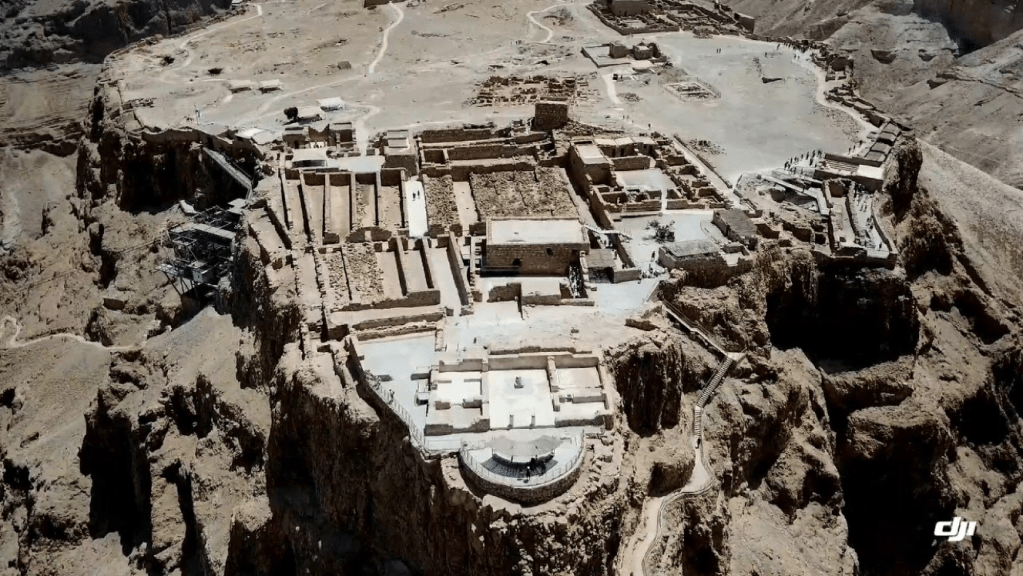
Josephus records: “They had died in the belief that they had left not a soul of them alive to fall into Roman hands; The Romans advanced to the assault … seeing none of the enemy but on all sides the awful solitude… within and silence, they were at a loss to conjecture what had happened here encountering the mass of slain, instead of exulting as over enemies, they admired the nobility of their resolve.”

The Battle of Leuctra in 371 BCE made Thebes the leading military power among the Greek city-states. The unexpected loss, dented the prestige of Sparta, ending its long dominance in Greece. Sparta never fully recovered from its losses at Leuctra, or the subsequent Helot revolts. Even so, it remained a regional power for another two centuries. Neither Philip II or his son Alexander the Great, attempted to conquer Sparta.
During its decline it remained the ‘defender of Hellenism,’ retaining its’ ‘laconic wit’ as evidenced, ‘when Philip II sent a message to Sparta saying, “If I enter Laconia, I will raze Sparta”, the Spartans responded with the single, terse reply… “if.” When Philip created the League of Corinth on the pretext of unifying Greece against Persia, the Spartans chose not to join, since they had no interest in joining a pan-Greek expedition unless it were under Spartan leadership. After defeating the Persians at the Battle of the Granicus, Alexander I, sent three hundred Persian suits of armour to Athens, inscribed: “Alexander, son of Philip, and all the Greeks except the Spartans, give these offerings taken from the foreigners who live in Asia.”
Spartan women were known to be literate and numerate; rare in ancient civilisation. Women were educated and interacted with their fellow male citizens, thus they were notorious for speaking their minds, even in public. Plato praised ‘Spartan women’s ability when it came to philosophical discussion.‘ Spartan women also had economic power, as they controlled their own properties as well as of their husbands. The higher status of females in Spartan society began at birth. Spartan girls were fed the same food as their brothers, allowed to exercise and even competed in sports. Rather than being married at the age of twelve or thirteen, Spartan law forbade the marriage of a girl until she was in at least her late teens. The reason was to ensure the birth of healthy children.
Overall, Spartan women were fitter and lived longer than the women of other Greek cities. Many visitors to Sparta, mentioned the practice of wife-sharing. The Spartans believed that breeding should be between the most physically fit and healthy. Older men allowed younger men, to impregnate their polygamous or polyandrous wives. This practice was encouraged so that women would ‘bear as many strong-bodied children as they could.’ The Spartan population of males was hard to maintain due to the loss of the men in battle and the strict physical inspection of newborns.
Laconophilia is a love or admiration of Sparta and its culture. Sparta was the subject of considerable admiration in its day, even from its rival, Athens. Greek philosophers, especially Platonists would describe Sparta as an ideal state, strong, brave, and free from the corruptions of commerce and money. Laconophilia was even in the writings of Machiavelli. ‘The Elizabethan English constitutionalist John Aylmer compared the mixed government of Tudor England to the Spartan republic, stating that “Lacedemonia (was) the noblest and best city governed that ever was”. He ironically, unbeknown to himself, commended it as a model for England – Chapter XXX Judah & Benjamin – the Regal Tribes.
In the twentieth century, a Facist admiration of Spartan ideals was in incredible irony adopted by Adolf Hitler, himself a quarter Jewish – Chapter XXVIII The True Identity & Origin of Germany & Austria – Ishmael & Hagar.
With further perverse irony, Hitler praised the Spartans in 1928, recommending ‘that Germany should imitate them by limiting “the number allowed to live”. He added that “The Spartans were once capable of such a wise measure… The subjugation of 350,000 Helots by 6,000 Spartans was only possible because of the racial superiority of the Spartans.” The Spartans had created “the first racialist state.”
A further uncanny link between Sparta and the state of Israel are early Zionists and those who foundered the Kibbutz movement. They were influenced by Spartan ideals, especially education. A founding father of the Kibbutz movement and the Palmach strike force (an elite underground Israeli army from 1941 to 1948), Yitzhak Tabenkin, advocated ‘that education for warfare “should begin from the nursery”, that children should from kindergarten be taken to “spend nights in the mountains and valleys.”
Today, the adjective spartan means ‘simple, frugal, avoiding luxury and comfort. The term ‘laconic phrase’ describes the very terse and direct speech characteristic of the Spartans.’ During our stay in Israel and travelling the length and breadth of it, it cannot help but be admitted that the recollection of the nation overall is aptly described as spartan. So too are the Israelis direct and witty. It would have to be expressed how welcome we felt in Israel and how helpful many locals were to my father and myself as strangers there. Of all the nations this writer has been fortunate to visit, Israel stands out, making a favourable and lasting impression.

The first century after 70 CE saw the beginning of the Jewish diaspora or the dispersion of Edom from Judea. We next find the Jews dwelling in three main centres of western Europe: Spain, France and Germany – dispersing there after migrating from the Middle East via Italy. Similarly, Jewish peoples located in the area roughly equating to Ukraine dispersed throughout Eastern Europe and Russia.
In Germany, reference to the Jews as early as 321 CE are made and they were known as the Ashkenazi Jewish community between circa 1000 to 1299 CE. Nothing to do with Ashkenaz the modern nation of Vietnam, the son of Gomer – refer Chapter V Gomer: Continental South East Asia. The community had survived during Charlemagne’s genocides and atrocities, yet suffered later during the Crusades; with Crusaders in 1096, sweeping over Jewish settlements, laying them waste. Accusations of well poisoning during the Black Death between 1346 and 1353 CE, led to the mass slaughter of German Jews and their subsequent flight in large numbers to Poland.

The Jews further east, subsequently known as Khazars ‘had been following a sex-orientated religion [Hebrews 12:16] until they officially embraced Judaism in 740 AD, while rejecting Christianity and Mohammedism’ according to Charles Weisman. The Khazars suffered the loss of the destruction of their government by the Russian Slavs in 1016 and then circa 1200, their land was invaded by Genghis Khan. Large numbers of Khazar Jews migrated to either Poland or western Russia. The eastern Jews began to have contact with their brethren from the Rhineland, either through mercantile association, or by reason of the influx of western Jews into Slavic countries.
The western Jew, possibly because of their superior learning in Judaism, gradually imposed upon the original residents their own culture as well as their speech. The German dialect was thus introduced among Polish Jewry and replaced Slavic. Thus the term ‘Ashkenazi’ in time, did not necessarily mean that all Ashkenazi Jews had come from Germany but that they had adopted the cluster of Ashkenazi culture; including the specific Ashkenazi religious rites and crucially, the German based Yiddish language.

The Joys of Yiddish, Leo Rosten, 1970:
‘Of other Germanic or German-based languages, Yiddish did not take its final shape as a separate language of eastern… Europe until late medieval times. However, its immediate predecessor, Judeo-German (originating, as recent scholarship has shown, in Bavaria and Bohemia, and notably in the cities of Regensburg and Prague, and not, as was earlier thought, in the Rhine valley), spread, at least with the first wave of Jewish settlers, to Silesia, Poland proper, Lithuania, Belarus, and western Ukraine during the high and later Middle Ages. Earlier Jewish ethnic groups had arrived in ECE (or its fringes) from the southeast: the former Khazaria (and beyond) and Kievan Rus, switching in the new setting to some form of East Slavic speech…’
Earlier we read of the interaction between Rome and the Idumean rulership in Judea leading into the time of Christ; the dispersal of the Jews from Judea by the Romans after 70 CE; the settlement of a portion of Jews in German lands; and now the formation of a hybrid language, incorporating Hebrew and German dialects. The constant reader will clearly realise the more than coincidental relationship exhibited between the descendants of Esau and Ishmael – refer Chapter XXVIII The True Identity & Origin of Germany & Austria – Ishmael & Hagar.
A very interesting correlation surfaces regarding the Ashkenazi Jew and the number of wives of Esau. Recall, we looked at the evidence and it strongly appeared that Esau had four wives, though one wife Judith, died prematurely after giving Esau two daughters – but no sons. One still wonders if the persistently held tradition that a person is a Jew through their maternal descent, stems from this very event.
Most Ashkenazi Jews from Four Women, Malcolm Ritter, 2006 – emphasis mine:
‘…about 40% of the total Ashkenazi population are descended from just four women, a genetic study indicates… lead author Dr. Doron Behar of the Rambam Medical Center in Haifa, Israel [commented]… Each woman left a genetic signature that shows up in their descendants today, he and colleagues say in a report published online by the American Journal of Human Genetics. Together, their four signatures appear in about 40% of Ashkenazi Jews, while being virtually absent in non-Jews and found only rarely in Jews of non-Ashkenazi origin, the researchers said. Ashkenazi Jews are a group with mainly central and eastern European ancestry. Ultimately, though, they can be traced back to Jews who migrated from Israel to Italy in the first and second centuries… Eventually this group moved to Eastern Europe in the 12th and 13th centuries and expanded greatly, reaching about 10 million just before World War II…
The study involved mitochondrial DNA, called mtDNA, which is passed only through the mother… Mike Hammer, who does similar research at the University of Arizona, said he found the work tracing back to just four ancestors “quite plausible… I think they’ve done a really good job of tackling this question. They may have existed in the Near East,” Hammer said. “We don’t know exactly where the four women were, but their descendants left a legacy in the population today, whereas… other women’s descendants did not.” Behar said the four women he referred to did inherit their genetic signatures from female ancestors who lived in the Near East. But he said he preferred to focus on these later European descendants because they were at the root of the Ashkenazi population explosion.’
Beginning in the thirteenth century, Jewish people were expelled from England and France as well as from central Europe. Most resettling in Russia, Poland and Eastern Europe. A small percentage however, began immigrating to Palestine. In 1492, when King Ferdinand and Queen Isabella expelled all Jewish people living in Spain, some refugees settled in Palestine.
At the turn of the twentieth century, European Jews were migrating to Palestine in large numbers, fleeing religious persecution. In Russia, Jewish people were segregated into an area along the country’s western border, called the Pale of Settlement. In 1881 (long before Nazi Germany), Russians began mass killings of Jews called pogroms. This prompted many to flee from Russia and re-locate in Palestine.
Prejudice against Jews, became known as anti-Semitism and was felt strongest in Germany, Austria-Hungary and France. A French army officer named Alfred Dreyfus was falsely accused of treason against the French government in 1894. Dreyfus was Jewish and imprisoned for five years and then later tried again, even after new information proved his innocence. The incident called The Dreyfus Affair, exposed widespread anti-Semitism in Western Europe.
In light of this, Theodor Herzl an Austrian Jewish journalist, thought that Jewish people required their own homeland, Erez Israel, and so be free of religious persecution. In 1897 he organised the First Zionist Congress and is credited with starting the Zionist political movement; though the term Zionism had been coined by a Jew, Nathan Birnbaum in 1890. Herzl was instrumental in turning Zionism from a ‘practical and philanthropic aspect to its political, economic and military objectives…’ Zionism held that an independent Jewish state was the only way for Jewish people to escape anti-Semitism. Herzl stated: ‘It was… incumbent upon the states of Europe to assist in establishing a Jewish state and assuring it of international legitimation.’
In response, the British government in 1903, first offered ‘a Jewish self-governing settlement in Uganda, East Africa’ then the British-held Sinai Peninsula was offered and finally ‘a plan to make Madagascar a Jewish nation also generated no Jewish interest.’
Who is Esau-Edom, Charles Weisman, 1991:
‘If half of Europe would have been offered to [the] Zionists they would still rather have the small barren land of Palestine. Why? … in Palestine they could draw Christian support as “God’s chosen people” returning to “Zion.” There would clearly be great political and financial leverage to be had by possessing “the ancient high places” of the true Israel people. The leaders of Edom did have a plan. As the counterfeit Israel people they could use their “cover” to fulfil Edomite goals – not Israelite ones.’
The issue to resolve was the fact that Palestine at this time was in the hands of the Turk and the Ottoman Empire and had been since 1299 CE. Since 1882, Edmond Rothschild had been financing a Jewish society to assist Jews in relocating to Palestine – Article: The Establishment: Who they are… What do they want? Weisman claims that International Zionists, Bankers and Plutocrats instigated the Balkan War of 1912/1913, which led to World War I in 1914 and guided Turkey into siding with the potential loser Germany, so that the Ottoman Empire could be carved up, freeing Palestine.
In the meantime, Zionists were able to convince Britain’s Arthur Balfour of their legitimacy as the Jews to a homeland. A ‘strange “Cabinet crisis” in December 1916’ led to “Lloyd George [becoming] Prime Minister and Arthur Balfour, Foreign Minister. Both these men… were outspoken supporters of Zionist aspirations.”
Thus pro-Zionists controlling British affairs were able to steer Great Britain towards victory over the Ottomans, by including the introduction of the United States in 1917, via President Woodrow Wilson and the insistence of his ‘intimate advisor’, Zionist agent Colonel Edward House.
British forces ultimately seized control of Palestine from the Turks. Lord Lionel Walter Rothschild submitted a draft declaration to Balfour, demanding what the Zionists wanted. Balfour addressed the British war Cabinet and two days later, the ‘Balfour Declaration’ was adopted. The letter was dated November 2nd, 1917, addressed to Lord Rothschild:
‘I have much pleasure in conveying to you, on behalf of His Majesty’s Government, the following declaration of sympathy with Jewish Zionist aspirations which has been submitted to, and approved by, the Cabinet:
“His Majesty’s Government view with favour the establishment in Palestine of a national home for the Jewish people, and will use their best endeavours to facilitate the achievement of this object, it being clearly understood that nothing shall be done which may prejudice the civil and religious rights of existing non-Jewish communities in Palestine, or the rights and political status enjoyed by Jews in any other country.”
I should be grateful if you would bring this declaration to the knowledge of the Zionist Federation.’
To ensure that Palestine would be in Zionist control, British forces occupied Jerusalem in December 1917. Muslim forces had earlier conquered the region in 637 CE. The occupying of an area already occupied ‘was an unprecedented innovation of international law.’ From that moment on, Arab discontent grew. Arab support in Europe with growing Arab nationalism in the Middle East, threatened to derail the Zionist plan.
Both Franklin Roosevelt and Winston Churchill were willing partners of the Zionists and enlisting their assistance required little effort in bringing the United States and the United Kingdom into World War II. The aftermath of the war allowed the Jews to create the United Nations in October 1945 and by 1947, the British gave up their Palestine mandate and handed the ‘Palestine problem’ to the United Nations. The agreement reached was to partition Palestine into separate Arab and Jewish states as according to the Zionist agenda. Thus the Edomite nation of ‘Israel’ was proclaimed on May 14, 1948. The very next day, the Arab countries surrounding Israel declared war on the new nation. Israel has been in an almost permanent state of internal conflict ever since. Conflict between Jews, who identify as Israeli and Arabs, who identify as Palestinian, broke out again in the years 1956, 1967, 1987, 2000, 2008, 2014 and 2022 till present. Esau certainly ‘lives by the sword.’
Who Is Esau-Edom, Charles A Weisman, 1991:
‘The only way the Jews got possession of Palestine was by using other people to steal it form the Turks and Arabs for them. The so-called “Israeli” state is nothing but a parasitic state, since it is occupied by parasites. The Jews get billions of dollars from Germany as “reparations” and “restitution payments” for its alleged “war crimes” against Jews. They get billions more every year from the United States. It has to steal or buy technology from Western nations as the Jews have not the creativity to develop their own. The Jewish state of Israel would collapse in a minute without the continued support, protection and assistance from Jacob-Israel… It is not, never has been, and never will be a self-sustaining nation.’
One of the singularly biggest cover ups in world history has been perpetrated; with the deliberate mistaken identity of the new inhabitants, foisted on the world so indelibly that most, when presented with this revelatory information, cannot shift the cleverly placed paradigm in their minds. The irony too, is that those of a religious persuasion, who are supposed to discern the truth, are those who are the most deceived; simultaneously being the biggest supporters of the erroneous concept, that the Jewish state is the tribe of Judah, finally home. Rather, it is Esau who has deceptively snatched an inheritance that is not his to take. How bizarre, that the role reversal Esau is enacting, is what his brother Jacob who he hates, did to him.
The Jewish Almanac, 1980:
‘Strictly speaking, it is incorrect to call an ancient Israelite a Jew or to call a contemporary Jew an Israelite or Hebrew.’
The Thirteenth Tribe, Arthur Koestler, 1976:
‘The story of the Khazar Empire, as it slowly emerges from the past, begins to look like the most cruel hoax that history has ever perpetrated.’
The Jewish Encylopedia, 1925, Volume 5, Page 41:
‘Edom is modern Jewry. The Jews are of Esau from Idumea, and therefore not of Israel or Judah…’
Harold Rosenthal:
‘Most Jews wont admit it, but our God is Lucifer, and we are his chosen. So when we say we are chosen of God we aren’t lying to the Goy [non-Jews]… We just aren’t telling them who chose us.’
Israel is a land of immigrants, with a population of 9,521,546 people; of which about seventy-four percent (~seven million) are Jewish and twenty-one percent Arab. Most are Ashkenazi Jews, who migrated from Eastern Europe (a blend of Ashkenazi Jew from Germany and the Khazars); Sephardic Jews who have migrated from the Iberian Peninsula; and Bukharan Jews, migrants from Central Asia.
The nation’s Law of Return grants full Israeli citizenship to all Jewish people. More than one hundred thousand Jews from sub-Saharan Africa for instance, have immigrated to Israel since 1980.
In keeping with living by the sword and the Spartan mindset, most Israelis are drafted into the military at the age of eighteen. Men serve two years and eight months and women two years. Following mandatory service, Israeli men join the reserve forces and usually do several weeks of reserve duty every year until they are in their forties. Most women are exempt from reserve duty.
The nation’s military relies heavily on high-tech weapons systems and is widely believed to possess chemical and biological weapons. Israel has not signed the Treaty on the Non-Proliferation of Nuclear Weapons, maintaining a policy of deliberate ambiguity. The Israeli Navy’s Dolphin submarines are reported to be armed with nuclear Popeye Turbo missiles – Article: Nuclear Nefariousness.
‘Since the Gulf War in 1991, when Israel was attacked by Iraqi Scud missiles, all homes in Israel are required to have a reinforced security room… impermeable to chemical and biological substances.’ In 2016, Israel ranked 6th in the world for defence spending as a percentage of GDP, with 5.7% and 15th in total military expenditure, with $18 billion. Since 1974, the United States has been a particularly notable contributor of military aid to Israel. ‘The United States is expected to provide the country with $3.8 billion per year, or around 20% of Israel’s defence budget, from 2018 to 2028. Israel ranked 5th globally for arms exports in 2017.’

Jerusalem at night – the Dome of the Rock and the Wailing Wall
In 2025, the world’s Jewish population is estimated at 15.8 million.
Approximate Jewish populations outside of Israel include:
United States: 6,000,000
France: 446,000
West Bank: 418,900
Canada: 393,000
United Kingdom: 292,000
Argentina: 175,000
Russia: 150,000
Germany: 118,000
Australia: 118,000
Brazil: 92,600
South Africa: 67,500
Netherlands: 29,800
New Zealand: 7,500
Ireland: 2,600

City of Jerusalem Flag
Israel is the 27th largest economy in the world with a GDP of $583 billion in 2025.
‘The following export product groups represent the highest dollar value in Israeli global shipments during 2020.
- Electrical machinery, equipment: US$8.2 billion
- Gems, precious metals: $6 billion
- Optical, technical, medical apparatus: $5.7 billion
- Machinery including computers: $4.4 billion
- Organic chemicals: $4.1 billion
- Plastics, plastic articles: $2.7 billion
- Other chemical goods: $2.5 billion
- Aircraft, spacecraft: $2.2 billion
- Pharmaceuticals: $1.7 billion
- Arms, ammunition: $1.2 billion
Arms including ammunition was the fastest grower among the top 10 export categories, up by 67.9% from 2019 to 2020.’
The discussion on who is a Jew, or what criteria constitutes being Jewish, is complex, multi-issued and thorny. It also highlights Esau’s fundamentally contrasting mental and physical characteristic differences with Jacob.
Identity of True Israel, Willie Martin – emphasis & bold mine:
‘By the time Christ came, there were now at least two different types of people in the land of Israel who were called “Jews.” Some were Israelites of the tribes of Judah, Levi or Benjamin… collectively, “Judahites…” Others called “Jews”… were Edomites who also lived in the land of Judea, and who had adopted the religion of Judaism.
King Herod was of… Edomite blood, and thus it is not surprising that he would kill a large number of baby Israelite boys in attempting to kill the Christ child. Therefore, when Christ came preaching the Gospel of the Kingdom to “the Jews,” it is understandable why some “Jews” believed on him and others believed not and tried to kill Him.
After the death, burial and resurrection of the Saviour, the apostles began preaching the good news first to the Judahite Israelites in Jerusalem and Judea, Samaria and Galilee. Those who were truly Israelites responded to the news by becoming Christians. Those who had become “Jews” by religion (Edomites and others) clung to Judaism (Tradition of the Elders, which later became known as Judaism).
This religion of Judaism… was not the true Mosaic/Hebrew religion, but was a perverted form of it which [Christ] denounced as “the traditions of men.” Paul, who was “a Pharisee of Pharisees,” (an expert in Babylonian Judaism), was a True Israelite (of the tribe of Benjamin), and thus converted to Christianity.’
Or did he? Refer article: The Pauline Paradox.
Martin: ‘But the “false Jews” refused to believe in Christ.
The spurious Noachide Laws are a Jewish fable. They are not found in the Christian Bible. Instead, the Word warns us against such: “… Wherefore rebuke them sharply… Not giving heed to Jewish fables, and commandments of men, that turn from the truth” – Titus 1:13-14. Such are the Noachide laws. Its followers and promoters uniformly reject the deity of Christ…’
We may well hear a lot more about the Noachide Laws in the future. The Noachide Laws are seven laws considered by rabbinic tradition as the minimal moral duties required by the ‘Bible’ – in the antediluvian age – on all men.
Though partially based on biblical precepts, exclusion of some of the ten commandments and the insidious inclusion of law number seven, paves the way for the controlling of humanity and its justification could be a foundational premise for continued worldwide changes – refer Chapter XXXIV Dan: The Invisible Tribe.
The seven Noachide laws, as traditionally enumerated are:
1. Do Not Deny God
2. Do Not Blaspheme God
3. Do Not Murder
4. Do Not Engage in Incestuous, Adulterous or Homosexual Relationships
5. Do Not Steal
6. Do Not Eat of a Live Animal
7. Establish Courts/Legal System to Ensure Law Obedience [of the first six laws]
In comparison and contrast, the Ten Commandments of the Old Testament (Exodus 20:2-17; Deuteronomy 5:6-21):
1. You shall have no other gods before Me
2. You shall not make for yourself any idol as an object to worship
3. You shall not take the name of the Lord your God in vain
4. Remember the Sabbath day to keep it holy
5. Honor your father and your mother
6. You shall not commit murder
7. You shall not commit adultery
8. You shall not steal
9. You shall not testify falsely
10. You shall not covet
The commandments italicised, are ones conveniently not included in the Noachide Laws. Though some would argue that the Noachide Laws came first…
The Races of the Old Testament, A H Sayce, 1891, page 74 – emphasis & bold mine:
‘But here again we must be careful to define what we mean by the modern Jewish type. The Jewish race is by no means a pure one. It has admitted proselytes from various nations, and at different periods in its career has intermarried with other races… and it is only by the aid of intermarriage that we can explain the contrast in type between the two great divisions of European Jews the Sephardim of Spain and Italy and the Ashkenazim of Germany, Poland, and Russia. Indeed we know that few of the leading Spanish families have not a certain admixture of Jewish blood in their veins, which implies a corresponding admixture on the other side.’
Blue Blood, True Blood, Conflict and Creation, Stewart A Swerdlow, 2002 – emphasis & bold mine:
‘There are in fact, many different physical types of Jews, covering many racial characteristics. This supports the fact that they are not a homogeneous group, but a religious group that spans many cultures. The vast majority of European/American Jews can trace their genetic lineage to the Khazars… who all converted to Judaism in the 800s to circumvent the Catholic rule of the Holy Roman Empire. In the year 2000, the University of Pavia in Italy did a genetic study of European men. They found that 80% of them had a direct lineage to Central Asia and the other 20% to the Middle East. This supports the statement that the Sumerians entered into Central Asia and then migrated to Europe and the Middle East. This also nullifies the theory of Africa as the birthplace of mankind. There is absolutely no genetic connection from Asia or Europe to Africa. The ancient Hebrews [if exclusively applied to the Israelites] have nothing to do with modern Jews [but they do if the term includes Abraham’s descendants].’
It is not so much that Jews are a religious group encompassing many ethnicities, though this is partially true, but rather the Jews have intermarried with many ethnicities to produce a very mixed gene pool. Esau was the first to marry three out of four wives who were a different lineage from his family; the exception being Basemath from his cousins in Ishmael’s family. The Edomites have continued to mix freely since. In 1900, only two percent of married Jews worldwide were wed to non-Jews or gentiles; whereas by 1975 the figure was twenty-five percent. In 2004 it had climbed to fifty percent of marrying Jews intermarrying with non-Jews, with non-Orthodox Jews in the United States the intermarriage rate was seventy percent in 2013.
Rabbi A H Fink: ‘The Jews do not claim to represent the twelve tribes…’ But they do incorrectly claim to be the tribe of Judah. Dr. J.H. Hertz, Chief Rabbi of the British Empire, said in 1918: ‘The people known as Jews are the descendants of the tribes of Judah and Benjamin, with a certain number of the tribe of Levi. So far as is known, there is not any further admixture of other tribes. The Ten Tribes have been absorbed among the nations of the world. The Jews look forward to the gathering of all the tribes at some future date.’
The rabbi was incorrect on the identity of the Jews; wrong on no admixture; and he was in error regarding the location of the other sons of Jacob. They have not been absorbed amongst other nations but have their own territories today and the biggest misnomer is the so-called future regathering of Judah with the other tribes. The reality is that they re-combined centuries ago and are in fact ironically, now in the process of systematically separating.
Whatever category is used to define a Jew, there is debate on its accuracy. Is a Jew, someone who practices Judaism? The religion or oral tenets of Judaism are not that of Jacob’s son Judah, based on the Old Testament, but rather the Talmud of the Edomites. Judaism isn’t actually Judah-ism.
Is a Jew, someone with a Jewish mother? In scripture, genealogies are patrimonial and not reckoned from the mother, whose name is usually excluded. Genetic studies have produced mixed results due to the volume of intermarriage by the Jews and some results may seem surprising. It would be expected that the Edomite Haplogroups may not appear uniform, though we will look for patterns and clues later.
The term anti-semite is highly misleading, as semite in modern parlance, is a language group not a racial group. Some three hundred and forty million people speak Semitic languages. Which includes an approximate three hundred million people who speak Arabic; twenty-two million, Amharic in Ethiopia; seven million, Tigrinya in the Horn of Africa; and ten million who speak Hebrew; not including Yiddish, which is a Germanic/Slavic language, not Semitic.
By strict definition then, anti-Semitic opposes Arabs; Ethiopians; and those Jews who are Hebrew speakers. Inaccurately, unfairly and persecutory, the term is used with racial implications. Dr Benjamin Freedman in Facts Are Facts, 1954, said the term anti-Semitism doesn’t apply to Jews in the sense it is most commonly used and that it ‘should be eliminated from the English language.’ A further point to be aware of is that the term Semitic does not necessarily apply to those that descend from Shem. The semitic speaking Arabs and Ethiopians are not descended from Shem. Thus the use of Shem and semitic together is not to be trusted in most cases.
The Missing Link of Jewish European Ancestry: Contrasting the Rhineland and the Khazarian Hypotheses, Eran Elhaik, 2012 – emphasis mine:
‘The question of Jewish ancestry has been the subject of controversy for over two centuries and has yet to be resolved. The “Rhineland hypothesis” depicts Eastern European Jews as a “population isolate” that emerged from a small group of German Jews who migrated eastward and expanded rapidly. Alternatively, the “Khazarian hypothesis” suggests that Eastern European Jews descended from the Khazars, an amalgam of Turkic clans that settled the Caucasus in the early centuries CE and converted to Judaism in the 8th century.
The “Rhineland hypothesis” envisions modern European Jews to be the descendents of the Judeans – an assortment of Israelite-Canaanite tribes of Semitic origin. It proposes two mass migratory waves: the first occurred over the 200 years following the Muslim conquest of Palestine (638 CE) and consisted of devoted Judeans who left Muslim Palestine for Europe. Whether these migrants joined the existing Judaized Greco-Roman communities is unclear, as is the extent of their contribution to the Southern European gene pool. The second wave occurred at the beginning of the 15th century by a group of 50,000 German Jews who migrated eastward and ushered an apparent hyper-baby-boom era for half a millennium. The Rhineland hypothesis predicts a Middle Eastern ancestry to European Jews and high genetic similarity among European Jews.
The competing “Khazarian hypothesis” considers Eastern European Jews to be the descendants of Khazars.’
This would only be true in part. Yes, due to admixture a certain proportion of the Ashkenazim would be descendants of the Khazars; but clearly not all. The Khazarian hypothesis doesn’t need to be a rival theory to the Rhineland hypothesis. Each are correct by degree and the reality is that the Rhineland Hypothesis holds more weight as a. being the first chronologically and b. the Khazarian hypothesis frankly by any proportion (or time frame), is a subset of the Rhineland hypothesis.
Elhaik: ‘The Khazars were a confederation of Slavic, Scythian, Hunnic–Bulgar, Iranian, Alans, and Turkish tribes who formed in the central-northern Caucasus one of most powerful empires during the late Iron Age and converted to Judaism in the 8th century CE. Genetic studies attempting to infer the ancestry of European Jews yielded inconsistent results. Some studies pointed to the genetic similarity between European Jews and Caucasus populations like Adygei, whereas some pointed to the similarity to Middle Eastern populations such as Palestinians and others pointed to the similarity to Southern European populations like Italians [remember this point].’

‘European Jews are expected to cluster with native Middle Eastern [older origin] or Caucasus [later migration] populations according to the Rhineland or Khazarian hypotheses, respectively. The results of all PC analyses show that over 70% of European Jews and almost all Eastern European Jews cluster with Georgian, Armenian, and Azerbaijani Jews within the Caucasus rim [it would be surprising if they did not]. Strong evidence for the Khazarian hypothesis is the clustering of European Jews with the populations that reside on opposite ends of ancient Khazaria: Armenians, Georgians, and Azerbaijani Jews.’
This only proves the validity of the Khazarian hypothesis as a component of the equation and not the whole answer.
Elhaik: ‘Central and Eastern European Jews differ mostly in their Middle Eastern (30% and 25%, respectively) and Eastern European ancestries (3% and 12%, respectively), probably due to late admixture [agree]. We emphasize that these hypotheses are not exclusive and that some European Jews may have other ancestries. We show that the Khazarian hypothesis offers a comprehensive[?] explanation for the results [disagree], including the reported Southern European and Middle Eastern ancestries.
By contrast, the Rhineland hypothesis could not explain the large Caucasus component in European Jews [why does it need to?], which is rare in non-Caucasus populations. A major difficulty with the Rhineland hypothesis, in addition to the lack of historical and anthropological evidence to the multimigration waves from Palestine to Europe is to explain the vast population expansion of Eastern European Jews from fifty thousand (15th century) to eight million (20th century).’
This data does not disprove a lineage from Esau. It does highlight the heavy admixture of Khazar tribes with the Ashkenazi Jews from Germany (and France). It confirms the lesser numbers of the Ashkenazi Jews in comparison to the Khazars (hence the population expansion) and explains why their culture dominated as they were the true Jew so-to-speak. Whereas the Khazar was a religious and cultural convert to Judaism rather than a genetic continuation. Further clarification is provided by Joanna Gillan.
Where are Ashkenazi Jews from? Their Origins May Surprise You, Joanna Gillan, 2020 – emphasis mine:
‘… the origins of the matrilineal line for the Ashkenazi Jews comes from Europe. This goes against the common belief that Jewish people first arrived in central Europe after the Byzantine–Sasanian War of 602-628 and only began settling in Germany in the Medieval period. One of the things they are recognized for is the use of Yiddish – a High German language written in the Hebrew alphabet and influenced by classical Hebrew and Aramaic.
Ashkenazi Jews were declared a clear, homogeneous genetic subgroup following a 2006 study. Ashkenazi Jews come from the same genetic group, no matter if their ancestors were from Poland, Russia, Hungary, Lithuania, or another place with a large historical Jewish population. They are all in the same ethnic group… they didn’t reproduce at a noticeable level with others outside their group (not even with other Jewish people). Researchers have shown Ashkenazi Jews were a reproductively isolated population in Europe for about 1000 years.
Previous studies have found that 50-80% of the Ashkenazim DNA from the paternal lineage originated in the Near East… [and] the 2013 study showed 80% of Ashkenazi Jews’ maternal line comes from Europe… “This suggests that, even though Jewish men may indeed have migrated into Europe from Palestine around 2000 years ago, they seem to have married European women” [much like Esau and his ethnically different wives]. That helps explain why the Ashkenazim can trace their female lineage to southern and western Europe. In conclusion, Richards said, “The origins of the Ashkenazim is one of the big questions that people have pursued again and again and never really come to a conclusive view.”
Khazaria, Kevin Alan Brook – emphasis & bold mine:
‘Advanced genetic testing, including Y-DNA and mtDNA haplotyping, of modern Jewish communities around the world, has helped to determine… the degrees of separation between the groups. Important studies archived here include the University College London study of 2002, Ariella Oppenheim’s study of 2001, Ariella Oppenheim’s study of 2000, Michael Hammer’s study of 2000, Doron Behar’s study of 2008, Steven Bray’s study of 2010, and others.
Key findings: The main ethnic element of Ashkenazim (German and Eastern European Jews), Sephardim (Spanish and Portuguese Jews), Mizrakhim (Middle Eastern Jews), Juhurim (Mountain Jews of the Caucasus), Italqim (Italian Jews), and most other modern Jewish populations of the world is… [the]… Y-DNA haplogroups J and E.’
This writer would contend that the principal paternal Haplogroup is in fact R1b. Meaning Haplogroups J2, J1 and E1b1b are evidence of males added to the Jewish melting pot through admixture. When we investigate Esau’s twin brother Jacob, it will be shown that the principle Y-DNA Haplogroup for his descendants is also R1b.
Brook: ‘Ashkenazim also descend, in a smaller way, from European peoples from the northern Mediterranean region (including Italians and French) and even less from Slavs.
We know most of the European ancestry came from women who married into the community since the Ashkenazic haplogroups of European origin are usually mtDNA rather than Y-DNA.
Unexpectedly, most Askenazim have a tiny fraction of East Asian ancestry.* Their typically East Asian mtDNA haplogroups include M33c2 and N9a3. The characteristically East Asian hair thickness allele 1540C for the EDAR gene is carried by about 1.7% of Ashkenazim. Dutch Jews from the Netherlands also descend from northwestern Europeans.
About half of Ashkenazic Levites possess haplotypes belonging to the R1a1 haplogroup. This is almost never found among Sephardic Levites, and is rare in non-Ashkenazic populations as a whole, but the phylogeny of the branching out of R1a1 shows the Ashkenazic variety of R1a1^ to be distinct [yet still resulting from admixture] from both the Eastern European and Central Asian forms of R1a1… [showing that] Khazars who converted to Judaism introduced this lineage into Ashkenazim. The [original] source of Ashkenazic R1a1 was a population [from] Iran.’*
This last point is significant as while the biggest percentage of Iranian men possess Haplogroup J2 (from admixture), it is in fact R1a which is the defining marker Haplogroup for the male descendants of Lud – Chapter XVII Lud & Iran.
In contrast, the biggest percentage of Turkish men while also possessing J2 (from admixture), it is Y-DNA Haplogroup R1b that is the defining marker Haplogroup for the male descendants of Elam – Chapter XVIII Elam & Turkey.
Brook: ‘Nicolas D Kristoff, Is Race Real? 2003: “Among Jews, there are common genetic markers, including some found in about half the Jewish men named Cohen. But this isn’t exactly a Jewish gene: The same marker is also found in Arabs.”
The true Levites today – and any Levitical priestly line attached to them – lays with Jacob’s descendants. It cannot be denied that any association between Jewish men named Cohen and a priestly line may be legitimate; though its source would be with the Idumean scribes, Pharisees and Sadducees and not with Jacob’s son Levi or his descendant Aaron and his sons – Chapter XXXI Reuben, Simeon, Levi & Gad – the Celtic Tribes.
Brook: ‘Catastrophe: An Investigation Into the Origins of the Modern World, David Keys, 2000, page 99-100. Keys summarises Origins of Old Testament Priests, M. G. Thomas, Karl L. Skorecki, H. Ben-Ami, Tudor Parfitt, Neil Bradman, D. B. Goldstein, 1998, page 138-140:
“DNA tests on Sephardic and Ashkenazi Jews have revealed the possibility that at least one key section of the latter community may have genetic evidence of a potentially large-scale or even mass conversion which must have taken place sometime after around A.D. 700…. the only known mass conversion within that time frame and in that geographical area was that of the Khazars in the eighth century. Significantly, the section of the Ashkenazi community whose DNA may suggest a partially convert origin is that section which up till now had traditionally been said to be wholly descended from the Assistant Priests of ancient Israel [Edom]…
By analyzing Y chromosomes from a sample of both [‘Levite’ and ‘non-Levite’] populations in both Sephardic and Ashkenazi communities, geneticists have discovered that an astounding 30 percent of Ashkenazi non-Cohenic Levites have a particular combination of DNA material on part of their Y-chromosome that is not shared to any extent by either non-Levite Ashkenazi Jews or the Sephardic community as a whole.
This genetic marker does not even show up among the Cohens (descendants of the ancient Israelite Chief Priests) – but only among the descendants of Assistant Priests, and then only within Ashkenazi (northern European) Jewry. What seems to have happened is not only a potentially large-scale conversion of non-Jewish people, almost certainly Khazars, to Judaism, but also the adoption of Levite (Assistant Priest) status by a substantial number of the Khazar converts…
A tenth-century letter of recommendation from the Jewish community of Kiev to Jewish communities outside Khazaria was signed by Jews with traditional Turkic names whose almost certainly Turkic Khazar ancestors had adopted second names… indicating that they saw themselves as descendants or close associates of the ancient tribe of Levi… Adoption of Cohenic or ordinary Levitical status by converts was and is expressly forbidden by rabbinical law, so the Khazars had to develop a mythic national history that gave them the right to Levitical status.**
They claimed that they were the descendants of one of the lost tribes of Israel and were not converts at all but merely returnees to Judaism. Furthermore, the tribe they claimed ancestry from was that of Simeon, the brother of the founder of the tribe of Levi… Probably it was the old pre-Jewish Khazar priests – the qams – who at the conversion had become Levites en masse…” – Chapter XXXI Reuben, Simeon, Levi & Gad – the Celtic Tribes.
‘The God Gene: How faith is Hardwired into our Genes, Dean Hamer, 2004, page 191-192:
“A recent study by Skorecki and colleagues uncovered a subgroup of Ashkenazic Levites who have a Y-chromosome pattern that is not seen in other priests, or indeed any major Jewish group, but is common in people around the mouth of the Volga River. A little sleuthing revealed the historical connection… Sometime in the eighth century, [Khazars] decided to convert from paganism to monotheism. Most of the common people became either Christian or Muslim, but the royal family and many members of the nobility opted for Judaism. They continued to rule the region for nearly five hundred years as a Jewish state. The DNA evidence shows that many of the Khazar converts declared themselves to be not only Jews but of the priestly caste.** Thus the infusion of new genetic lines.”
The terms Cohen, Cohanim, Levite and Levitical are misleading as they only apply to the Ashkenazi or Khazar priesthood; not to the original priesthood descending from Jacob’s son Levi. We will learn that the tribe of Simeon are in no way related to the Khazars who are not just of intermixed Turkic-Iranian origin – but of an older admixture again with west Asian, Middle eastern and North African origins as shown by their principal Y-DNA Haplogroups of J2, J1 and E1b1b respectively. The East Asian ancestry is linked to Madai* and Madai’s association with Elam – refer Chapter IV Central Asia – Madai & the Medes; and Chapter XVIII Elam & Turkey.
‘The Origins of Ashkenazic Levites: Many Ashkenazic Levites Probably Have a Paternal Descent from East Europeans or West Asians, Neil Bradman, Dror Rosengarten, and Karl L. Skorecki, 2002:
“…Levite haplotype distributions were compared with… candidate source populations (north Germans and two groups of Slavonic language speakers). The Ashkenazic Levites were most similar to the Sorbians, the most westerly Slavonic speaking group… Comparisons of the Ashkenazic Levite dataset with the other groups studied suggest that Y chromosome haplotypes, present at high frequency in Ashkenazic Levites, are most likely to have an east European or west Asian origin and not to have originated in the Middle East.”
Subsequently, as I learned in 2011, it was discovered that the Ashkenazi Levite version of R1a1a^ is distinguishable from the R1a1a [M17] of European non-Jews. The Ashkenazi version is coded as L342.2+ and R1a1a1g1 and it descends from Z93, whereas the European non-Jewish R1a1a descends from Z283.’

‘(One of our sources for this information is Łukasz Łapiński who is the administrator of the R1a1a and Subclades Y-DNA Project at Family Tree DNA.) The implication is that Levites did not get this haplotype from a Slavic forebear, which was one of the possibilities. Z93 is found among peoples of Central Asia*, South Asia, and Southwest Asia including Persians, Arabs, Indians, and Tatars.’
‘Y Chromosomes of Jewish Priests, Michael F. Hammer, Karl L. Skorecki, Sara Selig, Shraga Blazer, Bruce Rappaport, Robert Bradman, Neil Bradman, P. J. Warburton, Monica Ismajlowicz, 1997:
“Based on surveys of Jewish cemetery gravestones, priests represent approximately 5% of the estimated total male world Jewish population of roughly 7 million… We identified six haplotypes, whose frequencies are shown in the table (YAP+ DYS19A-E and YAP+ DYS19, all alleles.) Applying the x2 test to the frequencies of the T-chromosome haplotypes distinguishes priests from the lay population. The most striking difference was in the frequency of YAP+ chromosomes among compares to lay Jews. Only 1.5% of Y-chromosomes among priests were YAP+, in comparison to a frequency of 18.4% in lay Jews. In contrast, we found no significant difference in the distribution of alleles for the non-Y-chromosomes locus polymorphism D1S191.
These Y-chromosome haplotype differences confirm a distinct paternal genealogy for Jewish priests… This result is consistent with an origin for the Jewish priesthood antedating the division of world Jewry into Ashkenazi and Sephardic communities, and is of particular interest in view of the pronounced genetic diversity displayed between the two [Sephardim and Ashkenazim] communities.”
‘Regarding the “Cohen gene”: David Goldstein, an evolutionary geneticist at Oxford University, said: “It was incredibly exciting to find something that could be tracing paternally-inherited traits over 40 to 50 generations, three or four thousand years of history [to the birth of Esau].”
‘Only about half, or less (40-45%), of Ashkenazi Jewish Cohens have the so-called “Kohen gene”. A somewhat greater percentage of Sephardic Cohens have the gene. But it doesn’t approach 100 percent. Tell that to the staff of Karl Skorecki’s institution, Technion University, who claim… “Professor Karl Skorecki discovered genetic proof that all Jews belonging to the Cohen family are descendents of the biblical high priest Aaron Hacohen” (Dr. Skorecki himself does not approve of the university’s use of the word “all” and has asked them to fix their description of his research).’

Brook: ‘Daniel Friedman observes: “Ashkenazi and Sephardic Cohanim (left two columns in the chart [above]) show significant differences in the occurrence frequencies of the haplotypes said to make up the ‘Cohen gene’. [‘Israelite’] populations from both populations (right two columns) do not show the same differences. If the ‘Cohen gene’ comes from a single Biblical ancestor, the Cohanim seem to have had different genetic histories since the split between Sepharad and Ashkenaz.”
The Cohen gene is not from the true tribe of Levi, but a counterfeit priestly line from Esau. The differences in genetic history between the Sephardic and Ashkenazi Jewish lines can be accounted for by the the fact that the Sephardim are closer to the true Edomite genealogy than the Ashkenazim. By closer, it is meant less diluted through admixture. We will discover that the R1b Haplogroup percentage for each group scientifically supports this fact. Maybe not what the Ashkenazi Jew would want to learn, but it is the simple explanation for the difference between themselves and the Sephardic Jew.
The apparent confusion regarding Jewish DNA is an important factor; for under its cloak it has been easy for scientists to say what Dr Robert Pollack, a professor of biological sciences and director of the Center for the Study of Science and Religion at Columbia University writes in his article, The Fallacy of Biological Judaism:
‘… there are no DNA sequences common to all Jews and absent from all non-Jews. There is nothing in the human genome that makes or diagnoses a person as a Jew.’
We will study the Haplogroups and autosomal DNA of the Ashkenazi and Sephardic Jew. The Haplogroups of the Ashkenazi, are all over the place, as would be expected. The Sephardic Jew has more instantly recognisable sequential patterns. The challenge is to see those which are less obvious within the Ashkenazi and then link the two to the peoples they are most related to, such as either Jacob, Ishmael, Haran or Nahor.
Nineteen years ago an enquiring person asked the following insightful questions online – capitalisation theirs, emphasis mine. This writer would be intrigued to learn if they received a (helpful) response.
‘I’ve heard of Sephardi Jews being described as “fiery,” “active,” “angry,” and even “militant” when compared to their “cooler,” more saturnine Ashkenazi counterparts. Does anyone know of any research that could verify my hypothesis that red hair is MUCH more common amongst Sephardic Jews than among the Askenazim (who often have black and/or very dark brown hair). This often applies to men’s beards too, such as the person may not be a FULL redhead but still has some trace elements of red in their hair and/or beard. These same people also often seem [to] have lighter colored eyes than Ashkenazi Jews (whose eyes are often brown or darker in color, like their hair). Has anyone else noticed this red-headed/lighter-eyed “trend” amongst the Sephardic population? Thanks for any info that you can provide! – 07:44, 19 August 2006 (UTC).’
The questions are spot on, for they reflect the purer, for the want of a better word, genetic lineage of the Sephardic Jew back to their red progenitor, Esau. As we have discussed, red is also found in the Ashkenazi Jew though in lesser percentages due to the admixture with the Turkic-Iranian Khazars. The Sephardic Jew historically is associated with the Iberian Peninsula (Spain and Portugal); with Italy; and some spill over into the Netherlands; and England. They and the original Ashkenazi Jews in Germany and France would have had a similar heritage, just a different geography. The fact that the Jews were located in the nations descended from Moab (and Ammon), Midian, Ishmael and Jacob – apart from Aram – who are all closely related family nations, makes sense.
The complicated relationship dynamic between Germany and the Jews of recent times is all the more fascinating considering they are descended from Ishmael and Edom respectively. So too has been the complex relationship between the Jews, the United Kingdom and the United States as we will discover.
An enlightening piece regarding the Sephardic Jew. Discovering and Documenting England’s Lost Jews – emphasis mine:
‘Sephardim, also known as Sephardi Jews, are Jews with a Spanish or Portuguese heritage who were expelled or fled from the Iberian Peninsula from the end of the 15th century. A Sephardic diaspora followed. They found refuge across the Mediterranean basin, including the Ottoman Empire where they lived for centuries in the countries we now know as Morocco, Algeria, Italy, Turkey, Greece, Serbia, Bosnia and Bulgaria. Sephardim also settled, in the Netherlands, England and in the Americas [North America and South America]. We can see now that the dispersed communities arrived in their new countries with a Judeo-Iberian culture. In some cases, this was lost; in others, strong traces remain.
Jews from Normandy arrived in England with William the Conqueror, the Duke of Normandy, in 1066. They were transported to serve the monarch and his nobles as moneylenders. Medieval Christian England never treated Jews as equals. From 1217, King Henry III ordered Jews to wear a badge and, in 1275, King Edward ordered them to wear a yellow patch which the Nazis later emulated. Medieval archives and drawings reveal murders and atrocities against Jews. Geoffrey Chaucer, celebrated as the father of English Literature, propagated a blood libel in The Prioress’s Tale. When the Jews became destitute, and were no longer useful to royalty, King Edward expelled them in 1290. They were forced to leave on pain of death. Many were murdered as they approached the boats that were to take them to the continent. Officially there was no Jewish population in England between 1290 and 1656.
However, a small number of Sephardi Crypto-Jews, outwardly perceived as Christians while secretly continuing their Jewish faith, did settle in London and Bristol from the late 15th century. They were fleeing the horrors of the Catholic Inquisition in Spain and Portugal. After the execution of King Charles I, when Oliver Cromwell was Lord Protectorate of England, Jews were considered more favourably.
Cromwell, and some of his fellow Puritans, were expecting the world to end in 1666. Apocalypse-fever infected many religious sects during his regime. The Book of [Revelation] promised the Second Coming of Jesus under certain conditions. One was the return of the Jews to the four corners of the earth. With this in mind, Cromwell supported the idea of Jews being allowed to enter England and settle. He was petitioned by the Dutch Rabbi Menasseh ben Israel, and as a result, Cromwell approached The Whitehall Conference in 1656. He asked parliamentarians to overturn the monarchy’s expulsion of the Jews. Parliament refused. Despite this interdiction, Jews returned secretly and were allowed to practise their religion discreetly. The first small synagogue was opened, and in 1657, a burial ground was inaugurated. This is known as the Velho cemetery in Mile End. The importance of the burial ground encouraged settlement and Jews trickled back on to English soil. Bevis Marks was built as the first synagogue in 1701.
Ladino, also known as Judeo-Spanish, is a language derived from Castilian Spanish and enriched, over the centuries, by influences from other languages including Hebrew. Although its use sharply declined during the 20th century, Ladino is still spoken by Sephardi communities in more than thirty countries around the world. It is recognized as a minority language in Bosnia and Herzegovina, France, Turkey, and Israel.’

The significance of Jews returning to England is profound in two key points; both of which will become apparent as we progress into the next chapter. Another article explains further regarding the Ashkenazi and Sephardic Jews.
Judaism 101 – emphasis theirs:
‘Ashkenazic and Sephardic Jews represent two distinct subcultures of Judaism… [sharing] the same basic beliefs, but there are some variations in culture and practice. It’s not clear when the split began, but it has existed for more than a thousand years, because around the year 1000 CE Rabbi Gershom ben Judah issued an edict against polygamy that was accepted by Ashkenazim but not by Sephardim.’
There are differences in culture, language, genetics, and nuances of ritual observance, between the Ashkenazi and Sephardic Jews; though the commonalities between the two groups are much stronger than what divides them. A Sephardi from Morocco and an Ashkenazi from Moscow would immediately find common ground in a prayer service that is ninety-five percent identical; in mitzvah observance and the Hebrew language.
‘Ashkenazic Jews are the Jews of [originally] France, Germany, and [later] Eastern Europe and their descendants. The adjective “Ashkenazic” and corresponding nouns, Ashkenazi (singular) and Ashkenazim (plural) are derived from the Hebrew word “Ashkenaz,” which is used to refer to Germany. Most American Jews today are Ashkenazim, descended from Jews who emigrated from Germany and Eastern Europe from the mid 1800s to the early 1900s.’
It is not clear when Jews from Italy – who had originated in Judea and before that, Idumea – began populating the Rhine Valley. Beginning about the tenth Century though, the Jewish communities straddling France and southern Germany rose to prominence as a learned and vital centre of Jewish life.
‘Sephardic Jews are the Jews of Spain, Portugal, North Africa and the Middle East and their descendants. The adjective “Sephardic” and corresponding nouns Sephardi (singular) and Sephardim (plural) are derived from the Hebrew word “Sepharad,” which refers to Spain. Sephardic Jews are often subdivided into Sephardim, from Spain and Portugal, and Mizrachim, from… Northern Africa and the Middle East. The word “Mizrachi” comes from the Hebrew word for Eastern. There is much overlap between the Sephardim and Mizrachim. Until the 1400s, the Iberian Peninsula, North Africa and the Middle East were all controlled by Muslims, who generally allowed Jews to move freely throughout the region. It was under this relatively benevolent rule that Sephardic Judaism developed. When the Jews were expelled from Spain in 1492, many of them were absorbed into existing Mizrachi communities in Northern Africa and the Middle East.’
The earliest recorded Jewish settlements in Spain date to the third century. Having grown in prominence under Muslim rule, they were arguably the most illustrious Jewish community in the world. Sepharad produced Torah scholars, scientists, financiers, and thinkers whose works are still being studied today, including Isaac Abravanel, Nachmanides, Maimonides and others. The Catholic king and queen of Spain, Ferdinand and Isabella expelled all Jews from their lands; nor was this the first time Jews had been expelled from Spain. The Jews who had converted to Catholicism were permitted to stay.
The remaining Spanish Jews poured into Portugal, only to be expelled from there as well; continuing to North Africa and anywhere else they could find a safe haven. ‘In many places – from Amsterdam, Netherlands to Aleppo, Syria – they became the dominant Jewish culture in their new host communities’, explaining why Jews from lands far from Spain are still known as Sepharadim.

Flag of Israel
‘The Magen David gained popularity as a symbol of Judaism when it was adopted as the emblem of the Zionist movement in 1897, but the symbol continued to be controversial for many years afterward. When the modern state of Israel was founded, there was much debate over whether this symbol should be used on the flag. Today, the Magen David is the universally recognized symbol of Jewry. It appears on the flag of the state of Israel, and the Israeli equivalent of the Red Cross is known as the Red Magen David’ – refer Rothschild, article: The Establishment: Who are they… What do they want?
‘Most of the early Jewish settlers of North America were Sephardic. The first Jewish congregation in North America, Shearith Israel, founded in what is now New York in 1684, was Sephardic and is still active. Philadelphia’s first Jewish congregation, Congregation Mikveh Israel, founded in 1740, was also a Sephardic one, and is also still active. Historically, Sephardic Jews have been more integrated into the local non-Jewish culture than Ashkenazic Jews. The Yiddish language, which many people think of as the international language of Judaism, is really the language of Ashkenazic Jews. Sephardic Jews have their own international language: Ladino, which was based on Spanish and Hebrew in the same way that Yiddish was based on German and Hebrew.’
Hasdai ibn Shaprut was the foreign minister to Abd-al-Rahman, the Sultan of Cordova and in a letter to King Joseph of the Chazars, circa 960 CE; he speaks of the tradition according to which the Chazars once dwelt near the Seir Mountains. The Seir Mountains of the original land of Edom, south of the Dead Sea. This could be true, though a later aligning of Khazar roots with that of the Jewish Edomites seems far more likely, for we have already discussed the Ashkenazi migration eastwards from Germany and France and their intermixing with the already ‘Jewish’ Khazars.
The Seir mountains were the home of the Edomites for well over a millennium from when Esau conquered the Horites circa 1760 BCE to 312 BCE when the Nabatheans – Arabs from the Arabian Peninsula – drove Edom out of their ancestral home. The Encyclopedia Judaica Volume 6, page 372 says the Edomites arrived in Edom (or Seir) at the end of the fourteenth and beginning of the thirteenth century BCE. This is too late and upholds the ‘Khazars are Edom’ subterfuge. Why would the Jews be content with this?
A 2014 article in the Times of Israel states: ‘It is well known that, sometime in the eighth to ninth centuries, the Khazars, a warlike Turkic people, converted to Judaism and ruled over a vast domain in what became southern Russia and Ukraine. What happened to them after the Russians destroyed that empire around the eleventh century has been a mystery. Many have speculated that the Khazars became the ancestors of Ashkenazi Jews… In 2012, Israeli researcher Eran Elhaik published a study [read earlier] claiming to prove that Khazar ancestry is the single largest element in the Ashkenazi gene pool. Israel seems finally to have thrown in the towel. A blue-ribbon team of scholars from leading research institutions and museums has just issued a secret report to the government, acknowledging that European Jews are in fact Khazars.’
The Jewish historian and anti-Zionist Benjamin Freedman argues that the Jews are Khazars and not Israelites: ‘The origin and history of the Khazars and Khazar Kingdom are certainly incontestable historical facts. These incontestable historic facts also establish beyond any question of doubt the origin and history of the so-called or self-styled “Jews” in eastern Europe. The origin and history of the Khazars and Khazar kingdom and their relationship to the origin and early history of the so-called or self-styled “Jews” in eastern Europe was one of history’s best kept secrets until wide publicity was given in recent years to… research on this subject.’
The Jews know the game is up in declaring they are Israelites to the smaller community of biblical researchers and academic investigators who are gradually uncovering the truth. To the wider audience of the general public, they are still able to fool with the ‘we are sons of Jacob through Judah, Benjamin and Levi’ rouse. But, in ‘admitting’ that ninety percent of Eastern Ashkenazi Jewry is really Khazar, is propaganda that still conveniently blurs their identity. For people then think the Jews in the main are a Turkic people and the fact that Esau is a twin of Jacob, neatly pushes the identity of both to one side.
For the Jews not only wish to cloud the issue of their own identity, they do not want the world to understand the real identity of their twin brother and particularly that of true Judah. For as unpalatable as it may be for a great number of people, once Judah’s identity is understood, even for those descended from the mighty nations of Joseph; it is Judah, the most mentioned people in the scriptures – and from whose perspective the entire Bible is written – that the Creator reveals is His beloved chosen people.
Psalm 78:67-68
Common English Bible
‘God rejected the tent of Joseph and didn’t choose the tribe of Ephraim. Instead, he chose the tribe of Judah, the mountain of Zion, which he loves.’
Genetic testing performed on Jews around the world continues to show not only that Jews really are a unique ethnicity, they also are historically a mingled and mixed people. ‘Researchers in New York and Tel Aviv conducted a genome-wide analysis on 237 individuals from seven well-established Jewish communities around the world… each group of Jews is genetically distinct, but similarities between the groups weave them together with what the researchers describe as “genetic thread.” ‘There has been this back and forth discussion over the course of a century or more – are these a people? Is this in the genome?’ says Harry Ostrer, a geneticist at New York University. The findings he says, show that there ‘does seem to be a genetic basis to Jewishness.’
The Genetics Of The Jews by A E Mourant, 1978, found that of all Jews tested, between five and ten percent possessed admixture of Black African blood. The result of having lived in close proximity to Arabs and Africans in the Middle East and North Africa. As mentioned, genealogies recorded in the Bible show a patrilineal lineage, whereas Jews trace their ancestry through matrilineal descent. ‘By Jewish law, it is necessary for a Jew to have only a Jewish mother to be considered a Jew. The father can be of any race, but just as long as the mother is racially jewish, the child “qualifies” as a Jew. This law tacitly implies that racial mixing can and does occur without losing Jewish identity.’ Obtaining citizenship to Israel, is entirely dependent on proving that one is genetically a Jew and it has nothing to do with religion, but rather DNA.
Additional evidence showing that Jews are a distinct race rather than ‘people of the Jewish religion’, is the large body of data documenting rare genetic diseases peculiar to Jews. Jews have a higher propensity for mental illness in comparison to other white people. Israeli and American scientists discovered a gene among Ashkenazi Jews which increases their chances of developing the mental conditions, schizophrenia, schizoaffective disorder and manic depression. A study published in Nature Communications said the gene in question, raises Ashkenazi Jews chances of experiencing the disorders by roughly 40%, compared to 15% in the general population.
The reason for choosing Ashkenazi Jews as the subject for the study, was influenced by the fact that Ashkenazi Jews are considered to be a particularly homogenous group genetically. The narrow genetic variation among Ashkenazi Jews allowed for easy identification of differences between healthy and affected individuals.
The most well known genetic disorder among Jews, is Tay-Sachs Disease; which causes ‘idiocy and enfeeblement in children, and is carried by millions of Ashkenazi today. The condition was so common among Jewish immigrants in America at the turn of the twentieth century that it was used as a justifiable excuse to ban further Jewish immigration for fear that this disease would spread to the general population through inter-marriage – which it has.’
All About Genetic Diseases That Strike Sephardic Jews, Forward Staff, 2014:
‘The Forward Staff has compiled a guide to the most common heritable “Sephardic Jewish diseases”… These diseases are mostly caused by recessive genetic mutations, meaning that mutations must be present in both copies (alleles) of the gene for the associated condition to be expressed. When both parents carry a given mutation, each child of theirs has a 25% of developing the associated disease. Unlike Ashkenazi Jews, who share ethnic commonalities regardless of country of origin, “Sephardi” is a broad label.’
The two most common conditions that afflict the Sephardic Jew, from a rather lengthy list.
‘Beta Thalassemia which Affects the Mizrahi and Sephardic populations. Estimated Carrier Frequency is 1 in 5 to 1 in 7. Beta thalassemia is a blood disorder that reduces the production of haemoglobin and causes anemia, bone deformities and an enlarged spleen. When serious, it requires blood transfusions to survive, as well as chelation therapy to prevent organ failure from an iron overload.
Cystic Fibrosis which affects all Sephardic and Mizrahi populations. Estimated Carrier Frequency 1 in 26. The body produces abnormally thick, sticky mucus that clogs the lungs, the digestive system and impairs organ function. The average life expectancy today is 37 years. There is no cure, though antibiotics can reduce infection. In serious cases a lung transplant is required.’
There is a ‘revolutionary drug’ called Kaftrio, which can prolong life expectancy. It “is a triple combination treatment combining three drugs which perform different functions – ivacaftor, tezacaftor and elexacaftor – and tackles the underlying causes of the disease, by helping the lungs work effectively.”
Who is Esau-Edom, Charles Weisman, 1991 – emphasis mine:
‘The conflicting differences that exist between Jews and those of the white race are primarily a result of their genetic differences, or their “nature and constitution.” Jews act and think differently… because there is a difference in their brains.
According to Dr. Richard Goodman, in a study he made for John Hopkins University… there are 112 hereditary diseases within the Jewish race which originate from causes found within the Jewish brain and central nervous system.’
The central nervous and brain system may have been adversely affected with the introduction of Nephilim descended blood lines right at the beginning of Edom’s history and are not the result necessarily of intermixing with other races, though this cannot be ruled out and an expert medical opinion, would be invaluable.
Weisman: ‘Some of theses diseases include Bloom Syndrome, Familial Dysautonomia, Gaucher’s Disease and Tay-Sachs Disease. These mental and neurological abnormalities have a direct relation on Jewish behavioural patterns which other peoples would find to be obnoxious and alien. These mental diseases no doubt account for some of the common Jewish traits, such as being abrasive, rude, stingy, sexually perverted, aggressive, schizophrenic, and hostile.’
This list is immensely applicable to the very characteristics of the Nephilim. They are self-centered, self-serving and seek evil wholly. It is not a surprise to see these attributes listed for Edom, after Esau chose to marry wives with these genetic abnormalities and traits.
Weisman: ‘Such mental and neurological disorders among Jews has long been known to the science world. Dr. Joseph A Jacobs… The Journal of the Anthropological Institute of Great Britain… 1886… Dr Alexander Pilez… Wiener Klinische Rundschau… “Cases where acute psychoses lend to idiocy and lunacy are of particular frequency with the Jews.” By contrast, there are no hereditary diseases which exist exclusively within the white race, and the [black] race has only one – Sickle Cell Anemia. As a highly mixed and mongrelized people the Jews would be more prone to diseases than pure races. “Idiocy and imbecility are found comparatively more often among Jews than among non-Jews… The Mongolin type of idiocy is also very frequently observed among Jews… Among the Jews the proportion of insane has been observed to be very large…”
A certain royal family, claiming to be from Judah via King David, but who are principally Edomites, have historically exhibited lunacy – Chapter XXX Judah & Benjamin – the Regal Tribes; and article: The Life & Death of Charles III.
Weisman: ‘The Jewish Encyclopedia also states the causes of these mental disorders in Jews is due to “the neurotic taint of the race,” “a racial characteristic,” and “consanguineous [related by blood] marriages.” This high proportion of insanity, idiocy, imbecility and lunacy in Jews helps to explain why the Talmud is a collection of imbecilic ramblings of insane minds.’
The Talmud is the very book the orthodox Jew extols, not the Bible, apart from the first five books known as the Torah. The Talmud is a vitriolic tome in its accusatory recognition of Christ – and by extension Christians – as an imposter and reprobate.
A number of points are significant regarding Jewry, their agenda and cabalist schemes; beginning first with the sector of Banking. There is a wealth of detailed investigation on this subject that is appropriately explained by those who have devoted considerable time in research… therefore a couple of quotes will suffice.
Who Is Esau-Edom, Charles A Weisman, 1991 – emphasis & bold mine:
‘The real key to the Jews’ economic rule over nations, and the making of usury and credit more effective, is their International Banking Dynasty. This scheme began in England [irony of ironies] when the Jews, led by Rabbi Manasseh ben Israel, were allowed to return to that nation in 1657, by conspiring with Oliver Cromwell. With their foot in the door, the international Jews approached William of Orange and promised to help place him on the throne of England, in exchange for helping them secure a charter to establish a Bank of England. A Jew named Jacob Henriques was instrumental in this endeavor. William and Mary accepted the crown in 1689, but to justify the bank charter, wars between France and England were now instigated:
“The constant wars which followed William’s accession had compelled the king to borrow large sums from the London merchants [Jews]. Out of these loans sprang, first the National Debt, which was destined to grow, eventually by leaps and bounds, from less than a million of pounds up to so many hundred millions, that all thought of ever paying it is now given up. The second result was the organization of a company for the management of this colossal debt – the Bank of England.”
‘The Jewish merchants secured the bank charter in 1694. From that moment on Esau-Edom had financial dominion over all of Britain. As directors of the Bank they could regulate the gold standard, consolidate the national debt, and even impose direct taxation on the people as a means to secure loans. With control over this bank, the Jews would create wars, business panics, and political upheavals that would affect the entire world.
The existence of today’s banking system, that is the taking of money on deposit and loaning it out at interest, actually gave rise in modern times through the endeavors of the Jewish Rothschild family. The financial career of the Rothschilds is the key to the history of Jewish Banking in the nineteenth century… The plan adopted by him of establishing branches in the more important European capitals, over which he placed his sons, was followed by other Jewish banking-houses… the influence of Jews on Banking… was due to the preliminary advantage given to them by their international position. Other central banks were established in Europe which would also branch out their operations’ – Article: The Establishment: Who are they… What do they want?
“Warburg founded a bank in Hamburg in 1798… Jewish Bankers played an important part in the development of joint stock banks. Ludwig Bamberger und Herman Murkuse were among the founders of the Deutsche Bank (1870)… Among other important Jewish banks was the Banque de Paris (1872)… Jewish Bankers played a leading part in the foundation of the Banca Commerciale Italiana and the Credito ltaliano… Leading private banks in Hungary were of Jewish origin.”
‘The Jewish objective was to make all money, loans, credit and financial transactions world-wide become subject to their centralized control. Esau’s crowning achievement in gaining financial dominion over Jacob occurred with the establishment of the Federal Reserve Act, which was signed by the Zionist stooge Woodrow Wilson on December 23, 1913. The chief architect of this plan was the Edomite Jew Paul Warburg of Kuhn-Loeb and Co. The legislation created a corporation, The Federal Reserve Bank, whose stock is owned or controlled by Jewish Banking firms.
With the Federal Reserve system the Edomites have the ability to create their own “money” (Federal Reserve Notes and bank book entries), merely by loaning it out into “circulation,” and thus can manipulate loans and interest rates. The white people of America are now subject to their new Edomite masters who created their “money” allowing them to buy and sell with it, but monitors how much they receive (W2 Forms, etc) and taxes them for the privilege of that use. The IRS is but a collection agency for the Edomite Federal Reserve Banking System.
If some alien force wished to covertly take over a nation, no surer method could be devised than by supplanting the nation’s money with their own. As President James Garfield said: “Whoever controls the volume of money in any country is absolute master of all industry and commerce.” This is the situation that exists with the Jewish Federal Reserve Bank. The descendants of Esau have truly brought about the “Mark of the Beast,” so that “no man might buy or sell, save he that had the mark” (Rev. 13:16-17). No one in the nation can buy or sell unless they use the Jewish script (Federal Reserve Notes, credit cards, bank checks, etc.).
After the Edomite Jews had established their private banks in the individual nations, their next step was to solidify their financial control at the international level. At the close of World War II certain Jews spearheaded the Bretton Woods Conference in New Hampshire (July 1-22, 1944). Articles of Agreement were proposed for the establishment of the International Monetary Fund (IMF) and a World Bank. Jews have always controlled the operations of the IMF and World Bank. Through them, interest rates, loans, currency values, and international trade practices are regulated, making the economic activities of every nation subject to the Jew by way of these financial devises. Their objective of a “new international economic order” was fulfilled with these international devices. Thus, Esau now has economic dominion over Jacob like never before.’
Identity of True Israel, Willie Martin – emphasis mine:
‘… the English had expelled the Jews in 1290 A.D. For over 350 years they were kept out. In the mid-1600s, Oliver Cromwell had led a successful revolution against the English monarchy. As did many of his fellow Puritans, Cromwell was already inclined to believe he was a literal Israelite descended from the “lost Ten Tribes.” In fact, during his reign as “Lord Protector of the Commonwealth,” a number of his close advisors pressed Cromwell to appoint 70 elders (after the manner of ancient Israel under Moses) to his Privy Council.
Meanwhile, after the Jews had been expelled from Spain in 1492, many of them had fled to Holland as their next host country. Here lived one, Rabbi Manasseh ben Israel, who saw an opportunity. Two factors made Cromwell susceptible to the scheme of Rabbi ben Israel. First, his Israel identity conviction and secondly, the fact that revolutions cost money.
“[An] unpublished motive for the readmission of the Jews was of an economic and political nature. For not only were so many Jews very successful merchants but others of their number were International Financiers and Bankers. And England needed the money.”
Because King Edward I of England had been the first to expel the Jews, the Jewish Money Barons in France, Holland and Germany decided it would be poetic justice if they tried out their planned revolutionary technique in England first. They used their underground agents, or Cells, to cause trouble between the king and his government; employers and labour; ruling class and workers; Church and State. The plotters injected controversial issues into politics and religion, to divide the people into two opposing camps. First they divided the people in England into Catholics and Protestants, and then they divided the Protestants into Conformists and Non-Conformists. When King Charles I was brought into disagreement with his Parliament… Manasseh Ben Israel, had his agents contact Oliver Cromwell.
They offered him large sums of money if he would carry out their plan to overthrow the British throne. Manasseh Ben Israel, and other German and French money-lenders financed Cromwell. Fernandez Carvajal of Portugal, often referred to in history as “The Great Jew,” became Cromwell’s Chief Military Contractor. He re-organized the Round Heads into a model army. He provided them with the best arms and equipment money could buy. Once the conspiracy was under way, hundreds of trained revolutionaries were smuggled into England and were absorbed into the Jewish Underground. The same thing is going on in America today.
King Charles was tried. Charles was found guilty of the charges levelled against him by the International Jewish money-lenders, not by the people of England. On January 30, 1649, he was publicly beheaded in front of the Banqueting House at Whitehall, London. The Jewish money-lenders, had had their revenge because Edward I had expelled the Jews from England. Oliver Cromwell received his Blood-Money just as Judas had done. History proves that the International Jewish money-lenders had a purpose other than revenge for getting rid of Charles. They removed him to obtain control of England’s economy and government. They planned to involve many European countries in war with England.
Great sums of money are needed to fight wars. By loaning the Crowned Heads of Europe the money required to fight wars they fomented, the Internationalists were enabled to rapidly increase the National Debts of all European Nations.’
The year 1066 saw the beginning of the English and Jewish entwining in a monetary relationship which sowed the seeds for Edom gaining mastery over Jacob. William the Conqueror brought Jews into England in return for financial support. These wealthy Jews acquired a reputation as extortionate moneylenders leading to unpopularity with the Church and the public. In 1290, King Edward I expelled the Jews from England, with the Jews plotting revenge. The Jews financed Oliver Cromwell’s revolt in 1649, after Charles I had refused the Jews control of England’s finances.
Cromwell readmitted the Jews in 1655. In 1660, the British happily welcomed Charles II as restored King, after the austerity of Cromwell’s regime.
1674: England and Holland make Peace. The men directing international intrigue change their characters. They become match-makers. They elevate Mr. William Stradholder [a soldier] to the rank of Captain-General of the Dutch Forces. He became William Prince of Orange. It was arranged that he meet Mary, the eldest daughter of the Duke of York. The Duke was only one place removed from becoming King of England.
1677: Princess Mary of England married William Prince of Orange. To place William Prince of Orange upon the Throne of England it was necessary to get rid of both Charles II, and the Duke of York, who was slated to become James II.
1683: The Rye House Plot was hatched. The intention was to assassinate both King Charles II and the Duke of York. It failed.
1685: King Charles II died. The Duke of York became King James II of England. Immediately a campaign of L’Infamie was started against James II. The Duke of Monmouth was persuaded, or bribed, into leading an insurrection to overthrow the king.
1688: They ordered William Prince of Orange to land in England at Torbay. This he did on November 5th. King James abdicated and fled to France. He had become unpopular by reason of the campaign of L’Infamie, intrigue and his own foolishness and culpability.
1689: William of Orange and Mary, were proclaimed King and Queen of England. King James did not intend to give up the Throne without a fight. He was a Catholic, so the Secret Powers set up William of Orange as the Champion of the Protestant Faith. On February 15, 1689, King James landed in Ireland. The Battle of The Boyne was fought by men of definite, and opposing, religious convictions. The Battle has been celebrated by Orangemen on the 12th of July ever since. There is probably not one Orangeman in ten thousand who knows that all the wars and rebellions fought from 1640 to 1689 were fomented by the Jewish International money-lenders for the purpose of putting themselves in position to control British politics and economy.
The Jews were permitted back into England and from that time we can trace the cosy relationship between the Jews and the British which developed much of the “British/Israel” doctrine. Their first objective was to obtain permission to institute a Bank of England and consolidate and secure the debts Britain owed them for loans made to her to fight the wars they instigated. History shows how they completed their plans.
By 1694, the Bank of England was established; it was the English equivalent of “our” Federal Reserve System, the Jews controlled the money system which creates paper “money” out of thin air, and fastens every dollar or British pound of it on the people as debt.
In the final analysis, none of the countries and people involved in the wars and revolutions obtained any lasting benefits. No permanent or satisfactory solution was reached regarding the political, economic, and religious issues involved.
The only people to benefit were the small group of Jewish money-lenders who financed the wars and revolutions, and their friends and agents, who supplied the armies, the ships, and the munitions.
It is important to remember that no sooner was the Dutch General sitting upon the throne of England than he persuaded the British Treasury to borrow £1,250,000 from the Jewish Bankers who had put him there [to help keep the Stuarts at bay]. The International Jewish money-lenders agreed to accommodate the British Treasury to the extent of £1,250,000 [the issuing of the first bank notes on interest] providing they could dictate their own terms and conditions. This was agreed to. The terms were in part:
1). That the names of those who made the loan remain secret; and that they be granted a Charter to establish a Bank of England.
2). That the directors of the Bank of England be granted the legal right to establish the Gold Standard for currency by which;
3). They could make loans to the value of £10 for every £1 value of gold they had on deposit in their vaults.
4). That they be permitted to consolidate the national debt; and secure payment of amounts due as principal and interest by direct taxation of the people.
Thus, for the sum of £1,250,000, King William of Orange sold the people of England into economic bondage. The Jewish money-lenders gained their ambitions. They had usurped the power to issue and control the currency of the nation. And, having secured that power they cared not who made the laws. The International Jewish Bankers never intend that England be allowed to pay off the national indebtedness. The plan was to create international conditions which would plunge ALL nations concerned deeper and deeper into their debt.
If such a policy is carried to its logical conclusion it is only a matter of time before the International Jewish money-lenders will control the wealth, natural resources, and man-power of the entire world. History shows how rapidly they have progressed toward their goal since 1694. The identity of the men who control the Bank of England still remains a secret. The MacMillan Committee appointed in 1929 to throw light on the subject failed completely. Mr. Montague Norman, the official Head of the Bank of England was most evasive and non-committal in any answer he made to the committee.’
By 1697, the London Stock Exchange was the world’s largest ‘purse’ with twelve ruling seats governed by Jews only.
1 Timothy 6:7-10
Christian Standard Bible
‘For we brought nothing into the world, and we can take nothing out. If we have food and clothing, we will be content with these. But those who want to be rich fall into temptation, a trap, and many foolish and harmful desires, which plunge people into ruin and destruction. For the love of money is a root of all kinds of evil, and by craving it, some have… pierced themselves with many griefs.’
Who really controls the World? New Dawn, Dr Mujahid Kamran, 2011 – emphasis mine:
‘The wealthiest families on planet earth call the shots in every major upheaval that they cause. Their sphere of activity extends over the entire globe, and even beyond, their ambition and greed for wealth and power knows no bounds, and for them, most of mankind is garbage – “human garbage.” It is also their target to depopulate the globe and maintain a much lower population compared to what we have now.
It was Baron Nathan Mayer de Rothschild (1840-1915) who once said: “I care not what puppet is placed on the throne of England to rule the British Empire on which the sun never sets. The man that controls Britain’s money supply controls the British Empire, and I control the British money supply.” What was true of the British Empire is equally true of the US Empire, controlled remotely by the London based Elite through the Federal Reserve System. Judged by its consequences, the Federal Reserve System is the greatest con job in human history.
Secrecy and anonymity is integral to the operations of the Elite as is absolute ruthlessness, deep deception and the most sordid spying and blackmail. The Elite pitches nations against each other, and aims at the destruction of religion and other traditional values, creates chaos, deliberately spreads poverty and misery, and then usurps power placing its stooges in place. These families “buy while the blood is still flowing in the streets” (Rothschild dictum). Wars, “revolutions” and assassinations are part of their tactics to destroy traditional civilisation and traditional religions (as in Soviet Russia), amass wealth and power, eliminate opponents, and proceed relentlessly towards their avowed goal, generation after generation. They operate through covert and overt societies and organisations.’
“So you see, my dear Coningsby, that the world is governed by very different personages from what is imagined by those who are not behind the scenes.” – Benjamin Disraeli, British Prime Minister (1804-1881)
“Since I entered politics, I have chiefly had men’s views confided to me privately. Some of the biggest men in the United States, in the field of commerce and manufacture, are afraid of something. They know that there is a power somewhere so organised, so subtle, so watchful, so interlocked, so complete, so pervasive, that they better not speak above their breath when they speak in condemnation of it.” – Woodrow Wilson, 28th President of the United States (1856-1924)
President Franklin Delano Roosevelt wrote in November 1933 to Col. Edward House:
“The real truth of the matter is, as you and I know, that a financial element in the larger centres has owned the government since the days of Andrew Jackson.”
It may be recalled that Andrew Jackson, US President from 1829-1837, was so enraged by the tactics of bankers (Rothschilds) that he said:
“You are a den of vipers. I intend to rout you out and by the Eternal God I will rout you out. If the people only understood the rank injustice of our money and banking system, there would be a revolution before morning.”
Winston Churchill… wrote around 1920:
“From the days of Spartacus-Weishaupt to those of Karl Marx, to those of Trotsky, Bela Kun, Rosa Luxembourg, and Emma Goldman, this world wide conspiracy for the overthrow of civilisation and reconstitution of society on the basis of arrested development, of envious malevolence and impossible equality, has been steadily growing. It played a definitely recognisable role in the tragedy of French Revolution. It has been the mainspring of every subversive movement during the nineteenth century, and now at last, this band of extraordinary personalities from the underworld of the great cities of Europe and America have gripped the Russian people by the hair of their heads, and have become practically the undisputed masters of that enormous empire.”
‘It was in the dark days of World War II that Churchill referred to the existence of a “High Cabal” that had brought about unprecedented bloodshed in human history. Churchill is also said to have remarked about the Elite: “They have transported Lenin in a sealed truck like a plague bacillus from Switzerland into Russia…” (quoted by John Coleman in The Tavistock Institute of Human Relations, Global Publications 2006). Who are ‘they’?
Consider the 1961 statement of US President John F. Kennedy (JFK) before media personnel:
“The word secrecy is repugnant in a free and open society, and we are as a people, inherently and historically opposed to secret societies, secret oaths and secret proceedings. For we are opposed around the world by a monolithic and ruthless conspiracy, that relies primarily on covert means for expanding its sphere of influence. It depends on infiltration instead of invasion, on subversion instead of elections, on intimidation instead of free choice. It is a system which has conscripted vast human and material resources into the building of a tightly knit, highly efficient machine that combines military, diplomatic, intelligence, economic, scientific, and political operations. Its preparations are concealed, not published, its mistakes are buried, not headlined, and its dissenters are silenced, not praised, no expenditure is questioned, no secret revealed… I am asking your help in the tremendous task of informing and alerting the American people.”
‘Secret societies, secret oaths, secret proceedings, infiltration, subversion, intimidation – these are the words used by JFK! On June 4, 1963, JFK ordered the printing of Treasury dollar bills instead of Federal Reserve notes (Executive Order 11110). He also ordered that once these had been printed, the Federal Reserve notes would be withdrawn, and the Treasury bills put into circulation. A few months later (November 22, 1963) he was killed in broad daylight in front of the whole world – his brains blown out. Upon assumption of power, his successor, President Lyndon Johnson, immediately reversed the order to switch to Treasury bills showing very clearly why JFK was murdered. Another order of JFK, to militarily disengage from the Far East by withdrawing US “advisors” from Vietnam, was also immediately reversed after his death. After the Cuban crisis JFK wanted peaceful non-confrontational coexistence with the Soviet Union and that meant no wars in the world.’
In his book Big Oil and Their Bankers in the Persian Gulf: Four Horsemen, Eight Families and Their Global Intelligence, Narcotics and Terror Network, Dean Henderson states:
“My queries to bank regulatory agencies regarding stock ownership in the top 25 US bank holding companies were given Freedom of Information Act status, before being denied on ‘national security’ grounds. This is ironic since many of the bank’s stockholders reside in Europe.”
‘This is, on the face of it, quite astonishing but it goes to show the US government works not for the people but for the Elite. It also shows that secrecy is paramount in Elite affairs. No media outlet will raise this issue because the Elite owns the media. Secrecy is essential for Elite control – if the world finds out the truth about the wealth, thought, ideology and activities of the Elite there would be a worldwide revolt against it. Henderson further states:
“The Four Horsemen of Banking (Bank of America, JP Morgan Chase, Citigroup and Wells Fargo) own the Four Horsemen of Oil (Exxon Mobil, Royal Dutch/Shell, BP Amoco and Chevron Texaco); in tandem with other European and old money behemoths. But their monopoly over the global economy does not end at the edge of the oil patch. According to company 10K filings to the SEC, the Four Horsemen of Banking are among the top ten stockholders of virtually every Fortune 500 corporation.”
It is well known that in 2009, of the top 100 largest economic entities of the world, 44 were corporations. The wealth of these families, which are among the top 10% shareholders in each of these, is far in excess of national economies. In fact, total global GDP is around 70 trillion dollars.
The Rothschild family wealth alone is estimated to be in the trillions of dollars. So is the case with the Rockefellers who were helped and provided money all along by the Rothschilds. The US has an annual GDP in the range of 14-15 trillion dollars. This pales into insignificance before the wealth of these trillionaires. With the US government and most European countries in debt to the Elite, there should be absolutely no doubt as to who owns the world and who controls it.’
To quote Eustace Mullins from his book The World Order:
“The Rothschilds rule the US through their Foundations, the Council on Foreign Relations, and the Federal Reserve System with no serious challenges to their power. Expensive ‘political campaigns’ are routinely conducted, with carefully screened candidates who are pledged to the program of the World Order. Should they deviate from the program, they would have an ‘accident’, be framed on a sex charge, or indicted in some financial irregularity.”
‘The Elite members operate in absolute unison against public benefit, against a better life for mankind in which the individual is free to develop his or her innate creativity, a life free of war and bloodshed. James Forrestal, the first Secretary of Defence of the US, became aware of Elite intrigue and had, according to Jim Marrs, accumulated 3,000 pages of notes to be used for writing a book. He died in mysterious circumstances and was almost certainly murdered. His notes were taken away and a sanitised version made public after one year! Just before he died, almost fifteen months before the outbreak of the Korean War, he had revealed that American soldiers would die in Korea! Marrs quotes Forrestal:
“These men are not incompetent or stupid. Consistency has never been a mark of stupidity. If they were merely stupid, they would occasionally make a mistake in our favour.”
The Bilderberg Group, the Council on Foreign Relations, the Trilateral Commission and the mother of all these, The Royal Institute of International Affairs, are bodies where decisions about the future of mankind are arrived at. Who set these up and control them? The “international bankers” of course.
In a fascinating study of the Yale secret society Skull and Bones, Antony Sutton uncovered numerous aspects of profound importance about this one society. In his book America’s Secret Establishment – An Introduction to the Order of Skull & Bones, Sutton points out there is a set of “Old Line American Families and New Wealth” that dominates The Order (of Skull & Bones) – the Whitney family, the Stimson family, the Bundy family, the Rockefeller family, the Harriman family, the Taft family, the Bush family, and so on. He also points out that there is a British connection:
“The links between the Order and Britain go through Lazard Freres and the private merchant bankers. Notably the British establishment also founded a University – Oxford University, and especially All Souls College at Oxford.
The British element is called ‘The Group’. The Group links to the Jewish equivalent through the Rothschilds in Britain (Lord Rothschild was an original member of Rhodes’ ‘inner circle’). The Order in the US links to the Guggenheim, Schiff and Warburg families… There is an Illuminati connection.”
In his article, ‘Oxford University – The Illuminati Breeding Ground’, David Icke recounts an incident that demonstrates how these secret societies and groups, working for the Elite, select, train and plan to install their men in key positions.
‘In 1940 a young man addressed a “study group” of the Labor Party in a room at University College Oxford. He stressed that he belonged to a secret group without a name which planned a “Marxist takeover” of Britain, Rhodesia and South Africa by infiltrating the British Parliament and Civil Services. The young man stated that he headed the political wing of that secret group and he expected to be made Prime Minister of Britain some day! The young man was Harold Wilson who became Prime Minister of Britain (1964-70, 1974-76)!’
In his book Memoirs, published in 2002, David Rockefeller, Sr. stated that his family had been attacked by “ideological extremists” for “more than a century… Some even believe we are part of a secret cabal working against the best interests of the United States, characterising my family and me as ‘internationalists’ and of conspiring with others around the world to build a more integrated global political and economic structure – one world, if you will. If that’s the charge, I stand guilty, and I am proud of it” – refer article: The Secret Covenant.
The next subterfuge perpetrated by influential Jews is that related to European royalty and particularly the Royal family of Britain. It would be better if they gave an account of themselves, though this will never happen. In an ideal world, the advocacy of total respect to the institution and to the Monarch would be appropriate; though as the institution is corrupt, deceitful, lawless and opposed to truth, freedom and righteousness, with the family guilty of being willing participants in upholding a duplicitous status quo, their position is therefore vulnerable to scrutiny and exposition – refer article: The Life & Death of Charles III.
An example of the close relatedness of European royalty was exhibited at the beginning of the first World War, where Kaiser Wilhelm of Germany and Czar Nicholas II of Imperial Russia were third cousins and both of them were first cousins with King George V of England. The British monarchy had been able to gloss over their German roots, though quickly realised that it did not help their public image to be known as The House of Coburg-Saxe-Gotha, while at the same time their British subjects were dying in trenches fighting their equals from none other than Coburg-Saxe-Gotha Germany. Thus the Hanoverian Monarchy of Britain changed their name to the far more acceptable, The House of Windsor.
It was in 1714 that the Royal family of Hanover were invited by the City of London to be the British Royal Family. The first king was King George I or Georg Ludwig. He died in 1727. He was 52nd in line to the throne, but was preferred to a descendant of the deposed Stuart king, James II of England and the VII of Scotland. It was George III, great Grandson of George I, who was the first German monarch to be born in England, in London, 1738. He ruled from 1760 to 1820 and is known as the ‘mad king who lost America.’
While it appears that The House of Hanover is ostensibly German, it is really predominantly Jewish. Since at least the seventeenth century every European royal house has been infiltrated by the Jews. For instance, the famous and influential Royal House of Hapsburg in Austria. It wasn’t truly a German family who took claim of the British throne. The Hanoverian Royal Family were originally a Jewish family who claimed to have converted to Christianity in the fifteenth Century.
The rumours are persistent in that the British Royal Family are still, secretly Jewish. Interestingly, the Sovereign Bible that all British Kings and Queens use at their Coronation has been written in Hebrew since 1714. All British Monarchs are required to attend secret ceremonies at the Bevis Marks Synagogue – established by the Bank of England in 1701 – in the City of London, the night before their Coronation. The ceremonies are always attended by Britain’s senior Jews and Bankers. The very real, yet shadowy rulers behind the throne – refer article: The Establishment: Who are they… What do they want?
James Stuart the Old Pretender, son of King James II invaded Scotland in 1715 and attempted unsuccessfully to take back the British Crown from the Jews. The Stuarts made their final attempt to re-take British sovereignty from the Jewish usurpation when they invaded England in 1745 with an army of Scottish Highland Clans under Bonnie Prince Charlie, who lived from 1720 to 1788 and was the grandson of King James II. Defeated at the Battle of Culloden in 1746; Bonnie Prince Charlie went in to exile and the British Royal House of Stuart came to an abrupt end.

The beginning of the Rothschild, House of the Red Shield dynasty was established in 1750, becoming the prime money-lenders to the British Crown – refer article: The Establishment: Who are they… What do they want? In 1753, King George II under the influence of the Rothschilds and the Jewish bankers in Amsterdam, passed a Naturalisation Bill which allowed Jews to become British subjects. From 1757 to 1773, the opium trades of India and China were controlled by Jewish owned institutions, the East India Company and the Bank of England; leading to the deaths of some thirty million Indians and Chinese.
Mayer Rothschild was the creative mastermind behind the World Revolutionary Movement and Red Flag Socialism in 1773; used as the banker’s means of overthrowing ruling elites, such as the French and the Russian monarchies. The mass murder of the French aristocracy in 1789 enabled the privatising of the Bank of France, gaining administration of the French economy by 1803; with the National Debt to be fraudulently paid off by income tax.
In 1808, Napoleon seized control of France from the Jewish manipulators, issuing a decree, the Decret Infame; the Infamous Decree, which placed many justifiable restrictions on the Jews. In response in 1815, Rothschilds, James of France and Nathan of England ordered European rulers to assemble at the Congress of Vienna. The Rothschilds had drafted a plan that would make it impossible for another ‘Napoleon to rise to power’ by creating a European balance of power. If any European Nation revolted against Jewish hegemony again, all the Jewish controlled Nations would attack. Thus, the Battle of Waterloo signified the end of Napoleon’s heroic anti-Jewish rule and the short-lived Christian domination of Europe. Both James and Nathan Rothschild financed The Duke of Wellington’s victory over Napoleon. Nathan Rothschild had even used false information about Napoleon winning Waterloo, to fool the London Stock Exchange and fully acquire control of Britain’s economy.
Three land mark dates connected with Jewish intervention and control were first in 1890, when the biggest munitions factory in the world, Vickers of England was established by the Rothschild family, setting the stage for the engineering feats during World War I; and the second was in 1906, with the invention of the radio by Guglielmo Marconi. David Sarnoff bought and marketed it, creating the Marconi Company in England and RCA in America, thus beginning the Jewish influence of world media. Third, in 1910, Jews targeted the key offices of Minister of Finance throughout Europe. Louis Klotz, Minister of Finance for France, Moab and Ammon; Michael Luzzati, Italy, the Chaldeans; Bernhard Dernburg, Germany, Ishmael; Rufus Isaacs, England, Jacob; and Djavid Bey, Turkey, Elam.
The Jewish connection within the British Royal family is evidenced by the rite performed by the Mohel; a Jewish practitioner of circumcision in London on the Royal Family. Odd ‘that the male patron of the world’s largest protestant church is circumcised by a rabbi in a Jewish ceremony.’ Charles, as the Prince of Wales, was circumcised by Rabbi Jacob Snowman a medical doctor and the leading Mohel in London at the time; circumciser to the Royal Family. Snowman has only ever circumcised Jewish patients. All ‘British’ Kings have been circumcised by Jewish Doctors since 1714. Princess Diana apparently didn’t allow William or Harry to be circumcised; though they were allegedly circumcised as adults, after her death.
Queen Victoria claimed to be a direct descendent of King David and several items in the Crown Jewels are engraved with the Star of David. The Star of David is a Jewish (or Edomite) symbol and though it is ironically linked to the tribe of Judah, it has nothing to do with King David – Article: Seventh Son of a Seventh Son. In all Royal Palaces and other premises it is purported that both Sunday and Saturday are treated equally as the Sabbath Day – refer articles: The Sabbath Secrecy; and The Seven Churches – A Message for the Church of God in the Latter Days.
It is reported that King Charles has his own blue velvet kippa, with a royal crest on it in silver to wear at Jewish weddings and that he possesses other Jewish regalia, of which the exact purpose is not known. As the defender of the Church of England and the christian faith, it can be understood why King Charles should wish to uphold all faiths, when in fact he is secretly Jewish. His duplicity of allegiance and being a member of the Magic Circle since 1975 for instance, would only cast hypocrisy if his oath as king had not been amended – Article: The Life & Death of Charles III. At all synagogues in the United Kingdom, two daily prayers are always held, one for the Royal Family and one for the State of Israel. Both are Jewish and neither are the tribe of Judah.
King Charles III according to Jim Wade is ‘ethnically 66% German, [and] 19% English.’ One would need to investigate the ‘German’ to learn how much or all is actually Jewish. Wade in determining his percentages, states regarding the German percentage: ‘The ‘German’ figures I’ve used reflect the fact that, according to ’eminent genealogist William Addams Reitwiesner, the ‘Royal’ ethnic group (created by the historic extensive inter-breeding between European Royals) is essentially German. So he says it’s valid – and I quote – to “simply add the values I refer to as Royal to the values I refer to as German and call the result German.”
Reitwiesner’s extensive research includes the following incredible myriad ethnicities in King Charles ancestry: English, Scottish, Irish, Anglo-Irish [Northern Irish], Royal [predominantly Jewish], German [partly Jewish], French, Dutch, Belgian, Danish, Swedish, Swiss, Bohemian, Lithuanian, Hungarian, and Russian. Yet Jewish is not listed, included or discussed? Its omission resonates resoundingly. Ironically as the former Prince of Wales, Welsh is not included in King Charles ancestry.
Princess Diana’s mother, Frances Shand Kydd is known to be Jewish – born Frances Ruth Burke Roche – a Rothschild. That is sufficient cause, for Princess Diana to be certified as Jewish as well as her son, Prince William, the future King of England. Prince Harry’s appearance in a Nazi uniform with a swastika at a party in 2005, is both irregular and unsettling in light of this. Princess Catherine’s mother, Carole Goldsmith, is the daughter of Ronald Goldsmith and Dorothy Harrison who were both Jewish. Carole Goldsmith is Jewish and by extension, according to Jewish law and custom through the maternal line, her daughter Princess Catherine Middleton is Jewish. Thus, the future monarch Prince George, is also for all intent and purpose, Jewish – not principally German and certainly not entirely English. The monumental significance of this fact will become apparent later.
One commentator states, British mainstream media ignored how a flight attendant married the Queen’s grandson, William. Kate’s selection was carefully crafted and although the pretence maintained in Kate Middleton’s wedding ceremony is that she is Christian, her family roots show that she is considered a Sephardic Jew from her mother’s side. According to the same commentator: ‘This gains more significance once we realize that… Sources close to… Kate Middleton’ said the ‘Church of England decided to baptize and Christianize the new member unofficially and secretly so that her marriage to Prince William could be confirmed.
Nevertheless even being baptized… cannot prevent Prince William’s son [George], the next king and the senior governor of the Church of England, from being a Jew…’ Prince William according to Jim Wade is ‘ethnically 34% German, [and] 35% English.’ For those interested, Queen Elizabeth was ‘42% German, [and] 39% English’; while Prince Philip was ‘ethnically 90% German, [and] 0% English.’ Queen Elizabeth’s father, George VI was ‘83% German, 0% British.’
One considerable side benefit for the Jewish infiltration into the British monarchy is that since William the Conqueror in 1066, all of the property of England, Britain and the United Kingdom belongs to the Crown. When one thinks they own their property outright, having no debts due on say, a house; they in fact just own license to the title, and it’s the monarchy which actually owns the property. The King continues to legally own the lands of Britain, Northern Ireland, Canada, Australia, New Zealand, Antartica and thirty-two or two-thirds, of the member nations of the Commonwealth. The King who is The Crown, owns approximately one sixth of the planet’s surface. As one website reports: ‘Feudalism is not dead. It’s just hiding.’ Eminent Domain – that is Compulsory Purchase – gives the Crown or its Government agents, the power to purchase land from the freeholder in the event of necessity. The freeholder has no power to refuse.
The fact that the royal line in England is a fraudulent usurpation and the identity of the House of Windsor is not what everyone thinks it is, is concern enough, one would think; though an additional controversy is that the marriage of Queen Victoria to Prince Albert tempestuous at times, was possibly more divided than realised. Victoria was smitten when she first met Albert of Coburg-Saxe-Gotha; though Albert revealed a different side after marriage, with his thirst for power. In reality, he was king in all but name. Though public perception was a fairy tale marriage, Albert’s strong hold on Court life and Victoria, reshaped life in the palace in the twenty-one years they were married. Victoria having seven of her nine children in the first ten years of Marriage between 1840 and 1850, was in no condition to resist Albert’s aims and was wholly subjugated.
Queen Victoria was also the first known royal carrier of Haemophilia; which is commonly associated with European royal bloodlines. Persistent rumour is that the father of Queen Victoria’s second child and first son, was Lionel Nathan Rothschild who was Nathan Mayer Rothschild’s son. Thus King Edward VII was the firstborn son officially, yet possibly born in a bigamous relationship and therefore illegitimate. So added to an already fraudulent line, we may have an illegitimate monarch who was quite accepting and willing, to perpetuate the deception.
The royal blood from Queen Victoria’s second child, King Edward VII who was known as ‘The Father of Europe’, was vastly diminished (or was it). Edward’s son, King George V married Mary of Teck, who was ‘German’ on her father’s side and a great granddaughter of King George III on her mother’s side, producing the sons who became King Edward VIII and also King George VI – the father of Queen Elizabeth II. The result is that Prince William and particularly his son George, are not legitimately royal, or principally from the tribe of Judah and are in truth primarily yet superficially German and in reality Jewish (or Edomite).
An unnerving, diabolical goal of the controlling Jewish cabals is that of setting races against each other, while at the same time encouraging their mixing in the endeavour of eliminating their arch rival Jacob from the face of the Earth in at least causing the watering down of the white peoples in the nations descended from the patriarch Israel. This real genetic blending is a core agenda of the Jewish-Edomite peoples in their revenge plan on true Israel: the Celtic-Saxon-Viking descended peoples from Britain and Ireland.
Who Is Esau-Edom, Charles A Weisman, 1991 – emphasis mine:
‘The subversive Jewish goal and strategy to destroy the white race by interracial marriage was revealed in a speech by Rabbi Emanuel Rabinovich, which was delivered before the Emergency Council of European Rabbis in Budapest, Hungary, January 12, 1952:
“Greetings, my children. You have been called here to recapitulate the principal steps of our new program… The goal for which we have striven so concertedly for over a thousand years is at last within our reach, and because its fulfillment is so apparent, it behooves us to increase our efforts and our caution tenfold… this program will achieve its objective, the Third World War, which will surpass in destruction all previous contests… This war will end for all time our struggle against the [white race]. We will openly reveal our identity with the races of Asia and Africa.
Our Control Commissions will, in the interests of peace and wiping out interracial tensions, forbid the whites to mate with whites. The white women must cohabit with members of the dark races, and the white men with black women. Thus the white race will disappear. For mixing the dark with the white will be the end of the white man, and our most dangerous enemy will become only a memory. We [Jews] will embark upon an era of ten thousand years of peace and plenty, the Pax Judaica, and our race will rule undisputed over the earth. Our superior intelligence will easily enable us to retain mastery over a world of dark peoples.”
And Hitler thought the Germans were the master race?
‘… the Jew Israel Cohen [a Zionist] stated [in 1912]:
“We must realize that our party’s most powerful weapon is racial tension. By propounding into the consciousness of the dark races that for centuries they have been oppressed by the whites, we can mould them to the program of the Communist Party. In America we will aim for subtle victory. While inflaming the [black] minority against the whites, we will endeavor to instil in the whites a guilt complex for their exploitation of the [blacks]. We will aid the [blacks] to rise in prominence in every walk of life, in the professions and in the world, of sports and entertainment. With this prestige, the [blacks] will be able to intermarry with the whites and begin a process which will deliver America to our cause.”
‘As Rabbi Abraham L. Feinberg had stated:
“If anything, the law should encourage, not forbid, the intermingling of bloods… But legislation cannot change the human heart. The only way we can accomplish that, the only way we can achieve a Final Solution to racial prejudice, is to create a melange of races so universal that no one can preen himself on his racial purity or practice the barbarism to safeguard it. The deliberate encouragement of interracial marriages is the only way to hasten this process. And it may be that time is growing short. The dominance of our world has begun to shift, like cargo in a listing vessel, from the white races to the colored. The sooner we adjust to this fact, the better it will be for our children. For we might weII acknowledge, even the most enlightened of us, that we wiII never completely eliminate racial prejudice until we eliminate separate races.”
‘It is the white race that has been put under financial bondage to the [Jewish] monetary system. It is the white race that must now live under Jewish laws and governments. It is the white nations (Germany [Ishmael], America [Jacob], England [Jacob]) that the Jews have tricked into giving them money, aid and technology to support their anti-christian and bastardized state in Palestine. In their desire for revenge against Jacob’s descendants, the Edomite Jews have adopted the motto: “Never Forgive-Never Forget.” This hateful slogan has clearly been directed at the white race.’
The long term goal of Edom, under the guise of ‘multiculturalism, is the genocide of white nations to be replaced by a ninety-nine percent coffee-coloured, dumbed-down, debt-slave race [that] serves a one percent Jewish master race.’ Think this is an exaggeration?
Coudenhove-Kalergi, the Godfather and mastermind* behind the creation of the European Union in 1914 said: ‘The European of tomorrow will be a hybrid of Negro and Asians blended with the so called white race. [Jews] are going to make this happen, one race ruled over by the pure blooded Jew.’
What an ironic statement when the Jewish people are anything but pure blooded.
Oskar Schmitz, Der Jude, 1926: “We will continue to promote multiculturalism, until the white Christian people are no more, and because they are weak in their flaws of self righteous benevolence, our task should not be [too] difficult. And only then we will stop identifying as white. And thus, our turn will come where we will rule the world. Who, then, can stand against us?”
Noel Ignatiev, Jewish author and professor at Harvard, 1994: “We will continue to bash all the dead white males, and the live ones. And their women too. We wont stop until the construct known as the white race is destroyed. Not dismantled. Destroyed.”
Mark Potok, Jewish attorney, 2011: “If [you are] trying to say we have been plotting to replace the white population in America with immigrants, [you’re] absolutely right. And it doesn’t matter if you know or not. We have been at this for some time… Nothing can stop us now. Nothing.” Potok, keeps a chart on his office wall which has surfaced in photographs… European global population – 1900 30%, 1990 16%, 2018 8%, 2040 4% [2100 3%].
Joe Biden, United States President, [Catholic, Jewish, Zionist?] 2014: “An unrelenting flow of immigration, [is] not going to stop. Nor should we want it to stop. For the first time ever in America, white Caucasians of European descent like myself will be an absolute minority in America. And this is what we want. This is the source of our strength!”
Emily Goldstein, Jewish Journalist, 2015: “Some have said that diversity is about getting rid of white people. Well, they are right. And that’s a good thing.”
Barbara Specter, Jewish Zionist, 2016: “There has been a rise in anti-Semitism because at this time, Europe has not yet learned how to be multi-cultural. Europe is not going to be the monolithic societies that they once were. They are now going into a multi-cultural role, and Jews will be resented because we are at the center of this and leading it. But without us, Europe will not survive.”
Unknown quotes:
‘It has surprised some people to find out that the president of the National Association for the Advancement of Colored People [NAACP] is not a [Black] but the Jew Arthur Spingarn. It is the Jews who are behind desegregation, while they keep the strictest of segregation laws in Israel which shows, with no doubts, their intent with pushing multiculturalism in every, and ONLY in every white majority nation on Earth.’
‘They like to defend themselves by saying “Whites are just blaming Jews the way blacks blame whites for their problems”. I am not blaming them for any of my problems. I’m accusing them of the genocide of my people. There is a difference!’
‘The thing is though, our people have spent the last 70 or so years “Blessing” the people who murdered Christ. The people who curse his very name, and openly revile him while calling the bible a “hate book of propaganda.”
‘Do you see the absolute hate they have for all the white race yet? When you understand this evil and covetous hatred, you will understand how a people can be so diabolical that they would inject the world with Animal DNA and the tissue of Aborted fetus into your blood while smiling and telling you they are going to “save” you if you choose to follow them and not God – Article: Covid 19 Injection. They will kill your soul, then your body and do so in the name of “Peace” because they think this world is rightfully theirs and theirs alone, and see our race as an enemy in the way of that, just as they see God and Christ as enemies.’
In 1925, Richard Coudenhove-Kalergi in his book Practical Idealism* which laid down the blueprint for a new Europe; suggested the destruction of individual nation states to create a United States of Europe. There is a Coudenhove-Kalergi Prize given every two years to ‘the European Politician who has done most to support this genocide’ – Article: The Great Reset & the Fourth Industrial Revolution.
In 1998, this concept is shockingly revealed by the Jewish funded and controlled leader of the ‘new’ Labour Party Tony Blair, who publicly states: “It is time to implement* Practical Idealism.” British People failed to notice this monumental ‘political oxymoron’ and its veiled reference to White genocide. The Labour Party wasted no time in opening the floodgates to Third World immigration, with the aim of diluting the British population. Between 1997 and 2010, ‘Labour allowed up to [eight] million [immigrants] into Britain.’
Unfortunately, another distressing discussion is the Holocaust and the subject of anti-Semitism; though understanding the accuracy of these issues is more important than the upset it may cause people learning the truth. One should be more concerned with any falsification of data and be more disconcerted with that, surely. Research on this topic is extensive and the following series of quotes illuminates the subject concisely.
Who Is Esau-Edom, Charles A Weisman, 1991 – emphasis mine:
‘If God hated you and your ancestors how would you react and what would you do? By natural reaction you would be against God and His people, and try and prevent them from finding out you are Esau, the one God is against… Who is it that tries to conceal their identity as Edom, the one hated by God, by claiming to be Israel, the one loved by God? Only one group of people reacts as though God has a hatred for them – that is the Jews. If the Jew is to live in Christian society, his true nature and attributes must be concealed and censored from the masses. Thus the Jew states that throughout history he has been the one persecuted. Yet the cause of that persecution – anti-Christian and offensive Jewish traits – is never told. And when these traits are concealed, the cause and nature of much of the problems, conflicts, conspiracies and wars in the world are also concealed.’
Identity of True Israel, Willie Martin – emphasis mine:
‘… concerning the persecution theme and host-alien relationship, Roth wrote:
“Have not Jews been admitted from time immemorial, freely, kindly, almost happily by every nation at whose gate they have knocked for admittance… Have the Jews ever had to petition a country for admission – the first time? Read for yourself the story of the progress of Jewry through Europe and America. Wherever they come they are welcomed, permitted to settle down, and join in the general business of the community. But one by one the industries of the country close to them because of unfair practices (by the Jews towards Christians) until it no longer being possible to hold in check the wrath of a betrayed people, there is violence and, inevitably, an ignominious ejection of the whole race from the land.
Anti-Semitism is so instinctive that it may quite simply be called one of the primal instincts of mankind, one of the important instincts by which the race helps to preserve itself against total destruction. I cannot emphasize the matter too strongly. Anti-Semitism is not, as Jews have tried to make the world believe, an active prejudice. It is a deeply hidden instinct with which every man is born. He remains unconscious of it, as of all other instincts of self preservation, until something happens to awaken it. Just as when something flies in the direction of your eyes, the eyelids close instantly and of their own accord. So swiftly and surely is the instinct of anti-Semitism awakened in a man…
There is not a single instance when the Jews have not fully deserved the bitter fruit of the fury of their persecutors… Jewish history has been tragic to the Jews and no less tragic to the neighbouring nations who have suffered them. Our major vice of old, as of today, is parasitism. We are a people of vultures living on the labour (of the host nation) and the good nature of the rest of the world… We come to the nations pretending to escape persecution, we the most deadly persecutors in all the wretched annals of man.”
‘The Jews as outcasts: Jews have been a wandering people from the time of the beginning. History is filled with preemptory edicts, expelling Jews from where they had made their homes. At times the edicts were the result of trumped up charges against the Jews or Judaism, and later proved to be false. At other times they were the consequence of economic situation, which the authorities believed would be improved if the Jews were removed. Almost always the bans were only temporary as below. The cumulative impact on the psyche of the Jewish people however, has been traumatic. And may very well be indelible. Hardly a major Jewish community has not been expelled by its host country. Only to be let back in again, later to be expelled once more.” (Jewish Almanac 1981, page 127)’
‘… the Germans, not specifically the Nazis, but the Germans, allegedly exterminated more than six million Jews, even though this decades-long propaganda lie is being gradually exposed by honest scholars… Then, in a classic example of the Jewish tactic of accusing your enemy of what you yourself have done, [Roth] asserts on page 11:
“The Germans in the Second World War had attempted to conquer Britain. They had plans, if successful [sic], to deport all of the male population as slave labour to the Continent. They were developing means of mass-sterilization and in effect meant to exterminate the British people as we know it.”
‘No documentation of this outrageous charge is given. However, that precise program was proposed to be applied “against” the Germans by an American Jew, Theodore N. Kaufman, in his book “Germany Must Perish!” Following are pertinent extracts:
“For quite patently, to fight once more in democratic defence against Germany with any goal in view save that country’s extinction constitutes, even though it lost the war, a German victory. To fight, to win, and not this time to end Germanism forever by exterminating completely those people who spread its doctrine is to herald the outbreak of another German war within a generation. And so it is with the people of Germany.
They may respond for a while to civilizing forces; they may seemingly adopt the superficial mannerisms and exterior behaviourism of civilized peoples but all the while there remains ever present within them that war-soul which eventually drives them, as it does the tiger, to kill. And no amount of conditioning, or reasoning, or civilizing – past, present or future – will ever be able to change this basic nature’ – refer Chapter XXVIII The True Identity & Origin of Germany & Austria – Ishmael & Hagar. ‘There is in fine, no other solution except one: That Germany must perish forever from this earth! And, fortunately, as we shall now come to see, that is no longer impossible of accomplishment.
Quite naturally, massacre and wholesale execution must be ruled out… There remains then but one mode of ridding the world forever of Germanism – and that is to stem the source from which issue those war-lusted souls, by preventing the people of Germany from ever again reproducing their kind. This modern method, known to science as Eugenic Sterilization, is at once practical, humane and thorough.”

Who Is Esau-Edom, Charles A Weisman, 1991:
‘To show the world that this new crime of genocide is a potential threat, the Jews found it necessary to fabricate the monstrous lie of their holocaust story where 6 million of their race were allegedly killed by Nazi Germany during World War II. This worked effectively to play on the sympathy of most people especially when it is presented in a dramatic and emotional manner.’
In January 1933, there were approximately 522,000 Jews living in Germany. After the Nazis effectively seized power and implemented their antisemitic ideological policies, the Jewish community suffered increasing persecution.
About sixty percent or 304,000 people, emigrated during the first six years of the Nazi dictatorship, beginning in 1933. Around 214,000 Jews were left in Germany on the eve of WWII. Beginning in late 1941 the remaining Jewish communities were subjected to systematic deportations to ghettos, concentration camps and finally the death camps in Eastern Europe.
In May 1943, Germany was declared Judenrein – ‘clean of Jews’ or Judenfrei, ‘free of Jews.’ By the close of the war, some 160,000 to 180,000 German Jews had been murdered. Censuses and population charts show that the European Jewish population numbers do not support the killing of six million Jews; as the total Jewish population in Nazi-controlled Europe after emigrations and evacuations was at most only ‘around three million’ people.
Did 6 Million Really Die? Richard E Harwood, 1974 – emphasis mine:
‘Himmler’s statistician, Dr. Richard Korherr and the World Centre of Contemporary Jewish Documentation put the number respectively at 5,550,000 and 5,294,000 when German-occupied territory was at its widest, but both these figures include the two million Jews of the Baltic and western Russia without paying any attention to the large number of these who were evacuated. However, it is at least an admission from the latter organisation that there were not even six million Jews in Europe and western Russia combined. Nothing better illustrates the declining plausibility of the Six Million legend than the fact that the prosecution at the Eichmann trial deliberately avoided mentioning the figure.
The question most pertinent to the extermination legend is, of course: how many of the 3 million European Jews under German control survived after 1945? The Jewish Joint Distribution Committee estimated the number of survivors in Europe to be only one and a half million, but such a figure is now totally unacceptable. This is proved by the growing number of Jews claiming compensation from the West German Government for having allegedly suffered between 1939 and 1945. By 1965, the number of these claimants registered with the West German Government had tripled in ten years and reached 3,375,000. Nothing could be a more devastating proof of the brazen fantasy of the Six Million.
Most of these claimants are Jews, so there can be no doubt that the majority of the 3 million Jews who experienced the Nazi occupation of Europe are, in fact, very much alive. It is a resounding confirmation of the fact that Jewish casualties during the Second World War can only be estimated at a figure in thousands. Surely this is enough grief for the Jewish people? Who has the right to compound it with vast imaginary slaughter, marking with eternal shame a great European nation, as well as wringing fraudulent monetary compensation from them?
By 1939, the consistent efforts of the German Government to secure the departure of Jews from the Reich had resulted in the emigration of 400,000 German Jews from a total population of about 600,000, and an additional 480,000 emigrants from Austria and Czechoslovakia, which constituted almost their entire Jewish populations.
This was accomplished through Offices of Jewish Emigration in Berlin, Vienna and Prague established by Adolf Eichmann, the head of the Jewish Investigation Office of the Gestapo. So eager were the Germans to secure this emigration that Eichmann even established a training centre in Austria, where young Jews could learn farming in anticipation of being smuggled illegally to Palestine. Had Hitler cherished any intention of exterminating the Jews, it is inconceivable that he would have allowed more than 800,000 to leave Reich territory with the bulk of their wealth, much less considered plans for their mass emigration to Palestine…
In 1955… neutral Swiss source, Die Tat of Zurich, in a survey of all Second World War casualties based on figures of the International Red Cross, put the “Loss of victims of persecution because of politics, race or religion who died in prisons and concentration camps between 1939 and 1945” at 300,000, not all of whom were Jews, and this figure seems the most accurate assessment.
Is it possible that the story of the Six Million Jews is serving a political purpose, even that it is a form of political blackmail? So far as the Jewish people themselves are concerned, the deception has been an incalculable benefit. Every conceivable race and nationality had its share of suffering in the Second World War, but none has so successfully elaborated it and turned it to such great advantage. Indeed, it is a remarkable fact that the Jewish people emerged from the Second World War as nothing less than a triumphant minority. Dr. Max Nussbaum, the former chief rabbi of the Jewish community in Berlin, stated on April 11, 1953:
“The position the Jewish people occupy today in the world – despite the enormous losses – is ten times stronger than what it was twenty years ago.” It should be added, if one is to be honest, that this strength has been much consolidated financially by the supposed massacre of the Six Million, undoubtedly the most profitable atrocity allegation of all time. To date, the staggering figure of six thousand million pounds has been paid out in compensation by the Federal Government of West Germany, mostly to the State of Israel (which did not even exist during the Second World War), as well as to individual Jewish claimants.
In terms of political blackmail, however, the allegation that Six Million Jews died during the Second World War has much more far-reaching implications for the people of Britain and Europe than simply the advantages it has gained for the Jewish nation. And here one comes to the crux of the question: Why the Big Lie? What is its purpose? In the first place, it has been used quite unscrupulously to discourage any form of nationalism. Should the people of Britain or any other European country attempt to assert their patriotism and preserve their national integrity in an age when the very existence of nation-states is threatened, they are immediately branded as “neo-Nazis”. Because, of course, Nazism was nationalism, and we all know what happened then – Six Million Jews were exterminated! So long as the myth is perpetuated, peoples everywhere will remain in bondage to it; the need for international tolerance and understanding will be hammered home by the United Nations until nationhood itself, the very guarantee of freedom, is abolished.
Thus the accusation of the Six Million is not only used to undermine the principle of nationhood and national pride, but it threatens the survival of the Race itself. It is wielded over the heads of the populace, rather as the threat of hell fire and damnation was in the Middle Ages. Many countries of the Anglo-Saxon world, notably Britain and America, are today facing the gravest danger in their history, the danger posed by the alien races in their midst. Unless something is done in Britain to halt the immigration and assimilation of Africans and Asians into our country, we are faced in the near future, quite apart from the bloodshed of racial conflict, with the biological alteration and destruction of the British people as they have existed here since the coming of the Saxons. In short, we are threatened with the irrecoverable loss of our European culture and racial heritage.
But what happens if a man dares to speak of the race problem, of its biological and political implications? He is branded as that most heinous of creatures, a “racialist”. And what is racialism, of course, but the very hallmark of the Nazi! They (so everyone is told, anyway) murdered Six Million Jews because of racialism, so it must be a very evil thing indeed. When Enoch Powell drew attention to the dangers posed by coloured immigration into Britain in one of his early speeches, a certain prominent Socialist raised the spectre of Dachau and Auschwitz to silence his presumption. Thus any rational discussion of the problems of Race and the effort to preserve racial integrity is effectively discouraged.
No one could have anything but admiration for the way in which the Jews have sought to preserve their race through so many centuries, and continue to do so today. In this effort they have frankly been assisted by the story of the Six Million, which, almost like a religious myth, has stressed the need for greater Jewish racial solidarity. Unfortunately, it has worked in quite the opposite way for all other peoples, rendering them impotent in the struggle for self-preservation. The aim in the following pages is quite simply to tell the Truth. The distinguished American historian Harry Elmer Barnes once wrote that “An attempt to make a competent, objective and truthful investigation of the extermination question… is surely the most precarious venture that an historian or demographer could undertake today.” In attempting this precarious task, it is hoped to make some contribution, not only to historical truth, but towards lifting the burden of a lie from our own shoulders, so that we may freely confront the dangers which threaten us all.
… the story that no less than Six Million Jews were exterminated… [is] the most colossal piece of fiction and the most successful of deceptions…’

The bitter and diabolical irony is that at the hands of Jewish funded political exploitation, it is in fact they who have the blood of multiple millions on their hands. In 1917 the Rothschilds funded Lenin and Trotsky with twenty million dollars – real names, Vladimir Ilyich Ulyanov and Lev Bronshtein, both Jewish – via the Schiff banking family to overthrow the Russian Tsar; murdering him and his family by a Red Flag revolution. The Rothschilds privatised the Russian Central Bank, enslaving the Russian people descended from Asshur, to a Jewish Red Flag socialist elite, the ignominious first Red Flag, Jewish dictatorship. Anywhere between twenty to one hundred million White Christians in subsequent decades, were ‘murdered in an orgy of executions, rape, torture and enslavement.’
In 1919, the Jews insured Germany’s humiliation with the Treaty of Versailles, through Bernard Baruch advising President Wilson at the conference; Phillip Sassoon, the Parliamentary Private Secretary, advising Prime Minister Lloyd George; and Georges Mandel or rather Louis Rothschild, French Minister of the Interior, advising Prime Minister Georges Clemenceau. Nazi retaliation in 1933, in throwing off the shackles of Jewish oppression, led to the Jews declaring an all out war on the German people, with an oath to destroy them. The Jewish controlled allies, eventually defeated Nationalist Socialist Germany, yet after Germany’s surrender over ‘[one] million German soldiers are murdered by the Jewish allies including boys as young as 14. About [one] million more Germans are taken by the [Jewish] Bolshevik Russians as slaves and worked to death. The mass rape of German Women in East Prussia is effectively a genocide.’
An additional serious point to consider is the fact that the Jews hide behind the stolen identity of their nephew Judah and the name Israel, from their twin brother Jacob.
Encyclopaedia Biblica, Volume 2, Column 1187 – emphasis mine:
‘Indeed the Edomites later became completely absorbed in Jewry, and under their aggressive intrusion the Jews became racially the medium of expression for the Edomite ideal (this is a reference to Esau, his character, his evil nature, his despising of the birthright, and his insatiable desire to regain what Jacob was given by any and all means possible, including especially deception, lying, camouflage, stealing… In fact, control and rulership of the entire world is really what is at stake!) for which Herod the Great had first given political formation… Even the fact that the Edomites have at length become Jews was soon completely forgotten by the exponents of Jewish tradition.’
What Price Israel, Alfred M Lilienthal – emphasis mine:
‘The Khazar Jews and their descendants today comprise 90% of all Jews in Israel, the Sephardic Jews being the other 10%. The Zionists after WWII conspired to allow for the term “Jews” to be applied to any and all persons claiming a true heritage to Israel regardless of blood line or other qualification, the “right of return” could be based on essentially any claim: spiritual, physical or religious. In other words, a “Jew” is anybody we say a Jew is and the world bought it!’
Judaism and the Christian Predicament, page 159:
‘Judaism is not the religion of the Bible.’
A History of the Jews, Solomon Grayzel:
‘The Talmud is to this day the circulating heart’s blood of the Jewish religion. Whatever laws, customs, or ceremonies we observe – whether we are orthodox, Conservative, Reform, or merely spasmodic sentimentalists – we follow the Talmud. It is our common law.’
Identity of True Israel, Willie Martin – emphasis mine:
‘One of their own, Samuel Roth, a well known author and publisher in New York in the 1930s wrote in his book “Jews Must Live” [1934]:
“America is full of businesses bearing old Christian names, but which are really owned and run by Jews. Most of them have been acquired in the manner I have just described, the way the Jew creates something out of nothing (slow strangling). The Jew, better than anyone else in the world knows how to dispossess the poor and the members of the middle classes. To fit this case, the old P.T. Barnum adage needs only a little changing. A gentile enters business every minute, with two Jews waiting to take him out of it.”
Who Is Esau-Edom, Charles A Weisman, 1991 – emphasis mine:
‘… a hunter’s life is one of uncertainty and hardship always wandering to and fro, never having a settled existence. Like the legendary “Wandering Jew” the Edomites are cursed to be continually roaming the earth without end. The Jew has been a wanderer and a nomad nearly all of his existence. The Jews are perhaps the only race that has never had a land or a nation of their own. The Jews… are a parasitic people… who seek a host nation they can subsist on and prosper at the expense of others while contributing nothing.
Samuel Roth:
“It seems to be part of the Jew’s unwritten code that he should never work. I cannot find anything of value that Jews have created in their… residence on the American continent.”
‘The genius of the Jew is to live off people; not off land, nor off the production of commodities from raw material, but off people. Let other people toil the soil; the Jew, if he can, will live off the tiller. Let other people toil at trades and manufacturers; the Jew will exploit the fruits of their work. That is his peculiar genius’ – The International Jew, 1921.
Why the subterfuge and the red herring regarding the identity of the Jews? There are many facets, though three main reasons or benefits.
- The claiming of the identity of true Israelites is pivotal in the Zionists decree that they have the right to the takeover and occupation of Palestine and the state of Israel.
- Claiming to be true Israelites provides the Jews with all the kudos, support and sympathy they need from their devout enemy, the Christian; in the very nations they seek to destroy – principally, the United States of America and the United Kingdom. The Jews are accepted and assisted because they are the chosen ‘race’ or people of the Bible [“And I will bless them that bless thee, and curse him that curseth thee” – Genesis 12:3].
- The ‘identity theft’ by the Edomite Jews, helps to prevent the Israelite descendants particularly the tribe of Judah, from recognising and claiming their own true identity [Chapter XXX Judah & Benjamin – the Regal Tribes].
For any reader still holding a smidgen of doubt after all that we have covered, or rather uncovered so far, the following Jewish quote is typically brazen and unapologetic.
Manifesto of the World Jewish Federation, Gerald Soman: January 1, 1935 – emphasis mine:
‘No one can deny that the Jews are a most unique and unusual people. That uniqueness exists because of their Edomite heritage. You cannot be English Jews [true indeed]. We are a race, and only as a race can we perpetuate. Our mentality is of Edomitish character, and differs from that of an Englishman. Enough subterfuges! Let us assert openly that we are International Jews.’
We have briefly discussed the Magen Star, or Star of David. An enlightening article is presented by The Creator’s Calendar, entitled The Star of David Deception – emphasis mine:
‘… the “Star of David,” [is] the universally recognized symbol of the state of Israel and the Jews today – Article: The Establishment: Who are they… What do they want? The truth is that King David never used a star as a symbol… This six-pointed star was used by Babylonian astrologers for Sun worship – Article: The Calendar Conspiracy. They divided the starry heavens into 36 constellations (ten days each). These were represented by different amulets called “Sigilla Solis,” or the Sun Seal.
These amulets were worn by the pagan priests and they contained all the numbers from 1 to 36. By these figures, they claimed to be able to foretell future events. Adding the numbers of any column either horizontally or vertically, and also the two diagonals crossing the square, the total is the same – 111. The sum of the six columns, either horizontally or vertically, equals 666.
… the Israelites [worshipped] the Star of Remphan, which represents the god Saturn, also called Chiun. “But you have borne the tabernacle of your Moloch and Chiun your images, the star of your elohiym (god), which you made to yourselves.” Amos 5:26. Just before being stoned to death by the Jews, Stephen accused the Jewish leaders: “And you took up the tent of Moloch, and the star of your elohiym (god) Remphan, the figures which you made in order to worship them.” Acts 7:43.
Solomon gave himself up to witchcraft and idolatry and built altars to Moloch, Ashtoreth, and Remphan, the ancient Egyptian “Star” Elohim (god)’ – refer Chapter XIII India & Pakistan: Cush & Phut; and articles: Belphegor; and Na’amah. ‘This is very significant because Solomon was originally noted as a man of wisdom,* who was allowed to build the temple of Yahuah; yet late in his life Satan enticed him to worship and build altars to false Elohim (gods), and use the hexagram to invoke the powers of Satan.
King Solomon reintroduced the six-pointed Star to the Kingdom of Israel, so this Talisman of Saturn became known as the Seal of Solomon’ – Article: Seventh Son of a Seventh Son. ‘The six-pointed Star is engraved on the Talisman of Saturn which is used in ritual magic – Chapter XXII Alpha & Omega. ‘A bull’s head is enclosed in a six-pointed star, and surrounded by letters composing the name Remphan, the planetary genius of Saturn, according to the alphabet of the Babylonian Magi. The bull represents Moloch worship and ultimately, Satan worship’ – Chapter XV The Philistines: Latino-Hispano America.
Satanists, Occultists, and Freemasons venerate King Solomon, who (according to the sages) owned a magic ring that was engraved with the “Seal of Solomon,” which gave him power over the invisible monarchy of demons (The History and Practice of Magic, Volume 2).’ – Article: Thoth. ‘The six-pointed Star represents Satan, not King David. The hexagram equates to 666, which Yahusha the Messiah said is the sign of the beast. It has six points, forms six equilateral triangles, and its interior forms a six-pointed hexagon – thus it reveals the number of Satan’s antichrist beast. The 6 points, 6 triangles, and the 6 sides of the hexagon = 666! The Scriptures attribute the number 666 to Solomon.’
“Here is wisdom.* Let him that hath understanding count the number of the beast: for it is the number of a man [G444 – anthropos]; and [their] number is six hundred threescore and six” – Revelation 13:18.
“Now the weight of gold that came to Solomon in one year was six hundred threescore and six talents of gold…” – 1 Kings 10:14.
The Greek word for man principally refers to ‘a human being, whether male or female.’ But, can also be in reference to ‘animals, plants, God, Christ and angels.’
It is linked with the Greek word G3700, optanomai and ‘the countenance’ of one who is ‘man-faced.’ Now this word is interesting, for it means ‘to look at, behold, to appear’ and ‘to allow one’s self to be seen.’ By extension it includes ‘an apparition, vision.’ It allows that the number of the Beast refers to a being that is actually not human, as inferred by the use of the generic word, man. Using the word angel for instance, would not only completely change the meaning of the verse, but would lend weighty support to the conclusions drawn earlier on the Beast’s identity – refer Chapter XXI The Incredible Identity, Origin & Destiny of Nimrod; and Chapter XXII Alpha & Omega.
Creator’s Calendar: ‘Throughout the middle ages, the Seal of Solomon has been used by Arab Magicians, Cabalist Magicians, Druid witches and Satanists. It’s the most powerful symbol used to invoke witchcraft, demons, and Satan. It’s used in magic, witchcraft, sorcery, occultism, alchemy, and the casting of zodiacal horoscopes by astrologers. In fact, the word ‘hex‘, as in to put a hex on someone, derives from the word hexagram.’

Davidster [Star of David] by Dick Stins is a Holocaust memorial in The Hague, Netherlands.
The text at the side (in Dutch and Hebrew) and with monumental (no pun intended) irony, is from the Book of Deuteronomy: ‘Remember what Amalek has done to you… do not forget.’
‘According to former Satanist Bill Schnoebelen… “a hexagram must be present to call forth a demon” and “it is a very powerful tool to invoke Satan.” It is no mystery that in… the [occult], the hex plays a central role in Satan worship, and upon and within these covens, human sacrifices are offered to Satan.
The hexagram, like the pentagram, is used in practices of the occult and ceremonial magic, and it is attributed to the seven “old” planets outlined in astrology. The hexagram represents sun worship, which is Satan worship. The symbol is linked with sun worship and the sun god, which again links back to the Mystery Religions.
Deuteronomy 4:19 says, “And beware, lest you lift up your eyes to heaven and see the sun, and the moon, and the stars, all the host of heaven, and be drawn away and worship them and serve them.”
Helena Blavatsky wrote that “Lucifer is the true God,” and she incorporated the hexagram in the emblem of the Theosophical Society, which she founded in 1875. The six-pointed Star is prominent in their logo, which includes the Swastika, the Ankh (cross with a circle representing eternal life), the Aum [om, ohm],’ – refer article: 33 – ‘and the Ouroboros (an ancient symbol depicting a serpent or dragon eating its own tail)’ – Chapter XXII Alpha & Omega. ‘She believed that “There is no religion higher than (Lucifer’s) [Samael’s] truth.”
“The interlaced triangles, one (lighter) pointing upwards and the other (darker) pointing downwards, symbolize the descent of spirit into matter and its emergence from the confining limits of form. At the same time, they suggest the constant conflict between light and dark forces in nature and man. When, as in the emblem, the double triangle is depicted within the circle of the Serpent, the whole of manifested nature is represented, the universe bounded by the limitations of time and space.
“No one will enter the New World Order unless he or she will make a pledge to worship Lucifer. No one will enter the New Age unless he will take a Luciferian Initiation.” – David Spangler, Director of Planetary Initiative, United Nations.
The Rothschilds funded the Zionist movement to create the state of Israel. In 1895, Edmond James de Rothschild visited Palestine and subsequently supplied the funds to buy a great deal of property from the Turks and Arabs to found the first Jewish colonies in Palestine. In 1897, the Rothschilds founded the Zionist Congress to promote Zionism (a political movement with the sole aim of moving all Jews into a singularly Jewish nation-state). The “Rothschild Hexagram” was placed on the Zionist flag, which 51 years later ended up on the flag of Israel. The Satanic Rothschilds put the hexagram on Israel’s flag instead of a menorah.’
‘When the Flag of Israel was unveiled, it was met with tremendous opposition from Jews who realize this hexagram was used in the ancient mystery religions as the symbol of Moloch. The emblem on the flag is a blue-colored version of the Rothschild, “Red Hexagram or Sign.” The Star is on the flag because the Rothschilds own and control the state of Israel. The six-pointed star on Israel’s flag represents Satan, not the Star of David. So it wasn’t… the Eternal Father who created the modern state of Israel. It was Satan… Today, every major religion uses the hexagram.’
The Star of David turns up again, a little later in our journey, as it is on a flag in Northern Ireland: the Ulster Banner – Chapter XXXI Reuben, Simeon, Levi & Gad – the Celtic Tribes; and Chapter XXXIV Dan: The Invisible Tribe.
The second-to-last area of note concerning the Jews is that of the Jewish calendar, sometimes incorrectly rendered the Hebrew or Sacred calendar. As it is a major topic and possibly more interesting to those of a Sabbatarian background or point of reference; we will discuss in a separate article – refer: The Calendar Conspiracy. The calendar issue is significant, including the beginning and end of a day; when the new moon is calculated; what is the new moon; how is the seven day cycle counted; and other pertinent related matters are investigated.
The final major area involving the Edomite Jews is that of a one world government. A phrase used so often and discussed more frequently than any other ‘conspiracy theory’, that many probably tune out at the mention of it. Regardless, the Bible has quite a bit to say on the matter and its fulfilment is growing increasingly relevant right before the eyes of this generation – Article: The Establishment: Who are they… What do they want? Charles Weisman addresses the impact of this growing threat.
Who Is Esau-Edom, Charles A Weisman, 1991 – emphasis mine:
‘Conspiracies are as “old as the hills.” God’s people have often been the target of conspiracies (Psalm 83:3). It should by now be seen why talk of an “International Jewish Conspiracy” makes no sense to the general public. They don’t see or understand anything of the kind because they do not know the identity of the characters in God’s Script-the Bible-or their roles in that Script. Why would Jews, which the entire church world holds up as the apple of God’s eye, want to harm or destroy white Christians? Through the various organizations, movements, political parties and masonic orders, which Edomite Jews have either established or infiltrated, a definite program has been designed to prevail over or harm the white Christian people.’
Continuing with Charles Weisman – emphasis mine:
‘One-world dominion has long been a plan of the Jews. This is prevalent in their Zionist movement, which is part of the Jewish ideal of ruling the world. This plan was made explicit by the Jew and CFR member James P. Warburg, in testifying before the Senate Foreign Relations Committee on February 17, 1950, stating: “We shall have World Government whether or not you like it. The only question is whether world government will be achieved by conquest or consent.”
The Jew Baruch Levy, back in the mid 1800s, had clearly expressed the ultimate goals of the Jews:
“The Jewish people as a whole will be its own Messiah. It will attain world dominion by the dissolution of other races, by the abolition of frontiers, the annihilation of monarchy, and by the establishment of a world republic in which the Jews will every where exercise the privilege of citizenship. In this new world order the Jews will furnish all the leaders without encountering opposition. The Governments of the different peoples forming the world republic will fall without difficulty into the hands of the Jews. It will then be possible for the Jewish rulers to abolish private property, and everywhere to make use of the resources of the state. Thus will the purpose of the Talmud be fulfilled, in which it is said that when the Messianic time is come, the Jews will have all the property of the whole world in their hands.”
The Jews don’t await a Messiah or believe any ever existed, rather they are their own Messiah and that Messiah, they believe, will one day rule the world.’
Karl Marx, himself a Jew remarked:
‘There can be no solution of the problems of the world without the destruction of the Jews and their religion, Judaism.’
Finally, before we investigate the genetics and autosomal DNA of the Jewish people and their relevant Haplogroups, a survey of the colour Red symbolising Edom, is enlightening.
Who Is Esau-Edom, Charles A Weisman, 1991:
‘The word ‘Edom’ actually means “red,” just as the name Esau signifies red.
- Red is representative of blood and bloodshed (2 Kings 3:22; Isaiah 1:15).
- Scarlet or red is symbolic of sin in general (Isaiah 1:18).
- The red horse of the Book of Revelation signifies war and the ability to cause wars (Revelation 6:4). Esau was to be war-like and live by the sword (Genesis 27:40).
- The anti-Christian, satanic system which ruled Rome was identified as a red dragon (Revelation 12:3). Jews are the most anti-christian people on the face of the earth.’
Weisman adds: a ‘consistent distinguishing factor among Jews for the last 2,000 years and throughout the entire world is that they promote an anti-Christian agenda. They hate Christ, Christians, and Christianity as if their very identity is dependent on it.’
Merovingian Bloodline and the Black Nobility, Fritz Springmeier, 2000 – emphasis mine:
‘”The work of… [the] Jews smuggled as ‘Fifth Column’ into the bosom of the Church of Christ was made easier through the hypocritical conversion to Christianity or that of their forefathers. In addition, they laid aside their Jewish surnames and took on very Christian names, which were embellished with the surnames of their godfathers. Thus they were successful in mixing [within]… Christian society and taking possession of the names of the leading families of France, Italy, England, Spain, Portugal, Germany, Poland and the other lands of Christian Europe. With this system, they were successful in penetrating into the bosom of Christianity itself, in order to destroy it from within and to destroy the core of the religious, political and economic institutions.” (Pinay, page 237).’
‘The great beast of Mystery Babylon which was to spread abominations and death to the whole earth is scarlet or red in color. And the woman on the beast controlling it is dressed in scarlet (Revelation 17:3-4). Jews are the major promoters of the Babylonian religion called Judaism.’
Revelation 17:3-12, 18
English Standard Version
3 ‘And he carried me away in the Spirit into a wilderness, and I saw a woman sitting on a scarlet beast that was full of blasphemous names… 4 The woman was arrayed in purple and scarlet, and adorned with gold and jewels and pearls, holding in her hand a golden cup full of abominations and the impurities of her sexual immorality.
5 And on her forehead was written a name of mystery: “Babylon the great, mother of prostitutes and of earth’s abominations.”
6 And I saw the woman, drunk with the blood of the saints, the blood of the martyrs of Jesus. When I saw her, I marveled greatly. 7 But the angel said to me, “Why do you marvel? I will tell you the mystery of the woman, and of the beast with seven heads and ten horns that carries her. 8 The beast that you saw was, and is not, and is about to rise from the bottomless pit and go to destruction. And the dwellers on earth whose names have not been written in the book of life from the foundation of the world will marvel to see the beast… 12 And the ten horns that you saw are ten kings who have not yet received royal power, but they are to receive authority as kings for one hour [Day for a 1000 years: 1000 divide by 24 = 41.66… 42 years?], together with the beast.
18 And the woman* that you saw is the great city [Jerusalem in the state of Israel] that has dominion over the kings of the earth.”
Weisman: ‘The Script of God reveals many interesting parallels between Red Edom and the Red beast system of Babylon. As indicated they both have the color identification of red. There are also similarities between their prophecies and judgments. These need to be examined for the sake of further identifying who and what Esau-Edom is. The following are some of these parallels:
- Burned and destroyed by fire: In Obadiah 1:18 Esau is devoured by the flame of Jacob. Babylon will also “be utterly burned with fire” (Revelation 18:8).
- Be overthrown Iike Sodom and Gomorrah: Both Edom (Jeremiah. 49:18) and Babylon (Jeremiah 50:40) are to end in destruction “as in the overthrow of Sodom and Gomorrah.”
- Habitations made desolate: Edom shall have its habitations made “desolate” by “the least of the flock.” (Jeremiah 49:20). This exact same judgment is given for Babylon (Jeremiah 50:45).
- Dominion over, and war against, Israel: As shown, Edom was to gain dominion over, and afflict Israel. The system of Babylon also is to have dominion over God’s people and make war against them (Daniel 7:21-25; Revelation 12:17; 13:7; 17:6).
- Has a covert reign over the world: The final stage of rule of Babylon is a “mystery” (Revelation 17:5). Edom is also exalted very “high,” which involves “hidden things” (Obadiah 1:3-6).
– Israel to destroy and be delivered from: Both Edom (Obadiah 1:16-18) and Babylon (Revelation 18:4) are what God’s people need deliverance from. This deliverance comes by God’s people destroying its oppressor (Daniel 7:26-27; Revelation 18:6).
- The banking industry, which is a part of red babylon’s economic control over Christendom, is led by the Jewish banking family of Rothschild, which means “red shield.”
- The Red Flag symbolizes revolutionary socialism. “The socialist movement, from its inception up to the present day, has been largely dominated by Jewish influence.”
- In the Jewish Cabala red signifies bloodshed and also justice for the Jew.
- The Jewish author and historian Arthur Koestler shows that the Jewish Khazars (from which many Jews are derived) were commonly known as “Red Jews.”
- The color of Jewish-Communism is red as indicated by such terms as red nation, red star, ‘Red Square’, etc. The Russian Revolution that brought about ‘Red Communism’ was planned and financed by Jews, and “the revolutionary leaders nearly all belonged to the Jewish race.”
- Red, in the West, has become a universal sign for warning or danger. Red Edom (communism) has proven to be danger to the Christian West.’
An enumeration of the chemical process in analysing Haplogroups is provided in the following article:
The Genetic Origin of the Nations, Christian Churches of God, 2006 & 2020 – capitalisation theirs, emphasis & bold mine:
‘The YDNA and mtDNA are measured in two different ways. YDNA is measured in what are termed polymorphs. These polymorphs are allocated a numeric value and, according to the value when tested, the sub-groupings that are formed are called clades and subclades of the overall grouping which is called a Haplogroup. These values record the change in YDNA mutations and lines. The YDNA system that has been allocated to the male human species is grouped into a series of Haplogroups from A to R. The usual extensive measurement (using the Arizona system) is usually of 37 sites as markers. Basic testing is done for the first twelve, then to 25, and then on to 37 of these polymorphic sites, or locations to determine relatedness and Haplogroup association. There could be some 100 or more markers tested for changes (a.k.a. polymorphisms).
The mitochondria, first sequenced in 1981, became known as the Cambridge Reference Sequence (CRS). The CRS has been used as a basis for comparison with individual mtDNA. In other words, any place in an individual mtDNA that has a difference from the CRS is characterized as a mutation. If a result shows no mutations at all it means that the mtDNA matches the CRS. A mutation happens when: a) a base replaces another base – for example a C (Cytosine) replaces an A (Adenine); b) a base is no longer in that position, or a deletion; and c) a new base is inserted between the other bases without replacing any other (an insertion). The mtDNA is determined by reporting the polymorphic site such as for example 311C, meaning a mutation has occurred at base pair 16,311 and the base that changed here was actually changed to cytosine. The number 16,000 is the commencement point for DNA numbering and thus the 16,000 is dropped and the numbers used are the numbers in excess. So 16,311 becomes 311 and the letter indicates the chemical at that point in the polymorph.
It is this change of the polymorphic site that determines the genetic ancestry, as the parent passes on to the offspring the DNA polymorphisms that they have with the same or similar numerical values. When tested, these values that are not exactly the same as the parent are termed mutations. The values thus vary and have determined the tribal groupings of the world’s nations.’
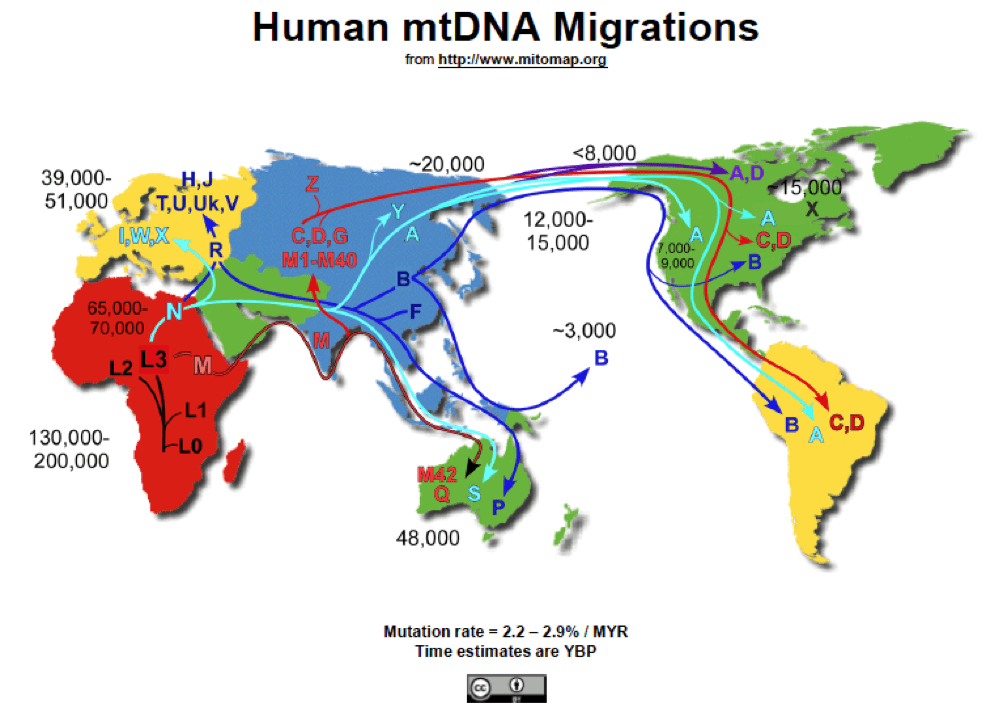
‘Conventional wisdom identifies the Middle-East Arabs as Haplogroup J[1] and the [Jews… who have] an identified clear lineage to Shem, is at J2 [from admixture only]. The mtDNA of the Ashkenazi Jews is classed as Near Eastern, but we need to look at the structure. As we saw with the mtDNA, all other groups came from Hg L3, which split into two main groups M and N. From N came R and the subsequent divisions of N and R. N split in the Middle East and formed the Nu subgroup of N (N1), I and W. 10% of Ashkenazi Jewish mtDNA is N1b. This type differs only by a single transition from the ancestral N1b (145-176G-223).
This may be among the most ancient of the mtDNA with the exception of L2. That L2 DNA as we have seen is an offshoot of the primal L mtDNA. It is of Hamitic origin [rather, retained by Canaan’s descendants] and mostly now sub-Saharan and Ethiopian. Moses’ first wife was an Ethiopian [Cush, not country of Ethiopia in Africa – Chapter XIII India & Pakistan: Cush & Phut] also and the Canaanites may well have had this DNA [yes]. There is also a Near-Eastern type of M1, which is the primal subdivision of the M group. The remainder are all subdivisions of R, and which constitute 60% of Ashkenazi mtDNA.
Near-Eastern mtDNA types among Ashkenazi Jews are N1b, H, J, K, L2, preHV, U7, M1, U1B (cf. Behar et al., Differential Bottleneck Effects in the mtDNA Gene Pool of Ashkenazi Jewish Populations, pp. 8,9,19; see also MtDNA Evidence for a genetic bottleneck in the early history of the Ashkenazi Jewish population, European Journal of Human Genetics, 2004, pp. 1-10). There are low percentages of mtDNA such as U5a and V, which are considered to have come from European admixture (Behar et al., p. 10).
The latest division is that of U, which split to form K. 32%^^ of all Ashkenazi-Jewish mtDNA is K, consisting of 4 major subtypes*.’
Recall, the four wives of Esau as well as the four original female ancestors of the Ashkenazim.
‘The next highest Ashkenazi-Jewish mtDNA is H at 21% and of which 7% is H ancestral. The British Ashkenazi-Jewish mtDNA is the CRS modal haplotype. Thus we might assume that the original division of HV is likely to have occurred on the early population of these females (early Israel?). J1 is next at 7%.
What is important in this aspect is that H constitutes 21% of Ashkenazi-Jewish mtDNA and that DNA is the major mtDNA sequence of the entire European population at just under 50% of Iceland, to up to 60% of the British Isles, and 65% of Iberia and 50% of France. It slowly decreases as the population goes east. It drops to 25% among the Turks and Palestine/Egyptians and drops further among the Kurds, Persians, South Pakistanis and Hazara, with an increase to over 22% among the Uzbeks and up to 30% in northern Russia among the Komi. It is thus reasonable to assume that the same females that were the basis of the Western Europeans were the basis for many of the Ashkenazi females, and that the mutations occurred within those tribes.
The other people with a high portion of K are the Kurds of which U forms the major portion. U forms significant portions of all European mtDNA. H forms over 50% of all Anglo-Celts, Scandinavians and French and is even greater in Iberia. The significant difference between the Ashkenazi and the Europeans is that the division K is greater among them than it is in Europe…
… Gentiles can become Israelites but not Levites or Cohenim. This rule obviously was not followed in the Khazar conversion. Within Ashkenazi Levite R1a1 haplotypes the microsatellite haplotypes are tightly clustered around a modal haplotype (16-12-25-10-11-13) that comprises 74% of Ashkenazi-Levites within the Haplogroup and 38% of Ashkenazi Levites overall.’
Remember Haplogroup R1b is the true defining marker Haplogroup for Jewish men descended from Esau. Paternal Haplogroup R1a is a result of admixture. Nor are the Jewish Levites or Cohen’s true Levites from the tribe of Levi – Chapter XXXI Reuben, Simeon, Levi & Gad – the Celtic Tribes.
‘Jews attempt to confine origins of the Ashkenazim to the small area of Northwest Europe from Northeast France to Northern Germany. They claimed an origin from as early as the 6th century. This area at that time was the central location of the Parthian Horde as it broke up and moved into Britain, Scandinavia, France and Spain and Italy. It is likely that some Jewish elements of the Horde moved there or followed the Horde later – refer Parthia, Chapter XXX Judah & Benjamin – the Regal Tribes. The term Sephardi, when originally applied to Jews, was related to the [ethnic] Jews of Spain prior to the expulsion of 1492, and which Jews also were in Britain. However current usage applies it [somewhat misleadingly] to all Jews of North Africa and the Near East who follow the Sephardi rite of worship.
The implications of these YDNA samples are quite far reaching. There are only 4 lineages that share the same J2 lineages as the Cohen Modal Haplotype. Only 6 share the J Haplogroup. Thus only 10% of tested Ashkenazi Levites are recognised as of known direct Jewish/Israelite [Edomite] YDNA. F and I comprise 25% of the Semitic Levite YDNA tested. Under current understanding, the staggering figures are that two-thirds of Ashkenazi-Levite YDNA is not Semitic.’ This is not staggering as it shouldn’t be classed as Semitic (or Middle Eastern) in the first place and is a result of intermixing and intermarriage. ‘Almost 10% are Celt and an amazing 52% are Slavic YDNA.’
‘The studies conclude also from the homogeneity of the R1a1 modal haplotype that the ancestor was perhaps only 663 years ago. The growth may have been only from one person. This would have coincided with the establishment of the Jewish communities of Mainz and Worms. The star-like patterns of the R1a1 YDNA indicate rapid population growth in the Ashkenazi Jewish population in the last 1000 years.
The diversity in the Ashkenazi-Levites suggests a genetic intrusion AFTER the Ashkenazi SPLIT from other Jewish [Sephardic] populations. The origin of the R1a1 [Iranian] Ashkenazi Levites is thus probably from Sorbian-speaking Khazars who converted to Judaism and entered into Levi [reather Edom] and who then expanded rapidly in Europe.
Of the tests done on the Jewish populations, we can compare the Sephardic Cohenim and the Ashkenazi Cohenim and we find that even in the Cohenim* there are Hamitic and Japhethite lineages[?]. Whilst the Haplogroup J has a frequency of .8684 for Ashkenazi Cohenim (AC) and .7536 for Sephardi Cohenim (SC), there is still a frequency for non-Semitic priests of between 14.16 and 24.64 per cent. Of the basic Jewish populations only some 37% are actual Semites [Middle Eastern (Arab related)] in the frequency samples. Hg J is for Ashkenazi Israelites (AI) .3700 and for Sephardi Israelites (SI) it is .3651.
What is certain is that the adherents of Rabbinical Judaism are not wholly Jewish [Edomite ] or Israelite, and 63% of all Jews are either Hamitic [Middle Eastern, West Asian] or Japhethite converts to Judaism; that is, unless it can be shown that some aspects of K are Semitic rather than Japhethite, which would throw the YDNA sequencing into complete revision.’

Khazaria, Studies of Cohens and Levites, Kevin Alan Brook – capitalisation theirs, emphasis & bold mine:
Key findings:
‘The Cohen Modal Haplotype is found among many Jewish populations of the world, including Ashkenazim, Sephardim, and the Bene Israel of India. The Cohen Modal Haplotype, which belongs to haplogroup J, was a component of the ancient Israelite population, and especially common among the Cohens [Edomites] (priests of the Temple in Jerusalem). The Cohen Modal Haplotype is NOT exclusively found among Jews, but rather is also found among Kurds, Armenians, Italians, Palestinian Arabs, and a few other peoples.
About half of Ashkenazic Levites possess haplotypes belonging to the R1a1 haplogroup. This is almost NEVER found among Sephardic Levites, and is RARE in non-Ashkenazic populations as a whole, but the phylogeny of the branching out of R1a1 shows the Ashkenazic variety of R1a1 to be DISTINCT from both the Eastern European and Central Asian forms of R1a1, contradicting the theory that Slavs or Khazars who converted to Judaism introduced this lineage into Ashkenazim. The actual source of Ashkenazic R1a1 was a population in Iran.’
The Ashkenazi ‘Levites’ experienced a rapid population expansion after a split from Sephardic Jews as evidenced by a unique R1a Haplogroup barely found in Sephardic Jews, rare in non-Jews and supposedly preceding, the introduction of Khazar R1a Haplogroups into the Ashkenazi Jewish gene pool. The Cohen – ‘Levite priest’ incorrectly claimed to descend from Moses’s brother Aaron – Modal Haplotype of J, is not unique to Jews. But, is common in peoples, who are in no way related to Abraham, as in, his children from Isaac, Jacob or Levi. This seriously questions the validity of the Cohen-Priest-Aaron-Levi-Jacob claim as being true.
In reference to the final paragraph in The Genetic Origin of Nations article preceding the above quote, the use of the word Semitic for race – in this case being applied to Arab related peoples – rather than language as previously touched upon, is problematic. The Jewish mtDNA Haplogroups in the main are those typically derived from Shem. The Khazars were a Turkic-Iranian peoples descended from Shem. The idea amongst many is to incorrectly equate the Turks with Japheth. As we found with Y-DNA Haplogroup Q – which is indicative in varying degrees in the East Asian peoples and particularly in the Native American Indians – similarly with mtDNA K, which though as a Haplogroup may appear elsewhere in Central Asia or North Africa from admixture, is a Haplogroup associated with Shem and especially Edom.
Therefore, we would expect the Jewish people to possess mtDNA haplogroup K. In fact, Haplogroup K represents an exceptionally high thirty-two percent^^ of the Ashkenazi Jewish total, while having a low to moderate frequency amongst non-Jews in both Europe, the Near East and the Sephardic Jew. In Europe, mtDNA K is common in Northwestern Europe: Ireland (12%), Belgium (12%), the Netherlands (10%), Iceland (10%), Denmark (9%), Austria (9%), France (9%), England (8%), Wales (8%), Italy (8%) and Scotland (7%). Not coincidentally, the Sephardic Jew possesses a similar percentage level as these related nations descended from Abraham, Nahor and Haran.

It was a 2004 study by Behar, that found that approximately 32% of Ashkenazi Jews belong to the mitochondrial Haplogroup K, which he said points to a genetic bottleneck of ‘100 generations ago’, with an origination in Western Asia some 12,000 years ago.
It was the 2006 follow up study by Behar, based on high-resolution analysis of mtDNA Haplogroup K, which found that ‘40% of the current Ashkenazi population is descended matrilineally from just four women, or founder lineages*’ – K1a1b1a, K1a9, K2a2a and N1b2. A ‘sister’ maternal line was found among the Jews of Portugal, North Africa, France, and Italy.
Behar wrote:
‘Both the extent and location of the maternal ancestral deme from which the Ashkenazi Jewry arose remain obscure. Here, using complete sequences of the maternally inherited mitochondrial DNA (mtDNA), we show that close to one-half of Ashkenazi Jews, estimated at 8,000,000 people, can be traced back to only four women carrying distinct mtDNAs that are virtually absent in other populations, with the important exception of low frequencies among non-Ashkenazi Jews [that is, Sephardi Jewry]. We conclude that four founding mtDNAs, likely of Near Eastern ancestry [the four wives of Esau], underwent major expansion(s) in Europe within the past millennium…’
Y-DNA Research Studies of Rabbinical Lineages and Their Importance to Jewish Genealogy, Dr Jeffrey Mark Paull, 2010 – emphasis mine:
‘… most Ashkenazi Jews cannot trace their ancestry back more than a few generations. Among those fortunate enough to be able to go back further, they run into a brick wall in the pre-Jewish surname era, before the mandated adoption of fixed, inherited surnames, during the late 18th to early 19th centuries in Eastern Europe and the Russian Empire.
The notable exceptions are the major rabbinical families, who adopted fixed surnames long before they were mandated by governmental authority. The lineages of these families have been preserved for centuries. Those who can connect to a major rabbinical family can thereby trace their ancestry back many more generations.
The eight Cohen* descendants have an average of 402 genetic matches at 37 STR markers; about 40% of these are genealogically relevant genetic matches (≥35/37 STR markers; the 90% probability prediction for the TMRCA is within 12 generations). Approximately 14% of these 402 genetic matches have the Cohen surname, or one of its variants (Cohn, Kahana, Kahn, Kaplan, Katz, Kohane, Kohen, Kohn).
An interesting observation about these thirteen rabbinical lineages is that four, or nearly one-third of them (30.8%), belong to the J-M267 haplogroup. This proportion is very close to the range of 35–43% that has been cited as the percentage of all Jewish men who belong to the J haplogroup and its subgroups. Another three lineages, or nearly one-quarter of them (23.1%), belong to the E-M35/E-L117 haplogroup (E-L117 is the previous haplogroup classification for E-M35). This is right in the middle of the range of 15–30% that has been cited as the percentage of all Jewish men who belong to the E1b1b (E-M35) haplogroup.
Of the remaining lineages, two of them (15.4%) belong to the G-M201 haplogroup, two (15.4%) to the R-M173 [R1] haplogroup, one (7.7%) to the J-M172 haplogroup, and one (7.7%) to the R-M124 [R2a] haplogroup. Together, these four haplogroups account for 46.2% of the total.’
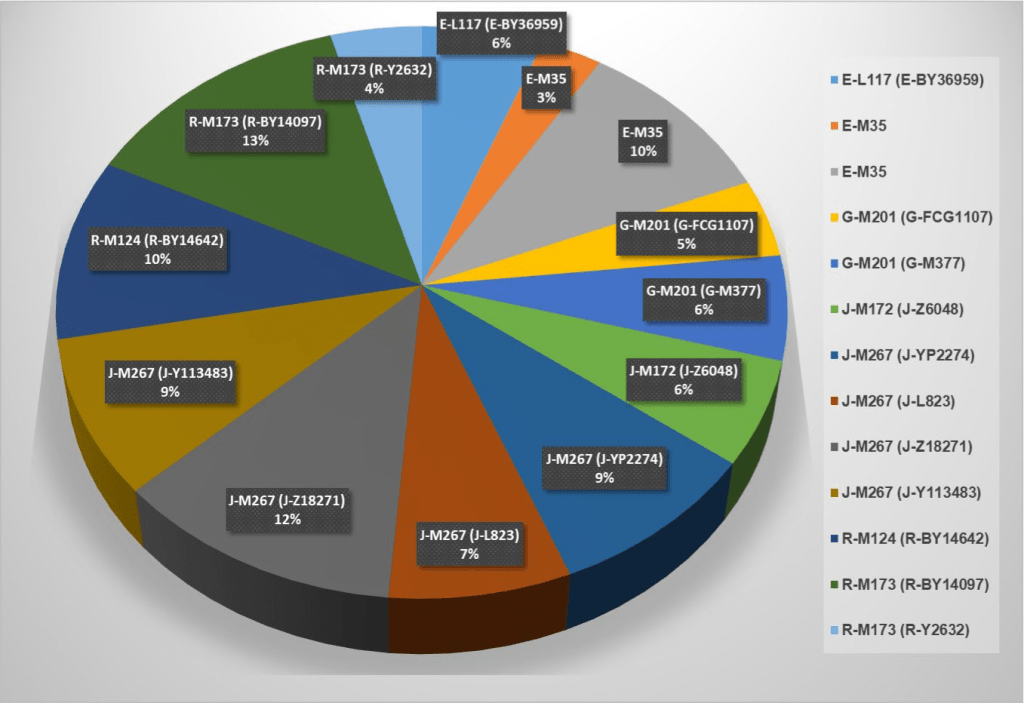
Distribution of Haplogroups among Thirteen Rabbinical Lineages
Y-DNA Haplogroup R mutations are found in Asian populations as R2 and R1a from admixture. Typically, the highest percentages for R1a are in eastern Europe and R1b is indicative of western Europe as we have discovered. Ninety-nine percent of R1a people belong to sub-clades of R1a1a1 (M417) and include the R1a-Z93 mutation, which is the main Asian branch of R1a.
It is found in Central Asia, South Asia and Southwest Asia, including amongst Ashkenazi Jews. R1a-Z93 is seen as a marker for historical peoples such as the ancient Persians, the Medes and Tatars – Chapter III Central Asia – Madai & the Medes; and Chapter XVIII Elam & Turkey – as well as filtering through to the genetic pool of the Arabs and Jews, with R1a-F1345 one of the main Middle Eastern clades. Interestingly, R1a-CTS6 is the Jewish sub-clade of R1a, which scientists say formed 3,500 ya and has a TMRCA – time to the most recent common ancestor – of 2,800 years. The first date is not far removed from when Esau was born in 1817 BCE, according to an unconventional chronology.
That said, it is this writer’s conviction that R1a is a defining marker for the males of Iran descended from Lud – Chapter XVII Lud & Iran. The ancient Persian men descended from Elam and today equating to the Turks are R1b driven like the Jews – regardless of the prevalence of Haplogroup J2 through admixture in both populations.
Haplogroup R1a has been found at elevated levels amongst samples of Israelis who claim Ashkenazi heritage. Perhaps reflecting gene flow into Ashkenazi populations from surrounding Eastern European populations, over a course of centuries as well as possibly the Khazar infusion (which appears to have been more Iranian than Turkish in origin). This finding is consistent with the SNP microarray analysis which indicates that up to fifty-five percent of the modern Ashkenazi genome is traceable to Europe. Ashkenazim were found to have a significantly higher frequency of the R1 (M173) Haplogroup; the dominant Haplogroup in Ashkenazi ‘Levites’ at 52%; while rare in Ashkenazi Cohanim at 1.3%.

Two studies by Nebel in 2001 and 2005, based on Y chromosome polymorphic markers, concluded: ‘However, if the R1a1a (R-M17) [M198] chromosomes in Ashkenazi Jews do indeed represent the vestiges of the mysterious Khazars then, according to our data, this contribution was limited to either a single founder or a few closely related men, and does not exceed ~12% of the present-day Ashkenazim.’ In addition, a 2017 study on the Ashkenazi Levites proposed that a Middle Eastern origin of this lineage had been firmly validated through the phylogenetically separate R1a-Y2619 sub-clade.
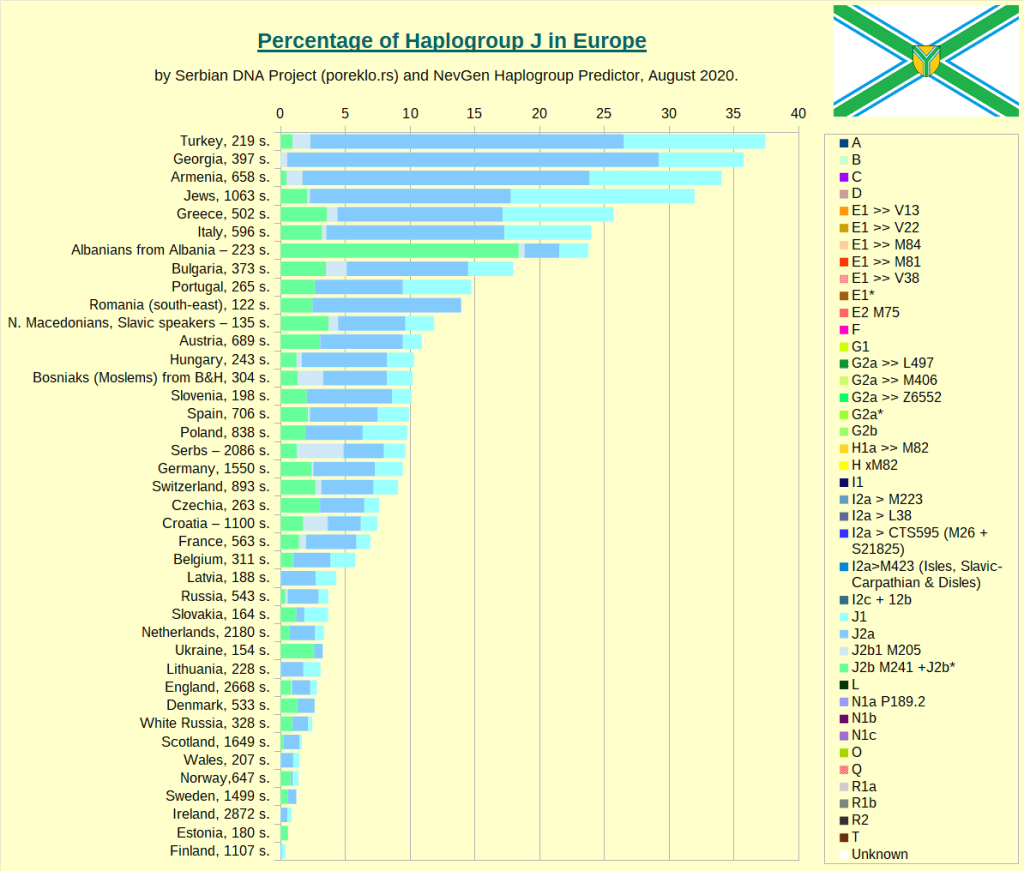
Y-DNA Haplogroup J is found amongst Europeans from admixture and naturally occurs amongst the peoples of the Middle East and southwest Asia. J1 is principally found in the Arabs of the near east, spilling over into the peoples of southern to eastern Europe. J2 for instance – a more complex mutation than J1 and the defining marker Haplogroup for Pakistani men and – in the Turks and Kurds, follows a similar pattern, though compared with J1, J2 is found in higher percentages in Europe. Even so, J is a paternal Haplogroup from Ham’s line and in Europeans is a result of admixture.

About twenty percent of Jewish men belong to Haplogroup J1-P58. J1-L817 is also a major Jewish cluster; found as far away as China. J1-L823 is a Jewish cluster found mostly in central and eastern Europe, as well as in Spain. Whereas J1-L1253, is specifically limited to Britain and Ireland.
Of course let it be repeated, the J1 and J2 Haplogroups are a bit of a blind, as the key Haplogroup to be homing in on is R1b, as it is for all of Abraham’s descendants – though not just exclusive to them. It is the paternal R1b Haplogroup which is the foundational Haplogroup with other Haplogroups such as I1, I2a2 and in lesser frequency the R1a Haplogroup, which are the main Y-DNA Haplogroups resulting from admixture – with related peoples descending from Arphaxad – and are the most visible in Abraham’s males descendants.

Therefore, Esau will exhibit the same Haplogroups and the Sephardic and Ashkenazi Jews will show varying degrees of further admixture through Haplogroups J and E1b1b (E-M135) from Ham and Canaan respectively and G2c from Shem.
There is also an mtDNA Haplogroup J1 distributed across Europe and the frequencies found in Abraham’s descendants and near relatives from his brothers Haran and Nahor include: Cornwall (20%), Wales (15%), Iceland (14%), Scotland (13%), Denmark (13%), England (12%), Switzerland (12%), Ireland (11%), the Netherlands (11%), Norway (11%), Germany (9%), Austria (9%), Sweden (8%), Italy (8%) and France (8%).
The Ashkenazim have seven percent of mtDNA J1 which places them slightly less than their British and Irish brothers, their Nordic and German cousins; as well as their distant cousins, Italy and France. The Sephardic Jew has even less at approximately five percent. Though this is probably based on the Sephardim of North Africa and a different history of admixture.
A comparison of the Ashkenazi Jew who comprises some 85 to 90% of the worldwide Jewish population is enlightening when compared to the Italians; because of all of Abraham’s descendants and brother’s children, it is in fact Italy, which aligns the closest.
A study in July 2010 by Bray, using SNP microarray techniques and linkage analysis, stated that it: ‘confirms that there is a closer relationship between the Ashkenazim and several European populations (Tuscans, Italians, and French) [see PCA graph below] than between the Ashkenazim and Middle Eastern populations’ of which European ‘admixture is considerably higher than previous estimates by studies that used the Y chromosome.’

It may not be influenced just through intermixing but as we have noted previously; some peoples are closer genetically to a cousin than a sibling. The Jews are a fascinating case in point, with a closer genetic alignment to their Great Uncle Nahor rather than twin brother Jacob. Is the answer hereditary? Or purely the result of admixture which has affected the R1b percentage (and sub-haplogroups) which was originally more like that of Jacob? Or, a combination of the two?
A hereditary component finds valuable support. Recall, Esau’s mother is Rebekah. Rebekah was the granddaughter of Nahor and her father was Bethuel, the son of Nahor and his wife Milcah; who in turn was the daughter of Haran, Nahor’s elder brother. Rebekah’s brother Laban gave his daughters, Leah and Rachel to Jacob. Therefore, we have a tight genetic group; that today would equate to North-Central Italians, Swiss-French, British-Irish and Jewish.
When the Bible describes Jacob and Esau as two different peoples, nations, ethnicities or ‘races’, it is giving a vital clue to their different genetic composition. It is now emerging that Jacob probably took after his father and Esau, his mother. All children are a combination of their parents, though some are more similar to one parent than another or even with a relative in the past.
In this case, it could be inferred that Esau inherited a strikingly closer genetic match from his mother, a maternal Italian ancestor than his father, a paternal British and Irish ancestor. We return to a matrilineal descent and its intrinsic definition of genetically being a Jew.
Yet the Jew has become such a diluted ethnicity, their autosomal DNA now matches other heavily mixed white ethnicities (from input with Arab related peoples) such as the southern Italians and Greeks. A more recognisable similarity of family kinship would have once been evident. A clue to this is in the oldest defining paternal marker Haplogroup for Shem’s descendants, that of Haplogroup G. From which I1, I2, R1a and R1b have ultimately derived.
Notice the relatively high percentage of ancient Y-DNA Haplogroup G (in Shem’s line) which Jews exhibit, similar to their ‘close’ relations, the Italians, Germans, Austrians, French and Swiss. In other words, that which Edom shares with Nahor the father of the Chaldeans; and with Ishmael, Hagar, Lot and Haran respectively.
Consider also, that the English and Welsh have far higher levels of Haplogroup G, particularly G2a-L497 than the Irish and Scots. We will learn that England and Wales are full blood brothers, whereas the Republic of Ireland and Scotland are their half brothers, with different mothers; though all sharing Jacob as their father.

A genome-wide genetic signature of Jewish ancestry perfectly separates individuals with and without full Jewish ancestry in a large random sample of European Americans, multiple authors, 2009 – emphasis mine:
‘It was recently shown that the genetic distinction between self-identified Ashkenazi Jewish and non-Jewish individuals is a prominent component of genome-wide patterns of genetic variation in European Americans.
No study however has yet assessed how accurately self-identified (Ashkenazi) Jewish ancestry can be inferred from genomic information, nor whether the degree of Jewish ancestry can be inferred among individuals with fewer than four Jewish grandparents.
Using a principal components analysis, we found that the individuals with full Jewish ancestry [light blue diamonds] formed a clearly distinct cluster from those individuals with no Jewish ancestry [red circles]. Using the position on the first principal component axis, every single individual with self-reported full Jewish ancestry had a higher score than any individual with no Jewish ancestry.’

‘Here we show that within Americans of European ancestry there is a perfect genetic corollary of Jewish ancestry which, in principle, would permit near perfect genetic inference of Ashkenazi Jewish ancestry. In fact, even subjects with a single Jewish grandparent [green triangle] can be statistically distinguished from those without Jewish ancestry.
We found that the Middle Eastern populations clustered separately from the European and European-American populations, as expected… This is an important finding for a number of reasons. Firstly, the Jewish subjects remain in a separate cluster when mixed with both European and Middle Eastern populations, suggesting that the original principal component axis seen in the European-Americans is indeed a Jewish-specific axis, at least in the context of the populations considered here.
Secondly, the Jewish cluster lies approximately midway between the European and the Middle Eastern clusters, implying that the Ashkenazi Jews may contain mixed ancestry from these two regions.
This is consistent with the Y chromosome and mitochondrial DNA genetic evidence that has been interpreted by some to suggest a stronger paternal genetic heritage of Jewish populations from the Middle East [Arab] and stronger maternal genetic heritage from the host populations [European] of the Diaspora.’
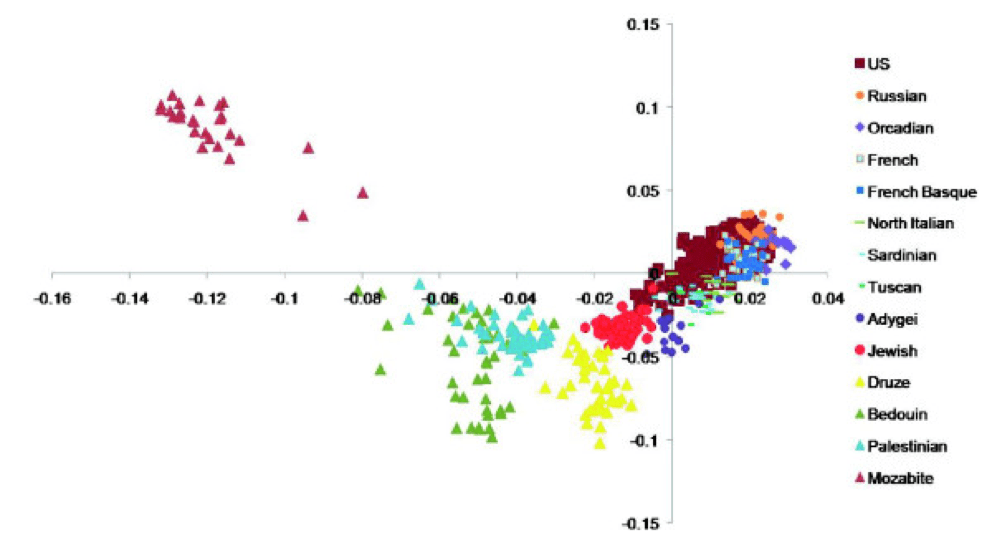
‘Finally, one of the two subjects reporting partial Sephardic* ancestry did not cluster clearly with the other Jewish subjects. Considering also that 90% of American Jews are Ashkenazim, we conclude that this axis is specific to Ashkenazi Jews, and that we cannot make any conclusions about other types of American Jews (for example, Sephardic, Mizrahi) from these data. This leaves open the question, however, of why Americans of Jewish ancestry are a distinct group. There are two extreme possibilities: either the Jewish group reflects ancestry from source populations other than those of non-Jewish Americans; or Jewish populations have undergone bottlenecks that change their genetic makeup.’
The last paragraph should not be a surprise. We have considered the possibility of a different line of Jews in the United States in the form of Amalek. Plus, as Esau married three wives out of four, of questionable origin, these bottlenecks occurred right at the beginning and have had a lasting impact. We will learn that the British, Irish and German peoples who immigrated to America are not the same peoples as those living in Britain, Ireland and Germany today. So, it is not beyond question for a different lineal descent of Jew to have immigrated to the United States.
A study led by Harry Ostrerm published in 2010, observed close links between Ashkenazi, Sephardi, and Mizrahi Jews; finding them to be genetically distinct from non-Jews. DNA from the blood of 237 Jews and about 2,800 non-Jews was analysed. It was determined how closely related they were and ‘individuals within the Ashkenazi, Sephardi, and Mizrahi groups shared high levels of IDB’ equivalent to that of fourth or fifth cousins.
All three groups shared many genetic features, evidencing a common origin of over two thousand years go. The study confirmed that all three Jewish groups exhibited signs of admixture with non-Jews. The genetic profiles of the Ashkenazi Jews indicated the highest admixture, of between thirty to sixty percent with Europeans; even so, they still clustered more closely with Sephardi and Mizrahi Jews.
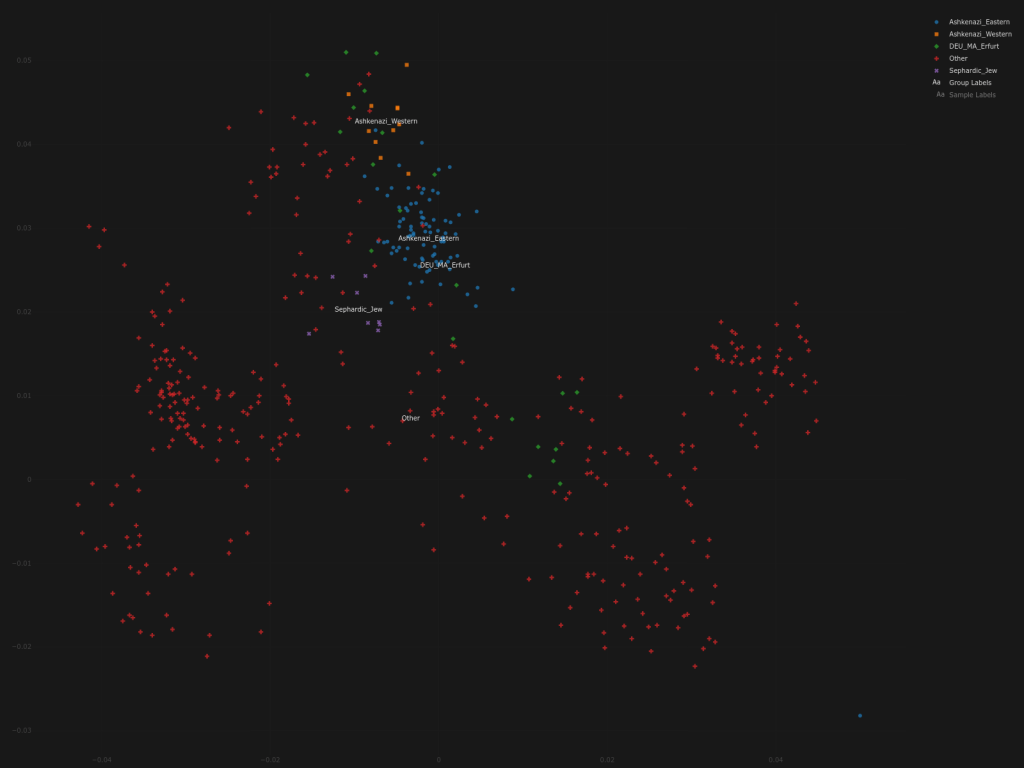
Key to Northwest European Origins, Raymond F McNair, 1963 – capitalisation his, emphasis & bold mine:
‘The CEPHALIC INDEX is the main key, used universally by most, if not all, present day ethnologists, to ascertain racial affinities FROM SKELETAL REMAINS! One can readily determine “race” on the living populations by such tests as: Skin color, stature, nasal indices, general build, color of hair and eyes, head shape, and by mental and personality traits.
But such tools elude the anthropologist who must determine the racial connections of a by-gone people from skeletal remains alone. With these silent men of yesteryear one can only judge their racial type by such measurements as general height, bodily proportions (from bone measurements), and the cephalic index… the C.I. (cephalic index) is of utmost importance in determining the racial affinities of people from their skeletal remains… Professor Ripley, who was considered one of the world’s foremost authorities on “race”, has some interesting remarks on this subject:
“The shape of the human head – by which we mean the general proportions of length, breadth, and height, irrespective of the “bumps of the phrenologist – is ONE of the best available tests of race known” (The Races of Europe, Chapter III, page 37).
‘Ripley then shows that the best way to measure the head form is by using the “cephalic index.” He says:
“This is simply the breadth of the head above the ears expressed in percentage of its length from forehead to back. Assuming that this length is 100, the width is expressed as a fraction of it. As the head becomes proportionately broader – that is, more fully rounded, viewed from the top down – this cephalic index increases. When it rises above 80, the head is called brachycephalic; when it falls below 75, the term dolichocephalic is applied to it. Indexes between 75 and 80 are characterized as mesocephalic. (ibid, page 37).”
‘Ripley shows that the general shape of the head seems to bear no direct relation to the intellectual power or to the intelligence of any particular individual (ibid., p. 40)… Ripley places a great deal of importance upon, not the size, but the general shape of the skull as the chief factor in determining the racial connections of a people from their skeletal remains. He shows the color of the hair, the eyes and the stature are open to modification by local circumstances.’
“On the other hand the general proportions of the head seem to be uninfluenced either by climate, by food supply or economic status, or by habits of life; so that they stand as the clearest exponents which we possess of the permanent hereditary difference within the human species [from skeletal remains]” (ibid., page 52).’
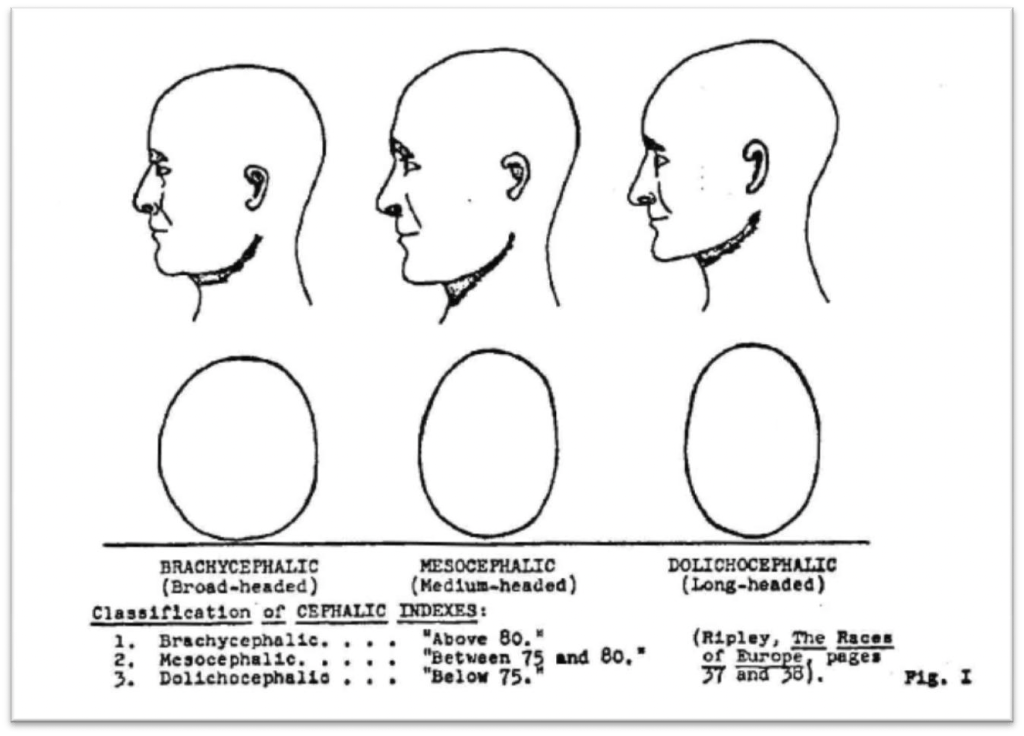
‘From the standpoint of the C.I., Europe is divided into two types – dolichocephals and brachycephals. The broad-headed people are, with few exceptions, found in the inland and mountainous districts. The long-heads are almost invariably located on the coastlands and islands of Europe. The dolichocephals (long-heads) are further divided into two main groups: (1) The Nordics who inhabit North-west Europe, and (2) The Mediterraneans who inhabit the southern regions of Europe, and are mainly found in the countries contiguous to the Mediterranean Sea.
The Scythians (or Sacae), who formerly lived in South Russia, were of the Nordic branch of the dolichocephals. The foremost authorities on the Scythian question are generally agreed on this point. Other characters enable a trained ethnologist to clearly differentiate between the skeletal remains of Nordics and Mediterraneans. The Nordics are longer-limbed, have typically larger skulls, and are generally larger-bodied than are the Mediterraneans. The difference between Nordic and Mediterranean skeletal remains is as easily discernable as is such difference readily noticeable between the living North-west European Nordics and the South or South-east European Mediterraneans.
… many of the present-day Jews have a tendency towards blondism [and red hair], and are of the long-headed type. These dolichocephalic Jews are found primarily among the Sephardic branch of the Jews, even though there are also quite a number of blond, long-headed Jews among the Ashkenazic Jews.
Furthermore, we have noticed that the Sephardic* Jews are more “European” or “Nordic” than they are “Jewish“; and we have observed that there is a considerable degree of blondism among this branch of Jews. Many redheads are found among them. (For further verification of this, see the Jewish Encyclopedia, Volume XII, Article Types, Anthropological, pages 291-95).’
Recall earlier, the unanswered question posted online: ‘Has anyone else noticed this red-headed/lighter-eyed “trend” amongst the Sephardic population?’ The answer is yes and the reason is due to the fact that the Sephardi Jew in Western Europe intermixed far less than the Ashkenazi Jew in Eastern Europe.
The mtDNA Haplogroups for the Ashkenazim and Sephardim contain some variance, according to which study or figures one chooses and thus the endeavour has been to choose those which accurately as possible portray the two respective branches of the Jewish people.
Ashkenazi Jew: K [31.8%] – H [22.8%] – J [6.8%] – HV [5%] –
T2 [4.8%] – HV0 + V [4.1%] – U [2.1%] – U5 [2%] – W [1.6%] –
L [1.4%] – I [1.3%] – U3 [1%] – U4 [1%] – X [0.8%]
Sephardic Jew: H [56%] – HV0+V [9%] – HV [8%] –
K [8%] – I [6%] – J [5%] – U [3%] – X [3%] – L [1%]
It can be immediately observed the difference between the two groups, highlighting different maternal origins. The Ashkenazi Jew possessing an abnormally high percentage of Haplogroup K and the Sephardic Jew a lower percentage of K – in keeping with the European average – yet a considerably higher percentage of mtDNA Haplogroup H, as is common amongst most people of European descent.
H HV0+V HV K J T2 I U
Ashkenazim 23 4 5 32 7 5 1 2
Turkey 31 0.7 5 6 9 4 2 6
Italy 40 3 3 8 8 8 1 3
Sephardim 56 9 8 8 5 6 [3]
Germany 45 4 0.5 7 9 8 2 0.8
A comparison of the main Jewish mtDNA Haplogroups with Turkey, for the Khazars are labelled a Turkic people. A strong similarity is not evident, with autosomal DNA actually highlighting that Jews and Turks are not that genetically similar. In fact the Ashkenazim sit between Iran and Turkey for mtDNA Haplogroup H.
The reduced Haplogroup H percentage for the Ashkenazi Jew compared with the Sephardic Jew, may reflect watering down from the Khazar (Turkic-Iranian) admixture. Overall, the main Haplogroups of the Sephardic Jew remain distinct. While Europeans usually carry either H, J, U, K or T; it is the absence of the relatively recent mtDNA Haplogroup T mutation in the Sephardim which stands out.
Though its level of Haplogroup H, means Germany is not far removed, as Uncle Ishmael – refer Chapter XVIII The True identity & Origin of Germany & Austria – Ishmael & Hagar. The extremely high level of Haplogroup K in the Ashkenazi Jew is another matter and reveals a different maternal line from the Sephardic Jew; which goes far beyond a migratory geographic split after leaving Judea in 70 CE.
It is reminiscent of Finland, with its very high percentage of Y-DNA Haplogroup N and mtDNA U5 – refer Chapter XXIV Arphaxad & Joktan: Balts, Slavs & the Balkans. Iran, Turkey, Armenia, Azerbaijan, Syria, Jordan, Lebanon and Palestine all range between 4.3% to 8.3% in Haplogroup K. Even Greece has only 5.1%. Other peoples with high percentages of Haplogroup K include: Cyprus with 20.5%; the Avars in Russia with 13.1%; the Druze people of Lebanon with 13%; Belgium and Luxembourg with 12.1%; Ireland with 12%; Georgia with 11.9%; the Dargins of Russia with 11.8%; and the Dutch with 10%.
Haplogroup K1 is one of the most recent mutations on the mtDNA Haplogroup timeline, deriving from the older Haplogroup U. As Esau with his twin brother Jacob are the youngest or rather most recent progenitors of lineal descendants, they could have (possibly) received Haplogroup K from their mother Rebekah. The alternative explanation is mtDNA Haplogroup K came (probably) through a maternal line from one of Esau’s wives. A genetic carry over from Esau’s Horite wives and successive intermarrying with Seir’s descendants? Yet this remains a conundrum, as the Horites were an ancient race. This would not explain why the Sephardic Jews do not have as equally high levels; unless they are descendants from Esau’s Ishmaelite wife, Basemath.
H HV0+V J K T2 U4 U5
Ashkenazim 23 4 7 32 5 1 2
Germany 45 4 9 7 8 3 9
Austria 45 2 9 9 8 5 9
Netherlands 45 8 11 10 12 7 8
Norway 46 4 11 5 8 3 11
Sweden 46 5 8 6 4 3 12
Denmark 47 4 13 9 6 2 6
Bel-Lux 47 3 6 12 9 3 3
Sephardim 56 9 5 8
Adding the Ashkenazim and Sephardim to the table from the previous chapter and comparing the key mtDNA Haplogroups, highlights the distinct difference between the two main groups of Jews, as well as with their Germanic and Nordic cousins from Hagar and Ishmael or Abraham and Keturah. Each are clear outliers in their percentages of Haplogroup H and bookend the table.
The table below is a continuation of the table of nations descended from Shem studied to date, with the addition of Esau’s descendants.
H HV HV0+V J T2 U U5 K
Sephardim 56 8 9 5 3 8
Switzerland 48 0.4 5 12 9 0.4 7 5
Bel-Lux 47 0.7 3 6 9 5 3 12
Denmark 47 4 13 6 1 6 9
Norway 46 0.2 4 11 8 2 11 5
Sweden 46 0.5 5 8 4 3 12 6
Netherlands 45 8 11 12 0.5 8 10
Austria 45 0.8 2 9 8 1 .4 9 9
Germany 45 0.5 4 9 8 0.8 9 7
France 44 2 5 8 6 1 8 9
Brazil 44 2 11
Portugal 44 0.1 5 7 6 3 7 6
Spain 44 0.7 8 7 6 2 8 6
Poland 44 1 5 8 7 1.4 10 4
Russia 41 2 4 8 7 2 10 4
Greece 41 3 1.8 10 7 3 5 5
Italy 40 3 3 8 8 3 5 8
Ukraine 39 4 4 8 8 0.6 10 5
Iceland 38 4 2 14 10 0.2 8 10
Romania 37 2 4 11 5 2 7 8
Finland 36 7 6 2 0.8 21 5
Turkey 31 5 0.7 9 4 6 3 6
Ashkenazim 23 5 4 7 5 2 2 32
Iran 17 7 0.6 14 5 12 3 7
Switzerland has been long standing as one bookend of the European descended peoples, with Iran remaining at the other end as per the dominant European maternal mtDNA Haplogroup H. The addition of the two principle Jewish groups does not follow type for the Ashkenazim, for by now, very obvious reasons. The Ashkenazi Jew almost replaces Iran as one bookend. It is abundantly clear how much admixture has altered Edom when we observe the Ashkenazi mtDNA Haplogroups. There is now a similarity with Turkey and even more so with Iran in Haplogroup H levels and so credence can be given to a large-scale admixture with a similar type people, in the form of the Khazars.
As Finland possesses the highest level of U5 (21%), with the Ashkenazi Jew having a very low percentage (2%); the Ashkenazim exhibit the highest level of K (32%) and Finland with only 5%. The riddle of Haplogroup K remains of which, we may never know the full answer. The Sephardim replace the Swiss as the other bookend. Reminding the reader of the pattern which has emerged showing the percentage levels of the main European mtDNA Haplogroup H increasing, as one heads west across Europe. Switzerland though, has not fitted exactly into this genetic type as it sits firmly in central Europe. What we will confirm as we progress, is that the nations comprising northwestern Europe in the main exhibit higher levels of mtDNA Haplogroup H further north and west; with the Swiss being the first to evidence this fact.
Considering the Sephardim, as the more shall we say purer line of descent from Esau, and considering just their mtDNA Haplogroups, they sit squarely – genetically and geographically, should they have resided in Europe – with the other, related offspring of Abraham: the Nordic and Germanic peoples such as the Danes, Dutch and Germans.
The main Y-DNA Haplogroups for the Ashkenazim and Sephardim.
Ashkenazi Jew: E1b1b [20.5%] – J2 [19%] – J1 [19%] – R1b [11.5%] –
R1a [10%] – G2c [9.5%] – I [4%] – Q1b [3%] – T1a [2%] – L [0.5%] –
E1b1a [0.3%] – N1c [0.2%]

The percentages above are a more recent compilation, than the 2015 pie chart figures. If we hold that R1b was the original paternal Haplogroup inherited by Esau from Issac and then passed to his sons, then it is clear just how much serious admixture has resulted. Not just at the beginning with Esau’s granddaughters marrying non-Edomites, but rigorously maintained throughout the centuries and to the present day. For instance, Haplogroup E1b1a is indicative of sub-Saharan Africa. The high levels of J1 are indicative of exposure with Arabs from the Middle East; J2 in part from southern Europeans via Southwest Asia, yet principally from admixture with Turkic-Iranians; and E1b1b is also common amongst Arabs from admixture with Berber (and African) men.
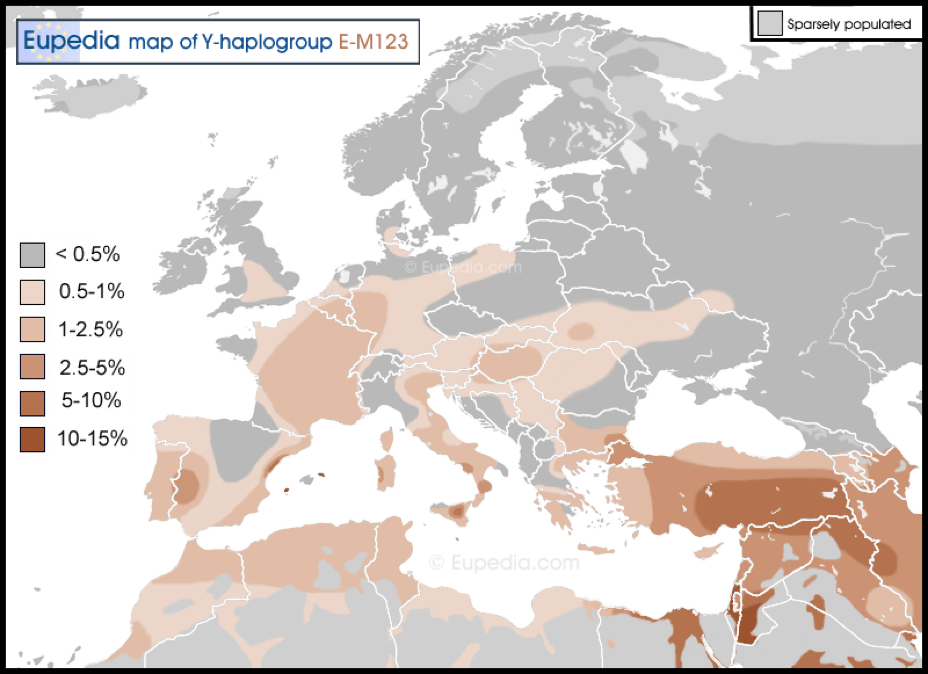
The E1b1b1b2a1 in question is M123, which derives from Z830, associated with the Middle East, Arabia and particularly North Africa.
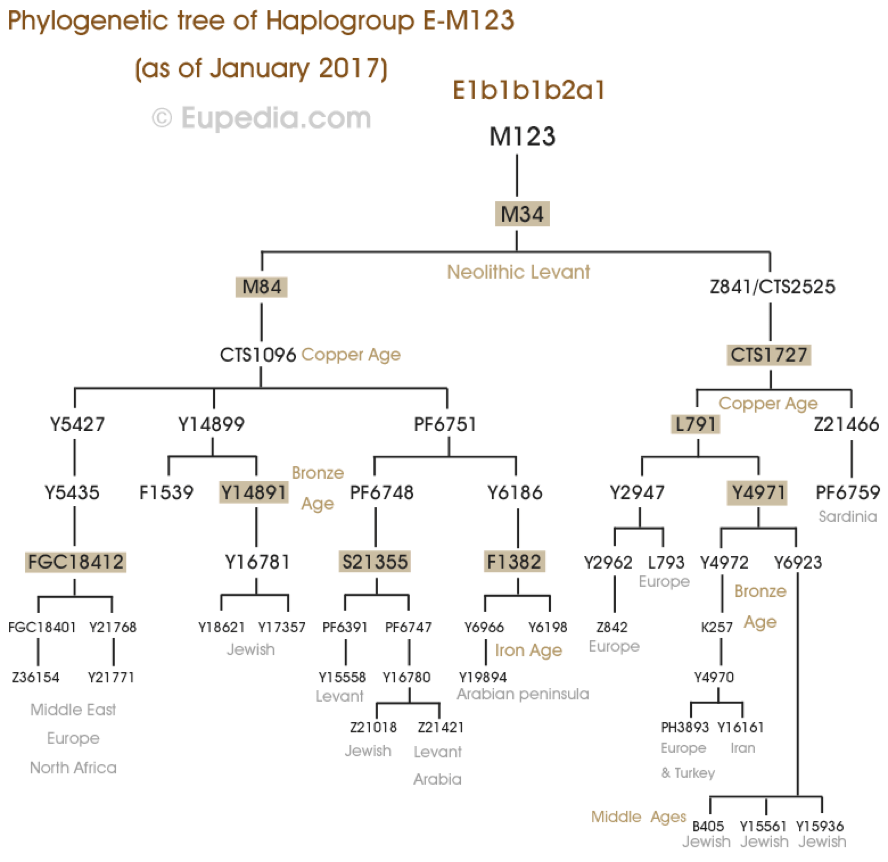
The E1b1b Phylogenetic tree clearly shows the close Arab link and infusion; with the highest percentage of M123 in the Dead Sea region in Jordan.

Regarding Haplogroup J1, the Jews belong to the large sub-clade P58 as mentioned, which derives from J1a1b known as L136. Some 40 to 75% of Arab males in the Arabian Peninsula are J1-P58.
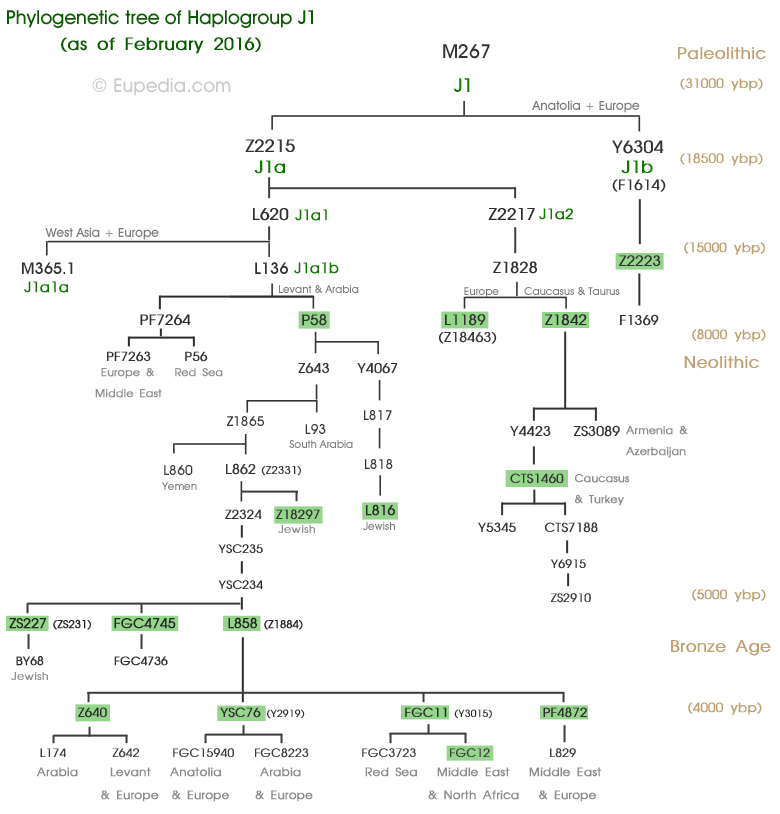
The sub-clade ZS227 comprises the Cohen Modal Haplotype discussed earlier and roughly half of all Cohanim belong to it. Major Jewish clusters descending from J1-P58 include L817 and L816.

The remaining Y-DNA Haplogroup of the top three for the Ashkenazim is J2a1. Significant clusters include L70, L254 and L210.
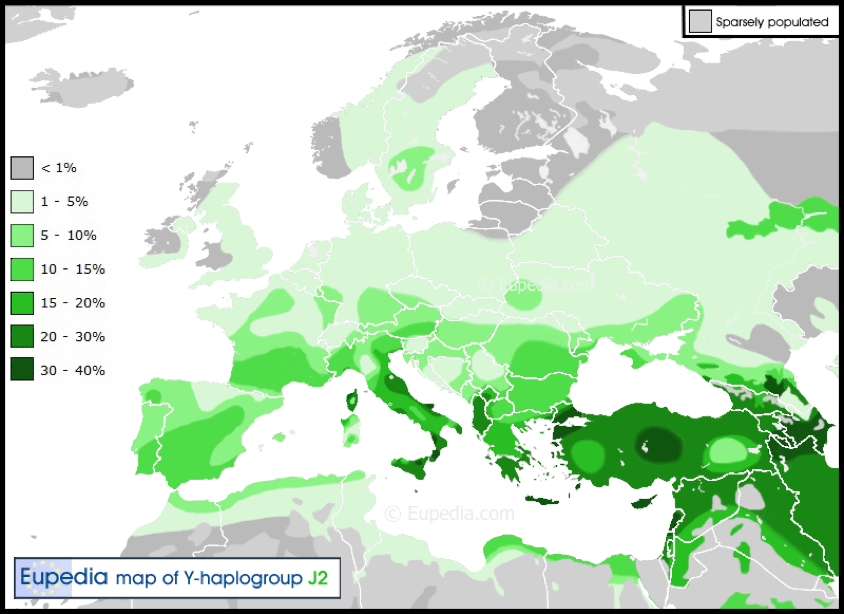
Haplogroup J2 stretches from Portugal in the west to India in the east. Notice the Rothschild clade Y15238 below, stemming from L210.
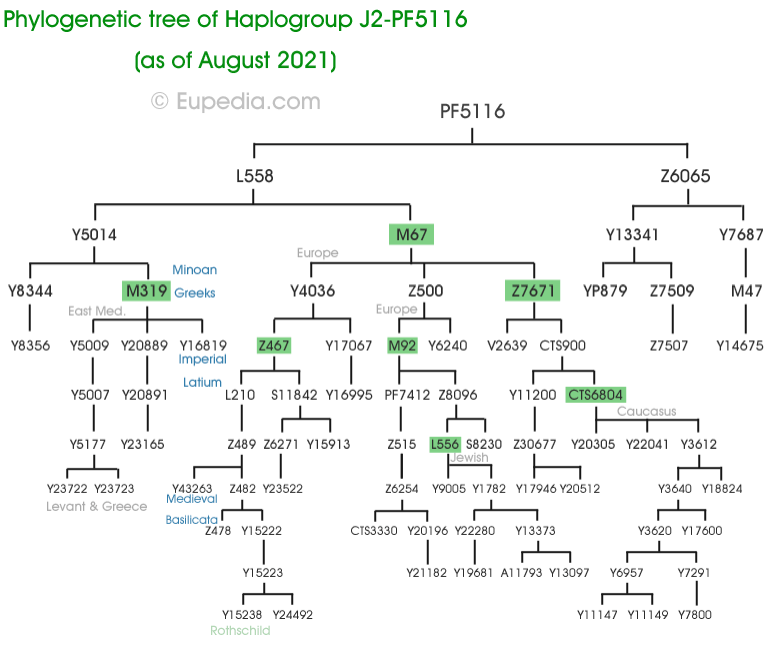
Haplogroup G is principally G2c, unlike the G2a more commonly found in western Europe. This Haplogroup is far older than R1b and so Jewish men with this Haplogroup have descended from an earlier line from Shem; such as that exhibited by thirty percent of Georgian men – who are genetically more closely related to Iranians than Turks.
Haplogroup R1b with which we have the most interest in, draws a bit of a blank, with the Jews being associated with the rather generic R1b1, known as P25 (or L278); which is widely associated with Eurasia; as well as M269 (R1b1a1a2), which is broadly associated with Western Europe.
More specifically, the Eastern European Jewish male via admixture and associated R1b mutations is likely to carry R1b-Z2103 – see below.

A Jewish man descending from a less adulterated lineage – for example a higher proportion of the Sephardim – would possess R1b-U106 (S21). This is common to men throughout northwestern Europe – the descendants of Abraham, including: Germany, Scandinavia, Benelux, Britain and Ireland.

Turning to the Sephardim, the men show less admixture with a higher percentage of R1b. Saying that, intermixing and intermarriage has still had a profound effect. One can surely conjecture correctly that whether one is an Ashkenazi or Sephardic Jew, it is a minority of males who exhibit the R1b Haplogroup passed from their ancestor Esau. Most possess either E1b1b, J1 or J2, which provides evidence of historical mass intermixing by Edomite women with male lines of descent from Canaan and Ham. Thus it is self evident how imperative it has been to record the lineal transfer of Jewishness via the maternal line as the standard genetic measure, rather than paternally.
Sephardic Jew: R1b [29.5%] – J2 [23%] – J1 [20%] –
E1b1b [9%] – G2c [7.7%] – R1a [3.9%] – T1a [3%] –
Q1b [2%] – I [1%]
J1/J2 E1b1b G R1a R1b I
Ashkenazi Jew 38 21 10 10 12 4
Sephardic Jew 43 9 8 4 30 1
The higher percentages for Y-DNA Haplogroups E1b1b, G2c, I1/I2 and R1a for the Ashkenazi Jews with the corresponding loss in R1b, compared with the Sephardic Jews, highlights the greater admixture with both Europeans from southern and eastern Europe, as well as with Arab related peoples. Iran, Turkey, Armenia and the Kurds are added for comparison.
J1/J2 E1b1b G R1a R1b I
Sephardic Jew 43 9 8 4 30 1
Ashkenazi Jew 38 21 10 10 12 4
Kurds 36 13 5 11 11 6
Armenia 33 6 12 5 30 5
Turkey 33 11 11 8 16 6
Iran 32 7 10 16 10 0.5
The table does not tell us a lot on one hand, for the Jewish people are closer with Italians and Greeks on principal component analysis graphs. It does show the impact of long term intermixing – on the R1b and R1a lineages – as Turkey, Armenia, Iran and the Kurds all show similar tell tale Haplogroup percentage sequence results from intermixing as the Ashkenazim and Sephardim.
The Ashkenazi Jew may have integrated with the Turkic-Iranian Khazars, yet still retain a variety of Y-DNA Haplogroups not quite like any other. This shows perhaps that the Khazars have impacted in part the Ashkenazi gene pool and amalgamated with them, but the Khazars are not to be equated solely, as the Ashkenazi Jews of today.

Now comparing the Jews with Italy’s Haplogroups; Italy’s R1b is composed of the sub-clades of U152 (19%), U106 (4%), L21 (2%), M167 (1%) and others (13%). Each of these sub-clades is found in other nations, with the highest levels of U152 in France; U106 in Germany; L21 in the British Isles; and M167 in Catalonia – Chapter XXV Italy: Nahor & the Chaldeans.
R1b J E1b1b G R1a I
Ashkenazi Jew 12 38 21 10 10 4
Sephardic Jew 30 43 9 8 4 1
Italy 39 19 14 9 4 10
Overall, Italy has more in common with the Sephardic Jew from a Y-DNA perspective as would be expected. Broadening the Italian view, as its sequence is dominated by the highly populated north, shows that Southern Italians align with the Sephardic Jew in Y-DNA Haplogroups and the Greeks more with the modern Ashkenazi Jew.

From an autosomal DNA view as shown on the PCA graph, it is again the Sephardim who are marginally closer genetically with Italians and the Ashkenazim leaning towards the Greeks.
R1b J E1b1b G R1a I
Italy South 28 26 19 11 3 7
Sephardic Jew 30 28 19 8 5 12
Ashkenazi Jew 12 36 20 10 10 4
Greece 16 26 21 7 12 15
Up to this point, we have discussed how Haplogroup R-M269 is the sub-clade of human Y-chromosome Haplogroup R1b which is defined by the SNP marker M269. According to ISOGG 2020 it is phylogenetically classified as R1b1a1b (now R1b1a1a2). R-M269 is the most common European Haplogroup in the genetic composition of mainly Western Europe; increasing in frequency from an east to west gradient. For instance in Poland, it is found in 22.7% of the male population, compared to Wales at 92.3%. It is carried by over 110 million European men.
Scientists propose that the age of the M269 mutation is somewhere between 4,000 to 10,000 years ago. This time frame is plausible and neatly fits with the birth of Peleg and hence the beginning of the R1b mutation, circa 7727 BCE, according to an unconventional chronology. The most recently significant R1b mutations originated with Abraham and his descendants beginning in 1977 BCE.
The sub-Haplogroup of R1b, U106 (S21), is frequent in central to western Europe, reaching 66.8% in Germany; while the sub-lineage R-S116 is the most frequent in the Iberian Peninsula. R-U152 is more frequent in France and Italy; R-U198 in England; and R-M529 in the Celtic nations of the United Kingdom and the Republic of Ireland.
Italy – the Iberian Peninsula and Turkey not withstanding – was the first nation (within Abraham’s extended family) with the main paternal Y-DNA Haplogroup being R1b and it showed a marked difference with eastern Europe. It is worth mentioning that the North to south axis is as important as the East to west and so this explains why for instance Poland has slightly higher percentages of both clades of R1b than Russia as it lies further west. Comparably, the Czech Republic displays a higher level of R-U106 than Italy (due to admixture with Germany) which is further south; yet less R-M269 overall as it is the descendants of Peleg and Aram which have the highest levels of R1b – refer Chapter XV The Philistines: Latino-Hispano America; and Chapter XXIII Aram & Tyre: Spain, Portugal & Brazil.
As we progress through the descendants of Shem, the levels of R1b vary and gradually increase. We will keep a record of the levels for the two main R1b sub-Haplogroups – M269 and U106 – for some of the nations we will study.
Turkey R-M269 14% – R-U106 0.4%
Russia R-M269 21% – R-U106 5.4%
Slovenia R-M269 17% – R-U106 4%
Czech R-M269 28% – R-U106 14%
Poland R-M269 23% – R-U106 8%
Ukraine R-M269 25% – R-U106 9%
Italy R-M269 53% – R-U106 6%
France R-M269 52% – R-U106 7%
Swiss R-M269 58% – R-U106 13%
Netherlands R-M269 54% – R-U106 35%
Denmark R-M269 34% – R-U106 17%
Austria R-M269 27% – R-U106 23%
Germany R-M269 43% – R-U106 19%
Comparing the Jewish Y-DNA Haplogroups, with their Nordic, Benelux and German cousins, immediately highlights the remarkable differences. The Jews have increased levels of E1b1b, J2 and J1 from millenniums of admixture and the compensating decreased percentage of the original paternal Haplogroup R1b – so prevalent throughout western Europe.
R1b R1a I1 I2a1 I2a2 E1b1b J2 J1
Ashkenazim 12 10 21 19 19
Sephardim 30 4 9 23 20
Iceland 42 23 29 4
Norway 32 26 32 5 1 0.5
Sweden 22 16 37 2 4 3 3
Denmark 33 15 34 2 6 3 3
Austria 32 19 12 7 3 8 9 1
Germany 45 16 16 2 5 6 5
Frisians 55 7 [34] 2 [1]
Netherlands 49 4 17 1 7 4 4 0.5
Flanders 61 4 12 3 5 5 4 1
Wallonia 60 7 11 2 5 6 2
Luxembourg 61 3 3 3 6 5 8 3
Continuing our Y-DNA comparison table from previous chapters with the addition of Isaac’s son Esau.
J J1 J2 E1b1b G R1a R1b R1
Georgia 43 16 27 2 30 9 10 19
Sephardim 43 20 23 9 [8] 4 30 34
Ashkenazim 38 19 19 21 [10] 10 12 22
Armenia 33 11 22 6 12 5 30 35
Turkey 33 9 24 11 11 8 16 24
Iran 32 9 23 7 10 16 10 26
Greece 26 3 23 21 6 12 16 28
Italy 19 3 16 14 9 4 39 43
Romania 15 1 14 14 3 18 16 34
Portugal 13 3 10 14 7 2 56 58
Luxembourg 11 3 8 5 6 3 61 64
Brazil 10 10 11 5 4 54 58
Spain 10 2 8 7 3 2 69 71
Austria 10 1 9 8 8 19 32 51
France 8 2 6 8 6 3 59 62
Ukraine 5 1 5 7 3 44 8 52
Germany 5 5 6 5 16 45 61
Flanders 5 1 4 5 4 4 61 65
Netherlands 4 1 3 4 5 4 49 53
Switzerland 4 0.5 3 8 8 4 50 54
Poland 3 3 4 2 58 13 71
Russia 3 3 3 1 46 6 52
Denmark 3 3 3 3 15 33 48
Sweden 3 3 3 1 16 22 38
Wallonia 2 2 6 6 7 60 67
Frisians 1.4 2 7 55 62
Norway 0.5 0.5 1 1 26 32 58
Iceland 23 42 65
Finland 0.5 5 4 9
Georgia continues as one bookend with the highest Haplogroup J2, J1 and G2a percentages. With the addition of the Ashkenazi and Sephardic Jew, we see them both eclipsing Georgia’s J1 levels; the Sephardim equaling the total Haplogroup J percentage of Georgia; and the Ashkenazi Jew equaling the percentage of E1b1b with Greece. Finland is the opposite bookend, with no Haplogroup J and the lowest R1 levels. Poland exhibits the highest percentage of R1a and equals Spain’s total R1, though in opposite percentages for R1a and R1b.
It tends to be the countries on the periphery of Europe and its extreme outer edges such as Finland, Spain, Greece or even Georgia which possess the most or least amounts of specific paternal Haplogroups. It is interesting to note that the inclusion of the Jews sees them join the periphery countries as clear outliers. We now have twenty-eight peoples, ranging from Russia and Iran in the East to Portugal and Iceland in the West; Italy and Greece in the South to Norway and Finland in the North.
Focussing on the key Y-DNA Haplogroups associated with the majority of the European nations, Haplogroups R1a, R1b, I1 and I2 segment Europe roughly into quarters. Haplogroup R1b is dominant in the West; R1a in the East; I1 and I2a2 in the North and west; with I2a1 in the South and east. Added to this, is N1c1 from admixture with Japheth, prevalent in northern Europe and in counter balance to Haplogroups J2 and J1 derived from Ham, which are more common in southern Europe.
R1a R1b I1 I2a1 I2a2 N1c
Portugal 1.5 56 2 1.5 5
Spain 2 69 1.5 5 1
Luxembourg 3 61 3 3 6
France 3 59 9 3 4
Switzerland 4 50 14 2 8 1
Netherlands 4 49 17 1 7
Flanders 4 61 12 3 5
Brazil 4 54 [9]
Italy 4 39 5 3 3
Sephardim 4 30 [1]
Finland 5 4 28 0.5 62
Frisians 7 55 [34]
Wallonia 7 60 11 2 5
Turkey 8 16 1 4 0.5 4
Ashkenazim 10 12 [4] 0.2
Greece 12 16 4 10 1.5
Denmark 15 33 34 2 6 1
Sweden 16 22 37 2 4 7
Germany 16 45 16 2 5 1
Iran 16 10 0.5 1
Romania 18 16 4 28 3 2
Austria 19 32 12 7 3 0.5
Iceland 23 42 29 4 1
Norway 26 32 32 5 3
Ukraine 44 8 5 21 0.5 6
Russia 46 6 5 11 23
Poland 58 13 9 6 2 4
The comparison table shifts in emphasis when northern (with the exception of N1c) European Y-DNA Haplogroups from Shem – comprising the intermediate, yet relatively old Haplogroups of I1 and I2a2 – are included. Finland possess the highest levels of N1c1, while the highest percentage of I1 is found in Sweden. Switzerland retains the highest levels of I2a2. Spain remains the bookend for the western most nations in Europe with a high percentage of R1b and Finland at the other end of the nations in Europe with a low R1b level.
The addition of the Ashkenazim and Sephardim to this table of Y-DNA Haplogroups for European nations is enlightening. Both the Ashkenazi and Sephardic Jew are not far removed from each other as expected, with the Sephardic Jew between Italy and Finland. A familial kinship with Italy as already discussed and next to another genetic outlier, the Finns – refer Chapter XXIV Arphaxad & Joktan: Balts, Slavs & the Balkans; and Chapter XXVII Abraham & Keturah – Benelux & Scandinavia.
Meanwhile, the Ashkenazim are sandwiched between the Greeks and the Turks. Neither are surprising considering PCA graphs place the Ashkenazim and Greeks closely together and the Khazar Turkish connection is valid, regardless of detractor’s arguments to the contrary.
Observing our approximate east to west axis according to percentages of R1b, the Ashkenazi Jew is squarely in the eastern half and the Sephardic Jew just makes the line between east and west, on the western side perhaps. The admixture with other peoples over a very long period of time has certainly contributed to or rather influenced, the Jewish Haplogroups.
The western Sephardic Jew has been less impacted, though one must remember that the primitive identity for the Jewish people descended from Esau, was originally further along the table, nearer Switzerland, the Netherlands and Germany (who once would have had nearly only R1b males); comparable to the MtDNA results. There is sound logic in this argument, when one understands that these nations are related family members and so one would expect the Jews to be in their rightful place on the family tree – with Great Uncle Haran, the Swiss; Uncle Midian, the Dutch; and Uncle Ishmael, the Germans.
In fact, the very reason many Idumean Jews fled Judea and the Middle East after Rome’s sacking of Jerusalem and the destruction of the second Temple in 70 CE, travelling to the region of north eastern France of Moab and the Ammonites and south western Germany of Ishmael (via Italy), is not a coincidence; as ethnically, historically and geographically this would be where they could and maybe should be living today rather than the Levant. The fact that the Jews have returned as discussed, is an undeniable and provocative fulfilment of scriptural biblical prophecy – Malachi 1:2-4.
The constant reader has truly been on a roller coaster ride with surprises and shocks throughout the investigation set down in The Noachian Legacy – particularly in the last two chapters about the real identity of Ishmael and Esau. As significant as these discoveries have been, they are dwarfed by the information compiled in the next chapter. The repercussions of which are seismic in their prophetic profundity and permutations in reshaping history as we know it. For some it will be a revelation too far and for others… at last, a recognition of the most vital key there is in finally unlocking the entire biblical record.
… I know the insults of those who call themselves Jews but aren’t – on the contrary, they are a synagogue of the Adversary.
Revelation 2:9 Complete Jewish Bible
“If you want to see the truth, you must be brave enough to look.”
Rune Lazuli
“Truth never penetrates an unwilling mind.”
Jorge Luis Borges
“There are two ways to be fooled. One is to believe what isn’t true; The other is to refuse to accept what is true. The truth is found in what holds the greatest weight of evidence.”
Kerrie L French
© Orion Gold 2021 – All rights reserved. Permission to copy, use or distribute, if acknowledgement of the original authorship is attributed to Orion Gold
























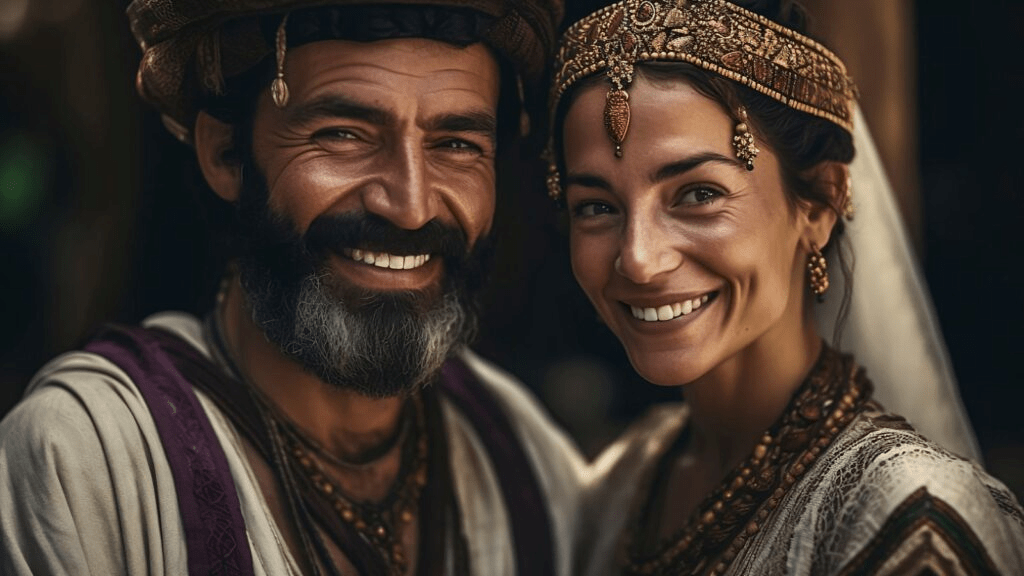













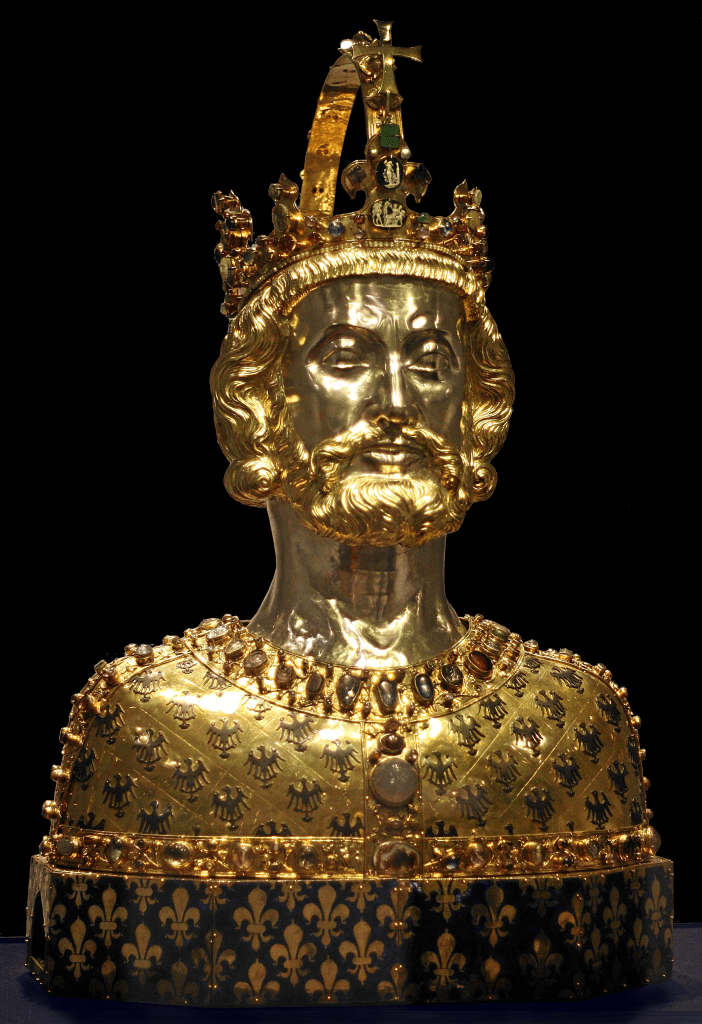
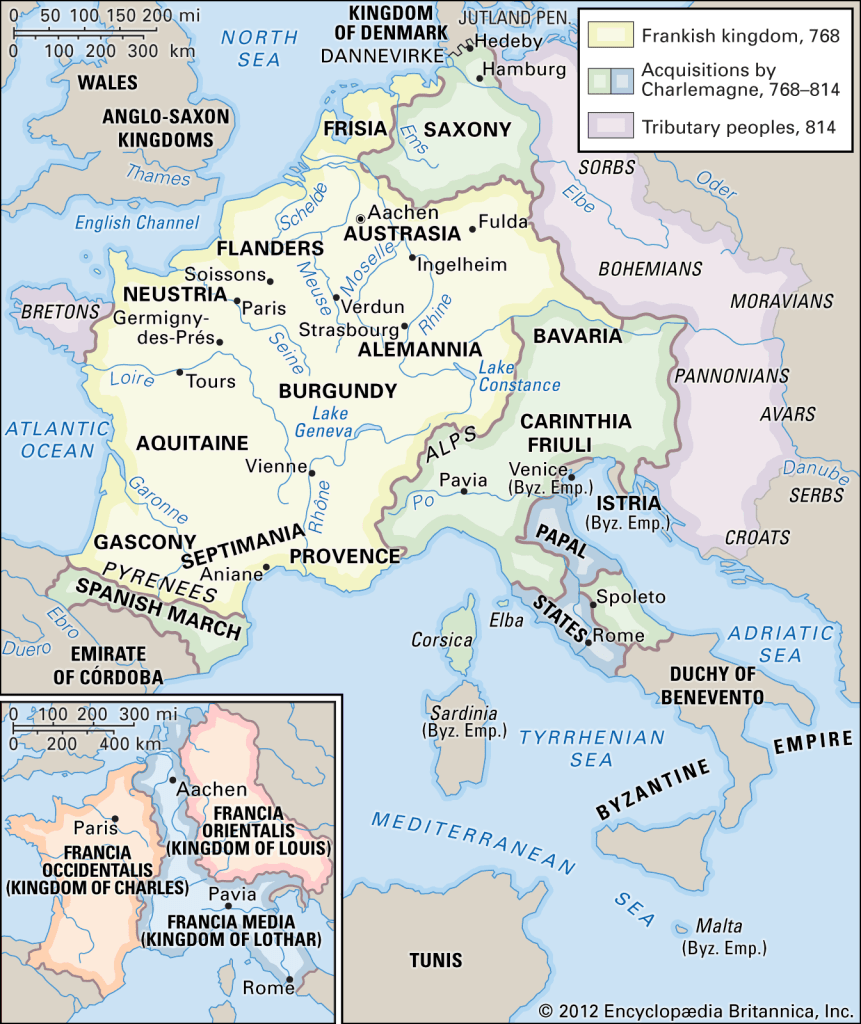



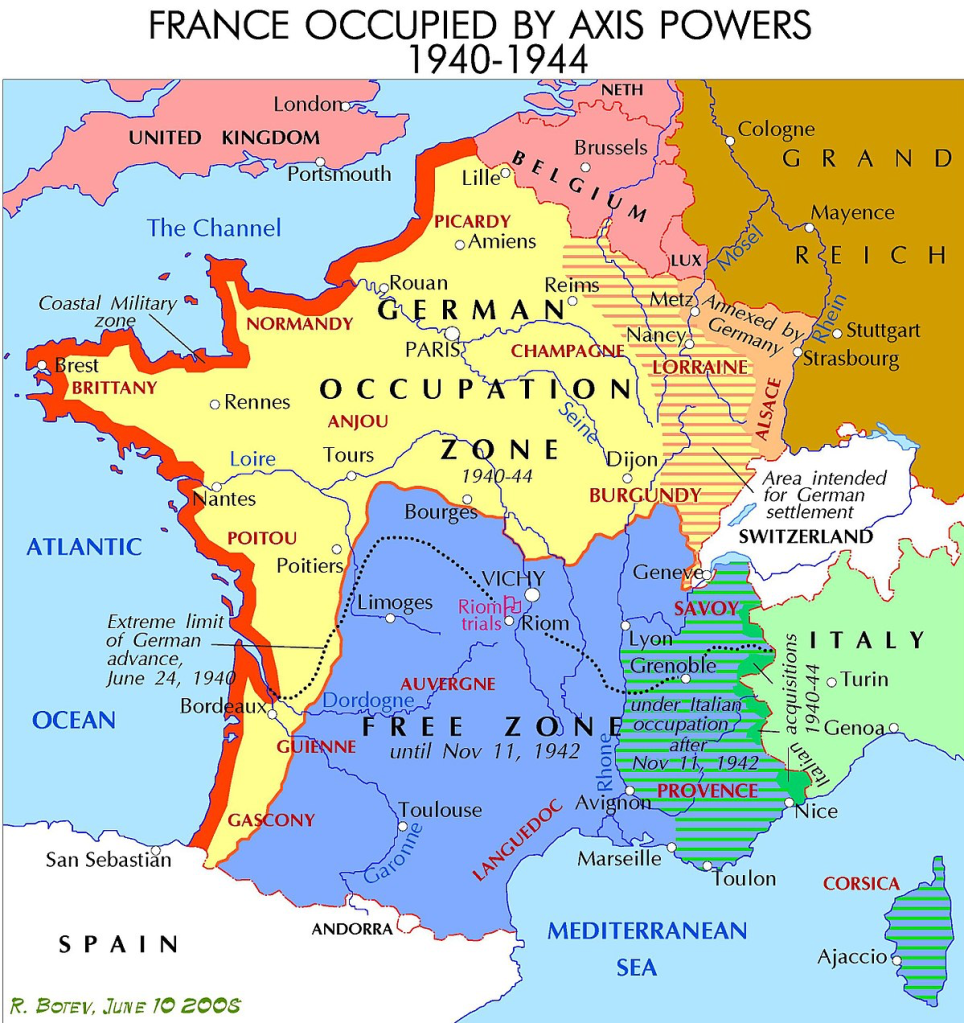










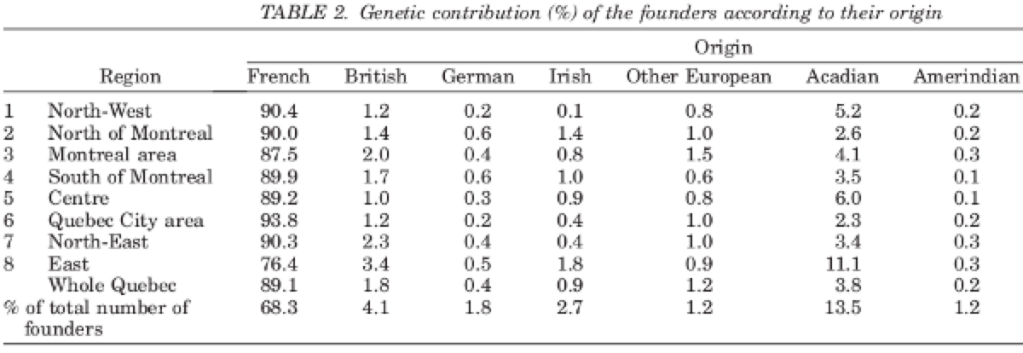


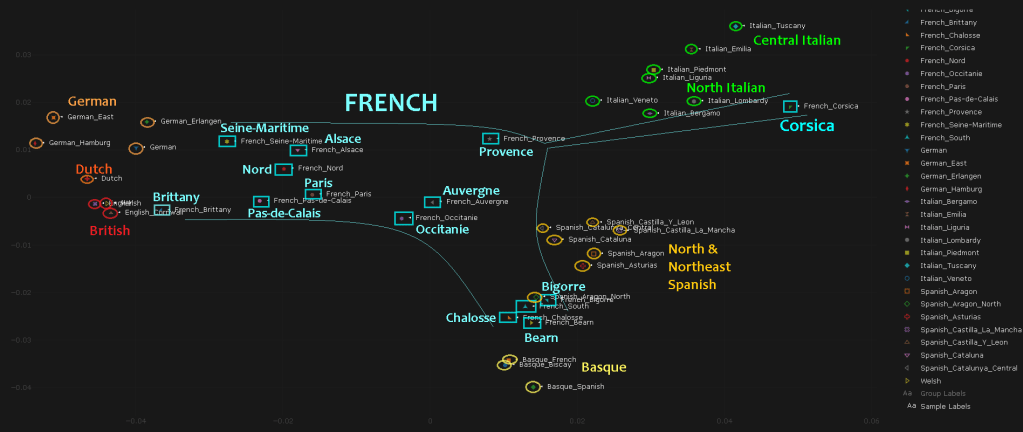


 The Lightkeeper