Kittim & Indonesia

Chapter VIII

The third son born to Javan is Kitt or Kitti translated solely in the plural, Kittim. There are a number of Bible verses attributed to his descendants and their role in our civilisation is evolving as these words are written. A key player, growing in world affairs. A nation similar to China so-to-speak, in that it is awakening and beginning to flex its economic muscle.  

Israel a History of:

‘Kittim has been understood to refer to Cyprus. It is plausible that the Hebrew term “Ma-Kittim”, meaning “the land of Kittim”, perhaps developed into the term “Macedonia”.’

The Origin of the Nations, Herman Hoeh, 1957:

‘The descendants of Kittim first settled on the island of Cyprus and then migrated into Southern Italy. This is simply proved by checking the historical fulfillment of Daniel 11:30. The “ships of Kittim” were Roman fleets* sailing from Cyprus. In modern times many Spanish and Portugese people (as well as Italians and a few Greeks) have migrated to the New World. These are the lands of Javan today.’ 

We have learned that Javan descends from Japheth and is an East Asian branch of the family tree, not European – refer Chapter VII Javan: Archipelago South East Asia & Polynesia. The Latin peoples of southern Europe do not descend from Japheth. The Kittim travelled throughout the Mediterranean before their huge eastward arc towards Asia.

It is not accurate to think that the Chinese were solely the Khitai, or called themselves by that name outside of the dynasty which ruled northern China from 907 CE to 1125 CE. The region to the north of China proper was known as Khitai – becoming Cathay. The ‘real’ China was further south beyond Khitan lands. The peoples who dwelt around the Yellow River delta region referred to themselves by the specific Dynasty in which time they lived. Whether Khitai is linked or derived from Kittim is not clear.

Early after the flood, the Kittim settled in present day Larnaca on the east coast of Cyprus, known in ancient times as Kition and in Latin, Citium. The whole Island became known as Kittim in Hebrew. The name was employed loosely in Hebrew literature, so it was often applied to all the Aegean islands and even to the West in general – especially the seafaring West.* 

Flavius Josephus circa 100 CE records in his Antiquities of the Jews that Cethimus a son of Javan possessed the island Cethima: ‘it is now called Cyprus; and from that it is that all islands, and the greatest part of the sea coasts, are named Cethim by the Hebrews…’

The expression ‘isles of Kittim’, found in the Books of Jeremiah and Ezekiel indicates that some centuries prior to Josephus, this designation had become a broad description for the Mediterranean Islands. As Dr Hoeh says, this designation was further extended to apply to the Romans, Macedonians and Seleucid Greeks. The Septuagint translates the use of Kittim in the Book of Daniel 11:30 as Romans. 1 Maccabees 1:1 states that: Alexander the Great the Macedonian, had originated from the ‘land of Kittim’ – in reality, the ancient and at one time home of the Kittim. By this later time, Hoeh describes the real Kittim who had long left the Mediterranean. As they were a prominent people, their legacy of territory and influence lingered in southern Europe through use of their name. 

In the War of the Sons of Light Against the Sons of Darkness from the Dead Sea Scrolls, the Kittim are referred to as being of Asshur. Eleazar Sukenik argued that this reference to Asshur, refers to the Seleucid Empire which controlled the territory of the former Assyrian Empire; though his son Yigael Yadin, interpreted this phrase as a veiled reference to the Romans. Some authors have speculated that Kittim comes from an Akkadian word meaning invaders. Others have identified Kittim with the land of Hatti from Khatti and the Hittite Empire. We will learn that neither the Romans or the Hittites are descended from Japheth.

The mediaeval rabbinic compilation Yosippon, says the Kittim camped in Campania, Italy and built a city called Posomanga, while descendants of Tubal camped in neighbouring Tuscany and built Sabino, with the Tiber river as their frontier. They soon went to war following the rape of certain sabines by the Kittim, who are equated with the Romans. The war ended when the Kittim showed the descendants of Tubal their mutual progeny. They then built cities called Porto, Albano, and Aresah. Later, their territory is occupied by Agnias, King of Carthage. This may be an accurate account if it relates to between 9500 – 6000 BCE. If later than this, then these would be peoples descended from Shem living where the Kittim and Tubal once dwelt and their names have been appropriated – Chapter XVI Shem Occidentalis. Possibly, the people being described with former names, are the early Romans and Etruscans.

The name Kittim in Hebrew signifies: ‘Beaters, Pulverizers’ from the verb katat, ‘to beat or hammer.’ Recall the two sons of Gomer: Riphath of Cambodia and Togarmah of North Korea and South Korea. Their names broadly mean, ‘Crusher’ and ‘Bone Breaker’ respectively.

Abarim Publications:

‘The name Kittim is a plural form of Kitty, although this singular doesn’t occur in Scriptures. 

The alternative plural form Kittiyyiym, occurs in Isaiah 23:12 and Jeremiah 2:10. 

The verb… means to beat or hammer, either to forge swords and ploughs and such, or to fragment and disperse of whatever is beaten. Adjective (katit) literally means beaten, but occurs only to denote a costly oil from beaten fruits. Noun (mekitta) refers to anything crushed or pulverised… Jones’ Dictionary of Old Testament Proper Names… reads Subduers.’

The peoples of Indonesia are the modern descendants of the Kittim.

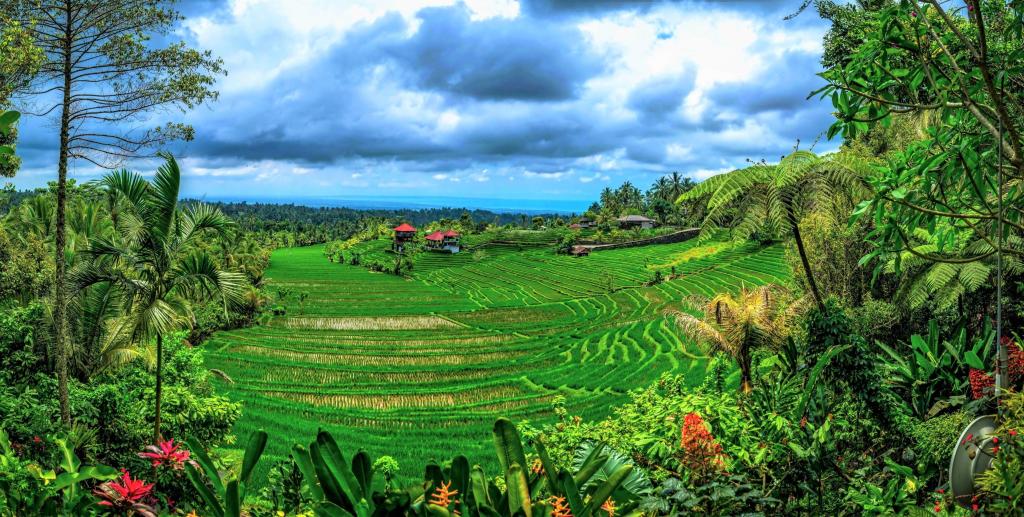
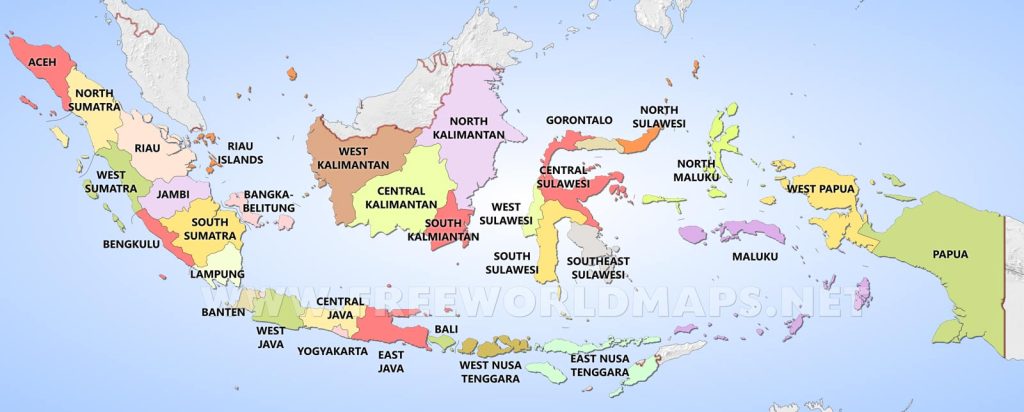
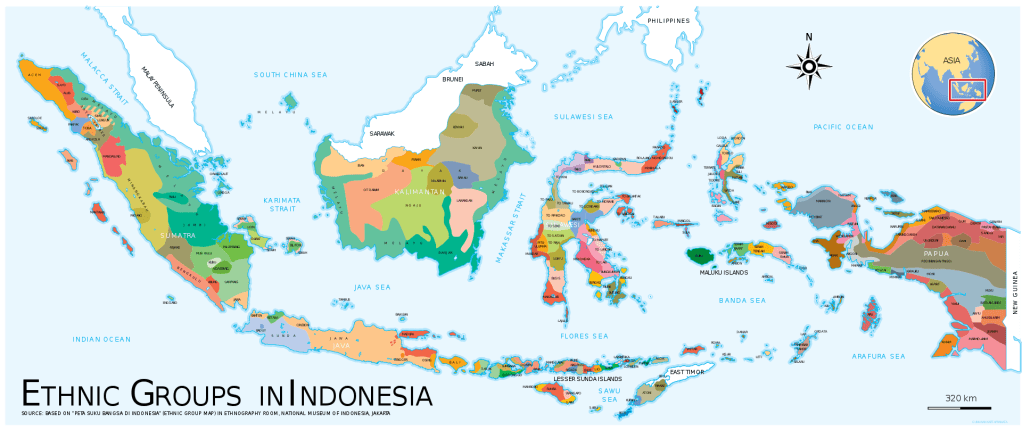
The Republic of Indonesia consists of an astounding 18,108 islands; which include the larger islands of Sumatra; Java; Borneo, Kalimantan in Indonesian; Bali; Sulawesi formerly Celebes; Flores; West Timor; and New Guinea. Indonesia is the world’s largest island country and the fourteenth largest country by land area at 735,358 square miles. With 285,057,159 people, it is the world’s fourth most populated country as well as the most populous Muslim majority nation. Java is the world’s most populous island and home to over half of the country’s population. Notice the striking similarity between the name of the main island of Indonesia, Java and Kitti’s father, Java-n.
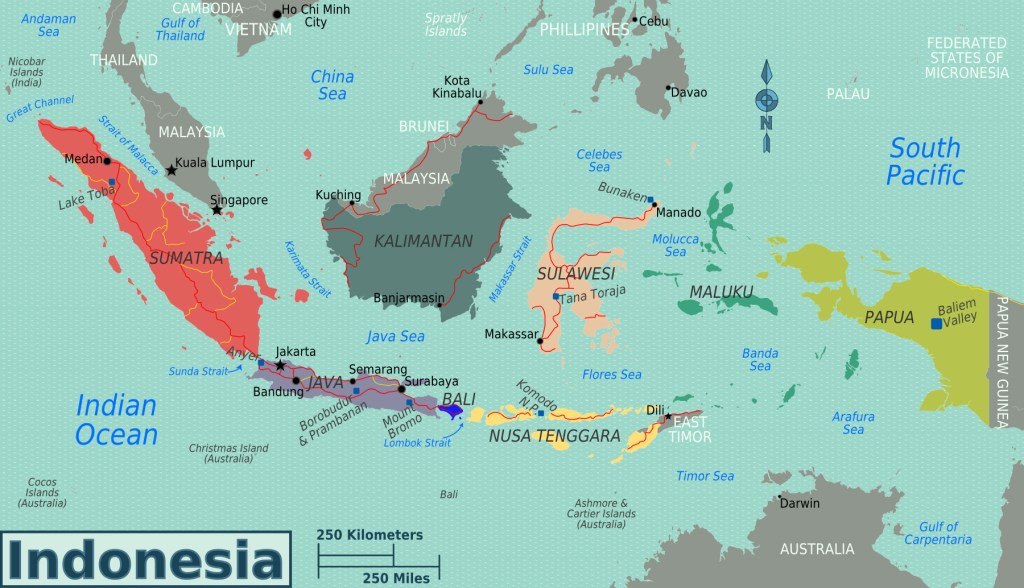
The country’s capital Jakarta, is the second highest urban populated area in the world. The country shares land borders with Papua New Guinea, East Timor and the eastern part of Malaysia and despite its large population and densely populated regions, Indonesia has enormous areas of wilderness that support one of the world’s highest levels of biodiversity.

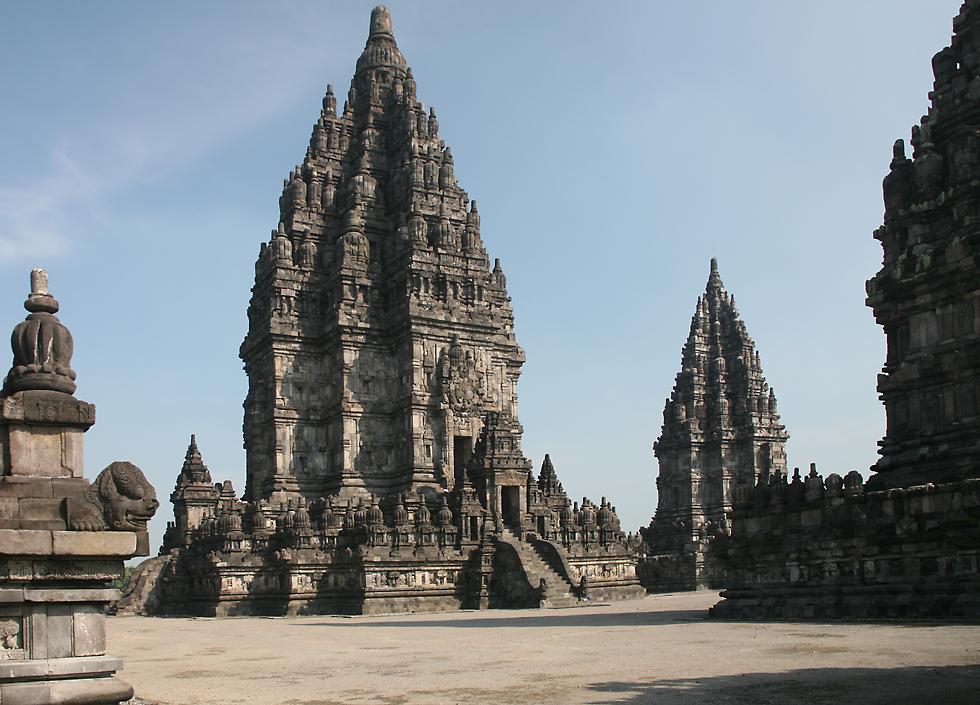
The Indonesian archipelago has been a valuable region for trade since the seventh century when Srivijaya and later Majapahit, traded with people from mainland China and the Indian subcontinent. Local rulers absorbed foreign influences and Hindu and Buddhist kingdoms flourished. Sunni traders and Sufi scholars introduced Islam, while Europeans brought Christianity through colonisation. 

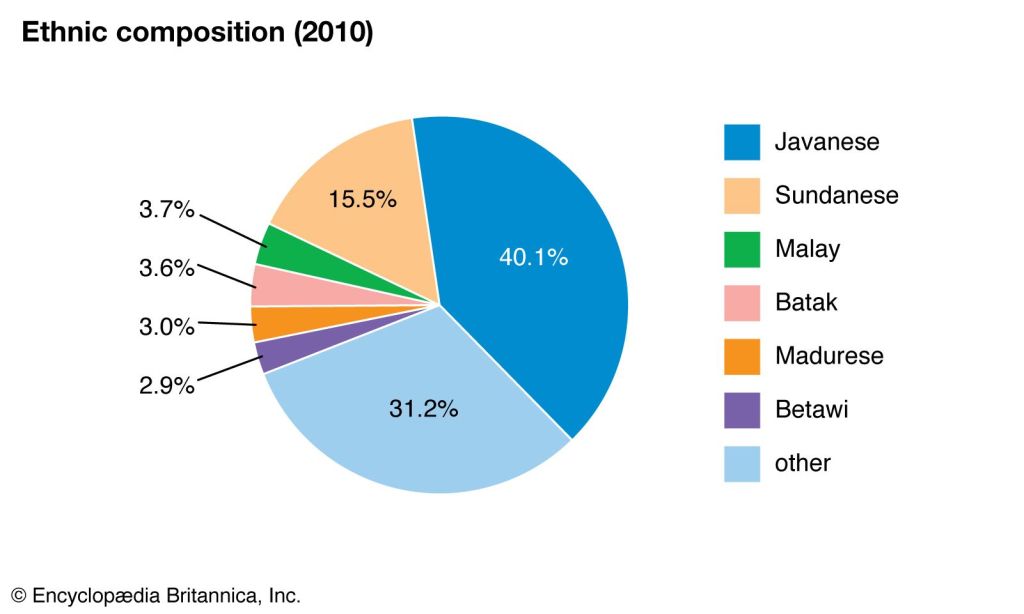
The first Europeans arrived in 1512, when Portuguese traders sought to monopolise sources of nutmeg and cloves. Dutch and British traders followed and in 1602, the Dutch established the Dutch East India Company. The politically dominant Javanese, are the largest ethnic group, constituting 40.2% of the population. They are predominantly located in the central to eastern parts of Java. The country’s official language is Indonesian, a variant of Malay. Most Indonesians speak at least one of more than seven hundred local languages, often as their first language; still, Javanese is the most widely spoken.
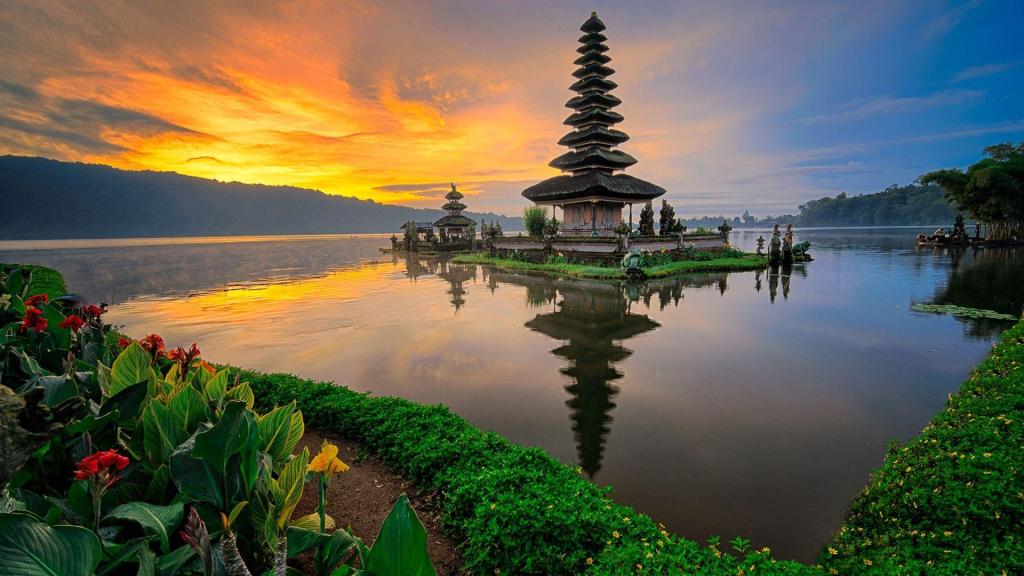
Intermittently interrupted by the Portuguese, French and British, the Dutch were the foremost colonial power for much of their three hundred and fifty year presence in the archipelago. The country proclaimed its independence in 1945, though it was not until 1949 when the Dutch recognised Indonesia’s sovereignty following an armed and diplomatic conflict between the two nations.

In 1850, George Earl an English ethnologist, proposed the term Indunesians, though preferring Malayunesians, for the inhabitants of the Indian Archipelago. One of his students James Logan, used Indonesia as a synonym for the Indian Archipelago. Dutch writers in East Indies publications, preferred the Malay Archipelago. The name Indonesia derives from Greek Indos and the word nesos, meaning ‘Indian islands’.

The economy of Indonesia is the largest in Southeast Asia, one of the emerging market economies of the world and a member of the G20. It is the 16th largest economy in the world by nominal GDP – $1.12 trillion – and the 7th largest in terms of GDP in 2019. In 2012, Indonesia replaced India as the second fastest-growing G-20 economy, behind China.

‘The following export product groups represent the highest dollar value in Indonesian global shipments during 2021. 

  1. Mineral fuels including oil: US$45.1 billion (19.8% of total exports)
  2. Animal/vegetable fats, oils, waxes: $32.8 billion (14.4%)
  3. Iron, steel: $20.9 billion (9.2%)
  4. Vehicles: $8.6 billion (3.8%)
  5. Electrical machinery, equipment: $8.5 billion (3.7%)
  6. Rubber, rubber articles: $7.1 billion (3.1%)
  7. Other chemical goods: $6.9 billion (3%)
  8. Ores, slag, ash: $6.4 billion (2.8%)
  9. Machinery including computers: $6.3 billion (2.8%)
  10. Footwear: $6.2 billion (2.7%)


Ores, slag and ash represents the fastest grower among the top 10 export categories, up by 96.3% from 2020 to 2021. That product category was galvanized by Indonesia’s higher international sales of exported copper ores and concentrates. In second place for improving export sales were the materials iron and steel via a 93.1% gain.’ 

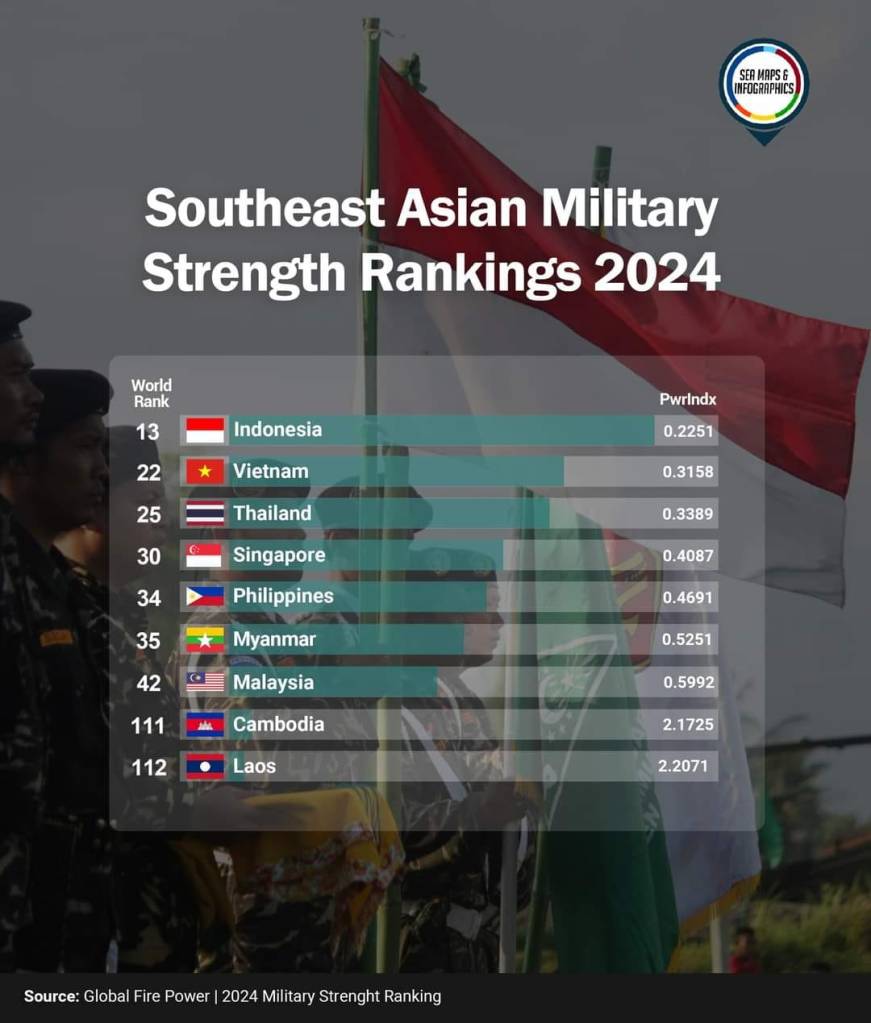
Indonesia is a paradox as it has played a back-seat modest role in the world economy since its independence. Its importance has been considerably less than its size, abundant natural resources and geographic location would seem to warrant. Kittim has not yet gotten into full-swing and we will likely witness a transformation of its influence on the world stage. It is one of the top four with South Korea, in the Next Eleven nations and as the world’s biggest Islamic Nation, a contender as the potential leader, or influencing nation in the Muslim world – Article: Four Kings & One Queen.

Will Kenton: ‘The next eleven, also known as N-11, are the eleven countries that are poised to become the biggest economies in the world in the 21st century, after the BRIC countries. The next eleven are South Korea, Mexico, Bangladesh, Egypt, Indonesia, Iran, Nigeria, Pakistan, the Philippines, Turkey, and Vietnam. The next eleven were named in a paper… by… Goldman Sachs, published… 2005. The purpose of the paper was to review the performance of the BRIC countries, which are Brazil, Russia, Indian, and China. The paper reviewed the progress of the BRICs, but then… introduced the idea of a larger set of countries that were likely to develop on a slower trajectory than the BRICs would, but could still become [economic] world powers. The authors of the paper used mathematical modeling to create charts of which countries could have the strongest economies… 45 years after the paper was published…’

The prophet Balaam provides a future prophecy on specific nations today, including Kittim.

Numbers 24:24

English Standard Version

‘But ships shall come from Kittim and shall afflict [H6031 – anah: to afflict, abase or humble (one self)]  Asshur and Eber; and he too shall come to utter destruction.’

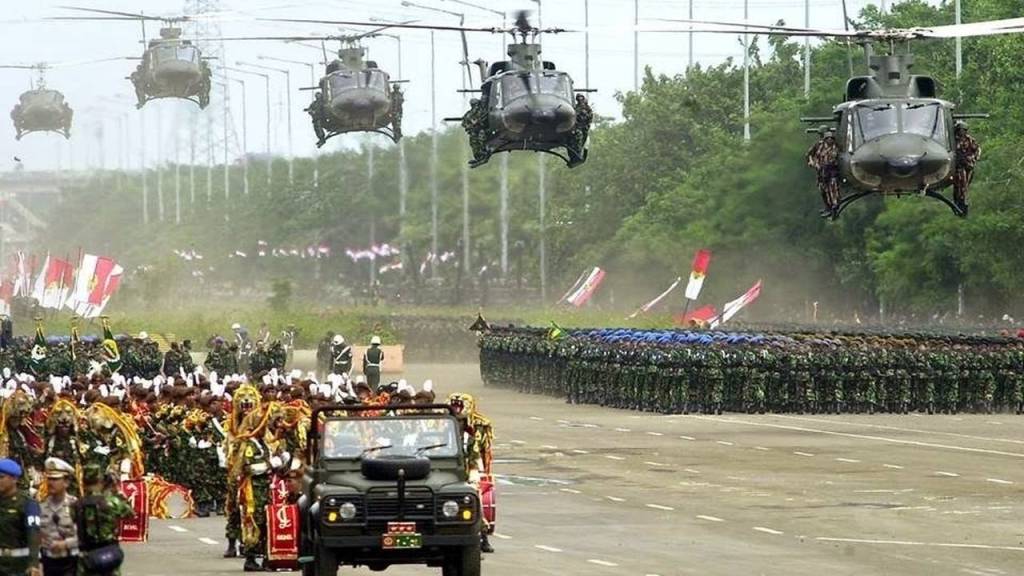
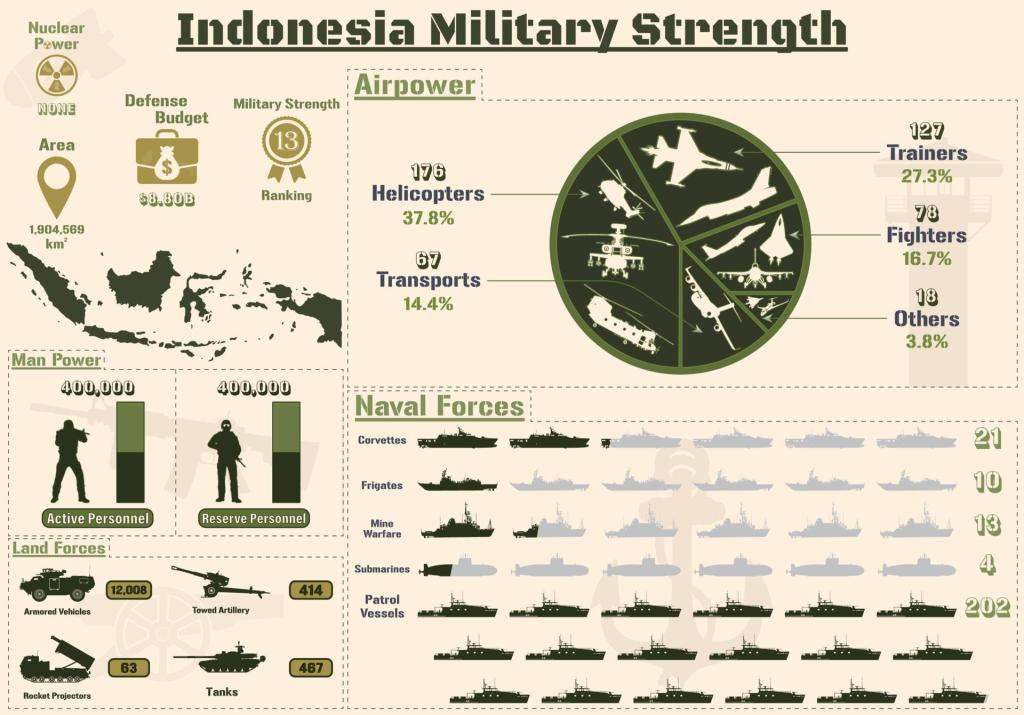
Some have misleadingly translated Kittim as Cyprus or Italy. At some point, Indonesia’s military and naval power will either be formidable enough to combat combined Russian and European forces, or the verse is a veiled reference to a naval cavalcade of various nations travelling from a base in Kittim – Chapter XX Will the Real Assyria Stand Up: Asshur & Russia. A confederation of states linked to the King of the South, as written in the Book of Daniel^ is described. It also appears from the Hebrew word anah, that it could be the ships from Kittim which are humbled.
Isaiah gives a prophecy on Tyre and its demise in chapter 23:1, 12 NCV:

This is a message about Tyre: You trading ships [of Tarshish], cry! The houses and harbor of Tyre are destroyed. This news came to the ships from the land of [Kittim]. He said, “Sidon, you will not rejoice any longer, because you are destroyed. Even if you cross the sea to [Kittim], you will not find a place to rest.”
Jeremiah 2:10

King James Version

‘For pass over the isles of Chittim…’

Ezekiel 27:6

Young’s Literal Translation

‘Of oaks of Bashan they made thine oars [ship building], Thy bench they have made of ivory, A branch [H1323 – bath: daughter, town, company, first] of Ashurim from isles of Chittim.’

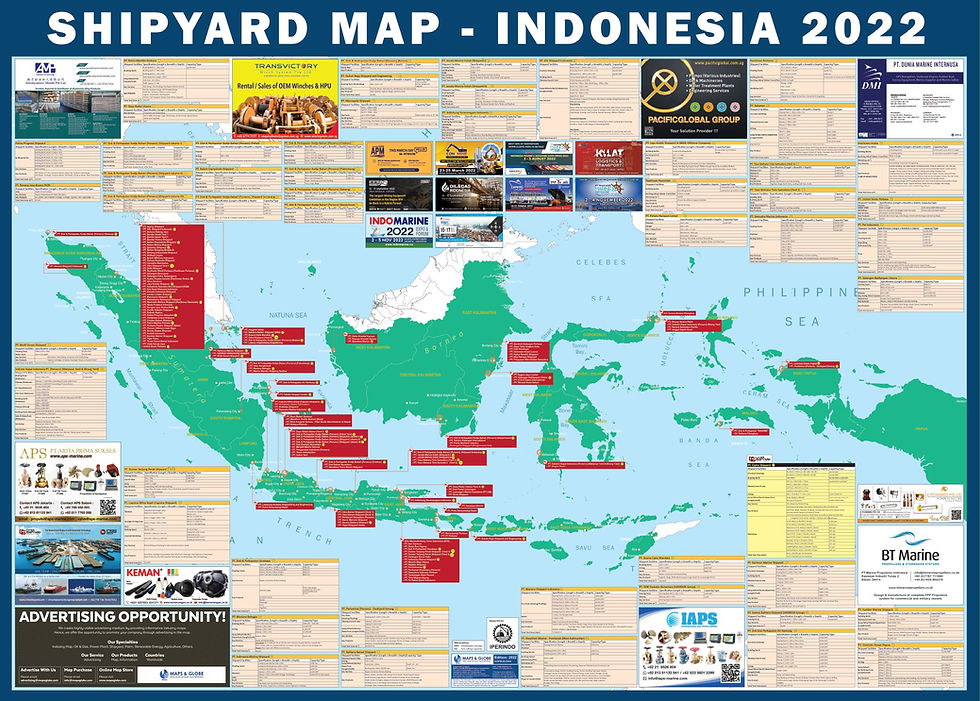
Ship building is a growing industry in Indonesia, presently in the shadow of Japan and Malaysia. Later, we will learn the significance of Bashan and ships – Chapter XXXI Reuben, Simeon, Levi & Gad – the Celtic Tribes. The second part of the verse links Kittim and seemingly a great grandson of Abraham. Most translations inaccurately translate as Asshur the second son of Shem, possibly following the relationship shown in Numbers 24:24. See Genesis 25:3 and the individual Ashurim and the Ashurites – Chapter XXVII Abraham & Keturah – Benelux & Scandinavia.

We will discover that the descendants of Ashurim – also listed in the plural – have had an historical link with the Kittim of Indonesia. The Hebrew word used in Ezekiel is not the same as the one used for Abraham’s grandson in Genesis, though it is a closer match than the Hebrew word used for Jacob’s son Asher in Genesis chapter forty-nine – Chapter XXXII Issachar, Zebulun, Asher & Naphtali – the Antipodean Tribes. Yet, Asher the son of Jacob cannot be ruled out of contention, as we will discover their close geographic location with Kittim, is an uncanny irony.

Daniel chapter Eleven^ contains the single longest prophecy in the Bible, which chronicles thousands of years and on into the future. The early part of the chapter references -somewhat confusingly – Greece or Javan; actually the Greco-Macedonian Empire and its confrontation with the existing, ruling Medo-Persian Empire. The players of north and south, subtly change over the centuries. Towards the end of the chapter the Kings of the North and South have shifted from a Mediterranean – Middle Eastern – orientation to a global power struggle – refer article: Four Kings & One Queen. We read in Daniel 11: 15, 18, 29-30:

English Standard Version

‘Then the king of the north shall come… Afterward he shall turn his face to the coastlands [of Javan]^ and shall capture many of them… At the time appointed he shall return and come into the south, but it shall not be this time as it was before. For ships of Kittim shall come against him, and he shall be afraid and withdraw, and shall turn back and be enraged and take action against the holy covenant.’

Sometimes translated unhelpfully, as ships from the west. The interlinear says: ‘For ships Chittim shall come…’ It does not include ‘of’ or ‘from’ in the Hebrew, though I consider the inference is from more than of, Kittim. We learned in Numbers 24:24 that the Kittim fight against Asshur and Eber – an alliance constituting Russia and a German led Europe. Asshur (or Assyria) is revealed as a future King of the North. The King of the North attacks the coastlands of Southeast Asia. Kittim is either part of those nations amalgamated with the King of the South – a united Islamic bloc comprising the principal nations of Turkey, Iran, Pakistan and Egypt – or accommodates a military and naval presence within its strategically positioned borders in southeast Asian waters.

These verses in Daniel chapter Eleven, highlight a beginning point of a specific time period, that includes actions of magnitude performed by important and specific individuals in the future. The significance of this is considerable and we shall return to it in detail when we study Shem’s son, Asshur and also the demagogue Nimrod – refer Chapter XX Will the Real Assyria Stand Up: Asshur & Russia; Chapter XXI The Incredible Identity, Origin & Destiny of Nimrod; and article: The Pyramid Perplexity.

Geneticist Luigi Luca Cavalli-Sforza, claims there is a genetic division between Eastern Orientals and Southeast Asians and Zhou Jixu agrees, that there is a physical difference between these two populations. The complexity of the genetic data has led to serious doubt amongst scientists about the usefulness of the concept of an Asian race, as distinctive Asian features clearly represent separate lines – of the sons of Japheth.

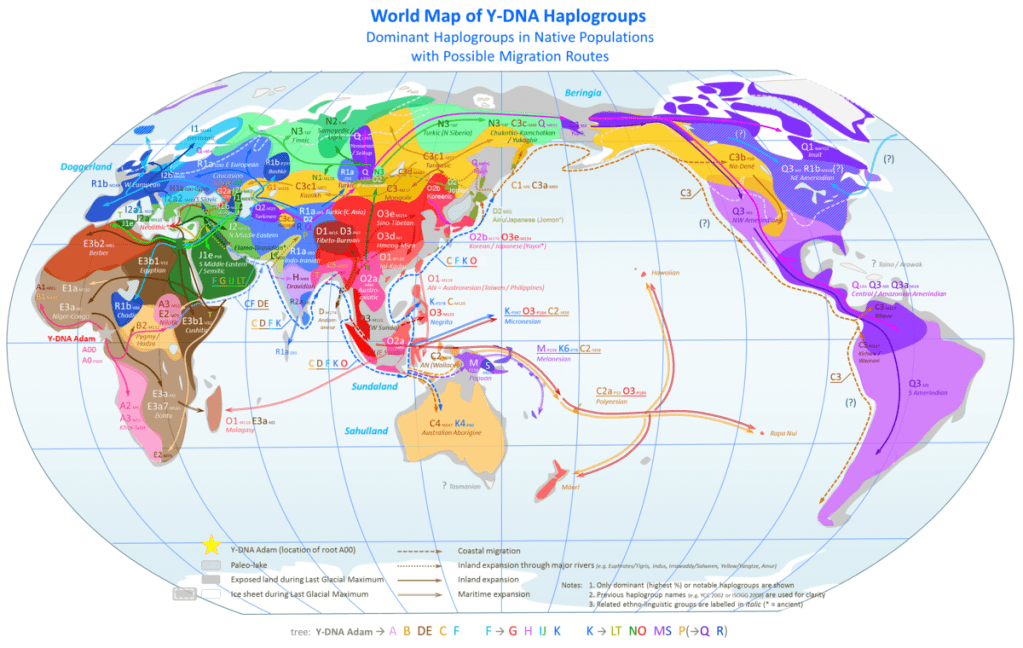
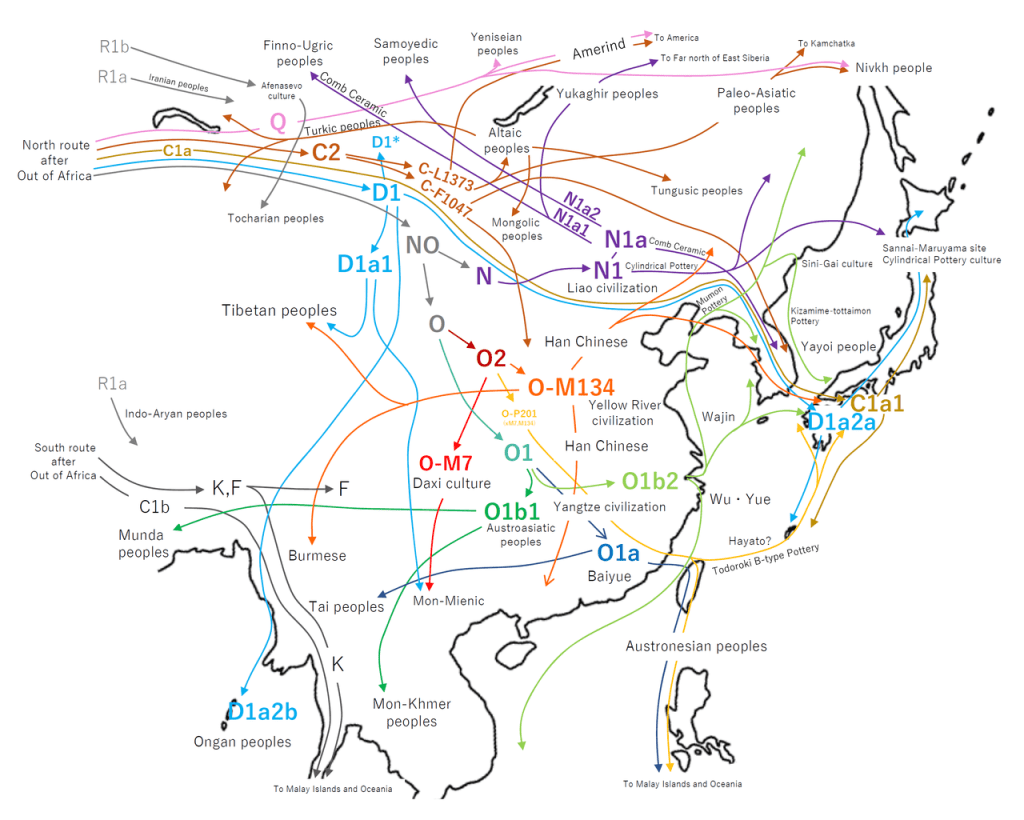
After studying all four of Javan’s sons, it will be understood that those sons of Japheth located in Asia, such as Madai, Gomer and Javan are all divergent and distinctive lines of lineal descent. As there are a number of lineages from Japheth’s sons, this does not discount an overall East Asian identity. There is variety within the Asian genome, for Japheth had seven sons. We have seen already, the core Y-DNA Haplogroups for instance, being exhibited of C, K and O and in lesser degree, D, N and Q.

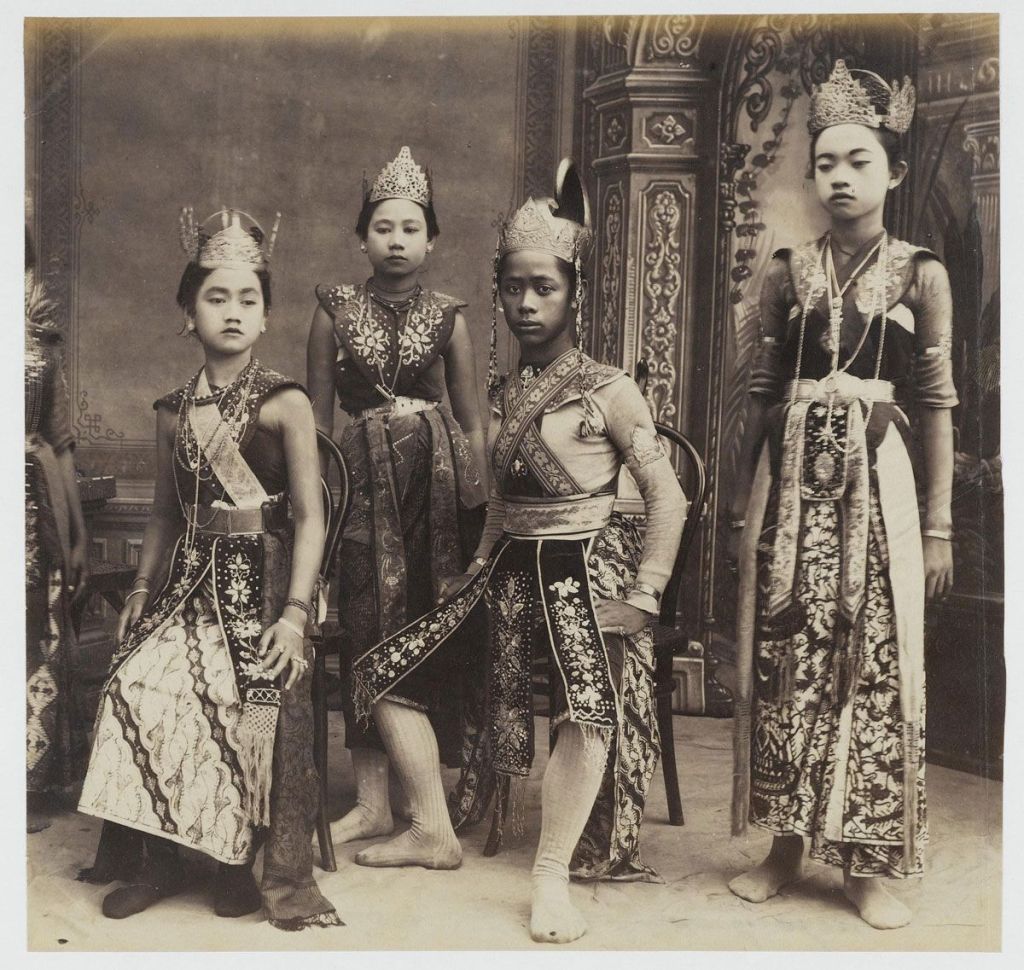
Indonesian man

Austronesian Indonesians are genetically close to southeast Asians, while the further east one travels the more inhabitants of the Indonesian islands region exhibit a Melanesian affinity. Prominent mt-DNA Haplogroups of which we are now quite familiar, include the prevalent southeastern Asian M, F, B and the addition of Y2 in the western regions of Indonesia; the speakers of Austronesian languages spoken in Southeast Asia; the Pacific Islands; and on Madagascar. In the eastern island chains of Indonesia it is mainly Haplogroups Q and P, found amongst non-Austronesian speakers. 

Indonesian woman

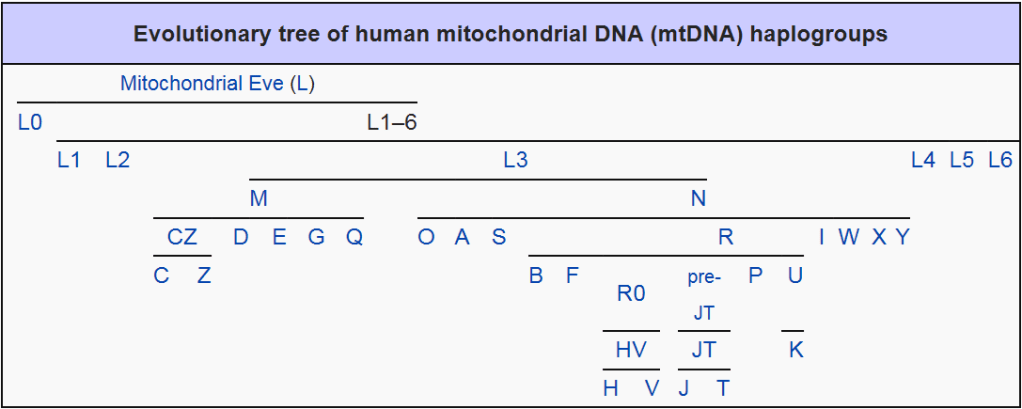
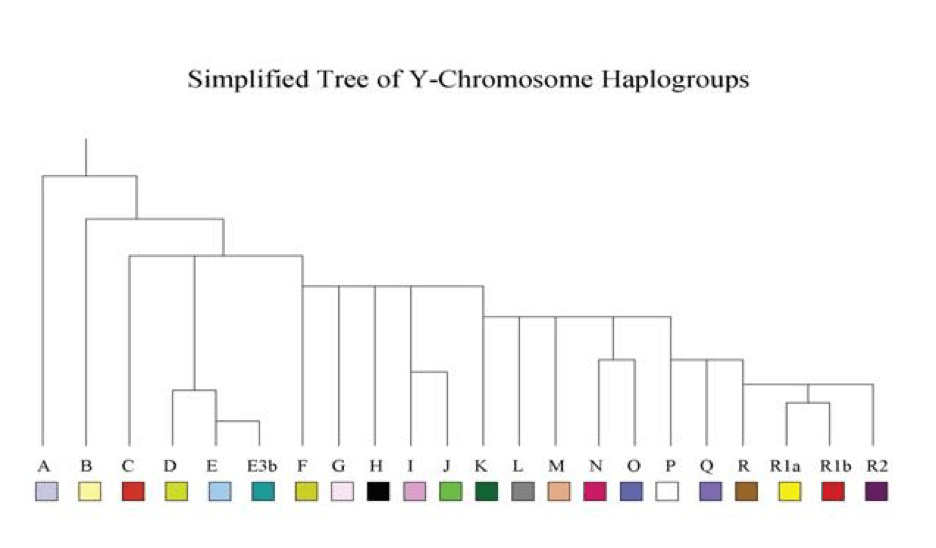
Recall from earlier chapters the one unifying mtDNA link amongst the descendants of Japheth has been Haplogroup B. While a variety of Haplogroups are evident, it is only B which has been found in all of his descendants studied thus far: Tiras the Amerindian; Madai the Central Asian; Gomer on the mainland of South East Asia; Togarmah the Korean; and Javan on the islands of South East Asia. Haplogroup B is a relatively recent mutation which derives respectively from the super Haplogroups R, N, [controversially] M [see chart below] and L3 – refer Chapter VII Javan: Archipelago South East Asia & Polynesia.
The Indonesian archipelago: an ancient genetic highway linking Asia and the Pacific, multiple authors, 2013 – emphasis & bold mine:

‘Indonesia, an island nation linking mainland Asia with the Pacific world, hosts a wide range of linguistic, ethnic and genetic diversity. Despite the complexity of this cultural environment, genetic studies in Indonesia remain surprisingly sparse. The haplotype diversity of communities ranged from 0.862 – 0.996, which indicates that most individuals within these groups carry unique mtDNA lineages. The most diverse communities are found in eastern parts of the archipelago (Sumba, Flores, Pantar and Alor), where both Asian and Papuan lineages occur side by side.

Haplogroup frequencies differ between western and eastern Indonesia… In the west, haplogroups B5a (12%), B4c1b3 (9%) and Y2 (10.5%) are carried by a third of individuals. These haplogroups, frequent in western Indonesia, are notable by their near absence in eastern Indonesia. In the east, haplogroups F1a4 (8.7%), Q including Q1 and Q2 (7.7%), P (2.8%) and B4a1a1a (2.3%) represent nearly a quarter of individuals. 

Correspondingly, these haplogroups are rare or absent in western Indonesia, which is expected for lineages with strong Papuan connections (P and Q), but more surprising for lineages like the Polynesian motif (B4a1a1a). The Polynesian motif is found as far west as Bali, albeit in just two individuals (0.4%). However, it was not detected in samples from the western Indonesian islands of Java, Sumatra, Nias and Mentawai, even though this region is thought to have contributed to the settlement of Madagascar where the Polynesian motif is carried by nearly a third of individuals – refer Chapter VII Javan: Archipelago South East Asia & Polynesia. The prevalence of the Polynesian motif in Madagascar, and its absence from the island region where the inhabitants of Madagascar originated, has yet to be satisfactorily explained.’ A subsequent article in 2015 answers the question.**
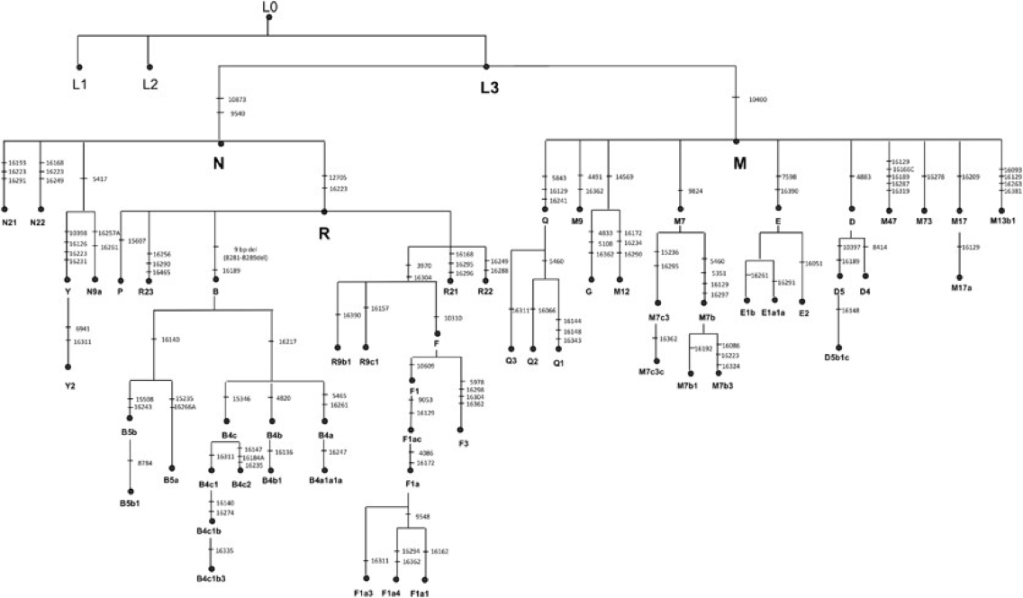
‘We compared the distribution of Indonesian mtDNA haplogroups with those of surrounding populations… Most haplogroups are shared. The deep maternal lineages M17a, M73, M47, N21, N22, R21, R22 and R23 have patchy distributions across mainland and island southeast Asia, likely reflecting ancient maternal lineages tracing back to the first settlers in this region. Four of these lineages (M17a, N21, R22 and R23) reach higher frequencies in western compared with eastern Indonesia… Owing to proposed population origins of Austronesian language speakers in Taiwan, Indonesian links to the Philippines and indigenous Taiwanese are of especial interest. These three locations share four haplogroups (E1a1a, M7b3, M7c3c and Y2), which have previously been suggested as candidates for a mid-Holocene dispersal out of Taiwan… lineages shared with Filipinos and indigenous Taiwanese are generally more common in the east than in the west of Indonesia. The exceptions are Y2 and M7c3c…

Alternative hypotheses, such as Austronesian groups originating in and dispersing from Indonesia, remain possible, with many genetic lineages in Indonesia showing old and local connections. Models combining these two extremes may ultimately be the best predictors. We envisage some genetic contributions from Taiwan, possibly including speakers of early Austronesian languages, with a substantial biological heritage from waves of ancestral populations arriving in island southeast Asia… ancestral-derived haplotype orders are consistent with a rapid expansion from Taiwan to the Philippines and Indonesia, but population dispersals in the opposite direction are equally likely. Although we provide haplogroup dates with some reluctance, we note that relative ages are inconsistent with a simple dispersal from Taiwan to the Philippines, and thence to Indonesia. Instead, they seem a better fit to widespread population movements within island southeast Asia during the Holocene.

The Polynesian motif is also generally associated with a Taiwanese dispersal, but actually possesses an unusual geographical distribution. The ancestral form occurs widely throughout mainland and island southeast Asia. However, the Polynesian motif itself is found only at low frequency in the Philippines (0.5%) and eastern Indonesia (2.3%). Although frequencies reach as high as 7.4% on Timor, the lineage is found no further west than Bali (0.4%, or just 2 of 457 individuals). This is consistent with a proposed origin in island Melanesia, but notably conflicts with the high frequency of the Polynesian motif in Madagascar… We suggest that an inclusive framework that describes the full distribution of this unusual mtDNA lineage is still lacking. Nevertheless, an unambiguous connection with population dispersals from Taiwan during the Neolithic seems increasingly unlikely – refer Chapter VII Javan: Archipelago South East Asia & Polynesia.

In comparisons with neighboring populations, Indonesia’s closest genetic connections lie toward mainland [Elishah – Malaysia] and island southeast Asia [Dodanim – Philippines] rather than Oceania [Rodanim]… the only mtDNA lineage found across all Indonesian island groups is M7c3c, but this haplogroup, while also present in Taiwan and the Philippines, appears to be absent from other Austronesian-speaking populations in Oceania. Therefore, no single shared mtDNA lineage links all speakers of Austronesian languages, even if only at low frequency. Instead, Austronesian populations are characterized more by their diversity than by any shared genetic inheritance.’

This is not quite true, for mtDNA Haplogroup B4a1a is prevalent throughout ‘Taiwan, Island Southeast Asia and the Pacific. The lineage B4a1a1 is prevalent in Near Oceania and has become almost fixed in Polynesia, making up more than 90% of all Polynesian mtDNA haplotypes’ – Genetic History of Polynesians and New Zealand Maori, Edana Lord.

Genetic Admixture History of Eastern Indonesia as Revealed by Y-Chromosome and Mitochondrial DNA Analysis, multiple authors, 2009 – emphasis mine:

‘Eastern Indonesia possesses more linguistic diversity than any other region in Southeast Asia, with both Austronesian (AN) languages that are of East Asian origin, as well as non-Austronesian (NAN) languages of likely Melanesian origin. Here, we investigated the genetic history of human populations from seven eastern Indonesian [EI] islands, including AN and NAN speakers, as well as the relationship between languages and genes, by means of nonrecombining Y-chromosomal (NRY) and mitochondrial DNA (mtDNA) analysis. We found that the eastern Indonesian gene pool consists of East Asian as well as Melanesian components, as might be expected based on linguistic evidence… In addition, we noted a small fraction of the NRY and mtDNA data shared between eastern Indonesians and Australian Aborigines likely reflecting an ancient link between Asia and Australia.^^

All AN languages trace back to a common ancestral language (Proto-AN) and are thought to have spread by an expansion that started about 5,500 – 6,000 years ago in Taiwan with an assumed ultimate origin in East Asia… Furthermore, we identified at least two haplogroups (Q1 and Q2) that were previously suggested to be of Melanesian origin… whereas our new data suggest they might be of EI origin instead. Moreover, the mtDNA sequence diversity within haplogroup Q1 was very high in EI (0.967 ± 0.01) making it somewhat unlikely that this haplogroup exists in EI as a result of a recent migration from Melanesia… 

We found NRY haplogroup C-RPS4Y in surprisingly high frequency in EI, accounting for 14.2% of all EI Y-chromosomes… which is the highest frequency of any region in our current and previous data set… The RPS4YT mutation characterizing the major haplogroup C represents one of the two oldest branches of the NRY tree in Asia/Oceania (in addition to M9)… It most likely represents the oldest NRY haplogroup of Asian origin in EI. Haplogroup C-RPS4Y has not been reported in East Asia or Polynesia, is almost completely absent from Melanesia (reported so far from one male from coastal PNG and one Fijian), and is very rare in Southeast Asia (outside EI)… However, this NRY lineage was previously found at an appreciable frequency (∼10%) in northern Australian Aborigines… and also, albeit less frequently (∼1.3%), in central Australian Aborigines…^^ Extremely high frequencies of C-RPS4Y (xM38) (92%) were also previously found in males from Cibol on Flores… C-RPS4Y^ was also previously found in India, albeit in low frequency, and was used to support an ancient genetic link between India and Australia.’

Supporting an historical and genetic link between the Indian Dravidian and the Australian Aborigine – refer Chapter VII Javan: Archipelago South East Asia & Polynesia; and Chapter XIII India & Pakistan: Cush & Phut

Mitochondrial DNA and the Y chromosome suggest the settlement of Madagascar by Indonesian sea nomad populations, multiple authors, 2015 – emphasis & bold mine: 

‘Linguistic, cultural and genetic characteristics of the Malagasy suggest that both Africans and Island Southeast Asians were involved in the colonization of Madagascar. 

Populations from the Indonesian archipelago played an especially important role because linguistic evidence suggests that the Malagasy language branches from the Southeast Barito language family of southern Borneo, Indonesia, with the closest language spoken today by the Ma’anyan. A combination of phylogeographic analysis of genetic distances, haplotype comparisons and inference of parental populations by linear optimization, using both maternal and paternal DNA lineages, suggests that Malagasy derive from multiple regional sources in Indonesia, with a focus on eastern Borneo, southern Sulawesi and the Lesser Sunda islands.**

Prior to the European colonial period, Austronesian-speaking populations were the most widespread of any language family. While most groups speaking Austronesian languages moved eastward, settling the Pacific Ocean, others moved westward through the Indian Ocean, reaching eastern Africa and Madagascar. Dispersing halfway around the world within the past two millennia, the Austronesian expansion is often considered the last substantial wave of migration in human prehistory.

A recent study of genome-wide SNP data suggests that the western and central regions of Indonesia (Java/Borneo/Sulawesi) have the closest genetic connections with Malagasy. This is in agreement with previous studies of uniparental markers (mtDNA and the Y chromosome), which found genetic affinity between Malagasy and western Indonesian populations. A key lineage linking Indonesia and Madagascar is the Polynesian motif (a mitochondrial DNA haplogroup, B4a1a1, characterized by the polymorphisms A14022G, T16217C, A16247G and C16261T).

More recently, it has been recognized that Malagasy carry specific point mutation variants (mtDNA nucleotides 1473 and 3423), which together have been termed the Malagasy motif. This Malagasy version of the Polynesian motif is distributed throughout Madagascar with frequencies in specific ethnic groups ranging from 11-50%. While still debated, this relatively homogenous distribution has been interpreted as supporting the first arrival of the Polynesian motif during an early phase of Madagascar’s settlement. To date, the Malagasy motif has not been found in Indonesia, or anywhere else outside Madagascar. 

Based on analysis of 96 Y chromosome binary markers… the majority of men in the Ma’anyan, Lebbo’ and Bajo carry haplogroups previously found in Southeast Asia, particularly C, K, and O… Among the haplogroups shared between Malagasy and Indonesians… four originated in Island Southeast Asia (C, O1a, O1a2, O2a1), while six have western Eurasian origins (J1, J2, J2b, T, L and R1a). The Ma’anyan and five other Indonesian groups, all located around the Sulawesi sea (east Kalimantan Dayak, Java, Bali, Mandar and Sumba), share four of these Island Southeast Asian haplogroups. Importantly, Malagasy uniquely share just one subhaplogroup (O2a1a1 [F2159 or] – M88 [O1b, downstream from M111 – O1b1a1a1a1a]?) with Ma’anyan, and this lineage has not been discovered in other regions of Indonesia. O2a1a1 may therefore be a marker of male genetic contributions from southern Borneo to Madagascar. 

Malagasy and Indonesians share mitochondrial haplogroups B4a1a, B4a1a1 (Polynesian motif), E1a1a, F3b, M7c1a4a, M32c and Q1… Of these, B4a1a1, E1a1a and Q1 are found exclusively in eastern Indonesia. Conversely, F3b, B4a1a and M7c1a4a occur ubiquitously across both eastern and western Indonesia, and M32c has been observed in only one Javanese individual.

The Polynesian motif (B4a1a1) is considered strong evidence of Indonesian gene flow into Madagascar, where a variant is found at moderate frequency (11-50%). With the exception of Bali… B4a1a1 only occurs in eastern Indonesia. Considering the restricted geographic distribution of the Polynesian motif, it is most likely that this lineage from Madagascar traces back to eastern rather than western Indonesia.

Malagasy and Indonesians share ten haplotypes in seven haplogroups… two haplotypes each in B4a1a and B4a1a1; three haplotypes in M7c1a4a; and one haplotype in each of the other shared haplogroups… eastern Indonesian populations tend to share more haplotypes with Malagasy than western Indonesian groups. We propose that the settlement of Madagascar had an Indonesian source location around southern Sulawesi, the Lesser Sunda islands and eastern Borneo.’

What we have learned thus far, from particularly Gomer and Javan; is the high percentage levels and predominant occurrence of the key Y-DNA Haplogroups O, C, K and a lesser degree, D, Q and N. The peoples of Indonesia are no different and expectedly reveal a similar Haplogroup pattern. With that in mind – as we have just seen from the origin of the Polynesian element in the Madagascans – Indonesia has an extremely diverse set of peoples inhabiting its myriad island chain. Whether they be Malay, Polynesian or Melanesian. Travelling from west to east, a selection of the prominent Islands, exhibit the following major Austronesian Y-DNA Haplogroups.

Sumatra:  O2 – O1a – O1b – F – C – K – D

Java:         O1b – O1a – O2 – C – K 

Bali:          O1b – O1a – O2 – C – K – Q 

Borneo:    O2 – C – O1b – O1a – F

Sulawesi:  C – O1a – O2 – O1b – K – F 

Sumatra has a population of nearly sixty million people and its male Haplogroup frequencies contribute heavily to the Indonesian total. Sumatra is distinct from the other Indonesian islands and has a passing resemblance with the Filipinos.

Sumatra: O2 [39.8%] – O1a [17.5%] – O1b [14%] – F [14%] – C [5.3%]

– K [3.5%] D [1.8%]  

Java has the highest number of people in Indonesia with nearly one hundred and fifty million people, over half the Indonesian total and dominating the Indonesian paternal Y-DNA Haplogroup pool. 

Java: O1b [41.5%] – O1a [22.6%] – O2 [22.6%] – C [1.9%] – K [1.9%]   

Java sits in stark contrast with Sumatra and though not aligned closely, Java has a closer match with the 0.7 million people of Bali, over any other island or nation in south east Asia.

Bali: O1b [58.8%] – O1a [18.1%] – O2  [6.9%] – C  [1.8%] – K  [1.1%]

– Q [0.4%]  

Borneo with approximately twenty-five million people has similarity in part with Sumatra as well as with Sulawesi.

Borneo: O2 [36%] – C [22.1%] – O1b [20.9%] – O1a [9.3%] – F [2.3%]

Sulawesi: C [22.2%] – O1a [21.4%] – O2  [16.7%] – O1b [13%] – K  [7.4%]

– F [5.6%]

The additional Melanesian Y-DNA Haplogroups of M and S, again travelling west to east, show the following.

Bali:                 O – C – K – M – S

Sulawesi:        O – C – K – S – M

Flores:             C1 – C – S – K – O – M

East Timor:    C1 – K – O – S – C – M

West Papua:   C1 – M – K – O

The Bali percentages for O, C and K are the same as above, with the addition of M at 0.7% and S at 0.4%. Sulawesi is again similar, with the addition of S at 5.1% and M at 1.1%. The remaining three islands in Indonesia have the following Y-DNA Haplogroups.

Flores: C1 [39.4%] – C [23.9%] – S [12.7%] – K [11.3%] -O 8.5%] – M [2.8%] 

East Timor: C1 [35.9%] – K [17.9%] – O [17.9%] – S [12.8%] – C [7.7%]

– M [7.7%] 

West Papua: C1 [44.4%] – M [29.3%] – K [23.3%] – O [3%] 

The islands of Flores with two million people, East Timor – a separate sovereign state, outside Indonesia – with 1.5 million people and West Papua, with one million people show the Haplogroup evidence of the Melanesian component in their demographics. West Timor is part of Indonesia, with a population of two million people and shares the Island of Timor with East Timor. 

West Papua is part of Indonesian New Guinea with Papua, which has five million people and they both share the western half of New Guinea with Papua New Guinea in the eastern half, which has a population of nearly nine million people and is a separate, distinct nation. 

While the western half of New Guinea was a Dutch colony, the north-eastern region was once a German colony and the south-eastern territory a British colony. Papua New Guinea is a mineral power and the fifth biggest country in terms of natural mineral reserves; holding about $222 billion worth of reserves of bauxite, the commercial ore of Aluminum. The country is estimated to hold up to 24% of the total bauxite reserves in the world.

Bali:                 O [84%]   C  [1.8%]                       K [1.1%]     M   [0.7%]   S [0.4%]  

Sulawesi:        O [64%]   C  [11%]     C1  [11%]    K  [6%]      M    [1.1%]   S   [5%]     

Flores:             O   [9%]   C [24%]     C1 [39%]    K [11%]      M    [3%]     S [13%]    

East Timor:    O [18%]  C  [8%]     C1 [36%]    K [18%]    M    [8%]    S [13%]   

West Papua:   O   [3%]   C [44%]                         K [23%]    M [39%]  

A survey of the Melanesian Y-DNA Haplogroups shows the sharp lessening of the prime East Asian and Southeast Asian Haplogroup O and the steep increasing percentages of the typical Melanesian Haplogroups of M, S and in part, K. Haplogroup S is mainly confined to the Melanesian peoples of Indonesia – refer Chapter VII Javan: Archipelago South East Asia & Polynesia.

The specific Haplogroups for East Timor include the following, which are in bold for typically Melanesian; italicised for typically South East Asian’ and both for those which reflect an indigenous Eastern Indonesian origin. 

Y-DNA:  C-M38, K-M9, S-M254, M-M4, M-P34, C-RPS4Y^, O-M119 [O1a]

mtDNA: P1, Q1, R14, B, B4a, F1a, R9c, E1a, E1b, E2, Polynesian motif.

Taiwan:           O1a  [66%]   O1b  [11%]     O2a1  [11%]   C   [0.4%]

Korea:              O1a    [3%]   O1b [33%]     O2a1 [42%]   C   [13%]   K  [0.5%] 

Vietnam:         O1a    [6%]   O1b  [33%]    O2a1  [40%]  C     [4%] 

Philippines:    O1a  [28%]   O1b   [3%]     O2a1  [39%]  C     [5%]   K [20%]  

Sumatra:         O1a  [18%]   O1b  [14%]     O2a1 [40%]   C     [5%]   K   [4%] 

Malaysia:        O1a    [8%]   O1b  [32%]     O2a1 [30%]   C    [6%]   K   [8%] 

Java:                O1a  [23%]   O1b  [42%]     O2a1 [23%]   C    [2%]    K  [2%]   

Bali:                  O1a  [18%]  O1b   [59%]    O2a1    [7%]   C    [2%]    K   [1%] 

Borneo:            O1a    [9%]  O1b   [21%]    O2a1  [36%]   C   [22%] 

Sulawesi:         O1a  [21%]   O1b   [13%]    O2a1  [17%]   C   [22%]   K   [7%] 

Comparing the selected five nations from Gomer and Javan with the five regions of Kittim shows that Sumatra appears to have the closest alignment overall with the Philippines – Dodan. Borneo and Sulawesi have more in common with each other, than they they do with either Malaysia or the Philippines. Similarly, Java and Bali are more closely aligned to each other. Though, as Indonesian Haplogroups are influenced by the majority of their population living on Java; the closest affinity of the overall Indonesian – Kittim Haplogroup sequence is with brother nation Malaysia – Elishah. 

                             O     O2a1   O1a   O1b      C       D      K     Q 

Sumatra             72        40       18       14        5       2      4  

Java                    88        23       23      42        2                2  

Bali                     84           7       18       59       2                 1     0.4         

Borneo               66        36         9       21      22

Sulawesi             51        17        21       13      22                7      

Indonesia          69        29       18       23      13     0.5     3     

Indonesia possesses a high percentage of Haplogroup O overall and low percentages of the other East Asian marker Y-DNA Haplogroups comprising C, K and D. Java as representative of Indonesia due to its population size, is high in O1a and O1b, with an average level of O2. Overall for the O Haplogroup, Java has the highest percentage. The Indonesian average at the base of the table is derived from the Haplogroup percentages of the four biggest regions and does not include Bali.
The comparison table begun in Chapter IV, with samples from Tiras, Madai, Gomer and Javan’s two sons studied thus far, now with the addition of the Kittim.

                                     O     O2a1   O1a   O1b     C       D       K       Q  N

NA Amerindian                                                   6                          77

Cook Islands              5                                       83                 8

Kazakhstan                8                                      40                10       2   7

Micronesia                 9                                       19               65

Sulawesi                    51      17       21       13      22                  7      

Tonga                        60                                      23                  1

Borneo                      66      36        9       21      22

Indonesia                 69       29      18      23      13     0.5       3     

Malaysia                   70       30        8      32       6                 8

Philippines               70      39      28        3        5               20

Sumatra                    72      40      18       14        5        2        4  

Vietnam                    79      40        6      33        4        3                 7  3

South Korea             79      42        3      33      13     2.5     0.5       2  4

Bali                             84       7       18      59        2                  1    0.4         

Java                           88      23      23      42        2                 2  

Taiwan:                     88      11      66       11     0.4        

The Island of Java mirrors Taiwan for the highest percentage of combined O Haplogroups. Though for an even distribution of O1a, O1b and O2, Java stands out and is comparable only with Sulawesi by comparison. Indonesia as a whole, carries little Haplogroup K and lower levels of Haplogroup C aside from Borneo and Sulawesi. Bali has the highest O1b in Indonesia and also in East Asia; for Sumatra, it is O2 and joint second in East Asia and for Java, it is O1a, third highest in East Asia. Haplogroup D is rare in East Asia thus far and in Indonesia, found in Sumatra; while Haplogroup Q also rare in East Asia, is found in Bali men. 

As a recap, Haplogroup Q is the defining marker Haplogroup for the Amerindian; for Micronesia, it is Haplogroup K, which has also been influential in the Philippines. Haplogroup C is the defining marker Haplogroup for the Cook Islands and Kazakhstan. 

Haplogroup O1b is not just the prime Haplogroup in Bali, but also in Java and Malaysia. 

Haplogroup O1a is the defining Haplogroup for the Taiwanese aborigine, as well as the Island of Sulawesi. Meanwhile, Haplogroup O2 is the defining marker Haplogroup for South Korea, Vietnam, the Philippines, Sumatra, Borneo and the combined average for Indonesia. Looking at Indonesia as a whole, it is the nation on the table which sits half way between the other nations from South East Asia on one side and the peoples of Polynesia, Central Asia and the Americas on the other.

One can’t help but consider the geography of the myriad island chain comprising Indonesia was as influential in the dispersal of Javan’s descendants in the past as it will be of strategic importance in the future.

Chapter nine visits Japheth’s enigmatic and maverick grandson, Tarshish.

There is gold, and an abundance of rubies, but words of knowledge are like a precious jewel.

Proverbs 20:15 New English Translation

“Whenever you find yourself on the side of the majority, it is time to reform.” (or pause and reflect)

Mark Twain 1835-1910

© Orion Gold 2020 – All rights reserved. Permission to copy, use or distribute, if acknowledgement of the original authorship is attributed to orion-gold.com
Gomer: Continental South East Asia

Chapter V

Japheth’s eldest son is Gomer. He had three sons and they are the first three great grandsons of Noah listed in Genesis Ten – Chapter II Japheth Orientallium.

Genesis 10:3

English Standard Version

The sons of Gomer:

Ashkenaz, Riphath, and Togarmah.

We will discuss the first two sons Ashkenaz and Riphath with their father Gomer, while studying the third son Togarmah separately – Chapter VI Togarmah & the Koreas.

The following quotes are reprinted in large part, to show how the first suggestion of an identity – in one instance 439 years ago – can take hold perpetuating an error. Also, to highlight the pitfalls of using any given word as a proof, when they are either just interesting or completely misleading. These two points have almost irreparably discredited the identity of nations teaching.

Ancient Civilisation:

‘In modern Turkey is an area which in New Testament times was called Galatia. The Jewish historian Flavius Josephus records that the people who were called Galatians or Gauls in his day (c. AD 93) were previously called Gomerites.’

This is disputable, for Josephus has been found an unreliable historian on more than one occasion, with an agenda of his own.

Ancient Civilisation: ‘They migrated westward to what are now called France and Spain [yes, the Galatians or Gauls did]. For many centuries France was called Gaul [true], after the descendants of Gomer [incorrect]. North-west Spain is called Galicia to this day [true]. Some of the Gomerites migrated further to what is now called Wales [incorrect, though the Cymry did]. The Welsh historian, Davis… records that the Welsh language is called Gomeraeg [true] (after their ancestor Gomer) [incorrect].’

The words Gaul and Gallic have a closer ethnic association with the words Gael(s) and Gaelic, though not necessarily an etymological one – refer Chapter XXXI Reuben, Simeon, Levi & Gad – the Celtic Tribes. The descendants of Gomer as Asian kin of Tiras and Madai, cannot be the ancestors of the Welsh. Refer previous chapters: Chapter III Tiras the Amerindian; and Chapter IV Central Asia – Madai & the Medes.

 Israel a History of:  

‘Herodotus and Plutarch associate Gomer, Japheth’s first son, with the peoples of Cimmeria, a region north of the Black Sea. Cimmeria is modern day Crimea. A certain group of Gomer’s descendants eventually moved westward, and the name was more than likely preserved in the names Germany and Cambria, or Wales.’

There is a link between the Welsh and the Cimmerians, just not with Gomer. Likewise, some have tried to equate the name Gomer with the word German. Trying to squeeze an Asian ancestry group into a European lineage does not work. Assumptions are easily conceived from selective word associations and dubious ancient historians and then too readily relied upon.

The Races of the Old Testament, A H Sayce, 1891, pages 48-49 – emphasis mine:

‘Jeremiah (51.27) makes it pretty clear in what part of the world we are to look for Ashkenaz… Ararat was the district which lay between the Araxes and the mountains south of Lake Van, while the Minni adjoined the kingdom of Ararat on the east. Ashkenaz accordingly must have been precisely where an inscription of Sargon places the people of the Asguza, and we may therefore feel but little hesitation in identifying the two together. The Gimirra, or Kimmerians, are placed in the same locality by certain cuneiform inscriptions which relate to the closing days of the Assyrian Empire. On Riphath no light has as yet been thrown by the decipherment of the records of the past…’

As per point number two in the introduction (primus verba), Sayce has probably located where these people once lived though not where they finally migrated.

Oxford Bible Church, Derek Walker – emphasis mine:

‘Another participant in the end-time confederation of nations is ancient Gomer… Some prophecy teachers as well as the Rabbinical view identify Gomer as Germany, and the Jewish Talmud positively identify Gomer with the Germans.’

An Asian line from Japheth has been incorrectly matched to a European line of Shem. It would be helpful to learn exactly what the positive identification of Germany with Gomer is?

Walker: ‘A closer examination, however, reveals that the Gomerites were the ancient Cimmerians, expelled in 700 BC from the southern steppes of Russia into the area we know today as Turkey. Gomer, scholars seem to almost universally agree, “refers to the Celtic Cimmerians of Crim-Tartary.” Gomer is well known to the ancient world as Gimarrai of north central Asia Minor [Cappadocia]. These people are also known as the Cimmerians. This seems to be the simplest, most obvious interpretation. Gomer is to be identified with the Cimmerians (the Cimarrai of the Assyrian inscriptions), located on the shores of the Black and Caspian Seas. Gomer is Gimarra is Cimmeria is Cappadocia – central Turkey. 

The Cimmerians are well known to secular historians. The Scythians chased them across the Caucasus mountains into Asia Minor (Turkey). They made their way through that land, destroyed the Phrygian kingdom in the 7th-8th century BC., and in the 5th century raided the kingdom of Lydia. They kept all of southern and western Asia in turmoil for a century and a half. 

Dr Young, citing the best of the most recent archaeological finds, says of Gomer [the Cimmerians]: “They settled on the north of the Black Sea and then spread themselves westward and southward to the extremities of Europe.” Josephus said Gomer founded those whom the Greeks called the Galatians. This confirms the best identification of Gomer as Turkey.’

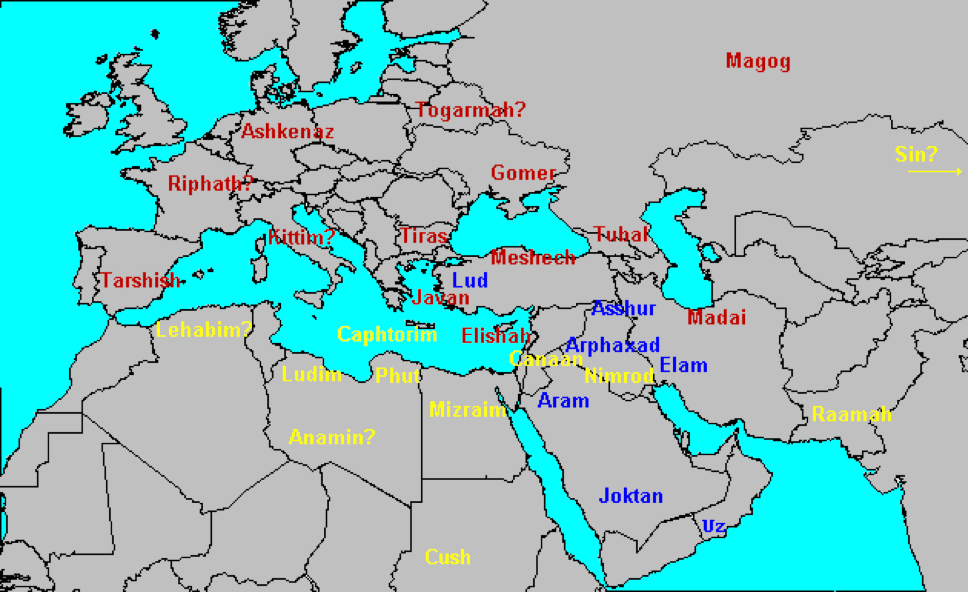
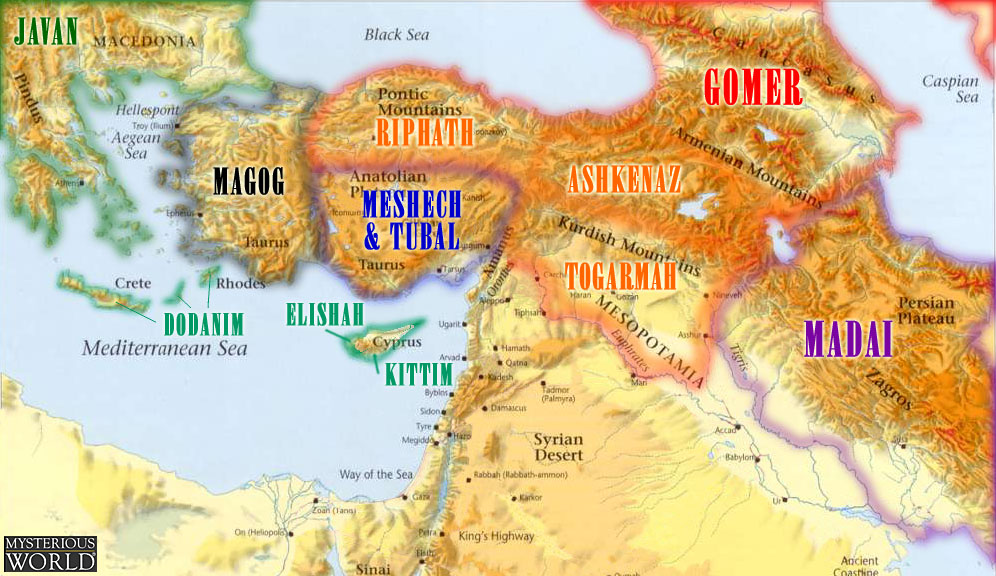
Who Gomer is not… the map above is an example of a common representation for the biblical identities listed in Ezekiel chapter thirty-eight. All without exception are incorrect, as our progression through the descendants of Japheth, Ham and Shem will reveal. Put, Cush and Magog are cold; Persia warm, yet still cool; and Gomer, Togarmah, Meshech and Tubal freezing.

Confusion has arisen as ‘Gomer’ is superficially linked to the Gimarri or Cimmerians and later, with the Gauls. The Cimmerians were warlike and spread to the extremities of southwestern Europe, before migrating to the British Isles. They just were not the Gomerites descended from Japheth.

Possibly the first author to identify Gomer, the Cimmerians and Cimbri with the Welsh name for themselves Cymri or Cymry, was the English antiquarian William Camden in his work: Britannia, published in 1586. In his 1716 book Drych y Prif Oesoedd, Welsh antiquary Theophilus Evans, posited correctly that the Welsh were descended from the Cimmerians and incorrectly, from Gomer.

An identity is offered and whether correct or incorrect, it is upheld. Scholars and researchers assume the question is answered. A certain academic laziness ensues and 439 years later, an original error deleteriously affects the mosaic of the overall identity jig-saw puzzle.

Celtic linguists follow the etymology proposed by Johann Kaspar Zeuss in 1853, which derives Cymry from the Brythonic word Combrogos, meaning ‘fellow countryman.’ The name Gomer – as in the pen-name of 19th century editor and author Joseph Harris – and its modern Welsh derivatives such as Gomeraeg – as an alternative name for the Welsh language – became popular for a time in Wales, but the Gomerian theory has long since been discredited as an outdated hypothesis with no historical or linguistic validity.

In rabbinic literature the kingdom of Ashkenaz was associated with the Scythian region, then later with the Slavic territories and from the Eleventh century, with Germany and northern Europe. Medieval Jews associated the term with the geographical area of the Rhineland and the Palatinate of Western Germany. The Jewish culture which developed in the area came to be called Ashkenazi. How the name of Ashkenaz came to be associated in the rabbinic literature with the Rhineland is a subject of speculation.

Associating a name from a grandson of Japheth with descendants from Shem has certainly muddied the waters. Ironically, we will learn later that the name Ashkenaz actually does have an association with the Jewish people – just not the one derived from Gomer – refer Chapter XXIX Esau: The Thirteenth Tribe.

The Origin of the Nations, Herman Hoeh, 1957 – capitalisation his, emphasis mine:

‘Look in your Bible for a map – if you have one in your Bible. There you will probably have pictured the descendants of Gomer migrating into Europe! Nothing could be further from the truth. They migrated in exactly the opposite direction! But do you know why many have assumed that Gomer may be in modern Europe today? Because the people of Northwest Europe journeyed through the land of Gomer before coming to Europe and were therefore called Kymmri! Prophecy says this very fact would occur!

Notice what Israel is called while in captivity: “Gomer” (Hosea 1:3). The woman “Gomer” mentioned by the prophet had the same name which the children of Israel bore when coming into Europe! The Israelites were called Khumri or Cymmri, or Khmeri, or Cimmerians upon reaching northwest Europe. But where are the descendants of Gomer today?’

This is conjecture on Hoeh’s part, for there is a better case for the word Khumri deriving from a king of Israel, called Omri – refer Chapter XXX Judah & Benjamin – the Regal Tribes.

Hoeh: ‘Gomer originally settled northeast of Elam. From here they were driven to the Caucasus, between the Black and the Caspian Sea. Then they journeyed to Southeast Asia! Notice! The native name for Cambodia in Indo-China is Khmer – the land of Gomer! Read the BRITANNICA article on Cambodia. Associated with Gomer are the Chams and Annamese. Could this be only a coincidence? The Cambodians are related to the Siamese, [and] Burmese… In the ancient land of Gomer dwelled a small tribe called the Lullu (ENCYCLOPAEDIA BIBLICA). In extreme South China today dwell the Lulu, a non-Chinese race related to the people of Southeast Asia!’

Korea in Prophecy, Bob Thiel, 2009 – emphasis mine:

‘An account penned in the nineteenth century…

“According to the Tartars and Orientals, the Chinese [specifically, South East Asians] are descended from Tchin, or Gin, the son of Japheth, and brother of Tarag [Togarmah]… Tchin is the Ashchenaz of Scripture, the son of Gomer… The Orientals call all grandsons, sons. Another division of the descendants of Aschenaz or Atchinez – as his name was pronounced in the following parts – migrated across the Imaus mountains, now the great Altai and Changai. These people spread to a vast extent, till they reached the Pacific Ocean. They formed the following nations:-

First – The Issedones, about the river Etchine, on the borders of China and the Desert of Thamo.

Second – The “Kin Tartars”, inhabiting the territory round the north of Corea, and along the shores of the Pacific Ocean…

[Third -] Tonkin, Cochin-China, Tciampa, Laos or Schan States, and Cambodia, anciently formed part of the Chinese Empire, the name of which was Tchin, so called from Atchinez, from which the names of nearly all these countries are derived.”

(Source: Painter, John Thomas. Ethnology: or The History & Genealogy of the Human Race. Baillière, Tindall & Cox, 1880 Original from Oxford University Digitized July 3, 2006, page 106).’

Online Encyclopaedia:

‘Cochinchina or Cochin-China is a historical exonym for part of Vietnam, depending on the contexts, usually for Southern Vietnam. Sometimes it referred to the whole of Vietnam, but it was commonly used to refer to the region south of the Gianh River. In the 17th and 18th centuries, Vietnam was divided between the Trịnh lords to the north and the Nguyễn lords to the south. The two domains bordered each other on the Son River. The northern section was called Tonkin by Europeans, and the southern part, Đàng Trong, was called Cochinchina by most Europeans and Quinam by the Dutch.’

The two eldest sons of Gomer, Ashkenaz and Riphath, migrated to mainland South East Asia and settled in what was historically called, Indochina. The name Indochina, was given to Laos, Cambodia and Vietnam, due to their being culturally and socially influenced by the Indian (Indo) and Chinese (China) cultures.

The region comprises the nations of Myanmar (formerly Burma and the Burmese), Thailand (formerly Siam and the Siamese), Vietnam, Laos and Cambodia.

We will look at the island nations of South East Asia separately as they identify with a different son from Japheth – Chapter VII Javan: Archipelago South East Asia & Polynesia.

The meaning of Gomer in Hebrew is: ‘completion, complete’ or ‘perfect.’ From the verb meaning, ‘to complete, bring to an end’ or ‘come to an end.’

We read of Gomer in the Book of Jubilees 9:8-9. 

‘And the first portion came forth for Gomer to the east from the north side to the river Tina; and in the north there came forth for Magog all the inner portions of the north until it reaches to the sea of Me’at.’

Gomer is described as being adjacent and southwards of Magog, when Japheth’s descendants formed their original settlement in south eastern Europe and western Asia some time after the flood cataclysm – Chapter I Noah Antecessor Nulla

Riphath is not mentioned outside Genesis Ten and 1 Chronicles One, though seems to be synonymous with Gomer. The meaning of his name is not straight forward. It can include: ‘fruit, grain, healers’ and possibly ‘crushers.’ The noun is ripa, some sort of beaten and dried grain or fruit. The verb is rapa, ‘to heal.’

Abarim Publications – emphasis mine: 

‘… since we don’t know how to translate the word [Riphath] we also don’t know what to do with the name… To add to the confusion, in 1 Chronicles 1:6 this descendant of Gomer is called Diphath – the letters d and r look much alike. Maybe this discrepancy is due to a scribal error, and maybe the man simply had two names.

Jones’ Dictionary of Old Testament Proper Names refers to a root that doesn’t exist. Jones erroneously points at Job 26:11, where the verb (rapap), meaning to shake or tremble is used. And so Jones reads Crusher… NOBSE Study Bible Name List and BDB Theological Dictionary don’t even try to translate this name. Whatever Riphath may have been supposed to mean, the intent is lost for good. But to a Hebrew audience, the name Riphath may have sounded like Healers.’

Ashkenaz and Riphath are not obvious in their identification, though their names provide possible clues. Thailand is at the forefront for herbal remedies as well as cosmetic surgery; as Riphath possibly alludes to heal. 

Gomer’s eldest son, Ashkenaz’s name is from the noun esh, meaning: ‘fire’, ke: ‘like’ or ‘as’ and the verb naza, ‘to sprinkle.’ In Hebrew it means: ‘sprinkles like fire’ or ‘so fire is scattered’, with a connotation of a fire offering or a ritualistic sprinkling of blood or water and immediately reminds of the Vietnam war and the destructiveness of napalm.

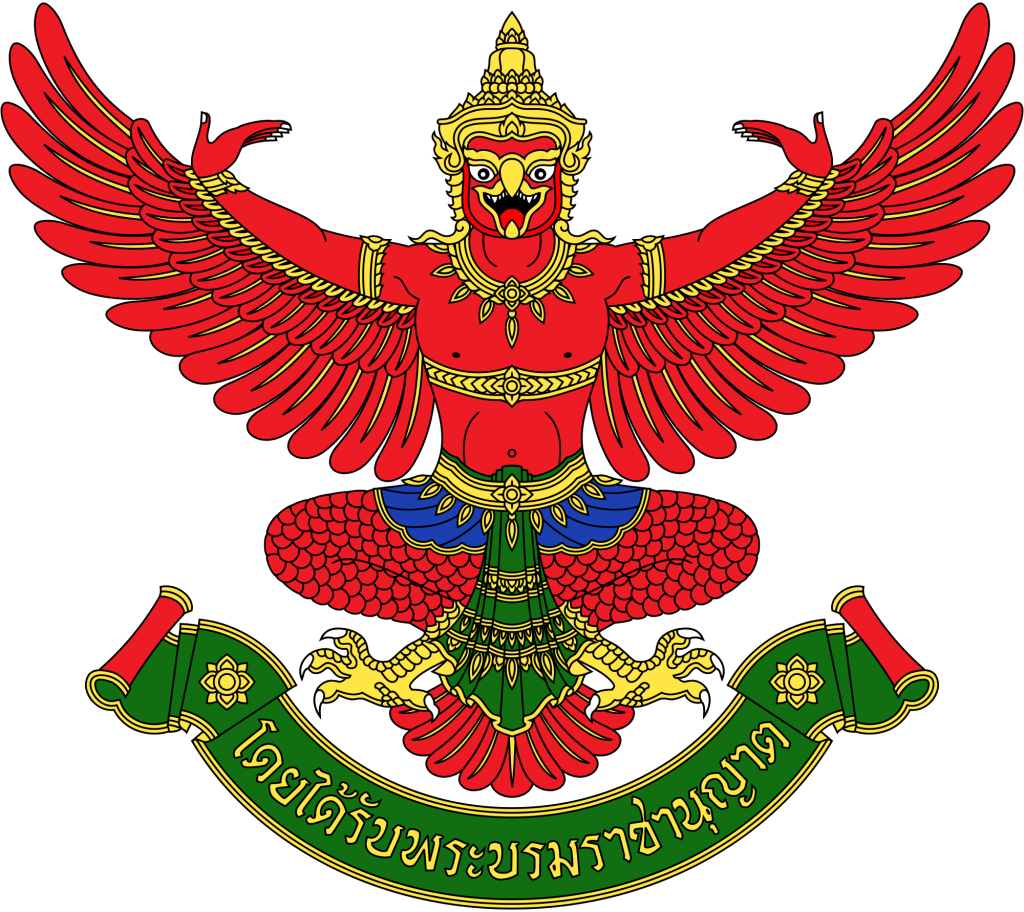
Flag of Thailand

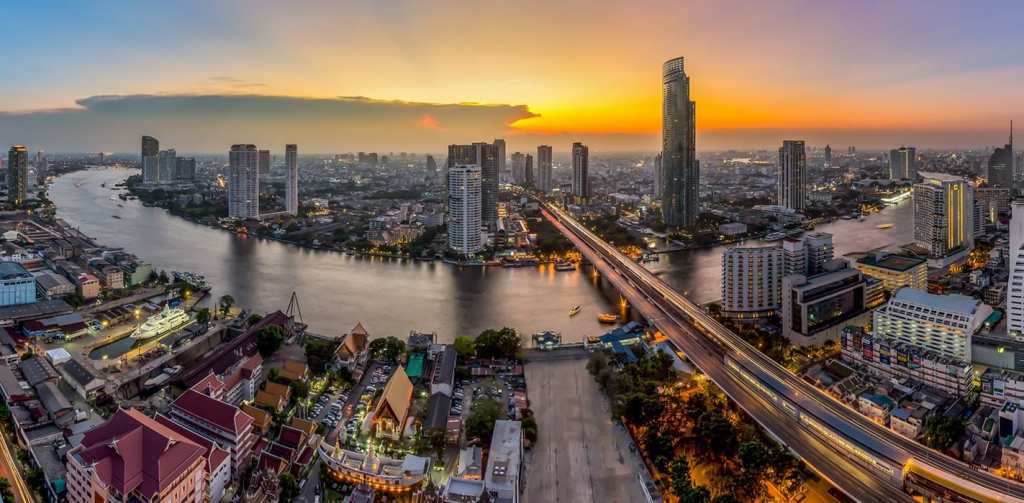
The leading economy of the the five nations is Thailand, with the second highest population after Vietnam, and the second biggest area after Myanmar. Thailand is the 22nd largest economy in the world – 5th in East Asia – with a GDP of $543.55 billion in 2019. The Thai economy possesses relatively high quality infrastructure as well as pro-free enterprise and pro-investment policies. Thailand is very dependent on exports; accounting for about two-thirds of its GDP. Thailand has a substantial international tourism industry. While its agricultural sector only makes up about 10% of its economy, it employs nearly a full 30% of its workers.

‘The following export product groups represent the highest dollar value in Thai global shipments during 2020.

  1. Machinery including computers: US$37.7 billion
  2. Electrical machinery, equipment: $34.1 billion
  3. Vehicles: $24.1 billion
  4. Gems, precious metals: $18 billion
  5. Rubber, rubber articles: $15.5 billion
  6. Plastics, plastic articles: $11.9 billion
  7. Meat/seafood preparations: $6.6 billion
  8. Mineral fuels including oil: $6.1 billion
  9. Optical, technical, medical apparatus: $4.7 billion
  10. Fruits, nuts: $4.2 billion

Gems and precious metals was the fastest-growing among the top 10 export categories, up by 14.9% since 2019 propelled by higher international sales of gold. The leading decliner among Thailand’s top 10 export categories was mineral fuels including oil which fell -27.8% year over year.’

Thai Woman

In the Bible, Gomer is mentioned just once, aside from the genealogical lists; in a yet future, intimidating military alliance with several other nations – refer article: Four Kings & One Queen.

In Ezekiel 38:2-6, ESV we read:

2 “Son of man, set your face toward Gog, of the land of Magog, the chief prince of Meshech and Tubal, and prophesy against him 3 and say, Thus says the Lord God: Behold, I am against you, O Gog, chief prince of Meshech and Tubal. 

4 And I will turn you about and put hooks into your jaws, and I will bring you out, and all your army, horses and horsemen, all of them clothed in full armor, a great host, all of them with buckler and shield, wielding swords. 

5 Persia, Cush, and Put are with them, all of them with shield and helmet;

Gomer and all his hordes;

Beth-togarmah from the uttermost parts of the north with all his hordes – many peoples are with you.”

Notice Togarmah is differentiated from Gomer, as his descendants migrated to a distant land. Gomer is able to field a large army in this already massive military operation.

Countries comprising Continental SE Asia

CountryPopulation (2025)
Vietnam101,406,482
Thailand71,634,837
Myanmar54,741,345
Cambodia17,293,532
Laos7,865,838

With a combined population of just over 250 million people, we can understand how this would be feasible. If we return briefly to Gomer and his first two sons names meanings, it is a rather frightening prospect when they are pieced together:

Bring to an end, Crushers, fire is scattered and sprinkling of blood.

Ashkenaz is highlighted in a single verse in Jeremiah 51:27, NET:

“Raise up battle flags throughout the lands. Sound the trumpets calling the nations to do battle. Prepare the nations to do battle against Babylonia. Call for these kingdoms to attack her: Ararat, Minni, and Ashkenaz. Appoint a commander to lead the attack. Send horses against her like a swarm of locusts” – Revelation 9:3-11.

Footnote:

‘Ararat, Minni, and Ashkenaz were three kingdoms located in the Lake Van-Lake Urmia region that are now parts of eastern Turkey and northwestern Iran. These kingdoms were conquered and made vassal states by the Medes [Chapter IV Central Asia – Madai & the Medes] in the early sixth century.’

The regions of Ararat and Minni are described as kingdoms, placed on a similar footing with Ashkenaz. Actually, they are even listed before Ashkenaz. Thus they are not regions within another territory. The fact that the Bible states them, shows they are an identifiable family subdivision of Gomer as his additional sons, or perhaps the link to his eldest son Ashkenaz, means they are Gomer’s grandsons. As we read from A H Sayce, we know this was where these peoples were once located in modern Armenia, though they are not there now. If Ashkenaz and Riphath’s children are located in former Indo-China; how do these other two peoples relate to them?

It is not integral in understanding Gomer’s future role, where Ashkenaz and Riphath are specifically located, though it is invaluable for those people investigating who may be represented by them today. With the introduction of Ararat and Minni, coupled with Diphath, the enigmatic double of Riphath, the mystery widens.

We have five Biblical identities associated with Gomer’s sons Ashkenaz and Riphath and we have unsurprisingly, five modern nations in continental Southeast Asia.

Previously, we addressed the original mountains of Ararat as representing the Himalayas, with the mountain ranges in Anatolia – modern Turkey – becoming a later identification – refer Chapter I Noah Antecessor Nulla. If the people of Ararat and Minni were once associated with this area in the past, then might they be near the Himalayas or in a mountainous region today?

The most mountainous nation in Southeast Asia is coincidentally, Myanmar – followed by Indonesia. The Hkakabo Razi is believed to be Myanmar’s highest mountain. The 19,295 foot tall mountain is also the highest mountain in Southeast Asia and is located in the northern Myanmar state of Kachin, in an outlying subrange of the Greater Himalayan mountain system adjacent to the tri-point border with India and China. 

Abarim Publications – emphasis mine:

‘Ararat is the name of a mountain range, which is famous for being the site of the first ship wreck in history: the stranding of the Ark of Noah (Genesis 8:4). Nowadays nobody knows for sure where the Ararat might be… according to Jones’ Dictionary of Old Testament Proper Names the name Ararat comes from (1) the common Hebrew word (har) hill, mountain. And (2) the Hebrew verb (yarad) to go down, descend, march down. Jones’ Dictionary of Old Testament Proper Names reads Mountain Of Descent, which is a wonderful interpretation if it didn’t ignore the final teth.

The following cluster of words seems more appropriate: (‘arar), to curse; (retet),trembling, panic, and (rata), wring out (Job 16:11), a word that, according to BDB Theological Dictionary may have to do with (yarat), precipitate, or be headlong, contrary (Numbers 22:32, “… because your way is contrary to me”. BDB Theological Dictionary suggest an alternative reading, “… thou hast precipitated the journey in front of me”.)

As is the case with many names from the earliest chapters of Genesis, it’s impossible to retrieve the intended meaning of the name Ararat. We can’t even be sure in which language this name originated. But the way this name was later spelled, it seems to stylise the Noah story: A curse and a trembling; then a mountain and a future in a flash laid out.’

The definition of Ararat is insightful with its accurate description of Noah’s family trekking down a mountain of magnitude, to populate the Indus Valley after the Flood. 

Minni in Hebrew means: ‘my portion, partly’. A subtle link with ‘my portion’ to Madai’s ‘middle land’ and Japheth’s ‘enlarged.’ From the preposition min, ‘from’, or the verb mana, ‘to count or reckon.’ The name Minni appears to have also originated from a language other than Hebrew.

In 1 Chronicles, Riphath is called Diphath. This is puzzling, as this writer does not believe it is an accident of a scribes quill. We learnt there was no clear definition for Riphath. Diphath seems a reflection for the same name. As there appears to be three components to Ashkenaz, there seems to be a similar aspect of two parts for Riphath. 

Book of Jasher 10:8-9

8 ‘And the children of Gomer, according to their cities, were… by the river Franza, by the river Senah. 9 And the children of Rephath are the Bartonim, who dwell in the land of Bartonia by the river Ledah, which empties its waters in the great sea Gihon, that is, oceanus.’

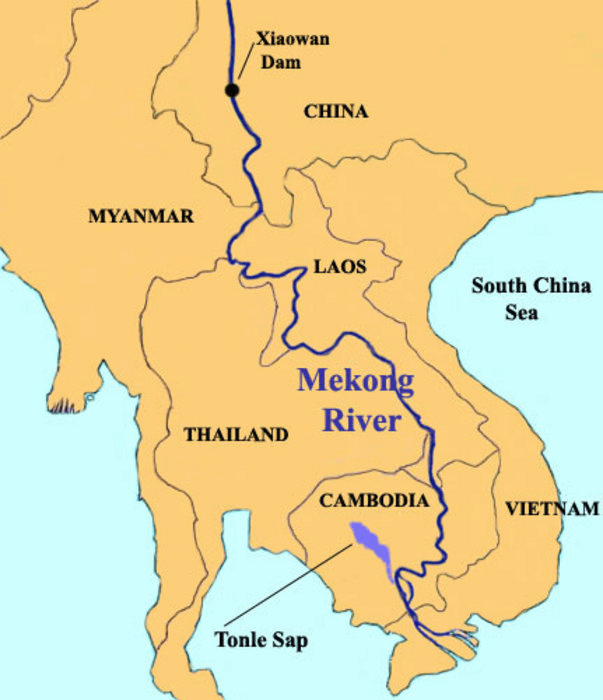
In like manner, the River Mekong is 2,703 miles long; the worlds 12th longest river and 7th longest in Asia. It serves all five nations and strategically opens out to the South China Sea via Vietnam.

Online comment:

‘Interestingly, linguistic-wise, Cambodia and Vietnam share… the same language family. Integration of Cambodia into [the Vietnamese] cultural and political [spheres] also took place regularly in [an] historical context[;] [with the] conquest and cultural conversion often [instigated] by the Vietnamese empire of the past[,] against the remnant of the old Khmer empire.’

Flag of Vietnam

Online comment – emphasis mine:

‘I’m often asked how similar Burmese is to the national languages of its Southeast Asian [neighbours], namely Thai, Lao and Khmer. And I’ve got to say: Burmese is quite different from the other three, whether it’s phonology, grammar, vocabulary, or writing.

In my perspective, one can divide Southeast Asia into two distinct sub-regions: continental Southeast Asia (Burma, Laos, Thailand, Cambodia and Vietnam) and insular Southeast Asia (Malaysia, Indonesia, Brunei, Singapore [refer Chapter VII Javan: Archipelago South East Asia & Polynesia]).

The national languages of Southeast Asia can similarly be divided along those same lines. It’s worth noting that all languages fall into a number of language families, which groups together languages that share a common ancestor, the proto-language of that family.

According to this conceptualization, Burmese is a clear outlier, as it is the only national language that’s part of the Sino-Tibetan language family, among the ranks of Chinese varieties and Tibetan. Thai and Lao are members of the Tai-Kadai language family. In fact, the two are quite similar, such that Thai and Lao are seen as languages in a Tai language ‘dialect continuum’ spanning from Thailand to southwest China. On the other hand, Khmer is part of the Mon-Khmer language family, linguistically related with neighboring Vietnamese.’

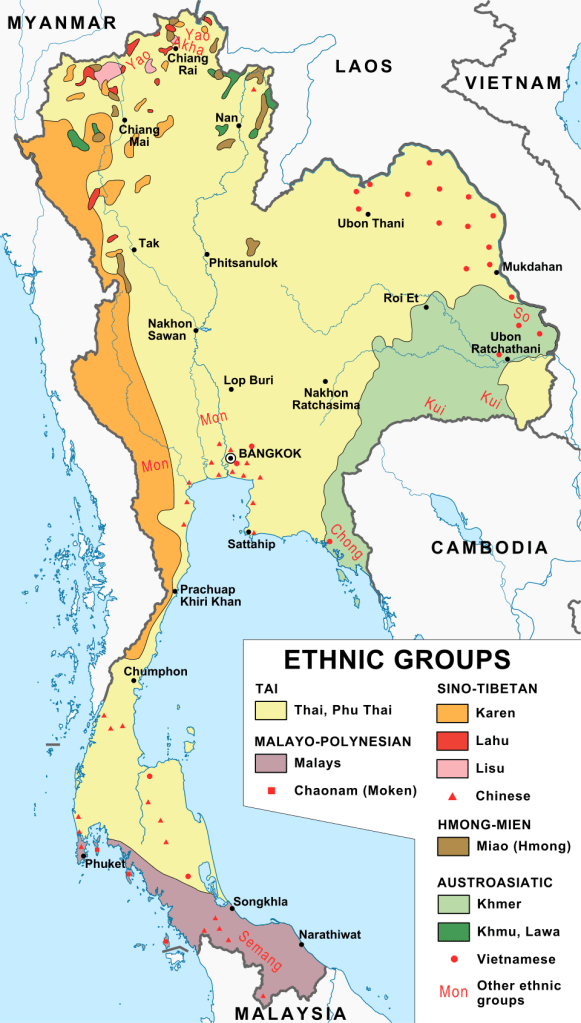
The principal lowland inhabitants of Laos are the Lao, who politically and culturally are the dominant group. They comprise the bulk of the Lao Loum; approximately 60% of the total population. The Lao are considered a branch of the Tai people, who began migrating southward from China in the first millennium CE. 

Thai Man

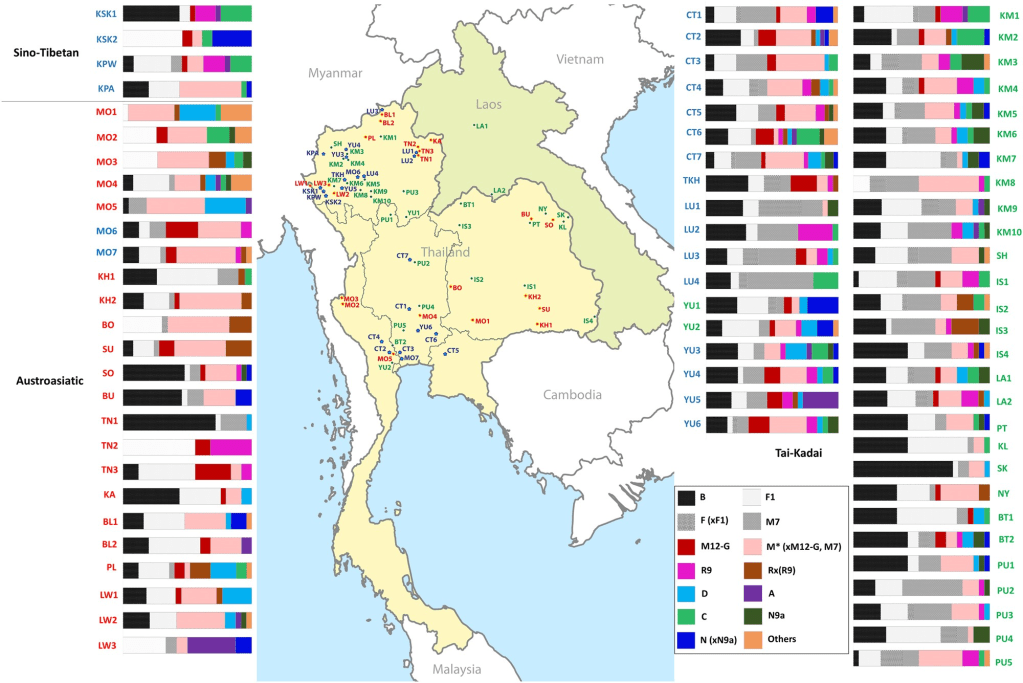
Thais tend to have high frequencies of Y-DNA Haplogroup O-M95 including its O-M88, O1b sub-clade, which also has been found with high frequency among both the Cham of Vietnam, the Kuy people in Laos and Cambodia, as well as the Jarai of Cambodia.

The genetic testing website 23andme groups Khmer people under the ‘Indonesian, Khmer, Thai and Myanmar’ reference population. This reference population contains people who have had recent ancestors from Cambodia, Laos, Myanmar, Thailand, Malaysia and Indonesia. Notice Vietnam is excluded, plus the similarity with Malaysia and Indonesia is possibly due to overspill from the migration of people of Ashkenaz, Riphath and the others to these two, non-Gomer descended nations.

Kim Wook in 2000, stated that genetically, Vietnamese people are mostly clustered with East Asians, of which his study analyzed DNA samples from Chinese, Japanese, Koreans and Mongolians, rather than with Southeast Asians. The same study analysed DNA samples of Indonesians, Filipinos and Thais included with the Vietnamese. The study observed that Vietnamese people were the only population in the study’s phylogenetic analysis that did not reflect a sizeable genetic difference between East Asian and Southeast Asian populations. In other words, they intriguingly bridge the genetic gap between these two regions.

Jung Jongsun in 2010, said that genetic structure analysis found significant admixture in ‘Vietnamese with unknown Southern original settlers’ and that Vietnamese people are located between Chinese and Cambodian people in the study’s genome map. 

We will return to the anomaly of the Vietnamese being distinct from their four related neighbours, whilst possessing a strong link with northeastern Asia – refer Chapter VI Togarmah & the Koreas.

Vietnamese woman

Complete human mtDNA genome sequences from Vietnam and the phylogeography of Mainland Southeast Asia, multiple authors, 2018 – emphasis & bold mine:

‘Vietnam is an important crossroads within Mainland Southeast Asia (MSEA) and a gateway to Island Southeast Asia… However, comparatively few studies have been undertaken of the genetic diversity of Vietnamese populations. We sequenced the entire mtDNA genome from 609 unrelated Vietnamese individuals… 399 distinct sequences (haplotypes) belonging to 135 haplogroups were identified, all belonging to the two macro-haplogroups M and N

Overall, F1 is the predominant haplogroup (19.38%) followed by B4 (17.41%), M7 (9.36%), B5 (7.22%), and M71 (6.08%); these haplogroups are also common in other MSEA populations…**

To identify Vietnamese-specific lineages (clades or branches consisting of sequences only from Vietnam), we constructed phylogenetic trees relating 2742 entire mtDNA genome sequences (including 609 newly sequenced mitogenomes from the present study and 2133 previously reported sequences from MSEA). Several previously undescribed sub-branches of haplogroups A, B, C, D, F, M and N were identified… In total, 111 novel lineages unique to Vietnam were found in the dataset. The majority of these belong to haplogroups B, F and M (25, 26 and 29, respectively); these are major haplogroups of MSEA, accounting for 76.35% of the sequences.**

Haplogroup A occurs mostly in northern and eastern Asia at frequencies from 5 to 10%, and is one of five founder haplogroups among native Americans. Overall, haplogroup A is most widespread in AA groups from Vietnam and Thailand… Within MSEA, haplogroup A is at highest frequency in northern Vietnam and northwestern Thailand.

Haplogroup B is one of the most common haplogroups in northern and eastern Asia, with three major subhaplogroups B4, B5 and B6. With the 164 Vietnamese mtDNA sequences belonging to haplogroup B, several new sub-clusters within B4, B5, and B6a are identified… B4 is the second most frequent haplogroup in Vietnam and is widespread across MSEA, especially northern Vietnam, northern Thailand, and Taiwan. However, B4 subhaplogroups that are relatively frequent in Taiwan… are absent in the Vietnamese AN groups… while haplogroup B4 has the highest frequency in northern Vietnam and Taiwan, there is very little overlap of B4 subhaplogroups between Vietnam and Taiwan… Overall, there is remarkably little sharing of sequences between groups from different language families or countries… haplogroup B5 reaches the highest frequency in northeastern Thailand. Haplogroup B6a is distributed mostly in northern Thailand.

Haplogroup C is widespread across East Asia and is one of the five founder haplogroups among native American populations… Haplogroup C5 is represented by a single haplotype belonging to subhaplogroup C5d*… and is present only in Vietnamese HM groups, while C4 is distributed in Vietnamese, Thai, and S. Chinese groups…

Haplogroup F is one of the most common haplogroups throughout Asia Haplogroup F1a is at high frequency in northern Vietnam and northeastern Thailand…

Haplogroup G is one of the most common mtDNA haplogroups among Japanese, Ainu, Mongol and Tibetan populations, and is also found at a lower frequency across East Asia, Central Asia and MSEA…The G2a1* sequence is from a TK group… Among MSEA populations, haplogroup G reaches the highest frequency in northern Vietnam

M is a macro-haplogroup found at high frequency all across Asia (including MSEA)… Haplogroup M7 reaches the highest frequency in eastern Thailand and northern Taiwan…

Haplogroup M71 is found in Thailand, Cambodia, Laos, Myanmar and Vietnam… haplogroup M71 has the highest frequency in central Vietnam…

N9a, one of three major sub-clades of haplogroup N, is found in East Asia, Southeast Asia and Central Asia… Haplogroup N9a reaches the highest frequency in southern peninsular Malaysia…’

The mtDNA macro-haplogroup M, is indicative of all oriental Asians. What is significant, is that M71 bonds the five continental southeast Asian nations, revealing a common maternal ancestry and a shared status as brothers.

Large-scale mitochondrial DNA analysis in Southeast Asia reveals evolutionary effects of cultural isolation in the multi-ethnic population of Myanmar, multiple authors, 2014 – emphasis mine: 

‘… we sequenced the mtDNA control region of 327 unrelated donors and the complete mitochondrial genome of 44 selected individuals… 

Population genetic analyses of Burmese control region sequences combined with population data from neighboring countries revealed that the Myanmar haplogroup distribution showed a typical Southeast Asian pattern, but also Northeast Asian and Indian influences. Analyzing mtDNA data from Myanmar is of great genetic interest, because in spite of accumulating knowledge in recent years the resolution of the mitochondrial haplogroup phylogeny in SEA, especially in macrohaplogroup M, is still very low compared to West-Eurasian haplogroups… 

Myanmar is subdivided into more than 100 ethnic groups amongst them the Bamar represent 68% of the population. Other important minorities are Shan (10%), Karen (7%), Arakanese (4%), Chinese (3%) and the ethno-linguistically related Mon and Khmer (2% each).

F1a1a** with 15.9% of all sequences was by far the most frequent haplogroup in this study, followed by C4b1 (7.0%), B6 (6.4%) and A4 (5.2%). R9b1a1a, D4 and G2b1a reached 4.6% each. The 78 individuals actually belonging to M split into 50 different haplogroups, 29 of them with only a single representative. The most common haplogroup in M was M21a (1.8%)… 

The Myanmar sample was typical for Southeast Asian populations with a high percentage of R9’F and B lineages as well as a variety of M haplogroups. The minor contribution of N lineages (without A, B and R9’F) to the gene pool also turned out to be characteristic for Southeast Asia. Noticeable was a relatively high percentage of A and C lineages in Myanmar compared to the neighboring countries…

A distinct geographic pattern appeared in the multi-dimensional scaling plot of pairwise Fst-values: The Myanmar sample fitted very well within the Southeast Asian cluster, the Central Asian populations formed a second cluster, the Korean sample represented East Asia, the Afghanistan population was representative for South Asia and Russia symbolized Western Eurasia. The main haplogroup distributions are displayed as pie charts. The size of the pie diagrams corresponds to sample size.

The proportion of N-lineages (without A,B and R9’F) increases from very low percentages in Southeast and East Asia over 50% in Central Asia to more than 75% in Afghanistan and 100% in the sample of Russian origin. The proportion of the American founding haplogroups A, B, C and D displayed an interesting pattern: from nonexistent in Russians it increased to more than 50% in East Asian Korea.

The mitochondrial haplogroup distribution in Myanmar showed a typical Southeast Asian pattern, confirming earlier findings but also adding new information: the population sample of Myanmar displayed quite a few parallels to North and Northeast Asian and also to South Asian populations. No traces of European or African influence to the maternal gene pool of Myanmar were detected. The description and dating of eight new mitochondrial haplogroups and the detection of three further basal M lineages shed more light on the population history of Southeast Asia.’

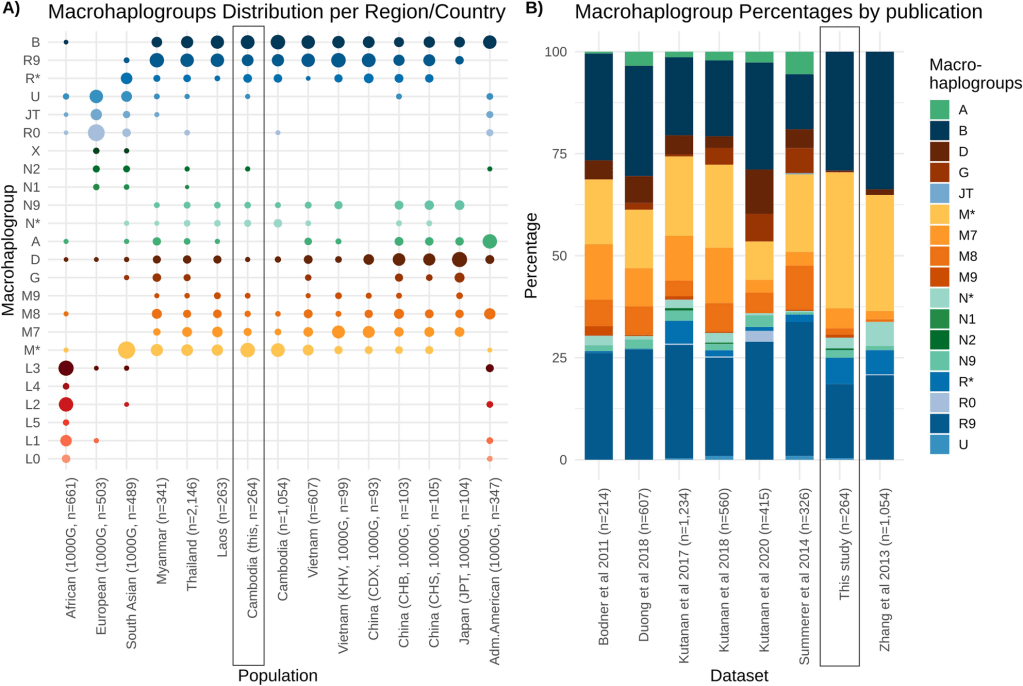
An in-depth analysis of the mitochondrial phylogenetic landscape of Cambodia, multiple authors, 2021 – emphasis & bold mine:

‘A total of 224 unique haplotypes were identified, which were mostly classified under haplogroups B5a1, F1a1, or categorized as newly defined basal haplogroups or basal sub-branches of R, N and M clades. The mtDNA data presented here increases the phylogenetic resolution in Cambodia significantly, thereby highlighting the need for an update of the current human mtDNA phylogeny. As a result of the historic expansion of the Khmer Empire in the twelfth century, the majority (96%) of Cambodia’s present-day population belongs to Khmer

Haplogroup distribution in different populations/data sets.

(A) Frequency plot of macrohaplogroups in different populations, including 1000 Genome Project data. The super populations are given for African ancestry, European ancestry, South Asian ancestry and admixed American ancestry.

East Asia is reported individually as Vietnam (KHV = Kinh in Ho Chi Minh City, Vietnam), China (CDX = Chinese Dai in Xishuangbanna, CHB = Han Chinese in Beijing, CHS = Southern Han Chinese) and Japan (JPT = Japanese in Tokyo). 

(B) Haplogroup distribution by publication… Bodner (Laos), Duong (mostly Vietnam), Kutanan (mostly Thailand), Summerer (Myanmar), Zhang (Cambodia).

“This study” indicates the present work’s data set. Macrohaplogroups represent M (yellow), N (green) and R (blue) groups.’

An article, Mitochondrial DNA control region variation in a population sample from Thailand, multiple authors, 2020, found that, ‘the [mtDNA] haplogroup composition [for Thailand] is comparable with other Southeast Asia population samples…’

The most frequent Haplogroups being B5a (9.4%), F1a1a (8.9%) and M (8.9%).**

Haplogroup B is a common mtDNA denominator thus far on our journey; as descendants of Tiras, Madai and now Gomer all exhibit the evidence of a shared maternal ancestor through this Haplogroup.

While the Amerindian includes other Haplogroups as do the Central Asians and the South East Asians – with F and M also prevalent amongst Central Asians – it is Haplogroup B which unifies these three sons maternal descent.

Haplogroup B is an intermediate to recent mutation like F and derives from super sub-Haplogroup R. Whereas the remaining mtDNA Haplogroups associated with Japheth’s descendants derive from earlier and older mutations from firstly super Haplogroup M, such as C, Z and D. And secondly for super Haplogroup N, they include Haplogroups A and X.

Vietnamese man

It depends how one chooses to group these five peoples, whether linguistically, historically, geographically or biblically. The Vietnamese are somewhat separated from the others genetically. Linguistically and historically, they are grouped with Cambodia, while Laos is linked with Thailand linguistically and historically. Myanmar is separated from the others linguistically. Thailand has a thriving economy which sets them apart. Historically, Myanmar and Thailand share a common heritage, as both were British colonies; whereas Vietnam, Cambodia and Laos were French colonies. 

Biblically, Riphath and Diphath are not specifically mentioned in scripture, whereas Ashkenaz is, with Ararat and Minni. From this, one could logically expect the latter three to equate to the three larger nations and the former two to the two smaller nations. Thus, Riphath and Diphath are Cambodia and Laos. Ararat, Minni and Ashkenaz are in order, Myanmar, Thailand and Vietnam. Myanmar the mountainous nation; Thailand located in the middle, with a significant portion of blessings; and Vietnam the nation with a history of fire and blood warfare.

The final determining factor is their genetic variance or similarity from their respective Y-DNA Haplogroups. All five nations share O-M122, or O2 (formerly O3) as their predominant Haplogroup. The principle O2 lineage in mainland southeast Asia is M7 (O2a2a1a2).

In lesser quantities, O1a or M119 (formerly O1) and O1b (formerly O2) are found with the other indicative Asian paternal Haplogroups constituting C and D. Recall, Haplogroup C2 is the defining marker Haplogroup for Central Asia. The primary O1b lineage in continental southeast Asia is M95 (O1b1a1a).

Both Cambodia and Laos have a strikingly similar sequence percentage consisting of: O2, O1a, O1b, C, D and K. Each also have traces of Haplogroups associated with South Asia or West Asia, such as J2, H and R1a all through admixture. Thailand exhibits a similar sequence and is the closet to Cambodia and Laos. Myanmar has a higher percentage of Haplogroup D than any of the others; whilst Vietnam has Haplogroup Q, which is the principle Haplogroup for the Amerindian – Chapter III Tiras the Amerindian.

Myanmar:  O2 – D – O1b – O1a – C

Thailand:   O2 – [O1b] – O1a – C – D 

Vietnam:    O2 – O1b – Q – O1a – C – D – N – J2

The distinctiveness of the other three nations suggests they are not offspring of Ashkenaz or derived from the Vietnamese but lean heavily towards being the direct lineage of Gomer. This would support their separate listed status in the Book of Jeremiah. The three peoples combined were obviously powerful enough to cause a threat and this is supported by Myanmar, Thailand and Vietnam having sizeable populations today, with the potential to capably wage a future military campaign. 

Thailand: O2a2 [35.3%] – O1b [?%] – O1a [8.8%] – C [2.9%] – D1 [2.9%] 

Vietnam: O2a2 [40%] – O1b [32.9%] – Q [7.1%] – O1a [5.7%] – C [4.3%]

– D1 [2.9%] – N [2.9%] – J2 [2.9%]

Vietnam’s paternal Haplogroups listed above – and the percentages for each – plus partially for Thailand. 

                                  C        O       K       D       Q

NA Amerindian     6                                      77

Kazakhstan           40        8      10                  2

Vietnam                   4      79                  3        7

Comparing Vietnam, with a representative from the preceding chapters: Kazakhstan from Madai and the North American Indian from Tiras, highlights two points.

First, the clear marker Haplogroups for Japheth’s male descendants – aside from N – are represented by C, D, K, O and Q.

Two, even so, it can be seen already just how wide the variation is between related siblings.

Each of the three so far, Tiras, Madai and Gomer though having groups in common, each demonstrate the individuality each possesses in having a prime Haplogroup distinct from one another – Q, C and O respectively.

In contrast, we will discover in the next few chapters that the severity of the divide reduces considerably with Japheth’s remaining four sons. One could say, it is a case of some brothers being more like each other than others.

So far, all carry Y-DNA Haplogroup Q, which was passed through Japheth’s line via the earlier connecting mutations comprising F, K and P. Yet, it is the sons of Tiras who exhibit the relatively recent Q as their prime Haplogroup.

All carry Haplogroup C, again passed via Japheth’s descendants; but it is the most undiluted sons of Madai in Kazakhstan after Mongolia, where the ancient group C is dominant. Though the number one principle Haplogroup for Japheth’s sons overall is O, it is devoid in the sons of Tiras and rare in the sons of Madai. For the male descendants of Gomer, Haplogroup O2a2a (M188) followed by O1b (M268) are the prime defining marker Haplogroups.

All five nations on the Southeast Asian mainland, include the core Y-DNA Haplogroups: O2, O1b, C and D. The primary significance, is that these five nations ultimately comprise the collective body of Gomer’s two eldest sons Ashkenaz and Riphath, with the additional offspring from Diphath, Ararat and Minni.

In the next chapter, we will investigate Gomer’s intriguing third and youngest son, Togarmah.

These are the people I am pleased with: those who are not proud or stubborn and who fear my word.

Isaiah 66:2 New Century Version

“I would remind you to notice where the claim of consensus is invoked. Consensus is invoked only in situations where the science is not solid enough. Nobody says the consensus of scientists agrees that E=mc2. Nobody says the consensus is that the sun is 93 million miles away. It would never occur to anyone to speak that way.”

Michael Crichton

© Orion Gold 2020 – All rights reserved. Permission to copy, use or distribute, if acknowledgement of the original authorship is attributed to orion-gold.com

Japheth Orientalium

Chapter II

Japheth is the eldest son of Noah and we learn important aspects about him in Genesis 9:27, English Standard Version:

“May God enlarge [H6601 – pathah] Japheth, and let him dwell [H7931 – shakan] in the tents [H168 – ‘ohel] of Shem…”

Israel a History of – emphasis theirs: 

‘The word “enlarge” is an unusual translation of the Hebrew word Pathah. Pathah is not the word normally used for “enlarge”, and in this instance, “enlarge” does not signify a geographical enlargement. Rachab would be the word used to convey a geographical enlargement. Instead, Pathah typically is translated as “entice”, or “persuade”. It is derived from the Hebrew word Pathach, which means “to make open”. However, this verse is the only instance in the Bible where the form Pathah occurs, and it has been agreed upon by linguists and scholars to be translated as “enlarge.”

The Hebrew word Pathah means: ‘to entice, deceive, persuade or seduce.’ The wider application includes: ‘to be spacious, open, be wide.’ The King James Version principally translates the word as entice, ten times; deceive, eight times; and enlarge, only once.

The New English Translation:

May God enlarge Japheth’s territory and numbers! May he live in the tents of Shem…

Footnotes:

‘The words “territory and numbers” are supplied in the translation for clarity. There is a wordplay (paronomasia) on the name Japheth. The verb (yaft, “may he enlarge”) sounds like the name (yefet, “Japheth”). The name itself suggested the idea. The blessing for Japheth extends beyond the son to the descendants. Their numbers and their territories will be enlarged, so much so that they will share in Shem’s territories… it is not clear what it would mean for Japheth to live in Shem’s tents… there is no reason in this context to expect Japheth to be blessed at the expense of Shem and occupy his territory… it would make more sense for it to mean that Japheth would participate in the blessings of Shem, but that is not clear for this phrase.’

The root of Yepheth or Japheth is pathah, ‘to make wide.’ Thus the verse could read: ‘May God enlarge enlarged and let him dwell…’

Abarim Publications explain Japheth’s meaning in Hebrew as: ‘formless expansion, enlarged, magnified, may he expand.’ It derives from the verb pata, ‘to grow bigger…’ and ‘appears to describe the process of slowly but surely growing wider… Jones’ Dictionary of Old Testament Proper Names proposes Enlargement [and the] NOBSE Study Bible Name List reads Wide Spreading.’

The Hebrew word for dwell is shakan, meaning: ‘to settle down, abide, reside, establish’ – the idea of lodging. The KJV uses the word dwell the most: ninety-two times.

The word for tents is ‘ohel, translated as: tabernacles, 198 times; tents, 141 times; and dwelling, two times.

A selection of Bible translations state the verse as follows:

Amplified Bible: ‘May God enlarge [the land of] Japheth…’

Easy to read version: ‘May God give more land to Japheth…’

International Standard Version: ‘May God make room for Japheth…’

The Message: ‘God prosper Japheth, living spaciously in the tents of Shem.’

New Life Version: ‘May God make Japheth great…’

The Voice: ‘May God make plenty of room for Japheth’s family and give them homes among Shem’s tents.’

This writer’s preference for best describing the intent, is the Good News Translation:

“May God cause Japheth to increase! May his descendants live with the people of Shem!”

As pathah is used in a unique context in this verse, it is difficult not to ascribe a geographical aspect to its intention – as it is associated with the second part of the verse – in dwelling within Shem. It would seem that the word is conveying more than just an enlargement and hinting at the method of that growth, through some form of deception or stealth.

This verse references Japheth’s posterity enlarging in population and though not intimating geography specifically it is indirectly, as Japheth is to encroach on Shem’s descendant’s territories via immigration. Japheth is increasing in prosperity – giving them the opportunity to share the economic benefits afforded – by dwelling in the prosperous nations descended from Shem – refer Chapter X China: Magog, Tubal & Meshech.

Thus Genesis 9:27 is a remarkable prophecy, as it succinctly describes Japheth’s descendants accurately, in our very age. They are enlarging within the borders of Shem’s descendants at a phenomenal rate. So much so, that the demographic status of certain nations is changing rapidly before our very eyes. We will look at figures to support this trend when we study Shem and certain of his son’s descendants.

Noah’s eldest son Japheth, represents the vast array of peoples of eastern and oriental descent; the Asiatics of Central, Eastern and South East Asia; Polynesia; as well as the Indigenous Amerindians of the Americas.

A number of people interested in the biblical identity of nations have been led astray in accepting the T and O map identification for Noah’s sons Japheth, Ham and Shem. The first printed version of Isidore’s Etymologiae is shown below.

The map identifies Cham or Ham, partially correctly as the peoples of Africa; Sem or Shem, incorrectly as Asia; and Iafeth or Japheth again incorrectly, as Europe. ‘In the seventh century, archbishop Isidore of Seville wrote his noted encyclopaedic-historical work, in which he [traced] the origins of most of the nations of Europe back to Japheth. Scholars in almost every European nation continued to [incorrectly] repeat and develop Isidore of Seville’s assertion of descent from Noah through Japheth into the nineteenth century.’

The far reaching consequence of this inaccurate scholarship has for example, resulted in the confusion exhibited on the map below.

Where would one start? For the map is wrong on numerous levels.

Shem is blue, with the exception of South West Asia. While Iran is part of Shem (in the main), Pakistan is not and is Hamitic.

The brown in Africa is not from Shem and rather a mix of Canaan and Ham. The brown in the Middle East is Ham and not Shem, though the yellow is from Shem.

The red in Africa is not Hamitic, but rather Canaanite.

The red of the Americas is a mix of primarily Japheth (indigenous) and Shem from colonial migration.

While the red of Central Asia, East Asia and South East Asia is from Japheth; the red of South Asia represents Ham and the red of Australasia is mainly Japheth and partially Ham.

If one were to entertain that the map above was correct, can the reader appreciate the disparity in geographic areas. An anomaly which does not parallel the division of the planet after the deluge amongst Noah’s ostensibly three sons (actually four) and sixteen grandsons (really twenty-one) – Genesis 10:1-32.

The map above is a closer interpretation of the truth. Even so, Shem does not extend into the Middle East (above Africa); and Africa is partially descended from Ham and principally from Canaan – refer Chapter XI Ham Aequator; and Chapter XII Canaan & Africa.

The Book of Jubilees provides information on the early settlement – after the flood cataclysm – of Southern Europe, West Asia, the Middle East and North Africa.

Book of Jubilees chapter eight:

10 ‘And it came to pass… that they divided the earth into three parts, for Shem and Ham and Japheth, according to the inheritance of each…

11 And [Noah] called his sons, and they drew nigh to him, they and their children, and he divided the earth into the lots, which his three sons were to take in possession, and they reached forth their hands, and took the writing out of the bosom of Noah, their father…

25 And for Japheth came forth the third portion beyond the river Tina to the north of the outflow of its waters, and it extends north-easterly to the whole region of Gog, and to all the country east thereof. 26 And it extends northerly to the north, and it extends to the mountains of Qelt towards the north, and towards the sea of Ma’uk, and it goes forth to the east of Gadir [Iberia] as far as the region of the waters of the sea. 

27 And it extends until it approaches the west of Fara and it returns towards ‘Aferag, and it extends easterly to the waters of the sea of Me’at. 28 And it extends to the region of the river Tina in a north-easterly direction until it approaches the boundary of its waters towards the mountain Rafa, and it turns round towards the north.

29 This is the land which came forth for Japheth and his sons as the portion of his inheritance which he should possess for himself and his sons, for their generations forever [as in a very long time]; five great islands* [in the Mediterranean Sea], and a great land in the north [Central Asia].  

30 But it is cold, and the land of Ham is hot [North Africa and the land of Canaan], and the land of Shem [Mesopotamia and Arabia] is neither hot nor cold, but it is of blended cold and heat.’

The sons of Japheth and particularly those descended from his son Javan – Elishah, Tarshish, Kittim and Dodan – migrated to the Mediterranean Sea and dwelt on the major islands* of Cyprus, Crete (and Rhodes), Sicily, Sardinia and Corsica. Today, these same peoples dwell on the great island chains comprising Japan; the Philippines; Malaysia (and Singapore); Indonesia; and Polynesia – including related peoples in Micronesia, Melanesia, Taiwan, Australia and New Zealand.

Of course, Japheth had the same DNA as his brothers and resembled them. Even so, the Y-DNA Haplogroup mutations indicative of Japheth’s descendants found their source in their paternal ancestor Japheth, inherited from his father Noah.

It was his wife ‘Adataneses, who carried the distinctive mitochondrial DNA possessed by the Asiatic peoples today – refer Chapter XXII Alpha & Omega; and article: Y-DNA Adam & mtDNA Eve: The Genesis & Evolution of Homo sapiens.

In the antediluvian age there were three principle bloodlines as discussed in Chapter I Noah Antecessor Nulla. One descending from Cain (Genesis 4:1); another from Abel’s ‘replacement’, Seth (Genesis 4:25; 5:3); and the third being the people who came into existence in what the Bible calls the Sixth Day, or rather the sixth epoch of creation – Genesis 1:26-31. For it was not a literal day – Chapter XXII Alpha & Omega.

Biblically and historically, the people of Day Six dwelt on the Earth before Adam and Eve (Genesis 2:7), who were created on Day Eight if you will; and it was with these inhabitants east of Eden where Cain settled, built a city and ruled over them – Genesis 4:16-17.

Scientifically, the people of Day Six are closely related to the modern human, Homo sapiens of the eighth epoch and they equate to Neanderthal man – refer articles: Homo neanderthalensis I, II, II & IV.

It was from this third – and chronologically first – bloodline whom Japheth’s wife ‘Adataneses (below) descended.

This explains why on one hand, many people possess genetic material of Neanderthal origin in small percentages. More importantly on the other hand, it reveals why it is people in East Asia who can exhibit high percentages of Neanderthal DNA – Articles: Homo neanderthalensis I, II, III & IV.

The principal mtDNA (mitochondria) maternal Haplogroups associated with Japheth’s descendants include:

Haplogroup A – found in Indigenous Americans (1) as well as Asians.

Haplogroup B – one of the primary East Asian lineages as well as one of five mitochondrial lineages identified among Indigenous Americans (2).

Haplogroup C – a descendant of super Haplogroup M, one of the two major lineages – with Haplogroup N – that derive from L3 – refer Chapter I Noah Antecessor Nulla. It is currently found in northeast Asia and it is also considered one of the founding lineages of the Indigenous American (3) population.

Haplogroup D – the principal East Asian lineage. Notable subgroups include D4, which is prevalent amongst Central Asian peoples; and D1, which is one of the five Haplogroups represented among Indigenous Americans (4).

Haplogroup E – located throughout the isles in Southeast Asia.

Haplogroup F – one of the primary mitochondrial lineages in East and Southeast Asia. Its greatest frequency and sequence diversity is found among coastal Asian populations.

Haplogroup K – certain lineages are found in Central Asia.

Haplogroup L3 – a daughter of mitochondrial Eve. Asian and European Haplogroups trace their ancestry to L3.

Haplogroup M – members were among the first humans to apparently migrate east along the southern coasts of Asia.

Haplogroup R – ancient and complex; today its members can be found all over the world, including Central and South Asia.

Haplogroup X – distributed worldwide with a subgroup X2, one of the founding lineages of Indigenous Americans (5).

Haplogroup Y – associated with Siberian populations. Also found in the Japanese, Koreans and certain Southeast Asian populations.

Haplogroup Z – located throughout Asia, with higher levels exhibited in Tibet and Siberia and lower levels in Japan. A subgroup Z1, is also found among the Finnish Saami, who have both European and Asian ancestry.

The global distribution of Y-DNA (Y sex chromosome) paternal Haplogroups associated with Japheth’s descendants are summarised in Retina, Fifth Edition, 2013:

‘Clade C [is] found in Central Asia, South Asia, and East Asia. C1 [C1a1] lineage is found exclusively in Japan. C2 [C1b3a] is found in New Guinea, Melanesia, and Polynesia. C3 lineage is … [found] in Southeast [and] Central Asia… [as well as] northern Asia, the Americas and Central Europe. C4 [C1b3b] appears to be restricted among aboriginal Australians and is dominant in that population. C5 [C1b1a1] has a significant presence in India.

Haplogroup D appears in Central Asia [D1a1b], Southeast Asia [D1], and in Japan, showing the highest frequencies in Tibet [D1a1a] and Japan [D1a2a] (50% and 35%, respectively).

Haplogroup K is the ancestral haplogroup of major groups L to R, but, in addition, also includes the minor K and K1 to K5 [K2] haplogroups, which are present at low frequencies in dispersed geographic regions all around the world, [including South East Asia].

The Y-DNA haplogroup N has a wide distribution, primarily in northern Eurasia…

Lineage O [M175] represents nearly 60% of chromosomes in East Asia. The O3 [O2a1 – M122] haplogroup has the highest frequency, being absent outside East Asia. The O1 [O1a – M119] and O2 [O1b – M268] haplogroups appear in Malaysia, Vietnam, Indonesia, South China, Japan, and Korea.

Haplogroup Q is found in Asia, the Americas, Europe, and the Middle East… its sub-clades, [groups Q1a3a1, Q1a3a2 and Q1a3a3 are] exclusively associated with the Native Americans.’

It is interesting to note concerning mtDNA Haplogroups, that some of the ones highly indicative of Japheth’s descendants are considerably older in the phylogenetic tree and not shared with Ham or Shem’s descendants, such as C, Z, D and E. Similarly, more recent mutations – though still not the newest – are also unique to his sons, such as Haplogroups A, Y and B. 

With regard to Y-DNA Haplogroups, early original Haplogroups unique to Japheth’s descendants prior to admixture, include C and to a large degree, D. More recent Haplogroups, include K, N and Q and between these is the Haplogroup most commonly associated with Japheth’s male descendants, Haplogroup O-M175.

While some may consider it just a synchronism of happenstance that the name Jap-heth and the nation Jap-an share the same first syllable; for others, it is a remarkable connection that transcends time and language beyond a mere coincidence.

Chapter Three concentrates on Tiras, the seventh and youngest son of Japheth.

And the man said to me, “Son of man, look with your eyes, and hear with your ears, and set your heart upon all that I shall show you, for you were brought here in order that I might show it to you…”

Ezekiel 40:4 English Standard Version

“No great discovery was ever made without a bold guess.”

“If I have ever made any valuable discoveries, it has been due more to patient attention, than to any other talent.” 

Isaac Newton 1643 – 1727

© Orion Gold 2020 – All rights reserved. Permission to copy, use or distribute, if acknowledgement of the original authorship is attributed to orion-gold.com