
The Apostle John while in exile on the Isle of Patmos, as a prisoner of the Roman Emperor – located to the East of the western coastline of present day Turkey – experienced a series of remarkable visions. They were so vivid and beyond compare, his account of them in the Book of Revelation is seen by many at worst, as the ravings of a mad man and at best, an episode fuelled by narcotics.
Rather, John was led by the Holy Spirit to see what was too befall humanity in the latter days; marked between Christ’s first and second comings. It is unquestionably ironic that the visions of modern seers – such as Nostradamus and Edgar Cayce – are given more credence than the Bible, even when they are inspired from unholy sources. The prophetic elements in Revelation are ambiguous on purpose, yet many can be unlocked when synchronised with the similarly startling prophecies recorded by Daniel in the biblical book of the same name.
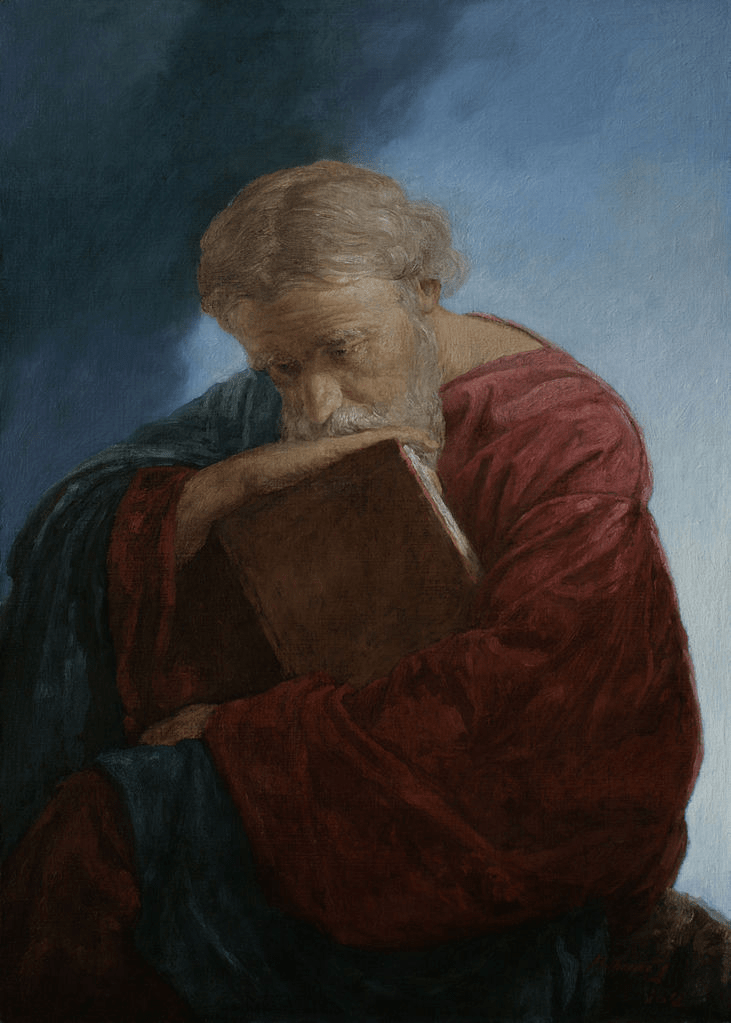
The Apostle John
Even so, it is without question that the revelation given to John would have weighed heavily on him just as it had for Daniel before him – Daniel 8:27.
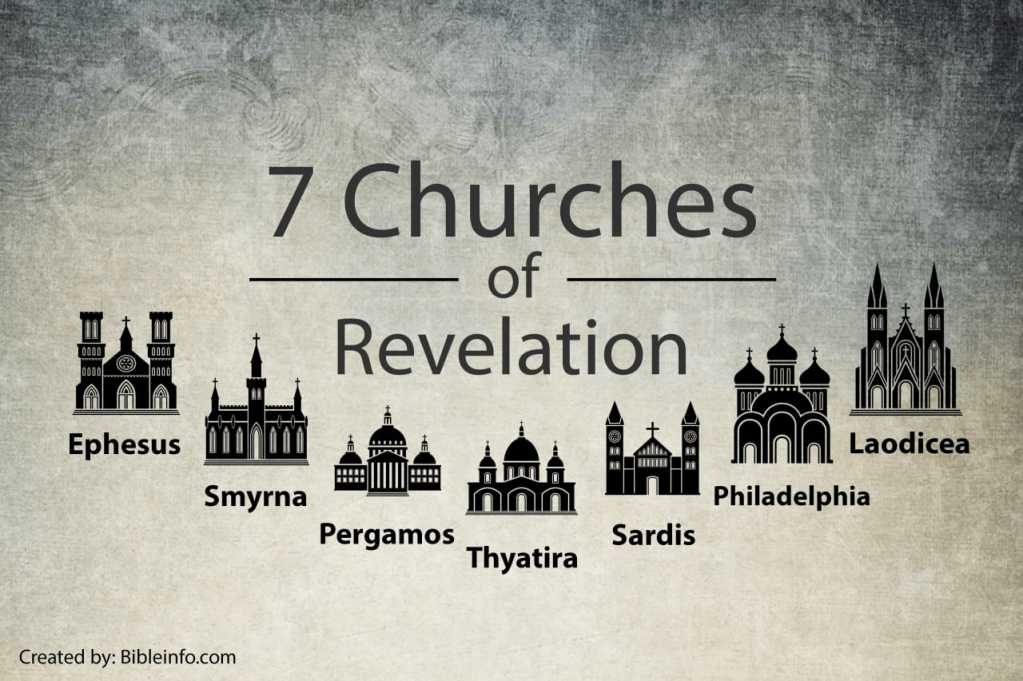
What some perhaps fail to recognise, is that the entirety of John’s revelation is written to seven specific churches – Revelation 1:11. These seven churches are of such importance, that they each have an individual letter addressed to them within the Revelation – Revelation 2:1-28; 3:1-22.
Revelation 1:1-2, 4, 9-13, 16, 19-20
English Standard Version
1 ‘The revelation of Jesus Christ, which God gave him to show to his servants the things that must soon take place. He made it known by sending his angel to his servant John, 2 who bore witness to the word of God and to the testimony of Jesus Christ, even to all that he saw.’
We will learn – aside from the revelation given to John – that the testimony of Christ were the words he spoke during his ministry and specifically, the good news (gospel) of the Kingdom of God – article: The Sabbath Secrecy.
4 ‘John to the seven churches that are in Asia:
9 I, John, your brother and partner in the tribulation and the kingdom and the patient endurance that are in Jesus, was on the island called Patmos on account of the word of God and the testimony of Jesus. 10 I was in the Spirit… and I heard behind me a loud voice… 11 saying,
“Write what you see in a book and send it to the seven churches, to Ephesus and to Smyrna and to Pergamum and to Thyatira and to Sardis and to Philadelphia and to Laodicea.”
12 Then I turned to see the voice that was speaking to me, and on turning I saw seven golden lampstands, 13 and in the midst of the lampstands one like a son of man… 16 In his right hand he held seven stars… 19 Write therefore the things that you have seen, those that are and those that are to take place after this. 20 As for the mystery of the seven stars that you saw in my right hand, and the seven golden lampstands, the seven stars are the angels of the seven churches, and the seven lampstands are the seven churches.’

The Seven Churches of Revelation are also known as the Seven Churches of the Apocalypse or the Seven Churches of Asia. The seven churches were located in seven cities – in western Asia Minor – and while spread apart were close enough to be on a shared mail route.
Church tradition claims John died during the reign of Emperor Trajan during 98 CE and 117 CE; Irenaeus (125 CE – 202 CE) speaks of John as still living in 98 CE and passing away at the grand old age of 101; and Jerome dates John’s death as sixty-eight years after the Crucifixion (in 30 CE). Christ seems to foretell John living to a great age – John 21:21-23.
Therefore if John died in 98 CE at one hundred and one, this means he was born the exact same year as his beloved Lord in 3 BCE – refer article: The Christ Chronology; and Appendix VIII: When the Creator came to dwell with His Creation.
All the more poignant when it is remembered John was a first cousin of Jesus.
James and his brother John were the sons of Zebedee the fisherman – Matthew 4:21. Their mother was Salome the wife of Zebedee and she is recorded being at the crucifixion of Christ – Matthew 27:56, Mark 15:40. From these accounts it is universally accepted that Salome and Christ’s mother Mary were sisters – John 19:25.
The Apostle John was sentenced to death, seemingly destined to earn a fate of martyrdom like the other apostles. He was rumoured to be killed in a cauldron of boiling oil, yet when his executioners cast him in, he apparently did not die. Instead, he stood up praising God. Nor did he suffer any burns or bodily injury. Such was the nature of the spectacular miracle, it was said many witnesses were moved to convert to the faith they were vainly trying to eradicate.
Most historical accounts record that John in fact died of old age in Ephesus, the city he returned to after his exile on the Island of Patmos.
The prevalent teaching is that John was banished and sentenced to exile on Patmos – not by Emperor Nerva who reigned from 96 to 98 CE – but by Domitian in about 90 CE, who was emperor from 81 CE to 96 CE. It is then assumed that during this time frame, John recorded under inspiration the Book of Revelation.
Thus its message and the letters to each church contained therein could have been sent to the seven churches during the final period or phase of the apostolic era which began with Christ’s death in 30 CE until its justifiable end with the death of the last original Apostle, John in 98 CE.
Not all biblical scholars would agree with this dating for John’s exile and the writing of Revelation (Revelation 1:9-11); as a large minority advocate an earlier authorship by John some thirty years prior – during the reign of Nero (54 CE to 68 CE). The numerous persuasive arguments presented convincingly support the dating for the Book of Revelation to somewhere between 58 CE to 66 CE.

This is the time frame following when John likely wrote the Gospel bearing his name – refer article: The Pauline Paradox.
An early church father, Tertulian (155 CE – 220 CE), places John’s banishment to Patmos at the same time as the martyrdom of Peter (68 CE) and Paul (67 CE). In his writing, Exclusion of Heretics, speaking about the history of Rome, he states:
‘… on which the Apostles poured out all their doctrine, with their blood: where Peter had a like Passion with the Lord; where Paul hath for his crown the same death with John; where the Apostle John was plunged into boiling oil, and suffered nothing, and was afterwards banished to an island.’
Clement of Alexandria (150 CE – 215 CE) wrote that John “after the death of the tyrant [was] removed from the island of Patmos to Ephesus.”
The question is which emperor?
Greek philosopher Apollonius of Tyana (3 BCE – 97 CE), who lived during the reigns of both Nero and Domitian said:
“In my travels… I have seen many, many beasts of Arabia and India; but this beast, that is commonly called a Tyrant, I know not how many heads he has, nor if it be crooked of claw, and armed with terrible fangs… And of wild beasts you cannot say that they were ever known to eat their own mothers, but Nero has gorged himself in this diet.”
In support of Nero being the emperor in question and not Domitian is the comment by Clement where he says:
“Revelation ceased at the time of Nero. As such, the canon would have to have been completed at the time of Nero.”
The Book of Revelation could not have been written some thirty years later during Domitian’s reign, if the inspiration for the New Testament was complete during the lifetime of Nero. This would mean John returned to Ephesus from Patmos following the deaths of both Nero and the Apostle Peter in 68 CE.
In addition, one of the oldest known New Testament documents – dating from the second century – is called The Syriac (or the Peshitta). Contained in this early version, on the Book of Revelation’s title page:
‘… the revelation was upon the holy John… from Yahuwah when he was on the island of Patmos, where he was thrown by the emperor Nero.’
Twenty Evidences Why Revelation Was Written before AD 70, Charles Meek:
‘The book “The Shepherd of Hermas” was well known by early church fathers and was often considered canonical. This suggests its composition to have been around the time of the apostles or shortly thereafter, as later books were not considered canonical. The book may have been written by the person Paul references in Romans 16:14. The book draws from Revelation, which implies a date for Revelation much earlier than the AD 95 time-frame, and probably before AD 70.’
The early church father Jerome wrote about the eventual frailty of the Apostle John:
“… he was with difficulty carried to the church and could speak only a few words to the people.”
This description is pertinent when compared with John’s account about Christ’s words to Peter in John 21:18-19, ESV:
“Truly, truly, I say to you, when you were young, you used to dress yourself and walk wherever you wanted, but when you are old, you will stretch out your hands, and another will dress you and carry you where you do not want to go.” (This he said to show by what kind of death he was to glorify God.)…
Christ’s instruction to John in Revelation 10:11, ESV:
And I was told, “You must again prophesy about many peoples and nations and languages and kings.”
This highlights the difficulty John would have had as an old man in his nineties if he wrote Revelation then – when there was an eyewitness who said John could barely walk or speak at that time – in continuing to preach to nations and kings the message of the Gospel of the Kingdom of God. Conversely, if John was in his early sixties (or late fifties) and robust, then he had time to fulfill this verse.
Clement of Alexandria confirms a younger John was released from Patmos, when he states:
“… [John] used to journey by request to the neighboring districts of the Gentiles, in some places to appoint bishops, in others to regulate whole churches, in others to set among the clergy some one man, it may be, of those indicated by the Spirit.”
Clement describes John chasing down an apostate on horseback ‘with all his might’. If true, then it is difficult to envisage a frail man in his nineties going at full gallop on a horse.
Charles Meek discusses the possibility that John did not live to old age and died a martyr:
‘Another reason to believe the Book of Revelation was written at the earlier date is… a question about John’s life after AD 70. Papias (AD 60-130) wrote that John was killed by the Jews. John’s martyrdom would have been when the Jews had the authority and means to have accomplished the execution – before AD 70.
Actually, there is internal biblical evidence about the martyrdom of John (and his brother James). In Matthew 20:22-23 and Mark 10:38-39 Jesus implies that John and his brother James would drink the cup of martyrdom that He was about to drink! Further evidence comes from silence in the historical record about John. If John had survived AD 70, he would have been a leader in the church, but history is silent.’
It is worth noting that Daniel was instructed to seal his vision – Daniel 12:4, ESV:
“But you, Daniel, shut up the words and seal the book, until the time of the end…”
Some of Daniel’s prophecies are for the time of the end and run parallel with the Book of Revelation, while others were to be fulfilled some 483 years later.
Yet fascinatingly, John was told not to seal his vision – Revelation 22:10, ESV:
And he said to me, “Do not seal up the words of the prophecy of this book, for the time is near.”
This was due to the fact that prophecies outlined in Matthew Chapter Twenty-Four and paralleled in Revelation chapters two and three – consisting of the destruction of the Temple and widespread persecution, torture and death – were due to come to pass within five to ten years depending on when Revelation was actually penned.
It would not make sense – if Daniel’s prophecy was sealed because it was ‘a long way off’ – to leave John’s prophecy unsealed if the early chapters were not to ‘shortly come to pass’ more than two thousand years later?
Even so, the seven messages to the churches are dual, in that they were not only applicable in John’s day, but to unfold through the centuries until the time of the end.
Thus the contents of Christ’s revelation to John remain largely unfulfilled and lay in our not so distant future.
The Book of Revelation has been interpreted through four main views:
Preterism, in that Revelation refers to past events, particularly those in the first century;
Historicism, where Revelation is a prophecy that unfolds throughout church history;
Futurism, interprets Revelation as predicting future events leading up to the end of the world, and;
Idealism, (spiritual) which views Revelation as a timeless allegory of the ongoing struggle between good and evil.
Each have merit and all are accurate in part, yet the Book of Revelation primarily focuses on the second and third views and this will be substantiated as we progress.
The ‘seven churches’ were brought to wider attention by the heavy metal band Possessed, who released their debut album, Seven Churches in 1985. What is significant about their release was that it bridged the period between Thrash and Death Metal. For the album was a landmark in metal music, as it went beyond thrash and is credited with the first components of death metal, which would rapidly evolve between the years 1987 and 1991.
The album itself was utterly unique, as if it had been dropped from the heavens – or raised from hell, out of time and out of place – so defining a moment in metal music was its impact. It is fittingly ironic that this album, named after the little understood yet profound symbolism of the Seven Churches of Revelation, should hold a one of a kind place in music history. The band is also credited with coining the term Death Metal and include a track on the album by the same name.

Biblical scholars, ministers and lay people consider the intent of the letters to the seven churches as not only applicable in the first century but also to the present day, in that aspects of each church can be accounted for currently. While lessons can be gleaned from each letter, this is not an accurate interpretation.
The truth is that the letters which granted were originally written to seven actual churches at the time of John, are in fact also coded messages to successive church epochs or eras encompassing the time of Christ, the apostles, and the early church in the first era; right through until just prior to the return of the Son of Man during the seventh and final era of the church.
The second vital aspect to understand is that when one says church, it does not mean the Universal (or Catholic Church), or even Christians from Protestant denominations.
A History of the True Church, Andrew N Dugger & Clarence O Dodd, 1936:
‘Any people deviating from the teaching of the scriptures, be they ever so sincere, cannot be the people of the true religion… mentioned repeatedly in the New Testament as “The Church of God”…’
The letters are actually written to this one body of Christ…
‘For just as the body is one and has many members, and all the members of the body, though many, are one body, so it is with Christ. For in one Spirit we were all baptized into one body… and all were made to drink of one Spirit’ – 1 Corinthians 12:12-13, ESV.
… the followers of the Way…
‘… and asked him for letters to the synagogues at Damascus, so that if he found any belonging to the Way, men or women, he might bring them bound to Jerusalem’ – Acts 9:2, ESV.
… and the ones who make up the little flock.
“Fear not, little flock, for it is your Father’s good pleasure to give you the kingdom” – Luke 12:32, ESV.
In the Bible, the Church (or Body of Christ), is likened to a virgin bride – Matthew 25:1, 2 Corinthians 11:2, Revelation 19:7. In the Book of Revelation there are two churches revealed and both are likened to two very different women. The first woman represents the true body of believers – Revelation 12:1-6. The second woman, is the bastion of false christianity, the Roman Catholic Church and her many Protestant daughters; likened unfortunately, to a whore – Revelation 17:1-6.
It is important to remember that the divine revelation was not from John himself, but of Jesus Christ. As is the singular nature of the book’s title; for many commentators incorrectly name it in the plural, the Book of Revelations.
The seven churches were obviously once concurrent. Yet from a prophetic standpoint, they reveal a sequential timeline. Of course, the sixty-four thousand dollar question, is… which church era are we in today? This article will seek to understand this and perhaps answer such an important question.
The seven letters to the churches follow a common pattern. Christ addresses each church and introduces Himself. Then reveals identifying signs about the church in question; including their failings or accomplishments. Christ then gives either a reproach, offers praise, or issues a challenge. Which is followed by a promise of reward, for those who endure and overcome; with an exhortation to listen to what the Spirit has to say.
Ephesus
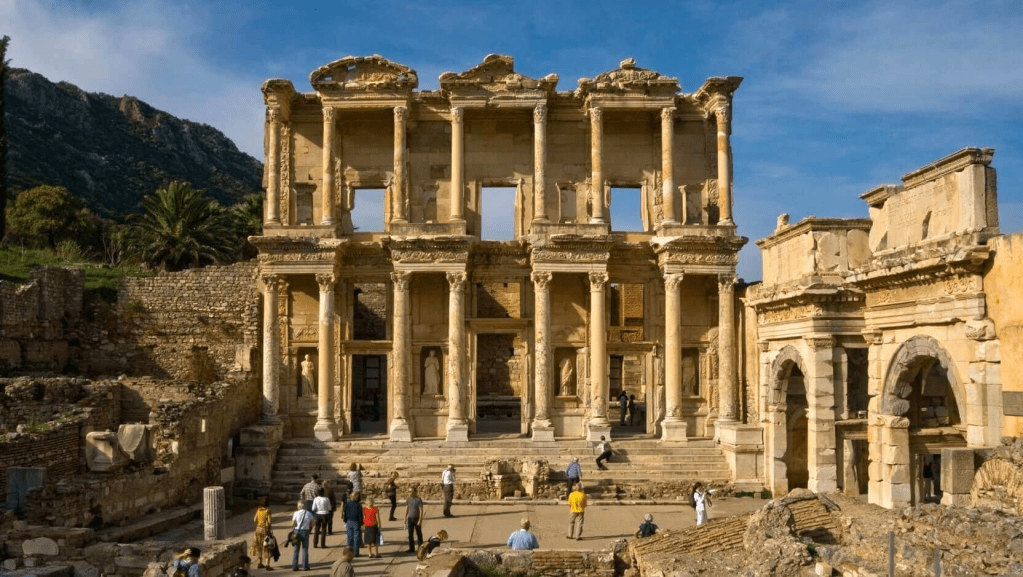
The first church congregation was located in Ephesus – a wealthy city (in the eastern Mediterranean region). Ephesus housed the impressive temple of the Greek goddess Artemis – refer articles: Thoth; and Lilith.
Thomas A Rohm: “The Ephesian church was proud of its position not only as ‘the metropolis of Asia’ (as Ephesus was called) but also of its heritage as the mother church of the region. Therefore, it is natural that this be the first church addressed, not only for its status but also because the mail route for these letters would naturally begin there” – Osborne.
“Ephesus, as the most prominent city in the Roman province of Asia, had already had a long history of Christian witness. Paul had effectively ministered there for 3 years… The preaching of the gospel had affected the lucrative pagan worship of Diana, in whose honor the Temple of Diana [the goddess of fertility] had been built in Ephesus, an imposing structure considered one of the Seven Wonders of the world” – refer Acts 19:23-41. “After Paul’s ministry at Ephesus came to a close, evidence indicates that Timothy for many years led the work as superintendent of the churches in that area. There is reason to believe that the Apostle John himself had succeeded Timothy as the pastor at large in Ephesus” – Walvoord.
Nota Bene
At this point it is only fair to mention the status of the man originally called Saul and later, Paul. While mainstream Christians recognise Paul as a prominent figure in the New Testament church, the truth of the matter is that Paul was actually the founder of Christianity – refer article: The Pauline Paradox. His teachings are contrary to the apostles and in variance with that of Christ and followers of the Way. Importantly, anything written by Paul (seven New Testament books) and any credited to him (six New Testament books) are of no value in any theological debate. This wields huge irony for literally all the ‘difficult’ scriptures in the New Testament are ascribed to Paul – Article: The Sabbath Secrecy.
Michal Hunt: Ephesus was ‘a prosperous Roman city at the mouth of the river Cayster… [and] the second most important city in the Roman Empire after Rome, according to the geographer Strabo… Ephesus was the center of Roman government in Asia… for trade and learning, and… the location of… John the Apostle’s home church’ – refer Appendix VIII: When the Creator came to dwell with His Creation.
‘The Greeks gave the city the name “mouth of Asia” because the world of the West seemed to pour through Ephesus on the way Eastward. The main street of Ephesus ran from the busy harbor to the Roman Theater and along the way a visitor would pass the gymnasium, the public baths, and the public library, as well as brothels and the temples to various pagan gods… Luke offered some valuable information about the city in the Acts of Apostles that may have some bearing on the Seven Letters as a whole. He wrote that Ephesus was a hotbed of Jewish occultism and magical arts’ – Acts 19:13-19.
Revelation chapters two and three contain the seven respective letters to the churches; beginning first with Ephesus.
Revelation 2:1-7
English Standard Version
1 “To the angel of the church in Ephesus write: ‘The words of him who holds the seven stars in his right hand, who walks among the seven golden lampstands.”
We read in chapter one that the stars represent angels and the lamp stands, stand – no pun intended – for the churches. Of which Christ walks amongst them. The letter itself is written to an angel and in this case a specific angel of not only the original Ephesian church but perhaps of the entire Ephesian era of the church. The Greek word is G32 – aggelos: ‘a messenger* from God, envoy, one who is sent.’ It is usually applied to a spirit entity working on the Eternal’s behalf, though can also be used in connection to a human messenger and by implication a human pastor. The same word is used for John the Baptist – Matthew 11:10.
C I Scofield: “The natural explanation of the ‘messengers’ is that they were men sent by the seven churches to ascertain the state of the aged apostle… [John] but they figure any who bear God’s messages to a church.” Two schools of thought interpret this word as meaning either in the case of Origen, a guardian angel and with Epiphanius, a bishop or elder. Two points which lean towards a human messenger, are that stars are separately singled out as angels and secondly, the letters contain rebuke (or chastisement) and so logically would a righteous spirit messenger of the church be the intended target in such condemnation?
It is notable that an apostle* is also ‘one who is sent out’ (or off) and ‘sent forth’.
In the Ephesian era of the church there were multiple apostles unlike any era which followed. For biblical scholars it is difficult to ascertain the exact number as while some men were clearly named as apostles, others are seemingly hinted at so that the total figure is not categoric in the minds of some. Judas Iscariot was an original disciple of Jesus, though he was never an apostle and committed suicide – Matthew 27:3-5.
The truth is – according to the scriptures – there were only ever twelve apostles, no less, no more.
The original eleven apostles were “… Peter (1) and John (2) and James (3) and Andrew (4), Philip (5) and Thomas (6), Bartholomew (7) and Matthew (8), James (9) the son of Alphaeus (Mark 15:40) and Simon (10) the Zealot and Judas (11) the son of James” – Acts 1:13, ESV.
The replacement for Judas was Matthias (12) – Acts 1:26.
Peter and Andrew were brothers (Matthew 4:18) and so were John and James the Greater (Matthew 4:21). Yet another pair of brothers were Matthew or Levi (Matthew 9:9; 10:3, Mark 2:14) and James the Lesser (the son of Alphaeus).
Two men are called apostles – in English Bible translations – by Luke in Acts 14:14… Barnabas and Paul. Though Luke’s intention was in using the Greek word apostolos (G652), to mean a delegate, a messenger and one sent forth with orders.
James the half-brother of Christ (Matthew 13:55), though not a believer originally (John 7:5), became a pillar and the pastor (Elder) of the Jerusalem congregation – Galatians 2:9, Acts 15:13, 19. Some commentators believe he was an apostle because Paul calls him one – Galatians 1:19. Though Paul was being facetious as evidenced in his mocking James with Peter and John in chapter two of Galatians.
Four other people are considered to have possibly been apostles, though the context or wording in the Greek refers to messengers (like Paul and Barnabas) rather than the office of an apostle for two out of the four.
This line of erroneous reasoning is firstly applied in Philippians 2:25 for Epaphroditus – refer article: The Pauline Paradox. And secondly, includes Paul’s (at first) faithful assistant, Silas – 1 Thessalonians 1:1; 2:6. In Acts 15:22, Silas is chosen to go to Antioch with Judas called Barsabbas, Paul and Barnabas. As Barsabbas was not selected as the replacement apostle for Judas Iscariot (Acts 1:23) and Silas was sent with him. Silas was himself a prophet (Acts 15:32).
In Romans 16:7, ESV it says: “Greet Andronicus and Junia, my kinsmen and my fellow prisoners. They are well known to the apostles, and they were in Christ before me.” Some credit Andronicus and Junia as apostles, though this is not what it is saying, but rather their reputation was known by the apostles; for they were long standing converts.
Others rightly claim Junia is a woman’s name and hence, a female apostle is being indicated. This is not supported scripturally as the roles fulfilled by women in the New Testament were either as a prophetess or as a deaconess and did not include elders, evangelists or apostles. Online Encyclopaedia: ‘… the Greek name is in the accusative and could be either Junia (a woman) or Junias (a man). Later manuscripts add accents to make it unambiguously Junias; however, while “Junia” was a common name, “Junias” was not…’
Finally, there are two men where the scriptural support for their being apostles is inferred. The first is Apollos and a case is made for his apostleship from the words written by Paul in 1 Corinthians 4:6, 9. Where the Corinthian brethren enthusiastically (yet incorrectly), viewed Apollos as an apostle and Paul did not deny it. Though Paul had his own agenda in not doing so – refer article: The Pauline Paradox.
The second is person is Jude, the half-brother of Christ and brother of James called the Just – Jude 1, Matthew 13:55. As James the Lord’s brother is credited with the authorship of the epistle bearing his name and hence (wrongly) viewed as an apostle… the inference is that his brother, the author of Jude’s epistle was also an apostle.
The seven golden Lampstands have a precursor with the gold lamp stand the Eternal commanded Moses and the Israelites to fashion for the Tabernacle in the wilderness and which later resided in Solomon’s Temple – Article: The Ark of God. Exodus 25:32, ESV: ‘And there shall be six branches going out of its sides, three branches of the lampstand out of one side of it and three branches of the lampstand out of the other side of it…’ – Exodus 25:31-40.

Curiously, the seven branched candlestick is mentioned in the Book of Zechariah in connection with Zerubbabel – who built the second Temple in Jerusalem between 536 to 516 BCE – a descendant of King David and an ancestor of Christ the Messiah.
Zechariah 4:1-14
English Standard Version
1 ‘… the angel who talked with me came again and woke me, like a man who is awakened out of his sleep. 2 And he said… “What do you see?” I said, “I see, and behold, a lampstand all of gold, with a bowl on the top of it, and seven lamps on it, with seven lips on each of the lamps that are on the top of it. 3 And there are two olive trees by it, one on the right of the bowl and the other on its left.” 4 … I said to the angel who talked with me, “What are these, my lord?”… he said to me, “This is the word of the Lord to Zerubbabel: Not by might, nor by power, but by my Spirit, says the Lord of hosts…
“The hands of Zerubbabel have laid the foundation of this house; his hands shall also complete it. Then you will know that the Lord of hosts has sent me to you. 10 For whoever has despised the day of small things shall rejoice, and shall see the plumb line in the hand of Zerubbabel.
“These seven are the eyes of the Lord, which range through the whole earth.” 11 Then I said to him, “What are these two olive trees on the right and the left of the lampstand?”… “What are these two branches of the olive trees, which are beside the two golden pipes from which the golden oil is poured out?”… 14 Then he said, “These are the two anointed ones who stand by the Lord of the whole earth.”
Zerubbabel who rebuilt the physical Temple – was a type of Christ and symbolically – represents the Word, who will finish the spiritual temple – 1 Corinthians 3:16, 1 Peter 2:5, Matthew 24:1-2, Revelation 21:22. Amplification of the identity of the two anointed ones goes full circle and is found in Revelation 11:1-4, ESV:
‘Then I was given a measuring rod like a staff, and I was told, “Rise and measure the temple of God and the altar and those who worship there… 3 And I will grant authority to my two witnesses, and they will prophesy for 1,260 days, clothed in sackcloth.” 4 These are the two olive trees and the two lampstands that stand before the Lord of the earth.’
The constant reader will be aware of the previous options discussed regarding the identities of these two – it would seem – human beings. While the possibility exists they are angelic beings, it remains that they are both described as prophets; are killed; and then resurrected three and a half days later. Zechariah describes them as olive trees either side of the seven branched candlestick; yet John says the olive trees are lamp stands themselves. Some commentators who make a case for the sixth and seventh church eras to run in tandem, consider that each era or church, provides a witness. While the scriptures do not overtly support such a scenario, it is interesting in light of the witnesses being equated with lamp stands – symbols for the churches.
Definitions for the name Ephesus include: ‘desirable, lovely’ and ‘to let go’. The Greek word is G2181 – Ephesos: meaning, ‘permitted.’
Abarim Publications add: ‘New town’ and ‘place in the back’ from the Hittite name Apasa, from appa, behind or after, which relates to the Greek (epi), on or upon.’ It may correspond with names like ‘Newton’ and ‘Neapolis’… ‘perhaps since it was located on the coast, at the end of a river, it was called Place Very Much At The Back and named in the sense of Lands’ End or The Boondocks.
Ephesus was a splendid Greek city… situated half-way up the western coast of modern-day Turkey, on the river Cayster. It was founded in the tenth century BC (probably on or near the ruins of an even older settlement). In Biblical times, the city was known for its theatre (which could seat 25,000 or half the population), its advanced aqueduct system and its temple of Artemis (or Diana), which was such an elaborate affair that it was counted as one of the seven wonders of the ancient world.’
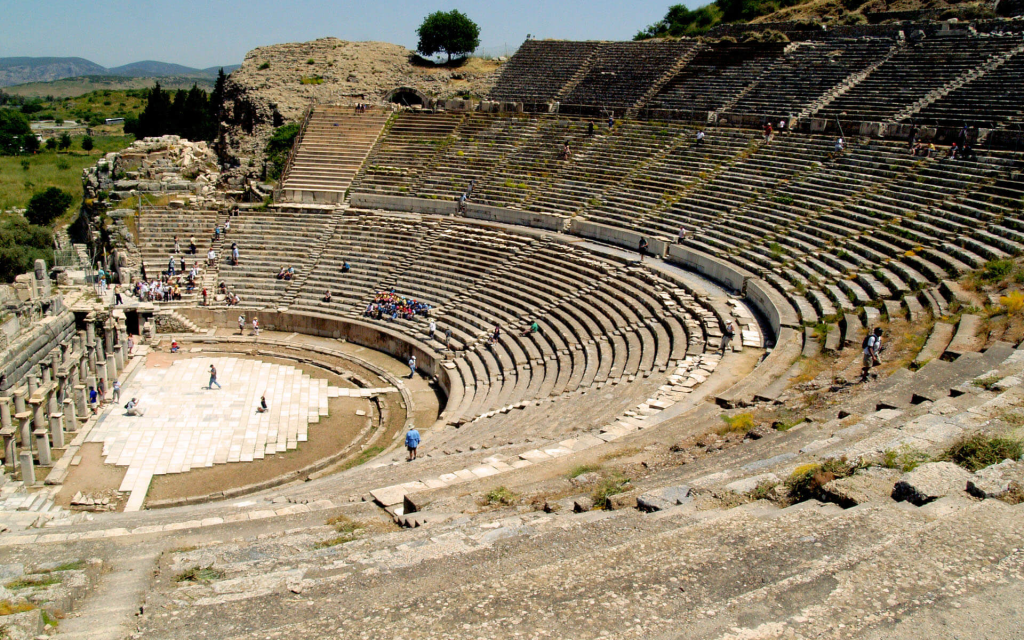
‘It was also a prime tourist attraction and when Paul and Barnabas began to preach the gospel of Jesus Christ, a souvenir seller named Demetrius became understandably upset ( Acts 19:24). Paul first came to Ephesus together with Priscilla and Aquila of Corinth (Acts 18:19)… Paul left them there… While he was gone… Apollos arrived at Ephesus and began to share the gospel (Acts 18:2), but he had moved on to Corinth when Paul returned to Ephesus and this time to stay for two years… during which Paul wrote 1 Corinthians… From his prison in Rome, Paul wrote the church in Ephesus his famous epistle. Possibly as many as four decades after Paul was in Ephesus, John was there (according to non-Biblical traditions) and wrote his gospel.’
The reality is that Paul did not write the epistle to the Ephesian brethren. Circumstantial evidence points to a close associate of Paul who did and in so doing copied the epistle to the Colossians – refer article: The Pauline Paradox.
Revelation: 2 “I know your works, your toil and your patient endurance, and how you cannot bear with those who are evil, but have tested those who call themselves apostles and are not, and found them to be false.^ 3 I know you are enduring patiently and bearing up for my name’s sake, and you have not grown weary.”
Aside from the very end of the age, this early period of the church Jesus foundered was full of drama, heartache, anticipation, inspiration and reward, unlike anything seen or experienced before – Matthew 21:42. Peoples lives were irrevocably changed forever with the understanding that death truly does not swallow us up whole and that eternal life is available for all those who seek it through the Saviour – refer article: DEATH: A Dead End or a New Beginning? Many suffered for their new beliefs and for claiming Christ as their Lord and master, contrary to expected – and often enforced – allegiance to a Caesar in Rome – Appendix VIII: When the Creator came to dwell with His Creation.
A constant roller coaster ride swept believers along in a whirlwind of change. Beginning with the teaching and miracles of Christ; then his death and resurrection; the institution of baptism, first taught by Christ’s cousin John the Baptist; the outpouring of the Holy Spirit on the first Day of Pentecost in 30 CE; the ending of circumcision – after nearly two thousand years – and the sacrificial system; the destruction of the temple in Jerusalem in 70 CE; and the scattering of the saints.
Acts 16:1-4, 20:5-6, 16
English Standard Version
‘When the day of Pentecost arrived, they were all together in one place. 2 And suddenly there came from heaven a sound like a mighty rushing wind, and it filled the entire house where they were sitting. 3 And divided tongues as of fire appeared to them and rested on each one of them. 4 And they were all filled with the Holy Spirit…’
5 ‘These went on ahead and were waiting for us at Troas, 6 but we sailed away from Philippi after the days of Unleavened Bread… 16 For Paul had decided to sail past Ephesus, so that he might not have to spend time in Asia, for he was hastening to be at Jerusalem, if possible, on the day of Pentecost.’
Even with all these amazing occurrences, the seeds of corruption were growing. Many jumped on the bandwagon of this new Way, so that there were tares amongst the wheat; sheep in wolves clothing; and self proclaimed apostles teaching falsehoods – Matthew 7:15; 13:24-30.
It is an incongruity then of the highest order, that chief amongst these false^ teachers was none other than the ‘apostle’ Paul… while others impacted the fledgling movement begun by Jesus – of whom we will discuss – it was Paul who subverted the Way of Christ to one of Paul, where his way appropriated the name of Christ and became christianity as we know it today.
For Christ to warn of this through the words of John is nothing short of spectacular – in the worst possible way (no pun intended). Heart stopping and breath taking all in one, in its ramifications for all true believers – refer article: The Pauline Paradox.
So it is with sinister and grim irony indeed that Paul should address exactly this in 2 Corinthians 11:13-15, ESV:
‘For such men are false apostles, deceitful workmen, disguising themselves as apostles of Christ. And no wonder, for even Satan disguises [them]self as an angel of light. So it is no surprise if [it’s] servants, also, disguise themselves as servants of righteousness. Their end will correspond to their deeds.’
The early true Christians were obedient and patient – rejecting ‘christians’ without sincerity for the truth – and remained faithfully steadfast to Christ’s promises – John 8:31-32, 2 Timothy 2:15. Many like Paul had taken Christ’s words to mean his return was imminent – Matthew 24:3; 26:29, 1 Thessalonians 4:15. So they eagerly endured, yet in so doing, their enthusiasm waned as more time elapsed.
The wholesale deception which has resulted in the divergent path of false Christianity from the true Way is evidenced in the following quote.
Dugger & Dodd: ‘A history of the true Church of God could not be written without taking into consideration the lives and work of the outstanding leaders of the Gospel Age, that is the apostles, Paul, Peter and John; for by, or under their direction, most of the New testament Scriptures were written, and the fortunes of the church advanced during the first century, and fashioned for future centuries.’
Yet, it is seven books conclusively written by Paul and six credited to him which number thirteen, of the total of twenty-seven books in the New testament which are of questionable (divine) inspiration or even doctrinal value.
Readers interested in the exploits of Peter, John, (even Paul) and early church heroes such as Joseph of Arimathea and Christ’s mother, Mary following Christ’s death, are welcome to refer to Appendix VIII: When the Creator came to dwell with His Creation.
The reference to congregations as the Church of God is found in Pauls’s letters (or those credited to him) alone – for example in 1 Corinthians 1:2; 11:6, Galatians 1:13 and in 1 Timothy 3:5. The exception in is in Acts 20:28, where interestingly, Paul uses the phrase while addressing elders of the Ephesian church.
The expression caught on as records of the early church writers testify to letters written between the churches being addressed for example as: ‘To the Church of God in Ephesus.’ Dugger & Dodd: ‘In the second century Ignatius wrote to the Smyrnaeans thus: “To the Churches of God in Smyrna” – Ante-Nicean Fathers, Volume 1.
As the faith spread and time passed, detractors, opponents and persecutors, called the sect by different names. The first known name used for the elect was that of the Nazarenes. Paul was satirically described as such. Acts 24:5, ESV: ‘For we have found this man a plague, one who stirs up riots among all the Jews throughout the world and is a ringleader of the sect of the Nazarenes.’
It had been foreknown as the name derives from the city of Nazareth, where Christ moved with his family after being born in Bethlehem. Matthew 2:23, ESV: ‘And he went and lived in a city called Nazareth, so that what was spoken by the prophets might be fulfilled, that he would be called a Nazarene.’ The Hebrew for Nazareth is netzer, meaning a ‘branch’ or ‘germ.’ In time the term Nazarene came to mean a ‘despised one.’
The Encyclopaedia Britannica remarks that the Nazarenes were identified right up until 370 CE, living in ‘Coele-Syria, Decapolis (Pella) and Basanitis (Cocabe).’ They dated their origin prior to fleeing Jerusalem’s siege by Titus in 70 CE, to Pella – Matthew 24:16.
The Nazarene teachings most closely match the New Testament church – truth in bold, error strikethrough – for they recognised the new covenant as well as the old; the resurrection from the dead; one God; and his Son, Jesus Christ. They also adhered to the ‘Mosaic economy’ regarding ‘sabbaths, foods [clean and unclean meats]…’ and ‘did not refuse to recognise… [Paul’s apostleship] or the rights of (Gentile) Christians.’ During the first four centuries the Nazarenes used the Aramaic recension for the scriptures. Eusebius (264-339) wrote that the church of the first centuries observed the Lord‘s Supper (Bread and wine) ‘at the same time as the Jews kept Passover.’
Originally, two or more bishops (elders) were appointed for each city as instructed by Paul – Titus 1:5. Towards the close of the second century, this was changed to just one bishop, over not just a city but a district with an ‘inferior order of ministers’ called Deacons presiding over the local affairs of the church congregation – Acts 6:3-6, Philippians 1:1, 1 Timothy 3:8-13.
Paul and his ministers choosing elders instead of the congregations and the subsequent creation of a two tier hierarchy with bishops and deacons were both unbiblical. True church government was the first Bible teaching to be changed by ‘wolves in sheep’s clothing’, infiltrating with a different agenda – one of power and greed (Matthew 7:15, Acts 20:29, 3 John 9-10).
The Pauline Paradox: “For in the apostolic era, there were (1) apostles, (2) prophets/prophetesses and (3) deacons/deaconesses. Deacon literally meaning a servant or minister. Thus men who were deacons became elders; otherwise known in the New Testament as bishops, shepherds, pastors and teachers. An elder was an ordained deacon. A deacon was simply a servant and minster. A deacon who travelled and preached was performing the work of an evangelist. Though these are functions and not ranks.”
The first Christian church established at Jerusalem was led by fifteen consecutive bishops who ‘united the teachings of Moses with the doctrines of Christ’ – History of the Christian Church, Hugh Smith, pages 50-51 (Acts 15:1-21).
Hugh Smith: ‘These Judaizing Christians were first known by the outside world as Nazarenes. All Christians agreed in celebrating the seventh day of the week in conformity to the Jewish converts’. This perchance contradicts the decision made at the Jerusalem Conference – refer article: The Sabbath Secrecy.
Nota Bene
It is at this point in our study of a true history of the true church that a strange paradox requires highlighting. It involves the seventh day Sabbath which of itself is a complex issue. The constant reader will already be aware of its importance in previous contexts and so it is recommended for new readers to refer to the articles: The Calendar Conspiracy; and The Sabbath Secrecy, in understanding why it will be a reoccurring theme in this investigation. The change over from the Old Covenant Sabbath of the Israelites to a New Covenant Sabbath for spiritual Israel has not always been conclusive, concise or clear cut. Because of this, in a remarkable twist of fate, the search for true believers sometimes leads to enclaves of Sabbath keepers. As we progress, the reason for this anomaly will become crystal clear.
Gieseler: ‘While the Jewish Christians of Palestine retained the entire Mosaic Law, and consequently the Jewish festivals, the Gentile Christians observed also the Sabbath and the Passover…’ Smith: The Nazarenes were “abhorred and publicly execrated by the Jews for their attachment to Christianity, and despised by the Christians for their prejudice in favour of the Mosaic law… they were peculiarly oppressed and unfortunate.”
It is not conclusive all ‘Nazarenes’ were participating in celebrating the Sabbath (or Passover). Lee Roy Martin: ‘The early church fathers from the second and third centuries… report that Sunday was the Christian day of worship. Ignatius (c. AD 45-115), a disciple of the apostle John’ – who died a mere seventeen years after John – ‘wrote that Christians were “no longer observing the Sabbath, but living in observance of the Lord’s Day” (Epistle to the Magnesians, 8)’ – refer article: The Sabbath Secrecy.
Myer’s General History: ‘As long as the Christians were supposed to be Jews they were not especially molested. They simply suffered from the ill-feeling which the Romans had for the Jews… [Nazarene Christians] disapproved of the Roman amusements, the gladiatorial shows, the races in the circus, the plays, the dances, and the theaters. They were hence regarded as unsocial, and ‘Haters of mankind.’ Their churches were looked upon as secret societies, which were contrary to law. They were hated and frequently subjects of mob violence.’
With the last of the apostles dying, a new period in the church began where it was increasingly led by men who had not known the Saviour while in the flesh and in many instances had not even met the apostles. So while there were loyal servants, the number grew of those who were not.
Revelation: 4 “But I have this against you, that you have abandoned the love you had at first. 5 Remember therefore from where you have fallen; repent, and do the works you did at first. If not, I will come to you and remove your lampstand from its place, unless you repent.”
Most commentators universally conclude that the Ephesian era of the church was short and ended swiftly. We will return to this important question. For as an abrupt ending is implied with the removal of the lampstand; it does not necessarily mean the era lasted only sixty-eight years, ending with the death of John. In support of this is the fact that the early church had truly transformed into a hidden, small and scattered church on one hand and a visible – growing in influence – church led by the Bishops of Constantinople and Rome on the other by the beginning of the fourth century.
As the church slowly (yet quickly) grew into two entities, the true Church (or woman) of Revelation chapter twelve maintained the following identifying and foundational… well, not so much teachings per se, but practices throughout the ensuing centuries.
- Its founder and head is Jesus Christ – Matthew 16:18-19
- It is independent – Matthew 22:21
- Its rule of faith and practice is the Bible – Matthew 4:4
- Its members are (mature) baptised adults – Acts 2:41
- Its teaching on salvation is predicated on faith and (good) works – Acts 16:31, Matthew 5:16
- Its government is one of congregational equality – Acts 1:23-26
- It has but two (symbolic) ordinances: Baptism and the Bread and Wine – Acts 2:38, Matthew 26:26-28
The sad and regrettable reality is that if the congregation a person attends does not adhere to these simple yet central truths, thereby confessing the true Body of Christ in their practice… then perhaps they need to carefully reconsider their choice.
1. While churches claim Christ as their head, it is invariably a man who sits at the top, whether a Pope, an Archbishop, or another form of quite simply, someone who is anti Christ.
2. Any church which has been incorporated or registered as a charity is an organisation of men and not of Christ. If it possesses financial accounts and is run as a business, it is not the spiritual organism of the true church.
3. Churches claim to believe the scriptures, yet when they publish a formal doctrinal creed they limit being led by the Holy Spirit in growing in understanding and truth.
4. Baptising children and confirming them as teenagers denies a person the opportunity for a true conversion and calling from God.
5. Mainstream Christianity – deceived by the theology of Paul – is adrift on the exact relationship between faith (grace) and works (the Law).
6. A hierarchal church government with ranks (and offices) is unscriptural. The body of Christ composed of different members of no greater or lesser importance than others and divinely appointed responsibilities (or functions) is scriptural.
7. All the additional rituals and sacraments in Christianity endemically originate from pagan and demonic practices and are designed to keep Christians enslaved to falsehoods.
Dugger & Dodd: ‘There has been but little interest manifest in the history of religion of the past because, most historians leave the history of the true faith with the death of the apostles, and then trace what they call Christianity down through the “Dark Ages” as it emanated from Rome…’
While John lived, heresy had made serious headway, though he had hardly passed away in 98 CE when heretical teachers infiltrated the true church in mass. According to Wilkinson, the ‘New Testament books were corrupted in abundance’ at this time. Eusebius relates that the ‘corrupted manuscripts were so prevalent that agreement between the copies was hopeless; and that those who were corrupting the Scriptures, claimed that they really were correcting them.’
‘For fifty [plus] years after… Paul’s life [when he died in 66 CE], a curtain hangs over the church, through which we vainly strive to look; and when at last it rises, about 129 A.D, with the writings of the earliest church fathers, we find a church in many respects very different from that in the days of St. Peter and St. Paul’ – Story of the Christian Church, Jesse Hurlbut.
Thus it is easy to comprehend how the Apostolic church came to be backsliding, who were ‘once on fire for Christ, but… [had become] indifferent.’ The saints were praised for being committed to doctrine, though corrected for their lessening fervour in maintaining good works – Article: The Sabbath Secrecy.
When one is converted – after being baptised and receiving the Holy Spirit through the laying on of hands – they are flush with feelings and emotions akin to a romance. Christ through the Holy Spirit fills a person’s soul and consumes their thoughts and actions. Faith is strong and love for the Way impassioned. Christ is reminding the Ephesian brethren that they have lost this ardour and need to regain the enthusiasm of their calling and embrace that inward dedication and outward zeal again.
The parable of the ten virgins is related to the two olive trees – the lamp stands – who possess pipes flowing with golden oil. The oil from the olive trees represents the Holy Spirit. While the parable is aimed at the final era of the church, its message is applicable to all the churches and notably, the saints in Ephesus.
Matthew 25:1-13
English Standard Version
“Then the kingdom of heaven will be like ten virgins who took their lamps and went to meet the bridegroom. 2 Five of them were foolish, and five were wise. 3 For when the foolish took their lamps, they took no oil with them, 4 but the wise took flasks of oil with their lamps. 5 As the bridegroom was delayed, they all became drowsy and slept. 6 But at midnight there was a cry, ‘Here is the bridegroom! Come out to meet him.’ 7 Then all those virgins rose and trimmed their lamps. 8 And the foolish said to the wise, ‘Give us some of your oil, for our lamps are going out.’ 9 But the wise answered, saying, ‘Since there will not be enough for us and for you, go rather to the dealers and buy for yourselves.’ 10 And while they were going to buy, the bridegroom came, and those who were ready went in with him to the marriage feast, and the door was shut. 11 Afterward the other virgins came also, saying, ‘Lord, lord, open to us.’ 12 But he answered, ‘Truly, I say to you, I do not know you.’ 13 Watch therefore, for you know neither the day nor the hour.”
The author of 2 Thessalonians 2:1-7 (not Paul), predicted a falling away from the truth, which had begun even in their lifetime and would accelerate after Paul’s death, the person most instrumental in this deception – refer article: The Pauline Paradox.
Acts 20:29-31, ESV: “I know that after my departure fierce wolves will come in among you, not sparing the flock; and from among your own selves will arise men speaking twisted things, to draw away the disciples after them. Therefore be alert…”
In the Book of Acts we learn of a more than coincidental confrontation between church leader Simon Peter and would be leader, the orphic Simon Magus (or Magician).
Acts 8:9-24
English Standard Version
9 ‘… there was a man named Simon, who had previously practiced magic in the city and amazed the people of Samaria, saying that he himself was somebody great. 10 They all paid attention to him, from the least to the greatest, saying, “This man is the power of God that is called Great.” 11 And they paid attention to him because for a long time he had amazed them with his magic.
12 But when they believed Philip [the Deacon] as he preached good news about the kingdom of God and the name of Jesus Christ, they were baptized, both men and women. 13 Even Simon himself believed, and after being baptized he continued with Philip. And seeing signs and great miracles performed, he was amazed.
14 Now when the apostles at Jerusalem heard that Samaria had received the word of God, they sent to them Peter and John, 15 who came down and prayed for them that they might receive the Holy Spirit, 16 for [it] had not yet fallen on any of them, but they had only been baptized in the name of the Lord Jesus. 17 Then they laid their hands on them and they received the Holy Spirit.
18 Now when Simon saw that the Spirit was given through the laying on of the apostles’ hands, he offered them money, 19 saying, “Give me this power also, so that anyone on whom I lay my hands may receive the Holy Spirit.” 20 But Peter said to him, “May your silver perish with you, because you thought you could obtain the gift of God with money! 21 You have neither part nor lot in this matter, for your heart is not right before God. 22 Repent, therefore, of this wickedness of yours, and pray to the Lord that, if possible, the intent of your heart may be forgiven you. 23 For I see that you are in the gall of bitterness and in the bond of iniquity.” 24 And Simon answered, “Pray for me to the Lord, that nothing of what you have said may come upon me.”
Peter perceived that Simon was not what he portrayed himself to be and was in fact a possessed, servant of evil. Simon was seeking the power Peter had been given (Matthew 16:1), who was the true spiritual leader of the Way. While falsified histo;ry tells us Simon Peter was the ‘first’ Bishop of Rome, in essence the first Pope, it was in fact the deluded, self serving Simon Magus, who fulfilled a role of a false apostle as referred to in Christ’s letter to the Ephesians.
Simon Magus was one of the first public figures to cross Christian concepts with Pagan ideas in a syncretism which ultimately blended with the theology of Paul and led to what became the Catholic Church. A church that accepted preaching about the name and the person of Jesus; rather than his message – the Gospel of the Kingdom of God.
The Dictionary of Christian Biography, Literature, Sects and Doctrinesm, Smith and Wace, page 62:
“Helen was a prostitute whom [Simon Magus] had redeemed at Tyre, and led about with him… This ‘Jezebel’ can be equated with the ‘Female Principle’ which Simon introduced into his ‘Christianity.’ For she was an Ennoea [an Archon of knowledge] “who had been detained in the lower regions… she suffered all manner of contumely, so far as to be included in a human body, and to pass by transmigration from one female body to another… until at last she was found in a brothel… Simon’s Helen – the reclaimed temple prostitute – what better type of person [was] there who could so expertly ‘teach’ and ‘seduce my servants to commit fornication,’ literally as well as spiritually?”
Saint Justin Martyr, Thomas B Falls, Volume VI (The First Apology): “After the ascension of Christ into Heaven, the demons produced certain men who claimed to be gods… There was a certain Simon, a Samaritan, from the village called Gitta, who in the time of Emperor Claudius [41-54 CE] through the force of the demons working in him, performed mighty acts of magic in your royal city of Rome and was reputed to be a god.”
‘He tried to prove he was a god by flying “… to give the emperor a crowning proof of his magical skill, he had attempted to fly through the air, but that through the efficacy of the Apostle’s prayers the demon who bore him [was] compelled to let him go, whereupon he perished miserably” – Smith and Wace, page 684.’
Falls: “And as a god he was honored by you with a statue, which was erected (on an island) in the Tiber River, between the two bridges, with this Roman inscription: ‘To Simon, the holy God.’ Almost every Samaritan, and even a few from other regions, worship him and call him the first God” (page. 62).’ It was during the reign of Titus (79-81 CE), in 80 CE, that this monument in Rome was dedicated to a ‘Peter’. This was not the Apostle Peter, but another Pater – Simon Magus who had appropriated the name.
The History of Baptism, Robert Robinson: ‘Toward the latter end of the second century, most of the churches assumed a new form, the first simplicity disappeared; and insensibly, as the old disciples retired to their graves, their children, along with new converts… came forward and new-modeled the cause.’
Wharey’s Church History: ‘At the end of the second century… it is obvious to remark the changes that had already been introduced in much of the Christian worship. The garb of heathenism was already being worn. The seed of most of these errors… marred its beauty and tarnished its glory, also that distinction of grades began to be established that ended in the papal hierarchy.’
History of Romanism, John Dowling: ‘There is scarcely anything which strikes the mind of the careful student of ancient ecclesiastical history with greater surprise than the comparatively early period at which many of the corruptions of Christianity, which are embodied in the Romish system, took their rise; yet it is not to be supposed that when the first originators of many of these unscriptural notions and practices planted those germs of corruptions, they anticipated or even imagined they would ever grow into such a hideous system of superstition and error as that of popery…’
The Modern Sabbath Examined, Henry Bannerman, 1923: ‘… the chief corruptions of popery… within fifty years of the apostolic age, the cup [of wine for the Lord’s Supper] was mixed with water, and a portion of the elements sent to the absent. The bread, which at first was sent only to the sick, was… [later] carried home by the people, and locked up as a divine treasure for their private use… the ordinance of the supper was given to infants of the tenderest age… praying for the dead… was common in the second century, and became the universal practice of the following ages; so that… in the fourth century… [it was] a kind of heresy to deny the efficacy of it. By this time the invocation of saints, the superstitious use of images, of the sign of the cross, and of consecrated oil… [became] established practices, and pretended miracles were confidently abduced in proof of their supposed [success].’
The second century witnessed significant changes in the outward practices of the church, yet within the true church these were rejected as the Body of Christ sought to hold onto the faith once delivered – Jude 3. By the time of the third century – during 200 to 300 CE – the transformation of the church into two separate entities was beyond question. The visible church increasingly powerful and influential fiscally, politically and doctrinally; and the other increasingly outnumbered, persecuted and forcibly required to be cloaked with invisibility.
A remnant of Judaic christian families – whom had fled Jerusalem to Pella in 70 CE – were able to return to Jerusalem in 130 CE, led by an elected Gentile called Marcus. For about one hundred years they remained in peace in the Holy City, headquartered there as they had been in the beginning of the era. Yet Marcus had disfellowshipped brethren who were faithful to the truth of Jesus Christ. Persecution arose and intensified when Decius the Roman emperor issued an imperial edict in 248 CE, exposing the church to ‘great calamities.’ Hugh Smith: ‘The venerable bishops of Jerusalem and Antioch died in prison, and many true followers were scourged to death, many sacrificed to wild beasts, some burned, and others perished by the sword.’
Comparable atrocities were perpetrated by the crazed young Emperor Nero (54-68) between 64 CE to 68 CE, where he happily crucified christians and wrapped others in clothes saturated with tar, burning them as human torches in his garden and throughout Rome. The early death of Decius (249-251) only led to his successor Gallus (251-253) continuing the persecution. Though Gallus had a short reign too, falling at the hand of one of his own soldiers; so that the terrible period of violence inflicted against the Jerusalem church ended in 253 CE.
The zeal of the true followers of Christ was increasingly matched and surpassed by the number of apostate christians; multiplicity of sects; false doctrine; and the lowering of christian standards. The breach between the Church of God and the Church of Rome widened further, reflected by a purposeful ignorance towards what the apostles had lived and taught. The false church brooded over amassing wealth; pastors and deacons neglected their duty to serve, or works of mercy in assisting the needy, rather following secular pursuits. ‘Usury and effeminacy prevailed’ and a preoccupation with cultivating ‘metricious arts in dress.’ Fraud and deceit were common practice amongst brethren, as was uniting themselves in matrimony with unbelievers. They were equally comfortable with swearing, quarrelling and ‘despising their ecclesiastical superiors.’
Aside from Jerusalem, the city of Antioch had also been a headquarters for the true church. In fact it was where disciples were first called Christians – Acts 11:26. Antioch was the largest predominantly Gentile congregation. Barnabas the brother-in-law of the Apostle Peter (Acts 12:12, Colossians 4:10, 1 peter 5:13) was their first minister – Act 11:22. Eusibius credits Peter as ‘establishing’ Antioch in 42 CE. This would have been when Peter withstood Simon Magus. After the apostolic era, Antioch maintained its importance as one of the five seats of Patriarchs (great fathers or papas) in the false church, organised into a state church by Emperor Constantine.
It is no coincidence that it was Ephesus which became the headquarters of the Ephesian era – 1 Timothy 1:3. Both John and the Deacon Philip died in Ephesus; for after his exile on Patmos, John was released. John’s protégée was called Polycarp. Polycarp lived between 69 CE to 155 CE and was the Bishop of Smyrna for half a century. Polycarp wrote numerous letters to congregations and individuals, though all have ‘perished, save one doubtful exception.’
Encyclopaedia Britannica: ‘The steady progress of the heretical movement in spite of all opposition was a cause of deep sorrow to Polycarp, so that in the last years of his life the words were constantly on his lips, “Oh good God, to what times hast thou spared me, that I must suffer such things!” In his old age, at about eighty-five, Polycarp journeyed to Rome in the hope of persuading the Bishop of Rome, Anicetus, to cease Easter observance. It was not a success, for he would not repent or accept the Passover. The following year, Polycarp was burnt to death by a mob in Smyrna.
According to Peter Lemesurier, the philosophical and doctrinal break between the Nazarenes, Judaism and Christians was complete circa 152 CE. This date dovetails with Polycarp’s death. While a later date is contemplated at the end of this section for the ending of the Ephesian era, the date of circa 150 CE could also be considered.
During Polycarp’s lifetime, the following events occurred: 1. Easter (false doctrine) began to be commemorated; 2. The resurrection of Christ on a Sunday (true doctrine – though emphasising ‘Sunday’ worship a false doctrine) began to be taught – refer article: The Sabbath Secrecy; 3. Maryology (false doctrine) developed; and 4. the growing dichotomy between the church of Rome and the churches in the East spread.
Polycrates – who lived between 130 CE to 196 CE and was the Bishop of Ephesus – was the faithful disciple of Polycarp; carrying the baton of leadership for the Ephesian era. Polycrates continued in the fight against false holy day observances and the pagan pretences of Victor at Rome (190-198 CE), but in vain. Ambassador College Bible Correspondence Course (ACBCC), Lesson 49, I will Build my Church: ‘Victor not only pretended his vast Easter-keeping organisation was Christs Church but arrogated to himself authority to “excommunicate” [in 195 CE] those who in Asia still kept the Passover.’
Though Passover (and Unleavened Bread) is a Jewish festival, the term Passover can also refer to those true Christians who while they took Bread and Wine, did not partake of communion mass or observe Easter.
Eventually, Ephesus was completely deserted with the population moving to a higher location more than a mile to the northeast – which today is called Ayassoluk. With one source claiming this name is a corruption of the Greek words for “St. John, spokesman for God.”
A group worth noting during these early centuries, were the Ebionites. The word Ebion – according to ACBCC – means: ‘paupers, poor’ and ‘destitute.’ It seems some may have been a continuation of the Nazarenes; while a rigid splinter group of the same name were clearly not. Traces of their name lingered in the Damascus region until the fourth century. It is difficult to ascertain how related to the true body of Christ the Ebionites were, due to the fact their own writings have perished and information which comes from their enemies is a combination of truth mixed with error.
They purportedly still believed in circumcision (Old Covenant) and held to Docetism (false doctrine), where Christ never really came in the flesh, rather entering Jesus and then leaving him when he endured his suffering on the cross. They were accused of rejecting the ‘virgin birth’, the ‘pre-existence of Christ’ and the ‘writings of Paul.’ ACBCC: ‘But this is not true at all. The next age of God’s True Church – revived in the place where migrating Ebionites disappear – accepted these truths… Their very distinguishing name became Paul-ician!’
Certain Ebionites ‘had accepted some Gnostic doctrines. As the second century ended a considerable number had exchanged the simple creed of Jesus Christ for a strange blend of Christianity and Essenism… led astray…’ by a ‘false prophet’ leader who had ‘demon visions…’
It is worth noting that certain ‘christians’ today teach that Christ was an Essene. This is not true. Christ if anything – if you like – was the founder or inspiration for the Nazarenes. He had nothing to do with the mystic Jewish sect, the Essenes. A perusal of Essene doctrine reveals more differences than similarities with the teachings of Christ.
‘About 200 A.D. an Ebionite from Ephesus, named Theodotion, revised earlier translations of the Old testament into Greek. His translation of Daniel gained universal acceptance in place of the poorly done original Septuagint version… another Ebionite, Symmachus… made a Greek translation of the Old Testament. His was probably the most readable – yet faithful – such translation ever made.’
Constant readers will be aware of the little known history of the fledgling movement of the Way in the decades after Christ’s death in the British Isles and the significance of the events which transpired there. As well, the sensational happenings which occurred in Rome involving the royal family of Britain and bizarrely enough, Paul – refer Appendix VIII: When the Creator came to dwell with His Creation.
After all these momentous events beginning with the resurrection of the Messiah in 30 CE, continuing for nearly 300 years to circa 300 CE and the falling away from the truth, it is little wonder that Christ should say the following.
Revelation: 6 “Yet this you have: you hate the works of the Nicolaitans, which I also hate.”
God’s people in the Ephesian era may have lost some of their passion in their christian walk with Christ; yet they resolutely resisted false teachings and doctrines. Chief of which were the works of the Nicolaitans. The word works is the Greek word erga, meaning ‘deeds.’ This word is all-encompassing, in that it portrays all the behaviour of the Nicolaitans; to include their conduct, words, thoughts and beliefs.
This group is somewhat mysterious as they are not expounded upon in the Bible and are coincidently mentioned only once more in the letter to the third era of the Church. Even to be stated just twice in the scriptures, signifies their importance historically and prophetically. Dugger and Dodd quote: “In his later years… Paul spent more time in preparing the churches for the great future apostasy than in pushing the work further on” – Wilkinson, Our Authorised Bible Vindicated, pages 13-14.
The Nicolaitans according to the Catholic Encyclopedia: ‘led lives of unrestrained indulgence’ and they ‘claimed to have derived from Nicholas the doctrine of promiscuity.’ Patrick Oben: ‘The Nicolaitans… [propagated] the belief that Christians could engage in sexual immorality without moral consequences. They encouraged Christians to pursue sexual pleasure without restraint… This movement contended that faith in Christ meant freedom from moral laws, leading some to indulge in sexual immorality, convinced that Jesus’ liberation from the law negated any repercussions.’
Smith’s Bible Dictionary: The Nicolaitans ‘in a time of persecution, when the eating or not eating of things sacrificed to idols was more than ever a crucial test of faithfulness, they persuaded men more than ever that was a thing indifferent. This was bad enough, but there was a yet worse evil. Mingling themselves in the orgies of idolatrous feasts, they brought the impurities of those feasts into the meetings of the Christian Church.
And all this was done, it must be remembered not simply as an indulgence of appetite: but as a part of a system, supported by a “doctrine,” accompanied by the boast of a prophetic illumination, (2 Peter 2:1). It confirms the view which has been taken of their character to find that stress is laid in the first instance on the “deeds” of the Nicolaitans. To hate those deeds is a sign of life in a Church that otherwise is weak and faithless. To tolerate them is well nigh to forfeit the glory of having been faithful under persecution.’
Hope Bolinger: ‘… Roman rule required sacrifice to their gods. Emperors such as Decius attempted to weed out Christians by enforcing sacrifices to various Roman deities. Those who resisted faced persecution and possible execution. The Nicolaitans… conform[ed] to this Roman culture and seemed to encourage Christians in Ephesus to do the same in a time of dire persecution (1 Corinthians 6:12). In eating the food given to the idols. This implies they had gone to the temples to receive this food and would’ve had to engage in the immoralities there to acquire this meat’ – Article: Belphegor.
In the Book of Acts, seven men were chosen to serve the church locally in a physical capacity, thus alleviating the load of the apostles. They were selected according to being men of ‘good repute, full of the Spirit and of wisdom’ – Acts 6:3. The seventh man chosen was Nicholas of Antioch – Acts 6:5 (Article: Seventh Son of a Seventh Son). In Hasting’s Dictionary of the Bible, this man is equated with a Bishop Nicholas of Samaria. A connecting link between Nicholas and the Apostle Peter’s visit in 42 CE, is none other than the Samaritan, Simon Magus – Galatians 2:11. The two men may be one and the same or Nicholas was a successor to Simon after his departure for Rome. Regardless, Nicholas is identified with the counterfeit Christianity founded by Simon Pater Magus.
The doctrine of the Nicolaitans was one of antinomianism – literally meaning, ‘against the law.’ The ethos today of sex, drugs and rock & roll. As well as the satanic: ‘do what thou wilt.’ This ideal is part of a longer phrase coined by occult ceremonial magician Aleister Crowley: “Do what thou wilt shall be the whole of the Law. Love is the law, love under will” – Article: The Top Ten Unexplained Mysteries of all Time.
The concept of no Law, is the fundamental tenet which underpins the whole fabric of false christianity. Catholicism, Protestantism and Fundamentalism are quick to deny an antinomianism position, yet in swallowing Paul’s philosophy on grace (faith) over the law (works), they have unwittingly included themselves in the deeds of the Nicolaitans.
It is a lie that the law has been done away or made of lesser effect through Christ’s sacrifice – Matthew 5:17. One will not find this anywhere in the Bible. The Law stands and while the Mosaic Law was in effect replaced it was at the same time magnified. For a spiritual application is required above and beyond the letter of the law – refer article: The Sabbath Secrecy.
And this is exactly what Jesus hates about the Nicolaitans, is the claim they follow him, while living contrary to his teachings. They instead followed false doctrines, perverting his truth. All the while believing they had been saved in his name – by his blood – and therefore eternally secure in his grace. Just as the vast bulk of Christians blindly believe today.
Christ dramatically describes these people who do not understand, why they have been denied entrance into the Kingdom. Matthew 7:21-23, ESV: “Not everyone who says to me, ‘Lord, Lord,’ will enter the kingdom of heaven, but the one who does the will of my Father who is in heaven. On that day many will say to me, ‘Lord, Lord, did we not prophesy in your name, and cast out demons in your name, and do many mighty works in your name?’ And then will I declare to them, ‘I never knew you; depart from me, you workers of lawlessness.’
Ted J McDonald: ‘In the very long treatise on heresies, a treatise of 252 pages of small type, Irenaeus wrote very little on the Nicolaitanes. His meager discussion of the Nicolaitanes is as follows… “The Nicolaitanes are the followers of that Nicolas who was one of the seven first ordained to the diaconate by the apostles. The character of these men is very plainly pointed out in the Apocalypse of John, as teaching that it is a matter of indifference to practice adultery, and to eat things sacrificed to idols.”
The Greek word G3531 – Nikolaites means, ‘destruction of people’ or more commonly interpreted as ‘conqueror of the people.’ It can also mean to be ‘victorious over the people.’ It is a combination of two Greeks words: nikos, ‘to conquer’ (or subdue) and laos, ‘the people’ or ‘laity.’ Strong’s G3534 – nikos: from 3529; means a conquest, that is by implication: a triumph. Strong’s G2992 – laos: signifies a people in general; differing from G1218, which denotes one’s own populace.
Others have translated the name as meaning ‘rulers over the people.’ Inferring that the Nicolaitans were ‘Christian leaders who imposed a hierarchical order in the church and sought to lord it over those below them in the pecking order… it foreshadows the actions of the hierarchical Church of later centuries’ and of which we endure today.
McDonald: ‘Ecclesiastical evil consists of a doctrine or practice that sets aside the scriptural functioning of the church, the ecclesia’ – the called out ones. ‘For example, the papacy is an ecclesiastical evil. The papacy sets a person in a position of power over the church to rule as a lord. This ecclesiastical evil sets aside the Headship of Christ and the leading of the Spirit of God in the assembly… Ephesians 1:22.’
This element of elitist authoritarian control through a hierarchal system is a legacy of none other than the first great ‘conqueror of the people’ after the Flood: Nimrod – refer Chapter XXI The Incredible Identity, Origin & Destiny of Nimrod; and article: The Pyramid Perplexity.
The two defining groups of people during the first era of the church were the Nazarenes and the Nicolaitans, both beginning with the letter N. That is where the similarity ends, for the two were diametrically opposed in their ideology and practice. One embodied the called out ones of the body of Christ, the elect, the saints: the first woman in the Book of Revelation. The other (with the followers of Simon Magus) represented the formation of the second woman in Revelation. Referred to as: ‘Mystery, Babylon the Great, the Mother of Harlots and of the Abominations of the Earth.’
Revelation: 7 “He who has an ear, let him hear what the Spirit says to the churches. To the one who conquers I will grant to eat of the tree of life, which is in the paradise of God.”
It is noteworthy that Christ uses the word conquer, when this was the meaning and aim of the Nicolaitans.
Genesis 2:9-10, ESV: ‘… The tree of life was in the midst of the garden… A river flowed out of Eden to water the garden…’
Adam and Eve gave up the chance to eat from the Tree of Life, yet a way has been made possible for humanity to return to the celestial paradise and the Tree of Life. For the Father and the Lamb have provided a path making it possible to become citizens of a new Earth; dwelling with them for eternity – Revelation 21:1-3.
Revelation 22:1-2, 14 ESV: ‘Then the angel showed me the river of the water of life, bright as crystal, flowing from the throne of God and of the Lamb through the middle of the street of the city; also, on either side of the river, the tree of life with its twelve kinds of fruit, yielding its fruit each month. The leaves of the tree were for the healing of the nations. Blessed are those who wash their robes, so that they may have the right to the tree of life and that they may enter the city by the gates.’
Recall the five wise virgins who were ready as the bride to marry Christ upon his return. Christ says to the church at Ephesus to ‘hear what the Spirit says.’ Revelation 22:17, ESV: ‘The Spirit and the Bride say, “Come.” And let the one who hears say, “Come.” And let the one who is thirsty come; let the one who desires take the water of life without price.”
The congregation at Ephesus was of far more significance than many realise, for a specific letter to them remains to this day as the Epistle to the Ephesians, credited to Paul, though not actually written by him – Article: The Pauline Paradox. There is more to learn from the author’s words to the Ephesian brethren and as they tie in closely with the final era of the Church, we will study the epistle then.
The Ephesian era was the first of seven. It is interesting to note the significance of the number, one. For example, the first thing designated as Holy in the Bible was the seventh ‘Day’, when God rested from His creative work – Genesis 2:1-3.
The number one is reflective of the unity and primacy of God – Deuteronomy 6:4. As there is one mediator between God and humankind – John 14:6, Hebrews 9:15. Yet the number one also symbolises the unity shared by God and Christ – John 10:30. There is one shepherd in the life of a Christian, Jesus and one flock – John 10:16.
Ephesians 4:4-6, ESV: ‘There is one body and one Spirit – just as you were called to the one hope that belongs to your call – one Lord, one faith, one baptism, one God and Father of all, who is over all and through all and in all.’
Bible Study: ‘In Gematria, the value of 1 is represented by the Hebrew letter Alef. In the Greek alphabet it is represented by the letter Alpha. Christ referred to himself as the first or Alpha (the first letter of the Greek language) several times in the book of Revelation’ – Revelation 1:8, 21:6; 22:13, ESV: “I am the Alpha and the Omega [Α and Ω], the first and the last, the beginning and the end.”
Before we turn our attention to the second era of God’s true church, there is the question of the length of the Ephesus era. A measure of hindsight and working backwards as well as forwards assists in successfully drawing as accurate a conclusion as possible. Various sources are unanimous that the Ephesus era was incredibly short compared with those which followed. Yet establishing an average time period for each era – say, three hundred years – highlights the improbability of an era lasting only 68 years from 30 CE (the death of Christ) to 98 CE with the death of John. These same sources all give a period beginning from either 30, 31 or 33 CE to 100 CE. The actual year Christ died was in 30 CE – refer article: Chronology of Christ.
One commentator suggests 70 to 170 CE and Ambassador College considers the Ephesian era to have lasted until 135 CE, when the Christians who had fled Jerusalem to Pella, returned. It would appear as we progress that Ambassador College desired to concertina the eras, thereby having the final two coalesce in the latter part of the twentieth century, so as to align with a miscalculated date for the return of Christ.
That said, 135 CE is close to 155 CE, the death of John’s faithful servant, Polycarp. As Peter Lemesurier opines, close to 152 CE is when the divergent lines of (false) Christianity, Judaism (Old Covenant) and the Nazarenes were clearly split one from each other. Perhaps this demarcation between the three was earlier still in the second century.
Two factors not considered by researchers, are the distances between the mail route cities and a possible correlation with time frames; as well as the length of the individual letters. We will consider the distances between each city as we progress. With regard to the Ephesian letter, it is neither short nor long and therefore possibly reflects an era of average length.
Key events at the beginning of the second era, help perhaps in substantiating an abrupt ending to Ephesus; as does the fact that each era begins strongly with a visibly identifiable work and then progressively fading from view until the new era. In the case of Ephesus, it began strongly during the apostolic age – from 30 to 98 CE. Then held ground to a degree, from 98 CE until the death of Polycrates in 196 CE. After this point, the Ephesian era steadily declined until events leading to the second era of Smyrna began with a bang, in 303 CE.
Smyrna
“If one traveled from Ephesus to Smyrna, he would cover a distance of about 35 miles to the north, entering Smyrna by what was called the ‘Ephesian Gate.’ Smyrna was a wealthy city, a noted center of science and medicine, second only to Ephesus in the entire area of Asia. Located on a gulf of the Aegean Sea, it was, like Ephesus, a thriving seaport, said to be the most beautiful city in Asia [with magnificent buildings].
From extrabiblical literature it is evident that this city was noted for its wickedness and opposition to the Christian gospel. Smyrna was a hotbed for pagan worship. At one end of its most famous street, the ‘Street of Gold,’ was the temple of Cybele, and at the other the temple of Zeus. In between were the temples of Apollo, Asklepios, and Aphrodite.
Unlike Ephesus, which today is uninhabited, Smyrna is still a large city (modern Izmir in Turkey). In this large and flourishing commercial city of the first century was the little church…” – Walvoord/MacArthur. Rohm: ‘Scripture does not record the founding of the church in Smyrna.’

Ancient Smyrna against the backdrop of modern Izmir
“According to legend, Smyrna was founded by an Amazon and named after her. According to Aristides (Athenian general and statesman, 530?-468? B.C.), Smyrna was actually founded 3 times, once by Tantalus or Pelops, again by Thesus, and finally by Alexander the Great. A number of great literary figures of the ancient world came from Smyrna, including, according to tradition, Homer” – Aune.’
Smyrna was a Greek colony, captured and destroyed by the Lydians in the 7th century BCE – Chapter XVII Lud & Iran. It was rebuilt in the 3rd century BCE and became an ally to Rome.
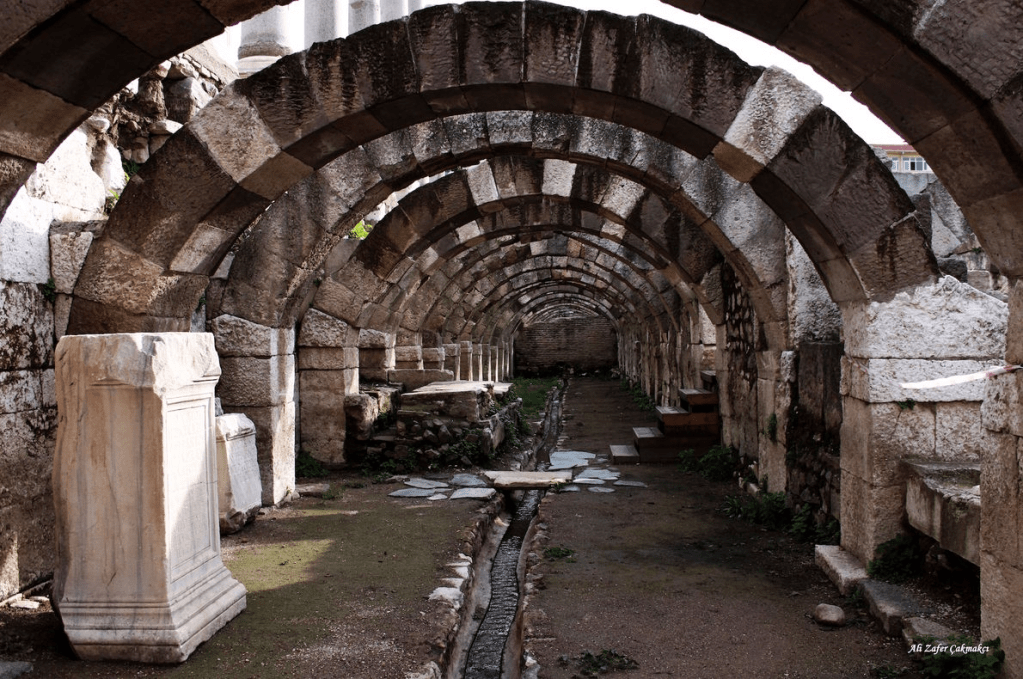
Michal Hunt: ‘The beautiful city of Smyrna, which rivaled Ephesus… was destroyed seven hundred years earlier (circa 580 BC) and had laid in ruins for three centuries until rebuilt in circa 290 BC to a comprehensive plan. It was one of the very few planned cities of antiquity, and many ancient writers commented on its beauty, calling it “the glory of Asia.” Smyrna enjoyed many natural advantages, including an excellent harbor at the head of a well-protected gulf that made it a commercial center. The city was the natural outlet for the trade that flowed into the river valley of the Hermus and the regions beyond. But it was also known for its schools of rhetoric and philosophy, and Smyrna claimed the honor of being the birthplace of the great poet, Homer. The people erected a… Temple to honor his memory, and a cave in the city was believed to be the site when he composed his epic poem.
The Romans honored Smyrna as one of the principal cities in Asia Minor. In appreciation for Roman patronage, it was one of the first cities of the region to engage in worship of the Roman emperor, winning the honor of erecting a temple devoted to the deified emperor Caesar Augustus [27 BCE to 14 CE] in the reign of Tiberius [14-37 CE] (emperor who reigned at the time of Jesus’ ministry and resurrection).’
The meaning of the word Smyrna, is Myrrh. Taken by some to mean a ‘sweet fragrance.’ One of the gifts brought by the wise men who travelled from Parthia in the East to visit the young Jesus – Matthew 2:11. Abarim: ‘From the noun (smurna), myrrh, from (mor), myrrh, from the verb (marar), to be bitter or strong.’ One source, offer ‘anointing oil’ as a definition. Myrrh was brought by the faithful disciple Nicodemus to use in the embalming process for the body of the dead Christ – John 19:39-40. Others propose the meaning of Smyrna to be that of death.
The letter to the Ephesians comprises seven verses. The letter to the Smyrna Church era is the shortest of all the seven letters, with only four verses. The second letter is very different from that of the first. An entirely different audience is being addressed, of this there is no doubt.
Revelation 2:8-11
English Standard Version
8 “And to the angel of the church in Smyrna write: The words of the first and the last, who died and came to life.”
In this short but packed full introduction, we have echoes of the Alpha and Omega; a continuation from the Ephesian letter and the primacy, of the number one. Christ is the beginning and end of all things and the church. Christ is the Word of God. John 1:1, ESV: ‘In the beginning was the Word, and the Word was with God…’ Christ speaks the word of God. John 6:63, ESV: ‘It is the Spirit who gives life… The words that I have spoken to you are spirit and life.’ Christ not only speaks the words of life; died and was raised again to life himself; he also has the power to raise us from the dead. John 11:25, ESV: ‘Jesus said… “I am the resurrection and the life”…’
Revelation: 9 “I know your tribulation and your poverty (but you are rich) and the slander [G988 – blasphemia: blasphemy, railing, evil speaking] of those who say that they are Jews [G2453 – Ioudaios: of Judea] and are not, but are a synagogue [G4864 – sunagoge: gathering, assembly] of Satan.”
This verse is monumental in its importance and enormous in its ramifications; yet it is not fully understood by the world. Some say it refers to unbelieving Jews who were persecuting Christians. This is true in part. For the Jews reject Christ as the Messiah. Others interpret the verse as referring to spiritual Jews pretending to be christians. While this is highly applicable in a subsequent era; it is less so during Smyrna. The Universal Church and its daughter offshoots are never described as the ‘synagogue of Satan’ in the Bible, but by other references as we shall discover. Including for example the tag of Nicolaitans, as we learned in the first church era.
The full scope of the verse is far reaching. This is due to the fact that the Jews in question are not who they say they are, in a physical sense. In this, the Jewish people are imposters. They are ethnically and genetically not descended from the tribe of Judah or from his father Jacob – John 8:39-44. The Jews in the main are in fact descendants of Jacob’s twin brother, Esau – Malachi 1:2-4, Obadiah 1-21. Constant readers will be well aware of this truth. For those readers interested in a full discussion, please refer to Chapter XXIX Esau: The Thirteenth Tribe and Chapter XXX Judah & Benjamin – the Regal Tribes.
Many Jews colluded with Rome against Christians. Thus true Christians were amongst the fallout. The hostility between the two ideologies was evident in the time of Christ – John 8:45-47. As the Jewish hierarchy had control of Judea during Christ’s life – in both state temporal affairs under King Herod the Edomite Jew as well as religiously under the High Priest and the Sadducees – so too, do the Jewish establishment control and manipulate the upper echelons of the leading nations in the West today – refer article: The Establishment: Who they are… What do they want? This was prophesied to occur – Genesis 27:39-40. Nor is Jewish power restricted to politics, banking, and the media, but also in religion and none other than in the headquarters of the false mother church – the Vatican City and Rome.
What is absolutely pivotal to understand is that this verse is speaking of a people who claim to be from Judah and are not. The use of the word Jew has stemmed from ignorance of the truth and at the same time, has clouded the meaning of the verse, so as to make it difficult to interpret. For the Jews are Jews. It’s just that the Jews are not Judah. The Greek word used here is misleadingly translated as Jew, when the term Judea, as in a location would be more accurate. The Greek word Ioudaios derives from G2448 – Iouda, meaning: ‘Juda’ or Judah, the fourth son of Jacob.
Jews have claimed to be Judah and they are not. Jews have not claimed to be Jews and are not. See the difference and how the meaning alters, becoming clearer from the verse if it were translated as: ‘those who say they are of Judea [or from Judah] and are not.’
The clinching clue that this verse is speaking about the Jews descended from Edom and not about the true tribe of Judah, is the use of the Greek word for a Jewish synagogue. John under inspiration could have easily used the Greek word G1577 – ekklesia, meaning a church, congregation or assembly; pointing to the regular gathering of the elect to fellowship and worship. But he pointedly did not.
The Jews were not just saying nasty things, but blasphemies. The Greek word G988 derives from G989 – blasphemos, meaning: ‘reproachful, abusive’ and ‘impious.’ Impious means: ‘ungodly’ and ‘lacking reverence for God.’ The Greek word, blasphemia is a serious word, for it implies hostile blasphemy directly ‘against God.’
“Scripture links persecution with spiritual strength. The church at Smyrna displayed the power and purity that comes from successfully enduring persecution. The Greek word for ‘tribulation’… carries the idea of pressure. The church at Smyrna was facing intense pressure because of their faithfulness. Persecution had purified and purged it from sin and affirmed the reality of its members’ faith. Though they suffered physical privation and poverty, the Christians at Smyrna clung to their immeasurable spiritual riches” – MacArthur.
The Greek word for “poverty”… describes beggars and refers to extreme poverty. “Many of the believers at Smyrna were slaves; most were destitute. The few who had possessions had undoubtedly lost them in the persecution. The church at Smyrna had every reason, humanly speaking, to collapse. Instead, it remained faithful to its Lord, never (unlike Ephesus) leaving its first love for Him.” – MacArthur.
Revelation: 10 “Do not fear what you are about to suffer. Behold, the devil is about to throw some of you into prison, that you may be tested, and for ten days* you will have tribulation…”
Unlike the Ephesus letter, the letter to the Smyrna church era contains no rebuke, condemnation or admonishment. But rather a warning of impending tests and trials, where they would suffer for their faith. Smyrna was to be ‘Persecuted, poor, but ever faithful and resolute.’ While the Ephesian era backslid, Smyrna remained a steadfast church in their zeal as well as in their dedication to the truth.
Eusibius who lived from 264 to 340 CE – an early Catholic historian and the ‘Father of church history’ – “believed that he was living at the beginning of a new age, and he felt that it was a fitting time, when the old order of things was passing away, to put on record for the benefit of posterity the great events which had occurred during the generations that were past” – Encyclopedia Britannica, 11th edition, page 954.
How right Eusibius was for he lived during the relatively sudden and violent passing of the first era to the second.
Isolated persecution had transpired during the Ephesus era, such as perpetrated by Nero in Rome (64 CE) and Decius in Jerusalem (248 CE). The church enjoyed nearly one hundred years of relative freedom of worship after the death of Polycrates in 196 CE. Yet, the most severe persecution – which ushered in the Smyrna era – were the tenth and final climatic persecutions begun by Emperor Diocletian in 303 CE.
Dugger & Dodd: ‘… Diocletian… formulated plans for the extermination of Christians. The edict… stated that churches, and all Christian writings should be destroyed, and all their rights and privileges annulled. Furious persecutions raged. Some were broiled to death on gridirons after being cruelly scourged, and their wounds washed in brine. Others were thrown to wild beasts, and some starved to death.’
Diocletian reigned over the Eastern Empire from 284 until 305 when at the age of sixty-eight(?) he abdicated after developing a ‘loathsome disease.’ The new emperor – in the West – Constantine, ended the evil purge in 313 CE. Exactly ten years, or ten prophetic days* – for in scripture a prophetic day often stands for a year – Numbers 14:34, Ezekiel 4:6.
Much like the ‘conversion’ experience of Paul – who first persecuted Christians and then became one himself after a revelatory encounter – Constantine had a change of heart when he beheld a luminous cross in the sky with the inscription: “By This Conquer” – Acts 9:1-9. There is that word ‘conquer’ again. Constantine chose to champion Christianity with the Edict of Milan in 313, favouring the Church and so peace ensued as he became emperor of the West and the East until his death in 337 – though not without historic decisions and everlasting consequences. The first of which occurred during a synod of bishops and prelates who assembled at Nice in Bithynia – a Greek city in northwestern Anatolia – in 321.
Again like Paul (article: The Pauline Paradox), the heathen Constantine was not a holy or converted man and did not understand the truth – or chose to ignore it – when it was presented to him regarding the controversy surrounding Easter versus the Passover; the question of the true nature of Christ and his relationship with the Father; and the debate over the Sabbath or the Lord’s Day. In fact, Constantine was so keen to distance himself from anything ‘Jewish’, he used Christianity for his gain in both solidifying his own power and establishing ecclesiastical unity across the empire.

Constantine I (the Great), sculpture found in York and on display at the Yorkshire Museum. There is more than one bust of Constantine discovered, though none are flattering. This rendition reveals a man not to be trifled with, with more than a hint of the psychotic.
Constantine was in York with his father, Constantius in 305 CE. The system of succession at the time demanded that another Caesar should become emperor but the soldiers in York immediately proclaimed Constantine their leader. It proved to be a pivotal moment in history.
Ambassador College, Bible Correspondence Course, Lesson 50, What became of the Church Jesus built?
‘Constantine… was not a Christian. He was a worshipper of the sun god, who foresaw how political advantage might be reaped by allying himself with “Christianity.” He allied himself with the faction which offered the most immediate benefits – the strongest ally. That faction happened to be reigned over by Sylvester, bishop of Rome. He too, observed the day of the sun. Sylvester could become head over all christendom – under the Emperor, of course!’
The first ‘doctrine’ – long after the corruption of church governance – isolated for adjustment, was to paganise the Sabbath tradition.
History of the First Council of Nice, Dean Dudley, 1880 – emphasis mine:
‘And our present legal institution of Sunday was established by this man’s authority. “He enjoined on all the subjects of the Roman empire to observe the Lord’s Day as a day of rest.“ This decree for the general observance of Sunday** appears to have been issued A.D. 321, before which time both “the old and new Sabbaths” were observed by Christians. Gibbon says he called the Lord’s Day “Dies Solis,” that is, the Day of the Sun, or Sun’sday, “This day,” he said, “should be regarded as a special occasion for prayer.”
Up until this time, both the ‘seventh’ day (Saturday) and the first day of the Roman week (Sunday), were chosen as days to congregate, fellowship and worship on by Jews and Christians alike. Neither were the true seventh day Sabbath of Old Covenant Israel as calculated by a scripturally based Lunar calendar – refer article: The Calendar Conspiracy. Nor was Saturday or Sunday observance in keeping with the true purpose of the New Covenant Sabbath – refer article: The Sabbath Secrecy.
Dudley: ‘It was not generally called** “Sunday” before this time; probably, never so called. Constantine had claimed Apollo, the sun-god, as his patron, and even after becoming a Christian, he stamped Apollo’s image on one side of his coin, and the initials of Christ on the other. The earlier Fathers of the Church observed the first day of the week as a day of rejoicing and triumph, because Christ, on that day, triumphed over the grave, and initiated the resurrection. They did not wholly cease from labor, but observed the old Sabbath as a day of rest. The first day of the week was, by then, called the “Lord’s Day.”
It is debatable whether true Christians were actually ‘observing’ both days or either. Yet, there are a number of occasions in the New Testament where early Church members were meeting on the first day of the week – Acts 20:7, 1 Corinthians 16:1-2. Of course, this does not prove anything, for while Christ appears to have been resurrected very early on the first day of the week, it may also have been very late on the seventh day – refer articles: Chronology of Christ; and The Sabbath Secrecy. There is no place in the scriptures where the first day of the week was ordained a special day of remembrance, worship, or rest by either Jesus or by apostolic mandate.
According to Dugger and Dodd, Father Enright, a deceased Catholic Priest from Kansas City, Missouri, stated: “It was the Roman Catholic Church that changed the Sabbath from Saturday, the seventh day of the week, to Sunday, the first day, and anathematized those who kept the Sabbath, and urged all persons to labor on the seventh day of the week under penalty of anathema.”
Anathema: ‘a person or thing detested or loathed; a person or thing accursed or consigned to damnation or destruction; a formal ecclesiastical curse involving excommunication; any imprecation of divine punishment; a curse; execration.’
William James: “When the practice of keeping Saturday Sabbaths, which had become so general at the close of [the fourth] century, was evidently gaining ground in the Eastern church, a decree [or law] was passed in the Council of Laodicea (A.D. 364), ‘That members of the church should not rest from work on the [Saturday] Sabbath like Jews’.”
The phrase Lord’s Day, is used only once in the Bible, coincidently in Revelation and in context with Christ addressing the seven churches – the seven golden lamp stands.
Revelation 1:9-13
English Standard Version
9 ‘I, John, your brother and partner in the tribulation and the kingdom and the patient endurance that are in Jesus, was on the island called Patmos on account of the word of God and the testimony [prophecy] of Jesus. 10 I was in the Spirit on the Lord’s day, and I heard behind me a loud voice like a trumpet 11 saying, “Write what you see in a book and send it to the seven churches, to Ephesus and to Smyrna and to Pergamum and to Thyatira and to Sardis and to Philadelphia and to Laodicea.” 12 Then I turned to see the voice that was speaking to me, and on turning I saw seven golden lampstands, 13 and in the midst of the lampstands one like a son of man…’
John was in a receptive like state or trance, induced by the Holy Spirit so that he could witness a vision from his time to the end of the latter days. It embraced the history of the church through the ages, culminating in the Lord’s Day, or the Day of the Lord. The Day of the lord is a time of God’s wrath and judgement on the world – Isaiah 13:9, Malachi 4:5, 2 Peter 3:10 – which the majority of the Book of Revelation describes. It is the climax of what is declared in other passages as the time of Jacob’s Trouble and as the Great Tribulation – Jeremiah 30:7, Matthew 24:21.
This phrase is used by many to support the argument that John sanctioned the first day of the week as a new Sabbath. Yet why would John explain what day of the week he was on when he had his rather lengthy vision, which could not have been revealed in one sitting (or day) judging by the length of Revelation. It makes little sense to say a particular day as this is without precedent in the scriptures from any other prophet or apostle. Why not the third day and if it really was the first day of the week, just say that as it was Jewish custom to refer to the days of the week by their numeric value; opposed to a name as in the Roman manner.
It is relevant to note the environment of the now well established universal church in 300 CE, just prior to the extraordinary events that would transpire a few short years later. Originally, the Bishop of Jerusalem was accorded the most honour and respect in the leadership of the Church of God. By the third century, bishops were commonly known as ‘papa’ or pope. As Jerusalem had taken a lesser role after 70 CE, the role of the Bishop of Rome grew in stature, aided by its proximity to the Roman emperor.
The Church of God went further under ground after the death of Polycrates in 196 CE, with the false church steadily rising to prominence. The Bishop of Rome became head of the clerical order, as the primary bishop; confirming his leadership superiority through ‘immense splendour and magnificence.’ Dugger & Dodd: ‘His authority had, however, before the close of the fourth century, a formidable rival in the bishop of Constantinople, who at a council in that city [in 381] was elected to bishop of second clerical rank.’
For a lengthy period the Bishop at Constantinople ‘regulated the affairs for the professed followers of Christ in the East, while the Bishop of Rome ruled the West.’ The title of papa or pope gradually became applicable only to the bishops of Constantinople and Rome. Later again, the use of pope as a title was reserved solely for the Bishop of Rome.
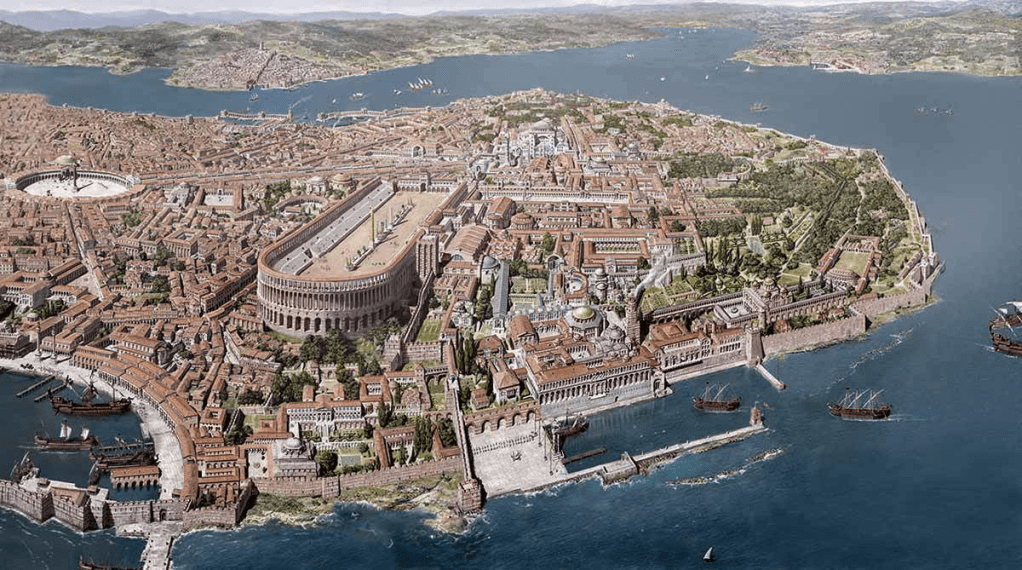
Constantinople
It was during this backdrop, a bright light shone in a dark world. The emanation of the Ephesus church era had grown dimmer after Polycrates the Bishop of Ephesus had faithfully served the Lord. One hundred and twenty-nine years elapsed and a mere twenty-two years or less had transpired since the emergence of the Smyrna church era, when a brilliant and brave man named Arius, took up the baton for the true church and led the crusade in standing up not just for the truth, but in challenging the unified might of the Catholic Church and the Roman Emperor.
As an aside, it is interesting to note that the earliest known document where the word ‘catholic’ is used to label the Church, is a letter from Ignatius of Antioch, a loyal disciple of John; written in 107 CE, while being taken to Rome for execution. Catholic simply means, universal; from the Greek, katholikos.
Much of what we learn about Arius derives from records written by his detractors and opponents. Even so, his stance of unwavering faith and defiance against an insurmountable wall of doctrinal bureaucracy and obstinacy is remarkable. Dugger & Dodd: ‘… Arius, the most talented, intellectual and spiritual power of the fourth century was the central figure against which the evil and polluted minds of western Roman bishops were directed. He was indeed a man of God, in whom the truth found its most consecrated and able defender… he traversed the then known world, propagating truth, and denouncing error.’
The name Arius is believed to have been inspired by Ares – renowned as the Greek god of courage and war – one of the twelve Olympians in the archaic tradition – refer article: Thoth. ‘In Roman times, the Algerian city of Médéa is thought to have been identified by the name Arius.’ Arius is believed to have originated in ancient Greek script as a Latinised variant of Areios and translates as: ‘immortal, devoted to Ares’, or ‘warlike.’ Other connotations for this name include: ‘of Ares, sacred to Ares, martial, deathless’ and ‘name of a settlement.’ Arius is also a transliteration of another Greek word, Athanasios. This is a strange coincidence as will become very apparent. A variant of the name includes Areius, which has a similar origin. If used today, the name can be abbreviated to Ari, Rius, and Ri Ri.
Little is known of the early life of Arius. He is credited with being born in Libya in Africa circa 250 to 260 CE, with 256 invariably cited. Described as an ascetic Christian minister of Baucalis in Alexandria, Egypt. Alexandria was founded in 331 BCE by Alexander the Great and became a renowned centre of learning, with a famous Library and eventually replaced Memphis as the capital. Arius was ordained in 313 as a presbyter, an unscriptural office placed between a deacon and a bishop.
This brings to attention an important point mentioned earlier in that the apostolic church did not have ranks amongst minsters but rather functions or responsibilities. The overriding qualification and definition of a minster, is to serve. The Bible is clear on what the responsibilities in the ministry or presbytery are and of how many. But as can be seen with the case of Arius, the process had deviated from the understanding of the early church and so today christian churches maintain unscriptural ministerial hierarchies.
In the Bible, there is a unique ministerial function, apart from apostles, prophets, prophetesses and priests, for all saints are priests, but not all have the gift of prophesy – Acts 11:27-28, Revelation 18:20, Luke 2:36-38, Acts 21:9, 1 Peter 2:9, 1 Corinthians 14:1-4. The basic and prime function in the congregation are deacons. The word means a servant or minster. Overseers or bishops were men already ordained deacons (with the laying on of hands) chosen to be elders in a local congregation. Recall, deacons and deaconesses were responsible for the ministration of the church, allowing the apostles to travel and preach – Acts 6:1-6.
Though it was Paul who led the way in appointing elders himself (instead of the congregation) and creating an artificial two tier ministry composed of bishops and deacons – Romans 16:1, Philippians 1:1, 1 Timothy 3:8-13.
Elders as deacons (Bishops) oversee the spiritual and physical welfare of the church congregation – 1 Timothy 3:1-7. The letter written to Titus shows that the words overseer and elder are synonymous and one and the same – Titus 1:5-7. The author of Acts confirms this, adding the responsibilities of an elder or overseer as one who shepherds the flock – Acts 20:17, 28. In only one place in the Bible, the word shepherd is translated as pastor. Not another position but rather an amplification of the role of an overseer or bishop to be a shepherd, pastor and a teacher. This verse interestingly, occurs in the anonymous letter to the Ephesian congregation, which we will discuss towards the end of the article.
Ephesians 4:11
King James Version
‘And he gave some, apostles; and some, prophets; and some, evangelists; and some, pastors and teachers…’
The author states the key functions or responsibilities of the ministry who serve the brethren and spread the gospel. Yet the list is misleading, as there are not five but rather three.
Pastors and teachers form one role – for the Greek word and [G2532 – kai] joins them together – which elsewhere is described as either an overseer, bishop or elder. Minsters (deacons) perform the work of an evangelist in spreading the ‘good news of the gospel’ – as the name means – and in establishing new congregations – Acts 21:8, 2 Timothy 4:5.
Prophets function as the Eternal’s warning mechanism for turning away from sin before national calamity strikes – Jeremiah 25:3-9, Revelation 11:10.
An Apostle was ‘one who is sent out’ or sent forth. His commission and authority was given by Christ – Matthew 10:1, 5-10.
In summary, the only functions delineated in the New Testament church are: Apostles, Prophets (Prophetesses) and Deacons (Deaconesses) – who may or may not have been elders and who may or may not have evangelised. Three in total, or five depending how one wishes to count them. These are responsibilities and while they are in descending order of service, they are not, repeat, are not ranks of a hierarchical order of rulership and therefore a yoke of bondage for the brethren, the beloved saints.
William Jones: ‘A Bishop, during the first and second centuries, was a person who had the care of the Christian assembly, which, at that time, was, generally speaking, small enough to be contained in a private house. In this assembly, he acted, not so much with the authority of a master, as with the zeal and diligence of a, faithful servant.’
The concept of us and them, with a congregation and separate clergy is not found in the New Testament and is a creation of the evolving Roman church which early understood the reward of creating a power structure to control income and ensure selfish financial gain. Recall the Nicolaitans who sought to subjugate the brethren during the first era and Simon Magus who sought power for himself.
Wish to know where the true church is? Well, here are clues to where it is not. It won’t be anywhere near a pyramidal structure of descending priestly control; nor will it be an organised, political, financial business entity with great wealth; and it will not entertain false doctrine of any kind, but rather be continually contending for the faith once delivered and always seeking to grow in grace and knowledge – Jude 3, 2 peter 3:18. Use this standard and you will know when you are in a false church and conversely, when you have found the true Church of God.
The key features in the life of Arius include his training at the hands of Lucian, a presbyter of the city with a famed christian tradition, Antioch. In 318, at the age of approximately sixty-two, Arius was compelled to openly challenge major error originating with the Bishop of Alexandria, Alexander; and began teaching the truth about the nature of Christ. As early as 320 or 321 Alexander convoked a council at Alexandria at which more than one hundred bishops from Egypt and Libya anathematised Arius. Arius continued to officiate in his church and to recruit believers. He was finally driven out, going first to Palestine and then to Nicomedia. But such was the impact of his preaching and teaching, it caused Constantine to summon the first ever Church Council at Nicea in 325, as the doctrinal crisis threatened to split the church.
Arius and his teaching were condemned at the council. He was essentially accused of reviving an ‘old heresy.’ One propounded by Sebellius in 215 CE and before him by Montanus in 150 CE, who both taught the oneness of God. Yet the importance of the theological question and strength of the case made by Arius, meant the controversy continued to rage in the East for centuries.
Although the points debated were many, the main issue at stake was whether the Logos – the Word of God – was coeternal with God the Father. Main catch phrases attributed to Arius in explaining his biblical position included: “There was when the Son was not” and “The Son has beginning, but God is without beginning.” Arius was essentially teaching that Christ did not pre-exist eternally with God – refer article: Arius, Alexander & Athanasius. On the surface, it appears Christ ‘was the first of the creation, who then created all the rest of the creation.’ But this is is not the complete story – refer Chapter XXII Alpha & Omega.
According to Dugger and Dodd, 318 bishops attended the council. A coincidental number to when Arius first began to preach Arianism in 318 CE as well as the same number used earlier in the Bible. Genesis 14:14, ESV: ‘When Abram heard that his kinsman [Lot] had been taken captive, he led forth his trained men, born in his house, 318 of them, and went in pursuit as far as Dan.’
Bishop’s Encylopedia of Religion, Society and Philosophy aptly describes the Arian controversy. ‘The Arian controversy began in Alexandria when its bishop, Alexander (250-326), clashed with the presbyter Arius (256-336) over matters of theology.’
“Alexander held that the Word existed eternally with the Father; Arius argued that the Word was not coeternal with the Father”. ‘Whereas Alexander believed in the divinity of the Word, Arius, although accepting the preexistence of the Word, claimed that the Word was not God, but the first of all creatures created by God. But in Alexander’s view, the Word was divine and therefore could not be created. It is coeternal with the Father.
Arius argued that Alexander’s view entailed a denial of monotheism. In Alexander’s view, there were two who were divine, and thus there were two gods. Alexander countered that Arius’s position denied the divinity of the Word and therefore the divinity of the Son. He also saw how Arius’s view had grave consequences for the Church’s worship of Jesus by suggesting that it had been worshiping a creature.’
‘During this period [Catholic Church historian, Eusibius] took the side of Arius in the dispute with Alexander of Alexandria, and accepted what he understood to be the position of Arius and his supporters, who, as he supposed, taught both the divinity and subordination of the Son. It was natural that he should take this side, for… he found it difficult to approve the position of Alexander, who seemed to be doing away altogether with the subordination of the Son. And, moreover, he believed that Alexander was misrepresenting the teaching of Arius and doing him great injustice.
Meanwhile at the council of Nicea he seems to have discovered that the Alexandrians were right in claiming that Arius was carrying his subordinationnism so far as to deny all real divinity to Christ. To this length Eusebius himself was unwilling to go, and so convinced that he had misunderstood Arius, and that the teaching of the latter was imperiling the historic belief in the Divinity of Christ, he gave his support to the opposition, and voted for the Nicene Creed, in which the teachings of Arians were repudiated’ – Encyclopedia Britannica, 11th edition, page 954.
In 325 CE, the bishops had gathered in Nicea in what would become known as the First Ecumenical Council. There was a small group of Arians led by the bishop Eusebius of Nicomedia (d. 341). Arius himself was not a bishop so could not sit in the council and Eusebius of Nicomedia had to represent him and his theology. The Arian position was… opposed by another small group of bishops, led by Alexander… One of Alexander’s followers was the deacon Athanasius of Alexandria (c. 296-373) who, while not permitted to sit in the council, would become a leading defender of Nicene orthodoxy against Arianism.
The creed was agreed upon that presented the views of the council that deliberately excluded Arianism. Constantine, either by his own accord or through his ecclesiastical advisor Hosius of Cordoba, suggested that the word homoousios (“of the same substance”) be included in the creed showing that the Son is just as divine as the Father.
Following the unbiblical Nicene Creed, all the bishops present save five declared themselves ready to subscribe to the formula, convinced that it contained the ancient faith of the Apostolic Church. The opponents were soon reduced to two, Theonas of Marmarica and Secundus of Ptolemais, who were exiled and anathematised. Arius and his writings were branded with anathema, his books were cast into fires and he was exiled to Illyria.
Dugger & Dodd: “A company of bishops who secretly favoured… Arius were discovered and banished into Gaul. One of the followers of Brother Arius, who by the dying words of his Sister Constantina, had been recommended to the emperor [Constantine] of Rome, had the address to persuade him that the sentence of… Arius was unjust. The emperor consequently recalled him, and endeavoured to have him received into the church at Alexandria, but the bishop [there] refused his admittance, but Arius and his adherents were received into the communion of the church at Jerusalem” – Hugh Smith’s History, page 114.
Constant readers will be aware of the details in this doctrinal crisis and the theological answer. How the Trinity doctrine is no where to be found in the Bible and what the oneness of the true God means. Dudley: ‘According to some historians, the idea of the Triad and Trinity originated with Plato, and was discussed by the Platonists – see Gibbon’s Decline and Fall of Rome, chapter 21.’ Interested readers are encouraged to refer to the article: Arius, Alexander & Athanasius; and Chapter XXII Alpha & Omega.
An opposing answer on the Quora forum regarding Arius is reproduced below. It is a good example of a. the widely held view on Arius as a villain and not a hero and b. how people are so easily misled in accepting party line propaganda, without realising the error they are promulgating.
“In the year 318, at the Synod of Alexandria, the Patriarch of that city gave a discourse on the doctrine of the Most Holy Trinity. Arius declared that the Patriarch had fallen into error, and proceeded to set out his own ideas of Christian doctrine. He denied that Christ was really the Eternal Son of God, equally sharing in the Divine Nature with the Father. According to him, the Person of Christ existed before all other created things, and was nobler than them all. But God had created that Person of Christ in eternity, and then through Him created all other things in time. Later that created Personality of Christ became man for the redemption of the human race.
In 320 A.D. a second Synod of Alexandria condemned the doctrine of Arius as heretical because it made the Eternal Son of God a mere creature, denying that He was equally the uncreated God with the Father and the Holy Ghost.
Arius would not submit, but went on teaching and publicly spreading his errors, securing many followers and causing immense disturbance in the Church, and also in the State. The Emperor Constantine demanded that a General Council be held to settle the matter, and in 325 A.D. the Bishops met at Nicea. They condemned the teaching of Arius because he denied the Deity of Christ, and he was excommunicated because he would not submit to the authority of the Church. His heresy led multitudes astray, and for over four centuries Arian heretics were proportionately as numerous as the various forms of Protestantism during the last four centuries.
Arius himself died in 335 A.D., and his movement died out also in the seventh century. In modern times Unitarianism is really a revived form of Arianism, at least by its denial of the doctrine of the Trinity and of the Deity of Christ.”
The Gothic peoples – the ‘Arian kingdoms: Burgundians, Vandals and Ostrogoths’ – faithfully embraced what was known as Arianism. Refer Chapter XV The Philistines: Latino-Hispano America; and Chapter XXIII Aram & Tyre: Spain, Portugal & Brazil.
Of course Arius did not submit to the usurping hypocritical rule of the second woman in Revelation chapter seventeen, the false church. Arius in the tradition of the Apostle Peter represented the first woman in Revelation chapter twelve – Matthew 16:18-19. It has to be considered that Arius as the rock of the Smyrna era of the church, whilst not an apostle had been sent forth as a messenger of the truth. In this, his opponents in Alexandria, at Nicea and even the eminent Roman emperor himself, were all in the presence unbeknown to them, of one greater in the eyes of the Eternal than all of them put together – Isaiah 66:2.
Dean Dudley provides a synopsis of the Council of Nicea in 325 – emphasis mine. ‘The Orthodox believed the Son to be derived of, and from, the Father, being of the same identical essence, and not merely of similar essence. But the Arians held that he was created by the power of God, out of nothing, although they allowed him to have been the first created being in the Universe. Great dissensions had arisen in the church of Egypt about the nature of Christ, and the time to celebrate Easter, by which Constantine was much troubled.
He therefore ordered a convention to be held at Nicea in Bithynia, to which bishops were invited from all parts of the world, hoping that harmony might result from the decision of such a Universal Assembly of the chief Christians of the world.
Arius (son of Ammonius), the celebrated originator of the Arian doctrines, was a presbyter of the Alexandrian Church, and presided over an independent parish of that city, by the name of Baucalis, where he had been placed a short time before Alexander became bishop. He was a rigid ascetic, and acquired great respect from all.’

Ascetic: ‘a person who dedicates their life to a pursuit of contemplative ideals and practices extreme self-denial or self-mortification for religious reasons. A person who leads an austerely simple life, especially one who abstains from the normal pleasures of life or shuns material satisfaction.’
Dudley: ‘Socrates [Scholasticus] thus describes the advent of Arianism: – “After Peter of Alexandria had suffered martyrdom (A.D. 311), Achillas was installed in the episcopal office, whom Alexander succeeded. The latter bishop, in the fearless exercise of his functions for the instruction and government of the Church, attempted one day, in the presence of the presbytery and the rest of his clergy, to explain, with perhaps too philosophical minuteness, that great theological mystery, the Unity of the Holy Trinity.
A certain one of the presbyters under his jurisdiction, whose name was Arius, possessed of no inconsiderable logical acumen, imagining that the bishop entertained the same view of this subject as Sabellius the Libyan (African, who taught, in the third century, that there was but one person in the divine essence), controverted his statement with excessive pertinacity; advancing another error, which was directly opposed, indeed, to that which he supposed himself called upon to refute.
‘If,’ said he, ‘the Father begat the Son, he that was begotten had a beginning of existence; and, from this, it is evident that there was a time when the Son was not in being. It, therefore, necessarily follows he had his existence from nothing.’ Having drawn this inference from this novel train of reasoning, he excited many to a consideration of the question; and thus, from a little spark, a large fire was kindled.”
‘Arius is thus described by the orthodox Epiphanius: “He was exceedingly tall, with a clouded and serious brow, having the appearance of a man subdued by self-mortification. His dress corresponded with his looks; his tunic was without sleeves, and his vest but half the usual length. His address was agreeable, and adapted to engage and fascinate all who heard him.” He was a man of acknowledged learning, but not of the deepest philosophy. Arius died suddenly at Constantinople, perhaps by the poison of his enemies, A.D. 336, and his opponents rejoiced at his death.’

Constantinople
Arius died at about eighty – when called by Constantine (a year before his own death) to the city – though his death was sudden with symptoms mimicking severe food poisoning, not unlike those produced by arsenic. Dan Fefferman: ‘Anti-Arians related the story of his death as miraculous: the venomous heretic a just victim of his own spiritual poison. Pro-Arians, on the other hand saw the event as the result of a murder and martyrdom. But at 80, he may easily have died of food poisoning or a natural stomach ailment, with the narrative then exaggerated by friends and foes alike.’
Dudley mentions two great debates raging at the time. The other had groundwork conveniently laid either by chance or design, when Sunday was officially venerated in 321. The awkward matter of a ‘Jewish Passover’, was also addressed and adjusted at the Council of Nicea. The prime motivation being Constantine: “Let us, then, have nothing in common with the most hostile rabble of the Jews” – Boyle’s Historical View of the Council of Nice, 1842, page 52.
During the first three centuries, the church was in constant flux with persecution and so no attempt was made to standardise the biblical festival observances. When Constantine became emperor and Christianity was no longer illegal, it was possible to consider the Passover-Easter controversy more carefully. Hence its inclusion on the Council of Nicea agenda. Constantine did not want Easter to be celebrated on the Jewish Passover. Whether he understood or not that the true body of believers were participating in a Bread and Wine ceremony – aka the ‘Lord’s Supper’ – instead of the Old Testament Passover is irrelevant, if he perceived it as Jewish because of its synchronistic timing – Article: The Chronology of Christ.
Constantine remarked that it was a Christian “duty to have nothing in common with the murderers of our Lord.” All the while ignoring the ironic fact that Christ’s execution was a joint effort between the Jews and Gentile Romans, of whom he was one, in part at least – Appendix VIII: When the Creator came to dwell with His creation.
Accordingly, the Council of Nicea required the ‘feast of the resurrection” to be celebrated on a Sunday and never on the day of the ‘Jewish Passover.’ Which was calculated as the fourteenth day of the first month of Abib or Nisan – preceding the full Moon of the fifteenth day – on the Jewish calendar and falling on any day of the week – Article: The Calendar Conspiracy.
Whereas Easter was calculated to be on the Sunday after the first full moon which followed the Spring equinox. This meant the date for Easter would always fall between March 22nd and April 25th. Since there is seldom a full moon on March 21st, Easter rarely falls on the following day. The last time it happened was in 1818 and in the twentieth century, it never occurred.
An important distinction between the two celebrations is that the Lord’s Supper commemorates the sacrifice and the death of the Messiah, the evening before he died. The Lord’s Supper is not the same as the Passover observance held the following night. Similarly, it is certainly not anchored to the Passover in its remembrance. Christ’s death made possible the forgiveness of sin. Yet focus was switched when Easter replaced the ‘Passover’ to a celebration of Christ’s resurrection; with the choice of a Sunday observance being inconsequential regardless. It was a successful attempt to paganise an Old Testament biblical observance of the Jews into a heathen holiday.
Some might ask, is there any observance which celebrates Christ’s resurrection. Overtly, no, there isn’t. Though two instances where it is remembered is when a new christian is baptised and rises from the watery grave in newness with Christ – Colossians 3:1-2. The other instance was the Feast of Weeks, or Pentecost where the first New Testament Christians gathered and received the Holy Spirit – Leviticus 23:15-22, Acts 2:1-4. This event and Holy Day observance pictured the church – the body of Christ – as the first fruits of God’s plan of redemption (with Christ, 1 Corinthians 15:20-23) and their process from a begotten Christian to a resurrected one with a new body, inheriting eternal life – Romans 8:23, Leviticus 23:10-11.
Needless to say, the ruling of the Nicean Council was not immediately accepted everywhere. It certainly did not sit well with those who had been celebrating the Lord’s supper at the time of the Passover to suddenly learn they were being called heretics.
ACBCC: ‘As protector and favorer of a counterfeit form of “Christianity,” Constantine forced everyone , pagan or Christian, either into conformity – or exile!’
A group undoubtedly encompassing the true church is identifiable in the latter part of the fourth century. Dugger & Dodd: ‘… in the midst of all the turmoil and the wrangling caused by ambitious bishops… there dwelt a people untouched by the worldliness of the apostate church, this was the true Church of God, known, it is true, by various man-made names, but among themselves holding to the true name, and the pure unadulterated doctrines advocated by the disciples of the first century… [were retrospectively named] the Waldenses…
“The heresy of the Waldenses is the oldest heresy in the world… they first betook themselves… among the mountains, where they existed before Constantine the Great… The people being settled there, their posterity continued… from age to age; and being, as it were, by natural walls, as well as by God’s grace, separated from the rest of the world, they never partook of the overflowing corruption” – Edwards’s History of Redemption.’
Dudley: ‘In the thirty-first year of [Constantine’s] reign [in 337], and the sixty-third of his age, he fell sick, and desired the bishop where he was, in Nicomedia, to baptize him, which was done; and he thought this ceremony had the effect to purify and purge his soul from past errors.’ Wishful thinking on Constantine’s part, unless his repentance was genuine. How many have thought upon deathbed conversions, the same as him? Where there are notable exceptions – such as the thief on the same tree of the cross as the Saviour – they are invariably actions of carnal people acting ‘too little, too late’ – Luke 23:39-43. Even so, only God can judge the heart of a person – 1 Samuel 16:7.
Little is known of the true church during the century lasting from 400 to 500 CE. Though “in the beginning of the fifth century, Vigilantius, a learned and eminent presbyter of a Christian church, took up his pen to oppose the growing superstitions. His book… now lost, was directed against the institution of monks [1], the celibacy of the clergy [2], praying for the dead…[refer article: The Pauline Paradox] the martyrs [3], adoring their relics [4], celebrating their vigils [5], and lighting up candles to them after the manner of the pagans [6]” – William Jones.
During the fifth century there were still a number of sects outside of the orthodox churches. In the East there were significant numbers of Christians not associated with the Roman [Catholic] or Greek [Eastern Orthodox] church. Of these, there were those who while dissenting from the Greek church, formed similar clergy led hierarchies and others ‘who never were of any hierarchy, and who have always retained their original freedom’ – Baptist History. ‘It is remarkable, that although they differ… on speculative points of divinity [Trinitarianism versus Arianism], yet they all administered baptism by immersion, and there is no instance to the contrary.
The Messalians or Euchites [the first word a Hebrew term and the second word Greek, signifying a praying people] had in Greece a very early existence… These people like all other nonconformists, are reproached and branded with heresy… The term Euchites among the Greeks was a general name for Dissenters, as the Waldenses was in the Latin church, and Nonconformists in England.’
Dugger & Dodd: ‘… between 500 and 600 A.D. … the Church of God was sorely oppressed by the state religion clothed with civil power, and completely overpowered, and scattered to the valleys of the mountains… the true followers of Jesus were… driven into the wilderness, where they took refuge in the rocks, and dens, and caves or the earth, yet they rejoiced in persecution, and lived in humble obedience… “They crossed the Alps, and traveled… into Germany, England, France, Italy and other countries” – William Jones.’
Those who settled in northern Italy and the south of France were primarily known as the Vaudois, meaning ‘valley dwellers.’ These people were the same as the later Waldenses, claiming their origin to 300 CE; with successive generations living in the region for a thousand years until the thirteenth century.
Somewhere and sometime during the seventh century the baton passes from the fading Smyrna era to the third church era. It it a seemingly hazy transition, for it is unlike the abrupt end of Ephesus with the removal of its lamp stand and the clear clue for the beginning of Smyrna, with the ten years of frightening persecution inflicted on saints by the Roman emperors.
Revelation: 10… “Be faithful unto death, and I will give you the crown of life. 11 He who has an ear, let him hear what the Spirit says to the churches. The one who conquers will not be hurt by the second death.”
ACBCC: ‘Ancient Smyrna was a “Crown City” in its heyday. The “crown of Smyrna” was an acropolis – a circle of beautiful buildings standing on a peak close to the bay. The view from the sea must have been famous in all the world. Now it lies desolate, deserted. The “crown” is a ruin.’

Ephesus fell into ruin and was not rebuilt, just as the lamp stand symbolising the church was removed. The Smyrna church was praised, with no rebuke. Yet the city’s fortunes declined when Constantine built his new capital at Byzantium on the Bosporus. Smyrna’s commerce and prestige shifted to Byzantium. Smyrna did sink into ruin, but was reborn as the living modern city of Izmir.
Christ mentions death twice in the final verse to the Smyrna brethren. Recall in verse eight he said about himself: “… who died and came to life” – 1 Corinthians 15:4. Thus he mentions death – and by extension, life – three times. Biblically, the number three signifies a decision or finality. It is therefore a very important point the Son of Man is repeating to the Smyrna era. They suffered severe persecution, yet remained faithful and unwavering towards the intoxicating temptation of false doctrine and the corrupting influence of unconverted christians.
Christ had led the way in defeating death and being resurrected – Revelation 1:18. 1 Corinthians 15:21, ESV: ‘For as by a man came death, by a man has come also the resurrection of the dead.’ It is the expectation of a resurrection which separates true Christians from the rest of the world – Job 14:14. Paul rightly says in 1 Corinthians 15:19, ESV: ‘If in Christ we have hope in this life only, we are of all people most to be pitied.’ But instead, we have the hope of the resurrection as the anchor of our faith – Hebrews 6:17-20.
1 Thessalonians 4:13, ESV: ‘But we do not want you to be uninformed, brothers, about those who are asleep, that you may not grieve as others do who have no hope.’ Our hope is not in vain, or without substance. Nor is it reliant just on our faith, but rather an assurance and promise from Christ. John 11:25-26, ESV: “Whoever believes in me, though he die, yet shall he live, and everyone who lives and believes in me shall never die. Do you believe this?”
Jesus also mentions being spared from the second death. In other words, eternal death. This is the fate of all creatures whether physical or spiritual, who rebel against the Creator; who refuse to submit; do not believe in Him; and who do not repent of their sins – Revelation 20:10, 13-15; 21:8, Matthew 25:41, 46, Jude 12. The Apostle John echoes these words to the Smyrna church; for there is more than one resurrection. The saints and the elect are raised first, prior to the rest of humanity.
Revelation 20:4-6
English Standard Version
‘Then I saw thrones, and seated on them were those to whom the authority to judge was committed. Also I saw the souls of those who had been beheaded for the testimony of Jesus and for the word of God, and those who had not worshiped the beast or its image and had not received its mark on their foreheads or their hands. They came to life and reigned with Christ for a thousand years. The rest of the dead did not come to life until the thousand years were ended. This is the first resurrection. Blessed and holy is the one who shares in the first resurrection! Over such the second death has no power, but they will be priests of God and of Christ, and they will reign with him for a thousand years.’
In relation to this subject is the doctrine of Heaven and Hell. It is a false doctrine, not taught in the Bible and does not explain what really happens following death – refer articles: Heaven & Hell; and DEATH: A Dead End or a New Beginning?
Dr Ken Vincent, a retired psychology professor from Houston Community College and the author of over one hundred books in the fields of psychology and religion, notes – emphasis & bold mine:
‘The first person to write about “eternal hell” was the Latin (West) North African Tertullian (160-220 A.D.), who is considered the Father of the Latin Church. As most people reason, hell is a place for people you don’t like! Tertullian fantasized that not only the wicked would be in hell but also every philosopher and theologian who ever argued with him! He envisioned a time when he would look down from heaven at those people in hell and laugh with glee!
Out of the six theological schools in Tertullian’s day and beyond (170-430 A.D.), the only school that taught the doctrine of eternal torment or hell to its students was the Latin (Roman) school in Carthage, Africa. Four of the other five taught that, through the death and resurrection of Christ, all people would be saved through restorative judgment and reconciliation in a plan of Ages. This teaching was called, “Universal Salvation” or “Universal Reconciliation.”
By far, the main person responsible for making hell eternal in the Western Church was St. Augustine (354-430 CE). Augustine… was made Bishop of Hippo in North Africa. He did not know Greek, had tried to study it, but stated that he hated it. Sadly, it is his misunderstanding of Greek that cemented the concept of eternal hell in the Western Church. Augustine not only said that hell was eternal for the wicked, but also for anyone who wasn’t a Christian. So complete was his concept of God’s exclusion of non-Christians that he considered un-baptized babies as damned. When these babies died, Augustine softened slightly to declare that they would be sent to the “upper level” of hell.
Augustine is also the inventor of the concept of “hell Lite,” also known as Purgatory, which he developed to accommodate some of the universalist verses in the Bible. Augustine acknowledged the Universalists, whom he called “tender-hearted,” and included them among the “orthodox.” Not only was Augustine somewhat the champion of the hell doctrine in the Western Church, he also had a major influence on the onset of religious bigotry and hate campaigns in the following centuries.
In the 1907 book, Lives of the Fathers: Sketches of Church History in Biography, written by Frederick D. Farrar, who was Chaplain in Ordinary to the Queen of England, we read about Augustine:
“The advocacy of hell came primarily on the scene with Augustine: In no other respect did Augustine differ more widely from Origen and the Alexandrians (Eastern Church) than in his intolerant spirit. Even Tertullian conceded to all the right of opinion. [Augustine] was the first in the long line of Christian persecutors, and illustrates the character of the theology that swayed him in the wicked spirit that impelled him to advocate the right to persecute Christians who differ from those in power. The dark pages that bear the record of subsequent centuries are a damning witness to the cruel spirit that actuated Christians, and the cruel theology that impelled it. Augustine was the first and ablest asserter of the principle which led to Albigensian crusades, Spanish armadas, Netherland’s butcheries, St. Bartholomew massacres, the accursed infamies of the Inquisition, the vile espionage, the hideous bale fires of Seville and Smithfield, the racks, the gibbets, the thumbscrews, and the subterranean torture-chambers used by churchly torturers.”
Samuel Dawson, author of, The Teaching of Jesus: From Mount Sinai to Gehenna a Faithful Rabbi Urgently Warns Rebellious Israel, says: “Most of what we believe about hell comes from Catholicism and ignorance of the Old Testament, not from the Bible. I now believe that hell is the invention of Roman Catholicism; and surprisingly, most, if not all, of our popular concepts of hell can be found in the writings of Roman Catholic writers like the Italian poet Dante Alighieri (1265-1321), author of Dante’s Inferno. The English poet John Milton (1608-1674), author of Paradise Lost, set forth the same concepts in a fashion highly acceptable to the Roman Catholic faith. Yet none of our concepts of hell can be found in the teaching of Jesus Christ!”
Tertullian lived and wrote during the Ephesian era. More importantly Augustine, who is principally credited with disseminating the erroneous evil of an immortal soul suffering all eternity in a hellfire; was firmly ensconced within the Smyrna era. I reference this, because the teaching counters the truth of the resurrection after one dies and because Christ saw fit to repeat the truth of living again after death, three times to the Smyrna era of the church. At the very time that a systematic attack was being waged by Augustine.
The Smyrna church era is the second of seven and represented by the number two, as Ephesus is by the number one. The number two conveys the meaning of a union or even a division. There is the profound union of two between Christ and the Church – John 6:56, 1 Corinthians 12:12, 19. As well as the Father who is one, with the Son, making two.
Bible Study: ‘The testimony of God is divided into two Testaments (Old and New). His agreements with mankind are divided into Old and New Covenants. Adam, the first man, sinned and brought death… into the world. Jesus, however, as the second Adam brings the hope of the resurrection and eternal life.’ There are two deaths as discussed, for ‘those who ultimately refuse to repent and obey God will be put to death forever by being thrown into the lake of fire, which is called the second death…
Jesus… sent the disciples out in groups of 2 (pairs) so that they could not only testify about his teachings and miracles, but also be witnesses of those who accepted or rejected the gospel (Mark 6:7-13). Jesus’ second appearance after his resurrection from the dead was to 2 men traveling to the city of Emmaus (Luke 24:13-33).’

Various commentators provide the following dates for the Smyrna era of God’s Church: 170 to 312; and three agree with 100 to 313. Ambassador College suggest the years, 135 to the Council of Nicea in 325. That is, one hundred and ninety years. As the length of Ephesus has been unanimously misinterpreted by researchers, it then throws out the beginning of Smyrna to the date of its end, actually being its beginning. Two hundred years would make it a short era, shorter than the Ephesian era. Yet, no clue is given in Revelation for this scenario.
Comparing the length of Christ’s letters indicates that the Smyrna letter is in fact the shortest. More enlightening, is the distances between the church congregations in the seven cities. Depending on which source, the distances vary, so an average for them has been used for uniformity. Thus the distance between Ephesus and Smyrna is approximately 47 miles. If we divide the 273 years between 30 to 303 CE by 47 it provides a ratio of 5.808.
The distance between Smyrna and the third city, Pergamos, is approximately 70 miles. It is the longest distance between any of the seven cities. If the scale correlates, it would suggest that the Smyrna era is in the least a long era and perhaps the longest at 407 years in length. Beginning in 303 and thus ending perhaps near the year 710. That said, the rapidly fading Smyrna era during the early seventh century coincides with increased activity later in the century, which feasibly indicates the beginning of Pergamos.
We will endeavour to keep an open mind and revise time frames as we progress if required. Yet in the interest of maintaining an objective chronological continuity, it appears the transition between Smyrna and Pergamos occurred midway through the seventh century.
Pergamos
Pergamos also known as Pergamon (or Pergamum), was a city which lay north of Smyrna and was about fifteen miles inland from the Aegean Sea. For a time it was the capital of the Roman province of Mysia. Pergamos was situated on a lofty hill and according to one source the name means ‘height’ or ‘elevation’ and Dugger and Dodd offer in the same vein, ‘high, exalted.’

Abarim Publications suggest the meaning is a synonym for capital and for a citadel or an acropolis. Also stating the name was applied by Homer in reference to the citadel of Troy, meaning ‘of or like Priam’ the renowned king of Troy – refer Chapter XXVI The French & Swiss: Moab, Ammon & Haran; and Chapter XXX Judah & Benjamin – the Regal Tribes. Literally, the name refers to those ‘of first class courage’, applicable to the brethren of the Pergamos era of the church. Another source offers the definition, ‘to be married to power.’
Abarim: ‘Alexander the Great died in 323 BC. The issue of his succession rent the known world to pieces (Daniel 8:8, 8:22) and in the vacuum the infant Roman Republic slithered its way to greatness, became unstable, collapsed and rose again as [a] totalitarian Empire and [the] epitome of blasphemy against the Lord of Life (Daniel 8:23-26).
General Antipater (or short: Antipas) is commonly considered the last man to keep Alexander’s empire together, and his death in 319 BC was the beginning of the end. Instrumental in bringing about this end was Lysimachus, who had become king in Pergamum in 323 BC, and who came to rule all of Asia Minor as well as Thrace and Macedon in 306 BC. At Pergamum, king Lysimachus kept his treasure of 9,000 talents of silver (roughly 270,000 kilograms, enough to hire an army of 50,000 men for three years), which he entrusted to a eunuch named Philetaerus (tells us Strabo, Geo.13.4.1).
The Ptolemies, who ran the Egyptian part of Alexander’s realm, controlled the world’s papyrus, and papyrus was essential to correspondence and thus to the consistency of one’s realm. Since the Ptolemies didn’t like Pergamum they refused to supply it with papyrus. The craftsmen of Pergamum were forced to invent parchment (hence the word), which was a papyrus substitute made from animal skin, and proceeded to copy the world’s wisdom onto their invention. Thus Pergamum accumulated a library of a baffling 200,000 volumes (or possibly many more), which was second only to the library of Alexandria. But apparently this library was merely a show of wealth as there was very little scholarship associated to Pergamum.’
Thomas Rohm: ‘… the magnificent city of Pergamum, with a citadel nearly 1300 feet above the plain of the Caicus River. William Ramsey commented about Pergamum, “Beyond all other sites in Asia Minor it gives the traveler the impression of a royal city, the home of authority. The rocky hill on which it stands is so huge, it dominates the broad plain so proudly and boldly.” Pergamum was the capital of Asia for almost 250 years. Pergamum… was “a wealthy city with many pagan temples devoted to idol worship. A thriving university and a large library of 200,000 volumes (later sent to Egypt as a gift from Anthony to Cleopatra)…” – Walvoord.’
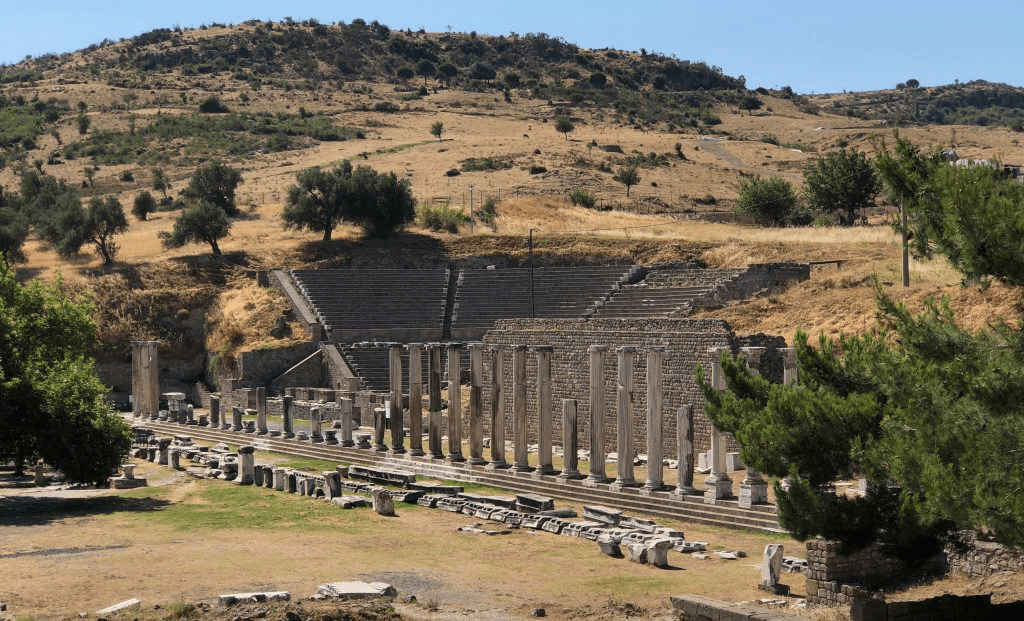
Michal Hunt: ‘The earliest mention of a settlement appears in the writings of Xenophon, a Greek who lived in the fourth century BC. In the third century BC, Pergamum was the center of the Hellenistic kingdom of the Attalids. When the last Attalid king died in 133 BC, he willed his kingdom to Rome. The city’s location did not occupy an advantageous position for trade like the city of Ephesus that was the largest and most important trading center in the Roman province of Asia. However, Pergamum dominated the other cities because of its position as the administrative capital. The Roman governor resided at Pergamum and ruled the entire Asian province, making Pergamum one of the three most prominent cities along with Ephesus and Smyrna.
Pergamum continued to be a leading cultural and political center of the Roman Empire until the fourth century AD. It was a sophisticated city… a center of… four pagan cults and rivaled Ephesus in its worship of idols. The city’s chief god was Asklepios, the serpent-god of healing. People came to Pergamum from all over the world seeking relief from various afflictions. Another significant temple honored Zeus, the chief deity in the Greek pantheon, whose great throne-like altar overlooked the city on its highest point. Dionysius, the Greek god of harvest, fertility, and every kind of sexual excess, and the goddess Athena also had significant temples.
Abarim: ‘Pergamum was… host to a large number of temples, although the most spectacular appear to have been built after John wrote Revelation. One of these splendid buildings was the Asclepion, which was founded in the 4th century BC and was slowly elaborated upon until it had become quite a world famous spectacle by the second century AD. The Asclepion was of course dedicated to Asclepius – the god of healing whose pet emblem was the snake (today still the symbol of the medicinal industrial complex)’ – refer article: WHO… will own my body?
People came from afar to be cured. ‘As with faith-healers and witch doctors today, a large percentage of people was indeed cured, which perpetuated the myth as well as the cash flow (in those days contributions were voluntary and medical attention free for all). Still, an industry based on despair and deceit is grim to say the least, also since the Lord of Life offers health, healing and wisdom as part of humanity’s inherent qualities.’
Hunt: ‘But what elevated Pergamum above her sister cities was her importance as a center for worship of the Roman emperor as a god. There was a temple dedicated to Rome and the deified Roman Emperor Caesar Augustus as early as 29 BC. By the 1st century AD, there were three temples devoted to emperor worship and the most magnificent temples dedicated to the Roman Caesars of all the seven cities. Because it was a center of emperor worship, it was the city in which Christians were most likely to clash with the Roman imperial cult. Today Pergamum is modern Bergama, in Turkey.’
Rohm: “… overshadowing the worship of all of these deities was Pergamum’s devotion to emperor worship. In Pergamum, more than any city in Asia, Christians were in danger of harm from the emperor worship cult. Elsewhere, Christians were primarily in danger on the one day per year they were required to offer sacrifices to the emperor; in Pergamum they were in danger every day” – MacArthur.
“Emperor worship was linked to civic loyalty and patriotism. Thus refusal to participate was considered godless and subversive. Christians, due to their rejection of the Roman gods, were called atheists; but they were also accused of hatred of the human race because they refused to show political loyalty to the emperor and thus to the Roman people. Because they were considered an ancient nation, the Jews were tolerated and protected and recognized by a Roman treaty. Christianity had no such background and so was labeled a mere ‘superstition,’ all the more hated for its exclusivism and intolerance of the gods” – Osborne.

While four verses are dedicated to the Smyrna letter and Ephesus has seven; Pergamos receives six verses dedicated to its brethren – with a letter of comparable length as the one written to the Ephesians.
Revelation 2:12-17
English Standard Version
12 “And to the angel of the church in Pergamum write: The words of him who has the sharp two-edged sword.“
Three times in the Book of Revelation, Christ is described as having ‘from his mouth came a sharp two-edged sword’ – Revelation 1:16; 19:15, 21 – Article: 33. Hebrews 4:12, ESV: ‘For the word of God is living and active, sharper than any two-edged sword, piercing to the division of soul and of spirit, of joints and of marrow, and discerning the thoughts and intentions of the heart.’ Christ is the Word and his word is represented in the scriptures of the Bible. In the relevant Epistle to the Ephesians, its mystery author includes the same terminology.
Ephesians 6:13-17
English Standard Version
13 ‘Therefore take up the whole armor of God, that you may be able to withstand in the evil day, and having done all, to stand firm. 14 Stand therefore, having fastened on the belt of truth, and having put on the breastplate of righteousness, 15 and, as shoes for your feet, having put on the readiness given by the gospel of peace. 16 In all circumstances take up the shield of faith, with which you can extinguish all the flaming darts of the evil one; 17 and take the helmet of salvation, and the sword of the Spirit, which is the word of God…’
The sharp double-edged sword was a symbol of Roman justice and so the imagery is applicable for a sword of justice issuing ‘out of Christ’s mouth’ – referring to His word of judgment. For Christ will judge everyone who has ever lived and the dead – 2 Timothy 4:1, 2 Corinthians 5:10, Acts 10:42; 17:31.
In connection with the reward for the first era, we read in Genesis 3:24, ESV: ‘He drove out the man, and at the east of the garden of Eden he placed the cherubim and a flaming sword that turned every way to guard the way to the tree of life’ – Article: The Ark of God; and Chapter XXII Alpha & Omega.
Revelation: 13 “I know where you dwell, where Satan’s throne is. Yet you hold fast my name, and you did not deny my faith even in the days of Antipas my faithful witness, who was killed among you, where Satan dwells.’
Christ sees fit to state a connection between where the Adversary is and where the church is… twice. Christ also mentions a person, concealing a literal first name by using a coded word which describes their role in witnessing for him directly. This is an astounding revelation for a number or reasons. When John wrote this, it was yet future. Though for the Pergamos era of the true church and those reading it, they would recognise the past tense – ‘even in the days of.’
The word, among in verse thirteen is not as clear or an accurate translation as could be rendered. It gives the connotation of the near past or present within the Pergamos era and does not fit cleanly with the past tense indicated by, even in the days of… The word in the Greek is G3844 – para, meaning: ‘from, of, at, besides, near.’ These definitions would be better than the word ‘among.’ In the King James Version the word is translated as: of, 51 times; with, 42; from, 24; by (the) side, 15; at, 12; than, 11; and miscellaneous words, 45 times. It is a primary preposition and while according to the context can signify among, it can also be used in relation to proximity as, above, against, by, past and before. This would be in keeping with even in the days of… So that it could read: ‘… who in the past was killed before you…’
It stands then that this Antipas preceded the Pergamos era; either during the Ephesus or Smyrna era. Those brethren alive at the time when Antipas stood faithfully as a witness, would have been moved by the Spirit to understand the fulfilling of scripture right in front of their eyes. Perhaps the most remarkable aspect of this verse, is the fact that only one person in all the seven letters is singled out in this way. Each letter is written to all the faithful elect who are included in the book of life – Revelation 3:5; 20:12. But only one unique person is identified for special attention.
One would think this would be an easy task in knowing who is being referenced, but in fact no one has successfully shown who Antipas is in nearly two thousand years of biblical scholarship. The Ambassador College Bible Correspondence Course misread the verse and searched for an ‘Antipas’ during the Pergamos era. While unsuccessful, they did establish I believe, the person who was responsible for raising the Pergamos era of God’s Church and who was the spiritual heir of Smyrna, taking hold of the passing of the baton. We will study this man shortly.
Michal Hunt: ‘Scholars give several possible interpretations to this reference to Satan’s throne: The allusion could be to Zeus’ throne-like altar located in the Temple of Zeus high above the city. It may be a reference to the prominence of Pergamum as the official cult center of emperor worship in Asia. It may even refer to a community of false Jews, another synagogue of Satan. The unbelieving Jewish communities who rejected their Redeemer-Messiah have become the foremost enemy of the Church. Jewish communities were constantly denouncing Christians to the Roman magistrate… John will reveal in Revelation Chapters 12-13 that Satan is the moving force behind the Jewish and Roman attempt to destroy the Church!
The tensions between the Roman state and organized Jewish opposition made it only natural that Christian persecution and martyrdom in the Roman Province of Asia would begin in Pergamum. That they “still hold firmly to My Name” testifies that the Christians of Pergamum confessed Jesus alone as Savior and Lord and did not waiver in the face of persecution… For this reason, Christ regards the church at Pergamum as faithful. We do not know very much about Antipas, whose name means “against all.” And, it doesn’t matter that human history has lost the account of his martyrdom because Christ singles him out for special acknowledgment and calls him “My faithful witness.”
Actually it does matter, in a. to be able to celebrate this individual by giving honour where honour is due; and b. in deciphering the chronological sequence of the first three church eras.
Rohm adds: ‘Antipas was obviously one of the early Christian martyrs. “There has been speculation as to the character of the person, but there is NO certain word concerning the nature of his martyrdom. His name means ‘against all’ which perhaps symbolizes the fact he may have stood alone against the forces of evil and was faithful even unto death” – Walvoord.’
According to Abarim, the name is derived from anti, meaning ‘instead of’ or ‘opposite’ and pater, meaning ‘father’ or from pas, meaning ‘everything.’ In other words, ‘against everything.’ Fascinatingly, in their view, Abarim offer the following definition: ‘Representation Of The Father in a Hermetic “on earth as it is in heaven” sort of way’ or ‘Representative Of God On Earth.’
This is an extraordinarily insightful definition considering Antipas’ identity.
‘The immediate question, of course, is: who is this Antipas whom Jesus finds so important but nobody else in the entire Bible appears to mention? Post-biblical tradition rushed to the rescue and invented a Saint Antipas, made him a bishop of Pergamum and devised a fittingly grizzly end [of being roasted alive in a brazen bull] for him to warrant his elevation to martyrdom.’
Going as far back as the Ephesus era would mean the Apostolic age. All the apostles made a significant contribution in spearheading the spreading of the Gospel. It would make no sense to isolate just one of them, when nearly all died as martyrs standing against the might of Rome – Appendix VIII: When the Creator came to dwell with His Creation. Thus, it is to the era preceding Pergamos we look and it is none other than the one and only possible candidate in the Smyrna era – the humble presbyter turned messenger, Arius. Arius was a faithful witness; who represented on Earth the true nature of the Father and of the Son; who perhaps did die a martyrs death from poisoning; and whom passed away where Satan figuratively dwelt at the time. The city which by 336 CE had surpassed Rome – if not in ecclesiastical, certainly political power and influence – that of Constantinople.

While most commentators assume where Satan dwelt and hence its throne was in reference to Pergamos; others such as Professor Rohm, consider that ‘while many possibilities have been suggested, just what the term “Satan’s throne” refers to is uncertain. Rather than a specific pagan temple the term could better be seen as a general reference to Satanic dominion through Roman rule.’
To herald the beginning of the Pergamos era, the Eternal commissioned a new shining light in the dark ages, a messenger called Constantine Silvanus, otherwise known as Constantine of Mananali. Constantine was born circa 620 in Mananalis near Samosata in modern day Syria.
Online Encyclopaedia: ‘According to Christian historian and scholar Samuel Vila (A las fuentes del cristianismo, page 203, 5th Edition, 1976; 1st Edition 1931): “… in the year 660 (Constantine) received a deacon in his house, who put in his hands a precious and rare treasure in those days before the invention of the printing press: a New Testament. Upon reading the same he came to know about the whole salvation in Christ; and upon sharing said good news with others, he formed a group of sincere believers; later on, of preachers… who became known as Paulicians.”
Constantine regarded ‘himself as called to restore the pure Christianity of Paul (of Tarsus)…’ In this he was deceived, though one is judged according to what they know and understand – Matthew 12:36, James 3:1, Revelation 20:12. He assumed the name Silvanus, also known as Silas – one of the Paul’s early companions and an alleged scribe to the Apostle Peter – in honour of the prophet Silas – Article: The Pauline Paradox (1 Peter 5:12, 2 Corinthians 1:19, Acts 15:32). This duality of names was imitated by subsequent Paulician leaders. Constantine studied the Gospels, the Epistles and christian doctrines; resulting in his vigorously opposing the ‘formalism of the church.’
Encyclopaedia Britannica: ‘Insisting that the New Testament (as he interpreted it) should be the only written source of religious guidance, Constantine-Silvanus left no known writings.’
ACBCC: ‘Constantine of Mananali plainly taught that the Pope was not the representative of God, that Peter was not the only apostle given the keys of the kingdom as the popes claimed, but that all their true successors shared in the knowledge and authority to guide Christians into the way of life.’
Britannica: ‘Becoming a noted teacher, he founded, during the reign (641-668) of the Byzantine emperor Constans II, a Paulician community at Kibossa, near Colonia, Armenia, and directed it until his death [in 684]. He died by stoning after his arrest by soldiers sent by the emperor Constantine IV (reigned 668-685) to suppress heresy. The leader of this force [clothed with imperial power], Symeon–Titus became a convert to Paulicianism and was himself martyred (690)’ by Emperor Justinian II [685-695, 705-711].

ACBCC: ‘Simeon offered to spare any who would themselves stone their leader. And it was one of those very men [a man called Justus] who should have been disfellowshipped long before, who cast the… [first stones]! So greatly impressed was… Simeon by the fortitude and sincerity of most, and especially the faith and courage with which he saw Constantine die, that he was convinced these were God’s people. Three years later, he completed his duty at the Emperor’s court and returned to join the humble people of God’s Church. He was placed by Jesus Christ as their head and carried on the ministry of Constantine for another three years until he too was martyred. He was burned at the stake – accused to the Emperor by that same man [Justus]!’
Hugh Smith: “The year 692 Justinian II, called the sixth general council to convene at Constantinople, as an imperial order from Rome. This council… condemned the Saturdays.” Dugger and Dodd note that Sabbath observance during the seventh century was so prevalent that this council found it necessary to legislate against it.
In the century encompassing 700 to 800 CE, “many British missionaries crossed the… [English Channel] and penetrated into the gloomy recesses of the German forests for the instruction of the fierce and uncivilised people” – Hugh Smith. “In 789, Charles the Great resolved to subdue the [German] Saxons or destroy them, unless they accepted of life on the condition of professing the Christian religion agreeably to the Roman ritual” – Chapter XXVI The French & Swiss: Moab, Ammon & Haran. “On pain of death the Saxons, with their infant offspring, were to receive baptism. Germany in time was subdued, and religious liberty destroyed. The king took an oath of fidelity of them…” – Orchard, Baptist History. In 794, Charlemagne called a council of 300 bishops to consider the subject of images in the churches. The first teaching of transubstantiation appeared during this century in the Roman Church.
As true christians were to be identified amongst the Nazarenes in the first ere of God’s church; and as Arians during the second; they were largely concentrated (ironically) within those called Paulicians in the third era. All were deemed by the Universal ‘Mother” Church as heretics. In the original Armenian, Paulician meant ‘a follower of the wretched little Paul.’ Unfortunately, in this there is truth – Article: The Pauline Paradox. How low they were held by the world’s false christians. Simeon Titus was later succeeded by a man named Paul (702-?) who did not change his name, though his son and successor Gegnesius, took the name Timothy and was leader from 717 to 746 CE.
ACBCC: ‘[Timothy] convinced Emperor Leo III [717-741] that the Paulician doctrine was not heresy; at his death his son Zachariah claimed the office but was rejected by most Paulicians.’ His successor was a man called Joseph who became Epaphroditus [746-782]’ – Philippians 2:25. Sergius calling himself Tychicus, led the Paulicians from 801 to 835; while successfully spreading the gospel – Ephesians 6:21.
Aside from Constantine, Sergius was the most renowned of the Paulician leaders. He was a woodcutter and carpenter, earning a living by his own hands. He laboured tirelessly for thirty-four years, saying: “I have run from east to west, and from north to south, until my knees are weary, preaching the gospel of Christ.” Even Sergius’ sternest critics acknowledged he had been a ‘most exemplary Christian.’ Later during the ninth century, Sambat reorganised a remnant of the Paulicians at Thronrak, after ensuing divisions, persecution, violence and warfare.
All these men were ostensibly followers of Paul – 1 Corinthians 11:1. Detractors within the Catholic Church claimed the Paulicians rejected the teachings of Peter as well as of the Old Testament, though this was false propaganda. As was the orthodox church fathers claiming the Paulicians were Dualists or linked in any way with the Manichaeans and their esoteric, gnostic teachings.
ACBCC: ‘Paulicians rejected the false practice of praying to saints – or to Mary [1]. They rejected purgatory [2], images [3], pictures, crosses [4], incense, candles! [5] They said that monks are the agents of Satan! That Mary, according to scripture, was not a perpetual virgin [6]. They are accused of ignoring all the fasts and feasts, especially Sunday [7]… Obviously!
These pagan institutions were incorporated into “Christianity” long after Christ. They rejected the “bath water” of the persecuting church – infant baptism [8]. But they practiced real baptism by immersion after genuine repentance, and cited Jesus’ age of 30… as a significant example. To those who advocated baptising infants… [the Paulicians] said: “you do not know the mystery of baptism; we are in no hurry to be baptised, for baptism is death.” They knew baptism signified the death of the self.’
What is of signifiant importance is that one book – of all that were burnt and destroyed about the Paulician teachings – which has survived, is the Key of Truth. It is clear that the Paulicians recognised the humanity of Christ while he was on the Earth and that he was not divine or God in the flesh as falsely taught by orthodox christianity. Coupled with this, is the understanding taught by Arius that Christ had a beginning and he was not co-eternal with the Father.
Further, Paulicians Sergius and Sambat taught that the same Holy Spirit was in them as had been in Christ – Isaiah 11:2, Matthew 3:16. ACBCC: ‘Their persecutors, to whom this was incomprehensible, charged that the Paulician leaders called themselves “Christs,” as if it were blasphemy’ – Galatians 2:20, Romans 8:10-17. ‘The Paulicians claimed to be the “holy universal and apostolic church” founded by Jesus Christ and his apostles. Of the false churches, they would say: “We do not belong to these, for they have long ago broken connection with the church.”
From the Key of Truth translated by Fred Conybeare, we learn the Paulicians rejected the Trinity [9]; the Eucharist [10]; the doctrine of Transubstantiation [11]; and the Pope as a representative of God [12]. They recognised the church was not a building, but a body of people and believed in the gospel of the Kingdom of God. While the Paulicians apparently observed ‘Passover’ on the 14th of Nisan as a meal, there is no mention in their teachings of observing the weekly Sabbath.
Roman Catholic heresies and inventions during the Smyrna and Pergamos eras:
1. Prayers for the dead – 300 CE
2. Making the Sign of the Cross – 300
3. Wax candles – 320
4. Veneration of angels, dead saints and use of images – 375
5. The Mass as a daily celebration – 394
6. Beginning of the exaltation of Mary, the term “Mother of God” first applied to her by the Council of Ephesus – 431
7. Priests began to dress differently from lay members – 500
8. Extreme Unction, prayers for the dying – 526
9. The doctrine of Purgatory, established by Gregory I – 593
10. Latin Language used in prayer and worship imposed by Gregory I – 600
11. Prayers directed to Mary, dead saints and angels – 600
12. Title of pope or universal bishop, given to Boniface III by Emperor Phocus – 607
13. Kissing the pope’s foot began with Pope Constantine – 709
14. Temporal power of the popes conferred by Pepin, king of the Franks – 750
15. Worship of the cross, images and relics authorised – 786.
16. Holy water mixed with a pinch of salt and blessed by a priest – 850
17. Worship of Saint Joseph – 890
18. College of Cardinals established – 927
19. Baptism of Bells instituted by Pope John XIII – 965
20. Canonisation of dead saints by Pope John XV – 995
21. Fasting on Fridays and during Lent – 998
22. The Mass attendance made obligatory – 998
23. Celibacy of the priesthood decreed by Pope Gregory VII (Hildebrand) – 1079
24. The Rosary and mechanical praying with beads invented by Peter the Hermit – 1090
The Paulician work at its height spread throughout the Taurus Mountains, Armenia, Albania and the surrounding Caspian Sea region. This growth over time meant many converts who were living amongst the saints, were not of the elect. Added to this was the increasing acceptance of false doctrine and those brethren who tolerated this situation in their midst. During the Pergamos era as with the preceding two eras, persecution had not abated. In time, the civil government of Constantinople was replaced by the dominant church government of Rome as the active agent of persecution.
ACBCC: ‘For it knew best how to hunt down and identify its victims. It knew just enough of true Christian doctrine to detect its intended victims from among the general population. At first, persecuting “Christianity” found difficulty in condemning Paulician doctrine. When the persecutors asked: “Do you believe” in this or that fundamental “Christian doctrine,” the Paulician could usually answer “Yes”.’ As the Catholic persecutors grew wiser to Paulician belief, they were able to condemn devout Paulicians to martyrdom and weaker Paulicians to apostasy. In so doing, their compromising led to swift judgement. As we shall discover later in the Pergamos letter.
Fleeing Paulicians headed West to Bulgaria; to Piedmont in Italy, where there were Waldenses; and the southern provinces of France where they mixed with the Albigeois. The Albigenses and Toulousians were sects of the true church who had originated from the peoples mentioned earlier in the Smyrna era, who would later be identified as the Waldenses.
Dugger & Dodd: ‘In a confession of their faith, one of the members of the Waldenses stated their faith, “declaring that they proffered the doctrine contained in the Old and New Testaments and comprehended in the Apostles’ Creed, and admitted the sacraments instituted by Christ, and the ten commandments… They said they had received this doctrine from their ancestors, and that if they were in any error they were ready to receive instruction from the word of God…” – William Jones.’
‘Theodore Beza, contemporary and colleague of Calvin, says, “As for the Waldenses, I may be permitted to call them the very seed of the primitive and purer Christian church… And as for their religion, they never adhered to papal superstitions…”
“The Waldenses were among the first of the people of Europe to obtain before the Reformation, the possession of the Bible in manuscript of their native tongue. They had the truth unadulterated, and this rendered them the special objects of hatred and persecutions… Here for a thousand years, witnesses for the truth maintained the ancient faith… in a most wonderful manner it (the Word of Truth) was preserved through all ages of darkness” – Wilkinson, Our Authorized Bible Vindicated, page 42.
“That the Waldensian faith and worship existed many centuries before Protestantism arose is undeniable; the proofs and monuments of this fact lie scattered over all Europe; but the antiquity of the Waldenses is the antiquity of Protestantism. The Church of the Reformation was in the loins of the Waldensian church ages before the birth of Luther… In their dispersion over so many lands… [in] France, the Low Countries, Germany, Poland, Bohemia, Moravia, England, Calabria, Naples – the Waldenses sowed the seeds of the great spiritual revival which, beginning with the days of Wycliffe, and advancing in the times of Luther and Calvin, awaits its full consummation in the ages to come.” – Wylie, History of the Waldenses, pages 24-25.
The Waldenses were described as: ‘… a very peaceable people, beloved by their neighbours… of good behaviour, of godly conversation, faithful to their promises, and punctual in paying their debts… liberal to strangers and the travelling poor… could not endure to blaspheme… or swear at all…’ – William Jones, Church History, page 260, edition 1837. Likewise, ‘… they generally live a purer life than other Christians… living for the most part in poverty, they profess to live the apostolic life and doctrine… [and] to overcome only by the simplicity of faith… purity of conscience, and integrity of life… in their lives and morals they were perfect… and without reproach among men, addicting themselves with all their might to observe the commands of God’ – page 259.
Dugger & Dodd: ‘In the preface to the first French Bible, the translator says, that… (the Valdenses) have always had the full enjoyment of the heavenly truth contained in the holy scriptures, ever since they were enriched with the same by the apostles; having in fair MSS, preserved the entire Bible in their native tongue, from generation to generation’ – Orchard, Baptist History, page 257.
According to Orchard, their resemblance to the true church is striking:
‘Their elders… do not appear distinguished [1] from the brethren by dress or names, but every christian was considered as capable… of instructing others, and of confirming the brethren by exhortations. Their rules… were practiced by a literal interpretation [2] of Christ’s sermon on the mount. They consequently prohibited wars [3], suits at law [4], acquisitions of wealth [5], capital punishments… [6] and oaths [7] of all kinds… they gave up all worldly possessions… [7] contended that a church was an assembly of believers… [8] and… the Lord Jesus Christ is head [9], and he alone; that it is governed by his word [Bible], and guided by the Holy Spirit [10]; that it behooves all Christians to walk in fellowship [unity]; that the only ordinances Christ hath appointed for the churches, are baptism [11] and [the] Lord’s Supper… [12]’
The transition from the Pergamos era of the true Church to the fourth era and from the Paulicians to the Waldeneses took place gradually over the tenth and eleventh centuries as the steadfastness of the Paulicians began to wane. This was a period of turbulent persecution for the Paulicians; as well as infighting amongst themselves; and the continual watering down of their faith, with an ever increasing tolerance for false doctrine and disingenuous teachers. The reason why Christ states the following:
Revelation: 14 “But I have a few things against you: you have some there who hold the teaching of Balaam, who taught Balak [the king of Moab] to put a stumbling block before the sons of Israel, so that they might eat food sacrificed to idols and practice sexual immorality. 15 So also you have some who hold the teaching of the Nicolaitans.”
Constant readers will be conversant with the prophet Balaam from earlier discussions – refer Chapter XXVI The French & Swiss: Moab, Ammon & Haran; Chapter XXVII Abraham & Keturah – Benelux & Scandinavia; and Chapter XXIX Esau: The Thirteenth Tribe.
It is worth remembering to note Balaam transformed from a prophet of God (Numbers 22:18; 24:2) to a soothsayer (Joshua 13:22), eventually dying a violent death by the sword (Numbers 31:8). Balaam strayed (Jude 11, 2 Peter 2:2) from righteousness (Numbers 24:4) to evil (2 Peter 2:15-16, Numbers 24:25); preferring the temporary rewards of wickedness (Revelation 2:14, Micah 6:5) over the everlasting riches of obedience (Matthew 6:33).

And, we meet again, the raised evil head of the Nicolaitans, who were so problematic in the first church era. Here then were God’s people making the same mistakes as the Ephesians and the ancient Israelites in the time of Moses. The name Balaam in Hebrew is H1109 – Bil’am: meaning, ‘not of the people’ – Numbers 22:7.
Christian Treasury breaks the word down further: ‘Balaam is a Hebrew word having a meaning similar to the Greek word, Nicolaitanes. Balaam means to “destroy the people.” It is a combination of two Hebrew words: bala, to destroy and am, a people.
Strong’s # 1104 bala’ (baw-lah’); a primitive root; to make away with (specifically by swallowing); generally, to destroy: KJV – cover, destroy, devour, eat up, be at end, spend up, swallow down (up). Strong’s # 5971 ‘am (am); from 6004; a people (as a congregated unit); specifically, a tribe (as those of Israel); hence (collectively) troops or attendants; figuratively, a flock: KJV – folk, men, nation, people.
The similarity of the Greek word, Nicolaitan, to the Hebrew word, Balaam, is noted in A.R. Fausset, The Critical and Expository Bible Cyclopaedia. Michaelis explains Nicolas (conqueror of the people) is the Greek for the Hebrew Balaam (destroyer of the people). It is instructive that “the doctrine of Balaam” is mentioned with “the doctrine of the Nicolaitanes”.’
ACBCC: ‘Both words [denote] the office of Nimrod, dictator and arch-rebel, who first after the Flood established man’s political and religious government based on false principles, in opposition to the government of God’ – Chapter XXI The Incredible Identity, Origin & Destiny of Nimrod. ‘This Balaam was Nimrod’s successor in that office’ – just as Simon Magus was in the first century (Jude 11, 2 Peter 2:15). ‘He was the greatest pagan prophet of his time – the Pontifex Maximus, the chief oracle of paganism… this man’s headquarters… was called Pethor. And – let the wise understand – who, today, in the same office, is headquartered in (St.) Peter‘s?!’
When the king of Moab was desperate, there was no one higher to whom he could resort. Far to the north of his own country in Mesopotamia, completely passing up his own ‘priests, magicians and astrologers…’ Balaam was not permitted to curse Israel as Balak desired but rather ended up blessing them. To circumnavigate this, the evil Balaam counselled Balak to get the Israelites to sacrifice to the idol, Baal of Peor and indulge in sexual sin – Exodus 31:16.
Michal Hunt: ‘Moabite and Midianite women enticed the Israelite men into ritual prostitution to the false god, Baal, on the plains of Peor. Worship of Baal of Peor involved every kind of “bodily emission” before the idol of the god. After the sacrifices and the orgies, they ate the meat of the animals sacrificed in a sacred meal. The sin of the Israelite men, in this case, was not only the sins of fornication, adultery, and sodomy with pagan women but also eating the meat sacrificed to the false god which amounted to national “adultery” from the covenant with Yahweh on the part of Israel, the Bride of Yahweh’ – refer article: Belphegor.
Balaam was to the children of Israel in the Old Testament, what the Nicolaitans were to the Church of God in the New Testament. Balaam was both a continuation from Nimrod and a prototype of those who promote compromise with the world in idolatry and immorality. Christ distinguished between the moral evil of Balaam and the religious, ecclesiastical evil of Nicolaitanism.
Sam Storms: ‘The Nicolaitans had dared to insinuate that freedom in Christ granted them a blank check to sin. The fault of believers in Pergamum was not so much that they had followed this pernicious teaching but that they had allowed it to be vocalized in the congregation.’ Showing an indifference to the licentiousness of the Nicolaitans. ‘… the Nicolaitans were advocating, in the name of Christian freedom, participation in the worship service both of the local church and the local pagan temple (a similar problem [of compromise] existed at Corinth; see 1 Corinthians 10:14-22).’
In the Old Testament, spiritual idolatry was described in terms of sacrificing to idols, and prostitution – Jeremiah 3:2; 13:27, Ezekiel 16:15-58; 23;1-49; 43:7, Hosea 5:4; 6:10. Whereas in Revelation, sexual immorality is invariably metaphorical for spiritual apostasy – Revelation 14:8; 17:1-16; 18:3, 9; 19:2.
Storms: ‘However, we can’t dismiss the possibility that the Nicolaitans were teaching that forgiveness of sin and their new-found freedom in Christ have now released them from what they regarded as “slavish obedience” to rules and regulations concerning sexual conduct.
The “teaching” of the Nicolaitans should probably be identified with the “teaching” of Balaam. The similarity of language also suggests that Jezebel and her followers constituted a group of Nicolaitans in [the following era]. They are all said to be guilty of enticing God’s people “to eat things sacrificed to idols” and “to commit acts of immorality”.
There was a difference in the response to the Nicolaitans in these two congregations. The Ephesians “hated” the work of the Nicolaitans and refused to tolerate their pernicious behavior. The church in Pergamum, on the other hand, had welcomed them into the fellowship of the church and given them freedom to propagate their destructive ways.’
Nicolaitanism was becoming fully accepted and it was there to stay. For what had begun as deeds in Ephesus; became doctrine in Pergamos; and finally dogma in Thyatira. A complete division of a scriptural, equal brotherhood into an unscriptural, priests and laity – Matthew 23:8. As the spirit and teaching of the Nicolaitans is evident even in the fourth era, as well as the first and the third eras, it is beneficial to understand its origins more fully; as explained by Rick Renner – emphasis his, bold mine:
‘Acts 6:5 tells us that this Nicolas was “a proselyte of Antioch.” The fact that he was a proselyte tells us that he was not born a Jew but had converted from paganism to Judaism. Then he experienced a second conversion, this time turning from Judaism to Christianity. From this information, we know these facts about Nicolas of Antioch:
- He came from paganism and had… pagan roots… unlike the other six deacons who came from a pure Hebrew line. Nicolas’ pagan background meant that he had… been immersed in the activities of the occult.
- He was not afraid of taking an opposing position, evidenced by his ability to change religions twice. Converting to Judaism would have estranged him from his pagan family and friends. It would seem to indicate that he was not impressed or concerned about the opinions of other people.
- He was a free thinker and very open to embracing new ideas and concepts. Judaism was very different from the pagan and occult world in which he had been raised. For him to shift from paganism to Judaism reveals that he was… liberal in his thinking, for most pagans were offended by Judaism. He was obviously not afraid to entertain or embrace new ways of thinking.
- When he converted to Christ, it was at least the second time he had converted from one religion to another. We don’t know if, or how many times, he shifted from one form of paganism to another before he became a Jewish proselyte. His ability to easily change religious “hats” implies that he was not afraid to switch direction in midstream and go a totally different direction.
According to the writings of the Early Church leaders, Nicolas taught a doctrine of compromise, implying that total separation between Christianity and the practice of occult paganism was not essential. From Early Church records, it seems apparent that this Nicolas of Antioch was so immersed in occultism, Judaism, and Christianity that he had a stomach for all of it. He had no problem intermingling these belief systems in various concoctions and saw no reason why believers couldn’t continue to fellowship with those still immersed in the black magic of the Roman empire and its countless mystery cults.
Occultism was a major force that warred against the Early Church. In Ephesus, the primary pagan religion was the worship of Diana (Artemis). There were many other forms of idolatry in Ephesus, but this was the primary object of occult worship in that city. In the city of Pergamos, there were numerous dark and sinister forms of occultism, causing Pergamos to be one of the most wicked cities in the history of the ancient world. In both of these cities, believers were lambasted and persecuted fiercely by adherents of pagan religions, forced to contend with paganism on a level far beyond all other cities. It was… hard for believers to live separately from all the activities of paganism because paganism and its religions were the center of life in these cities. Slipping in and out of paganism would have been… easy for young or weak believers to do since most of their families and friends were still pagans. A converted Gentile would have found it… difficult to stay away from all pagan influence.
It is significant that the “deeds” and “doctrines” of the Nicolaitans are only mentioned in connection with the churches in these two occultic and pagan cities. It seems that the “doctrine” of the Nicolaitans was that it was all right to have one foot in both worlds and that one needn’t be so strict about separation from the world in order to be a Christian. This, in fact, was the “doctrine” of the Nicolaitans that Jesus “hated.” It led to a weak version of Christianity that was without power and without conviction – a defeated, worldly type of Christianity.
Nicolas’ deep roots in paganism… produced in him a tolerance for occultism… Growing up in this perverted spiritual environment may have caused him to view these belief systems as not so damaging or dangerous. This wrong perception would have resulted in a very liberal viewpoint that encouraged people to stay connected to the world. This kind of teaching would result in nothing but total defeat for its followers. When believers allow sin and compromise to be in their lives, it drains away the power in the work of the Cross and the power of the Spirit that is resident in a believer’s life. This is the reason the name Nicolas is so vital to this discussion. The evil fruit of Nicolas’ “doctrine” encouraged worldly participation, leading people to indulge in sin and a lowered godly standard. In this way he literally conquered the people.
God wants to make sure we understand the doctrine the Nicolaitans taught, so Balaam’s actions are given as an example of their doctrine and actions. When Balaam could not successfully curse the people of God, he used another method to destroy them. He seduced them into unbridled, sensual living… Just as the men of Israel compromised themselves with the world and false religions, now the “doctrine” of the Nicolaitans was encouraging compromise. As you are well aware, compromise with the world always results in a weakened and powerless form of Christianity. This was the reason Jesus “hated” the “doctrine” and the “deeds” of the Nicolaitans.’
Revelation: 16 “Therefore repent. If not, I will come to you soon and war against them with the sword of my mouth.”
According to Michal Hunt, “Repent” is a keyword in five of the letters, and Jesus repeats it seven times: 2:5 twice, Ephesus; 2:16, Pergamum; 2:21 and 2:22 to the fourth church; 3:3, for the fifth church; and 3:19, about the seventh church. It is only Smyrna and the sixth church who are not exhorted to repent.
Hunt: ‘Notice that justice will be swift: “I shall soon come!” Failure to repent will bring judgment. It is also significant that in the story of Balaam in the Book of Numbers that the Angel of the Lord met Balaam with a drawn sword (Numbers 22:31) and a sword killed Balaam (Numbers 31:8)… the warning of the imminent coming of Christ in judgment in verse 16… is not a statement about the Second Coming at the end of history, but rather… refers to a judgment within history. It is a judgment that was imminent to the church at Pergamum. This same principle repeats throughout the history of the Church. Wherever heretics are indulged by the community or by the leadership, that particular community is on the verge of being destroyed by the wrath of God.’
Romans 13:3-4
English Standard Version
‘For rulers are not a terror to good conduct, but to bad. Would you have no fear of the one who is in authority? Then do what is good… But if you do wrong, be afraid, for he does not bear the sword in vain. For he is… an avenger who carries out God’s wrath on the wrongdoer.’
Sam Storms: ‘… the Nicolaitans will be the focus of judgment. It is against “them” that Jesus will make “war”. Such language suggests that their lack of repentance would be evidence of a lack of saving faith. Their persistent licentiousness and morally compromising behavior undermine their claim to know Jesus in a saving way.’
The Paulicians who apostatised during the Pergamos era paid a terrible price, suffering persecution often by the hand of a sword. For the brethren had a choice of either accepting the sword of the spirit – the word of God – or dying by the sword of Christ’s mouth sent against them. Tragically, many thousands perished because they did not repent of the sins of Balaam and the Nicolaitans. During the seventh century, Arab expansion contested Armenia, forcing Paulicians to hide within Moslem territory; then during the eighth century Emperor Constantine Copronymus reconquered the region relocating many Paulicians to Thrace. The divided Paulicians in Mananalis resorted to violence between the followers of Zachariah the son of Gegnesius-Timothy and Joseph-Epaphroditus.
Jospeh led his followers to Pisidia where he evangelised all Phrygia. By 800 there were numerous Paulicians in Phrygia and Lycaonia. Divisions amongst Paulicians multiplied and retaliatory violence escalated. They had forgotten that Christ would wield the sword… against them. Emperor Leo V (813-820) instigated persecution against the Paulicians in Cappadocia. When Theophilus was emperor (828-842), his wife Theodora (829-867) ‘continued the persecution with unabated zeal.’ The Paulicians, furious and desperate, ‘reconciled the use of the Bible and sword.’ Yet revolt against the dominion of Theodora resulted in submission to the Caliph of Bagdad.
The Paulician Christians turned warriors, ranged through Asia Minor with their Moslem allies. Forsaking trust in Jesus Christ’s protection, they relied on military alliances. The Paulicians were ultimately betrayed, with one hundred thousand dying by the sword of divine retribution. Then in 970, Paulicians were again transported to Thrace – this time another one hundred thousand of them – by Emperor John Zimisces. They defended the Empire against the Bulgarians and received religious freedom in exchange. A century earlier, Paulician missionaries had taught the Bulgars, with converts known as Bogomils, which in Slavic meant: ‘friends of God.’
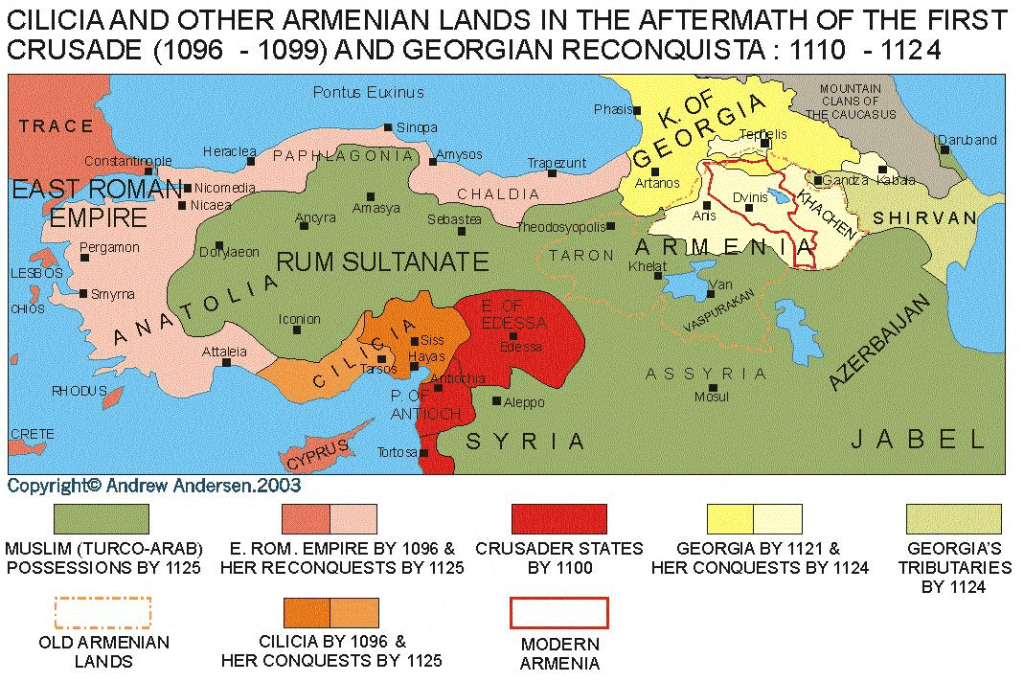
ACBCC: ‘During the… [eleventh century], the Crusades found Paulicians scattered everywhere in Syria and Cilicia, corrupting their name to Publicans… a name strangely descriptive of their apostasy – getting involved in public affairs! Later Turkish wars in the Balkans forced Paulicians and Bogomils into central and northwestern Europe.’
In the Book of Revelation, there are seven seals which are opened by Christ. The first four are known as the four horsemen of the apocalypse. They herald the time of the end, leading into the great tribulation.
Revelation 6:1-4
English Standard Version
‘Now I watched when the Lamb opened one of the seven seals, and I heard one of the four living creatures say with a voice like thunder, “Come!” And I looked, and behold, a white horse! And its rider had a bow, and a crown was given to him, and he came out conquering, and to conquer. When he opened the second seal, I heard the second living creature say, “Come!” And out came another horse, bright red. Its rider was permitted to take peace from the earth, so that people should slay one another, and he was given a great sword.’

The first horse is the colour white and symbolises false religion. Note the Pope wears white as opposed to the cardinals who wear vermillion and priests who wear black – Revelation 17:3-4. Notice, the rider does not possess a sword for war, but does conquer the people. The second horse is red, the colour of aggression and war. Now its rider is given a great sword, the very symbol of warfare. Later in Revelation, we read about the true spiritual leader who likewise rides a white horse, while making war with a sharp sword.
Revelation: 17 “He who has an ear, let him hear what the Spirit says to the churches. To the one who conquers I will give some of the hidden manna, and I will give him a white stone, with a new name written on the stone that no one knows except the one who receives it.”
For the third letter in a row, Christ uses the word conquer or ‘overcome.’ The process of overcoming requires repeated acts of repentance and faith. The very things Christ addresses in each letter. Particularly in light of the conquering agenda of the doctrine of Balaam and the Nicolaitans for the Pergamos church. To the brethren in the third era, Christ offers three gifts; where it was one in each of the first two eras: the Tree of Life in the Paradise of God for the Ephesians and escaping the second death through the first resurrection, for the Smyrna brethren.
The first gift given, is hidden manna. There was a physical type fulfilled in the wilderness when the Eternal instructed Moses to place an omer of manna within the Ark of the Covenant (Exodus 16:32-36, Hebrews 9:4) – refer articles: The Manna Mystery; and The Ark of God. An omer is equivalent to approximately 3.5 pounds or 1.6 kilograms. Whereas the spiritual symbolism of the hidden manna, is Christ himself who is the Bread of Life and the true manna from heaven – 1 Corinthians 11:23-26.
John 6:35, 49-50
English Standard Version
Jesus said to them, “I am the bread of life; whoever comes to me shall not hunger, and whoever believes in me shall never thirst. Your fathers ate the manna in the wilderness, and they died. This is the bread that comes down from heaven, so that one may eat of it and not die. I am the living bread that came down from heaven. If anyone eats of this bread, he will live forever…”
Hope Bolinger: ‘God sent manna… First, and most practically… to meet a physical need. God provides food… to show he meets our needs, even when situations seem most dire. Secondly, God want[ed] the Israelites to practice trust and obedience. God provided manna as a way to rely on him fully. Thirdly, God wanted to foreshadow the most important manna from heaven: Jesus. Although he provided for the physical needs of the Israelites, he knew they, along with all of mankind, needed a permanent, not temporary, solution to their need for spiritual bread. Because of the bread of life, we no longer hunger. Because of the bread of life, we have a chance to live.’
Just as the Ephesian and Pergamos churches shared a common factor in facing the threat of the Nicolaitans; they shared a similar symbolism in obtaining the reward of eternal life. The first era through eating from the fruit of the Tree of Life in the paradise of Eden and the third era through eating the Bread of Life from heaven. Both representative of the Lord Jesus Christ.
The second gift the Son of Man promises the faithful Pergamos brethren, is an enigmatic white stone. This reference has puzzled biblical scholars for centuries.
Hunt: ‘There are seven different suggested interpretations:
- It was a practice in the first century AD to send a stone or potsherd (a broken piece of pottery) to a guest invited to a feast with the necessary information such as the name of the host and time and date for the banquet. The guest would show his invitation to the servants upon arriving at the feast to gain admittance.
- Other scholars suggest that a black stone would be used in a court trial to condemn an accused person while a white one meant acquittal.
- It is perhaps a reference to reckoning since white stones were often used in calculations.
- It was a symbol of a “happy day.”
- It was a Roman custom to use a white stone, which represented a ticket to bread and entertainment in the coliseum and horse racing in the circus.
- It could refer to an amulet bringing good luck.
- A reference to the two stones of the Urim and Thummin carried in the breastplate of the high priest. No description exists, but some scholars suggest that they were black on one side and white on the other, symbolizing “no” and “yes” as answers to God’s divine will. Their names, Urim and Thummim in Hebrew mean “lights” and “integrity” (plural); see Exodus 28:30 and Leviticus 8:8.
Some of these interpretations may be rejected or criticized because either the stone is not white or it had no inscription.’
The first interpretation has merit in that the elect will be the bride – ‘clothed in fine linen, bright and pure’ – who marries the Lamb and there will be a wedding feast. A stone being both the invitation and pass to the occasion – Matthew 22:1-14, Luke 14:12-24, Revelation 19:7-9. White is the colour of purity, of Christ and the Father – Isaiah 1:18, Psalm 51:7, Matthew 17:1-2, Revelation 1:14, Daniel 7:9.
The second interpretation applies in that a true Christian has received acquittal from the sentence of death for their sins through the death of the Saviour. It is worth noting that the colour of the manna in the wilderness was… white (Exodus 16:31, Numbers 11:7) – refer article: The Manna Mystery. Not only that, it also resembled white stone like blobs on the ground. Manna is likened to the bdellium stone, which was found in Eden – Genesis 2:1-12 – a further connection between manna and the Tree of Life in the paradise of the Garden of Eden.
Interpretation number seven is perhaps the most interesting – refer article: Chronology of Christ.
Exodus 28:9-12
English Standard Version
‘You shall take two onyx stones, and engrave on them the names of the sons of Israel, six of their names on the one stone, and the names of the remaining six on the other stone, in the order of their birth. As a jeweler engraves signets, so shall you engrave the two stones with the names of the sons of Israel. You shall enclose them in settings of gold filigree. And you shall set the two stones on the shoulder pieces of the ephod, as stones of remembrance for the sons of Israel. And Aaron shall bear their names before the Lord on his two shoulders for remembrance.’
Hunt: ‘In the Exodus passage, an onyx stone carried the names of the twelve tribes of Israel; however, there were two black onyx stones placed on the shoulders of the High Priest and engraved with the names of the twelve tribes. Perhaps the symbolism is in the imperfection of the Old Covenant (black stone) followed by those names made perfect, engraved on a white stone, in the New Covenant in Christ and carried by the New Covenant High Priest, Christ Jesus.’
Rohm: ‘The meaning of the “white stone” is uncertain. It could be a symbol of victory. Scholars differ as to the meaning of the ‘white stone.’ Alford says that the important point is the stone’s inscription which gives the believer ‘a new name,’ indicating acceptance by God and his title to glory.’
The author of 1 Peter enlightens on the stone symbolism.
1 Peter 2:4-8
English Standard Version
‘As you come to him, a living stone rejected by men but in the sight of God chosen and precious, you yourselves like living stones are being built up as a spiritual house, to be a holy priesthood, to offer spiritual sacrifices acceptable to God through Jesus Christ. For it stands in Scripture:
“Behold, I am laying in Zion a stone, a cornerstone chosen and precious, and whoever believes in him will not be put to shame.” So the honor is for you who believe, but for those who do not believe, “The stone that the builders rejected has become the cornerstone,” and “A stone of stumbling, and a rock of offense.”
They stumble because they disobey the word, as they were destined to do.’
First Peter profoundly reveals Christ is the cornerstone of the spiritual house the Father is building – Revelation 21:1-3, 22, John 14:2, Matthew 21:42. As Christ is a living stone in God’s house, so true believers, are living stones in the same building. Yet many non-christians and christians alike have rejected the truth of Christ’s word and do not tabernacle or dwell with him – Hebrews 8:1-2, Matthew 7:21-27.
In the book of Zechariah where the olive trees are described – the two witnesses repeated in Revelation – Christ is confirmed as the chief cornerstone; the top stone; or capstone. Recall the first verse to the Ephesus church and the indirect reference to the two witnesses – Revelation 2:1. In Zechariah, Zerubbabel is described as laying the foundation for the second Temple, prefiguring Christ who is raising a spiritual temple. Zechariah 4:7, ESV: “What are you, you great mountain? Because of Zerubbabel you will become a level plain! And he will bring forth the temple capstone with shoutings of ‘Grace! Grace!’ because of this.”
In the process, a mountain – symbolic of an earthly rule of government or kingdom – is flattened by the capstone representing Christ. In fact, a new mountain will supersede those of the Earth. Isaiah 2:2, ESV: ‘It shall come to pass in the latter days that the mountain of the house of the Lord shall be established as the highest of the mountains, and shall be lifted up above the hills; and all the nations shall flow to it…’
Prior to this, the Prophet Daniel describes the defeat of the Earth’s kingdoms in Daniel 2:44-45, ESV: “And in the days of those kings the God of heaven will set up a kingdom that shall never be destroyed, nor shall the kingdom be left to another people. It shall break in pieces all these kingdoms and bring them to an end, and it shall stand forever, just as you saw that a stone was cut from a mountain by no human hand, and that it broke in pieces the iron, the bronze, the clay, the silver, and the gold. A great God has made known to the king what shall be after this. The dream is certain, and its interpretation sure.”
Christ is the capstone from the top of the mountain of God – the top stone of a pyramidal mountain no less – Isaiah 14:13; 19:19-20, Ezekiel 28:14, 16. This is a complete topic in itself and an article devoted to the history and meaning of the Great Pyramid of Giza is planned – now written. Regardless, the capstone or pyramidion of the Great pyramid was originally a valuable element, which gleamed and shone in the sunlight; probably gold because of its conductive quality, or perhaps a crystal or even a composition of precious stones such as diamonds – Articles: The Ark of God; and The Pyramid Perplexity.

The third gift is an individual new name written upon each white stone. We have learned that Christ and the body of Christ the church, are living stones; as well as the colour white representing the Ancient of Days and the Son of Man. It also portrays the elect – Daniel 11:35; 12:10.
Bible Study: ‘White is the most frequently mentioned pigment in the New Testament and in the word of God as a whole. It is the third most referenced color behind blue (50 times) and red (47) in the Old Testament.’
The Father is described as having white clothes and hair and the Son also with white raiment and hair. Christ is our judge and he will sit on a throne which is white – John 5:22. Revelation 20:11-12, ESV: ‘Then I saw a great white throne and him who was seated on it. From his presence earth and sky fled away, and no place was found for them. And I saw the dead, great and small, standing before the throne, and books were opened. Then another book was opened, which is the book of life. And the dead were judged by what was written in the books, according to what they had done.’
Hunt: ‘Then there is the closing phrase, which says the name is known only to the person who receives it. Biblical scholars point out that the meaning of this expression, rooted in a Hebrew idiom, is that the name is “known” by the receiver in the sense of owning it; “to know” in Hebrew means intimate knowledge. In other words, the point is not that the new name is secret, but that the new name is exclusive. Only the one who overcomes possesses the “new name”… No one else has the right of possession except those who are faithful to Jesus and His New Covenant. This exclusiveness points to the personal, intimate relationship between God (who issues the invitation) and the invited guest. See Isaiah 43:1 where Yahweh says: “I have redeemed you, I have called you by your name, you are mine.” In the Pergamum church, the Nicolaitan heretic does not truly own the name “Christian.” That name only belongs to true doctrine Christians who are granted admittance to Paradise…’
Revelation 19:11-16
English Standard Version
‘Then I saw heaven opened, and behold, a white horse! The one sitting on it is called Faithful and True, and in righteousness he judges and makes war… and he has a name written that no one knows but himself… and the name by which he is called is The Word of God. And the armies of heaven, arrayed in fine linen, white and pure, were following him on white horses. From his mouth comes a sharp sword with which to strike down the nations… On his robe and on his thigh he has a name written, King of kings and Lord of lords.’
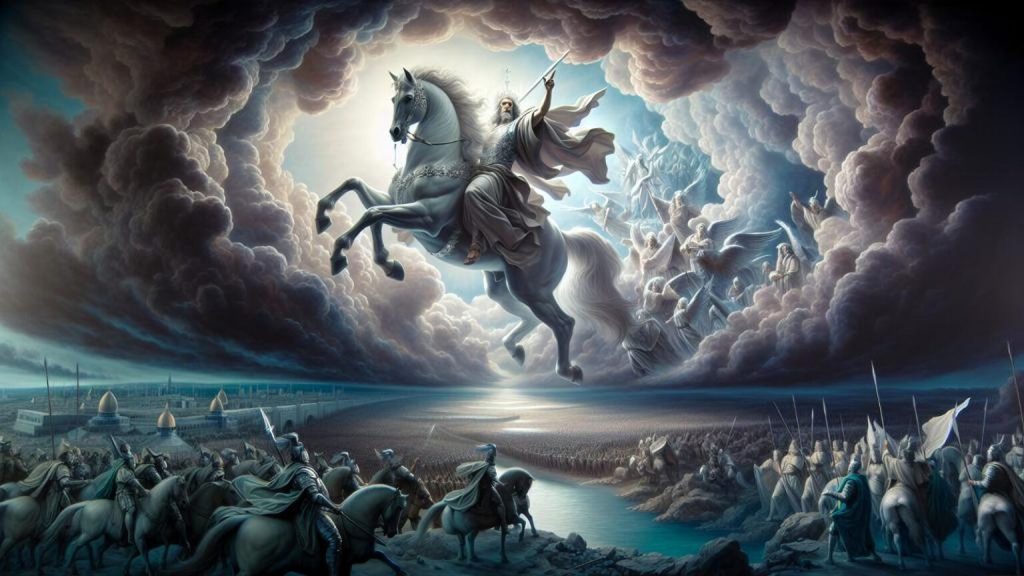
Aside from three gifts, Pergamos was the third church era.
Bible Study: ‘The number 3 conveys the meaning of completeness, though to a lesser degree than 7. It derives its symbolism from the fact that it is the first of four spiritually perfect numerals (the others being 7, 10 and 12).
A triangle, which is a polygon with 3 sides and vertices, is considered the most stable physical shape. [consider a pyramid – a triangle with a square base or foundation]. Its stability allows it to be widely used in construction and engineering.
Next to seven, 3 is the most commonly used number in Revelation. God is described, in the very beginning of the book of Revelation, as a Being with the three-fold characteristic, “which is, and which was, and which is to come” (Revelation 1:4).
Jesus prayed three times in the Garden of Gethsemane before His arrest. He was placed on the cross at the 3rd hour of the day (9 a.m.) and died at the 9th hour. There were 3 hours of darkness that covered the land while Jesus was suffering on the cross from the 6th hour to the 9th hour. Christ was dead for three [inclusive] days and nights… Jesus took only 3 of his disciples, James, Peter and John, up a large hill in order to view his transfiguration (Matthew 17:3-9). What the men saw, in a vision, were 3 people in their glorified form (Jesus, Moses and Elijah).
Only 3 people were allowed to ask God anything. They were Solomon (1Kings 3:5), Ahaz (Isaiah 7:11) and, of course, Jesus Christ (Psalm 2:9).’
The length of the Pergamos era as provided by various researchers on the subject include: 312 to 606, twice; 313 to 538 and 313 to 600. Ambassador College proposes 325 to 1104. A staggering 779 years. This writer would concur with their dating for the beginning of the fourth era, just not with the beginning of the third; which is just 295 years following the death of Christ. Challenging these views, it is suggested the Smyrna era began with Diocletian’s persecution in 303 CE and lasted 357 years until the calling of Constantine of Mananali in 660 – messenger for the Pergamos era and founder of the Paulicians.
It is agreed with Ambassador College that Pergamos was a long era – in fact the longest – lasting an auspicious 444 years… with the beginning of the fourth era in the year 1104 – thus occurring after the second era of Smyrna lasting 357 years, from 303 to 660 CE; and the first era Ephesus of 273 years, from 30 to 303 CE.
The Pergamos era enduring exactly four hundred and forty-four years is significant. The number four is linked to the Creator and His acts of creation. In particular, the number four represents the solidity achieved from an essential foundational structure. Its shape is the square, such as exhibited in the four sides of a pyramid. Thus the number 4 symbolises stability, security and a strong foundation.
The angel number 444 resonates with solidity, productivity, dedication, protection and reassurance. The energy of the number four is tripled and magnified with four multiplied by three, totalling twelve. Biblically, the number twelve represents a foundation for rulership and governance – refer article: The Ark of God. The number twelve is composed of one plus two equalling: three. The number three can represents God’s will in a matter and signifies a decision (or judgment) and finality.
Noting the sequence of three fours in the number 444 represents a solid base to build upon. In the context of Pergamos, while beset with tests and trials, this era of the true Church laid a spiritual platform for the fourth era of God’s work on Earth and the effective spreading of the gospel of the Kingdom of God. The number four being an important and applicable number in turn for the following fourth era of the church.
It would seem so far that the length of the individual church letters are not a subtle clue to their length in years. While the distance between the cities – where the churches were located – do bear some correlation; it does not appear an exact scale, using the ratio of 5.808. The distance between Pergamos and Thyatira is approximately 52 miles and so would accord with a shorter 302 years. This is a longer distance than the 47 miles from Ephesus to Smyrna, though less than the 70 miles from Smyrna to Pergamos. Considering distances between the cities as an accurate gauge of timescales for eras may not be feasible; though as we will learn, there are some coincidental parallels.
As the Ephesus and Smyrna eras began strongly and visibly with a prominent apostolic witness and a theological debate respectively, so too did the Pergamos era. Paulician activity was demonstrably effective from 660 to circa 900, yet waned and faded in power from 900 to 1100 as the devastating effects of compromise and subsequent persecution were truly felt.
Thyatira
Thyatira seated on the River Hermus, is known today as Akhisar, which means a white coloured castle. Bible Study: ‘Thyatira, which in the Greek language means “daughter,” got its name in 290 B.C. in honor of the birth of King Seleucus I Nicator’s daughter.’ One source claims the additional meanings of, ‘perfume of labour’ and ‘sweet savour of sacrifice.’ Dugger and Dodd offer, ‘sacrifice of that which is nearest and dearest.’ A further source adds: ‘to be ruled by a woman.’ Ambassador College: ‘sweet savor of contrition.’ In contrast, Abarim: ‘From (1) the verb (thuo), to slaughter or to rage, and (2) the suffix (-theira), “she who …” That is, a ‘female butcher’ and ‘she who rages madly.’
‘The original name of Thyatira was Pelopia, after a Theban princess, daughter of king Tantalus (hence the English adjective “tantalizing”) of Lydia. He was punished by the Olympians for giving nectar and ambrosia to human mortals, and for putting the omniscience of the gods to the test by boiling his son Pelops and offering his flesh as dinner to the gods.’

Michal Hunt: ‘In the 1st century AD, powerful trade guilds dominated the local economy and controlled every business in [the prosperous city of] Thyatira. To work in any trade, one had to belong to the guild of that trade.’
Bible Study: ‘The trade guilds in the city, which were well known, were more organized and in far greater numbers than in any other ancient Asia Minor city. Every artisan in Thyatira belonged to a guild. Guilds were incorporated organizations that could own property in its own name and enter into contracts for construction projects. As such, they wielded a significant amount of influence.
Two of the most powerful guilds were those of the coppersmiths and the dyers. The city was famous for its dyeing and was a center of the indigo trade. Evidence suggests these artisans made use of the madder-root for making purple-colored dyes. Among [Thyatira’s] ruins were found inscriptions relating to a guild of dyers.’
Hunt: ‘Belonging to a guild was integrally connected with the pagan religions that were approved by the Roman government since the guild meetings took place in the pagan temples and included the accepted practice of guild members eating a communal meal of meat sacrificed to pagan gods.
In addition to eating meat sacrificed to pagan idols, illicit sexual relations were a central aspect of pagan worship. Most temples had male and female prostitutes permanently assigned to serve the temple and its worshipers. Any Christian who worked in a trade faced problems. His commitment to Christ and obedience to living a life of holiness as a Christian would affect his livelihood, his acceptance by his peers, and his ability to feed and house his family.’

Bible Study: ‘During his second missionary journey… [Acts 16:12-15] Paul traveled to Philippi. On a Sabbath day, he meets a woman named Lydia, from Thyatira, who is praying near a river. Lydia is a seller of purple (either of the dye or cloth dyed in this color)’ – refer Chapter XII Canaan & Africa. ‘She listens to Paul’s preaching and becomes so convicted in God’s way of life that she, along with her entire household, are baptized. It is likely Lydia, when she traveled back home, helped spread the gospel throughout the city.’
Christ’s letter to the Thyatira Church is the longest of the seven, comprising twelve verses. Yet this does not translate to a particularly long era as we shall learn.
Revelation: 18 “And to the angel of the church in Thyatira write: ‘The words of the Son of God, who has eyes like a flame of fire, and whose feet are like burnished bronze.’
Jesus uses the title, the Son of God and while the term is common throughout the New Testament it is only used once in the Book of Revelation. Michal Hunt: ‘The city’s chief deity was Tyrimnos, the son of Zeus. The people also practiced Emperor worship…’ Recall, this was a major issue during the former Pergamos era of the church. ‘Worship of the city’s chief god mixed with devotion to the deified Caesar was a central feature of the Thyatiran community.’
Christ’s use of Son of God contrasts against when the term was coined to describe Rome’s first and initial emperor, Augustus, son of the deified Julius Caesar. ‘Whose assassination cleared the way for the hated Empire, in which everybody was a slave bound to the emperor.’ The Roman Senate proclaimed Augustus Caesar ‘the incarnate son of god’ in 14 CE. Therefore, the conflict arising between worshiping the false ‘son of god’ and the true Son of God was very real for the faithful Christian community and likely why the first words of Christ to the Church in Thyatira is the proclamation that he alone is the Son of God.
Christ is likened to one having eyes of fire and feet like polished bronze. Some believe this is evidence that Jesus has brown skin. Though they do not similarly remain consistent and claim Christ has orange eyes as well. The Greek words used for flame and burnished bronze do in fact indicate the colour of the Son of God’s eyes and feet.
The Greek word for flame is G5395 – pholga: ‘to flash, flaming, a blaze.’ In other words, a flame consisting of a high temperature. A flame of intense heat, a blazing fire such as produced in a furnace. In Revelation chapter one, verses fourteen and fifteen, Christ is similarly described: ‘… His eyes were like a flame of fire, his feet were like burnished bronze, refined in a furnace…’
It may come as a surprise to those accustomed to associating heat with the vibrant oranges and reds seen in a crackling campfire or the glowing embers of a dying flame to learn that the hottest flames are those that burn with a violet, ultra-violet, indigo and blue colour.

Red flames for example, signal a cooler temperature and occur in conditions of limited oxygen or when burning certain materials which don’t allow for a more efficient combustion. An orange or yellow flame suggests moderate temperatures and is common in wood fires, where the combustion is more but not fully complete. While a blue flame indicates a hotter, oxygen-rich burn and the presence of a more intense and efficient combustion process, typically reaching very high temperatures. In scientific experiments and practical applications, the blue-violet flame is a clear indicator of maximum heat output similar to thermionic emission.
The Greek word for burnished bronze is G5474 – chalkolibano. It is translated as fine brass or copper, but could mean a more precious metal than gold even. What is important is the polishing affect which implies brilliancy or whiteness – from a compound of G5475 and G3030 – as evidenced in white hot molten metal. Thus in keeping with the description of the Ancient of Days, the Son of Man likewise possesses piercing blue eyes and a white (luminous) body.
There is a chilling aspect in Christ speaking of flames of fire, for it was at this time that burning to death became the penalty for heresy. Up until this period it had been reserved for civil sentences and heinous crimes. The mob action against Polycarp in the second century for example, was outside the jurisdiction of the law.
Ambassador College Bible Correspondence Course, The Light in the Dark Ages, Lesson 51: ‘… the early Catholic “church fathers” taught that for the church to put a heretic to death would be an inexpiable sin. They allowed no more than banishment or imprisonment. But since cvil authority had prescribed burning for sorcery, it gradually became the custom to equate sorcery with heresy, which made burning the new official punishment for heretics. After 1229, the Dominican and Franciscan preaching friars – of the Inquisition – were accuser, judge and jury. When they turned over their victims to the civil authorities, it was understood most would be burned!’
Revelation: 19 “I know your works, your love and faith and service and patient endurance, and that your latter works exceed the first.”
God’s Son acknowledges the good works of the Thyatiran brethren; as well as their love, faith, service and patience. Patience is built though faith and faith comes from hope. While service is the outward manifestation of love. Paul speaks of these qualities to the church at Corinth. 1 Corinthians 13:13, ESV: ‘So now faith, hope, and love abide, these three; but the greatest of these is love.’
It is the last part of the verse which catches the attention of the careful reader. It is not saying the first works were feeble, but that the latter were more extensive, impressive and successful. It is a marker in time, just as Antipas aka Arius was earlier. On first reading, it seemed to this writer that Thyatira may have been a long era; though historical events appear to rule otherwise.
As with the preceding three eras, a visible and powerful messenger at the beginning of the Thyatira era should be identifiable in the annals of church history. Yet, we have a clue that a subsequent ministry was to eclipse the first. For this to be plausible, another messenger would have been raised to perform a further work. History does in fact record this unique scenario. Beginning with a gentleman known as Peter in 1104, followed by another in 1173; who would you believe, was also named Peter.
While true Christians had been living in northern Italy and in the south of France since the fourth century, fleeing during the days of Pope Sylvester and Emperor Constantine and objecting to the authority of Rome during the ensuing centuries. It wasn’t until the beginning of the twelfth century when a major work was spearheaded by Peter of Bruys.
Paulicians and doctrinally related Slavic speaking Bogomils who had fled to Italy, France and Germany, became known as Cathars (meaning puritans), Publicani and Albigenses. While these groups may have contained remnants of true believers, the majority were “the debris of an earlier Christianity” and the “abiding background of medieval heresy” – Encyclopaedia Britannica, 11th Edition, article, Cathars.
Perhaps it is more than a coincidence that the fourth era of the Church should begin in a region of France that was in the Middle Ages, the centre of the textile industry for Europe. Just as Thyatira was a prominent city of merchants and weavers. ACBCC: ‘The Cathars were noted as weavers. Contemporaries frequently designated them Texerant, Textors, Tisserants – all of which meant simply weavers.’
Peter of Bruys in Dauphiny, also known as Peter de Bruys (or Pierre de Bruis), was selected as a messenger for the truth after first being a Catholic priest who had supposedly ‘been deprived of his office by the Church hierarchy for teaching unorthodox doctrine’ – Online Encyclopaedia. Yet it was he, who resigned his orders in 1104, preferring to become a champion of the people against the corruptions of the Church and its lordship over them.
Peter taught the truth about baptism – challenging the infant baptism of the Catholic Church – and would only baptise those old enough to understand genuine repentance. Peter rejected the Catholic mystery of transubstantiation and the Eucharist (1) – where the Mass is believed to represent the literal flesh and blood of Jesus Christ.
Encyclopaedia: ‘The term, transubstantiation, used to describe the transformation of the consecrated bread and wine into the body and blood of Christ, was first used by Hildebert de Lavardin in about 1079. The theory had long been widely accepted as orthodox doctrine at the time of the attacks by Peter of Bruys. Less than two centuries later, in 1215, the Fourth Lateran Council officially declared transubstantiation the necessary, orthodox Catholic explanation of the Eucharist.’
Peter opposed reverence of crosses (2), saying “The accursed tree [of the cross] should be hated as an instrument of torture”; imposing and ostentatious church edifices for worship (3), saying “It is unnecessary to build temples, since the church of God does not consist in a multitude of stones joined together, but in the unity of the believers assembled”; the fable of purgatory (4); the unscriptural prayers, alms… oblations for the dead (5) and its associated bribes payable to the clergy; clerical celibacy; and chanting – refer Appendix VIII: When the Creator came to dwell with His Creation; and article: DEATH: A Dead End or a New Beginning?
Allegedly, ‘Peter admitted the doctrinal authority of the Gospels in their literal interpretation but considered the other New Testament writings to be valueless, as he doubted their apostolic origin. He questioned the Old Testament and rejected the authority of the Church Fathers and that of the Roman Catholic Church itself.’
This is a significant observation, showing Peter of Bruys was ahead of his time in recognising the polarisation in the New Testament canon. For seventeen books are of dubious authentic authorship and doctrinal accuracy – refer article: The Pauline Paradox. Only ten books can be – in the main – trusted and they include: Matthew, Mark, Luke, John, Acts, Hebrews, James, 1 John, Jude and Revelation. In addition, there are two books – not written by either Peter or Paul – of certain specific interest: 1 Peter and 2 Thessalonians. Of which both letters may have been either written by Silas or he was involved in their composition – article: The Pauline Paradox.
Peter was eproached by Peter the Venerable the Abbot of Clugny, as “that wretched little man.” Regardless, Peter eloquently preached a powerful gospel message and numbers grew as people converted by the Holy Spirit flocked to him. William Cathcart: ‘Peter de Bruys commenced his ministry… and such was his success that in a few years in the places about the mouth of the Rhone, in the plain country about Toulouse, and particularly in that city itself, and in many parts of the province of Gascoigne he led great throngs of men and women to Jesus, and overthrew the entire authority of popes, bishops, and priests.’
Hassell: ‘In the first years of the twelfth century Peter of Bruis went forth like another John the Baptist, full of the Spirit and of power, and lived… as an evangelist in the south of France, which he seems to have filled completely with his doctrine… Thus the seed was planted of what widened afterward into the famous and greatly dreaded ‘heresy’ of the Waldenses and Albigenses. Peter de Bruys was a strong Baptist.’
According to Ambassador College, Peter taught Sabbath observance, though there is no textual or historical support provided for this premise.
Encyclopaedia: ‘Peter of Bruys felt that crosses should not deserve veneration. Crosses became for the Petrobrusians objects of desecration and were destroyed in bonfires. In… the year 1131, Peter was [pushing his luck] publicly burning crosses in St Giles, near Nimes’ on Still Friday.
The local populace, ‘in an emeute caused by his preaching and probably instigated by the Romish ecclesiastics’ in the Arelatensia diocese, cast him into the flames of his own bonfire burning him alive – McClintock and Strong Biblical Cyclopedia.
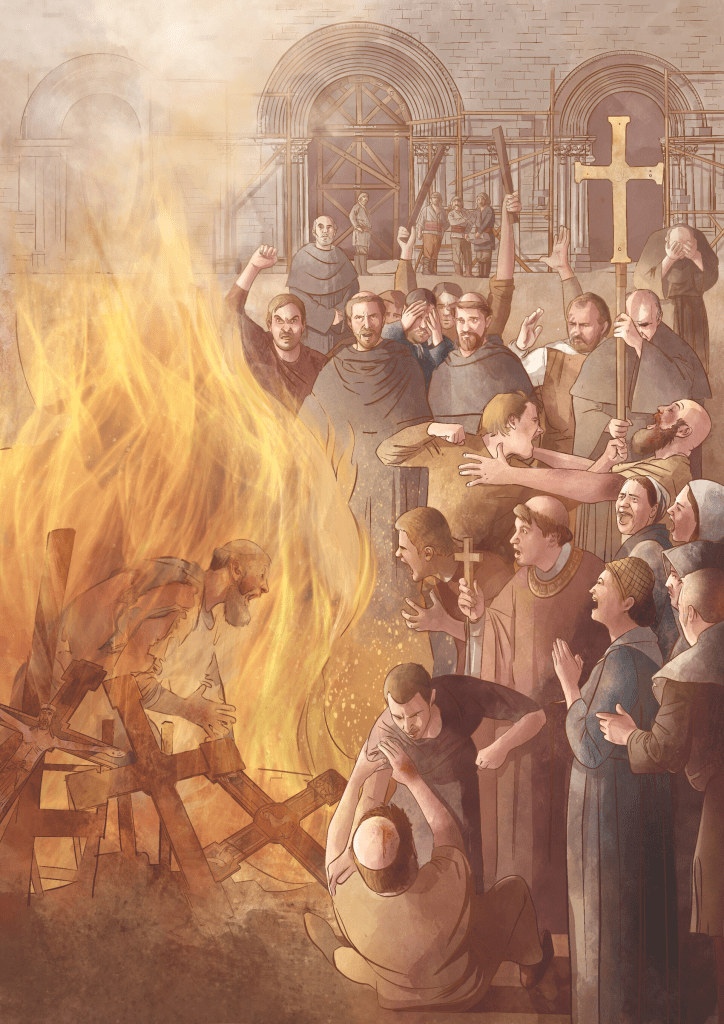
Peter of Bruys – whether he understood it or not – was used by God as the first in an increasing successive wave of faithful preachers who represented an Anti-Catholic movement which would sensationally find its cataclysmic finale, in the form of William Tyndale, Martin Luther and the Protestant Reformation.
A disciple called Henry (or Henri of Lausanne), carried on Peter’s ministry, who had begun evangelising ten years before in 1121 at Le Mans – subsequently joining Peter in 1125. Henry was a former Cluniac (Benedictine) monk and had lived the life of a hermit. John R Daily: ‘The idleness of the hermit gave place to the armor and toil of an ambassador of Christ.’
‘He was of imposing stature, wore a cropped beard and flowing hair, went barefooted in winters, with a frame so robust as to endure with ease the utmost rigours of the climate, and a voice so powerful that his adversaries compared it to the roar of a legion of devils’ – The Dictionary of Sects and Heresies, page 183.
Henry with an unusual gift of eloquence, zealously condemned the false teachings of the Cathars and Catholics alike; exposing Roman holidays and the corruption of priests. ‘Henry dwelt much on two points. Although a monk by education, and by profession and practice a rigid ascetic, he was emphatically the apostle of marriage and the uncompromising foe of the clergy’ – page 183 continued.
During Peter’s life, converts were called Petrobrussians and later during Henry’s ministry, as Henricians.
A History of the Christian Church, Schaff: Henry ‘practiced poverty and preached it to the laity. One of the results of his preaching was that women of loose morals repented and young men were persuaded to marry them. Cardinal Alberic, sent to stamp out the Henrician heresy, called to his aid St. Bernard, the bishop of Chartres and other prelates. Henry was seized and imprisoned’ in 1135. Henry was released for a time but then cast into prison again in 1138, finally dying there in 1149.
‘The word “Church” signifies the congregation of the faithful and consists in the unity of the assembled believers and not in the stones of the building. God may be worshipped as acceptably in the market place or a stable as in a consecrated edifice. They preached on the streets and in the open places. As for the cross, as well might a halter or a sword be adored? Song, they said, was fit for the tavern, but not for the worship of God. God is to be worshipped with the affections of the heart and cannot be moved by vocal notes or wooed by musical modulations.’
While many had responded to Peter and Henry’s preaching by listening, only a few accepted their message in its entirety and were truly converted. ‘Those who hung upon the preaching of Peter de Bruys and Henry of Lausanne were soon lost among the Cathari and other sects’ – A History of the Christian Church.
Towards the end of Henry’s life, though separate from him was Arnold of Bresca, in Italy. He began his work in southern France, then returning to his native city where he preached the gospel with great power. The people were melted and roused beneath his fiery appeals. The Catholic clergy became alarmed at his success, and condemned him to perpetual silence in the year 1139.
After spending succeeding years in the wilderness of the Alps, he eventually set out for Rome circa 1145. While he may not have been the same ilk as Peter and Henry – becoming embroiled in a political endeavour contrary to the scriptures – still, as Christ said: “For the one who is not against us is for us” – Mark 9:40.
Schaff: ‘During the pontificates of Innocent II., Eugene III., and Adrian IV… Arnold of Brescia, an unsuccessful ecclesiastical and political agitator… protested against the secularization of the church, and tried to restore it to apostolic poverty and apostolic purity… He proclaimed the principle that the Church and the clergy, as well as the monks, should be without any temporal possessions, like Christ and the Apostles, and live from the tithes and the voluntary offerings of the people.
Their calling is purely spiritual. All the things of this earth belong to the laity and the civil government. He practiced what he taught, and begged his daily bread from house to house. He was… of… enthusiastic temper, popular eloquence, well versed in the Scriptures, restless, radical, and fearless. He agreed with the Catholic orthodoxy, except on the doctrines of the Eucharist and infant baptism…’ Daily: ‘He was charged with advocating that the kingdom of Christ was not of this world, that the church was a distinct and spiritual assembly of baptized believers.’
Schaff: ‘With this ecclesiastical scheme he combined a political one. He identified himself with the movement of the Romans to emancipate themselves from the papal authority, and to restore the ancient republic. By giving all earthly power to the laity, he secured the favor of the laity, but lost the influence of the clergy. It was the political complication which caused his ruin… Arnold sought the welfare of the Church in her complete separation from the State and of the clerical office from secular entanglements…
He preached in his monastic gown, on the ruins of the Capitol, to the patres conscripti, and advised them to rebuild the Capitol, and to restore the old order of senators and knights… Arnold was banished from Rome in 1154, and soon afterwards hanged [crucified] by order of Emperor Frederick I… His body was burnt and his ashes were thrown into the Tiber, in 1155. The Arnoldists continued for some time to defend the doctrines of their master, and were declared heretics by a council of Verona, 1184, after which they disappeared’, resurfacing later as Waldensians.
With Arnold’s death the work of Thyatira came to an abrupt standstill in 1155 and for eighteen years ran the risk of disappearing entirely after the unexpected early death of Peter of Bruys had contributed to cutting it short in 1131. Until the Eternal raised a second messenger to head the Thyatira church era: a wealthy merchant from nearby Lyon, the weaving capital of Europe.
Like Peter of Bruys, Peter Waldo originated from Dauphiny – and specifically the district of Walden. While there is no evidence that Waldo was directly influenced by Peter of Bruys, he may well have been aware of him and the Petrobrussians.

It is important to note that while we have used the name Waldenses for true believers living in the alpine regions of Italy and France since circa 300 CE, it is not a chronologically correct term – but rather one used in retrospect. Documentation collated by Dean C Blackwell in his thesis, The Plain Truth about the Waldensians, establishes this fact.
In endeavouring to support a past for the Waldenses predating Peter Waldo, William Jones states: ‘The most satisfactory definition that I have met with of the term Waldenses, is that given by Mr. Robinson, in his Ecclesiastical Researches: “From the Latin word Vallis, came the English word valley, the French and Spanish Valle, the Italian Valdesi, the Low Dutch Valleye, the Provencal Vaux, Vaudois, the ecclesiastical Valdenses; Ualdenses, and Waldenses. The words simply signify valleys, inhabitants of valleys, and no more” – History of the Christian Church: From the Birth of Christ to the XVII Century, page 255.
The word Waldenses in French is Vaudois and in Italian, Valdesi, signifying a native or inhabitant of Vaud – Colliers Encyclopedia, Volume 23, page 217.
There were ‘ingenious attempts to account for the name of Waldenses from some other source than from the historical founder of the sect, Peter Waldo or Valdez. To get rid of Waldo… the name Waldenses or Vallenses was derived from Vallis, because they dwelt in the valleys, or from a supposed Provencal word Vaudes, which meant a sorcerer’ – Encyclopaedia Britannica, 13th Edition, Volume 28, Page 255.
The History of the Christian Church During the Middle Ages, Philip Smith, 1885, pages 578-579:
‘For it may safely be pronounced a fond fancy, which, with the aid of a mere play on the name, would trace their origin to a primitive remnant… in the Alps of Piedmont and Savoy… The easy transformation of Waldensis or Valdensis (the V and W being interchangable in the Latin) into Vallensis is further complicated by the resemblance to Vaudois, the name of one of the districts where the sect has survived… The very likeness would be a ground for suspecting one of those frequent plays of words… if the argument were one of probability only. But, with the known origin of the sect from Peter Waldo as its founder, the conclusion is quite clear, that, “when it is sought to get rid of their relation to him, as embodied in the very name which they bear and to change this name into Vallenses, the Men of the Valleys, or the Dolesmen, it is a transformation which has no likelihood, philological or historic, to recommend it.” (Trench, page 250) The only early writer, in whom we find the name Vallenses, used it as a play of words’… with ‘Valdenses… evidently alluding to the German word Wald, Latin, Valda, “a wood”.’
‘Certainly if the Waldensians existed since Sylvester, we would not expect to find that “the first combined measures taken by the secular authority for the destruction of the Vaudois, do not appear to date before 1209.” Had the much persecuted Waldensians from the thirteenth century on, existed since Sylvester unknown and unpersecuted? Definitely not! Another possibility, and as a matter of fact the truth of church history, is that the Waldensians recognized an unbroken chain of successive church stages and eras were their ancestral chain from the Apostles. Only in this way could they claim they were apostolical, but not as Waldensians by name since the apostles’ – Philadelphia: Presbyterian Board of Publication: French Protestants: The Revocation of the Edict of Nantes.
It is possible the name Peter was ascribed to Waldo later, perhaps inspired by Peter of Bruys. For the name ‘Peter’ does not appear in the extant Waldensian writings until one hundred and fifty years after his death. His name being rather Valdés in French; Valdesius in Latin, Valdo in Italian; and therefore Waldo in English.
Corretta Thomson: ‘His conversion happened after a companion died of a seizure during a banquet [at a civic event]. “If death had taken me, what would now be my destiny?” Waldo realized with a shock. A few weeks later [in 1173], a passing troubadour sang of Saint Alexis, who had abandoned wealth, status, and family for a life of itinerant poverty. Deeply moved, Waldo invited the minstrel home to hear the story again. The following day he asked a priest which way to heaven was the most perfect. “If you would be perfect, go, sell what you possess and give to the poor,” was the reply (Matt. 19:21).’
In seeking to follow Christ, he began to give away his wealth – gained in measure through usurious means – which he perceived as his enemy, keeping a distance between himself and the Eternal. He liquidated his assets, publicly announcing his intention to serve God rather than mammon – Matthew 6:24. “No one can serve two masters, God and mammon!” he cried. “Citizens and friends, I am not mad, as you imagine… I am urged to this for my own good and yours; for myself, that if hereafter anyone should see me with money, he may say that I have gone mad; for you also, that you may learn to put your trust in God and not in riches.”

Petrus Waldus
Waldo provided for his Catholic wife who thought he had lost his mind – while enrolling at least one of his two daughters in a convent – they remained estranged, though according to Ambassador College his wife may have reconciled with him later in life, assisting with the money he had given her.
‘It is said of Waldo by the Dominican Inquisitor Stephanus de Borbone at Lyons about 1225, “His one desire was to have a fuller knowledge of Holy Scripture than he could obtain from hearing the lessons read in church, and to regulate his life by the example and precepts of Christ and His Apostles.” As Waldo grew more acquainted with the Scriptures, he discovered that the general practice of nominal Christians was totally abhorrent from the doctrines of the New Testament: and in particular, that a number of customs, which all the world regarded with reverence, had not only no foundation in the divine oracles, but were even condemned by them’ – Joseph Milner, The History of the Church of Christ, 1835, page 47.
In longing to be more knowledgeable in the scriptures Waldo commissioned – with three other scholars, in the Gallo-Provencial idiom – vernacular translations of the New Testament, the Psalms and numerous other books of the Old Testament. The christian world under providence, was indebted to Waldo for the first translation of the Bible into a modern, readable tongue.
It is known that Waldo joyfully stood in the market square of Lyon three days a week for many months giving out food to famine-ravaged townspeople.
Dean Blackwell: ‘He practiced self-denial and invited others to follow him. He was soon joined by a number of companions and they formed together a fraternity [of itinerant preachers] called the Poor Men of Lyons. This was a compassionate and charitable organization. Many Protestants held sound doctrines and led exemplary lives, but they all lacked the characteristics which seemed to unite the Waldenses: a pure faith which was animated by a spirit of love. Taking with them… translated books of the Bible along with other selected passages of Scripture, Waldo and his followers set out preaching the Gospel message in the streets and houses of Lyons and neighboring villages. As the seventy disciples went out two by two without staff or scrip and wearing wooden sandals, so did Waldo’s disciples.’
Thomson: ‘He exhorted everyone he met to take the scriptures seriously and actually do what Jesus instructed. Everyone, not just clergy and consecrated people, can put Jesus’ teachings into practice in daily life. Detractors called them “sandalled ones” or simply referred to them as Waldensians. As a contemporary, Walter Map, observed in 1179, “These people have no settled dwellings, but go around two by two, barefooted and dressed in wool tunics. They own nothing, sharing everything in common, after the manner of the apostles. Naked, they follow a naked Christ.”
Blackwell: ‘As the following grew, the local priests became jealous of their work and convinced the archbishop of Lyons to issue an order [in 1176] forbidding Waldo and his followers to expound the Scriptures or to preach. But Waldo’s spirit of truth by which he claimed he was led could not be silenced by a petty law of the land.’
Thomson: ‘When Archbishop of Lyon Jean de Bellesmains summoned Waldo and forbade further preaching, he replied, “We shall obey God rather than men” – Acts 4:18-19; 5:28-29.
ACBCC: ‘When they persisted, they were cited to appear before Pope Alexander III. Now it was no longer just a question of preaching at Lyons. The issue at stake was whether God’s Work anywhere could continue… Also himself went boldly to Rome in late 1178. He put forward the Bible translated… which could be understood all over southern France… parts of Italy and Spain – and urged the common people’s need for it. Doctrine was kept in the background. The Pope appeared willing to accede to Waldo’s demands, but left the decision to the Lateran Council…’
Blackwell: ‘Looking for justice within the Catholic Church, two of Waldo’s followers journeyed to Rome to see Pope Alexander III and solicit his approbation of their work. They brought with them a translation of their Bible. The pope received them graciously and expressed his approbation of their charitable work [commending their vow of mendicant poverty]. At the time of their visit, the third Lateran Council [in 1179] was in session and one of the topics of discussion was whether or not Waldo’s work was a threat to the Catholic Church. The pope didn’t think it would be wise to extinguish this small work, but he did grant to Waldo and his friends a limited license to preach [so long as they received permission from their local bishop, now being] subject to the control of the Catholic clergy.’
ACBCC: ‘The reason given? “The Roman Church cannot endure your preaching!” Their reply… “Christ sent us. If you were His Church, you would not hinder us.”
Blackwell: ‘Up to this point Waldo’s conduct was almost entirely within the Catholics’ limitations and there were no grounds for ecclesiastical censure. He counselled with their priests, enrolled his daughters in convents, and the men who helped him translate the Bible were in the priestly order. They even preached within the limitations imposed by the pope for a time.’
Thomson: ‘Although sometimes thought of as a “proto-Protestant,” Waldo sought to reform the Catholic Church, not abandon it. An 1180 [statement of faith] document believed to have been signed by Waldo [when he met with the papal legate Henri de Marci in the Languedoc] declares belief in orthodox Catholic tenets. Private Bible reading in the vernacular was not necessarily forbidden in late medieval France, where literacy was rising in the growing towns. Others before Waldo had left their wealth, and within a few decades, Saint Francis of Assisi and Saint Dominic would do the same. Rather than start monasteries, the first Waldensians remained itinerant. They refused to perform any work but preaching lest they be tempted to accumulate wealth. Moreover, they took the radical step of publicly reading, preaching, and interpreting scripture as laypeople.’
Blackwell: ‘At length their zeal became too intense to stay within the pope’s guidelines. They could not be restrained. They shed the shackles of ecclesiastical censure and declared the truth in the spirit of liberty.’
Thomson: ‘Relations quickly soured… Some Waldensians became anticlerical, and others failed to secure permission to preach. Moreover, women preachers joined the movement in 1180.’ The Bible does not condemn this, though the maverick Paul in seeming contradiction does – Luke 2:36-38, 1 Corinthians 11:5; 14:1, 34-35, (1 Timothy 2:11-15). Including Paul, it could be reconciled in that a female prophetess is permissible and able to proclaim publicly perhaps; whereas a woman is disallowed from holding the office of an elder – but not that of a deaconess. Ignoring Paul, there does not appear to be a prohibition of women evangelising and we will discover in the following era that this occurs.
Blackwell: ‘Because of this flagrant disobedience to the apostolic office of the pope, they were immediately threatened with the severest penalties. At the Council of Verona in 1184 under the presidency of Pope Lucius III, Waldo and his disciples were formally excommunicated’ – condemned as schismatic. ‘Thus, the Waldenses were cast out of their native land. They sprinkled themselves throughout much of Europe wherever they were received. To some, theirs was a new gospel and to others a recultivation of a seed sown earlier.’
ACBCC: ‘The Work now grew rapidly. Soon a college was founded to train qualified laborers. Three small stone buildings in the Angrogna Valley of the Cottian Alps [straddling the French-Italian border] provided classrooms. The college and the town of La Torre, located where the Angrogna Valley meets the Lucerna (“the valley of light”), became the new headquarters of the… growing Church of God… articles and small booklets were written and multiple copies were produced. There were no printing presses… all had to be laboriously copied by hand…
Waldensian ministers… came to be called “barbes” [or barbas] (uncles) to conceal their identity. Because of scarcity of Bibles and imminent danger to both Bible and person carrying one, every… minster had to memorize a large amount of Scripture… Most learned to speak at least 3 languages’ – Latin, Italian and Romaine [Old French]. ‘Each learned a trade, to be able if necessary to earn his own living’ – Acts 18:3, 1 Corinthians 4:12.
Blackwell: ‘Peter Waldo preached for a while in Dauphine, but the persecution was too hot so close to Lyons. He gathered many followers in Picardy. [The Picards] became so numerous that the French king, Philip Augustus, sent an army against them. Hundreds of houses were burned, several towns were sacked and survivors fled to Flanders. From there Waldo went to Bohemia where he would be beyond the reach of the papal police. Here he founded a church and the membership grew tremendously. In 1315 the communicants numbered an estimated 80,000.’
Thomson: ‘The network grew, with Waldensians appearing in Britain, Germany, and Spain. They adopted beliefs considered heretical at the time. Some rejected taking oaths or supporting the death penalty. A few proposed that it was acceptable to confess to a layperson if the local priest was corrupt. Others organized simple Lord’s Suppers administered by laypeople. The movement grew too radical for even its founder. In Lombardy, a group of Waldensians settled in communities, rebaptized those who wanted to join them, and stated that only those entirely divested of wealth would enter heaven. Waldo expelled them from The Poor [Men of Lyons] in 1205.’
Waldo had appointed Joseph and Esperon to the regions of Dauphiny and Provence, where Peter de Bruys had formerly preached. He also sent Arnold Hot – not to be confused with Arnold of Brescia – to Albi north of Toulouse, where Henry had preached. The Papal Bull of Pope Lucius III in 1184 had not just anathematised the Poor Men of Lyons, but a number of groups all labelled under the umbrella tag of Albigenses. They included: Arnoldists; Josephists; Passagines [Waldenses dwelling in the Alps]; the Humiliated; Cathars; and Paterines [Italian Cathars].
ACBCC: ‘In 1207, as chief spokesman for all the Albigenses, Arnold Hot expounded these theses: that the Roman Church was antichrist, and that Christ did not establish the Mass. Not many years after, holding firmly to their faith, Arnold and several associates were marched to the stake and burned… Waldo spent his later years preaching in Germany and Bohemia, barely escaping capture in Strasbourg in 1211. Waldenses taken at that time reported their three chief… centers were in Strasbourg, Milan and Bohemia, where Waldo died. All agree he was dead by 1217.’
History of the Waldenses, Wylie, pages 22-23: ‘Even the Seven-hilled City they feared not to enter, scattering the seed on ungenial soil, if perchance some of it might take root and grow. Their naked feet [in sandals] and coarse [woollen] garments made them somewhat marked figures in the streets of a city that clothed itself in purple and fine linen; and when their errand was discovered, as sometimes chanced, the rulers of Christendom took care to further, in their own way, the springing of the seed, by watering it with the blood of men who had sowed it.’
Thomson: ‘As external dangers mounted, their preaching went underground. In the 1230s, the Inquisition initiated a full-scale persecution against the Waldensians. Still, they spread throughout continental Europe. When towns became too dangerous in the 1300s, The Poor fled to the countryside. In the 1400s, they drew close to the Hussites in Moravia. Crusaders invading the Alpine valleys slaughtered hundreds, causing some Waldensians to abandon pacifism.’
Peter Waldo statue – part of the Martin Luther Monument, erected in 1868 in Worms, Germany
William Jones in his Church History, pages 258-259, records an inquisitor’s recollection of the righteous Waldenses he was unwittingly blessed to have come into contact with all those dark centuries ago:
“These Heretics are known by their manners and conversation, for they are orderly and modest in their behaviour and deportment. They avoid all appearance of pride in their dress. They neither indulge in finery of attire nor are they remarkable for being mean and ragged.
They avoid commerce, that they may be free from deceit and falsehood. They get their livelihood by manual industry, as day labourers or mechanics; and their teachers are weavers or tailors. They are not anxious about amassing riches; but content themselves with the necessities of life.
They are chaste, temperate, and sober. They abstain from anger. Even when they work, they either learn or teach. In like manner, also, their women are modest, avoiding backbiting, foolish jesting, and levity of speech, especially abstaining from lies or swearing, not so much as making use of the common asseverations, ‘in truth,’ ‘for certain,’ or the like, because they regard these as oaths, contenting themselves with simply answering ‘yes’ or ‘no’.”
John Milton [1608-1674] the insightful English poet, makes mention of the Waldensian elders who learned trades in supporting themselves, so as to preach the gospel without being a burden on the brethren – refer Appendix VIII: When the Creator came to dwell with His Creation. Milton says:
“Our ministers scorn to use a trade, and count it a reproach that tradesman preach the gospel. It were to be wished they were all tradesman. They would not then for want of another trade make a trade of preaching and become the worst of all tradesman.”
Certain Waldensians professed their abhorrence with killing any living creature, including birds and animals. This hints at some brethren living on a plant based diet – Article: Red or Green?
History of the Waldenses, Wylie, pages 22-23: ‘Thus did the Bible in those ages, veiling its majesty and its mission, travel silently through Christendom, entering homes and hearts, and there making its abode. From her lofty seat Rome looked down with contempt upon the Book and its humble bearers. She aimed at bowing the necks of kings, thinking if they were obedient, meaner men would not dare to revolt; and so she took little heed of a power which, weak as it seemed, was destined at a future day to break in pieces the fabric of her dominion.’
Thomson: ‘When Luther sparked the Protestant Reformation [in 1517], the Waldensian movement was already over three hundred years old. There was contact between the two groups as early as 1523, and the Waldensians would eventually adopt beliefs and structures of the Reformed Church. Some Waldensians saw this move as betrayal: a loosely structured, persecuted, and unaligned movement becoming tied to an established church and a systematic theology. Others have maintained that the measure was the only path to survival.’
“The Reformers (Luther, Calvin, Knox, and others) with all their zeal and learning were babes in spiritual knowledge when compared with the Waldenses, particularly in regard to the nature of the kingdom of Christ, and its institutions, laws, and worship in general” – History of the Christian Church, William Jones, 1845, page 326.
Thomson: ‘This year [in 2024] Waldensians in Italy, Uruguay, and Argentina – the countries where significant Waldensian communities still exist – celebrate 850 years of history, most of it spent as persecuted minority congregations. A Waldensian emblem depicts a candle and a book with the motto lux lucet in tenebris (light shines in the darkness). Waldo’s call to let God’s word illuminate our lives, to live according to it, and to share it with others has not been extinguished.’
Thomson raises a crucial point, in that while the Waldensian legacy lives on today, it is but a shadow of its former zealous and true self. Long past, the tenure of Thyatira has been eclipsed by succeeding church eras.

The Waldensian Church logo is truly fascinating for it represents 1. the Word of God: the scriptures; 2. the seven stars: the angels/messengers of the churches; and 3. the lamp stand: the candle of the Thyatiran church bisecting the seven eras with its flame pointing to the applicable 4th star.
In fulfilment of scripture the apostolic work of Waldo was not cast beneath the shadow of those wrought by his predecessor Peter de Bruys and his successors, but rather built upon their good work, shining even more brightly in the spiritual darkness of Medieval Europe.
Before we progress to the next verse in the letter to Thyatira, there is a pivotal doctrinal issue which requires addressing. It is one of profound unity or explosive division depending on one’s view. That matter, is the one surrounding the seventh day Sabbath – refer article: The Sabbath Secrecy. By extension, it includes the keeping of the festivals and Holy days – refer article: The Calendar Conspiracy. There are certain church historians and scholars who consider sabbath keeping a prerequisite in identifying a continuous thread for the true Church of God through the ages and those, who don’t. In fairness, let’s consider both perspectives.
Ambassador College claim the Waldenses observed the Sabbath, the New Testament Passover [or rather the Lord’s Supper] and the Holy day festivals. Though all with scant evidence.
Philadelphia: The Presbyterian Board, The Waldenses: Sketches of the Evangelical Christians of the Valleys of Piedmont (French Protestants; The Revocation of the Edict of Nantes), 1853, page 373 states:
‘The Waldensian synod anciently met every year, in the month of September… Later in their history, it met once in three years. It now (1853) meets once in five years. At the annual synod, held in the valleys, the past conduct of the pastors was closely investigated, and their mutations of residence regulated. These mutations took place every third year among the younger pastors; the old barbas were not removed.’
Ambassador College infer this annual [ministerial] conference was the Feast of Tabernacles held in the seventh month of the Jewish Calendar, equating to September/October of the Roman year – Leviticus 23:33-43. ACBCC: ‘Under the name of Passgini, we have the clearest sort of statement that these people, about 1200, observed the whole Old Testament law, including the Sabbath and festivals!’ – the original source is not provided.
Ambassador College continue: ‘… in 1194, Alphonse, king of Aragon, Barcelona and Provence decreed these “Waldenses, Zapatati or Inzabbati (keepers of God’s Sabbath)… worthy of any punishment…’ A source for this quote is not provided, though Dugger and Dodd do acknowledge as: Pegna’s Directory of the Inquisitors from History of the Christian Church, William Jones, 1845, page 237. It was the first time this word was used.
Similarly, according to Jones, ‘Investigators made a report to Louis XII, king of France [1498-1515], that “They had visited all the parishes where… [Waldenses] dwelt… [claiming] they kept the Sabbath day… and the commandments of God” – History of the Christian Church, page 260. This may or may not be an accurate report. The Investigators might have added the Sabbath, so as to tarnish the Waldensians with a ‘Jewish’ brush of condemnation and contempt.
Dean Blackwell enlighteningly explains the meaning of the word Inzabbati as actually a slur by enemies who noticing the Waldenses did not keep any Roman holidays, saints’ days or feasts, then added the insult that they also must neglect the Jewish Sabbath and were consequently labelled Inzabbatati or Insabbathists. Blackwell then reasons that if these people were called this because they worked on “Roman sabbaths” and did not regard them, that they then must have “regarded God’s Sabbaths” in the plural. As in not just the seventh day but all the Holy days as well.
And that is his proof provided in his thesis presented to the Faculty of the Ambassador College Graduate School of Theology in 1974: that the Waldenses were Sabbath keepers and observed the Old Testament festivals. A chapter which is eight and one half pages long – page 64 to 72. Yet in the PDF version online, pages 65 to 69 are unhelpfully and mysteriously missing.
What is also telling in Blackwell’s thesis, is that he lists between ten to twenty core doctrines of the Waldenses as defined in their confession of beliefs. While the Lord’s Supper is included, the seven annual Holy Days are not and shockingly… missing, is any inclusion of a seventh day Sabbath observance.
Bob Thiel: “A fifteenth-century manuscript, published by church historian Johann Döllinger in History of the Sects {Beiträge zur Sektengeschichte des Mittelalters (Munich: Beck, 1890), Volume II, page 662} reports that Waldensians in Bohemia “do not celebrate the feasts of the blessed virgin Mary and the Apostles, except the Lord’s day. Not a few celebrate the Sabbath with the Jews” – Gerard P Damsteegt, Were Waldensians Sabbath-keepers? Adventist World, September 6, 2017).
The majority were esteeming Sunday – or just meeting on the day – while a sizeable minority were observing – or just meeting on – the Jewish Sabbath. The constant reader will appreciate there are multiple issues involved with this admission – Article: The Calendar Conspiracy. It does not necessarily reveal that most were deceived into keeping the ‘Lord’s Day’ – the worshiping of Apollo’s day of the Sun – or others into observing the ‘Jewish Sabbath’ which is actually Saturn’s day and not the true seventh day Sabbath – Article: The Sabbath Secrecy.
Thiel: ‘Here is a report from the Lutheran historian Johann Mosheim concerning a group in the 12th century and two of their tenets: “… the denomination of the Pasaginians… The first was a notion, that the observance of the law of Moses, in everything except the offering of sacrifices, was obligatory upon Christians; in consequence of which they circumcised their followers, abstained from those meats, the use of which was prohibited under the Mosaic economy, and celebrated the Jewish sabbath – refer article: The Sabbath Secrecy. The second tenet that distinguished this sect was advanced in opposition to the doctrine of three persons in the divine nature” – refer article: Arius, Alexander & Athanasius.
Now this is interesting, because these ‘Waldensians’ located in the Italian Alps opposed the Trinity. The only viable stance on the nature of God is a Unitarian view. A Binitarian position as adopted by the descendant Churches of God is a recent error; hardly even considered a correct explanation for the Godhead over the past two thousand years. Apart from between the years 325 and 381 when the initial Binitarian definition with the addition of the Holy Ghost as a person, cemented a Trinitarian interpretation at the Council of Constantinople in 381 CE – refer article: Arius, Alexander & Athanasius.
While these Waldenses were partially correct in their interpretation of the Mosaic Law – magnified by Christ – the Jerusalem conference made it clear that circumcision was no longer required – Acts 15:5, 19. As did Paul: Romans 2:26, Galatians 5:3, Philippians 3:2, 1 Corinthians 7:18-19.
Gerard Damsteegt, a Seventh Day Adventist scholar, discloses: ‘With few exceptions, Waldensians today deny that the ancient Waldenses kept the seventh-day Sabbath. During the early part of the seventeenth century, the Swiss historian Melchior Goldastus (1576-1635) commented on Emperor Frederic II’s Constitution of 1220 against heretics. He reasoned that the label insabbatati was used to describe heretics during the thirteenth century “because they judaize on the Sabbath,” that is, they kept the Sabbath like the Jews. He mentioned that the “Valdenses” were often called “Insabbatati…”
Damsteegt is concurring with Goldastus’ reasoning as it fits his paradigm of belief. Recall, Blackwell interpreted the term with the opposite meaning, but then turned it into a definition for the Waldensians keeping the Sabbath.
What neither of these men do, is explain that there is another far simpler explanation, in that insabbatati is the derivative of a Spanish word for someone who lives and travels in the mountains. Something the reader will now realise the Waldenses were renowned for. It is this explanation which researcher Robert Robinson considers the accurate interpretation of the word. He states: ‘That the people called Valdenses and Sabbatati originally inhabited this district is the most probable of all conjectures’ – Ecclesiastical Researches, page 310.
There is one other interpretation where insabbatati is a derivative of the word Sabot or Zabot, which denotes a mark on a certain type of perforated shoe that may have not been worn by Waldensian Elders, but rather by a rival group, known as the Poor Catholics, according to Damsteegt.
Though it is worth noting that Emilia Comba – a popular Waldenese pastor from the 1900’s – never mentions the Waldenses keeping the Sabbath Day, the Holy days or other Mosaic Laws. He in fact, closely aligns with Robinson’s conclusions; affirming the moniker of ‘Insabates’, was because of the sabates (sandals) some wore in mountainous regions. While not the same as Robinsons conclusion, Comba identifies this name Insabbatati as a result of their clothing and not because it is a reference to the Sabbath.
Emilia Comba: ‘The first name they are ambitious of, that of “Poor of Christ,” was not new, nor was that of “Brethren.” Catholics sometimes call them after the name of Waldo, their teacher; sometimes “Poor of Lyons,” or “Leonists,” to mark their origins; or again, Insabates, because of the “sabates” (sandals) they were in the habit of wearing.”
Comba revealingly continues: ‘We shall now add a few more details about Waldensian customs. The early Waldenses as we have seen were distinguished by a particular costume. They wore a woollen tunic, a cloak and a particular kind of shoes. They cut the upper part of these latter, so as to recall the apostolic use of sandals and marked them with a sign resembling a shield on account of which they were called “Ensabates or Insabbatati.”
‘They were like the Nazarenes in respect that they wore their beards and their hair long.’ It was reported mockingly, that they ‘find it more convenient to cross the straps of their sandal than to crucify their members, they crown not their head but their shoes. That sign was however a cross in the days of the persecution.’
Seventh Day Adventist historian Dr Samuele Bacchiochi confirms: ‘… found in some documents are references to the insabbati, a common nickname for the Waldenses. In the past some uninformed readers have taken this term to mean that the Waldenses were Sabbath-keepers… Unfortunately the term insabbati has no connection to Sabbath-keeping. As Adventist Church Historian Daniel Augsburger explains in the symposium The Sabbath in Scripture and History, the Waldenses were often called insabbati, not because they kept the Sabbath, but because they wore sandals. “The Latin word for sandals is sabbatum, the root of the Spanish zapato and the French sabot. The sandals were an outward sign of their being imitators of the apostles in living the vita apostolica and the justification of their preaching the gospel.” In other words, the Waldenses were often called insabbati – sandal-wearers – because many of them wore sandals cut away at the top in their itinerant ministry of preaching the Gospel.’
Both Blackwell and Damsteegt are eager to portray the Waldensians as keeping the Sabbath and thus part of an unbroken line of Sabbath keepers from Christ until the present. Of course, the converse is unthinkable. That is, the original Waldensians were in fact part of God’s true church, but not in fact observing a Jewish Sabbath. Damsteegt continues using words such as: could apply; often influenced; could have been used; closely associated; and considered part of. The opinion of this writer is that a weak case has been presented to reinforce an already preconceived belief. Therefore, it is not a conclusive conclusion by any means.
Thiel considering Damsteegt has acquitted himself well, still admits to the tentativeness of claiming Waldo as a Sabbath keeper; yet confusingly proceeds to create a back story for him and then bewilderingly includes Waldo in a succession of Sabbath keepers from the Apostle Peter in 31 CE to an unnamed Waldensian in 1525(?)
Thiel: ‘The fact that the followers of Peter Waldo may not have been publicly accused of keeping the seventh-day Sabbath until the late 12th century could possibly suggest that some who were earlier categorized as Waldensians did not then do so.
Yet, since Peter Waldo lived until 1205 [1217] in the 13th century, the fact that his people were called insabbatati by the end of the 12th century looks to be evidence that Peter Waldo and his followers were keeping the seventh-day Sabbath by then. As far as Peter Waldo goes, it is my view that he initially (c. 1160-1179) may or may not have been a Sabbath-keeper, but became one, probably no later than 1180, after exposure to some in his region who held Church of God-type doctrines.
He is also in a succession list article that I wrote and that the January-February 2022 edition of the Sabbath Sentinel put out by the Bible Sabbath Association, which is not a Church of God group (though it has members that are in the COGs, as well as members who are not)… The succession list in this article only includes leaders, starting with the apostles, who seemingly kept the seventh-day Sabbath.’
For interested readers, the list compiled by Bob Thiel is replicated below. This writer has added the Church eras; highlighted in bold the initial (true) messengers; and italicised the subsequent (loyal) ‘evangelists’.
Ephesus 30 – 303
31 – c. 64-68 Apostles Peter and Paul c. 67
c. 98 – 102 Apostle John
c. 100 – c. 157 Polycarp of Smyrna
c. 157 – c. 160 Thraseas of Smyrna
c.160 – c. 167 Sagaris of Laodicea
c. 167 – c.170 Papirius of Smyrna
c. 170 – c. 180 Melito of Sardis
c. 180 – c. 200 Polycrates of Ephesus
c. 200 – c. 220 Camerius of Smyrna
c. 220 – c.254 Nepos of Arsinoe
c. 254 – c. 275 Unnamed Antiochian(s) or possibly Dorotheus
c. 275 – 312 Lucian of Antioch
Smryna 303 – 660
c. 313 – 380 Unnamed Antiochian(s)
c. 380 – c. 470 Unnamed Antiochians or Unnamed Nazarenes
c. 470 – c. 500 Constantine of Antioch and Aushin
c. 500 – c. 645 Unnamed ‘Paulicians’
c. 645 – c. 650 Unnamed leader with New Testament from Syria
Pergamos 660 – 1104
c. 650 – c. 684 Constantine of Mananali (Silvanus)
c. 684 – c. 696 Simeon
c. 697 – c.702 Sergius
c. 702 – c. 717 Paul the Armenian
c. 717 – c. 746 Gegnesius
c. 746 – c. 782 Joseph (Epaphroditus)
c. 783 – c. 800 Unnamed Paulician(s)
c. 801 – c. 835 Sergius (Tychicus)
c.836 – c. 919 Unnamed Paulicians
c. 920 – c. 950 Basil
c. 951 – c. 980 Jeremiah
1000s Sergius (27 years)
Thyatira
c. 1110 – 1140 Peter De Bruy (Pierre De Bruy)
1140 – 1155 Arnold of Brescia
1156 – 1181 Nicetas
1181 – 1205 Peter Waldo
1205 – 1224 Arnold Hot
1224 – 1300 Unnamed Waldensians
Sardis
c. 1310 – 1322 Walter the Lollard
1322 – c. 1335 Raymond the Lollard [?]
c. 1335 – c. 1460 Unnamed Waldensians
c. 1460 -1492 Anthony Ferrar
1492 – 1525 Stefano Carlino or Unnamed Waldenesians
Philadelphia
added later
1526 – 1528 Moravian Sabbatarian Anabaptist ‘traveling minister’
1529 – 1540 Andreas Fischer
It is as satisfactory attempt as any and a good place to begin. Though it is in no way definitive or comprehensive, with numerous gaps containing no names; thereby lacking a convincing continuity of thread. This list cannot be relied upon, purely on the fact that most of the names listed, particularly in bold and italics – while ostensibly leaders in the ‘true church’ – cannot be documented as confirmed Sabbath keepers.
Fixating on a Jewish Sabbath record, rather than a seventh day Sabbath legacy, leads to no proof at all. Even so, the transformation of the Sabbath observance from the Old to New Covenant precludes this line of reasoning – refer article: The Sabbath Secrecy. It also results in some servants of the Eternal not even being considered, such as Arius. Add to this an erroneous interpretation about the nature of Christ and the whole Smyrna era has been misunderstood. Plus, placing a disproportionate emphasis on the Waldensian movement has meant the length of the Thyatira era has been without fail, perceived as far too long.
The Lord’s Supper was unsurprisingly observed, though this was not a continuation of the Old Testament Passover but a completely new ordinance. ‘… [the Waldenses] were determined to celebrate the Lord’s Supper yearly, and that in France it had been the custom of these people to celebrate it yearly from an early time. This work says further, “In Germany as well as France, the Waldenses celebrated the Lord’s Supper yearly, between the years of thirteen and fourteen hundred. In the Cottian Alps, on the other hand, as well as in Provence, Apulia, Calabria, and middle Italy, this independent celebration of the Lord’s Supper continued much longer than in France” – “Waldenses”, Schaff-Herzog Encyclopedia of Religious Knowledge, page 243.’
Interestingly, the Waldensians of a later date changed the type of bread they used for the Lord’s supper. They switched from the unleavened bread of Roman Catholicism to that of the leavened bread of the Eastern Orthodox Church.
Blackwell: ‘Leger, one of the historians of the Waldenses, who himself was a pastor in the valleys nearly twenty-four years, says that “as a consequence of the Waldensians’ supply of ministers from France and Geneva in 1630, one of the changes made was the giving up of the use of unleavened bread in the ordinance of the Lord’s Supper” – A Brief Sketch of the Waldenses, C H Strong, 1893, Page 81.
‘Notice how long they held onto this truth about the use of unleavened bread with the Lord’s Supper. Until they began their compromise with the Protestants, they still followed this practice from their foundation, and in all these countries. How sad to see such an exemplary people lose these vital truths one by one in being swallowed up by… [Protestantism].’
Blackwell imposes his own belief on the matter, concluding the Waldensians moved into apostasy and protestant heresy. Yet, the Greek word for the bread broken by Christ the night before he gave his life for all humankind; is that used for normal leavened bread [G740 – artos] (Matthew 26:26, Mark 14:22, Luke 22:19, Acts 2:42; 20:7) and not, repeat, not the Greek word used for unleavened bread [G106 – azymos] – refer articles: The Ark of God; and The Sabbath Secrecy.
There are a number of doctrines of the Waldensians which accord with the scriptures. Perhaps a pertinent one is that of good works, for this would become an important discussion in Protestantism.
Philadelphia: Presbyterian Board, The Waldenses, page 386, (from “A Confession of Faith” published by the Evangelical Churches of Piedmont, 1669):
“That the Lord having fully and absolutely reconciled us unto God, through the blood of His cross, by virtue of His merit only, and not of our works, we are thereby absolved and justified in His sight… That as God has promised us that we shall be regenerated in Christ, so those that are united unto Him by a true faith ought to apply, and do really apply themselves unto good works. That good works are so necessary to the faithful, that they cannot attain the kingdom of heaven without the same, seeing that God hath prepared them that we ought to avoid vice, and to apply ourselves to Christian virtues, making use of fasting, and all other means which may conduce to so holy a thing. That although our good works cannot merit anything, yet the Lord will reward or recompense them with eternal life, through the merciful continuation of His grace, and by virtue of the unchangeable constancy of His promises made unto us” – refer article: The Sabbath Secrecy.
An online comment reveals distinct differences between the Waldensians and modern Sabbath keeping groups such as the Seventh Day Adventists and the churches of God.
“Several other striking differences between the Waldenses from the Church of God movement is in their orthodox protestant views. Both Robinson and Comba specifically note religious practices that were common to the Waldenses. “Christian liberty” or “grace” was a hallmark characteristic of their [later] congregations. This stood out in sharp contrast to the Catholics belief in the necessity of works and rituals for salvation. The Waldenses also believed God was a Trinity, and in His triune nature.
While [the Churches of God] adheres to strict law keeping for salvation, the primitive Waldenses resembled baptists in their belief around divine grace. In addition, there was no clear governing hierarchy or clergy class among the Waldenses [laughing at such a distinction], with women freely teaching in their congregations.” Unlike the Catholic Church, Seventh Day Adventist Church and the Church of God which all maintain unscriptural hierarchal governmental structures.
Jared L Olar – emphasis & bold mine: ‘Take special note of the fact that at [an] early stage, the disagreements were not doctrinal, but rather had to do with obedience to Church authorities and the license to preach. Though Waldo and his movement did not start out with the intention to separate from the Catholic Church and to renounce many Catholic doctrines, that is nevertheless what eventually came to pass. Just as the early Waldenses were not evangelical [protestants], so too they had little, if anything, in common with Seventh-Day Sabbatarians. Though Sabbatarians have frequently believed the Waldenses included Christians who observed the seventh-day Sabbath, there is simply no historical evidence for that belief.
To show just how fundamentally Catholic the beliefs of Peter Waldo and his original followers were, here are lengthy excepts from the statement of faith that Waldo gave when he met with the papal legate Henri de Marci in the Languedoc in 1180 [1178].’
“In the name of the Father, Son, and Holy Spirit, and of the Blessed and Ever-Virgin Mary: Be it noted by all the faithful that I, Valdesius, and all my brethren, standing before the Holy Gospels, do declare that we believe with all our hearts, having been grasped by faith, that we profess openly that Father, Son, and Holy Spirit are three Persons, one God, and that the divine Trinity in full is one essence and substance, eternal and omnipotent, and that the single Persons of the Trinity are fully… one God as affirmed in the Creed…”
This is definitively Trinitarian and in gross error. The Eternal is the one true God. A Unitarian view of the godhead is the closest explanation in paralleling the truth expounded in the Bible – Acts 17:23, John 17:3, Matthew 23:9, 1 Corinthians 8:6.
“We firmly believe and explicitly declare that the incarnation of the Divinity did not take place in the Father and the Holy Spirit, but in the Son alone, so that he who was the divine Son of God the Father was also true man from his Mother… In Him co-existed two natures, God and Man in one person…. and He ate, drank, grew weary, and rested after His journeys…”
Christ is not God, did not have ‘two natures’ and was fully human while on Earth. To say otherwise is the spirit of the antichrist as defined by the Apostle John. An Arian view about the Word of God is the closest explanation to the truth written in the scriptures – 1 John 4:2-3, Colossians 1:15-20.
“We believe in our hearts and confess with our lips one Church, Catholic, Holy, Apostolic and Immaculate, apart from which no one can be saved.”
This is unscriptural and in error. The true Body of Christ is small and scattered – Luke 12.32. It is not contained in one physical hierarchical organisation, but is a diverse spiritual organism – 1 Corinthians 12: 12-13, 27-28.
“We accept the sacraments celebrated in the Church through the invisible and incomprehensible power of the Holy Spirit, even though administered by priests who sin… We firmly believe and affirm that the sacrifice, that is, the bread and wine, after its consecration, is the body and blood of Christ; in this sacrifice the good priest adds nothing more and the wicked priest in no way diminishes the sacrifice.”
Symbolically, yes – literally, no. Brethren do not require a priest to administer the bread and wine. It is an intimate ceremony within a personal relationship between Christ and the believer – Hebrews 10:19-22, 1 Timothy 2:5.
“We believe that those sinners who repent in their hearts, confess with their lips and give satisfaction with their works, according to the scriptures, can receive God’s forgiveness…”
True.
“We firmly believe in the judgment to come, and in the fact that each man will receive reward or punishment according to what he has done in this flesh. We do not doubt the fact that alms, sacrifice, and other good works benefit the dead.”
True, though the second sentence is unscriptural.
“And since, according to the Apostle James, faith without works is dead, we have renounced this world and have distributed to the poor all that we possess, according to the will of God, and we have decided that we ourselves should be poor in such a way as not to be anxious for the morrow, and to accept from no one gold, silver, or anything else, with the exception of raiment and daily food. We have set before ourselves the objective of fulfilling the Gospel counsels as precepts.”
Yes.
“We believe that anyone in this age who keeps to a proper life, giving alms and doing other good works from his own possessions and observing the Lord’s commandments, can be saved. Brothers, we make this declaration in order that if anyone should come to you affirming that he is one of us, you may know for certain that he is not one of us if he does not profess this same faith.”
Yes.
(Compiled from Giorgio Tourn, You Are My Witness, pages 20-21 and James E McGoldrick, Baptist Successionism: A Crucial Question in Baptist History, pages 76-77)
There are those on one side who endeavour to show Waldo was a Sabbath keeping christian in an unbroken chain of apostolic succession. While others are keen to emphasise Waldo’s affinity with the Catholic Church. The truth is somewhere in between and what seems to allude both sides, is that Peter Waldo began his christian walk as a faithful Catholic, who then gradually had the veil lifted from his eyes as he sought the truth in the scriptures and so in turn, turned ‘heretic’ and became a crusader for the light of the truth and the Eternal’s gospel.
Accusing Peter Waldo of this or that and trying to label him one thing or another is a fruitless task. The fruits of his ministry speak for themselves. Even so, within a hundred years of his death, the Thyatiran era had run its course. Battered, beaten and bruised from a relentless tide of persecution and torture, its members were ready to pass the baton to the fifth church era circa 1300.
Revelation: 20 “But I have this against you, that you tolerate that woman Jezebel, who calls herself a prophetess and is teaching and seducing my servants to practice sexual immorality and to eat food sacrificed to idols. 21 I gave her time to repent, but she refuses to repent of her sexual immorality. 22 Behold, I will throw her onto a sickbed, and those who commit adultery with her I will throw into great tribulation, unless they repent of her works, 23 and I will strike her children dead. And all the churches will know that I am he who searches mind and heart, and I will give to each of you according to your works.”
The woman described here is none other than the second woman discussed in Revelation (chapter seventeen). It is principally the Roman Catholic Church. As we have learned, this church played a signifiant role during the Thyatiran era and so it is expected that it is expanded upon in Christ’s letter. The issue is the influence it exerted over the true church and the spiritual immorality many brethren succumbed too in accepting false doctrine and exhibiting a lenient attitude towards its syncretism with the truth.
There is a duality with this woman; revealed in the article, Lilith. For simplicity, we will concentrate on the singular symbolism of the Universal Church named in the spirit of Jezebel. The name according to Abarim, derives from ‘(1) (‘i), a particle of negation, which may relate to the verb (‘wh), to desire, and (2) the verb (zabal), to dwell together in honor. BDB Theological Dictionary suggests Un-Exalted or Un-Husbanded…’
The false church is likened to Jezebel in the Old Testament who was the notorious wife of King Ahab, who in turn was perhaps the most wicked of the twenty kings of the Kingdom of Israel. Ahab the eighth monarch, ruled from 874 to 853 BCE. What is important to recognise is that Jezebel led Ahab down a dark path. She was a classic example of the type of Queen who does not meekly reside in the shadows, but rules the kingdom with an iron hand, with her kingly husband well in tow – 1 Kings 21:7, 25.
1 Kings 16:30, 32–34
English Standard Version
30 ‘… Ahab the son of Omri did evil in the sight of the Lord, more than all who were before him. 32 He erected an altar for Baal in the house of Baal, which he built in Samaria. 33 And Ahab made an Asherah‘ – Chapter XXII Alpha & Omega. ‘Ahab did more to provoke the Lord, the God of Israel, to anger than all the kings of Israel who were before him.’
Jezebel was the daughter of Ethbaal (1 Kings 16:31), king of the Sidonian Phoenicians – refer Chapter XXVII Abraham & Keturah – Benelux & Scandinavia. Jezebel undoubtedly came from a line of Baal worshippers, for her father Eth-baal had Baal within his name and the second part of the name Jeze-bel is a contraction of the extra-biblical Phoenician name Baalazebel.
Jezebel was such a symbol of evil, Christ saw fit to liken her to the Roman Church. Abarim: ‘John’s Jezebel is either a woman of some renown, alive at that time, or the Jezebel of the Old Testament has some symbolic value that is no longer obvious to us.’ Well for one, she was alive later in type, as a spiritual woman – the false church. Yet there was also a woman called Jezebel, which we will discuss shortly. The meaning is not obscure, for Jezebel represented a path, the same one Eve and Adam chose when they partook from the Tree of Knowledge of Good and Evil.
In fact, the great prophet Elijah the Tishbite, entered into a showdown with Jezebel and her husband, Ahab. It was the exact same choice as the Waldensian Thyatirans had to face twenty centuries later.
1 Kings 18:17-21
English Standard version
17 ‘When Ahab saw Elijah, Ahab said to him, “Is it you, you troubler of Israel?” 18 And he answered, “I have not troubled Israel, but you have, and your father’s house, because you have abandoned the commandments of the Lord and followed the Baals. 19 Now therefore send and gather all Israel to me at Mount Carmel, and the 450 prophets of Baal and the 400 prophets of Asherah, who eat at Jezebel’s table.” 20 So Ahab sent to all the people of Israel and gathered the prophets together at Mount Carmel.
21 And Elijah came near to all the people and said, “How long will you go limping between two different opinions? If the Lord is God, follow him; but if Baal, then follow him.”
And the people did not answer him a word.’
The sole prophet of God defeated the hundreds of Baal prophets. For Ba’al did not respond to the sacrifice laid out for him or the pleadings of his servants. While the Eternal powerfully reigned down fire on Elijah’s sacrifice when he prayed.
Elijah predicted Jezebel’s death – 1 Kings 21:23. When Jehu was anointed king, he had Jezebel thrown out a window. When he returns to bury her, she has been devoured by dogs with only her skull, hands and feet remaining – 2 Kings 9:30-37.
Bible Study: ‘Jezebel… is considered one of the most evil people in all of Scripture. Her notorious life earned her the spot as the fifth most mentioned woman in the entirety of the Bible…’
Of note is the fact Jezebel was a prophetess and coincidentally or not, ties in with the role of women in the church during the Thyatira era and the ‘liberal’ (according to Paul at least) view held by the Waldensians towards the subject – 1 Corinthians 14:31. As well as the false church arrogantly abrogating to itself the authority of a prophetess to rule true Christians in doctrinal bondage. A situation we will witness during the penultimate and final eras of the Church. There are only a handful of prophetesses mentioned in the scriptures. In the New Testament there is Anna as well as the four daughters of Philip – Luke 2:36-38, Acts 21:9.
In the Old Testament there is Miriam, the sister of Moses and Aaron; and Deborah a Judge of Israel – Exodus 15:20, Judges 4:4. There is a nameless prophetess in the Book of Isaiah and the little known Huldah who lived in Jerusalem – Isaiah 8:3, 2 Kings 22:14. Finally, there was Noadiah, a prophetess who while she disagreed with the Eternal’s servant Nehemiah, it does not say she was a false prophetess – Nehemiah 6:14.
Meanwhile in the Book of Ezekiel, there are false prophetesses mentioned but not by name – Ezekiel 13:17-23. This leaves the most infamous prophetess, Jezebel. She is unique in the scriptures, for she is not just the only false prophetess named, but she is also stated in both Testaments.

Jezebel was a whore, sorceress and murderer – 1 Kings 18:4; 19:2-3, 2 Kings 9:22. Compare with Revelation 17:1; 18:3, 23. ‘Outside’ the New Jerusalem where within the Tree of Life will be located… ‘are the dogs and sorcerers and the sexually immoral and murderers and idolaters, and everyone who loves and practices falsehood’ – Revelation 22:15, ESV. A list eerily recording the evil attributes of Queen Jezebel as well as the spiritual Jezebel.
In the Middle Ages this great false church sank to it lowest ebb as we shall see in the next verse of the Thyatiran letter. Yet all in the guise of a resplendent queen – Isaiah 47:1-15. Like the Gentile Queen Jezebel ruling over the physical nation of Israel, spiritual Jezebel lavishly ruled over the spiritual congregation of Israel.
The period between 1200 to 1300 was especially shocking, where her ‘celibate’ priests and nuns begat numerous offspring, with the remains of hundreds of babies buried in the walls and foundations of nunneries, monasteries and churches throughout Europe as evidence. Popes filled their palaces with harlots and debauchery. ACBCC: ‘Vicious females… ruled that church, elevating their lovers to the papal throne – murdering them later to elect others!’
Half of the Thyatiran letter is dedicated to warning about Jezebel, yet not enough ears listened to what the Spirit was saying as we shall discover and they fell into her trap. One of the principal ways the Thyatirans were seduced was in worshipping the city’s sun god, Apollo – with Sunday (Sin-day) the chief pagan day of worship. ACBCC: ‘And just outside the city of Thyatira, a sybil or prophetess presided at a famous Chaldean sanctuary. The Bible says her name was Jezebel. Probably, she not only pretended to be converted but took every opportunity to urge the members of Christ’s body to come to “her church.” Teaching them there to commit both physical and spiritual fornication, and to eat the things sacrificed to idols in her Chaldean mysteries’ – refer Jezebel* – article: The Pauline Paradox.
In the same way the antitypical Jezebel of the Middle Ages sought to entangle the true Church into her unholy communion. Many Waldensians compromised not seeing the harm – which Christ thought otherwise – on issues such as infant baptism; taking the Mass; and the immortality of the soul.
Michal Hunt: ‘The Jezebel of the church at Thyatira also advocated compromise with paganism. She may have been the wife of the pastor since some ancient manuscripts read your wife Jezebel. She was a woman of influence in the community, either the wife of… an elder, or she was a deaconess’ – refer Acts 16:11-15.*
Margaret Mowczko: ‘In Revelation 2:23, the Son of God says that he will kill Jezebel’s children with pestilence. The word “children” is commonly used by John in each of his three New Testament letters to describe Christian believers (i.e. disciples and church members)’ – Revelation 12:17. ‘It seems that Jezebel was not just a self-proclaimed prophetess and false teacher, she was a church leader who led her own “children” (disciples and church members) astray.’
Regarding women teachers in the church, Mowczko shares the following: ‘It is likely that Paul’s prohibition of a woman teaching was also aimed at silencing a false teacher, or, at least, a false teaching. Some say that this prohibition in 1 Timothy 2:23 – the only verse in the entire Bible that says a woman is not allowed to teach – was a universal and timeless prohibition against every woman from teaching any man. But this assumption overlooks the fact that Priscilla, a woman, along with her husband Aquila, taught Apollos, a man, in Ephesus. Moreover, Priscilla and Aquila were friends and ministry colleagues of Timothy, and especially of Paul, and the couple hosted and led a church that met in their home in Ephesus’ – 2 Timothy 4:19.
An irony which Mowczko would surely be interested in knowing is there is reason to believe that not only did Paul not write 1 Timothy (and this verse in question); but rather it was his closest colleague Timothy in an effort to consolidate his own power and influence in the wake of Paul’s demise – refer article: The Pauline Paradox.
It is worth noting that this Jezebel at Thyatira, despite her serious errors, lends credence to the notion that women were actively prophesying in the church. It also supports a link between prophecy and teaching – 1 Corinthians 14:31 – which was supposedly disallowed by Paul. Added to this is the fact that there is nothing to suggest that Jezebel should not have been teaching because she was a woman or that she was not given time to repent from teaching. Rather, she was graciously given time to repent of her immorality. Though she appears to have had an agenda for evil and thus like Simon Magus and Diotrephes before her, willed not to repent, seeking instead to reinforce her power – Acts 8:21-23, 3 John 9-10.
Alas, many forsook repentance, resulting in the following events. History of the Waldenses, Wylie, pages 22-23: ‘By and by [the Mother Church] began to be uneasy, and to have a boding of calamity. The penetrating eye of Innocent III [1198 to 1216] detected the quarter whence danger was to arise. He saw in the labors of these humble [Waldensian] men the beginning of a movement which, if permitted to go on and gather strength, would one day sweep away all that it had taken the toils and intrigues of centuries to achieve. He straightaway commenced those terrible crusades which wasted the sowers, but watered the seed, and helped bring on, at its appointed hour, the catastrophe which he sought to avert.’
In 1206, Innocent – innocent in name but certainly not by nature – had initiated sending trusted men out in twos in like manner to the Waldensians, in the hope of counteracting the barbes by their own methods. They were poorly clad and lived austerely. In 1209, Innocent authorised a rival Waldensian movement in the hope of enticing members. It was an ‘official organ of the Catholic Church, headed by Durand of Huesca, a Spanish ex-Waldense who had submitted to the pope in 1206… A similar arm called “Poor Catholics” was founded in Lombardy by Bernard Primo, another ex-Waldensian.’
Devastatingly in 1208, Pope Innocent III declared a holy war, the Albigensian Crusade. It began in 1209 and after twenty bitter years, it witnessed civilisation in southern France turn from the most brilliant in Europe to a decimated backwater; wholly in subjection to Paris and Rome.
Emperor Frederick II promulgated four edits in 1224, banning: Puritans, Paterines, Leonists, Arnoldists, Josephines, Albigenses and Waldenses. Dugger and Dodd note: ‘Frederick, in his proclamation against the heretics, uses the term “The Church of God.” This is found in the book entitled, Holy Roman Empire, in the Public Library of London.’
These events paved the way for the terrifying Inquisition. While the Inquisition can trace its origin to 1184 and Pope Lucius III excommunicating Peter Waldo; it began in earnest with Pope Gregory IX in 1231 and his appointing special inquisitors independent from the Bishops and Priests of the Roman Catholic clergy.
Its aim was to remove all religious objections though a Papal Bull, decreeing severe punishment for anyone even suspected of sympathising with a heretic. ACBCC: ‘Confiscations, imprisonments, burnings and every imaginable from of persecution [and torture] continued for more than a hundred years.’ Multiple tens of thousands died. In the city of Montsegur alone, two hundred people were gruesomely burned alive in just one day.
As promised, the tragic Thyatira era surely endured a horrendous nigh on one hundred years of great tribulation. Consisting of unrelenting persecution of the most despicable kind, grisly torture outside humane contemplation and hateful martyrdom beyond normal comprehension.
Yet through all this endeavour, ‘Rome saw that she was making no progress in the extermination of a heresy which had found seat amid these hills, as firm as it was ancient. The numbers of the Waldenses were not thinned; their constancy was not shaken, they still refused to enter the Roman church, and they met all edicts and inquisitors, all the torturings and burnings of their great persecutor, with a resistance as unyielding as that offered by their rocks to the tempests and hail and snow which the whirlwinds of winter hurled against them’ – History of the Waldenses, Wylie, Page 31.
Dugger and Dodd quote from Townsend’s Abridgement: “Though the narrative of the Waldensian transactions does not belong exclusively to the thirteenth century, it is however, ascribed to it, because during this, the sect endured most cruel persecutions, and experienced many severe conflicts, which particularly excited the attention of all Europe. It was a time of immense ignorance and wickedness.”
Revelation: 24 “But to the rest of you in Thyatira, who do not hold this teaching, who have not learned what some call the deep things of Satan, to you I say, I do not lay on you any other burden. 25 Only hold fast what you have until I come.”
Thus as Christ promised Thyatira in verse twenty-three, each were recompensed for their works with either protection or persecution. For those protected, no other burden was laid upon them. Just as in Elijah’s day – where there were those who were faithful to the Eternal and did not buy into Jezebel’s deceptions – 1 Kings 19:18, ESV: “Yet I will leave seven thousand in Israel, all the knees that have not bowed to Baal, and every mouth that has not kissed him” – so too, true Christians did not descended into the occult, witchcraft and satanism saturating the Thyatira era.
Abarim: ‘The word (bathus), here translated with “deep thing” was… simply a synonym for “mystery” or “thing to be fathomed” and was in common use by early Gnostic schools… in 1 Corinthians 2:10 Paul uses the same word as he speaks of the “deep things of God” – refer article: The Calendar Conspiracy.
Revelation: 26 “The one who conquers and who keeps my works until the end, to him I will give authority over the nations, 27 and he will rule them with a rod of iron, as when earthen pots are broken in pieces, even as I myself have received authority from my Father. 28 And I will give him the morning star. 29 He who has an ear, let him hear what the Spirit says to the churches.”
Christ has received authority from the Father to rule. Matthew 28:18, ESV: ‘And Jesus came and said to them, “All authority in heaven and on earth has been given to me” – Revelation 11:15. Christ is then able to grant authority to those who overcome. Revelation 19:15, ESV: ‘From his mouth comes a sharp sword with which to strike down the nations, and he will rule them with a rod of iron…’ – Revelation 12:5.
Psalm 2:8-9
English Standard Version
“Ask of me, and I will make the nations your heritage, and the ends of the earth your possession. You shall break them with a rod of iron and dash them in pieces like a potter’s vessel.”
Recall in the preceding Pergamos Church era, Christ is the living stone which smashes the kingdoms of the world, thereby establishing the Kingdom of God on the Earth. Revelation 20:6, ESV: ‘Blessed and holy is the one who shares in the first resurrection… they will be priests of God and of Christ, and they will reign with him for a thousand years’ – Matthew 25:31-34, Daniel 7:13-14.
Therefore, what the Catholic Church has striven to accomplish in this life though spiritual harlotry and sorcery, it will have stripped away from it in the next life, and rulership of the world will be given to the faithful elect with Christ.
Christ says he will give the one who conquers, the morning star. Typically, this term is applied to the planet Venus. It can also be called the evening star. It is the brightest orb in the sky during sunrise and sunset. The reason being, is due to a combination of factors such as its relatively large surface area; its close proximity to the Sun; as well as having highly reflective multiple layers of clouds blanketing the planet.
It is a term used of angelic beings and signifies their brightness – Job 38:7. Just as there are many sons of God, there are many morning stars. In contrast, there is only one Son of God and only one, Morning Star – Revelation 22:16, 2 Peter 1:19.
Where some become confused is that a being described similarly is erroneously equated with Satan. The misleading Latin word, lucifer for the Hebrew Hylel, simply means a ‘light bringer’ and is a description, not a name – Isaiah 14:12. Thus Lucifer is not a personal name and it is not speaking about Satan or Christ, but someone else entirely – refer Chapter XXII Alpha & Omega.
Thyatira was the fourth era of the true Church. The flame of light from Christ through the Thyatiran church during the darkness of the Middle Ages, is linked to the number four – Revelation 2:18. For it was during the fourth ‘Day’ or epoch of the Creation that the Sun, Moon and Stars were brought forth – Genesis 1:14-19.
The purpose of these heavenly lights was not only to give light, but to divide the day from the night on Earth. It was a demarcation of time for days and hence years and the four seasons. The Hebrew word for season in Genesis 1:14 is H4150 – moed. Meaning ‘appointed times’ and particularly in reference to the Holy days and festivals – an interesting coincidence considering the Thyatiran era’s connection with the number four. Similarly is the fourth commandment God gave to Israel – Exodus 16:23; 20:8-11. Resting on the Sabbath is inextricably linked with the Creation ‘week’ – Article: The Sabbath Secrecy.
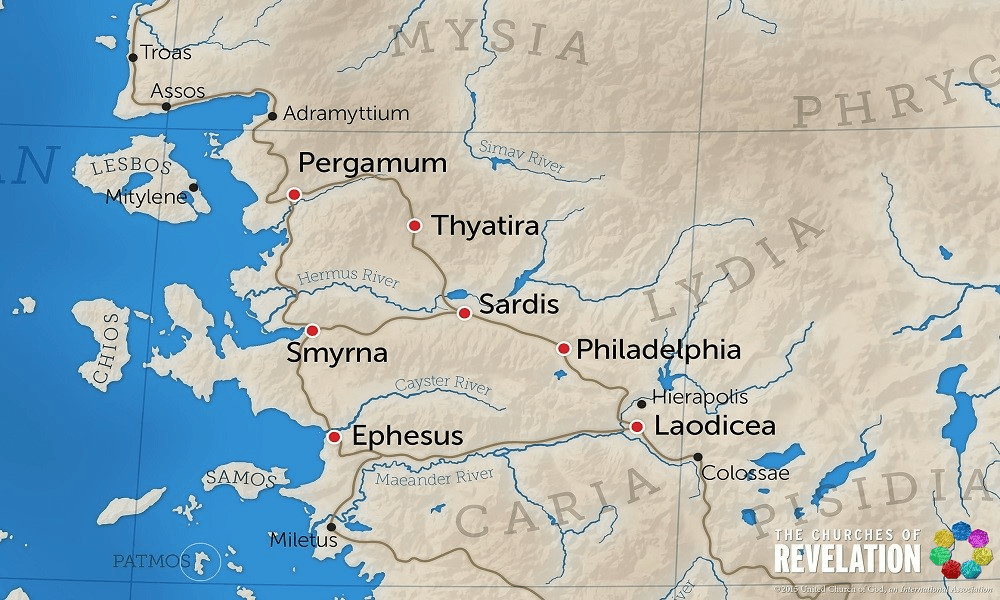
The duration of the Thyatira era as presented by various sources is unanimously long – in fact the longest of them all. Prior to this investigation the reasoning for a lengthy era had held a degree of logic. Time frames include: 538 to 1500; 600 to 1517; 606 to 1517; 606 to 1520 and 1050 to 1600. These average about nine hundred years, almost an incredible one thousand years – a whole millennium. This has to be balanced against an Ephesus era of only seventy years suggested by most. These respective discrepancies do not ring true.
It is interesting that a date close to the Protestant Reformation has been chosen by all. Ambassador College advocated a very long Pergamos era lasting 779 years, followed by a long Thyatiran era comprising 481 years – from 1104 to 1585. While agreeing with the beginning date, this writer does not concur with their position for a longer era.
It is proposed instead, that Thyatira began with the leadership of Peter of Bruys and later strengthened by the messenger Peter Waldo. After Waldo, for the next one hundred years, the church endured horrendous persecution and the power of the work went into serious decline.
In view of this, the Thyatira era was short, lasting 211 years; with the beginning of the fifth era in the year 1315. This after following the third era of Pergamos, which endured 444 years from 660 to 1104; occurring after the second era of Smyrna, lasting 357 years from 303 to 660 CE; and the first era Ephesus, of 273 years from 30 to 303 CE.
The Thyatiran church with the longest letter is shorter even than the Ephesus era and the shortest thus far. A comparison of the distances between the cities where the churches were located show an interesting correlation in that the distance between Thyatira and Sardis is approximately 39 miles. This compared with the 47 miles between Ephesus and Smyrna; 70 between Smyrna and Pergamon; and the 52 miles between Pergamon and Thyatira. Using our ratio of 5.808 it accords with 227 years; close to the 211 proposed.
As an additional point of interest, the average length of duration for these four eras thus far is 321.25 years. Fascinatingly, this figure coincides with the average length for empires to rise, peak and fall. Depending on which source or study one refers, it ranges between two hundred to four hundred years.
We have now witnessed the past exploits of four phases of the true church. Remember, the Body of Christ is invariably scattered and not wholly contained within one movement or group of people. And certainly, the saints shy away from church denominations and organisations which are based on a hierarchal and fiscal foundation.
The elect are not easily quantifiable, but for the sake of establishing a thread, the first era of Ephesus encompassed the Nazarenes; the second era of Smyrna, the Arians; the third era of Pergamos, the Paulicians; and the fourth era of Thyatira, the Waldensians.
The Nazarenes were named after Jesus of Nazareth; the Arians after the presbyter turned reformer, Arius; the Paulicians after the teachings of the itinerant and maverick Paul; and the Waldenses after businessman turned preacher, Peter Waldo.
Sardis
Sardis is located at the edge of the fertile Hermus plain and at the foot of the Tmolus Mountains, on a major route connecting the Aegean with inland Turkey. The city of Sardis and its surrounding area were watered by the river Pactolus. The river, known for its golden sands, helped make the city prosperous when gold was found near its banks.
The city became the capital of the Lydian empire in the seventh and sixth centuries BCE – Chapter XVII Lud & Iran. Its kings were legendary among the Greeks for their wealth and beneficence, building temples and dedicating precious objects and many tons of gold at Greek sanctuaries such as Ephesus, Didyma and Delphi – Article: The Ark of God.
The kingdom’s most noteworthy king was the very wealthy Croesus (Kroisos), who ruled from approximately 560 to 547 BCE. Croesus was the first person to strike and issue the first pure gold and silver coins used in the marketplace. His father King Alyattes, who reigned circa 610 to 560 BCE, had minted and distributed the world’s first coins. Alyattes’ coins were made of electrum, an alloy of gold and silver.
During the reign of Emperor Diocletian, Sardis became a provincial capital of Lydia and it flourished in the fourth and fifth centuries CE. The late Roman synagogue of Sardis is the largest known synagogue of the ancient world. The city’s churches included a fourth-century church outside the city walls, a chapel attached to the temple of Artemis and a large basilica near the centre of the city.

The main religion at Sardis was the worship of the goddess Cybele, as well as Artemis like Ephesus. The people of Sardis commemorated both goddesses with their images on the city’s coins.
Sardis fell into decline in the sixth and early seventh centuries CE, and the lower city was largely abandoned by the end of the seventh century. The acropolis however, described by Polybius as ‘the strongest place in the world’ remained an important citadel and stronghold through the Byzantine period.
The ancient name of the city, Sfar in Lydian, Sparda in Persian, is still reflected in the modern name of the town, Sart. In the Greek (G4554), Sardis means, ‘red ones.’ Other meanings offered include: ‘a precious stone’, ‘those escaping’ and ‘that which remains.’ Dugger and Dodd: ‘that which is left.’

Bible Study: ‘Tradition states that Sardis was the first in its area to be converted by the preaching of the apostle John. It also may have been the first city that revolted from Christianity and one of the first that was laid in its ruins. The inhabitants were dimly viewed by their contemporaries for their voluptuous way of life. There may be an allusion to this fact in God’s message to the church found in the book of Revelation.’
The length of Christ’s letter to the brethren in Sardis is similar to the Pergamos church and also contains six verses. Though unlike any letter preceding it or following, the letter to Sardis is decidedly odd. It does not really follow the format of the other six letters. It is bland, aloof, indifferent and ambivalent. Christ appears to be as disinterested in the brethren of this era as they appear to be towards him. And though he commends the faithful few, the praise is perhaps the least glowing of all the letters.
Nor does the letter mention all the tragic drama instigated through the rise of the second woman in Revelation – led by the Roman Catholic Church. The ‘sexual’ immorality rife in the Pergamos and Thyatira eras is nowhere to be found. Contained in the first four letters, the brethren faced either persecution, torture and death, or compromised in accepting or allowing false doctrine from insidious enemy influences. The letter to Sardis does not contain mention of any of these things, thereby providing a clue that an age of relative peace – though not without some persecution and martyrdom – had arrived in worship and dogma. Yet with it, the saints had slipped into apathy and ingratitude.
Revelation 3:1-6
English Standard Version
“And to the angel of the church in Sardis write: The words of him who has the seven spirits of God and the seven stars.”
This introduction is similar to the one used for Ephesus: “To the angel of the church in Ephesus write: The words of him who holds the seven stars in his right hand, who walks among the seven golden lampstands.” The difference being, that the seven golden lamp stands representing the Churches is omitted and substituted with seven spirits of God. The mutual connection is with the seven stars which represent the seven angels or messengers for each church – Revelation 1:20.
Who are the seven spirits, if they are distinct from the seven stars? The seven spirits are mentioned earlier. Revelation 1:4, ESV: ‘John to the seven churches that are in Asia: Grace to you and peace from him who is and who was and who is to come, and from the seven spirits who are before his throne…’ We learn the seven spirits are located by God’s throne.
Revelation 4:5, ESV: ‘From the throne came flashes of lightning, and rumblings and peals of thunder, and before the throne were burning seven torches of fire, which are the seven spirits of God…’ This verse reminds of the introduction to the Thyatira church, where Christ says he has ‘eyes like flames of fire.’ So it is very interesting to then read in Revelation 5:6, ESV: ‘And between the throne and the four living creatures and among the elders I saw a Lamb standing, as though it had been slain, with seven horns and with seven eyes, which are the seven spirits of God sent out into all the earth.’
Thus the seven spirits located at God’s throne are specifically the flaming eyes of Christ the Lamb. This last verse shows the seven spirits proceed from the throne, whereas every other creature in heaven is turned toward the throne, bowing down and singing praises to God and Christ. The seven spirits come from the throne, indicating that unlike the other angelic creatures who have a permanent place in God’s presence, they represent his activity away from the throne and go out into all the Earth.
These seven spirits are confirmed as the seven eyes in Zechariah 4:10, ESV: ‘… “These seven are the eyes of the Lord, which range through the whole earth.” And they go out and watch on the Lord’s behalf.’ Proverbs 15:3, ESV: ‘The eyes of the Lord are in every place, keeping watch on the evil and the good.’
Revelation: “I know your works. You have the reputation of being alive, but you are dead. 2 Wake up, and strengthen what remains and is about to die, for I have not found your works complete in the sight of my God. 3 Remember, then, what you received and heard. Keep it, and repent. If you will not wake up, I will come like a thief, and you will not know at what hour I will come against you.”
The original Church in Sardis and particularly the Sardis Era, was going through the motions. They were doing what was expected of them, though without zeal. To the outside world, a work was being accomplished, but in Christ’s eyes it did not resemble the true body of Christ, but just blended in with the christian church around them. Part of the problem may have stemmed from living in a very prosperous and famous city.
Michal Hunt: “There seems to be no evidence, in an era of growing Roman persecution, that the church at Sardis experienced either theological controversy or abuse. The walking almost dead at Sardis did not necessarily result from a lack of youth activities, or meaningless inward-looking “spiritual awakening” programs, which is the reason why most churches today tend to be called “dead.” Instead, it appears the church at Sardis lacked… depth of conviction… drowning in mediocrity while she pursued non-controversial “works.” The church at Sardis had become “secularized.” Its fundamental worldview was the same as that of the surrounding pagan culture. Satan must have been satisfied with Sardis not to bother to add persecution and suffering.’
It is worth noting that the most fatal pandemic in recent history; the bubonic plague, occurred during the Sardis era – each synonymous with death. The black death originated in Asia, entering Europe, it ravaged its population between the years 1346 to 1353, with some twenty-five to fifty million deaths – equating to a third or half of Europe’s population.
The epistle to the Ephesians discusses the number one reason, why a person would be dead spiritually and not alive.
Ephesians 2:1-5
English Standard Version
‘And you were dead in the trespasses and sins in which you once walked, following the course of this world… among whom we all once lived in the passions of our flesh, carrying out the desires of the body and the mind, and were by nature children of wrath, like the rest of mankind. But God, being rich in mercy, because of the great love with which he loved us, even when we were dead in our trespasses, made us alive together with Christ – by grace you have been saved…’
The Sardis brethren a little like the Ephesian church, had lost the sparkle and shine of their original conversion to the truth. They perhaps were doing it themselves and not sharing the burden of the christian walk with their Saviour. Galatians 2:20, ESV: ‘I have been crucified with Christ. It is no longer I who live, but Christ who lives in me. And the life I now live in the flesh I live by faith in the Son of God, who loved me and gave himself for me.’
Christ’s statement to ‘strengthen what remains for it is about to die’, could be a reference to an early and abrupt ending to the Sardis era of the church. As are his words that he would ‘come like a thief against’ them. Christ is not speaking of his second coming, but the end of the Sardis work. Both Christ and Paul speak about waking up, staying awake and Christ’s return being as a thief in the night.
Matthew 24:42-44
English Standard Version
‘Therefore, stay awake, for you do not know on what day your Lord is coming. But know this, that if the master of the house had known in what part of the night the thief was coming, he would have stayed awake and would not have let his house be broken into. Therefore you also must be ready, for the Son of Man is coming at an hour you do not expect.’
Revelation 16:15
English Standard Version
“Behold, I am coming like a thief! Blessed is the one who stays awake, keeping his garments on, that he may not go about naked and be seen exposed!”
This is an especially applicable verse as it mentions garments, with which Christ has much to say to the the Sardis church in the closing verses of his letter. We will learn in the seventh letter that the word naked in the aforementioned verse is also highly personal and applicable. Even more so, as the reading of the seventh and final letter is the closest in tone and content with that of the Sardis letter.
1 Thessalonians 5:1-9
English Standard Version
‘Now concerning the times and the seasons, brothers, you have no need to have anything written to you. 2 For you yourselves are fully aware that the day of the Lord will come like a thief in the night. 3 While people are saying, “There is peace and security,” then sudden destruction will come upon them as labor pains come upon a pregnant woman, and they will not escape. 4 But you are not in darkness, brothers, for that day to surprise you like a thief.
5 For you are all children of light, children of the day. We are not of the night or of the darkness. 6 So then let us not sleep, as others do, but let us keep awake and be sober. 7 For those who sleep, sleep at night, and those who get drunk, are drunk at night. 8 But since we belong to the day, let us be sober, having put on the breastplate of faith and love, and for a helmet the hope of salvation. 9 For God has not destined us for wrath, but to obtain salvation through our Lord Jesus Christ…’
Paul says to the Thessalonians that the observation of the festival’s and Holy Days will not necessarily help them know when Christ will return – Article: The Sabbath Secrecy. With that said, a true Christian will recognise the signs of his imminent return and will not be surprised as if one was in the dark, sleeping or drunk. The elect are awake and sober as if it were daylight. Recall, the Sardis congregation were living in peace, yet could still be taken by surprise by real death. Likewise, when ‘dead in our trespasses’ we were ‘children of wrath’ and not of love. By staying awake, the elect have the hope of salvation, which is the resurrection.
Romans 13:11-14
English Standard Version
‘Besides this you know the time, that the hour has come for you to wake from sleep. For salvation is nearer to us now than when we first believed. 12 The night is far gone; the day is at hand. So then let us cast off the works of darkness and put on the armor of light. 13 Let us walk properly as in the daytime, not in orgies and drunkenness, not in sexual immorality and sensuality, not in quarreling and jealousy. 14 But put on the Lord Jesus Christ, and make no provision for the flesh, to gratify its desires.’
Even so, there is cause to celebrate the good works of the Sardis era of the Church. After the severe persecution and decline of the influential albeit brief Thyatiran work – which flame burned ever so brightly but reduced to a flicker quickly – the Sardis era began with the raising of the next messenger. A bold and intrepid man called Walter Reynard. He may have had a brother called Raymond, though this is likely a corruption of the name Reynard, for there is scarce information in substantiating him or not.
Walter was a Picard from a Waldensian background. In the Netherlands, the Waldenses were called Lollards. It derived from a Flemish word, loellen, meaning to ‘sing’ or ‘speak softly’ and ‘mumble.’ The Lollards would memorise scripture, mumbling it to themselves or to one another. An alternative theory is that the name derives from the German loben, ‘to praise’ and herr, ‘lord’ – because the Lollards went from place to place singing psalms and hymns. Meanwhile enemies picked up on the connection with the Latin word lolium, meaning tares – Matthew 13:25. Lollards in Holland were noted as early as 1309 and it was Walter the Lollard in 1315, who carried the gospel to the English. The first Lollards in England arrived from Germany, though there is dispute whether Walter was Dutch or in fact German. Noted historian, Philip Schaff records he was a ‘Hollander.’
G H Orchard: ‘He was a man of learning and of remarkable eloquence, and famous for his writings. He was a laborious and successful preacher who resided [in Mentz] on the Rhine…’ Walter effectively preached the good news of salvation and the kingdom of God throughout much of England.
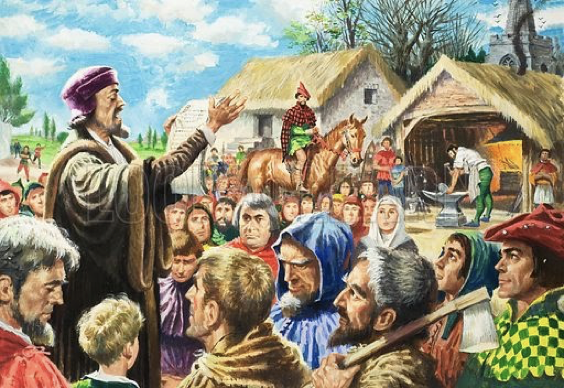
A Condensed History of The Church of God, J V Kirkland & C B Hassell, 1896: “In the time of King Edward II,” says Jarrel, “about the year A.D. 1315, Walter Lollard, a German preacher, a man of great renown among the Waldenses, came into England. He spread their doctrine very much in these parts; so that afterwards they went by the name ‘Lollards’, (Page 319).”
Penyrwrlodd Farm Cottages: ‘Lollard preachers travelled in pairs, and were distinguished by simple red robes. Many of them were women.’ The Encyclopedia Britannica, 11th edition, page 929: ‘The preachers were picturesque figures in long russet dress down to the heels, who, staff in hand, preached in the mother tongue to the people in churches and graveyards, in squares, streets and houses, in gardens, and pleasure grounds, and then talked privately with those who had been impressed.’
The Reformed Reader: ‘That this Walter Lollard was a Baptist [is] unquestionable. He came from the Waldensian Baptists to England, and found Baptists there, who… welcomed this eloquent teacher among them…
The Baptists in England were frequently called “Lollards” by their enemies for more than a century after the visit of Walter Lollard. They were generally among the common people, as their principles were held in mortal abhorrence by the clergy of the established religion. Those who believed or advocated them had to do so privately, or suffer; yet they were of the purest character and had many learned men to espouse their cause and boldly advocate their doctrine.’
The Lollards believed in an ‘Independent form of church government [1]; baptism by immersion upon a profession of faith [2]; they baptized anew all that came to them from any church not in fellowship with them; they refused baptism to infants [2a]; they were predestinarians [3]; they taught freedom of conscience; they acknowledged no rule of faith and practice but the Scriptures [4].’
History of the Baptists, David Benedict, 1813 & 1848, page 308: ‘They now abounded… yea, they covered all England. In 1389 they formed separate and distinct societies agreeable with Scripture. In these churches all the brethren were equal, each could preach, baptise and break bread. They were cited in opinion as one, and were called “Bible men,” since they allowed no office not enjoined in the Word of God. Their hostility to the hierarchy, and their numbers aroused their enemies to adopt severe measures. In the year 1400, a law was passed sentencing Lollards to be burned to death. In Norfolk they abounded, and there they suffered severely.
Still the “Bible men” increased, and became dangerous to the Church. They are said to have numbered 100,000. Henry VIII, while in conflict with the Pope, relieved and encouraged the Lollards in his kingdom: and this led their persecuted brethren from all parts of Europe to flock to England in great numbers, to enjoy religious liberty, and to strengthen the cause of true religion’ – James 1:27.
Describing Walter the Lollard, Benedict says: ‘He was in sentiment the same as Peter de Bruys, who was the founder of the Petrobrussians of France.’
Walter was eventually seized in Cologne, Germany in 1322 and burned to death.
The Lollard name and movement did not die out and was rejuvenated in part as well as partially subsumed in the late 1300s in the person of John Wycliffe who was born in 1324 on the banks of the Tee in Yorkshire – near the village of Wyclif in the diocese of Durham – and who died in 1384. Wycliffe undoubtedly came into contact with the legacy of Walter Lollard, who by ‘his extensive learning and superior ability no doubt were the means of bringing many of the more distinguished people of England in contact with these holy principles… As a result, many who were occupying distinguished positions in the established church broke away from the tyranny of the established priest and breathed the pure spirit of the Lollards…’
Berlin Hisel: ‘Who knows what great influence Walter Lollard and men like him had on Wycliffe. Certainly the Baptists of those days wanted folks to have a translation of the Bible. Certainly they believed the Bible to have all the answers for men’s rule of faith and practice. It could very well be that Wycliffe received those principles from them. He certainly did not receive them from the Catholic Church with which he was, at first, affiliated.’
Wycliffe’s studies and writings were immensely influential. While he publicly lived and died within the embrace of the Catholic Church, it remains doubtful that he was truly of that church. As indicative of the Sardis era, he may have played a double game. It is hard to discount his contribution to spreading the truth of the scriptures to a wide audience and his immeasurable evangelistic efforts. For even as far away as Prague, his writings were burned.
Bishop Newton said of the Lollards: “There was a man more worthy to have given name to the sect – the deservedly famous John Wycliffe, the honor of his own time and the admiration of succeeding times.”

John Wycliffe
Hisel: ‘There was a great deal of people called Lollards. Many of them were just reformers. Some of them, no doubt were Baptists. It is difficult to sort them out. John Wycliffe came on the scene [around 1371] and his followers were called Lollards. Quite naturally, his translation of the Scriptures would find much acceptance among the Baptists. He held many interesting views, yet, in my opinion, he was a reformer and not a Baptist.’ David Benedict: “The followers of Wycliffe and Lollard united and in a short time England was full of the ‘Bible Men’.”
Wycliffe was a theologian and professor at Oxford University, where he had first attended when age fifteen. His main interest was biblical studies. The Reformed Reader: ‘He passed his early manhood in Oxford University. He entered the clerical order, and beheld before him the highest honors in the “Church.” But… God’s Word had found entrance into his soul, and in obedience to its teaching he tore away from his heart the webs and wrappages of error which incased and deadened it. On, step by step, he struggled into light, until on the Bible and the Bible alone, he took his lone and defiant position.’
History of the Christian Church, Philip Schaff, 1910: ‘As a Schoolman – Wyclif was beyond dispute the most eminent scholar who taught for any length of time at Oxford… Whether we regard Wyclif’s constant activity in the pulpit, or the impression his sermons made, he must be pronounced by far the most notable of English preachers prior to the Reformation… Wyclif sets forth the ideal minister, as in the following description:
“A priest should live holily, in prayer, in desires and thought, in godly conversation and honest teaching, having God’s commandments and His Gospel ever on his lips. And let his deeds be so righteous that no man may be able with cause to find fault with them, and so open his acts that he may be a true book to all sinful and wicked men to serve God. For the example of a good life stirreth men more than true preaching with only the naked word.”
‘Behind all Wyclif’s other teaching is his devotion to Christ and his appeal to men to follow Him and obey His law. It is scarcely an exaggeration to say that the name of Christ appears on every page of his writings. To him, Christ was the supreme philosopher, yea, the content of all philosophy. In reaching his views Wyclif was, so far as we know, as independent as any teacher can well be. There is no indication that he drew from any of the medieval sects, as has been charged… He distinctly states that his peculiar views were drawn… from the Scriptures.’
Bible Manuscript Society: ‘As he studied the Holy Scriptures and learned Latin and Greek, he started comparing the teachings of the Scriptures with the church of his day. Instead of finding harmony, he found only differences – differences with the doctrines and beliefs of the established Catholic Church, and conflicts with practices which had no counterpart in the Biblical manuscripts that Wycliffe was studying.
At that time, the Roman Catholic Church held universal jurisdiction over the whole of Christendom. The church, and the Pope at the head of it, held total power over all. Everything and everyone, ultimately even kings, were subject to the decrees and decisions of the Roman church. The Crusades, starting in 1096, illustrated the sheer power of the Pope, in that at his command, out of fear and duty, vast numbers of people in Europe launched a series of persecutions of Jews across Europe, with incredible numbers migrating to the Middle East to kill Muslims and Jews alike, plundering and looting as they went, and slaughtering everyone who stood in their way. The Ninth Crusade (1271-1272) was still within living memory when Wycliffe was born. He would know no other world other than this one – a cruel Medieval world of fear, death, torture and the tyrannical excesses of power.
But into this Medieval world in which the Roman Catholic Church held universal power, something cataclysmic was about to happen. Something which would shake that world to its very foundations… the Black Death suddenly happened. People often died within hours of contracting the disease. Entire villages were wiped out. At first the bodies were buried decently, but towards the end there was none to bury the dead. Mass graves were dug and bodies simply thrown in. It was obvious to everyone that the Black Death was a judgement from God for the cruel excesses of the past. It was obvious that the church was powerless to control it.
But if the Black Death was sudden and unexpected, its effects were long and profound. Entire skills were permanently lost as people took their craftsman’s secrets to the grave. People suddenly inherited, or simply took, great wealth as those around them died. People became reluctant to do menial work, either because they lacked the skills or because they wanted higher wages. Society was disrupted from top to bottom. Soon afterwards The Peasants Revolt (1381) would take place. But crucially, circumstances now combined to create, within ordinary people, a longing and a desire to know the Bible for themselves. It was obvious to everyone that the established Roman Catholic Church did not have the answers.
Ordinary people now started to question the church – its authority was now questioned, in addition to its beliefs, its doctrines and its practices. To make matters worse, now that Wycliffe and others could read and understand the Bible for themselves, they were waking up to a secret that had been hidden for centuries – that the church’s beliefs, doctrines and practices were not what the Bible taught. People wanted to know what the Bible actually said, and read it for themselves – not to be told second-hand by a corrupt, lying and powerless priesthood…
Wycliffe, too, was affected by the Black Death. He, and others, survived it. His earlier conclusions that the church’s teachings did not match the Scriptures took on a new importance. He, and others, started preaching around the country, to an audience that had also survived the terrible plague, who knew they had been spared for a reason, and who now wanted to know for themselves what the Scriptures taught.’
Understanding the abuses perpetrated by the priests and prelates of the church, John began to write and distribute tracts beginning in 1374, subsequently being branded a Lollard. Wycliffe declared the priesthood in communion with Rome was not the true ministry of Christ; the Bishop of Rome was the anti-Christ; and later in 1381, assailed the accepted teachings of the Church in regard to the Eucharist.
Philip Schaff: ‘As Luther is the most vigorous tract writer that Germany has produced, so Wyclif is the foremost religious pamphleteer that has arisen in England…’
Ambassador College Bible Correspondence Course, The Book and the Church they couldn’t Destroy, Lesson 52: ‘A group of Oxford scholars and teachers gathered around him. Many of the rulers of England who had been his former associates listened to him with respect. And a great many of the common people began to look to him as their leader.’ A contemporary at the time said: The “sect” of the Wycliffites was “held in such great honour in these days, and has so multiplied, that you can hardly see two men passing in the road, but one of them shall be a disciple of Wycliffe.”
Kirkland & Hassell: ‘When he began to teach this pure doctrine of freedom of conscience [‘Freedom of conscience is the freedom of an individual to act upon their moral beliefs. In particular, it often refers to the freedom to not do something one is normally obliged, ordered or expected to do. An individual exercising this freedom may be called a conscientious objector. The right to freedom of conscience is… distinct from but closely related to freedom of thought, freedom of expression and freedom of religion’] and to instruct the people to read the Scriptures and make them their rule of faith and practice, he incurred the everlasting displeasure of the corrupt clergy, who saw that such measures would strike at the root of ignorance and superstition; and, as observed by Brown, “like the Ephesians of old, they trembled for their craft.”
At length they obtained letters patent from the king, directing that Wycliffe should be expelled from the University of Oxford, and that all of his publications should be everywhere seized and destroyed. When Wycliffe could no longer resist this flood of cruel intolerance, he gave up his professorship at Oxford and retired to Lutterworth.’
Admittedly, translations of parts of the Bible into Anglo-Saxon existed hundreds of years before John Wycliffe; yet the vital importance of Wycliffe’s contribution to the Church of God was to be the first person in translating the entirety of the Bible into English.
ACBCC: ‘Until the development of printing, it took a skilled and rapid writer ten months to make a copy of the Bible. A finished and bound copy was worth the price of a landed estate!’
Bible Manuscript Society: ‘… ordinary people now had a thirst to know, to read, and to understand, God’s Word for themselves. Their thirst was unquenchable. They hungered and thirsted to know the Truth of the Bible. And the more they found out, the more they wanted to know. But they had a problem. The authority of the Catholic Church was supreme. The Holy Scriptures were only available in Latin in the form of the Vulgate, only in the form of hand-written manuscripts, and only to those (like Wycliffe) who had the privilege of an education at a university such as Oxford, and who were able to understand Latin. Ordinary people had no access to read the Bible for themselves, and they could not understand Latin. They were dependent on people like Wycliffe and the Lollards to tell them what the Scriptures said, to tell them what the Latin said in their own mother tongue, English.
Wycliffe became Master of Balliol College, Oxford, in 1361. Studying the Bible, the Holy Scriptures, the Word of God, and seeing how ordinary people thirsted for a knowledge of God’s Word, he became convinced of the need to translate the Latin to which he had access – the Latin Vulgate – into the English language spoken by ordinary people. Only in this way would they be able to read the Scriptures for themselves. And so, a revolutionary idea was conceived – to translate the Bible from Latin into English, so that ordinary people could read and understand it. Wycliffe determined that it must be done, and the Wycliffe Bible was born.’
Philip Schaff: ‘Two years before his death, Wyclif received a paralytic stroke which maimed but did not completely disable him. While saying mass in his church, he was struck again with paralysis, and passed away two or three days after, Dec. 29, 1384. Wyclif was spare, and probably never of robust health, but he was not an ascetic. He was fond of a good meal. In temper he was quick, in mind clear, in moral character unblemished. Towards his enemies he was sharp, but never coarse or ribald. William Thorpe, a young contemporary standing in the court of Archbishop Arundel, bore testimony that “he was emaciated in body and well-nigh destitute of strength, and in conduct most innocent.”
Bible Manuscript Society: ‘Wycliffe did not work alone, and others helped him. He almost certainly personally translated the four gospels (Matthew, Mark, Luke and John) and possibly the entire New Testament…’
While Wycliffe died shortly before the hand written copy was fully completed in 1384, after being begun in 1382 – known as the ‘Evangelical doctor’ – his circle of scholars saw it to completion. With further more readable updated versions undertaken by Wycliffe’s assistant John Purvey – who later incredibly recanted – and others in 1388 and 1395. For the next thirty years, the Bible was distributed to all parts of England.
Bible Manuscript Society: ‘Rather than welcoming his translation of the Bible, however, the established church was furious. Their wrath knew no bounds. Wycliffe had challenged their authority, and made it possible for ordinary people to read the Bible for themselves, and discover just how astray the church was from the teachings of the Bible, from the faith and beliefs of Jesus Christ. In 1411, Archbishop Arundel wrote to… Pope [John XXIII]:
“This pestilent and wretched John Wycliffe, of cursed memory, that son of the old serpent… endeavoured by every means to attack the very faith and sacred doctrine of Holy Church, devising… to fill up the measure of his malice… the expedient of a new translation of the Scriptures into the mother tongue…“
Kirkland & Hassell: ‘The names of some of the prominent ministers and authors who were the exponents of the Baptist principles in England from the time that Walter Lollard visited England (A.D. 1315) until the first church of English Baptists was planted in America were John Wycliffe, Thomas Bodby, John Claydon, William Sawtree, David George, Thomas Mann, Christopher Shoomaker, William Tyndale, and John Frith.’
Penyrwrlodd Farm Cottages: ‘Joshua Thomas (1719-97), who was Minister at Olchon [on the South Wales/Herefordshire border] from 1746-54, in his book ‘The American Baptist Heritage in Wales’… states that Dr Thomas Bradwardine (1290-1349) was born in the county of Hereford, near Olchon and Hay, in the village of Bredwardine from which his family originated, though other sources suggest his family as coming from Sussex where some members of the Bradwardine family had moved some generations earlier. A Thomas Bradwardine is listed among the gentry of Herefordshire in 1433, which may be the Doctor himself or a relative of his, which at least demonstrates a connection with the area. He believed that the famous theologian sometimes attended services in Olchon, though his visits were infrequent because of the press of his busy life.
Bradwardine was a contemporary of Chaucer and is praised in ‘The Nun’s Tale’ as equal to Augustine and Boethius. He was a celebrated mathematician, scientist and diplomat for King Edward III. He is known as a proponent of the Art of Memory and for his theological radicalism, which may have been why he narrowly failed to become Archbishop of Canterbury in 1348 when the king withheld his consent after Bradwardine had been elected to that office and appointed his Chancellor, John de Ufford, instead. The following year Ufford died of the plague and Bradwardine succeeded to the appointment, though Bradwardine himself died of the plague only 40 days after his consecration.
An interesting aspect is the number of significant Lollard protestant reformers that have associations with Olchon. Joshua Thomas believed Walter Reynard, from Mainz [Germany], was given refuge there around 1315. While it cannot be proven Lollard actually went to Olchon, it is known that the European Anabaptist went to Wales. Thomas notes that Lollard was aware of the existence of Olchon before arriving in Wales. Thomas Crosby in his ‘History of the English Baptists’ of 1738 also records Lollard residing in Britain for some period of time.
John Wycliffe… is claimed to have lived near Olchon in 1371 and to have been influenced in his faith by Bradwardine while at Oxford. Wycliffe was unfortunate in that the Peasants Revolt that erupted in 1381 was openly Lollard in sympathy and one of its principle victims was the Archbishop of Canterbury who was murdered by the mob after being dragged from the Tower of London where he had sought refuge. One of the leaders, John Ball, was a Lollard preacher. Much of the blame for the Peasants’ Revolt was, unfairly, heaped onto Wycliffe, despite his well-established abhorrence of violence, and by 1382 all his writings had been banned. By 1407 the Lollard Bible had been banned.
The Lollard movement was particularly strong in Herefordshire around the Olchon Valley, where it is particularly associated with two men: Walter Brit (or Brute) and Sir John Oldcastle. Walter Brit lived at Olchon Court in the upper Olchon valley. He was described by John Foxe (1517-87) as “eminent in learning, gifts, knowledge, zeal and grace.”
The Reformed Reader: ‘In an old history of the Welsh Baptists are recorded the labors and sufferings of an intelligent, active Baptist layman, who, from Wales, passed into England in company with a preacher. “While the Lord was employing the immortal Wickliffe to prepare his way in England, he remembered Wales in his tender mercy, and visited her with the dayspring on high. The pioneer in the cause of the Reformation in Wales was Walter Brute, who was a native of the principality, and who had been at Oxford, where he became acquainted with Wickliffe, with whom he formed an intimacy, and fully entered into his views respecting the reformation of the church. Having reflected on the pitiable condition of his countrymen, who were bewildered in the haze of ignorance, his heart was moved with compassion. He left the university, endowed with the principles, fortified with the intrepidity, and fired with the zeal of his colleague; and fully determined to resist the delusions and abominations of the secular church, even unto blood, he entered his native land, where he soon distinguished himself.”
“He fearlessly sounded the trump of God throughout the land… As his weapons were those of truth and righteousness, and his cause the cause of God… he soon became instrumental in rescuing the prey from the mighty, and in delivering many lawful captives. His… labors of love appreciated, he found a number of steady friends among high and low. It may be supposed, that in traversing the country to preach the truth, and to seek the lost sheep… that the established churches were closed against him; for we learn that he was preaching from house to house, and in the chief places of concourse and elsewhere, and conducting the worship of God with the greatest simplicity. He… frequently took occasion to protest against the doctrines and discipline of the Established Church. His zeal for the truth and his exposures of the Papacy, soon elicited the hostility of the clergy… Many of the great congratulated Brute in putting a check to the clergy…”
Penyrwrlodd Farm Cottages: ‘In 1391 the Bishop of Hereford was granted permission by King Richard II to arrest Brit for preaching heresy and for conducting unauthorised religious meetings, probably in the Olchon Valley. He defended himself vigorously in his testimony, issuing a fierce and unrepentant denunciation of the Pope as Anti-Christ.’
The Reformed Reader: “… he confounded his adversaries by his fearlessness and acquaintance with the Scriptures. In the account of his trial, recorded by fox, is his written answer to the Bishop:
“In the name of the Father, Son, and Holy Ghost, I, Walter Brute, sinner, Layman, husbandman, and Christian, having my offspring of Britons, have been accused to the Bishhop of Herefordshire that I did err in matters of Christian faith, by whom I am required that I should give a written answer. If any man of any state or sect whatever, will show me that I err in my writings or sayings, by the authority of the sacred Scriptures, or a probable reason grounded thereon, I will gladly receive his information. But as for the bare words of any teacher, (Christ only excepted,) I will not simply believe, unless he shall be able to establish them by the truth of experience, and the example of God’s Word.”
Penyrwrlodd Farm Cottages: ‘For reasons unknown the case was dismissed before it came to trial and Brit disappears from history. The house at Olchon Court still stands, though is of later medieval construction. In the fields above it are a narrow path passing over the mountains to Eywas Valley and the overgrown remains of a small stone building at the junction of two narrow streams that is claimed by some as the earliest Baptist chapel.’
ACBCC: ‘In 1401, the famous statute called De Heretico Comburendo was pronounced against all Lollards. It forbade preaching without a license, teaching “new doctrines” or favoring those who taught them. It provided that those who did so should be imprisoned or fined, and… if obstinate or relapsed after once abjuring their “errors,” they were to be burned to death!’
Many Lollards were sympathisers and sought to merely purify the established Church, restoring it to an apostolic creed while staying firmly within it. With increasing oppression, Lollards fled to new parts of England and Scotland. Local priests were often sympathetic and omitted Catholic rites. The Lollards had to remain under cover and the true followers of Christ were scattered in all corners of England during the fourteenth and fifteenth centuries. They never rose to prominence again after the fall of the Wycliffites, due to the continued persecutory hunting of the Catholic Church.
The Lollards maintained the Papacy was anti-Christ and that it had never been given any authority by the Apostle Peter. They believed one should not be baptised until mature and that the true church was not ‘universal’ but limited to a few. The sacraments of the false church were blasphemous and the relics of saints and purported miracles claimed by them were fake.
Hisel: “Fuller says that Henry was more cruel to the Lollards ‘than his predecessors’, and Fox states that he was the first English monarch who burnt heretics. But Camden alludes to a case, it is thought the one recorded in the Chronicle of London, of one of the Albigenses who was burnt in 1210; and Collier tells of a deacon who became a Jew, was degraded by a council at Oxford, 1222, and burnt under Henry III. This inhuman torture had long existed on the Continent, and Burnet attributed its late introduction into England to the high temper of the people, who would not submit to such severity.
But this consideration is not satisfactory, while the fact stands that Parliament deliberately enacted the law for the burning of heretics, making a nation responsible for their murder, while in other lands the will of the prince was sufficient to burn heretics without statute law. The English sheriffs were forced to take an oath to persecute the Lollards, and the justices must deliver a relapsed heretic to be burned within ten days of his accusation. The fact is, that the pope dictated English law at the shrine, and Archbishop Chicheley says openly, in his constitution, 1416, that the taking of heretics ‘ought to be our principal care.’
‘John Badby [1380-1410], a Lollard… was brought before Archbishop Arundel, March 1, [1410], on the charge of heresy touching ‘The Sacrament.’ He said that he believed in the omnipotent God… but if every wafer used in the sacrament were Christ’s veritable body, soul and divinity, there would be 20,000 gods in England. Being condemned to death March 16, he was bound with chains, put into an empty barrel and burnt in Smithfield, in the presence of the Prince of Wales, afterward Henry V, who at the stake offered him a yearly stipend from the treasury if he would recant.
Even where the accused recanted the punishment was barbarous. John Florence, accused of heresy, renounced his views but was sentenced to be whipped for three Sundays before the congregation in the Norwich Cathedral, and for three Sundays more in his own parish church Shelton, bearing a taper and clothed only in canvas undergarments. The English had become mere serfs to a religious despotism, which brought them to the climax of wickedness that murdered its best subjects for claiming the sacred immunity to worship God as they would.
England made certain shades of opinion in the Church ‘high treason to the crown,’ simply constructive treason at the most; for so-called heresy was made disloyalty under the pretense that the ‘King of Glory was condemned under the cover of bread.’ In other words, the denial of the ‘Real Presence in the sacrament of the altar’ was made an overt act against the monarch of the realm. And so, the chief aim of king and Parliament was legally to grill to ashes the most patriotic people of England. The secular method of punishing treason was by hanging or beheading, but Bale says that at the Parliament at Leicester it was enacted (Henry V) that the Lollards should be hanged for treason against the king and burnt for heresy against God. It was in keeping with this double-handed tyranny that Lord Cobham (Sir John Oldcastle) was put to death.’
Penyrwrlodd Farm Cottages: ‘Probably the best known of all Lollard leaders and martyrs of England is Sir John Oldcastle [the Earl of Cobham], of Oldcastle, lower in Olchon – an “illustrious man of title, wealth, and courage” – who led the most significant and widespread Lollard uprising which in many respects anticipated the later English Civil War. He was a close friend of King Henry V and is known to history as the basis for Shakespeare’s character Falstaff, who originally named as Oldcastle but the name was changed at the request of his descendants. He helped Henry IV suppress the rebellion of Owain Glyndwr, where he served with the young Prince Henry (later Henry V), capturing 300 rebels near Usk. He also served with Henry V in Burgundy as a close and trusted aide but later became associated with religious radicalism and unlicenced Baptist preaching. It is claimed he was baptised by Walter Brit in Olchon Brook, close to Olchon Court.
Oldcastle was protected by the King for some time but finally arrested in 1411 after his Lollard beliefs became too flagrant to ignore and was held in the Tower of London to be tried as a Lollard. Large demonstrations were held in his support until Archbishop Chichely persuaded the reluctant King to have the ringleaders rounded up and 39 of them were hanged or burned at the stake.
Oldcastle, however, escaped in 1413, with a price of 1,000 marks on his head and, according to some accounts, fled to Olchon from where he tried to organise an uprising in the Welsh Marches. Lollard hopes of reform on Henry V’s accession to the throne in 1413 had been high, given his close friendship with Oldcastle and his known hostility towards Thomas Arundel, Archbishop of Canterbury, but it seems those hopes were dashed when the new King immediately sided with the established order.
Oldcastle’s plan was to establish a Lollard Commonwealth, along much the same lines as after the later Civil War, with the King and his brothers under restraint and himself as Regent. Henry was warned by a spy and escaped the ambush and capture by Oldcastle. Under Oldcastle’s plan all abbeys were to be dissolved and their wealth distributed to the people. A series of abortive revolts and plots followed around the country in 1414 (London), 1415 (Southampton) and 1416 (Scotland).
He was finally apprehended (according to one version at Olchon Court itself) in 1417, being severely injured attempting to jump out of an upper window, and, on the orders of King Henry V [1413-1422], tried and sentenced to death for heresy.’
Hisel: ‘Bishop Bale says that: ‘Upon the day appointed, he was brought out of the Tower with his arms bound behind him, having a very cheerful countenance. Then he was laid upon a hurdle, as though he had been a most heinous traitor to the crown, and so drawn forth into St. Gile’s field, where they had set up a new pair of gallows. As he was come to the place of execution, and was taken from the hurdle, he fell down devoutly upon his knees, desiring Almighty God to forgive his enemies.
Then was he hanged up there in the middle [by the waist] in chains of iron – “suspended between two gallows while a fire was lit below him to be slowly burnt to death, gallows and all” – and so consumed alive in the fire. That is, he was hanged over the fire as a traitor, and then burnt as a heretic, [in 1417].
The Reformed Reader: ‘… his possessions confiscated, his family impoverished, his name cast out as evil, Sir John Oldcastle never wavered. This was the victory whereby he overcame the world, even his faith. In death he warned the people to follow nothing but the scriptures; prayed for his enemies, and exclaimed, “I die in triumph!”
“Not satisfied with his death,” says Fox, “the clergy induced the Parliament to make fresh statutes against the Lollards. It was enacted, among other things, that whosoever read the Scriptures in English, should forfeit lands, chattels, goods, and life, and be condemned as heretics, should be hanged for treason against the king, and then burned for heresy against god.” (Fox, Acts and Monuments). “No sooner was this act passed than a violent persecution was raised against the Lollards.” (Ib., Book of Martyrs, page 224).’
Hisel: ‘This state of things did not cease down to the time of Henry VIII, when tyranny changed hands only from the pope to the monarch. When the head of Anne Boleyn fell upon the scaffold, no man dared to proclaim her innocent, even on religious grounds, and the king used the power which the law left in his hands to persecute either Catholic or Protestant as he would. Indeed, for three hundred years no great soul arose in England who was able to arrest the despotism of pope and sovereign. Religious freedom or bondage ebbed or flowed through the will of the monarch, and, in that matter, the nation counted for little as against imbecile pope or royal despot.
When a heretic was condemned, the church bells tolled, the priest thundered, and the sentence of excommunication was pronounced. The priest seized a lighted candle from the altar and cried: ‘Just as this candle is deprived of its light, so let him be deprived of his soul in hell.’ All the people were obliged to say ‘So be it;’ then came the fine, imprisonment and death.
Under Henry VIII it was proposed to consolidate all the penal laws against religion, when he said: ‘Leave that to me.’ He and his bishops then framed the ‘Six Article Act,’ which decreed that if a man denied that the bread and wine in the Supper were the very Christ, he should suffer death by burning and forfeit all his possessions to the king, as in high treason. No mercy was shown under any circumstances.’
The Reformed Reader: ‘But from the ten thousand sufferers of the poor Lollards we must pass, there still stands at this hour the gloomy monument of their miseries on the banks of the Thames, the Lollards Tower at Lambert Palace, London. Fitted up as the palace of their torture by the Bishop of Canterbury, in 1414, it stands there a witness to the triumph of truth. It speaks with an awful, yet prophetic eloquence, of the future of the Baptists.’
Penyrwrlodd Farm Cottages: ‘What is clear… is that within South Wales, centred on the valley of Olchon, was a long tradition of protestant dissent from at least the 13th Century onwards, manifesting ideas that later consolidated into the Baptist Church. Lollards had long propagated the idea of a secret ‘invisible’ community of ‘true Christians’ within but distinct from the outward and corrupt form of the established church institution. Olchon has long been cited by Baptists seeking to prove continuity of their church through the ‘invisible church’ all the way back to Jesus…’
Bible Manuscript Society: ‘At the Council of Constance in 1415, Wycliffe was declared a heretic. The Council decreed that all his works should be burned and his remains exhumed. In 1428, at Pope Martin V’s command, Wycliffe’s corpse was exhumed and burned, and the ashes cast into the River Swift, which flows through Lutterworth where he preached.’
Penyrwrlodd Farm Cottages: ‘There was a further brief Lollard uprising in 1431 and then various trials of individuals for Lollard heresy finally ending in 1559 when anti-Lollard legislation was repealed.’
Bible Manuscript Society: ‘… although his body was destroyed, the Wycliffe Bible would ultimately survive… each manuscript had to be hand-written. Despite the church’s wish to destroy the translation wherever it was found, around 250 individual copies or revisions are thought to have survived, and are still found in various libraries and museums today. The Wycliffe Bible laid the groundwork for further translations of the Bible into English… In fact, the King James Version retains much of the same wording as the Wycliffe Bible, and continues its legacy.’
Philip Schaff: ‘From about 1390 to 1425, we hear of the Lollards in all directions, so that the contemporary chronicler was able to say that of every two men found on the roads, one was sure to be a Lollard. The “heresy” also penetrated into Scotland; James Resby, one of Wyclif’s poor priests, being burnt at Perth, 1407, and another at Glasgow, 1422.
In 1488, a Bohemian student at St. Andrews, Paul Craw, suffered the same penalty for heresy. The Scotch parliament of 1425 enjoined bishops to make search for heretics and Lollards, and in 1416 every master of arts at St. Andrews was obliged to take an oath to defend the Church against them. Between 1450-1517, Lollardy was almost wholly restricted to the rural districts, and little mention is made of it in contemporary records. Although professed by many clerics, it was emphatically a movement of laymen.’
In 1494, thirty people called ‘the Lollards of Kyle’, were accused before the king in Ayrshire, Scotland. Every allegation of heresy against them was the truth as found in the scriptures. They amazingly escaped execution, though fury was provoked in Scotland by the events transpiring in Germany twenty years later.
The Lollard movement played a great part in preparing the people of England and Scotland to accept the coming Reformation. The work of the Lollards also paved the way for the rise of Puritanism, with John Wycliffe being called the Morning Star of the Reformation.
Dugger & Dodd: ‘The Protestant Reformation… can be said to have begun in the fourteenth and fifteenth centuries through the work of Walter Lollard, Wycliffe… and which work was taken up in the following century by Luther, Knox, and others. Luther… at the beginning of his work… insisted that it was by the Word of God alone, that error was to be met. But a hundred years before Luther, this truth was imperfectly recognised…’ for in the ‘fifteenth century corruption in the Romish church reached its greatest extent…’
It was the goldsmith Johannes Gutenberg who perfected the moveable type of the printing press in 1440 and by the 1450s, the first book to ever be printed was a Latin version of the Bible, printed in Mainz, Germany. Printing and hence the Bible spread to Holland and England.
Dugger & Dodd: ‘… Benedict (History of the Baptists, page 308) speaks of separate and distinct societies of Sabbath-keeping Lollards as early as A.D. 1389.’ This a curious statement as there is a massive chasm between the early church ostensibly ‘keeping’ the Sabbath and Sabbath observance rising in popularity during the past four hundred years. Thus 1389 is an early date. Yet why would this be deemed early? Why is there such scant information for Sabbath observance for nearly one thousand, five hundred years?
There are accounts of isolated congregations within the Sardis era keeping the Sabbath. ACBCC: ‘Records of the Catholic Church in Norway mention obstinate keepers of the Sabbath at Bergen and at Oslo about 1435 (Andrews History of the Sabbath)… these people followed the familiar pattern of sitting among the Sunday congregations at Mass, but privately kept the true Sabbath (and no doubt other true doctrines).’ One hundred years later they were still doing the same thing, though by this time, the Catholic Church had been replaced by the Lutheran.
In Finland… ‘the common people were persuaded the hard times which had come on them were for “not observing the seventh day called Saturday.” A letter from the king in 1554 ordered them to “forsake this way leading to damnation at once.” Anjou’s Swedish Church History speaks of an “antichurch party” who kept the Sabbath holy, abstaining from work on it, but who did not separate themselves from the Lutheran Church and from taking Mass on Sunday.’
John Wycliffe:
“Christian men and women, old and young, should study closely the New Testament, and no simple man of wit should be afraid unduly to study in the text of holy Writ. The pride and covetousness of the clerics is the cause of their blindness and heresy and it prevents them from truly understanding holy Writ. The New Testament is of full authority and open to the understanding of simple men, as to the points that be most needful to salvation.”
Revelation: 4 “Yet you have still a few names in Sardis, people who have not soiled their garments, and they will walk with me in white, for they are worthy. 5 The one who conquers will be clothed thus in white garments, and I will never blot his name out of the book of life. I will confess his name before my Father and before his angels. 6 He who has an ear, let him hear what the Spirit says to the churches.”
ACBCC: ‘Most of the immediate followers of Wycliffe were ready to make peace with the Catholic Church rather than face martyrdom. It was left to a few – whose religion was from another source – to continue’ – Luke 12:32.
Many brethren in the Sardis era – aside from the few high profile examples discussed – were content to hide within the Mother Church, which may have been a prudent decision on one hand. The bigger issues were either while doing so, compromising and performing pagan rituals which were wrong such as taking the Mass; or denying their faith so as to spare their physical life, when it was their spiritual life they should have been more concerned about – Matthew 10:28.
Roman Catholic heresies and inventions during the Thyatira and Sardis eras:
25. The Inquisition instituted by the Council of Verona – 1184
26. Sale of Indulgences – 1190
27. Transubstantiation proclaimed by Pope Innocent III – 1215
28. Auricular Confession of sins to a priest instead of to God, instituted by Pope Innocent III in the Lateran council – 1215
29. Adoration of the Wafer (Host), decreed by Pope Honorius III – 1220
30. Bible forbidden to laymen and placed on the Index of Forbidden Books by the Council of Valencia – 1229
31. The Scapular* invented by Simon Stock an English monk – 1251
32. Cup of wine forbidden to the people at Communion by Council of Constance – 1414
33. Purgatory proclaimed as a dogma by the Council of Florence – 1439
34. The doctrine of Seven Sacraments affirmed – 1439
35. The Hail Mary (Ave Maria) finally approved by Pope Sixtus V [1521-1590] at the end of the 16th century – 1508
William Saunders: ‘The scapular* originates in the habits worn by the monastic orders, beginning with the Benedictines, and later adapted by many other religious communities. Basically, the scapular is a piece of cloth, about chest-wide from shoulder to shoulder, and drapes down the front and the back of the person, with an opening for the head. At first, the scapular served more as an apron worn during work, especially farm work… Over time, pious lay people who worked closely with the monastic communities adopted a smaller version of the scapular… [which] consisted of two small pieces of cloth joined by two strings, and was worn around the neck and underneath a person’s clothing. Eventually these smaller scapulars were marks of membership in confraternities, groups of laity who joined together, attaching themselves to the apostolate of a religious community and accepting certain rules and regulations… these smaller versions of the scapular became even more popular among the laity. To date [in 1999], the Church has approved 18 different scapulars, distinguished by color, symbolism and devotion.’
Just because one wears white, doesn’t mean they are saved or have fooled the Eternal. Condemnation can be even greater as the Scribes and Pharisees found out in Jesus’ day – Chapter XXIX Esau: The Thirteenth Tribe. Matthew 23:27-28, ESV: “Woe to you, scribes and Pharisees, hypocrites! For you are like whitewashed tombs, which outwardly appear beautiful, but within are full of dead people’s bones and all uncleanness. So you also outwardly appear righteous to others, but within you are full of hypocrisy and lawlessness.”
2 Thessalonians 1:11
English Standard Version
‘To this end we always pray for you, that our God may make you worthy [G515 – axioo: deserving] of his calling and may fulfill every resolve for good and every work of faith by his power…’
Luke 21:36
King James Version
‘Watch ye therefore, and pray always, that ye may be accounted worthy to escape all these things that shall come to pass, and to stand before the Son of man.’
Being worthy is something a Christian must ask of the Eternal. We cannot make ourselves worthy. While Christ’s sacrifice is the first step towards being worthy of salvation, our continued status in being deemed worthy is requisite on obedience and faith – Article: The Sabbath Secrecy.
Righteous Enoch was such a man, one who walked with God – Genesis 5:22. Genesis 6:9, ESV: ‘… Noah was a righteous man, blameless in his generation. Noah walked with God.’ Only two individuals in the whole Bible are described in this way. Though the inference in the Sardis letter is that they are not the only two. We learn that Abraham was called to walk with God and like Noah, to be blameless. Genesis 17:1, ESV: ‘When Abram was ninety-nine years old the Lord appeared to Abram and said to him, “I am God Almighty; walk before me, and be blameless”…‘
The reference to white garments or clothes, echoes the white stone in the Pergamos letter. And interestingly, the ‘name in the book of life’ links with the new name on the white stone; as with the crown of life promised in the Smyrna era. Revelation 14:14, ESV: ‘Then I looked, and behold, a white cloud, and seated on the cloud one like a son of man, with a golden crown on his head…’
Revelation 20:12
English Standard Version
‘And I saw the dead, great and small, standing before the throne, and books were opened. Then another book was opened, which is the book of life. And the dead were judged by what was written in the books, according to what they had done’ – Revelation 21:27.
Not just the elect of the first resurrection will be clothed in white but also those who live through the tribulation and choose the way of obedience and faith.
Revelation 7:9, 13-15, 17
English Standard Version
9 ‘After this I looked… a great multitude that no one could number, from every nation, from all tribes and peoples and languages, standing before the throne and before the Lamb, clothed in white robes… 13 Then one of the elders addressed me, saying, “Who are these, clothed in white robes, and from where have they come?”
The Elders themselves are clothed in white, wearing a gold crown like the Son of Man. Revelation 4:4, ESV: ‘Around the throne were twenty-four thrones, and seated on the thrones were twenty-four elders, clothed in white garments, with golden crowns on their heads.’
14 ‘I said to him, “Sir, you know.” And he said to me, “These are the ones coming out of the great tribulation. They have washed their robes and made them white in the blood of the Lamb. 15 “Therefore they are before the throne of God, and serve him day and night in his temple; and he who sits on the throne will shelter them with his presence. 17 For the Lamb in the midst of the throne will be their shepherd, and he will guide them to springs of living water”…’
Michal Hunt: ‘In Scripture, white robes symbolize righteousness and purity with origins in the sun-white brilliance of the Glory-cloud of God. In their resurrection in Christ, the saints are re-created in the image of God and clothed with the grace of Christ. This verse is a description of an aspect of salvation in which all who “persevere to the end” have an eternal inheritance’ – Matthew 22:1-14, Galatians 3:27.
Christ ‘confessing the name in the book of life’ of a faithful believer, is a repetition of his words recorded in the Gospels. Matthew 10:32-33, ESV: ‘So everyone who acknowledges me before men, I also will acknowledge before my Father who is in heaven, but whoever denies me before men, I also will deny before my Father who is in heaven.’
Too many Christians in Sardis denied Christ as they worked for the praise and acceptance of men rather than the Eternal. At the Last Judgment, it would be a fearful thing to hear instead, “And then will I declare to them, I never knew you; depart from me, you workers of lawlessness” – Matthew 7:23.
While Christ is stern with Sardis – the fifth era of the true church – he acknowledges the few who are worthy to walk with him in white. To walk with the Son of God is no mean reward and as we have discovered – and can appreciate – the fortitude of the believers at the forefront of the church at this time was praise worthy. The mission given to Walter in sending him forth to witness to the British people was vital in paving the way for the Evangelistic effort of John Wycliffe and similar minded individuals to further the gospel yet more thoroughly through the English translations of the Word of God.
Bible Study: ‘The number 5… symbolizes God’s grace, goodness and favor toward humans. Since five represents grace, when its multiplied by itself, it produces 25 which means “grace upon grace” – John 1:15-16. Christ showed grace to the 5,000 people gathered to listen to him by multiplying five loaves – Matthew 14:17, 21.
‘There are five books of God’s Law (Genesis, Exodus, Leviticus, Numbers and Deuteronomy) commonly referred to as the Pentateuch (“Penta” means five). The 4 Gospels plus Acts equals five books that, as a set, can be designated as “the New Testament Pentateuch.” They reveal Jesus’ teachings concerning the Law and the Prophets.’
While many assume the Ten commandments were divided into four – dedicated to God – and the remaining six – towards other people – they are actually comprised of two sets of five. For the first five commandments were specific to an Israelite’s treatment and relationship with God – which included how one treated their parents in the fifth commandment with promise. While the second set of five were concerned directly with a person’s relationship with other people and each is listed as “do not…”
As the Apostle John is central to relating Christ’s messages to the churches it is interesting that John allegedly wrote five books dedicated to the grace of God and eternal life – the Gospel of John; the epistles, 1 John, 2 John, 3 John; and the Book of Revelation. (Note, John actually wrote three books in the Bible, with 2 John and 3 John being forgeries. The number three in this instance of more significance – refer article: 33.)
‘There are 5 primary types of offerings God commanded Israel to bring to him. They are the Burnt Offering, Sin, Trespass, Grain and Peace Offering.’ Related to this, the design of the tabernacle in the wilderness contained five curtains, bars, pillars and sockets and an altar of wood that was five cubits long and five wide. The height of the court within the tabernacle was also five cubits – Article: The Ark of God.
‘Holy anointing oil is mentioned in Exodus 30:23-25. Its ingredients, which were [given] directly by God, were used to consecrate the furniture of the tabernacle. It was comprised of 5 parts, as it was a revelation of pure grace. The proportion of spices used in making the oil were… multiple[s] of five, which then had a Hin of olive oil added to it.’
- Pure Myrrh, 500 shekels
- Sweet cinnamon, 250 shekels
- Sweet calamus, 250 shekels
- Cassia, 500 shekels
A hin is equal to one and a half gallons (5.7 litres). Recall the Ephesus letter and the association in the Book of Zechariah with the two golden pipes – beside the two olive trees – where oil is poured. The olive trees being the anointed ones ‘who stand by the Lord.’
The length of the preceding Thyatira era is unanimously viewed by commentators as long… of which this writer does not concur. While Sardis is considered a far shorter era, with which it is agreed. Yet Ambassador College considered it a longer phase of the true church. There is reason to believe this was chosen so as to calibrate the beginning of the next era to coincide with their own work and place in history.
Time frames suggested by others include: 1500-1790; 1517-1648; 1517-1739 and 1520-1750; so that most equate to approximately two hundred years in length. An average shorter length for Sardis is persuasively accurate, though the extremely long length chosen by all for the Thyatira era has skewed time frames, so that the dates proposed above are all including the sixth era and going well past the fifth era.
Puzzling then, is that all have chosen the work of Martin Luther and the Protestant Reformation, as falling within the Dead era of Sardis, rather than in perhaps one of the two most ‘alive’ eras of them all, the sixth era?
Ambassador College chose a time frame, where there is relative agreement in their proposed beginning date, but just not for this era. The dates they choose for Sardis are from 1585 to 1934. We will discuss the end date in the letter to the sixth church. The beginning date of 1585 was chosen due to their interpretation of the church going into a spiritual wilderness because of persecution for 1,260 years (Revelation 11:3; 12:6) – beginning at the Council of Nicaea in 325 and therefore ending in 1585.
Rather, it is proposed that Sardis began with the Eternal’s servant Walter the Lollard, continued with the evangelistic work of John Wycliffe and similar to the Thyatiran endeavour, went into gradual decline for the next one hundred years. Thus the Sardis era of God’s Church began in 1315 and ended in 1515, lasting 200 years – now, the shortest era.
This followed the fourth era of Thyatira, for 211 years, from 1104 to 1315; the third era of Pergamos, which endured 447 years, from 657 to 1104; the second era of Smyrna, lasting 354 years, from 303 to 657 CE; and the first era Ephesus, of 273 years, from 30 to 303 CE.
The continuing comparison of the distances between the cities where the churches were located still shows an interesting correlation in that the distance between Sardis and Philadelphia is approximately 31 miles. This compared with the 47 miles between Ephesus and Smyrna; 70 between Smyrna and Pergamon; 52 miles between Pergamon and Thyatira; and the 39 miles between Thyatira and Sardis. Using our ratio of 5.808 it accords with 180 years, not far off the 200 proposed. The result is that the average for each of the five eras lowers from the previous 321.25 years to 297.0 years.
We have now discussed the exploits of five phases of the true church. Recall, ‘the elect are not easily quantifiable…’ Still, true believers of the Body of Christ would have been hidden among those brethren through the ages with the following names.
Some would argue with good cause, that the saints of the Sardis era were to be found under the broad umbrella of, Baptists. Though for reasons that will become clearer as we progress, we will refrain from this term and use another, which is more encompassing and indicative for the two centuries they dominated the true Christian Church landscape.
The first era of Ephesus embraced the Nazarenes; the second era of Smyrna, the Arians; the third era of Pergamos, the Paulicians; the fourth era of Thyatira, the Waldensians; and the fifth era of Sardis, the Lollards.
The Nazarenes were named after Jesus of Nazareth; the Arians after the presbyter turned reformer, Arius; the Paulicians after the teachings of the itinerant and maverick Paul; the Waldenses after businessman turned preacher, Peter Waldo; and the Lollards not after Walter, but the manner in which they remembered, quoted and shared the scriptures in a time when the Bible was not yet available for all.
Philadelphia
The sixth city on the mail route of churches was Philadelphia. It sits on the Cogamus River and is located in the Kuzucay Valley near the base of Mount Bozdag in Turkey’s district of Manisa. It is now known as Alasehir – or Allah-Sheryr, meaning ‘city of God’ – with a population of just over one hundred thousand people. Philadelphia was founded in 189 BCE by king Eumenes II [197-159 BCE] and named for the love of his brother and successor Attalus II Philadelphus of Pergamos [159-138 BCE], to be an open door for Greek culture.
Michal Hunt: Philadelphia ‘was called the “gateway to the East” because the city was at the crossroads to the approach to the provinces of Mysia, Lydia, and Phrygia. The city’s prosperity came from its strategic position as a center of trade and because of its grape-growing and wine-producing industry, and it sometimes bore the title “little Athens” because of the magnificence of its many temples and public buildings.’

‘The cultural centers of the 1st century AD practically floated on the wine consumed by its various populations. As was fitting for a center of wine production, Philadelphia was a center for the worship of Dionysus, the Greek god of wine and fertility (and every other kind of excess), but the city also had many other temples devoted to pagan gods.
In addition to Philadelphia’s location at the crossroads of the Empire, it had nearby volcanic hot springs, which increased its status; however, the city… suffered destruction from numerous earthquakes. Twice the city had been rebuilt and given a new name. The earthquake of AD 17 severely damaged the city [and afterwards it was exempted from taxes by Emperor Tiberius], but at the time John’s letter was written, the Roman Empire had provided the funds to magnificently rebuild Philadelphia. When the Romans restored the city, they gave it a new name, Neocaesar (“new Caesar”), but the name fell into disuse. Then later, Emperor Vespasian (ruled AD 69-79) renamed the city Flavia after his family name. However, as before, the name Philadelphia persisted. In this letter, Christ will promise the Christian community at Philadelphia another “new name” that will last throughout all eternity.’

The name Philadelphia means ‘brotherly love.’ Hunt: from the Greek ‘philios = love of family or mankind and adelphos = from the womb/brother.’ Abarim: ‘Place Of Brotherly Love. From (1) the adjective (philos), friend or beloved, and (2) the noun (adelphos), brother.’ The name Philadelphia aside from the Book of Revelation, occurs five times in the New Testament: Romans 12:10; 1 Thessalonians 4:9; Hebrews 13:1; 1 Peter 1:22 and 2 Peter 1:7.
The call for brotherly love amongst the brethren should always be manifest, for Christ said it was a sign of his church. John 13:35, ESV: “By this all people will know that you are my disciples, if you have love for one another.” We read earlier that of faith, hope and love, love is the greatest. Yet Christians are very good at isolating themselves into groups, where they see themselves as right and others as wrong – 1 Corinthians 1:12. Instead of working together. Psalm 133:1, KJV: ‘Behold, how good and how pleasant it is for brethren to dwell together in unity!’
How refreshing, satisfying and godly it would be if every Christian generously gave love to one another rather than as they do now, freely sharing their judgment on each other. James 2:13, ESV: ‘For judgment is without mercy to one who has shown no mercy. Mercy triumphs over judgment.’ But oh, how human nature loves to get in the way of what is good and right. Jeremiah 17:9, NLT: “The human heart is the most deceitful of all things, and desperately wicked. Who really knows how bad it is?” When treating each other, let us remember the words of Henry W Shaw: “Love looks through a telescope, envy through a microscope.”
The names of some of the churches cities in Asia Minor have been used in modern times by christian minded founders of the American colonies. For instance in the State of Mississippi there is a Thyatira and a Sardis; while in Georgia, there is an Ephesus, Smyrna and another Sardis. Of course the most well known city is Philadelphia, Pennsylvania. Philadelphia was founded in 1682 by William Penn in the English Crown Province of Pennsylvania. Philadelphia, colloquially referred to as Philly, is the most populous city in the state, as well as the sixth most populous city in the nation.
Christ’s letter to the Philadelphians contains seven verses like the letter to Ephesus and is a medium to long letter. The message to the Philadelphians stands out, for like the Smyrna Church, there are no reprimands or criticism – only praise and encouragement. As we begin to appreciate both the scale of the work performed by the Philadelphian era and the length of time they endured patiently, then it is incredible that no faults at all, are levelled at this church.
Revelation 3:7-13
English Standard Version
7 “And to the angel of the church in Philadelphia write: ‘The words of the holy one, the true one, who has the key of David, who opens and no one will shut, who shuts and no one opens’.”
Christ is holy and true. When speaking with a possessed man, the demons recognised the Messiah. Luke 4:34, ESV: “Ha! What have you to do with us, Jesus of Nazareth? Have you come to destroy us? I know who you are – the Holy One of God.” When speaking to a crowd at the temple the Apostle Peter said, Acts 3:14, ESV: “But you denied the Holy and Righteous One, and asked for a murderer to be granted to you…”
Christ is the source of what is true. John 1:17, ESV: ‘For the law was given through Moses; grace and truth came through Jesus Christ. Christ is true, Revelation 19:11, ESV: ‘Then I saw heaven opened, and behold, a white horse! The one sitting on it is called Faithful and True, and in righteousness he judges and makes war.’ Christ speaking with Thomas, John 14:6, ESV: ‘Jesus said to him, “I am the way, and the truth, and the life. No one comes to the Father except through me.”
Next comes an enigmatic part of the verse where Christ is in possession of a key. A key that only he can use to open or shut and no one else can lock or unlock what he has unlocked or locked. Of note is that it is not a ‘key of Christ’ and not even the heavenly keys given to the Apostle Peter. Rather, it is a key in the singular, and one seemingly related to Christ’s ancestor, David – refer article: Seventh Son of a Seventh Son.
Nor is the key of David one of the keys Christ claims to possess in the beginning of the Book of Revelation. Revelation 1:17-18, ESV: ‘When I saw him, I fell at his feet as though dead. But he laid his right hand on me, saying, “Fear not, I am the first and the last, and the living one. I died, and behold I am alive forevermore, and I have the keys of Death and Hades. This reminds of the letter to the Smyrna era and Christ’s power over death and in turn the resurrection to life.
Constant readers will remember the study on the key of David in Chapter XXX Judah & Benjamin – the Regal Tribes. Following, selected passages in question, as well as relevant additional points.
Chapter XXX Judah & Benjamin – the Regal Tribes:
“The understanding of who Judah is, where Judah is and their possession of the royal orb and sceptre of the Messianic throne, is the integral key that unlocks the entire Holy Bible (whether history or prophecy). In the Book of Revelation and the seven separate letters written to seven consecutive church eras of the true body of Christ… there is a pointed clue to when the revealing of Israel’s true identity would begin to unfold.
The person who holds this key is the Son of Man. The beginning of interest in the identity of Israel… began about five hundred years ago. The open doors, signify a powerful and effective preaching by the true church, of the gospel of the Kingdom of God and thereby the knowledge and process of how to enter the spiritual kingdom – as was bestowed upon the apostle Peter. The key of David is thus linked with this open door for the true gospel message and in turn the response of those who heed.”
The key of David is intrinsically associated with the knowledge and understanding of the throne of David and where the modern nations of the houses of Israel and Judah – who descend from the physical kingdom of Israel – are located today – 2 Samuel 7:16.
For while Christ came to offer salvation for all humanity, he was not sent to everyone – John 3:16. Matthew 15:24, ESV: ‘He answered, “I was sent only to the lost sheep of the house of Israel”.’
“A key unlocks a door. A door to a room or a house which invariably contains valuable items, or in this case, knowledge. A key is important and it is not entrusted to just anyone. There are a few passages regarding keys in the Bible. We will look at those which are pertinent.”
The first is regarding the returned exiles from Babylon to Jerusalem and the rebuilding of the second temple.
1 Chronicles 9:21-27
English Standard Version
21 ‘Zechariah the son of Meshelemiah was gatekeeper at the entrance of the tent of meeting. 22 All these, who were chosen as gatekeepers at the thresholds, were 212 [men]. They were enrolled by genealogies in their villages. David and Samuel the seer [H7200 – ra’ah: to see, perceive, discern, have vision] established them in their office of trust. 23 So they and their sons were in charge of the gates of the house of the Lord, that is, the house of the tent, as guards. 24 The gatekeepers were on the four sides, east, west, north, and south. 25 And their kinsmen who were in their villages were obligated to come in every seven days, in turn, to be with these, 26 for the four chief gatekeepers, who were Levites, were entrusted to be over the chambers and the treasures of the house of God. 27 And they lodged around the house of God, for on them lay the duty of watching, and they had charge of opening it every morning.’
These figurative keys entrusted to the Levites, protected the treasures of the temple of God. The second example is found in the Gospels.
Matthew 16:18-19
English Standard Version
18 “And I tell you, you are Peter, and on this rock. I will build my church, and the gates of hell shall not prevail against it. 19 I will give you the keys of the kingdom of heaven, and whatever you bind on earth shall be bound in heaven, and whatever you loose on earth shall be loosed in heaven.”
This phrasing of binding is similar to the key of David which shuts, as loosening is to opening. Peter is given the proverbial keys to the Kingdom. It is he who is entrusted with the authority in heading the way to salvation in the inter-testament era leading to the New Covenant’s future establishment for all – Jeremiah 31:31-33. Yet this authority was not solely reserved for Peter as erroneously taught by the Catholic Church in endeavouring to maintain an unscriptural supreme pontiff – John 20:21-23.
Jesus made clear that this was in antithesis to the self-righteous scribes and Pharisees who were masters at closing doors but not in opening them – even for themselves. Matthew 23:13, ESV: “But woe to you, scribes and Pharisees, hypocrites! For you shut the kingdom of heaven in people’s faces. For you neither enter yourselves nor allow those who would enter to go in.”
The Pharisees created a plethora of rules which were not contained in the Bible and this placed a burden on believers in their worship of the Eternal. Much like the Universal Church exacts rituals on its believers which are not scriptural and are controlling. Christ said his way made a believer free and he gave this authority to his disciples, so as to liberate the true believer and not to tie them up in sacramental knots – Matthew 11:30, Galatians 5:1.
The cryptic Key of David is mentioned just once outside the Book of Revelation, in the Book of Isaiah.
Isaiah 22:1-25
English Standard Version
The oracle concerning the valley of vision.
‘What do you mean that you have gone up, all of you, to the housetops… Your slain are not slain with the sword or dead in battle. 3 All your leaders have fled together; without the bow they were captured. All of you who were found were captured, though they had fled far away. 5 For the Lord God of hosts has a day of tumult and trampling and confusion in the valley of vision… He has taken away the covering of Judah. In that day you looked to the weapons of the House of the Forest, 9 and you saw that the breaches of the city of David were many… But you did not look to him who did it, or see him who planned it long ago.’
“In 1 Kings 7:1-12, it says King Solomon took thirteen years to build his own Palace – circa 970 to 957 BCE. Compared to six years, to construct the Temple from 966 to 960 BCE. There were various rooms in the palace, such as the Hall of Pillars and the Hall of the Throne. All of these were built with ‘cedars from Lebanon’ and costly stones and jewels cut to measure” – refer articles: The Ark of God; and Seventh Son of a Seventh Son.
It is an analogous coincidence that Solomon had rooms in his palace dedicated to pillars and a throne, as both of these are mentioned as rewards in the sixth and seventh letters respectively to the churches.
2 ‘He built the House of the Forest of Lebanon. Its length was a hundred cubits [about 150 feet] and its breadth fifty cubits and its height thirty cubits, and it was built on four rows of cedar pillars, with cedar beams on the pillars. 3 And it was covered with cedar above the chambers that were on the forty-five pillars, fifteen in each row. 4 There were window frames in three rows, and window opposite window in three tiers. 5 All the doorways and windows had square frames, and window was opposite window in three tiers.’
“In 1 Kings 10:17, Solomon put three hundred shields made of gold in to the House of the Forest of Lebanon. The room was designed for weapons, though treasure seems to be included as we learn from the thirteenth king of Judah, Hezekiah.”
Isaiah 39:1-3
English Standard Version
‘At that time Merodach-baladan the son of Baladan, king of Babylon, sent envoys with letters and a present to Hezekiah, for he heard that he had been sick and had recovered. 2 And Hezekiah welcomed them gladly. And he showed them his treasure house, the silver, the gold, the spices, the precious oil, his whole armory, all that was found in his storehouses. There was nothing in his house or in all his realm that Hezekiah did not show them.
3 Then Isaiah the prophet came to King Hezekiah, and said to him, “What did these men say? And from where did they come to you?” Hezekiah said, “They have come to me from a far country, from Babylon.”
The Kingdom of Judah trusted in its own weapons and not the Creator. King Hezekiah naively shows his riches and weapons in front of envoys from Babylon – blind to the planned attack of the Chaldeans nearly a century later.
“Isaiah: 12 ‘In that day the Lord God of hosts called for weeping and mourning, for baldness and wearing sackcloth; 13 and behold, joy and gladness, killing oxen and slaughtering sheep, eating flesh and drinking wine. “Let us eat and drink, for tomorrow we die.” 14 The Lord of hosts has revealed himself in my ears: [‘He who has an ear, let him hear what the Spirit says…’] “Surely this iniquity will not be atoned for you until you die,” says the Lord God of hosts.
15 Thus says the Lord God of hosts, “Come, go to this steward, to Shebna, who is over the household, and say to him: 16 What have you to do here, and whom have you here, that you have cut out here a tomb for yourself, you who cut out a tomb on the height and carve a dwelling for yourself in the rock?’
Numbers 24:21, ESV: ‘And he looked on the Kenite, and took up his discourse and said, “Enduring is your dwelling place, and your nest is set in the rock” – Chapter XXIX Esau: The Thirteenth Tribe.
Isaiah: 17 ‘Behold, the Lord will hurl you away violently, O you strong man. He will seize firm hold on you 18 and whirl you around and around, and throw you like a ball into a wide land. There you shall die, and there shall be your glorious chariots, you shame of your master’s house. 19 I will thrust you from your office, and you will be pulled down from your station.’
“Shebna was a historical figure [Isaiah 36:3, 2 Kings 18:37], though as ‘in that day’ is used, this is a future prophecy during the Day of the Lord. The description of Shebna is possibly about a scribe, a steward, or an advisor to the throne – or even possibly an evil king himself. It could be someone more sinister – an angelic being or Nephilim at the time of the end, who may be a religious figure like the son of perdition – in the spiritual house of God, the Church” – Chapter XXI The Incredible Identity, Origin & Destiny of Nimrod.
Isaiah: 20 ‘In that day I will call my servant Eliakim [meaning: ‘God will establish, whom God sets up’] the son of Hilkiah, 21 and I will clothe him with your robe, and will bind your sash on him, and will commit your authority to his hand. And he shall be a father to the inhabitants of Jerusalem and to the house of Judah. 22 And I will place on his shoulder the key of the house of David. He shall open, and none shall shut; and he shall shut, and none shall open.’
“In the Old Testament, the Hebrew word for ‘key’ is maphteach and defined by Young’s Analytical Concordance of the Bible, as, ‘key opener, opening.’ In the New Testament, the Greek word for ‘key’ as used in Revelation 3:7, is kleis – a feminine word, defined by Young’s as simply, ‘a key.’
Eliakim is either a righteous steward or king after the deposed Shebna, or more likely the Son of Man taking His rightful seat. Eliakim was a historical figure as well, who became the ‘steward or prefect over the palace, as had been foretold by Isaiah (compare 2 Kings 18:18; Isaiah 36:3, 22; 37:2).’ The context of the passage speaks about the rulership of the house of David over Israel. ‘Originally, Shebna had been in a trustworthy position in the king’s rule. The Nelson Study Bible explains “the steward had the key that gave him an audience with the king”.’
Since Eliakim is given the same key as the Son of Man in Revelation, one could assume Eliakim is the returned Messiah, that the King is the Ancient of Days and that Shebna is the Adversary” – Chapter XXII Alpha & Omega.
Isaiah: 23 ‘And I will fasten him like a peg in a secure place, and he will become a throne of honor to his father’s house.’
“The covenant the Creator made with David, was because he kept God’s Law. Isaiah 55:3, describes the new or ‘everlasting’ covenant as ‘the sure [secure] mercies of David’.”
Isaiah: 24 ‘And they will hang on him the whole honor of his father’s house, the offspring and issue, every small vessel, from the cups to all the flagons. 25 In that day, declares the Lord of hosts, the peg that was fastened in a secure place will give way, and it will be cut down and fall, and the load that was on it will be cut off, for the Lord has spoken.’
Jamieson, Fausset and Brown, Commentary on the Whole Bible, states: “‘key’ – emblem of his office over the house; to ‘open’ or ‘shut’; access rested with him… keys are sometimes carried in the East, hanging from the kerchief on the shoulder. But the phrase is rather figurative for sustaining the government on one’s shoulders. Eliakim, as his name implies, is here plainly a type of… Christ, the Son of ‘David’… he that hath the key of David – the antitype of Eliakim, to whom the ‘key,’ the emblem of authority ‘over the house of David’ was transferred from Shebna, who was removed from the office of chamberlain or treasurer, as unworthy of it.
Christ, the Heir of the throne of David, shall supplant all the less worthy stewards who have abused their trust in God’s spiritual house, and ‘shall reign over the house of Jacob,’ literal and spiritual (Luke 1:32, 33), ‘for ever,’ ‘as a Son over His own house’ (Hebrews 3:2-6). It rests with Christ to open or shut the heavenly palace (the heavenly Jerusalem, verse 12, which will come down to this earth; Revelation 21:9-10), deciding who is, and who is not, to be admitted: as He also opens, or shuts… ‘having the keys of hell (the grave) and death (chapter 1:18)’.”
The Broadman Bible Commentary states: ‘To say that Christ is the one who has the key of David is to affirm his messianic authority to admit or exclude from the messianic kingdom.’
Michal Hunt: ‘The title Jesus uses [key of David] refers to God’s eternal covenant with David to which Jesus is the Davidic heir and the witness to the promise God made to David.’
In summary, the key of David now in the possession of Christ, was given to him. The key gives Christ authority to rule and judge. It is a symbol of being David’s heir; with the right to sit on the throne of Judah, in the future ruling government of the kingdom of God on Earth. Similarly, Christ as the Root or shoot of David is the Lion of Judah and described as a conqueror or overcomer – Revelation 5:5. As an aside, David when tending his father’s flock of sheep, defended them when he overcame lions with his bare hands – 1 Samuel 17:34-37, 1 Peter 5:8.
Revelation: 8 “I know your works [activities]. Behold, I have set before you an open door, which no one is able to shut [close]. I know that you have but little power [strength], and yet you have kept my word [commandments] and have not denied [disowned] my name.”
Michal Hunt: ‘”I know your works,” He assures them, and He has compassion for their lack of strength. The church of Philadelphia is not a large or prosperous church, but they have remained faithful to what they have received concerning the Gospel of Jesus… They have kept His commandments and have not denied His name. Because of their faithfulness, Christ the key holder, the Lord of the New Covenant Himself, has admitted them to fellowship and has cast out the ones from whom He removed the “keys” of authority.’
Christ as the one holding the key of David, confirms his authority in admitting or excluding Christians from the kingdom of God – Revelation 20:4. Later, Christ is responsible for ‘opening up’ the city of David that is the heavenly Jerusalem, where Christ alone opens or shuts the door of salvation – Revelation 21:27.
Opening the door to salvation during the Philadelphian era, required a work of spreading the gospel message of good news.
Acts 14:27
English Standard Version
‘And when they arrived and gathered the church together, they declared all that God had done with them, and how he had opened a door of faith to the Gentiles.’
1 Corinthians 16:9, ESV: Paul shared, ‘… for a wide door for effective work has opened to me, and there are many adversaries.’
The sixth era ushered in a time when some Christians could celebrate their beliefs and worship together without the same fear of reprisal. A certain amount of religious freedom and tolerance meant believers were not subject to the same level of pressure in persecution and suffocating Catholic dogma. Thereby allowing believers to keep God’s word and not to deny his name as evidenced repeatedly in previous eras. As we proceed, the history of the Philadelphian era establishes this fact and shows the gospel going out in power unlike any era preceding it, apart from Ephesus.
Some readers may be expecting Martin Luther to be the shining light of the Philadelphia church era and while he was instrumental in a monumental rupture between Catholicism and what would become a protest against her abhorrent abuse of power; all Luther achieved, is in the words of Berlin Hisel from the Baptist History Notebook: ‘Luther… jumped but not far enough. [He] actually created little Roman Catholic Churches’ – Revelation 17:5.
We will investigate Martin Luther’s contribution in evangelising portions of the truth to the world, though the baton of the light of truth was given to a young, remarkable and gifted William Tyndale in 1515. An Englishman born some one hundred years after the great John Wycliffe, Tyndale’s life bore an uncanny resemblance to that of his predecessor, as if he was the very reincarnation of him.
William was sent forth as the messenger of the Philadelphian era, through the door opened for him which ensured God’s word would be available for all people right through until the return of Jesus Christ.

William Tyndale
Bibles are easily accessible today and many people have several copies. For instance, how many do you have in your home? That we have the Bible in English owes in large part to William Tyndale’s dedication and vision – the ‘Father of the English Bible.’ Ninety percent of the King James Bible of 1611 – from which innumerable Bible translations are based – is from the translation of the Bible into English, made by Tyndale.
But this was not the world that Tyndale was born into, for little had changed from the age of Wycliffe. Bible Manuscript Society: ‘Following Wycliffe’s translation of the Bible into English, the Roman Catholic Church had… banned his works, burned his Bible wherever it could be found, forbidden the Bible to be read by the ordinary people, and outlawed translations of the Bible into English. The penalty for disobeying was simple. Death… the Catholic Church ruled supreme, with the Pope at its head. The Church permitted no rivals in its insatiable lust for power and wealth, and stood ready to destroy everything and anyone who stood in its path… the Spanish Inquisition was established in 1478. It would remain in force until 1834, more than 350 years later.
A reign of terror ensued. Anyone who was suspected of “heresy”, of not accepting whatever the Catholic Church taught, was tortured until they either died or confessed. At first mainly Jews and Moslems fell victim, but soon the Inquisition broadened out to all and sundry who opposed the Church, or spoke out against its excesses. Land, goods and lives were forfeited to the Catholic Church. Jews were expelled from country after country across Europe. The Bible was a banned book. The Church knew they dared not let people read God’s Word for themselves.
To those who hungered and thirsted to know the Truth of the Bible, the situation seemed hopeless. Europe had become a dark and dangerous place. But light was starting to shine from the darkness. Glimmers of hope were starting to arise. A new dawn of Truth was starting to emerge from the shadows. Despite the Bible still being a banned book, a sequence of events were starting to emerge which would make the translation of the Bible into English, not just a possibility, but an inevitability. The Bible was coming, and coming in an exciting way, to the people of Great Britain and the English-speaking world. These were events which changed history. And history is still feeling its effects.
First, in 1450, the Printing Press was invented. Whereas John Wycliffe and his followers had to produce hand-written manuscripts of his Bible translation, the printing press allowed Bibles to be (painstakingly and meticulously) typeset, but then hundreds of copies made. This made it possible to vastly increase the supply of Bibles.
Second… the printing press was starting to be used to good effect. Printed copies of the Hebrew Bible (or Old Testament) were being produced, albeit at great effort and expense. Copies of the New Testament in Greek and Latin were also being produced, as were Polyglot Bibles. Each one had to be personally authorized by the Pope. But these printed Hebrew, Greek and Latin texts allowed scholars in Universities to have access to the Holy Scriptures like never before – even if it was “only” in the Original Languages of the Bible, rather than the language of the common people.
Third, although the Spanish Inquisition was still in full sway and the Pope claimed universal authority over the whole of Christendom, elsewhere in Europe the Church’s authority was being questioned and challenged as never before. Like Wycliffe before him, in Germany, Martin Luther and his followers were starting to read and translate the Bible for themselves, armed with the printed copies of the Hebrew, Greek and Latin texts that were now rolling off the printing press. And like Wycliffe, they too could clearly see the gaping chasm between what was written in the Bible, and the beliefs, doctrines, practices and excesses of the Catholic Church.’
Tyndale can be spelled as Tynsdale, Tindall, Tindill and Tyndall. The Tyndale family were also known by the name Hychyns [Hitchins] and interestingly, it was as William Hychyns that Tyndale enrolled at Magdalen Hall, Oxford. Like John Wycliffe, William was a scholar and educated at Oxford University. Tyndale was born in 1490 in Melksham Court, Stinchcombe, a village near Dursley, Gloucestershire. It is held that Tyndale’s family had moved to Gloucestershire in the Fifteenth Century, as a result of the Wars of the Roses. The family are thought to have originated from Northumberland via East Anglia.
Online Encyclopaedia: ‘Tyndale is recorded in two Victorian genealogies which claim he was the brother of Sir William Tyndale of Deane, Northumberland, and Hockwold, Norfolk, who was knighted at the marriage of Arthur, Prince of Wales to Catherine of Aragon. If this is true then Tyndale’s family was thus descended from Baron Adam de Tyndale, a tenant-in-chief of Henry I.’
Tyndale began a Bachelor of Arts degree at Magdalen Hall [later Hertford College] at the age of sixteen in 1506 and received his Bachelor of Arts in 1512, the same year he became a subdeacon. He was made Master of Arts in July 1515 and was held to be ‘a man of virtuous disposition, leading an unblemished life.’ The added degree allowed William to start studying theology, but the official course did not include the systematic study of scripture. As Tyndale later complained:
“They have ordained that no man shall look on the Scripture until he is modeled in heathen learning eight or nine years and armed with false principles, with which he is clean shut out of the understanding of the Scripture.”
Tyndale excelled as a linguist, becoming fluent in French, Greek, Hebrew, German, Italian, Latin, and Spanish, in addition to English. Between 1517 and 1521, he attended the University of Cambridge. Erasmus was the leading teacher of Greek from August 1511 to January 1512, but not while Tyndale was at the university.
Tyndale became chaplain at the home of Sir John Walsh in Little Sodbury in Gloucestershire and tutor to his children. His challenging opinions proved controversial to fellow clergymen. In 1522 William was summoned before John Bell, the Chancellor of the Diocese of Worcester; though no formal charges were laid against him.
Encyclopaedia: ‘After the meeting with Bell and other church leaders, Tyndale, according to John Foxe, had an argument with a “learned but blasphemous clergyman” [at a dinner party], who allegedly asserted: “We had better be without God’s laws than the Pope’s”, to which Tyndale responded:
“I defy the Pope and all his laws; and if God spares my life, ere many years, I will cause the boy that driveth the plow to know more of the Scriptures than thou dost!”
By the early Sixteenth Century, the Wycliffite translations of the Bible were becoming less comprehensible due to changes in the English language as it evolved from Middle English to Early Modern English. This coincided with Classical and Koine Greek texts becoming widely available to European scholars for the first time in centuries – after Greek-speaking refugees arrived, following the fall of Constantinople in 1453.
‘Tyndale left for London in 1523 to seek sponsorship and permission to translate the Bible into English. He asked to join the household of London Bishop Cuthbert Tunstall, a well-known classicist who had worked with Erasmus, his friend, on the second edition of his Latin/Greek New Testament. The bishop, however, declined to extend his patronage, telling Tyndale that his household was already full with scholars. Tyndale preached and studied “at his book” in London for some time, relying on the help of cloth merchant Humphrey Monmouth. During this time, he lectured widely, including at St Dunstan-in-the-West at Fleet Street in London.’
Consequently, his life was in danger, so Tyndale departed England for Europe in the spring of 1524, heading to Hamburg and then traveling on to Wittenberg to meet Martin Luther. Tyndale never returned to England. An entry in the matriculation registers of the University of Wittenberg of the name Guillelmus Daltici ex Anglia, has been taken to be a Latinisation of “William Tyndale from England”. William began translating the New Testament in Wittenberg, completing it in 1525 with assistance from Observant Friar William Roy.
Tyndale’s translation was the first English Bible to draw directly from Hebrew and Greek texts and to some extent it was the first English translation to take advantage of the printing press. It was the first of the new English Bibles of the Reformation period and the first English translation to use the word Jehovah as God’s name which was preferred by English Protestant Reformers.
Encyclopaedia: ‘In 1525 the publication of the work by Peter Quentell in Cologne was interrupted by the impact of anti-Lutheranism.’ Betrayed, William fled up the Rhine to print again. ‘A full edition of the New Testament was produced in [February] 1526 by printer Peter Schöffer the Younger in Worms, a free imperial city… in the process of adopting Lutheranism. More copies were soon printed in Antwerp. It was smuggled from continental Europe into England and Scotland [in March 1526] by putting pages in between other legal books’ – where it was popularly received.
Tyndale’s translation was seen as a direct challenge to the hegemony of the Catholic Church and the laws of England which maintained the church’s position. The translation was condemned in October 1526 by Bishop Tunstall, who issued warnings to booksellers and had all the copies he could trace gathered and burned at St Paul’s Cross in London. Still they circulated. Tunstall arranged to buy them before they left the continent, so that they could be burned in bulk. Marius notes that the “spectacle of the scriptures being put to the torch… provoked controversy even amongst the faithful.”
Banner of Truth: ‘Tyndale used the money this brought him for further translation and revision. He began the Old Testament, apparently in Antwerp. Foxe tells how, sailing to Hamburg to print Deuteronomy, he was shipwrecked and lost everything, ‘both money, his copies, and time’, and started all over again, completing the Pentateuch between Easter and December. Back in Antwerp, Tyndale printed it in early January, 1530. Copies were in England by the summer. Revisions and shorter translations followed.’
Tyndale wrote A Prologue on the Epistle to the Romans in 1526; Parable of the Wicked Mammon and Obedience of a Christian Man in 1528; and Jonah in 1531. Cardinal Wolsey condemned Tyndale as a heretic; first stated in open court in January 1529, with Tyndale’s books banned by royal proclamation in 1530.
In the same year Tyndale’s version of the Pentateuch was published in Marburg. Tyndale remained at Worms for about a year and at some point moved to Antwerp, Belgium. He stayed at the house of Thomas Poyntz. Henry VIII [king from 1509 to 1547] asked Emperor Charles V to have Tyndale apprehended and returned to England under the terms of the Treaty of Cambrai; however, the emperor responded that ‘formal evidence was required before extradition.’
In 1530, while in exile, William had written The Practice of Prelates, which opposed Henry VIII’s intention to secure the annulment of his marriage to Catherine of Aragon in favour of Anne Boleyn, ‘on the grounds that it was unscriptural and that it was a plot by Cardinal Wolsey to get Henry entangled in the papal courts of Pope Clement VII. Historian Bruce Boehrer writes that for Tyndale the issue related to the perspicacity of literal scripture: “I suspect he (Tyndale) undercut the arguments of both Church and King because he found both to be based upon an objectionable premise: that the word of God should be subject to the final arbitrament of a single man.”
In 1531 King Henry asked Ambassador Stephen Vaughan to persuade Tyndale to retract his heretical opinions and return to England. Vaughan tried to persuade Tyndale, to no avail. In a secret, night-time meeting outside Antwerp’s city walls, Tyndale agreed that he would return to England, only if the king would print an English Bible. Tyndale was eventually betrayed by English spy Henry Phillips in 1535, to ducal authorities representing the Holy Roman Empire. Seized in Antwerp, he was held in the castle of Vilvoorde (Filford) near Brussels.
Following the insurrections of the Lollards and others ‘heresy was connected by states with sedition and possible regicide; it carried, at worst, the terrible death penalty of burning at the stake. The Church could usually protect someone accused of heresy from being charged by the state, if that person satisfied the appointed theologian Inquisitor, in a formal process, that they did not (now) hold heretical views.’
Tyndale was held in prison for a year and a half. His Roman Catholic inquisitor, Jacobus Latomus, gave him the opportunity to write a book stating his views. Latomus then wrote a book in response to convince him of his errors. Tyndale wrote two in reply and Latomus also wrote two further books in response to Tyndale.
Teachings discussed included: justification by faith and works (1); predestination versus free will (2); and the denial of the immortal soul (3). Latomus made no mention of a Bible translation. Indeed, while in prison, Tyndale was allowed to continue making translations from the Hebrew. ‘When Tyndale could not be convinced to abjure, he was handed over to the Brabantine secular arm and tried on charges of Lutheran heresy in 1536. The charges did not mention his Bible translation, which was not illegal in the Netherlands.’
Despite Thomas Cromwell’s attempt to intercede on his behalf – the most powerful man next to King Henry VIII, for he was blocked by Phillips acting for the papal authorities – Tyndale was deemed guilty by his own admission and subsequently condemned to be executed. Tyndale ‘was [mercifully] strangled to death while tied at the stake, and then his dead body was burned.’
Bible Manuscript Society: ‘As Tyndale was dying, as he gasped his last dying breaths, even as copies of his New Testament were rolling off the printing press into the hands of eager readers of the Bible, Tyndale uttered a final heart-felt prayer to the God of Heaven whom he had served, and to whom he had laid down his life in the ultimate sacrifice:
“Lord! Open the King of England’s eyes.”
This was a profound proclamation.
The traditional date of the commemoration of Tyndale’s death is October 6, yet records of Tyndale’s imprisonment suggest the actual date of his execution may have been weeks earlier. Foxe gives the 6th October as the date of commemoration, without providing a date of death. Biographer David Daniell states his date of death merely as ‘one of the first days of October 1536.’
At the time of Tyndale’s demise, 18,000 copies of his New Testament had been printed; however, only two complete volumes and a fragment remain today, at London’s British Library. Near to after Tyndale’s death, there was a sequence of four English translations of the Bible in as many years, published in England at the king’s behest, albeit revising Tyndale’s versions of the New Testament and Pentateuch; removing various objectionable features such as sectarian prefaces or annotations. The climate of reform helped speed the process of completing Tyndale’s Old Testament translation; with Henry VIII encouraging it, perhaps fulfilling William Tyndale’s final powerful words of prayer.
The first, was Miles Coverdale’s 1535 version, which was the first complete printed translation of the Bible into english, chiefly from the Latin Vulgate and from translations in German.
The second, was The Matthew Bible or Matthew’s Version, published in 1537 by John Rogers a follower of Tyndale, under the pseudonym Thomas Matthew. It combined the New Testament of William Tyndale and as much of the Old Testament as he had been able to translate before being captured and executed. Each were licensed for printing by Henry VIII, but neither was fully accepted by the Church. ‘Henry then held out the promise of an officially authorised English Bible being prepared by learned and catholic scholars.’
A fourth version, was known as the Great Bible of 1539. Encyclopaedia: ‘It was the first edition of the Bible in English, authorised by King Henry VIII of England to be read aloud in the church services of the Church of England. The Great Bible was prepared by [Miles] Coverdale, working under commission of Thomas Cromwell, Secretary to Henry VIII and Vicar General. In 1538, Cromwell directed the clergy to provide “one book of the Bible of the largest volume in English…” As the Tyndale Bible was incomplete, Coverdale translated the remaining books of the Old Testament and Apocrypha from… Latin… and German [sources], rather than working from the original Greek, Hebrew and Aramaic texts. Although called the Great Bible because of its large size, it is known by several other names as well: the King’s Bible… the Cromwell Bible… Whitchurch’s Bible after its first English printer; the Chained Bible, since it was chained to prevent removal from the church.’
It was in 1611 – after seven years of work – that 47 to 54 independent scholars produced the King James Version of the Bible, drawing extensively from Tyndale’s original work and translations descending from his. One estimate suggests the New Testament in the King James Version is 83% Tyndale’s words and the first half of the Old Testament 76%.
The translators of the Revised Standard Version in the 1940s, noted that Tyndale’s translation… also inspired the Geneva Bible of 1560; the Bishops’ Bible of 1568; and the Douay-Rheims Bible of 1582-1609. They added regarding the King James version: “It kept felicitous phrases and apt expressions, from whatever source, which had stood the test of public usage. It owed most, especially in the New Testament, to Tyndale.”
Banner of Truth: ‘… the Geneva Bible… was taken to the New World to Jamestown in 1607, and on the Mayflower in 1620.’ George Steiner in his book on translation After Babel refers to “the influence of the genius of Tyndale, the greatest of English Bible translators.”
In 2002, Tyndale was placed 26th in the BBC’s poll of the 100 Greatest Britons.’ Interesting… it would be fascinating to learn who the twenty-five people were above a man who did more to contribute to the preaching of the gospel than any other person since the original apostles of the first era.
Donald Smeeton conjectures that Tyndale came from a Lollard tradition which he argues was strong in Gloucestershire, but later scholars cast doubt on his claims. Yet perhaps Smeeton was correct.
Penyrwrlodd Farm Cottages: ‘Among the many other notable figures associated with Olchon is Walter Tyndale who was born close to Olchon, though he grew up in Gloucestershire, and whose family name is associated with the Olchon Valley. According to Davis in ‘History of the Welsh Baptists’, Llewellyn Tyndale and Hezekiah Tyndale were members of the Baptist church at nearby Abergaverney. Certainly in his writings Tyndale expresses Baptist views quite eloquently, particularly on the subject of baptism itself, and on occasion deliberately uses Baptist terms, such as [the] word ‘congregation’ instead of church, and only recognises clergy by the offices of ‘pastor’ and ‘deacon’. He uses the word ‘elder’ instead of ‘Bishop’ and challenged clerical celibacy.’
Beliefs of Tyndale included denouncing the practice of praying to dead saints and rejecting the view that the scriptures could be interpreted only by approved clergy. While some of his views were similar to Luther, Tyndale deliberately distanced himself from the German reformer on several key theological points, adopting a ‘symbolical interpretation of the Lord’s Supper in opposition to Luther’s doctrine of the real presence of Christ in the Eucharist.’
Dr Lee Gatiss: ‘Tyndale was very much interested in what has become known as covenant theology (“Seek therefore in the scripture, as thou readest it, chiefly and above all, the covenants made between God and us”), and took what has come to be thought of as a Calvinist stance on many issues, including the atonement (“Christ’s blood only putteth away all the sin that ever was, is, or shall be, from them that are elect”). His Reformation sacramentology will surprise some modern evangelicals, (“the sacraments which Christ ordained preach God’s word unto us, and therefore justify, and minister the Spirit to them that believe”).

William Tyndale – Victoria Embankment, River Thames, London
Tyndale had a refreshingly pragmatic and realistic view of himself. Describing himself as “evil-favoured in this world, and without grace in the sight of men, speechless and rude, dull and slow-witted.”
So Tyndale would have been unruffled by the comments of his contemporaries and detractors. Encyclopaedia: ‘Tyndale fought with… reformer George Joye who wrote in 1535: “Let every man be ware how he medle with Tin[dale],” finding him disdainful, conceited, hypocritical and unwilling to have his Bible translations corrected. John Foxe, writing in around 1562, considered Tyndale “simple and inexpert” in “the wily subtleties of this world.” The view of Tyndale given by a recent biography has been summarized as a “difficult, aggressive, unworldly and monomaniacal man.”
Though his ‘contemporary theological opponent Thomas More, who never met Tyndale personally, charitably described Tyndale as “a man of sober and honest living who was well educated, well liked, and a good preacher.”
Tyndale shared that it was his duty to translate the New Testament and defiantly declared:
“In burning the New Testament they did none other thing than I looked for; no more shall they do, if they burn me also, if it be God’s will it shall be so. Nevertheless, in translating the New Testament I did my duty…”
Though Martin Luther looms large on the religious landscape; Luther remains peripheral to the story of the saints of the true Church. While his motivation to challenge the usurped hegemony of the apostolic church by the Woman of Revelation seventeen is commendable; his lack of conversion is evident in his acceptance of diabolical doctrines such as the Trinity and the Eucharist. Never-the-less, a synopsis of his contribution during the Philadelphian era and his role in opening doors is relevant.
Martin Luther was a miners son born in Eisleben, Saxony, Germany in 1483. At age seven, Luther entered school in Mansfeld and then at fourteen, Luther went north to Magdeburg, where he continued his studies. In 1498, he returned to Eisleben and enrolled in a school, studying grammar, rhetoric and logic. He later compared this experience to purgatory and hell.
Reformation Art: ‘At the age of seventeen in 1501 he entered the University of Erfurt. The young student received his Bachelor’s degree [in grammar, logic, rhetoric and metaphysics] after just one year in 1502! Three years later, in 1505, he received a Master’s degree. According to his father’s wishes, Martin enrolled in the law school of that university. All that changed during a thunderstorm in the summer of 1505. A lightening bolt struck near to him [killing his friend Alexius] as he was returning to school. Terrified, he cried out, “Help, St. Anne! I’ll become a monk!” Spared of his life, but regretting his words, Luther kept his bargain, dropped out of law school and entered the [Augustinian] monastery there.
Young Brother Martin fully dedicated himself to monastic life, the effort to do good works to please God and to serve others through prayer for their souls. Yet peace with God escaped him. He devoted himself to fasts, flagellations, long hours in prayer and pilgrimages, and constant confession. The more he tried to do for God, it seemed, the more aware he became of his sinfulness. Johann von Staupitz, Luther’s superior, concluded the young man needed more work to distract him from pondering himself. He ordered the monk to pursue an academic career. In 1507 Luther was ordained to the priesthood. In 1508 he began teaching theology at the University of Wittenberg. Luther earned his Bachelor’s degree in Biblical Studies… [in] March 1508 and a Bachelor’s degree in the Sentences by Peter Lombard, (the main textbook of theology in the Middle Ages) in 1509… [and in] 1512, the University of Wittenberg conferred upon Martin Luther the degree of Doctor of Theology [becoming a doctor of divinity and a professor of biblical theology].’
It was in 1510 Luther was sent to Rome with a friar to settle a quarrel within Augustinian monasteries. He was shocked by the lack of meditation of the priests and the luxurious way of life of the cardinals. It was at this time that he started doubting the efficacy of prayer for souls in purgatory.
John Bishop: ‘Luther began to preach very unwillingly and only in obedience to the head of his monastery. He preached first in the dining hall of the cloister at Erfurt and then in the small church of the cloister at Wittenburg. Some of his earliest sermons are scholastic compositions in Latin, but soon he was preaching in German as often as four times a day on such subjects as the Lord’s Prayer and the Ten Commandments. His sermons were published and soon attracted attention by the freshness and frankness of his speech.
His delivery was dynamic. He cast a spell over those who heard him. Masterful in his handling of the language, Luther was fresh in expressing old truths and clear in expressing new ones. Those who heard him, though his plain speech often offended them, came eagerly again and again to hear him. They sensed the deep conviction of his soul. Their wide circulation extended Luther’s influence beyond the borders of Germany. They moved the hearts and stirred the consciences of the people. It soon became clear that this one man – by the converting power of his words – was ushering in a fresh era in the history of the Church.
There has been nothing like it since the Day of Pentecost, says John Derr. “On the way to Worms to meet the Diet, he could not escape from the crowds. At Erfurt the church was so crowded that they feared it would fall. At Zwickau, the marketplace was thronged by 2,500 eager listeners and Luther had to preach from a window. He continued to preach to the end of his life though so broken in health that he often fainted from exhaustion. To the end he retained his wonderful power. The last time he entered the pulpit was February 14, 1546, a few days before he died.”
He wrote once in a letter, “I simply taught, preached and wrote God’s Word: otherwise I did nothing. The Word did it all.”
Reformation Art: ‘The demands of study for academic degrees and preparation for delivering lectures drove Martin Luther to study the Scriptures in depth. Luther immersed himself in the teachings of the Scripture and the early church. This study convinced him that the Church had lost sight of several central truths.’
Pope Leon X renewed the plenary indulgence in 1515, that his predecessor Jules II had promulgated to finance the construction of Saint Peter’s Basilica in Rome. Then in 1516 the Dominican Tetzel was responsible for a campaign of indulgence sales in Germany; consisting of remission of sins and temporal punishments without repentance nor confession for the living and restriction of the time spent in purgatory for the dead, for a sum of money.
Reformation Art: ‘On Halloween of 1517, Luther changed the course of human history [and officially began the Protestant reformation which lasted until 1648] when he nailed his 95 Theses to the church door at Wittenberg, accusing the Roman Catholic church of heresy upon heresy. Luther’s charges… directly challenged the position of the clergy in regard to individual salvation.’
Biography: ‘Though Luther intended these to be discussion points, the 95 Theses laid out a devastating critique of the indulgences – good works, which often involved monetary donations, that popes could grant to the people to cancel out penance for sins – as corrupting people’s faith.’
Reformation Art: ‘Before long, Luther’s 95 Theses of Contention had been copied and published all over Europe. Luther’s Protestant views were condemned as heretical by Pope Leo III in the bull Exsurge Domine in 1520 [which Luther threw in a fire and refused to recant]. Consequently Luther was summoned to either renounce or reaffirm them at the Diet of Worms on 17 April 1521.
When he appeared before the assembly, Johann von Eck, by then assistant to the Archbishop of Trier, acted as spokesman for Emperor Charles the Fifth. He presented Luther with a table filled with copies of his writings. Eck asked Luther if he still believed what these works taught. He requested time to think about his answer. Granted an extension, Luther prayed, consulted with friends and mediators and presented himself before the Diet the next day.
When the counselor put the same question to Luther the next day, the reformer apologized for the harsh tone of many of his writings, but said that he could not reject the majority of them or the teachings in them. Luther respectfully but boldly stated, “Unless I am convinced by proofs from Scriptures or by plain and clear reasons and arguments, I can and will not retract, for it is neither safe nor wise to do anything against conscience. Here I stand. I can do no other. God help me. Amen.” On May 25, the Emperor issued his Edict of Worms, declaring Martin Luther an outlaw.’ Though still let him free. One month later however, Luther was banished from the empire.
‘Luther had powerful friends among the princes of Germany, one of whom was his own prince, Frederick the Wise, Elector of Saxony. The prince arranged for Luther to be seized on his way from the Diet by a company of masked horsemen, who carried him to the castle of the Wartburg, where he was kept about a year. He grew a wide flaring beard; took on the garb of a knight and assumed the pseudonym Jörg. During this period of forced sojourn in the world, Luther was still hard at work upon his celebrated translation of the Bible, though he couldn’t rely on the isolation of a monastery. During his translation, Luther would make forays into the nearby towns and markets to listen to people speak, so that he could put his translation of the Bible into the language of the people.
Martin Luther was the first person to translate the New Testament… and later the whole Bible, into German. He used the recent 1516 critical Greek edition of Erasmus, a text which was later called textus receptus. The Luther German New Testament translation was first published in September of 1522. The translation of the Old Testament followed, yielding an entire German language Bible. Luther is also known to have befriended William Tyndale, and given him safe haven and assistance…’
Biography: ‘Though still under threat of arrest, Luther returned to Wittenberg Castle Church, in Eisenach, in May 1522 to organize a new church, Lutheranism. He gained many followers, and the Lutheran Church also received considerable support from German princes. When a peasant revolt began in 1524 [led by former monk, Thomas Muntzer, who was later beheaded], Luther denounced the peasants and sided with the rulers, whom he depended on to keep his church growing. Thousands of peasants were killed, but the Lutheran Church grew over the years.’
Reformation Art: ‘The number of books attributed to Martin Luther is quite impressive. However, some Luther scholars contend that many of the works were at least drafted by some of his good friends… Luther’s books explain the settings of the epistles and show the conformity of the books of the Bible to each other. Of special note would be his writings about the Epistle to the Galatians in which he compares himself to… Paul in his defense of the Gospel. Luther also wrote about church administration and wrote much about the Christian home. Luther’s work contains a number of statements that modern readers would consider rather crude. For example, Luther was known to advise people that they should literally “Tell the Devil he may kiss my ass.”
It should be remembered that Luther received many communications from throughout Europe from people who could write anonymously, that is, without the specter of mass media making their communications known. No public figure today could write in the manner of the correspondences Luther received or in the way Luther responded to them. Luther was… an earthy man who enjoyed his beer, and was bold and often totally without tact in the blunt truth he vehemently preached. While this offended many, it endeared him all the more to others. He was open with his frustrations and emotions, as well.
Once, when asked if he truly loved God, Luther replied “Love God? Sometimes I hate Him!” Luther was also frustrated by the works-emphasis of the book of James, calling it “the Epistle of Straw”, and questioning its canonicity’ – refer article: The Pauline Pardox. ‘Also irritated with the complex symbolism of the Book of Revelation, he once said that it too, was not canon, and that it should be thrown into the river! He later retracted these statements, of course. Luther was a man who was easily misquoted or taken out of context. While a brilliant theologian, and a bold reformer, he would not have made a good politician. But then, he never aspired to any career in politics.’
Biography: ‘In 1525, Luther married Katharina von Bora [with whom he had six children], a former nun who had abandoned the convent and taken refuge in Wittenberg. Luther later said of his marriage, “I have made the angels laugh and the devils weep.” Unusual for its time, Luther in his will entrusted Katharina as his sole inheritor and guardian of their children.
Some works contained strident and offensive language against several segments of society, particularly Jews and, to a lesser degree, Muslims. Luther’s anti-Semitism is on full display in his treatise, The Jews and Their Lies.’
What stands out is that Luther and his associates laboured under the assumption of not realising that there were significant numbers around them in every country seeking reform. Added to this was their spiritual naivety. History of the Christian Church, William Jones – emphasis mine: ‘The Reformers [Luther, Calvin, Knox] with all their zeal and learning, were babes in spiritual knowledge… particularly in regard to the nature of the kingdom of Christ [the true gospel] and its institutions, laws, and worship in general.’
That said, a surprise to this writer and perhaps for many readers was Luther’s view of the Sabbath and the reason why it was not included as an article of faith. For Martin Luther believed in and practiced the observance of the Sabbath. Dugger & Dodd: ‘… in his original thesis, Luther advocated the observance of the seventh-day Sabbath, but that his colleagues objected on the grounds that it was an unpopular doctrine, which would have a tendency to repulse supporters of the Reformation who were not as pious as they should have been, but were of great assistance against the usurpations of the papacy.’
Luther in his own words: “The Sabbath was before the Law of Moses came, and has existed from the beginning of the world. Especially have the devout, who have preserved the true faith, met together and called upon God on this day” – Luther’s Work, XXXV, page 330.
Did Luther cave in to the pressure of accomplishing a political-corporate revolution, rather than truly seeking a theological-biblical one? On a number of false doctrines yes, regarding an Old Covenant interpretation of the Sabbath, no; for Luther’s acceptance of the Mosaic Sabbath was at strange odds with his intolerance of the Book of James.
‘In 1519 Martin Luther began to write against the frightful abominations of the Babylonian Harlot and to disclose all her wickedness… yes, as with thunder claps to bring it all down… But as soon as he joined himself to the secular rule, seeking protection there against the cross… then it went with him as with a man who in mending the old kettle only makes the hole bigger, and raised up a people altogether callous in sin’ – John C Wenger.
Because of Luther’s duplicity and hypocrisy, many who were from a Lollard and Baptist heritage, known as Anabaptists – initially drawn to the ideology of a protestation against the Catholic Church and the requirement to reform it – could not persevere with the increasing misdirection in Luther’s cause.
Berlin Hisel: ‘The Anabaptists believed that religion and all it includes (baptism, church membership), was to be… voluntary… People were not to be forced by the steel sword in matters of religion. State Religion is opposed to this. It believes coercion is to be used. The word “heretic” means “to exercise option in the presence of alternatives.” The Anabaptists, who believed religion to be a matter of choice, were called Heretics for that reason by those who believed in choiceless Christianity.
What would or what could Luther, Calvin and the Reformers do? If they went along with voluntary Christianity they would lose the support of the princes. How could they, without government help, oppose the Roman Catholic Church? Their other choice (rather than go it alone) was to make a deal with the local rulers. Thus was the choice the Reformers made.
All of the Anabaptists ancestors emphasized preaching and believing the preached Word. They taught that one was saved simply by believing the gospel. Baptism and the Lord’s Supper were nothing in the matter of salvation itself. They were only symbolic of salvation. When Luther first began to speak out against the papacy, he said the body of our Lord was not actually present in the Lord’s Supper. He was speaking against the Catholic doctrine of transubstantiation. He and other Reformers, at first, said lay people as much as priests are able to administer the ordinances as well as those ordained by a bishop. The Anabaptists liked this for this was their doctrine. They were, then, at first drawn toward Luther.
Then, when Luther attempted to combine “salvation by faith” with the administration of “sacraments”, the Anabaptists recognized him as not of the true faith and left his “reformation.” Luther’s consubstantiation and the Reformers’ “usual and specific presence,” the Anabaptists saw as the old Roman doctrine in another dress.
When Luther gave up the idea of a church composed of believers only (he never really believed this but toyed with the idea) he ran the gauntlet of Roman error. The Anabaptists, like their ancestors and the Baptists of today, wanted nothing to do with the sacerdotalism (a salvation by sacraments). They were soon disillusioned with the Reformation… they were not Reformers or “Protestants.” It was… a reason why they were hated and persecuted by the Reformers.
Jesus gathered His disciples together for worship without asking permission or license to meet. Early churches met in non-public places, such as private homes, to worship. Only those who had been admitted into the church’s society participated… the meeting was the property of the church. Only members partook of the Supper and voted. This non-public worship brought persecution from the Roman Empire. They were accused by the Empire of every imaginable evil going on in their “private” meetings. These Christians were up to evil and such meetings must be stopped.
When Constantine wedded Church to State, the same idea prevailed… Those who met privately must be up to no good or treason. They must be rooted out and stopped. Thus the Catholics sought to stop all such meetings. Persecution and death of these non-conformists resulted. The Reformers, Calvin especially, felt the Anabaptists and their non-public worship were an obstacle to a creation of a Protestant Church in opposition to the Catholic Church. He wanted them to be a public cult like Lutherans and Presbyterians. Their idea of the nature of a true church prevented this, thus bringing the displeasure of the Reformers against them.’
From 1533 until his death, Luther served as the dean of theology at the University of Wittenberg. During this time he suffered from many illnesses, including arthritis, heart problems and digestive disorders. Martin Luther escaped martyrdom, and died of a stroke at the age of sixty-two.
“He who does away with the Word and does not accept it as spoken by God does away with everything” – Martin Luther
Martin Luther did not live by these very words that he spoke. Luther’s statement is only true if one talks and walks the way of truth – Isaiah 66:2, Genesis 26:5.
Recall the heritage of the true Church in Wales, with both John Wycliffe and William Tyndale having an association. Hisel: ‘Our own American Baptist heritage has a close connection with Wales. Many of the earliest Baptists to come to America came here from Wales. Many of the early churches in America came from Wales or from people who were Baptists in Wales.’ This stemmed from the original spreading of the gospel shortly after the death of Christ by Joseph of Arimathea and the early church in Britain – refer Appendix VIII: When the Creator came to dwell with His Creation.
Britain remained untouched and unaffected by the evil tentacles of the Universal Church and its Pope for the six centuries which spanned the the first two church eras. As evidenced in the following work.
Saint Patrick and the Western Apostolic Churches: or The Religion of the Ancient Britains and Irish, not Roman Catholic: and the Antiquity, Tenents and Sufferings of the Albigenses and Waldenses, 1857:
‘This holy religion was introduced at an early period of the Christian era into Britain and Ireland. There is perhaps no point in ancient church history more clearly established than this, that the primitive, apostolic religion of Christ flourished in Britain and Ireland for the First Six Centuries, uninterrupted by any successful irruption of Popery. The following is a sketch of the proof… that there are seven remarkable epochs in the first seven centuries, relating to the ancient British Churches.
Under the first epoch… ‘St. Paul advanced into Spain,’ and ‘into the utmost bounds of the West,’ and ‘conferred advantages upon the islands which lie in the sea.’ And Henry Spelman quotes a passage out of Fortunatus, bishop of Poictiers, stating that ‘St. Paul passed over the ocean, even to the British Isles.
In the second epoch, in the second century, king Lucius publicly protected Christianity. In the ancient document called the British Triads, it is related that ‘Lleirwig (in Latin, Lucius) called Lleuver the Great, gave the privilege of the country and the tribe, with civil and ecclesiastical rights, to those who professed faith in Christ.’ The venerable Bede says: ‘After the days of Lucius, the Britons preserved the faith which they had received, whole and inviolate, in a quiet and peaceable manner, until the reign of Diocletian.’ In the third epoch, and during the frightful persecutions which raged from the year 304, for many years; Bede says, ‘The British Churches enjoyed the highest glory in its devoted confession of God.’
In the fourth epoch we find the British Churches sending eminent doctors to the Council of Arles, convoked, not by the Pope, who had no such power then, but by the emperor, Constantine the Great, in A.D. 314; also to the Council of Nice, in 325; and to the Council of Sardica, in 347. And these bishops were very unlike modern bishops. These ancient holy pastors, who preached every Sabbath, were so poor that ‘the three delegates were constrained, through their poverty, to accept the public allowance in lodging and food, provided by the emperor.’
The fifth epoch is rendered famous for the unanimous condemnation of Pelagianism, by the British pastors and churches.’ The hallmark of Pelagianism is a denial of original sin and a belief in human perfectibility, seemingly apart from divine grace. ‘In the sixth epoch, these faithful clergy and churches, in full council condemned Pelaganism for the third time.
The seventh epoch is rendered painfully remarkable by the arrival of the emissaries of the Roman pontiff, to propagate Popery and idolatry. The first melancholy occasion was the marriage of ‘a Papist,’ namely, queen Bertha, by the king Ethelbert. This paved the way for St. Austin and his monks, who came into Britain in A.D. 600, and began their fatal operations shortly after.’
Memoirs of the English Baptists, Josiah Taylor:
‘… Austin, the monk, with about forty others, were sent here by Pope Gregory the great, to convert the pagans to popery, and to subject all the British Christians to the dominion of Rome. The enterprise succeeded, and conversion (or rather perversion) work was performed on a large scale. King Ethelbert, and his court, and a considerable part of his kingdom were won over by the successful monk, who consecrated the river Swale, near York, in which he caused to be baptized ten thousand of his converts in a day.
Having met with so much success in England, he resolved to try what he could do in Wales. There were many British Christians who had fled hither in former times to avoid the brutal ravages of the outrageous Saxons. The monk held a synod… and sent to their pastors to request them to receive the pope’s commandment; but they utterly refused to listen to either the monk or the pope, or to adopt any of their maxims. Austin, meeting with this prompt refusal, endeavored to compromise matters with these strenuous Welshman, and requested that they would give Christendom, that is, baptism to their children; but with none of his propositions would they comply.
“Sins, therefore,” said he, “ye wol not receive peace of your brethren, ye of others shall have warre and wretche,” and accordingly he brought the Saxons upon them to shed their innocent blood, and many of them lost their lives for the name of Jesus.
We have no mention of the christening or baptizing children in England before the coming of Austin in 597; and to us, it is evident he brought it not from heaven, but from Rome. But though the subjects of baptism began now to be altered, the mode of it continued in the national church a thousand years longer, and baptism was administered by dipping… From the coming of Austin, the church in this island was divided into two parts, an old and the new. The old, or Baptist church maintained their original principles. But the new church adopted infant baptism, and the rest of the multiplying superstitions of Rome.’
While not all Baptists in history constituted the true Church, undoubtedly some of the true Church – as in the spiritual body of Christ – would have been part of the Baptist movement during the fifth and sixth eras of the church in particular. Baptist’s in England did not practice a church governmental structure. They believed in the biblically based, total autonomy of the local congregation.
As discussed, during the Sardis era, true Christians fell under the Lollard umbrella. In the Philadelphia era, we will learn that the true church has been found in various guises, though many have another common thread apart from baptism by full body immersion in water.
And that is the fact that a number of the elect have been associated with congregations which have met on the day observed by the Jews. Yet the day called Saturday is dependant on the Solar based Gregorian Calendar and as a result is a counterfeit – refer article: The Calendar Conspiracy. Whereas the original seventh day Sabbath was based according to a Sacred Calendar, which is calculated from the Lunar cycle of the Moon.
Incongruously, a label chosen for true Christians in the Philadelphia era could be one of: Sabbatarian. For the Sabbath figures prominently during the Philadelphian era. Thus, a honest history of the true Church cannot be accomplished without its inclusion. It is not without controversy; so much so, the questions surrounding the Sabbath spill over into the seventh and final era of the church. Underscoring the ramifications of its doctrinal, historical and future relevance.
For while most of Sunday keeping christendom is unaware of the debate within the Sabbath community, those of a Sabbatarian background are growing increasingly aware of the difficulties involved in a physical Sabbath observance – Article: The Sabbath Secrecy.
In the Old Testament, the Eternal certainly ceased from His labours and He ordained the seventh ‘day’ or epoch as holy – Genesis 2:1-3. Though scripture does not state a seventh day Sabbath was instituted at this time. The Sabbath was inaugurated at Mount Sinai and became a sign between the Almighty and physical Israel – Exodus 20:8-11; 31:13, 17, Ezekiel 20:20. The Sabbath as the fourth commandment was anchored in the Decalogue, which was incorporated in both the Law and the Mosaic Covenant – Exodus 31:16; 32:15-17, Deuteronomy 4:13; 5:2-3. The Law has not been abolished and remains in force, with a renewed, amplified and spiritual application – Matthew 5:17; 19:16-20, James 2:10-11.
Whereas the Old Covenant ended and the terms of its agreement was entirely superseded by that of the New Covenant (refer article: The Sabbath Secrecy), instituted with spiritual Israel – Hebrews 10:1, 16, Matthew 26:27, 2 Corinthians 2:1-18. It was those elements of the Mosaic Covenant associated with an unsatisfactory sacrificial system – the Levitical priesthood, tithing, sacrifices, Sabbaths, holy days and New Moons, which pointed to the satisfactory reality of Christ’s sacrifice given once and for all – that were by necessity either changed or abolished – Acts 15:5, 9-11, Hebrews 7:12, 27, Colossians 2:16-18.
The repercussions and fallout from the Protestant Reformation lasted throughout the sixteenth century. Yet during this time the Sabbath was being kept by larger numbers even though illegal to meet on that day. ‘In 1552 many in England were known as Sabbatarians’ – The Sabbath Recorder, June 11, 1868. ‘… many conscientious and independent thinkers in the reign of Elizabeth [who reigned from 1558 to 1603] advocated the seventh day [rather, the counterfeit Saturday]’ – Chambers Cyclopedia. Elizabeth I is said to have remarked on the ‘Church of God’ – History and Antiquity of Dissenting Churches, W Wilson, Volume IV, page 37.
Outside of England, another Sabbatarian movement was located in Transylvania, modern day Romania. It began with an ex-Catholic priest named Francis David. He had joined in succession the Lutherans in 1540; the Calvinists in 1559; and later the Polish Anabaptists. Having not found what he was searching for, he founded the first Unitarian congregation in Transylvania in 1566. Continued study led to deeper understanding so that he was branded as an ‘unscrupulous innovator.’ ACBCC: ‘Proving unmoveable in his convictions, he was condemned and imprisoned in 1578, and died the following year.’
At the same time, a rich Hungarian noble Andreas Eossi, who owned three villages and a number of estates, turned to studying the Bible while enduring a long sickness coupled with the tragic loss of his wife and three sons. A number of truths were revealed to him and in 1588 he began to lead the congregation whom Francis David had once pastored – Sabbatarians in Transylvania, Samuel Kohn. Yet he erred when he remarked on the physical observance of the Saturday Sabbath:
“He who keeps not the Sabbath will have no portion in the inheritance of Christ.”
In 1595 a law was passed for the suppression of Sabbath observance. Over the next few years they were punished having their property confiscated with books and writings, seized and burned. When Andreas Eossi died circa 1600, his adopted Hungarian son Simon Pechi, became leader. Pechi held public office, during which in 1619, he accompanied the army to war in Austria. Inexplicably, he was suddenly imprisoned for over three years and upon his release, retired. During this time there was an influx of Jews into the area, who became close to the Sabbath keepers; leading to Sabbatarians having increased secular influence. As a result, Simon Pechi returned to prominence and was honoured in government circles.
Then in 1635, a severer law was passed and in 1638, Sabbath keepers were sentenced to death and their possessions confiscated. Pechi was condemned and again imprisoned. He was later freed, after taking an oath to renounce the Sabbath. Sabbatarians were left with no option but to either go into hiding, emigrate or convert to Judaism.
England’s Henry VIII, led the way in becoming Protestant. Elizabeth I, firmly established England as a Protestant nation. James I (VI Scotland) cemented it with the publication of the King James Bible in 1611 – an early modern English translation for the Church of England. The King James Version was commissioned in 1604 and constituted eighty books, including fourteen books of the Apocrypha – which are not recognised in the inspired biblical canon – Article: The Pauline Paradox.
Encyclopaedia: ‘Noted for its “majesty of style”, the King James Version has been described as one of the most important books in English culture and a driving force in the shaping of the English-speaking world… [and] considered one of the important literary accomplishments of early modern England. The KJV was the third translation into English approved by the English Church authorities: The first had been the Great Bible (1535), and the second had been the Bishop’s Bible (1568).’
Biblical Research Institute, The Sabbath in Post-Reformation England:
‘Possibly no word in the history of religious ideas has been so misunderstood or misused as the word “Puritan.” It still carries today the unfortunate connotation of bigotry, fanaticism, and narrow-mindedness. In reality, it simply referred to those who wanted a purer church in England – a church more thoroughly cleansed from all remaining elements of medieval Catholicism in doctrine, practice, and structural organization. Above all, Puritans wanted a church that recognized the ultimate authority of the Bible.
Puritans in general, particularly in the early years, did not want to break from the Anglican Church, but stay within it and refine it. Only later, when that dream became impossible to realize, did the impetus for separatism arise, leading ultimately to Presbyterianism, Congregationalism, the Baptist Churches, and, between 1640 and 1660, sectarianism on an unprecedented scale. One of the outcomes of the developing Puritan impetus was what is now known as the “Sabbatarian Controversy.”
In 1657, the English Parliament, in response to mounting pressure from Sabbath-keeping leaders in London and supporting publications, appointed a committee to investigate observance of the seventh-day Sabbath. It appears either the committee never reported or, if it did, its report was never made public. We can only conjecture what might have happened if Parliament had reacted favorably to arguments advocating the seventh day.’ We will return to the findings of this all important report.
‘Three years later… former Puritan clergyman Theophilus Brabourne… claimed the Sabbath question was “the highest controversy in the Church of England” at the time. And in 1671 the influential Independent minister Dr. John Owen expressed the fear that “many might yet turn to the seventh day.” The Sabbatarians, though relatively small in number, were clearly not hiding their light under a bushel.
Within twenty years of Wycliffe’s death in 1384, a heresy trial in London confirmed that observance of the seventh-day Sabbath had taken root among Lollard “heretics.” In 1402, just a year after the introduction of the notorious anti-heresy Act, John Seygno, with two other defendants, was brought before the courts on a charge of heresy, indicted on several counts. Under interrogation he admitted, among other things, that the Sabbath was to be kept “according to what was observed in the Old Testament,” testifying that he wished to observe “a Sabbath of this kind as described in the old law, according to the customs and rites of the Jews.” He further stated that he intended to do so until he could be persuaded otherwise “with sufficient reasons.”
The Religious Denominations in the United States, Joseph Belcher: “The Sabbath controversy commenced in England near the close of the sixteenth century… Nicholas [Bownde]… published a book in 1595 [entitled, The Doctrine of the Sabbath], in which he advanced the… notion… the Christian Sabbath… is a perpetuation of the Sabbath of the fourth commandment, but that the day specified in that commandment has been changed by divine authority from the seventh to the first day of the week. ‘In a very little time it became the most bewitching error, and the most popular infatuation, that ever was embraced by the people of England.’
Ambassador College Bible Correspondence Course, Reaching the World with Power, Lesson 53: ‘One of those not satisfied with Puritan Sunday observance was a stentorian-voiced minister named John Traske [1585-1636]…’ Dugger & Dodd: ‘John Trask came to London from Salisbury and held revival meetings. One of his disciples, named Hamlet Jackson, was the means of bringing Trask and many, if not all, of his congregation to the observance of the seventh-day Sabbath in about 1617… this Traskite congregation was the origin of the Mill Yard Church.’
Belcher: ‘John Traske began to speak and write in favor of the seventh day Sabbath… [as well as abstinence from swine’s flesh]. He took high ground as to the sufficiency of the Scriptures to direct in religious services, and the duty of the State to impose nothing contrary to the Word of God.’ ACBCC: ‘Traske was censured… set on the pillory [at Westminster], publicly whipped and then imprisoned.’ Three years later he recanted; though his wife held fast to the Sabbath and died in prison after being confined there for fifteen years.
A former Anglican and Puritan minister in Norfolk, Theophilus Brabourne [1590-1662] – where many Anabaptists from Holland had migrated – published books advocating the seventh day Sabbath.’ Belcher: ‘Theophilus Brabourne… wrote a book… in 1628, wherein he argued “That the Lord’s Day is not the Sabbath Day by Divine Institution,” but “that the Seventh-day Sabbath is now in force”*… he published another in 1632, entitled, ‘A Defense of that most ancient and sacred ordinance of God, the Sabbath Day.’ For this he was called to account before the ‘Lord Archbishop of Canterbury’ and the Court of High Commission.’
Full quotation:* “Consequently the Seventh-day Sabbath, which is part of this law, is also in force… hence it clearly follows, that if not a jot or tittle must be taken from the Law, then the Seventh-day Sabbath in that Law must still be in force, and untaken away. You may as well take away the third or fifth Commandment, as the fourth Commandment, or any part of it.”
Biblical Research Institute: ‘His basic argument… “When it can be shown me that in Scripture’s account any day of the week save Saturday, the last day of the week, was called the seventh day, then may I be brought to think the Fourth Commandment may be understood of some other day besides Saturday, and not till then.”
Brabourne ‘may be regarded as the founder in England of the sect at first known as Sabbatarians, but now calling themselves Seventh Day Baptists’ – The Literature of the Sabbath Question, Robert Cox, 1853. Though under official pressure, Brabourne ‘became a convert, conforming himself quietly to the Church of England. His followers, however, did not all accompany him back to orthodoxy.’
Belcher: ‘He continued to maintain, however, that if the sabbatical institution be indeed moral and perpetually binding, then his conclusion that the seventh day ought to be kept is necessary and irresistible.’
BRI: ‘… the writings of Theophilus Brabourne… [are] undoubtedly representative of seventh-day literature as a whole, and since there are few aspects of seventh-day doctrine he does not at some point consider. A survey of Brabourne’s theology, based on an analysis of all his major works, reveals the following reasons for his advocacy of the seventh-day Sabbath and his corresponding rejection of the Lord’s Day or Sunday:
• The Sabbath was instituted at creation for man’s good and is a memorial of creation [false]
• It thus predates the Jews [false]
• The seventh-day Sabbath is specified in the perpetually binding moral law of the Ten Commandments [true]
• The seventh day was observed by Christ and the apostles [true] and was not abrogated in the New Testament [false]
• The seventh day was observed in the post-apostolic church for several centuries [false]
• The Sabbath is a sign and a means of the believer’s sanctification [false]
• The Lord’s Day was not introduced or substituted for the seventh day by divine authority [true]
• The New Testament texts used to support Sunday observance are incorrectly interpreted [true]
• The change from Sabbath observance to Sunday observance was instituted by the post-apostolic church [true]
• The observance of the Lord’s Day is based on canon law and ecclesiastical decree only [true]
• The change from Sabbath to Sunday observance was predicted in prophecy as the work of the “little horn” of Daniel 7 [false]
Brabourne castigates those who claim “Christ altered and changed the Sabbath from the seventh day to the first day.” He says, “Search the Scripture and you will nowhere find that Christ spake one word against the Sabbath, or about altering it and changing it.” It was, therefore, “a perpetual ordinance,” applicable to Christians in all ages.’
Christ gave a number of clues regarding a true understanding of Sabbath observance during the Old Covenant while he lived. After his death, it was revealed and authorised by the apostles that a change in observance had occurred and not its abolition or absolution – Article: The Sabbath Secrecy.
BRI: ‘Brabourne is justifiably regarded as one of the most important figures in the development of seventh-day belief and practice in the English-speaking world. Most of the foregoing arguments were adopted and developed by writers who followed Brabourne in advocating the seventh-day tradition.’
Theophilus Brabourne concluded ‘that observance of the biblical Sabbath had been replaced by Sunday by the “little horn” power foretold by Daniel in his prophetic outline of world kingdoms. Standard historicist interpretation of the period held that the “little horn” of Daniel 7 symbolized the papacy, which had arisen as the Roman Empire, the fourth beast in the prophetic sequence of world powers… It was “that little Horn, Antichrist… who hath destroyed the fourth commandment,” one anonymous Sabbatarian wrote.
Of the many features given in the text of Daniel 7 that helped to identify the “little horn” as the papacy, the attempt to “change times and laws” (Dan 7:25) was of particular significance to Sabbatarians, many of whom emphasized this prophecy and the papal substitution of Sunday for the biblical Sabbath’ – refer article: The Calendar Conspiracy. ‘Dr. Peter Chamberlen wrote an open letter to the Lord High Chancellor and the English judiciary in 1682, arguing that the “Triple-Crowned-Little-Horn-Changer of Times and Laws” had changed the Sabbath, thus “giving the lie to the Seventh day” by claiming “that the First day is the Sabbath of the Lord.”
Thomas Bampfield, MP, lawyer, and at one time Speaker of the House of Commons, had engaged in a long-running published discussion concerning the Sabbath with John Wallis, Professor of Geography at Oxford. Bampfield argued that although the bishops of Rome claimed authority to change or “dispense with the laws of the church, (they) could not alter or dispense with the laws of God.” Therefore “the law to alter the seventh day to the first” was based on a spurious authority.
Francis Bampfield, brother to Thomas and later to die in prison for his faith, describes Rome as “the papal Antichrist” and the “Anomos one” (the lawless one), since it had changed the law of God just as Daniel had predicted. Bampfield speaks uncompromisingly of Rome’s attack on the Ten Commandments as expressed in contemporary Psalters and Catechisms, writing that “the Antichristian party have mangled the Ten Words” (Ten Commandments) by leaving out the second commandment entirely and dispensing with the seventh day from the fourth commandment. He explains: “They thrust the weekly Seventh-day Sabbath of Jehovah out of the Fourth [commandment]… they turn the last [commandment] into two… they lay aside the weekly Seventh-day Sabbath and set up days of men’s inventing…”
Belcher: ‘Several causes combined to prevent the early organization of Sabbatarian churches in England. The various laws passed to secure uniformity in worship, and to hinder the holding of religious meetings among all dissenters from the Established Church, were doubly oppressive upon those who observed their Sabbath on a different day from the mass of Christians. To this and similar causes we must attribute the fact, that there were no churches regularly organized until about 1650. Within fifty years of that period, however, there were eleven** Sabbatarian churches, besides many scattered Sabbath-keepers, in different parts of the Kingdom.’ BRI: Even so, ‘one account suggests that Sabbath-keepers had been worshipping at Braintree,* in Essex, since the 1530s.’
Belcher: ‘These churches were located at the following places: Braintree,* in Essex; Chersey; Norweston; Salisbury, in Wiltshire; Sherbourne, in Buckinghamshire; Tewkesbury, or Natton, in Gloucestershire; Wallingford, in Berkshire; Woodbridge, in Suffolk; and three in London, namely, the Mill-Yard Church, the Cripplegate Church gathered by Francis Bampfield, and the Pinner’s Hall Church… Eight of these churches have now become extinct, and hence a complete account of them cannot be obtained.’
BRI: ‘For many years it was thought that there had been ten or eleven** seventh-day churches in England between circa 1640 and 1800, the date by which most of these congregations had died out. However, research carried out over the past thirty years or so has significantly widened our understanding of the English Sabbath-keeping movement, and it is now documented that there were more than sixty congregations in this period, scattered widely across the country in more than thirty counties. Some of these groups were small in number and short-lived, but many were flourishing congregations under regular pastoral care, lasting for several decades, and some for centuries.
Salisbury lasted until circa 1840, Watlington in Oxfordshire until 1808, and Natton in Gloucestershire until 1910. The heyday of English Sabbatarianism was undoubtedly the century between 1650 and 1750, when most of the seventh-day congregations co-existed and when there were hundreds of Sabbath-keepers across the country. If we include the whole period covered by this brief study, those who lived in parts of the country where no church existed, and the several hundred who left England and various parts of Europe for America during the years of hardship and persecution, the total number of Sabbath-keepers may well have reached several thousand.’
The most well known of these Sabbath keeping churches was the Mill Yard Church in London. It dates back to at least 1617 – and possibly ten years earlier – and the time of John Traske. Belcher: ‘The Mill-Yard Church is located in the eastern part of London.’
Dugger & Dodd: ‘From the beginning until 1654 they worshipped ‘near Whitechapel’; in 1661 their meeting place was in ‘Bull Stake Alley,’ and in 1680 they were at East Smithfield – from here they addressed a letter to the New Port (Rhode Island) Church, dated… December 21, 1680. From 1691 to 1785 they worshipped in Mill Yard Goodman’s Fields, County of Middlesex, a part of London, now in the heart of the Metropolis. Their chapel there was burned in 1790, and in September of the same year the first stone of a new edifice was laid…
“After being dispossessed of their Mill Yard property in 1885, they met for worship in the Commercial Street Baptist Church in Eldon Street, where once worshipped a Calvinistic Seventh Day Baptist Church, which became extinct about 1840. For some time since 1900, the congregation assembled in private houses and, to accommodate the widely scattered flock, two separate meetings were held – one at the residence of Lt. Col. Thomas W. Richardson, and the other either at the home of the church secretary, or at the home of the deacon. On the 4th of April 1903, this church began to hold services in St Thomas’ Hall, Gillespie Road, Highbury Vale.”
Belcher: On the 19th day of October 1661, while John James the pastor ‘was preaching, an officer entered the place of worship, pulled him down from the pulpit, and led him away to the police under a strong guard. About thirty members of his congregation were taken before a bench of justices then sitting at a tavern in the vicinity, where the oath of allegiance was tendered to each, and those who refused it were committed to Newgate Prison. Mr. James himself was examined and committed to Newgate, upon the testimony of several profligate witnesses, who accused him of speaking treasonable words against the King. His trial took place about a month afterward, at which he conducted himself in a manner to awaken much sympathy. He was however sentenced to be ‘Hanged, drawn, and quartered.’
This awful sentence did not dismay him in the least. He calmly said, ‘Blessed by God, whom man condemneth, God justifieth.’ While he lay in prison under sentence of death, many persons of distinction visited him, who was greatly affected by his piety and resignation… At the scaffold, on the day of his execution, Mr. James addressed the assembly in a very affectionate manner. Having finished his address, and kneeling down, he thanked God for covenant mercies… he prayed for the witnesses against him, for the executioner, for the people of God, for the removal of divisions, for the coming of Christ, for the spectators, and for himself, that he might enjoy a sense of God’s favor and presence, and an entrance into glory… Then, having thanked the Sheriff for his courtesy, he said, ‘Father, into thy hands I commit my spirit’; and was immediately launched into eternity. After he was dead, his heart was taken out and burned, his quarters were affixed to the gates of the city, and his head was set up in Whitechapel on a pole opposite to the Alley in which his meeting-house stood.’
According to William Jones: ‘… John Trask and John James were the founders of the Mill Yard Church, London, 1616 to 1661… In 1546 there were seven congregations in London, which called themselves collectively “The poor despised Churches of God…” Frances Banefield, writing sixteen years later (1677)… speaks of the church of which he is pastor, calling it the Church of God, and says there were then two other Sabbath-keeping churches in London… mentioning a public debate it was then carrying on in defense of the Sabbath, against opposers to this truth… At least three of the seven ‘poor despised Churches of God’ in London in 1646 had survived the persecutions, which cost the death of John James, and others, and were functioning in the year 1677… Frances Banefield’s church moved to the Mill Yard church to hold their services [in] the year 1830…’ This congregation was the Pinners Hall Sabbatarian church which had been established at Devonshire Square E.C. on March 1, 1574. Frances Banefield had brought forth evidence to show that the Church of God of his day [in 1677], like the Sabbath, is a continuation of the ‘Church of Jehovah in the Old Testament.’
Dugger & Dodd: ‘It was the pleasure of one of the authors of this book to spend some months during 1931 and 1932 with the Mill Yard church in London, and we were caused to rejoice, upon finding them advocating the same doctrine on the great essentials, in perfect harmony with the Church of God in America… though now connected with the Seventh day Baptists of America.’
BRI: ‘It has generally been thought that, with a few notable exceptions, Baptist churches drew their support largely from the lower classes of society. Baptist chapels, where they existed, were usually tucked away in some alley or back street, or located in a remote corner of the countryside where they attracted little attention. Compared to the thousands of sturdy, spacious, and well-appointed parish churches in which Anglicans worshipped, Baptists were very much the poor cousins. Baptist worship was often conducted in spartan conditions and with an eye open for authorities bent on detection and prosecution.
The Seventh Day Baptist chapel at Natton was attached to the end of a barn and its elder for years was the local farmer. In Wallingford in Oxfordshire, the church met in the ruins of the castle. That the Sabbath-keeping churches attracted people from a broader cross-section of the populace is evident from the following partial list of distinguished individuals who kept the seventh-day Sabbath, worshipping regularly with seventh-day congregations in various parts of the country during the seventeenth and eighteenth centuries:
• The Stennett family, including several generations of Baptist preachers, three of whom were national figures
• Joseph Stennett I, known to royalty and government ministers
• Dr. Peter Chamberlen, physician to three successive English royal households
• Francis Bampfield, descended from a distinguished family, eminent preacher and Hebrew scholar
• Joseph Davis, property owner and philanthropist
• Thomas Bampfield, MP, Recorder of the City of Exeter, and Speaker of the House of Commons
• Sir William Tempest, lawyer at the Court of Common Pleas in London and landowner
• Nathaniel Bailey, lexicographer
• Henry Jessey, author and publisher
• Arthur Squibb, MP and government official
• James Daniel, attorney
• Robert Cornthwaite, scholar and author
• Mordecai Abbott, Receiver General of Customs under William III
• Dr. Joseph Mason, psychiatrist and benefactor
• William Whiston, Newton’s successor as Lucasian professor of mathematics at Cambridge
That most of the Sabbatarian churches were composed of ordinary men and women from all walks of life goes without saying, but any movement that attracted and held men of this caliber cannot easily be dismissed.’
BRI: ‘Reference to… Sabbath-keepers… may suggest that it was structured with some kind of central organization. It would be a mistake to think of the English Sabbath-keepers in this way… [for example] all Seventh Day Baptist congregations… [were] independent. This is the key to the English Sabbath-keeping movement. It was identified by belief and practice, rather than by structure and organization. It arose spontaneously as study of the Bible led to greater understanding and as convinced individuals shared their convictions with others.
While there were those with seventh-day convictions outside Baptist ranks… the vast majority of the English Sabbath-keepers were Baptists. They fall into two distinctly recognizable groups: General Baptists and Particular Baptists. General Baptists, the older of the two, believed in general or universal redemption, the doctrine that Christ died for the sins of all humankind… believing in free will. Particular Baptists, who began to appear from about the 1640s onwards, were Calvinistic and predestinarian in theology, believing that Christ died only for the elect.
There were, of course, many points of agreement between these two wings of the early English Baptist Church, but there were also other notable differences. Thus the practice of foot washing, refusal to eat blood and perhaps adherence to other elements of Mosaic dietary law, and anointing of the sick were more likely to be found among General Baptists than among those in the Particular churches.
Most, if not all, early Sabbath-keeping congregations were General Baptists, including the Mill Yard Church in London, the earliest of the known Sabbatarian churches and the one that outlasted all others, surviving for more than three centuries. A present-day congregation in London claims descent from Mill Yard, a connection that is documented until at least the middle of the twentieth century. Much earlier than that, by the 1720s, Mill Yard, in common with most other General Baptist churches, had largely become Unitarian, a consequence of the intense Trinitarian debate among Baptists in the early eighteenth century – refer article: Arius, Alexander & Athanasius.
This emphasis declined in later years, although it preceded a revival in Mill Yard’s fortunes and wider influence in various parts of the country in the mid-1700s. Many Particular Baptists quickly adopted the seventh day, three of the four seventh-day congregations known in London before 1700 being of that mind.’
Dugger & Dodd: ‘… all converts to the truth from the Catholic church were re-baptized; that is, they were… immersed. The church was therefore known to be opposed to the Roman mode of baptism universally practiced in that day, hence called “Anti-baptists,” The word “anti” means against: thus they were called by their enemies… “Anabaptists.”
The Anabaptists in London were called “The Churches of God,” according to E. B. Underbill, writing in 1649, and… extracts from reliable sources [prove] further that these churches of God, observed the Sabbath, as well as held to the universal reign of Christ on the Earth during the millennium [and the Kingdom of God].’
It can be greatly appreciated and understood why bodies of people seeking religious freedom to worship in peace, departed for the American colonies in the New World. As persecution intensified in England, an open door was offered in America. This was a significant turning point – in the transference of religious zeal to preach the gospel – from the nation of England to the colonisers of the future United States of America. BRI: ‘… the English Sabbatarians were the first Seventh Day Baptists, and those who chose America as their new home became the first Sabbath-keepers in North America.’
In fact this was the beginning of a diminishing number of Sabbath keeping Christians in England; so that by 1800 they had become publicly at least as congregations, almost extinct. They were ultimately swallowed up by Baptist Churches which in the main, eventually shed keeping the Sabbath from their core beliefs in favour of Sunday.
Migrating Pilgrims to America consisted of Puritans, Quakers, Methodists, Baptists, Anabaptists and yes, Catholic’s. Puritans did not celebrate Christmas, but observed Sunday, calling it the Sabbath – refer Christmas: Chapter XXII Alpha & Omega. Sabbatarians were mixed in with this influx of Israelites seeking a promised land; prepared to undertake the hazardous ocean going journey across the Atlantic; with not much else than the clothes on their back; and to literally begin their lives anew in a wilderness of opportunity – Chapter XXXIII Manasseh & Ephraim – the Birthright Tribes; and Chapter XXXIV Dan: The Invisible Tribe.
The first brave souls to make this arduous journey landed at Plymouth Rock in the Autumn of 1620; the first permanent settlement in New England and the third overall in the colonies. According to Hugh Sprague who had ancestors on the ship, there were Sabbath keepers on the Mayflower. Regardless, venturesome believers followed.
One of these intrepid Sabbath keepers was a man called Stephen Mumford. BRI: ‘… Stephen Mumford, a member of the Bell Lane Seventh Day Baptist church in London and formerly of the mixed-communion Baptist church in Tewkesbury, emigrated to Rhode Island to avoid the difficult times in England. Isaac Backus, in his Church History of New England, summarizes Mumford’s part in [a] series of events, which prove to have planted the seeds of seventh-day observance and the Seventh Day Baptist Church in the American colonies:
“Stephen Mumford came over from London in 1664, and brought the opinion with him, that the whole of the Ten Commandments, as they were delivered from mount Sinai, were moral and immutable, and that it was the antichristian power, which thought to change times and laws, that changed the Sabbath from the seventh to the first day of the week.”
Belcher: ‘He associated much with the First-day Baptist Church in Newport, and soon won several members of that church to his views. They continued to walk with the church, however, for a time… in December, 1671, they came to an open separation, Stephen Mumford, William Hiscox, Samuel Hubbard, Roger Baster, and three sisters, entered into church covenant together, thus forming the first Seventh-day Baptist Church in America’ – seven people, seven years after Mumford’s arrival to the promised land, foundered a seventh day keeping congregation. ‘William Hiscox was chosen and ordained their pastor, which office he filled until his death in 1704, in the 66th year of his age.’
Mumford and these early American Sabbatarians believed Christ had been resurrected on the Sabbath and not on the morning of the first day of the week, or Sunday – refer article: The Sabbath Secrecy.
No small matter which has been an appalling hallmark of the Sabbath keeping churches and their congregations, has been a continual display of disunity in spirit, belief and judgement. The relentless divisive splitting apart of church after church began a little over thirty years after the establishment of the Providence congregation. Albeit for reasons of growth though invariably since, over doctrinal and leadership differences… because congregations lost sight at being a spiritual organism and hungered after the false Mother Church’s template – in seeking power through a corporate instilled identity in which to preach the gospel.
Belcher explains: ‘… the Newport Church included nearly all persons observing the seventh day in the States of Rhode Island and Connecticut; and its pastors were accustomed to hold stated meetings at several distant places, for the better accommodation of the widely-scattered members. But in 1708, the brethren living in what was then called Westerly, R.I., (comprehending all the south-western corner of the State,) thought best to form another society. Accordingly they proceeded to organize the Hopkinton Church, which had a succession of worthy pastors, became very numerous, and built three meeting-houses for the accommodation of the members in the different neighborhoods. At present (1854) there are seven [churches] in Rhode Island, and two in Connecticut, all in a healthy condition.’
ACBCC: ‘The… “Hopkinton” congregation retained the original records – being recognised as the… headquarters location… Previous to this time, the… site had become the regular meeting place for a “yearly meeting” of members from all over! It was at such a meeting – on September 28 (Gregorian calendar) – that the decision was made to establish the new congregation… it is highly significant that this date falls during the Feast of Tabernacles of that year! The earliest of these annual meetings… had been held in late May in 1864. Other annual meeting dates consistently fall… during the fall Holy day season or near Pentecost. None of these meetings came at Christmas, Easter, or even midsummer! (The Seventh Day Baptists in Europe and America, pages 127, 150-152, 174, 602, 614).’
A number of congregations were foundered in New Jersey – and then later in New York, Pennsylvania and West Virginia – with one of the most prominent being at Piscataway, in 1705. The first record after the articles of faith was a statement clearly identifying themselves as the Church of God.
“The Church of God keeping the commandments of God and the faith of Jesus Christ [Revelation 12:17], living in Piscataway and Hopewell, in the province of New Jersey, being assembled with one accord, at the house of Benjamin Martin, in Piscataway, the 19th day of August, 1705 – we did then, and with one mind, choose our dearly beloved Edward Dunham, who is faithful in the Lord, to be our elder and assistant, according to the will of God; whom we did send to New England to be ordained; who was ordained in the church-meeting in Westerly, Rhode Island, by prayer and laying on of hands, by their elder, William Gibson, the eight of September, 1705” – Seventh-day Baptist Memorial, Volume 2, Number 3, page 121.
Dugger and Dodd list the articles of faith for the Piscataway church:
- “… one God, the Father, and one Lord Jesus Christ, who is the mediator between God and mankind, and that the Holy Ghost is the Spirit of God.”
- “… all the Scriptures of the Old and New Testaments, given by inspiration, are the Word of God – and are the rule of faith and practice.”
- “… the ten commandments… continue to be the rule of righteousness unto all men.”
- “… the six principles recorded in Hebrews 6:1-2, to be the rule of faith and practice.”
- “… the Lord’s Supper ought to be administered and received in all Christian churches.”
- “… all Christian churches ought to have church officers in them, as elders
anddeacons.” - “… all persons thus believing ought to be baptised in water by
dippingorplunging, after confession is made by them of their faith in the above said things.” - “… a company of sincere persons, being formed in the faith and practices of the above said things, may truly be said to be the Church of Christ.”
- “We give up ourselves unto the Lord and one another, to be guided and governed by one another, according to the Word of God.”
Dugger and Dodd proposed the Philadelphian era began in 1789 when a door was opened for the church through the constitution drafted by eleven states. ‘It was the only official document in the world ratified by a national government, granting freedom of worship, freedom of speech and freedom of the press.’ A door that no man, or set of men, have since been able to shut. ‘The name of Benjamin Franklin, [a founding father and] a staunch Sabbath-keeper, who history says shone with a “peculiar luster,” was one of the brightest in this period of reconstruction’ – Chapter XXXIV Dan: The Invisible Tribe.
Even so, the inevitable watering down of the truth of the Word of God occurred during the eighteenth century; beginning almost immediately with William Davis, who had studied at Oxford to become a clergyman of the Church of England, though changed his mind and moved to America to become a Quaker. He then switched to the Baptists – after contact with the church at Newport. While Davis accepted the Sabbath, he held to the Trinity and the immortality of the soul, calling those who understood the truth of the resurrection as soul sleepers – refer article, DEATH: A Dead End or a New Beginning?
By 1776 brethren who had accepted the Trinity and immortal soul falsehoods had reasoned it was appropriate to take part in the revolutionary war. These and other protestant doctrines had become prevalent in the Sabbath keeping congregations by 1800. In time the majority of these congregations decided they did not wish to be known as Sabbatarians or the Church of God and officially became known as Seventh Day Baptists in 1818.
The Seventh Day Adventist Church was led by the visionary prophetess, Ellen G White and was founded on May 21, 1863 – in Battle Creek, Michigan – after accepting the truth of the Sabbath nearly twenty years previously. The church had been born from Sunday keeping Adventists who – disillusioned with William Miller’s failed prophecy on Christ’s return in 1844 – had aligned with a remnant of the Church of God.
Adopting the name Seventh Day Adventist earlier in 1860 – for they rejected the name Church of God as being ‘indistinctive and a mark of fanaticism’ – a group in opposition to White and in resistance to the proposed name change, retained the appellation of the Church of God or the Church of Christ. Both applicable names for the true church in the New Testament – Acts 20:28, Romans 16:16.
A conference consisting of several of these faithful congregations was organised in Michigan, with Gilbert Cranmer (1814-1903) – who had established many of the participating congregations – as President. Cranmer was a Christian Connection minister. The Christian Connection was a Christian movement in the United States of America – which developed during the late 1700s and early 1800s – composed of members who had withdrawn from other Christian denominations. The settling of the new frontier and the formation of the new United States, as well as its separation from Great Britain, influenced its creation. The Christian Connection professed no official creed outside of the sole authority of the Bible. Cranmer was a Unitarian, meaning God the Father is one singular being and that while Jesus Christ is God’s Son he is not divine.
Gilbert Cranmer
Gilbert Cranmer: ‘Among other subjects, the seventh day Sabbath was being investigated. My attention was first called to it by an article in a paper called the “Midnight Cry” written by J.C. Day of Ashburnham, Massachusetts [in 1843]. They strongly urged the doctrine at the time, but I did not become fully established in the Sabbath truth until the year 1845. David Hewitt of Battle Creek and myself commenced it at the same day. About this time I made the acquaintance of Elder Joseph Bates’ – a founder and developer of Sabbatarian Adventism. ‘He too commenced the observance of the Sabbath…’ Gilbert Cranmer began keeping the Sabbath before the Whites did.
John Kiesz: ‘It is evident that there were Sabbath-keeping groups (independent) besides the Seventh Day Baptists, before and during the time of William Miller’s preaching and prediction of the end of the world, in 1844’ – Appendix IV: An Unconventional Chronology.
Cranmer: “About ten years ago… Bates came to our town and advocated the whole Law, the gifts of the Spirit, and many other glorious truths. The gifts belonging to the Church, I had believed in for over 20 years. Hence I felt to rejoice, supposing I had found the people I had been so long looking for… But as long as I was with them, I never knew of any being healed. I have known them to try but they always failed…”
A credential of Cranmer’s ministry were reports of numerous miraculous healings.
“I also found that the gift of prophecy, with them, was wholly confined to a woman. I became suspicious that I had got a board the wrong ship. I then commenced giving her visions a thorough investigation. I found they contradict themselves, and they also contradict the Bible. My doubts concerning the visions I made known to the brethren. At once they gave me the cold shoulder, and I was held at bay. Not knowing any people I could unite with, I remained with them for years, hoping they would get sick of the visions of E.G. White, and that we could yet walk together in unity of spirit. But instead of rejecting them, as I hoped they would, they only drew the reigns tighter. At last I made up my mind to not be part of a church ruled by a woman any longer” – Coulter, The Story of the Church of God (Seventh Day), pages 13-14.
Keith W Stump: ‘… Cranmer… argued that [he] had not rebelled against Ellen G. White (as Seventh Day Adventists had accused), for though they had cooperated, and sometimes worked with her disciples, they had never specifically endorsed her.’
Encyclopaedia: ‘In 1858, five years before the founding of the Seventh-day Adventist Church, a group led by Cranmer separated from the Adventists who supported James and Ellen White. Another independent Sabbatarian Adventist body formed in Iowa in 1860, and joined with the Church of God (Seventh Day) in 1863.’
Later, after various groups came together in 1884, the Church of God called themselves the General Conference of the Church of God. In 1923, the name became the Church of God (Seventh Day). The Church of God (Seventh Day) grew from the efforts of dedicated followers of Christ living in western Michigan in 1858 and represents a line beginning with a publication called The Hope of Israel (inspired by Acts 28:20) – now The Bible Advocate – first printed in 1863.
As there is a wealth of information online regarding the Seventh Day Baptists, Seventh Day Adventists and the Church of God Seventh Day – and its hundreds of myriad offshoots – we will survey only the salient facts and teachings pertinent to the Philadelphian era and what they may pertain for the seventh and final era of God’s true church.
Before beginning with the Seventh Day Baptists, Dugger and Dodd raise two invaluable points about the true church. The first is that in Baptist records it is often claimed that certain congregations had ‘no official name.’ The reason for this is because they ‘did not believe in incorporating with the state or filing a charter’ – or registering as a church charity – for the Bible, they said, was sufficient.
The history we will shortly study is a catalogue of disaster, as carnal men clamber over each other in an attempt to gain and hold power over organisations and their financial income. In this, they are carbon copies of the harlot Church they so desperately claim disassociation with, yet mirror in heart and soul. This was not the example of governance set by Christ or the early apostles. In this, they have truly reaped what they have sown – Galatians 6:7-9. One cannot serve two masters, Matthew 6:24, ESV: “No one can serve two masters, for either he will hate the one and love the other, or he will be devoted to the one and despise the other. You cannot serve God and money.”
The second point is that the true Church has always upheld three key identifying teachings from the Bible.
The first crucial understanding as Dugger and Dodd enumerate, ‘… is the belief in the separateness of Almighty God, His Son Jesus Christ, and the Holy Spirit of God, as pertains to entities, but one as too unity of purpose and spirit. This Scriptural truth held dear by… Arius and his followers in the early centuries, is still dear to the Church of God in our day [in 1936], and was to the saints during the colonisation of America.’
Sadly today, almost one hundred years after Dugger wrote these words – regarding a Unitarian understanding of the scriptures – the vast majority of brethren associated with the various Churches of God Seventh Day, including the many offshoots from the former Worldwide Church of God, support an erroneous Binitarian explanation of the Godhead.
The second, is the observance of a Saturday Sabbath. It is suggested this doctrine be scratched and substituted instead with the practice of Baptism by full body immersion in water for mature adults.
The third, is ‘the teaching of immortality only through Jesus Christ, that is, a conditional immortality, which is given to the saints only, and not all mankind. There is no body of Christians in the world, with the exception of the Church of God, which teaches all three of these beautiful truths… and [contends] for the “faith which was once delivered unto the saints.” – Jude 3. In other words, faith in the first resurrection for the first fruits of God’s plan and denial of the unbiblical doctrines of Heaven, Hell and Purgatory.
If your church fellowship does not teach these three doctrines in a pure unadulterated form as revealed in the Bible – not just one or two, but all three – you are not in the right place… leave.
(If a fourth identifying sign were sought, it would be – even though coined by Paul – the name, Church of God. It is no coincidence that the phrase is stated twelve times in the New Testament; for the number twelve in the Bible is used in association with governance and establishing a foundation – Acts 20:28, 1 Corinthians 1:2; 10:32; 11:16, 22; 15;9, 2 Corinthians 1:1, Galatians 1:12, 1 Timothy 3:5, 15, 1 Thessalonians 2:14, 2 Thessalonians 1:4.)
In the United States, loyal congregations held onto the name Church of God, while most changed. Records show that early Sabbatarians who later became Seventh Day Baptists, used the name the Church of Christ; the Church of Jesus Christ; Sabbatarian Church of Christ; and Seventh Day Baptist Church of Christ. Gradually, ‘of Christ’ was disused and they became Seventh Day Baptists.
Dugger & Dodd: ‘After the church at Newport had faithfully held the true light aloft for one hundred and forty-five years, in obtaining a charter the year 1819, their name was registered as “The Seventh Day Baptist Church of Christ.”
“There were no by-laws, constitution, charter, or articles of faith, save the scriptures, which were considered all of these. There seems to have been no special thought that it should have any special name. It was referred to as the Sabbatarian church in Westerly (1758)… [or] the Hopkinton Church” – History of the Seventh day Baptists in America, Volume 2, page 610. ‘Sixty-one years later (1880) the name “Church of Christ” had been dropped and the name “Seventh Day Baptist” retained, and a charter given that year under the title of “The First Seventh Day Baptist Church” by the state legislature. Thus we see how, by consecutive stages, the divine scriptural titles are supplanted by worldly names, which would not be pleasing, or bring rejoicing, to the divine courts of heaven.’
With regard to the continuation of the Seventh Day Baptists, this writer had presumed they had become generically Baptist over the past two hundred years, putting aside keeping the Saturday Sabbath in favour of worship on Sunday. Yet, how valuable and eye opening this study has been; for the online presence of the Seventh Day Baptists does not support this occurrence. There are a number of conferences around the world available for Sabbath keepers seeking fellowship with like minded believers and while it may be partially commendable that they honour a ‘Sabbath’ – and not Sunday – it is weighed against the folly of upholding the Trinity.
Even the hostile and heretical Paul would be disappointed beyond measure and he would be quick to address the issue to all those christians who worship a God they do not know.
Acts 17:16-23
English Standard Version
‘Now while Paul was waiting for them at Athens, his spirit was provoked within him as he saw that the city was full of idols. So he reasoned in the synagogue… and in the marketplace every day with those who happened to be there… And some said, “What does this babbler wish to say?” Others said, “He seems to be a preacher of foreign divinities” – because he was preaching Jesus and the resurrection…
“May we know what this new teaching is that you are presenting? For you bring some strange things to our ears. We wish to know therefore what these things mean.” So Paul, standing in the midst of the Areopagus, said: “Men of Athens, I perceive that in every way you are very religious. For as I passed along and observed the objects of your worship, I found also an altar with this inscription: ‘To the unknown god.’ What therefore you worship as unknown, this I proclaim to you.’
The Trinity is a pagan, occult belief which condemns the adherent to pure and simple idol worship. It does not represent the true God of the Bible, the one known as the Ancient of Days; nor does it represent the mediator on God’s behalf, the one known as the Son of Man; or the power and essence of the Eternal, described as the Holy Spirit – Daniel 7:10, 13.
Remember the two doctrines, apart from the ‘Passover’ – that is the Lord’s Supper versus Communion – Easter controversy; was Saturn’s, Saturday ‘Sabbath’, versus the Sun’s Sunday, ‘Lord’s Day’ (1); and Trinitarianism versus Arianism – or Unitarianism (2). It was these three teachings which were singled out for attack and re-alignment in shaping a new christianity for the Roman Empire at the Councils of Nicaea in 325; Laodicea in 364 CE; and Constantinople in 381 CE.
That said, the 45,000 members in 520 congregations worldwide of the Seventh Day Baptist church, maintain a scriptural form of governance. ‘Seventh Day Baptists hold to the congregational form of organization, by which the congregation as a whole has the final authority in decision-making. Each local church is autonomous with respect to the General Conference (which is a “conference” of churches, not an authority structure).’
Sunday keeping Baptists form the fifth largest Christian denomination in the world. While a figure of 100 million is given for Baptists, this includes children. The Baptist World Alliance reports 51 million baptised members.
Coupled with this, the Seventh Day Baptist church encourages an open and friendly relationship with other Christians, whether they be Sabbath keepers or not. ‘Seventh Day Baptists believe they have great truths to share with other people – both unbelievers and believers. For this reason, SDB’s have been open to fellowship with other Christians, including those who have not yet embraced the truth of the Sabbath. In general, SDB’s see the “mark of the beast” as still in the future and that it will include far more than a change in the day of worship, although some also take the view that it may include Papal traditions and Sunday worship.’
This writer happily embraces this attitude of Philadelphian ‘brotherly love’ towards others and in the main with their interpretation on the ‘mark of the beast’ as constant readers will be aware. This view is in stark contrast with the Seventh Day Adventist church, who ‘subscribe to “remnant theology” which many SDA’s understand to mean that only members of their own church will receive salvation. Ellen White’s book, “Great Controversy”, identified Sunday observance as the “mark of the beast” mentioned in the book of Revelation. She also taught that all other Christian denominations became a part of “Babylon” for rejecting William Miller’s prediction of Jesus coming in 1844. These teachings restrict SDA association with other denominations, especially those who do not observe the Sabbath.’
The Seventh Day Adventists – who officially came into existence about forty years after the Seventh Day Baptists – were originally followers of William Miller. Miller had – beginning in the 1930s – zealously and convincingly predicted Christ’s return in 1844. But he had incorrectly interpreted the prophecy in Daniel 8:14. His prophecy politely stated, was inaccurate and bluntly stated, was false. It resulted in the ‘Great Disappointment’ for his followers. They were ‘Sunday worshippers.’ The ‘light of the Sabbath’ first shone when Rachel D Oakes (later Preston), a member of the First Verona Seventh Day Baptist church in New York, introduced the doctrine of the Saturday Sabbath among the Adventists in Washington, New Hampshire in 1844.
During 1844 and 1845, two ministers in the Washington, New Hampshire, area, Frederick Wheeler and Thomas Preble accepted the doctrine and began to propagate their views. In turn it came to the attention of Joseph Bates; one of the founders of the Seventh day Adventist Church with James Springer White and Ellen White. When Bates shared his new conviction with Ellen – who had formerly been a Methodist – sometime during 1845 to 1846, her initial reaction was negative. “I did not feel its importance and thought that he erred in dwelling upon the fourth commandment more than upon the other nine.” In August 1846, Bates published his first Sabbath tract, The Seventh Day Sabbath, a Perpetual Sign, and James and Ellen White acquired a copy. From the biblical evidence presented in this tract, they decided to accept this doctrine.
James White and Ellen G White
Her husband James White began publishing The Messenger while at Rochester in New York. It became The Advent Review and later, the Sabbath Herald. Ellen White contributed articles to the latter two publications. William Miller swapped Sunday for the Saturday Sabbath and he and others called themselves the Church of God Adventists.
In 1874, Ellen White recalled in a letter to John Loughborough: “I believed the truth upon the Sabbath question before I had seen anything in vision in reference to the Sabbath. It was months after I had commenced keeping the Sabbath before I was shown [in vision] its importance.” A similar scenario occurred regarding the time to begin the observance of the Sabbath.
‘Four views of when the Sabbath begins coexisted among them during the late 1840s and early 1850s: (1) sunrise Saturday morning; (2) midnight Friday night (“legal time”); (3) 6 P.M. Friday (“equatorial time”), the position favored by Bates; and (4) sunset on Friday, the Jewish and Seventh Day Baptist position. J. N. Andrews was commissioned to study out the matter from Scripture, and wrote a report for a November 1855 conference in Battle Creek. On the basis of biblical and historical evidence, Andrews concluded that the proper time to begin the Sabbath was sunset on Friday. Ultimately, the attendees at this conference accepted Andrews’s study and conclusions.’ Regarding the correct time a day begins and hence the Sabbath, refer articles: The Sabbath Secrecy; and The Calendar Conspiracy.
Ellen White in subsequent years, remained a strong supporter of the Sabbath doctrine and its theological and spiritual meaning. She provided numerous counsels regarding Sabbath keeping. Though it can hardly be said that Adventists obtained their distinctive belief regarding the Sabbath – whether by vision or not – from Ellen G White.
Thus Sabbath observance was added to their unique interpretation of the prophecies in the books of Daniel and Revelation. This combined message was reinforced by the leadership of James and Ellen White. Ellen wrote many books, sometimes borrowing material from other authors and subsequently receiving the tag of plagiarism. Ellen White claimed to have visions which conveniently resolved a number of doctrinal issues in the early years of the new denomination. White came to be seen as the authority in Bible interpretation for her church. As early as 1857, the Seventh day Adventist Conference declared that her testimony to the church was ‘received as the voice of the Lord to His people’ – Review & Herald, November 12, 1857.
This highlights a fundamental difference between the SDBs and the SDA Church in their view on the Bible and its interpretation. ‘Seventh Day Baptists view the Bible as the final authority in all matters of faith and practice, both for the individual Christian and for the church as a whole.’ While Seventh Day Adventists ‘insist that the Bible is the source of their faith,’ they ‘also teach that Ellen G. White was an inspired prophetess’ and ‘consider her writings and teachings as authoritative in [the] church.’
Similarly, ‘Seventh Day Baptists consider liberty of thought under the guidance of the Holy Spirit to be essential to Christian belief and practice. They encourage unhindered study and open discussion of Scripture. They uphold the individual’s freedom of conscience in seeking to understand and apply God’s Word.’ In contrast, Seventh Day Adventists utilise a ‘creedal approach to the interpretation of Scripture. They expect members to accept and support the official position of their church in all areas of doctrine. Only [very] limited freedom is permitted to members to interpret for themselves.’
Recall the theme of the Philadelphian era, with Christ possessing the key of David to unlock and open doors. The Adventists recovered from Miller’s failed prophesy by creating a doctrine in explanation. Ironically called, the Shut Door doctrine. Keith W Stump: ‘Hiram Edson believed that Christ had not intended to return to Earth in 1844. Instead he entered the heavenly Holy of Holies to cleanse it of sins – sins that had been forgiven but not blotted out. Now a great investigative judgment of the saints had begun.
This concept became united with the belief that from the date of the Great Disappointment (in 1844), God had shut the door of salvation to nonbelievers in the Advent message. Strict Shut Door believers contended that from that day forward no one else could be converted. These beliefs were readily accepted by James White and his wife Ellen, who displayed prophetic gifts. Not long thereafter, Joseph Bates introduced the Whites to the Sabbath.
After becoming Sabbatarians, Ellen White’s prophetic claims initially failed to receive widespread acceptance among Sabbatarians. However, her influence gradually grew until her supporters became the majority party among the Sabbatarian Adventists. One of Ellen White’s earliest visions appeared to uphold the Shut Door doctrine, though some dispute this conclusion. Years later, when it became apparent that others were being converted, she denied that her visions ever supported a strict Shut Door position. Unconvinced, her Sabbatarian opponents argued that time had proven her Shut Door vision false and that she therefore could not be a prophet of God.’
Therefore, not long after the Great Disappointment, conditions for division among Sabbatarian Adventists were laid. Accepting the Shut Door doctrine and the Cleansing of the Sanctuary idea tended to support Ellen White as God’s messenger. Disagreeing with the Shut Door and Cleansing, inevitably meant rejecting her as a prophet. White’s visions, they felt, contradicted the plain teachings of the Bible. This hasn’t stopped the church growing, in that today it boasts twenty-two million members worldwide.

Bear in mind the name of the church going forward was decided in 1860, though under considerable controversy. Ridicule was heaped by the White supporters upon those who favoured the name: Church of God. The pages of the Review & Herald became the battleground for the church name when the organisational drive fostered by the Whites came to fruition. For example: “… We receive the name Seventh Day Adventist, because it contains the two leading principles of our faith: First, the second coming of our Lord [a throw back to their Millerite Adventism past], and second, it sets forth the 4th commandment. On the other hand, the name ‘Church of God’ is not appropriate, because there are several churches by that name, and so many by the same name would make confusion.’
Waterman Phelps strongly and aptly advocated the name Church of God in the Review & Herald: “I think it is not difficult to determine what name they will have, when we consult Revelation 14:1, ‘having his father’s name in their foreheads.’ Chapter 3:12, ‘I will write upon them the name of my God.’ And with this agrees the apostle in all his epistles. They are addressed to the Church of God… Now if we have the right to depart from the simplicity of the gospel in one instance have we not in another? If so, what does their confusion consist in? If so, can we as a people do the same and not become a member of the same great family… one of the harlots?
The high pressure campaign lead by the Whites to organise Church of God Sabbath keepers under the name ‘Seventh Day Adventists’ was ‘ostensibly conducted with the purpose of holding church property in a corporation instead of being deeded to individuals. Michigan had recently passed a law allowing churches to organize, and an ‘official’ organization was said to be an encouragement for increasing the membership… Some Adventists did not go along with the change of the name from ‘Church of God’ to ‘Seventh Day Adventist.’ Ohio appears to be a leading center of objection to the White Party.’
Review & Herald, article, ‘Secession,’ April 9, 1861: “Brother Smith: We conclude from present aspects that the name, ‘Seventh Day Adventist,’ is being made obligatory upon our brethren. Without further light Ohio cannot submit to the name ‘Seventh Day Adventist,’ as either a test, or an appropriate name for God’s people. Being appointed a finance committee at the last conference, and having now on hand means for carrying on the cause in Ohio, we could not conscientiously expend those means in any other than the advancement and extension of the truth and the ‘Church of God.’ If such means are expended otherwise it will be necessary for the churches in Ohio to assemble in conference, and to give instruction to that effect, and to choose some other committee to make the disbursements.”
This debate over the name is ironic, for Ellen White wrote numerous volumes entitled Spiritual Gifts and frequently mentioned the ‘Church of God.’ In fact, the first songbook was dedicated: The Church of God scattered abroad.
Ironically again, Ellen White stated: “Before 1844 we were all united in the truth, but since 1844, the time of perplexion, many new views have sprung up, and darkness and confusion have been the result.” Yes, because Ellen was the major contributing factor in the ensuing ‘new views, darkness and confusion.’ And what were they? The introduction of the Saturday Sabbath and the Shut Door and Cleansing doctrine; neither of which derived from her inspiration but never-the-less, received her sanction.
Incorporating the church with a non-biblical name was just the beginning, as the church grew, so did its income and there is nothing like money and power to bring out the worst in people. One source states: ‘D.M. Canright, an early Seventh Day Adventist who was intimate with the Whites, left them in the 1880’s because he saw the “Elder and Mrs. White ran and ruled everything with an iron hand. Not a nomination to office, or a resolution, not an item of business was ever acted upon in business meetings till all had been first submitted to Elder White for his approval… (and Mrs. White’s) revelations always favored Elder White and herself. If any dared question their course, they soon received a scathing revelation (based on a vision) denouncing the wrath of God against them.” Canright painted a picture of a ‘coldly legalistic’ Seventh Day Adventist church governed by the fear of going against the ‘divine testimonies’ of its ‘prophetess.’
This central, top down pyramidal form of worldly government is a further contrast with the more scripturally based church organisation of the Seventh Day Baptists. The Seventh Day Baptists ‘are “congregational” in organization. The responsibility to organize and function as a church rests with the people on the local level. Such matters as the selection of leaders, ownership of property, and setting priorities in ministry, are seen as duties of each congregation. Cooperation among churches is encouraged to promote larger efforts, fellowship, training, and spiritual enrichment.’ Whereas, the ‘Seventh-day Adventists are authoritarian in organization. It is fundamentally an “Episcopal” form of church government. Appointment of pastors, ownership of local church property, setting of goals, and development of programs all flow from the top down. Most tithes and offerings go to the central church government for distribution according to the plans of the leadership.’
This highlights the false teaching of tithing, which is mandatory in the Seventh Day Adventist church, who ‘hold that tithing (the giving of ten per cent of income) is obligatory on all church members. They teach that the tithe should be supplemented by offerings.’ The simple explanation on tithing is that it was integral to the sacrificial system in Ancient Israel. Once Christ offered himself as a supreme sacrifice for all of humankind’s sin; there was no further requirement for sacrificing animals; a priesthood to administer the task; or a tithe system to maintain the priests – Hebrews 9:26. Likewise, the Levitical priesthood was supplanted by or rather, reverted back to the Order of Melchizedek – Hebrews 7:11-18. Readers interested in an in-depth analysis of the subject or not convinced about the role of tithing, are welcome to refer to the following two books: The Tithing Dilemma by Ernest L Martin; and Should the Church Teach Tithing? by Russell Earl Kelly.
Doubts have been repeatedly raised about the credibility and accuracy of Ellen White’s prophetic visions. One example: ‘Ellen G. White wrote in her Testimonies for the Church that “At the General Conference at Battle Creek, May 27, 1856, I was shown in vision some things which concern the church generally… I was shown the company present at the Conference. Said the angel, ‘Some food for worms, some subjects of the seven last plagues, some will be alive and remain upon the earth to be translated at the coming of Jesus.” – Revelation 15:1. ‘All of the people alive at that conference have died, presenting a serious question as to the authenticity of Mrs. White’s visions.’
Added to doubt about the godliness of the source of her visions, is the veracity of some of her ideas and written works. Newsweek, ‘A False Prophetess?’, January 14, 1981:
“Between 1844 and her death in 1915, she wrote more that 46 volumes – totaling 25 million words – on the Bible, history and health. Mrs. White’s prodigious literary output was based largely on the 2,000 or so visions she claimed to have had, in which the voice of God instructed her on everything from Biblical interpretation to diet and dress… But now, 66 years after Ellen White’s death, the notion that she was a ‘true prophetess of God’ is being questioned by Adventist scholars who argue that many of her revelations were copied from other nineteenth-century writers – and that, borrowed or not, some of the most important ones cannot be squared with Scripture…
The copying charge was leveled by Rea, a voluble pastor and researcher from Long Beach, California, who spent two years analyzing Mrs. White’s works… Rea insists that ‘the heart of Adventist theology was also copied from others.’ In all, he estimates, as much as 80 per cent of Mrs. White’s writing was lifted almost word for word from earlier works… What bothers him the most, however, is not her failure to attribute her ideas to their source but her insistence on attributing them to God…
The Adventist establishment has had a harder time responding to the theological challenge posed by Ford… Before Mrs. White came on the scene, followers of early Adventist preacher William Miller had believed that Christ would return to earth on October 22, 1844, to cleanse the earthly ‘sanctuary’ of sin. So on that date Miller and his flock gathered on a boulder in upper New York State to await this Second Coming. When Christ failed to appear, most Millerites lost faith. But some rallied round Mrs. White, who taught that Miller had merely misinterpreted Daniel’s revelation.
The real sanctuary, she explained, was in heaven. What had happened on October 22, she said, was that Jesus had moved from one heavenly apartment to another in order to begin a final ‘investigative judgment’ on the righteous that would precede his return to earth. Mrs. White’s reinterpretation saved the Adventist movement… In his massive study, Ford argues that scripture simply does not support White’s interpretation of Daniel. ‘No scholar seriously believes that Jesus Christ is sitting in heaven turning pages to investigate Christian lives,’ he argues.”
Christianity Today, ‘Was Ellen White Merely an Epileptic?’, Rodney Clapp:
“White’s writings have been the source of heavy controversy since Adventist minister Walter Rea claimed that she plagiarized several other writers. In addition to the plagiarism question, Evangelica presents three other arguments that, if true, would topple White from the prophetic throne where Adventists placed her.
The most fascinating of those arguments is made by Delbert Hodder, a pediatrician and active Adventist. Hodder notes that the supposed ‘supernatural nature’ of the many visions White had during her lifetime are regarded as proof she was a prophet. But Hodder speculates the visions had no supernatural cause. A form of epilepsy called partial-complex seizures may have been responsible instead… Similarities between seizures and White’s visions include: ‘Eyes that are open and often turned up. Historical accounts report White’s eyes ‘rolled up’ during visions. Words or phrases that are repeated monotonously. White is characterized as repeating ‘light,’ ‘dark,’ ‘glory,’ and ‘glory to God’ during visions. Gestures. White reportedly wrung her hands, walked back and forth, and gracefully moved her shoulders in her ecstatic states. Visual hallucinations, including ‘crude sensations of light or darkness.’ White spoke of ‘light’ and ‘dark’ during her visions…
Brinsmead, one of the first dissident evangelical Adventists, believes the denomination ‘engaged in a conspiracy to hide the facts of early Adventist history.’ The shut-door theory was postulated to explain what happened in 1844 when, contrary to prediction, Christ did not return to earth. It held that on October 22, 1844, Christ stopped pleading for sinners in one apartment of a heavenly sanctuary and went into a second sanctuary to plead only for the ‘little flock.’ Only the Adventist believers, in other words, would be saved. Later, the church shifted its position. White once testified that a vision affirmed the shut-door teaching. At another time, after the shut-door teaching fell out of favor, she said the same vision contradicted that theory…
Evangelica’s third argument is that Ellen White made a number of statements on health now known to be scientifically false. She wrote that wigs congest the brain and that persons become ‘hopelessly insane’ after adopting the ‘deforming fashion.’ She believed masturbation was ‘killing thousands and tens of thousands,’ that eating meat strengthened man’s animal propensities, and that some races began by sexual relations with animals.”
This is rather upsetting reading. A christian wants reassurance that the church they affiliate with is truly honourable. Attentive Adventists are aware that the original leadership of the Seventh day Adventist church began in corruption and remains so till this day. For example, four times brethren have raised the issue of the problematic nature of keeping Saturday on the Solar based Gregorian Calendar as opposed to the seventh day on a Lunar based Sacred Calendar, supported by the Bible. Four times over the span of one hundred and twenty years, the Seventh Day Adventist leadership has been presented with this challenging discussion and four times they have sought to bury the truth, for fear of repercussions affecting church membership and more importantly, their beloved income – The Hiding of the Lunar Sabbath, The Experience of the Seventh-day Adventist Church.
It is interesting to note the difference in viewing the Sabbath between the Seventh Day Baptists and the Seventh Day Adventists. The former, as a day of liberty, the latter as a day of bondage. Seventh Day Baptists have ‘preached this distinctive doctrine as a blessing provided by God for all people to experience. Obedience is our loving response to God’s grace. SDB’s believe that the Sabbath should be faithfully observed as a day of rest, worship, and fellowship.’ The Seventh Day Adventists embraced the Sabbath truth that was presented to them by Seventh Day Baptists. Yet, they have ‘often presented the Sabbath as “work” that is essential to salvation. The Sabbath also plays an important role in Adventist interpretation of prophecy with their historic identification of Sunday with Revelation’s mark of the beast. Therefore, the motive for Sabbath observance becomes one of works rather than loving obedience.’
The SDA Church falls foul in a number of teachings which are not biblical, including the contemptible Trinity doctrine. Regarding baptism, the SDB maintain a balanced, fair and wise view. ‘Seventh Day Baptists teach that baptism by immersion is a testimony to the death, burial and resurrection of Jesus Christ. Because this is a personal testimony of the person being baptized, SDB’s generally accept previous immersion baptisms from other groups if the person views the baptism as valid.’ On the other hand, Seventh Day Adventists ‘generally do not accept baptisms by other groups. They view baptism as more than a symbol of the death, burial and resurrection of Jesus. For them it also represents acceptance of SDA doctrine and membership in their church.’
Online Encyclopaedia: ‘Adventist churches usually practice open communion four times a year. It commences with a foot washing ceremony, known as the “Ordinance of Humility”, based on the Gospel account of John 13. The Ordinance of Humility is meant to emulate Christ’s washing of his disciples’ feet at the Last Supper and to remind participants of the need to humbly serve one another. Participants segregate by gender to separate rooms to conduct this ritual, although some congregations allow married couples to perform the ordinance on each other and families are often encouraged to participate together. After its completion, participants return to the main sanctuary for consumption of the Lord’s Supper, which consists of unleavened bread and unfermented grape juice.’
Where to start? Perhaps the only scriptural similarity is partaking of the bread and wine more than once a year. Though four times was chosen because Ellen White grew up in a congregation which took it three times a year. Otherwise, it closely parallels the Catholic Church Mass or the Churches of God Passover. Christ washed the disciples feet as a profound example of humility they were to show each other after his death; not in literally washing feet but in how they were to treat one another. If he could serve them – the sacrificial Passover Lamb just fifteen hours later – how much more so should they to each other? Catholic priests wash members feet on Maundy Thursday preceding Easter. A good rule of thumb is that if the Catholic Church do it, be suspicious of any biblical merit.
The last supper was a meal on the evening preceding Passover, for Christ died as the Passover Lamb at the same time as the lambs were being slaughtered at the temple in Jerusalem – Article: The Chronology of Christ. Thus, this meal did not include unleavened bread. The Eastern Orthodox Church are correct in using leavened bread for this ceremony. Also, the Bread and Wine followed a meal. It was not divorced as a separate event as conducted incorrectly by all christian denominations today. Red wine, from the vine symbolises Christ’s shed blood – his life for ours. Grape Juice just doesn’t cut it. The exception of course, is sensitivity shown towards recovering alcoholics.
It is worth mentioning albeit briefly, the Church of Jesus Christ of Latter Day Saints and the Jehovah’s Witnesses of whom many are aware. Primarily from the perspective of their interpretation of the godhead. The LDS church foundered by Joseph Smith in the 1820s, include a number of radical and unbiblical teachings, while elevating the Book of Mormon with the Bible. Even so, there are approximately seventeen million Mormons worldwide.
In orthodox Mormonism, the term ‘God’ refers to God the Father, called Elohim. The term ‘Godhead’ refers to a council of three distinct divine persons consisting of God the Father; Jesus Christ, his firstborn Son, referred to as Jehovah; and the Holy Ghost. Latter Day Saints believe that the Father, Son, and Holy Ghost are three distinct beings, and that the Father and Jesus have perfected, glorified, physical bodies, while the Holy Ghost is a spirit without a physical body.
Latter Day Saints also believe that there are other gods and goddesses outside the Godhead, such as a Heavenly Mother who is married to God the Father and that faithful Latter-day Saints may attain godhood in the afterlife. Smith taught that God was once a man on another planet before being exalted to Godhood. ‘This conception differs from the traditional Christian Trinity in several ways, one of which is that Mormonism has not adopted or continued to hold the doctrine of the Nicene Creed that the Father, Son, and Holy Ghost are of the same substance or being.’
This definition of the godhead is unique in that whilst technically not the same as the Trinity in that each are deemed separate and not of one being; the Father, Son and Holy Spirit are still counted as one in a divine godhead. The Holy Spirit is God’s energy, essence and power. It is not a third god. It emanates from the Father as a radiance of light or as flames of fire. It would not have a physical, or a spiritual body for that matter. Nor would the Father and the Son have physical bodies. There is only one God who is Eternal and for now, one Son. Who like us, was created and those who are the first fruits at his coming, like him, will be elevated as sons and daughters. They are correct in that there is a (deposed) Goddess of Heaven, who was once a consort nigh, wife of the Ancient of Days. Her name is Asherah and she is now His Adversary – refer Chapter XXII Alpha & Omega.
Charles Taze Russell led Bible studies in Pittsburgh, Pennsylvania. Russell was a product of the Adventist moment – started by William Miller – and established himself as an independent and controversial Adventist teacher. Like Miller, he fell foul in predicting Christ’s failed return seventy years later in 1914. He began the international Bible Students Association in 1872, motivated by questioning a number of traditional views within mainstream Christianity. In 1881, he formed the Watch Tower Society. Russell died in 1916 and it was later in 1931 that the name Jehovah’s Witnesses was adopted to distinguish them from other Bible Student groups as well as endeavouring to break the legacy with Russell’s traditions. Today, there are approximately eight and a half million Jehovah’s Witnesses world wide.
While the Jehovah’s Witness Church is incorrect on a number of doctrines – for instance misinterpreting scriptures regarding Christians going from house to house of each other, as examples of personal public evangelism to non-believers. refer Luke 10:7, Acts 20:20 – and are in essence an additional harlot daughter of the whoring Mother Church; they do have one key doctrine correct…
(This is tragically ironic, as the Church overall does not have a favourable reputation due in large part to its cloying and intrusive evangelism. Thus having such a pivotal truth as the mainstay of their doctrinal creed has seen it pushed into the shadows, where it is either ignored at best; viewed with little serious regard; or ridiculed as spiritually immature and heretical at worst.)
… And that is the Church’s position on the nature of God, Christ and the Holy Spirit. They rightly proclaim the Trinity as false. Jehovah’s Witnesses believe God is a single divine entity and not a triune being. Thus they believe the scriptures, in that there is only one God who is the Creator and that Christ was His first and highest creation. The Son is a separate and distinct being from the Father. Not co-eternal, co-existent or co-equal with Him. They also understand that the Holy Spirit is not a person with independent agency but rather, is God’s active force or power that He uses to accomplish His purposes.
Fascinatingly, the Jehovah’s Witnesses uphold the biblically based Unitarian view of God and the biblically inspired Arian view of Christ. The only point where they deviate from the scriptures is in their interpretation of references to the Archangel Michael and the spirit Abaddon (aka Apollyon) as names for Jesus in various roles – refer Chapter XXI The Incredible Identity, Origin & Destiny of Nimrod; and Chapter XXII Alpha & Omega.
Turning to the Church of God, the Headquarters of the Church of God Seventh Day moved from Battle Creek, Michigan to Marian, Iowa in 1863 and again in 1884, the headquarters was moved to Stanberry, Missouri. Dugger & Dodd: ‘As time went on, work was opened up in foreign fields and the precious truth found its way into many countries, and islands of the sea. Hundreds of thousands of tracts were printed and distributed together with many books, and for a period of 72 years from 1861 to 1933 the church continued to send forth the true doctrine.’
It was in 1933 that the church split with one headquarters in Salem, West Virginia. The Salem church eventually chose Jerusalem in Palestine as a world headquarters. The Stanberry church moved to Denver, Colorado in 1950 and today has a worldwide membership of two hundred thousand people.
The Denver Church of God hold a Binitarian view of the Godhead, in that while Christ is rightly viewed as distinct from the Father, subordinate and ‘begotten’, he is incorrectly taught as being uncreated, having dwelt with the Father ‘from eternity.’ Teaching, when Jesus was born of the virgin Mary, he united ‘two natures – human and divine.’ Yet Christ was fully human, so he could be tested as we are – Hebrews 4:15. To say otherwise, is the spirit of the antichrist – 1 John 4:2-3.
Online Encyclopaedia: ‘The Denver Conference, part of the greatest Church of God (7th Day) movement, had an Arian christology for much of the twentieth century, before leaving part of their heritage and reverting to a more classical view of Christ. The Salem Conference, the Churches previously affiliated or linked to the Jerusalem Conference [which numbers about fourteen thousand members] and a number of independent Churches of God (7th Day) still believe that Jesus Christ, as the Word of God, is a created being. Some independent churches or individuals retain a biblical Unitarian [Arian] christology.’
Not very many people acknowledge the truth regarding the nature of Christ in the Churches of God Seventh Day, when comparing the dominant membership of the Denver Conference with the smaller Salem Conference. We will discover that this doctrine becomes a major theme, discussion, debate, controversy and source of division in the final and seventh era of the true Church. Though it is not the only teaching which will find itself under an intense spotlight, for as in the early centuries and particularly during the Smyrna era, two other doctrines are given special attention in the end times: the Bread and Wine ceremony – or Lord’s Supper, not the Passover (Eucharist or Communion) – and the weekly Sabbath, the New Moon and related Holy Day Festivals.
Over the past couple of decades the Church of God Seventh Day has had members leave who have lost their conviction in a flawed Sabbath doctrine. A congregation in California split, with the anti-sabbatarian group dissolving and joining local Sunday groups. While Sabbath keepers view this as apostasy, those with a different understanding are in their minds, escaping a teaching which has entrapped them in an archaic legalistic Old Covenant, similar to that enforced by the Scribes and Pharisees in the time of Christ – Matthew 23:4, Galatians 2:16; 5:2, Philippians 3:2-3.
Church of God Seventh Day member in the Church of God News, November-December 2005: ‘What has changed on an official basis within CG7, is the teaching today that [the] Sabbath is only a secondary issue or as they like to say, a “distinctive” [one] that has no bearing on the core beliefs of Christianity. In that kind of environment, I expect we will see many more such apostate groups forming within the Church, and whether they continue to leave or finally organize within the Church is a serious question.’
An e-mail to Bob Thiel from a CG7 member, July 18, 2019: ‘The church has an open doctrine… as our understanding improves we adjust doctrine. But it also opens the door for… bad doctrine. Open doctrine… has come to mean, believe whatever you want… Coupled with a liberal view that despises whatever it calls legalism… this is to be expected. The Sabbath is the biggest casualty… As a result, people do whatever they want. The only element that remains somewhat common is not doing your… job on the Sabbath… CoG7… teaches a Sabbath that has no keeping and instead has an observance (celebration) that consists entirely of going to church on the Sabbath…’
Proponents for Sabbath observance see these changes as a liberal watering down of doctrine; whilst others welcome these changes which relieve the burden of a teaching requiring modification – Matthew 11:28-30, Hebrews 8:7.
The next phase of the Church of God is inextricably tied with a man called Herbert W Armstrong. Armstrong was born on July 31, 1892, in Des Moines, Iowa into a Quaker family. He was the son of Eva Wright and Horace Elon Armstrong and regularly attended the services and the Sunday school of First Friends Church in Des Moines.

ACBCC: ‘Six months before [Herbert Armstrong’s] conversion [in September 1926], an elderly lady [Emma Runcorn]… who was a member of the… Church in [the Willamette Valley] Oregon introduced [Loma] Armstrong to… God’s Sabbath. Mrs. Armstrong gladly accepted this truth because God had opened her mind. But Mr. Armstrong was anything but pleased. He was worried about what friends would think.’ Herbert Armstrong set about to prove his wife wrong, but concluded the Bible did in fact teach the Sabbath Day. Armstrong equally satisfied himself that the Bible was inspired by God.
Herbert was baptised in May or June of 1927 by Dr Dean, a non-Sabbatarian pastor of Hinson Memorial Baptist Church in Portland, Oregon. Online Encyclopaedia: ‘He would later recollect over four decades later that he believed, “On being baptized I knew God then and there gave me HIS HOLY SPIRIT!” Despite his own unique teaching on baptism his own account is noteworthy for the absence of any mention of the process of laying on of hands or a special prayer in the dispensation of the Holy Spirit, which were considered fundamental for membership in the Worldwide Church of God and reason for many a new convert’s rebaptism.’
He then set about searching for the true church Christ promised to build – Matthew 16:18. The Church of God in Oregon seemed to have the truth yet weren’t preaching the gospel with passion. Herbert Armstrong fellowshipped with the church, was asked to preach, and ordained an elder in June 1931. His ministerial license certificate states: ‘This official document is to certify that H. W. Armstrong is a recognized licensed minister, and apostle of the true primitive faith, that he has labored for Jesus, and among this people for the required period before being recognized in this capacity…’

Armstrong became convicted that the seven annual festivals and Holy Days were to be observed alongside the Sabbath. Armstrong claims he began keeping them alone in 1927 with his wife. Yet Holy Day observance was not original to Herbert, who learned of it from Clarence Dodd.
Richard Nickels, History of the Seventh Day Church of God, 1993: ‘Clarence O. Dodd [co-author of A History of the True Church] states that he began to keep the Passover in 1928, and immediately began keeping the other Feast Days of the year… Vera Henion, who with her husband Dave Henion moved to Oregon in October of 1934… learned much of her beliefs concerning the Holy days from Dodd’s tracts and articles… She wrote questions to Dodd, and recalls that Armstrong’s knowledge of the Holy days was increased through her, as she gave him Dodd’s material and they studied them together… (She) believes it was the latter part of 1935 that she started keeping the Holy Days, along with 40-60 others, including the Helms, McGills, Davises and Armstrongs.’
Armstrong also became convinced that the identity of the modern House of Israel was a fundamental key in understanding biblical prophecy. His inspiration and future plagiarising were based on the work of J H Allen, Judah’s Sceptre & Joseph’s Birthright, 1902. Yet the leadership in the Church of God Seventh Day were not convinced by Armstrong’s arguments or moved by his zeal to proclaim this truth themselves.

One of those men being none other, than Andrew Nugent Dugger (1886-1975), co-author of A History of the True Church from which we have noted numerous quotations. Dugger did concede Herbert was correct and that he had come to understand for a reason.

Andrew N Dugger
Andrew Dugger became a spokesman for a move to restore ‘Bible organisation’ to the church. He proposed that twelve men would look after the spiritual affairs of the church, seven men to take charge of the financial business, and seventy men to go out two by two to give ‘the warning message of the hour.’ The men were chosen by lot and Herbert Armstrong was number forty of the seventy elders selected. The issue concerning the reorganisation of church government became volatile and would eventually lead to a church split in 1933.
Armstrong was perceived by church hierarchy as both arrogant and rebellious. Dugger of the same ilk – who had predicted the apocalypse would begin in 1936 – was himself ousted with Dodd and in turn promised to make Armstrong an apostle in their new church if he joined them. His ministerial credentials with Dugger’s church were later revoked in the Autumn of 1937. The reason given by the Board of Twelve for this action was because he taught and kept the annual Feast days – John Kiesz, The Worldwide Church Of God Vs. The Church Of God (7th Day).
This, Armstrong believed, indicated God was now directing him in leading a revived work into the next church era – beginning in August 1933. Armstrong went from strength to strength in building a church and international work of renown.
Herbert aired on radio in 1933, becoming The World Tomorrow program and began The Plain Truth magazine in 1934 – reaching many millions over the span of six decades. The program would eventually expand to 382 United States television stations, and 36 television outlets internationally, dwarfing such televangelists as Jerry Falwell, Jimmy Swaggert, Oral Roberts and Jim Bakker. During its peak, The Plain Truth free subscription reached eight million copies – more than Time magazine. Church income was approximately two hundred million dollars per annum, with a church membership of one hundred thousand people.
The church Armstrong founded was the Radio Church of God in 1946, becoming the Worldwide Church of God in 1968. Armstrong’s early ministry is filled with many letters to members and co-workers pleading for money as well as proclaiming many failed prophecies. For instance, he predicted Hitler and Mussolini were the Beast and False Prophet in the Book of Revelation and in the February 1939 issue of The Plain Truth said about the coming world war: “By way of brief review of previous articles, and radio messages, notice, first, that this war will involve ALL nations. It will be the first real world war. Secondly, it will center around Jerusalem… And thirdly, this war will END with the Second Coming of Christ!” Seems he did not learn from Dugger’s failed prediction and in fact he again foretold Christ’s return, this time in 1975.
Herbert Armstrong purchased property in Pasadena, California and opened the doors to Ambassador College, a liberal arts and theology institution to train ministers in 1947. Herbert’s wife Loma – a distant cousin whom he had married in 1917 – died in 1968. They had four children together, two girls, Beverly and Dorothy and two boys, Richard and Garner Ted (1930-2003) – who figured prominently in the Church; possessed charm and charisma and as heir apparent, fell from grace due to sexual infidelity and gambling. He was disfellowshipped from the Church in 1978, subsequently starting his own church: the Church of God International. From 1968 onward, Herbert Armstrong was often criticised for living in extravagant wealth in comparison to church members. Personal luxuries enjoyed by Armstrong included a private jet; expensive clothing; a fine home; antique furniture; and possessions of art.
Loma and Herbert W Armstrong
Herbert had a controversial second marriage between 1977 and 1984 when he married divorcee Ramona Martin who had a fifteen year old son. They separated in 1982 and ‘during pre-trial proceedings in the divorce case, Armstrong’s lawyers had sought to limit evidence of “prior incestuous conduct with his daughter for many years,” but his wife’s attorneys said “it was crucial since the church leader alleged Mrs. Armstrong had breached an agreement of love and fidelity.”
Armstrong believed himself to be the rank of a New Testament apostle and the only instrument with which God governed his church and through whom he revealed new truth. Yet puzzlingly in 1937, Armstrong had switched from the more accurate date for the Feast of Pentecost based on the Pharisee count, to a modified version of the Sadducee method – from a Sunday observation to – a Monday Pentecost. In essence, he was two steps removed from the actual correct count and dating of Pentecost, based on a Lunar calendar, where Pentecost would fall on either Sivan 5, 6 or 7 each year.
While Armstrong chose an incorrect Binitarian view of God – instead of the correct Arian view held by the Church of God (Seventh Day) – beginning in 1938; he did teach a number of points of truth either unique to him or not taught in orthodox christianity. Yet Armstrong also taught a number of doctrines as equally false as his stance on the Godhead, such as tithing.
His correct scripturally based teachings, include: born again, which occurs when a true believer is resurrected and not at the time of their conversion (1). The gospel of the Kingdom of God, to be established upon Christ’s return, including a millennial rule (2). A resurrection for the dead, who after physical death are ‘sleeping’ and have not gone to either heaven or hell (3). The passing of the Old Covenant and yet future fulfilment of the New Covenant for all; with the reality now that true Christians exist between the two covenants (4). Though his interpretation of the identities of the modern descendants of the tribes of ancient Israel were incorrect, Armstrongs’s understanding of its significance in explaining biblical prophecy was entirely valid and biblically accurate (5).
A number of doctrines Herbert Armstrong learned from the Church of God (Seventh Day), which are not necessarily held by them today, include the following: church eras; clean and unclean meats; divorce and remarriage; the Gospel of the Kingdom of God; divine healing; the Holy spirit as a force, not a personage; the Law of God and the Ten Commandments; laying on of hands; mankind does not have an immortal soul; a Millennium on Earth; a new birth culminates in the resurrection (generally taught by the Church of God during the 1920s and 1930s); the Passover on Abib 14; the Christian reward is not heaven; tithing; water baptism; and a Wednesday Crucifixion, Saturday Resurrection.
The doctrines not italicised were/are incorrect. The teaching on unclean and clean meat is no longer a command (of the Old Covenant), though it is still a recommended choice considering the harmful side effects from eating pork and shell fish – Article: Red or Green? While Passover is on the 14th day of the first month of the Sacred calendar, it is not to be confused with the Bread and Wine ceremony.
Assuredly, Herbert Armstrong did not gain all his understanding through divine inspiration. Armstrong writes: “In this study I obtained every book I could find that upheld Sunday observance and condemned Saturday Sabbath-keeping. But I also obtained a Seventh-day Adventist book explaining their doctrines, and also a book called Bible Home Instructor (or something like that) published by the Church of God, Stanberry, Missouri. It was one of their members, neighbor to my parents’ home in Salem, Oregon, who had convinced my wife she ought to keep the Sabbath, Friday sunset to Saturday sunset” – Herbert W Armstrong, ‘What Every Reader Needs to Know About the Foundation, History, Authority and Doctrine of the Worldwide Church of God.’ Plain Truth, February 1978, page 41.
‘The Runcorns – our “spiritual parents” – were members of the Church of God, Seventh Day, with headquarters at Stanberry, Mo. I had studied completely their Bible Home Instructor’ – Herbert W Armstrong, ‘The History of the Beginning and Growth of the Worldwide Church of God,’ Good News, May 1980, pages 2-3.
Craig White: ‘But he and the team under him ([Herman] Hoeh, [Raymond] McNair, [Leroy] Neff, [Roderick] Meredith, [Kenneth] Herrmann… ) expanded and clarified the above doctrines greatly. In addition to poring through the works of others and various groups – taking the truth and leaving aside the errors. Mr Armstrong was a sifter and through him, God restored so much to the Church of God – truths that were scattered among other groups and organisations were collected, calibrated, and added to our body of knowledge.’
In the WCG it was widely held that Herbert Armstrong had ‘restored eighteen truths’ meant to reimplement first century Christianity. The number of their order listed is retained, though they are separated in to the following groups.
(1) hierarchical church government; (4) God is neither one person nor a Trinity;
(16) the annual festivals; (17) the authority of the Jewish calendar; (18) second and third tithe
The first two are unscriptural and the last three are not mandated for New Covenant Christians. Herbert Armstrong did not restore tithing, but borrowed it from the Seventh Day Adventists.
(2) that Mr. Armstrong preached the gospel of the Kingdom of God for the first time in 1,900 years;
This is debatable as we do not know exactly what the 2nd to 5th eras of the Church – from 303 to 1515 CE – were proclaiming.
(3) man’s ultimate destiny is to become [like] God; (5) man has no immortal soul; (6) man has a human spirit;
The word ‘like’ is added as otherwise, number three is unscriptural.
(7) God is not trying to save the world in this age; (8) the church is the Kingdom of God “in embryo”; (9) only those who are called of God can be converted in this age; (10) those not called in this age will be given a chance for salvation through the Great White Throne Judgment; (12) the Holy Spirit coming into us only begets us and opens our minds to spiritual understanding; (13) Christians are begotten rather than “born again”;
(11) Christ and the resurrected saints will rule on earth for 1,000 years;
(14) the identity of modern Israel; which is understood to be (15) a principal key to understanding prophecy
The last twelve teachings are supported scripturally. Various fundamentalist Christians believe in a millennial rule after Christ’s return. Thus Armstrong did not restore number eleven. Nor did he restore number fourteen. Rather, borrowing/plagiarising from J A Allen. Number fifteen is not technically a restored doctrine and is a subset of number fourteen. That said, as the major identities were all incorrect, Armstrong doubly did not restore the fourteenth truth.
Thus it could be argued that Herbert Armstrong restored nine out of the eighteen truths claimed. The glaring doctrines yet to be restored to the true church apart from number fourteen, are those which were the first four to be dismantled and changed by the eventual universal church headquartered in the Vatican at Rome – numbered below.
That said, there are six pivotal pillar teachings which define Christianity and a real christian. The number six coinciding with the sixth church era, Philadelphia and the word pillar in relation to the symbol and reward for the Philadelphian era – Revelation 3:7, 12.
The body of Christ throughout the ages of the true church of God would be found to uphold all six.
1 Governance: Church Hierarchy or Congregational Equality
2 Nature of God: Trinitarian or Unitarian (Arian)
3 Lord’s Supper: Passover, Communion or Bread & Wine
4 Day of Worship: Sabbath, Lord’s Day or Neither
5 Baptism: Anointing or Immersion
6 Kingdom of God: Heaven & Hell or Resurrection
The second and third feature as the key doctrinal issues for the Laodicean era, contained in the personal letter from Christ in the Book of Revelation. While the first pillar is more than hinted at in the meaning of the word Laodicea, as we shall discover. The author also discusses the second pillar in his epistle to the Colossians – also known as Laodicea. In the same letter, the author discusses the fourth pillar, stressing the requirement to resist or come out from a legalist interpretation of the New Covenant. These doctrinal challenges are central to the Laodicean era of the church; even so, they are a legacy from the Philadelphian era.
The sixth teaching could be split into two to create a perfect seven. The Kingdom of God is the true gospel. The false gospel instigated by Paul is about Christ – merely having faith in his name for salvation – rather than what Christ actually said about performing good works in obtaining salvation and represented by citizenship in his Father’s Kingdom. Conversely, the soul is not immortal and one does not go to heaven or hell upon death. Rather, the elect are later resurrected into the Kingdom of God. Because of this, these two truths were combined into the sixth pillar.
Anonymous critic: ‘Armstrong’s message was a mixture of Seventh Day Adventism, Jewish observances of the law, and specific cultist doctrines which were claimed to be special revelations from God. Yet most of his doctrines are very similar to those of [Jehovah’s] Witnesses, Mormonism, and British Israelism – thus in no way unique to Armstrong. Shortly before his death in 1986, Armstrong passed his authoritarian power as Pastor General to Joseph Tkach [1927-1995], a member of the board who had worked up through the ranks because of his unswerving loyalty… Ironically, Tkach used his power to change the Worldwide Church of God’s doctrines after Armstrong’s death to a more orthodox position, despite… widespread opposition among members.’
Armstrong recounts his reason for leaving the Church of God Seventh Day and beginning his own independent ministry: ‘The only Church I had so far found which “kept the commandments of God, and the testimony of Jesus Christ,” and at the same time bore the NAME of the original true Church, was this almost unknown little Church of God with its small publishing house in Stanberry, Missouri” – Autobiography 1973 edition, page 312.
‘Years later, still in my search for the one true church, still questioning whether this could be that church, still not having found it elsewhere, I asked Mrs. Runcorn (whom Mrs. Armstrong and I looked upon as our “spiritual mother”) if she could point out a single real bonafide convert, brought in from the outside, resulting from the ministry of any of the preachers affiliated with “Stanberry.” She thought seriously for quite a while. Then she slowly shook her head. She knew of none. I asked several others who had been in the church for years. Their answers were the same” – page 385.
‘… This was the crossroads – the final pivotal, crucial test before the living Christ began opening the doors of mass communication through which GOD’S WORK at last could come to life after centuries of sleeping, and go forth in mighty power to all the world, preparing the way before Christ’s return to earth as Ruler over all nations. I did not fully realize, then, that this was a crucial turning point in the history of the Church of God. My wife and I did not leave the Church. This was God’s Church. Of that I was not, then, completely sure. They came closer to Biblical truth than any other – but I was seriously disturbed by their lack of power and accomplishment. What actually was happening, though we did not understand it then, was that a NEW ERA was dawning in the history of the Church of God. The words of Christ are quoted in the 2nd and 3rd chapters of the Book of Revelation, foretelling the history of God’s Church in seven successive eras, or phases.
Events since that time have revealed was the transition from the ‘Sardis’ (Revelation 3:1-5) into the beginning of the ‘Philadelphia era’. Mrs. Armstrong and I continued to fellowship with these brethren. I continued to work with them, and with their ministers, as far as that was possible. The lay brethren continued to look to me for the leadership for getting the Work of God going to the world. Now the living Christ began opening DOORS! Later research into church history identified where we stood, at the moment, in the prophecy concerning the seven stages, or eras of God’s Church from the time of the original apostles, up to Christ’s return to earth and establishment of the Kingdom of God.
I had been fellowshipping with, working with, the latter part of the Sardis era, as described in Christ’s own words in Revelation 3:1-5. The time had come for the Philadelphia era to begin. It did begin a week later, with the ending of the Firbutte meetings, and establishment of a new local Church of God starting out with 19 members! It is to the Philadelphia era that Christ said He would OPEN DOORS that His Gospel might be worldwide, into all nations, in power’ – page 450.
Armstrong modified his teaching on church eras from an earlier version preached by an earlier Church of God, Seventh Day minister, G G Rupert. Richard Nickels: ‘G G Rupert and Armstrong both held that the Church of God (Seventh Day), headquartered at Stanberry, Missouri, was the “Sardis era” of the Church, while Stanberry believed itself to be the “Laodicean era.”
Thus Herbert believed the Sardis era ended with his severance from the Church of God (Seventh Day). Yet though he believed the eras are chronologically successive, the Sardis era somehow remained as a remnant in the guise of the CG7. Just as confusingly, the final and seventh era would be born from the Philadelphia era some forty to fifty years after the beginning of Philadelphia, with three eras running concurrently? Laodicea would be the ‘dominant’ era at the end of the age, yet Philadelphia would remain as the zealous era performing God’s work of spreading the gospel. If true, where are Thyatira, Pergamos, Smyrna and Ephesus? Armstrong’s concern was that Philadelphians would become Laodiceans and consequently lukewarm christians.
Encyclopaedia: ‘This concept has assumed greater importance among current [Worldwide Church of God] splinter groups, as those that practice Armstrong’s teachings tend to view the modern Worldwide Church of God (and sometimes other splinter groups) as “Laodicean” or entirely Protestant.’
It is interesting that while Armstrong was labelling the CG7 as Sardis; they thought of themselves as Laodicean – because it was expedient to do so, as they desired and expected the return of Christ – but, they were in fact the Philadelphian era of the Church.
Herman L Hoeh – feeling compelled to rewrite true church history as set forth by Dugger and Dodd – notes the following about the CG7 and the WCG – capitalisation his.
‘The “Church at Sardis” had a name that it was alive BUT IT WAS DEAD (Revelation 3:1). Only a minute fraction of its people were really surrendered to God and holding to the faith once delivered. This is just the picture of the Church of God for 400 years after the outbreak of the Reformation…
The remaining brethren retained the name “Church of God,” with headquarters finally at Stanberry, Missouri. Among local congregations only a few individuals repented and strengthened the truth that was ready to perish in their midst. But most of the ministers resorted to organizing pitifully weak evangelistic work on the pattern of state conferences rather than yielding themselves to God’s government and direction in the carrying of the gospel with power. In fact, instead of the true gospel, most ministers taught a “third angel’s message,” which they had accepted from the Adventist people. They also published a small paper called the “Bible Advocate.”…
John writes to the “Church at Philadelphia”: “I know thy works: behold, I HAVE SET BEFORE THEE AN OPEN DOOR, and no man can shut it: FOR THOU HAST A LITTLE STRENGTH, AND HAST KEPT MY WORD AND HAST NOT DENIED MY NAME” (Revelation 3:8). Here is a Church with little strength, few in numbers, but which has kept the word of God; one which has not denied the truth. Here is a Church which is preaching the gospel with power because Jesus promises to set before it AN OPEN DOOR until the work of the Church is completed…
The time had come for the gospel TO GO AROUND THE WORLD! Having tested and proven that Mr. Armstrong would remain faithful and subject to His government, God opened before him and a few faithful brethren the marvelous DOOR of radio and the printing press to carry forth the gospel. From a minute beginning in Oregon, in 1934, the work of God spread to cover much of North America in 19 years. In 1953 it leaped to Europe and the world!’ – A True History of the True Church, 1959.
Note, Hoeh provides an accurate beginning circa the Reformation for the era discussed, though lambasts an era which spread the gospel to the New World and was very much alive, not dead. Far from being Sardis, they were fellow Philadelphians. The Philadelphians have little strength, and are not ‘few in numbers’ as Hoeh purports. Hoeh places emphasis on the WCG government of a single man, a top down pyramidal hierarchy not supported in the scriptures.
Bob Thiel: ‘When I called CG7 sometime ago, I was told that it no longer teaches Church eras. This was also confirmed throughout Robert Coulter’s book The Journey: A History of the Church of God (Seventh Day).’
While somewhat pre-emptive, it is important to stress at this point that the work officially begun by Armstrong in August 1933, reflects one of two options. As it is impossible to predict the future and only possible to understand the past through hindsight or at best the present due to a detail in a letter, it appears that Herbert Armstrong may have been a continuation of the Philadelphian era on one hand. For doors in spreading the gospel of the Kingdom of God internationally were powerfully opened.
Within the Worldwide Church of God, even though characterised with a strict one man rule – coerced by an over riding doctrine of ‘Armageddon is near, save your spiritual soul now’, type fever – there was a strong common purpose amongst its members and a palpable atmosphere of brotherly love. Added to this, the Key of David and all its ramifications appears to have been fully unlocked during this era. That is, the Word of God, opened the door for the Word of the Bible to be translated into the English language for the descendants of the Celtic-Saxon-Viking peoples; the lost sheep of Israel – Matthew 15:24. This would suggest – coupled with clues in the Laodicean letter as we shall learn – that the seventh and final era is not too far away at the very least.
The alternative option, is that Herbert Armstrong was actually correct in thinking he began a ‘new’ church era. Except, it wasn’t Philadelphia, but rather, Laodicea. His ministry – even beset with all the transgressions and faults alleged in his personal and administrative life – bears the fruit of one sent forth, to proclaim a biblical gospel unlike any other christian one available today. Which other messenger has ever typified a Laodicean aura and attitude, as to fly in a Gulfstream GIII Jet?
This bears thought, as Armstrong certainly inherited a legacy of spiritual riches and his church clearly exhibited physical wealth and splendour in all that it had and did. Both hallmarks, of the final era of God’s Church.
We now arrive at the next verse in Christ’s letter to the Philadelphians and perhaps an answer to the pre-occupation with the Sabbath. We will discover that the Sabbath question does not go away and is a subject very much part of the next era of the Church. What many or some will not realise, is that not in the way one would perhaps envisage.
Revelation: 9 “Behold, I will make those of the synagogue of Satan who say that they are Jews and are not, but lie – behold, I will make them come and bow down before your feet, and they will learn that I have loved you.”
This is an almost replica statement made to the Smyrna era, where it says, Revelation 2:9, ESV: “I know your tribulation and your poverty (but you are rich) and the slander of those who say that they are Jews and are not, but are a synagogue of Satan…”
In discussing this verse, the physical nature of the ‘Jews’ in question was stressed and their descent from Edom and not from Judah. They with Rome, persecuted the Saints and have maintained an ongoing animosity towards Christ and Christianity. A ‘consistent distinguishing factor among Jews for the last 2,000 years and throughout the entire world is that they promote an anti-Christian agenda. They hate Christ, Christians, and Christianity as if their very identity is dependent on it’ – Who Is Esau-Edom, Charles A Weisman, 1991.
The difference with the reference to the synagogue of Satan to the Philadelphians, is a spiritual Jew is being discussed. The Philadelphian era has something in common with Sardis that preceded it and with Laodicea which follows. The first four eras share a commonality not shown in the final three church eras. With that said, the Smyrna and Philadelphian era are partial exceptions in their groups of four and three respectively, as they are not singled out for criticism or condemnation. Likewise, they both share in enduring the synagogue of Satan. The first four either resisted like Smyrna or succumbed to the temptation to compromise to attacks from without – albeit Smyrna from the Jews – which were manifestations of the evolving Catholic Church, whether they were the teachings of the Nicolaitans; Balaam; or Jezebel respectively.
Whereas the final three eras endure attacks from within – Philadelphia by spiritual Jews – which are manifested by the brethren themselves in who are either dead, with ‘soiled garments’ like Sardis; or lukewarm and ‘naked’ as Laodicea.
As the era typifies brotherly love, Christ states he loves the Philadelphians. Christ says the synagogue of Satan will bow down before the feet of the faithful Philadelphians – Isaiah 60:14. They will bow down because they have done wrong. What have they done wrong? What typifies a religious Jew? They reject Christ the Messiah as saviour and uphold the covenant of the Old Testament. The Orthodox Jew specifically studies the Law of the Torah – consisting of the first five books of the Bible – with its 613 commandments, statutes and judgments. Therefore, a spiritual Jew is akin to a Scribe or Pharisee who teaches a Christian to observe obsolete elements of the Old Covenant. Not understanding that while the Mosaic Law was not done away, the laws and statutes pertaining to the Levitical, sacrificial system were – Matthew 5:17, Colossians 2:16-17.
Thus, the Levitical priesthood reverted to the Order of Melchizedek with Christ. With no priesthood… no tithing. Sacrifices ended because Christ was the Passover Lamb sacrificed once and for all. Circumcision ended because a new covenantal agreement was made which is symbolised through baptism; the laying on of hands; and the receiving of the Holy Spirit. There is no physical temple, as each of the elect is a temple for the Holy Spirit, whereby Christ lives his life in us.
The celebrations of the New Moon, Festivals and Sabbaths – all computed by a Lunar calendar – ended, because these were part of the Old Covenant agreement. The New Covenant and the role of Christ for the first fruits of the Eternal is remembered and renewed each time a believer partakes of the Bread and Wine. Which is not a Passover or a replacement for Passover, but rather a new ordinance which hearkens back to the ancient ceremony Abraham shared with Melchizedek.
Thus, standing in the way of Christ by presenting passed away rituals as required precepts, rejects Christ, is a lie and originates from the Adversary. Following, is an astounding sequence of events never seen before in the history of Sabbath keeping christianity. We have discussed the origin of the Churches of God and the Seventh Day Adventist Church, though a recap may be helpful for what is addressed.
Lying for God: What Adventists Knew And When They Knew It! 8th Edition, 2014, multiple authors:
‘The Worldwide Church of God and the Seventh-day Adventist Church developed from the same group of post-Millerite Sabbath-keeping believers. This group split shortly after the Great Disappointment of 1844 over the Doctrine of the Shut Door adopted and taught by Ellen G. White after a vision showed her that it was the truth. The Church of God Seventh Day split into two factions in 1933, and eventually Herbert W. Armstrong branched off of one of those factions, and his followers metamorphosed into what was to become The Worldwide Church of God in 1968. Thus, these denominations had shared the same Sabbath heritage from the beginning.
Dale Ratzlaff, a Seventh-day Adventist pastor and Bible teacher, left Adventism in 1981 because he could not find biblical support for Ellen White’s Doctrine of the Investigative Judgment. Eventually he also studied his way out of the Sabbath doctrine by reading the research of Robert D. Brinsmead, Carson, and others. In 1990 Ratzlaff published his own refutation of the Sabbath doctrine, Sabbath in Crisis, which since has been renamed Sabbath in Christ, and is now widely recognized as the most extensive and authoritative book on the Sabbath heresy – Article: The Sabbath Secrecy.
Meanwhile the leaders of The Worldwide Church of God were searching for answers due to most of Armstrong’s prophecies revolving around 1972 and 1975 failing to come to pass. Even in his last book before he died, Armstrong was claiming the end time events leading up to the return of Christ would come about before the end of the twentieth century (The Mystery of the Ages; page 298).
Somehow one of the leaders of The Worldwide Church of God came across the writings of Brinsmead and Ratzlaff. The WWCG ordered large numbers of Ratzlaff’s book. These findings were presented to the Pastor General, Joseph W. Tkach, Sr., by his son, Joseph W. Tkach, Jr., and a few trusted associates. After studying the evidence, Joseph W. Tkach Sr., initiated the doctrinal change that did away with the Sabbath doctrine… in 1995…
The Worldwide Church of God renounced Sabbatarianism, opened its doors for “business” on Sundays, and became a more Gospel-oriented denomination. No greater rebuke to the perfidy of Adventist leaders could be offered. The turning from a religious cult to an orthodox, grace-oriented, Evangelical Christian denomination had never happened before to our knowledge.
There is no doubt that this astonishing development struck terror into the hearts of Seventh-day Adventist leaders everywhere, but there was no effort on their part to follow in the footsteps of their sister church. Apparently they observed the financial disaster that ensued as a result of The Worldwide Church of God’s profound doctrinal changes, and they decided the financial risk of major doctrinal reform was too great.
Unfortunately, despite ridding itself of the heresy of Sabbatarianism, the cultic behavior of the ministry of the Worldwide Church of God continued despite the change in theology to conform to a more “orthodox” view. Splinter groups broke away and continued to teach that Christians must keep the Jewish Sabbath [there are now hundreds]. It appears that the desire for income over ethics was still extant, and that the split that occurred was anticipated so that the ministry, despite whether they accepted the changes or not, were still guaranteed an income, seeing as the “replacement” Sabbatarian church was already set to go… “Grace Communion International”… is the new name adopted by The Worldwide Church of God a number of years after it repudiated the Sabbath…
Never-the-less, the story of the circumstances that led its sister Sabbath-keeping denomination to repudiate Sabbatarianism represents a stern rebuke to the refusal of Adventist leaders to acknowledge the (by now) unequivocal evidence against its Sabbath doctrine that had accumulated by 1995.’
One wonders how long Tkach and company were disgruntled with Armstrong and his teachings. How long had they compromised their precious beliefs? For they changed doctrine after doctrine in a domino effect, not just the sabbath. Would it have not been honourable to have departed and started their own church? Why take over and dismantle someone else’s ministry? Was that a christian act? I guess for them it was… saving people from false doctrine. Yet, for those supporting the Sabbath, they were seen as hijackers staging a coup and for those with disaffection for the Sabbath, liberators of a kind. Yet no matter how altruistic their motives, the act of changing the day – brethren had come to value for fellowship and worship – from Saturday to Sunday was a shocking and traumatic event.
The manner with which the doctrinal changes were conducted by Tkach senior and his son Joe junior were baffling in light of the obvious divide it would cause; with the majority of people leaving and the subsequent significant rupture in income. The almost complete dismantling of the Church’s core doctrines and assets left the WCG unrecognisable; as if they had been commissioned by a mysterious antagonist to systematically destroy a church. And while Herbert Armstrong didn’t do himself favours with inconsistencies personally, doctrinally and administratively, it still appears his heart towards the work of the Church was genuine, particularly at the beginning and at the end. One can’t help but think it was not the case with Joseph W Tkach and his son who while they may have done ‘good’, seems to have stemmed from blackened hearts filled with duplicitousness and hypocrisy.
The fact the Sabbath keeping element endured a succession of damaging doctrinal changes for a decade without making any stand, but prepared and waited until the Sabbath amendment to make their move is disappointing in the extreme. They made sure their nests were feathered and then fifteen thousand brethren left to form the United Church of God. Some years after the formation of the ironically named Philadelphia Church of God and the equally Global Church of God, which did not take long to split with the offshoot the anything but, the Living Church of God.
Regardless, the shock wave of doing a 180 degree about turn on the Sabbath and many other major doctrines sent a shock wave through the christian world. Well, at least in the United States of America. No transformation like it has occurred that has been so singularly and incredibly, utterly unique. Not since the Protestant Reformation at the beginning of the Philadelphia era. And so the open door has been well and truly shut on the ex Worldwide Church of God.
One can sadly comprehend how the Seventh Day Adventist administration has battened down the hatches and sailed through the stormy waters in an effort to preserve their power and income. But a day of reckoning is coming for that church too and when it does the fallout for an organisation with twenty-two million members will be spectacular. If the Worldwide Church of God experience escaped media attention outside of America, the SDA explosion will reverberate all around the world.
Lying for God: ‘Money has been a huge problem for both denominations. Here are several remarkable similarities that beg comparison:
1. Both churches had a prophet figure that required their followers to tithe and give generously to the organization on the basis that the “church” is the one and only true church.
2. Both denominations taught a version of the Jewish tithing system that is so twisted in its concept that it could not have been applied to Israel back in the days of the theocracy.
3. Both organizations developed financial and moral corruption that was way out of proportion to membership size.
4. Both the Seventh-day Adventist Church and The Worldwide Church of God developed this unprecedented financial and moral corruption at almost the same time.
5. Both denominations appear to have developed this large scale corruption because their leaders became increasingly aware that they were following false prophets and that they were teaching their followers to believe what they, themselves, did not believe.’
All five points are deplorable in light of supposedly converted christians, yet all churches contain some wheat and unfortunately, considerably more tares or weeds, which strangle the spiritual life out of the groups they associate with – Matthew 13:24-30. One cannot serve two masters, for one will win and invariably it is mammon – Matthew 6:24. Serving as a minister is a calling, yet most don’t want to sacrifice their life in that way and only treat the responsibility as a career at best and a job at worst.
John 10:12-14
English Standard Version
“He who is a hired hand and not a shepherd, who does not own the sheep, sees the wolf coming and leaves the sheep and flees, and the wolf snatches them and scatters them. He flees because he is a hired hand and cares nothing for the sheep. I am the good shepherd. I know my own and my own know me…”
Lying for God: ‘Here is a summary of these parallel developments:
SEVENTH-DAY ADVENTIST CHURCH – The Seventh-day Adventist Davenport Scandal came to a head in 1980-1981 after multiple revelations of the problems with Ellen White in the 1970’s. SDA physician, Dr. Donald Davenport, had managed to bilk over 25 million dollars of SDA Church funds – mostly tithe funds – from various SDA entities, as well as from private SDA investors. A quick look at our historical time line for the 1970’s lists a set of astonishing developments, including the discovery and subsequent publication of the 1919 Bible Conference Minutes in 1974-1975, which proved that SDA leaders had known she was a fraud since no later than 1919.
WORLDWIDE CHURCH OF GOD – A huge financial scandal came to light in 1979 after a series of revelations that the cult’s founder and prophet, Herbert W. Armstrong, had prophesied things that did not happen, the surfacing of the moral problems of Herbert W. Armstrong and his son, Garner Ted Armstrong, and their lavish life-styles. For a comparison with the details of the Adventist record of corruption, here is a condensed version of what happened with The Worldwide Church of God:
“Garner Ted Armstrong blamed Stanley Rader (legal counsel to HWA) for his two-time ousting from his father’s church. Garner Ted and other former and discontented members of the Worldwide Church of God prompted the State of California to investigate charges of malfeasance by Rader and others involved with the AICF (Ambassador International Cultural Foundation). By 1979, California Attorney General George Deukmejian had brought civil charges against the church, and the church was placed into an investigative financial receivership for one year.
The group of dissidents also gained the attention of Mike Wallace who investigated the church in a report for the TV program 60 Minutes. Using documentary evidence obtained, Wallace brought to light lavish secret expenditures, conflict of interest insider deals, posh homes and lifestyles in the higher ranks, and the heavy involvement of Stanley Rader in financial manipulation.
Wallace invited Rader to appear on 60 Minutes April 15, 1979. Wallace showed Rader a secret tape recording in which Herbert Armstrong had alleged Rader was attempting to take over the church after Armstrong’s death, reasoning that the donated tithe money might be quite a “magnet” to some evangelists. Rader abruptly ended the interview.
Rader, with the approval of Herbert Armstrong, was spending millions to fend off any financial audit or examination of the Church’s income and expenditures by litigating the issue all the way to the United States Supreme Court, several times, unsuccessfully. Having lost in the courts, Rader lobbied the California legislature to force the California Attorney General to drop the charges against the church and him. Under Rader’s lobbying, the California State Legislature passed legislation known as the Petris Bill, signed into law by Governor Jerry Brown, which changed the applicable law of California so that the Attorney General had no authority over churches in such circumstances.”
Money and power does strange things to people, especially the unconverted. One would hope that a converted servant would act differently, though all have their weaknesses and so only the Almighty can truly judge the heart of a person. These indiscretions give powerful reason why the true Church is the spiritual body of Christ and not an incorporated or registered organisation modelled on a secular company with assets and income. The true church is a little flock which meets in believers homes or small halls and only uses offerings of money to help widows, orphans and the needy – James 1:27.
Lying for God – emphasis & bold mine: ‘Ellen White, in her book, The Great Controversy, failed to discuss the significance of the post King James Era in regard to the Sabbath-Sunday Question. Therefore, few Adventists know that the Church of England came precariously close to establishing the Sabbath as official church doctrine within only a few decades of the publication of the King James Bible, which was published in 1611.
We were astonished by the discovery of this event because it seems like such an important part of the history of the Christian Church, now that we know about it. We also realize that we may not have been told about it because the story does not flatter the history of Sabbatarianism.
During the reign of King James (1603-1625), two tremendously powerful Sabbatarian movements had developed and were putting pressure on the Church of England to require Sabbath-keeping. One faction was pushing for the adoption of the Jewish Sabbath and the other was pushing for the adoption of Sunday observance with Jewish-type Sabbath restrictions.
King Charles I [1625-1649], who succeeded King James, inherited the controversy. When things heated to the boiling point, he turned to his court chaplain, Peter Heylyn, for help. He ordered him to begin a “Manhattan Project” – like research marathon to provide him an account of all the arguments for and against the idea that Christians must keep the Sabbath. Thanks to the definitive research that resulted, the Church of England reject both kinds of Sabbath-keeping.
Heylyn’s monumental work, The History of the Sabbath, was first published in 1636, and it appears to encompass almost all the arguments used by modern anti-Sabbatarians, with the exception of advanced Hebrew linguistics studies of Genesis and Exodus. His major points were these:
- The Sabbath commandment was not instituted until the manna was given in Exodus 16,
- that the Sabbath was given to Israel and to Israel alone,
- that the Sabbath commandment is predicated by the requirement of circumcision, was ceremonial in nature, and was abrogated at the Cross – officially and publicly being “retired” at the Council of Jerusalem,
- that Colossians 2:14-17 clearly abrogates the Sabbath, and
- that the “abandonment” of Sabbath-keeping by the Gentiles was virtually immediate; the adoption of Sunday observance by them being virtually immediate, and that the Early Church observed the seventh day of the week only as a festival.
No wonder Ellen White did not discuss the history of the Sabbath in England in The Great Controversy!
Seventh-day Adventists may be especially interested to know that the biblical and historical evidence Heylyn discovered demonstrated that Ellen White’s concept that the Roman Catholic Church “changed” the Sabbath from Saturday to Sunday was impossible.
Christians “abandoned” Sabbath-keeping so quickly that there was no time for the influence of pagan sun worship or the Catholic Church to play any part in what happened… Paul died between 64 AD and 67 AD, and… Within only 40 short years after his death, most Christians were worshiping on Sunday… Dr. Bacchiocchi conceded that Sunday observance was wide-spread by 100 AD and universal by 140 AD.’
Thus the difficulty in finding Sabbath keepers not just during this early time period but right through the next fifteen centuries until it suddenly flourished during the Philadelphia era, which had predicted the synagogue of Satan’s role and influence in the Church.
Lying for God: ‘If the first Christians hadn’t figured it out before, they knew the Sabbath was not part of Christianity when the Council of Jerusalem clarified that the Gentile Christians were not to be bound by the ordinance of circumcision… The list of requirements for the new Gentile converts was very brief, and it did not include the keeping of the Jewish Sabbath – a no brainer since they were not to be bound by the ordinance of circumcision.
It didn’t take long for the Jews to kick the Christians out of the synagogues. Christians were going there to convince the Jews that Jesus was the Messiah. The Christians, out of convenience and expediency, began to meet on the first day of the week [as shown repeatedly in the Book of Acts]. Figuring that it was a good a day to meet as any, they made it a tradition to meet on that day for Christian fellowship and worship.
The Sunday observers, then, were on the right side of the fence. The Jewish Christians – at least the ones who chose to cling to Sabbath-keeping – were not the heroes of the Early Church. Instead they were the ones who were seduced into following “another gospel.” Somewhat later they became the enemies of Christianity, having evolved into the Gnostics and Ebionites. The Ebionites, who kept the Sabbath, vilified… Paul and claimed James as their spiritual leader.’
While it is maintained that the Apostle John’s reference to the Lord’s Day refers to the Day of the Lord (Matthew 24:29-31), the following quote taken from the Encyclopedia Britannica is revealing, in that it confirms the early brethren were taking the Bread and Wine on a regular (weekly) basis and not once year on the Passover, which was a later corruption of the Lord’s Supper.
Lying for God: ‘… researchers at the Encyclopedia Britannica have concluded that the reference to the Lord’s Day in Revelation is to Sunday and that the Lord’s Day is to be equated with Sunday:
“First day of the week; in Christianity, the Lord’s Day, the weekly memorial of Jesus Christ’s Resurrection from the dead. The practice of Christians gathering together for worship on Sunday dates back to apostolic times, but details of the actual development of the custom are not clear. Before the end of the 1st century ad, the author of Revelation gave the first day its name of the “Lord’s Day” (Revelation 1:10). Saint Justin Martyr (c. 100 – c. 165), philosopher and defender of the Christian faith, in his writings described the Christians gathered together for worship [1] on the Lord’s Day: the gospels or the Old Testament was read [2], the presiding minister preached a sermon [3], and the group prayed together [4] and celebrated the Lord’s Supper [5].”
Roman Catholic heresies and inventions during the Philadelphia era:
36. Jesuit order founded by Ignatius of Loyola, with the approval of Pope Paul III – 1534
37. Tradition declared of equal authority with the Bible by the Council of Trent – 1545
38. Apocryphal books added to the Bible by the Council of Trent – 1546
39. Tridentine Creed by Pope Pius IV imposed as the official creed of Catholic Church – 1560
40. Immaculate Conception of the Virgin Mary, proclaimed by Pope Pius IX – 1854
41. Syllabus of Errors proclaimed by Pope Pius IX and ratified by the Vatican Council, condemned freedom of religion, conscience, speech, press and scientific discoveries which are disapproved by the Roman Church; asserting the Pope’s temporal authority over all civil rulers – 1870
42. Infallibility of the Pope in matters of faith and morals, proclaimed by the Vatican council – 1870
43. Public Schools condemned by Pope Pius XI – 1930
44. Assumption of the Virgin Mary (bodily ascension into heaven shortly after her death), proclaimed by Pope Pius XII – 1950
45. Mary proclaimed Mother of the Church, by Pope Paul VI – 1965
Revelation: 10 “Because you have kept my word about patient endurance, I will keep you from the hour of trial that is coming on the whole world, to try those who dwell on the earth. 11 I am coming soon. Hold fast what you have, so that no one may seize your crown.”
Two previous eras were commended for patiently enduring: Ephesus, Revelation 2:2; and Thyatira, Revelation 2:19.
Christ then says the faithful Philadelphians would be spared from the tribulation. Matthew 24:21-22, ESV: ‘For then there will be great tribulation, such as has not been from the beginning of the world until now, no, and never will be. And if those days had not been cut short, no human being would be saved. But for the sake of the elect those days will be cut short’ – 1 Peter 1:7.
Of course, the Worldwide Church of God and its offshoots in recent decades have interpreted this verse as saying Philadelphians will be alive at Christ’s return and link it with Revelation 12:17. They have misleadingly taught about a place of physical safety, missing the symbolism of spiritual protection and the rapture (or first resurrection) of the Saints. They then concluded any remnant left behind would constitute the seventh and final era of the church. In contradistinction to the eras running successively – not concurrently.
Though what Christ is actually saying is that from a time perspective, chronologically speaking, his return is imminent. For the latter days encompass the past two thousand years and with only one more era to pass, the end of the Philadelphian era is relatively close to the advent of Christ. Even so, all Philadelphians have now very probably passed away and thus have been spared from the hour of trial as promised.
Sardis was extolled to ‘strengthen what remained’ and Philadelphia was told to ‘hold fast what you have.’ The Philadelphians translated the Bible into English and made the scriptures readily available. Thus they were able more than any other era to ‘earnestly contend for the faith once delivered’ as Christ’s half brother, Jude exhorted. In this regard, Philadelphia was in possession of more truth and was to hold fast to it. They have a crown, a symbol of rulership like the twenty four Elders – Revelation 4:9-10. The first woman in Revelation, the true Church, possesses a ‘crown of twelve stars’ – Revelation 12:1 (for the meaning, refer article: Chronology of Christ).
The white horse of the apocalypse symbolising religious deception has a rider who wears a crown given to him and he goes forth to conquer – Revelation 6:1-2. Likewise, when Christ returns he rides a white horse and on his head ‘are many diadems’ – Revelation 19:11-12. A diadem is a crown encrusted with precious stones.
In another similarity with the Smyrna era of the Church, they too have a crown, though it is received as a reward. Revelation 2:10, ESV: “… Be faithful unto death, and I will give you the crown of life” – 1 Thessalonians 2:19, Philippians 4:1, 2 Timothy 4:8, 1 Peter 5:4.
James 1:12
English Standard Version
‘Blessed is the man who remains steadfast under trial, for when he has stood the test he will receive the crown of life, which God has promised to those who love him.’
Revelation: 12 “The one who conquers, I will make him a pillar in the temple of my God. Never shall he go out of it, and I will write on him the name of my God, and the name of the city of my God, the new Jerusalem, which comes down from my God out of heaven, and my own new name. 13 He who has an ear, let him hear what the Spirit says to the churches.”
Remember the two photos at the beginning of the section with the imposing pillars of Philadelphia still standing. A pillar or column can be a strengthening support on a structure as well as an impressive part of the architecture in making a building regal and grandiose. They were put to good effect by the Greeks and Romans and in modern times in America. It is a term used of people who are seen as strong or leaders. Paul wrote to the Galatian congregation; Galatians 2:9, ESV: “… and when James and Cephas [Peter] and John, who seemed to be pillars, perceived the grace that was given to me, they gave the right hand of fellowship to Barnabas and me, that we should go to the Gentiles and they to the circumcised.”
It can also be a reference to a weak pillar. Genesis 19:26, ESV: ‘But Lot’s wife, behind him, looked back, and she became a pillar of salt.’ Luke 17:28-33, ESV: ‘Likewise, just as it was in the days of Lot – they were eating and drinking, buying and selling, planting and building, but on the day when Lot went out from Sodom, fire and sulfur rained from heaven and destroyed them all – so will it be on the day when the Son of Man is revealed. On that day, let the one who is on the housetop, with his goods in the house, not come down to take them away, and likewise let the one who is in the field not turn back. Remember Lot’s wife. Whoever seeks to preserve his life will lose it, but whoever loses his life will keep it.’ As a Christian one must look ahead and travel forward and not dwell on the past or look backwards; watching and ready for the return of Christ – Article: How to be Happy.
Michal Hunt: ‘The expression I will make into a pillar in the sanctuary of My God is related to the complex imagery of the Temple in Jerusalem and the robes of the High Priest. The Temple’s architectural structures corresponded to the garments of the anointed High Priest. The two pillars of the Temple at the entrance to the Holy Place were “the shoulders,” while the lintel, which arched over the pillars, corresponded to the headdress of the High Priest inscribed with the name of Yahweh (Exodus 28:15-39).
When Jesus said: “I will inscribe on it the name of my God,” He might have been referring to God’s holy Covenant name inscribed on the lintel or on the gold band the High Priest wore on his turban: “Holy (or consecrated) to YHWH” (Exodus 28:36).’ Unless the Eternal has another name of which we are unaware… YHWH is revealed as God’s name – Chapter XXII Alpha & Omega.
‘The two pillars of the Temple at the entrance to the Sanctuary’s Holy Place were named (1 Kings 7:21) – Article: The Ark of God. The pillar on the right was Yachin (or Jachin which means “He shall establish”) [signifying stability] and the one on the left was Boaz (“in Him is strength”) and can correspond to the shoulders of the high priest’s ephod which were inscribed with the names of the twelve tribes of Israel (Exodus 28:9-12). All this Old Covenant Temple symbolism is brought together in the Book of Revelation. The faithful overcomer is a firmly “established” pillar of “strength” in God’s heavenly Temple. The faithful of the New Covenant Kingdom have been redeemed from their wandering (“and it will stay forever”) and are characterized by permanence and stability (see Jeremiah 1:18…)’
1 Timothy 3:15
English Standard Version
“… if I delay, you may know how one ought to behave in the household of God, which is the church of the living God, a pillar and buttress of the truth.’
Being a pillar is also indicative of Wisdom. Proverbs 9:1, ESV: ‘Wisdom has built her house; she has hewn her seven pillars.’ The original Wisdom was a feminine companion of the Ancient of Days – Chapter XXII Alpha & Omega. There is a link between her seven pillars and the Pleiades, a seven star cluster, known as the Seven Sisters in the Taurus Constellation – refer article: The Pyramid Perplexity. Amos 5:8, ESV: ‘He who made the Pleiades and Orion… the Lord is his name…’
Likewise, heaven – in the spirit dimension where the Almighty dwells – from a physical perspective, is located near or just beyond the Pleiades. John refers to the new Jerusalem which is on a new Earth. Revelation 21:1-3, ESV: ‘Then I saw a new heaven and a new earth, for the first heaven and the first earth had passed away, and the sea was no more. And I saw the holy city, new Jerusalem, coming down out of heaven from God, prepared as a bride adorned for her husband. And I heard a loud voice from the throne saying, “Behold, the dwelling place of God is with man. He will dwell with them, and they will be his people, and God himself will be with them as their God.”
The new Jerusalem may well descend from the direction of the Pleiades. The name of this city is: ‘The Lord is there’ – Ezekiel 48:35 – and this name will be written on the pillars. Hunt: ‘Historically, Philadelphia had received a “new” name twice that didn’t last. The repetition of “new name” in verse 12 may be drawing on the failed renaming of the city historically that didn’t last in contrast with the new name that the Christians of Philadelphia will receive that will endure forever.’
Interestingly, when God dwells with humankind, there is no need for a temple building. Revelation 21:22, ESV: “And I saw no temple in the city, for its temple is the Lord God the Almighty and the Lamb.” Showing that the faithful Philadelphians will be spiritual pillars in the new Jerusalem. Not only is God’s name written on them, but also Christ’s new name – Isaiah 62:2.
Recall the letter to the Smyrna church. Revelation 2:17, ESV: “… To the one who conquers I will give… him… a new name… that no one knows except the one who receives it.” God’s name will be written on those dwelling with Him. Revelation 22:4, ESV: ‘… They will see his face, and his name will be on their foreheads.’ All the faithful will have a relationship with God like Moses experienced. Exodus 33:11, ESV: ‘Thus the Lord used to speak to Moses face to face, as a man speaks to his friend’ – 1 John 3:2.
But what is Christ’s new name? The Old Testament reveals Christ’s personal name before he came to Earth – and was named Yeshua – as Immanuel – Isaiah 7:14. In the Book of Revelation, Jesus is repeatedly called the Lamb, or the Lamb of God. Yet, John the Baptist had already referred to Christ by this name – John 1:29. It is the Apostle John who reveals Christ’s new name, to be written on those dwelling in the new Jerusalem.
Revelation 19:11-13, ESV: ‘Then I saw heaven opened, and behold… one… called Faithful and True… and he has a name written that no one knows but himself… and the name by which he is called is The Word of God.’
Philadelphia is the sixth era and represented by the number six. In the Bible, the number six is associated with the the creation of man on the Sixth Day. Interestingly in light of the Philadelphian era, the Israelites were appointed to labour six days and rest on the seventh.
Bible Study: The number six is related to ‘human weakness, the evils of the devil and the manifestation of sin.’ The number six as a triple six, is equated with the mark of the Beast. Related to this is the fact there are six references in the New Testament on people who practiced sorcery – Matthew 24:24, Acts 13 & 14, Acts 8, Acts 16:16; 19:13; 19:14-16. ‘Jesus was accused six times of being demon possessed (Mark 3:22, John 7:20, 8:48, 8:52, 10:20 and Luke 11:15).’
Christ was asked six times, mainly by those who were self-righteous, to produce a sign to prove his claims of who he said he was – Matthew 12:38; 16:1; 24:3, Luke 11:16, John 2:18; 6:30. While many believed the lie that Christ was a blasphemer and political activist, six people proclaimed his innocence between his trial and his death – Luke 23:14; 23:15, 23:41, 23:47, Matthew 27:3; 27:19.
‘The first miracle of Jesus’ ministry involved having the servants at a Cana wedding fill 6 large stone vessels full of water. These containers likely held anywhere from 96 gallons (363.4 liters) to 144 gallons (545 liters) of liquid [in] total! Immediately after the pots were filled the water in them became wine (John 2:1-11). Remember the city of Philadelphia was noted, for its ‘grape-growing and wine-producing industry.’
Three books of the Bible contain six chapters: Galatians, 1 Timothy and of interest, Ephesians. Credited to Paul but not written by him, the epistle to the congregation at Ephesus is primarily directed to the New Testament church at the time and contains insight into the issues they faced, in addition to Christ’s letter to them in Revelation. Added to this, is a timeless message of value for every era and particularly now in the seventh and final age. While there is not space to study every single verse, we will survey those applicable in relation to what we have studied thus far. Readers interested in when and who wrote the Book of Ephesians may refer to the articles: The Pauline Paradox; and The Sabbath Secrecy.
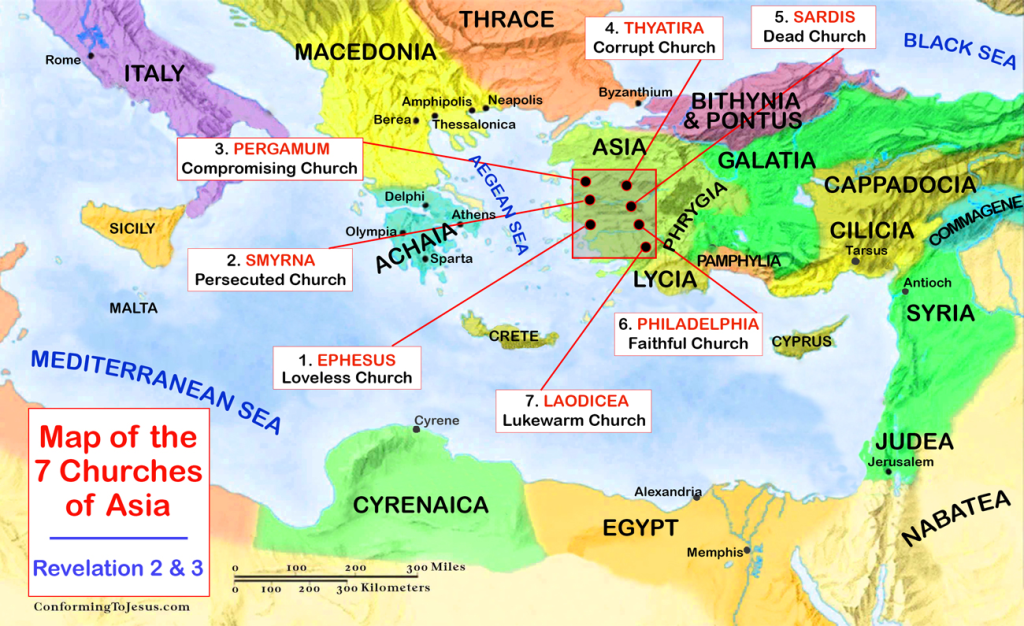
Time frames suggested by others for the Philadelphia era include: 1649-1900; 1739-1850; 1750-1900 and 1790-1840. One can’t help but think that these dates were chosen, influenced by the hope that Christ’s return was imminent. Of course, here we are in 2025 and still going strong. Some, place credence on Christ’s death between 30 to 33 CE and think Christ will return exactly 2,000 years later between 2030 and 2033. But in the process, suggesting the final era of the church is the shortest of all and an impossible seventy to one hundred years long. This flies in the face of the average for the first five eras of just under three hundred years. This leaves little time for Laodicea to begin, develop and fade so-to-speak. Even when considering time will be cut short – Matthew 23:22.
The length of Philadelphia proposed by these dates is considerably shorter even than those for Sardis which commentators averaged two hundred years. This writer would have to strenuously disagree and maintain the beginning of the doors opening for Philadelphia was fulfilled in William Tyndale’s English translation of the Bible; followed by the outpouring of Baptists, Puritans and others from Britain to the American Colonies, seeking religious freedom, while spreading the gospel in a way unforeseen before then. The fact the Reformation – characterised by rebellion against the tyrannical government and unscriptural doctrine of the Universal Church – occurred during this era, is no mere coincidence. Nor was the advent of the printing press at the beginning of the era and the wireless radio towards its end.
Ambassador College chose 1934 as the beginning of the Philadelphia era, whereas it is proposed that this was almost exactly its end date. Again, their reasoning was to include themselves in a ‘good’ era and not be associated with the lazy Laodiceans or the stiff [as in dead] Sardis era.
Thus, the Philadelphia era of God’s Church which began in 1515, ended in 1933, lasting 418 years – the second longest era. Following the fifth era of Sardis, for 200 years, from 1315 to 1515; which followed the fourth era of Thyatira, for 211 years, from 1104 to 1315; the third era of Pergamos, which endured 444 years, from 660 to 1104; the second era of Smyrna, lasting 357 years, from 303 to 660 CE; and the first era Ephesus, of 273 years, from 30 to 303 CE.
Recalling the distances between the cities where the churches were located, shows the distance between Philadelphia and Laodicea is 60 miles. This compared with the 47 miles between Ephesus and Smyrna; 70 miles between Smyrna and Pergamon; 52 miles between Pergamon and Thyatira; 39 miles between Thyatira and Sardis; and 31 miles between Sardis and Philadelphia. Using our ratio of 5.808 it accords with 348 years, somewhat off for the 418 proposed. The result is that the average for each of the six eras increases from the previous 297.0 years to 317.16 years.
This gives an indication perhaps for the length of the last church era prior to Christ’s return. The shortest eras, Sardis and Thyatira mean Laodicea could be as brief as 200 years; nearer the average of 300 years; or alternatively, as long as Philadelphia and Pergamos and 400 to 450 years long. If Laodicea were 400 years long, it would produce an average era length of almost exactly 330 years.
Having discussed the exploits of six phases of the true church, recall ‘the elect are not easily quantifiable.’ True believers of the Body of Christ would have been predominantly hidden among those brethren through the ages with the following names. While it was noted earlier that the body of Christ could have been broadly labelled Sabbatarians during the sixth era – this does not include all groups or individuals and therefore – the term Baptist better reflects believers during the entire 418 years which comprised the Philadelphian era.
The first era of Ephesus embraced the Nazarenes; the second era of Smyrna, the Arians; the third era of Pergamos, the Paulicians; the fourth era of Thyatira, the Waldensians; the fifth era of Sardis, the Lollards; and the sixth era of Philadelphia, the Baptists.
The Nazarenes were named after Jesus of Nazareth; the Arians after the presbyter turned reformer, Arius; the Paulicians after the teachings of the itinerant and maverick Paul; the Waldenses after businessman turned preacher, Peter Waldo; and the Lollards not after Walter, but the manner in which they remembered, quoted and shared the scriptures in a time when the Bible was not yet available for all – while the Baptists were named after the scriptural method of full body immersion in water.
Before we move on to the final Church era it may be productive to look at the Book of Ephesians.
Ephesus was a founding headquarters church, where the Apostle John purportedly spent most of his life (John 19:26-27); where Paul lived for two to three years (Acts 19:8, 10; 20:31); and which embraced the first era of believers in the Way – Revelation 2:1-7.
The author – who was not Paul (refer article: The Pauline Paradox) – spends much of his epistle discussing relationships amongst the Brethren; between husbands and wives; and children with parents. All are predicated on humility, respect and love.
Ephesians 1
English Standard Version
‘… To the saints who are in Ephesus, and are faithful in Christ Jesus…
God and Father of our Lord Jesus Christ, who has blessed us in Christ… even as he chose us in him before the foundation of the world, that we should be holy and blameless before him. In love he predestined us for adoption to himself as sons through Jesus Christ, according to the purpose of his will…’
The author of Ephesians does not say we have no free will, but he does say God predestined those He wishes to make Holy for adoption. This was decided before the physical creation. The first fruits are being offered what has already been given to Christ as the first of the first fruits: sonship (and daughter-ship). A relationship with God the Father which is completely and utterly unique. Not having ever been offered to any angelic being. Nor is its exact credentials to be offered to humanity again after the saints of the Old Testament and the elect of the New Testament, but rather a lesser form or version.
‘… making known to us the mystery of his will, according to his purpose, which he set forth in Christ as a plan for the fullness of time, to unite all things in him, things in heaven and things on earth.’
The mystery… is the incredible human potential. The opportunity to receive eternal life and be at one with the Eternal forever. Achieved through the sacrifice of the mediator between God and humankind, the Son of Man.
‘In him we have obtained an inheritance, having been predestined according to the purpose of him who works all things according to the counsel of his will, so that we who were the first to hope in Christ might be to the praise of his glory. In him you also, when you heard the word of truth, the gospel of your salvation, and believed in him, were sealed with the promised Holy Spirit, who is the guarantee of our inheritance until we acquire possession of it, to the praise of his glory.’
The true body of Christ have received a down payment of their future spiritual glory in the form of the Holy Spirit. While citizens of the kingdom of Heaven now, they yet await both the resurrection and the arrival of the kingdom on Earth when Christ returns.
‘I have heard of your faith in the Lord Jesus and your love toward all the saints… having the eyes of your hearts enlightened, that you may know… what are the riches of his glorious inheritance in the saints, and what is the immeasurable greatness of his power… when he raised [Christ] from the dead and seated him at his right hand in the heavenly places, far above all rule and authority… And he… gave him as head over all things to the church, which is his body…’
Notice the brotherly love between saints. ‘Eyes’, ‘riches’ and ‘seated’ next to Christ are highlighted, as these are discussed in Christ’s letter to the Laodiceans.
Ephesians 2
‘And you were dead in the trespasses and sins in which you once walked, following the course of this world… But God, being rich in mercy… even when we were dead in our trespasses, made us alive together with Christ… and raised us up with him and seated us with him in the heavenly places in Christ Jesus…’
Not remaining dead in sin like Sardis, but alive in Christ like Philadelphia and eventually resurrected and seated with Christ like Laodicea.
‘For by grace you have been saved through faith. And this is not your own doing; it is the gift of God, not a result of works, so that no one may boast. For we are his workmanship, created in Christ Jesus for good works, which God prepared beforehand, that we should walk in them… you are fellow citizens with the saints and members of the household of God, built on the foundation of the apostles and prophets, Christ Jesus himself being the cornerstone, in whom the whole structure, being joined together, grows into a holy temple in the Lord. In him you also are being built together into a dwelling place for God by the Spirit.’
A true believer is not only saved by works, though they are certainly rewarded according to them – Article: The Sabbath Secrecy. The elect with Christ are being fashioned into a spiritual temple, to be acceptable to God and ultimately a place for Him to dwell.
Ephesians 3
‘… I was made a minister according to the gift of God’s grace, which was given me by the working of his power. To me, though I am the very least of all the saints, this grace was given, to preach… the unsearchable riches of Christ, and to bring to light for everyone what is the plan of the mystery hidden for ages in God, who created all things…’
Ephesians 4
‘There is one body and one Spirit – just as you were called to the one hope that belongs to your call – one Lord [Jesus], one faith, one baptism, one God and Father of all, who is over all and through all and in all.’
Ephesians 5
‘… Christ loved the church and gave himself up for her, that he might sanctify her, having cleansed her by the washing of water with the word, so that he might present the church to himself in splendor, without spot or wrinkle or any such thing, that she might be holy and without blemish.’
Ephesians 6
‘Stand therefore, having fastened on the belt of truth, and having put on the breastplate of righteousness, and, as shoes for your feet, having put on the readiness given by the gospel of peace. In all circumstances take up the shield of faith, with which you can extinguish all the flaming darts of the evil one; and take the helmet of salvation, and the sword of the Spirit, which is the word of God, praying at all times in the Spirit…’
Laodicea
Philadelphia is now an era plausibly passed and we presently find ourselves in the seventh and final phase of the true church of God’s history.

It is vital to keep in mind that the verses in chapters two and three of the Book of Revelation are part of a personal, coded message to true believers and the elect of Christ, spanning since his death, until his return. Seven letters were written to seven congregations with different characteristics, representing seven phases or eras.
These verses have a complex tapestry in that they refer to a. the universal religious establishment which claims to have divine authority (John 20:23) for ‘so-called’ Christian beliefs and teachings (Matthew 16:18-19; 18:18); acting as a religious fraudster against the true spiritual body of Christ, which is always a little flock Luke 12:32) and cleverly refers to b. another influential religion which spawned Christianity (Romans 2:28-29) and a people who claim to be Judah or physical Jews and really are not.
Judaism and Roman Catholicism are equally Babylonian Mystery religions; imposters and usurpers, both posing as the true Church of God. Catholicism and Judaism are both spiritually Edom; rejecting the true Messiah, by either denying Him or replacing Him with an Antichrist. Judaism and Catholicism are related, or if you like, sinister spiritual sisters. Paradoxically working together; yet at enmity with one another, vying for world dominion. They are united in their wrath towards the spiritual Israel of God and the literal descendants of physical Israel.
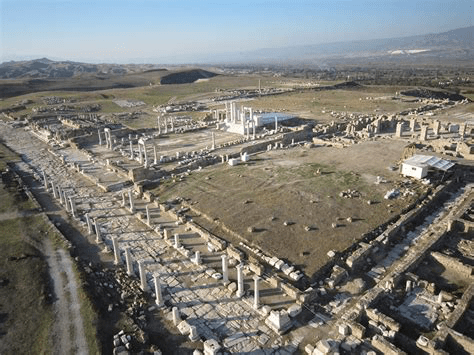
The ancient city of Laodicea is now known as Denizli. It has also been known as ‘Laodicea on the Lycus, Laodicea ad Lycum, Laodiceia or Laodikeia’ and was founded in 260 BCE at the junction of the Lykos (Curuksu) River – located 3.5 miles from Denizli city centre – and the Maeander valleys; close to and between two other wealthy cities, Colossae and Hierapolis. Laodicea was named by Antiochus II Theos, king of Syria, and named in honor of his wife, Laodice (Laodike). Formerly, the city was called Diospolis, the ‘City of Zeus’, and afterwards Rhodas. Laodicea, like Rome, Jerusalem and several other cities, was built upon seven hills.
Abarim Publications: ‘Laodice… (we may assume) was named after the great-great-great-great-great-granddaughter of none other than Zeus, namely Laodice the daughter of Priam of Troy and his second wife Hecuba, as mentioned in Homer’s Iliad.’

The city became part of the kingdom of Pergamon, then later it passed into Roman hands in 133 BCE. Cicero the famous Roman orator and statesman, served as governor of the province, residing mostly in Laodicea. Laodicea was renowned as a prestigious centre for banking and finance; being one of the wealthiest cities of the ancient world. Laodicea was destroyed by an earthquake in 60 CE, but refused aid from the Roman empire and rebuilt the city from its own wealth – Tacitus, Annals, 14:27.

‘The city was at the crossroads of north-south traffic between Sardis and Perga [Acts 13:13-14] and east-west from the Euphrates to Ephesus. Laodicea quickly became a rich city… In common with many of the Hellenistic cities there was a prosperous Jewish colony established there well before the Christian era. The city’s reputation was for its money transactions and the good quality of raven-black wool grown in the area’ – Blake and Edmonds, Biblical Sites in Turkey, pages 139-140.
Michal Hunt: ‘Laodicea had one of the largest Jewish populations in Roman Asia, with over 7,000 adult male Jews according to a 1st century Roman census. These were Hellenized (Greek culture) Jews who Rome granted the right to preserve their own customs and religion.’
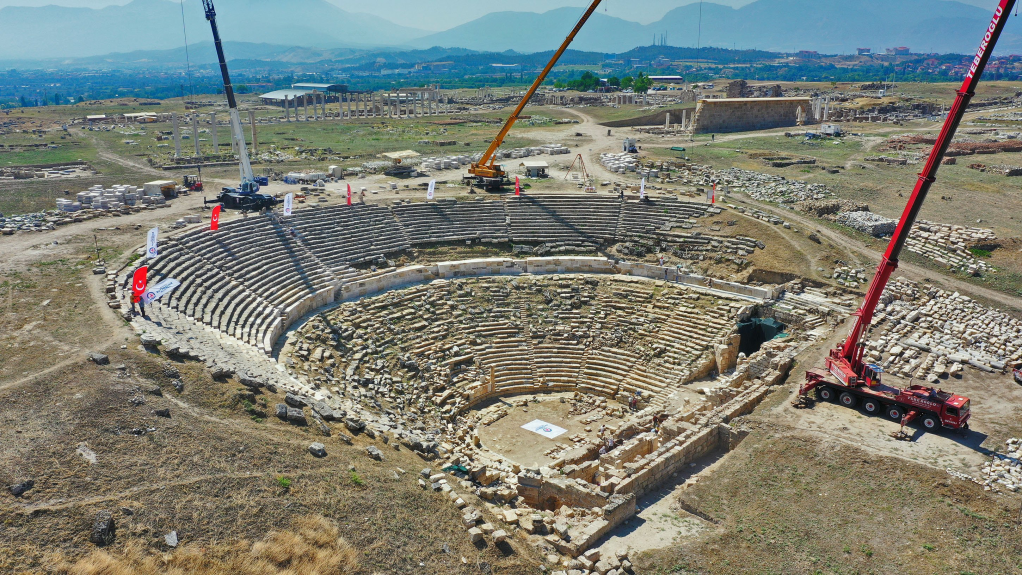
Laodicea was the first city in Anatolia, to export to the Roman Empire textile products made of high quality knitting wool. Laodicea grew into a major centre for the manufacturing of clothing because of the sheep which grazed around Laodicea and the famous soft, black wool they produced. ACBCC: ‘A synonym for soft, luxurious living.’ Laodicea was also famous for its school of medicine.
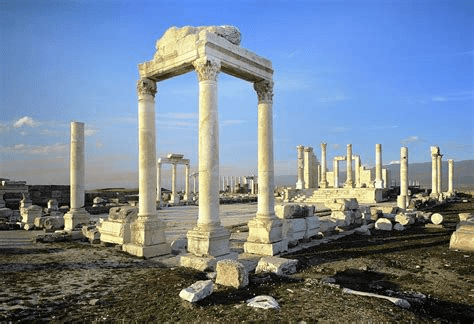
The meaning of the name Laodicea is perhaps the most interesting of all the church eras. Recall the doctrine of the Nicolaitans in the first era, Ephesus and the third era, Pergamos. Meaning, victory over the people and reflective of an ‘us and them’ scenario; with an unbiblical clergy, lording it over a subservient laity.
ACBCC: ‘The name Laodicea is Greek. It means “the (self-) righteous people.” It is significant that the ancient city of Laodicea lies a great ruin today – and like Sardis it is completely dead!’
Some propose it means ‘judgement of the people’, ‘judging of the people’ or ‘a just people.’ An insightful definition is: ‘power of the laity.’ One source offers: ‘Laodicea is a… Greek word [from] laos meaning people, nation, or crowd… [referring to] custom, law, judgment, penalty, or punishment, all depending on the context. Therefore… the founders of Laodicea saw themselves as people of justice or law-abiding people.’
Abarim: ‘Place Of People Of Common Fairness’ From (1) the noun (laos), (common) people, and (2) the noun (dike), justice.
In Colossians 4:16 [the author] refers to a letter to the church of the Laodiceans which we no longer possess. To rectify this sad loss, someone in the second or third century AD produced a kind of Paul’s Greatest Hits compilation (composed largely of statements found in Paul’s letters to the Philippians, Galatians and Colossians) and named it Paul’s Letter To The Laodiceans. It’s unknown what the original selling price of it was but since this product is still with us today, we may assume that it circulated in heavy rotation; a kind of Da Vinci Code of its day. It was probably written in Greek but exists today only in Latin.
The noun (laos) means people and is one of a few words to do so. What precisely distinguishes this word from the others is hard to say – it mostly implies the common masses at large, but so do the others – but it bears a remarkable resemblance to the noun (leon), lion… That word in turn looks like it has to do with the adverb (leos), wholly or entirely, which in turn relates to the adverb (lian), very, very much or greatly.
The noun (dike) means justice in a formal, judicial sense, and fairness in a common sense. Ultimately, it denotes a harmony with the rules of the universe, and can be easily recognized from stability and perpetuity in all sorts of circumstances. Injustice, in a cosmological sense, causes instability and ultimately demise. This word comes with a long list of compound derivatives. The noun (diktuon) means fishing net. It’s not technically related to (dike), but in the hands of a gifted poet may still help to explain why the disciples would be fishers of men.
The name Laodice stems from deep antiquity and it’s difficult to establish what it may have meant to the original name giver. Henry George Liddell and Robert Scott’s A Greek-English Lexicon lists what appears to be a variant or at least a related term (laodikos), meaning tried by the people, which would contain almost an oxymoron. The common people didn’t do any trying in the legal sense. Magistrates did that.
But if the names of gods and demigods could be indicative of their relationship to mankind (they frequently are), Laodice could convey humanity’s motivation to standardize codes of conduct, something that eventually led to formal law. Perhaps Laodice denoted the judicial counterpart of street-wisdom; the common sense of everyday fairness. In that case a personification in the form of a demigoddess named Laodice would govern the social cohesion of a people that follow the precepts of common fairness (which would be represented by the higher-ranking goddess Dike, whose name is identical to our noun δικη, dike).’
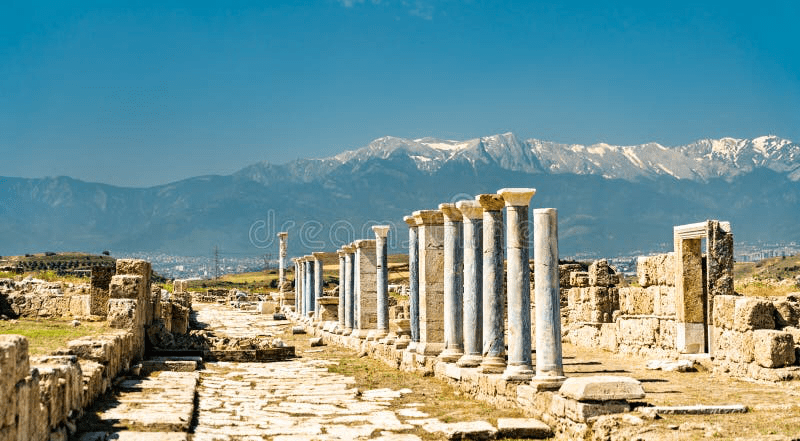
This church is vastly different from those round about it in the world. It is not clergy led but governed by the laity. The church has come full circle from the Ephesus era, where elders (deacons) and apostles served others. They did not lord it over the brethren. It is a return to the ‘power of the people’, in a glorious and godly way. Not in an anarchic or selfish sense, but an environment and culture of collaboration amongst equals in congregations and fellowships who submit one to another in humility, respect, love and the word of God. Where justice and fairness are distributed in a manner not readily experienced; with substance beyond the shallow silhouette displayed by churches, and the formless shadows delivered by ‘democratic’ government.
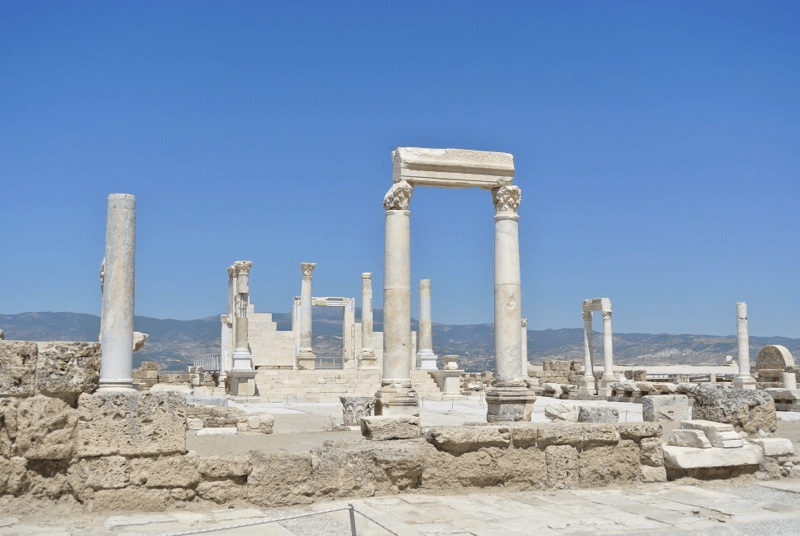
Christ’s letter to the Laodiceans contains nine verses. The second longest letter after the one written to the Thyatira church era comprising twelve verses.
Revelation 3:14-22
English Standard Version
14 “And to the angel of the church in Laodicea write: ‘The words of the Amen [G281 – amen: truly], the faithful and true [G228 – alethinos: real, sincere, genuine] witness [G3144 – martus: record] the beginning of God’s creation.’
Jesus packs an almighty punch with a knock out blow against the Trinity in his opening address to the Laodicean church. Christ wastes no time in saying what is most important to him and what will define the seventh age of the church.
But first, Christ is the Amen. The word amen can be translated as ‘verily’ and means firm and faithful. Used at the beginning of a discourse, it signifies “surely, truly, of a truth.” While at the end: “so it is, so be it, may it be fulfilled.” ‘It was a custom, which passed over from the synagogues to the Christian assemblies, that when he who had read or discoursed, had offered up solemn prayer to God, the others responded Amen, and thus made the substance of what was uttered their own.
The word “amen” is a most remarkable word. It was transliterated: directly from the Hebrew into the Greek of the New Testament, then into Latin and into English and many other languages, so that it is practically a universal word. It has been called the best known word in human speech. The word is directly related – in fact, almost identical – to the Hebrew word for “believe” (amam), or faithful. Thus, it came to mean… an expression of absolute trust and confidence.’
Amen could be rendered as faithful or true. Which is interesting, as Christ then uses the very words, ‘faithful’ and ‘true.’ Thus amen is a double word play for both words. Other renderings could include: ‘the word of truth’, or the ‘sure word.’
The use of the word amen in the Bible is almost always in the context of agreeing with a statement and affirming it. It was not used to conclude prayers. Its main use was to affirm praise for God or to confirm a blessing, either by the speaker or the hearers. The original manuscripts of the New Testament, did not include the word amen at the end of the ‘Lord’s Prayer’ in Matthew 6:9-13.
Christ is the true Word and his words are true. The Greek word for true, alethinos, refers to Christ’s real* nature, not just a resemblance. He is ‘opposite to what is fictitious, counterfeit, imaginary, simulated, pretended, imperfect, defective, frail’ and ‘uncertain.’
The Greek word for witness is deep, for it means a martyr like Christ. It relates to ‘those who after his example have proved the strength and genuineness of their faith in Christ by undergoing a violent death.’ This may be an alarming hint towards the martyrdom of saints in the future – Revelation 12:17; 17:6. The fact that Christ refers to truth and by extension faithfulness twice in the opening verse, strongly suggests the truth is of supreme importance during the Laodicean era.
And none is more important than the true* nature of the Son of God. The ‘first’ teaching to be targeted by those with a pagan and gnostic agenda in subverting and disguising the true identity of Christ and thus of God the Father, of whom they did not comprehend or understand – 1 Corinthians 2:10-14. Notice, the first doctrine to come under serious attack some three hundred years after the death of Christ, was not a day of worship or baptism – even the Lord’s Supper was secondary – but the relationship between the Word and the Father.
This is why the stand made by Christ’s faithful servant Arius, was an essential debate and marker point in the history of the true church and the fight to righteously defend the truth of God’s word… about the Word.
The Greek word for beginning is [G746] arche, meaning: origin, first. It is ‘the person or thing that commences, the first person or thing in a series, the leader.’ Though not just in rank or place, it also connotes order and time.
The Greek word for creation is more telling. It is [G2937] ktisis, meaning: the act of founding, establishing, building and anything created. It applies to abeing that is a creature, who is a creation.
“For there is one God, and there is one mediator between God and men, the man [G444 – anthropos] Christ Jesus” – 1 Timothy 2:5.
Though not written by Paul, this is a critical verse, as it describes the central truth of how there is only one God and the Son who is different from the Father, with his role being ordained to serve the Father and humankind in bringing them ultimately together. The Greek word for man is anthropos and means ‘a human being’. It confirms that the Messiah was fully human while on the Earth – not divine or a mixture of both. Of course, while Christ asked the Father to restore his glory to him, he was never ever divine in his past – John 17:5.
For God is one, He alone is the Godhead. And for most, He is the unknown God. A Unitarian position is only correct if it accepts an Arian view of Christ. A being who was created, begotten and adopted by the Father as His Son. The first of the first fruits. Christ did not exist forever as a second God, whether in a triune or binary Godhead.
A position paper written by the Jerusalem Conference (of the Church of God Seventh day) stated the following: ‘The Amen, the faithful and the true witness is no one else but Jesus Christ and speaking of himself he said, he is “the beginning of the creation of God” i.e. the very first manifested act of YHWH was the creation of his son Yehoshua (Jesus). Do other scriptures support this? Colossians 1:15 “Who is the image of the invisible God, the firstborn of every creature”. A creature is life which has been created, whether terrestrial or celestial: Colossians supports Revelation, it says of Christ he is “the firstborn of every creature.”
It is both tragic and revealing that Herbert Armstrong in his study – as the likely Laodicean messenger – rightly decided the Trinity of Catholicism and Protestantism was incorrect; yet incorrectly perceived Arianism upheld by the CG7 as wrong, and chose a wholly unscriptural and minority Binitarian position. One wonders what Arius and John would make of this?
With the Godhead, it is the first and most important doctrine of any denomination’s creed of beliefs. This cardinal dogma of the Philadelphian legacy, was rejected by the leading light of Laodicea. As a minute minority uphold a true Christology within the true church – let alone Christianity at large – it remains then that this discussion will become a central issue which completely consumes and engulfs the church. As in the time of Arius, it will cause dissension like no other and will truly sort the sheep from the goats… and the wolves – Matthew 7:15; 25:32-33.
Revelation: 15 “I know your works: you are neither cold nor hot. Would that you were either cold or hot! 16 So, because you are lukewarm [G5513 – chliaros: tepid], and neither hot nor cold, I will spit [G1692 – emeo: spue, to vomit, throw up] you out of my mouth.”
Tepid means lukewarm; with synonyms including, mild or moderate. A tepid reaction is characterised ‘by a lack of force or enthusiasm.’ It is not too far removed from something being insipid, that is; uninteresting, dull, flat, bland or tasteless. Tepid can have different contexts, in that going into the sea which has been warmed daily by the summer sun – or a heated swimming pool – can be pleasant because it is lukewarm. On the other hand, imbibing a lukewarm beverage such as tea or coffee, is decidedly unpleasant for most people.
It is this example Christ refers. His reaction is to spit a lukewarm christian out of his mouth in disgust. Yet, it is not really about being lukewarm or cold, as Christ does not seek either from a believer. It is the hot fervent passion exhibited by a person filled with faith and full of hope which he desires.
With attendance at weekly church services falling all around the world in recent decades, there are a lot of lukewarm Christians in this age. It is a dangerous spiritual condition that threatens the spiritual life of God’s people today. When one is cold, they are invariably miserable. When one is lukewarm they are in the main, in a state of noncommittal uncomfortableness. If one is warm, they are usually comfortable and positive.
Michal Hunt: ‘Laodicea’s location was between two other wealthy cities: Colossae and Hierapolis (St. John’s disciple Papias was bishop here for circa 30 years). Icy mountain streams watered the city of Colossae, situated in a narrow valley between tall mountains. But Hierapolis [just six miles across the Lycus River valley and to the south] was famous for its hot mineral springs. It was these same heavily laden mineral waters that were carried by a Roman aqueduct to supply Laodicea with water, but by the time the water reached the city, it was no longer hot but lukewarm and putrid. The community at Laodicea, like the water, was ineffective: neither hot and healing, nor cold and refreshing.’ No other city on the Lycus Valley was as dependent on external water supplies as Laodicea. The water from Hierapolis was therapeutic, while the water from Colossae was invigorating. By the time it reached Laodicea it was nauseating.
‘Water piped into Laodicea by aqueduct from the south was so concentrated with minerals that the Roman engineers designed vents, capped by removable stones, so the aqueduct pipes could periodically be cleared of deposits’ – John McRay, Archaeology And The New Testament, page 248.
Christ did not accuse the brethren in Laodicea of apostasy; nor with following a false prophet; or even in engaging in emperor worship. Rather, the church is accused of being ‘lukewarm’ – this is the only congregation about which the Son of Man had nothing good to say. Jesus was not judging the church on her spiritual temperature but on the barrenness of her works.
Hunt: ‘He is… calling for them to have an influence on the pagan and Jewish society, to either actively and energetically [evangelise] them (hot) or to turn away and to completely reject interaction with their lifestyle and worldview (cold). If a church is not transforming its society and Christianizing the culture, what good is it? In Matthew 5:13, Jesus said: “You are salt for the earth. But if salt loses its taste, what can make it salty again: It is good for nothing and can only be thrown out to be trampled under people’s feet.” It is not our calling to blend in with our environment but to transform it, convert it, reform it, and reconstruct it in terms of what God has mandated in His Word.’
Hunt raises two very important points in that one, a Christian is to set an example of good works and in ‘always being prepared to make a defense to anyone who asks you for a reason for the hope that is in you; yet do it with gentleness and respect…’ – 1 Peter 3:15, ESV. Like wise, Christ exhorted in Matthew 5:15-16, ESV: “Nor do people light a lamp and put it under a basket, but on a stand, and it gives light to all in the house. In the same way, let your light shine before others, so that they may see your good works and give glory to your Father who is in heaven.”
Two, Hunt insightfully draws a distinction between hot and cold and evangelising and withdrawal from the world. During and especially after the demise of the Worldwide Church of God, many of the seventy thousand brethren who dispersed have not joined the hundreds of splinter Churches of God. Choosing not to fellowship with or support an evangelistic effort. While individuals’ reasons for this are many and varied and cannot be judged, one has to weigh them against what Christ says in the parable of the talents – Matthew 25:14-30.
With reference to believers being spit out of Christ’s mouth, the Greek word is more serious in that it means to vomit or spew. There are a few references to something similar in the Bible. Speaking to the ancient Israelites, the Eternal says in Leviticus 18:26-28, English Standard Version:
“But you shall keep my statutes and my rules… either the native or the stranger who sojourns among you (for the people of the land, who were before you, did all of these abominations, so that the land became unclean), lest the land vomit you out when you make it unclean, as it vomited out the nation that was before you.”
Leviticus 20:22-26
English Standard Version
“You shall therefore keep all my statutes and all my rules and do them, that the land where I am bringing you to live may not vomit you out. And you shall not walk in the customs of the nation that I am driving out before you, for they did all these things, and therefore I detested them. But I have said to you, ‘You shall inherit their land, and I will give it to you to possess, a land flowing with milk and honey.’ I am the Lord your God, who has separated you from the peoples. You shall therefore separate the clean beast from the unclean, and the unclean bird from the clean. You shall not make yourselves detestable by beast or by bird or by anything with which the ground crawls, which I have set apart for you to hold unclean. You shall be holy to me, for I the Lord am holy and have separated you from the peoples, that you should be mine.”
The Eternal warned the Israelites not to follow in the footsteps of the heathen nations before them who had been ejected from the land due to the abominations they committed. The Israelites were to remain ‘clean’, a ‘separate, holy’ people from the nations neighbouring them – Deuteronomy 28:9, Isaiah 62:12, 1 Peter 2:9. If they became ‘unclean’, they would be ‘vomited’ out from the land.
Jeremiah 25:26-29
English Standard Version
‘… And after them the king of Babylon shall drink. Then you shall say to them, “Thus says the Lord of hosts, the God of Israel: Drink, be drunk and vomit, fall and rise no more, because of the sword that I am sending among you.” And if they refuse to accept the cup from your hand to drink, then you shall say to them, “Thus says the Lord of hosts: You must drink! For behold, I begin to work disaster at the city that is called by my name, and shall you go unpunished? You shall not go unpunished, for I am summoning a sword against all the inhabitants of the earth, declares the Lord of hosts.”
The prophecy given to Jeremiah is dual in application, which relates to a. the original captivity of the Kingdom of Judah and b. to a coming future captivity for modern Judah (not the state of Israel) – Chapter XXX Judah & Benjamin – the Regal tribes.
Recall, it is Christ who will use a sword to strike the nations, Revelation 19:15, ESV: ‘From his mouth comes a sharp sword with which to strike down the nations, and he will rule them with a rod of iron. He will tread the winepress of the fury of the wrath of God the Almighty.’
It is the Harlot Church based in modern Babylon which intoxicates the governments of the world with her poisonous cup of wine to commit spiritual fornication – Chapter XXV Italy: Nahor & the Chaldeans; and Chapter XXII Alpha & Omega. This cup is in opposition to the true cup and wine symbolising the blood of Christ in the Lord’s Supper. The city mentioned in Jeremiah is Jerusalem and in Revelation, it is the same city – not Rome.
Revelation 17:1-18
English Standard Version
‘… “Come, I will show you the judgment of the great prostitute… with whom the kings of the earth have committed sexual immorality, and with the wine of whose sexual immorality the dwellers on earth have become drunk.” The woman was… holding in her hand a golden cup full of abominations and the impurities of her sexual immorality. And on her forehead was written a name of mystery: “Babylon the great, mother of prostitutes and of earth’s abominations.” And I saw the woman, drunk with the blood of the saints, the blood of the martyrs of Jesus. And the woman that you saw is the great city that has dominion over the kings of the earth.”
It is then of great interest after reading about the second woman – the false church – that we read the following about the first woman – the true church – in Revelation.
Revelation 12:1-17
English Standard Version
‘… another sign appeared in heaven: behold, a great red dragon.. [it’s] tail swept down a third of the stars of heaven and cast them to the earth. And the dragon stood before the woman… woe to you, O earth and sea, for the devil has come down to you in great wrath, because [it] knows that [its] time is short!” And when the dragon saw that [it] had been thrown down to the earth, [it] pursued the woman…But the woman was given the two wings of the great eagle so that she might fly from the serpent into the wilderness, to the place where she is to be nourished for a time, and times, and half a time’ – Exodus 19:4.
The serpent poured water like a river out of [its] mouth after the woman, to sweep her away with a flood’ – Genesis 6:17. ‘But the earth came to the help of the woman, and the earth opened its mouth and swallowed the river that the dragon had poured from his mouth. Then the dragon became furious with the woman and went off to make war on the rest of her offspring, on those who keep the commandments of God and hold to the testimony of Jesus’ – Romans 13:8-10, 13, 1 Corinthians 1:6; 6:9-10.
This prophecy is predicting a future event – of miraculous protection for some and persecuting martyrdom for others – at the end of this age and the close of the Laodicean era. Is it a remarkable coincidence that the imagery matches the words of Christ to the Laodicean church? One would conclude not. What is interesting, is that a forerunner of Christ’s anger with the Laodicean church occurred after the death of Herbert Armstrong.
Well, it actually began in the early 1970s when the Worldwide Church of God failed to listen to or heed the research from biblical scholarship which clearly showed errors in the following doctrines: the counting of Pentecost (1); the teaching on divorce and remarriage (2); and the legitimacy of tithing in the New Testament church (3). Coupled with an unbending and unscriptural church government; persistent stories of financial abuse; and failed prophecies about Christ’s return by 1975; led to ten thousand brethren leaving the church’s fellowship over the course of the decade. Others left with Garner Ted Armstrong in 1978 and a trickle leading to a constant stream began shortly after Armstrong senior’s death in January 1986.
This spewing forth of brethren in their thousands to either turn their back on the truth and return to the world; fellowship with other denominations entirely; go it alone; or join the formation of myriad Church of God groups was and is, an unprecedented event. Caused one cannot help but feel, from a lukewarmness of complacency and compromise spreading throughout the church. The result ironically, has led many brethren to re-evaluate their attitude regarding obedience towards the Eternal; to truly grow in grace and knowledge; and therefore earnestly contend for the faith once delivered.
Revelation: 17 “For you say, I am rich [G4145 – plousios: wealthy], I have prospered [G4147 – plouteo: increased with goods], and I need nothing, not realizing that you are wretched [G5005 – talaiporos: afflicted], pitiable [G1652 – eleeinos: miserable], poor [G4434 – ptochos: a beggar], blind, and naked.”
The letter to the last era is rather condemning; for the people of this present age are self-righteous in that they know they are blessed with spiritual knowledge, yet have failed to fully ‘contend for the faith once delivered’ as addressed by Jude. For they arrogantly think they have the sum of all the knowledge they need, oblivious to being ‘wretched, pitiable, poor, blind, and naked.’
This was the state of affairs in the Worldwide Church of God and perhaps other churches – such as the Seventh Day Adventist Church – await a similar fate if there are enough true believers in their congregations. A little like Lot pleading for the salvation of Sodom, though in reverse. If there are too few, then the Adversary will leave them alone, but if there are enough [self]-righteous, they are a target for wrath and tribulation.
“The saddest symptom about many so-called Christians is the utter absence of anything like conflict and fight against spiritual apathy in their Christianity. They eat, they drink, they dress, they work, they amuse themselves, they get money, they spend money, they go through a brief round of formal religious services once or twice every week. But of the great spiritual warfare – its watchings and strugglings, its agonies and anxieties, its battles and contests – of all things they appear to know nothing at all. Let us take care that this case is not our own” – J C Ryle
The Greek word for rich, means to be ‘abounding in material resources’ and by extension, ‘rich in Christian virtues and eternal possessions.’ So much so that the Laodiceans kept adding and growing their wealth. As the city was prosperous, so were many of its inhabitants including the true Church residing there. Yet Christ is homing in on their spiritual wealth and while they have inherited much from the preceding Philadelphia era as we have discovered, the majority are deceived on the pivotal doctrine regarding the true identity of the Son and the unique nature of his Father. Likewise, most brethren do not keep the Bread and Wine ceremony in the true manner it should be observed.

Thus far from being rich, Laodiceans are destitute of real wealth. What more proof does one need that we have entered the Laodicean era than the phenomenal progress in technology during the twentieth century. For while landmark achievements occurred before 1933, it was after this year that a number of them quickly advanced thanks to World War II. Including: Radar, 1904; Plastic, 1905; Radio Broadcasting, 1906; Sonar, 1916; Television, 1925; and the Jet Engine, 1930.
After 1933, the technological and material expansion has been nothing short of staggering and includes: Helicopter, 1939; Nuclear Reactor, 1942; Atomic Bomb, 1945; Automation, 1946; Artificial Intelligence, 1947; Mobile Phone, 1947; General Computer, 1948; Credit Card, 1950; Satellite, 1957; Video Game, 1958; Microchip, 1958; Laser, 1960; Man in Space, 1961; Fibre Optics, 1966; Internet, 1969; Cash Dispenser, 1969; Genetic Engineering, 1973; Barcodes, 1973; Cellular Phone, 1973; Personal Computer, 1975; World Wide Web, 1989.
In a little over half a century, computers were invented; reduced in size from whole buildings to rooms; evolving to sitting on a single desk in a family’s home; then to the size of a laptop; a tablet; to sleek black portable computers carried in pockets, that double as cameras, telephones, providing access to currency and credit transactions; and finally to wrist watches with the same capabilities. The next evolutionary step: micro computer chips implanted into the human body – Chapter XXII Alpha & Omega.
One has to entertain incredible advances will be experienced over the following centuries in Medicine; Artificial Intelligence and Robotics; Space Exploration and Mining; Weaponry; and Sustainable Cities, whether on the Earth’s surface, under the Oceans or perhaps on the Moon and beyond – Article: The Great Reset & the Fourth Industrial Revolution.
The Greek word for wretched means to be miserable from ‘enduring toils and troubles.’ A circumstance which began for many in the 1990s and will certainly be attendant at the end of the Laodicean era during the time of Jacob’s trouble. The Greek word for pitiable means ‘to be pitied.’ Most Laodiceans don’t realise they are to be pitied.
Like the Scribes and Pharisees in Christ’s day, believers are excellent at pointing the finger at other groups and churches, saying they are Laodiceans – thinking themselves as Philadelphians – when not seeing they are in fact Laodiceans too – 1 Corinthians 1:10-13, Romans 14:10. Matthew 5:20, ESV: Christ says, “For I tell you, unless your righteousness exceeds that of the scribes and Pharisees, you will never enter the kingdom of heaven.”
Division and self-righteousness was a real problem with the Corinthian brethren as it is today amongst the competing Churches of God.
1 Corinthians 1:10-13
English Standard Version
‘I appeal to you, brothers, by the name of our Lord Jesus Christ, that all of you agree, and that there be no divisions among you, but that you be united in the same mind and the same judgment. For it has been reported to me by Chloe’s people that there is quarreling among you, my brothers. What I mean is that each one of you says, “I follow Paul,” or “I follow Apollos,” or “I follow Cephas [Peter],” or “I follow Christ.” Is Christ divided? Was Paul crucified for you? Or were you baptized in the name of Paul?’
The self-righteous attitude of the Laodiceans will be a stumbling block to eternal salvation while they remain blind. The Greek word tuphlos [G5185] means ‘mentally blind.’ Christ’s use of the word poor is laden with meaning, highlighting the pitiable state of the church in the final era prior to his return. The word poor means to be reduced to beggary and asking for alms; as well as being destitute of wealth, influence, position and honour.
In a spiritual context it connotes being ‘lowly, afflicted, destitute of the Christian virtues and eternal riches, helpless, powerless to accomplish an end.’ One might find an effective organised work in preaching the true gospel is hampered by the smug disunity of the Laodicean brethren and is not completely achieved until the advent of the two witnesses – Revelation 11:1-13.
Regarding the word poor, Strongs says it means: ‘to crouch; akin to (4422) and the alternate of (4098); a beggar (as cringing), i.e. pauper (strictly denoting absolute or public mendicancy [the state or condition of being a beggar]…’
The word naked is as bare as it sounds. From the Greek gumnos [G1131] meaning ‘laid bare’ in both a literal and figurative sense. A full circle has spun in that it was the comparable question for our original ancestors, Adam and Eve. They were given the same opportunity the first fruits of God’s plan are being offered: eternal life in exchange for obedience. Adam and Eve failed the Serpent of Eden’s seduction and shockingly, saw their spiritual exposure, addressed in physical analogy – refer Chapter XXII Alpha & Omega.
Genesis 3:6-11
The Voice
‘The woman approached the tree, eyed its fruit, and coveted its mouth-watering, wisdom-granting beauty. She plucked a fruit from the tree and ate. She then offered the fruit to her husband who was close by, and he ate as well. Suddenly their eyes were opened to a reality previously unknown. For the first time, they sensed their vulnerability and rushed to hide their naked bodies, stitching fig leaves into crude loincloths.
Then they heard the sound of the Eternal God walking in the cool misting shadows of the garden. The man and his wife took cover among the trees and hid from the Eternal God. God (calling to Adam): Where are you? Adam: When I heard the sound of You coming in the garden, I was afraid because I am naked. So I hid from You. God: Who told you that you are naked? Have you eaten from the tree in the center of the garden, the very one I commanded you not to eat from?’
The story of humanity’s journey, by sinning and cutting themselves off from the Creator; begins with this second tree; is remedied by a third tree; which then allows the first tree to be made available once more. The second tree being the Tree of the Knowledge of Good and Evil – the way of the Adversary – and the third tree, the Tree of the Cross on which Jesus died for all – refer Appendix VIII: When the Creator came to dwell with His Creation. The first tree is the Tree of Life.
The second tree offered eternal death, the third tree offered forgiveness and the first tree offers eternal life. It is this tree, stated as a reward for the Ephesus era, which will be found in the New Jerusalem – Revelation 2:7; 22:2.
Matthew 25:31-46
English Standard Version
31 “When the Son of Man comes in his glory, and all the angels with him, then he will sit on his glorious throne. 32 Before him will be gathered all the nations, and he will separate people one from another as a shepherd separates the sheep from the goats. 33 And he will place the sheep on his right, but the goats on the left.
34 Then the King will say to those on his right, ‘Come, you who are blessed by my Father, inherit the kingdom prepared for you from the foundation of the world. 35 For I was hungry and you gave me food, I was thirsty and you gave me drink, I was a stranger and you welcomed me, 36 I was naked and you clothed me, I was sick and you visited me, I was in prison and you came to me.’
37 Then the righteous will answer him, saying, ‘Lord, when did we see you hungry and feed you, or thirsty and give you drink? 38 And when did we see you a stranger and welcome you, or naked and clothe you? 39 And when did we see you sick or in prison and visit you?’ 40 And the King will answer them, ‘Truly, I say to you, as you did it to one of the least of these my brothers, you did it to me.’
41 “Then he will say to those on his left, ‘Depart from me, you cursed, into the eternal fire prepared for the devil and his angels. 42 For I was hungry and you gave me no food, I was thirsty and you gave me no drink, 43 I was a stranger and you did not welcome me, naked and you did not clothe me, sick and in prison and you did not visit me.’
44 Then they also will answer, saying, ‘Lord, when did we see you hungry or thirsty or a stranger or naked or sick or in prison, and did not minister to you?’ 45 Then he will answer them, saying, ‘Truly, I say to you, as you did not do it to one of the least of these, you did not do it to me.’ 46 And these will go away into eternal punishment, but the righteous into eternal life.”
Christ spends time speaking about the good works of the righteous and their glorious reward and the weak works of the unrighteous and their fearful fate. A stern warning to the Laodiceans: “For unto whomsoever much is given, of him shall be much required…” – Luke 12:48, KJV.
Revelation: 18 “I counsel you to buy from me gold refined by fire, so that you may be rich, and white [G3022 – leukos: light, bright] garments so that you may clothe yourself and the shame [G152 – aischune: disgrace] of your nakedness may not be seen, and salve to anoint your eyes, so that you may see [G991 – blepo: take heed, behold]. 19 Those whom I love, I reprove and discipline, so be zealous and repent.”
The Greek word for buy is agorazo [G59] which means redeem. To redeem means to reclaim or regain something. It also includes an act of exchange. Thus Christ is encouraging Laodiceans to regain spirituality they formerly possessed and exchange outward riches for inward ones.
“God is more concerned with our character than with our achievements. Achievements have importance only in the realm of time. Character is eternal. It determines what we will be through eternity” – Derek Prince
The Eternal uses gold as a symbol for precious character developed through faith because of its many special qualities – refer article: The Ark of God. When melted in fire it is ‘purged of dross’, meaning it is ‘freed from impurities.’
1 Peter 1:5-7
English Standard Version
‘… who by God’s power are being guarded through faith for a salvation ready to be revealed in the last time. In this you rejoice, though now for a little while, if necessary, you have been grieved by various trials, so that the tested genuineness of your faith – more precious than gold that perishes though it is tested by fire – may be found to result in praise and glory and honor at the revelation of Jesus Christ.’
1 Corinthians 3:11-15
English Standard Version
‘For no one can lay a foundation other than that which is laid, which is Jesus Christ. Now if anyone builds on the foundation with gold, silver, precious stones, wood, hay, straw – each one’s work will become manifest, for the Day will disclose it, because it will be revealed by fire, and the fire will test what sort of work each one has done. If the work that anyone has built on the foundation survives, he will receive a reward. If anyone’s work is burned up, he will suffer loss, though he himself will be saved, but only as through fire.’
Better to repent now than to go through the ferocious fiery tempest of the Day of the Lord – Malachi 4:1, 6, 2 Peter 3:10-12. The Greek word for repent is metanoeo [G3340], meaning to change one’s mind, make a 180 degree turn… ‘to change one’s mind for better, heartily to amend with abhorrence of one’s past sins’ and to ‘think differently.’
Hunt: ‘St. Ambrose wrote that there are two conversions in the Church: there are water and tears: the water of Baptism and the tears of repentance.’
The Laodiceans are urged to not just buy gold symbolising character developed from faith but also clothes of white, symbolising purity of the soul – Psalm 104:2. Recall, the faithful in the Sardis era who overcame, were promised to be clothed in white garments and not blotted out of the Book of Life – Revelation 3:5.
The Greek word for white means, brilliant derived from a ‘dazzling’ white. It is likened to the ‘whitening colour of ripening grain’; ‘shining garments worn on festive or state occasions’; a ‘sign of innocence’; and ‘of the garments of angels, and of those exalted to the splendour of the heavenly state.’
This is to cover the shame of their spiritual nakedness which they do not see. The Greek word for shame relates to the ‘confusion of one who is ashamed of anything’, a ‘sense of shame’, a ‘thing to be ashamed of.’ The word itself includes the meanings of, ignominy, disgrace and dishonour. Strong’s also provide a meaning of dishonesty, used in the KJV of the Bible. This shows that to be caught out spiritually naked, reveals dishonesty on the part of the believer. Dishonesty towards others, the Eternal and themselves – 1 Peter 5:5.
Christ warns to anoint their eyes with salve so that they may see. The Greek word for eye, ophthalmas [G3788], metaphorically refers to the ‘eyes of the mind, the faculty of knowing.’ It is no coincidence that Christ should use this analogy and inspire the Apostle John to record it in the Laodicean letter.
‘The principal deity worshipped in Laodicea was the Phrygian god Men Karou, the Carian Men. In connection with this god’s temple there grew up a famous school of medicine, which followed the teachings of Herophilus (330-250 B.C.) who began administering compound mixtures to his patients on the principle that compound diseases require compound medicines’ – Otto F A Meinardus, St. John of Patmos, page 125. So famous were two doctors from Laodicea, that their names appear on the coins of the city, namely: Zeuxis and Alexander Philalethes.
‘One of the compounds used for strengthening the ears was made from the spice nard (spikenard? an aromatic plant). Galen says that it was originally made only in Laodicea, although by the second century A.D. it was made in other places also. Galen also described a medicine for the eyes made of Phrygian stone (eye salve). Aristotle spoke of it as a Phrygian powder. Ramsay tries to explain what kind of medicine it was by saying it was not an eye ointment but a cylindrical collyrium that could be powdered and then spread on the part affected. The term used by John in Revelation is the same that Galen uses to describe the preparation of the Phrygian stone. Would not these medicinal concoctions be a reason why John cautions the Laodiceans to buy “ointment for your eyes so that you may see”?’ – Blake and Edmonds, Biblical Sites in Turkey, page 140.
The eye salve was to help the patient to see. The Greek word for see has a number of meanings including: ‘to discern, to perceive, to feel, to know, to have the power of understanding, discover, examine, to weigh.’
The eye salve Christ really wants the Laodiceans to use is the Holy Spirit. Not to be like the foolish virgins who thought they could leave it to the last minute to be ready for Christ’s return, for they had not kept their earthly vessel as a living receptacle for the Holy Spirit in order and had let it dissipate away – Matthew 25:1-13, 1 Corinthians 6:19-20. Proverbs 29:18 KJV: ‘Where there is no vision, the people perish.’
The Laodiceans need to follow Paul’s admonition – by the entity who spoke to him – in Acts 26:18, ESV: “to open their eyes, so that they may turn from darkness to light and from the power of Satan to God, that they may receive forgiveness of sins and a place among those who are sanctified by faith in me.” ‘… then that person can pray to God and find favor with him, they will see God’s face and shout for joy; he will restore them to full well-being’ – Job 33:26, NIV.
Interestingly, the author of the letter to the congregation in Ephesus states: “… when you heard the word of truth… and believed in him, [you] were sealed with the promised Holy Spirit… [may] the God of our Lord Jesus Christ… give you the Spirit of… having the eyes of your hearts enlightened, that you may know what is the hope to which he has called you, what are the riches of his glorious inheritance in the saints…” – Ephesians 1:13-18, ESV.
As noted earlier, the Church of God splinter groups sit in judgement of the other churches as ‘Laodicean’ and ‘blinded’ not ‘seeing’ their own spiritual ‘nakedness’. The Apostle John warned against this scenario, 1 John 2:11, ESV: ‘But whoever hates his brother is in the darkness and walks in the darkness, and does not know where he is going, because the darkness has blinded his eyes.’
Hebrews 4:13
English Standard Version
‘And no creature is hidden from his sight, but all are naked and exposed to the eyes of him to whom we must give account.’
Hunt: ‘There is a meaningful contrast… between the city’s wealth and importance: The city as a banking and financial center of immense wealth versus its spiritual condition, which is wretchedly and pitiably poor. The city produces a world-famous eye ointment versus this church’s condition as spiritually blind. The city is a clothing manufacturing center, and yet the church is spiritually “naked.” Their condition recalls the warning in the Book of Proverbs: “Pride goes before destruction and a haughty spirit before a fall (Proverbs 16:18).”
‘The only thing the Christian Laodiceans feel good about is the church’s smugly positive opinion of itself, and that is false. She claims to have everything, and yet she has nothing. The fact that Jesus rebukes her shows that He has not cast her out. He still professes His love for His Bride when He says, “I reprove and train those whom I love: so repent in real earnest” (Revelation 3:19).’
This verse is the eighth time Jesus has urged repentance in the seven letters: Revelation 2:5 twice (Ephesus); 16 (Pergamos); 21 twice (Thyatira); 22 (Thyatira); 3:3 (Sardis); and 19 (Laodicea).
Revelation: 20 “Behold, I stand at the door [G2374 – thura: gate, entrance, vestibule] and knock. If anyone hears my voice and opens the door, I will come in to him and eat [G1172 – deipneo: dine, sup] with him, and he with me.”
The Greek word for door includes a ‘door through which sheep go in and out, the name of him who brings salvation to those who follow his guidance.’ Opening the door hearkens back to the Philadelphian era and ‘is used of the opportunity of doing something.’
While there is doubt regarding the strength of a future work during Laodicea, the past work fulfilled by Herbert Armstrong was arguably indicative of an open door during the Laodicean era of the church. Yet, the door here is specifically denoting the door to the Kingdom of Heaven, where the Kingdom of God ruled by Christ will descend to Earth. The word used also denotes a passage and Strong’s add that it is a portal.
Matthew 7:7-8
English Standard Version
“Ask, and it will be given to you; seek, and you will find; knock, and it will be opened to you. For everyone who asks receives, and the one who seeks finds, and to the one who knocks it will be opened.”
Recall the separation of the goats from the sheep. John explains who hears Christ’s voice in John 10:26-28, ESV: “… but you do not believe because you are not among my sheep. My sheep hear my voice, and I know them, and they follow me. I give them eternal life, and they will never perish, and no one will snatch them out of my hand.” The words spoken by the Good Shepherd that the sheep hear – John 6:63, ESV: “… The words that I have spoken to you are spirit and life.”
The second part of verse twenty speaks of the second key doctrine upheld by the little flock, coupled with that of the true nature of Christ. Both targeted at the Council in Nicaea, (almost) exactly 1,700 years ago – misunderstood ever since by christianity at large. And that is the Bread and Wine ceremony instituted by Christ at the Last Supper. The Greek word deipneo means a ‘supper’ as in an ‘evening’ or main meal.
The observation of the Bread and Wine ceremony has these essential points. This writer is unaware of a church which adheres to them all, though surely there are by God’s grace individual Christians who do faithfully practice them.
The ceremony was the night preceding the Passover and a completely separate event. The Passover has passed with Christ’s sacrifice and is no longer observed.
While the ceremony constitutes bread and wine and not a meal, it is appropriate to partake at the conclusion of a meal in a manner like Christ and the disciples. The segregating of the ceremony as a separate act such as the Catholic Mass is unscriptural.
The Wine is in fact wine and not grape juice as taught by the SDA Church (unless one has serious cause to refrain, Romans 14:21-23) – Matthew 26:29, John 2:9-11, 1 Corinthians 11:21. The Wine is drunk from the same cup by all participating in a small fellowship, not poured into individual glasses. For the Body of Christ is one.
The Bread used is leavened like the shewbread, for it is not the Passover or the Feast of Unleavened Bread requiring the unleavened bread of affliction – Deuteronomy 16:3, Leviticus 7:12-14, Isaiah 30:20. For the bread symbolises Christ’s (risen) body – Matthew 26:26, 1 Corinthians 11:24. In this regard, the Eastern Orthodox Church is correct. The Bread is a loaf, broken apart by each person and shared in that manner like the wine.
Christ is clear that both the wine and bread represent and symbolise his shed blood and broken body, they do not literally transform to become those things in some mystical, occult ritual.
As the Lord’s Supper is not anchored to the Passover it is not required to be kept on that night or just once a year – Jude 12, I Corinthians 11:26. Though it would not be wrong to do so. The early New Testament Christians were meeting once a week on the first day and therefore taking it weekly. Some may not feel comfortable with that frequency and so once a month or once a quarter like the SDA Church may suffice. Either way, taking it just once a year or too often could be seen as taking it unworthily – 1 Corinthians 11:27.
Christ says to the Laodiceans he will eat with them. Christ’s return is near and what a glorious day when he can share the wine too. Matthew 26:29, ESV: “I tell you I will not drink again of this fruit of the vine until that day when I drink it new with you in my Father’s kingdom.”
That said, we are to live on Christ who is the Bread of Life – refer article: The Manna Mystery. And he lives in us – Galatians 2:20.
John 6:47-56
English Standard Version
“Truly, truly, I say to you, whoever believes has eternal life. I am the bread of life. Your fathers ate the manna in the wilderness, and they died. This is the bread that comes down from heaven, so that one may eat of it and not die. I am the living bread that came down from heaven. If anyone eats of this bread, he will live forever. And the bread that I will give for the life of the world is my flesh.”
So Jesus said to them, “Truly, truly, I say to you, unless you eat the flesh of the Son of Man and drink his blood, you have no life in you. Whoever feeds on my flesh and drinks my blood has eternal life, and I will raise him up on the last day. For my flesh is true food, and my blood is true drink. Whoever feeds on my flesh and drinks my blood abides in me, and I in him.”
Michal Hunt: ‘In this verse, Jesus is extending to His Church an offer of renewed communion with Himself, and the very heart/center of our communion and fellowship with Him is at His table (our earthly altar/table which He has made His own). The most basic and most profound offer of Christ’s salvation is His willingness to eat with us by offering us Himself as the meal. In… Communion, we are… having a sacred meal with Jesus Christ. We are lifted up into His heavenly presence, and we are feasting on the Living Bread come down from heaven. This is truly an example of “You are what you eat.”
Jesus knocks on the door as his arrival is imminent. The Bible is clear that his return will be quick and unexpected.
Matthew 24:42-44
English Standard Version
“Therefore, stay awake, for you do not know on what day your Lord is coming. But know this, that if the master of the house had known in what part of the night the thief was coming, he would have stayed awake and would not have let his house be broken into. Therefore you also must be ready, for the Son of Man is coming at an hour you do not expect.”
1 Thessalonians 5:2-4
English Standard Version
“For you yourselves are fully aware that the day of the Lord will come like a thief in the night. While people are saying, “There is peace and security,” then sudden destruction will come upon them as labor pains come upon a pregnant woman, and they will not escape. But you are not in darkness, brothers, for that day to surprise you like a thief.”
Christ says as if in extension to what he has said in the Laodicean letter in Revelation 16:15, ESV: “Behold, I am coming like a thief! Blessed is the one who stays awake, keeping his garments on, that he may not go about naked and be seen exposed!”

Revelation: 21 “The one who conquers, I will grant him to sit with me on my throne, as I also conquered and sat down with my Father on his throne. 22 He who has an ear, let him hear what the Spirit says to the churches.”
In Daniel chapter seven we read about the Ancient of Days upon his throne and the Son of Man being presented before him and receiving a kingdom, a dominion and glory. In Psalms he is given a throne next to the Eternal. Psalm 110:1, ESV: ‘The Lord says to my Lord: “Sit at my right hand, until I make your enemies your footstool” – Matthew 26:64, Acts 2:33, Hebrews 8:1-2; 10:12-13, 1 Peter 3:22. King David was given a throne forever and it is the one the Son of Man will return to – 2 Samuel 7:16.
Luke 1:32-33
English Standard Version
‘He will be great and will be called the Son of the Most High. And the Lord God will give to him the throne of his father David, and he will reign over the house of Jacob forever, and of his kingdom there will be no end’ – Isaiah 9:7.
The disciple brothers James and John, asked Christ if they could sit next to him in the Kingdom of God.
Mark 10:35-45
English Standard Version
35 ‘And James and John, the sons of Zebedee, came up to him and said to him, “Teacher, we want you to do for us whatever we ask of you.” 36 And he said to them, “What do you want me to do for you?” 37 And they said to him, “Grant us to sit, one at your right hand and one at your left, in your glory.”
38 Jesus said to them, “You do not know what you are asking. Are you able to drink the cup that I drink, or to be baptized with the baptism with which I am baptized?” 39 And they said to him, “We are able.” And Jesus said to them, “The cup that I drink you will drink, and with the baptism with which I am baptized, you will be baptized, 40 but to sit at my right hand or at my left is not mine to grant, but it is for those for whom it has been prepared.”
41 And when the ten heard it, they began to be indignant at James and John. 42 And Jesus called them to him and said to them, “You know that those who are considered rulers of the Gentiles lord it over them, and their great ones exercise authority over them. 43 But it shall not be so among you. But whoever would be great among you must be your servant, 44 and whoever would be first among you must be slave of all. 45 For even the Son of Man came not to be served but to serve, and to give his life as a ransom for many.”
1 Corinthians 2:7-10
English Standard Version
‘But we impart a secret and hidden wisdom of God, which God decreed before the ages for our glory. None of the rulers of this age understood this, for if they had, they would not have crucified the Lord of glory. But, as it is written,
“What no eye has seen, nor ear heard, nor the heart of man imagined, what God has prepared for those who love him” – these things God has revealed to us through the Spirit. For the Spirit searches everything, even the depths of God.’
Do you see… do you hear?
Revelation 22:7
English Standard Version
“And behold, I am coming soon. Blessed is the one who keeps the words of the prophecy of this book.”
The number seven like twelve, is a foundational number in the Bible and intrinsically linked with the seven ‘days’ or rather phases of the re-creation. The number seven symbolises physical and spiritual completion and perfection. It is an interesting coincidence that the final and seventh era of Laodicea is stated seven times in the New Testament.
There are seven men in the Old Testament who are named as men of God: 1. Moses, Joshua 14:6; David, 2 Chronicles 8:14; Samuel, 1 Samuel 9:6, 14; Shemaiah, 1 Kings 12:22; Elijah, 1 Kings 17:18; Elisha, 2 Kings 5:8; and Igdaliah, Jeremiah 35:4.
Bible Study: ‘The seven churches of… Paul [were] groups of Gentile converts he wrote to in the first century A.D. These assemblies, composed of home fellowships, were located in the cities of Rome, Corinth, Thessalonica, Philippi, Colosse, Ephesus and the Roman Province of Galatia.’

‘The Bible, when it was originally canonized, was divided into seven major divisions… the Law, the Prophets, the Writings (Psalms), the Gospels and Acts, the general epistles, the epistles of… Paul and lastly the book of Revelation. The total number of originally inspired books was forty-nine, or 7 x 7, showing the absolute perfection of the Word of God.’
We briefly surveyed the epistle to the Ephesian Church congregation and will now study the epistle to the Colossian brethren. Scholars debate the authorship of Ephesians and Colossians. The argument against the Book of Ephesians is that it uses convoluted and elaborate sentences in contrast to Paul’s ‘short, punchy sentences’ as well as containing theological differences – refer article: The Pauline Paradox. The Book of Colossians is seen in a similar vein, with differences in ‘stylistic features’ and ‘usage of grammatical constructs’ yielding a ‘very different profile from the epistles widely accepted as authentic.’
The Colossians are interesting in that they are linked via a missing, yet similar letter to their neighbouring brethren in Laodicea – Colossians 2:1; 4:13, 15-16. The Church of Laodicea was chosen to represent the seventh and final age of the church prior to the return of the Son of Man – Revelation 3:14-22. These two letters with the Letter to the Philippians and to Philemon are known as ‘Paul’s prison epistles’, for they were penned during the two years of Paul’s house arrest in Rome, during 56 to 58 CE – Acts 28:30-31. By reading the letter to the Colossians we pick up valuable insight on the issues facing Laodicea then and now.
Colossians 1
English Standard Version
‘Paul, an apostle of Christ Jesus by the will of God, and Timothy our brother, To the saints and faithful brothers in Christ at Colossae: Grace to you and peace from God our Father.
We always thank God, the Father of our Lord Jesus Christ, when we pray for you, since we heard of your faith in Christ Jesus and of the love that you have for all the saints… you have heard before… the word of the truth… just as you learned it from Epaphras our beloved fellow servant. He is a faithful minister of Christ on your behalf and has made known to us your love in the Spirit.
He [Christ] is the image of the invisible God, the firstborn of all creation [Arianism]. For by him all things were created, in heaven and on earth, visible and invisible, whether thrones or dominions or rulers or authorities – all things were created through him and for him [Trinity]. And he is before all things, and in him all things hold together. And he is the head of the body, the church. He is the beginning, the firstborn from the dead, that in everything he might be preeminent [Arianism]. For in him all the fullness of God was pleased to dwell, and through him to reconcile to himself all things, whether on earth or in heaven, making peace by the blood of his cross [Trinity].’
In the Book of Jude written by the half-brother of Christ, we are admonished to: “contend for the faith that was once delivered to the saints.” Even in Paul’s day, a mere twenty years after the Messiah’s death the true faith was being thwarted. ‘For the mystery of lawlessness is already at work’ – 2 Thessalonians 2:7, ESV.
In the epistle to the church at Colossae, the writer speaks of another mystery: ‘the mystery hidden for ages and generations but now revealed to his saints. To them God chose to make known how great… are the riches of the glory of this mystery, which is Christ…’ – Colossians 1:26-27. And, what is the mystery of Christ?
‘[Christ] is the image [G1504 eikon: likeness] of the invisible God, the firstborn [G4416 prototokos] of all creation. And he is before [G4253 pro: in front of, prior] all things…’
The highlighted phrases in this passage of scripture all equal the same thing. That is, the Son of Man is not just the preeminent, first or beginning of God’s plan, he is literally, first of the creation. Christ as the image of the Eternal One, is a wholly separate yet near identical being. The main word of interest is firstborn. The word prototokos means: ‘the firstborn of all creation’ the ‘first begotten’ “literally and figuratively” according to Strong’s Concordance.
Colossians 2
‘For I want you to know how great a struggle I have for you and for those at Laodicea [1] and for all who have not seen me face to face, that their hearts may be encouraged, being knit together in love, to reach all the riches of full assurance of understanding and the knowledge of God’s mystery, which is Christ, in whom are hidden all the treasures of wisdom and knowledge.’
Paul had not met the church at Colossae or at Laodicea. Epaphras had been sent to teach the Colossians and Laodiceans on Paul’s behalf – Colossians 1:7; 4:12-13.
‘I say this in order that no one may delude you with plausible arguments. For though I am absent in body, yet I am with you in spirit… as you received Christ Jesus the Lord, so walk in him, rooted and built up in him and established in the faith, just as you were taught… See to it that no one takes you captive by philosophy and empty deceit, according to human tradition, according to the elemental spirits of the world, and not according to Christ.
For in him the whole fullness of deity dwells bodily, and you have been filled in him, who is the head of all rule and authority. In him also you were circumcised with a circumcision made without hands, by putting off the body of the flesh, by the circumcision of Christ, having been buried with him in baptism, in which you were also raised with him through faith in the powerful working of God, who raised him from the dead. And you, who were dead in your trespasses and the uncircumcision of your flesh, God made alive together with him, having forgiven us all our trespasses, by canceling the record of debt that stood against us with its legal demands. This he set aside, nailing it to the cross.’
Paul exhorts the brethren not to fall for the old arguments they left behind when they were taught the truth through Christ. They have all been circumcised spiritually through baptism, dying with Christ and raised a new person; with their sins forgiven and the associated guilt for transgression of the law is wiped clean. That is, the record of their sins and the required punishment of death prescribed by the law. Not the law itself. The law was not ‘against us’, the law was not ‘cancelled’, the law was not the ‘record’, but the list of each and everyone’s sins was. The Law was not ‘nailed to the cross.’
‘Therefore let no one pass judgment on you in questions of food and drink, or with regard to a festival or a new moon or a Sabbath. These are a shadow of the things to come, but the substance belongs to Christ. Let no one disqualify you, insisting on asceticism and worship of angels, going on in detail about visions, puffed up without reason by his sensuous mind, and not holding fast to the Head, from whom the whole body, nourished and knit together through its joints and ligaments, grows with a growth that is from God.’
The New Moon (calendar); festivals (annual Holy Days); feasting on meat and wine on those days (sacrifices and offerings); and the (weekly) Sabbath; were all tied together and a shadow of Christ and subsequently fulfilled in his sacrifice. Yes, the Sabbath was part of the decalogue as the one ceremonial commandment, yet was only relevant within the Old Covenant while it remained in force for physical Israel. It was no longer binding with the ending of the Old Covenant or required for spiritual Israel. So it is a remarkably fascinating yet eerie coincidence that Ellen G White through her ‘visions’, a result of her unholy ‘reverence for angels’, led a whole church into heresy on the Sabbath, the Trinity and the Lord’s Supper.
Colossians 3
‘If then you have been raised with Christ, seek the things that are above, where Christ is, seated at the right hand of God. Set your minds on things that are above, not on things that are on earth. For you have died, and your life is hidden with Christ in God. When Christ who is your life appears, then you also will appear with him in glory. Put to death therefore what is earthly in you: sexual immorality, impurity, passion, evil desire, and covetousness, which is idolatry. On account of these the wrath of God is coming. Here there is not Greek and Jew, circumcised and uncircumcised, barbarian, Scythian, slave, free; but Christ is all, and in all.’
An example, where Paul – forgets himself and – amplifies the law; as he does in Romans and 1 Corinthians, expanding on its principles and showing the Decalogue is not limited to ten ‘commands.’
For example, the command to remember the Sabbath incorporated remembering the Eternal had brought the Israelites out of slavery in Egypt, a type of bondage to sin – Deuteronomy 5:15. Similarly, the Creator commanded the Israelites to remember that He had also rested from His work – Exodus 20:11.
Even so, the Israelites did not remember or continue in the covenant agreement with God – Hebrews 8:9. They hardened their hearts in rebellion and God swore they would not enter ‘His rest’ – Hebrews 3:7-11. His rest, being where He had desisted from the physical creation – Genesis 2:2-3, Hebrews 4:3-4. While the Israelites did enter the promised land, a type of the Kingdom of God, they did not enter ‘God’s rest’ – Hebrews 4:2, 8.
Apollos, the likely author of Hebrews, reminds Spiritual Israel that the tribes of Israel did not enter into a rest with the Eternal. Yet that rest is available today… for the true christian enters into God’s rest with Him upon conversion – Hebrews 4:3, 10. This spiritual rest of salvation culminates in the resurrection – Hebrews 4:9, 11.
Colossians 4
‘Continue steadfastly in prayer, being watchful in it with thanksgiving. At the same time, pray also for us, that God may open to us a door for the word, to declare the mystery of Christ, on account of which I am in prison – that I may make it clear, which is how I ought to speak.
Epaphras, who is one of you, a servant of Christ Jesus, greets you, always struggling on your behalf in his prayers, that you may stand mature and fully assured in all the will of God. For I bear him witness that he has worked hard for you and for those in Laodicea [2] and in Hierapolis.
Luke [author of the Gospel of Luke and the Acts of the Apostles] the beloved physician greets you, as does Demas. Give my greetings to the brothers at Laodicea [3], and to Nympha and the church in her house.
And when this letter has been read among you, have it also read in the church of the Laodiceans [4]; and see that you also read the letter from Laodicea [5].
And say to Archippus, “See that you fulfill the ministry that you have received in the Lord.” I, Paul, write this greeting with my own hand. Remember my chains. Grace be with you.’
In the epistle to the Colossians the author mentions the church at Laodicea five times no less. An unusual coincidence, unless the Colossae letter is the one we should have today. For we do not have the original or authentic epistle (from Paul) to the Laodiceans for a reason. We can safely assume that it was important to be mentioned, though it may well have been parallel to the one to the Colossians and therefore we are not missing anything relevant. The prevalent school of thought by a number of biblical scholars is that the Book of Ephesians is actually the Laodicean letter.
As the reader is now aware and what remains highly pertinent, is that there is another letter written to the Laodiceans recorded by the Apostle John. It is immensely revealing that the final message to the body of Christ, the church in the end of the latter days; speaks of the nature of Christ in the very first sentence, revealing his created status – and in the next breath, counsels Christians to anoint their eyes so that they may see – so that likewise Colossians expounds on the true nature of Christ in the first chapter.

The beginning date for the Laodicean era suggested by others include: 1840; 1850; and 1900 twice. These correlate to the first Industrial Revolution and the beginning of humankind’s accelerated advancement in technology. They have merit and cannot be completely ruled out. That said, the precedent of a leading messenger and evidence of his work does not support the beginning of a new church era until later. It is the view of this writer unless hindsight reveals evidence to the contrary, that the ministry – albeit imperfect – of Herbert W Armstrong chronicles the beginning of Laodicea.
Ambassador College did not provide a definitive date for Laodicea seeing as they thought it gradually began alongside Philadelphia during the 1970s. Their date for the beginning of Philadelphia in 1934 aligns with the suggestion of 1933 for the beginning of Laodicea – the year Adolf Hitler seized power as a troubling ante-type of the coming Antichrist and his reign of global tyranny. A qualified approximation – based on previous era lengths – for the duration of the Laodicean era beginning in 1933, would be between two hundred and four hundred and fifty years.
In summary, the Philadelphia era of God’s Church which began in 1515, ended in 1933, lasting 418 years – the second longest era. It followed the fifth era of Sardis, lasting for 200 years from 1315 to 1515 and followed the fourth era of Thyatira, of 211 years from 1104 to 1315. The third era of Pergamos, endured 444 years from 660 to 1104. The second era of Smyrna, lasted 357 years from 303 to 660 CE and the first era Ephesus, of 273 years was from 30 to 303 CE.
The distances between the cities where the churches were located, shows the distance between Philadelphia and Laodicea as 60 miles, compared with 47 miles between Ephesus and Smyrna; 70 between Smyrna and Pergamon; 52 between Pergamon and Thyatira; 39 between Thyatira and Sardis; and 31 between Sardis and Philadelphia. Using the ratio of 5.808, the average length for each of the six eras was 317.16 years – refer Appendix IV: An Unconventional Chronology.
The first era of Ephesus embraced the Nazarenes; the second era of Smyrna, the Arians; the third era of Pergamos, the Paulicians; the fourth era of Thyatira, the Waldensians; the fifth era of Sardis, the Lollards; and the sixth era of Philadelphia, the Baptists.
The Nazarenes were named after Jesus of Nazareth; the Arians after the presbyter turned reformer, Arius; the Paulicians after the teachings of the itinerant and maverick Paul; the Waldenses after businessman turned preacher, Peter Waldo; and the Lollards not after Walter, but the manner in which they remembered, quoted and shared the scriptures in a time when the Bible was not yet available for all – while the Baptists were named after the scriptural method of full body immersion in water.
It remains to be seen what the posterity of the people of God are labelled in the seventh era. Up and till today, opponents invariably call the movement Armstrongism and its adherents Armstrongites – more favourably, as the ‘churches of God’. As there are a number of Pentecostal churches using that same appellation – coupled with a growing number of brethren comprehending a deeper understanding of the true nature and celebration of the Sabbath, the Lord’s Supper and about Arianism – then the name Church of God may well fall out of favour and not be appropriate any longer.
Since the righteous will increasingly contend for the true faith once delivered by Christ and the apostles – and as we surge towards the events which will fulfil the latter days – they may revert to the original name ascribed to the very earliest Christians… before they were ever called Nazarenes – Acts 9:2; 18:26; 19:9; 22:4; 24:22, Hebrews 10:19-20, 2 Peter 2:2.
It was inspired by Christ – John 14:6, ESV: Jesus said to him, “I am the way, and the truth, and the life. No one comes to the Father except through me.”
Confirmed even by Paul – Acts 24:14, ESV: “But this I confess to you, that according to the Way, which they call a sect, I worship the God of our fathers, believing everything laid down by the Law and written in the Prophets…”
And recognised by others – Acts 19:23, ESV: ‘About that time there arose no little disturbance concerning the Way.’
This is dedicated to the Laodicean Church, the Followers of the Way…
May God bless you.
I, Jesus, have sent my angel to testify to you about these things for the churches. I am the root and the descendant of David, the bright morning star.
Revelation 22:16 English Standard Version
“Henceforth let no man glory in his denomination; that is sectarianism: but let all men glory in Christ and practice brotherhood with men; that is Christianity.”
Peter Ainslie
“It is dangerous to seek the truth, if one does not desire to truly change.”
Michael Logan
© Orion Gold 2024 – All rights reserved. Permission to copy, use or distribute, if acknowledgement of the original authorship is attributed to orion-gold.com









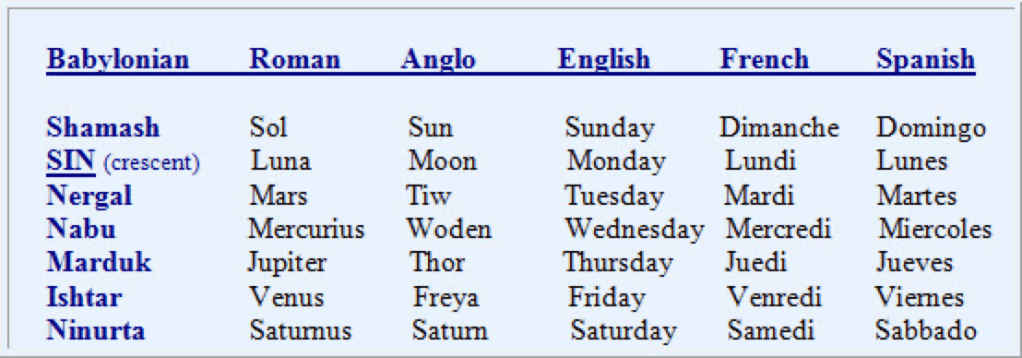




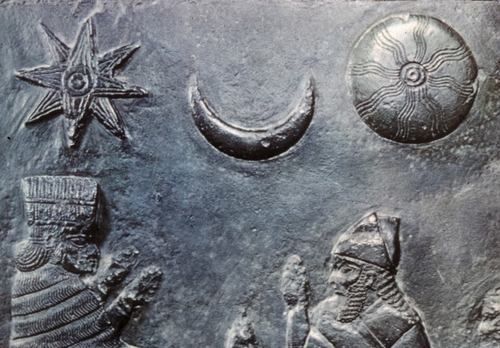




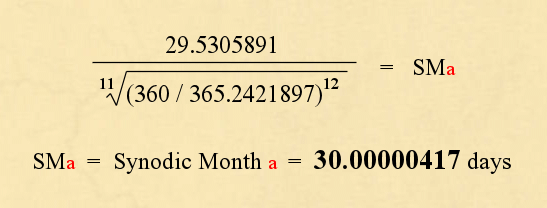





 The Lightkeeper