
For those readers interested in the life of Joseph who preceded Moses, it is recommended to read Chapter XXXIII Manasseh & Ephraim – the Birthright Tribes and Appendix VI: Joseph & Imhotep – One man, different name? Similarly, readers seeking information on Moses’s early life, there is a riveting section in Chapter XIII India & Pakistan: Cush & Phut, as well as additional information in Chapter XXVII Abraham & Keturah – Benelux & Scandinavia.
The first Pharaoh of dynasty XII in Egypt was Amenemhet I, meaning ‘Amun is at the Head’. He was also known as Sehetepibre, meaning ‘Satisfied is the heart of Re’. He began his rule in 1655 BCE, reigning for twenty-nine years – refer Appendix IV: An Unconventional Chronology. Amenemhet I had no royal blood per se, not being related to his predecessors from the XI Dynasty and had possibly overthrown the previous king. Amenemhet is believed to have been a Vizier for Mentuhotep IV; though scholars fluctuate on whether he actually murdered the Pharaoh or not. A stone plate found at Lisht, bears the names of Mentuhotep and Amenenmhet together; perhaps indicating a (forced) co-regency towards the end of Mentuhotep’s reign.
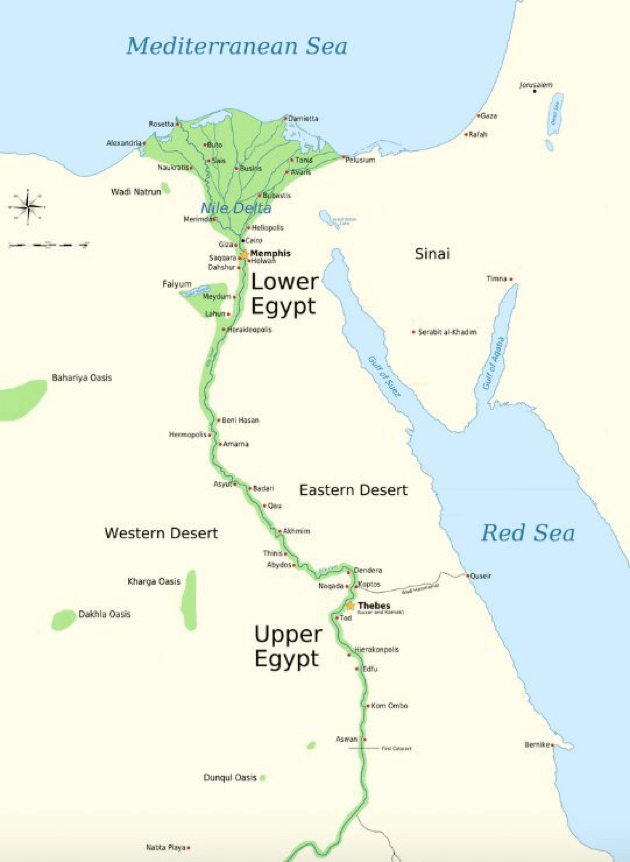
Amenemhet’s father was a priest at Thebes called Senuseret and his mother was named Nefret. Their family is reported to have come from Elephantine near modern Aswan in southern Egypt. He was called Amenemhet-itj-tawy or ‘Amenemhet the Seizer of the Two Lands’. Historian Mantheo, states that the XII Dynasty was based in Thebes; while contemporary records reveal the first Pharaoh moved the capital to Itjtawy, somewhere between five to twenty years into his reign. The new capital is thought to have been near the Fayoum Oasis, as well as both the royal graveyards and Amenemhet’s Pyramid at el-Lisht – where his son also built a pyramid. This region was near Memphis, just south of the apex of the Nile Delta.
The XII Dynasty was renowned for its wealth and stability – no doubt greatly contributed to (as we shall confirm) from the enslavement of the Israelites – evidenced by the quality of its statues, reliefs and paintings. Amenemhet I consolidated his power by retaining the monarchs who had supported him, strengthening a centralised government and increasing bureaucracy, while weakening the regional governors by appointing his own officials. He diluted the army’s power and raised personnel for future conflicts by reintroducing conscription. His policy was one of conquest and colonisation, with the main aim to obtain raw materials, especially gold – refer article: The Ark of God. During the XII Dynasty there was a decided increase in mineral wealth possessed by the royal family as well as jewellery caches in their royal burials. The standard of living for all Egyptians was seen to have improved during the XII Dynasty.
The XII Dynasty kings continued to rule Egypt with a firm hand from the central authorities down to the local administrations. They effectively imposed rule on northern Nubia – in large part credited to the later military success of a man referred to vicariously as Moses (refer Chapter XIII India & Pakistan: Cush & Phut) – pacified the Arabian nations in the East and the people of Phut in Libya to the West. Imposing fortresses were built well within the southern border with Nubia (the people of Cush), as well as eastwards bordering towards the land of Canaan.
Amenemhet I appears to have been a wise leader, assuring a legitimate succession and protecting Egypt’s borders from potential invasions. Yet in possible irony to how he gained the throne, Amenemhet I himself was assassinated by his own guards in 1626 BCE – while his son was leading a campaign in Libya – and buried at el-Lisht. His son and co-regent from 1635 was Senusret I or Kheperkare, meaning ‘the Ka of Re’, who reigned to 1590 BCE. His wife and sister Neferu was the mother of Senusret’s son and successor, Amenemhet II. Senusret I was the second king of the dynasty and is also known as Sesostris I (or Senwosret I).
He furthered his father’s aggressive expansionist policies against Nubia, in initiating two expeditions into this region in his 10th and 18th years of reign; establishing Egypt’s formal southern border near the second cataract, where he placed both a garrison and a victory stele. Senusret I established diplomatic relations with rulers in Syria and Canaan. He dispatched several quarrying expeditions to the Sinai and built numerous shrines and temples throughout Egypt and Nubia during his long reign. He rebuilt the important temple of Re-Atum in Heliopolis; the centre of the Sun cult – refer Chapter XXXIII Manasseh & Ephraim – the Birthright Tribes.
He erected two red granite obelisks in Heliopolis to celebrate his 30th year of rule in 1605 BCE. One of the obelisks still remains and is the oldest standing obelisk in Egypt, at 67 feet tall and weighing 120 tons.

Senusret I was one of the most powerful kings during the XII Dynasty, taking a lead in military matters within his father’s government and so would have known Joseph. For Joseph died in 1616 BCE at the age of one hundred and ten years, during the nineteenth year of Senusret I, beginning with his joint reign with his father. It would be one hundred and seventy years until the Exodus of the Israelites from bondage.
Intriguingly, Senusret I had two viziers during his lengthy reign. The first at the beginning was known as Intefiqer, who held office for a long time before the second vizier. Intefiqer is known from numerous inscriptions and tellingly from his tomb adjacent to the Pyramid of none other than Amenemhet I – refer Appendix VI: Joseph & Imhotep – one man, different name?
The Book of Jasher chapter 59 says: “And Joseph lived in the land of Egypt ninety-three years, and Joseph reigned over all Egypt eighty years… Joseph died in that year, the seventy-first year of the Israelites going down to Egypt. And Joseph was one hundred and ten years old when he died in the land of Egypt, and all his brethren and all his servants rose up and they embalmed Joseph, as was their custom, and his brethren and all Egypt mourned over him for seventy days. And they put Joseph in a coffin filled with spices and all sorts of perfume, and they buried him by the side of the river, that is Sihor, and his sons and all his brethren, and the whole of his father’s household made a seven day’s mourning for him. And it came to pass after the death of Joseph, all the Egyptians began in those days to rule over the children of Israel, and Pharaoh, king of Egypt, who reigned in his father’s stead, took all the laws of Egypt and conducted the whole government of Egypt under his counsel, and he reigned securely over his people.”
Now, Joseph’s brother Levi, was the last sibling of Joseph and son of Jacob, to die in 1611 BCE. The Book of Jasher chapter 63 states: “And… Levi was a hundred and thirty-seven years old when he died, and they put him into a coffin and he was given into the hands of his children. And it came to pass after the death of Levi, when all Egypt saw that the sons of Jacob the brethren of Joseph were dead, all the Egyptians began to afflict the children of Jacob, and to embitter their lives from that day unto the day of their going forth from Egypt, and they took from their hands all the vineyards and fields which Joseph had given unto them, and all the elegant houses in which the people of Israel lived, and all the fat of Egypt, the Egyptians took all from the sons of Jacob in those days.”
In Exodus chapter 1, it confirms: “Now there arose a new king over Egypt, who did not know Joseph. And he said to his people, “Behold, the people of Israel are too many and too mighty for us. Come, let us deal shrewdly with them, lest they multiply, and, if war breaks out, they join our enemies and fight against us and escape from the land.” Therefore they set taskmasters over them to afflict them with heavy burdens. They built for Pharaoh store cities, Pithom and Raamses” which was retrospectively named – Exodus 1:8-11.
These cities were built in Goshen which was located in the southeastern Nile Delta, where the Israelites dwelt – Genesis 45:10-11. Excavations at the site of Tell ed-Daba at Raamses or Pi-Ramesse have shown that though built later by the XIX Dynasty Pharaoh Ramesses II, it was erected upon an older city called Avaris.

Archaeologists have confirmed a number of salient points. The people who once lived there were ‘Semitic in origin’, pottery finds include those of a Levantine – that is a land of Canaan source – and the remains of a large amount of sheep were discovered, indicating a shepherding people – Genesis 30:43; 31:17.
Confirming Pharaoh’s command to execute male newborns as recorded in Exodus 1:22, there are an abnormal amount of burials for children eighteen months or younger with 65% total burials, far exceeding the average death rate at the time of 20 to 30%. Along with this is a higher than normal number of women buried too, indicating they died while probably protecting their children.
It was in 1590 BCE, when Amenemhet II or Nubkhaure, meaning ‘Golden are the Souls of Re’ succeeded his father Senusret I, though he had been co-regent for two years prior to his succession as recorded on the stele of Wepwaweto. Amenemhet II was an imperialistic Pharaoh, launching mining expeditions to the Sinai and military expeditions against Kush, as well as into Asia. It was this Pharaoh who is plausibly recorded in the Books of Jasher and Exodus, for he was likely born after Joseph’s death when the change of attitude towards the Israelites arose and their subjugation began with their lands being taken and their wealth confiscated – refer Appendix IV: An Unconventional Chronology.
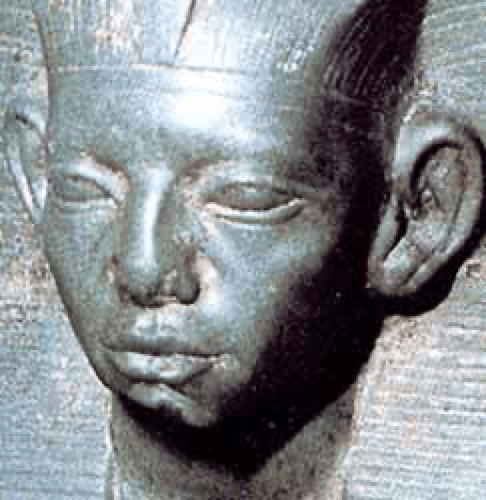
Pharaoh Amenemhet II – likely the first king to not know Joseph and enslave the Israelites.
The Israelite affliction beginning some twenty-three years after Joseph’s death and eighteen years after the death of Levi. The reign of Pharaoh Amenemhet II lasted until 1558 BCE and so by this time the Israelite enslavement was truly complete – Genesis 50:24-25, Exodus 1:8-22. Giving one hundred and forty-seven years of affliction – the age of Jacob when he died – until the Exodus.
Thus it is feasible that Moses would have recognised the affliction of his own people from about 1516 BCE, when he was ten years old. The Israelites having already served seventy-seven years of slavery, with seventy years of captivity remaining.
The most important monument of Amenemhet’s reign were the fragments found at Memphis of an annual stone, reused in the New Kingdom. It reports events of the early years of his reign; including donations to various temples as well as a campaign to Southern Palestine and the destruction of two cities. Nubians bringing tribute are also recorded. Amenemhet’s White Pyramid was constructed at Dahshur. Why he chose the location associated with the IV Dynasty and not el-Lisht remains unanswered. Next to the pyramid, tombs of several royal women were found while excavating and some were undisturbed, still containing golden jewellery of excellent craftsmanship indicative of the era.
An online comment – emphasis mine: “There has been evidence brought forward which shows that the face of the Great Sphinx of Giza is that of Amenemhat II. The evidence includes statements made by German Egyptologist Ludwig Borchardt suggesting that the eye-paint cosmetics seen on the Sphinx were not seen before the 6th Dynasty (making it unlikely to have represented Khafra as typically assumed) and that the pleated stripes on the nemes headress are in groups of three, a very specific style seen exclusively during the 12th Dynasty. The same stripes, eye-paint, and facial structure are present on Amenemhat’s sphinx statue in the Louvre. It is concluded by this evidence that the [statue’s]… original head was damaged beyond repair, and that Amenemhat II carved his own likeness into the existing head and neck to save the structure (explaining why the Sphinx’s head is so disproportionately small).”

As an aside, it is worth noting that the weathering of the Sphinx has been studied and discussed at length. It mirrors the Great Pyramid and the Giza complex in general. There are some researchers who believe the Sphinx could be older than the Great Pyramid – Article: The Pyramid Perplexity. Either way, geological evidence points to a monument that was built shortly after the Last Glacial Maximum and the Younger Dryas event which coincided with the flood circa 10,837 BCE – refer article: The Younger Dryas Stadial: Ending of the Earth… Beginning of the World. This writer would concur with this finding, for the time frame is scientifically supported and biblically based when an unconventional chronology is applied.
The Sphinx is considered the largest single-stone structure in the world, being 241 feet in length and 66 feet high. It is curious that the Egyptians, who were meticulous record keepers should possess no written texts that speak about the Sphinx. It lends weight to the Sphinx not being an original construction of the ancient Egyptians. Edgar Cayce prophesied in 1932 that the Sphinx was built in 10,500 BCE, by the ancient Atlantean civilisation – refer article: Antartica: Secrets of the Lost Continent of Atlantis. Furthermore, he stated a secret room was located beneath the Sphinx called the Hall of Records and contained secret wisdom which had survived the destruction of Atlantis.
The Sphinx is interesting for its original face was not that of a human and perhaps not of a lion. The current human head is accepted as too small in proportion to its body, showing it has been re-carved. The posture of the animal’s legs are indicative of a canine and not reminiscent of how a feline would normally sit. This would mean that the monument is incorrectly named as a sphinx for they are creatures that were guardians at the entrance of temples, of which the Pyramids are not and ‘with the head of a [woman] and the [haunches] of a lion, and [with] the wings of a falcon.’ Where is the evidence of broken off wings?

A head and body of a jet black jackal in contrast to a gleaming white Great Pyramid, may actually be the original statue; thus depicting the god Anubis and all which pertains with eternal life, mummification, the underworld and re-birth – articles: Thoth; and The Pyramid Perplexity. That said, there is residue of red pigment visible on areas of the Sphinx’s face; as well as traces of yellow and blue pigment found elsewhere on the Sphinx. Mark Lehner concluded that the monument “was once decked out in gaudy comic book colors.”

Author Robert Temple in his book, The Sphinx Mystery, considers that the Sphinx was in fact originally a monumental Anubis. Temple confirms that it was later re-carved with the face of the Middle Kingdom Pharaoh, Amenemhet II. He ‘provides photographic evidence of ancient sluice gate traces to demonstrate… [originally] that the Sphinx as Anubis sat surrounded by a moat filled with water – called Jackal Lake in the ancient Pyramid Texts – where religious ceremonies were held.’
Senusret II, meaning ‘Man of Goddess Wosret’ or Khakheperre, meaning ‘Soul of Re comes into Being’ was the son of Amenemhet II and co-regent for two years from 1560 BCE, ruling until 1548 BCE and for 12 years in total as the 4th king of the XII Dynasty.

Senusret II
An online comment: “Of the rulers of this Dynasty, the length of Senusret II’s reign is the most debated amongst scholars. The Turin Canon gives an unknown king of the Dynasty a reign of 19 Years, (which is usually attributed to Senusret II), but Senusret II’s highest known date is currently only a Year 8 red sandstone stela found in June 1932 in a long unused quarry at Toshka. Some scholars prefer to ascribe him a reign of only 10 Years and assign the 19 Year reign to Senusret III instead. Other Egyptologists, however… have maintained the traditional view of a longer 19 Year reign for Senusret II given the level of activity undertaken by the king during his reign… [noting] that limiting Senusret II’s reign to only 6 or 10 years poses major difficulties…
Senusret II may not have shared a coregency with his son… unlike most other Middle Kingdom rulers. Some scholars are of the view that he did, noting a scarab with both kings names inscribed on it, a dedication inscription celebrating the resumption of rituals begun by Senusret II and III, and a papyrus which was thought to mention Senusret II’s 19th year and Senusret III’s first year. None of these… items, however, necessitate a coregency. Moreover, the evidence from the papyrus document is now obviated by the fact that the document has been securely dated to Year 19 of Senusret III and Year 1 of Amenemhet III. At present, no document from Senusret II’s reign has been discovered from Lahun, the king’s new capital city.”
Senusret’s pyramid was constructed at El-Lahun, close to the Fayoum Oasis. Senusret II took interest in the Faiyum oasis region and initiated work on an extensive irrigation system from Bahr Yusuf to Lake Moeris through the construction of a dike at El-Lahun and a network of drainage canals, turning a vast area of marshlands into agricultural land; thereby increasing the area of cultivable land. The importance of Senusret’s project is emphasised by his decision to move the royal necropolis from Dahshur to El-Lahun. This location would remain the political capital for the XII and XIII Dynasties of Egypt. The king also established the first known workers quarter in the nearby town of Senusrethotep, also known as Kahun.
The Bahr Yusef is noteworthy for it was a canal built to connect the Nile River to lake Moeris in the area of Faiyum Oasis. The name Yusef is Arabic for Joseph and translates as ‘the waterway of Joseph’, which may be more than a coincidence for Jospeh was involved in a number of building projects. Ironically as we shall learn, Amenemhet III from the XII Dynasty is said to have expanded and deepened the waterway.
Like his father, Senusret II’s reign is considered a peaceful one; using diplomacy with neighbours rather than warfare, as there are no recorded military campaigns during his reign. His trade with the Near East was particularly prolific. His great interest in the Fayoum elevated the region in importance. Its growing recognition is attested to in a number of pyramids built both before and after his reign, in or near the oasis; though the Fayoum is not a true oasis. As kings usually built their royal palaces near their mortuary complexes, many of the future dynastic kings also made their home in the Fayoum.
Senusret II is further attested too, with a sphinx, which is now in the Cairo Egyptian Antiquity Museum and by inscriptions of both himself and his father near Aswan. The pyramid town associated with Senusret II’s complex, Lahun (or Kahun) after the nearby modern village, provided much valuable information to archaeologists and Egyptologists on the common lives of Egyptians. Pyramid towns were comprised of communities of workmen, craftsmen and administrators associated with any given king’s pyramid project.
Senusret II was succeeded by his son Senusret III (or Khakaure), who ostensibly reigned to 1529 BCE as the 5th king of the XII Dynasty and was considered the most powerful of the Middle Kingdom Pharaohs. World History Encyclopedia says: ‘His reign is often considered the height of the Middle Kingdom which was the Golden Age in Egypt’s history in so far as art, literature, architecture, science, and other cultural aspects [reaching] an unprecedented level of refinement, the economy flourished, and military and trade expeditions filled the nation’s treasury.
In Senusret III the people found the epitome of the ideal warrior-king… whose reign was characterized by military skill, decisive action, and efficient administration. At the head of his army, he was considered invincible… the Nubians so respected him that he was venerated in their land as a god… The Egyptians conferred upon him the rare honor of deifying him while he still lived…’
Among his achievements was the building of the Sisostris Canal and due to the peace achieved after his military campaigns; a revival in craftwork, trade and urban development. Senusret III relentlessly expanded his kingdom into Nubia, erecting massive river forts. He conducted at least four major campaigns into Nubia during his reign in years 8, 10, 16 and 19 respectively. Senusret III Year 8 stela at Semna documents his victories against the Nubians, whereby he is thought to have made the southern frontier secure; preventing further incursions into Egypt. A great stela from Semna dated to the third month of Year 16 of his reign, records his military accomplishments against both the lands of Nubia and Canaan. In it, he admonishes his future successors to maintain the new border which he had created.
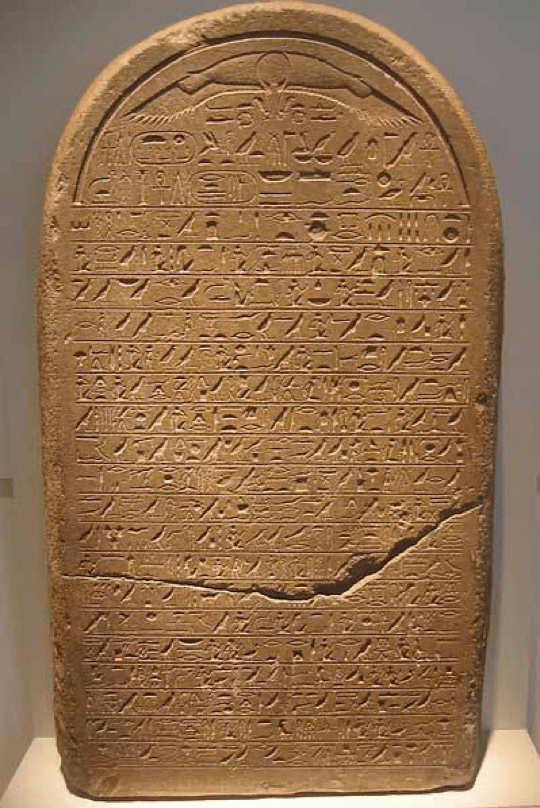
It is plausible that Senusret III reigned longer that 19 years and shared a co-regency with his son for 20 years. The reason being the length of the Temple work for Senusret III. An online comment: “Wegner stresses that it is unlikely that Amenemhet III, Senusret’s son and successor would still be working on his father’s temple nearly 4 decades into his own reign [of 46 years]. He notes that the only possible solution for the block’s existence here is that Senusret III had a 39-year reign, with the final 20 years in coregency with his son Amenemhet III. Since the project was associated with a project of Senusret III, his Regnal Year was presumably used to date the block, rather than Year 20 of Amenemhet III. This implies that Senusret was still alive in the first two decades of his son’s reign [from 1529 to 1509 BCE].”
Senusret III, unlike his immediate forbears built his pyramid at Dashur. It was the largest of the XII Dynasty pyramids, but as with others with a mudbrick core, it deteriorated considerably once the casing stones were removed.
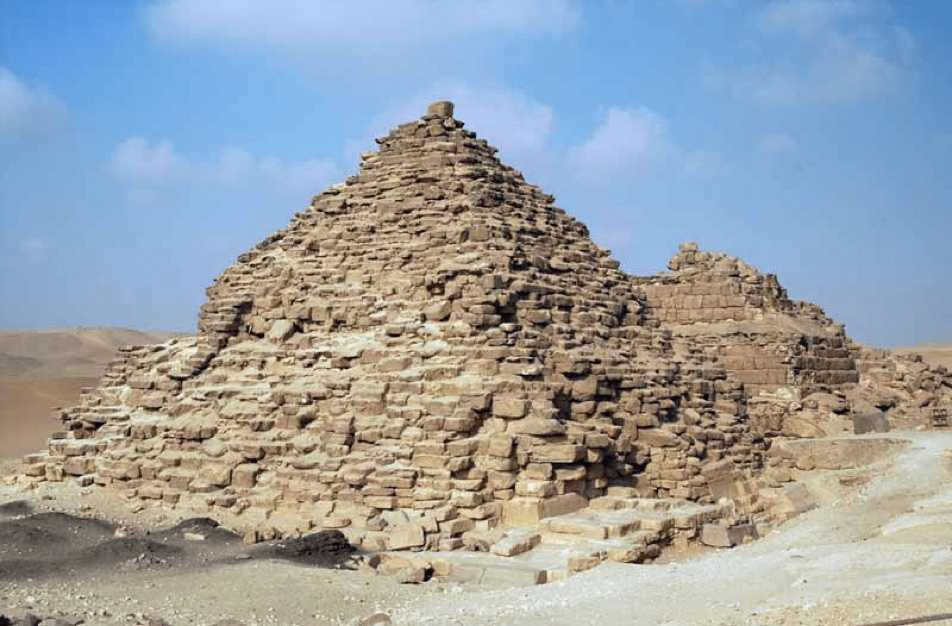
This is the background of the family which Moses was thrust into from a babe, radically changing his life forever and altering the destiny of his people. It was during the Pharaoh Senusret III’s reign that Moses’ big sister Miriam was born in 1536 BCE. She would have been merely ten years old when she witnessed her mother hide Moses in the bulrushes of the River Nile and watched closely while the Egyptian princess and daughter of the new Pharaoh, rescued little baby Moses – Exodus 2:1-10. It was three years earlier in 1529 BCE that Senusret III’s son, Amenemhet III or Nimaatre, meaning ‘Belonging to the Justice of Re’, ascended the throne as the 6th king of the XII Dynasty. It was also the same year when Moses’s brother Aaron was born.

Amenemhet III
Moses was born three years later in 1526 BCE, exactly ninety years after the death of Joseph. There are two Pharaoh’s of considerable significance in Egyptian history by virtue of their relationship with the Eternal’s servant Moses. They are firstly, the Pharaoh of the Exodus and secondly, the Pharaoh who was the father of the Princess Sobekneferu who adopted Moses as her own son. Both these Pharaoh’s identities have been shrouded in mystery; yet revised and accurate chronologies now testify to the real personalities who existed in this prominent and dramatic epoch of both the well-established Egyptian and fledgling Israelite histories.
The latest known date for Amenemhet III was found in a papyrus dated to Regnal Year 46 of his rule. Amenemhet is regarded as the greatest monarch of the Middle Kingdom. He built his first pyramid at Dahshur, called the Black Pyramid but construction problems meant it was abandoned. About year fifteen of his reign in 1514 BCE, the king decided to build a new pyramid at Hawara; while the pyramid at Dahshur was used as a burial ground for several royal women.
An online comment: “His mortuary temple at Hawara, is accompanied by a pyramid and may have been known to Herodotus and Diodorus Siculus as the “Labyrinth”. Strabo praised it as a wonder of the world. The king’s pyramid at Hawara contained some of the most complex security features of any found in Egypt… Nevertheless, the king’s burial was robbed in antiquity. The pyramidion of Amenemhet III’s pyramid tomb was found toppled from the peak of its structure and preserved relatively intact; it is today located in the Egyptian Cairo Museum. The Rhind Mathematical Papyrus is thought to have been originally composed during Amenemhat’s time.”
The military exploits of his predecessors allowed Amenemhet III a peaceful reign upon which to concentrate on building projects, exploit the mineral wealth of the quarries and conduct successful diplomatic relationships with neighbouring states. It is said that he was honoured and respected from Kerma to Byblos and during his reign many eastern workers, including peasants, soldiers and craftsmen, moved to Egypt. The extensive building works, together with possibly a series of low Nile floods, may have placed a strain on the economy by the end of his reign. Upon the king’s death, he was buried in his second pyramid at Hawara.
An online comment: “Amenemhet III is also attested to by an unusual set of statues probably of Amenemhet III and Senusret III that show the two rulers in archaic priestly dress and offering fish, lotus flowers and geese. These statues are very naturalistic but show the king in the guise of a Nile god. There was also a set of sphinxes… believed to have been built on the orders of Amenemhet III… all these statues were discovered reused in the Third Intermediate Period temples at Tanis.”
Nigel Hawkins remarks: “Modern thinking using the revised chronology results in [a] much clearer picture with the history [of] Israel and Egypt lining up and matching archaeological records. This would fit with the theory that Amenemhet III was the Pharaoh of Moses who oppressed the Israelites… Also of note is that… After Joseph’s death, the Israelites were given the task of making mud bricks. Interestingly, the core of the Pyramid of Amenemhet III is made of mud bricks containing straw… Amenemhet III… had only daughters [and one] who had a son (Amenemhet IV) who disappeared before he could become King. It has been suggested that Amenemhet IV was Moses.”

Amenemhet IV
And for good reason, as Amenemhet IV is a rather enigmatic figure during the XII Dynasty period of Egypt. There are a number of anomalies that belie the identity of this personage and Moses being one and the same.
Anne Habermehl brings to attention key points: such as ‘… an unsuccessful search for the pharaoh’s body (Sparks, 1986). The reign of Amenemhat IV was brief; many believe that he reigned for a total of nine years (Gardiner, 1964, page 140). Edwards (1988, page 223) suggests that he might not have reigned separately at all, but only as a co-regent with the previous pharaoh, his father, Amenemhat III. Amenemhat IV had a son, Ameni, whose name appears along with that of his father on a glazed steatite plaque in the British Museum; in the inscription this son is called “The son of the Sun of his body” (Budge, 1902; British Museum, 1891). This is of note because Amenemhat IV does not appear to have left any known male heirs (Salisbury, 2001, page 327).’
Habermehl continues: ‘… Sobekneferu reigned for about four years (Shaw, 2003, page 482), and the 12th Dynasty ended. A mystery associated with her is that as pharaoh, she does not mention Amenemhat IV, her predecessor, in the various inscriptions; she associates herself only with her father, Amenemhat III, and calls herself “king’s daughter,” never “king’s sister” or “king’s wife” (Callender, 1998, pages 230–31). The “disappearance” of Amenemhat IV from the space between Amenemhat III and Sobekneferu is a peculiarity of history that has given Egyptologists much leeway for speculation.
Callender (1998, page 230) suggests that by linking herself to Amenemhat III, Sobekneferu intended to strengthen the legitimacy of her reign. Some suggest that there may even have been a family feud (Gardiner, 1964, page 141). Courville (1971, volume 1, page 224) notes that Amenemhat IV is not recognized in the Sothis king’s list “for reasons which can only be speculative at this time.”
It is completely understandable that Moses’ adoptive mother did not mention her son, Amenemhet IV, as he was not her brother or husband. Sobekneferu associating herself with her father and predecessor Amenemhet III, is only natural in the order of succession and particularly following an abortive reign by Moses – whether as a regent or not. Yes, there had been a family feud, in that Moses spectacularly murdered an Egyptian guard and fled Egypt in 1486 BCE – Exodus 2:11-15. Yet this occurred three years before his adoptive father died and consequently Queen Sobekneferu became Pharaoh.

Sobekneferu
In 1494 BCE Moses co-ruled as Amenemhet IV and was also known as Amenemes IV (or Maakherure). He was the 7th king of the XII Dynasty for eight years, beginning at the age of thirty-two. Old records from the Alexandria Library in Egypt, recount an Egyptian ruler who commanded a successful military campaign against the land of Kush – refer Chapter XIII India & Pakistan: Cush & Phut.
The Jewish historian Josephus in Antiquities of the Jews refers to a campaign by Moses who invaded the country by way of the Nile Valley, heading southwards past the Third Cataract. An earlier Jewish historian Artapanus in Peri Ioudaion, stated that ‘Mousos’ popularity had grown with the conquest of Ethiopia.’
Amenemhet IV completed Amenemhet III’s temple at Medinet Maadi, which is “the only intact temple still existing from the Middle Kingdom” according to Zahi Hawass, Secretary-General of the Supreme Council of Antiquities. “The temple’s foundations, administrative buildings, granaries and residences were… uncovered by an Egyptian archaeological expedition in early 2006. Amenemhat IV likely also built a temple in the northeastern Fayum at Qasr el-Sagha.”
The Turin Canon papyrus records a reign of nine years, three months and twenty-seven days for Amenemhat IV. His short reign was peaceful and uneventful. A handful of dated expeditions were recorded at the Serabit el-Khadim mines in the Sinai. It was after his disappearance that the decline of the Middle Kingdom is believed to have begun.
Prior to this, Egypt’s wealth and power had reached a peak during the reigns of Senusret III and his son Amenemhet III, with this economic prosperity in direct correlation to the incrementally increasing abuse inflicted upon the Israelites as they were subjugated to provide the labour involved in bringing the grandiose building projects of the XII Dynasty kings to fruition, including a number of pyramids. Yet in stark contrast to the benefit the Hebrews were bringing to Egypt, the Pharaoh felt the pressurising need to cull the Israelite population before they outnumbered the Egyptians. For their population was at least 2 million people and above in Egypt and as confirmed later in a census, where they numbered 600,000 men (Exodus 12:37, Numbers 1:46) of fighting age from 20 to 50 years – Numbers 1:45; 4:47.
Moses was born at this crucial juncture in time; though as Amenemhet III had no sons of his own he allowed his daughter Sobekneferu to adopt this attractive and wonderful little baby boy, whom she had discovered lying in a basket among the bullrushes of the Nile.
The Hebrew slaves who lived in Kahun were given the task of producing mud bricks containing straw to then be used in the varied building projects of the XII Dynasty Pharaohs. The mud bricks were integral in the construction of the pyramid cores. There were at least seven pyramids constructed during the XII dynasty which spanned about one hundred and eighty years. The Labyrinth at Hawara, constructed by Amenemhet III contained millions of mud bricks and with over a thousand rooms, it was considered one of the wonders of the ancient world. A very large slave labour force was required to support these building exploits and the number of Israelite slaves meant there were more than enough to meet the successive Pharaoh’s expectations.
The XII Dynasty rulers had forgotten what Joseph as Imhotep had done for Egypt and had therefore exerted an increasing oppression towards his family’s descendants as they grew exponentially in size. Succeeding pharaohs did not undertake on the same scale the massive construction projects of their XII dynasty predecessors, though they continued in harshly oppressing the descendants of Jacob. The Eternal saw their suffering and remembered his promise to Abraham – Exodus 6:1-12.
And so from the age of forty, the former Amenemhat IV lived with Jethro of Midian and married his daughter Zipporrah, who was his second wife. According to the Egyptian priest Manetho, Moses’ original name in Egypt was purportedly Osarsiph or Auserre-Apophi; but when he departed Egypt his name was supposedly changed, to Moses – Against Apion I:250.
In 1483 BCE, just three years after Moses’s disappearance, Amenemhet III died and from 1483 to 1479, a mere four years, possibly as little as three, Queen Sobekneferu or Sobekkare (and Neferusobek), ‘the beauty of Sobek’ was the 8th and final ruler of the XII Dynasty. Sobekneferu had an older sister, Neferuptah who might have been the intended heir though she died at an early age. Neferuptah’s name was enclosed in a cartouche and she had her own pyramid at Hawara. Sobekneferu is the first ever known archeologically attested female Pharaoh. According to the Turin Canon, she ruled for 3 years, 10 months, and 24 days. She died without an heir and the end of her reign spelled the conclusion of Egypt’s brilliant XII Dynasty and the Golden Age of the Middle Kingdom.
The suddenness of Amenemhet’s death and the brevity of Sobekneferu’s reign may be indicators of the heartfelt sorrow and mourning they both experienced after Moses’s shocking and swift departure from Egypt. Even though the Pharaoh had initially shown rage and had sought to kill Moses – Exodus 2:15.
Gerard Gertoux discusses Moses’ name and early life: ‘… As Pharaoh’s daughter was not able to speak Hebrew, the name Moses must be Egyptian. One can notice that in Hebrew this name probably means “pulled out (mosheh)” (the word “water” is missing), whereas in Egyptian it means “Water’s son (mu-sa)”. Moses did not receive this Egyptian name from his parents, but from Pharaoh’s daughter after his “baptism” in the Nile. As it was received after the age of 3 months (the text of Exodus 2:10 even suggests after his weaning), it was therefore a nickname and not a birth name (like Israel is the nickname for Jacob, his birth name). The name of Hebrew children was given by parents based on a striking condition at birth. As Moses was beautiful at his birth, which is emphasized by biblical texts (Exodus 2:2) as by Josephus (Jewish Antiquities II:231), “divinely beautiful” in Acts 7:20, he had to have been called “very beautiful”. In Hebrew “beautiful” is rendered as Ioppa (Joshua 19:46) and “splendid” as iepepiah (Jeremiah 46:20).’
Gertoux continues: ‘Moses was adopted as [the] king’s son through Pharaoh’s daughter (Exodus 2:10). Adoption in the royal family conferred on its holder the honorific title of “king’s son.” If the daughter of Pharaoh had the prestigious position of Wife of the god, she would have been able to confer dynastic position to his son who could have been considered not just a king… but as a co-regent. Some Egyptian accounts show that women of royal origin could play an important role in the choice of future pharaohs.
The Bible speaks little of the royal position of Moses during the first 40 years of his life, but one can guess it implicitly in the following texts: The man Moses too was very great in the land of Egypt, in the eyes of Pharaoh’s servants and in the eyes of the people (Exodus 11:3); the daughter of Pharaoh picked him up and brought him up as her own son. Consequently Moses was instructed in all the wisdom of the Egyptians.
In fact, he was powerful in his words and deeds (Acts 7:21-22); By faith Moses, when grown up, denied to be called the son of the daughter of Pharaoh, choosing to be ill-treated with the people of God rather than to have the temporary enjoyment of sin, because he esteemed the reproach of the Christ as riches greater than the treasures of Egypt (Hebrews 11:24-26).
Renunciation [by] Moses of the treasures of Egypt makes sense only if he really had them thanks to his royal status. Something can be denied only if it has been owned… [after] he struck the Egyptian down and hid him in the sand… Moses now [became] afraid and… ran away from Pharaoh that he might dwell in the land of Midian… About this new period of 40 years… in the 120 years of Moses’ life… very little is known.’ It was while Moses was living in Midian from 1486 to 1446 BCE, that his father Amram, died in 1455 BCE at one hundred and thirty-seven years of age.
We discovered the intimate relationship the Eternal shared with Abraham, calling him his friend – refer Chapter XXVII Abraham & Keturah – Benelux & Scandinavia. An online comment regarding the similar friendship between Moses and the Eternal: “And the LORD spake unto Moses face to face, as a man speaketh unto his friend. These words are spoken of Moses in Exodus 33:11, The Lord spoke with Moses face to face… The Hebrew word for “friend” used here is the word, rea (H7453). This word suggests intimacy, companionship, and reciprocal relationship. Numbers 12:8 says this of Moses, I speak with him directly, openly, and not in riddles; he sees the form of the Lord.
Throughout the life of Moses we see over and over again, this open conversation with God. It is important to note, that this level of relationship [and] friendship requires intentionality and regular communication. Moses did not only speak to God once in a while, or only when he needed something, but as a friend, he maintained regular and open communication with God. When Moses is forced to flee Egypt he ends up in Midian at the home of the priest of Midian, Jethro (… his father-in-law).
The family name of Jethro is, Reuel (Exodus 2:18). In Hebrew the name Reuel means, “friend of God” (H7467). The years spent working for Jethro were formative to Moses understanding of who God is. Moses was able to do what he was called to only after his time spent learning who God is, and establishing this friend relationship. I find it interesting that the man who would be known as a friend of God, Moses, spent more than 40 years learning of God at the feet of a man whose name is, “friend of God”, Reuel.’
Archaeology News – Moses may be named in ancient Egyptian mine inscriptions, sparking debate over earliest biblical references, Dario Radley, July 31, 2025:
‘Did Moses, the biblical leader of the Exodus, ever exist? Independent researcher Michael S. Bar-Ron believes the answer lies in the Proto-Sinaitic inscriptions carved into rock walls at Serabit el-Khadim, an Egyptian Sinai Peninsula [turquoise] mine site.’
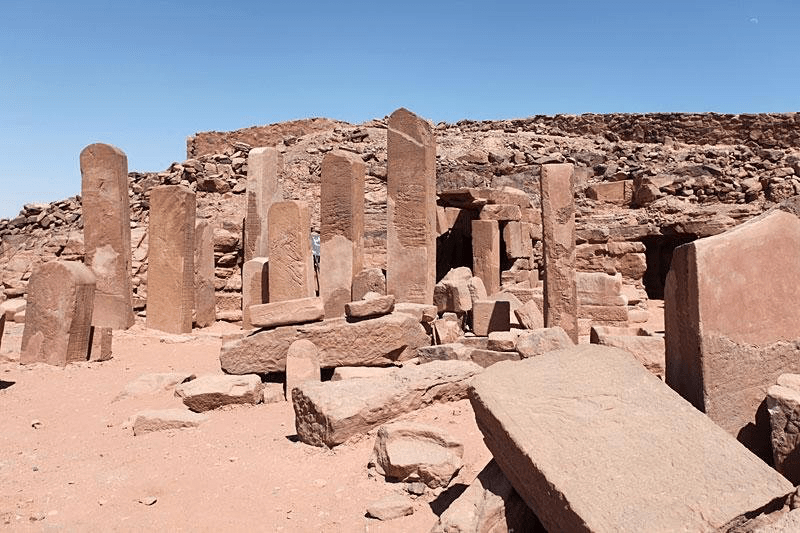
‘After eight years of study using high-resolution photos and 3D scans provided by Harvard’s Semitic Museum, Bar-Ron says he has discovered two inscriptions reading “zot mi’Moshe” – Hebrew for “This is from Moses” – and “ne’um Moshe”, which means “A saying of Moses.”

‘If verified, these would be the oldest extra-biblical inscriptional references to Moses, a figure long documented in religious tradition but never confirmed by archaeology. The inscriptions are part of a group of over two dozen Proto-Sinaitic inscriptions first unearthed by Sir William Flinders Petrie early in the 20th century. These writings, which were likely created by Semitic-speaking laborers during the reign of Pharaoh Amenemhat III… represent some of the earliest alphabetic texts known, even predating Phoenician.
In [Bar-Ron’s] proto-thesis… he suggests that these inscriptions are the voice of a single scribe who had knowledge of Egyptian hieroglyphs and used Proto-Sinaitic script to encode religious and personal messages. He believes the personal tone and poetic form of the scribe support a single authorship.
Some of the inscriptions… mention “overseers,” “slavery,” and a call to depart – possibly to be interpreted as “ni’mosh” (“let us depart”) – give support to religious rebellion and mass departure, recalling the biblical Exodus.’
After the short reign of Moses’ mother, Queen Sobekneferu, the XII Dynasty came to an abrupt end, though the unrelenting captivity of Moses’s people remained unabated. The new era after the stability of the XII Dynasty was in stark contrast for its instability. The XIII Dynasty was typified by famine, intrigue, chaos and disorder. A correct chronology is difficult to discern for there were few monuments from this period. The kings invariably had reigns of brevity; nor did they descend from single family lines; or from royalty; and many were deemed commoners.
It is next to impossible to compile a comprehensive list for the number of rulers or the length of their reigns and therefore, an accurate chronology for the XIII Dynasty. It is difficult to determine because many of the kings names are only drawn from fragmentary inscriptions or scarabs. Hence, the placement of the majority of kings attributed to this dynasty is both very uncertain and disputed among Egyptologists. It is clear that the XII and XIII dynasties over lapped and the XIII Dynasty may not have lasted very long at all – certainly not as long as the 154 years commonly ascribed to it. With its final thirty-three years occurring from the end of Queen Sobekneferu’s reign to the Exodus Pharaoh’s reign – Article: 33. Any ‘documentation of the 13th dynasty is in shambles which would not be unexpected if it ended in such disaster.’
Even so, Nigel Hawkins concludes: “The Exodus took place during the Reign of Neferhotep I during the 13th dynasty…”

Neferhotep I
Other notable Pharaohs from this Dynasty included the founding and first Pharaoh of the XIII Dynasty, Sekhemre Khutawy, Sobekhotep (or Wegaf), who ruled for four years. Notice the similarity between his name and his predecessor Queen Sobek-neferu. Sobekhotep IV, was the brother of Neferhotep I and possibly ruled from between ten to twenty years. Sobekhotep III preceded Neferhotep I, ruling for four years. Reportedly, the final kings of the Dynasty, were Dudimose I and Dudimose II who reigned for less than a year.
An online comment: ‘A [tattered] papyrus scroll [fragment] (Brooklyn 35:1446) acquired by Charles Wilbur in the 19th Century and now in the Brooklyn Museum dates to the 13th Dynasty under Pharaoh Sobekhotep III [1461 to 1457 BCE]… Essentially it is a [royal] decree from the pharaoh authorizing the transfer [ownership] of slaves; of the 95 slaves mentioned by name, approximately 46 of them have their original Semitic names [such as Menahem (a king of Israel), Issachar and Asher (family names of Jacob)] in addition to their Egyptian names each were assigned, something the Bible records as a common practice (Genesis 41:45).”
Neferhotep I was the son of a temple priest in Abydos. Notice the first part of his name is the same as the last part of Queen Sobek-nefer-u’s name – and the first part of her sister’s name. His father’s position helped him to gain the royal throne as the king, as he did not have aristocratic heritage or royal blood in his family line. Neferhotep I was from a family with a military background. His grandfather Nehy, held the title ‘officer of a town regiment’. Nehy married a woman called Senebtysy. Nothing is known about her, other than that she held the common title ‘lady of the house’. The only known son of their marriage, was called Haankhef. He is always enigmatically described in sources as ‘God’s father’ and he married a woman called Kemi. Haankhef and Kemi were the parents of Neferhotep I.
The family of Neferhotep I appear to have originally come from Thebes. Neferhotep’s brother, king Sobekhotep IV, stated that he was born there, on a stela which was placed during his reign in the temple of Amun at Karnak. However, the capital during the XIII Dynasty remained at Itjtawy in the north of Egypt, near the modern village of el-Lisht. Neferhotep’s wife was called Senebsen and they had a son called Haankhef (or Wahneferhotep) and also a daughter called Kemi, named after Neferhotep’s parents.
Neferhotep I is inscribed on certain stones discovered near Byblos*. Numerous other stones throughout Egypt and Lower Nubia, including in Aswan were carved with texts which document his reign, as well as family members and officials serving under the king and that his power reached the Delta in the north and the Nubian Nome in the south. “The most important monument of the king is a large, heavily eroded stela dating to year two of the king’s reign, found at Abydos. The inscription on the stela is one of the few ancient Egyptian royal texts to record how a king might conceive of and order the making of a sculpture.”
It is not known under what circumstances Neferhotep I died and it remains a mystery; for his mummy has never been uncovered. A statue of Neferhotep was discovered beneath the temple of Karnak at Luxor as was another previously in 1904 in Luxor, now on display in the Egyptian Museum. His supposed successor was his brother, Sobekhotep IV, which may indicate that Haankhef was Neferhotep’s only son; dying during the tenth plague. Yet there are several monuments mentioning Neferhotep I and Sobekhotep IV together. This could well mean that they reigned for a parallel period. Regardless, the reigns of the two brothers during the Thirteenth Dynasty marks its relative peak before the sudden catastrophic collapse of this turbulent Egyptian dynasty.
Pharaoh Neferhotep I (or Khasekhemre), was a powerful ruler during the XIII Dynasty, reigning eleven (to ten) years from circa 1457 BCE until the Exodus and likely the 21st (or 22nd) king of the Dynasty. Only twenty-two years separated Neferhotep I from the end of Queen Sobekneferu’s reign.
Gerard Gertoux adds: ‘The fact that the rulers of Byblos* used [a] specific title suggests therefore that they regarded Byblos as an Egyptian domain and saw themselves as its governors on behalf of the Egyptian king. This situation is substantiated by two sources of a different nature, a relief found at Byblos and a cylinder-seal of unknown provenance. The relief depicts the Governor of Byblos Yantinu (in-t-n) who was begotten by Governor Yakin (y3-k-n) seated upon a throne in front of which is inscribed a cartouche with the prenomen and nomen of Neferhotep I.
The cylinder-seal is inscribed for a certain Yakin-ilu in cuneiform on one side and the prenomen of king Sewesekhtawy on the other side. The fact to record the name of the Egyptian king within those specific context strongly suggests that they regarded themselves officially as subordinates of the Egyptian king. It is notable that it was the Egyptian king (13th dynasty) rather than the Canaanites kings (14th dynasty) who were recognized as the superiors at Byblos.’
Pharaoh Djedhotepre or Dudimose I (also recorded as Tutimaeus and Tutimaos by Mantheo), is credited as ruling from 1450 to 1446 BCE in the New Chronology, for the four years prior to the Exodus and is viewed as the 30th King of the unstable Thirteenth Dynasty. Yet this dating is speculative. His similarity of name, Dudi-mose with Moses is noteworthy but not reason alone that he was contemporaneous with Moses. Aside from this, there is little support for him being the Pharaoh of the Exodus; but rather either a later ruler in Egypt, or one of lesser importance. Therefore the catastrophe of the ten plagues and the Exodus events brought collapse not just for Neferhotep I, but the parallel XIII and XIV Dynasties of Egypt in 1446 BCE. Thus ushering in the opportunistic Amalekite Hyksos, who invaded Lower Egypt during the demise of the XIII and XIV Dynasties. They constituted the rulers of the subsequent XV and XVI Dynasties and beyond – Chapter XXIX Esau: The Thirteenth Tribe.
The dramatic events which led up to the Exodus comprised a series of disasters or plagues inspired by the Eternal to drive the Pharaoh and Egyptian nation to despair and thereby release their captive Israelite slaves. The hardness of Pharaoh’s heart (Exodus 11:10) meant a diabolical tenth plague was required wherefore the eldest child of every Egyptian family died during the passing over of the Lord’s Death Angel – Exodus 11:4-5; 12:23, Hebrews 11:28, 2 Samuel 24:16-17.
The Ten Plagues are recorded in Exodus 7:14-25, 8:1-29, 9:6-31, 10:13-23, 12:28-26 and 14:7-28.
The first plague occurred on the 7th day of the 12th month of Adar corresponding to February 11th and was the turning of the River Nile into blood.
The second plague eight days later comprised a pestilence of frogs and on the 18th day of the 12th month a third plague brought lice.
On February 25th, the fourth plague brought swarms of flies and three days later there was the Great Murrain where Egypt’s livestock of cattle likely died from babesiosis, the fifth plague.
The sixth plague occurred on the 25th day of Adar, with the Egyptians inflicted with boils; and then the seventh plague involving hail and fire, destroyed the land’s mainstay crops of barley and flax; occurring during March 4th and 5th.
The eighth plague on the 2nd day of the first month, Nisan (or Abib) were consuming swarms of locusts. The penultimate plague of complete and utter pitch black darkness, began on March 12th and prevailed for three days.
The tenth and final plague was brutally savage and finally broke the resolve of the obstinate and stubborn Pharaoh. On the Passover night of Wednesday the 14th of Nisan (or March 21st) after midnight, the first born children of the Egyptians died – Exodus 12:29-30.
It was on this day that there was a Hybrid Solar Eclipse number 01321 at 09:05:39 and it lasted for 1 minute and 9 seconds. ‘Eclipses of the Sun can only occur during the New Moon phase – refer articles: The Christ Chronology; and The Calendar Conspiracy. It is then possible for the Moon’s penumbral, umbral or antumbral shadows to sweep across Earth’s surface thereby producing an eclipse.’ There are four types of solar eclipses: Partial, Annular, Total and a Hybrid, where the ‘Moon’s umbral and antumbral shadows traverse Earth (eclipse appears annular and total along different sections of its path). Hybrid eclipses are also known as annular-total eclipses.’

Gerard Gertoux in The Pharaoh of the Exodus Fairy Tale or Real History, states: ‘The text of Ezekiel mentions the tragic end of a pharaoh and associates it with a cloudy sky and a solar eclipse (Ezekiel 32:2, 7-8). This text targets the Pharaoh of the Exodus, the only one known for ending tragically (Psalm 136:15), because the terms “crocodile dragon/marine monster” always refer to this ruler (Isaiah 51:9-10) as an avatar of the sliding snake, Leviathan (Isaiah 27:1, Ezekiel 29:2-5, Psalm 74:13-14) and not Apries, the Pharaoh of that time whose name is given (Jeremiah 44:30). This process of assimilation between two rulers from different eras is to be found again with the king of Tyre who was assimilated to the original serpent in Eden (Ezekiel 28:12-14).
The expression “All the luminaries of light in the heavens – I shall darken them on your account, and I will put darkness upon your land” has a symbolic meaning, but could be understood only if it had also a literal meaning (solar eclipse). The Pharaoh was considered a living god by the Egyptians, the son of Ra the sun god, thus the solar eclipse as a moonless night would have to have marked them.’
Three key points in the Exodus narrative require illumination. They are the veracity of the personage of Moses (1); the natural, stroke, supernatural plagues which devastated Egypt (2); and the miraculous or otherwise, walking through the sea of crossing by an innumerable number of freed Israelites (3). We have investigated Moses in previous chapters, as well as the current appendix. The known historical records regarding the plagues will be presented next. The subject of the sea of crossing requires a more thorough discussion. Please refer to the addendum at the close of this Appendix.
On the morning of Thursday the 15th of Nisan in the year 1446 BCE on March 22nd – the first day of Unleavened Bread (Exodus 12:15-20) – the Israelites hurriedly took leave from Egypt: Exodus 12:39, 51, Numbers 33:3; 1 Kings 6:1, Psalm 105:23-45. One week later on the last day of Unleavened Bread the 21st of Nisan, the Israelites travelled by foot across the sea of crossing – Exodus 14:21-22. Pharaoh Neferhotep I and his pursuing army of six hundred chariots (Exodus 14:5-8) perished on Wednesday, March the 28th, when towering walls of water from either side, collapsed, crushing them – Exodus 14:27-28. Proving that Pharaoh Neferhotep I* was not a firstborn child, for he would have died during the tenth plague otherwise – as his only son did.
Anne Habermehl adds: ‘This mystery of the pharaoh who went missing is a matter of great significance because the Egyptians did not normally lose track of their pharaohs. Indeed, they believed that the king’s ka (breath of life) contained the life force of all his living subjects. The pharaoh’s physical body was therefore needed for transfer of the kingship from the dead pharaoh’s body to the body of the new living pharaoh through rituals carried out at his pyramid. In addition, there were other religious implications of the dead mummified pharaoh preserved in his tomb. In causing the pharaoh’s physical body to be lost in the Red Sea, God dealt a major blow to the whole fabric of Egyptian belief and priestly practice. Not having the pharaoh’s body in hand was an unthinkable catastrophe. It appears that what happened (no doubt after desperate attempts to find the drowned pharaoh’s body) was that the transfer of kingship was now officially made from [Neferhotep I to his brother, Sobekhotep IV*]…
Manfred Bietek, in his burrow at Tel ed-Baba, discovered in stratum G/1 an overwhelming number of shallow mass graves pits throughout the city of Avaris, where hundreds of bodies had been thrown in on top of each other. Clear proof of a sudden major calamity remarkably reminiscent of the scriptural Tenth Plague demise of the Egyptian firstborn. Site prehistoric studies also propose that the rest of the populace had surrendered their homes rapidly, coinciding with the simultaneous abandonment of the city by the people en-masse.’
Creation Wiki states: ‘[English Egyptologist Sir] Flinders Petrie [1853-1942] found evidence to [support] that the town of Kahun was suddenly vacated… As so many tools and manuscripts were left behind, Petrie concluded that the village must have been evacuated fairly quickly. He also found the scarabs of various pharaohs including those of [Senusret II] (the earliest) and Neferhotep I (the latest). The most recent (latest) scarabs would indicate which pharaoh was ruling when the town was vacated, particularly if the pharaoh had been ruling for a while. The most recent scarabs found at Kahun were those of Neferhotep… [who] has the necessary credentials to be the Pharaoh of the Exodus…’
The simple triumph of the invading Amalekite Hyksos into Egypt can be readily explained with the sudden and dramatic loss of Egypt’s whole armed forces. Avaris was completely resettled, as the archaeological record reveals an Asiatic people in origin who had plundered Egyptian tombs for relics and who also practiced human sacrifice as evidenced by the large number of female ritual burials – refer Chapter XXIX Esau: The Thirteenth Tribe; and Chapter XXX Judah & Benjamin – the Regal Tribes. The conquering Hyksos inherited an Egypt brought to its knees, for the large-scale departure of the Hebrew slave work force from Goshen, meant a severely weakened economy. Added to this was the psychological blow of losing all the firstborn of Egypt, whether high born or low.
Josephus quoted Mantheo regarding the sudden destruction and ensuing Amalakite invasion: “In his reign, for what cause I know not, a blast of God smote us; and unexpectedly, from the regions of the East, invaders of obscure race marched in confidence of victory against our land. By main force they easily seized it without striking a blow and having overpowered the rulers of the land, they then burned our cities ruthlessly, razed to the ground the temples of the gods and treated all our natives with cruel hostility, massacring some and leading into slavery the wives and children of others.”
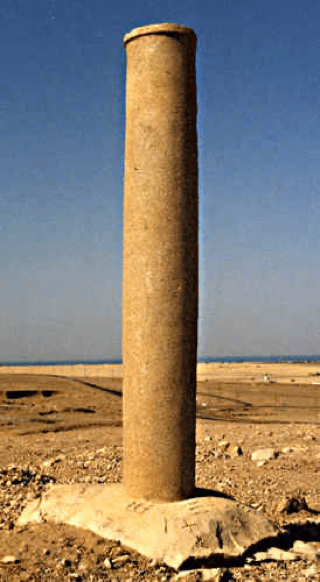
‘Discovered by Ronn Wyatt in 1978. A pair of pillars on the Egyptian side (Nuweiba) and the Saudi side of the the Gulf of Aqaba, the northeastern arm of the Red Sea. The one on the Egyptian side had fallen over and was in the sea. It’s inscriptions had worn off. The one on the Saudi side was [supposedly] inscribed with the words: Yahweh, Pharaoh, Mizraim [refer Chapter XIV Mizra: North Africa & Arabia], Moses, Death, Water, Solomon, Edom. The Saudi pillar has been removed by the Saudi’s but the one on the Nuweiba side is… [now] standing and can be visited’ [refer Addendum: The crossing of a Reed Sea or the Red Sea?].
The Ten Plagues of Egypt are recorded outside of the biblical account. First, on the Tempest Stele:
“[Then] the gods [made] the sky come in a storm of r[ain, with dark]ness in the western region and the sky beclouded without [stop, loud]er than [the sound of] the subjects, strong[er than …, howling(?)] on the hills more than the sound of the cavern in Elephantine. Then every house and every habitation they reached [perished and those in them died, their corpses] floating on the water like skiffs of papyrus, (even) in the doorway and the private apartments (of the palace), for a period of up to […] days, while no torch could give light over the Two Lands.
Then His Incarnation said: How much greater is this… Hence the magic-practicing priests said to Pharaoh: than the impressive manifestation of the great god, than… It is the finger of God! the plans of the gods! Then His Incarnation commanded to make firm the temples that had fallen to ruin in this entire land: to make functional the monuments of the gods (…) to cause the processional images that were fallen to the ground to enter their shrines.”
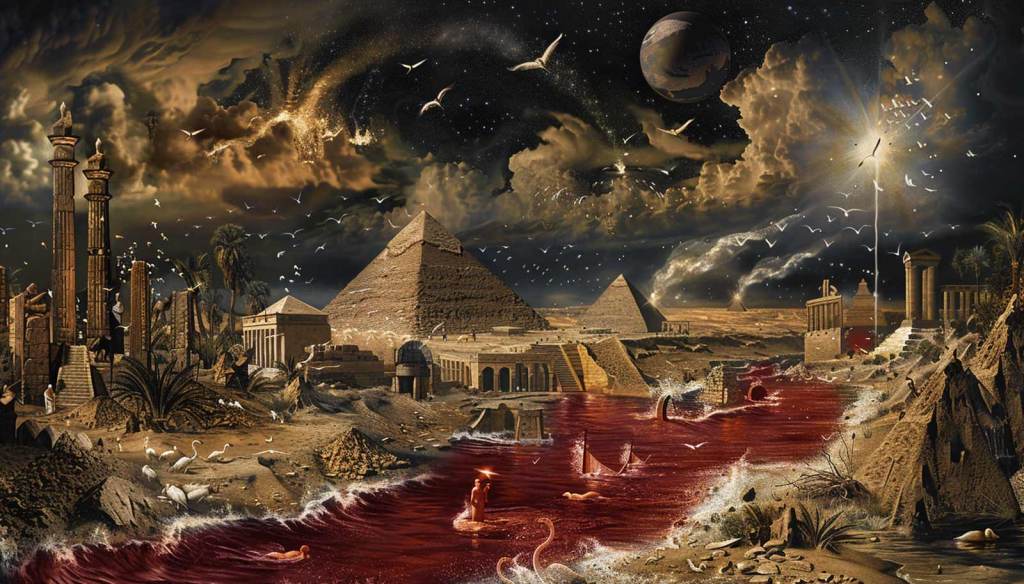
Second, the Admonitions of Ipuwer state:
“[Nile] River is blood: Admonitions 2:6, 10:
Pestilence is throughout the land, blood is everywhere (…) O, yet the [Nile] river is blood and one drinks from it; one pushes people aside, thirsting for water.
Hail and fire: Admonitions 2:10-11; 7:1:
O, yet porches, pillars and partition walls(?) are burnt, (but) the facade(?) of the King’s Estate (l.p.h.) is enduring and firm (…) For look, the fire is become higher.
Magic is ineffective: Admonitions 6:6-7:
O, yet the sacred fore hall, its writings have been removed; the place of secrets and the sanctuary(?) have been stripped bare. O, yet magic is stripped bare; omens(?) and predictions(?) are made dangerous because of their being recalled by people.
Vegetation perished: Admonitions 4:14; 6:2-4:
O, yet [t]rees are swept away, plantations laid bare (…) O, yet one eats(?) plants and one drinks down water. No meal or bird-plants can be found; seed is taken from the pig’s mouth. There is no bright face because of bowing down(?) before hunger. O, yet barley has perished everywhere (…) everyone says. ‘There is nothing!’ – the storehouse is razed.
Cattle perished: Admonitions 5:6:
O, yet all herds, their hearts weep; cattle mourn because of the state of the land.
Disaster on the whole country: Admonitions 5:6; 6:4; 9:6; 10:4:
Officials are hungry and homeless (…) everyone says: There is nothing! The storehouse is razed (…) Look, the strong of the land, they have not reported the state of the subjects, having come to ruin (…) The entire King’s Estate is without its revenues.
Darkness: Admonitions 9:11, 14; 10:1:
Wretches […] them(?); day does not dawn on it. Destroyed (…) be]hind a wall(?) in an office, and rooms containing falcons and rams(?) [… till] dawn. It is the commoner who will be vigilant; day dawns on him.
Death of the firstborn: Admonitions 2:6-7; 3:13-14; 5:6-7:
There is no lack(?) of death; the (mummy)-binding speaks without approaching it. O, yet the many dead are buried in the river; the flood is a grave, while the tomb has become a flood (…) What may we do about it, since it has come to perishing? O, yet laughter has perished [and is no] longer done. It is mourning which is throughout the land mixed with lamentation (…) O, yet the children of officials are thrown against walls; children of prayer are placed on high ground. Khnum [god of fertility and connected with water – “father of the fathers” and represented as a ram with horizontal twisting horns, or a ram headed man] mourns because of his weariness. O, yet terror slays.
Pharaoh is fallen down: Admonitions 7:4:
The Residence has fallen down in an hour. [Psalms 136:15: ‘And who shook off Pharaoh and his military force into the Red Sea’].
Egyptians stripped: Admonitions 2:4-5; 3:1-3:
O, yet the poor have become the owners of riches; he who could not make for himself sandals is the owner of wealth (…) the outside bow-people have come to Egypt. O, yet [… Asiatics] reach [Egypt] and there are no people anywhere. O, yet gold, lapis lazuli, silver, turquoise, garnet, amethyst, diorite(?), our [fine stones(?),] have been hung on the neck(s) of maidservants; riches are throughout the land, (but) ladies of the house say: ‘Would that we had something we might eat!’
Some will question why there are not numerous accounts? It is because the Egyptians did not wish to record an event which portrayed their ruler and nation in a very poor light. This was common practice amongst great civilisations. Anything detrimental to their reputation was minimised. It was also to safeguard against enemies getting wind of an opponents weakness and attacking. Hence there are not more sources on the Exodus departure and the preceding plagues. Both events deeply humiliating in the annals of Egyptian history. Though in this case, the Amalekite Hyksos did learn of Egypt’s imminent demise and swarmed into the Nile’s delta region ruling for hundreds of years afterwards.
Anne Habermehl writes: ‘All this had to have caused a total collapse of Egypt. That such a collapse did actually occur can be seen from a study of historical sources – in fact, secular historians believe that Egypt collapsed not once, but twice: once at the end of the 6th Dynasty of the Old Kingdom (followed by the First Intermediate Period), and again at the end of the 12th Dynasty of the Middle Kingdom (followed by the Second Intermediate Period). Which collapse was precipitated by the Exodus? It is likely there was only one collapse, with the 6th and 12th Dynasties running concurrently and ending in chaos at the same time. Gardiner (1964, page 147) compares the traditional two intermediate periods with a very interesting description, and inadvertently backs the idea that these two periods were one:
“… it will be well to note that the general pattern of these two dark periods is roughly the same. Both begin with a chaotic series of insignificant native rulers; in both, intruders from Palestine cast their shadow over the delta, and even into the Valley; and in both relief comes at last from a hardy race of Theban princes, who after quelling internal dissention expel the foreigner and usher in a new epoch of immense power and prosperity.”
‘Secular scholars apparently believe that the same strange series of events happened in Egyptian history twice and do not consider the statistical improbability of this. The collapse of the Old Kingdom at the end of the 6th Dynasty appears to be the big event to most Egyptologists. Erman (1966, page 93), says that at the end of the 6th Dynasty “Egypt is suddenly blotted out from our sight in obscurity, as if some great catastrophe had overwhelmed it.” Both historians and scientists continue to wonder exactly what caused this collapse, and to offer theories. To a Bible believer, it is amazing how the events leading up to the Exodus, and the Exodus itself, are basically invisible to secular historians.’
It was 430 years from Abraham’s 100th year, when he was 99 years old to the Exodus – Exodus 12:40-41, Genesis 17:1-13, Galatians 3:15-17. The count of 400 years as per Genesis 15:13-14 and Acts 7:6-7 began with the 130th year of Abraham and the corresponding 30th of Isaac in 1847 BCE.
An online comment confirms: “Thus, all one has to do is to add 430 years to Abraham’s year [100] and there is a grand total of [530] years from Abraham’s birth [in 1977 BCE] to the Exodus [in 1446 BCE]. Then add [45] years to the time that Joshua divided the land of the Amorites [during 1406 to 1400 BCE] (Joshua 14:7-10) and the number 575 is reached from Abraham’s birth. But remember that Abraham lived to be 175 years of age (Genesis 25:7). So, one simply needs to subtract 175 from 575 and we arrive at exactly 400 years from Abraham’s death [in 1802 BCE] and the year when the sins of the Amorites reached maturity [circa 1402/1 BCE]. This means that both the “400 years” in Genesis 15:13 are literal (to the very year), but that also the “430 years” of Moses (Exodus 12:40,41) and referred to by… Paul (Galatians 3:14-19) are literal (to the very year).”

There is confusion as to when the 430 years applies as the Bible indicates the whole period lasted from entry into Egypt by Jacob and the exit of the Israelites during the Exodus. Jacob arrived in Egypt with his family in 1687 BCE and thus the Exodus was two hundred and forty years later in 1446 BCE. The issue is that modern translations are based on the Masoretic text which dates from the 4th Century CE. Older manuscripts agree that the 430 years begins with Abraham’s arrival in Canaan and not with Jacob’s move to Egypt.
David Reagan states: ‘The three older sources are The Septuagint (the translation of the Hebrew Scriptures into Greek in about 280 BC), the writings of Josephus (who quotes the verse in his First Century AD writings, stating that he is quoting from Temple documents), and The Samaritan Version of the Torah (which dates from the 2nd Century AD). The Septuagint version reads as follows: “And the sojourning of the children of Israel, that is which they sojourned in the land of Egypt and in the land of Canaan, was four hundred and thirty years.” Josephus, in his Antiquities of the Jews (Chapter XV:2) puts it this way: “They (the Israelites) left Egypt in the month of Xanthiens, on the fifteenth day of the lunar month; four hundred and thirty years after our forefather Abraham came into Canaan…” It appears that in the compilation of the Masoretic text, the phrase “and in the land of Canaan” was dropped either because of a scribal error or because of an exercise in interpretation.’
Addendum
The Crossing of a Reed Sea or the Red Sea?
There are two main theories presented in explanation of the Israelites crossing the Red Sea and so we will look at each in turn. The first is a crossing of a reed Sea west of the Sinai Peninsula, closer to the land of Goshen where the Israelites dwelt (mauve and orange lines, with the orange line a possible route Moses followed when he fled Egypt forty years earlier ending in the land of Midian). This version seeks to explain the Israelites crossing on dry land through a shallower body of water that was not the Red Sea. The second answer offered is that of a crossing of the actual Red Sea, whether by the Gulf of Suez (red line) or the Gulf of Aqaba (blue and green lines). This would have entailed a passage walking through considerably deeper water and for far further, requiring more than mere natural causes alone for the separation of a such a great volume of water.

It is the view of this writer that the more pressing issue than how did the Israelites cross is rather, where did they pass over? And so, the geography of the land between Goshen and the sea in question is vital to answer, with the actual route taken on foot paramount in understanding this question correctly. Yet any investigation into this subject quickly reveals the amount of research conducted by theologians and academics accompanied by an extensive body of material in support of more theories than one would think possible. In fact, the volume of data can be overwhelming as some seek to prove their position. Because of this, it would be easy to compile a book and as that is not my purpose, some options will be mentioned but not necessarily delved into deeply if they are in obvious error. With all truth, it can be demonstrated succinctly. The more convoluted an explanation, the increasingly flawed and error stricken it becomes.
To begin, it is advantageous to start in Exodus chapter twelve with the events which preceded the Israelite departure from Goshen in the eastern reaches of Egypt’s Nile delta. The Eternal instructed Moses and Aaron in the observation of the Passover and Feast of Unleavened Bread. The Passover was a sacrificial meal in commemoration of the first born being spared from death when the Angel of the Lord passed through Egypt and the tenth plague was inflicted at Midnight on the night of the 14th of Nisan (or Abib), the first month of the sacred year – article: The Calendar Conspiracy.
It also prefigured the sacrifice of the Son of Man who died on the same day 1,477 years later (article: The Christ Chronology). The Days of Unleavened Bread began the morning of the following day, the 15th of Nisan and ended on the 21st – Leviticus 23:4-8. The first and last days both being Holy days of rest and convocation – Article: The Sabbath Secrecy. The disciples and Christ kept these same days – Matthew 26:17-29.
Exodus 12:29-39, 51
English Standard Version
29 ‘At midnight the Lord struck down all the firstborn in the land of Egypt, from the firstborn of Pharaoh who sat on his throne to the firstborn of the captive who was in the dungeon, and all the firstborn of the livestock. 30 And Pharaoh rose up in the night, he and all his servants and all the Egyptians. And there was a great cry in Egypt, for there was not a house where someone was not dead.
31 Then he summoned Moses and Aaron by night and said, “Up, go out from among my people, both you and the people of Israel; and go, serve the Lord, as you have said. 32 Take your flocks and your herds, as you have said, and be gone, and bless me also!”
33 The Egyptians were urgent with the people to send them out of the land in haste. For they said, “We shall all be dead.” 34 So the people took their dough before it was leavened, their kneading bowls being bound up in their cloaks on their shoulders. 35 The people of Israel had also done as Moses told them, for they had asked the Egyptians for silver and gold jewelry and for clothing. 36 And the Lord had given the people favor in the sight of the Egyptians, so that they let them have what they asked. Thus they plundered the Egyptians.
37 And the people of Israel journeyed from Rameses to Succoth, about six hundred thousand men on foot, besides women and children. 38 A mixed multitude also went up with them, and very much livestock, both flocks and herds. 39 And they baked unleavened cakes of the dough that they had brought out of Egypt, for it was not leavened, because they were thrust out of Egypt and could not wait, nor had they prepared any provisions for themselves.
51 And on that very day the Lord brought the people of Israel out of the land of Egypt by their hosts.’
The Israelite slaves departed in haste at the behest of Pharaoh and their former Egyptian masters. Hurriedly packing in the small hours before dawn. Plundering the Egyptian’s valuables and livestock, yet without adequate eating provisions for their march from Egypt. Approximately three million people left a decimated Egypt. This is a significant number of people and a logistical nightmare for Moses and Aaron. Notice in verse 51, it says ‘on that very day’ the Israelites left ‘the land of Egypt’. This means Goshen was on the eastern periphery of Egypt’s borders and in a single day, they left Egyptian territory, travelling from Rameses to Succoth. As mentioned, the name Rameses is a retrospective edit for the original city called Avaris.
Which day was this? Numbers 33:3-4 ESV: “They set out from Rameses in the first month, on the fifteenth day of the first month. On the day after the Passover, the people of Israel went out triumphantly in the sight of all the Egyptians, while the Egyptians were burying all their firstborn, whom the Lord had struck down among them.”
The jubilant Israelites exited Egypt after sunrise on the first day of Unleavened Bread, fulfilling the symbolism of an individual’s journey in striving to put sin out of their life and leaving wanton and habitual wrongdoing in their past, behind. It was important to the Eternal that the Israelites departed Egypt on the first Holy day of Unleavened Bread. Remember this point when we follow the chronology of the travelling Israelites and where they find themselves on the seventh and last day of the festival and a Holy day commemoration.
Exodus 13:3-4, 17-18, 20-22
English Standard Version
3 ‘Then Moses said to the people, “Remember this day in which you came out from Egypt, out of the house of slavery, for by a strong hand the Lord brought you out from this place. No leavened bread shall be eaten. 4 Today, in the month of Abib, you are going out.
17 When Pharaoh let the people go, God did not lead them by way of the land of the Philistines, although that was near. For God said, “Lest the people change their minds when they see war and return to Egypt.” 18 But God led the people around by the way [H1870 – derek: toward in the direction of, not through. Judges 11:16 is a summary verse and refers to a later point in the Israelites journey.] of the wilderness [H4057 – midbar: desert, uninhabited land, pasture] toward the Red [H5488 – cuwph] Sea [H3220 – yam].
19 And the people of Israel went up out of the land of Egypt equipped for battle… 20 And they moved on from Succoth [1] and encamped at Etham [2], on the edge of the wilderness. 21 And the Lord went before them by day in a pillar of cloud to lead them along the way, and by night in a pillar of fire to give them light, that they might travel by day and by night. 22 The pillar of cloud by day and the pillar of fire by night did not depart from before the people.’
It was a series of miracles, whether by influencing natural means or not by which the Eternal delivered the Israelite slaves. By a strong hand He caused the Egyptian firstborn of man and beast to die. This is important to remember when Israel later crosses a dry water bed. If the Creator could perform a series of supernatural occurrences in bringing mighty Egypt to its knees, surely one more devastating phenomena which killed Pharaoh and his army was not too much of a stretch for the Almighty, who is the author of miracles – whether they be great or small.
Notice the miracle of a pillar of cloud by day and a pillar of fire by night. The reader has a choice in either discounting the whole Exodus story because there are just too many miracles… or realise that something phenomenal happened as an everlasting witness of the Creator’s power, deliverance and mercy. The desire by many is to discredit the Exodus story for it absolves one in acknowledging anything else the scriptures have to offer. This is at the core of some of the options presented regarding the route taken by the Israelites, but by doing this the actual path of their journey is then missed and misunderstood.
The most direct route to Canaan was to keep travelling east on the Kings Road through the land of the Philistines. But this would lead to conflict and while six hundred thousand men carried weapons for warfare, they were not battle hardened. The Eternal wisely led them a different route, albeit problematic it would not be as tempting to return to Egypt.

The Israelites were led ‘by the way of the wilderness toward the Red Sea’.
And here is the first contentious sentence. The interpretation of which has huge bearing in which sea is being referred to and thus important ramifications regarding the route taken to get there. It is worth noting that verse eighteen does not state at this point that the Israelites crossed the Red Sea, but merely that the route they traversed immediately upon leaving Egypt was in the direction of the Red Sea.

The full extent of the Red Sea
After leaving Egypt and camping at Succoth, the Israelites travelled to Etham which was on the edge of the wilderness – Numbers 33:5-6. Where was this wilderness and which one is being referred to? Though first, the two most discussed and debated words in the Old Testament Exodus account: Red Sea.
The Hebrew word for sea here is yam and it is translated in the KJV as sea 321 times; west forty-seven times; and south once, amongst other words. It has a broad application and can refer to: ‘seaward, westward’ and is ‘from an unused root meaning to roar; a sea (as breaking in noisy surf) or large body of water; specifically (with the article), the Mediterranean Sea; sometimes a large river, or an artificial basin; locally, the west, or (rarely) the south.’
The use of this word can refer to the Sea of Galilee, the Dead Sea, the Red Sea, a mighty river such as the Nile or a sea in general. The connotation is for a large expanse of water and not so much a smaller one such as a lake or a landlocked sea. This would in context, preclude anywhere other than the Mediterranean Sea or Red Sea.
Surprisingly, the word for red here, is not the actual word for the colour red in Hebrew, as the word may have an Egyptian origin instead. This is where differences of interpretation lead to different conclusions. The word cuwph is translated in the KJV as red 24 times; flags three times; and weeds once. The word means ‘a reed, especially the papyrus… water plant, rushes, sea of rushes.’ What is relevant is that the rushes or reeds are equated in the scriptures to those in the ‘Red Sea’ and the ‘arms of [the] Red Sea’, meaning specifically ‘of [the] Gulf of Suez’ and the ‘sea from straits to Gulf of Akaba.’

Taking this definition at face value one would surmise that the sea in question is the Red Sea. Yet the question remains how the Red Sea became known as the red sea and was its original name actually the Reed Sea?
Ferdinand Regalado, in an article entitled, The Location of the Sea the Israelites Passed Through, 2002, confirms this sea was the “Sea of Reeds” or “Reed Sea”… and can be ‘translated as the “End or Border Sea.” In the Septuagint, yam [suph] is consistently translated as erythreœ thaélassa, which means “Red Sea” [we shall return to this point].’ This is in keeping with the King James version which translates it similarly. Even so, ‘[in] spite of the general acceptance of [this] translation [for] “Reed Sea,” scholars are divided over exactly which one of the reedy lakes (or “Sea of Reeds”) of the Eastern Delta is yam [suph]. Suggestions include: “Lake Menzaleh [or Lake Tanis (Tanitic Lake)],” “Lake Ballah,” “Lake Timsah,” and [the] “Bitter Lakes.”

No wonder scholars cannot agree on which lake, when they have decided to ignore ‘the term yam [suph] is used in some places in the OT for the Gulf of Aqabah, which is the northeastern finger of the Red Sea [Numbers 21:4, Jeremiah 49:21].’
1 Kings 9:26, ESV: “King Solomon built a fleet of ships at Ezion-geber, which is near Eloth on the shore of the Red Sea, in the land of Edom [H123 – edom: red].” ‘It is clear in this description that the “sea” near to the land of Edom points to the Gulf of Aqabah. The yam [suph] here (i.e., Gulf of Aqabah) “marks the southernmost border of the territory (of Edom) under Solomon.”
While ‘[in] other passages this term is used for the Gulf of Suez, the northwestern finger [Isaiah 11:15]… yam [suph] consistently refers to the sea the Israelites crossed over on their way out of Egypt. This sea is sometimes called the “sea of the Exodus” or the “sea of the miracle crossing”…
Regalado makes quite an admission when he confirms that ‘Exodus 13:18 gives us an idea of what yam [suph] is referring to. Logically, yam [suph] here refers to the Red Sea proper in general, specifically to its western arm at the North – the Gulf of Suez, since it is the nearest arm of the Red Sea to the eastern Nile delta.’
Yet nonsensically, Regalado chooses to ignore the simple logic he himself acknowledges and states the Israelites were only travelling towards the Red Sea and instead crossed one of the lakes immediately to the east of Goshen. One of the issues with this explanation is how could the Israelites led by Moses have almost immediately crossed a Reed Sea and then after a number of days of travel, be camped by the same Sea of Reeds? In this region, only the Red Sea and the Gulf of Suez would have been long enough for the Israelites to have traveled parallel with and still be close to its coast.
He proposes that the sea ‘is most likely located in the Lake Ballah or Lake Timsah area, along the line of the modern Suez canal, [and adds] but definitely not in the Gulf of Suez, the northwestern arm of the Red Sea… At the present time the evidence[?] from both the archaeological and the biblical data points to Lake Ballah or Lake Timsah as the yam [suph] the Israelites passed through on their way out of Egypt.’
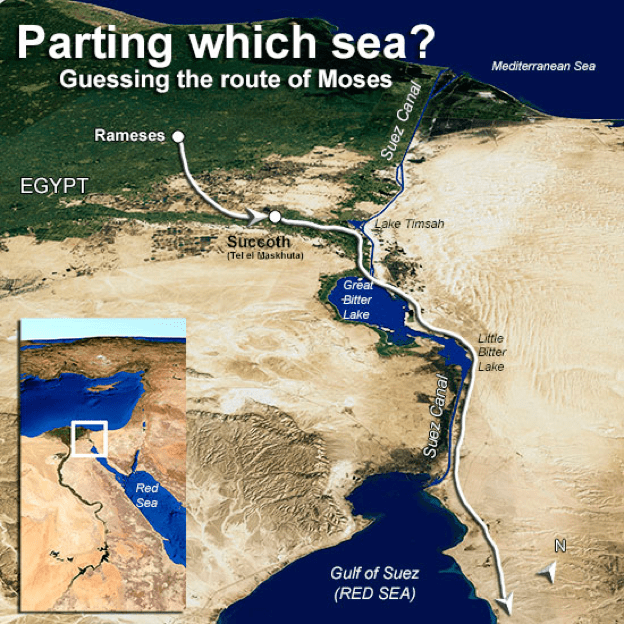
William Tanner in his article, Did Israel Cross the Red Sea? 1998, also categorically argues against a Red Sea crossing: ‘Without any other considerations, the ubiquitous coral reefs eliminate “Red Sea” as a viable rendition… The “Sea of Reeds” is something quite different from “Red Sea.” Neither the Red Sea nor the Gulf of Suez has extensive coverage of salt grass (“reeds”)… the “crossing” was made in a marsh, not in the Red Sea or the Gulf of Suez… There is, in fact, one wide, shallow lake… as well as a few smaller such lakes, on the route of the Exodus. These lakes are now crossed by the Suez Canal. The largest, by far, is Great Bitter Lake; it is about forty kilometers long, north-to-south, and about ten kilometers wide at the widest place. This lake would be an ideal place for a large group of people to cross on their way from Egypt eastward into the Sinai Peninsula to escape a pursuing army…’
This conclusion by Tanner after grudgingly acknowledging the following: ‘The long, narrow water body between Egypt, on the west, and the Sinai Peninsula, on the east, is the Gulf of Suez. Perhaps in ancient times this water body was known by the name of the larger sea with which it was connected, in which case “Red Sea” might be appropriate.’
We shall return to the question of coral, though with regard to reeds and rushes, Regalado explains: ‘The connection of [suph] to the Egyptian twf is one of the crucial arguments for the “Sea of Reeds” hypothesis. It has been believed that [suph] is an Egyptian loanword from the word twf(y), which is translated “papyrus plant,” or “papyrus reeds.” Two texts in the OT recognize this connection. In Exodus 2:3 and Isaiah 19:6, the Hebrew word [suph] is translated “marsh reeds” or “rushes.” However, there is complexity when [suph] in Jonah 2:5 is translated as “seaweeds,” which “suggests the possibility that [suph] is a generic term (‘underwater plant growth’) including both marine and freshwater vegetation.”
Thus as we learned with the definition of cuwph, which refers to ‘water plants’ and the context of Exodus 13:18 is clearly about the Red Sea, then undoubtedly the ‘reeds’ in question are referring to seaweed, which is indicative of… salt water. A sea of weeds would be a neutral and accurate interpretation, without relying on a bias towards freshwater when using a ‘sea of reeds’ or even towards salt water if described as a ‘sea of seaweed’ for instance.
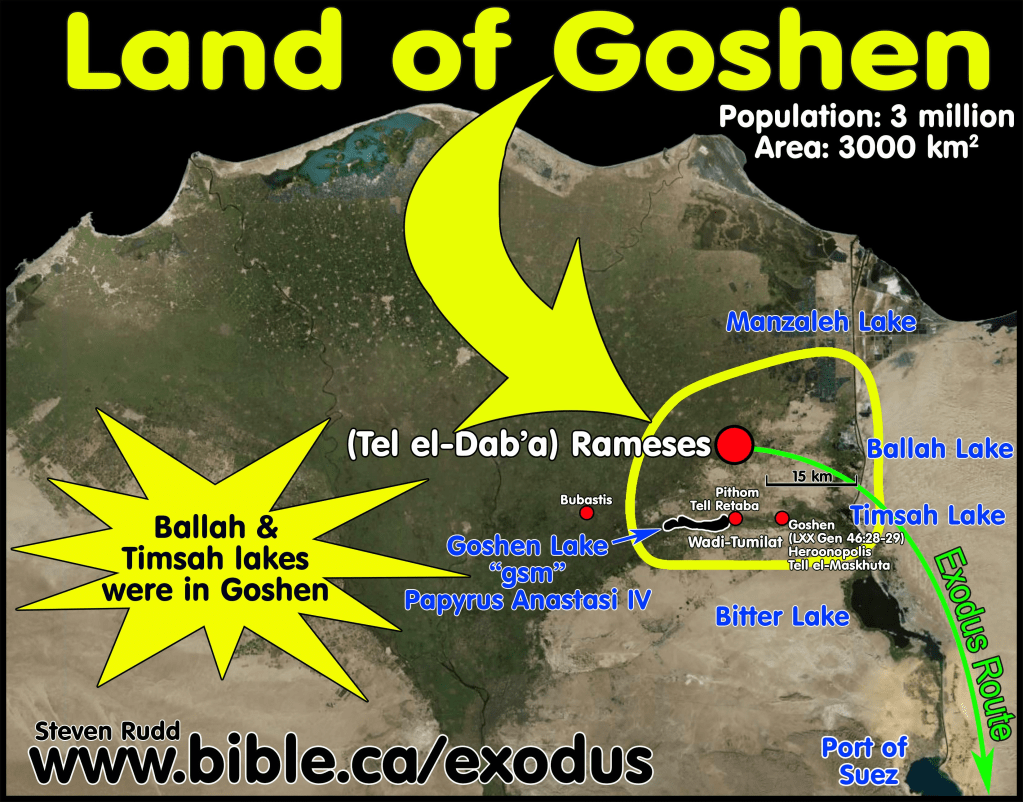
Steve Rudd highlights the unlikelihood that the northern freshwater lakes were the crossing point due to their geographic position inside the land of Goshen. ‘Ballah lake and Timsah lake cannot be the Red Sea crossing site because they are inside the land [of] Goshen. These two freshwater lakes would be an important water supply for the 3 million Hebrews who would occupy the entire area from Tel el-Dab’a to the Suez Canal. The lakes were a major food supply of fish for the [Hebrews] like the Sea of Galilee at the time of Jesus. It is likely therefore, that the entire shoreline was surrounded and occupied by Hebrews. While Ballah lake and Timsah lake are 40 km east of Tel el-Dab’a, both lakes were entirely inside the land of Goshen. Even the Bitter lakes would be used regularly by the Hebrews as a commercial fishing center being only 15 km south of the land of Goshen.’ Besides, the simple fact of the matter is that all the Israelites had to do was walk around any one of these lakes, not through any given one of them.
The attempt by scholars to minimise the miraculous intervention by the Eternal and thereby choose a shallow lake instead of a deep sea crossing has led them into palpable error. Christopher Eames in an article entitled, Where Did the Red Sea Crossing Take Place? 2021, reaches a similar view: ‘… we’ll leave out the minimalist Bitter Lakes theory (as it is, in several points, contrary to the biblical account, and primarily exists to provide explanations for the miraculous events through only natural phenomena – [documentary] Red Sea Miracle did a thorough job in covering this theory)… The Bitter Lakes theory has long been a classic apologists’ version of events, a way to scientifically “explain” the Exodus account.’
The Eternal reveals it wasn’t a fluke of nature when he reminds the Israelites of the Red Sea crossing at the time they entered the promised land under Joshua and He again provides a miracle of dry passage through this time, the River Jordan.
Joshua 4:20-24
English Standard Version
20 ‘And those twelve stones, which they took out of the Jordan, Joshua set up at Gilgal 21 And he said to the people of Israel, “When your children ask their fathers in times to come, ‘What do these stones mean?’ 22 then you shall let your children know, ‘Israel passed over this Jordan on dry ground.’
23 For the Lord your God dried up the waters of the Jordan for you until you passed over, as the Lord your God did to the Red Sea, which he dried up for us until we passed over, 24 so that all the peoples of the earth may know that the hand of the Lord is mighty, that you may fear the Lord your God forever.”
Recall the locusts during the eighth plague which afflicted Egypt. Exodus 10:19, ESV: “And the Lord turned the wind into a very strong west wind, which lifted the locusts and drove them into the Red Sea [in this instance the Gulf of Suez]. Not a single locust was left in all the country of Egypt.” The words for Red Sea are the exact same Hebrew words cuwph and yam. The Locusts were driven eastwards to die in the Red Sea. If one says instead a Reed Sea or a Sea of Reeds, then if not the Red Sea which one of the number of lakes north of the Red Sea is being referred to exactly?
Though the Lakes Theory is debunked in the main, we shall return to it indirectly when analysing the Gulf of Aqaba theories in comparison with the Gulf of Suez theory.
The next step is investigating the encampments of the Israelites prior to the Red Sea crossing. It is worth reminding the constant reader about the second point in the introduction. This is the mechanism whereby original place names are reused by the same peoples when migrating. For instance the descendants of Ham’s son Cush (translated as Ethiopia) dwelt in Eastern Africa, south of upper Egypt. Later, their name is associated with the Horn of Africa and again after that in the southwestern tip of the Arabian Peninsula. They continued migrating eastwards and now comprise the peoples of the Indian sub-Continent – Chapter XIII India & Pakistan: Cush & Phut.
This appears to be a concept many historians, researchers and scholars find difficult to grasp, yet its reality remains fundamental. Now, in our journey to locate the stops of the walking Israelites, a pitfall would be to choose a location with the same name in an entirely different region to the one enumerated in the scriptures. This point cannot be underlined enough and is pivotal in examining the Israelites path to the Red Sea and then the onward journey to Mount Sinai. The reader will not be surprised to learn that the debate on these locations is even more intense and varied than about which sea was crossed. Luckily, there are logistical factors which support a definitive conclusion for the camp locations which otherwise could be possibly argued ad infinitum.
Eames confirms: ‘… as with the identity of the Red Sea, there is even more debate surrounding the separate identities of the stations of the Exodus on the way to the crossing – Succoth, Etham, Pi-hahiroth, Migdol, Baal-zephon, etc. There are all manner of different locations identified as “proof” of different crossing points related to the Bitter Lakes, Gulf of Suez and the Gulf of Aqaba.’ Biblical researcher Steve Rudd adds: “We only know with certainty, three of the nearly 50 places listed in the exodus between Egypt and the Jordan 40 years later. Rameses (Goshen), Ezion-Geber (modern Elat) and Mt. Nemo [in the land of Moab and Ammon]… only the starting, midway and ending cities. Nothing in between is known for certain.”
Returning to the Exodus trek, the Israelites departed from Goshen and camped first at Succoth and then at Etham on ‘the edge of the wilderness.’
Exodus 14:1-30
English Standard Version
1 ‘Then the Lord said to Moses, 2 “Tell the people of Israel to turn back and encamp in front of Pi–hahiroth [3], between Migdol and the sea, in front of Baal-zephon; you shall encamp facing it, by the sea. 3 For Pharaoh will say of the people of Israel, ‘They are wandering in the land; the wilderness has shut them in.’ 4 And I will harden Pharaoh’s heart, and he will pursue them, and I will get glory over Pharaoh and all his host, and the Egyptians shall know that I am the Lord.” And they did so.’
We learn that the wilderness acted as a border fencing or boxing the Israelites in. Coupled with this, the Red Sea was an additional obstacle in their path away from Egyptian reach. Thus for the Israelites to be hemmed in, with crossing the Red Sea the only way to escape Pharaoh Neferhotep I, there must have been other factors such as a city or garrison. The Israelites had been travelling in an eastward direction, possibly southeasterly.
They were advised to double back on themselves from Etham (located at the wilderness) and arrived at Pi-Hahiroth, which was positioned between Migdol and the sea as well as Baal-zephon which was further back behind them towards the west. Verse nine says: “… encamped at the sea, by Pi-hahiroth, in front of Baal-zephon” and Numbers 33:7, ESV: “And they set out from Etham and turned back to Pi-hahiroth, which is east of Baal-zephon, and they camped before Migdol.”
It would appear that Migdol and Baal-zephon were also road blocks. A quadrangular hemming in, by Migdol to the East, Baal-zephon to the West, the wilderness to the North and the Red Sea to the South confronted the Israelites, when they were camped at Pi-Hahiroth. Baal-zephon from H1189 means ‘lord of the north’ and in the sense of cold, ‘Baal of winter.’ This was a Canaanite god ‘adopted by the Egyptians into their [own] pantheon of gods. Perhaps the Egyptians built a temple or city in his honour in the north, where he originally came from.’ It is also associated with Typhon, the destroyer. An interesting coincidence with the tenth plague and the destroying death angel. The significance of this definition is the fact it is located in a northerly position.

It is thus difficult to reconcile its position with the southern end of either the Gulf of Suez or the Gulf of Aqaba as crossing points. In turn, the northerly situation of the Gulf of Suez is more viable than that of the Gulf of Aqaba.
Migdol in Hebrew stems from H4024, Migdowl and means, ‘tower’ and is recognised as a fortified structure on the far extremity of the Egyptian border. This is also significant, for Migdol had to be geographically near Egypt. It could not have been adjacent to the northern Gulf of Aqaba for instance, which was associated with Edom.
Nor present at the much favoured proposed Nuweiba beach crossing point which ‘was a very unlikely location for a military watchtower.’ Thus so far to the east, Migdol could not in any conscience, be described as an Egyptian border garrison town or fort.
Pi-Hahiroth from H6367 means, ‘place where sedge grows.’ Sedge is ‘a grasslike plant with triangular stems and inconspicuous flowers, growing typically in wet ground.’ The root words possess the following interesting definitions: ‘mouth of the gorges’ and a ‘mouth’ or ‘opening’ such as ‘of a well’ or ‘river.’ A gorge is ‘a narrow cleft with steep rocky walls, especially one through which a stream runs’ or ‘a small canyon.’ It can also be translated as ‘edge’ or ‘end’. Considering this was the Israelites third and final camp before crossing the Red Sea, the definitions are more than coincidental. Regalado adds: ‘Pi-hahiroth literally means “mouth of the canal,” taken from the Hebrew stem h-r-t, which means “to incise, engrave, carve, cut into.”
A crossing at the southern end of either Gulf or a crossing at the northern end of the Gulf of Aqaba are tenuous. The credentials for a Red Sea crossing at the northern end of the Gulf of Suez are more convincing. Further investigation into the route taken and subsequent encampments after crossing the Red Sea only serve to underscore the validity of this proposed route; while exposing the weakness of the other theories.

As the Israelites journeyed eastwards, it would have made obvious sense to have circumnavigated around the Gulf of Suez, south of the lakes and into the northern wilderness of the Sinai Peninsula = blue line. Yet, the Eternal told Moses and the Israelites to turn back to Pi-hahiroth, thereby trapping them and forcing a crossing in the vicinity of the northern end of the western tongue of the Red Sea, the Gulf of Suez = red line.
It was after the Israelites crossed the Red Sea that they entered the wilderness of Etham – Numbers 33:8. Not to be confused with the city of the same name on the ‘edge of the wilderness [of Etham]’ where they had camped – Numbers 33:6. Exodus 13:18 says they were heading in the direction of the wilderness of Etham in Sinai.
Judges 11:16 ESV, appears to contradict, where it says: “but when they came up from Egypt, Israel went through the wilderness to the Red Sea and came to Kadesh-[Barnea].” Kadesh was located towards the end of the Israelites forty year sojourn and was near the territory of Edom – Numbers 33:36-37. This verse in Judges is a summary verse. The Israelites passed through a number of wildernesses; though the first one was the wilderness of Etham prior to their camping near the Red Sea again after Elim – Numbers 33:8-10.
While addressing this subject, it is worth noting that some researchers who maintain the original Mount Sinai was not in the Sinai Peninsula endeavour to equate this first wilderness encountered by the Israelites – the Wilderness of Etham – as an extension of Egypt to include the whole Sinai Peninsula. Isaiah 21:1 is used in support, though this verse refers to the Negev (or Negeb), an area above Sinai’s top northeastern corner and not the same as the ‘wilderness of the sea’ in the same verse. Which may well refer to the Red Sea comprising the western and eastern horns which surround each side of the Sinai Peninsula, shaped like an inverted triangle or the letter V.
Psalm 106:22 ESV: “… wondrous works in the land of Ham, and awesome deeds by the Red Sea.” The Land of Ham refers to Egypt and not the Sinai Peninsula. Similarly, the Red Sea is distinct and separate from the land of Ham. Ezekiel 20:36 ESV: “As I entered into judgment with your fathers in the wilderness of the land of Egypt, so I will enter into judgment with you, declares the Lord God.” There are numerous verses which speak specifically of the Wilderness of Sinai, for instance in Numbers 1:1; whether this verse in Ezekiel is a reference to another wilderness or not is open to interpretation.
Exodus: 5 ‘When the king of Egypt was told that the people had fled, the mind of Pharaoh and his servants was changed toward the people, and they said, “What is this we have done, that we have let Israel go from serving us?” 6 So he made ready his chariot and took his army with him, 7 and took six hundred chosen chariots and all the other chariots of Egypt with officers over all of them. 8 And the Lord hardened the heart of Pharaoh king of Egypt, and he pursued the people of Israel while the people of Israel were going out defiantly. 9 The Egyptians pursued them, all Pharaoh’s horses and chariots and his horsemen and his army, and overtook them encamped at the sea, by Pi-hahiroth, in front of Baal-zephon.
10 When Pharaoh drew near, the people of Israel lifted up their eyes, and behold, the Egyptians were marching after them, and they feared greatly. And the people of Israel cried out to the Lord. 11 They said to Moses, “Is it because there are no graves in Egypt that you have taken us away to die in the wilderness? What have you done to us in bringing us out of Egypt? 12 Is not this what we said to you in Egypt: ‘Leave us alone that we may serve the Egyptians?’ For it would have been better for us to serve the Egyptians than to die in the wilderness.”
13 And Moses said to the people, “Fear not, stand firm, and see the salvation of the Lord, which he will work for you today. For the Egyptians whom you see today, you shall never see again. 14 The Lord will fight for you, and you have only to be silent.” 15 The Lord said to Moses, “Why do you cry to me? Tell the people of Israel to go forward. 16 Lift up your staff, and stretch out your hand over the sea and divide it, that the people of Israel may go through the sea on dry ground.’
Moses spent too much time speaking to Israel, while the Eternal playfully told Moses to stop pontificating and procrastinating and rather get on with the miracle at hand.
Even after the horrific calamities which had befallen the Egyptian nation and enduring the horrendous loss of life, Pharaoh Neferhotep I and his advisors experienced a rapid change of heart in the cold light of day, realising their cash cow comprising hundreds of thousands of slaves had just walked out with much of their personal wealth. It is clear that they wasted no time in chasing down the Israelites shortly after their departure, so that it was a matter of days and not weeks when they overtook them at Pi-hahiroth. This fits a Red Sea crossing at the Gulf of Suez, though does not for the Gulf of Aqaba as shall be demonstrated.
The Israelites were to be known and described by the Eternal as an ‘obstinate and stiff-necked people.’ They were also inveterate ‘grumblers and quarrellers’ – Exodus 16:2; 17:2; 32:9; 33:5; Isaiah 48:4. The deeply converted Moses had a monumental task in shepherding so many unconverted, ungrateful and faithless people. It is no wonder he was reticent in accepting the mission given him by the Eternal – Exodus 3:11-13; 4:10-17. Which included claiming he was not eloquent and slow of speech. But this was not true as there are examples of Moses speaking powerfully – Numbers 14:13–19. The Eternal said he would guide Moses mouth and words, but the real issue was that Moses did not want the mission presented to him. Asking for someone else to do it instead.
‘But Moses said to God, “Who am I that I should go to Pharaoh and bring the children of Israel out of Egypt?” – Exodus 3:11, ESV – and ‘… he said, “Oh, my Lord, please send someone else” – Exodus 4:13, ESV. This attitude stemmed from a good heart (Isaiah 66:2), for Moses “… was very meek [or humble], more than all [the] people who were on the face of the earth” – Numbers 12:3, ESV.
When the Eternal was angry with the Israelites He spoke to Moses: “I will strike them with the pestilence and disinherit them, and I will make of you a nation greater and mightier than they” – Number 14:12, ESV. But Moses rejected this offer and asked for His forgiveness towards the Israelites. The Eternal replied: “I have pardoned, according to your word” – Numbers 14:20, ESV. The Eternal acquiesced and listened to Moses who “… the Lord used to speak to… face to face, as a man speaks to his friend. Not many people in the scriptures are called God’s friend – John 5:46. Moses’ genuine love for the Israelites was demonstrated by “… choosing rather to be mistreated with the people of God than to enjoy the fleeting pleasures of sin” – Hebrews 11:25, ESV.
Two things Moses did which he undoubtedly regretted deeply in his life were his slaying of an Egyptian guard (Exodus 2:11–12) and later his defying the Eternal’s instructions at Meribah. For the people were without water and Moses was told to raise his staff and command a huge rock to yield a hidden spring. Instead he let the peoples grumbling get to him and in anger he struck the rock with his staff twice.
An important lesson is that the Eternal upheld Moses’s authority in front of the people and performed a miracle regardless. Yet Moses, the tremendous individual he was, was still punished for disobeying and detracting from the Eternal’s power and mercy and so did not lead the Israelites into Canaan which was given to Joshua instead.
While these two examples could be seen as failures, Moses did not really have any short comings that we are made aware of. Moses was a type of Christ, in that he served in a messianic role, as both deliverer of Israel from Egypt and the symbolism of their bondage to sin – Exodus 3:9-10, Hebrews 3:1-5 – and also as a lawgiver (Malachi 4:4).
Moses’ unique stature is highlighted when the Devil and the archangel Michael disputed over Moses’ dead body in Jude 1:9. What this means exactly, is open to conjecture. Moses was also transfigured with none other than Elijah and Christ – Matthew 17:3. There are many examples of outstanding men and women in the Bible, though considering the massive burden of leading some three million or more men, women and children for four decades, catapults Moses into an extraordinary category of humans – Deuteronomy 18:15, Acts 3:22.
There is a twin aspect to the crossing; the physical crossing point and the spiritual nature of its occurrence.
The act of walking across had to be feasible from a distance; altitude; and an ease of tread underfoot perspective. Therefore, realistic crossing points are limited and though the northern lakes are attractive to those scholars who deny supernatural intervention and seek to explain via purely natural happenstance, their geography precludes them from a serious discussion as has been highlighted. Thus we are left with three main options and they include Nuweiba beach almost at the centre of the Aqaba finger; a crossing at the southern tip of the Gulf of Aqaba at the Straits of Tiran; and across the northern end of the Gulf of Suez. Interestingly, the third option being the traditional teaching.
It is important to remind the reader that either one of these three potential crossing points would have been shorter than they are today, as land gradually erodes and shorelines recede. Three thousand, four hundred and seventy-one years have passed from that fateful day and so it would be naive to ignore the changes to the Sinai Peninsula’s coastline in that time. On this question William Tanner says that the crossing had to be one without rocky cliffs, coral reefs or a rough bottom so that the Egyptian charioteers could cross in pursuit. Nor could the channel be too wide or deep for a huge crowd to cross during the course of one night. Steve Rudd adds that a crossing in one of the shallow lakes ‘where wind merely blew the water away, creates a problem for how the Egyptian army would be drowned.’ Tanner confirms that the actual Red Sea south of the two forks or tongues of the respective gulfs was too wide and deep to cross on foot.
‘Without any other considerations, the ubiquitous coral reefs eliminate [the] “Red Sea” as a viable rendition. The Red Sea is 180 to 300 kilometers wide, and the long narrow trough, the deepest part, is 1,200 to 2,600 meters below the water surface. We may choose to believe that the crossing was made at the narrowest point, along the shallowest bottom (although these two requirements are not compatible). One recorded depth along the axial line is a bit more than 1,200 meters, or 4,000 feet.
… the path [to the sea would have been]… nearly 220 kilometers (about 140 miles). The trip from their homes to the edge of the sea, a similar or somewhat longer distance, required four to six weeks. The Gulf of Suez is only about 25 to 30 kilometers wide, and up to two hundred* meters deep (666 feet). If the terrain were not too rough, ten hours might be enough for the crossing.’

Recall the two columns found in Saudi Arabia and Nuweiba forty miles south of Eilat in Israel. These were purportedly erected by King Solomon and would solve the question of the exact crossing point if they were a legitimate testimony of the event. Many researchers favour this option due to the seemingly favourable position of Nuweiba for it is a ‘large, flat and sandy’ beach. Yet the time to arrive there from Goshen strains the viability of it being the actual crossing site. The distance across today is ‘10.5 miles or 16.9 km’ with a ‘gradual grade going down to 2,500 feet [762 m] below sea level.’ One researcher states: “Just north or south of this area, there are deep impassible ravines on the ocean floor. The Nuweiba Beach location is the only place on the Aqaba finger of the Red Sea that would have allowed the Israelites to cross.”
The main proponent of an alternative Aqaba crossing situated at the southern end of the Gulf, disagrees and provides extensive material against a crossing at Nuweiba. Researcher Steve Rudd has complied an almost inexhaustible array of articles on the subject and states:
‘Israel passed by the Red Sea camp to Etham and hit a dead end then backtracked, retracing their steps to the final Red Sea camp where they waited for Pharaoh. The Hebrew word used for “turn back” is the same one used when the waters of the Red Sea “returned” and drowned the Egyptians. It is also the common word for “repentance” in Isaiah. The Nuweiba route fails because at Etham it merely changes course by making a right-hand turn to reach the Gulf of Aqaba at the Nuweiba beach four days away.’
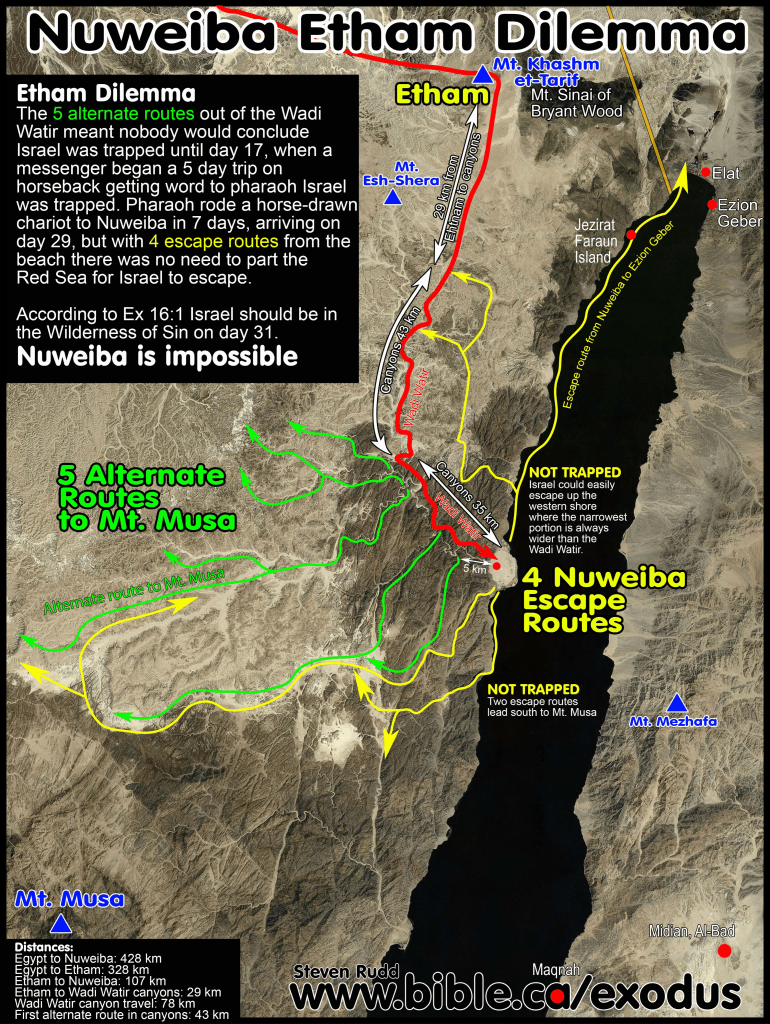
Rudd makes a number of observations about Nuweiba and the Straits of Tiran. The Gulf of Aqaba is a deep channel of water which ranges from 800 to 1,800 metres in the middle. He claims the Straits of Tiran is 18km long and has a natural land bridge. ‘The Straits of Tiran have a shallow coral reef in the middle with a one way shipping lane on either side. From modern nautical charts, we can see that the eastern “Enterprise Passage” [on the west side of Gordon Reef] is 205* meters deep and [is] 800 meters wide [with a] pathway the full distance of the crossing and the western “Grafton Passage” is only 70 meters deep… A diver need go only 13 meters at [the] deepest point on top of Jackson’s Reef from the surface.’
Rudd concedes that we have no way of knowing what the sea floor was like three thousand, five hundred years ago and the extent of coral as a hindrance or how it has grown since. Regarding the location of the beach at Nuweiba, it is ‘in the middle of a mountain range making it difficult to access for the Israelites. It doesn’t have easy continuous access back to Goshen like the Straits of Tiran offer. It does too good a job at “shutting them up in the wilderness” since there is a very narrow and long canyon through the mountains they needed to cross to even get to the shore at Neweiba. Neweiba is therefore a distant second choice to the Straits of Tiran for the location of the Red Sea crossing.’
The easier passage Rudd alludes is the exact same route the Israelites would have walked after crossing the Red Sea into the Sinai Peninsula and heading southeast parallel with the Gulf of Suez to Mount Sinai, also known as Jabal Mousa with a height of 2,285 metres (7,496 ft). It is a prominent peak and sits beside Mount Catherine, the highest mountain in Egypt today (2,629 m).
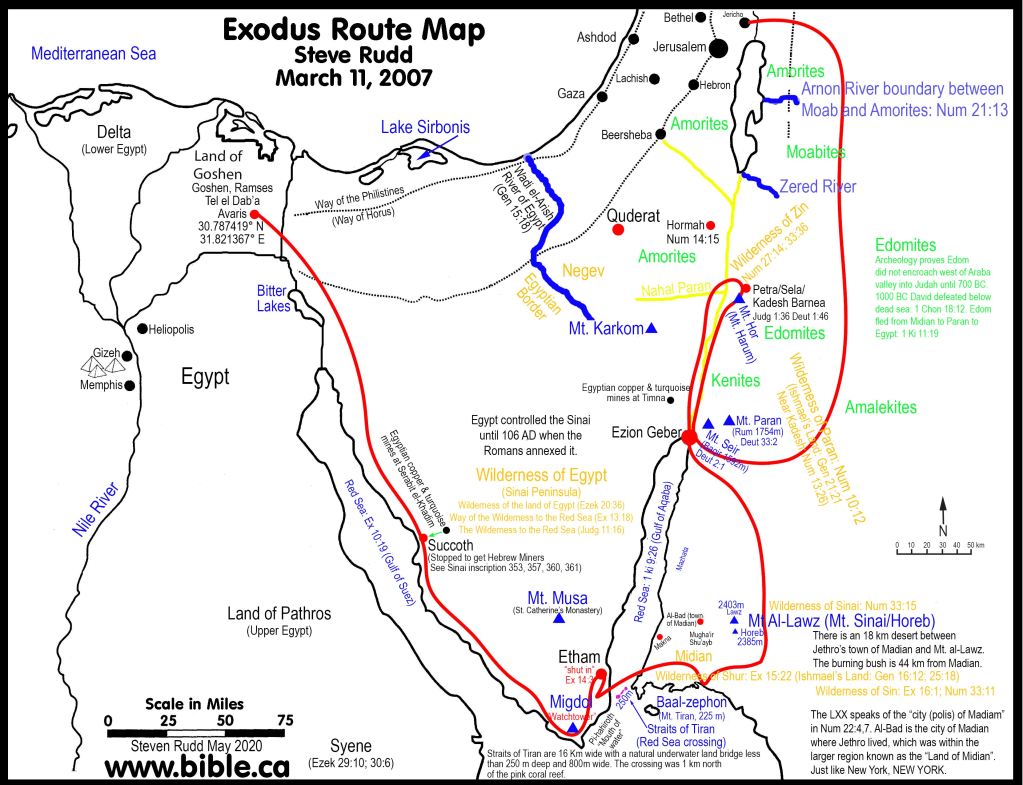
Continuing with the Nuweiba Crossing, Rudd writes: ‘Glen Fritz is a Doctor of Philosophy in Environmental Geography and is the only proponent of the Nuweiba crossing who has done serious, detailed and scholarly work to support this location for the Red Sea crossing. His Ph.D. Doctoral Dissertation in 2006 was called, “The Lost Sea of the Exodus”. He turned his PhD dissertation into a book of the same title in 2007… [publishing] the second edition of “Lost Sea of the Exodus” in 2016… Fritz’s other book “The Exodus Mysteries” (2019 AD) focuses on the geography, geology and archaeology of north Saudi Arabia in support of Lawz being Sinai. Fritz correctly admits no archaeological evidence dating to the time of Moses has been found in Saudi Arabia or anywhere near Mt. Lawz or Mt. Maqla.’
Steve Rudd presents a comparison table between Tiran and Nuweiba and while the credentials of a Tiran crossing remain tentatively open, the difficulties of a sojourn to Nuweiba and the unlikelihood of a crossing at its beach are clearly evident.
“Tiran [versus] Nuweiba route comparison…”
| Terrain Difficulty Heuristic (TDH) Comparison of Tiran vs. Nuweiba Red Sea Crossings | ||
| Tiran: Rudd | Nuweiba: Fritz | |
| Goshen to Sinai | 47 days 420 miles/700 km | 64 days 555 miles/888 km |
| Goshen to Red Sea | 294 miles/490 km | 272 miles/ 436 km |
| Red Sea Crossing | 10 miles/16 km | 10 miles/16 km |
| Red Sea to Sinai | 120 miles/200 km | 273 miles/ 436 km |
| Total narrow canyon travel | 18 miles/23 km | 171 miles/273 km |
| % of narrow canyon travel | 3% (23/700 km) | 31% (273/888 km) |
| % distance difference | Nuweiba is 25% longer in distance than Tiran (700/888 km) | |
Rudd elaborates : ‘The Tiran Route is shorter, faster, and easier than Nuweiba, reaches the Wilderness of Sin on day 31 and Mt. Sinai on day 47. Compared to the Tiran Route, Nuweiba is 25% longer in distance, 18 days longer in time and 400% more difficult.” It is his opinion that the “Red Sea crossing itself [was] much easier [if at the]… Tiran crossing compared to… [a] Nuweiba crossing. While the distance is the same at 16 km and the slopes are comparable, the Nuweiba underwater land bridge is more than 3 times deeper than at the Straits of Tiran. It takes three times the human energy to transit at Nuweiba as it does at Tiran.’
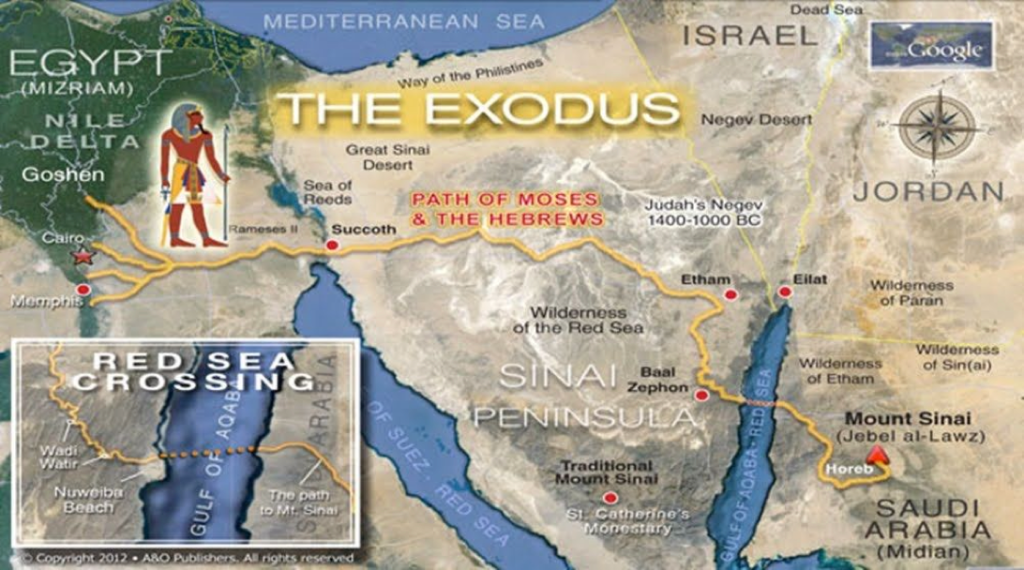
Though Jewish historian Josephus is interesting, his accuracy can be doubtful at times, with a biased agenda a possible explanation. Regarding the Exodus he records:
‘Another reason for this was that God had commanded [Moses] to bring the people to Mount Sinai, that there they might offer him sacrifices. Now when the Egyptians had overtaken the Hebrews, they prepared to fight them, and by their multitude they drove them into a narrow place; for the number that pursued after them was six hundred chariots, with fifty thousand horsemen, and two hundred thousand footmen, all armed. They also seized on the passages by which they imagined the Hebrews might fly, shutting them up between inaccessible precipices and the sea; for there was (on each side) a (ridge of) mountains that terminated at the sea, which were impassable by reason of their roughness, and obstructed their flight; wherefore they were pressed upon the Hebrews with their army, where (the ridges of) the mountains were closed with the sea; which army they placed at the chops of the mountains, that so they might deprive them of any passage into the plain’ – Josephus Antiquities 2.324.
Translators have added the words in (brackets). The description of mountains does not fit the geography of the Bitter Lakes or the other northern lakes, partially for a Gulf of Suez crossing, while more applicable for Aqaba. The size of Pharaoh Neferhotep’s army is both considerable and formidable – Exodus 14:7-9. ‘A chariot team was generally composed of the driver holding a whip and the reigns, the archer (who often carried spears to use when his arrows were spent) and a number of chariot runners who flanked the chariot.’
It would seem that with the addition of foot soldiers, the chariots would have been slowed down in their pursuit. Even so, soldiers would have walked faster than the fleeing Israelites and so a crossing at either Tiran or Nuweiba is unlikely. For the Egyptian army would have overtaken them much sooner than at each of these two crossing points so far from Goshen. As stated, Pharaoh’s army left Egypt in haste after the Israelites departure and therefore logically they caught up with them in a matter of days and not weeks – Exodus 14:5-6, 9.
Josephus adds a specific detail in that pharaoh’s army split into different divisions to block all available escape routes available to the Israelite encampment by the Red Sea. If true, it effectively rules out Nuweiba beach, as its location would mean his army would have had to split much earlier on route to be able to approach from the North, south or west and lay in wait. Whereas the Bible in Exodus chapter fourteen relates ‘all Pharaoh’s horse and chariots and his horsemen and his army’ overtook the Israelites.
One researcher who’s material resonates with this writer is Christopher Eames. He proposes a traditional route and crossing point for the fleeing Israelites in his article, Where Did the Red Sea Crossing Take Place? In so doing, his arguments against an Aqaba crossing of any type are soundly convincing. With regard to the debated phrase the Red Sea, Eames states – emphasis his:
‘Yet in modern Hebrew, Yam Suph indeed refers to the entire general Red Sea, including both gulfs (merely “tongues” of the wider Red Sea – see Isaiah 11:15-16). The New Testament Greek for the crossing site, Erethran Thalassan, likewise is used in antiquity to refer to the entire Red Sea. Why should the original title Yam Suph be any different? Clearly, as it does today, the biblical Yam Suph did refer to more than “just” the Gulf of Aqaba. 1 Kings 9:26 does not preclude the Gulf of Suez.
In fact, 1 Kings 9:26 is some of the best evidence against a Gulf of Aqaba crossing. That’s because the wording used in the second-century b.c.e. Greek Septuagint Bible is different – the name for this Gulf of Aqaba body does have a distinction from the name used in all 22 biblical references to the sea that the Israelites crossed! The Septuagint calls this Gulf of Aqaba sea in 1 Kings 9:26 Eschates Thalasses. The body of water in which the Israelites crossed, however (including the name of the sea in which the locusts were drowned!), is always referred to in the Septuagint (as well as in the New Testament) by the name Erythran Thalassan. Thus, it becomes clear that the 2,300-year-old Jewish community, from which the Septuagint emerged, recognized this Gulf of Aqaba as distinct and different to the actual sea that the Israelites crossed!’
Eames, notes reconciling the Red Sea crossing of the Israelites anywhere other than the northern end of the Gulf of Suez is problematic – emphasis his:
‘Numbers 33 describes the “stations” of the Exodus. Verse 8 describes the Israelites crossing the Red Sea, and proceeding for three days into the wilderness of Etham, within which they camped at Marah, and then on to Elim (verse 9). Yet verse 10 has the Israelites arriving, again – before they reach Mount Sinai – at the Red Sea! How to explain this? But this fits perfectly with an initial crossing of the northern end of the Gulf of Suez, with the Israelites then following down south more or less along the direction of the coast toward Mount Sinai, in the southern part of the peninsula. It does not fit logically with a crossing at the Gulf of Aqaba, followed by a journey due east into the desert toward Saudi Arabia’s al-Lawz.’
Exodus: 17 “And I will harden the hearts of the Egyptians so that they shall go in after them, and I will get glory over Pharaoh and all his host, his chariots, and his horsemen. 18 And the Egyptians shall know that I am the Lord, when I have gotten glory over Pharaoh, his chariots, and his horsemen.”
19 Then the angel of God who was going before the host of Israel moved and went behind them, and the pillar of cloud moved from before them and stood behind them, 20 coming between the host of Egypt and the host of Israel. And there was the cloud and the darkness. And it lit up the night without one coming near the other all night.
21 Then Moses stretched out his hand over the sea, and the Lord drove the sea back by a strong east wind all night and made the sea dry land, and the waters were divided.

22 And the people of Israel went into the midst of the sea on dry ground, the waters being a wall to them on their right hand and on their left.’
We are told in Exodus chapter fourteen, verses twenty and twenty-seven that the Israelites took between eight to twelve hours to cross, for it was after sunset when the waters were divided and it was sunrise when the separated waters returned upon each other. So let’s approximate ten hours. This highlights the large number of people crossing, while the distance traversed is open to question. The supernatural pillar of cloud by day moved between the Israelites and Egyptians to bar them from attacking, while emitting a bright light as a pillar of fire during the ensuing darkness of nightfall.
The wind dried the sea bed for a safe crossing. The Hebrew word for wind is H7037, ruwach and though it is translated as a wind ninety-two times, it is more commonly defined as a spirit 232 times. The word derives from H7306 which means to ‘blow or breathe’. Ruwach can also mean ‘breath [of air]’ or ‘energy’. As it can be ‘manifest in the Shekinah glory’ there is undoubtedly a preternatural explanation for dividing the water into walls each side which were high enough to come crashing down in a rain of death. Shekinah: ‘a visible manifestation of God on earth, whose presence is portrayed through a natural occurrence’.
This should not be a surprise or difficult to comprehend when the evidence for this is associated with the presence of the Angel of God, the pillar of cloud and fire; and the recent memory of the passing of the Angel of Death a few nights previously on the Passover – Exodus 12:12, 23; 13:21-22.
Those scholars and researchers who deem themselves wise, trapped in a paradigm of denial and disbelief are required to concoct an alternative ‘rational’ explanation – Romans 1:18-32, 1 Corinthians 3:18, 2 Corinthians 10:12. Hence a shallow lake or river affected by a natural phenomena is the stock answer. Two different theories in support of this line of reasoning include super-elevation, in shallow water; and wind setdown, in deep water.
Did Israel Cross the Red Sea? 1998, William F Tanner:
‘This phenomenon is well known today as super-elevation, but it has physical limits. Super-elevation, caused by the wind blowing steadily and strongly for hours, can drive much of the water out of a very shallow basin. The height of super-elevation (from one side of the basin to the other) may be one to two or so meters. However, it is not a reasonable mechanism for water one hundred meters deep, or one thousand meters deep, and, therefore, is not applicable to either the Gulf of Suez, or to the Red Sea. And since the historical text is very clear about what happened, the reader is not entitled to use a “miraculous augmentation.” Thus, the reader should be careful to distinguish between (1) a supernatural mechanism (which requires no rational physical limitations or causes, and therefore cannot even be discussed in any detail within a rational framework), and (2) a supernatural cause for the timing of a natural mechanism. The writer of Exodus clearly chose the latter. Such a shallow basin is precisely what is needed to have a “Sea of Reeds.”
Map of Israel’s crossing of the Red Sea at Ras el Ballah, “Cape Ballah” (Baal-Zephon?) or Qantara and Lake Menzaleh? 2009 – emphasis mine:
‘Professor Humphreys (2004) sought to explain the drying up the Red Sea via physcial phenomena. He argued that “wind setdown” was the mechanism that created a passage in the sea. He said this worked only on large bodies of water (he noted it being documented at Lake Erie in the United States). Wind setdown “removes” water whereas wind setup “adds” water. He noted some thought the crossing was at the Gulf of Suez. He dismissed this location however because only a wind from the northwest could blow back this gulf’s waters exposing dry land and the Bible said it was an east wind. He then noted that at the Gulf of Aqaba it would take a wind from the northeast to blow black the waters and expose the sea’s bottom.
He favored Aqabah as the crossing point of the Red Sea, despite the fact that an east wind could not blow back the gulf’s waters only a northeast wind could do this. He was apparently unaware of the 1882 report of an east wind blowing back Lake Menzaleh’s waters in this lake’s eastern sector near the mouth of the Suez Canal. This lake is roughly 43 miles in length and 12 miles wide so it is big enough for wind set-down to work (cf. pages 246-252. Colin J. Humphreys. The Miracles of Exodus: A Scientist’s Discovery of the Extraordinary Natural Causes of the Biblical Stories. HarperCollins. 2004)’
It is important to realise that the wind was used to dry the ground. Whether it was instrumental in dividing the water is open to speculation. It was not used to keep the waters on each side apart. The Eternal’s miraculous power held the displaced waters in check. The wind would have ceased and a tranquil calm descended so that the Israelites could cross without a powerful wind with tornado force sucking them into the air or water. The Egyptians lulled into a false sense of security then foolishly followed.

The Israelites walking through the Red Sea has significant baptismal symbolism, which recalls Noah and his family saved in the Ark and also foreshadowed water baptism for new covenant converts. 1 Corinthians 10:1-2, ESV: “For I do not want you to be unaware, brothers, that our fathers were all under the cloud, and all passed through the sea, and all were baptized into Moses in the cloud and in the sea, and all ate the same spiritual food, and all drank the same spiritual drink – Article: The Manna Mystery. For they drank from the spiritual Rock that followed them, and the Rock was Christ. Nevertheless, with most of them God was not pleased, for they were overthrown in the wilderness” – Mark 16:16, Acts 2:38.
Exodus: 23 ‘The Egyptians pursued and went in after them into the midst of the sea, all Pharaoh’s horses, his chariots, and his horsemen. 24 And in the morning* watch the Lord in the pillar of fire and of cloud looked down on the Egyptian forces and threw the Egyptian forces into a panic, 25 clogging their chariot wheels so that they drove heavily. And the Egyptians said, “Let us flee from before Israel, for the Lord fights for them against the Egyptians.”
26 Then the Lord said to Moses, “Stretch out your hand over the sea, that the water may come back upon the Egyptians, upon their chariots, and upon their horsemen.”
27 ‘So Moses stretched out his hand over the sea, and the sea returned to its normal course when the morning appeared [dawn, sunrise*]. And as the Egyptians fled into it, the Lord threw the Egyptians into the midst of the sea. 28 The waters returned and covered the chariots and the horsemen; of all the host of Pharaoh that had followed them into the sea, not one of them remained.
Exodus chapter fifteen is an account of the Red Sea crossing, where it says: “Pharaoh’s chariots and his host he cast into the sea, and his chosen officers were sunk in the Red Sea. The floods covered them; they went down into the depths like a stone. At the blast of your nostrils the waters piled up; the floods stood up in a heap; the deeps congealed in the heart of the sea. The enemy said, ‘I will pursue, I will overtake, I will divide the spoil, my desire shall have its fill of them. I will draw my sword; my hand shall destroy them.’ You blew with your wind; the sea covered them; they sank like lead in the mighty waters.”

The destruction of Pharaoh’s army was utterly catastrophic. Perhaps it was at this time the Red Sea acquired its name from the all the dead and bloodied bodies of the Egyptians.
Exodus: 29 ‘But the people of Israel walked on dry ground through the sea, the waters being a wall to them on their right hand and on their left.’
Isaiah 51:10 ESV: “Was it not you who dried up the sea, the waters of the great deep, who made the depths of the sea a way for the redeemed to pass over?” – Psalm 77:16, 19; 106:9, Isaiah 43:16; 63:13. The shallow lake beds and marshes of the northern lakes east of Goshen were certainly not indicative of the waters of the ‘great deep.’
Exodus: 30 ‘Thus the Lord saved Israel that day from the hand of the Egyptians, and Israel saw the Egyptians dead on the seashore.’
Some Egyptian soldiers washed up on the shore and others wearing heavy armour sank like lead stones. The chariots primarily comprised from wood and iron sank without a trace. The cascading waters acting like two tidal waves, devastatingly swept Pharaoh’s chariots, horses and men in a violent torrent of water with no chance of survival. Nehemiah 9:11, ESV: “… and you cast their pursuers into the depths, as a stone into mighty waters.”
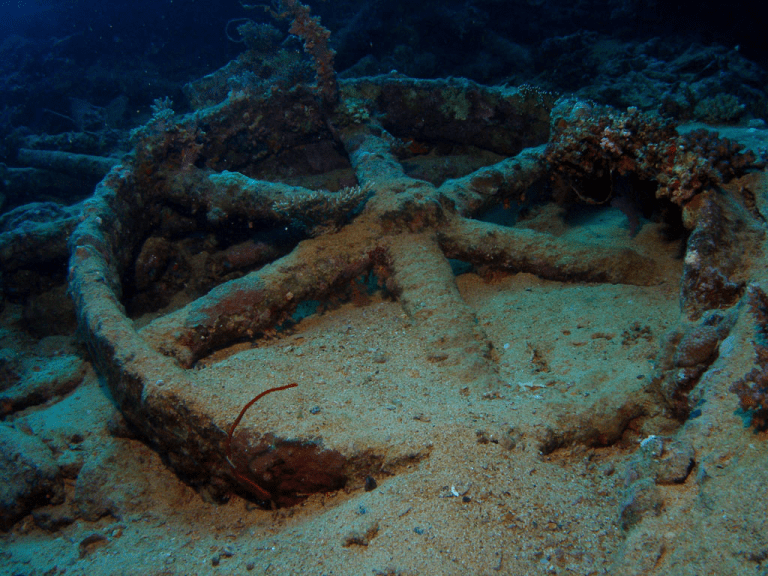
Exodus 15:19, 22-27
English Standard Version
19 ‘For when the horses of Pharaoh with his chariots and his horsemen went into the sea, the Lord brought back the waters of the sea upon them, but the people of Israel walked on dry ground in the midst of the sea.
22 Then Moses made Israel set out from the Red Sea, and they went into the wilderness of Shur. They went three days in the wilderness and found no water.
23 When they came to Marah [4], they could not drink the water of Marah because it was bitter; therefore it was named Marah. 24 And the people grumbled against Moses, saying, “What shall we drink?” 25 And he cried to the Lord, and the Lord showed him a log, and he threw it into the water, and the water became sweet.
There the Lord made for them a statute and a rule, and there he tested them, 26 saying, “If you will diligently listen to the voice of the Lord your God, and do that which is right in his eyes, and give ear to his commandments and keep all his statutes, I will put none of the diseases on you that I put on the Egyptians, for I am the Lord, your healer.”
27 Then they came to Elim [5], where there were twelve springs of water and seventy palm trees, and they encamped there by the water.’
The Israelites when on the west side of the Suez Gulf were on the edge of the Wilderness of Etham, while after the Red Sea crossing on the eastern side of the Suez Gulf it says they travelled through the Wilderness of Shur for three days.
The Book of Numbers records the Israelite itinerary from Rameses, formerly Avaris until their arrival in Canaan. Moses meticulously records each of the fifty principle encampments. Numbers 33:1-2, ESV: “These are the stages of the people of Israel, when they went out of the land of Egypt by their companies under the leadership of Moses and Aaron. Moses wrote down their starting places, stage by stage, by command of the Lord, and these are their stages according to their starting places.”
Numbers 33:8-9
English Standard Version
8 ‘And they set out from before [Pi-]Hahiroth and passed through the midst of the sea into the wilderness, and they went a three days’ journey in the wilderness of Etham and camped at Marah. 9 And they set out from Marah and came to Elim; at Elim there were twelve springs of water and seventy palm trees, and they camped there.’
Here it confusingly calls the wilderness, Etham instead of Shur. Unless of course they are names for two sides (boundaries) for the same wilderness region.
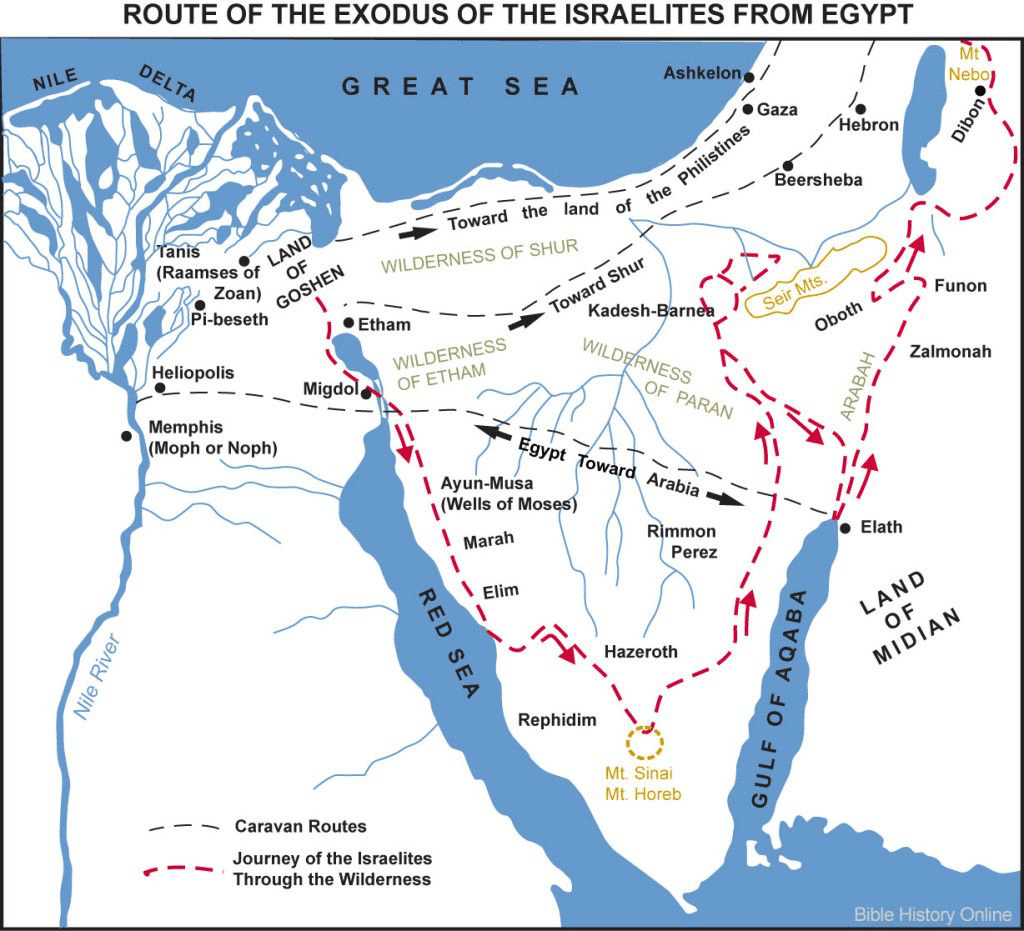
The map above while not wholly accurate is still helpful and shows the general landscape of the Sinai and surrounding area. The route of the Exodus is essentially accurate, though the crossing would have been slightly further south and not through what is now the Suez Canal.
The Wilderness of Shur must have extended further southwards; while the Wilderness of Etham would have been to the west of its position shown on the map and actually south of Goshen. This configuration validates the Israelites crossing from the Wilderness of Etham to that of Shur via the Red Sea.
When Sarah’s handmaid Hagar fled from Hebron where Abraham lived, she headed in the direction of the Wilderness of Shur and was found by the Angel of the Lord between Kadesh and Bered at a well spring named Beer-lahoi-roi – Genesis 16:7, 13-14. Beer-lahoi-roi was where Isaac chose to settle after Abraham’s death – Genesis 25:11. This is significant for two reasons as firstly there is cause to understand that Hagar was a daughter of Pharaoh, with familial roots in Egypt. Heading in that direction is both plausible and understandable – refer Chapter XXVIII The True Identity & Origin of Germans & Austrians – Ishmael & Hagar.

Additionally, her son Ishmael later dwelt in a large territory extending ‘from Havilah to Shur, which is opposite Egypt’ – Genesis 25:18. Havilah was a son of Joktan who dwelt in the western region of the Arabian Peninsula, east of the Gulf of Aqaba. Abraham’s other six sons by his second wife Keturah also dwelt east of the Aqaba Gulf, where the land became known as Midian, as shown on the first map above – Chapter XXIV Arphaxad & Joktan: Balts, Slavs & the Balkans; and Chapter XXVII Abraham & Keturah – Benelux & Scandinavia. The caravan route across Sinai from Egypt to Arabia may have been the direction Moses took in his eventual destination of Midian.
Travelling to Marah and Elim where the Israelites camped, meant heading in a southerly direction parallel to the Gulf of Suez on the Red Sea. While Steve Rudd’s theory is well presented, documented and argued, the Tiran Straits crossing as with Nuweiba beach do not fit the biblical geography of the greater Sinai region.
On the map below, Succoth, Migdol, Pi-hahiroth, Etham, the Wilderness of Shur, Marah, the Wilderness of Sin and Kadesh-Barnea are all out of synchronicity compared with the geo-political layout of the area three thousand, five hundred years ago.

Exodus 16:1-36
English Standard Version
1 ‘They set out from Elim, and all the congregation of the people of Israel came to the wilderness of Sin, which is between Elim and Sinai, on the fifteenth day of the second month after they had departed from the land of Egypt.’
The month following Nisan (or Abib) is Iyar. And so the Israelites had travelled a good three quarters down the Sinai Peninsula, arriving at the Wilderness of Sin thirty days after exiting Egypt – refer article: The Calendar Conspiracy. There is reasonable logic in entertaining the Wilderness of Sin would be located on the Sinai Peninsula and not in Arabia as suggested by Steve Rudd. The Israelites were adept at withholding their patience and trust towards Moses and the Lord. Moses who had stood up to Pharaoh on their behalf and who had exhibited profound faith in the Almighty’s deliverance for them all – the Eternal responding with a sequence of miracles of impressive magnitude. For all this, the Israelites remained selfish and ungrateful. The darker side of human nature, less than beautiful.
Exodus: 2 ‘And the whole congregation of the people of Israel grumbled against Moses and Aaron in the wilderness, 3 and the people of Israel said to them, “Would that we had died by the hand of the Lord in the land of Egypt, when we sat by the meat pots and ate bread to the full, for you have brought us out into this wilderness to kill this whole assembly with hunger.”
Like Esau (Genesis 25:29-30), the Israelites were thinking with their bellies – Chapter XXIX Esau: The Thirteenth tribe.
Exodus: 4 ‘Then the Lord said to Moses, “Behold, I am about to rain bread from heaven for you, and the people shall go out and gather a day’s portion every day, that I may test them, whether they will walk in my law or not [Article: The Manna Mystery]. 5 On the sixth day, when they prepare what they bring in, it will be twice as much as they gather daily.”
6 So Moses and Aaron said to all the people of Israel, “At evening you shall know that it was the Lord who brought you out of the land of Egypt, 7 and in the morning you shall see the glory of the Lord, because he has heard your grumbling against the Lord. For what are we, that you grumble against us?” 8 And Moses said, “When the Lord gives you in the evening meat to eat and in the morning bread to the full, because the Lord has heard your grumbling that you grumble against him – what are we? Your grumbling is not against us but against the Lord.”
9 Then Moses said to Aaron, “Say to the whole congregation of the people of Israel, ‘Come near before the Lord, for he has heard your grumbling.’ 10 And as soon as Aaron spoke to the whole congregation of the people of Israel, they looked toward the wilderness, and behold, the glory of the Lord appeared in the cloud. 11 And the Lord said to Moses, 12 “I have heard the grumbling of the people of Israel. Say to them, ‘At twilight you shall eat meat, and in the morning you shall be filled with bread. Then you shall know that I am the Lord your God.”
13 In the evening quail came up and covered the camp, and in the morning dew lay around the camp. 14 And when the dew had gone up, there was on the face of the wilderness a fine, flake-like thing, fine as frost on the ground. 15 When the people of Israel saw it, they said to one another, “What is it?” For they did not know what it was. And Moses said to them, “It is the bread that the Lord has given you to eat.
16 This is what the Lord has commanded: ‘Gather of it, each one of you, as much as he can eat. You shall each take an omer, according to the number of the persons that each of you has in his tent.” 17 And the people of Israel did so. They gathered, some more, some less. 18 But when they measured it with an omer, whoever gathered much had nothing left over, and whoever gathered little had no lack. Each of them gathered as much as he could eat. 19 And Moses said to them, “Let no one leave any of it over till the morning.” 20 But they did not listen to Moses. Some left part of it till the morning, and it bred worms and stank. And Moses was angry with them. 21 Morning by morning they gathered it, each as much as he could eat; but when the sun grew hot, it melted.
22 On the sixth day they gathered twice as much bread, two omers each. And when all the leaders of the congregation came and told Moses, 23 he said to them, “This is what the Lord has commanded: ‘Tomorrow is a day of solemn rest, a holy Sabbath to the Lord; bake what you will bake and boil what you will boil, and all that is left over lay aside to be kept till the morning’ – Article: The Sabbath Secrecy.
24 ‘So they laid it aside till the morning, as Moses commanded them, and it did not stink, and there were no worms in it. 25 Moses said, “Eat it today, for today is a Sabbath to the Lord; today you will not find it in the field. 26 Six days you shall gather it, but on the seventh day, which is a Sabbath, there will be none.”
27 On the seventh day some of the people went out to gather, but they found none. 28 And the Lord said to Moses, “How long will you refuse to keep my commandments and my laws? 29 See! The Lord has given you the Sabbath; therefore on the sixth day he gives you bread for two days. Remain each of you in his place; let no one go out of his place on the seventh day.” 30 So the people rested on the seventh day.
31 Now the house of Israel called its name manna. It was like coriander seed, white, and the taste of it was like wafers made with honey. 32 Moses said, “This is what the Lord has commanded: ‘Let an omer of it be kept throughout your generations, so that they may see the bread with which I fed you in the wilderness, when I brought you out of the land of Egypt.’ 33 And Moses said to Aaron, “Take a jar, and put an omer of manna in it, and place it before the Lord to be kept throughout your generations.” 34 As the Lord commanded Moses, so Aaron placed it before the testimony to be kept. 35 The people of Israel ate the manna forty years, till they came to a habitable land. They ate the manna till they came to the border of the land of Canaan. 36 (An omer is the tenth part of an ephah.)’
There are a number of salient points contained in this chapter, which we will not address in full as they are outside the scope of this study – refer article: The Manna Mystery. The word manna means ‘what is it.’ A miraculous bread like provision of food which did not keep overnight, yet lasted for two days when it was the sabbath rest every seven days – Article: The Sabbath Secrecy.
Exodus 17:1, 8
English Standard Version
1 ‘All the congregation of the people of Israel moved on from the wilderness of Sin by stages, according to the commandment of the Lord, and camped at Rephidim… 8 Then Amalek came and fought with Israel at Rephidim.’
In Rephidim there was a lack of water to drink. The people quarrelled with Moses to the point that he was afraid for his life. The Amalekites who dwelt near Edom and were a mixture of Nephilim descended Elioud giants and of Esau’s grandson Amalek sought to destroy the fleeing Israelites en route to subjugate a devastated Egypt. They were too strong for the fledgling Israelite army and it required miraculous intervention from the Eternal to provide an against all odds victory. The Amalekites then left Israel alone and continued heading northwest to Egypt – refer Chapter XXIX Esau: The Thirteenth Tribe.
Numbers 33:10-15
English Standard Version
10 ‘And they set out from Elim and camped by the Red Sea [6]. 11 And they set out from the Red Sea and camped in the wilderness of Sin [7]. 12 And they set out from the wilderness of Sin and camped at Dophkah [8]. 13 And they set out from Dophkah and camped at Alush [9]. 14 And they set out from Alush and camped at Rephidim [10], where there was no water for the people to drink. 15 And they set out from Rephidim and camped in the wilderness of Sinai [11].’
Exodus 18:5, 27
English Standard Version
5 ‘Jethro, Moses’ father-in-law, came with his sons and his wife to Moses in the wilderness where he was encamped at the mountain of God… 27 Then Moses let his father-in-law depart, and he went away to his own country.’
After the defeat of their bitter enemies the Amalekites, the people of Israel journeyed on to Mount Sinai. Moses’ father-in-law Jethro, visits from the land of Midian and then returns home. Two paramount points to clarify in this chapter are a. where was the land of Midian; and b. where was Mount Sinai located? Was it in the Midian mountains known as Jabal al-Lawz (mountain of almonds) or was it located in the Sinai, known as Jabal Mousa (Mount Moses)? With regard to the Exodus route, there is no greater debate than where Mount Sinai was located. For wherever the original Mount Sinai is located, dictates whereabouts to the west, the Israelites crossed the Red Sea.
When Jethro leaves Moses and returns to Midian, ‘away to his own country’ it reveals that Mount Sinai was not in Midian. Numbers 10: 30-31, 33, ESV: ‘But [Jethro] said to him, “I will not go. I will depart to my own land and to my kindred.” And [Moses] said, “Please do not leave us, for you know where we should camp in the wilderness, and you will serve as eyes for us… So they set out from the mount of the Lord three days’ journey.’
The land of Midian was located to the east of the Aqaba Gulf. What is interesting is that Paul confirms in Galatians 4:24-25, ESV: “Now this may be interpreted allegorically: these women are two covenants. One is from Mount Sinai, bearing children for slavery; she is Hagar. Now Hagar is Mount Sinai in Arabia, she corresponds to the present Jerusalem, for she is in slavery with her children.”
Most have used these verses to presume that Mount Sinai is in Arabia as in, east of the Aqaba Gulf. The intent of the verse is equating Hagar’s descendants the Ishmaelites with bondage and slavery. Thus they are likened to the Old Covenant ratified at Mount Sinai and with the subjugation of Jerusalem whilst under Roman rule. Yet the Ishmaelites have never lived in Jerusalem or near Mount Sinai. Verse twenty-five is actually showing that Mount Sinai on the peninsula was counted as being part of Arabia and not in Egypt.
Now while Moses did settle in the land of Midian after fleeing from Egypt (Exodus 2:15), it does not follow that Mount Sinai was in Midian, for Exodus 3:1, ESV states: “Now Moses was keeping the flock of his father-in-law, Jethro, the priest of Midian, and he led his flock to the west side of the wilderness and came to Horeb, the mountain of God.” Horeb was another name for Mount Sinai and it was located some distance away on the ‘[western] side of the wilderness’ of Sinai.
Christopher Eames notes: ‘Moses “led the flock to the farthest end of the wilderness, and came to the mountain of God… Other translations read “the backside of the desert” or “rear part of the wilderness.” The Hebrew word means a behind place, a hinder part. This would fit with the location of the traditional Mount Sinai, on the “hinder” end of the Sinai Peninsula.’ It was to be the self same mountain peak which Moses was to return with the Israelites, verse 12: “… But I will be with you… when you have brought the people out of Egypt, you shall serve God on this mountain.”
Exodus 19:1-6, 9-12, 16-17
English Standard Version
1 ‘On the third new moon after the people of Israel had gone out of the land of Egypt, on that day they came into the wilderness of Sinai. 2 They set out from Rephidim and came into the wilderness of Sinai, and they encamped in the wilderness. There Israel encamped before the mountain, 3 while Moses went up to God.
The Lord called to him out of the mountain, saying, “Thus you shall say to the house of Jacob, and tell the people of Israel: 4 ‘You yourselves have seen what I did to the Egyptians, and how I bore you on eagles’ wings and brought you to myself [Revelation 12:6, 14]. 5 Now therefore, if you will indeed obey my voice and keep my covenant, you shall be my treasured possession among all peoples, for all the earth is mine; 6 and you shall be to me a kingdom of priests and a holy nation [1 Peter 2:9].’ These are the words that you shall speak to the people of Israel.” 9 And the Lord said to Moses, “Behold, I am coming to you in a thick cloud, that the people may hear when I speak with you, and may also believe you forever.”
… 10 the Lord said to Moses, “Go to the people and consecrate them today and tomorrow, and let them wash their garments 11 and be ready for the third day. For on the third day the Lord will come down on Mount Sinai in the sight of all the people. 12 And you shall set limits for the people all around, saying, ‘Take care not to go up into the mountain or touch the edge of it. Whoever touches the mountain shall be put to death.’
16 On the morning of the third day there were thunders and lightnings and a thick cloud on the mountain and a very loud trumpet blast, so that all the people in the camp trembled. 17 Then Moses brought the people out of the camp to meet God, and they took their stand at the foot of the mountain.’
The first new moon had occurred on the first day of Nisan (Abib) when the Israelites were still in Egypt. Fourteen days later the Israelites departed Egypt on the full moon of the 15th day. The second new moon would have been the beginning of the second month of Iyar. Recall the Israelites arrived at the Wilderness of Sin on the full moon of the 15th day of Iyar. The third new moon was the first day of the third month, Sivan. This means the Israelites led by Moses and Aaron had been travelling on foot for just on forty-four or forty-five days – article: The Calendar Conspiracy.
The three day count is significant as it prefigures when the messiah would be buried ‘three days and three nights in the heart of the earth’, culminating in his death (Matthew 12:39-40) – refer article: The Sabbath Secrecy.
It also reflects the three days before the Feast of Weeks, which was the next Holy Day instituted after those of Unleavened Bread – Leviticus 23:9-22. In the New Testament it was called Pentecost and means ‘count fifty’, for the observance of the days was reckoned by a fifty day count from the day after the first Holy Day sabbath of Unleavened Bread – Acts 2:1-4. This began on the 16th day of Nisan and so fifty days later would fall in the third month of Sivan.
The giving of the ten commandments to Moses occurred on the Day of Pentecost, on either the 5th, 6th or 7th day of Sivan – depending on a 29 or 30 day month, according to the lunar cycle. It would be one thousand, four hundred and seventy-seven years later when the Holy Spirit was poured out on new believers, heralding the new Covenant during the first Day of Pentecost after Christ’s resurrection.

This means Moses either did not climb Mount Sinai when they arrived on the first day of Sivan, or he took more than a day to reach the top, for the Eternal gave Moses warning for two days of washing and preparation and the third day would signify His presence on the mountain top, coinciding with the Day of Pentecost.
Steve Rudd comments: ‘Seder Olam Rabbah which dates to AD 160 specifically says that the law was given on Sivan 6… the Book of Jubilees which dates to 170 years before Christ says in the opening verse that Moses received the two stone tablets of the Ten Commandments on Sivan 16 or day 62 after leaving Goshen. This corresponds to Moses’ 6th ascension up Mt. Sinai where he spent 40 days (Exodus 24:12-18). All this proves the exodus route from Goshen to Sinai was 47 days. This has devastating consequences for advocates of the Nuweiba Beach Red Sea crossing…’
The debate regarding the Red Sea crossing point has escalated in recent years and as it is intrinsically linked with which Mount Sinai is the correct site we will investigate the matter further. Mount Sinai held considerable historical significance and its veneration with many other peaks in Sinai so named is shown on the map below.
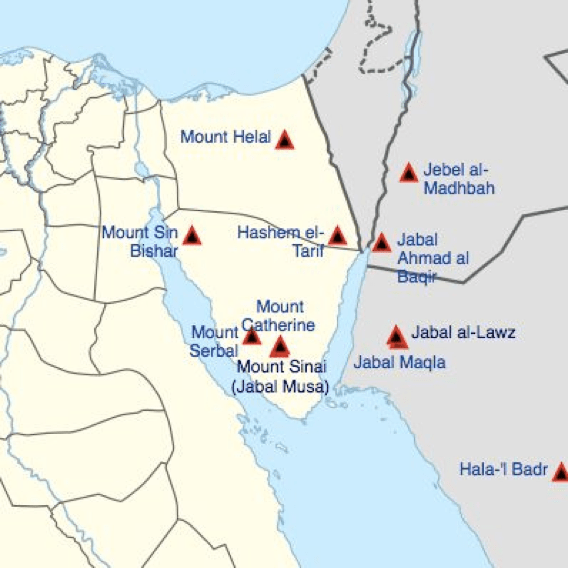
Most are immediately ruled out of contention due a northerly location and while Jabal al-Lawz (or Jabal Maqla [burnt mountain]) has gained popularity as an alternative site, it falls outside of the Sinai Peninsula. The term Sinai has been one and the same with the Sinai Peninsula as early as 2000 BCE, well prior to the events of the Exodus. Eames quotes, ‘this “supports the orthodoxy … (of locating) biblical ‘Mount Sinai’ in the southern parts of the Sinai Peninsula, be it Gebel Musa or any other nearby peak” – The Earliest Mention of the Place name Sinai: The Journeys of Khety, Egyptologist Julien Cooper, ASOR, 2023.’
Other considerations are the fact that the Sinai was a region where Egyptian criminals were banished and thus the peninsula was not deemed a part of Egypt. When Moses requested the Pharaoh for the Israelites to have threes days journey to go into the wilderness to worship, this tallies with an entry into the Sinai Wilderness and not any others beyond it or east of the Gulf of Aqaba – Exodus 8:27.
As mentioned, the Sinai was deemed part of Arabia as described by Paul and not part of Egypt as it is today. Similarly, Arabia did not begin with the northwestern corner of present day Saudi Arabia but with the Sinai Peninsula. Eames notes: ‘The Romans called this Sinai province, which they controlled from c.e. 106 to c.e. 630, Arabia Petraea [refer map below] – a territory in large part made up of the Sinai Peninsula…’

‘The Romans conquered [the] Sinai “Arabia” territory from the Arab Nabateans [see map below], whose kingdom spanned from the third century b.c.e. to c.e. 106. The Nabateans took it over from the earlier Arab Qedarites.’

Christopher Eames in his article, Where Did the Red Sea Crossing Take Place, 2021, raises telling observations regarding the Israelites journey, itinerary and route from Goshen to the Red Sea crossing – emphasis his.
‘Thus, we have two general options: Either a roughly 400-kilometer (250-mile) journey from this starting location to the Gulf of Aqaba, and from there a roughly 80-kilometer (50-mile) journey to Jabal al-Lawz; or, a roughly 130-kilometer (80-mile) journey to the Gulf of Suez, and from there a 240-kilometer (150-mile) journey to Jabal Mousa. In other words: A huge journey to the sea crossing, then a short journey to the mountain (the Aqaba theory); or a short journey to the sea crossing, then a long journey to the mountain (the Suez theory).
Put simply, the short-to-long route is the only one that truly matches the biblical text. The journey to the Red Sea is covered in only around half a chapter of the Bible. The remaining journey from the Red Sea to Mount Sinai is covered in several chapters. This alone would indicate a shorter initial journey to the Red Sea, then a longer journey to Mount Sinai.
Josephus stated that it took only three days of journeying for the Israelites to reach the Red Sea. “But as they went away hastily, on the third day, they came to a place called Baalzephon, on the Red Sea” (Antiquities, 2.15.1). Long-standing Jewish (and Christian) tradition holds that the Israelites crossed the Red Sea seven days after the Passover. Only seven days until the crossing – or, according to Josephus’s account, three days of journey – an achievable trip to the Gulf of Suez, but an inconceivably short amount of time for the 400 kilometers (250 miles) across the Sinai Peninsula to the Gulf of Aqaba.’
Rudd discusses the plausible rate the Israelites could have walked: ‘The average human walking speed is 5 km per hour. Without any miraculous assistance, 3 million Hebrews walking 5 km/h could easily travel 30 km in only 6 hours. That is 3 hours of walking in the morning and a 2-hour rest then 3 hours of walking in the afternoon.’ Those researchers who argue for an Aqaba crossing are relying on the Israelites making a three day journey tantamount to a ‘continuous marathon feat of endurance.’ The Bible clearly says the Israelites made three encampments before the crossing – Numbers 33:5-7.
Eames explores the impossibility of walking to Nuweiba beach in the Aqaba Gulf: ‘If the Israelites walked nonstop for three full days and nights at the average walking pace of 5.6 kilometers per hour, they would be able to cover the 400-kilometer journey in time (just – you can do the math: 5.6 kph x 24 hours x 3 days = 403.2 kilometers). The Bible states that it took roughly two months to reach the territory of Mount Sinai (Exodus 19:1, Numbers 33:3). 400 kilometers in a handful of days – 80 kilometers in two months? The math just does not add up.’
The exit from Egypt would have comprised Israelite slaves from various parts of the kingdom. Though Jacob’s family had originally settled in Goshen, the descendants who had been made slaves would have been spread throughout Lower Egypt and possibly into Upper Egypt. Therefore as the main body threaded their way from Avaris (Rameses) through Egypt, towards Succoth, others would have been chasing this principle entourage and catching them up at first succoth, then Etham and finally Pi-hahiroth. With a few million people, their possessions and livestock, the lines of people would have trailed thousands of yards; thus meaning those at the tail end would have been perhaps half a day behind. The camp at Pi-hahiroth would have given everyone a chance to amass before the crossing. This realistic scenario would be logical for a Gulf of Suez crossing, yet untenable for a Nuweiba beach crossing on the Aqaba Gulf.
When Pharaoh Neferhotep I changed his mind and gave chase from Memphis, he realistically caught up to the Israelites at Pi-hahiroth by the Red Sea. It is a stretch indeed to say he only caught up with the Israelites after a two hundred and fifty mile plus journey across Sinai to Nuweiba beach and just as much for the nearly three hundred mile journey to the Tiran Straits as proposed by Rudd. Christopher Eames adds: ‘The Bible also describes the Israelites “pitching” in only three different locations before the sea crossing – but it describes them pitching in eight different locations after it, on the way to Mount Sinai (Numbers 33:5-15). Which route fits better?’

Mount Sinai, also known as Jabal Mousa or the Mountain of Moses
The geography of Sinai’s wildernesses tally with a Suez Gulf crossing but not with an Aqaba crossing as explained by Eames – emphasis his:
‘The Bible describes only one “wilderness” before the Red Sea crossing – and then three or four entirely different wildernesses from the Red Sea to Mount Sinai (Josephus called them entire countries). This fits perfectly with the distance-layout for a Gulf of Suez crossing. But are we to believe that, for a Gulf of Aqaba crossing, the 400-kilometer journey across the Sinai Peninsula is referenced as barely a single wilderness – whereas the last 80-kilometer stretch to Jabal al-Lawz constitutes three or four different wildernesses, or countries? Again, in this respect, the math is the wrong way around.
But this biblical layout fits hand-in-glove with a Suez crossing: The single, shorter desert region just before the Gulf of Suez, followed by the well-known, standard geographical division of the Sinai Peninsula into three separate “wildernesses”: the northern Dune Sheet, the central Tih Plateau and the southern mountainous Sinai Massif. Further, it is only after the Red Sea crossing that the Israelites begin to complain about water (Exodus 17:1-2). Why only in the short stretch from Aqaba to al-Lawz? Why no mention of water during the massive 400-kilometer stretch across the Sinai? And it is only after the Red Sea crossing that God starts to give the Israelites manna (Exodus 16). Why only in the final short stretch? Why not on the 400-kilometer hike? But these events do fit with the long desert journey deep into the Sinai Peninsula, following the short journey to a crossing at the Gulf of Suez.’
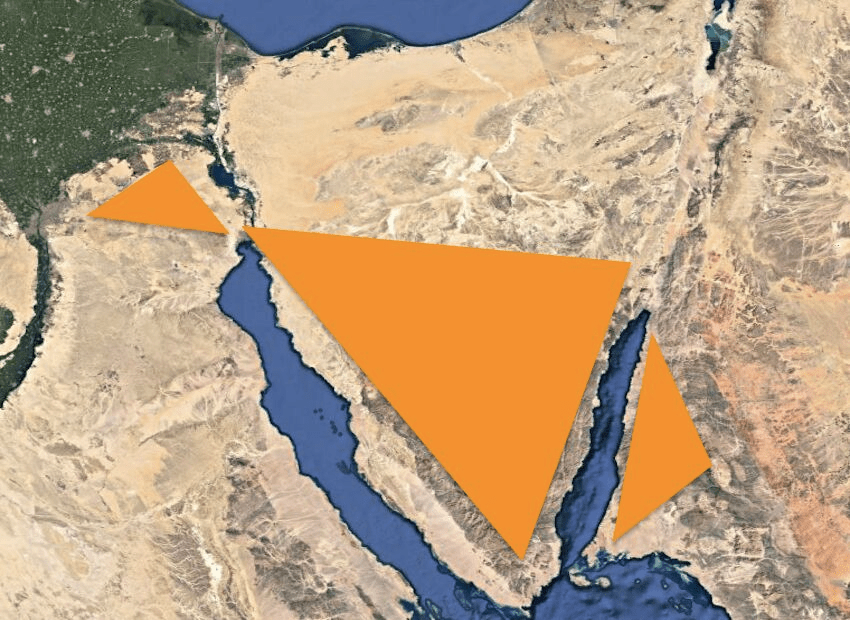
‘Blocks of “Wilderness,” or desert, traversed by the Israelites. There is one wilderness block described before the Red Sea Crossing, followed by three or four to Mount Sinai. Could such a huge wilderness journey to Aqaba really have been only loosely mentioned – followed by three crammed-together wildernesses, described in more detail – including a war, and the beginning of miracles providence of manna and water, all in the final right-handed triangle?’
A crossing of the Gulf of Aqaba is problematic in light of the depth of its water. It is akin to the Grand Canyon, being some 6,600 feet (2,000 m) below sea level as ‘it is a continuation of the Jordan Rift Valley and Dead Sea Transform plate boundary.’ Nuweiba beach is little better, for it is still too deep being 2,800 feet (850 m) in depth. Eames highlights the difficulty with a Straits of Tiran crossing: ‘Parts of this crossing are as shallow as 15 meters deep. Container ships have to exercise some caution crossing through… But the crossing also includes the immediate navigation of a canyon at the near edge, 300 meters deep (a corridor lane used by the container ships), with a 60 percent incline on the eastern side. Not to mention how much more the proposed lengthy journey itself, to get to the crossing point at the very bottom of the Sinai Peninsula (some 500 kilometers, or around 300 miles), strains the biblical account.’
Eames states a convincing case for a Gulf of Suez crossing point – emphasis mine:
‘… the Gulf of Suez would fit, with its utterly smooth seabed. Much of the sea floor of the northern Suez reaches only 40 meters deep, with gentle inclines on both ends – perfect for the Israelites on foot, as well as for the chariots and horsemen of Egypt to follow. Josephus stated that the dried seabed was like a “road.” Psalm 106:9 describes the seabed as being like “a wilderness.” Compare the two gulf seabeds on the topographical map below:

As mentioned earlier, the timing of the Israelite trek to Pi-hahiroth and the encampment there fit a seven day timeline from Goshen some eighty miles away. As the Israelites were liberated from the oppression of slavery on the first day of Unleavened Bread on the 15th day of the first month, their deliverance was completed seven days later on the last day of Unleavened Bread, with the crossing of the Red Sea and the destruction of their would be destroyer Neferhotep and his army – Leviticus 23:6-8.
The Old Covenant festival of Unleavened Bread pictures the removal of leaven as a symbol of sin, from our lives as well as coming out from the sinful practices of the world. In the Bible, Egypt serves to represent rejecting the world’s ways and leaving sin behind. Pharaoh typifies the Adversary who tempts us to do wrong; while the passing through the Red Sea symbolises the rite of baptism, which a new christian undergoes, expressing outwardly their inner commitment to walk a new way of life. Moses as a messianic figure led the Israelites in their deliverance from the former bondage of their enslavement.
Eames provides the following quote: ‘From the [Ambassador] College Bible Correspondence Course (Lesson 30): “The miraculous opening of the Red Sea and the completion of the Israelites’ escape from slavery took place before dawn on the seventh and last day of Unleavened Bread. Then on the daylight part of this annual holy sabbath, there was great rejoicing in celebration of their complete delivery from bondage in Egypt (Exodus 15:1-21).” The “song of Moses,” in Exodus 15, therefore essentially serving as a worship service on this final holy day.’

Christopher Eames aptly concludes: ‘It is no coincidence that each sacred day – Passover, the first day of Unleavened Bread, the last day of Unleavened Bread and Pentecost – matches with a major event of the Exodus. These holy festivals unlock the full meaning of the Exodus, both physically and spiritually.’

Stunning satellite image of the Sinai Peninsula and the two horns or tongues of the Red Sea, the Gulf of Suez in the West and the Gulf of Aqaba to the East.
Even in the unending shadows of death’s darkness, I am not overcome by fear. Because You are with me in those dark moments, near with Your protection and guidance, I am comforted.
Psalm 23:4 The Voice
© Orion Gold 2020, 2023 – All rights reserved. Permission to copy, use or distribute, if acknowledgement of the original authorship is attributed to orion-gold.com


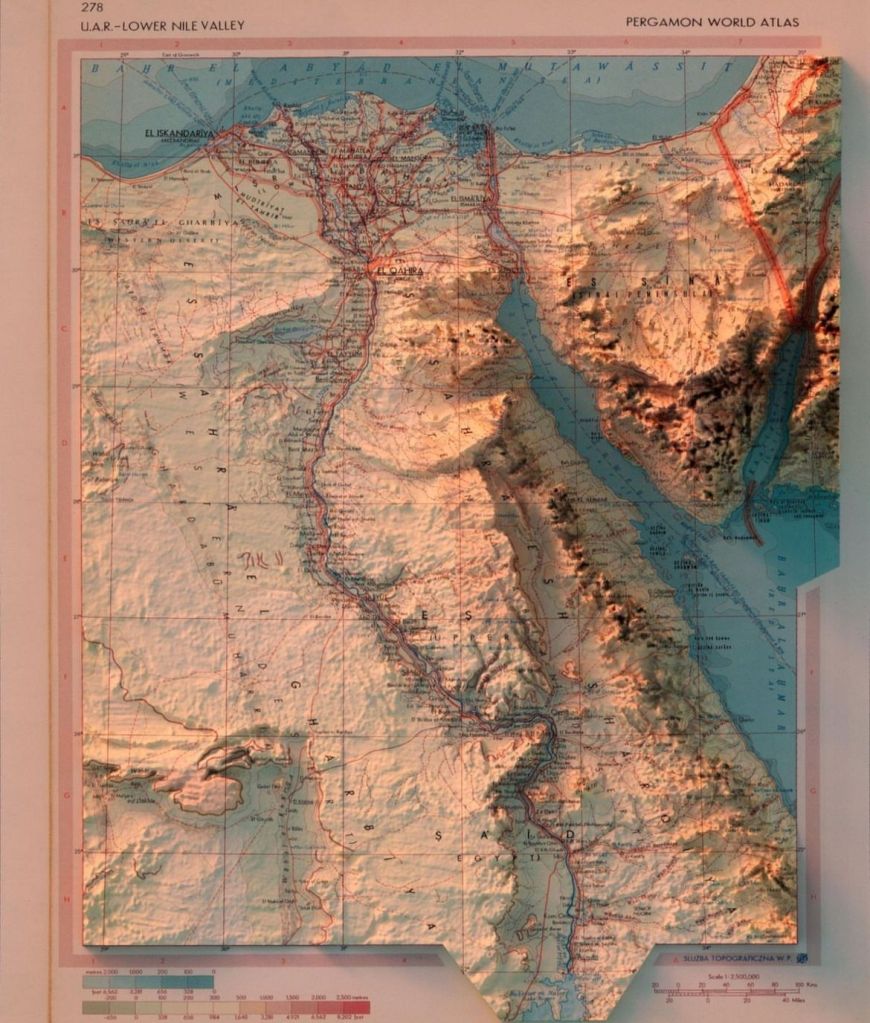
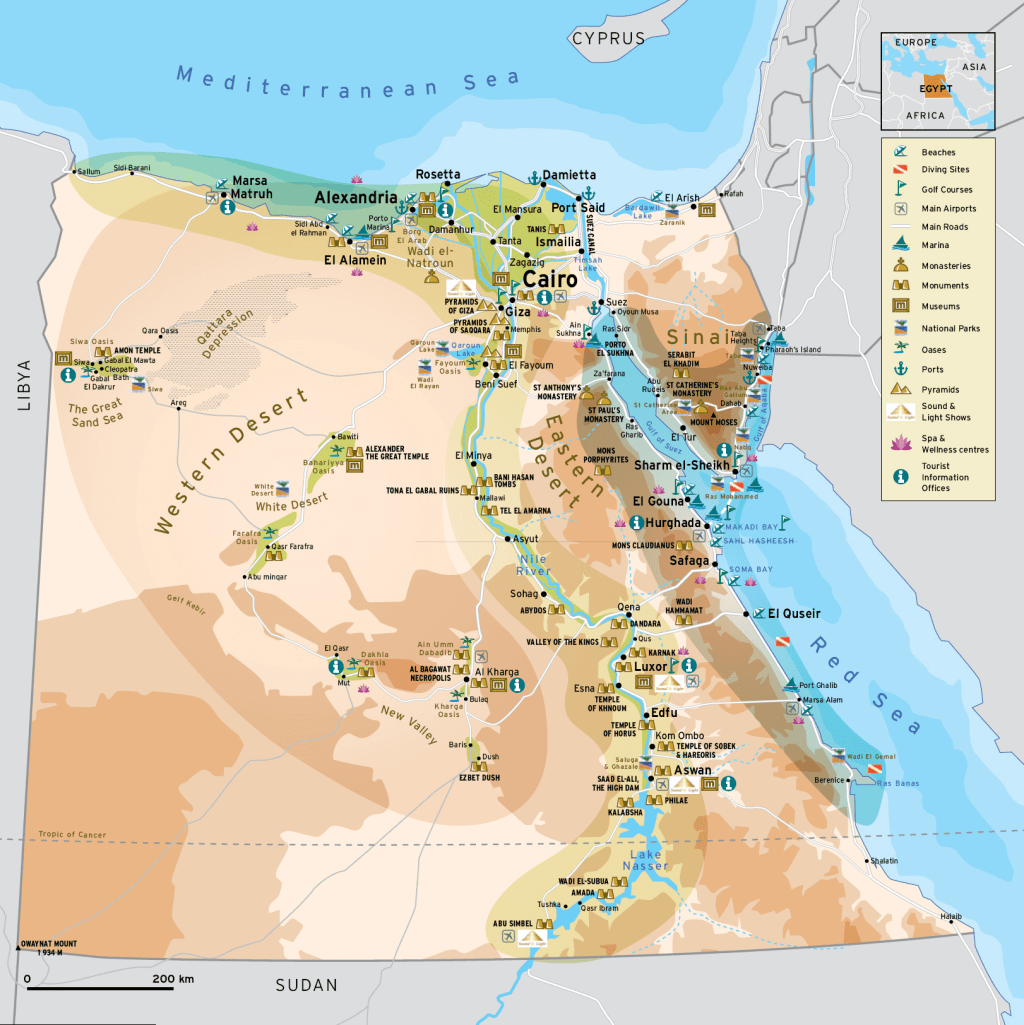


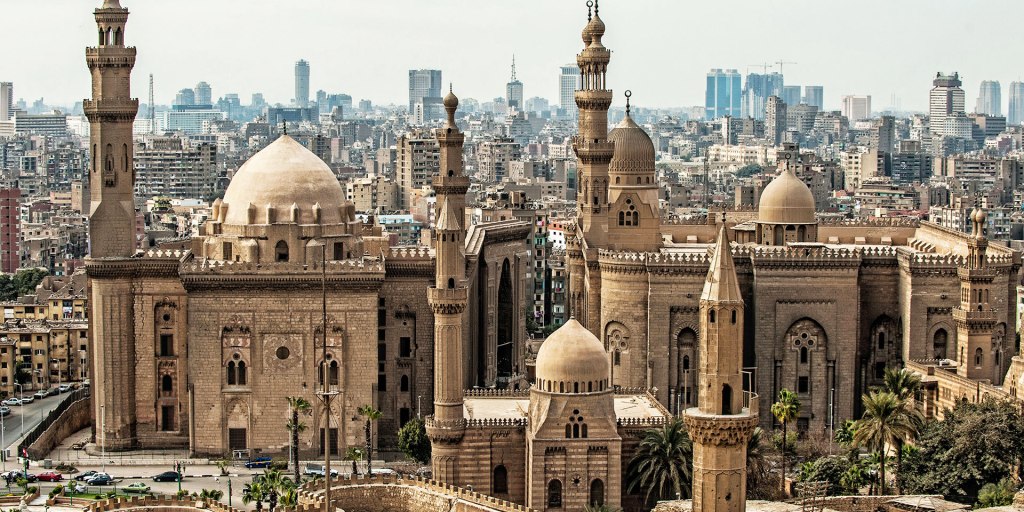
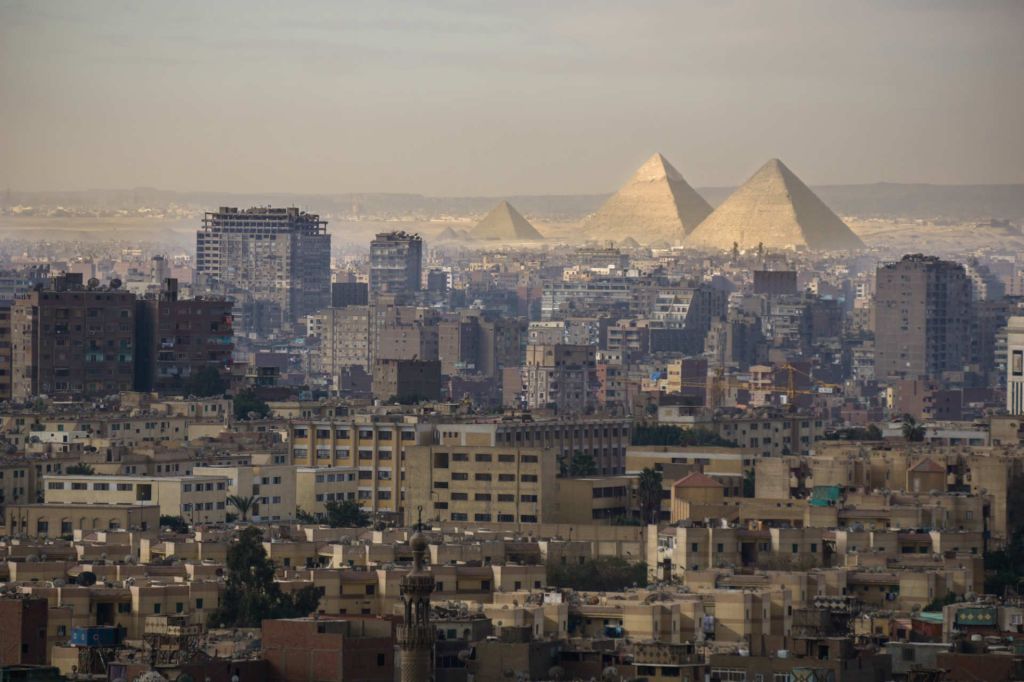

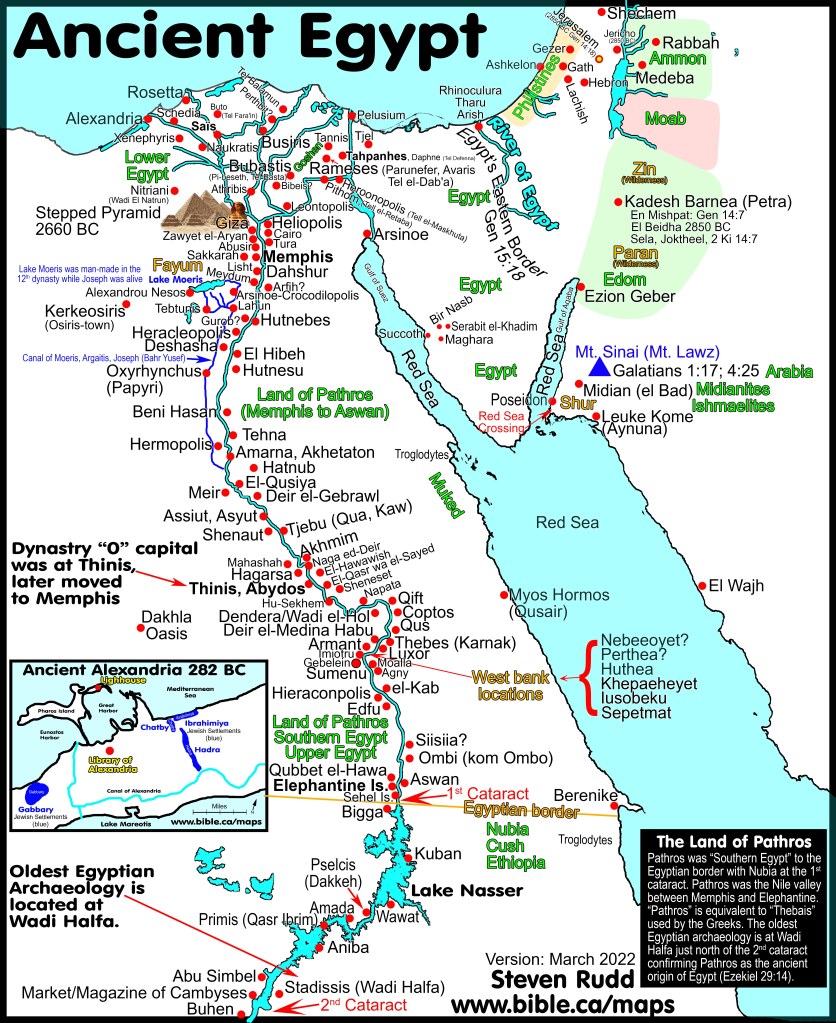


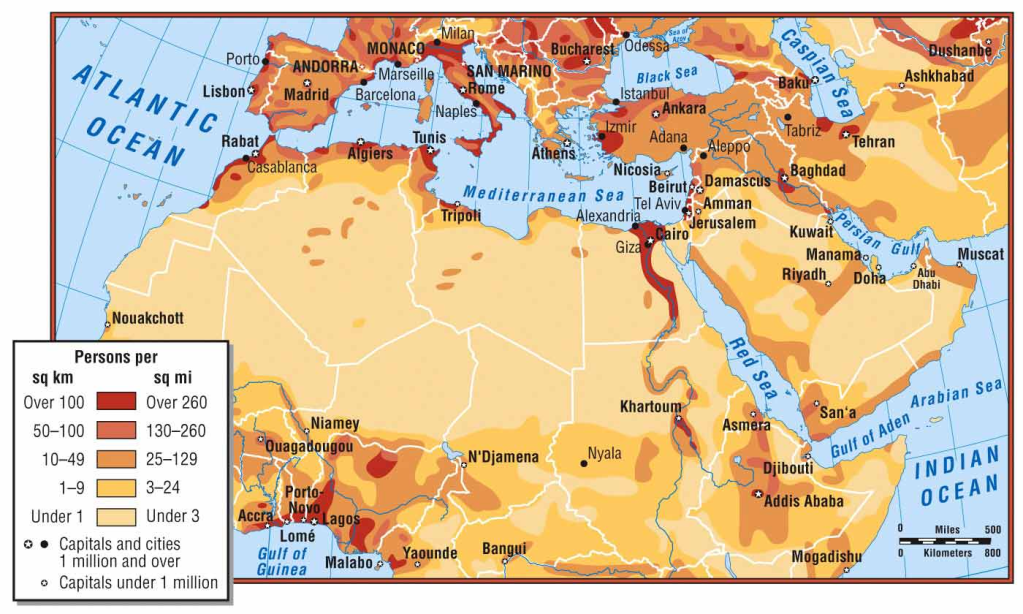


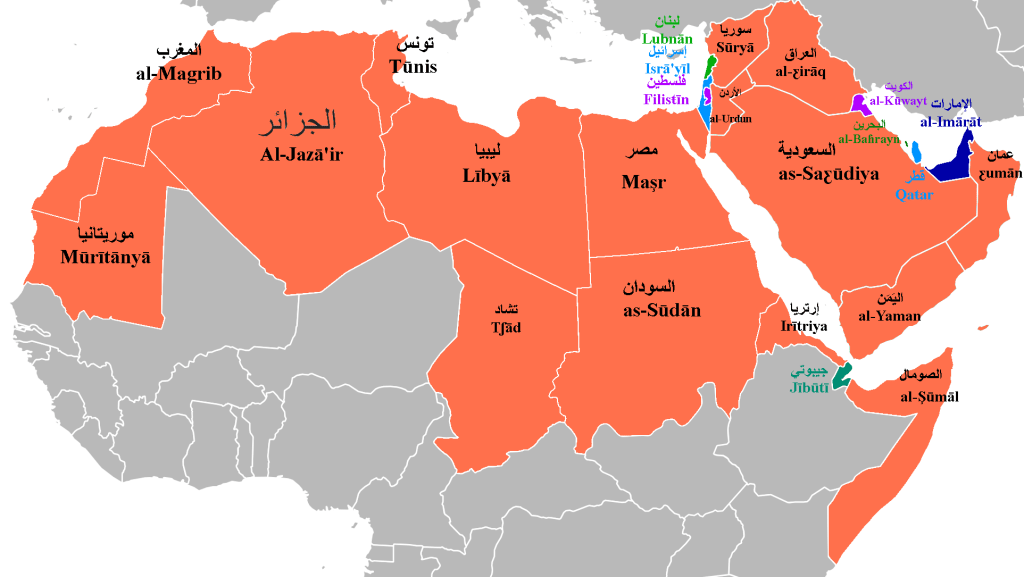





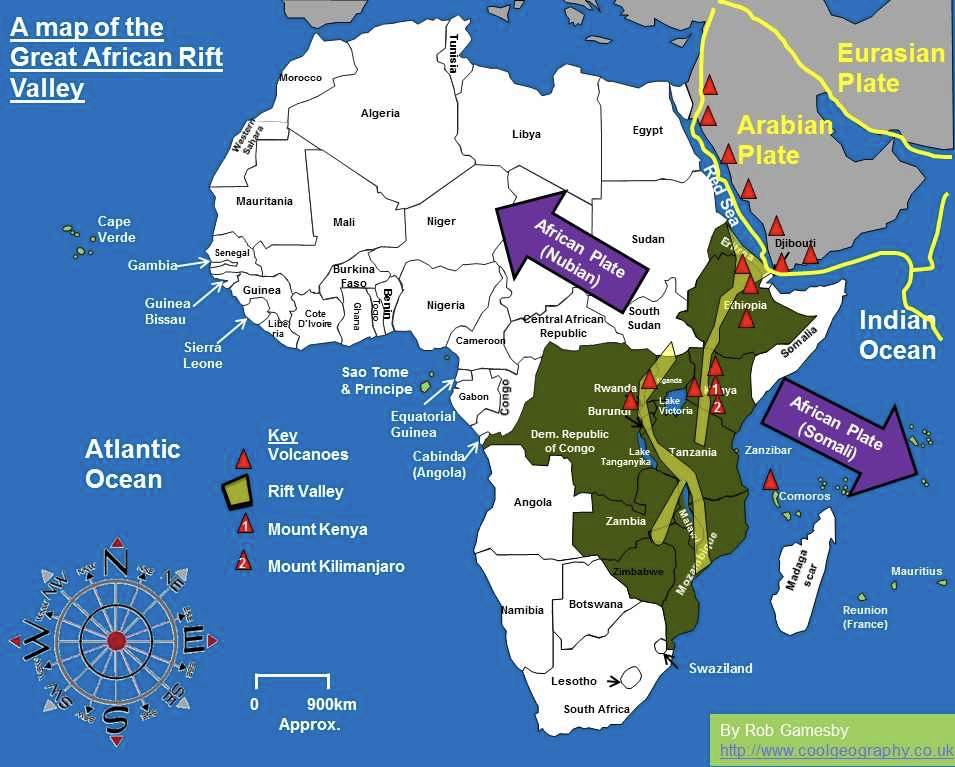
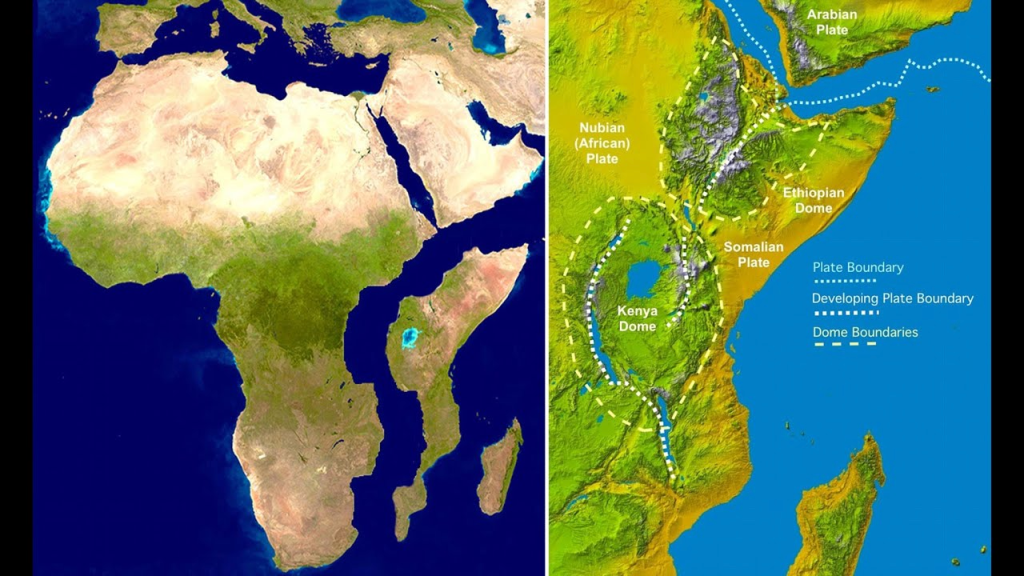


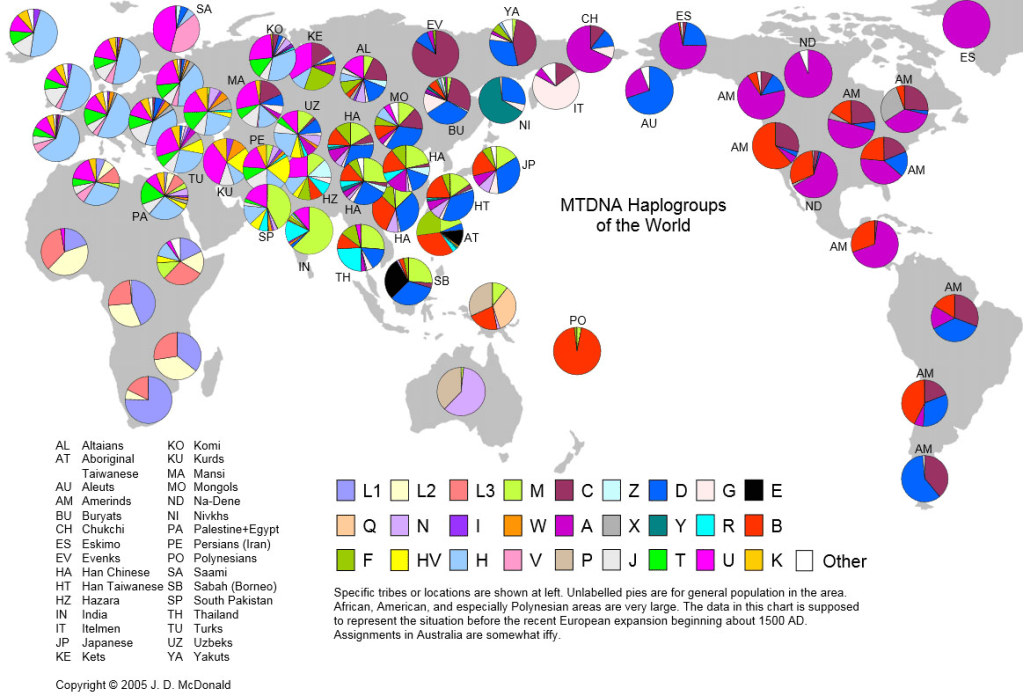



 The Lightkeeper