
If the manna provided by the Eternal to the wandering Israelites is just make believe, then it is surely overly stated in the scriptures for a fanciful story. It is referred to multiple times in the Old and New Testaments. Even the idiomatic phrase manna from heaven meaning ‘an unexpected surprise or gift that comes when it is needed or wanted the most’, has somehow survived to our present age. Rather ironic one would think if it is just based on a fable. Of course, some say “oh yes it was a real event, but it was droplets of dried sap from a plant or tree; and or the secretion of honeydew by aphids and scale insects that eat the sap. Nothing miraculous or supernatural about it.”
But if this were true, then wouldn’t the Eternal have just said, “by the way, the plant you see everywhere which you have ignored up until now, is a great source of sustenance. Make sure you collect what is beneath the fallen dew every morning, but not on the Sabbath day of rest, because there won’t be any that morning.” How could a natural dew, know not to occur one day out of seven? Added to this, was the fact that the manna had to be eaten on the day it was collected. If someone was lazy or perhaps just resourceful and thought, “I’ll collect extra today and save myself work tomorrow”, the old manna spoiled over night and was rotten in the morning. Again, this would be a highly unusual occurrence for a plant based substance. Even an animal product would not spoil that quickly.
As we have previously discussed the incredible series of miraculous events surrounding the releasing of the Israelites from Egypt and their subsequent escape; it hopefully will not be difficult for the reader to entertain the thought that the manna really was from heaven – refer Appendix VII: Moses, the Exodus & the Red Sea Crossing – Fabrication or Fact? Granted, a supernatural explanation for the origin of the manna presents difficulty in then defining exactly what the manna was. It may mean a definitive answer remains out of reach.
For those, where a miraculous answer to the origin of manna is unpalatable – pun not intended – solutions to the enigma can stretch one’s incredulity even further.
Ancient code: “In the Zohar – ‘a collection of spiritual commentaries and interpretations of the Torah… central to the mystical Kabbalah… written in the 13th century’ – we find descriptions of what is referred to as the Ancient of Days providing Manna.” Some researchers such as “ancient astronaut theorists argue… the [Ancient of Days]… isn’t necessarily a god figure, but rather a type of machine: A machine that somehow produced ‘manna’… that has still not been identified…
The Manna machine theory… suggests [the Israelites] stole it from the Egyptians before their exodus… [or] the more controversial one suspect’s extraterrestrials gave it to them as a humanitarian gesture, to prevent their starvation in the desert. In 1978 George Sassoon and Rodney Dale wrote a book which was based upon a translation of the section of the Zohar… called “The Ancient of Days”.
In the book, the authors conclude that Manna was produced by a machine that had created algae as food for human beings in biblical times. The so-called Manna machine was eventually reproduced by George who was an engineer, who is said to have followed the directions given in The Ancient of Days. After creating the machine, he claimed it created a food source of algae. Furthermore… It is said by Sassoon and Dale that a nuclear reactor used to power the manna machine was stored within the Ark of the Covenant.”
The nuclear reactor would have required to be micro-sized to fit inside the ark which was 45 inches long; 27 inches wide; and 27 inches deep – Exodus 25:10. While plans are underway for small modular reactors (SMRs), they are yet in the future, which means an SMR inside the ark would have been future technology either not invented yet or a lost and forgotten capability.
Unravelling the Mystery: Does Manna Still Exist Today? Eleaanor Charlotte, 2024: ‘Numerous texts and references allude to its existence in various cultures across different time periods – from biblical stories recounting its miraculous appearance in the desert to ancient Greek literature mentioning honey-like substances falling from the sky.’ The Very Real Search for the Bible’s Mythical Manna, Erica X Eisen, 2019: ‘References to manna are also present in Islamic texts: one Hadith passage has the prophet Muhammad likening desert truffles to manna.’
Bipin Dimri states – emphasis mine: ‘A number of scholars have attempted to identify what manna might be in the natural world. Some believe that it could be a product or resin of the tamarisk tree.’

‘… Arab merchants living in the Sinai Peninsula used to sell the resin of the tamarisk tree, calling it man es-simma, which means “heavenly manna.” It was believed that there were a number of tamarisk trees in the southern Sinai region and the resins from the tree looked like wax. When the sun fell on the resins, it used to melt.’

‘Moreover, it has an aromatic smell and tasted like honey. This is a close match to the Biblical characteristics of heavenly manna. However, something that needs to be noted is that the resins are mainly made up of sugar, and that was not enough to provide the people of Israel with sufficient nutrition to survive for forty long years. The resins are also quite difficult to convert into cakes. Moreover, the natural substance of the tamarisk tree is said to appear only in the months of June and July, and it does not rot when stored overnight. As a result, the hypothesis was discarded.’
Erica Eisen: ‘In their book Plants of the Bible, botanists Harold and Alma Moldenke argue that there were several kinds of food collectively known as manna. One of these… is a swift-growing algae (from the genus Nostoc) known to carpet the desert floor in Sinai when enough dew on the ground allowed it to grow. The Moldenkes also make the case that a number of lichen species (Lecanora affinus, L. esculenta, and L. fruticulosa) native to the Middle East have been known to shrivel up and travel tumbleweed-like on the wind, or even “rain down” when dry. Nomadic pastoralists, they report, use the lichen to make a type of bread. The lichen theory, the Moldenkes argue, would explain both how the Israelites prepared their manna and why they might have spoken of it as having fallen from heaven. A multi-decade diet exclusively of algae or lichen would certainly explain why the Israelites complain bitterly that the lack of normal food had left them feeling like their very souls had dried away.
Cambridge historian R.A. Donkin… notes that L. esculenta was used in the Arab world as a medicine, an additive to honey wine, and a fermentation agent. Poking a hole in the lichen theory, however, is the fact that L. esculenta, one of the most commonly cited possibilities for a “manna lichen,” doesn’t grow in Sinai. Instead, the current frontrunner in the manna quest is not lichen or algae but a type of sticky secretion found on common desert plants. Insects that rest on the bark of certain shrubs leave behind a substance that can solidify into pearl-like, sweet-tasting globules. Often referred to as manna, this secretion has both culinary and medicinal uses.’
In the Old Testament cannon, there are two key chapters where manna is introduced and discussed. We will look for clues in seeking to understand what the manna was; though by focussing on the what, it should not deflect one from considering the more important question of… why?
The first chapter is in the Book of Exodus, where the Israelites have been on the march for exactly a month since leaving Egypt. The crux of the chapter is not actually the commencement of the manna, but rather the inauguration of the true seventh day Sabbath rest. This topic is a whole subject in itself, on how to compute the Sabbath day – discussed in the article: The Calendar Conspiracy. Yet, this is secondary to the bigger discussion of whether the Sabbath is required in the current inter-covenantal dispensation. Part of the debate, is whether the Sabbath in Exodus is being instituted for the very first time or whether it was a reinstitution of an elapsed and forgotten observation originating before the time of Abel – refer article: The Sabbath Secrecy.
Thus in allowing the Israelites to be able to completely refrain from work of any kind on the Sabbath, one reason manna was provided, was to ease their burden.
Exodus 16:1-36
Common English Bible
‘The whole Israelite community set out from Elim and came to the Sin desert, which is located between Elim and Sinai. They set out on the fifteenth day of the second month after they had left the land of Egypt. The whole Israelite community complained against Moses and Aaron in the desert. The Israelites said to them, “Oh, how we wish that the Lord had just put us to death while we were still in the land of Egypt. There we could sit by the pots cooking meat [H1320 – basar: flesh] and eat our fill of bread [H3899 – lechem: ‘bread, grain’]. Instead, you’ve brought us out into this desert to starve this whole assembly to death.”
It was a legitimate concern – even though the Israelites were expert grumblers and thankless at the best of times – as rations were probably running low and a lack of wildlife to kill and eat a genuine issue.
‘Then the Lord said to Moses, “I’m going to make bread [H3899 – lechem] rain down [H4305 – matar: ‘to be rained on or upon’] from the sky [H8064 – shamayim: ‘sky, air, heaven’] for you. The people will go out each day and gather just enough for that day. In this way, I’ll test them to see whether or not they follow my Instruction. On the sixth day, when they measure out what they have collected, it will be twice as much as they collected on other days.” So Moses and Aaron said to all the Israelites, “This evening you will know that it was the Lord who brought you out of the land of Egypt. And in the morning you will see the Lord’s glorious presence [H3519 – kabowd: ‘glory, honour, splendour’], because your complaints against the Lord have been heard. Who are we? Why blame us?”
Notice, the equivalent of what would constitute bread, was to fall from the sky. It is the exact same word used for regular bread earlier and is in distinction to an animal product or meat. Plus, it is clearly a miraculous act by the Eternal in response to the Israelites complaints.
‘Then Moses said to Aaron, “Say to the whole Israelite community, ‘Come near to the Lord, because he’s heard your complaints.” As Aaron spoke to the whole Israelite community, they turned to look toward the desert, and just then the glorious presence of the Lord appeared in the cloud. The Lord spoke to Moses, “I’ve heard the complaints of the Israelites. Tell them, ‘At twilight [H6153 – ereb: sunset from H6150 – arab: ‘to grow dark, dusk’] you will eat meat [H1320 – basar]. And in the morning you will have your fill of bread [H3899 – lechem]. Then you will know that I am the Lord your God”.’
‘In the evening [H6153 – ereb] a flock of quail flew down and covered the camp. And in the morning [1242 – boqer: ‘sunrise, break of day’] there was a layer [H7902 – shkabah: coating] of dew [H2929 – tal: ‘night mist’ from H2926 – talal: cover] all around the camp. When the layer of dew lifted, there on the desert surface were thin [H1851 – daq: ‘small, fine, gaunt, little, lean’] flakes [H2636 – chacpac: ’round substance, scale like, to peel’], as thin [H1851 – daq] as frost [H3713 – kippah: white frost] on the ground. When the Israelites saw it, they said to each other, “What is it?” They didn’t know what it was.’
Here we learn the substance appeared underneath a covering mist; was like snow flakes or frost; it was white; and it was something the Israelites were unfamiliar with. Effectively ruling out an existing natural phenomena. For the want of a better picture, something not too unlike the photograph below.

What was the Manna? Yehuda Shurpin: “In order that the manna remain clean, a north wind would blow, sweeping the ground, and then rain would wash it. The ground would then be covered with a layer of dew, and the manna would fall upon it, after which the manna was covered with another layer of dew, as if it were packaged in a box.”
Exodus: ‘Moses said to them, “This is the bread [H3899 – lechem] that the Lord has given you to eat. This is what the Lord has commanded: ‘Collect as much of it as each of you can eat, one omer per person. You may collect for the number of people in your household.” The Israelites did as Moses said, some collecting more, some less. But when they measured it out by the omer, the ones who had collected more had nothing left over, and the ones who had collected less had no shortage. Everyone collected just as much as they could eat. Moses said to them, “Don’t keep any of it until morning.” But they didn’t listen to Moses. Some kept part of it until morning, but it became infested with worms [maggots] and stank. Moses got angry with them. Every morning they gathered it, as much as each person could eat. But when the sun grew hot, it melted away [H4549 – macac: dissolve, vanish, waste away].’

There was a relatively small window for collecting the manna at day break, before the sun melted the manna away within one to two hours later. As well as the fact, they could not store it overnight and it had to be collected fresh each morning. This was an important lesson in faith for each Israelite.
Yehuda Shurpin: “Not having any reserves, the Israelites had to have full faith in G-d that He would provide their needs each day.”
Exodus: ‘On the sixth day the people collected twice as much food as usual, two omers per person. All the chiefs of the community came and told Moses. He said to them, “This is what the Lord has said, ‘Tomorrow is a day of rest, a holy Sabbath to the Lord. Bake what you want to bake and boil what you want to boil. But you can set aside and keep all the leftovers until the next morning.” So they set the leftovers aside until morning, as Moses had commanded. They didn’t stink or become infested with worms. The next day Moses said, “Eat it today, because today is a Sabbath to the Lord. Today you won’t find it out in the field. Six days you will gather it. But on the seventh day, the Sabbath, there will be nothing to gather.”
On the seventh day some of the people went out to gather bread, but they found nothing. The Lord said to Moses, “How long will you refuse to obey my commandments and instructions? Look! The Lord has given you the Sabbath. Therefore, on the sixth day he gives you enough food for two days. Each of you should stay where you are and not leave your place on the seventh day.” So the people rested on the seventh day.
We learn that the manna could be baked or boiled. Perhaps boiling it liquified it and baking it turned the manna solid. One could infer that either manna could not be digested well in its raw state; or that it tasted better or maybe, just different when cooked. The supernatural element of the manna is displayed by the fact that the exception to the rule was the collecting of double on the sixth day and it did not decompose overnight, being still edible on the seventh day Sabbath rest.
‘The Israelite people called it manna [H4478 – man: what is it?].’
R A Donkin: “The origin of the word “manna” has not been satisfactorily explained. It may have several roots, including the early Hebrew mân (what?). The Israelites in the Wilderness of Sin, seeing manna for the first time, are said to have exclaimed mân-hû, “what is this?”… Subsequently, the name of the substance itself took the form of the interrogative. This is the etymology advanced by Flavius Josephus (ca. A.D. 94) and by later commentators such as Fr. Angelus Palea (1550), Johann Buxtorf (Dissertatio de Manna, ca. 1600), Michael Walther (Tractatu de Mannâ, 1633), and Samuel Bochart (Geographia Sacra, 1692).
Mân passed into Egyptian (mennu), Arabic (mann), Hellenistic Greek (μάννα) and Latin (manna). Modern authorities have pointed out that the Arabic mann also means “gift,” in the sense of “free gift,” “gift from God” or “gift from heaven” (mann as-samā). The Jewish physician Maimonides (Moses ben Maimon, 1135-1204), who worked in Cairo, gives mann and rizq (“provision”) as synonyms for the Persian manna tar-angubīn. It is possible that mân, meaning “gift” or something similar, was originally a Sinaitic dialect word and adopted by the Hebrews for manna.
P. Haupt maintained that “the primary connotation of Hebrew man (related to min, “from”) is… separation, elimination, secretion,” which could refer to the mode of origin of manna, and further that “man-hu (Syriac mana-hU) is Aramaic, not Hebrew… the popular etymology given in Exodus 16:15 must be a late gloss.” Notes: Haupt, 1922: pages 235-236. Dorvault (1884: page 301) derived manne (French) from manare, “to flow” or “to ooze.”
Some scholars in endeavouring to rationalise the manna physically have conjectured that it is derived from the secretions of insects such as from the ‘sweet beetle cocoon which grows on green leaves of desert plants.’
The beetle cocoon that was manna for Moses, John Emsley, Imperial College, London, April 22, 1996 – emphasis mine:
‘Passover… commemorates the night when the Angel of Death spared the Israelites but killed the first-born of their Egyptian masters… [persuading] the Egyptians to release their slaves, and so began their 40 years in the wilderness. Within a few weeks the Israelites were starving, so Moses appealed to God, who promised: “I will rain down bread from Heaven for you”, and delivered the mysterious, but nutritious, manna which was “white like coriander seed and tasted like a wafer made with honey”.
This Heaven-sent sweetness might again be saving lives – thanks to a British company. Manna was almost certainly trehalose, a white crystalline carbohydrate made of two glucose molecules joined together. It is one of very few naturally occurring molecules that taste sweet, although it is only half as sweet as sugar. What the Israelites were gathering was the cocoon of the parasitic beetle Trehala manna from which trehalose gets its name, and which explains Moses’ warning not to hoard it: “Some, however, did not listen… and it became full of maggots and stank.”
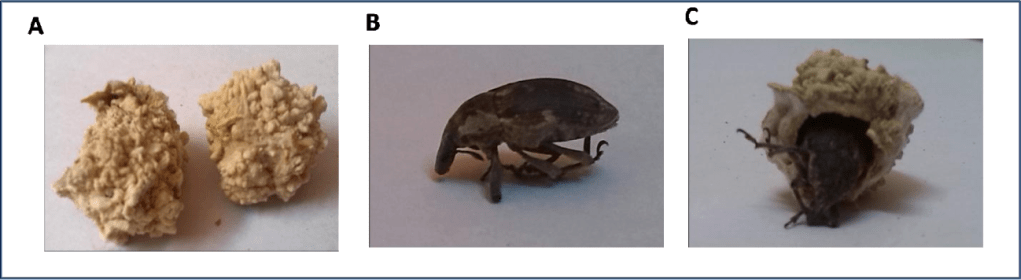
Trehala Manna beetle and cocoon
The paper, ‘Morphological and molecular inference of immature stages of Larinus hedenborgi (Col: Curculionidae), a trehala-constructing weevil’, multiple authors, October 9, 2021, states: “Trehala manna is the edible and trehalose-rich cocoons of a few Larinus species (Coleoptera: Curculionidae: Lixinae: Lixini), and manufactured by the feeding activity of larvae on the Echinops plants.”
Emsley: ‘The cocoons, found on thorn bushes in the Middle East, are highly nutritious, consisting of 30 per cent trehalose plus protein. Trehalose occurs in honey, bread, beer, wine and vinegar, while Japanese shiitake mushrooms and baker’s yeast contain as much as 20 per cent. Trehalose has remarkable preserving power and is produced by creatures that lie dormant under drought conditions. Some plants can loose over 95 per cent of their water content and still survive, thanks to the trehalose in their cells.
John Crowe, of the University of California at Davis, suggested that trehalose has the right shape to replace water molecules around vital cell proteins and prevent them from collapsing. Michael Burke, of Oregon State University, believes that trehalose forms a supportive “glass” like that of boiled sweets within tissues. Steve Ring, of the Institute of Food Research at Norwich, has shown that small amounts of protein are needed to keep trehalose glass stable at 37C and prevent it becoming opaque and microcrystalline.
Trehalose is now being used as a preservative for antibodies, vaccines, enzymes and blood coagulation factors. In 1985, Bruce Roser discovered that if trehalose was added to solutions of proteins like these, which were then dehydrated, the products could be stored at temperatures above 40C and when rehydrated were still active. This offers an alternative way of preserving medical supplies in Third World countries, where 90 per cent of vaccines are wasted through lack of refrigeration facilities. Mr Roser has set up his own company, Quadrant, at Cambridge, to exploit his discovery, and employs 30 people.
“After years of storage at room temperature, trehalose-dried antibodies worked well. Even notoriously unstable enzymes, such as DNA-modifying and restriction enzymes, worked after being stored for a month at 70C,” says Mr Roser. Another use could be to store blood. “Fresh blood has a shelf life of 42 days, after which it must be disposed of” – refer article: 42. “Trehalose-dried blood could mean an end to the critical blood shortages that are suffered by the health service.”
Quadrant imports its trehalose from Japan. Production is set to increase to 50 tons a month. Scientists there have shown that trehalose preserves the quality and flavour of dried foods. Many people find that powdered egg has an unpleasant taste, but if it is dehydrated with trehalose it takes on the taste of fresh egg. Other foods, such as powdered puree of bananas, mangoes, apples and avocados, also rehydrate with the taste of the fresh fruit. The method used to dry trehalose-treated foods is much cheaper than the normal methods of vacuum-drying and freeze-drying.’
This article is a fascinating insight into trehalose and its variety of vital uses today. Emsley confidently states that “manna was almost certainly trehalose.” An initial reaction was: ‘well it can’t be, because manna ‘rained down from the sky’; it was a substance that compelled the Israelites to say, “what is it?” and as we shall learn, the manna abruptly stopped when the Israelites entered the land of Canaan. Did all the beetles die out in one day? Then this writer thought, perhaps Emsley is correct and manna was actually composed from the trehalose molecule, though its formation was likely not derived from the Trehala Manna beetle’s cocoons.

What Does “Manna” Mean?, Menachem Posner: “In the original Hebrew the word is מן, more accurately transliterated as mon. Some say that mon means a portion of food. They did not know what it was, but they knew that it was a portion of ready-to-eat food, so they called it just that. Others explain that mon is Egyptian for “what.” Over the… years that they had lived in Egypt, a fair amount of Egyptian had crept into their lexicon. Thus, when they said, “It is manna,” what they were actually saying was, “What is it?” A third interpretation is that the root word of mon means status or importance. In other words, they saw the stuff fall from heaven, did not know what it was, but were absolutely sure that it was something special.”
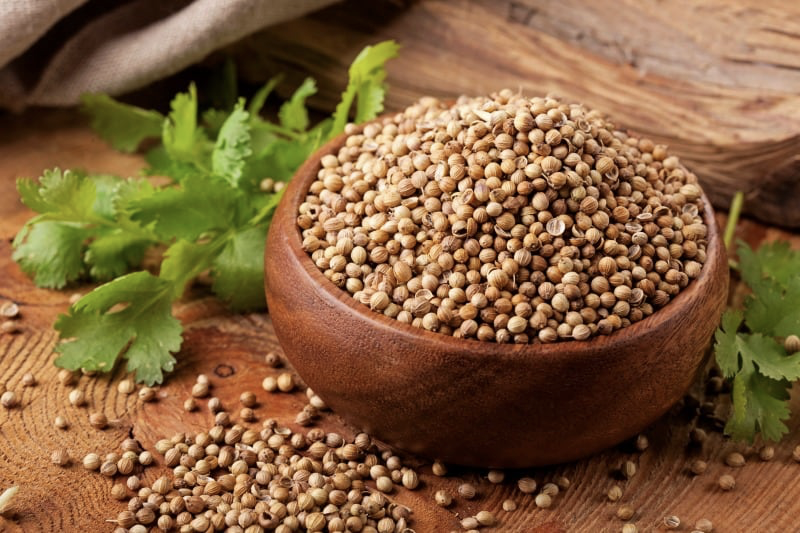
Exodus: ‘It was like coriander [H1407 – gad: seed resembles manna] seed [H2233 – zera: seed, sowing, virile, semen, offspring, children], white, and tasted like honey [H1706 – dbash: honey, honeycomb, gummy, syrup] wafers [H6838 – tsappiychith: flat thin cake].’
Yehuda Shurpin: “The manna was the size of a coriander seed and the color of a white bedolach, which commentaries explain is a fine crystal.”
Coriander seeds
The manna flakes then, were the size and shape of Coriander seeds; a white colour; had a texture like a wafer biscuit; and a sweet taste like honey. The manna wasn’t an unpleasant taste, but it may have been sweet for those who prefer savoury foods. This might have been hard going for some people over the forty years of trekking in the wilderness.
‘Moses said, “This is what the Lord has commanded: ‘Let an omer of it be kept safe for future generations so that they can see the food that I used to feed you in the desert when I brought you out of the land of Egypt.” Moses said to Aaron, “Take a jar, and put one full omer [approximately 3.5 pounds or 1.6 kilograms] of manna in it. Then set it in the Lord’s presence, where it should be kept safe for future generations.” Aaron did as the Lord commanded Moses, and he put it in front of the covenant document [H5715 – eduwth: ‘testimony, witness’ from H5707 – ed: ‘evidence (of things)’] for safekeeping [H4931 – mishmereth: guard, watch, charge, preserve]. The Israelites ate manna for forty years… until they came to the border of the land of Canaan. (An omer is one-tenth of an ephah.)’
While the manna was prone to spoil, there was an exception when collected on the sixth day and it would appear again for the omer or manna which was preserved perpetually – or it did turn mouldy and petrify. Where the manna was stored is a mystery until we read the account by Apollos the probate author of the Book of Hebrews – refer Apollos, article: The Sabbath Secrecy.
Hebrews 9:2-5
English Standard Version
‘For a tent was prepared, the first section, in which were the lampstand and the table and the bread of the Presence. It is called the Holy Place. Behind the second curtain was a second section called the Most Holy Place [or Holy of Holies], having the golden altar of incense and the ark of the covenant covered on all sides with gold, in which was a golden urn holding the manna, and Aaron’s staff that budded, and the tablets of the covenant. Above it were the cherubim of glory overshadowing the mercy seat. Of these things we cannot now speak in detail.’

Notice the three items in the ark of the covenant, weren’t just unceremoniously dumped inside the ark but rather, they were placed in a golden urn, within the ark itself. Investigating the specific nature of the ark of the covenant is contained in the article: The Ark of God. It is interesting that there is considerable effort expended into the present day whereabouts of the ark, yet to the mind of this writer, what happened to the three items within its chest are just as worthy of attention.
Shurpin: ‘Aaron collected some manna and put it in a jar inside the Holy of Holies. The Midrash relates that it remained there for many years, and in the days of the prophet Jeremiah [circa 600 BCE], when Jeremiah rebuked the Jews, saying, “Why do you not engage in the Torah [the law]” they answered, “Should we leave our work and engage in the Torah? From what will we support ourselves?” He brought out the jar of manna and said to them, “You see the word of the L‑rd” [reference Jeremiah 2:31]. It does not say “hear” but “see.” In other words, Jeremiah was saying, “With this, your ancestors supported themselves.”
“… when King Solomon built the Holy Temple, knowing that it was destined to be destroyed, he built a place in which to hide the Ark, at the end of hidden, deep, winding passageways.” Ultimately, [in 607 BCE] 22 years before the destruction of the First Temple [in 586 BCE], King Josiah hid the jug of manna together with the Ark in that special hidden passage.” Note: Talmud, Yoma 52b; Mishneh Torah, Laws of the Holy Temple 4:1. “According to tradition, it is still hidden there, waiting to be rediscovered…” The question arising about the location of the omer of manna, with the Ark of the Covenant is investigated in the article: The Ark of God.
We next read about manna in the Book of Numbers.
Numbers 11:1-35
English Standard Version
‘And the people complained in the hearing of the Lord about their misfortunes, and when the Lord heard it, his anger was kindled, and the fire of the Lord burned among them and consumed some outlying parts of the camp. Then the people cried out to Moses, and Moses prayed to the Lord, and the fire died down. So the name of that place was called Taberah, because the fire of the Lord burned among them.
Now the rabble that was among them had a strong craving [H8378 – ta’avah: desire, lust, greedily]. And the people of Israel also wept again and said, “Oh that we had meat to eat! We remember the fish we ate in Egypt that cost nothing, the cucumbers, the melons, the leeks, the onions, and the garlic. But now our strength is dried up, and there is nothing at all but this manna to look at.”
As we surmised earlier, the manna grew tiresome, for some at least. It is likely that it contained nutrients that are required for a healthy diet. This would have included carbohydrates, fats, vitamins and protein, but as today, there were some who thought animal protein is superior to plant protein, when in fact it is the other way around – refer article: Red or Green? It was more a case of a lust for the taste and texture of meat not being satiated, than a supposed ‘drying up of their strength.’
‘Now the manna was like coriander seed, and its appearance [H5869 – ayin: colour, sight, eye] like that of bdellium [H916 – bdolach: gum resin, (fragrant, amber), pearl].’
Ancient Code describe bdellium as: “… a semi-transparent oleo-gum-resin extracted from trees growing in Ethiopia, Eritrea and sub-Saharan Africa.”
Numbers: ‘The people went about and gathered it and ground [H2912 – tachan: to grind, crush] it in handmills [a pair of millstones for grinding] or beat [pound] it in mortars and boiled [cooked] it in pots [or pans] and made cakes [H5692 – uggah: disc, cake (of bread) baked on hot stones] of it. And the taste of it was like the taste of cakes [H3955 – Ishad: fresh, moisture, juicy, dainty, pastry] baked with [olive] oil. When the dew fell upon the camp in the night, the manna fell with it.’
Further detail is provided in addition to the account in the Book of Exodus, regarding the preparation of the manna. Again, it is likened to a coriander seed in size and shape and its whiteness is confirmed by the colour pearl. Its taste like honey is amplified with the description of what the manna resembled inside its seed like exterior. It was as a sweet smelling gum, comparable to fossilised tree resin and amber – usually a golden orange colour. The Israelites ground the seeds into powder, as grain is turned into flour and made round, flat cakes – shown below – similar to the Shewbread in the Tabernacle of the Wilderness and later Solomon’s Temple.

The second word for cake describes its taste as opposed to the first word using cake for its shape. The NJPS says ‘rich cream’; the NRSV, ‘oily cake’; and the HALOT, ‘butter cake.’ These cakes were rich and moist like pastry. As good as these sound, one can appreciate they may have worn thin, if that was the entirety of the peoples’ diet.
Numbers: ‘Moses heard the people weeping throughout their clans, everyone at the door of his tent. And the anger of the Lord blazed hotly, and Moses was displeased. Moses said to the Lord, “Why have you dealt ill with your servant? And why have I not found favor in your sight, that you lay the burden of all this people on me? Did I conceive all this people? Did I give them birth, that you should say to me, ‘Carry them in your bosom, as a nurse carries a nursing child,’ to the land that you swore to give their fathers? Where am I to get meat to give to all this people? For they weep before me and say, ‘Give us meat, that we may eat.’ I am not able to carry all this people alone; the burden is too heavy for me. If you will treat me like this, kill me at once, if I find favor in your sight, that I may not see my wretchedness.”
One can only feel for Moses. It was a thankless task leading three million or more people on a journey, whom most did not appreciate the profound significance – refer Appendix VII: Moses, the Exodus & the Red Sea Crossing – Fabrication or Fact? There is a humorous aspect in what Moses says, for both Moses and the Eternal complain to each other more than once, regarding the annoying stubbornness of the repeatedly complaining Israelites over the next forty years. Particularly when the Creator says to Moses, “for your people, whom you brought up out of the land of Egypt” – Exodus 32:7. Regardless, the Eternal listened to the Israelite grievance, with devastating consequences.
‘Then the Lord said to Moses… ‘Consecrate yourselves for tomorrow, and you shall eat meat, for you have wept in the hearing of the Lord, saying, “Who will give us meat to eat? For it was better for us in Egypt.” Therefore the Lord will give you meat, and you shall eat. You shall not eat just one day, or two days, or five days, or ten days, or twenty days, but a whole month, until it comes out at your nostrils and becomes loathsome to you, because you have rejected the Lord who is among you and have wept before him, saying, “Why did we come out of Egypt?” But Moses said, “The people among whom I am number six hundred thousand on foot, and you have said, ‘I will give them meat, that they may eat a whole month!’
The number of Israelites on foot is a reference to men over twenty, able to bear arms – Numbers 26:2, 51.
‘Shall flocks and herds be slaughtered for them, and be enough for them? Or shall all the fish of the sea be gathered together for them, and be enough for them?” And the Lord said to Moses, “Is the Lord’s hand shortened? Now you shall see whether my word will come true for you or not.” So Moses went out and told the people the words of the Lord…
Then a wind from the Lord sprang up, and it brought quail from the sea and let them fall beside the camp, about a day’s journey on this side and a day’s journey on the other side, around the camp, and about two cubits [or 3 feet, (cubit = 18 inches)] above the ground. And the people rose all that day and all night and all the next day, and gathered the quail. Those who gathered least gathered ten homers [6 bushels or 220 litres]. And they spread them out for themselves all around the camp.
While the meat was yet between their teeth, before it was consumed, the anger of the Lord was kindled against the people, and the Lord struck down the people with a very great plague. Therefore the name of that place was called Kibroth-hattaavah [meaning: ‘graves of craving’], because there they buried the people who had the craving.’
While not stated, the inference is that those with a lust for meat and did eat, were the ones who died in the plague. The lesson? Be grateful for what you have and especially when it has been provided by the Eternal. At the time the Israelites entered the promised land of Canaan in 1406 BCE, the manna stopped. It was almost exactly forty years to the day, shy by thirty days of a lunar month.
Joshua 5:10-12
English Standard Version
‘While the people of Israel were encamped at Gilgal, they kept the Passover on the fourteenth day of the month in the evening on the plains of Jericho. And the day after the Passover, on that very day, [the 15th] they ate of the produce of the land, unleavened cakes and parched grain. And the manna ceased the day after they ate of the produce of the land [on the 16th]. And there was no longer manna for the people of Israel, but they ate of the fruit of the land of Canaan that year.’
There is a deeper significance and symbolism in relation to the Eternal providing manna in the wilderness, alluded to in a number of scriptures.
Deuteronomy 8:2-3, 11, 16
English Standard Version
‘And you shall remember the whole way that the Lord your God has led you these forty years in the wilderness, that he might humble you, testing you to know what was in your heart, whether you would keep his commandments or not. And he humbled you and let you hunger and fed you with manna, which you did not know, nor did your fathers know, that he might make you know that man does not live by bread alone, but man lives by every word that comes from the mouth of the Lord. “Take care lest you forget the Lord your God… who fed you in the wilderness with manna that… he might… test you, to do you good in the end.’
Christ later quoted these verses while on Earth, recorded in Matthew 4:4. The Eternal deliberately tested the attitude of the Israelites, wanting them to rely on Him and seek the spiritual over the physical, which He could easily provide. The people did not receive the testing well, or understand the deeper significance of being tried.
The Prophet Nehemiah some one thousand years later circa 400 BCE wrote of their failure to grasp what the Eternal was doing for them.
Nehemiah 9:14-21
English Standard Version
‘… and you made known to them your holy Sabbath and commanded them commandments and statutes and a law by Moses your servant. You gave them bread from heaven for their hunger and brought water for them out of the rock for their thirst, and you told them to go in to possess the land that you had sworn to give them. “But they and our fathers acted presumptuously and stiffened their neck and did not obey your commandments. They refused to obey and were not mindful of the wonders that you performed among them… and appointed a leader to return to their slavery in Egypt.
But you are a God ready to forgive, gracious and merciful, slow to anger and abounding in steadfast love, and did not forsake them. Even when they had made for themselves a golden calf and said, ‘This is your God who brought you up out of Egypt,’ and had committed great blasphemies, you in your great mercies did not forsake them in the wilderness’ – refer Chapter XV The Philistines: Latino-Hispano America; and article: The Calendar Conspiracy. ‘The pillar of cloud to lead them in the way did not depart from them by day, nor the pillar of fire by night to light for them the way by which they should go.
You gave your good Spirit to instruct them and did not withhold your manna from their mouth and gave them water for their thirst. Forty years you sustained them in the wilderness, and they lacked nothing. Their clothes did not wear out and their feet did not swell.’
The sin of ingratitude is the root for which all other sins grow. For if one is truly thankful for what they have; their desire is not to steal from; cheat against; lust for; covet of; commit adultery with; or kill, a fellow human being. The sin of ingratitude was the beginning of the path taken by the Wisdom of God, Asherah, and as the saying goes, ‘the rest is history.’ The deeply profound unhappy state of our Universe and of those beyond is predicated on her fateful decision in becoming disgruntled and acting on her discontent – Article: Asherah.
The Psalmist – not usually attributed to David, while a few scholars do – in 105:40, ESV says: ‘They asked, and he brought quail, and gave them bread from heaven in abundance’ – refer David – Chapter XXX Judah & Benjamin – the Regal Tribes.
Asaph, wrote:
Psalm 78:24-25
English Standard Version
‘… and he rained down on them manna to eat and gave them the grain [H1715 – dagan: wheat, corn, cereal] of heaven. Man ate of the bread [H3899 – lechem] of the angels [H47 – ‘abbiyr]; he sent them food in abundance.’
Notice a different Hebrew word is used for manna before it was baked or boiled. It is not the word lechem for bread, but a specific rendering, using dagan, the word for grain. This is not a contradiction, but a reflection of the manna which looked like coriander seeds. When it was ground to flour and cooked, it became a substance reminiscent of bread, with a rich, moist texture. This is confirmed with the word we are familiar with for regular bread in the next verse.
The word used for angel is not the word commonly translated as messenger (H4397 – malek). The Hebrew word used is translated in other verses in the KJV as bulls, four times; strong (ones) four times; mighty, three times; stouthearted, twice: valiant, twice; chiefest, once; and angels once. The word ‘abbiyr can be used in the context of ‘mighty or valiant’ men, angels, animals, enemies and princes. While a few Bible translations correctly use the phrases ‘mighty one’ or ‘mighty angels’, the vast majority simply use, angel. What all of them recognise, is the context reflects a heavenly creature, for the source of the manna was divine.
Paul referred to the manna which was a physical manifestation of a substance from a spiritual source. 1 Corinthians 10:1-3, ESV: ‘For I do not want you to be unaware, brothers, that our fathers were all under the cloud, and all passed through the sea, and all were baptized into Moses in the cloud and in the sea, and all ate the same spiritual food…’ The importance of manna’s symbolism and its association with the Son of Man is discussed by Christ when he was questioned by the religious leaders of the day in a synagogue at the time of the Passover season – John 6:4. Refer Chapter XXIX Esau: The Thirteenth Tribe.
John 6:26-36, 41-42, 47-69
English Standard Version
26 ‘Jesus answered them, “Truly, truly, I say to you, you are seeking me, not because you saw signs, but because you ate your fill of the loaves [G740 – artos: bread, shewbread]. 27 Do not work for the food that perishes, but for the food that endures to eternal life, which the Son of Man will give to you. For on him God the Father has set his seal.” 28 Then they said to him, “What must we do, to be doing the works of God?” 29 Jesus answered them, “This is the work of God, that you believe in him whom he has sent.” 30 So they said to him, “Then what sign do you do, that we may see and believe you? What work do you perform? 31 Our fathers ate the manna [G3131 – manna: what is it] in the wilderness; as it is written, ‘He gave them bread [G740 – artos] from heaven to eat.”
It wasn’t good enough for them to follow Christ and believe him. The leaders asked for proof or a sign of his credentials of Messiahship so-to-speak. Jesus wasn’t enamoured with this kind of request.
Matthew 12:38-40, ESV: ‘Then some of the scribes and Pharisees answered him, saying, “Teacher, we wish to see a sign from you.” But he answered them, “An evil and adulterous generation seeks for a sign, but no sign will be given to it except the sign of the prophet Jonah. For just as Jonah was three days and three nights in the belly of the great fish, so will the Son of Man be three days and three nights in the heart of the earth.’
It is a curious coincidence that they should bring up the manna in the wilderness; playing right into Jesus’ hands. The Greek word for bread means a loaf with a leavening agent. The Shewbread in the Tabernacle was the same type of bread composed of ‘flour mixed with water and baked. The Israelites made it in the form of an oblong or round cake, as thick as one’s thumb, and as large as a plate or platter hence it was not to be cut but broken.’ Not to be confused with unleavened bread served during the Passover season [G106 – azumos]. The Greek word for manna has the exact same definition as the Hebrew equivalent and is again equated with leavened bread.
John: 32 ‘Jesus then said to them, “Truly, truly, I say to you, it was not Moses who gave you the bread from heaven, but my Father gives you the true bread [G740 – artos] from heaven. 33 For the bread of God is he who comes down from heaven and gives life to the world.” 34 They said to him, “Sir, give us this bread always.” 35 Jesus said to them, “I am the bread of life; whoever comes to me shall not hunger, and whoever believes in me shall never thirst. 36 But I said to you that you have seen me and yet do not believe.’
It is ironic that the leaders said, ‘give us this bread always’ yet in turn did not truly believe Christ’s words beyond a superficial level.
41 ‘So the Jews grumbled about him, because he said, “I am the bread that came down from heaven.” 42 They said, “Is not this Jesus, the son of Joseph, whose father and mother we know? How does he now say, ‘I have come down from heaven’?” 47 Truly, truly, I say to you, whoever believes has eternal life.
48 I am the bread of life. 49 Your fathers ate the manna in the wilderness, and they died. 50 This is the bread that comes down from heaven, so that one may eat of it and not die. 51 I am the living bread that came down from heaven. If anyone eats of this bread, he will live forever. And the bread that I will give for the life of the world is my flesh.”
What is Manna in the bible? The Miracle in the Wilderness, Hope Bolinger:
‘Then we have the second type of manna: the bread of life, Jesus. Jesus comes to us in the wilderness (the space between here and heaven) and provides for us the true substance we need. We need him, the bread of life, to spiritually survive. We can try to describe Jesus, but Jesus is far more complex than a human explanation. Just like manna, we come up short, and end up with, “What is it?” Both types of manna come from heaven. God provides the manna we need.’
Manna and Mystical Eating, Professor Joel Hecker:
‘The Second Temple period philosopher, Philo of Alexandria (ca. 25 B.C.E – 50 C.E.), understood the manna from heaven as symbolizing wisdom (On the Changing of Names {De Mut. Nom.}, 259-60): “Of what food can He rightly say that it is rained from heaven, save of heavenly wisdom which is sent from above on souls which yearn for virtue…” Thus, in the Hellenistic sources, the manna is understood as simple food on one level, but as an allegory for something more than this on a deeper level. In Philo, it is an allegory for how the Israelites received wisdom from God; for the Gospel of John, it is an allegory for how a person’s acceptance of God’s “real” bread from heaven, procures life everlasting.’
John: 52 ‘The Jews then disputed among themselves, saying, “How can this man give us his flesh to eat?” 53 So Jesus said to them, “Truly, truly, I say to you, unless you eat the flesh of the Son of Man and drink his blood, you have no life in you. 54 Whoever feeds on my flesh and drinks my blood has eternal life, and I will raise him up on the last day. 55 For my flesh is true food, and my blood is true drink. 56 Whoever feeds on my flesh and drinks my blood abides in me, and I in him. 57 As the living Father sent me, and I live because of the Father, so whoever feeds on me, he also will live because of me. 58 This is the bread that came down from heaven, not like the bread the fathers ate, and died. Whoever feeds on this bread will live forever.” 59 Jesus said these things in the synagogue, as he taught at Capernaum.’
Jesus was not advocating cannibalism or a vampiric drinking of blood. Rather the institution of the Lord’s Supper ceremony memorialising his death, through taking bread and wine in symbolism of his body and blood.
Matthew 26:26-29, ESV: ‘Now as they were eating, Jesus took bread [G740 – artos], and after blessing it broke it and gave it to the disciples, and said, “Take, eat; this is my body.” And he took a cup, and when he had given thanks he gave it to them, saying, “Drink of it, all of you, for this is my blood of the covenant, which is poured out for many for the forgiveness of sins. I tell you I will not drink again of this fruit of the vine until that day when I drink it new with you in my Father’s kingdom” – refer article: The Christ Chronology.’
John: 60 ‘When many of his disciples heard it, they said, “This is a hard saying; who can listen to it?” 61 But Jesus… said to them… 62 … what if you were to see the Son of Man ascending to where he was before? 63 It is the Spirit who gives life; the flesh is no help at all. The words that I have spoken to you are spirit and life. 64 But there are some of you who do not believe”… 65 And he said, “This is why I told you that no one can come to me unless it is granted him by the Father.” 66 After this many of his disciples turned back and no longer walked with him. 67 So Jesus said to the twelve, “Do you want to go away as well?” 68 Simon Peter answered him, “Lord, to whom shall we go? You have the words of eternal life, 69 and we have believed, and have come to know, that you are the Holy One of God.”
Hope Bolinger: ‘God sent manna… First, and most practically… to meet a physical need. God provides food… to show he meets our needs, even when situations seem most dire. Secondly, God want[ed] the Israelites to practice trust and obedience. God provided manna as a way to rely on him fully. Thirdly, God wanted to foreshadow the most important manna from heaven: Jesus. Although he provided for the physical needs of the Israelites, he knew they, along with all of mankind, needed a permanent, not temporary, solution to their need for spiritual bread. Because of the bread of life, we no longer hunger. Because of the bread of life, we have a chance to live.’
Just as in the wilderness, the majority of the disciples could not fathom what Jesus was truly saying. Most do not comprehend the mystery of the spiritual relationship with Christ, which is only afforded by the will and grace of the Father and leads to true immortality – Colossians 1:26-27.
The manna was so much more than merely physical sustenance – it was a spiritual experience leading towards an everlasting relationship with the Creator. This was totally lost on the congregation of Israel as it is on the church today. As only Moses, Joshua and a handful of others truly understood and believed the precepts of God; so too is the body of Christ small in number today – Matthew 22:14. Luke 12:32, EEB: “You are only a small group of people… Your Father God has given his kingdom to you. He is happy to do that.”
Commentators, researchers and scholars find themselves distracted in trying to explain naturally, the preternatural occurrence of the manna. Yet it is not given to the carnal man to understand spiritual things – Ecclesiastes 8:16-27, Matthew 22:29, 1 Corinthians 2:14. For the central tenet in following the Way of Christ, is faith in the unseen and the inexplicable. Hebrews 11:1, The Voice: “Faith is the assurance of things you have hoped for, the absolute conviction that there are realities you’ve never seen.”
Pray you are worthy to be counted by Christ as one of the following described in Matthew 13:16-17, ESV: “But blessed are your eyes, for they see, and your ears, for they hear. For truly, I say to you, many prophets and righteous people longed to see what you see, and did not see it, and to hear what you hear, and did not hear it.”
God’s Spirit is speaking to you in the churches. You should understand what the Spirit is saying to you. You have ears, so listen carefully! To everyone who wins against Satan I will give some of my special food called manna. I will also give each of them a white stone. I will write a new name on that stone. Nobody will know that name except the person who receives it – Christ’s message to the believers of Pergamum
Revelation 2:17 Easy English Bible
© Orion Gold 2024 – All rights reserved. Permission to copy, use or distribute, if acknowledgement of the original authorship is attributed to orion-gold.com
 The Lightkeeper