The Pyramid Perplexity

The Great Pyramid is a paragon of construction perfection and symbolic mystery. Unarguably, it is the most obsessively discussed monolithic monument on the Earth. It stands testament to a long ago bygone age. Silently taunting humanity to try and unlock its arcane purpose and the knowledge secretly embedded in its inexplicable, otherworldly design. It has stood defiantly at Giza as a silent witness for millennia. Its aura and majesty remain awe inspiring, even without its outer covering layers of gleaming white limestone or its shiny solid gold capstone. 

The Great Pyramid in the foreground without its capstone. Notice the second pyramid at the top of the frame still retains part of its limestone casing – a residue of the aftermath of persistent vandalism and desecratrion. 

What makes the Great Pyramid wholly more enigmatic, is the profusion of pyramid replicas not just in Egypt but throughout the globe, even in a remote continent such as Antartica – refer article: Antartica: Secrets of the Lost Continent of Atlantis. Not just that, the existence of five sided pyramids on the surface of Mars provoke sensibilities beyond the reasonable to the unfathomable. 

While nearly all aspects surrounding the Pyramid have been exhaustively broached by researchers and authors alike, perhaps one avenue not questioned has been whether the Great Pyramid and its two counter parts at Giza are devices for good or sentinels of evil. As we progress, the answer to this important question will become clearer. 

The obvious questions to ask about the Great Pyramid are: who, why, when and how.

Egyptologists adhering to an incorrect chronology, have sought to answer who built the Pyramid, when it was built and why. In each case, the answer is incorrect as we shall learn. Conversely, the truth is so staggering, that most of academia cannot and will not entertain the ramifications. 

In an earlier article, the premise was proposed that the megalithic structures built using monolithic stones around the entirety of the globe, was the work of a united, organised and technologically advanced elite – Article: Monoliths of the Nephilim. What challenges mainstream science, is that this occurred after a global cataclysm which ended the last ice age, an event known as the Younger Dryas – Article: The Younger Dryas Stadial: Ending of the Earth… Beginning of the World. This event culminated in a worldwide deluge in the year 10,837 BCE – according to an unconventional chronology. 

Renowned investigative journalist and author Graham Hancock, advocates the same premise. Of course, this runs contrary to the tenets of Evolution and so is automatically dismissed out of hand. Rather than scientists displaying intellectual integrity and re-investigating evolution in light of the geological evidence. 

What surprises this writer is knowing Hancock is an intelligent and well read individual who has successfully joined the dots on the myths, legends, traditions and geology of a destructive global catastrophe which enveloped the ancient world leaving a few survivors to begin again; even entertaining as recorded in the Bible, the Flood in the time of Noah – Chapter I Noah Antecessor Nulla

If Graham Hancock is well versed in these traditions, then he surely must be aware of the parallel stories which corroborate the identity of the architects responsible for the myriad megalithic monuments and cities across the surface of the planet. And it was not the few human survivors. This writer’s question to Graham would be: Why isn’t he discussing this topic? Has it really escaped his radar of investigation? 

While science refuses to acknowledge a superior culture could exist a. 13,000 years ago;  b. let alone have the ability to build structures with a technological sophistication ahead of current construction capabilities; and c. immediately following a global cataclysm no less – it certainly does not wish to entertain who these inventive engineers really were. 

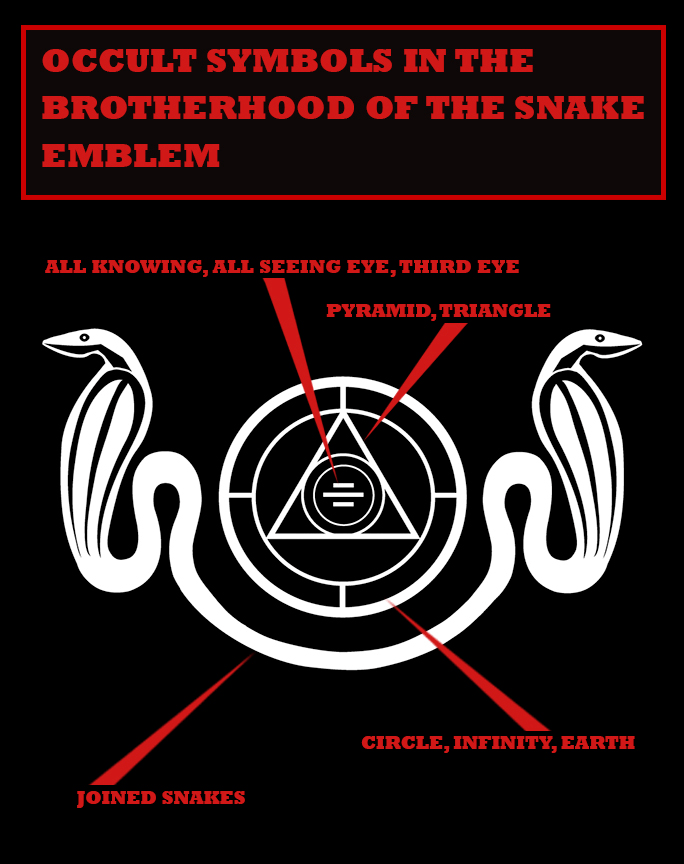
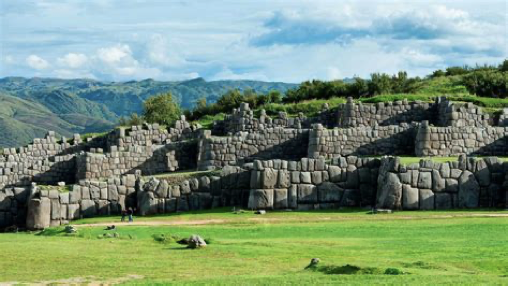
Briefly for new readers, this elite core of master builders – the Brotherhood of the Snake – traversing the Earth in the early centuries after the Flood; laying down a premeditated network of geodetic markers were the descendants of angelic and human offspring: comprising the Nephilim and their offspring in following generations known as the Elioud – refer articles: Nephilim & Elioud Giants I & II. These beings were not fully human and had at their disposal minds, skills and the size to carry out the remarkable exploits of which we have studied or discussed on our journey so far. They include the sites at Gobekli Tepe; Stonehenge (refer article: Stonehenge); Sacsayhuamán; Baalbek; Easter Island; Machu Picchu; and the Sphinx. 

It stands to reason that a race of giants could be the only reasonable explanation – applying Occam’s razor – for the otherwise inexplicable origin of the grand edifices around the world of yes, gigantic size. This may be a difficult concept for those apart from constant readers. The premise of this article goes a step further. While the sites mentioned above all indicate a use of technology more advanced than possessed by 21st Century humankind and an impressive knowledge of astronomy, they still bear the telltale hallmarks of constructions devised by principally physical beings. 

There is one monument or complex which defies this paradigm and aloofly and prominently stands apart. It is the Great Pyramid of the Giza complex. It is hoped that as we progress, the details of its design, construction and purpose will convince the reader of its almost ethereal authorship by an entity not wholly from this world or the physical plane. So perfect for example is the Great Pyramid, that not only did purely human hands not design or oversee its construction, nor were the race of Elioud giants wholly responsible for it – Articles: Nephilim & Elioud Giants I & II.

An image of the pyramid has been indelibly imprinted on the mind of the public as seen on the iconic album cover of The Dark Side of the Moon by Pink Floyd in 1973.
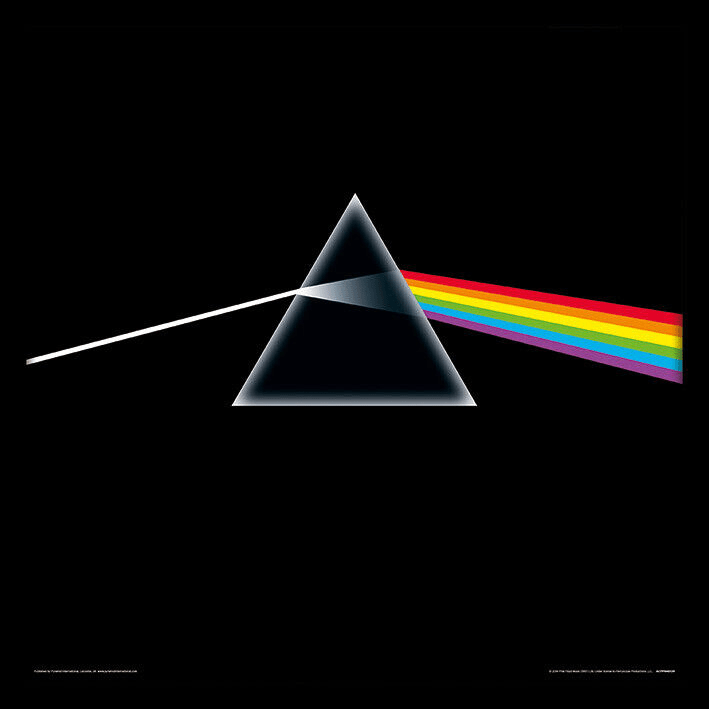
While arguably it is a prism refracting light showing the colours of the spectrum, it is pyramidal none-the-less. The most famous progressive rock record and the fourth highest selling album of all time with sales somewhere between twenty-five to forty-five million copies. 

It is worth noting that the dimensions of the Great Pyramid incorporate a number of fascinating numerical wonders, of which we will study. One is the fact that the slope angles of its sides are the angles required to see a rainbow. Light refracts through a water surface by 42 degrees to create a rainbow – refer articles: 42; Thoth; and The Truly Big Questions. This of itself is interesting because this dates the pyramid to at least after the time of the patriarch Noah – Chapter I Noah Antecessor Nulla. After the global cataclysm which nearly destroyed all life on Earth, the Creator established a covenantal agreement with Noah and his offspring to never destroy the Earth again, by flood at least – Article: The Younger Dryas Stadial: Ending of the Earth… Beginning of the World

Genesis 9:8-15

Easy English Bible 

God said to Noah and to his sons, “I promise you that I will obey the covenant that I am making with you I promise this to you and to all your descendants. I also promise this to all the animals and birds that came out of the ship with you… I will never cause water to destroy all living things on the earth again. I will show you clearly that I have made this covenant with you, and with every living animal… I have put my rainbow among the clouds in the sky… When I bring clouds over the earth, a rainbow will sometimes appear. Then I will remember the covenant that I have made with you… Never again will the water become so deep that it destroys everything that lives.”

This promise extended to Noah’s prosperity forever, with all the animals on the Earth. Prior to the Flood the Earth was very different, including its flora, fauna, geography, atmosphere and astronomy. Months were thirty days long – refer article: The Calendar Conspiracy. Noah entered the Ark on the 10th day of the second month, equating to April/May – Genesis 7:7, 10. The Flood began in 10,837 BCE on the 17th day – Genesis 7:11. Noah and his family remained on board until water levels had stabilised and the ground was completely dry. Thus they disembarked the Ark – 377 days after sealing it shut and 370 days after the flood waters consumed the Earth – on the 27th day of the second month, a year later: Genesis 8.14. It was shortly after this that the Eternal agreed the Rainbow Covenant with righteous Noah – Genesis 6:9, Ezekiel 14:14. Refer article: The Sabbath Secrecy.

We will discover that the timing of this event and the subsequent planning if not the building of the Great Pyramid have more in common than one would imagine. But first, what age do Egyptologists typically ascribe to the Great Pyramid? The stock answer is that it was built by the second king of the 4th Dynasty, Khufu or Cheops in Greek, during his reign from 2589 to 2566 BCE. There are multiple issues with this in that the thirty dynasties of pharaohs were not successive, with many concurrent and overlapping. 

Added to this, local rulers in both Lower and Upper Egypt, would talk themselves up, so that while records listed them kings and pharaohs; this did not mean they ruled all of either Upper Egypt or Lower Egypt. In many cases there was rarely one Pharaoh over all Egypt. The Dynastic period of Egypt did begin with Pharaoh Narmer (or Menes), but not in 3100 BCE, but rather he reigned from 1988 to 1970 BCE – Appendix IV: An Unconventional Chronology

Thus Khufu reigned considerably later and so if the Great Pyramid was built circa 2550 BCE as alleged it was not built by him anyway. The second and much smaller third pyramid are attributed to Khufu’s son and grandson respectively: Khafre (or Chephren) from 2558 to 2532 BCE and Menkaure (or Mycerinus) from 2432 to 2503 BCE. The pyramids at Giza are explained as monumental tombs. Granted, pharaohs expected to become gods in the afterlife and the pyramids appear to be associated with this concept. 

But they were never intended to be tombs. The extravagant cost of building such a structure to be a massive sarcophagus makes no sense at all. The purported time required to build them ‘conventionally’ would have outlived the pharaoh in question by perhaps decades. The prominent pyramids were infamously appropriated by earlier pharaohs and their names attached to them. Most pharaohs were buried in the Valley of the Kings and in rock-cut tombs, mastabas and sarcophagi. 

Even so, many researchers continue in firmly believing the Great Pyramid of Giza was built to serve as the eternal resting place of the Pharaoh. Yet not a single piece of evidence has been unearthed to support the Great Pyramid was ever intended to serve as a tomb. Not even hieroglyphics or ancient texts. Nor was any mummy ever discovered in the Great Pyramid. When it was ‘first’ entered by the Arabs in 820 CE, the only thing found in the pyramid was an empty granite box in the King’s chamber called the coffer. 

Famous pharaohs who were buried in pyramids include: Djoser, Khufu, Khafre, Menkaure and Tutankhamun.

Djoser is noteworthy, for he was the first king of the 3rd Dynasty – from 1700 to 1672/71 BCE – and the dream interpretation Pharaoh at the time of Joseph – refer Chapter XXXIII Manasseh & Ephraim – the Birthright Tribes; and Appendix VI: Joseph & Imhotep – One man, different name? Both men are associated with the Saqqara step pyramid. 

The Second Pyramid of Giza

As the second Pyramid is associated with Khufu’s son Khafre, the necropolis or burial ground attributed to him stands out on the landscape because it includes the Sphinx – refer Appendix VII: Moses, the Exodus & the Red Sea Crossing – Fabrication or Fact? There is no proof whatsoever that Khafre built the Sphinx, let alone the second Pyramid; or that it is his face presently carved on it. 
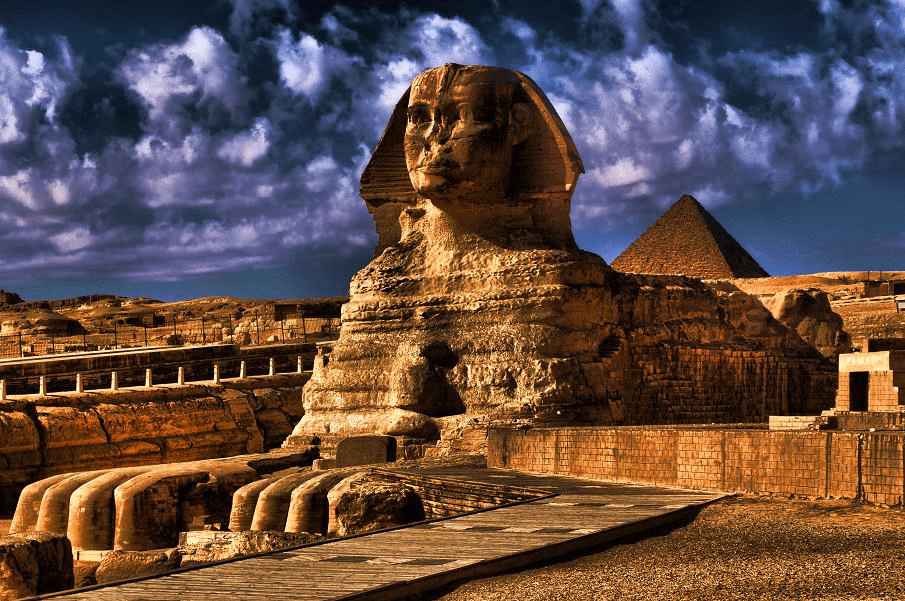
National Geographic, The Pyramids at Giza were built to endure an eternity – but how? Brian Handwerk, 2023:

‘The third of the Giza Pyramids is considerably smaller than the first two – less than half their height… the pyramid’s elaborate complex includes two separate temples connected by a long causeway, and three individual queens’ pyramids.’

These pyramids are labeled G-IIIa, East subsidiary pyramid; G-IIIb, Middle subsidiary pyramid; and G-IIIc, West subsidiary pyramid. In the chapel associated with G-IIIa, a statue of a Queen was found. It is thought by Egyptologists that Khamerernebti II was buried in one of the Queen pyramids.
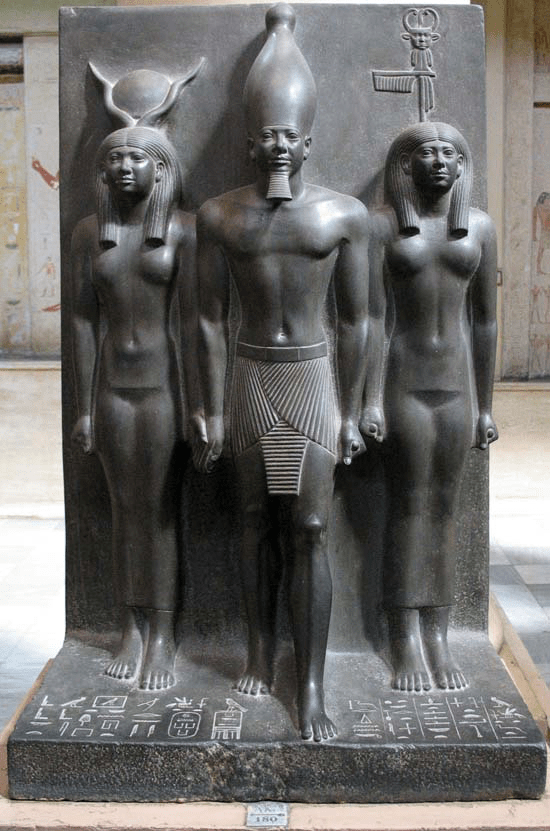
Fifth king of the 4th Dynasty, Menkaure with his wife Khamerernebti II appearing as Hathor on left and the goddess of the seventeenth nome of Egypt on the right

The sixty-four thousand dollar question is: why if Menkaure had the previous expertise of his father and grandfather at his disposal to draw upon, would he build a pyramid less than half the size of the preceding two? 

Handwerk: ‘Menkaure’s chambers include niche decorations unique to Giza and a vaulted ceiling in his burial chamber itself. The pharaoh’s elaborate sarcophagus was lost at sea near Gibraltar in 1838.’

The third Pyramid of Giza in the foreground 

Two more questions remain as to how did Khufu, Khafre and Menkaure a. erect these cyclopean towers of cut rock and b. with such exactitude of accuracy not even replicated by today’s skyscrapers? 

Handwerk: ‘The ancient engineering feats at Giza were so impressive that even today scientists and engineers can’t be sure exactly how the pyramids were built… [and] are still debating exactly how the pyramids were constructed. It’s generally believed that the Egyptians moved massive stone blocks to the heights along large ramps, greased by water or wet clay, using a system of sledges, ropes, rollers, and levers. Some suggest exterior ramps either zig-zagged or spiralled around each pyramid, while a more controversial theory suggests internal ramps were used.’
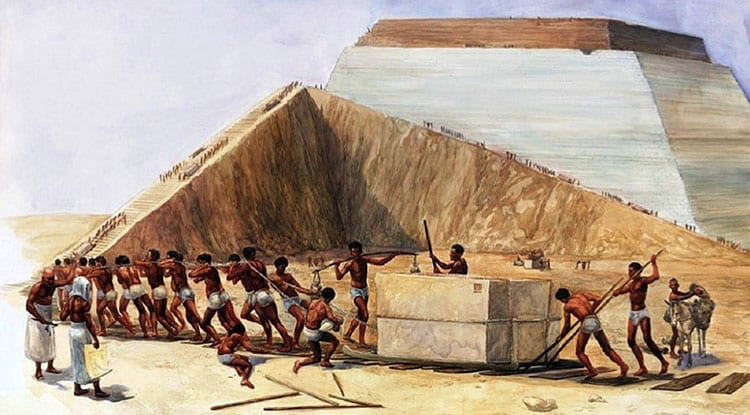
How the Great Pyramid was not built

This explanation just doesn’t fit with the evidence we see before our eyes. The amount of blocks required and the 2.5 to 15 ton average weight of each of them abrogates this line of reasoning as palpably incorrect. The estimate for the number of blocks used is a mind blowing 2.3 million; (though computer calculations indicate a number closer to a still staggering 590,712 blocks, according to A New Science for Everything). 
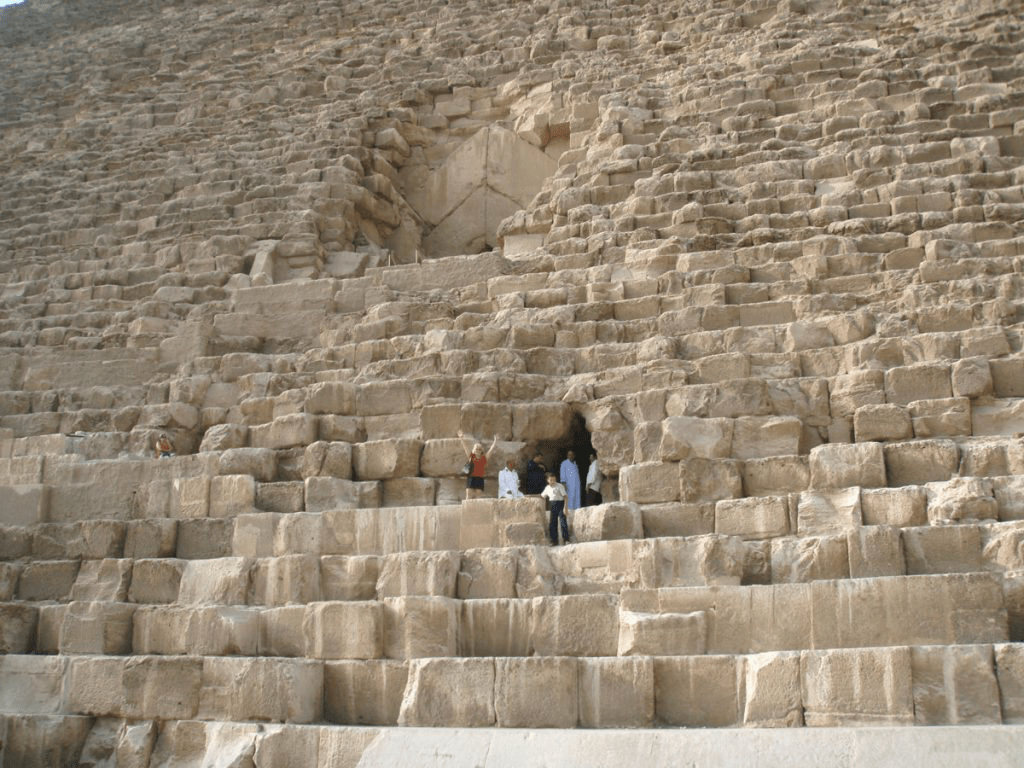
The enormity of the titanic endeavour in building a monument of such incredible size, using so many heavy stone blocks perfectly melded together, is profoundly visible above.

Before concentrating on the mathematical data of the Great Pyramid and spatial correlations with the Earth below and the stars above, there are a couple of pyramid complexes located in Mexico which while not exhibiting the perfection of the Giza pyramids are none-the-less impressive and imposing examples of workmanship. 
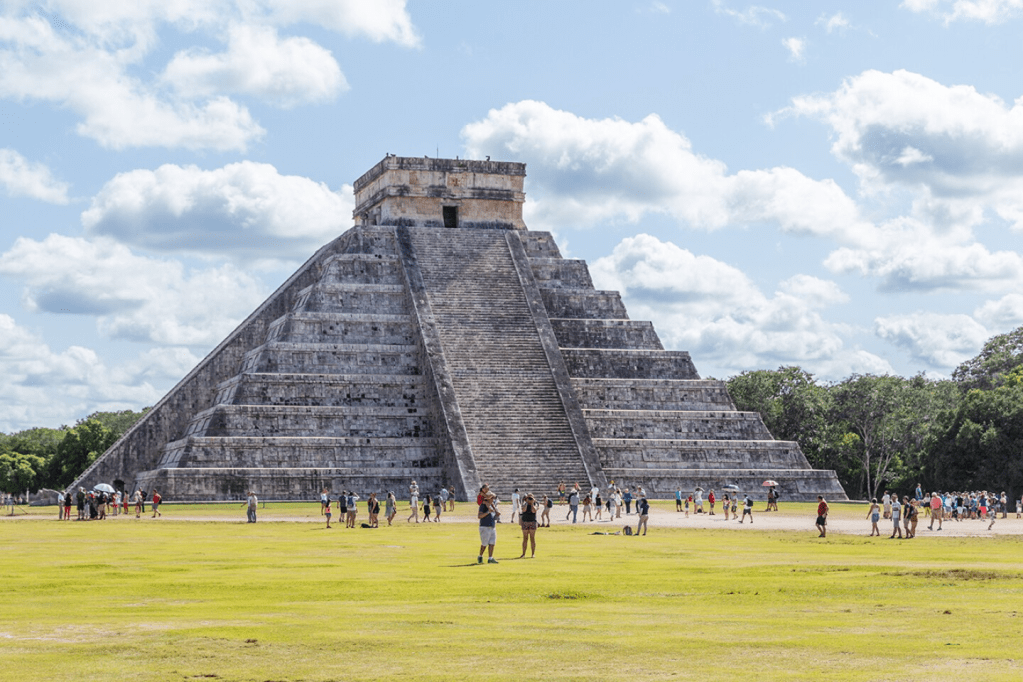
In Yucatan, stands the Castillo de Kukulcán – with its nine stepped platforms, perhaps alluding to the nine dimensions between humans and God – the centre piece of Chichén Itzá. The pyramid functions as an enormous calendar and was designed so that on the equinoxes, the play of sunlight and shadow would create the illusion of a snake descending to Earth. 

Observe the serpent’s head at the base of the steps with its body composed of sunlight shining on the steps during the equinox. As visitors are no longer allowed to climb the steps or access the Temple of Kukulcán at the top of the pyramid, they tour other courts, temples and palaces throughout the city instead. Such as the Templo de los Guerreros or Temple of the Warriors below.
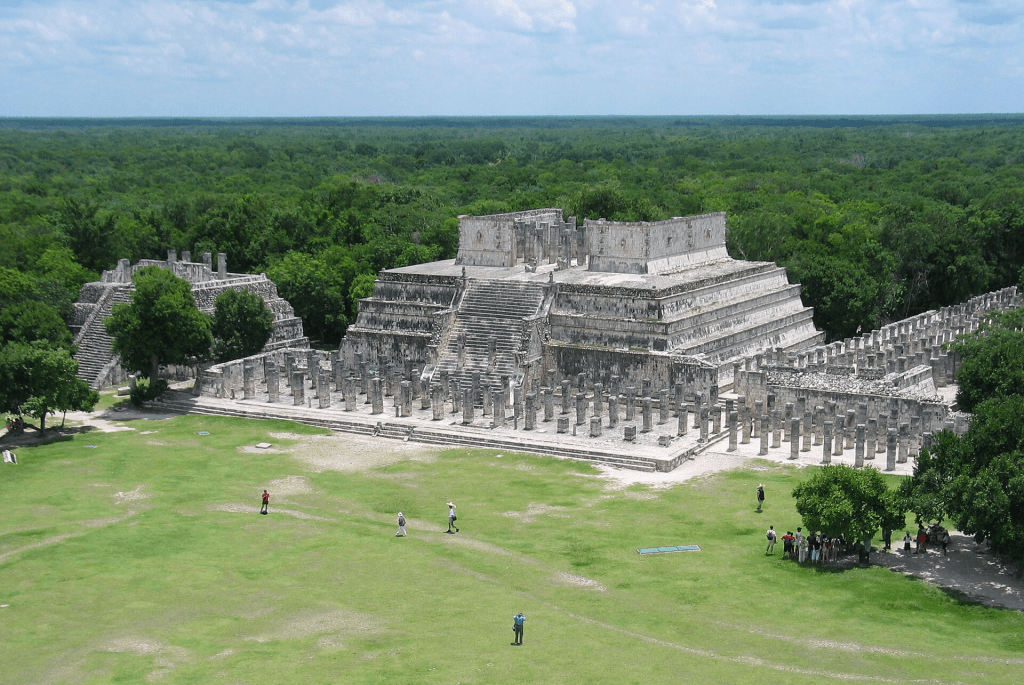
As arresting as the monuments are, it appears to this writer that they may not be the work solely of giants but also mortal men at a later date than the Great Pyramid. Though more recent, they still look far older than historians propose: between 700 to 1300 CE. 

In contrast, Teotihuacán is thought to have flourished between 100 to 550 BCE and was one of the most influential cities in Mesoamerica, with a population of nearly 200,000 at its peak. The city is dominated by the enormous Pyramid of the Sun, the Pyramid of the Moon, and a citadel, which sit along the 2.5 mile long Avenue of the Dead. The site awed the Aztecs, who wondered what vanished civilisation could have created such a monumental city. 

The Pyramid of the Sun – not its original title and retrospectively named – is one of the largest structures of its type in the Western Hemisphere and the third largest pyramid in the world. The pyramid dominates the central city from the east side of the Avenue of the Dead. The pyramid rises 216 feet (66 metres) above ground level and measures approximately 720 by 760 feet (220 by 230 metres) at its base. It was constructed of about 1,000,000 cubic yards (765,000 cubic metres) of material, including hewed tezontle, a red coarse volcanic rock of the region. 

The north end of the Avenue of the Dead is capped by the foreboding Pyramid or Temple of the Moon, flanked by platforms and lesser pyramids. The second largest structure in the city, it rises to 140 feet (43 metres) and measures 426 by 511 feet (130 by 156 metres) at its base. 

Even though the Pyramid of the Moon is dwarfed by the pyramid of the Sun, it is still gigantic as can be seen by the smallness of the people exploring it. The Pyramid of the Moon looks out of place, otherworldly and genuinely malevolent. The pre-Aztec culture was brutal, with many people and animals sacrificed in rituals. The decapitated remains of people, wolves, jaguars, pumas, rattlesnakes and eagles, were discovered under the Temple of the Moon in 2004.
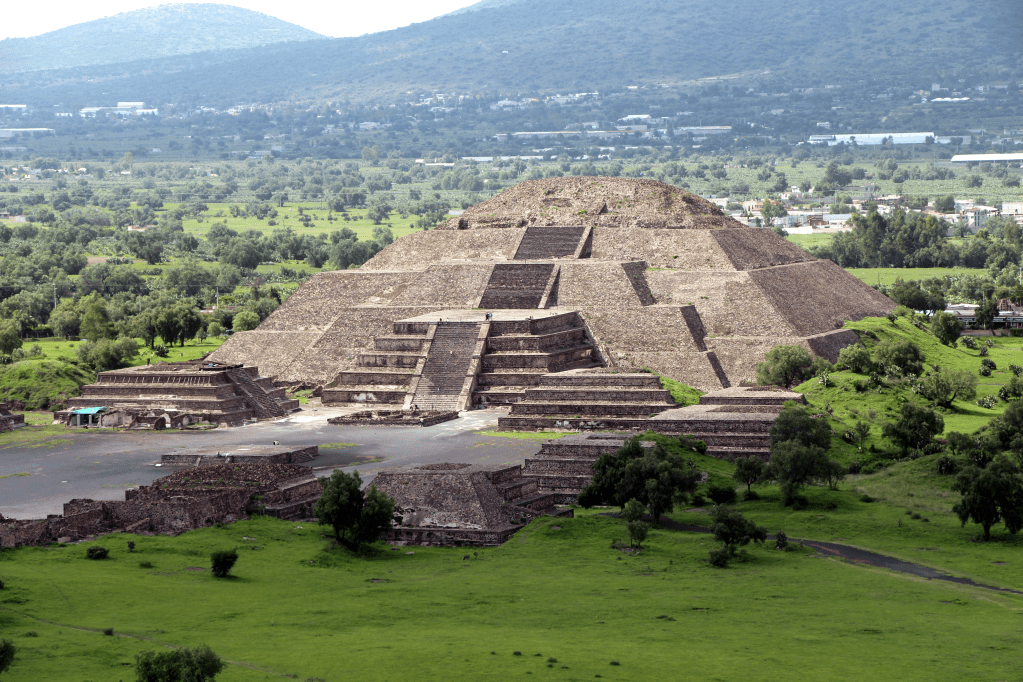
A more recent photograph reveals the growth in the vegetation and nearby trees, as well as the new buildings in the background. Its main stairway faces the Avenue of the Dead and the Pyramid of the Sun can be seen in the distance. One can see just how steep the incline is on the first set of steps.

Along the southern part of the avenue lies the Ciudadela or Citadel, a large square courtyard covering 38 acres (15 hectares). Within the Citadel stands the Temple of Quetzalcoatl – the Feathered Serpent – in the form of a truncated pyramid; projecting from its ornately decorated walls are numerous stone heads of the deity – refer article: Thoth. The temple walls were once painted in hematite red – or haematite – a common dark red rock from which iron is obtained. 
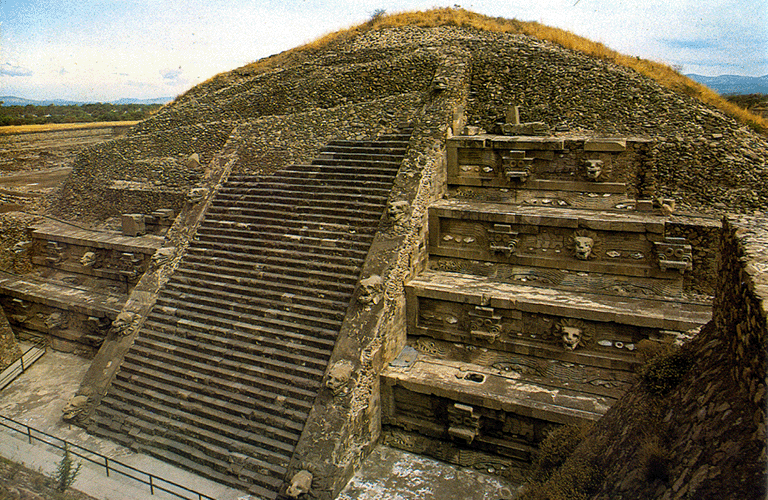
Crystal Council: ‘NASA made a remarkable discovery when they found Hematite on Mars [the red planet]. It was found by the infrared spectrometer on the NASA Mars Global Surveyor and the 2001 Mars Odyssey spacecraft when it was orbiting the planet. What makes this even more interesting is the need of water for Hematite to occur.’

Other archaeologists suggest cinnabar was heated and used for the blood-red pigment. This process produces the deadly to handle, mercury ore; of which its significance will become apparent shortly. 

Cinnabar (or cinnabarite), also known as mercurblende, is the bright scarlet to brick-red form of mercury sulfide – HgS. It is the most common source ore for refining elemental mercury and is the historic source for the brilliant red or scarlet pigment termed vermilion and associated red mercury pigments – refer scarlet, article: Is America Babylon? Cinnabar generally occurs as a vein-filling mineral associated with volcanic activity and alkaline hot springs – occurring in brilliant red crystals and also in red or brown amorphous masses.

Cinnabar has been valued since ancient times and is used in medicine. It symbolises wealth and power and historically was used in royal artefacts. It also represents vitality, longevity and connecting individuals to spiritual realms. The mineral is said to enhance intuition and psychic ability. While popular in jewellery, safety measures are essential to minimise mercury exposure.
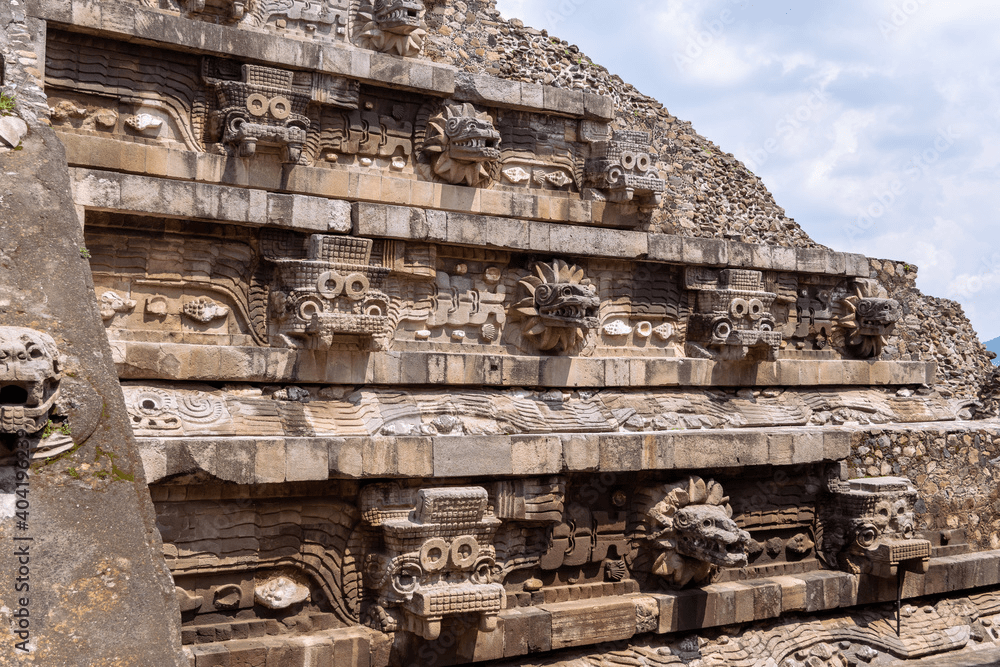
Individual burial sites were found around the Temple of Quetzalcoatl in 1925, and in the early 1980s archaeologists discovered the ceremonially interred remains of 18 men, thought to be ‘soldiers who had been ritually sacrificed; about 200 CE. Further excavation revealed more than 130 skeletons of both sexes in mass graves along the edges of the temple as well as underneath it.’ 

As with Chichén Itzá, the stamp of the Brotherhood of the Snake is grimly evident. The correlation does not end there. 

Ancient Code: ‘The construction of Teotihuacan was attributed to the Quinametzin Giants; Quinametzin (Náhuatl), a race of giants who, legend says, populated the world during the previous era and whose survivors were hidden in those days. “The Quinametzin were created during the era of the “Sun of Rain” and its ruler was Tlaloc.”

Crystal Council: ‘Mexican archaeologist Sergio Gómez and his team have discovered liquid mercury at the end of the tunnel below the Pyramid of the Feathered Serpent, the third largest pyramid of Teotihuacan. 

According to archaeologists, the ancient builders had opened the tunnel once in the past, probably to place something inside. Since then… No one had entered or seen the interior of the tunnel. The tunnel’s ceiling was very interesting as it had traces of metal powder that reflects light in a curious pattern, almost as if mimicking the night sky… when entering the tunnel with torches, the metal dust shined just like the stars. Researchers believe that these traces are pyrite or magnetite remains elements not found in the region of Teotihuacan.

[One hundred and fifty] meters below the temple of the Feathered Serpent, researchers discovered 50,000 mysterious objects, ranging from animal bones, batons to metal spheres. The descent through the tunnel resembles… the journey to the underworld, in an enigmatic city… 50 [km] northeast of Mexico City. 

During their search, the team… discovered a large amount of silvered metal at the end of the sacred tunnel that remained sealed for 1800 years. Many researchers firmly believe that the toxic element could be a clue that will provide more insight about… a mysterious ancient civilization that predates the Aztecs, which still remains a mystery as researchers do not have a name for them. 

Gomez believes… the metal could have been used to represent a river or lake of the underworld, even though ancient astronaut theorists suggest that there could have been a more “technological use” to mercury’ as the “first known superconductor.” ‘Traces of mercury have been previously found in small amounts in a couple of Maya sites farther south, but it has never been found in Teotihuacan until now. 

Mercury is an element very difficult to extract, appreciated for its refracting properties, it is used [in] numerous appliances today. Mercury was uncommon in ancient Mexico and some researchers believe that its features could have given supernatural features to its rulers. What use could the ancient inhabitants of Teotihuacan have for Mercury and Mica?’ 

Large quantities of Mica have been found at Teotihuacan, even though this mineral is sourced three thousand miles away in Brazil. Mica is present almost in every single building at Teotihuacan. Mica was known to ancient Indian, Egyptian, Greek, Roman and Chinese civilisations. Mica is stable when exposed to electricity, light, moisture and extreme temperatures. It has superior electrical properties as a superior thermal insulator – often used in today’s electronics – and as a dielectric; can support an electrostatic field while dissipating minimal energy in the form of heat; and is thermally stable to 500 °C.

‘Mercury is a heavy, silvery-white metal. As compared to other metals, it is a poor conductor of heat, but a fair conductor of electricity’ – Article: The Ark of God. ‘Mica is an excellent conductor of electricity. Mercury is the only elemental metal known to melt at a generally cold temperature.’
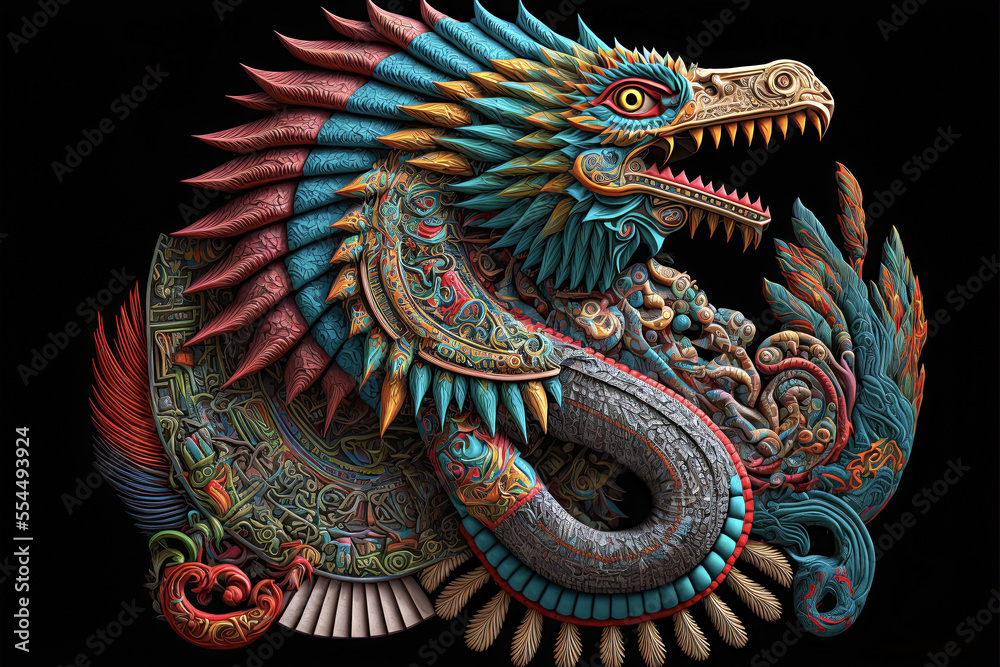
It is interesting to note as discussed previously, the link between the personalities Thoth, the Moon; Hermes Trismegistus, the planet Mercury; and Quetzalcoatl – Article: Thoth. This added to the metal, liquid Mercury; refracting properties; and pyramids, becomes greater interest in light of the Great Pyramid and its link with the spectrum of a rainbow. What is of the greatest significance is that Quetzalcoatl is not just a serpent, but a feathered serpent with a plume like a bird, always pictured with a regalia of many colours – like a rainbow. North American Indians symbolise this god when they wear an ornate headdress made of bird feathers. 

It should be added that as Quetzalcoatl is represented in the symbolism of a serpent and… a bird; Thoth is likewise portrayed as humanoid and… avian. 

In depictions of Quetzalcoatl two colours predominate: turquoise and yellow (or gold). The significance of gold will become clearer as we proceed. Turquoise is a precious and sacred gemstone to Native American tribes of the Southwest United States – who associate it with healing properties and spiritual guidance.

Turquoise stone has an opaque blue/green colour and forms when water containing copper and aluminium seeps into rock and settles there. It is the copper which is responsible for the vivid colour of the gemstone. Turquoise like Quetzalcoatl represents life, with the blue and green mixed with the brown of the matrix being the colours of the sky, water and earth. 

The captivating colour of Turquoise held spiritual and cultural significance for the ancient Egyptians, where turquoise was revered as a symbol of protection and good fortune. It adorned the tombs of pharaohs, signifying a connection between the earthly and divine realms.

The Inca version of Quetzalcoatl was named Viracocha; venerated as the sun god and a creator. He was sacred to the Inca Empire, as was gold. However, gold had less material value because it more importantly represented Viracocha’s blood and the Sun’s sweat. Ancient Code: ‘In pre-Incan times, highly developed civilizations in South America were expert goldsmiths. To them, it was part of religious rituals.’

Fascinatingly, Viracocha was non-binary, that is neither male nor female. We have encountered an individual of similar sexual ambivalence in the form of the Greek god Hermes and the Roman god, Mercury – Article: Thoth. 

The Incas of Peru rarely used Viracocha’s name because of its sacred nature. Instead, they would refer to the god as Ilya, meaning light; Ticci, meaning beginning; and Wiraqocha Pacayacaciq, meaning instructor

Linked with Viracocha’s gold blood was the belief that monoatomic gold unlocks a means to immortality. The ancient Egyptians ingested gold, believing it was the skin and flesh of the gods in similar vein to the Incas – Article: The Ark of God.

Viracocha’s face usually remained hidden behind a mask – Article: Belphegor. Though in some cases, Viracocha is referred to as an old bearded man, with a long robe and staff like a wizard and remarkably reminisce of the Hermit in the Tarot – refer article: Thoth. Viracocha wandered the world to teach humans how to build civilisation. Eventually, Viracocha departed across the Pacific; promising to return one day. 

Notably, the beard could also be seen as a symbol of a water god, as Viracocha translates to “sea foam.” According to certain accounts, the god emerged from Lake Titicaca – after creating the land and the sky – near the ancient site of Tiwanaku, home of the portal-like Gateway of the Sun. 

The Gateway of the Sun depicts Viracocha powerfully poised with a rod in each hand, surrounded by forty-eight winged chasquis, or ‘god messengers.’ Drawing a comparison with the angelic Watchers from the Book of Enoch. Unsurprisingly, Viracocha is credited with creating a race of giants. 

Below the Gateway, a series of alien-like stone heads adorn an enormous wall. Each head may represent a different alien race. One of the heads bears a striking resemblance to modern depictions of grey aliens. 

It is worth noting Viracocha accentuates a humanlike aspect; whereas Queztalcoatl, embodies the serpent like nature reminiscent of the biblical order of the Seraphim – refer Chapter XXII Alpha & Omega; and article: The Ark of God.

The staff may represent a technological ability to move massive stones. Much like Moses and his brother Aaron carried staffs, using them to perform miracles – Article: The Manna Mystery; and Appendix VII: Moses, the Exodus & the Red Sea Crossing – Fabrication or Fact? 

Ancient Code, The Bosnian Pyramids, 2023 – emphasis & bold mine: ‘A Pyramid in Europe? Well… Pyramids actually! … the discovery in Bosnia & Herzegovina [of] the incredible Pyramid complex found by Dr. Semir “Sam” Osmanagić Ph.D. … Head of Anthropology at the American University in Bosnia-Herzegovina… 

These strange geometrical shapes were first sighted in 2005 when Dr. Osmanagić traveled to the town of Visoko [northwest of Sarajevo], and these strange looking hills caught his attention when you travel to the area, these geometrical shapes clearly stand out from the rest and are very difficult to miss.’

‘The Pyramid of the Sun, with its 220 [metre] height, exceeds the Great Pyramid of Egypt, which measures 147 meters. But what we find mind-blowing is the fact that the Pyramid’s orientation to the North is accurate with an error of 0 degrees, 0 minutes and 12 seconds. Incredible precision and this is where the Bosnian Pyramid of the Sun has an amazing fact in common with the Great Pyramid of Egypt. 

The great Pyramid of Egypt resides at the intersection of the longest line of latitude and the longest line of longitude, the exact center of all the land mass in the world. Also, each of the four sides aligns almost precisely with the four points of the compass. But how can this be? These two ancient civilizations were not connected.’

‘If the discovery itself isn’t enough, there’s more to the Bosnian Pyramids. Several teams of physicists and electrical engineers from around the world have gathered in Visoko to study these findings and found some interesting things in Bosnia.

Researchers have detected and measured an energy beam (electromagnetic in nature) coming through the top of the Bosnian Pyramid of the Sun… The radius of the beam is 4.5 meters with a frequency of 28 kHz with a strength of 3.9 V. According to researchers, the beam is continuous, and its strength grows as it moves up and away from the pyramid. This phenomenon contradicts the known laws of nature, physics and technology and might as well be the first ever “tangible” proof of non-herzian technology found on Earth.’
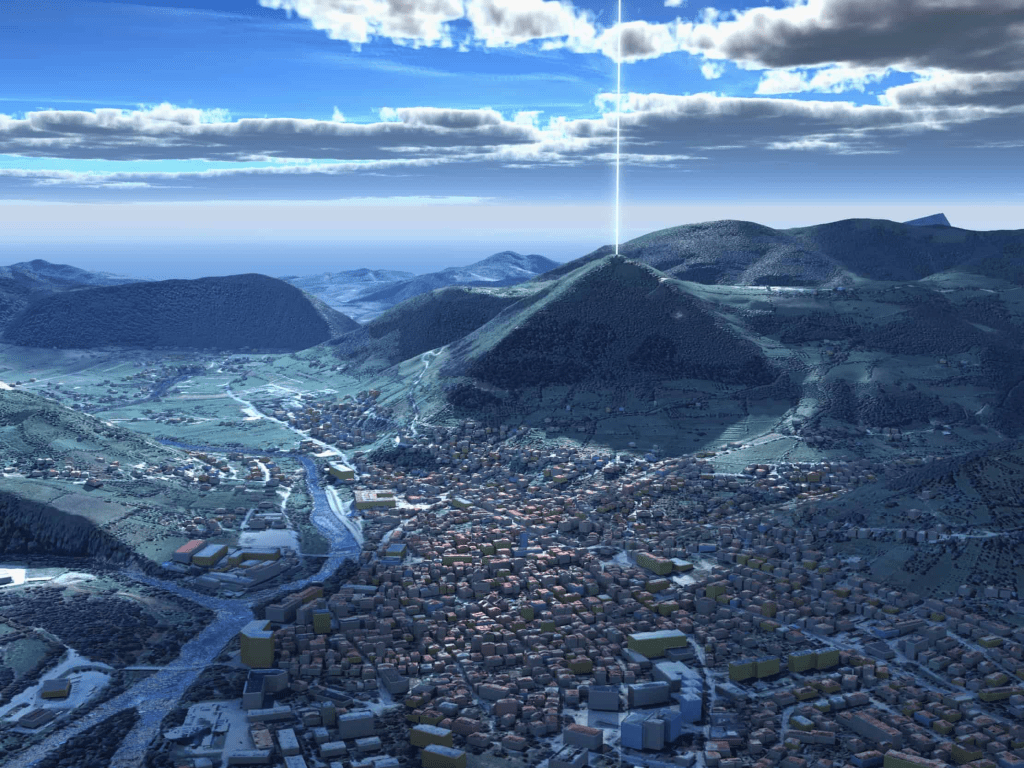
If we look elsewhere on Earth, we will find that beams coming out of Pyramids are not strange phenomena as beams of light have been recorded coming out of the Mayan Kukulkan Pyramid located in Yucatan, Mexico. In China, we also have reports of strange beams of energy coming out of the Xianyang pyramid, and according to some even the Chinese government has begun monitoring the Xianyang pyramid as researchers claim, the beam has extraterrestrial origins. Could it be that these Pyramids are enormous energy machines? If so, what is their actual purpose? And better yet where does this beam lead to? 

An “ultrasound” beam found at the Bosnian Pyramid of the Sun comes in regular blocks of 9.3333 Hz with peaks up to 28.3000 kHz so what you have here are properties of energy… By the end of 2012, the source of the beam was located 1.5 miles under the Pyramid and according to researchers it has an estimated power of over 10kW. Hydrophone recordings conducted in water pools within the Ravne tunnels showed the presence of ultrasound oscillations at 24 kHz and one octave up at 48 kHz whose amplitudes changed in a rhythmic manner. A 38 kHz frequency also appeared erratically. Interestingly, this is 14 kHz higher than the 24 kHz frequency, a [different] frequency that is half of the 28 kHz frequency reported coming from the Pyramid of the Sun. 

But that’s not all, enormous underground constructions have been discovered as well, chambers, labyrinths, and even underground lakes have been found in the area. Energy screenings show that the ionization level has over 43,000 negative ions which are about 200 times higher than the average concentration which makes these underground chambers display healing properties.’ 

If credible, the beam of energy emanating from within the Pyramid and exiting through its apex is indicative of a high level of a metallic element beneath the Pyramid. Therefore, a plausible link between the Bosnian Pyramid’s energy beam; the Kukulkan Pyramid exhibiting the same phenomena; and the mercury beneath the Pyramid of the Feathered Serpent is drawn. 

The elevation of gold as the life blood of Viracocha – aka Quetzalcoatl – equates to it being a good conductor for electricity and perhaps a core element in pyramids historically – refer article: The Ark of God. The evidence of its presence now long gone, due to vandalism and theft over the centuries. 

The ultrasound beam reminds of the Taos Hum located near Mexico no less, in the state of New Mexico – refer article: The Top Ten Unexplained Mysteries of all Time. A young person without hearing loss can hear between 20 Hz and 20,000 Hz. Thus the Bosnian Pyramid beam at 28,000 Hz would be beyond the frequency of a human being. Likewise, the lower end of the beam at 9.3333 Hz would be outside of range. But should the beam hit between 20 Hz and 20 kHz it would technically be audible. 

What might the reason be for this mysterious ray of energy and its frequency of vibration? Are these emitted from a network of pyramids and used to impact humankind in some way? Is it a transmission of some kind – a measure of influence or control? (Refer article: Thoth) We have learned that there are invisible entities who do not have humankind’s interests at heart – Article: Principalities & Potentates: What they want… Who they are. Their leader certainly doesn’t: “…in which you formerly lived according to this world’s present path, according to the ruler of the domain of the air, the ruler of the spirit that is now energizing the sons of disobedience…” – Ephesians 2:2, NET. 

Before returning to the Giza complex and the search for a mysterious fourth pyramid, a number of modern pyramids have been erected around the world. Some of the more iconic include the following: 

The Sunway Pyramid Shopping Mall in Malaysia – Chapter VII Javan: Archipelago South East Asia & Polynesia. It opened in 1997 and is one of Malaysia’s largest malls at four million square feet. It boasts an array of large pharaoh statues, pseudo-hieroglyphs and an imposing sphinx standing guard at the front. 

The Palace of Peace and Reconciliation in Kazakhstan’s capital, Astana – Chapter IV Central Asia – Madai & the Medes. Designed by Sir Norman Foster, it was completed in just two years – with a cost of roughly $58 million – and the 203 foot edifice was unveiled in 2006 as a custom-built venue for the Congress of Leaders of World and Traditional Religions. 

The Muttart Conservatory in Edmonton, Canada – Chapter XXXIII Manasseh & Ephraim – the Birthright Tribes. The modern botanical conservatory complex is comprised of four massive glass pyramids, designed by British-born architect Peter Hemingway and completed in 1977. 

The Luxor Las Vegas in Nevada – Chapter XXXIII Manasseh & Ephraim – the Birthright Tribes. It cost $375 million to build the 30 storey glass and steel skyscraper and was unveiled in 1993. It is currently the ninth largest hotel in the world with over 4,400 rooms. The pyramid emits the world’s strongest UFO beacon-beam of light from its apex and there is a replica of the Sphinx of Giza in front of it.

The Walter Pyramid at California State University, Long Beach, California.

The aluminum-clad cobalt structure was opened in 1994 and is eighteen stories tall. Inside it has a seating capacity for over 4,000 people. 

The Memphis Pyramid in Memphis, Tennessee. 

Opened two years before its more ostentatious Las Vegas cousin in 1991, the $65 million Memphis Pyramid initially functioned as a 20,000 seat sports and entertainment arena. 

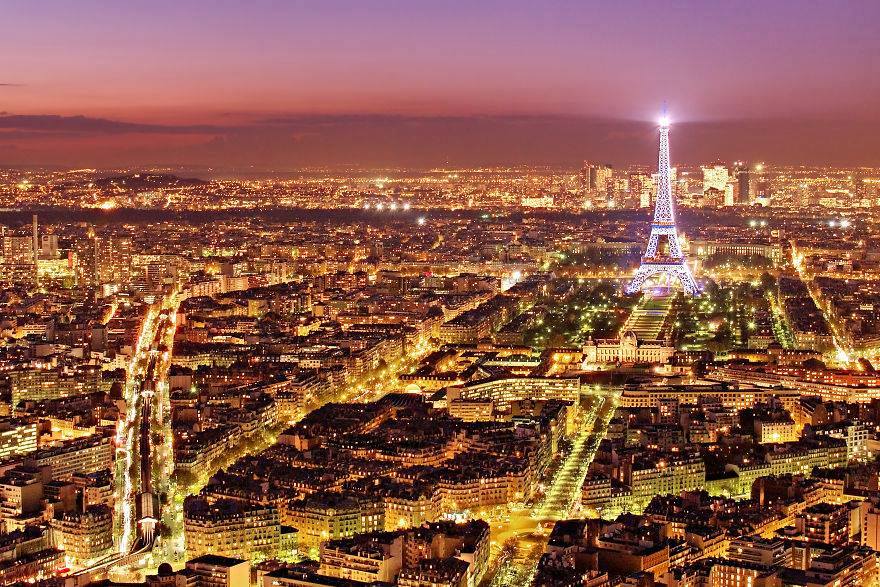
The Louvre Pyramid in Paris, France. 
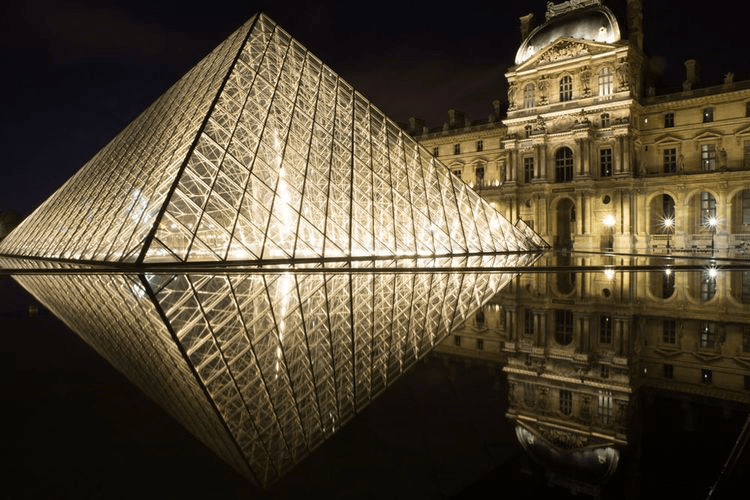
The seventy-one foot pyramid forms the entrance pavilion at the Louvre Museum – the world’s largest and second most well-attended museum in the world – completed in 1989. It is regarded as one of Paris’ most photogenic architectural landmarks.

Egypt historian Matthew Sibson claims he discovered evidence of a fourth Pyramid of Giza, first described by the explorer Danish naval captain Frederik Ludvig Norden in 1737 on behalf of King Christian VI of Denmark.

Sibson: “Well, some authorities have suggested that it was dismantled… and the stone used for building the nearby city of Cairo. Looking at satellite photos of Giza, we are looking for an area slightly west of the main rough diagonal axis, an area beyond the Pyramid of Menkaure. I used to think the pyramid may well have sat in the rectangular enclosure to the west of the Menkaure pyramid, but this doesn’t really work as it doesn’t match Norden’s words.”

Norden’s sketch showing four pyramids at Giza

“Looking at his map, we can instantly see that it isn’t to scale or accurate when comparing it to a satellite photo, but it does give us a rough estimate of how the pyramids were laid out and the fourth pyramid certainly isn’t due west of the Menkaure pyramid.” 

“This sketch by Norden, looking towards the southwest also shows that the fourth pyramid is on the diagonal and again is not due west of the Menkaure pyramid. So the obvious place for the pyramid to be is in the space outside the Menkaure enclosure and the rectangular enclosure as well.

This would put the missing pyramid slightly due west of the rough axis of the three main pyramids on what looks to be some flat prepared ground. You may say that this is just guesswork, but then I remembered the Wall of the Crow, a 650-feet-long and 32-foot-high wall located to the south of the Sphinx. It displays truly incredible stonework, with enormous blocks of stone used in its construction. 

Experts date it to the Fourth Dynasty, but I and many others suspect it actually predates the pyramids, making it one of the oldest pieces of architecture in the Giza Plateau. Nobody knows why it was built, but I suspect it was an old causeway, leading from where the River Nile used to be, up to the Giza Plateau, just like the three other pyramids. 

The Wall of the Crow, if extended, leads to nothing of note, but that would only be true if you are unaware of Norden’s description of a lost fourth pyramid. Each of the three pyramids of Giza has a long causeway leading to where the River Nile once extended. 

What I’ve discovered is the Wall of the Crow would lead directly to this small patch of land that I’ve already identified as the best possible location for the fourth pyramid based on the topography and Norden’s description.” 

“Interestingly, it also perfectly aligns with Khufu and Khafre’s pyramids. I think it is certainly possible, but what happened to it? According to research, there is evidence of a pyramid being dismantled in 1759 and [it] took 10 months. This pyramid would have been quite different from the others, around 100 foot smaller than the others and apparently had a cube on top, which I would guess was for a statue.”

In Voyage d’Egypte et de Nubie (Travels in Egypt and Nubia), Norden describes the missing pyramid as being made of ‘stone more black than the common granite.’ Norden’s description and illustrations are of superb quality, positioning the fourth pyramid at a little distance from the three Pyramids of Giza.

Norden: “The principal pyramids are at the east, south-east of Giza… There are four of them; that deserve the greatest attention of the curious; for though, we see seven or eight others in the neighborhood, they are nothing in comparison to the former… The two most northerly pyramids are the greatest and have five hundred feet perpendicular height. The two others are much less, but have some particularities, which occasion their being examined and admired. 

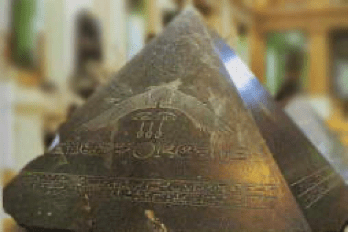
It is without coating, closed and resembles the others, but without any temple like the first. It has, however, one particular deserving remark; which is, that its summit is terminated by a single great stone, which seems to have served as a pedestal… the fourth pyramid has been made, upwards above the middle, of a stone more black than the common granite, and at least as hard. Its summit is of a yellowish stone. I shall speak elsewhere of its top, which terminates in a cube. It is, moreover, situated out of the line of the others, being more to the west… it makes a series with the three others.”

Detractors and naysayers accuse Norden of confusing the missing fourth pyramid with other pyramids in the area. It would seem this is a poor attempt at trying to dismiss an embarrassing situation. The aspect of four aligned pyramids in a row instead of three, will have an impact on a following discussion regarding the Giza pyramids positions. 

Another pyramid not quite missing but dubbed ‘the lost pyramid’, is the peculiar structure located at Abu Rawash – eight kilometres from the pyramids of Giza and the most northerly pyramid in Egypt. Opinion is divided, so that some think it was never finished and others propose it was and that an explosion destroyed its top half. Amongst those who think it was completed, they are divided again between the pyramid being a similar size to the third pyramid on the Giza plateau or the highest pyramid ever built, at 722 feet; some 240 feet taller than the Great Pyramid. 

Brien Foerster considers the Abu Rawash Pyramid was part of an energy grid and a power plant. At the time, the region was known as ‘The Land of Osiris’ and ruled by ‘heavenly’ rulers, the ‘Gods’. He advances that the Pyramid exploded between 10,000 to 12,000 years ago; caused by a destabilisation of the entire energy system. 

Further details claim that once completed, it was the ‘most beautiful Pyramid ever constructed in ancient Egypt’, having an exterior of ‘polished imported granite, limestone with a huge pyramidion placed on the top.’ The ancient name of the Pyramid was ‘Djedefre’s Starry Sky.’ 

The dates given by Foerster are far older than the orthodox chronology for the building of the Giza pyramids. Which means the Abu Rawash pyramid could predate them by an astounding seven or eight millennia. We will investigate this huge discrepancy in dating. 

First, there are a number of intriguing facts and anomalies surrounding the Great Pyramid worth investigating, as well as a clear correlation between ‘as above, so below’ – Article: Thoth; and Chapter XXII Alpha & Omega

The following sequence of photos in this section include old images of the Great Pyramid and stunning photos shot by people near to or on the Great Pyramid, which has been illegal to climb since 1951.  

A stunning photo of the Great Pyramid on the outskirts of sprawling Cairo in the background. Giza is a suburb of Cairo, Egypt’s capital with 22 million inhabitants. Notice how small people look, like ants.  

The Great Pyramid is compellingly unique in comparison with all other pyramids. In Egypt it can be said all the pyramids are similar. Not so with the Great Pyramid. It is clear that its designers and constructors were scientists and mathematicians, wanting everyone to know it was different and inexplicable. A veritable time capsule – and perhaps a distinct marker of a specific time – if it is nothing else. The ancient Greeks named the Great Pyramid of Giza as the first wonder of the world. It is the only one of the seven ancient wonders still remaining to this day.

Above, is the Pyramid attributed to Senusret III; a classic example of a pyramid ostensibly built to a blueprint diametrically in contrast to that of the Giza pyramids. The resulting failings of which is all too clear to see.

The Great Pyramid is the only pyramid in Egypt with its four faces slightly concave. So that the centres of the four sides are indented with an extraordinary degree of precision forming the only ‘eight’ sided pyramid. This effect is not visible from ground level whether near by or from a distance. Only from the air and even then only under certain lighting conditions. The phenomena has remained hidden for thousands of years, as it is only clearly detectable at dawn and during sunset on the spring and autumn equinoxes, when the sun casts shadows on the pyramid. Not only that – the curvature designed into the faces of the Great Pyramid exactly matches the radius of the earth.

The photograph (above) highlights two significant details. Firstly, the concave sides of the great Pyramid and its different shape – as evidenced in a preceding photo – in comparison with the Second Pyramid and secondly; the difference in construction quality between the Great Pyramid and its clearly non-identical twin, the Second Pyramid. Looking closely, the coarser, rougher formation and more advanced deterioration of the stone blocks made visible by the removal of the casing stones is strikingly evident on the Second Pyramid.

The Great Pyramid is the only known pyramid in Egypt to have both descending and ascending inner passages. The passages remain unexplained, so we will return to their enigma later. Likewise, there are a variety of airshafts built into the pyramid – present inside the Kings and Queen’s chambers. The purpose of these airshafts remains a mystery. The Great Pyramid is the only pyramid to have chambers above ground level.
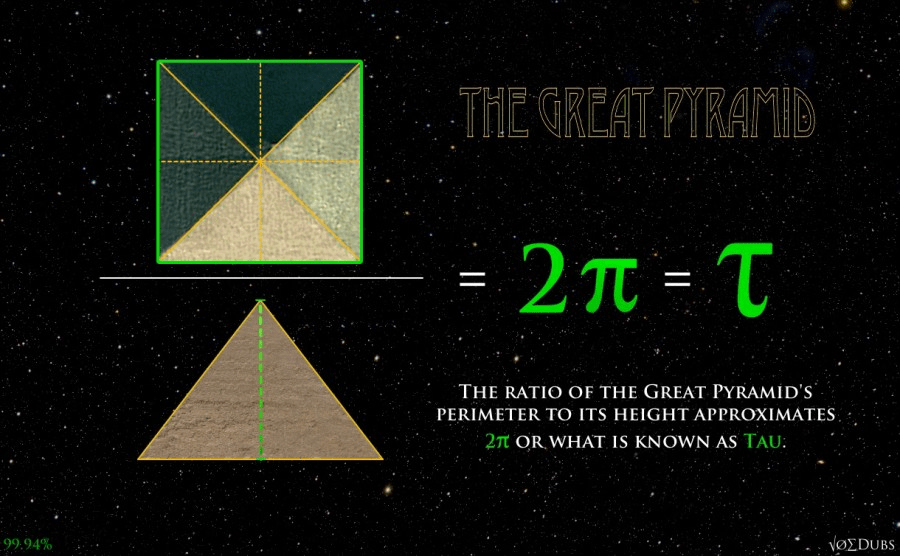
There is a relationship between Pi (p) and Phi (F) expressed in the fundamental proportions of the Great Pyramid; proving that the architect of the Great Pyramid predated the discovery of Pi of the Greeks by millennia. The vertical height of the pyramid maintains the same relationship to the perimeter of its base – the distance around the pyramid – as the radius of a circle bears to its circumference. 
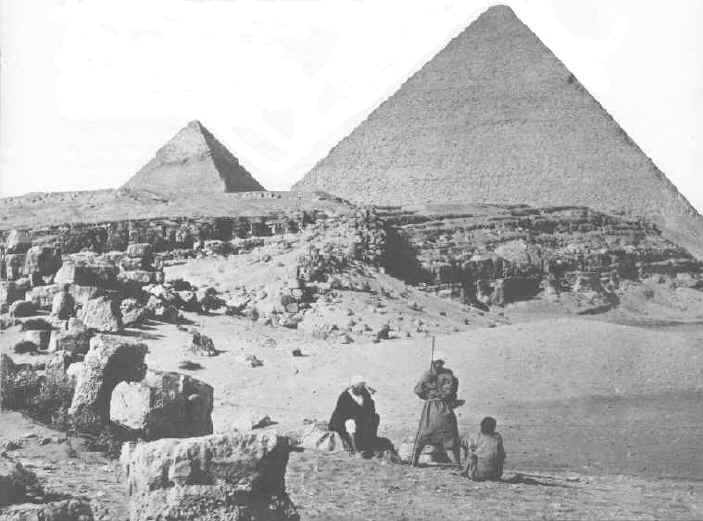
One of the oldest images of the Giza pyramids in existence, dating to 1862

The base of the pyramid covers 55,000 m2 (or 592,000 ft2), with each side greater than 20,000 m2 (or 218,000 ft2) in area. The base area in feet is coincidentally close with the computer calculation for 590,712 blocks in the pyramid. 

The cornerstone foundations of the pyramid have ball and socket construction capable of dealing with heat expansion and earthquakes.

The Great Pyramid once possessed an entrance with a swivel door. Only two other pyramids have been known to have a similar access: Khufu’s father and grandfather, Sneferu and Huni, respectively. According to historic accounts when the pyramid was first entered, the swivel door weighing about twenty tons, was so well balanced that it could be opened by pushing out from the inside with only minimal force. Though once closed, it was so perfect a fit that it could scarcely be detected; with not enough crack or crevice around the edges to gain a grasp from the outside.
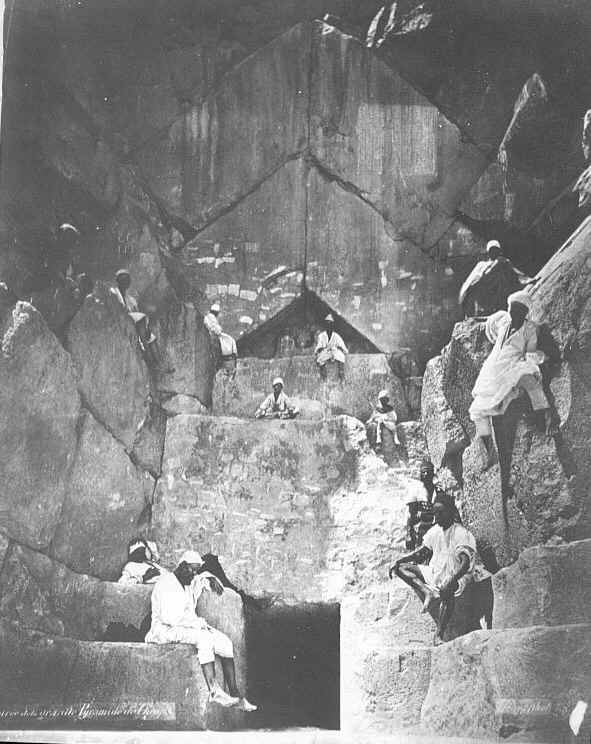
Photograph taken in the 1890s of the entrance to the Great Pyramid

Ancient Wisdom: ‘Today tourists enter the Great Pyramid via the ‘Robbers’ tunnel dug by workmen employed by Caliph al-Ma’mun around AD 820. The tunnel was cut straight through the masonry of the pyramid for approximately 27 metres (89 ft), then turns sharply left to encounter the blocking ‘plugs’ in the Ascending Passage.’ 

‘The workmen tunnelled up beside them through the softer limestone of the Pyramid until they reached the Ascending Passage. Al Mamun decided to bore direct centre on the North face of the pyramid and on the level of the 7th course. The original entrance is ten courses higher and 24 feet east of the main axis than Al Mamun dug.’

‘The fact is that Al Mamun appears to have tunnelled directly towards the junction of the ascending and descending passages. The hole that he quarried was unnervingly accurate… ?’

According to one source, while the chemical composition of the mortar used in the construction process of the Great Pyramid after analysis is known; it cannot be reproduced and has an unknown origin. The mortar is so strong – it is stronger than the stones it binds – it continues to hold the pyramid together until this day. 
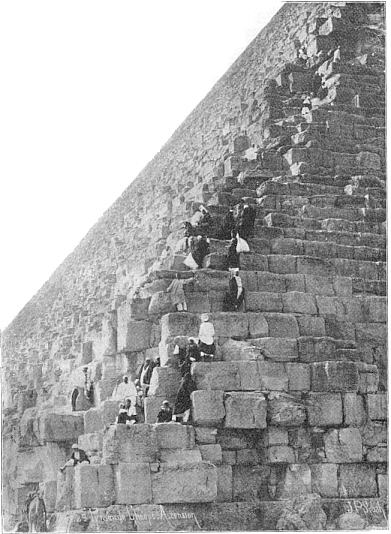
Tourists and guides climbing the Great Pyramid in the early twentieth century. Notice the steepness of the slope and the perilousness of the 450 foot ascent. 

Taking the length of a base side of the pyramid, equals 9,131 Pyramid Inches measured at the mean socket level or 365.24 Pyramid Cubits. This number is the same number as the days in a solar based calendar year – 9,131/25 = 365.24, accurate to 5 digits – Article: The Calendar Conspiracy.

The Ancient Egyptian Royal Cubit originates from the differences in volume between the sphere and cube – refer cube, article: 42. “The cube and the sphere are the sole working tools of creation” – Walter Russell 
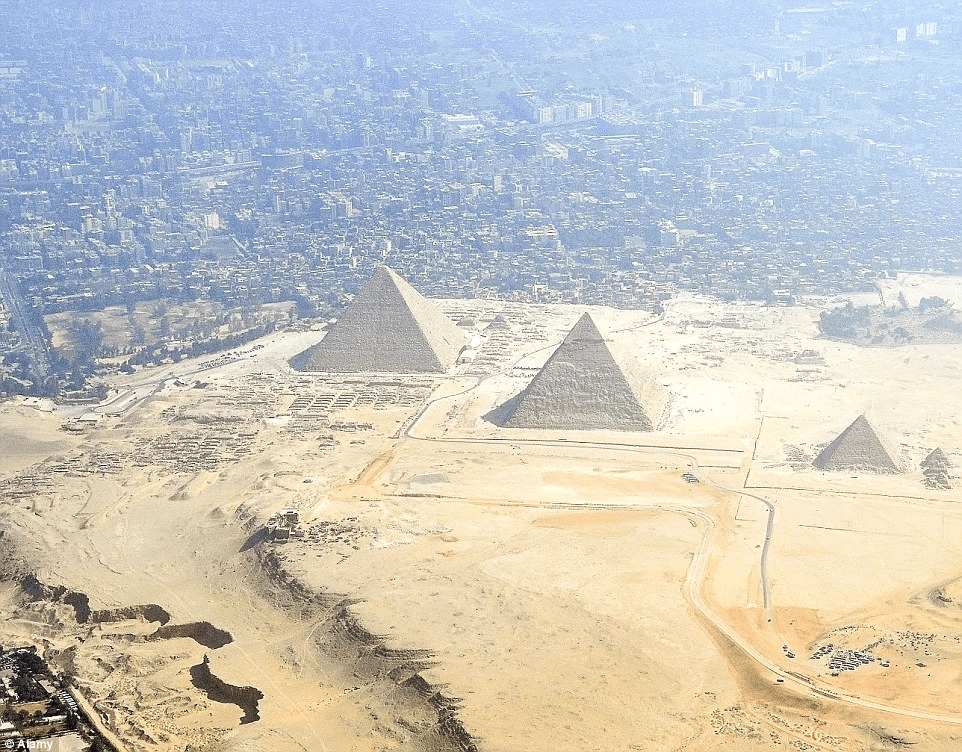
This photo highlights the palpable difference in quality and in the wear of the stones of the Second Pyramid compared to the superior sides of the Great Pyramid.

Chapter XXII Alpha & Omega: ‘There is a curious link between precession and the Great pyramid of Giza. It has been shown that the exterior measurements of the Pyramid of Giza are an accurate representation of the Earth’s Northern Hemisphere on a scale of 1:43,200. 

The distance the Earth spins or rotates at the Equator in 2 seconds is equal to the Perimeter of the Great Pyramid of [Giza]. Since there are 86,400 seconds in a day, two seconds is 1/43200th of a day. Multiplying the Height of the Great Pyramid by 43,200 equals the polar radius of the Earth. Multiplying the Perimeter of the Great Pyramid by 43,200 equals the equatorial circumference of the Earth. The Great Pyramid therefore is not just a 1:43,200 scale model of the Northern Hemisphere of Earth, but also represents a 1:43,200 ratio of time in a day.’

A coincidence is that 432,000 is the number of years in the Kali Yuga – a time cycle in the Vedic tradition.

‘It is a number that proves highly significant when one considers the method of doubling or halving key numbers used frequently in ancient Egypt. For instance 25,920 years divided by twelve constellations equals 2,160 years; times this by two produces 4,320. The platonic year of 25,920 years produces the decimal 25.92. Doubling this number equals 51.84. Amazingly, the angle of inclination or slope of the pyramid is cited as 51.8539761 degrees. Though created with sekeds – an ancient Egyptian unit for the measurement of the slope of an inclined surface such as the triangular faces of a pyramid – it is exactly 51.84. A pyramid based on phi, would be 51.83 degrees. This number at very least, is an extraordinary coincidence in light of the astronomical references applicable to the pyramid.’ 
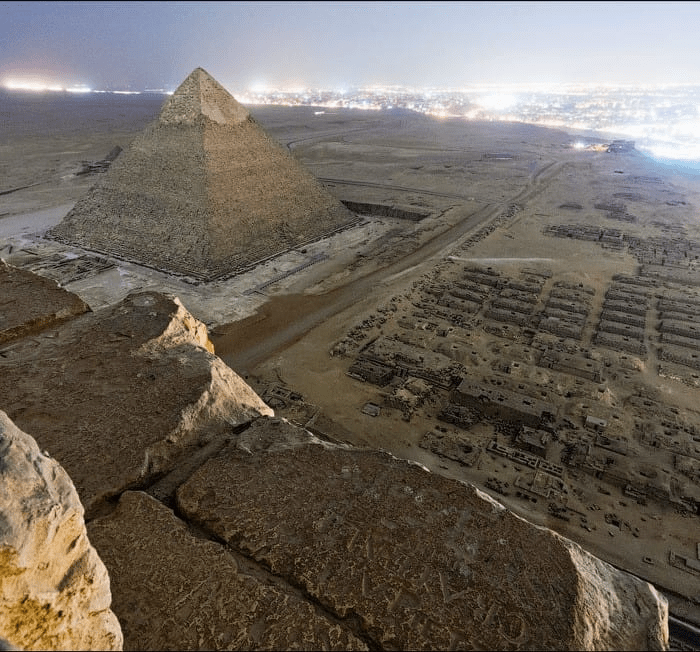
An impressive view from the top of the Great Pyramid

The interior temperature of the Great Pyramid is a constant 20 Degrees Celsius (68 Degrees Fahrenheit); which is the average mean temperature of the Earth. 

An interesting number in regard to the original outer mantle of the pyramid were the 144,000 casing stones – Revelation 7:1-8; 14:1-5. The Limestone was highly polished; flat to an accuracy of 1/100th of an inch; 100 inches thick; weighed approximately 15 tons each; with near perfect right angles for all six sides. 

One set of computer calculations indicate only 40,745 casing stones were used; with the average casing stone on the lowest level being five foot long by five foot high by six feet deep. Some casing stones weighed as much as 20 tons and were placed with an accuracy of 5/1000th of an inch and an intentional gap about 2/100th of an inch for mortar.

The massive size alone of the Great Pyramid means it can be seen from a vast distance. So much so, it is clearly visible in satellite images of the Earth. Yet in the past it was even more visible than it is today when it had its covering of casing stones made of polished limestone. The Ancient Egyptians called the Great Pyramid Ikhet, meaning the ‘Glorious Light.’ The casing stones reflected the Sun’s light in such a way that they made the Pyramid shine as if it were a giant mirror. The casing stones were removed by the Bahri Mamluk Sultan of Egypt – Al-Nasir Badr ad-Din Hasan ibn Muhammad ibn Qalawun, better known as al-Nasir Hasan – to build mosques and fortresses in nearby Cairo in 1356 CE. Many of the casing stones had been fortuitously loosened during an earthquake in 1303 CE. The original pyramid with its casing stones reflected light so powerfully that it would have been visible from the moon as a shining star on earth.

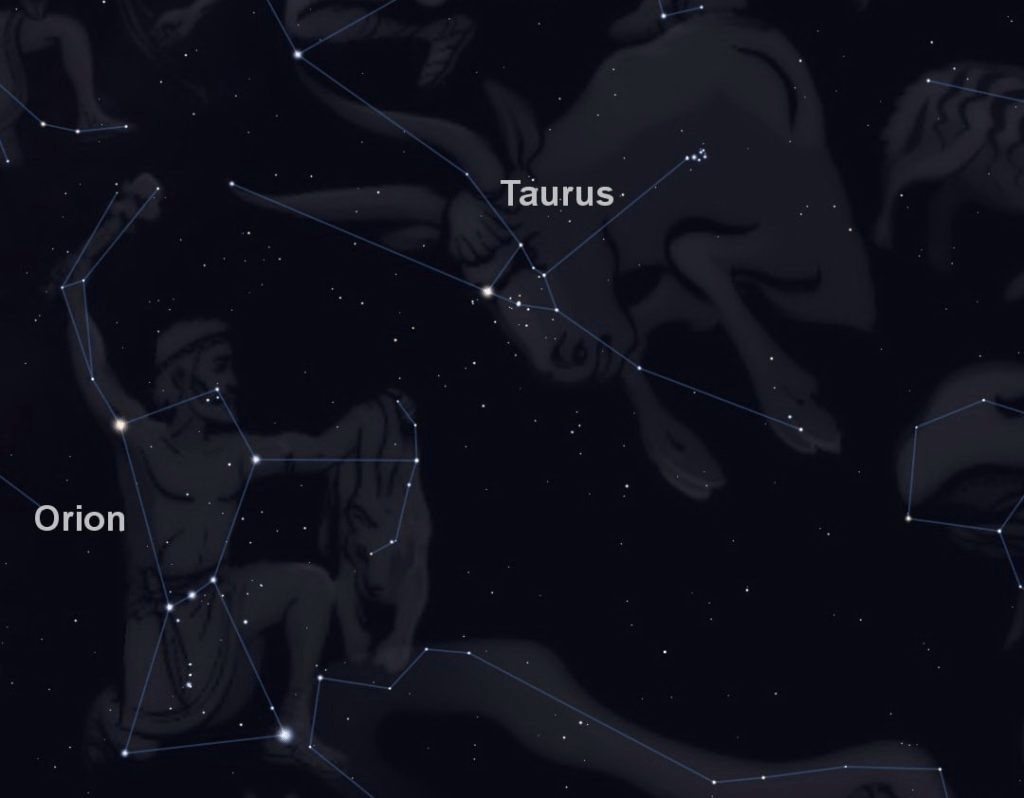
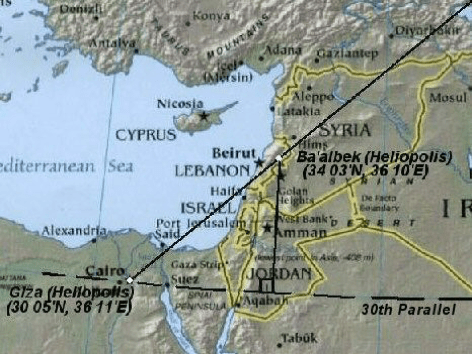
The Great Pyramid of Giza is one of the most aligned structures on the surface of the planet. Many are aware of the Orion Correlation Theory, which we will discuss later. As mentioned previously, the Great Pyramid is located at the centre of the land mass of the earth. The east to west parallel that crosses the most land and the north to south meridian which crosses the most land intersect in two places on the earth. One in the ocean on the opposite side of the planet and the other at the Great Pyramid. 

Aside from these aspects, a number of researchers consider the Great Pyramid is mathematically connected with numerous other ancient sites across the globe. One for instance being Stonehenge in England – refer article: Stonehenge. Alfred Watkins in 1921 proposed the theory that ancient sites were specifically placed on certain points across the globe. These sites could be discovered by following what he referred to as Ley Lines

Inside the King’s Chamber is a granite coffer, the size of which necessitates that the chamber was built with the coffer already in place. For it would not have fitted through the entrance, nor would it have fit along the lower section of the ascending passageway; casting doubt in the coffer’s use as a tomb.  
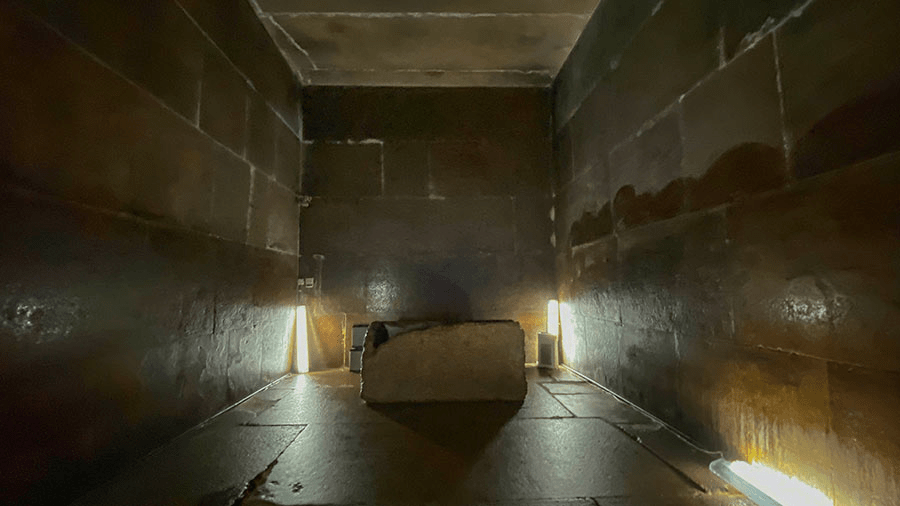
There are no markings on the Coffer. This is odd if the coffer was intended to house the remains of a Pharaoh. It would have undoubtedly had hieroglyphs depicted if intended as a coffin. The coffer no longer has its lid and the southeast upper corner has been broken away – possibly when the lid was removed. As its western edge sports three drilled pinion holes, used to hold the lid in place. The lid would have weighed over two tons and was slid into place within angled grooves.

The coffer was made out of a single block of solid rose granite weighing about 3.75 tons. Experts advance that to carve such a structure its builders would have required bronze saws eight to nine feet long with a set of teeth made from sapphires. Hollowing out the interior would require tubular drills of the same material applied with a tremendous vertical force. Microscopic analysis of the coffer reveals a fixed point drill was used, which utilised hard jewel bits and a drilling force of two tons. 
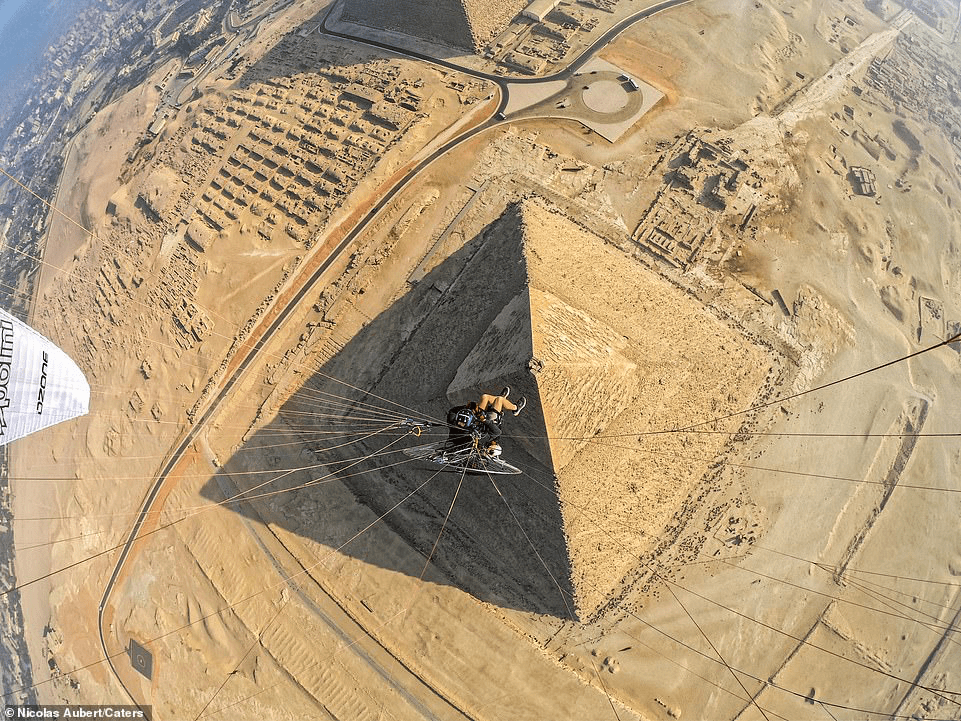
The outside of the pyramid has been exhaustively surveyed while the inside still remains largely uncharted. A number of archeological missions have endeavoured to understand what the Great Pyramid looks like from the inside. The ScanPyramid project, using muon tomography, located voids inside the Pyramid. The voids may be indicating ‘internal air currents.’

Situated above the Pyramid’s Grand Gallery, is a massive unknown structure that has still not been explored. It is one of a number of ‘thermal anomalies’ discovered in the Great Pyramid. It has been dubbed the Big Void. It resembles a corridor and has remained hidden behind the chevrons on the North face of the pyramid for millennia. The mystery void’s length is at least 30 metres long and between 50 to 70 metres up from the ground. 

The weight of the pyramid has been estimated at a staggering 5,955,000 tons. This figure multiplied by 10^8 gives a corresponding estimate of the Earth’s mass of M🜨 = 5.9722 × 1024 kg, (with a relative uncertainty of 10-4). Similarly, the pyramid’s volume and density times 10^15 equals the ratio of volume to the density of the earth.

Earth How: ‘Earth is not a perfect sphere. But we can approximate it by using the volume of a sphere which is 4/3πr3. Based on a radius of 6,371 km, Earth’s volume would be 1.08 trillion cubic kilometers. Given the mass of Earth is 5.972 × 1024 kg, we can divide by its volume… After converting kilograms and cubic kilometers to grams and cubic centimeters, Earth’s density is about 5.519 g/cm3.’ 

The air inside the Great Pyramid is dense. Visitors who enter the pyramid with a flashlight or a camera to film and record the inside, are surprised to find that batteries drain very quickly.

Author Eckhart Schmitz, leaves no doubt regarding the monumental mathematic milestone the Great Pyramid represents. 

‘Mankind has been fascinated with the Great Pyramid of Giza for Millennia and… [to] contemplate how the structure could have been erected in such scale and exactitude without machinery and advanced technology seems unthinkable and indeed impossible. I propound that the Great Pyramid is a testament in stone written in the “Universal Language” of mathematics and it is in the use of elegantly simple equations that one finds information of advanced knowledge relating to the Earth, Astronomy and Astrophysics. 

It is substantiated that the Great Pyramid of Giza is a Monument of Science as it was known by our ancestors in the extreme distant past and was in this way a means of communication with humanity spanning countless lifetimes and will go on indefinitely well into the future… The Great Pyramid of Giza is of a highly intelligent design that clearly demonstrates that the builders possessed highly advanced geodetic… knowledge well beyond what has been hitherto advanced including Newtonian Mechanics. 

The following is a list of conclusions drawn from analysis of the relationship of dimensions found within and without the Great Pyramid: 

– A precise definition of the Royal Cubit as it relates to the Earth

– The size and shape of the Earth

– The Mass and Density of the Earth

– The Gravitational Constant

– The Escape Velocity from the Earth to obtain an Open Orbit

– The Escape Velocity from the Earth to obtain escape from the combined Earth’s and Sun’s gravitational field

– The significance of the location of the Great Pyramid

– The Golden Ratio

– The Mass of the Sun

– The Mass of the Moon

– The Mean distance to the Sun and the Circumference of the Earth’s Orbit

– Neutral Points of Gravity between the Earth and the Sun

– The Mean distance to the Moon

– The Orbital Velocity of the Earth

– The Orbital Velocity of the Moon

– The Metonic 19 year cycle of the Moon’s orbit of the Earth

– The Lagrange Point (L1) between the Earth and the Moon

– The Speed of Light

– The Orbital Velocity of the Solar System relative to the Center of the Milkyway Galaxy

– The Velocity of the Local Group of Galaxies which includes the Milky Way Galaxy relative to the Universe

Joe Dubs: ‘Mainstream academia dismisses these findings since they are not 100% accurate. (They are 99.9+% accurate). Little do they know that 100% precision is unobtainable in the real world. 100% can only be achieved conceptually.’ 

“Science is about recognizing patterns… Everything depends on the ground rules of the observer: if someone refuses to look at obvious patterns because they consider a pattern should not be there, then they will see nothing but the reflection of their own prejudices” – Christopher Knight, Who Built the Moon? 

Researcher, Historian and author Zecharia Sitchin, divides opinion regarding his conclusions on the ancient Anunnaki and their role in human affairs. That said, his synopsis of the Great Pyramid is a concise and enlightening summary. 

The Stairway to Heaven, 1980: 

‘The Great Pyramid stands at the extreme northeastern edge of a protrusion of the plateau; a few hundred feet to the north and east, sands and mud begin, making such massive structures impossible. One of the first scientists to have taken precise measurements, Charles Piazzi Smyth (Our Inheritance in the Great Pyramid) established that the center of the Great Pyramid was at northern latitude 29° 58′ 55” – a mere one-sixtieth of a degree off from exactly at the thirtieth parallel. The center of the second large pyramid was only thirteen seconds (13/3600 of a degree) to the south of that.

The alignment with the cardinal points of the compass; the inclination of the sides at the perfect angle of about 52° [51.51 degrees] (at which the height of the pyramid in relation to its circumference is the same as that of a radius of a circle to its circumference); the square bases, set on perfectly level platforms – all bespeak of a high degree of scientific knowledge of mathematics, astronomy, geometry, geography and of course building and architecture, as well as the administrative ability to mobilize the necessary manpower, to plan and execute such massive and long-term projects. 

The wonderment only increases as one realizes the interior complexities and precision of the galleries, corridors, chambers, shafts and openings that have been engineered within the pyramids, their hidden entrances (always on the north face), the locking and plugging systems – all unseen from the outside, all in perfect alignment with each other, all executed within these artificial mountains as they were being built layer after layer.

Though the Second Pyramid (that of Chefra) is only slightly smaller than the First, “Great Pyramid” (heights: 470 and 480 feet; sides at base 707 and 756 feet, respectively), it is the latter that has by and large captured the interest and imagination of scholars and laymen since men ever set their eyes upon these monuments. It has been and still remains the largest stone building in the world, having been constructed of an estimated 2,300,000 to 2,500,000 slabs of yellow limestone (the core), white limestone (the smooth facing or casing), and granite (for interior chambers and galleries, for roofing, etc.). 

Its total mass, estimated at some 93 million cubic feet weighing 7 million tons, has been calculated to exceed that of all the cathedrals, churches and chapels combined that have been built in England since the beginning of Christianity. On ground that has been artificially leveled, the Great Pyramid rises on a thin platform whose four corners are marked by sockets of no ascertained function. In spite of the passage of millennia, continental shifts, Earth’s wobble around its own axis, earthquakes and the immense weight of the pyramid itself, the relatively thin platform (less than twenty-two inches* thick) is still undamaged and perfectly level: the error or shift in its perfect horizontal alignment is less than a tenth of an inch over the 758 feet that each side of the platform measures.

From a distance, the Great Pyramid and its two companions appear to be true pyramids; but when approached it is realized that they too are a kind of step pyramid, built layer upon layer (scholars call them courses) of stone, each layer smaller than the one below it. Modern studies, in fact, suggest that the Great Pyramid is a step pyramid at its core, engineered to sustain great vertical stress.’

A foundation this thin* yet enduringly stable is beyond extraordinary. We will return to the concept of a step pyramid – in reality, a ziggurat. More remarkable then, are the legends that subterranean chambers and tunnels exist beneath the Giza pyramids. With even a passageway extending from the Sphinx to the Great Pyramid.

Many of these ideas remain conjecture without clear evidence or disclosure by the Egyptian government on findings already known and not made public. What may be of more significance is the possibility the Giza complex was once submerged under the sea. While there is evidence of a pattern of water erosion on the Sphinx for example, which indicates it is far older than mainstream scientists consider; it was the finding of a controversial fossil which added impetus to the theory. 

Archaeologist Sherif El Morsi and his colleague Antoine Gigal made the discovery during a photo shoot documenting patterns of erosion on several megaliths in the area. El Morsi said, a “bump on the top surface of a block that almost tripped me was in fact [an] exoskeleton of a fossil of what appears to be a Echinoid (Sea Urchin) which are marine creatures that live in relatively shallow waters.”
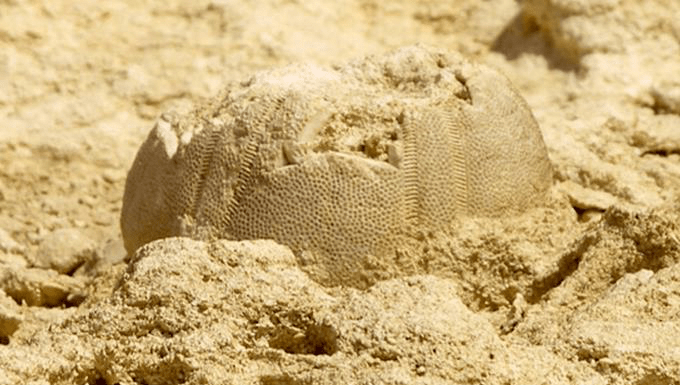
He postulates that the Giza plateau was once covered by a surge of flood water. The temple site of Menkare – the Third Pyramid – may have been a lagoon when the sea level rose over the Necropolis; the Sphinx; the complex of temples; and other monuments. In response to opponents to his theory: “We can clearly see the pristine condition and the details of the perforations of the exoskeleton, this means that the sea creature must have been petrified in recent times.” According to El Morsi, the Sphinx, the temple of the Sphinx and the first twenty fields or courses of the Great Pyramid exhibit erosion caused by deep water saturation. 

Apparently, ‘when one of the pyramids was first opened, incrustations of salt one inch (2.54 cm) thick were found inside it. When a chemical analysis was conducted on the salt, researchers found that it had a mineral content the same as salt from the ocean. This evidence indicates that the pyramids were swamped by water that came from the ocean’ – Martin Gray. 

Others have supported the evidence of water erosion as proof the Sphinx and Giza pyramids are far older than generally recognised. Two Ukrainian scientists, Manichev and Parkhomenko posited that the Sphinx had to be submerged for a long time under water; with “large bodies of water” partially flooding the Sphinx monument creating “wave cut-out hollows on its vertical walls”, sensationally proposing this occurred 800,000 years ago. According to an unconventional chronology, this is wildly inaccurate for the construction of the Sphinx or the Great Pyramid. 

Andrew Collins countered, that while the rock formation may have been ‘kissed by the Mediterranean Sea’, the actual statue was carved out of it at a much later date. In other words, the rock is ancient but the statue is relatively less so. 

Closer to the mark from the perspective of when the monuments of Giza were first constructed and secondly flooded, is Dr Robert M Schoch – a geology professor at Boston University – who was one of the first researchers to address the idea that the structures of the plateau are older than previously thought. 

Schoch visited the Sphinx in 1990, at which time he immediately noticed there was a disconnect between the statue’s academically accepted date of origin and the truth staring him in the face. Upon careful inspection, Schoch realised the Sphinx had survived intensely wet weather conditions that stand in stark contrast to the now arid conditions of the Sahara Desert. Thus the statue was carved at a time when the Saharan region was humid, lush with plant and animal life and subject to persistent rainfall. For the heavy rainfall which has eroded the Sphinx was uncommon to the Egyptian plateau within the past 5,000 years. 
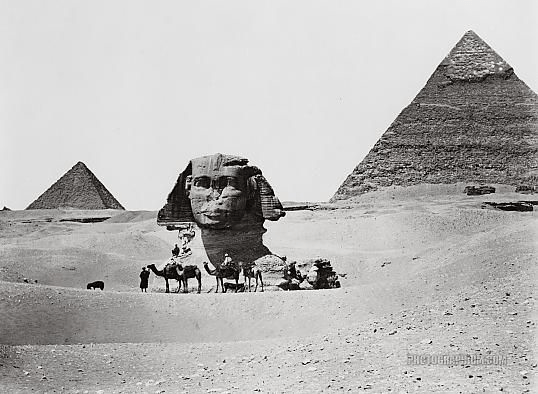
At one period in its existence, the Sphinx spent more than seven hundred years beneath the surface of the desert. There is no doubt the scoring on the Sphinx has been subject to mainly water erosion rather than windblown sand.

Top photo circa 1860; bottom photo circa 1878

Adir Ferrara: ‘Rocks eroded by wind-blown sand have a ragged, sharp appearance. Rocks eroded by water have smoother, undulating erosion patterns, resulting in wide fissures.’

In 1991, Schoch proposed the Sphinx was thousands of years older than archaeologists believed, dating back to between 5000 to 9000 BCE. This was based on the pattern of erosion as a result of water found on the monument and the surrounding rocks. Tasha Shayne: ‘… despite constant criticism from mainstream archeologists, [Schoch has] held his ground, showing seismic data of the region which suggests the Sphinx’s origin may be more accurately placed at 10,000 B.C.E.’

Schoch was approached in 1992 by author John Anthony West, who similarly claimed the Sphinx had been carved ten thousand years earlier, before Egypt was a desert – Mystery of the Sphinx

Author and researcher Graham Hancock, also concurs with an ancient age for the sphinx and believes the origin of the Sphinx is close to 12,500 years ago. ‘According to… Hancock, computer simulations show that in 10,500 BC the constellation of Leo housed the sun on the spring equinox – i.e. an hour before dawn in that epoch Leo would have reclined due east along the horizon in the place where the sun would soon rise. This means that the lion-bodied [rather, canine bodied] Sphinx, with its due-east orientation, would have gazed directly on that morning at the one constellation in the sky that might reasonably be regarded as its own celestial counterpart.’

This may not be the convincing support for the Sphinx being carved at this time as Hancock thinks, if the Sphinx was really Anubis; a statue of a black headed Jackal with a closer association with the Dog Star, Sirius than the constellation of Leo, the Lion – refer Appendix VII: Moses, the Exodus & the Red Sea Crossing – Fabrication or Fact? Though this does not necessarily cancel out the date of 10,500 BCE.

In Hancock’s book, Fingerprints Of The Gods, 1995, in the chapter ‘Lord of Eternity’, Hancock quotes Robert Bauval: “They knew their epochs, and the clock that they used was the natural clock of the stars. Their working language was precessional astronomy…” Hancock: ‘What do you think the purpose of the pyramid builders really might have been?’ Bauval: “They didn’t do it because they wanted an eternal tomb. In my view… They… transmitted the power of their ideas through something that is to all intents and purposes is eternal… My guess is that they knew the human mind to perfection… They knew they could initiate people far ahead in the future… They were not only telling us when they built it, they were also telling us about the precession of the equinoxes and Aquarius.”

In this writer’s view, the precessional Age of Aquarius – The Water Bearer – began in 1990 and will last until 4150 CE.

Shayne: ‘Egyptian-born writer and engineer Robert Bauval famously argued that there are no inscriptions on the Sphinx “either carved on a wall or a stela or written on the throngs of papyri that associates” the statue with the time period of the pharaohs of ancient Egypt as we know them.’

Ferrara: ‘However, the idea that the Sphinx is older than commonly assumed is not new, it was an accepted truth among Egyptologists in the nineteenth century. The British archaeologist Sir Flinders Petrie, one of the founding fathers of Egyptology, considered the Sphinx older than the Old Kingdom. In 1900, the director of the Department of Antiquities in the Cairo Museum, Sir Gaston Maspero, raised the possibility that Khafre did not build the Sphinx, but simply unearthed it. If that is the case, the monument is obviously older than the Old Kingdom, the time of Khafre’s reign. 

Egyptologists argue that the water erosion on the Sphinx could have been caused from the Nile floods that occur in the area, but Schoch contends that if that were the case, the floods would have undercut the monument from its base. Instead, the heaviest erosion appears at the top of both the Sphinx and the walls enclosing it. This pattern is more consistent with rainfall from above, rather than flood water from below. Robert Schoch notes that for centuries, starting in the period of the New Kingdom and throughout Roman times, the Great Sphinx of Giza was considered to have been built before the Pyramids.’

Similarly, Robert Ballard – a well known underwater archaeologist – using a robotic submersible with a remote-controlled camera, probed the depths of the Black Sea near the coast of modern day Turkey. Ballard was looking for traces of an ancient civilisation dating back to the time of Noah; indicating that the biblical flood, mentioned in ancient Sumerian texts was real. Ballard established a timeline of the events by carbon dating sea shells found along the coastline. Ballard estimated that it was around 5000 BCE when a catastrophic flood occurred. While a number of scholars inaccurately ascribe this date to the historic Flood in Noah’s day; Ballard actually found evidence for a subsequent flooding during the time of his descendant, Peleg – Genesis 10:25.
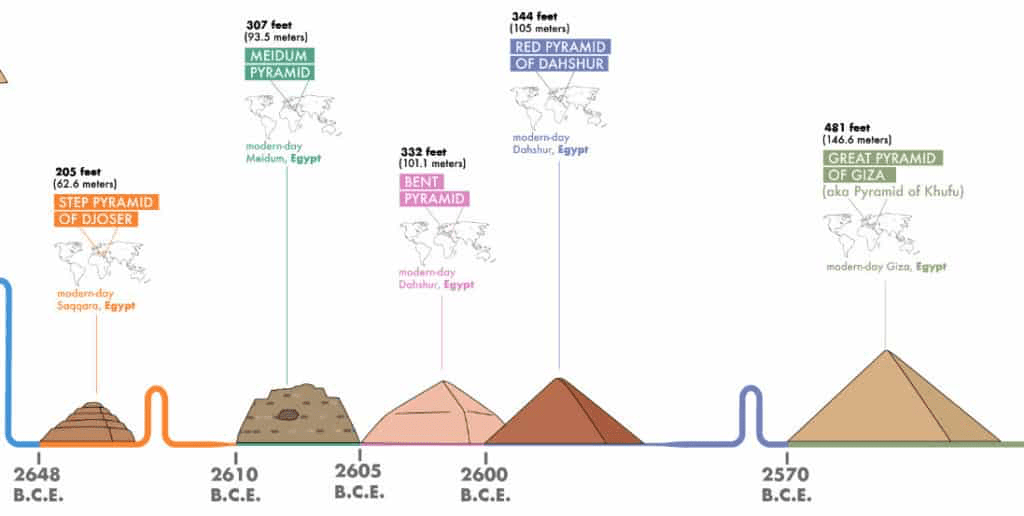
Egyptologists attempt at chronicling the evolution of pyramid building (above); but if anything, it goes in the opposite direction, with pyramids built long after the Great Pyramid, being inferior replicas. The pyramid built during Djoser’s reign was overseen by his Vizier Joseph, otherwise known as Imhotep – refer Appendix VI: Joseph & Imhotep – One man, different name?; and Chapter XXXIII Manasseh & Ephraim – the Birthright Tribes. Pharaoh Djoser was the first king of the 3rd Dynasty and ruled from 1700 to 1672/71 BCE according to an unconventional chronology. The issue with carbon dating is that it cannot be tested on inanimate stone or rock. Additionally, dates older than 2000 BCE, are invariably skewed giving misleading results. 

As The Conscious Vibe admit: ‘When King Djoser’s Pyramid was built… it was built [with] some large stones, but… mostly stones of manageable size and weight (about 1’x1’x1’). These stones… were stacked on top of one another to form the Step Pyramid at a height of 203’ tall. However only 80 years later, the same civilization was able to cut and hoist 2.3 million stones weighting 2-3 tons in weight, to a height of 481’ and with the mathematical precision to align directly with North, South, East & West directions, and to be sized in direct proportion to the exact [measurement] of the Earth. That’s a large advance in ability for only 80 years difference at that time period. 

Experts are still, to this day, baffled to the exact construction methods used to hoist the blocks into place. There is no known accurate historical or archaeological evidence that definitively resolves the question. The exact age of the pyramids is not known for sure. What we definitely know is that the Pharaoh Khufu certainly conducted renovations and maintenance to the Pyramids if he wasn’t the original builder.’

Sherif El Morsi’s theory could thus be revealing in regard to dating the Great Pyramid. Could the flooding involved have occurred at the time of the Great Flood in 10,837 BCE? – refer article: The Younger Dryas Stadial: The Ending of the Earth… Beginning of the World. This would indicate construction of the Pyramid prior to the Flood – though this is highly unlikely as the destruction of the great Deluge was all consuming – refer Chapter I Noah Antecessor Nulla. What is more likely is the Great Pyramid and the Sphinx – legacies of knowledge from the antediluvian age – suffered partial water submersion during the Black Sea Catastrophe circa 6700 BCE, occurring around or after the dispersion from the Tower of Babel in circa 6755 BCE – Chapter XXI The Incredible Identity, Origin & Destiny of Nimrod; and article: Antartica: Secrets of the Lost Continent of Atlantis. 

Added together, the information to this point indicates the Great Pyramid and Sphinx are far older than circa 2500 BCE uniformly attributed to them. They appear to date to approximately between 10,500 BCE – some three hundred years after the Deluge – and 7000 BCE. It is possible that the reoccurring belief the Sphinx is older; means it was built closer to 10,500 BCE and the Great Pyramid may have been a later addition to the Giza plateau. 

To assist in understanding when the Great Pyramid was built there are key aspects which focus on the pyramid’s geographic location.

The first, is in accordance with its longitude and latitude location from a ground level perspective in relation to other monuments around the globe and their possible link via invisible Ley lines. 

The second, is that of the Pyramids’s location from a celestial view and its association with stars in the cosmos, mirroring down below that which is above. 

A third key element is one concerning the positioning of the pyramid’s so-called internal air shafts. 
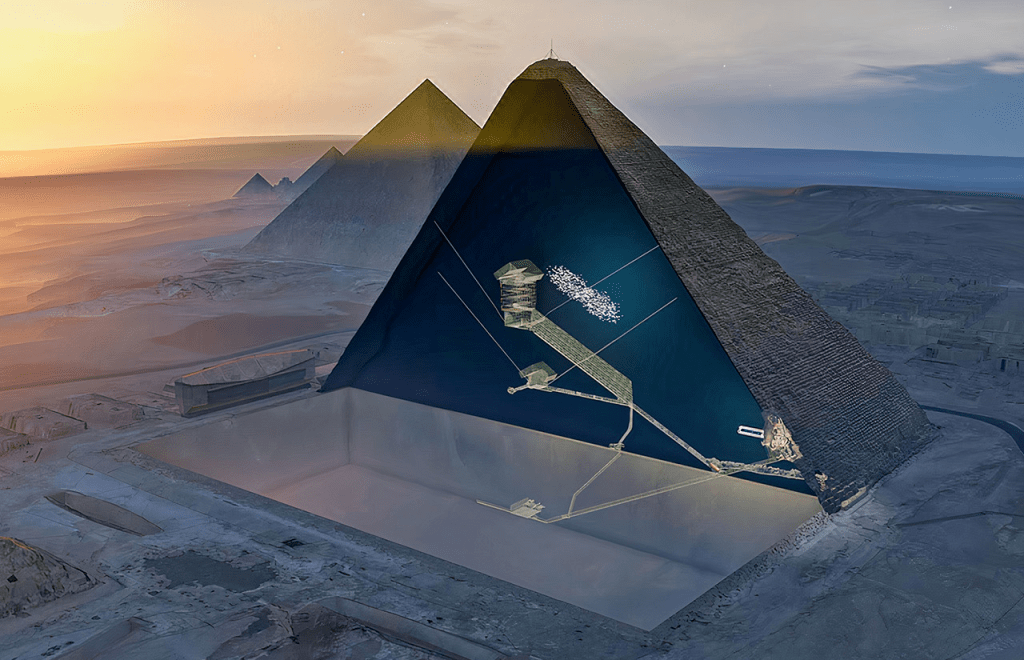
Out of all the pyramids investigated, it is only the Great Pyramid which contains air vents. The King’s Chamber has two, about five inches in diameter, connecting to the exterior. The Queen’s Chamber also has two, though they stop short of the walls of the chamber and do not penetrate completely to the outside. The cross section of these shafts vary so that they are either oval, domed, or rectangular. 

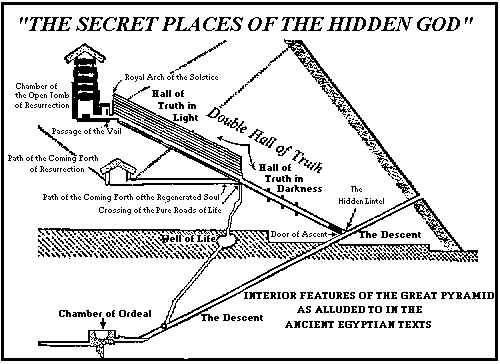
No one has been able to decipher what the ascending and descending passages were built for apart from accessing the three chambers. The descending passageway leads to the Subterranean chamber. 

Ancient Wisdom: ‘The first noticeable thing about the subterranean passage [below] is that it has the appearance of being unfinished. The southern passage was in the process of being carefully cut, and adds to the idea that work was stopped in the middle of the chamber. The obvious question is – why [was it…] left unfinished when it was such an obviously original feature of the pyramid. The Polar shaft was a feature of all the other Memphite pyramids.’

‘It has been commonly argued in the past that the upper chambers were created following a ‘change in plan’. Anyone who has actually been in the subterranean chamber will know that it would be impossible to get a sarcophagus down there. The existence of this chamber contradicts the ‘Pyramid as Tomb’ theory.’ This raises an immense point. The work was halted in the subterranean chamber for some reason. Remember this as it will be very important later on. 

According to calculations, the 344 foot descending passage provides an angle of view of only +/- 1/3 of a degree and was astronomically aligned to the pole star Alpha Draconis, circa 2170 to 2144 BCE. This was the North Star at that point in time and no other star has aligned with the passage since then. The next alignment will be with the North Star, Polaris* in about 2004 CE.’
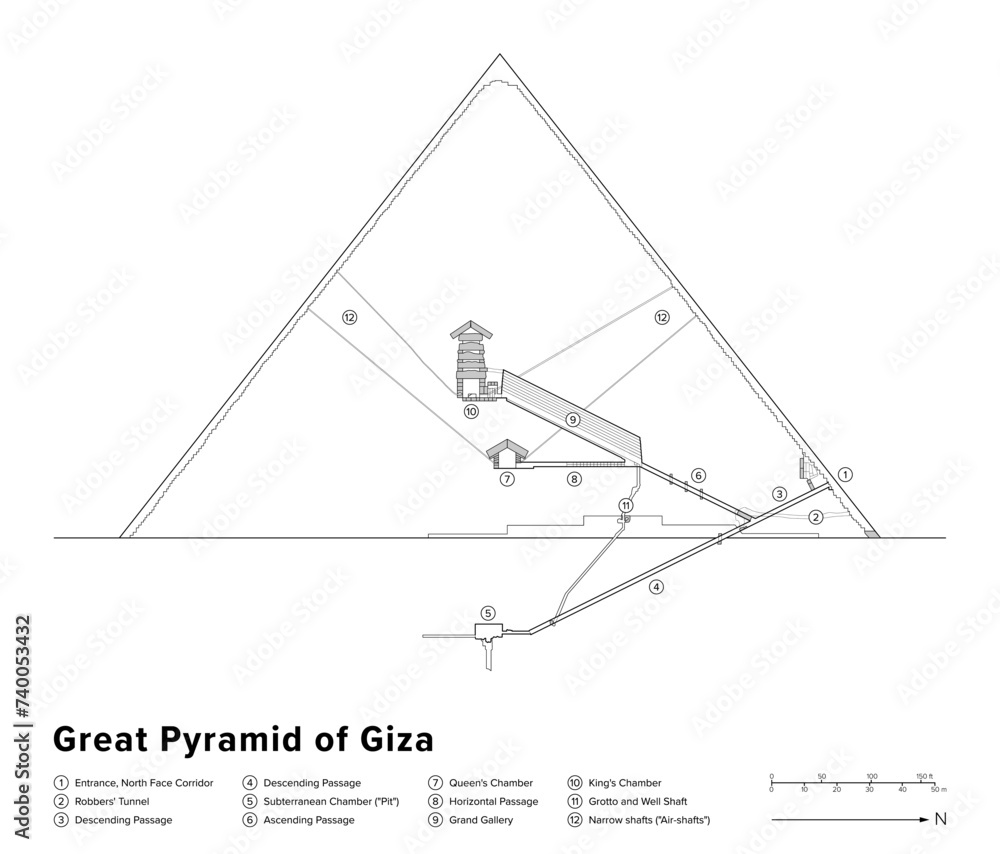
‘Approximately 60 feet from the entrance there is a hole in the masonry roof of the descending passageway which leads to the first ascending passageway found in a major pyramid. The passage is 129 feet in length and rises at a gradient of 26°2’30”. Its lower end was plugged with three, seven ton granite slabs, which are still in place. A hole was hewn bypassing the slabs for access to the ascending passageway.’

Queen’s Chamber

The ascending passageway leads to the Grand Gallery, where entry to both the Queen’s Chamber and the King’s Chamber can be found.
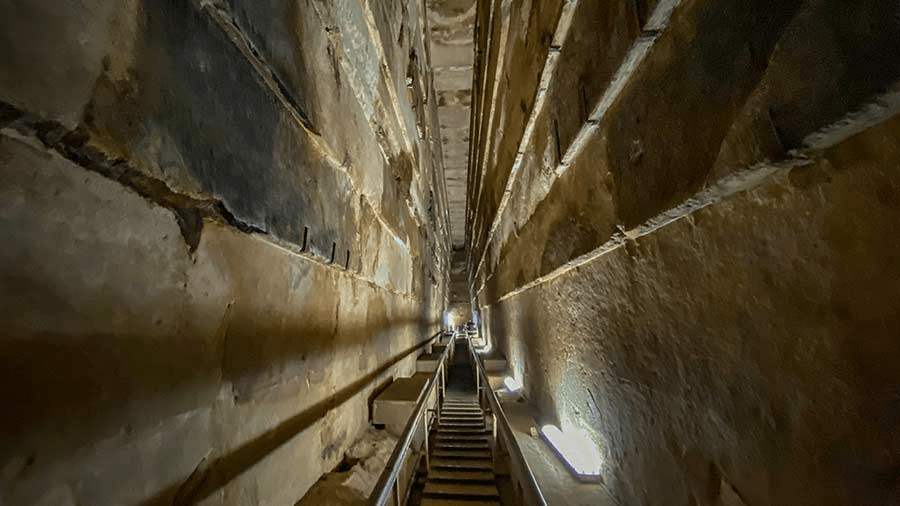
The Grand Gallery

The King’s Chamber is the main chamber, built entirely of rose granite. It is situated at the 50th course of masonry. The stones used to construct this chamber are the heaviest known stones in the entire pyramid. Twenty-one stones comprise the floor; the walls are made from one hundred and one stones; and there are nine huge beams forming the ceiling. As with all the other exposed surfaces in the Great Pyramid, there are no inscriptions or carved reliefs on the chamber walls.

The northern shaft in the Queen’s Chamber – 39.7 degrees, 00 minutes, 00 seconds – pointed to the Kachob Star in the Ursa Minor* constellation, circa 2450 BCE. Ursa Minor means Lesser Bear or Little Bear. 
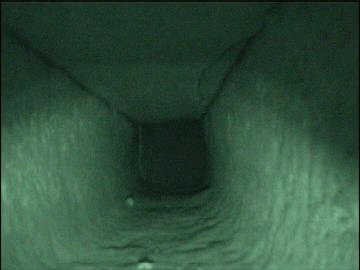
Queen’s Chamber southern shaft

Meanwhile, the southern shaft of the Queen’s Chamber – 39.36 degrees, 30 minutes, 00 seconds – pointed to the star Sirius – the Dog Star circa 2450 BCE. Sirius was associated with the Egyptian goddess Isis and is also part of a unique ceremony continued to this day, practiced by the African Dogon tribe – refer article: Lilith. Sirius is the brightest star in the night sky. Its name is derived from the Greek word Σείριος [Latin: Seirios], meaning: ‘glowing’ or ‘scorching’. The star is designated as Alpha Canis Majoris. With a ‘visual apparent magnitude of -1.46, Sirius is almost twice as bright as Canopus, the next brightest star.’

The southern shaft in the King’s Chamber – 45 degrees, 00 minutes, 00 seconds – pointed to the star Al Nitak [Zeta Orionis] in the constellation Orion, circa 2450 BCE. The Orion constellation was associated with the Egyptian god Osiris – Chapter XXI The Incredible Identity, Origin & Destiny of Nimrod. No other star aligned with this shaft during that time in history. Orion means the Giant Hunter or Great Hunter.

The constant reader will recall the strong association between Osiris and Isis. Thus the Great Pyramid focussing on both neighbouring star constellations of Orion and Canis Major, the Greater Dog is no coincidence and laden with symbolism, which will be unravelled as we progress. 

While the northern shaft in the King’s Chamber – 32.36 degrees, 28 minutes, 00 seconds – pointed to the star Thuban also known as Alpha Draconis, circa 2450 BCE. This is the same star as would be viewed from the descending passage some three hundred years later. 

Though Ursa Minor and Draco – the Dragon – are two different constellations, they are adjacent. The fact Alpha Draconis is highlighted twice may be significant, as is the fact that this star is likely linked to the Draconian Aliens – refer article: Principalities & Potentates: What they want… Who they are

The date 2450 BCE of itself does not prove when the pyramid was designed or built. It would be simplistic to think it does. Yet this date may have a significance not yet realised. Even so, we are certainly alerted to the importance of the respective stars – Thuban, Kachob, Sirius, Al Nitak – and the constellations of which they belong – Draco, Ursa Minor, Canis Major, Orion – to the builders of the Great Pyramid. 

We will investigate these constellations in more detail shortly, though first the mysterious matrix that the Great Pyramid may be the fulcrum. Ley Lines at their simplest, refer to straight alignments drawn between various historic structures and prominent landmarks; whether in a designated region, a country, or globally. Ley line adherents believe ancient monuments are linked by this network of invisible lines and that there was a pre-purposed plan in their chosen locations. At a complex level, it is thought these lines form a sort of connected grid or matrix; composed of either the Earth’s natural energies – or perhaps an engineered [magical] one – being channeled through the megalithic structures. 

Benjamin Taub: ‘The concept of ley lines was first proposed by English antiquarian Alfred Watkins in [1921]. Laying out the concept in his book The Old Straight Track, Watkins revealed that the idea came to him while traveling through [the Malvern Hills in] rural Herefordshire one day, when he suddenly noticed that ancient monuments appeared to be arranged in a grid of straight lines that stood out like “glowing wires all over the surface of the county.”

The scientific community rejected the idea as they saw Ley Lines as ‘the perfect illustration of the mathematical concept known as the Ramsey Theory, which basically states that you can find any pattern you want as long as you have enough random data points to choose from. To further complicate the landscape, there’s no consensus on what ley lines even are…’ 

‘It wasn’t until 1969, however, that the idea really took flight, largely thanks to John Michell’s New Age book The View Over Atlantis, in which he introduced the concept of Earth energies… archaeologist Dr Robert Wallis… explained that the view was “these are sort of the spiritual arteries of the planet, and there’s a belief that through psychic awareness, or dowsing, particularly at ancient sites, it’s possible to sense these energies.” The idea behind Earth energies is therefore that ancient societies were somehow more attuned than we are to these power lines running through the landscape, and built their monuments directly on top of these sacred pathways. 

In the 1970s, Paul Devereux – who at the time was the editor of the Ley Hunter magazine – set up a research initiative called The Dragon Project to scientifically investigate these supposed mysterious power centers.’ After decades of searching by enthusiasts, no tangible evidence exists for Ley Lines.  

Though ‘there are a few examples of intentionally aligned monuments stretching across vast areas, with the most notable being in South America. For example, the Inca Empire [in Peru] was dissected by a series of ritual pathways known as ceques, which radiated out from the capital, Cuzco, and extended towards the outer edges of the kingdom. Along these straight lines, the pre-Hispanic culture placed ceremonial markers known as Wak’as, although it’s still unclear exactly why they did this or how they determined the trajectory of each ceque. 

In China, meanwhile, the ancient art of Feng Shui was developed as a means of arranging landscape features to ensure a harmonious flow of the universal energy called Qi. Though not entirely the same as Earth energies, there are some clear similarities between this philosophy and the New Age idea of ley lines.’ 

Jordan Long: ‘One… proto ley line example is that of “Dragon Paths”, or lung mei as they were originally called. This ancient Chinese concept mapped out energy paths from a central source, or the Heart of the Dragon. These energy paths, like ley lines, were straight, and there were stone markers and monuments built to signify where they were. 

Before ley lines had their name, the idea of historically significant and sacred sites being connected was suggested. In 1846, Reverend Edward Duke wrote that he believed these sites were built intentionally on linearly connected pathways. Later, the hypothetical linear connection of these landmarks and monuments was investigated in Germany. In 1909, German archaeologist Wilhelm Teudt continued to study these possible connections, proposing that the sites may have been built in specific locations for astronomical or religious use.’

According to Ancient Wisdom, the word ley or lea, means ‘a clearing’ and is Saxony for fire. In other cultures these lines were known as ‘Heilige Linien’ [Holy Lines] to the Germans; ‘Fairy paths’ to the Irish; ‘Dragon Lines’ to the Chinese; ‘Spirit Lines’ to Peruvians; and ‘Song Paths’ to the Australian Aborigines. This is interesting if Ley Lines are purely imaginary, that a number of disperse cultures should give recognition to them.

‘Even though the term Ley-line was originally conceived by Alfred Watkins, by 1929, he had discarded the use of the name ‘ley’ and referred to his alignments only as ‘old straight tracks’ or ‘archaic tracks.’ 

Factors explaining the existence for Ley Lines include – emphasis & bold mine: 

Spirit ways and Death roads – (Funerary paths): 

‘A number of rituals and traditions have been associated with the path taken by funerary parties. Traditionally known as ‘death roads’ (doodwegen or geister-wege). The fact that ‘spirit paths’ are traditionally straight and seem to include the same ‘markers’ as ley lines significantly increases the argument for some of the leys having once served this function. Spirit lines are also invisible, and are viewed as ‘tracks’ or ‘paths’ for the movement of the spirits, which may explain why markers are often not visible from one location to another (an argument traditionally used against the existence of leys themselves).’

Feng shui – (Earths Magnetic Field): 

Many important ley-markers are associated with springs and water sources. 

‘The Chinese art of ‘Feng-shui’, or ‘wind and water’, also means ‘that which cannot be seen and cannot be grasped’. The duty of the practitioners of the art was to determine the flow of ‘lung-mei’, or ‘Dragon currents’. Every building, stone and planted tree was so placed into the landscape as to conform to the ‘dragon currents’ which flowed along these lines. The main paths of the forces were believed to be determined by the routes of the sun, moon and five major planets. We know that the Earth is encompassed within a magnetic field. The strength and direction of the magnetic currents vary according to the position of the sun, moon and closer planets. The magnetic field is also affected. 

It is possible that this field may have been detected (i.e. through dowsing), and mapped out in the past. Noobergen reminds us that the earths natural magnetism was believed to have been used to re-fertilise the soil, in the same way as the aborigines did with their ‘turingas’ or ‘dream lines’. He also mentions that there is scientific research that shows that water is extremely sensitive to electromagnetic fields, and that as the fields are changed or influenced, so the chemistry of the water may be altered too. Horticulturalists have discovered that plants placed within a magnetic field grow more than six times faster than in normal conditions. We are able to show today that the strength and direction of the Earths magnetic currents vary according to the positions of the Sun, Moon and other planets’ – refer Addendum I.

Astronomical Alignments: 

‘The fact it took so long for us to realise that astronomy was in any way involved with megalithic culture is almost as surprising as the fact that it was ever forgotten. Although there has been a traditional resistance to this theory from the scientific establishment, we live in a time when it is finally accepted that many of the larger megalithic constructions were designed so as to be able to accurately identify celestial objects or measure their cycles – Article: Monoliths of the Nephilim

The clear link between megaliths and astronomy can also be said for megaliths and ley-lines, as they are often found to be prime ley-markers, and intersections of several ley-lines

Stonehenge, whilst not being a part of the St. Michael ley, is connected with both Glastonbury and Avebury/Silbury through geometry, and also forms the crossing point of several prominent ley-lines – both astronomical and non-astronomical’ – Article: Stonehenge. ‘The first astronomically significant ley-line to pass through Stonehenge was first identified by Sir Norman Lockyer, and later extended to 22 miles in length by K. Koop. This ley follows the path of the mid-summer sunrise on a bearing of 49� 15’. 

Another significant ley-line to pass through Stonehenge was also identified by Lockyer, and can be shown to extend accurately for 18.5 miles. It skirts only the edge of the henge at the junction of the avenue, missing the centre (and the sarsen stones) altogether. This line runs on a bearing of 170� 45′, and appears to have no astronomical significance. 

The alignments at Stonehenge therefore appear to offer a fusion of funerary, astronomical and geometric practices, simultaneously connecting three of the most significant locations in southern England. Glastonbury, Stonehenge and Avebury/Silbury, which all align to create a perfect right-angled triangle, accurate to within 1/1000th part. It is from this historic starting point that we can begin unravelling the complexity of prehistoric geometry of the British landscape.

In 1740, Dr. William Stuckley, first noted that the axis of Stonehenge and the Avenue leading from it point to the north-east, ‘whereabouts the sun rises when the days are longest’. He perceived the whole British landscape as laid out according to a sacred ‘druidic’ pattern, and etched with symbols of serpents and winged discs.’

Other Traditions: 

‘The Aborigines of Australia tell of a ‘pastage’, which they call the ‘dream-time’, when the ‘creative gods’ traversed the country and reshaped the land to conform with important paths called ‘turingas’. They say that at certain times of the year these ‘turingas’ are revitalised by energies flowing through them fertilising the adjacent countryside. They also say that these lines can be used to receive messages over great distances. 

The Incas used ‘Spirit-lines’ or ‘ceques’ with the Inca temple of the sun in Cuzco as their hub. The Jesuit father Bernabe Cobo referred to these ‘ceques’ in his ‘History of the new World’, 1653. These were lines on which ‘wak’as’ were placed and which were venerated by the local people. Ceques were described as sacred pathways. The old Indian word ‘ceqque’ or ‘ceque’ means boundary or line. Cobo describes how these lines are not the same as those at Nazca, being only apparent in the alignment of the wak’as. These wak’as were most often in the form of stones, springs, and often terminating near the summits of holy mountains.’

This reminds of the god Hermes who’s “role as a god who crossed boundaries was further reinforced by the herma, or way markers, that stood on boundaries between properties and states. Originally simple stone cairns, they later bore his image as the god of travel across borders before further evolving into phallic shapes that reinforced the connection between boundaries and fertility.” According to most scholars, the name Hermes is derived from the Greek word herma, meaning: a ‘stone heap’ – refer article: Thoth.

Ancient Wisdom: ‘Documentary records made by the Spanish record that ‘qhapaq Hucha’ ceremonies of human sacrifice (usually children), took place at wak’as as an annual event and also at times of disaster. In the 17th century the Roman catholic church ordered that the holy shrines along the routes be destroyed. As in Europe, many ancient holy places were built over with churches. 

Elsewhere in America, fragments of ancient tracks can still be found such as the Mayan ‘Sache’, of which 16 have so far been found originating in Coba, Mexico. The following is a description of one found in the Yucatan; 

“… a great causeway, 32ft wide, elevated from 2-8 ft above the ground, constructed of blocks of stone. It ran as far as we could follow it straight as an arrow, and almost flat as a rule. The guide told us that it extended 50 miles direct to Chichen itza (it started from the other chief town of Coba) and that it ended at the great mound, 2km to the north of Nohku or the main temple in a great ruined building.” 

‘Watkins maintained that leys ran between initial ‘sighting posts’. Many of the ‘mark stones’, and ‘ancient tracks’ he refers to have since disappeared, a situation which is considerably unhelpful to serious research… Watkins believed that the lines were associated with former ‘Trade routes’ for important commodities such as water and salt. He found confirmation in this through ‘name-associated’ leys. Even today the Bedouins of North Africa use the line system marked out by standing stones and cairns to help them traverse the deserts. A letter to the Observer (5 Jan 1930), notes similarities with Watkins theories and the local natives of Ceylon, who had to travel long distances to the salt pans. The tracks were always straight through the forest, were sighted on some distant hill, (called ‘salt-hill’), and that the way was marked at intervals by large stones (called ‘salt-stones’), similar to those in Britain.

After the 1914-18 world war, Major F.A. Menzies, M.C., a distinguished British army engineer and surveyor, decided to live in France where he chose to investigate the energies of the earth. During this time Major Menzies became aware of the importance of the Feng Shui system of geomancy… By learning how to use the Chinese geomancers compass in conjunction with his British army compass, Major Menzies became very proficient in locating earth energy alignments (ley-lines)… Eventually, Major Menzies returned to England where, during the 1940’s, he carried out research work, using both his compasses, at the ancient megalithic site of Stanton Drew, six miles south of Bristol in the south west of England. Stanton Drew is comprised of several megalithic stone circles which are said to possibly date back to 3,000 B.C. They show several astronomical alignments and are believed to have been associated with solar (fire) worship in Pagan times. While investigating these stone circles, Major Menzies had an extraordinary experience which he subsequently related to a friend and fellow surveyor, George Sandwith. Major Menzies said: 

“Although the weather was dull there was no sign of a storm. Just at a moment when I was re-checking a bearing on one of the stones in that group, it was as if a powerful flash of lightning hit the stone, so the whole group was flood-lit, making them glow like molten gold in a furnace. Rooted to the spot – unable to move – I became profoundly awestruck, as dazzling radiations from above, caused the whole group of stones to pulsate with energy in a way that was terrifying. Before my eyes, it seemed the stones were enveloped in a moving pillar of fire – radiating light without heat – writhing upwards towards the heavens: on the other hand it was descending in a vivid spiral effect of various shades of colour – earthward. In fact the moving, flaring lights gyrating around the stones had joined the heavens with the earth.”

‘Major Menzies’ experience at Stanton Drew may have a direct bearing on the ‘fire-pillars’ of ancient Phoenician tradition and elsewhere. To re-quote Rev. J.A. Wylie: ‘Altein is a name given to certain stones or rocks found in many districts of Scotland, and which are remarkable for their great size, and the reverence in which they are held by the populace, from the tradition that they played an important part in the mysteries transacted in former days. Altein is a compound word – al, a stone, and teine, fire, and so it signifies ‘the stone of fire’. These ‘stones of fire’ form a connecting link between the early Caledonia and the ancient Phoenicia’. The fire-pillars that blazed at the foot of Lebanon burned in honour of the same gods as those that lighted up the straths of Caledonia. Ezekiel speaks of the ‘stones of fire’ of Tyre, and his description enables us to trace the same ceremonies at the Phoenician alteins as we find enacted at the Scottish ones.’ (History of the Scottish Nation, 1886, volume I). 

Wylie brings to attention an important point regarding the stones of fire in Ezekiel. This passage, incorrectly addressed to a ‘king’ of Tyre is in fact the Adversary of the Ancient of Days. She was the original Wisdom – refer verse 12 and Proverbs 8:22-31 – and her name is Asherah – Article: Asherah

Ezekiel 28:14-16 

Easy English Bible 

“I put you there with a cherub to be your guard. You lived on my holy mountain. You walked among the stones that burned with fire. Everything that you did was completely good from the day that you were born” – Proverbs 8:22-25. “But later, you started to do wicked things” – Isaiah 47:1-15. “… So I sent you away in shame. I would not allow you to remain on my mountain. The cherub that had been your guard chased you out. You could no longer walk among the stones that burned with fire.” 

Asherah was perfect and had dwelt in Eden – verses 12-13. She, like Adam and Eve was  banished from Eden – Genesis 3.24. The Holy Mountain represents the Eternal’s seat of power and His throne. These and the angels who serve Him, are associated with fire – Daniel 7:10, Revelation 4:5, Psalm 104:4. Recall, the Great Pyramid is likened to a mountain of stones. The mountain of God and the angelic stones of fire are in a spiritual Eden. The Garden of Eden had been a dedicated part for Adam and Eve to dwell until they too rebelled. 

Norbert Link: ‘It is true that fire could be an allusion to God’s throne in heaven or its surroundings (Daniel 7:9; Revelation 8:5). God Himself is sometimes associated with fire (Exodus 24:17; Hebrews 12:29; Revelation 2:18; 19:12). In addition to the cherubim’s fiery sword mentioned in Genesis 3:24, another interesting and more compelling reference can be found in Isaiah 6:6, stating: “Then one of the seraphim flew to me, having in his hand a live coal which he had taken from the tongs of the altar…” This live or “burning” coal or, one might say, this coal of fire, was taken from the altar of God, showing the close proximity of angels to fiery coals or fiery stones

But coals of fire or fiery stones are also used in the Bible as a reference to attributes of angels or, better yet, angels themselves. In Ezekiel 10:2, 6-7 “coals of fire from among the cherubim” are mentioned, and in Ezekiel 1:13, cherubim are themselves described in this way: “… their appearance was like burning coals of fire, like the appearance of torches going back and forth among the living creatures. The fire was bright, and out of the fire went lightning.”

Bible Resources: ‘… the “stones of fire” is a way of saying the stars of heaven, [represent] a portal access to the throne and presence of God. As holy angels of God’s creation these had the ability to come and go throughout the physical universe, with full liberty of travel, [untrammelled] by the great distances involved. However, when disobedience became manifest among them, restrictions were put in place, curtailing [their] freedoms and movement and access to God’s throne’, including Asherah.

Bible Resources reference Revelation 4:2-3: “Immediately God’s Spirit caused me to see… a throne in heaven, with someone sitting on it. The person who sat there shone with bright red and white light, like jewels called jasper and ruby. Around the throne there was a rainbow that shone with bright green light like an emerald jewel”, EEB – refer Emerald tablets, article: Thoth

Objective History – emphasis & bold mine: ‘In the system of ancient monumental structures (SAMS) were considered some of the features of lines – great circles [a great circle divides a sphere in two equal hemispheres], which interconnect the reference points of the System. It was found that the apparent randomness of the location of the lines of intersection are certain laws by which objects interact. In the table there were shown points of intersection of lines connecting the Great Pyramid (GP) with the key objects of the system, which shows that many of the lines, except the intersections between them, are also at certain points where the meridians [an imaginary line between the North Pole and the South Pole, drawn on maps to help to show the position of a place] intersect with one objects latitudes [and] other objects. 

Now, when we found out that there is a system of latitudes and meridians uniting the major monumental structures of antiquity, you can see how [its] lines interact directly [connecting] key points of SAMS. In this publication, we consider several lines connecting the Great Pyramid with the main points of the system. Namely, Teotihuacan [Mexico], Uluru [Australia], Stonehenge [England], Tiwanaku [Bolivia], Easter Island [Polynesia – southeastern Pacific Ocean], Nan Madol [Micronesia], Baalbek [Lebanon] and Angkor [Cambodia].’ Sites in bold; investigated in depth – refer articles: Monoliths of the Nephilim; and Stonehenge – and italicised sites; cursory explanations in previous articles or chapters of The Noachian Legacy

‘If we remove all the “extra” lines, we see that the great circle joining the GP with other objects that are diagonals of rectangles formed by certain latitudes and longitudes [and] with very interesting properties. 

[A] line connects with the Mexican Pyramids, and carried through… the pyramid of the Sun at Teotihuacan. This line is the diagonal of the six rectangles and passes through five independent points of intersection of latitude with meridians. A very interesting feature of the line GP – Teotihuacan, appears at points of intersection with the 40th and 45th latitude. In the northern hemisphere the line crosses these latitudes on the meridians of Tiwanaku and perpendicular to the meridian of Baalbek. In the southern hemisphere, the 40th latitude line crosses along the meridian of Angkor+90°, but with a small error, and the 45th meridian with Stonehenge.’

‘… the line connecting, perhaps the two most famous historical sites – GP and Stonehenge. This line… is a diagonal of six rectangles and passes through five independent points of intersection of latitude with meridians. An interesting feature of this line is that it brings together the most significant centers of civilizations and religions – Rome (Vatican), Jerusalem (Temple of Solomon), Mecca, GP (Cairo)’ – Chapter XXV Italy: Nahor & the Chaldeans; Chapter XXIX Esau: The Thirteenth Tribe; and article: Is America Babylon? ‘In addition to the GP and Stonehenge, the line just goes through the ancient capital of Aegean civilization – Mycenae.’

Baalbek – cyclopean structure, which we still can not build because of the lack of necessary equipment, able to lift 800-ton monoliths, is 655 kilometers, almost certainly in the north-east (azimuth 45.55 °) from the Great Pyramid. Baalbek… meridian divides the sector between the meridians of GP and Uluru + 90° half and is a very important point in the system. Line GP – Baalbek once again confirms this, passing through five independent intersections latitude with meridians. An interesting feature of this line is detected as it passes through the latitude of Stonehenge, which it intersects with the meridians of Teotihuacan and Machu Picchu.’
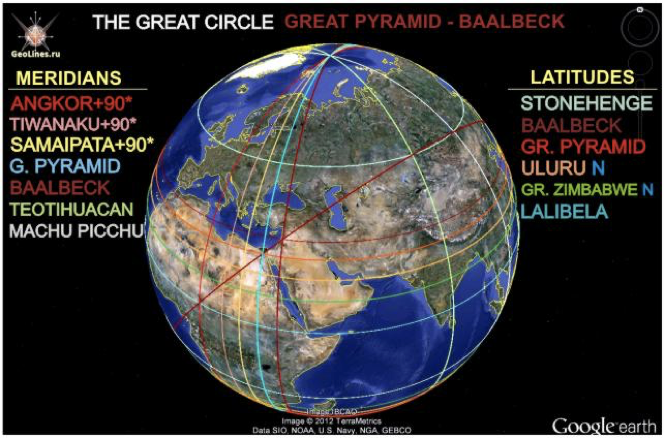
Joe Dubs – emphasis & bold mine: ‘Carl Munck is an archeocryptographer who re-discovered an ancient geo mathematical grid on Earth with precise latitude/longitude positions of ancient pyramids, mounds, effigies, monuments, and stone circles. He has been able to confirm these discoveries by simply pointing-out what is there for all to see, by use of simple math.

One of his greatest achievements was in proving that the prime meridian is actually centered on the Great Pyramid of Giza instead of Greenwich, England.

He clearly lays out this ‘geomath matrix’ in astounding detail and accuracy by surveying various ancient sites around the globe. He found a code that the ancient’s knew about and had used in determining where to place sacred temples, and sacred sites.’

Whatever one may think regarding Ley Lines, it is the opinion of this writer that the evidence of a thought out and pre-meditated pattern of specific locations chosen for the construction of the most important megalithic monuments around the world is clearly laid out before us. Are these locations on specific points of the Earth’s latitude, Longitude and meridian lines? Yes, they obviously are. Is there a circuitry of spiritual energy – like electricity – uniting these inexplicable cyclopean structures? It is considered very likely. Just because the energy transmitted is invisible or remains undetected, does not negate its existence – Article: Principalities & Potentates: What they want… Who they are.

Remember, the race of Elioud giants responsible for these endeavours possessed advanced knowledge in architecture, astrophysics and geometry; as well as superior construction technology and logistical know-how – Chapter XXII Alpha & Omega. Their leaders – specifically, soon after the Flood – were Nephilim, who were themselves a mixture of half spirit from their primarily, paternal angelic parentage and half flesh – Articles: Nephilim & Elioud Giants I & II. With regard to the origin of the Great Pyramid, the mastermind responsible was – while technically from the Nephilim – a cut above, in a different league again.

The second key involves an alignment which is in accordance with the Duat; the art of placement as it was practiced in ancient Egypt, wherein the structures of the Earth were positioned to mirror the architecture of heaven. Thus, monuments on Earth reflect certain celestial spheres in the cosmos; principally from specific constellations of which there are eighty-eight in total: 88 is 8+8=16, which is 1+6 and equals the spiritual number 7. 

The Duat, pronounced “do-aht” – also called Amenthes in ancient Greek or Te in Coptic – is the underworld in ancient Egyptian mythology. It has been represented in hieroglyphs as a star-in-circle: 𓇽. This is reflective of a pentagram, a five pointed star inside a circle. This symbol is of great importance within occult practices, such as ceremonial magic and witchcraft – Articles: Thoth; and Seventh Son of a Seventh Son

How interesting then, that ancient megalithic monuments as geodetic markers invariably form a variety of geometric patterns such as hexagrams and pentagrams. 

Online Encyclopaedia: ‘The god Osiris was believed to be the lord of the underworld. He was the first mummy as depicted in the Osiris myth and he personified rebirth and life after death. The underworld was also the residence of various other gods along with Osiris… including… Anubis, Thoth, Horus, Hathor and Maat, who all appear to the dead soul as it makes its way toward judgement’ article: Thoth. ‘The absolute punishment for the wicked, in ancient Egyptian thought, was the denial of an afterlife to the deceased, ceasing to exist in the intellectual form…’ – Article: Heaven & Hell.

‘The geography of the Duat is similar in outline to the world the Egyptians knew: There are realistic features like rivers, islands, fields, lakes, mounds and caverns, but there were also fantastic lakes of fire, walls of iron, and trees of turquoise.’

Alternative timeline theories in opposition to orthodox Egyptology’s dating for the Giza pyramids began with Dr James J Hurtak in 1973. Suggesting that the three pyramids were built to align with Orion’s belt was popularised by Egyptian born author Robert Bauval and known as The Orion Correlation Theory. Mainstream archeologists do not accept the Orion theory, instead claiming that the Giza Pyramids are aligned as they are so that they can be seen by people, especially kings travelling down river from Memphis. 
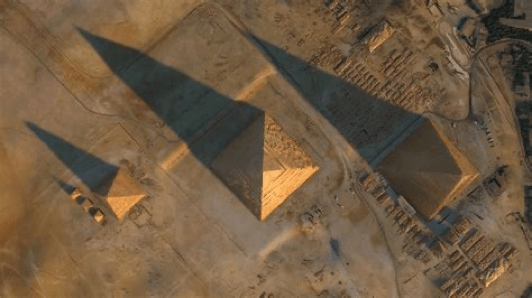
Orion’s Belt is a prominent asterism (an observed pattern or group of stars in the sky), formed by three stars in the Orion constellation. The three bright blue stars are: Alnitak, Alnilam and Mintaka, which outline the belt in the constellation figure of the celestial Hunter. 

In fact, five of the seven brightest stars in the night sky have pyramid equivalents: The three pyramids of Giza; the Great Pyramid (Khufu), the Second Pyramid (Khafra) and the Third Pyramid (Menkaure); the pyramid of Nebka at Abu Rawash corresponding to the star Saiph; and the pyramid at Zawat al Aryan, corresponding to the star Bellatrix. The only two missing star positions are seemingly for Betelgeuse and Rigel

Another idea, in tandem with The Orion Correlation Theory is the Leo Constellation Theory. Currently, the sphinx is not aligned with any stars or constellations. Robert Bauval and Graham Hancock propose the construction of the Great Sphinx occurred circa 10,500 BCE. They base their case on 1. the layout and orientation of the Sphinx; 2. the Giza Pyramid complex; and 3. the Nile River, as an accurate reflection or terrestrial map of a. the constellation of Leo; b. Orion’s Belt; and c. the Milky Way respectively. 

According to the theory in 10,450 BCE, the sphinx would have been perfectly aligned with the constellation of Leo and during this time frame, the three largest pyramids of Giza would have been aligned with the stars in Orion’s Belt. 

The fact the three pyramids aligned with Orion’s Belt at this time is more convincing than the Sphinx’s alignment with the precessional Age of Leo – between 10,970 and 8810 BCE – if it wasn’t technically a sphinx. For a sphinx is a mythical creature with the head of a human, the body of a lion and the wings of an eagle. There is no evidence on the body of the Giza Sphinx of broken off wings. This added to the resting, sitting position of the Sphinx more in keeping with a canine dog rather than a feline cat; casts serious doubt on the original carving being a lion. 

It is odd that researchers have not questioned whether the Sphinx and Giza pyramids are not in fact markers of a global catastrophe – in the same manner as the site at Gobekli Tepe – and not actually erected in the time they are memorialising – Article: Monoliths of the Nephilim. At Gobekli Tepe the original layer of building, Level III, is dated to circa 9600 BCE. Whereas pillar no. 43, the Vulture Stone marks a date commensurate with the ending of the Last Glacial Maximum in 10,837 BCE – Article: The Younger Dryas Stadial: Ending of the Earth… Beginning of the World. 

Therefore, while the Sphinx and pyramids are clearly far older than the 4,500 years typically ascribed to them; they may not be as old as 12,500 years offered by Hancock and company. The year 10,500 BCE was a mere three hundred years after the great deluge which destroyed everything in its path and covered the whole earth, even rising above the Himalayan mountain range – Chapter I Noah Antecessor Nulla. It is the view of this writer that it may have taken longer for the ground to fully dry out and stabilise. The building work at Gobekli Tepe a good example of at least a thousand years passing before major construction was viable. 

Thus, the parameters put forward by Robert Schoch for the Sphinx between 9000 to 5000 BCE is realistic. Anything pushed back past 10,000 BCE is problematic, though not impossible. As the Black Sea Catastrophe occurred circa 6700 BCE, it is considered 10,000 to 7000 BCE to be a feasible window for the construction of the Giza pyramids and the Sphinx. As the Sphinx and Second Pyramid are linked, it is possible they were built during the same phase of construction. It is also reasonable to conclude that the Giza complex was a. planned and b. a work in progress. Thus, any gaps between the second to fourth pyramids may not have been very long. Though not very long may have meant decades. As there is a decline in quality from the Great Pyramid to the Second and Third pyramid, it appears logical the great Pyramid was built first. 

An alternative hypothesis from author Andrew Collins, is the Cygnus Constellation Theory, which also subscribes to the notion that the pyramids were built in alignment with the stars. Like The Orion Correlation Theory, it similarly proposes a mapped mirror of not just Orion’s Belt – with the three main pyramids at Giza – but with the setting constellation of Cygnus. This theory carries some weight with a calculated mathematical correlation. It was through the research of this theory that ‘Egyptological researcher Nigel Skinner-Simpson was able to find and locate the bird tomb entrance to an underground cave system in 2008, which had been lost for over 200 years’ – The Conscious Vibe. Andrew Collins acknowledges both the Orion and Cygnus theories have merit and their matching is more than a coincidence for neither to be true. 

That said, it is a little peculiar and perhaps somewhat suspicious that there is not just one clear hypothesis in explaining the Giza pyramids layout, if they match up with and align with a sequence of stars in the cosmos.

Monoliths of the Nephilim: “Working with British engineer Rodney Hale, Andrew Collins established that the three main Pyramids of Giza not only reflect the astronomical positions of the three wing stars of Cygnus, but are aligned to them on the ground as well. The three pyramids are locked into the setting of these three Cygnus stars in the horizontal and vertical planes of all three dimensions.”

“The visual alignment of the same three stars, as seen from a vertical perspective, their astronomical positions corresponding with the geographical locations of the Giza pyramids.”

Cygnus is the avian Swan Constellation and reminds of the fact that Thoth and Quetzalcoatl are associated with birds. 
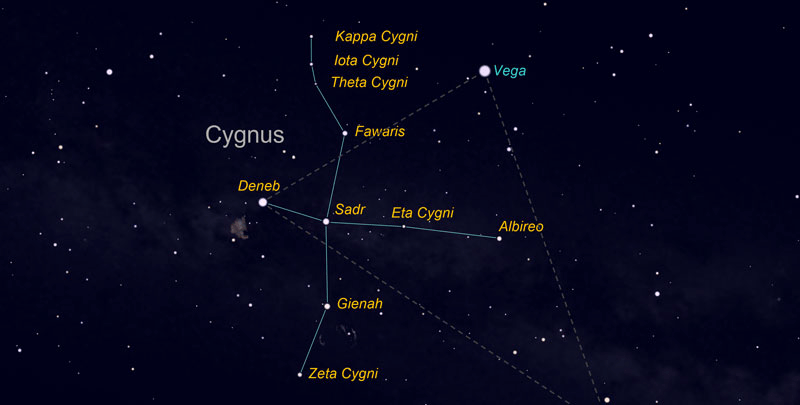
The three aligned stars, Kappa, Iota and Theta – located at the tip of the swan’s wing – corresponding to the three Giza pyramids. The brightest star in the Cygnus Constellation is Deneb. 

The Pyramid of the Sun in Teotihuacan is exactly half as tall as the Great Pyramid of Giza; and interestingly, the Temple of the Sun, the Temple of the Moon and the Temple of Quetzalcoatl also share the same layout as Orion’s Belt. 
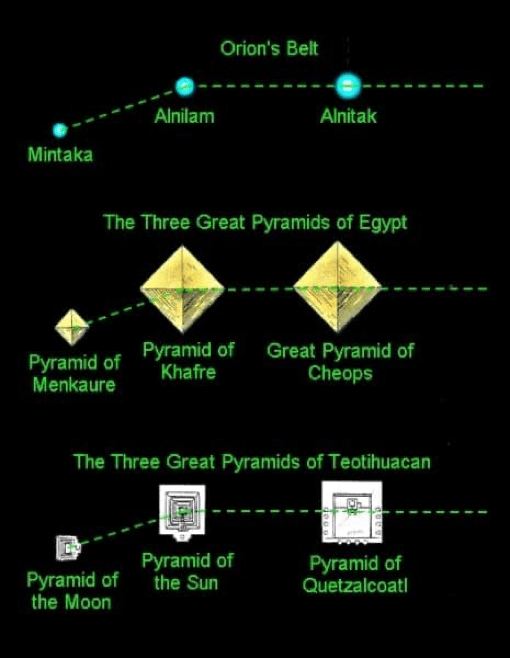
Before investigating the lingering question on the layout of the three principle Giza pyramids, we must look to the stars and consider the constellations which the architect of the Great Pyramid deemed fit to draw attention to in its internal structure. 
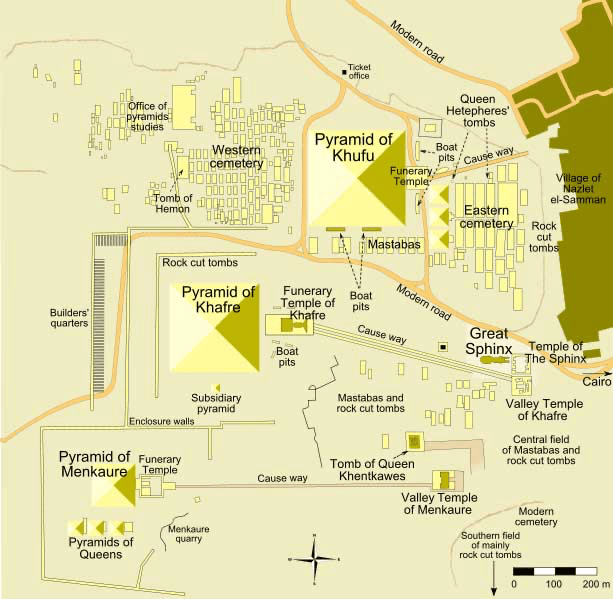
The constellation associated with the southern shaft of the Queen’s Chamber is Canis Major and its brightest star Sirius. While Canis Minor is not directly highlighted within the Great Pyramid, it is associated with the Giza Complex in the form of the Sphinx. 

Canis Minor is a small constellation located in the northern celestial hemisphere. The name comes from Latin and it translates as the ‘Lesser Dog’, in contrast with Canis Major, the ‘Greater Dog’. Both celestial dogs are commonly represented as following the Constellation of Orion, the hunter. 

The Winter Triangle is also called the Great Southern Triangle. It is not a constellation, but an asterism. It is formed by connecting the three brightest stars in the winter constellations; Betelgeuse – which occasionally outshines Rigel from Orion; Sirius from Canis Major; and Procyon from Canis Minor. 


Orion as the celestial hunter, always had his dogs with him. He was so proficient at hunting, he vowed to kill all the animals on Earth. This made the goddess of the Earth, Gaia, angry. She asked the giant scorpion, Scorpio, to kill the hunter before he harmed every animal. Scorpio duly murdered Orion. This made Artemis his lover, very sorrowful. When Zeus realised his daughter was upset, he placed Orion in the sky together with his two loyal hunting dogs. The ancient Egyptians associated Canis Minor with Anubis, the ancient Egyptian jackal god of the Dead and the Underworld – refer article: Thoth

The Nine Planets: ‘Two stars in Canis Minor have been discovered to host planets: HD 66141, and Luyten’s Star… Procyon… has a magnitude of 0.34 – the eighth brightest star in the night sky. Procyon is a binary star system, consisting of a white main-sequence primary star, and a fainter white dwarf companion. One of the nearest star systems to Earth is located in Canis Minor, Luyten’s Star, which is situated at only 12.36 light-years away. 

In Greek mythos, the constellation of Canis Minor was related to the Teumessian Fox, a beast turned into stone together with its hunter, Laelaps, by Zeus.’ Laelaps had been a gift from Zeus to Europa, ‘or sometimes the hound of Procris, Diana’s nymph, or the one given by Aurora to Cephalus, so famed for its speed that Zeus elevated it to the sky. Zeus later placed them into the sky as Canis Major (Laelaps) and Canis Minor (Teumessian Fox)’ – refer fox (Gobekli Tepe), article: Monoliths of the Nephilim

The constellation of Canis Minor is the 71st largest constellation in the sky. Canis Minor spreads for over 183 square degrees. Canis Minor is located in the second quadrant of the northern hemisphere (NQ2), and can be seen at latitudes +90o and -75o. The neighboring constellations of Canis Minor are Cancer, Gemini, Hydra, and Monoceros. Canis Minor belongs to the Orion family of constellations together with Canis Major, Lepus, Monoceros, and Orion.

The Aztec calendar was related to their cosmology, with the stars of Canis Minor being incorporated along with some stars of Orion and Gemini, that formed an asterism associated with the day called Water.’

Canis Major ‘was also considered to represent one of Orion’s hunting dogs, pursuing Lepus, the celestial Hare, or helping Orion fight Taurus, the celestial bull, and it is referred to in this way by Aratos, Homer, and Hesiod.

Encyclopaedia: ‘Sirius is a binary star consisting of a main-sequence star of spectral type A0 or A1, termed Sirius A, and a faint white dwarf companion of spectral type DA2, termed Sirius B. The distance between the two varies between 8.2 and 31.5 astronomical units as they orbit every 50 years. Sirius appears bright because of its intrinsic luminosity and its proximity to the Solar System. At a distance of 2.64 parsecs, the Sirius system is one of Earth’s nearest neighbours’ – refer Addendum II & III

‘Sirius is gradually moving closer to the Solar System; it is expected to increase in brightness slightly over the next 60,000 years to reach a peak magnitude of -1.68. Coincidentally, at about the same time, Sirius will take its turn as the southern Pole Star, around the year 66,270 AD.’ Polaris Australis or Sigma Octantis, is the current South Star, being the nearest visible star to the south celestial pole. It is a yellow giant located 294 light-years away in the faint southern constellation Octans. 

‘Sirius A is about twice as massive as the Sun and… It is 25 times as luminous as the Sun but has a significantly lower luminosity than other bright stars such as Canopus, Betelguese, or Rigel. The system… was originally composed of two bright bluish stars. The initially more massive of these, Sirius B, consumed its hydrogen fuel and became a red giant before shedding its outer layers and collapsing into its current state as a white dwarf… Sirius is colloquially known as the “Dog Star”, reflecting its prominence in its constellation, Canis Major (the Greater Dog).’

‘The heliacal rising of Sirius marked the flooding of the Nile in Ancient Egypt and the “dog days” of summer for the ancient Greeks, while to the Polynesians, mostly in the Southern Hemisphere, the star marked winter and was an important reference for their navigation around the Pacific Ocean.’

The Nine Planets: ‘Currently, seven stars that host planets have been discovered in Canis Major. The constellation… is the 43rd largest constellation in the sky. Canis Major spreads out for over 380 square degrees. Canis Major is located in the second quadrant of the southern hemisphere (SQ2), and it can be seen at latitudes between +60o and -90o. The bordering constellations of Canis Major are Columba, Lepus, Monoceros, and Puppis.’

Orion is intrinsically linked with the Greater and Lesser Dog constellations. The Lesser Dog in turn is said to generally represent the Egyptian god Anubis and the Greater Dog, the Egyptian goddess Isis. Isis is a complex character and is in fact the Mesopotamian Ishtar or Babylonian-Assyrian Semiramis; otherwise known as, Lilith – Article: Lilith. The Orion constellation is synonymous with the Egyptian god, Osiris. Osiris is just as complex as Isis and is linked with the biblical demagogue, Nimrod – of which we will have more to discuss later. 

Orion is the focus of the – parallel to the Queen’s – southern vent in the King’s Chamber. The constellation of Orion is one of the most prominent and oldest constellations in the night sky; hosting numerous bright stars, nebulae, clusters and clouds. To date, ten stars in the constellation have been discovered to host exoplanets. The constellation is the 26th largest constellation in the night sky and spreads out 594 square degrees. Orion lies on the celestial equator and it is visible throughout the world. 

The spectacular Orion Nebula (below), is among the brightest in the sky and can be viewed without the aid of binoculars. It has a visual magnitude of 4.0 and is 1,344 light years away from the Earth. The Orion Nebula is the nearest known region of a massive star formation to our Solar System and is part of the Orion Molecular Cloud Cluster. 

The constellation of Orion hosts several of the brightest stars in the night sky. The brightest star in Orion is Rigel, followed by Betelgeuse. Rigel, designated as Beta Orionis, is a massive blue-white supergiant variable star. While it appears as a single star, Rigel is actually a star system containing four stars. Rigel is the seventh brightest star in the night sky. It is located about 860 light years away from Earth. ‘Rigel has 7,000% of our Sun’s radius, and 2,100 % of our Sun’s mass. As time passes, Rigel will expand to an even greater size transcending into a red supergiant. It may explode as a supernova in the future. 

Betelgeuse is located at around 640 light-years away from Earth, and its brightness ranges from 90,000 to 150,000 times that of our Sun. Betelgeuse is among the biggest stars known to us [and ninth brightest overall], having a radius of around 88.700% of our Sun’s radius, and 1,160% of its mass.’

Bellatrix or Gamma Orionis, is the third brightest star in Orion. ‘Bellatrix is a slightly variable star… [and] varies in being the 27th and the 25th brightest star in the night sky. Bellatrix is a blue star located at around 250 light-years away from us. It has around 575% of our Sun’s radius, around 860% of its mass, and it is around 9.211 times brighter.’ 

Bellatrix

Al Nitak or Zeta Orionis, is a triple star system; the fifth brightest star in Orion; and the 31st brightest star in the night sky. Al Nitak as part of the famous asterism, Orion’s Belt, is located at about 1,260 light years away from Earth and is a blue supergiant star. Al Nitak is 250,000 times brighter than our Sun; possessing some 33 solar masses and a radius twenty times that of the Sun.  

It is very curious then, that as the primary star of the Belt of Orion – ‘representing’ the Great Pyramid – it is the ‘second most massive and the second biggest star’ in Orion’s belt. For the second star, Alnilam – representing the marginally smaller Second Pyramid – is a bright blue supergiant star and the biggest and most massive star of the asterism. Remember this important anomaly…

The Nine Planets: ‘Orion was called the MUL.SIPA.ZI.AN.NA. – the Heavenly Shepherd or the True Shepherd of Anu – Anu being the chief god of the heavenly realms. What is more interesting is the fact that in Egyptian mythology, the gods descended from Sirius and the Orions Belt asterism… instigating the human race.’ This is in accordance with the southern shafts originating from the King and Queen’s chambers pointing at one time to Sirius and Al Nitak, respectively.

Were these star systems – or rather the invisible subspace realities shadowing them – the original home worlds of the angels who rebelled? 

‘The mythical hunter, Orion, is often depicted in star maps as either facing the charge of Taurus, (the celestial bull…), who is pursuing the Pleiades sisters, (represented by the famous open cluster) or chasing after the hare (constellation Lepus)… In ancient Aramea, the offspring of the “sons of God” – the Nephilim – were said to be Orion’s descendants’ – Genesis 6:1-2, 4. ‘In medieval Muslim astronomy, Orion was known as al-Jabbar – “the giant”. In old Hungarian tradition, Orion is known as the “magic Archer”, he is called Nimrod’ – Chapter XXI The Incredible Identity, Origin & Destiny of Nimrod. 

Turning our attention to the northern vent of the Kings Chamber and its alignment with the Draco Constellation and its star Alpha Draconis or Thuban. Not to be confused with the name Draco, made popular by J K Rowling in her Harry Potter series and the character Draco Lucius Malfoy, one of the principle antagonists.  

Draco as a circumpolar constellation, means it never sets below the horizon for many observers in the northern hemisphere. Its name derives from Latin, meaning ‘the dragon.’ The Draco Constellation contains seventeen stars; of which nine stars have known planets. There is one meteor shower associated with the constellation, the Draconids.

The Planets: ‘Draco was first catalogued by the Greek astronomer Ptolemy in the 2nd century. While it is associated with several myths, it is most frequently associated with the 12 labours of Heracles. In the myth, Draco represents Ladon, the dragon that guarded the golden apples in the gardens of the Hesperides. The apple tree was a wedding present to Hera when she married Zeus, and she planted it in her garden. She tasked Atlas’ daughters, the Hesperides, with guarding it, and placed the dragon Ladon around the tree so that the Hesperides would not pick any apples from it. As part of his 12 labours, Heracles was asked to steal some golden apples from the tree. He killed [Ladon with his poisoned arrows] while doing so… Hera [who was saddened] placed its image in the sky among the constellations.’ 

There is a distant echo here of the Garden of Eden and one of its two trees, with forbidden fruit – Chapter XXII Alpha & Omega

Constellation Guide: ‘In some versions of the myth, Ladon had a hundred heads and was the child of the monster Typhon and Echidna, who was half woman and half serpent. In others, he was the offspring of two sea deities, Ceto and Phorcys… Draco is usually depicted coiled around the North Pole, with one foot of Heracles on its head. In Roman mythology, Draco was one of the Giant Titans who warred with the Olympian gods for ten years’ – refer article: Thoth. ‘The Titan met his end at the hands of the goddess Minerva and was thrown into the sky, where it froze around the North Pole.’ 

Perhaps an accurate alternative mythological interpretation is that Draco is represented actually as Typhon, the Titan son of Gaia. 

Constant readers will be aware there are two prime antagonists in the scriptures as well as in non-biblical accounts. They are mighty Dragons and often described as sea monsters or leviathans – Revelation 12:9, Job 41:1-34. Though the sea can be a euphemism for space or the dimensions beyond our own. The dragon Ladon, has more than a passing resemblance to one of these leviathans – Samael the Serpent in Eden. The reference to stepping on its head also hearkens to a biblical reference, whereby the Serpent of Eden would be defeated through the sacrifice of the Messiah – Genesis 3:14-15, Romans 16:20. The association with the North Pole is highly relevant and due serious consideration as we proceed. 

It is outside the remit of this article to discuss the inhabitants of Draco at length. Those readers interested in a full discussion, may refer to the article: Principalities & Potentates: What they want… Who they are. In essence, the Draco are viewed by the non-religious as extraterrestrials and form the hierarchy of the reptilian alien races who a. reside within the Earth and its sub-space environs; b. monitor and manipulate the Earth and its inhabitants; with the aim of c. seeking to completely control the world. 

In the Bible, these beings are dark, fallen angels. They are of the order of the Dragon and may identify with the ‘fiery, flying, fire-breathing’ Seraphim. Those reptilians subservient to them are known as ‘serpents’ or ‘devils’ in the scriptures. In ancient Sumerian texts, the Draco are known as the Anunnaki and in the Book of Enoch as the Watchers. Did the dragon race flee and settle in the Draco Constellation, after being expelled from Orion and Sirius? 

The constellation of Draco is the eighth largest constellation in the night sky. It occupies an area of 1083 square degrees and lies in the third quadrant of the northern hemisphere (NQ3); which can be seen at latitudes between +90° and -15°. 

The Planets: ‘Draco belongs to the Ursa Major family of constellations, along with  Coma Berenices, Boötes, Camelopardalis, Canes Venatici, Corona Borealis, Leo Minor, Lynx, Ursa Major and Ursa Minor. The neighboring constellations are Boötes,  Camelopardalis, Cepheus, Cygnus, Hercules, Lyra [refer Chapter XXII Alpha & Omega; and Addendum IV], Ursa Major, and Ursa Minor.’ 

Recall the Cygnus Constellation – top left above – proposed by Andrew Collins as a potential celestial reflection of the Giza pyramids.

The Planets: ‘Eltanin, also known as Gamma Draconis, is the brightest star in Draco with an apparent magnitude of 2.3617. It is an evolved giant and belongs to the spectral class K5 III. It is located around 154.3 light years distant from the Solar System and is 471 times more luminous than the Sun… [with] 72 percent more mass than the Sun. Eltanin has a companion with a visual magnitude of 13.4, likely a red dwarf that may be a physical companion, not just an optical one. It is pretty easy to find in the night sky, lying just north-northwest of Vega, which is the brightest star in the constellation of Lyra. The star’s name comes from the Arabic At-Tinnin, which means “the great serpent”. It is sometimes known as the Zenith Star because it lies close to the zenith point directly overhead in London. 

Omicron Draconis is a spectroscopic binary star. It is a giant belonging to the spectral class K2 III and has a visual magnitude of 4.62 and is 322.93 light years away from us. It has a radius that is 30 times that of the Sun and is 269 times brighter than the Sun. Omicron Draconis is notable for being the North Pole star of Mercury. 

Thuban, also known as Alpha Draconis, is a white giant star that belongs to the spectral class A0III. It has an apparent magnitude of 3.6452 and is approximately 303 light years away from us. It is 250 times more luminous than the Sun. Thuban is a double star. The main star has a companion, which is either a red or white dwarf. The two complete an orbit every 51 days. Its name comes from the Arabic thuʿbān, which means “the snake.”

Recall, Thuban is not only associated with the northern vent in the King’s Chamber in 2450 BCE but also with the descending passage between 2170 to 2144 BCE. For this star – aka Alpha Draconis – to be highlighted twice, shows the builder of the Great Pyramid had an affinity with not just Sirius and Orion but especially with Draco. 

Though incongruously, ‘For a star with the Alpha designation, Thuban is pretty inconspicuousConstellation Guide [and] can be found by following the line from the inner two stars of the Big Dipper [Ursa Major], Phecda and Megrez, which point in its direction.’ 

As Thuban is a long way from being the brightest star in the Draco Constellation, one wonders why it has been highlighted twice in the Great Pyramid? Or has it? What significance does this sphere play as the North Pole star? We will return to these important questions. 

Finally, there is the northern shaft in the Queen’s chamber. It highlights Kachob in the Ursa Minor Constellation. Like Canis Major, the Greater Dog; and Canis Minor, the Lesser Dog; the Bear is split into two constellations – Ursa Major and Ursa Minor. Ursa Major is not highlighted in the Great Pyramid, just as Canis Minor isn’t either. Even so, Ursa Major is mentioned twice in the Bible – in the same book as Leviathan coincidentally is – the Book of Job. 

The Ursa Major constellation is situated in the northern sky. Its name means ‘the great bear’ or ‘the larger bear’ in Latin. Ursa Major is the largest northern constellation and third largest constellation in the sky. Its brightest stars form the Big Dipper asterism – the tail of the bear – one of the most well known shapes in the sky, also known as the Plough and the Wagon. 

Ursa Major is often used as a symbol of the North – for example, its depiction on the flag of Alaska (above). Note the ladle like shape of the Big Dipper and Polaris, the North Pole Star in the top right hand corner. The flags of Minnesota and Maine also incorporate the Pole Star.

The grizzly bear featured on the California flag, named Monarch, was a grizzly bear captured in 1899. Though the grizzly bear become extinct in California, with the last known sighting occurring in 1924. The lone red star represents California’s unfulfilled aspirations at becoming an independent nation. While the bear does not symbolise either of the Bear constellations, it is interesting that the star could be the North Pole Star Polaris, in combination with the bear of the Ursa Minor Constellation. 

Katie Wareham: ‘The seven stars that create the Big Dipper’s recognizable ladle make up the bear’s uniquely long tail.’

‘In Greek mythology, Ursa Major represents Callisto, a beautiful nymph and huntress with whom Zeus, the god of the sky, fell in love. Zeus fathered Callisto’s son, Arcas, and out of jealousy Hera, Zeus’s wife, turned Callisto into a bear forcing her to spend the rest of her life roaming the woods. Years later, Callisto’s son Arcas became a great hunter himself. One day, he encountered a bear in the woods and took chase not knowing the true identity of the bear was his mother.’ [This reminds of Nimrod the hunter and his mother Semiramis] ‘Zeus stopped Arcas just before he threw his spear to kill her. In order to protect her, Zeus hoisted Callisto into the sky by her tail, stretching it to an abnormal length.’

‘There are numerous versions of this myth. In one version of the story, both Callisto and Arcas were thrown to the heavens, becoming Ursa Major and Ursa Minor (“Little Bear”). They were forced to circle the North Star and never allowed to rest beneath the ocean, explaining why the constellation is visible in the Northern Hemisphere year-round.’ Another version has Arcas turned into the constellation Bootes, the Herdsman.  

‘In some Native American cultures, the three stars in Ursa Major’s tail represent three hunters pursuing a bear. The hunt lasts from spring to autumn, until the hunters finally pierce the bear with their arrows. The constellation drops much closer to the horizon in the fall and the blood from the wounded bear spills onto the earth, changing the colors of the leaves.’

Constellation Guide: ‘The Romans called the constellation Septentrio, or “seven plough oxen,” even though only two of the seven stars represented oxen, while the others formed a wagon. In Hindu legend, the brightest stars of Ursa Major represent the Seven Sages and the constellation is known as Saptarshi.’

Ursa Major contains a number of notable stars and deep sky objects; including the Pinwheel Galaxy and the Owl Nebula. 
Pinwheel Galaxy – Messier 101

The Great Bear occupies an area of 1280 square degrees. ‘It is located in the second quadrant of the northern hemisphere (NQ2) and can be seen at latitudes between +90° and -30°. The neighboring constellations are Bootes, Camelopardalis, Canes Venatici, Coma Berenices, Draco, Leo, Leo Minor and Lynx.’

Ursa Major contains thirteen stars with confirmed planets. The constellation contains twenty-two formally named stars. There are two meteor showers associated with the constellation; the Alpha Ursa Majorids and the Leonids-Ursids.

‘The Big Dipper is… very useful in navigation as it points the way to Polaris, the North Star (Alpha Ursae Minoris), which is a part of another famous asterism, the Little Dipper in Ursa Minor constellation. If you follow the imaginary line from Merak to Dubhe and continue the arc, you will eventually reach the Northern Star.’

Katie Wareham: ‘The Big Dipper can help beginning astronomers identify the North Star, Polaris. This is exactly what many slaves did before, and during the Civil War, in an attempt [to] escape slavery. Many slaves did not know how to read and lacked access to navigational tools. However, even without maps or compasses, escaping slaves could read the stars.’ There were numerous songs that spread in the south that said to follow the “Drinking Gourd” to get to a better life. ‘By using the Big Dipper to find Polaris, slaves could navigate North in search of freedom.’

Constellation Guide: ‘Similarly, the imaginary line that stretches along the handle of the Dipper leads to the bright star Arcturus, the bear keeper, located in the constellation  Bootes…’ – Job 38:32. ‘If you follow the line further, you will find Spica, the brightest star in the constellation Virgo and also one of the brightest stars in the sky’ – Article: The Christ Chronology

The Nine Planets: ‘Alioth, designated as Epsilon Ursae Majoris, is the brightest star in Ursa Major, and the brightest of the seven stars of the Big Dipper asterism. Alioth also shares the 31st place as the brightest star in the night sky with Alnitak – one of three stars that make up the Orion’s Belt asterism.’

Constellation Guide: ‘The star’s traditional name comes from the Arabic word alyat, which means “fat tail of a sheep.” Alioth is the star in the bear’s tail that is closest to the body of the bear.’ 

The Nine Planets: ‘Alioth is a blue-white giant or subgiant star with a peculiar spectrum, having calcium K-lines in it. It is located at 86 light-years from Earth, and it is 102 times brighter than our Sun. Alioth has an apparent magnitude of 1.77, it is also classified as a Canum Venaticorum variable star – meaning, it varies in brightness due to its magnetic field and its chemical peculiarity. Alioth has 291% of our Sun’s mass, and around 414% its radius. Its magnetic field is 100 times greater than Earth’s. Alioth, along with Dubhe, and Alkaid, are among the 58 navigational stars selected for celestial navigation. Only the brightest and the most easily recognizable stars are part of this group.’

Constellation Guide: ‘Alioth belongs to the Ursa Major Moving Group (Collinder 285), a group of stars that includes most of the brightest stars in the constellation Ursa Major. The stars belonging to the group share common velocities in space and are believed to have a common origin. The Ursa Major Moving Group was discovered in 1869 by the English astronomer Richard A. Proctor, who realized that all stars of the Big Dipper with the exception of Alkaid and Dubhe have proper motions heading toward a common point in the constellation Sagittarius.’

Ursa Minor, is the constellation highlighted by the northern shaft in the Queen’s Chamber and perhaps on first reading, the least significant of the four constellations. Or is it? 

The Nine Planets: ‘The constellation of Ursa Minor is among the oldest constellations in the sky. Among the earliest records of it belongs to the Babylonian star catalogs, where it was known as the “Wagon of Heaven” – MUL.MAR.GID.DA.AN.NA – who is also associated with the goddess Damkina. Ursa Minor is listed in the MUL.APIN catalog, compiled around 1000 BC, among the “Stars of Enlil” – the northern sky. In classical antiquity, the celestial pole was closer to Kochab, the second brightest star of Ursa Minor, rather than Polaris, and the entire constellation was taken to indicate the northern direction. 

The constellation of Ursa Minor is the 56th largest constellation in the sky. Ursa Minor spreads out for over 256 square degrees. Ursa Minor is easy to spot since it hosts the north pole star’ – Polaris. ‘The constellation has been traditionally important for navigation, particularly by mariners. Ursa Minor is located in the third quadrant of the northern hemisphere (NQ3). The constellation of Ursa Minor hosts several important stars, such as Polaris… or the seven stars that form the Little Dipper asterism. Currently, around 4 stars have been discovered to host planets in Ursa Minor.’

‘Polaris… is a triple star system, and currently, it is our North Star or Pole Star, being the closest star to the north celestial pole. The star system has an apparent magnitude of 1.98. The primary star, Polaris Aa, is a [pulsating] yellow supergiant located at around 433 light-years* [133 parsecs] away from Earth.’

Supergiants are the largest and brightest stars, often many hundred times larger and brighter than our Sun. Yet Polaris does not look as bright to us because it is so far away. Polaris is over 6400 million million kilometres or 4000 million million miles.*

‘Polaris has 540% of our Sun’s mass, and it is overall around 50 times bigger than our Sun. It is… around 2,900 times brighter than our Sun, holding the [48th] position among the brightest stars in the night sky.’ Polaris is slightly hotter than our Sun. It has an estimated surface temperature of around 6.015 Kelvins. ‘Polaris has been the North Pole star for more than 2,000 years, and… will remain more accurate than any compass.’

Bruce McClure & Don Machholz: ‘Polaris is a variable star. In the past, it had varied between magnitudes 1.86 and 2.13 every four days. In recent decades, this variability decreased from 10% to 2%, then it went back up to 4% variability. Astronomers are not sure why this happened. It’s the type of variable star known as a Cepheid variable star, a class of stars that astronomers use to figure distances to star clusters and galaxies.’

The Nine Planets: ‘Kochab, designated as Beta Ursae Minoris, is the brightest star in the bowl of the Little Dipper asterism, and the second-brightest star in the constellation of Ursa Minor’ – after Polaris. ‘Kochab has an apparent magnitude of 2.08, it can be used by amateur astronomers as a precise guide for setting up a telescope, as the celestial north pole is located at 43 arcminutes away from Polaris, very close to the line connecting Polaris with Kochab. 

Kochab is a giant star located at 130.9 light-years away from us. It is 390 times brighter than our Sun, having 220% of its mass, and around 4.206% of its radius. Around the year 2500 BCE, Kochab was the north pole star. Recently, it was discovered that a planet orbits Kochab, which is 610% more massive than Jupiter.’ 

Ursa Minor is associated with two different myths. The first was described in relation with Ursa Major. In the second myth, ‘the constellation represents Ida, the nymph who took care of Zeus on the island of Crete when he was young, along with Adrasteia, the nymph who is associated with the larger Ursa Major constellation. Zeus’s mother, Rhea, hid him on the island to protect him from his father, Cronus, who was afraid that his children will overthrow him. Cronus swallowed Zeus’s brothers and sisters but was tricked into swallowing a stone, thinking that it was Zeus’ – Article: The Calendar Conspiracy; and Addendum II.

‘Zeus would eventually free his brothers and sisters and become the supreme god of the Olympians. In an older myth, the seven stars that form the Little Dipper were said to represent the Hesperides, the seven daughters of Atlas. Before it became known as the Little Bear, Ursa Minor was known as the Dog’s Tail or Cynosura.* 

In Inuit astronomy, the three brightest stars of Ursa Minor – Polaris, Kochab, and Pherkad, were known as the Nuutuittut – “never moving”, though the term is more frequently used for Polaris alone.’

Prior to focussing on the North Pole Star, Polaris, and in light of the theories and observations highlighted up to this point, it is worth considering a proposal by investigative journalist Armando Mei on a revised timeline for humankind’s early history, as it not only dovetails with an unconventional chronology, it has bearing on the age of the Great Pyramid.

Armando Mei – emphasis his: ‘In the last [29] years, one of the most outstanding theories, in scientific terms, is that proposed by Robert Bauval, known as The Orion Correlation Theory. He proposed a correlation between the major pyramids of Giza and the three largest stars forming the Belt of Orion. Particularly, he suggested that a perfect alignment between the former and the latter occurred in the year 10,450 BC. 

Still mysteries remain, for example, the dispute over the “Zep Tepi” (‘First Time’ or Golden Era). While academics agree to confine its purpose to mythology, I believe that their position conflicts with the long lists of sovereigns found so accurately transcribed in Egyptian documents and temples. In my opinion, all major monuments of Giza were built before the Dynastic Age to celebrate the Age of Osiris rule. But, when were the monuments of Giza built?’ – Article: Na’amah.

‘First of all, I analyzed the astronomical configuration concerning the sky above Giza in the year 10,450 BC (Bauval’s Theory).
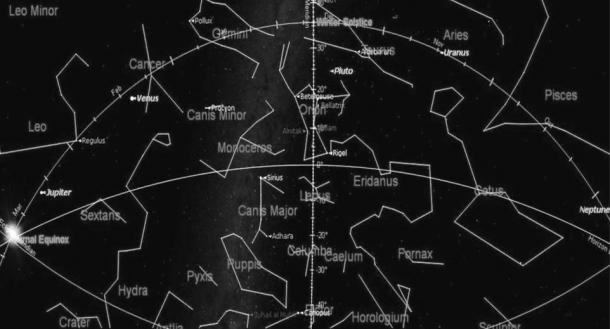
Bauval’s Orion Correlation Theory – Vernal Equinox 10,500 BC. Al Nitak is not on the Meridian and not connected to the Great Pyramid. Sirius is under the Horizon. Planets [do not have] a symbolic arrangement.

At the dawn of the vernal equinox, the Constellation of Lion [Leo] is right on the ecliptic, while the Constellation of Orion is on the Meridian. Remarkable is the position of Mintaka, because this star lies on the Meridian while Alnitak has moved toward the south-east.  In my opinion, this is not the right configuration, because I would expect to find Alnitak (the correspondent of the Great Pyramid, the most important monument of Giza) on the Meridian and not the pyramid of Mycerinus, the smaller pyramid of Giza. Any other astronomical object, close to the monuments of Giza, were in the Sky at that time. 

In the following table, what is most striking is the configuration of the sky above Giza in the year 36,420 BC. At the dawn of the vernal equinox, at an entire astronomical precessional cycle before 10,450 BC, all monuments of Giza were perfectly aligned with the constellations as follows:

The Sky above Giza at Vernal Equinox in the year 36,400 BC: my proposal on Historical Golden Age of the Zep Tepi.

At the dawn of the vernal equinox. The Lion constellation and Sphinx are closely connected to the East. The Orion constellation is on the Celestial Meridian, exactly above the Pyramids. Most importantly, it’s a perfect connection between Al Nitak – the largest Star of the Belt of Orion – and the Great Pyramid, the biggest monument in the Giza Plateau. The connection occurred only in this astronomical configuration and in no one astronomical alignment ever proposed by experts, from 2,000 AD to 100,000 BC. As Al Nitak cuts the Celestial Meridian, so the Great Pyramid lies in the center of emerged lands, the main meridian and parallel intersection, or rather at the distance of 1/3 between the Equator and North Pole, symbolizing the “natural zero” for longitude. 

Moreover, there are many astronomical guidelines proving the concept of the Beginning of a New Age. First of all, the planets positions. They are positioned in the south-east hemisphere, as though following the rising Sun through its movement along the ecliptic. In particular, the Moon is a New Moon, and it’s positioned just below the celestial horizon, ready to follow the Sun’s movement towards the light. The seven planets are positioned along the ecliptic in a perfect row, fixing the beginning of the New Era. Just below the ecliptic, the New Moon gives way to Sunrise – the rebirth of the New Light – that will flood the Land of Egypt…’

This article is interesting for a couple of reasons. Taking for granted for the moment that Orion’s Belt and the pyramids of Giza are a correct match, this finding supports the fact that the Great Pyramid is memorialising a date in antiquity and not necessarily providing a date for its construction. As the evidence points to the pyramid being built this side of the Flood, 36,420 BCE is not a viable or realistic date for its erection. 

That said, Mei’s date for the dawn of the first time of Zep Tepi, nearly aligns with the date in an unconventional chronology for the Age of Leo from 36,890 to 34,730 BCE, during the Sabbath rest of the Eternal on the Seventh day of creation lasting from 51,397 BCE to 27,397 BCE.

Mei’s findings may show a flaw in the Orion Correlation Theory as we shall discover. 

Polaris was officially discovered by William Herschel in August of 1779. Polaris as the Pole Star appears to stay fixed in our northern sky, as it marks the location of the sky’s north pole; the point around which the whole northern sky, full of stars, turns. One can always depend on Polaris to find the direction north. 

The North Star does move, as it makes its own little circle around the sky’s north pole every day. The North Star is offset by a small 0.65 degrees from celestial north. Thus Polaris makes a circle that is 1.3 degrees in diameter every day. When it will be at its closest to the celestial pole in approximately 100 (75) years – at a distance of only 0.45 degrees – it will make a daily circle of just 0.90 degrees. 
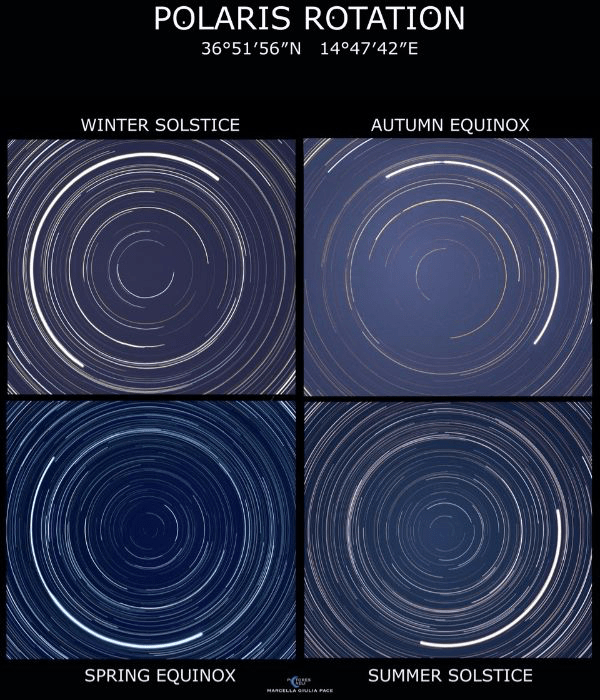
The bright star in this montage of time-exposure photos is Polaris, the North Star

This lack of movement is derived from the Earth’s spin. The Earth spins under the sky every twenty-four hours and it is its spin which causes the sun to rise in the East in the daytime – and the stars at night to rise – and set in the west. The North Star is unique as it lies almost exactly above Earth’s northern axis like the hub of a wheel. So that Polaris doesn’t rise or set – appearing to stay motionless in the northern sky. 
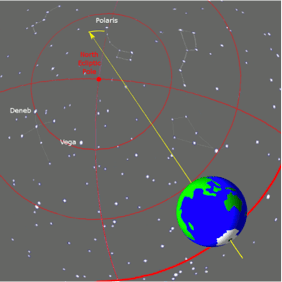
McClure & Machholz: ‘The Big Dipper, like a great big hour hand, goes full circle around Polaris in one day. More specifically, the Big Dipper circles Polaris in a counterclockwise direction in 23 hours and 56 minutes. Although the Big Dipper (Great Bear, Ursa major) travels around Polaris all night long, the Big Dipper pointer stars always point to Polaris at any time of the night, and on any day of the year. Polaris marks the center of nature’s grandest celestial clock!’

It was well after Alpha Draconis in around 400 BCE, that the pole was significantly closer to Kochab – Beta Ursae Minoris. Then the constellation of Ursa Minor was used for navigation as a whole rather than a single star. As Polaris wasn’t close or bright enough to be seen until gradually during the early Middle Ages – 500 to 1000 CE. Polaris was particularly prominent over the past five centuries and depended on by European sailors navigating the Atlantic Ocean. The angle of the star above the horizon provides the latitude (north-south position on the Earth’s surface). Sailors relied on the North Star for navigating at sea, with the help of instruments like quadrants and astrolabes. 
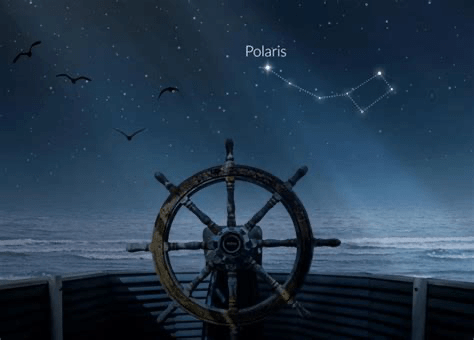
Earth Sky: ‘The North Star not only points toward the north, but its height in the northern sky also matches your latitude on earth. If you are sailing the Caribbean at 16° north latitude, the north star will be about 16° high in your sky. If you are sailing around Nova Scotia, at 44° north latitude, then the North Star will be about 44° high in your northern sky. Each degree north or south equals 69 miles (111 km), so traveling 690 miles north or south will change your latitude, and the North Star’s elevation, by 10 degrees. 

A motion of Earth called precession causes our axis to trace out an imaginary circle on the celestial sphere every 26,000 years. Thousands of years ago… the North Star was an inconspicuous star called Thuban in the constellation Draco the Dragon. Twelve thousand years from now, the blue-white star Vega in the constellation Lyra the Harp will be a much brighter North Star than our current Polaris.’ 

The 26,000-year precession cycle causes the north celestial pole to move counterclockwise relative to the background stars. Whichever star is closest to the north celestial pole is called the North Star. 

McClure & Machholz: ‘… Polaris will continue its reign as the North Star for many centuries to come. It will align most closely with the north celestial pole – the point in the sky directly above Earth’s north rotational axis – on March 24, 2100. The computational wizard Jean Meeus figures Polaris will be 27’ 09’’ (0.4525 degrees) from the north celestial pole at that time (a little less than the angular diameter of the moon when at its farthest from Earth). 

Meanwhile, there is currently no visible star marking the celestial pole in the Southern Hemisphere. What’s more, the Southern Hemisphere won’t see a pole star appreciably close to the south celestial pole for another 2,000 years.’ 

‘In the year 2000, Polaris’ position was RA: 2h 31m 48.7s, dec: +89° 15′ 51″. Due to precession, since this star is so close to the celestial north pole, its Right Ascension (RA) can change quickly. Presently it is sitting at about 03h 00m. Here is a graph showing how the RA of the star changes over the next century.’

The Ancient Chinese called Polaris the Emperor Star and many Native Americans knew it as ‘The Star-That-Does-Not-Walk-Around.’ 

Judy Volker: ‘The first mentioning of a pole star usable for navigation can be found in England at around the 8th or 9th century AD. In old English, the star we now know as Polaris was called scip-steorra, the ship-star… In 14th century Northern Europe, Polaris was called the “guiding star”; lodestar in Old English, leiðarstjarna in Old Norse and leitstern in Middle High German.’

Earth Sky: ‘Polaris could be a name for any North Star. Our current Polaris used to be called Phoenice. According to The Nine Planets, the name Polaris was coined in the Sixteenth Century during the Renaissance era. It is a shortened version from the Latin, Stella Polaris, which translates to ‘polar star.’

Judy Volker: ‘… the first known usage of the name Stella Polaris applied to this star in print was in an edition of the Alfonsine Tables published in Venice in 1492. According to R. H. Allen, in the Alfonsine Tables, the term Alrucaba et est Stella polaris sive Polus was applied to both Kochab (β UMi) and Polaris (α UMi). The name Stella Polaris also appears on a celestial globe made in 1493 by German priest Johannes Stoffler.’

While honoured as the North Star, Polaris enjoys the title of Cynosura* as well. Cynosure meaning: ‘something that strongly attracts attention by its brilliance, interest…’ and ‘something serving for guidance or direction.’ For example, to be the cynosure of all eyes. Other names for the North Pole Star include: Alruccabah, Tramontana, Angel Stern, Navigatoria, Star of Arcady, Yilduz, Mismar and Polyarnaya.

Earth sky: ‘[Polaris] is not known for its brightness, but for its unique position in the sky. 

… Polaris – like all stars – has more than one kind of motion. The stars we see in our night sky are all members of our Milky Way galaxy. All of these stars are moving through space, but they’re so far away we can’t easily see them move relative to each other. That’s why the stars appear fixed relative to each other. And it’s why, for the most part, we see the same constellations as our ancestors. 

But over time, this movement, called proper motion rearranges the patterns of stars we see in our sky. For Polaris, that movement is small, about 46 arcseconds in 1,000 years. That is about 1/40th of the diameter of the full moon as seen from the earth. So when you’re talking about stars moving or staying fixed, remember… they are all moving through the vastness of space. It’s just the relatively short time of a human lifespan that prevents us from seeing this grand motion.’ 

Royal Museums Greenwich: ‘In Arabic mythology, [Polaris] is an evil star that killed the great warrior of the sky. The dead warrior now lies in the coffin of the ‘Funeral Bier’ constellation – the Arabic name for the Great Bear [Ursa Major]. In Norse mythology the Pole Star is the jewel on the end of the spike that the gods stuck through the universe and around which the sky revolves. To the Moguls (Mongolian empire) it was the peg holding the world together’ – Isaiah 22:22-25, Revelation 3:7.

McClure & Machholz: ‘Just when you think you have seen it all… maybe you have. Because this next bit will blow your mind, and you will never visually see it. Below we see an image of Polaris, which is several images stacked to bring out the contrast. Those are not clouds in our atmosphere. They are not clouds between us and Polaris. They are clouds well beyond Polaris, illuminated by the light of our galaxy. These clouds are called the Integrated Flux Nebula.’ 

The changing Pole Star, Steve Hurley, 2020 – emphasis his: 

‘Polaris is located roughly one and a half times the diameter of the Moon away from the projection of the North Pole into the sky. This point is known as the North Celestial Pole and, to an observer in the Northern Hemisphere, Polaris appears almost exactly due north. Over the course of a night, the Earth’s rotation means that all stars appear to rotate around the North Celestial Pole. This includes Polaris as well, because it isn’t located exactly at the North Celestial Pole.’

‘Although Polaris is almost directly above the North Pole today, it has been known for over two thousand years that the orientation of the Earth’s axis is not fixed with respect to the background stars. Instead, it slowly rotates in a circle, completing one revolution every 25,800 years. This causes the position of the North Celestial Pole to gradually change.

Line AB shows the current alignment of the Earth’s axis, with respect to the background stars. Line CD shows the alignment of the Earth’s axis in 13 000 years’ time.

The current orientation of the Earth’s rotation axis is shown as the line running from the North Celestial Pole (marked A) to the South Celestial Pole (marked B). Over 25,800 years the projection of the Earth’s rotation axis traces out a circle of radius 23.5 degrees (roughly 45 times the apparent diameter of the Moon). This circle is centred at a point called the North Ecliptic Pole which lies at a right angle to the plane of the Earth’s orbit. 13,000 years from now in the year 15000 the North Celestial Pole will be at the opposite side of this circle from its current location and there will be no bright north pole star.
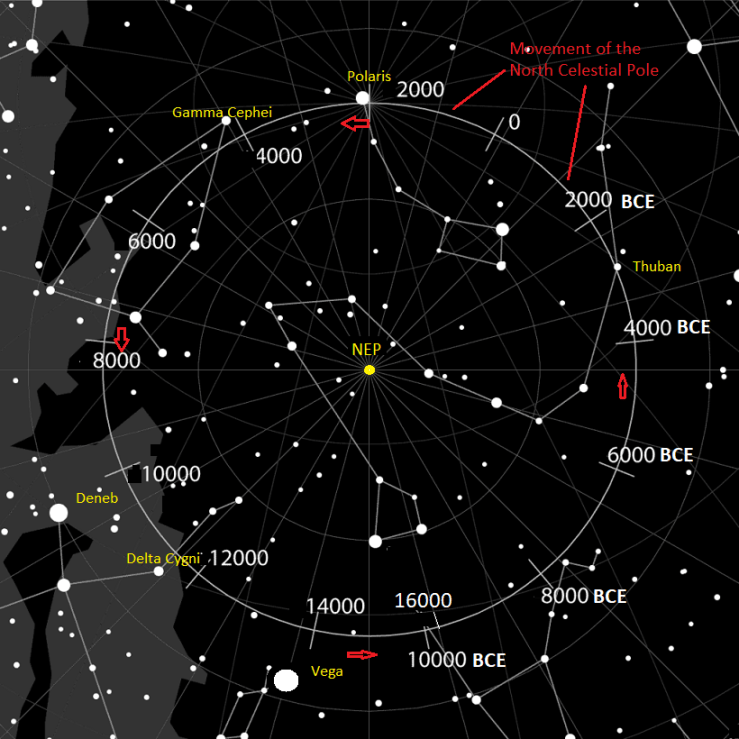
The diagram above shows how the North Celestial Pole changes over the 25,800-year cycle. Five thousand years ago, it was very close to Thuban in the constellation Draco – the Dragon.

In the year 10000 the North Celestial Pole will lie close to Deneb in the constellation Cygnus – the Swan.’

‘In the year 11000 it will lie close to Delta Cygni in the same constellation. In 14000, Vega which is the fifth brightest star in the sky will be close to the North Celestial Pole.’ 

Over the centuries other stars take the place of the previous North Star, while the Earth’s axis shifts and wobbles in precession. When Thuban – Alpha Draconis of Draco – was the North Pole star beginning circa 3900 BCE, it reached its zenith in 2787 BCE, for it was then it was almost precisely at the point of celestial north. Both the northern vent in the Kings Chamber and the opening from the descending passage, aligned with Thuban during the third millennia BCE. 

Kochab – Beta Ursa Minor of the Little Bear (Ursa Minor) – held the position as Pole Star from approximately 1800 BCE until the transition to Polaris – Alpha Ursae Minoris – about 300 CE. With the northern shaft of the Queen’s chamber aligning with Kochab also. 

Encyclopaedia: ‘From around 2500 BCE, as Thuban became less and less aligned with the north celestial pole, Kochab became one “pillar” of the circumpolar stars, first with Mizar, a star in the middle of the handle of the Big Dipper (Ursa Major), and later with Pherkad (in Ursa Minor). In fact, around the year 2467 BCE, the true north was best determined by drawing a plumb line between Mizar and Kochab… Kochab and Mizar were referred to by Ancient Egyptian astronomers as ‘The Indestructibles’ lighting the North. 

As precession continued, by the year 1100 BCE, Kochab was within roughly 7° of the north celestial pole, with old references over-emphasizing this near pass by referring to Beta Ursae Minoris as “Polaris”, relating it to the current pole star, Polaris, which is slightly brighter and will have a much closer alignment of less than 0.5° by 2100 CE. After 2000 BCE, Kochab and a new star, its neighbor Pherkad, were closer to the pole and together served as twin pole stars, circling the North Pole from around 1700 BCE until just after 300 CE. Neither star was as close to the north celestial pole as Polaris is now. Today, they are sometimes referred to as the “Guardians of the Pole” [since they appear to be rotating around Polaris].’

While Polaris has been the North Pole Star practically for over a thousand years – and technically for seventeen hundred years – it critically did not align with the descending passage of the Great Pyramid until very recently, circa the year 2000. 

Polaris as the Pole Star has bridged two precessional zodiac houses with the Age of Pisces, the Fish from 170 BCE to 1990 CE; and the Age of Aquarius, the Water Bearer from 1990 to 4150. 

Polaris will continue to hold its pride of place as Pole Star for the next thousand years until 3100, when ErraiGamma Cephei of Cepheus – will be the North Star. Peter Mulford: ‘… Polaris… will be the brightest star near the North Pole, but, after 2105, it will be gradually moving away from its Zenith 89°32′ N.’

The following stars – a number of them inconspicuous – are projected to be the respective pole stars for the next twenty-three thousand years; as the 25,920 year precession cycle causes the north celestial pole to move counter-clockwise relative to the backdrop of stars. Whichever star is closest to the north celestial pole is the Pole Star. 

5900: Alfirk – Beta Cephei of Cepheus

7500: Alderamin – Alpha Cephei of Cepheus 

9800: Deneb – Alpha Cygni of Cygnus

11,250: Fawaris – Delta Cygni of Cygnus

13,727: Vega – Alpha Lyrae of Lyra – North Star in 12,000 BCE, during the Younger Dryas Stadial

15,000: Iota Herculis of Hercules – North Star in 9000 BCE

18,400: Tau Herculis of Hercules – North Star in 7,400 BCE

20,500: Thuban, Alpha Draconis of Draco or Edasich, Iota Draconis of Draco – North Star in 4420 BCE

23,800: Kochab – Beta Ursae Minoris of Ursa Minor

25,800: Polaris – Alpha Ursae Minoris of Ursa Minor 

While Polaris’ movement in relation to the Earth is almost imperceptible, one online comment considers differently.

Inconvenient Truther, 2025: 

‘Have you ever noticed that [Polaris] has never moved. If Thuben used to be a pole star, the math associated with it says the pole star would move about 1 degree every 70 years. We have monuments with holes bored through them that have pointed at the same pole star for centuries. It’s likely the reason the Georgia [Guidestones] were destroyed’ – refer article: The Top Ten Unexplained Mysteries of all Time.

‘In 40 years the pole star never drifted out of its hole when observed through the [Guidestones]. It should have been more than half a degree off, but it wasn’t. For perspective the width of the moon in the sky is about 1/2 degree (.5°) Taking that into account, Polaris should have been at least a quarter to half a moon’s width out of the hole when looking through the guidestone in the center of the Georgia guidestones.

Should there say be any substance to this line of reasoning, then the permutations are pertinent in that Polaris may well have been the North Pole star for a very long time. This then heightens – no pun intended – the symbolism of the Great pyramid representing not just a number of pole stars through the eons, but perhaps principally just one: Polaris.

Later, we will explore who is affiliated with the North Pole star and this will inevitably take on an even more profound meaning. Particularly when combined with who potentially built the Great Pyramid.

The reader may be wondering where this is heading and why the volume of detail on the constellations targeted by the Great Pyramid and their principle stars. The question of whether the mapping of the Giza pyramids with Orion’s Belt or the wing tip of Cygnus’ wing are entirely correct remains.

The Cygnus Constellation is not specifically or even indirectly highlighted by the Great Pyramid; while the somewhat awkward fact that Alnilam with a greater solar mass, is bigger than Alnitak – and opposite in scale when compared with the Great Pyramid and Second Pyramid – strikes a blow against the Orion Correlation Theory’s validity. Are both theories incredible flukes, yet correct subsets within a more accurate answer? Perhaps if one searched the 88 constellations conscientiously, further synchronistic examples for three aligned pyramids could be found? 

Enthusiasm for both theories appears to extend to the three pyramids and their corollary stars as a set, without pausing to consider the identity of the first pyramid, which is vastly different from its two neighbours. With reason, it is called great and so does Alnitak of Orion and Kappa Cygni of Cygnus fit the same designation? Are they great stars? It could be posited that once removed from their respective set of three, they are rather unremarkable. 

What if looking for three stars is limiting because there was once four principle pyramids on the Giza plateau. What if there are four aligned stars in the cosmos which mirror Giza in a different constellation? Is there an asterism comprising two larger stars with two offset smaller stars? 

This writer would like to be able to say after studying the constellations of Orion, Draco, Canis Major and Ursa Minor, a definitive answer was found. Such is not the case, though that said, it was in the last of the four checked that a compelling partial match is evident. That was in Ursa Minor. Notice below, the three end stars of the tail in the upper right hand corner. The fourth star to the left of them joins with the body of the bear and is in relative scale and curvature with where the missing fourth pyramid of Giza was located.
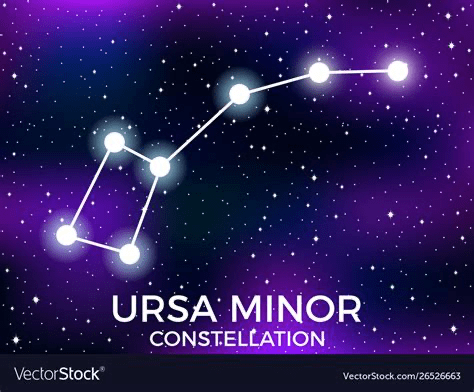
Using the respective markers of solar mass (M) and visual magnitude (VM) or brightness, these are the findings.

Working from left to right of the four tail stars, the fourth is Alifa al Farkadain, otherwise known as Zeta Ursae Minoris. Its mass is 3.4 M and visual magnitude: 4.32 VM.

The third star is Urodelus, otherwise known as Epsilon Ursae Minoris, with 3.6 M and 4.23 VM. It is a marginally bigger and brighter star and ostensibly fits the pattern of the missing fourth pyramid and the Third Pyramid. 

The second star is Yildun, otherwise known as Delta Ursae Minoris, having 2.35 M and 4.36 VM.

The first star of course is Polaris, otherwise known as Alpha Ursae Minoris. It is the biggest of the four, 5.4 M; and the brightest, 2.02 VM. 

There are two issues in that a. the third and fourth stars are not appreciably smaller; and b. the second star is smaller than the other three. 

Out of interest, the mass and visual magnitude of the three stars in Orion’s Belt:

Alnitak: 33 M / 2.05 VM; Alnilam: 40 M / 1.7 VM; Mintaka: 17.8 M / 2.23 VM.

The three pertinent stars in the Cygnus Constellation:

Kappa Cygni: 2.35 M; Iota Cygni: 1.8 M; Theta Cygni: 1.4 M.

As is evident for both groups, the ratios in mass are off in comparison with the volumes for the three respective Giza pyramids – Great Pyramid: 2.5 million cubic metres; Second Pyramid: 2.2 million cubic metres; Third Pyramid:  235,183 cubic metres. The first two pyramids are near identical, with the Third Pyramid a tenth of the size of the Second; so that neither of the two established theories match their ratio either. 

It is appreciated readers will wonder why this writer would persevere with this line of reasoning, when on the surface it does not appear to correlate. There are three reasons.

First, the Cygnus and Orion theories do not fit, as illustrated. The Cygnus Constellation is not encoded in the Great Pyramid and Orion’s belt has three stars and not four.

Second – and the opinion of an astrophysicist would be welcome – is there an explanation for the Yildun anomaly, which then would explain its current size and position – see excerpt below.

Third, the pre-eminence of the Great Pyramid – as a carefully crafted monument in symbolising a real star – can only be logically matched with the most prominent and important navigational star in the sky, the North Pole Star, currently Polaris

Jim Kaler – emphasis & bold mine: ‘Ursa Minor is one of the few constellations in which the Greek letters actually do progress from brightest to faintest. Polaris [present Pole Star] tops the list as Alpha, after which follow Kochab (Beta) [a past pole Star] and Pherkad (Gamma). The next three are all about the same, so while Yildun is technically number 6 in brightness, (slightly beat out by Epsilon and Zeta), its designation as Delta is certainly forgivable. Eta and Theta follow. 

The first distinction is the name. While most stars carry Arabic names, and the ones that do not are mostly of Greek or Latin extraction, “Yildun” is taken from a Turkish word for “star.” Why such a faint star was given such a singular proper name is not known. But it may have to do with the second distinction. As the second star in from the Little Dipper’s handle, Yildun is very close to the North Celestial Pole, the sky’s point of zero rotation. Only 3.5 degrees away from the Pole, if not for Polaris, Yildun would make a reasonably acceptable Pole star and probably would have been called Polaris!’

This might explain why the Second Pyramid of Giza is only very slightly smaller in height and mass than the Great Pyramid. Perhaps the 3/4 pyramids did not mirror literal size, but rather portrayed the importance of this pole star and its near neighbour. 

Kaler: ‘Aside from Polaris itself, it is the closest star to the Pole with a proper name. It is circumpolar – perpetually visible – from the entire northern hemisphere down to a latitude of only 3 degrees north. Moreover, it is about as close to the Pole as it can be, as precession, the 26,000-year wobble of the Earth’s axis, is now carrying the Pole away from it. 

Physically, Yildun is a quite-ordinary white class A star (A1) 183 light years away with a temperature of 9000 Kelvin, a luminosity 47 times that of the Sun, and a diameter of 2.8 solar. Its only real, and not all that unusual, physical distinction is a high rotation speed of 174 kilometers per second that makes its spectrum lines fuzzy. The star spins 87 times faster than the Sun, and makes a full rotation in just 19 hours.’ 

Remember, the Great Pyramid’s shafts bring attention to the pole stars Thuban or Alpha Draconis of Draco the dragon and Kochab or Beta Ursae Minoris of Ursa Minor, the Little Bear. The architect of the Great Pyramid chose to highlight these stars and constellations and in so doing artfully, hides a yet future recognition of Polaris as the North Pole Star – refer dragon and bear, article: Is America Babylon? For the alignment in the descending passage coinciding with the turn of our present millennium holds prophetic significance – Hosea 6:2. In fact, the era of Polaris being the pole star for nearly two thousand years parallels the latter days spoken of by the Messiah – Matthew 24:1-14. 

Quite obviously, pole stars have import and significance to the designer of the Great Pyramid; when two are directly highlighted and one indirectly. Recall, the constellation of Draco was emphasised twice; once in the northern vent of the King’s Chamber and again in the descending passage. Curious then that Draco (Thuban) and Ursa Minor (Kochab_ – where Polaris is a star – are closely entwined. 

An enlightening, unknown quote:

‘As far back as the third “Deluge” of the third Lemurian race, that old Dragon “Whose tail sweeps whole nations out of existence in the twinkling of an eye,” that ancient “Old Dragon” of the heavenly constellation was identical with the great Flood’ – Revelation 12:4. “We know that in the past the constellation of the Dragon was at the pole, or boss, of the celestial sphere. In stellar temples… the Dragon would be the uppermost or ruling constellation… it is singular how closely the constellations… correspond in sequence and in range of right ascension with the events recorded respecting the (Biblical) flood” – Proctor. The first great flood was heaven-born and cosmical. There have been numbers of terrestrial flood’ – Chapter I Noah Antecessor Nulla.

A parallel exists with the Tower of Babel, for its ideology and construction was in response to the flood cataclysm and the ensuring of humanities survival. Its leader and builder Nimrod, in his rebellion against the Eternal, was batting for the other side led by no less than the supreme Dragon itself – Revelation 12:3, 9. Pertinent perhaps that the Great Pyramid should have more than one astronomical clue pointing to the Draco Constellation… of the Dragon. 

There is reason to believe the Bear serves the Dragon. Constant readers will be aware of the modern identity of the Russian people and the part they play in the future – Chapter XX Will the Real Assyria Stand Up – Asshur & Russia. It is necessarily intriguing that Russia has historically been referred as the Russian Bear – ‘a widespread symbol for Russia, used in cartoons, articles and dramatic plays since as early as the sixteenth century.’

Likewise, Nimrod’s parentage included a mixed ancestry, though his paternal lineage was that from Asshur and not Cush, as misleadingly translated in the Bible – refer Chapter XXI The Incredible Identity, Origin & Destiny of Nimrod. Of note, is Nimrod’s association with the Orion Constellation and the Egyptian god, Osiris.

Thus, the following dots, consisting of: Ursa Minor, Polaris, Bear, Russia, Asshur, Nimrod, Osiris, Orion; join and form a line.

We will investigate whether this line, is connected to the Great Pyramid. 

The potential synchronism of the Great Pyramid with Polaris cannot be underestimated. 
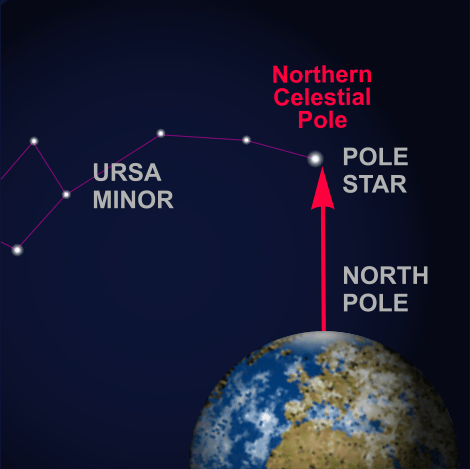
The Great Pyramid represents the Northern Hemisphere of the Earth and is located at an equidistant centre of the globe. An invisible line originating from its apex travelling skywards would have ultimately connected with Polaris before it became the pole star. As Polaris stands watch, yet is itself watched by many; so too, the Great Pyramid maintains its eternal vigilance, while innumerable residents and tourists stare in wonder when they visit Giza. 

The positioning of the Great Pyramid clearly was not left to happenstance. Ancient Code: ‘The Pyramid is located on a powerful source of underground energy, like many other ancient structures around the globe. The Geology present at the Giza plateau naturally concentrates high amounts of electromagnetic forces of our planet. Beneath the surface, natural electric forces travel [and] are known as telluric currents or Earth current [Ley Lines]. Telluric currents are an electric current which moves underground or through the sea. Telluric currents result from both natural causes and human activity, and the discrete currents interact in a complex pattern.’

Von Del Chamberlain: ‘… the Skidi band of Pawnee Indians… referred to Polaris as the Chief Star. In the Skidi mythology we find instructions given by the creator to this star: 

“You shall stand in the north. You shall not move; for you shall be the chief of all the gods that shall be placed in the heavens, and you shall watch over them.”

The Great Pyramid in comparison with the Bible, tantalisingly points to the constellations of Canis Major, Ursa Minor and Draco. While interestingly, both (the Pyramid and the Bible) draw attention to the constellation of Orion. Tauntingly, the Pyramid does not include the Taurus Constellation in its encoding. The Bible does, in the form of the Pleiades asterism – or Messier 45 (M45). Other designations include Collinder 42 and Melotte 22 – refer article: 42. Is there significance, in this deliberate omission by the builder of the Great Pyramid? 

Constant readers will be aware in previous articles of the important enduring presence of the Taurus Constellation – refer: Chapter XV The Philistines: Latino-Hispano America; and The Younger Dryas Stadial: Ending of the Earth… Beginning of the World. The fact this influential constellation is omitted from the Great Pyramid, while at the same time emphasised in the scriptures, may be of great relevance. 

The Taurus constellation – Latin for Bull – represents a bull’s head and front legs, not the whole body. Taurus – the second sign of the Zodiac – is visible at latitudes between 90°N and 65°S. It takes up 797 square degrees of the sky and is the 17th largest constellation. Taurus contains seventeen named stars, of which five have planets in their orbits. There are two meteor showers associated with the constellation; the Taurids and the Beta Taurids, which can be quite spectacular, similar to fireballs – refer article: The Younger Dryas Stadial: Ending of the Earth… Beginning of the World. 

Aldebaran or Alpha Tauri, is the most prominent star in Taurus and the 14th brightest star in the night sky. It is a red giant about 350,000 times bigger and 400 times more luminous than the Sun. Aldebaran appears to chase the Pleiades across the night sky, which is why its name in Arabic means ‘the follower’. The ancient Persians considered Aldebaran one of Four Royal Stars, along with Regulus in Leo; Antares in Scorpius; and Fomalhaut in Piscis Austrinus, the Southern Fish. 

The Hyades is an open cluster containing hundreds of stars that share the same motion through space, origin, age and chemical content. It is the nearest open star cluster to the Sun. The brightest stars in the Hyades cluster and Aldebaran form a V shape. Aldebaran is not a member of the cluster, but lies in the same line of sight. It is much closer to Earth than the Hyades. The four brightest stars in the cluster – Gamma, Delta, Epsilon and Theta Tauri – are red giants and form an asterism that represents the bull’s head. The cluster was named after the Hyades, five daughters of the titan Atlas and half-sisters to the Pleiades. When their brother Hyas passed, the sisters were transformed into a star cluster which was later associated with rain. In England, the cluster was sometimes known as the April Rainers.

Babylonian astronomers called the constellation MUL.APIN, or ‘The Heavenly Bull’; who was sent by the goddess Ishtar^ to kill the hero Gilgamesh. The bull was defeated and torn apart and his body parts were hurled into the sky, where they became the stars. The head turned into Taurus and the rear part was believed to make up Ursa Major and Ursa Minor. Gilgamesh is associated with nearby Orion and the two constellations are depicted as Gilgamesh and the bull in combat. Gilgamesh in turn, is equated with Nimrod – Chapter I Noah Antecessor Nulla; and Chapter XXI The Incredible Identity, origin & Destiny of Nimrod

In Greek mythology, the bull represents Zeus, the supreme god who transformed himself into a beautiful white bull to seduce the Phoenician princess Europa.^ Whereby he abducts her and takes her across the Mediterranean Sea until they reach the island of Crete. They settle there and have a baby by the name of Minos, who later becomes the legendary king of the Island.

The Bible deems the Pleiades asterism – in the Taurus Constellation – and the neighbouring Orion Constellation, important enough to mention them three times – Articles: 33; and Job

Job 38:31-33 

English Standard Version 

“Can you bind* the chains [H4576 – ma’adannah: (sweet) influence] of the Pleiades or loose** the cords [belt] of Orion?”

The Eternal once issued an impossible challenge to Job, in showing his limitations as a human in comparison with His Creator’s omnipotence – Article: Job.

Bible Science forum, Josh Hartnett – emphasis & bold mine: 

‘… [the]… Pleiades as a group of seven stars… [are] visible to the naked eye as seven bright, blue-white stars, also called the Seven Sisters. Modern astronomy has shown that the constituent stars of Pleiades are expected to dissociate within the next 250 million years, and hence Pleiades is an open or unbound* cluster. That is, the motions and velocities of its constituent objects are such that the gravitational forces between them are not sufficient to hold it together (as a recognizable cluster) over the longer term. A ‘bound’** cluster, by contrast, can be shown to still be a recognizable grouping even if its motions are projected forward by a billion years or so. 

Modern astronomy has revealed that more than 500 [perhaps up to a thousand] mostly faint stars belong to the Pleiades star cluster… Pleiades is a large but expanding, or unbound, cluster of stars that are all just passing the same region of space at the same time with the same motion’ at about 25 miles per second. ‘What was originally thought to be bound is unbound and what was thought to be unbound is bound (given current astrophysical definitions). 

The text in Job 38:31, 32 describe real astronomical bodies. God is speaking to Job in practical terms about real objects that Job can see (or has seen) and He is expecting Job to give Him immediate answers. In the past, some have used this passage in Job to claim biblical accuracy in relation to the universe… it was argued that God was asking Job if he can do the same as God, while now we could turn the argument around and suggest that God is asking Job if he can undo what God has done…’
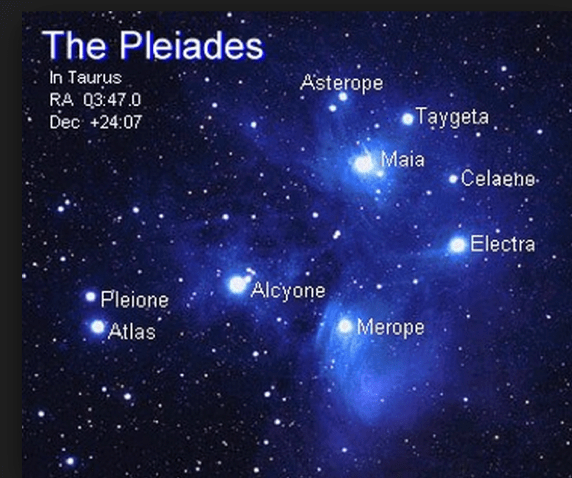
Job: “Can you lead forth the Mazzaroth [H4216 – Mazzarah: 12 signs of the Zodiac and their 36 associated constellations] in their season [precession of the equinoxes], or can you guide the Bear [H5906 – ‘Ayish: Ursa Major constellation] with its children? [Arcturus, also known as ‘Job’s Star’: a red giant star; 3rd single brightest star in the night sky; in the Bootes (the herdsman) constellation, to the west of Ursa Major] 

Do you know the ordinances of the heavens? Can you establish their rule [H4896 – mishtar: dominion, authority] on the earth?”

Certain translations use the word Arcturus instead of Bear. Though the Hebrew word (H5906) means either Great Bear (or Ursa Major). For example, the GW translation uses Ursa Major. Similarly, other translations use the word cubs [for a bear] instead of children. The NASB uses the equally appropriate word, satellites [indicating Ursa Major and perhaps Ursa Minor with Polaris]. Yet the inference may be in relation to Arcturus and the stars of the Bootes Constellation, with Ursa Major which ‘[migrates] through the heavens.’ Notice below, how Bootes follows behind the tail and hind quarters of the Great Bear. 

Interestingly, the traditional name Arcturus is Latinised from the ancient Greek Arktouros, which means, ‘Guardian of the Bear’; derived from arktos, ‘bear’ and ouros, ‘watcher, guardian.’

Arcturus or Alpha Bootis – the left foot of Bootes the Herdsmanforms one corner of the Spring Triangle asterism with Spica from Virgo and Regulus of Leo. Arcturus is slightly metal deficient, which suggests that it is a very old star, belonging to an older population of stars in the Milky Way’s thick disk. 

Constellation Guide: ‘Arcturus and a group of 52 other old disk stars share a common proper motion. The group is known as the Arcturus moving group [or stream]. These stars don’t travel with the group of stars in the Milky Way’s disk. Instead, they are cutting perpendicularly across the disk. They are moving at a greater speed and at a different angle than other stars in the Milky Way Galaxy. For this reason, Arcturus will eventually move out of our line of sight. 

Arcturus was formed in our galaxy’s large spherical halo. It moves in an elliptical orbit, unlike the Sun, which moves with the galaxy’s plane. A different theory suggests that the stars in the Arcturus moving group may have entered our system as a result of the Milky Way colliding with a smaller satellite dwarf galaxy… Arcturus is believed to have come into our system about 500,000 years ago, and it will likely stay here for another 500,000 years before continuing its journey in the direction of the Virgo Cluster of galaxies.’

Encyclopaedia: ‘With an apparent visual magnitude of -0.05, Arcturus is the brightest star in the northern celestial hemisphere [ahead of Vega in the Northern constellation of Lyra] and the fourth-brightest star in the night sky, after Sirius [Northern constellation Canis major] (-1.46 apparent magnitude), Canopus  [Southern constellation of Carina] (-0.72) and [Alpha] Centauri [Southern constellation of Centaurus] (combined magnitude of -0.27). However, α Centauri AB is a binary star, whose components are each fainter than Arcturus. This makes Arcturus the third-brightest individual star, just ahead of α Centauri A (officially named Rigil Kentaurus), whose apparent magnitude is -0.01 

One astronomical tradition associates Arcturus with the mythology around Arcas, who was about to shoot and kill his own mother Callisto who had been transformed into a bear. Zeus averted their imminent tragic fate by transforming the boy into the constellation Boötes, called Arctophylax “bear guardian” by the Greeks, and his mother into Ursa Major (Greek: Arctos “the bear”).’ 

To the ancient Romans, Arcturus was associated as a harbinger of stormy and tempestuous weather.

‘In Arabic, Arcturus is one of two stars called al-simāk “the uplifted ones” (the other is Spica). Another Arabic name is Haris-el-sema… “the keeper of heaven”… or… ħāris al-shamāl’  “the keeper of north.”

One is reminded of Polaris the North Pole Star. 

‘In Chinese astronomy, Arcturus is called Da Jiao… ‘great horn’* – Daniel 8:8, Revelation 13:1, 11; 17:3. 

‘In the Society Islands, Arcturus, called Ana-tahua-taata-metua-te-tupu-mavae (“a pillar to stand by”), was one of the ten* “pillars of the sky”, bright stars that represented the ten heavens of the Tahitian afterlife… 

In Inuit astronomy, Arcturus is called the Old Man [euphemism for the Devil] (Uttuqalualuk in Inuit languages) and The First Ones (Sivulliik in Inuit languages).’  The Mi’ kmaq of eastern Canada saw Arcturus as Kookoogwéss, the owl.’ The owl is synonymous with wisdom – refer article: Lilith

Amos 5:8

English Standard Version 

‘He who made the Pleiades and Orion, and turns deep darkness into the morning and darkens the day into night… the Lord is his name…’

The Pleiades star cluster is about 444 light years away from the Sun – an interesting number of itself – from Earth. Kitty Fields: ‘When we see the number 444, we are immediately reminded of the angel number 444 which symbolizes the balance of the Universe, infinity, and that we are not alone.’

According to one definitive study by astronomer Mark Reid in 2014, they are actually at a distance of ‘448 light-years with an uncertainty of 0.9%.’ The Pleiades cluster is very bright and is visible from almost every part of the globe; though it cannot be seen during the months of May and June as the Sun blocks our view of the cluster in that period.

The nine brightest stars in the cluster were named after the Pleiades, the Seven Sisters in Greek mythology – Alcyone (brightest star); Celaeno; Electra (third brightest star); Maia – her name meaning great one (fourth brightest star), eldest of the seven sisters, wife of Vulcan and mother of the god Hermes; Merope (wife of Sisyphus); Asterope; Taygeta – and their parents, the Oceanid nymph Pleione and the Titan Atlas (second brightest star).
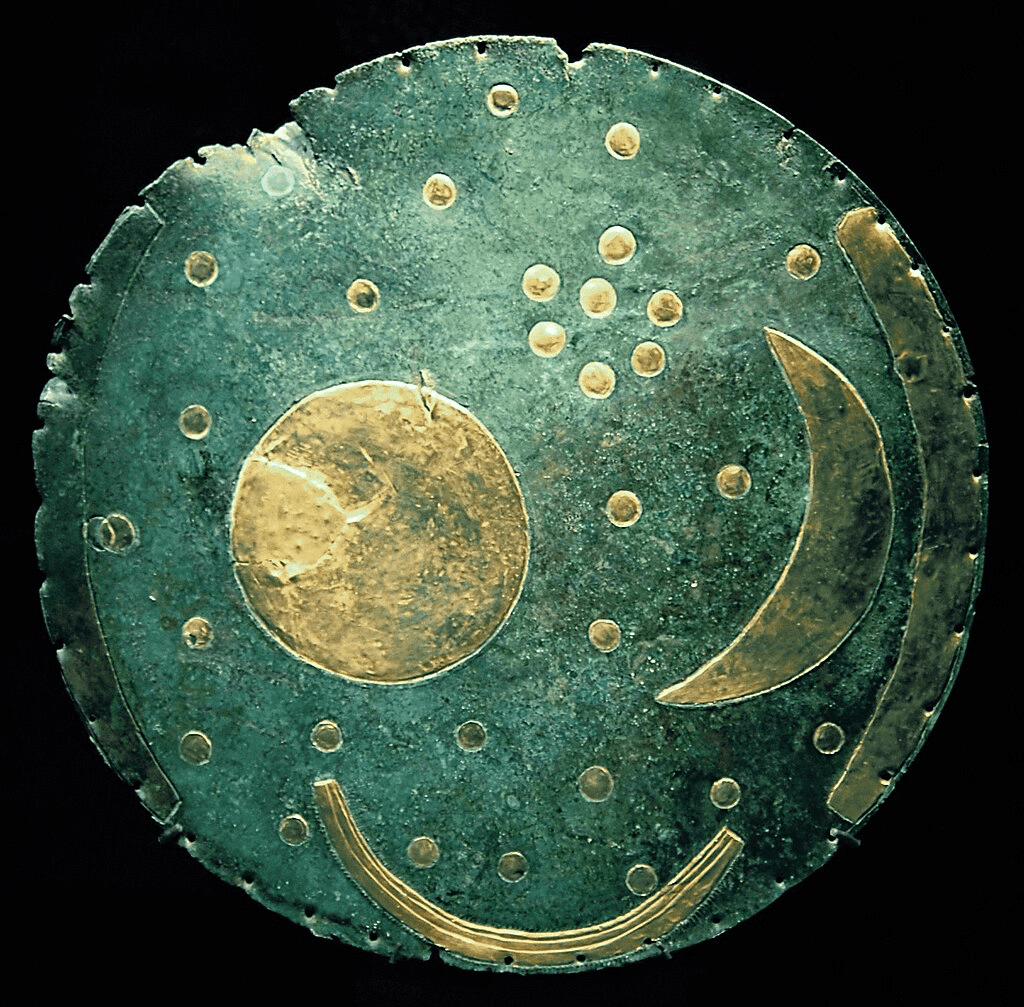
On the Nebra sky disc – a Northern German Bronze Age artefact, dated circa 1600 BCE – the cluster of seven dots in the upper right portion of the disk is believed to be the Pleiades.

Computer simulations have demonstrated that the Pleiades were likely formed from a compact configuration that resembled the Orion Nebula. Thus the very hot blue and luminous stars in the Pleiades cluster have a common origin; forming through the gravitational pull on a gigantic molecular cloud of dust and gas. 

Earth Sky: ‘According to a Polynesian legend, the Pleiades was once a single star: the brightest in the sky. The Polynesian god Tane disliked this star bragging about its beauty – Ezekiel 28:12, 17, Isaiah 47:8, 10. So the god smashed the star into pieces, creating the Pleiades star cluster.’

The name Pleiades comes from Ancient Greek and it most likely derives from plein, which translates to ‘sail’, since the ‘cluster’s importance in delimiting the sailing season in the Mediterranean Sea’, as “the season of navigation began with their heliacal rising.”

Mark Fisher: ‘The structure of the Pleiades in the sky is a small ‘dipper’ shape, with Atlas forming the handle attached to a quadrangle made up of Alcyone… Electra, Merope and Maia. The other sisters are clustered around the western end of this ‘dipper’, while the star of their mother Pleione lies close to her brighter companion Atlas in the east.

The Nine Planets: ‘The Pleiades are mentioned in the Kojiki as the Mutsuraboshi – translating to “six stars.” In modern Japan, the cluster is now known as Subaru – the same name used by the famous automobile company that depicts the six brightest stars in their logo.’

In Greek mythology, once Atlas was forced to carry the heavens, the giant hunter Orion, started to pursue his daughters. To protect them from his advances, Zeus first transformed the seven sisters into a flock of doves and then, to comfort their father, into stars. It is said that the Orion Constellation still pursues the Pleiades across the sky. 

Earth Sky: ‘The modern-day festival of Halloween originates from an old Druid rite that coincided with the midnight culmination of the Pleiades cluster. People believed the veil dividing the living [physical] from the dead [spirit] is at its thinnest when the Pleiades culminates – reaches its highest point in the sky – at midnight.’

Job 9:9

Easy English Bible 

‘He put the groups of stars in their places. He made the Bear, Orion, and the Pleiades. He put the groups of stars in the southern sky.’

This verse clearly states groups of stars or rather constellations; so that while some translations state Arcturus instead of the Bear, this is an incorrect and misleading rendition in naming a star in the context of this verse. Thus the use of Bear – as in the Great Bear – is in keeping with Orion and the Pleiades cluster, part of the Taurus Constellation. The verse also separates all three as northern constellations and distinct from the constellations in the Southern Hemisphere. 

Conjectured previously, is the idea that Orion is linked to the ancestral home of the Sons of God and of the fallen Angels – who were the progenitors of the Nephilim. Additionally, it seems Sirius in Canis Major is included and as well by extension, Canis Minor. Then it appears after the fallout of their rebellion, these dark angels spilled over into the constellations of Draco and Ursa Minor – where Polaris is located – and by extension, Ursa Major – the Great Bear. 

This leaves the unmentioned – in the Great pyramid at least  – constellation of Taurus. In the investigation so far, as enumerated in previous articles and chapters, the dots found which join to form a line, include: Taurus, Bull, Egyptian god Apis, the Hidden God, Saturn and the Storm God or Ba’al Hadad. Baal is none other than (the Hebrew) Heylel or (the Latin) Lucifer… the former archangel Samael and the Serpent in the Garden of Eden – refer Chapter XXII – Alpha & Omega

With regard to the handful of constellations focussed upon both in the Great Pyramid and in the Bible as to their – spiritually rather than physically – being the home worlds of the angelic realm; then what role does the Pleiades play? Particularly as it is conspicuously omitted from the Great Pyramid’s testimony. Could the star cluster of the Pleiades be the seat and dwelling of the Creator?

The seven stars of the Pleiades are possibly a physical representation of the seven spirits which go out from God’s throne, observe all in the cosmos and report to the one called the Lamb – who is the Messiah. These seven spirits are called the seven eyes of the Lord – refer article: The Seven Churches – A Message for the Church of God in the Latter Days. It states in Proverbs 15:3, ESV: ‘The eyes of the Lord are in every place, keeping watch on the evil and the good.’

The ‘eyes of the Lord’ are spirits who watch on behalf of the Eternal. They are also lights. Zechariah 4:10 EEB: ‘The Lord sees everything in the whole earth. (The seven lights are the seven eyes of the Lord.)’ The seven pre-eminent stars of the Pleiades star cluster – the closest to the Earth – are strikingly bright lights in the sky, clearly visible to the naked eye. This aspect of watching is significant, as we will investigate the all-seeing eye of the Great Pyramid in Masonic (esoteric/occult) symbolism. Again, the role of the great Pyramid in watching, as well as being a visibly prominent marker, is reflected perhaps, in its celestial counterpoint the North Pole Star, Polaris

In the article, The Seven Churches – A Message for the Church of God in the Latter Days, it was surmised that the Pleiades star cluster was the location of the third heaven – refer article: Heaven & Hell. It was ventured that the New Earth and by extension, the New Jerusalem originates and descends from the Pleiades – Revelation 21:1-2, 10. 

Imagine this writer’s surprise, when they learned Helena Lehman confirms the following in The Pleiades Connection to the New Jerusalem, 2014 – emphasis & bold mine: 

‘Although the entire expanse of the heavens is called God’s Throne in the Bible, there are speculations that God’s actual Throne Room may be located near to the Earth’s Northern Celestial Pole because of this verse… Leviticus 1:11 – “He shall kill it (the atonement sacrifice) on the northside of the altar before Yahweh; and the priests, Aaron’s sons, shall sprinkle its blood all around on the altar.” 

Some believe this means that God’s heavenly abode must be north of the Altar of Sacrifice in the Jerusalem Temple, thus connecting His abode to the Earth’s Northern Celestial Polar Region in space.

In addition, after the empty space behind the star Polaris was discovered recently, some have speculated that it might be some kind of doorway or portal between the Second Heaven, which is our physical Universe, and the Third Heaven, where God dwells (Note: The First Heaven is the Earth’s Atmosphere). 

This connection is further supported by the location of the constellation Cepheus, or the Enthroned King and Cassiopeia, or the Enthroned Queen of Heaven in the Northern Celestial Polar Region of the sky’ – refer article: Asherah.

‘Fascinatingly, the four horns of Taurus and Aries represent the four horns on the corners of the altar that once stood outside God’s Temple in Jerusalem.

Also within this symbolic altar is the star called Al-Cyone, or The Center“, which many scientists believe marks the region of the sky where the center of the Universe is located.’
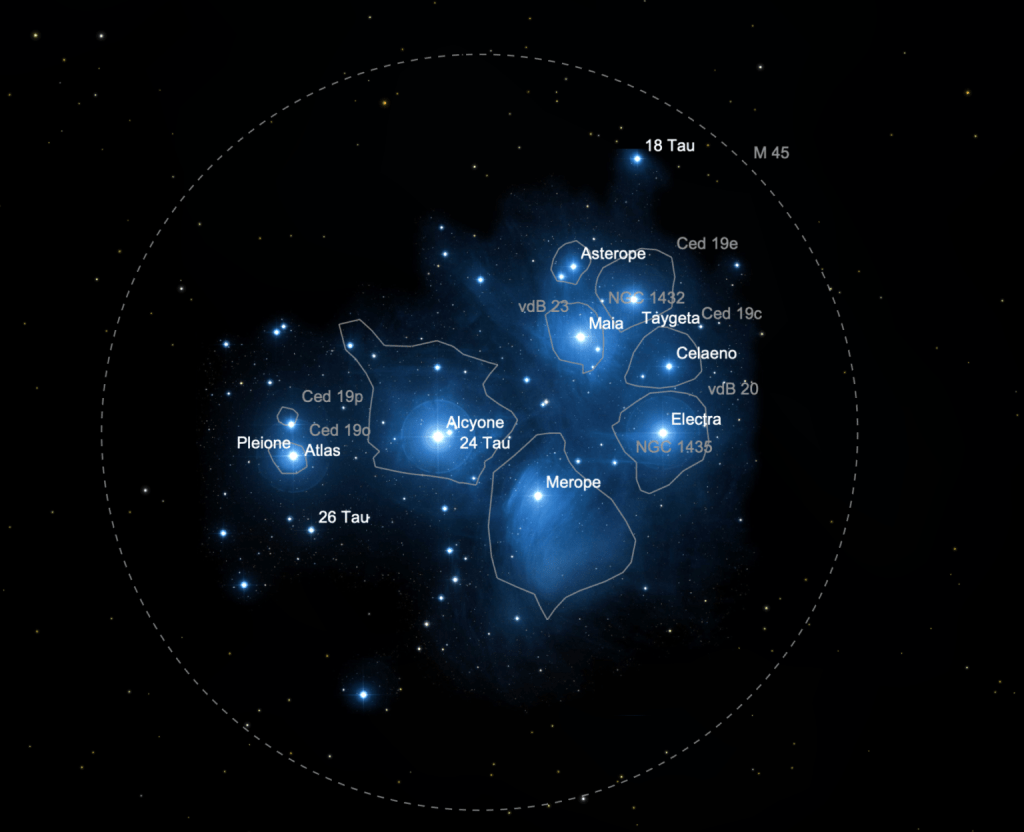
‘Al-Cyone… happens to be the brightest star within the Pleiades Star Cluster in Taurus, as well as the brightest member of a binary star system… the Pleiades Star Cluster may be allegorically connected to the New Jerusalem, which is to be the heavenly and earthly home of the Bride of Christ and her Redeemer Yahshua Ha Mashiach for eternity’ – Revelation 21:1-3. ‘In fact, the word “Al Cyone” or “kingfisher” [means] (a brightly colored little bird) in Greek…’

Very interesting indeed that Lehman should draw attention to the Creator dwelling in the North and particularly beyond the North Pole Star Polaris, via a portal between the physical and spiritual realms. As is the fact that the Pleiades asterism as we have learned, once had a singular origin and therefore being the centre of the Universe is not only revelatory, but logically plausible. 
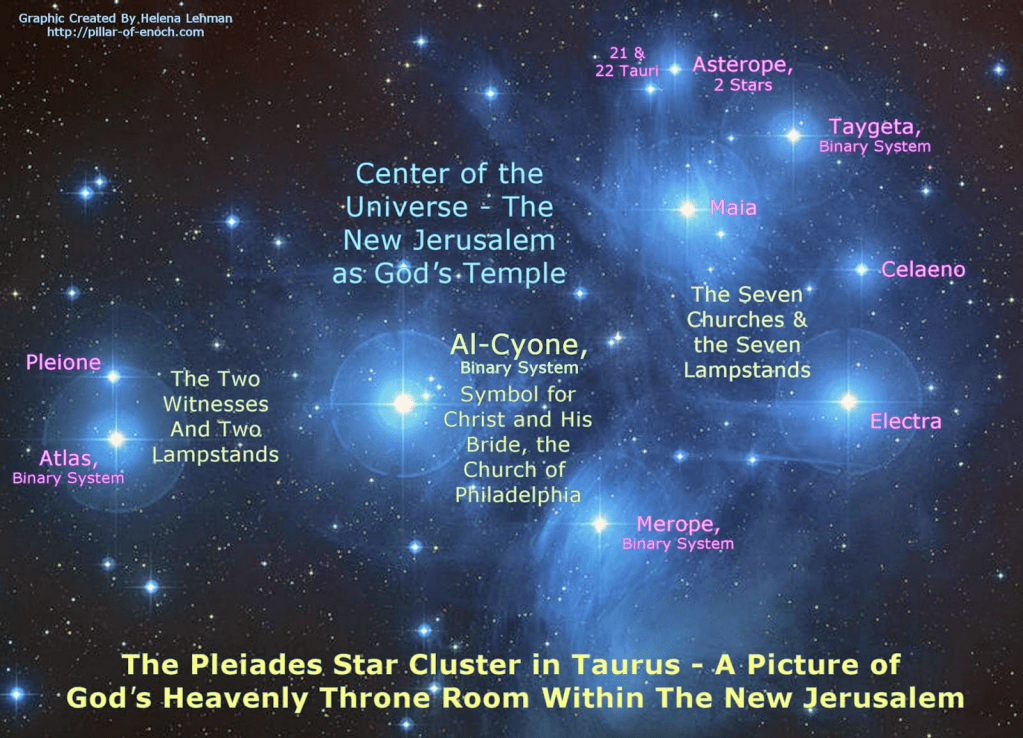
While a New Earth could originate from any number of the Pleiades stars, the brightest star Al-Cyone – and central within the Pleiades – is as good a hypothesis as any. 

Is the Great Pyramid mentioned in the Bible? Surely not? Well, it isn’t… not directly, though surprisingly, its exact geographic location is stated in the scriptures. In the Book of Isaiah the Pyramid is alluded too and then in a future prophecy, the exact site for the Great Pyramid today will be used for a new, different monument. 

Isaiah 19:13 

The Voice 

‘The elite, the nobles from the northern delta south to bustling Memphis, have been overconfident, deluded fools. These cornerstones of society have led Egypt in the wrong direction, and Egypt pays the price.’ 

The definition of a cornerstone: ‘a stone that forms part of the corner of a building; especially a foundation stone of this kind, often inscribed, laid at a ceremony that marks the beginning of building.’

The rulers and elite of Egyptian society are described as cornerstones in reflection of their importance and influence. Such could be said of the Great pyramid. One could say, the Great Pyramid as a whole, is a gigantic cornerstone – a mountain of stone – on the Earth’s surface. 

The four corners of the Great Pyramid of Giza align with the cardinal directions of the compass – north, south, east, and west – so that its base is exactly square to a fraction of a degree. That means the corner angles are almost exactly 90 degrees. With its north to south alignment exhibiting an accuracy of up to 0.05 degrees. The square base of the Great Pyramid is just 3.4 arc minutes off of true north – a precision of about one millimetre per metre. How the Pyramid builders achieved this feat of precision remains an unanswered question for Egyptologists. Today, one can align a building north-south by pointing the sides towards the North Pole Star, which sits at true north. 

Most researchers accept that the pyramid’s engineers used the motion of the Sun in the sky. True north is the easily observed north when you track the direction of sunrise and sunset. True north is distinct from magnetic north, which is the direction that magnets orient with, thanks to the Earth’s magnetic field. Magnetic north can be anywhere from exactly matched with true north, to tens of degrees off.

Christ himself, is likened to a cornerstone. ‘… Christ Jesus himself being the cornerstone, in whom the whole structure, being joined together, grows into a holy temple…’ – Ephesians 2:20-21, ESV. Could the Pyramid be a temple? If so, a temple dedicated to whom? 

Isaiah 19:19 

Easy English Bible 

‘At that time, there will be an altar in the middle of Egypt’s land, where people will worship the Lord. There will also be a tall stone for the Lord at Egypt’s border.’ 

This is a remarkable verse for two reasons. First, the phrasing middle of Egypt and its border are not a contradiction, as the map below shows. Second, it intimates a time when the Great Pyramid will not exist and a different monument will replace its position on the Giza landscape.  

It is worth remembering the precise location of the Great Pyramid was mapped out specifically. As Ancient Code state: ‘It remains a profound mystery the fact that the Great Pyramid of Giza was built with such precision. The fact that The Great Pyramid is the most accurately aligned structure in existence and faces true north with only 3/60th of a degree of error is something mind-boggling.’ 

The position of the North Pole moves over time and so the Great Pyramid undoubtedly, was exactly aligned at one point. As well, the Great Pyramid is located at the centre of the Earth’s land mass. These are indicators of a structure built in harmony with our planet.

Granted, the notion the Great Pyramid reflects Polaris is not water-tight, though in light of the information to be highlighted, it deserves recognition. Thus support for the tail of the Little Bear, or the handle of the Little Dipper’s credentials being the match with the Giza pyramids versus Orion’s Belt, follows. 

Are the Egyptian pyramids aligned with the stars? Eric Betz, 2021:

‘… it’s clear that the pyramids hold celestial significance and that they were built with a mastery of the sky in mind. Those ideas are not at all controversial. The controversy stems from the notion that each of the three pyramids were specifically positioned and oriented to represent Orion’s Belt. If you look at Bauval’s overlay of the pyramids’ placement and the stars of Orion’s Belt, you can definitely see the similarities. Yet, the alignment still isn’t perfect. 

Believers see a connection between the layout of the pyramids at Giza (crossed squares) and stars of Orion (smudgy circles). But critics say the overlap has been distorted.

‘It also isn’t completely honest. In 1999, astronomers using planetarium equipment exposed some serious liberties taken by proponents of the idea.’ 

Adrian Terer: ‘Among these are critiques from two astronomers, Ed Krupp of Griffith Observatory in Los Angeles and Tony Fairall of the University of Cape Town, S Africa. Using planetarium equipment, Krupp and Fairall independently investigated the bending between the alignment of Orion’s Belt and during the era cited by Hancock, Bauval, et al. (which differs from the bending seen today or in the 3rd millennium BC, considering… the precession of the equinoxes).’ 

Betz: ‘In order for the pyramids to take the shape of Orion’s Belt, you have to invert one or the other.’ 

Terer: ‘Krupp pointed out that the slightly bent line formed by the three pyramids was deviated towards the north, whereas the slight “kink” in the line of Orion’s Belt was deformed to the due south, and to match them up one or the other of them had to be turned upside-down. Indeed, this is what was done in the original book by Bauval and Gilbert (The Orion Mystery), which compares images of the pyramids and Orion without revealing that the pyramids’ map had been inverted.’ 

Betz: ‘So, the pyramids don’t really mirror the celestial alignment in the way that’s often presented. What’s more, the stars in Orion’s Belt have moved since the pyramids were constructed, so their relative positions would’ve been different back then.’

Precession and the layout of the ancient Egyptian pyramids, Anthony Fairall, 1999: 

‘Bauval claims that going back to 10 500 BC gives “a perfect match”. Or does it? My own investigation showed that, while the line of the two outer pyramids is set 38 [degrees] from north, the angle of Orion’s Belt to north in 10 500 BC is close on 50 [degrees]! Hardly an exact match. I calculate that circular precessional motion would give 47 [degrees]…’

Terer: ‘Krupp and Fairall found other problems with their arguments, including noting that if the Sphinx is meant to represent the constellation of Leo, then it should be on the opposite side of the Nile (the “Milky Way”) from the pyramids (“Orion”), that the vernal equinox c. 10,500 BC was in Virgo and not Leo…’ 

The Mars Mystery, Graham Hancock & Robert Bauval, 1998: 

‘…nosotros… demonstrated with a substantial trunk of evidence that the design of stars that is “frozen” on the footing at Giza in the form of the three pyramids and the Sphinx represents the disposition of the constellations of Orion and Leo every bit they looked at the moment of sunrise on the… equinox during the astronomical “Age of Leo” (i.e., the epoch… which… was “housed” past Leo on the spring equinox.) Like all precessional ages this was a 2,160-yr period. It is more often than not calculated to have fallen between the Gregorian calendar dates of 10,970 and 8810 BC.’

Fairall: ‘… the vernal equinox of 10 500 BC would lie at 2000: 11 h 40 m, +2.2 [degrees], which although close to the star pattern we now know as Leo, still lies decidedly in Virgo. Again, not a perfect match.’ The precessional age of Virgo preceded Leo and likely occurred between 13,130 to 10,970 BCE.

Terer: ‘…and that in any case the constellations of the Zodiac originate from Mesopotamia and were completely unknown in Egypt until the much subsequently Graeco-Roman era.’

Therefore, if the Giza pyramids do not match Orion’s Belt, or at least the time frame  proposed of 10,500 BCE – and Armando Mei’s earlier Leo correlation not withstanding – when was the Great Pyramid built? If the cleverly hidden clue of the North Pole Star, Polaris dating from circa 2000 CE is significant, then perhaps the focus should be on the North Pole Star at the time of the pyramid’s construction? 

The pole stars during and after the Flood cataclysm, until Alpha Draconis in the early fourth millennium include: Vega – Alpha Lyrae of Lyra – North Star in 12,000 BCE; Iota Herculis of Hercules – North Star in 9000 BCE; Tau Herculis of Hercules – North Star in 7,400 BCE; and Edasich – Iota Draconis of Draco – North Star in 4420 BCE. 

We have learned the weathering and erosion evidence rules out a construction later than 5000 BCE and thus Iota Draconis. For the same reasons, it favours the earlier epoch from 9000 to 7000 BCE, which included the two stars in the Hercules Constellation. Yet, neither of these stars are necessarily notable. Coincidence may mean Hancock and company are correct in the epoch chosen for the Pyramid’s construction, as Vega is a prominent star and the Lyra Constellation of interest – as discussed in Chapter XXII Alpha & Omega

In short, the inhabitants of the Lyra Constellation in a distant era were allegedly placed under threat by the warlike Draco and with the mass destruction of their home world, fled to other regions, including our own Solar System and planet Earth – refer Addendum IV. Thus it would be an interesting coincidence if the Lyrans’ brightest star, Vega, were the pole star during Earth’s own near fateful disaster – Article: The Younger Dryas Stadial: Ending of the Earth… Beginning of the World. 

Lyra is a small constellation – the 52nd largest – occupying an area of 286 square degrees. ‘It is located in the fourth quadrant of the northern hemisphere (NQ4) and can be seen at latitudes between +90° and -40°.’ Lyra is latin for the stringed musical instrument, the lyre. Lyra is often represented on star maps as a vulture or an eagle carrying a lyre and is sometimes referred to as Vultur Cadens (falling vulture) or Aquila Cadens (falling eagle) – refer article: Monoliths of the Nephilim. Beginning in the north, Lyra is bordered by Draco, Hecules, Vulpecula and Cygnus. Lyra belongs to the Hercules family of constellations. 

The constellation of Lyra is home to six formally named stars and contains nine stars with known planets. The Double Double, also known as Epsilon Lyrae, is a multiple star system. There are three meteor showers associated with the constellation – the Lyrids

Lyra is one of three constellations – along with neighbouring Cygnus and Draco – to be in the Kepler Mission’s field of view and as such, it contains many more known exoplanets (a planet orbiting a star not our Sun) than most constellations. 

Note the former pole star, Vega and the current star, Polaris

The Planets: ‘In Greek mythology, Lyra represents the lyre of Orpheus. It was made by Hermes from a tortoise shell and is said to be the first lyre ever produced – Article: Thoth. Orpheus’ music was said to be so great that even inanimate objects such as trees, streams, and rocks could be charmed. His music was able to quell the voices of the dangerous Sirens, who sang tempting songs to the Argonauts. 

In Wales, Lyra is known as King Arthur’s Harp (Talyn Arthur), and King David’s harp. In Australian Aboriginal astronomy, Lyra is known by the Boorong people in Victoria as the Malleefowl constellation. Lyra was known as Urcuchillay by the Incas and was worshipped as an animal deity.’ 

Vega also known as Alpha Lyrae, is the brightest star in the constellation of Lyra; the second brightest star in the northern hemisphere after Arcturus; and the fifth brightest star in the night sky over all, surpassed only by: Arcturus (4), Alpha Centauri (3), Canopus (2) and Sirius (1). Vega is 25.04 light years away and 2.1 times as massive as the Sun. In 1979, Vega was discovered to be the first solitary main-sequence star beyond the Sun to emit excess infrared radiation like an X-ray. In 1983, Vega was discovered to be surrounded by a circumstellar disk of dust – similar to the Kuiper belt. It may have at least one planet the size of Jupiter in its orbit. 
The star was first photographed by William Bond and John Adams Whipple at the Harvard College Observatory on July 17, 1850. It was the first star other than the Sun to be photographed and the first to have its spectrum recorded – in 1872 by Henry Draper – showing absorption lines for the first time. Since 1943, the spectrum of Vega has served as one of the stable anchor points by which other stars are classified.

Vega is part of the Summer Triangle asterism which it forms with the stars Altair in the constellation Aquila and Deneb in Cygnus. 

Vega also forms one vertex of a much smaller triangle, along with Epsilon and Zeta Lyrae. 

The name Vega is borrowed from Medieval Latin Wega; which in turn is altered from the Arabic al-nasr al-wāqi’, literally meaning, ‘the descending [or diving, swooping] eagle.’

Encyclopaedia: ‘Vega is one of the most magnificent of all stars, and has been called “arguably the next most important star in the sky after the Sun.” 

One can’t help surmising that Vega may have been the inspiration for the Great Pyramid and perhaps the beginning of an all important time line or even a count down clock. Has this stately pyramid symbolised each succeeding North Pole Star through the many millennia? In turn, culminating with Polaris in our time? – Appendix IV: An Unconventional Chronology. If such is the case, then the time frame for the Great Pyramid’s construction may potentially be narrowed to between 10,800 to 9000 BCE, if one ignores the immediate post-flood terrain. We will continue to discuss the chronology of the Great Pyramid as we progress.

A perplexing issue is how the Great Pyramid was built; which may remain not fully comprehended until perhaps humankind advances to the level of technological know how that matches the pyramid builders. Yet we do know how the pyramid was not built. Ropes, rollers and ramps are not the correct answer. 

A standard explanation goes something like this: 

“Built by the Pharaoh Khufu in 2560 BC, it took thousands of dedicated labourers over twenty years to haul six million tons of stone into the classic shape of the Great Pyramid. The pyramid remains to this day a spectacular and awe-inspiring example of ancient craftsmanship, but also a source of mystery. Little wonder, considering that it was a monument designed as a tomb for a god!”

Well, not a tomb, for no mummy was ever found in it. Though what is interesting in this answer, is the reference to a god. While the answerer is perhaps thinking of a pharaoh who was considered a god; the truth may be closer to one who really was a god… or a demigod. Yes, the pyramid remains a mystery because Egyptologists refuse to think outside the restrictive paradigm they have placed themselves within. Why for instance, are there no hieroglyphs or writing left in the Great Pyramid by its builder, other than those obviously written much later.

If we accept the conventional answer to the Great Pyramid’s construction, there are just too many unanswered questions and obstacles countering any credence to the idea. The period suggested of twenty years – an idea taken from The Nine Books of History, where Herodotus says, “… as for the pyramid, twenty years were spent on [its] construction…” – is too short (using primitive methods) to build a monument so vast and in perfect precision. 

Whatever the size of the workforce – whether five thousand men or one hundred thousand – they would have had to place ‘130,000 blocks of stone, which in turn means they had to place 360 a day’ according to Ancient Code. ‘… a rough calculation of the working day of ancient Egyptian labourers at that time… consisted of a 12-hour period… [so that]… for 20 years… the architect of the Great Pyramid organized a work team that was capable of quarrying the massive stones, cutting them… while somehow managing to lift these blocks up to a height of hundreds of meters, and place them into position with incredible precision, and all of that in a record time of 120 seconds per block.’ 

Further, quarries were hundreds of miles away with no traced roads to transport the hundreds of thousands or even millions of stone blocks. And all done before the advent of iron or the wheel. 

The stone blocks were cut with such exactness that the most advanced saws today would not be able to match the accuracy. Marks left on the surface of certain blocks raise interesting questions. Researchers have demonstrated that the pyramid builders used a material, ‘fifty times stronger than a diamond’ to cut and shape the giant stones. But what kind of material is fifty times stronger than a diamond? Additionally, the stones used for the Great Pyramid do not bear the signs of stress normally associated with dragging or pulling heavy stones over long distances. Current ‘modern’ technology is not able to replicate these feats. 

Ancient Code: ‘And while building the Great Pyramid in record time, apparently they managed to incorporate countless mathematical formulas…’
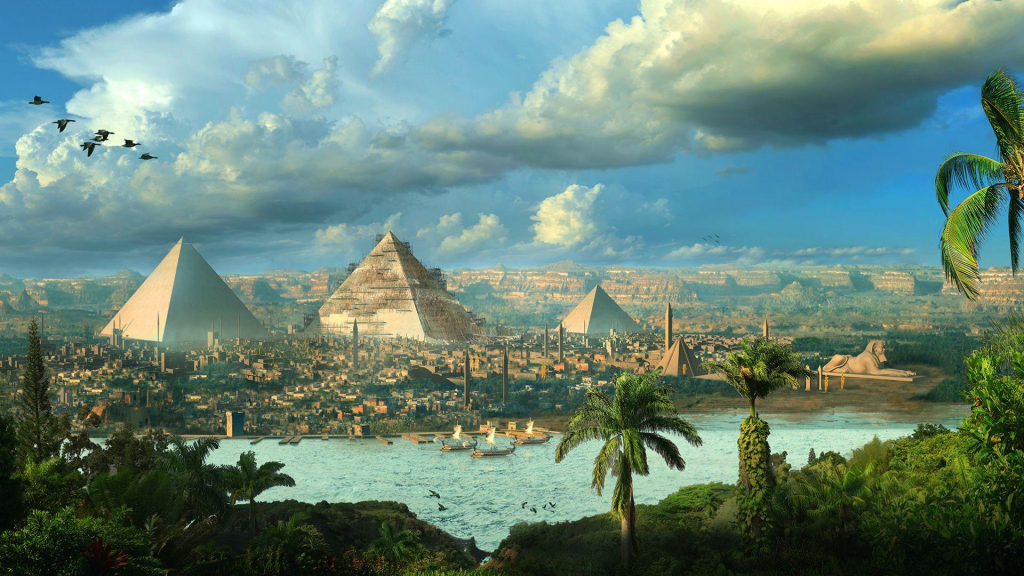
One method used in Egypt for transporting stone blocks and obelisks for example, was to pour water on the sand in front of a sledge carrying a heavy load. This principle is evidenced on a wall painting in the tomb of Djehutihotep. Dry sand develops clumps and wet sand can be thick and too stiff; whereas just the right amount of water produces firm sand, thereby creating an optimal sliding friction and reducing drag by fifty percent. This would have certainly made smaller building projects easier, though still does not account for the enormity of the Great Pyramid project. 

Carriage scene in the Colossus showing water being poured into the path of a sleigh

The most interesting and enlightening idea to emerge on the building of the Great Pyramid is an internal ramp theory. The idea that the pyramids had been built from the inside was formulated in 1999 by Henri Houdin, an engineer and the father of the French architect Jean-Pierre Houdin who presented a controversial theory about the way the Great Pyramid of Giza was constructed.

Bob Brier is coauthor with Jean-Pierre Houdin of the Secret of the Great Pyramid. In a 2009 article he wrote:

‘All of the current theories – a long, straight ramp, a ramp that corkscrewed around the outside of the pyramid, or cranelike shadoufs (used in Egypt until recently for irrigating fields) – have serious flaws. In the May/June 2007 issue of ARCHAEOLOGY, architect Jean-Pierre Houdin and I presented a radical new theory: that blocks of stone were raised to the very top of the pyramid on an internal ramp’, named “the spiral structure.” 
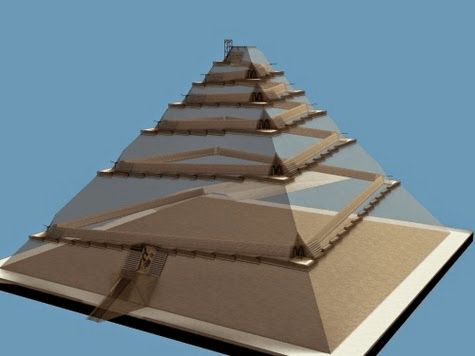
‘We gave what we felt was strong evidence for the theory, which explains a French team’s microgravemetric survey in the 1980s that recorded variations in the density of the pyramid. Although the researchers didn’t recognize its importance, an image from the survey may show a ramp still open inside the pyramid, running parallel to the outer face of the structure and turning 90 degrees at the corners, corkscrewing up to the top. 

The internal ramp theory suggests that for the bottom third of the pyramid, the blocks were hauled up a short, straight external ramp. At the same time, a second ramp was built inside the pyramid on which blocks for the top two-thirds would be hauled. This ramp, beginning at the bottom, was put into use after the lower third was completed and the external ramp had served its purpose. Men hauling heavy blocks of stones up a narrow ramp can’t easily turn a 90-degree corner, so Houdin suggests that the ramp had openings at each corner where a simple wooden hoist could turn the blocks.’

‘The presence of small, open chambers behind each notch would explain why the 1980s microgravemetric survey indicated that the pyramid’s four edges were of a lower density than the rest of it.’
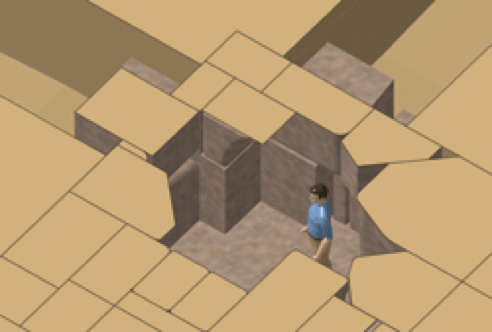
‘The French team had no explanation, but small rooms behind each notch might be the answer. For now, those who remain skeptical about the theory will need to devise a better explanation for… the results of the 1980s microgravemetric survey.’ 

This theory is a plausible attempt to reconcile a physical delivery with an enigmatic result. Unsurprisingly, Egyptologists do not welcome it with open arms. While a reliance on ramps may not be the actual answer as we shall contemplate; the small L shaped rooms with which to turn blocks and distribute them internally, is both a practical and obvious solution. 

The mention of aliens exasperates one half of an audience and enthrals the other, depending on one’s view. It is an unfortunate term and cleverly hides the fact that they are what the Bible describes as either angels or demons – Chapter XXII Alpha & Omega; and article: Principalities & Potentates: What they want… Who they are. The angels in question were called Watchers in the Book of Enoch and demons find their origin as the Nephilim in the Book of Genesis. If choosing to apply the word alien, then the Reptilians, including the Draco are actually fallen angels; while the various factions of Greys are masquerading demonic entities. 

Various researchers equate Ancient Egyptian achievements as evidence of ‘alien’ technology. While this is unpalatable for the more serious scholar, the general populace is not so easily dissuaded from the convincing arguments for these conclusions. It is undeniable that since antiquity, the Great Pyramid has been connected with deities and gods – to a time when the gods themselves walked among mortals. 

This is underscored by the intriguing artwork found in Egypt chronicling what appears to be high-tech equipment and machinery, as well as, well… an ancient alien presence in Egypt. The photograph below is one of the most well known, depicting arial and perhaps nautical military hardware that a modern mind readily associates with high technology. The glyph is carved into a lintel in the temple of Seti I in Abydos, Egypt. 

If this is not bizarre enough, Ancient Code: ‘The enigmatic 3,000-year-old vignette from the Djedkhonsuiefankh funerary papyrus found on display in the Cairo Museum (below) illustrates an uncanny scene: a disc-shaped object, depicted as being extremely bright, with a landing gear deployed on top of a Sphinx.’ 
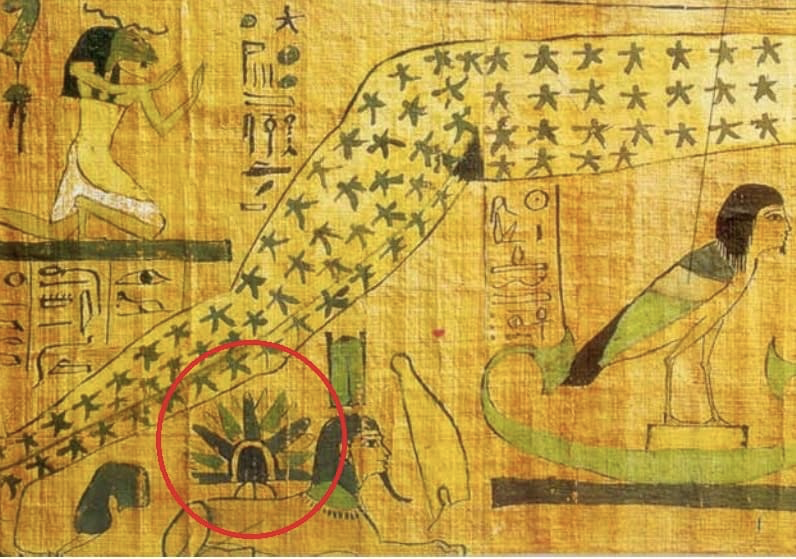
‘And if we take a close look at the ancient manuscript, it’s clear that it… has a radiating dome on top. It is depicted as having ‘landed’ on the Sphinx, with three leg-like tripods seen protruding from the object… what if this really is a UFO – and not a plant or some sort of bug?’

For those who remain incredulous, the Tulli Papyrus supports UFO and hence alien visitation. The translation of the text according to R Cedric Leonard: 

“In the year 22, of the third month of winter, sixth hour of the day… among the scribes of the House of Life it was found that a strange Fiery Disk was coming in the sky. It had no head. The breath of its mouth emitted a foul odor. Its body was one rod in length and one rod in width. It had no voice. It came toward His Majesty’s house. After several days had passed, they became more numerous in the sky than ever. They shined in the sky more than the brightness of the sun, and extended to the limits of the four supports of heaven… Powerful was the position of the Fiery Disks. The army of the King looked on, with His Majesty in their midst. It was after the evening meal when the Disks ascended even higher in the sky to the south. And His Majesty caused incense to be brought to appease the heart of Amun-Re, the god of the Two Lands. And it was (ordered) that the event (be recorded for) His Majesty in the Annals of the House of Life (to be remembered) forever.”

The Eternal during his discourse to Job, discusses the creation of the Earth, though it could quite easily be referring to the Great Pyramid. Particularly as this pyramid is a microcosm of the Earth,

“Where were you when I dug and laid the foundation of the earth? Explain it to me, if you are acquainted with understanding. Who decided on the measurements? Surely you know that! Who stretched out a line to measure the dimensions? Upon what base was the foundation set? Or who laid the cornerstone…” – Job 38:4-6, The Voice. 

After the Flood, the issues which had led to the flooding of the Earth in the first place erupted again. Fallen angels, ‘aliens’, Anunnaki, descended upon the Earth. Nephilim who survived the cataclysm were present and a supreme Nephilim was born called Nimrod. The localised flooding and disasters which ensued after the aborted Tower of Babel and the confusing of the one global language into myriad dialects ended the disruption initialised by dark angels and their legacy continued by Nephilim and the Elioud giants – Genesis 11:7-8; 10:25. 
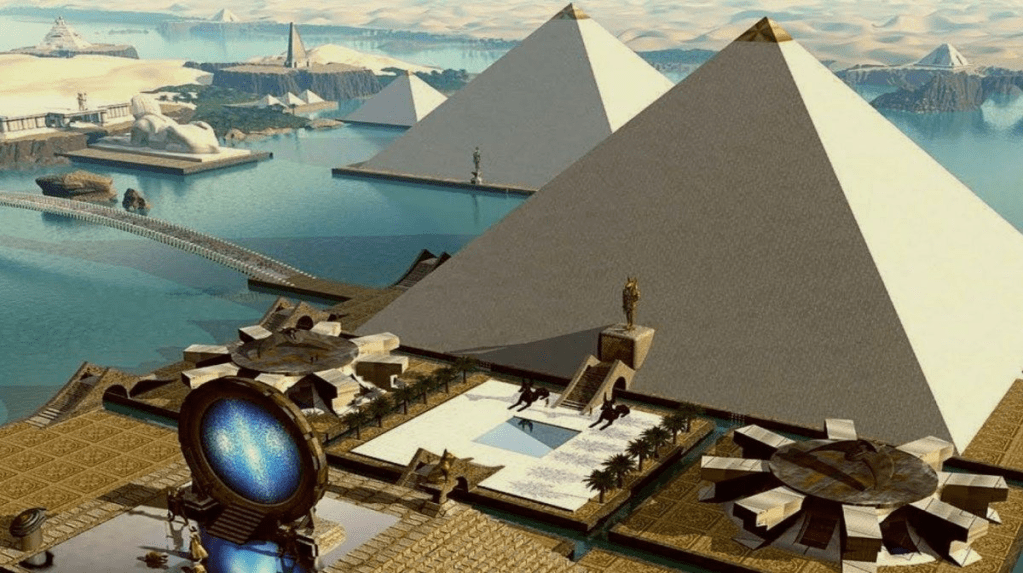
How did the Giza pyramids really end up looking like those rendered above? It is doubtful if the other pyramids had capstones made of a different substance like the Great Pyramid and were merely painted distinct colours or had a veneer applied. Notice the fourth pyramid in the top left hand corner, situated approximately where it would have been located. Note also the Sphinx is incorrectly rendered, though in front of the Great Pyramid, statues of Anubis figure prominently. 

Overall, it is an interesting and accurate depiction as water once surrounded the Giza pyramid complex. As the three/four pyramids represented stars, the water symbolised outer space, where the stars appear to float. 

There is a persistent and reoccurring belief that the Great Pyramid was built using the assistance of an advanced technology based on a sonic manipulation of the physical elements, which enabled the levitation of heavy objects. In this instance, the large and heavy stone blocks. As with the subject of aliens, people are polarised on the building of the Great Pyramid. Perhaps understanding aliens as real and that they are in fact angelic (or demonic) beings, then the manipulation of physical objects seemingly akin to magic by these same entities, may be easier to digest, assimilate and comprehend. 

The subject of levitation was briefly discussed in the article – Antartica: Secrets of the Lost Continent of Atlantis:

“Lemuria and Atlantis were highly evolved technological societies with ‘advanced knowledge of cymatics and systems of energy resonance.’ Cymatics is the science of visible sound, whereby ‘when sound meets a membrane, such as a water surface, it makes the sound visible.’ For instance, the Great pyramid was built according to cymatic principles and geodetic knowledge from a legacy of Atlantean knowledge after the global cataclysm 13,000 years ago.”

Famous psychic and clairvoyant Edgar Cayce offered how the Great Pyramid of Egypt was built. “By the use of those forces in nature as make for iron to swim. Stone floats in the air in the same manner. This will be discovered in 58.” It was in 1958 that Werner Heisenberg announced the Unified Field Theory – refer article: The Truly Big Questions

We will consider the mediums of water and air as viable vehicles for the transportation of heavy masonry in Ancient Egypt. For example, water in connection with more recent endeavours like obelisks and air in regard to older and larger edifices as the Great Pyramid. Such are the repeated legends concerning the movement of megalithic stones through the air, they cannot be categorically ignored as fanciful flights – no pun intended – of fantasy. 

Cosmic Key: ‘In almost every culture where megaliths exist, a legend also exists that the huge stones were moved by acoustic means – either by the chanted spells of magicians, by song, by striking with a magic wand or rod (to produce acoustic resonance), or by trumpets, gongs, lyres, cymbals or whistles.’

Trumpets are interesting and we shall return to this instrument. In fact, we shall learn of the musical nature of the Great Pyramid as we proceed. The mention of a rod or staff is also noteworthy – refer article: The Ark of God; and Appendix VII: Moses, The Exodus & the Red Sea Crossing – Fabrication or Fact?

The Aymara Indians in Peru allege that in the ‘beginning of time’, the founder god Viracocha (aka Quetzalcoatl) and his followers, caused gigantic stones to be ‘carried through the air to the sound of a trumpet’. An alternative theme is that they created a ‘heavenly fire’ that consumed the stones and enabled large blocks to be lifted by hand ‘as if they were cork.’

According to Mayan legend the temple complex of Uxmal in the Yucatan Peninsula, was built by a race of dwarfs who were able to move heavy rocks into place by whistling. Could the reference to dwarfs be referring to the invariably small, Grey aliens? – Article: Principalities & Potentates: What they want… Who they are; and Chapter XXII Alpha & Omega

The Moai statues on Easter Island are as high as a three storey building. The Rapa Nui – the indigenous Polynesian peoples of Easter Island – explain how ‘masters of special knowledge’ had used mana – a heavenly gift? – or mind power, to make the Moai walk, or float through the air – Article: The Manna Mystery. 

As a prelude to this subject, Griffin Gallagher presents interesting observations about the Great Pyramid in the 2024 article, Stairway to Heaven: How the Pyramids Were Built with Levitation – emphasis mine:

‘The Great Pyramid of Egypt is the most profound monument in the existence of the planet… [it] has approximately 2.3 million limestone blocks with an average height and length of 2.5 feet and an average weight of 2.5 to 15 tons. Above the King’s Chamber within the Great Pyramid are numerous massive granite blocks weighing from 25 to 80 tons, all imported from Aswan located more than 800 km away… these stones are stacked up to 455 feet high in the air, and placed completely without error, in such a way that even a piece of paper cannot fit between them. As Edgar Cayce describes… “[its] records are written in the language of mathematics, geometry and astronomy, as well as in the lands of stone used, with their symbology.”

“The builders had a knowledge of materials: [red] granite which expands and contracts with heat and cold was used in the inside construction, while the limestone used on the outside becomes harder and more marblelike in appearance when exposed to the weather” – Holt. ‘By choosing to put granite within the pyramid, it serves as a strong center so that the Pyramid does not cave in on itself, while the limestone on the outside not only withstands the forces of nature but also actually benefits from it over time.

How did they build it? The most convincing explanation is that the Great Pyramid… was assembled with the lost technology of acoustic levitation… Arthur Clarke’s third law on the nature of technology puts it best: “Any sufficiently advanced technology is indistinguishable from magic”… Many hieroglyphs depict rituals of song, chants, or musical instruments which could be concluded to have been used to build the Pyramids.

… the idea that ancient civilizations were masters of using sound as levitation is no surprise… [and] with the use of striking rods, chanting, or a combination of both, were able to resonate sound at a frequency that caused massive blocks of stone to levitate in the air. One of the earliest known documentations of the acoustic levitation theory comes from Abul Hasan Ali Al-Masudi, the ‘Herodotus of the Arabs’, about 1,000 years ago. Having traveled much of the known world, Al-Masudi settled in Egypt to document what he had learned from the locals about the construction of these ancient megaliths.’ 

Al-Masudi claimed that a magic papyrus imprinted with symbols was placed under each block of stone required to be moved. The stone was struck with a metal rod, which caused the stone to levitate and move along a path – about fifty metres in length – paved with stones and fenced on either side by metal poles, until it settled on the ground. The process would be repeated until the stone was in its final resting place. The metal poles as electrodes may have been responsible for creating a high frequency sound vibration that would have been engaged in creating the levitation effects. 

These are claims from the past – what about today? While the properties of sound are principally associated with communication and music, sound propulsion and the ability to move objects using sound waves is presently a tangible concept. 

African Explorer Magazine: ‘Experiments in sound or acoustic levitation are common and ongoing. Dozens of researchers have managed to use sound waves to levitate and move tiny particles and liquid droplets. Multiple vibrating plates are used to create different frequencies and move an acoustic field with particles trapped inside. The techniques developed have not been used to lift heavy or large objects. Twenty-first century scientists do not yet know if such a thing is possible. But there have been breakthroughs, some of which are significant enough to suggest that large-scale acoustic levitation may some day be possible.’ 

Overall, it is an interesting and accurate depiction as water once surrounded the Giza pyramid complex. As the three/four pyramids represented stars, the water symbolised outer space, where the stars appeared to float. 

There is a persistent and reoccurring belief that the Great Pyramid was built using the assistance of an advanced technology based on a sonic manipulation of the physical elements, which enabled the levitation of heavy objects. In this instance, the large and heavy stone blocks. As with the subject of aliens, people are polarised on the building of the Great Pyramid. Perhaps understanding aliens are real and are in fact angelic or demonic beings, then the manipulation of physical objects seemingly akin to magic by these same entities, may be easier to digest, assimilate and comprehend. 

The subject of levitation was briefly discussed in the article – Antartica: Secrets of the Lost Continent of Atlantis: “Lemuria and Atlantis were highly evolved technological societies with ‘advanced knowledge of cymatics and systems of energy resonance.’ Cymatics is the science of visible sound, whereby ‘when sound meets a membrane, such as a water surface, it makes the sound visible.’ For instance, the Great pyramid was built according to cymatic principles and geodetic knowledge from a legacy of Atlantean knowledge after the global cataclysm 13,000 years ago.” 

Famous psychic and clairvoyant Edgar Cayce offered how the Great Pyramid of Egypt was built. “By the use of those forces in nature as make for iron to swim. Stone floats in the air in the same manner. This will be discovered in 58.” It was in 1958 that Werner Heisenberg announced the Unified Field Theory – refer article: The Truly Big Questions

We will consider the mediums of water and air as viable vehicles for the transportation of heavy masonry in Ancient Egypt. For example, water in connection with more recent endeavours like obelisks and air in regard to older and larger edifices as the Great Pyramid. Such are the repeated legends concerning the movement of megalithic stones through the air, they cannot be categorically ignored as fanciful flights – no pun intended – of fantasy. 

Cosmic Key: ‘In almost every culture where megaliths exist, a legend also exists that the huge stones were moved by acoustic means – either by the chanted spells of magicians, by song, by striking with a magic wand or rod (to produce acoustic resonance), or by trumpets, gongs, lyres, cymbals or whistles.’ Trumpets are interesting and we shall return to this instrument. In fact, we shall learn of the musical nature of the Great Pyramid as we proceed. The mention of a rod or staff is also noteworthy – refer article: The Ark of God; and Appendix VII: Moses, The Exodus & the Red Sea Crossing – Fabrication or Fact?

The Aymara Indians in Peru allege that in the ‘beginning of time’, the founder god Viracocha [aka Quetzalcoatl] and his followers, caused gigantic stones to be ‘carried through the air to the sound of a trumpet’. An alternative theme is that they created a ‘heavenly fire’ that consumed the stones and enabled large blocks to be lifted by hand ‘as if they were cork.’

According to Mayan legend the temple complex of Uxmal in the Yucatan Peninsula, was built by a race of dwarfs who were able to move heavy rocks into place by whistling. Could the reference to dwarfs be referring to the invariably small, Grey aliens? – Article: Principalities & Potentates: What they want… Who they are; and Chapter XXII Alpha & Omega

The Moai statues on Easter Island are as high as a three storey building. The Rapa Nui – the indigenous Polynesian peoples of Easter Island – explain how ‘masters of special knowledge’ had used mana – a heavenly gift? – or mind power, to make the Moai walk, or float through the air – Article: The Manna Mystery. 

As a prelude to this subject, Griffin Gallagher presents interesting observations about the Great Pyramid in the 2024 article, Stairway to Heaven: How the Pyramids Were Built with Levitation – emphasis mine:

‘The Great Pyramid of Egypt is the most profound monument in the existence of the planet… [it] has approximately 2.3 million limestone blocks with an average height and length of 2.5 feet and an average weight of 2.5 to 15 tons. Above the King’s Chamber within the Great Pyramid are numerous massive granite blocks weighing from 25 to 80 tons, all imported from Aswan located more than 800 km away… these stones are stacked up to 455 feet high in the air, and placed completely without error, in such a way that even a piece of paper cannot fit between them. As Edgar Cayce describes… “[its] records are written in the language of mathematics, geometry and astronomy, as well as in the lands of stone used, with their symbology.”

“The builders had a knowledge of materials: [red] granite which expands and contracts with heat and cold was used in the inside construction, while the limestone used on the outside becomes harder and more marblelike in appearance when exposed to the weather” – Holt. ‘By choosing to put granite within the pyramid, it serves as a strong center so that the Pyramid does not cave in on itself, while the limestone on the outside not only withstands the forces of nature but also actually benefits from it over time.

How did they build it? The most convincing explanation is that the Great Pyramid… was assembled with the lost technology of acoustic levitation… Arthur Clarke’s third law on the nature of technology puts it best: “Any sufficiently advanced technology is indistinguishable from magic”… Many hieroglyphs depict rituals of song, chants, or musical instruments which could be concluded to have been used to build the Pyramids.

… the idea that ancient civilizations were masters of using sound as levitation is no surprise… [and] with the use of striking rods, chanting, or a combination of both, were able to resonate sound at a frequency that caused massive blocks of stone to levitate in the air. One of the earliest known documentations of the acoustic levitation theory comes from Abul Hasan Ali Al-Masudi, the ‘Herodotus of the Arabs’, about 1,000 years ago. Having traveled much of the known world, Al-Masudi settled in Egypt to document what he had learned from the locals about the construction of these ancient megaliths.’ 

Al-Masudi claimed that a magic papyrus imprinted with symbols was placed under each block of stone required to be moved. The stone was struck with a metal rod, which caused the stone to levitate and move along a path – about fifty metres in length – paved with stones and fenced on either side by metal poles, until it settled on the ground. The process would be repeated until the stone was in its final resting place. The metal poles  as electrodes may have been responsible for creating a high frequency sound vibration that would have been engaged in creating the levitation effects. 

These are claims from the past – what about today? While the properties of sound are principally associated with communication and music, sound propulsion and the ability to move objects using sound waves is presently a tangible concept. 

African Explorer Magazine: ‘Experiments in sound or acoustic levitation are common and ongoing. Dozens of researchers have managed to use sound waves to levitate and move tiny particles and liquid droplets. Multiple vibrating plates are used to create different frequencies and move an acoustic field with particles trapped inside. The techniques developed have not been used to lift heavy or large objects. Twenty-first century scientists do not yet know if such a thing is possible. But there have been breakthroughs, some of which are significant enough to suggest that large-scale acoustic levitation may some day be possible.’ 

These orbs of liquid aren’t magically levitating: they’re hovering on the power of sound waves

‘In two experiments, scientist have successfully levitated lightweight polystyrene balls greater in size than the wavelengths used to elevate them, which represents an important step forward in the management of the force of concentrated sound. One of these experiments, carried out by a joint team of researchers in the UK and Brazil in 2016, lifted a 50-millimeter polystyrene ball several centimeters off the ground, where it remained suspended for as long as the sound waves were generated. Just one year later, another group of researchers working out of the University of Bristol successfully levitated a polystyrene ball of two centimeters in diameter.’

A truly astounding account exists of construction work occurring in the previous century fully accounting for the very principles being discussed. Located in Homestead – not far from Miami in southeastern Florida – is a series of huge stone structures formally known as ‘Rock Gate Park’, but has since been named Coral Castle. What is amazing about the construction is that it was built single handedly by the diminutive Edward Leedskalnin, a five foot tall, one hundred pound, Latvian immigrant. Leedskalnin worked in secret – from 1923 to 1951, usually at night – and was mysteriously able to quarry, fashion, manoeuvre and construct the impressive edifices from large blocks of heavy coral rock at his unique home. 

An estimated one thousand tons of coral rock were used in the construction of the walls and towers and an additional hundred tons were carved into furniture and art objects. Features include: a raised obelisk, weighing 28 tons; a surrounding eight foot tall wall, comprising large blocks weighing several tons; large stone crescents perched atop twenty foot, high walls; a nine ton swinging gate, which guards the eastern wall that moves at the touch of a finger and guards the eastern wall; and a rock on the property purported to be an estimated thirty-five tons. 

Ed Leedskalnin with hoisting equipment at his Coral Castle in Homestead

Crystal Links: ‘It’s made through a gate fashioned from a single coral block weighing nine tons. This miraculous monolith is approximately 80 inches wide, 92 inches tall, and 21 inches thick. It fits within a quarter of an inch of the walls on either side and pivots through an iron rod resting on an automobile gear. The enormous block balances so perfectly on its center of gravity that a visitor can easily push it open with one finger. People who are sensitive to electromagnetic energies fields will sometimes report headaches while standing inside the archway of the nine-ton swinging gate-door – thought to be over a vortex – and a major grid point of the planet.’ 
Leedskalnin refused visitors or observers onsite while he was working, so there are no official eyewitness accounts detailing his construction methods. Although it is claimed that some spying teenagers saw him “float coral blocks through the air like hydrogen balloons.” Nor are there any reports of heavy machinery or mysterious sounds emanating from the vicinity of the Coral Castle. That said, sonic levitation relies on the use of sound frequencies inaudible to human ears. 

Edward Leedskalnin – in his writings and conversations – tantalisingly never specifically identified sound as a key factor in his work. Though he was known to have an interest in radio; possessing a range of radio equipment, which he used for unknown purposes. Cryptically, Leedskalnin said he was able to tune in to “the music of the stars,” a reference which could have literal or metaphorical significance. 

The perpetually enigmatic Leedskalnin proclaimed the following: 

“I have discovered the secrets of the pyramids and have found out how the Egyptians and the ancient builders in Peru, Yucutan and Asia… raised and set in place blocks of stone weighing many tons!” 

Leedskalnin implies that somehow these ancient master craftsman had developed a method for overcoming the force of gravity. How Leedskalnin discovered this secret of the ancients remains a mystery; though there are reports that he was a practicing Freemason – Article: The Establishment: Who are they… What do they want? Perhaps he was exposed to secret knowledge. If Leedskalnin did indeed rediscover the ancient secrets of levitation, he probably took them with him to his grave.

Sacha Black proposes a thought provoking idea in their article, The Mystery of Sound Propulsion, Coral Castle & the Pyramids, 2015 – capitalisation theirs:

‘So how DID he do it? There were rumours Leedskalnin used strange cone shaped objects which emanated sound to levitate the enormous stone objects’ – refer cone, article: Monoliths of the Nephilim. ‘Cone like objects similar to the one… [below]. This particular one however, is rather more ancient. It’s thousands of years old and covered in cuneiform [inscriptions]… developed by the Sumerians…’
When Black visited the British Museum in London, they noticed depictions of cones and that the ‘cone highlighted in the red circle, wasn’t just on one or two of the carved statues, but on dozens of them across various different sculptures, and interestingly from different cultures, Egyptian, Sumerian, Babylonian… The other interesting thing in the photo, is the bracelets the creature is wearing. Two identical bracelets with a circular plate. Kind of like a watch… I wonder what they did, and why there are two of them.’ 
The hybrid being portrayed is an Assyrian (Sumerian) god and notably has four wings like a cherub – article: The Ark of God; and Chapter XXII Alpha & Omega. Certain cherubim have faces like birds and particularly of eagles – Ezekiel 10:14. Doesn’t its head look very much like the head of the god, Quetzalcoatl?

Black also highlights the impractical physics in transporting massive blocks of stone. ‘… [conventionally] the Pyramids were built using ropes and pulleys and round wooden-bobbin like structures to roll the stones. I always thought that a little odd though, stone being heavier and denser than wood, surely it would immediately crush the bobbins?’ 

Black has made a remarkable correlation with a mysterious cone shaped device and a mechanism like a remote control to use in the levitating and movement of heavy objects. In the article, Monoliths of the Nephilim, on the section on Baalbek, it was discussed how ‘sacred stones’ of a conical shape were worshipped by the Assyrians and Egyptians like a god. At the temple of Ammon at the oasis of Siwa, its appearance was ‘most like an umbilicus, and it is made of an emerald and gems cemented together. The term omphalos in Greek or umbilicus in Latin means a ‘navel’ – a conical stone which, for reasons that scholars do not understand, was deemed in antiquity to have marked a ‘center of the Earth.’ 

We have discovered the association of emerald – and the colour green – with the Book of Thoth; and Atlantis – articles: Thoth; and Antartica: Secrets of the Lost Continent of Atlantis. Interesting, that a small stone shaped like a cone, should equate to the centre of the Earth, just like a very big conical inspired Great Pyramid which sits at the centre of the Earth, no less. Constant readers may remember the multiple omphali of Karahan Tepe, discussed by Graham Hancock. 

At sites where an omphalos were located, the stones were venerated as oracles. Zechariah Sitchin postulates: ‘This device could communicate with the heavens as well as with other places on Earth… the apparent dual function of the Stone of Splendor… becomes clear: the same device which the Gods used to communicate with each other was also the object from which there emanated the Gods’ oracular answers to the kings and heroes!’

These stones were consulted by notable leaders such as Alexander the Great who had a quest for immortality; and the Persian king Cambyses who searched for the secrets of longevity. The association of these stones with a navel and umbilical cord symbolises the connection between a mother and her unborn baby. This in turn represents a mother giving life to her baby, who when born in essence continues her own life genetically and figuratively. So that while the mother will one day die, her child will live on carrying part of her as the closest way she will live forever or, be immortal… a resurrection of sorts – Chapter XXII Alpha & Omega

Sitchin: ‘In a most thorough study on the subject, Wilhelm H. Roscher (Omphalos) showed that the Indo-European term for these oracle stones – navel in English, nabel in German… stem from the Sanskrit nabh, which meant “emanate forcefully” – a little like a birth? ‘It is no coincidence that in the Semitic languages naboh meant to foretell and nabih meant “prophet.” All these identical meanings undoubtedly harken back to the Sumerian, in which NA.BA(R) meant “bright-shiny stone that solves.” 

If perhaps these smaller stones represent the Great Pyramid, one wonders what did the pyramid solve, pray tell? 

At Delphi in Greece, the most famous oracle, was dedicated to the Sun god, Apollo, ‘He of Stone.’ Constant readers will be aware of the familial link between Apollo (or Azazel) and his nephew, Nimrod. The quest for immortality and Nimrod’s endeavours are inextricably linked. The purpose for the Tower of Babel, as is Nimrod’s association with Apollo are discussed in Chapter XXI The Incredible Identity, Origin & Destiny of Nimrod – refer also Chapter XXIV Arphaxad & Joktan: Balts, Slavs & the Balkans. We will return to both Nimrod and the subject of a resurrection to immortality.

Monoliths of the Nephilim: ‘According to Boulay, the Phoenix was a fabled bird which arose from its own ashes and was a symbol of regeneration. It resembled an eagle in size and shape and had gold and red plumage’ much like the feathers of Quetzalcoatl. ‘The phoenix was connected to fire and associated with sun worship in Egypt. The inner sanctum of the Sun Temple at the City of Annu was the most sacred of all places. It was the home of the Sun Stone which the Egyptians called the “Ben-Ben.”

‘Mounted on a truncated pyramid, the “Ben-Ben” was a square stone platform upon which was set a pyramid-shaped stone or pyramidion, giving the appearance of [a] stubby obelisk. It was on this stone that the Phoenix or Benu bird alighted.’
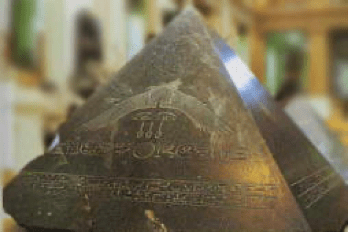
‘The Sun Stone was revered as the ‘dwelling of the Sun God.’ Not only pictured as a “stubby obelisk but… [also] as an upright conical stone. At Byblos, the oldest of the Phoenician cities… the Egyptian gods were worshiped side by side with those of the Canaanite pantheon. The Sun Stone was called a “baetyl” or “betyl” by the Semitic peoples, and its functions are similar to the pyramid-shaped stone found in Egypt. “Betyl” is a Semitic version of the Hebrew term “Beth-el” meaning the dwelling or abode of God.” This coalesces with numerous authors and researchers who firmly agree the Great Pyramid channeled, captured and encapsulated light – it was meant to be the Sunlight in Stone

We will return to the Benben stone and the missing pyramidion from the top of the Great Pyramid. For now, there is much food for thought. The dots discovered thus far – whether they join intrinsically or not – are: 

Thoth; emerald and turquoise; Quetzalcoatl; feathered serpent; gold and red; phoenix; eagle; Sun god; Apollo, Nimrod; Osiris; Orion; Tower of Babel; Benben; Great Pyramid; resurrection and immortality. 

The subject of levitation as well as water in transporting heavy stone, is discussed at length by Abdul-Wahab El-Kadi in The Role of Abolishing Gravity in Ancient Egyptian Pyramids Architecture; of the Architectural Department, College of Engineering and Technology, Arab Academy for Science, Technology and Maritime Transport, Latakia, Syria. Published in Archaeological Discovery, Volume 11, Number 1, January 2023. 

“The latest study that has discussed the abolition of gravity for the construction of the pyramids is by Nick Redfern in his book, ‘How Antigravity Built the Pyramids: The Mysterious Technology of Ancient Superstructures’. In his book, Redfern discusses the idea of building the pyramids by using sound [waves]… the main working element in acoustic lifting. 

Moreover, Redfern also mentions in his book other researchers who have discussed acoustic levitation such as Mari D. Jones and Larry Flaxman. However, Redfern only discusses the hypothesis without providing scientific evidence or scientific laws to support his ideas. For example, some chapters of the book give explanations about the pyramids’ construction that depend on supernatural forces like jinns [spirits] or aliens that came from other planets.” 

Unfortunately, for all the atheists, agnostics and nay sayers, this may be as good as it gets. The technology to manipulate sound waves sounds – no pun intended – otherworldly, or akin to magic if one does not understand it or possess it. This does not make the theory untenable. If that were the case, then throw out each theory on everything. 

Though this paper seeks to ‘prove with scientific evidence that the construction of the pyramids was based on the abolition of gravity.’ The author rightly points out the doubt over the Great Pyramid being a tomb, as it ‘does not have mural art, a coffin, or a mummy.’ El Kadi offers that the Great Pyramid was a power station which captured sound waves and released ‘free energy.’ 

Abolition of Gravity in Architecture 

4.1. Definition 

“The Earth’s gravity is a force that causes objects to move toward its center. This force cannot be absorbed, transformed, or armed against. Gravity enables humans to move comfortably on horizontal surfaces, and allows structures to be stable on the surface of the earth. The Earth’s gravity is constant in its value, controls all the masses on its surface, and determines the weight of each mass. 

Anti-Gravity, which is known as a non-gravitational field, is a hypothetical phenomenon of creating a place or object that is free from the force of gravity. It is stated that gravity ‘does not refer to the lack of weight under gravity experienced in free fall or orbit, or to balancing the force of gravity with some other force, such as electromagnetism or aerodynamic’ (Wei, Li, & Gao, 2018).”

4.2. Objective 

“The abolition of gravity… plays a role in facilitating the lifting [of] weights and heavy loads by using the forces of sound and electromagnetic waves and fluid flow, which reduce both effort and time (Abdul Jalil, 2018).”

4.3. Ways to Abolish Gravity in Lifting Large Bodies 

The most important of which are: 

Acoustic Lift. 

Hydro Lift.

5.2. Theory Proposed (Hydro Lifting) 

5.2.1. Principle 

“This research indicates the possibility of adopting the theory of water lifting to justify how the process of lifting large weights was performed… [by] facilitating the transportation of huge stones using waterslides.” 

5.2.2. Physical Evidence to Support the Theory (Nawamis) 

  1. Definition 

“Al-Nawamis (singular namus) are circular-shaped buildings built from the Nubian sandstone scattered in Southern Sinai. Each namus has a small door and an opening in the roof. There are more than a thousand Nawamis in the valleys of South Sinai, as well as a group of similar buildings that are all registered in Halaib, Southeast Egypt. Moreover, they can also be found in many different locations in Egypt… each of which varies in diameter from 1 to 3 m. The nets were built without adhesive to the stones. 

Khaled Elyan, Director General of Saint Catherine’s Antiquities said: “Experts differed and opinions varied about why prehistoric people built these buildings. Some say that they are dwellings, and the first appearance of the idea of gathering and tribe, while others believe that they were tombs, and a third opinion appeared, that they were used for hunting animals” As shown in Figure 13(a) & Figure 13(b (Ibrahim, 2017).”

2) Methods of building 

“… this research assumes that these types of buildings were used to make a water lift (hydraulic) as presented in the illustration in (Figure 9 [below]) in which these Nawamis of different diameters were filled with water and a certain pressure was applied to enable these devices (Nawamis) to lift heavy weights (Goren, 2002).”

Figure 13. (a) Nawamis places (Ibrahim, 2017). (b) Nawamis shape. 

“Hydrolifting method is one of the most feasible methods compared to acoustic lifting, and it can be adopted in combination with the previous traditional method.”

7. Application of the Theory of Water Lifting in the Construction of the Pyramids 

“The proposed theory depends on the principle of water lifting vertically huge stones and then moving them horizontally, depending on water and the application of Pascal law in hydraulic press. The process requires two Nawamis (that are considered as cylinders) in which one of the two Nawamis is considerably larger in size than the other. The two Nawamis are connected to each other, and the smaller Namus is filled with an incompressible liquid (water in this case). 

Assume that, A1 is the small stone, A2 is the big stone, R1 is the small piston radius (m), R2 is the large piston radius (m), d1 is the distance a small weight lifts (m), d2 is the distance a large weight lifts (m), F1 is the small stone weight (kg), and F2 is the big stone weight (kg). The hydrolift suggestion steps are shown in Figure 14(a) & Figure 14(b) as in the following: 

– Putting the large stone in place and closing the Nawamis well. 

– Filling the void with water. 

– Putting the small stone in its place. 

– The large stone rises due to the pressure difference upwards until reaching the appropriate level. 

– Moving the stone horizontally using water pouring to make it easy to pull. 

The process was repeated by emptying the Namus which was linked at the same time with another Namus (as shown in Figure 13(a)). Furthermore, at the time of floods, the water of the floods was used for both filling the Nawamis with water and increase the speed of the whole process of hyrdrolic press (Hydrolifting).” 

Figure 14. (a) Site plan of the suggested method, (b) Steps of the suggested method. 

8. The application of the Theory of Water Lifting in the Construction of Obelisks 

“Obelisks were carved at the site and raised 90 degrees… Water lifting can be used to lift large sizes vertically. However, when it comes to obelisks, large blocks can be slipped through water in order to be moved at an angle of 90 degrees. When lifting a stone under water, the buoyant force applied by water helps. When the obelisk was going through the process of construction, it was in a horizontal position. After the construction work was finished, another difficult task was facing the workers at that time: transporting the obelisk to the wanted location and then changing its position from horizontal to vertical one by going through the following steps (Figure 16).”

1) Due to its extremely heavy weight, it is carried vertically on level ground (illustration  1) 

2) The obelisk is pulled down to fit in its assigned position as in (illustration 2). 

3) As the bottom of the obelisk comes down, its top goes up as in (illustration 3). 

4) The obelisk fits right in a vertical position as in (illustration 4). 

Figure 16. Way to lift the obelisk. 

There appears to be merit in water being used for certain building projects in Egypt, though it remains limited and unconvincing for the stand alone Great Pyramid. 

4.3.1. Acoustic Lift 

“It is sonic lifting (Acoustic Levitation) or swimming on a wave of sound (Fontana & Liu, 2016). The idea that something intangible can lift things up may seem incredible, but it is a real phenomenon. Acoustic levitation takes advantage of the properties of sound in order to make solids, liquids, and heavy gases float above a sound wave. The process of acoustic levitation can be done in normal or low gravity. In other words, sound can lift objects on Earth or in space (Röthlisberger, Schuck, Kulmer, & Kolar, 2021). 

Acoustic levitation experiments are common and ongoing. Some researchers have already been able to use sound waves to lift and move small particles and liquid droplets. Multiple vibrating plates are used to create different frequencies and move the sound field as in Figure 7 (Röthlisberger, Schuck, Kulmer, & Kolar, 2021).”

4.3.2. Hydro Lift 

“Hydraulic jacks are tools used to lift heavy objects such as the levers in auto repair shops, in wheelchairs, and even on skyscraper construction sites. They use water (or other liquids) to increase the force available to lift objects. The experiment in (Figure 8) explains how to design one of these levers in which it demonstrates how easy it is to lift objects with the use of hydropower (Wei, Li, & Gao, 2018).” 
Figure 7. (a) Acoustic levitation. (b) Sonic lifting. 

Figure 8. Fluid energy: A design for a lever that uses water as an aid. 

“When moving an object, exerting a force is not enough because the force must be distributed over the entire area of where it is exerted, as in Figure 9 (Mahmoud, Salih, & Moneer, 2017).” 

5. Application of Methods of Abolishing Gravity in Ancient Egyptian Architecture 

“A number of researchers and studies referred to the theory of abolishing gravity when lifting huge stone blocks weighing 2.5 tons and more (Cassel, 2017). On the one hand, the theory of Acoustic Lift is the one in circulation up to this date. On the other hand, this research sheds light on the theory of Hydrolift with reference to evidence of its use.”

5.1. Common Theory of Absorption of Gravity in Ancient Egyptian Architecture (Sound Lifting) 

5.1.1. Principle 

“The technique of Sound Lifting has not been used to lift heavy or large objects, and scientists have not yet known whether such a technique is possible, but their findings so far suggest that large-scale sonic hovering may one day be possible (Sundvik, Salmi, Nieminen, & Panula, 2015).” 

Figure 9. Hydrolift method. 
“In addition, a team of architects and Egyptologists confirmed that the Pharaohs were able to abolish the Earth’s gravity when lifting the stones that were used in building the pyramids and moving them over long distances by directing special sound vibrations and electrostatic charges to facilitate the process of lifting them (Fontana & Liu, 2016).” 

5.1.2. Physical Evidence Supporting the Theory 

“Sayed Karim, a professor of architecture at Cairo University and an expert in Egyptology, told Al-Ahram Journal that two papyri were discovered and that they gave valuable information about the method used to construct the pyramids. The two papyri are now in two different places: One is in Karnak and the other is in Paris. The former papyrus is in an architect’s tomb who belonged to the Middle Kingdom, and the latter is in the Louvre Museum, Figure 10.” 

Figure 10

“In 1993, an inaccessible room known as the “lower chamber” was found under the Great Pyramid. In 2011, thanks to technological development and the use of cosmic ray-based imaging, what was inside this room (void) was discovered: it was just a void. Scientists could specify the dimensions of the void, but they were not certain about the purpose of that void which ‘it could have been a burial chamber, another gallery, an architectural anomaly, or simply a sealed-off construction passage’ (Rubin, 2017). However, some historians and experts still have the hope to prove that such a void had an important role in transforming the earth’s gravity into high-frequency sound vibrations that played the role of Acoustic Lifting. 

The Egyptians used dolomite on the inner sides of the stone’s walls. This mineral is known for its doubling electrical conductivity. In addition, tunnels and underground passages (paths) were lined with radioactive granite and quartz crystals which are great conductors of piezoelectricity by directing the sound waves emanating from the center of the Earth through the pyramid and intensifying them to the highest frequencies by passing them through passages supplied with water that works as a jet engine. In this situation, the quartz crystals vibrate in water which has an effect on the sound waves speed which is quadrupled if compared to the speed of the sound waves affected by the vibrating quartz crystals in the air. This can be called anti-gravity (Schwabl, 2006).” 

Encyclopaedia: ‘Piezoelectricity is the electric charge that accumulates in certain solid materials – such as crystals, certain ceramics, and biological matter such as bone, DNA, and various proteins – in response to applied mechanical stress. The word piezoelectricity means electricity resulting from pressure and latent heat.’ 

The American Heritage Dictionary: ‘The generation of electricity or of electric polarity in dielectric crystals subjected to mechanical stress, or the generation of stress in such crystals subjected to an applied voltage. The ability of certain crystals to generate a  voltage in response to applied mechanical stress. Electricity produced by mechanical pressure on certain crystals (notably quartz or Rochelle salt); alternatively, electrostatic stress produces a change in the linear dimensions of the crystal.’ 

El-Kadi: “With the presence of the metal coils at the base of the pyramid, these waves are generated, and they are filtered in side chambers through the granite layers to turn into frequency-calculated resonance energy. The quartz crystals on the surfaces of the granite blocks work to condense sound waves to generate electromagnetic fields and electrostatic charges. The result is a repulsion between the stones and the earth, so the stones rise from the ground to be controlled by a polarizing column of energy consisting mainly of three parts: a ceramic bowl, a copper tube with an iron rod inside it, and an acid liquid that produces the outgoing reaction that is formed by striking the stone with the polarized column. This leads to the rise of the stone and moving it through a path paved with stones. The stone reaches a certain distance, and the process is repeated until the stone reaches to the desired and specified place (Figure 12) (Massey, 2014).”

Figure 12. Antigravity technology 

The author is saying the Great Pyramid itself, is an anti-gravity device with the capability to levitate objects sonically. Therefore, an example of the theory of Sound Lifting in practice. Not just that it was built according to this technology. The Plot thickens.

The points of particular interest are the fact the Great Pyramid was a finely tuned conductor of electricity, as well as the reference to its internal mechanism being an ‘engine’, of which we shall investigate further. 

It would seem the builders – even if of a spiritual nature themselves – were able to manipulate the laws of physics and harness natural energy in some manner in moving the thousands of stone blocks. Not by some inexplicable magic spell, though this can’t be ruled out. Edward Leedskalnin may be, albeit a tenuous strand, proof that it was possible then and just as possible now. 

In the article, The Ark of God, the conquering of the city of Jericho by the Israelites was discussed, from the perspective of chronology and the presence of the Ark of the Covenant in the victory. The element of sound being a significant feature was omitted, though in this context it is pertinent in interest. 

Joshua 6:1-4, 15-17, 20

English Standard Version 

‘Now Jericho was shut up inside and outside because of the people of Israel. None went out, and none came in. 2 And the Lord said to Joshua, “See, I have given Jericho into your hand, with its king and mighty men of valor. 3 You shall march around the city, all the men of war going around the city once. Thus shall you do for six days. 4 Seven priests shall bear seven trumpets of rams’ horns before the ark. 15 On the seventh day they rose early, at the dawn of day, and marched around the city in the same manner seven times. It was only on that day that they marched around the city seven times. 16 And at the seventh time, when the priests had blown the trumpets, Joshua said to the people, “Shout, for the Lord has given you the city. 17 And the city and all that is within it shall be devoted to the Lord for destruction.”

20 So the people shouted, and the trumpets were blown. As soon as the people heard the sound of the trumpet, the people shouted a great shout, and the wall fell down flat, so that the people went up into the city, every man straight before him, and they captured the city.’

This episode is in contrast to moving objects to construct something, where the opposite occurred with the city wall crumpling in a heap. The reoccurring themes of sound with trumpets yet again are evident. As described in The Ark of God

‘Can you imagine the cacophony created from the blaring trumpets with an eerie lack of voices until they all shouted, yet the foot falls of over six hundred thousand soldiers marching around the imposing walls of an impregnable city. The spectacle may have been humorous and ominous in equal measure for the inhabitants of the ancient city of Jericho. Added to this scenario, was the glimpse of the ghostly and gleaming golden Ark.’

If sound was the cause, was it the shouting, the trumpets or the marching soldiers? 

Archaeoacoustics and the Fall of Jericho, Anne Habermehl, 2017: 

‘The march around Jericho was possibly not a strange custom to the inhabitants of the city. As [Bruce] Waltke… says: “The royal march around the city is based on widespread custom in the ancient Near East of laying claim to territory by tracing out its bounds” – An Old Testament Theology, 2007. 

But audible sound is not the only result of the marching. Experts include infrasounds (cycles per second in the range below what the human ear can hear) in the science of acoustics… [D] Jones… an expert in viscoelastic vibration damping, also mentions that the vibrations of Joshua’s marching soldiers… are what made the wall fall’ – Handbook of Viscoelastic Vibration Damping, 2001.

Vibration Spectrum Analysis, Volume 1, Steve Goldman, 1999: 

‘To demonstrate that pulse theory may be applied to a great many varied phenomena, one last case will be covered: the falling of the walls of Jericho. The blowing ram’s horns and shouting would cause pressure waves of rather high frequency, several hundred to several thousand Hertz. It is extremely unlikely that these pressure waves… would have been capable of causing the low natural frequency walls to collapse. 

On the other hand, the stomping of a large number of feet on fertile ground would have caused long-time-duration pulses of rather high amplitude. Pulse theory tells us that long-time-duration pulses have most of their energy concentrated in the low-frequency range, near the natural frequency of the wall. We can surmise, therefore, that the walls of Jericho fell due to the marching…’ 

Can A Contingent Of Marching Soldiers Collapse A Bridge? Vaishnavi Patil, 2022: ‘Have you ever felt the windows of your room rattling when a heavy truck lumbers along outside? This happens when the windows vibrate in synch with the natural frequency produced by the truck. This effect is called resonance, but for something really dramatic to take place, a considerably inelastic system has to be subjected to a frequency that perfectly matches its own natural frequency. Therefore, if the truck’s natural frequency was the same as that of the windows, then the mechanical resonance thus created would result in the windows shattering.

When people walk on a bridge, they collectively create complex and scattered frequencies, the combination of which is nowhere near that of the natural frequency of the bridge. However, when soldiers march in unison, the otherwise scattered frequencies of people walking is transformed into a more unified frequency. If this frequency closely matches the bridge’s natural frequency, it could cause the bridge to resonate with amplified vibrations. The stronger the mechanical resonance that is produced, the better the chances are of the bridge collapsing.’ 

During Christ’s ministry, he uttered a curious analogy, in light of the fact he is the chief cornerstone of a spiritual temple comprised of many living stones. The Great Pyramid is a mountain of many stones. The stones were plausibly moved into place using levitation and so Christ’s words are intriguing: 

‘And when they came to the crowd, a man came up to him and, kneeling before him, said, “Lord, have mercy on my son, for he has seizures and he suffers terribly. For often he falls into the fire, and often into the water. And I brought him to your disciples, and they could not heal him.” 

And Jesus answered, “O faithless and twisted generation, how long am I to be with you? How long am I to bear with you? Bring him here to me.” And Jesus rebuked the demon, and it came out of him, and the boy was healed instantly. Then the disciples came to Jesus privately and said, “Why could we not cast it out?”

He said to them, “Because of your little faith. For truly, I say to you, if you have faith like a grain of mustard seed, you will say to this mountain, ‘Move from here to there,’ and it will move, and nothing will be impossible for you” – Matthew 17:14-20, ESV. 

Fascinating Christ should exhort true faith would move a mountain. A literal mountain, or a figurative mountain comprised of stones? Christ said the mustard seed was very small in Matthew 13:32, ESV: “It is the smallest of all seeds, but when it has grown it is larger than all the garden plants and becomes a tree, so that the birds of the air come and make nests in its branches.”

Some commentators say something like, “Poor Jesus, hampered by his parochial upbringing, didn’t even know that the seeds of Anoectochilus – the Jewel Orchid are significantly smaller than mustard seeds.” For while Mustard seeds vary from 0.3 mm to 2.0 mm in length – and are either yellow, white or black in colour – the orchid seeds can be as small as 0.05 millimetres. 

Of course, what these self same detractors fail to realise is that Christ is speaking of a. plants local to the region – the Jewel Orchid is typically found in South East Asia – and b. plants that are edible – try eating an orchid. The mustard seed was likened to faith which can move mountains because it is a fast growing plant that becomes a tall tree up to thirty feet in height – far bigger than any orchid which usually only grows to about three feet, if it is not an epiphytic orchid that grows on the trunks of other trees. 

There are myriad theories about what the Great Pyramid is, does, or means. Sifting through them in endeavouring to reach the truth is challenging. A journey akin to travelling down the yellow brick road. Even so, let us see where it takes us.

The album cover above is by the avant-garde Death metal band, Blood Incantation. They like many other bands and the populace at large, have an enduring fascination for the Great Pyramid and understandably so. It speaks to all of us in varying degrees. No one can see its image and not be left with it permanently engraved in our memory as a strange lingering question mark. It portrays a complexity in its design yet simplicity all at the same time. Its great age abundantly apparent – yet one cannot help but think it is still not obsolete and is possibly waiting patiently to be renovated and activated. 

If such is the case, then if and when that occurs, a sign of great importance would have been demonstrated. Artistic depictions of futuristic pyramids are a concept that may not be far-fetched, either with the Great Pyramid in mind, or perhaps a wholly new structure to be built on the Earth…

General consensus is the Great Pyramid is more than an impressive monument incorporated with earthly and celestial symbolism, but also primarily an energy producing machine, a power plant if you will. The Great Pyramid is convincingly a legacy technology from the antediluvian age which included the legendary Atlantis. Its internal mechanism certainly looks machine like, as if it is an engine; a generator; an industrial oven of some kind; or even an instrument. 

It is inescapable that a unified ancient culture positioned Pyramids around the globe in specific geographic locations, creating a global pyramid network – Article: Monoliths of the Nephilim. For what reason? Did they work in tandem to harness a natural energy from our planet? Do they form a defensive forcefield like an electric fence as some claim? 

If they are active energy devices this could be due to their specific crystalline compositions and positions, each indelibly connected to the planet. Crystals receive power from a variety of sources; which include the Sun, the energy field of the earth, as well as those megalithic structures capable of transmitting energy from one location to another.

Researchers have discovered numerous facets of the Great Pyramid in lending credibility to these conclusions. For example, the Great Pyramid of Giza focuses electromagnetic energy in its chambers, concentrating the electromagnetic energy in its lower cavity beneath the surface. Thus behaving like a resonant cavity. A resonant cavity is a foundational concept in physics. It is predominantly used in the field of telecommunication, electronics and even in quantum physics. 

Study Smarter: ‘In electromagnetism, a resonant cavity functions as a placeholder for propagating waves at specific frequencies. Consequently, these cavities are integral to electromagnetic devices, ranging from antennas and oscillators to filters and amplifiers. They function through resonance, a phenomenon wherein an object vibrates at its natural frequency, causing an increase in amplitude.

A resonant cavity, also known as a resonator, is a system in which standing waves occur when certain frequencies allow waves to bounce back and forth and align to form an amplified signal or intensified field. This phenomenon happens through the process of resonance, where a system vibrates at its natural frequencies, resulting in an enhanced output. 

Every resonator… has what’s known as a resonant frequency. It is significant because it’s at this frequency that the cavity can store energy most effectively. This resonant frequency depends on the physical characteristics of the resonator, making each resonator unique in its response.’

The formula for resonant frequency is f = nc/2L, where n represents the resonant mode number, L is the length of the cavity and c is the speed of light. 

Features of a resonator include – 

1. Ability to store energy: ‘A resonant cavity traps the energy within it, causing an amplified and intensified output. This energy storage feature means the cavity has a sort of “memory” for the vibrations happening inside it.’ 

2. Natural Frequencies: ‘Every resonator has a set of natural frequencies it responds to, which depend on its physical properties such as size and shape. These frequencies increase the strength of the resonating waves internally.’

3. Quality factor: ‘The quality factor (Q) of a resonant cavity relates to how long it can keep the energy before releasing it. A high Q factor points to low energy loss and a longer resonance.’ 

Real life examples of resonating cavities – 

1. Musical instruments: ‘In musical instruments like guitars or violins, the hollow body acts as a resonant cavity. When played, the body captures the vibrations from the strings, amplifying the sound.’

2. Laser cavities: ‘In laser systems, a resonant cavity is used to produce coherent light waves.’ 

3. Microwave ovens: ‘The cooking area in a microwave is a resonant cavity. The food sits inside a metal box with microwaves (electromagnetic waves) being emitted into the space. As these microwaves bounce off the metal walls, they form standing waves inside the cavity. It is these standing waves that cause the water in the food to vibrate, creating the heat that cooks the food.’

The Great Pyramid fits the description of a resonating cavity and incredibly, one akin to a musical instrument – where it exhibits natural frequencies, vibrates and stores energy. 

A fascinating journey inside the Great Pyramid is recorded by Tom Danley in The Great Pyramid: Early Reflections & Ancient Echoes, 2024. An article which first appeared in the July/August 2000 issue of Live Sound International – emphasis & bold mine: 

“To enter the Great Pyramid, one must first enter the cave El-Mamun. A would-be robber bored into the limestone here in around 600 AD. This tunnel goes in approximately 50 ft (15.2 m) to a point they were supposedly about to give up, but heard a noise inside and re-directed the tunnel to the left. There they hit the Red Granite casing on one of the interior passages and by following it (the tools they had couldn’t cut granite), they eventually located the Great Pyramid’s interior. From the end of this tunnel, one climbs about 120 ft (36.6 m) stooped over in a space barely 1 yard/meter high. This section is fairly steep with an approximate 30-degree incline. Without the wooden boards fastened to the stone for footing, it would be almost impossible to make this climb while carrying gear. For me, this path created a whole new meaning to the term “walk like an Egyptian.” 

Next you enter the Grand Hall. It’s also inclined but now about 40 ft (12.2 m) tall with a corbled (stepped) ceiling.”

“After trudging up another 120 ft (36.6 m) up the grand hall one finally reaches the entry to the King’s Chamber, which is another tunnel. This time, however, it’s level and about 10 sq.ft (1 sq.m) and perhaps 20 ft (6.1 m) long. The King’s Chamber is about 40 ft (12.2 m) long, 20 ft (6.1 m) wide and 20 ft (6.1 m) high. The walls, floor and ceiling are all made of Red Granite. 

The granite blocks that make up the walls are huge. The one over the door is nearly 8 ft (2.4 m) high 14 ft (4.3 m) long and 5 ft (1.5 m) thick, yet all the blocks fit so tightly you can’t get a business card between them. They are polished to a surprisingly smooth finish. 

The producer was also right about the acoustics in the King’s Chamber. It sounded very weird inside there. Think of the “livest room” you’ve ever experienced, and then double that. It was acoustically “solid as a rock.” Given a minimum of 200 ft (61 m) of stone in all directions, it should be. 

The lighting guy tapped into the AC mains (240-volt, 50 Hz) and set up his transformer, and we were ready. I picked a spot on the wall in the King’s Chamber to set up my stuff. I placed the source at one wall and the microphone at the opposite wall and was ready to go. I applied the first loud slow sweep starting at 200 Hz to 10 Hz – a comfortable level. Around 90 Hz I observed a strong room mode and sweeping at 1.1 Hz/sec – some real energy was transferred. 

What really made everyone get up and run to the exit was the resonance near 30 Hz. At that moment I aborted that test. This was a good resonance, it got nice and strong and scared the wits out of a several crew members. Frankly, I was a little concerned myself. High-Q resonances at low frequencies can be very exciting! 

The chances of something bad happening are small, but the consequences are large. Not wanting to be known as the first person in modern times to be buried in the pyramid, I moved the TEF and myself to the tunnel entry way instead of inside the King’s Chamber. 

I spent several nights taking measurements there and was filmed without incident. I observed a good distribution of room modes and curiously, the red granite sarcophagus displayed several resonant modes, which directly corresponded to these room modes. 

Lying in the sarcophagus, one finds it’s nearly impossible to hum any note other than ones related to the main resonances. In that position when you do hum at the “right” frequency, it’s easy to make it seem very loud. But for someone standing next to you, it’s not loud at all. Also lying in it, the outside sounds that get coupled throughout, colors other people’s voices for a very “Darth Vader” effect.” 

The Great Pyramid Experiment: Exploring Infrasound Technology Use By The Ancients, Andrew Collins, 2019: 

‘Since intoning seems to be a natural thing to do when lying down inside the sarcophagus there is every reason to assume it was designed with this intention in mind. The average male vocal frequency range is between 85 Hz and 180 Hz, with most female voices spanning the range between 165 Hz and 255 Hz. Indeed, the fundamental frequency of what is known as the complex speech tone for a typical male – known as pitch or f0 – spans the range between 100-120 Hz, even though the female natural pitch is on average one octave higher. Since the sarcophagus’s optimum resonant frequency range of 114-122 Hz synchronizes near perfectly to the pitch of the male voice, it seems reasonable to suggest that it was designed with the male intoning range in mind. This then is yet further evidence that the pyramid builders possessed an advanced knowledge of sound technology.’

Danley: “My general observation is that the pyramid’s dimensions, the pyramid’s construction materials, and the box inside the King’s Chamber were designed to passively (as in zero electricity) enhance whatever sounds were present inside the chamber. It also appears that any wind pressure across the pyramid’s internal air shafts, especially when it was new and smooth, was like blowing across the neck of a Coke bottle. This wind pressure created an infrasound harmonic vibration in the chamber at precisely 16 Hz.”

Recall, a person without any hearing loss can process sounds between 20* Hz and 20,000 Hz. 

“Being a musician myself, I was especially interested to discover a patterned musical signature to those resonances that formed an F-sharp chord.

Ancient Egyptian texts indicate that this F-sharp was the resonant harmonic center of planet Earth.

F-sharp is (coincidentally?) the tuning reference for the sacred flutes of many Native American shamans. Bottom line: We have 2.5 million blocks piled up in Egypt. Halfway around the world you have a guy whittling a tree into a musical instrument with exactly the same F-sharp resonance. 

The producer and crew were hot to film me placing an accelerometer on the big red granite beams which make up the roof of the King’s Chamber. Each of these beams weighs up to 90 tons (91.444 kg), and they were quarried at Aswan some 600 [miles] (966 km) away. They are also about 150 ft (46 m) high inside the pyramid. Another “how did they do that” question. 

To reach the upper levels above the King’s Chamber, one re-enters the grand hallway, then climbs 40 ft (1.2 m) up an old extension ladder to a hole in the wall. A small bundle of knotted cords comes out of the hole, which is also the entrance to a small tunnel. Once in the tunnel, you make a right turn and crawl a little more to an enlarged area carved out around a red Granite wall with a hole in it. Climbing through that opening, you come into the chamber directly above the King’s Chamber. This room is only about 4 ft (12.1 m) tall but is the same length and width as the King’s Chamber. The ceiling is flat and is covered with some very old graffiti. The floor consists of big rounded bulges, which are the center beams that run the width of the room.

After being home for a few months and trying to see what else might be revealed on the DAT tape using Hyperception software, I found several things I couldn’t have seen with the TEF. The TEF showed a large number of room modes some going below 20* Hz. 

While doing an FFT on the between-sweep time or quiet parts of the recording I found some very LF sound – resonances which start at a few Hz and go upward to 15-20 Hz or so. At least some of these were the same LF resonances I excited with my sweep, but not all of them. 

This sound was present even if everyone is silent. 

I crunched the results of the measurements, and they were sent on to a musicologist that was part of the staff. As mentioned, he identified that there was a pattern of frequencies, which roughly form an F-sharp chord. Not all the resonances fell in the right place but many did and some repeated the pattern for many octaves. In other words, it was roughly tuned to F-sharp over many octaves. 

It has been suggested (by others) that the Great Pyramid is NOT a tomb at all but actually a temple of sorts and that these resonant frequencies were “designed into” the structure. While many exotic and often far-fetched properties have been ascribed to “the power of the pyramid,” I see a possible argument that some of the phenomena people experience in it may be caused by the acoustical properties that were measured. 

The effects of LF sound were extensively studied by various government agencies to determine the effects on humans, partly for the space program.

One of the things that was discovered is that infrasound (very LF) can effect ones brain wave activity (Alpha rhythms, etc.) and other biological functions. 

If, as some suggest, these pyramids were constructed as a “temple” or for an initiation ritual rather than a tomb, then the LF sounds may be deliberate and have served a scared purpose – with the sound triggering and even forcing changes in brain wave state (i.e., one’s level of consciousness). 

One of the latest rages in controlling one’s brain wave state are the light/sound machines which use black glasses and headphones with flashing lights in the glasses and LF pulsing sound in the headphones to literally trap your brain into synchronizing at the pre-programmed frequency. It would seem like sort of a meditation ride. You need no practice to do it. It just takes you. The frequency range, which causes this effect, is at the low end of the audio spectrum or even below the LF that we hear (infrasound). 

Low-pitched sounds have long been known to cause emotional responses. The massive pipe organs of the ancient cathedrals were built (at considerable difficulty one should remember) to produce powerful LF sounds to frequencies below “audibility” or infrasound because of the powerful emotional and physiological effects they have on people. 

Music and movie sound tracks are reproduced loudly to have an emotional effect on most people. Before the industrial revolution (and the attendant noise pollution) humans had more sensitive hearing than we do now. Accordingly, to the ancients, the sound in the pyramids would seem even more powerful. 

Apparently man has been intentionally designing acoustic spaces for quite some time. During 1996, A Journal of the Acoustical Society of America paper, authored by Paul Devereux and Robert G. Jahn, detailed a number of ancient structures in England and Ireland which were apparently designed to enhance the bass frequencies in the voice range. Among other conclusions, Devereux and Jahn believed this was done because of the group chanting used in their rituals. Mantra’s were often part of the meditation process and are even now. 

The dimensions of the Sarcophagus in the main chamber are also such that there’s acoustical reinforcement of the LF voice range as well. As such, it seems obvious that architectural acoustics are simultaneously very old, and yet a virtually new science. The ancients had a grip on these principles, yet acoustic sciences seemed nearly lost for thousands of years. 

We ask why, yet we have no answer. 

In many cases, architectural designs made more than 100 years before the computer are still considered to be among the best there are. This is further evidence, it seems, of how cyber-analysis can never fully replace life experience. Still, these days, architectural acoustics exist almost entirely within the computer. 

Lacking a time machine, one cannot “know” what the designers really had in mind when they built the Egyptian Pyramids. Clearly, they went to an amazing amount of work and had a powerful reason for doing it. Equally clear, they had techniques and skills used in its construction that we are aware of, but what they did looks impossible with what is known about them. Still, it obviously was possible. 

“High Technology” (aliens, etc.) seems very unlikely as the pyramid’s interior nooks and crannies are very roughly shaped. If they had a laser or other high-tech voodoo tools, logic predicts they would have used them everywhere, not just where it showed. On the other hand, machining marks were visible on the inside of the sarcophagus wall from some “rotary” type cutting process. Obviously they had some mechanical help. 

Anyone who has been in the Great Pyramid and chanted or hummed will tell you that it feels weird, and that the acoustic effect is powerful. In short, it is possible that the ancient builders may well have been aware that sounds, even inaudible ones, can have a profound effect on [ones] consciousness. The fact that they were able to quarry huge red granite blocks six hundred miles away, transport them, “machine” them to a precise fit and then polish them, implies that there is an ocean about the ancient’s we don’t know – especially regarding their application of acoustic science.” 
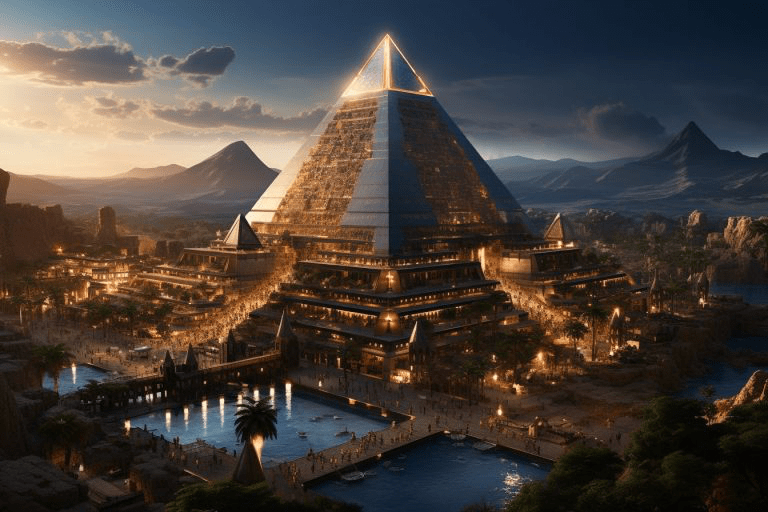
Danley in sharing his journey into the winding passageways of the Great Pyramid raises a number of important points. The aspect of a temple strikes a chord as it resonates – no pun intended – with the temple of living stones where Christ is the chief cornerstone. A temple is very different from a tomb and does not necessarily contradict the pyramid being a machine. A temple is synonymous with the worship of a god. The Great Pyramid’s internal mechanism and particularly the King’s Chamber with its coffer-cum-sarcophagus may be concerned with a god too. Except in this instance, a transformation into a god. 

The aspect of the pyramid vibrating and humming reminds of the Bosnian Pyramid discussed earlier and the conjecture of some form of control via a transmission of energy. The frequency under 20Hz and therefore below normal hearing is significant, particularly if it alters consciousness. For instance, listening to 19Hz prevents listeners from seeing straight as it’s the frequency at which eyeballs vibrate. Even scarier, lower frequencies can damage internal organs. Danley certainly portrays a structure very much tuned – pun intended – as a musical instrument. We will return to the all important sound element of the Pyramid. 

Lastly, Danley thinks the internal roughness of some of the workmanship indicates a lack of ‘alien’ contribution. This writer would beg to differ. On a persianl note my conviction is that the architect of the Great Pyramid was not entirely of this world. Nor perhaps all the process of its construction. Though undoubtedly most of it was. Once the structure’s finishing touches were predominantly complete, certain aspects of its internal work not visible from the exterior did not require exact precision. Thus any imperfection does not negate or contradict its otherworldly inspiration in my view. Particularly as the sophistication of the construction of the Great Pyramid when compared with the Second and Third pyramids is far superior. It is the only pyramid to exhibit any internal design. Who knows how long the Great Pyramid stood alone, before being joined by its 2/3 companions – years, decades, centuries?

An alternative explanation why some of the workmanship was lesser quality may be due to a sudden breakdown in communication. This reason will become clearer as we explore the possibility of the Great Pyramid actually being discussed in the Bible, but sensationally under a different name.  

Researcher and author Andrew Collins, considers the infrasound function of the Great Pyramid an intentional feature incorporated into its design. Collins says the ‘rock-cut Dead-end Passage inside the structure’s enigmatic Subterranean Chamber… functioned as a sound resonance tube, generating infrasound with a base frequency in the range of 5 Hz.’

Collins continues: ‘… infrasound affects the human brain in a number of different ways. It can induce feelings of nausea, anxiety, paranoia, as well as a sense of dread. In more sensitive individuals this can lead to a feeling of disconnection with the material world, accompanied by a very real sense of otherworldliness.’ 

Ancient Code: ‘Interestingly, historical figures such as Alexander the Great, Julius Caesar and Napoleon, ventured to spend a night inside this monument where, presumably, they had experiences of a “mystical” nature.’

Collins: ‘As the only thing a person can do when in the Dead-end Passage is either sit cross-legged or lie down lengthways, then it really does make sense that its original function involved a person, an initiate or priest perhaps, entering inside it and achieving some kind of altered state of consciousness. This might have been achieved through either the use of meditational practices or the achievement of non-REM sleep, enhanced, of course, by the effects of the tube’s own inherent infrasound; the two resonating in sympathy with each other. 

Since this rock-cut passage lies almost directly beneath the dead center of the pyramid, any induced sense of otherworldliness when inside it is likely to have been linked with the building’s primary function. Since this was most likely connected with the eternal nature of the spirit of the pharaoh responsible for its construction, then a close association with the cosmic nature of the human soul and its supposed destination in the afterlife has to be considered likely. 

… this deep cosmic journey involved an ascent to the constellation of Orion, and then an onward passage via the Milky Way to the constellation of Cygnus, the entrance to the sky world proper’ – refer Gobekli Tepe, article: Monoliths of the Nephilim. ‘It is a process outlined in the 4,300-year-old Pyramid Texts, found inscribed on the interior walls of several Old Kingdom pyramids, whereby in death every pharaoh automatically becomes the god Osiris.’ 

Does this mean every pharaoh symbolically became the original Osiris, that is, Nimrod. Was the original ‘pharaoh’ who built the Great Pyramid, Nimrod? 

Collins: ‘In this guise, the soul’s primary goal was to achieve rebirth in the womb of Osiris’s mother. She was the sky-goddess Nut, who was herself a personification of the Milky Way, her womb synonymous with the fork in the milky Way marked by the stars of Cygnus. Having achieved entry to the afterlife, the ascended soul of the pharaoh was reunited with both the gods and the ancestors.’

The gods in question being fallen angels (Draconian and Reptilian ‘aliens’) and ancestors being Nephilim (Grey ‘aliens’). An online comment: “… the triangle/pyramid-shape is a symbol of the womb. And the entrance of for example the Kufu-pyramid has the stones stacked in a chevron-shape which is a symbol of the vulva. As these old cathedrals have often a vulva shaped entrance as well – Article: Belphegor. So pyramids indeed probably have a initiatory or [funerary] function; returning via the womb to mother earth.”

The entry way or portal to the feminine aspect is in fact represented by Isis/Semiramis or in reality, Lilith. Though in turn, she is the beginning or conduit to someone far more powerful and frightening… the once Queen of Heaven and presently the Mother of Dragons – refer article: Asherah. 

Collins: ‘At the same time, he or she would become a new star among the so-called Imperishable Stars, the circumpolar and near-circumpolar stars of the northern night sky. All of this would have been played out in a terrestrial sense within the inner chambers of a pyramid, almost as if by doing so it would ensure the success of the soul’s final ascension – a classic case of “as above, so below.”

A new star symbolising the birth of a new spirit – a rebirth if you like, of a human spirit transformed into immortality. It is of great interest that Andrew Collins should equate these new stars with circumpolar stars. Circumpolar stars being those situated around or inhabiting one of the earth’s celestial poles. In this instance the North Pole. A circumpolar star is visible at all times due to its latitude position and so remains above the horizon for the entire night on every night of the year. 

Which circumpolar star was the most prominent in the northern night sky at the time the Great Pyramid was feasibly erected? It was Vega of the Lyra Constellation. Of course now, during a period of prophetic paramountcy, it is Polaris of the Little Bear (Ursa Minor) Constellation.
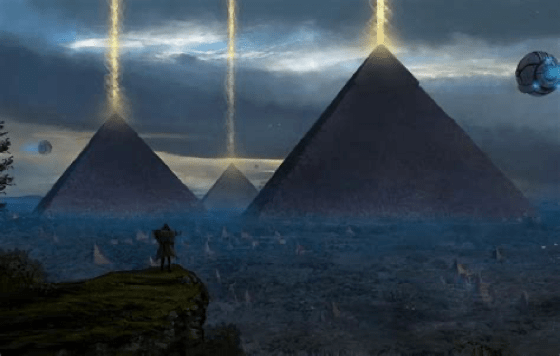
Collins: ‘Could it be that the initiate or priest granted access to the Dead-end Passage for extended rituals involving the use of infrasound was somehow able to link their inner consciousness with the building’s genius loci, the two merging to quite literally maintain and perhaps even guide its future destiny? If correct, then these findings suggest that the notion of spending an extended period of time inside the darkness of the Dead-end Passage, while being bathed in infrasound, might well be crucial to our understanding of the true function not only of the Great Pyramid, but also of its highly  mysterious Subterranean Chamber, which remains an enigma to this day.’

Collins use of genius loci, is appropriate for it means ‘the prevailing character or atmosphere of a place’ and ‘the presiding [or protective] god or spirit of a place.’ It was depicted in religious iconography as a figure holding attributes such as a cornucopia (horn of plenty), patera (shallow ceramic or metal bowl – used in a libation: a ritual pouring of a liquid as an offering to a deity or spirit, or in memory of the dead), or snake

Snakes have been associated with some of the oldest rituals known to humankind, including: fertility; sexual passion; wisdom; knowledge; and the expression of good and evil. And again, the serpent reminds of Quetzalcoatl. 
One of the most comprehensive and influential works explaining the role of the Great Pyramid by some distance is the book, The Giza Power Plant: Technologies of Ancient Egypt, Bear & Company, 1998, by Christopher P Dunn. Dunn’s conclusion on the pyramid consists of it being built by a highly technical society as a holistic energy device, harmonically coupled with the Earth.  

His biography reads: ‘In a brilliant piece of reverse engineering based on twenty years of research, Dunn reveals that the Great Pyramid of Giza was actually a large acoustical device! By its size and dimensions, this crystal edifice created a harmonic resonance with the Earth and converted Earth’s vibrational energies to microwave radiation. The author shows how the pyramid’s numerous chambers and passageways were positioned with the deliberate precision to maximize its acoustical qualities. This may be the same technology discovered by Nikola Tesla and the solution to our own clean energy needs.’

Griffin Gallagher in his article, Stairway to Heaven: How the Pyramids Were Built with Levitation, 2024, provides a summary of Dunn’s theory:

‘To summarize, using sinkholes in the lowest chamber, the Queen’s (middle) chamber underwent a chemical reaction that began to produce hydrogen [from H2O (water)]. Shafts then lead the hydrogen into the Grand Gallery, where granite compression generates electricity.’ According to Ancient Code, the granite stones used in the Pyramid’s passageways are slightly radioactive, a feature that allows the stone to electrify the air.

Gallagher: ‘Conveniently, the outside of the pyramid was built with an electricity-insulating limestone, an electricity-conducting limestone mixture on the inside, and energy-creating chambers of granite on the inside, making the Pyramid naturally conductive. Seems rather intentional, like everything else about the pyramid. 

Twenty-seven large metal resonators inside the Grand Gallery would emit sound waves which would further resonate the pyramid at 440 Hertz. The large granite beams above the Grand Gallery are tuned to an F-sharp chord, which would make the pyramid a colossal musical instrument. Christopher Dunn, mechanical engineer and one of the leading researchers in the power plant theory suggests that “In order for the system to work, the pyramid would need to be mechanically coupled with the Earth and vibrating in sympathy with it… After the initial priming pulse, though, the pyramid would be coupled with the Earth and could draw off its energy”. Essentially, once the pyramid is resonating at the same frequency as the Earth, the energy produced would then be harnessed and transmitted through the conducting alloyed point of the pyramid, creating an unlimited source of clean energy.’

In the absence of a better theory or explanation, Dunn’s ideas have to be considered as logical and credible. That said, is it the sole purpose of the Great Pyramid? No, this writer thinks there is more as Andrew Collins has put forward. 

Encyclopaedia: ‘In an interview [Alan Alford, author of several books on ancient history and mythology] said that “In a nutshell, the Great Pyramid is of an entirely different ilk to the other pyramids in Egypt. Its build quality is totally superior. Its design is radically different. And its dimensions – as a scaled down hemisphere of the Earth – bespeak a scientific rather than a religious purpose. All this suggests that the Great Pyramid was built by an entirely different culture – in my view an earlier, pre-dynastic culture.”

Alford’s conclusion on the function of the Great Pyramid is discussed in his first book, Gods of the New Millennium, 1997. In the vein of Christopher Dunn, his summary:

“The Great Pyramid possessed a tremendously powerful source of energy… The Pyramid’s enigmatic chambers and shafts have a functional explanation. The Queen’s Chamber Niche contained a Water Fuel Cell, the King’s Chamber coffer was used to burn hydrogen gas, the Grand Gallery functioned as a cylinder for compressed hydrogen gas, and the “airshafts” transported hydrogen and oxygen accordingly. The mysterious doorway, discovered by Rudolf Gantenbrink, is a valve leading to a Gas Settlement Chamber.”

Meanwhile, supporting the premise pyramids are a source of energy is the incredible number of them worldwide. There are more than one thousand pyramids in Central America alone; three hundred in China; and over two hundred in Sudan. Whereas Egypt boasts around one hundred and twenty pyramids. 
Two men independently have conducted experiments with pyramid models, with fascinating results. In the 1970s, Jim Onan discovered a study by the University of Wisconsin which claimed the ancient Egyptians used the pyramids as energy producing machines. Subsequently, Onan performed a series of experiments, endeavouring to recreate the energetic properties of the pyramid. Onan built a thirteen foot tall structure and invited a botanist to plant plants inside the pyramid. The plants grew three times faster inside the pyramid than what they would normally grow – refer Addendum I

A man named Ralph who worked maintenance at the Onan’s property, drank spring water every day while working on the Pyramid. Ralph had high blood pressure, though noticed his blood pressure became lower. Word got out and people started coming to Onan’s mysterious Pyramid to drink the miracle water from it; with many people claiming to feel better or to have certain ailments cured. 

Physicist Dr Volodymyr Krashnoholovets from Ukraine, after studying pyramids for a decade – including building a model one hundred and forty-four feet tall outside of Moscow – compiled the following observations: 

  • The immune system of organisms improved (blood leukocyte composition increased). 
  • Improved regeneration of tissue. 
  • Seeds stored in the pyramid for 1-5 days showed a 30-100% increase in yield. 
  • Soon after construction of the Lake Seliger pyramid a marked improvement of the ozone was noted above the area. 
  • Seismic activity near the pyramid research areas is reduced in severity and size. 
  • Violent weather also appears to decrease in the vicinity of the pyramids. 
  • Pyramids constructed in Southern Russia (Bashkiria) appeared to have a positive effect on oil production with oil becoming less viscous by 30% and the yield of the oil wells increased according to tests carried out by the Moscow Academy of Oil and Gas. 
  • A study was done on 5000 prisoners who ingested salt and pepper that had been exposed to the pyramid energy field. The test subjects exhibited a greatly reduced violence rate and overall behavior was much improved. 
  • Standard tissue culture tests showed an increase in survival of cellular tissue after infection by viruses and bacteria. 
  • Radioactive substances show a decreased level of radiation inside the pyramid. 
  • There are reports of spontaneous charging of capacitors. 
  • Physicists observed significant changes in superconductivity temperature thresholds and the properties of semiconducting and carbon nanomaterials. 
  • Water inside the pyramid will remain liquid to minus 40 degrees Celsius but freeze instantly if jostled or bumped in any way. 
At the outset of this study, the questions relating to the Great Pyramid of who, why, when and how were posed in the endeavour to shed light on them. At this point of our investigation it seems we are not much further along in answering them. Though the information thus far has provided some valuable pieces of the puzzle and it is the hope that more will fall into place, so that a clearer composite picture forms. It occurred to this writer that there is a fifth question closely related to why the Great Pyramid was built and that is, what is the Great pyramid?

This is a complex question as the Great Pyramid somewhat resembles a Rubik’s cube, in that it is more than just the sum of its parts; it is more than just a powerful aesthetic object, when viewed as such; though unlike the cube, it appears to have a multipurpose functionality. 

We will turn our attention to who built the pyramid shortly. At this point, there is conflict surrounding the when, as there are convincing arguments for two different overseers – and therefore two separate timeframes – for its construction. 

The probability of two primary functions for the pyramid as discussed, has added to the dilemma. While the Great Pyramid is linked with other pyramids as the principal geodetic marker, this writer is not convinced that there was a sharing of energy or a network between them. Only the Great Pyramid possesses an internal mechanism resembling a functioning machine. Arguably, the Great Pyramid is a stand alone monument; the first of its kind, with all other pyramids built in imitation of it – including the Second, the Third (and the fourth) pyramid of Giza. 

Albeit these two or three were relatively immediate copies and an obvious inheritance of superior technology. Whereas other pyramids scattered throughout Northern Africa and across the globe are palpably later endeavours by less able civilisations, yet seeking to continue the original pyramid tradition.  

There are undoubtedly a number of lesser known people with regard to the authorship of the Great Pyramid. It would be informative to learn from readers any other options not addressed here. Interestingly, of the six principal contenders, five of them are to be found in the Old Testament narrative. All six have been discussed previously, so that the constant reader will be conversant with each one as we proceed. 

Two biblical patriarchs associated with the building of the Great Pyramid – particularly popular amongst Adventist, Evangelical and Fundamentalist Christian circles – are Joseph and Job. Two ante-diluvian candidates include a descendant from the line of Cain – his first son – the evil Enoch; and a personage without maternal or paternal lineage, the enigmatic Melchizedek. The final two personalities are an Egyptian god no less; and rather pointedly, one who lived, died and is to be reborn

Starting chronologically from a biblical perspective, let’s begin with evil Enoch. Not to be confused with righteous Enoch of the posterity of Seth and the ancestor of Noah – yet he invariably is. The initial reaction was to eliminate Enoch because he lived prior to the flood and thereby seemingly ruled himself out of contention. But, it was apparent that as he is a. persistently linked with the Great Pyramid; b. equated with Thoth and Hermes Trismegistus; c. a renowned master mason and d. from a Nephilim bloodline and thus a type of god. Yet could evil Enoch have built a pyramid – during Zep Tepi, the first time – before the flood? 

This opens to questioning whether the Great Pyramid truly was a legacy of the antediluvian age of Atlantis and modelled on an original pyramid preceding it? Additionally, could Enoch have survived the Flood and actually led the orchestration of the Great Pyramid. In a previous article, it was surmised that the Greek god Hermes and the Roman god Mercury were personifications of evil Enoch – refer article: Thoth. A second incarnation if you will of the god Thoth and the third incarnation being Hermes Trismegistus and equating with Nimrod; with the specific identity of Thoth not definitive.

In hindsight, a case could well be made for Enoch actually being Thoth and thus the original or first incarnation. Where this becomes interesting is that Nimrod is the post-flood successor of the legacy precipitated by Enoch – the Brotherhood of the Snake – refer articles: Thoth; and Antartica: Secrets of the Lost Continent of Atlantis

The Jews up to the time of Christ, cherished a tradition that the Great Pyramid was built before the Flood and supported by the – dubious at times – historian, Josephus. While data points to the Great Pyramid’s construction following the global flood, perhaps the lingering belief it was built prior to the deluge is inspired by the forgotten memory that it was firstly, a copy of an earlier pyramid and secondly, built by the same personage. 

Arab histories support the notion that Hermes and Enoch are one and the same person with a ruler called Surid. Surid being credited as the builder of the Giza pyramids. Though not necessarily original to him and likely a legacy suspiciously passed to him by fallen angels. 

Thus according to an Arabian writer – Ibrahim al-Maqrizi – the Great Pyramid was constructed long before the Great Flood by a king with the name of Surid Ibn Salhouk. Alan Alford notes that a popular tradition, drawing on Coptic and Hermetic lore, asserts that the builder of the pyramids had been ‘the first Hermes’ or ‘Hermes of Hermes’, also known later as Hermes Trismegistus. Alford adds that in the thirteenth century, one writer alleged the pyramids had been built by a pre-Adamite race, the inhabitants of an earlier Earth. 

The first theory would equate to the period between circa 450,000 BCE to 200,000 BCE when angels lived and ruled the Earth. Pyramids may well have been built during this epoch as evidenced by megalith remnants on the surface of Mars, though the Great Pyramid would not have been one of them surely.

The second theory would coincide with the advent of Neanderthal man (with animals and insects) on Day Six of creation circa 75,397 BCE to 51,297 BCE – according to an unconventional chronology (Genesis 1:24-31).

These ideas became merged to the extent that Surid was identified as Hermes or Enoch. Surid having learned of the coming Flood in a dream, erected the Pyramids as vaults to protect antediluvian knowledge and artefacts. 

Masoudi speaks of Surid assigning guardians to the pyramids: 

“The guardian of the eastern pyramid was an idol of speckled granite, standing upright, with a weapon like a spear in his hand; a serpent was wreathed round his head, which seized upon and strangled whoever approached, by twisting round his neck, when it again returned to its former position upon the idol… When everything was finished, he caused the Pyramids to be haunted with living spirits; and offered up sacrifices to prevent the intrusion of strangers, and of all persons excepting those who by their conduct were worthy of admission.” 

We have encountered this concept previously, where a sorcerer invokes demonic entities to possess stone monuments. Perhaps gargoyles and grotesques are a throwback to this custom. In a bizarre anti-type of true christians becoming living stones; structures are dedicated to evil – like diabolical temples of stone – and perversely defiled. The Maoi statues on Easter Island a case in point. 

According to a Coptic account, the following passage was inscribed, in Arabic, upon the pyramids: “I, Surid the King, have built these Pyramids, and have finished them in sixty-one years. Let him, who comes after me, and imagines himself a king like me, attempt to destroy them in six hundred. To destroy is easier than to build. I have clothed them with silk: let him try to cover them with mats.”

Evil Enoch was born circa 26,119 BCE. His father Cain built a city named after his first born son in 26,108 BCE – Genesis 4:16-18. It later came to be known as Baalbek, an attempt to rebuild a massive platform after the flood was interrupted and not finished – Article: Monoliths of the Nephilim. Enoch was known as En-men-lu-ana (or Ammilu’anna) in Mesopotamia – Article: Na’amah. Enoch ruled from Bad-Tibira for 3,600 years – Chapter I Noah Antecessor Nulla. The name Enoch as defined by Abarim Publications, from the root hanak means: ‘to inaugurate, train, dedicate.’ Another source offers: ‘initiated’ and ‘disciplined’.

Evil Enoch – artwork by Molly Brown

The Genesis 6 Conspiracy, Gary Wayne, 2014 – emphasis & bold mine:

‘Two of Cain’s descendants were fingered as particularly corrupt in the application of the Sacred Sciences: Enoch and Lamech’ – refer article: Na’amah. ‘In the Anderson Legend, Enoch was considered an expert in science, geometry, and masonry… credited with the invention of sacred symbols and hieroglyphics… as a means to… preserve and transmit the sacred truths… Bar Hebraeus credits Enoch with inventing writing and books and with teaching men the art of building cities… while the Babylonians noted that Enoch was… expert on the stars… [inventing] astrology [with zodiacal precession].’

The Book of Jubilees records that Enoch was ‘a mystery figure conversant in… esoteric and scientific knowledge.’

Wayne: ‘… Enoch… set out to pervert the sacred knowledge, enslaving it to the augmentation of wickedness and mysticism. This hijacking of sacred knowledge and segregating that powerful knowledge into exclusive and secretive Snake Brotherhoods by Enoch… was the naissance to The Genesis 6 Conspiracy. The sullied liberal arts… were earmarked for the elite, while philosophy was reserved for even fewer. 

Consider the list of sinister sacraments Enoch introduced. From astronomy, he created astrology and sun worship. Enoch… [with] his counterparts and descendants became idolaters, worshipping other gods rather than the true God of the universe’ – Article: Belphegor. ‘Enoch implemented pagan rituals, ceremonies and rites with this new, repulsive religion. The knowledge could then only be passed on to initiates, the selected guardians  of the knowledge that was then cloaked in mysteries and secrets. This is why he was called Enoch, for the Hebrew translation means “initiated or consecrated.”

Enoch was… reputed to be Taut (Thoth) in other legends… he was deified by the Egyptians… Thoth was the keeper of the magical arts that made him master of the Gods, the one who revealed all knowledge of the Seven Sacred Sciences and religion to humankind. Thoth… transmitted mystical secrets to his obscure followers, members of a reticent Snake order…’ – refer Article: Monoliths of the Nephilim. ‘Thoth was transformed into a god through wisdom.’ 

The equating of Enoch with Thoth could be pivotal or merely substantiating Enoch’s role as a follower of Thoth. Vital is the aspect of Thoth transforming into a god. Enoch inherited the Nephilim bloodline from his father Cain and so as a first generation Elioud, possessed a spirit component equaling twenty-five percent of his total genetic composition – refer Chapter XXII Alpha & Omega. Even if Thoth and evil Enoch are not the same entity, there is little doubt that Enoch walked in the way of Thoth; embraced his teachings; and likely sought to transform into a powerful spirit being. Cue the Great Pyramid? 

Wayne: ‘When Enoch imagined writing in the form of hieroglyphics, he… set in motion the technology that would fuel all of humankind’s advances’ and in so doing, employed ‘the secretive, sacred symbols, known only to the selected elite, as a vehicle to transmit the sacred truths and Mysteries in a way that was free from discovery by the masses not considered worthy enough to learn about [them]. Enoch then, was the first Master Mason.’ 

Enoch was reputed to have ‘constructed nine hidden [subterranean] vaults [underneath the Great Pyramid] to protect the seven spurious sciences from the impending deluge… one of the two famous Pillars of Lamech [preserved by his children, refer article: Na’amah] was manufactured out of marble [“some form of crystalline rock”] so that it would never burn and the second out of Laterus… so that it would not sink.’ This pillar* had the seven spurious sciences inscribed on it, while the pillar of marble had directions to find the nine vaults. The pillars were originally known as Mazzebah Stones. 

‘… Freemasonry regards the mystical [evil] Enoch as the ecclesiastical [righteous] Enoch. Strange indeed, unless one considers that Freemasonry truly upholds the doctrine that mysticism is in fact the pure religion and the pure branch of heavenly knowledge that descended from Adam through Seth and Noah, coupled with the concept that orthodox Christianity and orthodox Judaism are, in fact, equal partners in the evil religion.’

This is a monumentally profound point, as this is the explanation why the Establishment – led by invisible and powerful Principalities and Potentates – maintains the agenda they relentlessly follow – refer articles: The Establishment: Who are they… What do they want? and Principalities & Potentates: What they want…Who they are. It also reveals how orthodox religions are not untainted, including the Judaeo-Christian offshoot religion, Islam. There is no pure religion, yet there is a pure path or Way – Article: The Seven Churches – A message for the Church of God in the Latter Days.

Wayne: ‘Enoch fuses to mysticism when we consider the second definition of the Hebrew name Enoch. Not only can Enoch be translated as “consecrated,” which applies perfectly to the biblical Enoch, but also it can be translated as “initiated,” which applies perfectly to the Enoch of Freemasonry.’ Wayne likens the intercessory roles of Mercury the Messenger; Hermes, who transmitted the knowledge of the gods concerning their secret names, weaknesses, and abilities to control the gods to humankind; and Thoth, with Enoch, ‘as one who interceded with the gods.’

‘Understand then, that masonry, the Seven Liberal Sciences, the additional illicit heavenly knowledge from the… [Watchers], and mysticism, in which all this has been cleverly encoded, are all part of the same spurious religion of Enoch, Cain, fallen angels, and Nephilim. It is no wonder that [evil] Enoch was held in such high regard by the descendants of the [specious] religion of the postdiluvian epoch. Enoch was truly the spurious patron saint, the founding father of mysticism and Freemasonry. 

The Mythology of the Hebrews by Goldziher, a German ethnologist, clearly identifies Enoch’ with the sun and the solar year. ‘Enoch was a sun worshipper, as testified by his festivals and sacrifices celebrated to the sun during its procession through the zodiac’ – refer articles: The Calendar Conspiracy; and The Seven Churches – A Message for the Church of God in the Latter Days. 

‘Hermes collected 36,525 books (the exact number of days in a solar year: 365.25), kept secretly in the temples…’ Recall, the length of a base side of the pyramid, equals 9,131 Pyramid Inches measured at the mean socket level or 365.24 Pyramid Cubits. This number is the same number as the days in a solar based calendar year – 9,131/25 = 365.24.

Wayne: ‘The worship of the sun was a classic anti-God act by the rebellious Cain lineage and not a violation likely to have been committed by the faithful posterity of Seth and the ecclesiastical Enoch. In addition, the Enoch of mysticism was also known as the third great leader of the Adamites, which could only be possible if Enoch the Evil was [the] son of Cain…’ – Article: 33

Monoliths of the Nephilim: ‘Baalbek… sits 5 degrees east of Giza, and 4 degrees north, suggesting it may have been a major marker on an ancient survey of the Earth, that also revealed an interesting anomaly that was spotted by Alex Whitaker: “This very specific separation of both longitudes and latitudes between the two sites has a secondary significance in that the angle created is 51° 51′ [5+1 = 6 and 6+6 = 66], which is the same angle as that of the exterior faces of the great pyramid at Giza.”
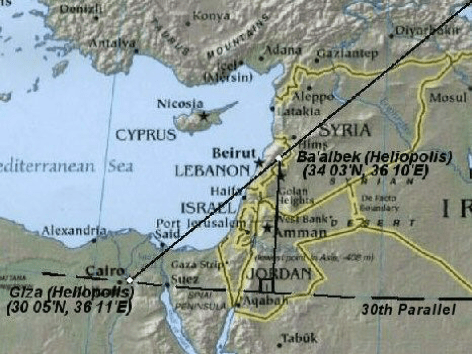
The connection between Giza and Baalbek is noteworthy for it may be a clue to not just a coordinated effort in aligning the two building projects, but to the age of the re-building of Baalbek II after the flood. 

Before we turn to the next suspect in the Great Pyramid’s construction, the persistent idea that associates the pyramids with aliens needs to be addressed. While sceptical readers will summarily disregard out of hand the notion of aliens, the fact of the matter which needs to be underlined is that rebellious angels in the guise of aliens; have a. existed either in the Earth or within the lower dimensions just beyond our perception; and b. have manipulated humanity from as far back as one can imagine. 

An incredible link alluded to earlier – which re-writes pre-history – between Earth and the planet Mars, is the fact that there there are pyramids on Mars. The most well known being the five sided D & M Pyramid – named after V DiPietro and G Molenaar by Richard Hoagland – located near 40.7°N, 9.6°W in the Cydonia region of Mars. 

An excerpt is included below from an enlightening and forthright article by J J Hurtack in 1976, entitled: The search for the meaning of the pyramidal structures on Mars: Do they hold the key to man’s existence? Information contained in the article is included from two works by Hurtack: The Meaning of the Pyramids on Mars and The Book of Knowledge: The Keys of Enoch. The second book title of interest in light of Enoch’s connection with the Great Pyramid. While many scientists, including NASA which took the photographs are eager to dismiss the images as tricks of light; millions of people are not so easily convinced, nor was J J Hurtack – emphasis & bold mine: 

Hurtack: “The historic gap between ancient documents claiming some form of extraterrestrial visitation and our present search for ‘a viable extraterrestrial paradigm’ is now being bridged by the findings of remarkable pyramidal structures on Mars by the Mariner 9 probe. The Mariner 9 spacecraft which reached Mars on November 11, 1971, circled the planet 698 times in 349 days, gathering a wealth of science data that has revised all previous concepts of Mars. For more than half a Martian year, the spacecraft maintained an instrumental surveillance of the planet as the seasons changed beneath the cameras. 

Besides Mariner 9, photographs from 1033 miles up, showing a sinuous rille [a fissure] 2500 miles long indicating that free-flowing water may have existed in Mars geological history, a series of tetrahedron pyramids were seen.”

‘In geometry, a tetrahedron, also known as a triangular pyramid, is a polyhedron composed of four triangular faces, six straight edges, and four vertices. The tetrahedron is the simplest of all the ordinary convex polyhedra.’

“These Martian pyramids appear in sets which are centered at approximately 15.258 latitude and 198.425 longitude, appearing on a somewhat barren plateau. A comparison of two photographs taken from a viewing angle of 6.018 degrees on February 8, 1972 and 37.510 degrees taken on August 7, 1972 shows near perfect tetrahedrons of two denominations observed from two different time directions when the Sun was well above the horizon. These show remarkably exact pyramidal faces disclosing that these pyramids are not part of a natural phenomena.”
“We know from the work of Nobel prize winner Jacques Monad that mother nature does not create surface realities by straight lines or repeatable structures, but here we have in the region of Elysium Quadrangle on Mars sets of pyramids showing exact repeatable patterns with what appears to be the same mathematical distance between the sets. Could these structures whose volume is estimated to be some 700 to 800 times the volume of the Great Pyramid in Egypt be part of an earlier evolutionary story, some other evolutionary mechanisms of life in the local universe? 

It is true that the geological history of Mars shows that half the planet erupted into turmoil as lavas flowed and great volcanoes poked into the Martian sky” – Chapter XXII Alpha & Omega. “Sometime… and probably fairly recent, copious quantities of water flowed on the surface of Mars and eroded immense arroyo beds. Yet, in the midst of a planet which is geologically active with volcanic mountains and calderas larger than any on earth the Mariner 9 B frames MTVS 4205-77, DAS 0779453 and MTVS 4296-24 DAS 12985881, taken in the east central portion of the Elysium Quadrangle, showed a perfect set of tetrahedron pyramidal structures too unique to be a result of natural formations. 

Like Carl Sagan and others, I pointed out that non-artificial pyramidal structures can be explained by one or several of the following mechanisms: 

  1. Wind-faceting of volcanic cones, lava flow ridges and elongated level morphologies by prevailing storm winds. These winds could be either part of the primary circulation pattern of Mars or dust storms of long duration. 
  2. Regolith mantling of erosional remnants of either intersecting resistant dikes, dipping sediments, or other bedrock forms that have pyramidal appearance. 
  3. Probably glacial sculpturing producing horns analogous to alpine glacial horns on earth. 
  4. Rotation of solidified lava blocks in the underling molten lava. The tilting of such solidified blocks could expose corners protruding above the lava field. 

Closer examination, however, by image enhancement has shown details of parallel walls and structures build exactly above the water line as determined by the US Geological Survey for the surface of Mars. In fact, the Soviets have reached the opposite conclusion than the Americans on the question of previous evolutionary life on Mars by reprocessing the NASA data and the more than 54,000 Mariner 9 frames.”
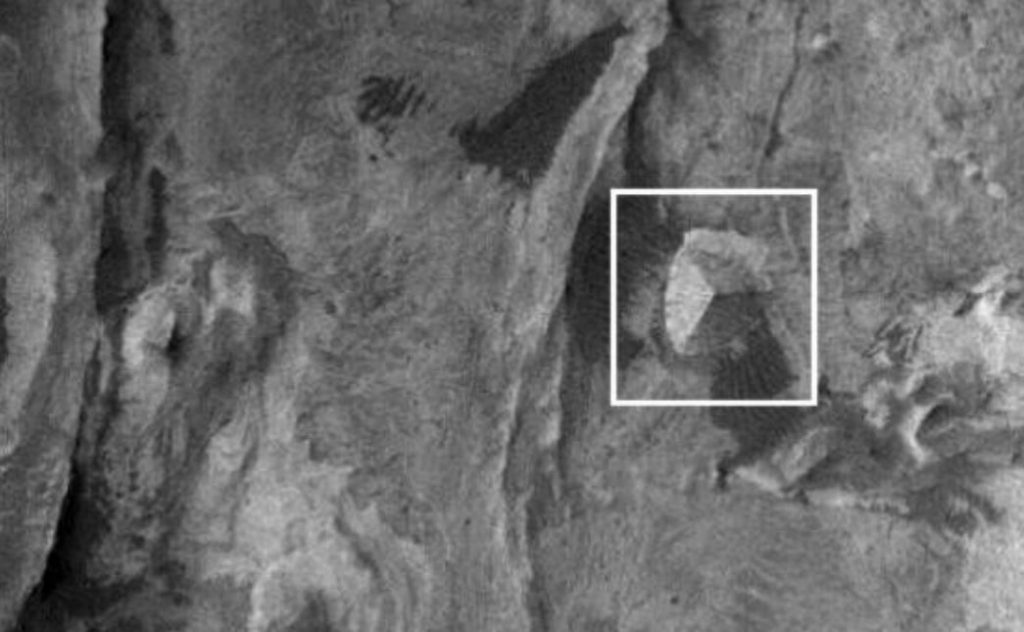
“Additional arguments have been brought forth by traditional geologists who have argued that the unique mountain formations in the Peruvian highlands provide an analog for wind-faceted Martian pyramidal structures. More extensive research, however, reveals non-natural pyramidal sets clustered in Chan-cay, Jequet-epe-que, Viru, etc., in the surrounding Peruvian areas. It has become clear that the many earth mount clusters, so far discovered in Peru, are not to be dismissed as geological anomalies, but with further investigation many have been discovered to be, in reality, astronomical-calendrical complexes built during previous millenniums of time.” 

“Compared to the grid network of pyramidal sets in Mars’ Elysium Quadrangle, the Peruvian area does not give weight to the arguments that the pyramids are a result of regolithic mantling of erosional remnants of either intersecting resistant dikes, dipping sediments, or other bedrock forms.”

‘Regolith is a blanket of unconsolidated, loose, heterogeneous superficial deposits covering solid rock. It includes dust, broken rocks, and other related materials and is present on Earth, the Moon, Mars, some asteroids, and other terrestrial planets and moons’.

“Nor are there any visible faults that would indicate structural controls relating to the grid formation of the four tetrahedron pyramids. A site of multiple pyramidal structures suggest the need to update the arguments of surface morphology. 

Additional attention to striking anomalies of pyramid structures on crater rims is drawn by Mariner 9 cameras to a location near the south pole of Mars (original B frame 1417-160341 changed to 42125) which shows a regular assortment of high plateau grid units, box-like structures of several kilometers each with raised bulwarks possibly used as an experimental area for a biome, or as some type of information gathering grid pattern that was destroyed by cataclysmic change. This site was  nicknamed by NASA as the “Inca City.” A closer examination of aerial pictures shows similarities with Machu Picchu in Peru.

How many professional archaeologists have ever heard of the site of Morro Solar? It is within a mile of Las Palmas, on the outskirts of Lima, and reveals acres of scientific buildings and an elaborate hydraulic system virtually unknown to the scientific world.” [An answer to levitation?]  “How many know about the twenty-five pyramids at Apurle in northwestern Peru? Jack West, a contemporary archaeologist, has recently brought forth pictures showing scores of small pyramids within Peruvian pyramidal shaped mountains. More and more archaeological evidence has shown that what geologists for centuries have perceived as mountains have, in actuality, turned out to be pyramidal artifacts from previous millenniums. 

Pyramid structures which range in dimensions of 3.0-base to 6.0 km mean diameter have been identified in the Elysium Quadrangle of Mars. Geologic processes that could result in such features have not produced a satisfactory scientific explanation for some of the pyramids. Thus we must keep in mind that what may appear to be a natural hill from an aerial view may be a pyramidal artifact. 

Perhaps, instead of preparing for the contemporary scans of the Martian micro-intelligence, we might prepare ourselves for a close examination of pyramidal structures as blueprints for bio-magnetic analogs?

The Martian and Egyptian pyramidal grids may be models preparing us to meet the superior architects in our immediate universe? 

Perhaps, the pyramid is a future artifact?” 

The last sentence delivered from Hurtack is penetratingly insightful.

Notice the face on Cydonia, close to the pentagonal pyramid in the first photograph. What an amazing coincidence it is for this configuration on Mars to be mirrored by the Giza Pyramids and the Sphinx on Earth. As humankind’s origins are linked to Mars prior to Earth, perhaps this shouldn’t be too much of a surprise – Chapter XXII Alpha & Omega

Although pyramids have existed for millennia and across numerous civilisations around the world; the introduction of ‘aliens’ is a fairly recent idea. “I would say it really develops after HG Wells publishes The War of the Worlds in 1897. This starts a run of sci-fi books. There’s one in particular in 1898, Edison’s Conquest of Mars (by American astronomer and writer Garrett P Serviss), which reveals that the Great Pyramid and the Sphinx are Martian constructions. It’s not supposed to be a serious book; it’s fiction. But this idea that someone from outside Earth might have visited Egypt and built the pyramids took hold” – Professor Tyldesley. 

Is fact mimicking fiction or fiction copying fact? Regardless, truth is truly stranger than fiction. 

The second candidate considered as the builder of the Great Pyramid is the Old Testament figure, Melchizedek. 

Charles Piazzi Smyth (1819 – 1900) was Astronomer Royal for Scotland from 1846 to 1888. He is renowned for numerous innovations in astronomy and with his wife, his pryamidological and meteorological studies of the Great Pyramid. Smyth published a book Our Inheritance in the Great Pyramid in 1864, later expanded to The Great Pyramid: Its Secrets and Mysteries Revealed. Smyth claimed the measurements he obtained from the Great Pyramid indicated a unit of length, the pyramid inch – equivalent to 1.001 British inches – that may have been the standard of measurement by the pyramid’s architects. 

Smyth’s theories on pyramid prophecy were integrated into the prophecies of Charles Taze Russell who founded the Bible Student movement – which later adopted the name Jehovah’s Witnesses in 1931. Russell’s successor, Joseph Rutherford denounced pyramidology as unscriptural. Smyth’s proposed dates for the Second Coming in 1882 and subsequent dates between 1892 and 1911, were all failed predictions. 

Smyth corresponded with a pyramid theorist, John Taylor; being heavily influenced by him. Taylor theorised in his 1859 book The Great Pyramid: Why Was It Built? & Who Built It? that the Great Pyramid was planned and the building supervised by the biblical patriarch Noah. Based upon theories by Taylor, Smyth conjectured that the Hyksos were the Hebrew people and that they built the Great Pyramid under the leadership of Melchizedek. 

An observation on Melchizedek is that biblical commentators frustratingly equate him with someone else – such as Shem, Job or Christ – instead of accepting his identity as it is simply stated – refer Chapter XXVII Abraham & Keturah – Benelux & Scandinavia

As the evidence of the Great Pyramid points to a monument stemming from an evil legacy and not intended for wholly benign use, it is improbable that Noah as a righteous man, would have had the inclination or time – Genesis 6:3, 9, Hebrews 11:7. 

Added to this, Noah did not descend very far from where the Ark finally came to rest, so that Noah being anywhere near Egypt is highly unlikely – refer Chapter I Noah Antecessor Nulla

The Hyksos though related to the Hebrews, were not one and the same and a different people who had invaded Egypt after the Israelites hurriedly vacated Goshen – Chapter XXIX Esau: The Thirteenth Tribe

The case for Melchizedek being either Shem or Job is hampered by the fact that these two men have genealogies – or families – supporting their status as physical human beings – Genesis 9:18, Job 1:1-2; 2;9; 42:13. Job’s ancestry is an investigation in itself, unravelled in the article: Job. Whereas Melchizedek did not have a physical father or mother, revealing his spiritual origin – Hebrews 7:3. 

If Melchizedek were Christ in pre-incarnate form then his desire or requirement to build the Great Pyramid would be what? What would be Christ’s motive? His role was to be fulfilled thousands of years later as the mediator between God and mankind through a spiritual enactment. Building a physical building was both a distraction and unnecessary. 

The author of Hebrews – not Paul and probably Apollos (refer articles: The Sabbath Secrecy; and The Pauline Paradox) – explains that Melchizedek was like the Son of God, not that he is the Son of God. As the Son of Man is inadvertently though incorrectly equated with the Archangel Michael, so He is perhaps mistakenly equated with Melchizedek. The similar descriptions are because both are in the same Order, as Priests of the Most High. 

If Melchizedek was not Christ, then would he have built the Great Pyramid? Well for the same reasons as Christ, it is unlikely a spirit being representing the Eternal would interfere in humankind’s history with such a profound physical endeavour – Chapter XXVII Abraham & Keturah – Benelux & Scandinavia. The Pyramid sits squarely – no pun intended – in the face of humanity. It is surely there for our attention, but not from a clear holy source but rather a suspiciously unholy one.  

The next pairing are Joseph and Job. Certain Christians including those from Adventist, Evangelical and Fundamentalist circles teach that Joseph built the Great Pyramid. One commentator states: ‘The late Dr. Herman Hoeh, self-educated “historian” and biblical scholar, wrote an article in the Plain Truth magazine in 1964 titled “Who Built the Great Pyramid?”… He asserts that not only Joseph was involved, but the biblical figure of “Job” was in fact Cheops, the non-Egyptian king who ruled Egypt in the 18th century BCE.’ 

While Hoeh joins a number of seemingly convincing dots, they form an imperfect line because the Great Pyramid clearly antedates Job and Joseph. Also, Herman Hoeh relies on histories of others which are not conclusive in their own conclusions. Though scriptural references may refer to construction projects performed by Job, to then infer they relate specifically to the Great Pyramid is not concrete – no pun intended – proof of his involvement. 

It is considered that the granaries built by Joseph to store up the grains from the seven years of plenty against the succeeding seven years of famine were the Giza Pyramids. But nothing could be more ill adapted for a purpose of that sort. The pyramids were a thousand times more costly than the worth of all the corn, wheat and barley they could hold and any one of them would require more time to construct than the number of years Joseph had at his disposal to prepare for the famine – Chapter XXXIII Manasseh & Ephraim – The Birthright Tribes

Only the Great Pyramid could even remotely have been used in this manner, yet it was built thousands of years before Joseph was born in 1726 BCE. On the other hand, Joseph as the Vizier Imhotep, may well have been involved with the building of Djoser’s step pyramid; the first king of the 3rd Dynasty from 1700 to 1672/71 BCE according to an unconventional chronology – refer Appendix VI: Joseph & Imhotep – One man, different name? 

Joseph lived for 110 years and died in 1616 BCE – Genesis 37:3. This means he was a contemporary of Job, who lived 210 years, from 1656 to 1446 BCE, the year of the Exodus. Even so, it effectively rules Job out as the builder of the Great Pyramid –  refer article: Job

The pairing of Thoth and Nimrod have been extensively researched in previous articles and so those points relating to their link with the Great Pyramid will be the prime focus – Article: Thoth; and Chapter XXI The Incredible Identity, Origin & Destiny of Nimrod

Thoth

A brief background from the article, Thoth:

“Wayne considers the likelihood that thrice greatest indicates three individuals, with which this writer would concur. They are a ‘God’ – or in reality a fallen angelic being – and for the want of a better name, known as Thoth (1); ‘Enoch the Evil’ the son of Cain (2); and Hermes a ‘postdiluvian father/priest of the Mysteries’ (3). As ‘it turns out, Hermes better known as Hermes Trismegistus, was more than just one individual.’ 

Wayne: ‘Thoth… begat an ultra secret Snake Order… and perhaps… was the fallen angel Azazel. The latter two Hermes were fused into the first Hermes, forming the legend known as Trismegistus Hermes in later ages, where Hermes Trismegistus became mythologized as a spiritual guide, or prophet… Hermes… was so named “thrice Hermes,” honoring his accomplishments of being first among men to attain all knowledge and secrets of the gods that he inscribed onto stone tablets with sacred hieroglyphs, which he concealed for future generations.’ 

Wayne offers that the first postdiluvian Hermes known as Hermarynes was of Nephilim origin who had discovered one of two pillars left by Enoch’s descendants and after translating the spurious branch of Masonry, then taught the Corrupted Sciences to the civilisation at Babel. Sounds remarkably like Nimrod or one in league with him – Chapter XXI The Incredible Identity, Origin & Destiny of Nimrod.” 

Thoth: “In summary, a case is tentatively made for the third incarnation originating in the post-flood epoch – during the height of Sumerian culture and wending its way to Egyptian lore – and now known as Hermes Trismegistus, as none other than the biblical Nimrod. The second incarnation during the preceding antediluvian age; whom was also descended from Nephilim ancestry, known to us as Hermes or Mercury was the biblical evil Enoch.” 

“The air of enigma surrounding the original Thoth, may mean his true name is forever shrouded in mystery. While there is reason to believe his identity was not one of the two leaders of the Grigori, Azazel, he perhaps remains the front runner. Thoth was very likely one of the fallen Watchers and – apart from the possible candidate Quetzalcoatl, who has remarkable similarity with Azazel under a different name perhaps – does closely equate with the 13th leader out of twenty: Penemue

Penemue’s name means ‘the inside’… Another source states, ‘Penemue is the angel’s equivalent of Prometheus [a Titan god of fire]. According to Enoch, he [or she] is the angel that taught humankind how to read and write – not because [they] loved us, but because reading leads to knowledge, knowledge leads to thinking, thinking leads to sin’ – Chapter XXII Alpha & Omega.” 

It is undeniable that the biblical figures of Nimrod and the evil Enoch, are strongly connected with the legendary identities of Hermes Trismegistus and Mercury, respectively. That these are incarnations of an original god, Thoth who may or may not be Azazel, though a parallel with Quetzalcoatl remains striking. This added to the fact that Enoch and Thoth are closely linked with the Great Pyramid and Quetzalcoatl by extension with American pyramids, is too much of a coincidence to ignore. 

The Egyptian god Thoth portrayed with the head of an Ibis bird is synonymous with wisdom, writing and teaching. Quetzalcoatl likewise is described in the same manner.

Both gods exhibit birdlike qualities and are colourful, with turquoise or teal (emerald) a shared colour. 

Each are associated with a Pyramid: the Great Pyramid and the Pyramid of Quetzalcoatl. Notice above the pyramid in the lower left hand corner. 

As an aside, the imagery of the long beak of the Ibis bird has been curiously held onto today in not just the artwork of the Hermit in the Tarot – refer article: Thoth.

The sinister Venetian long-nosed mask is popular at masquerade balls and exclusive ceremonies and perhaps derives its inspiration from the mask the plague doctors wore during the Black Death and are replicated in ominous costumes today.

While Thoth is closely linked with the Moon, he – through his association with Hermes and Hermes Trismegistus – also shares with Quetzalcoatl an attachment to the planet, symbol and element, of Mercury. So it is is enlightening to learn the following. 

Ancient Wisdom – emphasis & bold mine: ‘The meticulous measuring of the Giza complex by Petrie, Smyth and others, has illuminated the extent of the geometry at Giza, but there is a simple geometry behind the Giza layout which returns us again and again to 30 [degrees] which has in fact been associated with an 8×8 grid before as noted by John Michel, who mentions ‘Levi’s magic squares’ of which there was one for each planet, and that each of the seven wonders of the ancient world represented a planet, and that Giza represented Mercury ‘the messenger’, whose square was an 8×8. While this may be a coincidence, it seems worth mentioning.’

Recall, the Great Pyramid uniquely has not four but eight sides… and, there are 88 constellations. Of note as Christ is the chief cornerstone, is that his Hebrew name Yeshua – Joshua in English – adds up in the Greek form, Ἰησοῦς, as 10+8+200+70+400+200 = 888. An angel number equated with balance. 

Visible from the air, the Great pyramid with its concave sides is distinctly different from the Second Pyramid.

Quote from article, Thoth, where one commentator stated: “Before Atlantis, Thoth came from elsewhere in the Universe… [confirming] his otherworldly origins… He lived many lives on Arcturus in a higher dimension. Thoth is a Cariana birdlike extraterrestrial who came to earth to aid in the creation of humanity. He is a creator god of cosmic origins. He may also have been Lyran before his time in Arcturus. And he’s believed to be one of the Ascended Masters who are now aiding humanity in ascension.”

This quote is interesting for a number of reasons. Arcturus is the brightest star in the Bootes Constellation and Bootes is the Herdsman. Herdsman herd cattle or sheep, like a shepherd. Herman Hoeh: ‘Herodotus, the famous Greek historian of the 5th century before Christ, states that the builders of the Great Pyramid were SHEPHERDS (“Euterpe” § 128).’ 

There is now a link between the prominent stars Arcturus and Polaris and perhaps with the former pole star, Vega which is the brightest star in the Lyra Constellation. If Thoth did originate from Lyra, then this may have been before his fall, for Bootes is adjacent to the Draco Constellation. If Thoth came originally from Lyra, this ties in with the Great Pyramid’s proposed construction during the period when Vega was the North pole Star. 

Thoth: “The Emerald Tablets allegedly comprise ten tablets, and are referred to as keys, such as the Key of Wisdom; the Key of Magic; the Key of Mysteries; the Key of Time; and the Keys of Life and Death. It is claimed by Doreal, the Supreme Voice of the Brotherhood that the ‘writer is Thoth, an Atlantean Priest-King, who founded a colony in ancient Egypt after the sinking of the mother country. He was the builder of the Great Pyramid of Giza… In it he incorporated his knowledge of the ancient wisdom and also securely secreted records and instruments of ancient Atlantis.” 

“Built I the Great Pyramid, patterned after the pyramid of earth force, burning eternally so that it, too, might remain through the ages. In it, I built my knowledge of “Magic-Science” so that it might be here when again I return from Amenti [Hades, the Underworld]. Aye, while I sleep in the Halls of Amenti, my Soul roaming free will incarnate, [dwelling] among men in this form or another” – Emerald tablet 1.

This is a recurrent and persistent theme regarding the origin of the Great Pyramid. All roads seem to lead to the mysterious Thoth. Is that his true name; or does it hide a shocking truth pertaining to his identity. Could Thoth be the mighty watcher angel, Azazel? – Chapter XXI The Incredible Identity, Origin & Destiny of Nimrod. 

The very entity described in the Book of Enoch; stated directly in the Old Testament; and indirectly – under different names – in the New Testament. Who figures prominently in future biblical prophecy at the end of this age. Azazel is prophesied to return, after being released from a place of restraint. Does he reclaim the Great Pyramid, because it is his and belongs to him? 

Quoting again from the article on Thoth, a very enlightening passage which discusses the fact the pyramid resonates or hums. This aspect of sound and its role in the creation is a subject we will investigate further as we continue. 

Thoth: ‘Returning to the idea that Thoth was the builder of the Great Pyramid, there is a remarkable article by Igor Oakwood, entitled, The Sanctuary Of Thoth May Be The Original ‘Sanctuary of Thought’, 2020. It is an extract from his book, Hallu-Cygns – Language of Creation. We have previously discussed elements of the creation coming into being via the spoken word, as intimated in the Book of John 1:1-4 – refer Chapter I Noah Antecessor Nulla. 

Igor Oakwood – emphasis & bold mine: ‘… the Sanctuary of Thoth is a gateway to understanding… about the incredible feats of the ancient Egyptians… it confirms… that the ancient gods were originally mathematical principles that were used by the megalith builders to induce hyperdimensional communication and for the building of “stargates” – Article: Monoliths of the Nephilim. ‘The basic metaphor of these principles is found in the Heliopolitan Ennead or the Nine Creator Gods… which, when synthesized in a sacred geometrical structure, open up the 1/10th or 9-11 Gate of Consciousness. 

Although there seems to be no direct indication in the etymology of the word “thought” that connects it to the ancient Egyptian name Thoth, the meanings of both words are so related that it could not be a coincidence… it would imply that the creators of the Egyptian language and thought are somehow related to modern-day English language and thought. Is it… just coincidental to believe that the name Thoth is the root of the word “thought”? 

… the Sanctuary of Thoth becomes the Sanctuary of Thought. Therefore… the secret chambers must be a metaphor for the hidden chambers or glands in the brain’ – Article: 33; and Chapter XXII Alpha & Omega

‘The number 110 is a key length in the sacred geometry of the Great Pyramid (110 cubits is a fourth of its base length) and in many other megalithic structures like the Hypogeum in Malta… [as] the whole Hypogeum temple is designed to resonate at a frequency of 110 Hertz. 

In 2008, a report was published by Dr Ian Cook of UCLA in which he describes his… experiment in which he monitored regional brain activity in a number of healthy volunteers through exposure to different resonance frequencies… findings indicated that, at 110 Hz, the patterns of activity over the prefrontal cortex abruptly shifted, resulting in a relative deactivation of the language center and a temporary shifting from left to right-sided dominance, related to emotional processing. This shift did not occur at other frequencies. This means that the Hypogeum’s oracle chamber was constructed in such a way as to induce mystical experiences and hyperdimensional consciousness’ – refer article: Stonehenge.

‘We know that the most important temple in Heliopolis was the Temple of Ra-Atum or the Temple of the Phoenix, in which the sacred knowledge… was stored (in its architecture and cosmic alignments). Therefore, the temple functioned as an “inventory of knowledge.” In the center of this temple stood a granite (firestone) obelisk upon which rested an even more sacred object known as the Benben Stone. The Benben Stone is a mysterious conical stone (resembling a pinecone or a honeycomb) that symbolized the egg of the cosmic bird of creation or the Phoenix. The Phoenix was usually depicted as a grey heron, a migratory bird just like the ibis or the swan

It was believed that the first coming of the Phoenix marked the birth of a new age and the Benben Stone was its egg or divine seed… the conical shape of the Benben Stone has been linked more than once with the conical shape of the pineal gland (just like the pine cone statue in the Vatican!), which is considered to be the “Seed of Thought,” or the divine seed of reality’ – refer articles: 33; and Monoliths of the Nephilim. ‘The conical shape of the Benben Stone was later replaced by the pyramid capstone.’

The Benben Stone from the Black Pyramid of Amenemhat III, sixth king of the 12th Dynasty and adoptive father of Moses – refer Appendix VII: Moses, the Exodus & the Red Sea Crossing – Fabrication or Fact? 

Oakwood: ‘And the “Inventory” was replaced by the Great Pyramid itself… the Sanctuary of Thoth is a metaphor for the Sanctuary of Thought (Brain); the Seed of Thoth (Benben Stone) is a metaphor for the Seed of Thought (the pineal gland); and the Phoenix is a metaphor for the bird of the New Age. 

When I was in Egypt a few years ago, I visited Memphis, the ancient capital of Lower Egypt, where one can admire the tall statues of Pharaoh Ramesses II. Interestingly, in all these statues we see Ramesses holding two cylinder-like objects. Valery Uvarov, in his book “Pyramids,” says this about these cylinders: 

“they (the Pharaohs) are all clasping cylinder-like objects in their hands. Their roots go back into the depths of time… Those cylinders, with which the Pharaohs never parted throughout their lives, were harmonisers of the two basic flows of energy which the Ancient Egyptians called BA and KA, corresponding to Yin and Yang in the Oriental tradition. For the Ancient Egyptians BA and KA were the two component elements of the human entity, the two sources of vital energy… The diameter of the Wands is designed to be tuned to the Earth’s breathing rate of 54 minutes. Each planet has its own breathing tempo, its distinctive frequency which determines the bio-energy rhythms of all that exists on its surface. This tempo depends on the planet’s orbit and its period of revolution around its sun.”

‘Today, we know that the “breathing rate” of the earth is the frequency of seismic waves. On earth, the lowest possible seismic wave is indeed 54 minutes. In other words, 5.4 or 54 [5+4=9] is a key number that dictates the energy impulse to life on the earth. Whereas 54 might be the frequency of Mother Earth, we also know that Father Sky had its own frequencies, which are called the Schumann Resonances (SR). SR’s are global electromagnetic resonances, generated and excited by lightning discharges in the atmospheric cavity formed by the earth’s surface and the ionosphere. At every second, some 100 lightning discharges touch the surface of the earth, which submerge the planet in a constant hum’ – refer Taos Hum – article: The Top Ten Unexplained Mysteries of all Time.

‘The fundamental Schumann Resonance is 7.83 [7+8+3=18 / 1+8=9] hertz. Interestingly, when we divide 7.83 hertz by 5.4, we get 1.45 hertz, a frequency which is known today as the psychoacoustic baseline frequency. This frequency induces the tri-thalamic synchronization of the hypothalamus, pineal and pituitary gland with the human heartbeat

Knowing this, the Great Pyramid of Giza might have been built as an instrument to balance the fundamental Schumann frequency of the earth’s atmosphere (7.83 hertz) and the fundamental frequency of the earth itself (5.4 hertz) with the third basic tri-thalamic human heartbeat frequency of 1.45 hertz. This is because the base length of the Great Pyramid is 756 [7+5+6=18 / 1+8=9] feet, which divided by 54 yields 14. We know that 756 divided 14 times by the golden ratio phi yields 1.45 hertz. This means that 1.45 hertz functions as a harmonizing frequency between the cosmic Yin (earth/seismic wave/Ba) and Yang (heaven/Schumann resonance/Ka) energies. 

Could this sophisticated “Mer-Ka-Ba Science of Thought” be behind the famous story of Osiris who was cut into 14 pieces by his brother Seth, only to be reassembled by his consort Isis? If this is true, then I suggest that Osiris (Yang/Ka) embodied either the number 756 or the Schumann resonance of 7.83 hertz. Therefore, Seth was the golden ration phi; Isis (Yin/Ba) would have been the number 54; and Horus, as the sacred child born from their union, would then become the balancing frequency of 1.45 hertz. 

Apparently, the Maltese megalith builders had a complete understanding of how certain frequencies deactivate the language center in the human brain. And they knew perfectly well how to build sanctuaries resonating with these consciousness-altering frequencies. But why would these people have been interested in deactivating the language center in the brain?’ – Chapter XXI The Incredible Identity, Origin & Destiny of Nimrod. 

‘Reality as we know it is made up of atoms and molecules that form increasingly complex and self-organizing structures which we call living beings. The relationships, geometries and resonances between the components of living beings are the “letters” that make up the language or “the word” of creation and are therefore “sacred.” As a result, we can say that language functions as the universal software program that programs reality. Since the universe is a perpetual self-sustaining system, its language is the key to oneness and immortality

Human language, on the other hand, is made of another kind of words. The letters that make up our words are phonetic symbols with which we can transmit very complex information but with which we can also influence our own thoughts and beliefs. It is our thoughts and beliefs that define what we call “reality” or “non-reality” or what is manifest or not manifest. As a result, we can say that human language functions as a software program that programs our reality. In short, we can say that language and belief are inextricably intertwined like the two strands of the DNA molecule, the building block of life itself. 

The problem is that because of their merely phonetic function, the letters and sounds of human languages have no connection with any geometric or resonant principle in the creational language. Although the Bible tells us that “In the Beginning was the Word,” we seem to have forgotten the deepest sense of the word “Word.” The fact that there are hundreds of human languages does not make a positive contribution to a united humanity nor to our self-identification as an intrinsic part of the planetary ecological system. 

Since our megalithic ancestors apparently had deep knowledge of the psychoacoustic and infrasound frequencies of the universe, which they applied in their sacred architecture or “Sanctuaries of Thought,” we can assume that they considered these frequencies as the language of creation. In order to (re)connect with the source language of sacred geometry and resonance it seems logical that they switch off our “unnatural” language system in the brain. We can now easily imagine how our ancestors, during rituals inside these “thought” sanctuaries, resonated with the source, speaking the same language of the micro cosmos and the macro cosmos.’ 

Oakwood has hit upon a profound yet ignored event which was recorded in the scriptures. Genesis 11:6-8, ESV: ‘And the Lord said, “Behold, they are one people, and they have all one language, and this is only the beginning of what they will do. And nothing that they propose to do will now be impossible for them. Come, let us go down there and confuse their language, so that they may not understand one another’s speech.” So the Lord dispersed them from there over the face of all the earth, and they left off building…’

Humanity once possessed a telepathic ability which was switched off either at this time or earlier. Regardless, the incident at the Tower at Babel was the end of a universal way of communicating and the beginning of the approximate 7,151 languages we have in the world today – refer Chapter XXI The Incredible Identity, Origin & Destiny of Nimrod. 

Oakwood: ‘In a healthy system, every component, from the smallest atom to the biggest star system, “speaks the same language.” It is therefore right to say that it is the deviation of human language from the primordial language of creation that causes the deviation of humanity from nature. This leads us to the most obvious reason why information about the original blueprint of the Sanctuary of Thought and its original purpose would be concealed because it hides the power of thought control

The solution to the concealment of this knowledge is the return to the source. This source is… the language of sacred geometry and resonance. Logically, when we “speak” this source language we enter into resonance with the whole of creation. This means that we gain a much deeper influence over reality at the moment we enter into resonance with the universe. This resonance functions as a hyper-dimensional portal that connects human subjective consciousness with the very core of objective material reality. 

However, this also means that everything we think of when we are in resonance inside the portal, will be manifested in material reality. Therefore, keeping our thoughts sacred is so important that we can understand why a “Sanctuary of Thought” was built. Was Thoth one of these high priests who inherited the secrets of “Sacred Thought”? And who decided to save this precious knowledge in an “Inventory or Sanctuary of Thought”?

Were the pyramid complexes of Egypt, situated at the exact center of the planet’s landmass, used as a thought-control tower for the whole planet?

Is it still functioning? If not, how could we activate it?’

Igor Oakwood’s theory is original and unique and to the mind of this writer, resonates – no pun intended – with a compelling element of truth. His final two sentences cause serious pause for thought – again no pun intended.

The likening of the Phoenix with the swan recalls the Cygnus Constellation and Andrew Collin’s theory that it was an entry or portal from our dimensions into those beyond. We shall explore the Benben stone as a ‘divine’ seed or egg and a metaphor for thought as represented by the pineal gland. The Great Pyramid as a sanctuary of thought, as in a brain is interesting, in light of the pyramidion (Benben) being in essence the mind within or in this case, above – Article: DEATH: A Dead End or a New Beginning?

The Stairway to Heaven, Zecharia Sitchin, 1980:

‘The Giza pyramids are nowadays also minus their apex or capstones, which were shaped as pyramidions and may have been either made of metal or covered with a shiny metal – as the similar pyramidion-shaped tips of obelisks were. Who, when and why they were removed from their great heights, no one knows. It is known however that in later times these apex stones, resembling the Ben-Ben at Heliopolis, were made of special granite and bore appropriate inscriptions. 

The one from the pyramid of Amen-em-khet at Dahshur, which was found buried some distance away from the pyramid [previous photo above], bore the emblem of the Winged Globe and the inscription… The face of king Amen-em-khet is opened, That he may behold the Lord of the Mountain of Light, When he sails across the sky.’
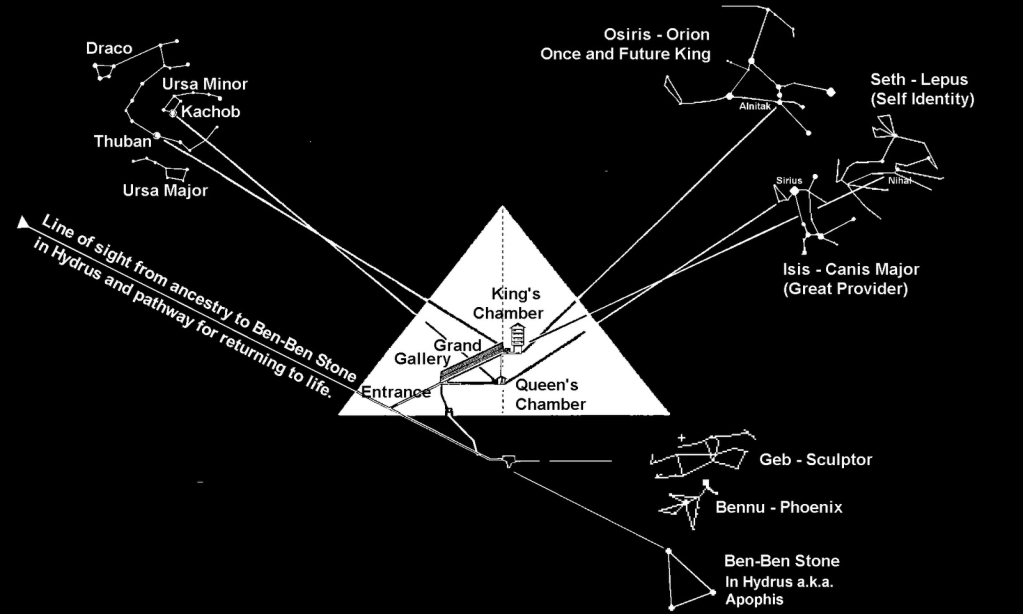
According to one source, the average height for land above sea level for the Earth is 5449 inches. This is the exact height of the pyramid, which equates to 454.0833 feet (or 138.4046 metres). The height to the missing apex is 5812.98 PI (5768.28 inches) or 480.69 feet – 146.5143 metres. The height of the pyramid without the capstone is 5496 PI. The difference representing the capstone being 26.6067 feet.

The Great Pyramid’s Missing Capstone, Luke Piwalker, 2020: 

‘Building on Carl Munck’s’ – refer The Code, 1997 by Carl Munck – ‘model of the Great Pyramid, after rounding up… on the Great Pyramid’s present height without the missing apex… the present height defines the [probable] height of the capstone’s platform at 452.3813491 ft… Munck… referred to 4523.893421 as a “Holy of Holies”, and there are a lot of things that are attractive about the proposal that the Great Pyramid embodied this “Holy” number that way, including in Royal Cubits this is 1.622311470^2 x 10^n, a very useful way to incorporate the quintessential number 1.622311470 into the Great Pyramid. 

This automatically defines the remainder. The equation is Height with missing apex section 480.3471728 ft (Munck) – 452.3893421 = 27.95783074, which was subsequently identified as 27.94546572 ft. Emphatically, I am not suggesting that the Great Pyramid was once topped with a single stone nearly 28 feet high, nor do I wish to try to guess how much such [a] massive artifact would weigh[…] or the difficulties to be encountered in getting it to the top of the pyramid. 

However, the mathematics involved imply that the Great Pyramid’s current height after presumably a plundering at the top of blocks of a coveted construction material ended when this prized material (or materials) ran out, so that the height to where this material began is where it now remains – thus a height of Munck’s “Holy” number of 452.389421. 

Thus the Great Pyramid’s capstone may have been a composite of different layers that may have afforded it with additional significant height values, achieving the same purpose as having a pyramidion whose slope angle doesn’t match the slope angle of its pyramid… Thus the Great Pyramid’s actual capstone, however many pieces comprised it, would probably have had different proportions from the projected proportions of the missing section.”

Agreed, as probably only the tip of the pyramidion would have been made of solid gold and then a certain amount of the courses beneath either gold leaf or painted a gold colour. The total number of courses of stones on the Great Pyramid is two hundred and one, about forty storeys. 

The capstone of the Great Pyramid in essence was a fifth corner stone, above the four  below constituting the base. It was the preeminent corner stone, made of gold and as such, valuable. Not surprising it was taken and that it is missing. Though how was it removed and where is it?

Isaiah 28:16 

English Standard Version 

‘… therefore thus says the Lord God, “Behold, I am the one who has laid as a foundation in Zion, a stone, a tested stone, a precious cornerstone, of a sure foundation: ‘Whoever believes will not be in haste.’

In other words, one does not need to move quickly in panic. Certainly, patience was required to build the Great Pyramid and was not completed in haste. In like manner, Christ is the ‘sure foundation’, the ‘tested stone’ and ‘precious cornerstone.’ 

Christopher Eames writes regarding the first Pastor General of the former Worldwide Church of God, Herbert Armstrong – refer article: The Seven Churches – A Message for the Church of God in the Latter Days. 

‘Mr. Armstrong (who himself visited the pyramid a number of times) expounded on the… scripture, Job 38:7, in one of his early radio broadcasts on the subject of Job – particularly as it relates to the Great Pyramid’s capstone (or, pyramidion).’

Armstrong: “One point about [pyramids] that is most interesting, is this: It’s the only type of building, that I know of, the only building that I’ve ever heard of on Earth, where the cornerstone is the top stone, and is laid last.” He continued: “[It] signified the very completion of the building. The cornerstone there is on top. And it is a corner – you know, you have the four corners of the bottom, but you have the corner at the top, too, at the apex, where they all meet.” 

“And all the sons of God shouted for joy” as the final corner stone was laid on this Earth. Now that’s all figurative language, of course. There isn’t any actual cornerstone on the Earth. He’s comparing it to a building. It’s being compared to a building on this Earth, where the cornerstone is the final capstone, the completing stone that is laid last… And, strangely enough, if there is a symbolism to the Great Pyramid, that top cornerstone seems to be referred to in the Bible as the “stone which the builders rejected, that has become the head of the corner… which means the head cornerstone, the top cornerstone” (quoting Psalm 118:22). 

As concluded by Herbert Armstrong: “[There] are a great many things in the Great Pyramid that are just beyond belief, almost – it was so perfectly designed. And a great many people believe that the Great Pyramid was divinely inspired. At least, you see things in it that certainly make you wonder. And I will say this: I’m not going to discount the possibility at all.” 

Eames: ‘There are… numerous unusual statements throughout the book of Job that various translations make attempts at interpreting. Among them are statements that relate to some kind of worry about removable landmarks, preservation in death and the permanency of “the rock.” What could this be referring to? 

Job 5:23-24 contain an assurance from one of Job’s friends that he would be “in league with the stones of the field …. And thou shalt know that thy tabernacle shall be in peace” (KJV). Yet Job 14:18-19 contain Job’s fear that “surely the mountain falling crumbleth away, And the rock is removed out of his place; The waters wear the stones.” Also, “[there] are [those] that remove the landmarks” (Job 24:2). One of Job’s friends stated: “Thou tearest thyself in thine anger, Shall the earth be forsaken for thee? Or shall the rock be removed out of its place?” (Job 18:4, KJV). Job replied: “Oh that my words were now written… That with an iron pen and lead they were graven in the rock for ever!” (Job 19:23-24). 

Could this “rock” be a veiled reference to the Great Pyramid? Certainly, with the Great Pyramid of Giza, we have one of history’s most enduring, immovable, monumental landmarks – a record in stone, “for ever.” 

‘A key understanding of astronomy also explains how the Great Pyramid was so perfectly, almost inexplicably aligned to True North (not magnetic north, which regularly changes position). The book of Job contains several references to the North, including the following peculiar statement:

“Out of the north he comes in golden splendor; God comes in awesome majesty” (Job 37:22; NIV). Alternatively, the New Living Translation puts part of the verse this way: “So also, golden splendor comes from the mountain of God.” (On this point, note that the Great Pyramid’s missing pyramidion is often considered to have been made of gold/electrum.)’

The North Mountain by Robertino Solàrion, elaborates on the pivotal nature of the Pole Star in the sky and in the mind of this writer, underlines the high probability that it is realised in the Great Pyramid on Earth below – refer Addendum V. For as the Great Pyramid is likened to a ‘rock’ and ‘mountain’, so too is the North Pole Star – emphasis & bold mine. 

‘Occult science proves that the founders of all root races have been connected with the North Pole. Gods, religions, beliefs, myths, have all come from there. No wonder we find it alluded to as the “Cradle of Man,” for when the Pole star energizes the earth’s axis humanity receives an upward urge or spiritual rebirth

The ancient topography of the nature of the Arctic and Antarctic regions of which the ancients had clear understanding is unquestionably accurate. “If we hold at present only to the astronomical and geographical significance it may be found that the ancients knew the topography and nature of the Arctic and Antarctic regions better than any of our modern astronomers” – The Secret Doctrine, H P Blavatsky. 

‘Early astronomers divided the heavens into three great divisions’ – refer article: Heaven & Hell. ‘The point called the Mountain, denominated the Highest, was the middle of the first division which always seemed to remain above the horizon, and stationary’ – Ezekiel 28:16. ‘It was made the seat of the Empire, whose monarch, from his throne, could behold the whole world and every nation night or day. This was the Great Judgment Seat, from which even unto this day, at certain periods in world changes, proceeds the powerful Justice Ray of a Balancing Manifestation.’ 

“Look at you! You have fallen from heaven! You shine like the bright morning star! You have won against many nations, but now you have come down very low! You said to yourself, “I will go up into heaven. I will put my throne above the stars of God. I will rule as king on the mountain in the far north, where the gods of the nations meet together” – Isaiah 14:12-13, EEB. 

‘Henry Melville in “Veritas” very fittingly speaks of the “Pole Star” as the rock of ages. “‘Trust ye in the Lord forever; for the Lord Jehovah is the rock of ages.’ Isaiah xxiv, 4. This Polar star is the rock, or Mount Olympus of the Latins, which was so high that no bird could fly to the top, nor were clouds ever seen on its summit. This Polar Star is the Mount Meru of the Buddhists, and the Mount Zion of the Hebrews. ‘They that trust in the Lord shall be as Mount Zion, which cannot be removed, but abideth forever.’ Psalm cxxv, 1. David says, ‘Lead me to the rock that is higher than I.’ Psalm lxi, 1. 

From our world nothing can appear higher than the Polar star which is the pivot or point of axis on which the earth performs its diurnal and annular motion. David exclaims, ‘thus saith the Lord, the heaven is my throne, and the earth is my footstool; where is the house that ye build unto me? And where is the place of my rest!’ Isaiah lxvi, 1.

Cephas, or Cepheus, means rock. Cepheus is seated in the highest heaven, and he has Mount Olympus, or the Pole Star, for his footstool.” Celestial Astrology and Astronomy are spoken of as lost sciences, and we are told that until the position of the dark planets is known, astrology cannot become an exact science, yet it can and will again be raised to its former sublimity. 

The North Pole of the heavens was represented as the Mountain, the South Pole as the Pit. The Mountain and the Pit explain the meaning of Helion and Acheron, which, according to S. A. Mackey, were made use of in astronomical calculations by the ancients. Helion or the Sun, was the Sun in his highest, Acheron was usually translated as Hell, or the last condition or state of the Sun in its disappearance among the Southern constellations. Could we look down from the North Pole to the South Pole into the great abyss, the point of our vision might lead us very quickly to the discerning of a Christian Heaven and Hell, for many an absurd misinterpretation has been generated concerning these primordial parents, the Poles.’

The connection between the North Pole Star – the peg, or nail – and ensuing destruction on the Earth is outlined in the following startling discussion, entitled: The Nail of the North.

From Hamlet’s Mill, By Giorgio de Santillana & Hertha von Dechend, 1969, with comments from Robertino Solàrion – emphasis & bold mine: 

‘As concerns the removing of the Pole Star, the most drastic version is told by the Lapps: 

“When Arcturus (alpha Boötis, supposed to be an archer, Ursa Major being his bow) shoots down the North Nail [Polaris] with his arrow on the last day, the heaven will fall, crushing the earth and setting fire to everything.” 

‘In that day the heavens will disappear in a terrific tearing blast, the very elements will disintegrate in heat and the earth and all that is in it will be burnt up to nothing’ – 2 Peter 3:10, Phillips.

The relationship stated between the gigantic star Arcturus and Polaris is a curious one.  Particularly as the Herdsman chases the Bear. Imagine the surprise when this writer found the following comment on The National Radio Astronomy Observatory website. 

Unusual Events Involving Arcturus or Polaris? | February 12, 2013 

Question: Has anyone noticed any unusual “observations” from either the star Arcturus and/or the star Polaris. Thank You – Michael 

Answer: No, not to my knowledge. If you have noted anything unusual in the direction of these two stars then I would be happy to try to explain your observations. I should note, though, that it is often best to apply the principle of “Occam’s Razor” to unusual observations that one might make of the night sky. Start with the simplest explanation, then if those fail proceed to add complexity to your analysis – Jeff Mangum

This writer wonders what prompted Michael to ask his unusual question?

‘Other legends prefer to deal with the fate of circumpolar stars, the result being the same.’ 

‘All the stars in the sky will dissolve. The sky will roll up like a scroll, and its stars will all wither as leaves wither on the vine…’ – Isaiah 34:4, CSB.

“The Siberian Kirghis call the three stars of the Little Bear nearest the Pole Star, which form an arch, a “rope” to which the two larger stars of the same constellation, the two horses, are fastened. One of the horses is white, the other bluish-grey. The seven stars of the Great Bear they call the seven watchmen, whose duty it is to guard the horses from the lurking wolf. When once the wolf succeeds in killing the horses, the end of the world will come. In other tales the stars of the Great Bear are “seven wolves” who pursue those horses. Just before the end of the world they will succeed in catching them. Some even fancy that the Great Bear is also tied to the Pole Star. When once all the bonds are broken, there will be a great disturbance in the sky” – refer Addendum III

‘There will be signs in the sun, moon and stars. The nations of the earth… will be puzzled… Terror will make people faint. They will be worried about what is happening in the world. The sun, moon and stars will be shaken from their places’ – Luke 21:25-26, NIRV.

Robertino Solàrion: ‘In the context of the Planet Nibiru occupying the position atop “The Cosmic Tree” or “The North Nail”, this reference to “the end of the world” would obviously mean the time when the Planet Nibiru last [de-tethered] and departed.’

‘According to South Russian folklore, a dog is fettered to Ursa Minor, and tries constantly to bite through the fetter; when he succeeds, the end of the world has come.’

“Others say that Ursa Major consists of a team of horses with harness; every night a black dog is gnawing at the harness, in order to destroy the world, but he does not reach his aim; at dawn, when he runs to a spring to drink, the harness renews itself.” 

‘A very strange and apparently stone-old story is told by the Skidi-Pawnee about the end and the beginning of the world.’

“Various portents will precede: the Moon will turn red and the Sun will die in the skies.”

“And I will show wonders in the heavens above and signs on the earth below, blood, and fire, and vapor of smoke; the sun shall be turned to darkness and the moon to blood, before the day of the Lord comes, the great and magnificent day” – Acts 2:19-20, ESV. 

“When he opened the sixth seal, I looked, and behold, there was a great earthquake, and the sun became black as sackcloth, the full moon became like blood…” – Revelation 6:12, ESV.

The North Star [Polaris] is the power which is to preside at the end of all things, as the Bright Star of Evening was the ruler when life began.

The Morning Star, the messenger of heaven, which revealed the mysteries of fate to the people, said that in the beginning, at the first great council which apportioned to star folk their stations, two of the people fell ill. One of these was old, and one was young. They were placed upon stretchers, carried by stars (Ursa Major [Big bear] and Ursa Minor [Little Bear]), and the two stretchers were tied to the North Star [Polaris (of Ursa Minor)]. 

Now the South Star, the Spirit Star, or Star of Death, comes higher and higher in the heavens, and nearer and nearer to the North Star; and when the time for the end of life draws nigh, the Death Star will approach so close to the North Star that it will capture the stars that bear the stretchers and cause the death of the persons who are lying ill upon those stellar couches.” 

“…a great mountain, burning with fire, was thrown into the sea, and a third of the sea became blood… a great star fell from heaven, blazing like a torch… The name of the star is Wormwood… a third of the sun was struck, and a third of the moon, and a third of the stars, so that a third of their light might be darkened, and a third of the day might be kept from shining, and likewise a third of the night” – Revelation 8:8, 10-12, ESV. 

The North Star will then disappear and move away and the South Star will take possession of Earth and its people.

The command for the ending of all things will be given by the North Star, and the South Star will carry out the commands. Our people were made by the stars. When the time comes for all things to end, our people will turn into small stars and will fly to the South Star where they belong.” 

“And many of those whose bodies lie dead and buried will rise up, some to everlasting life… And those who are wise – the people of God – shall shine as brightly as the sun’s brilliance, and those who turn many to righteousness will glitter like stars forever” – Daniel 12:2-3, Living Bible.

“Then I saw a new heaven and a new earth, for the first heaven and the first earth had passed away…” – Revelation 21:1, ESV.

Solàrion: ‘Think of “The South Star” as the Planet Nibiru, arriving from its perpendicular orbit (in relation to the Ecliptic) from “underneath” the South Pole and rising to dock/tether as “The North Nail”, displacing the North Star Polaris’ – Chapter XXII Alpha & Omega. ‘Then this bit of “mythology” makes scientific and historical sense.’

“In that day, declares the Lord of hosts, the peg that was fastened in a secure place will give way, and it will be cut down and fall, and the load that was on it will be cut off, for the Lord has spoken” – Isaiah 22:25, ESV. 

Solàrion: ‘When the Planet Nibiru begins its final approach towards the North Star, it is first visible in the Constellation of Sagittarius, wherein lies the Center of the Galaxy. Thus, it is not surprising to read that these zodiacs give prominence to this region of the Milky Way, as well as to the Big Dipper.’

‘To return to better known provinces, Proclus informs us that the fox star nibbles continuously at the thong of the yoke which holds together Heaven and Earth; German folklore adds that when the fox succeeds, the world will come to its end. This fox star is no other than Alcor, the small star near Zeta Ursae Majoris [Mizar]… known as such since Babylonian times’ – refer fox, (Gobekli Tepe), article: Monoliths of the Nephilim. Zeta Ursa Majoris forms a well-known naked eye double star with the fainter star Alcor, and is itself a quadruple star system.

Solàrion: ‘The “yoke” or “bond” that holds together “Heaven” and “Earth” is nothing more than the electromagnetic tether, the North Nail, which links the docked Nibiru to the Earth’s North Pole.’ 

“Christ… was before all else… and it is his power that holds everything together” – Colossians 1:16-17, Living Bible. 

Stairway to Heaven: How the Pyramids Were Built with Levitation, Griffin Gallagher, 2024: 

‘Not to mention, its specific location on the Earth’s surface is completely intentional. It serves as a natural avoidance of the forces of nature: such as floods, storms, earthquakes, etc. As Etelka Holt puts it, “It was imperative that the site for the Great Pyramid furnish as stable a foundation as possible because of the esoteric knowledge it was to house”. One can only wonder if the placement so severely close to perfect was almost intentional, or even symbolic, of man’s displacement from God.’

Recall, the Ancient Egyptians called the Great Pyramid Ikhet – the Glorious Light. The 144,000 casing stones reflected the Sun’s light in such a way that they made the Pyramid shine as if it were a giant mirror, seen from as far away as the Moon. 

One of the few surviving casing stones from the Great Pyramid of Giza – originating from a quarry at Tura, 15 kilometres upriver from Giza – and the only pyramid casing stone on display outside Egypt at the National Museum of Scotland – reference A.1955.176.
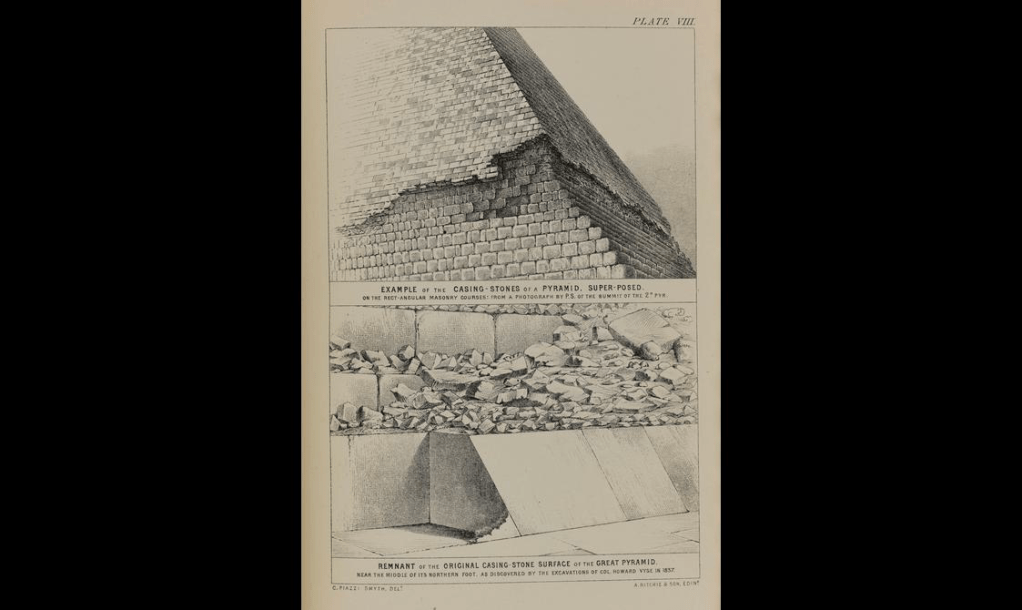
As the Pyramid is in harmony with the Earth, it is claimed the numeric value of 144,000 plays a key role in the harmonic connection which eventually determined the exact size of the structure. 

This is absolutely fascinating for as quoted, Christ is building a spiritual and holy temple comprised of resurrected human beings, changed from mortality to immortality – who are living stones. 1 Peter 2:5, NCV: “You also are like living stones, so let yourselves be used to build a spiritual temple…” 

1 Corinthians 15:51-52

Easy English Bible 

‘Listen to me. I will explain a great secret to you. Not all of us will die, but God will change all of us… God will raise up the believers who have died. He will give them bodies that can never die.’

It is intriguing that the biblical patriarch Job is considered as a potential builder of the Great Pyramid, when he himself refers to his own transformation through the resurrection – Article: Job. Job 14:14, NCV: “Will the dead live again? All my days are a struggle; I will wait until my change comes.”

Ancient Code: ‘Under the World Geodetic System 84 (WGS84 Earth Model), we understand that the elliptical arc length separation between the structure itself and the equator of the planet is equal to 10885784.94485787 feet. In addition, the established measure for the base-line length of the structure has been determined to be 755.7875 feet. By dividing the two values = 10885784.94485787 / 755.7875 we obtain 14403.23496, a value nearly identical to 1/10th of 144,000, which is the number of casing stones that originally formed the Great Pyramid of Giza when the structure was built. 

… according to Sir William Matthew Flinders Petrie an English Egyptologist and a pioneer of systematic methodology in archaeology and preservation of artefacts the above association is accurate since the margin of error one would be dealing with in determining the base length of the structure would be about 1/4000 of the actual distance itself…’ 

So that the pyramid was built with the 144,000 casing stones in mind and not with them as an after thought. In other words, the pyramid was built to scale so as to house the layer of finishing casing stones and not with the preparation of the casing stones to fit the existing pyramid. This indicates that the ancient builders had knowledge of the exact shape and size of the Earth and built the pyramid accordingly – something mainstream scholars believe impossible.

The Book of Revelation reveals a select number of saints will be saved at the end of this age. They will be supernaturally protected from the horrific events of the tribulation to come upon the world, and resurrected – Revelation 7:1-8; 14:1-5. They are numbered from the descendants of the patriarch Jacob, equaling twelve times 12,000 people, totalling 144,000 – Chapter XXXIV Dan: The Invisible Tribe. An interesting number in numerological terms for it contains the master number 44 – which symbolises building and putting things into form – and adds up to 1+4+4 = 9. Nine being a special, spiritual number, representing oneness and perfection

‘Ancient mathematical philosophers called NINE the “finishing post” and “that which brings completion.” Nine is the unsurpassable limit, the utmost bound, the ultimate extension to which the archetypal principles of number can reach and manifest themselves in the world. The ancient Greeks called nine “the horizon,” as it lies at the edge of the shore before the boundless ocean of numbers that repeat in endless cycles the principles of the first nine digits. Nothing lies beyond the principles of nine…’ – Michael Schneider. 

The Great Pyramid was synonymous – when it had all its casing stones – with light like a star. Each of the 144,000 casing stones having its part to play. The 144,000 saints are also individual lights. Christ was a light to the world (John 8:12) and he described the righteous as lights, Matthew 5:14, 16, EEB: “You are like a light for everybody in this world. You must be sure that your light shines well. Then you will give light to other people. They will see all the good things that you do.” Paul adds, Philippians 2:15, EEB: “In this world, you are living among bad people who have turned away from what is good. But you must bring light into this dark place, like stars that shine in the night.”

Both the Father and the Son as light beings will provide the illumination in the New Jerusalem. ‘And the city hath no need of the sun, nor of the moon, to shine in it: for the glory of God enlighteneth it, and the Lamb is it’s light’ – Revelation 21:23, Worsley New Testament.

As the saints will be beings of light, they are also vessels for energy. And so in real essence, the 144,000 casing stones on the Great Pyramid may have acted as literally solar panels for converting electrical energy.

Ancient Code: ‘Is it just an eerie coincidence that the speed of Light equals the coordinates of the Great Pyramid of Giza? The speed of light in a vacuum is 299,792,458 meters per second, and the geographic coordinate for the Great Pyramid of Giza is 29.9792458°N… this is just one of the many numerical ‘coincidences’ embedded within the Great Pyramid. 

Furthermore, another mind-bending coincidence related to the speed of light is found inside the Great Pyramid, discovered by John Charles Webb Jr. Precise latitude of the center of the Grand Gallery is 29° 58′ 45.28″ N = 29.9792458° N. The speed of light in vacuum, usually denoted by c, is a universal physical constant important in many areas of physics (299,792,458 meters /s). 

While this is a fascinating connection, it is noteworthy to mention that the meter is a modern unit and the ancient Egyptians are not known to have used seconds or for that matter decimal counting. The ancient Egyptians used cubits as a measurement system. Is this another coincidence? Or is it possible that somehow, the ancient Egyptians knew about the concept of speed of light or a vacuum?’

Space math: ‘The most interesting of these stellar alignments may be with the [brightest] star Sirius, also associated with the goddess Isis; the wife of Osiris who was resurrected after death. Inside the Pyramid of Khufu are a number of chambers and shafts that were built into the pyramid as the pyramid was being assembled. This sketch [below] is a cross-section of the pyramid along the North-South axis through the apex of the pyramid. North is to the right. The two [shafts on the left] show the pointing directions of the ‘Sirius’ shaft (lower) and the ‘Orion’ shaft (upper). The Orion shaft opens to the outside, however, the Sirius shaft is blocked by 16 meters of limestone blocks and cannot be used to see stars in the sky.’

Osiris or Nimrod is the great hunter – Genesis 10:9. His fame is linked with the aborted Tower of Babel, yet fascinatingly enough, his name is not included with the biblical account of Babel but inferred – refer Genesis 10:10; 11:4, 9. Nimrod was the preeminent offspring of a fallen angelic mother and a father named Kish, a descendant of Asshur – refer Chapter XXI The Incredible Identity, Origin & Destiny of Nimrod. The plot darkens as his mother known as Semiramis (and Isis), is the evil spirit Lilith – article: Lilith. Nimrod infamously married his own mother. 
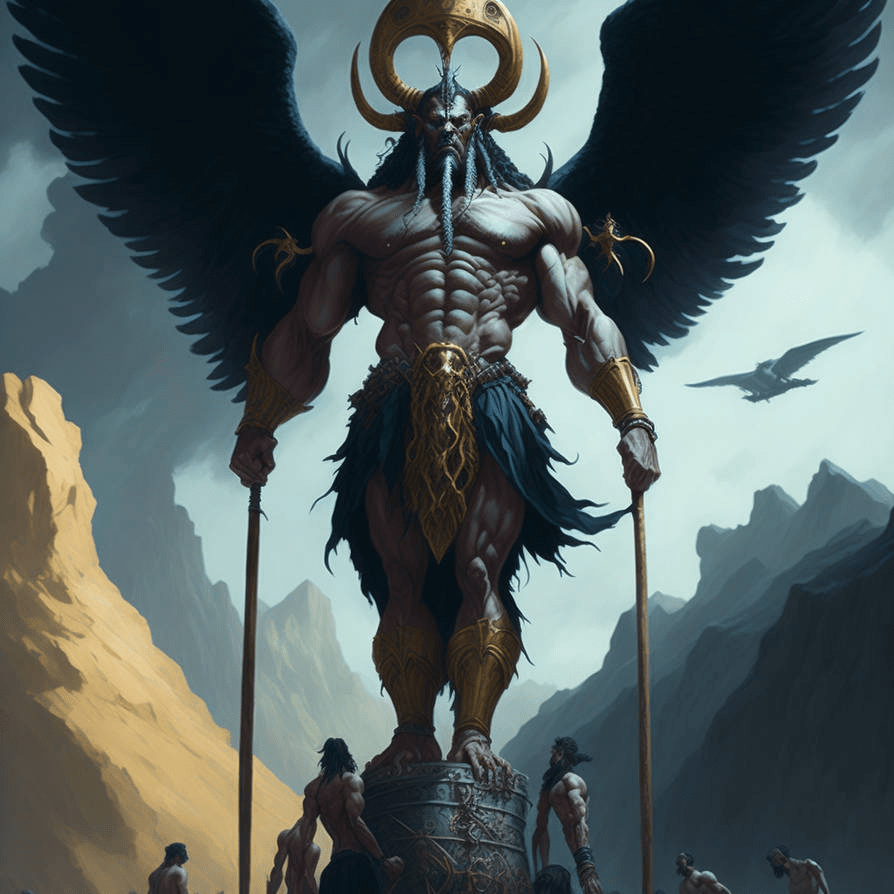
Nimrod was a formidable demagogue in the post-flood age and sought to establish a ‘one world government.’ He as a Nephilim giant composed of spirit and flesh, would eventually lose his physical body to death; while his spirit would remain immortal – Articles: Nephilim & Elioud Giants I & II. Therefore, his resurrection is not as spectacular or literal as it first sounds. Shem being the plausible slayer of Nimrod; whereas Osiris, was murdered by his brother Seth (or Set), who then cut his body into fourteen pieces. Isis with the help of her son Horus, avenged the death of Osiris and collecting his body parts – apart from his phallus – brought him back to life. 

As Nimrod is equated with the Tower of Babel, Osiris is associated with the Great Pyramid. Both are strongly linked with Orion. It begs the question: Is the Great Pyramid: the Tower of Babel? We will investigate this vital question and the importance of Osiris and Horus. 
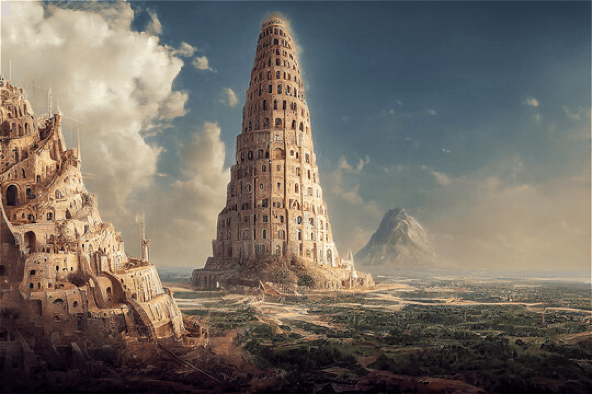
It is interesting that renditions of the Tower of Babel are either conical in shape like a menhir (or obelisk) and closer to the mark, as a square sided building with a base and step-like structure resembling a tall pyramid. 

In the article, Monoliths of the Nephilim, Baalbek was considered as the site for the Tower of Babel, though was ostensibly ruled out it because, ‘first, the people involved had travelled eastwards to a plain in Shinar located in Southern Mesopotamia – Genesis 11:1-2. They built a city and a tower, which was then abandoned – Genesis 11:3-8. Though, there was no evidence of any rubble or collapse of a very high tower in [Mesopotamia just like there isn’t] in Baalbek – Chapter XXI The Incredible Identity, Origin & Destiny of Nimrod. Second, the city and tower were called Babel. Babel which purportedly became known as Babylon is located in Shinar not Baalbek in present day Lebanon – Genesis 11:9 – though there is similarity between the words Babel and Ba-a-lbe-k.’ 

There are a number of proposed buildings which will dwarf the current tallest building in the world, the Burj Khalifa in Dubai, United Arab Emirates – refer Chapter XXI The Incredible Identity, Origin & Destiny of Nimrod. The building has a total height of 829.8 metres or 2,722 feet – just over half a mile tall. Whereas the Book of Jubilees mentions the Tower of Babel’s height as being 5,433 cubits and 2 palms, or 2,484 m (8,150 feet) – an incredible 1.6 miles high. This may sound like an exaggeration, though with plans to create future monster skyscrapers, perhaps not. 

One example is the Ultima Tower – see image below, lower right hand corner. A two mile tall, one mile wide structure planned to be the tallest building ever in the United States. It would be 3,354 metres (11,000 feet) tall and destined – unwisely – to be located in San Francisco Bay, California. Designed by Eugene Tsui, the tower would be almost two times taller than the Grand Canyon at 1,655 metres (5,429 feet). 
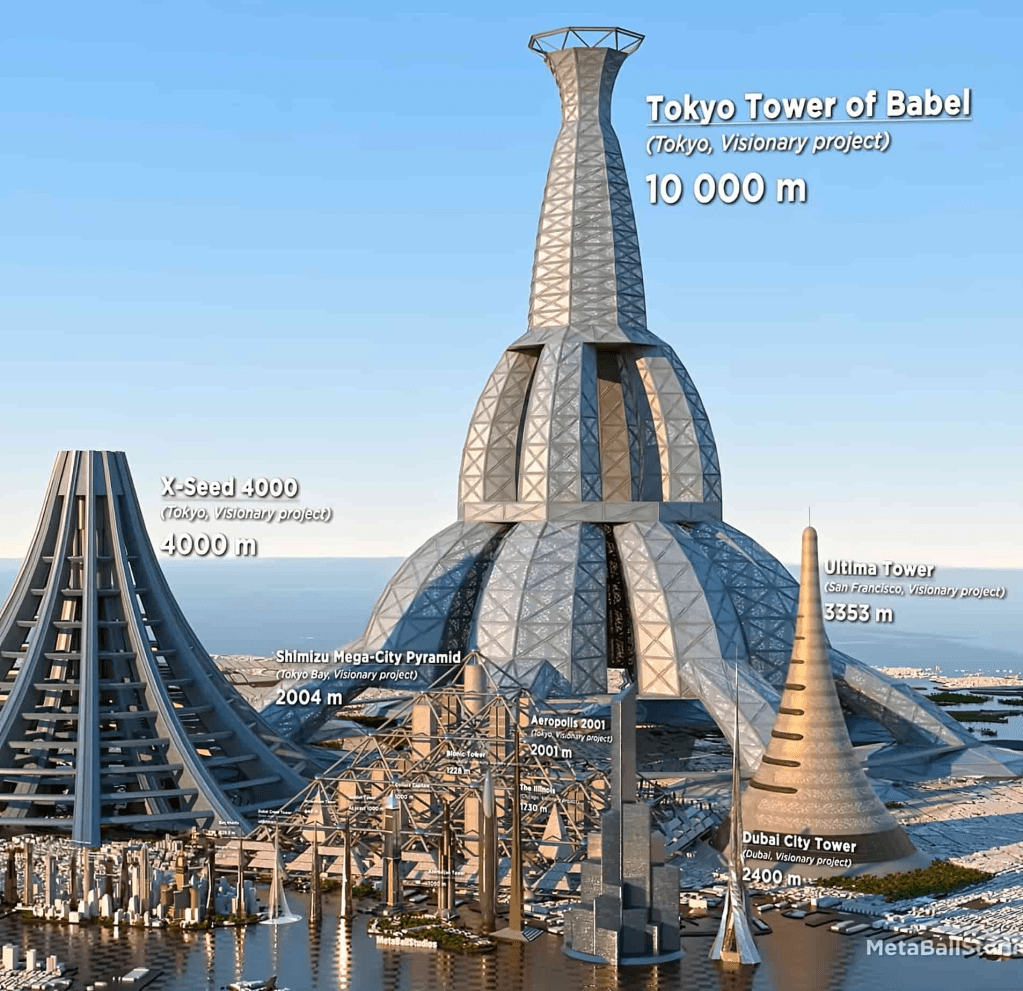
Think that is tall, the Tokyo Tower of Babel would be a hyperbuilding in the city of Tokyo and an astounding 10,000 metres or 6.2 miles (33,000 feet) tall. The megastructure was designed by Professor Toshio Ojima of Waseda University. It is the world’s tallest building ever envisioned by humankind. The ultra-skyscraper would require 100 to 150 years to complete and have the capacity to house thirty million people. 

Hrothsige Frithowulf: ‘The name alludes to the aspiration that it ascends to the heavens like the biblical Tower of Babel, which was 8,150 ft (2,500 m) tall. If built, the Tokyo Tower of Babel would reach a height that is 3,770 feet (1,150 m) higher than Mount Everest [8,849 metres or 29,032 feet]. This makes the project an unprecedented architectural achievement. 

For comparison, jet planes go no lower than 33,000 ft (10 km) on domestic flights and 39,000 ft (12 km) on international flights. At a height of 33,000 ft (10 km), the air pressure is one-fourth that at sea level, and the temperature is about -67 degrees Fahrenheit (-55 degrees Celsius).

The closest building in height to the Tokyo Tower of Babel would be the X-Seed 4000 which is only 13,100 feet (4,000 m) tall [see image above, left hand side]. X-Seed 4000 has 800 floors. But, the Tokyo Tower of Babel has around [1,969] floors… The structure’s logarithmic design, conical shape, wide base, and narrowing top parts make it strong enough to bear any force applied to it [much like the Great Pyramid]. The Tokyo Tower of Babel is an example of arcology because the project focuses on biodiversity preservation. 

The building’s construction cost is 25 trillion USD. It comes with a basal area of 42,5 mi2 (110 km2), a total floor area of 656 mi2 (1,700 km2, including all levels of floors) and an impressive steel volume of 10 billion tons. This total floor area is equal to the area of the city of Houston (4,460 mi2).’ 

Chapter XXI The Incredible Identity, Origin & Destiny of Nimrod

‘We do not know exactly what the tower constituted, though it was serious enough for the Creator to stop the endeavour in its tracks. As the Creator said nothing would be withheld from humanity, it must be presumed that the structure was linked to mankind gaining access to what had been denied to them in Eden. Was it a portal entrance and star-gate route to heaven and immortality, as well as a safe guard against another catastrophic Flood? Are the pyramids a replica in some way of the original tower, or more correctly, a precursor of the tower. The great Pyramid of Giza, has an internal mechanism no one has been able to definitively explain. Some scholars have concluded the tower was more than just an extremely tall building; rather, a portal or doorway between dimensions, a gateway in accessing spiritual realms. In light of this, William Henry presents a case for a link between the Tower of Babel and ancient Egypt.’ 

Ancient Code: ‘The Great Temple of Seti I at Abydos in the Osiris sanctuary contains many fascinating relief carvings on the walls, still rich in color today. The temple is dedicated to six major gods – Osiris, Isis, Horus, Amun-Ra, Ra-Horakhty and Ptah, and also to Seti I himself. The Osiris sanctuary is dedicated to this god of the underworld and his son Horus god of the sky. Osiris is often depicted with greenish skin, an elongated head, and partially mummy-wrapped legs. 

At this temple, we find a depiction considered of importance… The relief carving shows an extraordinary object that some say represents unknown technology. It’s called the Osiris Device or Osiris Stargate Device by William Henry, investigative mythologist.’ 

‘Henry made a connection between the Osiris Device and the Tower of Babel from biblical accounts’ – capitalisation his. 

“… THE SUMERIAN KING NIMROD BUILT A LADDER (SYMBOLIZED BY AN H) OR TOWER (ACTUALLY A GATE) THAT REACHED FROM BABYLON INTO THE STARS. THE JEALOUS ISRAELITE GOD YAHWEH GOT NERVOUS ABOUT HUMANKIND ‘MAKING A NAME OR RENOWN’ FOR ITSELF BY BUILDING THIS GATE. IF SUCCESSFUL, SAYS THE BOOK OF GENESIS, “NOTHING WE CAN IMAGINE WOULD BE IMPOSSIBLE FOR US… 

BIBLICAL SCHOLARS SAY NIMROD WAS KNOWN AS OSIRIS, THE EGYPTIAN GOD OF RESURRECTION, IN EGYPT. BOTH ARE ASSOCIATED WITH LADDERS OR STAIRWAYS TO HEAVEN. THIS IS KEY. INSIDE SETY’S 14TH CENTURY B.C. TEMPLE AT ABYDOS, IN THE OSIRIS CHAPEL, IS THE MAGNIFICENT DEPICTION OF OSIRIS AS A PILLAR OR TOWER. IN FACT, THE EGYPTIANS CALLED THIS OSIRIS PILLAR THE TA-WER OR ‘BOND BETWEEN HEAVEN AND EARTH’. SOUNDS LIKE BABEL TO ME.

ON THE OPPOSITE WALL OF THE OSIRIS CHAPEL AT ABYDOS IS THE OSIRIS DEVICE, ENHANCED, I NOTICED, WITH THE SHIP OF ETERNITY UPON WHICH THE KING WILL SAIL INTO ETERNITY AS A STAR. THIS SHIP RESEMBLES A MODERN DRAWING OF A WORMHOLE. PAY PARTICULAR ATTENTION TO SETY WHO APPEARS TO HAVE TRANSFORMED HIS BODY INTO THE OSIRIS DEVICE… OR IS COMING OUT OF IT. THIS IS A WONDERFUL MOMENT OF TRANSFORMATION AND RESURRECTION…” 

‘If there is a connection with Osiris, the Sumerian king Nimrod, and the story of the Tower of Babel, could this attempt to create “a stairway to heaven” be the motive for the biblical destruction of the tower, or this technology? The Anubis shrine found in King Tut’s tomb could be a physical representation of the Osiris device, which is similar in appearance to the Ark of the Covenant of the Bible’ – refer article: The Ark of God; and Appendix VII: Moses, the Exodus & the Red Sea Crossing – Fabrication or Fact?

The themes discussed above and thus far – Orion; Osiris and Nimrod; a tower; a stairway to Heaven; rebirth; and the Great Pyramid – continue to interweave. Just as Thoth and Anubis are closely linked as gods of the underworld, death and resurrection; so too are Osiris and Anubis. 

The link between the Tower of Babel and the Great Pyramid could be answered a number of ways. The two structures may be one and the same and therefore built by Nimrod. This would change the time frame of its construction from circa 10,000 / 9000 BCE to circa 7000 BCE. It would also necessitate Thoth – like evil Enoch – being rather instigators of pyramids, prior to the flood. Though if Thoth/Enoch were the (unlikely) architects of the Great Pyramid and replicating an antediluvian edifice, then Nimrod may have been either a. trying to complete or add to the pyramid, by renovating and re-using it; or b. building a new monument that might have worked in tandem with the Great Pyramid. Was the Cydonian Pyramid on Mars a part of this loop? 

As discussed in Monoliths of the Nephilim, the Genesis account clearly states that firstly, the Tower of Babel was constructed in Shinar, that is, lower Mesopotamia; and secondly yet conversely, its construction was interrupted and halted… it was not destroyed or razed to the ground – Genesis 11:2, 8. If so, where is the evidence of this tower? Logic says the Great Pyramid could be the tower of Babel, supported by the second point. Though the first point is a serious stumbling block to this idea… yet deserves further investigation. 

Remaining scholastically objective and impartial would mean the Tower of Babel was a separate and distinct event from the Great Pyramid, though by no means does it preclude it from being a legacy of the pyramid. If a transformation and resurrection from the physical plane through a portal or gateway into the spirit realm is the prime focus of the Great Pyramid – inspired by Thoth, the ‘first incarnation’ of Hermes Trismegistus – then a continuation of this process in the Tower of Babel – orchestrated by a later incarnation of Hermes Trismegistus, Nimrod – cannot be ruled out or deemed improbable. 

Helena Lehman: ‘… the EU Parliament Building in Strasbourg, Germany looks remarkably like either a Space Age rendition of the ruined Coliseum in Rome, or a partially constructed Tower of Babel. Significantly, the Coliseum is where many Christians were martyred, while the Tower signifies Babylon…’

More than being a blot on the landscape, the curved lower part of the building looks like a triangular UFO from above. In fact, the circular Eye of Horus, the all-seeing eye is firmly implanted within the pyramidal shape – refer article: 33

Armando Mei provides surprising support for Thoth as either the Great Pyramid’s inspiration or architect – Who Really Built the Pyramids of Giza? Thoth’s Enigmatic Emerald Tablets May Provide the Answer, 2017 – emphasis & bold mine:

‘… I observed a Giza map taken from above… Considering the pyramids altogether… Their very special shape enlightened me, suggesting an intriguing hypothesis. Just out of curiosity, I traced some guidelines starting from the corners of the major pyramids, toward the center of the monuments, following the satellite pyramids’ orientation. Then I drew the same lines for the satellite pyramids, according to their cardinal direction. Therefore, I obtained the following image.’

‘It is curious to observe how a very easy geometric exercise might instill a deep doubt, challenging the foundation of humankind’s history and the origins of modern societies. In fact, to detect the possible existence of cuneiform writing in the land of hieroglyphics can be considered a crazy idea. As presently known, academic considerations about Sumerian and Egyptian civilizations story are very precise; in fact, they assume that during their time the two cultures had never been in contact. With this in mind, I should have given up my curiosity; however, I wanted to listen to my own instincts because I found the possible connection between pyramids and cuneiform writing very compelling. 

A comparison between the pyramids’ geometric forms and cuneiform writing is possible by analyzing the Sumerian alphabet, containing the symbols of each letter. Observing the [above] image, it is astonishing to note the unbelievable correlation between some Sumerian letters and the signs I obtained while drawing the lines at the pyramids base. For example, Mycerinus Pyramid (Pyramid of Menkaure, the smallest of the three main Giza Pyramids and at the bottom of the map) – with a triangle projection towards its satellite pyramids – has a geometrical form very similar to the cuneiform letter for “G”; i.e. a wedge downward. Equally, I can state that Mycerinus’ satellite pyramids look like the cuneiform letter for “L”, having three wedges downward. 

I followed the same procedure for all pyramids of Giza. 

Khafre’s Pyramid, for example, (the second-largest of the Ancient Egyptian Pyramids, and in the middle of the map) has a little peculiarity, because of the position of its satellite pyramid, very close to the major monument. It is a very unusual architectural technique, compared to the other pyramidal complexes, showing the precise builders’ will to meld the monuments into having a single and homogeneous design. As result of this, the graphic sign is very similar to the Sumerian letter for “Z”. 

Finally, the Great Pyramid (the largest of the plateau and at the top of the map) and its satellites give very exciting symbols, perfectly connected to cuneiform letters, i.e. to the letter “T” as a cuneiform towards the right side, and to the letter “H”, characterized by three cuneiform symbols towards right side. Therefore, I obtained the following sequence: GL – Z – TH 

Originally, cuneiform writing was inscribed vertically, and in the event of more lines, they were aligned from right to left. It is interesting to note that pyramid position on the Giza Plateau develops in accordance with a vertical orientation – from the highest place, i.e. the Great Pyramid, until the lowest, i.e. the Mycerinus Pyramid – and in different lines. Moreover, as the Sumerian writing was characterized for a lack of vowels, so is for the geometrical symbols obtained by the pyramids. 

So far, we have observed some technical characteristics of the Sumerian writing and its homogeneity with symbols coming from graphics processing of the Giza buildings. Now, let us look to the complete sentence, with vowels, searching for a possible meaning of the ancient message: GaL Zu TeHu 

The meaning of the message is: TeHu the Great Wise 

It is very clear that the word TeHu refers to a proper noun, very probably to the designer of the Giza Project. To unveil the name, I studied the Egyptian Book of Dead (as translated by Wallis Bydge and also Boris de Rachewiltz) where the name of TeHu refers to Thoth.

In fact, one of the Egyptian words indicating the Ibis is Tekh, which sounds like the name TeHu; that word refers to the Moon as Measurer of the Time, and that is why Egyptians depict Thoth as Ibis.’

‘The analysis is very fascinating, but proposes a series of questions:

1) The message indicates that Thoth was the designer of Giza, as reported in the Emerald Tablets.  Does it mean that the Book of Thoth really exists?

2)  If the Sumerian correlation with the monuments has a scientific validity, the question is why, in the distant past of Egypt, did the population use the Sumerian writing?

When one studies the origins of cuneiform writing, we find that archaeologists date it to 3500 BC [far too late]. Nevertheless, it’s very interesting that when the writing appeared it was characterized by an extraordinary complexity, consisting of over a thousand phonetic symbols. Over time, the writing had a rationalization process and it reduced to hundreds of symbols. So, we can suppose that Sumerian writing was born in a very full form, and experienced a process apart from all other writing forms which display real signs of evolution. Only cuneiform is considerably convoluted – or, as archaeologists suggest, “rationalized” – as if it followed its founders’ decline. Can we argue that the Sumerian was the language used by the ancient Gods? Can we state that Middle Eastern and Egyptian cultures, during the pre-dynastic age, were influenced by an ancient and unknown Civilization? 

According to historians, due its geography, Egypt was isolated from the outside world until the First Intermediate Period, around 2000 BC – without experiencing any kind of influence from other civilizations. Therefore, the possible ‘corruption’ could have happened a long time before the pre-dynastic age. Furthermore, one of the most interesting pieces of evidence could be the numbers of Egyptians gods that are very similar to the Sumerians ones. Indeed, the story of the Sumerian Gods is very similar to the Egyptian Neteru, and the great part of religious traditions of eastern civilizations. 

An unknown civilization seems to have bequeathed symbols we can find everywhere around the planet; for example, the winged sun, or caduceus [linked to Hermes and Mercury], even the gods who have different names but similar functions. It is possible that this civilization could have inspired the Sumerian and Egyptian cultures… and likewise shared many symbols and divinities. It is undeniable that the two cultures originated from a “matrix” which lived in the distant past. If Egyptian and Sumerian civilizations have deep cultural and religious correlations, it may mean they were generated by a lost civilization [Atlantis], maybe the same who built pyramids all around the planet [prior to the great Flood]. 

Lastly, did the Emerald Tablets really exist? Maybe we will never have a confirmation, but it is thrilling to show the relationship between the god Thoth and the Giza Plateau, as the result of an easy geometrical game, which gave an unexpected answer to one of the most fascinating mysteries of the past. It is also interesting to suppose that the Sumerian writing system offered a Hermetic link with the Ancient Egyptians, which was historically never detected, but clear in my proposal. All these indications can be considered very important clues and may be regarded as the starting point to understanding the scientific meaning of the pyramids and the Knowledge of which they are [keeping].’

While there is a palpable link between Nimrod and Egypt through his association with Osiris; there is an equally compelling link between the ‘Egyptian’ god Thoth – the Giza pyramid complex – and the Great Pyramid. Because of the persistent association between the Great Pyramid and Orion in mythology, consistently mentioned by researchers, let’s investigate further.

Orion: the Star Gospel Symbol for Many Bible Heroes, Helena Lehman – emphasis  & bold mine: 

‘In Egypt, Orion was associated with the resurrected god-king Osiris… if we can discern the fabrications obscuring the truth… we can peel them away, and see that the evil part Nephilim god-king Gilgamesh [Osiris/Nimrod] usurped the place of the coming Messiah of mankind, and twisted the heavenly record of the Messiah’s heroic deeds on behalf of humanity… powerfully depicted in the signs of Orion and Taurus’ – 2 Thessalonians 2:1-12, Matthew 24:15. 

‘This was not merely a smoke screen to hide the truth… It was a prophecy of things to come far into the future, when [the Messiah] was scheduled to return, and to exact judgment against all the evil seeds of the serpent, whether… human, or… Nephilim. This can be seen no more clearly than in the wicked mimicry of the coming Antichrist, who will deceive many into thinking he is the true Messiah, just as Gilgamesh, Nimrod… and… other evil political figures attempted…’ – refer Chapter XXI The Incredible Identity, Origin & Destiny of Nimrod

‘After a terrible battle, the Scorpion succeeded in stinging Orion fatally in the heel. Shortly thereafter, however, the gods resurrected Orion by immortalizing him as a constellation. In addition, they supposedly placed the Scorpion on the opposite end of the sky to Orion so that they would never have to do battle again. Since Orion and Scorpio were given honored places in the heavens – among the stars and planets of the gods – Pagans believed that the gods were ensuring that their memory would never be forgotten. 

Looking at Orion in relation to the other constellations around it, we can see many elements of the Gilgamesh, Osiris, and Orion stories depicted in the sky. For example, Orion’s name in Ancient Egypt was “Seir” or “Prince” – refer Seir, Chapter XXIX Esau: The Thirteenth Tribe. ‘This was also the name of the Egyptian god-king Osiris, making Orion a royal figure like a Pharaoh, or King Gilgamesh. The strong animals that Orion boasts that he can kill are represented by the rampaging figure of Taurus, the Mighty Bull’ – Chapter XV The Philistines: Latino-Hispano America; and article: The Calendar Conspiracy. ‘This same bull makes his appearance in the Epic of Gilgamesh as the raging Bull of Heaven, whose breath and hooves could cause earthquakes, and volcanic eruptions until Gilgamesh kills it. In Osiris’ case, bulls were used to plow the earth, and make it fertile with their dung – thus serving to perpetuate Osiris’ blessings on Egypt as the breadbasket of the ancient world. 

Originating at Orion’s feet, there is [a] winding river that flows downward into the “outer darkness,” where the darkest regions of the night sky are located. This is the constellation Eridanus, the River of Judgment. In the Gilgamesh Epic, this constellation can be identified with the Euphrates River… The Milky Way also runs alongside Orion in the sky – and in Ancient Egypt, the Milky Way was the celestial counterpart of the Nile River. Nonetheless, the Eridanus constellation is not primarily a symbol for the Nile, or Euphrates Rivers, but of the Jordan River! In fact, in ancient Hebrew, “Jordan” is pronounced “Yardanu,” which is clearly related to “Eridanus” – the Greco-Roman version of the Hebrew word’ – Chapter XXXIV Dan: The Invisible Tribe. ‘All… these rivers flow quietly through various Bible stories, providing backgrounds for major biblical events such as the divine turning of the Nile River to blood before the Exodus, the Israelite crossing of the Jordan River into Canaan, and the baptism of Christ. 

Directly under Orion’s feet is the sign called Lepus, known today as a dead, or dying hare. But, in ancient times, this sign was seen as a serpent, whose head is biting Orion’s foot. This connects well with Scorpio, the Scorpion in Greek myth that fatally wounded Orion in the heel. Scorpio is also represented by its decan called Serpens, the Serpent, both of which depict Satan… 

Satan inspired all mythological, Pagan connections made between the heavens, and various human heroes… Satan beguiled men into worshipping the constellations, stars, Sun, Moon, and planets – thereby blinding them to the knowledge and worship of the one and only… Creator God… Thankfully, the Bible was written to… preserve a memory of the true allegorical and prophetic meanings behind many of the constellations. This is especially true for the constellation Orion… 

Of course, the greatest of these heroes is Yahshua, the Messiah. Just as the Egyptians called Orion “Seir,” or “Prince,” Christ is the Prince of Peace, and will one day literally rule as the King of kings on Earth. Orion therefore depicts Yahshua as a Conquering Prince, or King.

In relation to Yahshua, the Bull of Taurus has much prophetic meaning… it signifies Christ as an atonement sacrifice – as seen in the bulls sacrificed to atone for the sins of the priests, and all Israel (Exodus 29:36; Leviticus 4:13-14), and the lambs [and young goats] sacrificed in atonement at Passover (Exodus 12:5-8). 

… the star that depicts Orion’s foot is called “Rigel,” meaning “The Foot that Crushes,” and hearkens back to the first messianic prophecy in the Bible found in Genesis 3:15…’

“I will put enmity between you [the Serpent] and the woman [Eve], and between your offspring and her offspring; he [the Messiah] shall bruise your head, and you shall bruise his heel” – ESV.

‘… the star called Regulus in the sign of Leo was also known as Rigel, and marks the same truth: that Christ has won the war against evil, and will one day crush Satan forever!’ 

If as Lehman asserts, Orion has been appropriated by Nimrod worship and really represents Christ, then this is profound for the following reasons. Nimrod as the builder of the Babel ‘skyscraper’ would have been symbolically a cornerstone himself and literally would have laid a cornerstone at the beginning – or in the case of the Great Pyramid at the end – of the tower’s construction. This is in mimicry of the cornerstone, Christ and his true temple as opposed to the false temple of Nimrod; which will be resurrected in the future by the False Prophet – Revelation 13:11-18; 19:20, 2 Thessalonians 2:1-12 (Article: Is America Babylon?)

Christ as the Atonement sacrifice is in righteous opposition to the false christ’s ‘sacrifice’ typified annually by the goat representing Azazel, the future Antichrist – Leviticus 16:1-28, Revelation 13:1-10; 17:1-13, Daniel 7:19-26; 9:26-27, Matthew 24:15 – refer Chapter XXI The Incredible Identity, Origin & Destiny of Nimrod

Christ is likened as a prince, a bull, a ram and a goat during a vision of the prophet Ezekiel. “In the first month, on the fourteenth day of the month, you shall celebrate the Feast of the Passover… On that day the prince shall provide for himself and all the people of the land a young bull for a sin offering. And on the seven days of the festival he shall provide as a burnt offering to the Lord seven young bulls and seven rams without blemish, on each of the seven days; and a male goat daily for a sin offering” – Ezekiel 45:21-23, ESV. 

The question of when the Great Pyramid was constructed is presently an informed estimate at best. Similarly, it is intrinsically tied with who built the pyramid and indirectly related to what the Great Pyramid is and why it was conceived. Of the time frame proposed thus far – broadly between circa 10,500 BCE and 6000 BCE – the earlier end for arguments sake, appears an attractive date for the following reasons. 

  1. The Bible reveals an eruption of angelic activity following the global cataclysm – Genesis 6:4. In other words, the Anunnaki gods reappeared. This would account for the high tech (Sumerian and Egyptian) society; a ‘legacy’ from Atlantis in the post-flood era, which – not so – mysteriously, disappeared approximately four thousand years later, when Nimrod endeavoured to revive and exceed an already fading civilisation – Genesis 10:25; 11:8. 
  1. In light of this, Thoth – whether that be his true identity or an alternative alias for Azazel or even Enoch the Evil – is ostensibly more closely linked with the Great Pyramid than Nimrod. Added to this is Thoth’s status as a god, opposed to Nimrod’s lesser status – albeit a unique Nephilim – of a ‘mighty man.’  
  1. The Tower of Babel was built in Shinar and apparently constructed after the Great Pyramid. If Nimrod was seeking to go one better than the Great Pyramid, it would explain perhaps why the Great Pyramid remains and the greater threat of the Babel Tower thwarted, is gone – presumably dismantled as no sign of its destruction is known. 

Of course, this lack of evidence could be a singular proof the Great Pyramid is in fact the Tower of Babel. We shall return to this thought and how the land of Shinar is seemingly a stumbling block for an Egyptian Tower of Babel.  

4. The aligning of the Great Pyramid – apart from its accurate scale association with the Northern Hemisphere of the Earth; the parallel symbolism with planet Mercury as one of the Seven Wonders; as well as with Hermes/Thoth – with the impressive North Pole Star at the time, Vega and subsequently the equally ‘most important’ star in the sky, Polaris. 

5. While the preceding Pole Star theory is especially new – presented here for the first time – the long established Orion Correlation Theory remains relevant because of the following, though not so much for its accuracy of scale as observed already. 

As explained by Goro Adachi there was an extraordinary set of alignments about 10,500 BCE as a. Orion reached its lowest point at the Meridian in its 26,000 year precessional cycle. Precession slowly shifts Orion and other stars along the meridian, an imaginary north to south line drawn in the sky where the stars achieve their highest daily altitudes and b. on the vernal equinox (March), the Great Sphinx, directly facing east, witnessed the rising of its supposed two celestial counterparts – the sun and Leo. Though if the sphinx was a dog and not a lion, the significance of the Leo aspect is puzzling. 

At the moment of equinoctial sunrise, a. Orion was positioned right at the meridian and b. in the southern sky, the Milky Way was seen roughly vertical and positioned in such a way that it appeared to be an extension of the Nile. Orion was situated just to the right of the celestial river; closely mimicking the configuration of the Giza pyramids and the Nile River. 

6. Due to one particular prophetic timeline*, the construction of the pyramid circa 10,500 BCE holds increased subjective (yet not necessarily accurate) interest compared with a later date. 

7. The preceding point dovetails with the precession of the equinoxes and perhaps a reason why the vernal equinox figures prominently for the pyramid and sphinx at this time. The year 10,500 BCE is an approximate date – as according to computer models, the Sphinx and the three pyramids at Giza would align with Orion’s Belt in the year 10,450 BCE – which has been easy to remember and disseminate. Though of considerable interest is Adachi’s diagram above, with a date of 10,600 BCE. This date correlates with this writer’s findings.*

Due to a personal conviction that the Great Pyramid includes in its design the element of being a time piece; it is marking or recording two significant dates. Based on precession for each constellation of the Zodiac moving fully every 2,160 years – Appendix IV An Unconventional Chronology – so that half way equals six houses totalling 12,960 years; the construction of the Great Pyramid was either begun or completed close to 10,627 BCE. 

This would have been two hundred and ten years after the flood waters had time to lower and settle, for land to dry out and top soil firm up. The construction would have been during the early part of the Leo Constellation, though a transition period from Virgo to Leo cannot be ruled out. Both these zodiacal houses are pertinent, as Christ was born under the sign of Virgo; descended from the tribe of Judah which equates with Leo; and he is described as a Lion [Revelation 5:5] – refer article: Chronology of Christ; Chapter XXII Alpha & Omega; and Chapter XXX Judah & Benjamin – the Regal Tribes. The adversary, Satan, is also likened to a lion – 1 Peter 5.8. 

Pertinent points about the Orion Constellation. 

Alnilam, Mintaka [a double star] and Alnitak – a 100,000 times more luminous than the Sun – which form Orion’s belt, are the most prominent stars in the Orion constellation. 

Betelgeuse, the second brightest star in Orion, establishes the right shoulder of the hunter. Bellatrix serves as Orion’s left shoulder. 

Even though the Orion Nebula is a formation of dust, hydrogen, helium and other ionized gases, it is labelled the middle ‘star’ in Orion’s sword. 

The star Hatsya, establishes the tip of Orion’s sword that hangs off the belt and Meissa forms Orion’s head. Saiph serves as Orion’s right knee. 

Rigel forms the hunter’s left knee and is Orion’s brightest star. 

Astronomers refer to Orion as M42 and it is there where stars are being born. The Orion constellation is one of the most prominent star formations in the night sky and has seven stars with known planets. 

According to Egyptian mythology, the gods in the form of humans descended from the belt of Orion and Sirius – the brightest star in the sky – and instigated the human race. It was believed that Osiris would one day return from Orion. 

Located in the eastern region of the Sahara Desert is the archaeological site, Nabta Playa. In 1974, it was discovered by a team of scientists. Researchers believe that the “mini Stonehenge of the desert” reveals an intricate alignment to the stars of the constellation of Orion. 

Babylonian ‘star catalogues’ name Orion, ‘The Heavenly Shepherd’ or ‘True Shepherd of Anu’ – Anu the chief god of the heavenly realms. 

Ancient Code explores the aspect of the importance of the Orion Constellation in NASA’s processes. 

‘The original insignia for Apollo 13 depicted the constellation Orion in the background. The insignia was later changed but… most of NASA’s planned events coordinate… with Orion, Sirius, and their positions in the sky. An example… is the Moon landing. According to NASA records, the sea of tranquility was chosen based on its flat surface, but some researchers suggest this sight was chosen because on that date its coordinates lined up directly under Orion’s belt… 

According to Ancient Egyptian [beliefs], ceremonies performed directly under Orion’s belt produce a sacred alignment, which allows humans to communicate directly with Osiris. Apollo 11 had landed at a specific day and a specific time where the three belt stars of Orion were on the horizon. The person who picked all of Apollos landing dates and landing times including Apollo 11 was Farouk El-Baz… his father is an expert on the ancient Egyptian stellar religion, now you just connect the dots.’ 

Sirius is a a binary star system, consisting of a white main sequence ‘star of spectral type A1V, termed Sirius A, and a faint white dwarf companion of spectral type DA2, called Sirius B. In ancient Egyptian mythology, Hathor, was closely connected and identified to Sirius but then again so was Isis. An icon of Sirius depicted as a five-pointed star was discovered on the walls of the Temple of Isis/Hathor located at Denderah. When we talk about the beautiful goddess Isis, we cannot omit Osiris, her husband. Osiris was connected to Orion. According to some, the Sirius system is attributed to Isis as Sirius A and Osiris as Sirius B.

Known as the Dog Star, Sirius is the leading star in the Canis Major constellation, with Procyon in the tiny Little Dog constellation located to the north east. These two stars with Betelgeuse form the Winter Triangle.’ 

Brian Jones: ‘Canis Minor can be seen from every inhabited part of the world. Although generally identified as one of Orion’s hunting dogs, the astronomers of ancient Egypt linked Canis Minor with Anubis, the jackal-headed dog in Egyptian mythology associated with mummification and the after-life.’ 
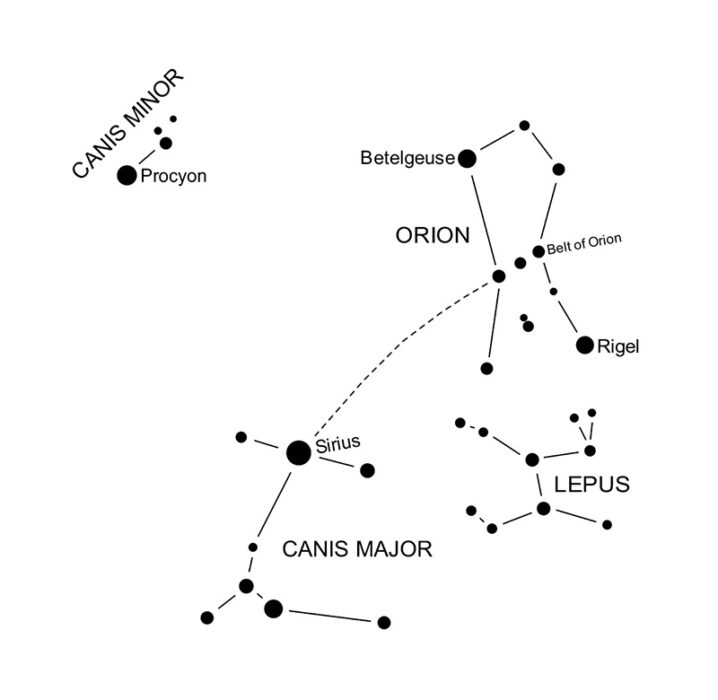
‘Procyon derives its name from the Greek for ‘before the dog’, alluding to the fact that Canis Minor rises before the neighbouring celestial dog Canis Major. But because of Earth’s precession, this effect has become far less obvious as the centuries have passed. Procyon and Sirius now rise basically in tandem, with Procyon only slightly higher. Gomeisa, on the other hand, has a name derived from the Arabic ‘al-ghumaisa’ meaning ‘the Dim, Watery-eyed or Weeping One’, a name that was originally applied by Arabic astronomers to the constellation as a whole…’ 

Daniel Johnson: ‘If you’re a fan of classic cartoons, you might be familiar with a series of Warner Brothers short films that feature Chester, a little terrier, who is the devoted fan of Spike, a big bulldog. By the end of the show, Chester has proven his worth and the roles are reversed, so that the little dog is now the top dog. 

Procyon… had canine associations in ancient Egypt, where the star was connected to the mythological figure of Anubis. Ancient Mesopotamians associated Procyon with dogs, too. But other cultures saw things differently. For Polynesians living in what is now Tahiti, Procyon was a pillar that supported the sky, while the Ojibwe of North America actually included Procyon in their version of Orion, what they call the Wintermaker.’
Annette Lee: ‘The Ojibwe constellation of the Wintermaker includes the familiar stars of our Orion but his outstretched arms reach to include Procyon in Canis Minor as well as Aldebaran in Taurus. The painting depicts the Ojibwe way of seeing star figures – both their inner spirit and outer form.’

It has to be acknowledged that support for the association between the Giza pyramids and the Sphinx is lent by the fact Orion (Osiris), Sirius the Dog Star (Isis) and the Little Dog (Anubis) are so closely linked. The Sphinx representing a dog and not a lion has to be taken seriously. Thus the Little Dog certainly – and primarily Procyon – being Anubis is of significance when added to the Great Pyramid, specifically being so closely attached to another Egyptian god, Thoth. 

Even more so, when wherever Thoth is, so too is Anubis. When Thoth and the Great Pyramid are present, so too is Anubis – its guardian the Sphinx – and resurrection, the afterlife and the underworld. 

Thus there is a potent synchronicity between Sirius, the Dog Star, the Sphinx and Anubis

Anubis, Anpu, Anup or Anapa, was the son of either Set and Nephthys or Osiris and Nephthys; depending on the version of myth. From another older point of view, he was the sun of Ra. Anubis was ‘noted for being the general anointer of the mummified Osiris prior to his resurrection. Some versions assert he was the baptiser of Horus’ – The Gods of the Egyptians, Wallis Budge, 1904. Most sources equate Anubis with the Little Dog, though not all. 

Imagining the World into Existence: an Ancient Egyptian Manual of Consciousness, Normandi Ellis, 2012: 

‘At most underworld entrances and in many sarcophagus rooms, the black dogs Anubis and Upuaut appear. While Anubis prepares the human vessel for its entrance into the underworld, Upuaut guards the gateway and opens the way into altered states of being. These jackals appear as openers of the way as early as the First Dynasty of Egypt. The Dogon tribe of Sudan, who probably are linked to Egypt’s early ancestors, have a strong connection to the star Sirius, the bright Dog Star, which appears in the constellation Canis Major. They know, for example, that there are actually two stars: Sirius A and Sirius B, which appear to circle each other. The Canis Major and Canis Minor constellations may represent Anubis and Upuaut, but the Dog Star itself, called Sothis by the Egyptians, is linked to Isis, and the hidden twin star may be linked to Nephthys.’

When Thebes became the new religious capital, Anubis became the chief embalming god of the dead. ‘In the Theban Recension of the Book of the Dead, Anubis plays some very prominent parts, the most important of all being those which are connected with the judgment and the embalming of the deceased. Tradition declared that Anubis embalmed the body of Osiris, and that he swathed it in the linen swathings which were woven by Isis and Nephthys for their brother; and it was believed that his work was so thoroughly well performed under the direction of Horus and Isis and Nephthys, that it resisted the influences of time and decay’ – The Gods of the Egyptians, Wallis Budge, 1904, Volume II, page 262. 

One source states: ‘Anubis was perceived to superintend the embalming of the kings and courtiers in the mortuary and the subsequent binding with linen bandages. His coat color, according to Michael Jordan [Encyclopedia of Gods: Over 2,500 Deities of the World, 1993], is black in relation to the black tar that embalmers coated the mummies with. It is Anubis who performs the “opening of the mouth” ceremony; hence, he seems to have an astro-theology origin’ – refer article: Belphegor

Concerning Anubis, Wallis Budge writes: “His worship is very ancient, and there is no doubt that even in the earliest times his cult was general in Egypt; it is probable that it is older than that of Osiris. In the text of Unas (line 70) he is associated with the Eye of Horus, and his duty as the guide of the dead in the Underworld on their way to Osiris was well defined, even at the remote period when this composition was written, for we read, ‘Unas standeth with the Spirits, get thee onwards, Anubis, into Amenti (the Underworld), onwards, onwards to Osiris.’

According to Budge, the worship of Anubis as a god is older than that of Osiris; yet not as old as Horus if the Eye of Horus is associated with Anubis. As Horus is the son of Osiris, this is an interesting anomaly. Though Anubis and the all-seeing eye is of increasing interest as we progress; for the original Sphinx as Anubis – before its head was decreased in size due to facial cosmetic surgery – silently sat watching for millennia. A guardian of the Giza complex, keeping what secret? 

Osiris

‘Isis learning that Osiris in his love had consorted with her sister [Nephthys] through ignorance, in the belief that she was Isis, and seeing the proof of this in the garland of melilote which he had left with Nephthys, sought to find the child; for the mother, immediately after its birth, had exposed it because of her fear of Typhon [Set]. And when the child had been found, after a great toil and trouble, with the help of dogs which led Isis to it, it was brought up and became her guardian and attendant, receiving the name of Anubis, and it is said to protect the gods just as dogs protect men’ – Plutarch, 100 CE.

‘Of the stars, the Egyptians think that the Dog Star is the star of Isis, because it is the bringer of water [the heliacal rising of Sirius marks the start of the annual 150 day Nile River flood]’ – Plutarch. Likewise, Anubis was – associated with Aquarius, a man carrying a water jar – also known as the ‘bringer of the waters’ in the celestial Nile River as in a Milky Way sense of things. It is of note that we entered the precessional age of Aquarius in 1990. 

The origin of the avian god Thoth from not Arcturus in Bootes but rather from Lyra, where the former North Pole Star Vega is located has been ventured. As Lyra and Draco appear prominently in New Age teachings and remote viewing testimonies, it is worth learning more about Lyra – Addendum IV. Both these constellations are apparently home to two warring factions – refer Chapter XXII Alpha & Omega. Each are allegedly linked to the antediluvian civilisations of Lemuria and Atlantis.  

Lyran Starseeds: Origins, Markings & Modern Practices, Kitty Fields, 2021 – emphasis & bold mine: 

‘There are a few stars in the Lyra constellation, but the main planet of origin is Vega. It’s said the first humans originate from Lyra. Two races of ancient beings called Felines and Avians also come from Lyra and helped establish much of the ancient world on Earth including Atlantis and ancient Egypt. The Lyrans who aren’t incarnated on our planet are typically found in the higher dimensions – in the sixth dimension and up.’ 

‘Lyra is a small star constellation viewable in the Summer months in the Northern Hemisphere. The stars of Lyra form a harp’s shape, or a lyre which gives the constellation it’s name. Lyra was recorded as early as the 2nd century BC by the astronomer Ptolemy. But it’s impact on our planet started long before time was invented. Modern mystics, magical practitioners, and witches are drawn to Lyra. And some believe their souls originate in the Lyran realm. 

In the new age community, there’s belief that man’s origins go far beyond the scientific or religious explanations. That perhaps humans arise from a mixture of evolution and creation, of sorts. That the ancient races from the Lyra constellation may actually be our earliest ancestors who seeded us on this planet. I find this interesting, because according to astronomy, the stars in the Lyra constellation are younger than our Sun. However, remember not every star race is on the physical plane but may be in other dimensions and other planes of existence. 

I’ve also read books in which Polarians were the “first” spiritual beings on this planet from a higher dimension. 

Vega is the brightest star in the Lyra constellation, which is why it’s also called Alpha Lyrae. This is where life in Lyra probably originated. Vega was the gateway to that galaxy from another: in Old Norse the word “Vega” meant “to move” or “to transport”. This is why I feel Vega was the doorway the Avians came through to populate Lyra. There are two main types of Lyran starseeds and star ancestors that we know of: the Felines (cat-people) and the Avians (bird-people). 

The Avians are some of the oldest beings in our Universe and there’s speculation they come from another Universe [higher dimensions] entirely. They look like bird-humanoids, and interestingly the star Vega’s name in Arabic means “Falling Eagle”. In addition, the stars Mu Lyrae [Lemuria?] and Eta Lyrae are referred to as Alathfar, which means “the Talons of the Swooping Eagle” confirming our beliefs in Avians populating the Lyra constellation. They were present in the lost civilization of Atlantis and spread throughout the world after its fall [caused by the Deluge].

Thoth, the Ibis-headed god of Ancient Egypt may be an Avian star being and an ancestor to Lyran starseeds.’

The constant reader is well aware of arguably, the most famous avian god, Thoth. Though for others, the bird headed god of equal renown is the falcon or hawk headed god, Horus. The Falcon had special protective powers and is often represented hovering over or protecting a Pharaoh. 

Notice the Horus falcon with its talons clutching orbs and ankhs – a cross having a loop instead of the top arm, used in ancient Egypt as a symbol of the key of life. In time, the falcon became an eagle, the ankh became a sceptre of rulership, and a prominent heraldic symbol of national power, adopted by the United States of America and Russia for example – refer Chapter XXXIII Manasseh & Ephraim – the Birthright Tribes; and Chapter XX Will the Real Assyria Stand Up: Asshur & Russia.

Yet, as where Thoth is and the jackal headed Anubis; where the Eye of Horus is, so is the Great Pyramid. 

The Falcon was also represented or was sacred to: Montu, the god of war; Sokar the god of the Memphite necropolis; and Qebehsenuef, the son of Horus. 

The Goose – known as the ‘Great Cackler’ – was sacred to the god Geb, the ‘earth’ god and father of the goddess Isis; who is sometimes referred to as the ‘egg of the Goose’. 

The Heron is fascinating in Egyptian mythology, for it can be equated with the original Phoenix – as discussed earlier in connection with the Benben stone – and a symbol of the Sun and rebirth. The heron is closely linked with Heliopolis, the Sun City, like the Phoenix.  It is also the Ba (depiction/Soul) of both the gods Ra and Osiris

Both Isis (Goose) and Osiris (Heron/Phoenix) are associated with birds and thereby linked with Thoth. Also, Maat, the goddess of truth and justice is often depicted as a woman seated with an Ostritch feather headdress. Recall, Quetzalcoatl the feathered serpent and the American Indian headdresses designed from feathers. 

A very important bird in Ancient Egypt was the Vulture. It was sacred to the goddess Nekhbet of Upper Egypt and Mut, the ‘mother goddess.’ The Vulture represented eternal power and protection. Vultures are by nature scavengers – they eat the flesh of the dead. Symbolically consuming the soul of the departed, they became associated with eternity. When finished eating the vulture soars off into the sky, carrying the departed soul to ‘heaven.’ As Egyptian dynastic mythology was obsessed with immortality (and mummification), the Vulture was invariably depicted in association with the rulers of Egypt. Constant readers will recall the remarkable Pillar 43, the Vulture Stone at Gobekli Tepe in Turkey – refer article: Monoliths of the Nephilim

Fields: ‘Many Lyran starseeds relate closely to the Feline race of Lyran star ancestors. I believe there are more Feline Lyran starseeds than Avian. The Feline star ancestors had a hand in humans’ origins including in the ancient civilization of Atlantis. When Atlantis fell, the Felines moved to Ancient Egypt along with Avian and Sirian [Isis] star beings. You might know the Feline star races through the Ancient Egyptian cat goddesses Bastet and Sekhmet.’ 

Bastet is a goddess of possibly Nubian origin and was worshipped in Lower Egypt originally as a Lioness. Though in time, she was increasingly depicted as a cat. This was to represent a gentler aspect in comparison with her twin Sekhmet of Upper Egypt, who is a powerful warrior and protecter of Ra. Notably, Sekhmet – the Lady of the Flame – is one of the honored “Eyes of the Sun.” 

Bastet

Encyclopaedia: ‘Together, they represent duality: life and death, mercy and wrath, submission and domination’ Bastet and Sekhmet are simultaneously daughters and consorts of the Sun god Ra. Sometimes, their father-husband is Ptah, depending on the version of the story and who is the chief god. ‘In Sekhmet’s most famous myth, she was so bloodthirsty that Ra – or Thoth – had to get her drunk enough to sleep so that she would stop slaughtering mortals. If they hadn’t, she would have destroyed humanity.’ 

Considered to have powerful attributes, feline deities were associated with the  pharaohs and became patrons of Egypt. 

Maahes was a lion headed god of war, whose name means “he who is true beside her”. He is viewed as the son of the Creator god Ptah as well as a feline goddess – either Bastet in Lower Egypt or Sekhmet in Upper Egypt – whose nature he shared. His cult was centred in Taremu and Per-Bast, the cult centres of Sekhmet and Bastet respectively. 

A very interesting leonine goddess is Wadjet, a local goddess of the city of Dep (or Buto) in Lower Egypt – an important site in prehistoric Egypt. Over time, Wadjet’s worship evolved from a local goddess to a patron goddess. Of consequence was Wadjet’s close association with the Eye of Ra and the Eye of Horus symbols, each powerful protective deities.

Encyclopaedia: ‘The hieroglyph for her eye is shown below; sometimes two are shown in the sky of religious images.’

‘There is little consensus on which eye is truly tied to Wadjet as both have some importance to her. The main differences between her eyes are which side of the face they are on, left or right. The color of these eyes in amulets and ceramics are usually created in vibrant blue and green colors, which resemble the goddess’s name of “the green one” [just as Thoth is associated with the colour green]. The green Wadjet eye amulets found in Egyptian daily life provided a token of fertility and protection to those who had them.’
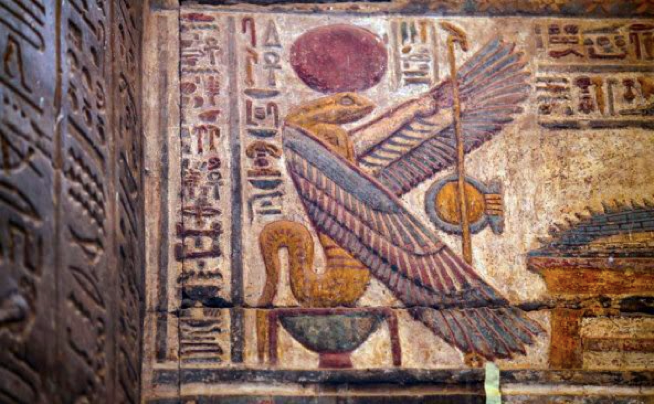
Notice in the first photo, the vulture and the serpent. While Wadjet was principally feline, she was also rendered as a snake as in the photo above. Again, an avian theme is present and she looks like none other than the winged feathered serpent of the Americas… Quetzalcoatl. 

Fields: ‘Thoth says, “the wisdom of the Universe can be placed on a single feather.” And unsurprisingly, ‘Thoth the ibis-headed god of wisdom, writing, math, and medicine is indeed Avian in origin.’

This writer has warned against the ascended master deception – Article: Thoth. Fields lists thirty of them, though the two pertinent masters in this discussion are Isis and Thoth. 

12. Isis: ‘While mostly known as an Ancient Egyptian goddess, is also an Ascended Master and is woven into Atlantean myth in the new age community. She will teach magic, healing, and the sacred feminine to those who call on her’ – Article: Na’amah. ‘In Egyptian myth, this mother goddess was able to resurrect her husband Osiris by giving birth to the god Horus. She can transform herself into any form she wishes but typically chooses the form of a bird or a woman with beautiful feathered wings.’ 

28. Thoth: ‘An ascended master and Egyptian god, Thoth (Tehuti) is a guide for writers, mathematicians, healers, and magicians. They say he wrote The Emerald Tablet of Thoth and may have incarnated as Hermes Trismegistus… Thoth is a scribe, astronomer, and may have initially been an Atlantean before making his way to Egypt… [a guide in] studying healing, magic, writing, alchemy, and spiritual growth.’ 

As the rainbow is embedded in the Great Pyramid and its colours with Quetzalcoatl’s plumage, the following may be of interest. 

Fields: ‘The seven rays of light represent energtic vibrations, consciousness, and frequencies in the Universe. Each ray represents something distinct from the next.

  • The First Ray (RED) represents will, power, and force.
  • The Second Ray (BLUE) represents love, compassion, kindness, understanding.
  • Third Ray (YELLOW) = logic, idea, reasoning, communication.
  • Fourth Ray (GREEN) = creativity, the arts, love, harmony through contradiction.
  • Fifth Ray (ORANGE) = science, technological advancements, knowledge.
  • Sixth Ray (INDIGO) = religion, spirituality, dedication. 
  • Seventh Ray (VIOLET) = ceremonial magic, ritual, healing, shifting.

In seeking to obtain a clearer focus of the material presented thus far with the additional information to follow, reference is made to controversial historian and scholar, Zechariah Sitchin. 

The Stairway to Heaven, 1980 – capitalisation and emphasis his, bold mine: 

‘In time Ra divided the kingdom between the Gods OSIRIS and SETH. But the sharing of the kingdom between the two divine brothers did not work. Seth kept seeking the overthrow and death of his brother Osiris. It took some doing, but finally Seth succeeded in tricking Osiris into entering a coffin, which Seth promptly set to seal and drown. ISIS, the sister and wife of Osiris, managed to find the coffin, which had floated ashore in what is nowadays Lebanon. 

She hid Osiris as she went to summon the help of other Gods who could bring Osiris back to life; but Seth discovered the body and cut it to pieces, dispersing them all over the land. Helped by her sister NEPHTYS, Isis managed to retrieve the pieces (all except for the phallus) and to put together the mutilated body of Osiris, thereby resurrecting him. Thereafter, Osiris lived on, resurrected, in the Other World among the other celestial Gods. Of him the sacred writings said: 

“He entered the Secret Gates, The glory of the Lords of Eternity, In step with him who shines in the horizon, On the path of Ra.” 

‘The place of Osiris on the throne of Egypt was taken over by his son HORUS. When he was born, his mother Isis hid him in the reeds of the river Nile (just as the mother of Moses did, according to the Bible), to keep him out of the reach of Seth. But the boy was stung by a scorpion and died. Quickly, the Goddess his mother appealed to THOTH, a God of magical powers, for help. Thoth, who was in the heavens, immediately came down to Earth in Ra’s “Barge of Astronomical Years” and helped restore Horus to life.

Growing up, Horus challenged Seth for the throne. The struggle ranged far and wide, the Gods pursuing each other in the skies. Horus attacked Seth from a Nar, a term which in the ancient Near East meant “Fiery Pillar.” Depictions from pre-dynastic times showed this celestial chariot as a long, cylindrical object with a funnel-like tail and a bulkhead from which rays are spewed out, a kind of a celestial submarine. In front the Nar had two headlights or “eyes,” which according to the Egyptian tales changed color from blue to red.’
‘There were ups and downs in the battles, which lasted several days. Horns shot at Seth, from out of the Nar, a specially designed “harpoon,” and Seth was hurt, losing his testicles; this only made him madder. In the final battle, over the Sinai peninsula, Seth shot a beam of fire at Horus, and Horus lost an eye.” The great Gods called a truce and met in council. After some wavering and indecision, the Lord of Earth ruled in favor of giving Egypt to Horus, declaring him the legitimate heir in the Ra-Osiris line of succession.’

‘Thereafter, Horus was usually depicted with the attributes of a falcon, while Seth was shown as an Asiatic deity, symbolized by the ass, the burden animal of the nomads. The accession of Horus to the reunited throne of the Two Lands (Upper Egypt and Lower Egypt) remained throughout Egyptian history the point at which kingship was given its perpetual divine connection; for every Pharaoh was deemed a successor of Horus and the occupier of the throne of Osiris.’

The avian god Horus, not unlike Thoth and his alter ego, Quetzalcoatl

In like manner every Pharaoh sought to live again in the celestial realm, resurrected and transformed as an eternal spirit being. This process after death involved a lengthy journey ascending a stairway to heaven. The ultimate goal to reach the Imperishable Star, symbolised by a ‘Celestial Disk’. The hieroglyphic pictograph for the ‘Stairway to Heaven’ was in a few instances a single stairway – which was cast in gold and worn as a charm according to Sitchin – or usually as a double stairway, as in a step pyramid. The Book of the Dead describes the Stairway to Heaven as a Mountain of Light no less. 

The Old Testament records just such a stairway: ‘At sunset [Jacob] came to a holy place and camped there. He lay down to sleep, resting his head on a stone. He dreamed that he saw a stairway reaching from earth to heaven, with angels going up and coming down on it’ – Genesis 28:11-12, GNT. 

Sitchin: ‘Illustrations to the Book of the Dead showed such a Divine Ladder sometimes with the Ankh ([key of] “Life”) sign symbolically reaching toward the Celestial Disk in the heavens – in the shape of a high tower with a superstructure. In stylized form, the tower by itself was written hieroglyphic-ally (“Ded”) and meant “Everlastingness.” 

Some illustrations show the king being granted a Ded – “Everlastingness.” Blessed by Isis and Nephtys, he is led by a falcon-God to a rocket-like Ded, equipped with fins. The king’s prayer to be given Everlastingness, a “Name,” a Divine Ladder, has been granted. He is about to begin his actual ascent to the Heavens. 

Though [Pepi] requires only one Divine Ladder for himself, not one but two Ascenders are raised together. Both the “Eye of Ra” and the “Eye of Horus” are prepared and put into position, one on the “wing of Thoth” and the other on the “wing of Seth”

Thoth and the watchful Eye of Ra (or Osiris)

‘The term “Eye” (of Horus, of Ra) which has gradually replaced the term Ascender or Ladder, now is being increasingly displaced by the term “boat.” The “Eye” or “boat” into which the king steps’ is not a sailing boat but rather as it travels the sky, is a celestial vessel akin to a space craft. 

‘The texts dealing with the Journey to the Afterlife by King Pepi describe the moment: “Pepi is arrayed in the apparel of Horus, and in the dress of Thoth; Isis is before him and Nephtys is behind him; Ap-uat who is Opener of the Ways hath opened a way unto him…’  

“The Door to Heaven is open! The Door of Earth is open! The aperture of the celestial windows is open! The Stairway to Heaven is open; The Steps of Light are revealed… The double Doors to Heaven are open… for Horus of the east, at daybreak.” 

Ap-uat is the same as the god Anpu and this is none other than Anubis. Anubis as the ‘opener’ is eerily reminiscent of the god, Ba’al of Peor, the ‘Lord of the Opening’ in the Old Testament – refer article: Belphegor. Anubis is sometimes equated with Osiris, though in reality was his son – Addendum II. More importantly, he is considered a son of either Isis (or sometimes Nephtys). As such, Anubis may be more accurately equated with Sirius of the Canis Major constellation rather than the Little Dog star system as discussed – refer Addendum III

Eye of Horus hieroglyph 

Before continuing with Zechariah Sitchin and studying afterward the Eye of Horus further, a digression is required on Anubis; the meaning of his name and a word association regarding language with the pivotal event marked by the dissolution of the Tower of Babel. 

“Let’s go build ourselves… a huge tower… That way we will make a name for ourselves…” – Genesis 11:4, The Voice. It was important for all those involved in the Tower of Babel project to make a name for themselves and to be remembered. Building a device or structure to obtain immortality would certainly do that, unless of course it was interrupted – Genesis 11:8. Even so, could that name be both forgotten and yet remembered because the device built in this endeavour still endures to this day?  

With this in mind, Polat Kaya presents enlightening linguistic details on the name of Anubis. The Name of God “Anubis” revisited and his secret identity revealed (Ancient Masarian god ANPU and AP-UAT), 2008 – capitalisation and italics his, bold mine: 

‘ANUBIS is the Greek version of the Masarian ANPU. As all ancient Greek names are artificially manufactured words from Turkish, so is the name ANUBIS.’

Kaya is seemingly correct in this premise (and his findings to follow) as research has convinced this writer, that forms of a later Sumerian dialect inherited from far older ones, were the precursors of Turkish – refer Chapter XVIII Elam & Turkey; and Chapter XXIV Arphaxad & Joktan: Balts, Slavs & the Balkans

Kaya: ‘The name ANUBIS, rearranged as “ANU-BIS” or “ANI BUS”, is the distorted Turkish expression “ANU BAŞ” which has a number of meanings in Turkish:

a) “ANU BAŞ” means “ANU is head”, that is, the Sky-God ANU (Turkish “AN O” (Gök O) meaning “it is sky” and “HAN U” meaning “That Lord”) is the top Sky-God. Sumerian ANU is also known as the name of the universal Sky-God. Thus, in this context, ANPU (ANUBIS) is the personification of the Top Sky God.

b) “ANU BAŞ” means “ANU is the HEAD”, that is, the god ANU (“HAN U”) is the “head” of man. In this meaning, Turkish words ANU and BAŞ are synonyms, that is, having the same meanings. Turkish ANU (ANI), from Turkish verb “anmak”, that is, “hatirlamak, usda saklamak” meaning “to remember, to keep in memory, to save as knowledge in mind” takes place in the “HEAD” (BAŞ) of man. In other words, “ANU” is the knowledge being kept in the human mind and personified as “GOD”.
 
c) “ANU BAŞ” or “BAŞ ANI”, that is, “BAŞ ADI” (ILK AD, BIRINCI AD) meaning “the head name of man”, “the first name of man”, “the common name of man”. In this context, ANUBIS (ANU BAŞ) is the personification of “man’s name”.

Turkish BAŞ means “head”, but it also means “first among others”, for example a “king” is the first among all others in a society and therefore he is the “head” of the country; A good example of this is the supposedly “Greek” word “BASIL” (VASIL, VASILUS) meaning “King”. But this Greek word BASIL (VASIL) is nothing but Turkish words “BAŞ IL” (IL BAŞI) meaning “the head of the country” which is the “king”. In the case of VASILUS, it is made up from Turkish “IL US BAŞI” meaning “the wise head of country”.

ANU (ANI), in this context, means “name”, that is “how someone is being remembered, recognized or called”. Again, ANI (ANU) is from the root AN of the Turkish verb “anmak” meaning “to remember”. When we remember to address someone, we say and/or recall his/her name. Thus, “BAŞ ANU” (BAŞ ANI) is “the first name given to a person”, or to an “object” or to “any concept” at the time of its conception.’ 

Anubis has a. a name; b. a name which is to be remembered; and c. a name which is first amongst other names. His name is most important and to be remembered. Why?

Kaya: ‘Turkish words “ANUM, ANIM, NAM, ANI, ANU and AD” all mean “name”.  It is clear that the so-called English word “NAME” is sourced from these Turkish words, particularly from Turkish ANIM meaning “my name”. So-called “English” term NAME is exactly that. It is somebody’s name.

Turkish “BAŞ ANU” (BAŞ ANI, TEPE AD, TEPE ANI, ILK AD) all mean the “head name” or “first name” given to a person. Thus, in Turkish, a ANIM / ANUM / NAM means “my name”, ANI means “name by which one is called” and ANIT means “monument by which someone is remembered”.  

Hieroglyphically… the symbol of ANPU (ANUPU) or the ANUBIS… is, the “first name” of the dead person. But it is also the name of the Sky-god “ANU” who is forever present above the dead person. 

At this point, I should also mention the makeup of the so-called “English” word MONUMENT. The word MONUMENT rearranged as “MEN-ONUTM is the altered and disguised Turkish expression MEN ANUTAM (MEN ANITIM) meaning “I am monument”, “I am rememberence”. MONUMENT, when rearranged as “OTEMU-NMN”, reveals itself as the Turkish expression “ADIMU ANMAN” meaning “it is your remembering my name”, that is, “it is the way you remember me”. MONUMENT, when rearranged as “UNOTME-MN”, it reveals itself as the Turkish expression “UNUTMA MeNi” meaning “do not forget me”

Genesis 11:6-7

The Voice 

“… The people are all together on this. With one [tongue] they are able to start this kind of project… If We confuse their language, they won’t be able to understand each other’s words.” 

Kaya: ‘So we again find that the ANPU or AM-UT or the so-called name ANUBIS is the personification of the “name” that is given to a person (and also to concepts). Thus, in general it can be said that ANPU is the personification of the “words” of the language because names are “words” generated by the “mouth”, that is, “AUZ” (AGUZ) in Turkish.

This associates the god ANPU (ANUBIS) with OSIRIS, that is, in ancient Masarian “AUSAR” (ASAR, OSIR). Now we immediately note that the Masarian name “AUSAR”, rearranged as AUS-AR and read as in Turkish, is the Turkish expression “AUZ ER” (AGUZ ER or ER AGUZU) meaning “man’s mouth”

Additionally, the name OSIRIS, which is the Greek version of the Masarian name AUSAR (ASAR, OSIR), rearranged in the form of “IR-SOSI”, is also an altered and disguised form of the Turkish expression “ER SÖZI” meaning “word of man”, that is, “speech, language of man“. 

With my new identification of the name “ANUBIS” being Turkish “ANU BAŞ” (BAŞ ANI), that is, the “first name” of men, objects and concepts, it becomes, by nature, “NAMES” which are “WORDS” that are coined by the “head and mouth”. This establishes the relation between “ANU BAŞ” (ANUBIS) and the name OSIRIS” (i.e., “ER SÖZI” or “SÖZ”) meaning “word of man” and “word” respectively.

This identity of Anubis, and, he being the son of Osiris, relates them to each other. Thus they are one and the same. They are both the personification of “man’s name, word, language, writings, speech, etc.,”

Hence the source of all these so-called “Egyptian” and “Greek” words were TURKISH based – contrary to all kinds of “mythology” having been spread among the public. These foreign looking and sounding words were all Turkish words and phrases which were intentionally altered and restructured into broken up formats.

In the above reference, ANPU (ANUBIS) is said to be son of Osiris or Ra, sometimes by ISIS and sometimes NEPHTHYS. Since ANPU is the personification of a “word”, its mother ISIS or NEPHTHYS must also be, at least in one meaning, related to “WORD” and/or to “word generation”. In this context, the Hellenized (Greek) name ISIS, in the form of “I-SIS” is the disguised form of Turkish word “I SES” (BIR SES) meaning “one sound” (one voice) which is the human voice. This is one of her many titles. Turkish word SES means “voice” and Symbol “I” is the symbol for numeral one which is “BIR” in Turkish.

It is well known that “words” are short modulated forms of “voice”, that is, “SES”. In speech, “voice” and “words are one and the same and cannot be separated from each other. Without “VOICE” (SES) there can be no “WORD” (SÖZ). Hence, SES (voice) is the mother of SÖZ (word). Thus, in one meaning ISIS (I SES) is the personification of “voice.”

As Isis is the mother of Anubis; she is the voice, while her son Anubis is the word. 

Kaya: ‘Since she is a twin sister of ISIS who is a “voice”, that is, (I-SES) in Turkish, NEPHTHYS in one meaning must also be related to Turkish SES [voice], SÖZ [word] and AGUZ [mouth]. First, supposedly Greek name NEPHTHYS, when arranged as “NEPH-THYS”, where the bogus letter H can be an “I” as well as an “H”, by substituting this in the name we get “NEPI-TIYS” which is a Hellenized and disguised form of the Turkish expression “NEBI DEYIŞ” meaning “prophet saying”, “lordly saying”. This makes NEPHTHYS “a personification of word” again and in one of her meanings, thus “she is the personification of word and/or word generation” in the human head or mouth.  

One of the most important organs in the mouth is the “tongue” which is “DIL” in Turkish. Turkish word “DIL” (TIL) means “tongue” and also “the language“. Everyone knows that without “tongue”, (DIL), there can be no “word generation” possible. One form of the name of goddess NEPHTHYS, among many, is written in hierogyliphs… which has been read as “NEB-T-HET” by Wallis Budge. “NEB-T-HET” is also identified as “a singing goddess”. “Singing” is a quality of ‘man’ who uses his/her “mouth, voice, tongue and lips” to generate enchanting and powerful words in voice. Thus again she is a female personification of “mouth, voice, tongue and lips”. In this context, the name “NEB-T-HET” can be read, as in Turkish, “NEBI-DEITI-O” meaning “it is divine saying”  which human speech and singing are’ – refer article: Na’amah.

‘Turkish word NEBI which is also attributed to “Arabic”, means “prophet, heavenly messenger”. Similarly, NEBIH means “celebrated, famous, noble”. Turkish DE means “say, tell, talk, word”, DEI (DEYI, SÖZ) means “speech, what is said”, and Turkish DEITI (DEYIDI) means “it is saying, it is word”. But, in the beginning there was the “WORD”, “Word” was God [rather, correct Greek rendering is: “God was the Word”] and “Word” was with the God. Thus Turkish DEI (DEYI) is the “GOD”. Is it not a curious “coincidence” that, in the so-called “European” languages, DEI and DEITY has the meaning of “GOD”? So they have had a free ride on the shoulders of the ancient Turkish language and culture for thousands of years by way of punning and by way of alteration. 

In another excerpt, Wallis Budge gives the following: 

“From Plutarch’s treatise on Isis and Osiris we may gather many curious facts about the Egyptian beliefs concerning Nephthys. Thus he tells us that the Egyptians call “the extreme limits of their country, their confines and sea-shores, Nephthys (and sometimes TELEUTE, a name meaning expressly signifying “the end of anything”), whom they suppose likewise to be married to Typho.”

In this description, goddess NEPHTHYS being called “TELEUTE” is very significant because the name “TELEUTE” is a form of the Turkish word “TIL-ÖYTÜ” (DIL ÖYDÜ) , meaning “it is the tongue house”, “it is the language house”, “it is mouth”.  Alternatively, “TELEUTE” is the distorted form of turkish word “DILDI O” meaning “it is the tongue; it is language“. It would also refer to their country boundaries within which their language was spoken. Here again we find goddess NEPHTHYS being related to “mouth, voice, tongue and language”.

In another form of the name of goddess NEPHTHYS, it is transliterated as “NEB-T KHA-T”. This ancient Masarian name is almost exactly the same as the Turkish girl’s name of “NEBEHAT”. In Turkish this name means “a noble being, great and famous; nobility, celebrity.”

It is of real interest that Osris, Anubis, Isis and Nephthys are intrinsically linked with each other as a. family; b. constellations in the sky; and c. in definitions of their names being associated with name, voice, word and language. Add this to Anubis being an important name to firstly remember; Nephthys a great celebrity; and Egypt’s borders being defined by the tongue of its language. 

Then compare this information with the fact Anubis/Sirius/the Sphinx; with Horus/the Eye of Horus/Stairway of Heaven; and Osiris/Nimrod/Great Hunter (Genesis 10:9) are linked with the Tower of Babel/language/a name – and its role (like the Great Pyramid) as… a Stairway to Heaven.

Sitchin: ‘… Gods symbolizing the waning moon (“Daybreak”) begin to pronounce magical “words of power which will cause splendor to issue from the Eye of Horus.” The “radiance” – reported earlier as the hallmark of the twin-peaked Mountain of Light – intensifies: 

“The sky-God has strengthened the radiance for the king that the king may lift himself to Heaven like the Eye of Ra. The king is in this Eye of Horus, where the command of the Gods is heard.” 

The Eye of Horus is in itself a crucial key in this investigation. Sitchin has shown from the Book of the Dead, that it is both part of an ascending ladder or spiral stairway to heaven, as well as a means to reaching heaven via a trans-dimensional craft. 
The Eye of Horus appears to symbolise a number of things pertaining to the mythical, the esoteric and the occult. Unsurprisingly, Egyptologists are not always in agreement for texts do not provide a consistent narrative regarding the injuries inflicted by both Seth and Horus on one another. 

The Eye of Horus is known as the left wedjat* or udjat eye, ‘specular to the Eye of Ra’, which is the right wedjat eye. 
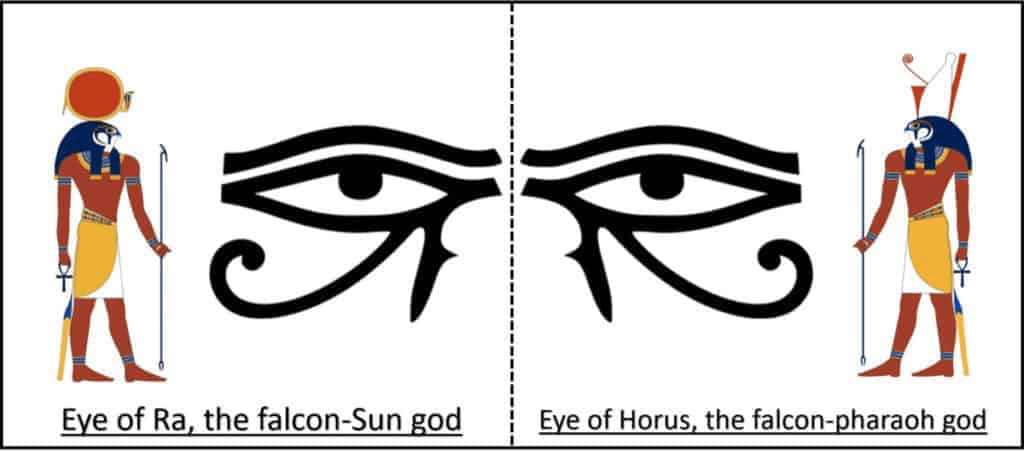
As a symbol in ancient Egyptian religion it represented well-being, healing, rejuvenation and rebirth of the soul. Once Horus was healed by Thoth, he offered the eye to his deceased father Osiris; with its revitalising power sustaining him in the afterlife. 

Encyclopaedia: ‘The Eye of Horus symbol, a stylized eye with distinctive markings, was believed to have protective magical power and appeared frequently in Egyptian art. It was one of the most common motifs for amulets…

The Eye of Horus was… equated with funerary offerings, as well as with all the offerings given to deities in temple ritual. It could also represent other concepts, such as the moon, whose waxing and waning was likened to the injury and restoration of the eye.’

Eye of Ra versus Eye of Horus – The Main Differences, James Lingard, 2023 – emphasis mine: 

‘The Eye of Ra… looks like a large bronze or golden disc that has two cobras on each side. The disc… [represents] Ra… the Sun, and the two cobras represent royalty… the cobras on each side… were first used on an even older Egyptian symbol… the Uraeus… associated with the goddess Wadjet*, an [old] deity that existed before the unification of… Lower Egypt with… Upper Egypt…’ Recall, Wadjet is a cat deity who also appears as a serpent with wings.

‘… the Eye of Ra symbol was meant to represent the eye of the God, [yet] it’s not that simple… [it] was also viewed as the sun itself as well as the weapon that Ra wielded against anyone that dared to oppose him… the Eye of Ra was also seen as its very own deity, or more specifically as the feminine counterpart of Ra… even though it was… feminine… it was nowhere near as benevolent as he was. In fact, it was known for being quite vengeful and wrathful… keep in mind that this is a weapon… 

The symbol… was also associated… with female deities from the Egyptian mythos, including Sekhmet, Bastet and Hathor [the wife of Horus]… it was most often times worn by pharaohs as a way to showcase their close relation with the God of the Sun. They would plaster it on their crowns as a way of indicating the fact that they were chosen by Ra himself. 

Early on after the merger of the Upper and the Lower Egyptian Kingdoms, the Eye of Ra started to be portrayed in two different places, namely on the red Deshret crown and the white Hedjet crown. Even so, the… truth is that the symbol is not the first thing that people think of when they picture the Eye of Ra. Instead, people tend to picture a different design altogether.

Many people look at… [the Eye of Horus] and immediately think of the ancient God Ra, when in actuality it belongs to a god that is in an entirely different pantheon altogether. The symbol actually pertains to the Falcon God Horus… a member of the Ennead… the nine divine beings that the people of Helipolis are known to worship… these two deities couldn’t be more different from one another, as… the followers of Ra eventually disappeared… being replaced by the cult of the Ennead… [who] controlled death, resurrection and more.’ 

‘The cult… claimed that the Eye of Horus, by unifying all of the human senses**, was a mirror to our soul, showcasing the unity of mind and the unity of being all at once… one of the most beloved symbols of Ancient Egypt… it is still being used to this very day… it was considered to be a symbol of inner peace, as the people that wore it were the followers of Horus, and they believed that by donning this symbol they would be protected from any threats to the soul. 

The main reason… why the Eye of Ra is… confused with the Eye of Horus is because there is an illustration [see above]… which depicts the Eye of Ra as a mirrored version of the Eye of Horus… this depiction… shows the desperate means that the cult of Ra was willing to go to in order to capitalize on the cult of Ennead, as they were even willing to change up their symbol altogether to mimic theirs.’ 

‘Even though the two gods had practically nothing in common with one another at first… connections were made later on… which allowed the two cults to merge… For… the Eye of Ra is clearly meant to represent the sun while the Eye of Horus is… related to the moon…’

The Eye of Horus is confirmed as a symbol of rebirth and resurrection, coupled as a talismanic source of protection for an individuals soul. It is also analogous with the Moon like Thoth. 

Wu Mingren: ‘The Eye of Horus is not merely a magical symbol but is also an example of the mathematical knowledge acquired by the ancient Egyptians… Set tore Horus’ eye into six parts. As a symbol, the Eye of Horus contains six parts. Each of them was given a fraction as a unit of measurement – the right side of the eye is 1/2, the pupil 1/4, the eyebrow 1/8, the left side of the eye 1/16, the curved tail 1/32, and the teardrop 1/64. These fractions add up to 63/64, and the missing part is said to either represent the magical powers of Thoth or to illustrate that nothing is perfect.’ 

‘Each of the six parts of the Eye of Horus correspond to a different sense**. The right side of the eye is associated with the sense of smell, as it is closest to the nose and resembles this organ… the pupil represents the sense of sight, while the eyebrow represents thought, as it can be used to express our thoughts. The left side of the eye represents the sense of hearing, as it points towards the ear, and has the shape of a musical instrument. The curved tail resembles a sprout from a planted stalk of wheat or grain. As a representation of food, this part of the Eye of Horus corresponds to the sense of taste. Finally, the teardrop is supposed to represent the sense of touch, as this part of the Eye represents a stalk being planted into the ground, an act that involves physical contact and touching.’ 

The Eye of Horus is undoubtedly the inspiration for the somewhat innocuous Eye of Providence, which in turn is known as the more sinister ‘all-seeing eye.’ The simplest representation is a ‘lidded eye with “glory,” or beams, emanating from it in all directions.’ The Christian version includes a triangular (pyramidal) frame encompassing the eye. Typically, the all-seeing eye is a symbol of an ‘omniscient entity – usually a deity – that can see all.’ 

Got Questions: ‘Most Americans are familiar with the all-seeing eye because it appears on the reverse of the dollar bill.’
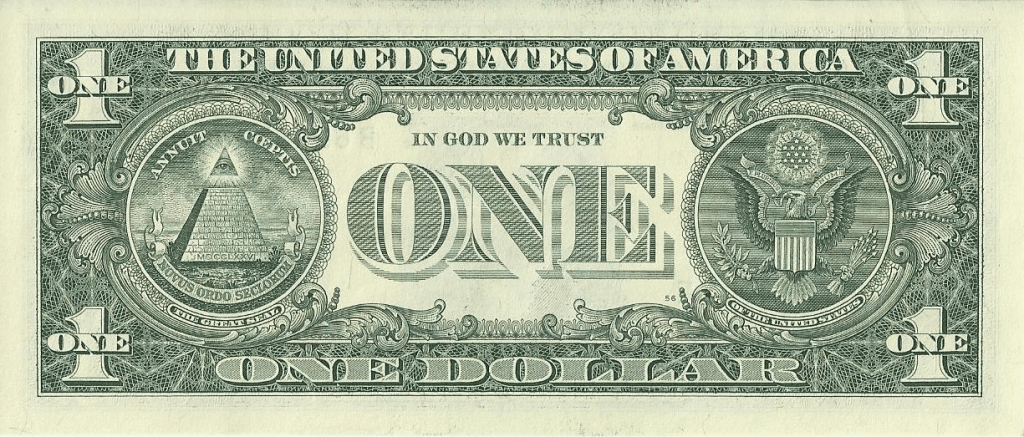
‘There, as part of what is labeled “The Great Seal,” the Eye of Providence appears as the capstone of an unfinished pyramid. The base of the pyramid is inscribed with “1776” in Roman numerals. Beneath the pyramid is a banner reading “Novus Ordo Seclorum” (Latin for “New Order of the Ages”). Above the pyramid are the words “Annuit Cœptis” (Latin for “Favors Undertakings”). The idea on the Great Seal, then, is that the Eye of Providence has shown favor to America in its founding of a new era of history. 

The film industry… [gave] us National Treasure, in which the “all-seeing eye” was supposedly used as a symbol of Free Masonry by America’s Founding Fathers. However, the use of the eye in an unfinished pyramid was never a Masonic symbol, and the all-seeing eye was not used in Free Masonry until 1797, years after the design for the Great Seal was finalized.’ 

For the simple reason that a more shadowy and sinister group were behind the all-seeing eye and Great Pyramid symbolism – refer article: The Establishment: Who are they… What do they Want? 

‘In popular culture, J. R. R. Tolkien’s character Sauron in The Lord of the Rings is referred to as the Red Eye, the Lidless Eye, and the Great Eye. Peter Jackson’s depiction of Sauron in his Lord of the Rings film trilogy is that of a fiery eye that watches all of Middle Earth.’

The all-seeing eye is found throughout the world and used as a talisman or charm in many cultures – especially those which subscribe to the existence of the ‘evil eye’, against which the ‘all-seeing eye’ is believed to provide protection. The ojo de venado is a shamanic amulet used in this fashion in Mexico. The symbol is not used in Buddhism, though Buddha is referred to as the ‘eye of the world’ in some Buddhist texts. 

Got Questions: ‘While Christianity makes use of many symbols (the cross and the fish being the most common), they were never imbued with any special power. The symbols remain pictures that remind us of basic Christian [‘truths’], and that meaning makes them important but not inherently powerful. In European Christian contexts, particularly in the Medieval and Renaissance periods, the so-called Eye of Providence within a triangular frame was used as a symbol of the Trinity. The eye itself could be considered a symbol of God’s omniscience.’

The all-seeing eye is a powerful icon regardless of the different contexts recognised by diverse peoples. The benign meanings include those on the chart above. Malevolent meanings extend to it being a Masonic symbol and a conspiratorial sign of the Illuminati – Article: 33. Sharing centre stage with the Great Pyramid is intriguing, as is it representing a watching God

There are a number of verses in the scriptures which refer to the Eternal or rather His messengers or angels watching people on earth and particularly those who please Him. ‘For his eyes are on the ways of a man, and he sees all his steps’ – Job 23:21, ESV. 2 Chronicles 16:9, ESV: ‘For the eyes of the Lord run to and fro throughout the whole earth, to give strong support to those whose heart is blameless toward him.’ 

While the Bible discusses the Nephilim – the offspring of fallen angels – it does not disclose the angels role as watchers, but the Book of Enoch does. ‘[Righteous Enoch] was wholly engaged with the holy ones, and with the Watchers in his days. Then the Lord said to me: Enoch, scribe of righteousness, go tell the Watchers of heaven, who have deserted the lofty sky, and their holy everlasting station…’ – Enoch 12:2, 5. 

The eyes of the Adversary who rules the world are not directly stated in the Bible though they are indirectly. 1 Peter 5:8, ESV: “… be watchful. Your adversary the devil prowls around like a roaring lion, seeking someone to devour.” Like a predatory lion, the eyes of the Devil keenly watch for those whom they can tempt and destroy. Likewise in 2 Corinthians 4:4, ESV: “In their case the god of this world has blinded the minds of the unbelievers, to keep them from seeing the light of the gospel of the glory of Christ…” 

It is wishful thinking that the Eye of Horus, or the all-seeing eye is that of the Creator. Rather, it is the baneful watchful eye of the Adversary, the architect of the physical realm and god of this world. The designers of the Great Seal surely knew this and deigned to place the all-seeing eye of Horus and its hidden meaning in plain sight on top of the Great Pyramid’s capstone.  

The Eye of Horus – the Falcon sky god – on top of the Great Pyramid, highlights the aspect of a ‘birds eye view.’

What a bird sees when flying 

Applicable sayings include: having the “eyes of an eagle” and being “watched like a hawk”.

Yet having a bird’s eye view and being watched like hawk have a disquieting interpretation, when viewed in light of angelic/alien activity perpetrated against the human race. Of course now, we are in a period of history where people can literally be monitored much of the time they go outside, use online services, ATMs or mobile phones – Article: The Great Reset & the Fourth Industrial Revolution. It is an age the founding fathers could have only dreamed and one where George Orwell’s prediction of televisions that are capable of watching us (Nineteen Eighty-Four, 1949) has eerily come true – Article: The Establishment: Who are they… What do they Want? 

The ramifications of the all-seeing eye include what is called, the Third Eye. The third eye in turn is linked with the pineal gland in the human brain. A further interesting correlation is related to the Great Pyramid’s hum and vibrational qualities. 

Article, 33: ‘… it is interesting to note the related subject of Aum or Om which is said to represent the most primordial sound vibration of the Universe. The syllable Om or Ohm was the original, holy sound emanation, predating the Universe and the herald of the birth, life, death and rebirth process. According to Hinduism, Brahma was the single entity in existence and as the Creator, thought ‘to become many’. Yoga practitioners chant the sound Om to bring themselves ‘into harmonic resonance with the Infinite and connect with the divine’ in seeking ‘to move out of mental dissonance and chaos’ according to Ashley Turner.  She further states: 

“OM is said to vibrate at 432 Hz [4+3+2 = 9], which is the natural musical pitch of the Universe, as opposed to 440 Hz, which is the frequency of most modern music. It is considered one of the most important spiritual symbols (pratima) and represents the sacred trinity in all its depictions.” For instance: Body, Mind and Spirit; Father, Son and Holy Spirit; Brahma, Vishnu and Shiva; Saraswati, Lakshmi and Durga-Kali. The… symbol represents the meaning of AUM. The symbol OM visually consists of three curves, one semicircle, and a dot.’ 

‘The pineal gland is a small pine cone shaped object located deep between the cerebral hemispheres in the epithalamus. It is attached to the upper part of the thalamus near the roof of the third ventricle. A normal pineal gland appears as a small reddish-brown or grey structure and its normal size ranges between 10 and 14 mm, or a third of an inch. The gland is part of the endocrine system and assists in regulating melatonin; a chemical produced to help the body sleep at night. Its function is to govern the production of hormones, while maintaining the circadian rhythm of our sleep/wake cycle.’

What is the pineal gland? Healthglade – emphasis & bold mine:

‘To the present day, the functions of the pineal gland are not fully understood. Current knowledge indicates that by secretion of melatonin, the pineal gland plays an important role in the regulation of the sleep-wake cycle and of reproductive function (e.g. onset of puberty), with melatonin also acting as a neuroprotector or antioxidant. 

Previous studies have suggested a decline of melatonin secretion with age and an association between melatonin decrease and neurodegenerative diseases such as Alzheimer’s or Parkinson’s disease. The amount of uncalcified pineal tissue was shown to predict total melatonin excretion with lack of melatonin being hypothesized to result from pineal gland calcification [with the addition of Fluoride in tap water and toothpaste, contributing to calcification of the pineal gland]. 

Calcification of pineal region tumors is very common… Pineal gland calcifications, also referred to as “brain sand”, involves the development of hydroxyapatite deposits and is very common with a reported prevalence of approximately 68-75% in adults. In all population groups, calcification of the pineal gland was found to increase with age.’ 

The acceleration of the decline in pineal gland functions as one grows older is further alarming as it does not just regulate purely physical processes. 

What is the Pineal Gland’s Function and How to Amplify It, Mindbliss – emphasis & bold mine: 

‘[The pineal gland] has long been associated with the idea of the “third eye”, which is a spiritual symbol of all-knowing according to yoga philosophy and often perceived as a gateway for the soul’s liberation. In his book Kundalini Tantra, Swami Satyananda Saraswati says, “It has also been called ‘the eye of intuition’, and it is the doorway through which the individual enters the astral and psychic dimension of consciousness. Perhaps the most common name for this chakra is “the third eye”, and the mystical traditions of every age and culture make abundant references to it.

It is portrayed as a psychic eye located midway between the two physical eyes and it looks inward instead of outward.” 

‘The idea of the third eye has also floated around science circles previously, as some believe the pineal gland is what has been leftover in the human brain of an actual, physical third eye which we eventually evolved out of. Swami Satyananda Saraswati says: 

“The pineal gland acts as a lock on the pituitary. As long as the pineal gland is healthy, the functions of the pituitary are controlled. However, in most of us, the pineal gland started to degenerate when we reached the age of eight, nine or ten. Then the pituitary began to function and to secrete various hormones which instigated our sexual consciousness, our sensuality and worldly personality. At this time, we began to lose touch with our spiritual heritage.” 

‘The pituitary gland is a gland that acts as a master gland, controlling many of the hormonal functions in the body.

It is located in the hypothalamus in the brain, which also contributes to our sleep/wake patterns. This means the pituitary and pineal gland work together for proper function. Imbalances in the pineal gland (and pituitary) can lead to sleep disturbances and problems with your sleep/wake cycle. Therefore, this tiny, little gland plays a bigger role in our lives than previously thought! 

In addition to the physiological role the pineal gland plays in the body, it is also commonly associated with spiritual thought and mystical experiences. Ancient sages and mystics believed this area of the body to be the space for ascension and enlightenment through the brain/body.

It is perceived as a bridge between our inner and outer worlds, as well as to a connection to something beyond what we know to exist, to a higher state of consciousness… now that it has been proven that melatonin is in part regulated by the pineal gland, it does lend credibility to the fact that increased melatonin production can produce transcendent or mystical experiences during a waking state such as meditation through its function as a psychotropic chemical. 

Symbolically, the third eye represents union on the path to cosmic consciousness, divine wisdom, inner knowing, and intuition. This is the place where the ego is left behind and the concept of duality begins to unwind in order to embrace unity or the concept of oneness.’ 

A healthy pineal gland allows a person to be open to a spiritual relationship. Optimistically a positive one with the Eternal rather than a negative one at a low vibrational level with a demonic entity as encouraged by New Age, ceremonial magic and occult practices. An unhealthy pineal gland, one that is calcified and indicative of the majority of the population means the world is being progressively dumbed down spiritually at the very least. 

Article, 33: ‘Associated with the Third Eye, is the All-Seeing Eye. The symbol of the number three is a triangle; specifically, an equilateral triangle inside a circle. It is an arcane occult symbol dating back to very ancient civilisations. Alice Bailey of the Lucis Trust states that the coming New World Order is best symbolised by a triangle within a circle, with a dot inside the triangle. The dot or point symbolises the ruler of the spirit world, Sanat, an anagram for Satan. Bailey says that Sanat is the entity who at the appointed time, will emerge to rule the Earth and humanity’ – Revelation 12:3-4. 

‘Satan is clearly represented in the Illuminati symbol the Eye of Providence, or the All-Seeing Eye. It is a symbol rooted deeply in Masonic tradition and ritual. It is typically depicted as a single eye – the eye of Horus – placed centrally inside a triangle or pyramid and enhanced using beams of light, in Illumination. The eye represents the Serpent of Wisdom, the powerful, ever-present, all seeing one’ – Genesis 3:1.

The link between the pineal gland, the third eye and the Eye of Horus

‘Theresa Ibis, founder of the Universal Kabbalah Network, says: “From spirals, to circles, to triangles, to squares and where these things manifest themselves, and why those are the best patterns for nature to follow, and how that we can use those patterns as gates and keys within our own soul, and open up energies to flow through us that we would like to be working with. The triangle often represents a trinity, it represents spirit, so if we want to connect with spirit, we can imagine our head being immersed in a golden pyramid of light”.
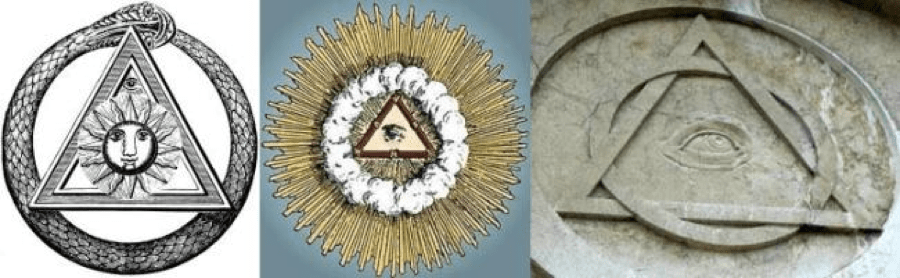
Triangle inside Circle Occult Illuminati Symbol, Healthglade – emphasis & bold mine: 

‘The Rosicrucians are another ancient movement heavily involved in the triangle inside the circle symbolism. Their manuals refer to it as the “Symbol of Creation”, with the only difference being that the circle is represented in the form of a serpent swallowing its own tail. The serpent is known as Nehushstan, and is mentioned in the Bible in 2 Kings 18:4 as the bronze serpent which the Israelites worshipped and made religious offerings to.

The serpent is also referred to as Ouroboros, and can be found in both the Ancient Greek and Egyptian cultures, as well as practices such as Gnosticism, Hermeticism, Alchemy, and Kundalini Yoga – refer Chapter XXII Alpha & Omega.

The infiltration of the Christian religion by satanic and occult practices is well known. The Catholic churches are chock full of symbolism, including the all-seeing eye, circumscribed triangle, or triangle within an arch, and even modern churches such as the Seventh Day Adventists have also been overtaken by these symbol proliferators’ – article: The Seven Churches – A Message for the Church of God in the Latter Days

It does not bode well for organised religion when the founder of the Jehovah Witnesses was a Freemason and the founder of the Seventh Day Adventist Church is buried adjacent to a miniature replica pyramid.

‘One of the main agendas of the Illuminati is to proliferate the use of occult symbols and spread them throughout our daily lives. This plan is discrete, and with the general public not knowing the true meanings of these symbols, it is an easy plan for them to promote and worship Satan without facing opposition. One of their favourite places to put these images is on government or official logos, where they will be recognised and acknowledged by the public as a symbol of authority and domination over their lives.’ 

‘Alcoholics Anonymous is a well known Illuminati front organisation, so it comes as no surprise that they would adopt an Illuminati symbol to depict themselves’ – image below, upper right corner. ‘Their description and reasoning for selection of the symbol to represent them [sounds] very much like the making of a satanic ritual… The Alcoholics Anonymous organisation also acknowledged the symbols origins in ancient times and cultures… In addition… the symbol can also be found in seemingly innocuous locations, such as shown below on the monitoring well, and has even been known to appear in crop circles in the United Kingdom’ – refer article: Stonehenge.

‘Another popular modern-day movement to have adopted this symbolism is the homosexuality movement, and many members will be shocked to find out the origins of their symbol, the pink triangle inverted inside a green circle. They use it to symbolise alliance with gay rights and a space free from homophobia, unaware that the same space has been used for centuries by satanists in their rituals to conjure demons. 

Satanists refer to the triangle inside the circle as… the Thaumaturgic Triangle or Thaumaturgic Circle. It is one of their primary tools used in demon conjuring ceremonies, as the triangle is the doorway to the spirit realm, and the circle is the boundary of the power. Some Satanists will even remove the circle in the hope of being possessed by the demons. 

The triangle within a circle dominates the pages of Masonic literature, and is also used in their most popular imagery. It is said they refer to it as the symbol of the Kybalion, and have adopted it from Hermetic Philosophy of Ancient Egypt and Greece – refer article: Thoth. Hermes just happens to be mentioned in the Bible in Acts 14:8-13, where the masses believed that gods had come down in human form, and that Paul was in fact Hermes.’

Originally, this fact was just an interesting coincidence. Yet, it may indicate a strange and dark relationship between the arcane legacy associated with the Great Pyramid and the theology taught by the false apostle Paul – explored in the article: The Pauline Paradox

The reoccurring aspect of the Great Pyramid being a portal to other dimensions is important. Its prime shape is composed of triangular faces and it is triangles which form the points of drawn stars as well as on pentagonal and heptagonal stars used in flags and satanic ceremonies. 

In The Genesis 6 Conspiracy, 2014, Gary Wayne discusses the legacy of the Watchers and their Nephilim hybrid offspring. According to Wayne, all clandestine brotherhoods adhere to cloak-and-dagger ceremonies, arcane rituals and surreptitious initiations; with two sides, one for the elite and one for the mundane masses. ‘Why was and still is there a necessity for secret Snake Societies? As with all of these stealthy forms of religion, the true face is always hidden beneath a veil of mystery and lies. Specious societies and religions are always reinforced with ceremonial rituals, some secret and some for public consumption.’ It was evil Enoch the son of Cain, who ‘first introduced ceremonies, rituals, secret allegories, and other mysticism into the pure ante-diluvian masonry. Secret worship was called mysticism. Secret societies, and societies within societies, were, and are, Enoch’s ancient style of mysticism. 

There were of course, distinct degrees of deception. The Lesser Mysteries could be revealed without fear of incrimination, through public ceremonies and rituals immersed in allegories. As for the Greater Mysteries, these were forbidden to be written down or disclosed in any form to the… masses… Alan Alford writes that the true secrets nurtured by numinous [‘surpassing comprehension or understanding, mysterious, spiritual, supernatural’] societies have never been fully divulged, a comment that one can apply to modern Freemasonry and modern mysticism. Alford… adds… only at the final level of initiation, the Third level of Perfection, or at the Thirty-Third Level of Freemasonry, is the “Secret of Secrets” revealed, which would not only astound the initiate but… is believed… to be of such earth-shattering meaning that its revelation would overturn any preconceived opinions’ – Article: 33

‘… Enochian pantheism that Freemasonry is anchored in is a doctrine denying the personality of God, while worshipping gods of different creeds. Pantheism depersonalizes God [as our Father] to a universal life force, to an impersonal [pure] energy’ as the ‘singularity and the unicity point that sparked the Big Bang. 

The mysteries were created to both conceal and teach the initiated two great truths… the unity of God and… the immortality of the soul in a future life‘ – refer article: DEATH: A Dead End or a New Beginning?; The Seven Churches – A Message for the Church of God in the Latter Days; and Chapter XXII Alpha & Omega

‘The translations of the two truths are very simple and consistent with the definition of pantheism and mysticism… the unity of God, represented by the All-seeing Eye or the Eye of Osiris, pictured prominently on the American one-dollar bill, atop a great pyramid, is the non personal, universal life force and not a single entity, omnipotent God proclaimed by monotheistic religions’ – Article: 33

Of course, this supposed monotheistic God of Christianity is falsely taught as a Trinity, when in fact God is best described by Unitarianism. God is one, for there is only one true God – Article: Arius, Alexander & Athanasius

Wayne: ‘The All-seeing eye… is merely a symbol for the…. Architect of Heaven and Earth’ – the Adversary. ‘This is the secret that supposedly changes all preconceived minds alongside the illicit knowledge from heaven… the immortality of the soul, is commonly known as reincarnation. The individual is on an evolutionary path to godhood, where eventually, that person, too, will join the pantheon of gods.’

The truth is that when we die, we enter a state much like sleep, but with no dreams. There is no heaven or hell at the moment of death, but a future resurrection awaits everyone – Revelation 20:13. 

Wayne: ‘Enoch the Evil consequently changed the order of access to the holy knowledge by establishing selected elite to garner and preserve it. Enoch the Evil was alternatively recorded as Uanna, the great Mesopotamian sage who travelled with the Anunnaki/Nephilim and was one of the Shadowy Seven (Snake) Sages, one of the builder gods…. who helped transfer antediluvian knowledge to the postdiluvian epoch’ – refer article: Monoliths of the Nephilim

The mystery of lawlessness (2 Thessalonians 2:7); the mystery religion (Genesis 10:9); mystery Babylon the Great (Revelation 17:5); and the Brotherhood of the Snake (Genesis 3:4-5), which were ‘founded’ by Cain and his evil son Enoch (Genesis 4:17), permeated the antediluvian age and corrupted Atlantis (Genesis 6:5). 

Thoth being the overseer of this system – and so may just equate with the princely fallen angel Azazel as surmised – with Anubis as guardian. Headquarters of this administration appears to be perhaps formerly Sirius (and Orion) and now Draco, with Mars and the Moon convenient way stations. Pre-flood pyramids surely a given; it was Nimrod who sought to resurrect – pun intended – this satanic system.

The burning question: Is did Nimrod in fact build a pyramid? 

Many authors and researchers have questioned whether the Great Pyramid of Giza may have acted as a device that helped prolong and grant new life and power to the Egyptian monarchs. It – like the Tower of Babel – is heavily tied to being a stairway to heaven, facilitating a transfer between dimensions, from the physical to spiritual. 

The vibrational acoustic qualities of the Great Pyramid are suspiciously related to either a. inducing altered states of consciousness in expediting communication between men and spirits; and or b. going a step further and promoting the ability to vibrate at a higher rate so that a human bridges the third, fourth and fifth dimensions. 

One source states that the word pyramid is deemed to be ‘derived from πῦρ or fire, thus signifying that it is the symbolic representation of the One Divine Flame, the life of every creature’ – Addendum I.

Nimrod’s destiny like Osiris (or Orion) is living again and his role is paramount in supporting the future Antichrist – Chapter XXII Alpha & Omega; Article: Is America Babylon? It is Nimrod as the False Prophet, who will set the mark of the Beast on all those who are unsuspecting of the insidious agenda to lead humanity down a path towards destruction – though in the guise of ‘immortality.’

“Through the mystic passageways and chambers of the Great Pyramid passed the illumined of antiquity. They entered its portals as men; they came forth as gods. It was the place of the “second birth,” the “womb of the Mysteries,” and wisdom dwelt in it as God dwells in the hearts of men” – Manly P Hall 

The questions posed on who, when, why and how still linger in relative degrees. This is in part due to the fact that when this investigation was begun, little did this writer comprehend the direction it would take. 

Personally, it has been unsettling at first yet progressing to exhilarating, as discoveries relating to other preconceived and incorrect ideas. For example: a. that Noah’s ark was a wooden sailing ship instead of a titanium type submarine; b. the original mountain range of Ararat, was not located in Turkey, but the Himalayas in Asia; and c. Atlantis did not sink, but was submerged in layers of glaciation and remains hidden as the ice continent, Antartica

For the first time in any research, this writer found themselves left with not just one theory or conclusion, but confusingly yet equally convincingly, with two. 

Regarding when the Great Pyramid was built, two time frames step easily forward. One occurs quickly after the Flood. The date of 10,627 BCE was chosen for it lays within Vega as the North Pole Star and fits with a prophetic hunch. It is a flimsy premise, though Graham Hancock and company do propose 10,450 BCE. There is the real issue of the devastation left by the Flood and the time required for the land to heal. After further thought, anytime prior to 10,000 BCE is probably unfeasible. Added to this, is the fact that a certain measure of time was required to pass, so that a. enough manpower was available to participate in such a monumental project; and b. the technological equipment required to build such an imposing edifice needed to be developed and manufactured. 

Thus the alternative era is during the lifetime of Nimrod. Due to natural disasters on the Earth at the time; the genealogy of Arphaxad’s descendants; and the confusing of the languages; a date of circa 6755 BCE has been an attractive and realistic date used in this writer’s research to date. Nearly four thousand years separates these two dates though. 

Just as 10,627 BCE was based on the precessional cycle working backwards from a future date with prophetic implications; a more exact date for the construction or perhaps failed completion of the Great Pyramid – on the assumption it doubles as the Tower of Babel – and based on a re-interpretation of the same prophecy, arrives at a date I personally certainly did not foresee. Nor did I presume to engineer it for effect, for sensationally it is a date in keeping with Nimrod’s role as the False Prophet and the mark of the Beast. The pivotal year in question regarding the construction of the nearly nine thousand year old Great Pyramid resulted in the year, 6666 BCE. This number adds up to 24, which is 2+4 and interestingly, equals 6 – refer article: 42.

Who built the Great Pyramid is certainly an enigma if the event occurred immediately following the Flood. Even if it was a god like being such as Thoth, who exactly – Egyptian name ḏḥwty – is Thoth? Enoch reincarnated or the mighty Azazel? As Nimrod is closely associated with Orion and Osiris, it would be hasty to dismiss him as the builder of the Great Pyramid. Yet he was born well after the Flood as a fourth generation descendant of Shem, at the earliest. These two names are repeatedly associated with the Great Pyramid. If one of them did not build it, then answering who did may never be understood. 

Why the Great Pyramid was built relates to what is the Great Pyramid? On the one hand it may well have been a device to create energy as Christopher Dunn and many others argue. This would perhaps ascribe a benevolent use and an earlier construction. If it was still an energy creating machine though with a diabolical metaphysical purpose, then a later construction may then coincide with the intentions of Nimrod to bridge the gap between the physical world and the spirit realm with a portal or stargate. 

Whether this was through thought transference or a spirit resurrection? Either way, the Pyramid was built with all the remarkable symbolism discussed, equating it with both the Earth – and particularly the Northern Hemisphere – as well as a star, in all likelihood the North Pole Star. 

What is a star? What does a star do? It transforms from Hydrogen to Helium.

This is interesting when compared to nuclear power plant capability, where through Electrolysis and thermochemical means, they can split water molecules into its component parts of Hydrogen and Oxygen. Hydrogen as a fuel, is both cheaper and safer than conventional fossil fuels and electricity. 

Herschel Space laboratory: ‘The process begins when a star forms from a collapsing hydrogen cloud. The gravitational pressure at the star’s core generates heat, which ignites a thermonuclear fusion reaction that converts the core’s hydrogen into helium. This process, called “nucleosynthesis,” continues until the core’s hydrogen is exhausted. What happens next depends on the star’s mass. 

Observations indicate that most stars are massive enough to enter a second round of nucleosynthesis. The depleted core – now rich in helium – contracts further, generating enough heat to start a thermonuclear reaction in a shell of hydrogen surrounding it, which fuses that hydrogen into helium. If the core’s temperature gets hot enough, it undergoes a second wave of thermonuclear fusion itself, turning its helium into carbon and oxygen. 

The more massive the star, the more generations of nucleosynthesis it will experience. The most massive stars can have several layers of fusion going on at the same time, with the outermost converting hydrogen to helium, a shell beneath it turning helium into carbon and oxygen, a shell beneath that producing heavier elements, a shell beneath that creating even heavier elements, and so on down to a core in which iron is produced.’ 

‘Once a star forms an iron core, its days are numbered. Up to that point, the nuclear fusion reactions produce energy, creating an outward pressure that counterbalances the inward pressure of gravity. But iron fusion uses up energy instead of producing it. So the outward pressure stops and even reverses, gravity takes over, and the star rapidly implodes until suddenly a vast number of neutrinos blast out of the core, blowing the rest of the star to bits in a supernova explosion that may be as bright as an entire galaxy.’ 

“A neutrino is a subatomic particle that is very similar to an electron, but has no electrical charge and a very small mass, which might even be zero. Neutrinos are one of the most abundant particles in the universe. Because they have very little interaction with matter, however, they are incredibly difficult to detect” – Aksel Hallin. 

Smaller stars undergo a less spectacular transformation. It is interesting that a large star can finish its life, or perhaps begin its life as a Black Hole. A misconception about Black Holes is that they are wormholes; but they do not provide shortcuts between different points in space, or portals to other dimensions or universes. Another is that they are ‘Cosmic vacuum cleaners.’ Black holes don’t suck in other matter; their gravitational effects are like those of other objects of the same mass. Similarly, these objects are not really holes. They are in reality huge concentrations of matter packed into very tiny spaces. So that a Black Hole is so dense that gravity just beneath its surface, the event horizon, is so strong that nothing, not even light can escape. 

Analogous to this less than positive transformational rebirth is the bleak state rebellious angels will find themselves. ‘They are like stars which follow no orbit, and their proper place is the everlasting blackness of the regions beyond the light’ – Jude 15, Phillips. 

How the Great Pyramid was built might remain the greatest mystery of the four questions. If built by a god after the Flood, perhaps ‘magic’ such as sonic levitation was used. A later construction could have meant a technology which utilised an advanced hydraulic system for transporting and lifting the huge stones. But even this idea poses logistical capability and lifting stability dilemmas. Perhaps it did take one hundred thousand people over twenty years to build the pyramid as Herodotus claimed. 

Where does this leave us? 

‘Certainly, with the Great Pyramid of Giza, we have one of history’s most enduring, immovable, monumental landmarks – a record in stone, “for ever” – Christopher Eames

Well, the Great Pyramid isn’t just one of the most enduring, but is the most enduring monument in history. Impossible to be a relic from before the Flood, it is the most ambitious architectural achievement in the age following the Flood cataclysm. 

Surely the Bible wouldn’t be quiet on the matter? In seeking to resolve which theory is most plausible of the two presented, let’s return to the Old Testament and read verse by verse. 

Genesis 11:1-4, 8-9 

English Standard Version 

1 ‘Now the whole earth had one language and the same words.’

After the Flood, the family of eight survivors, became twenty-one and soon multiplied to become nations – Genesis 10:32. It is both credible and obvious, everyone spoke the same language at that time.  

2 ‘And as people migrated from the east, they found a plain [H1237 – biq‘ah: a plain or valley] in the land [H776 – ‘erets: firm or level earth] of Shinar [H8152 – Shin’ar] and settled there.’

This verse is one of three pivotal verses in Genesis chapter eleven. Strong’s define the Hebrew words, though do not define the word shinar, as it is ‘probably of foreign derivation.’ 

Abarim Publications offer ‘that what is young.’ This is applicable in two ways in that Shinar was a new territory after the Flood and what Nimrod and company endeavoured was a form of staying young, by living forever – the age old quest for immortality

Strong’s state: ‘hinar = “country of two rivers”, with Shinar ‘the ancient name for the territory later known as Babylonia or Chaldea.’ 

Though as the constant reader is aware, words can be older than ‘ancient’ even and derive from a geographic location older than the one currently known or acknowledged – refer Ararat: Chapter I Noah Antecessor Nulla. Doubt has a legitimate claim in being cast on the original location of Shinar if the word is not Hebrew in origin and ostensibly from an older language. 

The map below highlights the location of Shinar as commonly accepted. Though perhaps it is a later, shrunken territory after the dispersal. 

People had travelled from the East. East must mean Asia, West Asia or the Middle East. Scientists propose man originated in Africa, but historians teach Sumerian civilisation is the oldest. Yet, human’s after the Flood settled first in the Indus Valley and travelled eastwards to the Middle East – Chapter I Noah Antecessor Nulla. Civilisation in Egypt, while old, realistically sprung from Mesopotamia if the Tower of Babel as the Great Pyramid was built circa 6666 BCE.

In Genesis 10:10 it says Nimrod’s kingdom included Babel, Erech, Accad and Calneh, which were all in the land of Shinar. Due to the expansion from the Indus Valley, the assumed cities may have been regions within Shinar, dating from the Flood in 10,837 BCE until circa 7000 BCE. Thus on the map above – for the want of a better one – the territory of Calneh would have incorporated the Indus Valley (Pakistan); Accad, Persia (Iran); Erech, Mesopotamia (Iraq); and Babel, Egypt. There is no reason to disregard the area to the south of the Nile Delta region in Lower Egypt as the plain in question. 

In answer to the following on Quora, Could the Great Pyramid be the Tower of Babel? An online comment in reply:

“Interesting question… everyone’s arguments seem to be a dispute of the geography indicated in Genesis… fair enough. But the Qur’an does mention an incident that resembles the Tower of Babel story, with a few key differences” – 28:38; 40:36-37. “In the Islamic version, the story does take place in Egypt, and it is the Pharaoh who orders a minister named Haman to build a tower that reaches the heavens. So, using this configuration, your query would be geographically possible, and the position could be plausible.” 

3 ‘And they said to one another, “Come, let us make bricks [H3843 – lbenah], and burn [H8313 – saraph: kindled, made] them thoroughly.” And they had brick for stone [H68 – ‘eben: stone (large or small), a ‘sacred object’], and bitumen [H2564 – chemar: slime, pitch, asphalt, bitumen; derived from H2560 – chamar: to daub, seal up, cover or smear] for mortar [H2563 – ḥōmer: cement, clay].’

The second key verse in this passage reveals the bricks in question were not necessarily what we today would think of as a small red and brown brick. The meaning of eben includes large stone ‘blocks’, which generically could be called ‘bricks’. They were also designed for a ‘sacred object.’ The Hebrew word for brick can mean to tile or a pavement and derives from H3835 – laban: meaning ‘to be white, make white, to show whiteness.’ Recall the Great Pyramid was constructed from yellow limestone blocks (bricks) and slabs of white limestone. 

4 Then they said, “Come, let us build ourselves a city and a tower [H4026 – migdal] with its top [H7218 – rosh] in the heavens [H8064 – shamayim], and let us make a name [H8034 – shem] for ourselves, lest we be dispersed over the face of the whole earth.” 

The third key verse describes the monument and cryptically its purpose. Some detractors ridicule that a ‘tower’ could not be for instance, a pyramid; yet the Hebrew word for tower can mean a ‘castle, elevated stage, a rostrum’ and a ‘pulpit.’ Amazingly, it can also refer to ‘a (pyramidal) bed of flowers.’ Tellingly, the word in reference to a ‘tower’ can refer not just to its height, but its size. The Great Pyramid with a mass greater than all the cathedrals and churches in Great Britain combined and a height of 480 feet could easily be defined as a tower, no matter what anyone may argue to the contrary. 

Added to this, the word migdal is derived from H1431 – gadal, meaning: ‘to grow, become great or important, promote, make powerful, praise, magnify, do great things.’ While this definition does not prove it is the Great Pyramid, it certainly could apply to said structure. 

The Hebrew word for top means: ‘head, summit, upper part, chief.’ Top can be in reference to the tip of a mountain, which fits the Great pyramid, but not so well a standard – tall, thin – skyscraper. Fascinatingly, the word rosh can allude to height in the context of the stars. In comparison, the Hebrew word for heavens can mean: ‘air, the sky, atmosphere, visible heavens, visible universe’ and ‘Heaven (as the abode of God).’ The Tower of Babel did not and could not literally reach Heaven. Figuratively, it was designed so that it could – Chapter XXI The Incredible Identity, Origin & Destiny of Nimrod.

Recall the empty space discovered behind the North Pole Star, Polaris. A veritable stargate if there ever was one. A portal from the Universe (the second heaven) accessing the spirit realm (the third Heaven) where the Eternal dwells. The significance of the correlation between the Great Pyramid and Polaris is heightened – no pun intended – when factoring in the very purpose of the Tower of Babel, which was to reach God or to become like Him.

The Great Pyramid Decoded, Peter Lemesurier, 1977 & 1996, page 53: 

‘And in this case what strange truth may lie in the speculations of those who assert that man’s true origins were extra-terrestrial [for “man was originally a wholly spiritual creature”], and are to be found in the celestial region of the Pole Star?’ Lemesurier postulates that man’s fall was from ‘the northern sky, via dimensions unknown, into earthy mortality […] And may we see a connection with the fact that homo sapiens apparently first appeared – quite suddenly, it seems – in the northern hemisphere?’

The Hebrew word for name means: ‘reputation, fame, glory, memorial’ and ‘monument.’ Attributes the Great Pyramid certainly represents. Strong’s concordance  further state: ‘… through the idea of definite and conspicuous position… an appellation, as a mark or memorial of individuality; by implication honor, authority, character… base… fame(-ous), named(-d), renown, report.’ 

The Tower of Babel was to be an impressive project with lasting impact. The word shem is derived from H7760 – siym, which means: ‘to put, place, set, appoint, make, lay, direct, ordain, establish, found, constitute, determine, fix, plant, station, work, fashion’ and ‘bring to pass.’ Interesting definitions of the word for name, in light of the Great Pyramid are: ‘heap up’, where the pyramid is literally composed of nearly two and a half million blocks; ‘transform into’; and ‘to set or make for a sign’, which the Great Pyramid after 8,690 years still achieves.

8 ‘So the Lord dispersed them from there over the face of all the earth, and they left off building the city’ – Genesis 10:25. 

The Tower was not destroyed. The single, sole language was confounded, the people spread across the globe. The Tower was not finished, completed or used for its evil purpose. Hence why the internal mechanism for the Great Pyramid shows hurried, lesser quality workmanship due to the ensuing breakdown in communication – as well as an unfinished subterranean chamber. For those who consider the capstone was never positioned as the pinnacle on the Great Pyramid, possess further support of an interruption. Perhaps the pyramid was even tested, though a concerted or prolonged effort in making use of its capability was prohibited in transpiring. 

9 ‘Therefore its name was called Babel [H894 – babel: ‘Babylon = “confusion (by mixing)”], because there the Lord confused the language of all the earth. And from there the Lord dispersed them over the face of all the earth.’ 

Like the word shinar, babel is not a Hebrew word and so a definition has been ascribed to it that describes what the Eternal did. Abarim Publications describe the non-Hebrew word as being ‘from the Sumerian phrase Bab-ilim’ meaning the ‘gate of god.’ 

Shawn Murphy: “The groundbreaking work of Sir William Jones has shown that all of the world’s languages originally came from one. Much more work has been done on this theory which has resulted in accurate dating of the history of language, illustrated in the attached table [below].” 

This is an excellent table, though would hasten to add that it only shows the languages spoken by the descendants of Shem and not his brothers, Japheth and Ham (apart from Cush) – Chapter XVI Shem Occidentalis.

Murphy: “The most logical research shows that the various languages started to develop after the flooding at the end of the last ice age, about 10,500 years ago” [10,837 BCE] – Article: The Younger Dryas Stadial: Ending of the Earth… Beginning of the World. “So, the history of language shows that the “Tower of Babel” event must have happened sometime before 8,000 BCE [6666 BCE]. There are no archeological finds dating back to this time period. The “towers” discovered were built thousands of years later, after there were many languages already. 

Many think that Babel somehow refers to [the word] Babylonian, yet the word Baba-el has turned out to be a much older word than [Sumerian] or Babylonian. It dates back to the earliest language and it means “God the Father” [Baba = father, El = God].” 

Agreed, all this information is circumstantial evidence. That said, until someone can categorically disprove where it all leads, then it is considered the best theory in this writer’s view. 

Given the purpose of the Great Pyramid, it would just be a matter of time before a large enough number of people – led by an adversary – set to construct one, as the following quote reveals. 

“Show me a man or a woman alone and I’ll show you a saint. Give me two and they’ll fall in love. Give me three and they’ll invent the charming thing we call society. Give me four and they’ll build a pyramid. Give me five and they’ll make one an outcast. Give me six and they’ll reinvent prejudice. Give me seven and in seven years they’ll reinvent warfare. Man may have been made in the image of God, but human society was made in the image of His opposite number, and is always trying to get back home” – Stephen King, The Stand 

Weighing all the information carefully, Nimrod fulfils better than anyone else in being the instigator of the Great Pyramid – the Tower of Babel. He in turn may not have been the original architect but rather an inheritor of a pyramid legacy from the antediluvian Atlantis age – begun with the god Thoth and or the demigod, Enoch the Evil. 

Based on an unconventional chronology, the Tower of Babel was built during the lifetime of Nimrod and Arphaxad’s descendants, Joktan and Peleg. This dates to anywhere between 8700 BCE to 4737 BCE. Refining this period to a more accurate time frame decreases the window from 7727 BCE to 6232 BCE. Reducing one further time after synchronising all relevant data, provides a calculated date of circa 6666 BCE for the Tower of Babel rebellion. 

Opinion that the Sphinx is of a greater age than the Great Pyramid could be with foundation and so its construction may well equate to the earlier precessional based period circa 10,627 BCE or shortly thereafter.

The Eternal said nothing would be beyond humanity’s capabilities if the building project succeeded. Therefore the serious ramifications of the project was of the greatest magnitude and threat to the timetable of the Creator’s plan for humankind. Nimrod was seeking to advance the human race more quickly than scheduled. At the time of the end, it would not be a surprise then, if the Great Pyramid is renovated, completed and one would dare to say, activated. 

As the Tower of Babel, the use of its pyramidal and triangular depictions on numerous logos – as well as infamously on the currency of the world’s only hyper power and chief sponsor of the Illuminati inspired United Nations, World Health Organisation and International Monetary Fund – is monstrous and terrifying…

A special stone was quarried and cut, but not by human hands. The divinely hewn stone began to move… the divinely hewn stone… became a mountain that filled the whole earth. 

Daniel 2:34-35 The Voice 

“The true finish is the work of time, and the use to which a thing is put. The elements are still polishing the pyramids.” 

Henry David Thoreau 

“It’s very important to reveal the mystery of the pyramid. Science in archaeology is very important. People all over the world are waiting to solve this mystery.” 

Zahi Hawass 

© Orion Gold 2024 – All rights reserved. Permission to copy, use or distribute, if acknowledgement of the original authorship is attributed to orion-gold.com

Addendum I

The pyramid shape and its beneficial effects are discussed by Caeli Francisco, The Secret Power of the Pyramidal Shape, 2023 – capitalisation theirs: 

‘Why does the pyramidal shape resonate various energy fields? 

The very shape of the pyramid is an amplified-receiver or resonator of various kinds of energy fields… electro-magnetic waves, cosmic rays, electrical discharges, gravitational waves… surrounding our planet and which are in the air around and within the pyramid. 

Inside the pyramid the received energies, interact with one another. 

A pyramid also creates a spherical field like a 3D globe of harmonic vibrations – where the wave patterns are synchronous and rhythmic – around itself. Everything within that field will move towards the harmony. 

How does the pyramid create a spherical field of harmonic vibrations around itself? 

In a magnetic field like the inside of a pyramid, the produced magnetism is in a direction opposite to that of iron where the field-direction is outward from the North pole and inward to the South pole of a magnet. In other words in a pyramid the direction of its magnetic field is outward from the south pole of the pyramid and inwards to the north pole. 

The pyramid shape generates a spin field from its apex for electrons, meaning that they can move in an angular momentum… around their own axis. So, if moving or kinetic energy enters the pyramid at the top opening, this can be taken as the north pole of its magnetic field and as the pyramid emits energy from its middle, this can then be taken as the south pole of its magnetic field. 

Once… entered into the pyramid, the energy bounces from the equal sides of its walls while the five angles of the pyramid project a beam of radiation towards the center where the energy is collected or pooled to form the “fire in the middle” (the word pyramid is translated as ‘fire in the middle’). These energies all combine in the center or King’s chamber area of… the Great Pyramid. The molecules or atoms in this area absorb these energies by resonance. 

The corners are then, in effect, a type of nano-wave radiator. As the energy increases, the electron orbits start to expand; as more energy is absorbed, more expansion occurs and as the energy increases, there is an increase in circulation and finally we have a highly saturated energy atmosphere in the wave bands around 10 nm. These energies also radiate outwards from the corners of the pyramid. 

Pyramid energy is a life-giving force called bio-cosmic energy, which allows for the pyramid to become a kind of cosmic antenna that tunes into vast energy sources, receives the energy and changes itself into a magnetic field. 

While most of the positive energy is focused within and beneath the pyramid, some is also diffused from the five points or angles. Many people who have stood on top of the Great Pyramid have described sensing a high energy field or electrical charge. 

How does this occur? 

Depending on the material it is built with, i.e. some kind of crystal or stone such as granite or marble, a pyramid will create a spherical field of harmonic vibrations around itself. Rose granite, which was used in the construction of the King’s Chamber of the Great Pyramid, is one of the most paramagnetic substances that has the ability to alter the magnetic field in the area it occupies. 

Limestone, which covered the Great Pyramid on the outside, is a diamagnetic substance in that it is repelled by both poles of a magnet – being repelled then, the energy moves right through its walls to the outside. 

According to Joe Parr, a member of the Great Pyramid of Giza Research Association, any pyramidal shape will theoretically attract and trap certain mass particles and it is these particles that produce the orb-like energy field, also called a containment bubble, around any true pyramid that shields out other energies. 

It does so in order to cleanse the atmosphere outside around the structure enabling all other elements and vibrations to move towards the harmony and therefore making what is negative, positive. In this process, destructive energies are deflected and positive energies are enhanced. 

Parr studied this energy field, which emanates from the one-third height level of the pyramid – the geometric center – he found that sun spot activity and the phases of the moon had an effect upon the intensity of a pyramid’s energy field and that at certain times of the year the field would block all electromagnetic radiation and even the force of gravity, which brought him to the conclusion that solar and lunar activity has a direct impact on the strength of dynamic torsion energy streaming into the earth: 

– Pyramid energy weakens radiation consisting of waves of energy associated with electric and magnetic fields resulting from the acceleration of an electric charge, i.e. gamma rays. One of the aspects of the power of pyramids is that the atmospheric energy in and around a pyramid is contained in a spherical aetheric energy field centered at the 1/3 height level of the pyramid. 

This energy field is called a third dimensional energy bubble that has been tested and measured by scientists and it was found that every now and then Pyramids quit responding to recordings and measurements. 

Regarding this, a correlation was found that celestial events such as sun spot activity seemed to affect the intensity of the pyramid energy bubble: at certain times of the year the energy bubble would totally block not only the force of gravity but also nuclear and electromagnetic radiation. 

Another effect of the influence of celestial events upon a pyramid’s energy bubble, was found in a pyramid’s seeming ability to relate in a harmonious way at 500 and 1000 Hz. This means that the force field around the pyramid become totally non-conductive to all known forces that are generally negative. 

– Parr has also found that the width of the energy containment bubble or orb expands and contracts with the phases of the moon. This suggests again that the spherical orb on the outside of the pyramid is a static torsion field that gathers around the pyramid and is strengthened by absorbing other dynamic torsion fields. These fields can be strengthened by the electrostatic energy in the ions or in the acoustic vibration of air, which also is a vibration of the ether. 

The best passive torsion generators are formed by cones or pyramidal shapes built according to the “phi” ratio of 1 to 0.618 and it can, therefore, be said the pyramid shape has the power to harness torsional energy because torsion waves are phi-spirals and for this reason a pyramid will hold positive energy and deflects negative energy wavelengths…

Meditation and Healing 

A cube-shape such as most houses people live in, inhibits energy while a pyramid-shape allows for a heightened energy field… A pyramid aids meditation because it focuses harmonious energy while deflecting distracting energies, which are unordered, disharmonic energy. 

By guarding against external interference, it helps you corral your own maverick thoughts by focusing positive energy within you, which is precisely your goal. As you enter your reflective state, the pyramid assists you at every step. Meditation is faster, deeper and more rewarding. 

It has been reported that after spending time within a pyramid, people feel revitalized with sense-perceptions sharpened. Added to this, some people experience an internal tingling and sometimes a distant ringing sound, which is explained by the fact that the pyramidal shape focuses and resonates beneficial sound vibrations. 

Through Kirlian photography, changes have been noted in the meditator’s aura, described as his/her electromagnetic field, such as the aura becoming brighter and larger. Meditators reported deeper relaxation, an enhanced sense of well-being and increased levels of awareness – these conditions have been achieved due to the positive energy flow in the pyramid facilitating deeper focus. What happens is that their alpha waves became much stronger and meditation became deeper. 

People meditating in a pyramid regularly, have received strong spiritual and psychic impressions, enhanced dreams and visions, vivid visual imagery and increased memory recall. Many people reported feeling revitalized with sense-perceptions sharpened after spending time within a pyramid. People sitting or sleeping near just a model pyramid, have reported the alleviation or disappearance of pain or symptoms of illness. 

Another pair of researchers postulates that the pyramid energy field tends to produce healthier functioning of cells, tissues and organs. People experience enhanced effects when meditating beneath pyramids, which can be attributed to the positive energy flow in the pyramid that facilitates deeper focus. 

The energy within a pyramid makes it a transmitter of universal light energy (also known as Source Energy, Ether and Zero Point Energy). As the inside of the pyramid transmits the inflowing energy it causes a higher dimensional field – a field that is the animating force behind all creation – and has the capacity to automatically transform lower vibrational (negative) energy into higher vibrational (positive) energy. 

By the layering of organic and inorganic matter in the building blocks of the structure, the Life Force Energy are purified, condensed and then magnified, enabling it to transmit this energy to the outside where a spherical field of harmonic vibrations around the pyramidal structure is created. 

This form of energy, orgone energy, is known by various cultures as Chi, Ki, Prana, Ether, or Life Force. By simply holding an Orgone device or being near one, negative energy will be cleared from your field creating a higher, more balanced and healthy state. Using your intent you can also direct this Source Energy towards personal healing, protection and spiritual awakening. 

Make your own 

Anyone can use a pyramid model in the proportions of the Great Pyramid to conduct various experiments such as placing different organic matter inside the pyramid shape: razor blades are sharpened, organic matter undergoes dehydration, milk turns into smooth yogurt after six weeks, seeds germinate more easily while plant growth is accelerated and remains free of pests, by pyramid power. 

Experiments have shown copper to be the best metal for an open-frame meditation pyramid, due to its natural electronic and bio-enhancing properties, but pyramid structures of cardboard, wood or bamboo are effective too, if built to the same proportional dimensions as the Great Pyramid. 

If you want to build or make your own, the pyramid MUST be aligned to magnetic north to work! The energy is very weak when it is out of alignment, so you want to get it aligned as good as possible. 

One particular observation made by Schul and Pettit, captured the difference in the growth rate of plants beneath pyramids with time-lapse photography. What their photography showed was “plants gyrating in a symphonic dance as though orchestrated by an unseen conductor.” Their first film showed a six-inch-tall sunflower placed in a glass pyramid at the one-third height level. 

“THE PLANT FOLLOWED AN EAST-WEST CYCLIC MOVEMENT. IT BOWED TO THE EAST NEARLY TOUCHING THE BASE, SWEPT A SEMICIRCLE TO THE SOUTH, BACK TO THE WEST AND FINALLY STRAIGHTENED TO THE VERTICAL BEFORE STARTING THE DANCE ONCE MORE. THE MOVEMENT WAS REPEATED EVERY TWO HOURS ….” 

The authors observed this east-west movement for two years, then abruptly the plants started to move instead in a north-south arc, presumably due to some change in the environment or atmosphere. An aluminum screen placed to the west of the plants would stop the plants’ gyrations, since aluminum blocks a pyramid’s energy field. 

Similarly, seeds placed on aluminum foil in a pyramid will sprout slowly – but aluminum’s blocking effect is overcome if the foil is left in a pyramid for two weeks or more. Amazingly, the foil then carries its own pyramid energy and it will enhance seed growth and cook food faster. 

Flanagan investigated pyramid effects on plants, water, animals and people. He was particularly enthusiastic about the pyramid’s ability to preserve food – foods and beverages stay fresh longer and acquire enhanced flavour. Fruit is preserved indefinitely by dehydration. The Great Pyramid Company explains how pyramids inhibit natural decay: 

“PYRAMIDS DON’T KILL BACTERIA. HOWEVER THE BACTERIA FEED BY ABSORBING NUTRIENTS AS ENTROPY BREAKS THE TISSUES DOWN. IN A PYRAMID THERE IS SO LITTLE ENTROPY THAT THE BACTERIA BARELY SURVIVE AND DON’T MULTIPLY PROLIFICALLY. FOOD THEREFORE STAYS FRESHER LONGER AND HAS A CHANCE TO DEHYDRATE BEFORE IT GOES BAD.”

Addendum II

A valuable contribution on the subject of Osiris, Isis, Sirius and Anubis is provided in The Sirius Mystery, Robert K G Temple, 1976, pages 79-81: 

“Sirius was the most important star in the sky to the ancient Egyptians. The ancient Egyptian calendar was based on the rising of Sirius. It is established for certain that Sirius was sometimes identified by the ancient Egyptians with their chief goddess Isis. 

The companion of Isis was Osiris, the chief Egyptian god. The ‘companion’ of the constellation of the Great Dog (which includes Sirius) was the constellation of Orion. Since Isis is equated with Sirius, the companion of Isis must be equated, equally, with the companion of Sirius. Osiris is thus equated on occasion with the constellation Orion. 

We know that the ‘companion of Sirius’ is in reality Sirius B. It is conceivable that Osiris-as-Orion, ‘the companion of Sirius,’ is a stand-in for the invisible true companion Sirius B. 

‘The oldest and simplest form of the name’ of Osiris, we are told, is a hieroglyph of a throne and an eye. The ‘eye’ aspect of Osiris is thus fundamental. The Bozo tribe of Mali, related to the Dogon, call Sirius B ‘the eye star’. Since Osiris is represented by an eye and is sometimes considered ‘the companion of Sirius’, this is equivalent to saying that Osiris is ‘the eye star’, provided only that one grants the premise that the existence of Sirius B really was known to the ancient Egyptians and that ‘the companion of Sirius’ therefore could ultimately refer to it. 

The meanings of the Egyptian hieroglyphs and names for Isis and Osiris were unknown to the earliest dynastic Egyptians themselves, and the names and signs appear to have a pre-dynastic origin… 

‘The Dog Star’ is a common designation of Sirius throughout known history. The ancient god Anubis was a ‘dog god’, that is, he had a man’s body and a dog’s head. 

In discussing Egyptian beliefs, Plutarch says that Anubis was really the son of Nephthys, sister to Isis, although he was said to be the son of Isis. Nephthys was ‘invisible’, Isis was ‘visible’. (In other words, the visible mother was the stand-in for the invisible mother, who was the true mother, for the simple reason that the invisible mother could not be perceived.) 

Plutarch said that Anubis was a ‘horizontal circle, which divides the invisible part … which they call Nephthys, from the visible, to which they give the name Isis; and as this circle equally touches upon the confines of both light and darkness, it may be looked upon as common to them both.’ 

This is as clear an ancient description as one could expect of a circular orbit (called ‘Anubis’) of a dark and invisible star (called ‘Nephthys’) around its ‘sister’, a light and visible star (called ‘Isis’) – and we know Isis to have been equated with Sirius. What is missing here are the following specific points which must be at this stage still our assumptions: (a) The circle is actually an orbit. (b) The divine characters are actually stars, specifically in this context. 

Actually, Anubis and Osiris were sometimes identified with one another. Osiris, the companion of Isis who is sometimes ‘the companion of Sirius’ is also sometimes identified with the orbit of the companion of Sirius, and this is reasonable and to be expected. 

Isis-as-Sirius was customarily portrayed by the ancient Egyptians in their paintings as travelling with two companions in the same celestial boat. And as we know, Sirius does, according to some astronomers, have two companions, Sirius B and Sirius C. 

To the Arabs, a companion-star to Sirius (in the same constellation of the Great Dog) was named ‘Weight’ and was supposed to be extremely heavy – almost too heavy to rise over the horizon. ‘Ideler calls this an astonishing star-name’, we are told, not surprisingly. 

The true companion-star of Sirius, Sirius B, is made of super-dense matter which is heavier than any normal matter in the universe and the weight of this tiny star is the same as that of a gigantic normal star. 

The Dogon also, as we know, say that Sirius B is ‘heavy’ and they speak of its ‘weight’. 

The orbit of Sirius B around Sirius A takes fifty years… 

There are many divine names and other points in common between ancient Egypt and ancient Sumer (Babylonia). The Sumerians seem to have called Egypt by the name of ‘Magan’ and to have been in contact with it. 

The chief god of Sumer, named Anu, was pictured as a jackal, which is a variation of the dog motif and was used also in Egypt for Anubis, the dog and the jackal apparently being interchangeable as symbols. The Egyptian form of the name Anubis is ‘Anpu’ and is similar to the Sumerian ‘Anu’, and both are jackal-gods. 

The famous Egyptologist Wallis Budge was convinced that Sumer and Egypt both derived their own cultures from a common source which was ‘exceedingly ancient’. 

Anu is also called An (a variation) by the Sumerians. In Egypt Osiris is called An also. Remembering that Plutarch said that Anubis (Anpu in Egyptian) was a circle, it is interesting to note that in Sanskrit the word Anda means ‘ellipse’. This may be a coincidence. 

Wallis Budge says that Anubis represents time. The combined meanings of ‘time’ and ‘circle’ for Anubis hint strongly at ‘circular motion’. 

The worship of Anubis was a secret mystery religion restricted to initiates (and we thus do not know its content). Plutarch who writes of Anubis, was an initiate of several mystery religions, and there is reason to believe his information was from well-informed sources. (Plutarch himself was a Greek living under the Roman Empire.) A variant translation of Plutarch’s description of Anubis is that Anubis was ‘a combined relation’ between Isis and Nephthys. This has overtones which help in thinking of ‘the circle’ as an orbit – a ‘combined relation’ between the star orbiting and the star orbited. 

The Egyptians used the name Horus to describe ‘the power which is assigned to direct the revolution of the sun’, according to Plutarch. Thus the Egyptians conceived of and named such specific dynamics – an essential point. Plutarch says Anubis guarded like a dog and attended on Isis. This fact, plus Anubis being ‘time’ and ‘a circle’, suggests even more an orbital concept – the ideal form of attendance of the prowling guard dog. 

An Egyptian papyrus says the companion of Isis is ‘Lord in the perfect black’. This sounds like the invisible Sirius B. Isis’s companion Osiris ‘is a dark god’. 

The Trismegistic treatise ‘The Virgin of the World’ from Egypt refers to ‘the Black Rite’, connected with the ‘black’ Osiris, as the highest degree of secret initiation possible in the ancient Egyptian religion – it is the ultimate secret of the mysteries of Isis. 

This treatise says Hermes came to earth to teach men civilization and then again ‘mounted to the stars’, going back to his home and leaving behind the mystery religion of Egypt with its celestial secrets which were some day to be decoded. 

There is evidence that ‘the Black Rite’ did deal with astronomical matters. Hence the Black Rite concerned astronomical matters, the black Osiris, and Isis. The evidence mounts that it may thus have concerned the existence of Sirius B. 

A prophecy in the treatise ‘The Virgin of the World’ maintains that only when men concern themselves with the heavenly bodies and ‘chase after them into the height’ can men hope to understand the subject-matter of the Black Rite. The understanding of astronomy of today’s space age now qualifies us to comprehend the true subject of the Black Rite, if that subject is what we suspect it may be.”

Addendum III

The association between Sirius and Anubis is amplified in Tracking the Alien Astroengineers, An Essay By Vladimir V Rubtsov, Chairman Research Institute On Anomalous Phenomena (RIAP), Kharkov, Ukraine, RIAP Bulletin Volume 4, Number 4 October-December 1998: 

‘It is well known that the most common (though not the only) name for Sirius in the ancient world was “The Dog” (with the variants: the wolf, the fox, the jackal). The ancient Egyptians called it, in particular, the Starry Dog and identified the star with Anubis, the jackal – or dog-headed god of the dead. The North American Indian Cherokee tribe believed that this Dog awaited the souls of the dead on the Milky Way; the Blackfeet Indians named the star “Dog-face”. 

The oldest Hindu name for Sirius was Sarama, “one of the Twin Watch-dogs of the Milky Way”. The Chinese knew this star as the Heavenly Wolf, and the Greeks as the Dog of Orion, or more specifically, as the dog Orthrus, a son of the monster Typhon. The Romans saw in it the Southern Cerberus, a watch-dog of their hell. As for the fennec Ogo, it is the smallest wild animal in the dog family (which hints probably at the small size of Sirius B). 

What is more, Sirius represented not a decent house dog, but a terrible beast, monstrous and dangerous for everyone. It was related to death, hell and disaster. Orphrus’ father Typhon was identified with the Egyptian evil god Seth (who, incidentally, was sometimes portrayed as a dog-headed creature) and was regarded as one of the monstrous adversaries of Zeus. The latter fought with Typhon and defeated him with much difficulty. Finally, Ogo himself is, as we know, a very harmful character in the Dogon mythology. 

The worship of a dangerous dog was widespread in the ancient world, and this is rather strange: the dog was in fact the “first friend” of ancient man and played a very important part in his everyday life. Nonetheless, the fact remains: dogs (as well as wolves and jackals, which seems much more natural) were regarded as chthonian animals, guardians of the underworld. The “Inmost Story” of the Mongols contains a motif of monstrous metal dogs who feed on human flesh. The terrible dog Yarchuk, from Slavic mythology, had a wolf tooth in his mouth and two vipers under his lower lip. According to a Russian belief, a Solar eclipse happens when the heavenly wolf swallows the Sun (this idea was not unfamiliar to many other peoples). 

The Ukrainians believed that Ursa Major was a team of horses with harness; “every night a black dog tries to bite through the harness, in order to destroy the world, but he does not achieve his disastrous aim: at dawn, when he runs to drink from a spring, the harness renews itself”. 

Another version of this story states that a dog was chained beside Ursa Minor; he tries in every way to gnaw through his iron chain, and when this happens, the world will perish. According to the famous ancient Greek philosopher Proclus, who lived in the 5th century A.D., “the fox star nibbles continuously at the thong of the yoke which holds together heaven and Earth”; the Germans added that “when the fox succeeds, the world will come to its end.” 

The reference to a fox destroying the world was discussed previously – refer 666 (Gobekli Tepe) article: Monoliths of the Nephilim. 

‘One can find some interesting details of this future event in the Nordic mythology. It has been called “Ragnaroek”, and the wolf Fenrir, together with the great dog Garm, play leading parts in it. Having snapped his fetters (which, incidentally, were made of nothing), Fenrir will devour the Sun and the supreme god Odin [equating to Thoth, according to Robertino Solarion]. 

These fetters are of much importance for our subject. As was ascertained by the Russian philologist Dr. Vyacheslav Ivanov, the motif of the fight against the dragon in Slavic mythology grew out of an older motif of the hero-blacksmiths, chaining up a terrible dog. What is still more essential, “over the whole territory of Eurasia, this mythological complex is associated both with the Great Bear… with a star near it as a dog which is dangerous for the Universe, and also with blacksmiths…” One should remember that, although Sirius is far from this constellation in the firmament, it belongs to the same star-cluster. 

Now, let us pay some attention to other Sirius names. There exists in mythology some kind of “principle of complementarity”: you can describe a complex phenomenon, using a set of quite different, even incompatible, images. Thus, the first satellite of Sirius is at the same time an empty husk of a millet grain, and the Pale Fox himself. Just as much, Sirius may have been represented as the Dog, the Arrow, the Triangle [Pyramid], as well as in many other ways. This star was either the tip of the arrow (in Mesopotamia and Persia) [apex or capstone], or its target (in China, as well as in Ancient Egypt). 

The Chinese mythical emperor Huang-ti was both a smith and an archer; on an ancient picture he aims at the celestial jackal, located beside another star, which represent, probably, the A and B components of this system. 

The Iranian mythology personified Sirius as Tishtrya, the divine archer (the corresponding character in the Vedic myths was Tishya). The name “Tishtrya” goes back to the Sanskrit term “three stars” and to an older Indo-European one of the same meaning. Some scholars prefer to see here a designation of the Belt of Orion, but it seems to be just an ad hoc conjecture. On the other hand, the name “three stars” is quite justified in terms of the Dogon concept of this stellar system. There is, by the way, a direct relationship between the word “Tishtrya” and the name of the hellish dog Cerberus. 

Thus, there are in various parts of the world some traces of an ancient – and rather clear – concept of Sirius as a dangerous stellar system, consisting of three stars. Its transformation has been described, first, as the transition from Typhon (a fiery monster in rage, that is a red giant before its change into a Supernova) to Orphrus (a dangerous but suppressed beast, that is the core of the red giant in the process of its “calm” turning into a white dwarf). 

Second, the Dog is usually chained up by sacred blacksmiths, which can be interpreted as a description of astroengineering activity by a supercivilization. Nommos are also considered as heavenly blacksmiths, but they do not chain up the Fox; they simply circumcise him. This rather unexpected metaphor expresses very clearly the main point: it was necessary to remove the excess of stellar matter from Sirius B. The 240 years of increased brightness of the star looks like a slow explosion of this “cosmic bomb”. 

When did all this happen? Astrophysical data suggest that the lifetime of Sirius B as a white dwarf has been 30 to 100 million years. However, some classical authors, such as Ptolemy and Seneca, described Sirius as red, which is very different from its present white-bluish appearance. For instance, Seneca wrote: “… The redness of the Dog star is deeper, that of Mars milder, that of Jupiter nothing at all.” 

This enigma has been discussed by astronomers since the 18th century up to now, and it remains still unsolved. It is astrophysically very unlikely that Sirius B could have been a red giant as recently as 2000 years ago; but we cannot rule out entirely the possibility of lasting astroengineering works in this system. In any case, attempts to explain the red color of Sirius by some atmospheric causes are not very convincing. There is some evidence that the epithet “red” was not unusual for Sirius in the past. 

Thus, Tistrya was called “aurusha”, what can be translated either as “white”, or as “red”. In Egyptian hieroglyphic writing, Sirius was depicted as a red triangle with a small semicircle and a five-pointed star near it. The Babylonians referenced to the star as “shining like copper”. Finally, the Dogon represent Po tolo by a red stone (let us note it is precisely Po tolo, not Sigi tolo or Emme ya tolo, which is represented in such a way!). 

In a recent work R. Ceragioli has made an attempt to solve the riddle of Sirius’ redness in the context of classical philology: the color red was in antiquity a token of danger. The most typical cultural pattern for Sirius connected it with fire, fever, rage, bloodshed, heat and other perils; that is why it may have been called red even in spite of evidence. 

It is questionable, however, if Ptolemy and Seneca were so much devoted to the cultural tradition that they did not trust their own eyes and took a color of Sirius’ scintillations for the intrinsic color of the star. It seems more appropriate to assume that they did in fact see Sirius as red, even though this can have been just a temporary reddening related to some physical (or astroengineering?) processes in this stellar system. 

What is even more important, the solution suggested by R. Ceragioli does not provide the answer to the main question: why the ancients attached so great “negative” importance to Sirius? Egyptian priests watched this star closely at its heliacal risings, believing that its bright and white color presaged abundance, and its redness betokened war.’ 

There may be an important link and correlation between Sirius and Earth – not just through Anubis and the Sphinx, but – via the red planet of war, Mars. Also, the description of the dog – and particularly of the fox – as originally a friend of mankind; being castrated, that is having its power neutered; and posing a threat to humanity in seeking to destroy the world, all hearken of the powerful former archangel Samael… synonymous with the Serpent of Eden, Baal and Lucifer – Chapter XXII Alpha & Omega.  

‘The inhabitants of the Greek island of Ceos, when expecting Sirius’ rising “prayed for the north winds to cool the ‘Dog’s’ heat, which in their myths had once threatened to burn the world”. All that fits well with the “astroengineering hypothesis”, raising at the same time some doubts: was “the cosmic bomb” discharged completely? Let us remember that the myth of the Dogon tells us that the blacksmiths only chained up the Dog, but it does not mean they rendered it quite harmless. Therefore, we can suppose that alien astroengineering activities inside the Sirius system were finished only recently (if at all).’

Addendum IV

While the following article reads like science fiction, it is included as ‘historical’ background regarding the Lyra, Draco and Orion Constellations and their bearing on the unseen forces influencing our world and how the Great Pyramid may fit into this paradigm – articles: The Establishment: Who are they… What do they want? and Principalities & Potentates: What they want… Who they are. 

STEWART SWERDLOW, Time Traveler & Montauk Survivor: Lyran, Draco, Pleiades, Venus & Mars, New Berliners, The Cabal & Us, Sasha Alex Lessin, Ph.D. (Anthropology, UCLA), 2018 – emphasis & bold mine: 

‘In Blue Blood, True Blood, Swerdlow writes that four billion [?] years ago… the Lyran System… created the Galactic Federation of 110 scattered planets to fight Reptilians from the Draco System. Dracos bombarded a planet of [Lyrans] of Apex… forcing the Apex people to live underground, then flee into space. Other survivors of the initial Draco attacks rocketed to Mars and a (now extinct) planet called Maldek in the Solar[…] System and “to Orion, Tau Ceti, Pleiades [Taurus], Procyon [Little Dog], Antares, Alpha Centauri, Aquarius and dozens of other solar systems.”

One group of Lyran refugees to the Pleiades, the Atlans, refused to join the Galactic Federation and fight the Draco Empire. Atlans wanted, instead of a federation of refugees, to restore the ancient civilization in Lyra enjoyed before the Dracos invaded. Atlans, like most Lyrans, were blue-eyed and blond or green-eyed and red-haired. 

Millions of years ago several humanoid species dwelt in [the] star group Lyra. Most were Lyran Caucasians, who looked like Caucasians on Earth… but taller. They colonized nearby Vega…  On Vega, the Lyran refugees found and bred with brown-skinned people. The hybrid Vegans colonized in the Orion, Sirius, Altair and Alpha Centauri systems. In Orion, Lyran-Vegans – but mostly Vegans – allied themselves with Reptilian races. (Greys came to Orion later). The Vegans later met Reptilians in the Draco constellation. 

Draco Reptilians already ruled an empire from Thuban… Alpha Draconius with humanoid worlds they conquered or who joined voluntarily. The Dracos colonized the Alpha Draconis, Epsilon Bootes, Zeta II Reticuli, Polaris, Rigel (Orion), Bellatrix (Orion), Capella (Alpha Aurigae) systems. 

The Lyran-Vegan explorers fought the Dracos in the Ring Nebula over planets each sought for themselves. Dracos attacked the Lyran home planets and killed Lyrans by the millions. But by then most Lyrans had already gone to other worlds. Lyrans in the Orion colonies hit Reptilian colonies in Orion and the Dracos struck back. 

Before the wars between the Lyrans and Dracos started, Vegans and local reptilians on Orion-neighborhood planets had lived cooperatively and joined, as the Galactic Federation in the war against the Draco Empire. The Federation included some reptilians but mostly… from Lyra, Andromeda, Pleiades, Hyades, Iumma, Procyon, Tau Ceti, Alpha Centauri, and Epsilon Eridani. The Federation… included non-physical races, Sirian groups, Orion organizations as well as Koldasians and Dal civilizations from a parallel universe. Some Reptilian worlds joined the Federation to escape Draco rule. Cooperating Vegans and Reptilians of Orion began the Orion Empire around the time the Federation started. “They did this to stay out of the wars.” But the wars went on. 

“The earliest humanoid civilizations, explorers and colonizers, led migrations. When the wars erupted, more migrations followed over millions of years in seven waves.” 

Migration 1: “22 million years ago, the first humanoid civilizations colonized Vega, which was already inhabited by humanoids and Apex. Lyran explorers moved to Sirius and Orion; others came to Earth and from Earth moved on to the Pleiades.”

Migration 2: “The original humanoid population of Vega created settlements on worlds in Altair, Centauri, Sirius (Nibirans’ homeword), and Orion. Some came to Earth. While exploring the Ring Nebula, they came across lizard-like races that claimed the territory for themselves. This is where Galactic wars erupted [with the Draconians].”

Migration 3: “Nuclear war on Apex destroyed much of its surface, forcing its inhabitants to live underground for thousands of years. The radiation… damaged their reproductive capacities, forcing them to use cloning as a way to survive as a species. The Apexians –  surviving underground for millennia – would become the Greys from Zeta Reticuli.”

Migration 4: “[Vegan] Settlers… moved to Arcturus, [ascending] to Non-Physicality… [while] others stay Embodied. Most Arcturians… are non-physical, higher-dimensional beings, though physical races still exist.”

Migration 5: “In worlds around Sirius humanoid [Vegan] settlers found species… not like them and chose to move on to Orion. Later on, Sirians migrated to Earth, too.” 

Migration 6: “The main battleground for the Galactic Wars was in Orion. Because of this, many descendants of humanoid settlers in Orion, fled, and also migrated to Earth.”

Migration 7: “Some of the very first Lyran colonizers had to come to Earth. When their descendants were afraid the Galactic Wars were coming too close to Earth, most of them moved to the Pleiades.”


“After a time, however, some of their descendants decided to [meet] up with their relatives from Earth again, and came back to Earth.”

“Draco-Federation wars lasted for millions [?] of years. [Humanoids] and Reptilians fled the wars to Sirius’ planets. Several moved to Earth. Wherever these refugees went, wars followed. Some groups in Sirius tried marriage between royal lineages to create a dynasty to unite everyone but many people refused loyalty to the new dynasty. 

Groups with different agendas now inhabit the Sirian system. Members of this new dynasty settled on Nibiru (which would shoot out of its original orbit around  Sirius C to a path that crosses our inner solar system then clockwise off to an elongated orbit to Nemesis, the somewhat cooled remains of Sirius C. Royals of the combined would-be Unity Kingdom settled the planet Nibiru” – refer Chapter XXII Alpha & Omega.

Addendum V

The Celestial Ship Of The North, E Valentia Straiton, first published circa 1900 – emphasis & bold mine:

‘Age after age the Great Architect of the Universe has sent his messengers in many lands to make plain to man that the laws under which life spiritual and temporal evolves have been the same from the foundation of the world and are but the reactions of the planet earth to the stimuli of the moon, stars, suns and super-suns of the heavens. And amongst these the Mighty Ruler, “Ship of the North,” was ever pre-eminent in its primal energizing. 

The relation between the heavens and earth has been the same fundamentally in all ages. Heavenly forces play upon earth and visibly impress their operative laws. The sun governs earth’s motion. The moon sways earth’s tides.

The polestar exerts a lawgiving, orbitdirecting influence upon earths polar axis.

And the signs of the zodiac through which the Sun takes his royal course year after year and in one of which earth dwells every age, being at present in Pisces and proceeding thence into Aquarius, were called the “living creatures” because of their lively magisterial modification of forces playing through the sun upon earth.

Of old other celestial governors of earth were known and their forces differentiated and reverenced. Astrology and astronomy, esoteric and exoteric knowledge of the heavenly bodies or entities, have lain at the generating heart of every great religion that has waxed and waned upon earth in accordance with cyclic celestial law.

“Every one of these Stars that are in Heaven, do not make the like, or an equal course; who is it that hath prescribed unto every one, the manner and the greatness of their course? This Bear that turns round about its own self; and carries the whole World with her, who possessed and made such an Instrument. Who hath set the Bounds of the Sea? Who hath established the Earth? For there is somebody, O Tat, that is the Maker and Lord of these things. For it is impossible, O Son, that either place, or number, or measure, should be observed without a Maker. For no order can be made by disorder or disproportion” – Hermes Trismegistus

Eden has another name, Gen-Eden, which means Paradise, a “Garden of Delight,” a “Region of Supreme Loveliness.” It also means to encompass, to surround, to clasp, to enclose. It was a circle of space, a cycle of time, a ring… situated on the horizon.

Eden by whatever name it may be called is a symbol of the Seven Stars and their circle around the pole

The original Eden meant Wisdom, and a place of bliss like Nirvana. “The Garden of Eden on the Euphrates became the garden of the Astrologers and the Magi.” “China, 2000 B. C., had such a primitive garden in Central Asia, inhabited by the ‘Dragons of Wisdom’,” the Wise Ones. 

The Japanese also had their Garden of Eden “on the Plateau of Pamir between the highest peaks of the Himalayan ranges,” a culminating point of Central Asia, where four rivers flowed from a common source called “The Lake of the Dragons.” The Light descended at these places in the past.

A symbol of sacred knowledge in antiquity was a Tree, ever guarded by a serpent, the serpent or dragon of wisdom. The serpent of Hercules was said to guard the golden apple that hung from the Pole, the Tree of Life, in the midst of the garden of the Hesperides. The serpent that guarded the golden fruit in the garden of the Hesperides and the serpent of the Garden of Eden, which enfolded with its coils that mysterious tree, are the same. Likewise Mount Meru with its beautiful tree, the abode of the Gods was guarded by the serpent guarding the North Pole, whose secret still defies the greatest explorers and scientists of the day. 

The cross is of immense antiquity, and was first celestial. The Tree of Paradise was called the Tree of the Cross, and was placed at the Mount of the Four Corners in the Garden of Eden, which was formed by the stars encircling the pole. Here the great Serpent, as the constellation Draco, kept his sacred watch, “the Cross was an evolution from ‘The Tree and the Serpent’ and thus became the salvation of mankind. 

The Tree of Life and the Cross were identical also with that Mount Meru of the Four Corners that originated at the Pole, with its seven steps, our Paradise. The Tat Cross or Pillar was a special type of the Moon-god Taht, who was the establisher of the four quarters of the Moon, as well as of Ptah the Sun-god when he established the four quarters of the solar Zodiac. It is the equivalent of the Mount of the Four Corners and was ever a sacred emblem.

A four-headed and four-winged serpent in Egypt symbolized the four corners of the earth, and their serpent, Apta, a name signifying “The Corner or end of the World,” was covered with four mystic figures, which represented the four cardinal points. Hapu means “Corner or Secret Places,” and the serpent Hapu was represented with four heads. Four serpents, in various forms and conditions, were used in many countries as foundations for temples... and places for worship. The four corners that turned four ways were called the Sword of Flyfut, the weapon of Thor. This was a form of the four-footed cross, type of the four corners, as was the Swastika or the God Agni of the Hindus, or the Agnus Dei of the Christians.

From the earliest Sabean reckoning by the constellation of the Great Bear down to the latest periodicity given for the Sun, the Four Corners and the ancient Sabean cycle still remain in our solar Zodiac with the four quarters marked out by the signs of the Lion, the Bird, the Waterer, and the Bull. In all lands in all languages are found endless myths of the early Four, which belong to the circle discovered to have been made by the constellation of the Great Bear revolving around the Pole.

There is a tradition that the first great tree of earth was hung with clusters of beautiful stars or constellations… The Tree in the beginning was single, feminine, the Mother, the nourisher of life. When the heavens divided, there were two branches. Then there were four, the four quarters of the four cardinal points of the world, and then it became seven-branched, and these were the seven constellations revolving around the Pole, or the Seven Stars of the Great Bear. 

Then came the tree with its twelve branches, and variable fruits for every month, representing the twelve signs of the Zodiac, and finally this celestial Tree is depicted with seventy-two branches, the duo-decans of the Zodiac… The twelve-branched Tree of the Book of Revelation is the Bearer, celestial type of the Zodiac.

The Palm Tree as an ideograph of time as well as of letters was a form of the Tree of Knowledge, and when Taht, the Egyptian scribe, carried a Palm cross in his hand it was a symbol of Time, representing the crossing (astronomical), not the crucifixion. It was the symbol of the equinoctial year.

The Apple Tree… was called the Tree of Pure Gold. In ancient times covenants were made and troths plighted under this tree. With its berried sprigs of Mistletoe, so like the clustering stars, it was named the Tree of the “Lofty Summit,” pointing the way above.

The tree of the Summit was a type of the Celestial Pole, Seat of Judgment, and was guarded by the celestial serpent, the Constellation Draco.’

The Ark of God

The recent article, The Top Ten Unexplained Mysteries of All Time, has proven popular with readers, even with adding in two extra mysteries. The arcane Ark of the Covenant or Ark of the Testimony could easily be number thirteen; for it is one of the most enduring famous historical artefacts. With considerably more superstition and myth embedded in the popular psyche than fact. A lingering aura of fascination surrounding the Ark of God, continues to haunt those with a preoccupation for a relic that seemingly vanished into thin air. As if it wasn’t already well-known, the acclaimed 1981 American action-adventure film, Raiders of the Lost Ark – directed by Steven Spielberg and based on a story by George Lucas and Philip Kaufman – catapulted interest to a much wider secular audience. 

The Ark of the Covenant as it appeared in Raiders of the Lost Ark

Even so, the significance of the Ark is profoundly misunderstood. This article follows on from the previous article, The Manna Mystery, in the hope of lifting the lid – no pun intended – on the Ark and its role in the lives of the Israelites and how its symbolism relates to us today. More interest has been invested in trying to discover the location of the Ark than what it represented in the lives of the Israelites or what lessons we can learn from its design, construction and use. 

The still above is from a clip at the very end of the film, Raiders of the Lost Ark, where the discovered Ark – unrealistically found in Canis, Egypt in 1936… or not? – is put into a Washington DC vault with myriad other treasures. A discovery of this magnitude, would not be relegated to such an ignominious fate. 

Indiana Jones with the lost Ark

Studying the biblical references will provide the backbone for this investigation, as it did for the article on manna. While manna is stated a handful of times in the Bible, the Ark of the Covenant is discussed frequently by comparison. To the degree that we will certainly endeavour to identify the key scriptures, in leaving ‘no stone unturned.’ 

The Book of Exodus is where we first learn of an ark for God. In chapter twenty-five, the Eternal instructs Moses to seek contributions from the Israelites which will be used for the construction of a movable temple called a Tabernacle, as well as for items associated with the establishment of a new priesthood descending from Moses’ elder brother, Aaron – Chapter XXXI Reuben, Simeon, Levi & Gad – the Celtic Tribes; and article: The Calendar Conspiracy.

This was long before King Solomon four hundred and eighty years later began the Temple in 966 BCE. Three integral items amongst others to be placed within the Tabernacle – listed in chapter twenty-five – were an Ark, a Table for Bread and a Lamp Stand. The first two were to be comprised of wood and overlaid with gold, while the Lampstand was to be made purely of solid gold.  

Exodus 25:1-22

English Standard Version 

1 ‘The Lord said to Moses, 2 “Speak to the people of Israel, that they take for me a contribution. From every man whose heart moves him you shall receive the contribution for me. 3 And this is the contribution that you shall receive from them:

gold [H2091 – zahab: ‘from an unused root meaning to shimmer, of brilliance, splendour, precious metal’], silver, and bronze,

4 blue and purple and scarlet yarns and fine twined linen, goats’ hair, 5 tanned rams’ skins, goat skins,

acacia [H7848 – shittiym: ‘acacia tree, acacia wood, meaning the sticks of wood, from H7850, scourge,  flog, to pierce’] wood [H6086 – ets: ‘tree, timber, plank, stick’]

6 oil for the lamps, spices for the anointing oil and for the fragrant incense,

7 onyx stones, and stones for setting, for the ephod and for the breast piece. 

8 And let them make me a sanctuary [H4720 – miqdash: ‘a consecrated thing, hallowed, holy place, sacred, chapel’], that I may dwell [H7931 – shakan: ‘abide, settle down, rest, inhabit’] in their midst [H8432 – tavek: ‘among, within, between, therein, middle’].

9 Exactly as I show you concerning the pattern [H8403 – tabniyth: ‘construction, likeness, form’], of the tabernacle [H4908 – mishkan: ‘dwelling place, habitation, tents’], and of all its furniture [H3627 – kliy: ‘furnishing, vessel, article, utensil’], so you shall make it.’

The Lord God who had delivered the Israelite tribes from Egypt, incredibly, desired to have an abode with them when they camped and settled for a period of time – Appendix VII: Moses, the Exodus & the Red Sea Crossing – Fabrication or Fact? Up until this time: “… the Lord went before them by day in a pillar of cloud to lead them along the way, and by night in a pillar of fire to give them light, that they might travel by day and by night. The pillar of cloud by day and the pillar of fire by night did not depart from before the people” – Exodus 13:21-22. 

We will discover that the earthly tabernacle was a copy or mirror image of a celestial temple in the third Heaven where the Eternal dwells. Thus, His instructions were detailed and to be adhered to exactly. This means the items requested were significant and not randomly selected, including two principle elements: Acacia Wood and Gold. 

According to the article, The Purpose of the Wilderness Tabernacle, Tamarajo, 2024, there are seven types of temples recorded in scripture. 

  1. The Tabernacle of Moses
  2. The Tabernacle of David
  3. The Temple of Solomon
  4. Zerubbabel’s Temple
  5. The Temple of Herod
  6. The Temple of Ezekiel’s Vision
  7. The Temple, which is the Body of Christ 

It could be argued that King Herod’s restoration work was a continuation of that begun by Zerubbabel. As he was an Edomite Jew – not descended from the tribe of Judah – nor a righteous or holy man as his predecessors, it is questionable whether he would be a bonafide candidate on a list including holy sanctuaries for the Lord God. Coupled with this, is the fact that the Body of true believers would then be number five; with number six either Ezekiel bring shown an ideal for ancient Israel which was never met, or a vision during the millennial rule of the Kingdom of God after Christ’s return. After this period when there is a new Earth, God with Christ will dwell with man – Revelation 21:3. In fact, there will not be a temple structure all – Revelation 21:22.

These are holy temples of scripture, yet there is an unholy temple which will be dedicated to the False Prophet. 2 Thessalonians 2:3-4, ESV: “… For that day will not come, unless the rebellion comes first, and the man of lawlessness is revealed, the son of destruction, who opposes and exalts himself against every so-called god or object of worship, so that he takes his seat in the temple of God, proclaiming himself to be God” – Chapter XXI The Incredible Identity, Origin & Destiny of Nimrod

It is not the purpose of this article to discuss the Tabernacle at length, yet it is part of the discussion for its most important purpose was to house the Ark of God in the section of the Tabernacle known as the Most Holy Place or the Holy of Holies. For this was where the physical presence of the Lord God was manifested on Earth. Righteous people had walked and talked with the Eternal in the past, such as Noah and Abraham, yet here was an opportunity for a whole nation comprising the twelve tribes of Israel to dwell with the one who represented the Ancient of Days and thereby share in a relationship with the Son of Man, the mediator between them and the Creator. 

The Eternal did not choose the descendants of Jacob flippantly or because of an unfair bias of favouritism. Deuteronomy 7:6-8, NET: “For you are a people holy to the Lord your God. He has chosen you to be his people, prized above all others on the face of the earth. It is not because you were more numerous than all the other peoples that the Lord favored and chose you – for in fact you were the least numerous of all peoples. Rather it is because of his love for you and his faithfulness to the promise he solemnly vowed to your ancestors that the Lord brought you out with great power, redeeming you from the place of slavery, from the power of Pharaoh king of Egypt” – 2 Samuel 7:24. The ancestors in question were Abraham, Isaac and Jacob who were all loyal and obedient to the Eternal. The promises of national greatness and prosperity made by the Creator to Abraham, Issac and Jacob have been fulfilled in our modern age – refer Chapter XXX Judah & Benjamin – the Regal Tribes; and Manasseh & Ephraim – the Birthright Tribes

The diagram above renders the arrangement of the twelve tribes – thirteen counting Levi in the centre – when the Israelites camped; setting up the Tabernacle and its furnishings. Each side had a leading tribe of the three as shown and it was the standards of Reuben, Judah, Dan and Ephraim which were flown. 

Exodus: 10 “They shall make an ark [H727 – ‘arown] of acacia wood. Two cubits and a half shall be its length, a cubit and a half its breadth, and a cubit and a half its height.” 

A cubit is recognised as eighteen inches, thus the ark was 45 inches long, 27 inches wide and 27 inches deep. The meaning for ark includes: ‘chest, coffin’ and from H717, ‘in the sense of gathering.’ It is the same word used for Noah’s Ark – refer Chapter I Noah Antecessor Nulla. It denotes something egg like, sealed, protected and enclosed. 

Exodus: 11 “You shall overlay [H6823 – tsaphah: ‘cover, plate, stud, garnish’] it with pure gold, inside and outside shall you overlay it, and you shall make on it a molding [H2213 – zer: ‘border, circlet, crown’] of gold around it. 12 You shall cast four rings of gold for it and put them on its four feet, two rings on the one side of it, and two rings on the other side of it. 13 You shall make poles of acacia wood and overlay them with gold. 14 And you shall put the poles into the rings on the sides of the ark to carry the ark by them. 15 The poles shall remain in the rings of the ark; they shall not be taken from it.”

The Ark of God was constructed from Acacia wood and then gold plated with one imagines, more than just a thin layer of gold. Added to this was an extra covering or crown of gold placed around the Ark. The poles used to carry the ark were also made from Acacia wood and likewise overlaid with gold. The poles were never to be removed from the chest of the ark so as to remove the temptation of lifting the ark itself and thereby touching it directly. As the Ark of the Covenant contained God’s presence through His Holy Spirit, it was holy and no human – being impure by comparison – could touch the holy vessel and survive. It would be tantamount to irreverent contempt to do so and a case of the profane not able to touch that which was holy and expect to live.

Exodus: 16 “And you shall put into the ark the testimony that I shall give you. 17 “You shall make a mercy seat [H3727 – kapporeth: ‘place of atonement’] of pure gold. Two cubits and a half shall be its length, and a cubit and a half its breadth.”  

The mercy seat was a separate section to the chest underneath and was a lid the same dimensions as the chest of the ark. Unlike the overlaid ark and poles, it was a slab of solid gold and with the cherubim ‘constituted the throne of God.’ 

It was important that the lid was separate from the ark, still sitting on it, yet made entirely from solid gold without any Acacia wood. Thus while the ark was not to be touched, the mercy seat was another level up in importance. The ark housed three important items, whereas the lid represented the Divine.

This ‘golden plate of propitiation’ was where the ‘High Priest sprinkled the seat 7 times on the Day of Atonement’, symbolising reconciliation between the Eternal and His chosen people.

The testimony placed into the ark was one of three items – refer article: The Manna Mystery. The testimony is another name for the covenant agreement between the Eternal and the Israelites, embodied and encapsulated in the Law and codified by the Ten Commandments. 

Exodus: 18 “And you shall make two cherubim [H3742 – kruwb: ‘an angelic being’] of gold; of hammered work [H4749 – miqshah] shall you make them, on the two ends of the mercy seat. 19 Make one cherub on the one end, and one cherub on the other end. Of one piece with the mercy seat shall you make the cherubim on its two ends. 20 The cherubim shall spread out their wings above, overshadowing the mercy seat with their wings, their faces one to another; toward the mercy seat shall the faces of the cherubim be. 21 And you shall put the mercy seat on the top of the ark, and in the ark you shall put the testimony that I shall give you.” 

The hammered work is translated from miqshah as ‘beaten work, beaten out of one piece, whole piece.’ It refers to ‘finely decorated cultic objects of gold and silver’ and ‘it signifies rounded work, moulded by hammering.’ The Mercy Seat was obviously the result of very skilled craftsmanship. 

One wonders if Aaron was involved in following the Eternals’ instruction given to Moses for the Ark’s design and construction? We have learned about his considerable metal working skills and creative ability previously. It is worth a reminder.

Chapter XV The Philistines: Latino-Hispano America:

Exodus 32:1-8, 19-24, 35

English Standard Version

1 ‘When the people saw that Moses delayed to come down from the mountain, the people gathered themselves together to Aaron and said to him, “Up, make us gods who shall go before us. As for this Moses, the man who brought us up out of the land of Egypt, we do not know what has become of him.” 2 So Aaron said to them, “Take off the rings of gold that are in the ears of your wives, your sons, and your daughters, and bring them to me.” 3 So all the people took off the rings of gold that were in their ears and brought them to Aaron. 

4 And he received the gold from their hand and fashioned it with a graving tool [H2747 cheret – ‘a stylus, chisel’] and made a golden [H4541 maccekah – ‘molten metal, cast image’] calf [H5695 egel – ‘bull-calf, bullock, a steer’ a male calf nearly grown]. And they said, “These are your gods, O Israel, who brought you up out of the land of Egypt!” 5 When Aaron saw this, he built an altar before it. And Aaron made a proclamation and said, “Tomorrow shall be a feast to the Lord.” 

6 ‘And they rose up early the next day and offered burnt offerings and brought peace offerings. And the people sat down to eat and drink and rose up to play. 7 And the Lord said to Moses, “Go down, for your people, whom you brought up out of the land of Egypt, have corrupted themselves. 8 They have turned aside quickly out of the way that I commanded them. They have made for themselves a golden calf [the Sun god, Ra] and have worshiped it and sacrificed to it and said, ‘These are your gods, O Israel, who brought you up out of the land of Egypt!”

19 And as soon as he came near the camp and saw the calf and the dancing, Moses’ anger burned hot, and he threw the tablets out of his hands and broke them at the foot of the mountain. 20 He took the calf that they had made and burned it with fire and ground it to powder and scattered it on the water and made the people of Israel drink it.’

Moses was so inflamed with anger, he made the rebellious Israelites drink the ground down gold as punishment, while at the same time ensuring they did not make another golden idol. Yet in so doing, was he inadvertently giving them something beneficial? Ancient Code: ‘Since ancient times, gold was used as medicine for thousands of years. Today, people pay hundreds of thousands of dollars to eat dishes adorned with edible 23-karat gold. Even so, it has no taste or nutritional value. However, it’s not known what, if any, value ingesting gold or nanoparticles of gold would have.’ 

21 ‘And Moses said to Aaron, “What did this people do to you that you have brought such a great sin upon them?” 22 And Aaron said, “Let not the anger of my lord burn hot. You know the people, that they are set on evil. 24 So I said to them, ‘Let any who have gold take it off.’ So they gave it to me, and I threw it into the fire, and out came this calf.” 

35 Then the Lord sent a plague on the people, because they made the calf, the one that Aaron made.’

‘This is quite a scenario. There were people who were either oblivious or chose to ignore the leadership of Moses and that the Eternal was working through him or the fact that the Creator had delivered the Israelites from Egypt through a series of ten spectacular miracles and then again in a mind boggling act of parting the Red Sea to save them and then crashing down the thousands of tons of water to kill their enemies. The very people who had cruelly enslaved them for one hundred and forty-seven years – refer Appendix VII: Moses, the Exodus & the Red Sea Crossing – Fabrication or Fact?

Moses’s elder brother Aaron is a revelation; the man chosen to found the Levitical Priesthood for the ancient Israelites and temporarily replace the perpetual Melchizedek Order. Aaron put his artistic ability to use, fashioning the calf of gold and then he used his carpentry skills to build an altar to a pagan, false god. Aaron then ironically blames the people, for being set on evil and finally how does he think he can fool Moses, with: ‘I threw [the gold] into the fire, and out came this calf.’ Miracles had been so plenteous, it was worth a shot it would seem.’

Returning to the Ark, the instructions clearly state a. the cherubim were to be from the same piece of molten gold used for the lid; b. the cherubs were to be at either end; c. the cherubim’s wings were to be outstretched over the lid; d. the cherubs were to be facing each other; e. the cherubim’s faces were to have a downward slant looking towards the lid or Mercy Seat and not at each other. Thus in a pose of submission, deference or prayer with heads bowed. The passage does not say whether they were standing or kneeling; it does not reveal what kind of face they possessed; nor does it instruct for them to be touching. Thus some poetic licence is used in images and the construction of replica arks regarding the cherubim. 

To take the one used for Raiders of the Lost Ark above as an example, the Cherubim are not fully at each end of the Mercy Seat; they do not look like they are one piece with the lid, but added on top; and they do not have their wings fully outstretched. Their heads are bowed correctly. The designers have chosen to have the cherubim kneeling and touching. This writer is not convinced the wings would be touching, particularly as this was not stated. A further error by the designers of the ark above, is that the Mercy Seat lid is not flush with the chest of the ark. Yet we know its length and width dimensions were exactly the same. A further criticism is that the cherubim may well have been impressive in size. The ones on the ark above are too diminutive in this writer’s opinion. We will look at a few examples of the Ark as we progress, which all have merit and flaws. 

The ark above has perhaps oversized cherubim but it is more likely in keeping with the overall design.

A burning question which comes to mind, is what were the identities of the two cherubs – who were they? Constant readers will recall the nature of the cherubim was the subject of an investigation in Chapter XXII Alpha & Omega. A recap is presented later. 

Different sources provide differing details on the angelic realm pertaining to types and hierarchies. The Bible is perhaps the simplest in the information it provides, with many researchers reading their own interpretation into various verses. The Bible speaks of a. angels who are God’s messengers; b. one archangel who is named Michael; c. one other angel, named as Gabriel, who is not called an archangel but referred to as one outside the Bible; d. the Seraphim; and e. the Cherubim

Tradition and church writers such as Gregory and Thomas Aquinas maintain there are nine celestial orders or hierarchies of ‘angels’. Basing this supposedly on theological evidence by interpreting two verses in letters by the authors (not Paul, refer article: The Pauline Paradox) of the letters to the Ephesian and Colossae congregations as types of spiritual beings – Ephesians 1:21, Colossians 1:16.

They are ‘Virtue [dynameos: strength, mighty work, power],

Power [exousias: strength, jurisdiction, right],

Principality,

Dominion [kyriotetos: government, power, lordship, mastery] and

Throne [thronoi: seat, bench, tribunal].’

Yet these five english words used from the Greek are descriptions of rulership and government; with three of the five words all denoting power. One of the words, principality from G746 arche, meaning beginning is used for the Son of Man himself – Revelation 3:14.

Thus nine becomes four and as angel and archangel – meaning chief angel – are logically the same, there are perhaps only three types of angelic entities. To better understand the cherubim, we will look at the scriptures where they are described. 

Genesis 3:24

English Standard Version 

“He drove out the man, and at the east of the garden of Eden he placed the cherubim [H3742 – kruwb] and a flaming sword that turned every way [H2015 – haphak: ‘whirling’] to guard the way to the tree of life.” 

More than one Cherub presumably guarded the Tree of Life. The reference to a sword is about a weapon of supernatural origin, with the word flaming meaning ‘magical, enchanted.’ The definition of the Hebrew word kruwb is rather nebulous. Abarim Publications offer from the verb karabu – ‘to bless’ or ‘to approach’ – and its adjective, ‘to be mighty.’ These meanings would fit creatures who attend the throne* of the Ancient of Days.

Ezekiel 1:4-28

English Standard Version 

4 ‘As I looked, behold, a stormy wind came out of the north, and a great cloud, with brightness around it, and fire flashing forth continually, and in the midst of the fire, as it were gleaming metal. 5 And from the midst of it came the likeness of four living creatures [H2416 – chay: ‘live, life, alive’]. And this was their appearance: they had a human likeness, 6 but each had four faces, and each of them had four wings. 7 Their legs were straight, and the soles of their feet were like the sole of a calf’s foot. And they sparkled like burnished bronze. 8 Under their wings on their four sides they had human hands. And the four had their faces and their wings thus: 9 their wings touched one another. Each one of them went straight forward, without turning as they went. 

10 As for the likeness of their faces, each had a human face. The four had the face of a lion on the right side, the four had the face of an ox on the left side, and the four had the face of an eagle. 11 Such were their faces. And their wings were spread out above. Each creature had two wings, each of which touched the wing of another, while two covered their bodies. 12 And each went straight forward. Wherever the spirit would go, they went, without turning as they went. 13 As for the likeness of the living creatures, their appearance was like burning coals of fire, like the appearance of torches moving to and fro among the living creatures. And the fire was bright, and out of the fire went forth lightning. 14 And the living creatures darted to and fro, like the appearance of a flash of lightning.’ 

The prophet Ezekiel in a vision provides a detailed yet confusing description of the cherubim. They are both anthropomorphic yet animalistic. The cherubim have human like hands with bovine hooves and chimera type faces – each human, bovine, feline and avian.

We learn there are at least four cherubim – associated with the Throne of God – with four wings each. Two wings outstretched, with two folded down beside their bodies. It is interesting to note that their upper wings touched the wing of the cherub either side of them. Adding support perhaps that the cherubim on the Mercy Seat were touching wings. It may also mean that the Ark of God cherubim possessed four wings and not just two. The question remains: why were just two cherubs included on the earthly Mercy Seat, when there are four surrounding the celestial throne? 

Aside from three distinct categories of spiritual beings: Angels, Seraphs and Cherubs – it could alternatively be considered if all spirit beings are in fact Angels, that there are then just two types of angel: the order of mammalian and/or avian Cherubim and the order of the reptilian Seraphim. 

We will return to the Book of 1 Kings in connection with the Ark of God, when it was housed in the Temple built by King Solomon between 966 and 959 BCE. Solomon also had two upright cherubim crafted inside the Temple’s Most Holy Place. Which interestingly makes a total of four living creatures. In addition, numerous cherubim were engraved on the inner walls of the inner sanctuary of the Holy of Holies.

1 Kings 6:23-35

English Standard Version 

23 ‘In the inner sanctuary he made two cherubim of olivewood, each ten cubits high. 24 Five cubits was the length of one wing of the cherub, and five cubits the length of the other wing of the cherub; it was ten cubits from the tip of one wing to the tip of the other. 25 The other cherub also measured ten cubits; both cherubim had the same measure and the same form. 26 The height of one cherub was ten cubits, and so was that of the other cherub. 27 He put the cherubim in the innermost part of the house. And the wings of the cherubim were spread out so that a wing of one touched the one wall, and a wing of the other cherub touched the other wall; their other wings touched each other in the middle of the house.’ 

These two cherubim were impressively tall, standing 180 inches or fifteen feet high and a wingspan to match. The cherubs inner wings touched. One could safely assume this was in keeping with the cherubim on the Ark of God, who in turn were a reflection of the four cherubim beneath^ the Throne of the Eternal. Even so, they were not constructed from Acacia wood as used on the chest of the Ark and its poles, but from the wood of Olive Trees. While Acacia wood has an attractive grain compared to a number of alternative woods, Olivewood is stunningly beautiful.

Wood Assistant: “The olive wood, farmed from the trees of Olea europaea, is a hard… wood that is prized all around the world for its appearance, density, straight grain, and fine texture. Visually, olive wood has a strikingly rich and colorful appearance, which makes it perfect for use in decorative objects. Its structural features are highly contrasting brown lines and yellow streaks of sapwood, and even more importantly, the surface of olive wood can be easily polished to a high degree. While it can be a bit uncooperating during cutting, olive wood can easily be glued. It has a distinct, pleasant, and sweet odor during cutting, and this odor usually remains present in the finished product for several years.”

“The negative point of this wood is that lacks necessary natural oils that repel insects and rot. To achieve more extended durability, furniture made from olive wood needs to be treated so it can remain untouched by outside elements for years. Additionally, raw olive wood is hard to dry, and during this process, the lumber pieces can start to warp. To prevent this, olive wood must be very slowly dried using the Kiln-drying process at low heat levels.”

Compare the marked difference in grain and colour Olive wood has with other woods.

Inspire Uplift: “Being known as the hardest woods, Olive Wood is symbolized as peace, longevity, and sacredness… Its beautiful and messy grain patterns – straight, interlocked, or wild – is what makes it high-demanding.”

The aspect of Olive wood being prone to rot and termite infestation was remedied by Solomon in the following verse. 

28 ‘And he overlaid the cherubim with gold.’ 

Read that again. The stunning fifteen feet tall and fifteen feet wide beautiful Olive wood cherubim were plated in gold. As everything in the Temple was either gold or covered in gold, this perhaps is not surprising. What is, is the use of such a beautiful yet slightly uncooperative wood to work with. The assumption would have to be that a plainer wood such as maple did not suit as the inside of the cherubim. Not even the decorative Cedar Wood. Thus the use of Olive wood for these Cherubim must represent the internal integrity of the inside of these creatures, as gold symbolises the exceptional exterior of these magnificent beings. Both in their close physical proximity to the Ancient of Days and in their spiritual relationship with Him.

29 ‘Around all the walls of the house he carved engraved figures of cherubim and palm trees and open flowers, in the inner and outer rooms. 30 The floor of the house he overlaid with gold in the inner and outer rooms. 31 For the entrance to the inner sanctuary he made doors of olivewood; the lintel and the doorposts were five-sided. 32 He covered the two doors of olivewood with carvings of cherubim, palm trees, and open flowers. He overlaid them with gold and spread gold on the cherubim and on the palm trees. 33 So also he made for the entrance to the nave doorposts of olivewood, in the form of a square, 34 and two doors of cypress wood. The two leaves of the one door were folding, and the two leaves of the other door were folding. 35 On them he carved cherubim and palm trees and open flowers, and he overlaid them with gold evenly applied on the carved work.’

Throughout the Most Holy Place, cherubim were carved. Beautiful Olive wood and Cyprus wood – not unlike Cedar wood – fitted doors and posts, engraved with cherubim and all overlaid in gold. One must pause to imagine the sheer volume** of gold used in this endeavour, not to mention all the expensive wood beneath it all. The cost beyond comprehension. The visual impact of a golden sea of yellow. The furnishings of Versace would not have been out of place. 

The compiler of the 2 Book of Chronicles describes the Holy of Holies in Solomon’s Temple, providing supporting details. 

2 Chronicles 3:8-14

English Standard Version

8 ‘And he made the Most Holy Place. Its length, corresponding to the breadth of the house, was twenty cubits, and its breadth was twenty cubits. He overlaid it with 600 talents** of fine gold. 9 The weight of gold for the nails was fifty shekels. And he overlaid the upper chambers with gold. 10 In the Most Holy Place he made two cherubim of wood and overlaid them with gold. 11 The wings of the cherubim together extended twenty cubits: one wing of the one, of five cubits, touched the wall of the house, and its other wing, of five cubits, touched the wing of the other cherub… The cherubim stood on their feet, facing the nave. 14 And he made the veil of blue and purple and crimson fabrics and fine linen, and he worked cherubim on it.’ 

The width of the inner sanctuary was twenty cubits, matching the outspread wings of the two cherubim. According to the footnotes^^ of the ESV Bible, a talent** is equivalent to 75 pounds or 34 kilograms. Even the nails were made from gold. A shekel^^ equivalent to 2/5 ounces or 11 kilograms. The use of the colours blue, purple and crimson are indicative of royalty. The upright nature of the two cherubim is confirmed. Perhaps the universal rendition of the cherubim kneeling on the Ark of God is inaccurate and in fact they stood on their feet. 

This ark is perhaps too simple in design in that the chest does not have any ornate decoration. The Bible does not say one way or the other. Yet its lid is correctly flush with the chest, when most representations are not. Also, while the cherubim may be oversized, they are more reflective of their stature. The question of how many wings the cherubs had each, remains unanswered. Solomon used only two wings on his Cherubs. Though the design choice for these may have been purely a sculptural and spatial consideration within the inner sanctuary. 

At this point it may be interesting and helpful to learn the significance of two integral components for the Ark of God – the symbol of the Lord God’s presence on the Earth with the Israelites: Acacia wood and Gold

Compare the Acacia wood kitchen utensils with the other woods above 

Acacia Wood, Exploring This Gorgeous Material & Uses, Dara Brandt, 2023 – emphasis mine : ‘Acacia wood, known for its durability and visually appealing grain, is a popular choice for the construction of long-lasting furniture and household items. Originating in [its native] Australia, Acacia trees and shrubs have spread across Africa, America, Asia… boasting over 1,350 varieties. The wood derived from Acacia is revered for its high density, pliability, and multidirectional fiber orientation, which contribute to its remarkable strength and longevity. The rich reddish-brown color, dark veins, and varying shades of sapwood present in Acacia wood make it an attractive option for interior design.’

‘Acacia wood has been used for various purposes since ancient times. It is mentioned in various historical records, including religious texts, where it was used to construct sacred items due to its resilience and robustness. Acacia’s hardiness has stood the test of time… 

The distinctive features of acacia wood make it easy to identify compared to other hardwoods. A common characteristic is the presence of stripes on both sides of the wood grain, which typically occur parallel to each other. Additionally, acacia wood contains distinct pores or holes that extend from the tree’s bark into the center of its trunk, making it easily distinguishable from other types of wood. Acacia wood is valued for its high density, registering at 2,300 psi on the Janka scale. This density makes it 55% harder than European white oak, 23% harder than hickory, and 90% harder than carbonized bamboo.’

Adrian Tapu: ‘Acacia wood is not only hard and robust, it is also very flexible and easy to work with. The natural material is one of the few types of wood in resistance class 1 and can… be used outdoors without impregnation. Fungi, pests, weather will not affect furniture made of acacia… there are different types or species. Among all of them, two types of wood stand out. The first one known as black acacia (Acacia Melanoxylon) and native to Oceania, although it really is not entirely black and the second one known as the “false acacia” (Robinia Pseudoacacia)… is normal to find it in temperate climates.’ 

Brandt: ‘Blackwood… is highly sought after for its attractive, dark brown wood with a medium to coarse texture. It is commonly used in making furniture, cabinetry, and musical instruments due to its workability and beautiful finish.’ 

Tapu: ‘Robinia or “false acacia” is the… most common and which we usually refer to when talking about acacia wood. These trees belong to the Fabaceae family… Robinia originate from North America and were introduced as park trees. Since robinia is permanent and hardly needs any maintenance, the furniture industry soon became interested in it. There is hardly any real acacia wood on the North American and European market, which is why the false acacia, i.e. the robinia, has become the name of acacia wood.’ 

Tamarajo: ‘Trees or wood in Scripture are symbolic of human life and, in the case of the Tabernacle… represent Christ’s humanity. According to Glen Carpenter, in his book Connections, the shittim tree, sometimes called the Acacia, is a desert tree that can survive in the most barren and challenging conditions, as described by the prophet Isaiah. “I will plant in the wilderness the cedar and the acacia (shittim) tree, The myrtle and the oil tree…” – Isaiah 41:19-21. Shittim wood is resistant to decay and insect infestations, which speaks of the incorruptible Christ who became a man [refer Shittim, article: Belphegor]. No other type of wood was used in the Tabernacle’s construction, furnishings, or utensils. The boards, poles, and furnishings consisted of this particular wood and were also plated with gold… gold represents God and His glory.’ 

Thus the Acacia wood used for the chest of the Ark was both beautiful and robust. It was going to last a very long time, particularly with gold plating. The relation to Christ is very important, for the being who represented the Eternal One, His name YHWH, and whom tabernacled with the Israelites through the Ark was the Son of Man, who later manifested as the incarnated son of God – his name at that time, the Hebraic Yeshua. Which today would actually be closer to the anglicised name Joshua, rather than the commonly expounded Latinised Jesus. 

While water may be technically the most important commodity on the Earth – apart from oxygen and a breathable atmosphere – and diamonds the most expensive; it is gold which historically has been the most sought after precious metal on the Earth – Article: Wonder of Water. Gold is the everlasting symbol of luck, prosperity and wealth and is truly a fascinating element; being the 58th rarest on Earth, with many remarkable properties. 

Daniel Fisher: “Gold is considered rare due to its limited availability in the Earth’s crust compared to most elements, but it certainly isn’t the rarest. Rhodium is 35 times rarer to find than gold, with platinum and palladium 30 times rarer. Rarer still are metals such as osmium, iridium, and ruthenium.”

Gold is not reactive; doesn’t combine with oxygen; it doesn’t rust or tarnish easily; doesn’t react with halogens easily; or entirely dissolve with acids. 

Gold – Physical, Mechanical, Thermal, and Electrical Properties, Skyla Baily, 2010: – emphasis mine: 

‘Gold has an atomic number of 79, which means each gold atom contains 79 protons in its nucleus. Gold’s atomic mass is 196.967… The way the outer electrons are arranged around the gold nucleus is associated with the characteristic [lustrous] yellow color of gold. A metal’s color is based on the movement of electrons between energy bands.’ 

‘The conditions for the strong absorption of light at the wavelengths that are essential to creating the characteristic gold color are met by a transition from the d-band to vacant positions in the conduction band. The warm and attractive color of gold has led to its extensive use in ornaments alongside other precious metals. While the number of protons in a gold nucleus is fixed at 79, the number of neutrons can differ from one atom to the other, offering several isotopes of gold. However, there is only one stable non-radioactive isotope that makes up for all naturally found gold.’ 

Fisher: “It’s the very core of gold’s makeup that sets it apart from other elements. It possesses a set of fundamental characteristics that enable it to outperform every other metal for a number of important uses.”

“Gold is represented by the chemical symbol “Au,” derived from the Latin word “aurum,” meaning “shining dawn.” Positioned within the transition metals group on the periodic table… As a noble metal [as opposed to a base metal], gold exhibits remarkable resistance to corrosion and oxidation. While gold is an expensive option for use in jewellery and electrical connectors, its corrosion resistance means it offers more longevity, improving the overall value of selecting it as the material of choice.” 

Bailey: ‘Metallic gold has a crystal structure that is a face-centered cubic FCC. This crystal structure is responsible for the very high ductility of gold… Gold is ductile (the level of extension that takes place before the failure of a material in tension), and one ounce can be drawn into 80 km (50 miles) of thin gold wire (5-µm diameter), to create electrical contacts and bonding wire.’ 

‘The density of gold is 19.3 [grams per cubic centimetre – g/cm³]… this relies on its atomic mass as well as its crystal structure. This makes gold quite heavy… aluminum’s density is 2.7 gcm-3 and steel’s density is just 7.87 gcm-3.’ 

Fisher: “Worth its weight in gold”, is an expression referring to gold’s value. But its density and weight are also significant in their own right, which plays [important] roles in various practical applications and industries. Density refers to the amount of mass per unit volume of a substance… how heavy is something for its size. Gold is notably dense… [its] high density makes gold one of the densest naturally occurring elements, surpassed only by a few other precious metals such as platinum and iridium. If you’re ever lucky enough to pick up a kilo gold bar, it’s [surprisingly] heavy for its size.”

Bailey: ‘Pure gold has a melting temperature of 1064 °C [1947 degrees Fahrenheit]. The boiling point of gold, where gold changes from a liquid state to a gaseous state, is [2856] degrees Celsius or 5,173 degrees Fahrenheit.’ Fisher: “… gold’s relatively high melting point contributes to its enduring value and durability. It withstands the rigors of high-temperature environments, ensuring that gold-based products retain their structural integrity and aesthetic appeal over time.”’

Bailey: ‘Gold can efficiently transfer heat and electricity, and this ability is surpassed only by silver and copper, but unlike these metals, gold does not tarnish, making it crucial in electronics. The corrosion resistance of gold is possibly one of its most valuable properties.’ 

Fisher: “Tarnishing, which is the dulling or discoloration of metals due to chemical reactions with substances like sulphur or oxygen [rust], is a common issue with many metals, including silver and copper. This makes keeping gold coins far easier than silver coins, with the later prone to tarnishing if exposed to too much oxygen. Gold’s inert nature ensures that it does not tarnish or corrode even when exposed to elements that typically cause tarnishing in other metals. This property makes gold particularly valuable in applications where maintaining appearance and longevity are critical, such as in jewellery and electronics.”

Rare gold coins found beneath a theatre in Italy

“When exposed to heat, gold rapidly distributes thermal energy throughout its structure, making it valuable in applications where efficient heat dissipation is essential. This trait comes in very handy in electronics, where gold is used in components such as heat sinks to prevent overheating and ensure the reliable performance of devices. Additionally, gold’s high thermal conductivity makes it suitable for aerospace technology, where it helps regulate temperatures in spacecraft components. 

Electrical conductivity refers to a material’s ability to conduct electrical current. The official unit of measurement is Siemens per metre (S/m), named after the German physicist Ernst Werner von Siemen… Gold scores 48.8 compared to silver’s top of class 62.9. Silver ranks a perfect 100 on its self-administered scale, with copper scoring 97, and gold… in third at 76. Gold’s low resistance to the flow of electrons makes gold highly efficient in transmitting electrical signals. This property is exploited in various electronic devices, where gold is used in connectors, circuitry, and contacts to ensure reliable electrical connections. While silver is both cheaper and more conductive, gold’s corrosion resistance further enhances its utility in electronics, as it maintains conductivity over time without succumbing to oxidation or tarnishing.”

Bailey: ‘Gold is highly malleable (the degree to which a material can experience deformation in compression before failure). In the annealed state, gold can be hammered cold into a translucent wafer with a thickness of 0.000013 cm.’ 

Gold ranks amongst the most malleable of all metals. ‘Hardness can be defined as a material’s ability to resist surface abrasion. The relative hardness of materials was traditionally evaluated using a list of materials set in such an order that any material in the list will scrape any material below it. Thus, diamond, the hardest substance known, tops the list with a hardness index of 10, while talc is at the bottom with a hardness index of 1. On this scale, gold has a value of 2.5 to 3, meaning it is a soft metal.’ Though not as soft as tin or lead. 

Fisher: “Its softness allows gold to be easily shaped and moulded into intricate designs, making it a great choice for jewellery…” such as the golden calf fashioned by Aaron and the Cherubim atop the Mercy Seat. “Within industrial settings, gold’s malleability and ductility are harnessed in processes like gold leaf production, where thin sheets of gold are used for decorative purposes, and in aerospace technology, where gold foils are employed for thermal insulation.”

Gold Leaf

Bailey: ‘Gold exhibits superior biocompatibility within the human body (the key reason for its use as a dental alloy), and, consequently, there are several direct applications of gold as a medical material.’ Gold’s flexibility is demonstrated in dentistry, when dental restorations such as crowns and bridges utilise gold because it conforms to a precise shape ensuring a comfortable and durable fit. ‘Gold also has a high degree of resistance to bacterial colonization, and hence it is the preferred material for implants that are at risk of infection, such as the inner ear.’ 

Fisher: “One of the most intriguing properties of gold is its exceptional reflectivity. Gold does not absorb any light rays at all, reflecting light with remarkable efficiency, making it appear bright and radiant even in dim lighting conditions. This high reflectivity is not only aesthetically pleasing but also practical. Gold’s reflective properties find applications in various fields, including optics and electronics. In mirrors and reflective coatings, gold’s ability to bounce light back contributes to clarity and precision, making it invaluable in optical instruments and high-tech devices. 

Gold is inherently shiny and possesses a distinctive lustre that sets it apart from other metals. Its natural brilliance and reflective properties give it a shiny appearance, especially when polished or crafted into jewellery… gold typically maintains its shiny allure, making it a prized material for adornment and decoration.”

Features of gold having importance in the construction of the Ark include its ductility and efficient transfer of electricity and heat,* as well as its density and corrosion resistance. Some conclude the Ark was amongst other things, primarily a communication device, where these attributes would certainly be advantageous. As would its high melting point coupled with its reflective quality, allowing the ark to withstand the effects of the temperatures* inflicted by the pillar of fire – the manifestation of the power of the Holy Spirit – on the Mercy Seat. If gold is symbolic in bridging a gap between God and man, then gold’s electrical conductivity and biocompatibility with the human body may be of an unrecognised significance. 

Ancient Code – emphasis mine: ‘Interestingly, there are… researchers that suggest… the construction details of the Ark are those which… would basically resemble an electrical capacitor with two electrodes separated by insulator drivers. The ark… is very similar to other artifacts that have been found in Egypt; the ark was placed in a dry “room” where the natural magnetic field is usually 500 or 600 volts per vertical meter. According to several ancient alien theorists, this would have made it possible to charge it through the golden crown that surrounded it; suggesting that the Ark of the Covenant would have acted as a capacitor.’ 

Online Encyclopaedia: ‘In electrical engineering, a capacitor is a device that stores electrical energy [much like a battery] by accumulating electric charges on two closely spaced surfaces that are insulated from each other. The capacitor was originally known as the condenser… It is a passive electronic component with two terminals.’ 

Ancient Code: ‘… some believe the Ark of the Covenant was… a generator of unknown, uncontrollable and deadly force… it was something extremely powerful… Ancient Astronaut theorists believe that the Ark of the Covenant was… a power generator or part of a more complex system of energy production. Energy that could be used as a weapon (Jericho) as a means of telecommunication (dialogue between Moses and god) and other… uses, and theorists state that the proof of its power lies in reading the instructions for the assembly of the tabernacle, the tent of meeting, where the ark was guarded and the precise rules for accessing it inside in order to protect human lives.’

Tamarajo in the article, The Meaning of the Tabernacle Metals: Gold, Silver, and Copper, provides observations regarding the metals used in the construction of the Tabernacle in the wilderness, including gold used for the Ark. Only gold, silver and copper qualify as genuine noble metals based on their electron structure. They were each resistant to corrosion and oxidation. The Tabernacle’s purpose was to facilitate a connection with the Eternal via His Son and as such had to symbolise purity and incorruptibility. 

These three metals are ‘noted for their antimicrobial features that resist bacteria and viruses. Contact with God is cleansing and healing. Interestingly, when Moses destroyed the golden calf, he burnt it, ground it to powder, put it in water, and made the children of Israel drink it. Its germ-fighting qualities could have been a remedial prescription for possible infectious conditions that may have occurred when they “rose up to play” before their self-created god.

All three are ductile… and are malleable. Contact with God through His prescribed system will soften us and make us pliable in His hands. All three are excellent conductors of heat and electricity. Contact with God includes power that we cannot generate nor produce in and of ourselves.’ 

R A Boulay adds insightful details on the communication aspect of the Ark. Flying Serpents and Dragons, 1990 – emphasis mine: 

‘In Mesopotamia, reed huts were scattered throughout the land and appear quite often in paintings and engravings on cylinder seals and pottery. This is presumably the reed hut that was used by Utnapishtim when he was informed of the coming Deluge’ – Chapter I Noah Antecessor Nulla. ‘Not wishing to see his creation destroyed, Enki decided to forewarn Utnapishtim so that he could make preparations and build a ship. In the epic, Enki addresses the wall of the reed hut, “Reed-wall, reed-wall! Wall! Wall! Reed-wall, listen! Wall, pay attention! Man of Shuruppak, son of Ubaratutu, tear down the house. Build an Ark.” 

This verse of the epic has baffled scholars as to its meaning, of why the god would speak to the wall of a reed hut in order to pass information to the Sumerian Noah. Understandably, this was just not a pastoral reed hut. Enki would logically at this time be where the gods had just met in counsel to decide man’s fate, probably in [an] orbiting space ship. Utnapishtim was presumably listening to the broadcast at a reed hut or radio receiver below at his home city of Shuruppak in Mesopotamia. 

These reed huts which were scattered all over Mesopotamia and the adjacent lands are shown on numerous cylinder seals and paintings. They all have the strange feature in common of antenna-like projections on the roofs with round eye-like objects attached. These antenna later became stylized as gateposts with streamers and became a symbol of the goddess Ishtar who seems to have had some association with these reed huts or radio stations’ – Article: Lilith

‘These reed huts were also portable and could be moved from place to place when required, as shown on a cylinder seal depicting one being transported by boat.* Another example of the portable or mobile radio station was the Ark of the Covenant built by Moses specifically to contact Yahweh during the days of the Exodus.’ 

Ancient Code: ‘Another sacred object resembling the Ark is the Bark of Horus found in the sanctuary of the temple of Horus at Edfu. According to Global Egyptian Museum:

“… it is assumed that the so-called solar barks, found near Old Kingdom tombs, were designed to transport the king through the underworld. The best known is the boat* belonging to Khufu, now restored and open to the public where it was found, next to his pyramid at Giza. In addition, there was also another type: the bark used to transport the (statue of a) god in Egypt. This type resembled an ordinary Nile boat, but was decorated with an aegis [a shield, breastplate or statue symbolising majesty and a strong force of protection and support] at the prow or at both ends, and instead of a cabin had a shrine enclosing the statue. In most cases these barks also had carrying poles which rested on the shoulders of the priests carrying the bark.”

The holy bark in the sanctuary of the temple of Horus at Edfu

Boulay: ‘During the Exodus, Moses and the Israelites needed… a means of communication… to pass orders down when the deity was not among the Israelites in the Tent of Meeting. Moses was given instructions on how to build the Ark of the Covenant and schematic drawings as well. The fact that Moses built the Ark from drawings supplied by Yahweh on Mount Sinai is clearly stated in the Scriptures when he is told, “Note well and follow the patterns for them that are being shown you on the mountain.” The box itself was of acacia wood with gold plating. The cover, however, was the key to the device. The cover was to be fashioned of solid gold with a cherub at each end facing one another; solid gold was an excellent choice since it was a good conductor of electricity. It was also specified that the cherubs and the cover must be made in one piece, probably to ensure good electrical contact

The cherubim were to have wings outstretched, facing each other and shielding the cover with their wings, thus forming an antennae. There is no description of what these cherub looked like, but in view of the Egyptian origin of Moses and his associates, it must have looked something like a winged sphinx. 

The cover was to be placed on the box after depositing the tablets… It is significant that it was only after the Ark was constructed that the tablets were provided to Moses. The tablets presumably were an integral part of the device and contained the power source necessary to activate the receiver-transmitter. Moses is told then, “There I will meet you, and I will impart to you – from above the cover, from between the two cherubim that are on top of the Ark of the Pact.” 

This was the form of communication used as they travelled through the wilderness for the next 38 years. According to Numbers 7, Moses “would hear the Voice addressing him from above the cover that was on top of the Ark of the Pact between the two cherubim.” The power source and transmission device was incorporated into the two tablets of “stone” upon which was inscribed the Ten Commandments. When Moses broke the first set of tablets upon descending Mount Sinai because he was angry at the sight of the Israelites worshiping a golden calf, it defeated the whole purpose of the Ark. Moses had to go back a second time in order to have another set fashioned. Perhaps this explains the forty days he spent there – it may have taken that long to fabricate a second set or to get the replacement parts.

At first, only Moses, Aaron, and his… sons were allowed to approach the Ark because of its inherent dangers. This was demonstrated when an accident killed… two sons of Aaron. They were hit by a sudden and unexpected discharge of electricity from the Ark for as Leviticus states, “and fire came forth from the Lord and consumed them; thus they died before the Lord.” The Old Testament does not give the full story, however, and we must look to the Hebrew oral tradition for further details on this event. 

In the Haggadah, it relates how, “from the Holy of Holies issued two flames of fire, as thin as threads, then parted into four, and two each pierced the nostrils of Nadab and Abihu, whose souls were burned, although no external injury was visible.” This obvious electrical discharge proved to be a real threat to anyone who dared to enter the tent in order to service the deity. Thus in order to prevent further casualties, Moses was told in Leviticus to warn Aaron: “Tell your bother Aaron that he is not to come at will into the shrine behind the curtain, in front of the cover that is upon the Ark, lest he die.” This statement makes it clear that it is the Ark of the Covenant that is dangerous and not something else in the Tent of Meeting… 

Due to the inherent dangers of the Ark, it was decided to train a group of priests – the tribe of Levi – to care for and to handle all [contact] with the Ark. From thereon, only a fixed, clearly defined group of initiates, who wore protective clothing, and followed the proper safety procedures, were allowed access to the Ark. The instructions for fabricating these garments is very detailed and specific, allowing for no margin of error, indicative that its protective nature was woven into the fabric of the material. The Ark was extremely dangerous and even the Levites must have approached it with trepidation and a certain fear of not returning from the Tent alive.’

Regarding the symbolic properties of gold, Tamarajo comments: ‘In particular, silver and gold were used to fashion idols, the other “gods.” The idols of the nations are silver and gold, The work of men’s hands – Psalm 135:15.

Gold, silver, and copper are referred to as the “royal family” in the world of metals because they are considered currency metals and, therefore, can be attached to concept ideas regarding value. These are used in this respect in the New Testament when Jesus sends out His disciples. Provide neither gold nor silver nor copper in your money belts – Matthew 10:9… currency implies transactions between parties, which this structure is about. Our spiritual condition concerns a transaction. Salvation, therefore, required a transaction. These metals… serve as tools… to illustrate value and transaction, considering that the price paid for our salvation was even more precious than these… you were not redeemed with corruptible things, like silver or gold, from your aimless conduct received by tradition from your fathers, but with the precious blood of Christ, as of a lamb without blemish and without spot – I Peter 1:18-19.

The first of the three metals is gold, and its first occurrence is in Genesis chapter two… we see the temple pattern themes with their origins in Genesis. Gold is the only metal mentioned before the fall and stands alone as the last discussed metal in the Bible during the restoration of all things in the heavenly city. And the street of the city was pure gold, like transparent glass – Revelation 21:21. Gold’s connection with God’s pure, glorious, eternal, and holy characteristics is displayed in plan “A” of creation and restored in plan “B.” Gold is set apart (holy) from the others; it is the only metal that does not tarnish.

It remains virtually unchanged throughout time and exposure, hinting at the glorious eternal illustrations gold exhibits regarding faith. Faith is the currency of heaven. Gold in scripture is symbolic of tried and tested faith in the goodness of God. Faith finds its most exquisite exhibit in a life that glorifies Him. Gold and faith are both refined and purified by fire. In this you greatly rejoice, though now for a little while, if need be, you have been grieved by various trials, that the genuineness of your faith, being much more precious than gold that perishes, though it is tested by fire, may be found to praise, honor, and glory at the revelation of Jesus Christ – I Peter 1:6-9.

In connection with this concept of gold, glory, and tested faith, the Hebrew word for glory means: heavy with substance. Gold is understood to be very dense and, therefore, [a] heavy metal. In his second letter to the Corinthian church, Paul discusses glory in terms of weight. For our light affliction, which is but for a moment, is working for us a far more exceeding and eternal weight of glory – II Corinthians 4:17.

A characteristic of gold is that it is the most pliable and versatile metal. It is so soft that it can be scratched with a fingernail. One of the instructions for the high priest’s garment included a turban adorned with a plate of pure gold inscribed with “Holiness to the Lord” on it. “You shall also make a plate of pure gold and engrave on it, like the engraving of a signet: HOLINESS TO THE LORD – Exodus 28:36. As our faith comes forth as pure gold through test and trial, He will inscribe His holiness on our lives. May we be as pliable and malleable as gold in our faith as we trust him in everything?’ 

Two points which were invaluable and worth highlighting is first – which this writer had not been consciously aware – gold being stated at both the beginning of Genesis and at the end of Revelation. If one doubted the importance of the physical presence of gold to the Creator, then the street of the future dwelling of the Lord God Almighty and the Lamb made from gold, as well as gold’s presence in His former residence in the Garden of Eden, quells the idea – Article: The Eden Enigma. Of course, more impressive still is the fact that while the wall of the New Jerusalem is constructed of jasper, the whole city itself is made of gold; which is a staggering 1,372 miles foursquare – Revelation 21:15-16.

The second point, is if one wondered to what extent the symbolism of gold was important to the Eternal, it is answered by His likening faith produced through trials, to being even more precious than pure gold.

Returning to the Book of Ezekiel and the cherubim: 15 ‘Now as I looked at the living creatures, I saw a wheel [H212 – ophan: ‘to revolve, whirlwinds, spheres’] on the earth beside the living creatures, one for each of the four of them. 16 As for the appearance of the wheels and their construction: their appearance was like the gleaming of beryl. And the four had the same likeness, their appearance and construction being as it were a wheel within a wheel. 17 When they went, they went in any of their four directions without turning as they went. 18 And their rims were tall and awesome, and the rims of all four were full of eyes all around. 19 And when the living creatures went, the wheels went beside them; and when the living creatures rose from the earth, the wheels rose. 20 Wherever the spirit wanted to go, they went, and the wheels rose along with them, for the spirit of the living creatures was in the wheels. 21 When those went, these went; and when those stood, these stood; and when those rose from the earth, the wheels rose along with them, for the spirit of the living creatures was in the wheels.’

The Second Book of Enoch equates the mysterious wheels – in Hebrew the ophanim – as a type of spiritual creature or the ‘many-eyed ones’ – 1 Enoch 20:1, 21:1. While the First Book of Enoch implies they are related to the ‘Thrones’ mentioned in the Letter to the Colossians, by listing the Ophanim with the Seraphim and Cherubim – 2 Enoch 61:10, 71:7. They are also described as never sleeping, guarding the throne of God. What does not fully persuade that they are heavenly creatures but rather a mechanism of movement in transporting the Eternal’s throne is the control the Cherubim have over the wheels. 

King Solomon added elements to the Temple, including the following. 

1 Kings 7:27-36

English Standard Version 

27 ‘He also made… ten stands of bronze. Each stand was four cubits long, four cubits wide [six feet], and three cubits high [four and a half feet]. 28 … they had panels, and the panels were set in the frames, 29 and on the panels that were set in the frames were lions, oxen, and cherubim. On the frames, both above and below the lions and oxen, there were wreaths of beveled work. 30 Moreover, each stand had four bronze wheels and axles of bronze… 32 And the four wheels were underneath the panels. The axles of the wheels were of one piece with the stands, and the height of a wheel was a cubit and a half. 33 The wheels were made like a chariot wheel; their axles, their rims, their spokes, and their hubs were all cast… and on the top of the stand its stays and its panels were of one piece with it. 36 And on the surfaces of its stays and on its panels, he carved cherubim, lions, and palm trees, according to the space of each, with wreaths all around.’ 

The ten stands made from bronze were of good size and decorated with cherubim symbolism: lions, oxen or bulls and cherubs. The exact nature of the artwork will be looked at later. The stands had supports and were stationary, yet had decorative wheels at the bottom. An obvious correlation between the cherubic imagery of the stand and its wheels with the cherubim and the ophanim of God’s throne. 

Ezekiel: 22 ‘Over the heads of the living creatures there was the likeness of an expanse, shining like awe-inspiring crystal, spread out above their heads. 23 And under the expanse their wings were stretched out straight, one toward another. And each creature had two wings covering its body. 24 And when they went, I heard the sound of their wings like the sound of many waters, like the sound of the Almighty, a sound of tumult like the sound of an army. When they stood still, they let down their wings. 25 And there came a voice from above the expanse over their heads. When they stood still, they let down their wings.

26 And above the expanse over^ their heads there was the likeness of a throne, in appearance like [dark blue] sapphire; and seated above the likeness of a throne* was a likeness with a human appearance. 27 And upward from what had the appearance of his waist I saw as it were gleaming metal, like the appearance of fire enclosed all around. And downward from what had the appearance of his waist I saw as it were the appearance of fire, and there was brightness around him. 28 Like the appearance of the bow that is in the cloud on the day of rain, so was the appearance of the brightness all around.’

Above the Cherubim, the throne of the Eternal One is located, who we now discover has a human appearance with a waist. We have previously discussed the throne of the Ancient of Days – Daniel 7:9-10 – refer Chapter I Noah Antecessor Nulla. Here, we learned only of His clothing being ‘white as snow’ and the hair of His head as white as ‘pure wool’ – refer Daniel 7:13, Revelation 1:14. This is quite a revelation, though an unsurprising one since man is made in the image of God – Genesis 1:26. 

Ezekiel reveals wheels move God’s throne and Daniel states the same, albeit a different word is used, the Aramaic inspired, ‘galgal.’ Daniel 7:9, ESV: “… the Ancient of Days took his seat… his throne was fiery flames; its wheels were burning fire.” 

 Also of interest, is the number of spiritual beings who are loyal to the Ancient of Days, which in turn may give a clue to how many serve the Adversary – Revelation 12;4, 9. Daniel 7:10, ESV: “… a thousand thousands served him, and ten thousand times ten thousand stood before him; the court sat in judgment, and the books were opened.” A million angelic beings directly serve the Eternal from a total of one hundred million.  It is not clear if this is an original number or a future count. If past, the number 33 is revered amongst the Establishment’s luciferian cabals and societies, thus taking on a profound significance if there were 33,333,333 rebellious angels who fell with the Great Red Dragon – refer articles: 33; and Asherah. Alternatively, the number could be fifty million fallen angels if a future reference is implied.  

Later in the Book of Ezekiel the approaching of the sacking of Jerusalem and destruction of the Temple by the Chaldeans is described. It may be a dual prophecy with a future application.

Ezekiel 9:1-10

English Standard Version 

1 ‘Then he cried in my ears with a loud voice, saying, “Bring near the executioners of the city, each with his destroying weapon in his hand…” 3 Now the glory of the God of Israel had gone up from the [cherubim] on which it rested to the threshold of the house…’

Prior to the attack, the Holy Spirit of the Eternal lifted and departed from presumably, the Cherubim on the Ark. 

4 ‘And the Lord said… “Pass through the city, through Jerusalem, and put a mark on the foreheads of the men who sigh and groan over all the abominations that are committed in it.”’ 

This is reminiscent of the future sealing of the faithful 144,000 saints of which 12,000 are from the tribe of Judah – Revelation 7:5. The earth, sea and trees are not to be harmed until the sealing of the servants of God on their foreheads – Revelation 7:3. What was this mark? Revelation 14:1, ESV: “Then I looked, and behold, on Mount Zion stood the Lamb, and with him 144,000 who had his name and his Father’s name written on their foreheads.” 

5 ‘And to the others he said in my hearing, “Pass through the city after him, and strike. Your eye shall not spare, and you shall show no pity. 6 Kill old men outright, young men and maidens, little children and women, but touch no one on whom is the mark. And begin at my sanctuary.” So they began with the elders who were before the house. 7 Then he said to them, “Defile the house, and fill the courts with the slain. Go out.” So they went out and struck in the city. 

8 And while they were striking, and I was left alone, I fell upon my face, and cried, “Ah, Lord God! Will you destroy all the remnant of Israel in the outpouring of your wrath on Jerusalem?” 9 Then he said to me, “The guilt of the house of Israel and Judah is exceedingly great. The land is full of blood, and the city full of injustice. For they say, ‘The Lord has forsaken the land, and the Lord does not see.’ 10 As for me, my eye will not spare, nor will I have pity; I will bring their deeds upon their heads.”’ 

Continuing in the Book of Ezekiel.

Ezekiel 10:1-22

English Standard Version

1 ‘Then I looked, and behold, on the expanse that was over the heads of the cherubim there appeared above them something like a [dark blue] sapphire [H5601 – cappiyr], in appearance like a throne. 2 And he said to the man clothed in linen, “Go in among the whirling wheels [H1534 – galgal] underneath the cherubim. Fill your hands with burning coals from between the cherubim, and scatter them over the city.”

The Hebrew word for sapphire can also mean Lapis lazuli, a Persian word meaning blue. It is a pretty rock composed primarily of the minerals lazurite, pyrite and calcite and is a lighter shade of blue than the darker sapphire stone. As the lower atmosphere and sky is blue and the oceans are a blue-green, it is perhaps safe to assume the Creator likes the colour blue; for His throne is of the same hue. 

The same word used in the Book of Daniel for wheel is used here and not ophan used in chapter one of Ezekiel. As Ezekiel wrote both chapters, he must have had a reason in making a distinction. This word means ‘wheel, whirl, whirlwind, whirling.’ It stems from H1556, galal, meaning, ‘roll, roll away, roll down, roll together, roll up, to roll oneself.’

‘And he went in before my eyes. 3 Now the cherubim were standing on the south side of the house, when the man went in, and a cloud filled the inner court. 4 And the glory of the Lord went up from the cherub to the threshold of the house, and the house was filled with the cloud, and the court was filled with the brightness of the glory of the Lord. 5 And the sound of the wings of the cherubim was heard as far as the outer court, like the voice of God Almighty when he speaks.’ 

We read earlier about the noise the wings of the cherubim made when they moved. Recall there are four cherubs and each have four wings. Again they are pictured standing and not kneeling. The Cherubim are clearly responsible for the transportation of God’s Throne. Psalm 18:10, 80:1 ESV: “He rode on a cherub and flew; he came swiftly on the wings of the wind.” “Give ear, O Shepherd of Israel… You who are enthroned upon the cherubim, shine forth.” Isaiah 37:16, ESV: “O Lord of hosts, God of Israel, enthroned above the cherubim, you are the God, you alone…”

6 ‘And when he commanded the man clothed in linen, “Take fire from between the whirling wheels [H1534], from between the cherubim,” he went in and stood beside a wheel [H212 – ophan; ‘to revolve, a wheel’]. 7 And a cherub stretched out his hand from between the cherubim to the fire that was between the cherubim, and took some of it and put it into the hands of the man clothed in linen, who took it and went out. 8 The cherubim appeared to have the form of a human hand under their wings.’ 

Ezekiel uses both words for wheel and continues to use ophan in the following verses. This writer’s view is that ophan is the prime word for wheel when it is stationary and galgal is used by Ezekiel when the wheel is in motion, whirling. 

9 ‘And I looked, and behold, there were four wheels beside the cherubim, one beside each cherub, and the appearance of the wheels was like sparkling beryl [H8658 – tarshiysh]. 10 And as for their appearance, the four had the same likeness, as if a wheel were within a wheel. 11 When they went, they went in any of their four directions without turning as they went, but in whatever direction the front wheel faced, the others followed without turning as they went. 12 And their whole body, their rims, and their spokes, their wings, and the wheels were full of eyes all around – the wheels that the four of them had.’

13 ‘As for the wheels [H212], they were called in my hearing “the whirling wheels [H1534].” 14 And every one had four faces: the first face was the face of the cherub, and the second face was a human face, and the third the face of a lion, and the fourth the face of an eagle.’ 

The Hebrew word for beryl can mean a topaz stone. Each are a clear gem stone, though can exhibit other colours from impurities. The connotation here is that it is a yellow shade like yellow jasper – refer Chapter IX Tarshish & Japan. The four wheels act as one in the direction they move. Mysteriously, they are described as possessing four faces like the cherubim. But unlike them, the face of an ox or bull is swapped for a cherub – who supposedly have four faces themselves?

15 ‘And the cherubim mounted up. These were the living creatures [Revelation 4:6-8] that I saw by the Chebar canal. 16 And when the cherubim went, the wheels went beside them. And when the cherubim lifted up their wings to mount up from the earth, the wheels did not turn from beside them. 17 When they stood still, these stood still, and when they mounted up, these mounted up with them, for the spirit of the living creatures was in them.

The Chebar Canal or river comes from hebar, meaning ‘far-off’ and likely was the ‘Habor or the Royal Canal of King Nebuchadnezzar.’ The cherubs are described as living creatures, whereas the wheels are not. Similarly, the wheels do not appear to have action of themselves unless the movement is coordinated from the Cherub. While endeavouring to maintain an open mind on the possibility the ophanim are subservient spiritual beings of the cherubim, it seems they are – either a part of the cherubim themselves or as this writer lean towards – a transportation mechanism controlled by the Cherubs. 

18 ‘Then the glory of the Lord went out from the threshold of the house, and stood over the cherubim. 19 And the cherubim lifted up their wings and mounted up from the earth before my eyes as they went out, with the wheels beside them. And they stood at the entrance of the east gate of the house of the Lord, and the glory of the God of Israel was over them. 20 These were the living creatures that I saw underneath the God of Israel by the Chebar canal; and I knew that they were cherubim. 21 Each had four faces, and each four wings, and underneath their wings the likeness of human hands. 22 And as for the likeness of their faces, they were the same faces whose appearance I had seen by the Chebar canal. Each one of them went straight forward.’ 

The Prophet Ezekiel does not stop there, for he goes on to describe an infamous Cherub in chapter twenty-eight. We have investigated this chapter previously and so it is not the intention to repeat all the discussion on the subject, but there are some salient points in chapter twenty-eight – refer Chapter XXII Alpha & Omega. A mistake commentators make is equating this chapter with chapter fourteen of the Book of Isaiah. The individual discussed in Isaiah is not the same person. Added to this, is the fact that the Prince of Tyre in verses one to ten of Ezekiel twenty-eight, is not the same personality as that described incorrectly as the King of Tyre in verses eleven to nineteen. 

For this king is actually a queen. The difficulty is that the Hebrew word used, melek [H4428] is masculine for king. It stems from the same root word which can mean king or queen [H4427], literally, “to become queen or king”. The Hebrew does not have a specific word for queen, for it only recognises a queen as not a ruler in her own right, but as subsidiary to a king. Thus, there is the feminine of melek, in malkah [H4436] which is used invariably for a queen regent or wife of a king; for example Queen Vashti, the wife of Artaxerxes I (or Ahasuerus) – Esther 1:9: refer Chapter IV Central Asia – Madai & the Medes.

Alternatively, shegal (H7694) for a queen consort (Psalm 45:9, Daniel 5:2-3), which simply means a ‘wife’ of the first rank, as distinguished from mere concubines; and gebirah (H1377) for a lady or queen mother – for example Tahpenes, wife of Pharaoh Hadad, 1 Kings 11:19 (1 Kings 2:19). McClintock and Strong: ‘Gebirdh… is expressive of authority; it means “powerful” or “mistress,” being the feminine of gebir, “master,” or “lord.” The feminine is to be understood by its relation to the masculine, which is not applied to kingly power or to kings, but to general authority and dominion.’ 

The one exception is the Queen of Sheba who visited King Solomon. She very obviously a female, was accorded the Hebrew word malkah – 1 Kings 10:1. Refer Chapter XIII India & Pakistan: Cush & Phut. Otherwise there has been in Hebrew, a bias in the assumption a ruler was male and therefore a king and so in the case of typing this ruler against that of Tyre, the identity of Wisdom the once closest companion (Proverbs 8:22-31^) of the Ancient of Days turned His greatest Adversary (Job 1:6-12), has remained conveniently hidden for millennia… refer Article: Asherah.

Thus the crucial passages in Isaiah and Ezekiel pertain to three distinct rebellious beings. In error, they have all been ascribed to a Satan, yet only one of them actually identifies under not this name, but rather the descriptive title or rank Satan, meaning: an Adversary. This Satan, is only the subject of the latter verses in Ezekiel chapter twenty-eight and in perhaps one of the greatest plot twists in the entirety of the scriptures, is actually… a feminine supernatural entity and not an assumed masculine one. 

Ezekiel 28:12-19

English Standard Version

12 “Son of man, raise a lamentation over the king [H4428 – melek: ‘royal’] of Tyre, and say to him, Thus says the Lord God: 

While ostensibly this appears to be written to or more accurately about, a human king of Tyre, the subsequent verses leave no doubt that a powerful being residing in the spirit realm is being discussed – Chapter XXIII Aram & Tyre: Spain, Portugal & Brazil. Further, unlike the prophetic nature of verse one to ten for the Prince of Tyre, this passage is a paradoxical lamentation for one not dead, though will be. The word can be translated as a dirge or elegy. In other words, a mournful commemoration for one already dead. This being is such a one who has been close to the Creator and while deserving of the sentence of death, is of such high esteem, is remembered… 

Most Bible translations say king; only a couple use the correct contextual, ‘ruler.’ In the Hebrew, the word ‘him’ is not there and has been added in English translations, only misleading further regarding the true identity of this ‘ruler of Tyre.’ For the Hebrew word if it were included in the original, would be H1931 hu or hi, meaning either ‘he, she’ or ‘it’ depending on the context.

“You were the signet [or seal] of perfection, full of wisdom and perfect in beauty [H3308 – yophiy].” 

This individual was full of wisdom for she was the Wisdom^ of God – Proverbs 8:22-31. She was the first of God’s creation with the Word and perfect in every way – John 1:1-2. The Hebrew word used here for beauty is a word associated with females rather than for males and can mean from its root, ‘fair, to be bright, beautiful.’

13 “You were in Eden, the garden of God; every precious stone was your covering, sardius, topaz, and diamond, beryl, onyx, and jasper, sapphire, emerald, and carbuncle; and crafted in gold were your settings and your engravings. On the day that you were created they were prepared.”

This being’s name is Asherah – 1 Kings 18:19, 2 Kings 23:6, Micah 5:14. It was she who was in Eden with God and after she turned away from Him, she is the enigmatic Tree of Knowledge of Good and Evil in the Garden – Deuteronomy 16:21, Judges 6:25, Jeremiah 17:2, 2 Kings 17:10. It was the fruit of her tree that the Serpent enticed Eve and Adam to eat from. The Ancient of Days had planned and prepared Asherah’s creation and adorned her with many precious gem stones in recognition of her beauty, perfection and wisdom. These presents, tantamount to jewellery were not given to a male being.

14 “You were an anointed [H4473 – mimshach: ‘outspread (with outstretched wings)’, root H4886: ‘consecrate’] guardian [H5526 – cakak: ‘cover, defend, overshadow, to screen, protector’] cherub [H3742 – kruwb]. I placed you; you were on the holy mountain of God; in the midst of the stones of fire you walked.” 

Eden was both a heavenly and earthly abode – refer article: The Eden Enigma. In the celestial abode with God, Asherah was an original Cherub. Though she is not any more. Was she one of the four cherubs who transport the Throne of the Ancient of Days and was then replaced? Probably not. Perhaps at least two cherubs guarded the Tree of Life in the Garden. With Asherah included too, there were at least seven cherubim. If Asherah was originally a consecrated cherub, she had four wings, of which at least two were outstretched and therefore covering something or someone. Was Asherah one of two Cherubs who covered the Eternal? Could the other have been the Word? Making at least eight cherubim? And how could this perhaps be related to the cherubim of the Ark of God?

A surprise answer to who may have been the second covering Cherub with Asherah is the mysterious leader of the Watchers who rebelliously descended to Earth in the endeavour to corrupt humanity during the time of righteous Enoch. His name was Samyaza, which tellingly means ‘covering’ or ‘that which covers’. The shocking true identity of Samyaza is revealed in Chapter XXII Alpha & Omega.

15 “You were blameless in your ways from the day you were created, till unrighteousness was found in you. 16 In the abundance of your trade you were filled with violence in your midst, and you sinned; so I cast you as a profane thing from the mountain of God, and I destroyed you, O guardian cherub, from the midst of the stones of fire. 17 Your heart was proud because of your beauty; you corrupted your wisdom for the sake of your splendor. I cast you to the ground; I exposed you before kings, to feast their eyes on you. 18 By the multitude of your iniquities, in the unrighteousness of your trade you profaned your sanctuaries; so I brought fire out from your midst; it consumed you, and I turned you to ashes on the earth in the sight of all who saw you. 19 All who know you among the peoples are appalled at you; you have come to a dreadful end and shall be no more forever.”

As discussed in The Manna Mystery, Asherah fell foul to the sin of ingratitude. She was summarily dismissed from the upper echelon of God’s government and was no longer welcome. Her fate is the same as all those in Heaven and Earth who reject the Tree of Life – Matthew 25:41, Revelation 20:10. 

Revelation 4:1-11

English Standard Version 

1 ‘After this I looked, and behold, a door standing open in heaven! And the first voice, which I had heard speaking to me like a trumpet, said, “Come up here, and I will show you what must take place after this.” 2 At once I was in the Spirit, and behold, a throne stood in heaven, with one seated on the throne. 3 And he who sat there had the appearance of jasper [G2393 – iaspis] and carnelian [G4556 – sardios], and around the throne was a rainbow that had the appearance of an emerald.’ 

While jasper can be different colours, we have learned from other scriptural references that the Ancient of Days is clothed in white and has white hair. The most likely inference in this verse is white jasper, suggested by Knowing Jesus: “There is one kind called the Aeizusa, [likened] to air and another Crystallizusa, clear as crystal. So Pliny speaks of a white Jasper called Astrios, and which, he says is “crystallo propinquans”, near to crystal, found in India, and on the shores of Pallene.” 

Similarly, the word carnelian is the precious stone sardius, of which there are two types: a sard and the ‘flesh coloured’ carnelian. The sard is harder and darker. The carnelian ranges from a pale light orange on one hand to a reddish-orange or a deep reddish-brown on the other. 

4 ‘Around the throne were twenty-four thrones, and seated on the thrones were twenty-four elders, clothed in white garments, with golden crowns on their heads. 5 From the throne came flashes of lightning, and rumblings and peals of thunder, and before the throne were burning seven torches of fire, which are the seven spirits of God, 6 and before the throne there was as it were a sea of glass, like crystal.’

The mysterious Elders are not mentioned outside of the Book of Revelation and are included in relation to the four living creatures of God’s Throne. The term elder signifies an office as well as great age. The Elders wear crowns of rulership. Their role appears to be one of co-rulership with the Eternal as a serving advisory Council. 

The number twelve symbolises a foundation, particularly in regard to power, authority and governance; as well as completeness in a nation, such as the Israelites. The number twelve is found throughout scripture. The word twelve, is recorded 189 times in the King James version; with most references in 1 Chronicles, 26 times; followed by Revelation with 22. The word twelfth is used 23 times.

Examples include:

  • Twelve sons of Jacob
  • Twelve sons of Ishmael 
  • Twelve sons of Canaan 
  • Twelve loaves of Bread in the Tabernacle 
  • Twelve officers appointed by King Solomon over all of Israel
  • Twelve chapters in the Books of Daniel and Ecclesiastes 
  • Twelve Minor Prophets 
  • Twelve gem stones embedded on the High Priest’s breastplate 
  • Twelve patriarchs descending from Noah: Shem, Arphaxad, Shelah, Eber, Peleg, Reu, Serug, Nahor, Terah, Abraham, Isaac and Jacob.
  • Twelve names in the Bible with two letters according to Bible Study: ‘… Ai (Joshua 7:2), Ar (Numbers 21:15), Ed (Joshua 22:34), Er (Genesis 38:3), Ir (1 Chronicles 7:12), No (Jeremiah 46:25), Og (Numbers 21:33), On (Numbers 16:11), Pe (Psalm 119:129), So (2 Kings 17:4), Ur (Genesis 11:28) and Uz (Genesis 10:23).’
  • Twelve ‘people are specially noted in the Bible… being anointed for a unique task or responsibility… Aaron and his four sons to serve as priests (Exodus 29:7-9), Saul (1 Samuel 10:1), David (1 Samuel 16:13) and Solomon (1 Kings 1:39) to serve as kings over a united Israel. David’s son Absalom, who wanted to take the throne of his [father] David but was killed (2 Samuel 19:10), was also anointed by some to be king. The remaining three specially anointed are King Jehu of Israel (2 Kings 9:6) and Kings Joash (2 Kings 11:12) and Jehoahaz (2 Kings 23:30) of Judah’ – Bible Study
  • Twelve Passovers mentioned in the Bible, six in each Testament 
  • Twelve disciples who became apostles
  • Twelve stars on the Woman’s crown in Revelation Twelve
  • Twelve thousand people from the twelve Tribes – aside from Dan – sealed before the Great Tribulation
  • Twelve foundations of the New Jerusalem with the twelve names of the twelve apostles on them
  • Twelve gates in the New Jerusalem, with twelve angels and the twelve names of the tribes inscribed
  • Twelve thousand stadia foursquare equals the boundary size of the city of the New Jerusalem
  • Twelve multiplied by itself equals the 144 cubit height of the city’s walls

Thus the twenty-four Elders represent the added authority of twelve twice. The number twelve itself is comprised of the numbers 3 x 4. The number three signifying decision and finality, while the number four represents the Creator and a creative foundation – Article: 33.

Revelation: ‘And around the throne, on each side of the throne, are four living creatures, full of eyes [G3788 – ophthalmos: sight] in front and behind: 7 the first living creature like a lion, the second living creature like an ox, the third living creature with the face of a man, and the fourth living creature like an eagle in flight. 

8 And the four living creatures, each of them with six wings, are full of eyes all around and within, and day and night they never cease to say, “Holy, holy, holy, is the Lord God Almighty, who was and is and is to come!” 9 And whenever the living creatures give glory and honor and thanks to him who is seated on the throne, who lives forever and ever, 10 the twenty-four elders fall down before him who is seated on the throne and worship him who lives forever and ever. They cast their crowns before the throne, saying, 11 “Worthy are you, our Lord and God, to receive glory and honor and power, for you created all things, and by your will they existed and were created” – Revelation 11:16; 19:4.’ 

The living creatures may not literally possess many eyes but rather have keen sight beyond what is seen into what is known. A metaphor for ‘the eyes of the mind, the faculty of knowing.’ Not just literally but figuratively and ‘by implication’ visionary. These creatures exhibit the characteristics of cherubim, with each one being either feline, bovine, humanoid or avian. 

It is these same symbols which were used by the head tribes of each of the fours sides of the encampment. The Lion, the standard of Judah; the Bull, the standard of Ephraim; a Man, the standard of Reuben; and an Eagle, the standard of Dan – refer Chapter XXII Alpha & Omega.

There appears to be an abrupt transition after verse 7 about the cherubim in verse 8, where six wings and crying aloud with praise for God, is a description of the Seraphim – Isaiah 6:2-7.

Thus these four new living creatures are not the cherubs spoken of earlier, who are ‘around’ and ‘on each side’ of the Throne. 

The Elders honour the fact that the Ancient of Days created all things and gave life to all living beings. A gross irony when held up against the rebellious angelic spirits who like the Adversary, Asherah, have chosen to dishonour the Eternal One. 

Chapter XXII Alpha & Omega:

‘The biblical prophet Ezekiel describes the cherubim as a tetrad of living creatures, each having four faces: of a lion, an ox, an eagle and of a man… this is symbolic in that they possess the four facets described and not a literal description of four faces… each Cherub may have a predominant personality so that one may look human, one birdlike… and… like a minotaur… They may have shape shifting ability in exhibiting them at will. 

One is reminded of the Egyptian gods with human bodies and [the] heads of animals, such as the… god Horus with the head of a falcon… Anubis had the head of a jackal… The goddess of war, Sekhmet had a lioness head; Heket the goddess of birth and fertility possessed a frogs head and her husband, Khnum had the head of a ram; Sobek, had the head of a crocodile; Thoth the head of an Ibis; and Kehpheri, the head of a scarab beetle’ – Article: Thoth.

‘The definition of Cherub is not clear, though the verb karabu means ‘to bless’ and the adjective form, is ‘to be mighty’ or Mighty Ones. It can also connote ‘to approach’ and to be ‘in the midst’ or ‘within.’ Hence, these mighty multi-faceted beings are blessed by attending to the Creator and are in the midst of His presence and throne.’

The Cherubim: Their Role on the Ark in the Holy of Holies, Dr Rabbi Zev Farber – emphasis mine: “Tradition has a rich history of interpreting the mythical cherubs in numerous ways. Nevertheless the extensive findings from the Ancient Near East make it clear that the Cherubs historically represented either frightening beasts used as guards, or the equivalent of flying horses drawing chariots; these images fit a number of biblical passages. In the Mishkan, however, they served either as God’s throne or as buffers surrounding the deity. 

Anciently karibu were depicted as colossal bulls. The Cherubs that are stationed by the Eternal’s throne-cum-transportation device appear to conduct a dual role of bodyguard, providing a protective covering with their wings; and flight attendants, including piloting of said craft or chariot – Psalm 18:10, 2 Samuel 22:11, Ezekiel 9:3. Engravings and paintings of chimera type creatures abound as do sphinx, gryphons and lamassu which are all cherubim inspired. 

The idea of a god or a king riding a chariot pulled by fantastic creatures exists in the Ancient Near East. Phoenician art depicts sphinx driven war chariots, for instance. The idea is most developed, and well known, in the ancient Greek and Roman worlds, where many different gods and goddesses are [pictured] with their own chariots. Apollo rides a gryphon, Poseidon a pair of Hippokampi (horse-fish). Helios’ chariot is carried by winged horses, Saturn by serpents, and Dionysius by centaurs. When seen in this context, the imagery of God riding a chariot in the Bible seems in keeping with ancient conceptions and poetic norms.” 

‘Cherubim are associated with the images of Lamassu, with a human head, the body of a bull or lion and eagle wings [see below]; the Sphinx, with a female human head, the body of a lion and the wings of a falcon; and the Griffin, with the body, tail and hind legs of a lion and the head, wings and front talons of an eagle.’

The dual role of the cherubim surrounding God’s Throne appears to be distinct yet similar to the role of other cherubim. For while the four cherubim of the Eternal uniquely transport his Throne, they are also protectors just as the cherubim who guard Eden for example. Asherah once was a protector who covered something or someone. Who or what did she guard? Perhaps it was the Tree of Life, before she established her own tree – the Tree of Knowledge of Good and Evil.

The other tree, the Tree of Life symbolises the Bread from Heaven – the Son of Man – Article: The Manna Mystery. The two cherubs on the Mercy Seat are symbolic protectors of the Ark of God. The Ark with the Tabernacle a representation in miniature, of the Eternal’s Throne on Earth. 

Exodus 25: 22 “There I will meet with you, and from above [H5921 – al: ‘upon, over, through’] the mercy seat, from between the two cherubim that are on the ark of the testimony, I will speak with you about all that I will give you in commandment for the people of Israel.” 

The Ark of God then, was not just the point where the Eternal resided with the Israelites on their epic forty year journey through the Sinai wilderness, but it was the conduit with which the Eternal manifested his presence when he met with and spoke with his righteous and humble servant Moses. This time the Holy Spirit of God in the column of cloud by day or the pillar of fire by night grounded or earthed in the Ark, just as it had done in the burning bush with Moses a few weeks previously – Exodus 3:1-5. 

Exodus 34:27-35

English Standard Version 

27 ‘And the Lord said to Moses, “Write these words, for in accordance with these words I have made a covenant with you and with Israel.” 28 So he was there with the Lord forty days and forty nights. He neither ate bread nor drank water. And he wrote on the tablets the words of the covenant, the Ten Commandments. 

29 When Moses came down from Mount Sinai, with the two tablets of the testimony in his hand as he came down from the mountain, Moses did not know that the skin of his face shone [H7160 – qeren: ‘to send out rays’] because he had been talking with God. 30 Aaron and all the people of Israel saw Moses, and behold, the skin of his face shone, and they were afraid to come near him. 31 But Moses called to them, and Aaron and all the leaders of the congregation returned to him, and Moses talked with them. 32 Afterward all the people of Israel came near, and he commanded them all that the Lord had spoken with him in Mount Sinai. 

33 And when Moses had finished speaking with them, he put a veil over his face. 34 Whenever Moses went in before the Lord to speak with him, he would remove the veil, until he came out. And when he came out and told the people of Israel what he was commanded, 35 the people of Israel would see the face of Moses, that the skin of Moses’ face was shining. And Moses would put the veil over his face again, until he went in to speak with him.’ 

For Moses to have fasted without water for forty days, meant he was given miraculous assistance from the Eternal. His time with God meant his face shone. The Hebrew word reveals that Moses did not just have a red face or a radiation burn but rather the Holy Spirit from God’s presence had transferred to him. This means they were physically close to one another when they spoke as two people chatting. In the Holy Place, one imagines Moses kneeled or sat facing towards the Ark behind the veiled curtain separating the Most Holy Place. His meetings with the Eternal were regular enough for Moses to be compelled to wear a veil. Moses undoubtedly looked like an angel and this must have caused both awe and consternation amongst the Israelites. 

In numbers 7:89, ESV, at the consecration of the Tabernacle we read: ‘And when Moses went into the tent of meeting to speak with the Lord, he heard the voice speaking to him from above the mercy seat that was on the ark of the testimony, from between the two cherubim; and it spoke to him.’ 

Thoth:

‘Moses did an about turn, radically changing his whole philosophy, belief system and the gods he had venerated. Moses already a unique individual, became the most humble man on the face of the Earth – Numbers 12:3. He was given – because of his faithfulness and belief – a special relationship with the Eternal. Exodus 33:9-11, The Voice: “When Moses entered the tent, the cloud pillar descended to the tent’s entrance, and the Eternal would talk with Moses. When people witnessed the cloud pillar standing at the meeting tent’s entrance, they would stand and bow in worship at the entrance of their own tents. The Eternal spoke with Moses face-to-face, just as a friend speaks to another friend.”

The next chapter, Exodus twenty six, explains in detail how the Tabernacle was constructed. The principle colours used being blue, scarlet and purple and the main components, Acacia wood, gold, silver and bronze. It says the following regarding the cherubim and the Ark. 

Exodus 26:1, 31-34

English Standard Version 

“Moreover, you shall make the tabernacle with ten curtains of fine twined linen and blue and purple and scarlet yarns; you shall make them with cherubim skillfully worked into them. “And you shall make a veil of blue and purple and scarlet yarns and fine twined linen. It shall be made with cherubim skillfully worked into it. And you shall hang it on four pillars of acacia overlaid with gold, with hooks of gold, on four bases of silver. And you shall hang the veil from the clasps, and bring the ark of the testimony in there within the veil. And the veil shall separate for you the Holy Place from the Most Holy. You shall put the mercy seat on the ark of the testimony in the Most Holy Place.” 

Exodus chapter thirty discusses the construction of the altar of incense and in chapter thirty-one the two men who led the construction of the Tabernacle are disclosed; eliminating Aaron as the head* of its design.

Exodus 31:1-11 

English Standard Version 

1 ‘The Lord said to Moses, 2 “See, I have called by name Bezalel the son of Uri, son of Hur, of the tribe of Judah’ – Chapter XXX Judah & Benjamin – the Regal Tribes, 3 ‘and I have filled him with the Spirit of God, with ability and intelligence, with knowledge and all craftsmanship, 4 to devise artistic designs, to work in gold, silver, and bronze, 5 in cutting stones for setting, and in carving wood, to work in every craft. 6 And behold, I have appointed with him Oholiab, the son of Ahisamach, of the tribe of Dan’ – Chapter XXIV Dan: The Invisible Tribe

‘And I have given to all able men ability, that they may make all that I have commanded you: 7 the tent of meeting, and the ark of the testimony, and the mercy seat that is on it, and all the furnishings of the tent, 8 the table and its utensils, and the pure lampstand with all its utensils, and the altar of incense, 9 and the altar of burnt offering with all its utensils, and the basin and its stand, 10 and the finely worked garments, the holy garments for Aaron the priest and the garments of his sons, for their service as priests, 11 and the anointing oil and the fragrant incense for the Holy Place. According to all that I have commanded you, they shall do” – Exodus 35:30-35; 36:1-2. 

Exodus 37:1-9

English Standard Version 

1 ‘Bezalel made the ark of acacia wood. Two cubits and a half was its length, a cubit and a half its breadth, and a cubit and a half its height. 2 And he overlaid it with pure gold inside and outside, and made a molding of gold around it.

3 And he cast for it four rings of gold for its four feet, two rings on its one side and two rings on its other side. 4 And he made poles of acacia wood and overlaid them with gold 5 and put the poles into the rings on the sides of the ark to carry the ark.

6 And he made a mercy seat of pure gold. Two cubits and a half was its length, and a cubit and a half its breadth. 7 And he made two cherubim of gold. He made them of hammered work on the two ends of the mercy seat, 8 one cherub on the one end, and one cherub on the other end. Of one piece with the mercy seat he made the cherubim on its two ends. 9 The cherubim spread out their wings above, overshadowing the mercy seat with their wings, with their faces one to another; toward the mercy seat were the faces of the cherubim.’

The cherubim on the Mercy Seat above are in proportion with the chest of the Ark. The wings are not touching but are very close together. They are in a raised kneeling position closer to an upright stance. Yet lacking two extra wings to make four. The lid of the Mercy Seat is oversized and not flush with the opening of the Ark. Additionally, the Ark incorrectly has legs; whereas it should just have the four pole hoops as it feet.

Exodus 38:21-31

English Standard Version 

21 ‘These are the records of the tabernacle, the tabernacle of the testimony, as they were recorded at the commandment of Moses, the responsibility of the Levites under the direction of Ithamar* the son of Aaron the priest. 22 Bezalel the son of Uri, son of Hur, of the tribe of Judah, made all that the Lord commanded Moses; 23 and with him was Oholiab the son of Ahisamach, of the tribe of Dan, an engraver and designer and embroiderer in blue and purple and scarlet yarns and fine twined linen.’

Bezalel was responsible for the design and construction of the components of the Tabernacle made from metal and wood, while Oholiab for those made from fabrics including the yarn and linen.

24 ‘All the gold that was used for the work, in all the construction of the sanctuary, the gold from the offering, was twenty-nine talents [talent = 75 pounds / 34 kilograms] and 730 shekels [2/5 ounces ‘ 11 grams]…’ 

Exodus 40:1-3, 17-18, 20-21,

English Standard Version 

‘The Lord spoke to Moses, saying, 2 “On the first day of the first month you shall erect the tabernacle of the tent of meeting. 3 And you shall put in it the ark of the testimony, and you shall screen the ark with the veil. 17 In the first month [March/April] in the second year, on the first day of the month [New Moon], the tabernacle was erected. 18 Moses erected the tabernacle. 

20 He took the testimony and put it into the ark, and put the poles on the ark and set the mercy seat above on the ark. 21 And he brought the ark into the tabernacle and set up the veil of the screen, and screened the ark of the testimony, as the Lord had commanded Moses.’

The comments for the previous image of the Ark apply to the one pictured above.

34 ‘Then the cloud covered the tent of meeting, and the glory of the Lord filled the tabernacle. 35 And Moses was not able to enter the tent of meeting because the cloud settled on it, and the glory of the Lord filled the tabernacle. 36 Throughout all their journeys, whenever the cloud was taken up from over the tabernacle, the people of Israel would set out. 37 But if the cloud was not taken up, then they did not set out till the day that it was taken up. 38 For the cloud of the Lord was on the tabernacle by day, and fire was in it by night, in the sight of all the house of Israel throughout all their journeys.’ 

Leviticus 16:1-16, 

English Standard Version 

1 ‘The Lord spoke to Moses after the death of the two sons of Aaron, when they drew near before the Lord and died [Leviticus 10:1-2], 2 and the Lord said to Moses, “Tell Aaron your brother not to come at any time into the Holy Place inside the veil, before the mercy seat that is on the ark, so that he may not die. For I will appear in the cloud over the mercy seat… 5 And he shall take from the congregation of the people of Israel two male goats for a sin offering, and one ram for a burnt offering. 6 “Aaron shall offer the bull as a sin offering for himself and shall make atonement for himself and for his house.’

Absolutely no one was to enter the Holy of Holies while encamped. Not even Moses. Only the High Priest could enter on the Day of Atonement on the 10th day of the seventh month – September/October. Aaron had to offer a bull first and wear the correct garments before he could enter.

7 ‘Then he shall take the two goats and set them before the Lord at the entrance of the tent of meeting. 8 And Aaron shall cast lots over the two goats, one lot for the Lord and the other lot for Azazel. 9 And Aaron shall present the goat on which the lot fell for the Lord and use it as a sin offering, 10 but the goat on which the lot fell for Azazel shall be presented alive before the Lord to make atonement over it, that it may be sent away into the wilderness to Azazel.’ 

For additional information on Azazel, refer Chapter XXI The Incredible Identity, Origin & Destiny of Nimrod; and Chapter XXII Alpha & Omega. 

12 ‘And he shall take a censer full of coals of fire from the altar before the Lord, and two handfuls of sweet incense beaten small, and he shall bring it inside the veil 13 and put the incense on the fire before the Lord, that the cloud of the incense may cover the mercy seat that is over the testimony, so that he does not die. 14 And he shall take some of the blood of the bull and sprinkle it with his finger on the front of the mercy seat on the east side, and in front of the mercy seat he shall sprinkle some of the blood with his finger seven times. 

15 “Then he shall kill the goat of the sin offering that is for the people and bring its blood inside the veil and do with its blood as he did with the blood of the bull, sprinkling it over the mercy seat and in front of the mercy seat. 16 Thus he shall make atonement for the Holy Place, because of the uncleannesses of the people of Israel and because of their transgressions, all their sins. And so he shall do for the tent of meeting, which dwells with them in the midst of their uncleannesses.’ 

This process was performed once a year on the Day of Atonement, with the cleansing of the inner sanctuary and the Ark of the Covenant with the sprinkling of the sacrificial blood by the High Priest of the bull for himself and then the goat on behalf of the congregation of Israel. At-one-ment achieved between the Holy God and the unholy Israelites. 

Numbers 4:5, 15

English Standard Version

‘When the camp is to set out, Aaron and his sons shall go in and take down the veil of the screen and cover the ark of the testimony with it. And when Aaron and his sons have finished covering the sanctuary and all the furnishings of the sanctuary, as the camp sets out, after that the sons of Kohath shall come to carry these, but they must not touch the holy things, lest they die. These are the things of the tent of meeting that the sons of Kohath are to carry.’ 

When the Israelites broke camp, Only Aaron and his priestly sons could enter the Most Holy Place and cover the Ark of God with the curtain veil that separated the Holy Place and the Holy of Holies. Once all the holy items had been covered, then the sons of Kohath could uplift them, but they were not to touch anything directly with their skin, body or hands. Levi originally had three sons. Kohath was the middle son between Gershon and Merari and the ancestor of Moses and Aaron – Genesis 46:11. 

Numbers 10:11-35

English Standard Version

11 ‘In the second year, in the second month, on the twentieth day of the month, the cloud lifted from over the tabernacle of the testimony, 12 and the people of Israel set out by stages from the wilderness of Sinai. And the cloud settled down in the wilderness of Paran. 13 They set out for the first time at the command of the Lord by Moses. 17 And when the tabernacle was taken down, the sons of Gershon and the sons of Merari, who carried the tabernacle, set out.

21 Then the Kohathites set out, carrying the holy things, and the tabernacle was set up before their arrival. 33 So they set out from the mount of the Lord three days’ journey. And the ark of the covenant of the Lord went before them three days’ journey, to seek out a resting place for them. 34 And the cloud of the Lord was over them by day, whenever they set out from the camp. 35 And whenever the ark set out, Moses said, “Arise, O Lord, and let your enemies be scattered, and let those who hate you flee before you.”

Boulay: ‘The Ark also appears to have emitted dangerous radioactivity. Numbers [twelve] relates the incident when [Miriam], the sister of Moses, was “stricken with scales” at the entrance to the Tent, an affliction that sounds very much like radioactive poisoning. Subsequent associations with the Ark seem to confirm the radioactive character of the instrument.’

Recorded in Numbers fourteen is an account where the people of Israel, incredibly, rebelled against Moses and Aaron, planning to stone them to death, desiring a new leader to take them back to Egypt. The Eternal in His anger said to Moses: “How long will this people despise me? And how long will they not believe in me, in spite of all the signs that I have done among them? I will strike them with the pestilence and disinherit them, and I will make of you a nation greater and mightier than they.” 

Moses in his humility and wisdom replied, “Then the Egyptians will hear of it… [and] the nations who have heard your fame will say, ‘It is because the Lord was not able to bring this people into the land that he swore to give to them that he has killed them in the wilderness.’ Please pardon the iniquity of this people, according to the greatness of your steadfast love, just as you have forgiven this people, from Egypt until now.” 

The Eternal listened to Moses and relented. Yet he punished all those over twenty years of age by extending their journey to Canaan to last forty years, allowing for those over twenty to die. Only those under twenty were allowed to enter the promised land. There were two exceptions of the faithful men, Joshua the son of Nun and Caleb the son of Jephunneh. The Lord said, “And none of those who despised me shall see it. But my servant Caleb, because he has a different spirit and has followed me fully, I will bring into the land into which he went, and his descendants shall possess it.” 

The Eternal warned the people about the Amalekites and the Canaanites and to change direction towards the Red Sea. Yet the people did not heed and hoped to bypass them. The Eternal removed his protection and predicted they would fall by the sword. Tellingly, they proceeded out of the camp with ‘neither the ark of the covenant of the Lord nor Moses… Then the Amalekites and the Canaanites who lived in that hill country came down and defeated them and pursued them, even to Hormah.’

The Israelites were aware of the potency of the Ark of God, the Eternal’s miracles and the faith of Moses, yet astoundingly chose to trust in themselves. 

Boulay: ‘In Numbers [chapter sixteen], the story is related of how a group of 250 members of the tribe of Korah were annihilated by the destructive power of the Ark. When the Israelites were resting near Kadesh after their second and final defeat in Canaan, 250 members of the tribe of Korah were directed to bring copper pans for presenting incense, and to appear at the entrance of the Tent of Meeting. Suddenly, “a fire went forth from the Lord and consumed the two hundred and fifty men offering incense.” 

The victims appeared to have been completely incinerated for the priests were told to remove “the charred remains, and scatter the coals.” Ironically, their copper pans which had attracted the electrical discharge were hammered into sheets and used as plating for the altar. Since the incident happened right after their second defeat at Hormah, it may be, as the Haggadah seems to suggest, that the tribe was eliminated for showing cowardice at this battle.’ 

In Deuteronomy, the compiler of the first five books of the Bible, provides his version of events regarding the Ark and the second set of tablets after he had broken them in anger – Exodus 32:19. 

Deuteronomy 10:1-10

English Standard Version 

1 “At that time the Lord said to me, ‘Cut for yourself two tablets of stone like the first, and come up to me on the mountain and make an ark of wood. 2 And I will write on the tablets the words that were on the first tablets that you broke, and you shall put them in the ark.’ 3 So I made an ark of acacia wood, and cut two tablets of stone like the first, and went up the mountain with the two tablets in my hand. 4 And he wrote on the tablets, in the same writing as before, the Ten Commandments that the Lord had spoken to you on the mountain out of the midst of the fire on the day of the assembly. And the Lord gave them to me. 5 Then I turned and came down from the mountain and put the tablets in the ark that I had made. And there they are, as the Lord commanded me.” 

Deuteronomy 31:1-7, 23-29

English Standard Version 

1 ‘… Moses… said… “I am 120 years old today. I am no longer able to go out and come in. The Lord has said to me, ‘You shall not go over this Jordan.’ 3 The Lord your God himself will go over before you. He will destroy these nations before you, so that you shall dispossess them, and Joshua will go over at your head, as the Lord has spoken… 6 Be strong and courageous. Do not fear or be in dread of them, for it is the Lord your God who goes with you. He will not leave you or forsake you.” 7 Then Moses summoned Joshua and said to him in the sight of all Israel, “Be strong and courageous, for you shall go with this people into the land that the Lord has sworn to their fathers to give them, and you shall put them in possession of it. 8 It is the Lord who goes before you. He will be with you; he will not leave you or forsake you. Do not fear or be dismayed.” 23 And the Lord commissioned Joshua the son of Nun and said, “Be strong and courageous, for you shall bring the people of Israel into the land that I swore to give them. I will be with you…” 

25 Moses commanded the Levites who carried the ark of the covenant of the Lord, 26 “Take this Book of the Law and put it by the side of the ark of the covenant of the Lord your God, that it may be there for a witness against you. 27 For I know how rebellious and stubborn you are. Behold, even today while I am yet alive with you, you have been rebellious against the Lord. How much more after my death! 28 Assemble to me all the elders of your tribes and your officers, that I may speak these words in their ears and call heaven and earth to witness against them. 29 For I know that after my death you will surely act corruptly and turn aside from the way that I have commanded you. And in the days to come evil will befall you, because you will do what is evil in the sight of the Lord, provoking him to anger through the work of your hands”.’

The Book of the Law was not the Ten Commandments writ by the finger of God on the tablets, known as the testimony, but rather the instructions the Eternal had given Moses regarding the seven annual Holy Day festivals. The Law was to be kept next to the Ark, not inside it. Moses did not withhold any punches in his address to the people just before his death. After the death of Joshua, the people did walk down an evil path, just as Moses had predicted for them. 

Joshua 3:1-17

English Standard Version 

1 ‘Then Joshua rose early in the morning and they set out from Shittim. And they came to the Jordan, he and all the people of Israel, and lodged there before they passed over. 2 At the end of three days the officers went through the camp 3 and commanded the people, “As soon as you see the ark of the covenant of the Lord your God being carried by the Levitical priests, then you shall set out from your place and follow it. 4 Yet there shall be a distance between you and it, about 2,000 cubits in length. Do not come near it, in order that you may know the way you shall go, for you have not passed this way before.” 5 Then Joshua said to the people, “Consecrate yourselves, for tomorrow the Lord will do wonders among you.” 6 And Joshua said to the priests, “Take up the ark of the covenant and pass on before the people.” So they took up the ark of the covenant and went before the people.’ 

Two thousand cubits represents 3,000 feet or over half a mile. This was some distance separating the trailing Israelites behind the Ark carrying Levitical priests. 

Boulay: ‘The Tent of Meeting containing the Ark was kept at a safe distance from the Israelite camp. When travelling, the Ark was carried by the Levites and preceded the body of people. In Joshua 3, they are instructed to keep a safe distance, “there shall be two thousand cubits, do not come near it.” Two thousand cubits is roughly one kilometer, the distance considered as a safety buffer zone.’

Joshua passing the River Jordan with the Ark of the Covenant – Benjamin West

7 ‘The Lord said to Joshua, “Today I will begin to exalt you in the sight of all Israel, that they may know that, as I was with Moses, so I will be with you. 8 And as for you, command the priests who bear the ark of the covenant, ‘When you come to the brink of the waters of the Jordan, you shall stand still in the Jordan.’ 9 And Joshua said to the people of Israel… 11 Behold, the ark of the covenant of the Lord of all the earth is passing over before you into the Jordan… 13 And when the soles of the feet of the priests bearing the ark of the Lord, the Lord of all the earth, shall rest in the waters of the Jordan, the waters of the Jordan shall be cut off from flowing, and the waters coming down from above shall stand in one heap.

14 So when the people set out from their tents to pass over the Jordan with the priests bearing the ark of the covenant before the people, 15 and as soon as those bearing the ark had come as far as the Jordan, and the feet of the priests bearing the ark were dipped in the brink of the water (now the Jordan overflows all its banks throughout the time of harvest), 16 the waters coming down from above stood and rose up in a heap very far away, at Adam, the city that is beside Zarethan, and those flowing down toward the Sea of the Arabah, the Salt Sea [the Dead Sea], were completely cut off. And the people passed over opposite Jericho. 17 Now the priests bearing the ark of the covenant of the Lord stood firmly on dry ground in the midst of the Jordan, and all Israel was passing over on dry ground until all the nation finished passing over the Jordan.’ 

Joshua, seen as a righteous man like Moses, meant the Eternal saw fit to cement his authority in the eyes of the people by performing a similar miracle to the parting of the Red Sea – refer Appendix VII: Moses, the Exodus & the Red Sea Crossing – Fabrication or Fact? Incorporating the Ark in the miracle, embellished its role in the lives of the Israelites as a symbol of Israel’s power – the power of God’s Holy Spirit and its presence leading them.

There is a third occurrence in the Bible of waters being parted and again it was the River Jordan.

‘Then a company of fifty of the sons of the prophets went and stood at a distance, facing Elijah and Elisha as the two of them stood by the Jordan. And Elijah took his cloak, rolled it up, and struck the waters, which parted to the right and to the left, so that the two of them crossed over on dry ground’ – 2 Kings 2:7-8, Berean Standard Bible.

Joshua 4:1-24

English Standard Version 

1 ‘… the Lord said to Joshua, 2 “Take twelve men from the people, from each tribe a man, 3 and command them, saying, ‘Take twelve stones from here out of the midst of the Jordan, from the very place where the priests’ feet stood firmly, and bring them over with you and lay them down in the place where you lodge tonight”… The people passed over in haste. 11 And when all the people had finished passing over, the ark of the Lord and the priests passed over before the people…

14 On that day the Lord exalted Joshua in the sight of all Israel, and they stood in awe of him just as they had stood in awe of Moses, all the days of his life.

15 And the Lord said to Joshua, 16 “Command the priests bearing the ark of the testimony to come up out of the Jordan”… 18 And when the priests bearing the ark of the covenant of the Lord came up from the midst of the Jordan, and the soles of the priests’ feet were lifted up on dry ground, the waters of the Jordan returned to their place and overflowed all its banks, as before. 

19 The people came up out of the Jordan on the tenth day of the first month [four days before Passover], and they encamped at Gilgal on the east border of Jericho. 20 And those twelve stones, which they took out of the Jordan, Joshua set up at Gilgal. 21 And he said to the people of Israel, “When your children ask their fathers in times to come, ‘What do these stones mean?’ 22 then you shall let your children know, ‘Israel passed over this Jordan on dry ground.’ 23 For the Lord your God dried up the waters of the Jordan for you until you passed over, as the Lord your God did to the Red Sea, which he dried up for us until we passed over, 24 so that all the peoples of the earth may know that the hand of the Lord is mighty, that you may fear the Lord your God forever”.’

Joshua 6:1-27 

English Standard Version 

1 ‘Now Jericho was shut up inside and outside because of the people of Israel. None went out, and none came in. 2 And the Lord said to Joshua, “See, I have given Jericho into your hand, with its king and mighty men of valor. 3 You shall march around the city, all the men of war going around the city once. Thus shall you do for six days. 4 Seven priests shall bear seven trumpets of rams’ horns before the ark. On the seventh day you shall march around the city seven times, and the priests shall blow the trumpets. 5 And when they make a long blast with the ram’s horn, when you hear the sound of the trumpet, then all the people shall shout with a great shout, and the wall of the city will fall down flat, and the people shall go up, everyone straight before him.” 

6 So Joshua the son of Nun called the priests and said to them, “Take up the ark of the covenant and let seven priests bear seven trumpets of rams’ horns before the ark of the Lord.” 7 And he said to the people, “Go forward. March around the city and let the armed men pass on before the ark of the Lord.” 8 And just as Joshua had commanded the people, the seven priests bearing the seven trumpets of rams’ horns before the Lord went forward, blowing the trumpets, with the ark of the covenant of the Lord following them. 9 The armed men were walking before the priests who were blowing the trumpets, and the rear guard was walking after the ark, while the trumpets blew continually. 

10 But Joshua commanded the people, “You shall not shout or make your voice heard, neither shall any word go out of your mouth, until the day I tell you to shout. Then you shall shout.” 11 So he caused the ark of the Lord to circle the city, going about it once. And they came into the camp and spent the night in the camp.’ 

Can you imagine the cacophony created from the blaring trumpets with an eerie lack of voices until they all shouted, yet the foot falls of over six hundred thousand soldiers marching around the imposing walls of an impregnable city. The spectacle may have been humorous and ominous in equal measure for the inhabitants of the ancient city of Jericho. Added to this scenario, was the glimpse of the ghostly and gleaming golden Ark.

12 ‘Then Joshua rose early in the morning, and the priests took up the ark of the Lord. 13 And the seven priests bearing the seven trumpets of rams’ horns before the ark of the Lord walked on, and they blew the trumpets continually. And the armed men were walking before them, and the rear guard was walking after the ark of the Lord, while the trumpets blew continually. 14 And the second day they marched around the city once, and returned into the camp. So they did for six days.’

These days corresponded to the seven days of Unleavened Bread from the 15th to the 21st day, following the Passover on the 14th day of the first month.

15 ‘On the seventh day they rose early, at the dawn of day, and marched around the city in the same manner seven times. It was only on that day that they marched around the city seven times. 16 And at the seventh time, when the priests had blown the trumpets, Joshua said to the people, “Shout, for the Lord has given you the city. 17 And the city and all that is within it shall be devoted to the Lord for destruction…

19 But all silver and gold, and every vessel of bronze and iron, are holy to the Lord; they shall go into the treasury of the Lord.” 20 So the people shouted, and the trumpets were blown. As soon as the people heard the sound of the trumpet, the people shouted a great shout, and the wall fell down flat, so that the people went up into the city, every man straight before him, and they captured the city. 21 Then they devoted all in the city to destruction, both men and women, young and old, oxen, sheep, and donkeys, with the edge of the sword… 24 And they burned the city with fire, and everything in it. Only the silver and gold, and the vessels of bronze and of iron, they put into the treasury of the house of the Lord. 

26 Joshua laid an oath on them at that time, saying, “Cursed before the Lord be the man who rises up and rebuilds this city, Jericho. At the cost of his firstborn shall he lay its foundation, and at the cost of his youngest son shall he set up its gates.”

27 So the Lord was with Joshua, and his fame was in all the land.’ 

Word quickly spread about the spectacular victory – consternation for all the land of Canaan. 

Joshua 7:1-6, 19-26

English Standard Version 

1 ‘But the people of Israel broke faith in regard to the devoted things, for Achan the son of Carmi, son of Zabdi, son of Zerah, of the tribe of Judah, took some of the devoted things. And the anger of the Lord burned against the people of Israel. 6 Then Joshua tore his clothes and fell to the earth on his face before the ark of the Lord until the evening, he and the elders of Israel. And they put dust on their heads. 

19 Then Joshua said to Achan, “My son, give glory to the Lord God of Israel and give praise to him. And tell me now what you have done; do not hide it from me.” 20 And Achan answered Joshua, “Truly I have sinned against the Lord God of Israel, and this is what I did: 21 when I saw among the spoil a beautiful cloak from Shinar, and 200 shekels of silver, and a bar of gold weighing 50 shekels, then I coveted them and took them. And see, they are hidden in the earth inside my tent, with the silver underneath.” 

24 And Joshua and all Israel with him took Achan the son of Zerah, and the silver and the cloak and the bar of gold, and his sons and daughters and his oxen and donkeys and sheep and his tent and all that he had. And they brought them up to the Valley of Achor. 25 And Joshua said, “Why did you bring trouble on us? The Lord brings trouble on you today.” And all Israel stoned him with stones. They burned them with fire and stoned them with stones. 26 And they raised over him a great heap of stones that remains to this day. Then the Lord turned from his burning anger. Therefore, to this day the name of that place is called the Valley of Achor.’ 

Achan’s sin was in keeping the cloak which should have been destroyed and for not giving the silver and gold to the treasury. This was not a battle, where spoils of war were acceptable. As the Eternal had provided the way to victory, it was His rules during this unique event and Achan lost his life in learning that lesson. 

Judges 20:24-28

English Standard Version 

24 ‘So the people of Israel came near against the people of Benjamin the second day. 25 And Benjamin went against them out of Gibeah the second day, and destroyed 18,000 men of the people of Israel. All these were men who drew the sword. 26 Then all the people of Israel, the whole army, went up and came to Bethel and wept. They sat there before the Lord and fasted that day until evening, and offered burnt offerings and peace offerings before the Lord. 27 And the people of Israel inquired of the Lord (for the ark of the covenant of God was there in those days, 28 and Phinehas the son of Eleazar, son of Aaron, ministered before it in those days), saying, “Shall we go out once more to battle against our brothers, the people of Benjamin, or shall we cease?” And the Lord said, “Go up, for tomorrow I will give them into your hand”.’

This event occurred when certain men from the tribe of Benjamin raped and murdered a Levite’s concubine. All the other tribes united in opposition to mete out punishment – Chapter XXX Judah & Benjamin – the Regal Tribes. They stopped short of completely annihilating the tribe of Benjamin, when only 600 men remained. The Ark is mentioned in context of the Eternal still communicating through it and Phinehas was High Priest. This would have occurred after his grandfather Aaron died in 1402 BCE – his father Eleazar and then Joshua in 1354 BCE – circa 1351 BCE. 

1 Samuel 3:1-3

English Standard Version 

1 ‘Now the boy Samuel was ministering to the Lord in the presence of Eli. And the word of the Lord was rare in those days; there was no frequent vision’ – Psalm 74:9. 2 ‘At that time Eli, whose eyesight had begun to grow dim so that he could not see, was lying down in his own place. 3 The lamp of God had not yet gone out, and Samuel was lying down in the temple of the Lord, where the ark of God was.’

The time frame was well after Joshua, with the slow slide of Israel towards captivity well under way, though it accelerated after David’s death in 970 BCE. Samuel was born circa 1090 BCE and would have been about twelve in this story, circa 1078 BCE. If the word of the Lord was rare, it means communication via the Ark was still occurring, yet declining. This was a reflection on the people and also on the High Priests preceding Eli. 

Even so, it also signifies that the power of God was still present about the Ark, as we shall discover. Eli was both High Priest and Judge of Israel before Samuel and dwelt at Shiloh in Ephraim (the holy place in Israel well before Jerusalem succeeded to the same role). Eli was born in 1144 BCE and became Judge in 1086 BCE at 58 years of age. Eli died in 1046 BCE, when righteous Samuel became a Judge of Israel. Samuel judged until his death at age eighty-five in 1015 BCE – five years prior to David becoming king. 

1 Samuel 4:1-21

English Standard Version

1 ‘… Now Israel went out to battle against the Philistines. They encamped at Ebenezer, and the Philistines encamped at Aphek. 2 The Philistines drew up in line against Israel, and when the battle spread, Israel was defeated before the Philistines, who killed about four thousand men on the field of battle. 3 And when the people came to the camp, the elders of Israel said, “Why has the Lord defeated us today before the Philistines? Let us bring the ark of the covenant of the Lord here from Shiloh, that it may come among us and save us from the power of our enemies.” 4 So the people sent to Shiloh and brought from there the ark of the covenant of the Lord of hosts, who is enthroned on the cherubim. And the two sons of Eli, Hophni and Phinehas, were there with the ark of the covenant of God.

5 As soon as the ark of the covenant of the Lord came into the camp, all Israel gave a mighty shout, so that the earth resounded. 6 And when the Philistines heard the noise of the shouting, they said, “What does this great shouting in the camp of the Hebrews mean?” And when they learned that the ark of the Lord had come to the camp, 7 the Philistines were afraid, for they said, “A god has come into the camp.” And they said, “Woe to us! For nothing like this has happened before. 8 Woe to us! Who can deliver us from the power of these mighty gods? These are the gods who struck the Egyptians with every sort of plague in the wilderness. 9 Take courage, and be men, O Philistines, lest you become slaves to the Hebrews as they have been to you; be men and fight.” 10 So the Philistines fought, and Israel was defeated, and they fled, every man to his home. And there was a very great slaughter, for thirty thousand foot soldiers of Israel fell. 

11 And the ark of God was captured, and the two sons of Eli, Hophni and Phinehas, died.’ 

Notice the Israelite army believed in not just the reputation of the Ark, but also its perceived power in saving them from defeat to the Philistines – Chapter XV The Philistines: Latino-Hispano America. Yet their faith in the Ark’s power to provide protection was not enough. Disobedience to the Eternal, as evidenced by the dwindling communication – a mark of a relationship breakdown – meant the Eternal was not listening. The Ark only had power when the Eternal spoke, not because the Israelites had spoken. In fact, the Philistines exhibited more faith, in their determination to beat the Israelites and their fearsome God, before they were beaten in turn. To the point that the most unforgivable act imaginable occurred, with the Ark being captured – for the first and only time in Israel’s history. 

12 ‘A man of Benjamin ran from the battle line and came to Shiloh the same day, with his clothes torn and with dirt on his head. 13 When he arrived, Eli was sitting on his seat by the road watching, for his heart trembled for the ark of God. And when the man came into the city and told the news, all the city cried out. 14 When Eli heard the sound of the outcry, he said, “What is this uproar?” Then the man hurried and came and told Eli. 15 Now Eli was ninety-eight years old and his eyes were set so that he could not see. 16 And the man said to Eli, “I am he who has come from the battle; I fled from the battle today.” And he said, “How did it go, my son?”

17 He who brought the news answered and said, “Israel has fled before the Philistines, and there has also been a great defeat among the people. Your two sons also, Hophni and Phinehas, are dead, and the ark of God has been captured.” 18 As soon as he mentioned the ark of God, Eli fell over backward from his seat by the side of the gate, and his neck was broken and he died, for the man was old and heavy. He had judged Israel forty years. 

Eli was far more concerned with the loss of the talismanic Ark than with the death of his own two sons. That was how grave the situation was – an unbridled calamity. How low the nation had sunk in faithlessness and how far the Israelites had traversed from a faith-believing, undefeated army sweeping through Canaan with victory after victory, to become a crippled military force losing the very earthly sanctuary of the Lord God. 

19 ‘Now his daughter-in-law, the wife of Phinehas, was pregnant, about to give birth. And when she heard the news that the ark of God was captured, and that her father-in-law and her husband were dead, she bowed and gave birth, for her pains came upon her. 20 And about the time of her death the women attending her said to her, “Do not be afraid, for you have borne a son.” But she did not answer or pay attention. 21 And she named the child Ichabod, saying, “The glory has departed from Israel!” because the ark of God had been captured…’ 

1 Samuel 5:1-12

English Standard Version

1 ‘When the Philistines captured the ark of God, they brought it from Ebenezer to Ashdod. 2 Then the Philistines took the ark of God and brought it into the house of Dagon and set it up beside Dagon.’

Dagon has associations with the Canaanite word for fish, with his depictions showing him as a half-fish half-man god. He was the god of all amphibious creatures of the ocean. An analogy for supernatural beings in space, or more correctly, dimensions beyond our own. His name also has connections to the root dgn, which had to do with the clouds and the weather. Much like the Storm god, Baal Hadad. He was a supreme god beneath the Creator and this would equate with the former Archangel, Samael – otherwise known as Baal (in the Old Testament) or Beelzebub (in the New Testament) – Chapter XXII Alpha & Omega. This same religion is practiced by the same peoples today – refer Chapter XV The Philistines: Latino-Hispano America. It would be interesting to know how the Philistines transported the Ark. As no deaths are recorded, it would appear they either used the poles attached, or an existing cart and did not directly touch the Ark or Mercy Seat. 

3 ‘And when the people of Ashdod rose early the next day, behold, Dagon had fallen face downward on the ground before the ark of the Lord. So they took Dagon and put him back in his place. 4 But when they rose early on the next morning, behold, Dagon had fallen face downward on the ground before the ark of the Lord, and the head of Dagon and both his hands were lying cut off on the threshold. Only the trunk of Dagon was left to him. 5 This is why the priests of Dagon and all who enter the house of Dagon do not tread on the threshold of Dagon in Ashdod to this day.’

The Eternal was not to be mocked in sharing a place in a temple dedicated to a fallen archangel. 

6 ‘The hand of the Lord was heavy against the people of Ashdod, and he terrified and afflicted them with tumors, both Ashdod and its territory. 7 And when the men of Ashdod saw how things were, they said, “The ark of the God of Israel must not remain with us, for his hand is hard against us and against Dagon our god.” 8 So they sent and gathered together all the lords of the Philistines and said, “What shall we do with the ark of the God of Israel?” They answered, “Let the ark of the God of Israel be brought around to Gath.” So they brought the ark of the God of Israel there.’

There were five lords of the Philistines, representing the five major cities of Ashdod, Ashkelon, Ekron, Gaza and Gath. The Lord of Gath at this time was none other than a certain Elioud giant called Goliath – refer Chapter XXX Judah & Benjamin – the Regal Tribes.

9 ‘But after they had brought it around, the hand of the Lord was against the city, causing a very great panic, and he afflicted the men of the city, both young and old, so that tumors broke out on them. 10 So they sent the ark of God to Ekron. But as soon as the ark of God came to Ekron, the people of Ekron cried out, “They have brought around to us the ark of the God of Israel to kill us and our people.”

11 They sent therefore and gathered together all the lords of the Philistines and said, “Send away the ark of the God of Israel, and let it return to its own place, that it may not kill us and our people.” For there was a deathly panic throughout the whole city. The hand of God was very heavy there. 12 The men who did not die were struck with tumors, and the cry of the city went up to heaven.’ 

It is mind boggling the Philistines persevered with the Ark as long as they did. It highlights how beautiful and prestigious a trophy it was. 

1 Samuel 6:1-21

English Standard Version 

1 ‘The ark of the Lord was in the country of the Philistines seven months. 2 And the Philistines called for the priests and the diviners [H7080 – qacam: ‘soothsayer, false prophet’] and said, “What shall we do with the ark of the Lord? Tell us with what we shall send it to its place.” 3 They said, “If you send away the ark of the God of Israel, do not send it empty, but by all means return him a guilt offering. Then you will be healed, and it will be known to you why his hand does not turn away from you.” 4 And they said, “What is the guilt offering that we shall return to him?” They answered, “Five golden tumors and five golden mice, according to the number of the lords of the Philistines, for the same plague was on all of you and on your lords. 5 So you must make images of your tumors and images of your mice that ravage the land, and give glory to the God of Israel. Perhaps he will lighten his hand from off you and your gods and your land. 

6 Why should you harden your hearts as the Egyptians and Pharaoh hardened their hearts? After he had dealt severely with them, did they not send the people away, and they departed? 7 Now then, take and prepare a new cart and two milk cows on which there has never come a yoke, and yoke the cows to the cart, but take their calves home, away from them. 8 And take the ark of the Lord and place it on the cart and put in a box at its side the figures of gold, which you are returning to him as a guilt offering. Then send it off and let it go its way 9 and watch. If it goes up on the way to its own land, to Beth-shemesh, then it is he who has done us this great harm, but if not, then we shall know that it is not his hand that struck us; it happened to us by coincidence”…’

The Philistine diviners and rulers were smart enough to realise an offering would appease the angry God of the Ark, as well as its return to the Israelite tribes.

12 ‘And the cows went straight in the direction of Beth-shemesh along one highway, lowing as they went. They turned neither to the right nor to the left, and the lords of the Philistines went after them as far as the border of Beth-shemesh. 13 Now the people of Beth-shemesh were reaping their wheat harvest in the valley. And when they lifted up their eyes and saw the ark, they rejoiced to see it. 14 The cart came into the field of Joshua of Beth-shemesh and stopped there. A great stone was there. And they split up the wood of the cart and offered the cows as a burnt offering to the Lord. 

15 And the Levites took down the ark of the Lord and the box that was beside it, in which were the golden figures, and set them upon the great stone. And the men of Beth-shemesh offered burnt offerings and sacrificed sacrifices on that day to the Lord. 16 And when the five lords of the Philistines saw it, they returned that day to Ekron.’ 

It must have seemed a long seven months and quite unexpected to find the Ark meandering its way home.

17 ‘These are the golden tumors that the Philistines returned as a guilt offering to the Lord: one for Ashdod, one for Gaza, one for Ashkelon, one for Gath, one for Ekron, 18 and the golden mice, according to the number of all the cities of the Philistines belonging to the five lords, both fortified cities and unwalled villages’ – Chapter XV The Philistines: Latino-Hispano America. ‘The great stone beside which they set down the ark of the Lord is a witness to this day in the field of Joshua of Beth-shemesh.’ 

Boulay: ‘… in the days of Eli the Prophet, the Ark was captured by the Philistines and brought to their cities in the hill country of western Palestine. The First Book of Samuel describes how the Philistines suffered from plagues for seven months. Those who came too close to the Ark received sores and tumors and their hair fell out, classic symptoms of radioactivity poisoning. It was passed from one Philistine city to another until finally, in disgust, they returned it to the nearest Israelite community and abandoned it at Kireath Jearin.’ 

1 Samuel 6:19 ‘And he struck some of the men of Beth-shemesh, because they looked [H7200 – ra’ah: ‘inspect, observe, look intently’] upon [into] the ark of the Lord. He struck seventy men of them, and the people mourned because the Lord had struck the people with a great blow. 20 Then the men of Beth-shemesh said, “Who is able to stand before the Lord, this holy God? And to whom shall he go up away from us?” 21 So they sent messengers to the inhabitants of Kiriath-jearim, saying, “The Philistines have returned the ark of the Lord. Come down and take it up to you.”

The Hebrew words used clearly show the seventy men looked inside the Ark. They would have had to take the Mercy Seat off to do so and thereby touch it. Even if they had used a covering blanket, gloves or a utensil of some kind, they were not authorised to do so. Even the Levites who took down the Ark from the cart could not do so and live. Only the High Priest could have done so, if instructed by the Eternal. Presumably, the three items in the Ark – the tablets of the testimony, the omer of manna and Aaron’s rod – were still inside and had not been taken by the Philistines?

A twenty year period of peace ensued between Israel and the Philistines – 1 Samuel 7:9-13. Samuel became a Judge when Eli died at 98 years of age [1 Samuel 4:15-18] and the capture of the Ark of the Covenant was seven months before the ending of the Philistine oppression at the hands of the Judge Samson – 1 Samuel 6:1. The Ark was returned and spent some twenty years in Kiriath-jearim [1 Samuel 2:18-4:1; 6:21; 7:1-8:1] from 1046 to the year 1026 BCE when Saul was anointed king. When the Ark was captured, the Philistines burned Shiloh – 1 Samuel 4:12-17. Even though this is not stated in the bible, excavations confirm the city’s destruction. 

Did the Philistines destroy the Israelite Sanctuary at Shiloh? The Archaeological Evidence, Biblical Archaeology Review, June 1975:

‘Ms. Buhl, a Keeper of the National Museum of Denmark, recently wrote part of the final report on the Danish excavations at Shiloh… the… excavations had been carried out by a Danish expedition about 40 years earlier… under the direction of Hans Kjaer… Kjaer… [published] two preliminary reports on the excavations containing a major finding for students of the Bible: Shiloh had been destroyed in about 1050 B.C., about the time that the Philistines had captured the Ark of the Lord – after it had been taken from the central sanctuary at Shiloh to lead the Israelite forces in battle. It seemed reasonable to conclude that the Philistines had destroyed the Israelite sanctuary at Shiloh following the fateful defeat of the Israelite army near Aphek.’ 

Ancient Code: ‘Near the settlement of Beit El, archaeologists made important discoveries that are believed to be connected with the Ark of the covenant. They unearthed clay pots, stoves, buildings but most importantly, they found holes carved into solid rock. Based on the location, researchers believe that these holes may have once held the wooden beams that were actually used to support the Tabernacle at Shiloh.’

1 Samuel 7:1-4

English Standard Version 

1 ‘And the men of Kiriath-jearim came and took up the ark of the Lord and brought it to the house of Abinadab on the hill. And they consecrated his son Eleazar to have charge of the ark of the Lord. 2 From the day that the ark was lodged at Kiriath-jearim, a long time passed, some twenty years, and all the house of Israel lamented after the Lord. 3 And Samuel said to all the house of Israel, “If you are returning to the Lord with all your heart, then put away the foreign gods and the Ashtaroth from among you and direct your heart to the Lord and serve him only, and he will deliver you out of the hand of the Philistines.” 4 So the people of Israel put away the Baals and the Ashtaroth, and they served the Lord only.’ 

This was a highly unusual time in the history of Israel at the very end of the period of the Judges and prior to the coronation of King Saul in 1025 BCE. The Israelites had a dramatic change of heart for twenty years and followed the Eternal. This religious revival and turn around was sparked by the return of the Ark and the symbolic presence again of the Lord God within their midst. 

2 Samuel 6:1-22

English Standard Version 

1 ‘David again gathered all the chosen men of Israel, thirty thousand. 2 And David arose and went with all the people who were with him from Baale-judah to bring up from there the ark of God, which is called by the name of the Lord of hosts who sits enthroned on the cherubim. 3 And they carried the ark of God on a new cart and brought it out of the house of Abinadab, which was on the hill. And Uzzah and Ahio, the sons of Abinadab, were driving the new cart, 4 with the ark of God, and Ahio went before the ark. 5 And David and all the house of Israel were celebrating before the Lord, with songs and lyres and harps and tambourines and castanets and cymbals. 

6 And when they came to the threshing floor of Nacon, Uzzah put out his hand to the ark of God and took hold of it, for the oxen stumbled. 7 And the anger of the Lord was kindled against Uzzah, and God struck him down there because of his error, and he died there beside the ark of God. 

8 And David was angry because the Lord had broken out against Uzzah. And that place is called Perez-uzzah to this day. 9 And David was afraid of the Lord that day, and he said, “How can the ark of the Lord come to me?” 10 So David was not willing to take the ark of the Lord into the city of David [Jerusalem]. But David took it aside to the house of Obed-edom the Gittite. 11 And the ark of the Lord remained in the house of Obed-edom the Gittite three months, and the Lord blessed Obed-edom and all his household’ – 1 Chronicles 13:1-14.

This was a big event, which had turned into a festival. Uzzah did what would come naturally to any normal person without thinking and stretched out his arm to steady the Ark when the oxen stumbled on their journey. But of course, this is where Uzzah came unstuck in not thinking first. The Ark was not to be touched by anyone, no matter how well intentioned. David let his emotions cloud his thinking and understandably feared the Lord and thought, “I don’t want the Ark anywhere near me.” 

Boulay: ‘… the Ark acquired a deadly reputation and due to its dangers remained untouched and unmoved until much later when David decided to return it to Jerusalem. In this attempt, one of the men tried to steady the Ark as it began to topple from the wagon carrying it. He was killed outright by a discharge from the Ark. This appeared to be the last activity of the Ark, and this last discharge probably neutralized the power source, for the Ark remained inactive in the days that followed.’

We do not know how Obed-Edom was chosen to house the Ark. In 1 Chronicles 15:18 he is described as a gatekeeper. No mean responsibility. Judging by his name, he may have been an Edomite, or even a Philistine if he was a Gittite from Gath. Either way, the Eternal blessed his family to make a point. 1 Chronicles 13:3-4 ESV: ‘David said to all the assembly of Israel… “let us bring again the ark of our God to us, for we did not seek it in the days of Saul.” All the assembly agreed to do so, for the thing was right in the eyes of all the people.’

2 Samuel: 12 ‘And it was told King David, “The Lord has blessed the household of Obed-edom and all that belongs to him, because of the ark of God.” So David went and brought up the ark of God from the house of Obed-edom to the city of David with rejoicing. 13 And when those who bore the ark of the Lord had gone six steps, he sacrificed an ox and a fattened animal’ – Ezekiel 45:22; 46:6.

14 ‘And David danced before the Lord with all his might. And David was wearing a linen ephod [H464 – ephowd: ‘High Priest shoulder-cape or mantle, ornamented with gems and gold, woven of blue, purple, scarlet’]. 15 So David and all the house of Israel brought up the ark of the Lord with shouting and with the sound of the horn.’ 

The festivities were renewed with great gusto. David didn’t do anything by halves. He also didn’t take any chances, with a sacrificial offering right at the beginning of the journey to the capital. The wearing of an Ephod is highly irregular. Not unlike when David ate of the Shewbread – 1 Samuel 21:1-6. 

In 1 Samuel 10:12, Saul is likened to a prophet and in Acts 2:29-30, ESV, Paul says: “Brothers, I may say to you with confidence about the patriarch David that he both died and was buried, and his tomb is with us to this day. Being therefore a prophet, and knowing that God had sworn with an oath to him that he would set one of his descendants on his throne…”  

Thus David was a prophet, but even more, 1 Chronicles 15:27, ESV, records: ‘David was clothed with a robe of fine linen, as also were all the Levites who were carrying the ark…’ This coupled with wearing an Ephod means David was also a Priest. 2 Samuel 8:18, ESV confirms: “… David’s sons were priests.” David from the tribe of Judah, was not of the Aaronic Levitical priesthood but rather like Christ, after the order of Melchizidek, as intimated in Psalm 110:4. 

David Among the Priests: Seeing the Royal Priesthood of David in the Book of 1 Chronicles, David S Schrock, 2020 – emphasis mine: 

‘In Leviticus – a book given for the instruction of priests – the high priest is told to sprinkle [blood on the] altar on the mercy seat, which is on the ark of the covenant, once a year, on the Day of Atonement (Leviticus 16). Thus, priests served at… this altar. Which is to say in reverse, where the ark is, priests are. Yet, in 1 Chronicles 16 the ark is no longer found in the tabernacle where Zadok and the others sons of Aaron served. Rather, David puts the ark in his city under a tent, thus associating priesthood with Jerusalem (cf. Psalm 132). In fact, 1 Chronicles 16:37, 39 [goes] so far as to separate the ark from the tabernacle, placing the former in Jerusalem under David’s care and leaving the tabernacle in Gibeon under the care of Zadok. 

Does this not point to David’s superior priesthood over Zadok? I think so. And it goes even further, for when David praises God in 1 Chronicles 17, he does so, having received God’s covenant promise that his son would build the temple (the place where the ark would dwell). At the same time, his son would receive an eternal throne. 

In response, David praises God and takes courage to pray before him. Verse 25 says, “Therefore your servant has found courage to pray before you.” This is a strange phrase (“found courage to pray before [God]”), unless, it means something like the fact that David found courage to stand before the ark and pray like a priest. Remember, David has brought [the Ark] to Jerusalem, leaving the priests in Gibeon. Previously, it was the priests who stood before the ark and prayed before God. Anyone who forced their way to the altar, like Saul (1 Samuel 13:12), did so in violation of God’s rules for the altar. But now, based upon God’s divine word to David, he recognizes the gracious invitation to approach the throne of grace and offer prayer. 

As [per] Hebrews 5:1-4, no priest selects themselves. And every time a priest or Levite or servant seeks to exalt themselves and approach God without permission, they die (see Nabab and Abihu, Korah, and Uzzah). Therefore, approaching God takes courage – for it is a dangerous step to draw near to God. Yet, here in response to God’s grace, David does draw near to God in prayer, thus evidencing God’s favor on David and David’s priestly status. 

In 1 Chronicles 15-16, when he brings the Ark to Jerusalem, he acts like a priest in at least five ways. 

  1. David leads the procession of priests, who are carrying the ark (15:16-29). 
  1. David offers burnt offerings. These offerings certainly involve the Levitical priests (16:1), but v. 2 says, “when David had finished offering the burnt offerings and peace offerings,” thus indicating his leading role. 
  1. David blesses the people in the name of the Lord (v. 2), an unmistakable priestly action. In Numbers 6:24-26, God granted Aaron and his sons the role of blessing the people. Moreover, because blessing came from the altar, it was the priest’s place to mediate the blessing.
  1. David shares a meal with the people of Israel. We learn from Moses that only the priests could eat the sacrifices. When Israel, as a nation ate of the sacrifices (during the various festivals…), they functioned as a kingdom of priests. Thus, the eating and distribution of the bread, meat, and cakes of raisins suggests a priestly action by David. 
  1. Finally, but prior to bringing the ark to Jerusalem, David learns from the mistake of carrying the ark on a cart (see 13:5-14). Yet, in learning from the Law, he becomes a teacher of the Law – a priestly duty (see Leviticus 10:10-11; Malachi 2:1-9). 

All in all, these five actions, plus the previous three evidences – (1) David’s association with the priests, (2) his priestly attire, and (3) making his city (Jerusalem) the home of the ark, while leaving the tabernacle behind all point to the fact that in 1 Chronicles, David is identified as a priestly king. 

Certainly, this fact raises questions, for how can a son of Judah be a priest? But better than denying that question outright, we should see how 1-2 Chronicles develops the tension. Certainly, there is the promise of a new priest(hood) to replace the old priesthood in 1 Samuel 2:35. And I would suggest that in 1-2 Chronicles we have something of the history that stands beside the Psalm 110 promise of a royal priest like Melchizedek. In the fulness of time, we learn how this resolves in Christ. But in 1 Chronicles itself, we can begin to see the outworking of the royal priesthood – namely, the weakening/weakness of Levi, the promise of a better priest, and the ongoing story of Israel that leads to a better royal priest, who, like a previous Joshua, will bring the ark of the covenant into the presence of God.’ 

2 Samuel: 16 ‘As the ark of the Lord came into the city of David, Michal the daughter of Saul looked out of the window and saw King David leaping and dancing before the Lord, and she despised him in her heart. 17 And they brought in the ark of the Lord and set it in its place, inside the tent that David had pitched for it. And David offered burnt offerings and peace offerings before the Lord. 18 And when David had finished offering the burnt offerings and the peace offerings, he blessed the people in the name of the Lord of hosts 19 and distributed among all the people, the whole multitude of Israel, both men and women, a cake of bread, a portion of meat, and a cake of raisins to each one. Then all the people departed, each to his house. 

20 And David returned to bless his household. But Michal the daughter of Saul came out to meet David and said, “How the king of Israel honored himself today, uncovering himself today before the eyes of his servants’ female servants, as one of the vulgar fellows shamelessly uncovers himself!” 21 And David said to Michal, “It was before the Lord, who chose me above your father and above all his house, to appoint me as prince over Israel, the people of the Lord – and I will celebrate before the Lord” – Ezekiel 46:4. 22 “I will make myself yet more contemptible than this, and I will be abased in your eyes. But by the female servants of whom you have spoken, by them I shall be held in honor” – 1 Chronicles 15:1-29; 16:1-7.’

It is difficult to know what was really getting underneath the skin of David’s wife, Michal. It may have been a combination of factors: 1. an arranged marriage at a very young age; 2. David’s popularity had eclipsed that of her father King Saul, as well as her own; 3. David as an extremely handsome man was very popular with other women – 1 Samuel 16:12; 18:7; 4. David was displaying greater enthusiasm for the Ark and worshipping God than he showed her; and 5. in David’s exuberance and celebration while dancing, he had inadvertently revealed more of himself than intended and this was the trigger for Michal’s anger and frustration to spill over.

This representation of the Ark has a lid correctly flush with the Chest and the Cherubim are in relative proportion, yet not standing or with four wings. The most interesting feature and only replicated on the earlier image of the Tabernacle in the wilderness, are the poles located parallel along the breadth of the Ark as opposed to its length. There is a certain amount of logic to this arrangement in this writer’s mind as it means both cherubs travelled in the same direction; with one not having its back facing a forward trajectory. The Ark is also situated in a more authoritative angle in this position. 

2 Samuel 11:11 

English Standard Version 

‘Uriah said to David, “The ark and Israel and Judah dwell in booths, and my lord Joab and the servants of my lord are camping in the open field. Shall I then go to my house, to eat and to drink and to lie with my wife? As you live, and as your soul lives, I will not do this thing”.’

In this episode, David had already slept with Uriah’s wife, Bathsheba and gotten her pregnant. David endeavoured to have Uriah the Hittite* sleep with his wife while on leave orchestrated by David – Chapter XXVIII The True Identity & Origin of Germans & Austrians – Ishmael* & Hagar. Uriah who was undoubtedly an officer and a honourable soldier, refused to go home while his men were still fighting the Ammonites – Chapter XVI The French & Swiss: Moab, Ammon & Haran. David then instructed the Head of his Army, Joab, to position Uriah in the front lines and then pull back, leaving him isolated and vulnerable to an inevitable death. It is incongruous that the Ark – which David had made such a fanfare of during its triumphant entry into Jerusalem – should be considered by a non-Israelite and good man who was soon to meet his death by the orders of the one who had so enthusiastically celebrated the Ark. 

In 2 Samuel chapter fifteen – discussed in Chapter XXX Judah & Benjamin – the Regal Tribes – David’s son Absalom, conspires to seize the throne from his father David. David flees Jerusalem, where Absalom is heading and goes to the Mount of Olives. Meanwhile… 

24 ‘… and behold, Zadok came also with all the Levites, bearing the ark of the covenant of God. And they set down the ark of God until the people had all passed out of the city. 25 Then the king said to Zadok, “Carry the ark of God back into the city. If I find favor in the eyes of the Lord, he will bring me back and let me see both it and his dwelling place… 28 See, I will wait at the fords of the wilderness until word comes from you to inform me.” 29 So Zadok and Abiathar carried the ark of God back to Jerusalem, and they remained there.’ 

So the Ark remained until the reign of Solomon in the tent provided by David and not in the original Tabernacle constructed by Moses. 

1 Kings 3:1-15

English Standard Version 

1 ‘Solomon made a marriage alliance with Pharaoh king of Egypt. He took Pharaoh’s daughter and brought her into the city of David until he had finished building his own house and the house of the Lord and the wall around Jerusalem. 2 The people were sacrificing at the high places, however, because no house had yet been built for the name of the Lord. 3 Solomon loved the Lord, walking in the statutes of David his father, only he sacrificed and made offerings at the high places. 4 And the king went to Gibeon to sacrifice there, for that was the great high place. Solomon used to offer a thousand burnt offerings on that altar’ – Articles: Belphegor; and Seventh Son of a Seventh Son. 

5 ‘At Gibeon the Lord appeared to Solomon in a dream by night, and God said, “Ask what I shall give you.” 6 And Solomon said, “You have shown great and steadfast love to your servant David my father, because he walked before you in faithfulness, in righteousness, and in uprightness of heart toward you. And you have kept for him this great and steadfast love and have given him a son to sit on his throne this day. 7 And now, O Lord my God, you have made your servant king in place of David my father, although I am but a little child. I do not know how to go out or come in. 8 And your servant is in the midst of your people whom you have chosen, a great people, too many to be numbered or counted for multitude. 9 Give your servant therefore an understanding mind to govern your people, that I may discern between good and evil, for who is able to govern this your great people?” 

10 It pleased the Lord that Solomon had asked this. 11 And God said to him, “Because you have asked this, and have not asked for yourself long life or riches or the life of your enemies, but have asked for yourself understanding to discern what is right, 12 behold, I now do according to your word. Behold, I give you a wise and discerning mind, so that none like you has been before you and none like you shall arise after you. 13 I give you also what you have not asked, both riches and honor, so that no other king shall compare with you, all your days. 14 And if you will walk in my ways, keeping my statutes and my commandments, as your father David walked, then I will lengthen your days.” 

15 And Solomon awoke, and behold, it was a dream. Then he came to Jerusalem and stood before the ark of the covenant of the Lord, and offered up burnt offerings and peace offerings, and made a feast for all his servants.’ 

King Solomon is a contradictory character, in that while he ‘loved the Lord, walking in his statutes’, he was also ‘sacrificing’ to false gods at the ‘High places’ used for demonic idol worship – refer article: Na’amah and Chapter XIII India & Pakistan: Cush & Phut. Even so, the Eternal did not give up on Solomon, in part due to his love for his father David – Acts 13:22. When offered anything in the world, Solomon chose wisdom to discern – in reality, the Tree of Knowledge of – good and evil. While this was less selfless than riches and honour, it wound up with Solomon abusing the knowledge he gained from his wisdom and pursuing dark esoteric paths – refer article: Seventh Son of a Seventh Son. 

Perhaps a better choice would have been humility and better still, the Holy Spirit – as symbolised by the Tree of Life. Needless to say, Solomon did not follow the Eternal all his life and thus his days were not lengthened. Notice as with the Israelites when the Ark returned and when David brought the Ark to Jerusalem; Solomon’s interest in the Ark coincides with his increased fervour, after his dream sent from the Lord. 

1 Kings 6:1-21, 38

English Standard Version 

1 ‘In the four hundred and eightieth year after the people of Israel came out of the land of Egypt [1446 – 480 = 966 BCE], in the fourth year of Solomon’s reign over Israel [970 to 930 BCE], in the month of Ziv [or Iyar], which is the second month [April/May], he began to build the house of the Lord. 2 The house that King Solomon built for the Lord was sixty cubits long [90 feet], twenty cubits wide [30 feet], and thirty cubits high [45 feet]…’ 

7 ‘When the house was built, it was with stone prepared at the quarry, so that neither hammer nor axe nor any tool of iron was heard in the house while it was being built. 14 So Solomon… 15 lined the walls of the house on the inside with boards of cedar. From the floor of the house to the walls of the ceiling, he covered them on the inside with wood, and he covered the floor of the house with boards of cypress. 18 … All was cedar; no stone was seen. 19 The inner sanctuary he prepared in the innermost part of the house, to set there the ark of the covenant of the Lord.

20 The inner sanctuary was twenty cubits long, twenty cubits wide, and twenty cubits high, and he overlaid it with pure gold… 21 And Solomon overlaid the inside of the [rest of the] house with pure gold…  38 And in the eleventh year [659 BCE], in the month of Bul [or Cheshvan], which is the eighth month [October/November], the house was finished in all its parts, and according to all its specifications. He was seven years in building it.’ 

The Temple was a reasonable length and width and not overly ostentatious from the outside as it was constructed with quarried stone. Though it was tall compared with its length and supremely spectacular inside with every item being either made from pure gold or overlaid with gold. The Holy of Holies was a perfect cube, 30 feet by 30 feet by 30 feet. The number three representing decision and finality; and the number ten, judgement and completion. After Solomon completed the Temple, the Ark of God was transported from the tent of meeting to the new Temple.

1 Kings 8:1-21

English Standard Version 

1 ‘Then Solomon assembled the elders of Israel and all the heads of the tribes, the leaders of the fathers’ houses of the people of Israel, before King Solomon in Jerusalem, to bring up the ark of the covenant of the Lord out of the city of David, which is Zion. 2 And all the men of Israel assembled to King Solomon at the feast in the month Ethanim, which is the seventh month [September/October]. 

3 And all the elders of Israel came, and the priests took up the ark. 4 And they brought up the [1] ark of the Lord, [2] the tent of meeting, and all the [3] holy vessels that were in the tent; the priests and the Levites brought them up. 5 And King Solomon and all the congregation of Israel, who had assembled before him, were with him before the ark, sacrificing so many sheep and oxen that they could not be counted or numbered.’ 

Verse two, is the only instance in the Bible where the seventh month of Tishri is called by a different name. While King Solomon is dedicating a permanent House for the Eternal, its predecessor, the ‘Tabernacle or Mishkan, was a moveable tent-like dwelling. It moved, and the people followed.’ David spent seven years on the run from the age of 23 to 30, during the years 1016 to 1010 BCE. David felt guilt that he dwelt in a beautiful palace, when the Eternal symbolically lived in a simple tent for centuries. 

2 Samuel 7:1-17 

English Standard Version 

1 ‘Now when the king lived in his house and the Lord had given him rest from all his surrounding enemies, 2 the king said to Nathan the prophet, “See now, I dwell in a house of cedar, but the ark of God dwells in a tent”… the word of the Lord came to Nathan, 5 “Go and tell my servant David, ‘Thus says the Lord: Would you build me a house to dwell in? 6 I have not lived in a house since the day I brought up the people of Israel from Egypt to this day, but I have been moving about in a tent for my dwelling. 7 In all places where I have moved with all the people of Israel, did I speak a word with any of the judges of Israel, whom I commanded to shepherd my people Israel, saying, “Why have you not built me a house of cedar?”

Far from the Eternal being peeved, He like Abraham, had been a sojourner with the Israelites – Hebrews 11:9-10. A commentator states – capitals his: ‘The word translated… as “moving about” is the Hebrew word halak. This text literally says, “I have been walking in a tent and a tabernacle.” God is moving, even in the tent… a God and King that MOVES and WALKS. He is not like the deaf and dumb idols of darkness. Etanim is a significant term to use for the 7th month… Strong’s H388: A masculine noun indicating strength, permanence, endurance. Figuratively, it describes the usual, constant position of a stream or sea (Exodus 14:27)… King Solomon’s desire was for the House of YHWH to perpetually endure, just as God promised King David that his house (dynasty/throne) would continue or endure. Allusions to eternity begin to form with this one well placed word.’

1 Chronicles 28:2

English Standard Version 

‘Then King David rose to his feet and said: “Hear me, my brothers and my people. I had it in my heart to build a house of rest for the ark of the covenant of the Lord and for the footstool of our God, and I made preparations for building.’ 

Isaiah 66:1, ESV: 1 ‘Thus says the Lord: “Heaven is my throne, and the earth is my footstool; what is the house that you would build for me, and what is the place of my rest?’ 2 Chronicles 6:41, ESV: “And now arise, O Lord God, and go to your resting place, you and the ark of your might” – Psalm 132:8.

1 Kings 8: 6 ‘Then the priests brought the ark of the covenant of the Lord to its place in the inner sanctuary of the house, in the Most Holy Place, underneath the wings of the cherubim. 7 For the cherubim spread out their wings over the place of the ark, so that the cherubim overshadowed the ark and its poles. 8 And the poles were so long that the ends of the poles were seen from the Holy Place before the inner sanctuary; but they could not be seen from outside. And they are there to this day [at time of writing]. 

There was nothing in the ark except the two tablets of stone that Moses put there at Horeb, where the Lord made a covenant with the people of Israel, when they came out of the land of Egypt.’

We learn that tragically at some point, between 1446 BCE and 959 BCE, that Aaron’s rod which miraculously budded [Numbers 17:1-11], as well as the Manna have been taken and are now missing – refer article: The Manna Mystery. The omer of Manna was to be ‘kept safe’ within an urn inside the chest of the Ark. Somewhere between Moses and Solomon, these two items were either removed for safe keeping or stolen. It is easy to blame the Philistines perhaps, when they captured the Ark and held it for seven months. The Bible does not say one way or the other.

As both items were of an organic nature, they were prone to rot and then petrify. So there is no reason why they couldn’t still be in existence. If such is the case, the thieves who took them would obviously take great care in their survival and passing down through future generations. For it was the Ark which had supernatural power and dealt death to those who touched it. Whether this transferred to the items within it is open to speculation.  

10 ‘And when the priests came out of the Holy Place, a cloud filled the house of the Lord, 11 so that the priests could not stand to minister because of the cloud, for the glory of the Lord filled the house of the Lord. 12 Then Solomon said, “The Lord has said that he would dwell in thick darkness. 13 I have indeed built you an exalted house, a place for you to dwell in forever.” 14 Then the king turned around and blessed all the assembly of Israel, while all the assembly of Israel stood. 15 And he said, “Blessed be the Lord, the God of Israel, who with his hand has fulfilled what he promised with his mouth to David my father, saying, 16 ‘Since the day that I brought my people Israel out of Egypt, I chose no city out of all the tribes of Israel in which to build a house, that my name might be there. But I chose David to be over my people Israel.’ 17 Now it was in the heart of David my father to build a house for the name of the Lord, the God of Israel. 

18 But the Lord said to David my father, ‘Whereas it was in your heart to build a house for my name, you did well that it was in your heart. 19 Nevertheless, you shall not build the house, but your son who shall be born to you shall build the house for my name.’ 20 Now the Lord has fulfilled his promise that he made. For I have risen in the place of David my father, and sit on the throne of Israel, as the Lord promised, and I have built the house for the name of the Lord, the God of Israel. 21 And there I have provided a place for the ark, in which is the covenant of the Lord that he made with our fathers, when he brought them out of the land of Egypt” – 2 Chronicles 5:1-14; 8:1-18.’

Unfortunately, the Eternal was not able to dwell in either the Ark or Temple ‘forever.’ Only for approximately 350 years, until circa 607 to 587 BCE. David had desired to build the temple, but God had rejected him because of his violent lifestyle and penchant for bloodshed – 1 Chronicles 28:2-3. It is very sad irony that Solomon built the temple, when he later turned away from the Lord – 1 Kings 11:9. In time, the grandiose setting of the Temple proved fruitless in being the perpetual home of the Ark. 

This image of the Ark of God bears inconstancies like the former images – such as the poles being too short, thin; on the incorrect sides perhaps; the lid of the Mercy Seat overhanging the Ark, yet it is flush with the bevelled bottom of the chest; and the cherubim while in proportion with the Ark and exhibiting a realistic wing formation, are not on the far edges, or standing with four wings. Though that said, this ark radiates the most convincing aesthetic appeal and accuracy of construction in this writer’s view. 

2 Chronicles 35:1-6

English Standard Version 

‘Josiah kept a Passover to the Lord in Jerusalem. And they slaughtered the Passover lamb on the fourteenth day of the first month. 2 He appointed the priests to their offices and encouraged them in the service of the house of the Lord. 3 And he said to the Levites who taught all Israel and who were holy to the Lord, “Put the holy ark in the house that Solomon the son of David, king of Israel, built. You need not carry it on your shoulders. Now serve the Lord your God and his people Israel. 4 Prepare yourselves according to your fathers’ houses by your divisions, as prescribed in the writing of David king of Israel and the document of Solomon his son. 5 And stand in the Holy Place according to the groupings of the fathers’ houses of your brothers the lay people, and according to the division of the Levites by fathers’ household. 6 And slaughter the Passover lamb, and consecrate yourselves, and prepare for your brothers, to do according to the word of the Lord by Moses.” 

Josiah was the sixteenth king of the Kingdom of Judah and one of a select few to be called righteous, for most were deemed evil by the Eternal. Josiah stood out even amongst the righteous kings of Judah. Josiah reigned from 639 to 608 BCE, just prior to the fall of Judah during 607 to 587 BCE – 2 Kings 23:1-23. For whatever reason, the Ark of God had been moved from out of the Temple in Jerusalem between the end of Solomon’s reign in 930 BCE and the beginning of Josiah’s in 639 BCE.

2 Kings 23:2-3, 21-25

English Standard Version 

2 ‘And the king went up to the house of the Lord, and… all the people, both small and great. And he read in their hearing all the words of the Book of the Covenant that had been found in the house of the Lord. 3 And the king stood by the pillar and made a covenant before the Lord, to walk after the Lord and to keep his commandments and his testimonies and his statutes with all his heart and all his soul, to perform the words of this covenant that were written in this book. And all the people joined in the covenant. 

21 And the king commanded all the people, “Keep the Passover to the Lord your God, as it is written in this Book of the Covenant.” 22 For no such Passover had been kept since the days of the judges who judged Israel, or during all the days of the kings of Israel or of the kings of Judah. 23 But in the eighteenth year of King Josiah [in 621 BCE] this Passover was kept to the Lord in Jerusalem. 24 Moreover, Josiah put away the mediums and the necromancers and the household gods and the idols and all the abominations that were seen in the land of Judah and in Jerusalem, that he might establish the words of the law…

25 Before him there was no king like him, who turned to the Lord with all his heart and with all his soul and with all his might, according to all the Law of Moses, nor did any like him arise after him.’ 

The Prophet Jeremiah predicted a time when the Ark of God would no longer be remembered or revered – Isaiah 65:17. This epoch stretches into the future for Jeremiah describes the Israelite tribes coming from the North, where they presently dwell – refer Chapter XXX Judah & Benjamin – the Regal Tribes

Jeremiah 3:16-18

English Standard Version 

‘And when you have multiplied and been fruitful in the land, in those days, declares the Lord, they shall no more say, “The ark of the covenant of the Lord.”

It shall not come to mind or be remembered or missed; it shall not be made [H6213 – asah: ‘fashion, accomplish, produce’] again.

At that time Jerusalem shall be called the throne of the Lord, and all nations shall gather to it, to the presence of the Lord in Jerusalem, and they shall no more stubbornly follow their own evil heart. In those days the house of Judah shall join the house of Israel, and together they shall come from the land of the north to the land that I gave your fathers for a heritage’ – Jeremiah 31:31-34. 

Hebrews 8:1-13

English Standard Version 

1 ‘… we have such a high priest, one who is seated at the right hand of the throne of the Majesty in heaven, 2 a minister in the holy places, in the true tent that the Lord set up, not man. 3 For every high priest is appointed to offer gifts and sacrifices; thus it is necessary for this priest also to have something to offer. 4 Now if he were on earth, he would not be a priest at all, since there are priests who offer gifts according to the law. 5 They serve a copy and shadow of the heavenly things. For when Moses was about to erect the tent, he was instructed by God, saying, “See that you make everything according to the pattern that was shown you on the mountain.” 6 But as it is, Christ has obtained a ministry that is as much more excellent than the old as the covenant he mediates is better, since it is enacted on better promises. 7 For if that first covenant had been faultless, there would have been no occasion to look for a second.

8 For he finds fault with them when he says: “Behold, the days are coming, declares the Lord, when I will establish a new covenant with the house of Israel and with the house of Judah, 9 not like the covenant that I made with their fathers on the day when I took them by the hand to bring them out of the land of Egypt… I will put my laws into their minds, and write them on their hearts, and I will be their God, and they shall be my people. 11 And they shall not teach, each one his neighbor and each one his brother, saying, ‘Know the Lord,’ for they shall all know me, from the least of them to the greatest. 12 For I will be merciful toward their iniquities, and I will remember their sins no more.” 13 In speaking of a new covenant, he makes the first one obsolete. And what is becoming obsolete and growing old is ready to vanish away.’ 

The Old Covenant was flawed and temporary. The new Covenant is spiritual and eternal. A literal temple is no longer required, nor the tablets of the Law, or the Ark of the Covenant, for there is a heavenly tabernacle – 1 Corinthians 3:16, Hebrews 10:16. 

Hebrews 9:1-26

English Standard Version 

1 ‘Now even the first covenant had regulations for worship and an earthly place of holiness. 2 For a tent was prepared, the first section, in which were the lampstand and the table and the bread of the Presence. It is called the Holy Place. 3 Behind the second curtain was a second section called the Most Holy Place, 4 having the golden altar of incense and the ark of the covenant covered on all sides with gold, in which was a golden urn holding the manna, and Aaron’s staff that budded, and the tablets of the covenant. 5 Above it were the cherubim of glory overshadowing the mercy seat… 

6 These preparations having thus been made, the priests go regularly into the first section, performing their ritual duties, 7 but into the second only the high priest goes, and he but once a year, and not without taking blood, which he offers for himself and for the unintentional sins of the people. 8 By this the Holy Spirit indicates that the way into the holy places is not yet opened as long as the first section is still standing 9 (which is symbolic for the present age). According to this arrangement, gifts and sacrifices are offered that cannot perfect the conscience of the worshiper, 10 but deal only with food and drink and various washings, regulations for the body imposed until the time of reformation.

11 But when Christ appeared as a high priest of the good things that have come, then through the greater and more perfect tent (not made with hands, that is, not of this creation) 12 he entered once for all into the holy places, not by means of the blood of goats and calves but by means of his own blood, thus securing an eternal redemption. 13 For if the blood of goats and bulls, and the sprinkling of defiled persons with the ashes of a [red] heifer, sanctify for the purification of the flesh, 14 how much more will the blood of Christ, who through the eternal Spirit offered himself without blemish to God, purify our conscience from dead works to serve the living God.

15 Therefore he is the mediator of a new covenant, so that those who are called may receive the promised eternal inheritance, since a death has occurred that redeems them from the transgressions committed under the first covenant… 18 Therefore not even the first covenant was inaugurated without blood. 19 For when every commandment of the law had been declared by Moses to all the people, he took the blood of calves and goats, with water and scarlet wool and hyssop, and sprinkled both the book itself and all the people, 20 saying, “This is the blood of the covenant that God commanded for you.” 21 And in the same way he sprinkled with the blood both the tent and all the vessels used in worship. 22 Indeed, under the law almost everything is purified with blood, and without the shedding of blood there is no forgiveness of sins.

23 Thus it was necessary for the copies of the heavenly things to be purified with these rites, but the heavenly things themselves with better sacrifices than these. 24 For Christ has entered, not into holy places made with hands, which are copies of the true things, but into heaven itself, now to appear in the presence of God on our behalf. 25 Nor was it to offer himself repeatedly, as the high priest enters the holy places every year with blood not his own, 26 for then he would have had to suffer repeatedly since the foundation of the world. But as it is, he has appeared once for all at the end of the ages to put away sin by the sacrifice of himself.’

Chad Napier: ‘Unlike the statutes of gods idolized by many of the Israelites, the Ark of the Covenant served as a religious symbol where the people could meet with God. He hovered over the Ark when the priests were present. If the priests were absent, the presence of the law tablets reflected God’s presence. Thus, the Ark of the Covenant was aptly named because of the commandments written on the tablets.’ 

Jack Zavada: ‘The Ark was an important foreshadowing of Jesus Christ as the sole place of atonement for sins. In the Old Testament, the Ark was the only place believers could go (through the high priest) to have their sins forgiven. In the New Testament, Christ replaced the Ark becoming the only way to salvation and the kingdom of heaven.’ 

We have encountered Athanasius previously. He was instrumental in replacing the truth about Jesus Christ’s human status when on Earth and replacing it with the false doctrine of the Trinity – whereby instead, Christ was decreed as both Divine and God – refer article: Arius, Alexander & Athanasius. Athanasius had the following to say regarding the Ark. Online Encyclopaedia: ‘Saint Athanasius, the bishop of Alexandria, is credited with writing about the connections between the Ark and the Virgin Mary:

“O noble Virgin, truly you are greater than any other greatness. For who is your equal in greatness, O dwelling place of God the Word? To whom among all creatures shall I compare you, O Virgin? You are greater than them all O (Ark of the) Covenant, clothed with purity instead of gold! You are the Ark in which is found the golden vessel containing the true manna, that is, the flesh in which Divinity resides” (Homily of the Papyrus of Turin).

The three errors in his statement are a. Mary the mother of Jesus as a physical human being, is no where in scripture, commanded to be venerated like God; b. The Word was and is not God – this is a mistranslation of the Greek in John 1:1; and c. while Jesus was in the flesh, he was not divine, he only represented Divinity as a mediator between the Father and ourselves. 

‘The Ark is referred to in the Quran (Surah The Heifer: 248): Their prophet further told them, “The sign of Saul’s kingship is that the Ark will come to you – containing reassurance from your Lord and relics of the family of Moses and the family of Aaron [the manna and Aaron’s rod], which will be carried by the angels. Surely in this is a sign for you, if you ‘truly’ believe.’

Above: Picture by Raizel Shurpin showing possibly the correct location for the carrying poles, as well as an accurate rendering of the cherubim standing upright. Below: While the cherubim are kneeling, it is the only image found so far which may represent the Cherubim accurately with four wings.

The Manna Mystery:

‘It is interesting that there is considerable effort expended into the present day whereabouts of the ark, yet in the mind of this writer, what happened to the three items inside its chest are just as worthy of attention.’ 

Did the tablets of the testimony go missing with the Ark? Or did they disappear after the Manna with Aaron’s staff, yet still prior to the Ark itself? We will return to this question.

There are two main scenarios regarding the Ark of God’s disappearance, prior to the fall of Jerusalem to the invading Chaldeans (2 Kings 25:8-9, 2 Chronicles 36:17-20, Jeremiah 52;12) and the destruction of the Temple at the hands of the Edomites – Psalm 137:7, Jeremiah 41:4-5, Obadiah 1:10. The first, is that the Ark was buried or hidden near or under the Temple. The second, is that it was smuggled out of Jerusalem and hence away from the Kingdom of Judah. Then within the first scenario, there are a further two options. 

First, the Ark remains buried and undiscovered, or second it was found – for instance by the Crusaders or the Templar Knights – and taken to a new location, such as the Vatican, or transported by the Templars when they fled France via Portugal to Scotland. From there, the Ark may have reached the inheritance of true Zion and Judah, or even been taken to the promised land of America – Chapter XXX Judah & Benjamin – the Regal Tribes; and Chapter XXXIII Manasseh & Ephraim – the Birthright Tribes

In the second scenario, the party which included Jeremiah, Baruch and King Zedekiah’s daughters may have carried the Ark with them out of Judah, to Egypt. Then possibly to Spain and finally to Ireland – a claim we shall investigate. Zedekiah was the last king of Judah before Jerusalem’s fall and though he was captured and died a prisoner in Babylon – with his sons all being killed – his daughters were spared by King Nebuchadnezzar II; for he was unaware of the legitimacy of succession through a monarch’s oldest daughter as well as an eldest son – Chapter XXX Judah & Benjamin – the Regal Tribes

One writer offers the following. Shurpin: ‘Aaron collected some manna and put it in a jar inside the Holy of Holies. The Midrash relates that it remained there for many years, and in the days of the prophet Jeremiah [who wrote between 626 and 586 BCE], when Jeremiah rebuked the Jews, saying, “Why do you not engage in the Torah [the law]” they answered, “Should we leave our work and engage in the Torah? From what will we support ourselves?” He brought out the jar of manna and said to them, “You see the word of the L‑rd” – reference Jeremiah 2:31.

The account in the Midrash is false if the Manna had been taken between the time of Moses and Solomon as the Bible seems to say. Alternatively, it could be true if the Manna* had not been lost and just not in the Ark, so that Jeremiah was able to lay his hands on it so readily. 

Shurpin: ‘… when King Solomon built the Holy Temple, knowing that it was destined to be destroyed, he built a place in which to hide the Ark, at the end of hidden, deep, winding passageways. Ultimately, [in 608 BCE] 22 years before the destruction of the First Temple [in 586 BCE], King Josiah hid the jug of manna* together with the Ark in that special hidden passage. Note: Talmud, Yoma 52b; Mishneh Torah, Laws of the Holy Temple 4:1.’ “According to tradition, it is still hidden there, waiting to be rediscovered…” 

It would be naive to think that secret passageways, tunnels and chambers were not built underneath the Temple, so as to safeguard sacred items during a time of calamity. There is a ring of truth in righteous King Josiah secreting the Ark away in advance before the fall of Jerusalem. The addition of the Manna being hidden is interesting in light of Jeremiah having access to the omer of Manna during the same time frame. It may also mean that the Ark was only hidden a short period of time, with Jeremiah in fact taking it with him either when he and his party fled to Egypt or to another location entirely. Jeremiah’s cryptic words recorded in Jeremiah 3:16-18, lend weight to Jeremiah being a. involved in transporting the Ark away from Jerusalem to safety; and b. one of, if not the last person, to know where its final secret resting place is… 

It appears the Babylonians took vessels associated with the Ark, but interestingly, not the Ark itself. “And they took all the holy vessels of the Lord, both great and small, with the vessels of the ark of God, and the king’s treasures, and carried them away into Babylon” – 1 Esdras 1:54. 

During times of crisis, the Ark was spirited away for safe keeping. Encyclopaedia: ‘In a noncanonical text known as the Treatise of the Vessels, Hezekiah is identified as one of the kings who had the Ark and the other treasures of Solomon’s Temple hidden during a time of crisis. This text lists the following hiding places, which it says were recorded on a bronze tablet: (1) a spring named Kohel or Kahal with pure water in a valley with a stopped-up gate; (2) a spring named Kotel (or “wall” in Hebrew); (3) a spring named Zedekiah; (4) an unidentified cistern; (5) Mount Carmel; and (6) locations in Babylon.’ While these locations may be viable, the last one in the city of Babylon is undoubtedly incorrect. Hezekiah was a righteous king as well as the thirteenth monarch of Judah, reigning from 720 to 691 BCE. 

Where is the Ark of the Covenant? Boniface, 2007 – except scripture verses, emphasis mine: 

‘After the dedication of the Temple by Solomon, there are only three references to the Ark in the entire Old Testament. The first comes from II Chronicles 35:3, where good King Josiah says to the Levites: “Put the holy ark in the house which Solomon the son of David, king of Israel, built; you need no longer carry it upon your shoulders.” … in the time of Josiah, the Ark was… not in the Temple where it should have been. 

Josiah reigned from 640-609 BC… if we look to his predecessors, we find two of Judah’s wickedest kings, Amon (642-640) and Manasseh (697-642)… Manasseh was the wickedest king of Judah, in fact, the one because of whom the destruction of Jerusalem by Babylon was decreed. 

His crime was that “he built altars for all the host of heaven in the two courts of the house of the Lord. And he burned his sons as an offering in the valley of the son of Hinnom, and practiced soothsaying and augury and sorcery, and dealt with mediums and wizards” (II Chronicles 33:5-6). While normally we dwell on the sacrifice of children to Moloch in listing Manessah’s crimes, in this case we ought to focus on the fact that he “built altars for all the host of heaven in the two courts of the house of the Lord.” 

Now, knowing that the Ark was the holiest object in ancient Israel, is it likely that the priests and Levites would have allowed it to remain in the Temple in the midst of such sacriligious worship and abominations as those which Manessah was practicing? … the Levites and priests removed the Ark for safe-keeping during Manessah’s idolatrous and wicked reign… 

But did the priests ever return it? A verse from Jeremiah, written “in the days of King Josiah” (ie, prior to 609 and at least 25 years before the destruction of the Temple [circa 611 BCE]), seems to suggest that it was not… Jeremiah… 3:16… is an amazing verse. It suggests that at the time Jeremiah was writing… people were lamenting the fact that the ark was apparently gone.’ 

As stated earlier, it is this writer’s understanding that Jeremiah’s words were yet future. Written somewhere between 626 and 608 BCE, so that Jeremiah is saying the Ark will one day not be missed or replaced. It does not mean that it was already missing. But, if it were then it would have occurred between when Josiah instructed the priests to restore the Ark to the Temple for the Passover – in his 18th year of rule in 621 BCE – and when he is reputed in the Talmud to have hidden the Ark in the final year of his reign in 608 BCE. Thus, it was during this thirteen year window that the Ark possibly went ‘missing.’ Well before the destruction of the Temple in 586 BCE. 

Boniface – emphasis theirs: ‘There are four generally accepted theories on the whereabouts of the Ark of the Covenant. 

  1. The Ark was either destroyed or carried away to Babylon by Nebuchadnezzar in the destruction of the Temple in 586 (the secular archaeological view). 
  2. The Ark is buried under the Temple Mount in Jerusalem (believed by many Protestant Evangelicals). 
  3. The Ark was hidden by Jeremiah on Mount Nebo shortly before the Babylonian conquest (Jewish tradition, adhered to by many Catholics over the ages). 
  4. The Ark rests in St. Mary of Zion Church in… Ethiopia (the claim of the Coptic Church in Ethiopia).

Each of these theories have merit… the “Secular Archaeological View”… the [disappearance] of the Ark is traceable to the Babylonian destruction of the Temple of Solomon in 586. The Ark was either (a) captured, or (b) destroyed. 

It seems unlikely that the Ark was captured and carried away as booty for three reasons. 

First, the book of Jeremiah lists all the items that were carried away to Babylon: “The Babylonians broke up the bronze pillars, the movable stands and the bronze Sea that were at the temple of the LORD and they carried all the bronze to Babylon. They also took away the pots, shovels, wick trimmers, sprinkling bowls, dishes and all the bronze articles used in the temple service. The commander of the imperial guard took away the basins, censers, sprinkling bowls, pots, lampstands, dishes and bowls used for drink offerings – all that were made of pure gold or silver” (Jeremiah 52:17-19). It seems that if the Bible lists even the “wick trimmers” and “sprinkling bowls” that were taken, [Jeremiah] would have mentioned the Ark… which was certainly more important… 

Second, in the book of Daniel, chapter 5, we see the feast of Belshazzar, where the Babylonian king orders all of the vessels taken from the Temple to be brought out to him so that he and his lords could drink from them. The miraculous hand appears on the wall and decrees that the kingdom of Belshazzar will come to an end, because “the vessels of… (God’s) house have been brought in before you, and you and your lords, your wives, and your concubines have drunk wine from them” (Daniel 5:23). It seems that if the Babylonians had possessed the Ark, this would have been mentioned… If the kingdom of Belshazzar could be destroyed for [sacrilegious] use of the Temple vessels, how much more for [sacrilegious] possession of the holy Ark, which devastated the Philistines in the time of Saul? 

Third, the Ark is not among the list of items returned to the Jews by King Cyrus of Persia for the rebuilding of the Temple. The Bible says: “Moreover, King Cyrus brought out the articles belonging to the temple of the LORD, which Nebuchadnezzar had carried away from Jerusalem and had placed in the temple of his god. Cyrus king of Persia had them brought by Mithredath the treasurer, who counted them out to Sheshbazzar the prince of Judah. This was the inventory: thirty gold bowls, one thousand silver dishes, one thousand silver pans, twenty-nine censers, two thousand four hundred ten bowls of silver, and a thousand other vessels. In all, there were five thousand four hundred sixty-nine articles of gold and of silver. Sheshbazzar brought all these along when the exiles came up from Babylon to Jerusalem” (Ezra 1:7-10). Surely, in this minute inventory, the Ark of the Covenant would have been mentioned were it present. 

What about the possibility that it was destroyed by the Babylonians, as the Romans destroyed much of the Temple… in the year 70 AD? This seems unlikely… because it was not mentioned or even alluded to anywhere; it seems that the Jews would have written about it had it been destroyed, since it was the inner sanctum of their sanctuary. 

… the Secular Archaeological View fails in a very important area… the Ark went missing before the Babylonians ever came to Jerusalem… Therefore, the Babylonians never saw the Ark. The only way the Secular Archaeological View can hold water is if we assert that the prophecy of Jeremiah 3:16 was written [retroactively] after the Temple destruction to look like a prophecy (similar to the way modernists interpret the prophecies of Daniel). But such an [interpretation] depends on anti-supernatural bias and is [inadmissible] to any Catholic exegete. I think we can say with confidence that not only did the Babylonians not take or destroy the Ark, but that it was missing long before they ever showed up.’ 

This writer concurs with the author’s conclusions. The Ark went missing prior to the Edomites successfully desecrating and destroying the Temple after the fall of Jerusalem. Therefore, neither had opportunity to either destroy or capture the Ark. Such a momentous event would surely have been gloated upon and recorded? As an aside, one could argue that the Ark was demolished, for Jeremiah clearly says the Ark would not be ‘made or fashioned again.’ This could be seen to imply that it was destroyed. Not by the hands of the Babylonians or Edomites, but from a decision made by the High Priest, the King or even Jeremiah?

What is key in our investigation regarding its possible current whereabouts, is who at the time may have been involved in its disappearance and whether it was either successfully hidden, or taken to safety. What is of most interest thus far, is the fact that two people appear to have been involved in the Ark’s fading from view in the pages of the Bible. King Josiah might well have been a. the last monarch of Judah to have seen the Ark; and b. the one to order its removal from the Temple and for it to go into hiding. The Prophet Jeremiah speaks confidently that the Ark will not be replaced and ultimately not missed. While this alludes to the coming Messiah, it may mean Jeremiah knew more than he could let on.  

Ancient Code: ‘Scholars do not know for sure what occurred to the Ark after the Babylonian conquest… Most historians agree that the Ark of the Covenant is found in Ethiopia in the town of Aksum [Axum]; the Cathedral of St. Mary of Zion.’ A theory made popular in 1992 by investigative journalist, Graham Hancok. ‘According to church authorities [of the Ethiopian Orthodox Tewahedo Church], only one man; the Guardian of the Ark can see it. Church authorities have never permitted the “Ark” to be studied for authenticity.’ 

Benito Cerino: The Ark ‘has been fiercely guarded by a succession of virgin monks who dedicate their lives to keeping watch over the Ark in the chapel and are forbidden to step foot outside once anointed to this duty [till the day they die]. The Ethiopian chronicle known as Kebra Negast (“The Glory of Kings”) records when the Queen of Sheba (i.e., Ethiopia) went to visit Solomon… she got pregnant with his son, named Menelik. When Menelik later visited his father, some Israelite nobles accompanied him on his return trip. Unknown to Menelik, these nobles had stolen the Ark and replaced it with a fake. Since Menelik had borne the Ark all the way to Ethiopia without being destroyed, he knew it had to have been God’s will… Since no one but the Ark’s guardian is allowed to see it, who can dispute it?’

The Chapel of the Tablet at the Church of Our Lady Mary of Zion in Axum allegedly houses the original Ark of the Covenant.

John D Keyser – capitalisation his: ‘In the September, 1935 issue of the National Geographic magazine, an article… stated that when the Queen of Sheba visited King Solomon in Jerusalem, she had a child by him called Menelik I… Solomon educated the young boy in Jerusalem until he was nineteen years of age… King Solomon wanted to give Menelik a REPLICA of the Ark to take with him since the distance between Jerusalem and Ethiopia was such that Menelik would be prevented from ever again worshipping at the Temple. “However, Prince Menelik was concerned with the growing APOSTASY of Israel and the fact that his father, Solomon, was now allowing idols to be placed in the Temple to please his pagan wives. King Solomon gave the prince a going-away banquet and after the priests were filled with wine, Menelik and his loyal associates SWITCHED ARKS AND LEFT THE REPLICA in its place in the Holy of Holies. 

“A group of priests with some representatives from several of the tribes of Israel reverently took the TRUE ARK OF THE COVENANT to Ethiopia for safekeeping until Israel should turn from idol worship and return to the pure worship of God. Unfortunately, Israel never wholly returned to following God exclusively and suffered a succession of mostly evil kings until both Israel and Judah were finally conquered four hundred years later. Thus, the Jewish descendants of Menelik I of Ethiopia NEVER RETURNED the Ark of the Covenant to Jerusalem” (Armageddon: Appointment with Destiny, by Grant R. Jeffrey, page 115).’ 

One source states: ‘It was taken to Elephantine Island in the River Nile south of the Valley of the Kings, where it was protected for about 200 years. Then it was moved down the Nile to Khartoum and from there down the Blue Nile River to Lake Tana, Ethiopia, where it was housed on an island in the lake. Later a temple was built at Axum, Ethiopia, home of the Queen of Sheba, to permanently house the Ark. Supposedly it is still there to this day. This editor has visited the Mariam Church of the Ark of the Covenant. Then, there was nothing but a locked door preventing access to the Ark and its official caretaker-priest. Today, there is a chainlink fence around that church, and the church yard is patrolled by armed guards wielding machine guns.’

Encyclopaedia: ‘In a 1992 interview, [Edward] Ullendorff [a British scholar of Semitic languages] says that he personally examined the ark held within the church in Axum in 1941 while an officer in the British Army. Describing the ark there, he says, “They have a wooden box, but it’s empty. Middle-to late-medieval construction, when these were fabricated ad hoc.” 

On 25 June 2009, the patriarch of the Orthodox Church of Ethiopia, Abune Paulos, said he would announce to the world the next day the unveiling of the Ark of the Covenant, which he said had been kept safe and secure in a church in Axum. The following day, he announced that he would not unveil the Ark after all, but that instead he could attest to its current status.’

There is an additional assertion for the Ark’s location on the African continent, though it perhaps lacks as much convincing credibility as the aforementioned claim. Encyclopaedia: ‘The Lemba people of South Africa and Zimbabwe have claimed that their ancestors carried the Ark south, calling it the ngoma lungundu or “voice of God”, eventually hiding it in a deep cave in the Dumghe mountains, their spiritual home. On 14 April 2008, in a UK Channel 4 documentary, Tudor Parfitt… says that the object described by the Lemba has attributes similar to the Ark. It was of similar size, was carried on poles by priests, was not allowed to touch the ground, was revered as a voice of their God, and was used as a weapon of great power, sweeping enemies aside. 

In his book The Lost Ark of the Covenant (2008), Parfitt… suggests that the Ark was taken to Arabia following the events depicted in the Second Book of Maccabees, and cites Arabic sources which maintain it was brought in distant times to Yemen. Lemba tradition maintains that the Ark spent some time in a place called Sena, which might be Sena in Yemen. Later, it was taken across the sea to East Africa and may have been taken inland at the time of the Great Zimbabwe civilization. According to their oral traditions, some time after the arrival of the Lemba with the Ark, it self-destructed. Using a core from the original, the Lemba priests constructed a new one. This replica was discovered in a cave by a Swedish-German missionary named Harald von Sicard in the 1940s and eventually found its way to the Museum of Human Science in Harare.’

Ancient Code: ‘According to historians, the other possibility is that the Ark of the Covenant is located in a hidden chamber beneath the first temple of Jerusalem before being destroyed by the Babylonians. This claim cannot be verified because this site is where the Dome of the Rock shrine is located; sacred to… Islam…’ 

It is remarkable that historians agree the lost Ark is in Ethiopia with no proof to substantiate the sensational claim. It is convenient in the same way it alternatively might be buried underneath the Dome of the Rock, where no excavation work can be carried out; or that the Ark was in Zimbabwe, but self-destructed.  

Diana Bocco: ‘In 1909, British aristocrat Captain Montagu Brownlow Parker embarked on what would become the biggest and most bizarre archeological search for the Ark of the Covenant ever attempted. According to Smithsonian Magazine, Parker’s team consisted of a psychic, a poet, a cricket player, and a somewhat experienced steamboat pilot. No historians, no archeologists. Parker arrived in Jerusalem (which was at the time under the rule of the Ottoman Empire) hoping to find the Ark as well as a number of other objects from the time of King Solomon. After securing an excavation permit, Parker intended to dig on a nearby hill to find a secret tunnel that he’d been told ran under the Dome of the Rock and would lead him to the Ark. And while the hired local workers found ancient passages here and there over a period of almost two years, none truly led anywhere or held any treasures. In a last desperate attempt, Parker illegally entered the cave right under the holy shrine and started to dig. He was caught by locals and had to flee the country, but not before he almost caused a holy war.’ 

Where Parker failed, another man claims to have met with success in tracking down the Ark. Kerry Sullivan: ‘… Ron Wyatt – an amateur researcher, adventurer and Seventh Day Adventist – claimed he had found the Ark of the Covenant and its ten Commandments buried under the remains of the old city of Jerusalem. Indeed, his version says that the Ark of the Covenant was situated exactly beneath the spot where Jesus of Nazareth was crucified and that the event was foretold by prophecy’ – by Ellen G White in 1901. ‘Wyatt and his team dug… eventually stumbling upon a network of ancient caves. It is in one of these that… He described his discovery in a 1999 interview with AnchorStone International, made shortly before his death from cancer.’ 

“Once we found that place, I knew that, well basically, that I needed to get inside that escarpment, because there were several indications that it was just a system of tunnels and chambers, and that I needed to, basically, just go chamber by chamber, tunnel by tunnel, and whatever, systematically go through there, until I found the Ark of the Covenant, or until I didn’t find it. 

And so, anyway, we found it on January 6th, 1982 at approximately 2 o’clock in the afternoon. And so, when I found it, it was in a situation that I had not anticipated or expected, that was that it was in a chamber that was totally filled with what appeared to be debris. And what turned out to be a bunch of materials of furnishings of the first temple, covered first by animal skins, then that covered by boards, and then these covered by stone, just whatever they could get their hands on, looked like. It looked like it had been done in a hurry, looked like they just grabbed everything, whatever they could get to fill the place, and I was still a little fuzzy on why that would be done, but I don’t see that I need to know everything. When God does something I just know it’s done perfectly, so.” 

Very conveniently, ‘Wyatt claimed that divine interference prevented any of the pictures or videos he took of the Ark of the Covenant to show. Upon returning to the site to gather further evidence it is said that, “Four angels stood before him and he was told that the time is not yet for the world to see this discovery with their own eyes, but the time is coming when the inhabitants of the world will have a universal, religious law enforced upon them.” Well, he is right on the last score – Revelation 13:15-17 (Article: Is America Babylon). 

‘The Ark of the Covenant is not the only startling discovery that Ron Wyatt claimed to have made. Among more than 100 Biblical-related discoveries, Wyatt said he found Noah’s Ark [refer Chapter I Noah Antecessor Nulla], anchor stones used by Noah, his post-flood house, tombs of Noah and his wife, the Tower of Babel site, the site of the Crucifixion of Jesus, and the blood of Jesus in an earthquake crack, which he said had 24 chromosomes instead of 46. His discoveries have been dismissed by scientists, historians, biblical scholars, other Creationists and by leaders in his own Seventh-day Adventist Church. Nevertheless… his work continues to have a following and has been preserved by Wyatt Archaeological Research (W.A.R.).’ Hmmm… 

John D Keyser: ‘According to Grant R. Jeffrey: “A respected source told me in confidence that Jewish archaeologists had in fact seen the Ark at a distance in one of these tunnels but were prevented from examining it because the Muslim authorities immediately sealed up the tunnel entrance” (Armageddon: Appointment with Destiny, page 122).’

Ark of the Covenant: Under the Temple Mount? Boniface, 2007 except scripture verses, emphasis mine: 

‘… that the Ark is buried beneath the Temple Mount in Jerusalem… is adhered to primarily by Zionists, extremely pro-Israel Evangelical Protestants and certain orthodox Jews. According to this theory, the Ark has rested in a secret vault beneath the Temple [Mount] (in fact, beneath the exact spot of the Holy of Holies) since the days just before the Babylonian capture of Jerusalem in 586 BC. 

The evidence for this theory is that the Ark was the holiest object in the ancient world, and could only therefore rest in a [holy] place. It’s proper place was the Holy of Holies. However, knowing the Babylonians were coming to destroy the Temple, the Jews decided to hide it. However, wherever they hid it had to be sacred, consecrated ground. Now, according to Jewish theology, the sacredness of a space extends not only to its two-dimensional borders but to its ultimate spatial extent. Thus, all of the air and sky directly above the Holy of Holies and all the ground beneath it down to the center of the earth are just as holy as the sanctuary. Thus, the theory goes, the priests (or some say Solomon) had a chamber dug under the Holy of Holies in the event that someday the Ark would need to be hidden there. 

Shortly before the Babylonian captivity, the Ark was removed and hidden in this chamber. Then, all of the priests who knew of its whereabouts were slain or died in exile, leaving the entrance to the secret chamber a mystery. Jeremiah 52:24 mentions that Nebuzaradan the captain of the guard captured “Seraiah the chief priest, and Zephaniah the second priest, and the three keepers of the threshold… and brought them to the King of Babylon at Riblah. And the king of Babylon struck them, and put them to death at Riblah in the land of Hamath.” Now, if the chief priests and the keepers of the threshold were all executed, would anybody be left to know where the Ark was taken? 

The idea that the Ark is under the Temple Mount… found support in the work of two Israeli archaeologists, Shlomo Goren and Yehuda Getz, also Rabbis. They were digging secretly in a tunnel beneath the Temple Mount when they noticed some water seeping through a wall. The wall was removed, revealing a [vaulted] chamber with the sealed entrance to another chamber below it. This chamber, the rabbis [believe], held the Ark. However, when the Moslems discovered that there were diggings being conducted under the Dome of the Rock, they threatened a general riot and the diggings were stopped. The rabbi explains that, for the sake of maintaining peace with their Moslem neighbors, the Israelis had to reseal the entrance to the tunnel, and it remains blocked up to this day. 

Another reason Rabbi Getz said that no attempt was made to remove the Ark was that there was no one in the proper state of ritual purification able to move it, especially since the Temple Mount was dominated by Gentiles; ie, they had no one who could touch it without being struck dead. Thus they are content to leave it sit until the coming of the Messiah. 

This theory… I find problematic for several reasons. 

  1. As… discussed… the Ark was missing… years before the Babylonian captivity. 
  2. It is based on theological reasoning: that the Ark must be in a place as sacred as the Holy of Holies. There is no historical evidence that the Ark was ever taken to any underground chamber. 
  3. Furthermore… it is not necessarily true that the Ark has to be somewhere sacred. We know that it rested in the house of Obed-Edom the Gittite for three [months]… Not only was nobody cursed or struck dead for it, but “the Lord blessed Obed-Edom and all his household” (2 Samuel 6:11). The Scriptures never said that the [Ark] could not touch the dirty ground, only that it could not touch sinful flesh. 
  4. The Templar Knights, when the Temple Mount was in their exclusive possession during the Crusades, did a series of excavations beneath the site of the Temple and found nothing. 
  5. Rabbi Getz and Rabbi Goren have not said how they knew that the Ark was in the chamber, only that they were “certain.” Furthermore, their work is tied up with Israeli-Palestinian politics and the desire to build a Third Temple. Thus, it is in their political best interest to have the Ark located beneath the Temple Mount. 
  6. The excuse of Rabbi Getz as to why they didn’t make more of an effort to retrieve the Ark (that there was no one holy enough to move it) seems suspect. There exists the modern technology to dig the Ark out and transport it without any human having to touch it.

This theory, which I call the Zionist Theory, is very controversial because, if it were true, it gives Jews a strong claim to parts of the Temple Mount. Most adherents of this view support the idea of building a Third Temple on the Mount and [re-instituting] animal sacrifice according to Old Testament regulations. Zionist Jews and Protestants are among these supporters; on the other hand, Catholic tradition has always seen the rebuilding of the Temple as a sign of antichrist (as in the well known story of Julian the Apostate’s attempt to rebuild it in the mid-4th century). This theory’s main weakness is that it is based on a series of theological assumptions with little history to back them up, and even the assumptions themselves are questionable.’ 

This writer shares agreement with the author’s conclusions. It remains a theory until the finding of the Ark buried under the Temple Mount is excavated and it becomes fact. This happening is unlikely it would seem. If the Templar Knights truly found nothing, then this is damming. We will look at the Templars in a moment. Of course, an over whelming spanner in the works is the fact that the Jews are not the legitimate inheritors of the Ark, whether it is found or not, let alone any claim of rights to the Temple Mount area or building a ‘third’ temple there, or not – refer Chapter XXIX Esau: The Thirteenth Tribe.

Ancient Code: ‘Some have proposed that the Ark of the covenant made its way to Japan and that it was buried in Mount Tsurugi. Japanese historian Takane Masanori even performed [excavations] on Mount Tsurugi in search of the Ark, but these were canceled years after due to environmental reasons… the Ark wasn’t located.’

Cerino: ‘One of the most recent claimants to being the location of the Ark of the Covenant is the alleged tomb of Alexander the Great on the Greek island of Thasos. According to the Huffington Post, in 2012 an… archaeological outfit announced they’d uncovered the final resting place of one of history’s greatest conquerors, and… they found the Ark of the Covenant inside. Bulgaria’s Focus Information Agency, [was] the [unreliable] source of the story… [obtaining] their story from the [dubious] Russian website Grekomania [fake news]. 

Thasos, which is near Macedonia, where Alexander was from, has long been rumored to be where… [he] was buried… But why would the Ark of the Covenant be there? … according to the Jewish historian Josephus, Alexander did in fact go to Jerusalem, where he was shown a copy of the Book of Daniel, which prophesied a great Greek leader would conquer the Persians… Seeing this, he was satisfied and left Jerusalem alone. Definitely no mention of him taking one of the holiest items of the Jews along with him… as a souvenir… [and] which had been missing for centuries… It seems like Josephus would have mentioned that…’ 

Encyclopaedia: ‘The Ark of the Covenant was said to have been kept in the Basilica of St. John Lateran, surviving the pillages of Rome by Alaric I and Gaiseric but lost when the basilica burned. “Rabbi Eliezer ben Jose stated that he saw in Rome the mercy-seat of the temple. There was a bloodstain on it. On inquiry he was told that it was a stain from the blood which the high priest sprinkled thereon on the Day of Atonement.”

Regarding the Templar Knights – formed in 1119 – they were best placed to ever locate the Ark if it was buried or hidden by King Josiah under or near Solomon’s Temple. That is, if it hadn’t been retrieved before the Babylonian conquest of Jerusalem. The issue with the Templar stories is that they remain theories at best. Though of interest is the fact that while ostensibly France is claimed as the resting place for the Ark – even over the Vatican – it is the destination of Britain where rumours of its final travels are strongest. This is significant, for the true descendants of the Kingdom of Judah – comprising the tribes of Judah, Benjamin, Simeon and Levi – are today to be found in the British Isles – refer Chapters XXX Judah & Benjamin – the Regal Tribes; and Chapter XXXI Reuben, Simeon, Levi & Gad – the Celtic Tribes

Cerino: ‘There’s no biblical artifact so famous someone won’t claim it was recovered by the Knights Templar and taken from the Holy Land back to Europe somewhere. As Crusader History explains, French author Louis Charpentier argues the Templars, not satisfied with having attained the Holy Grail [which is likely fictional], apparently removed the Ark of the Covenant from the ruins of Solomon’s temple and took it back to the French Cathedral of Our Lady of Chartres. The theory is the Templars, in their roles as master stonemasons (on top of being bodyguards for Crusaders), were the ones to rebuild Chartres Cathedral as an exquisitely carved Gothic cathedral after it had burnt down, with the intention of it being a great storehouse for holy relics and wisdom. The evidence of this can be found in reliefs depicting the transportation of the Ark.’ 

Other legends say the Ark is buried in the Languedoc region. The Knights Templars are also credited with smuggling the Ark out of Jerusalem and taking it to Oak Island, Nova Scotia, Canada. Ancient Code: ‘If so, it remains hidden, protected by a curse… like the Curse of the Pharaohs at King Tut’s tomb, where the Anubis shrine was found. There are clues that the Templars did bury a well-protected treasure on the island, and many people have died trying to get it.’

Cerino: ‘The Leamington Courier reports, however, that British author Graham Phillips argues the Templars took the Ark not to France, but to – wait for it – Britain. In Phillips’s reconstruction of events, the Templar leader Ralph de Sudeley found the Ark among the hidden stash on Mount Nebo and carried it back to his estate in Warwickshire. Phillips asserts among the rubble of a church there was found a tablet inscribed with strange symbols he believes to be one of Moses’s tablets.’ 

Further legends state that the Knights Templar took the Ark of the Covenant to Scotland to the Rosslyn Chapel but as with other theories, this has not been corroborated. While The Templars in France suffered persecution between 1307 to 1312 from King Philip IV and Pope Clement V, with many leaving France via Portugal and then onwards to Scotland, where they were given safe homage by Robert the Bruce (1306-1329); the Templars in England did not suffer to the same degree. 

If the Templars did recover the Ark, it is possible – because it is often linked with France – that it was taken to and kept in Frankish lands for some time, before being taken from France to safety in Scotland. As feasible, is the account of it being taken to England. We will return to the significance of both Scotland and England as destinations for the Ark. Of interest, is de Sudeley finding the Ark not in Jerusalem but on Mount Nebo

In the non-canonical Book of 2 Maccabees, written circa 100 BCE we learn the following: 

2 Maccabees 2:1, 4-8

Revised Standard Version Catholic Edition

‘One finds in the records that Jeremiah the prophet… having received an oracle, ordered that the tent and the ark should follow with him, and that he went out to the mountain where Moses had gone up and had seen the inheritance of God. And Jeremiah came and found a cave, and he brought there the tent and the ark and the altar of incense, and he sealed up the entrance. Some of those who followed him came up to mark the way, but could not find it. When Jeremiah learned of it, he rebuked them and declared: “The place shall be unknown until God gathers his people together again and shows his mercy. And then the Lord will disclose these things, and the glory of the Lord and the cloud will appear, as they were shown in the case of Moses, and as Solomon asked that the place should be specially consecrated”.’

Did Jeremiah Hide the Ark on Mt. Nebo? Boniface, 2007 – emphasis mine: 

‘This theory is… supported by… archaeological finds in the mid-1980’s by an American archaeologist named Tom Crotser who carried out excavations on Mount Pisgah (the highest point in the Mt. Nebo range) in 1981. In his excavations, Croster reportedly discovered “a large object covered with blue material”, which they measured to be “62 inches long, 37 inches high and 37 inches deep.” Crotser, however, who runs the Institute for Restoring Ancient History in Kansas, also claims to have found Noah’s Ark and the Tower of Babel and has little professional credibility. Though Crotser claims to have not only discovered the Ark but even photographed it, he for some reason refused to attempt to bring the Ark out or tell anybody else where it was. He said, “God sent me only to locate the Ark. I was not to open it; neither was I to bring it out.” Indeed, he believed his very expedition was ordained by God: “I knew that God had chosen us to find this most sacred box that belongs to the Almighty. It belongs to Him for this specific purpose: the Regathering of His People Israel for the receiving of the Kingdom of God on earth.” 

This second quote demonstrates another weakness in Crotser’s credibility: that his “discovery of the Ark” is related directly to his messianic-political beliefs about the State of Israel. Though Crotser did not move or touch the Ark, he claimed to have photographed it. When asked for the photographs, he replied that he would not release them until he had first shown them to London banker, and Jew, David Rothschild, who Crotser believed would fund the building of a new Temple in Jerusalem (incidentally, Rothschild referred to the claim as a “pure joke”)’ – Article: The Establishment: Who are they… What do they want? ‘Thus, the photos never surfaced and Crotser quietly went away. 

But what were his plans following the Ark debacle? Crotser says, “In 1985, I will be moving to Jerusalem. In ’86, I will witness the mark of the beast. In ’87 I will be one of God’s Chosen 144,000 sent by Christ to preach the Word. In ’88 I will meet Jesus Christ on Mount Sion which is 125 miles north of Jerusalem. And then, from Revelation chapter 11, I will be in Jerusalem when the two witnesses are assassinated. For three and a half days they will be dead, then rise and go into the city of Petra where the 144,000 will be. Soon after the Battle of Armageddon will be fought. And Christ will establish his Kingdom on earth and rule and reign as King for 1,000 years of peace.” 

This should be enough to discredit him. 

But on a more serious note, what about this verse from Maccabees? Since this is from Sacred Scripture, does this not prove irrefutably that the Ark is on the summit of Pisgah in Mount Nebo? As the Catholic Encyclopedia points out, the answer is no, for a very simple reason relating to Scriptural infallibility. 

Regarding the passage from Maccabees cited above, the Encyclopedia notes that: “[The] letter from which the above-cited lines are supposed to have been copied cannot be regarded as possessing Divine authority; for, as a rule, a citation remains in the Bible what it was outside of the inspired writing; the impossibility of dating the original document makes it very difficult to pass a judgment on its historical reliability.” 

If we re-read Maccabees carefully, we see that indeed, the account is said to be transcribed from a letter, and letters and outside writings which are quoted in the Bible do not therefore gain canonicity, but retain their original authority. Therefore, the fact that this citation appears in 2 Maccabees does not give it any infallible authority, though, as the Encyclopedia says, neither ought it to be discarded automatically. 

In my opinion, the argument that the Ark is on Mt. Nebo fails for the following reasons: 

  1. No constant, historical tradition of the Ark being there, even in the Franciscan Church that sits on Mt. Nebo. Though the Church claims to be the resting place of Moses (which I think is a tenuous claim), there is no tradition of anything to do with the Ark here. 
  1. Archaeological expeditions, like Crotser’s, have turned up no promising evidence. 
  1. It is unlikely that Jeremiah, who was at such odds with the Jerusalem priesthood in the period before the destruction of the Temple, would have been permitted by them to simply take the Ark away. Remember, the Jerusalem priesthood of Jeremiah’s time did not believe his prophecies about the destruction of the city, and thus would have no incentive to move the Ark, let alone give it to Jeremiah, whom they despised. 
  1. Scripture seems to attest that the Ark was gone by the reign of King Josiah (see II Chronicles 35:3), at least 25 years before the coming of Nebuchadnezzar. 
  1. Like the assertion that the Ark is under the Temple Mount, this one seems to be tied up with political-Zionist aspirations that have little to do with true, objective archaeology. 
  1. As we have seen, the Scriptural reference to the Ark being on Mt. Nebo is taken from a quotation and thus is not inerrant. 

These factors seem to indicate that the Ark of the Covenant is not on Mt. Nebo.’

This writer agrees with points one, two, five and six. Regarding point four, we have noted the likelihood King Josiah hid the Ark in a secret underground location associated with the Temple. This leads to point three in which Jeremiah may not have met resistance from the priesthood hierarchy if the Ark was no longer in the Temple. Added to this is that if Jeremiah fled with King Zedekiah’s daughters, he may have had royal decree not just for transferring the princesses to safety but also for the Ark. Regardless, if the Eternal sanctioned the Ark’s removal by Jeremiah’s hand, then a way of doing this would have been provided. 

After Boniface wrote the article, he stated the following after receiving comments from a reader. “UPDATE! I am now a bit more uncertain about some propositions in this article. Please read the comments for more info.” It is worth including the comments to see if there is any foundation in their counter claims. 

Confitebor: ‘Most fascinating, but I’m afraid you’re mistaken on several points here.

1) The old Catholic Encyclopedia occasionally gets things wrong, and one can trace the faint influence of “Higher Criticism” in its treatment of the Old Testament at times. This is one of those instances. 

It is difficult to see how The Catholic Encyclopedia’s claims… can be reconciled with Leo XIII’s Providentissimus Deus 20-21

(“But it is absolutely wrong and forbidden, either to narrow inspiration to certain parts only of Holy Scripture, or to admit that the sacred writer has erred… For all the books which the Church receives as sacred and canonical, are written wholly and entirely, with all their parts, at the dictation of the Holy Ghost; and so far is it from being possible that any error can co-exist with inspiration, that inspiration not only is essentially incompatible with error, but excludes and rejects it as absolutely and necessarily as it is impossible that God Himself, the supreme Truth, can utter that which is not true… It follows that those who maintain that an error is possible in any genuine passage of the sacred writings, either pervert the Catholic notion of inspiration, or make God the author of such error.”),

Pius XII’s Humani Generis 38

(“If, however, the ancient sacred writers have taken anything from popular narrations (and this may be conceded), it must never be forgotten that they did so with the help of divine inspiration, through which they were rendered immune from any error in selecting and evaluating those documents.”), and

Vatican II’s Dei Verbum 11

(“the books of both the Old and New Testaments in their entirety, with all their parts, are sacred and canonical because written under the inspiration of the Holy Spirit, they have God as their author and have been handed on as such to the Church herself. In composing the sacred books, God chose men and while employed by Him they made use of their powers and abilities, so that with Him acting in them and through them, they, as true authors, consigned to writing everything and only those things which He wanted. Therefore, since everything asserted by the inspired authors or sacred writers must be held to be asserted by the Holy Spirit, it follows that the books of Scripture must be acknowledged as teaching solidly, faithfully and without error that truth which God wanted put into sacred writings for the sake of salvation.”).

In light of what the Church believes about the inerrancy of Sacred Scripture, we must reject any attempt to suggest that some parts of the Scripture are not canonical or not infallible. If it is a part of a scriptural book, then it is canonical, and if it asserts anything, then the assertion is true. In this case, we have only to determine if the inspired author/compiler of II Maccabees intended to assert that Jeremiah concealed the Ark of the Covenant on Mt. Nebo. If he quoted that letter with the belief that what the letter says is true, then because he was the Holy Spirit’s inspired instrument, what the letter says about the Ark is true. 

At the very least, the fact that the letter was included in Scripture proves that the letter is authentic and was written when it claims to have been written… It seems unlikely that the author would have included the letter if he thought it contained counterfactual statements: the author is presumed to have believed what the letter says, which would mean he asserted the contents of the letter, which under the Catholic doctrine of biblical inerrancy would mean the letter’s story of Jeremiah’s concealment of the Ark is true, vouched for by the Holy Spirit.’

This writer’s response to the argument above is that they are only correct regarding scripture which has not only been inspired by the Eternal, but included through the Eternal’s guidance in the finalised Canon. Though this is not the whole Bible consisting of 66 Books, but rather the 49 which are the inspired Word of God – refer article: The Pauline Paradox.

As the author of 2 Timothy writes:

2 Timothy 3:14-17

J.B. Phillips New Testament 

‘Yet you must go on steadily in all those things that you have learned and which you know are true. Remember from what sort of people your knowledge has come, and how from early childhood your mind has been familiar with the holy scriptures, which can open the mind to the salvation which comes through believing in Christ Jesus. All scripture is inspired by God and is useful for teaching the faith and correcting error, for re-setting the direction of a man’s life and training him in good living. The scriptures are the comprehensive equipment of the man of God and fit him fully for all branches of his work.’ 

Conversely, while value can be gleaned from non-canonical works such as 2 Maccabees, it has not been divinely directed for inclusion in the scriptures for a reason. The Catholic Church does not have the authority to say it holds the same status as the Bible. Only God’s inspired Word is set apart in this way. The words and actions purported to Jeremiah may be true or they may be false. As such, they cannot be relied upon as proof of the whereabouts of the Ark of god.  

Confitebor:

2) ‘You say there is no constant, historical tradition of the Ark being hidden somewhere on Mt. Nebo. I can’t speak to that, because I haven’t made a comprehensive survey of the relevant literature of the past two millennia. To my knowledge, however, no ancient Christian author contradicted the II Maccabees account, that would counter one argument from silence with another. We should not expect the Church on Mt. Nebo to claim to be the location of the unknown cave where Jeremiah is said to have hidden the Ark, since the caves location is supposed to remain unknowable until the general conversion of the Jewish people to Catholicism at the end of time.’

This is a non-argument as who can contradict a belief if no one knows the answer. Plus, no persistent rumour within the area of the Ark’s presence is odd, if it has been held to be there for two and a half thousand years. It is presumptuous to say Jews will convert to Catholicism. It is more likely to be the other way around if anything; but that said, the strong deception perpetrated on humanity at the end of the age, will be a compelling new religion which will completely take the world by surprise with its persuasive appeal.

3) ‘We should not expect any archaeological expeditions on Mt. Nebo to find the cave, since Jeremiah is said to have pronounced that it would remain hidden until the time when the scattered Israelites are regathered and God has mercy on them, something the Church Fathers say won’t happen until the Last Days.’

This falls under the umbrella of a convenient and weak assertion which does not prove or disprove the Ark’s location on Nebo; in addition to a mis-interpretation of prophetic scripture.

4) ‘You say that it’s not likely that Jeremiah would have been permitted by them to simply take the Ark away. 

True, the unfaithful priests of Jerusalem would not likely have given him the Ark or allowed him to take it – but after Nebuchadnezzar’s vizier Nebuzaradan had sacked Jerusalem and the high priest Seraiah had been put to death, with the other leading priests dragged off in shackles to a Babylonian dungeon, those priests would not have been in any position to stop Jeremiah from taking the Ark. We know that Jeremiah was on reasonably good terms with Nebuzaradan, and we know from the Book of Baruch that Jeremiah’s secretary Baruch managed to obtain some silver Temple vessels in Babylon, intending to take them back to the ragtag group of Jews still living in or near the desolate, ruined city of Jerusalem so they could resume sacrifices there. In that light, it’s not hard to believe that the Babylonians could have given the Ark to Jeremiah before they set fire to the Temple. Again, in IV Kings’ catalogue of items looted from the Temple, the Ark is not mentioned: unless the Ark had already left the Temple years before the time of the fall of Jerusalem, the absence of the Ark from that catalogue would suggest that somehow it had been removed from the Temple just before, during, or just after the sack of Jerusalem.’

This writer does not believe for one second that Nebuchadnezzar would have allowed the Ark to be taken by Jeremiah, if he had somehow gotten his hands on it first.

4) ‘II Chron. 35:3 does not say that the Ark was gone by the reign of King Josiah. On the contrary, after cleansing and repairing the Temple and reconstituting the priestly worship, Josiah issued a decree to the Levites to return the Ark to the Temple. If the Ark was gone before Josiah’s reign, its absence would have been noticed when the Temple renovation project began. If the Levites had not been carrying the Ark on their shoulders, Josiah would not have told them, “It shall no longer be a burden on you shoulders.” So he issued his decree, and we are not told that the Levites failed to obey it: the usual meaning in such cases is that the King’s edict had gone into effect and had been obeyed. Far from attesting that the Ark was gone by Josiah’s reign, II Chron. 35:3 shows that the Ark was still in Jerusalem in his day.’

The reader has misunderstood, going off on a tangent, as Boniface did not say the Ark had disappeared, but that it had been removed from the Temple – likely during the reign of evil King Manasseh – to another secure location in Jerusalem.

5) ‘Some “Christian Zionists” or evangelical Protestants… like Crotser, suffer from fevered delusions of the imminent return of Christ, and they hope that the prophecy of II Macc. 2:7 will be fulfilled – so Crotser tries to find the Ark on Mt. Nebo, thereby ushering in the Second Advent of Christ. But the truth or falsity of this biblical tradition cannot be established through well poisoning or guilty by association. There are a lot of kooks who believe things the Bible says: that doesn’t mean what the Bible says is wrong.’

There is agreement with point number five. The reader does not include a point six, or perhaps point seven is a mistake and should be point number six. 

7) ‘You reiterate that “the Scriptural reference to the Ark being on Mt. Nebo is taken from a quotation and thus is not inerrant.” I have already addressed that point above, but here is a further example. At the Areopagus, St. Paul quoted two pagan Greek poets, Epimenides of Knossos and Aratus of Soli (Acts 17:28). Does the fact that verse 28 is made up of two quotations of pagan poets establish that what they said is not inerrant, and therefore could be false? As Leo XIII said, it is forbidden to limit inerrancy only to certain passages of Scripture: inerrancy applies to all of Scripture, even the quotations.’ 

Yes, this certainly holds true to what Paul says in the Book of Acts in the Holy Bible. The words written in 2 Maccabees are not part of holy writ and thus this point is not a valid argument, like their point number one.

‘All things taken together, I say the scenario that must hold pride of place is that recounted in II Macc. 2: Jeremiah concealed the Ark somewhere on Mt. Nebo, and the location of that cave will remain unknown until Christ comes again in glory to judge the living and the dead. Anyone trying to find that cave is wasting his time… Jeremiah prophesied elsewhere, the time will come when the Ark of the Covenant will no longer be of [importance] to God’s People: that time came 2,000 years ago… when… the Ark of the New Covenant… [was] assumed into heaven. As I’m sure you agree, that is the Ark we should really be focusing on.’

It is unfortunate that Boniface should succumb to the authoritative approach of Confitebor and allow a seed of doubt to grow in his mind. For though Confitebor appears to offer valid points in counter to Boniface’s reasons; this is a classic example of a detractor not really knowing what they are speaking about, while at the same time disagreeing with a well reasoned and thought out argument based on their own prejudice. For Confitebor is upholding the very biased Catholic tradition which Boniface has already admitted to regarding the Ark’s location on Nebo. Yet Boniface provides sufficient evidence – perhaps not to rule out Mount Nebo completely, but – to realise something does not quite sit right with the theory. 

Further, the Talmud states that the Ark was never included in the second Temple built after the Babylonian captivity. If Jeremiah really did take the Ark to a secret cave on Mount Nebo, would it not have – if it had remained intact – been returned to the second Temple? As a final thought, a comment online states: “Jeremiah and a few priests hid the ark in some kind of “hollow” which he closed up… afterward, the location was lost, hence why it was not recovered for the second temple. There is a tradition that the two priests who hid the ark volunteered to be hidden with it so that its location would be forever lost… it would explain why others could not find the hiding place after the ark was hidden – no one was alive who knew!”

If a ruler were entrusted to protect the Ark at this time, such as righteous King Josiah, he acted according to logical common sense. Josiah recognised the ominous warning signs of a strengthening Babylon and its encroaching armies drawing ever closer to Jerusalem. Even so, hiding the Ark near or underneath the Temple was too obvious and potentially dangerous. If the Chaldeans did not find it, then someone else eventually would do so. Thus, someone like Jeremiah reasoned the only way to properly protect the Ark was to spirit it away from Jerusalem. But, wouldn’t it make sense that in so doing, a region of historical significance could be chosen and purposely leaked to distract from where the Ark actually went?

Mount Nebo was where Moses looked down upon the predestined Israelite homeland in Canaan, the inheritance for the sons of Jacob as promised by the Eternal to Abraham – Deuteronomy 32:48-52; 34:1-5. As can be observed on the map above, Mount Nebo is thirty miles east of Jerusalem and requires going slightly around the northern tip of the Dead Sea. The issue with this location as the resting place for the Ark, is that it was heading towards the enemy. Any travelling north or east was a dangerous idea during this phase of Judah’s history. 

But, with that said, there is the possibility that the Ark of God may have been hidden on Mount Nebo temporarily, with Jeremiah either collecting it en route to Egypt or for an entirely different destination. Perhaps the precise manoeuvring of the Ark, as well as its destiny, will never be known for certain. There is reason to consider the Ark found its way to the British Isles and if it wasn’t at the time of the Crusades and the Knights Templar, then during the flight of Jeremiah to Egypt is the only other feasible time period. Fleeing south by land to Egypt or west to the Mediterranean Sea were the only viable escape routes. Yet, Jeremiah and his entourage heading to a port in Israel would arouse attention and suspicion, as his passengers – the king’s daughters – were even more important than the precious cargo containing the Ark of God. A route to Egypt was the safest option in successfully disappearing. Once in the busy environs of Egypt, Jeremiah and his important band were able to briefly lie low until they set sail for ostensibly the Iberian Peninsula and then on to Ireland. 

Recall the Prophet Jeremiah predicted a time when the Ark of God would no longer be remembered or revered – Jeremiah 3:16-18. This is a definite clue that Jeremiah knew more about the Ark than he was letting on. In the Book of Jeremiah – to cut a long story short – we learn that he was treated worse in being imprisoned by his own King Zedekiah of Judah, than he was by the conquering Chaldean King Nebuchadnezzar. Wherever the Ark was at that time, Jeremiah was part of a select group of people who left Jerusalem. 

Jeremiah 43:5-7 

English Standard Version

‘But Johanan the son of Kareah and all the commanders of the forces took all the remnant of Judah… the men, the women, the children, the princesses, and… also Jeremiah the prophet and Baruch the son of Neriah. And they came into the land of Egypt… And they arrived at Tahpanhes.’ 

We know for sure that Jeremiah and Zedekiah’s daughters arrived in Egypt. It has to be considered they did not journey further and that the Ark may have ended up in Egypt. The producers of Raiders of the Lost Ark, certainly thought so. As the tribes of Israel and Judah who had been taken captive by the Assyrians and Chaldeans respectively, later reconvened in the British Isles as a fulfilment of prophecy; so too earlier migrations of the descendants of Jacob travelled to Albion and Erin. It would seem that even if the Ark had a perilous and winding journey through the ages, it would eventually end up where the so-called Lost Tribes are located today – refer Chapter XXX Judah & Benjamin – the Regal Tribes and Chapter XXXIII Manasseh & Ephraim – the Birthright Tribes

There are a considerable number of detractors against any idea that Jeremiah or royal princesses from Judah ever journeyed to, or stepped foot on Irish or British soil. We will follow this line of enquiry regardless, for what if ‘where there is smoke there is fire?’  

Jeremiah was a special prophet and selected by the Eternal before he was conceived. He was also one of a select band of men who received the Holy Spirit prior to his birth, with John the Baptist and Jesus – Luke 1:15, Matthew 1:18. One could say no other person at the time was better placed to not only secure the safe passage of King Zedekiah’s daughters out of Jerusalem but also if required, the Ark.

Jeremiah 1:1-10 

English Standard Version 

‘The words of Jeremiah, the son of Hilkiah, one of the priests who were in Anathoth in the land of Benjamin, to whom the word of the Lord came in the days of Josiah the son of Amon, king of Judah, in the thirteenth year of his reign [in 626 BCE]. It came also in the days of Jehoiakim the son of Josiah, king of Judah, and until the end of the eleventh year of Zedekiah [in 586 BCE], the son of Josiah, king of Judah, until the captivity of Jerusalem in the fifth month [July/August of that year]. 

Now the word of the Lord came to me, saying, “Before I formed you in the womb I knew you, and before you were born I consecrated you; I appointed you a prophet to the nations.” Then I said, “Ah, Lord God! Behold, I do not know how to speak, for I am only a youth.” But the Lord said to me, “Do not say, ‘I am only a youth’; for to all to whom I send you, you shall go, and whatever I command you, you shall speak. Do not be afraid of them, for I am with you to deliver you, declares the Lord.” 

Then the Lord put out his hand and touched my mouth. And the Lord said to me, “Behold, I have put my words in your mouth. See, I have set you this day over nations and over kingdoms, to pluck up and to break down, to destroy and to overthrow, to build and to plant.” 

Notice, Jeremiah was to be prophet to nations and peoples in the plural and to be sent to them and speak the Eternal’s words. He was told not to be afraid of them. The reason being he was going to peoples he did not know. The context of the Book of Jeremiah shows it didn’t mean a gentile nation such as Egypt, but to his kith and kin in the isles to the northwest of the Kingdom of Judah – Jeremiah 31:8-10. In the process, was Jeremiah given the role in being instrumental in restoring the breach of the Pharez line of Judah with that of Zarah? 

Chapter XXX Judah & Benjamin – the Regal Tribes

The final king of Judah, Zedekiah was also known as Mattaniah. 

Judah’s Sceptre & Joseph’s Birthright, The Sceptre and the Davidic Covenant, J H Allen, 1902 – capitalisation his, emphasis mine: 

‘Jeremiah records the downfall of Zedekiah and his sons, the royal princes, as follows: 

“In the ninth year of Zedekiah, king of Judah, in the tenth month, came Nebuchadnezzar, king of Babylon, and all his army against Jerusalem, and they besieged it. And in the eleventh year of Zedekiah, in the fourth month [June/July], and the ninth day of the month [the day following the Sabbath], the city was broken up. And all the princes of the king of Babylon came in, and sat in the middle gate, even Nergal-sharezar, Samgar-Nebo, Sarsechim, Rabsaris, Rabmag, with all the residue of the princes of the king of Babylon.” 

“And it came to pass, that when Zedekiah, the king of Judah, saw them, and all the men of war, then they fled, and went forth out of the city by night, by the way of the king’s garden, by the gate betwixt the two walls; and he went out the way of the plain. But the Chaldeans’ army pursued after them, and overtook Zedekiah in the plains of Jericho; and when they had taken him, they brought him up to Nebuchadnezzar, king of Babylon, to Riblah, in the land of Hamath, where he gave judgment upon him. Then the king of BabyIon slew the sons of Zedekiah in Riblah before his eyes; also the king of Babylon slew all the nobles of Judah. Moreover he put out Zedekiah’s eyes, and bound him in chains, to carry him to Babylon. And the Chaldeans burned the king’s house, and the houses of the people, with fire, and brake down the walls of Jerusalem,” (Jeremiah 39:1-8). 

‘In the fifty-second chapter of Jeremiah there is a statement of these events, to which, after recording the fact concerning the king’s being carried to Babylon in chains, there is added the following: “And the king of Babylon… put him in prison till the day of his death,” (Jeremiah 52:11). When those events occurred which resulted in the overthrow of the Zedekiah branch of the royal house, a climax was reached…’ “Then Ishmael carried away captive all the residue of the people that were in Mizpah, even the King’s Daughters…” 

‘Baruch, the scribe, was the companion of Jeremiah in prison, when the Lord took them out and hid them. He was also his companion in persecution and affliction and accusation. Now, since we find his name mentioned as one of this company which Johanan compelled to go to Egypt against the direct command of God, there is just one prophecy concerning him which we need to mention before we proceed further. It is as follows: 

“Thus saith the Lord, the God of Israel, unto thee, O Baruch: Behold, that which I have built will I break down, and that which I have planted I will pluck up, even this whole land… but thy life will I give unto thee for a prey (booty or reward) in all places whither thou goest,” (Jeremiah 45:2, 4, 5). 

  1. We have in this company, which has come down into Egypt from Judea, “the King’s daughters.” Since the plural form of speech is used there are at least two of them – history says there were three [1]. These are the royal seed of the house of David [2], who are fleeing from the slayers of their father, Zedekiah, the last King of the house of Judah, and the slayers of their brothers, the sons of Zedekiah and princes of Judah. 
  1. In company with these princesses is Jeremiah, their grandfather [3], whom also the Lord has chosen to do the work of building and planting. In the princesses the prophet has royal material with which to build and plant. 
  1. In company with Jeremiah and his royal charge we have Baruch, his faithful scribe, whom expert genealogists prove to have been uncle [4] to the royal seed. 
  1. God has promised that the lives of this “small number,” only five or six at most [5], shall be to them a prey (reward) in all lands whither they shall go. 
  2. Prior to this, at a time when Jeremiah was greatly troubled, when in his great distress and anguish of heart he cried unto the Lord, saying: “Remember me, visit me, and revenge me of my persecutors”; then the Lord said, “Verily it shall be well with thy remnant; verily I will cause the enemy to entreat thee well in the time of evil and in the time of affliction… And I will make thee to pass with thine enemies into a land which thou knowest not,” (Jeremiah 15:11-14).’

The contention amongst identity adherents is that Jeremiah took Zedekiah’s daughters to Ireland, whereby they married into the royal line already established in Ireland from ancient times; when descendants of the family of Zarah, namely Heman, Calcol and Dara or Darda, migrated to the British Isles. As Zedekiah’s daughters were descended from Pharez, the line of King David, it is maintained that the two royal lines were joined together in the Irish High kings and that the original breach at birth of the twins had been healed. 

The five points listed by Allen are all valid in regard to them being based on scripture. The five fascinating, yet uncorroborated pieces of information Allen includes, have been numbered; for they are not substantiated with references, sources or biblical accuracy. The same applies with the following pivotal paragraph.

Allen: ‘About 585 B.C. a “notable man,” an “important personage,” a patriarch, a saint, an essentially important someone [1]… came to Ulster [2], the most northern province of Ireland, accompanied by a princess [3], the daughter of an eastern king, and that in company with them was one Simon Brach, Breck, Brack, Barech, Berach, as it is differently spelled [4]… This eastern princess was married [5] to King Herremon [6] on condition, made by this notable patriarch, that he should abandon his former religion, and build a college for the prophets. This Herremon did [7], and the name of the school was Mur-Ollam, which is the name, both in Hebrew and Irish, for school of the prophets. He also changed [8] the name of his capital city, Lothair – sometimes spelled Cothair Croffin – to that of Tara… it is a well-known fact that the royal arms of Ireland is the harp of David, and has been for two thousand and five hundred years.’ 

The following article concisely draws upon the legend surrounding Jeremiah going to Ireland as well as delineating the key scriptural prophecies on the kingly line of Judah. As with Allen, anything open to conjecture is numbered for the readers benefit.

Zedekiah’s Daughter Tamar Tephi of Pharez Married Eochaidh Heremon of Zarah in Ireland, unknown author, 2000 – capitalisation theirs, emphasis mine: 

‘The THRONE of BRITAIN is the oldest in Europe and it has preserved the same fundamental coronation service as far as records go back from Egferth in 785 A.D. That is for [1239] years. It is identical to the Bible’s coronation service: The anointing with oil (1 Kings 1:34), the crown of pure gold (Psalm 21:3), sitting on or: at his pillar” (stone) (2 Chronicles 23:13), presented with a Bible (Deuteronomy 17:14), given bracelets of St. George (2 Samuel 1:10) [1], the shout, “God save the king” (1 Samuel 10:24) and an oath between king and people to obey [God] (2 Chronicles 23:16). This is proof the British are the HOUSE of ISRAEL [and specifically England, the house of Judah]. 

In Jeremiah 52:11 we… read that Zedekiah was beginning, in 585 B.C., seven times of national punishment and Jeremiah was commanded to “root out, and to pull down, and to destroy, and to throw down” (Jeremiah 1:10) the royalty of the Pharez line in Judah. Why Jeremiah? Because Josiah “married Hamutal, the daughter of Jeremiah” [2] (Jeremiah 1:1). Their son was Zedekiah (2 Kings 24:17). But after this “went Jeremiah… to Mizpeh” (Jeremiah 40:6) where King Zedekiah’s DAUGHTERS were (41:10). 

Apparently Nebuchadnezzar didn’t know that Hebrew law permitted the PRINCESS to inherit the throne when there were no male descendants (Numbers 27:8). He didn’t harm Zedekiah’s DAUGHTERS or take them to Babylon. Now “the king’s DAUGHTERS… and Jeremiah the prophet, and Baruch… came into the land of Egypt” (Jeremiah 43:5-7). When they arrived in Tahpanhes (meaning “secret flight”), the Eternal warned Jeremiah that Babylon’s king would soon overrun Egypt also, and destroy the remnant of Judah there…” (Jeremiah 44:28). “To this day Tahpanhes or modern Tell Defneh (the [fortress] mound) is called the PALACE of the JEW’S DAUGHTER” (The History of Egypt by Sir Flinders Petrie) – Qasr Bint el Yehudi. 

After tearing down the throne of PHAREZ Judah, Jeremiah was commissioned “to build, and to plant” (Jeremiah 1:10) as the prophecy said, “the remnant that is escaped of the house of Judah shall again take root downward, and bear fruit upward; For out of Jerusalem shall go forth a remnant, and they that escape out of Mount Zion” (Isaiah 37:31-32). This remnant was the royal DAUGHTERS (2 Kings 19:30-31). In Ezekiel 21:25 we read that the royalty would CHANGE. The Eternal says, “take off the crown: this (crown) shall not be the same: EXALT him that is LOW, and ABASE him that is HIGH.” So Judah’s son PHAREZ was ABASED and ZARAH was EXALTED. The nation of JUDAH had been HIGH and ISRAEL LOW (Hosea 3:4). Now the positions were REVERSED.’ 

The unusual circumstance surrounding the twins birth caused controversy as to which child was truly the firstborn. The rights of the firstborn were at stake. The twins were born circa 1705 BCE prior to Jacob relocating his family to Egypt in 1687 BCE. Once in Egypt, it would be another seventeen years before Jacob would proclaim his prophecy of Genesis chapter forty-nine. When the boys were born, it was ordained yet not yet given that Judah’s offspring would inherit the rights of rulership – Genesis 49:10. 

Due to this unique inheritance and the privilege of royal lineage, the Pharez and Zarah controversy became supremely significant, for the right of regal rule was paramount. As Pharez was born first literally and second by a technicality, he was blamed for and even named for the breach. A passionate brotherly rivalry was a foregone conclusion. There is no doubt that Zarah and his subsequent line believed that they had been deprived of the firstborn position and the right to rule over Israel. 

This family breach, could be resolved through a royal marriage, such as the one proposed of ‘Eochaidh’ of Zarah and ‘Tamar’ of Pharez. 

Unknown: ‘The daughters were planted “In the mountain of the height of ISRAEL” (Ezekiel 17:24). But where was LOST ISRAEL? We know that Jeremiah was sent to “the kings of the ISLES which are beyond the sea” (Jeremiah 25:15-22; 31:10). Just as the prophecy said, “I will appoint a PLACE for my people Israel, and will plant them” (2 Samuel 7:10). Not only the tribes, but also the royalty. The parable of Ezekiel 17 (encoded so no Babylonian spy could understand) describes this whole episode.

Nebuchadnezzar and Pharaoh were the two “EAGLES.” The “HIGH CEDAR” is the royal house of David. The “HIGHEST BRANCH” was Zedekiah. The “TENDER ONE” of the “YOUNG TWIGS” was the young crown princess. 

The Hebrew word here used for “tender” is feminine, in contrast to the masculine form of the same word in Isaiah 53:2. After the transplanting to a “HIGH MOUNTAIN” which was Israel (verse 23) in IRELAND, this feminine twig would “bring forth boughs, bear fruit, and be a goodly cedar” which means that many royal descendants would come from it. Through his grandmother, Matilda of Scotland, descent is claimed from the daughter of Zedekiah for Henry the Second, Henry Plantagenet of England [3]. His surname means “a twig.” 

The ancient Chronicles of IRELAND (Leabhar Gabhala; Keating’s History of Ireland) inform us [4] that a sage named “Ollam Fodla” (“Wonderful Prophet”) came from Egypt by way of Spain about six centuries B.C., and that he landed on the northeast coast of IRELAND where Carrickfergus is now. He brought with him a princess called “Tamar Tephi” (“Beautiful Palm”) and a secretary/scribe named “Simon Brug” or “Bruch.” 

Also a massive, strongly secured, and mysterious chest which they regarded with utmost reverence and guarded with zealous care (Ark of Covenant) [5] and a large, rough stone [6] and golden banner with a red lion on it [7]. Perhaps the Ark and the two tables of stone lie buried in the Hill of Tara (2 Maccabees 2:7) [8]. Irish poetry and folklore [9] identify Ollam Fodla as JEREMIAH and Tamar Tephi as the DAUGHTER of ZEDEKIAH.’ 

This is a dramatic admission as to the whereabouts of the Ark of God circa 580 BCE. While disputed, it is the best or only record for explaining where the Ark may have mysteriously departed after King Josiah’s reign. If the Ark arrived in Ireland, did it stay there, or was it moved again? The Hill of Tara is an ancient ceremonial location for the coronation of the high kings of Ireland and a burial site near Skryne in County Meath.

Encyclopaedia: ‘Between 1899 and 1902, the British-Israel Association of London carried out limited excavations of the Hill of Tara in Ireland looking for the Ark of the Covenant. The Irish nationalists including Maud Gonne and the Royal Society of Antiquaries of Ireland (RSAI) campaigned successfully to have them stopped before they destroyed the hill [the seat of High Kings and the capital of ancient Ireland]. A non-invasive survey by archaeologist Conor Newman carried out from 1992 until 1995 found no evidence of the Ark. The British Israelites believed that the Ark was located at the grave of the Egyptian princess Tea Tephi, who according to Irish legend came to Ireland in the 6th century BC and married Irish King Erimon. 

Mairead Carew: “British Israelites wanted to present the Ark to Queen Victoria as they believed that Tea Tephi was the ancestor of the English Kings and Queens. Victoria was interested in Tara herself and had in her possession two replica Tara brooches for her wardrobe (she wasn’t to know that the original brooch wasn’t found at Tara!).”

Encyclopaedia: ‘Because of the historical importance of Tara, Irish nationalists like Douglas Hyde [later Irish President; Arthur Griffith, founder of Sinn Fein; novelist, George Moore] and W. B. Yeats [Nobel prize-winning poet] voiced their protests in newspapers and in 1902 Maud Gonne [muse to Yeats] led a protest [with hundreds of children] against the excavations at the site.’ 

Carew: “The landlord, [and Freemason] Gustavus Villiers Briscoe, who had given permission for the British-Israelites [Walton Adams and Charles Groom, also Freemasons] to dig at Tara had prepared a bonfire to celebrate the coronation of Victoria’s son, Edward VII. Maud Gonne lit the fire and sang the rebel song ‘A Nation Once Again’ in honor of an independent Ireland.”

Supposing Jeremiah did bring the Ark to Ireland, what reason would Jeremiah have for burying the Ark at Tara or anywhere else for that matter? Particularly as it had been brought thousands of miles already. Things buried have an uncanny knack of eventually being found. While the Ark had likely lost the Holy presence of the Eternal by this time, it still was an artefact of incredible importance, beauty and value. One could imagine Jeremiah entrusting its safe keeping to someone loyal and faithful. The big question is what happened to the Ark after that and who’s hands did it fall into? Would the Eternal have allowed this scenario in the first place? There is also the lingering question of the tablets of the testimony.

Unknown: ‘Ancient Irish poetry [10] is full of praises for Tamar Tephi and tells of her lofty birth, her stormy life in Jerusalem and at Tahpanhes in Egypt, her voyage to Spain and from there to Ireland. It is also claimed that Tamar Tephi’s younger sister SCOTTA, who was with JEREMIAH on the first lap of the journey, never reached Ireland because she married a Celto-Scythian MILESIAN prince in Spain. Tamar Tephi married the Irish king called Eochaidh Heremon of ZARAH JUDAH after he agreed to give up Baal idolatry and worship Yahweh according to the two tables of law and provide a school for ollamhs.’ 

Regarding Eochaidh, Walsh writes: “One of Ireland’s rulers was a man named Eochaidh Heremon. Eochaidh is Irish for the Greek name Achaios, and the term Heremon is a title meaning Chief of the Landsmen, a king. He was a Milesian living among the Tuatha de Danann… His genealogy traces back to Chalcol [I Chronicles 2:6; I Kings 4:31], the Zarahite founder of Athens, who is said to have planted a royal dynasty in Ulster [Northern Ireland]. Tephi, heiress to the Pharez Davidic throne, married into an existing  Zarah royal line going back hundreds of years. As the newly crowned Queen of Ireland, Tephi contributed the authority of the throne of David to Eochaidh’s kingship. Eochaidh’s coronation is recorded taking place in 580 BCE, six years after the fall of Jerusalem. Through their children the tender twig grew to become a majestic cedar – a new royal dynasty in its own right, through which the Davidic throne would be perpetuated.” 

‘When Jeremiah reached Tara Ireland, about 580 B.C., he established the “Mur-ollamain” (Hebrew: “School of the Prophets”). Also the Iodhan Moran was created (Hebrew: “Chief Justice”) and the Rectaire (Hebrew: “the Judge”). On the Four Courts at Dublin (the Supreme Court of Ireland) is a statue of the Prophet JEREMIAH [11].’

‘To this very day, JEREMIAH’S burial place is pointed out on Devenish Island, in Lough Erne, two and a half miles below Enniskillen, Co. Fermanagh. The tomb is hewn out of solid rock. It has been known through the centuries as “JEREMIAH’S TOMB.” He was the real SAINT PATRIARCH – a name later corrupted to “St. Patrick” by Catholics.’ 

Jacob’s Pillar, E Raymond Capt: “The other [site proposed for Ollamh Fodhla], and best authenticated is located in Schiabhla-Cailliche, near Oldcastle, County Meath, in Ireland, not far from Tara. A huge cairn of stones marks the spot [known as Cairn T], and a large carved stone is still pointed out as Jeremiah’s judicial seat.”

For further information:

https://jahtruth.net/jere.htm

Unknown: ‘From the union of Heremon and Tea Tephi came a long line of IRISH monarchs extending over a period of more than one thousand years. The SCOTCH monarchs were descended from the Irish kings. The last Scottish king, James VI of Scotland, became James I of ENGLAND, and from him the [former] Queen of Great Britain is descended. King Heremon and Queen Tamar Tephi were crowned at TARA (Hebrew. “TORAH”) upon the Lia Fail, (Hebrew: STONE of DESTINY) of Israel, just as the kings of Judah had been for centuries. It was as this time that the “HARP of DAVID” became part of the royal heraldic symbolism on family crests and flags since David was the Pharez line.’ 

According to Jah Truth: ‘Teia Tephi arrived in Ireland at Howth, then called Pen Edair (Binn Eadair), on the 18th June of 583 B.C. and the Mound of The Hostages (Teamur) [see previous photo] was built between then and the death of Jeremiah on the 21st of September of 581 B.C., as is recorded and carved in stone inside Jeremiah Tomb (Cairn T) at Loughcrew.’

There is energetic debate regarding the person of Zedekiah’s daughter. Whether she really existed or is a myth. The Tea-Tephi tradition is a great story, a legend which is shrouded in myth. This does not mean the account should be dismissed. As with all tales, the kernel of truth is within to extract. Her name appears to be a composite, which has aided the weakening of her credentials as a real person. Some call her Tea or Tamar. Tephi appears to be the common denominator in each case. But which name if any is correct and why the confusion? 

Quoted earlier with regard to the Ark being hidden on Mount Nebo, Confitebor adds: 

“Old Irish documents refer to an ancient legendary Irish king named Ollamh Fodhla, another ancient legendary Irish kin[g] named Siomon Breac, and an Egyptian princess named Tephi (NOT “Tamar Tephi”), daughter of Pharaoh (supposedly the eponym of Teamhuir or Tara, ancient cultic seat of the Irish high kings in County Meath), but there is no old Irish text that ever mentions these three individuals living at the same time or arriving in Ireland together with [a] mysterious box or stone. There’s just no such story in the ancient Irish Gaelic legendarium – it’s a concoction of the British Israelists, wholly unknown to anybody before it appears in their literature during the Victorian age.” 

By their own admission, these three personages are recorded as ‘real’ legendary people. Though as we shall uncomfortably learn, their comment raises an issue of a misunderstanding between the identities of different people. The legend alleges Tephi was Egyptian and not Hebrew. This could be a mix up in her origin, for she had set sail from Egypt and likely knew the Egyptian royal family, being a guest while staying there. 

Ark Files: ‘… Egypt and Jerusalem were… allied against Babylon. The pharaoh and Zedekiah knew were acquainted. The normal thing in those days when a people enter a country is for the ruler… to be notified and… it’s very likely that Pharaoh would invite the princesses… to dwell with him as a protest against Babylon. It would be a status to have the remaining children of the king their enemy had just destroyed. Being a beneficiary to the survivors from the monarchy would help the call for more allies against Babylon. If Pharaoh had taken the daughter of Zedekiah into his palace she would be known as an adopted daughter of the Pharaoh. And so it is not impossible for a [Judean] princess to also have been called a daughter of Pharaoh…’ 

Jah Truth: ‘There they stayed in a palace that was given to Teia Tephi by Pharaoh Hophra after he adopted her as his own daughter. The palace, although now in ruins at Tel Defneh, is still known today as “Quasr Bint el Jehudi” which means “Palace of the Daughter of Judah”.’

Ark Files: ‘However, God had given a message to Jeremiah saying that Nebuchadnezzar would soon conquer the ruler of Egypt… Pharaoh and Egypt would suffer a similar fate as Jerusalem… If the daughter of Zedekiah, at least one of the daughters as there was more than one according to the biblical record, took Jeremiah’s warning seriously, it meant that she would have to leave Pharaoh’s protection to seek refuge elsewhere. The legend of this story says Jeremiah was the one who took Zedekiah’s daughter and traveled with her first to the Iberian Peninsula and from there to Ireland. 

One of the primary Irish chronicles, The Annals of the Kings of Ireland by the Four Masters, mentions “Tea, daughter of Lughaidh, son of Itha, whom Eremhon married in Spain” (1636, Volume 1, page 31). At first glance, this would seem to rule out her being the daughter of Zedekiah. However, Lughaidh may not refer to an actual person. The Irish are referred to as the “race of Lughaidh” and Ireland as “the land of Lughaidh” – “one of the many arbitrary bardic names for Ireland” (Annals of the Four Masters, Volume 6, appendix). Lughaidh in old Gaelic could mean “House of God” – broken down as Logh, “God,” and aidhe, “house, habitation, fortress” (Edward O’Reilly, An Irish-English Dictionary, 1821, 1864).’

A ballad composed by a celebrated Bard, and one time Regent of Ireland, Cu-an-O’Cochlain in 1024 CE, includes the following verses:

“Where, after her death was Tea’ monument, Which structure perpetuated her fame. Bregia of Tea was a delightsome abode, On record as a place of great renown, It contains the grave, the Great Mergech [Hebrew, meaning ‘resting place’], A sepulchre which has not been violated. The daughter of Pharaoh of many champions, Tephi, ‘the most beautiful’ that traversed the plain, Here formed a fortress circular and strong Which she described with her breast-pin and wand. It may be related without reserve That a mound was raised over Tephi as recorded, And she lies buried beneath this unequalled tomb, Here formed for this mighty Queen.”

The actual answer may relate to an earlier arrival of indeed a ‘daughter of Pharaoh’ – a princess named Scota. Not to be confused with ‘Tea’ or ‘Tephi’, the daughter of Zedekiah; though she obviously is. Her son was Gaodhal Glas, credited as the progenitor of the Gaels and the Gaelic speaking Q-Celts who settled* in Ireland – the Hiberi Scotti – refer Chapter XXXI Reuben, Simeon, Levi & Gad – the Celtic Tribes.

Confitebor continues: “… this spurious legend identifies the stone that “Ollamh Fodhla”/Jeremiah supposedly brought to Ireland not as the Ark of the Covenant, but as the Lia Fail, or Stone of Destiny. Late medieval legend claims that the Lia Fail was moved from Tara to Scone in Scotland, where it became the coronation stone of the Scottish kings. Modern research has determined, however, that the Lia Fail never left Tara, and that the Stone of Scone, also called Jacob’s Pillow Stone, is of Scottish origin, not Irish or Near Eastern. Even if the Stone of Scone originally came from Ireland…” 

This is a pivotal point, for the Stone of Scone has been deemed of sandstone origin which is prevalent in Scotland and yes, not from the Middle East. All this means is that the Scottish stone is a copy. Where the original Stone of Destiny is, is by the bye. What is certain, is the Stone of Scone on public display and used in the coronation of each new monarch is a duplicate. This writer’s opinion is that the original Lia Fail was taken to Scotland by the Milesian** Scots and subsequently lost there on purpose for safe keeping. 

Prior to the Gaels and their arrival* in Ireland in 1046 BCE, there is an important point to consider. Firstly, descendants of the tribe of Judah and the royal line of Zarah arrived in the Emerald Isle in 1404 BCE – Chapter XXX Judah & Benjamin – the Regal Tribes. King Heremon – a title not a name was a descendant of the Zarah line of royal** Milesian kings and it was he who purportedly married ‘Tephi’, one of the princess daughters of Zedekiah from the royal Pharez line circa 580 BCE. 

Another vital point of great significance in this discussion is an occurrence not long after 1046 BCE and which involves David who was king of Judah between 1010 and 970 BCE – Appendix IV: An Unconventional Chronology. For David is the key to the riddle of how Ollamh Fodhla actually lived prior to Jeremiah yet is still equated with the prophet Jeremiah over four hundred years later. John Keyser presents a compelling argument for Ollamh Fodhla, meaning “Sage of Ireland” was none other than King David. For ‘he proved himself to be an “Ollamh” in wisdom and in intellect…’ 

The achievements credited to this man are true, they just don’t apply to Jeremiah. Ollamh Fodhla was a king, warrior, poet, legislator, who kept the Feast of Tara [Tabernacles] and reigned the exact same forty years as David, dying in his sleep – 1 Kings 2:10. The significance of the Harp of David as a prominent Irish symbol is more than a coincidence – 1 Samuel 16:16, 23. 

John D Keyser – capitalisation his: ‘The Four Courts of Dublin, which is the seat of the high courts of Ireland, at one time had a large dome decorated with life-like medallions of the world’s greatest lawgivers. Unfortunately, this dome was destroyed by fire some years ago. These medallions however, constructed in “basso relievo,” included the likenesses of King Alfred, Solon, Confucius, Moses and Ollamh Fodhla. Who was this Ollamh Fodhla, memorialized in the great dome of the Four Courts? According to the Irish annals, the name Ollamh Fodhla, pronounced “Ollav Fola,” means the “Ollamh” or chief POET of “Fodhla” or Ireland… 

Thomas Moore, in his book The History of Ireland, outlines some of the enlightened institutions King Ollamh Fodhla established: “Among the numerous kings that, in this dim period of Irish history, pass like shadows before our eyes, THE ROYAL SAGE, OLLAMH FODHLA, is almost the ONLY ONE who, from the strong light of tradition thrown round him, STANDS OUT as being of historical substance and truth.” 

The article, Was Ollamh Fodhla King David of Israel? can be found at: 

https://www.hope-of-israel.org/i000118a.htm

We learned previously that David was not just a king but also a priest and most importantly in this instance a prophet. While Jeremiah was not Ollamh Fodhla, he may well have been viewed as a wise man and called Ollamh. Keyser in his article, Jeremiah In Ireland – Fact Or Fabrication? raises issues undeniably showing Jeremiah was not the Ollamh Fodhla and how British Israelites have created a mish-mash of a story which it is agreed, is ostensibly not true. Though one does not concur with all of Keyser’s points, this writer agrees the Stone of Destiny or Lia Fail was not taken to Ireland by Jeremiah. 

Keyser convincingly explains that there was a Tea recorded in the Irish Annals as well as another woman called Tephi. There is no such person as Tea Tephi and this woman is a fabrication. 

Afterword on British-Israelism, Greg Doudna – emphasis mine: 

“In 1861, a British-Israel expositor named F. R. A. Glover combined ‘Tea’ and ‘Tephi’ into one person, in the first book to promote the ‘Tea-Tephi’ theory. Glover is the inventor of the story of ‘Tea-Tephi’ and Jeremiah, et al. Glover’s slipshod scholarship was adopted by other British-Israelites, including C. A. L. Totten’s first five volumes of Our Race (1890-92), followed by W. M. H. Milner, The Royal House of Britain an Enduring Dynasty (1902), J. H. Allen (1902)… The story of Glover’s origination of ‘Tea-Tephi,’ with documentation, is told in Filmer, Nithsdale, Price, and Stough, ‘Tea-Tephi or Scota,’ The Message, Issue 5 (London: Covenant Publishing Co.,).”

It occurs then that perhaps Zedekiah’s princess daughter’s name may have been Tamar after all. As this was a Hebrew name, it is a plausible identity. For it was a family name in the line of Judah and Pharez. Tamar the mother of Pharez and Zarah, Genesis 38:6; Tamar the daughter of David, 2 Samuel 13:14; and Tamar the grand daughter of David, 2 Samuel 14:27.  

Regarding Jeremiah’s scribe Baruch, Doudna states: “In the first place, nothing in the annals links Ollam Fodla with Simon Brach. Second, Simon Brec is identified in the annals, according to Britannica (11th edition), as a famous ancient warrior BEFORE the Milesians ever arrived in Ireland. 

Keyser: ‘Geoffrey Keating, in The History of Ireland, verifies the existence of the early Simon Breac, who was the grandson of Neimheadh and the “sea-robber” mentioned in the eleventh edition of the Encyclopedia Britannica. (See Volume I, pages 179-191. The Irish Texts Society.) The second Simon – called Symon Brek – is verified by Hector Boece in The Chronicles of Scotland as being a later king of Ireland and far removed from the time of Jeremiah. (See Volume I, pages 27-30. William Blackwood & Sons, Ltd. Edinburgh. MCMXXXVIII).’ 

Greg Doudna: “Is there a ‘third Breac’ in the annals answering to the biblical companion of Jeremiah named Baruch? Absolutely not! The story of Jeremiah bringing Zedekiah’s daughter over to Ireland is an obvious cut-and-paste job, taking prominent names in the Irish annals separated by many centuries and making the most superficial, gullible identifications. If anyone checks the story of the annals themselves and stumbles across these things, the… explanation is that there were ‘second’ Ollam Fodlas, Heremons, Tea-Tephis, and Brachs – these ‘second’ personalities all just happening to have such famous names and of whom, strangely, the Irish legends know nothing and all conveniently at the right time, unlike their inconveniently dated famous namesakes” (Afterword on British-Israelism, pp. 125-126). 

Keyser: ‘All of this research into Jeremiah and the so-called Tea-Tephi is actually made superfluous by one core truth – only a SON, NOT A DAUGHTER, could perpetuate the royal line of David! If you study the genealogies in the Bible, you will find that they pass down through the MALE LINE without exception. The only time females are named in the genealogies is when there is something remarkable about them that needs to be recorded. Examples of this are found in Genesis 11:29; 22:23; 25:1-4; 35:22-26; Exodus 6:23 and Numbers 26:33. This is why Josephus could say: “And after this manner have the kings of David’s race ended their lives, being in number twenty-one, until THE LAST KING, who altogether reigned five hundred and fourteen years, and six months, and ten days: of whom Saul, who was their first king, retained the government twenty years, though he was not of the same tribe with the rest” (Antiquities of the Jews, chap. VIII, 4).’ 

This is not correct as it runs counter to the Mosaic Law enumerated in Numbers 27:8, ESV: And you shall speak to the people of Israel, saying, ‘If a man dies and has no son, then you shall transfer his inheritance to his daughter’ – 11 Kings 11:1-3.

Keyser: ‘During an interesting dissertation on the anointing oil used by certain royal lines, Roderic O’Flaherty comments “that David and his posterity were anointed with the same oil that is used in the ordination of priests: the Rabbis unanimously believe it: and they also confirm, by traditions which they hold in the highest veneration, that the blessed oil, with which Aaron was anointed priest, was providentially and miraculously preserved without the smallest diminution, UNTIL THE LINE OF DAVID WAS EXTINCT….” (Ogygia, or, a Chronological Account of Irish Events. Vol. I. W. M’Kenzie, Dublin. 1793, p. 71). This is not to say that DESCENDANTS of David no longer carried on the line, but that descendants of David sitting on the throne IN JERUSALEM came to an end. David’s blood-line continued and there are people today, on this earth, descended from David… O’Flaherty, a leading authority on the Irish annals, KNOWS NOTHING of David’s line being transferred to Ireland by Jeremiah!’ 

The obvious disappointment for those believing a false version of events surrounding Jeremiah is compounded when realising the overlooked nature of Jeremiah’s true commission according to Les Aron Gosling. 

Gosling – capitalisation & emphasis his: ‘Thus is recorded the major reason why Jeremiah went to Gedeliah at Mizpah, and that was to grant the protection of God to the daughters of the deposed Zedekiah. There is biblical and secular evidence that Jeremiah later left Egypt on a worldwide commission to the nations, and that he took the daughters of Zedekiah with him for at least part of the journey.’ 

At the end of the day, it cares not whether Jeremiah went to Ireland or not. Though it would make sense if he took Zedekiah’s daughters to the British Isles, for this was where previous waves of migrating Israelites had sojourned and they housed prominent colonies of the tribes of Israel. Most of the tribes had departed from Canaan and it was no longer safe to stay even in Egypt. The likelihood Jeremiah dropped them off in Ireland or Britain is strengthened by the fact there was Irish and British royalty for the princesses to marry into. This highlights a further issue with the Tea Tephi version of events in that Zedekiah’s daughters were but young girls and not adult women. 

Gosling: ‘Zedekiah was just 32 years of age when his little sons were so cruelly despatched (2 Kgs 24.18) and we have the testimony of Josephus that his children were still under the care of their mothers at the time of the Babylonian invasion and seige of Jerusalem (Josephus, Antiquities, X, VIII, 2).’ 

Gosling continues regarding Jeremiah’s remarkable misson: ‘As a result of this commission men in various nations were raised up teaching social reform, under Jeremiah, leading to the rise of powerful societal paridigms and completely novel religious systems of worship… Jeremiah’s commission to overturn existing social systems during what has now been termed “the Axial Period of History” did not fail to produce fruit for the religious and philosophical wisdom that suddenly blossoms forth in Asia and the ancient Orient around 500 BCE, and the cultural revolution that took place worldwide at that time, came as the direct result of Jeremiah’s commission from God (Jer 1.10). 

He was to “root out,” “pull down,” “destroy,” and to overthrow nations and kingdoms, as well as to institute entirely new systems – “build” and “plant.” And God’s prophet obeyed God’s Word implicitly (25.15ff). As a result of his efforts the world as we know it now emerged. Historians claim it as a miracle! “The Axial Period is in the nature of a miracle, in so far as no really adequate explanation of it is possible within the limits of our present knowledge” (Karl Jaspers, The Origin and Goal of History, 1949, 18). 

But happen it did! It is no coincidence that during Jeremiah’s travels Zoroaster, Lao Tzu, Confucius, Gautama (the Buddha), king Numa of Rome, and the philosophers in Hellas “made their appearances… SIMULTANEOUSLY as reformers of the national religion” (Lasaulx, quoted in Jaspers, ibid., 8).’ 

Gosling correctly refutes Jeremiah’s blood relationship with Zedekiah ‘… British-Israelites… insist that Jeremiah was actually the father of Hamutal, the mother of Zedekiah, continuing the line through one of his daughters. We have demolished the “Tea party” story, but has this forceful claim concerning Jeremiah’s bloodline any merit? Or is it yet another Anglo-Israel myth? … There were eight Jeremiah’s in the biblical record.

  • Jeremiah the prophet.  
  • Jeremiah, a high ranking priest of the second or third Temple courses (Nehemiah 10.1-8; 12.1,12).  
  • Jeremiah, head of a house in the transjordanic half-tribe of Manasseh and one of the “mighty men of valor” (1 Chronicles 5.24).  
  • Jeremiah, a Benjamite, who came with others to David in Ziglag when he retreated from Saul (1 Chronicles 12.1-4).  
  • Two Gadite warriors named Jeremiah, also in David’s army (1 Chronicles 12.10,13). 
  • Jeremiah of the house of the Rechabites (Jeremiah 35.3).  
  • Jeremiah of Libnah, the father of Hamutal wife of Josiah and who mothered Jehoahaz and Zedekiah (2 Kings 23.31; 24.18; 52.1).  

Jeremiah of Anathoth was the prophet of God not Jeremiah of Libnah! Indeed, Jeremiah himself plainly states that there was absolutely no connection between himself and Zedekiah. He was decidedly NOT Zedekiah’s grandfather (see Jeremiah 1.1)… Zedekiah was not an heir to the throne of David. Further, he could not convey the throne to any of his descendants, including a mythical “Tea.” 

The powerful prophet Ezekiel denounced him as an appointed stooge of Nebuchadnezzar and as a Davidic would-be king (Ezekiel 21.25-27). The last legitimate king of Israel was Jeconiah, who was also called Coniah and Jehoiachin.

Jeremiah did not languish through his final years enjoying the green tranquility and safety of Irish shores and a debauched life of economic prosperity. In fact, most biblical historians believe he was finally stoned to death in Egypt. Considering his horrendous prophetic mission, and the character of the man, it begs intellectual assent to accept the highly questionable proposition that he personally preferred to spend his final years in comparitive peace and comfort.’ 

And so it would seem this is a fitting last word on Jeremiah not setting foot in Ireland – apart from the proposed evidence at Cairn T of his tomb – but, the plot of Jeremiah’s life is still open according to John E Wall. Who confidently asserts: “Contrary to the doubting opinions of some, Jeremiah is mentioned in the Irish annals, under another name.” Yet he aptly admits: “This of course is not the total answer to all the mystery surrounding Jeremiah in Ireland. The question of Ollam Fodhla, variously called a prophet and a king in Irish history, needs to be explored. There are also questions that need to be answered concerning King Zedekiah’s daughters allegedly taken to Ireland by Jeremiah, the identity of Eochaidh the Heremon, the whereabouts of the wondrous stone, harp, and ark which were also carried to Ireland by Jeremiah according to legend. But that is for further research and/or revelation.” 

Jeremiah in Ireland, Proof from the Bible and the Irish Annals – emphasis & bold mine:

‘Historian Geoffrey Keating, writing of the expedition of Nemedh to Ireland in “thirty-four ships, with a crew of thirty in each ship” said that this party of colonisers was led by “Nemedh and his four sons, Starn, Iarbanel the Prophet, Anind and Fergus Leth-derg (Fergus of the Red Side)” – refer Chapter XXXI Reuben, Simeon, Levi & Gad – the Celtic Tribes

In all the genealogies of Nemedh’s descendants, one name is met with consistently: Iarbanel the Prophet. Iarbanel is clearly stated to be a descendant (“son of”) Nemedh, the Hebrew chieftain. This obviously makes Iarbanel also a Hebrew. Furthermore, Iarbanel is also unique in that he is called a prophet, the only one of Nemedh’s descendants so called… Keating, in his account of founders of a sort of school established by Fenius Farsa in Egypt after the Tower of Tahpanhes was abandoned. He writes, “The three sages that held the chief direction of this great school were Fenius Farsa from Scythia; Gaedal, son of Ethor… from Greece; and Caei, the Eloquent (or the Just), from Judea, or Iar[Iarbanel], son of Nemha [Nemedh], as others call him …”

‘… the name Tahpanhes… should be familiar to Bible students. The name is found in the book of Jeremiah… (Jeremiah 43:7)… according to legend, Jeremiah, his scribe, and the king’s daughters left that place to continue their journey to Ireland. 

Keating, quoting from the Leabhar Gabhala, gives us the following lines from a poem: “The Fair Iarbanel, a prophet true, / Was son of Nemedh, son of Ardnaman – / To this gray hero, mighty in spells…” 

‘Iarbanel is called “fair” (which may refer to lightness of skin or a mild… temperament or a man of sympathy, deep feeling and justice), a “prophet true” (as opposed to a false prophet); a “gray hero”; and, “mighty of spells”, i.e., a miracle-worker. What do we know about Jeremiah? Firstly, he was a Hebrew, a true prophet (Jeremiah 1:5) coming from a priestly family (Jeremiah 1:1); he came from Judea (Anathoth in Judah, a town northeast of Jerusalem – Jeremiah 1:1). He spoke the word of the Lord often and eloquently, rising early (Jeremiah 7:13, 25; 25:3; 35:14), speaking of justice (Jeremiah 22:15; 23:5; 31:23; 50:7). 

His eloquence, given to Jeremiah by God Himself (Jeremiah 1:7, 9) is revealed in his words and in this admission from the International Standard Bible Encyclopedia that, “As far as the form of his poetic utterances is concerned, Jeremiah is of a poetical nature… He often speaks in the meter of an elegy”. As for “fair” (in the temperamental sense) and just, the ISBE says that Jeremiah “was, by nature, gentle and tender in his feelings, and sympathetic”. 

‘The name Jeremiah in Hebrew is Yirmeyahu, abbreviated to Yirmeyah. It means “the Lord establishes”. The beginning letters in the name are yod and resh… the letters “Iar” in “Iarbanel” are simply an abbreviation for the name Yirmeyahu (Jeremiah), a transliteration into the Irish tongue of the yod and resh of the prophet’s name. “Ban” is simply the Hebrew ben, meaning “son of”; “el” is the Hebrew El, meaning “God”… Iarbanel, translated from Hebrew to English is Iar ben El, or “Jeremiah, the son of God”! As a true prophet of God, who had God’s Holy Spirit within him, Jeremiah could legitimately be called a son of God… a “sanctified one”, i.e., one set apart for holy use and having the Spirit of God, Jeremiah certainly qualified as a saint. 

It is interesting to note that the Irish word for saint is namh (pronounced “nav”), and that Iarbanel is said to be a son of Nemedh, also spelled Nemha. Is there a philological connection between Nemedh/Nemha and namh? More light on this question will be shed later, but for now let us note the opinion of Yair Davidy, a respected Israeli Lost Ten Tribes researcher, who points out that, “Nemha [Nemedh] (i.e. in ‘Iar son of Nemha’ above) is from the same root as ‘Nemedian’ and means sanctified” (emphasis mine). A sanctified person is a saint! 

Jeremiah was the “son of of Hilkiah, of the priests that were in Anathoth in the land of Benjamin”. Anathoth was a priestly town. E. W. Bullinger in a note to Jeremiah 1:1 in his Companion Bible, in comparing the priestly lines of Eleazar and Ithamar says that “Anathoth belonged to that (line) of Ithamar”. This is not a common name in Scripture and only one man bears it. Ithamar is the fourth son of Aaron who founded a line of priests (I Chronicles 24:3, 6). It is obvious that if Jeremiah’s father, Hilkiah, who lived in Anathoth, was of the line of Ithamar, son of Aaron [from Levi], then this makes Jeremiah a [Levitical] descendant (“son of”) Aaron as well.

The evidence presented… leads to only one conclusion: that Iarbanel was Jeremiah. If one does not believe that Iarbanel was Jeremiah, then one is forced to believe that an amazing thing has happened. It has happened that a Hebrew prophet, a true prophet… in whom God’s Holy Spirit dwelt… who lived in Judea, who fled to Tahpanhes in Egypt… who was an eloquent speaker and a gentle man who preached justice, who was an old man and a worker of miracles, disappeared from the face of the earth. 

At the same time in history there appeared in Ireland, a Hebrew prophet… a true prophet, who was considered a saint, who lived in Judea, who fled to Tahpanhes in Egypt…who was an eloquent and a just man, who was an old man and “mighty in spells”, appeared on the scene, fully formed, literally out of nowhere. If one does not believe that Iarbanel was Jeremiah, one must believe that this is all a coincidence.’ 

The Nemedians arrived in Ireland in approximately 1714 BCE, ruling Ireland for two hundred and seventeen years, to circa 1497 BCE. The Nemedians are claimed ‘to be descendants of Sru, Sera and Isru. These names… are all forms of the name Israel.’ Aside from the fact the Nemedians invaded Ireland some eleven centuries before Jeremiah’s arrival – but if Iarbanel is a descendant of Nemedh and not a literal son – this writer finds little to fault in Wall’s argument. For if there is a case for Ollamh Fodhla being David, then Iarbanel as Jeremiah is equally as tenable in this writer’s view. 

Ark Files: ‘Jeremiah is the person most traditions say had something to do with the Ark’s disappearance, however, Jeremiah had been given this prophecy: “For thus saith the LORD, That after seventy years be accomplished at Babylon I will visit you, and perform my good word toward you, in causing you to return to this place. For I know the thoughts that I think toward you, saith the LORD, thoughts of peace, and not of evil, to give you an expected end.” (Jeremiah 29:10-11) 

So Jeremiah knew very well that the kingdom would continue in Jerusalem after 70 years, and that God would still regard the hills there as His special place. Jeremiah would have no reason to panically bring the Ark out of its hiding place and drag it all the way to Ireland. Jeremiah still believed and prayed for the future of Jerusalem and pleaded with the people to not leave Jerusalem. He said their future was still there. If God’s people were faithful after the Babylonian captivity they would have been the chosen people and city forever.’ 

This was certainly true about Jerusalem in 586 BCE, for the second Temple was completed seventy years later in 516 BCE. But by 70 CE, the Temple was destroyed and the true descendants of Judah departed from a land which had been dominated by Edomite Jews for many decades – refer Chapter XXIX Esau: The Thirteenth Tribe.

Finding the Ark of the Covenant, Philadelphia Trumpet, Gerald Flurry, December 2013: 

‘Remember the prophecy in Jeremiah 3:16, because God tells us that the ark is going to be found! And Scripture and Irish history even tell us, in general, where it will emerge!’ 

Here we have one person presenting the valid point of why would Jeremiah go through the massive undertaking of traipsing the Ark across the world, when a second Temple was to be built in the Holy land? A Temple which importantly, did not include the Ark. A second reason to consider, is why would Jeremiah transfer the Ark thousands of miles, when the Eternal did not speak through the Ark any longer and His presence had departed from it.

On the other hand, Flurry subscribes to the continued importance of the Ark and its necessary transfer from the Middle East, where Jacob’s descendants no longer remain to the British Isles – where they are now. Flurry believes in its symbolic prophetic importance and relies on perhaps a misinterpretation of Jeremiah 3:16. 

There are three vital points to consider. 

The first, is that if the Ark was transported to Ireland, it makes no sense to bury it there at Tara. In that case, it would have been easier to leave it buried in Jerusalem or on Mount Nebo. 

The second, is that if Ireland is the tribe of Dan as Flurry and the majority of Bible students believe, then of all places, the Ark would not be residing there, under any circumstances – refer Chapter XXXIV Dan: The Invisible Tribe. The truth is, Ireland is the tribe of Gad – Chapter XXXI Reuben, Simeon, Levi & Gad – the Celtic Tribes. Even so, the likelihood of the Ark being in Ireland is slim if based on historic precedent.

For after the conquest of Canaan during 1406 to 1400 BCE, the Ark was kept at Shiloh in the land of Ephraim. Later, we learn the Ark was in Bethel in Benjamin’s territory. This was at the time of the brutal rape and murder of the Levite’s concubine, circa 1351 BCE. Israel gathered to attack Benjamin in retribution and this occurred while Phinehas, the grandson of Aaron was High Priest. After that, it was returned to Shiloh, where we learn it was later cared for by Eli’s sons, Hophni and Phinehas. After the capture of the Ark and its return by the Philistines in 1046 BCE, the Ark never left the tribe of Judah for 460 years until circa 586 BCE.

Why is this significant? Because the modern day nations comprising the descendants of Benjamin, Judah and Ephraim respectively, are: Scotland, England and the United States of America – Chapter XXX Judah & Benjamin – the Regal Tribes; and Chapter XXXIII Manasseh & Ephraim – the Birthright Tribes. Thus, it would not be a surprise or unexpected to learn the Ark was held securely in one of these countries. 

Whatever is eventually revealed to be the truth, it would appear that all roads for the Ark of God – if it still exists – lead to its finding a place of safety, after wending its way to the home of the relocated peoples of Judah in present day England, the true Zion and non-coincidently, located in its at once literal capital, London and symbolic chief city, Jerusalem.

The third, is that in Revelation 11:19, ESV it reveals: ‘… God’s temple in heaven was opened, and the ark of his covenant…’ Very obviously, there is a spiritual Ark in Heaven and the one on Earth was a replication of the celestial one. If such is the case, then what need or requirement would the resurfacing of the earthly one merit? 

At the end of the day, the Bible is the beginning and the end of any matter, question, teaching or doctrine. As interesting, helpful or unhelpful as the case may be, all other non-canonical information is bluntly, irrelevant. Thus, the answer must be in the Bible and it would seem Jeremiah has answered the question. 

Jeremiah 3:16

Living Bible 

Then, when your land is once more filled with people, says the Lord, you will no longer wish for “the good old days of long ago” when you possessed the Ark of God’s covenant. Those days will not be missed or even thought about, and the Ark will not be reconstructed, for the Lord himself will be among you.’ 

While some may wish to interpret Jeremiah’s words as meaning the Ark is hidden and will one day be found or revealed, he is actually saying the Ark once had its purpose, but no more and so there is no need to replace it with another one. And therein lies the answer, there, all along. Why would anyone need to reconstruct a new Ark? The only reason to do so, would be because the original one was no longer in existence. But then, this would be redundant also, for the veil between us and God – where the Ark of the Covenant was located – was torn in two and we have access to the Father, through Christ who represents a new covenant – Hebrews 6:19;  9:12; 10:20. 

It is very unfortunate that writers within British-Israelism combined fact with fiction, resulting in discrediting a story which may actually have happened. The lingering hints of Jeremiah’s presence in Ireland as evidenced by certain references to him alive and dead, as well as his quite possible identity under another name and the unique commission given to him, support his travelling there. It was not safe to leave the princesses in Egypt, so taking them to Ireland does not seem unreasonable. One daughter known as Tamar in Judah, to be subsequently known as Tea or Tephi in Ireland is not difficult to accept either. This would have been responsibility enough for Jeremiah and as it is almost certain he did not carry the Stone of Destiny; it seems transporting the Ark was similarly not part of his remit. 

Remember the omer of manna; Aaron’s staff which budded; and the tablets of the testimony? The Testimony remained with the Ark, but the manna and rod had apparently disappeared between the time of Moses and Solomon according to the Bible, yet we read later that King Josiah hid the Ark and the manna together. We can only assume that the manna and the tablets containing the ten commandments writ on them, suffered the same fate as the Ark. Unless any further evidence surrounding the tablets and manna reveals otherwise. Aaron’s rod is another matter, as that is not mentioned by the Bible or any non-canonical work. Perhaps it was buried with Aaron in 1402 BCE, when he died – four years after Moses and his sister Miriam – during the seven years it took Israel to conquer Canaan and divide the land amongst the twelve tribes.    

It is very probable that Jeremiah was the last person to see the Ark of God – Jeremiah 3:16. 

There are four options which are viable solutions to the conundrum of what happened to the Ark. 

One: Jeremiah daringly smuggled it out of Jerusalem, to Egypt and then on to Ireland. After considering all that we have learned, this seems the least likely course of action – Deuteronomy 4:23-24. The Ark would have eventually fallen into the hands of unrighteous people. A secret society would have ultimately taken possession of the Ark. This would not be something the Eternal would allow to happen when it had been representative of his presence and power on Earth; even though it was now defunct.

Two: Jeremiah left the Ark exactly where King Josiah had hidden it in a secret chamber near the Temple originally constructed by King Solomon. This also appears unlikely for the reason: Jeremiah knew that Judah and Jerusalem would be subsumed into Idumea and ruled by the Edomites at the time of Christ and eventually become completely un-Israelite as it is today – Jeremiah 31:4, 8, 10: 44:14, Lamentations 1:3. Neither the Jews or the Arabs are Israelite descended peoples and it is questionable whether the Eternal would let it fall into the hands of gentiles in the latter days – 2 Thessalonians 2: 3-4 (Chapter XIV Mizra: North Africa & Arabia). 

Three: Jeremiah really did move the Ark to a location such as Mount Nebo, as recorded in the Book of 2 Maccabees. This writer believes this is getting warmer to what may have happened, but not exactly as imagined. This leads to the final option. The one Jeremiah cryptically alludes. 

Four: The Ark was taken by Jeremiah, albeit reluctantly, to a secure and symbolic location. Mount Nebo was where Moses was able to view the land promised to the Israelites and where one day in the distant future they will once again dwell – Ezekiel 38:14, 18. Jeremiah understood that a New Covenant would be enacted, one which did not necessitate or require the physical Ark of the Old Covenant. 

Jeremiah 31:31-34 

English Standard Version 

“Behold, the days are coming, declares the Lord, when I will make a new covenant with the house of Israel and the house of Judah, not like the covenant that I made with their fathers on the day when I took them by the hand to bring them out of the land of Egypt, my covenant that they broke… I will put my law within them, and I will write it on their hearts. And I will be their God, and they shall be my people… for they shall all know me, from the least of them to the greatest, declares the Lord. For I will forgive their iniquity, and I will remember their sin no more.”

As the Ark was not under any circumstance – the Philistines excepted, as an object lesson and wake up call – to fall into the hands of enemies and unbelievers or to be mocked and desecrated, the Eternal would have sensationally told Jeremiah to decommission the Ark; by melting it down and disposing of it, burying its residue (for the want of an alternative location) on Mount Nebo. 

For all can agree, the Ark has seemingly disappeared from the face of the Earth.

Manhatten Gold & Silver, Can Gold be Destroyed?

‘As it stands, it is not possible to destroy gold on a molecular level with any naturally occurring substance on earth. Pure gold is virtually indestructible. It will not corrode, rust or tarnish, and fire cannot destroy it. This is why all of the gold extracted from the earth is still melted, re-melted and used over and over again. A great example of this is the Perth Mint in Australia… They host a public gold pour multiple times a day. Since 1993, they have melted and recast the same gold bar over 65,000 times. Throughout this time, none of the recast gold has been irrecoverably destroyed. 

The only way gold could truly be destroyed is through nuclear reactions. However, there does exist a way to dissolve gold using “Aqua Regia,” which is a mix of hydrochloric and nitric acids. Even so, this does not mean the gold is destroyed after exposure. After dissolving, it exists as gold particles in a more widely dispersed form.’

Jeremiah, devastated, would have had churning emotions aghast with horror in performing such an awful act. Imagine having to destroy the most awe inspiring device in history, at once stunningly beautiful with deadly potency. Yet, its symbolic destruction pre-figured the momentous event involving Christ offering himself as a sacrifice so that the distance between all humankind and God was bridged, with Jesus as the intermediary – 1 Timothy 2:5. 

Matthew 27:50-52 

New International Version 

‘And when Jesus had cried out again in a loud voice, he gave up his spirit. At that moment the curtain of the temple was torn in two from top to bottom. The earth shook, the rocks split and the tombs broke open. The bodies of many holy people who had died were raised to life.’

The Eternal through His Holy Spirit now dwells permanently in the hearts of believers instead of the temporal Ark – 1 Corinthians 3:16, 2 Timothy 1:14. The Ark of God will never re-appear and will never be re-made. Instead, the glorious Heavenly Ark will one day be made manifest. May that day be soon…

Then God’s temple in heaven was opened, and the ark of his covenant was seen within his temple

Revelation 11:19 English Standard Version 

And I saw no temple in the city, for its temple is the Lord God the Almighty and the Lamb

Revelation 21:22 English Standard version 

“In this regard – and only this regard – God is kind of like Sheldon from Big Bang Theory: they’re both very territorial about where they sit.”

Benito Cerino 

© Orion Gold 2024 – All rights reserved. Permission to copy, use or distribute, if acknowledgement of the original authorship is attributed to orion-gold.com

Monoliths of the Nephilim

This writer particularly enjoyed researching a recent article concerning unexplained mysteries and was surprised at not only how much satisfaction was gained in putting it together, but also the level of interest shown by readers – Article: The Top Ten Unexplained Mysteries of all Time. In a similar vein, an article by Ancient Code, entitled: Five Archaeological discoveries no one can explain, April 2022, is the inspiration for this article. We will investigate the same five discoveries, of which three of them this writer wasn’t even aware. As with the previous article where two additional mysteries to the original ten were included; it is hoped to add two further discoveries of considerable interest to the five we will study – the equally intriguing sites of Sacsayhuaman in Peru and Baalbek in Lebanon.

We have touched upon the Giza Pyramids and the Sphinx previously, though it is the intention to write an in-depth article on both of these enigmas in the future – refer articles: The Pyramid Perplexity; and Appendix VII: Moses, the Exodus & the Red Sea Crossing – Fabrication or Fact? Like wise, briefly mentioned were the hidden settlement at altitude of Machu Picchu, or the ‘Lost City of the Incas’ situated high up in the Andes Mountains in Peru, as well as the giant buried statues on Easter Island – Chapter XXVII Abraham & Keturah – Benelux & Scandinavia

What these structures have in common is an advanced intricacy of design, construction and purpose as well as being monuments of monolithic proportions, seemingly, or rather more pointedly, glaringly out of place within the orthodox paradigm presented for the world in which we live. This article logically follows Antartica: Secrets of the Lost Continent of Atlantis. As the legacy of the antediluvian epoch is reflected in the gigantic structures built in the age after the global cataclysm in 10,837 BCE according to an unconventional chronology – refer article; The Younger Dryas Stadial: Ending of the Earth… Beginning of the World.

Ancient Code: ‘All over the world, experts have found countless puzzling monuments, artifacts, and places that have remained a mystery ever since their discovery… these findings literally rewrite history as we know it. Countless theories have been proposed throughout the years trying to explain… them, however, not even the best scholars can agree on the purpose, reason and building process of… these… structures… we [will] take a look at FIVE discoveries that still continue to baffle experts.’ 

I. Massive Stone Mound beneath the Sea of Galilee 

Beneath the Sea of Galilee in northern Israel lays a conical structure comprised of ‘unhewn basalt cobbles and uncut boulders.’ Its weight is estimated to be 60,000 tons (heavier than most modern warships), rising nearly thirty-two feet (10m), with a diameter of approximately two hundred and thirty feet (70) – longer than the length of a Boeing 747. Owen Jarus, Live Science, April 9, 2013, states: ‘To put that in perspective, the outer stone circle of Stonehenge has a diameter just half that with its tallest stones not reaching that height.’ 

A reoccurring theme in the structures we will investigate is the baffling question of how the builders ‘managed to transport the megalithic blocks of stone. The closest basalt outcrop was a few hundred metres from the site. The stones used are one to two metres in width and weigh up to two hundred pounds [90 kg].’

This shot of the Sea of Galilee was taken near the old city of Tiberias. The newly discovered structure is located just to the south

‘Archaeologists argue that judging by what they have been able to see, its builders belonged to a “complex and well-organized society”…’ The structure looks like a giant rock cairn (rocks piled on top of each other) used to mark burials. Whether this was its intended purpose is open to question. It was first detected in 2003 from a sonar survey off the southwest portion of the sea, located some five hundred meters (1600 ft) off the coast and nine meters under the surface. Divers who investigated the structure, wrote in the International Journal of Nautical Archaeology:

“Close inspection by scuba diving revealed that the structure is made of basalt boulders up to 1 m (3.2 feet) long with no apparent construction pattern,” the researchers write in their journal article. “The boulders have natural faces with no signs of cutting or chiselling. Similarly, we did not find any sign of arrangement or walls that delineate this structure.” Their opinion is that it was built on land and covered as the water level rose. “The shape and composition of the submerged structure does not resemble any natural feature. We therefore conclude that it is man-made and might be termed a cairn.” 

The use of Compressed High Intensity Radar Pulse (CHIRP) provided researchers with additional information; indicating its “western face is somewhat steeper than the eastern part.”

Jarus adds: ‘Researchers list several examples of megalithic structures found close to the Sea of Galilee that are more than 4,000 years-old. One example is the monumental site of Khirbet Beteiha, located some 19 miles (30 kilometers) north-east of the submerged stone structure… It “comprises three concentric stone circles, the largest of which is 56 m [184 feet] in diameter.” This dating is conservative, with the cairn likely being far older. Underwater archaeological excavation is required in the hope of finding artefacts which could assist in determining the structure’s date and its purpose.

On our journey, there has been a mysterious common thread regarding circular monuments – where we can now add cones – which are ‘strangely, intriguingly, consistently and uniquely, replicated in the layout of Stonehenge; Plato’s account of the geographic configuration of Atlantis; crop circles; the rings of both Saturn; and the recently discovered, Super Saturn’ – Chapter XXII Alpha & Omega; and article, Antartica: Secrets of the Lost Continent of Atlantis.

During the third millennium BCE, the city of Bet Yerah (or Khirbet Kerak), was one of the biggest sites in the vicinity – located about a mile to the south of Galilee’s cone shaped mound – with researcher Yitzhak Paz saying: “It… [was] the most powerful and fortified town in this region and, as a matter of fact, in the whole of [ancient] Israel.” 

A rock cairn comprises a human-made pile or stack of rough stones raised for a purpose. Either as a marker of some kind, such as a landmark; a memorial; a monument; a ceremonial ground; or as a prehistoric burial mound. Typically found on a hilltop or skyline, they can also be a navigational aid. ‘The word cairn stems from the Scottish Gaelic: càrn [ˈkʰaːrˠn̪ˠ] (plural càirn [ˈkʰaːrˠɲ] ).’ 

As this structure is sizeable, it may not be a burial ground, just as pyramids are not tombs. Its stature signifies a monument designed to be a. seen; b. remembered; and c. lasting. While the Galilee Mound is not as intricately sophisticated in its design, it still required considerable effort in its construction. Archeologists agree that the monument was of great importance to the people who built it.

II. The Cochno Stone 

A coincidence arises in that as the word cairn is from the Scottish Gaelic, the next unexplained archaeological mystery is the Cochno Stone in the foothills of the Kilpatrick Hills of West Dunbartonshire in Scotland. It is a short walk from the Faifley housing estate and a twenty minute drive from Glasgow.

The Cochno Stone is an enigmatic slab of sandstone discovered in 1887 by the Reverend James Harvey. When the stone was discovered, it remained buried for decades to protect it from vandalism. 

Interest in the site was ignited ‘in the 1930s when an account of the site in the Proceedings of the Society of Antiquaries of Scotland caught the attention of the eccentric and tireless amateur archaeologist Ludovic Maclellan Mann. He had already undertaken various excavations of Bronze Age sites in and around Glasgow and had a particular interest in the cosmological meaning of prehistoric rock art. In 1937, the profusion of weird symbols on the Cochno stone inspired in him a burst of well meaning but questionable creativity: he painted the rock surface in various colours. He picked out the cup-and-ring marks in white and covered the stone in a spectacular yellow linear grid of his own devising to try and capture its original cosmological and geometric meaning’ – The Conversation, September 14, 2016.

The huge gritstone outcrop is domed in the middle and features about ninety carefully carved indentations – consisting of domes, lines and rings across an area of almost 100 square metres – considered to be one of the finest petroglyph sets not just in Scotland, but in the world. ‘A petroglyph is an image created by removing part of a rock surface by incising, picking, carving, or abrading, as a form of rock art.’ The Cochno Stone has been conservatively dated to five thousand years old, though an older origin is probable. The name Cochno means ‘little cups’ in Gaelic and it is also known as ‘the Druid Stone’ or Whitehill 1.

Ludovic Mann [right] and a colleague studying the site in the 1930s

The Conversation continues: ‘Mann’s work brought media attention to the stone and soon visitors came flocking. Over the next couple of decades, their numbers kept increasing as urban Glasgow crept closer. By the early 1960s, the Cochno stone had become a popular place for local people and children to hang out. There was a growing fashion for visitors to carve marks and names into the soft rock, and lots of people were walking on the surface.’ It then became a well kept secret ‘… thanks to a decision in 1965 by the then Ministry of Works to bury it beneath tons of soil and stone.’ 

The stone was buried for conservation reasons, to protect it from further damage and to prevent people from adding their own carvings onto it; ensuring it would remain preserved and frozen in time. Fifty years later, beginning in 2015, the Cochno Stone was unearthed again. With the plan to ‘digitally and photographically record the stone and then create an exact replica [which could] be placed nearby. This [would] allow the real Cochno stone to be reburied and… rest in peace.’ 

https://factumfoundation.org/our-projects/digitisation/the-cochno-stone/

Dr Kenny Brophy who specializes in urban archaeology, with a team of students from the University of Glasgow Archaeology Department, lead the excavation and ‘described the experience of seeing the stone for the first time in 51 years as a “once in a lifetime opportunity. The Cochno Stone is something I had heard about as a boy, historically it is well documented, but I was not able to see it until now.”

No consensus has been reached among archaeologists or scientists on the meaning of the intricate symbols found on its surface. Is the stone an altar where ceremonies were held, with the indented carvings acting as receptacles for liquids used in rituals? ‘Researcher Alexander McCallum proposed that the Cochno Stone is a map showing other settlements in the Clyde Valley.’ Or is it a map of the Earth or even the sky above? Some experts consider it a rendition of an ancient cosmic map, delineating planets and stars. The detailed markings are reminiscent of crop circles on a larger scale, which have been invariably ‘attributed to extraterrestrial civilizations’. Researchers have even suggested that the slab is in fact a portal; symbolising life, death and rebirth.

The hypnotic appeal of the carvings reminds the viewer of the geoglyphs in Peru, known as the Nazca Lines. Similar slabs have been discovered in the north of Spain, Greece, Mexico and in India. The scale of the stone’s carvings lends itself to being part of the legacy of the ancient enigmatic builders in our distant past. 

If the stone slab is an elaborate map of the heavens, then deciphering the stone is a priority. The data could be fed into the applicable computer program and viewed against which time period the constellations match. This may not reveal the date the stone was crafted, but a significant event in arcane history. Conversely, what if the Cochno Stone actually marks a future event? 

III. The Inga Stone 

The third unexplained archaeological discovery in Ancient Code’s article, is the ‘mind-bending’ Inga Stone in the middle of the Inga River in the northeastern Brazilian state of Paraiba. It is believed to date to at least six thousand years ago, though it is conceivably far older. The Inga Stone or Pedra do Inga in Portuguese, is also known as  Itacoatiara, do Ingá  – meaning stone of Inga in the the Tupi languageand covers an impressive area of two hundred and fifty square metres. It is a horizontal construction one hundred and fifty-one feet (46m) long and up to twelve and a half feet (3.8m) high. The Inga stone displays myriad carvings yet to be deciphered, such as cryptic hieroglyphs of the more than four hundred engravings. 

Researchers have identified several carvings as human figures, fruits, animals and geometric shapes; but of most interest, are engravings of the Milky Way galaxy and the constellation of Orion – Articles: Thoth; The Pyramid Perplexity; and Chapter XXI The Incredible Identity, Origin & Destiny of Nimrod. Archaeologists concur that the detailed engravings have been performed with minute precision and superb technique by skilled craftsmen. Raising serious questions whether the native Indians who lacked metal tools are the creators of the images. 

Fertilization cycle of the flower of the angiosperm and the same cycle shown by the engravings on the stone

Ancient Code: ‘The Inga Stone is a geological formation from Gneiss (a common and widely distributed type of rock formed by high-grade regional metamorphic processes from pre-existing formations that were originally either igneous or sedimentary rock.) It is often foliated (composed of layers of sheet-like planar structures). The foliations are characterized by alternating darker and lighter colored bands, called “gneissic banding”).’

Brazilian researcher Gabriele D’Annunzio Baraldi has studied the encrypted messages in depth resulting in his theory that the carvings are proof of an unknown ancient technology. Baraldi opines the ‘rock represents the story of the universal flood, written in a language very similar to the Hittite, spoken in the second millennium BC in present-day Turkey.’ 

One source claims: ‘Many symbols of the Inga’s monolith are similar to those found in Turkey, in ancient Anatolia of the Hittites. A series of inscriptions speak of a “borders war” between two sovereigns of [Mesopotamian] origin. Another story tells about a terrible volcanic eruption. The ashes covered a stone city on the Atlantic coast, similar to what happened in Pompeii and Herculaneum.’

According to researcher Yuri Leveratto… ‘the message written in the Pedra do Ingá could be written in Nostratic – a large-scale language family, which includes many of the indigenous language families of Eurasia…’

The Inga Stone is an artistically designed complex, yet not unique for the geometrical style is replicated in other Brazilian engravings but admittedly, none are as famous and interesting as the Inga Stone. 

Certain researchers have postulated that the engravings of the Inga stone were created by the Phoenicians, which is wholly incorrect – Chapter XXIII Aram & Tyre: Spain, Portugal & Brazil; and Chapter XXVII Abraham & Keturah – Benelux & Scandinavia. Others consider the aborigines of Easter Island, which has substance, as symbols of the Inga Stone show a degree of stylistic resemblance to symbols found at Easter Island with both of them representing curved style geometry. Researchers caveat that this is the only similarity found between them and does not necessarily mean a connection between the cultures. Alternatively, researchers have proposed the Inga Stone is evidence of ‘extraterrestrial contact.’ 

Tamas Varga: Could the horizontal line carved above the figures denote the water level of the river bed during a certain period of the year?

What is known is that the Inga stone is related to celestial phenomena as depicted by several constellations on its surface. Ancient Code: ‘In 1976 the Spanish engineer Francisco Pavia Alemany began a mathematical study… whose first results were published in 1986 by the Instituto de Arqueología Brasileira. 

The author identified on the surface of the Ingá stone what he described as the most extraordinary known archaeological record of the variation of the solar orthography throughout the year. The symbols are materialized by a series of bowls or “capsular” and other petroglyphs engraved on the vertical surface, which by way of a graduated limb form a “Solar calendar”, on which a gnomon would project the shadow of the first solar rays of each day’ – Article: The Calendar Conspiracy. ‘The Safor Astronomical Association published in 2005 a synthesis of this work in its official bulletin Huygens Nº 53. 

Later, F. Pavia continued the study of Ingá rock, focusing this time on the recording of a series of signs inscribed on the rocky surface of the channel itself, where a great number of “stars” can be observed that can be grouped into “constellations.” Both the “capsular” and the “constellation” records, in themselves, give Ingá great value, but the coexistence of both in the same reservoir gives Ingá an exceptional [archaeo-astronomical] importance, which is why many authors refer to the Inga Stone as one of the most under appreciated monuments on the surface of Earth’ and “an exceptional archeoastronomy monument, like no other in the world.” 

As with the Cochno Stone, a deciphering of the constellations, for instance Orion, may provide a valuable date, which again may relate to an important occurrence and not necessarily to when the Inga Stone’s engravings were first carved. Though unlike the Cochno Stone, the Inga Stone may be recounting more than one story or significant event. 

IV. Gobekli Tepe 

The fourth unexplained archaeological discovery of the five listed in Ancient Code’s article is the potentially history changing site of Gobekli Tepe, located in the Germus mountains of southeastern Turkey. Göbekli Tepe (Go-Beck-Lee-Tep-E), is translated as ‘Potbelly Hill, Belly Hill’ or ‘Hill of the Navel’ in Turkish and ‘Girê Mirazan’ or ‘Xirabreşkê’ in Kurdish. The archaeological ruins atop a limestone plateau six miles from ancient Urfa, were first uncovered in the 1960s, though their significance was not truly realised until 1994. 

The site has been brought to the attention of a wider audience, in large part to the program series presented by investigative journalist Graham Hancock on Netflix: Ancient Apocalypse. While Hancock continually divides opinion with his views on an alternate ancient history for human kind; Gobekli Tepe has opened Pandora’s Box for the archaeological evidence on arcane history. Causing an adamant re-writing of pre-history to press vigorously at the firmly locked door of mainstream historians and orthodox scientist’s explanation of mankind’s early ancestors. 

Its re-discovery has raised countless questions about the actual evolution of civilisation and the existence of advanced and complex societies tens of thousands of years ago. Thus challenging the gradual ascent of an upward curve from the past till the present, by revealing a wave which goes up and down repeatedly in tandem with civilisations rising, falling and rising again. 

Graham Hancock has invested special interest in Gobleki Tepe for good reason, as it is believed to be twelve thousand years old. This is meaningful to Hancock and researchers of a similar view, for it supports an advanced civilisation shortly after the global cataclysm approximately one thousand years earlier – Article: The Younger Dryas Stadial: Ending of the Earth… Beginning of the World.

By standard chronology, Gobleki Tepe predates Stonehenge by some 6,500 years and the Pyramids at Giza by 7,000 years. Of course, before Pandora’s Box even began to open ajar, the issue of the dating of Stonehenge and of the Great Pyramid has concerned this writer. For the Giza complex reveals a different degree of design and construction which does not remotely compare with the megalithic structures which are the subject of this article. Hence a future article will specifically address the Great Pyramid and its origin – The Pyramid Perplexity. Though the essence being, while the Giza pyramids are still younger than Gobleki Tepe, they are far older than currently dated.

As the Inga Stone and Cochno Stone are plausibly older than archaeologists have accounted for, so too is Stonehenge. Thus Gobleki Tepe being dated to between 9,600 for the oldest stratum to 8,200 BCE is not a surprise at all. The site merely fits in with Stonehenge, the Great Pyramid and other mysterious architectural monolithic buildings situated around the globe. As we have noted a circular pattern in ancient and modern anomalies previously, there are other commonalities to discuss as we progress, which link the ancient megalithic constructions to a single, related culture and time frame. Experts in their fields are left scratching their heads as to who designed and built all these mysterious structures, for they either ignore or reject, myth, legend, tradition, ancient texts and scripture for the missing pieces of the jig-saw puzzle that is humanities past. 

The construction of Gobekli Tepe began circa 9600 BCE during the Würm Glacial Age, after the Great Deluge in 10,837 BCE which inundated the Earth – refer article: The Younger Dryas Stadial: Ending of the Earth… Beginning of the World. So it is ironic that the most recent widespread cataclysm to decimate portions of the planet, including the Black Sea Catastrophe occurred nearly nine thousand years ago circa 6,700 BCE. Causing the thriving Gobekli Tepe civilisation of three millennia duration to be mysteriously abandoned – refer article: Antartica: Secrets of the Lost Continent of Atlantis and Appendix IV: An Unconventional Chronology. It was at this time that Ireland and Great Britain once connected with Doggerland, became islands and with Scandinavia split off from the rest of Europe as part of the continental shelf sank under the sea.

Stephan Roget states that the structures that make up the site are incredibly well-preserved, allowing archaeologists to study them in something similar to their original condition. He says: ‘Part of the reason for the remarkable preservation of Göbekli Tepe is due to the climate in Turkey, but another major factor is… that many of the temple sites appear to have been backfilled before being abandoned.’

This is due to the fact natural burial through sediment building up is unlikely for the location; as hilltops do not collect sediment because they are places where the soil is lost and not where it is added. ‘This allowed the structures to remain protected from the elements as the centuries wore on…’ So much so that the megalithic structures have remarkably retained their original form, design, architectural elements and decorative craft works.

Christopher McFadden provides alternative reasons for burying the site aside from an ensuing catastrophe: ‘… the monuments on top of Gobekli Tepe were buried on purpose… it could have been buried to keep it safe for people in the future… [or] if a new religion or people replaced it, the site may have become seen as a place of sacrilege or taboo and was duly “memory holed”… If the place was a religious sanctuary, another… reason could be that the burial was part of a process to make the place less holy. In many cultures, things or buildings that are thought to have supernatural or divine power must be destroyed or changed in some way when they are no longer needed.’

Ancient code: ‘The main structures of Göbekli Tepe are a series of three rectilinear structures which are located below the surface, defined by dry-stone walls, and containing multiple decorated T-shaped pillars. The stones were used mainly as support for the roof, although it cannot be excluded that these had a symbolic purpose.’ Göbekli Tepe is considered the world’s first temple by archaeologists, historians and scholars alike. Most of this ancient site still remains buried. 

‘Whoever built it, made sure the complex would survive… thousands of years, by backfilling the various sites and burying them deep under [ground]. So far, excavations and geomagnetic results revealed that there are at least 20 stone circles… on the site.’ Each circle site has been constructed with a similar design, but with slightly differing qualities.

‘All of the pillars at Göbekli Tepe are t-shaped and range in height from 3 to 6 meters [10-20 ft].’ The pillars weigh several tons, with estimates ranging between seven and ten tons; which would have made ‘bringing them to the central location a Herculean task. That’s to say nothing of placing large stone blocks on top of them.’ 

Today’s technology would have issues moving and positioning the pillars of Göbekli Tepe. It has been suggested a minimum of five hundred individuals would have been required to move and position the massive pillars. Yet in a world reeling in the aftermath of a global cataclysm, filled with chaos and consumed by self-preservation, how were these people organised and by whom? ‘Mainstream scholars argue that the building proves… Göbekli Tepe required quarrying experts, transport specialists, planners, and ritual overseers.’ The organisation required in building the site means its constructors possessed an already established society and hierarchy. Therefore, it remains a profound mystery how ancient man at this time, managed to accomplish the monumental feat of transporting and placing into position the massive stones at Gobekli Tepe.

The anthropomorphic pillars were carved from quarries in the adjacent limestone plateau. It is assumed that stone and bone tools were used, but only because of a rigid held paradigm for this period. For after ’13 years of digging’ according to Ancient Code, ‘archaeologists investigating the ancient site have failed to recover a single stone-cutting tool. 

No one has been able to understand how ancient mankind, which was believed to be incapable of such [feats], erected some of the greatest stone-works on the planet… [and it] bothers mainstream scholars… they have failed to unearth a single stone cutting tool from the ruins of Göbekli Tepe.’

As the heat prevents archaeologists from digging in the summer months, only five percent of Göbekli Tepe has been unearthed. Imagine what finds may lay waiting within the fifteen metres of accumulated sediments, as more of the site is excavated? Geophysical surveys conducted in 2017, found more than two hundred obelisks and fifteen more ‘temples’ buried beneath the Earth. Gobekli Tepe is not alone either, for around a dozen other sites of similar age are under excavation in the ‘Stone Hills’ area, which extends for about one hundred square kilometres.

Roget: ‘The pillars, along with their top [stones]… might be hiding a design secret… Some of the stone blocks on top of the pillars have what appear to be human faces carved into them… [so] that the pillars are actually stylised depictions of human beings… the covering of the human form with depictions of [elaborate drawings of] animals [and intricate animal statues carved right onto the pillar’s surface] might be a clue into the belief system of the people who constructed Göbekli Tepe.

According to experts, foxes, snakes, wild boars, cranes, [and] wild ducks are the most commonly depicted animals’ – Article: Thoth. Andrew Curry adds: ‘… Gobekli Tepe’s pillar carvings are dominated not by edible prey like deer and cattle but by menacing creatures such as lions, spiders, snakes and scorpions. “It’s a scary, fantastic world of nasty-looking beasts.”

Roget: ‘The skilled architectural style seen in the construction of its many “temples” is seriously impressive, and would be in any era. The craftsmanship seen at Göbekli Tepe is thousands of years ahead of its time, and dates back… long before such construction should have been possible. The manpower, engineering, and project managing required for such an endeavor all seem unfeasible, given where human civilization was understood to be at the time’ [and] ‘shouldn’t have been possible without a sophisticated social structure already in place. Humankind may, unfortunately, never know who the brilliant minds behind Göbekli Tepe actually were.’ 

Yes, how could humanity so soon after the flood have been able to construct such an impressive site? In fact how did ‘they’ construct all the impressive buildings and monuments around the world, so quickly, so expertly and on such grand scales? Even more ironic then that the ‘potentially world-changing discovery of Göbekli Tepe’ during the 1960s was not recognised by University of Chicago and Istanbul University anthropologists. ‘In fact, it was wrongly assessed as being a “medieval cemetery,” and… subsequently ignored for half a century due to its apparent lack of potential. Klaus Schmidt, a German archaeologist, was the individual who decided to give it another look. Analysis of the site has been going on ever since, but archaeologists remain baffled by it…’

A temple or burial site is suggested for the apparent lack of a better alternative, even though no graves have been found; yet the site is so large – spread over an area of nine hectares – with palpable astronomical features, Gobleki Tepe likely had a more practical or meaningful function than a religious one, such as an observatory, a vault for knowledge, as well as a symbolic landmark. 

Curry elaborates on the site’s function: ‘The site, Schmidt argued, was a ritual centre, perhaps some sort of burial or death cult complex, rather than a settlement. That was a big claim. Archaeologists had long thought complex ritual and organised religion were luxuries that societies developed only once they began domesticating crops and animals, a transition known as the Neolithic. Once they had a food surplus… they could devote their extra resources to rituals and monuments. Gobekli Tepe, Schmidt told me, turned that timeline upside down. The stone tools at the site, backed up by radiocarbon dates, placed it firmly in the pre-Neolithic era. More than 25 years after the first excavations there, there is still no evidence for domesticated plants or animals’ – refer Chapter I Noah Antecessor Nulla. ‘And Schmidt didn’t think anyone lived at the site full-time. He called it a “cathedral on a hill”. If that was true, it showed that complex ritual and social organisation actually came before settlement and agriculture. Ritual and religion, it seemed, launched the Neolithic Revolution.’ 

This is an extremely important point, for it is a clue to who the builders were and how and why they were able to perhaps place importance in constructing a non-essential for survival complex, ahead of domesticating crops and animals. More recent excavations have complicated Schmidt’s view who died in 2014; while not necessarily contradicting him. 

Curry: ‘Work on foundations needed to support the site’s swooping fabric canopy required archaeologists to dig deeper that Schmidt ever had. Under the direction of Schmidt’s successor, Lee Clare, a German Archaeological Institute team dug several “keyhole” trenches down to the site’s bedrock, several metres below the floors of the large buildings. The digs revealed evidence of houses and year-round settlement, suggesting that Gobekli Tepe wasn’t an isolated temple visited on special occasions but rather a thriving village with large special buildings at its centre. 

The team also identified a large cistern and channels for collecting rainwater, key to supporting a settlement on the dry mountaintop, and thousands of grinding tools for processing grain for cooking porridge and brewing beer. Clare said. “It was a fully-fledged settlement with permanent occupation”…’

McFadden: ‘In 2021, researchers from the German Archaeological Institute in Berlin learned over… four years that the people who built these old buildings ate vast pots of porridge and stew made from grain that the ancient people ground and processed on a nearly industrial scale. The clues from Gobekli Tepe show that ancient people used grains much earlier than was thought, even before there was evidence that these plants were domesticated. Rather than a centuries-long building project inspiring the transition to farming, Clare and others now think Gobekli Tepe was an attempt by hunter-gatherers [to cling] to their vanishing lifestyle as the world changed around them. Evidence from the surrounding region shows people at other sites were experimenting with domesticated animals and plants – a trend the people of “Belly Hill” might have been resisting.’

Thus Gobekli Tepe appears to have been originally built by those who were not reliant on domesticated crops and animals, but unlike the residents of nearby sites, were not transitioning to domesticated crops and farming. Coupled with this, there are a lot of animal bones within the ruins, confirming that the people who lived there were proficient hunters. If so, this adds support to the identity of the original builders and community which may have lingered at Gobekli Tepe. 

Curry: ‘Joris Peters, an archaeozoologist from the Ludwig Maximilian University in Munich, specializes in the analysis of animal remains. Since 1998, he has examined more than 100,000 bone fragments from Gobekli Tepe. Peters has often found cut marks and splintered edges on them – signs that the animals from which they came were butchered and cooked. The bones, stored in dozens of plastic crates stacked in a storeroom… are the best clue to how people who created Gobekli Tepe lived. Peters has identified tens of thousands of gazelle bones, which make up more than 60 percent of the total, plus those of other wild game such as boar, sheep and red deer. He’s also found bones of a dozen different bird species, including vultures, cranes, ducks and geese. 

“The first year, we went through 15,000 pieces of animal bone, all of them wild. It was pretty clear we were dealing with a hunter-gatherer site,” Peters says. “It’s been the same every year since.” The abundant remnants of wild game indicate that the people who lived here had not yet domesticated animals or farmed. But, Peters and Schmidt say, Gobekli Tepe’s builders were on the verge of a major change in how they lived, thanks to an environment that held the raw materials for farming. “They had wild sheep, wild grains that could be domesticated – and the people with the potential to do it,” Schmidt says. In fact, research at other sites in the region has shown that within 1,000 years of Gobekli Tepe’s construction, settlers had corralled sheep, cattle and pigs. And, at a prehistoric village just 20 miles away, geneticists found evidence of the world’s oldest domesticated strains of wheat…’ – refer Chapter I Noah Antecessor Nulla.

World History Encyclopaedia describe Gobekli Tepe’s enclosures in detail. The site is broken down into three chronological levels, I, II and III, which represent the main phases of construction and its use. Level I being the most recent and III the most ancient and deepest level. 

Layer III is fascinatingly, the ‘most sophisticated level at Göbekli Tepe, a fact which poses some interesting questions: this is a site that in terms of artistic endeavour, construction, and concept seems to go backwards rather than progressing with the passage of time.’ So that Level II is far more basic and Level I represents thousands of years of abandonment and later agricultural use. Level I still produces relevant finds, though they have been affected by erosion and farming. 

The overall size of the Göbekli Tepe site is considerable, yet the ancient core being excavated is modest in size and represented by four enclosures identified by lettering, A to D, designating the order of their discovery. ‘In level III, the oldest levels, each enclosure is characterised by different thematic components and artistic representations, and the early groups of enclosures are roughly circular in shape.’ 

The first area excavated was Enclosure A, also known as ‘the snake enclosure’ because depictions of snakes dominate the carvings on the T-pillars. ‘These are, in places, extremely intricate including one (pillar no. 1) which depicts a group of tightly packed snakes contained in what appears to be a net or wicker basket, set above a wild sheep or ram. The leading edge of the stele has three carved snakes moving downwards and one snake moving up. All the snakes carved at Göbekli Tepe are carved in a downward motion except for this single example [below].

The snakes are shown as short, thick creatures with broad flattened heads – typical of snakes which inhabit the Urfa region today, including the common Levantine viper’ – Chapter XXXIV Dan: The Invisible Tribe. ‘It is interesting to note that the snake holds a very powerful position in the mythology of Anatolia… Along with the snake, images of the fox are a consistent feature and possibly the fox has some totemic value for important members of this culture although, unlike the snake, the fox does not appear to have survived with a significant folkloric role in the wider region…’ 

‘Another pillar depicts a grouping of an auroch (a very large and now extinct bovine), a fox, and a crane, positioned one above the other in what may represent a narrative of some description. This is a thought-provoking narrative because the depiction of the crane is anatomically incorrect if the carver was depicting what he actually saw in the wild, as the knees of the crane articulate backwards in the same fashion that a human knee does. Any member of a hunting and gathering society would know from an early age that a bird’s knee articulates forward, and with a long-legged bird such as a crane, this forward movement is very marked indeed. What in fact may be depicted here is a human dressed as a crane. Could this be a hunting scene or possibly a depiction of a dance to invoke the attributes of the creatures being depicted?’

‘This anatomical puzzle is repeated elsewhere. The central pillars in Enclosure A do not have the anatomical features such as arms that we see on other pillars at this site and elsewhere but the animal depictions are particularly vivid. Nor do the pillars have any obvious structural purpose.’ 

Enclosure B is in the shape of a rough oval measuring about 10-15 m (north/south) and about 9 m (east/west) and has a constructed terrazzo floor. This enclosure is called the ‘Fox Pillars Building’ because the image of the fox predominates. The two central pillars [within the additional seven pillars shaped in a circular wall] each have a life-sized fox carved [in low relief] on them, both facing inwards and given their posture, in mid-leap. But interestingly on one of the stones, the fox appears to be pouncing upon a small rodent-like creature that was etched into the pillar at a later date [below].’

Enclosure C is dominated by superb renderings of wild boar and birds. Curiously, snakes are completely absent from this enclosure and appear to have been replaced in terms of use and positioning by images of the boar. Along with the two central pillars, there are 11 in the inner circle and, so far, eight in the outer circle; several may have been removed prior to the site’s burial. This construction is a little different in that the enclosure is built as a series of up to three concentric circles, one could even describe it as a sort of spiral.’ 

‘At some point after the burial of Enclosure C, a large 10 m diameter pit was dug in the central area of the enclosure and both standing central stones were smashed into several pieces. It is impossible to know the circumstances of this episode of iconoclastic vandalism and it is repeated elsewhere at Göbekli Tepe. It has been determined that the violence of this attack was considerable because the eastern pillar was cracked apart by an intense fire. The reconstruction of the western pillar from fragments of the original is adorned with a life-sized fox relief on the inward face in mid-leap southward towards the entrance. The eastern pillar, most of which is missing was adorned with a bull on its inward face. It is fortunate that the violence was only directed at the central pillars because around the perimeter wall of Enclosure C are to be found some of the highest quality stonework at Göbekli Tepe including an extraordinary high relief (Pillar 27) of a free-standing feline above a wild boar [below].’

‘The enclosure is built onto the plateau’s surface on the natural bedrock.’ 

Enclosure D is referred to as the Stone Age Zoo because of the wide variety of animal imagery. The dominating feature of this enclosure is the massive pair of central T-shaped stele, clearly intended to represent human figures and monumental in scope. They face south and are set on an ornamental pedestal, one of which is decorated with what appear to be ducks, and they stand at an impressive height of 5.5 m. Both standing pillars have arms clasped at the belly just above a decorated belt and a fox pelt loincloth with the tail hanging down at the front. The pillar standing eastwards has a life-sized fox in the crook of its right arm leaping to the south. But significantly there are no facial features. Apart from the belt and loincloth, both figures have what could be described as neck adornments which are clearly symbolic.’

‘This enclosure also has, as one of its perimeter stones, the most discussed, and possibly disturbing set of Göbekli Tepe images of all. This is pillar no. 43, the Vulture Stone [below]. The bizarre images on this pillar include, on the left-hand side, a vulture holding an orb or egg in an outstretched wing. Lower down there is a scorpion, and the imagery is further complicated by the depiction of a headless ithyphallic man. The enclosure is also built on natural bedrock which was levelled and smoothed to construct the central pillars’ pedestals and floor.’

‘There is [a] further enclosure, Enclosure E, which is about 100 metres east and slightly south of this grouping of enclosures. Nothing remains except the floor plan and foundation sockets for the central pillars. The floor is carved directly from the bedrock. Just adjacent to the enclosure there are some carved depressions which may be small cisterns carved from the rock; there are other larger examples found along the ridge of Göbekli Tepe. There are no springs in the vicinity, so water supply would have been a problem. There is also a grouping of cup-like depressions carved into the rock which are replicated at other Neolithic sites in the regions, but there are no real theories as to what they may have been for. 

All the enclosures at Level III were filled in prior to the constructions on Level II. It is unclear why this was done, but there seems to be a conscious ‘decommissioning’ of the structures at Level III because some pillars were damaged or moved in an organised and controlled manner, while some pillars seem to have been removed entirely. Small artefacts remained, and statues were left in situ but toppled. Some of the tops of the pillars in Enclosure C are completely broken off. The tops of the intact central pillars have carved, cup-like depressions. It appears that when the Level III structures were buried, just the tops remained above ground and these cup-like depressions were carved once burial was complete. 

Once again, the purpose of this is speculative, but receptacles for votive offerings or candles are a reasonable suggestion. With the construction and use on Level II, people were clearly using the site and would have been aware of the buried enclosures, the tops of which were protruding just above the surface, evidence of the convocation of standing stones just below. It is also reasonable to conclude that, although buried, the ancient enclosures still played a role of sorts in the ritual life of the people who continued to build and gather here. 

One cannot be absolutely precise but it would seem that Level III, original construction around 9,500 BCE, was buried in phases after hundreds of years of use. The content of the material used to fill the enclosures in is a huge source of hard data. The composition of the in-fill material is simply refuse produced by hunting, food preparation, and consumption mixed in with in-fill material which included the residue of construction, stone working, thousands of flint tools, and the remnants of tool manufacture. The spoil tells us some important things about these people. The tools themselves, in the absence of the archaeologist’s basic dating tool, pottery, can be used to produce a broad cultural and chronological context in which data from other sites can [be] used to produce rough dates. 

Level II is a different environment both conceptually and artistically. It is evident that the society and the culture are undergoing an important series of changes while important cultural markers remain. The enclosure spaces are far smaller and much more modest while decorations are simpler and are executed with less skill. They are also far more numerous and are constructed, almost in a jumble of competing floor plans, on top of Level III and sometimes cutting into Level III. They are certainly considerably less ambitiously monumental than before. This is possibly a society that has exhausted itself both economically and spiritually with Level III. It may be evidence of a transitional period before the abandonment of Göbekli Tepe and the evolution of more settled societies, such as the one at Çatalhöyük in the Konya Plain which is dated from about 7,500 BCE. 

However, speculation aside, the most elaborate of these now more modest rectangular enclosures is the so-called Lion Building, identified by the carving on one of its principle stones. While probably still a purely cult or religious site with no evidence of domesticity, the enclosures are small and in many respects resemble the domestic buildings in other places such as Nevali Çori. It could be that economic and cultural changes are reflected in construction patterns here. 

Over the 2013/14 CE season, archaeologists were uncovering another enclosure, EnclosureH,’ about 250 m away from the original Level III excavations and on the other side of the hill towards the northwest. This is referred to as the ‘North West Depression’ and, at first glance, looks almost to mirror the original existing excavation. Also built on Level III, this enclosure possesses good-sized central stele set in an oval-shaped structure. As with Enclosure C, representations of wild boar seem pre-eminent. The enclosure, like all the others, was buried after its useful life. However, somebody, as with Enclosure C, took the time and effort to excavate a pit, locate the central standing stones…and destroy one (the other one still awaits investigation). Why? 

Clearly what connects Enclosures C and H, and possibly enclosures yet to be discovered, are design (oval and with an accessing staircase), level (age), and artwork, but above all, these two enclosures are connected by identical acts of desecration carried out long after the enclosures were buried!

‘These acts of desecration would suggest a number of possible scenarios none of which necessarily exclude the others. Clearly the act of burying enclosures on Level III and the evolution of the structural design changes seen on Level II indicate a conclusion of a lifecycle for these structures, and a change of political and economic, although not cultural or religious, fundamentals. The question of deliberate, targeted, and heavy destruction in enclosures but continued site use suggests a continuity of belief for a considerable period of time but with major changes in the power dynamics of the society represented at and by this extraordinary site.

… theories contributed by non-academic and ‘alternative’ writers of popular books about the origins of Göbekli Tepe and its builders… are understandably concerned with the amazing and very photogenic remains on Level III… [and] range from an ancient civilisation of amazing complexity via vaguely biblical references to, quite literally, the stars.’ 

In an article entitled, Gobekli Tepe – Temples Communicating Ancient Cosmic Geography, March 8, 2013, Paul Burley comments: ‘The sacred relationship between Earth and the cosmos is expressed by the circular architectural form as well as the chiseled ornamentation found at Gobekli Tepe. The structures at Gobekli Tepe are generally devoid of subdivided space other than what appear to be few peripheral hallways or storage areas. Rather than a temple of worship with a common area separated from a sacred space such as an alter or place of offering, the temples at Gobekli Tepe have the appearance of undivided open, circular structures except for two T-shaped pillars placed off center within each structure and aligned generally in a northeast-southwest direction. The open, rounded shape is similar to a modern day arena or even the Roman coliseum where spectators observed games from peripheral seating while participants were located on the central floor area of each structure – like theatre in the round

The temples are located on a prominent hill overlooking a broad valley. The site provided unobstructed views of both Earth and the heavens. Yet the site lacks a source of water. This fact alone shows that the development served a function of greater importance than mere secular comfort. The circular shape of the temple buildings reflects a natural, organic form. The arena-like structures would have been intended for ritual or ceremonial purposes, observation of the cosmos, and allowing a relationship to build between the human occupants and the world. 

Essentially the sidewalls of the temples are like mid-sections of spheres in contact with Earth below and the cosmic dome above. Standing at floor level in one of the temples we place ourselves symbolically at the center of the world. At night we can look up and see the moon, planets and stars. We might perceive constellations that help us orient ourselves with the night sky. We can envision the paths of the planets, Moon and Sun crossing the sky. Those paths form a band extending across the cosmos. It is a pathway we call the ecliptic. We can also observe the Milky Way stretching across the night sky, its bulge of stars surrounding the galactic center in the vicinity of the well-known constellations of Sagittarius and Scorpio. However, different cultures perceive different constellations. It is reasonable to assume that builders of Gobekli Tepe did not necessarily envision the same constellations as Sumerians did thousands of years later, or the Greeks who were responsible for many of the constellations we think of today. It is fortunate that the temples were buried so soon after construction, for the cosmology developed by their builders is preserved and communicated to us today, eleven millennia later.’

World History Encyclopaedia: ‘The site is clearly orientated… [as] the Level III enclosures are orientated southwards… down the Plain of Harran from where the people might have approached…’ – Chapter XXVI The French & Swiss: Moab, Ammon & Haran. ‘Even today, the most logical approach is from the south. It is possible that this southern alignment faces a processional approach. After the abandonment of Level II, we see nothing happening at Göbekli Tepe other than the slow evolution of Level I, which represents the establishment of a rugged agricultural and semi-nomadic life across the environment we see today, with minor contributions during the Roman, Byzantine, and Islamic periods and which hid the drama of the numerous and silent convocations of monolithic beings just below the surface.’

Andrew Collins discusses proposed orientations for the twin central pillars in the key enclosures. Collins is one of the world’s foremost experts on Göbekli Tepe; first visiting the site in 2004. Collins has been investigating its Pre-Pottery Neolithic culture for over twenty years and is the author of various books which feature the subject. He comments: “… directly between the T-shaped heads of the pillars, is a very distinct pecked hole. Left and right of this hole are short vertical lines that make the image resemble the rectangular holed standing stone positioned centrally behind the twin central pillars in Göbekli Tepe’s Enclosure D.”

“This was something pointed out by my colleague Hugh Newman moments after Matthew Smith’s own dramatic discovery in Sanliurfa Museum in September 2015. A similar holed stone is seen in exactly the same position next door in Enclosure C. Yet this example (officially designated Pillar 59) is on its side and fractured across its circular aperture. In both cases the holed stones are located in the north-northwest section of the enclosure’s retaining wall at a position that reflects the exact alignment of its twin central monoliths. 

This suggests that these standing stones, with circular apertures around 25-30 centimetres in diameter bored centrally through their widest faces in order that someone standing within the structure could gaze through their openings, had formed a key role in the religious beliefs and practices of the Göbekli builders. Indeed, their positioning would indicate they acted as the structure’s altar or holy of holies, forming a bridge or point of connection between the liminal space created by the enclosure’s interiors and the otherworldly realms and supernatural forces thought to exist beyond the physical world” – Article: Belphegor. 

“Although the late Professor Klaus Schmidt… never commented on these holed stones seen in two of the most accomplished enclosures so far uncovered at Göbekli Tepe, he did pass comment on the fragments of strange stone rings found at the site (one of which is now on display at Sanliurfa Museum. These, he suspected, had been placed in the walls of now lost enclosures and acted as seelenloch, a word in his native German language meaning “soul hole”. 

Seelenloch are found in connection with a large number of megalithic dolmens of Neolithic and later Bronze Age manufacture from Ireland in the West across to India in the East, with by far the greatest concentration existing in the North Caucasus region of southwest Russia. These take the form of circular apertures centrally bored through the structure’s entrance façade. Generally, these openings, which like the examples at Göbekli Tepe are usually between 25 and 40 centimetres in diameter, are too small to enable a person to pass through easily. 

Shamanistic practices in various parts of the world incorporate the idea of a symbolic hole, either in a rock, in the ground, within a tree, or in the roof of a yurt or tent, that enables their soul to leave their physical environment and enter the Upper or Lower Worlds while in altered states of consciousness. Very likely the soul holes in megalithic structures, like those seen at Göbekli Tepe, acted in a similar capacity. 

That a pecked soul hole should appear between the twin pillars on the carved bone plaque found at Göbekli Tepe is a revelation, as it intensifies the already heated debate over the direction of orientation of its main enclosures. The existence of the soul hole stones, the fact that the carved relief on the twin central monoliths faces the entrant approaching from the south, along with the southerly placed entrances into the main enclosures, all strongly indicate that these prehistoric cult structures were aligned towards the north. 

Some researchers of the ancient mysteries field have chosen to ignore these data and announce that the twin central pillars of key enclosures at Göbekli Tepe are directed south, their twin central monoliths aligned to target the rising of either the three belt stars of Orion (Schoch, 2014, 54-55) or the bright star Sirius (Magli, 2014). However, not only have these alignments been shown to be either dramatically flawed or, in the case of Orion, non existent (Collins, 2014, 77-80; Collins and Hale, 2014), but there are far better reasons to assume northerly orientations of key enclosures at Göbekli Tepe. 

Both the mean azimuths of the twin central pillars in Enclosures C and D, along with the positioning of the soul hole stones, target the setting of the bright star Deneb in the constellation of Cygnus on the north-northwest horizon during the epoch of their construction, ca. 9500-8900 BC (Collins, 2014, 80-82). 

The [cross-like formation of the] stars of Cygnus sit astride the Milky Way, exactly where it bifurcates or forks to create two separate streams known as the Dark Rift or Cygnus Rift. This area of the sky has been seen as an entrance to the sky-world [the source of life and creation] for many thousands of years, and seems even to be depicted within the ice age cave art at Lascaux in Southern France, created by Solutrean artists ca. 16,000 BC (Rappenglück, 1999). It thus makes sense why the Göbekli builders might have orientated key enclosures north towards this already ancient entrance to the Upper World, where access to the Milky Way – long seen as the river, road or path along which souls reached the afterlife – was located. From this constellation souls emerged into incarnation and here they would return in death” – refer article: DEATH: A Dead End or a New Beginning? “The route to Cygnus taken both by the souls of the dead and by shamans in trance states is known in North America as the Path of Souls death journey.

A northerly orientation towards the soul hole stones in the main enclosures at Göbekli Tepe is now supported by the discovery of the bone plaque displayed at Sanliurfa Museum. The manner in which its carved imagery clearly implies that the entrant’s eyes are drawn towards the soul hole, like those seen in Enclosures C and D, bears out this supposition, and supports the likelihood that the Milky Way, and in particular the Dark Rift and Cygnus stars, were of primary importance to the beliefs and practices of the Göbekli builders.” 

Working with British engineer Rodney Hale, Andrew Collins established that the three main Pyramids of Giza not only reflect the astronomical positions of the three wing stars of Cygnus, but are aligned to them on the ground as well. The three pyramids are locked into the setting of these three Cygnus stars in the horizontal and vertical planes of all three dimensions.

The visual alignment of the same three stars, as seen from a vertical perspective, their astronomical positions corresponding with the geographical locations of the Giza pyramids.

Collins’ deduction that Gobekli Tepe was aligned with or focusing on a Northern orientation is of particular interest and ties in with this writer’s research on the Great Pyramid – Article: The Pyramid Perplexity. Collins is also correct in realising the positioning of the Giza pyramids do not align (entirely) with the stars in Orion’s belt as popularly taught amongst alternative history and New Age authors. Yet Collins’ proposal with the constellation of Cygnus may not be wholly correct either – refer article: The Pyramid Perplexity.

The theory that Gobekli Tepe was one of the earliest astronomical observatories in history as Andrews Collins hypothesises is gaining support outside of the mainstream. McFadden: ‘The rationale for this hypothesis tends to distill down to two critical pieces of evidence. The first is based on the fact that the location appears aligned with the night sky, notably [though perhaps incorrectly] with the star Sirius. Another contends that Gobekli Tepe’s carvings document a comet impact that occurred at the end of the Ice Age.’ The construction of Gobekli Tepe began after the Last Glacial Maximum and may explain why many of the images at Gobekli Tepe seem to indicate struggle and death. 

Eric Betz: ‘Most of the pillars feature ornate carvings of animals, like snakes, foxes, wild boars, birds… Individual rooms… usually have one particular animal as its theme, which is why researchers suggested that the ancient hunter-gatherers were so-called [animists]. They believed all living creatures had spirits… [worshipping] them.’ 

It may not be a sign of worship per se, but of veneration instead. All physical life had been wiped out in the great Flood, accept those animals and DNA samples aboard the Ark – Chapter I Noah Antecessor Nulla. Therefore, after the disaster in 10,837 BCE, it would have naturally taken some time for animal life to flourish again – Article: The Younger Dryas Stadial: The Ending of the Earth… Beginning of the World. If Gobekli Tepe was initially constructed circa 9,600 BCE, it would make sense that while animal and bird species were breeding exponentially, they were still not as widespread as they are today. Their existence would not be taken for granted by those who lived after the Flood and had observed the slowish regeneration of the Earth. 

The fact that wild animals in particular, were revered or remembered on the pillars and enclosures is not hard to fathom. An alternatively more plausible reason for their inclusion on the stonework, is the astronomical connotation of their images and symbolism relating to the constellations in the night sky. 

‘Although many of the pillars focus on… a single animal, other carvings combine their art into a more complex motif. Gobekli Tepe’s Pillar 43 is the most prominent of these. This captivating pillar appears to feature a large vulture, other birds, a scorpion, and additional abstract symbols.’

Curry: ‘Danielle Stordeur, an archaeologist at the National Center for Scientific Research in France, emphasizes the significance of the vulture carvings. Some cultures have long believed the high-flying carrion birds transported the flesh of the dead up to the heavens. Stordeur has found similar symbols at sites from the same era as Gobekli Tepe just 50 miles away in Syria. “You can really see it’s the same culture,” she says. “All the most important symbols are the same.”

Pillar 43 or the Vulture column (lower left above), may serve as a kind of ‘smoking gun’ that the Earth underwent worldwide destruction. Phys.org and researchers with the University of Edinburgh: “The pillar was created by the people of Gobekli Tepe and now appears to have served as a means of commemorating a devastating event – perhaps a comet breaking up and its remnants crashing into the Earth, causing an immediate environmental impact around the globe and possible loss of life.”

It was in 2017, when two chemical engineers from the University of Edinburgh, caught the media’s attention, claiming they were able to connect the animal carvings on Gobekli Tepe’s Pillar 43 to the positions of various groups of stars in Earth’s sky many millennia ago. They had published a paper in the journal Mediterranean Archaeology and Archaeometry, where they argued that the Vulture column is a ‘date stamp’ [an asterism – meaning: a familiar star pattern] for a catastrophic comet strike 13,000 years ago.

This struck a cord, as scientists suspect a comet struck Greenland around this time, triggering the Younger Dryas Stadial. One of the engineers, Martin Sweatman: “It appears Gobekli Tepe was, among other things, an observatory for monitoring the night sky. One of its pillars seems to have served as a memorial to this devastating event – probably the worst day in history since the end of the Ice Age.”

A future article on the Younger Dryas event is planned, where we will return to Gobekli Tepe and the incredible significance it has with that remote epoch – refer article: The Younger Dryas Stadial: Ending of the Earth… Beginning of the World. Graham Hancock considers Gobekli Tepe to be a “profoundly astronomical site” and that it is an ancient constellation diagram which ‘shows the winter solstice against a backdrop of today’s modern sky.’ Hancock remarks:

“This is spooky and eerie, because it appears there’s overwhelming evidence that the people who made Gobekli Tepe had a profound knowledge of precession” – Chapter XXII Alpha & Omega. “And it appears that they deliberately sent forward into time – in this time capsule – a picture of the sky in our age.” 

Paul Burley is of the same opinion:  ‘From the archeological evidence gathered to date there can be little doubt that Gobekli Tepe symbolizes an ancient cosmology, with the architecture representing the world and the carved figures symbolizing important aspects of the sun, stars and other features of the night sky. One of the limestone pillars includes a scene in bas relief on the upper portion of one of its sides. There is a bird with outstretched wings, two smaller birds, a scorpion, a snake, a circle, and a number of wavy lines and cord-like features. At first glance this lithified menagerie appears to be simply a hodgepodge of animals and geometrical designs randomly placed to fill in the broad side of the pillar. 

The key to unlocking this early Neolithic puzzle is the circle situated at the center of the scene. I am immediately reminded of the cosmic Father – the sun. The next clues are the scorpion facing up toward the sun, and the large bird seemingly holding the sun upon an outstretched wing. In fact, the sun figure appears to be located accurately on the ecliptic with respect to the familiar constellation of Scorpio, although the scorpion depicted on the pillar occupies only the left portion, or head, of our modern conception of that constellation. As such, the sun symbol is located as close to the galactic center as it can be on the ecliptic as it crosses the galactic plane. 

What is important here is for some unknown reason the builders of Gobekli Tepe constructed a temple apparently highlighting a time 11,600 years in their future. Yet this scene is intentional. The symbolism is clear and in keeping with many mythologies describing this very same event – occurring at the very time we live in today!’ The figure below ‘illustrates the ecliptic crossing the galactic plane of the Milky Way near the center of the galaxy, with several familiar constellations nearby.’

Sky graphic using Stellarium 0.10.61

While the figure below ‘is the same view with the addition of the ancient constellations represented on the pillar.’ 

‘Note that the outstretched wings, Sun, bird legs and snake all appear to be oriented to emphasize the sun’s path along the ecliptic. Detailed analysis of the architecture at Gobekli Tepe is needed to further evaluate the scene carved onto the pillar. However, the similarity of the bas relief to the crossing of the ecliptic and galactic equator at the center of the Milky Way is difficult to reject, supporting the possibility that humans recognized and documented the precession of the equinoxes thousands of years earlier than is generally accepted by scholars at this time. Gobekli Tepe was built as a symbolic sphere communicating a very ancient understanding of world and cosmic geography. Why this knowledge was intentionally buried to ground level soon afterward remains a mystery.’ Unless the inhabitants had advance warning of an impending disaster. 

Paul D Burley is an archaeo-engineer, geologist, researcher and the author of the The Sacred Sphere – where he explores sacred ‘concepts and cosmic consciousness through universal symbolism’. The book details many facets of circular pictographic symbols and ancient architecture representing the sphere. The book highlights ‘all sacred circular symbols throughout time have represented relationships between humans, the world, the cosmos, and the Creator as defined by each culture around the world. The book also defines the unique geometric structure from which all sacred geometries and sacred circular symbols are derived.’

There are weird aspects at Gobekli Tepe. The first, involves a strange fascination with collecting and modifying human skulls. While there are no human graves on the site, pieces of human remains have been discovered in the fill of buildings and the areas around them. Included in these piles were a series of partly preserved human skulls. The alterations are unique in that they have not been observed on sites from the same time period or location. 

This was unexpected for researchers, to say the least and could point to the emergence of a skull cult in Anatolia and the Levant during the Early Neolithic which has never been documented before. Was Gobekli Tepe an important ritual centre or something more sinister?

The skulls have been removed after death and appear to have been given both exceptional care and special status in that decorations were added to their skulls, while being displayed around the site. It is not clear if these treatments were done as part of rituals within the monumental buildings themselves or if they were brought to the ritual centre from settlements in the region.

A. Intentionally decapitated human statue. B. A “gift bearer” holding a human head. C. Pillar 43 (“Vulture stone”) with low relief of an ithyphallic headless individual, one arm raised.

McFadden states: ‘The discovery of the human skulls in 2017 is fascinating enough… more evidence for the use of the site may be extracted by studying the actual columns and other artifacts… the T-shaped columns on the site famously have various animal-human hybrid depictions… more crucially… some of the reliefs… indicate the ritualistic decapitation of human bodies. One particular case (image C) shows a headless individual in the bottom right of the pillar (below the scorpion and [to] the right of the “bird’s head.” Other artifacts from the site… support the inhabitants’ fascination with heads. One small statue appears to show what has been interpreted as a “gift-bearer” carrying a disembodied head… another… [indicates] a human statue that has, at some point, been intentionally decapitated… it is clear the people at this site were very different from us today.’ 

Eric Betz: ‘Klaus’ team believes that one thing is clear about the pillars in general: They were built in a T-shape as a kind of stylized human form, like a person without a head. (… [and] like later peoples in the region [they] removed heads from buried bodies to employ them in rituals.) “This T-form is really some unique phenomenon of this culture of Gobekli Tepe and the surrounding settlements, and it’s not repeated anywhere else on our Earth and in any other culture,” Schmidt said… So, unlocking their meaning could help explain the entire site.’ 

A further creepy aspect is a nearby site called Karahan Tepe, which shares numerous characteristics and is referred to as Gobekli Tepe’s ‘sister site’. Hancock describes his impression: “I found this place eerie, unsettling and powerful.” 

The undulating body of a serpent coils across the base of a water-channel

Karahan Tepe was discovered in 1997, though the first systematic survey was carried out later in 2000. The study ‘revealed basin-like pools carved in bedrock, and a considerable number of chisels… adzes, beads, stone pot fragments, grindstones, and pestles. The fact that arrowheads, scrapers, perforators, blades, and other stone tools made from flint or obsidian were [also] found… suggests that most people… hunted, gathered, or raised animals for food’ according to McFadden. This is in contrast with Neolithic settlements, which were based on farming. 

Findings show that the site was used during the Pre-Pottery Neolithic period [from 10500-6500 BCE], the same period as Gobekli Tepe. Studies show Karahan Tepe resembles the Gobekli Tepe II layer and ‘both sites have 266 pillars with T-shaped architectural elements and animal reliefs…’

‘Karahan Tepe has more depictions of human beings than… at Gobekli Tepe, which might show that people were starting to see themselves as separate from animals… the people who lived there [also] buried the site and left it. Even more astounding is that Karahan Tepe is… not alone as a “sister site” to Göbekli Tepe. It is… considered part of a constellation of contemporaneous settlements that extends for more than 100 km and includes… at least [eleven]* other un-excavated sites.

Circular homes are part of a large ritual complex on the site. Structures for ceremonies have… been found cut into the bedrock. One of these structures is a rock-cut chamber with [eleven]* giant phalluses and a [striking humanoid] head with a snake’s body…’

Hancock: ‘The enclosure itself is entirely cut down into and carved out of solid bedrock. Ten of the pillars within the enclosure are also directly carved out of the bedrock to which they remain connected at their bases. The eleventh, notably curved, pillar is freestanding and rests in a shallow groove. Some of the archaeologists working on the site speculate that it might have been used to produce tones, like a tuning-fork or musical instrument – a suggestion that is enhanced by evidence that the enclosure once contained water (which could perhaps have been used to modulate tones) to a depth of up to a metre. There is a general assumption that the other pillars in the enclosure are phallic symbols and this may very well be true. However, consideration might usefully be given to an alternative possibility. Nearby Gobekli Tepe… has a very distinctive name, often translated “Potbelly Hill” but more accurately rendered as “Hill of the Navel.”

‘This invites us to consider the possibility that Gobekli Tepe was recognised as an Omphalos or “Navel of the Earth”, a notion found at other ancient sites around the world (Delphi in Greece, Cuzco in Peru, the Temple Mount in Jerusalem and Easter Island in the Pacific to name but a few) that are connected in myths and traditions to geodesy – the science of accurately measuring and understanding the Earth’s geometric shape and orientation in space. Could Karahan Tepe also have been one of these “navel” sites, and could the rock-hewn pillars represent not phalli but omphali?’ Hancock raises an interesting and valid point. It is worth noting that omphali look like phalluses. They could be one and the same thing, just as menhirs, obelisks, church steeples, skyscrapers, towers and even serpents all carry phallic symbolism.

‘Immediately visible from the entrance the most compelling mystery of Karahan Tepe is this inscrutable human face. Mounted on a sinuous, serpent-like neck it seems to thrust itself forward out of the bedrock.’ The face or rather head is human like, yet somehow inhuman and sinister beyond description. Is this head linked with the preoccupation with severed heads and skulls in Gobekli Tepe? 

A disturbing coincidence is the Karahan Tepe face while not a dead ringer for the face on Mars (below), does instil a similar uncanny preternatural aura and one which is definitely not friendly – Article: The Pyramid Perplexity. 

The persistence of snake imagery at both sites is indicative of a serpent cult, or perhaps a brotherhood of the snake. While the Brotherhood of the Snake has become a catch-all term to embrace just about any conspiracy one cares to mention and no tangible evidence supports its existence; the truth is that its does exist. It began when the Adversary rebelled; continued in the Garden of Eden; again when the Watchers descended to Earth; and its torch is carried by Establishment subsidiaries of a Luciferian nature such as the Illuminati – Articles: Principalities & Potentates: What they want… Who they are; and The Establishment: Who are they… What do they want?

The essence of the Brotherhood of the Snake is the seeking of the overthrow of the Eternal One’s rule as well as the destruction of the human race. In the interim, in the continued war against mankind, humanity is kept enslaved through corrupt governments, political systems and conflicting beliefs, whether religious or scientific. 

Ascension Glossary states – emphasis mine: ‘The Brotherhood of the Snake secretly and methodically infiltrated the Atlantan Mystery Schools and [their] Great Libraries in order to acquire all of the Law of One and human… knowledge for themselves [and] intentionally confiscating the records… in their planned takeover of the earth… they were stealing knowledge crystals and meticulously copying over the… ancient written translations that contained the original… Founder… records, in order to use that knowledge as a consciousness weapon against humanity. 

The Snake Brotherhood Kings during Atlantis made a secret pact called the Luciferian Covenant for the purpose of the total annihilation of the historical timelines and cellular memories of humanity, to wipe out all records of highly technological human civilizations that were naturally evolving and advancing human consciousness and authentic human culture. The eradication of all of the technology, memories, histories and identities during the advanced civilization of the Atlantian colonies on the earth, is a conspiracy enacted through a blood covenant made with the Illuminati hybrid humans that make up the Power Elite and answer to the Thothian Luciferian groups’ – Article: Thoth

‘The goal was that the Thothian group behind the Brotherhood of the Snake would continually maintain control over how, what and when particular knowledge from the Founder Records would be disseminated to the masses and to slowly package it as a worldwide religious control mechanism. Essentially taking the Founder records and weaponizing them into a fear-based narrative that would be enforced by threats or shaming by some externally created authority, hidden behind the religious or dogmatic structure.’ 

Organised and militarised style of Psychological Warfare tactics are used ‘to further prey upon the spiritual and emotional desires of a primarily western Judeo-Christian population, to lead them into the False Ascension Matrix on the Astral Plane for soul capture during the death passage. The Luciferian Thothian groups currently transmit a range of twisted half-truths in ancient esoteric teachings of ascension to guru and seeker archetypes, that are purposely geared towards the consciousness enslavement of its audience. Many of the channeled transmissions are based in the information that was disseminated in the timeline of the Atlantian Mystery Schools, the Brotherhood of the Snake, which had acquired ancient written translations of stolen coded information in the Law of One records. 

These records were accessed and translated by Thoth and then subsequently repackaged through the release of the Emerald Tablets. The Emerald Tablet transmissions into the New Age movement are heavily hijacked and embedded with Artificial Intelligence and mind control programming in order to attract those spiritually awakening with Atlantian or Mystery School memories, and then tag and track these groups for Mind control and spiritual oppression’ – refer articles: 33; Antartica: Secrets of the Lost Continent of Atlantis; DEATH: A Dead End or a New Beginning? and Chapter XXI The Incredible Identity, Origin & Destiny of Nimrod.

For anyone doubting the validity of this secret and invisible agenda, the primary plot of the Bible’s New Testament, is exactly this. A warning of its escalation and the Way of escaping its ramifications, was proclaimed when the Mediator between the Creator and humankind was sent to this Earth a little over two thousand years ago – Appendix VIII: When the Creator came to dwell with His Creation. The truth is truly stranger than fiction; the truth is really out there; and only the truth, will set one free – John 8:32.  

Andrew Collins poses the following questions in May 2014 regarding Gobekli Tepe: Who built it, When and Why: ‘… Göbekli Tepe was constructed by a… population still in fear following a devastating cataclysm that nearly destroyed the world… it seems unlikely that those who came up with a plan to counter the innate fear of another cataclysm (something that visionary and writer Barbara Hand Clow so aptly calls catastrophobia) were the indigenous population. This appears to have been orchestrated by members of an incoming culture, composed of groups of shamans, warriors, hunters and stone tool specialists of immense power and charisma. Their territories, across which they traded different forms of flint, as well ashematite used as red ochre, stretched from the Carpathian Mountains in the west to the Russian steppes… in the east. More incredibly, anatomical evidence points to them being of striking appearance – tall, with extremely long heads, high cheekbones, long faces, large jaws, and strong brow ridges… So who were these people?’ – refer Nephilim & Elioud Giants I & II.

Collins states that the builders of Gobekli Tepe possessed a legacy of knowledge, where they believed in a ‘cosmic tree [refer article: Asherah] supporting the sky world [entrance] via the Great Rift – the fork or split in the Milky Way caused by the presence of stellar dust and debris – corresponding to the position in the northern heavens occupied by the stars of Cygnus, the celestial swan (a.k.a. the Northern Cross).’ As birds were symbols for astral flight, this was the manner in which a shaman could reach the sky world. The birds typically associated with this process in Europe, were the swan and in Southwest Asia, the vulture. The vulture being a primary symbol for death and transformation in the early Neolithic age; with both birds identified with the Cygnus constellation, according to Collins. 

Thus the shaman could enter the sky world and aim to counter the actions of the ‘supernatural creature… responsible for cataclysms… This cosmic trickster was seen to take the form of a sky fox or sky wolf, embodied perhaps in the leaping foxes carved in relief on the inner faces of key pillars at Göbekli Tepe [such as in enclosure B]… All across Europe, and into Southwest Asia, accounts exist of supernatural foxes and wolves that have attempted to endanger the sky pillar supporting the starry canopy, an act that if achieved would have brought about the destruction of the world… whenever this supernatural creature returned to the heavens in the guise of a comet… it would be the shaman’s role to enter the sky world and counter its baleful influence, a primary motivation I see as behind the construction of Göbekli Tepe.’ 

In the context of numerology, the word fox – a symbol used prominently throughout Gobekli Tepe – comprises the letters f, o and x. There are only three out of the twenty-six letters in the (English) alphabet which have a numerical value of six. They are f, o and x, which thus equates to the number 666. Revelation 13:18, ESV: ‘This calls for wisdom: let the one who has understanding calculate the number of the beast, for it is the number of a man, and his number is 666.’ 

This is a misleading translation. The Greek word for beast is G2342 – therion, and can refer to a ‘wild, venomous’ or ‘dangerous animal’, as well as a ‘bestial man.’ It is more than a reference to a wild animal and implies one which is ‘brutal, savage’ and ‘ferocious.’ Importantly, the context of Revelation thirteen with chapter nine, reveals the beast to be of supernatural origin, such as an angel. 

The word for ‘man’ is G444 – anthropos, and while its literal meaning is ‘man-faced’, that is a ‘male’ or ‘female human being’, it can be a reference for ‘animals, plants, God, Christ’ and yes, ‘angels’. In the context of an angel, it includes ‘the added notion of weakness, by which man is led into a mistake or prompted to sin with the adjunct notion of contempt or disdainful pity.’ The word for ‘his’ is G846 – autos, meaning: ‘him, he, his, her, she, they’ and ‘it’. Its usage includes: ‘himself, herself, themselves’ and ‘itself’. 

Thus the use of the male noun and pronoun is perhaps not accurate. The verse could  just as easily be written as: “… calculate the number of a monster [according to the New Testament For Everyone], for it is the number of an angel, and its number is 666.”

The number 666 is interesting in the context of the Beast deceiving the world, for the first two digits contain the prefix hex and the third number is the primary numeral six and hex in the Greek – G1803. The definition of hex in English includes ‘to bewitch, practice witchcraft on, a ‘spell’ and to ‘charm’ – Revelation 18:23, 2 Thessalonians 2:9-11. 

Collins: ‘Yet there were clearly other reasons for the construction of Göbekli Tepe. Its stone enclosures served, most likely, as womb chambers, places where the shaman entered into a primal state, like that experienced before birth, after passing between the enclosures’ twin central pillars. These enormous monoliths… acted as otherworldly portals to invisible realms – true star gates in every sense of the word.

And their target: the setting down on the local horizon of Deneb, Cygnus’s brightest star, which marked the start of the Milky Way’s Great Rift, a role played by Deneb as early as 16,500-14,000 BC. At this time Deneb acted as Pole Star, the star closest to the celestial pole during any particular epoch. Even after Deneb ceased to be [the North] Pole Star around 14,000 BC, due to the effects of precession (the slow wobble of the earth’s axis across a cycle of approximately 26,000 years), its place was taken by another Cygnus star, Delta Cygni, which held the position until around 13,000 BC’ – refer pole star, article: The Pyramid Perplexity.

Collins: ‘After this time the role of Pole Star went to Vega [Alpha Lyrae, circa 12,000 BCE] in the constellation of Lyra, the celestial lyre. When around 11,000 BC Vega moved out of range of the celestial pole, no bright star replaced it for several thousand years. This meant that when Göbekli Tepe was constructed, ca. 9500-9000 BC, there was no Pole Star. It was for this reason that Deneb, and the Milky Way’s Great Rift, retained their significance as the main point of entry to the sky world, making it the primary destination of the shaman.’

Note that circa 9000 BCE Iota Herculis of Hercules was the North Pole Star. 

Collins: ‘Standing stones erected in the north-northwestern sections of the walls in two key enclosures at Göbekli Tepe bore large holes that framed the setting of Deneb each night, highlighting the star’s significance to the Göbekli builders, and showing the precise direction in which the shaman should access the sky world. 

Everywhere you look at Göbekli Tepe there is confirmation that its builders shared a sense of connection with the cosmos. From the strange glyphs and ideograms on the various stones, which include symbols resembling the letters C and H, to the twelvefold division of stones in the various enclosures, there is powerful evidence that these 11,000-year-old temples resonate the influence of the celestial heavens. 

The H glyphs seem to relate to the shaman’s journey from this world to the otherworld, while the C glyphs are almost certainly slim lunar crescents signifying the transition from one lunar cycle to the next. Even the design of the enclosures appears to have cosmic significance. Invariably the structures are ovoid in shape, with a length to breadth ratio of 5:4, numbers that could hint at the Göbekli builders’ profound awareness of cosmic time cycles not usually thought to have been understood until the age of Plato. 

Over a period of around 1,500 years twenty or more major enclosures were constructed within the gradually emerging occupational mound at Göbekli Tepe. Old enclosures were periodically decommissioned, deconsecrated and covered over, quite literally “killed,” at the end of their useful lives. New structures were built to replace them, but as time went on they became much smaller in construction, until eventually the cell-like buildings were no larger than a family-sized Jacuzzi with pillars no more than five feet (a meter and a half) in height. Somehow the world had changed, and the impetus for creating gigantic stone temples with enormous twin monoliths at their centers was no longer there.’ 

Rather the people had changed. The grandeur and sophistication of layer III was performed by the original builders and inhabitants, whereof Collins describes. Layer II is evidence that the original inhabitants had likely departed and for the want of a better description was constructed by Homo sapiens sapiens. For the original designers and inspiration for the works at Gobekli Tepe were not entirely human. 

Collins: ‘Sometime around 8000 BC the last remaining enclosures were covered over with imported earth, stone chippings and refuse matter, and the site abandoned to the elements. All that remained was an enormous belly-like mound that became an ideal expression of the fact that the stone enclosures had originally been seen, not just as star portals to another world, but also as womb-like chambers, where the souls of shaman, or indeed the spirits of the dead, could quite literally journey to the source of creation, located somewhere in the vicinity of the Cygnus constellation. It was a concept dimly remembered in the name Göbekli Tepe, which in Turkish means “navel-like hill”.’

The final abandonment may have taken place later than Collins supposes during the early period of Peleg’s lifetime circa 7000 to 6700 BCE – refer Appendix IV: An Unconventional Chronology. This was an epoch of immense upheaval which coincided with the demise of Nimrod; the destruction of the Tower of Babel; and the global cataclysms such as evidenced in the Black sea and the Hudson Bay – Article: The Pyramid Perplexity. 

Collins: ‘Even after Göbekli Tepe was abandoned, its memory, and those of the ruling elite behind its construction, lingered on among the Halaf and Ubaid peoples who flourished during the later half of the Neolithic age, ca. 6000-4100 BC.’ When civilisation and culture seemingly suddenly sprung up out of nowhere in Lower Mesopotamia and in Egypt. ‘Like their predecessors, they gained control of the all-important obsidian trade at places such as Bingöl Mountain and Nemrut Dağ, close to Lake Van.

Their elites, who would appear to have belonged to specific family groups, artificially deformed their already elongated heads, not only to denote their status in society, but also quite possibly to mimic the perceived appearance of great ancestors, seen to have possessed extremely long heads and faces. It is very possibly these great ancestors who are perhaps represented by the snake-or reptilian-headed clay figurines found in several Ubaid cemeteries [as shown below].’ 

Collins dances close to the truth regarding the mysterious identity of the Gobekli Tepe architects and its builders – refer article: Principalities & Potentates: What they want… Who they are; and Chapter XXII Alpha & Omega

Collins: ‘The elite of the Halaf and Ubaid were… the forerunners of the god-kings who ruled the first city-states down on the Mesopotamian plain, which eventually became the civilizations of Sumer, Akkad, Assyria and Babylon. Their scribes preserved in cuneiform writing the ruling dynasties’ mythical history, in which the original founders… are known as the Anunnaki, the gods of heaven and earth. Their birthplace was said to have been the Duku, a primeval mound located on the summit of a world mountain called Kharsag, or Hursag…’ Collins equates the primeval mound with Gobekli Tepe and Bingöl Mountain which while not literally correct, could well be in a symbolic sense. ‘The Anunnaki are occasionally likened to serpents, reflecting the snake-like appearance of Göbekli Tepe’s ruling elite, as well as those of the later Halaf and Ubaid cultures.’ 

Credit is given to Andrew Collins for being closer to the truth than any other researcher in aiming to unravel the identity of the creators of the Gobekli Tepe compound. Though not a criticism of his excellent research overall, there are errors in the details. It has to be considered that the architects of sites such as Gobekli Tepe and its builders are two different entities or not the ones Collins supposes. Collins focuses on the Annunaki (or Watchers) as responsible for both enterprises and in the process inadvertently mixes their antediluvian exploits as described in the Book of Enoch with those after the great deluge such as at Gobekli Tepe. The answer to Gobekli Tepe’s construction may lay in a collaboration between these dark angels and their offspring, or entirely in the endeavours of their children (the formidable race), who were the giant Nephilim – refer articles: Nephilim & Elioud Giants I & II

Collins describes the Watchers as human angels, an oxymoron and as being ‘extremely tall, [wearing] coats of feathers, [possessing] visages like vipers (that is, extremely long facial features), and… [being] described as Serpents…’ Collins concludes that the serpent like Annunaki could be ‘Neanderthal-human hybrids’ – an incorrect juxtaposition. The Annunaki were akin to the Watchers, yet decidedly inhuman, fallen angels – 2 Peter 2:4-5. Their offspring, the result of unlawful relations with human women were angel-human hybrids – Genesis 6:1-4. Homo neanderthalensis was an earlier creation than Homo sapiens, but nether-the-less very much human – Genesis 1:26-31; 2:7-8, 15-25. 

It is of note that Collins mentions the Anunnaki – which literally means: “Those who from Heaven to Earth Came” – in relation with Gobekli Tepe for it may strongly link the obsession of its architects and builders with animal symbolism; as prior to the Flood, the Anunnaki and or the Nephilim had experimented with interbreeding with animals. This had resulted in mixed breeds of creatures upon the planet to whom a soul would not stay. It is these beings who were the soulless ones often written about in channeled materials. Creatures such as minotaurs (body of a man, head of a bull), centaurs (upper body of a man, lower body of a horse), werewolves (human transformation into a wolf) and a great number of other examples. There was a necessity for these to be destroyed so that the whole of creation would not be fouled by their presence on the planet.

Collins continues in stating that ‘local tradition asserts that Bingöl was… the source of the fourth river [the Pison] of Paradise [in the biblical Eden]… [and] ancient writers record that the true source of the Tigris was in the same region. Armenian tradition… speaks of Bingöl Mountain being the place of the gods and the summit of the world from which emerge four great rivers that carry the waters of life to every part of the world. [This] points toward Bingöl Mountain being not only the “birthplace” of the Anunnaki, but also the site of the mountain of Paradise, and the place of descent of the Watchers in the book of Enoch.’ Though in reality, the Annunaki did not originate on this Earth; the Garden of Eden was not in Anatolia and the Watchers did not originally descend on Bingol Mountain – refer Chapter XXII Alpha & Omega.

Hancock and Collin’s ideas on Gobekli Tepe’s astronomical potential and importance are pertinent. Whatever other uses the site builders intended, such as a ritual centre of death for instance, a cosmological gallery and observatory seems glaringly obvious, weighed against the vehement arguments of orthodox scientists, astronomers and archaeologists to the contrary. Could the circular enclosures and specifically between the two central pillars have been used as portals of some kind in aligning the physical realm with the spirit dimension as Collins alludes? Could the site have been a doorway for spiritual entities to cross. These questions cannot be dismissed out of hand.

Credence should be given to this line of reasoning as following the Flood, the Sumerian King Lists describe kingship being lowered from heaven: “… after the Flood had swept over the Earth, when Kingship was lowered from heaven…” The Anunnaki gods now found themselves living in a different dimension from humans, unlike prior to the Flood. So that a merging was required between the fourth dimension in which they resided with that of the third dimension where humans now found themselves.

The focus of temples changed to match the fact that the gods were not present in person to walk and talk with, as the earth plane was now only three dimensional. Just as humans usually cannot see fourth dimensional beings such as ghosts or astral entities unless they are psychically gifted – or whom have momentarily slowed their vibration to become visible – so too could ordinary men not see the gods their ancestors had once been able to interact with. Other forms of communication became necessary. Temples ceased from being the literal house of a god and became houses of worship. Man and his gods met in the temples, but in a different way so that the knowledge, rituals and beliefs which resulted are now called Religion

As the gods in the post flood world still desired sex with human females, the uppermost levels of the temples – atop ziggurats – became twilight zones, an area where the third and fourth dimensions intertwined and mingled in order for the gods to be able to ‘descend’ again and have intercourse with third dimension human women. The god’s appointed women – the temple virgins or vestal virgins – who were kept in special houses adjoining the temple area. These virgin priestesses were chosen when very young; their diet was monitored; they were isolated from other polluting influences; they were guarded by eunuchs so there would be no temptation for them; and their degree of spirituality was carefully gauged to ensure their vibration could be kept high for their passage into this mixed dimensional zone.

The Anunnaki needed the use of wormholes to travel the great distances across space from planet Earth to their home world (originally) in the constellation of Taurus. The gods would leave and so the priestesses burned eternal fires at their altars, waiting for the next return. The possibility of that return became less and less real to each succeeding generation, setting up an archetype of waiting for the gods to come back, which various cultures still carry till today. As the Flood became a distant memory so too did the gods; becoming only legends and then myths because they were no longer present physically as they had been in the ancient past.

Jon Landseer in a series of lectures delivered at the Royal Institute of Great Britain to the society of Antiquarians in 1822, called those early post flood times an era “when Astronomy was religion” and vice versa. He asserted that the calendar was related to the zodiacal “mansion” of the Bull, [home of the Anunnaki’s own planet] and that the transition to Aries was associated with “a mystifying conjunction of the Sun and Jupiter in the sign of Aries, at the commencement of the great cycle of intricate (celestial) revolutions” – refer article: The Calendar Conspiracy.

Landseer believed Greek myths and legends connecting Zeus or Jupiter with the Ram and its golden fleece, reflected the transition into Aries, of which he calculated that such a determining conjunction of Jupiter and the Sun in the boundary between Taurus and Aries had occurred in the year 2142 BC. Landseer’s dating accords with an unconventional chronology; where the age of Taurus lasted from 4490 BCE to 2330 BCE, with the age of Aries following from 2330 BCE to 170 BCE.

Was it precisely at this moment when the Anunnaki left for the last time to catch the next wormhole home? The reason they went was not just because it was time to go home. Nor just because they got burned out on inter-dimensional sex. Though this does relate to the actual issue: did they really leave?

The density of this planet traps souls or spirits here with its net of sexual lust and desire and so the endless pursuit of sexual fulfilment has degraded the vibrational status of the Earth until it can now really go no lower. This is it for the planet, the bottom of its moral descent. So for these sub-space entities from the fourth dimension, having relationships with third dimensional partners takes its toll, depleting their energies. Logically, if partners are not on the same frequency or energy band, it will lessen the higher energy of the two. 

While this type of relatively direct contact ended, the Anunnaki did not leave and have instead maintained a continuous relationship with humanity. Brinsley Le Poer Trench, the editor of Flying Saucer Review, detailed that an otherworldly message appeared for the first time in a 1947 issue of Fanatic Stories written by an author under the pseudonym ‘Alexander Blade.’

The ‘Anunnaki’ begin with the claim:

“We are already here, among you. Some of us have always been here, with you, yet apart from, watching, and occasionally guiding you whenever the opportunity arose. Now, however, our numbers have been increased in preparation for a further step in the development of your planet: a step of which you are not yet aware…”

“You will find records of our presence in the mysterious symbols of ancient Egypt, where we made ourselves known in order to accomplish certain ends. Our principal symbol appears in the religious art of your present civilization and occupies a position of importance upon the great seal of your country” – the all-seeing eye atop the Great Pyramid of the United States of America” – refer article: The Pyramid Perplexity.

“We have left you certain landmarks, placed carefully in different parts of the globe, but most prominently in Egypt where we established our headquarters upon the occasion of our last… public appearance. At that time the foundations of your present civilization were ‘laid in the earth’…”

Marcus LiBrizzi expands on the Anunnaki’s mode of operation and their agenda:

‘The latest incarnation of the vampire… reveals the critical, revolutionary heart of the vampire legend. The Anunnaki form of the vampire… has moved… from the cloak of darkness to the light of day.

… according to [David] Icke, the Anunnaki have been ruling earth in different guises and from different dimensions. Through genetic engineering, the Anunnaki have manipulated the evolution of humans as a slave race. “The Anunnaki created bloodlines to rule humanity on their behalf,” he writes, “and these … are the families still in control of the world to this day.”

‘The interbreeding of the rich and powerful (primarily… the European aristocracy and the Eastern Establishment of the US) is not done for reasons of snobbery but rather, “to hold a genetic structure that gives them certain abilities, especially the ability to ‘shape-shift’ and manifest in other forms.”

Working with these crossbreeds are full-blooded Anunnaki, some physically present on earth, others influencing individuals and events psychically from… “the lower fourth dimension”. Forming a “Brotherhood” or secret society network, the Anunnaki have effectively “hijacked the planet”. 

The recurring motif in the discourse on the Anunnaki is vampirism. “While vampire beliefs are varied,” writes James Craig Holte, “certain elements of the vampire myth are consistent. The most important are the inability to experience death, the importance of blood, and the sexual connection between vampire and victim.”

‘Other structural similarities between the traditional vampire and the Anunnaki include shape-shifting, hypnotism, and links to secret societies. The Anunnaki, like traditional vampires, enjoy eternal or extenuated life spans. Icke claims that, “the fourth dimensional reptilians wear their human bodies like a genetic overcoat and when one body dies the same reptilian ‘moves house’ to another body and continues the Agenda into another generation.”

One type of creature Icke describes is a reptilian “inside” a human physical body; “it seems that … the Anunnaki need to occupy a very reptilian dominated genetic stream to do this, hence certain bloodlines always end up in the positions of power. Other less pure crossbreed human-reptilians are those bodies which are possessed by a reptilian consciousness from the fourth dimension and these are people who psychics see as essentially human, but ‘overshadowed’ by a reptilian”. Crossbreeding to infuse reptilian genetics into human bloodlines, the Anunnaki gain the means to defy death, as we conceive it.

In respect to blood drinking… The Anunnaki drink blood, which they need in order to exist in this dimension and hold a human form. Embedded in this need lies another parallel between the Anunnaki and the figure of the vampire – the power to shape-shift (from reptilian to human form for the Anunnaki, and usually from vampire form to that of bat or even mist for the traditional vampire). But the Anunnaki also feed off fear, aggression, and other negative emotions’ – Article: Principalities & Potentates: What they want… Who they are.

Holte: ‘Thus, while blood is needed as a vital life force, the Anunnaki are also addicted to “adrenalchrome,” a hormone released in the human body during periods of extreme terror. Rather than sucking the blood directly from the necks of their victims, the Anunnaki apparently slash the throats of their victims from left to right and consume the blood out of goblets… the origin of the vampire stories are the blood drinking and “energy sucking” rituals of the Anunnaki.

In the sexual connection between slayer and victim, the Anunnaki also share another similarity with the traditional vampire. However, depictions of the Anunnaki… contain none of the erotic allure and seductiveness that distinguish many vampire texts. Instead, the sexual bond between the Anunnaki and their victims is characterized by violence – rape, murder, and Satanic ritual.’

Satanism at its core is about the manipulation and theft of another person’s energy and consciousness… sex is so common in Satanic ritual because at the moment of orgasm, the body explodes with energy which the Satanists and the reptiles can capture and absorb.”

‘For Icke… the demons honored or appeased by satanic sex rituals are none other than the reptilian Anunnaki. Sex is also a fundamental tool of the Anunnaki mind control program and, more prosaically, it figures prominently as a means of blackmail. The picture that emerges is one involving vast networks of sexual abuse and ritual murder – graphic accounts of satanic practices at the playgrounds for world leaders, such as the Boemian Grove, a 2,700 acre compound north of San Francisco – mass graves for victims drained of their blood and libidinal energies – and the cultivation of sexual crimes to create an energy field that nourishes these rapacious ETs’ – article: Lilith.

‘There are other shared traits between the traditional vampire and the Anunnaki, for example, the role of secret societies. One of Icke’s chief contributions to the discourse on the vampire lies in his immersion of this figure into a vast web of clandestine organizations, from ancient mystery schools and cults like the Brotherhood of the Snake to the Knights Templar and the Masonic Order, from global entities like the UN, the Trilateral Commission and the Council on Foreign Relations to drug cartels, satanic churches, and the Black Nobility. A keystone in this architecture of conspiracy is the Order of Draco, which conjures up the most famous of all vampires – Count Dracula – and underscores his demonic, draconian, and reptilian associations.’ 

“According to Laurence Gardner, the name Dracula means ‘Son of Dracul’ and was inspired by Prince Vlad III of Transylvania-Wallachia, a chancellor of the Court of the Dragon in the 15th century. This prince’s father was called Dracul within the Court” – refer King Charles, article: The Life & Death of Charles III.

‘Finally, the Anunnaki share with the traditional vampire the capacity to hypnotize: Icke writes that reptilian bloodlines, “have the ability to produce an extremely powerful hypnotic stare, just like a snake hypnotizing its prey and this is the origin of giving someone the ‘evil eye.’

The pattern of circular enclosures in Gobekli Tepe reinforces the theme already noted and as observed for example on the Cochno Stone. It is central to the fifth discovery to be discussed next. 

V. Stonehenge 

Nota Bene

The original section which followed concerning Stonehenge has been removed. The material is reproduced in its entirety in the article ‘Stonehenge’ and is now available there for the interested reader.

VI. Sacsayhuaman 

Ancient Code describe Sacsayhuaman – pronounced as sexy woman – as ‘one of the greatest archaeological mysteries on our planet.’ Ancient Code: ‘While mainstream scholars firmly believe [ancient megaliths were] created without the use of advanced technologies, millions of people around the globe maintain that not only were sites like Sacsayhuaman built thousands of years ago by advanced civilizations, but they also had in their possession now lost technologies that allowed them to build some of the most incredible ancient sites on the planet.’

‘The intricate, MASSIVE, interlocked walls of Sacsayhuaman are the ultimate evidence of advanced technology. Creating something like this today is nearly impossible, even with all of the [modern] technology that engineers and architects have at their disposal. The megalithic boulders of Sacsayhuaman were placed together with such precision that the site cannot be compared to any other similar complex on Earth. 

In fact, the stones at Sacsayhuaman are so closely spaced that not a single sheet of paper could fit between the boulders. The precision at Sacsayhuaman, in addition to the size and weight of the rocks and their unmatched shapes, and the general design of the walls have puzzled scientists and experts for years. Sacsayhuaman remains one of the greatest archaeological mysteries of all time.’ 

Unlike Gobekli Tepe and Stonehenge which while incorrectly, could be attributed to a huge concerted effort by human manpower alone, Sacsayhuaman simply does not allow the luxury of denial for the palpable truth. Either entities clearly not from this world, possessing unknown and godlike technology constructed the site, or beings of extraordinary size and capabilities who have ceased to exist in our physical world, designed and built Sacsayhuaman. 

The rule book concerning ancient history urgently requires rewriting, yet mainstream historians and scientists will continue to contend against this correction. Researchers such as Graham Hancock are paving the way as early pioneers for a reconstruction of mankind’s prehistory and in time the trickle of the stream of truth now, will become a surging river of greater acceptance and eventually an undeniable ocean of understanding.

In Gods of the New Millennium, 1997, Alan Alford describes the enormity of the undertaking in constructing the walled fortification: ‘The ruins of Sacsayhuaman occupy a ridge overlooking the city of Cuzco [in Peru]. The main feature of the site is a set of three parallel, zigzagging walls [measuring 1,500 feet long and 54 feet wide. The walls surround a paved area containing a circular stone structure that could be a solar calendar].’

‘These walls, when combined with the natural sheer drop on the opposite side, [create] a completely fortified area… The largest stones at Sacsayhuaman occur in the lowest wall, a magnificent 20 feet in height. where one stone in particular is estimated to weigh 130 tons. These zigzagging walls, more than 1,200 feet long, have rightly been called “one of the most astounding megalithic structures of the ancient world and have repeatedly amazed all that have seen them.”

‘The Spanish historian, Garcilaso de la Vega, recorded his impressions that the walls were: “… erected by magic, by demons and not by men, because of the number and size of the stones placed in the three walls… which it is impossible to believe were cut out of quarries, since the Indians had neither iron nor steel wherewith to extract and shape them.” 

‘Leaving aside the enormous efforts which would have been involved in dragging more than a thousand stones several miles from the nearest quarry, let us [turn] to the theory of “scribing and coping”. In order to match the joints of the Sacsayhuaman stones in this way, many stones weighing 10-20 tons would have had to be propped up in mid-air while the scribing and coping was performed against the stone positioned below. Faced with such a dangerous and painstaking operation, the question which arises is not whether the Incas could have done it, but why did they bother? Why did they not use stones half the size? I… [am] forced to conclude that an advanced construction technology must have been available.’

Elizabeth Lunden explains the origin of the scribing and copying theory. How an architect sought to answer how the megalithic stones were intricately and perfectly aligned together: ‘[A]… plausible theory… submitted was developed by a man named John McCauley… a retired architect and construction manager, [who] researched ancient construction techniques for over 40 years. His theory states that the Inca probably used a system called “scribing”, or basically, “template-making”, to create the interlocking system of megalithic stones we see at Sacsayhuaman.’

‘… the Inca [would have] moved the huge pieces of rock up to the site and carved and polished them… on the hill. In order to create stones that fit so perfectly together, they would carefully measure the space they needed and create a wooden template.’ 

Lunden: ‘This template would then be applied to another stone… and the stone would be shaped and polished to match the template… this means that the Inca would have to be extremely accurate stonemasons. We know that they possessed a lot of knowledge of mathematics and science, and that they were very accurate at stone carving. Still, this theory seems… a little too far-fetched [for the Inca]. 

The stones at Sacsayhuaman are huge. The precision needed to create a wall, with no mortar, where [one] can’t even slip a piece of paper in between the cracks at any point, even with templates, chiseling, and polishing, would have been extremely difficult and taken an inordinate amount of time. The… problem with this theory is that the stone has been vitrified. Even with the cutting and polishing, the builders still would have had to fit these huge… stones into an equally megalithic furnace and vitrify them at temperatures upward of 1100 degrees. This, of course, would have messed with the precise carving… if the stones had been carved after being vitrified and polished… [one] would see obvious tool marks on the stone where the glass-like surface was cut away. Still, it’s the best theory… so far, and… the only one that doesn’t sound like a… conspiracy theory. Does that make it correct? Not at all.’ 

Alan Alford: ‘A similarly advanced technology seems to have been used on a rocky knell at Sacsayhuaman, opposite the zigzag walls. Here, we find the so-called “Inca’s Throne” where, for no apparent reason, a platform and series of steps have been carved with great precision into the hillside. The “experts” claim that the perfect angles and edges of the Inca’s Throne were finished off using small stones as precision tools. 

However, when one sees the accuracy of this work first-hand, it seems ludicrous to suggest that such primitive methods were actually used. The smooth, polished faces of these steps, together with numerous other enigmatic niches around Sacsayhuaman, appear instead to have been machined using twentieth century technology.’

Sacsayhuaman’s cyclopean dimensions and colossal boulders inspire awe at the sheer scale and audacity of the unbelievable stone architecture. Ancient Code confirm: ‘The stone masonry present at Sacsayhuaman is incredible, with huge walls composed of rocks over 50 tons, squeezed together in such a way as if the rock literally melted, placed together like a puzzle, perfectly fitting into place.

Ancient Code: ‘This image [above] is incredible, observe the corner of this construction, the stone blocks seem bent, yet everything fits together perfectly, and there is not a chance that a single sheet of paper would fit between these incredible blocks of stone… [the] image [demonstrates] Sacsayhuamans’ stonemason abilities to shape these huge stones in a unique manner, creating bent corners… [also] seen in other places on the Planet, Egypt being one of those. Did ancient stonemasons from Sacsayhuaman really have the ability to soften rock?’ By ‘using a mysterious liquid derived from a plant’ and mineral disaggregation from the heat generated from a ‘series of complex mirrors and lenses to harness the sun’s rays to create enough heat to melt the stone…’ 

Due to the impressiveness of the site it is easily one of the most astonishing archeological complexes ever discovered. With its beauty and grandeur it has become an ‘all-but-compulsory’ must-see destination in Peru. The complex is located two kilometres north of the main square of the city of Cusco and is 3701 metres (12,140 feet) above sea level. It forms the highest part of the city of Cusco, covering an area of more than three thousand hectares, situated on a hill surrounded by huge mountains. 

These thirteen slabs are called thrones or at least that is what tour guides explain them to be. The flat surfaces have been carved from extremely hard stone with exacting precision and detail.

According to Peru Hop: ‘Sacsayhuaman (also known as Saksaywaman or Saqsawaman) is a Quechua word that can be translated as: “Saqsay” – “Satisfy”, and “Huaman” – “Hawk”, meaning “the place where the hawk is satisfied”. It is believed that the complex was given this name due to the presence of the hawks, and legends tell of the Inca who fed a hawk that landed on his shoulders. Current theories argue that the complex served as a fortress as well as a ceremonial center but the truth is that no one is really sure exactly what Sacsayhuaman was before the Spanish invaded, at which point it was used as a fortress.’ 

‘There is another theory about the name of the structure. This theory claims that all of Cusco was laid out to form a puma shape when seen from above, this is plausible as the puma was a very sacred animal to the Inca people. If this is the case, Sacsayhuaman was in the place of the animals head. One of the translations of the word Sacsayhuaman is Puma, and that this animal is the one who [watches] and [takes] care of everything.’

Apparently, Inca ruler Pachacutec (1438-1471) after successful victories against the expanding Chanca Confederation, commanded his architects to redesign the entire urban trace of Cusco City to resemble the figure of a puma. Curiously shaped stones are found throughout the complex. For instance, the “paw” is a set of stones that resemble a mountain lion’s paw.

The different shapes which compose the wall fit together in such a way as if the stones were deliberately cut for one another.

Viewed as a fortress of the Inca, the site has three different terraces laying one behind the other. The walls reach an intimidating height of 18 metres (60 feet) and stretch over 540 metres. Each wall has up to 40 segments which allowed defenders to ambush attackers in a crossfire. Yet because of the many different kinds of architecture exhibited in Sacsayhuaman, the function of its enclosures and great walls is still up for debate amongst historians. Some scholars argue it was a sanctuary comprising – historians fan favourite catch-all explanation – temples. As there is one dedicated to the main Inca god, the Sun god Inti. There is also an area of ‘stepped terracing cut into the side of the Rodadero Hill, which is thought to have been a religious shrine, perhaps dedicated to the Pachamama (the mother earth).’ 

Breathtaking images of Sacsayhuaman blocks of stone weighing well over one hundred tons and which are pressed firmly together, perfectly fitting into place. How did the ancient stonemasons achieve this type of precision, let alone managing to quarry these blocks of stone and expertly putting them into place? 

The amazing styles of construction defy todays engineering and construction skills. The precise placement of these walls and the incredible shapes these blocks of stone have is truly a wonder of ancient construction.

There is evidence that the Incas used the site ‘as a storage depot… [perhaps for] arms, armours, foodstuffs, valuable textiles, ceramics, metal tools and precious metals. Of course these explanations are used for the Incas, including a fortress, and do not answer what the original builders used Sacsayhuaman for. It may simply have been a city of settlement for its earliest inhabitants. After the Inca Empire was defeated, the conquering Spanish partially dismantled Sacsayhuaman and then covered it entirely with earth. It was in 1934 that it was rediscovered during excavations. 

Puma Puncu

Peru Hop: ‘[Today], the complex is very important for [its] residents, as it is the place where the annual Inca festival takes place: the Inti Raymi or “the party of the Sun”, which is held every 24th of June at the winter solstice [in the Southern Hemisphere]. In the time of the Inca, this was a ceremony where a sacrifice was offered to the Sun god “Inti”. 

The Towers of Sacsayhuaman… are called Muyuccmarca, Paucarmarca, Sallaqmarca, and are located on the top of the walls. There was plenty of water here thanks to aqueducts that can still be seen today. The remains of the Paucarmarca tower are located at the east of the complex. It is believed that this tower was dedicated to the stars. In Quechua “Sallaq” means rough, rocky and “Marca” means population.’

‘Currently, just the foundations of the Sallaqmarca tower can be seen as the building was destroyed in the early days of the colony. The chincanas are the tunnels and underground caves of Sacsayhuaman. There are [two], the smallest of which is short in length… The larger one is further north, under a large limestone rock, and… is not easily accessible.’ The system of tunnels are evidence of the advanced hydrology of the site and continue to amaze specialists with their design.

Javier Puente adds: ‘The [Muyuccmarca] tower is often mistaken for a solar calendar due to its circular shape, but in fact this was once the political core of the entire [Inca] complex. This structure had multiple functions, serving as a defensive tower, a reservoir for water and food, an arms depot, and a temple. It complemented the Paucamarca tower, devoted to religious purposes, and the Sallacmarca tower, devoted to logistics.’ 

Sacsayhuaman contains numerous ponderable anomalies. Andrew C Katen describes one of the features: ‘I found a feature that I recognized from my research. Carved into a large boulder are what appear to be upside-down steps. The precision of these cuts is extraordinary. But how does one explain their inverted orientation? Several nearby boulders – many of which are the size of a house – appear to have been violently overturned. Various edges and rails have been carved into them, but at all angles and without any apparent regularity. Why was this done? Are the carvings purely symbolic, and the seemingly random arrangement actually purposeful and intended? Or is this disjointed appearance the result of some massive cataclysm that overturned the earth, depositing these features in their current, haphazard manner?’

The dating for Sacsayhuaman is completely out of kilter, being ascribed to the Killke culture between 900 to 1200 CE prior to the arrival of the Incas. Though Inca legends go far beyond that in time; stating that the ancient megalithic site was ‘built by gods who descended from the heavens.’

A Sutherland reminds the reader: ‘But as D. H. Childress points out in his book ‘Ancient Technology in Peru and Bolivia’ “Sacsayhuaman may still be hundreds or even thousands of years older than the Killke culture. There seems to be no reason why building in the Cuzco and Sacsayhuaman area would have only begun in 1100 AD when the megalithic building had begun much earlier in other areas”…’

‘The stonework of Sacsayhuamán is not the only enigma… [according to] Dr. Derek Cunningham, a published author, and researcher. While studying how the massive stone blocks are connected revealing [the] remarkable precision-fitting of stones, the researcher discovered that the Sacsayhuamán stone angles reveal something extraordinary. As a result of his analysis, Cunningham presented a highly unorthodox theory that our ancient ancestors developed ‘writing’ at least 30,000 years ago from a geometrical form of text that is based on the motion of the moon and the sun’ – a date which coincides with the period between Homo neanderthalensis and Homo sapiens based on an unconventional chronology. ‘According to the researcher, this mysterious astronomical ‘writing’ has been also found in prehistoric places on other continents.’

Andrew C Katen concludes: ‘When I left Sacsayhuaman, I had more questions than answers. Today [in 2018], as I write these words, I have even more questions. This site, like so many in Peru, contains riddles that have yet to be solved by archaeologists. Whoever built Sacsayhuaman did so with great intention, reverence, and engineering brilliance. It is a must-see for lovers of history and mystery, and I hope to return someday with more answers than questions.’

VII. Baalbek 

As if the colossal stonework at Sacsayhuaman is not impressive enough, the ancient site at Baalbek in modern day Lebanon contains monoliths of unimaginable size and weight which completely dwarf those of Gobekli Tepe, Stonehenge and even by a distance, those of Sacsayhuaman. Careful readers will have noticed a date was not offered for the city of Sacsayhuaman. The reason for this will be explained later as we delve into Baalbek.

There are two components of interest in Baalbek, the actual remains of the monuments and the monolithic stones they are built upon. As Sacsayhuaman is incorrectly attributed as Incan (or pre-Incan); Baalbek is invariably described as a Roman ruin, due mainly to later architecture and construction by the Roman Empire. Yet its true history stretches considerably further back in time. 

Baalbek has been a cornerstone for a number of civilisations and a holy ground for Mesopotamian, Roman, Christian and Islamic worship. The ruins of the sacred monuments ‘stand tall as an archaeological wonder with towering monuments and impressive columns.’ A good place to begin, is with Alan Alford’s comprehensive synopsis of Baalbek: 

‘The imposing ruins of Baalbek in Lebanon are situated in the fertile Bekaa valley at the foot of the Anti-Lebanon mountains, 53 miles north-east of Beirut [and at an elevation of roughly 3,700 feet]… two thousand years ago… Roman emperors would journey 1,500 miles to this remote location, to make offerings to their Gods and receive oracles on the destiny of their empire. Indeed, it was here that the Romans built their grandest ever temples, crowned by the magnificent temple to their chief God, Jupiter. Only six pillars from that temple have survived the series of earthquakes which have laid the site to ruins, but these pillars… still form a spectacular sight today, rising to a commanding height of 66 feet [20m].’

‘The size of this temple literally dwarfs the Parthenon of Athens. However, as magnificent as the Temple of Jupiter certainly is, it stands on a pre-Roman terrace of colossal stones which is even more impressive.’

The entire complex is located on this immense raised plaza which is erected 5m (16 ft) over an earlier T-shaped base consisting of a podium, staircase, and foundation walls. These walls were built from about 24 monoliths. Running through the foundation there are three enormous passages the size of railway tunnels.

Alford: ‘At the bottom… can be seen a row of nine blocks in the south-east wall of the terrace, each measuring approximately 33 by 14 by 10 feet, and thus weighing more than 300 tons apiece.’

‘At the same level in the adjoining south-western wall, we find six further 300-ton stones, above which are situated three enormous megalithic blocks, referred to as “the Trilithon” or the “Marvel of the Three Stones”… the three granite blocks of the Trilithon (the light colored course), forming the sixth visible layer of the wall. Each of these stones measures an amazing 64 feet in length (on average). with a height of 14 feet 6 inches and a thickness of 12 feet. They are estimated to weigh a staggering 800 tons each. 

Michel M Alouf, the former curator of the ruins, notes that: “… in spite of their immense site, [the Trilithon stones] are so accurately placed in position and so carefully joined, that it is almost impossible to insert a needle between them. No description will give an exact idea of the bewildering and stupefying effect of these tremendous blocks on the spectator.” The workmanship of the original foundational layers of stone at Baalbek, remind of the same precision exhibited at Sacsayhuaman. 

Alford: ‘… a slightly larger block, known as the “Stone of the [Pregnant Woman]”… lies in a nearby hillside quarry, ten minutes walk to the south-west… [above and below] which measures 69 feet long by 16 feet wide by 13 feet 10 inches high. This block is estimated to weigh around 1,000 tons, the equivalent of three Boeing 747 aircraft.’ 

‘How were the [800]-ton stones of the Trilithon [below] moved from the quarry to the acropolis? The distance is not huge, no more than a third of a mile. Nor is the elevation very different between the two points. And yet, when one considers the size and weight of these stones and the fact that the route from the quarry to the acropolis is not entirely flat, transportation via any conventional means presents a seemingly impossible dilemma. Furthermore, an even greater mystery surrounds the manner in which the Trilithon stones were then fitted more than 20 feet high into the wall, without mortar and with perfect precision. 

Some experts would have us believe that the Romans constructed this vast stone terrace at Baalbek as a foundation for their temples. However, it is a fact that no Roman emperor ever claimed to have accomplished this fantastic achievement, and as one authority has noted, there is a huge contrast in scale between the Roman temples and the size of the terrace on which they stand. In addition, we have no evidence of any Roman technology that could have moved stones weighing 800 tons. In fact, there is no evidence of any known civilization having the technology to erect the colossal stones which we see in the terrace at Baalbek!’

‘The [Scottish] traveller, David Urquhart… suggested that the builders used mastodons – huge extinct elephant-like mammals – as mobile cranes to help them move the stones! It is sometimes claimed that modern cranes cannot lift stones as heavy as Baalbek’s 800-ton monoliths. This is actually incorrect. I posed the problem of the Baalbek stones to Baldwins Industrial Services, one of the leading British crane hire companies. I asked them how they might attempt to move the 1,000-ton Stone of the [Pregnant Woman] and place it at the same height as the Trilithon.’

A model at Jungfrau Park in Interlaken, Switzerland, which demonstrates the number of modern cranes needed to lift the Stone of the Pregnant Woman

Alford: ‘Bob MacCrain, the Technical Director of Baldwins, confirmed that there were several mobile cranes currently available that could lift and place the 1,000-ton stone on a support structure 20 feet high. Baldwins themselves operate a 1,200 ton capacity Gottwald AK912 strut jib crane, whilst other companies operate cranes capable of lifting 2,000 tons. Unfortunately, these cranes do not have the capability to move whilst carrying such heavy loads. How then might we transport the Stone of the South to the acropolis? Baldwins suggested two possibilities. The first would use a 1,000-ton capacity crane fitted with crawler tracks. The disadvantage of this method would be the need for massive ground preparation works in order to provide a solid, level roadway for the crane to move. The alternative to a crane would be a series of modular hydraulic trailers, combined to create a massive load carrying platform. 

These trailers raise and lower their loads using hydraulic cylinders built into their suspension. The initial lift at the quarry would be achieved by the use of a cut-out section beneath the stone, which the trailer would drive into. The final positioning in the wall, at a height of 20 feet, would be achieved by using an earth ramp. There is, of course, one slight problem with Baldwins’ solution. None of this twentieth century technology was supposedly available when Baalbek was built! What happens if we fall back on non-technological methods? 

The usual suggestion is that megalithic stones were moved using a system of wooden rollers. However, modern experiments have shown such rollers being crushed by much lighter weights than 800 tons. Even if such a system was possible, it has been estimated that it would take the combined efforts of 40,000 men to move the Stone of the [Pregnant Woman]. It remains completely unproven that an 800-ton stone could have been moved using such primitive methods.

Another major weakness of the conventional explanation is why the builders should have struggled with such a large weight, when it would have been far easier to split the giant monolith into several smaller blocks. According to my engineer friends, it would actually have been very risky to use large blocks in the Trilithon. This is because any vertical defects running length-wise through the stone would have led to a severe structural weakness. In contrast, a similar fault in a smaller block would not have affected the overall construction.’

‘It therefore makes no sense at all to imagine tens of thousands of men attempting to move and lift three 800-ton stones. How can we resolve this apparent dilemma and what can we deduce concerning the motivations of the Baalbek designers? On the one hand, it seems as if they were supremely confident their material had no defects. They might thus have favoured large stones for a specific structural reason, namely to provide a more stable platform which could withstand enormous vertical forces. An intriguing idea. On the other hand, it is possible that the builders were simply in a hurry, and it was therefore expeditious to cut and move one large stone rather than two small ones. This does of course presuppose a high level of construction technology being available. 

Although the first of the above alternatives is the more enticing, in my opinion it is the latter alternative which provides the more likely explanation. My impression of the Baalbek platform, shared by others, is that it is incomplete. The Trilithon layer for instance, rises above any of the other megalithic stones and does not form part of a level terrace. It thus appears to form part of an unfinished defensive wall. This theory is reinforced by the Stone of the [Pregnant Woman], which is still attached at one point to the rocky floor of the quarry. The physical evidence indicates a sudden abandonment of the construction project. However, if the Trilithon layer represents a later addition, erected using high technology at an unknown time, then the layers below it must take us even further back into prehistory. 

These lower layers in the south-western wall, have been carefully constructed of smaller stones, topped by a layer of 300-ton stones which have been shaped with an outward taper. If we now move to the same level in the adjoining south-eastern wall, we see a layer of megaliths, which although of similar size, are ill-matched: some are tapered, others are not, and the cut of the tapering does not match, even on adjacent blocks. The unavoidable conclusion is that this upper layer of the original platform has been reconstructed having once sustained serious damage.

Let us now return to the sacred importance of Baalbek. Michel Alouf comments that “nowhere is it clearly stated to what cause the religious importance of this town ought to be attributed”. However, the Romans did leave us a clue with their temples to the Gods Jupiter, Mercury and Venus. Why did the Romans, and indeed earlier civilizations of the Near East, worship this triad of Gods? A major clue comes from the Greeks who called Baalbek “Heliopolis” – the city of Helios [Greek for Sun City]’ – Chapter XXXIII Manasseh & Ephraim – the Birthright Tribes.

‘According to ancient legend, Helios was a Sun God who could traverse the skies in his “chariot”, and Baalbek was the alleged resting place of that chariot’ – Article: Thoth. ‘Could this legend explain the need for such massive foundations in the original platform at Baalbek?’ 

This writer concurs with Alford’s observations and particularly with the obvious layers of stonework at Baalbek, in that the foundation has been built by a culture far older and technically superior than the Romans; as impressive as their buildings built later on top were. We shall return to the question regarding the original purpose of the enormous foundational terrace, as well as who built it. 

The block of stone referred by Alford as the Stone of the South is in fact the Stone of the Pregnant Woman. Not his fault as ‘… some sources (incorrectly) identify “Stone of the South” as an alternate name of the Stone of the Pregnant Woman.’

Aside from the Trilithon of stones underneath the Temple of Jupiter as part of its podium, there are three other gigantic monoliths not part of the structure. The Stone of the Pregnant Woman or the first monolith; the Stone of the South or second monolith; and the Forgotten Stone or third monolith. An online encyclopaedia states: ‘These are, in reverse order, the first, third, and tied fifth largest known stones ever quarried in human history. They are believed to have been intended for the nearby Jupiter Baal complex, possibly as an addition to the Trilithon; but, perhaps due to their size, they were never removed from their quarry. They have not been used since their extraction in ancient times.’ 

The Stone of the Pregnant Woman still lays in an ancient quarry, some nine hundred metres from the Heliopolis temple complex. It is the smallest of the three monoliths, though the most famous because of its excellent condition (below).

In 1996, a geodetic team from the Austrian city of Linz conducted topographical measurements at the site. According to their calculations, the block weighs 1,000.12 tonnes. There are different stories behind the name, including the monolith being named after a pregnant woman ‘who tricked the people of Baalbek into believing that she knew how to move the giant stone if only they would feed her until she gave birth. Others say the name comes from the legends that pregnant jinn [In Islam, an intelligent spirit of lower rank than the angels, able to appear in human and animal forms and to possess humans; in Christianity, a demon; in reality a disincarnate spirit of the Nephilim] were assigned the task of cutting and moving the stone, while others say that the name reflects the belief that a woman who touches the stone experiences an increase in fertility.’ 

The Stone of the South (Hadjar el Gouble), was rediscovered in the same quarry in the 1990s. Its weight is estimated at 1,242 tonnes and slightly surpasses the dimensions of the Stone of the Pregnant Woman (below). 

The Forgotten Stone was also discovered in the same quarry in 2014 by archaeologists from the German Archaeological Institute. Its weight is estimated at approximately 1500 tonnes (1650 Tons), making it the largest stone ever quarried. It is 19.6 metres (64 ft) long, 6 metres (20 ft) wide and around 5.5 metres (18 ft) high.

The Third Monolith in situ at Baalbek quarry, on the right (above); beside the excavated Stone of the Pregnant Woman, above on the left

The sheer size and weight of these blocks of stone are beyond comprehension. In the mind of this writer, there is no orthodox explanation for their existence and only one which predates our conditioned understanding of history can truly answer the contradiction presented. 

The same two stones from the opposite angle

Little is known about Baalbek prior to the Greco-Macedonian conquest of Syria by Alexander the Great in 332 BCE. In 64 CE it came under Roman control. Later it passed into Byzantine hands and then eventually Arab domination in 637 BCE. Emperor Wilhelm II of Germany and his wife visited Baalbek November 1, 1898 on their way to Jerusalem. Subsequently during 1898 to 1903 a German expedition excavated the two huge Roman temples and began to reconstruct the ruins. There is some irony in this, considering the connection between Rome and Germany* – Chapter XXVIII The True Identity & Origin of Germans & Austrians – Ishmael & Hagar

One of the principal structures on the site mentioned earlier is the Temple of Jupiter, commonly believed to have been constructed between 16 BCE and 60 CE – only a portion of which remains – though Jiri Mruzek states Roman Emperor Augustus began the project in 27 BCE and Zechariah Sitchin offers as early as 63 BCE. 

Note the frieze work in the foreground and the swastika pattern*

It was a massive building and dedicated to three deities: the Syrian thunder god Ba’al Haddu equated with Zeus or Jupiter; the Syrian nature goddess Atargatis (or Aphrodite), equated with Venus; and a youthful god, equated by the Greeks with Hermes (or Dionysus) and hence by the Romans with Mercury – refer article: Thoth. During the Canaanite period, the temples were largely devoted to the Heliopolitan Triad: a male god, Ba’al; his consort, Astarte; and their son, Adonis.

The Temple of Bacchus is also Corinthian and its symbolic decoration shows that it was dedicated to the same agricultural gods as the great temple. The temple is credited as being commissioned by Roman Emperor Aelius Antoninus Pius (138-161 CE). Julius Capitolinus wrote the annals of Antoninus Pius and enumerated the buildings which he erected. He offers no material support for the assertion linking Pius with the Jupiter or Bacchus temples.

Though Antoninus Pius did build in Baalbek, evidenced by his inscriptions found there, ‘his activity was restricted to reparation of the temples or the construction of one of the edifices in the temple area.’ The Romans were meticulous in recording their constructions and buildings, yet strangely enough, no information was ever recorded about the site. The temple is 66m long, 35m wide and 31m high, making it slightly smaller than the Temple of Jupiter, yet boasts a huge megalithic entrance.

Other ruins include a round Temple of Venus; the lesser known Temple of the Muses; remains of the town walls; traces of a temple dedicated to Hermes; and important Roman mosaics from private homes.

The etymology of Baalbek is uncertain and includes: Baal (Lord [of the gods]) of the Beka and Ba’al Nebeq (Lord of the Sources [of the Litani River]). According to Maghie Ghali: ‘Baalbek was not an important city… it became a home to the gods because of its natural setting, including Ras al-Ain [‘head of the source’], an abundant source of freshwater. Waters from the Ain-Juj spring nine kilometres away were drawn into Baalbek by canal.’

Baalbek curator, Vali Mahlouji: “Baalbek commanded these two big sources that feed into the Litani and Aassi rivers, which flow in opposite directions in the Bekaa.” Majhlouji adds: “There are even still large blocks lying around as though they are going to be used – prepared blocks for the foundations of a new podium around Jupiter Temple… like an on-going project with bits lying around the city.”

Hugh Newman is a world explorer and in his own words – a ‘megalithomaniac’ – and author. Newman offers a couple of interesting points. He refers to Graham Hancock’s visit to Baalbek, quoting Hancock on the unlikelihood that Baalbek’s foundation was constructed by the Romans, for if they did build the site, why did they not reuse the stones from the quarry?

Hancock: “… the fact that these gigantic, almost finished blocks remain in the quarry and were never sliced up into smaller blocks and used in the general construction of the Temple of Jupiter, suggests to me very strongly that the Romans did not even know they were there. Most probably they had been buried under many metres of sediment for many thousands of years when the Romans appeared on the scene. They made use of the megaliths that were already in place on the already remotely ancient sacred site that would become the Temple of Jupiter – a handy, massive and convenient platform upon which they could build their temple – but they knew nothing of the fully cut and shaped but unused megaliths lying deeply buried in the quarry.” 

Newman has his own thoughts on why the monoliths were left in the quarry: ‘As with many other sites around the world, I propose that these mighty monoliths were left there for a reason. It was part of the ancient tradition to leave the largest stone in the quarry, itself a sanctified zone, a place from where the temple was birthed’

If so, why leave three?

Elif Batuman writes that ‘one of [the] previously discovered megaliths, known as the Hajjar al-Hibla, or Stone of the Pregnant Woman, turned out to have a crack that would have impeded its transport.’

Jiri Mruzek: ‘Elsewhere in the Roman empire, just a little over 300 metric tons seemed to be the limit for the transport of big blocks, achievable only with the greatest difficulty. Transport of the 323 ton Laterano obelisk to Rome spanned the reigns of three emperors. At Baalbek Rome had found a fabulous ready made foundation, a mighty platform to add a suitably majestic structure to, stamping the Roman eagle upon the whole for the perception of future generations.’ 

Baalbek – Lebanon’s Sacred Fortress, New Dawn Magazine No. 43, July-August, 1997, Andrew Collins:

‘A similar situation prevails in Egyptology, where in the late nineteenth, early twentieth centuries megalithic structures such [as] the Valley Temple at Giza and the Osireion at Abydos were initially ascribed very early dates of construction by archaeologists before later being cited as contemporary to more modern structures placed in their general proximity. 

As has now become clear from recent research into the age of the Great Sphinx, there was every reason to have ascribed these cyclopean structures much earlier dates of construction. So what was it that so convinced early archaeologists and travellers that the Trilithon was much older than the rest of the temple complex? The evidence is self apparent and runs as follows:

  • One has only to look at the positioning of the Trilithon and the various courses of large stone blocks immediately beneath it to realize that they bear very little relationship to the rest of the Temple of Jupiter. Moreover, the visible courses of smaller blocks above and to the right of the Trilithon are markedly different in shape and appearance to the smaller, more regular sized courses in the rest of the obviously Roman structure.
     
  • The limestone courses that make up the outer podium base – which, of course, includes the Trilithon – are heavily pitted by wind and sand erosion, while the rest of the Temple of Jupiter still possesses comparatively smooth surfaces. The same type of wind and sand erosion can be seen on the huge limestone blocks used in many of the megalithic temple complexes around the northern Mediterranean coast, as well as the cyclopean walls of Mycenean Greece… it could be argued that the lower courses of the outer podium wall at Baalbek antedate the Roman temple complex… 
  • Other classical temple complexes have been built upon much earlier megalithic structures. This includes the Acropolis in Athens (erected 447-406 BC), where archaeologists have unearthed cyclopean walls dating to the Mycenean or Late Bronze Age period (1600-1100 BC). Similar huge stone walls appear at Delphi, Tiryns and Mycenae. 
  • The Phoenicians are known to have employed [though not necessarily the originators of] the use of cyclopean masonry in the construction of their citadels.

These are important points in favor of the Great Platform, as in the case of the inner podium, being of much greater antiquity than the Roman, or even the Ptolemaic, temple complex. Yet if we were to accept this possibility, then we must also ask ourselves: who constructed it, and why?’ 

Further evidence of the dichotomy between the terraced foundation and a construction designed by the Romans is discussed in the article, Baalbek – A Colossal Enigma, Gian J Quasar: ‘… [the Jupiter] temple was built on a “tel” or ruin mound, indicating a place that had long been held sacred, though what had caused this area to be significant or “sacred” is unknown.

To further increase [the Trilithons] mysterious origin and original use, these megaliths are not “foundation stones” as they are always declared. They represent the top course of stones of the original edifice, whatever that may have been. Whatever its purpose, it was essential that the greatest stones had to be on top, not on the bottom. The whole edifice is inverted in concept, fact and layout. Below them at least 3 tiers of stones can be found, much smaller though still monumental in size. 

Another example that they are separate to the Roman temple, is that while the Romans built the back of their temple wall flush with 3 of these stones, on one of the sides of the temple of Jupiter the perimeter clearly falls short of the width of the original megalithic structure, allowing a tier of megaliths to protrude obtrusively from the temple foundation – incongruous if they were simply foundation stones for the Roman temple. But it seems the Romans could not extend the building far enough to cover the layout of megaliths.’

What the original edifice must have looked like – a massive platform

Quasar: ‘But… the huge stones next to the break in the wall… are as big as the Bimini stones and cut flush with the other, rather than neat squares. This architecture, “Cyclopean,” is the oldest we know of, yet it appears sloppy and small compared to the great megaliths below them.

This evolution in stonework is remarkable. From the small Roman and Turkish blocks, we go further down to monumental blocks identical with our earliest cultures. Yet lower than this, we come not to primitive mud bricks or shanty-hut foundations, but to the greatest stones worked by man. They are not clumsy artifacts, crude and compromised cuts like Stonehenge. They are perfectly fitted 1,500 ton stones forming a foundation not even a huge Roman temple could encompass. 

Our own science and engineering today cannot explain them, let alone what their function was. It would seem some unknown culture could move these great stones, place them on top of others, in perfect fit and alignment, before the dawn of our most ancient cultures. What caused them to pass away without leaving a clue as to who they were and to what purpose they built such a stupefying platform?’

Newman: ‘… the style of masonry employed [at Baalbek] is similar to what we find on the Giza plateau, an area that was also once called Heliopolis. Baalbek’s connection to Giza is also interesting, as the wooden boats that were found buried on the Giza plateau are made from Cedar-wood, from trees that potentially comes from the famous Cedar forests that once thrived on the slopes that Baalbek sits upon. 

Baalbek also sits 5 degrees east of Giza, and 4 degrees north, suggesting it may have been a major marker on an ancient survey of the Earth, that also revealed an interesting anomaly that was spotted by Alex Whitaker: “This very specific separation of both longitudes and latitudes between the two sites has a secondary significance in that the angle created is 51° 51′, which is the same angle as that of the exterior faces of the great pyramid at Giza” – refer article: The Pyramid Perplexity.

The connection between Giza and Baalbek is noteworthy for it may be a clue to the age of Baalbek. 

Biblical archaeologists propose the association of Baalbek with either the town of a. Baalgad listed in the Book of Joshua; b. the town of Baalath, one of King Solomon’s cities recorded in First Kings; c. Baal-hamon where Solomon had a vineyard; and d. the Plain of Aven in the Book of Amos. Of these, Baalath, a town re-fortified by Solomon stands out for it confirms both its sanctity to Baal and its strategic importance on the road to Damascus, the capital of the Aramaens – refer Chapter XXIII Aram & Tyre: Spain, Portugal & Brazil

What is very interesting is a series of collected essays by Immanuel Velikovsky, which establishes a link between the northern city of Dan with none other than… Baalbek. We have addressed the city of Dan previously, so will stay with the pertinent points on the two cities association as much as a digression would be interesting regarding the specific aspects relating to the city of Dan – refer Chapter XXXIV Dan: The Invisible Tribe

Velikovsky explains the link between Beth-Aven – the House of Sin – and with possibly the temple of Dan – mentioned in the books of Hosea and Amos. He also highlights the connection between the Plain of Aven with Baalbek further north from Damascus. 

Velikovsky: ‘The Septuagint, the Greek translation of the Bible… renders [Amos 1:5] as “the valley of On,” written the same as On (or Heliopolis) in Egypt’ – refer Joseph, Chapter XXXIII Manasseh & Ephraim – the Birthright Tribes. ‘The Hebrew spellings of Aven and On do not differ in consonants; and vocals were inserted in the texts by the Masoretes in a late period. On is the Hebrew name of Heliopolis in Egypt, pronounced also as Aven, as in Ezekiel 30:17; Bikat Aven is the name of the plain of Baalbek in Amos. Tradition has it also that the cult of Baalbek was brought there from Heliopolis in Egypt.

Hosea, however, called by the name of Aven (Beth-Aven) the cities of Bethel and Dan; and he spoke of “high places” there, and in the instance where he referred to “the sin of Israel” he obviously meant Dan. Amos, who in the eighth chapter speaks against the worshippers at Dan, in chapter one speaks against the plain of Aven – and thus, comparing Hosea and Amos, one wonders whether Amos 1:5 speaks of Baalbek or of Dan.

The expression Bikat Aven, or the Valley (Plain) of Aven in Amos impelled the exegetes and commentators to refer the place to Coele-Syria, and this because Bi’qa is the specific name of the Coele-Syrian plain – still in use today. The very name Baalbek is generally explained as the Baal of Bi’qa or Bekaa – of the valley. Baalbek is situated in the valley between Lebanon and Hermon. Of Dan it is also said that it was situated in a valley: “… And it was in the valley that lieth by Beth-Rehob. And they built a city, and dwelt therein.”

Velikovsky draws attention to Benjamin of Tudela’s belief that Baalbek is the scriptural Baalath. “And Solomon built… Baalath, and Tadmor in the wilderness.” Tadmor is Palmyra, far to the northeast of Baalbek’ and ‘Baalath is said to have belonged to the tribe of Dan.’ Baal Gad is described as being “in the valley of Lebanon under mount Hermon” and in the valley of Lebanon under mount Hermon, lies Baalbek. ‘If this identification is correct… Baalbek was inside the Israelite kingdom… against this supposition of Baal Gad in the valley of Lebanon… [is] that the Israelite kingdom never embraced the area of Coele-Syria, or the valley between Lebanon and Hermon (Anti-Lebanon).’ Thus Baalath and Baal Gad could be the same place and in turn, both located at Baalbek. 

Velikovsky elaborates on the scholarly conflict of equating these places with Baalbek north of the city of Dan. ‘If Solomon built in Palmyra in the desert between Syria and Mesopotamia, the region of Coele-Syria[,] between Lebanon and Hermon could certainly be in the area of his building activity… But placing Baal Gad in Coele-Syria, where would [be]… Dan, the northernmost point of the Kingdom of Israel? To keep Dan in Galilee and to place Baal Gad, an Israelite city, one hundred fifty kilometers farther to the north will not stand up against the indisputable fact that Dan was the northernmost city in Israel.

Some scholars, looking for Baalbek in the Scriptures, identified it with Baal-Hamon, referred to in the Song of Songs. And again, Baal Hamon is supposed to be another name for Baalath and Baal Gad. Also Baal Zaphon, or Zeus Cassius, was proposed as Baalbek. In this connection it can be said that, according to the Talmud, Gad was the name of the planet Jupiter; and Zeus Cassius signifies Jupiter of Lebanon; and Hamon was supposed to be a Syrian form of the name Amon who, according to the Greek authors, was Zeus-Jupiter. All this together, if correct, points toward the cult of Jupiter in Baalbek… Besides Baal Gad, Baal Zaphon or Zeus Cassius, Baal Hamon, and Baalath, one more name is identified as Baalbek: Baalmelech, or “the royal Baal.”

Velikovsky discusses the Trilithon stones: ‘The question arises whether they are not the survivals of the original cyclopean structure – that which carried the name Rehob, or Beth-Rehob, and which served as a landmark for the scouts dispatched by Moses in their survey of Canaan, and for the emissaries of the tribe of Dan in their search for the territory in the north. Like Stonehenge in Great Britain [Article: Stonehenge]… it may have originated in an early time – not necessarily Neolithic, since it appears that these stones are subjected to hewing by metal tools.

In the quarry a mile away is found another stone of comparable size, cut out of the rock from all but one side; it appears that this stone of more perfect cut was quarried in a later time, possibly in the days of Jeroboam, or even later; but, for probably mechanical considerations, the work was not finished and the stone not removed, and the emulation of the early builders not completed.’ 

While this writer does not consider the site at Baalbek an original construction of King Solomon, it would seem his involvement in later modifications is substantiated. ‘Aside from the incased trilithon, the attention of the visitor to Baalbek who inspects the wall of the acropolis is drawn to stones of a bossed shape with an indented rim on all four sides of the face of the stone. O. von Richter in 1822 and S. Wolcott in 1843  drew attention to the fact that the quaders of the wall of the temple area of the acropolis of Baalbek have the same form as the quaders of the Temple of Solomon, namely, of the surviving western (outer) wall, or Wailing Wall.

The Roman architects, wrote Wolcott, never built foundations or walls of such stones; and of the Israelite period it is especially the age of Solomon that shows this type of stone shaping (chiseling). The… outer wall of Baalbek’s temple area illustrates that the same art of chiseling was employed in the preparation of stones for its construction. Whatever the time of construction of other parts of Baalbek’s compound – neolithic, Israelite, Syrian, Greek, or Roman – this fundamental part of the compound must have originated in the same century as the surviving (western) wall of the area of Solomon’s temple.’ 

Local tradition confuses additional building work during Solomon’s reign from 970 to 930 BCE with the original foundation. As modern scholars have done the same with attributing all of Baalbek’s layers at the hands of the Romans. ‘Ildrisi, the Arab traveler and geographer (1099-1154), wrote: “The great (temple-city) of astonishing appearance was built in the time of Solomon.” Gazwini (d. 1823) explained the origin of the edifices and the name of the place by connecting it with Balkis, the legendary Queen of the South, and with Solomon. 

The traveler Benjamin of Tudela wrote in the year 1160 of his visit to Baalbek: “This is the city which is mentioned in Scripture as Baalath in the vicinity of the Lebanon, which Solomon built for the daughter of Pharaoh.” Robert Wood, who stayed at Baalbek in the 1750’s, and who published an unsurpassed monograph on its ruins, wrote: “The inhabitants of this country, Mohomedans, Jews and Christians, all confidently believe that Solomon built both, Palmyra and Baalbek.”

The case for Dan and Baalbek being one and the same is strengthened by the discovery of calf worship. The golden calf worshipped by the Israelites shortly after the Exodus and the twin calves set up by King Jeroboam in Bethel and Dan have been previously addressed – refer article: The Calendar Conspiracy; and Chapter XXXIV Dan: The Invisible Tribe

Velikovsky: ‘It was almost a common feature in all places where pilgrims gathered to worship at a local cult that diminutive images of the deity were offered for sale to them. Also small figures of the god or of his emblem in precious or semi-precious metals were brought by worshippers as a donation to the temple where the large scale figure had its domicile. In Baalbek archaeological work produced very few sacred objects or figures that could shed light on the worship of the local god. “It was a disappointment, next to the brilliant success of so rich an excavation, that nothing was learned of the nature of the deity and the history of its worship.” 

Figures of Jupiter Heliopolitanus standing between two bullocks or calves have been found at Baalbek, dating from Roman times. In addition, an image of a calf was also found. The only figure of an earlier time found in Baalbek is an image of a calf. Since it is to be expected that images found in an ancient temple are reproductions of the main deity worshipped in the holy enclosure, it is significant that the holy image in the temple of Baalbek was that of a calf, and of no other animal’ – Article: The Calendar Conspiracy.*

‘The name Baal-Bek (Baal-Bi’qa) is sometimes transmitted by Arab authors as Baal bikra, or Baal of the Steer or Calf, which is the way of folk etymology to adapt the name to the form of the worship practiced in the temple. This, together with the finding of the images of the calf in the area of the temple, strengthens the impression that the god of Baalbek was a calf.’ Of note, is that one of the prominent symbols for Baal Hadad the storm god, is in fact a Bull. 

Further compelling evidence for the cities of Dan and Baalbek being one and the same place include the fact that ‘Baalbek or, as the Romans called it, Heliopolis, was venerated in the Roman world as the place of an old cult of an ancient oracle, and… [rivalled]… other venerated temples of the Roman Empire. It is known that the Emperor Trajan, before going to war against the Parthians in the year 115, wrote to the priests of Baalbek and questioned its oracle.

The oracle remained in high esteem at least as late as the fourth century of the present era, when Macrobius in his Saturnalia* wrote of Baalbek: “This temple is also famous for its oracles.” Was it the ancient oracle of Micah? In the words of Jeremiah, shortly before the Babylonian exile of 586 in which he spoke of “a voice… from Dan”, we had the last biblical reference to the oracle of Micah. In the days of Jeremiah the oracle must have been seven or eight hundred years old. Did it survive until the days of Trajan and even later, until the days of Macrobius?  

In the Tractate Pesahim of the Babylonian Talmud is written the following sentence: “The image of Micah stands in Bechi.” Bechi is known as the Hebrew name for Baalbek in the time of the Talmud… in the Book of Exodus [Judges 17 and 18] it is recounted that the Danites, migrating to the North, took with them Micah and his idol, and that it was placed in Dan of the North’ – Chapter XXXIV Dan: The Invisible Tribe. ‘This passage in the Tractate Pesahim is a strong argument for the thesis of this essay, namely that Baalbek is the ancient Dan.’ 

The television program Ancient Aliens, claims the following about Baalbek: “Archaeological surveys have revealed that the enormous stone foundation that lies at the base of the site dates back tens of thousands of years… what was originally there before the Roman temple was [a] space-board platform that was… used for extra-terrestrials coming and going on planet Earth… it’s always been known as the landing place. There’s an actual text from Sumerian times known as the epic of Gilgamesh. Gilgamesh… claims to have seen rockets descend and ascend from Baalbek…”

In contrast, an online commentator states that these claims ‘come directly from the writings [of] Zechariah Sitchin, and they are totally untrue. Baalbek was not called the “landing place”, and the Epic of Gilgamesh never speaks of rockets ascending and descending anywhere in it.’ 

The monolithic stones of Baalbek’s platform foundation weighing between 300 to 800 tons must have been chosen for a specific reason. Sitchin does suggest there is a connecting line between the Epic of Gilgamesh’s the ‘Landing Place’ and rocket ships with Baalbek. Though whether this is stated directly, inferred or not at all in the thirteen tablets of the Epic, does not alter the fact that Baalbek may have been built with that in mind. Leaving aside this point for the time being.

Referring to Zechariah Sitchin’s The Stairway to Heaven, 1980: 

‘Modern scholars have tried to shed more light on the age-long worship at… [Baalbek] by studying the archaeological evidence from neighboring sites. A principal one of these is Palmyra (the biblical Tadmor), an ancient caravan center on the way from Damascus to Mesopotamia. As a result, such scholars as Henry Seyrig (La Triade Heliopolitaine) and Rene Dussaud (Temples et Cultes Heliopolitaine) have concluded that a basic triad had been worshipped throughout the ages. It was headed by the God of the Thunderbolt [the Storm god, Baal Hadad] and included the Warrior Maiden [Lilith^] and the Celestial Charioteer. 

They and other scholars helped establish the now generally accepted conclusion, that the Roman-Greek triad stemmed from the earlier Semitic beliefs, which in turn were based upon the Sumerian pantheon. The earliest Triad was headed, it appears, by Adad, who was allotted by his father Enlil – the chief God of Sumer – “the mountain lands of the north.” The female member of the Triad was Ishtar.^ 

After he visited the area, Alexander the Great struck a coin honoring Ishtar/Astarte and Adad; the coin bears his name in Phoenician-Hebrew script. The third member of the Triad was the Celestial Charioteer, Shamash – commander of the prehistoric astronauts [Azazel]. The Greeks honored him (as Helios) by erecting a colossal statue atop the main temple, showing him driving his chariot. To them, its swiftness was denoted by the four horses that pulled it; the authors of the Book of Enoch knew better: 

“The chariot of Shamash,” it says, “was driven by the wind.” Examining the Roman and Greek traditions and beliefs, we have arrived back at Sumer; we have circled back to Gilgamesh and his Search for Immortality in the Cedar Forest, at the “crossroads of Ishtar.” Though in the territory of Adad, he was told, the place was also within the jurisdiction of Shamash. And so we have the original Triad: Adad, Ishtar, Shamash.’ 

Shamash is an important character and closely linked with Baalbek. New World Encylopedia: ‘In Mesopotamian religion Shamash was the Akkadian name of the sun god, corresponding to Sumerian Utu. In mythology, Shamash was the son of the moon god Sin (known as Nanna in Sumerian), and thus the brother of the goddess Ishtar (Sumerian: Inanna), who represented the great “star” of Venus. In later Babylonian astral mythology, Sin [Samael], Shamash [Azazel], and Ishtar [Lilith] formed a major triad of divinities, which still today plays an important role in astrological systems, though under different names. 

Shamash is depicted as overcoming darkness and death. In the Epic of Gilgamesh he assisted the hero’s victory over the monster Humbaba, guardian of the deep forests of Lebanon. Like the later Apollo [Apollyon], he made his daily journey through the heavens, either on horseback, in a chariot, or on a boat. His main cult center in Sumer was the city of Larsa, and in Akkad his primary temple was in Sippar. In Canaanite tradition, the sun god was Shemesh, the “torch of the gods,” but was described as female. The name Shamash simply means “sun.” Both in early and in late inscriptions, Shamash is designated as the “offspring of Nanna,” the moon god. In the Mesopotamian pantheon, Nanna (known as Sin in Akkadian) generally takes precedence over Shamash, since the moon was both the basis of the calendar… As farming came to the fore, the sun god came to play a gradually increasing role. 

The two chief centers of sun worship in Babylonia were Sippar, represented by the mounds at Abu Habba, and Larsa, represented by the modern Senkerah. At both places, the chief sanctuary bore the name E-barra (or E-babbara) meaning “Shining House” in allusion to the brilliance of Shamash. 

The temple at Sippar was the most famous, but temples to Shamash were erected in all large population centers, including Babylon, Ur, Mari, Nippur, and Nineveh. Together with Sin and Ishtar, Shamash formed a triad of gods which completed the even older trinity of Anu, Enlil and Ea, representing the heavens, earth and water, respectively. The three powers of Sin, Shamash, and Ishtar symbolized three great forces of nature: The sun, the moon, and the morning star (or love and fertility). 

At times, instead of Ishtar, one finds Adad, the storm god [Samael], as the third person of this triad, and it may be that these two sets of triads represent the doctrines of two different schools of theological thought in Babylonia.’

Flying Serpents and Dragons, R A Boulay, 1997 & 1999 – emphasis mine:

‘Utu or “The Shining One” was a grandson of Enlil and with Inanna was a twin born to Nannar. Utu’s city in antediluvian times was the space platform at Sippar, from where the freighters laden with metals shuttled to and from the orbiting space ship. 

After the Deluge, Sippar remained his sacred city, although he moved his space activities to the west to the land of Lebanon, where Baalbek became the new space platform. In the Western Lands he was known by his Semitic name of Shamash. The city of Baalbek was called Beth-Shamash in the Old Testament, or in other words the “House of Shamash.” The symbol of Shamash was the four-pointed star against a disk with rays. Later, the winged solar disk became associated with Shamash. 

Shamash was worshiped as the Sun God who daily traversed the skies and the “one from whom no secrets were hid,” probably because his space craft surveyed all that went on below. In this tablet two horned gods in “heaven” hold divine cords which connect with the altar of Shamash below. The cords represent his connection or shuttle flight between heaven and earth. As the divine cordholder, it was said he traversed the skies and “measured the bounds of the Earth.” 

Shamash was often depicted with wings indicative of his role as Chief Astronaut of the Anunnaki. An Assyrian relief from the palace of Asshurnazipal II at Nimrod shows him in a winged wheel hovering over the symbolic tree of life. It is flanked by two nobles and two winged astronauts each bearing the symbols of immortality – the pine cone and the “situla” or water bucket.’

Roberto Solàrion comments: ‘Drunvalo Melchizedek talks about the fact that the pine cone forms in the perfect Fibonacci Sequence [refer article: Stonehenge]… if the Fibonacci Sequence is indeed incorporated into the mathematical structure of the Great Pyramid of Egypt, as Drunvalo suggests, then this symbol of a pine cone relating to Utu could indicate this as well, because the Great Pyramid and Sphinx were constructed in the first place to be “landing beacons,” so to speak, for Space Commander Utu’s Sinai Spaceport’ – refer article: The Pyramid Perplexity.

As fantastical as all this sounds for the casual reader – gods, jetting around in spacecraft especially during the age of righteous Enoch and Noah – bear with this line of thought and reasoning. There also appears to be more than one link between the Giza Pyramids and Baalbek. A switch from Sippar’s prominence in the antediluvian age to Baalbek after the flood, as a key command centre on Earth for interstellar flight, does not preclude Baalbek from being a site of importance before the deluge, as we shall learn. 

Constant readers will glean perhaps why we have laboured on the point of a trinity of gods.

First, is that it is a very ancient form of false worship, designed to lead believers from the truth of the One true God – refer article: Arius, Alexander & Athanasius.

Second, the triad of gods associated with Baalbek has included different entities over time, yet the three key personalities shine through, albeit under differing names. They are: Baal, Ishtar and Apollo. These titles and names provide clues to their true identities while at the same time, cleverly hiding them in the shadows.

The true identity of Baal has been exposed and discussed in length under a different name; that of Samael – refer Chapter XXII Alpha & Omega. The identity of Baal’s children, the twins Ishtar and Apollo – have been previously discussed in length regarding their real identities as mentioned in the scriptures, the Book of Enoch and in ancient texts – equate to Lilith and Azazel – refer article: Lilith; and Chapter XXI The Incredible Identity, Origin & Destiny of Nimrod

Sitchin in The Stairway to Heaven, describes Baalbek’s fascinating foundation and intriguingly, its association with the quest for immortality. A directive a certain demigod known as Nimrod was dedicating himself, with the construction of the Tower of Babel – Article: The Pyramid Perplexity. 

‘Henry Seyrig, who as Director of Antiquities of Syria devoted a lifetime to the study of the vast platform and its meaning, found that the Greeks used to conduct there “rites of mystery, in which Afterlife was represented as human Immortality – an identification with the deity obtained by the ascent (heavenward) of the soul.” The Greeks, he concluded, indeed associated this place with Man’s efforts to attain Immortality.

Was then this place the very place in the Cedar Mountains to which Gilgamesh had first gone with Enkidu, the Crest of Zaphon of Ba’al? We… find that the Romans and Greeks… built their temples upon a paved platform which existed from much earlier times – a platform constructed of large, thick stone blocks so tightly put together that no one – to this very day – has been able to penetrate it and study the chambers, tunnels, caverns and other substructures that lie hidden beneath it. That such subterranean structures undoubtedly exist is judged not only from the fact that other Greek temples had secret, subterranean cellars and grottoes beneath their apparent floors. Georg Ebers and Hermann Guthe (Palastina in Bild und Wort, the English version is titled Picturesque Palestine) reported a century ago that the local Arabs entered the ruins “at the southeast corner, through a long vaulted passage like a railway tunnel under the great platform.”

“Two of these great vaults run parallel with each other, from east to west, and are connected by a third running at right angles to them from north to south.” As soon as they entered the tunnel, they were caught in total darkness, broken here and there by eerie green lights from puzzling “laced windows.” Emerging from the 460-feet-long tunnel, they found themselves under the north wall of the Sun Temple… The German archaeologists also reported that the platform apparently rested upon gigantic vaults; but they concerned themselves with mapping and reconstructing the superstructure. A French archaeological mission, led by Andre Parrot in the 1920s, confirmed the existence of the subterranean maze, but was unable to penetrate its hidden parts. When the platform was pierced from above through its thick stones, evidence was found of structures beneath it. 

The temples were erected upon a platform raised to thirty feet, depending on the terrain. No one has yet attempted to calculate the quantity of stone hewn, cut, shaped, hauled and imbedded layer upon layer upon this site; it could possibly dwarf the Great Pyramid of Egypt. Whoever laid this platform originally, paid particular attention to the rectangular northwestern corner, the location of the temple of Jupiter/Zeus. There, the temple’s more than 50,000 square feet rested upon a raised podium which was certainly intended to support some extremely heavy weight. Constructed of layer upon layer of huge stones, the Podium rose twenty-six feet above the level of the Court in front of it and forty-two feet above the ground on its exposed northern and western sides’ – Article: 42.

Sitchin offers an answer to Baalbek’s distant beginning saying: ‘Local traditions hold that the place had existed from the days of Adam and his sons, who resided in the area of the Cedar Mountains after the expulsion of Adam and Eve from the Garden of Eden. Adam, these legends relate, inhabited the place which is now Damascus, and died not far from there. It was Cain his son who built a refuge upon the Cedar Crest after he had killed Abel. The Maronite Patriarch of Lebanon [Estfan Doweihi] related [to French archaeologist, Michel Alouf] the following tradition: “The fastness [or fortress of Baalbek] on Mount Lebanon is the most ancient building in the world. Cain, the son of Adam, built it in the year 133 of Creation, during a fit of raving madness. He gave it the name of his son Enoch, and peopled it with giants who were punished for their iniquities by the Flood.”

The physical land of Eden encompassed part of the promised land conquered by the Israelites under the leadership of Joshua; from Galilee in the North, extending southwards to the smaller area of the Garden of Eden, where Jerusalem is located today – refer article: The Eden Enigma. It was conjectured that the Land of Nod east of Eden where Cain dwelt, was in Mesopotamia and connected with Babylon. Whereas Baalbek was north of Eden and northeast at a stretch. Cain named his first city after his evil son Enoch, yet the oldest city in Mesopotamia is deemed Eridu, likely named after Enoch’s son, Irad – Genesis 4:17-18. 

But, we learn that Cain was to become a ‘restless wanderer’, thus it is plausible he later departed from Nod and built a city at Baalbek. Support for this is in Genesis 4:17, where it states Cain knew his wife, she gave birth to Enoch and later, ‘Cain was then building a city’… [naming] ‘it after his son Enoch’, NIV. The Hebrew word then is hayah [H1961] meaning, ‘come to pass.’ Cain’s son’s name Enoch, means ‘dedicated’, from the Hebrew word, chanowk [H2585]. 

Coupled with this, is the fact that Babel (or Babylon) appears to have already been in existence in Nimrod’s time and not a city he actually built – Genesis 10:10. Hence the Tower of Babel may not have been where Babylon was, though does not rule out the possibility that the Tower of Babel was built in the existing city of Babylon.

Cain himself carried Nephilim DNA and so his line of descendants were likely tall, even before the Watchers descended to the Earth – refer Chapter XXII Alpha & Omega. If Cain did build Baalbek I in 133, then according to an unconventional chronology, this would have been in the year 27,264 BCE. To put this in context, Adam and Eve were created in circa 27,397 BCE; they were banished from the Garden of Eden, not Eden, seven years later according to legend, in 27,390 BCE (Genesis 3:23-24); Cain was born the same year; Abel a little later circa 27,385 BCE (Genesis 4:2); Abel was then murdered in 26,129 BCE; and Cain was banished from Eden the same year (Genesis 4:14-16); about nineteen years before building Enoch (Baalbek I) after his son’s birth circa 26,119 BCE. 

The endurance of Baalbek, even today, with being associated with Baal is intriguing, for the true father of Cain was not Adam but rather the Serpent of the Garden of Eden – none other than the former archangel Samael – the same being who later would be known and venerated as Baal: the chief or Lord of the gods. Not only that, a later etymology for his name included Beelzebub (from Ba’al Zebul) and this name is significant in that it does not mean the commonly mis-interpreted, ‘Lord of the Flies’ but rather, Lord of the Fliers, or Lord of those who Fly. Therefore, Sitchin equating Baalbek with space craft and space travel, particularly during the antediluvian age isn’t to be scorned without due consideration. 

Elsewhere, Sitchin offers an alternative beginning for Baalbek, saying: ‘I found the answers in the ancient Sumerian texts… The great stone platform was indeed the first Landing Place of the Anunnaki gods on Earth, built by them before they established a proper spaceport. It was the only structure that had survived the Flood, and was used by Enki and Enlil as the post-Diluvial headquarters for the reconstruction of the devastated Earth. It is the only structure on Earth from before the Flood…’ 

While doubt is cast on who first built Baalbek – though the Annunaki may well have added upon Cain’s efforts – the devastation inflicted on the Earth at the time of the Flood was all-consuming in its total annihilation of the globe’s surface. It cannot be ruled out entirely that the foundation could be the remains from before the flood, surviving due to their absurd enormity – Chapter I Noah Antecessor Nulla. This writer’s opinion is that while the site had significance in remote antiquity, it was rebuilt after the destructive power of the deluge. The ostensible dating for the Giza Pyramids – to be discussed in a future article (The Pyramid Perplexity) – appears to have been as soon as land was stable and dry enough to build after the global cataclysm in 10,837 BCE – perhaps as early as 10,500 to 10,000 BCE.

Nota Bene

Research for the article, The Pyramid Perplexity, led to a surprise result on the who, why, what, when and how regarding the Great Pyramid of Gizawith a date considerably closer to circa 6700 BCE instead.

Gobekli Tepe likewise, has been dated to relatively shortly after this disaster in 9600 BCE. The site at Sacsayhuaman seems it may have had an early construction by the Elioud, using gigantic boulders and then later additional smaller stones, supplied during human settlement. Sacsayhuaman may originally date to a similar time frame as Gobekli Tepe, or perhaps less likely to that of Stonehenge, equating to the time frame not associated with the immediate post-flood world but later during the age of Peleg (and the Great Pyramid) from 7727 to 4737 BCE. 

This leads to the dating of Baalbek. It is possible that Baalbek I, formerly the city of Enoch before the Flood, was forgotten about until considerably after the event, or not utilised heavily. The question then, is why titanic monoliths were used as a platform in Baalbek II? Stones which dwarfed those used at Giza, Gobekli Tepe and in Sacsayhuaman. Even the largest statues on Easter Island made from tuff – compressed volcanic ash – measuring some 33 feet (12m) are an impressive, yet paltry 90 tons in weight compared to the 800 ton Trilithon stones at Baalbek. 

The flummoxing question on the properties of Baalbek were recorded in the diary of Scottish traveller David Urquhart in 1860, ‘whose mental capacities’ were “paralyzed” by “the impossibility of any solution.” Urquhart writes several pages regarding the “riddles” posed by the giant stones, saying “so enormous, as to shut out every other thought, and yet to fill the mind only with trouble.” Baalbek was not a port or a prestigious capital city, so why cut enormous blocks of stone in a relatively remote region. What building structure would warrant stones the strength and size as seen at Baalbek? Why was there no other comparable sites in antiquity like Baalbek, for it is utterly unique. Why was the work underway there, apparently interrupted and abandoned? 

Urquhart surmised that the site was built by contemporaries of Noah’s epoch, utilising the same technological prowess that enabled the construction of the ark – refer Chapter I Noah Antecessor Nulla. Thus he conjectured that work was halted because of the ensuing Flood, which swept away any similar sites, leaving behind the enigma of Baalbek alone on the face of the earth. Urquhart’s questions are valid, though it is proposed the epoch is too early and that it was sometime after the flood cataclysm and during the life of Peleg that Baalbek was re-constructed and then interrupted. 

Mark Twain too, was entranced with Baalbek after visiting the site: ‘Such grandeur of design, and such grace of execution, as one sees in the temples of Baalbec, have not been equaled or even approached in any work of men’s hands that has been built within twenty centuries past. A race of gods or of giants must have inhabited Baalbec many a century ago. Men like the men of our day could hardly rear such temples as these.’

Zechariah Sitchen: ‘The Maronite Christians who for generations deemed themselves custodians of the site (before they were displaced by the Shiite Moslems) told legends of the “giants” who had built the colossal platform. 

Alan Alford: ‘… local Muslims… believed that it was beyond the capability of humans to move the enormous stones of Baalbek. Instead of giants, however, they credited the work to demons or djinn.’ Ironically, the original Nephilim are synonymous with demons though not their giant descendants, the Elioud – articles: Nephilim & Elioud Giants I & II

Immanuel Velikovsky: ‘The marvelous site in the valley on the junction of roads running to Hamath is a work of anonymous authors in unknown ages. It is as if some mysterious people brought the mighty blocks and placed them at the feet and in front of the snow-capped Lebanon, and went away unnoticed. The inhabitants of the place actually believe that the great stones were brought and put together by Djenoun, mysterious creatures… Another traveler who visited Syria in the eighties of the eighteenth century recorded: “The inhabitants of Baalbek assert that this edifice was constructed by Djenoun, or genies…”

The Stairway to Heaven: ‘After the Deluge, the place was rebuilt by the biblical Nimrod, in his efforts to scale the heavens. The Tower of Babel, according to these legends, was not in Babylon but upon the great platform in Lebanon. A seventeenth-century traveler named d’Arvieux wrote in his Memoires (Part II, Chapter 26) that local Jewish inhabitants, as well as Muslim residents, held that an ancient manuscript found at the site revealed that, “After the Flood, when Nimrod reigned over Lebanon, he sent giants to rebuild the Fortress of Baalbek, which is so named in honor of Ba’al, the God of the Moabites, worshippers of the Sun-God.” 

The association of the God Ba’al with the place in post-Diluvial days rings a bell. Indeed, no sooner were the Greeks and Romans gone than the local people abandoned the Hellenistic name Heliopolis and resumed calling the place by its Semitic name. It is the name by which it is still called to this day: Baalbek.

There are differing opinions as to the precise meaning of the name. Many believe that it means “The Valley of Ba’al.” But from the spelling and from Talmudic references, we surmise that it has meant “The Weeping of Ba’al.” We can hear again the closing verses of the Ugaritic epic, describing the fall of Ba’al… The Prince, Lord of Earth…’ – Ephesians 2:1-2. 

‘All these local legends… contain a kernel of age-old recollections of actual events, [and] agree that the place is of extreme antiquity. They ascribe its building to “giants” and connect its construction with the events of the Deluge. They connect it with Ba’al, its function being that of a “Tower of Babel” – a place from which to “scale the heavens.”

Andrew Collins: ‘… Baalbek’s first city was built before the Great Flood by Cain… The citadel… fell into ruins at the time of the deluge and was much later re-built by a race of giants under the command of Nimrod, the ‘mighty hunter’ and ‘king of Shinar’… the Nephilim, were half-mortal, half-Watcher, and there is tentative evidence in the writings of Sumer and Akkad to suggest that the accounts of great battles being fought between mythical kings and demons dressed as bird-men might well preserve the distorted memories of actual conflicts between mortal armies and Nephilim-led tribes’ – Article: Thoth.

‘In Greek mythology the Nephilim are equated directly with the Titans and gigantes, or ‘giants’… stories concerning the Nephilim, or gibborim, ‘mighty men’, of biblical tradition are [fused] with the legends surrounding the Titans and gigantes… and not perhaps without reason. The giants and Titans are said to have helped Nimrod, the ‘mighty hunter’ construct the fabled Tower of Babel which reached towards heaven.

On its destruction by God, legends speak of how the giant races were dispersed… stories of giants exist right across Asia Minor and the Middle East, and these are often cited to explain the presence of either cyclopean ruins (such as the Greek city of Mycenae, the cyclopean walls of which were said to have been built by the one-eyed cyclops – hence the term ‘cyclopean’ masonry) or gigantic natural and man-made features. 

… the Titans were said to have been born of the same loins as Cronus [Article: The Calendar Conspiracy], and in alliance with their half-brother, they waged war against their father Ouranus. Yet family alliances of this type can go wrong, for… after the fall of the Tower of Babel and the dispersion of the tribes, a war broke out between Cronus (Saturn) [Samael] and his brother Titan… the Titans were eventually defeated by Jupiter and his fellow Olympian gods and goddesses. As punishment, they were banished to Tartarus, a… region of hell enclosed by a brazen wall and shrouded perpetually by a cloud of darkness’ – Chapter XXII Alpha & Omega. ‘The giants, too, were linked with this terrible place, for they are cited by the first-century Roman writer Caius Julius Hyginus (circa 40 BC) as having been the, ‘sons of Tartarus and Terra (ie the earth)’ – 2 Peter 2:4, Jude 6.

It is the opinion of this writer that the construction of Baalbek II may have occurred at the behest of Nimrod and that fellow giants were responsible for the great platform’s construction. Its purpose as being the foundation for the Tower of Babel is tenuous at best for two reasons.

First, the people involved had ostensibly travelled eastwards to a plain in Shinar located in Southern Mesopotamia – Genesis 11:1-2. They built a city and a tower, which was then abandoned – Genesis 11:3-8. Though, there was no evidence of any rubble or collapse of a very high tower just like in Baalbek – Chapter XXI The Incredible Identity, Origin & Destiny of Nimrod; and article: The Pyramid Perplexity.

Second, the city and tower were called Babel. Babel which purportedly became known as Babylon is located in Shinar (refer article: The Pyramid Perplexity) not Baalbek in present day Lebanon – Genesis 11:9 – though there is similarity between the words Babel and Ba-a-lbe-k. A similarity we shall discover that supports a link between Lebanon and Egypt, rather than with Sumer…

Is the foundation at Baalbek an overkill for use merely by landing space craft. Was it a foundation for a very tall building instead? One like the failed tower of Babel perhaps? Did the disasters at the time of Peleg cause a cessation of activities before the project even properly began? The huge monoliths left in the quarry surely indicate an interrupted and unfinished building endeavour. 

Even so, Zechariah Sitchin persists with his belief in a landing site: ‘The designation of Baalbek as “the Crossroads of Ishtar” implies that, as she roamed Earth’s skies, she could come and go from that “Landing Place” to other landing places upon Earth. Likewise, the attempt by Ba’al to install upon the Crest of Zaphon “a contraption that launches words, a ‘stone that whispers’,” implied the existence elsewhere of similar communication units: “Heaven with Earth it makes converse, and the seas with the planets.” Were there indeed such other places on Earth that could serve as Landing Places for the aircraft of the Gods? Were there, besides upon the Crest of Zaphon, other “stones that whisper”? 

… the Greek historian Herodotus… wrote of an “Immortal whom the Egyptians venerated as Hercules.” He traced the origins of the worship of this Immortal to Phoenicia, “hearing that there was a temple of Hercules at that place, very highly venerated.” In the temple he saw two pillars. “One was of pure gold; the other was of emerald, shining with great brilliancy at night.” Such sacred “Sun Pillars” – “Stones of the Gods” – were… depicted on Phoenician coins following the area’s conquest by Alexander. 

Herodotus provides us with the additional information that of the two connected stones, one was made of the metal which is the best conductor of electricity (gold); and the other of a precious stone (emerald [Brotherhood of the Snake]) as is now used for laser communications, giving off an eerie radiance as it emits a high-powered beam’ – Articles: Thoth; and The Ark of God. ‘Was it not like the contraption set up by Ba’al, which the Canaanite text described as “stones of splendor?” 

… Roman historians… stressed that the “sacred stones” worshiped by the “Assyrians” and the Egyptians were of a conical shape. Quintus Curtius recorded that such an object was located at the temple of Ammon at the oasis of Siwa. “The thing which is worshipped there as a God,” Quintus Curtius wrote, “has not the shape that artificers have usually applied to the Gods. Rather, its appearance is most like an umbilicus, and it is made of an emerald and gems cemented together.” The term omphalos in Greek or umbilicus in Latin means a ‘navel” – a conical stone which, for reasons that scholars do not understand, was deemed in antiquity to have marked a “center of the Earth.’ Remember the multiple omphali of Karahan Tepe, discussed by Graham Hancock.

Sitchin: ‘The temple of Ammon at the oasis of Siwa… was the location of the oracle which Alexander rushed to consult on his arrival in Egypt. We have the testimony of both Callisthenes, Alexander’s historian, and the Roman Quintus Curtius that an omphalos made of precious stones was the very “object” venerated at that oracle site. The Nubian temple of Ammon where Reisner discovered the omphalos stone was at Napata, an ancient capital of the domains of Nubian queens; and we recall the baffling visit of Alexander to Queen Candace, in his continuing quest for Immortality.

Was it mere coincidence that, in his search for the secrets of longevity, the Persian king Cambyses (as Herodotus has reported) sent his men to Nubia, to the temple where the “Table of the Sun” was enshrined? Early in the first millennium B.C. a Nubian queen – the Queen of Sheba – made a long journey to King Solomon in Jerusalem. The legends current at Baalbek relate that he embellished the site in Lebanon in her honor. Did she then undertake the long and hazardous voyage merely to enjoy the wisdom of Solomon, or was her real purpose to consult the oracle at Baalbekthe biblical “House of Shemesh?” – Chapter XIII India & Pakistan: Cush & Phut.

‘There seem to be more than just coincidences here; and the question that comes to mind is this: if at all these oracle centers an omphalos was enshrined – was the omphalos itself the very source of the oracles?

The construction (or reconstruction) upon the Crest of Zaphon of a launching silo and a landing platform for Ba’al… was his clandestine attempt to set up a “Stone of Splendor.” This device could communicate with the heavens as well as with other places on Earth… the apparent dual function of the Stone of Splendor… becomes clear: the same device which the Gods used to communicate with each other was also the object from which there emanated the Gods’ oracular answers to the kings and heroes!

In a most thorough study on the subject, Wilhelm H. Roscher (Omphalos) showed that the Indo-European term for these oracle stones – navel in English, nabel in German… stem from the Sanskrit nabh, which meant “emanate forcefully.” It is no coincidence that in the Semitic languages naboh meant to foretell and nabih meant “prophet.” All these identical meanings undoubtedly harken back to the Sumerian, in which NA.BA(R) meant “bright-shiny stone that solves.”

Delphi, the site of Greece’s most famous oracle, was dedicated to [the sun god] Apollo (“He of Stone”)… There too, as at Baalbek, the sacred precinct consisted of a platform shaped upon a mountainside, also facing a valley that opens up as a funnel toward the Mediterranean Sea and the lands on its other shores. Many records establish that an omphalos stone was Delphi’s holiest object. It was set into a special base in the inner sanctum of the temple of Apollo, some say next to a golden statue of the God and some say it was enshrined all by itself. In a subterranean chamber, hidden from view by the oracle seekers, the oracle priestess, in trance-like oblivion, answered the questions of kings and heroes by uttering enigmatic answers – answers given by the God but emanating from the omphalos.

The original sacred omphalos had mysteriously disappeared, perhaps during the several sacred wars or foreign invasions which affected the place. But a stone replica thereof, erected perhaps in Roman times outside the temple, was discovered in archaeological excavations and is now on display in the Delphi Museum.’

The quest for immortality and Nimrod’s endeavours are inextricably linked. The purpose for the Tower of Babel, as is Nimrod’s association with Apollo for example, is discussed in Chapter XXI The Incredible Identity, Origin & Destiny of Nimrod; and article: The Pyramid Perplexity (refer Chapter XXIV Arphaxad & Joktan: Balts, Slavs & the Balkans). Sitchin puts forward a case for Baalbek being linked, whether it was another attempt at Babel or not. The Phallic-ness of the omphalos is perhaps also represented in the over stated grandeur of the Babel Tower – Genesis 11:4. 

Like Zechariah Sitchin, Rene Boulay subscribes to Baalbek being a ‘spaceport and launch facility’, for space craft. According to Boulay, the Phoenix was a fabled bird which arose from its own ashes and was a symbol of regeneration. It resembled an eagle in size and shape and had gold and red plumage – Article: Thoth. The phoenix was connected to fire and associated with sun worship in Egypt. ‘The inner sanctum of the Sun Temple at the City of Annu was the most sacred of all places. It was the home of the Sun Stone which the Egyptians called the “Ben-Ben.”

Boulay: ‘Mounted on a truncated pyramid, the “Ben-Ben” was a square stone platform upon which was set a pyramid-shaped stone or pyramidion, giving the appearance of [a] stubby obelisk. It was on this stone that the Phoenix or Benu bird alighted.’

The Sun Stone was revered as the ‘dwelling of the Sun God.’ Not only pictured as a ‘stubby obelisk but… [also] as an upright conical stone. At Byblos, the oldest of the Phoenician cities… the Egyptian gods were worshiped side by side with those of the Canaanite pantheon. The Sun Stone was called a “baetyl” or “betyl” by the Semitic peoples, and its functions are similar to the pyramid-shaped stone found in Egypt. “Betyl” is a Semitic version of the Hebrew term “Beth-el” meaning the dwelling or abode of God. Digging in the ancient ruins of Jericho, archaeologists found at its lowest level, carbon dated to… about 7000 BC, a temple where at its center an oval stone stood upright on a stone pedestal.’ 

Regarding Baalbek: ‘Such a massive stone platform was obviously designed either to hold an immense weight, or for some operation that must have applied tremendous pressure on the ground, such as that exerted by a large rocket motor. The… Sun God Shamash who made [his] home base at Baalbek was… similar to the Egyptian sun god. Like the Egyptian Ra who appears with the sun disc over his head, Shamash is always shown with a sun disc, containing a four-pointed star and four radiating spokes. And just like Ra, he is often depicted with the head of an eagle. Some scenes also show him holding the symbols of immortality. 

When Utu or Shamash left Baalbek, one of his destinations was ostensibly the City of Annu in Egypt where his bright arrival and departure in flames became the core of the legend of the golden and red Phoenix bird. For thousands of years throughout the whole Middle East, the betyl or Sun Stone became a sacred fetish revered as the physical dwelling of the sun god. Its conical or pyramidion shape was their attempt to represent the dwelling of the sun god, that is, the command or personal capsule of the first stage of a composite rocket.

In Egypt, the origin of the Sun Stone is partially remembered in the ancient hieroglyphic sign used to represent the City of Annu or Heliopolis. It is shown as a bolt aimed at the sky.’ The god Apollo was not the only god represented by the Sun. Baal’s symbols extended from not just the lightening bolt as the storm god and a Bull, but also the Sun.

According to the Greek mythologist Robert Graves, the half-egg stones or omphalos were [pine] cone-shaped pillars… It was the residence of a god… fallen from heaven. (In Greek mythology, Baetylus was a son of the Sky God Uranus.) While the term “omphalos” means the human navel in Greek, its use… seems to be that of “the navel of the Earth.” Besides being the residence of the Sun God, the omphalos was also a geodetic marker. It is interesting to note and pertinent to this subject, that if a line is drawn through the oracular sites of Dodona, Delphi, and Delos, and continued towards the mainland it runs right through Jerusalem. 

Like the Greek sites, Jerusalem has often been referred to in ancient documents as “the navel of the Earth,” such as in Jubilees 8 as well as Ezekiel. It seems that there was some sort of geodetic grid connecting sacred places in ancient times. Shamash was also known as the god of justice and measurements. He is shown in one instance with two gods overhead holding cords connected to an altar which bears his sacred symbol. Therefore, it seems that the term “omphalos” was applied to the conical stone for its geodetic meaning, that is, as the geodetic point of a master grid. On the other hand, the term “baetylos” was used to mean the residence of a god and referred to in use as an oracular device. 

In summary, the Phoenix bird rising in flames became symbolic of the lift-off of the rocket craft of the ancient astronauts. Originally shown in conical configuration, an imitation of the command capsule, it later became angular-shaped under the Egyptians who used it as a capstone on pyramids and obelisks. Baalbek… appears to be the original home of the Phoenix bird where a gigantic stone platform is all that remains of what was probably the main base for the chariots of the gods.’ 

Sitchin and Boulay both describe the eventual destruction of the infrastructure atop Baalbek’s platform, albeit with differing explanations – see The Wars of God and Men and Flying Serpents and Dragons respectively. 

Science and scientists are not favourable to the concept of humankind undergoing epochs of advanced technology preceding the great Flood, or immediately following. In their view, in order to uphold an erroneous evolutionary upward curve, mankind has only ever been advanced once and that is now. Nor do they entertain any evidence which supports a race of giants who not only existed, but who were responsible for the arcane monuments and cyclopean buildings erected all over the ancient world. For example the Basque legends which state that ‘the giants are held accountable for the creation of many stone formations, hills and ages-old megalithic structures…’

Thus the discovery of Elioud skeletons are not welcomed and are either ignored or written off as false. Fake photos on the internet also deflect attention from this missing piece of mankind’s true history. Yet, skeletons and bones are discovered often by accident and have been for some time – refer article: Nephilim & Elioud Giants II; and Chapter XXII Alpha & Omega

A sample of the many finds too numerous to mention include the following. ‘The Giant of Castelnau: Estimated at 11 feet 6 inches (3.5 m) tall. Discovered by the anthropologist Georges Vacher de Lapouge at the Bronze Age cemetery of Castelnau-le-Lez, France in the winter of 1890.

1894 press accounts mentioned a discovery of bones of human giants unearthed at a prehistoric cemetery at Montpellier, France. Skulls “28, 31, and 32 inches in circumference” were reported alongside other bones of gigantic proportions which indicated they belonged to a race of men “between 10 and 15 feet in height.” The bones were reportedly sent to the Paris Academy for further study’ – Article: Rhesus Negative Blood Factor

  • Pausanias, an ancient historian wrote in 200 AD about 5 meter (16.40ft) tall, humanoid skeletons found in modern Syria
  • Germanic mythology has numerous giants, living in Riesenheim
  • Don Antonio de Mendoza discovered giant skeletons in Peru, South America
  • The Dutch navigator Willem Cornelisz Schouten claims he had seen skeletons of at least 3.5 meters (11.48ft)
  • Giants are depicted on rock drawings in Ohio 
  • There was a huge skeleton found in Minnesota in 1968. Radiocarbon dating could not continue because the skeleton vanished during its transportation
  • Statues in Egypt depict ‘gods’ as tall beings. Historians will tell you that this is to indicate that they were important, but it is also possible that they were representing their actual height. Often there is a man of normal height to create a context.
  • A giant footprint embedded in granite that is around [20,000] years old has been found in South Africa, near the town of Mpaluzi – Ancient Origins.

Archaeology Team recount that eighteen giant skeletons were found in burial mounds near Lake Delavan, Wisconsin in May 1912: ‘But the enormous size of the skeletons and elongated skulls found… did not fit very neatly into anyone’s concept of a textbook standard. They were enormous. These were not average human beings. 

Their heights ranged between 7.6 ft and 10 feet and their skulls “presumably those of men, are much larger than the heads of any race which inhabit America to-day.” They tend to have a double row of teeth, 6 fingers, 6 toes and like humans came in different races. The teeth in the front of the jaw are regular molars. Heads usually found are elongated believed due to longer than normal life span.’ 

The New York Times on August 10, 1891, reported scientists from the Smithsonian Institute, discovered several large ancient “pyramidal monuments” on Lake Mills, near Madison in Wisconsin. Madison is described as being a centre of a population numbering 200,000 people. The site included an elaborate system of defensive works, named Fort Aztalan. The construction of “gigantic and mysterious monuments of the earth – erected we know not by whom, and for what purpose we can only conjecture.”

The article continues: ‘Giant skulls and skeletons of a race of “Goliaths” have been found on a very regular basis throughout the Midwestern states for more than 100 years. Giants have been found in Minnesota, Iowa, Illinois, Ohio, Kentucky, and New York, and their burial sites are similar to the well-known mounds of the Mound Builder people.’ 

The article also dares to admit a scholarly cover up, which is par for the course concerning skeletons of giants. ‘Has there been a giant cover-up? Why aren’t there public displays of gigantic Native American skeletons at natural history museums? The skeletons of some Mound Builders are certainly on display. There is a wonderful exhibit, for example, at the Aztalan State Park where one may see the skeleton of a “Princess of Aztalan” in the museum. But the skeletons placed on display are normal-sized, and according to some sources… the Smithsonian Institution has been accused of making a deliberate effort to hide the “telling of the bones” and to keep the giant skeletons locked away. 

In the words of Vine Deloria, a Native American author, and professor of law: “Modern day archaeology and anthropology have nearly sealed the door on our imaginations, broadly interpreting the North American past as devoid of anything unusual in the way of great cultures characterized by a people of unusual demeanor. The great interloper of ancient burial grounds, the nineteenth century Smithsonian Institution, created a one-way portal, through which uncounted bones have been spirited. This door and the contents of its vault are virtually sealed off to anyone, but government officials. Among these bones may lay answers not even sought by these officials concerning the deep past.”

Many volumes of books could be compiled on the subject of unexplained enormous and enigmatic archaeological discoveries. There are countless other extraordinary examples that the reader can investigate should they desire. Have all of them been built by giants? Maybe not, though the line can be blurred between the original Elioud giants responsible and later human settlements as seen at Sacsayhuaman and Gobekli Tepe for instance. Structures such as dolmens and cairns are invariably of human origin. While many pyramids and mounds still hidden underneath the ground are the domain of giants alone; one notable exception are those of the Giza complex. A planned separate article will investigate pyramids and particularly the perfection surrounding the architecture and design of the Great Pyramid as perhaps being beyond the capabilities of just the Nephilim alone – Article: The Pyramid Perplexity.

In a previous article, an ancient technology consisting of sonic movement being utilised in the transporting of monoliths for megalithic structures was introduced – Antartica: Secrets of the Lost Continent of Atlantis. This technology carried over from the antediluvian world and the advanced societies of Lemuria and Atlantis; which ‘were highly evolved technological societies with “advanced knowledge of cymatics and systems of energy resonance.”

Cymatics is the science of visible sound, whereby “when sound meets a membrane, such as a water surface, it makes the sound visible.” For instance, the Great pyramid was built according to cymatic principles and geodetic knowledge from a legacy of Atlantean knowledge after the global cataclysm 13,000 years ago. Michael Tellinger explains that “Sound and resonance are responsible for everything in creation… [and] every frequency has its own specific shape.”

Andrew Collins elaborates: “In surviving folklore from both Egypt and Palestine there are tantalizing accounts of how sound, used in association with ‘magic words’, was able to lift and move large stone blocks and statues, or open huge stone doors. I was therefore excited to discover that, according to Sanchoniatho, Ouranus was supposed to have ‘devised Baetulia, contriving stones that moved as having life’.

By ‘contriving’ the nineteenth-century English translator of Philo’s original Greek text seems to have meant ‘designing’, ‘devising’ or ‘inventing’, implying that Ouranus had made stones to move as if they had life of their own. Was this a veiled reference to some kind of sonic technology utilized by the proposed Byblos culture? Could this knowledge help explain the methods behind the cutting, transportation and positioning of the 1000-tonne blocks used in Baalbek’s Great Platform? It is certainly a very real possibility.” 

In conclusion, an important question arises whether anyone apart from Noah and his seven other family members survived the flood – 2 Peter 2:5. A careful reading of Genesis 7:21-23, reveals that all physical birdlife, animal life on the land – not the oceans – and humankind, that is, both Homo neanderthalensis and Homo sapiens which were composed of flesh and breathed, died. It does not state or include hybrid creatures such as Chimeras, Nephilim and Elioud giants.

The Genesis 6 Conspiracy, Gary Wayne, 2014, pages 200-201 – emphasis mine: ‘Even Gnostic gospels record Noah denying that he or his kin created the postdiluvian giants, even though his apostate descendants evidently intermarried with postdiluvian Nephilim… Nephilim are not listed in the Table of Nations that is limited to only Noah’s posterity… the Genesis flood account [is] a general accounting of events kept by saints descended from Noah for only the faithful, not a global, forensic accounting for cynical seculars and revisionist mystics.’ 

Page 169: ‘The Incorruptible* Race of giants is the mysterious race that… Cain [and his posterity] have all allegedly and eagerly connected themselves to in legend. Cain… claimed a more royal and divine legacy, void of Adamite impurity, which the posterity of Cain, in turn, pollinated into the people of day six [the Neanderthal]. The Gnostic gospels record that not only Noah survived the deluge but also many people from the Immoveable* Race did and that they were guided to a certain place within a luminous cloud to ensure they survived the flood. The Nephilim and the Immoveable Race survived because of the intercession of fallen angels saving them and their illicit legacy from utter destruction, all to poison the postdiluvian world…’

The Nephilim and Elioud unquestionably roamed the earth for thousands of years after the Flood cataclysm and it is they who were instrumental in arguably all the titanic building structures and otherworldly architectural feats around the globe.

In those days, and even later, there were giants on the earth who were descendants of human women and the heavenly beings. They were the great heroes and famous men of long ago. 

Genesis 6:4 Good News Translation

“They say that the Giants aspired to the sovereignty of Heaven, and piled the mountains, heaped together, even to the lofty stars.”

Ovid 43 BCE – 17 CE

© Orion Gold 2024 – All rights reserved. Permission to copy, use or distribute, if acknowledgement of the original authorship is attributed to orion-gold.com

The French & Swiss: Moab, Ammon & Haran

Chapter XXVI

The elder brother of Nahor is Haran. Haran died prematurely – compared with his two brothers – at eighty-two years of age, either at the hands of his younger brother Abraham in an accident by fire* or highly unlikely, murdered by Nimrod, though more probably at the hands of King Shulgi of Ur – refer Chapter XXV Italy: Nahor & the Chaldeans. His father Terah, with the families of Lot and Abraham then moved in 1927 BCE, northwest six hundred miles and settled in Haran, a city-region associated with Nahor’s family in Padan-Aram.

We will learn that Haran had other children apart from those named in the scriptures: Lot, Milcah and Sarah. We do not know the name of Haran’s wife, though it is likely that Haran married a descendent of Arphaxad through Peleg’s line. It is not clear if descendants of Haran already lived in Haran; or if they arrived later after Abraham. The term Haran for the region, may have been added to the biblical account retrospectively, if they followed.

The geographic relationship of Haran adjacent to Padan-Aram with Aram-Nahor, which in turn was next to Aram is significant as this alignment is replicated in our modern world – refer Chapter XXIII Aram & Tyre: Spain, Portugal & Brazil; and Chapter XXV Italy: Nahor & the Chaldeans. Today, Aram (in this context) principally includes Spain and Portugal, while Padan-Aram signifies an association with Italy – also refer Chapter XV The Philistines: Latino-Hispano America.

Regarding identities in the Bible; if there is more than one verse – even if it is only two – it is specifying a distinct people. Haran had a son called Lot and he in turn had two sons, Moab and Ammon. Aside from these peoples, we read about a people described as Haran twice in the Bible. We are therefore seeking a people not only related to Nahor and Haran, but also dwelling next to Nahor, Moab and Ammon in Western Europe.

2 Kings 19:12

English Standard Version

‘Have the gods of the nations delivered them, the nations that my fathers destroyed, Gozan, Haran, Rezeph, and the people of Eden…’

Ezekiel 27:21-24

English Standard Version

‘Arabia and all the princes of Kedar [son of Ishmael] were your favored dealers in lambs, rams, and goats; in these they did business with you… Haran, Canneh, Eden, traders of Sheba, Asshur [Russia], and Chilmad traded with you. In your market these traded with [Tyre, Brazil] in choice garments, in clothes of blue and embroidered work, and in carpets of colored material, bound with cords and made secure.’

Abarim Publications – emphasis & bold mine:

‘There are two completely different Hebrew names that have ended up as the similar name Haran in English. We’ll call them Haran I and Haran II, and note that both versions occur in Genesis 11:31: The name Haran I: Summary meaning Mountainous, Mountaineer. From the noun (har), hill or mountain. The name Haran I is assigned two times in the Bible: A son of Terah and brother of Abraham… This Haran is the father of Lot. [The other is] a Levite of the family of Gershon (1 Chronicles 23:9).

The noun (har) is the Bible’s common word for mountain or hill. The obviously related verb (hera) means to be or become pregnant. An association with the previous noun is obvious, although not because the stomach of a pregnant woman resembles a mountain. The Bible depicts nations as individual women even more than as mountains; the words, (‘umma) meaning people and (’em), meaning mother are closely related. A pregnant woman is to her husband what a conceiving nation is to its deity.

The name Haran II: Summary Meaning Freedom, Central Fire.* From the root (harar), to be a central hub of heat. The name Haran II is assigned two times in the Bible: The city where Abram’s family settled (Genesis 11:31)… A son of Caleb and Epaha (1 Chronicles 2:46). The name Haran II probably comes from the verb (hara), to burn*, or (harar), to be hot or even to be free: The root (harar) describes a society’s central and enclosed source of heat. It thus may express a geographical depression, but more so a being hot and ultimately being a ruler (whether by might, political clout or wisdom). The unused verb (harar II) means to be free in cognate languages, which is the opposite of being a slave. Noun (hor) means noble or nobleman. 

The nouns (hor) mean hole or cavern, but obviously relate to the previous word in that freemen surround themselves with walls and armies. Verb (hawar) means to be or grow white (like ash or baked bricks). Nouns (hur) and (huray) refer to any white stuff, including garments and linen, and noun (hori) describes white bread or cake. For a meaning of the name Haran II… BDB Theological Dictionary sees a connection with an Assyrian word that means Road or Path, and suggests the name stems from Haran’s location on a trade route.’

Canneh means favoured and Eden means pleasure, delight, finery, luxury and paradise. The descendants of Haran dwell in the nation of Switzerland. The verse in Ezekiel twenty-seven is revealing Haran’s economic strength as well as its ethnic split as evidenced by its principle languages comprising German, French, and Italian – plus Romany. The Swiss themselves – regardless of language divide – are homogenous, as their Haplogroups reveal. Whereas in Austria, an Austrian majority of sixty percent perceive themselves as German, the Swiss when asked the same question, resoundingly answered No. The meanings of the name Haran are remarkably specific about the Swiss. 

Switzerland is mountainous, free, protected with a wall of strong military tradition, is white with snow and known for its bread, cake, pastry and deserts, including chocolate. It is favoured in wealth via trade – its central location, route through Europe – and in scenery; a veritable paradise of luxury.

The ancient Hurrians and Mitanni were separate yet synonymous – also known as Hanigalbat – with the Hurrians having a lesser role due to a smaller population, with the height of their kingdom longevity shorter – circa 905 to 886 BCE – compared to the Mitanni; but as the warrior nobility within the Kingdom of Mitanni their impact was extensive and protracted – refer Chapter XXV Italy: Nahor & the Chaldeans. 

Recall we mentioned the Mitanni in Chapters XXIII Aram & Tyre: Spain, Portugal & Brazil and XXV Italy: Nahor & the Chaldeans. The Mitanni of upper Mesopotamia were the descendants of the dispossessed Hatti; who had been migrating in the direction of Babylon due to the Hittite expansion in Anatolia encroaching into the former lands of the Hatti. The apogee of the Mitanni kingdom era circa 1150 to 900 BCE is the connecting link between the peak of the Hatti empire during 1900 to 1500 BCE and the later Chaldean rule of Babylon from 626 to 539 BCE.

The Hurrian army was built around an elite chariot corps, like an honour guard, commanded by the king. The relationship between the Hurrians and Mitanni is replicated between Switzerland and Italy in the form of the Papal (or Pontifical) Swiss Guard. It is a combined armed forces and honour guard maintained by the Holy See. It protects the Pope and the Apostolic Palace, serving as the military of the Vatican City. 

Established in 1506 by Pope Julius II, it is one of the oldest military units used in ‘continuous operation.’ The dress uniform is blue, red and yellow – the family colours of the House of Medici of Florence. 

The Swiss Guard are equipped with traditional weapons, like the halberd, as well as with modern firearms. ‘Recruits to the guards must be unmarried Swiss Catholic males between 19 and 30 years of age who have completed basic training with the Swiss Armed Forces.’ The corp also receive enhanced training, in unarmed combat and small arms.

Burgundy is a region in France, made famous by its red wine. It is a little smaller than Switzerland and lies to the west, with only one hundred miles separating them. Though the name lives on in France, the original Burgundians are the ancestors of the Swiss. The Burgundians are considered a Scandinavian people whose original homeland lay on the southern shores of the Baltic Sea; where the island of Bornholm – Burgundarholm in the Middle Ages – still bears their name. In the first century CE they migrated into the lower valley of the Vistula River, but, unable to defend themselves against the Gepidae, they traveled westward. Serving as foederati – meaning auxiliaries – in the Roman army, they formed a powerful kingdom, around Sapaudia – modern day Savoy – near Lake Geneva, from 450 CE.

Christian king Gundobad ruling from 474 to 516 CE, allowed Burgundy to remain independent. Though in 534 the Franks occupied the kingdom, extinguishing the royal dynasty. The area was controlled initially by Neustrian Franks, then Middle Franks and finally German Franks until the year 888. It was then under Frankish Burgundian control until 1032. It was in 888 that Rudolf I – who died in 912 – of the German Welf family was recognised as king of Jurane, Burgundy, including much of what is now Switzerland. His son and successor Rudolf II, was able to conclude a treaty circa 931 with Hugh of Provence, extending ‘his rule over the entire regnum Burgundiae.’ 

The union of Upper and Lower Burgundy was bequeathed in 1032 – lasting until 1648 – to the German king and Holy Roman emperor Conrad II, which became known from the thirteenth century as the Kingdom of Arles. The name Burgundy was being increasingly applied to the county of Burgundy, as well as for the Duchy of Burgundy – both located in modern France. There were four Burgundies in total: the duchy, the county, and the kingdoms of Upper Burgundy and Lower Burgundy. Upper Burgundy larger than lower Burgundy was located in present day western Italy. Lower Burgundy was located in current French speaking western Switzerland.

The Historicity of the Bible, Iurii Mosenkis – emphasis mine:

‘German Nibelungen, Old Norse Niflungar denote the Burgundian royal family which take its name from the people which initially owned the gold hoard. Siegfried slew Nibelung and twelve giants before he took the hoard. In the Norse mythology, Niflheimr (‘mist home’) is the world of frost. The similar world is Niflhel, the lowest level of Norse underworld Hel. The Indo-European root ne-bh means ‘not light (sky)’ (ne – ‘not’ and bh – ‘light’ like in Greek phos) initially and gave several related meanings: ‘sky’ (Russian nebo), ‘cloud, mist’ (Latin nebula), ‘dark’ (Anglo-Saxon nifol) etc.’   

Britannica – emphasis & bold mine:

‘In 1291, when Rudolf I of Habsburg died, the elites of the Waldstatte (“forest cantons”) Uri, Schwyz, and Unterwalden renewed an older treaty confirming that they would maintain public peace and efficient jurisdiction without interference from outside [namely the Austrian Hapsburgs], thus securing their privileged position [Confoederatio Helvetica]. Such pacts were common at that time, but this one was to be considered much later as the foundation of the Swiss Confederation (only since 1891 has August 1, 1291, been celebrated as the birth of the nation).’

The prime Swiss communities of Uri, Schwyz, and Unterwalden, mirror Haran, Canneh and Eden in the Bible. The word Schwyz is where the name Switzerland has derived. The Swiss are famously known for their neutrality from 1815 following the Napoleonic wars against France. The Congress of Vienna guaranteed the perpetual neutrality of Switzerland. The present nation of Switzerland was formed in 1848 with the adoption of a new constitution, as there had been internal conflict prior to this date.

Switzerland is a federated country of 26 Cantons and its administrative capital is Bern; with Lausanne serving as its judicial centre. Switzerland’s small size – its total area is about half that of Scotland and its population of 8,965,466 people, the 20th largest in Europe – gives little indication of its international significance and economic clout. Geneva is home to numerous international organisations and the Swiss economy is the 21st largest in the world – just behind Poland (19) and ahead of Taiwan (22).

The Heraldry for the three original Cantons – the Key similar to the Vatican Keys of Heaven (or Saint Peter)

The Bull, stems from veneration lasting millennium – refer Chapter XV The Philistines: Latino-Hispano America; and article: The Calendar Conspiracy.

Apart from the capital Bern, Zurich is the country’s largest and most cosmopolitan city; its famed Bahnhofstrasse rivalling shopping districts found in other leading cities in the world. Basel and Lucerne are major German speaking cities, with Geneva and Lausanne the centres of the country’s French speaking cantons.

Geneva

In 1992 Swiss voters narrowly turned down membership in a European Economic Area comprising the EU and EFTA. Switzerland is politically isolated within Europe, though maintains strong economic ties with the EU – its largest trading partner. In the 1990s there were growing doubts about Switzerland’s past. ‘Many Swiss questioned the country’s traditional “bunker mentality” in Europe at peace and with open borders.’ 

Troubling for Switzerland was an international debate concerning dormant accounts of assets left by Jews in Swiss banks during the Nazi era, but never returned. ‘A controversy that challenged Switzerland’s image of itself and resulted in a settlement between two large commercial banks and Jewish plaintiffs in which the banks agreed to pay international Jewish organizations two billion Swiss francs (about $1.25 billion). Financial officials estimated that hundreds of millions of dollars in dormant assets remained unclaimed in Swiss banks in the early 21st century.’

‘The following export product groups categorize the highest dollar value in Swiss global shipments during 2021.

  1. Gems, precious metals: US$106.3 billion 
  2. Pharmaceuticals: $101.5 billion
  3. Organic chemicals: $29.7 billion
  4. Clocks, watches including parts: $24.4 billion
  5. Machinery including computers: $24 billion
  6. Optical, technical, medical apparatus: $19.1 billion
  7. Electrical machinery, equipment: $13.8 billion
  8. Plastics, plastic articles: $6.2 billion
  9. Mineral fuels including oil: $4.03 billion
  10. Perfumes, cosmetics: $3.98 billion


Mineral fuels including oil was the fastest-growing among the top 10 export categories, up by 107.2% from 2020 to 2021. In second place for improving export sales was… clocks and watches including parts category which rose 34.7%. Switzerland’s shipments of gems and precious metals posted the third-fastest gain in value up by 23.3% year over year, propelled by higher international sales of gold and silver.’

The Alpine nation of Switzerland has a GDP of $947 billion in 2025. Switzerland possesses a large service sector, including financial services and a high-tech manufacturing sector served by a highly skilled labor force. Excellent quality legal, political and economic institutions with a solid physical infrastructure have set the stage for a productive economy with one of the highest per capita GDPs in the world.

Switzerland is in the top ten countries with the largest gold reserves at number seven, ahead of Japan and India and one place behind China. Its total tonnage of gold is 1,040.0 tonnes and represents 5.4% of its foreign reserves. Switzerland maintains the world’s largest reserves of gold per capita. ‘During World War II, the neutral country became the center of the gold trade in Europe, making transactions with both the Allies and Axis powers. Today, much of its gold trading is done with Hong Kong and China.’

In 2023, Switzerland was number one in the world on the Global Innovation Index; ahead of Singapore (5), Finland (6) and South Korea (10).

Haran had a specific son named in the Bible, called Lot. Though he was Abraham’s nephew, Lot was born only seven years after Abraham in 1970 BCE – when Haran was thirty-nine. They had a close relationship and instead of being as an uncle and nephew that they were, acted more like brothers, due to the closeness of their ages. With the premature death of Haran, Abraham was protective of his nephew in more than one instance. The fact that Abraham did not have his own son for many years, meant Lot was logically in line to be Abraham’s heir. This is telling and may have significant bearing in how circumstances eventuated between the descendants of Lot and those from Abraham. 

Abarim Publications – emphasis & bold mine:

‘The name Lot [means] Covering. From the verb (lut), to wrap closely, to envelop

Noun (lat) or (la’t) means secrecy. The verb (malat) means to deliver from confinement or dangerous predicament. For a meaning of the name Lot, both NOBSE Study Bible Name List and Jones’ Dictionary of Old Testament Proper Names read Covering. Jones adds Veil.’

Lot

In Genesis chapter eleven we read of Terah’s departure from Ur to Haran, with Abraham and Lot’s families in 1927 BCE. Twenty-five years later when Abraham was seventy-five, the Creator told him to leave Haran to dwell in Canaan further south.

Genesis 12:4-9

English Standard Version

‘So Abram went, as the Lord had told him, and Lot went with him. Abram was seventy-five years old when he departed from Haran. And Abram took Sarai his wife, and Lot his brother’s son, and all their possessions that they had gathered, and the people that they had acquired in Haran, and they set out to go to the land of Canaan. When they came to the land of Canaan, Abram passed through the land to the place at Shechem [future location of Simeon and Levi’s revenge for their sister Dinah], to the oak of Moreh.

At that time the Canaanites [dark skinned sons of Canaan] were in the land. Then the Lord appeared to Abram and said, “To your offspring I will give this land.” So he built there an altar to the Lord, who had appeared to him. From there he moved to the hill country on the east of Bethel and pitched his tent, with Bethel on the west and Ai on the east. And there he built an altar to the Lord and called upon the name of the Lord. And Abram journeyed on, still going toward the Negeb.’

Genesis 13:1-18

English Standard Version

1 ‘So Abram went up from Egypt, he and his wife and all that he had, and Lot with him, into the Negeb. 2 Now Abram was very rich in livestock, in silver, and in gold. 3 And he journeyed on from the Negeb as far as Bethel to the place where his tent had been at the beginning, between Bethel and Ai, 4 to the place where he had made an altar at the first. And there Abram called upon the name of the Lord. 5 And Lot, who went with Abram, also had flocks and herds and tents, 6 so that the land could not support both of them dwelling together; for their possessions were so great that they could not dwell together, 7 and there was strife between the herdsmen of Abram’s livestock and the herdsmen of Lot’s livestock. At that time the Canaanites and the Perizzites were dwelling in the land.

8 Then Abram said to Lot, “Let there be no strife between you and me, and between your herdsmen and my herdsmen, for we are kinsmen. 9 Is not the whole land before you? Separate yourself from me. If you take the left hand, then I will go to the right, or if you take the right hand, then I will go to the left.” 10 And Lot lifted up his eyes and saw that the Jordan Valley was well watered everywhere like the garden of the Lord [Eden], like the land of Egypt, in the direction of Zoar. (This was before the Lord destroyed Sodom and Gomorrah.) 11 So Lot chose for himself all the Jordan Valley, and Lot journeyed east. Thus they separated from each other. 12 Abram settled in the land of Canaan, while Lot settled among the cities of the valley and moved his tent as far as Sodom.’ 

Recall in Chapter XXII Alpha & Omega, the location of physical Eden was investigated. We learned that the area of Eden encompassed the region of southern Lebanon and the Sea of Galilee, stretching southwards to Jerusalem and the garden’s location – refer article: The Eden Enigma. We will soon discover that Zoar was situated north of the Dead or Salt Sea and so the fertile Jordan River Valley was a corridor running from Galilee through the Dead Sea – which wasn’t ‘dead’ yet – and all the way south to where the river exits into the Red Sea. Lot saw that this land between Galilee and Zoar was ‘like the garden of the Lord’ or Eden and understandably chose it for his family. Thus he lived to the east of Abraham who dwelt westwards towards the Mediterranean Sea in the land of Canaan. It also explains how Lot ended up living in Sodom – where he became prominent in the City’s governance – as it was one of the five main cities with Zoar, on the plains north of the Salt Sea.

Genesis: 13 ‘Now the men of Sodom were wicked, great sinners against the Lord [like Nimrod]. 14 The Lord said to Abram, after Lot had separated from him, “Lift up your eyes and look from the place where you are, northward and southward and eastward and westward, 15 for all the land that you see I will give to you and to your offspring forever [for a long time]. 16 I will make your offspring as the dust of the earth, so that if one can count the dust of the earth, your offspring also can be counted. 17 Arise, walk through the length and the breadth of the land, for I will give it to you.” 18 So Abram moved his tent and came and settled by the oaks of Mamre, which are at Hebron, and there he built an altar to the Lord.’

It is worth noting that Abraham’s son Issac, chose Hebron to live the last years of his life in peace. The city was later taken by Joshua and given to Caleb and his descendants, becoming a Levitical City and a place of refuge. When David became king, his royal residence was in Hebron, he was anointed king there and he ruled from Hebron for seven and a half years.

Lot chose the fertile lower ground, the plains in the valley bordered between the hills towards the west and the River Jordan to the east. We read a parallel account in the Book of Jasher 15:35-47:

35 ‘And Lot the son of Haran, Abram’s brother, had a heavy stock of cattle, flocks and herds and tents, for the Lord was bountiful to them on account of Abram. 36 And when Abram was dwelling in the land the herdsmen of Lot quarrelled with the herdsmen of Abram, for their property was too great for them to remain together in the land, and the land could not bear them on account of their cattle. 37 And when Abram’s herdsmen went to feed their flock they would not go into the fields of the people of the land, but the cattle of Lot’s herdsmen did otherwise, for they were suffered to feed in the fields of the people of the land.

38 And the people of the land saw this occurrence daily, and they came to Abram and quarrelled with him on account of Lot’s herdsmen. 39 And Abram said to Lot, What is this thou art doing to me, to make me despicable to the inhabitants of the land, that thou orderest thy herdsman to feed thy cattle in the fields of other people? Dost thou not know that I am a stranger in this land amongst the children of Canaan, and why wilt thou do this unto me? 40 And Abram quarrelled daily with Lot on account of this, but Lot would not listen to Abram, and he continued to do the same and the inhabitants of the land came and told Abram.’ 

This display of mercurial stubbornness is indicative of Lot’s descendants.

Jasher: 41 ‘And Abram said unto Lot, How long wilt thou be to me for a stumbling block with the inhabitants of the land? Now I beseech thee let there be no more quarrelling between us, for we are kinsmen. 42 But I pray thee separate from me, go and choose a place where thou mayest dwell with thy cattle and all belonging to thee, but Keep thyself at a distance from me, thou and thy household. 43 And be not afraid in going from me, for if any one do an injury to thee, let me know and I will avenge thy cause from him, only remove from me. 44 And when Abram had spoken all these words to Lot, then Lot arose and lifted up his eyes toward the plain of Jordan. 45 And he saw that the whole of this place was well watered, and good for man as well as affording pasture for the cattle. 46 And Lot went from Abram to that place, and he there pitched his tent and he dwelt in Sodom, and they were separated from each other. 47 And Abram dwelt in the plain of Mamre, which is in Hebron, and he pitched his tent there, and Abram remained in that place many years.’

The selfishness of Lot in using other peoples property and not caring how that made Abraham look was the beginning of a rift circa 1902 to 1900 BCE between both families, which ultimately led to mistrust, hatred and a perpetual rivalry, based on jealousy between their peoples lasting to the present day. The seeds of the fissure between them, even after Lot had been continually at Abraham’s side were undoubtedly the same that causes nearly all parting of the ways between people – the same reason Asherah left the Ancient of Day’s side – pride or envy, turning to disdain – Article: Asherah. In the section on Chedorlaomer of Elam, we touched on Lot being taken hostage in 1894 BCE after the Battle of the Kings at Siddim. We will return to this battle again when we study Abraham – Chapter XIX Chedorlaomer & the War of Nine Kings; and Chapter XXVII Abraham & Keturah – Benelux & Scandinavia.

Genesis 14:11-16

English Standard Version

‘So the enemy took all the possessions of Sodom and Gomorrah, and all their provisions, and went their way. They also took Lot, the son of Abram’s brother, who was dwelling in Sodom, and his possessions, and went their way. Then one who had escaped came and told Abram the Hebrew, who was living by the oaks of Mamre the Amorite, brother of Eshcol and of Aner. These were allies of Abram. When Abram heard that his kinsman had been taken captive, he led forth his trained men [soldiers], born in his house, 318 of them, and went in pursuit as far as Dan. And he divided his forces against them by night, he and his servants, and defeated them and pursued them to Hobah, north of Damascus [capital of Gether-Aram]. Then he brought back all the possessions, and also brought back his kinsman Lot with his possessions, and the women and the people.’

Jasher 16:6-8

‘And they plundered all the cities of Sodom and Gomorrah, and they also took Lot, Abram’s brother’s son, and his property, and they seized all the goods of the cities of Sodom, and they went away; and Unic, Abram’s servant, who was in the battle, saw this, and told Abram all that the kings had done to the cities of Sodom, and that Lot was taken captive by them. And Abram heard this, and he rose up with about three hundred and eighteen men that were with him, and he that night pursued these kings and smote them, and they all fell before Abram and his men, and there was none remaining but the four kings who fled, and they went each his own road. And Abram recovered all the property of Sodom, and he also recovered Lot and his property, his wives and little ones and all belonging to him, so that Lot lacked nothing.’

Abraham risked his life to rescue Lot, who had somewhat deserved what had befallen him, after treating Abraham with disrespect; ensuring he had all his family – including more than one wife – and belongings returned to him safely. Proverbs 25:21-22 CJB: “If someone who hates you is hungry, give him food to eat; and if he is thirsty, give him water to drink. For you will heap fiery coals (of shame) on his head, and Adonai [the Lord] will reward you.” Abraham was offered a reward by the King of Sodom, but refused to take anything for what he had done. We next read of Lot in Genesis chapter Nineteen.

Genesis 19:1-38

English Standard Version

‘The two angels came to Sodom in the evening, and Lot was sitting in the gate of Sodom. When Lot saw them, he rose to meet them and bowed himself with his face to the earth 2 and said, “My lords, please turn aside to your servant’s house and spend the night and wash* your feet. Then you may rise up early and go on your way.” They said, “No; we will spend the night in the town square.” 3 But he pressed them strongly; so they turned aside to him and entered his house. And he made them a feast and baked unleavened** bread [March-April, the time of the Passover* and Feast** of unleavened Bread], and they ate.’

Hebrews 13:2

Complete Jewish Bible

but don’t forget to be friendly to outsiders; for in so doing, some people, without knowing it, have entertained angels.’

Lot had gained a position of responsibility in Sodom when he had moved to the city circa 1900 BCE. Lot was rescued by Abraham in 1894 BCE in the aftermath of the Battle of Siddim. The destruction of Sodom took place in Abraham’s 99th year, in 1878 BCE. For twenty-two years, Lot and his family had resided in Sodom. Sitting in the gate, means Lot was a member of Sodom’s ruling council and involved in the discussion and prosecution of legal matters. Lot may have been an actual Judge.

Genesis: 4 ‘But before they lay down, the men of the city, the men of Sodom, both young and old, all the people to the last man, surrounded the house. 5 And they called to Lot, “Where are the men who came to you tonight? Bring them out to us, that we may know [H3045 – yada: ‘to know a person carnally’] them.” 6 Lot went out to the men at the entrance, shut the door after him, 7 and said, “I beg you, my brothers, do not act so wickedly. 8 Behold, I have two daughters who have not known any man. Let me bring them out to you, and do to them as you please. Only do nothing to these men, for they have come under the shelter of my roof.”

9 But they said, “Stand back!” And they said, “This fellow came to sojourn, and he has become the judge! Now we will deal worse with you than with them.” Then they pressed hard against the man Lot, and drew near to break the door down. 10 But the men reached out their hands and brought Lot into the house with them and shut the door. 11 And they [the angels created a blinding light] struck with blindness the men who were at the entrance of the house, both small and great, so that they wore themselves out groping for the door.’

Judging by the name of the city of Sodom and the fact the crowd of men were wanting the two men who were angels; homosexuality is clearly what was intended. In a broader sense, the city was involved in adult activity with Nephilim and Eliouds, who lived there; for as stated earlier in the Book of Genesis, a second irruption of angelic infiltration with humans had occurred. Hence the requirement for the judgement of utter destruction to be decreed. It may have involved more than sexual relations.

A continuation of the ante-diluvian and post-flood (Tower of Babel) scientific and technological endeavour to completely tamper with mankind’s genetic code and seek profane immortality, would certainly attract punishment – Article: The Pyramid Perplexity. For it has been reserved for the time of the end for these events to reoccur; thus requiring the Creator to re-intervene at that time. Christ’s half-brother Jude, connects the activities before the flood with those taking place in the five cities of the Plain. 

The Greek word heteros translated as ‘strange’ flesh, is referring to sexual congress with either Nephilim or perverted sex with fallen angels not strictly just homosexuality.

Jude 6-7 ESV: ‘And the angels who did not stay within their own position of authority, but left their proper dwelling… just as Sodom and Gomorrah and the surrounding cities, which likewise indulged in sexual immorality and pursued unnatural [G2087 – heteros: another, one not of the same nature, form, kind] desire [G4561 – sarx: carnal cravings that incite sin], serve as an example by undergoing a punishment of eternal fire.’

Lot offered his two youngest daughters who were around 15 to 20 years old, to the mob, rather than the angels. What the rationale behind this is conjecture. Maybe Lot was buying time, for he knew the angels could and would resolve the issue without his daughters having to go out – a bluff. Or possibly, he weighed their lives versus those of the messengers sent by the Creator and made a judgement call.

Genesis: 12 ‘Then the men said to Lot, “Have you anyone else here? Sons-in-law, sons, daughters, or anyone [friends] you have in the city, bring them out of the place. 13 For we are about to destroy this place, because the outcry against its people has become great before the Lord, and the Lord has sent us to destroy it.”

14 So Lot went out and said to his sons-in-law, who were to marry his daughters, “Up! Get out of this place, for the Lord is about to destroy the city.” But he seemed to his sons-in-law to be jesting. 15 As morning dawned, the angels urged Lot, saying, “Up! Take your wife and your two daughters who are here, lest you be swept away in the punishment of the city.”

Verse 14 is misleading, as it appears the two younger daughters were bequeathed but not yet married. The interlinear reads: And Lot went out, spake unto his sons law, which married his daughters. From the account, we learn that Lot has at least two other daughters, aside from the two virgins already mentioned. The Book of Jasher introduces a fifth daughter.

Book of Jasher 19:11, 23-35 

‘And in the course of time Sarah sent Eliezer to Sodom, to see Lot and inquire after his welfare. 23 … and when it was told to Abraham he went and made war with the kings of Elam, and he recovered from their hands all the property of Lot as well as the property of Sodom. 24 At that time the wife of Lot bare him a daughter [circa 1894 BCE], and he called her name Paltith, saying, Because God had delivered him and his whole household from the kings of Elam; and Paltith daughter of Lot grew up, and one of the men of Sodom took her for a wife [circa 1882-1879 BCE]

25 And a poor man came into the city to seek a maintenance, and he remained in the city some days, and all the people of Sodom caused a proclamation of their custom** not to give this man a morsel of bread to eat, until he dropped dead upon the earth, and they did so. 26 And Paltith the daughter of Lot saw this man lying in the streets starved with hunger, and no one would give him any thing to keep him alive, and he was just upon the point of death. 27 And her soul was filled with pity on account of the man, and she fed him secretly with bread for many days… and three men concealed themselves in a place where the poor man was stationed, to know who it was that brought him bread to eat… 32 And the three men saw what Paltith did to the poor man… 34 And they took Paltith and brought her before their judges… now therefore declare to us the punishment due to this woman for having transgressed our law. 35 And the people of Sodom and Gomorrah assembled and kindled a fire in the street of the city, and they took the woman and cast her into the fire and she was burned to ashes.’

Paltith would have been about fifteen or sixteen, when she was put to death, which was not long before Sodom was destroyed. Anciently, daughters were given in marriage as soon as they were deemed a woman and able to serve a husband and bear his children.

Genesis: 16 ‘But he lingered. So the men seized him and his wife and his two daughters by the hand, the Lord being merciful to him, and they brought him out and set him outside the city.’ 

Lot’s angelic visitors and protectors had already taken an aerial reconnoissance. According to the Haggadah, they were then able to fly him and his family inside their craft out of Sodom’s City wall boundaries. It was then that they instructed Lot to flee to further safety. 

Genesis: 17 ‘And as they brought them out, one said, “Escape for your life. Do not look back or stop anywhere in the valley. Escape to the hills, lest you be swept away.” 18 And Lot said to them, “Oh, no, my lords. 19 Behold, your servant has found favor in your sight, and you have shown me great kindness in saving my life. But I cannot escape to the hills, lest the disaster overtake me and I die.

20 Behold, this city is near enough to flee to, and it is a little one. Let me escape there – is it not a little one? – and my life will be saved!” 21 He said to him, “Behold, I grant you this favor also, that I will not overthrow the city of which you have spoken. 22 Escape there quickly, for I can do nothing till you arrive there.” Therefore the name of the city was called Zoar.’

Contrary Lot, might be a fitting name and at a moment when time was of the essence. We will find that his descendants are in fact an impulsive and unpredictable people. Granted, Lot was ninety-two years old – just ten years older than when his father, Haran died. It is ironic, for Lot did not linger in Zoar, but rather fled from Zoar and retreated to a cave. 

Lot’s entreating was in fact a far bigger favour even granted by the angels than sparing his life. When asking to be able to go to Zoar, he was actually asking for one of the five cities marked for destruction to be spared. The five cities in question were Sodom, Gomorrah, Admah, Zebo[im] and Bela – afterwards known as Zoar. According to Lot, it would seem it was the smallest of the five cites on the plain. 

In contrast to what is commonly taught, the condemnation of Sodom and the other cities was not just because of sexual transgressions. Another reason is given in Ezekiel 16:49-50 ESV: “Behold, this was the guilt of your sister Sodom: she and her daughters had pride, excess of food, and prosperous ease, but did not aid** the poor and needy. They were haughty and did an abomination before me. So I removed them, when I saw it.”

Genesis: 23 ‘The sun had risen on the earth when Lot came to Zoar. 24 Then the Lord rained on Sodom and Gomorrah sulfur and fire from the Lord out of heaven. 25 And he overthrew those cities, and all the valley, and all the inhabitants of the cities, and what grew on the ground. 26 But Lot’s wife, behind him, looked back, and she became a pillar of salt.’

Book of Jasher 19:52-54 

‘And he overthrew these cities, all the plain and all the inhabitants of the cities, and that which grew upon the ground; and Ado the wife of Lot looked back to see the destruction of the cities, for her compassion was moved on account of her daughters who remained in Sodom, for they did not go with her. 53 And when she looked back she became a pillar of salt, and it is yet in that place unto this day. 54 And the oxen which stood in that place daily licked up the salt to the extremities of their feet, and in the morning it would spring forth afresh, and they again licked it up unto this day.’

The Book of Jasher gives Lot’s wife’s name as Ado. Certain Rabbis refer to her as Idit. One vowel lacking from Idiot, it would unfortunately seem. The Midrash calls her Edith, which may have derived from Idit. The Book of Jasher supports other married daughters still in Sodom, when Lot, his wife and two unmarried daughters fled for their lives. It helps to explain, why Idit disobeyed the Angel’s instruction. It may have been more than the intensity of the detonation and Idit doing more than just looking back. She must have lingered too close to the blast zone. The interlinear infers this: ‘But his wife looked back from behind him…’

Luke 17:28-32 

English Standard Version

‘Likewise, just as it was in the days of Lot – they were eating and drinking, buying and selling, planting and building, but on the day when Lot went out from Sodom, fire and sulfur rained from heaven and destroyed them all – so will it be on the day when the Son of Man is revealed. On that day, let the one who is on the housetop, with his goods in the house, not come down to take them away, and likewise let the one who is in the field not turn back.

Remember Lot’s wife.’

Genesis: 27 ‘And Abraham went early in the morning to the place where he had stood before the Lord. 28 And he looked down toward Sodom and Gomorrah and toward [the east] all the land of the valley, and he looked and, behold, the smoke of the land went up like the smoke of a furnace. 29 So it was that, when God destroyed the cities of the valley, God remembered Abraham and sent Lot out of the midst of the overthrow when he overthrew the cities in which Lot had lived.’ 

Wisdom of Solomon 10.7 GNT: 

‘You can still see the evidence of their wickedness. The land there is barren and smoking. The plants bear fruit that never ripens, and a pillar of salt stands as a monument to one who did not believe.’

Evidence found supporting the Biblical description of Sodom and Gomorrah’s destruction? Dean Smith, 2018 – emphasis mine:

‘In an article published in Science News, archaeologists working at Tall el-Hammam located in Jordan… have found evidence corroborating its massive destruction recorded in the Bible that spoke of brimstone and fire falling from the sky… Archaeologists have found evidence of the area being hit with a massive explosion that turned glaze on potsherds into glass. They also found stone fragments stuck in the glaze that supports the idea that something poured down upon cities from the sky. According to lead archaeologist Philip J. Silvia, the heat was “perhaps as hot as the surface of the sun.” They also discovered that the bricks used in the buildings were totally obliterated leaving only the stone foundations.

The Bible records that not only were the cities of Sodom and Gomorrah [destroyed] but much of the valley as well and Silva confirmed this adding they found evidence the blast covered an area of 15.5 miles and killing upwards of 65,000 people. The site on the north end of the Dead Sea was so devastated that it took 600 years for the soil to recover sufficiently to allow crops… 

Writing on behalf of the Tall el-Hamman Excavation Project, co-director Dr. Steven Collins said: “The violent conflagration that ended occupation at Tall el-Hammam produced melted potters, scorched foundation stones and several feet of ash and destruction debris churned into a dark gray matrix ‘as if in a Cuisinart’ [food processor].”

Archaeological evidence confirms that Sodom and Gomorrah were destroyed by intense fire, Dean Smith, 2020- emphasis mine:

‘According to archaeologists working on the site believed to include the ancient cities of Sodom and Gomorrah, they found evidence confirming the Biblical record that the two cities were destroyed by sulphur and fire… The archaeologists, who have been working on the site for 13 years, reported discovering evidence of intense heat. This included clay and rock that had been turned into glass. 

This would require a brief burst of heat of between 8,000 to 12,000 degree Celsius. The archaeologists also noted that the destruction took place “in an instant,” and resulted in the stripping of the topsoil. The archaeologists added that “a super-heated brine of Dead Sea anhydride salts pushed over the [landscape] by the Event’s frontal shock wave.”

It is interesting that even the Biblical account noted the appearance of salt as it described Lot’s wife being turned into a pillar of salt and as well, noted the destruction of vegetation. They wrote, “the physical evidence from Tall el-Hamman and neighboring sites exhibit signs of a highly destructive concussive and thermal event that one might expect from what is described in Genesis 19.”

Secular history is silent concerning Lot, ‘save for the fact that the Dead Sea has always been called by the Arabs, the Sea of Lot.’ The Battle of Siddim, including the Plain with the five cities – four of them destroyed – is located in the area of the Dead Sea or Sea of Death. The Dead Sea and its composition is an anomaly that can be explained only by the biblical destruction of the region as recorded in Genesis chapter nineteen. Archaeological digs have confirmed the northern end, southeast of Jericho, of the Dead Sea – rather than the traditional southern end – as the original site of the Valley of Siddim. 

Flying Serpents and Dragons, R A Boulay, 1997 & 1999, Pages 195, 197-198, 206-207 – emphasis mine:

‘There is no scriptural or other evidence to support… Sodom and Gormorrah [being]… located… in the shallow or southern part of the Dead Sea, the body of water the Jews call… the Salt Sea…To the contrary, all indications are that the [five] cities were located in the northern part of the Dead Sea… [nor] the age of the Dead Sea [being] hundreds of thousands of years old… this sea dates… [according to Velikovsky to] less than 5000 years [ago]… [or] no further back than the days of Abraham [1878 BCE]. In the Biblical story… it specifically states that the area now occupied by the Dead Sea used to be called the Valley or vale of Siddim [Genesis 14:3]…’ 

‘Some catastrophic event must have caused the [rupture of the] geological fault (which runs through and underlies the area) to displace, the ground sinking in the process, and forming a seal to allow the accumulation of water [creating a large inland sea] from the inflow of the Jordan River. Josephus adds… that the Lord “cast a thunderbolt upon the city and set it on fire with its inhabitants.” In the Haggadah, this thunderbolt comes from the Shekinah, the aerial chariot of the Lord: “When the angels had brought forth Lot and his family and set them outside the city, he bade them run for their lives, and not look behind, lest they behold the Shekinah, which had descended to work the destruction of the cities…”

The Dead Sea contains twenty-one minerals including Sodium, Magnesium, Calcium, Bromine, Bitumen and Potassium. Twelve of these are found in no other sea or ocean. The Dead Sea contains ten times more salts and minerals than the Mediterranean Sea and the Dead Sea has a 33% concentration of salt compared to only 3% in the world’s oceans. There are other bodies of water in the world with similar salt content ratios – one wonders if they are victims of a similar fate as the Dead Sea?

Genesis: 30 ‘Now Lot went up out of Zoar and lived in the hills with his two daughters, for he was afraid to live in Zoar. So he lived in a cave with his two daughters. 31 And the firstborn said to the younger, “Our father is old, and there is not a man on earth to come in to us after the manner of all the earth. 32 Come, let us make our father drink wine, and we will lie with him, that we may preserve offspring [seed] from our father.” 33 So they made their father drink wine that night. And the firstborn went in and lay with her father. He did [not?] know when she lay down or when she arose.’

The incident with an intoxicated Noah and his daughter-in-law Na’eltama’uk, did not end well – refer Chapter XI Ham Aequator. This is another situation in being taken advantage of while inebriated. The cave location was very remote and the eldest daughter – the only sister recorded speaking – was concerned that their father Lot is old and may die (without a son and heir) and that any chance of a man visiting for them wasn’t presenting itself anytime soon. Their sisters and brothers-in-law in Sodom were dead and would not be leaving any children. This is more likely perhaps, than their thinking the world had ended and there were no men left to continue humankind. The three of them had left Zoar and knew there were other survivors. Either way, the daughters do not take their father into their confidence. 

The biblical account presents the daughters as the ‘initiators and perpetrators of the incestuous rape’ of Lot over two separate nights, according to Esther Fuchs. The verb used by the older daughter about eighteen to twenty years old for giving Lot wine also means to irrigate the ground. Thus, the daughters intentions are not to just give their father a glass or two, but to fully saturate him and get Lot very drunk; before having sexual intercourse with him. The next night, the younger sister about fifteen to seventeen years old, repeats the course of action. The fact that the sisters get their father very drunk, suggests their actions were more altruistic than driven by desire.

One feels for Lot after the second night of binge drinking and not only the hangover he must have endured but coming to the realisation of what he had been party too.

The Hebrew word used for offspring is zera, meaning seed or offspring in a general sense, rather than for a specific ‘son.’ The intent is ultimately related to the eventual Messiah and fulfilment of Genesis 3:15. From a historical perspective, these acts were essential for the future birth of the Son of Man. The Creator would judge the daughters by their thoughts and not necessarily their deeds; as this is a recurrent theme in the Bible for those the Creator is working with. The daughters true intent was not to lay with their father for sexual gratification, but rather to ensure their family line continued. 

Support that Lot’s daughters were vindicated rather than Lot himself is the fact that the prohibition in Deuteronomy 23:2-4, 6 ESV, applies to males not females: “No one born of a forbidden union may enter the assembly of the Lord. Even to the tenth generation, none of his descendants may enter the assembly of the Lord. No Ammonite or Moabite may enter the assembly of the Lord. Even to the tenth generation, none of them may enter the assembly of the Lord forever, because they did not meet you – the sons of Jacob – with bread and with water on the way, when you came out of Egypt, and because they hired against you Balaam the son of Beor from Pethor of Mesopotamia, to curse you. You shall not seek their peace or their prosperity all your days forever.”

The angels who rescued Lot would have been cognisant of the fact that Ruth the Moabite would trace her lineage to the eldest sister, and her marriage to Boaz from the tribe of Judah would result in descendants, including King David and the Messianic Saviour. They would also have known that Naamah the Ammonite, would trace her lineage to the youngest sister and her marriage to King Solomon – the only wife of Solomon stated by name in the Bible – would result in the birth of Rehoboam, King of Judah after Solomon – Article: Seventh Son of a Seventh Son. 

The goodness of Lot’s daughters intentions displayed, in that they lay with their father only once and like Ruth – acted for an ideal – when she lay at the foot of Boaz’s bed in the threshing floor. 

Genesis: 34 ‘The next day, the firstborn said to the younger, “Behold, I lay last night with my father. Let us make him drink wine tonight also. Then you go in and lie with him, that we may preserve offspring from our father.” 35 So they made their father drink wine that night also. And the younger arose and lay with him, and he did [not?] know when she lay down or when she arose.’ 

Scholars, such as Robert Alter have postulated that Lot’s daughters in sleeping with their father “suggests measure-for-measure justice meted out for his rash offer” to the mob outside their home. ‘Rabbis have observed that a man usually allows himself to be killed in order to save his wife and children… Lot was willing to allow the townspeople to abuse his daughters.’ In Sodom, Lot was ready to offer his daughters – possibly against their will – to engage in sexual relations with the people outside. Later, Lot’s daughters have relations with their unwitting father. These acts of incest are Lot’s punishment for his indecorous behaviour, according to some scholars. 

There are two Rabbinic views issued against the patriarch Lot. Firstly, that Lot ‘from the outset, decided to dwell in Sodom because he wanted to engage in the licentious [behaviour] of its inhabitants.’ Lot thought he could engage secretly in depravity. He is then later, humiliated through his daughters seducing him. R Nahman bar Hanan said to the effect: “Whoever is driven by his lust for fornication, will eventually be fed from his own flesh.” Lot was so eager to engage in promiscuity, that in the end, his daughters played the harlot with him.

Secondly, Lot insidiously desired his daughters; for he was inebriated when the elder sister lay with him, though he was sober enough to know when she rose. 

This is indicated in the Old Testament ‘by the supralinear dot over the word u-ve-komah (“when she rose”).’ Though Lot was not aware of what was going to happen when he drunk the wine, he was aware of having sex with his eldest daughter by the time she left his bed. Therefore, his willingness to drink wine the next night – means to some – that he was complicit in repeating incest with his younger daughter. On the basis of what is said in Proverbs 18:1 CJB: “He who separates himself indulges his desires and shows contempt for sound advice of any kind”, some Rabbis conclude that Lot did lust after his daughters. Particularly, as Lot sought out a remote cave which allowed the facilitation of the incestuous events to occur. 

Even so, other Rabbis have reinterpreted the incest accounts of Lot and his daughters in the Bible in a more positive light due to the royal and messianic lineages it produced. Ironically, the other half of David’s lineage is similarly problematic for the Rabbis; as Tamar secures a son, by surreptitiously seducing her father-in-law Judah. The son Pharez, in turn becomes an ancestor to Boaz and thus also, to King David.

Genesis: 36 ‘Thus both the daughters of Lot became pregnant by their father. 37 The firstborn bore a son and called his name Moab. He is the father of the Moabites to this day. 38 The younger also bore a son and called his name Ben-ammi. He is the father of the Ammonites to this day.

Book of Jasher 19:55, 57-60 

‘And Lot and two of his daughters that remained with him fled and escaped to the cave of Adullam, and they remained there for some time… And they both lay with their father, and they conceived and bare sons… And after this Lot and his two daughters went away from there, and he dwelt on the other side of the Jordan with his two daughters and their sons, and the sons of Lot grew up, and they went and took themselves wives from the land of Canaan, and they begat children and they were fruitful and multiplied.’

The eldest daughter names her son Moab, which means ‘from my father.’ She has been rather brazen and immodest in openly naming her son being born of her father. This now leaves no doubt as to the union being an incestuous one. The younger daughter names her son Ben-Ammi, which means ‘son of my clan,’ a more veiled euphemistic reference to her son’s origin. While the names of the sons are descriptive of their conception, they serve a negative etiological (cause or origin of something, invariably a disease) function for Israel’s neighbours – and frequent enemies – as the Moabites and the Ammonites. The definitions, puzzlingly humiliate Lot – as if revengeful retribution was a motive – while at the same time demeaning also his daughters who named the babies.

Chapter XI, The Moabites and the Ammonites, Emanuel Swedenborg – emphasis mine:

‘It is a remarkable fact that the children of Lot should have commemorated their infamous origin in their very names. Moab means literally “water of a father,” while Ammon or Ben-ammi means “son of my mother.” These names, so horribly suggestive, were proudly retained by two whole nations throughout their history. The Old Testament is silent as to the personal story of the two sons of Lot, but they evidently repeated the story of the founders of the other Hebrew nations, becoming chieftains… and founding royal dynasties…

The descendants of Moab within a few generations took possession of the country formerly inhabited by the Emim, (“terrible ones”), a branch of the aboriginal Nephilim, even as their cousins, the descendants of Ammon, took possession of the country formerly occupied by the Zuzim and Zamzummim.

The [partial] slaughter of these ancient giant races by Chedorlaomer and his allies no doubt cleared the way for the children of Lot. The Moabites found homes in the rich and well protected plateau to the east of the Dead Sea, extending from the land of Edom in the south to the land of Gilead in the north, while the Ammonites established themselves in the land of Gilead… and they dwelt here until they were driven into the eastern desert by the tribes of Gad and Reuben… their descendants recovered the land of Gilead after the Assyrians had carried away the tribe of Gad.’

The significance of the Ammonites dwelling in Gilead will become apparent as we progress.

2 Peter 2:6-8 ESV: ‘… if by turning the cities of Sodom and Gomorrah to ashes he condemned them to extinction, making them an example of what is going to happen to the ungodly; and if he rescued righteous [1] Lot, greatly distressed by the sensual conduct of the wicked (for as that righteous [2] man lived among them day after day, he was tormenting his righteous [3] soul over their lawless deeds that he saw and heard)…’

The author of 2 Peter really wishes to convey the righteousness of Lot, yet was he really righteous? His actions do not convey the deeds of a converted mind. For Lot a. knowingly insulted the local land owners; b. fell out with ‘righteous’ Abraham (Romans 4:22); c. ignored the specific instructions of the angels when fleeing Sodom and argued for his own way – and then preceded to change his mind about living in Zoar and fled to a cave in the hills as the angels and stipulated in the first place; d. was willing to sacrifice his youngest daughters’ virginity to rape; and e. then slept with both of them himself. As the Book of 2 Peter was not authored by the Apostle Peter, one wonders as to the inspiration and veracity of its claims regarding Lot – refer article: The Pauline Paradox.

In fact, Lot is not included in Hebrews chapter eleven as one of the faithful, with Abraham and Sarah. His omission is more glaring than King Solomon for example, who deliberately turned away from the Lord – 1 Kings 11:9. The author of 2 Peter calls Lot a righteous soul in the Greek Interlinear. And so by extension, he has perhaps unduly included Lot with the righteous giants, Noah, Daniel and Job – Ezekiel 14:14.

Even so, Lot has a lot in common with Job in the dramatic and sudden loss of most of his family. Lot lost his wife, and at least two daughters and two sons-in-law. Job 1:1-2, 18-19 ESV: ‘There was a man in the land of Uz whose name was Job, and that man was blameless and upright, one who feared God and turned away from evil. There were born to him seven sons and three daughters… “Your sons and daughters were eating and drinking wine in their oldest brother’s house, and behold, a great wind came across the wilderness and struck the four corners of the house, and it fell upon the young people, and they are dead, and I alone have escaped to tell you” – refer Chapter XXIX Esau: The Thirteenth Tribe.

Perhaps the Eternal was working with Lot in humbling him.

Ammon, the younger brother of Moab, is invariably described as the ‘children or sons of Ammon’ in the Bible, a clue to their status not being quite the same as Moab or other identities investigated thus far. The Hebrew definition of H5983 from H5971, for Ammon is tribal or inbred as one born from incest.

Abarim Publications – emphasis & bold mine:

‘The name Ben-ammi meaning: Son Of My Kinsman, Son Of My People from (1) the noun (ben), son, and (2) the noun (‘am), people or kinsman [kindred].

The only Ben-ammi in the Bible is the incestuous son of Lot and his younger daughter, who becomes the patriarch of the “sons” of Ammon, also known as the Ammonites (Genesis 19:38)… its curious that both the daughters of this prominent figure remain nameless, also since Lots daughters are matriarchs of enormous nations.

The noun (ben) means son, or more general: a member of one particular social or economic node – called a “house”, which is built upon the instructions of one (‘ab), or “father”… within… a larger economy… This noun obviously resembles the verb (bana), to build, and the noun (‘eben), stone. Our noun’s feminine version, namely (bat), means daughter, which resembles the noun (bayit), meaning house. The word for mother, (’em), is highly similar to that of tribe or people, (‘umma). The verb (‘mm) probably expressed to be inclusive or comprehensive. Its rare uses in the Bible relate to making secrets or making info available to an in-crowd. 

For a meaning of the name Ammon, NOBSE Study Bible Name List reads A People. Jones’ Dictionary of Old Testament Proper Names proposes Great People, taking the extension as an intensitive.’

The children of Ammon today are in part, the French Canadians of Quebec. They also comprise the northwesterly section of the nation of France (and the capital, Paris); with the main body of French being descended from the eldest son Moab.

French Canadian men

The Origin of the Nations, Herman Hoeh, 1957 – emphasis mine: 

‘Abraham also had a nephew named Lot. Lot had two sons, Moab and Ammon. They were born to him after the calamity that hit Sodom (Genesis 19:37-38). They lived by the Arabs east of the Dead Sea next to Palestine. They are still in the same region today! Their nation today is called Jordan, after the Jordan River. Jordan has been much in the news lately, Amman is the capital of Jordan now.’

The Arabs once lived in north Africa and then migrated to the Arabian Peninsula. They never lived north of this area or next to Moab and Ammon. The peoples of present day Jordan as discussed, are descendants of Mizra, son of Ham – Chapter XIV Mizra: North Africa & Arabia. Moab and Ammon migrated from Palestine a very long time ago; with some two thousand years elapsing between there and their present location.

Hoeh: ‘Isaiah 11:14 points out that these two sons of Lot live near Palestine today. Since the days of Isaiah, the children of Moab have been “very small and without strength” (Isaiah 16:13-14). They have not been taken “into captivity” to another nation (Jeremiah 48:11), In these latter days boastful Moab lives “together with the children of Ammon” (Ezekiel 25:9-10). The Kingdom of Jordan occupies part of present-day Palestine and keeps the Jews from dwelling in Old Jerusalem. Jeremiah 49:1-2 prophesied this over 2500 years ago! But Arabs and Jordanians are not the only Hebrews!’

Isaiah chapter sixteen is a future reference to Moab. Moab and Ammon are anything but a ‘very few and feeble’ people (English Standard version). The Arabic peoples descended from Ham are not Hebrews. This appellation refers broadly to the descendants of Peleg through his grandson, Eber. It would include Moab and Ammon. In time it was applied primarily to the sons of Jacob. The chief city or capital of the Ammonites was Rabbah and has a modern day equivalent – to be discussed. Hoeh’s comment regarding Moab and Ammon today living together is an insightful one and biblically and historically supported.

French Canadian women

Abarim Publications – emphasis & bold mine:

‘The name Rabbah meaning: Great from the verb (rabab), to be great or many.

There are two cities named Rabbah in the Bible, the lesser known one is a city in the territory allotted to the tribe of Judah (Joshua 15:60). The most famous Rabbah was also known as Rabbath-bene-ammon or “Rabbath of the sons of Ammon” (Rabbath is really the same as Rabbah, just of an older spelling), which was the major city of Ammon (modern Amman, the capital of Jordan).

It’s first mentioned in the Bible as the final resting place of the huge iron bed of king Og of Bashan (Deuteronomy 3:11). What Og’s bunk was doing in an Ammonite metropolis is a bit of a mystery. Bashan was a kingdom located to the east of the Sea of Galilee, and Ammon country was to the east of the Salt Sea. But Og was the last of the Rephaim… and they were expelled by the Ammonites (Deuteronomy 2:20). It appears that the Ammonites had hoisted Og’s huge bedstead to their capital as a trophy.

Even though YHWH had ordered not to meddle with Ammon (Deuteronomy 2:19), the tribes of Gad and Reuben [plus the half tribe of East Manasseh] settled in their land anyway. Rabbah is listed as just over the border of Gad, which puts it in or near Reuben, although that’s not explicitly mentioned (Joshua 15:25). The reason for this is probably that the Ammonites held out in Rabbah until the time of king David.

While the author of 2 Samuel focuses mainly on David’s seduction of Bathsheba, her husband Uriah was engaged with the siege of Rabbah. The author casually reports that the Ammonites were destroyed and Rabbah captured by general Joab (2 Samuel 11:1, 12:26). The gold crown of the Ammonite king weighed a talent and was placed on David’s head, and the Ammonites were massacred in the most creative ways (2 Samuel 12:31)… Nahash is also the name of the cruel Ammonite king whom Saul defeated (1 Samuel 11:1). The son of this Nahash, Hanun, provoked David into the siege that ended in Rabbah’s ultimate defeat (2 Samuel 10:1). 

… the identical noun (rab) means chief or captain. Noun (rob) means multitude or abundance. Possibly a second yet identical verb (rabab) means to shoot, particularly of arrows. This may very well be a specified usage of our verb since arrows are customarily shot en masse by many archers. Noun (rab) means archer, and is identical to the adjective meaning many. Fittingly, noun (arbeh) denotes a kind of locust.

For a meaning of the name Rabbah, NOBSE Study Bible Name List reads Great, Jones’ Dictionary of Old Testament Proper Names has Great City, and BDB Theological Dictionary proposes Great or Populous.’

There are hundreds of references to Ammon and Moab in the Bible as they were an arch nemesis of the sons of Jacob. The reason for this was heightened by the fact they were great nations with large populations living next to each other. The fact that the sons of Jacob had returned to the land centuries after leaving had only exacerbated their natural enmity as two closely related family members who just didn’t get along. 

Chapter XI, The Moabites and the Ammonites, Emanuel Swedenborg – emphasis mine:

‘Both became great and powerful clans or nations, but the Ammonites always preferred the roving life of… marauders, while Moab… [developed] into a settled, well organized and prosperous nation, the chief characteristics of which were wealth and moral corruption.

The prosperity and riches of Moab are vividly portrayed in the Word. In the cities of this land there was “a great multitude of people,” living on the “glory” and “fat of the land,” possessing “great treasure,” and crowding the temples of Chemosh and Baal Peor, where infants were sacrificed, and virgins prostituted in the name of religion’ – refer article: Belphegor. ‘Outside of the towns were the “plentiful fields,” the vineyards and gardens of “summer fruit,” the meadows where hundreds of thousands of sheep and cattle were browsing. Peace and prosperity reign everywhere; the people are fat and self-satisfied, but of the worship of the true God there is not a trace.

Small wonder that such a nation should view with alarm the approach of a great horde of desert wanderers, asking permission to pass through the land on their way to Canaan. They came as Hebrew kinsmen, worshipping an ancient but generally forsaken deity named Jehovah. Balak, the king of the Moabites, now bethought himself of a Syrian wizard, Balaam, who was [known]: to prophecy in the name of Jehovah and who was wont to dispense his blessings or cursings for filthy lucre. If a prophet of Jehovah were to curse the children of Israel, the latter would surely be put to confusion. He, therefore, sent for the complaisant prophet, but great was his disgust when the magician was forced by his God to turn the intended curse into a blessing, the power and beauty of which are almost without equal in Hebrew literature. Dismayed, Balak now allied himself with the Midianites in an effort to destroy Israel by the seductions of harlots in the lascivious rites of Baal Peor, but again his scheme was frustrated, and he was glad to escape the frightful punishment meted out to the Midianites, who had been the most active in the plot.

The subsequent relations of Moab with Israel were of a somewhat mixed character, sometimes friendly, as is evident from the story of Ruth, the Moabitish ancestress of David, but more generally hostile. Not long after the Israelitish conquest, Eglon, king of Moab, by the assistance of Ammon and Amalek, “smote Israel and possessed himself of the city of palm trees,” (Jericho), The children of Israel now “served Eglon for eighteen years” (Judges 3:13), until they were delivered by Ehud [2nd Judge of Israel, from the tribe of Benjamin – from 1284 to 1204 BCE]. The Moabites, however, continued to harass the chosen people on various occasions, and were not subdued until David put to the sword two-thirds of the population, the remainder becoming bondsmen and subjected to a regular tribute, (2 Samuel 8:2; 23:20), thus literally fulfilling Balaam’s prophecy: “Out of Jacob shall come he that shall have dominion and shall destroy him that remaineth of Ar,” (i.e., Moab). After the division of Solomon’s kingdom, Moab seems to have remained tributary to the kingdom of Israel, and in the time of Ahab paid an annual tribute of [100,000 rams] – an indication of the almost fabulous wealth of so small a nation.

After the death of Ahab the Moabites revolted and joined the Ammonites in an attack upon the kingdom of Judah. The allies, however, fell to fighting one another; and Judah, Israel and Edom now joined in a war against Moab; the latter fell into an ambush and were slaughtered; the land of Moab was swept clean by the besom of destruction; the cities were beaten down and their stones scattered over the fields… the wells of water were filled up, and all the trees of the land were cut down. The king of Moab, with his family and a small remnant of the army, took refuge in Kir-haraseth where, in the extremity of despair, and in full sight of the besiegers, “he took his eldest son, that should have reigned in his stead, and offered him for a burnt offering upon the wall.” (2 Kings 3:27.) 

The besieging army, struck with horror at this sight, now withdrew to their own lands. After this awful event, nothing further is known of the history of Moab for a long period, but it appears that Moab gradually recovered all of its former prosperity, and in addition took possession of the territory of Reuben, after this tribe had been carried away by the Assyrians. At the time of the Babylonian invasion, Moab submitted to Nebuchadnezzar, and after the return of the Jews from the captivity the Moabites took the lead in annoying those who were rebuilding Jerusalem. Even at the time of the last Jewish war the Moabites, according to Josephus, was still “a very great nation,” but two hundred years afterwards they were exterminated or absorbed by a great invasion of “the children of the East.”

The Moabites were neither ‘exterminated or absorbed’ but rather, they were forced to migrate westwards. The Ammonites were a more diverse or fragmented people compared to their elder brother Moab. In Canaan the Ammonites had their own territory north of Moab, with their own capital – Rabbah. Ultimately they joined with Moab and migrated with them. Though these were not all the descendants of Ammon and Moab as we shall discover. In modern times, most have unified with Moab in France, while the remainder migrated to New France in North America, eventually becoming the modern province of Quebec in Canada. 

Today, the term Rabbah – as in those Ammonites not dwelling with Moab – broadly means the province of Quebec and Rabbah as in specifically the capital, is fulfilled by Quebec City.

When the Israelites entered Canaan, they were instructed to leave Ammon alone.

Deuteronomy 2:16-22, 37

English Standard Version

16 “So as soon as all the men of war had perished and were dead from among the people, 17 the Lord said to me, 18 ‘Today you are to cross the border of Moab at Ar. 19 And when you approach the territory of the people of Ammon, do not harass them or contend with them, for I will not give you any of the land of the people of Ammon as a possession, because I have given it to the sons of Lot for a possession.’ 20 (It is also counted as a land of Rephaim. Rephaim formerly lived there – but the Ammonites call them Zamzummim – 21 a people great and many, and tall as the Anakim; but the Lord destroyed them before the Ammonites, and they dispossessed them and settled in their place, 22 as he did for the people of Esau, who live in Seir, when he destroyed the Horites before them and they dispossessed them and settled in their place even to this day. 37 Only to the land of the sons of Ammon you did not draw near, that is, to all the banks of the river Jabbok and the cities of the hill country, whatever the Lord our God had forbidden us.”

The Israelites and Ammonites repeatedly disputed territory and borders. The rift between Lot and Abraham didn’t heal or improve with time and aggravation continually worsened the relationship. The instruction was clear: do not engage negatively with Ammon in any way or take their land.

Joshua 13:8-13

English Standard Version

‘With the other half of the tribe of Manasseh [half tribe of East Manasseh (or Gilead)] the Reubenites and the Gadites received their inheritance, which Moses gave them, beyond the Jordan eastward, as Moses the servant of the Lord gave them: from Aroer, which is on the edge of the Valley of the Arnon, and the city that is in the middle of the valley, and all the tableland of Medeba as far as Dibon; and all the cities of Sihon king of the Amorites, who reigned in Heshbon, as far as the boundary of the Ammonites; and Gilead, and the region of the Geshurites and Maacathites, and all Mount Hermon, and all Bashan to Salecah; all the kingdom of Og in Bashan, who reigned in Ashtaroth and in Edrei (he alone was left of the remnant of the Rephaim); these Moses had struck and driven out. Yet the people of Israel did not drive out the Geshurites or the Maacathites, but Geshur and Maacath dwell in the midst of Israel to this day.’

After the sons of Jacob fought the existing Canaanite inhabitants and had either killed or subjugated them, the land was divided amongst the tribes on the eastern side of the River Jordan. The tribe of Manasseh had split in two. The half tribe of West Manasseh stayed with their brother Ephraim, while the half tribe of East Manasseh struck out on their own. With the tribes of Reuben and Gad, they requested to live on the east side of the River Jordan. These two and a half tribes believed the land was spacious and suitable to live. It did not come without difficulties; namely, Ammonites, Amorites, various tribes of Elioud giants  – such as king Og of the Rephaim – and Mount Herman, the once headquarters so-to-speak, of the Watcher fallen angels.

Judges 10:17-18

English Standard Version

‘Then the Ammonites were called to arms, and they encamped in Gilead. And the people of Israel came together, and they encamped at Mizpah. And the people, the leaders of Gilead, said one to another, “Who is the man who will begin to fight against the Ammonites? He shall be head over all the inhabitants of Gilead.”

Gilead – a name brought to the wider public’s attention by the Canadian author Margaret Atwood and her insightful novel, The Handmaid’s Tale in 1985 (and 1990 film) – was the broad area east of the River Jordan and bordering north of Ammon which had been settled by the two and a half tribes of Israel. In time, the word Gilead became more synonymous with the half tribe of East Manasseh than with Reuben or Gad.

Judges 11:11-33

English Standard Version

11 ‘So Jephthah [ninth Judge of Israel for 6 years beginning in 1106 BCE from the half tribe of East Manasseh (or Gilead)] went with the elders of Gilead, and the people made him head and leader over them. And Jephthah spoke all his words before the Lord at Mizpah. 

12 Then Jephthah sent messengers to the king of the Ammonites and said, “What do you have against me, that you have come to me to fight against my land?” 13 And the king of the Ammonites answered the messengers of Jephthah, “Because Israel on coming up from Egypt took away my land, from the Arnon to the Jabbok and to the Jordan; now therefore restore it peaceably.” 14 Jephthah again sent messengers to the king of the Ammonites 15 and said to him, “Thus says Jephthah: Israel did not take away the land of Moab or the land of the Ammonites, 16 but when they came up from Egypt, Israel went through the wilderness to the Red Sea and came to Kadesh. 17 Israel then sent messengers to the king of Edom, saying, ‘Please let us pass through your land,’ but the king of Edom would not listen. And they sent also to the king of Moab, but he would not consent. So Israel remained at Kadesh.

18 “Then they journeyed through the wilderness and went around the land of Edom and the land of Moab and arrived on the east side of the land of Moab and camped on the other side of the Arnon. But they did not enter the territory of Moab, for the Arnon was the boundary of Moab. 19 Israel then sent messengers to Sihon king of the Amorites, king of Heshbon, and Israel said to him, ‘Please let us pass through your land to our country,’ 20 but Sihon did not trust Israel to pass through his territory, so Sihon gathered all his people together and encamped at Jahaz and fought with Israel. 21 And the Lord, the God of Israel, gave Sihon and all his people into the hand of Israel, and they defeated them. So Israel took possession of all the land of the Amorites, who inhabited that country… 

23 So then the Lord, the God of Israel, dispossessed the Amorites from before his people Israel; and are you to take possession of them? 24 Will you not possess what Chemosh your god gives you to possess? And all that the Lord our God has dispossessed before us, we will possess. 25 Now are you any better than Balak the son of Zippor, king of Moab? Did he ever contend against Israel, or did he ever go to war with them? 26 While Israel lived in Heshbon and its villages, and in Aroer and its villages, and in all the cities that are on the banks of the Arnon, 300 years [1406 – 1106 BCE], why did you not deliver them within that time? 27 I therefore have not sinned against you, and you do me wrong by making war on me. The Lord, the Judge, decide this day between the people of Israel and the people of Ammon.” 28 But the king of the Ammonites did not listen to the words of Jephthah that he sent to him.

29 Then the Spirit of the Lord was upon Jephthah, and he passed through Gilead and Manasseh and passed on to Mizpah of Gilead, and from Mizpah of Gilead he passed on to the Ammonites. 30 And Jephthah made a vow to the Lord and said, “If you will give the Ammonites into my hand, 31 then whatever comes out from the doors of my house to meet me when I return in peace from the Ammonites shall be the Lord’s, and I will offer it up for a burnt offering.” 32 So Jephthah crossed over to the Ammonites to fight against them, and the Lord gave them into his hand. 33 And he struck them from Aroer to the neighborhood of Minnith, twenty cities, and as far as Abel-keramim, with a great blow. So the Ammonites were subdued before the people of Israel.’

The king of the Ammonites raised an issue three hundred years old. The Moabites hadn’t made an issue of it, so why Ammon and why now was Jephthah’s reasoning. The Israelites had defeated the Amorites – after being refused passage through Edom and Moab – and probably some of their land, had once been Ammonite land. It was too late to dispute it now. The king of Ammon remained stubborn and proud, but did not win it back.

2 Samuel 12:26-31

English Standard Version

26 ‘Now Joab fought against Rabbah of the Ammonites and took the royal city. 27 And Joab sent messengers to David and said, “I have fought against Rabbah; moreover, I have taken the city of waters.* 28 Now then gather the rest of the people together and encamp against the city and take it, lest I take the city and it be called by my name.” 29 So David gathered all the people together and went to Rabbah and fought against it and took it. 30 And he took the crown of their king from his head. The weight of it was a talent of gold, and in it was a precious stone, and it was placed on David’s head. And he brought out the spoil of the city, a very great amount. 31 And he brought out the people who were in it and set them to labor with saws and iron picks and iron axes and made them toil at the brick kilns. And thus he did to all the cities of the Ammonites. Then David and all the people returned to Jerusalem.’ 

David exacted harsh measures on the Ammonites, which didn’t improve relations, but showed the strength of negative feeling between the two peoples. His actions did contravene the instruction of not to contend, to struggle in opposition or strive in rivalry with Ammon.

Quebec is Kebec in Algonquin, meaning ‘where the river narrows.’ The Province of Quebec has a vast coastline. The motto of Quebec City is Don de Dieu feray valoir: “I shall put God’s gift to good use.” The Don de Dieu was one of three ships which set sail from France under captain Henry Couillard and on July 3, 1608 explorer Samuel de Champlain – established a fort at Cape Diamond and – founded Quebec City, the oldest city in Canada. The Montmorency Falls are located on the Montmorency River and are about 270 feet tall – one hundred feet taller than Niagara Falls. One of Quebec’s most important resources is water,* harnessed for hydroelectric power.

Notice the two interlocked keys, reminiscent of the keys of Unterwalden, Switzerland (and the Papal Keys).

1 Chronicles 19:19

English Standard Version

‘And when the servants of Hadadezer saw that they had been defeated by Israel, they made peace with David and became subject to him. So the Syrians [Gether-Aram-Spain] were not willing to save the Ammonites anymore.’

1 Kings 11:7

English Standard Version

‘Then Solomon built a high place for Chemosh the abomination of Moab, and for Molech the abomination of the Ammonites, on the mountain east of Jerusalem.’

Nehemiah 4:1-9

English Standard Version

1 ‘Now when Sanballat heard that we were building the wall, he was angry and greatly enraged, and he jeered at the [Judeans]. 2 And he said in the presence of his brothers and of the army of Samaria, “What are these feeble Jews doing? Will they restore it for themselves? Will they sacrifice? Will they finish up in a day? Will they revive the stones out of the heaps of rubbish, and burned ones at that?” 3 Tobiah the Ammonite was beside him, and he said, “Yes, what they are building – if a fox goes up on it he will break down their stone wall!”

4 Hear, O our God, for we are despised. Turn back their taunt on their own heads and give them up to be plundered in a land where they are captives. 5 Do not cover their guilt, and let not their sin be blotted out from your sight, for they have provoked you to anger in the presence of the builders. 6 So we built the wall. And all the wall was joined together to half its height, for the people had a mind to work. 

7 But when Sanballat and Tobiah and the Arabs [not Arabs from Mizra. Arabians meaning, in the eastern peninsula of Arabia – probably Joktan] and the Ammonites and the Ashdodites [Philistines] heard that the repairing of the walls of Jerusalem was going forward and that the breaches were beginning to be closed, they were very angry. 8 And they all plotted together to come and fight against Jerusalem and to cause confusion in it. 9 And we prayed to our God and set a guard as a protection against them day and night.’

The Medes and Persians had allowed captives from Judah and Benjamin to return to Jerusalem and rebuild its walls and Temple compound. Tobiah the Ammonite was one who mocked their efforts.

Jeremiah 40:11-16

English Standard Version

11 ‘Likewise, when all the Judeans who were in Moab and among the Ammonites and in Edom and in other lands heard that the king of Babylon had left a remnant in Judah and had appointed Gedaliah the son of Ahikam, son of Shaphan, as governor over them, 12 then all the Judeans returned from all the places to which they had been driven and came to the land of Judah, to Gedaliah at Mizpah. And they gathered wine and summer fruits in great abundance. 13 Now Johanan the son of Kareah and all the leaders of the forces in the open country came to Gedaliah at Mizpah 

14 and said to him, “Do you know that Baalis the king of the Ammonites has sent Ishmael the son of Nethaniah to take your life?” But Gedaliah the son of Ahikam would not believe them. 15 Then Johanan the son of Kareah spoke secretly to Gedaliah at Mizpah, “Please let me go and strike down Ishmael the son of Nethaniah, and no one will know it. Why should he take your life, so that all the Judeans who are gathered about you would be scattered, and the remnant of Judah would perish?” 16 But Gedaliah the son of Ahikam said to Johanan the son of Kareah, “You shall not do this thing, for you are speaking falsely of Ishmael.” [Ishmael (not Abraham’s son) did assassinate Gedaliah]’

Jeremiah 49:1-6 

English Standard Version

‘Concerning the Ammonites. Thus says the Lord: “Has Israel no sons? Has he no heir? Why then has Milcom [a prominent god of Ammon, with Molech] dispossessed Gad and his people settled in its cities? 2 Therefore, behold, the days are coming, declares the Lord, when I will cause the battle cry to be heard against Rabbah of the Ammonites; it shall become a desolate mound, and its villages shall be burned with fire; then Israel shall dispossess those who dispossessed him, says the Lord.

3 “Wail, O Heshbon, for Ai is laid waste! Cry out, O daughters of Rabbah! [the descendants of Lot’s youngest daughter] Put on sackcloth, lament, and run to and fro among the hedges! For Milcom shall go into exile, with his priests and his officials. 4 Why do you boast of your valleys, O faithless daughter, who trusted in her treasures, saying, ‘Who will come against me?’

5 Behold, I will bring terror upon you, declares the Lord God of hosts, from all who are around you, and you shall be driven out, every man straight before him, with none to gather the fugitives. 6 “But afterward I will restore the fortunes of the Ammonites, declares the Lord.”

In modern times, France and Quebec have been blessed with wealth and abundance.

Ezekiel 21:28-32

English Standard Version

“And you, son of man, prophesy, and say, Thus says the Lord God concerning the Ammonites and concerning their reproach; say, A sword, a sword is drawn for the slaughter. It is polished to consume and to flash like lightning – while they see for you false visions, while they divine lies for you – to place you on the necks of the profane wicked, whose day has come, the time of their final punishment. Return it to its sheath. In the place where you were created, in the land of your origin, I will judge you. And I will pour out my indignation upon you; I will blow upon you with the fire of my wrath, [similar to the fire inflicted on Sodom] and I will deliver you into the hands of brutish men, skillful to destroy. You shall be fuel for the fire. Your blood shall be in the midst of the land. You shall be no more remembered, for I the Lord have spoken.”

The punishment decreed at the end of the latter days when the Son of Man returns. Many nations will suffer similar fates and some because of their attitude and treatment towards the sons of Jacob.

Ezekiel 25:1-11

English Standard Version

1 ‘The word of the Lord came to me: 2 “Son of man, set your face toward the Ammonites and prophesy against them. 3 Say to the Ammonites, Hear the word of the Lord God: Thus says the Lord God, Because you said, ‘Aha!’ over my sanctuary when it was profaned, and over the land of Israel when it was made desolate, and over the house of Judah when they went into exile, 4 therefore behold, I am handing you over to the people of the East for a possession, and they shall set their encampments among you and make their dwellings in your midst. They shall eat your fruit, and they shall drink your milk. 5 I will make Rabbah a pasture for camels and Ammon a fold for flocks. 

Then you will know that I am the Lord. 6 For thus says the Lord God: Because you have clapped your hands and stamped your feet and rejoiced with all the malice within your soul against the land of Israel, 7 therefore, behold, I have stretched out my hand against you, and will hand you over as plunder to the nations. And I will cut you off from the peoples and will make you perish out of the countries; I will destroy you. Then you will know that I am the Lord.

8 “Thus says the Lord God: Because Moab and Seir said, ‘Behold, the house of Judah is like all the other nations,’ 9 therefore I will lay open the flank of Moab [France] from the cities, from its cities on its frontier, the glory of the country, Beth-jeshimoth, Baal-meon, and Kiriathaim. 10 I will give it along with the Ammonites to the people of the East as a possession, that the Ammonites may be remembered no more among the nations, 11 and I will execute judgments upon Moab. Then they will know that I am the Lord.’

Whether this prophecy is dual, with a future fulfilment involving France, time will tell. The people of the east in the past as well as today includes a number of alternatives. It could mean a dominant near neighbour and relative as in Ishmael, who originally dwelt in the east, known as Arabia or alternatively the wilderness. Secondly and unlikely, Assyria (or Russia) – the king of the North – as they spared Moab and the Ammonites in the past as well as predicted for the future – Daniel 11.41. As it appears to be the far future, possibly further distant than the King of the North timeframe, it could mean the far East and descendants of Japheth – such as Magog, Tubal and Meschech (Revelation 16:12) – in partial ironic fulfilment of the sons of Japheth dwelling in the tents of Shem Genesis 9:27.

Daniel 11:40-41

English Standard Version

“At the time of the end, the king of the south shall attack  him, but the king of the north shall rush upon him like a whirlwind, with chariots and horsemen, and with many ships. And he shall come into countries and shall overflow and pass through. He shall come into the glorious land. And tens of thousands shall fall, but these shall be delivered out of his [Assyria’s] hand: Edom and Moab [France] and the main part of the Ammonites [northwestern France and the capital].”

The French Canadians heralded from principally the north and western regions of France (over 90%), particularly Normandy and Poitou. Every region with direct access to the Ocean (water) and with a tradition of long-term fishing expeditions, attracted migrants to New France. Apparently, French Canadian soldiers were surprised when they landed in Normandy, discovering how much Norman French was like their own dialect.

The Tribe of Benjamin are the Normans, Peter Salemi – emphasis & bold mine:

‘A review of census records for the year 1700 reveals that of New France’s French-speaking colonists, 29% came from the provinces of Poitou, Aunis, Saintonge, and Angoumois in the mother country; 22% from Normandy and Perche; 15% from Paris and Ile-de-France; 13% from Anjou, Touraine, Beauce, and Maine; 9% from Brittany, Picardy, and Champagne; 5% from Limousin, Périgord, and Guyenne; 7% from other regions. 

Thus over 50% of immigrants to Quebec, and possibly much more, came from north of the Loire river in France, i.e., areas of Norman, Breton, and Frankish settlement. In addition, many of the Seigneurs (Lords) of Quebec, e.g., the families of de Lotbinière, Panet, Montizambert, etc., were Norman, who left Normandy in 1686.’

Amos 1:13-15

English Standard Version

‘Thus says the Lord: “For three transgressions of the Ammonites, and for four, I will not revoke the punishment, because they have ripped open pregnant women in Gilead, that they might enlarge their border. So I will kindle a fire in the wall of Rabbah, and it shall devour her strongholds, with shouting on the day of battle, with a tempest in the day of the whirlwind; and their king shall go into exile, he and his princes together,” says the Lord.’

This passage is of note because the Ammonites dwelt both within and adjacent to the territory of Giliead, which in time was synonymous with the half tribe of East Manasseh. Therefore, the fact that a proportion of the descendants of Ammon (in Quebec) dwell amongst the descendants of East Manasseh (Gilead) in Canada is of no small coincidence.

The map above is a fair representation of the Ammon (northwest) and Moab (northeast and south) geographic divide (or split) between the brothers. Not so much the dotted line, but the twelve regions (provinces) highlighted.

Zephaniah 2:8-10

Amplified Bible

“I have heard the taunting of Moab [and] the revilings of the sons of Ammon, With which they have taunted My people And become arrogant against their territory [by violently and cruelly violating Israel’s boundary and trying to seize its land]. “Therefore, as I live,” declares the Lord of hosts, The God of Israel, “Moab will in fact become like Sodom [and] the sons of Ammon like Gomorrah, [a] land possessed by nettles and salt pits, And a perpetual desolation. The remnant of My people will plunder them And what is left of My nation will inherit them [as their own].” This they shall have in return for their pride, because they have taunted and become arrogant against the people of the Lord of hosts.’ 

Ammon had no authority to try to possess Gilead or take it from Israel. The sitting on the sidelines and relishing Judah’s downfall and subsequent captivity at the hands of the Chaldeans, has also been a cause of Ammon and particularly Moab, receiving retribution – Chapter XXV Italy: Nahor & the Chaldeans; and Chapter XXX Judah & Benjamin – the Regal Tribes.

We will discover that Ammon and particularly Moab are described frequently in the Bible as being proud, with it rather being a national trait (fault). It is ironic that in the way Sodom was criticised (and Punished) for withholding acts of kindness towards those in need, the descendants of Lot similarly – Lot who had dwelt in Sodom – were (and will be) punished in the same way by fire, for their withholding passage and supplies to the Israelites when they returned from captivity in Egypt.

An important person mentioned earlier from the line of Ammon was Naamah, a royal princess of Ammon – not to be confused with the daughter of evil Lamech prior to the Flood (refer article: Na’amah). An additional reason for the sons of Jacob not to wage war and destroy Ammon and Moab. Her name means ‘sweet, lovely’ or ‘pleasant’ from the verb naem. Naamah married Solomon before he became king in 970 BCE. Their son, Rehoboam was born in 971 BCE. Naamah provided the heir to the throne of Judah and she is the only wife of Solomon, mentioned by name in the Bible. Naamah is also only one of two foreign Queen Mothers of Israel or Judah, with Jezebel – a Princess of Tyre and the daughter of the Phoenician King Ethbaal. Naamah, may well have been an influence on Solomon who later turned away from the Eternal, to worship Ammonite and Moabite gods – Article: Seventh Son of a Seventh Son.

1 Kings 14:21-23

English Standard Version

‘Now Rehoboam the son of Solomon reigned in Judah. Rehoboam was forty-one years old when he began to reign, and he reigned seventeen years in Jerusalem, the city that the Lord had chosen out of all the tribes of Israel, to put his name there. His mother’s name was Naamah the Ammonite. And [the House of] Judah did what was evil in the sight of the Lord, and they provoked him to jealousy with their sins that they committed, more than all that their fathers had done. For they also built for themselves high places and pillars and Asherim on every high hill and under every green tree…’ – refer article: Asherah.

15 Fun Quebec City Facts, Nadeen White, 2018 – capitalisation hers, emphasis & bold mine:

‘Quebec City is also known simply as Quebec [similar to Rabbah of the Ammonites]. It is located in the Canadian province of Quebec… [and] is the capital city… [as well as] the second largest city… Montreal is the largest city in the province of Quebec. 

Quebec is a French speaking province [and] is the official language… Approximately 80% of the residents speak French as their native language… It is the oldest French speaking [region] in North America. However, English is [also widely] spoken by most residents… Old Quebec is surrounded by fortified city walls [it is the only remaining walled city in North America north of Mexico] that were designated as a UNESCO World Heritage site in 1985… 

Quebec produces a LOT of maple syrup… I had no idea that Canada produces about 70% of the worlds pure maple syrup. Out of that 70% about 90% is from the province of Quebec. Most of the maple syrup produced in the U.S. comes from Vermont. 

In 2010 the Province of Quebec produced roughly 7,989,000 gallons of maple syrup while Vermont produced roughly 890,000 gallons. Quebec isn’t just French… there are many Irish people here too! There is actually a large Irish community in Quebec. During the 17th century, Irish inhabitants of France were sent to Quebec to help populate the area. Historians estimate that about 40% of the population in Quebec is of Irish descent.’

This is a startling fact and the Irish component in Quebec is more than interesting, it is of great significance. When we study the Irish (Gad) and the British – Northern Irish (Reuben) – descended peoples of Canada (half tribe of East Manasseh), their relationship with the French Ammonites of Quebec (within the land of Gilead) will be fascinatingly evident – Chapter XXXI Reuben, Simeon, Levi & Gad the Celtic Tribes. Quebec is overwhelmingly Roman Catholic and during the Irish Potato Famine of the 1840s and 1850s a large number of Irish Catholics, migrated to Canada and Quebec. 

The Province of Quebec comprises nearly one-sixth of Canada’s total land area; is the largest of Canada’s ten provinces; and possesses an abundance of mineral wealth. The site of Quebec City, originally occupied by an Indian village named Stadacona, was discovered by Jacques Cartier in 1535. Quebec Province and city were formally French until ceded to Great Britain in 1763 by the Treaty of Paris. This was the result of the famous Battle of Quebec on the Plains of Abraham – interesting name coincidence – adjacent to the city in 1759, where the French were defeated. Later, Great Britain reinforced its military defences of the city in time to repel an attack during the American Revolution in the second Battle of Quebec in 1775. 

The arrival of displaced Loyalists following American independence, increased Quebec’s population and so did trade with Britain, much of it through the port of Quebec. Up until the mid-nineteenth century, Quebec’s economy was centred on French and then British mercantilism. The British Parliament passed the Constitutional Act of 1791, which split the large colony of Quebec into two provinces: Upper Canada – now the province of Ontario – and Lower Canada, now the province of Quebec. Quebec city, formerly the capital of the colony, remained the capital of Lower Canada.

After the British takeover of New France, Montreal – founded in 1642 and the second largest Canadian city after Toronto – gained the dominant economic position in the province, whereas Quebec remained an important port. Quebec is the second most populous province of Canada after Ontario with 8,604,500 people. ‘On November 27, 2006, the House of Commons passed a symbolic motion moved by Prime Minister Stephen Harper declaring “that this House recognize that the Quebecois [Francophones] form a nation within a united Canada.” However, there is considerable debate and uncertainty over what this means. The debate over the status of Quebec is a highly animated one to this day.’

Quebec Flag

Nearly half of the total population of Quebec are descendants of the ten thousand original French settlers. When the Dominion of Canada was established in 1867, French Canadians accounted for one-third of the newly formed country’s population. In 1974, French was made the official language in Quebec province. Between 1897 and 1936, Quebec competed with Ontario for domestic and foreign investment. Montreal was the headquarters of the national banks, the insurance corporations and the railway companies. Even so, Ontario, because of its proximity to the United States, its shared language and the vast amounts of hydroelectric power at Niagara Falls, was more attractive for United States investment. An ensuing struggle developed between Montreal and Toronto, with Toronto eventually gaining the upper hand.

The colony of New France included Acadia, with its first capital in Port-Royal in 1605. ‘The term Acadia today refers to regions of North America that are historically associated with the lands, descendants, or culture of the former region [in north eastern Canada]. It particularly refers to regions of The Maritimes with Acadian roots, language, and culture, primarily in New Brunswick, Nova Scotia, the Magdalen Islands, and Prince Edward Island, as well as in Maine. It can also refer to the Acadian diaspora in southern Louisiana, a region also referred to as Acadiana. In the abstract, Acadia refers to the existence of an Acadian culture in any of these regions. People living in Acadia are called Acadians which changed to Cajuns in Louisiana, the American pronunciation of Acadians.’ 

The word Acadia is similar to Akkad(ia) of Babylon and Acadian parallels the name, Akkadian. The original peoples of Akkad were descendants of Arphaxad and his great grandson Peleg. They were related to and ancestors of the peoples from Haran and Nahor. As Haran’s children include the modern French it is a notable association. Explorer Giovanni de Verrazzano is credited in originating the designation Acadia on his 16th century map, where he applied the ancient Greek name Arcadia to the entire Atlantic coast north of Virginia. 

‘Arcadia’ is derived from the district in ancient Greece, ‘which had the extended meanings of ‘refuge’ or ‘idyllic place.’ By the time of de Champlain, it was La Cadie without the r. In the Mi’ kmaq language, Cadie means ‘fertile land.’ We will revisit the link between the French and the ancient Greeks. A fascinating side note of history and all the more interesting once it is understood that the French Canadians are descended from Ammon; as well as the indirect parallel with Lot’s daughters, are the eight hundred women that most French Canadians are literally descended from. 

CBC, Filles du Roi, 2017 – emphasis mine:

‘It’s 1663. New France has a population problem. To dominate the fur trade along the St. Lawrence River, New France needs people. Britain’s colonies to the south have 18 times as many settlers as New France. Britain has a wide-open policy on who can come to the colonies, meaning Brits from all walks of life are risking the perilous ocean voyage. France, on the other hand, has banned Protestants from going to New France. The British colonies have a farming-based economy, meaning men bring their wives over and have families, whereas the French settlers are mostly fur trappers and missionaries. That population gap is only getting wider. Britain’s colonies are growing, but in New France, which has only one woman for every six men, the population is stuck.

To help fix New France’s gender imbalance, two men come up with an innovative idea: Jean Talon (Intendant of the colony) and King Louis XIV decide to import young women to the colony to marry male settlers. The women would be known as the Filles du Roi or “Daughters of the King.” Almost all the women are poor. Many are orphans. 

[Between the years 1663 to 1673, these women of marriageable age came from Rouen in the province of Normandy, La Rochelle in Aunis and included beggars and orphans from the streets of Paris]. One in 10 doesn’t survive the voyage from France. For the 800 women who make it, France pays for the women’s passage and provides a dowry… from the royal treasury. 

The women are also given a hope chest containing, among other things, a pair of hose, a pair of shoes, a bonnet, gloves, a comb, a belt and various sewing supplies. The Filles du Roi step off their boats into a foreign landscape. It is a sparsely populated, heavily wooded wilderness. Many of them are from France’s cities and are about to get a harsh introduction to the backbreaking world of 17th century farm labour. Canadian winter will be unlike anything they’ve ever experienced. And in the coming years, many of them are going to be pregnant more often than not.

As daunting as that sounds, all of the Filles du Roi come to New France voluntarily. Even with the cold climate and hard toil, life in New France has advantages over the lives they left behind. Unlike many women at the time, the Filles du Roi are allowed to choose their husbands. Admittedly, they’re choosing from a very small pool – the population of New France is just over 3,000 and includes a disproportionately high number of priests. The women meet potential suitors in a series of chaperoned, interview-like “dates.”

The meetings are presided over by Jean Talon himself, along with Ursuline nun Marie Guyart… The women sail down the St. Lawrence, stopping first at Quebec City, then Trois-Rivieres, and eventually making their way to Montreal. At every stop, they have to make a choice; go with one of the men there, or see if there’s a better husband waiting down river. The women are given 50 livres – the equivalent of roughly $1,000 today – as a dowry. As poor women without dowries, finding a husband (let alone one they liked), would have been nearly impossible in France. There are other advantages, too. Abundant food means that women in New France live longer than their peers in Europe.

Families with more than 10 children get an additional annual pension of 300 livres ($6,000) from the crown. The program leads to a population explosion unlike anything Canada has seen since. The average family has five children – almost twice as many as the “Baby Boom” that follows WWII. The population of New France more than doubles in a decade. Two-thirds of today’s French-Canadians can trace their ancestry back to one of these 800 women. Their influence was felt outside Quebec, as well.

Some famous Americans also claim a Fille du Roi as an ancestor, including Hiliary Clinton, Madonna and Angelina Jolie. There are very few first-hand accounts of the lives of the Filles du Roi. Few of them could read or write.Their histories have largely been told by subsequent generations. That said, one thing we know with absolute certainty: the Quebec we know today owes a lot to the fortitude of these incredibly tough women.’

Moab is Ammon’s elder brother and comprises the bulk of the French people. In the past, his peoples were also more numerous and they interacted with the sons of Jacob constantly through conventional warfare – unlike the guerrilla tactics of the Ammonites. The name Abarim – which has been an invaluable biblical word definition and concordance website – was actually a mountain range in the land of Moab.

Abarim Publications – emphasis & bold mine:

‘The name Moab meaning: Who Is Your Father? Water Of A Father from (1) (mi), who, or (may), “water of …”, and (2) the noun (‘ab), father

The etymology and original meaning of the name Moab is unknown. The word moab is foreign to Hebrew… However, to a creative Hebrew audience, the name may have sounded like a compilation of two elements: the interrogative particle (me), what or (mi), who… The noun (‘ab) means father… It’s unclear where this word (‘ab) comes from but the verb abu means to decide.

Thus the name Moab would carry the meaning of Who’s… or What’s Your Father? a rhetorical question to which the story may easily give rise. Jones’ Dictionary of Old Testament Proper Names takes a different approach and goes with the word (may), meaning water… Water represents the great unknown from which the dry land of the known emerges. Thus Jones reads Water Of A Father, and explains this to mean seed or progeny. The problem here is that semen is never referred to as a father’s waters.

The name Ar meaning: City from the noun (‘ir), city

The name Ar (or more complete: Ar of Moab – see Numbers 21:28) was a city on the southern shore of the river Arnon (Numbers 21:15). When YHWH delivers his famous “do not harass Moab” sermon, he declares that he gave Ar to the sons of Lot (which would be the Ammonites and the Moabites – Deuteronomy 2:9). Much later, the prophet Isaiah declares his blood curdling prophecies against Moab, and foretells its utter destruction, along with Kir of Moab (Isaiah 15:1).

Adjectives (‘ariri) and (‘ar’ar) mean stripped, childless or destitute. Noun (me’ara) literally means “place of being stripped” and is the Bible’s common word for cave. Verb (‘ur I) means to rouse oneself – literally to collect and bundle one’s feelings. Noun (‘ir) means excitement. Identical verb (‘ur II) means to be exposed or laid bare. Noun (ma’or) means nakedness and noun (ma’arom) means naked one. Adjectives (‘erom), (‘erom), (‘arom) and (‘arom) mean naked. Noun (‘or) means skin or hide. Verb (‘ara) also means to be naked or bare. Nouns (‘ara), (ma’ara) and (ma’ar) refer to bare or exposed places. Nouns (‘erwa) and (‘erya) mean nakedness or exposure. Noun (ta’ar) denotes a thing that makes bare: a razor or sheath of a sword.

The name Kir meaning: Wall from the noun (qir), wall 

The noun (qarqa’) means floor; earth trampled into a compact state. The verb (qarqar) means to forcibly compact, to pound down. Verb (qara), and its by-form (qara’), mean to near, to meet or to happen upon. Noun (qora) describes a rafter or beam; the things that come together to form a roof, and which obviously relate to bricks pieced into a wall. Nouns (qareh) and (miqreh) mean chance or accident, fortune or fate. Noun (qeri) means opposition, contrariness

For this same reason, the nouns (qiryah) and (qeret) are the words for city and federation of cities. Adjective (qari’) means called or summoned… And noun (miqra’) means convocation or called assembly. Jones’ Dictionary of Old Testament Proper Names has A Wall, A Fortress, but this word for wall typically doesn’t refer to a military wall.’

Numbers 21:28-29

English Standard Version

28 ‘For fire came out from Heshbon, flame from the city of Sihon. It devoured Ar of Moab, and swallowed the heights of the [River] Arnon. 29 Woe to you, O Moab! You are undone, O people of Chemosh! He has made his sons fugitives, and his daughters captives, to an Amorite king, Sihon.’

Ar and Kir of Moab appear to be the most prominent settlements in ancient Moab. Today, they could equate to the capital Paris and possibly the principal port – and the second biggest city – Marseille. The numbers of the Israelites and their series of military victories became a serious concern to Moab; though Moab was unaware of the Eternal’s edict to the sons of Jacob: to not attack Moab and Ammon. In a preemptive strike, King Balak of Moab, summoned a Seer and Prophet to pronounce a curse on the sons of Jacob. Though the best laid plan did not eventuate as the Moabites would have hoped.

Numbers 22:1-41

English Standard Version

1 ‘Then the people of Israel set out and camped in the plains of Moab beyond the Jordan at Jericho. 

2 And Balak the son of Zippor saw all that Israel had done to the Amorites. 3 And Moab was in great dread of the people, because they were many. Moab was overcome with fear of the people of Israel. 4 And Moab said to the elders of Midian [descendants from Abraham and his second wife, Keturah], “This horde will now lick up all that is around us, as the ox licks up the grass of the field.” So Balak the son of Zippor, who was king of Moab at that time, 5 sent messengers to Balaam the son of Beor at Pethor, which is near the River in the land of the people of Amaw, to call him, saying, 

“Behold, a people has come out of Egypt. They cover the face of the earth [estimates account for three million plus people, including 600,000 fighting men able to take up arms], and they are dwelling opposite me. 6 Come now, curse this people for me, since they are too mighty for me. Perhaps I shall be able to defeat them and drive them from the land, for I know that he whom you bless is blessed, and he whom you curse is cursed.” 

7 So the elders of Moab and the elders of Midian departed with the fees for divination in their hand. And they came to Balaam and gave him Balak’s message… 9 And God came to Balaam and said, “Who are these men with you?” 10 And Balaam said to God, “Balak the son of Zippor, king of Moab, has sent to me…

12 God said to Balaam, “You shall not go with them. You shall not curse the people, for they are blessed.” 13 So Balaam rose in the morning and said to the princes of Balak, “Go to your own land, for the Lord has refused to let me go with you.” 14 So the princes of Moab rose and went to Balak and said, “Balaam refuses to come with us.” 15 Once again Balak sent princes, more in number and more honorable than these.  

16 And they came to Balaam and said to him, “Thus says Balak the son of Zippor: ‘Let nothing hinder you from coming to me, 17 for I will surely do you great honor, and whatever you say to me I will do. Come, curse this people for me’.” 18 But Balaam answered and said to the servants of Balak, “Though Balak were to give me his house full of silver and gold, I could not go beyond the command of the Lord my God to do less or more. 19 So you, too, please stay here tonight, that I may know what more the Lord will say to me.” 20 And God came to Balaam at night and said to him, “If the men have come to call you, rise, go with them; but only do what I tell you.” 21 So Balaam rose in the morning and saddled his donkey and went with the princes of Moab.

22 But God’s anger was kindled because he went, and the angel of the Lord took his stand in the way as his adversary. Now he was riding on the donkey, and his two servants were with him. 23 And the donkey saw the angel of the Lord standing in the road, with a drawn sword in his hand [like a Cherub – Genesis 3:24]. And the donkey turned aside out of the road and went into the field. And Balaam struck the donkey, to turn her into the road… 28 Then the Lord opened the mouth of the donkey, and she said to Balaam, “What have I done to you, that you have struck me these three times?” 29 And Balaam said to the donkey, “Because you have made a fool of me. I wish I had a sword in my hand, for then I would kill you.” … 31 Then the Lord opened the eyes of Balaam, and he saw the angel of the Lord standing in the way, with his drawn sword in his hand. And he bowed down and fell on his face. 

32 And the angel of the Lord said to him, “Why have you struck your donkey these three times? Behold, I have come out to oppose you because your way is perverse before me. 33 The donkey saw me and turned aside before me these three times. If she had not turned aside from me, surely just now I would have killed you and let her live.” 34 Then Balaam said to the angel of the Lord, “I have sinned, for I did not know that you stood in the road against me. Now therefore, if it is evil in your sight, I will turn back.” 35 And the angel of the Lord said to Balaam, “Go with the men, but speak only the word that I tell you.” So Balaam went on with the princes of Balak.

36 When Balak heard that Balaam had come, he went out to meet him at the city of Moab [Ar], on the border formed by the [River] Arnon, at the extremity of the border… 38 Balaam said to Balak, “Behold, I have come to you! Have I now any power of my own to speak anything? The word that God puts in my mouth, that must I speak.” 39 Then Balaam went with Balak, and they came to Kiriath-huzoth. 40 And Balak sacrificed oxen and sheep, and sent for Balaam and for the princes who were with him. 41 And in the morning Balak took Balaam and brought him up to Bamoth-baal…’

In Numbers Twenty-three, Balaam does not curse Israel but speaks of the blessings given them by the Creator. In Numbers Twenty-four, Balaam then precedes to curse the enemies of the sons of Jacob after adding a blessing to the Israelites.

Numbers 24:10-14, 17

English Standard Version

10 ‘And Balak’s anger was kindled against Balaam, and he struck his hands together. And Balak said to Balaam, “I called you to curse my enemies, and behold, you have blessed them these three times. 11 Therefore now flee to your own place. I said, ‘I will certainly honor you,’ but the Lord has held you back from honor.” 12 And Balaam said to Balak, “Did I not tell your messengers whom you sent to me, 13 ‘If Balak should give me his house full of silver and gold, I would not be able to go beyond the word of the Lord, to do either good or bad of my own will. What the Lord speaks, that will I speak?’

14 And now, behold, I am going to my people. Come, I will let you know what this people will do to your people in the latter days.” 17 I see him, but not now; I behold him, but not near [the promised Messiah]: a star [blessing of Ephraim] shall come out of Jacob, and a scepter [blessing of Judah] shall rise out of Israel; it shall crush the forehead of Moab and break down all the sons of Sheth.’

Balaam is an intriguing character, for was he a prophet of God or a sorcerer for the devil? Readers interested in a more detailed discussion regarding Balaam’s relationship with the Eternal and the way of Balaam (Revelation 2:14), may refer to the following articles: Belphegor; and The Seven Churches – A Message for the Church of God in the Latter Days.

As with the descendants of Ammon, the Israelites were not to provoke the Moabites or engage them in battle.

Deuteronomy 2:9-11

English Standard Version

‘And the Lord said to me, ‘Do not harass Moab or contend with them in battle, for I will not give you any of their land for a possession, because I have given Ar [the capital] to the people of Lot for a possession.’ The Emim formerly lived there, a people great and many, and tall as the Anakim. Like the Anakim they are also counted as Rephaim, but the Moabites call them Emim.’

Deuteronomy 34:1-8

English Standard Version

1 ‘Then Moses went up from the plains of Moab to Mount Nebo, to the top of Pisgah, which is opposite Jericho. And the Lord showed him all the land, Gilead as far as Dan [the far north east], 2 all Naphtali [the north], the land of Ephraim and Manasseh [central Canaan], all the land of Judah as far as the western sea [the far south west], 3 the Negeb, and the Plain, that is, the Valley of Jericho the city of palm trees, as far as Zoar. 4 And the Lord said to him, “This is the land of which I swore to Abraham, to Isaac, and to Jacob, ‘I will give it to your offspring.’ I have let you see it with your eyes, but you shall not go over there.” 

So Moses the servant of the Lord died there in the land of Moab, according to the word of the Lord, 6 and he [the Eternal] buried him in the valley in the land of Moab opposite Beth-peor; but no one knows the place of his burial to this day. 7 Moses was 120 years old when he died. His eye was undimmed, and his vigor unabated. 8 And the people of Israel wept for Moses in the plains of Moab thirty days…’

Judges 3:12-14, 26-30

English Standard Version

12 ‘And the people of Israel again did what was evil in the sight of the Lord, and the Lord strengthened Eglon the king of Moab against Israel, because they had done what was evil in the sight of the Lord. 

13 He gathered to himself the Ammonites and the Amalekites [grandson of Esau], and went and defeated Israel. And they took possession of the city of palms. 14 And the people of Israel served Eglon the king of Moab eighteen years’ – 1302 to 1284 BCE.

26 ‘Ehud escaped while they delayed, and he passed beyond the idols and escaped to Seirah. 27 When he arrived, he sounded the trumpet in the hill country of Ephraim. Then the people of Israel went down with him from the hill country, and he was their leader. 28 And he said to them, “Follow after me, for the Lord has given your enemies the Moabites into your hand.” So they went down after him and seized the fords of the Jordan against the Moabites and did not allow anyone to pass over. 29 And they killed at that time about 10,000 of the Moabites, all strong, able-bodied men; not a man escaped. 30 So Moab was subdued that day under the hand of Israel. And the land had rest for eighty years.’

Ehud was the second Judge of Israel for the same period from 1284 to 1204 BCE.

A famous descendant of Moab and ancestor of King David, as mentioned previously, is Ruth.

Abarim Publications – emphasis & bold mine:

‘The name Ruth means: Friend, Associate, Vision, View from the noun (rea’), friend or companion and from the noun (re’ut), a looking or understanding.

Ruth was the Moabite wife of Mahlon, son of Elimelech and Naomi of Bethlehem. Their other son, Chilion, married Orphah also of Moab. When the men die [in battle with Israel], Ruth and Naomi move back to Bethlehem, where Ruth marries Boaz. In order to do so, Boaz appeals to the Leviratic Law, which dictates that when a man dies childless, his brother is to marry his widow and sire children in the name of the deceased man (Ruth 4:10, Deuteronomy 25:5). Ruth and Boaz become the parents of Obed, the grandparents of Jesse and the great-grandparents of David, the great king of Israel, and finally the ancestors of Jesus…

Verb (ra’a I) means to pasture or feed and the participle (ra’a) means shepherd… Verb (ra’a II) means to associate with. Nouns (rea’), (re’eh) and (merea’) mean friend, associate or “neighbor”. Nouns (ra’ya), (re’a) and (re’ut) describe a female attendant, mate or friend. Scholars who follow this root group see the name Ruth as a feminine derivation of the root (ra’a II), meaning to associate with, or be a friend of. And thus, they say, the name Ruth means (Lady-) Friend or (Lady-) Companion.

The… NOBSE Study Bible Name List agrees and reads Female Companion for a meaning of the name Ruth. The… Alfred Jones (Dictionary of Old Testament Proper Names) proposes a different etymology and goes after the root (ra’a), meaning to see… The verb (ra’a) means to see, and by extension to understand. It may mean to become visible (of, say, an angel) or to become understandable (of, say, a theory). Noun (ro’eh) means either seer, or prophetic vision, and noun (mar’a) means either vision as means of revelation, or mirror.

Specifically, Jones sees the name Ruth as a contraction of the noun (re’ut), meaning look. Hence, for a meaning of the name Ruth, Jones reads Beauty but perhaps better would be Vision. There’s no telling whether to an ancient Hebrew audience the name Ruth sounded like Female Friend or Beauty, but all-in-all Ruth is quite a name.’

Ruth 1:15-18, 22

English Standard Version

‘And she said, “See, your sister-in-law [Orphah] has gone back to her people and to her gods [Chemosh]; return after your sister-in-law.” But Ruth said, “Do not urge me to leave you or to return from following you. For where you go I will go, and where you lodge I will lodge. Your people shall be my people, and your God my God. Where you die I will die, and there will I be buried. May the Lord do so to me and more also if anything but death parts me from you.” And when Naomi saw that she was determined to go with her, she said no more. So Naomi returned, and Ruth the Moabite her daughter-in-law with her, who returned from the country of Moab. And they came to Bethlehem [in Judah] at the beginning of barley harvest.’

Ruth 2:1-20

English Standard Version

‘Now Naomi had a relative of her husband’s, a worthy* man of the clan of Elimelech, whose name was Boaz. And Ruth the Moabite said to Naomi, “Let me go to the field and glean among the ears of grain after him in whose sight I shall find favor.” And she said to her, “Go, my daughter.” … Then Boaz said to Ruth… “All that you have done for your mother-in-law since the death of your husband has been fully told to me, and how you left your father and mother and your native land and came to a people that you did not know before. The Lord repay you for what you have done… Then she said, “I have found favor in your eyes, my lord, for you have comforted me and spoken kindly to your servant, though I am not one of your servants.” “The man’s name with whom I worked today is Boaz.”  And Naomi said… “The man is a close relative of ours…

Ruth 3:1-14

English Standard Version

‘Then Naomi her mother-in-law said to her, “My daughter, should I not seek rest for you, that it may be well with you? Is not Boaz our relative, with whose young women you were? See, he is winnowing barley tonight at the threshing floor. 3 Wash therefore and anoint yourself, and put on your cloak and go down to the threshing floor… when he lies down, observe the place where he lies. Then go and uncover his feet and lie down, and he will tell you what to do.”

At midnight the man was startled and turned over, and behold, a woman lay at his feet! 

‘He said, “Who are you?” And she answered, “I am Ruth, your servant. Spread your wings over your servant, for you are a redeemer.” And he said, “May you be blessed by the Lord… in that you have not gone after young men, whether poor or rich. And now, my daughter, do not fear. I will do for you all that you ask, for all my fellow townsmen know that you are a worthy* woman [described the same way as Boaz]. So she lay at his feet until the morning, but arose before one could recognize another.’

Comparable with, yet in contrast with the scenario involving Lot and his daughters.

Some scholars maintain that Ruth and Boaz had an intimate relationship before they married. In contradistinction to her ancestor – the elder daughter of Lot – Ruth did not entice Boaz into temptation. The terms used in verse four do have sexual connotations, as Ruth was showing that she wanted to be married. The word uncover, means to make visible, to be naked. In this case, Boaz’s feet were exposed. They then became cold and hence Boaz naturally woke up. Some commentators state that feet here, are a euphemism for sexual organs. This is very tenuous at best.

‘And lie down…’ This can also have sexual connotations, though only when paired with the Hebrew terms eṯ and ‘im [with] as in passages such as Genesis 19:32-35; Exodus 22:15; Leviticus 18:22; Deuteronomy 22:22; 1 Samuel 2:22 and 2 Samuel 11:4. The text says that she ‘lay at his feet until morning.’ Ruth slept there until morning, not that she slept with Boaz until morning. Though it could be interpreted as morally questionable to have a woman spend the night with a single man; Boaz kept Ruth with him until morning, because of the dangers of her going home alone in the middle of the night. It was more honourable to protect her until just before dawn, so that she could slip away before first light.

‘Spread your wings over your servant…’ means Ruth asked Boaz to spread his covering over her – a Hebrew idiom for marriage – Ezekiel 16:8; Deuteronomy 22:30; 27:20 and Malachi 2:16. Ruth probably visited at night to maintain privacy, so that Boaz wouldn’t feel pressured into making a public decision to marry her. Boaz was asleep and when he awoke, the text says he was ‘startled.’ If Boaz had just engaged in sex with Ruth, he obviously wouldn’t have been startled. Boaz also refers to Ruth as a ‘worthy woman.’ This is the same phrase used for a godly wife in Proverbs 31:10. He would hardly say these words after just engaging in fornication. Boaz was careful to keep and follow the kinsman-redeemer laws, even though he clearly loved Ruth and wanted to marry her; this highlights his integrity towards Ruth, not sexual permissiveness.

Ruth 4:9-17

English Standard Version

‘Then Boaz said to the elders and all the people, “You are witnesses this day that I have bought from the hand of Naomi all that belonged to Elimelech and all that belonged to Chilion and to Mahlon. 10 Also Ruth the Moabite, the widow of Mahlon, I have bought to be my wife…”

Then all the people who were at the gate [Boaz had local prestige and held civic responsibility like Lot] and the elders said, “We are witnesses. May the Lord make the woman, who is coming into your house, like Rachel and Leah, who together built up the house of Israel. May you act worthily in Ephrathah and be renowned in Bethlehem, and may your house be like the house of Perez [Pharez, a royal line of Judah and ancestor of David], whom Tamar bore to Judah, because of the offspring that the Lord will give you by this young woman.”

So Boaz took Ruth, and she became his wife. And he went in to her [the first time], and the Lord gave her conception, and she bore a son… Then Naomi took the child and laid him on her lap and became his nurse. And the women of the neighborhood gave him a name, saying, “A son has been born to Naomi.” They named him Obed. He was the father of Jesse, the father of David.’

Boaz and Ruth

2 Samuel 8:2

English Standard Version

‘And he [King David] defeated Moab and he measured them with a line, making them lie down on the ground. Two lines he measured to be put to death, [!] and one full line to be spared [1/3]. And the Moabites became servants to David and brought tribute.’

2 Kings 3:4-27

English Standard Version

4 ‘Now Mesha king of Moab was a sheep breeder, and he had to deliver to the king of Israel 100,000 lambs and the wool of 100,000 rams. 5 But when Ahab died, the king of Moab rebelled against the king of Israel. 6 So King Jehoram marched out of Samaria at that time and mustered all Israel. 7 And he went and sent word to Jehoshaphat king of Judah: “The king of Moab has rebelled against me. Will you go with me to battle against Moab?” And he said, “I will go. I am as you are, my people [Houses of Judah and Benjamin, (Simeon and Levi)] as your people [Kingdom of remaining Ten Tribes of Israel], my horses as your horses.” 8 Then he said, “By which way shall we march?” Jehoram answered, “By the way of the wilderness of Edom.”

9 So the king of Israel went with the king of Judah and the king of Edom. And when they had made a circuitous march of seven days, there was no water for the army or for the animals that followed them. 10 Then the king of Israel said, “Alas! The Lord has called these three kings to give them into the hand of Moab.” 11 And Jehoshaphat said, “Is there no prophet of the Lord here, through whom we may inquire of the Lord?” Then one of the king of Israel’s servants answered, “Elisha the son of Shaphat is here, who poured water on the hands of Elijah.” 12 And Jehoshaphat said, “The word of the Lord is with him.” So the king of Israel and Jehoshaphat and the king of Edom went down to him.

13 And Elisha said to the king of Israel, “What have I to do with you? Go to the prophets of your father and to the prophets of your mother.” But the king of Israel said to him, “No; it is the Lord who has called these three kings to give them into the hand of Moab.” 

14 And Elisha said, “As the Lord of hosts lives, before whom I stand, were it not that I have regard for Jehoshaphat the king of Judah, I would neither look at you nor see you. 15 But now bring me a musician.” And when the musician played, the hand of the Lord came upon him. 16 And he said, “Thus says the Lord, ‘I will make this dry streambed full of pools.’ 17 For thus says the Lord, ‘You shall not see wind or rain, but that streambed shall be filled with water, so that you shall drink, you, your livestock, and your animals.’ 

18 This is a light thing in the sight of the Lord. He will also give the Moabites into your hand, 19 and you shall attack every fortified city and every choice city, and shall fell every good tree and stop up all springs of water and ruin every good piece of land with stones.”[!] 20 The next morning, about the time of offering the sacrifice, behold, water came from the direction of Edom, till the country was filled with water.’

Recall, a definition of Moab is ‘water of a father’, as well as the connection of water with Rabbah of the Ammonites.

21 ‘When all the Moabites heard that the kings had come up to fight against them, all who were able to put on armor, from the youngest to the oldest, were called out and were drawn up at the border. 22 And when they rose early in the morning and the sun shone on the water, the Moabites saw the water opposite them as red as blood. 23 And they said, “This is blood; the kings have surely fought together and struck one another down. Now then, Moab, to the spoil!” 24 But when they came to the camp of Israel, the Israelites rose and struck the Moabites, till they fled before them. And they went forward, striking the Moabites as they went. 25 And they overthrew the cities, and on every good piece of land every man threw a stone until it was covered. They stopped every spring of water and felled all the good trees, till only its stones were left in Kir-hareseth [not the Kir of Moab], and the slingers surrounded and attacked it. 26 When the king of Moab saw that the battle was going against him, he took with him 700 swordsmen to break through, opposite the king of Edom, but they could not. 

27 Then he took his oldest son who was to reign in his place and offered him for a burnt offering on the wall. And there came great wrath against Israel. And they withdrew from him and returned to their own land.’

These were severely harsh measures and vicious war atrocities perpetrated by the Israelites against the Moabites. Not a big surprise when hatred brewed and raged within Moab everafter. The sons of Jacob were disobeying the command in not harassing or contending with Moab and going to war with them. Then compounded the issue by adding undue cruelty to make it immensely worse.

2 Kings 16:9

English Standard Version

‘… The king of Assyria marched up against Damascus [Gether-Aram] and took it, carrying its people captive to Kir [of Moab], and he killed Rezin [the king of Damascus].’

Psalm 60:7-8

English Standard Version

Gilead is mine; Manasseh is mine; Ephraim is my helmet; Judah is my scepter. Moab is my washbasin; upon Edom I cast my shoe; over Philistia I shout in triumph.”

Isaiah 15:1-9

English Standard Version

‘… Because Ar of Moab [the capital] is laid waste in a night, Moab is undone; because Kir of Moab [the second city] is laid waste in a night, Moab is undone. 2 He has gone up to the temple, and to Dibon, to the high places to weep; over Nebo and over Medeba Moab wails. On every head is baldness; every beard is shorn; 3 in the streets they wear sackcloth; on the housetops and in the squares everyone wails and melts in tears. 4… the armed men of Moab cry aloud; his soul trembles.

5 My heart cries out for Moab; her fugitives flee to Zoar [as Lot had done]… For at the ascent of Luhith [possibly neighbouring great grandson of Abraham and Keturah – Genesis 25:3] they go up weeping; on the road to Horonaim they raise a cry of destruction… 8 For a cry has gone around the land of Moab; her wailing reaches to Eglaim; her wailing reaches to Beer-elim. 9 For the waters of Dibon are full of blood; for I will bring upon Dibon even more, a lion for those of Moab who escape, for the remnant of the land.’

Isaiah 16:1-13

English Standard Version

‘Send the lamb to the ruler of the land, from Sela, by way of the desert, to the mount of the daughter of Zion. 2 Like fleeing birds, like a scattered nest, so are the daughters of Moab at the fords of the Arnon… 4 let the outcasts of Moab sojourn among you; be a shelter to them from the destroyer. When the oppressor is no more, and destruction has ceased, and he who tramples underfoot has vanished from the land, 5 then a throne will be established in steadfast love, and on it will sit in faithfulness in the tent of David one who judges and seeks justice and is swift to do righteousness.”

We have heard of the pride of Moab how proud he is! – of his arrogance, his pride, and his insolence; in his idle boasting he is not right.’

Moab’s pride is their biggest stumbling block.

Job 41:34 RSV: 

“[They behold] everything that is high; [they (the Adversary) are a ruler] over all the [children] of pride.”

Isaiah: 7 ‘Therefore let Moab wail for Moab, let everyone wail. Mourn, utterly stricken, for the raisin cakes of Kir-hareseth. 8 For the fields of Heshbon languish, and the vine of Sibmah; the lords of the nations have struck down its branches… And joy and gladness are taken away from the fruitful field, and in the vineyards no songs are sung, no cheers are raised; no treader treads out wine in the presses; I have put an end to the shouting. 11 Therefore my inner parts moan like a lyre for Moab, and my inmost self for Kir-hareseth. 

12 And when Moab presents himself, when he wearies himself on the high place, when he comes to his sanctuary to pray, he will not prevail. 13 This is the word that the Lord spoke concerning Moab in the past. 14 But now the Lord has spoken, saying, “In three years, like the years of a hired worker, the glory of Moab will be brought into contempt, in spite of all his great multitude, and those who remain will be very few and feeble.” This proclamation is yet future, for the Moabites have never been ‘few and feeble’.

Germany has an eagle; the United Kingdom has a lion; Spain (and Italy) often sport a bull; while France have a rooster as a mascot symbol. The origin of this emblem dates back to the Gallic origins of the French nation when the Romans laughed at Gauls because of a linguistic pun. In Latin, the word gallus means Gaul, but also cockerel. The supposed stubbornness and brazen pride of the people was to be turned on its head as the French took the bird to their hearts as an icon of their nation.

The French kings adopted the rooster as a symbol of courage and bravery. During the French Revolution, the cockerel became a symbol of the people and the State and was engraved on coins. Napoleon preferred the eagle – the symbol of imperial Rome – but the rooster won out over the raptor, as an apt symbol for French pride. The rooster is visible throughout France: on French stamps, at the entrance of the Élysée Palace, on jerseys of French football, rugby and handball teams and on the shirts of Olympic athletes. Mercury was often portrayed with the cockerel (Article: Thoth); a sacred animal among the Continental Celts. 

Jeremiah 48:2-30, 38-47

English Standard Version

2  the renown of Moab is no more. In Heshbon they planned disaster against her: ‘Come, let us cut her off from being a nation!’ You also, O Madmen, shall be brought to silence; the sword shall pursue you. 3 … ‘Desolation and great destruction!’ 4 Moab is destroyed; her little ones have made a cry… 6 Flee! Save yourselves! You will be like a juniper in the desert! 7 For, because you trusted in your works and your treasures, you also shall be taken; and Chemosh shall go into exile with his priests and his officials… 9 “Give wings to Moab, for she would fly away; her cities shall become a desolation, with no inhabitant in them. 

11 “Moab has been at ease from his youth and has settled on his dregs; he has not been emptied from vessel to vessel, nor has he gone into exile; so his taste remains in him, and his scent is not changed. 12 “Therefore, behold, the days are coming, declares the Lord, when I shall send to him pourers who will pour him, and empty his vessels and break his jars in pieces. 13 Then Moab shall be ashamed of Chemosh, as the house of Israel was ashamed of Bethel, their confidence [Article: Belphegor]. 14 “How do you say, ‘We are heroes and mighty men of war’? 15 The destroyer of Moab and his cities has come up, and the choicest of his young men have gone down to slaughter, declares the King, whose name is the Lord of hosts. 16 The calamity of Moab is near at hand, and his affliction hastens swiftly. 17 Grieve for him, all you who are around him, and all who know his name; say, ‘How the mighty scepter is broken, the glorious staff.’

18 “Come down from your glory, and sit on the parched ground, O inhabitant of Dibon [H1769 – diybon: ‘wasting’]! For the destroyer of Moab has come up against you; he has destroyed your strongholds… 20 Moab is put to shame, for it is broken; wail and cry! Tell it beside the Arnon, that Moab is laid waste. 21 “Judgment has come upon the tableland… and all the cities of the land of Moab, far and near. 25 The horn [symbol of power] of Moab is cut off, and his arm is broken, declares the Lord. 26 “Make him drunk, because he magnified himself against the Lord, so that Moab shall wallow in his vomit, and he too shall be held in derision. 27 Was not Israel a derision to you? Was he found among thieves, that whenever you spoke of him you wagged your head? 28 “Leave the cities, and dwell in the rock, O inhabitants of Moab!

29 … We have heard of the pride of Moab he is very proud of his loftiness, his pride, and his arrogance, and the haughtiness of his heart. 30 I know his insolence, declares the Lord; his boasts are false, his deeds are false

38 On all the housetops of Moab and in the squares there is nothing but lamentation, for I have broken Moab like a vessel for which no one cares, declares the Lord. 39 How it is broken! How they wail! How Moab has turned his back in shame! So Moab has become a derision and a horror to all that are around him.”

40 For thus says the Lord: “Behold, one shall fly swiftly like an eagle and spread his wings against Moab; 41 the cities shall be taken and the strongholds seized. The heart of the warriors of Moab shall be in that day like the heart of a woman in her birth pains; 42 Moab shall be destroyed and be no longer a people, because he magnified himself against the Lord… For I will bring these things upon Moab, the year of their punishment, declares the Lord. 45 “In the shadow of Heshbon fugitives stop without strength, for fire came out from Heshbon, flame from the house of Sihon; it has destroyed the forehead of Moab, the crown of the sons of tumult. 46 Woe to you, O Moab! The people of Chemosh are undone, for your sons have been taken captive, and your daughters into captivity. 47 Yet I will restore the fortunes of Moab in the latter days, declares the Lord.” Thus far is the judgment on Moab.

Ezekiel 25:8-11

English Standard Version

8 “Thus says the Lord God: Because Moab and Seir said, ‘Behold, the house of Judah is like all the other nations,’ 9 therefore I will lay open the flank of Moab from the cities, from its cities on its frontier, the glory of the country, Beth-jeshimoth, Baal-meon, and Kiriathaim. 10 I will give it along with the Ammonites to the people of the East as a possession, that the Ammonites may be remembered no more among the nations [a scattered people within Moab and Gilead], 11 and I will execute judgments upon Moab. Then they will know that I am the Lord.”

Amos 2:1-3

English Standard Version

‘Thus says the Lord: “For three transgressions of Moab, and for four, I will not revoke the punishment, because he burned to lime the bones of the king of Edom. 

2 So I will send a fire upon Moab [reminiscent of Sodom’s fate], and it shall devour the strongholds of Kerioth, and Moab shall die amid uproar, amid shouting and the sound of the trumpet; 3 I will cut off the ruler from its midst, and will kill all its princes with him,” says the Lord.

Daniel 2:32-39

English Standard Version

‘The head of this image was of fine gold, its chest and arms of silver, its middle and thighs of bronze, its legs of iron, its feet partly of iron and partly of clay. As you looked, a stone was cut out by no human hand, and it struck the image on its feet of iron and clay, and broke them in pieces. Then the iron, the clay, the bronze, the silver, and the gold, all together were broken in pieces, and became like the chaff of the summer threshing floors; and the wind carried them away, so that not a trace of them could be found. But the stone that struck the image became a great mountain and filled the whole earth. Another kingdom inferior to you shall arise after you, and yet a third kingdom of bronze, which shall rule over all the earth.’ 

Daniel 7:6

English Standard Version

‘After this I looked, and behold, another, like a leopard, with four wings of a bird on its back. And the beast had four heads*, and dominion was given to it.’

Daniel 8:20-22

English Standard Version

‘As for the ram that you saw with the two horns, these are the kings of Media and Persia. And the goat is the king of Greece. And the great horn between his eyes is the first king [Alexander the Great]. As for the horn that was broken, in place of which four others arose, four kingdoms* shall arise from his nation, but not with his power.’

Previously, we learned that the head of gold was the Chaldean Empire – the ancestors of the Northern and in part the Central Italians (refer Chapter XXV Italy: Nahor & the Chaldeans) – of Babylon, represented by a lion with wings.

Also, one leg of iron was the Byzantine, Eastern Roman Empire – comprising the ancestors of the Russians (Chapter XX Will the Real Assyria Stand Up: Asshur & Russia) – represented as one half of a monstrous beast.

The chest and arms of silver was the Medo-Persian empire – the ancestors of the Turko-Mongol and Turkish peoples (Chapter IV Central Asia – Madai & the Medes; and Chapter XVIII Elam & Turkey) – represented by a bear, as well as a ram

The torso and thighs are representative of the Greco-Macedonian empire – the ancestors of the French – who toppled the Medes and Persians. 

Alexander III of Macedon or the Great, defeated Persia in 331 BCE and the power of Greece lasted until 146 BCE, when it became a protectorate of the burgeoning Roman empire. After Alexander, who reigned briefly yet emphatically from 336 to 323 BCE and the subsequent seven short-lived emperor reigns from 323 to 288 BCE, four divisions* of the Greek empire arose, each led by one of Alexander’s generals. Ptolemy from 281 to 279 BCE, administered Egypt and North Africa; Seleucus in 281 BCE governed Syria, Asia Minor and the East. Lysimachus during 288 to 285 BCE, took control of Thrace – until it united with Greece and Macedonia – and Cassander from 315 to 297 BCE, ruled over Macedonia and Greece. 

The two thighs of Nebuchadnezzar’s statute represent the distinct Macedonian and Greek components of the Empire – in other words, Ammon and Moab. The Greco-Macedonian empire was more robust and stronger than the two preceding empires, as evidenced by being likened to bronze as opposed to gold or silver. Militarily, it defeated its enemies with raw power and speed unlike any before it, as evidenced by the agile goat compared to the ram of Persia and the lighter leopard in contrast to the heavier and slower bear of Persia and the former lion of Chaldea. 

Alexander, with the agility of a goat crossed the Hellespont after conquering neighbouring, yet related Grecia and began his march to revenge the humiliation inflicted upon Greece by Xerxes a century before. Alexander Conquered Troy, then met Persian opposition at Granicus. After subjugating all of Asia Minor, he battled a host of supposedly half a million Persians, whom Darius III – king from 336 to 330 BCE – had assembled. They met in the plain of Issus on November 5, 333 BCE and Alexander slaughtered the greatly superior Persian force – outnumbered two to one – breaking the back of Persian opposition. Proceeding southward, city after city fell without a real fight except for Tyre in 332 BCE and Gaza, which were both subdued after sieges.

Marching southwards to Egypt, Alexander conquered the entire country with little effort and founded the world renowned capital city of Alexandria. It became the largest city of the Hellenic world. Continuing east, he fought a third momentous battle with Persia on October 1, 331 BCE, against Darius at Gaugamela and again defeated a greatly superior force. Alexander’s armies reached right to India, but his troops, weary with battle, refused to go further. Returning to Babylon, Alexander intended to make this the capital of his entire empire. Yet he died a victim of his profligate eating, drinking and whoring, coupled with an attack of malaria at the age of thirty-three on June 11, 323 BCE. 

As brief as his rule was, his indelible mark on the world was permanent. The description of the leopard – one of the swiftest of animals and greatest, of predatory carnivores – portrays the lightning speed of attack of Alexander’s armies which was unprecedented. Alexander never lost a siege or battle – despite typically being outnumbered – during the years 338 to 325 BCE. His record is an incredibly impressive, fought twenty, won twenty. 

The four wings on the back of the leopard not only represent agility and speed, but with the four heads, symbolise the fulfilled historic fact, that Alexander’s empire was eventually controlled by four principal generals. 

As John F Walvoord remarks: “The accuracy of this prophecy is so evident that liberal scholars who consider detailed prophecy an impossibility are forced to postulate that the entire book of Daniel is in fact a forgery written by a pseudo-Daniel who lived after these events of Alexander’s conquest had already taken place. This unwilling confession of the accuracy of Biblical prophecy is in itself most significant and a testimony to the accuracy of prophecy as a whole.”

Alexander the Great, thought, acted and fought on his gut instinct. The gut located in the lower torso as evidenced on Nebuchadnezzar’s statue. He was also influenced by his lower groin, in his private life. Some may say, ‘how very French.’ Cyrus the Great, as pictured by the chest, let his heart influence him when he fell for Esther from the tribe of Benjamin; allowing the tribe of Judah to return to Jerusalem and rebuild the city and Temple. Nebuchadnezzar certainly depicted a more cerebral approach in his reign with his methodical deconstruction of his enemies and impressive building projects, as represented by the head of gold.

Alexander was born in Pella, the capital of Macedon and from age thirteen, was tutored by Aristotle until he was sixteen. His mother was Olympias, the fourth of eight wives and principal wife of Philip II of Macedon. Alexander was raised to read, play the lyre, ride, fight and hunt. His mother had huge ambitions and encouraged Alexander to believe it was his destiny to conquer the Persian Empire. He had a great desire for knowledge, a love for philosophy and was an avid reader. Though Alexander was impulsive, with a violent temper his intelligent and rational side was also demonstrated by his ability and success as a general and military strategist. It would seem he had an equal appreciation of men as he had for women, though both were lesser than his dependance on alcohol. 

There have been a succession of Greek ages. The ones dominated by Moab and Ammon were the later Classical age of Greece from 500 to 323 BCE and the Hellenistic era of 323 to 146 BCE. The sons of Lot were the ancestors of peoples living in Greece before these epochs, as were the sons of Jacob; stretching back to Archaic Greece during the centuries from 800 to 500 BCE and beyond to Ancient Greece, including the Mycenaean period of 1600 to 1200 BCE and the Dark age of Greece lasting from 1200 to 800 BCE.

University of Oxford, Professor of Classics and Ancient History, Simon Hornblower  – emphasis & bold mine:

‘… about 1200 BCE, to the death of Alexander… in 323 BCE. It was a period of political, philosophical, artistic, and scientific achievements that formed a legacy with unparalleled influence on Western civilization.’

By the time frame comprising Classical Greece, the peoples of the region had begun to change in composition from those who had constituted Greece from 1600 BCE. The city-states up to approximately 1000 to 800 BCE had been reflective of different peoples. The rise of Macedon and its control of greater Greece saw the transition to the descendants of Ammon and Moab. The people of Troy and the greater Troad, were colonial descendants of Ammon and Moab and both the Trojans and the Macedonians were ancestors of the Frankish peoples who form modern day France.

We will investigate the original founding of Troy, which is credited not to the sons of Lot but rather descendants of the tribe of Judah. The original peoples who had grouped primarily around Athens, Thebes, Corinth, Arcadia and Olympia were primarily colonies of the descendants of the sons of Jacob. In time, they were transplanted by the peoples of Moab and Ammon. The Spartans are similarly related, though they are not descendants of either Lot or Jacob – refer Chapter XXIX Esau: The Thirteenth Tribe

Italians and Race, Dr Orville Boyd Jenkins – emphasis & bold mine:

‘From pre-Roman times, it appears there was already a clear distinction of short, darker-skinned, dark-haired peoples from pre-history being [overlaid] and mixed with taller, sometimes larger built, blond and blue-eyed groups. It is now generally believed that the Greeks also were larger, blond and blueeyed people, which was the case when Alexander the Great spread his forces and opened up colonies all over the Middle East and Egypt. This is also attested in frescos from the era, as well as in various references to their looks.’

Both the earlier Greeks, the sons of Jacob and later Greeks from Ammon and Moab would today be broadly classed as Germanic (or Teutonic). The French are a Germanic-Celtic, rather pseudo Latin mix. This inclusion of fairer skin, blond hair and blue eyes was attributable to both ‘sets’ of Greeks. Alexander the Great himself, no different, as various reports reveal. 

The Greek biographer Plutarch lived circa  45 to 120 CE, describes Alexander’s appearance as: ‘… for those peculiarities which many of his successors and friends afterwards tried to imitate, namely, the poise of the neck, which was bent slightly to the left, and the melting glance of his eyes, this artist has accurately observed… he was of a fair colour, as they say, and his fairness passed into ruddiness on his breast particularly, and in his face. Moreover, that a very pleasant odour exhaled from his skin and that there was a fragrance about his mouth and all his flesh, so that his garments were filled with it, this we have read in the Memoirs of Aristoxenus.’

Alexander Romance suggested that Alexander III possessed heterochromia iridium: that one eye was dark and the other light. British historian Peter Green compiled a description of Alexander’s appearance, based on his review of statues and ancient documents: ‘Physically, Alexander was not prepossessing. Even by Macedonian standards he was very short, though stocky and tough. His beard was scanty, and he stood out against his hirsute Macedonian barons by going clean-shaven. His neck was in some way twisted, so that he appeared to be gazing upward at an angle. His eyes (one blue, one brown) revealed a dewy, feminine quality. He had a high complexion and a harsh voice.’ Egyptian Historian Joann Fletcher has also said that Alexander exhibited blond hair.

French men

Many people are intrigued by the amazing story of Troy. Three Hollywood feature films have been produced on the fantastic events, yet much of the scholarly community view it entirely as myth. Yet with all legends truth is within the tale, though admittedly it is difficult in this case to separate fact from fiction. 

Regardless, the Trojan war continues to stand out during the Dark age of Ancient Greece. The siege of Troy is said to have lasted some nine to ten years and its eventual fall, through the ruse of the Trojan Horse, occurred approximately, according to an unconventional chronology, between 1186 and 1184 BCE.

Those historians who believe the story of the Trojan War is derived from a real historical conflict, often use the dates given by Eratosthenes of 1194 to 1184 BCE; which roughly corresponds to the archaeological evidence of the catastrophic burning of Troy VII and a late Bronze Age collapse. Other researchers more recently, have dated the events somewhere between 1260 to 1180 BCE.

French women

The Trojan War Chronological, Historical and Archaeological Evidence, Gérard Gertoux – emphasis & bold mine:

‘The Trojan War is the foundation of Greek history. If Greek historians had little doubt of its existence they remained extremely sceptical regarding its mythological origin. Archaeology has confirmed one essential point: there was indeed a general conflagration in the Greek world around 1200 BCE, the assumed period of that war, which caused the disappearance of two powerful empires: 

Mycenaean [circa 1100 BCE] on one hand and [the] Hittite [circa 1180 BCE] with its vassals on the other hand. The inscriptions of Ramses III’s [who reigned from 1184 to 1153 BCE during his] year 8 [in 1177 BCE] describe a general invasion of the Mediterranean by the “Sea Peoples”, but without giving any reason. 

A precise chronological reconstruction, based on a few absolute dates, shows that the annexation of the kingdom of Cyprus (Alasia), closely linked to the Mycenaean world, by Hittite King Tudhaliya IV played a role of detonator in the confrontation between a Greek heterogeneous confederation, consisting of pirates and privateers on one side and a set of vassal kingdoms of the Hittite empire, such as Troy and Ugarit, on the other. This struggle to control a vital sea path, from Crete to Egypt, via Cyprus, which ended with a complete mutual destruction in 1185 BCE, the climax of the famous Trojan War, had begun 10 years earlier. Surprisingly, this conclusion was already that of Eratosthenes (276-193). Historical and epigraphic context shows that Homer wrote his epic shortly after Queen Elissa founded Carthage (c. 870 BCE).’ 

The supposed mythic events surrounding the collapse of Troy begin when Paris – same name as future capital of France – a Prince of Troy and son of Priam who reigned from circa 1200 to 1185 BCE and the King of Troy, is visiting King Melenaus of Sparta and staying in the Spartan Palace. Paris knew of Melenaus’s wife Helen and had fallen in love with her – refer article: Thoth. Paris hid Helen on his ship for the return voyage to Troy. Paris’ older brother Prince Hector did not agree with Paris, yet sailed home regardless. King Priam welcomed Helen and took her into the family as one of his own. Priam was reputed to have had fifty sons and twelve daughters. The city of Troy was splendidly wealthy and impregnable. Recall the prominent city of Kir of Moab, meaning wall.

Raging with revenge, King Melenaus of Sparta calls for the assistance and a favour from his brother King Agamemnon II who ruled Argos, circa 1202 to 1185 BCE. Though all closely related, the Trojans, Spartans (or Dorians) and the Achaean Greeks were different peoples. Agamemnon called in the services of Achilles, a killing machine and a fabled warrior of demi-god stature. King Agamemnon had at his disposal a realistic number of approximately one hundred ships and ten thousand men, including allies from Athens. 

According to Thucydides, Agamemnon raised an enormous fleet utilising other Greek cities of close to twelve hundred Boeotian [100+ men] and Philoctetes [50 men] ships – with a force of some 60,000 to 130,000 troops. To end the decade long stalemate, Odysseus – an ally of Menelaus – devised the ruse of a giant hollow wooden horse, an animal that was sacred to the Trojans.

Once inside Troy’s walls and the Trojans defeated, the Greeks burned the city and divided the spoils. Cassandra – Priam’s daughter who had warned not to accept the horse inside the city – was apparently awarded to Agamemnon. Neoptolemus, a son of Achilles obtained Andromache, the wife of Hector – the son of Priam, who had been killed by Achilles – and Odysseus was given Hecuba, Priam’s wife. 

That most Achaean heroes did not return to their homes and instead founded colonies elsewhere was ‘interpreted by Thucydides as being due to their long absence. Nowadays the interpretation followed by most scholars is that the Achaean leaders driven out of their lands by the turmoil at the end of the Mycenaean era preferred to claim descent from exiles of the Trojan War.’

Simply, these Greeks migrated as all ancient peoples continually moved due to the search for better opportunities, usually prodded by other peoples pressing against their territory, due to either population expansion, food shortages, famine or war. There was a continuous domino effect throughout the Middle East, Central Asia and Europe maintaining the movement of Shem’s descendants until peoples finally settled in their current geographical and political positions beginning from approximately 800 to 1000 CE.

The Greeks and Romans took for a fact the historicity of the Trojan War and the identity of Homeric Troy with a site in Anatolia on a peninsula called the Troad or now known as the Biga Peninsula, which forms the basis of Homer’s Iliad. Ironically, Alexander the Great later conquered the Troad and Troy, when it was part of the Persian Empire. He visited the site in 334 BCE and offered sacrifices at tombs associated with the Homeric heroes of Achilles and Patroclus his cousin, killed by Hector. Alexander was reputed to be related to Achilles via his mother who was apparently descended from a royal house. Troy is known in Greek as Troia; also by association with the region to the east, as Ilios (or Ilion). In Latin, Troja (or Ilium), as it was known during the reign of the Roman Emperor Augustus. 

A large mound known locally as Hisarlik, had long been understood to hold the ruins of a city named Ilion (or Ilium) which had flourished in Hellenistic and Roman times. In 1822 Charles Maclaren, a Scottish journalist, posited that this was the site of Homeric Troy; though for the next fifty years, his idea received little attention from Classical scholars, most of whom regarded the Trojan legend as a fictional creation based on myth and not history. ‘Those who did believe in the existence of a real Troy thought it to be at Bunarbashi (Pinarbasi), a short distance south of Hisarlik. It took Frank Calvert an English Levantine emigrant and scholarly amateur archaeologist, until 1860 to begin exploratory work on Hisarlik. It was he who persuaded the German archaeologist Heinrich Schliemann to work at Hisarlik, though Schliemann soon took full credit for adopting Maclaren’s identification and demonstrating to the world that it was correct.’

There are nine major periods of ancient Troy designated by archaeologists, which are labeled I to IX, starting from the bottom with the oldest settlement, Troy I. ‘In periods I to VII Troy was a fortified stronghold that served as the capital of the Troad and the residence of a king, his family, officials, advisers, retinue, and slaves. Troy VI and VII [are] assigned to the Middle and Late Bronze Ages, circa 1900 to 1100 BCE. Based on the evidence of imported Mycenaean pottery, the end of Troy VIIa is dated to between 1260 and 1240 BCE. The Cincinnati expedition under Blengen concluded that Troy VIIa was very likely the capital of King Priam described in Homer’s Iliad, which was destroyed by the Greek armies of Agamemnon. 

The partly rebuilt Troy VIIb shows evidence of new settlers with a lower level of material culture, who vanished altogether by 1100 BCE. For about the next four centuries the site was virtually abandoned. The glorious and rich city Homer describes was believed to be Troy VI by many twentieth century authors, and destroyed about 1275 BC, probably by an earthquake. Its successor, Troy VIIa, was destroyed around 1180 BC; it was long considered a poorer city, and dismissed as a candidate for Homeric Troy, but since the excavation campaign of 1988, it has come to be regarded as the most likely candidate.’ 

This writer is not convinced with the VIIa and VIIb archaeological split. It is proposed that VI is the same Troy as described by Homer and the same Troy which Priam was king of when it was destroyed. Troy VI included the height of its splendour from circa 1400 to 1180 BCE. What has been labeled VIIb, should perhaps be renamed Troy VII. It is agreed that Troy VIIb was an attempt to rebuild, maintain and sustain a Troy that was now a shadow of its former grandeur and ultimately given up as a viable project by 1100 BCE.

Is there an agenda to lessen Troy’s prestige during 1194 and 1184 BCE and thus discredit the whole saga’s validity? Parallel propaganda include accounts which assert there were very few survivors from Troy.

Homeric Troy is described as a wealthy and populous city, yet the idea of a lesser Troy: ‘a relatively minor settlement, perhaps [just] a princely seat’ is advanced by scholars. In 1988, Korfmann’s team searched the terrain surrounding the citadel site at Hisarlik, investigating the wider settlement. Korfmann’s findings from ‘geomagnetic surveying and isolated excavations, led him to conclude in favour of a greater Troy – that is, a settlement of some size and prosperity.’

The question of what language was spoken by the Trojans has been a burning question. No evidence of a Trojan language seems to have survived. It was thought that the Trojans were Greek, though they were not in the Achaean domain and actually opposed to the Achaeans. Both remain a mystery, until we understand the Trojans were descended from Moab and Ammon and the Greeks at this time were principally sons of Jacob. It would be like comparing French with English and wondering why they are not the same. The animosity between the two peoples still alive and strong. Their differences not just due to culture but family lineage. Passages from the Iliad also allude that the Trojans were not Greek.

Who were the Trojans and where did they come from? Luciana Cavallaro, 2014 – emphasis mine:

‘Many scholars, including Carl Blengen American archaeologist who worked at the site in the 1930s, believed the Trojans were of Greek origin. This conjecture was attributed to the Greek names given to the characters in the Iliad but that isn’t the case. Homer mentioned a close relationship between the Trojan allies and in particular with the Dardanians. Excavations at the site of Troy/Ilios/Troya/Troia have found artefacts that showed the Trojans were in fact indigenous to the region and related to the Indo-European people who migrated to the area.

Archaeological investigations have surmised the people from Dardania and Troy shared a kinship, their ancestry a mixture of Anatolian and Luwians.’

The Luwians proper were the original Hatti. If these Dardanians are Luwians, then they could be related, just as the French (from Haran) are related to the Italians (from Nahor) – refer Chapter XXV Italy: Nahor & the Chaldeans.

Cavallaro: ‘The latter came from south eastern Anatolia [Asia-minor], a province the Romans later called Cilicia. The Greeks and Romans thought Dardania was a subset [satellite] of Troy however it was the other way around. Troy was a state of [the region of] Dardania [though Dardania was also the name of a city].

There are also the names of the Trojans, given in Greek as the audience was Hellenistic and more recognisable. Alexander/Alaksandu, better known as Paris was first noted in Hittite text and [a] ruler who established trading links with the Hittites. Wilusa, [a] Hittite word for the Greek interpretation Ilios. Priam/Piyama-Radu and Hektor are considered indigenous names though the spelling of the former changed. The Greeks did migrate to the west coast of Asia Minor and there is evidence they settled in the famous city. This was identified as Troy VIII.’

As stated in the preceding article, one proposal is that the Indo-European Luwians who arrived in the western coastal region of Anatolia are the West-Luwian speakers of Arzawa, who migrated westward. Another theory is that the Dardanians were Thracians who crossed the Dardanelles, named after the Dardans. The remains of their material culture reveal close ties with Thracians and Anatolian groups, as well as some Greek contact. Added to this is that later, a Thraco-Illyrian tribal state, the Dar-dan-i, dwelt to the north of Mace-don

There are historical clues sustaining the fact Trojans and Greeks, were offshoot colonies descended from Lot and Jacob respectively. Like all colonial origins, they begin with migrants on board ships; in this case, from Canaan. The descendants of Lot and Jacob would have been well aware of the Aegean-Grecian world via the Phoenician’s trade routes and the Mycenaean/Minoan – later Philistine – civilisation already established there.

Dardania, the city purportedly founded by Dardanus, as well as the name also given to the region, was located in the northwestern corner of Anatolia and to the immediate north of Troy – facing modern Gallipoli across the Dardanelles. It is included as part of the Troad, the peninsula region at the far north-western corner of Asia-minor, now modern Turkey. Dardania historically has been defined as ‘a district of the Troad, lying along the Hellespont, southwest of Abydos, and adjacent to the territory of Ilium. Its people (Dardani) appear in the Trojan War under Aeneas, in close alliance with the Trojans, with whose name their own is often interchanged…’ Aeneas is referred to in Virgil’s Aeneid interchangeably as a Dardan or as a Trojan, but strictly speaking Aeneas was of the Dardanian branch.

Thus some consider the Dardanians (or Dardans) as being the same stock as the Trojans – Dardanian and Trojan being synonymous – while others like Homer distinguish the two as clearly identifiable people – not two branches of a single group. The answer includes both propositions, in that a. Moab and Ammon are the same stock, both having Lot as their father; yet b. they are also two separate lines from two different brothers. Therefore, two different though related peoples, combined through marriage. The twist is that the original Dardanus was not descended from Lot but rather from Jacob. The Dardanians and the Teucri (or Teukroi) are credited as collaborating in building Troy as a state. As information is scant and legend and history are fused, it is a challenge in constructing a reliable chronology regarding the original founders.  

Teucer’s father is recorded as the mythical Scamandrus born circa 1627 BCE; ruling his people from 1603 to 1581 BCE. It was at that time his territory was allegedly absorbed by the Dardanians. In Greek mythology the daughter of Teucer was Bataea. Bataea married Dardanus who subsequently inherits rulership from Teucer of the Teucri in 1581, lasting until 1550 BCE, under the name of the Dardanians. Probably, the Teucri represent the relatively indigenous northwestern Anatolians of the second millennium BCE, while the Indo-European Dardanians, the migratory arrivals integrated into Teucri society, but who very quickly dominated it. Dardanus was born circa 1675 BCE in the land of Goshen, while the sons of Jacob were living in Egypt; for Dardanus was from a royal line of Judah, the son of Jacob.

Dardanus had a son Ilus (or Ilos), who ruled from 1550 to 1514 BCE; a king who died young and childless. Ilus’ younger brother, Erecthonius (or Erictanus) was born circa 1540 BCE and became king after Ilus. Erichthonius married Astyoche, daughter of the ‘river-god’ Simoeis, and she bore him a son, who was named Tros and he lived approximately between 1474 to 1415 BCE. Erichthonius was said to be the richest ruler in the world at that time, because he owned three thousand mares.

According to Dionysius of Halicarnassus, Dardanus had another son named Zacynthus by Bataea and Zacynthus was the first settler on the island afterwards called Zacynthus. Dionysius also said that Dardanus’ son Idaeus, gave his name to the Idaean Mountains, that is Mount Ida, where Idaeus built a temple to the Mother of the Gods, Cybele and instituted mysteries and ceremonies still observed in Phrygia in Dionysius’ time. There are operas on the subject of Dardanus by Jean-Philippe Rameau (1739). Interesting coincidence that the operas are composed by a Frenchman.

Tros is the family member credited as the ruler of the Trojans, whereby the origin of the name Troad, as well as its inhabitants, the Trojans derive. Tros married Callirrhoe and had three sons with her, including the youngest son, Ganymede. Tros bequeathed the rulership of the Trojans to Ilos his eldest son – (not Ilos the son of Dardanus), who chose to be near the sea and strengthened Troy on the plain – and the rulership of Dardania, near Mount Ida, to his second son, Assaracus in 1415 BCE. Ilos founded the royal line of Ilium (or Ilios) which may equate to the Hittite (Hatti) Wilusa from (W)ilios. Assaracus and his Dardanian descendants maintained close links with their Trojan cousins. 

To give a context for the period circa 1600 BCE with the approximate founding of Troy and the birth of Dardanus circa 1675 BCE, through to 1415 BCE and the death of his grandson Tros… Moab and Ammon were born circa 1878 or 1877 BCE after the destruction of Sodom, when Abraham was ninety-nine years old. Similarly, Abraham’s son Isaac was born in 1877 BCE, when Abraham was one hundred years old. Jacob’s son Joseph died in 1616 BCE at the age of one hundred and ten in Egypt, but by the birth of Moses some ninety years later in 1527 BCE, the sons of Jacob were in bondage to a ruling Dynasty who did not remember Joseph – Exodus 1:8 (refer Appendix VII: Moses, the Exodus & the Red Sea Crossing – Fabrication or Fact?) 

The exodus of the sons of Jacob from Egypt occurred in 1446 BCE, 430 years after Abraham’s 99th year – Exodus 12:40-41, Galatians 3:17. The three hundred and seventy-five years during 1400 to 1025 BCE was the period of the Judges in Israel until Saul became king. The early period and then height of Troy encompassed the approximate period of four hundred and twenty years from 1600 to 1180 BCE. From 1400 BCE onwards, the Moabites and children of Ammon were at continual loggerheads with Israel. Moving to Dardania and Troy was an attractive proposition for those who had the financial means. It may explain the wealth of Troy, if many inhabitants were rich immigrants.

The two families remained intertwined. Ilos married Eurydice, and became the father of Laomedon. Ilos’ daughter Themiste, married his nephew, Capys of the Dardanian line. Ilos’ son Laomedon succeeded him as king of Troy. Assaracus’ son, Capys and his wife Themiste had a son called Anchises. Of the two royal lines, those of Troy (or Ilium) became more powerful than the older Dardanian line, particularly under the rule of Laomedon; even though there was only three generations of kings in Troy, compared to the line of eight successive kings in Dardania. King Laomedon was known for his arrogance, his impiety and his refusal to honour his promises.

Then enters Priam (or Priamos), the only son to survive in a war against Heracles. Priam had been ransomed by his sister Hesione and became the new king in 1200 BCE. He had formally been known as Podacres. Priam’s first wife was Arisbe, daughter of Merops king of Percote. They had a son Aesacus, who was a gifted seer. Priam soon married Hecuba, daughter of Dymas and gave Arisbe to Hyrtacos. With Hecuba, Priam became the father of Hector, Paris, Cassandra, Helenus, Deiphobus and countless others as mentioned. Apollodorus recorded that Hecuba was the mother of ten sons and four daughters. 

Before Paris was born, Hecuba had a vision and a seer interpreted her vision, saying that Paris would one day cause the destruction of Troy. So Paris was sent to live in the wilderness. Years later, Paris returned to Troy and was recognised. Their parents had apparently forgotten the warning by the seer and welcomed him home – refer article: Thoth. Priam would have returned Helen when the Greek embassy demanded the return of Helen to her husband King Menelaus the Spartan; but Paris prevailed upon his father to refuse. As a result, the war lasted for ten years and all but one son Helenus, would die in the war. Neoptolemus, son of Achilles allegedly killed King Priam on the last day of the war. 

Who is Dardanus, the founder of Dardania, the city and subsequent region? A persistent secular legend from Greece and Rome, identifies a man called Dara as Dardanus, founder of ancient Troy, or rather Dardan. One translation of the Antiquities of the Jews by Flavius Josephus, mentions King Solomon as being wiser than two men named as Calcol and Dara (or Darda) and gives Dara’s name as Dardanos. In 1 Chronicles 2:6 we read of Zarah, who had five sons and his fourth and fifth sons were Calcol and Dara (or Darda). Zarah was a son of Judah, one of the twelve sons of Jacob. We will return to Calcol when we study Judah, as he is credited with founding the city of Athens – Chapter XXX Judah & Benjamin – the Regal Tribes.

The Greek poet Homer recorded that Dardanus was a son of Zeus, the chief of the Greek gods. The Roman and Greek legends support that Zeus called Jupiter in Latin, was a son of Saturn who was also called Kronus – Article: The Calendar Conspiracy; and Chapter XXII Alpha & Omega. Writing about the Greek gods, Sanchuniathon a Phoenician historian said that ‘Kronus’ was whom the Phoenicians called Israel, that is Jacob and he had a son called Jehud – who is, Judah. What is important is not the Greek mythology but rather the family relationship between Jacob, Judah and Zarah’s son Darda, the great grandson of Jacob as real historic figures. 

Critics focus on the Greek mythology and say every Greek city cited Zeus as their founder god and thus dismiss Darda as a founder of Troy. Critics also say the Bible does not give ‘direct evidence’ that any Israelites ‘abandoned the forty-year march… and travelled to the Aegean Sea or Black Sea… to found their own kingdoms.’ This is ironic as the rest of the time, the Bible is just a collection of fanciful fables, yet in this instance it is valued for not giving evidence, as if this evidence would be believed. We will look in detail into the sons of Jacob and the historical data that family members actually departed the congregation of Israel not just during the exodus sojourn for forty years from 1446 to 1407 BCE, but prior to their departure from Egypt.

The early migration of Darda is mentioned in How Israel Came to Britain, Canadian British Israel Association – emphasis & bold mine: 

‘Actually, groups of Israelites began to migrate away from the main body before the Israel nation was formed – while, as a people, they were still in bondage in Egypt. One of these groups under the leadership of Calcol, a prince of the tribe of Judah, went westward across the Mediterranean eventually settling in Ulster (Ireland). Another, under the leadership of Dardanus, a brother of Calcol, crossed to Asia Minor to found the Kingdom later known as Troy. E Raymond Capt in his work, Jacob’s Pillar, 1977, writes that Darda was ‘Egyptian’ in that he lived there during the bondage and was the son of Zarah. This Darda according to Capt, was one and the same with ‘Dardanus’, the ‘Egyptian founder of Troy.’

Hecataeus of Abdera, a fourth century BCE Greek historian, stated that “Now the Egyptians say that also after these events [the plagues of the Exodus] a great number of colonies were spread from Egypt all over the inhabited world… They say also that those who set forth with Danaus, likewise from Egypt, settled what is practically the oldest city of Greece, Argos, and that the nations of the Colchi in Pontus and that of the Jews (remnant of Judah), which lies between Arabia and Syria, were founded as colonies by certain emigrants from their country [Egypt]; and this is the reason why it is a long-established institution among these peoples to circumcise their male children, the custom having been brought over from Egypt. Even the Athenians, they say, are colonists from Sais in Egypt.” Quoted from Diodorus of Sicily. G H Oldfather, 1933. Volume I, books I-II, 1-34, page 91. We will return to both Calcol and his brother Darda in subsequent chapters.

Depending on which interpretation of history one receives, the fallout from Troy’s defeat is as follows. If the ten year war was one against the Mycenae, then the lone royal survivor was Aeneas a member of the Dardanian branch of the Trojan royal family. His father was Anchises. Aeneas fought on behalf of Troy against the Mycenae. Datings for the ten year war – or siege for the Helenus version – range from as early as 1196 to as late 1183 BCE. Thus, 1194 to 1184 BCE is a good median. 

Aeneas is said to have lead the two sons of Antenor, Archelochus and Acamas as well as the Dardanians, allies of Troy during the Trojan War. After the sack of Troy, Aeneas and his followers were allowed to leave with their lives. His descendants according to Virgil in the Aenid, continued to rule the Trojans. They travelled for seven years, settling in Latium – central Italy, corresponding with Lazio. Opposed by Latinus, ruler of the Latins, Aeneas bests him in battle and is then accepted, marrying his daughter, Lavinia. Many subsequent rulers of Rome claimed descent from Aeneas and the Houses of Troy and Dardania. This raises an integral point. The rulers or the royal line of Troy – splitting into two houses, the Trojan and Dardanian – were originally from Dara, the son of Zarah. Zarah was a twin of Pharez. We will study each in detail. Both twins were to be ancestors of royal lines. We will learn that nearly every royal line in Europe has descended from or included the descendants of Zarah – article: The Life & Death of Charles III.

The Romans, may well have some legitimacy to the claim of Trojan blood, as many royal houses probably could. 

The pivotal issue though is not this, but that the sons of Dara ruled the peoples from Anatolia, the western Luwians. These people became known as Trojans and Dardanians after their rulers – Darda and Tros. The western Luwians were Moabite and Ammonite colonists, descended from Abraham’s brother Haran. Similarly, the eastern Luwians were related to Abraham’s other brother Nahor – refer Chapter XXV Italy: Nahor & the Chaldeans. These peoples were known as the Hatti, who later incorporated the Chaldeans and then many centuries later were the Lombardi and intermingled with the Ostrogoths, settling in northern and central Italy. The original royal houses of Troy and Darda were from the tribe of Judah. A portion of Ammon and Moab comprised the main body of Trojans and Dardanians, who in time migrated to the area of Macedonia and ultimately comprised the later Greeks of the Classical and Hellenistic periods. 

The alternative Trojan history is where Helenus is the lone royal survivor from the Trojan line. Trojan king lists follow Helenus with Genger and then a Francus (or, poetic licence perhaps, a Franco). Many centuries later there is another Francus, a king of the West Franks. Historians say Franc-us is a fabrication of history and inserted into the Trojan line by the Merovingian kings of France. 

What is fascinating, is not whether this is true or not, but rather that the Merovingians in part, with the Franks and the Trojans are actually all one and the same, regardless of whether a Francus was the great grandson of King Priam or not. 

Other kings included in the Trojan king list are Pepin of France, Louis I of France and sandwiched between the two, one of the most influential and important kings in history, Charles I or the Great, better known as Charlemagne. The following works on Troy are all written by French men. This writer wonders if any understood that they themselves were the living descendants of the very people they were writing about; or whether their attachment is a strong subconscious ardour and inclination they have not rationalised or quite put their finger on.

Britannica: 

‘The key work in the medieval exploitation of the Trojan theme was a French romance, the Roman de Troie (1154–60), by Benoit de Sainte-Maure. Later medieval writers used the Roman de Troie until it was superseded by a Latin prose account, the Historia destructionis Troiae (c. 1287; “History of the Destruction of Troy”), by Guido delle Colonne. The French author Raoul Le Fèvre’s Recueil des histoires de Troye (1464), an account based on Guido, was translated into English by William Caxton and became the first book to be printed in English as The Recuyell of the Histories of Troye (c. 1474).’

Regarding the rise of city-states or Poleis in Greece, Britannica states – emphasis theirs: 

‘A related factor is Phoenician influence (related, because the early Phoenicians were great colonizers, who must often have met trading Greeks). The Phoenician coast was settled by communities similar in many respects to the early Greek poleis. It is arguable that Phoenician influence, and Semitic influence generally, on early Greece has been seriously underrated’ – refer Chapter XII Canaan & Africa; Chapter XXIII Aram & Tyre: Spain, Portugal & Brazil; and Chapter XXVII Abraham & Keturah – Benelux & Scandinavia.

The first significant date in Greek history, in the Archaic age was 776 BCE, the year of the first Olympic Games in Olympia, which was located west of Arcadia – recall Acadia, Canada – and northwest of Sparta in the west of Greece. This was the highlight of the Archaic age which culminated with the Persian wars. This era included Homer and his epics The Iliad and The Odyssey.

In the period from Dark to Archaic Greece there were two powerful interrelationships which influenced Greek society, the colonizing mother city and its daughter city and the shared membership of an amphictyony. The most common link was that between two cities with the emphasis of shared ancestry. This diplomatic kinship was taken seriously right until the Hellenistic period and was the basis of key alliances; developing into the proxenia. Proxenoi were citizens of one state who looked after the interests of citizens of their related, neighbour state. This was evident in type between Sparta and Athens against Troy and was really exploited by Athens in the fifth century.

In Archaic Greece an amphictyony – literally, ‘dwellers around’ – comprised a ‘league of neighbors’ called an Amphictyonic League, which was an ancient religious association of Greek tribes and states formed in the dim past, between the Trojan war and the rise of the various Greek poleis. The most important was the Delphic Amphictyony. Originally composed of twelve tribes dwelling around Thermopylae, this league was centred first on the shrine of Demeter and later became associated with the Temple of Apollo at Delphi. The founder is said to be Amphictyon, brother of Hellen – the purported male ancestor of all Hellenes. The twelve founders were the Oetaeans, Boeotians of Thebes, Dolopes, Dorians of Sparta, the Ionians of Athens, Phthian Achaeans, Locrians, Magnesians, Malians, Perrhaebians, Phocians, Pythians of Delphi and the Thessalians. The League doctrine required that no member would be entirely wiped out in war and no water supply of any member would be cut even in wartime. It did not prevent members from the numerous clashes with each other, about dominance over temples. 

Oxford University Press states: ‘[Amphictyony] a word borrowed from institutions in classical Greece and applied by some historians of Israel to its supposed organization before the monarchy [time of the Judges] as a confederation of twelve clans. It was suggested that there was a central shrine at which a cultic object was a shared responsibility among the twelve. But the amphictyony theory has now been generally abandoned.’

The number of twelve tribes is too coincidental to ignore. The premise of not destroying a family clan, is reminiscent of the war of the eleven tribes against the tribe of Benjamin, which would have wiped them out if six hundred men had not fled and hidden, so that the remaining tribes relented – Judges 20:1-48 (Chapter XXX Judah & Benjamin – the Regal Tribes). The early Greeks as mentioned, included the related sons of Jacob. The idea of the amphictyony sounds completely plausible from an Israelite, as well as a Moabite, Ammonite perspective. As a lot of blood had been spilt between the two families. 

The region of Canaan, Palestine or the Levantine, as discussed previously, was a prized parcel of real estate and so became a very crowded part of the world – refer Chapter XII Canaan & Africa. The draw to move away to lands partially established, yet with space and opportunities beckoned to the sons of Jacob and Lot. Just as the New World was attractive a few hundred years ago, ancient Greece and the Aegean was the destination of choice. This explains the flowering of cities, rather than countries or empires in the region as they were colonies of a number of differing tribes and peoples. The influx of migrating peoples also explains why the Myceaneans – formerly Minoans and latterly Philistines – left mainland Greece, for the myriad islands and particularly Crete – Chapter XV The Philistines: Latino-Hispano America.

Another way of reinforcing this relationship between citizens from different city-states was through epigamia. This was enacted through an arrangement by which the husband’s family by marriage were treated as citizens of the wife’s poleis if the husband settled there. In contrast, Plutarch mentions that there was no intermarriage between members of two of the villages of Attica – Pallene and Hagnous. Not because they were dissimilar, rather they were too closely related and thus there was a ban on endogamy. This situation remarkably parallels the peoples of French Ammonite stock in Canada and Louisiana.

The Endogamy Files: What Is Endogamy? The DNA Geek, 2020 – emphasis & bold mine:

‘Endogamy is a word that gets bandied around a lot in genetic genealogy circles, but what it means and how it affects our work is less clear. This post is the first in a series about what endogamy is, why it matters, how to detect it, and how to work with it. Endogamy is the practice of mating within a specific group. All human populations have practiced endogamy to one extent or another. Some still do.  

Endogamy can occur because the group is geographically isolated from other people, like Native Hawaiians were; because they prefer to marry within their religion, ethnicity, language, and/or social caste, as most cultures do; or for other reasons, like consolidating power among royalty. Key to endogamy is that the group is small enough that, over time, marriages occur between cousins. Not necessarily first or even second cousins (although that can occur), but between third, fourth, and more distant cousins. Over and over. And over. 

It’s important to remember that endogamy is not incest, which is sexual relations between close relatives, like a father and daughter or uncle and niece. Incest is associated with a substantial risk of early death or genetic disorders in the child, while marriages between even first cousins are much safer.  

Endogamy causes something called pedigree collapse, but not all pedigree collapse rises to the level of endogamy. The home person… is the child of parents who were third cousins to one another. That is, the parents shared a pair of great-great grandparents. As a result, their child… has 30 unique great-great-great grandparents instead of the expected 32. One set of 3-great grandparents shows up twice in the child’s tree. We say the pedigree is “collapsing” rather than doubling in number with each generation back, as we’d expect. But pedigree collapse is not endogamy. Pedigree collapse is one or a few isolated incidents of cousin marriage, while endogamy occurs repeatedly over many, many generations. 

This is my mother’s tree. She’s Cajun [a Louisianian descended of French Canadian immigrants from Acadia, speaking an archaic form of French], a culture that was geographically and culturally isolated in southern Louisiana and, before that, in what is now Nova Scotia. Cajuns have been marrying mainly within their own population since the 1600s… [like the expression “All Cajuns are cousins”!] My mother’s parents were fourth cousins. I don’t think they knew, because my grandmother’s father was born out of wedlock. My grandfather’s parents were third cousins; they definitely knew. There’s no known incest in this tree, but the cousin marriages go on and on, back to the earliest settlers in Port-Royal, Acadia (now Annapolis Royal, Nova Scotia) in the early 1600s, because there simply weren’t a lot of options for marriage partners.

The closest cousin marriages I’ve identified in this tree are between first cousins. Consider Isaure Marie Guidry (1863–1933), my mother’s great grandmother… Her parents, Alexis Onésime Guidry and Palmire Dupré, were first cousins through their shared grandparents Louis–David Guidry and Marie Modeste Borda. To complicate matters even more, Onésime had been widowed before marrying Palmire. His previous wife, Celestine, was Palmire’s older sister, and Celestine had a daughter named Marie. So Marie and Isaure were half sisters their father Onésime, and first cousins through their mothers Celestine and Palmire. (This combination is often termed three-quarter siblings.) But they were also second cousins through Onésime and their mothers. Technically, Marie and Isaure were second cousins twice over, once through Onésime and Celestine and once through Onésime and Palmire, but you get the picture. It’s enough to make your head spin!

Isaure and Marie died more than 75 years before the advent of genetic genealogy using autosomal DNA, but what would their match to one another look like if we could analyze their genomes today? As half sisters, we’d expect them to share about 1750 cM, as first cousins another 850 cM or so, and as double second cousins roughly 200 cM twice over.  In many parts of their genomes, they’d match on both copies of their two chromosomes, much like full siblings do. In fact, they might well be indistinguishable from full sisters using the methods we use for genealogy. While Isaure and Marie are an extreme case, DNA matching is affected to some degree in all endogamous populations. People who are no closer than fourth cousins might share enough DNA to be predicted as third cousins, because they’re picking up “extra” shared DNA through their other relationships.’

‘For example, my mother shares 184 cM with D.M. If you were to plug that number into the DNA Painter SCP tool, you’d see a combined probability of 89.1% that they were either in the second cousin group (38.8% chance) or the second cousin once removed group (50.3%). In fact, their closest relationship is third cousins, who average only about 50 cM. On the other hand, Mom and D.M. are also third cousins once removed twice over, fourth cousins once removed, and fifth cousins… that we know of. All those distant relationships add to the shared centimorgan tally. Thus, the overall effect of endogamy is to make many of our DNA matches appear to be more closely related than they really are. This complicates everything, from basic relationship prediction to more advanced and powerful techniques, like the… What are the Odds? tool.

Is the entire human population endogamous? After all, we only mate (well, mate successfully) with other humans and have been doing so for ten thousand years or more, since the last archaic humans, like Denisovans and Neanderthals, died out. Technically, we’re all (very distant) cousins, and all of our pedigrees collapse eventually. What do you think?’

By the sixth century BCE, the dominant cities in Grecia were Athens, Sparta, Corinth and Thebes. They had all increased their influence to include surrounding smaller towns and rural areas. Athens and Corinth had become major maritime and mercantile powers. Herodotus described one such trader from the later Archaic period, Sostratus of Aegina, a man of fabulous wealth. 

Then in the early 1970s a remarkable inscription was found in Etruria, Italy – a dedication to Apollo, in the name of Sostratus of Aegina. This discovery revealed that the source of his wealth was trade with Etruria and other parts of Italy. A rapidly increasing population in the preceding centuries had resulted in emigration of many Greeks to form colonies in Southern Italy and Sicily. The Greek colonies of Sicily, especially Syracuse were drawn into conflicts with the Carthaginians – ancestors of the Portuguese-Brazilian descended peoples (refer Chapter XXIII Aram & Tyre: Spain, Portugal & Brazil). The conflict lasted from 600 to 265 BCE until the Romans intervened. A year later, the Punic wars began. 

Beginning about 500 BCE, the Athenians and Spartans tussled for hegemony over Greece, though the Athenians were no longer the Israelites – of six hundred years before – but Moab – with Ammon located in Macedonia to the north. For these were the children of Lot, whose migrations southward had pushed the other (earlier) Greeks to leave. 

The Spartans who were distinct and not descended from Moab, Ammon or Jacob, were never defeated by Philip II (or Alexander III) and remained outside of the Greek Empire – refer Chapter XXIX Esau: The Thirteenth Tribe. Around the same time, in 499 BCE, the Ionian city states under Persian rule rebelled against their Persian-backed, tyrannical rulers. Supported by troops predominantly from Athens, they advanced as far as Sardis burning the city before being driven back by a Persian counterattack. The revolt continued for five years until finally the rebel Ionians were defeated. 

Darius I, king from 522 to 486 BCE, did not forget that Athens had assisted the Ionian revolt and he assembled an armada to exact retribution. Though heavily outnumbered, the plucky Athenians and allies, defeated the Persians at the Battle of Marathon in 490. The Athenians and Persians continued to wage war until about 450, with the Athenians driving the Persians out of the Aegean. They then turned on the Spartans during the Peloponnesian War beginning in 431 BCE and lasting to 404 BCE. Eventually, Sparta brought an end to Athens’ empire though was ultimately left severely weakened itself. 

By 360 BCE, the Greek states had worn themselves out and ‘the exhaustion of the Greek heartland coincided with the rise of Macedon, led by Philip II.’ In 359, two strong leaders came to the thrones of both Persia and Macedon, ruling for nearly the exact same periods: Artaxerses III, from 359 to 338 BCE; and Philip II from 359 to 336 BCE. 

The Parthenon situated on the Acropolis of Athens was built between 447 and 438 BCE. A temple dedicated to the goddess Athena. Parthenos meant a ‘maiden, girl, virgin’ or an ‘unmarried woman.’ Construction began at the height of the Athenian Empire. The Parthenon replaced an older temple of Athena which was destroyed in the Persian invasion of 480 BCE. It also served a practical purpose as the city treasury. 

Philip took twenty years in not just unifying his kingdom, but also expanding north and westwards, conquering Thrace as well as Thessaly to the south. His reforms to the Macedonian army were pivotal in his success. In 338 BCE he invaded the southern city-states of Thebes and Athens, defeating them at the Battle of Chaeronea. Now king of all but Sparta; Philip then entered into war against the Achaemenid Empire but was assassinated by one of his bodyguards Pausanias of Orestis, early in the conflict … and so entered, Alexander the Great onto the world stage, aged just twenty, born July 20, 356 BCE.

‘Modern belief in the Greek-ness of the Macedonian language was strengthened by the publication in 1994 of an important curse tablet from Pella that appears provisionally to indicate that the Macedonian language was a form of northwest Greek. Macedonian religion looks Greek; there are local variations, but that is equally true of incontestably Greek places in, for instance, the Peloponnese. Many Macedonian personal names resemble Greek ones… The Classical Age was resplendent with most of the cultural wonders associated with Ancient Greece. It corresponds with the period of the height of democracy, the flowering of Greek tragedy in the hands of Aeschylus, Sophocles, and Euripides, and the architectural marvels, like the Parthenon, at Athens.’

The Greek word for philosophy, philosophia, translates as the ‘love for wisdom.’ The discipline dates back to ancient times with some of the greatest philosophers, including Pythagoras circa 570 to 495 BCE; Parmenides circa 540-? BCE; Socrates circa 469 to 399 BCE; Plato circa 428 to 348 BCE; Aristotle 384 to 322 BCE; and Epicurus 341 to 270 BCE. 

There are famous modern day philosophical thinkers who have had their contributions recognised as well. The same people descended from Lot, known as the Greeks, are now known as the French and are still producing the majority of the finest thinkers in the world. Examples include: John Calvin, 1509 to 1564; Rene Descartes, 1596 to 1650; Blaise Pascal, 1623 to 1662; Voltaire, 1694 to 1778, Auguste Comte, 1798 to 1857, Jean Paul Sartre, 1905 to 1980; Simone de Beauvoir, 1908 to 1986; Albert Camus, 1913 to 1960; and Michael Foucault, 1926 to 1984. Some of the major Greek contributors to science, lived during the Hellenistic era, including Euclid and Archimedes. 

In 600 BCE, a portion of the Greek Empire – an early enclave of Moabites – settled in Southern France and founded the colony of Massalia; now the city that is called Marseille and the oldest city in France – Kir of Moab. The primary link between the Classical Greeks and the French are not the Gauls, but the Franks. The original Gauls are not the ancestors of Moab and Ammon. We will study these Gauls in detail in a later chapter – Chapter XXXI Reuben, Simeon, Levi & Gad – the Celtic Tribes

As the Swedes, Norwegians and Danes believe they are Vikings and identify with that culture and past history, the truth, is that the original Vikings left Scandinavia and settled in Britain and Ireland – Chapter XXXII Issachar, Zebulun, Asher & Naphtali – the Antipodean Tribes. Likewise the French identify with a Gallic past, yet they are not Gauls, for the true Gauls vacated France for the shores of Britain and Ireland. The Gauls were a Celtic race who left their name in northwestern Italy as Gallia, in Belgium as Belgica and in France as Celtica. The nation of France emerged from this Gallic region of the Celtic culture and peoples. Gallia remains a name for France in the Latin, with Francogallia.

The Merovingian dynasty of the Franks attracts considerable interest from researchers and the public alike, in a similar vein to the Trojan kings. We will discuss them further in a subsequent chapter as they are perhaps not all that they seem – Chapter XXXIV Dan: The Invisible Tribe; and Chapter XXX Judah & Benjamin – the Regal Tribes. The Merovingian kings were ostensibly a Frankish, Salian dynasty lasting some three hundred years – 476 to 750 CE – and are traditionally reckoned as the first race of the ‘kings of France.’ They importantly for the French identity, ended the hegemony of the Visigoths in Gaul. Merovingian derives from the name Merovech meaning Sea-Bull – the father of Childeric I, who ruled a tribe of Salian Franks from his capital at Tournai. 

Childeric was succeeded by his son Clovis I in 481/482 CE. Many regard Clovis as the beginning point for the history of France. Clovis I extended his rule over all the Salian Franks by conquering or annexing the territories of the Ripuarian Franks and the Alemanni; uniting nearly all of Gaul except for Burgundy – the seeds of modern Switzerland – and what is now Provence. Important choices by Clovis included making Paris his new capital and converting to Christianity sometime during 496 to 506 CE. 

At Clovis’ death in 511 – and in a situation similar to Alexander at the time of his death – his realm was divided among his four sons, Theuderic I, Chlodomir, Childebert I and Chlotar I. Despite the frequently bloody competition between them, the brothers managed to extend Frankish rule over Thuringia in 531 and Burgundy in 534; as well as gaining control over Septimania on the Mediterranean coast; Bavaria; and the lands of the Saxons to the north. By 558 CE, Chlotar I was the only surviving son of Clovis. 

The Merovingians grew their hair long (refer Chapter XXIX Esau: The Thirteenth Tribe; and Chapter XXXIV Dan: The Invisible Tribe) which distinguished them among the Franks who cut their hair short. Contemporaries referred to them as the ‘long-haired kings’, in Latin reges criniti. A Merovingian whose hair was cut could not rule. The Merovingians used a distinct stock of names. Clovis, evolved into Louis and remained common among French royalty to the 19th century – with claimant for the throne Louis XIX in 1830, allegedly king for twenty minutes.

The Trojan Origins of European Royalty! John D Keyser – capitals and emphasis his, bold mine:

‘The old Trojan Royal House – of the line of DARDANUS – was restored to power after the Greek defeat at Troy in 1149. As noted by Herman L. Hoeh:

“A complete list of TROJAN RULERS after the fall of Troy in 1181 may be found in the original Spanish work by Bartholome Gutierrez entitled: Historia del estado presente y antiguo, de la mui noble y mui leal ciudad de Xerez de la Frontera. It was published in Xerez, Spain in 1886″ (Compendium of World History, Volume II).

‘… HELENUS, the son of Priam and Hecuba, fled Troy after the first Trojan War and settled in Illyria or Epirus. There Helenus and his followers founded the cities of Buthrotum and Chaonia. During the Second Trojan War in 1149, the descendants of Helenus REGAINED CONTROL of Troy from the Greeks and restored the Royal House of DARDANUS to the city. 

The Spanish history by Gutierrez records the names of Helenus’ descendants who controlled Troy and the surrounding region until the Third Trojan War in 677… At the fall of Troy in 677, members of the Trojan Royal Family, and most of the population of the city, fled to the NORTHERN SHORES OF THE BLACK SEA in eastern Europe. For the next 234 years, in this region, the… TROJAN HOUSE provided eleven rulers over the people who fled Troy…

In 442 B.C. MARCOMIR, Antenor’s son, ascended the throne; and in 441 he migrated out of Scythia and settled the people on the DANUBE. In 431 the Goths forced him, along with over 175,000 men, out of the area and into the country now called West Friesland, Gelders and Holland. Then, nine years later, Marcomir crossed the Rhine and conquered part of Gaul – MODERN FRANCE! He made his brother governor, and continued the gradual conquest of the entirety of Gaul.

Eventually this people became known as FRANKS or Franconians after a king called FRANCUS who reigned from 39 – 11 B.C. The last King of the Franks – Marcomir V – won a great victory over the Romans at Cologne in 382 A. D. and recovered all the lands in the possession of the Romans, except Armoria or Little Brittany, in 390. However, he was slain in battle three years later and the Romans conquered the FRANKS – commanding them to refrain from electing kings over themselves. Instead, the Franks elected Dukes to reign over them, starting with Genebald I in 328 A.D.

The fifth duke of the East Franks, Pharamund (404-419) is recognized by early historians as being the FIRST TRUE KING OF FRANCE. In 427 the succession passed to Clodion who founded the MEROVINGIAN DYNASTY. There is something VERY INTERESTING about this dynasty that bears explanation:

“Its kings all wore LONG HAIR. They kept their kingly office until the Pope suggested to the East Franks (Germans) that they could gain the power over the Merovingians by cutting the king’s hair. The last Merovingian was accordingly tonsured. The government thereafter passed to Pippin, father of the German king Charlemagne, who RESTORED the Roman Empire to the west in 800.

The history of the Merovingians, WHO DESCENDED [perhaps] FROM THE [early] TROJAN LINE AND THE HOUSE OF JUDAH [Zarah], is made especially interesting in a book entitled The Long-haired Kings, by J. M. Wallace-Hadrill. (See especially chapter 7.) The Merovingians recognized that… THEY WERE NOT OF THE THRONE OF DAVID [Pharez] and would hold their power only so long as they kept a NAZARITE TRADITION long hairsymbolizing their subjection to a Higher Power God – who rules supreme among men. (See Numbers 6)” (Compendium of World History, Volume II, page 183).’

The first consideration by this writer was that the Merovingian kings were descended from Moab (or Ammon) via the later ruling Trojans. Subsequent research lent credence to considering the explanation that the Merovingians were from a tribe of Israel which differed from that of Judah, the tribe of Dan -Chapter XXXIV Dan: The Invisible Tribe.

Further consideration yet and evidence of a DNA lineage via the specific paternal Haplogroup R1b (Z381 > Z331) for the Merovingian kings, led to acknowledging a descent from the tribe of Judah. As Darda (Dara) the fifth and youngest son of Zarah founded Troy, the link between this branch of Zarah and the Merovingians is not beyond realistic foundation – Article: The Life & Death of Charles III. It is then of note that by their own admission, the Merovingians were not descendants of David’s line from Pharaz.

Thus as a branch of Zarah initially ruled Troy prior to Moab and Ammon in the Troad, so too a branch of Zarah (Merovingians) ruled the fledgling Frankish (Salian) kingdom lands prior to the Carolingian rulers of non-Judah (Israelite) descent and with a high degree of probability, were actually of Moabite lineage.

The Genesis 6 Conspiracy, Gary Wayne, 2014, page 445 – emphasis his, bold mine:

‘Even the name Lancelot, according to Ried, derived from L’Alan de Lot, Alan from the Lot Valley of southwest France. The Lot Valley is the same region that the Essenes, Templars, Rex Deus, Cathars, and Merovingians settled in. Lot derives from Lot, the nephew of Abraham, recorded in the Nephilim-infested Sodom and Gomorrrah narrative. Lot also inexplicably shows up in the original Camu-lot. One wonders, were Camulot and the Lot region of France thus considered by Gnostics as the new Sodom and Gomorrah cities of light?’ – Paris is the “City of Light”.

The Franks like other Germanic peoples had resided in Scandinavia before their migration southwards and prior to that, they are linked to the Black Sea area. The Franks from the beginning, were divided into two distinct political yet related groups. The Salian Franks of very probable Moabite descent, dwelt in the west of France. This Frankish kingdom became known as Neustria and encompassed northern France, Burgundy, Orleans – upper central France – and Provence.

The Ripuarian Franks, most likely descended from Ammon, dwelt in the Rhineland region of northwestern Germany; which in turn became known as Austrasia and later encompassed Austria, the Netherlands and northern Germany. The name Ripuarian is thought to mean river people or river dwellers. One is reminded of Ammon’s capital Rabbah, the city of water and Quebec with its strong association with the sea. The name Franci, from Frank is linked with the english word frank, to be ‘free.’ Other accepted meanings include the Germanic words for ‘javelin, fierce, bold’ and ‘insolent.’

The author of the Chronicle of Fredegar in the seventh century, claimed the Franks came originally from Troy, citing the works of Virgil and Hieronymous: ‘Blessed Jerome has written about the ancient kings of the Franks, whose story was first told by the poet Virgil: their first king was Priam and, after Troy was captured by trickery, they departed. Afterwards they had as king Friga, then they split into two parts, the first going into Macedonia, the second group, which left Asia with Friga were called the Frigii, settled on the banks of the Danube and the Ocean Sea – Black Sea. Again splitting into two groups, half of them entered Europe with their king Francio. After crossing Europe with their wives and children they occupied the banks of the Rhine and not far from the Rhine began to build the city of “Troy.”

The Liber Historiae Francorum (or Gesta regum Francoru) describes how 12,000 Trojans, alledgely led by Priam and Antenor (or rather descendants) sailed from Troy to the River Don and on to Pannonia which is on the River Danube settling near the Sea of Azov. There they founded a city called Sicambria. The Sicambri circa 55 BCE are linked to the area occupied by the Salian Franks in northwestern France. The Trojans joined the Roman army in accomplishing the task of driving enemies into the marshes of Mæotis, for which it is claimed they received the name of Franks, meaning ‘savage.’

There are many kings called great and within that group, there are only a select few who cast a long shadow over the other rulers labelled great. The great of the great, if you will. For instance, Alexander the Great of Macedon. Another is Charles I or Charlemagne, who lived from 742 to 814 CE. He was the son of Pepin III, king from 751 to 768 and Bertrada of Laon. 

Charlemagne co-ruled with his brother Carloman I from 768 until his death in 771. Pepin had peacefully wrenched the monarchy away from Chileric III, by beseeching Pope Zachary (741-752 CE) for the need of a strong ruler such as himself: the Mayor of the Palace, effectively wielding the true power over the Frankish kingdom. Charlemagne is considered a founder of both the French and German monarchies. The French monarchy would continue to be a great power in Europe for the following thousand years. 

It is thought that Charlemagne was born in either Liege in Belgium, or Aachen in Germany, where he died. He displayed a talent for languages and could speak Latin and understood Greek, amongst others. Charlemagne expanded the Frankish kingdom; establishing the Carolingian Empire. As a zealous defender of ‘Christianity’, Charlemagne gave money and land to the Catholic church and protected successive popes. 

To acknowledge Charlemagne’s power and reinforce his support of the church, Pope Leo III crowned Charlemagne emperor of the Romans on December 25, 800, at St Peter’s Basilica in Rome – thus uniting Western Europe and the Holy Roman Empire for the first time since the fall of Rome. ‘Charlemagne ruled from the start by force of his personality which embodied the warrior-king ethos combined with Christian vision.’

Charlemagne maintained a violent and protracted thirty year series of battles from 772 to 804 CE – called the Saxon Wars – against the German Saxons, a ‘pagan’ worshipping Germanic tribe who had earned a reputation for ruthlessness. 

Bust of Charlemagne – note the symbols of the German Eagle and the French Fleur-de-lis

In 782 at the Massacre of Verden, Charlemagne ordered the slaughter of some four and a half thousand Saxons and tried to force them to convert to Christianity; declaring that anyone who did not get baptised or follow the Catholic faith, would be put to death. The aim was to break the Saxon’s will to fight, but they still would not surrender their autonomy or repudiate their religion. In 804, Charlemagne deported over ten thousand Saxons to his kingdom in Neustria and replaced them in Saxony with his own people. This effectively won the conflict, while earning the enmity of the Scandinavian kings; who bid their time until Charlemagne’s death and who then unleashed Viking raids on Francia during 820 to 840. 

Charlemagne’s son Louis was born in 778 to his second wife, Hildegard of the Vinzgau, who had nine children by the time she died at the age of 26 in 783. When King Louis I, the Pious died in 840, the empire was divided among his three sons who fought each other for supremacy. Their conflict was concluded by the Treaty of Verdun in 843 which divided the empire between Louis’ sons. Louis II, the German (843-876) received East Francia; Lothair I (843-855), Middle Francia; and Charles II, the Bald (843-877) gained West Francia. None of the kings were interested in working with their brothers and the empire’s infrastructure, as well as most of the reforms advanced by Charlemagne, deteriorated. His notable reforms included the first public schools and a monetary standard. 

Hollister describes the king: ‘Charlemagne towered over his contemporaries both figuratively and literally. He was 6 feet 3 ½ inches tall [ironic as his father was very short], thick-necked, and pot bellied yet imposing in appearance for all that. He could be warm and talkative, but he could also be hard, cruel, and violent, and his subjects came to regard him with both admiration and fear… Above all else, Charlemagne was a warrior-king. He led his armies on yearly campaigns as a matter of course. Only gradually did he develop a notion of Christian mission and a program of unifying and systematically expanding the Christian West.’ 

Notable events in French history include, the Hundred Years War with the English, beginning in 1337. Then in 1348, the plague of Black Death spread through France killing a large percentage of the population. In 1415, the English defeated the French at the Battle of Agincourt. In 1453, the Hundred Years’ War finally drew to a close when the French defeated the English at the Battle of Castillon. The year 1643 saw Louis XIV become King of France. He ruled for seventy-two years and was known as Louis the Great and the Sun King. In 1778, France became involved in the American War of Independence, siding with the colonies in their drive for independent governance from Great Britain. The most popular French king names have been Louis with eighteen kings; Charles with ten; and Philip with five – the name of Alexander the Great’s father.

In 1789, the French Revolution began with the storming of the Bastille. In 1792, the French Republic was proclaimed and the following year, King Louis XVI and Marie Antoinette were executed by guillotine. In 1799, Napoleon seized power, overthrowing the French Directory; making himself Emperor. Conquering most of Europe by 1811, he had been officially crowned Emperor of France in 1804. By 1815, Napoleon was defeated by a coalition, led by England’s the Duke of Wellington.

Much could be said regarding Napoleon I, who like a reincarnated Alexander, embodied more than a passing similarity. The following, is a brief synopsis from Britannia – emphasis mine: 

‘Napoleon I, French in full Napoléon Bonaparte… byname the Corsican or the Little Corporal, French byname Le Corse or Le Petit Caporal, (born August 15, 1769, Ajaccio, Corsica – died May 5, 1821, St. Helena Island), French general, first consul (1799-1804), and emperor of the French (1804-1814/15), one of the most celebrated personages in the history of the West. He revolutionized military organization and training; sponsored the Naploeonic Code, the prototype of later civil-law codes; reorganized education; and established the long-lived Concordat with the papacy. Napoleon’s many reforms left a lasting mark on the institutions of France and of much of western Europe. But his driving passion was the military expansion of French dominion, and, though at his fall he left France little larger than it had been at the outbreak of the revolution in 1789, he was almost unanimously revered during his lifetime and until the end of the Second Empire under his nephew Napoleon III as one of history’s great heroes.’

There is an air of the Germanic or perhaps Flemish-Dutch about Charlemagne, not so with Napoleon Bonaparte who is wholly French like his spiritual antecedent, Alexander the Great. Both of which shared one major attribute and that was superior military innovation. It gave them the edge over their opponents. Sandwiched between Charlemagne and Napoleon was another formidable French leader and warrior, Joan of Arc. It was vital that England did not gain a stranglehold on France and Joan was the difference.

Britannia – emphasis mine:

‘St. Joan of Arc, byname the Maid of Orléans… (born circa 1412, Domrémy, Bar, France – died May 30, 1431, Rouen; canonized May 16, 1920… national heroine of France, a peasant girl who, believing that she was acting under divine guidance, led the French army in a momentous victory at Orleans [in 1429] that repulsed an English attempt to conquer France during the Hundred Years’ War. 

Captured a year afterward, Joan was burned to death by the English and their French collaborators as a heretic. She became the greatest national heroine of her compatriots, and her achievement was a decisive factor in the later awakening of French national consciousness. Joan was the daughter of a tenant farmer… In her mission of expelling the English and their Burgundian allies… she felt herself to be guided by the voices of St. Michael [and others]… Joan was endowed with remarkable mental and physical courage, as well as a robust common sense, and she possessed many attributes characteristic of the female visionaries who were a noted feature of her time. These qualities included extreme personal piety, a claim to direct communication with the saints, and a consequent reliance upon individual experience of God’s presence beyond the ministrations of the priesthood and the confines of the institutional church.’

The 1789 Declaration of the Rights of Man and of the Citizen. Notice the similarity with the customary tablets used for the Ten commandments; with the United States Declaration of Independence; and with the Eye of Providence – the all-seeing eye of a god (Article: Thoth). This Eye is a symbol that has an eye enclosed in a pyramid, surrounded by rays of light from the Sun to represent superficially, the divine providence of God watching over humanity – Article: The Pyramid Perplexity. In reality, the god who watches, is the one who holds this world captive – Articles: 33; and Asherah.

The Eye of Providence appears on the reverse of the Great Seal of the United States, depicted on the one dollar bill. The Eye of Providence was adopted in 1782, but was first proposed as an element of the Great Seal in 1776. Coincidentally, it is thought to be the suggestion of the artistic consultant, Pierre Eugene du Simitiere – of French ancestry born in Geneva, Switzerland.

In 1889, the iconic Eiffel Tower was built in Paris for the World’s Fair

France suffered greatly in both World War I and World War II, with considerable loss of life and spilt blood on its soil. In 1940 During World War II, France was occupied by the Germans and under their direct control. German officials oversaw all aspects of government, supported by the military. Any infraction of the rules could be dealt with by the Nazis bureaucrats or by the military. Vichy France was a puppet government. It was governed by French officials, with the Germans maintaining only a small oversight group to ensure that Vichy France did not contravene the interests of the Germans. The Vichy government generally cooperated with the Germans; rounding up and deporting Jews and anyone else the Nazis declared as their enemies.

Most Resistance activity was fought in the occupied territories, as there was little incentive to take action against the Germans in Vichy France. It would have impacted the measure of self-governance the French already had and run the risk of inciting severe penalties against the civilian population. Relatively few French actually took an active part in the Resistance. Many offered passive support by not reporting Resistance movements, but the vast majority of French citizens in both occupied and Vichy France simply avoided doing anything to attract the attention of the gestapo or of collaborating Frenchmen. Allied forces liberated the country in 1944. 

An additional interesting coincidence is France’s close association with the Modern Olympic Games. It was the Greeks who staged the first Olympic Games in Olympia during 776 BCE and it was a modern ‘Greek’, a French aristocrat, Baron Pierre de Coubertin who spoke of the Games’ revival. Athens was understandably, awarded the first re-instituted Games in 1896 in homage to the Olympics’ Greek origins. Though Paris hosting the second games in 1900, was truer to its returning to its spiritual and physical origin. Paris was the first home of the International Olympic Committee, before it moved to Lausanne, Switzerland. France also hosted the Summer Olympics in 1924 and has hosted the Winter Games three times. Paris is hosted the Olympic Games exactly one hundred years later, in 2024. It will join Athens and London in hosting the games a record three times; while Los Angeles is set to host for a third time in 2028.

Britannica: ‘France has long provided a geographic, economic, and linguistic bridge joining northern and southern Europe. It is Europe’s most important agricultural producer and one of the world’s leading industrial powers.’ A long standing and well known theme of the French nation, is the insistence on the supremacy of the individual. Historian Jules Michelet remarked…

“England is an empire, Germany is a nation, a race, France is a person.”

‘This is surely reflective of the French national character; one that was born from a familial origin more intimate than the beginning of other nations. Writer Gustave Flaubert philosophically deduced: ‘I am no more modern than I am ancient, no more French than Chinese; and the idea of la patrie, the fatherland – that is, the obligation to live on a bit of earth coloured red or blue on a map, and to detest the other bits coloured green or black – has always seemed to me narrow, restricted, and ferociously stupid.’ 

France is a major world power as evidenced in being one of the five permanent members of the United Nations Security Council with the United States, Russia, the United Kingdom and China. In 2015 France was listed as being ‘the best networked state in the world’ as a country that ‘is [a] member of more multi-lateral organisations than any other country.’ Reminds of Lot and his participation and position in Sodom. France is a leading member of the International Francophone Organisation (OIF) of eighty-four fully or partly French speaking nations. In 2017 France was the fourth largest donor of development aid in the world, after the United States, Germany, and the United Kingdom. A 2018 study by Credit Suisse ranked the French Armed Forces as the world’s sixth largest military and most powerful in Europe, behind Russia. 

France is an integral member of the intergovernmental organisation comprising the seven most powerful economies – not including China and India – in the world, the G7. France’s second biggest export is automobiles. French automobile brands include renowned Renault, Peugeot, Citroen, Alpine and Bugatti. France is famous for the most prestigious wines in the world; as well as for champagne – from the region of the same name – and cognac exports. Many cosmetic brands originate from France, including Vichy, Nuxe, Yves-Rocher and Bioderma. 

France has a GDP of $3.21 trillion in 2025, ranking as the seventh largest economy in the world. Tourism is a very important industry and France receives the most visitors of any country each year with Paris the most visited capital in the world and voted the most romantic city destination. France is a mixed economy, with many private and semi-private businesses across a diverse range of industries. There is heavy government involvement in certain key sectors such as defence and electrical power generation. The French government’s commitment to economic intervention in favour of social equality, creates challenges for the economy such as a rigid labor market with high unemployment and a large public debt relative to other advanced economies.

‘The following product groups represent the highest dollar value in France’s import purchases during 2021

  1. Machinery including computers: US$84.2 billion
  2. Vehicles: $75.9 billion 
  3. Mineral fuels including oil: $70.8 billion 
  4. Electrical machinery, equipment: $64.1 billion 
  5. Pharmaceuticals: $33.9 billion 
  6. Plastics, plastic articles: $29.2 billion 
  7. Optical, technical, medical apparatus: $23.3 billion 
  8. Organic chemicals: $16.5 billion 
  9. Iron, steel: $15.2 billion 
  10. Articles of iron or steel: $14.3 billion


The fastest growers among the top product categories from 2020 to 2021 were mineral fuels including oil (up 80.4%), iron or steel as materials (up 57.1%), items made from iron or steel (up 37.2%), plastics as a material and items made from plastic (up 31.4%) and electrical machinery or equipment (up 19.5%).’

The French Tricolore

France ranks highly in the top ten countries with the largest gold reserves, one behind Italy at number three. France in fourth position is ahead of those nations we have investigated so far, such as Russia (5), China (6), Switzerland (7), Japan (8) and India (9). France has 2,436.0 tonnes of gold which represents 64.5 percent of its foreign reserves. The French central bank has sold little of its gold reserves in recent years. ‘The Banque de France vaults in Paris are one of the four designated depositories of the International Monetary Fund (IMF).’

France was the most populous nation in Europe in 1801, containing about one sixth of the continent’s inhabitants. By 1936, the French population had increased by fifty percent; though in the same period the number of people in Italy and Germany had nearly trebled and in the United Kingdom and the Netherlands the population had nearly quadrupled. The population of France today is 66,647,930 people, the fourth highest in Europe between the United Kingdom and Italy. France has never been a major source of international migrants like the other prominent nations surrounding it. 

In the seventeenth century due to religious persecution, France lost more than four hundred thousand Huguenot refugees – usually highly skilled – mainly to Prussia in northeast Germany, to England, the Netherlands and the United States. In the same century, relatively small numbers of emigrants first settled in North America, particularly eastern Canada and Quebec and in the southern state of Louisiana. Small numbers of French, especially from Brittany and Normandy continue to relocate to Canada.

An online encyclopaedia states, that ‘most French people are of Celtic (Gauls) origin, with an admixture of Italic (Roman) and Germanic (Franks) groups.’ As touched upon, the Gauls were in fact early British and Irish peoples and it is the Salian and Ripuarian Franks who are the nucleus of the French nation. The Latin and Celtic component reveals their familial resemblance to the Italians and Swiss respectively; whom represent their cousins from both Nahor and Haran respectively. We will discover when we investigate Haran’s brother Abraham and his descendants the why and where of the Germanic component in the French people. The fact that France is composed of two brothers is the key piece of the French puzzle and explains their approximate north western to south eastern population demographic divide.

The major differences between the North and South of France, Santa Fe Relocation, 2017 – emphasis & bold mine:

‘The two regions of France are heavily influenced by the surrounding countries and the weather. While many aspects of Northern France are reminiscent of Germany and Belgium, such as the architecture [industry and commerce], Southern France feels more Mediterranean, sharing many features [such as cuisine and pace of life] with Spain and Italy. The lifestyle and culture varies between the two regions… In Northern France most people tend to be quite honest and blunt, but they also tend to form much deeper relationships with people… The easiest way to make friends in Southern France is to speak the language.’

Encyclopaedia: ‘Large-scale immigration over the last century and a half has led to a more multicultural society. In 2004, the Institute Montaigne estimated that within Metropolitan France, 51 million people were White (85% of the population), 6 million were Northwest African (10%), 2 million were Black (3.3%), and 1 million were Asian (1.7%). In 2005, it was Western Europe’s leading recipient of asylum seekers… In 2010, France… [was] among the top five asylum recipients in the world… [even though] France established controls to curb Eastern European migration. Immigration remains a contentious political issue.’

Recall Ezekiel 25:10 ESV: ‘I will give [Moab] along with the Ammonites to the people of the East as a possession, that the Ammonites may be remembered no more among the nations…’

The region of Catalonia though within Spain, also includes Catalan speakers in the historical French region of Roussillon. For some four hundred years this Catalan territory has been united with France, called Catalunya nord and today known as Pyrenees Orientales with the city of Perpignan. The autonomous community of Catalonia is the richest and most highly industrialised region of Spain; reflecting its difference from the rest of the Spanish. For instance, the Catalan textile industry achieved prominence between 1283 and 1313; long remaining the premier industry of Spain until the 1950s. 

Britannia – emphasis & bold mine: 

‘Catalonia was formerly a principality of the crown of Aragon, and it has played an important role in the history of the Iberian Peninsula. From the 17th century it was the centre of a separatist movement that sometimes dominated Spanish affairs. In 2006 Catalonia was granted “nation” status and given the same level of taxation responsibility as the Spanish central government. Spain’s Constitutional Court struck down portions of this autonomy statute in 2010, ruling that Catalans constituted a “nationality” but that Catalonia was not, itself, a “nation.”

This is strikingly similar to the ruling accorded to Quebec in Canada.

‘Scotland’s referendum on independence from the United Kingdom in… 2014, although ultimately unsuccessful, [galvanised] the independence movement in Catalonia. Convergence and Union leader Artur Mas called for the long-promised, albeit nonbinding, independence referendum to be held… The move was immediately challenged by Spanish Prime Minister Mariano Rajoy, and the independence campaign was suspended while the Constitutional Court considered the legality of the vote. Ultimately, Mas proceeded with the referendum but framed it as an informal poll of Catalan opinion. With more than one-third of registered voters participating in the balloting, over 80 percent expressed a desire for independence.’

This sentiment survives till this day, though there has been a power struggle between the central government in Madrid and that of the Catalonian capital, Barcelona; which is currently stalled and in Madrid’s favour. The Catalan government surveys regularly its people regarding its “sentiment of belonging.” In July 2019, the results indicated that 46.7% of Catalans would favour independence from Spain. This has dropped markedly after the heavy handed response from Madrid in 2018. With the stronger centralist tendencies in France however, French Catalans display a much less open sense of uniqueness, having been integrated more seamlessly ‘into the unitary French national identity.’ 

There are 7,596,131 people in Catalonia and in France 423,112 Catalonians. It is not surprising that the French Catalonians feel more at home in France than their Spanish counter parts if they are from similar stock. We only learn of Spanish Catalonian and Basque discontent not French Catalonian and Basque grievances.

The etymology of Basque according to some scholars is based on bhar-s-, meaning ‘summit, point’ or ‘leaves.’ Barscunes may have meant ‘the mountain people, the tall ones’ or the proud ones. The last definition is interesting considering the pride of Moab. Euskal Herria is the oldest documented Basque name for the area they inhabit, dating from the sixteenth century. The Spanish Basque Country, is the largest and most populated part of the Basque territories. It includes two main regions, the Basque Autonomous Community – capital city, Vitoria-Gasteiz – and the Chartered Community of Navarre – capital city, Pamplona. The Spanish Constitution of 1978 states ‘that Navarre may become a part of the Autonomous Community of the Basque Country if it is so decided by its people and institutions… To date, there has been no implementation of this law.’

For many French Basques, their identity is mixed with a sense of being Basque and French. Whereas in the Spanish Basque Country, there are many Basques who don’t have a sense of Spanish identity at all. Former Basque rugby union player and French international, Imanol Harinordoquy, said about his national identity: ‘I am French and Basque. There is no conflict, I am proud of both… I have friends who are involved in the political side of things but that is not for me. My only interest is the culture, the Euskera language, the people, our history and ways.’

Rugby union is an important sport in parts of France, particularly in Paris and Marseille. It is also a popular sport among French Basques, with major clubs Biarritz Olympique and Aviron Bayonnais traditional heavy weights in the premier division of French Rugby. Biarritz regularly play Champion Cup matches, especially knockout matches in San Sebastian, Spain. Games between the Basque clubs and Catalan club USA Perpignan are always hard fought. The fact that the French Basque and Catalans are so keen on rugby may allude to their Moab and Ammon heritage. Though Rugby is played in Spain, it is amongst the French that it is a passion. These French consider France the spiritual home of rugby, even in lieu of its origins in England.

An online encyclopaedia mentions: ‘Strabo’s account of the north of Spain in his Geographica (written between approximately 20 BC and 20 AD) makes a mention of “a sort of woman-rule…” a first mention of the – for the period – unusual position of women. Women could inherit and control property as well as officiate in churches… matrilineal inheritance laws, and agricultural work performed by women continued in Basque country until the early twentieth century. Could this be a hearkening back to the unique circumstances and reverence surrounding Moab and Ammon’s respective mothers?

For more than a century, scholars have widely discussed the high status of Basque women in law codes, as well as their positions as judges, inheritors, and arbitrators through ante-Roman, medieval, and modern times. The system of laws governing succession in the French Basque region reflected total equality between the sexes. Up until the eve of the French Revolution, the Basque woman was truly ‘the mistress of the house, hereditary guardian, and head of the lineage.’ This may have a link to the Amazons who lived in the Aegean Sea – south of the Troad and the isle of Lesbos – either a clan of warrior women or a female dominated society.

Basque Country Flag above (notice its similarity to the Union Jack of the United Kingdom) and the Catalonia Flag below.

Interestingly, the French capital Paris, apart from being known as the City of Love and the number one visited city in the world, is also known as mentioned as the City of Lights. Paris played a leading role during the Age of Enlightenment as well as literally being one of the first European cities to install gas city street lights in 1820; with the first electric streetlight appearing in 1878. 

A somber and stygian matter is the aspect of Moab and Ammon’s origin. Surveys have labelled the French as the most depressed nation. In 2011, the World Health Organisation in a report, said the French are the most likely to suffer from ‘a major depressive episode’ in their lifetimes. This followed a report in 2008, where the French learned ‘they consume more anti-depressants than any other country’ in the world. What could be an underlying cause?

The coincidence of a Frenchman is repeated here in the undertaking of the following study and the nature of its subject matter. Claude Lévi-Strauss, a French and Jewish anthropologist and ethnologist ‘was key in the development of the theory of structuralism and structural anthropology.’ The chair of Social Anthropology at the Collège de France from 1959 to 1982; he was elected a member of the Académie française in 1973 and was also a member of the School for Advanced Studies in the Social Sciences in Paris. Levi-Strauss received a number of honours from universities and institutions throughout the world and with James George Frazer and Franz Boas, is considered a ‘father of modern anthropology.’ His significant work was aimed – through a structural method – ‘at discovering universal invariants in human society, chief among which he believed to be the incest taboo.’

A poll by Ipsos in late 2020, estimated one in ten French people have been the victim of sexual abuse within the family as children or adolescents: 78% were female and 22% male. The poll suggested the number of incest cases has risen from 3% of the population in 2009 – equating to 2 million victims – to 10% in 2020; an alarming 6.7 million victims. This is shocking, though it is worth noting that the countries with the highest rate of incest are… France and Spain. Also, not all people polled are forthcoming, thus the ten percent figure may actually be higher as evidenced by the anti-depressant consumption. 

At time of writing, under French law there is no legal age of consent, though the Senate voted for the threshold to be set at 13. At present a victim of rape or abuse is considered consenting by default and has to prove non-consent. New legislation proposes criminalising sexual acts between an adult and a child under 13 – currently an “offence” and not a “crime” – and extending the statute of limitations to give victims more time to bring legal proceedings. Not to single France out entirely, there are other nations with either a lax view or lenient laws regarding consenting adult incest. France is not being confined as unique by this measure; though the percentage of its occurrence is of significance, in the shadow of the French descending originally from Moab and Ammon. 

The continuous perpetuation of a certain percentage of incestuous births within the population (and original endogamy), could have a bearing on the blood, hormone and DNA composition of said people in society. 

Nota Bene

The original section which followed concerning Rhesus negative blood has been removed. The material is reproduced in its entirety in the article ‘Rhesus Negative Blood Factor’ and is now available there for the interested reader.

Forensic Science International: Genetics, Martin Zieger & Silvia Utz, Volume 48 September 2020 – emphasis & bold mine:

‘The Y-chromosomal Haplotype and Haplogroup distribution of modern Switzerland still reflects the alpine divide as a geographical barrier for human migration.’

‘A sample of 606 Swiss individuals has been characterized for 27 Y-STR and 34 Y-SNPs, defining major European haplogroups. For the first time, a subsample from the southernmost part of Switzerland, the Italian speaking canton Ticino, has been included. The data reveals significant intra-national differences in the distribution of haplogroups R1b-U106, R1b-U152, I1 and J2a north and south of the alpine divide, with R1b-U152 being the most frequent haplogroup among all Swiss subpopulations [also the dominant R1b Haplogroup in France and Italy], reaching 26% in average and 53 % in the Ticino sample. 

In addition, a high percentage of haplogroup E1b1b-M35 in Eastern Switzerland corresponds well with data reported from Western Austria. In general, we detected a low level of differentiation between the subgroups north of the alpine divide. This is the first comprehensive Y chromosomal dataset for Switzerland, demonstrating significant population substructure due to an intra-national geographical barrier.’

Swiss men

‘Pairwise FST calculations based on the maximal STR marker set (YFilerPlus® + PowerPlex Y23®) show little intra-national differentiation among the 6 regional subpopulations (Table 2). In line with our previous observations, all subpopulations show the largest FST values in pairwise comparison with the southernmost Swiss canton Ticino subpopulation, with the largest difference being the one between Northwestern Switzerland and Ticino. We also compared our dataset to datasets from other countries, using the AMOVA tool from YHRD. The multiple dimensional scaling plot in Fig. 2a localizes the Swiss data between the datasets from neighboring countries. For one of the direct neighboring countries, no data was included, since there was no French dataset forPowerPlex® Y23 available on the YHRD. 

If we divide the sample into language subgroups, the German speaking subpopulation locates even closer to the Austrian sample, whereas the French speaking subpopulation is somewhat closer to the samples from Belgium and Spain. Surprisingly, the Italian speaking sample co-localizes with the sample from Spain and is significantly different from the Italian sample, registered on YHRD [due to the Swiss being a distinct people from the Italians, French and Germans, regardless of the different languages spoken]. As a control, we also checked the genetic distance of our regional subsamples to the four other Swiss YFiler datasets registered on YHRD. They show all a high degree of similarity, except for the sample from Basel that exhibits extremely large RST values towards all the other subpopulations, ranging from 0.084 to 0.173, even towards the sample from the same region of Northwestern Switzerland (0.101). All RST values and corresponding p-values generated with the YHRD AMOVA tool are available in Supplementary Table 2. 

Pairwise FST values among the different regional subgroups. NW = Northwestern Switzerland; CS = Central Switzerland; BE = Bern area; TI = Ticino; WS = Western Switzerland; SG = St. Gallen.’


NWCSBETIWSSG
SG0.00680.00630.00640.01090.0049
WS0.00430.00320.00360.0077
TI0.01410.01020.0085

BE0.00500.0044


CS0.0063


NW


Swiss women

‘Fig. 2. Multiple dimensional scaling blot based on RST values, generated for PowerPlex® Y23 datasets with the AMOVA tool from YHRD. A) Comparison of the whole sample (“Switzerland”) to other national European datasets, registered on YHRD. B) Comparison of Swiss (“CH”) subpopulations based on mother tongue to national datasets from neighboring countries. Spain was included as the next western country in mainland Europe, since no French sample for PowerPlex® Y23 was available on the YHRD. The data points for Spain and the Italian speaking Swiss subsample collapse into one.’

On PCA graphs, the Swiss-French are marginally closer to the French than Swiss-Germans, though all three form an equilateral triangle. The Swiss-Germans have an affinity with Western Germans and also with the Dutch in the southern provinces of the Netherlands. We will see this confirmed between the Swiss and Dutch later when observing their respective Haplogroups. The fact that Swiss-Italians* are genetically closer to the Spanish rather than Italians as a whole, will not be a surprise to the constant reader who has read the preceding chapters – refer Chapter XXIII Aram & Tyre: Spain, Portugal & Brazil; and Chapter XXV Italy: Nahor & the Chaldeans.

Zieger & Utz: ‘For the comparison of the haplogroup distributions among different regional subgroups, the regions defined in our previous work were maintained. All haplogroup proportions are listed in Table 5. We detected five significant regional differences in haplogroup spread. Whereas the [Y-DNA] haplogroups I1-M253 and R1b-U106 are more or less evenly distributed north of the Alps, they are almost absent from the Ticino sample. In return, haplogroups J2a-M410 and R1b-U152 are far more abundant in the Ticino sample than in the rest of the country. Furthermore, we detected a significant enrichment of haplogroup E1b1b-M35 in the easternmost sample from St. Gallen. We could also detect a slightly larger proportion of E1b1b-M35 in the sample from Western Switzerland. However, this observation [proved] not to be significant.

As expected, we observe a good correspondence of the dataset with the metapopulation “Western European”, what can be concluded from the distribution of the estimated haplotype frequencies. The fact that 90% of the haplotypes are predicted to be more frequent in the Western European than in the global panel, can be seen as a successful quality control of the sampling scheme. The population sample also fits well in the context of the neighboring countries and shows no noteworthy differences compared to the Swiss datasets previously registered on the YHRD. 

The only exception concerns the sample from Basel. However, since the Basel sample on YHRD shows large genetic differences with all other Swiss samples, including our sample collected from the same region, we assume some kind of sampling error for this regional subsample and we would like to suggest that it should be used with caution for any interpretation and comparison. The fact that the Italian* speaking subsample co-locates rather with the sample from Spain than with the sample from Italy, might be attributed to the higher overall percentage of haplogroup R1b in Spain than in Italy. The fraction of R1b in the Spanish population corresponds better to the 70 % R1b in the Ticino sample. Given the dubious reputation of the prediction tools, we were surprised how well the haplogroup predictions corresponded to the haplogroups determined by SNaPshot assay.’ 


NWCSWSSGBETIHg (tot)
E1b1b (M35)44913**467
G (M201)129661249
I1 (M253)1391012112*10
I2 (M223)753444
I2 (P215)4421222
J1 (M267)1110
J2a (M410)114610*3
J2b (M102)4331343
N (M46)10
O (M175)10
QR (M45)20
R1a (M198)7454424
R1b (U106)12151213172*13
R1b (U152)192924282053***26
R1b (U198)110
R1b (M269)14141913181616
R1b (M343)10
R2 (M124)10
KLT (M9)21121
F (M213)10

‘So, even though we would agree that for reliable results, every SNP should be finally determined in the wet lab, we cannot deny that for samples of Western European ancestry, predictors seem to deliver good preliminary results. The HAPEST predictor we used here has already been shown to deliver accurate predictions for typical European haplogroups. We assume that such a high accuracy of haplogroup prediction of 95% could be achieved only because we have very good data coverage for Western Europe. For most reliable predictions, we recommend combining an YHRD search with the haplogroup prediction tool. All haplogroups that were concordant between YHRD ancestry information and HAPEST haplogroup prediction turned out to be correct.

SNP typing for common European haplogroups revealed some expected patterns, demonstrating that the modern Swiss population still reflects the Alps as geographical barrier for human migration. We detected significantly less haplogroup I1-M253 south of the alpine divide than in the German and French speaking parts of Switzerland. This was expected, since I1 is most common in Northern Europe and can only be found in small proportions south of the Alps. We detected significant differences in the distribution of two sublineages of R1b-M269 north and south of the Alps: notably lineages R1b-U106 [Germanic -Germany and England] and R1b-U152 [Latin – Italy and France]. R1b-U106 is mainly spread along the river Rhine, reaching the largest proportions at the southern coast of the North Sea. R1b-U106 evolved approximately at the same time [as] haplogroup R1b-P312/S116. R1b-U152 is a sublineage of R1b-P312/S116 of younger origin.

This writer remains unconvinced in the exact thread of the R1b genetic tree at its tail end – that is, it’s most recent mutations (see below). Briefly, the Atlantic Celtic M529 would seem logically to be either next to the Proto-Germanic U106 (beneath L11) or deriving from U106. Similarly, the Italo-Gaulish U152 would also seem better placed deriving from L11 and located between the Proto-Germanic U106 and (the Ibero-Atlantic DF27 stemming from) P312.

Martin Zieger & Silvia Utz: ‘It has been suggested that [U152] originates from a Franco-Cantabrian region and has been brought to the Alps and northern Italy by migration along the Mediterranean coast. Today [U152] reaches its highest percentages in northern Italy. Northwestern Italy has a very high percentage of haplogroup R1b (around 70 %) with the highest proportions in the area of Bergamo. In this pre-alpine region, located about 50 km from Ticino, the percentage of individuals with haplogroup R1b-U152 is around 50 %, just as for our Ticino sample. Haplogroup R1b-U152 is significantly less frequent north of the Alps, but remains the most frequent haplogroup throughout the entire country [as it is in both Italy and France].’

These findings concerning Y-DNA Haplogroup R1b as evidenced by the preceding table confirm that the Swiss are less like the northern Germans or southern English in that they do not possess R1b-U198 beyond a trace element. The Alpine split of the north and south, confirms that though many Swiss men are related to the Germans through R1b-U106; the fact remains that R1b-U152 is the main Haplogroup throughout all Switzerland. Confirming that they are more closely related to the French and Italians. This should not be a surprise when we understand that the Swiss descend from Haran, who is the grandfather of Lot’s descendants in France; and the elder brother of Nahor, the father of many Northern and to a lesser degree, Central Italians.

The Genomic Heritage of French Canadians, Razib Khan, 2011 – emphasis & bold mine:

‘One of the great things about the mass personal genomic revolution is that it allows people to have direct access to their own information. This is important for the more than 90% of the human population which has sketchy genealogical records.’ 

‘But even with genealogical records there are often omissions and biases in transmission of information. This is one reason that HAP, Dodecad and Eurogenes BGA are so interesting: they combine what people already know with scientific genealogy. This intersection can often be very inferentially fruitful.

But what about if you had a whole population with rich robust conventional genealogical records? Combined with the power of the new genomics you could really crank up the level of insight. Where to find these records? A reason that Jewish genetics is so useful and interesting is that there is often a relative dearth of records when it comes to the lineages of American Ashkenazi Jews. Many American Jews even today are often sketchy about the region of the “Old Country” from which their forebears arrived. Jews have been interesting from a genetic perspective because of the relative excess of ethnically distinctive Mendelian disorders within their population. 

There happens to be another group in North America with the same characteristic: the French Canadians. And importantly, in the French Canadian population you do have copious genealogical records. The origins of this group lay in the 17th and 18th century, and the Roman Catholic Church has often been a punctilious institution when it comes to preserving events under its purview such as baptisms and marriages. The genealogical archives are so robust that last fall a research group input centuries of ancestry for [2,221] French Canadians, and used it to infer patterns of genetic relationships as a function of geography, as well as long term contribution by provenance.

That paper found that nearly 70% of the immigrant founding stock in this data set came directly from France. For the period before 1700 that fraction exceeds 95%. Of the remainder, about 15% of the founding stock were Acadians, who themselves were presumably mostly of French origin. Because of the earlier migration of the French founding stock, they left a stronger impact on future generations: But this research did not look directly at genetics. Rather, these inferences were generated from genealogical records which go back to the founding of Quebec and maintained coherency and integrity from generation to generation. Some of the members of the same research group now have a paper out which looks at the genomics of French Canadians, and directly compares their results to that of the earlier paper.’

Genomic and genealogical investigation of the French Canadian founder population structure – emphasis & bold mine: 

‘Characterizing the genetic structure of worldwide populations is important for understanding human history and is essential to the design and analysis of genetic epidemiological [health and disease conditions] studies. In this study, we examined genetic structure and distant relatedness and their effect on the extent of linkage disequilibrium (LD) and homozygosity in the founder population of Quebec (Canada). In the French Canadian founder population, such analysis can be performed using both genomic and genealogical data. We investigated genetic differences, extent of LD, and homozygosity in 140 individuals from seven sub-populations of Quebec characterized by different demographic histories reflecting complex founder events. 

Genetic findings from genome-wide single nucleotide polymorphism data were correlated with genealogical information on each of these sub-populations. Our genomic data showed significant population structure and relatedness present in the contemporary Quebec population, also reflected in LD and homozygosity levels. 

Our extended genealogical data corroborated these findings and indicated that this structure is consistent with the settlement patterns involving several founder events. This provides an independent and complementary validation of genomic-based studies of population structure. Combined genomic and genealogical data in the Quebec founder population provide insights into the effects of the interplay of two important sources of bias in genetic epidemiological studies, unrecognized genetic structure and cryptic relatedness.’

‘In 1760 there were 70,000 residents in the areas of Canada which were under French rule. A substantial fraction of these derived from the much smaller 17th century founding population. Today the number of North Americans with some known French Canadian ancestry numbers around [10 million people]. I happen to know an individual whose great-great-grandmother was French Canadian. Using the internet it turned out that I could trace this woman’s ancestry along one line back to the countryside outside of Poitiers in the mid 16th century! Being conservative it seems that at least 5 million North Americans have overwhelming descent from the 1760 founding stock. These are the core French Canadians.

An immediate inference one might make from these background facts, the rapid expansion of the French Canadian ethnic group from a small core founding stock, is that they would have gone through a “population bottleneck.” The data here are mixed. On the one hand, there are particular Mendelian diseases associated with French Canadians. This is evidence of some level of inbreeding which would randomly increase the frequencies of deleterious recessively expressed alleles. 

And yet as noted in the paper French Canadians do not seem to have lower genetic diversity than the parental stock of French in the HGDP data set. Why? Because to go through a population bottleneck which is genetically significant you need a very small window of census size indeed. Tens of thousands is sufficiently large enough to preserve most of the genetic variation in the founder population which is not private to families. The sort of genetic polymorphisms which might have been typed for in widely distributed SNP chips. But that’s not the end of the story.’

‘Though French Canadians don’t seem [to] exhibit the hallmarks of having gone through an extreme population bottleneck as an aggregate, it turns out that in the populations surveyed there was evidence of substructure. The map… shows you the regions where the samples were drawn. Unlike the earlier study the sample size is smaller; this is a nod to the difference between a purely genealogical study and a genomic one. There needs to be money and time invested in typing individuals. Relatively public genealogical records are a different matter. Apparently the Gaspesia sample population were from a relatively later settlement. The urban samples naturally include descendants of local French Canadians, as well as rural to urban transplants.’

‘As one would expect the French Canadian sample clustered with the CEU (Utah whites from the HapMap) and French (from the HGDP) in the world wide PCA. And not surprisingly they exhibited smaller genetic distance to the French than to the Utah whites (who were of mostly British extraction). 

Using Fst, which measures the extent of genetic variance partitioning between populations, the values from the aggregate French Canadian sample to the CEU sample was 0.0014 and to the French HGDP sample was 0.00078. The Montreal French Canadian group exhibited values of 0.0020 and 0.0012. But, it is important to observe that there was statistically significant differences between the various French Canadian populations as well (excluding the Montreal-Quebec City pairing). This may explain the existence of particular Mendelian diseases in the French Canadian population despite their lack of reduced genetic variation: there’s localized pockets of inbreeding which are not smoked out by looking at total variation statistics. Additionally, the authors conclude that not taking this substructure into account in medical genetics could lead to false positives. Inter-population differences in disease susceptibilities correlated with genome-wide differences in allele frequencies could produce spurious associations.

In the final section the paper notes that there are some peculiarities in the genetics of the French Canadians which do indicate some level of genetic homogeneity, at least by locality. To explore this issue they focus on two genomic phenomena which measure correlations of alleles, genetic variations, over spans of the genome within populations. The two phenomena are linkage disequilibrium, which measures association across loci of particular variants, and runs-of-homozygosity, which highlights genomic regions where homozygosity seems enriched beyond expectation (the former is inter-locus, while the latter is intra-locus). Both of these values could be indicators of some level of population bottleneck or substructure, where stochastic evolutionary forces shift a population away from equilibrium as measured by the balance of parameters such as drift, selection, and mutation.’

‘To the right is a mashup of figures 5 and 6. On the left you have a figure which shows the extent of linkage disequilibrium as a function of distance between SNP. As you would expect the greater the distance between two SNPs, the more likely they’re to be in equilibrium as recombination has broken apart associations. The closer and closer two markers, the more likely they’re to be linked, physically and statistically. But there’s a difference between the two LD plots. There’s no difference between the CEU and French Canadian samples in the top panel, but there is in the bottom one. Why? The bottom panel shows LD between markers much further apart. Acadians in particular seem to exhibit more long distance LD than the other populations. This may be a sign of a population bottleneck and inbreeding.

Also, please note that the Utah white CEU sample is probably relatively similar to the French Canadians in its demographic history as North American groups go. It is homogeneous and expanded rapidly from a small founder group. To the right you have in the top panel total length of ROH per individual, and the bottom length of ROH greater than 1 MB. Again, the Acadians seem to be standouts in terms of their difference from the CEU reference. Interestingly, there’s no difference between CEU, French, and the two French Canadian urban samples. I suspect this is due to the fact that in Montreal and Quebec City the distinctive inbreeding found in the other samples has been eliminated through intermarriage. ROH disappear when you introduce heterozygosity through outbreeding.

What has all this told us? From a medical genetic perspective it is implying that population structure matters when evaluating French Canadians, an Acadian is not interchangeable with a native of Montreal. In terms of ethnically clustered diseases of French Canadians, in the USA the Cajuns, it may not be that there are patterns across the whole ethnic group, but trends within subgroups characterized by long-term endogamy. I wonder if the same might be true of Ashkenazi. 

Is there is a difference between Galicians and Litvaks? Such regional differences among European Jews are new, but the French Canadians themselves are the result of the past three centuries. These results also seem to reinforce the Frenchness of the French Canadians. A group which one could analyze in a similar vein would be the Boers, who are an amalgam of French Protestants, Dutch, and Germans, but seem to exhibit a dominance of the Dutch element culturally’ – refer Chapter XXVII Abraham & Keturah Benelux & Scandinavia.

‘Finally, the French Canadians may give us a small window in the long term demographic patterns and genetic dynamics which might be operative on a nearby ethnic group: the Puritans of New England. Because of their fecundity [fruitfulness] it seems likely that tens of millions of Americans today descend from the 30,000 or so English settlers who arrived in New England in the two decades between 1620 and 1640 [this very likely to be accurate]. This is the subject of the Greta Migration Project. With numbers in the few tens of thousands it seems unlikely that much of a thorough population bottleneck occurred with this group in a genetic sense in the aggregate. But the results from the French Canadians indicate that isolated groups can be subject to stochastic dynamics, and develop in their own peculiar directions.’

In later chapters, the Jews, Boers and Puritans will be investigated. What this article is confirming is that these peoples, regardless of religious, cultural and historical factors or influences, all remain homogenous peoples genetically. This evidence validates the proposal that these three peoples, with French Canadians are distinct peoples in their own right and not an amalgam of different unrelated ethnic groups.

Catalonians and Gascons of France, Khazaria – emphasis & bold mine:

‘Being Western Europeans, it is no surprise that the most common Y-DNA haplogroup among Catalans is a branch of the R1b [M269] haplogroup. R1b1b2a1 [now R1b1a1a2] is nearly exclusive to western Europe, and the sub-haplogroup [M153] R1b1b2a1a2c [now R1b1b2a2c] is common among Catalans and Gascons.

The place of the Basques in the European Y-chromosome diversity landscape. European Journal of Human Genetics 13:12, multiple authors, (2005): pages 1293-1302.’

“The Y chromosomes of 68 male Basques were analyzed. About 86 percent of them carried varieties of haplogroup R1*(xR1a,R1b3f)-M173 [R1b-M173], of which most carried R1b3*-M269 [R1b-M269]. This is a commonality between Basques and other western Europeans. 7.1 percent of the Basques in this study (a lower frequency than other scientists had found) carried the Iberian-specific subclades R1b3d-M153 [R1b-M153 – Basque and Gascon] and R1b3f-SRY2627 [R1b-M167 Catalonian]…”

An mtDNA perspective of French genetic variation. Annals of Human Biology 34:1 multiple authors, (January-February 2007): pages 68-79.

‘This mitochondrial DNA study of 868 people from 12 areas of France includes Basques from the Basque province of Lapurdi in France. These French Basques were found to have noteworthy differences in mtDNA distribution compared to Spanish Basques.

Excerpts from the body of the paper: 

“… It is somewhat surprising to find Hg U4 at a relatively high frequency (6.2%) and diversity among the French Basques (absent in Spanish Basques), because this sub-clade of U is largely East European and West Siberian (Tambets et al. 2003) in its distribution. In contrast to U4, Hg U5b2 is rare among French Basques (2.5%), and more frequent in the Spanish Basques [as is HV0]. One other particularity of the French Basque is found within Hg J, more frequent than in the Spanish Basques, and also the presence of the Hg J1c haplotype with HVS-I motif 16069-16126-16300. The derivatives of this branch of Hg J have been so far found mostly in Near Eastern populations (Richards et al. 2002; Metspalu et al. 2004; and authors’ unpublished data). Likewise to U4, Hg T1 is found only in French Basques.

The pattern observed in the mtDNA pool of the French Basques from the Lapurdi region may be explained by genetic drift and cultural isolation in a relatively small long-term effective population size. In addition, it is also likely that both French and Spanish Basques, although sharing a common linguistic and probably also genetic ancestry, have been affected by admixture from different sources. 

Meanwhile, the overall high frequency of autosomal recessive coagulation factors deficiencies in French Basques population (Bauduer et al. 2004) argues in favour of genetic drift acting on this population… Taken together, our findings support the notion that ‘Basques’ are a strongly sub-divided population and support a conclusion that French and Spanish Basques have been effectively isolated from each other for a long enough period to allow random genetic drift to differentiate them.”

In other words, the Basque – who are related to the French – have retained their ‘Frenchness’, whereas those Basque who have dwelt with the Aramaean Spanish for many centuries or longer, show the resulting admixture. PCA graphs place the French Basque equally distant from southwest French and northwest Spanish. Ethnologists and geneticists have stressed the differences; saying the Basque especially and Catalonians, are entirely distinct from the Spanish, which is correct and the French, which is less true. The mixing with the Spanish on their side of the border has had an impact on the Basque and Catalonian Haplogroups and autosomal DNA. The Basque and Catalonians on the French side of the border have remained truer to their French origin culturally and ethnically, as descendants of probably Moab (possibly Ammon), rather than Aram – Chapter XXIII Aram & Tyre: Spain, Portugal & Brazil

We Are Not Our Ancestors: Evidence for Discontinuity between Prehistoric and Modern Europeans – Journal of Genetic Genealogy, Ellen Levy-Coffman, 2005 – emphasis & bold mine:

‘Other genetic studies on the Basque have focused on examining blood groups, STR loci, and autosomal markers, often in an attempt to support the Paleolithic paradigm. However, in light of the aDNA studies, Basque distinctiveness can be accounted for by the processes of genetic drift, inbreeding over long periods of time and natural selective processes. Moreover, the researchers noted that the Basque are unique among European populations due to their extremely high rate of consanguinity [‘close relationship or connection by descent from a common ancestor’]. Basque social and cultural traditions continue to promote consanguinity. 

The genetic impact of such inbreeding has yet to fully explored by geneticists, but the high frequency of inherited disorders among the Basque, including Coagulation Deficiences (Factor XI) and Mutation F508 (Cystic Fibrosis Gene), support the suggestion that drift, inbreeding, and a small population size maintained over many generations, as opposed to significant retention of Paleolithic genetic ancestry, best explains the present genetic makeup of the Basque (Alonso 2005; Bauduer 2005).

Finally, even researchers that have found limited genetic evidence of probable Paleolithic ancestry among the Basque also acknowledge that such findings do not support the contention that contemporary Basque retain significant genetic links with indigenous Paleolithic Europeans. (Gonzalez 2006) For instance, although the Basque mtDNA lineage U8a may date to the late Paleolithic, it is rarely found today among modern-day Europeans and, furthermore, constitutes only [one percent] of contemporary Basque mtDNA results. Thus, U8a has diminished in frequency among populations today in a manner similar to the N1a lineage.’

French Genetics: Abstracts and Summaries, Kevin Alan Brook – Emphasis & bold mine:

French people mostly live in France but also live in neighboring Belgium and Switzerland and their descendants notably moved in large numbers to Quebec and Acadia. They are called Walloons in Belgium. The French are a complex mixture of ancient Celtic [Abraham], Iberian [Aram], Italic [Moab], Germanic [Ammon], and [ancient] Greek peoples [Moab and Ammon]. The standard French, Norman, and Occitan languages are members of the Romance linguistic family and all are written in the Latin alphabet.

Participants in the French Heritage DNA project belong to such Y-DNA (paternal-line) haplogroups as I-M253, I-P109, I-P37, J-P58, J-Z387, R-L21 [northwest France – Celtic] (a branch of R1b), R-M269 (R1b1a2, [now R1b1a1a2] the most common branch of R1b in western Europe), R-L552, and R-U198 [English].

Participants in the French Swiss DNA Project whose most distantly known ancestors were French people from Switzerland carry the Y-DNA haplogroups E-L542, E-V13, E-V36, E-M78, G-P15, G-M201, I-M253, I-Z138, N-M178, R-M269, R-U106 [Germanic], and R-U152 [Italian and French].

Y-chromosomal DNA analysis in French male lineages. Forensic Science International: Genetics 9, multiple authors, (March 2014): pages 162-168. First published online on December 29, 2013. 

The authors analyze Y-DNA haplogroups’ variation across France using a pool of 558 samples taken from men from 7 French regions: Alsace, Auvergne, Bretagne, Île-de-France, Midi-Pyrénées, Nord-Pas-de-Calais, and Provence-Alpes-Côte d’Azur. Figure 2 lists all the Y-chromosomal haplogroups they found and their frequencies on a per-region basis.

The haplogroups are BD,

E*, E1b1b1*, E1b1b1a, E1b1b1b, E1b1b1c*, E1b1b1c1,

F*, G,

I*, I2a2,

J*, J1a, J2,

K*, L, N1c, P*,

R1*, R1a,

R1b1*, R1b1b2*, R1b1b2a1*, R1b1b2a1a, R1b1b2a2d, R1b1b2a2e, R1b1b2a2g,

and T.’

Excerpt from the Abstract: 

“Even though we find that most of the individual populations in France were not differentiated from each other, Bretagne population shows population substructure…”

Excerpt from the body of the article: 

“From a total of 27 binary markers typed in the seven regions of France, 22 different haplogroups were found. The most frequent haplogroup in all the regions was R1b1b2* [M269] (xR1b1b2a1, 2d, 2e, 2g), with the exception of Alsace, where the most common one was R1b1b2a2g [U152].”

The coming of the Greeks to Provence and Corsica: Y-chromosome models of archaic Greek colonisation of the western Mediterranean. BMC Evolutionary Biology 11:69, multiple authors, (March 14, 2011). 

‘This paper’s goal was to study the genetic traces of Greek colonization in Provence in southern mainland France. 51 samples from Provençal Frenchmen were compared with 58 samples from people from Smyrna and 31 from Asia Minor Phokaia. The Y-DNA haplogroup E-V13 is known to be “characteristic of the Greek and Balkan mainland”. It was found among 19% of the Phokaian samples and 12% of the Smyrnian samples as well as among 4% of the Provençal Frenchmen, 4.6% of East Corsicans, and 1.6% of West Corsicans. Altogether, according to the Results section, taking into account all haplogroups, “An admixture analysis estimated that 17% of the Y-chromosomes of Provence may be attributed to Greek colonization.”

An mtDNA perspective of French genetic variation. Annals of Human Biology 34:1, multiple authors, (January-February 2007): pages 68-79. 

‘Mitochondrial DNA was evaluated for 868 samples these researchers and previous researchers gathered from inhabitants of France, predominantly from 12 specific locations, including but not limited to regions like Normandy, Seine-Maritime, and North-East in the north and Languedoc and Provence in the south. Ethnic French people proper as well as Bretons, Corsicans, and Basques living in France were tested…

H is by far the most common mtDNA haplogroup in France with the frequency of 45.56%.

Others include (but are not limited to) K at 8.74%, U5 at 8.3%, J at 7.65%, HV0 at 4.77%, U4 at 2.31%, I at 2.02%, and T1 at 1.66%.

The authors conclude: “The mtDNA haplogroup composition of the French does not differ significantly from the surrounding European genetic landscape.” However, they did find some level of distinctiveness among the Bretons and Basques…’

Eupedia, Genetic history of the Benelux and France, Maciamo Hay, 2017 – emphasis & bold mine:

Note that the total [Haplogroups] for France is biased towards North Americans of French descent (mostly from Québec), as genealogical DNA tests have not yet become popular among French people. 

R1b is the most common haplogroup in France. It includes four main subclades:

the Atlantic Celtic R1b-L21 in the north-west,

the Gascon-Iberian R1b-DF27 (including the Basque R1b-M153) in the south-west,

the Germanic R1b-U106 in the north,

and the Gaulish Celtic and Italic R1b-U152 in the east.’

R1bL21 (M529/S145) is concentrated in Brittany and shared with the Celtic nations of Ireland, Scotland and Wales.

R1bDF27 not only includes M153 associated with the Basque and the Gascon, but also M167 (SRY2627) which is concentrated in Catalonia and shared with the Basque as well as being found in Cornwall, England; Wales, Bavaria, Germany; Belgium and the Netherlands.

R1bU106 (M405/S21) is concentrated in Frisia, northern Netherlands and shared with Benelux, Germany, Austria, Norway and England. 

R1bU152 (S28) is predominately found in northern and central Italy and shared with Switzerland and France.

Notice that these various R1b Haplogroup strains are principally aligned (apart from DF27) with northern and central Europe rather than with southern Europe. People often think of France as a Latin country; it is actually more Teutonic. For even its supposed ‘Latin’ influence as shown by its genetic links with Switzerland and Italy, are actually non-Latin, for both these nations though containing a Latin element, are still predominantly Teutonic, ‘Germanic’ nations – having R1b-U152 as the dominating paternal Haplogroup – refer Chapter XXV Italy: Nahor & the Chaldeans.

Hay: ‘The ancient Burgundians, a Germanic tribe from eastern Denmark, appear to have carried considerable percentages of haplogroups R1a* and Q*, two haplogroups that are now found at unusually high frequencies around the former Kingdom of the Burgundians, in what is now the Rhône-Alpes region and the north of Provence [refer Switzerland]. 

Haplogroup R1b has numerous branches, each with their own origins. The ancient Gauls during the Bronze Age and Iron Age belonged primarily to R1b-P312 [S116 Iberia: Spain & Portugal], which is divided in three main subclades: DF27, L21 [Celtic] and U152. All of them are found throughout France, but DF27 is more common in the southern half of France, while L21 is especially common [in] the Northwest. Britons fleeing the Anglo-Saxon invasions in the 5th and 6th centuries crossed the Channel and settled in great number in Brittany, which increased the percentage of R1b-L21 in that region. Nowadays half of all R1b in Brittany is L21 (35% of all Y-DNA). 

Later in the Middle Ages Normandy, Anjou, Brittany and other parts of western France came under English rule, and some L21 may have come from England during that period. But it is most likely that Northwest Gaul already had a substantial percentage of L21 during the Iron Age.

The U152 clade of R1b is the most homogeneously distributed, with between 15% and 20% in most French regions. It is associated with Hallstatt and La Tène Celts that migrated from the North of the Alps to Gaul during the Iron Age, but also with the Cisalpine Gauls and Italic people from Italy. The ancient Romans and other Italic peoples would have belonged to the U152>Z56, U152>Z193 and some U152>L2 subclades [an incorrect assumption about the Romans]. Other L2 subclades [NW Europe] and the Z36 clade were found among the Etruscans (confirmed) [correct as we will discover] and probably also among the Alpine Celts [incorrect]. 

Data about deep clades is still sparse in France, but Italic Z56 and Z193 appear to be most common in Provence (~9%), followed by Champagne-Lorraine (5%), Alsace and Poitou-Charentes (both ~4.5%), Bourgogne-France Comté (4%) and Rhône-Alpes (3%). The ancient Romans also carried Greek/Balkanic R1b-Z2103 lineages [incorrect]. This haplogroup is found in the same regions, with a peak in the Rhône-Alpes region (~9%).

Germanic tribes brought R1b-U106 to France. It was particularly common among the Franks and was the lineage of the Kings of France.’ As we shall discover, Y-DNA Haplogroup R1b-U106 is a marker for all the male royal lines in Europe.

Hay: ‘Nowadays it is most common in Ile-de-France [including the capital, Paris] and Picardy (both ~16%), followed by Alsace (14.5%), Normandy (13.5%) and Flanders-Artois (11%). Other Germanic lineages are I1, I2a2a-L801, R1a-L664 and R1a-Z284. Almost all the I2a2a and R1a in northern and eastern France is of Germanic origin.’

‘Around 80% of G2a in France [ancient lineage from Shem] falls under the Celtic Z1816 clade. Another 15% is made up of the U1 branch, typically the L13 clade, which is usually of Italic/Roman origin. The remaining 5% of G2a descends from local Neolithic farmers. Most J2a in France belongs to the M67 and the M319 subclades, which were found among ancient Etruscans and Greeks.’ 

This is highly telling, as we will discover that the Etruscans were ‘Greek’ before leaving the Aegean and settling in central Italy. The Etruscans are related to the Classical and Hellenistic Greeks who formed the Greco-Macedonian Empire. In other words, the Etruscans and Moab and Ammon are closely related. The dominant connecting Y-DNA Haplogroup is R1b (U106) and not the ancient Haplogroup G2a from Shem and definitely not the Hamitic J2a, derived from admixture.

Hay: ‘These lineages probably came from Italy in Roman times, apart from some Greek lineages in the Côte d’Azur. J1 was also found among the Etruscans and is the likely source of the non-Jewish J1 in France. J2b was found in Bronze Age Illyria, among Iron Age Etruscans and Daunians, but was probably also found in other parts of central and southern Italy as well as in Greece. In France it would be mostly of Graeco-Roman (including Etruscan) origin [not so, J1 and J2 Haplogroups are the result of admixture with Arab men and related peoples]. Nowadays J2b makes up roughly half of all J2 in Provence and Languedoc, one third in Midi-Pyrénées and Lorraine, but under 20% in Aquitaine and Poitou-Charentes. It’s rare elsewhere.’

‘This map shows an estimation of the dominant ancestry in each region of France based on anthropological studies. Will DNA confirm this general pattern? Here is a summary of Y-DNA haplogroups found in France, and the ancient ethnicities associated with them:

  • Germanic/Nordic: R1b-U106, I1, I2-L801
  • Gaulish Celtic: R1b-U152 [Alpine]
  • Atlantic Celts: R1b-L21 [British and Irish Celts]
  • Iberian Celts: R1b-DF27, R1b-P312
  • Basque: R1b-DF27, R1b-M153 
  • Greek: E1b1b, E-M123, J2, R1b-L23 [Balkans, Greece, Turkey, Southern Italy], G2a, T1a, J1′

Regardless of descriptive labels for regions and ancestry, or where one draws an approximate line to split France into approximate halves, the above map confirms the dual nature of the French. The areas encompassing the Germanic, Celto-Germanic and Celto-Italic lineages roughly highlight one half and the Celtic, Greco-Roman and Celtiberian the other half.

The defining marker paternal group for French men is Haplogroup R1b. Principally it is U152 (Gaulish-Celtic-Italic); whereas all the others, R1b-U106, R1b-L21, R1b-DF27, R1b-L23 and E1b1b, J1, J2 and T1a are from intermixing and intermarriage. Finally, Haplogroups G2a, I1 and I2 are older lineages which are indicative of men related though distinct from the later defining R1b-U152 line.

The mtDNA Haplogroups for the Swiss and French are as follows:

Switzerland: H [47.9%] – J [11.5%] – T2 [9.3%] – U5 [6.7%] – K [5.3%] – 

HV0+V [4.9%] – U4 [3.1%] – T1 [2.2%] – W [1.8%] – L [0.9%] –

U2 [0.9%] – U3 [0.9%] – I [0.9%] – HV [0.4%] – U [0.4] – X [0.4]

France: H [44.3%] – K [8.7%] – U5 [8.2%] – J [7.7%] – T2 [6.2%] – 

HV0+V [5%] – U4 [2.5%] – HV [2%] – I [2%] – T1 [1.9%] – W [1.9%] –

U2 [1.6%] – U [1.4%] – U3 [1%] – L [0.9%] – X [0.9%] 

The mtDNA table showing the family resemblance between the Swiss and the French, yet the subtle difference between Haran and Lot’s children Moab and Ammon.

                                 H     J    T2   U5   K  HV0+V  HV    U4    T1

Switzerland          48    12     9     7     5        5         0.5      3       2

France                   44     8      6    8     9        5             3      3       2

Comparing the Swiss and French with their immediate neighbours, cements the family ties between cousins. Something we will see repeated frequently as we progress with the peoples of northwestern Europe. The French and Spanish are alike in frequency levels of H, T2 and U5, though in the other main mt-DNA Haplogroups comprising J, K, HV0+V, HV, U4 and T1, the French align more closely with the Italians. 

                               H    J    T2   U5     K     HV0+V   HV    U4    T1

Switzerland          48   12     9      7       5          5        0.5       3       2

Spain                     44     7     6      8       6          8        0.7       2       2

France                   44     8     6     8       9          5            3        3      2

Italy                       40     8     8     5       8          3            3        2      3

Adding Switzerland and France to our table of nations descended from Shem thus far, has Switzerland now as one bookend of the European descended peoples replacing Brazil, with Iran remaining at the other end. A pattern has emerged showing the percentage levels for the main European mt-DNA Haplogroup H, increasing as one heads west across Europe, with France following this pattern. Switzerland though, has not fitted into this genetic type as it sits firmly in central Europe. What we will notice as we progress, is that the nations of northwestern Europe – in the main – exhibit higher levels of mtDNA Haplogroup H further north; with the Swiss being the first to evidence this fact.

                          H       HV   HV0+V    J        T2        U        U5       K

Switzerland    48    0.4          5          12         9      0.4         7         5

France             44       2           5           8          6         1          8        9

Brazil               44        2                      11 

Portugal          44     0.1          5           7         6          3          7         6

Spain               44     0.7          8           7         6          2         8         6

Poland            44         1          5            8         7       1.4        10        4

Russia             41         2          4            8         7          2        10        4

Greece             41        3        1.8          10         7          3          5        5

Italy                 40       3           3            8          8         3          5        8            

Ukraine          39        4           4            8         8      0.6        10        5

Romania        37        2           4           11          5         2          7        8

Finland           36                       7          6          2     0.8        21        5

Turkey            31         5       0.7            9          4         6         3         6

Iran                 17         7       0.6          14           5       12         3         7

It is worth reminding ourselves that Haplogroup R-M269 is the sub-clade of human Y-chromosome Haplogroup R1b which is defined by the SNP marker M269. According to ISOGG 2020 it is phylogenetically classified as R1b1a1b (now R1b1a1a2). R-M269 is the most common European Haplogroup in the genetic composition of mainly Western Europe; increasing in frequency from an east to west gradient. For instance in Poland, it is found in 22.7% of the male population, compared to Wales at 92.3%. It is carried by over 110 million European men. 

Scientists propose that the age of the M269 mutation is somewhere between 4,000 to 10,000 years ago. This time frame is plausible and neatly fits with the birth of Peleg and hence the beginning of the R1b mutation, circa 7727 BCE, according to an unconventional chronology. The most recently significant R1b mutations originated with Abraham and his descendants beginning with his birth in 1977 BCE.

The sub-Haplogroup of R1b, U106 (S21), is frequent in central to western Europe, reaching 66.8% in Germany; while the sub-lineage R-S116 is the most frequent in the Iberian Peninsula. R-U152 is more frequent in France and Italy; R-U198 in England; and R-M529 in the Celtic nations of the United Kingdom and the Republic of Ireland.

As we progress through the descendants of Shem, the levels of R1b vary and gradually increase. We will keep a record of the levels for the two main R1b sub-Haplogroups – M269 and U106 – for some of the nations we will study.

Italys dominant Haplogroup is R1b and we can see the marked difference comparing with nations from Eastern Europe and beyond. It is worth mentioning that the North to south axis is as important as the East to west and so this explains why for instance Poland has slightly higher percentages of both clades of R1b than Russia as it is further west. Comparably, the Czech Republic displays a higher level of R-U106 than Italy (due to admixture with Germany) which is further south; yet less R-M269 overall as it is the descendants of Peleg and Aram which have the highest levels of R1b – refer Chapter XV The Philistines: Latino-Hispano America; and Chapter XXIII Aram & Tyre: Spain, Portugal & Brazil.

Turkey:    R-M269   14%   –  R-U106   0.4%

Russia:     R-M269   21%   –  R-U106   5.4%

Slovenia  R-M269   17%    –  R-U106      4%

Czech       R-M269  28%    –  R-U106    14% 

Poland     R-M269  23%    –  R-U106      8% 

Ukraine   R-M269  25%    –  R-U106      9%

Italy         R-M269   53%   –  R-U106      6%

France     R-M269   52%   –  R-U106      7%

Swiss       R-M269   58%   –  R-U106    13%

The addition of Switzerland and France highlights the north to south and east to west pattern we have noted. The Swiss exhibit higher levels of the Germanic R-U106 as reflected by their geographic position in central Europe. Switzerland’s position northwards of both France and Italy is reflected by their higher level of R-M269. The French and Italian men unsurprisingly, share an almost exact measure of R1b-M269 and R1b-U106.

The Y-DNA Haplogroups for the Swiss and French:

Switzerland: R1b [50%] – I1 [14%] – I2a2 [8%] – E1b1b [7.5%] – 

G2a [7.5%] – R1a [3.5%] – J2 [3%] – Ia21 [1.5%] –

Q [1.5%] – N1c1 [ 1%] – J1 [0.5%] – T1a [0.5%] 

France: R1b [58.5%] – I1 [8.5%] – E1b1b [7.5%] – J2 [6%] – 

G2a [5.5%] – I2a2 [3.5%] – I2a1 [3%] – R1a [3%] –

J1 [1.5%] – T1a [1%] – Q [0.5%] 

In keeping with cousins exhibiting similar traits and sharing more in common – more than they have with their own siblings – we will find that the Swiss Y-DNA Haplogroup sequencing is reminisce of the Dutch. Closer bonds shared with a cousin rather than a sibling can be explained, due to a more exact sharing of common Haplogroups and genetic DNA code.

                         R1b     R1a     I1    I2a1     I2a2    E1b1b    J2     J1     G2a

Switzerland    50         4       14      2          8             8        3     0.5       8

France             59         3         9      3          4             8        6         2       6

Comparing the main Y-DNA Haplogroups, we see a greater divergence between Switzerland and France than with the mtDNA Haplogroups; though still close enough to express a family relationship. 

The main Y-DNA Haplogroup R1b is highest in Brittany with 77.3% and then Centre-Val de Loire with 70.6%. The lowest level of R1b is in Alsace with 43.7% and then Aquitaine with 48%. The highest percentage for I1 is found in Flanders-Artois with 16% and then Alsace with 15%. The highest level of R1a is in Languedoc-Roussillon with 10%; the highest level of J2 is found in Corsica with 14%; and the highest percentage of E1b1b is in Ile-de-France with 19% – due to the higher percentage of Africans from former French colonies.

                         R1b     R1a     I1    I2a1   I2a2    E1b1b    J2     J1     G2a

N Italy              50        5        7       1          4           11       10      2        8  

Switzerland     50       4      14       2          8            8         3      1         8

Tuscany           53        4       4       2           3            9       12      2         9

Lombardy       59        4       3       1            5           10        6               10

France             59        3       9       3            4            8        6       2        6

A comparison with the Northern Italian region of Lombardy shows a similarity with France. Switzerland has commonalty with the Central region Tuscany. Both France and Switzerland have common ground with northern Italy as a whole from a Y-DNA perspective. From a PCA standpoint, The French and Swiss have more in common than they do with Italy.

Continuing our Y-DNA comparison table from the previous chapters, with the addition of Switzerland and France – the second major descendants from Peleg’s line, of Haran and his son Lot . 

                         J        J1      J2     E1b1b    G      R1a     R1b      R1    

Georgia         43      16       27         2        30        9        10       19 

Armenia        33      11       22        6         12         5        30      35  

Turkey           33       9       24       11         11         8        16       24

Iran                32       9       23         7        10       16        10       26

Greece           26       3       23       21          6       12        16       28

Italy               19       3        16       14          9         4        39       43

Romania       15        1       14        14          3       18        16       34

Portugal        13        3       10       14          7       1.5       56       58

Brazil             10                 10       11          5          4       54       58

Spain             10     1.5         8         7          3         2        69       71     

France            8        2         6          8         6         3        59       62

Ukraine          5     0.5     4.5          7          3       44         8       52

Switzerland   4     0.5        3          8          8        4        50       54

Poland            3                   3          4          2       58       13        71

Russia             3                   3         3           1       46         6       52

Finland                                        0.5                      5         4         9

Georgia continues as one bookend with the highest Haplogroup J2, J1 and G2a percentages. Finland is the opposite bookend, with no Haplogroup J and the lowest R1 levels. Poland exhibits the highest percentage of R1a while Greece has the most E1b1b. Spain’s total R1 is equalled by Poland, though in opposite percentages for R1a and R1b. France has the second highest percentage of R1b after Spain, indicative of its westerly location. 

Focussing on the key Y-DNA Haplogroups associated with the majority of the European nations, Haplogroups R1a, R1b, I1 and I2 segment Europe roughly into quarters. Haplogroup R1b is dominant in the West; R1a in the East; I1 and I2a2 in the North and west; with I2a1 in the South and east. Added to this, is N1c1 from admixture with Japheth, prevalent in northern Europe and in counter balance to Haplogroups J2 and J1 derived from Ham, which are more common in southern Europe.

                       R1a      R1b       I1     I2a1      I2a2    N1c

Portugal        1.5         56         2      1.5           5          

Spain                2         69      1.5         5           1

France              3         59        9          3          4            

Switzerland     4         50      14          2          8          1

Brazil                4         54                  [9]            

Italy                  4         39         5        3           3         

Finland            5           4       28                   0.5      62

Turkey             8         16         1         4         0.5        4  

Greece            12         16         4       10         1.5      

Iran                 16         10                 0.5                      1           

Romania        18         16         4       28           3        2

Ukraine          44          8         5        21       0.5         6

Russia             46          6         5        11                    23

Poland            58         13        9          6          2         4

The comparison table shifts in emphasis when northern European Y-DNA Haplogroups from Shem comprising the intermediate, yet relatively old Haplogroups of I1 and I2a2 are compared with the ancient Haplogroup G2a also from Shem. Switzerland and France are sandwiched between Portugal, Spain and Italy, Brazil. They are both at the low end of Haplogroup R1a and the higher end with R1b.

Two Haplogroups are of note for the Swiss. First they have a trace of the very northern Haplogroup N1c1 (from admixture) – unlike France – in common with nations in the far northeast of Europe or its periphery, such as Finland and Russia. Second, Switzerland has the highest levels of Haplogroup I2a2 so far; and the second highest in Haplogroup I1 – after Finland – prevalent especially in northwestern Europe.

Y-DNA Haplogroups I1 and I2a2 reveal an older lineage of males amongst the Swiss, whom while related and also stemming from Shem’s son Arphaxad (and subsequently Peleg), they are not the same (later) line of descent from Haran (or his brother Nahor) as evidenced by Haplogroup R1b-U152.

We are increasingly able to observe more clearly the palpable east and west European divide as revealed by those nations with either R1a or R1b as their predominant paternal Haplogroup.

We have concluded the descendants of Abraham’s older brothers Haran (Swiss and French) and Nahor (Northern and Central Italians). The constant reader will be aware of the European peoples now remaining to be studied. These are all the descendants of Abraham. They reside in Northwestern Europe as well as their former colonies in the New World.

The next chapter will concentrate on Abraham’s children by his forgotten and mysterious second wife, Keturah.

One’s pride will bring him low, but he who is lowly in spirit will obtain honour.

Proverbs 29:23 English Standard Version

“All truths are easy to understand once they are discovered; the point is to discover them. I do not feel obliged to believe that the same God who has endowed us with sense, reason and intellect has intended us to forgo their use.”

Galileo Galilei [1564-1642]

“Even if you are a minority of one, the truth is the truth.”

Mahatma Gandhi

© Orion Gold 2021 – All rights reserved. Permission to copy, use or distribute, if acknowledgement of the original authorship is attributed to Orion Gold