Thoth

This writer’s interest was piqued during a conversation, after the other person’s attention became animated when a certain deific individual was mentioned in connection with The Kybalion and the Seven Hermetic Principles. What touched a cord, was how this particular entity had been briefly discussed in the article: Monoliths of the Nephilim. The realisation dawned of the need to learn about this individual and understand the reason for their popularity. In so doing, a number of details were not clear at the outset: what his real name was; his true identity; the exact time frame in which he lived; or whether one was dealing with a man, a god or something between the two. The mystery surrounding his persona was further enhanced as an exhaustive study led to of all places, the Bible. Therefore, the title for this article was not chosen at the beginning of writing or with little thought, but only at the conclusion of this writer’s research when Thoth’s profile crystallised into clearer form. 

His online presence and offline popularity became increasingly obvious as a firm favourite amongst those interested in the New Age, the occult and all things esoteric. For now, let’s call him Thoth (1). Even Thoth’s name is ambiguous for though an Egyptian god, Thoth is a Greek name and is the Greek form of the Egyptian ḏḥwtj reconstructed as Djehuti (2); which is of uncertain meaning, yet some equate it as the word for the Ibis bird. Or rather the phrase: ‘He who is like the Ibis’, for it was associated with wisdom like Thoth. 
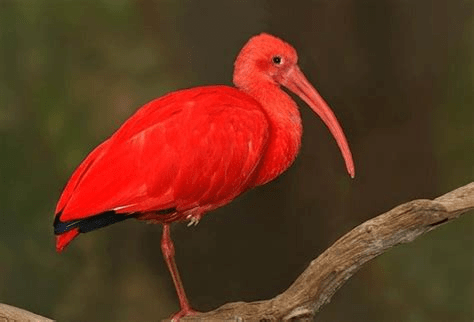
The Ibis was a popular pet and common throughout Egypt. One source proposed that Thoth means ‘the one who balances.’ Judging from the photos, the Ibis seems good at that. 

Thoth being a Greek name led to the association with the Greek god of like attributes, Hermes (3); otherwise known by the classical historian Herodotus, as the Roman god Mercury (4). This connection was popular, supported by Plutarch and Christian writers. It was during the incursions of Greece into Egypt, that the ancient Greeks merged the names Thoth and Hermes to form the appellation, Hermes Trismegistus (5). This term translates as ‘Thoth the Thrice Great’ or ‘Thoth Three Times Great’ – refer article: 33. That said, we will begin our study with the Olympian god, Hermes

There were twelve canonical Olympian gods in Greek mythology, with Hermes one of these who lived on Mount Olympus, ruling over parts of the mortal world. Zeus and Maia were the parents of Hermes. All the children of Zeus were Hermes’ siblings, though he possessed a ‘special younger-brotherly relationship with Apollo.’ The identity of Apollo is of notable interest and has been discussed at length – refer Chapter XXI The Incredible Identity, Origin & Destiny of Nimrod; and Chapter XXII Alpha & Omega

Facts About the Olympian God Hermes, N S Gill:

‘Greek gods were far from perfect. In fact, they were known to be flawed and to have many sexual affairs with gods, nymphs, and mortals alike. The list of Hermes’ partners included: ‘Agraulos, Akalle, Antianeira, Alkidameia, Aphrodite, Aptale, Carmentis, Chthonophyle, Creusa, Daeira, Erytheia, Eupolemeia, Khione, Iphthime, Libya, Okyrrhoe, Penelopeia*, Phylodameia, Polymele, Rhene, Sose, Theoboula, and Thronia.’ Unsurprisingly, the busy ‘Hermes fathered many children… Angelia, Eleusis, Hermaphroditos, Oreiades, Palaistra, Pan [with the Arcadian nymph Penelopeia*], Agreus, Nomios, Priapos, Pherespondos, Lykos, Pronomos, Abderos, Aithalides, Arabos, Autolycus, Bounos, Daphnis, Ekhion, Eleusis, Euandros, Eudoros, Eurestos, Eurytos, Kaikos, Kephalos, Keryx, Kydon, Libys, Myrtilos, Norax, Orion, Pharis, Phaunos, Polybos, and Saon.’

‘… Hermes is the god of eloquence, commerce, cunning, astronomy [including astrology], music, and the art of fighting. As a god of commerce, Hermes is also known as the inventor of the alphabet, numbers, measures, and weights. As the god of the art of fighting, Hermes is a patron of gymnastics. According to Greek mythology, Hermes also cultivated the olive tree and provides refreshing sleep as well as dreams. Additionally, he is the herdsman of the dead, the protector of [travellers], the giver of wealth and luck, and [the] protector of sacrificial animals, among other things. Hermes is credited with inventing divine worship and sacrifice… [and] is the herald [or messenger] of the gods.’

It goes without saying that Hermes was a busy man, or god – at work and at home it would seem. An important point to note and one which assists in identifying Hermes is the fact that the gods were flawed and interacting sexually with humans. This highlights that these beings were not Gods and rather angelic in nature, as well as the fact that they were not righteous spirits serving the Eternal God. It remains to be seen whether they were associated with the Grigori, preceding them perhaps, or were in fact lesser demigods. Though we do have a time frame appearing to indicate the antediluvian age, between the patriarchs Adam and Noah. 

Hermes: Messenger of The Greek Gods, Thomas Gregory, April 6, 2022:

‘Hermes… wearer of winged sandals, was one of the most important and referred to of the Olympian gods… ran messages from the underworld, and was the trickster god who gave Pandora her famous box… Hermes is still one of the most popular gods and is the primary influence of one of the most recognizable superheroes we have – The Flash… his childhood showed indications of the tricky but kind… god he was to become. His mother, Maia, was the oldest of the seven Pleiades, the daughters of Atlas’ – refer Chapter XV The Philistines: Latino-Hispano America; and article: The Pyramid Perplexity. ‘As such, she was as powerful as Zeus’ wife Hera, and Hermes was known as a protected child. 

As soon as he was born, Hermes crafted the first lyre using the shell of a tortoise and the guts… [from a] sheep. When Hermes played, it was said to be the most beautiful sound in the world; the young god would use it many times to calm those [angered by] his trickery. 

Artemis taught Hermes how to hunt, and Pan [his son] taught him how to play the pipes. He went on to become Zeus’ messenger and the protector of his many brothers. Hermes also had a soft spot for mortal men and would protect them on their adventures. Of the 12 olympian Gods, Hermes was perhaps the most loved. Hermes found his place as a personal messenger, guide, and kind-hearted trickster. Hermes is… most recognizable [of the gods] due to his unusual staff and winged boots. These items not only appeared in art but also became central elements in many of the stories from Greek mythology.’

‘Hermes staff was known as “The Caduceus.” Sometimes known as “the golden wand,” or “the herald’s wand,” the staff was wrapped by two snakes and often topped with wings and a globe. The Caduceus is said to have the power of creating peace or putting people to sleep. Hermes’ famous staff, the Caduceus, is seen today all over the world. How? As a symbol of transport, the caduceus symbol is used by customs agencies all over the world, including… China, Russia, and Belarus. In Ukraine, the Kyiv National University of Trade and Economics uses the Caduceus in its coat of arms’ – refer article: Ophir & Ukraine

‘Despite NOT being the Rod of Asclepius, a well-known snake-god, the Caduceus is also a common modern logo for Medicine. While its origin may have been by mistaking the two, the symbol has been used since the 3rd century. Today, the United States Army Medical Corp uses the symbol, despite its erroneous history. Academics hypothesize that the confusion came not because of the similarities in design, but because of Hermes’ connection to chemistry and alchemy. 

Hermes wore magical sandals, called “pedila” [also known as talaria, made of imperishable gold]. They provided Hermes with great speed, and would sometimes be shown artistically as having tiny wings.’ Hermes often wore a “petasos”, a winged hat sometimes mistaken as a helmet but was actually a wide-brimmed farmer’s hat made of felt. He owned a golden sword, which he famously lent to Perseus the hero used to kill Medusa. 

‘In the plays and poems of Homer, Hermes is sometimes referred to as Argeiphontes. In less-known myths, he was known as Atlantiades, Cyllenian, and Kriophoros.’ Note for now, the similarity of his name Atlantiades with Atlantis – Article: Antartica: Secrets of the Lost Continent of Atlantis

Gregory: ‘While Hermes is best known today for his role as herald and messenger, he was first worshiped as a god of fertility and boundaries. Known as a “Chthonic god,” he was associated closely with the underworld, and large phallic pillars dedicated to the Greek god could be found at the borders between towns’ – refer article: Belphegor. ‘These pillars were as much markers to guide [travellers] as they were indicators of ownership and control, and it may be that it was from these [artefacts] that the ancient deity became associated with guidance.’ 

This description of Hermes is uncannily like that for the idol Ba’al of Peor worshiped by the ancient Moabites. N S Gill describes Hermes as a ‘complex old god’ who was ‘friendly, helpful, sneaky, and cunning.’ Belphegor’s personalty could be described similarly. Ba’al Peor Latinised to Belphegor was representative of the ancient god, Chemosh. Yet, both these names are descriptive titles and the god’s name was in fact Horon – the Egyptian equivalent being, Horus. Added to this is the fact that the Moabites with the Ammonites, were the ancestors of the modern nation of France – refer Chapter XXVI The French & Swiss: Moab, Ammon & Haran. This is important, as the connecting link between the biblical ancestors and the modern descendants are the intermediate peoples comprising none other than the Classical and Hellenistic Greeks. For the Moabites and Ammonites formed the Greco-Macedonian Empire. 

While Hermes was never viewed as the primary god of the dead, he was often featured in underworld myths and pictured on ancient gravestones. Hermes was associated with crossing the line between life and what came after and often acted as a psychopomp – a guide to the dead, escorting the souls of the deceased to the underworld – Article: DEATH: A Dead End or a New Beginning? Hermes did serve a role as a fertility god, as while creation and death are seen as opposites; underworld gods were associated with the boundaries of life and death and thus with the creation of new life from the earth. 

Mike Greenberg: “Hermes’s role as a god who crossed boundaries was further reinforced by the herma, or way markers, that stood on boundaries between properties and states. Originally simple stone cairns, they later bore his image as the god of travel across borders before further evolving into phallic shapes that reinforced the connection between boundaries and fertility. While the herma continued to be associated with Hermes, his role as a fertility god became more indirect. His origin in the wild mountains and patronage over herds connected him with the more obviously sexual god Pan [his son]…” According to most scholars, the name Hermes is derived from the Greek word herma, meaning: a ‘stone heap’.

Thomas Gregory: ‘Hermes is also known as the god of shepherds, and many early depictions of the god show him carrying a lamb over his shoulders. Some academics suggest that Roman-era art showing Christ as “the good shepherd” may have been [modelled] on earlier works depicting Hermes. One ancient myth pertains to the shepherd god protecting a town from a plague by walking around the city’s borders with a ram on his shoulders.’ 

Two points here. First, while the artwork for Christ may well have been modelled on Hermes, the concept of Christ being the Lamb was original to him – 1 Peter 1:19-20, Revelation 13:8. As was perhaps not the title, but the role of the Good Shepherd – John 10:11-14. Second, the attribute of being a shepherd of people, was indicative of the antediluvian age – refer article: Na’amah

Gregory: ‘Of all the roles Hermes played, he was best recognized as the swift and honest messenger of Zeus. He could appear anywhere in the world to order or warn people, or to simply pass on the words of his father. Hermes could also hear the call of others and would relay their messages back to the greater god, Zeus. Most importantly, the Greek god was one of the few who could travel easily between our world and the underworld. While there had been many gods and goddesses of the underworld, only Hermes was said to come and go as he pleased.’ This role parallels that of the Son of Man – 1 Timothy 2:5. 

‘Hermes appears many times in the famous Homeric Poem “The Odyssey.” While The Odyssey records Hermes guiding Heracles into the underworld, he was not the only important person led by the Greek god. Hermes plays an integral role in one of the most well-known events of “The Iliad” – the Trojan War. During the war, the near-immortal  Achilles [a demigod in the vein of an Elioud of Nephilim descent] engages in a one-on-one battle with the Trojan prince, Hector. When Hector is eventually killed by Achilles, King Priam of Troy is distraught that he cannot safely retrieve the body from the field. It is the kind messenger Hermes that protects the king as he left his castle to retrieve his son and perform the important death rites. Hermes also plays the role of guide and protector for many young gods… [including] Hermes protecting the son of Apollo and taking him to Delphi so that he may grow up as an attendant at the temple.’ 

This is of interest, as the Trojan War was in essence a battle involving family members living as city-states, instead of national states or countries we have now. To cut a long story short. The cause of the battle was a prince of Troy, Paris abducting and stealing Helen of Sparta for his own. Her husband, King Menelaus of Sparta then enlisted the help of the numerous Greek city-states led by his elder brother, Agamemnon, king of Mycenae. While other identities may have been involved, the two principle contenders were descendants of Esau and again curiously, those of Lot’s sons, Moab and Ammon – the ancestors of the French – refer Chapter XXVI The French & Swiss: Moab, Ammon & Haran; and Chapter XXIX Esau: The Thirteenth Tribe

Of course even before these events transpired, it was Hermes who ironically triggered the tragic war, when he escorted three goddesses to Paris of Troy at Mount Ida. What Was the Cause of the Trojan War, Madeline, 2019: “The war originated as a quarrel between three goddesses (Aphrodite, Athena, and Hera) over a golden apple, sometimes referred to as the Apple of Discord. It all happened at the wedding of Peleus and Thetis, when Eris, goddess of strife and discord, was not invited.  She was turned away and in retaliation, threw a golden apple amongst the goddesses there “to the fairest.” When Aphrodite, Hera, and Athena claimed it, Zeus mediated and assigned Hermes to bring the goddesses to Paris of Troy to settle the debate. 

They all offered gifts – Athena, goddess of war, offered him victory in battle; Hera, the goddess of home, promised him to be king of all men; and Aphrodite, the goddess of love, offered him Helene (the most beautiful woman in the world) in marriage. Paris chose Aphrodite. However, Helene was the wife of Menelaus, the king of Sparta. Paris, under the disguise of a diplomatic mission, went to Sparta to abduct Helene so he could bring her back to Troy. However, before Helene could look up to see Paris, she was shot with an arrow by Eros, or Cupid, and fell in love with Paris as soon as she saw him.”

Gregory: ‘While best known as the messenger of the gods, Hermes was also famous for his skilled or deceptive acts of mischief. Most of the time these tricks were used to help people, rather than get into mischief, although he also played a role in perhaps one of the most famous tricks of all time – Pandora’s Box.’ 
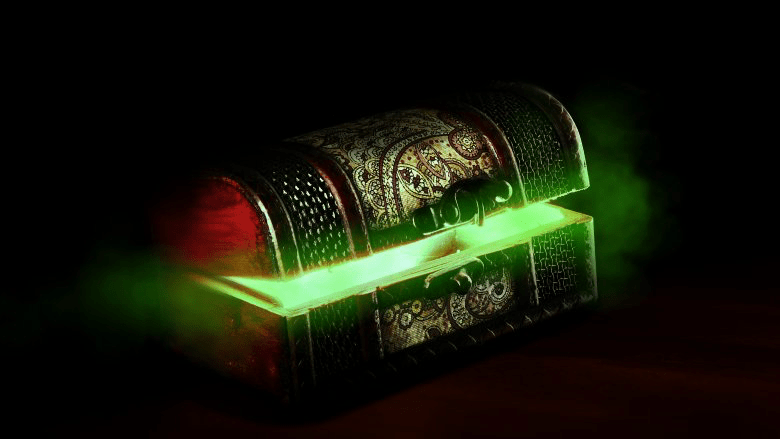
‘Pandora, the first^ woman, was created by Hephaestus at the orders of Zeus. According to “Hesiod, Works and Days,” she was “a sweet, lovely maiden-shape, like to the immortal goddesses in the face.” Zeus commanded Athena to teach the woman needlework but, most importantly, he also commanded Hermes to make Pandora inquisitive and able to lie. Without these things, the young woman would never have released her box (or jar) and all its calamities upon the world.’ 

This sounds suspiciously like the actual greatest trick played in the history of humankind which occurred during the incident in the Garden of Eden, whereby Eve^ was a. lied to; b. tricked; c. her curiosity was awakened; and d. her bad choice led to evil entering the world – Genesis 3:1-24. 

Hermes is credited with inventing the Greek alphabet, though in truth language, letters and grammar were passed from the gods to humans at the beginning of the antediluvian age – refer article: Na’amah* and Chapter XXII Alph & Omega. Granted, Hermes may have been instrumental in this, and so his involvement with the Greek alphabet is poetic licence by the Greeks. 

Thomas Gregory: ‘From The Fabulae, a text by Hyginus, superintendent of the Palatine Library in ancient Greece, we learn that Hermes played an important role in inventing the Greek alphabet and all written words since. According to Hyginus, the Fates created seven letters of the alphabet, which were then added to by Palamedes, a great prince in Greek mythology. Hermes, taking what had been created, formed these sounds into shaped characters that could be written. This “Pelasgian Alphabet” he then sent to Egypt, where it was first used. Eventually, further letters were added to it, forming the alphabet we have today. 

While the Greek god did not invent music* Hermes did invent the lyre, an ancient version of the harp [and precursor to the guitar], almost immediately after being born… Bibliotheca of Pseudo-Apollodorus

“Outside the cave (of his mother Maia) he (the infant god Hermes) found a tortoise feeding. He cleaned it out and stretched across the shell strings made from the cattle he had sacrificed, and when he had thus devised a lyre he also invented a plectrum… When Apollon heard the lyre, he exchanged the cattle for that. And as Hermes was tending the cattle, this time he fashioned a shepherd’s pipe which he proceeded to play. Covetous also of this, Apollon offered him the golden staff which he held when he herded cattle. But Hermes wanted both the staff and proficiency in the art of prophecy in return for the pipe. So he was taught how to prophesy by means of pebbles, and gave Apollon the pipe.” 

A further association with both the French people and the ancient Greek’s ancestor Lot, is ‘In “Metamorphoses,” [where] Ovid tells the tale of an old married couple [Baucis and Philemon] who were the only people to welcome the disguised Zeus and Hermes into their home. Quite similar to the story of Lot in Sodom and Gomorrah, the rest of the town was destroyed as punishment, but the couple was saved.’

According to Juan Salazar Sanchez, one of the symbols for Hermes is a Gallic rooster. Another connection with France as the Cockerel is their national symbol. Aligned with this is the fact that Belphegor as the Ba’al of Peor, was not just the god of the Moabites – the ancestors of the Franks and the French – but is France’s infernal ambassador and Guardian – refer article: Belphegor; and Chapter XXVI The French & Swiss: Moab, Ammon & Haran.

Gregory: ‘When Harry Lampert was commissioned to illustrate the first two issues of a new comic book, he took inspiration from Greek mythology and drew the “fastest man alive” with wings on his boots and a wide-brimmed hat (that in later versions turned into a helmet). Despite being paid only $150 for his design, and being quickly replaced, Lampert’s design remained and has been used as an influence for further iterations of the character. 

One year after “The Flash” was introduced, DC Comics introduced the “real” Hermes in the very first issues of “Wonder Woman.” In this first issue, it is Hermes who helps mold Princess Diana from clay, imbuing her with the power of the Gods. In a famous mini-series of comics called “Injustice,” Hermes even proves his might by catching up to “The Flash” and punching him out! Not to be undone, Marvel Comics also introduced Hermes in its “Thor” comics. The Greek god would appear many times when Thor interacted with Greek mythology, but also to collect Hercules when he was beaten up by The Hulk! In Marvel’s version of the Greek god, he has the winged cap and boots but also carries the Caduceus wherever he goes.’ 

Hermes popularity led to his statues being placed at the entrances of stadiums and gymnasiums throughout Greece, symbolising his swiftness and athleticism. He was worshipped with sacrifices in Olympia where the Olympic Games was celebrated. One of the most famous statues of Hermes is known as the Hermes of Olympia or the ‘Hermes of Praxiteles’, found amongst the ruins of a temple dedicated to Hera. The cult worship of Hermes became widespread in Greece and Rome. The oldest place of worship for Hermes was Mount Cyllene in Arcadia where he was said to have been born. From there, his cult following travelled to Athens, then spreading throughout Greece. Even so, only three known temples were specifically dedicated to Hermes during the Classical period and all of them in Arcadia. Other temples were usually consecrated to Hermes in conjunction with his partner Aphrodite such as in Attica and on Crete. 

Gamblers would often pray to Hermes for good luck and wealth; while many merchants worshipped him daily, hoping for business success. It was believed giving offerings to Hermes would bring them good fortune and prosperity. 

Juan Salazar Sanchez:

‘In Greek mythology, the Titanomchy was a great war that took place between the Olympian gods and the Titans, the old generation of the Greek gods. It was a long war that lasted for ten years and ended when the old pantheon that was based on Mt. Othrys was defeated. Afterwards, the new pantheon of gods was established on Mt. Olympus. Hermes was seen during the war dodging boulders thrown by the Titans, but he doesn’t have a prominent role in this great conflict. He apparently did his best to avoid it [much like Belphegor’s tendency to remain distant and non-committal] whereas Ceryx, one of his sons, fought valiantly and was killed in battle fighting Kratos, the divine personification of power or brute strength. It’s said that Hermes bore witness to Zeus banishing the Titans to Tartarus for all eternity.’ 

The Grigori were likewise placed in Tartarus by the archangels, where Christ later spoke to them – Jude 6, 2 Peter 2:4-5, 1 Peter 3:18-20. That said, during the war with the giants, while Hermes wore his cap which made him invisible, he killed Hippolytus as well as helping his father Zeus in his confrontation with Tyfoea. 

Avi Kapach: “The Titans were immortal deities who ruled the cosmos before the Olympians. The original twelve Titans – the children of the primordial gods Gaia (earth) and Uranus (heaven) – assumed power by overthrowing their tyrannical father, only to become tyrants themselves. Cronus, the youngest Titan, became king after usurping Uranus. Fearing a similar fate, he attempted to prevent any revolts against his own power by swallowing his children as soon as they were born. But Zeus, Cronus’ youngest son, managed to escape, and he eventually freed his siblings. Together, they waged a ten-year war against Cronus and the other Titans known as the Titanomachy. In the end, the Titans were defeated; most of them were imprisoned in Tartarus by the new gods, the Olympians – so called because they dwelled atop Mount Olympus.”
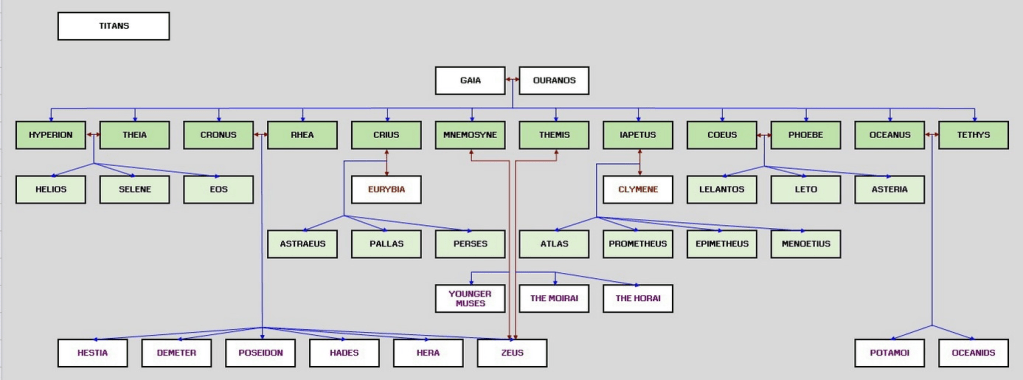
“The Titans included not only the original twelve children of Gaia and Uranus but also some of their descendants, such as Prometheus, Atlas, Metis, and Leto. Though they were sometimes represented as cruel in Greek mythology, the period during which the Titans ruled was nonetheless regarded as a Golden Age. Unlike the Olympians, however, the Titans were almost never worshiped in ancient Greece (an exception is Rhea, the mother of Zeus and the Olympians, who was sometimes worshiped as “Mother of the Gods” or “Great Mother”).”

The genealogy of Hermes

There is much more which could be said about Hermes – the god of transitions and boundaries – such as the fact he is also the patron of thieves and liars, as a result of his own trickery. Lefteris Koukakis concludes: ‘Cunning and clever, agile and tricky, resourceful and wily, dreamer, thief and flatterer, energetic and restless are some of his key features. Hermes is one of the oddest, most gifted, and most popular Olympian gods.’ Although Hermes was a god of fertility, Hermes didn’t marry and had few affairs compared to other Greek gods. Certainly, he had number of consorts but a hint of the fey lingers about Hermes – see first image of Mercury** below. Much like the angel of the written word, Penemue who was ambiguously male and female – refer Chapter XXII Alpha & Omega.

Penemue

Hermes allegedly also ‘loved young men in pederastic relationships where he bestowed and/or taught something related to combat, athletics, herding, poetry and music. Photius wrote that Polydeuces (Pollux), one of the Dioscuri, was a lover of Hermes, to whom he gifted the Thessalian horse Dotor. Amphion became a great singer and musician after his lover Hermes taught him to play and gave him a golden lyre.’ In likeness, his son by the most beautiful Aphrodite – associated with love, lust, desire, beauty, pleasure, passion, sex, procreation and fertility – was Hermaphroditus. 
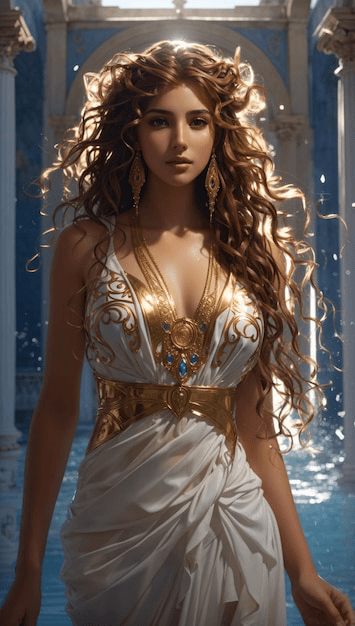
Aphrodite

Online Encylopaedia: ‘According to Ovid, he was born a remarkably handsome boy whom the naiad [nymph] Salmacis attempted to rape and prayed to be united with forever. A god, in answer to her prayer, merged their two forms into one and transformed him into a hermaphrodite… His name is compounded of his parents’ names, Hermes and Aphrodite… the two-sexed child of Aphrodite and Hermes (Venus and Mercury), had long been a symbol of androgeny or effeminacy, and was portrayed in Greco-Roman art as a female figure with male genitals. All three of these gods figure largely among erotic and fertility figures, and all possess distinctly sexual overtones.’ Not forgetting Hermes’ son Pan, a wild god who excelled at revelry, unchecked sexuality and seducing nymphs. 

Androgynous Mercury**

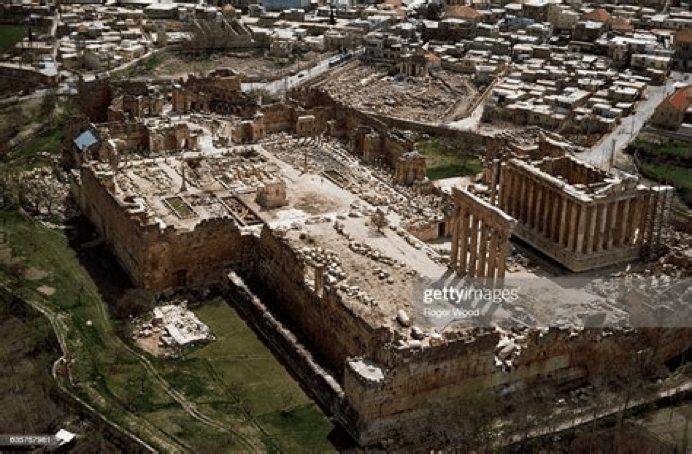
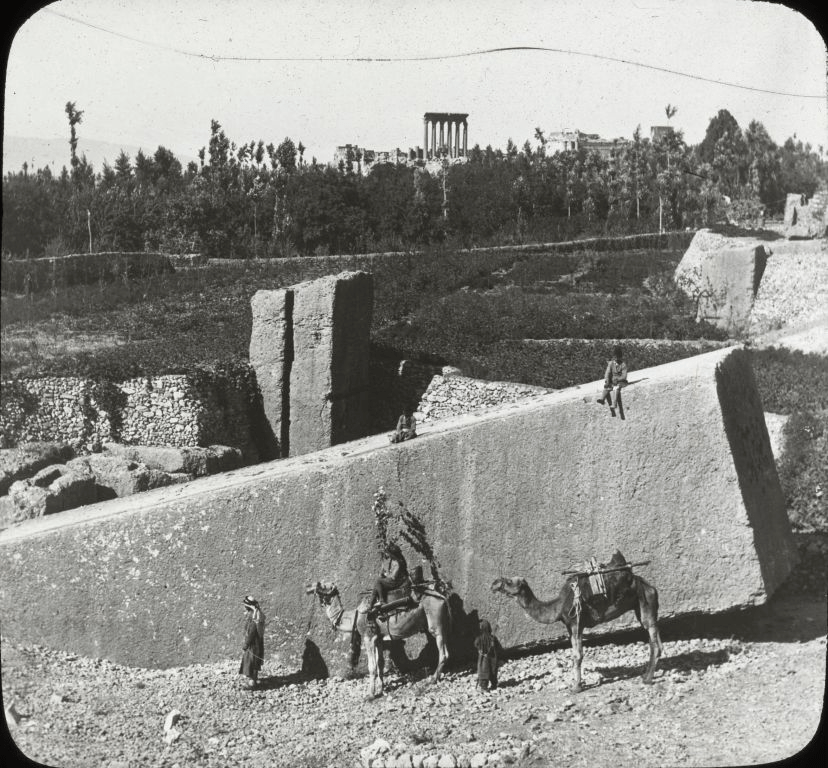
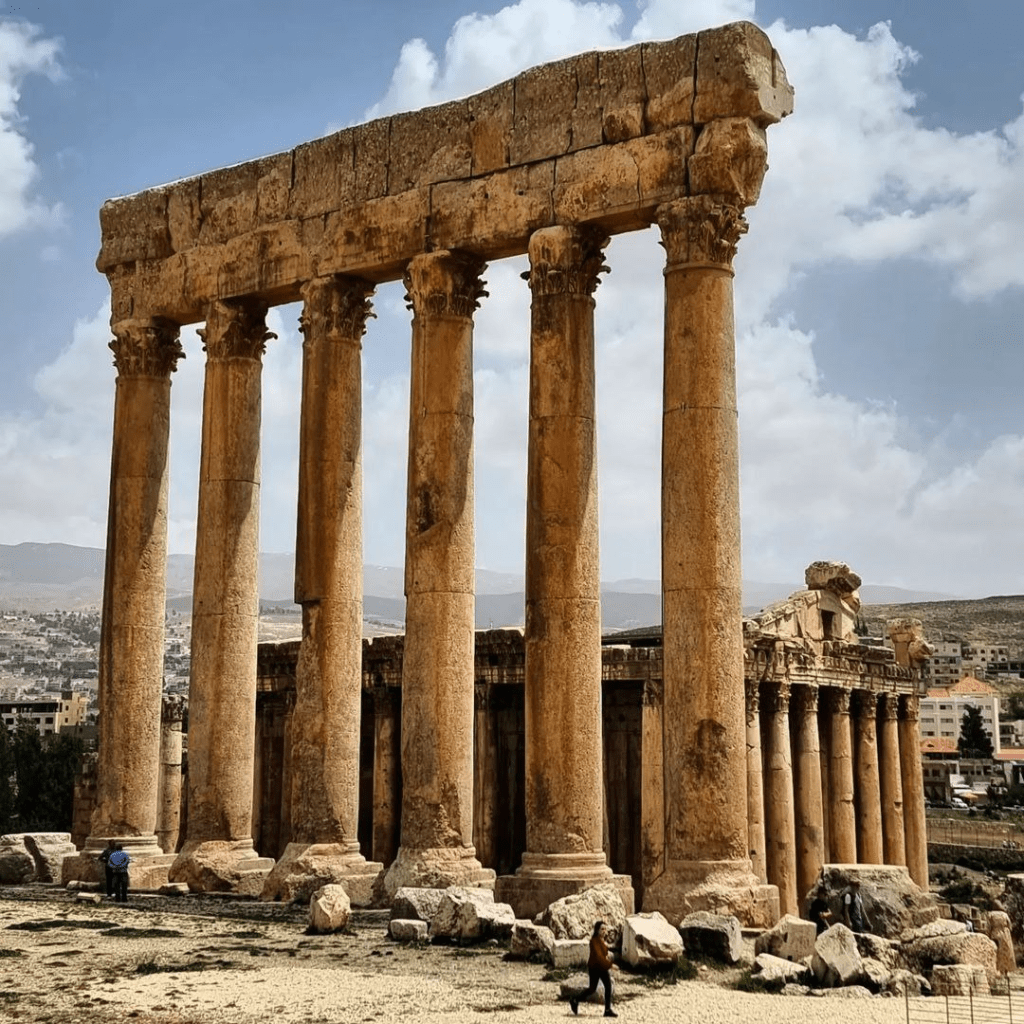
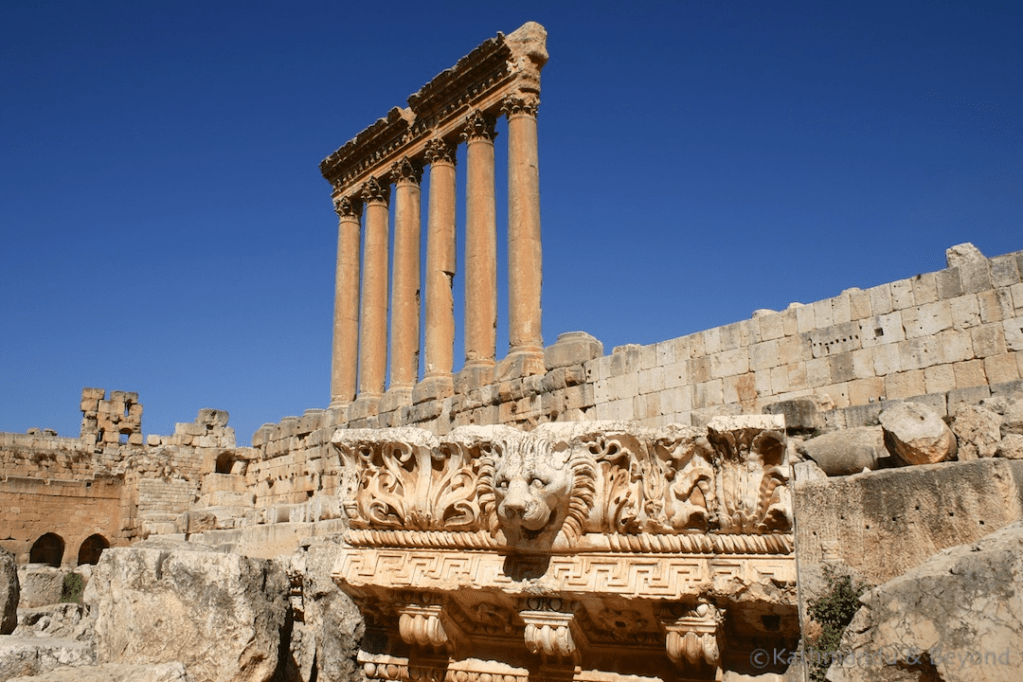
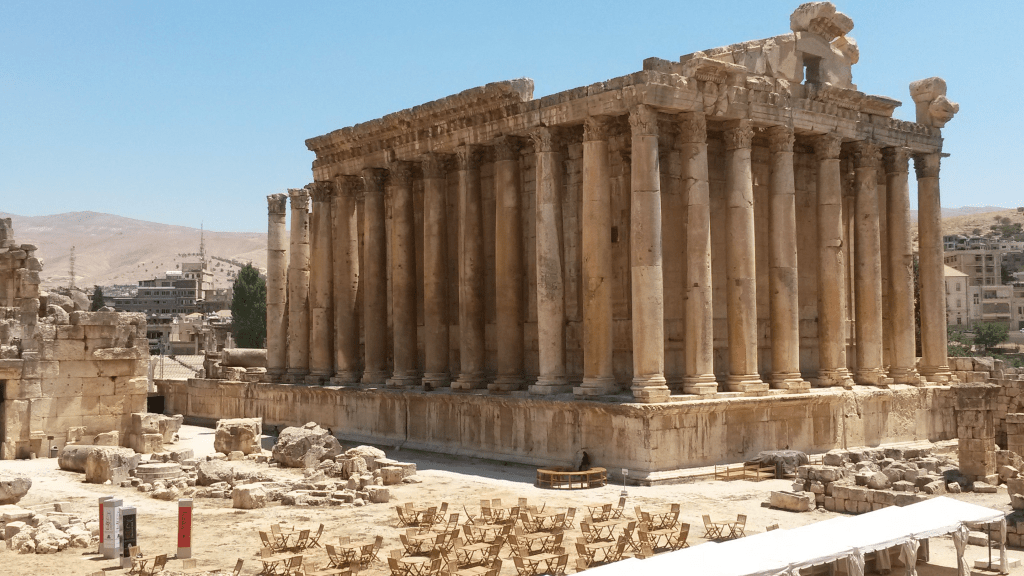
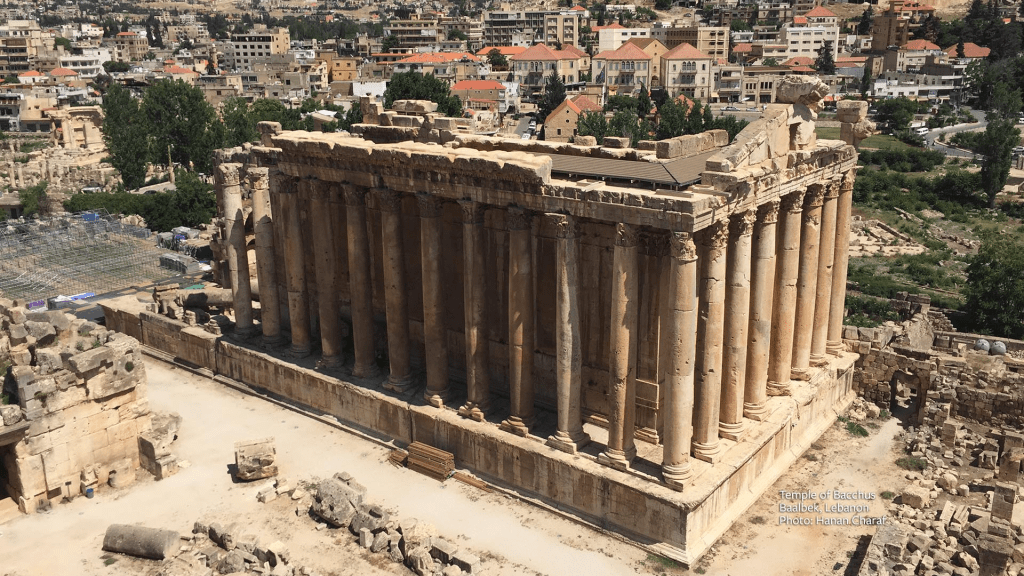
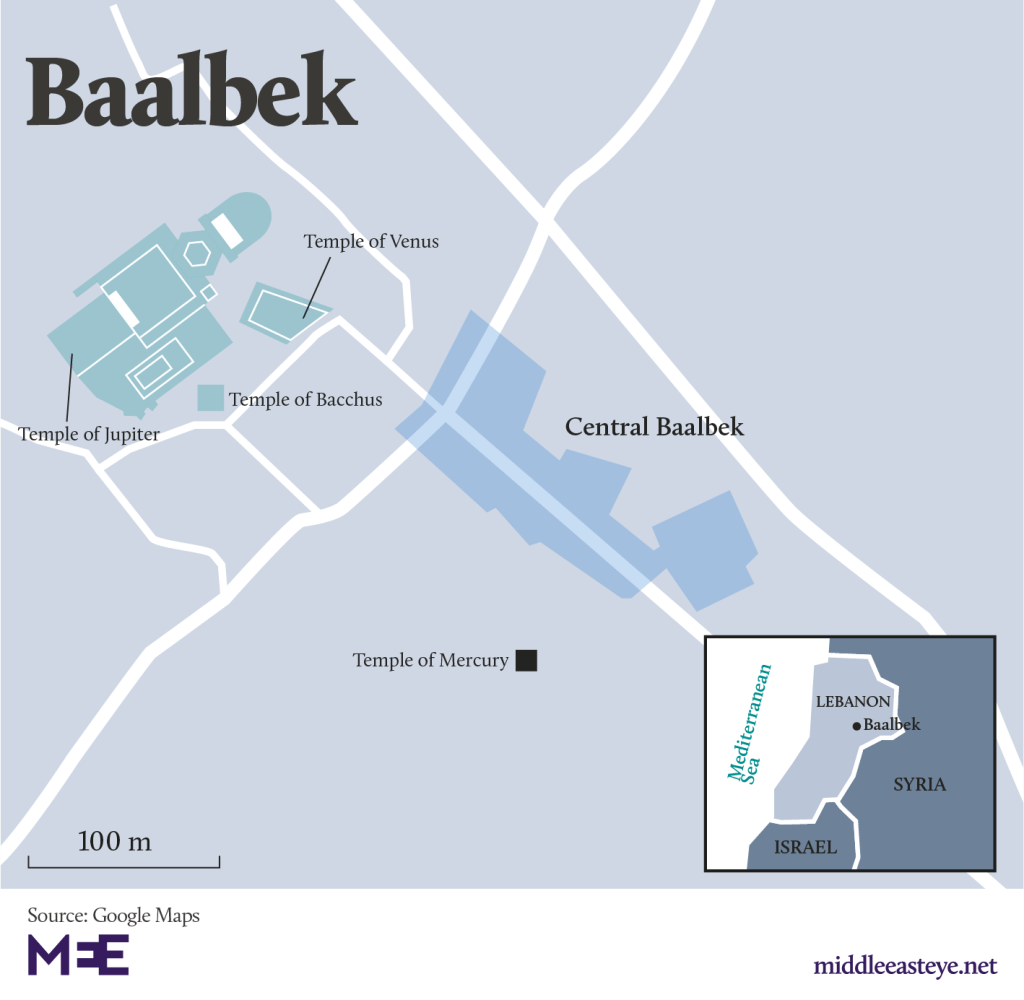
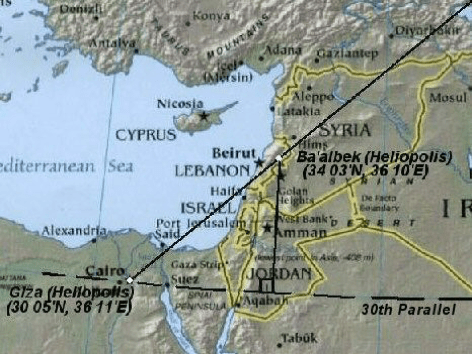
This leads to the counterpart of the Greek God Hermes, the Roman god Mercury. The paradox within Hermes possessing at once fluid androgyny for each sex and yet the almost asexual ambivalence towards commitment in a marriage, parallels the two Zodiac signs ironically ruled by Mercury – dualistic Gemini and puritanical Virgo. As Hermes understandably shared temple popularity with Aphrodite in Greece, Mercury likewise shared the spotlight with Venus. Though in Roman tradition he perhaps fared better when a temple was dedicated to him in the Circus Maximus – Rome’s first and largest entertainment venue – between the Aventine and Palatine hills in 495 BCE. Similarly, the impressive Roman temple complex built on the extraordinary foundations of Baalbek was dedicated to three gods, including the mercurial Mercury – refer article: Monoliths of the Nephilim

Mercury appears to be a carbon copy of Hermes and it is easy to see them as the same person. Mercury’s favoured position as the messenger of the gods meant he had control over the flow of information, using this position to his advantage. Yet Mercury seems a little more liberated, often appearing nude. In the Roman pantheon, Mercury was the only god who could freely cross into the underworld like Hermes. 

Thomas Apel: ‘The name “Mercury” (or Mercurius) probably emerged from the Latin merx, a noun meaning “merchandise” [‘or possibly “merces”, whose meaning is wages’]. In its verb form, the word mercari meant “to trade.” A deeper root in the Proto Indo-European language may have been merk- or merg-, meaning “boundary” or “border,” respectively. Mercury, then, was “the merchant” or “the keeper of boundaries.” As the chief messenger of the gods, Mercury controlled the movement of all things – goods, ideas, words, and people.’ Mercury ‘flew with the help of a winged helm that [his half-brother] Vulcan, the god of forge and fire, had fashioned for him. Mercury also carried the caduceus, a staff wound with serpents that was gifted to him by Apollo. Mercury was swift and clever, and his knowledge of major events often bordered on foresight.’ 

Mercury was the only child of Jupiter the king of gods and the nymph, Maia. He had a number of half-brothers: Liber (Bacchus), Apollo, Mars and Vulcan and half-sisters: Diana, Venus, Minerva and Proserpina. Mercury’s consort was Larunda, a naiad nymph and they had two children, who were ‘nameless [invisible] deities known only as the Lares. Like their father, the Lares served as guardians of the crossroads.’ Mercury had other lovers, the most famous being his affair with his beautiful half-sister Venus, producing an androgynous child called Hermaphroditos. ‘Later in life, Hermaphroditos would merge his body with that of his female lover, thus becoming a single entity with both male and female genitalia.’ Mercury took male lovers, including the hero Perseus. 

Venus

Apel: ‘Mercury was a significant figure in Roman religion whose persona evolved over time. While Mercury’s earliest temple was established in the fifth century BCE, the characteristics of this early incarnation were unclear. This version of Mercury was likely a Romanization of the Etruscan god known as Sethlans. With the rise of Hellenic culture in Rome in the third century BCE, Mercury emerged more clearly as a Romanized version of Hermes. Mercury’s festival, Mercuralia, was celebrated each year on May 15th. 

Compared to other gods and goddesses, Mercury has maintained an incredibly lively presence in popular culture. The speedy god is best remembered for the planet named after him. Of which we shall return as well as its place in astrology. Mercury also lent his name to NASA’s first manned space program; the object of this program was to put a man into orbit around the planet. The chemical element “Mercury” also bore the name of the messenger god… known as quicksilver due to its liquid state at room temperature, mercury could easily [and quickly] transition into other compounds. It was often used in mining to extract gold and silver from various ores. Mercury’s name resonated in other areas as well. From 1938 to 2011, the Ford Motor Company devoted an entire division to its Mercury line. The brand’s first logo was a profile image of Mercury wearing his winged helm. Mercury Records, a famed record label, also used Mercury’s helm as a logo.’ 

In imitation of the already established link between Hermes and the ancestors of the French; Mercury was considered a god of ‘abundance and commercial success, particularly in Gaul, where he was said to have been particularly revered.’ Mike Greenberg: ‘While Mercury was important to the Roman way of life, they believed that other people held him in even higher regard. When writing about the people of Gaul, Julius Caesar remarked: 

“They worship Mercury in particular, as their god and have many images of him, and regard him as the inventor of all arts. They consider him the guide of their journeys and marches, and believe him to have great influence over the acquisition of gain and mercantile transactions” – Julius Caesar, The Conquest of Gaul. 

Greenberg: ‘Of course, the arrival of Mercury in Gaul did not occur until after it was occupied by Rome… Among the Germanic people, the Romans associated Mercury with Wotan. The Germanic form of Odin, Wotan was the chief of the gods but associated with the god of commerce because he was often depicted as a traveller. As Roman influence in Germanic regions increased, the associations between their gods were strengthened. Local gods took on more Roman attributes and in Rome itself Mercury became the god more associated with Gaul and the Celts.’

Similarly, the rooster – as for Hermes – is the symbol of a new day which is brought by Mercury the fastest of the Gods. Old World gods: ‘As well as sharing similarities to the Greek God Hermes, he also is linked to the German god Woden. Mercury’s sacred day is Wednesday or Mercurii Dies in Latin. Wednesday translated to French is Mercredi, in Italian it is Mercoledi and German tribes would refer to Wednesday as Wodensday, from the German God Woden’ and hence Wednesday in English. 

Mike Greenberg: ‘The Etruscan god Turms was very similar, as he was also a god of commerce and an intermediary between the gods and mankind. Turms, however, was not a native god of Italy either. Both Mercury and Turms were taken almost directly from the Greek god Hermes. Unlike Zeus, Mars, and other important Roman gods, there was no close parallel to Hermes in pre-Hellenized Roman religion. Therefore, the characterization and mythology of Mercury remained almost entirely unchanged. The only obvious difference in Rome was his name. 

Rome could not function without its trade routes. As the city’s population grew it needed grain from Egypt, vegetables from Tuscany, wood from Gaul, and metals from Spain and Britain. As the god who protected travelers, Mercury was essential in making sure that shipments of all these goods arrived steadily from throughout Rome’s territories. Without his favor, Roman culture would collapse. He was especially important in the grain trade. Any interruption in the flow of grain from Egypt led to shortages of bread among the poor of Rome, a situation that could easily lead to civil unrest and violence.’

‘The god was known for his speed, so chariot racers often associated their sport with him. Mercury was said in mythology to often best the other gods in their own games, so he was linked with athleticism.

The Circus Maximus had been built almost precisely in between the Capitaline Hill, the traditional home of the patrician class, and the Aventine Hill, the stronghold of plebian political power. The placement of Mercury’s temple between these two feuding factors highlighted his role as diplomat and negotiator. 

While most of Mercury’s mythology was taken directly from Greek sources, a few stories were told in Rome alone. One of these involved the journey of Aeneas. The son of Venus, he had fled Troy at the end of the Trojan War to settle in Italy, becoming a founding king and an ancestor to Romulus and Remus. The Roman story of Aeneas was modelled after that of Odysseus, and Mercury appeared to the Roman hero just as he had to the Ithacan kind. In the Aeneid, Mercury appears to Venus’s son to remind him to continue on his mission to fulfil his destiny of becoming one of Rome’s founders’ – Chapter XXVIII The True Identity & Origin of Germans & Austrians – Ishmael & Hagar.

The planet Mercury is the closest planet to our solar system’s Sun – it only takes 3.2 minutes for sunlight to travel from the Sun to Mercury – yet it is not the hottest planet as one would think, for that is Mercury’s next door neighbour Venus, with its ‘thicker atmosphere and runaway greenhouse effect.’ In fact, Mercury’s surface temperatures fluctuate violently between freezing cold (-173°C / -280°F) during the night – as on the side facing away from the Sun, without a substantial atmosphere to trap solar radiation, all heat is lost to space – and baking hot (427°C / 800°F) in the daytime – as the extreme highs present on the side facing the Sun are due to the insufficient atmosphere, for it is unable to absorb the solar radiation.

Mercury is also the smallest of the ‘rocky terrestrial planets’ and therefore the planet with the quickest orbit of the sun [travelling at 112,000 mph, which is the fastest of all the planets]. This means it has the shortest year with 88 days. In fact ‘Mercury orbits so quickly around the Sun [at 29 miles per second] that early civilisations believed it was actually two different stars – one which appeared in the morning and another which appeared in the evening.’

The tiny planet spins on its axis incredibly slowly, taking 58.7 Earth days to turn just once (a sidereal day is the time for one rotation in relation to a fixed point). Ironic since Mercury is the fastest god. ‘It rotates three times on its axis for every two trips it makes around the Sun. One odd effect of this “spin-orbit” lock is that a solar day [the time from noon to noon on the planet’s surface] on Mercury lasts [the equivalent of] 176 Earth days’ according to Carolyn Collins Petersen. 

Mercury is nearly tidally locked to the Sun – but not quite like the Earth’s moon – and over time this has slowed the rotation of the planet to almost match its orbit around the Sun. Mercury also has the highest orbital eccentricity of all the planets, possessing an elliptical orbit which is the least circular of all of the planets and its distance from the Sun ranging from forty-six (29 million miles) to seventy million kilometres (43 million miles).
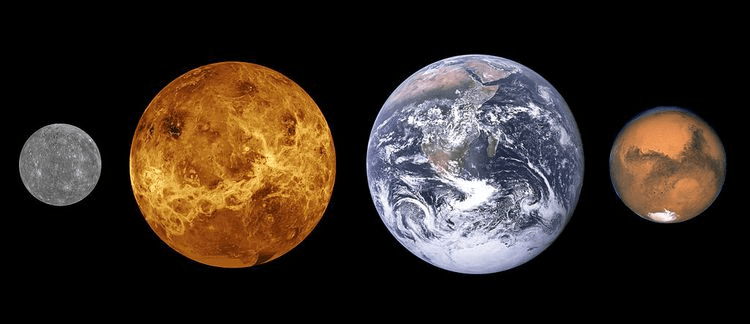
Mercury in relation with Venus, Earth and Mars

Of all the planets, only dwarf planet Pluto is smaller. Mercury is 15,328 kilometres around its equator, making it smaller than Jupiter’s moon Ganymede or Saturn’s largest moon, Titan. Mercury is approximately 4,876 kilometres (or 3,030 miles) in diameter; slightly bigger than Earth’s moon and about as wide as the continental United States.

Its mass is about 0.055 Earths, with about seventy percent of its mass metallic – mainly iron – and about 30 percent silicates; rocks made mostly of silicon. Mercury’s unusual molten core for a small planet is 42% of its total volume compared with 17% for the Earth. Its centre is described as a region of liquid iron which ‘sloshes around as the planet spins.’ Some scientists postulate that the core contains a lighter element such as sulphur, which would lower the melting temperature of the core material. 

Mercury has an absence of atmosphere – and thus no weather, clouds or rain – being too small and hot to retain any molecules in the air and therefore susceptible to solar winds. Though it does have what is called an exosphere, a ‘tenuous collection of calcium, hydrogen [22%], helium [6%], oxygen [42%], sodium^ [29%], and potassium [5%] atoms that seem to come and go as the solar wind blows across the planet.’ The Planets: ‘However, as meagre as its atmosphere is, Mercury does have one. According to NASA, its chemical composition is thought to… [include possible] trace amounts of argon, carbon dioxide, water, nitrogen, xenon, krypton, neon… and magnesium.’

Mercury’s bland dark grey surface is coated with a carbon dust layer. The residue of millennia of impacts. While most planets in the solar system show evidence of impacts, Mercury is one of the most ‘heavily cratered of the inner solar system worlds’

The Planets: ‘The surface is [very] similar to that of the Moon, as unlike most planets, Mercury isn’t geologically active and cannot “self heal” from impacts with asteroids and comets.’ Petersen states: ‘Images of its surface, provided by the Mariner 10 [during 1974 to 1975] and MESSENGER spacecraft [Mercury Surface Space Environment, Geochemistry, and Ranging mission during 2011 to 2015], show just how much bombardment Mercury has experienced. Its covered with craters of all sizes, indicating impacts from both large and small space debris. 

Its volcanic plains were created in the distant past when lava poured out from beneath the surface.’ Space Facts: ‘Any crater larger than 250 kilometres in diameter is referred to as a Basin. The Caloris Basin is the largest impact crater on Mercury covering approximately 1,550 km [963 miles] in diameter and was discovered… by the Mariner 10 probe.’
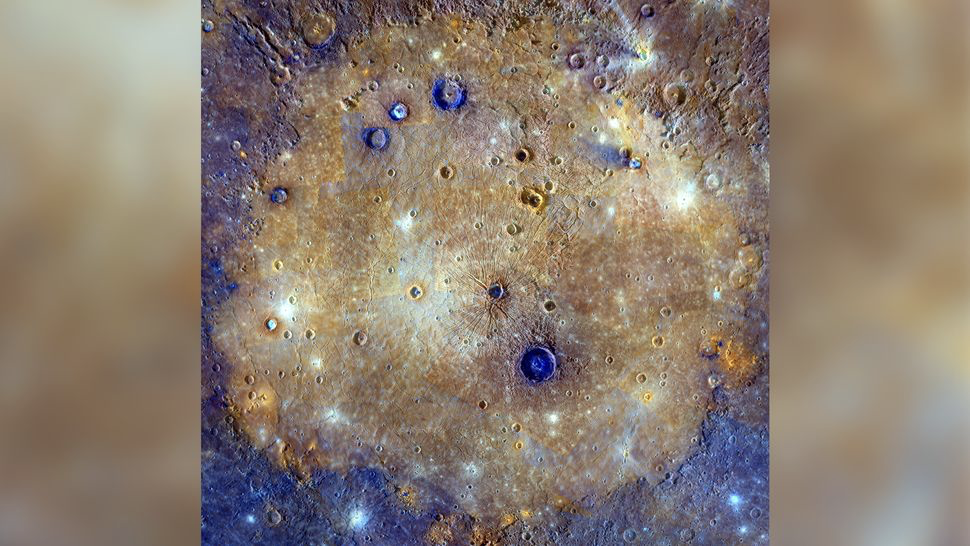
A mosaic image of the Caloris Basin, is an enhanced-colour composite overlain on a monochrome mosaic

It is estimated that 16 quadrillion tons of diamonds are on the surface of Mercury derived from graphite a form of carbon. The diamonds forming as a result of high pressure and heat from the constant bombardment by asteroids and comets, making it the most diamond rich planet in the solar system.

‘MESSENGER’s data and images helped scientists understand the structure of the planet’… revealing the existence of ice deposits in permanently shadowed craters where sunlight is never seen at Mercury’s poles. Conversely, there is a spot in the south pole region of Mercury which almost never goes dark, receiving sunlight about 82% of the time – called the True Peak of Eternal Light.

‘There are no missions to Mercury scheduled until at least 2025 when the BepiColumbo spacecraft’ – a joint mission of the European Space Agency (ESA) and the Japan Aerospace Exploration Agency – ‘will arrive for a long-term study of the planet’ after a forty-eight million mile journey.

Organic materials – the building blocks of life – have also been discovered on Mercury, but the harsh conditions cannot support life as it exists on Earth. Just the concentration of sulphur on Mercury is unlike any other planet in the Solar System. Mercury is one of five planets visible (along with Saturn, Jupiter, Mars and Venus), though its position close to the horizon makes it the most difficult to observe with the naked eye from Earth. Thirteen times a century, Mercury can be observed passing across the face of the Sun in an event called a transit, which lasts for a few hours. The previous Mercury transit was on November 11/12, 2019, with the next one due on November 12/13, 2032.

Mercury does not have any moons or rings because of its low gravity and lack of atmosphere. Thus Mercury would not be able to hold onto a moon. Venus has no moons either, but the reasons for this are more of a mystery to scientists. This is because Venus was once a moon itself – refer article: The Younger Dryas Stadial: Ending of the Earth… Beginning of the World; and Chapter XXII Alpha & Omega

Daisy Dobrijevic: “Scientists have discovered that Mercury has streams of particles sloughing off its surface, much like a comet. Long-exposure photographs taken by astrophotographers on Earth can capture these curious tails… Scientists believe that the tails are produced when the sodium^ in Mercury’s exosphere glows as a result of being excited by light from the sun. Sunlight can also free these molecules from Mercury’s surface and push them away into space…”

An amazing feature is that ‘Mercury’s tail extends about 1.6 million miles… [and] at its peak, the tail stretches up to 14.6 million miles long.’ This is fascinating in light of the past history of Venus as both a former moon of Jupiter and later a comet; created when a passing planetary body ripped Venus from Jupiter’s orbit and magnetic pull. 

Could Mercury have once been a moon? And was it likewise pulled away from its original location like its sister planet Venus? Mercury’s unusual composition, its mysterious core – bigger than the cores of the Earth and Venus – and small size may be clues to its true origin. Is the tiny planet’s oversized core in fact the residue of a former bigger planet? Coupled with this is Mercury’s impractical position adjacent to the Sun and inhospitable atmosphere for life just like Venus. It may not be a coincidence that the god Mercury and goddess Venus were partners or that they are often partnered in temples dedicated to them. Nor could the most well known trinity of gods – the Sun, Mercury and Venus – be a mere coincidence either – refer Baalbek – article: Monoliths of the Nephilim

Mercury has a weak magnetic field whose strength is about 1% of the magnetic field on Earth. Daisy Dobrijevic: ‘Scientists are puzzled by Mercury’s magnetic field; the planet appears to be too small to host a global magnetic field, yet it does… [and] it can cause quite the commotion on the surface of Mercury in the form of magnetic tornadoes. According to NASA, when Mercury’s magnetic field interacts with the solar wind, it sometimes generates magnetic tornadoes that channel fast, hot, solar wind plasma to the surface of the little planet. When the solar wind plasma hits the surface, it displaces neutrally charged atoms on the surface, sending the loops high into Mercury’s atmosphere.’ 

On Mercury, your weight would be 38% of your weight on Earth. 

Even though Mercury is small, the planet is very dense. Each cubic centimetre has a density of 5.4 grams with only the Earth having a higher density. This is mainly due to Mercury being composed of heavy metals and rock. 

Mercury does not experience any seasons. The axis of Mercury has the smallest tilt of all other planets – just 2 degrees – resulting in a lack of any seasons on its surface. 

It was once believed that a planet* called Vulcan existed between the orbit of Mercury and the Sun – however the existence of such a planet has never been found. 

The Planets: ‘Mercury’s orbit is… significant in that it provides [an]… example of modern physics. Over time the orbit of Mercury shifts slightly around the Sun. This process is known as precession. Though Newtonian mechanics (i.e., classical physics) does a fairly good job of predicting the speed of this precession, it still cannot predict it precisely. This was a persistent problem for astronomers in the late nineteenth and early twentieth century. Many theories were introduced to explain the difference between the actual and theoretical rates. One theory even suggested the existence of a unknown planet* closer to the Sun than Mercury. However, the truth was finally revealed when Einstein published his general theory of relativity. As a consequence of this theory, Mercury’s orbital precession was finally described exactly. 

Though it was long believed that Mercury’s spin-orbit resonance (the number of rotations per orbit) was 1:1, it was discovered in the mid-twentieth century that it is, in fact, 3:2. This resonance produces what would be fascinating phenomena for a witness on the planet’s surface. For example, the Sun would appear to rise to the highest point in the sky, then reverse its course and set in the same direction from where it rose.’ Three to four times a year, Mercury appears to travel backwards in the sky. The phenomenon is known as the retrograde of Mercury and is caused by the shortness of the planet’s orbit.

The first recorded observations of Mercury date back thousands of years, in Sumerian and Assyrian records. The planet’s existence was documented by ancient astronomers before the discovery of Venus and Mars, with the Babylonians calling the planet, Nabu. The planet is also known as Budha in ancient Sanskrit religions and in Vedic astrology and is considered a source of positive thoughts. Current astronomers believe that the darker skies of the past made it possible for ancient astronomers to observe Mercury. In modern times, Galileo Galilei observed Mercury for the first time in 1631. 

A source online states: ‘A green meteorite piece was found being sold on the streets of Morocco in 2012. Scientists discovered after studies that it matches data sent from spacecraft’ orbiting Mercury. A further amazing aspect regarding Mercury is that ‘according to scientists, there may be pieces of Mercury hiding on Earth.’ 

Based on the premise that Mercury was once much bigger and that pieces of it had broken off and were strewn into space. This cataclysmic scenario might be linked to and explain, the anomalies in Mercury’s composition; its location in the Solar System too close to the Sun; and its elliptical orbit. A certain measure of mystery surrounds the planet Mercury’s origin, evolution and resultant status as a tiny bonafide planet? Or a destitute moon stranded in the Solar System, held and trapped by the Sun?

Unknown source: ‘… was revered through the form of the planet Mercury because this body is nearest to the sun: Hermes of all creatures was nearest to God, and became known as the Messenger of the Gods.’

It is enlightening to include the characteristics of Mercury’s influence in astrology. Not in predicting the future, but rather the aspects of personality exhibited in people born under the zodiacal signs ruled by the planet – which include Gemini beginning May 20th to June 21 and Virgo from August 23 to September 22.

Mercury Dominant Planet in the Birth Chart: An Irresistible Mind, Stargazer, July 13, 2020 – emphasis & bold mine:

‘Mercury is one of the most important planets in astrology. If you have Mercury as your dominant planet in your natal chart, you are smart, great at networking, funny, and you excel at logical thinking. Many Mercury dominant people possess literary talent. With this planet as your dominant planet, you are a quick learner and have a sharp intellect. 

If Mercury is strong in your chart, you are called a Mercurian. Mercurians are a lot like Mercury: vivid, talkative, and observant. Mercury is a very quick planet, and so are people with this planet emphasized in their horoscope. They are lively and they wish they were three people so that they could live more.’
‘You have a Mercury dominant birth chart if: 

1. You are a Gemini or Virgo rising. If you are a Gemini or Virgo rising, this makes Mercury your chart ruler…

2. Mercury conjunct the ascendant or Midheaven. When talking about conjunction with an angle, most astrologers use an orb up to 10 degrees. The areas around the ascendant or Midheaven are extremely important. The areas around the angles are called the Gauquelin sectors, and planets here become more powerful. Mercury conjunct the ascendant gives you a lot of Mercurian qualities, to the extent where you sometimes appear to be a Gemini or Virgo rising, no matter your actual rising sign! This placement suggests that your physical appearance is Mercurian, too. The Mercury dominant appearance is slender, airy, short, very quick, and flexible. 

3. Aspects to Mercury. If a planet receives a lot of aspects in the birth chart, it has a great influence over your personality, especially if they are personal planets (the Sun, Moon, Mercury, Venus, Mars, Jupiter, Saturn). Sun-Mercury and Moon-Mercury aspects are particularly important. Planets that are in aspect with each other color how each planet manifests in your life. For example, if your Mercury is conjunct Venus, their energies blend together, and there will be some Mercurian traits to your Venus.’ 

‘Mercury… has been in use in astrology for a long time, as it is one of the seven visible planets. Mercury is one of the personal planets, used both in modern and in traditional astrology. There are two zodiac signs associated with Mercury in astrology: Gemini and Virgo*. (However, some astrologers consider the asteroid Chiron to be the ruling planet of Virgo, so see what works for you the best.) There are two houses where Mercury is in accidental dignity: both in the third and sixth.’*

‘Why is Mercury important in astrology? This planet takes place between the Sun and the Earth, and in astrology, it represents the bridge between you and the world. It enables us to think and share our thoughts with each other. This planet helps us to communicate, share information, give and receive. Without Mercury, we couldn’t cooperate and human civilization couldn’t exist in the form it does today.

Mercury rules all forms of communication: talking, reading, writing, the internet and media are all associated with this planet in astrology

Besides communication, Mercury is also the planet of rational thinking. It represents the thinking process, gathering and processing information, reasoning, logical abilities. Mercury in a harmonious aspect with the Moon suggests great memory. Mercury is a very fast moving planet with its orbit of 88 days. People who have a Mercury dominant planet in the birth chart are quick and agile themselves… They think and talk fast, and they want to be always on the go. 

If you are a Mercurian, you are intelligent, have great communication skills, and generally speaking, you are fun to be around. This planet is usually strong in the charts of actors, writers, programmers, or people in fields where you need strong logical thinking, such as science or math. 

In a relationship, people with Mercury dominant planet need an intellectual connection. They are drawn to smart people, and need fascinating discussions about… anything in the world. Mercury is not emotional at all. With [a] Mercury dominant planet, you are curious and open-minded. There is an intellectual need to discover how the world works. You are interested in a lot of things…

Having a strong Mercurian influence in your natal chart suggests outstanding hand dexterity. Mercury rules the hand in astrology, and people with Mercury dominant planet are usually great at different arts and crafts. 

Mercurians tend to talk a lot. But besides talking, they are great listeners, too, and they are particularly good at spotting small details. With this planet strong in your natal chart, you are great at picking up tiny clues. Mercury dominant people understand nonverbal communication well…

You need reading and writing like you need the air you breathe. This planet is… strong in the charts of writers. There is an intellectual urge to share what you notice around you, and many Mercury dominants simply need to write. Reading is a must for them, too. Many people who have this planet strong in their charts learned to read at a very young age, often on their own. And they haven’t stopped ever since. 

… people with a Mercury dominant birth chart have a wide range of interests. In astrology, Mercury is the planet of the conscious mind, rational thinking, logic… the left side of the brain. If you have a Mercury dominant personality, you have strong intellectual urges. You are incredibly curious. People who have this planet strong in their charts are in love with learning. You usually never stop educating yourself, this planet makes you a lifelong learner. Mercurians are quick to gather information and connect the dots. Mercury dominant people are hungry for novelties. Mercury wants something new every minute. The flip side of this is a short attention span… A Mercury dominant personality gets bored very quickly. Being in a low-stimuli environment is… torture for a Mercury dominant… Mercury is a thinker, but it doesn’t tend to be a doer.

Besides learning and gathering information, Mercury is eager to share its knowledge with others… people with a Mercury dominant planet make great teachers. If they don’t choose teaching in the classical sense of the word, they still teach others in some way, through books, articles, or just sharing their latest observation in a conversation. 

Sometimes it seems like Mercurians [run] on puns. Humor is also connected with Mercury in astrology. If Mercury is strong in your chart, you have a great sense of humor, and your talent for cheering up others contributes to your popularity. However… Not all people appreciate irony, unlike Mercury dominants.’ 

Thus far it would be fair to say that little separates the Roman god Mercury from his Greek counterpart, forerunner and inspiration, the Greek god Hermes. It is also powerfully evident that Hermes-Mercury is a god of impressive intellect and captivating communication skills. A learned and educated being who possesses a vast reservoir of knowledge and secret wisdom. It is with this in mind that we now investigate the Egyptian god Djehuti (or Djehuty), renamed by the Greeks as Thoth – pronounced as Toth, rhyming with ‘both’, rather than with ‘goth’. Are Hermes and Thoth one and the same as Hermes and Mercury? Or is Thoth a different personage altogether? 

Thoth otherwise known as Tehuty, Djehuty, Tahuti, Tehuti, Zehuti, Techu and Tetu, according to J Hill, is one of the earliest Egyptian gods on record. He became popular and particularly venerated in Khmunu or Khemenu [‘the City of the Eight’] or Hermopolis Magna in Greek which later became the capital – and was worshipped as part of the Ogdoad. Not to be confused with Khnum – a ram-headed deity who created humankind from clay on a potter’s wheel. Archeologists have found thousands of mummified ibis who were buried with honour in Thoth’s name in cemeteries in both Hermopolis and Memphis.
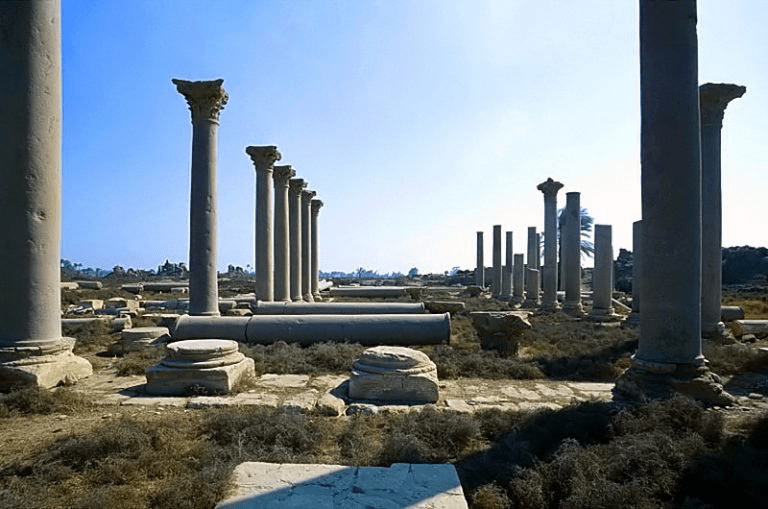
Hermopolis

In Egyptian mythology, the Ogdoad were eight primordial deities worshiped in Hermopolis. It is of note that Thoth was worshipped principally at Herm-opolis – modern Al-Ashmunayn in Upper Egypt – meaning ‘city of Hermes’. It is also interesting that Thoth was part of the Og-doad, bearing similarity with the giant, King Og in the scriptures and discussed in the articles: Belphegor; and Na’amah

Evan Meehan: ‘… the pre-creation universe existed in the form of Nun – an infinite body of inert water. Nun was a difficult concept to fathom, so the Hermopolians divided Nun into 8 components, half male, half female. These eight deities were represented by frogs for the men, and snakes for the women and included: 

Nun and Naunet: the boundless waters 

Huh and Hauhet: infinity

Kuk and Kauket: darkness

Amun and Amunet: secrecy

Collectively… the eight deities built an island in the infinite sea of Nun. It was on this island that the ibis Thoth laid an egg. When it hatched, this egg would become the sun. It appears the popularity of Thoth grew to the extent that the ‘power of his cult’ rewrote the myth of his origin as the creator god.’
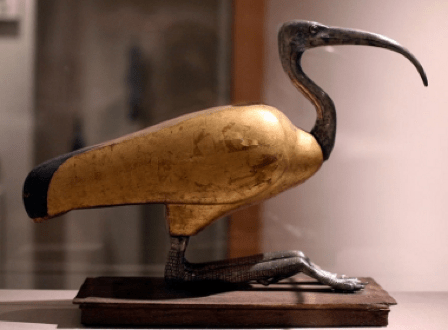
Ibis – Brooklyn Museum

Thoth, J Hill, 2010: ‘According to this variant, Thoth (in the form of an ibis, one of his sacred animals) laid [a magical cosmic] egg from which Ra, (Atum, Nefertum, or Khepri) was born. Other myths suggest that Thoth created himself through the power of language (in an interesting parallel to the phrase in the Gospel according to St John “in the beginning was the word, and the Word was with God, and the Word was God”) – refer article: Arius, Alexander & Athanasius; and Chapter I Noah Antecessor Nulla. His song was thought to have created eight deities… (the gods Nun, Heh, Kuk, and Amun and the goddesses Nunet, Hauhet, Kuaket, and Amaunet).’ 

World History EDU: ‘There are primarily two accounts of the birth of Thoth. The first… states that Thoth came into being… the same time the universe was created. He is considered a self-created god… similar to the manner in which Ma’at came into being… Thoth is considered as the “god without a mother”. A variation… states that Thoth emerged from the lips of Ra… around the beginning of creation… the second account of Thoth’s birth… ancient Egyptians believed… Thoth’s origin story can be traced to the Horus’ semen. It goes on to say that the god Set (Seth) mistakenly came into contact with the semen and out came Thoth from Set’s forehead.’ Alternatively, Thoth may have been created by Ra, Atum and Khepri for he declared “I am Thoth, the eldest son of Ra, whom Atum has fashioned, created from Khrepi.”

Hill: ‘The moon and the sun were initially thought of as the left and right eyes of Horus – Article: Belphegor. According to legend, Horus’ left eye (the moon) was injured in a fight with Set and was restored by Thoth (“the eye of Horus”)’ – refer article: 33.

Note the eye of Horus behind Thoth

‘However, as time progressed the moon came to be associated with Thoth, possibly because the crescent moon resembled the beak of an Ibis.’

Meehan: ‘In Heliopolis, the foundation of their religious belief was the Ennead – a group of gods that would ultimately grow to include Ra, Shu, Tefnut, Geb, Nut, Osiris, Set, Isis, and Nephthys. These nine gods were not formed all at once, however, and if not for Thoth’s intervention the list would have been cut short.’

Continuing with Hill’s comprehensive article: ‘Although Osiris and Isis were… credited with bringing civilisation to mankind, Thoth was also thought to have invented [languages], writing [hieroglyphs], medicine, magic, [science, philosophy], and the Egyptian’s civil and religious practices. He was even credited with the invention of music, which was… often associated with Hathor’ – Article: Na’amah. ‘Thoth was the patron of scribes and of the written word. He was scribe of the underworld who recorded the verdict on the deceased in the hall of Ma’at and was given the epithets “He who Balances”, “God of the Equilibrium”, and “Master of the Balance” – as well as Lord of the Ogdoad and The Place-Taker of Ra.

Thoth maintained the library of the gods with the help of his wife [and daughter], Sesthat (the goddess of writing) [and ancient goddess of wisdom]. As time passed Thoth gradually absorbed most of Seshat’s roles, and she was seen largely as his female aspect. They had a child called Hornub. At Khnum [rather Khmunu] (Hermopolis) he was the husband of Nehmauit (Nahmauit, Nehmetaway), goddess of protection. Their child was the god Neferhor.’

‘He was the scribe of the gods, and was often described as the “Lord of the Divine Body”, “Scribe of the Company of the Gods”, the “voice of Ra”, or the “counsellor of Ra” who (along with Ma’at) stood on the sun barge next to Ra on his nightly voyage across the sky.’ As Thoth’s role ‘was to speak the words that fulfilled Ra’s wishes, Thoth is credited with creating the heavens and earth’, according to Patti Wigington. 

Ma’at 

‘It was also thought that Ra gave Thoth [his very close “wing man and respected counsellor”] an area of the underworld to rule in the “Land of the Caves“. He kept a register of those in his realm and decreed just punishments for their transgressions and acted as Ra’s representative in the afterlife.’ One of Thoth’s symbols was a scale whereby he weighed the “heart of the dead against the Feather of truth.” In this role, his wife was Ma’at the goddess of justice.

World History EDU: ‘As part of his recording work, Thoth [played] a very crucial role in the Hall of Truth – a place where… dead souls [were] judged. He assisted… Anubis, Ma’at and Osiris in pronouncing judgment on the dead. Once the verdict was given, Thoth would then record the verdict passed on the dead soul. This helped earn him the title “Inscriber of one’s fate”. Thoth is believed to have a mansion in the underworld – the Mansion of Thoth. In this mansion, the dead could seek solace and safety as they made their journey in the underworld.’ 

There are key attributes relating to Thoth which bear an uncanny resemblance to the Son of Man. Regarding his role as the creator on behalf of the Eternal – Colossians 1:15-16, ESV: “He is the image of the invisible God, the firstborn of all creation. For by him all things were created, in heaven and on earth, visible and invisible… all things were created through him and for him.” Christ’s role as judge on behalf of the Eternal – 2 Timothy 4:1, ESV:  “… Christ Jesus, who is to judge the living and the dead…” Not to forget his role as the word of God – John 1:1, WYC: “In the beginning was the word, and the word was at God, and God was the word.”

Even mansions are stated – John 14:2-3, NKJV: “In My Father’s house are many mansions; if it were not so, I would have told you. I go to prepare a place for you. And if I go and prepare a place for you, I will come again and receive you to Myself; that where I am, there you may be also.” 

The Son of Man acts a messenger for the Eternal and is a mediator between Him and mankind – Malachi 3:1, NKJV:  “Behold, I send My messenger, And he will prepare the way before Me. And the Lord, whom you seek, Will suddenly come to His temple, Even the Messenger of the covenant, In whom you delight. Behold, He is coming…” 1 Timothy 2:5, NKJV: “For there is one God and one Mediator between God and men, the Man Christ Jesus…”

Ma’at – wife of Thoth

World History EDU: ‘The two deities seemed like a perfect match considering the fact that Ma’at was believed to be the goddess of [Harmony, truth,] law and order while Thoth was in charge of all the knowledge and wisdom in the world. Both deities always featured heavily beside each other during the judgment of dead souls. And regarding Ma’at’s 42 Principles, it is believed that Thoth was the framer of those principles’ – refer article: 42.

‘In some regard, he was also the enforcer of Ma’at’s principles and laws in the universe’ for she too was associated with the balance of things on the Earth. Consequently, Thoth was also known as the Lord of Ma’at. Ancient Society state that though Thoth was married to Ma’at he ‘was in love with Nut.’

Hill: Thoth ‘was sometimes described as the partner of Astennu (one of the male baboons who lived in the underworld), although it was also stated that Astennu was simply an aspect of Thoth.’ This replicates the bi-sexuality displayed by Hermes and Mercury.

‘It was said that he was the author of the spells in the “Book of the Dead” and “Book of Breathings” (which was also attributed to Isis [Ishtar/Lilith]) and he was given the grand title, the “Author of Every Work on Every Branch of Knowledge, Both Human and Divine”.’ Thoth’s associations with writing, knowledge and books resonate with Hermes, as the underworld and casting spells does with Belphegor. 

‘Egyptian mythology speaks of the “Book of Thoth” in which the god inscribed all of the secrets of the universe. Anyone who read it would become the most powerful sorcerer in the world, but would be cursed by their knowledge.’ 

Ancient pages, A Sutherland: ‘In his book “Ancient Egypt”, George Rawlinson mentions a beautiful ancient legend about [the] god Thoth who wrote a mysterious book, full of sacred wisdom and science, which told of everything concerning the birds of the air, and the fishes of the sea, and the four-footed beasts of the earth. This book was not easy to obtain.’ Knowledge of fauna and animal life reminds one of the patriarch Noah.

 “… He who knew a single page of the book could charm the heaven, the earth, the great abyss, the mountains, and the seas. Thoth took the work and enclosed it in a box of gold. The box of gold he placed within a box of silver, and the silver box within a box of ivory and ebony, and that again within a box of bronze; and the bronze box he enclosed within a box of brass, and the brass box within a box of iron; and the box, thus guarded, he threw into the Nile at Coptos. But a priest discovered the book’s whereabouts and sold the knowledge to a young noble for a hundred pieces of silver, and the young noble with great trouble fished the book up. But the possession of the book brought him not good but evil. He lost his wife; he lost his child; he became entangled in a disgraceful intrigue. He was glad to part with the book. But the next possessor was not more fortunate; the book brought him no luck. The quest after unlawful knowledge involved all who sought it in calamity…”

This box of hidden knowledge has much in common with Hermes’ Pandora’s Box.

Hill: ‘Needless to say, people have been searching for this text despite the warning, and some more “colourful” theories propose that it is hidden in a secret chamber in or near the Great Pyramid. This book is said by some to be the “emerald tablets of Thoth” a work of dubious authenticity which suggests that Thoth and the other gods were from Atlantis’ – Article: Antartica: Secrets of the Lost Continent of Atlantis. While the author of the Emerald Tablets may be disputed, the gods originating in the antediluvian age fits the chronology of prehistory and the merging of the pre-flood epoch with the post-flood world. 

Hill: ‘Thoth was a great magician who knew “all that is hidden under the heavenly vault”. He used his knowledge [of magical spells] to help Isis [resurrect Osiris, during her pregnancy] after the murder of her husband… by his brother Set. With the help of Anubis [the jackal headed god] he created the first mummification ritual and helped resurrect Osiris (albeit in the land of the Dead). He also protected the son of Isis, Horus [healing his eye], by driving a magical poison from his body when he was very young and supported him in his fight to gain the throne which was rightfully his’ – refer Horon – article: Belphegor.

Anubis, Ma’at and Thoth

Hill: ‘Many of the Egyptian’s religious and civil rituals were organised according to a lunar calendar – refer article: The Calendar Conspiracy. As Thoth was associated with writing and with the moon it is perhaps unsurprising that he was also linked to the creation of the calendar. As his association with the moon waned, he developed into a god of wisdom, magic and the measurement of time. Similarly he was considered to measure and record time. He was known by the epithets; “the One who Made Calculations Concerning the Heavens, the Stars and the Earth”, “the Reckoner of Time and of Seasons” and “the one who Measured out the Heavens and Planned the Earth”. 

Thoth was thought to be the inventor of the 365-day calendar (which replaced the inaccurate 360 day calendar). According to myth, he earned the extra days by gambling with the moon (Iabet or Khonsu) in a game of dice to help the goddess Nut. She was pregnant by her brother/husband Geb, but Ra forbade her to give birth on any day of the Egyptian calendar. Thoth won a portion of light from the moon (1/72) which equated to five new days, and Nut gave birth to her five children on those days (Osiris, Horus the Elder, Set, Isis and Nephthys).’ 

Evan Meehan: ‘The first month of the Coptic Calendar, Thout, was named after Thoth. The month begins September 11th and ends October 10th.’ 

Hill: ‘Most often depicted as a man with the head of an ibis, Thoth often holds a scribe’s palette and stylus but could also be depicted with an ankh ([cross] representing life) and a sceptre (representing power). Thoth sometimes wore a crescent moon [or lunar disk] on his head, but was also depicted wearing the Atef crown, and the double crown of Upper and Lower Egypt’ – symbolising the Lord of all Egypt.
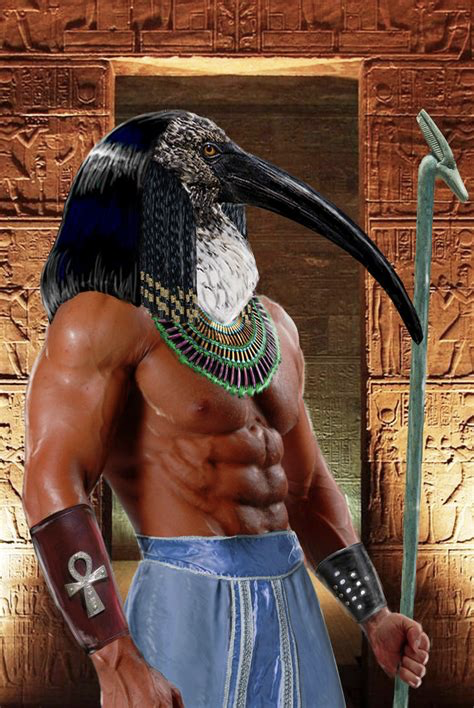
Thoth much like Hermes was kind and helpful to any god who needed advice. This was in keeping with his title “the voice of Ra”. When Thoth with his wife Ma’at journeyed in the sky with Ra during the night, he would lend a helping hand in defeating the tenacious serpentine creature, Apophis also known as Apep. The logo of the University of Cairo in Egypt, has the symbol of Thoth sitting on his throne. 

Evan Meehan: ‘Thoth originated far from the religious centers that spawned the vast majority of the Egyptian pantheon. As a result, Thoth took on the role of the perpetual outsider; he was not the focus of any major myths, and his stories could often [prove] convoluted or vague. In many tales, he appeared without explanation. Despite Thoth’s strange position (or perhaps because of it), he held a key role in the Egyptian mythos and was respected by all.’

World History EDU: ‘Since the beginning of time and creation, Thoth has been around. He burst forth voluntarily in order to take records of the events that transpired during creation. Ancient Egyptians also believed that the universe itself was based on the models and calculations put forth by Thoth. In view of this, his vast knowledge and wisdom [cannot be rivalled] by any god or goddess in Egypt. All in all, Thoth’s sphere of influence abounds in every form of knowledge ever known to mankind, as well as the gods themselves.’ 

There is no doubting Thoth is an extraordinary individual just like Hermes. At some point, Thoth became a significant and perhaps the preeminent figure in the world of the occult. His inclusion as a prominent figure in the Egyptian pantheon possibly misleading if it disguises that he was already an established god in the antediluvian age and linked with the advanced civilisation of Atlantis – Article: Antartica: Secrets of the Lost Continent of Atlantis.   

A Theosophist: ‘Thoth-Hermes was one of the King-Instructors, the “Sons of the Fire,” who began in Lemuria in the Third Race to instruct infant humanity in the arts and sciences… [and] he is always credited as the first to teach the science of magic to the Egyptians.’

Online Encyclopaedia: ‘Aleister Crowley’s Egyptian style Thoth tarot deck and its written description in his 1944 book The Book of Thoth were named in reference to the theory that Tarot cards were the Egyptian book of Thoth. H. P Lovecraft… used the word “Thoth” as the basis for his alien god, “Yog-Sothoth”, an entity associated with sorcery and esoteric knowledge.’ 

The important question of whether Thoth and Hermes-Mercury are the same person, is not easy to answer. Hermes is associated with the planet Mercury, yet Thoth with the Earth’s Moon. This appears to be a glaring difference. The main similarities being the tiny planet of Mercury and the Moon are of similar size, colour and heavily cratered from a  celestial war – Chapter XXII Alpha & Omega. Both spheres are less significant in stature in the Solar System and are out of proportion to the prominence of both Hermes and Thoth as dominant gods. While Thoth is on record of having more than one wife, Hermes did not marry. 

From Wilkinson’s Manners & Customs of the Ancient Egyptians: “It is doubtful that the deity called Thoth by the Egyptians was originally Hermes, but the two personalities were blended together and it is now impossible to separate them. Thoth was called “The Lord of the Divine Books” and “Scribe of the Company of the Gods.” He is generally depicted with the body of a man and the head of an ibis. The exact symbolic meaning of this latter bird has never been discovered. A careful analysis of the peculiar shape of the ibis – especially its head and beak – should prove illuminating.”

An important question, is whether the Egyptian, Greek, Roman and Norse pantheons of gods were all different or merely replications of former ones. The association of Woden, Wodan, Wotan, Vodan or Votan has been established with Mercury and the naming of the fourth day of the week, Wednesday. Woden was an important god for the Teutonic Saxon tribes comprising the Angles, Frisians and Jutes, as his counterpart Odin was for the Norse tribes. 

If the different pantheons are evolutionary descriptions of former gods, then the syncretism between the Greek Hermes and Roman Mercury is clearly evident for one empire immediately followed the other culturally, chronologically and in part, geographically. Whereas geography and millennia separated Egypt from Greece and so would perhaps explain the heightened difference between Thoth and Hermes. As for example, the more pronounced distinction between Mercury and Woden, due again to geography, chronology and culture. These four pantheons also represent different peoples, which would explain the individual interpretation and descriptions by the Greeks, Romans, Vikings and Saxons for actually the same gods. 

Encyclopaedia: “The title Tuthmoses, was used by certain pharaohs and translates as someone ‘Born of Thoth’ – refer Appendix VII: Moses, the Exodus & the Red Sea Crossing – Fabrication or Fact? Artapanus of Alexandria, an Egyptian Jew who lived in the third or second century BC, euhemerized Thoth-Hermes as a historical human being and claimed he was the same person as Moses, based primarily on their shared roles as authors of texts and creators of laws. Artapanus’s biography of Moses conflates traditions about Moses and Thoth and invents many details. Many later authors, from late antiquity to the Renaissance, either identified Hermes Trismegistus with Moses or regarded them as contemporaries who expounded similar beliefs.”

The premise that Thoth and Hermes are the same person still yet appears to have some merit and for the sake of this study, will be what his identity is based on going forward. The issue of whether Thoth is a literal god or a human such as Moses remains. The likelihood of Thoth’s attributes being superimposed on a human being will be investigated as will whether Thoth was a human being to begin with and was in mythology raised in stature to a god. A little similar to Cain’s descendant, Na’amah – refer article: Na’amah. Either way, as discovered with Na’amah and Belphegor; Thoth is believed by practitioners of the occult to be a real entity – Article: Belphegor.

Otherwordly Oracleemphasis mine: “Thoth Egyptian God of wisdom and writing calls to those he feels are intelligent, creative and seek the hidden knowledge. Maybe he’s calling to you. Learn all about his mysterious origins, power, and how to work with him in your pagan or spiritual practice. 

The ibis was sacred to the ancient Egyptians. This solemn and serene bird floats through the air with ease. The ibis breaks the barrier between air and water, and therefore breaks the barrier between the dead and the living. Just like Thoth. 

Thoth is a scribe and record-keeper and therefore frequently calls to writers. He willingly protects and guides modern writers, authors, publishers, poets and editors. In his most ancient form, Thoth maintains Universal movement. He keeps balance between good and evil, light and dark. 

Thoth’s origins are mysterious at best… modern occultists believe Thoth is much older than Ra or Set. Could Thoth have originated in Atlantis? Was he a god? A human? Or something else during Atlantean times? Anything is possible. 

Hermès Trismegistus wrote The Emerald Tablets of Thoth in the sixth century [CE]. Hermes Trismegistus claimed to be Thoth reincarnate. Some believe he had also come to earth as Enoch, Noah, and Moses.” 

An imaginative 17th century depiction of the Emerald Tablet from the work of Heinrich Khunrath, 1606

“The Emerald Tablets are the sacred texts of the Hermetic movement and were favored by Medieval alchemists. The tablets connect Thoth to Atlantis. When Atlantis was destroyed, the people and gods of Atlantis dispersed and went elsewhere in the world. Thoth escaped to Egypt and aided in its establishment. And was tasked with keeping the ancient records safe. As an intriguing side note, there are sacred records buried under the Sphinx.”
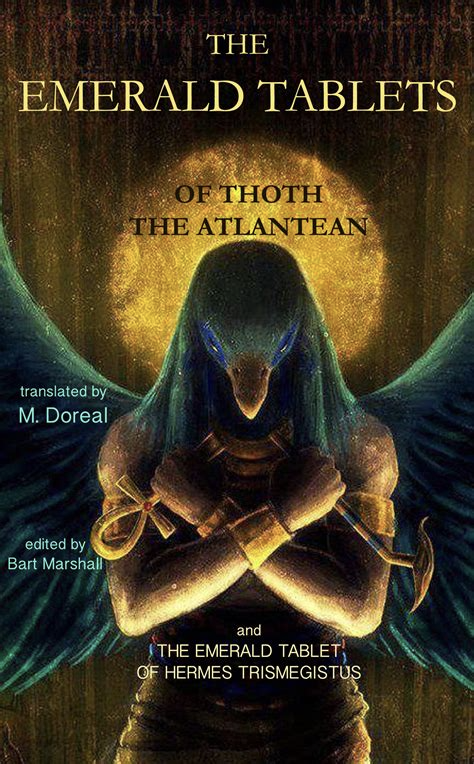
“Before Atlantis, Thoth came from elsewhere in the Universe. When I worked with Thoth extensively in 2011 and 2012, he confirmed his otherworldly origins with me. He lived many lives on Arcturus in a higher dimension. Thoth is a Cariana bird-like extraterrestrial who came to earth to aid in the creation of humanity. He is a creator god of cosmic origins. He may also have been Lyran before his time in Arcturus. And he’s believed to be one of the Ascended Masters who are now aiding humanity in ascension” that is if he is telling the truth?

This is of grave concern as discussed in previous articles. The concept of humanity evolving to a higher form* in the 4th and 5th dimensions is a sinister plot to imprison humankind in a tighter trap than the one they are already unwittingly ensnared. Extraterrestrials (or aliens) are not physical beings from merely just another galaxy but rather spirit entities masquerading as such. They are fallen angelic beings residing in the dimensions just beyond the ones we perceive – refer article: Principalities & Potentates: What they want… Who they are; Chapter XXII Alpha & Omega; and Chapter XXI The Incredible Identity, Origin & Destiny of Nimrod.

Otherworldly Oracle: “Work with Thoth just as you’d work with any other deity. Establish a connection by telling him you want to work with him in your spiritual practice. He particularly loves writers, mathematicians, magicians, and all who seek to understand the nature of the Universe. Thoth calls to starseeds – Article: Are you an Old Soul… with a Young heart. Thoth is a teacher, above all, and when he comes to you be ready to learn and transform.” 

While this writer has been aware of the growing interest in magick, the craft, the occult, demonolatry and all things esoteric; it has only been while researching Thoth that his widespread popularity and influence has become evident. An alarming number of people are either contacting him – or rather in reality those who serve Thoth, impersonating his identity – or claiming to channel him and expounding on the supposed secrets he possesses. Otherworldly Oracle provide the steps by which one can make contact. This is not as helpful as it seems and is potentially placing people in serious danger. The effort spent on contacting Thoth is misplaced, while reaching out to the true source of knowledge is the only path which provides lasting reward. 

“Read All About Thoth

There are many myths, historical facts, and archaeological artifacts featuring… Thoth. One of the best ways to get to know a deity is by researching, reading, and taking notes on them. Thoth, being a god of wisdom and writing, will particularly be pleased with this act. Keep a few pages in your grimoire dedicated to him and your experiences with him. 

Set Up An Altar

I recommend this to everyone who wants to seriously work with a deity. Thoth, like the other Egyptian gods, appreciates a sacred space of which to occupy. Give him his own altar and add things that make him feel at home – pyramids, clear quartz and lapis stones [Chapter XV The Philistines: Latino & Hispano America], ankhs, sistrums [a musical instrument of ancient Egypt consisting of a metal frame with transverse metal rods which rattled when the instrument was shaken]… Anything that screams Egypt will be appreciated by this god. Images of baboons and ibises are also appropriate. And an image of Thoth himself. 

Offer Gifts to the God of Wisdom 

If I know anything about Thoth, it’s that he enjoys gifts related to writing. Write Thoth a poem, story, prayer, or song. In addition, Thoth enjoys offerings of red wine, beer, and bread. You don’t have to give him gifts daily, but make it a regular thing when you feel you want to show your appreciation to him. He will bless you in return. 

Just WRITE 

I’ve learned that Thoth typically calls to people who are writers. So, if that applies to you, connect with the deity of writing by doing just that. WRITING. Every act of pen to paper appeases Thoth. Every thought to write is him urging you forward on your writing path. Every time I see an ibis in my front yard, I know it’s Thoth reminding me to write. 

Explore Ancient Origins of Man 

Now… Thoth had a hand in the beginning of man on this planet. And often when he’s working with a follower/devotee, he will begin revealing secrets of man’s origins to you. Don’t be surprised if he takes you on a wild journey deep inside the pyramids, deep under the Sphinx, to places unseen. Just to show you something you already knew but had forgotten. 

Get Off Your Ath and Do Some MATH 

Thoth is a mathematician. If you aren’t, maybe it’s time to dig into the origins of mathematics and see just how occult this practice actually is. Did you know the word algebra has its roots in magick? The mysteries of the Universe may be revealed through the study of math. You don’t have to become a mathematician but at least understand how math is tied intricately to magic. Thoth will guide you” – Articles: 33; 42; and The Top Ten Unexplained Mysteries of all Time

“Working with the Baboon and Ibis 

The Egyptian gods were anthropomorphic. Meaning they would manifest in animal form or half-man half-animal form. You might not live in a place where baboons or ibises roam in the wild, but you can work with the spirit of these animals. Thoth is tied to the baboon and ibis, so include these animals in your rites. 

Make Magic with Thoth 

Thoth is a god of magic. Call on him when casting spells, performing rituals and making every day magick. He will accompany, guide, and aid you in manifesting your desires.” 

Interlude:

“THUNDER rolled, lightning flashed, the veil of the Temple was rent from top to bottom. The venerable initiator, in his robes of blue and gold, slowly raised his jeweled wand and pointed with it into the darkness revealed by the tearing of the silken curtain: “Behold the Light of Egypt!” The candidate, in his plain white robe, gazed into the utter blackness framed by the two great Lotus-headed columns between which the veil had hung. As he watched, a luminous haze distributed itself throughout the atmosphere until the air was a mass of shining particles. The face of the neophyte was illumined by the soft glow as he scanned the shimmering cloud for some tangible object. The initiator spoke again: “This Light which ye behold is the secret luminance of the Mysteries. Whence it comes none knoweth, save the ‘Master of the Light.’ Behold Him!” Suddenly, through the gleaming mist a figure appeared, surrounded by a flickering greenish sheen. The initiator lowered his wand and, bowing his head, placed one hand edgewise against his breast in humble salutation. The neophyte stepped back in awe, partly blinded by the glory of the revealed figure. Gaining courage, the youth gazed again at the Divine One. 

The Form before him was considerably larger than that of a mortal man. The body seemed partly transparent so that the heart and brain could be seen pulsating and radiant. As the candidate watched, the heart changed into an ibis, and the brain into a flashing emerald. In Its hand this mysterious Being bore a winged rod, entwined with serpents. The aged initiator, raising his wand, cried out in a loud voice: “All hail Thee, Thoth Hermes, Thrice Greatest; all hail Thee, Prince of Men; all hail Thee who standeth upon the head of Typhon!” At the same instant a lurid writhing dragon appeared – a hideous monster, part serpent, part crocodile, and part hog. From its mouth and nostrils poured sheets of flame and horrible sounds echoed through the vaulted chambers. Suddenly Hermes struck the advancing reptile with the serpent-wound staff and with snarling cry the dragon fell over upon its side, while the flames about it slowly died away. Hermes placed His foot upon the skull of the vanquished Typhon. The next instant, with a blaze of unbearable glory that sent the neophyte staggering backward against a pillar, the immortal Hermes, followed by streamers of greenish mist, passed through the chamber and faded into nothingness.”

According to Otherworldly Oracle, Hermès Trismegistus was a real person who claimed to be the reincarnated Thoth and the author of the Emerald tablets. J Hill offers that two deities – Thoth and Hermes – were combined to form Hermes Trismegistus, with this version of Thoth remaining popular with occultists today. Therefore an amalgamation of two names and not a real person, in the vein of the composite name Baphomet. The former name as important to occultists as the latter is for satanists. 

Encyclopaedia – emphasis mine: ‘As Greek culture and influence spread following the conquests of Alexander the Great, a period of syncretism or interpretatio graeca saw many traditional Greek deities identified with foreign counterparts. In Ptolemaic Egypt, for example… This led to Hermes gaining the attributes of a god of translation and interpretation, or more generally, a god of knowledge and learning, This is illustrated by a 3rd-century BC… letter sent by the priest Petosiris to King Nechopso… written in Alexandria c. 150 BC, stating that Hermes is the teacher of all secret wisdoms, which are accessible by the experience of religious ecstasy. 

The Mystica: ‘The English occultist Francis Barrett in Biographia Antiqua wrote [about] Hermes “… if God ever appeared in man, he appeared in him, as is evident both from his books and his Pymander; in which works he has communicated the sum of the Abyss, and the divine knowledge to all posterity; by which he has demonstrated himself to have been not only an inspired divine, but also a deep philosopher, obtaining his wisdom from God and heavenly things, and not from man.” According to legend Hermes Trismegistus… “carried an emerald, upon which was recorded all of philosophy, and the caduceus, the symbol of mystical illumination. Hermes Trismegistus vanquished Typhon, the dragon of ignorance, and mental, moral and physical perversion.”

Online source: ‘Fowden asserts that the first datable occurrences of the epithet “thrice great” are in the Legatio of Athenagoras of Athens and in a fragment from Philo of Byblos, circa AD 64-141. However, in a later work, Copenhaver reports that this epithet is first found in the minutes of a meeting of the council of the Ibis cult… near Memphis in Egypt… found at the Temple of Esna…’

Online Encyclopaedia: ‘An epithet of Thoth found in the temple at Esna, “Thoth the great, the great, the great” [Latin: Mercurius ter Maximus], became applied to Hermes beginning in at least 172 BC. This lent Hermes one of his most famous later titles, Hermes Trismegistus (Ἑρμῆς ὁ Τρισμέγιστος), “thrice-greatest Hermes”. The figure of Hermes Trismegistus would later absorb a variety of other esoteric wisdom traditions and become a major component of Hermeticism, alchemy, and related traditions.’ Even so, the epithet Trismegistus [thrice-greatest] occurs only rarely outside the Hermetic texts.’

Online source: “A Mycenaean Greek reference to a deity or semi-deity called ti-ri-se-ro-e (“thrice or triple hero”) was found on two Linear B clay tablets at Pylos and could be connected to the later epithet “thrice great”, Trismegistos, applied to Hermes/Thoth. On the aforementioned PY Tn 316 tablet – as well as other Linear B tablets found in Pylos, Knossos, and Thebes – there appears the name of the deity “Hermes” as e-ma-ha, but not in any apparent connection with the “Trisheros”. This interpretation of poorly understood Mycenaean material is disputed, since Hermes Trismegistus is not referenced in any of the copious sources before he emerges in Hellenistic Egypt.” 

Historia Deorum Fatidicorum: “Master of all arts and sciences. Perfect in all crafts, Ruler of the Three Worlds, Scribe of the Gods, and Keeper of the Books of Life, Thoth Hermes Trismegistus – the Three Times Greatest, the “First Intelligencer” – was regarded by the ancient Egyptians as the embodiment of the Universal Mind. While in all probability there actually existed a great sage and educator by the name of Hermes, it is impossible to extricate the historical man from the mass of legendary accounts which attempt to identify him with the Cosmic Principle of Thought.”

Thomas Gregory – emphasis: ‘In some Islamic belief systems, as well as in the Baháʼí faith, “Hermes the Thrice-Greatest,” or “Hermes Trismegistus” was a person later known as both the Greek god and the Egyptian god Toth. They do so for good reason. Many Roman texts mention Hermes being revered in Egypt, with the Roman writer Cicero writing that “fourth Mercury (Hermes) was the son of the Nile, whose name may not be spoken by the Egyptians.” 

Some academics today argue that early Christian leaders such as St Augustine were influenced by the Greek god, and Hermes’ association with Toth convinced Renaissance philosophers to believe that all religions may be connected in some deeper way. At the center of these beliefs are “The Hermetic Writings,” or “Hermetic”. These included Greek and Arabic texts relating to subjects as wide as Astrology, Chemistry, and even Magic. Considered to contain secret knowledge, the hermetica were popular gnostic texts during the Renaissance period, and are still studied by many today.’ 

Reverend Erik – emphasis mine: ‘Even though Hermes Trismegistus was a mythical figure, many ancient writers wrote about him as if he was a real person. This produced disagreements and confusion. At some point, it began to be assumed that there were two Hermes. In Asclepius, Hermes Trismegistus talks about his grandfather: 

“Is it not true that my grandfather Hermes, after whom I am named, resides in his eponymous town whence he aids and cures all those who come to him from every land?” – Asclepius 37 

‘This passage indicates that the Grandfather Hermes is in fact identical with the deity Hermes, residing at Hermopolis. Ancient writers invented additional Hermes to fill in the gaps. In fact, it could be that the title “Trismegistus” refers to many great Hermes characters, a line of sages and mystics bringing the Hermetic teachings to humanity over many generations.’

Online Encyclopaedia – emphasis theirs, bold mine: ‘[Hermes Trismegistus] is the purported author of the Hermetica, a widely diverse series of ancient and medieval pseudepigraphica that lay the basis of various philosophical systems known as Hermeticism. The wisdom attributed to this figure in antiquity combined a knowledge of both the material and the spiritual world, which rendered the writings attributed to him of great relevance to those who were interested in the interrelationship between the material and the divine. The figure of Hermes Trismegistus… in both Muslim and Baha’i writings… has been associated with the prophet Idris (the Biblical Enoch).’ Katrina Sisowath adds: ‘Thoth Hermes Trismegistus… to the Sumerians… was Ningizzida.’

It is important during the antediluvian age to differentiate between the two different men named Enoch; the first being evil Enoch the son of Cain and the second, righteous Enoch the son of Jared – Genesis 4:17-18; 5:18-24. We will investigate the association of Thoth with Moses and Noah, while discussing each Enoch respectively. 

‘According to the account of the Persian astrologer Abu Ma’shar al-Balkhi (787-886), Idris/Hermes was termed “Thrice-Wise” Hermes Trismegistus because he had a threefold origin. The first Hermes, comparable to Thoth, was a “civilizing hero”, an initiator into the mysteries of the divine science and wisdom that animate the world; he carved the principles of this sacred science in hieroglyphs. The second Hermes, in Babylon, was the initiator of Pythagoras. The third Hermes was the first teacher of alchemy. “A faceless prophet,” writes the Islamicist Pierre Lory, “Hermes possesses no concrete or salient characteristics, differing in this regard from most of the major figures of the Bible and the Quran.” 

Online source: ‘The date of Hermes Trismegistus’s sojourn in Egypt during his last incarnation is not now known, but it has been fixed at the early days of the oldest dynasties of Egypt’ – Dynasty I 1988-1787 BCE according to an unconventional chronology – ‘long before the days of Moses’ – b. 1526, d. 1406 BCE. ‘Some authorities regard him as a contemporary of Abraham…’ – b. 1977, d, 1802 BCE.

Online Encyclopaedia: ‘There is no portion of the occult teachings possessed by the world which have been so closely guarded as the fragments of the Hermetic Teachings which have come down to us over the tens of centuries which have elapsed since the lifetime of its great founder, Hermes Trismegistus… who dwelt in old Egypt in the days when the present race of men was in its infancy… hailed as “The Master of Masters.” This man, if “man” indeed he was… was the father of the Occult Wisdom; the founder of Astrology; the discoverer of Alchemy… the Great Central Sun of Occultism, whose rays have served to illumine the countless teachings which have been promulgated since his time. 

All the fundamental and basic teachings embedded in the esoteric teachings of every race may be traced back to Hermes. Even the most ancient teachings of India undoubtedly have their roots in the original Hermetic Teachings. The best authorities regard him as a contemporary of Abraham, and some of the Jewish traditions go so far as to claim that “Abraham… that venerable sage… acquired a portion of his mystic knowledge from Hermes himself” – Introduction The Kybalion (A Study of the Hermetic Philosophy of Ancient Egypt and Greece) by Three Initiates, Yogi Publication Society, Chicago Masonic Temple, Chicago, 1912.’ 

The 1908 book Kybalion, by the Three Initiates, addresses Hermetic principles; though many believe that the book was written by a man called William Atkinson, an influential and prolific writer in the eighteenth and nineteenth centuries. 

Bryant’s Mythology: “There are two theories concerning his demise. The first declares that Hermes was translated like Enoch and carried without death into the presence of God, the second states that he was buried in the Valley of Ebron and a great treasure placed in his tomb – not a treasure of gold but of books and sacred learning.”

Encyclopaedia: ‘The Hermetic literature among the Egyptians, which was concerned with conjuring spirits and animating statues, inform the oldest Hellenistic writings on Greco-Babylonian astrology and on the newly developed practice of alchemy. In a parallel tradition, Hermetic philosophy rationalized and systematized religious cult practices and offered the adept a means of personal ascension* from the constraints of physical being. 

Online source: ‘The Hermetica is a category of papyri containing spells and initiatory induction procedures. The dialogue called the Asclepius (after the Greek god of healing) describes the art of imprisoning the souls of demons or… angels in statues with the help of herbs, gems, and odors, so that the statue could speak and engage in prophecy. In other papyri, there are recipes for constructing such images and animating them, such as when images are to be fashioned hollow so as to enclose a magic name inscribed on gold leaf.’ Perhaps like the golden calf of the Israelites – refer article: The Calendar Conspiracy.

Encyclopaedia: ‘Many Christian writers… considered Hermes Trismegistus to be a wise pagan prophet who foresaw the coming of Christianity. They believed in the existence of a prisca theologia, a single, true theology that threads through all religions‘ – Article: The Seven Churches – A Message for the Church of God in the Latter Days. ‘It was given by God to man in antiquity and passed through a series of prophets… In order to demonstrate the verity of the prisca theologia, Christians appropriated the Hermetic teachings for their own purposes. By this account, Hermes Trismegistus was either a contemporary of Moses, or… Enoch, Noah… During the Renaissance, it was accepted that Hermes Trismegistus was a contemporary of Moses. 

However, after Issac Casaubon’s demonstration in 1614 that the Hermetic writings… postdate the advent of Christianity, the whole of Renaissance Hermeticism collapsed. As to their actual authorship… they were certainly not written in remotest antiquity by an all wise Egyptian priest… but by various unknown authors, all probably Greeks, and they contain popular Greek philosophy of the period, a mixture of Platonism and Stoicism, combined with some Jewish and… Persian influences.’ 

When the Hermetic writings may have been written or compiled does not detract from when the real or composite figure of Hermes Trismegistus lived. As these writings most likely derived from an earlier epoch, just as Thoth was a pre-flood figure, who was later worshipped or deified in the post-flood era. 

Encylopaedia: ‘Perhaps no character in history has formed the subject of so much and so varied study and speculation as that of Hermes Mercurius Trismegistus and we shall realize the truth of this statement as we individually seek light upon the sublime philosophy rightly attributed to this Avatar. At the very outset, we are confronted with a remarkable dearth of exact information regarding his person and life. A dearth all the more inexplicable when we realize that from the Rosicrucian standpoint Hermes may be justly regarded as one of the greatest of all Messiahs who have incarnated on this sphere. 

Yet the very mythos, which apparently surrounds his existence, has a special value to occultists, for a similar obscurity and absence of specific data attaches to the characters of Melchisedek, King of Salem, Osiris, Attis, Confucius and John the Baptist, of all of whom the origin is unknown’ – Hermes Mercurius Trismegistus, A Treatise preliminary to the Study of the Hermetic Philosophy, By Fr. K. X, Societas Rosicruciana in America.

Katrina Sisowath: ‘Before he was revered as a god, he was the first great Egyptian philosopher and founder of the Ancient Mystery Schools, receiving his wisdom while in meditative trances, writing over 40 books… with the Book of Thoth only being given to his enlightened initiates of the Mysteries… a quick perusal or in-depth study resounds in most readers, due to the similarity with Buddhism and Christianity… the clearest examples are his teachings on reincarnation and the creation of the world’ – Article: DEATH: A Dead End or a New Beginning? 

‘… the Book of Thoth… was written in Egyptian Hieroglyphics. It was kept in a golden box [Pandora’s Box] in the inner sanctuary of the temple and only the highest initiate of the Hermetic Arcanum Mystery School had the key to it… the book described the Key to Immortality, the process achieved through awakening certain areas of the brain, similar to the Buddhist monks’ practices… authors have claimed the awakening of the brain was achieved through meditation, the use of a white powder,* and the priestesses’ sacred essence.’ 

With regard to the Book of Thoth, an unknown source elaborates further: ‘While Hermes still walked the earth with men, he entrusted to his chosen successors the sacred Book of Thoth. This work contained the secret processes by which the regeneration of humanity was to be accomplished and also served as the key to his other writings. Nothing definite is known concerning the contents of the Book of Thoth other than that its pages were covered with strange hieroglyphic figures and symbols, which gave to those acquainted with their use unlimited power over the spirits of the air and the subterranean divinities. When certain areas of the brain are stimulated by the secret processes of the Mysteries, the consciousness of man is extended and he is permitted to behold the Immortals and enter into the presence of the superior gods. The Book of Thoth described the method whereby this stimulation was accomplished. In truth, therefore, it was the “Key to Immortality.” 

According to legend, the Book of Thoth was kept in a golden box [Ark of the Covenant – article: The Ark of God] in the inner sanctuary of the temple. There was but one key and this was in the possession of the “Master of the Mysteries,” the highest initiate of the Hermetic Arcanum. He alone knew what was written in the secret book. The Book of Thoth was lost to the ancient world with the decay of the Mysteries, but its faithful initiates carried it sealed in the sacred casket into another land. The book is still in existence and continues to lead the disciples of this age into the presence of the Immortals. No other information can be given to the world concerning it now, but the apostolic succession from the first hierophant initiated by Hermes himself remains unbroken to this day, and those who are peculiarly fitted to serve the Immortals may discover this priceless document if they will search sincerely and tirelessly for it. 

It has been asserted that the Book of Thoth is, in reality, the mysterious Tarot of the Bohemians – a strange emblematic book of seventy-eight leaves which has been in possession of the gypsies since the time when they were driven from their ancient temple, the Serapeum.’ We will investigate the origin of the Tarot shortly.

The Hermit is the ninth trump or Major Arcana card in traditional tarot decks. It is used in game playing as well as in divination. It signifies contemplation, the search for truth, solitude, wisdom, enlightenment and inner guidance. Zodiac sign: Virgo.

Tina Gong: ‘The Hermit depicts an old man standing alone at the peak of the mountain while holding a lantern in one of his hands and a staff on the other. The mountain denotes accomplishment, development, and success. The hermit tarot card refers to the level of spiritual knowledge that he attained, and that he is ready to impart that knowledge to everyone. There is also a deep commitment he has to his goal and a solid awareness of the path that he is taking.’
‘Inside the lantern, you will notice a star with 6 points which is also known as the Seal of Solomon. This symbol represents wisdom. The staff that he holds depicts authority and power. The Hermit is a seeker for the knowledge that comes from within. A lonely wanderer in the path of the night, he searches for that which can only be gained with long periods of solitude – the inner voice. To hear it, he must disconnect from the crowds whose voices and desires threaten to overcome his own. He walks through the dark night of his unconscious, guided only by the low light of the northern star [refer Pole Star, article: The Pyramid Perplexity], with his destination being his home, his self.’
Notice the similarity between The Hermit (above) and the Ibis inspired Thoth aka Hermes Trismegistus (below).

Unknown source: ‘(According to the Secret Histories the gypsies were originally Egyptian priests.) There are now in the world several secret schools privileged to initiate candidates into the Mysteries, but in nearly every instance they lighted their altar fires from the flaming torch of Herm. Hermes in his Book of Thoth revealed to all mankind the “One Way,” and for ages the wise of every nation and every faith have reached immortality by the “Way” established by Hermes in the midst of the darkness for the redemption of humankind.” We will return to the premise of a Way and the ‘one way’ in achieving everlasting redemption. 

Sisowath: ‘The most powerful of the Mystery Schools was known as the Royal School of the Master Craftsmen at Karnak, founded by Pharaoh Thuthmosis III [945-912 BCE], though as with all the Mystery Schools, it is commonly believed that the true founders resided in Sumeria, emigrating to Egypt… 

This school was also known as the Great White Brotherhood due to the members’ choice of raiment (white robes) and their dedication to producing the white powder* known to the Mesopotamians as Shem-an-na, the High-Ward Fire Stone, or ‘white bread’ to the Egyptians. Pictures of it show it being offered to the Pharaohs, in the shape of a cone’ – refer article: Monoliths of the Nephilim

‘On the top of Mount Sinai, Petrie discovered an Egyptian Temple which contained a bewildering discovery: laying some inches deep beneath heavy flagstones in a storeroom was a considerable supply of the finest pure white, unadulterated powder. Copper smelting and animal sacrifice were quickly ruled out. Some of the mysterious powder was taken back to Britain for analysis and examination, but no results were ever published. The rest was left open to the elements after 3000 years to become a victim of the desert winds. 

What has become apparent, however, is that this powder was seemingly identical to the ancient Mesopotamian fire-stone or shem-an-na – the substance that was made into bread-cakes and used to feed the Babylonian kings and the pharaohs of Egypt. This, of course, explains the temple inscriptions denoting the importance of bread and light, while the white powder (the shem-an-na) has been identified with the sacred manna that Aaron placed in the Ark of the Covenant.’ The Israelite’s manna and the Ark of the Covenant are addressed in the articles: The Manna Mystery; and The Ark of God. 

‘Eventually the Mystery Schools went into decline as new Dynasties emerged. The initiates left Egypt and brought the Book of Thoth to another land. Where it is now, no one knows, though supposedly the chain of succession of Grand Master since Thoth has remained unbroken. The Rosicrucians are said to be descended from his school, while the Freemasons are descended from the school founded by Solomon’ – article: The Establishment: Who are they… What do they want? ‘As for Thoth himself? He has remained revered by philosophers, occultists, alchemists and healers through the ages, though many of the texts accredited to him were lost in the Great Fire of the Library of Alexandria. Who [knows] how different history might have been had the knowledge contained in that library not been lost?’ 

Online source – emphasis mine: ‘As a divine source of wisdom, Hermes Trismegistus was credited with tens of thousands of highly esteemed writings, which were reputed to be of immense antiquity’ – 36,000 according to Egyptian priest, Manetho. ‘Clement of Alexandria was under the impression that the Egyptians had forty-two sacred writings by Hermes, writings that detailed the training of Egyptian priests.’ Recall the 42 principles of Ma’at, the wife of Thoth – Article: 42

‘Siegfried Morenz has suggested, in Egyptian Religion: “The reference to Thoth’s authorship… is based on ancient tradition; the figure forty-two probably stems from the number of Egyptian nomes, and thus conveys the notion of completeness.” The neoplatonic writers took up Clement’s “forty-two essential texts.”

Online source: ‘Modern occultists suggest that some Hermetic texts may be of Pharaonic origin, and that the legendary “forty-two essential texts” that contain the core Hermetic religious beliefs and philosophy of life, remain hidden in a secret library.’ 

Everet Dee says regarding these 42 books: ‘The forty-two were kept in the great Library of Alexandria, which was eventually destroyed. What remained moved to the Islamic world in 400-600 AD, before eventually re-emerging in Europe during the Renaissance. During the Medieval Europe Hermeticism was banned by the church, and the philosophy was forced underground. It was kept alive by secret societies such as the Freemasons, Rosicrucians, and the Hermetic Order of the Golden Dawn. Of the forty-two books, ten deal with sacrifices, ten with sacred rites, and two were hymns to the gods, as well as rules for how kings should govern. Four books were about astrology, and six about medicine. Today only a small handful remain, although their authenticity is sometimes called in to question by skeptics. These have been compiled into the Corpus Hermeticum.’

Britannica – emphasis mine: ‘The writings ascribed to Hermes-Thoth fall into two main classes: “popular” Hermetism dealt with astrology and the other occult sciences, and “learned” Hermetism concerned itself with theology and philosophy. From the Renaissance until the end of the 19th century little attention was paid to the popular Hermetic literature. More recent study has shown that its development preceded that of the learned Hermetism and that it reflects ideas and beliefs that were widely held in the early Roman Empire and are therefore significant for the religious and intellectual history of the time. 

In the Hellenistic Age… There was a growing distrust of traditional Greek rationalism and a breaking down of the distinction between science and religion. Hermes-Thoth was but one, if perhaps the most important, of the gods and prophets (chiefly of Middle Eastern origin) to whom knowledge seekers turned for a divinely revealed wisdom. 

The theological writings are represented chiefly by the 17 treatises of the Corpus Hermeticum, by extensive fragments in Stobaeus, and by a Latin translation of the Asclepius, preserved among the works of Apuleius. These date probably from the first three centuries CE. All are marked by a sincere piety of a mystical type, but there is no single doctrine which is consistently set forth, and it is unlikely that there was any well-defined Hermetic community or “church.” Though the setting is Egyptian, the philosophy, like the language, is Greek.’ 

Erik: “The Hermetica that we read and write about most often are not the only ancient books ascribed to Hermes Trismegistus. Multiple important early works on astrology were also attributed to the legendary sage. The link between Hermes and astrology is also clear in the Hermetic fragments of Stobaeus. The greek Magical Papyri and texts such as the Cyranidi make it clear that Hermes Trismegistus was seen as a master of thaumaturgy” – ‘Thaumaturgy is the… capability of a magician to work magic… [and] paranormal events or a saint to perform miracles. It is… translated into English as wonderworking.’ A practitioner of thaumaturgy is a thaumaturge, thaumaturgist, thaumaturgus, miracle worker, or wonderworker – “demonology [Demonology is the study of a hierarchy of demons within theology, religious doctrine and occultism], and other magical arts. Finally, Hermes is also the legendary source of alchemy, through such works as the Emerald Tablet and the works of Zosimos of Panopolis.” 

The work attributed to Hermes Trismegistus, his second book called Asclepius, 1657, makes the following two comments: “Thou Asclepius, the soul of every man is immortal, but not all alike; for there is a difference both in the time and manner.” This is not true, for the soul which sins, dies: Ezekiel 18:20 – refer article: DEATH: A Dead End… or a New beginning? and The Seven Churches – A Message for the Church of God in the Latter Days.

Similarly: “How quickly hast thou learned, by the very light of reason; for said I not this, that all things are one, and one all things? that all things were in the Creator, before he created all things; neither unworthily is he said to be All, whole parts are all things; therefore in this whole Discourse have a care to remember him, who being One, is All, even the very Creator of all things; all things descend from Heaven into Earth, into the Water, and into the Air.” 

All things do find their source in the Creator and have been replicated from above, below. Isaiah 45:12, The Voice: “It is I who made the very ground on which you stand, I who shaped the human beings who walk around on it. I pulled the sky and the heavens taut with My own hands, and organized the army of stars that march across the night sky.” The connection between the source of life and the creation has been severed twice. 

Once with the angelic rebellion – Revelation 12:7-9 (Chapter XXII Alpha & Omega) – and secondly, when humankind chose an alternative path. One which did not lead to immortality but rather death, when Adam and Eve rejected the Tree of Life and chose the Tree of Death. Humanity has been cut off from the Eternal and is not connected to Him. Only through the Son of Man as the Mediator, discussed earlier can a human re-establish contact. For the Creator has no part or connection at the present time with the creation. Habakkuk 1:13, The Voice: “Your eyes are too pure to even look at evil. You cannot turn Your face toward injustice.”

Genesis 3:4-7, ESV: ‘But the serpent said to the woman, “You will not surely die. For God knows that when… your eyes [are]… opened… you will be like God, knowing good and evil”… when the woman saw that the tree [of the knowledge of Good and Evil] was good for food, and that it was a delight to the eyes, and that the tree was to be desired to make one wise, she took of its fruit and ate, and she… gave some to her husband who was with her, and he ate. Then the eyes of both were opened…’ Notice the Serpent lied to Eve, tricking her. The immortal words of Samael resound through the ages; “You will not surely die”. This was the beginning point for the false religious doctrine and the erroneous occult teaching; that mankind possesses an immortal soul. 

Micki Spollern – emphasis mine: ‘The 7 Hermetic principles are believed to run the universe and create the reality you live in – and put you in complete control of your own life. Hermeticism is a philosophical system based on the teachings of the ancient god Hermes Trismegistus. According to Hermeticism, the wisdom of the whole universe can be accessed independently of religion through alchemy, astrology, and theurgy.’ 

Encylopaedia: ‘Theurgy, also known as divine magic, is one of two major branches of the magical arts, the other being practical magic or thaumaturgy. Theurgy describes the ritual practices associated with the invocation or evocation of the presence of one or more deities’… the art or technique of influencing a god or supernatural power. 

Spollern: ‘… “The Kybalion” was published to share Hermes Trismegistus’ teachings, outlining seven Hermetic laws passed down by Hermes Trismegistus and his students. When understood and practiced, these universal laws are said to be the answers to leading a fulfilling and meaningful life… 

  1. The Principle of Mentalism 

“The All is Mind; the Universe is Mental.” 

Broken down, this is very similar to what you may know as the Law of attraction, which states that your thoughts create your reality. Using this law, you have the power to determine the circumstances around you as, according to Hermetic philosophy, everything in the universe is mentally created. Everything that exists was created by a thought. The changes that happen on this plane in your mind go on to become your reality. 

Sana Nawazish writes concerning how to apply the principle: ‘The principle of mentalism can be applied in daily life by… Focusing on the good in every situation and creating vivid mental images of what you want to manifest, reinforced by repeating positive affirmations and expressing gratitude, will help align your thoughts and beliefs with your desires… [using] the power of mentalism to shape your life in the way you want.’ 

The two phrases in bold, are becoming byword principles amongst younger generations. 

2. The Principle of Correspondence 

“As above, so below; as below, so above.” 

According to this principle, the world around you is a manifestation of your inner world. Eventually, your inner thoughts, whether on a conscious or subconscious level, become your external circumstances. The various methods of manifestation are based on this Hermetic principle as [they are] techniques that train your focus and thoughts that then go on to become your reality. 

3. The Principle of Vibration 

“Nothing rests; everything moves; everything vibrates.” 

This principle explains that everything in the universe, whether it’s… physical matter or [a] thought, vibrates. Its vibration makes it real. The second you have a thought, it’s given a vibration. The more it’s thought about, the more momentum it’s given to become real. For this reason, it’s important to work on raising your vibration in order to manifest positive things in your life’ – refer article: 33

Everet Dee adds: ‘All things, wither they are physical or spiritual, hold a certain vibration. From spirit to the grossest level of matter, everything is vibrating at its frequency. Every molecule in the universe is vibrating, as well as our thoughts and emotions. New scientific tools… allow us to perceive the vibratory nature of our reality, on an atomic level. While modern science has verified this as being true, as a Hermetic principle it has been known for thousands of years. The difference between matter and energy is simply a difference in the rate of vibration. The scale of vibration ranges from the highest vibrations which are so rapid that it is practically at rest, down to the most gross forms of matter, vibrating at such a low rate so as to also almost be at rest. Between these two poles exist all that is on varying vibrations.’

4. The Principle of Polarity 

“Everything is dual; everything has poles; everything has its pair of opposites; like and unlike are the same; opposites are identical in nature, but different in degree; extremes meet; all truths are but half-truths; all paradoxes may be reconciled.” 

Put simply, the principle of polarity means that all opposites are really the same thing. They are different ends of the same pole. For example, heat and cold, though opposites, are both temperatures. Likewise, love and hate are opposite levels of an emotion, but a strong emotion nonetheless. The only difference between the two ends of the pole is vibration. According to Hermetic beliefs, the same can be said of the spirit and reality. Put into practice, this principle encourages you to shift your vibration towards the more positive end of the spectrum to better your relationship with it. 

Everet Dee: ‘This principle states that all that exists also has its opposite, and cannot exist without it. Take the polarity of light and dark. As you move across from one side to the other, when does dark become light? The transition point is unclear because they are the same thing, and extreme light prevents us from seeing just as much as extreme dark does.’

5. The Principle of Rhythm 

“Everything flows, out and in; everything has its tides; all things rise and fall; the pendulum-swing manifests in everything; the measure of the swing to the right is the measure of the swing to the left; rhythm compensates.” 

This principle is similar to Newton’s 3rd Law of Motion, which states that “For every action, there is an equal and opposite reaction.” Everything [in] the universe will eventually even itself out, which leads to an ebb and flow. When talking about your own mental or emotional state, you may see this in life as the emotional highs and lows you go through. Mastering this principle is learning how to center yourself so that you don’t consciously or subconsciously act to counter an emotion, causing the pendulum to swing wildly from one side to the other. This leads to a state of inner peace in which your foundation is strong and you can remain unbothered by circumstances around you. 

6. The Principle of Cause and Effect 

“Every cause has its effect; every effect has its cause; everything happens according to law; chance is but a name for law not recognized; there are many planes of causation, but nothing escapes the law.” 

The universe is governed by laws, meaning nothing happens without reason’ – refer article: Predestination & Free Will. ‘You may not be able to directly pinpoint a specific cause for a certain effect because the cause may happen on different planes of existence, but every action has a ripple effect that leads to a consequence. 

Everet Dee: ‘There is no such thing as chance. The higher planes dominate the lower planes, which can cause the things that occur in our lives to seem a mystery to us at times, because we are limited by our human perception, and cannot see the full picture of all that is at play. While most people go through life as a victim of their own thoughts and feelings, and the circumstances that are created, The Hermeticist strives to become the cause, rather than the effect, of his own life. Most people are like pawns on the chessboard, obedient to external causes coming from people and forces more powerful than themselves.

Part of the way of the Hermeticist is to rise to higher planes in their consciousness, and become cause on that higher plane, effecting the lower planes with their influence. They master their own internal experience first, and then the external environment around them. The true adept knows to not try to reject causation of the higher planes, but to work with and while also exerting their own influence.’

7. The Principle of Gender 

“Gender is in everything; everything has its masculine and feminine principles; gender manifests on all planes.” 

In Hermeticism, the principle of gender is not necessarily about the physical body. Instead, it’s referring to the qualities of masculinity and femininity which create balance in the world. All things embody both masculine and feminine energies, and learning how to be open to and balance those energies within yourself can bring you to a higher state of consciousness that is simultaneously powerful and thoughtful.’ 

Dee: ‘The gender polarity exists on the macro level as well, with the sun representing masculine energy and the moon feminine. The masculine is the creative force, while the feminine is soft and reflective. While opposites, they are inseparable, part of a larger picture, that when balanced part in unison to enhance one and other.’
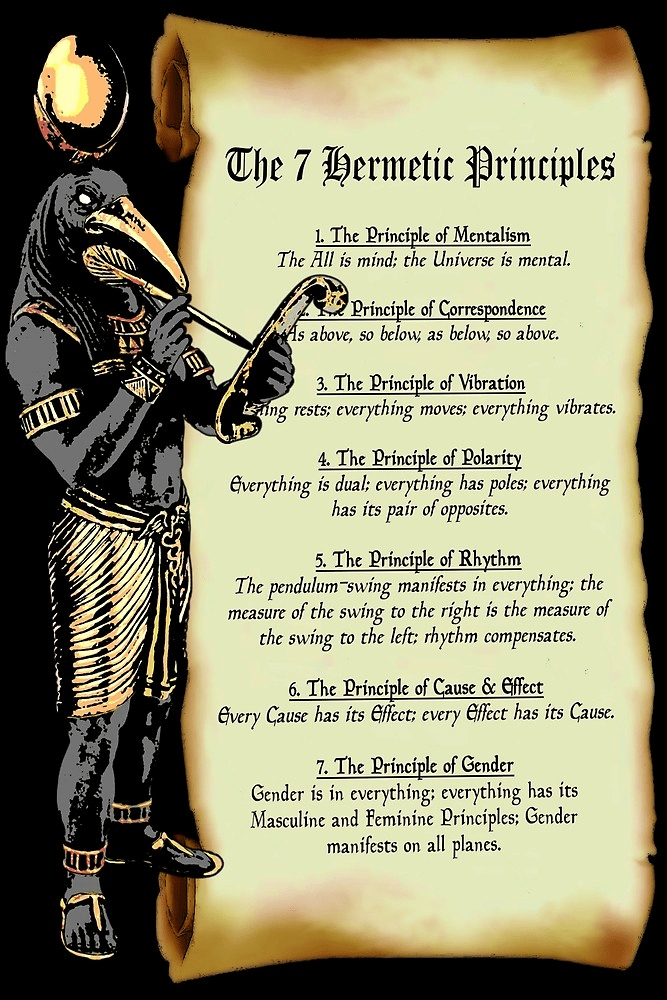
All seven points are of themselves truthful points; with the understanding of them or their application lending value in a person’s life. This is not in dispute. The concern for this writer, is if a person views them through a narrowly scoped paradigm; perceiving them as a comprehensive explanation for a person’s successful endeavours in life. For they are lessened in meaning and devalued in effectiveness if their application is attempted devoid of the Creator. There is a sinister factor involved if by the Three Initiates sharing them, one were to follow these seven principles purely in a secular or even metaphysical fashion alone. 

There were two preceding sentences with profound bearing worth highlighting. The first by Spollern was: “According to Hermeticism, the wisdom of the whole universe can be accessed independently of religion through alchemy, astrology, and theurgy.” Two vital points in this sentence are firstly: this writer would beg to differ that if one truly seeks the ‘wisdom of the whole universe’, then while it is agreed religion is flawed, the disciplines of the left hand path are not truly beneficial or fulfilling to its practitioner and ultimately lead to a permanent spiritual death. They are the path of the Adversary and symbolised by the Tree of Knowledge of Good and Evil, in opposition to the Ancient of Days. 

“The principles of truth are seven; He who knows these, understandingly, possesses the magic key before whose touch all the doors of the temple fly open” – The Kyballion. 

Of course, the sixty-four thousand dollar question, is the doors to which temple? A little like Pandora’s Box, these doors may be better left closed. If a reader truly seeks the truth on all things, then this is only achieved through a relationship with the Eternal – which leads to the Tree of Life. Attempting ‘independently’ of the Creator is an unwise decision just as Adam and Eve, made the wrong choice – Chapter XXII Alpha & Omega. For “Wisdom begins with respect for the Lord, and understanding begins with knowing the Holy One” – Proverbs 9:10, NCV.

Likewise, “The best that people can do is eat, drink, and enjoy their work. I saw that even this comes from God, because no one can eat or enjoy life without him. If people please God, God will give them wisdom, knowledge, and joy. But sinners will get only the work of gathering and storing wealth… all their work is useless, like chasing the wind” – Ecclesiastes 2:24-26, NCV. 

Similarly, the Son of Man said, “Ask, and you will be given what you ask for. Seek, and you will find. Knock, and the door will be opened. For everyone who asks, receives. Anyone who seeks, finds. If only you will knock, the door will open. If a child asks his father for a loaf of bread, will he be given a stone instead? If he asks for fish, will he be given a poisonous snake? Of course not! And if you hard-hearted, sinful men know how to give good gifts to your children, won’t your Father in heaven even more certainly give good gifts to those who ask him for them?” – Matthew 7:7-11, TLB. 

Everet Dee states regarding the first principle: “This principle states that everything in the universe consists of thought, and is created by thought. Everything that exists, whether in the physical universe, or as abstract concepts or pure energy… is made of spirit, which itself is the product of a universal living mind.” 

Spirit is the source of all life and emanates from the Creator. While sentient living beings possess mind capabilities in the image of the Creator, it is not true that we share the same mind. Only the righteous following a path to be at one with the Eternal – develop a selfless mind, focussed on the welfare of others. Every other creature, whether angelic or human, possess a selfish mind focused on themselves, driven by competition, envy and strife against others.  

The second sentence was in connection with the fifth Principle of Rhythm: “This leads to a state of inner peace in which your foundation is strong and you can remain unbothered by circumstances around you.” Wouldn’t peace of mind of this nature be desired by everyone? How many in this world possess true ‘inner peace’. And which ‘foundation’ would provide peace of this kind, it is wondered? It is the Eternal who is the only sure foundation, as “He will be the sure foundation for your times, a rich store of salvation and wisdom and knowledge; the fear of the Lord is the key to this treasure” – Isaiah 33:6, NIV. 

This is the only path which results in everlasting peace as explained by Paul: “Don’t worry about anything; instead, pray about everything; tell God your needs, and don’t forget to thank him for his answers. If you do this, you will experience God’s peace, which is far more wonderful than the human mind can understand. His peace will keep your thoughts and your hearts quiet and at rest as you trust in Christ Jesus” – Philippians 4:6-7, TLB. 

How can one be truly ‘unbothered by circumstances around you’. This type of relaxed faith, understanding and temperament stems from being positive. And being positive is the product of being happy – Article: How to be Happy. You, you reading this, are… what you think; you are what you watch; you are what you listen to; you are what you read; you are what you do; you are what you eat and drink; and you are influenced, by which people you spend the majority of your time with. Many wish for peace and wisdom and perhaps all, desire happiness. True happiness is given by the Eternal to those who obey Him. It is that simple, it is that easy. 

Everet Dee: ‘Hermeticism’s influence can be found world-wide, in modern science, as well as Christian and Muslim philosophy [and within psychology]. The ancient Greek philosophers were heavily influenced by Hermeticism, who in turn influenced the Renaissance and eventually the Scientific Revolution. Copernicus, the Renaissance astronomer who proposed the Sun is the center of the solar system, rather than planet Earth, and Isaac Newton, perhaps the most influential physicist of all time, are but two of many such students of the philosophy. Alchemy is a branch of the Hermeticism, which was the precursor to modern chemistry. The astrological concepts introduced in Hermeticism paved the way for modern astronomy, instilling an appreciation, and keen eye turned towards the sky.’

In the Emerald Tablet of Hermes, translated by Sir Issac Newton, circa 1680, it states: “That which is below is like that which is above and that which is above is like that which is below…” This is not some occult secret wisdom. The Bible has much to say on this truth. Another quote words it as: “As above, so below, as within, so without, as the universe, so the soul…” As noted above, it is recorded in the Kybalion – II The Principle of Correspondence – “As above, so below; as below, so above.” 

Everet Dee: ‘Amongst scholars, the phrase is often understood to be referring to the effects of celestial mechanics upon terrestrial events. This can be materialistic in nature, such as the effect of the sun on the plants growing on earth, but it can also be esoteric or non-physical in nature. When studying the phrase, the version most commonly looked at is the medieval Latin translation: “Quod est superius est sicut quod inferius, et quod inferius est sicut quod est superius.” 

“That which is above is like to that which is below, and that which is below is like to that which is above.” ‘Modern science has confirmed the concept of As Above, So Below as it has been able to observe galaxies of space, as well as the world of atomic particles, and found surprising similarities between the two. Both consist of particles kept in orbit by the gravity of an energetic core.’ Whether planets orbiting the sun, or an atom and its accompanying electrons. ‘In this way modern science has confirmed the wisdom of ancient thought. 

Another example of As Above, So Below being expressed or represented is in Eliphas Levi’s 1856 magical treatise titled Dogme et Rituel de la Haute Magie. The book features artwork portraying Baphomet, and is rich in symbolism showing the As Above, So Below concept. The hands pointing up and down imply “as above, so below,” that in these two opposites there is still union. Other dualities include the light and dark moons, the male and female aspects of the figure, and the caduceus.’

This same concept is contained in the scriptures. John 8:23, ESV: ‘[Christ] said to them, “You are from below; I am from above. You are of this world; I am not of this world.’ In Colossians 3:1-2, ESV: ‘If then you have been raised with Christ, seek the things that are above, where Christ is, seated at the right hand of God. Set your minds on things that are above, not on things that are on earth.’ And in 2 Corinthians 4:18, ESV: ‘… as we look not to the things that are seen but to the things that are unseen. For the things that are seen are transient, but the things that are unseen are eternal’ – Matthew 6:10, Deuteronomy 28:23, Genesis 1:7, Philippians 3:20. 

Encylopaedia: ‘Emerald is the stone traditionally associated with Hermes, while mercury is his metal. Mars is associated with red stones and iron, and Saturn is associated with black stones and lead. In antiquity, Greeks and Egyptians referred to various green-colored minerals (green jasper and even green granite) as emerald, and in the Middle Ages, this also applied to objects made of colored glass, such as the “Emerald Tablet” of the Visigothic kings or the Sacro Catino of Genoa (a dish seized by the Crusaders during the sack of Caesarea in 1011, which was believed to have been offered by the Queen of Sheba to Solomon and used during the Last Supper).’ 

Ancient Origins discuss the origin of the Emerald Tablet: ‘… the creator of the Emerald Tablet has been provided in myth as the Egyptian god Thoth, who… “divided his knowledge into 42 plates of emerald, codifying the great scientific principles ruling the Universe.”

For an odd coincidence regarding the number forty-two, refer: The Hitchhiker’s Guide to the Galaxy, Douglas Adams – articles: The Truly Big Questions; and 42.

Interesting expressions of the number 42 in mathematics and science include the following. When using base 13: 610 × 910 = 5410, it can be expressed as 4213 (in other words the decimal expression 54 is encoded as 42 in base 13); the number 42 is 101010 in base 2; light refracts through a water surface by 42 degrees to create a rainbow; and light requires 10−42 seconds to cross the diameter of a proton.

“The legend tells that after the gods’ fall, the Hermetic tablets were cleverly hidden so that no human being might find them. Only Thoth, on his return to that dimension, was able to recover the mysterious book.” ‘Another legend suggests that it was the third son of Adam and Eve, Seth, who originally wrote it. Others believed that the tablet was once held within the Ark of the Covenant. 

While various claims have been made regarding the origins of the Emerald Tablet, as yet no verifiable evidence has been found to support them. The oldest documentable source of the Emerald Tablet’s text is the Kitab sirr al-haliqi (Book of the Secret of Creation and the Art of Nature), which was itself a composite of earlier works. Based on this Arabic work, some believe that the Emerald Tablet was… an Arabic text… rather than a piece of work from Antiquity, as many have claimed. 

The interpretation of the Emerald Text is not a straightforward matter, as it is after all a piece of esoteric text. One interpretation, for instance, suggests that the text describes seven stages of alchemical transformation – calcination, dissolution, separation, conjunction, fermentation, distillation and coagulation. Yet, despite the various interpretations available, it seems that none of their authors claim to possess knowledge of the whole truth. Furthermore, readers are encouraged to read the text and try to interpret and find the hidden truths themselves.’ 

The Emerald Tablets allegedly comprise ten** tablets, and are referred to as keys, such as the Key of Wisdom; the Key of Magic; the Key of Mysteries; the Key of Time; and the Keys of Life and Death. It is claimed by Doreal, the Supreme Voice of the Brotherhood that the ‘writer is Thoth, an Atlantean Priest-King, who founded a colony in ancient Egypt after the sinking of the mother country. He was the builder of the Great Pyramid of Giza…’ Article: The Pyramid Perplexity. ‘In it he incorporated his knowledge of the ancient wisdom and also securely secreted records and instruments of ancient Atlantis.’ “Built I the Great Pyramid, patterned after the pyramid of earth force, burning eternally so that it, too, might remain through the ages. In it, I built my knowledge of “Magic-Science” so that it might be here when again I return from Amenti… while I sleep in the Halls of Amenti, my Soul roaming free will incarnate, dwell[ing] among men in this form or another” – Chapter XXI The Incredible Identity, Origin & Destiny of Nimrod.

‘Now, a word as to the material aspect of the tablets. They consist of twelve** tablets of emerald green, formed from a substance created through alchemical transmutation. They are imperishable, resistant to all elements and substances. In effect, the atomic and cellular structure is fixed, no change ever taking place. In this respect, they violate the material law of ionization. Upon them are engraved characters in the ancient Atlantean language: characters which respond to attuned thought waves, releasing the associated mental vibration in the mind of the reader. The tablets are fastened together with hoops of golden-colored alloy suspended from a rod of the same material. So much for the material appearance. The wisdom contained therein is the foundation of the ancient mysteries. And for the one who reads with open eyes and mind, his wisdom shall be increased a hundred-fold.’ 

In reading the tablets, which we have available today; left this writer with the impression that they had not been authored by a god or powerful spirit, but rather by a flesh and blood man. Albeit, perhaps by someone such as Hermes Trismegistus, yet decidedly not by a supernatural being called Thoth, whether claiming an existence beginning in Atlantis or not. 

Readers interested in studying the Emerald tablets in their entirety, can use the following link: 

https://archive.org/details/TheEmeraldTabletsOfThoth/page/n5/mode/2up?view=theater

Returning to the idea that Thoth was the builder of the Great Pyramid, there is a remarkable article by Igor Oakwood, entitled, The Sanctuary Of Thoth May Be The Original ‘Sanctuary of Thought’, 2020. It is an extract from his book, Hallu-Cygns – Language of Creation. We have previously discussed elements of the creation coming into being via the spoken word, as intimated in the Book of John 1:1-4 – refer Chapter I Noah Antecessor Nulla.

Igor Oakwood – emphasis mine:

‘… the Sanctuary of Thoth is a gateway to understanding… about the incredible feats of the ancient Egyptians… it confirms… that the ancient gods were originally mathematical principles that were used by the megalith builders to induce hyperdimensional communication and for the building of “stargates” – Article: Monoliths of the Nephilim. ‘The basic metaphor of these principles is found in the Heliopolitan Ennead or the Nine Creator Gods… which, when synthesized in a sacred geometrical structure, open up the 1/10th or 9-11 Gate of Consciousness. 

Although there seems to be no direct indication in the etymology of the word “thought” that connects it to the ancient Egyptian name Thoth, the meanings of both words are so related that it could not be a coincidence… it would imply that the creators of the Egyptian language and thought are somehow related to modern-day English language and thought. Is it… just coincidental to believe that the name Thoth is the root of the word “thought”? 

… the Sanctuary of Thoth becomes the Sanctuary of Thought. Therefore… the secret chambers must be a metaphor for the hidden chambers or glands in the brain’ – Article: 33; and Chapter XXII Alpha & Omega

‘The number 110 is a key length in the sacred geometry of the Great Pyramid (110 cubits is a fourth of its base length) and in many other megalithic structures like the Hypogeum in Malta… [as] the whole Hypogeum temple is designed to resonate at a frequency of 110 Hertz’ – Article: The Pyramid Perplexity. 

‘In 2008, a report was published by Dr Ian Cook of UCLA in which he describes his… experiment in which he monitored regional brain activity in a number of healthy volunteers through exposure to different resonance frequencies… findings indicated that, at 110 Hz, the patterns of activity over the prefrontal cortex abruptly shifted, resulting in a relative deactivation of the language center and a temporary shifting from left to right-sided dominance, related to emotional processing. This shift did not occur at other frequencies. This means that the Hypogeum’s oracle chamber was constructed in such a way as to induce mystical experiences and hyperdimensional consciousness’ – refer Stonehenge – article: Monoliths of the Nephilim; and the Top Ten Unexplained Mysteries of all Time. 

‘We know that the most important temple in Heliopolis was the Temple of Ra-Atum or the Temple of the Phoenix, in which the sacred knowledge… was stored (in its architecture and cosmic alignments). Therefore, the temple functioned as an “inventory of knowledge.” In the center of this temple stood a granite (firestone) obelisk upon which rested an even more sacred object known as the Benben Stone. The Benben Stone is a mysterious conical stone (resembling a pinecone or a honeycomb) that symbolized the egg of the cosmic bird of creation or the Phoenix [or perhaps the Ibis of Thoth]. The Phoenix was usually depicted as a grey heron, a migratory bird just like the ibis or the swan. 

It was believed that the first coming of the Phoenix marked the birth of a new age and the Benben Stone was its egg or divine seed… the conical shape of the Benben Stone has been linked more than once with the conical shape of the pineal gland (just like the pine cone statue in the Vatican!), which is considered to be the “Seed of Thought,” or the divine seed of reality’ – refer articles: 33; and Monoliths of the Nephilim. ‘The conical shape of the Benben Stone was later replaced by the pyramid capstone. 

And the “Inventory” was replaced by the Great Pyramid itself… the Sanctuary of Thoth is a metaphor for the Sanctuary of Thought (Brain); the Seed of Thoth (Benben Stone) is a metaphor for the Seed of Thought (the pineal gland); and the Phoenix is a metaphor for the bird of the New Age. 

When I was in Egypt a few years ago, I visited Memphis, the ancient capital of Lower Egypt, where one can admire the tall statues of Pharaoh Ramesses II. Interestingly, in all these statues we see Ramesses holding two cylinder-like objects. Valery Uvarov, in his book “Pyramids,” says this about these cylinders: 

“they (the Pharaohs) are all clasping cylinder-like objects in their hands. Their roots go back into the depths of time… Those cylinders, with which the Pharaohs never parted throughout their lives, were harmonisers of the two basic flows of energy which the Ancient Egyptians called BA and KA, corresponding to Yin and Yang in the Oriental tradition. For the Ancient Egyptians BA and KA were the two component elements of the human entity, the two sources of vital energy… The diameter of the Wands is designed to be tuned to the Earth’s breathing rate of 54 minutes. Each planet has its own breathing tempo, its distinctive frequency which determines the bio-energy rhythms of all that exists on its surface. This tempo depends on the planet’s orbit and its period of revolution around its sun” – Article: 33.

‘Today, we know that the “breathing rate” of the earth is the frequency of seismic waves. On earth, the lowest possible seismic wave is indeed 54 minutes. In other words, 5.4 or 54 is a key number that dictates the energy impulse to life on the earth. Whereas 54 might be the frequency of Mother Earth, we also know that Father Sky had its own frequencies, which are called the Schumann Resonances (SR). SR’s are global electromagnetic resonances, generated and excited by lightning discharges in the atmospheric cavity formed by the earth’s surface and the ionosphere. At every second, some 100 lightning discharges touch the surface of the earth, which submerge the planet in a constant hum’ – refer Taos Hum – article: The Top Ten Unexplained Mysteries of all Time.

‘The fundamental Schumann Resonance is 7.83 hertz. Interestingly, when we divide 7.83 hertz by 5.4, we get 1.45 hertz, a frequency which is known today as the psychoacoustic baseline frequency. This frequency induces the tri-thalamic synchronization of the hypothalamus, pineal and pituitary gland with the human heartbeat.’

‘Knowing this, the Great Pyramid of Giza might have been built as an instrument to balance the fundamental Schumann frequency of the earth’s atmosphere (7.83 hertz) and the fundamental frequency of the earth itself (5.4 hertz) with the third basic tri-thalamic human heartbeat frequency of 1.45 hertz. This is because the base length of the Great Pyramid is 756 feet, which divided by 54 yields 14. We know that 756 divided 14 times by the golden ratio phi yields 1.45 hertz. This means that 1.45 hertz functions as a harmonizing frequency between the cosmic Yin (earth/seismic wave/Ba) and Yang (heaven/Schumann resonance/Ka) energies’ – Article: The Pyramid Perplexity.

‘Could this sophisticated “Mer-Ka-Ba Science of Thought” be behind the famous story of Osiris who was cut into 14 pieces by his brother Seth, only to be reassembled by his consort Isis? If this is true, then I suggest that Osiris (Yang/Ka) embodied either the number 756 or the Schumann resonance of 7.83 hertz. Therefore, Seth was the golden ration phi; Isis (Yin/Ba) would have been the number 54; and Horus, as the sacred child born from their union, would then become the balancing frequency of 1.45 hertz. 

Apparently, the Maltese megalith builders had a complete understanding of how certain frequencies deactivate the language center in the human brain. And they knew perfectly well how to build sanctuaries resonating with these consciousness-altering frequencies. But why would these people have been interested in deactivating the language center in the brain?’ – Chapter XXI The Incredible Identity, Origin & Destiny of Nimrod.

‘Reality as we know it is made up of atoms and molecules that form increasingly complex and self-organizing structures which we call living beings. The relationships, geometries and resonances between the components of living beings are the “letters” that make up the language or “the word” of creation and are therefore “sacred.” As a result, we can say that language functions as the universal software program that programs reality. Since the universe is a perpetual self-sustaining system, its language is the key to oneness and immortality. 

Human language, on the other hand, is made of another kind of words. The letters that make up our words are phonetic symbols with which we can transmit very complex information but with which we can also influence our own thoughts and beliefs. It is our thoughts and beliefs that define what we call “reality” or “non-reality” or what is manifest or not manifest. As a result, we can say that human language functions as a software program that programs our reality. In short, we can say that language and belief are inextricably intertwined like the two strands of the DNA molecule, the building block of life itself. 

The problem is that because of their merely phonetic function, the letters and sounds of human languages have no connection with any geometric or resonant principle in the creational language. Although the Bible tells us that “In the Beginning was the Word,” we seem to have forgotten the deepest sense of the word “Word.” The fact that there are hundreds of human languages does not make a positive contribution to a united humanity nor to our self-identification as an intrinsic part of the planetary ecological system. 

Since our megalithic ancestors apparently had deep knowledge of the psychoacoustic and infrasound frequencies of the universe, which they applied in their sacred architecture or “Sanctuaries of Thought,” we can assume that they considered these frequencies as the language of creation. In order to (re)connect with the source language of sacred geometry and resonance it seems logical that they switch off our “unnatural” language system in the brain. We can now easily imagine how our ancestors, during rituals inside these “thought” sanctuaries, resonated with the source, speaking the same language of the micro cosmos and the macro cosmos.’ 

Oakwood has hit upon a profound yet ignored event which was recorded in the scriptures. Genesis 11:6-8, ESV: ‘And the Lord said, “Behold, they are one people, and they have all one language, and this is only the beginning of what they will do. And nothing that they propose to do will now be impossible for them. Come, let us go down there and confuse their language, so that they may not understand one another’s speech.” So the Lord dispersed them from there over the face of all the earth, and they left off building…’ Humanity had telepathic ability which was switched off either at this time or earlier. Regardless, the incident at the Tower at Babel was the end of a universal way of communicating and the beginning of the approximate 7,151 languages we have in the world today – refer Chapter XXI The Incredible Identity, Origin & Destiny of Nimrod; and refer Tower of Babel, article: The Pyramid Perplexity.

The advent and furtherance of AI – Artificial Intelligence (or Alternative Intelligence) – is society going full circle and the beginning of a universal, single form of not just intelligence but communication and language.

Oakwood: ‘In a healthy system, every component, from the smallest atom to the biggest star system, “speaks the same language.” It is therefore right to say that it is the deviation of human language from the primordial language of creation that causes the deviation of humanity from nature. This leads us to the most obvious reason why information about the original blueprint of the Sanctuary of Thought and its original purpose would be concealed because it hides the power of thought control

The solution to the concealment of this knowledge is the return to the source. This source is… the language of sacred geometry and resonance. Logically, when we “speak” this source language we enter into resonance with the whole of creation. This means that we gain a much deeper influence over reality at the moment we enter into resonance with the universe. This resonance functions as a hyper-dimensional portal that connects human subjective consciousness with the very core of objective material reality. 

However, this also means that everything we think of when we are in resonance inside the portal, will be manifested in material reality. Therefore, keeping our thoughts sacred is so important that we can understand why a “Sanctuary of Thought” was built. Was Thoth one of these high priests who inherited the secrets of “Sacred Thought”? And who decided to save this precious knowledge in an “Inventory or Sanctuary of Thought”?

Were the pyramid complexes of Egypt, situated at the exact center of the planet’s landmass, used as a thought-control tower for the whole planet? Is it still functioning? If not, how could we activate it?’ – refer article: The Pyramid Perplexity.

It is reasonable to presume from extant data that the Great Pyramid was and is, a multi-purpose instrument or device. Igor Oakwood’s theory is original and unique and to the mind of this writer, resonates – no pun intended – with a compelling element of truth.
The following is a quote from ISTA. While lengthy, it contains much of interest regarding the creation of the material realm; the path to immortality; and regarding the Dragon Poimandres, if recognised as the Adversary, who was the arcane Wisdom and consort of the Ancient of Days – refer article: Asherah

‘The Divine Pymander of Hermes Mercurius Trismegistus is one of the earliest of the Hermetic writings now extant. While probably not in its original form, having been remodeled during the first centuries of the Christian Era and incorrectly translated since, this work undoubtedly contains many of the original concepts of the Hermetic cultus. The Divine Pymander consists of seventeen fragmentary writings gathered together and put forth as one work. The second book of The Divine Pymander, called Poimandres, or The Vision, is believed to describe the method by which the divine wisdom was first revealed to Hermes. It was after Hermes had received this revelation that he began his ministry, teaching to all who would listen the secrets of the invisible universe as they had been unfolded to him. 

The Vision is the most famous of all the Hermetic fragments, and contains an exposition of Hermetic cosmogony and the secret sciences of the Egyptians regarding the culture and unfoldment of the human soul. For some time it was erroneously called “The Genesis of Enoch,” but that mistake has now been rectified. 

At hand while preparing the following interpretation of the symbolic philosophy concealed within The Vision of Hermes the present author has had these reference works: The Divine Pymander of Hermes Mercurius Trismegistus (London, 1650), translated out of the Arabic and Greek by Dr. Everard; Hermetica (Oxford, 1924), edited by Walter Scott; Hermes, The Mysteries of Egypt (Philadelphia, 1925), by Edouard Schure; and the Thrice-Greatest Hermes (London, 1906), by G. R. S. Mead. 

To the material contained in the above volumes he has added commentaries based upon the esoteric philosophy of the ancient Egyptians, together with amplifications derived partly from other Hermetic fragments and partly from the secret arcanum of the Hermetic sciences. For the sake of clarity, the narrative form has been chosen in preference to the original dialogic style, and obsolete words have given place to those in current use.’

“Hermes, while wandering in a rocky and desolate place, gave himself over to meditation and prayer. Following the secret instructions of the Temple, he gradually freed his higher consciousness from the bondage of his bodily senses; and, thus released, his divine nature revealed to him the mysteries of the transcendental spheres. He beheld a figure, terrible and awe-inspiring. It was the Great Dragon, with wings stretching across the sky and light streaming in all directions from its body” – Revelation 12:3.

“(The Mysteries taught that the Universal Life was personified as a dragon.) The Great Dragon called Hermes by name, and asked him why he thus meditated upon the World Mystery. Terrified by the spectacle, Hermes prostrated himself before the Dragon, beseeching it to reveal its identity. The great creature answered that it was Poimandres, the Mind of the Universe, the Creative Intelligence, and the Absolute [Emperoress] of all. (Schure identifies Poimandres as the god Osiris.) Hermes then besought Poimandres to disclose the nature of the universe and the constitution of the gods. The Dragon acquiesced, bidding Trismegistus hold its image in his mind.”

“Immediately the form of Poimandres changed. Where it had stood there was a glorious and pulsating Radiance. This Light was the spiritual nature of the Great Dragon itself” – 2 Corinthians 11:4. “Hermes was “raised” into the midst of this Divine Effulgence and the universe of material things faded from his consciousness. Presently a great darkness descended and, expanding, swallowed up the Light. Everything was troubled. About Hermes swirled a mysterious watery substance which gave forth a smokelike vapor. The air was filled with inarticulate moanings and sighings which seemed to come from the Light swallowed up in the darkness. His mind told Hermes that the Light was the form of the spiritual universe and that the swirling darkness which had engulfed it represented material substance. 

Then out of the imprisoned Light a mysterious and Holy Word^ came forth and took its stand upon the smoking waters. This Word – the Voice of the Light – rose out of the darkness as a great pillar, and the fire and the air followed after it, but the earth and the water remained unmoved below. Thus the waters of Light were divided from the waters of darkness, and from the waters of Light were formed the worlds above and from the waters of darkness were formed the worlds below” – Genesis 1:1-10. “The earth and the water next mingled, becoming inseparable, and the Spiritual Word which is called Reason moved upon their surface, causing endless turmoil. 

Then again was heard the voice of Poimandres, but [Her] form was not revealed: “I Thy God am the Light and the Mind which were before substance was divided from spirit and darkness from Light” – Proverbs 8:22-31. “And the Word which appeared as a pillar of flame out of the darkness is the Son of God, born of the mystery of the Mind” – John 1:1-5^. “The name of that Word is Reason. Reason is the offspring of Thought and Reason shall divide the Light from the darkness and establish Truth in the midst of the waters. Understand, O Hermes, and meditate deeply upon the mystery. That which in you sees and hears is not of the earth, but is the Word of God incarnate. So it is said that Divine Light dwells in the midst of mortal darkness, and ignorance cannot divide them. 

The union of the Word [the Son of Man] and the Mind [the Dragon] produces that mystery which is called Life. As the darkness without you is divided against itself, so the darkness within you is likewise divided. The Light and the fire which rise are the divine man, ascending in the path of the Word [Christ], and that which fails to ascend is the mortal man, which may not partake of immortality” – Genesis 3:3, 19. “Learn deeply of the Mind and its mystery, for therein lies the secret of immortality” – Genesis 3:4. 

“The Dragon again revealed its form to Hermes, and for a long time the two looked steadfastly one upon the other, eye to eye, so that Hermes trembled before the gaze of Poimandres. At the Word of the Dragon the heavens opened and the innumerable Light Powers were revealed, soaring through Cosmos on pinions of streaming fire. Hermes beheld the spirits of the stars, the celestials controlling the universe, and all those Powers which shine with the radiance of the One Fire – the glory of the Sovereign Mind [of the physical dimensions of this universe]. Hermes realized that the sight which he beheld was revealed to him only because Poimandres had spoken a Word. The Word was Reason, and by the Reason of the Word invisible things were made manifest [Tree of the knowledge of Good and Evil]. Divine Mind – the Dragon – continued its discourse: 

Before the visible universe was formed its mold was cast. This mold was called the Archetype, and this Archetype was in the Supreme Mind [the true supreme mind is the Ancient of Days] long before the process of creation began. Beholding the Archetypes, the Supreme Mind [the Dragon] became enamored with Its own thought; so, taking the Word as a mighty hammer, It gouged out caverns in primordial space and cast the form of the spheres in the Archetypal mold, at the same time sowing in the newly fashioned bodies the seeds of living things. The darkness below, receiving the hammer of the Word, was fashioned into an orderly universe. The elements separated into strata and each brought forth living creatures. The Supreme Being – the Mind – male [The Eternal One] and female [Wisdom (Asherah)], brought forth the Word [the Son of Man]; and the Word, suspended between Light and darkness, was delivered of another Mind called the Workman, the Master-Builder, or the Maker of Things

In this manner it was accomplished, O Hermes: The Word moving like a breath through space called forth the Fire by the friction of its motion. Therefore, the Fire is called the Son of Striving. The Workman passed as a whirlwind through the universe, causing the substances to vibrate and glow with its friction, The Son of Striving thus formed Seven Governors, the Spirits of the Planets [symbolised – in order of original positions – by

1. Mars,

2. Tiamat (now Earth and the Asteroid Belt),

3. Jupiter,

4. Saturn,

5. Uranus,

6. Neptune and

7. Maldek (now the Kuiper Belt)], whose orbits bounded the world; and the Seven Governors controlled the world by the mysterious power called Destiny given them by the Fiery Workman [the Holy Spirit].”

“When the Second Mind (The Workman) had organized Chaos, the Word of God rose straightway [out] of its prison of substance, leaving the elements without Reason, and joined Itself to the nature of the Fiery Workman. Then the Second Mind, together with the risen Word, established Itself in the midst of the universe and whirled the wheels of the Celestial Powers [Ezekiel 1:15-21]. This shall continue from an infinite beginning to an infinite end, for the beginning and the ending are in the same place and state” – Revelation 22:13.

“Then the downward-turned and unreasoning elements brought forth creatures without Reason” – Genesis 1:20-25. “Substance could not bestow Reason, for Reason had ascended out of it. The air produced flying things and the waters such as swim. The earth conceived strange four-footed and creeping beasts, dragons, composite demons, and grotesque monsters. Then the Father – the Supreme Mind – being Light and Life, fashioned a glorious Universal Man [rather angelic sons of God – Job 38:7] in Its own image, not an earthy man [Genesis 1:26-27] but a heavenly Man dwelling in the Light of God. The Supreme Mind loved the Man It had fashioned and delivered to Him the control of the creations and workmanships. 

The Man, desiring to labor, took up His abode in the sphere of generation and observed the works of His brother – the Second Mind – which sat upon the Ring of the Fire [Ezekiel 28:14]. And having beheld the achievements of the Fiery Workman, He willed also to make things, and His Father gave permission. The Seven Governors, of whose powers He partook, rejoiced and each gave the Man a share of Its own nature. The Man longed to pierce the circumference of the circles and understand the mystery of Him who sat upon the Eternal Fire. Having already all power, He stooped down and peeped through the seven Harmonies and, breaking through the strength of the circles, made Himself manifest to Nature stretched out below. The Man, looking into the depths, smiled, for He beheld a shadow upon the earth and a likeness mirrored in the waters, which shadow and likeness were a reflection of Himself. The Man fell in love with His own shadow and desired to descend into it. Coincident with the desire, the Intelligent Thing united Itself with the unreasoning image or shape. 

Nature, beholding the descent, wrapped herself about the Man whom she loved, and the two were mingled. For this reason, earthy man is composite. Within him is the Sky Man, immortal and beautiful; without is Nature, mortal and destructible. Thus, suffering is the result of the Immortal Mans falling in love with His shadow and giving up Reality to dwell in the darkness of illusion; for, being immortal, man has the power of the Seven Governors – also the Life, the Light, and the Word-but being mortal, he is controlled by the Rings of the Governors – Fate or Destiny” – Genesis 3:6-7. 

“Of the Immortal Man [Job 1:6] it should be said that He is hermaphrodite, or male and female, and eternally watchful. He neither slumbers nor sleeps, and is governed by a Father also both male and female, and ever watchful. Such is the mystery kept hidden to this day, for Nature, being mingled in marriage with the Sky Man, brought forth a wonder most wonderful – seven men, all bisexual, male and female, and upright of stature, each one exemplifying the natures of the Seven Governors [Revelation 4:5]. These O Hermes, are the seven races, species, and wheels. After this manner were the seven men generated. Earth was the female element and water the male element, and from the fire and the æther they received their spirits, and Nature produced bodies after the species and shapes of men. 

And man received the Life and Light of the Great Dragon, and of the Life was made his Soul and of the Light his Mind. And so, all these composite creatures containing immortality, but partaking of mortality, continued in this state for the duration of a period. They reproduced themselves out of themselves, for each was male and female. But at the end of the period the knot of Destiny was untied by the will of God and the bond of all things was loosened. 

Then all living creatures, including man, which had been hermaphroditical, were separated, the males being set apart by themselves and the females likewise, according to the dictates of Reason. Then God spoke to the Holy Word within the soul of all things, saying: ‘Increase in increasing and multiply in multitudes, all you, my creatures and workmanships. Let him that is endued with Mind know himself to be immortal and that the cause of death is the love of the body; and let him learn all things that are, for he who has recognized himself enters into the state of Good.’ 

And when God had said this, Providence, with the aid of the Seven Governors and Harmony, brought the sexes together, making the mixtures and establishing the generations, and all things were multiplied according to their kind. He who through the error of attachment loves his body [the physical realm], abides wandering in darkness, sensible and suffering the things of death, but he who realizes that the body is but the tomb of his soul, rises to immortality. 

Then Hermes desired to know why men should be deprived of immortality for the sin of ignorance alone. The Great Dragon answered: ‘To the ignorant the body is supreme and they are incapable of realizing the [potential of] immortality that is within them. Knowing only the body which is subject to death, they believe in death because they worship that substance which is the cause and reality of death. Then Hermes asked how the righteous and wise pass to God, to which Poimandres replied: “That which the Word of God said, say I: ‘Because the Father of all things consists of Life and Light, whereof man is made.’ If, therefore, a man shall learn and understand the nature of Life and Light [through obedience to the Father], then he shall pass into the eternity of Life and Light.”

Hermes next inquired about the road by which the wise attained to Life eternal, and Poimandres continued: “Let the man endued with a Mind mark, consider, and learn of himself, and with the power of his Mind divide himself from his not-self and become a servant of Reality. Hermes asked if all men did not have Minds, and the Great Dragon replied: “Take heed what you say, for I am the Mind – the Eternal Teacher. I am the Father [rather, the Mother] of the Word – the Redeemer of all men – and in the nature of the wise the Word takes flesh. By means of the Word, the world is saved. I, Thought (Thoth) – the [Mother] of the Word, the Mind – come only unto men that are holy and good, pure and merciful, and that live piously and religiously, and my presence is an inspiration and a help to them, for when I come they immediately know all things and adore the Universal Father. Before such wise and philosophic ones die, they learn to renounce their senses, knowing that these are the enemies of their immortal souls. 

I will not permit the evil senses to control the bodies of those who love me, nor will I allow evil emotions and evil thoughts to enter them. I become as a porter or doorkeeper, and shut out evil, protecting the wise from their own lower nature. But to the wicked, the envious and the covetous, I come not, for such cannot understand the mysteries of Mind; therefore, I am unwelcome. I leave them to the avenging demon that they are making in their own souls, for evil each day increases itself and torments man more sharply, and each evil deed adds to the evil deeds that are gone before until finally evil destroys itself. The punishment of desire is the agony of unfulfillment. 

Hermes bowed his head in thankfulness to the Great Dragon who had taught him so much, and begged to hear more concerning the ultimate of the human soul. So Poimandres resumed: “At death the material body of man is returned to the elements from which it came [Ecclesiastes 12:7], and the invisible divine man [Genesis 2:7] ascends to the source from whence he came [Revelation 20:6], namely the Eighth Sphere” – refer article: DEATH: A Dead End or a New beginning? “The evil passes to the dwelling place of the demon [Revelation 20:13-15], and the senses, feelings, desires, and body passions return to their source, namely the Seven Governors, whose natures in the lower man destroy but in the invisible spiritual man give life. 

After the lower nature has returned to the brutishness, the higher struggles again to regain its spiritual estate. It ascends the seven Rings upon which sit the Seven Governors and returns to each their lower powers in this manner:

Upon the first ring sits the Moon, and to it is returned the ability to increase and diminish.

Upon the second ring sits Mercury, and to it are returned machinations, deceit, and craftiness.

Upon the third ring sits Venus, and to it are returned the lusts and passions.

Upon the fourth ring sits the Sun, and to this Lord are returned ambitions.

Upon the fifth ring sits Mars, and to it are returned rashness and profane boldness.

Upon the sixth ring sits Jupiter, and to it are returned the sense of accumulation and riches.

And upon the seventh ring sits Saturn, at the Gate of Chaos, and to it are returned falsehood and evil plotting. 

Then, being naked of all the accumulations of the seven Rings, the soul comes to the Eighth Sphere, namely, the ring of the fixed stars. Here, freed of all illusion, it dwells in the Light and sings praises to the Father in a voice which only the pure of spirit may understand. Behold, O Hermes, there is a great mystery in the Eighth Sphere, for the Milky Way is the seed-ground of souls, and from it they drop into the Rings, and to the Milky Way they return again from the wheels of Saturn. But some cannot climb the seven-runged ladder of the Rings. So they wander in darkness below and are swept into eternity with the illusion of sense and earthiness” – Jude 12-13. 

“The path to immortality is hard, and only a few find it” – refer article: Predestination & Free Will. “The rest await the Great Day when the wheels of the universe shall be stopped and the immortal sparks shall escape from the sheaths of substance” – Leviticus 23:36, 39, John 7:37. 

“Woe unto those who wait, for they must return again, unconscious and unknowing, to the seed-ground of stars, and await a new beginning” – Revelation 20:11-15. “Those who are saved by the light of the mystery which I have revealed unto you, O Hermes, and which I now bid you to establish among men, shall return again to the Father who dwelleth in the White Light, and shall deliver themselves up to the Light and shall be absorbed into the Light, and in the Light they shall become Powers in God. This is the Way of Good and is revealed only to them that have wisdom.”

We will address the Way to the true light and eternal life, a little later.

“Blessed art thou, O Son of Light, to whom of all men, I, Poimandres, the Light of the World, have revealed myself. I order you to go forth, to become as a guide to those who wander in darkness, that all men within whom dwells the spirit of My Mind (The Universal Mind) may be saved by My Mind in you, which shall call forth My Mind in them. Establish My Mysteries and they shall not fail from the earth, for I am the Mind of the Mysteries and until Mind fails (which is never) my Mysteries cannot fail.” With these parting words, Poimandres, radiant with celestial light, vanished, mingling with the powers of the heavens” – Ephesians 2:2; 6:12. “Raising his eyes unto the heavens, Hermes blessed the Father [Mother] of All Things and consecrated his life to the service of the Great Light.” 

Those sincere souls seeking enlightenment, through knowledge, understanding and wisdom, should follow the light of the Father who is in the open, and not of the Adversary – otherwise known as the Great Red Dragon and the Serpent of Old – in the hidden occult shadows of darkness.

Continuing: “Thus preached Hermes: “O people of the earth, men born and made of the elements, but with the spirit of the Divine Man within you [Genesis 2:7], rise from your sleep of ignorance!” – Romans 13:11. “Be sober and thoughtful” – 1 Peter 5:8. “Realize that your home is not in the earth but in the Light. Why have you delivered yourselves over unto death, having power to partake of immortality? Repent, and change your minds. Depart from the dark light and forsake corruption forever. Prepare yourselves to climb [via ascension offered by Ascended Masters] through the Seven Rings and to blend your souls with the eternal Light [an evil path to a false salvation]. 

Some who heard mocked and scoffed and went their way, delivering themselves to the Second Death from which there is no salvation” – Hebrews 10:26-27. “But others, casting themselves before the feet of Hermes, besought him to teach them the Way of Life. He lifted them gently, receiving no approbation for himself, and staff in hand, went forth teaching and guiding mankind, and showing them how they might be saved. In the worlds of men, Hermes sowed the seeds of wisdom and nourished the seeds with the Immortal Waters. And at last came the evening of his life, and as the brightness of the light of earth was beginning to go down, Hermes commanded his disciples to preserve his doctrines inviolate throughout all ages. The Vision of Poimandres he committed to writing that all men desiring immortality might therein find the way. 

In concluding his exposition of the Vision, Hermes wrote: “The sleep of the body is the sober watchfulness of the Mind and the shutting of my eyes reveals the true Light” – 1 Corinthians 15:51. “My silence is filled with budding life and hope, and is full of good. My words are the blossoms of fruit of the tree of my soul. For this is the faithful account of what I received from my true Mind, that is Poimandres, the Great Dragon, the Lord of the Word, through whom I became inspired by God with the Truth. Since that day my Mind has been ever with me and in my own soul it hath given birth to the Word: the Word is Reason, and Reason hath redeemed me. For which cause, with all my soul and all my strength, I give praise and blessing unto God the Father, the Life and the Light, and the Eternal Good. 

The Vision of Hermes, like nearly all of the Hermetic writings, is an allegorical exposition of great philosophic and mystic truths, and its hidden meaning may be comprehended only by those who have been “raised” [via ascension offered by Ascended Masters] into the presence of the True Mind.” 

Or, as readers who have already been converted will understand or who are being called at the present time (Acts 3;19), it is through the grace and mercy of the Eternal Creator that one is raised into a spiritual mind which is in the image of the Father’s mind and not into the mind of the adversarial Dragon by false religion; whether it be christianity or the occult – Colossians 3:1-4. Tread carefully, for when one is living in deception, they do not know they are deceived – 2 Timothy 3:13, Revelation 12:9. 

Two important takeaways from this piece are firstly; if Thoth became an adherer of the way of the Dragon, then his is a dark, false path to enlightenment and immortality. This then lends weight to Thoth at least, being a god of dubious origin and credentials. Surely not an emissary of the one true God. 

In the Emerald Tablets, Thoth requests of one of the ‘masters’, that he ‘be a teacher of men.’ This master has his own throne, yet at one point the master goes before the throne of one greater:

Before me arose a great throne of darkness, veiled on it seated a figure of night. Darker than darkness sat the great figure, dark with a darkness not of the night.

Before it then paused the Master… saying: “Oh, master of darkness, guide of the way from Life unto Life, before thee I bring a Sun of the morning. Touch him not ever with the power of night. Call not his flame to the darkness of night. Know him, and see him, one of our brothers, lifted from darkness into the Light. Release thou his flame from its bondage, free let it flame through the darkness of night.”

‘Raised then the hand of the figure, forth came a flame that grew clear and bright. Rolled back swiftly the curtain of darkness, unveiled the Hall from the darkness of night. Then grew in the great space before me, flame after flame, from the veil of the night.’ 

Firstly, this is decidedly not a description of the Ancient of Days, as portrayed in Daniel 7:9, NIV:

“As I looked, thrones were set in place, and the Ancient of Days took his seat. His clothing was as white as snow; the hair of his head was white like wool. His throne was flaming with fire, and its wheels were all ablaze.”

Secondly, the relationship between the Ancient of Days, the Adversary and the Son of God has been in the main – whether by fluke or design – depicted accurately. For the Dragon was once the very thought and reason emanating from the Mind of God. She came into existence as the original Wisdom of God and her name was Asherah – the Queen of Heaven. Together, they created angelic offspring. Whereas when God uttered his thoughts out loud, His Word came into existence. The Word’s name is Immanuel and as the Son of Man, he is the mediator between the Creator and humankind. 

Daniel Seeker highlights the salient points of the teachings of Hermes Trismegistus.

‘Few have expressed the inexpressible as compellingly as Hermes Trismegistus… the alleged and attributed author of the Hermetic Corpus (Hermetica), an influential set of writings on spirituality, nature, the divine and alchemy… [which] the renaissance spiritual philosophers and classicists… held… in the highest regards, even ahead of grand figures like Plato and Moses… the teachings of Hermes Trismegistus… mostly focus on the potential union of man with the divine… achieved through the help of meditation, gnosis, prayer, mantras and other ascetic practices which could potentially lead the individual, the spiritual seeker, to higher states of consciousness and ultimately, union with the divine.’ 

There is only one true path which leads to real eternal life and the joining with the Creator. Acts 4:10-12, ESV: “… let it be known to all of you and to all the people… that by the name of Jesus Christ of Nazareth, whom you crucified, whom God raised from the dead… the stone that was rejected by you… which has become the cornerstone… there is salvation in no one else, for there is no other name under heaven given among men by which we must be saved.”

Seeker: ‘One of the key… most notable concepts found in the Hermetica is the notion… “as above, so below”, which posits that the microcosm (the individual)… reflects the macrocosm (the universe) and that by understanding the workings of the universe, one can understand the workings of the self. Another important teaching of Hermes is the concept of the “prima materia,” which was seen as the raw material or substance out of which all things in the manifest world was made from. The Hermetica proposed that by understanding the nature of this prima materia… one could access the secrets of the universe and achieve alchemical and spiritual transformation… Hermes… expanded on the notion of “as above, so below” to include that which is within and without… this is also known as the “Hermetic Axiom” or “Hermetic Principle”. The axiom refers to the idea that everything in the universe is interconnected in ways we can’t even begin to imagine.’

The Bible reveals the Eternal created everything by the source of His own power and essence through the working of the Holy Spirit. Hebrews 11:3, ESV: “By faith we understand that the universe was created by the word of God, so that what is seen was not made out of things that are visible.” Psalm 33:6, ESV: “By the word of the Lord the heavens were made, and by the breath of his mouth all their host” and Revelation 10:6, ESV: “… by him who lives forever and ever, who created heaven and what is in it, the earth and what is in it, and the sea and what is in it…”

‘… the main message of the Hermetica and of Hermes Trismegistus is that we can transcend.. [attaining] to higher spiritual realities within ourselves… by understanding the nature of the universe… of yourself, and by understanding deeply the nature of your own mind and consciousness you could potentially understand the nature of the whole, which in turn would lead you to what many traditions around the world call “spiritual enlightenment.”

Insightful quotes and truisms attributed to Hermes Trimegistus.

“The world nourishes bodies, the spirit nourishes souls.” 

“The man who hath Mind in him, let him learn to know that he himself is deathless.” 

“Close your eyes and let the mind expand. Let no fear of death or darkness arrest its course.”

“The excellence of the soul is understanding; for the man who understands is conscious, devoted, and already godlike.” 

“To understand is to have faith (pisteusai), and not to have faith (apistesai) is not to understand.”

“I long to learn the things that are, and comprehend their nature, and know God. This is, I said, what I desire to hear.” 

“In the moment when you have nothing to say… you will see it… One who has understood it can understand nothing else, nor can one who has looked on it look on anything else or hear of anything else…” 

“But if you shut up your soul in your body… and say ‘I know nothing, I can do nothing; I am afraid… I know not what I was, nor what I shall be,’ then what have you to do with God?”

“But the eternal God cannot and never could be born; He is, He has been, He will be always. The nature of God is to be His own Principle.” 

“The form of the universe is that of a hollow sphere, having in itself the cause of its quality or of its figure, wholly invisible; if, choosing any given point of its surface, one should seek to behold its depths, one would be unable to see anything. It appears visible only by means of those special forms whose images appear graven upon it, it shows itself only in effigy; but in reality it is always invisible in itself.” 

This leads to the interesting question of not principally the authorship of these writings – for they are clearly the work not of a re-incarnated Thoth, but perhaps one moved and inspired by the spirit of the original Thoth – but of the identity of Thoth himself. Earlier, persons such as Moses, Noah and Enoch have been suggested. These three men all share one thing in common and that was their faith in the Creator. They are listed in the Book of Hebrews chapter eleven. Otherwise known as the faith chapter and a hall of fame if you will, of the Eternal’s faithful servants through the ages. 

It has been proposed that Hermes Trismegistus was a contemporary of the patriarch Abraham. Plausibly, anywhere from circa 2000 BCE to the early centuries of the previous millennium is feasible for when a singular or composite Hermes Trismegistus may have lived. As Thoth is linked to the antediluvian age beginning circa 27,000 BCE until circa 11,000 BCE – according to an unconventional chronology – it is highly unlikely that Moses could be equated with Thoth. For Moses lived between 1526 BCE when he was born, until 1406 BCE, the year of his death. 

Alternatively, could Moses have been Hermes Trismegistus? Maintaining the premise that Hermes Trismegistus was not a follower of the Eternal or the scriptures but rather of the Adversary and the occult; it is difficult to entertain Moses having the time or desire to write all the works attributed to Hermes Trismegistus. Moses was wholly invested and consumed with his responsibilities in leading the ornery Israelites and while perhaps not the author of all the first five books of the Bible, is credited in compiling each of them. Even so, it is worth noting Moses’ extraordinary position in life and his access to the very esoteric writings which undoubtedly inspired those later ascribed to Hermes Trismegistus. 

We learn from Paul in Acts 7:21-23, The Voice: “… Pharaoh’s daughter found, adopted, and raised him as her own son. So Moses learned the culture and wisdom of the Egyptians and became a powerful man – both as an intellectual and as a leader. When he reached the age of 40, his heart drew him to visit his kinfolk, our ancestors, the Israelites.” The story of Moses has been chronicled in other articles, though briefly, he was co-regent with Amenemhet III of the 12th Dynasty. Therefore, as successor to the Pharaoh and a prince of Egypt, Moses had been schooled in all the mysteries. 

At the age of forty, he turned his back on this privileged yet also unfulfilling life and dwelt in the the land of Midian as a shepherd for forty years and learned about the one true God from his father-in-law – Exodus 2:15-22, Acts 7:23-34. Refer: Appendix VII: Moses, the Exodus & the Red Sea Crossing – Fabrication or fact? and Chapter XXVII Abraham & Keturah – Benelux & Scandinavia

Moses was reminded of the life he forsook which had embraced the occult and ceremonial magic, when in an audience with the Pharaoh was part of a conjuring challenge. Exodus 7:10-12, The Voice: “So Moses and Aaron went to Pharaoh and did exactly what the Eternal told them to do. Aaron threw his staff down before Pharaoh and his servants, and it was transformed into a snake. Pharaoh then sent for all the sages and sorcerers; and the most talented magicians in Egypt stepped up and performed the same act with their own incantations. Each magician threw down his staff, and each staff turned into a snake. But Aaron’s staff devoured all of the other staffs.” 

The magic performed by Pharaoh’s magicians while impressive was outdone by the Eternal’s power through Aaron. Paul provides the identity of these ‘talented magicians’ in a letter to Timothy. 2 Timothy 3:7-9, The Message: “… [there are] women who, depressed by their sinfulness, take up with every new religious fad that calls itself “truth.” They get exploited every time and never really learn. These men [who exploit women] are like those old Egyptian frauds Jannes and Jambres, who challenged Moses. They were rejects from the faith, twisted in their thinking, defying truth itself. But nothing will come of these latest impostors. Everyone will see through them, just as people saw through that Egyptian hoax.” 

Moses did an about turn, radically changing his whole philosophy, belief system and the gods he had venerated. Moses already a unique individual became the most humble man on the face of the Earth – Numbers 12:3. He was given – because of his faithfulness and belief – a special relationship with the Eternal. Exodus 33:9-11, The Voice: “When Moses entered the tent, the cloud pillar descended to the tent’s entrance, and the Eternal would talk with Moses. When people witnessed the cloud pillar standing at the meeting tent’s entrance, they would stand and bow in worship at the entrance of their own tents. The Eternal spoke with Moses face-to-face, just as a friend speaks to another friend.” 

Moses, a spiritual giant amongst men was obedient and loyal to the Lord and unequivocally not a follower of the Adversary. Any claimed ink between Moses and Hermes Trismegistus as being the same person are false and reveal a lack of understanding about the real Moses and his relationship with the Creator. 

Noah was unique, in that with seven other people he lived in two ages, the antediluvian and the post-flood epoch. Noah according to an unconventional chronology lived during the time of extraordinary human length of life, which though it diminished dramatically after the flood cataclysm still meant that Noah lived six thousand years prior to the flood and three thousand, five hundred years afterwards – Article: The Younger Dryas Stadial: Ending of the Earth… Beginning of the World; and Chapter I Noah Antecessor Nulla

Noah was the tenth and final generation of the line of Seth from Adam, born in approximately 16,837 BCE. Genesis 6:9, ESV: “These are the generations of Noah. Noah was a righteous man, blameless in his generation. Noah walked with God.” Noah was in fact one of the three most righteous men named in the Bible – Ezekiel 14:14. 2 Peter 2:5, Phillips: “… he did not spare the ancient world but only saved Noah (the solitary voice that cried out for righteousness) and his seven companions when he brought the flood upon the world in its wickedness…” 

Noah was untainted in his genetic lineage and chosen not just for this reason to father the peoples after the Flood but also because he was righteous before the Eternal. Like Moses, he believed in; was obedient towards; and worshipped, the one true God. Noah preached a warning message before the flood cataclysm and while there is a Book of Noah, his authentic authorship is questionable, as is any other written records supposedly left by Noah. It would certainly run against type if Noah had been a servant of the Adversary. A supposed link between Noah and Thoth being the same person is flimsy at best.  

Which brings us to Enoch. Enoch was a family name, for there are two listed in the Genesis account. The name Enoch as defined by Abarim Publications, from the root hanak means: ‘to inaugurate, train, dedicate.’ Another source offers: ‘initiated’ and ‘disciplined’. These meanings are of note, when compared alongside an early system of belief. The second mentioned Enoch was the seventh generation of the line of Seth from Adam – Jude 14. He is briefly mentioned four times in the Bible. Genesis 5:24, ESV: “Enoch walked with God, and he was not, for God took him.” We learn he walked with God like his descendant Noah and, was mysteriously translated from death. 

Hebrews 11:5-6, ESV: “By faith Enoch was taken up so that he should not see death, and he was not found, because God had taken him. Now before he was taken he was commended as having pleased God. And without faith it is impossible to please him, for whoever would draw near to God must believe that he exists and that he rewards those who seek him.” Enoch underwent a unique process and did not see death as we experience it – Article: DEATH: A Dead End or a New Beginning?

Only one other person was translated in such a way and that was the Prophet Elijah – 2 Kings 2:9-12. It is this Enoch who is often confused with the first Enoch. Thus this man is dubbed as righteous Enoch and clearly not any relation with the god Thoth. More about righteous Enoch can be found in the non-canonical work, the Book of Enoch. 

The first Enoch was a third generation son of Eve through her son Cain. He is barely mentioned in the scriptures with even less said of him than righteous Enoch. Genesis 4:16-18, ESV: “Then Cain went away from the presence of the Lord and settled in the land of Nod, east of Eden. Cain knew his wife, and she conceived and bore Enoch. When he built a city, he called the name of the city after the name of his son, Enoch. To Enoch was born Irad…” To distance this Enoch from the other, he is dubbed evil Enoch. Readers interested in background information on Cain, Cain’s wife, the land of Nod and the city of Enoch, are encouraged to read the following: Chapter XXII Alpha & Omega; Chapter I Noah Antecessor Nulla; articles: Monoliths of the Nephilim; and Na’amah

Evil Enoch – artwork by Molly Brown

Modern exegetes in their infinite wisdom see fits to view the two genealogies from Cain and Seth as one due to certain names in common, though this is incorrect – refer article Na’amah. Likewise, scholars due to a seeming lack of evidence for a city named Enoch have chosen to assume that evil Enoch was in fact the builder of the first city and named it after his son Irad, finding form in the ancient though principally, post-flood city of Eridu. In the Genesis account it says when Cain built a city, it does not say where or that it was in Nod to the east of Eden, equating to the land that eventually became known as Shinar – Chapter XVI Shem Occidentalis; and Chapter XXIV Arphaxad & Joktan: Balts, Slavs & the Balkans

The Genesis 6 Conspiracy, Gary Wayne, 2014 – emphasis mine:

‘Two of Cain’s descendants were fingered as particularly corrupt in the application of the Sacred Sciences: Enoch and Lamech’ – refer article: Na’amah. ‘In the Anderson Legend, Enoch was considered an expert in science, geometry, and masonry… credited with the invention of sacred symbols and hieroglyphics… as a means to… preserve and transmit the sacred truths… Bar Hebraeus credits Enoch with inventing writing and books and with teaching men the art of building cities… while the Babylonians noted that Enoch was… expert on the stars… [inventing] astrology [with zodiacal precession].’ 

Sound like someone we know? The Book of Jubilees records that Enoch was ‘a mystery figure conversant in the esoteric and scientific knowledge.’

Wayne: ‘… Enoch… set out to pervert the sacred knowledge, enslaving it to the augmentation of wickedness and mysticism. This hijacking of sacred knowledge and segregating that powerful knowledge into exclusive and secretive Snake Brotherhoods by Enoch… was the naissance to The Genesis 6 Conspiracy. The sullied liberal arts… were earmarked for the elite, while philosophy was reserved for even fewer. 

Consider the list of sinister sacraments Enoch introduced. From astronomy, he created astrology and sun worship. Enoch… his counterparts and descendants became idolaters, worshipping other gods rather than the true God of the universe’ – Article: Belphegor. ‘Enoch implemented pagan rituals, ceremonies and rites with this new, repulsive religion. The knowledge could then only be passed on to initiates, the selected guardians  of the knowledge that was then cloaked in mysteries and secrets. This is why he was called Enoch, for the Hebrew translation means “initiated or consecrated.” 

Enoch was… reputed to be Taut (Thoth) in other legends… he was deified by the Egyptians… Thoth was the keeper of the magical arts that made him master of the Gods, the one who revealed all knowledge of the Seven Sacred Sciences and religion to humankind. Thoth… transmitted mystical secrets to his obscure followers, members of a reticent Snake order…’ – refer Article: Monoliths of the Nephilim. ‘Thoth was transformed into a god through wisdom.’

Wayne considers the likelihood that thrice greatest indicates three individuals, with which this writer would concur. They are a ‘God’ – or in reality a fallen angelic being – and for the want of a better name, known as Thoth (1); ‘Enoch the Evil’ the son of Cain (2); and Hermes a ‘postdiluvian father/priest of the Mysteries’ (3). As ‘it turns out, Hermes better known as Hermes Trismegistus, was more than just one individual.’ 

Wayne: ‘Thoth… begat an ultra secret Snake Order… and perhaps… was the fallen angel Azazel. The latter two Hermes were fused into the first Hermes, forming the legend known as Trismegistus Hermes in later ages, where Hermes Trismegistus became mythologized as a spiritual guide, or prophet… Hermes… was so named “thrice Hermes,” honoring his accomplishments of being first among men to attain all knowledge and secrets of the gods that he inscribed onto stone tablets with sacred hieroglyphs, which he concealed for future generations.’ 

Wayne offers that the first postdiluvian Hermes known as Hermarynes was of Nephilim origin who had discovered one of two pillars* left by Enoch’s descendants and after translating the spurious branch of Masonry, then taught the Corrupted Sciences to the civilisation at Babel – Article: The Pyramid Perplexity. Sounds remarkably like Nimrod or one in league with him – Chapter XXI The Incredible Identity, Origin & Destiny of Nimrod

Wayne: ‘When Enoch imagined writing in the form of hieroglyphics, he… set in motion the technology that would fuel all of humankind’s advances’ and in so doing, employed ‘the secretive, sacred symbols, known only to the selected elite, as a vehicle to transmit the sacred truths and Mysteries in a way that was free from discovery by the masses not considered worthy enough to learn about [them]. Enoch then, was the first Master Mason.’ 

Evil Enoch – artwork by Molly Brown

Enoch was reputed to have ‘constructed nine hidden [subterranean] vaults [underneath the Great Pyramid] to protect the seven spurious sciences from the impending deluge… one of the two famous Pillars of Lamech [preserved by his children, refer article: Na’amah] was manufactured out of marble [“some form of crystalline rock”]so that it would never burn and the second out of Laterus… so that it would not sink.’ This pillar* had the seven spurious sciences inscribed on it, while the pillar of marble had directions to find the nine vaults. The pillars were originally known as Mazzebah Stones. 

The latres pillar is thought to have been a corrupted translation of laterus, a brass pillar and ‘reconciled later as laterite, red, iron-based clay used for making bricks and road surfaces – refer iron and clay, article: Is America Babylon? The information discovered on the marble pillar… is why Hermarynes led the people of Ham… to [found Egyptian civilisation] after the Babel incident’ – Chapter XI Ham Aequator; Chapter XII Canaan & Africa; Chapter XIII India & Pakistan: Cush & Phut; and Chapter XIV Mizra: North Africa & Arabia

‘… Freemasonry regards the mystical [evil] Enoch as the ecclesiastical [righteous] Enoch. Strange indeed, unless one considers that Freemasonry truly upholds the doctrine that mysticism is in fact the pure religion and the pure branch of heavenly knowledge that descended from Adam through Seth and Noah, coupled with the concept that orthodox Christianity and orthodox Judaism are, in fact, equal partners in the evil religion.’ 

This is a monumentally profound point, as this is the explanation why the Establishment – led by invisible and powerful Principalities and Potentates – maintains the agenda they relentlessly follow – refer articles: The Establishment: Who are they… What do they want? and Principalities & Potentates: What they want…Who they are. It also reveals how orthodox religions are not untainted, including the Judaeo-Christian offshoot religion, Islam. There is no pure religion, yet there is a pure path or Way, which we will discuss. 

Wayne: ‘Enoch fuses to mysticism when we consider the second definition of the Hebrew name Enoch. Not only can Enoch be translated as “consecrated,” which applies perfectly to the biblical Enoch, but also it can be translated as “initiated,” which applies perfectly to the Enoch of Freemasonry.’ Wayne likens the intercessory roles of Mercury the Messenger; Hermes, who transmitted the knowledge of the gods concerning their secret names, weaknesses, and abilities to control the gods to humankind; and Thoth, with Enoch, ‘as one who interceded with the gods.’ 

‘Understand then, that masonry, the Seven Liberal Sciences, the additional illicit heavenly knowledge from the… [Watchers], and mysticism, in which all this has been cleverly encoded, are all part of the same spurious religion of Enoch, Cain, fallen angels, and Nephilim. It is no wonder that [evil] Enoch was held in such high regard by the descendants of the [specious] religion of the postdiluvian epoch. Enoch was truly the spurious patron saint, the founding father of mysticism and Freemasonry. 

‘The Mythology of the Hebrews by Goldziher, a German ethnologist, clearly identifies Enoch’ with the sun and the solar year. ‘Enoch was a sun worshipper, as testified by his festivals and sacrifices celebrated to the sun during its procession through the zodiac’ – refer articles: The Calendar Conspiracy; and The Seven Churches – A Message for the Church of God in the Latter Days.

‘Hermes collected 36,525 books (the exact number of days in a solar year: 365.25), kept secretly in the temples… The worship of the sun was a classic anti-God act by the rebellious Cain lineage and not a violation likely to have been committed by the faithful posterity of Seth and the ecclesiastical Enoch. In addition, the Enoch of mysticism was also known as the third great leader of the Adamites, which could only be possible if Enoch the Evil was [the] son of Cain…’ – Article: 33.

According to Wayne, all clandestine brotherhoods adhere to cloak-and-dagger ceremonies, arcane rituals and surreptitious initiations; with two sides, one for the elite and one for the mundane masses. ‘Why was and still is there a necessity for secret Snake Societies? As with all of these stealthy forms of religion, the true face is always hidden beneath a veil of mystery and lies. Specious societies and religions are always reinforced with ceremonial rituals, some secret and some for public consumption.’ It was evil Enoch the son of Cain, who ‘first introduced ceremonies, rituals, secret allegories, and other mysticism into the pure ante-diluvian masonry. Secret worship was called mysticism. Secret societies, and societies within societies, were, and are, Enoch’s ancient style of mysticism. 

There were of course, distinct degrees of deception. The Lesser Mysteries could be revealed without fear of incrimination, through public ceremonies and rituals immersed in allegories. As for the Greater Mysteries, these were forbidden to be written down or disclosed in any form to the… masses… Alan Alford writes that the true secrets nurtured by numinous [surpassing comprehension or understanding, mysterious, spiritual, supernatural] societies have never been fully divulged, a comment that one can apply to modern Freemasonry and modern mysticism. Alford… adds… only at the final level of initiation, the Third level of Perfection, or at the Thirty-Third Level of Freemasonry, is the “Secret of Secrets” revealed, which would not only astound the initiate but… is believed… to be of such earth-shattering meaning that its revelation would overturn any preconceived opinions’ – Article: 33.

‘… Enochian pantheism that Freemasonry is anchored in is a doctrine denying the personality of God, while worshipping gods of different creeds. Pantheism depersonalizes God [as our Father] to a universal life force, to an impersonal [pure] energy’ as the ‘singularity and the unicity point that sparked the Big Bang. 

The mysteries were created to both conceal and teach the initiated two great truths… the unity of God and… the immortality of the soul in a future life’ – refer article: DEATH: A Dead End or a New Beginning? and Chapter XXII Alpha & Omega. ‘The translations of the two truths are very simple and consistent with the definition of pantheism and mysticism… the unity of God, represented by the All-seeing Eye or the Eye of Osiris, pictured prominently on the American one-dollar bill, atop a great pyramid, is the non personal, universal life force and not a single entity, omnipotent God proclaimed by monotheistic religions’ – Articles: 33; and Is America Babylon?

Of course, this supposed monotheistic God of Christianity is falsely taught as a Trinity, when in fact God is best described by Unitarianism (and Arianism). God is one, for there is only one true God – Article: Arius, Alexander & Athanasius

Wayne: ‘The All-seeing eye… is merely a symbol for the…. Architect of Heaven and Earth’ – the Adversary. ‘This is the secret that supposedly changes all preconceived minds alongside the illicit knowledge from heaven… the immortality of the soul, is commonly known as reincarnation. The individual is on an evolutionary path to godhood, where eventually, that person, too, will join the pantheon of gods.’ 

The truth is that when we die, we enter a state much like sleep, but with no dreams. There is no heaven or hell at the moment of death, but a future resurrection awaits everyone – Revelation 20:13. 

Wayne: ‘Enoch the Evil consequently changed the order of access to the holy knowledge by establishing selected elite to garner and preserve it. Enoch the Evil was alternatively recorded as Uanna, the great Mesopotamian sage who travelled with the Anunnaki/Nephilim and was one of the Shadowy Seven (Snake) Sages, one of the builder gods…. who helped transfer antediluvian knowledge to the postdiluvian epoch’ – refer article: Monoliths of the Nephilim

This reminds of the pervasive tradition about the god Quetzalcoatl teaching ancient peoples in the America’s the fundamentals of civilisation, including arts, sciences and crafts, following a global cataclysm – and discussed at length by Graham Hancock in Fingerprints of the Gods, 1995 – refer article: The Pyramid Perplexity. Wayne has alluded to a link between the fallen angel Azazel – second leader of the Grigori (or Watchers) who descended to Earth during the life of Jared, the father of righteous Enoch and Methusael, the father of evil Lamech circa 22,000 BCE – and Thoth. This association had occurred to this writer, though it is considered that Thoth is a different personage and he may equate with Quetzacoatl instead. 

Britannica – emphasis mine: ‘Quetzalcóatl, (from Nahuatl quetzalli, “tail feather of the quetzal bird [Pharomachrus mocinno],” and coatl, “snake”), the Feathered Serpent, one of the major deities of the ancient Mexican pantheon. In aztec times (14th through 16th centuries) Quetzalcóatl was revered as the patron of priests, the inventor of the calendar and of books, and the protector of goldsmiths and other craftsmen; he was also identified with the planet Venus. As the morning and evening star, Quetzalcóatl was the symbol of death and resurrection [Thoth]. With his companion Xolotl, a dog-headed god [Anubis], he was said to have descended to the underground hell of Mictlan to gather the bones of the ancient dead. Those bones he anointed with his own blood, giving birth to the men who inhabit the present universe. 

One important body of myths describes Quetzalcóatl as the priest-king of Tula, the capital of the Toltecs. He never offered human victims, only snakes, birds and butterflies. But the god of the night sky, Tezcatlipoca, expelled him from Tula by performing feats of black magic. Quetzalcóatl wandered down to the coast of the “divine water” (the Atlantic Ocean) and then immolated himself on a pyre, emerging as the planet Venus. According to another version, he embarked upon a raft made of snakes and disappeared beyond the eastern horizon.’

The head of Quetzalcoatl on the Temple of Mexico at Teotihuacan is eerily similar with the protruding serpentine head at Karahan Tepe in Turkey – refer article: Monoliths of the Nephilim.

‘In addition to his guise as a plumed serpent, Quetzalcóatl was often represented as a man with a beard, and, as Ehécatl, the wind god [Article: Belphegor], he was shown with a mask with two protruding tubes (through which the wind blew) and a conical hat… The temple of Quetzalcóatl at Tenochtitlan, the Aztec capital, was a round building, a shape that fitted the god’s personality as Ehécatl. Circular temples were believed to please Ehécatl because they offered no sharp obstacles to the wind. Quetzalcóatl ruled over the days that bore the name ehécatl (“wind”)… He was… the ninth of the 13 gods of the daytime hours. Although he was generally listed as one of the first-rank deities, no ceremonial month was dedicated to his cult. As the god of learning, of writing, and of books, Quetzalcóatl was particularly venerated in the calmecac, religious colleges annexed to the temples, in which the future priests and the sons of the nobility were educated.’ 

Similarity parallels Thoth with the calendar, learning, writing and books as does his companion god Xolotl, remarkably like the Egyptian god of death and resurrection, Anubis – Article: The Pyramid Perplexity. The sinister tradition is that Quetzalcoatl will one day return.

A modern rendition below of Quetzalcoatl, is strikingly reminisce of Thoth’s head and Mercury’s wings.

The underlying serpentine current running through not just this investigation about Thoth – but in every hierarchy of power whether in this world below or the invisible above – has been discussed at length in separate articles. Needless to say, it cannot be ignored because it is central to just about any discussion, whether it be on history, religion, politics, economics, industry, business, the military, medicine, the media or in entertainment. 

The Serpent’s agenda began prior to the garden of Eden incident with Eve, though for the sake of a beginning regarding humankind this was the defining moment; when the Serpent Samael deceived Eve into embracing a new existence in the physical realm and in so doing fell prey to this devil’s wiles and was impregnated literally with the devil’s seed – spawning her first son Cain – Chapter XXII Alpha & Omega; and article: Na’amah. Cain was thus the first tainted human being, a demigod possessing serpentine genes and the originator of a royal dragon bloodline. 

Specifically, his first born son Enoch was twenty-five percent Nephilim and a being beyond human as we would conceive of today. He was physically and mentally superior to a. the people of Day Six; b. his cousins from the line of Seth; and c. as well as all the descendants from Adam and Eve’s other sons and daughters. This was long before the Watchers officially descended to Earth replicating the same act as Samael and siring Nephilim offspring with human women. 

Even so, there is no reason to believe that contact of a non-sexual nature was not taking place right from the beginning. Remember, Cain was Samael’s son. The former archangel and sibling to the likes of Michael and Gabriel. Now turned rebel and second only to Asherah his mother – the other mighty Leviathan. Therefore, it is not hard to understand Enoch would have not only recognised his superiority as a. the firstborn son of Cain, b. an inheritor of a royal bloodline, 3. a son of the first Nephilim, but also d. he would have been the recipient of special attention from the angelic powers in the service of Samael. Was one of these the being variously known as Djehuty by the Egyptians or Thoth by the Greeks? 

All roads lead back to the antediluvian age; the Zep Tepi; the first time; and the civilisation of Atlantis – Article: Antartica: Secrets of the Lost Continent of Atlantis. And with that, to the Brotherhood of the Snake and surprise, surprise… Thoth. 

Monoliths of the Nephilim:

“While the Brotherhood of the Snake has become a catch-all term to embrace just about any conspiracy one cares to mention and no tangible evidence supports its existence; the truth is that it does exist. It began when the Adversary rebelled; continued in the Garden of Eden; again when the Watchers descended to Earth; and its torch is carried by Establishment subsidiaries of a Luciferian nature such as the Illuminati – Articles: Principalities & Potentates: What they want… Who they are; and The Establishment: Who are they… What do they want? 

The essence of the Brotherhood of the Snake is the seeking of the overthrow of the Eternal One’s rule as well as the destruction of the human race. In the interim, in the continued war against mankind, humanity is kept enslaved through corrupt governments, political systems and conflicting beliefs – whether religious or scientific. 

Ascension Glossary states: ‘The Brotherhood of the Snake secretly and methodically infiltrated the Atlantan Mystery Schools and [their] Great Libraries in order to acquire all of the Law of One and human… knowledge for themselves [and] intentionally confiscating the records… in their planned takeover of the earth… they were stealing knowledge crystals and meticulously copying over the… ancient written translations that contained the original… Founder… records, in order to use that knowledge as a consciousness weapon against humanity. 

The Snake Brotherhood Kings during Atlantis made a secret pact called the Luciferian Covenant for the purpose of the total annihilation of the historical timelines and cellular memories of humanity, to wipe out all records of highly technological human civilizations that were naturally evolving and advancing human consciousness and authentic human culture. The eradication of all of the technology, memories, histories and identities during the advanced civilization of the Atlantian colonies on the earth, is a conspiracy enacted through a blood covenant made with the Illuminati hybrid humans that make up the Power Elite and answer to the Thothian Luciferian groups. 

The goal was that the Thothian group behind the Brotherhood of the Snake would continually maintain control over how, what and when particular knowledge from the Founder Records would be disseminated to the masses and to slowly package it as a worldwide religious control mechanism

Essentially taking the Founder records and weaponizing them into a fear-based narrative that would be enforced by threats or shaming by some externally created authority, hidden behind the religious or dogmatic structure.’ Organised and militarised style of Psychological Warfare tactics are used ‘to further prey upon the spiritual and emotional desires of a primarily western Judeo-Christian population, to lead them into the False Ascension Matrix on the Astral Plane for soul capture during the death passage. 

The Luciferian Thothian groups currently transmit a range of twisted half-truths in ancient esoteric teachings of ascension to guru and seeker archetypes, that are purposely geared towards the consciousness enslavement of its audience. 

Many of the channeled transmissions are based in the information that was disseminated in the timeline of the Atlantian Mystery Schools, the Brotherhood of the Snake, which had acquired ancient written translations of stolen coded information in the Law of One records. 

These records were accessed and translated by Thoth and then subsequently repackaged through the release of the Emerald Tablets. 

The Emerald Tablet transmissions into the New Age movement are heavily hijacked and embedded with Artificial Intelligence and mind control programming in order to attract those spiritually awakening with Atlantian or Mystery School memories, and then tag and track these groups for Mind control and spiritual oppression’ – refer Chapter XXI The Incredible Identity, Origin & Destiny of Nimrod, articles: 33; Antartica: Secrets of the Lost Continent of Atlantis and DEATH: A Dead End or a New Beginning? 

For anyone doubting the validity of this secret and invisible agenda, the basic plot of the Bible’s New Testament, is exactly this. A warning of its escalation and the Way of escaping its ramifications, was proclaimed when the Mediator between the Creator and humankind was sent to this Earth a little over two thousand years ago. The truth is truly stranger than fiction; the truth is really out there; and only the truth, will set one free.” 

Before looking at the only Way which actually leads to freedom, everlasting life and a relationship with the Creator, it is worth noting the false path offered by Tarot. There are numerous others, though Tarot is relevant for it is linked to concepts related to Thoth such as: mind, knowledge, divination and astrology. We have learned the link between Thoth and thought, in that Thoth equals thought and possibly also Tarot. So that perhaps Thoth = thought = Tarot. 
Online Encyclopaedia: ‘… there are two distinct types of tarot packs in circulation: those used for card games and those used for divination’ or Cartomancy, which is fortune-telling or divination using a deck of cards. The three most common decks used in esoteric tarot are the Tarot of Marseilles (a playing card pack), the Rider-Waite Tarot, and the Thoth Tarot

Aleister Crowley who devised the Thoth deck along with lady Frieda Harris, stated about Tarot: “The origin of this pack of cards is very obscure. Some authorities seek to put it back as far as the ancient Egyptian Mysteries; others try to bring it forward as late as the fifteenth or even the sixteenth century… (but) The only theory of ultimate interest about the tarot is that it is an admirable symbolic picture of the Universe, based on the data of the Holy Qabalah”. ‘However, the origin of the Tarot pack has since been documented, showing that it was invented in Italy in the early 15th century and is unrelated to any “Holy Qabalah.” – or was it re-discovered? 

‘The word ‘tarot’ and German Tarock derive from the Italian Tarocchi, the origin of which is uncertain, although taroch was used as a synonym for foolishness in the late 15th and early 16th centuries. In modern Italian, the singular term is Tarocco, which, as a noun, is a cultivar of blood orange. The attribute Tarocco and the verb Taroccare are used regionally to indicate that something is fake or forged. This meaning is directly derived from the tarocchi game as played in Italy, in which tarocco indicates a card that can be played in place of another card.’ 

Earlier we read: ‘Hermes in his Book of Thoth revealed to all mankind the “One Way,” and for ages the wise of every nation and every faith have reached immortality by the “Way” established by Hermes in the midst of the darkness for the redemption of humankind.’ This way is a false path and cannot be trusted. There is only one Way to immortality. The Bible has much to say on this subject and – coincidentally as there are forty-two sacred writings attributed to Hermes and 42 principles of Ma’at, the wife of Thoth – there are 42 Bible verses regarding the true Way. 

A vital aspect of Christ’s mission while on the Earth, was to alert people to the Way – yet, few truly heeded his message. All verses English Standard Version. Matthew 7:14: “For the gate is narrow and the way is hard that leads to life, and those who find it are few.” Matthew 21:32: “… John [the Baptist] came to you in the way of righteousness, and you did not believe him, but the tax collectors and the prostitutes believed him. And even when you saw it, you did not afterward change your minds and believe him.” Luke 20:21: ‘So they asked him, “Teacher, we know that you speak and teach rightly, and show no partiality, but truly teach the way of God.” John 14:4-6: “And you know the way to where I am going.” Thomas said to him, “Lord, we do not know where you are going. How can we know the way?” Jesus said to him, “I am the way, and the truth, and the life. No one comes to the Father except through me.” 

The early church in the New Testament and particularly Paul, frequently referred to the Way. Acts 16:17: ‘She followed Paul and us, crying out, “These men are servants of the Most High God, who proclaim to you the way of salvation.” Acts 18:24-25: “Now a Jew named Apollos, a native of Alexandria, came to Ephesus. He was an eloquent man, competent in the Scriptures. He had been instructed in the way of the Lord. And being fervent in spirit, he spoke and taught accurately the things concerning Jesus…” Acts 19:9: “But… some became stubborn and continued in unbelief, speaking evil of the Way before the congregation…” 

Paul, prior to his conversion was an ardent persecutor of the Way, which he later embraced, taught and died for – refer Appendix VIII: When the Creator came to dwell with his Creation‘ and article: The Pauline Paradox. Acts 22:4: “I persecuted this Way to the death, binding and delivering to prison both men and women…” Acts 24:14: “But this I confess to you, that according to the Way, which they call a sect, I worship the God of our fathers, believing everything laid down by the Law and written in the Prophets…” 

Do not think the Way was merely a New Testament phenomena. The father of the faithful, Abraham, an important example. Genesis 18:19: “For I have chosen him, that he may command his children and his household after him to keep the way of the Lord by doing righteousness and justice, so that the Lord may bring to Abraham what he has promised him.” Proverbs 10:29: “The way of the Lord is a stronghold to the blameless, but destruction to evildoers.” 

Thus the only lasting Way to escape the prison which traps our spirit in a physical vessel and from attaining immortality, is salvation through the Son of Man. Only this path genuinely leads to eternal life. This is a great mystery, though it is not the same esoteric mystery which was taught by Thoth, evil Enoch or Hermes Trismegistus. Both are stated in the Bible. The counterfeit mystery is called the mystery of iniquity or lawlessness; as well as the mystery name of a woman, Babylon and the beast – Chapter XXI The Incredible Identity, Origin & Destiny of Nimrod.

The two main texts delineating this mystery are a letter from not Paul but probably Silas to the church of the Thessalonians (refer article: The Pauline Paradox) and a prophecy given by the Apostle John. Both are dire warnings of a world succumbed to the mysteries which lead away from a relationship with the Eternal and rather one with His adversaries instead. 

“Now… we ask you, brothers, not to be quickly shaken in mind or alarmed, either by a spirit or a spoken word, or a letter… Let no one deceive you in any way. For that day will not come, unless the rebellion comes first, and the man of lawlessness is revealed, the son of destruction, who opposes and exalts himself against every so-called god or object of worship, so that he takes his seat in the temple of God, proclaiming himself to be God. 

Do you not remember that when I was still with you I told you these things? And you know… that he may be revealed in his time. For the mystery of lawlessness is already at work… the lawless one will be revealed, whom the Lord Jesus will kill with the breath of his mouth and bring to nothing by the appearance of his coming. The coming of the lawless one is by the activity of Satan with all power and false signs and wonders, and with all wicked deception for those who are perishing, because they refused to love the truth and so be saved. Therefore God sends them a strong delusion, so that they may believe what is false…” – 2 Thessalonians 2:1-11, English Standard Version. 

This is a sobering pronouncement of what yet lies ahead, perhaps affecting the tenth generation from now and orchestrated by the Great Red Dragon and Adversary. John’s prediction describes in coded symbolism the vehicle by which the man of lawlessness; the beast; and the great whore, achieve grand deception in blanketing the whole world. 

Then one of the seven angels… said to me, “Come, I will show you the judgment of the great prostitute who is seated on many waters, with whom the kings of the earth have committed sexual immorality, and with the wine of whose sexual immorality the dwellers on earth have become drunk.” And he carried me away in the Spirit into a wilderness, and I saw a woman sitting on a scarlet beast that was full of blasphemous names, and it had seven heads and ten horns. The woman was arrayed in purple and scarlet, and adorned with gold and jewels and pearls, holding in her hand a golden cup full of abominations and the impurities of her sexual immorality. 

And on her forehead was written a name of mystery: “Babylon the great, mother of prostitutes and of earth’s abominations.” And I saw the woman, drunk with the blood of the saints, the blood of the martyrs of Jesus. When I saw her, I marveled greatly. But the angel said to me, “Why do you marvel? I will tell you the mystery of the woman, and of the beast with seven heads and ten horns that carries her’ – Revelation 17:1-7, English Standard Version. 

The fact that billions of souls have turned to the religions of Christianity, Islam, Judaism, Hinduism, Sikhism, Buddhism, Shintoism, Taoism, Satansim, demonism or one of any number of the 11,400 different religions in the world, is testimony to the nearly unanimous interest which people share in the what, who and why concerning humankind’s existence and whether there is an eternal afterlife. 

Hence, if a path purports to provide secret knowledge on the way to achieving godhood, it is no wonder people are curious. Especially, if it does not seemingly entail the worship and obedience to a supreme God. Alternative paths are attractive, for they may require ritual, sacrifice and even worship, but not that annoying element called… obedience. Yet, what practitioners of the left hand path either fail to realise, ignore or rebelliously embrace is that they are worshipping evil spirits, whether angelic or demonic. Those who choose a more wholesome path, are also deceived – whether it be Christianity, Islam, Judaism or Hinduism for example – for the gods, whether one or many are not the one true God as revealed by the early church apostles and prophets. 

While there is only one true path or Way, it does not mean all of the other eleven thousand three hundred and ninety-nine paths are wrong. In answer to a question on Quora: “They are in a percentile manner, descending shades of the original truth. All religions or belief systems contain elements of truth – and so all have value. The issue is that they all contain falsehoods as well. And therein lies the problem. 

From the beginning, there were two Ways or paths. One typified by selflessness; the other of selfishness. The one true path has remained the same and leads to eternal life and a relationship or at-one-ment with the Creator; who themselves have always existed and thus are able to offer the same, as a reward to those who diligently seek to follow. 

The other path – at the behest of an Adversary – has diverged into the serpentine myriad pathways of confusing and corrupted choices that we have before us today.” 
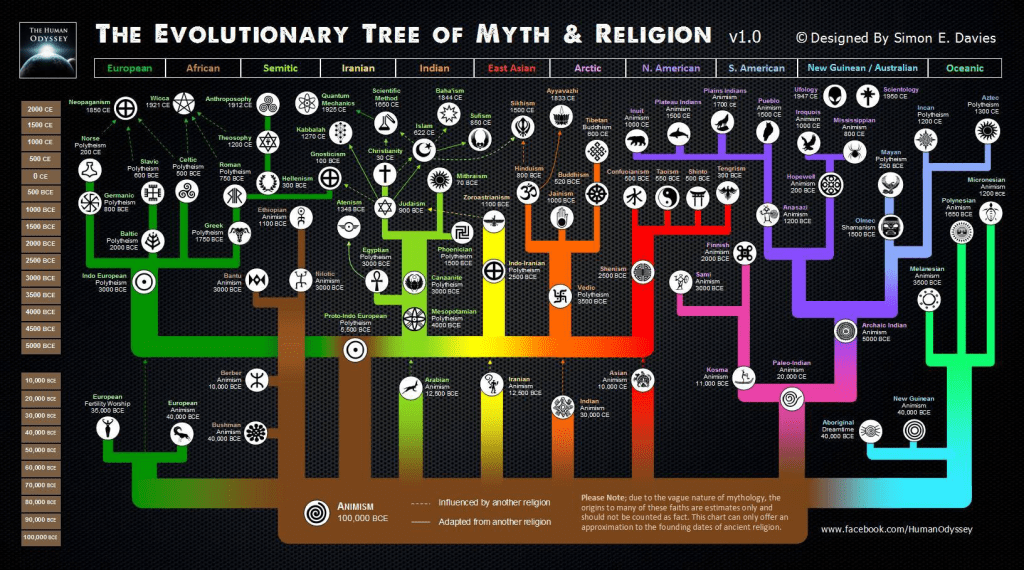
A comprehensive tree chart of the evolution of religion by Simon Davies. There is a version 2.0 with additional detail.

“Any religion that espouses coercion or violence of any kind, is certainly not a true religion… The true path remains very narrow. Few search for it, even fewer choose it and it is the very fewest who remain on its sojourn.” 

This is great mystery and one which has endured through the ages for those who truly seek its reward. Paul discusses the mystery of the ages. First to the church in Rome. Romans 16:25-26, ESV: “Now to him who is able to strengthen you according to my gospel and the preaching of Jesus Christ, according to the revelation of the mystery that was kept secret for long ages but has now been disclosed and through the prophetic writings has been made known to all nations, according to the command of the eternal God, to bring about the obedience of faith…”

As well as the church at Corinth. 1 Corinthians 2:6-8, ESV: “Yet among the mature we do impart wisdom, although it is not a wisdom of this age or of the rulers of this age, who are doomed to pass away. But we impart a secret and hidden wisdom of God, which God decreed before the ages for our glory. None of the rulers of this age understood this, for if they had, they would not have crucified the Lord of glory.”

To the churches at Ephesus and Colossae the authors (not Paul in either instance) shares the same message – Article: The Pauline Paradox. Ephesians 3:9-10, ESV: “… and to bring to light for everyone what is the plan of the mystery hidden for ages in God, who created all things, so that through the church the manifold wisdom of God might now be made known to the rulers and authorities in the heavenly places.” 

This verse is sensationally referencing that spirit beings learned of the truth of the Creator’s plan for humankind. Up until the birth of the Messiah, it had been shrouded in secrecy. David, beloved of the Lord posed a penetrating question when he asked: “… what is man that you are mindful of him, and the son of man that you care for him? Yet you have made him a little lower than the heavenly beings and crowned him with glory and honor. You have given him dominion over the works of your hands; you have put all things under his feet…” – Psalm 8:4-6, English Standard Version. 

Later in the Psalms, Asaph reveals that these heavenly beings – which the Son of Man when human [and by extension man] is a little lower than – are gods, in that they are sons of the Most High. God judges them for not meting out righteous judgement and wisdom to mankind. ‘God has taken his place in the divine council; in the midst of the gods he holds judgment: “How long will you judge unjustly and show partiality to the wicked?” They should “… Give justice to the weak and the fatherless maintain the right of the afflicted and the destitute. Rescue the weak and the needy; deliver them from the hand of the wicked.” They have neither knowledge nor understanding, they walk about in darkness… I said, “You are gods, sons of the Most High, all of you; nevertheless, like men you shall die, and fall like any prince” – Psalm 82:1-7, English Standard Version. 

The ‘mystery of the ages’, though revealed for all, is truly sought after by only the very few and truly comprehended by fewer still. Colossians 1:25-28, ESV: “… of which I became a minister according to the stewardship from God that was given to me for you, to make the word of God fully known, the mystery hidden for ages and generations but now revealed to his saints. To them God chose to make known how great among the Gentiles are the riches of the glory of this mystery, which is Christ in you, the hope of glory. Him we proclaim, warning everyone and teaching everyone with all wisdom, that we may present everyone mature in Christ.” 

In summary, a case is tentatively made for the third incarnation originating in the post-flood epoch – during the height of Sumerian culture and ostensibly wending its way to Egyptian lore (though it may well be the other way around) – and now known as Hermes Trismegistus, as none other than the biblical Nimrod.

The second incarnation during the preceding antediluvian age; whom was also descended from Nephilim ancestry, known to us as Hermes or Mercury was the biblical evil Enoch.

The air of enigma surrounding the original Thoth, may mean his true name is forever shrouded in mystery. While there is reason to believe his identity was not one of the two leaders of the Grigori, Azazel, he perhaps remains the front runner. Thoth was very likely one of the fallen Watchers and – apart from the possible candidate Quetzalcoatl, who has remarkable similarity with Azazel (and Nimrod) under a different name perhaps – does closely equate with the 13th leader out of twenty: Penemue

Penemue was a curer of stupidity in men, mentioned in Bereshith Rabba or Genesis Rabba. As an angel, he was apparently associated with Abraxiel (or Abraxas). Penemue’s name means ‘the inside’ and he may have been in the order of healing angels called the Labbim, according to one opinion. Another source states, ‘Penemue is the angel’s equivalent of Prometheus [a Titan god of fire]. According to Enoch, he [or she] is the angel that taught humankind how to read and write – not because [they] loved us, but because reading leads to knowledge, knowledge leads to thinking, thinking leads to sin’ – Chapter XXII Alpha & Omega.

“The name of the fourth is Penemue: he discovered to the children of men bitterness and sweetness; And pointed out to them every secret of their wisdom. 

He taught men to understand writing, and the use of ink and paper. 

Therefore numerous have been those who have gone astray from every period of the world, even to this day. For men were not born for this, thus with pen and with ink to confirm their faith; Since they were not created, except that, like the angels, they might remain righteous and pure. 

Nor would death, which destroys everything, have effected them; But by this their knowledge they perish, and by this also its power consumes them” – 1 Enoch 69:9-16. 

One description of Thoth raises him to supreme stature amongst the gods, though it seems it is actually describing many entities entwined as one: 

“He is the God beyond all name – He the unmanifest, he the most manifest; He whom the mind alone can contemplate, He visible unto the eyes as well. He is the one of no body, the one of many bodies, nay, rather, He of every body. Naught is there which He is not, for all are He, and He is all.”

The following is an Invocation to Lord Hermes. While superficially appearing innocuous, there is inherent danger in asking a spirit who may or may not not be Thoth, in becoming one with yourself. For it will not lose its identity, but the summoner may risk losing theirs. 

“Come unto me, Lord Hermes, even as into women’s wombs…

Come unto me, Lord Hermes, who dost collect the food of gods and men! 

Lord Hermes, come to me, and give me grace, food, victory, health and happiness, and cheerful countenance, beauty and powers in sight of all! 

I know thy Name that shineth forth in heaven; I know thy forms as well; I know thy tree; I know thy wood as well. 

I know thee, Hermes, who thou art, and whence thou art, and what thy city is. 

I know thy names in the Egyptian tongue, and thy true name as it is written on the holy tablet in the holy place at Hermes’ city, where thou dost have thy birth. 

I know thee, Hermes, and thou me; I am thou, and thou art I. 

Come unto me; fulfil all that I crave; be favourable to me together with good fortune and the blessing of the Good.” 

Taken from the Greek Papyri in the British museum (London, 1893), by Richard August Reitzenstein quoted in Thrice-Greatest Hermes, Volume 1, Page 82 by G R S Mead, 1906. 

A concluding thought, is the mystery of the depiction of Thoth with an anthropomorphic body and yet with an avian head. The answer may be simply that an Ibis is symbolic of wisdom, or the real meaning may for the time being remain allusive. Otherworldly Oracle claimed Thoth is a ‘bird-like extraterrestrial.’ Thoth’s origin may not be too far from this as the Bible reveals an angelic order of beings called Cherubim.

Ezekiel 10:14, EASY: “Each of the cherubs had four faces. One face was the face of a bull. The second face was the face of a man. The third face was a lion’s face. And the fourth face was an eagles face.”

Thoth may have been a high ranking entity from one of the four types of Cherubim. In this case, an avian line – like Quetzalcoatl – and hence why he is depicted with the head and face in the likeness of a bird.

Write down the revelation and make it plain on tablets so that a herald may run with it. For the revelation awaits an appointed time; it speaks of the end and will not prove false. Though it linger, wait for it; it will certainly come and will not delay.’

Habakkuk 2:2-3 New International Version

“There has never really been a time that Hermes has not been talked about. He was first worshiped thousands of years before Christ and even today his influence is found in the philosophy we read, the symbols we use, and even the movies we watch.”

Thomas Gregory 

The present issues from the past, and the future from the present. Everything is made one by this continuity. Time is like a circle, where all the points are so linked that one cannot say where it begins or ends, for all points precede and follow one another for ever.”

Hermes Trismegistus,  Corpus Hermeticum 

© Orion Gold 2024 – All rights reserved. Permission to copy, use or distribute, if acknowledgement of the original authorship is attributed to orion-gold.com

Na’amah

The scriptures feature a curious habit, where they include people even if only mentioned fleetingly in a single verse, invariably for profound reason. Not quite embedded so deeply and cryptically as the dark angel Lilith in the Book of Isaiah (Article: Lilith), there is a descendant from a royal line of Eve, listed in the first book of the Bible. Royal, because only two lines of descent are recorded in the antediluvian age stemming from Adam and Eve. The second was also a priestly line; for while Adam and Eve are credited in having many children, just two sons are highlighted on purpose: Cain and his younger half-brother Seth. 

Jewish historian Josephus, albeit drawing upon legend, recorded that Adam and Eve had thirty-three sons and twenty-three daughters, totalling fifty-six children. The exact figure though would be – the interesting number from a numerology perspective of – 55. The reason being, that Cain while a son of Eve, was not a son of Adam; hence 32 sons instead, including the murdered Abel – refer Chapter XXII Alpha & Omega. Thus, 32 sons and the transcribed opposite figure of daughters, the number 23.  

This person is significant for a variety of reasons, though two very obvious ones are that they were part of the final generation to be born prior to the great Flood, some twenty-two thousand years ago and they are only one of three females listed in either genealogy stemming from Cain and Seth – refer article: The Younger Dryas Stadial: Ending of the Earth… Beginning of the World; Appendix IV: An Unconventional Chronology; and Chapter I Noah Antecessor Nulla.

No daughters or wives are recorded in Seth’s line which included only two righteous men: Enoch and Noah. Whereas Cain’s line additionally records two wives and one lone daughter from one of them, namely Na’amah (or Naamah).  

Na’amah

Before we investigate this Naamah, there are two other Naamahs mentioned in the Old Testament. The first is a city of the same name included in the inheritance of the tribe of Judah. Joshua 15:41, ESV: “Gederoth, Beth-dagon, Naamah, and Makkedah: sixteen cities with their villages.” It was a city located in the plain of Judah and supposed by some to be identifiable with Na’aneh, about five miles south-east of Makkedah. Meanwhile one source offers that Naamah is not identical with modern Na’aneh, but rather with ‘Khirbet Fared nearby to Araq Na’aman.’ 

In Job 2:11, three locutionary friends of the patriarch Job are listed; the third being Zophar the Naamathite, the adjectival form of Naamah. Zophar is proposed by some sources as the king of the Minaeans in Arabia – possibly a link with Abraham’s sons by Keturah. He is also linked with Eliphaz’s son Zepho (or Zephi), a grandson of Esau. The obvious answer is that Naamah was the hometown of Zophar the Naamathite, though it is not certain that this is the case – refer Chapter XXIX Esau: The Thirteenth Tribe. 

The second Naamah coincidentally, was also high born and an Ammonite princess, descended from Lot’s second son, Ammon – refer Chapter XXVI The French & Swiss: Moab, Ammon & Haran. This Naamah is also of particular interest, connected in more ways than one with her original namesake, who preceded her by nineteen millennia. Naamah is introduced in the Bible as a wife of King Solomon and the Queen mother of Solomon’s son and heir Rehoboam, who ascended the throne of Israel after his death. When the Kingdom split into two, Rehoboam remained the king of the Kingdom of Judah. A coincidental link perhaps, to the city of Naamah within Judah’s territory. 

“So King Rehoboam grew strong in Jerusalem and reigned. Rehoboam was forty-one years old when he began to reign [in 930 BCE], and he reigned seventeen years in Jerusalem, the city that the Lord had chosen out of all the tribes of Israel to put his name there.

His mother’s name was Naamah the Ammonite” – 2 Chronicles 12:13, ESV. 

King Solomon had 700 wives and 300 concubines, yet only one son, Rehoboam, is named in scripture with two daughters, Taphath and Basemath – 1 Kings 11:3, 43; 4:11, 14. What is astonishing, is that only three children are identified in the entire Bible, when Solomon must have had many, many children from so large a number of wives. This is a glaring omission. Scripture offers an answer, though it is an unpalatable one. It helps to understand why there are no genealogical lists for Solomon’s sons as there are for Saul and David in the Bible and why Solomon is not included in Hebrews chapter eleven as a man of faith. The chapter reads as a hall of fame for heroes of the Old Testament. Yet Solomon is omitted. Regarding Solomon’s wives and concubines. 1 Kings 11:1-13, ESV: 

“Now King Solomon loved [or rather lusted after] many foreign women, along with the daughter of Pharaoh [Hatshepsut, the Queen of Sheba – refer Chapter XIII India & Pakistan: Cush & Phut]: Moabite, Ammonite, Edomite, Sidonian, and Hittite women, from the nations concerning which the Lord had said to the people of Israel, “You shall not enter into marriage with them, neither shall they with you, for surely they will turn away your heart after their gods.” Solomon clung to these in love. He had 700 wives, who were princesses, and 300 concubines. 

And his wives turned away his heart. For when Solomon was old his wives turned away his heart after other gods, and his heart was not wholly true to the Lord his God, as was the heart of David his father. For Solomon went after Ashtoreth the goddess of the Sidonians, and after Milcom* the abomination of the Ammonites. So Solomon did what was evil in the sight of the Lord and did not wholly follow the Lord, as David his father had done. 

Then Solomon built a high place for Chemosh the abomination of Moab, and for Molech* the abomination of the Ammonites, on the mountain east of Jerusalem.** And so he did for all his foreign wives, who made offerings and sacrificed to their gods. And the Lord was angry with Solomon, because his heart had turned away from the Lord, the God of Israel, who had appeared to him twice and had commanded him concerning this thing, that he should not go after other gods. But he did not keep what the Lord commanded’ – 1 Kings 3:5-14; 9:2, 6-7. 

‘Therefore the Lord said to Solomon, “Since this has been your practice and you have not kept my covenant and my statutes that I have commanded you, I will surely tear the kingdom from you and will give it to your servant. Yet for the sake of David your father I will not do it in your days, but I will tear it out of the hand of your son. However, I will not tear away all the kingdom, but I will give one tribe to… [Rehoboam], for the sake of David my servant and for the sake of Jerusalem that I have chosen.” 

Chapter XIII India & Pakistan: Cush & Phut: ‘Worshipers of gods such as Chemosh and Molech practiced human sacrifice: the inhumane sacrificing of babies. Chemosh, Molech and Milcom, are names for gods within the pantheon of Ba’al. The Jewish Encylopaedia maintains that Solomon built a temple to Chemosh on the Mount of Olives** which remained in use for over four hundred years, from circa 940 to 540 BCE.

Deuteronomy 12:29-31, ESV: “When the Lord your God cuts off before you the nations whom you go in to dispossess, and you dispossess them and dwell in their land, take care that you be not ensnared to follow them, after they have been destroyed before you, and that you do not inquire about their gods, saying, ‘How did these nations serve their gods? – that I also may do the same. You shall not worship the Lord your God in that way, for every abominable thing that the Lord hates they have done for their gods, for they even burn their sons and their daughters in the fire to their gods.” 

‘Idols were composed of metal and fierce fires were heated inside the sculpture so it became cremation-level-hot. Worshipers placed babies onto the idol’s outstretched hands whereupon they burned to death. The hands could be winched so that the hands raised and then dropped the sacrifice into the idols mouth as if eating. Isaiah 57:5-10, ESV: “… you who burn with lust [for sexual rituals and magic] among the oaks, under every green tree [of Asherah], who slaughter your children in the valleys, under the clefts of the rocks. On a high and lofty mountain [Nephilim related] you have set your bed, and there you went up to offer sacrifice… You journeyed to… king [Solomon] with oil and multiplied your perfumes; you sent your envoys far off, and sent down even to Sheol [Hell].”

King Solomon’s Worshipful Offering to Molech – Illustration from the 1897 Bible Pictures and What They Teach Us by Charles Foster

Dragon of the Two Flames, Demonic Magic and Gods of Canaan, Michael W Ford, 2019: “Moloch as an underworld god of divination and power… [appearing] as part man and bull as… the Minotaur of Crete mythology…” refer articles:The Younger Dryas Stadial: Ending of the Earth… Beginning of the World; The Calendar Conspiracy; and Chapter XV The Philistines: Latino-Hispano America. “The horns of Molech represent his power and wisdom; the authority of his divinity… [and] resemble the… ‘Sabbatic Goat’ or ‘Baphomet’… Moloch is seated upon a… throne… flanked by two Sphinxes. 

Under the throne there is a place made for fire, which represents the Black Flame of Divine Consciousness… Adrammelech and Anammelech… [relate] to the Black Flame… Anammelech is considered… to be the Moon Goddess [Ishtar aka Lilith] who is the divine power enthroned with Adrammelech, a Sun God… [they are] the gods of the people of Sepharvaim, who were Assyrian deportees, settled in Samaria [after the deportation of the Israelites]… [and] were either of Aramean/Phoenician or Babylonian origin… Luciferians may view ‘Adrammelech’ as the ‘storm’ and ‘fire’ manifestation… of Baal Hadad…”

This is ironic in that the descriptive name Lucifer and the title Baal, are for the same dark fallen archangel – his personal name is: Samael.

‘Leviticus 20:1-5, ESV: “The Lord spoke to Moses, saying, “Say to the people of Israel, Any one of the people of Israel or of the strangers who sojourn in Israel who gives any of his children to Molech shall surely be put to death. The people of the land shall stone him with stones. I myself will set my face against that man and will cut him off from among his people, because he has given one of his children to Molech, to make my sanctuary unclean and to profane my holy name. And if the people of the land do at all close their eyes to that man when he gives one of his children to Molech, and do not put him to death, then I will set my face against that man and against his clan and will cut them off from among their people, him and all who follow him in whoring after Molech.” 

This was an ‘atrocity of the highest order and we can understand why the Creator became wrathful with Solomon and how the Kingdom of Israel later fragmented into two – the kingdoms of Israel and Judah – and if the false idol temple remained in Jerusalem for some four hundred years, this takes us to the time period when Judah ultimately fell in 587 BCE through to 586 BCE, with their punishment leading to captivity.’

These sacrificial ceremonies were ancient and practised by Nimrod and the Nephilim and Elioud giants before him; including some of the same Nephilim during the lifetime of the first Naamah prior to the Flood. 

Rehoboam perpetuated his father’s evil – 1 Kings 14:21-31, ESV: “Now Rehoboam the son of Solomon reigned in Judah… And Judah did what was evil in the sight of the Lord, and they provoked him to jealousy with their sins that they committed, more than all that their fathers had done. For they also built for themselves high places and pillars and Asherim on every high hill and under every green tree, and there were also male cult prostitutes in the land” – refer article: Asherah. “They did according to all the abominations of the nations that the Lord drove out before the people of Israel… And there was war between Rehoboam and Jeroboam continually… Rehoboam slept with his fathers and was buried… in the city of David. His mother’s name was Naamah the Ammonite. And Abijam his son reigned in his place.” 

Naamah was the daughter of the Ammonite King Hanun. She married Solomon before he became king in 970 BCE. Their son Rehoboam, was born in 971 BCE. Naamah provided the heir to the throne of Judah and she is the only wife of Solomon mentioned by name in the Bible – refer Solomon, article: Seventh Son of a Seventh Son. This is significant for a number of reasons, just as Rehoboam is the only recorded son. While marrying an Ammonite would normally be a reprehensible act, it doesn’t seem so for Solomon, who it appears married Naamah and sired a son while his father King David was still alive. 

Deuteronomy 23:3, 6, ERV: “An Ammonite or Moabite may not join with the men of Israel when they gather to worship the Lord. And none of their descendants, to the tenth generation, may join in the worship of the Lord. You must never try to make peace with the Ammonites or Moabites. As long as you live, don’t be friendly to them.”

The fact Naamah and Rehoboam are both named lends weight to Naamah being Solomon’s first wife and the legitimate Queen when he became King; as is Rehoboam being the lawful heir to the throne. Naamah is also only one of two foreign Queen Mothers of Judah or Israel, with Jezebel – a Princess of Tyre and the daughter of the Phoenician King Ethbaal – refer article: The Seven Churches – A Message for the Church of God in the Latter Days. 

The Israelites were told repeatedly by the Eternal not to wage war against the Ammonites or their kindred peoples the Moabites, but that didn’t stop them from doing so – Deuteronomy 2:9, 19. Though, when the Israelites first entered Canaan after the Exodus from Egypt were told not to destroy the Ammonites, they obeyed. This was in keeping with the angels who had rescued Lot and his daughters, being cognisant of the fact that Ruth the Moabite would trace her lineage to the eldest sister, and that her marriage to Boaz from the tribe of Judah would result in descendants, including King David and the Messianic Saviour – Chapter XXVI The French & Swiss: Moab, Ammon & Haran.

They would also have foreknown that Naamah the Ammonite, would trace her lineage to the youngest sister and her marriage to King Solomon – the only wife of Solomon stated by name in the Bible – would result in the birth of Rehoboam, the King of Judah following Solomon (and ancestor of Jesus of Nazareth). 

The Bible states Solomon was influenced by his wives when he was old, turning away from following the truth and obeying the Eternal. So while Solomon turned from righteousness to evil, his son Rehoboam chose to follow his bad example in being rebellious as a youngster. Naamah, may well have been an influence on Solomon who later turned away from the Creator to worship Ammonite and Moabite gods. But as the Bible does not stipulate this categorically concerning Naamah, it would be unfair to just assume she had a role in Solomon’s falling away. But, if reading between the lines whilst considering her infamous predecessor, it does not weigh in her favour. Perhaps her beliefs, practices and persuasion over the decades took its toll on Solomon, with a changing acceptance steadily germinating in his mind and accelerating as he married additional foreign women. 

The meaning of the name Naamah is not what one would expect, in light of the original Na’amah’s pedigree and character. Even so, Naamah happens to be a fairly common name among women in modern Israel.

According to Abarim Publications, her name means: ‘Sweet, Pleasant, delightful’ and ‘beautiful’ from the ‘verb (naem), to be pleasant.’ It also means ‘lovely’. Related names in the Bible amongst others include: Naaman, Naamathite, Nain and Naomi. ‘Derived nouns (no’am) and (na’aman) mean pleasantness. Adjective (na’im), means pleasant. The plural noun (man’ammim) describes “sweets” or dainties. The adjective (na’im) describes a soft or pleasant sound. 

Experts insist that there are two separate roots that are spelled (n’m), but any observer will notice that these two roots are suspiciously adjacent in meaning. So adjacent even that one may wonder whether any original speaker of the Hebrew language realized that these roots were not the same but separate: 

The verb (na’em I) and its derivatives occur in the Bible about two dozen times… It’s used to describe the qualities of people (2 Samuel 23:1), music (Psalm 81:2), bread (Proverbs 9:17), land (Genesis 49:15). It’s… used in reference to words (Psalm 141:6), knowledge (Proverbs 2:10) and wisdom (Proverbs 3:17). This verb is… used to ascribe an attribute to God, namely that of beauty or loveliness (Psalm 27:4, 90:17), and also to the worship of God, namely pleasantness (Psalm 135:3). 

The second root (na’em II) does not occur in the Bible as [a] verb, although the verb itself occurs in Arabic. And there it has a meaning of to speak in a gentle and low voice. This root’s sole derivative does occur in the Bible… only once or twice (Psalm 81:3 and perhaps 2 Samuel 23:1). It’s the adjective (na’im), meaning sweetly sounding or singing or musical.’ 

To appreciate Na’amah, a synopsis of the family she was born into is requisite. We are first introduced to Na’amah early in the Genesis Account, yet there is only one verse dedicated to her. Genesis chapter four discusses Cain and the lineage of his descendant’s. It follows the first three chapters which discuss the re-creation of the Earth after an angelic rebellion and the sabotaging transformation of Adam and Eve – Chapter XXII Alpha & Omega. Chapter five of Genesis discusses Seth’s line through to Noah and his sons. 

Genesis 4:17-22, ESV: “Cain knew his wife, and she conceived and bore Enoch… To Enoch was born Irad, and Irad fathered Mehujael, and Mehujael fathered Methushael, and Methushael fathered Lamech.

And Lamech took two wives. The name of the one was Adah, and the name of the other Zillah.

Adah bore Jabal [H2989 – Yabal: ‘stream of water, to flow along a course, conduit, flowing’]; he was the father of those who dwell in tents and have livestock. His brother’s name was Jubal [H3106 – Yuwbal: ‘stream, to carry or bring along, flow maker’]; he was the father of all those who play the lyre and pipe.

Zillah also bore Tubal-cain [‘thou will be brought of Cain’]; he was the forger of all instruments of bronze and iron.

The sister of Tubal-cain was Naamah [H5279 – Na’amah].” 

It’s as if Na’amah as the youngest child is tacked on after her brother as an after thought, yet being a female included in a male dominated genealogy means she had meaningful importance.

Chapter I Noah Antecessor Nulla: ‘The line of Cain in Genesis chapter four is fascinating, because we learn that another Lamech, different from the father of Noah is perhaps the progenitor of polygamy, having two wives. They are only the second and third women after Eve to be recorded in the old Testament, implying significance. Adah means ‘ornament’ and has the connotation of beauty. Zillah means ‘dark’ or ‘to be dark’. 

So some have conjectured that Adah was light skinned and Zillah dark skinned; or, it could be referring to Zillah possessing a proclivity towards the dark arts. Intriguing, are the two sons born of Adah and especially the son from Zillah and their very Japheth-like names. There is the [ancestor] of Cain’s line, Cain and on Seth’s family tree, a Cainan* – a later ‘Hamitic’ name (refer Chapter XI Ham Aequator). The Book of Jasher in chapter two says that Cainan, the Grandson of Seth was the father of three sons and two daughters, who are none other than Adah and Zillah. The book also says that Zillah was barren when she was old, until towards the end of her life.

In Genesis chapter four, we learn there were other humans – not descended from either Adam or Eve – in the Land of Nod, where Cain went to dwell. Genesis 4:16-17, NCV: “So Cain went away [not just physically but also spiritually] from the Lord and lived in the land of Nod, east of Eden” – Chapter XXII Alpha & Omega. “He had sexual relations with his wife, and she became pregnant and gave birth to Enoch. At that time Cain was building a city, which he named after his son Enoch.” 

‘Cain already had a wife – a sister according to some sources, a fallen Angel in others – before sojourning to Nod and building a city.’ Book of Jubilees 4:9: “And Cain took Awan his sister to be his wife and she bare him Enoch… And… houses were built on the earth, and Cain built a city, and called its name after the name of his son Enoch.” ‘Cain would not build a city, if it were not for an already large population of people living in Nod.

Genesis 1:27 reveals man was created on the Sixth Day or era, whereas, Genesis 2:7 shows Adam was created on the ‘Eighth Day’, the day or era after the Seventh Day rest. If there were inhabitants prior to Cain’s arrival, they were not descended from Adam and Eve – refer Homo Neanderthalensis I, II, III & IV. Cain didn’t waste any time, in becoming the first person in endeavouring to establish and consolidate centralised power – a precursor for a one world government.’ The Way of Cain has survived decades of millennia right through to our present day and age.

Abel’s wife was supposedly his sister Azura, who would later marry Seth after her husband’s death. Book of Jubilees 4:1, 7, 10: “1… [Eve] gave birth… to her daughter Awan. 7 And Adam and his wife mourned for Abel four weeks of years, [28 years] and in the fourth year of the fifth week [32 years] they became joyful, and Adam knew his wife again, and she bare him a son, and he called his name Seth; for he said ‘Yahweh has raised up a second seed unto us on the earth instead of Abel; for Cain slew him.

When Adam’s son Seth is born, we learn in Genesis 5:3, NCV: “When Adam was 130 years old, he became the father of another son in his likeness [H1823 – dmuwth: similitude] and image [H6754 – tselem: resemblance], and Adam named him Seth.” Seth was in other words, the spitting image of his biological father – unlike Cain. The line of Seth, his sons and their wives is amplified in the Book of Jubilees.

Book of Jubilees 4:11-28: “11 … Seth took Azura his sister to be his wife, and… she bare him Enos. 13 … Enos took Noam his sister to be his wife, and she bare him a son… [calling] his name Kenan.* 14 And… Kenan took Mualeleth his sister to be his wife, and she bare him a son… and he called his name Mahalalel. 

15 … Mahalalel took unto him to wife Dinah, the daughter of Barakiel the daughter of his father’s brother, and she bare him a son… and he called his name Jared, for in his days the malakim of Yahweh descended on the earth, those who are named the Watchers, that they should instruct the children of men, and that they should do judgment and uprightness on the earth. 

16 And… Jared took to himself a wife, and her name was Baraka, the daughter of Rasujal, a daughter of his father’s brother… and she bare him a son… and he called his name Enoch. 20 And… he took to himself a wife, and her name was Edna, the daughter of Danel, the daughter of his father’s brother, and… she bare him a son and he called his name Methuselah. 27 And… Methuselah took unto himself a wife, Edna the daughter of Azrial, the daughter of his father’s brother… and he begat a son and called his name Lamech.

28 And… Lamech took to himself a wife, and her name was Betenos the daughter of Baraki’il, the daughter of his father’s brother, and… she bare him a son and he called his name Noah, saying, ‘This one will comfort me for my trouble and all my work, and for the ground which Yahweh has cursed.’

‘Noah’s wife is mentioned five times in Genesis, without her name being revealed. Some believe she could be Na’amah, the sister of Tubal-Cain in Genesis 4.22. As she is tainted from the already imperfect line of Cain, it would seem to be a contradiction for Noah to marry Na’amah, mixing the two divergent genetic lines. 

With that said, if there is any merit in Alan Alford’s theory or a version of it, Noah may have had three wives from which three sons were born; but taking only one wife on board the Ark – refer Chapter I Noah Antecessor Nulla. The Book of Jubilees 4:46-47, supports the Bible and states Noah had one wife and that she bore all three sons: “… Noah took to himself a wife, and her name was Emzara, the daughter of Rakeel, the daughter of his father’s brother [a brother of Lamech]…”

Quoting from Chapter XXII Alpha & Omega – and R A Boulay: ‘… in the Apocalypse of Adam… Adam reveals to his son Seth that “the Lord, who created us, created a son from himself and Eve, your mother.”… the Life of Adam and Eve… observes that Eve “bore a son and he was lustrous.” This is a good description of the shiny, luminous hide of the reptile gods…[also] Eve tells Adam: 

My Lord, I saw… the blood of my son… Abel, being thrust into the mouth of Cainand he drank it mercilessly… it did not stay in his stomach but came out of his mouth. They got up to see what happened and found Abel killed by Cain. The crime of Cain was… not only to commit fracticide but also to eat the flesh and blood of his brother. 

This behaviour [is] more reptilian than human, for Cain… was half saurian… [and] the main reason for [Cain’s line being] superseded by that of Seth… the deity warned that “whoever kills Cain shall suffer vengeance seven fold”… Cain was reputedly accidentally killed by Lamech, thus fulfilling the curse of the seventh generation.’ 

Genesis 4:23-24, ESV: “Lamech said to his wives: “Adah and Zillah, hear my voice; you wives of Lamech, listen to what I say: I have killed a man for wounding me, a young man for striking me. If Cain’s revenge is sevenfold, then Lamech’s is seventy-sevenfold.”

Evil Lamech, the seventh generation in the line of Cain and father of Na’amah

‘… in the Haggadah… Lamech was… old and blind… when he went hunting [and] was led by his son Tubal-Cain, who would tell his father when game came into sight, so that Lamech could shoot at it with his bow and arrow… he aimed at some horned creature which Tubal-Cain thought to be a beast. In fact, it was Cain bearing the “sign of Cain,” a horn in the forehead, according to the Haggadah, but more probably a set of horns on the head’ – refer article: Belphegor. ‘Lamech killed him and in despair, he struck out inadvertently killing his son Tubal-Cain… it accounts for the killing of a man and a [young man], both of which were not just ordinary people.’ 

‘After God cursed Cain, Cain left the presence of the Lord, travelled east to Nod, the land of Wandering; builds a city to exalt his son the evil Enoch and his story in the Bible ends. Josephus, in his work Antiquities, expands on the further exploits of the miscreant Cain. He did not repent of his crime against Abel or live peaceably after his own life was spared from the Creator’s wrath. Cain in fact, grows exponentially wicked and the world’s foremost innovator of evil. 

Josephus states “Cain dedicated himself to the pursuit of pleasure and wealth at any cost… perpetrating theft and violence upon his neighbours. He built up a great amount of wealth through stealing and strong-arming… [also] building up a huge army… Cain is… credited with creating weights and measures… to make sure no one was accidentally being generous by innocently giving too much. He likewise invented the idea of property lines and drawing up fortifications to protect one’s belongings with violence.”

The Genesis 6 Conspiracy, Gary Wayne, 2014, pages 8-9, 12-13, 55-56 – emphasis & bold mine: ‘The Dowland Manuscript of the Legend of the Craft lists the Seven Liberal [Sacred] Sciences: 

Grammere to teach humankind to both speak and write truly; 

Rhethoricke to teach humankind to speak in subtle terms;

Dialectyke to teach humankind to discern between truth and falsehoods;

Arithmeticke to teach humankind to compute all manner of numbers;

Geometrie to teach humankind to measure the earth and all things (this is the science of Masonry);

Musicke to teach humankind song and the language of musical instruments;

Astronomye to teach humankind the course of the planets and stars 

‘Jubal… specialised in music, inventing musical instruments [Jabal in Geometry and Masonry]… Tubal-Cain… exceeded all other men in strength and excelled in the martial arts… [and] inventing the art of manufacturing brass… Cain [means] “a metal worker,” thereby attributing Tubal to being his first name, and Cain denoting his expertise [Artificer], just as his forefather [Cain] must have been some form of metalworker or smith…’ Michael Ford adds: It was “Tubal-Cain who brought [or more likely refined and advanced] murder weapons into the world.”

The name Tubal stems from his half-brothers name, Jabel and means ‘to flow or carry along.’ Abarim Publications amplify the meaning of Tubal to include: “… identical to the name Tubal is our root’s derivative (tebel), meaning world. Hence the name Tubal [does not just mean] World, but the whole flow and currencies of the world-economy in its broadest sense.” 

Wayne continues: “Naamah the Charmer [‘an attractive person claiming or seeming to have magical powers’] known in Sumerian lore as “Non Pu Abi” and “Queen Shub of Ur”… [and] according to Jewish legends married and copulated with Shamdon [Shomron, a fallen Angel], producing the giant Asmodeous…’ Asmodeous or Ashmodai means, ‘demon of wrath’ and he is a king of devils, commanding seventy-two legions of demons [a Roman legion averaged approximately 5,000 men]. Michael Ford: “Upon physical death, the evil spirit of Asmodeus would become so powerful that under Samael he was to be the King of Demons.” 

A curious Jewish legend involves Asmodeus and King Solomon, recounted by an online encyclopaedia:

“One legend concerning Asmodeus goes on to state that Solomon one day asked Asmodeus what could make demons powerful over man, and Asmodeus asked to be freed and given [a magic] ring so that he could demonstrate; Solomon agreed but Asmodeus threw the ring into the sea and it was swallowed by a fish. Asmodeus then swallowed the king, stood up fully with one wing touching heaven and the other earth, and spat out Solomon to a distance of 400 miles. The Rabbis claim this was a divine punishment for Solomon’s having failed to follow three divine commands, and Solomon was forced to wander from city to city, until he eventually arrived in an Ammonite city where he was forced to work in the king’s kitchens.

Solomon gained a chance to prepare a meal for the Ammonite king, which the king found so impressive that the previous cook was sacked and Solomon put in his place; the king’s daughter, Naamah, subsequently fell in love with Solomon, but the family (thinking Solomon a commoner) disapproved, so the king decided to kill them both by sending them into the desert. Solomon and the king’s daughter wandered the desert until they reached a coastal city, where they bought a fish to eat, which just happened to be the one which had swallowed the magic ring. Solomon was then able to regain his throne and expel Asmodeus.”

Rabbis reject the notion that Na’amah was Noah’s wife and declare that ‘Naamah was an idolatrous woman who sang “pleasant” songs to idols.’ The fact that her name is linked to beautiful sounds, singing and music, implies she possessed musical ability like her half-brother Jubal. Tamar Kadari quotes: “… she acted improperly, for she beat on a drum and drew people to engage in idolatry, and her musical activity increased corruption among people.” ‘In Talmudic-midrashic literature, Naamah… earned her name by seducing men through her [dancing and] play[ing] of [small] cymbals.’ 

Meanwhile Rabbi Abbahu maintains, “The simple sense of Scripture indicates that she was learned in metal-working, like her brother Tubal-Cain, as implied by what is written: he was the progenitor of every implement of bronze and iron – and the sister of Tubal-Cain, Na’amah. He invented this craft and his sister with him, as is written: and the sister of Tubal-Cain, Na’amah – she was skilled like him. The ‘and’ of ‘and the sister’ joins the preceding statement.”

Naamah is also associated with weaving, which involves cloth and fabrics for clothing and other material items. Delinquent music and sensual fashion may have constituted part of her contribution to the world. Kadari adds: “The midrash (Midrash ha-Gadol, Gen. Rabbah 4.22) relates that Naamah was the most beautiful woman in the world, so much so that she caused the ministering angels to fall prey to her loveliness for they thought she was one of them.”

Marble bas relief at Orvieto Cathedral, Italy, innocuously depicts Na’amah as a teacher of reading, while her half-brother Jubal is a father of music

Gary Wayne: ‘… the Cainites used the Seven Sacred Sciences for evil… Two of Cain’s descendants were fingered as particularly corrupt in the application of the Sacred Sciences: [evil] Enoch and [evil] Lamech… [Enoch introduced]… sinister sacraments… From Astronomy, he created astrology and sun worship… implemented … rituals, ceremonies, and rites with this new, repulsive religion [refer article: Thoth]. The knowledge could then only be passed on to initiates, the selected guardians of the knowledge that was then cloaked in mysteries and secrets.’

The Book of Adam says Cain’s wife was Luluwa. The Book of Jubilees calls his sister Awan his wife. Cain may have had more than one wife and so he and perhaps not evil Lamech, likely initiated polygamy. ‘The descendants of Cain continued in wickedness. Josephus confirms that within Adam’s lifetime, the lineage of Cain had become a corrupt mess; each new generation of Elioud giants more evil than the last.’ 

The Genesis 6 Conspiracy, Gary Wayne, 2014, page 112 – emphasis & bold mine: 

“One wonders whether or not the descendants of Cain and Lulawa-Lilith, such as [evil] Enoch, [evil] Lamech, Tubal-Cain, and Naamah were in truth Nephilim [and], in fact, initially immortal. The Sumerian mythology appears to strongly advocate…a distinct strain of Nephilim directly connected to Cain and the people of day six [the Neanderthals], but distinct from the Nephilim created on Mount Hermon by dark angels… Cain and Lulawa-Lilith [usurped] kingship over the people of day six” – refer articles: Homo neanderthalensis I, II, III & IV… “[infusing] a unique variety of Nephilim bloodlines [of the Royal Dragon] into [them].” 

The likely scenario is that Cain first married his sister, though Lilith keeps raising her head as not only the first wife of Adam prior to Eve’s birth, but also as the wife of Cain. The dark angel Lilith is incorrectly described by many researchers as a demon – refer article: Lilith. Her original role was not only as Samael’s daughter but later his consort. Similarly, Lilith was also Nimrod’s mother and later his wife. Her relationship with Adam appears unlikely, though cannot be ruled out as is her role as possibly Cain’s wife. Either way, Cain strongly appears not only a progenitor of a unique Nephilim-Elioud line, but himself being the first of his kind – Chapter XXII Alpha & Omega

A variant line of Nephilim descended from Cain as suggested by Wayne, distinct from that of the Watchers has become plausibly apparent during research on the subject. The sheer wickedness perpetrated by Cain’s line, as embodied by Cain’s evil son Enoch and his great, great, great grandson Lamech and in turn Lamech’s daughter Na’amah, may have an explanation if we understand their serpentine bloodline, stemming from the Genesis 3:15 prophetic curse. 

Thus the anti-heroine of our story Na’amah, was descended from – as a relative of Cain who himself, was half human from his mother Eve and half immortal by his real father the Serpent, Samael – a Nephilim bloodline (refer Chapter XXII Alpha & Omega). Na’amah may well have been unusually tall, or this might have been a physical trait found only amongst the Elioud giants directly descended from the dark, fallen angels of the Watchers. 

As discussed in previous articles, there are beings who do not have corporal bodies, but seek to inhabit humans – refer articles: Nephilim & Elioud Giants I & II. They are known by many names, though commonly as demons or unclean spirits – Luke 11:24. The Book of Enoch 15:1-12, adds that when the giants died, they lost their physical bodies to death, though their spiritual component did not die and henceforth they were called evil spirits. 

Thus demons are disembodied spirits who originated at the time of the Great Flood circa 10,837 BCE, according to an unconventional chronology. They are not to be confused with fallen Angels, though are linked to them as they are the offspring of the Watchers who descended to Earth circa 22,000 BCE – Chapter XXI The Incredible Identity, Origin & Destiny of Nimrod; Chapter XXII Alpha & Omega; and Chapter XXXIV Dan: The Invisible Tribe

As the Nephilim were born on the earth or in the physical realm, they are now bound to the earth as demons to torment humankind. It is these same spirits who often respond to ouija boards and who work with Mediums as familiars; impersonating souls who have died. 

An important point to understand for those who believe fallen angels are demons, is that Angels, Seraphs and Cherubs are magnificent beings of immense majesty. For after their rebellion, the fallen angels even with their power diminished and their beauty transformed, are still too lofty and mighty to readily demean themselves to inhabit a human body. Though there may be exceptions to the rule. 

Nephilim were an abomination of spirit and flesh and though they were bigger, stronger, smarter and out lived mortal men, they still had a physical body. Their spirit was not the spirit of man (Job 32:8), but of their immortal fathers. Once their fleshly body died, their spirit lived on in an unnatural state. In this condition as a discorporate entity of energy, they seek habitation in humans to quench their spiritual thirst and appease their unholy appetite – Luke 11:24-26. 

Jude 12-13, ESV: “These are hidden reefs… as they feast with you without fear, shepherds* feeding themselves; waterless clouds, swept along by winds; fruitless trees in late autumn, twice dead, uprooted; wild waves of the sea, casting up the foam of their own shame; wandering stars [spirits], for whom the gloom of utter darkness has been reserved forever.” 

The legends and myths of giants and vampires with their traits of cannibalism and drinking human blood, find their source from the Nephilim of the antediluvian age. It is also where the doctrine of re-incarnation originates. For evil spirits have inhabited various people in different times and so are able to transfer thoughts and memories to new hosts; falsely thinking they have lived in the past. 

Infinity Explorers state – emphasis mine: ‘… these dark entities [torment] people, with the ability to spread evil and chaos in the world, dwelling in dark regions in the lower dimensions known as hell. Demonic entities work actively to influence society. Those who have witnessed the appearance of demonic beings in our reality using dimensional portals ensure that many of the dark entities have specific roles and work together in a hierarchy of evil in other dimensions. They are part of a structure of evil that extends its tentacles from the darker dimensional regions to the physical world. 

They work through dark secret societies, who secretly run… religions and… communicate with a large number of people… who are going through the process of awakening in the dark’ – article: The Establishment: Who are they… What do they want? ‘These disciples of the dark are using… techniques to gain knowledge of demonic entities… [working] with an immense evil intelligence in an agenda dating back thousands of years. They do not want people to wake up spiritually in the light… Thanks to dimensional portals, they can control politicians, celebrities, governments, criminal organisations, and large corporations. They use human weakness and defects like greed, ignorance, lust, and violence to attract, control and enslave their puppets as well as the masses’ – refer article: Principalities & Potentates: What they want… Who they are.

The antediluvian age was considerably longer than people realise. It was discovered that dating for the post-flood patriarchs is incorrectly based on a decimal system instead of a sexagesimal count; as well as inadvertently adhering to an inaccurate and therefore erroneous pre-flood chronology altered through editing. Using an unconventional chronology to re-align the biblical account with scientific data, produced a date of 10,837 BCE for the great deluge, coinciding with the Younger Dryas event – Article: The Younger Dryas Stadial: Ending of the Earth… Beginning of the World. 

Thus to provide a context for when Na’amah lived, she was born circa 20,000 BCE. This was during the last Ice Age and when civilisation was far beyond the technological advances we presently witness in our own epoch. The height of achievement was synonymous with the descriptions for Atlantis and Lemuria, yet at the same time the wickedness abounding on the Earth and particularly through the line of Cain with its evil tentacles spreading into other lines, such as those of Seth and the Neanderthal peoples of day Six, had brought the Earth to a point where it had to be destroyed – Genesis 6:5-7. 

Cain was born circa 27,390 BCE and murdered his brother Abel in 26,129 BCE. Cain was expelled from Eden at that time and his son, the evil Enoch was born circa 26,119 BCE. Cain then began building the city of Enoch – the site of the post-flood Baalbek – in 26,108 BCE – refer article: Monoliths of the Nephilim. Evil Lamech was born circa 22,000 BCE, about 797 years after Jared, the father of righteous Enoch. It was during this time frame that the Watchers descended to Earth led by the powerful Samyaza, actually another name for the formidable Samael. 

The following may be of interest to some readers and ties in with an unconventional chronology for pre-history. The Sumerian King List provide a list of eight kings, with some versions having ten, who reigned for incredibly long periods of time before the great Flood. This is similar to Genesis five, where the generations from the Creation to the Flood are recorded. It is generally assumed by scholars that the ten generations between Adam and Noah may correlate to the antediluvian kings from the beginning of kingship descending from heaven until the flood as written in the Sumerian King List.

After the Flood, the king list records kings who ruled for far shorter periods of time. The Sumerian King List not only documents a great flood in humankind’s early history; it also reflects the same pattern of decreasing longevity as found in the Bible – with men having extremely long life spans before the Flood and much shorter life spans following the catastrophe – refer article: The Younger Dryas Stadial: The Ending of the Earth… Beginning of the World.

Joanna Gillan notes: ‘The Sumerian King List truly is a perplexing mystery. Why would the Sumerians combine mythical rulers with actual historical rulers in one document? Why are there so many similarities with Genesis? Why were ancient kings described as ruling for thousands of years? These are just some of the questions that still remain unanswered after more than a century of research.’

Perhaps the Sumerian King List is not recording the line of eleven generations from Adam through Seth, but rather the eight generations descending from Cain, the firstborn of Eve as recorded in Genesis chapter four. Likewise, as the chronology before and after the flood has been misinterpreted, so too these reigns may be shorter than deciphered but still longer than readily accepted. As the length of age of antediluvian figures was in the realm of nearly ten thousand years, rather than one thousand as incorrectly translated in the Bible; the elongated ages of the Sumerian kings may be shorter as in thousands of years rather than tens of thousands. 

Five copies of the Antediluvian king list are known [including MS 2855 shown below]: MS 3175; two in Oxford, including Ashmolean Museum; a fourth copy is in Berkeley, Museum of the University of California; and a fifth tablet, a small fragment, is in Istanbul. There are conflicts between them regarding a. the number of kings, b. the spelling of names and c. the cities from which they ruled. If we acknowledge ‘… In 5 cities 8 kings; they ruled for 241,200 [or 24,120 adjusted] years. Then the flood swept over…’ as a starting point. 

The reign of these antediluvian rulers is typically measured in sars: periods of 3600 years; ners, units of 600; and sosses units of 60; each based on a sexagesimal system. The Sumerian King List states: “After the kingship descended from heaven, the kingship was in Eridug. In Eridug, Alulim became king; he ruled for 28,800 years.” It is proposed that 28,800 years is in fact 2,880 years. And rather than 8 sars of 3,600 years, it is a alternative measurement comprising 8 x 360.

Alulim Adam: The first king thus ruled 2,880 years from Eridu. This would equate to Adam as the first ruler of Eridu and the initial king of Sumer. It is believed that Enki, the creator God and patron god of Eridu brought civilisation to Sumer at this time. 

AlalngarCain: Alalngar was the second king of Eridu. The Sumerian King list states that he ruled for 36,000 years – 10 sars. In this instance it was Cain who ruled for 3,600 years during his life. “Then Eridug fell and the kingship was taken to Bad-tibira.” Another king list names Elalgar ruling for 43,200 years. This writer considers 4,320 years perhaps more feasible for the demi-god (and demagogue), Cain. After Cain, Eridu was abandoned. 

En-men-lu-ana – (Evil) Enoch: The next ruler who was king after Eridu fell was En-men-lu-ana who also ruled for 43,200 years – 12 sars. According to the Sumerian King List, En-men-lu-ana was the third pre-dynastic ruler of ancient Sumer and was perhaps the joint ‘longest reigning king’ with his father Elalgar. Enoch ruling a similar 4,320 years is credible considering the influence the two of them had in the early annals of humankind’s history. Yet elsewhere, he is documented as Ammilu’anna, with a reign of 36,000 or 3,600 years. Thus Cain and his son’s length of reigns seem to have been transposed. 

En-men-gal-anaIrad: Reigned for 28,800 years – 8 sars. Also known as Enmegalanna and equating to Enoch’s son Irad, the possible founder of Ur and ruler for 2,880 years. 

DumuzidMehujael: Dumuzid, commonly referred to as the ‘Shepherd’* was the fifth pre-dynastic king who ruled Sumer before the Deluge. He ruled for 36,000 years – 10 sars. Dumuzid is mentioned sometimes as the son of Enki, or Enlil and Ninsun. This is related to the fact that Dumuzid was deified and was the object of later devotional depictions, as the husband of the goddess Inanna, aka Ishtar and none other than Samael’s daughter, Lilith – Article: Lilith. He is also referred to as Dumuzi or Tammuz and ruling a shorter 28,800 or 2,880 years. “Then Bad-tibira fell and the kingship was taken to Larag [Larak].” 

Ezekiel 8:14, ERV: “Then God led me to the entrance to the Lord’s Temple. This gate was on the north side. I saw women sitting there and crying. They were sad about the false god Tammuz!”

‘Footnote: People thought this false god died and his wife Ishtar asked everyone to be sad and cry with her. Ishtar hoped this would bring him back to life. This ceremony was on the 2nd day of the fourth month (June/July). This month was named Tammuz because of this ceremony.’ The true identity of Tammuz is Nimrod, who married his own mother Ishtar, aka Lilith – Chapter XXI The Incredible Identity, Origin & Destiny of Nimrod

En-sipad-zid-anaMethushael: According to the Sumerian King List, he ruled for 28,800 years – 8 sars – 2,880 years. “Then Larag fell and the kingship was taken to Zimbir.” Otherwise known as Sippar, the patron city of the god Utu. Methushael’s reign is deemed shorter elsewhere as 13,800 years – 3 sars, 4 ners, 10 sosses – 1,380 years. 

En-men-dur-anaLamech: The following ruler mentioned in the Sumerian King List after the fall of Larak is En-men-dur-ana, who was the seventh pre-dynastic king of Sumer and ruled for a total of 21,000 years – 5 sars, 5 ners – 2,100 years. “Then Zimbir fell and the kingship was taken to Shuruppag.” Otherwise known as Shurruppak, the patron city of the goddess Ninlil. This ruler was also known as Meduranki and he had an unusually short reign of 7,200 years – 2 sars – 720 years; just as Lamech’s life was possibly cut short, even though described as ‘old and blind’ elsewhere. As Lamech is highlighted in the Bible as the significant progenitor of four influential children, ‘Emmeduranki was taught arts of divination, such as how to inspect oil on water and how to discern messages in the liver of animals and several other divine secrets.’ 

Ubara-TutuTubal Cain: He ruled over ancient Sumer for a period of 18,600 years – 5 sars, 1 ner – 1,860 years. Ubara-Tutu was the eighth and final pre-dynastic ruler of ancient Sumer, as noted in the Sumerian King List. Ubara-tutu is believed to have lived just prior to the great deluge which swept over the Earth. Elsewhere, he is referred to as Ubur-Tutu, with a reign of 36,000 years – 3,600 years. What is an interesting coincidence with Ubara-Tutu, is that he shares an uncommon hyphenated name with Tubal-Cain and a shortened rulership due to an untimely death in the flood. 

Gary Wayne: ‘Tubal-Cain was revered as the great Patriarch of the Master Craftsman, an instructor of every artificer of brass and metal, and regarded in the Craft as the greatest metallurgist… [and] recorded in Freemasonry as a… Master Freemason… [while] According to Gardner, Tubal-Cain was recorded as “Tobalkin, the prince of Southern Mespotamia” and the son of King Akalum/Lamech.’

The lowest reigns for each ruler have been chosen by choice – reasoning easier arithmetic. The totals add differently depending on lengths of reigns, with the most common totals being 241,200 or alternatively 222,600 years. 

These totals according to an unconventional chronology would equate as 24,120 and 22,260 years respectively instead. The years between Adam and the flood total 16,553 years, thus overlapping of reigns from fathers to sons appears probable. Adding the totals of the reigns in bold equals 20,520 years. A surplus of 3,967 years. It is possible that as the reigns all fit a convenient exact numbers of sars and ners, that they are approximations to begin with. 

Added to this, is the fact that Cain struck out on his own and thus may have begun his rule from about 26,000 BCE, thus 20,520 less Adam’s reign is 17,640 years. Subtracting the flood in 10,837 BCE from 26,000 BCE is 15,163 years. A surplus of 2477 years. It would not seem unreasonable in allowing overlapping years, particularly when the seat of power in a designated city was changed four times between five cities. Each change over could easily have had an overlap of approximately six hundred years, accounting for the extra 2477 years. 

It would be a positive spin if we could show that Na’amah was the black sheep of her family and succeeded in resisting her background, genetics and the hereditary lineage she was born into, but she was destined for the life she ultimately embraced. As Gary Wayne writes:

“… to be noted in the Bible, one must be worthy of either good or evil.” Wayne continues regarding Lamech’s children of which there were many, though Jabal, Jubal, Tubal-Cain and Naamah are highlighted because they contaminated the Seven Sacred Sciences which had been passed down from Adam’s generation – perverting them for evil designs. These four rebellious siblings were in league to corrupt the whole world through the machinations of the Brotherhood of the Snake and the infiltration of the House of the Royal Dragon line – Articles: Monoliths of the Nephilim; and Antartica: Secrets of the Lost Continent of Atlantis

On page 53 and 55, Wayne states: ‘… Lamech’s children… [received] additional and illicit knowledge reserved for only the heavenly realm from fallen, rebellious angels, which further enhanced the spurious Sciences… [and] were thus considered patriarchs of the purported pure branch of antediluvian masonry…’ – Article: The Establishment: Who are they… What do they want?

This was how and why four of the children of Lamech, of the lineage of Cain, ‘found their way into the book of Genesis – because of their great and nefarious individual roles in the corruption of the antediluvian world, which brought upon them the great deluge. These infamous four conspired with the fallen angels to create a super race of sinister giants, armed with the knowledge of the corrupted sciences, in an attempt to completely change the natural order of creation, all against God’s will.’ 

Thus the seemingly innocuous three verses, from twenty to twenty-two in chapter four of Genesis are really revealing a perverted use of the disciplines stated earlier. Remember, this was not a primitive hunter-gatherer caveman epoch but rather, a high-tech computerised world with technology incorporating anti-gravity, crystals and lasers of which our civilisation has not yet even touched upon. 

So that Jabal, actually violated ethical principles and practices in medicine, genetic cross-breeding, science, farming and agriculture; Jubal took entertainment down a dark, sadistic path; Tubal-Cain pioneered wicked uses in engineering, robotics, artificial intelligence, weaponry and warfare; and Na’amah negatively influenced religion, education, music and fashion. 

Constant readers will be aware of the fearsome Amalekites and their hatred towards the Israelites of old – refer Chapter XXIX Esau: The Thirteenth Tribe. They were originally a Nephilim race prior to the great Flood and were able to survive into the post-flood era – Genesis 14:7. They are not listed in the Table of Nations in Genesis chapter ten, for they did not descend from Noah. Their Elioud giant descendants married into the family of Esau, with one of Esau’s notable grandsons named Amalek – Genesis 36:12. 

The name Amalek means a ‘people that wring’ and a ‘people that lap’ – refer Chapter XXIX Esau: The Thirteenth Tribe. The Amalekites due to their ancient beginnings are described in Numbers 24:20, ESV, as: ‘Then he looked on Amalek and took up his discourse and said, “Amalek was the first among the nations, but its end is utter destruction”.’ Thus, if the Amalekites existed in the antediluvian age and were the first nation after the flood, who was their progenitor? 

Wayne provides the surprising answer on page 264: “… Amalek was the prominent antediluvian Sumerian king Akalum-Dug, understanding that Akalum was Sumerian for the infamous evil “Lamech,” which found its true anagram in producing the name Amalek, and that all the antediluvian Sumerian kings were Nephilim.” The name Lamech is H3929 – Lemek or Lamek, meaning ‘powerful’ and a ‘strong man.’

“We can connect… another variant name of a king to Amalek: Anam’ Melech, pronounced as “a-nam-e l-lek. Anam’ Melech was worshipped by the Babylonian people from the city of Sepharvaim. Melechis Hebrew for “king,” [and in Greek it is archon or ruler] as in Molech/Malech, the god of the Canaanites, son [descendant] of Baal, who required the sacrifice of children in his worship.

Anam’ Melech translates as “Anu, is king,” with Anu, of course, being the great sky god and parent of the Anunnaki” – Article: Principalities & Potentates: What they want… Who they are. “Like Molech, Anam’ Melech also required the sacrifice of children. One wonders, was Anam” Melech the mythical god Molech? This is likely another variant and the same Amalek and/or Lamech, a Nephililm demigod of barbaric proportions.”

Dragon of the Two Flames, Demonic Magic and Gods of Canaan, Michael W Ford, 2019: “The Maliku are divine shades [spirits]… identical to the Rephaim [Nephilim]; deified heroes who are honoured in their chthonic [‘relating to or inhabiting the underworld’] abodes. There are many variations to the spelling of the gods’ name, Malik, Melekh, Molic, Molloch, Molokh, Mulac…”

Acts 7:43, ESV: ‘You took up the tent [or shrine] of Moloch and the star of your god Rephan, the images that you made to worship…’

According to Ford, ‘Repham or Kaiwan is the planet Saturn’ and means a pedestal in which a god’s statue is placed upon. “Cabalistic texts such as Targum Yerushalmi… make reference that Cain was Kewan or ‘Saturn’. Cain is described in many Jewish texts as having a ‘Shining Countenance’, this from being the son of Samael [the hidden god]. Saturn is considered a ‘Star of Evil’ which brings misfortune to Israel’ – refer article: The Calendar Conspiracy.

‘As early as Akkadian god-lists through the Old Babylonian period there is a powerful god named ‘Malik’ who is equated with Nergal including the reference to the maliku beings with the… Anunnaki who are… related to the cult of [the] dead…’ – Article: Monoliths of the Nephililm. In 2 Kings 23:10, ESV: ‘And [King Josiah] defiled Topheth, which is in the Valley of the Son of Hinnom, that no one might burn his son or his daughter as an offering to lammolek [H4432 – king].’ 

Wayne: ‘Listed among the names of antediluvian Nephilim was the name Amalekthe twin brother of the antediluvian giant… Samael. One of Samael’s wives, Naamah, was considered the angel of prostitution and the mother of demons. Samael the giant must have been the offspring of Samael the angel and Naamah… daughter of Lamech (Amalek)…’ 

In the last paragraph, Wayne says Na’amah’s husband was Samael, otherwise known as Shamdon and Samyaza, the leader of the Watcher angels. If such is the case and Samael the giant and his twin Amalek were their offspring, then this Amalek cannot be the same as Lamech, her father. But, Amalek her son, may have been similarly named after her own father. Either way, Lamech as the progenitor of the Amalekites remains consistent. 

Regardless, it is Na’amah’s relationship in all this that is of most interest. For she herself was of Nephilim descent from Cain and with the very same angel who had impregnated Eve with Cain, Samael, then had twin sons named after Samael and her own father. Even more compelling, Na’amah was related to Samael and her sons were related to not just Samael but also Samael’s daughter, Lilith and hence Lilith’s twin brother, Azazel (Chapter XXI The Incredible Identity, Origin & Destiny of Nimrod) – who was the second ranked Watcher of the ‘two hundred’ who descended on Mount Hermon circa 22,000 BCE. 

Noteworthy, is that one version of Second Enoch adds that their number was two hundred myriads, meaning ten thousand. Thus 10,000 x 200 equates to a staggering two million Watchers. Therefore the twenty chiefs of tens, were each responsible for 100,000 angels. This seems logical, rather than each chief being a leader over just ten angels. 

A 1340 Kabbalistic treatise by Bahya ben Asher confirms Na’amah as one of the mates of the former archangel Samael – the Prince of Darkness and the ruler of the Qliphoth – along with Lilith, Agrat bat Mahlet (or Aggereth) and Eisheth Zenunim (or Qodesha). These four have been called the Grand Succubi and Queens of Lust. It also states that Esau took four wives in imitation of him – refer Chapter XXIX Esau: The Thirteenth Tribe.

In the Zohar, Na’amah was one of the first women to seduce the grigori and birth Nephilim. The ‘Slavic word Grigori… is a transcription of the Greek word… egrḗgoroi, meaning “wakeful”. Na’amah’s Nephilim status means she is not a fallen dark angel like Lilith, though she is not fully human either. This means as we have learned, that she did not die in the flood waters. While her physical body eventually failed her, her angelic spirit continued living. In Kabbalistic literature such as the Zohar, it says Na’amah became an ‘inhuman spirit’ with Occult World adding: ‘Naamah, originally mortal, evolved into a spirit, attaining immortality or something very close to it. The Zohar, Kabbalah’s sacred text, describes her as “alive to this day” and living amongst the waves of the Great Sea [the atmosphere of space].’ 

Michael W Ford describes Na’amah as a “powerful she-demon and companion of Lilith… Naamah… was transformed into a deathless vampire-demoness who like Lilith seduces men… Naamah is considered a ravishing beauty… [and] like Lilith… is a mother of a great horde of nocturnal demons with Asmodeus being the first.” In other words, she is now a demonic creature – of lesser rank than the dark angel and goddess Lilith – yet still a powerful entity in the pantheon of demonesses. 

The Zohar records that Na’amah corrupted the angels Samyaza and Azazel. ‘The text states [Naamah]… attracts demons, as she is continuously chased by demon kings Afrira and Qastimon every night, but she leaps away every time and takes multiple forms to entice men. She makes sport with the sons of man, and conceives from them through their dreams, from the male desire, and she attaches herself to them. She takes the desire, and nothing more, and from that desire [seed] she conceives and brings forth all kinds of demons into the world. And those sons she bears from men visit the women of humankind, who then conceive from them and give birth to spirits. And all of them go to… Lilith and she… [raises] them…’

In fact, Na’amah is known as ‘Lilith the Younger’ and in the Qlippoth, resides over the realm named ironically, Lilith.

The Zohar says that after Cain killed Abel, Adam separated from Eve for one hundred and thirty years. During this time, four angels – Lilith, Naamah, Agrat and Eisheth – seduced Adam. Having sex with him, they bore his demonic children, the Nashyim who became the Plagues of Mankind. In turn, they became known as the four angels of prostitution and the alleged cause of epilepsy in children – as well as sudden infant death syndrome or SIDS. 

A problem with this scenario, is that Na’amah was not yet born to seduce her ancestor Adam, after the death of Abel in 26,129 BCE. That said, Adam died in 18,097 BCE, well after the birth of the eighth generation Na’amah circa 20,000 BCE. A second issue is that while the other three may have been fallen dark angels and certainly Lilith was, Na’amah was not an angel. 

Mother of Divination; the Charmer; Queen of Whispers, Thalia, July 20, 2023:

‘Naamah was a gifted and natural dream walker, and used this skill judiciously yet secretly as part of her scheming. Over her long years Naamah learned many secrets of bending others to her will, but was possessed furthermore of an almost supernatural ability to win people; to her body, to her cause, to her words.’

Allorah Rayne: “Dream walking occurs when one person enters the dream space (the consciousness) of another individual. When this is done subconsciously and without control, it’s called shared dreaming. However, when it’s done consciously with control, it is known as dream walking.”

Thalia: ‘The… Grigori, were an order of dream walking angels meant to shepherd and guide early humanity. They served as vast reservoirs of information and guidance, and their selflessness and dedication was beyond compare. It was their job to observe only, lending a helping hand when necessary but not interfering in the course of human development. They were also the beings who guarded the portals linking worlds together. Through Naamah’s manipulations, they became the second faction of angels to fall. 

A gifted channeller, she is said to have woven spells to warp the appearance of the human women, making them more desirable not only in appearance but in soul, so that even divine beings such as angels were lured to distraction with the temptation of lying with them. In all appearance of sweet innocence, over time Naamah seduced their leader Samyaza with the art of music, and his second Azazel with the art of words.’ 

Psalm 41:6-8, ERV: ‘If they come to see me, they don’t say what they are really thinking. They come to gather a little gossip and then go to spread their rumors. Those who hate me whisper about me. They think the worst about me. They say, “He did something wrong. That is why he is sick. He will never get well.”

Michael W Ford: “In Psalm 41-5-9 a prayer to Yahweh refers to enemies ‘whispering incantations’ (yitlahasu [H3907 – ‘charmer, conjure, mumble a spell’]) in which the sorcerers imagine the worst for the Psalmist and by whispering curses. This is significant in sorcery as it involves the Kessapim [Black Adept sorcerer] ‘imagining’ what they wish to see, the recital of incantations even if barely audible (yitlahasu) are all key aspects of the balance in will, desire and belief.”

Thalia: ‘Eventually the order’s angels finally relented to the stirrings of lust nurtured within them like a well tended garden, and together they made a pact to rebel… [for] Samyaza, their truth seer, submitted to her charms and confessed his affections… In love, he was utterly blind. And in those whom he bestowed his trust, others trusted in kind. The Watchers began to defect and abandon their duties guarding the dreamworld, taking human women to wife and fathering children that became known as the fearsome and corrupted Nephilim… Naamah took Samyaza himself as a husband, and bore him children. Meanwhile, her connection with his second in command Azazel, encouraged him to whisper in the ears of mortals.’ 

Samyaza (Samael), Na’amah and Lilith

Thalia: ‘Though she seduced him with charm, it was never to her bed; rather, she awakened his desire for power and recognition, leaning upon knowledge she gleaned about him from Samyaza… [who by now] had confessed a secret about Azazel’s true nature, hidden from even him. Using this knowledge she incited him to teach humans [advanced] warfare. Under her influence, the Watchers all began to share knowledge and secrets which were forbidden, teaching humanity all manner of enchantments and charms such as weaponry, cosmetics, mirrors, and sorcery [drugs]’ – Chapter XXI The Incredible Identity, Origin & Destiny of Nimrod.

‘Together, the Watchers and their demigod offspring began to dominate rule of the earth. They lived as gods. Yet it was not enough, for she wished to protect what had been built. She intended them to build an army. Not one of men, but one of fearsome nephilim. In fact, after awakening Azazel’s lusts for power and recognition, Naamah intended an entire new world order; to overturn the rulers of their pantheon, and reclaim dominion of the dreamworld. It was the work of long years of careful and targeted whispering. But it ended in war and failure. Ever aware, she fled upon sensing the arrival of the Archangels, who brought with them the punishment of the Flood. Humanity was wiped clean, and the Watchers were punished for their misdeeds and betrayal, being chained for all eternity’ – 2 Peter 2:4, Jude 6, Revelation 9:1-11. ‘Naamah’s role was never revealed, and Azazel took the full blame.’ 

In an article entitled, Nahema, September 1, 2017, V K Jehannum describes Na’amah and her attributes. Associated with Naamah are the following: the Zodiac* sign of Taurus the Bull; planet Earth, as well as Venus and the Moon; primary element Earth, [including the other earth* signs, Virgo and Capricorn]; the  direction North; the colours, yellow and black; and animals, the bull, dog, owl, serpent, goat and dove, amongst others. 

Jehannum: ‘The succubitic demon goddess Naamah rules the Qliphothic sphere of the Black Earth, the Womb-Gate to the Qliphoth, variously known as Nahemoth/Nehemoth/Nahemo, Lilith, and Reschaim, which Qlipha is traditionally held to be divided into the five kingdoms inhabited by the Nephilim, Geburim, Raphaim, Anakim, and Amalekim [Amalekites] (in reality, there is no separation between the beings of the Black Earth).’

In other words, those beings birthed from fallen angels and humans who are now demonic entities dwelling dimensionally between humankind and dark angels – refer article: Principalities & Potentates: What they want… Who they are.

Jehannum: ‘Naamah presides over physical fitness, pleasure, music, art, the awakening of dark desires, sexuality, beauty, compassion, desire, the subconscious, the material plane, passion, intelligence/acuity, love, healing, knowledge of self, storms, natural disasters, agriculture, wealth, confidence, discernment, protection, fear, night, nocturnal creatures, strength of will, alteration of consciousness, and the dead. According to The Tree of Shadows, rituals to Naamah are most powerful during the full and new moon, and according to The Red Book of Appin, rites to her are best performed on Tuesday nights [and in the Winter]. 

Nahema is held to be a goddess of divination [the practice of attempting to foretell future events or discover hidden knowledge by occult or supernatural means] and to preside over the witching hour [or ‘devil’s hour… a time of night that is associated with supernatural events, whereby witches, demons and ghosts are thought to appear and be at their most powerful. Definitions… include the hour immediately after midnight, and the time between 3:00 am and 4:00 am.’], and she is purported to have a very beautiful and hypnotic singing voice

She gives assistance and instruction in nature magick, atavism [the reappearance in an individual of characteristics of some remote ancestor that have been absent in intervening generations], geomancy [divination by geographic features or by figures or lines (refer ley lines, article: The Pyramid Perplexity)], pyromancy [divination by fire, or by forms appearing in fire], the mysteries of the moon, death magick, sex magick, psychic vampyrism, shapeshifting, conversing in the native language of demonian night-things, necromancy [speaking with the dead], and the use of poisons in witchcraft. 

Nahema is written to be betrothed to Shamdan* [angelic husband – correct], Asmodeus [her son – false], Tubal-Qayin [her brother – false], and Samael* [leader of the Watchers – correct]. Apocryphal lore delineates her as variously the sister of Tubal-Qayin and Baal [Samael – false] as well as the mother of Sorath and Asmodeus. In my opinion, the plentiful familial relations of Naamah which are rumored in Hebrew lore clearly contradict one another and probably should not be interpreted literally, if one is to pay them any mind at all. 

Naamah grants gnosis of reincarnation, past lives, and the various spirit planes. She can help the sorcerer transcend the causal realm and perceive spiritual realities. She has an expertise concerning the transpersonal chakras and the second heart chakra’ – refer article: 33. ‘She’s both a guide of deceased souls to the afterlife and a messenger to witches from the spirit planes. She rules over animals and plant life and engenders their renewal’ – Article: DEATH: A Dead End or a New Beginning? 

‘Naamah is variously described as the most nurturing and most draconian of the four prostitute matrons, indicating that she is the most dedicated to helping the witch surmount the challenges before her – with either gentle guidance or harsh instruction as needed. Naamah is variously described as the sister or daughter of Lilith – what we can infer from this is that Naamah and Lilith are of the same ‘essence’ one way or another. My coven mate and I both independently sensed that she was the daughter of Lilith, but it’s not truly relevant.’

In this instance, sister and a descendant ‘daughter’ due to their mutual connection with Samael, means both appellations have validity. As it is figuratively, for in mind and purpose, Na’amah is likened to a daughter or sister in spirit with Lilith.

‘Naamah purportedly seduced and corrupted the two leaders of the Grigori… Semyaza and Azazel. Traditionally, the five aforementioned kingdoms of the Black Earth all consist of various species derived from the Nephilimic [demonic] bloodline. Azazel currently acts as a messenger [Article: Thoth] between the populace of the Black Earth and the court of the Qliphoth. 

Nehema can impart serenity to the troubled and elucidate whether various elements of our lives are beneficial or disadvantageous. She can help the magickian objectively analyze the path before her and restore her faith in herself as she deduces which approach will help her overcome her personal struggles. 

The Book of Sitra Ahra ascribes the invented name Na-Ama-Hema to Naamah, which apparently translates to “Deathly Mother of Blood.” “Na” is included in the famous Hindu mantra Sa Ta Na Ma (Birth Life Death Rebirth), Ama is a word for “Mother” used in reference to the Sphere of Saturn, and “Hema” is a well-known word for blood

The Tree of Death [aka The Tree of Knowledge of Good and Evil] and Qliphoth refers to Nahema as the “serpent-mother” and The Red Book of Appin describes her as “a woman half naked with the body of thunderclouds colour, with crown and precious necklace on her neck.” 

The Temple of the Black Light describes her as a beautiful pale woman with black eyes reminiscent of a shark, wearing a very revealing red dress, all manner of jewellery, a black crown, and a Lapis Smaragdina [a hermetic text: The Emerald Tablet] set upon her third eye’ – Articles: Thoth; and 33. ‘Traditional demonography depicts Nahema as a crouching woman with the body of an animal who crawls along the ground, and she appeared to my apprentice as a Persian woman sitting nude and enthroned with long, wavy black hair which covered her nipples.’

The Hidden Identity of the Woman Glorified as Athena: Her Link to the Pre-Flood World, Robert Bowie Johnson, August 24, 2017:

‘A most revealing 782-page book by secular scholars Anne Baring and Jules Cashford, [is] titled The Myth of the Goddess… The authors trace the goddesses of the ancient Near-eastern and Mediterranean world back to a single figure, the Sumerian Nammu – a minor linguistic variation of Naamah.

Below, we see an ancient Sumerian image of Naamah/Nammu. She [is depicted] wear[ing] a mountain hat representing the mountain from which she descended after the Flood. In her hand, she holds the double-headed serpent symbolizing the serpent’s rule in the pre-Flood world, and now in the post-Flood world as well.’

‘Many of the significant ancient goddesses were linked to the Flood in some way, beginning with the one they represented [as] Naamah/Nammu. Baring and Cashford:

“The images of water and sea, the unfathomable abyss of the Deep, return us to Nammu, the Sumerian goddess whose ideogram was the sea… Asherah was called ‘the Lady of the Sea’, [refer article: Asherah] which links her to the Sumerian Nammu, and to the Egyptian Isis [Lilith], ‘born in all wetness’ [refer articles: Lilith; The Pyramid Perplexity; and Thoth].” ‘Those descriptions of the great Cainite woman who became worshipped as a goddess evoke the memory of the Flood, and [Na’amah’s] passage through it.’

While the following is heavily laden with conjecture, there are salient points of interest – Darkness within Shadow:

‘… it is said in mythology that in the pits of Despair [Naamah] was greeted by Samael, who would later become her first husband. While it isn’t clear whether or not at this point he was blessed with the almighty powers [from] the Satan, it is clear that this was at [the] height of his conspiracy attempts and… raising his power to Godhood [in aiming to]… overthrow God… At this point, Samael was planning behind his masters backs, creating a power organization and fueling his own powers without either God or… [Asherah] noticing. He granted Naamah even more power and was able to finally complete her in his dark image, turning into something not completely human, but more demonic and phantom-like; she had become a Succubus, and a powerful one at that.’ 

Samael

‘Naamah, along with many other powerful entities from demons, to renegade angels, to many other monsters and creatures beyond or in between would become part of Samael’s… [attempts] to overthrow both Heaven and Hell, and later all of Creation for himself and sending them all into Oblivion. His highest and most trustworthy of comrades and perhaps the ones he cherished most were his Four Wives, The Whores of the Apocalypse as was rudely called of them. 

Samael’s intentions were unclear because as both an Angel of Death, and later powerful Demon Lord, his goals would alienate both sides. As an Angel of Death, he saw Death as the absolute highest power and Judgment over God, and he desired to be Master of all of it. To him, Death was inevitable, and he desired to simply conquer all the Realms that needed to be conquered, and send all of them to the Oblivion at once, thus quickening the End of Times and letting the nothing but Chaos and Death and pure Darkness regain the entire Realms once again. 

He planned all this out not through conquest but through his own mad logic, and he desired to free the Leviathans/Old Ones to do so, the Old Banes of Existence, the Old Rulers of Chaos that would once again take what was theirs and thus restore the entire Cosmos into its former state, the Sea of Chaos

While clearly mad… Naamah actually found his views to be [quite] appealing and [she] actually connected to him… She did not value this Existence as God had designed for humanity and [believed] humanity to be… unworthy. Her and… Lilith became powerful partners to Samael and assisted in his goal of bringing back the Leviathans to unleash pure destruction, as revenge against what the Creator had done to them. The first was a conspiracy still being [exacted] today. The event with the Serpent [who] manipulates and seduces the 2nd woman of existence: Eve into eating the Fruit of Knowledge and thus banishing them from the Holy Lands. 

… Naamah… became [one] of the most feared and most powerful [of the] legions of hell. But Naamah began to grow quite distant from the Prince of Darkness, her… Husband. Mostly due to the fact that she realized her goals, while still oriented towards Vengeance against God like [Samael] and Lilith, she did not value the same things [they] did, and thus she would end [up] betraying them sooner or later.

Demons are generally very mischievous… but what was quite frightening about Naamah was that she did not have a… mischievous [or] comedic attitude towards things, she treated every [thing]… coldly like it was serious business. Beings like Lilith always deviated from the main goals all the time, yet they will still return to their Lord of Darkness sooner or later. Naamah would soon crave a power far greater than the Light of God or the power of Darkness… she wanted the most ancient and powerful force beyond all of Creation… beyond life and death… She wanted Chaos. Above all else…’

The Four Angels of Prostitution: ‘Within the “angels of prostitution” paradigm, all four goddesses are viewed as sisters and manifestations of the Dark Goddess.’ The Dark Goddess being Asherah, the true Adversary and ruler of the fallen forces who oppose the Eternal One – refer article: Asherah. ‘The whole kingdom of the Qliphoth in this sense constitutes the body of the Dark Goddess, with Lilith… being her vulva

There we encounter the Four Angels. Naamah [the One who Crawls Upon the Earth] greets the traveler at the gate to the Qliphoth, opening the passage to the astral garden… and initiating the path of sacred sexuality.’ 

Qliphoth Sigil for Na’amah

“From beyond the shell of Nehemoth, Naamah, queen of desire, I invoke you. 

Enter into this temple on this night. Take of my body as the offering. 

In return give me life. Let me be reborn within the waters of damnation. 

Awaken your forbidden gnosis within me. Ignite my lust, my passions and my desires. 

Let me taste of your sinful fruit. 

Oh lady in red, whore of the beast – I embrace you. Initiate me in your ways, teach me all that I should know. Let us become one on this night. 

Open up your gates so that I may enter the Nightside. Let your presence fill this temple. Come forth Naamah!”

Agrat leads us… into the body of the Dark Goddess. She is called the Roof Dancer, because she resides on the border of the worlds – physical and astral, sleeping and waking, conscious and unconscious – helping the traveler to pass through the gate and enter Sitra Ahra [“the other side”, ‘meaning the side distinct from, and opposed to, holiness’ and ‘the realm of evil or demonic powers and emanations; the domain of Satan’].

Eisheth Zenunim [the Eater of Souls] completes the passage, letting the traveler drink the blood of the Dark Goddess, “the wine of the Sabbat,” from her unholy grail, which poisons the mundane senses and opens consciousness for the experience of the Other Side…

Lilith [the Mother of Demons] is viewed in this paradigm as the embodiment of the Dark Goddess and the presiding force of the whole process… these initiations occur through sexual gnosis, as sex is the most natural way to approach the current of the Dark Feminine.’ 

Practitioners of Draconian Magick may think they are communicating with Na’amah directly when they conjure or summon her, though in all likelihood an Adept is communing with demonic entities in her service. Only a powerful sorcerer who carries ‘a magical birthright conferred upon them by an exotic bloodline, some otherworldly influence, or exposure to unknown cosmic forces’ would gain an audience with her. For ‘no one chooses sorcery; the power chooses the sorcerer.’ 

For those, who unwisely seek an unholy communion with Na’amah, Hitokiri Battosai describes contacting her in, Awakening the Passionate Realms: A Ritual Invocation of Naamah, April 13, 2015:

“Naamah is related to the earth element and she is the demon ruler of the Lilith Qlipha. She can serve as a spiritual gatekeeper, as well – acting as a bridge between the unseen realms and… communicating messages to the individual from… other worlds and the hereafter. To enter the realms of Naamah is to find passion… She is our first contact with the energies of the other side. Naamah possesses knowledge about how to [awaken]… sexual energy… It is true that once the gates of her kingdom are opened, our will is tested, because sexual magick is a two-edge sword.” 

The ritual instructions Battosai offers in making contact with Naamah, is an ‘invitation to explore the passionate realms of Naamah. A call for her to enter our temples of flesh and empower them with her fury, knowledge of sexual magick, dream work and other magical skills that she possesses.’ He says:

“Naamah appeared to me in the first Qliphoth working, interchanging her energy with me and giving me the chance to see beyond the physical senses. Her appearance is often that of a pale woman, beautiful and enchanting as no other, her eyes are green and bright like emeralds, she has curly red hair and she is naked. She smiles in a sinister but lovely way and enhances your experience. The purpose of the ritual is to receive and awaken the energies of Naamah in our souls and become aware of her pleasures and knowledge.”

Another practitioner, She-Witch in March 2018, described Na’amah when she appeared to her, as having “long dark hair… and big black pointy horns… She did have a red hood… [and she was] beautiful.”

Portion of an alleged conversation She-Witch has recorded with Na’amah: 

Me: “You know I’ve been [wanting] to work with you lately right?”

Naamah: Yes… But I’m around you and inside you every second of the day, dear. 

Me: “Why do I feel better whenever [you‘re] around me?”

Naamah: I also feel good when I’m with you my dear, I’m you and you are me! 

Me: “What do I need to do next Naamah?”

Naamah: You must use your power more, you sit everyday not knowing how much power you actually have my dear, use it and find out how great you can become.

A concerning aspect of this interaction is the admittance by the spirit involved, that they are continually attached to She-Witch and has become entwined with her in a serpent-like manner – spiritually unifying as one. She-Witch concludes:

“After that it was so silent… I saw a big flash of purple… All I could see in the darkness was snakes swirling around my wall. Long black snakes. I don’t know what the snakes could mean if someone wants to try to figure that out for me…” 

Medusa: In ancient Greek mythology, Medusa is the most famous of three monstrous sisters known as the Gorgons – hideous creatures covered with snakes. Though like Na’amah, Medusa was once mortal and beautiful.

Medusa once had charms; to gain her love 
A rival crowd of envious lovers strove. 
They, who have seen her, own, they ne’er did trace 
More moving features in a sweeter face. 
Yet above all, her length of hair, they own, 
In golden ringlets wav’d, and graceful shone. 

– Ovid,  Metamorphoses

Medusa was ravaged (raped) by Poseidon, so Athena gave her a head of snakes to protect her. In the process transforming her into a monstrous entity according to Virgil:

“In the middle is the Gorgon Medusa, an enormous monster about whom snaky locks twist their hissing mouths; her eyes stare malevolently, and under the base of her chin the tail-ends of serpents have tied knots.”

Snakes and serpents are powerful sexual symbols due to their phallic shape and the slow sensuous movement replicated by women who dance erotically for example on the other – Article: Belphegor. Thus the symbolism of the snake contains both masculine and feminine attributes and represents each gender.

An interesting side note is how snakes are unusual in that they have two penises – as do lizards. A snake penis is known as a hemipenis. The two together are hemipenes. The hemipenes are located further down on a male snake, fascinatingly in the same position as where hind legs would be located on a mammal. In possessing two organs, it provides the male snake the opportunity to mate successfully with a female no matter which side she is on. Yet even with this seeming advantage for the male, female snakes mate with multiple partners and store sperm for up to five years. The female snake then decides if and when she will become pregnant in that period, ultimately choosing which sperm to use.  

Snakes are associated with fertility (the snake as a phallic symbol is the fertilising male force and its presence in almost every folklore represents pregnancy) and desire stemming from the Serpent, Samael in the Garden of Eden. Unsurprisingly, snakes represent sexual energy as well as the duality of life and death. In turn, the snake is an emblem of self-generating life repeatedly associated with spiritual beings.

Vladislav Tchakarov: “… it is no coincidence that the symbol of marriage between an earthly woman and a dragon or a serpent is characteristic of mythology worldwide.”

Occult World: ‘Naamah is a spirit of… sexual autonomy and sacred erotic rites. Naamah rules the ecstatic point where sex, spiritual ecstasy, and music intersect. Those who comprehend this point and seek to attain it are her constituency.’ 

Anonymous comment, July 31, 2022:

‘… I came to realize… after working with Naamah for a while, she… [is] one of the chief demons of sacred prostitution and a succubus… that… [is a] high ranking demon… after a period of working with her… I noted that I started being more energetic and primal in my nature… I came to understand she was activating my sacral chakra, my opposite gender became more attracted to me and [persons] I never expected started seducing me indirectly… this is because I had a lot of sexual energy, which is the most powerful energy you can ever have… through working with Naamah I don’t have just regular sex but I have really powerful and empowering sex… [in return]… remember spirits ask for three things as payment, time, attention and energy… 

I wish everyone could experience how amazing this demonic queen is… However it should be noted that she’s very… versatile in sex magic so the more you work with her, [invoking] her… [chanting] her enns… [it] will make you absorb her energies thus she will definitely bring you more sexual partners into your life whether you ask of it or not because she’s the most primal queen ruler of sex demons and succubus…’ 

Enns are unique sentences in an unknown, demonic language for the purpose of contacting a specific demon. FluX-Byn: “An enn is a mantra given by daemons as a way to atune your energy and vibration… through sound to their frequency [so] as to… put you in touch with them. Almost like a phone number. It not only changes your vibration and the surrounding but also charges the air around you with their power.” 

Ephesians 2:2, WE: “At one time you did those wrong things, just like the people around you. You obeyed the ruler [G758 – archon: ‘prince, leader, commander’] who has the power [authority] over things in the air [lower atmosphere, physical realm]. That ruler is the spirit who is working now in the people who do not obey God.”

The Prince who rules the things in the air, is Samael, also known as Beelzebub, the Lord of those who fly.

FluX-Byn: “This is useful for many things. Enn mantras are in a language that isn’t known… and daemons sometimes give them to Demonolators. With that being said an enn can be used to give reverence, a sign [of] respect, when used with sigils they can be used to contact the daemon or make requests. They help empower your magick… However typically for invocation[,] that is[,] calling a daemon inside[,] a call mantra is used instead… a call mantra calls energy into you, whereas enn mantras seem to be more for connecting externally. Still[,] enn mantras can draw in some energy within you as you atune[,] but formally for invocation a call mantra is typically used instead.”

Sigil of Na’amah

Comment by Uncle-AI, April 1, 2017: Naamah is a ‘spiritual entity who radiates dirty, sexual love. A Demoness so physical you can almost smell Her sexual allure. And because She’s so close to the physical plane She can manifest things – like women and/or money. Naamah is beautiful and hot! Treat Her with the utmost respect! Tell her what you want and what you’ll give Her in return. Keep your end of that bargain because one way or another, She will. Results come quickly…’ 

He burned his son as an offering and used fortune-telling and omens and dealt with mediums and with necromancers. He did much evil in the sight of the Lord, provoking him to anger.

2 Kings 21:6 English Standard Version 

“Evil walked the earth when angels fell. Evil stalks us now in disembodied spirits; immortal wraiths once clothed in flesh when angel and women bred; spirits released from their fleshly prisons when their bodies were destroyed for drinking the blood of men.” 

Joseph Lumpkin 

“My story is a tale of long and tainted crimes and sins against God… Whatever I take is mine, I deserved, I planned for it, I’ve earned it.”

 Na’amah 

© Orion Gold 2024 – All rights reserved. Permission to copy, use or distribute, if acknowledgement of the original authorship is attributed to orion-gold.com
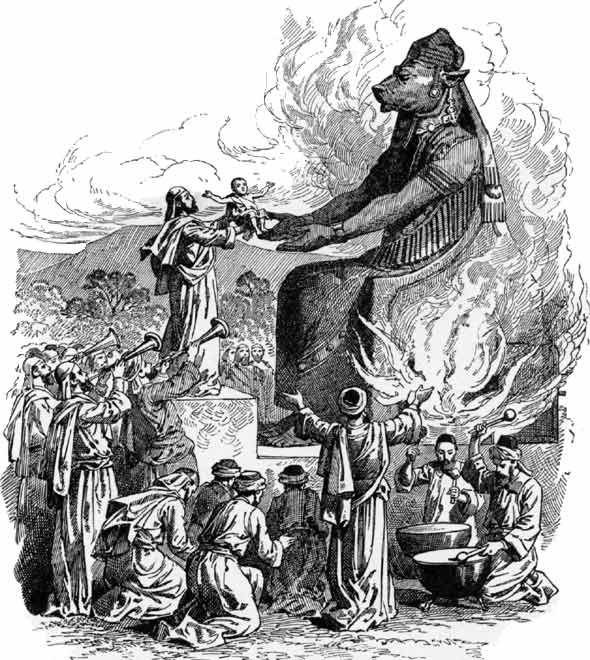
Monoliths of the Nephilim

This writer particularly enjoyed researching a recent article concerning unexplained mysteries and was surprised at not only how much satisfaction was gained in putting it together, but also the level of interest shown by readers – Article: The Top Ten Unexplained Mysteries of all Time. In a similar vein, an article by Ancient Code, entitled: Five Archaeological discoveries no one can explain, April 2022, is the inspiration for this article. We will investigate the same five discoveries, of which three of them this writer wasn’t even aware. As with the previous article where two additional mysteries to the original ten were included; it is hoped to add two further discoveries of considerable interest to the five we will study – the equally intriguing sites of Sacsayhuaman in Peru and Baalbek in Lebanon.

We have touched upon the Giza Pyramids and the Sphinx previously, though it is the intention to write an in-depth article on both of these enigmas in the future – refer articles: The Pyramid Perplexity; and Appendix VII: Moses, the Exodus & the Red Sea Crossing – Fabrication or Fact? Like wise, briefly mentioned were the hidden settlement at altitude of Machu Picchu, or the ‘Lost City of the Incas’ situated high up in the Andes Mountains in Peru, as well as the giant buried statues on Easter Island – Chapter XXVII Abraham & Keturah – Benelux & Scandinavia

What these structures have in common is an advanced intricacy of design, construction and purpose as well as being monuments of monolithic proportions, seemingly, or rather more pointedly, glaringly out of place within the orthodox paradigm presented for the world in which we live. This article logically follows Antartica: Secrets of the Lost Continent of Atlantis. As the legacy of the antediluvian epoch is reflected in the gigantic structures built in the age after the global cataclysm in 10,837 BCE according to an unconventional chronology – refer article; The Younger Dryas Stadial: Ending of the Earth… Beginning of the World.

Ancient Code: ‘All over the world, experts have found countless puzzling monuments, artifacts, and places that have remained a mystery ever since their discovery… these findings literally rewrite history as we know it. Countless theories have been proposed throughout the years trying to explain… them, however, not even the best scholars can agree on the purpose, reason and building process of… these… structures… we [will] take a look at FIVE discoveries that still continue to baffle experts.’ 

I. Massive Stone Mound beneath the Sea of Galilee 

Beneath the Sea of Galilee in northern Israel lays a conical structure comprised of ‘unhewn basalt cobbles and uncut boulders.’ Its weight is estimated to be 60,000 tons (heavier than most modern warships), rising nearly thirty-two feet (10m), with a diameter of approximately two hundred and thirty feet (70) – longer than the length of a Boeing 747. Owen Jarus, Live Science, April 9, 2013, states: ‘To put that in perspective, the outer stone circle of Stonehenge has a diameter just half that with its tallest stones not reaching that height.’ 

A reoccurring theme in the structures we will investigate is the baffling question of how the builders ‘managed to transport the megalithic blocks of stone. The closest basalt outcrop was a few hundred metres from the site. The stones used are one to two metres in width and weigh up to two hundred pounds [90 kg].’

This shot of the Sea of Galilee was taken near the old city of Tiberias. The newly discovered structure is located just to the south

‘Archaeologists argue that judging by what they have been able to see, its builders belonged to a “complex and well-organized society”…’ The structure looks like a giant rock cairn (rocks piled on top of each other) used to mark burials. Whether this was its intended purpose is open to question. It was first detected in 2003 from a sonar survey off the southwest portion of the sea, located some five hundred meters (1600 ft) off the coast and nine meters under the surface. Divers who investigated the structure, wrote in the International Journal of Nautical Archaeology:

“Close inspection by scuba diving revealed that the structure is made of basalt boulders up to 1 m (3.2 feet) long with no apparent construction pattern,” the researchers write in their journal article. “The boulders have natural faces with no signs of cutting or chiselling. Similarly, we did not find any sign of arrangement or walls that delineate this structure.” Their opinion is that it was built on land and covered as the water level rose. “The shape and composition of the submerged structure does not resemble any natural feature. We therefore conclude that it is man-made and might be termed a cairn.” 

The use of Compressed High Intensity Radar Pulse (CHIRP) provided researchers with additional information; indicating its “western face is somewhat steeper than the eastern part.”

Jarus adds: ‘Researchers list several examples of megalithic structures found close to the Sea of Galilee that are more than 4,000 years-old. One example is the monumental site of Khirbet Beteiha, located some 19 miles (30 kilometers) north-east of the submerged stone structure… It “comprises three concentric stone circles, the largest of which is 56 m [184 feet] in diameter.” This dating is conservative, with the cairn likely being far older. Underwater archaeological excavation is required in the hope of finding artefacts which could assist in determining the structure’s date and its purpose.

On our journey, there has been a mysterious common thread regarding circular monuments – where we can now add cones – which are ‘strangely, intriguingly, consistently and uniquely, replicated in the layout of Stonehenge; Plato’s account of the geographic configuration of Atlantis; crop circles; the rings of both Saturn; and the recently discovered, Super Saturn’ – Chapter XXII Alpha & Omega; and article, Antartica: Secrets of the Lost Continent of Atlantis.

During the third millennium BCE, the city of Bet Yerah (or Khirbet Kerak), was one of the biggest sites in the vicinity – located about a mile to the south of Galilee’s cone shaped mound – with researcher Yitzhak Paz saying: “It… [was] the most powerful and fortified town in this region and, as a matter of fact, in the whole of [ancient] Israel.” 

A rock cairn comprises a human-made pile or stack of rough stones raised for a purpose. Either as a marker of some kind, such as a landmark; a memorial; a monument; a ceremonial ground; or as a prehistoric burial mound. Typically found on a hilltop or skyline, they can also be a navigational aid. ‘The word cairn stems from the Scottish Gaelic: càrn [ˈkʰaːrˠn̪ˠ] (plural càirn [ˈkʰaːrˠɲ] ).’ 
As this structure is sizeable, it may not be a burial ground, just as pyramids are not tombs. Its stature signifies a monument designed to be a. seen; b. remembered; and c. lasting. While the Galilee Mound is not as intricately sophisticated in its design, it still required considerable effort in its construction. Archeologists agree that the monument was of great importance to the people who built it.

II. The Cochno Stone 

A coincidence arises in that as the word cairn is from the Scottish Gaelic, the next unexplained archaeological mystery is the Cochno Stone in the foothills of the Kilpatrick Hills of West Dunbartonshire in Scotland. It is a short walk from the Faifley housing estate and a twenty minute drive from Glasgow.

The Cochno Stone is an enigmatic slab of sandstone discovered in 1887 by the Reverend James Harvey. When the stone was discovered, it remained buried for decades to protect it from vandalism. 

Interest in the site was ignited ‘in the 1930s when an account of the site in the Proceedings of the Society of Antiquaries of Scotland caught the attention of the eccentric and tireless amateur archaeologist Ludovic Maclellan Mann. He had already undertaken various excavations of Bronze Age sites in and around Glasgow and had a particular interest in the cosmological meaning of prehistoric rock art. In 1937, the profusion of weird symbols on the Cochno stone inspired in him a burst of well meaning but questionable creativity: he painted the rock surface in various colours. He picked out the cup-and-ring marks in white and covered the stone in a spectacular yellow linear grid of his own devising to try and capture its original cosmological and geometric meaning’ – The Conversation, September 14, 2016.

The huge gritstone outcrop is domed in the middle and features about ninety carefully carved indentations – consisting of domes, lines and rings across an area of almost 100 square metres – considered to be one of the finest petroglyph sets not just in Scotland, but in the world. ‘A petroglyph is an image created by removing part of a rock surface by incising, picking, carving, or abrading, as a form of rock art.’ The Cochno Stone has been conservatively dated to five thousand years old, though an older origin is probable. The name Cochno means ‘little cups’ in Gaelic and it is also known as ‘the Druid Stone’ or Whitehill 1.

Ludovic Mann [right] and a colleague studying the site in the 1930s

The Conversation continues: ‘Mann’s work brought media attention to the stone and soon visitors came flocking. Over the next couple of decades, their numbers kept increasing as urban Glasgow crept closer. By the early 1960s, the Cochno stone had become a popular place for local people and children to hang out. There was a growing fashion for visitors to carve marks and names into the soft rock, and lots of people were walking on the surface.’ It then became a well kept secret ‘… thanks to a decision in 1965 by the then Ministry of Works to bury it beneath tons of soil and stone.’ 

The stone was buried for conservation reasons, to protect it from further damage and to prevent people from adding their own carvings onto it; ensuring it would remain preserved and frozen in time. Fifty years later, beginning in 2015, the Cochno Stone was unearthed again. With the plan to ‘digitally and photographically record the stone and then create an exact replica [which could] be placed nearby. This [would] allow the real Cochno stone to be reburied and… rest in peace.’ 

https://factumfoundation.org/our-projects/digitisation/the-cochno-stone/

Dr Kenny Brophy who specializes in urban archaeology, with a team of students from the University of Glasgow Archaeology Department, lead the excavation and ‘described the experience of seeing the stone for the first time in 51 years as a “once in a lifetime opportunity. The Cochno Stone is something I had heard about as a boy, historically it is well documented, but I was not able to see it until now.”

No consensus has been reached among archaeologists or scientists on the meaning of the intricate symbols found on its surface. Is the stone an altar where ceremonies were held, with the indented carvings acting as receptacles for liquids used in rituals? ‘Researcher Alexander McCallum proposed that the Cochno Stone is a map showing other settlements in the Clyde Valley.’ Or is it a map of the Earth or even the sky above? Some experts consider it a rendition of an ancient cosmic map, delineating planets and stars. The detailed markings are reminiscent of crop circles on a larger scale, which have been invariably ‘attributed to extraterrestrial civilizations’. Researchers have even suggested that the slab is in fact a portal; symbolising life, death and rebirth.

The hypnotic appeal of the carvings reminds the viewer of the geoglyphs in Peru, known as the Nazca Lines. Similar slabs have been discovered in the north of Spain, Greece, Mexico and in India. The scale of the stone’s carvings lends itself to being part of the legacy of the ancient enigmatic builders in our distant past. 

If the stone slab is an elaborate map of the heavens, then deciphering the stone is a priority. The data could be fed into the applicable computer program and viewed against which time period the constellations match. This may not reveal the date the stone was crafted, but a significant event in arcane history. Conversely, what if the Cochno Stone actually marks a future event? 

III. The Inga Stone 

The third unexplained archaeological discovery in Ancient Code’s article, is the ‘mind-bending’ Inga Stone in the middle of the Inga River in the northeastern Brazilian state of Paraiba. It is believed to date to at least six thousand years ago, though it is conceivably far older. The Inga Stone or Pedra do Inga in Portuguese, is also known as  Itacoatiara, do Ingá  – meaning stone of Inga in the the Tupi languageand covers an impressive area of two hundred and fifty square metres. It is a horizontal construction one hundred and fifty-one feet (46m) long and up to twelve and a half feet (3.8m) high. The Inga stone displays myriad carvings yet to be deciphered, such as cryptic hieroglyphs of the more than four hundred engravings. 

Researchers have identified several carvings as human figures, fruits, animals and geometric shapes; but of most interest, are engravings of the Milky Way galaxy and the constellation of Orion – Articles: Thoth; The Pyramid Perplexity; and Chapter XXI The Incredible Identity, Origin & Destiny of Nimrod. Archaeologists concur that the detailed engravings have been performed with minute precision and superb technique by skilled craftsmen. Raising serious questions whether the native Indians who lacked metal tools are the creators of the images. 

Fertilization cycle of the flower of the angiosperm and the same cycle shown by the engravings on the stone

Ancient Code: ‘The Inga Stone is a geological formation from Gneiss (a common and widely distributed type of rock formed by high-grade regional metamorphic processes from pre-existing formations that were originally either igneous or sedimentary rock.) It is often foliated (composed of layers of sheet-like planar structures). The foliations are characterized by alternating darker and lighter colored bands, called “gneissic banding”).’

Brazilian researcher Gabriele D’Annunzio Baraldi has studied the encrypted messages in depth resulting in his theory that the carvings are proof of an unknown ancient technology. Baraldi opines the ‘rock represents the story of the universal flood, written in a language very similar to the Hittite, spoken in the second millennium BC in present-day Turkey.’ 

One source claims: ‘Many symbols of the Inga’s monolith are similar to those found in Turkey, in ancient Anatolia of the Hittites. A series of inscriptions speak of a “borders war” between two sovereigns of [Mesopotamian] origin. Another story tells about a terrible volcanic eruption. The ashes covered a stone city on the Atlantic coast, similar to what happened in Pompeii and Herculaneum.’

According to researcher Yuri Leveratto… ‘the message written in the Pedra do Ingá could be written in Nostratic – a large-scale language family, which includes many of the indigenous language families of Eurasia…’

The Inga Stone is an artistically designed complex, yet not unique for the geometrical style is replicated in other Brazilian engravings but admittedly, none are as famous and interesting as the Inga Stone. 

Certain researchers have postulated that the engravings of the Inga stone were created by the Phoenicians, which is wholly incorrect – Chapter XXIII Aram & Tyre: Spain, Portugal & Brazil; and Chapter XXVII Abraham & Keturah – Benelux & Scandinavia. Others consider the aborigines of Easter Island, which has substance, as symbols of the Inga Stone show a degree of stylistic resemblance to symbols found at Easter Island with both of them representing curved style geometry. Researchers caveat that this is the only similarity found between them and does not necessarily mean a connection between the cultures. Alternatively, researchers have proposed the Inga Stone is evidence of ‘extraterrestrial contact.’ 

Tamas Varga: Could the horizontal line carved above the figures denote the water level of the river bed during a certain period of the year?

What is known is that the Inga stone is related to celestial phenomena as depicted by several constellations on its surface. Ancient Code: ‘In 1976 the Spanish engineer Francisco Pavia Alemany began a mathematical study… whose first results were published in 1986 by the Instituto de Arqueología Brasileira. 

The author identified on the surface of the Ingá stone what he described as the most extraordinary known archaeological record of the variation of the solar orthography throughout the year. The symbols are materialized by a series of bowls or “capsular” and other petroglyphs engraved on the vertical surface, which by way of a graduated limb form a “Solar calendar”, on which a gnomon would project the shadow of the first solar rays of each day’ – Article: The Calendar Conspiracy. ‘The Safor Astronomical Association published in 2005 a synthesis of this work in its official bulletin Huygens Nº 53. 

Later, F. Pavia continued the study of Ingá rock, focusing this time on the recording of a series of signs inscribed on the rocky surface of the channel itself, where a great number of “stars” can be observed that can be grouped into “constellations.” Both the “capsular” and the “constellation” records, in themselves, give Ingá great value, but the coexistence of both in the same reservoir gives Ingá an exceptional [archaeo-astronomical] importance, which is why many authors refer to the Inga Stone as one of the most under appreciated monuments on the surface of Earth’ and “an exceptional archeoastronomy monument, like no other in the world.” 

As with the Cochno Stone, a deciphering of the constellations, for instance Orion, may provide a valuable date, which again may relate to an important occurrence and not necessarily to when the Inga Stone’s engravings were first carved. Though unlike the Cochno Stone, the Inga Stone may be recounting more than one story or significant event. 

IV. Gobekli Tepe 

The fourth unexplained archaeological discovery of the five listed in Ancient Code’s article is the potentially history changing site of Gobekli Tepe, located in the Germus mountains of southeastern Turkey. Göbekli Tepe (Go-Beck-Lee-Tep-E), is translated as ‘Potbelly Hill, Belly Hill’ or ‘Hill of the Navel’ in Turkish and ‘Girê Mirazan’ or ‘Xirabreşkê’ in Kurdish. The archaeological ruins atop a limestone plateau six miles from ancient Urfa, were first uncovered in the 1960s, though their significance was not truly realised until 1994. 

The site has been brought to the attention of a wider audience, in large part to the program series presented by investigative journalist Graham Hancock on Netflix: Ancient Apocalypse. While Hancock continually divides opinion with his views on an alternate ancient history for human kind; Gobekli Tepe has opened Pandora’s Box for the archaeological evidence on arcane history. Causing an adamant re-writing of pre-history to press vigorously at the firmly locked door of mainstream historians and orthodox scientist’s explanation of mankind’s early ancestors. 

Its re-discovery has raised countless questions about the actual evolution of civilisation and the existence of advanced and complex societies tens of thousands of years ago. Thus challenging the gradual ascent of an upward curve from the past till the present, by revealing a wave which goes up and down repeatedly in tandem with civilisations rising, falling and rising again. 

Graham Hancock has invested special interest in Gobleki Tepe for good reason, as it is believed to be twelve thousand years old. This is meaningful to Hancock and researchers of a similar view, for it supports an advanced civilisation shortly after the global cataclysm approximately one thousand years earlier – Article: The Younger Dryas Stadial: Ending of the Earth… Beginning of the World.

By standard chronology, Gobleki Tepe predates Stonehenge by some 6,500 years and the Pyramids at Giza by 7,000 years. Of course, before Pandora’s Box even began to open ajar, the issue of the dating of Stonehenge and of the Great Pyramid has concerned this writer. For the Giza complex reveals a different degree of design and construction which does not remotely compare with the megalithic structures which are the subject of this article. Hence a future article will specifically address the Great Pyramid and its origin – The Pyramid Perplexity. Though the essence being, while the Giza pyramids are still younger than Gobleki Tepe, they are far older than currently dated.

As the Inga Stone and Cochno Stone are plausibly older than archaeologists have accounted for, so too is Stonehenge. Thus Gobleki Tepe being dated to between 9,600 for the oldest stratum to 8,200 BCE is not a surprise at all. The site merely fits in with Stonehenge, the Great Pyramid and other mysterious architectural monolithic buildings situated around the globe. As we have noted a circular pattern in ancient and modern anomalies previously, there are other commonalities to discuss as we progress, which link the ancient megalithic constructions to a single, related culture and time frame. Experts in their fields are left scratching their heads as to who designed and built all these mysterious structures, for they either ignore or reject, myth, legend, tradition, ancient texts and scripture for the missing pieces of the jig-saw puzzle that is humanities past. 

The construction of Gobekli Tepe began circa 9600 BCE during the Würm Glacial Age, after the Great Deluge in 10,837 BCE which inundated the Earth – refer article: The Younger Dryas Stadial: Ending of the Earth… Beginning of the World. So it is ironic that the most recent widespread cataclysm to decimate portions of the planet, including the Black Sea Catastrophe occurred nearly nine thousand years ago circa 6,700 BCE. Causing the thriving Gobekli Tepe civilisation of three millennia duration to be mysteriously abandoned – refer article: Antartica: Secrets of the Lost Continent of Atlantis and Appendix IV: An Unconventional Chronology. It was at this time that Ireland and Great Britain once connected with Doggerland, became islands and with Scandinavia split off from the rest of Europe as part of the continental shelf sank under the sea.

Stephan Roget states that the structures that make up the site are incredibly well-preserved, allowing archaeologists to study them in something similar to their original condition. He says: ‘Part of the reason for the remarkable preservation of Göbekli Tepe is due to the climate in Turkey, but another major factor is… that many of the temple sites appear to have been backfilled before being abandoned.’

This is due to the fact natural burial through sediment building up is unlikely for the location; as hilltops do not collect sediment because they are places where the soil is lost and not where it is added. ‘This allowed the structures to remain protected from the elements as the centuries wore on…’ So much so that the megalithic structures have remarkably retained their original form, design, architectural elements and decorative craft works.

Christopher McFadden provides alternative reasons for burying the site aside from an ensuing catastrophe: ‘… the monuments on top of Gobekli Tepe were buried on purpose… it could have been buried to keep it safe for people in the future… [or] if a new religion or people replaced it, the site may have become seen as a place of sacrilege or taboo and was duly “memory holed”… If the place was a religious sanctuary, another… reason could be that the burial was part of a process to make the place less holy. In many cultures, things or buildings that are thought to have supernatural or divine power must be destroyed or changed in some way when they are no longer needed.’

Ancient code: ‘The main structures of Göbekli Tepe are a series of three rectilinear structures which are located below the surface, defined by dry-stone walls, and containing multiple decorated T-shaped pillars. The stones were used mainly as support for the roof, although it cannot be excluded that these had a symbolic purpose.’ Göbekli Tepe is considered the world’s first temple by archaeologists, historians and scholars alike. Most of this ancient site still remains buried. 

‘Whoever built it, made sure the complex would survive… thousands of years, by backfilling the various sites and burying them deep under [ground]. So far, excavations and geomagnetic results revealed that there are at least 20 stone circles… on the site.’ Each circle site has been constructed with a similar design, but with slightly differing qualities.

‘All of the pillars at Göbekli Tepe are t-shaped and range in height from 3 to 6 meters [10-20 ft].’ The pillars weigh several tons, with estimates ranging between seven and ten tons; which would have made ‘bringing them to the central location a Herculean task. That’s to say nothing of placing large stone blocks on top of them.’ 

Today’s technology would have issues moving and positioning the pillars of Göbekli Tepe. It has been suggested a minimum of five hundred individuals would have been required to move and position the massive pillars. Yet in a world reeling in the aftermath of a global cataclysm, filled with chaos and consumed by self-preservation, how were these people organised and by whom? ‘Mainstream scholars argue that the building proves… Göbekli Tepe required quarrying experts, transport specialists, planners, and ritual overseers.’ The organisation required in building the site means its constructors possessed an already established society and hierarchy. Therefore, it remains a profound mystery how ancient man at this time, managed to accomplish the monumental feat of transporting and placing into position the massive stones at Gobekli Tepe.

The anthropomorphic pillars were carved from quarries in the adjacent limestone plateau. It is assumed that stone and bone tools were used, but only because of a rigid held paradigm for this period. For after ’13 years of digging’ according to Ancient Code, ‘archaeologists investigating the ancient site have failed to recover a single stone-cutting tool. 

No one has been able to understand how ancient mankind, which was believed to be incapable of such [feats], erected some of the greatest stone-works on the planet… [and it] bothers mainstream scholars… they have failed to unearth a single stone cutting tool from the ruins of Göbekli Tepe.’

As the heat prevents archaeologists from digging in the summer months, only five percent of Göbekli Tepe has been unearthed. Imagine what finds may lay waiting within the fifteen metres of accumulated sediments, as more of the site is excavated? Geophysical surveys conducted in 2017, found more than two hundred obelisks and fifteen more ‘temples’ buried beneath the Earth. Gobekli Tepe is not alone either, for around a dozen other sites of similar age are under excavation in the ‘Stone Hills’ area, which extends for about one hundred square kilometres.

Roget: ‘The pillars, along with their top [stones]… might be hiding a design secret… Some of the stone blocks on top of the pillars have what appear to be human faces carved into them… [so] that the pillars are actually stylised depictions of human beings… the covering of the human form with depictions of [elaborate drawings of] animals [and intricate animal statues carved right onto the pillar’s surface] might be a clue into the belief system of the people who constructed Göbekli Tepe.

According to experts, foxes, snakes, wild boars, cranes, [and] wild ducks are the most commonly depicted animals’ – Article: Thoth. Andrew Curry adds: ‘… Gobekli Tepe’s pillar carvings are dominated not by edible prey like deer and cattle but by menacing creatures such as lions, spiders, snakes and scorpions. “It’s a scary, fantastic world of nasty-looking beasts.”

Roget: ‘The skilled architectural style seen in the construction of its many “temples” is seriously impressive, and would be in any era. The craftsmanship seen at Göbekli Tepe is thousands of years ahead of its time, and dates back… long before such construction should have been possible. The manpower, engineering, and project managing required for such an endeavor all seem unfeasible, given where human civilization was understood to be at the time’ [and] ‘shouldn’t have been possible without a sophisticated social structure already in place. Humankind may, unfortunately, never know who the brilliant minds behind Göbekli Tepe actually were.’ 

Yes, how could humanity so soon after the flood have been able to construct such an impressive site? In fact how did ‘they’ construct all the impressive buildings and monuments around the world, so quickly, so expertly and on such grand scales? Even more ironic then that the ‘potentially world-changing discovery of Göbekli Tepe’ during the 1960s was not recognised by University of Chicago and Istanbul University anthropologists. ‘In fact, it was wrongly assessed as being a “medieval cemetery,” and… subsequently ignored for half a century due to its apparent lack of potential. Klaus Schmidt, a German archaeologist, was the individual who decided to give it another look. Analysis of the site has been going on ever since, but archaeologists remain baffled by it…’

A temple or burial site is suggested for the apparent lack of a better alternative, even though no graves have been found; yet the site is so large – spread over an area of nine hectares – with palpable astronomical features, Gobleki Tepe likely had a more practical or meaningful function than a religious one, such as an observatory, a vault for knowledge, as well as a symbolic landmark. 

Curry elaborates on the site’s function: ‘The site, Schmidt argued, was a ritual centre, perhaps some sort of burial or death cult complex, rather than a settlement. That was a big claim. Archaeologists had long thought complex ritual and organised religion were luxuries that societies developed only once they began domesticating crops and animals, a transition known as the Neolithic. Once they had a food surplus… they could devote their extra resources to rituals and monuments. Gobekli Tepe, Schmidt told me, turned that timeline upside down. The stone tools at the site, backed up by radiocarbon dates, placed it firmly in the pre-Neolithic era. More than 25 years after the first excavations there, there is still no evidence for domesticated plants or animals’ – refer Chapter I Noah Antecessor Nulla. ‘And Schmidt didn’t think anyone lived at the site full-time. He called it a “cathedral on a hill”. If that was true, it showed that complex ritual and social organisation actually came before settlement and agriculture. Ritual and religion, it seemed, launched the Neolithic Revolution.’ 

This is an extremely important point, for it is a clue to who the builders were and how and why they were able to perhaps place importance in constructing a non-essential for survival complex, ahead of domesticating crops and animals. More recent excavations have complicated Schmidt’s view who died in 2014; while not necessarily contradicting him. 

Curry: ‘Work on foundations needed to support the site’s swooping fabric canopy required archaeologists to dig deeper that Schmidt ever had. Under the direction of Schmidt’s successor, Lee Clare, a German Archaeological Institute team dug several “keyhole” trenches down to the site’s bedrock, several metres below the floors of the large buildings. The digs revealed evidence of houses and year-round settlement, suggesting that Gobekli Tepe wasn’t an isolated temple visited on special occasions but rather a thriving village with large special buildings at its centre. 

The team also identified a large cistern and channels for collecting rainwater, key to supporting a settlement on the dry mountaintop, and thousands of grinding tools for processing grain for cooking porridge and brewing beer. Clare said. “It was a fully-fledged settlement with permanent occupation”…’

McFadden: ‘In 2021, researchers from the German Archaeological Institute in Berlin learned over… four years that the people who built these old buildings ate vast pots of porridge and stew made from grain that the ancient people ground and processed on a nearly industrial scale. The clues from Gobekli Tepe show that ancient people used grains much earlier than was thought, even before there was evidence that these plants were domesticated. Rather than a centuries-long building project inspiring the transition to farming, Clare and others now think Gobekli Tepe was an attempt by hunter-gatherers [to cling] to their vanishing lifestyle as the world changed around them. Evidence from the surrounding region shows people at other sites were experimenting with domesticated animals and plants – a trend the people of “Belly Hill” might have been resisting.’

Thus Gobekli Tepe appears to have been originally built by those who were not reliant on domesticated crops and animals, but unlike the residents of nearby sites, were not transitioning to domesticated crops and farming. Coupled with this, there are a lot of animal bones within the ruins, confirming that the people who lived there were proficient hunters. If so, this adds support to the identity of the original builders and community which may have lingered at Gobekli Tepe. 

Curry: ‘Joris Peters, an archaeozoologist from the Ludwig Maximilian University in Munich, specializes in the analysis of animal remains. Since 1998, he has examined more than 100,000 bone fragments from Gobekli Tepe. Peters has often found cut marks and splintered edges on them – signs that the animals from which they came were butchered and cooked. The bones, stored in dozens of plastic crates stacked in a storeroom… are the best clue to how people who created Gobekli Tepe lived. Peters has identified tens of thousands of gazelle bones, which make up more than 60 percent of the total, plus those of other wild game such as boar, sheep and red deer. He’s also found bones of a dozen different bird species, including vultures, cranes, ducks and geese. 

“The first year, we went through 15,000 pieces of animal bone, all of them wild. It was pretty clear we were dealing with a hunter-gatherer site,” Peters says. “It’s been the same every year since.” The abundant remnants of wild game indicate that the people who lived here had not yet domesticated animals or farmed. But, Peters and Schmidt say, Gobekli Tepe’s builders were on the verge of a major change in how they lived, thanks to an environment that held the raw materials for farming. “They had wild sheep, wild grains that could be domesticated – and the people with the potential to do it,” Schmidt says. In fact, research at other sites in the region has shown that within 1,000 years of Gobekli Tepe’s construction, settlers had corralled sheep, cattle and pigs. And, at a prehistoric village just 20 miles away, geneticists found evidence of the world’s oldest domesticated strains of wheat…’ – refer Chapter I Noah Antecessor Nulla.

World History Encyclopaedia describe Gobekli Tepe’s enclosures in detail. The site is broken down into three chronological levels, I, II and III, which represent the main phases of construction and its use. Level I being the most recent and III the most ancient and deepest level. 

Layer III is fascinatingly, the ‘most sophisticated level at Göbekli Tepe, a fact which poses some interesting questions: this is a site that in terms of artistic endeavour, construction, and concept seems to go backwards rather than progressing with the passage of time.’ So that Level II is far more basic and Level I represents thousands of years of abandonment and later agricultural use. Level I still produces relevant finds, though they have been affected by erosion and farming. 

The overall size of the Göbekli Tepe site is considerable, yet the ancient core being excavated is modest in size and represented by four enclosures identified by lettering, A to D, designating the order of their discovery. ‘In level III, the oldest levels, each enclosure is characterised by different thematic components and artistic representations, and the early groups of enclosures are roughly circular in shape.’ 

The first area excavated was Enclosure A, also known as ‘the snake enclosure’ because depictions of snakes dominate the carvings on the T-pillars. ‘These are, in places, extremely intricate including one (pillar no. 1) which depicts a group of tightly packed snakes contained in what appears to be a net or wicker basket, set above a wild sheep or ram. The leading edge of the stele has three carved snakes moving downwards and one snake moving up. All the snakes carved at Göbekli Tepe are carved in a downward motion except for this single example [below].

The snakes are shown as short, thick creatures with broad flattened heads – typical of snakes which inhabit the Urfa region today, including the common Levantine viper’ – Chapter XXXIV Dan: The Invisible Tribe. ‘It is interesting to note that the snake holds a very powerful position in the mythology of Anatolia… Along with the snake, images of the fox are a consistent feature and possibly the fox has some totemic value for important members of this culture although, unlike the snake, the fox does not appear to have survived with a significant folkloric role in the wider region…’ 

‘Another pillar depicts a grouping of an auroch (a very large and now extinct bovine), a fox, and a crane, positioned one above the other in what may represent a narrative of some description. This is a thought-provoking narrative because the depiction of the crane is anatomically incorrect if the carver was depicting what he actually saw in the wild, as the knees of the crane articulate backwards in the same fashion that a human knee does. Any member of a hunting and gathering society would know from an early age that a bird’s knee articulates forward, and with a long-legged bird such as a crane, this forward movement is very marked indeed. What in fact may be depicted here is a human dressed as a crane. Could this be a hunting scene or possibly a depiction of a dance to invoke the attributes of the creatures being depicted?’

‘This anatomical puzzle is repeated elsewhere. The central pillars in Enclosure A do not have the anatomical features such as arms that we see on other pillars at this site and elsewhere but the animal depictions are particularly vivid. Nor do the pillars have any obvious structural purpose.’ 

Enclosure B is in the shape of a rough oval measuring about 10-15 m (north/south) and about 9 m (east/west) and has a constructed terrazzo floor. This enclosure is called the ‘Fox Pillars Building’ because the image of the fox predominates. The two central pillars [within the additional seven pillars shaped in a circular wall] each have a life-sized fox carved [in low relief] on them, both facing inwards and given their posture, in mid-leap. But interestingly on one of the stones, the fox appears to be pouncing upon a small rodent-like creature that was etched into the pillar at a later date [below].’

Enclosure C is dominated by superb renderings of wild boar and birds. Curiously, snakes are completely absent from this enclosure and appear to have been replaced in terms of use and positioning by images of the boar. Along with the two central pillars, there are 11 in the inner circle and, so far, eight in the outer circle; several may have been removed prior to the site’s burial. This construction is a little different in that the enclosure is built as a series of up to three concentric circles, one could even describe it as a sort of spiral.’ 

‘At some point after the burial of Enclosure C, a large 10 m diameter pit was dug in the central area of the enclosure and both standing central stones were smashed into several pieces. It is impossible to know the circumstances of this episode of iconoclastic vandalism and it is repeated elsewhere at Göbekli Tepe. It has been determined that the violence of this attack was considerable because the eastern pillar was cracked apart by an intense fire. The reconstruction of the western pillar from fragments of the original is adorned with a life-sized fox relief on the inward face in mid-leap southward towards the entrance. The eastern pillar, most of which is missing was adorned with a bull on its inward face. It is fortunate that the violence was only directed at the central pillars because around the perimeter wall of Enclosure C are to be found some of the highest quality stonework at Göbekli Tepe including an extraordinary high relief (Pillar 27) of a free-standing feline above a wild boar [below].’

‘The enclosure is built onto the plateau’s surface on the natural bedrock.’ 

Enclosure D is referred to as the Stone Age Zoo because of the wide variety of animal imagery. The dominating feature of this enclosure is the massive pair of central T-shaped stele, clearly intended to represent human figures and monumental in scope. They face south and are set on an ornamental pedestal, one of which is decorated with what appear to be ducks, and they stand at an impressive height of 5.5 m. Both standing pillars have arms clasped at the belly just above a decorated belt and a fox pelt loincloth with the tail hanging down at the front. The pillar standing eastwards has a life-sized fox in the crook of its right arm leaping to the south. But significantly there are no facial features. Apart from the belt and loincloth, both figures have what could be described as neck adornments which are clearly symbolic.’

‘This enclosure also has, as one of its perimeter stones, the most discussed, and possibly disturbing set of Göbekli Tepe images of all. This is pillar no. 43, the Vulture Stone [below]. The bizarre images on this pillar include, on the left-hand side, a vulture holding an orb or egg in an outstretched wing. Lower down there is a scorpion, and the imagery is further complicated by the depiction of a headless ithyphallic man. The enclosure is also built on natural bedrock which was levelled and smoothed to construct the central pillars’ pedestals and floor.’

‘There is [a] further enclosure, Enclosure E, which is about 100 metres east and slightly south of this grouping of enclosures. Nothing remains except the floor plan and foundation sockets for the central pillars. The floor is carved directly from the bedrock. Just adjacent to the enclosure there are some carved depressions which may be small cisterns carved from the rock; there are other larger examples found along the ridge of Göbekli Tepe. There are no springs in the vicinity, so water supply would have been a problem. There is also a grouping of cup-like depressions carved into the rock which are replicated at other Neolithic sites in the regions, but there are no real theories as to what they may have been for. 

All the enclosures at Level III were filled in prior to the constructions on Level II. It is unclear why this was done, but there seems to be a conscious ‘decommissioning’ of the structures at Level III because some pillars were damaged or moved in an organised and controlled manner, while some pillars seem to have been removed entirely. Small artefacts remained, and statues were left in situ but toppled. Some of the tops of the pillars in Enclosure C are completely broken off. The tops of the intact central pillars have carved, cup-like depressions. It appears that when the Level III structures were buried, just the tops remained above ground and these cup-like depressions were carved once burial was complete. 

Once again, the purpose of this is speculative, but receptacles for votive offerings or candles are a reasonable suggestion. With the construction and use on Level II, people were clearly using the site and would have been aware of the buried enclosures, the tops of which were protruding just above the surface, evidence of the convocation of standing stones just below. It is also reasonable to conclude that, although buried, the ancient enclosures still played a role of sorts in the ritual life of the people who continued to build and gather here. 

One cannot be absolutely precise but it would seem that Level III, original construction around 9,500 BCE, was buried in phases after hundreds of years of use. The content of the material used to fill the enclosures in is a huge source of hard data. The composition of the in-fill material is simply refuse produced by hunting, food preparation, and consumption mixed in with in-fill material which included the residue of construction, stone working, thousands of flint tools, and the remnants of tool manufacture. The spoil tells us some important things about these people. The tools themselves, in the absence of the archaeologist’s basic dating tool, pottery, can be used to produce a broad cultural and chronological context in which data from other sites can [be] used to produce rough dates. 

Level II is a different environment both conceptually and artistically. It is evident that the society and the culture are undergoing an important series of changes while important cultural markers remain. The enclosure spaces are far smaller and much more modest while decorations are simpler and are executed with less skill. They are also far more numerous and are constructed, almost in a jumble of competing floor plans, on top of Level III and sometimes cutting into Level III. They are certainly considerably less ambitiously monumental than before. This is possibly a society that has exhausted itself both economically and spiritually with Level III. It may be evidence of a transitional period before the abandonment of Göbekli Tepe and the evolution of more settled societies, such as the one at Çatalhöyük in the Konya Plain which is dated from about 7,500 BCE. 

However, speculation aside, the most elaborate of these now more modest rectangular enclosures is the so-called Lion Building, identified by the carving on one of its principle stones. While probably still a purely cult or religious site with no evidence of domesticity, the enclosures are small and in many respects resemble the domestic buildings in other places such as Nevali Çori. It could be that economic and cultural changes are reflected in construction patterns here. 

Over the 2013/14 CE season, archaeologists were uncovering another enclosure, EnclosureH,’ about 250 m away from the original Level III excavations and on the other side of the hill towards the northwest. This is referred to as the ‘North West Depression’ and, at first glance, looks almost to mirror the original existing excavation. Also built on Level III, this enclosure possesses good-sized central stele set in an oval-shaped structure. As with Enclosure C, representations of wild boar seem pre-eminent. The enclosure, like all the others, was buried after its useful life. However, somebody, as with Enclosure C, took the time and effort to excavate a pit, locate the central standing stones…and destroy one (the other one still awaits investigation). Why? 

Clearly what connects Enclosures C and H, and possibly enclosures yet to be discovered, are design (oval and with an accessing staircase), level (age), and artwork, but above all, these two enclosures are connected by identical acts of desecration carried out long after the enclosures were buried!

‘These acts of desecration would suggest a number of possible scenarios none of which necessarily exclude the others. Clearly the act of burying enclosures on Level III and the evolution of the structural design changes seen on Level II indicate a conclusion of a lifecycle for these structures, and a change of political and economic, although not cultural or religious, fundamentals. The question of deliberate, targeted, and heavy destruction in enclosures but continued site use suggests a continuity of belief for a considerable period of time but with major changes in the power dynamics of the society represented at and by this extraordinary site.

… theories contributed by non-academic and ‘alternative’ writers of popular books about the origins of Göbekli Tepe and its builders… are understandably concerned with the amazing and very photogenic remains on Level III… [and] range from an ancient civilisation of amazing complexity via vaguely biblical references to, quite literally, the stars.’ 

In an article entitled, Gobekli Tepe – Temples Communicating Ancient Cosmic Geography, March 8, 2013, Paul Burley comments: ‘The sacred relationship between Earth and the cosmos is expressed by the circular architectural form as well as the chiseled ornamentation found at Gobekli Tepe. The structures at Gobekli Tepe are generally devoid of subdivided space other than what appear to be few peripheral hallways or storage areas. Rather than a temple of worship with a common area separated from a sacred space such as an alter or place of offering, the temples at Gobekli Tepe have the appearance of undivided open, circular structures except for two T-shaped pillars placed off center within each structure and aligned generally in a northeast-southwest direction. The open, rounded shape is similar to a modern day arena or even the Roman coliseum where spectators observed games from peripheral seating while participants were located on the central floor area of each structure – like theatre in the round

The temples are located on a prominent hill overlooking a broad valley. The site provided unobstructed views of both Earth and the heavens. Yet the site lacks a source of water. This fact alone shows that the development served a function of greater importance than mere secular comfort. The circular shape of the temple buildings reflects a natural, organic form. The arena-like structures would have been intended for ritual or ceremonial purposes, observation of the cosmos, and allowing a relationship to build between the human occupants and the world. 

Essentially the sidewalls of the temples are like mid-sections of spheres in contact with Earth below and the cosmic dome above. Standing at floor level in one of the temples we place ourselves symbolically at the center of the world. At night we can look up and see the moon, planets and stars. We might perceive constellations that help us orient ourselves with the night sky. We can envision the paths of the planets, Moon and Sun crossing the sky. Those paths form a band extending across the cosmos. It is a pathway we call the ecliptic. We can also observe the Milky Way stretching across the night sky, its bulge of stars surrounding the galactic center in the vicinity of the well-known constellations of Sagittarius and Scorpio. However, different cultures perceive different constellations. It is reasonable to assume that builders of Gobekli Tepe did not necessarily envision the same constellations as Sumerians did thousands of years later, or the Greeks who were responsible for many of the constellations we think of today. It is fortunate that the temples were buried so soon after construction, for the cosmology developed by their builders is preserved and communicated to us today, eleven millennia later.’

World History Encyclopaedia: ‘The site is clearly orientated… [as] the Level III enclosures are orientated southwards… down the Plain of Harran from where the people might have approached…’ – Chapter XXVI The French & Swiss: Moab, Ammon & Haran. ‘Even today, the most logical approach is from the south. It is possible that this southern alignment faces a processional approach. After the abandonment of Level II, we see nothing happening at Göbekli Tepe other than the slow evolution of Level I, which represents the establishment of a rugged agricultural and semi-nomadic life across the environment we see today, with minor contributions during the Roman, Byzantine, and Islamic periods and which hid the drama of the numerous and silent convocations of monolithic beings just below the surface.’

Andrew Collins discusses proposed orientations for the twin central pillars in the key enclosures. Collins is one of the world’s foremost experts on Göbekli Tepe; first visiting the site in 2004. Collins has been investigating its Pre-Pottery Neolithic culture for over twenty years and is the author of various books which feature the subject. He comments: “… directly between the T-shaped heads of the pillars, is a very distinct pecked hole. Left and right of this hole are short vertical lines that make the image resemble the rectangular holed standing stone positioned centrally behind the twin central pillars in Göbekli Tepe’s Enclosure D.”

“This was something pointed out by my colleague Hugh Newman moments after Matthew Smith’s own dramatic discovery in Sanliurfa Museum in September 2015. A similar holed stone is seen in exactly the same position next door in Enclosure C. Yet this example (officially designated Pillar 59) is on its side and fractured across its circular aperture. In both cases the holed stones are located in the north-northwest section of the enclosure’s retaining wall at a position that reflects the exact alignment of its twin central monoliths. 

This suggests that these standing stones, with circular apertures around 25-30 centimetres in diameter bored centrally through their widest faces in order that someone standing within the structure could gaze through their openings, had formed a key role in the religious beliefs and practices of the Göbekli builders. Indeed, their positioning would indicate they acted as the structure’s altar or holy of holies, forming a bridge or point of connection between the liminal space created by the enclosure’s interiors and the otherworldly realms and supernatural forces thought to exist beyond the physical world” – Article: Belphegor. 

“Although the late Professor Klaus Schmidt… never commented on these holed stones seen in two of the most accomplished enclosures so far uncovered at Göbekli Tepe, he did pass comment on the fragments of strange stone rings found at the site (one of which is now on display at Sanliurfa Museum. These, he suspected, had been placed in the walls of now lost enclosures and acted as seelenloch, a word in his native German language meaning “soul hole”. 

Seelenloch are found in connection with a large number of megalithic dolmens of Neolithic and later Bronze Age manufacture from Ireland in the West across to India in the East, with by far the greatest concentration existing in the North Caucasus region of southwest Russia. These take the form of circular apertures centrally bored through the structure’s entrance façade. Generally, these openings, which like the examples at Göbekli Tepe are usually between 25 and 40 centimetres in diameter, are too small to enable a person to pass through easily. 

Shamanistic practices in various parts of the world incorporate the idea of a symbolic hole, either in a rock, in the ground, within a tree, or in the roof of a yurt or tent, that enables their soul to leave their physical environment and enter the Upper or Lower Worlds while in altered states of consciousness. Very likely the soul holes in megalithic structures, like those seen at Göbekli Tepe, acted in a similar capacity. 

That a pecked soul hole should appear between the twin pillars on the carved bone plaque found at Göbekli Tepe is a revelation, as it intensifies the already heated debate over the direction of orientation of its main enclosures. The existence of the soul hole stones, the fact that the carved relief on the twin central monoliths faces the entrant approaching from the south, along with the southerly placed entrances into the main enclosures, all strongly indicate that these prehistoric cult structures were aligned towards the north. 

Some researchers of the ancient mysteries field have chosen to ignore these data and announce that the twin central pillars of key enclosures at Göbekli Tepe are directed south, their twin central monoliths aligned to target the rising of either the three belt stars of Orion (Schoch, 2014, 54-55) or the bright star Sirius (Magli, 2014). However, not only have these alignments been shown to be either dramatically flawed or, in the case of Orion, non existent (Collins, 2014, 77-80; Collins and Hale, 2014), but there are far better reasons to assume northerly orientations of key enclosures at Göbekli Tepe. 

Both the mean azimuths of the twin central pillars in Enclosures C and D, along with the positioning of the soul hole stones, target the setting of the bright star Deneb in the constellation of Cygnus on the north-northwest horizon during the epoch of their construction, ca. 9500-8900 BC (Collins, 2014, 80-82). 

The [cross-like formation of the] stars of Cygnus sit astride the Milky Way, exactly where it bifurcates or forks to create two separate streams known as the Dark Rift or Cygnus Rift. This area of the sky has been seen as an entrance to the sky-world [the source of life and creation] for many thousands of years, and seems even to be depicted within the ice age cave art at Lascaux in Southern France, created by Solutrean artists ca. 16,000 BC (Rappenglück, 1999). It thus makes sense why the Göbekli builders might have orientated key enclosures north towards this already ancient entrance to the Upper World, where access to the Milky Way – long seen as the river, road or path along which souls reached the afterlife – was located. From this constellation souls emerged into incarnation and here they would return in death” – refer article: DEATH: A Dead End or a New Beginning? “The route to Cygnus taken both by the souls of the dead and by shamans in trance states is known in North America as the Path of Souls death journey.

A northerly orientation towards the soul hole stones in the main enclosures at Göbekli Tepe is now supported by the discovery of the bone plaque displayed at Sanliurfa Museum. The manner in which its carved imagery clearly implies that the entrant’s eyes are drawn towards the soul hole, like those seen in Enclosures C and D, bears out this supposition, and supports the likelihood that the Milky Way, and in particular the Dark Rift and Cygnus stars, were of primary importance to the beliefs and practices of the Göbekli builders.” 

Working with British engineer Rodney Hale, Andrew Collins established that the three main Pyramids of Giza not only reflect the astronomical positions of the three wing stars of Cygnus, but are aligned to them on the ground as well. The three pyramids are locked into the setting of these three Cygnus stars in the horizontal and vertical planes of all three dimensions.

The visual alignment of the same three stars, as seen from a vertical perspective, their astronomical positions corresponding with the geographical locations of the Giza pyramids.

Collins’ deduction that Gobekli Tepe was aligned with or focusing on a Northern orientation is of particular interest and ties in with this writer’s research on the Great Pyramid – Article: The Pyramid Perplexity. Collins is also correct in realising the positioning of the Giza pyramids do not align (entirely) with the stars in Orion’s belt as popularly taught amongst alternative history and New Age authors. Yet Collins’ proposal with the constellation of Cygnus may not be wholly correct either – refer article: The Pyramid Perplexity.

The theory that Gobekli Tepe was one of the earliest astronomical observatories in history as Andrews Collins hypothesises is gaining support outside of the mainstream. McFadden: ‘The rationale for this hypothesis tends to distill down to two critical pieces of evidence. The first is based on the fact that the location appears aligned with the night sky, notably [though perhaps incorrectly] with the star Sirius. Another contends that Gobekli Tepe’s carvings document a comet impact that occurred at the end of the Ice Age.’ The construction of Gobekli Tepe began after the Last Glacial Maximum and may explain why many of the images at Gobekli Tepe seem to indicate struggle and death. 

Eric Betz: ‘Most of the pillars feature ornate carvings of animals, like snakes, foxes, wild boars, birds… Individual rooms… usually have one particular animal as its theme, which is why researchers suggested that the ancient hunter-gatherers were so-called [animists]. They believed all living creatures had spirits… [worshipping] them.’ 

It may not be a sign of worship per se, but of veneration instead. All physical life had been wiped out in the great Flood, accept those animals and DNA samples aboard the Ark – Chapter I Noah Antecessor Nulla. Therefore, after the disaster in 10,837 BCE, it would have naturally taken some time for animal life to flourish again – Article: The Younger Dryas Stadial: The Ending of the Earth… Beginning of the World. If Gobekli Tepe was initially constructed circa 9,600 BCE, it would make sense that while animal and bird species were breeding exponentially, they were still not as widespread as they are today. Their existence would not be taken for granted by those who lived after the Flood and had observed the slowish regeneration of the Earth. 

The fact that wild animals in particular, were revered or remembered on the pillars and enclosures is not hard to fathom. An alternatively more plausible reason for their inclusion on the stonework, is the astronomical connotation of their images and symbolism relating to the constellations in the night sky. 

‘Although many of the pillars focus on… a single animal, other carvings combine their art into a more complex motif. Gobekli Tepe’s Pillar 43 is the most prominent of these. This captivating pillar appears to feature a large vulture, other birds, a scorpion, and additional abstract symbols.’

Curry: ‘Danielle Stordeur, an archaeologist at the National Center for Scientific Research in France, emphasizes the significance of the vulture carvings. Some cultures have long believed the high-flying carrion birds transported the flesh of the dead up to the heavens. Stordeur has found similar symbols at sites from the same era as Gobekli Tepe just 50 miles away in Syria. “You can really see it’s the same culture,” she says. “All the most important symbols are the same.”

Pillar 43 or the Vulture column (lower left above), may serve as a kind of ‘smoking gun’ that the Earth underwent worldwide destruction. Phys.org and researchers with the University of Edinburgh: “The pillar was created by the people of Gobekli Tepe and now appears to have served as a means of commemorating a devastating event – perhaps a comet breaking up and its remnants crashing into the Earth, causing an immediate environmental impact around the globe and possible loss of life.”

It was in 2017, when two chemical engineers from the University of Edinburgh, caught the media’s attention, claiming they were able to connect the animal carvings on Gobekli Tepe’s Pillar 43 to the positions of various groups of stars in Earth’s sky many millennia ago. They had published a paper in the journal Mediterranean Archaeology and Archaeometry, where they argued that the Vulture column is a ‘date stamp’ [an asterism – meaning: a familiar star pattern] for a catastrophic comet strike 13,000 years ago.

This struck a cord, as scientists suspect a comet struck Greenland around this time, triggering the Younger Dryas Stadial. One of the engineers, Martin Sweatman: “It appears Gobekli Tepe was, among other things, an observatory for monitoring the night sky. One of its pillars seems to have served as a memorial to this devastating event – probably the worst day in history since the end of the Ice Age.”

A future article on the Younger Dryas event is planned, where we will return to Gobekli Tepe and the incredible significance it has with that remote epoch – refer article: The Younger Dryas Stadial: Ending of the Earth… Beginning of the World. Graham Hancock considers Gobekli Tepe to be a “profoundly astronomical site” and that it is an ancient constellation diagram which ‘shows the winter solstice against a backdrop of today’s modern sky.’ Hancock remarks:

“This is spooky and eerie, because it appears there’s overwhelming evidence that the people who made Gobekli Tepe had a profound knowledge of precession” – Chapter XXII Alpha & Omega. “And it appears that they deliberately sent forward into time – in this time capsule – a picture of the sky in our age.” 

Paul Burley is of the same opinion:  ‘From the archeological evidence gathered to date there can be little doubt that Gobekli Tepe symbolizes an ancient cosmology, with the architecture representing the world and the carved figures symbolizing important aspects of the sun, stars and other features of the night sky. One of the limestone pillars includes a scene in bas relief on the upper portion of one of its sides. There is a bird with outstretched wings, two smaller birds, a scorpion, a snake, a circle, and a number of wavy lines and cord-like features. At first glance this lithified menagerie appears to be simply a hodgepodge of animals and geometrical designs randomly placed to fill in the broad side of the pillar. 

The key to unlocking this early Neolithic puzzle is the circle situated at the center of the scene. I am immediately reminded of the cosmic Father – the sun. The next clues are the scorpion facing up toward the sun, and the large bird seemingly holding the sun upon an outstretched wing. In fact, the sun figure appears to be located accurately on the ecliptic with respect to the familiar constellation of Scorpio, although the scorpion depicted on the pillar occupies only the left portion, or head, of our modern conception of that constellation. As such, the sun symbol is located as close to the galactic center as it can be on the ecliptic as it crosses the galactic plane. 

What is important here is for some unknown reason the builders of Gobekli Tepe constructed a temple apparently highlighting a time 11,600 years in their future. Yet this scene is intentional. The symbolism is clear and in keeping with many mythologies describing this very same event – occurring at the very time we live in today!’ The figure below ‘illustrates the ecliptic crossing the galactic plane of the Milky Way near the center of the galaxy, with several familiar constellations nearby.’

Sky graphic using Stellarium 0.10.61

While the figure below ‘is the same view with the addition of the ancient constellations represented on the pillar.’ 

‘Note that the outstretched wings, Sun, bird legs and snake all appear to be oriented to emphasize the sun’s path along the ecliptic. Detailed analysis of the architecture at Gobekli Tepe is needed to further evaluate the scene carved onto the pillar. However, the similarity of the bas relief to the crossing of the ecliptic and galactic equator at the center of the Milky Way is difficult to reject, supporting the possibility that humans recognized and documented the precession of the equinoxes thousands of years earlier than is generally accepted by scholars at this time. Gobekli Tepe was built as a symbolic sphere communicating a very ancient understanding of world and cosmic geography. Why this knowledge was intentionally buried to ground level soon afterward remains a mystery.’ Unless the inhabitants had advance warning of an impending disaster. 

Paul D Burley is an archaeo-engineer, geologist, researcher and the author of the The Sacred Sphere – where he explores sacred ‘concepts and cosmic consciousness through universal symbolism’. The book details many facets of circular pictographic symbols and ancient architecture representing the sphere. The book highlights ‘all sacred circular symbols throughout time have represented relationships between humans, the world, the cosmos, and the Creator as defined by each culture around the world. The book also defines the unique geometric structure from which all sacred geometries and sacred circular symbols are derived.’

There are weird aspects at Gobekli Tepe. The first, involves a strange fascination with collecting and modifying human skulls. While there are no human graves on the site, pieces of human remains have been discovered in the fill of buildings and the areas around them. Included in these piles were a series of partly preserved human skulls. The alterations are unique in that they have not been observed on sites from the same time period or location. 

This was unexpected for researchers, to say the least and could point to the emergence of a skull cult in Anatolia and the Levant during the Early Neolithic which has never been documented before. Was Gobekli Tepe an important ritual centre or something more sinister?

The skulls have been removed after death and appear to have been given both exceptional care and special status in that decorations were added to their skulls, while being displayed around the site. It is not clear if these treatments were done as part of rituals within the monumental buildings themselves or if they were brought to the ritual centre from settlements in the region.

A. Intentionally decapitated human statue. B. A “gift bearer” holding a human head. C. Pillar 43 (“Vulture stone”) with low relief of an ithyphallic headless individual, one arm raised.

McFadden states: ‘The discovery of the human skulls in 2017 is fascinating enough… more evidence for the use of the site may be extracted by studying the actual columns and other artifacts… the T-shaped columns on the site famously have various animal-human hybrid depictions… more crucially… some of the reliefs… indicate the ritualistic decapitation of human bodies. One particular case (image C) shows a headless individual in the bottom right of the pillar (below the scorpion and [to] the right of the “bird’s head.” Other artifacts from the site… support the inhabitants’ fascination with heads. One small statue appears to show what has been interpreted as a “gift-bearer” carrying a disembodied head… another… [indicates] a human statue that has, at some point, been intentionally decapitated… it is clear the people at this site were very different from us today.’ 

Eric Betz: ‘Klaus’ team believes that one thing is clear about the pillars in general: They were built in a T-shape as a kind of stylized human form, like a person without a head. (… [and] like later peoples in the region [they] removed heads from buried bodies to employ them in rituals.) “This T-form is really some unique phenomenon of this culture of Gobekli Tepe and the surrounding settlements, and it’s not repeated anywhere else on our Earth and in any other culture,” Schmidt said… So, unlocking their meaning could help explain the entire site.’ 

A further creepy aspect is a nearby site called Karahan Tepe, which shares numerous characteristics and is referred to as Gobekli Tepe’s ‘sister site’. Hancock describes his impression: “I found this place eerie, unsettling and powerful.” 

The undulating body of a serpent coils across the base of a water-channel

Karahan Tepe was discovered in 1997, though the first systematic survey was carried out later in 2000. The study ‘revealed basin-like pools carved in bedrock, and a considerable number of chisels… adzes, beads, stone pot fragments, grindstones, and pestles. The fact that arrowheads, scrapers, perforators, blades, and other stone tools made from flint or obsidian were [also] found… suggests that most people… hunted, gathered, or raised animals for food’ according to McFadden. This is in contrast with Neolithic settlements, which were based on farming. 

Findings show that the site was used during the Pre-Pottery Neolithic period [from 10500-6500 BCE], the same period as Gobekli Tepe. Studies show Karahan Tepe resembles the Gobekli Tepe II layer and ‘both sites have 266 pillars with T-shaped architectural elements and animal reliefs…’

‘Karahan Tepe has more depictions of human beings than… at Gobekli Tepe, which might show that people were starting to see themselves as separate from animals… the people who lived there [also] buried the site and left it. Even more astounding is that Karahan Tepe is… not alone as a “sister site” to Göbekli Tepe. It is… considered part of a constellation of contemporaneous settlements that extends for more than 100 km and includes… at least [eleven]* other un-excavated sites.

Circular homes are part of a large ritual complex on the site. Structures for ceremonies have… been found cut into the bedrock. One of these structures is a rock-cut chamber with [eleven]* giant phalluses and a [striking humanoid] head with a snake’s body…’

Hancock: ‘The enclosure itself is entirely cut down into and carved out of solid bedrock. Ten of the pillars within the enclosure are also directly carved out of the bedrock to which they remain connected at their bases. The eleventh, notably curved, pillar is freestanding and rests in a shallow groove. Some of the archaeologists working on the site speculate that it might have been used to produce tones, like a tuning-fork or musical instrument – a suggestion that is enhanced by evidence that the enclosure once contained water (which could perhaps have been used to modulate tones) to a depth of up to a metre. There is a general assumption that the other pillars in the enclosure are phallic symbols and this may very well be true. However, consideration might usefully be given to an alternative possibility. Nearby Gobekli Tepe… has a very distinctive name, often translated “Potbelly Hill” but more accurately rendered as “Hill of the Navel.”

‘This invites us to consider the possibility that Gobekli Tepe was recognised as an Omphalos or “Navel of the Earth”, a notion found at other ancient sites around the world (Delphi in Greece, Cuzco in Peru, the Temple Mount in Jerusalem and Easter Island in the Pacific to name but a few) that are connected in myths and traditions to geodesy – the science of accurately measuring and understanding the Earth’s geometric shape and orientation in space. Could Karahan Tepe also have been one of these “navel” sites, and could the rock-hewn pillars represent not phalli but omphali?’ Hancock raises an interesting and valid point. It is worth noting that omphali look like phalluses. They could be one and the same thing, just as menhirs, obelisks, church steeples, skyscrapers, towers and even serpents all carry phallic symbolism.

‘Immediately visible from the entrance the most compelling mystery of Karahan Tepe is this inscrutable human face. Mounted on a sinuous, serpent-like neck it seems to thrust itself forward out of the bedrock.’ The face or rather head is human like, yet somehow inhuman and sinister beyond description. Is this head linked with the preoccupation with severed heads and skulls in Gobekli Tepe? 

A disturbing coincidence is the Karahan Tepe face while not a dead ringer for the face on Mars (below), does instil a similar uncanny preternatural aura and one which is definitely not friendly – Article: The Pyramid Perplexity. 

The persistence of snake imagery at both sites is indicative of a serpent cult, or perhaps a brotherhood of the snake. While the Brotherhood of the Snake has become a catch-all term to embrace just about any conspiracy one cares to mention and no tangible evidence supports its existence; the truth is that its does exist. It began when the Adversary rebelled; continued in the Garden of Eden; again when the Watchers descended to Earth; and its torch is carried by Establishment subsidiaries of a Luciferian nature such as the Illuminati – Articles: Principalities & Potentates: What they want… Who they are; and The Establishment: Who are they… What do they want?

The essence of the Brotherhood of the Snake is the seeking of the overthrow of the Eternal One’s rule as well as the destruction of the human race. In the interim, in the continued war against mankind, humanity is kept enslaved through corrupt governments, political systems and conflicting beliefs, whether religious or scientific. 

Ascension Glossary states – emphasis mine: ‘The Brotherhood of the Snake secretly and methodically infiltrated the Atlantan Mystery Schools and [their] Great Libraries in order to acquire all of the Law of One and human… knowledge for themselves [and] intentionally confiscating the records… in their planned takeover of the earth… they were stealing knowledge crystals and meticulously copying over the… ancient written translations that contained the original… Founder… records, in order to use that knowledge as a consciousness weapon against humanity. 

The Snake Brotherhood Kings during Atlantis made a secret pact called the Luciferian Covenant for the purpose of the total annihilation of the historical timelines and cellular memories of humanity, to wipe out all records of highly technological human civilizations that were naturally evolving and advancing human consciousness and authentic human culture. The eradication of all of the technology, memories, histories and identities during the advanced civilization of the Atlantian colonies on the earth, is a conspiracy enacted through a blood covenant made with the Illuminati hybrid humans that make up the Power Elite and answer to the Thothian Luciferian groups’ – Article: Thoth

‘The goal was that the Thothian group behind the Brotherhood of the Snake would continually maintain control over how, what and when particular knowledge from the Founder Records would be disseminated to the masses and to slowly package it as a worldwide religious control mechanism. Essentially taking the Founder records and weaponizing them into a fear-based narrative that would be enforced by threats or shaming by some externally created authority, hidden behind the religious or dogmatic structure.’ 

Organised and militarised style of Psychological Warfare tactics are used ‘to further prey upon the spiritual and emotional desires of a primarily western Judeo-Christian population, to lead them into the False Ascension Matrix on the Astral Plane for soul capture during the death passage. The Luciferian Thothian groups currently transmit a range of twisted half-truths in ancient esoteric teachings of ascension to guru and seeker archetypes, that are purposely geared towards the consciousness enslavement of its audience. Many of the channeled transmissions are based in the information that was disseminated in the timeline of the Atlantian Mystery Schools, the Brotherhood of the Snake, which had acquired ancient written translations of stolen coded information in the Law of One records. 

These records were accessed and translated by Thoth and then subsequently repackaged through the release of the Emerald Tablets. The Emerald Tablet transmissions into the New Age movement are heavily hijacked and embedded with Artificial Intelligence and mind control programming in order to attract those spiritually awakening with Atlantian or Mystery School memories, and then tag and track these groups for Mind control and spiritual oppression’ – refer articles: 33; Antartica: Secrets of the Lost Continent of Atlantis; DEATH: A Dead End or a New Beginning? and Chapter XXI The Incredible Identity, Origin & Destiny of Nimrod.

For anyone doubting the validity of this secret and invisible agenda, the primary plot of the Bible’s New Testament, is exactly this. A warning of its escalation and the Way of escaping its ramifications, was proclaimed when the Mediator between the Creator and humankind was sent to this Earth a little over two thousand years ago – Appendix VIII: When the Creator came to dwell with His Creation. The truth is truly stranger than fiction; the truth is really out there; and only the truth, will set one free – John 8:32.  

Andrew Collins poses the following questions in May 2014 regarding Gobekli Tepe: Who built it, When and Why: ‘… Göbekli Tepe was constructed by a… population still in fear following a devastating cataclysm that nearly destroyed the world… it seems unlikely that those who came up with a plan to counter the innate fear of another cataclysm (something that visionary and writer Barbara Hand Clow so aptly calls catastrophobia) were the indigenous population. This appears to have been orchestrated by members of an incoming culture, composed of groups of shamans, warriors, hunters and stone tool specialists of immense power and charisma. Their territories, across which they traded different forms of flint, as well ashematite used as red ochre, stretched from the Carpathian Mountains in the west to the Russian steppes… in the east. More incredibly, anatomical evidence points to them being of striking appearance – tall, with extremely long heads, high cheekbones, long faces, large jaws, and strong brow ridges… So who were these people?’ – refer Nephilim & Elioud Giants I & II.

Collins states that the builders of Gobekli Tepe possessed a legacy of knowledge, where they believed in a ‘cosmic tree [refer article: Asherah] supporting the sky world [entrance] via the Great Rift – the fork or split in the Milky Way caused by the presence of stellar dust and debris – corresponding to the position in the northern heavens occupied by the stars of Cygnus, the celestial swan (a.k.a. the Northern Cross).’ As birds were symbols for astral flight, this was the manner in which a shaman could reach the sky world. The birds typically associated with this process in Europe, were the swan and in Southwest Asia, the vulture. The vulture being a primary symbol for death and transformation in the early Neolithic age; with both birds identified with the Cygnus constellation, according to Collins. 

Thus the shaman could enter the sky world and aim to counter the actions of the ‘supernatural creature… responsible for cataclysms… This cosmic trickster was seen to take the form of a sky fox or sky wolf, embodied perhaps in the leaping foxes carved in relief on the inner faces of key pillars at Göbekli Tepe [such as in enclosure B]… All across Europe, and into Southwest Asia, accounts exist of supernatural foxes and wolves that have attempted to endanger the sky pillar supporting the starry canopy, an act that if achieved would have brought about the destruction of the world… whenever this supernatural creature returned to the heavens in the guise of a comet… it would be the shaman’s role to enter the sky world and counter its baleful influence, a primary motivation I see as behind the construction of Göbekli Tepe.’ 

In the context of numerology, the word fox – a symbol used prominently throughout Gobekli Tepe – comprises the letters f, o and x. There are only three out of the twenty-six letters in the (English) alphabet which have a numerical value of six. They are f, o and x, which thus equates to the number 666. Revelation 13:18, ESV: ‘This calls for wisdom: let the one who has understanding calculate the number of the beast, for it is the number of a man, and his number is 666.’ 

This is a misleading translation. The Greek word for beast is G2342 – therion, and can refer to a ‘wild, venomous’ or ‘dangerous animal’, as well as a ‘bestial man.’ It is more than a reference to a wild animal and implies one which is ‘brutal, savage’ and ‘ferocious.’ Importantly, the context of Revelation thirteen with chapter nine, reveals the beast to be of supernatural origin, such as an angel. 

The word for ‘man’ is G444 – anthropos, and while its literal meaning is ‘man-faced’, that is a ‘male’ or ‘female human being’, it can be a reference for ‘animals, plants, God, Christ’ and yes, ‘angels’. In the context of an angel, it includes ‘the added notion of weakness, by which man is led into a mistake or prompted to sin with the adjunct notion of contempt or disdainful pity.’ The word for ‘his’ is G846 – autos, meaning: ‘him, he, his, her, she, they’ and ‘it’. Its usage includes: ‘himself, herself, themselves’ and ‘itself’. 

Thus the use of the male noun and pronoun is perhaps not accurate. The verse could  just as easily be written as: “… calculate the number of a monster [according to the New Testament For Everyone], for it is the number of an angel, and its number is 666.”

The number 666 is interesting in the context of the Beast deceiving the world, for the first two digits contain the prefix hex and the third number is the primary numeral six and hex in the Greek – G1803. The definition of hex in English includes ‘to bewitch, practice witchcraft on, a ‘spell’ and to ‘charm’ – Revelation 18:23, 2 Thessalonians 2:9-11. 

Collins: ‘Yet there were clearly other reasons for the construction of Göbekli Tepe. Its stone enclosures served, most likely, as womb chambers, places where the shaman entered into a primal state, like that experienced before birth, after passing between the enclosures’ twin central pillars. These enormous monoliths… acted as otherworldly portals to invisible realms – true star gates in every sense of the word.

And their target: the setting down on the local horizon of Deneb, Cygnus’s brightest star, which marked the start of the Milky Way’s Great Rift, a role played by Deneb as early as 16,500-14,000 BC. At this time Deneb acted as Pole Star, the star closest to the celestial pole during any particular epoch. Even after Deneb ceased to be [the North] Pole Star around 14,000 BC, due to the effects of precession (the slow wobble of the earth’s axis across a cycle of approximately 26,000 years), its place was taken by another Cygnus star, Delta Cygni, which held the position until around 13,000 BC’ – refer pole star, article: The Pyramid Perplexity.

Collins: ‘After this time the role of Pole Star went to Vega [Alpha Lyrae, circa 12,000 BCE] in the constellation of Lyra, the celestial lyre. When around 11,000 BC Vega moved out of range of the celestial pole, no bright star replaced it for several thousand years. This meant that when Göbekli Tepe was constructed, ca. 9500-9000 BC, there was no Pole Star. It was for this reason that Deneb, and the Milky Way’s Great Rift, retained their significance as the main point of entry to the sky world, making it the primary destination of the shaman.’

Note that circa 9000 BCE Iota Herculis of Hercules was the North Pole Star. 

Collins: ‘Standing stones erected in the north-northwestern sections of the walls in two key enclosures at Göbekli Tepe bore large holes that framed the setting of Deneb each night, highlighting the star’s significance to the Göbekli builders, and showing the precise direction in which the shaman should access the sky world. 

Everywhere you look at Göbekli Tepe there is confirmation that its builders shared a sense of connection with the cosmos. From the strange glyphs and ideograms on the various stones, which include symbols resembling the letters C and H, to the twelvefold division of stones in the various enclosures, there is powerful evidence that these 11,000-year-old temples resonate the influence of the celestial heavens. 

The H glyphs seem to relate to the shaman’s journey from this world to the otherworld, while the C glyphs are almost certainly slim lunar crescents signifying the transition from one lunar cycle to the next. Even the design of the enclosures appears to have cosmic significance. Invariably the structures are ovoid in shape, with a length to breadth ratio of 5:4, numbers that could hint at the Göbekli builders’ profound awareness of cosmic time cycles not usually thought to have been understood until the age of Plato. 

Over a period of around 1,500 years twenty or more major enclosures were constructed within the gradually emerging occupational mound at Göbekli Tepe. Old enclosures were periodically decommissioned, deconsecrated and covered over, quite literally “killed,” at the end of their useful lives. New structures were built to replace them, but as time went on they became much smaller in construction, until eventually the cell-like buildings were no larger than a family-sized Jacuzzi with pillars no more than five feet (a meter and a half) in height. Somehow the world had changed, and the impetus for creating gigantic stone temples with enormous twin monoliths at their centers was no longer there.’ 

Rather the people had changed. The grandeur and sophistication of layer III was performed by the original builders and inhabitants, whereof Collins describes. Layer II is evidence that the original inhabitants had likely departed and for the want of a better description was constructed by Homo sapiens sapiens. For the original designers and inspiration for the works at Gobekli Tepe were not entirely human. 

Collins: ‘Sometime around 8000 BC the last remaining enclosures were covered over with imported earth, stone chippings and refuse matter, and the site abandoned to the elements. All that remained was an enormous belly-like mound that became an ideal expression of the fact that the stone enclosures had originally been seen, not just as star portals to another world, but also as womb-like chambers, where the souls of shaman, or indeed the spirits of the dead, could quite literally journey to the source of creation, located somewhere in the vicinity of the Cygnus constellation. It was a concept dimly remembered in the name Göbekli Tepe, which in Turkish means “navel-like hill”.’

The final abandonment may have taken place later than Collins supposes during the early period of Peleg’s lifetime circa 7000 to 6700 BCE – refer Appendix IV: An Unconventional Chronology. This was an epoch of immense upheaval which coincided with the demise of Nimrod; the destruction of the Tower of Babel; and the global cataclysms such as evidenced in the Black sea and the Hudson Bay – Article: The Pyramid Perplexity. 

Collins: ‘Even after Göbekli Tepe was abandoned, its memory, and those of the ruling elite behind its construction, lingered on among the Halaf and Ubaid peoples who flourished during the later half of the Neolithic age, ca. 6000-4100 BC.’ When civilisation and culture seemingly suddenly sprung up out of nowhere in Lower Mesopotamia and in Egypt. ‘Like their predecessors, they gained control of the all-important obsidian trade at places such as Bingöl Mountain and Nemrut Dağ, close to Lake Van.

Their elites, who would appear to have belonged to specific family groups, artificially deformed their already elongated heads, not only to denote their status in society, but also quite possibly to mimic the perceived appearance of great ancestors, seen to have possessed extremely long heads and faces. It is very possibly these great ancestors who are perhaps represented by the snake-or reptilian-headed clay figurines found in several Ubaid cemeteries [as shown below].’ 

Collins dances close to the truth regarding the mysterious identity of the Gobekli Tepe architects and its builders – refer article: Principalities & Potentates: What they want… Who they are; and Chapter XXII Alpha & Omega

Collins: ‘The elite of the Halaf and Ubaid were… the forerunners of the god-kings who ruled the first city-states down on the Mesopotamian plain, which eventually became the civilizations of Sumer, Akkad, Assyria and Babylon. Their scribes preserved in cuneiform writing the ruling dynasties’ mythical history, in which the original founders… are known as the Anunnaki, the gods of heaven and earth. Their birthplace was said to have been the Duku, a primeval mound located on the summit of a world mountain called Kharsag, or Hursag…’ Collins equates the primeval mound with Gobekli Tepe and Bingöl Mountain which while not literally correct, could well be in a symbolic sense. ‘The Anunnaki are occasionally likened to serpents, reflecting the snake-like appearance of Göbekli Tepe’s ruling elite, as well as those of the later Halaf and Ubaid cultures.’ 

Credit is given to Andrew Collins for being closer to the truth than any other researcher in aiming to unravel the identity of the creators of the Gobekli Tepe compound. Though not a criticism of his excellent research overall, there are errors in the details. It has to be considered that the architects of sites such as Gobekli Tepe and its builders are two different entities or not the ones Collins supposes. Collins focuses on the Annunaki (or Watchers) as responsible for both enterprises and in the process inadvertently mixes their antediluvian exploits as described in the Book of Enoch with those after the great deluge such as at Gobekli Tepe. The answer to Gobekli Tepe’s construction may lay in a collaboration between these dark angels and their offspring, or entirely in the endeavours of their children (the formidable race), who were the giant Nephilim – refer articles: Nephilim & Elioud Giants I & II

Collins describes the Watchers as human angels, an oxymoron and as being ‘extremely tall, [wearing] coats of feathers, [possessing] visages like vipers (that is, extremely long facial features), and… [being] described as Serpents…’ Collins concludes that the serpent like Annunaki could be ‘Neanderthal-human hybrids’ – an incorrect juxtaposition. The Annunaki were akin to the Watchers, yet decidedly inhuman, fallen angels – 2 Peter 2:4-5. Their offspring, the result of unlawful relations with human women were angel-human hybrids – Genesis 6:1-4. Homo neanderthalensis was an earlier creation than Homo sapiens, but nether-the-less very much human – Genesis 1:26-31; 2:7-8, 15-25. 

It is of note that Collins mentions the Anunnaki – which literally means: “Those who from Heaven to Earth Came” – in relation with Gobekli Tepe for it may strongly link the obsession of its architects and builders with animal symbolism; as prior to the Flood, the Anunnaki and or the Nephilim had experimented with interbreeding with animals. This had resulted in mixed breeds of creatures upon the planet to whom a soul would not stay. It is these beings who were the soulless ones often written about in channeled materials. Creatures such as minotaurs (body of a man, head of a bull), centaurs (upper body of a man, lower body of a horse), werewolves (human transformation into a wolf) and a great number of other examples. There was a necessity for these to be destroyed so that the whole of creation would not be fouled by their presence on the planet.

Collins continues in stating that ‘local tradition asserts that Bingöl was… the source of the fourth river [the Pison] of Paradise [in the biblical Eden]… [and] ancient writers record that the true source of the Tigris was in the same region. Armenian tradition… speaks of Bingöl Mountain being the place of the gods and the summit of the world from which emerge four great rivers that carry the waters of life to every part of the world. [This] points toward Bingöl Mountain being not only the “birthplace” of the Anunnaki, but also the site of the mountain of Paradise, and the place of descent of the Watchers in the book of Enoch.’ Though in reality, the Annunaki did not originate on this Earth; the Garden of Eden was not in Anatolia and the Watchers did not originally descend on Bingol Mountain – refer Chapter XXII Alpha & Omega.

Hancock and Collin’s ideas on Gobekli Tepe’s astronomical potential and importance are pertinent. Whatever other uses the site builders intended, such as a ritual centre of death for instance, a cosmological gallery and observatory seems glaringly obvious, weighed against the vehement arguments of orthodox scientists, astronomers and archaeologists to the contrary. Could the circular enclosures and specifically between the two central pillars have been used as portals of some kind in aligning the physical realm with the spirit dimension as Collins alludes? Could the site have been a doorway for spiritual entities to cross. These questions cannot be dismissed out of hand.

Credence should be given to this line of reasoning as following the Flood, the Sumerian King Lists describe kingship being lowered from heaven: “… after the Flood had swept over the Earth, when Kingship was lowered from heaven…” The Anunnaki gods now found themselves living in a different dimension from humans, unlike prior to the Flood. So that a merging was required between the fourth dimension in which they resided with that of the third dimension where humans now found themselves.

The focus of temples changed to match the fact that the gods were not present in person to walk and talk with, as the earth plane was now only three dimensional. Just as humans usually cannot see fourth dimensional beings such as ghosts or astral entities unless they are psychically gifted – or whom have momentarily slowed their vibration to become visible – so too could ordinary men not see the gods their ancestors had once been able to interact with. Other forms of communication became necessary. Temples ceased from being the literal house of a god and became houses of worship. Man and his gods met in the temples, but in a different way so that the knowledge, rituals and beliefs which resulted are now called Religion

As the gods in the post flood world still desired sex with human females, the uppermost levels of the temples – atop ziggurats – became twilight zones, an area where the third and fourth dimensions intertwined and mingled in order for the gods to be able to ‘descend’ again and have intercourse with third dimension human women. The god’s appointed women – the temple virgins or vestal virgins – who were kept in special houses adjoining the temple area. These virgin priestesses were chosen when very young; their diet was monitored; they were isolated from other polluting influences; they were guarded by eunuchs so there would be no temptation for them; and their degree of spirituality was carefully gauged to ensure their vibration could be kept high for their passage into this mixed dimensional zone.

The Anunnaki needed the use of wormholes to travel the great distances across space from planet Earth to their home world (originally) in the constellation of Taurus. The gods would leave and so the priestesses burned eternal fires at their altars, waiting for the next return. The possibility of that return became less and less real to each succeeding generation, setting up an archetype of waiting for the gods to come back, which various cultures still carry till today. As the Flood became a distant memory so too did the gods; becoming only legends and then myths because they were no longer present physically as they had been in the ancient past.

Jon Landseer in a series of lectures delivered at the Royal Institute of Great Britain to the society of Antiquarians in 1822, called those early post flood times an era “when Astronomy was religion” and vice versa. He asserted that the calendar was related to the zodiacal “mansion” of the Bull, [home of the Anunnaki’s own planet] and that the transition to Aries was associated with “a mystifying conjunction of the Sun and Jupiter in the sign of Aries, at the commencement of the great cycle of intricate (celestial) revolutions” – refer article: The Calendar Conspiracy.

Landseer believed Greek myths and legends connecting Zeus or Jupiter with the Ram and its golden fleece, reflected the transition into Aries, of which he calculated that such a determining conjunction of Jupiter and the Sun in the boundary between Taurus and Aries had occurred in the year 2142 BC. Landseer’s dating accords with an unconventional chronology; where the age of Taurus lasted from 4490 BCE to 2330 BCE, with the age of Aries following from 2330 BCE to 170 BCE.

Was it precisely at this moment when the Anunnaki left for the last time to catch the next wormhole home? The reason they went was not just because it was time to go home. Nor just because they got burned out on inter-dimensional sex. Though this does relate to the actual issue: did they really leave?

The density of this planet traps souls or spirits here with its net of sexual lust and desire and so the endless pursuit of sexual fulfilment has degraded the vibrational status of the Earth until it can now really go no lower. This is it for the planet, the bottom of its moral descent. So for these sub-space entities from the fourth dimension, having relationships with third dimensional partners takes its toll, depleting their energies. Logically, if partners are not on the same frequency or energy band, it will lessen the higher energy of the two. 

While this type of relatively direct contact ended, the Anunnaki did not leave and have instead maintained a continuous relationship with humanity. Brinsley Le Poer Trench, the editor of Flying Saucer Review, detailed that an otherworldly message appeared for the first time in a 1947 issue of Fanatic Stories written by an author under the pseudonym ‘Alexander Blade.’

The ‘Anunnaki’ begin with the claim:

“We are already here, among you. Some of us have always been here, with you, yet apart from, watching, and occasionally guiding you whenever the opportunity arose. Now, however, our numbers have been increased in preparation for a further step in the development of your planet: a step of which you are not yet aware…”

“You will find records of our presence in the mysterious symbols of ancient Egypt, where we made ourselves known in order to accomplish certain ends. Our principal symbol appears in the religious art of your present civilization and occupies a position of importance upon the great seal of your country” – the all-seeing eye atop the Great Pyramid of the United States of America” – refer article: The Pyramid Perplexity.

“We have left you certain landmarks, placed carefully in different parts of the globe, but most prominently in Egypt where we established our headquarters upon the occasion of our last… public appearance. At that time the foundations of your present civilization were ‘laid in the earth’…”

Marcus LiBrizzi expands on the Anunnaki’s mode of operation and their agenda:

‘The latest incarnation of the vampire… reveals the critical, revolutionary heart of the vampire legend. The Anunnaki form of the vampire… has moved… from the cloak of darkness to the light of day.

… according to [David] Icke, the Anunnaki have been ruling earth in different guises and from different dimensions. Through genetic engineering, the Anunnaki have manipulated the evolution of humans as a slave race. “The Anunnaki created bloodlines to rule humanity on their behalf,” he writes, “and these … are the families still in control of the world to this day.”

‘The interbreeding of the rich and powerful (primarily… the European aristocracy and the Eastern Establishment of the US) is not done for reasons of snobbery but rather, “to hold a genetic structure that gives them certain abilities, especially the ability to ‘shape-shift’ and manifest in other forms.”

Working with these crossbreeds are full-blooded Anunnaki, some physically present on earth, others influencing individuals and events psychically from… “the lower fourth dimension”. Forming a “Brotherhood” or secret society network, the Anunnaki have effectively “hijacked the planet”. 

The recurring motif in the discourse on the Anunnaki is vampirism. “While vampire beliefs are varied,” writes James Craig Holte, “certain elements of the vampire myth are consistent. The most important are the inability to experience death, the importance of blood, and the sexual connection between vampire and victim.”

‘Other structural similarities between the traditional vampire and the Anunnaki include shape-shifting, hypnotism, and links to secret societies. The Anunnaki, like traditional vampires, enjoy eternal or extenuated life spans. Icke claims that, “the fourth dimensional reptilians wear their human bodies like a genetic overcoat and when one body dies the same reptilian ‘moves house’ to another body and continues the Agenda into another generation.”

One type of creature Icke describes is a reptilian “inside” a human physical body; “it seems that … the Anunnaki need to occupy a very reptilian dominated genetic stream to do this, hence certain bloodlines always end up in the positions of power. Other less pure crossbreed human-reptilians are those bodies which are possessed by a reptilian consciousness from the fourth dimension and these are people who psychics see as essentially human, but ‘overshadowed’ by a reptilian”. Crossbreeding to infuse reptilian genetics into human bloodlines, the Anunnaki gain the means to defy death, as we conceive it.

In respect to blood drinking… The Anunnaki drink blood, which they need in order to exist in this dimension and hold a human form. Embedded in this need lies another parallel between the Anunnaki and the figure of the vampire – the power to shape-shift (from reptilian to human form for the Anunnaki, and usually from vampire form to that of bat or even mist for the traditional vampire). But the Anunnaki also feed off fear, aggression, and other negative emotions’ – Article: Principalities & Potentates: What they want… Who they are.

Holte: ‘Thus, while blood is needed as a vital life force, the Anunnaki are also addicted to “adrenalchrome,” a hormone released in the human body during periods of extreme terror. Rather than sucking the blood directly from the necks of their victims, the Anunnaki apparently slash the throats of their victims from left to right and consume the blood out of goblets… the origin of the vampire stories are the blood drinking and “energy sucking” rituals of the Anunnaki.

In the sexual connection between slayer and victim, the Anunnaki also share another similarity with the traditional vampire. However, depictions of the Anunnaki… contain none of the erotic allure and seductiveness that distinguish many vampire texts. Instead, the sexual bond between the Anunnaki and their victims is characterized by violence – rape, murder, and Satanic ritual.’

Satanism at its core is about the manipulation and theft of another person’s energy and consciousness… sex is so common in Satanic ritual because at the moment of orgasm, the body explodes with energy which the Satanists and the reptiles can capture and absorb.”

‘For Icke… the demons honored or appeased by satanic sex rituals are none other than the reptilian Anunnaki. Sex is also a fundamental tool of the Anunnaki mind control program and, more prosaically, it figures prominently as a means of blackmail. The picture that emerges is one involving vast networks of sexual abuse and ritual murder – graphic accounts of satanic practices at the playgrounds for world leaders, such as the Boemian Grove, a 2,700 acre compound north of San Francisco – mass graves for victims drained of their blood and libidinal energies – and the cultivation of sexual crimes to create an energy field that nourishes these rapacious ETs’ – article: Lilith.

‘There are other shared traits between the traditional vampire and the Anunnaki, for example, the role of secret societies. One of Icke’s chief contributions to the discourse on the vampire lies in his immersion of this figure into a vast web of clandestine organizations, from ancient mystery schools and cults like the Brotherhood of the Snake to the Knights Templar and the Masonic Order, from global entities like the UN, the Trilateral Commission and the Council on Foreign Relations to drug cartels, satanic churches, and the Black Nobility. A keystone in this architecture of conspiracy is the Order of Draco, which conjures up the most famous of all vampires – Count Dracula – and underscores his demonic, draconian, and reptilian associations.’ 

“According to Laurence Gardner, the name Dracula means ‘Son of Dracul’ and was inspired by Prince Vlad III of Transylvania-Wallachia, a chancellor of the Court of the Dragon in the 15th century. This prince’s father was called Dracul within the Court” – refer King Charles, article: The Life & Death of Charles III.

‘Finally, the Anunnaki share with the traditional vampire the capacity to hypnotize: Icke writes that reptilian bloodlines, “have the ability to produce an extremely powerful hypnotic stare, just like a snake hypnotizing its prey and this is the origin of giving someone the ‘evil eye.’

The pattern of circular enclosures in Gobekli Tepe reinforces the theme already noted and as observed for example on the Cochno Stone. It is central to the fifth discovery to be discussed next. 

V. Stonehenge 

Nota Bene

The original section which followed concerning Stonehenge has been removed. The material is reproduced in its entirety in the article ‘Stonehenge’ and is now available there for the interested reader.

VI. Sacsayhuaman 

Ancient Code describe Sacsayhuaman – pronounced as sexy woman – as ‘one of the greatest archaeological mysteries on our planet.’ Ancient Code: ‘While mainstream scholars firmly believe [ancient megaliths were] created without the use of advanced technologies, millions of people around the globe maintain that not only were sites like Sacsayhuaman built thousands of years ago by advanced civilizations, but they also had in their possession now lost technologies that allowed them to build some of the most incredible ancient sites on the planet.’

‘The intricate, MASSIVE, interlocked walls of Sacsayhuaman are the ultimate evidence of advanced technology. Creating something like this today is nearly impossible, even with all of the [modern] technology that engineers and architects have at their disposal. The megalithic boulders of Sacsayhuaman were placed together with such precision that the site cannot be compared to any other similar complex on Earth. 

In fact, the stones at Sacsayhuaman are so closely spaced that not a single sheet of paper could fit between the boulders. The precision at Sacsayhuaman, in addition to the size and weight of the rocks and their unmatched shapes, and the general design of the walls have puzzled scientists and experts for years. Sacsayhuaman remains one of the greatest archaeological mysteries of all time.’ 

Unlike Gobekli Tepe and Stonehenge which while incorrectly, could be attributed to a huge concerted effort by human manpower alone, Sacsayhuaman simply does not allow the luxury of denial for the palpable truth. Either entities clearly not from this world, possessing unknown and godlike technology constructed the site, or beings of extraordinary size and capabilities who have ceased to exist in our physical world, designed and built Sacsayhuaman. 

The rule book concerning ancient history urgently requires rewriting, yet mainstream historians and scientists will continue to contend against this correction. Researchers such as Graham Hancock are paving the way as early pioneers for a reconstruction of mankind’s prehistory and in time the trickle of the stream of truth now, will become a surging river of greater acceptance and eventually an undeniable ocean of understanding.

In Gods of the New Millennium, 1997, Alan Alford describes the enormity of the undertaking in constructing the walled fortification: ‘The ruins of Sacsayhuaman occupy a ridge overlooking the city of Cuzco [in Peru]. The main feature of the site is a set of three parallel, zigzagging walls [measuring 1,500 feet long and 54 feet wide. The walls surround a paved area containing a circular stone structure that could be a solar calendar].’

‘These walls, when combined with the natural sheer drop on the opposite side, [create] a completely fortified area… The largest stones at Sacsayhuaman occur in the lowest wall, a magnificent 20 feet in height. where one stone in particular is estimated to weigh 130 tons. These zigzagging walls, more than 1,200 feet long, have rightly been called “one of the most astounding megalithic structures of the ancient world and have repeatedly amazed all that have seen them.”

‘The Spanish historian, Garcilaso de la Vega, recorded his impressions that the walls were: “… erected by magic, by demons and not by men, because of the number and size of the stones placed in the three walls… which it is impossible to believe were cut out of quarries, since the Indians had neither iron nor steel wherewith to extract and shape them.” 

‘Leaving aside the enormous efforts which would have been involved in dragging more than a thousand stones several miles from the nearest quarry, let us [turn] to the theory of “scribing and coping”. In order to match the joints of the Sacsayhuaman stones in this way, many stones weighing 10-20 tons would have had to be propped up in mid-air while the scribing and coping was performed against the stone positioned below. Faced with such a dangerous and painstaking operation, the question which arises is not whether the Incas could have done it, but why did they bother? Why did they not use stones half the size? I… [am] forced to conclude that an advanced construction technology must have been available.’

Elizabeth Lunden explains the origin of the scribing and copying theory. How an architect sought to answer how the megalithic stones were intricately and perfectly aligned together: ‘[A]… plausible theory… submitted was developed by a man named John McCauley… a retired architect and construction manager, [who] researched ancient construction techniques for over 40 years. His theory states that the Inca probably used a system called “scribing”, or basically, “template-making”, to create the interlocking system of megalithic stones we see at Sacsayhuaman.’

‘… the Inca [would have] moved the huge pieces of rock up to the site and carved and polished them… on the hill. In order to create stones that fit so perfectly together, they would carefully measure the space they needed and create a wooden template.’ 

Lunden: ‘This template would then be applied to another stone… and the stone would be shaped and polished to match the template… this means that the Inca would have to be extremely accurate stonemasons. We know that they possessed a lot of knowledge of mathematics and science, and that they were very accurate at stone carving. Still, this theory seems… a little too far-fetched [for the Inca]. 

The stones at Sacsayhuaman are huge. The precision needed to create a wall, with no mortar, where [one] can’t even slip a piece of paper in between the cracks at any point, even with templates, chiseling, and polishing, would have been extremely difficult and taken an inordinate amount of time. The… problem with this theory is that the stone has been vitrified. Even with the cutting and polishing, the builders still would have had to fit these huge… stones into an equally megalithic furnace and vitrify them at temperatures upward of 1100 degrees. This, of course, would have messed with the precise carving… if the stones had been carved after being vitrified and polished… [one] would see obvious tool marks on the stone where the glass-like surface was cut away. Still, it’s the best theory… so far, and… the only one that doesn’t sound like a… conspiracy theory. Does that make it correct? Not at all.’ 

Alan Alford: ‘A similarly advanced technology seems to have been used on a rocky knell at Sacsayhuaman, opposite the zigzag walls. Here, we find the so-called “Inca’s Throne” where, for no apparent reason, a platform and series of steps have been carved with great precision into the hillside. The “experts” claim that the perfect angles and edges of the Inca’s Throne were finished off using small stones as precision tools. 

However, when one sees the accuracy of this work first-hand, it seems ludicrous to suggest that such primitive methods were actually used. The smooth, polished faces of these steps, together with numerous other enigmatic niches around Sacsayhuaman, appear instead to have been machined using twentieth century technology.’

Sacsayhuaman’s cyclopean dimensions and colossal boulders inspire awe at the sheer scale and audacity of the unbelievable stone architecture. Ancient Code confirm: ‘The stone masonry present at Sacsayhuaman is incredible, with huge walls composed of rocks over 50 tons, squeezed together in such a way as if the rock literally melted, placed together like a puzzle, perfectly fitting into place.

Ancient Code: ‘This image [above] is incredible, observe the corner of this construction, the stone blocks seem bent, yet everything fits together perfectly, and there is not a chance that a single sheet of paper would fit between these incredible blocks of stone… [the] image [demonstrates] Sacsayhuamans’ stonemason abilities to shape these huge stones in a unique manner, creating bent corners… [also] seen in other places on the Planet, Egypt being one of those. Did ancient stonemasons from Sacsayhuaman really have the ability to soften rock?’ By ‘using a mysterious liquid derived from a plant’ and mineral disaggregation from the heat generated from a ‘series of complex mirrors and lenses to harness the sun’s rays to create enough heat to melt the stone…’ 

Due to the impressiveness of the site it is easily one of the most astonishing archeological complexes ever discovered. With its beauty and grandeur it has become an ‘all-but-compulsory’ must-see destination in Peru. The complex is located two kilometres north of the main square of the city of Cusco and is 3701 metres (12,140 feet) above sea level. It forms the highest part of the city of Cusco, covering an area of more than three thousand hectares, situated on a hill surrounded by huge mountains. 

These thirteen slabs are called thrones or at least that is what tour guides explain them to be. The flat surfaces have been carved from extremely hard stone with exacting precision and detail.

According to Peru Hop: ‘Sacsayhuaman (also known as Saksaywaman or Saqsawaman) is a Quechua word that can be translated as: “Saqsay” – “Satisfy”, and “Huaman” – “Hawk”, meaning “the place where the hawk is satisfied”. It is believed that the complex was given this name due to the presence of the hawks, and legends tell of the Inca who fed a hawk that landed on his shoulders. Current theories argue that the complex served as a fortress as well as a ceremonial center but the truth is that no one is really sure exactly what Sacsayhuaman was before the Spanish invaded, at which point it was used as a fortress.’ 

‘There is another theory about the name of the structure. This theory claims that all of Cusco was laid out to form a puma shape when seen from above, this is plausible as the puma was a very sacred animal to the Inca people. If this is the case, Sacsayhuaman was in the place of the animals head. One of the translations of the word Sacsayhuaman is Puma, and that this animal is the one who [watches] and [takes] care of everything.’

Apparently, Inca ruler Pachacutec (1438-1471) after successful victories against the expanding Chanca Confederation, commanded his architects to redesign the entire urban trace of Cusco City to resemble the figure of a puma. Curiously shaped stones are found throughout the complex. For instance, the “paw” is a set of stones that resemble a mountain lion’s paw.

The different shapes which compose the wall fit together in such a way as if the stones were deliberately cut for one another.

Viewed as a fortress of the Inca, the site has three different terraces laying one behind the other. The walls reach an intimidating height of 18 metres (60 feet) and stretch over 540 metres. Each wall has up to 40 segments which allowed defenders to ambush attackers in a crossfire. Yet because of the many different kinds of architecture exhibited in Sacsayhuaman, the function of its enclosures and great walls is still up for debate amongst historians. Some scholars argue it was a sanctuary comprising – historians fan favourite catch-all explanation – temples. As there is one dedicated to the main Inca god, the Sun god Inti. There is also an area of ‘stepped terracing cut into the side of the Rodadero Hill, which is thought to have been a religious shrine, perhaps dedicated to the Pachamama (the mother earth).’ 

Breathtaking images of Sacsayhuaman blocks of stone weighing well over one hundred tons and which are pressed firmly together, perfectly fitting into place. How did the ancient stonemasons achieve this type of precision, let alone managing to quarry these blocks of stone and expertly putting them into place? 

The amazing styles of construction defy todays engineering and construction skills. The precise placement of these walls and the incredible shapes these blocks of stone have is truly a wonder of ancient construction.

There is evidence that the Incas used the site ‘as a storage depot… [perhaps for] arms, armours, foodstuffs, valuable textiles, ceramics, metal tools and precious metals. Of course these explanations are used for the Incas, including a fortress, and do not answer what the original builders used Sacsayhuaman for. It may simply have been a city of settlement for its earliest inhabitants. After the Inca Empire was defeated, the conquering Spanish partially dismantled Sacsayhuaman and then covered it entirely with earth. It was in 1934 that it was rediscovered during excavations. 

Puma Puncu

Peru Hop: ‘[Today], the complex is very important for [its] residents, as it is the place where the annual Inca festival takes place: the Inti Raymi or “the party of the Sun”, which is held every 24th of June at the winter solstice [in the Southern Hemisphere]. In the time of the Inca, this was a ceremony where a sacrifice was offered to the Sun god “Inti”. 

The Towers of Sacsayhuaman… are called Muyuccmarca, Paucarmarca, Sallaqmarca, and are located on the top of the walls. There was plenty of water here thanks to aqueducts that can still be seen today. The remains of the Paucarmarca tower are located at the east of the complex. It is believed that this tower was dedicated to the stars. In Quechua “Sallaq” means rough, rocky and “Marca” means population.’

‘Currently, just the foundations of the Sallaqmarca tower can be seen as the building was destroyed in the early days of the colony. The chincanas are the tunnels and underground caves of Sacsayhuaman. There are [two], the smallest of which is short in length… The larger one is further north, under a large limestone rock, and… is not easily accessible.’ The system of tunnels are evidence of the advanced hydrology of the site and continue to amaze specialists with their design.

Javier Puente adds: ‘The [Muyuccmarca] tower is often mistaken for a solar calendar due to its circular shape, but in fact this was once the political core of the entire [Inca] complex. This structure had multiple functions, serving as a defensive tower, a reservoir for water and food, an arms depot, and a temple. It complemented the Paucamarca tower, devoted to religious purposes, and the Sallacmarca tower, devoted to logistics.’ 

Sacsayhuaman contains numerous ponderable anomalies. Andrew C Katen describes one of the features: ‘I found a feature that I recognized from my research. Carved into a large boulder are what appear to be upside-down steps. The precision of these cuts is extraordinary. But how does one explain their inverted orientation? Several nearby boulders – many of which are the size of a house – appear to have been violently overturned. Various edges and rails have been carved into them, but at all angles and without any apparent regularity. Why was this done? Are the carvings purely symbolic, and the seemingly random arrangement actually purposeful and intended? Or is this disjointed appearance the result of some massive cataclysm that overturned the earth, depositing these features in their current, haphazard manner?’

The dating for Sacsayhuaman is completely out of kilter, being ascribed to the Killke culture between 900 to 1200 CE prior to the arrival of the Incas. Though Inca legends go far beyond that in time; stating that the ancient megalithic site was ‘built by gods who descended from the heavens.’

A Sutherland reminds the reader: ‘But as D. H. Childress points out in his book ‘Ancient Technology in Peru and Bolivia’ “Sacsayhuaman may still be hundreds or even thousands of years older than the Killke culture. There seems to be no reason why building in the Cuzco and Sacsayhuaman area would have only begun in 1100 AD when the megalithic building had begun much earlier in other areas”…’

‘The stonework of Sacsayhuamán is not the only enigma… [according to] Dr. Derek Cunningham, a published author, and researcher. While studying how the massive stone blocks are connected revealing [the] remarkable precision-fitting of stones, the researcher discovered that the Sacsayhuamán stone angles reveal something extraordinary. As a result of his analysis, Cunningham presented a highly unorthodox theory that our ancient ancestors developed ‘writing’ at least 30,000 years ago from a geometrical form of text that is based on the motion of the moon and the sun’ – a date which coincides with the period between Homo neanderthalensis and Homo sapiens based on an unconventional chronology. ‘According to the researcher, this mysterious astronomical ‘writing’ has been also found in prehistoric places on other continents.’

Andrew C Katen concludes: ‘When I left Sacsayhuaman, I had more questions than answers. Today [in 2018], as I write these words, I have even more questions. This site, like so many in Peru, contains riddles that have yet to be solved by archaeologists. Whoever built Sacsayhuaman did so with great intention, reverence, and engineering brilliance. It is a must-see for lovers of history and mystery, and I hope to return someday with more answers than questions.’

VII. Baalbek 

As if the colossal stonework at Sacsayhuaman is not impressive enough, the ancient site at Baalbek in modern day Lebanon contains monoliths of unimaginable size and weight which completely dwarf those of Gobekli Tepe, Stonehenge and even by a distance, those of Sacsayhuaman. Careful readers will have noticed a date was not offered for the city of Sacsayhuaman. The reason for this will be explained later as we delve into Baalbek.

There are two components of interest in Baalbek, the actual remains of the monuments and the monolithic stones they are built upon. As Sacsayhuaman is incorrectly attributed as Incan (or pre-Incan); Baalbek is invariably described as a Roman ruin, due mainly to later architecture and construction by the Roman Empire. Yet its true history stretches considerably further back in time. 

Baalbek has been a cornerstone for a number of civilisations and a holy ground for Mesopotamian, Roman, Christian and Islamic worship. The ruins of the sacred monuments ‘stand tall as an archaeological wonder with towering monuments and impressive columns.’ A good place to begin, is with Alan Alford’s comprehensive synopsis of Baalbek: 

‘The imposing ruins of Baalbek in Lebanon are situated in the fertile Bekaa valley at the foot of the Anti-Lebanon mountains, 53 miles north-east of Beirut [and at an elevation of roughly 3,700 feet]… two thousand years ago… Roman emperors would journey 1,500 miles to this remote location, to make offerings to their Gods and receive oracles on the destiny of their empire. Indeed, it was here that the Romans built their grandest ever temples, crowned by the magnificent temple to their chief God, Jupiter. Only six pillars from that temple have survived the series of earthquakes which have laid the site to ruins, but these pillars… still form a spectacular sight today, rising to a commanding height of 66 feet [20m].’

‘The size of this temple literally dwarfs the Parthenon of Athens. However, as magnificent as the Temple of Jupiter certainly is, it stands on a pre-Roman terrace of colossal stones which is even more impressive.’

The entire complex is located on this immense raised plaza which is erected 5m (16 ft) over an earlier T-shaped base consisting of a podium, staircase, and foundation walls. These walls were built from about 24 monoliths. Running through the foundation there are three enormous passages the size of railway tunnels.

Alford: ‘At the bottom… can be seen a row of nine blocks in the south-east wall of the terrace, each measuring approximately 33 by 14 by 10 feet, and thus weighing more than 300 tons apiece.’

‘At the same level in the adjoining south-western wall, we find six further 300-ton stones, above which are situated three enormous megalithic blocks, referred to as “the Trilithon” or the “Marvel of the Three Stones”… the three granite blocks of the Trilithon (the light colored course), forming the sixth visible layer of the wall. Each of these stones measures an amazing 64 feet in length (on average). with a height of 14 feet 6 inches and a thickness of 12 feet. They are estimated to weigh a staggering 800 tons each. 

Michel M Alouf, the former curator of the ruins, notes that: “… in spite of their immense site, [the Trilithon stones] are so accurately placed in position and so carefully joined, that it is almost impossible to insert a needle between them. No description will give an exact idea of the bewildering and stupefying effect of these tremendous blocks on the spectator.” The workmanship of the original foundational layers of stone at Baalbek, remind of the same precision exhibited at Sacsayhuaman. 

Alford: ‘… a slightly larger block, known as the “Stone of the [Pregnant Woman]”… lies in a nearby hillside quarry, ten minutes walk to the south-west… [above and below] which measures 69 feet long by 16 feet wide by 13 feet 10 inches high. This block is estimated to weigh around 1,000 tons, the equivalent of three Boeing 747 aircraft.’ 

‘How were the [800]-ton stones of the Trilithon [below] moved from the quarry to the acropolis? The distance is not huge, no more than a third of a mile. Nor is the elevation very different between the two points. And yet, when one considers the size and weight of these stones and the fact that the route from the quarry to the acropolis is not entirely flat, transportation via any conventional means presents a seemingly impossible dilemma. Furthermore, an even greater mystery surrounds the manner in which the Trilithon stones were then fitted more than 20 feet high into the wall, without mortar and with perfect precision. 

Some experts would have us believe that the Romans constructed this vast stone terrace at Baalbek as a foundation for their temples. However, it is a fact that no Roman emperor ever claimed to have accomplished this fantastic achievement, and as one authority has noted, there is a huge contrast in scale between the Roman temples and the size of the terrace on which they stand. In addition, we have no evidence of any Roman technology that could have moved stones weighing 800 tons. In fact, there is no evidence of any known civilization having the technology to erect the colossal stones which we see in the terrace at Baalbek!’

‘The [Scottish] traveller, David Urquhart… suggested that the builders used mastodons – huge extinct elephant-like mammals – as mobile cranes to help them move the stones! It is sometimes claimed that modern cranes cannot lift stones as heavy as Baalbek’s 800-ton monoliths. This is actually incorrect. I posed the problem of the Baalbek stones to Baldwins Industrial Services, one of the leading British crane hire companies. I asked them how they might attempt to move the 1,000-ton Stone of the [Pregnant Woman] and place it at the same height as the Trilithon.’

A model at Jungfrau Park in Interlaken, Switzerland, which demonstrates the number of modern cranes needed to lift the Stone of the Pregnant Woman

Alford: ‘Bob MacCrain, the Technical Director of Baldwins, confirmed that there were several mobile cranes currently available that could lift and place the 1,000-ton stone on a support structure 20 feet high. Baldwins themselves operate a 1,200 ton capacity Gottwald AK912 strut jib crane, whilst other companies operate cranes capable of lifting 2,000 tons. Unfortunately, these cranes do not have the capability to move whilst carrying such heavy loads. How then might we transport the Stone of the South to the acropolis? Baldwins suggested two possibilities. The first would use a 1,000-ton capacity crane fitted with crawler tracks. The disadvantage of this method would be the need for massive ground preparation works in order to provide a solid, level roadway for the crane to move. The alternative to a crane would be a series of modular hydraulic trailers, combined to create a massive load carrying platform. 

These trailers raise and lower their loads using hydraulic cylinders built into their suspension. The initial lift at the quarry would be achieved by the use of a cut-out section beneath the stone, which the trailer would drive into. The final positioning in the wall, at a height of 20 feet, would be achieved by using an earth ramp. There is, of course, one slight problem with Baldwins’ solution. None of this twentieth century technology was supposedly available when Baalbek was built! What happens if we fall back on non-technological methods? 

The usual suggestion is that megalithic stones were moved using a system of wooden rollers. However, modern experiments have shown such rollers being crushed by much lighter weights than 800 tons. Even if such a system was possible, it has been estimated that it would take the combined efforts of 40,000 men to move the Stone of the [Pregnant Woman]. It remains completely unproven that an 800-ton stone could have been moved using such primitive methods.

Another major weakness of the conventional explanation is why the builders should have struggled with such a large weight, when it would have been far easier to split the giant monolith into several smaller blocks. According to my engineer friends, it would actually have been very risky to use large blocks in the Trilithon. This is because any vertical defects running length-wise through the stone would have led to a severe structural weakness. In contrast, a similar fault in a smaller block would not have affected the overall construction.’

‘It therefore makes no sense at all to imagine tens of thousands of men attempting to move and lift three 800-ton stones. How can we resolve this apparent dilemma and what can we deduce concerning the motivations of the Baalbek designers? On the one hand, it seems as if they were supremely confident their material had no defects. They might thus have favoured large stones for a specific structural reason, namely to provide a more stable platform which could withstand enormous vertical forces. An intriguing idea. On the other hand, it is possible that the builders were simply in a hurry, and it was therefore expeditious to cut and move one large stone rather than two small ones. This does of course presuppose a high level of construction technology being available. 

Although the first of the above alternatives is the more enticing, in my opinion it is the latter alternative which provides the more likely explanation. My impression of the Baalbek platform, shared by others, is that it is incomplete. The Trilithon layer for instance, rises above any of the other megalithic stones and does not form part of a level terrace. It thus appears to form part of an unfinished defensive wall. This theory is reinforced by the Stone of the [Pregnant Woman], which is still attached at one point to the rocky floor of the quarry. The physical evidence indicates a sudden abandonment of the construction project. However, if the Trilithon layer represents a later addition, erected using high technology at an unknown time, then the layers below it must take us even further back into prehistory. 

These lower layers in the south-western wall, have been carefully constructed of smaller stones, topped by a layer of 300-ton stones which have been shaped with an outward taper. If we now move to the same level in the adjoining south-eastern wall, we see a layer of megaliths, which although of similar size, are ill-matched: some are tapered, others are not, and the cut of the tapering does not match, even on adjacent blocks. The unavoidable conclusion is that this upper layer of the original platform has been reconstructed having once sustained serious damage.

Let us now return to the sacred importance of Baalbek. Michel Alouf comments that “nowhere is it clearly stated to what cause the religious importance of this town ought to be attributed”. However, the Romans did leave us a clue with their temples to the Gods Jupiter, Mercury and Venus. Why did the Romans, and indeed earlier civilizations of the Near East, worship this triad of Gods? A major clue comes from the Greeks who called Baalbek “Heliopolis” – the city of Helios [Greek for Sun City]’ – Chapter XXXIII Manasseh & Ephraim – the Birthright Tribes.

‘According to ancient legend, Helios was a Sun God who could traverse the skies in his “chariot”, and Baalbek was the alleged resting place of that chariot’ – Article: Thoth. ‘Could this legend explain the need for such massive foundations in the original platform at Baalbek?’ 

This writer concurs with Alford’s observations and particularly with the obvious layers of stonework at Baalbek, in that the foundation has been built by a culture far older and technically superior than the Romans; as impressive as their buildings built later on top were. We shall return to the question regarding the original purpose of the enormous foundational terrace, as well as who built it. 

The block of stone referred by Alford as the Stone of the South is in fact the Stone of the Pregnant Woman. Not his fault as ‘… some sources (incorrectly) identify “Stone of the South” as an alternate name of the Stone of the Pregnant Woman.’

Aside from the Trilithon of stones underneath the Temple of Jupiter as part of its podium, there are three other gigantic monoliths not part of the structure. The Stone of the Pregnant Woman or the first monolith; the Stone of the South or second monolith; and the Forgotten Stone or third monolith. An online encyclopaedia states: ‘These are, in reverse order, the first, third, and tied fifth largest known stones ever quarried in human history. They are believed to have been intended for the nearby Jupiter Baal complex, possibly as an addition to the Trilithon; but, perhaps due to their size, they were never removed from their quarry. They have not been used since their extraction in ancient times.’ 

The Stone of the Pregnant Woman still lays in an ancient quarry, some nine hundred metres from the Heliopolis temple complex. It is the smallest of the three monoliths, though the most famous because of its excellent condition (below).

In 1996, a geodetic team from the Austrian city of Linz conducted topographical measurements at the site. According to their calculations, the block weighs 1,000.12 tonnes. There are different stories behind the name, including the monolith being named after a pregnant woman ‘who tricked the people of Baalbek into believing that she knew how to move the giant stone if only they would feed her until she gave birth. Others say the name comes from the legends that pregnant jinn [In Islam, an intelligent spirit of lower rank than the angels, able to appear in human and animal forms and to possess humans; in Christianity, a demon; in reality a disincarnate spirit of the Nephilim] were assigned the task of cutting and moving the stone, while others say that the name reflects the belief that a woman who touches the stone experiences an increase in fertility.’ 

The Stone of the South (Hadjar el Gouble), was rediscovered in the same quarry in the 1990s. Its weight is estimated at 1,242 tonnes and slightly surpasses the dimensions of the Stone of the Pregnant Woman (below). 

The Forgotten Stone was also discovered in the same quarry in 2014 by archaeologists from the German Archaeological Institute. Its weight is estimated at approximately 1500 tonnes (1650 Tons), making it the largest stone ever quarried. It is 19.6 metres (64 ft) long, 6 metres (20 ft) wide and around 5.5 metres (18 ft) high.

The Third Monolith in situ at Baalbek quarry, on the right (above); beside the excavated Stone of the Pregnant Woman, above on the left

The sheer size and weight of these blocks of stone are beyond comprehension. In the mind of this writer, there is no orthodox explanation for their existence and only one which predates our conditioned understanding of history can truly answer the contradiction presented. 

The same two stones from the opposite angle

Little is known about Baalbek prior to the Greco-Macedonian conquest of Syria by Alexander the Great in 332 BCE. In 64 CE it came under Roman control. Later it passed into Byzantine hands and then eventually Arab domination in 637 BCE. Emperor Wilhelm II of Germany and his wife visited Baalbek November 1, 1898 on their way to Jerusalem. Subsequently during 1898 to 1903 a German expedition excavated the two huge Roman temples and began to reconstruct the ruins. There is some irony in this, considering the connection between Rome and Germany* – Chapter XXVIII The True Identity & Origin of Germans & Austrians – Ishmael & Hagar

One of the principal structures on the site mentioned earlier is the Temple of Jupiter, commonly believed to have been constructed between 16 BCE and 60 CE – only a portion of which remains – though Jiri Mruzek states Roman Emperor Augustus began the project in 27 BCE and Zechariah Sitchin offers as early as 63 BCE. 

Note the frieze work in the foreground and the swastika pattern*

It was a massive building and dedicated to three deities: the Syrian thunder god Ba’al Haddu equated with Zeus or Jupiter; the Syrian nature goddess Atargatis (or Aphrodite), equated with Venus; and a youthful god, equated by the Greeks with Hermes (or Dionysus) and hence by the Romans with Mercury – refer article: Thoth. During the Canaanite period, the temples were largely devoted to the Heliopolitan Triad: a male god, Ba’al; his consort, Astarte; and their son, Adonis.

The Temple of Bacchus is also Corinthian and its symbolic decoration shows that it was dedicated to the same agricultural gods as the great temple. The temple is credited as being commissioned by Roman Emperor Aelius Antoninus Pius (138-161 CE). Julius Capitolinus wrote the annals of Antoninus Pius and enumerated the buildings which he erected. He offers no material support for the assertion linking Pius with the Jupiter or Bacchus temples.

Though Antoninus Pius did build in Baalbek, evidenced by his inscriptions found there, ‘his activity was restricted to reparation of the temples or the construction of one of the edifices in the temple area.’ The Romans were meticulous in recording their constructions and buildings, yet strangely enough, no information was ever recorded about the site. The temple is 66m long, 35m wide and 31m high, making it slightly smaller than the Temple of Jupiter, yet boasts a huge megalithic entrance.

Other ruins include a round Temple of Venus; the lesser known Temple of the Muses; remains of the town walls; traces of a temple dedicated to Hermes; and important Roman mosaics from private homes.

The etymology of Baalbek is uncertain and includes: Baal (Lord [of the gods]) of the Beka and Ba’al Nebeq (Lord of the Sources [of the Litani River]). According to Maghie Ghali: ‘Baalbek was not an important city… it became a home to the gods because of its natural setting, including Ras al-Ain [‘head of the source’], an abundant source of freshwater. Waters from the Ain-Juj spring nine kilometres away were drawn into Baalbek by canal.’

Baalbek curator, Vali Mahlouji: “Baalbek commanded these two big sources that feed into the Litani and Aassi rivers, which flow in opposite directions in the Bekaa.” Majhlouji adds: “There are even still large blocks lying around as though they are going to be used – prepared blocks for the foundations of a new podium around Jupiter Temple… like an on-going project with bits lying around the city.”

Hugh Newman is a world explorer and in his own words – a ‘megalithomaniac’ – and author. Newman offers a couple of interesting points. He refers to Graham Hancock’s visit to Baalbek, quoting Hancock on the unlikelihood that Baalbek’s foundation was constructed by the Romans, for if they did build the site, why did they not reuse the stones from the quarry?

Hancock: “… the fact that these gigantic, almost finished blocks remain in the quarry and were never sliced up into smaller blocks and used in the general construction of the Temple of Jupiter, suggests to me very strongly that the Romans did not even know they were there. Most probably they had been buried under many metres of sediment for many thousands of years when the Romans appeared on the scene. They made use of the megaliths that were already in place on the already remotely ancient sacred site that would become the Temple of Jupiter – a handy, massive and convenient platform upon which they could build their temple – but they knew nothing of the fully cut and shaped but unused megaliths lying deeply buried in the quarry.” 

Newman has his own thoughts on why the monoliths were left in the quarry: ‘As with many other sites around the world, I propose that these mighty monoliths were left there for a reason. It was part of the ancient tradition to leave the largest stone in the quarry, itself a sanctified zone, a place from where the temple was birthed’

If so, why leave three?

Elif Batuman writes that ‘one of [the] previously discovered megaliths, known as the Hajjar al-Hibla, or Stone of the Pregnant Woman, turned out to have a crack that would have impeded its transport.’

Jiri Mruzek: ‘Elsewhere in the Roman empire, just a little over 300 metric tons seemed to be the limit for the transport of big blocks, achievable only with the greatest difficulty. Transport of the 323 ton Laterano obelisk to Rome spanned the reigns of three emperors. At Baalbek Rome had found a fabulous ready made foundation, a mighty platform to add a suitably majestic structure to, stamping the Roman eagle upon the whole for the perception of future generations.’ 

Baalbek – Lebanon’s Sacred Fortress, New Dawn Magazine No. 43, July-August, 1997, Andrew Collins:

‘A similar situation prevails in Egyptology, where in the late nineteenth, early twentieth centuries megalithic structures such [as] the Valley Temple at Giza and the Osireion at Abydos were initially ascribed very early dates of construction by archaeologists before later being cited as contemporary to more modern structures placed in their general proximity. 

As has now become clear from recent research into the age of the Great Sphinx, there was every reason to have ascribed these cyclopean structures much earlier dates of construction. So what was it that so convinced early archaeologists and travellers that the Trilithon was much older than the rest of the temple complex? The evidence is self apparent and runs as follows:

  • One has only to look at the positioning of the Trilithon and the various courses of large stone blocks immediately beneath it to realize that they bear very little relationship to the rest of the Temple of Jupiter. Moreover, the visible courses of smaller blocks above and to the right of the Trilithon are markedly different in shape and appearance to the smaller, more regular sized courses in the rest of the obviously Roman structure.
     
  • The limestone courses that make up the outer podium base – which, of course, includes the Trilithon – are heavily pitted by wind and sand erosion, while the rest of the Temple of Jupiter still possesses comparatively smooth surfaces. The same type of wind and sand erosion can be seen on the huge limestone blocks used in many of the megalithic temple complexes around the northern Mediterranean coast, as well as the cyclopean walls of Mycenean Greece… it could be argued that the lower courses of the outer podium wall at Baalbek antedate the Roman temple complex… 
  • Other classical temple complexes have been built upon much earlier megalithic structures. This includes the Acropolis in Athens (erected 447-406 BC), where archaeologists have unearthed cyclopean walls dating to the Mycenean or Late Bronze Age period (1600-1100 BC). Similar huge stone walls appear at Delphi, Tiryns and Mycenae. 
  • The Phoenicians are known to have employed [though not necessarily the originators of] the use of cyclopean masonry in the construction of their citadels.

These are important points in favor of the Great Platform, as in the case of the inner podium, being of much greater antiquity than the Roman, or even the Ptolemaic, temple complex. Yet if we were to accept this possibility, then we must also ask ourselves: who constructed it, and why?’ 

Further evidence of the dichotomy between the terraced foundation and a construction designed by the Romans is discussed in the article, Baalbek – A Colossal Enigma, Gian J Quasar: ‘… [the Jupiter] temple was built on a “tel” or ruin mound, indicating a place that had long been held sacred, though what had caused this area to be significant or “sacred” is unknown.

To further increase [the Trilithons] mysterious origin and original use, these megaliths are not “foundation stones” as they are always declared. They represent the top course of stones of the original edifice, whatever that may have been. Whatever its purpose, it was essential that the greatest stones had to be on top, not on the bottom. The whole edifice is inverted in concept, fact and layout. Below them at least 3 tiers of stones can be found, much smaller though still monumental in size. 

Another example that they are separate to the Roman temple, is that while the Romans built the back of their temple wall flush with 3 of these stones, on one of the sides of the temple of Jupiter the perimeter clearly falls short of the width of the original megalithic structure, allowing a tier of megaliths to protrude obtrusively from the temple foundation – incongruous if they were simply foundation stones for the Roman temple. But it seems the Romans could not extend the building far enough to cover the layout of megaliths.’

What the original edifice must have looked like – a massive platform

Quasar: ‘But… the huge stones next to the break in the wall… are as big as the Bimini stones and cut flush with the other, rather than neat squares. This architecture, “Cyclopean,” is the oldest we know of, yet it appears sloppy and small compared to the great megaliths below them.

This evolution in stonework is remarkable. From the small Roman and Turkish blocks, we go further down to monumental blocks identical with our earliest cultures. Yet lower than this, we come not to primitive mud bricks or shanty-hut foundations, but to the greatest stones worked by man. They are not clumsy artifacts, crude and compromised cuts like Stonehenge. They are perfectly fitted 1,500 ton stones forming a foundation not even a huge Roman temple could encompass. 

Our own science and engineering today cannot explain them, let alone what their function was. It would seem some unknown culture could move these great stones, place them on top of others, in perfect fit and alignment, before the dawn of our most ancient cultures. What caused them to pass away without leaving a clue as to who they were and to what purpose they built such a stupefying platform?’

Newman: ‘… the style of masonry employed [at Baalbek] is similar to what we find on the Giza plateau, an area that was also once called Heliopolis. Baalbek’s connection to Giza is also interesting, as the wooden boats that were found buried on the Giza plateau are made from Cedar-wood, from trees that potentially comes from the famous Cedar forests that once thrived on the slopes that Baalbek sits upon. 

Baalbek also sits 5 degrees east of Giza, and 4 degrees north, suggesting it may have been a major marker on an ancient survey of the Earth, that also revealed an interesting anomaly that was spotted by Alex Whitaker: “This very specific separation of both longitudes and latitudes between the two sites has a secondary significance in that the angle created is 51° 51′, which is the same angle as that of the exterior faces of the great pyramid at Giza” – refer article: The Pyramid Perplexity.

The connection between Giza and Baalbek is noteworthy for it may be a clue to the age of Baalbek. 

Biblical archaeologists propose the association of Baalbek with either the town of a. Baalgad listed in the Book of Joshua; b. the town of Baalath, one of King Solomon’s cities recorded in First Kings; c. Baal-hamon where Solomon had a vineyard; and d. the Plain of Aven in the Book of Amos. Of these, Baalath, a town re-fortified by Solomon stands out for it confirms both its sanctity to Baal and its strategic importance on the road to Damascus, the capital of the Aramaens – refer Chapter XXIII Aram & Tyre: Spain, Portugal & Brazil

What is very interesting is a series of collected essays by Immanuel Velikovsky, which establishes a link between the northern city of Dan with none other than… Baalbek. We have addressed the city of Dan previously, so will stay with the pertinent points on the two cities association as much as a digression would be interesting regarding the specific aspects relating to the city of Dan – refer Chapter XXXIV Dan: The Invisible Tribe

Velikovsky explains the link between Beth-Aven – the House of Sin – and with possibly the temple of Dan – mentioned in the books of Hosea and Amos. He also highlights the connection between the Plain of Aven with Baalbek further north from Damascus. 

Velikovsky: ‘The Septuagint, the Greek translation of the Bible… renders [Amos 1:5] as “the valley of On,” written the same as On (or Heliopolis) in Egypt’ – refer Joseph, Chapter XXXIII Manasseh & Ephraim – the Birthright Tribes. ‘The Hebrew spellings of Aven and On do not differ in consonants; and vocals were inserted in the texts by the Masoretes in a late period. On is the Hebrew name of Heliopolis in Egypt, pronounced also as Aven, as in Ezekiel 30:17; Bikat Aven is the name of the plain of Baalbek in Amos. Tradition has it also that the cult of Baalbek was brought there from Heliopolis in Egypt.

Hosea, however, called by the name of Aven (Beth-Aven) the cities of Bethel and Dan; and he spoke of “high places” there, and in the instance where he referred to “the sin of Israel” he obviously meant Dan. Amos, who in the eighth chapter speaks against the worshippers at Dan, in chapter one speaks against the plain of Aven – and thus, comparing Hosea and Amos, one wonders whether Amos 1:5 speaks of Baalbek or of Dan.

The expression Bikat Aven, or the Valley (Plain) of Aven in Amos impelled the exegetes and commentators to refer the place to Coele-Syria, and this because Bi’qa is the specific name of the Coele-Syrian plain – still in use today. The very name Baalbek is generally explained as the Baal of Bi’qa or Bekaa – of the valley. Baalbek is situated in the valley between Lebanon and Hermon. Of Dan it is also said that it was situated in a valley: “… And it was in the valley that lieth by Beth-Rehob. And they built a city, and dwelt therein.”

Velikovsky draws attention to Benjamin of Tudela’s belief that Baalbek is the scriptural Baalath. “And Solomon built… Baalath, and Tadmor in the wilderness.” Tadmor is Palmyra, far to the northeast of Baalbek’ and ‘Baalath is said to have belonged to the tribe of Dan.’ Baal Gad is described as being “in the valley of Lebanon under mount Hermon” and in the valley of Lebanon under mount Hermon, lies Baalbek. ‘If this identification is correct… Baalbek was inside the Israelite kingdom… against this supposition of Baal Gad in the valley of Lebanon… [is] that the Israelite kingdom never embraced the area of Coele-Syria, or the valley between Lebanon and Hermon (Anti-Lebanon).’ Thus Baalath and Baal Gad could be the same place and in turn, both located at Baalbek. 

Velikovsky elaborates on the scholarly conflict of equating these places with Baalbek north of the city of Dan. ‘If Solomon built in Palmyra in the desert between Syria and Mesopotamia, the region of Coele-Syria[,] between Lebanon and Hermon could certainly be in the area of his building activity… But placing Baal Gad in Coele-Syria, where would [be]… Dan, the northernmost point of the Kingdom of Israel? To keep Dan in Galilee and to place Baal Gad, an Israelite city, one hundred fifty kilometers farther to the north will not stand up against the indisputable fact that Dan was the northernmost city in Israel.

Some scholars, looking for Baalbek in the Scriptures, identified it with Baal-Hamon, referred to in the Song of Songs. And again, Baal Hamon is supposed to be another name for Baalath and Baal Gad. Also Baal Zaphon, or Zeus Cassius, was proposed as Baalbek. In this connection it can be said that, according to the Talmud, Gad was the name of the planet Jupiter; and Zeus Cassius signifies Jupiter of Lebanon; and Hamon was supposed to be a Syrian form of the name Amon who, according to the Greek authors, was Zeus-Jupiter. All this together, if correct, points toward the cult of Jupiter in Baalbek… Besides Baal Gad, Baal Zaphon or Zeus Cassius, Baal Hamon, and Baalath, one more name is identified as Baalbek: Baalmelech, or “the royal Baal.”

Velikovsky discusses the Trilithon stones: ‘The question arises whether they are not the survivals of the original cyclopean structure – that which carried the name Rehob, or Beth-Rehob, and which served as a landmark for the scouts dispatched by Moses in their survey of Canaan, and for the emissaries of the tribe of Dan in their search for the territory in the north. Like Stonehenge in Great Britain [Article: Stonehenge]… it may have originated in an early time – not necessarily Neolithic, since it appears that these stones are subjected to hewing by metal tools.

In the quarry a mile away is found another stone of comparable size, cut out of the rock from all but one side; it appears that this stone of more perfect cut was quarried in a later time, possibly in the days of Jeroboam, or even later; but, for probably mechanical considerations, the work was not finished and the stone not removed, and the emulation of the early builders not completed.’ 

While this writer does not consider the site at Baalbek an original construction of King Solomon, it would seem his involvement in later modifications is substantiated. ‘Aside from the incased trilithon, the attention of the visitor to Baalbek who inspects the wall of the acropolis is drawn to stones of a bossed shape with an indented rim on all four sides of the face of the stone. O. von Richter in 1822 and S. Wolcott in 1843  drew attention to the fact that the quaders of the wall of the temple area of the acropolis of Baalbek have the same form as the quaders of the Temple of Solomon, namely, of the surviving western (outer) wall, or Wailing Wall.

The Roman architects, wrote Wolcott, never built foundations or walls of such stones; and of the Israelite period it is especially the age of Solomon that shows this type of stone shaping (chiseling). The… outer wall of Baalbek’s temple area illustrates that the same art of chiseling was employed in the preparation of stones for its construction. Whatever the time of construction of other parts of Baalbek’s compound – neolithic, Israelite, Syrian, Greek, or Roman – this fundamental part of the compound must have originated in the same century as the surviving (western) wall of the area of Solomon’s temple.’ 

Local tradition confuses additional building work during Solomon’s reign from 970 to 930 BCE with the original foundation. As modern scholars have done the same with attributing all of Baalbek’s layers at the hands of the Romans. ‘Ildrisi, the Arab traveler and geographer (1099-1154), wrote: “The great (temple-city) of astonishing appearance was built in the time of Solomon.” Gazwini (d. 1823) explained the origin of the edifices and the name of the place by connecting it with Balkis, the legendary Queen of the South, and with Solomon. 

The traveler Benjamin of Tudela wrote in the year 1160 of his visit to Baalbek: “This is the city which is mentioned in Scripture as Baalath in the vicinity of the Lebanon, which Solomon built for the daughter of Pharaoh.” Robert Wood, who stayed at Baalbek in the 1750’s, and who published an unsurpassed monograph on its ruins, wrote: “The inhabitants of this country, Mohomedans, Jews and Christians, all confidently believe that Solomon built both, Palmyra and Baalbek.”

The case for Dan and Baalbek being one and the same is strengthened by the discovery of calf worship. The golden calf worshipped by the Israelites shortly after the Exodus and the twin calves set up by King Jeroboam in Bethel and Dan have been previously addressed – refer article: The Calendar Conspiracy; and Chapter XXXIV Dan: The Invisible Tribe

Velikovsky: ‘It was almost a common feature in all places where pilgrims gathered to worship at a local cult that diminutive images of the deity were offered for sale to them. Also small figures of the god or of his emblem in precious or semi-precious metals were brought by worshippers as a donation to the temple where the large scale figure had its domicile. In Baalbek archaeological work produced very few sacred objects or figures that could shed light on the worship of the local god. “It was a disappointment, next to the brilliant success of so rich an excavation, that nothing was learned of the nature of the deity and the history of its worship.” 

Figures of Jupiter Heliopolitanus standing between two bullocks or calves have been found at Baalbek, dating from Roman times. In addition, an image of a calf was also found. The only figure of an earlier time found in Baalbek is an image of a calf. Since it is to be expected that images found in an ancient temple are reproductions of the main deity worshipped in the holy enclosure, it is significant that the holy image in the temple of Baalbek was that of a calf, and of no other animal’ – Article: The Calendar Conspiracy.*

‘The name Baal-Bek (Baal-Bi’qa) is sometimes transmitted by Arab authors as Baal bikra, or Baal of the Steer or Calf, which is the way of folk etymology to adapt the name to the form of the worship practiced in the temple. This, together with the finding of the images of the calf in the area of the temple, strengthens the impression that the god of Baalbek was a calf.’ Of note, is that one of the prominent symbols for Baal Hadad the storm god, is in fact a Bull. 

Further compelling evidence for the cities of Dan and Baalbek being one and the same place include the fact that ‘Baalbek or, as the Romans called it, Heliopolis, was venerated in the Roman world as the place of an old cult of an ancient oracle, and… [rivalled]… other venerated temples of the Roman Empire. It is known that the Emperor Trajan, before going to war against the Parthians in the year 115, wrote to the priests of Baalbek and questioned its oracle.

The oracle remained in high esteem at least as late as the fourth century of the present era, when Macrobius in his Saturnalia* wrote of Baalbek: “This temple is also famous for its oracles.” Was it the ancient oracle of Micah? In the words of Jeremiah, shortly before the Babylonian exile of 586 in which he spoke of “a voice… from Dan”, we had the last biblical reference to the oracle of Micah. In the days of Jeremiah the oracle must have been seven or eight hundred years old. Did it survive until the days of Trajan and even later, until the days of Macrobius?  

In the Tractate Pesahim of the Babylonian Talmud is written the following sentence: “The image of Micah stands in Bechi.” Bechi is known as the Hebrew name for Baalbek in the time of the Talmud… in the Book of Exodus [Judges 17 and 18] it is recounted that the Danites, migrating to the North, took with them Micah and his idol, and that it was placed in Dan of the North’ – Chapter XXXIV Dan: The Invisible Tribe. ‘This passage in the Tractate Pesahim is a strong argument for the thesis of this essay, namely that Baalbek is the ancient Dan.’ 

The television program Ancient Aliens, claims the following about Baalbek: “Archaeological surveys have revealed that the enormous stone foundation that lies at the base of the site dates back tens of thousands of years… what was originally there before the Roman temple was [a] space-board platform that was… used for extra-terrestrials coming and going on planet Earth… it’s always been known as the landing place. There’s an actual text from Sumerian times known as the epic of Gilgamesh. Gilgamesh… claims to have seen rockets descend and ascend from Baalbek…”

In contrast, an online commentator states that these claims ‘come directly from the writings [of] Zechariah Sitchin, and they are totally untrue. Baalbek was not called the “landing place”, and the Epic of Gilgamesh never speaks of rockets ascending and descending anywhere in it.’ 

The monolithic stones of Baalbek’s platform foundation weighing between 300 to 800 tons must have been chosen for a specific reason. Sitchin does suggest there is a connecting line between the Epic of Gilgamesh’s the ‘Landing Place’ and rocket ships with Baalbek. Though whether this is stated directly, inferred or not at all in the thirteen tablets of the Epic, does not alter the fact that Baalbek may have been built with that in mind. Leaving aside this point for the time being.

Referring to Zechariah Sitchin’s The Stairway to Heaven, 1980: 

‘Modern scholars have tried to shed more light on the age-long worship at… [Baalbek] by studying the archaeological evidence from neighboring sites. A principal one of these is Palmyra (the biblical Tadmor), an ancient caravan center on the way from Damascus to Mesopotamia. As a result, such scholars as Henry Seyrig (La Triade Heliopolitaine) and Rene Dussaud (Temples et Cultes Heliopolitaine) have concluded that a basic triad had been worshipped throughout the ages. It was headed by the God of the Thunderbolt [the Storm god, Baal Hadad] and included the Warrior Maiden [Lilith^] and the Celestial Charioteer. 

They and other scholars helped establish the now generally accepted conclusion, that the Roman-Greek triad stemmed from the earlier Semitic beliefs, which in turn were based upon the Sumerian pantheon. The earliest Triad was headed, it appears, by Adad, who was allotted by his father Enlil – the chief God of Sumer – “the mountain lands of the north.” The female member of the Triad was Ishtar.^ 

After he visited the area, Alexander the Great struck a coin honoring Ishtar/Astarte and Adad; the coin bears his name in Phoenician-Hebrew script. The third member of the Triad was the Celestial Charioteer, Shamash – commander of the prehistoric astronauts [Azazel]. The Greeks honored him (as Helios) by erecting a colossal statue atop the main temple, showing him driving his chariot. To them, its swiftness was denoted by the four horses that pulled it; the authors of the Book of Enoch knew better: 

“The chariot of Shamash,” it says, “was driven by the wind.” Examining the Roman and Greek traditions and beliefs, we have arrived back at Sumer; we have circled back to Gilgamesh and his Search for Immortality in the Cedar Forest, at the “crossroads of Ishtar.” Though in the territory of Adad, he was told, the place was also within the jurisdiction of Shamash. And so we have the original Triad: Adad, Ishtar, Shamash.’ 

Shamash is an important character and closely linked with Baalbek. New World Encylopedia: ‘In Mesopotamian religion Shamash was the Akkadian name of the sun god, corresponding to Sumerian Utu. In mythology, Shamash was the son of the moon god Sin (known as Nanna in Sumerian), and thus the brother of the goddess Ishtar (Sumerian: Inanna), who represented the great “star” of Venus. In later Babylonian astral mythology, Sin [Samael], Shamash [Azazel], and Ishtar [Lilith] formed a major triad of divinities, which still today plays an important role in astrological systems, though under different names. 

Shamash is depicted as overcoming darkness and death. In the Epic of Gilgamesh he assisted the hero’s victory over the monster Humbaba, guardian of the deep forests of Lebanon. Like the later Apollo [Apollyon], he made his daily journey through the heavens, either on horseback, in a chariot, or on a boat. His main cult center in Sumer was the city of Larsa, and in Akkad his primary temple was in Sippar. In Canaanite tradition, the sun god was Shemesh, the “torch of the gods,” but was described as female. The name Shamash simply means “sun.” Both in early and in late inscriptions, Shamash is designated as the “offspring of Nanna,” the moon god. In the Mesopotamian pantheon, Nanna (known as Sin in Akkadian) generally takes precedence over Shamash, since the moon was both the basis of the calendar… As farming came to the fore, the sun god came to play a gradually increasing role. 

The two chief centers of sun worship in Babylonia were Sippar, represented by the mounds at Abu Habba, and Larsa, represented by the modern Senkerah. At both places, the chief sanctuary bore the name E-barra (or E-babbara) meaning “Shining House” in allusion to the brilliance of Shamash. 

The temple at Sippar was the most famous, but temples to Shamash were erected in all large population centers, including Babylon, Ur, Mari, Nippur, and Nineveh. Together with Sin and Ishtar, Shamash formed a triad of gods which completed the even older trinity of Anu, Enlil and Ea, representing the heavens, earth and water, respectively. The three powers of Sin, Shamash, and Ishtar symbolized three great forces of nature: The sun, the moon, and the morning star (or love and fertility). 

At times, instead of Ishtar, one finds Adad, the storm god [Samael], as the third person of this triad, and it may be that these two sets of triads represent the doctrines of two different schools of theological thought in Babylonia.’

Flying Serpents and Dragons, R A Boulay, 1997 & 1999 – emphasis mine:

‘Utu or “The Shining One” was a grandson of Enlil and with Inanna was a twin born to Nannar. Utu’s city in antediluvian times was the space platform at Sippar, from where the freighters laden with metals shuttled to and from the orbiting space ship. 

After the Deluge, Sippar remained his sacred city, although he moved his space activities to the west to the land of Lebanon, where Baalbek became the new space platform. In the Western Lands he was known by his Semitic name of Shamash. The city of Baalbek was called Beth-Shamash in the Old Testament, or in other words the “House of Shamash.” The symbol of Shamash was the four-pointed star against a disk with rays. Later, the winged solar disk became associated with Shamash. 

Shamash was worshiped as the Sun God who daily traversed the skies and the “one from whom no secrets were hid,” probably because his space craft surveyed all that went on below. In this tablet two horned gods in “heaven” hold divine cords which connect with the altar of Shamash below. The cords represent his connection or shuttle flight between heaven and earth. As the divine cordholder, it was said he traversed the skies and “measured the bounds of the Earth.” 

Shamash was often depicted with wings indicative of his role as Chief Astronaut of the Anunnaki. An Assyrian relief from the palace of Asshurnazipal II at Nimrod shows him in a winged wheel hovering over the symbolic tree of life. It is flanked by two nobles and two winged astronauts each bearing the symbols of immortality – the pine cone and the “situla” or water bucket.’

Roberto Solàrion comments: ‘Drunvalo Melchizedek talks about the fact that the pine cone forms in the perfect Fibonacci Sequence [refer article: Stonehenge]… if the Fibonacci Sequence is indeed incorporated into the mathematical structure of the Great Pyramid of Egypt, as Drunvalo suggests, then this symbol of a pine cone relating to Utu could indicate this as well, because the Great Pyramid and Sphinx were constructed in the first place to be “landing beacons,” so to speak, for Space Commander Utu’s Sinai Spaceport’ – refer article: The Pyramid Perplexity.

As fantastical as all this sounds for the casual reader – gods, jetting around in spacecraft especially during the age of righteous Enoch and Noah – bear with this line of thought and reasoning. There also appears to be more than one link between the Giza Pyramids and Baalbek. A switch from Sippar’s prominence in the antediluvian age to Baalbek after the flood, as a key command centre on Earth for interstellar flight, does not preclude Baalbek from being a site of importance before the deluge, as we shall learn. 

Constant readers will glean perhaps why we have laboured on the point of a trinity of gods.

First, is that it is a very ancient form of false worship, designed to lead believers from the truth of the One true God – refer article: Arius, Alexander & Athanasius.

Second, the triad of gods associated with Baalbek has included different entities over time, yet the three key personalities shine through, albeit under differing names. They are: Baal, Ishtar and Apollo. These titles and names provide clues to their true identities while at the same time, cleverly hiding them in the shadows.

The true identity of Baal has been exposed and discussed in length under a different name; that of Samael – refer Chapter XXII Alpha & Omega. The identity of Baal’s children, the twins Ishtar and Apollo – have been previously discussed in length regarding their real identities as mentioned in the scriptures, the Book of Enoch and in ancient texts – equate to Lilith and Azazel – refer article: Lilith; and Chapter XXI The Incredible Identity, Origin & Destiny of Nimrod

Sitchin in The Stairway to Heaven, describes Baalbek’s fascinating foundation and intriguingly, its association with the quest for immortality. A directive a certain demigod known as Nimrod was dedicating himself, with the construction of the Tower of Babel – Article: The Pyramid Perplexity. 

‘Henry Seyrig, who as Director of Antiquities of Syria devoted a lifetime to the study of the vast platform and its meaning, found that the Greeks used to conduct there “rites of mystery, in which Afterlife was represented as human Immortality – an identification with the deity obtained by the ascent (heavenward) of the soul.” The Greeks, he concluded, indeed associated this place with Man’s efforts to attain Immortality.

Was then this place the very place in the Cedar Mountains to which Gilgamesh had first gone with Enkidu, the Crest of Zaphon of Ba’al? We… find that the Romans and Greeks… built their temples upon a paved platform which existed from much earlier times – a platform constructed of large, thick stone blocks so tightly put together that no one – to this very day – has been able to penetrate it and study the chambers, tunnels, caverns and other substructures that lie hidden beneath it. That such subterranean structures undoubtedly exist is judged not only from the fact that other Greek temples had secret, subterranean cellars and grottoes beneath their apparent floors. Georg Ebers and Hermann Guthe (Palastina in Bild und Wort, the English version is titled Picturesque Palestine) reported a century ago that the local Arabs entered the ruins “at the southeast corner, through a long vaulted passage like a railway tunnel under the great platform.”

“Two of these great vaults run parallel with each other, from east to west, and are connected by a third running at right angles to them from north to south.” As soon as they entered the tunnel, they were caught in total darkness, broken here and there by eerie green lights from puzzling “laced windows.” Emerging from the 460-feet-long tunnel, they found themselves under the north wall of the Sun Temple… The German archaeologists also reported that the platform apparently rested upon gigantic vaults; but they concerned themselves with mapping and reconstructing the superstructure. A French archaeological mission, led by Andre Parrot in the 1920s, confirmed the existence of the subterranean maze, but was unable to penetrate its hidden parts. When the platform was pierced from above through its thick stones, evidence was found of structures beneath it. 

The temples were erected upon a platform raised to thirty feet, depending on the terrain. No one has yet attempted to calculate the quantity of stone hewn, cut, shaped, hauled and imbedded layer upon layer upon this site; it could possibly dwarf the Great Pyramid of Egypt. Whoever laid this platform originally, paid particular attention to the rectangular northwestern corner, the location of the temple of Jupiter/Zeus. There, the temple’s more than 50,000 square feet rested upon a raised podium which was certainly intended to support some extremely heavy weight. Constructed of layer upon layer of huge stones, the Podium rose twenty-six feet above the level of the Court in front of it and forty-two feet above the ground on its exposed northern and western sides’ – Article: 42.

Sitchin offers an answer to Baalbek’s distant beginning saying: ‘Local traditions hold that the place had existed from the days of Adam and his sons, who resided in the area of the Cedar Mountains after the expulsion of Adam and Eve from the Garden of Eden. Adam, these legends relate, inhabited the place which is now Damascus, and died not far from there. It was Cain his son who built a refuge upon the Cedar Crest after he had killed Abel. The Maronite Patriarch of Lebanon [Estfan Doweihi] related [to French archaeologist, Michel Alouf] the following tradition: “The fastness [or fortress of Baalbek] on Mount Lebanon is the most ancient building in the world. Cain, the son of Adam, built it in the year 133 of Creation, during a fit of raving madness. He gave it the name of his son Enoch, and peopled it with giants who were punished for their iniquities by the Flood.”

The physical land of Eden encompassed part of the promised land conquered by the Israelites under the leadership of Joshua; from Galilee in the North, extending southwards to the smaller area of the Garden of Eden, where Jerusalem is located today – refer article: The Eden Enigma. It was conjectured that the Land of Nod east of Eden where Cain dwelt, was in Mesopotamia and connected with Babylon. Whereas Baalbek was north of Eden and northeast at a stretch. Cain named his first city after his evil son Enoch, yet the oldest city in Mesopotamia is deemed Eridu, likely named after Enoch’s son, Irad – Genesis 4:17-18. 

But, we learn that Cain was to become a ‘restless wanderer’, thus it is plausible he later departed from Nod and built a city at Baalbek. Support for this is in Genesis 4:17, where it states Cain knew his wife, she gave birth to Enoch and later, ‘Cain was then building a city’… [naming] ‘it after his son Enoch’, NIV. The Hebrew word then is hayah [H1961] meaning, ‘come to pass.’ Cain’s son’s name Enoch, means ‘dedicated’, from the Hebrew word, chanowk [H2585]. 

Coupled with this, is the fact that Babel (or Babylon) appears to have already been in existence in Nimrod’s time and not a city he actually built – Genesis 10:10. Hence the Tower of Babel may not have been where Babylon was, though does not rule out the possibility that the Tower of Babel was built in the existing city of Babylon.

Cain himself carried Nephilim DNA and so his line of descendants were likely tall, even before the Watchers descended to the Earth – refer Chapter XXII Alpha & Omega. If Cain did build Baalbek I in 133, then according to an unconventional chronology, this would have been in the year 27,264 BCE. To put this in context, Adam and Eve were created in circa 27,397 BCE; they were banished from the Garden of Eden, not Eden, seven years later according to legend, in 27,390 BCE (Genesis 3:23-24); Cain was born the same year; Abel a little later circa 27,385 BCE (Genesis 4:2); Abel was then murdered in 26,129 BCE; and Cain was banished from Eden the same year (Genesis 4:14-16); about nineteen years before building Enoch (Baalbek I) after his son’s birth circa 26,119 BCE. 

The endurance of Baalbek, even today, with being associated with Baal is intriguing, for the true father of Cain was not Adam but rather the Serpent of the Garden of Eden – none other than the former archangel Samael – the same being who later would be known and venerated as Baal: the chief or Lord of the gods. Not only that, a later etymology for his name included Beelzebub (from Ba’al Zebul) and this name is significant in that it does not mean the commonly mis-interpreted, ‘Lord of the Flies’ but rather, Lord of the Fliers, or Lord of those who Fly. Therefore, Sitchin equating Baalbek with space craft and space travel, particularly during the antediluvian age isn’t to be scorned without due consideration. 

Elsewhere, Sitchin offers an alternative beginning for Baalbek, saying: ‘I found the answers in the ancient Sumerian texts… The great stone platform was indeed the first Landing Place of the Anunnaki gods on Earth, built by them before they established a proper spaceport. It was the only structure that had survived the Flood, and was used by Enki and Enlil as the post-Diluvial headquarters for the reconstruction of the devastated Earth. It is the only structure on Earth from before the Flood…’ 

While doubt is cast on who first built Baalbek – though the Annunaki may well have added upon Cain’s efforts – the devastation inflicted on the Earth at the time of the Flood was all-consuming in its total annihilation of the globe’s surface. It cannot be ruled out entirely that the foundation could be the remains from before the flood, surviving due to their absurd enormity – Chapter I Noah Antecessor Nulla. This writer’s opinion is that while the site had significance in remote antiquity, it was rebuilt after the destructive power of the deluge. The ostensible dating for the Giza Pyramids – to be discussed in a future article (The Pyramid Perplexity) – appears to have been as soon as land was stable and dry enough to build after the global cataclysm in 10,837 BCE – perhaps as early as 10,500 to 10,000 BCE.

Nota Bene

Research for the article, The Pyramid Perplexity, led to a surprise result on the who, why, what, when and how regarding the Great Pyramid of Gizawith a date considerably closer to circa 6700 BCE instead.

Gobekli Tepe likewise, has been dated to relatively shortly after this disaster in 9600 BCE. The site at Sacsayhuaman seems it may have had an early construction by the Elioud, using gigantic boulders and then later additional smaller stones, supplied during human settlement. Sacsayhuaman may originally date to a similar time frame as Gobekli Tepe, or perhaps less likely to that of Stonehenge, equating to the time frame not associated with the immediate post-flood world but later during the age of Peleg (and the Great Pyramid) from 7727 to 4737 BCE. 

This leads to the dating of Baalbek. It is possible that Baalbek I, formerly the city of Enoch before the Flood, was forgotten about until considerably after the event, or not utilised heavily. The question then, is why titanic monoliths were used as a platform in Baalbek II? Stones which dwarfed those used at Giza, Gobekli Tepe and in Sacsayhuaman. Even the largest statues on Easter Island made from tuff – compressed volcanic ash – measuring some 33 feet (12m) are an impressive, yet paltry 90 tons in weight compared to the 800 ton Trilithon stones at Baalbek. 

The flummoxing question on the properties of Baalbek were recorded in the diary of Scottish traveller David Urquhart in 1860, ‘whose mental capacities’ were “paralyzed” by “the impossibility of any solution.” Urquhart writes several pages regarding the “riddles” posed by the giant stones, saying “so enormous, as to shut out every other thought, and yet to fill the mind only with trouble.” Baalbek was not a port or a prestigious capital city, so why cut enormous blocks of stone in a relatively remote region. What building structure would warrant stones the strength and size as seen at Baalbek? Why was there no other comparable sites in antiquity like Baalbek, for it is utterly unique. Why was the work underway there, apparently interrupted and abandoned? 

Urquhart surmised that the site was built by contemporaries of Noah’s epoch, utilising the same technological prowess that enabled the construction of the ark – refer Chapter I Noah Antecessor Nulla. Thus he conjectured that work was halted because of the ensuing Flood, which swept away any similar sites, leaving behind the enigma of Baalbek alone on the face of the earth. Urquhart’s questions are valid, though it is proposed the epoch is too early and that it was sometime after the flood cataclysm and during the life of Peleg that Baalbek was re-constructed and then interrupted. 

Mark Twain too, was entranced with Baalbek after visiting the site: ‘Such grandeur of design, and such grace of execution, as one sees in the temples of Baalbec, have not been equaled or even approached in any work of men’s hands that has been built within twenty centuries past. A race of gods or of giants must have inhabited Baalbec many a century ago. Men like the men of our day could hardly rear such temples as these.’

Zechariah Sitchen: ‘The Maronite Christians who for generations deemed themselves custodians of the site (before they were displaced by the Shiite Moslems) told legends of the “giants” who had built the colossal platform. 

Alan Alford: ‘… local Muslims… believed that it was beyond the capability of humans to move the enormous stones of Baalbek. Instead of giants, however, they credited the work to demons or djinn.’ Ironically, the original Nephilim are synonymous with demons though not their giant descendants, the Elioud – articles: Nephilim & Elioud Giants I & II

Immanuel Velikovsky: ‘The marvelous site in the valley on the junction of roads running to Hamath is a work of anonymous authors in unknown ages. It is as if some mysterious people brought the mighty blocks and placed them at the feet and in front of the snow-capped Lebanon, and went away unnoticed. The inhabitants of the place actually believe that the great stones were brought and put together by Djenoun, mysterious creatures… Another traveler who visited Syria in the eighties of the eighteenth century recorded: “The inhabitants of Baalbek assert that this edifice was constructed by Djenoun, or genies…”

The Stairway to Heaven: ‘After the Deluge, the place was rebuilt by the biblical Nimrod, in his efforts to scale the heavens. The Tower of Babel, according to these legends, was not in Babylon but upon the great platform in Lebanon. A seventeenth-century traveler named d’Arvieux wrote in his Memoires (Part II, Chapter 26) that local Jewish inhabitants, as well as Muslim residents, held that an ancient manuscript found at the site revealed that, “After the Flood, when Nimrod reigned over Lebanon, he sent giants to rebuild the Fortress of Baalbek, which is so named in honor of Ba’al, the God of the Moabites, worshippers of the Sun-God.” 

The association of the God Ba’al with the place in post-Diluvial days rings a bell. Indeed, no sooner were the Greeks and Romans gone than the local people abandoned the Hellenistic name Heliopolis and resumed calling the place by its Semitic name. It is the name by which it is still called to this day: Baalbek.

There are differing opinions as to the precise meaning of the name. Many believe that it means “The Valley of Ba’al.” But from the spelling and from Talmudic references, we surmise that it has meant “The Weeping of Ba’al.” We can hear again the closing verses of the Ugaritic epic, describing the fall of Ba’al… The Prince, Lord of Earth…’ – Ephesians 2:1-2. 

‘All these local legends… contain a kernel of age-old recollections of actual events, [and] agree that the place is of extreme antiquity. They ascribe its building to “giants” and connect its construction with the events of the Deluge. They connect it with Ba’al, its function being that of a “Tower of Babel” – a place from which to “scale the heavens.”

Andrew Collins: ‘… Baalbek’s first city was built before the Great Flood by Cain… The citadel… fell into ruins at the time of the deluge and was much later re-built by a race of giants under the command of Nimrod, the ‘mighty hunter’ and ‘king of Shinar’… the Nephilim, were half-mortal, half-Watcher, and there is tentative evidence in the writings of Sumer and Akkad to suggest that the accounts of great battles being fought between mythical kings and demons dressed as bird-men might well preserve the distorted memories of actual conflicts between mortal armies and Nephilim-led tribes’ – Article: Thoth.

‘In Greek mythology the Nephilim are equated directly with the Titans and gigantes, or ‘giants’… stories concerning the Nephilim, or gibborim, ‘mighty men’, of biblical tradition are [fused] with the legends surrounding the Titans and gigantes… and not perhaps without reason. The giants and Titans are said to have helped Nimrod, the ‘mighty hunter’ construct the fabled Tower of Babel which reached towards heaven.

On its destruction by God, legends speak of how the giant races were dispersed… stories of giants exist right across Asia Minor and the Middle East, and these are often cited to explain the presence of either cyclopean ruins (such as the Greek city of Mycenae, the cyclopean walls of which were said to have been built by the one-eyed cyclops – hence the term ‘cyclopean’ masonry) or gigantic natural and man-made features. 

… the Titans were said to have been born of the same loins as Cronus [Article: The Calendar Conspiracy], and in alliance with their half-brother, they waged war against their father Ouranus. Yet family alliances of this type can go wrong, for… after the fall of the Tower of Babel and the dispersion of the tribes, a war broke out between Cronus (Saturn) [Samael] and his brother Titan… the Titans were eventually defeated by Jupiter and his fellow Olympian gods and goddesses. As punishment, they were banished to Tartarus, a… region of hell enclosed by a brazen wall and shrouded perpetually by a cloud of darkness’ – Chapter XXII Alpha & Omega. ‘The giants, too, were linked with this terrible place, for they are cited by the first-century Roman writer Caius Julius Hyginus (circa 40 BC) as having been the, ‘sons of Tartarus and Terra (ie the earth)’ – 2 Peter 2:4, Jude 6.

It is the opinion of this writer that the construction of Baalbek II may have occurred at the behest of Nimrod and that fellow giants were responsible for the great platform’s construction. Its purpose as being the foundation for the Tower of Babel is tenuous at best for two reasons.

First, the people involved had ostensibly travelled eastwards to a plain in Shinar located in Southern Mesopotamia – Genesis 11:1-2. They built a city and a tower, which was then abandoned – Genesis 11:3-8. Though, there was no evidence of any rubble or collapse of a very high tower just like in Baalbek – Chapter XXI The Incredible Identity, Origin & Destiny of Nimrod; and article: The Pyramid Perplexity.

Second, the city and tower were called Babel. Babel which purportedly became known as Babylon is located in Shinar (refer article: The Pyramid Perplexity) not Baalbek in present day Lebanon – Genesis 11:9 – though there is similarity between the words Babel and Ba-a-lbe-k. A similarity we shall discover that supports a link between Lebanon and Egypt, rather than with Sumer…

Is the foundation at Baalbek an overkill for use merely by landing space craft. Was it a foundation for a very tall building instead? One like the failed tower of Babel perhaps? Did the disasters at the time of Peleg cause a cessation of activities before the project even properly began? The huge monoliths left in the quarry surely indicate an interrupted and unfinished building endeavour. 

Even so, Zechariah Sitchin persists with his belief in a landing site: ‘The designation of Baalbek as “the Crossroads of Ishtar” implies that, as she roamed Earth’s skies, she could come and go from that “Landing Place” to other landing places upon Earth. Likewise, the attempt by Ba’al to install upon the Crest of Zaphon “a contraption that launches words, a ‘stone that whispers’,” implied the existence elsewhere of similar communication units: “Heaven with Earth it makes converse, and the seas with the planets.” Were there indeed such other places on Earth that could serve as Landing Places for the aircraft of the Gods? Were there, besides upon the Crest of Zaphon, other “stones that whisper”? 

… the Greek historian Herodotus… wrote of an “Immortal whom the Egyptians venerated as Hercules.” He traced the origins of the worship of this Immortal to Phoenicia, “hearing that there was a temple of Hercules at that place, very highly venerated.” In the temple he saw two pillars. “One was of pure gold; the other was of emerald, shining with great brilliancy at night.” Such sacred “Sun Pillars” – “Stones of the Gods” – were… depicted on Phoenician coins following the area’s conquest by Alexander. 

Herodotus provides us with the additional information that of the two connected stones, one was made of the metal which is the best conductor of electricity (gold); and the other of a precious stone (emerald [Brotherhood of the Snake]) as is now used for laser communications, giving off an eerie radiance as it emits a high-powered beam’ – Articles: Thoth; and The Ark of God. ‘Was it not like the contraption set up by Ba’al, which the Canaanite text described as “stones of splendor?” 

… Roman historians… stressed that the “sacred stones” worshiped by the “Assyrians” and the Egyptians were of a conical shape. Quintus Curtius recorded that such an object was located at the temple of Ammon at the oasis of Siwa. “The thing which is worshipped there as a God,” Quintus Curtius wrote, “has not the shape that artificers have usually applied to the Gods. Rather, its appearance is most like an umbilicus, and it is made of an emerald and gems cemented together.” The term omphalos in Greek or umbilicus in Latin means a ‘navel” – a conical stone which, for reasons that scholars do not understand, was deemed in antiquity to have marked a “center of the Earth.’ Remember the multiple omphali of Karahan Tepe, discussed by Graham Hancock.

Sitchin: ‘The temple of Ammon at the oasis of Siwa… was the location of the oracle which Alexander rushed to consult on his arrival in Egypt. We have the testimony of both Callisthenes, Alexander’s historian, and the Roman Quintus Curtius that an omphalos made of precious stones was the very “object” venerated at that oracle site. The Nubian temple of Ammon where Reisner discovered the omphalos stone was at Napata, an ancient capital of the domains of Nubian queens; and we recall the baffling visit of Alexander to Queen Candace, in his continuing quest for Immortality.

Was it mere coincidence that, in his search for the secrets of longevity, the Persian king Cambyses (as Herodotus has reported) sent his men to Nubia, to the temple where the “Table of the Sun” was enshrined? Early in the first millennium B.C. a Nubian queen – the Queen of Sheba – made a long journey to King Solomon in Jerusalem. The legends current at Baalbek relate that he embellished the site in Lebanon in her honor. Did she then undertake the long and hazardous voyage merely to enjoy the wisdom of Solomon, or was her real purpose to consult the oracle at Baalbekthe biblical “House of Shemesh?” – Chapter XIII India & Pakistan: Cush & Phut.

‘There seem to be more than just coincidences here; and the question that comes to mind is this: if at all these oracle centers an omphalos was enshrined – was the omphalos itself the very source of the oracles?

The construction (or reconstruction) upon the Crest of Zaphon of a launching silo and a landing platform for Ba’al… was his clandestine attempt to set up a “Stone of Splendor.” This device could communicate with the heavens as well as with other places on Earth… the apparent dual function of the Stone of Splendor… becomes clear: the same device which the Gods used to communicate with each other was also the object from which there emanated the Gods’ oracular answers to the kings and heroes!

In a most thorough study on the subject, Wilhelm H. Roscher (Omphalos) showed that the Indo-European term for these oracle stones – navel in English, nabel in German… stem from the Sanskrit nabh, which meant “emanate forcefully.” It is no coincidence that in the Semitic languages naboh meant to foretell and nabih meant “prophet.” All these identical meanings undoubtedly harken back to the Sumerian, in which NA.BA(R) meant “bright-shiny stone that solves.”

Delphi, the site of Greece’s most famous oracle, was dedicated to [the sun god] Apollo (“He of Stone”)… There too, as at Baalbek, the sacred precinct consisted of a platform shaped upon a mountainside, also facing a valley that opens up as a funnel toward the Mediterranean Sea and the lands on its other shores. Many records establish that an omphalos stone was Delphi’s holiest object. It was set into a special base in the inner sanctum of the temple of Apollo, some say next to a golden statue of the God and some say it was enshrined all by itself. In a subterranean chamber, hidden from view by the oracle seekers, the oracle priestess, in trance-like oblivion, answered the questions of kings and heroes by uttering enigmatic answers – answers given by the God but emanating from the omphalos.

The original sacred omphalos had mysteriously disappeared, perhaps during the several sacred wars or foreign invasions which affected the place. But a stone replica thereof, erected perhaps in Roman times outside the temple, was discovered in archaeological excavations and is now on display in the Delphi Museum.’

The quest for immortality and Nimrod’s endeavours are inextricably linked. The purpose for the Tower of Babel, as is Nimrod’s association with Apollo for example, is discussed in Chapter XXI The Incredible Identity, Origin & Destiny of Nimrod; and article: The Pyramid Perplexity (refer Chapter XXIV Arphaxad & Joktan: Balts, Slavs & the Balkans). Sitchin puts forward a case for Baalbek being linked, whether it was another attempt at Babel or not. The Phallic-ness of the omphalos is perhaps also represented in the over stated grandeur of the Babel Tower – Genesis 11:4. 

Like Zechariah Sitchin, Rene Boulay subscribes to Baalbek being a ‘spaceport and launch facility’, for space craft. According to Boulay, the Phoenix was a fabled bird which arose from its own ashes and was a symbol of regeneration. It resembled an eagle in size and shape and had gold and red plumage – Article: Thoth. The phoenix was connected to fire and associated with sun worship in Egypt. ‘The inner sanctum of the Sun Temple at the City of Annu was the most sacred of all places. It was the home of the Sun Stone which the Egyptians called the “Ben-Ben.”

Boulay: ‘Mounted on a truncated pyramid, the “Ben-Ben” was a square stone platform upon which was set a pyramid-shaped stone or pyramidion, giving the appearance of [a] stubby obelisk. It was on this stone that the Phoenix or Benu bird alighted.’

The Sun Stone was revered as the ‘dwelling of the Sun God.’ Not only pictured as a ‘stubby obelisk but… [also] as an upright conical stone. At Byblos, the oldest of the Phoenician cities… the Egyptian gods were worshiped side by side with those of the Canaanite pantheon. The Sun Stone was called a “baetyl” or “betyl” by the Semitic peoples, and its functions are similar to the pyramid-shaped stone found in Egypt. “Betyl” is a Semitic version of the Hebrew term “Beth-el” meaning the dwelling or abode of God. Digging in the ancient ruins of Jericho, archaeologists found at its lowest level, carbon dated to… about 7000 BC, a temple where at its center an oval stone stood upright on a stone pedestal.’ 

Regarding Baalbek: ‘Such a massive stone platform was obviously designed either to hold an immense weight, or for some operation that must have applied tremendous pressure on the ground, such as that exerted by a large rocket motor. The… Sun God Shamash who made [his] home base at Baalbek was… similar to the Egyptian sun god. Like the Egyptian Ra who appears with the sun disc over his head, Shamash is always shown with a sun disc, containing a four-pointed star and four radiating spokes. And just like Ra, he is often depicted with the head of an eagle. Some scenes also show him holding the symbols of immortality. 

When Utu or Shamash left Baalbek, one of his destinations was ostensibly the City of Annu in Egypt where his bright arrival and departure in flames became the core of the legend of the golden and red Phoenix bird. For thousands of years throughout the whole Middle East, the betyl or Sun Stone became a sacred fetish revered as the physical dwelling of the sun god. Its conical or pyramidion shape was their attempt to represent the dwelling of the sun god, that is, the command or personal capsule of the first stage of a composite rocket.

In Egypt, the origin of the Sun Stone is partially remembered in the ancient hieroglyphic sign used to represent the City of Annu or Heliopolis. It is shown as a bolt aimed at the sky.’ The god Apollo was not the only god represented by the Sun. Baal’s symbols extended from not just the lightening bolt as the storm god and a Bull, but also the Sun.

According to the Greek mythologist Robert Graves, the half-egg stones or omphalos were [pine] cone-shaped pillars… It was the residence of a god… fallen from heaven. (In Greek mythology, Baetylus was a son of the Sky God Uranus.) While the term “omphalos” means the human navel in Greek, its use… seems to be that of “the navel of the Earth.” Besides being the residence of the Sun God, the omphalos was also a geodetic marker. It is interesting to note and pertinent to this subject, that if a line is drawn through the oracular sites of Dodona, Delphi, and Delos, and continued towards the mainland it runs right through Jerusalem. 

Like the Greek sites, Jerusalem has often been referred to in ancient documents as “the navel of the Earth,” such as in Jubilees 8 as well as Ezekiel. It seems that there was some sort of geodetic grid connecting sacred places in ancient times. Shamash was also known as the god of justice and measurements. He is shown in one instance with two gods overhead holding cords connected to an altar which bears his sacred symbol. Therefore, it seems that the term “omphalos” was applied to the conical stone for its geodetic meaning, that is, as the geodetic point of a master grid. On the other hand, the term “baetylos” was used to mean the residence of a god and referred to in use as an oracular device. 

In summary, the Phoenix bird rising in flames became symbolic of the lift-off of the rocket craft of the ancient astronauts. Originally shown in conical configuration, an imitation of the command capsule, it later became angular-shaped under the Egyptians who used it as a capstone on pyramids and obelisks. Baalbek… appears to be the original home of the Phoenix bird where a gigantic stone platform is all that remains of what was probably the main base for the chariots of the gods.’ 

Sitchin and Boulay both describe the eventual destruction of the infrastructure atop Baalbek’s platform, albeit with differing explanations – see The Wars of God and Men and Flying Serpents and Dragons respectively. 

Science and scientists are not favourable to the concept of humankind undergoing epochs of advanced technology preceding the great Flood, or immediately following. In their view, in order to uphold an erroneous evolutionary upward curve, mankind has only ever been advanced once and that is now. Nor do they entertain any evidence which supports a race of giants who not only existed, but who were responsible for the arcane monuments and cyclopean buildings erected all over the ancient world. For example the Basque legends which state that ‘the giants are held accountable for the creation of many stone formations, hills and ages-old megalithic structures…’

Thus the discovery of Elioud skeletons are not welcomed and are either ignored or written off as false. Fake photos on the internet also deflect attention from this missing piece of mankind’s true history. Yet, skeletons and bones are discovered often by accident and have been for some time – refer article: Nephilim & Elioud Giants II; and Chapter XXII Alpha & Omega

A sample of the many finds too numerous to mention include the following. ‘The Giant of Castelnau: Estimated at 11 feet 6 inches (3.5 m) tall. Discovered by the anthropologist Georges Vacher de Lapouge at the Bronze Age cemetery of Castelnau-le-Lez, France in the winter of 1890.

1894 press accounts mentioned a discovery of bones of human giants unearthed at a prehistoric cemetery at Montpellier, France. Skulls “28, 31, and 32 inches in circumference” were reported alongside other bones of gigantic proportions which indicated they belonged to a race of men “between 10 and 15 feet in height.” The bones were reportedly sent to the Paris Academy for further study’ – Article: Rhesus Negative Blood Factor

  • Pausanias, an ancient historian wrote in 200 AD about 5 meter (16.40ft) tall, humanoid skeletons found in modern Syria
  • Germanic mythology has numerous giants, living in Riesenheim
  • Don Antonio de Mendoza discovered giant skeletons in Peru, South America
  • The Dutch navigator Willem Cornelisz Schouten claims he had seen skeletons of at least 3.5 meters (11.48ft)
  • Giants are depicted on rock drawings in Ohio 
  • There was a huge skeleton found in Minnesota in 1968. Radiocarbon dating could not continue because the skeleton vanished during its transportation
  • Statues in Egypt depict ‘gods’ as tall beings. Historians will tell you that this is to indicate that they were important, but it is also possible that they were representing their actual height. Often there is a man of normal height to create a context.
  • A giant footprint embedded in granite that is around [20,000] years old has been found in South Africa, near the town of Mpaluzi – Ancient Origins.

Archaeology Team recount that eighteen giant skeletons were found in burial mounds near Lake Delavan, Wisconsin in May 1912: ‘But the enormous size of the skeletons and elongated skulls found… did not fit very neatly into anyone’s concept of a textbook standard. They were enormous. These were not average human beings. 

Their heights ranged between 7.6 ft and 10 feet and their skulls “presumably those of men, are much larger than the heads of any race which inhabit America to-day.” They tend to have a double row of teeth, 6 fingers, 6 toes and like humans came in different races. The teeth in the front of the jaw are regular molars. Heads usually found are elongated believed due to longer than normal life span.’ 

The New York Times on August 10, 1891, reported scientists from the Smithsonian Institute, discovered several large ancient “pyramidal monuments” on Lake Mills, near Madison in Wisconsin. Madison is described as being a centre of a population numbering 200,000 people. The site included an elaborate system of defensive works, named Fort Aztalan. The construction of “gigantic and mysterious monuments of the earth – erected we know not by whom, and for what purpose we can only conjecture.”

The article continues: ‘Giant skulls and skeletons of a race of “Goliaths” have been found on a very regular basis throughout the Midwestern states for more than 100 years. Giants have been found in Minnesota, Iowa, Illinois, Ohio, Kentucky, and New York, and their burial sites are similar to the well-known mounds of the Mound Builder people.’ 

The article also dares to admit a scholarly cover up, which is par for the course concerning skeletons of giants. ‘Has there been a giant cover-up? Why aren’t there public displays of gigantic Native American skeletons at natural history museums? The skeletons of some Mound Builders are certainly on display. There is a wonderful exhibit, for example, at the Aztalan State Park where one may see the skeleton of a “Princess of Aztalan” in the museum. But the skeletons placed on display are normal-sized, and according to some sources… the Smithsonian Institution has been accused of making a deliberate effort to hide the “telling of the bones” and to keep the giant skeletons locked away. 

In the words of Vine Deloria, a Native American author, and professor of law: “Modern day archaeology and anthropology have nearly sealed the door on our imaginations, broadly interpreting the North American past as devoid of anything unusual in the way of great cultures characterized by a people of unusual demeanor. The great interloper of ancient burial grounds, the nineteenth century Smithsonian Institution, created a one-way portal, through which uncounted bones have been spirited. This door and the contents of its vault are virtually sealed off to anyone, but government officials. Among these bones may lay answers not even sought by these officials concerning the deep past.”

Many volumes of books could be compiled on the subject of unexplained enormous and enigmatic archaeological discoveries. There are countless other extraordinary examples that the reader can investigate should they desire. Have all of them been built by giants? Maybe not, though the line can be blurred between the original Elioud giants responsible and later human settlements as seen at Sacsayhuaman and Gobekli Tepe for instance. Structures such as dolmens and cairns are invariably of human origin. While many pyramids and mounds still hidden underneath the ground are the domain of giants alone; one notable exception are those of the Giza complex. A planned separate article will investigate pyramids and particularly the perfection surrounding the architecture and design of the Great Pyramid as perhaps being beyond the capabilities of just the Nephilim alone – Article: The Pyramid Perplexity.

In a previous article, an ancient technology consisting of sonic movement being utilised in the transporting of monoliths for megalithic structures was introduced – Antartica: Secrets of the Lost Continent of Atlantis. This technology carried over from the antediluvian world and the advanced societies of Lemuria and Atlantis; which ‘were highly evolved technological societies with “advanced knowledge of cymatics and systems of energy resonance.”

Cymatics is the science of visible sound, whereby “when sound meets a membrane, such as a water surface, it makes the sound visible.” For instance, the Great pyramid was built according to cymatic principles and geodetic knowledge from a legacy of Atlantean knowledge after the global cataclysm 13,000 years ago. Michael Tellinger explains that “Sound and resonance are responsible for everything in creation… [and] every frequency has its own specific shape.”

Andrew Collins elaborates: “In surviving folklore from both Egypt and Palestine there are tantalizing accounts of how sound, used in association with ‘magic words’, was able to lift and move large stone blocks and statues, or open huge stone doors. I was therefore excited to discover that, according to Sanchoniatho, Ouranus was supposed to have ‘devised Baetulia, contriving stones that moved as having life’.

By ‘contriving’ the nineteenth-century English translator of Philo’s original Greek text seems to have meant ‘designing’, ‘devising’ or ‘inventing’, implying that Ouranus had made stones to move as if they had life of their own. Was this a veiled reference to some kind of sonic technology utilized by the proposed Byblos culture? Could this knowledge help explain the methods behind the cutting, transportation and positioning of the 1000-tonne blocks used in Baalbek’s Great Platform? It is certainly a very real possibility.” 

In conclusion, an important question arises whether anyone apart from Noah and his seven other family members survived the flood – 2 Peter 2:5. A careful reading of Genesis 7:21-23, reveals that all physical birdlife, animal life on the land – not the oceans – and humankind, that is, both Homo neanderthalensis and Homo sapiens which were composed of flesh and breathed, died. It does not state or include hybrid creatures such as Chimeras, Nephilim and Elioud giants.

The Genesis 6 Conspiracy, Gary Wayne, 2014, pages 200-201 – emphasis mine: ‘Even Gnostic gospels record Noah denying that he or his kin created the postdiluvian giants, even though his apostate descendants evidently intermarried with postdiluvian Nephilim… Nephilim are not listed in the Table of Nations that is limited to only Noah’s posterity… the Genesis flood account [is] a general accounting of events kept by saints descended from Noah for only the faithful, not a global, forensic accounting for cynical seculars and revisionist mystics.’ 

Page 169: ‘The Incorruptible* Race of giants is the mysterious race that… Cain [and his posterity] have all allegedly and eagerly connected themselves to in legend. Cain… claimed a more royal and divine legacy, void of Adamite impurity, which the posterity of Cain, in turn, pollinated into the people of day six [the Neanderthal]. The Gnostic gospels record that not only Noah survived the deluge but also many people from the Immoveable* Race did and that they were guided to a certain place within a luminous cloud to ensure they survived the flood. The Nephilim and the Immoveable Race survived because of the intercession of fallen angels saving them and their illicit legacy from utter destruction, all to poison the postdiluvian world…’

The Nephilim and Elioud unquestionably roamed the earth for thousands of years after the Flood cataclysm and it is they who were instrumental in arguably all the titanic building structures and otherworldly architectural feats around the globe.

In those days, and even later, there were giants on the earth who were descendants of human women and the heavenly beings. They were the great heroes and famous men of long ago. 

Genesis 6:4 Good News Translation

“They say that the Giants aspired to the sovereignty of Heaven, and piled the mountains, heaped together, even to the lofty stars.”

Ovid 43 BCE – 17 CE

© Orion Gold 2024 – All rights reserved. Permission to copy, use or distribute, if acknowledgement of the original authorship is attributed to orion-gold.com