
A calendar controversy is real, yet only a minute percentage of people on Earth are aware that the Roman inspired calendar they live by on a daily basis, taking for granted for their work, holidays and special observances, is a diabolical prelude of scripture being fulfilled and a fraudulent imposter.
The depth of deception has been far greater than any have realised.
An even smaller number of enlightened people are comprehending what the original calendar was or would look like today. It is this calendar which is the original calendar given by the Eternal so that his faithful servants could worship Him in truth, honouring Him by observing the correct days during the ancient epochs of the past and encompassing the Old Covenant.
There are two prophetic passages which delineate a yet future age when an extraordinary leader will seek to preternaturally alter time and the natural order. This will be on a scale far beyond the calendar adjustments exposed in this article. For most who embrace the truth of a sacred calendar believe the prophet Daniel’s words have been fulfilled in the guise of the machinations of the Rome Republic; the Roman Empire and later the Holy Roman Empire. Yet a careful reading of Daniel’s vision reveals such is not the case.
“And he shall speak words [commands]… and he shall think himself able to change times [seasons] and laws [decrees]…” – Daniel 7:25, Douay-Rheims.
The same person is described by the Apostle John and he corroborates that this future demagogue will rule the world for three and one half years.
“… the whole earth marvelled as they followed the beast… and they worshiped the beast, saying, “Who is like the beast, and who can fight against it? And the beast was given a mouth uttering haughty and blasphemous words, and it was allowed to exercise authority… It opened its mouth to utter blasphemies against God, blaspheming his name and his dwelling, that is, those who dwell in heaven. Also it was allowed to make war on the saints and to conquer them. And authority was given it over every tribe and people and language and nation…” – Revelation 13:3-8, English Standard Version.
This grave generation while set after us… is in the not so distant future. Constant readers will be conversant of its personalities and the sequence of events leading to a time of great trouble and tribulation for the world’s inhabitants. New readers are encouraged to read Chapter XXI The Incredible Identity, Origin & Destiny of Nimrod for a clearer historical context of what now follows.
In collusion, is the Hebrew or Jewish calendar, which is not an accurate demarkation of time for those who wish to observe the Old Testament festivals; the Holy days; the New Moon; or a seventh day Sabbath. It is just as fundamentally flawed as the Gregorian calendar which is relied upon by the European and Western nations of the world.
This is the incredible investigation of how this came about and what the original calendar as decreed by the Creator and revealed in the scriptures should truly be.
It was in 1582 that Pope Gregory XIII introduced a new calendar: which was actually an amendment to the existing Julian calendar named after Julius Caesar. It had been in use for sixteen centuries until it was found to be several days out of alignment with the seasons.
Online Encyclopaedia: ‘Reform was required as the Julian calendar year, with an average length of 365.25 days, was longer than the natural tropical year. On average, the astronomical solstices and the equinoxes advance by 10.8 minutes per year against the Julian calendar year. As a result, 21 March (which is the base date for calculating the date of Easter) gradually moved out of alignment with the March equinox.’
This displacement accumulated significantly over time, so that the Julian calendar gained a day every 128 years. In 1582, the 21st of March was ten days out of sync with the reckoned March equinox date in 325, the year of the Council of Nicea.
Ten days were omitted from the calendar in 1582; so that the day following October 4th was called October 15th. The day of the week did not change, just the date skipped forward. October 4th was a Thursday and thus the following day, now called October 15th was still a Friday.

The formula for calculating leap years was changed and with it, the New Year was moved from the logical beginning in Spring on March 10th at that time, to a pagan inspired 1st of January in the heart of Winter.
However, the theological bitterness of the day meant that protestant countries refused to accept the Pope’s ruling – Article: The Seven Churches – A Message for the Church of God in the Latter Days. England retained the old calendar and another one hundred and seventy years passed. The discrepancy between the Sun and the Julian calendar still in use in England had increased to eleven days. Therefore in 1752, the new Gregorian calendar had to be accepted. In so doing, Wednesday, September 2nd was now followed by Thursday, September 14th; with no alteration in the order of the days of the week.
On the surface, this appears reasonable. It was untenable to let the calendar slip further and further away from the Solar calendrical year and the adjustment caused no disruption to the order of the Roman mandated seven day planetary weekly cycle. Makes perfect sense, right? No, not at all, for unawares to the public, this attention to the calendar was papering over some very big cracks. Issues, that only existed because of the changes which Julius Caesar set in motion over two thousand years ago beginning in 45 BCE. It did nothing to harmonise the rogue pagan solar week back into harmony with the Bible’s astronomical lunar-solar calendar and its New Moon based weekly cycle.
To fully grasp the issues impacting the calendar, it would be beneficial to understand the proverbial and literal beginning… in what is a day, when does it begin and why and how it was changed.
The Romans measured a day by the 12 hours defined by the shadow on a sundial and nights were measured by the four Watches of the night, as recorded in the Bible – 2 Kings 20:8-11, Psalms 63:6, John 11:9. During the next four hundred years the Roman Emperors changed all their units of time for reasons of: a. power and control; b. in distancing themselves from the Jews (and true believers); and c. ultimately, in rebellion towards the Eternal’s decrees.
Eventually, they formulated a calendar with a time measurement system very different from that of other nations and as delineated in the scriptures. These flagrant adjustments began under Julius Caesar who first, severed the Moon from measuring years, months, weeks and days, while crafting a new calendar. This single act allowed him to conceive variable lengths for months and fashion the new Roman eight day week in ‘a twist of genius’ to cycle without an end. It was no longer bound by the 29 or 30 day numeric phases of the Moon.

Gaius Julius Caesar – Roman Dictator 49 to 44 BCE
“In the mid-1st century B.C. Julius Caesar invited Sosigenes, an Alexandrian astronomer [and Mathematician], to advise him about the reform of the [Roman] calendar, and Sosigenes decided that the only practical step was to abandon the lunar calendar altogether. Months must be arranged on a seasonal basis, and a tropical (solar) year used, as in the Egyptian calendar, but with its length taken as 365 1/4 days” – The Julian Calendar, paragraph 1, Encyclopaedia Britannica.
This decision immediately impinged on the seventh day Sabbath. Imported superstitions from Babylon had eventually led Jewish Rabbis to name the seventh day as Saturn’s Day (or Saturday) – from Shabbti: the star of the Sabbath – Amos 5.26. During the first century of our era, the planetary week became an established institution, “so that the Jewish Sabbath seems always to have corresponded to Saturn’s Day” – Hutton Webster, Rest Days, page 244.
Kerrie French & John D Keyser: ‘The Jewish and astrological weeks evolved quite independently of one another. However, given the coincidence of their identical length, it was only a matter of time before some permanent correspondence between particular Jewish days and particular planetary days would be made. A permanent correspondence between the Sabbath and “the day of Saturn” was thus established… later than the first century of the present era, Jews even came to name the planet Saturn Shabtai, after the original Hebrew name of the Sabbath, Shabbath.
Moreover, as they came into closer contact with Hellenism, their conception of their holy day was evidently affected by the astrological conception of Saturn as a planet that has an overwhelming negative influence (a conception which, incidentally, is still evident even from the association of the English word “saturnine” with a gloomy disposition.) There are traditional Jewish superstitious beliefs about demons and evil spirits that hold full sway on the Sabbath, and an old Jewish legend even links the choice of “the day of Saturn” as the official Jewish rest day with the superstition that it would be an inauspicious day for doing any work anyway!’ – The Seven Day Circle: the History and Meaning of the Week, Eviatar Zerubavel, The Free Press, New York, 1985, page 17.
Emperor Constantine the Great due to his extreme hatred for all things ‘Jewish’, ensured that the modifications he made to his new calendar would never harmonise with or pay homage to the preordained time measurements as prescribed by its lunar phases and outlined in the Bible’s Mosaic Law – used by Jews and a number of Christians. This he specified in a Creed specifically renouncing the New Moons, the lunar calculated seventh day Sabbath and the annual Feast and Holy Days.
The Creed’s oath consisted of the following compendious renunciation of all Jewish practices:
“I renounce all customs, rites, legalisms, unleavened breads and sacrifices of lambs of the Hebrews, and all other feasts of the Hebrews, sacrifices, prayers, aspersions, purifications, sanctifications and propitiations and fasts, and new moons, and Sabbaths, and superstitions, and hymns and chants and observances and Synagogues, and the food and drink of The Hebrews; in one word, I renounce everything Jewish, every law, rite and custom and if afterwards I shall wish to deny and return to Jewish superstition, or shall be found eating with The Jews, or feasting with them, or secretly conversing and condemning the Christian religion instead of openly confuting them and condemning their vain faith, then let the trembling of Gehazi cleave to me, as well as the legal punishments to which I acknowledge myself liable. And may I be anathema in the world to come, and may my soul be set down with Satan and the devils.”
The second half of the oath was just as serious in its weight of obligation:
“I accept all customs, rites, legalism, and feasts of the Romans, sacrifices, prayers, purifications with water, sanctifications by Pontificus Maximus (high priest of Rome), propitiations, and feasts, and the New Sabbath “Sol dei” (day of the sun), all new chants and observances, and all the foods and drinks of the Romans. In other words, I absolutely accept everything Roman, every new law, rite and custom, of Rome, and the New Roman Religion” – The Conflict Of The Church And The Synagogue, James Parkes, 1974.
When Constantine legislated the change back from the eight day continuous weekly cycle instituted by Julius Caesar to the present seven day cycle, the new week initially began with Saturday as the first day, ending with a Friday. Constantine decided to reshuffle the week so as to commence on Sunday and deviously and deceitfully, end it on Saturday, the new seventh day – to appease the Jews in adapting to Rome’s new weekly cycle.
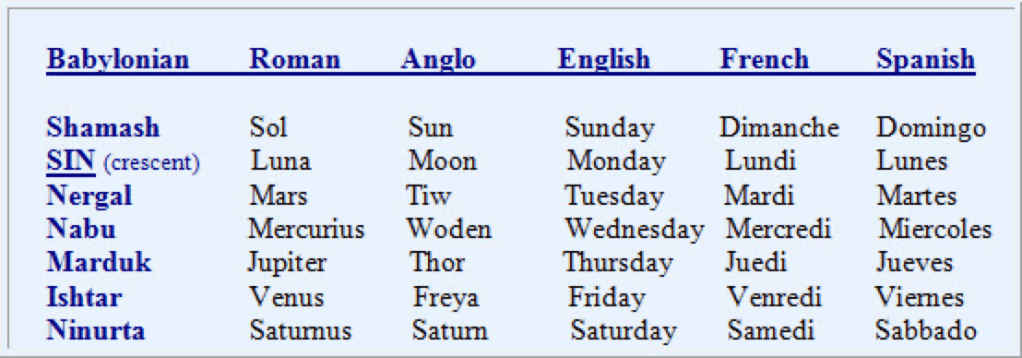
Creator’s Calendar: ‘Saturday, (or dies Saturni – the day of Saturn) was the very first day of the week, not the seventh. As the god of agriculture, he can be seen [below] in this preeminent position of importance, holding his symbol, a sickle.’

‘Next, on the second day of the pagan planetary week, is seen the sun god with rays of light emanating from his head. Sunday was originally the second day of the planetary week and was known as dies Solis. The third day of the week was dies Lunæ (day of the Moon – Monday). The moon goddess is shown wearing the horned crescent moon as a diadem on her head. The rest of the gods follow in order: dies Martis (day of Mars); dies Mercurii (day of Mercury); dies Jovis (day of Jupiter); and dies Veneris (day of Venus), the seventh day of the week.’
“The modern seven-day week came into use during the early imperial period, after the Julian calendar came into effect [in 45 BCE]… For a while it coexisted alongside the old 8-day nundinal cycle…. It was finally given official status by Constantine in 321” – Roman Calendar Encyclopaedia, Days of the Week.
French & Keyser: ‘The Roman eight-day week was known as internundinum tempus or “the period between ninth-day affairs.” (This term must be understood within the context of the ancient Roman mathematical practice of inclusive counting, whereby the first day of a cycle would also be counted as the last day of the preceding cycle.) The “ninth-day affair” around which this week revolved was the nundinæ, a periodic market day that was held regularly every eight days.’
It is a simple fact, easily established by history, that the Julian calendar in the time of Christ had an eight-day week, designated by the letters A through H. The fragment below is from an early Julian calendar called the Fasti Praenestini (Palestrina Calendar). Palestrina a city in Latium, central Italy and the word Fasti deriving from fas, meaning ‘that which is permitted’, or ‘that which is legitimate in the eyes of the gods.’ Fasti dies were the days on which business might be transacted without impiety.

To the left is a list of days spanning parts of two eight-day weeks: G, H, A, B, C, D, E, and F. The words to the right indicate what sort of business could be conducted on those particular days of the week.
French: ‘Julius Caesar’s conquest of Egypt in the 1st century BC introduced [the] planetary week to the Roman Empire, which still used the Etruscan eight-day week. After Christianity became the state religion, the Church integrated both cycles to produce our present week, used also by Jews and Moslems’ – Sarah Belle Dougherty, book review of The Seven Day Circle: The History and Meaning of the Week by Eviatar Zerubavel, University of Chicago Press, Chicago and London, 1989.
To this day, the updated planetary weekly cycle from Sunday to Saturday as ushered in by the Romans, remains completely divorced from the Lunar phases. This monumental change was driven by seeking to bring harmony between two opposing calendar weeks: Rome’s new seven day continuous weekly cycle and the Jewish lunar week of seven days. Roman Emperor Constantine through civil enactments, made ‘the venerable day of the Sun’ which day was then ‘notable for its veneration’ the weekly rest day of the empire.
This enforcement of the weekly observance of Sunday gave official recognition to a week of seven days and resulted in the official civil calendar of Rome adopting the same cycle, with Sunday as the first Day. Stunningly, the Roman calendar has remained until this day and in it, we still have the ancient planetary titles for the days of the week.
Constantine’s empire then had a perfect union for celebrating not only the ‘christian’ first day of the week Sunday and the Jewish seventh day of the week, the Saturday ‘Sabbath’ but also the newly established Roman holiday called Easter in 325 CE; in direct opposition to the Jewish Passover. All this was done according to the malicious whims of one man, the Emperor Constantine – born from the evil desires of his own heart.

Constantine the Great – Roman Emperor from 306 to 337 CE
Years were changed from beginning in the springtime to commencing in winter and with months, weeks and days, they commenced without reference to the phases of the Moon. Days were adjusted to begin at Midnight by the Romans – inherited from Egypt – and from sunset, practised by the Jews. No unit of time escaped this radical alteration ushered in by the Roman Beast – Daniel 7:7, Revelation 13:1. The aim to not just hide, but eliminate the Creator’s calendar. So that the observance of the New Moon, the true seventh day and the Holy Days were obliterated.
The Hidden God, Elaine Vornholt & Laura Lee Vornholt-Jones – emphasis mine:
‘The deeply buried secret of the Babylonian mysteries is that all worship on a counterfeit calendar is actually directed to the hidden god, Saturn… While the external parade of rites and ceremonies is primarily performed on Sunday, the hidden god at the root of it all remains Saturn.
The lord of Sunday is Solis Invicti (the invincible sun). The lord of Saturday is Saturn/Sheitan/Satan. The Lord of the Sabbath day is the Creator’ – Matthew 12:8. ‘To direct one’s worship to the correct deity, one must worship on that God’s/god’s day, calculated by His/his calendar. Laying aside work and observing a holy day of rest, is an act acknowledging allegiance to the divinity that lays claim to that day.
Do not be tempted to suppose that worship on Sunday is the lesser of the two evils. Worship on Saturday directs one’s worship to the hidden god, Saturn/Sheitan/Satan. However, the two worship days are inseparably bound. Worship on Sunday, the “first” day of the week, perpetuates the lie that Saturday, the “seventh” day of the week, must be the true Sabbath. All who worship by the pagan/papal calendar created, perpetrated and sustained by those very same Babylonian mysteries which assumed a Christian disguise in the 4th century C.E. are joining in the worship of Nimrod’ – refer Chapter XXI The Incredible Identity, Origin & Destiny of Nimrod. ‘In so doing, they are giving honor to the power that inspired him: Satan. Sunday-keeping Protestants and Saturday Sabbatarians have been unjustified in feeling morally superior to Roman Catholics.’
Kerrie French: ‘The Karaite Jews [biblical fundamentalists, distinct from the rabbinical traditions and laws of Judaism] from which the Seventh-day Adventist Church adopted their crescent New Moon for their 10-day count to Yom Kippur (Day of Atonement) of October 22, 1844′ and the erroneous prediction for Christ’s return – refer article: The Seven Churches: A Message for the Church of God in the Latter Days – ‘admit they don’t know when the true Seventh-day Sabbath occurs anymore: “Through all the trials and tribulations that humanity has experienced over the past 5,000 years, we have no proof whatsoever that our current Saturday is the actual seven-day “anniversary” of the original Shabbath of Creation”.’
This is a staggering, though never-the-less, truthful admission.
Beginning in 70 CE, the Jews were pressured by Rome to give up their calendar based on the scriptures. French & Keyser: ‘In 130, Hadrian [Roman Emperor from 117 to 138 CE] visited the ruins of Jerusalem left after the First Roman-Jewish War of 66-73. He promised to rebuild the city, but planning it as a pagan metropolis to be called Aelia Capitolina. A new pagan temple on the ruins of the Second Temple was to be dedicated to Jupiter. In addition, Hadrian abolished circumcision (brit milah), which he, as an avid Hellenist, viewed as mutilation. A Roman coin inscribed Aelia Capitolina was issued in 132. Hadrian’s policies triggered the massive Jewish uprising (132–135), led by Bar Kokhba and Akiba ben Joseph.
Following the outbreak of the revolt, Hadrian called his general Sextus Julius Severus from Britain, and troops were brought from as far as the Danube. Roman losses were very heavy, and it is believed that an entire legion, the XXII Deiotariana was destroyed. Roman losses were so heavy that Hadrian’s report to the Roman Senate omitted the customary salutation “I and the legions are well.” Hadrian’s army eventually defeated the revolt however. According to Cassius Dio, during the war 580,000 Jews were killed, 50 fortified towns and 985 villages razed.
After the end of the war, Hadrian continued the religious persecution of Jews, according to the Babylonian Talmud. He attempted to root out Judaism, which he saw as the cause of continuous rebellions, prohibited the Torah law, the Hebrew calendar and executed Judaic scholars. The sacred scroll was ceremoniously burned on the Temple Mount. At the former Temple sanctuary, he installed two statues, one of Jupiter, another of himself. In an attempt to erase any memory of Judea, he removed the name from the map and replaced it with Syria Palaestina, after the Philistines, the ancient enemies of the Jews. He re-established Jerusalem as the Roman pagan polis of Aelia Capitolina, and Jews were forbidden from entering it.
[A]… [lunar based] calendar was used by all the original disciples of [Christ]… [The] original Nazarene lunar-solar calendar was supplanted by a Roman “planetary week”… calendar in 135 C.E. – when the “Bishops of the Circumcision” were displaced from Jerusalem. [It] began a three hundred year controversy concerning the true calendar and… Sabbath: “This… controversy arose after the exodus of the bishops of the circumcision and has continued until our time” (Epiphanius, HE4, 6, 4).’
“Under the reign of Constantius [II, from 337 to 361 CE, the son of Constantine] the persecutions of the Jews reached such a height that… the computation of the calendar (was) forbidden under pain of severe punishment” – The Jewish Encyclopaedia, Calendar.
In 351 to 352 CE Roman persecution flared and though the Jews revolted, they were crushed. Jewish towns were destroyed and decrees were issued against the local authorities and Judaism. The privileges and freedoms of the Sanhedrin were curtailed. Sanhedrin Patriarch Hillel II, motivated by the relentless tide of Jewish persecution agreed to limit the functions of the Sanhedrin with respect to proclaiming the New Moon, setting festival dates and employing intercalation – the inserting of the 13th lunar month.
Hillel II, published details informing all Jews of the methods for a revised mathematically based calendar. Hillel II is given the credit for the present fixed Rabbinical calendar which harmonises with the Roman calendar for all time. The process of transforming the calendar was completed in 358 CE, when the Rabbinical Pharisees of the Sanhedrin, under the leadership of Hillel II adopted the measuring of a 24 hour day, from sunset to sunset.
“… [there was a] time of… transition from the reckoning of the day as beginning with morning to the reckoning of it as beginning with evening… in the earlier calendar and in the literature which records this, the day was reckoned from the morning, presumably from sunrise, while in the later calendar and the literature pertaining thereto the day was reckoned from the evening… Elsewhere we have presented quite a mass of evidence which establishes conclusively that the earlier practice in Israel during the Biblical period was to reckon the (24 hour) day from sunrise to sunrise… That in the earliest period of [the] Israelite sojourn in Palestine, under calendar 1, the day was reckoned from morning to morning is established by [an]… abundance of evidence…” – Supplementary Studies in the Calendars of Ancient Israel, pages 1-148, courtesy of Kerrie L French, SUNRISE or SUNSET When Does a Day Begin? 2015.
For example in Mark 16:1-2, ESV: ‘When the Sabbath was past, Mary Magdalene, Mary the mother of James, and Salome bought spices, so that they might go and anoint [Jesus]. 2 And very early on the first day of the week, when the sun had risen, they went to the tomb.’
The sun rising heralded a new day and in Psalm 113:3, ESV, the daylight portion of a day is described as lasting: ‘From the rising of the sun to its setting, the name of the Lord is to be praised!’
At the same time, the Jews sensationally embraced Rome’s seven day continuous weekly cycle which was adrift from the cycle of the Moon. To circumnavigate the chaos that would ensue from uniting the lunar months with the Roman weekly cycle and its Saturday masquerading as the seventh day Sabbath, the Jews of necessity had to devise the non-biblical Four Rules of Postponement – refer article: Chronology of Christ.
“Intercalations were determined at meetings of a special commission of the Sanhedrin. But Constantius, following the tyrannous precedents of Hadrian, prohibited the holding of such meetings… How difficult the fixing of the annual calendar consequently became may be judged from an enigmatic letter addressed to Raba… and preserved in the Talmud… Almost the whole Diaspora depended for the legal observance of the feasts and fasts upon the calendar sanctioned by the Judea Sanhedrin; yet danger threatened the participants in that sanction and the messengers who communicated their decisions to distant congregations… As the religious persecutions continued, Hillel II determined to provide an authorized calendar for all time to come, though by so doing he severed the ties which united the Jews of the Diaspora to their mother country and to the patriarchate” – I Singer & S Mendelsohn, Hillel II, Jewish Encyclopaedia.
Kerrie French: “It was a document of intervention and convention to bring harmony to the two calendar factions that could not otherwise be coordinated. Without these newly implemented self-made rules, the Roman seventh-day would cycle irresponsibly, falling on the lunar sacred days of the New Moon, Passover (Pasch), or Day of Atonement (Yom Kippur).”
This clandestine, historic universal decision led by Hillel II, was the last final act by the Sanhedrin. The Jews had swapped the scriptural lunar based Sabbaths for the popularised Roman continuous weekly cycle. Irrevocably causing the true Sabbaths to be no longer in synchronisation with the Lunar cycle and its monthly phases beginning with the New Moon.
“In the Diaspora the New Moon came to occupy a secondary position in contrast to the Sabbath; the prohibition against work and the carrying on of commerce was lifted, and the New Moon, although still celebrated by means of increased offerings, soon was reduced to the rank of a minor or half holiday. Its importance was confined to the fact that it remained of great value and necessity for the fixing of the festivals” – Universal Jewish Encyclopaedia, New Moon, Volume 8, page 171.
The Western world has been oblivious and ignorant of this massive assault on our calendar both by Rome and the Jews, yet the author of the letter to Titus counsels: “So rebuke them sharply so that they will be sound in the faith and free from doctrinal error, not paying attention to Jewish myths and the commandments and rules of men who turn their backs on the truth” – Titus 1:13-14, Amplified Bible. The truth is in the original Hebrew and Greek texts and exposes the falsehoods promulgated both by Christianity and Judaism.
The Creator clearly states the permanence of the Sun, stars and Moon as indicators of both day and night: “The Lord has made a promise to Israel. He promises it as the one who fixed the sun to give light by day and the moon and stars to give light by night…. The Lord affirms, “The descendants of Israel will not cease forever to be a nation in my sight. That could only happen if the fixed ordering of the heavenly lights were to cease to operate before me” – Jeremiah 31:35-36, New English Translation.
A technicality, though a pivotal one, is that a new day begins at dawn just prior to sunrise. The cessation of darkness at daybreak with the beginning of light from the Sun, divides the night from the day. Like wise following sunset, the end of dusk at nightfall, divides the day from the night. As the day must have the Sun shining, when it is completely gone it is then night time. The Sun and stars do not shine at the same time for the Sun rules the daytime and the stars rule the night.
“Alahim called the LIGHT DAY, and the darkness He called night. And then followed dusk, and then followed dawn, the first 24 hour division of time” – Genesis 1:5, The Creator’s Calendar Restored Text.
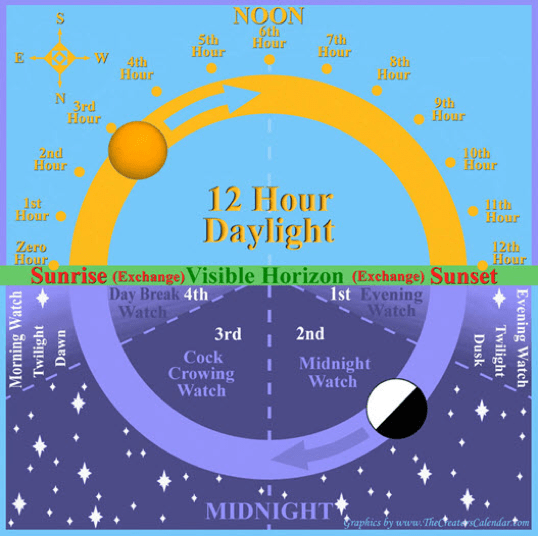
We learn in Genesis chapter one that darkness is an actual segment of time. It preceded or began Day One (or rather epoch) of the Re-creation week – refer Chapter XXII Alpha & Omega. As the very first day of the very first month in Earth’s history was dark; with no light preceding this day, then why should we expect the calculating of subsequent months to be any different?
Genesis 1:4, 16
English Standard Version
‘In the beginning… darkness was over the face of the deep… And God said, “Let there be light,” and there was light. And God saw that the light was good. And God separated the light from the darkness… God made the two great lights – the greater light to rule the day and the lesser light to rule the night – and the stars.’
“In the Hebrew mind the day began at the rising of the sun” – Vine’s Complete Expository Dictionary of Old and New Testament Words. “The sun alone indicated the hours for daily worship; at sunrise, when the day began, there was the morning sacrifice; at sunset, when the day closed, there was the evening sacrifice” – International Standard Bible Encyclopedia.
A progression began for changing the beginning of a day from sunrise to sunset as documented in historical records.
“Later (Orthodox) Jewish calendar: Following the reign of King Josiah (c. 640-609) and especially after the Babylonian exile a number of significant and enduring changes occurred in the Israelite calendar showing that the (Orthodox Pharisee) Jews gradually adopted the Babylonian calendar of the time… The day however, was counted from evening to evening, after the Babylonian fashion…” – New Catholic Encyclopaedia, Volume 11, page 1068.
“So far as we know, the Babylonian calendar was at all periods truly lunar… the month began with the evening when the new crescent was for the first time again visible shortly after sunset. Consequently, the Babylonian day… begins in the evening…” – The Exact Sciences in Antiquity, page 106.
“In certain spheres of the population the older system continued to be in use, either exclusively or side by side with the newer system. Thus in the temple service the older system continued all through the time of the existence of the second temple, and there the day was reckoned from morning to morning…” – Rabbinic Essays, Pages 447-451.
“The day was either the period of sunlight, contrasted with the night or the whole period of twenty four hours, although [not] defined as such in the Bible… In earlier traditions the day apparently began at sunrise (Leviticus 7:15-17, Judges 19:4-19)… Later its beginning was at sunset and its end at the following sunset… this system became normative… and is still observed in Jewish [Babylonian Talmudic] tradition, where for example, the shabbat begins… at sunset and ends… at sunset” – Oxford Companion to the Bible, page 744.
“In order to assure against profanation of the Sabbath the Jews added the late Friday afternoon hours to the Sabbath” – The Jewish Festivals: History and Observance, page 13. “If we look at the essentials of a day of rest and reflection, which has a religious orientation, it is possible to justify the shifting of the Sabbath worship to Friday evening (the celebration of which was moved back to the eve of the feast) as early as the Middle Ages…” – Judaism: Between Yesterday and Tomorrow, Kung, page 518.
“… ‘Remember the Sabbath day, to keep it holy’ by doing all one’s work in six days and by resting the seventh day ‘to the Lord your God.’ (Exodus 20:8)… It is thus important to note… that the method of observing the Sabbath from sunset to sunset is dictated not by the Fourth Commandment itself, but by the method of sunset reckoning, which became normative in (Rabbinical Pharisee) Jewish history” – The Time of the Crucifixion and the Resurrection, chapter 6.
The modern Roman calendar severs the Moon from measuring years, months, weeks and days. Its units of time cannot be synchronised to the calendar instructions contained in the Bible. In tandem, the Jewish calendar has been cumulatively changed by ‘Rabbinical Pharisee Jews’ between the first and the fourth centuries CE, so that all their original units of time measuring are obsolete. The changes to both the Roman and Jewish calendars means that months, weeks and days ‘float through that of [the] Creator’s standard time-measuring model.’ French: “As a result, neither Friday, Saturday, nor Sunday can be consistently synonymous with our Creator’s true seventh-day Sabbath, ever.”
French continues: “How does [all] the world wonder after the Beast? Is it a mere issue of keeping sacred the correct planetary day on the Roman calendar, such as Saturday vs. Sunday, as defined by Seventh-day Adventists? No, as that is impossible, for the very reason that both Saturday and Sunday are part of the same fictitious time-replacement system. A system proactively designed by the Romans to eliminate all things prophetically time-centric to the [Old Testament] Law. Then later the lie of the cycling week was adopted by the Jews to distance themselves far from the guilt and scrutiny… as the chief conspirators in the death of their own Messiah” – refer Chapter XXIX Esau: The Thirteenth Tribe.
We have ascertained that the seventh day of the Roman calendar called Saturday, is not the true Sabbath day. Let’s look further into the evolution of the calendar and the computation of the Sabbath from the cycle of the Moon, as addressed in the scriptures.
“Sabbath and New Moon, both periodically recur in the course of the year. The New Moon is still, and the Sabbath originally was, dependent upon the lunar cycle… Originally the New Moon was celebrated in the same way as the Sabbath” – Universal Jewish Encyclopedia, Holidays, Volume 5, page 410.
French: “The Roman Gregorian calendar is based upon the principles of time-measuring that utilizes the imaginary Solar-Line as viewed from earth at noon, through the sun, and marks the ruling constellation of the Zodiac that is not even visible. This system begins in winter instead of spring and declares Sagittarius as the first constellation of the year, although not visible in the night sky at this time of year. It only enters the visible sky on the eastern horizon in mid-summer. This view of the Gregorian Solar-Line Time does not fit the Scriptural model…”
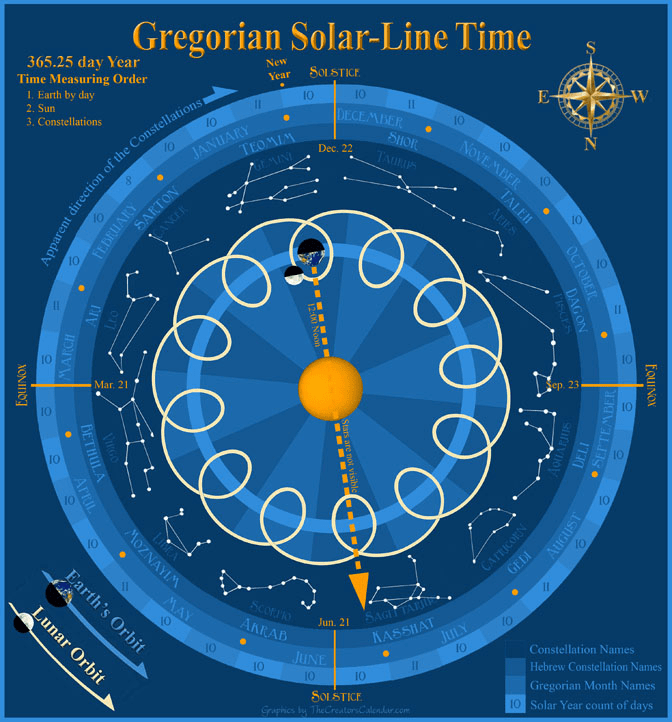
The Enoch solar calendar with its reciprocal ‘Solar-Line Time’ independent of the moon, is also based upon a 365.25 solar year, devoid of a connection to the lunar phases. Though in contradistinction to the Gregorian calendar, the Enoch calendar interpretation focuses on the Sun and the vernal equinox with consecutive 30 day months. Each quarter of the year has one day added to bring its total to 91 days; with an additional day added on the last day of the year, to make a total of 365 days for the year.
French claims that by removing the Moon as a ‘beacon of time’ the Romans followed in the footsteps of the Egyptians, in using only the Sun as the backdrop of the constellations, thereby allowing weeks to cycle without end or any anchor to the months and years. The Moon had until this point been used to designate days, weeks and months. ‘Then [the Romans with the Jews] sold this to the entire world as having existed since the dawn of creation. The world bought into this lie because the scriptures appeared to support this view. Ironically, the Romans together with the Jews had their hands on the sacred manuscripts. It indeed appears that some things relating to time have been changed in both the oldest manuscripts as well as the translations.’
Isaiah 66:22-23
English Standard Version
“For as the new heavens and the new earth that I make shall remain before me, says the Lord, so shall your offspring and your name remain” – Revelation 21:1. “From [H1767 – day: ‘enough, sufficient, according to the abundance of, as often as’] new moon to new moon [H2320 – chodesh: new moon], and from Sabbath to Sabbath, all flesh shall come to worship before me, declares the Lord.”
This verse in the book of Isaiah reveals that the New Moon and the Sabbath were eternally entwined in the past and will be again until the future new Earth – Article: The Sabbath Secrecy. The Hebrew word for Moon means a ‘new moon, [a new] month’ and ‘monthly.’ Chodesh derives from H2318, chadash which means: ‘renew, repair’ with the implication of ‘to be new, make anew, to renew oneself, to rebuild.’
This definition it would seem, describes a waxing Moon growing bigger from either a dark Moon conjunction or the first visible crescent. We also learn from the Prophet Isaiah that the New Moon was a day of worship akin to the Sabbath. This is corroborated by both Ezekiel and the author of the letter to the Colossians – Colossians 2:16.
Ezekiel 46:1, 3
English Standard Version
“Thus says the Lord God: The gate of the inner court that faces east shall be shut on the six working days, but on the Sabbath day it shall be opened, and on the day of the new moon it shall be opened… The people of the land shall bow down at the entrance of that gate before the Lord on the Sabbaths and on the new moons.”
“And then the Moon, ever punctual to mark the times, an everlasting sign: It is the Moon that signals the Feasts, a luminary that wanes after being full. The month derives its name from hers. She waxes wonderfully in her phases, a banner of the hosts on high, shining in the vault of heaven” – Ecclesiasticus 43:6-8.
We shall return to the Sabbath and its relationship with the New Moon in regard to its counting cycle and when it was to be observed. Firstly, what is a New Moon? Historically, there have been two ways to calculate a New Moon – yet there is a third way as supported by Kerrie French and others – with the claim that it is actually the first and original way of beginning a new Lunar month and has been intentionally lost, buried in history.
This article will investigate the three principle ways of calculating a New Moon, with the goal of understanding which method is correct from a biblical and historical perspective. This will be no mean feat, for there is considerable confusion and disagreement on the subject. Beginning with the most radical and least supported method: the proposal that the New Moon is actually when the Moon is full on the usually accepted 15th day of its 29/30 day cycle. Thus according to this premise, the Full Moon is the new Moon and actually day one of a new Lunar monthly cycle.
An issue with reckoning the New Moon Day by the Full Moon is that the subsequent phases of the moon are inconsistent and unpredictable, negating the moon of its ordained role as a beacon and a ruling celestial body of the night – Genesis 1:16.
Making reliable identification of days by the moon’s appearance becomes very difficult, if not impossible; for the moon can appear full for more than one day each month. This would make consistent reckoning by observation problematic. Also, as we shall discover when using the Full Moon as the new Moon, there will be one or two dark days in the middle of the month and so the quarter phases of the moon would not have reliably announced the weekly Sabbaths.
Recall that the word chodesh for the New Moon derives from chadash. A clear contradiction exists when using the Full Moon as the New Moon, in that the Moon from day one is tearing down as in losing light and not being ‘renewed or rebuilt.’ Immediately after the moon begins to be full, it starts to surrender light. Meaning that between the evening when the New Moon is declared and the day after it is recognised as the official New Moon Day, the moon will have already lost light. It will continue to lose light as it wanes until the middle of the month, after which it will again begin to rebuild. This definition of a New Moon as the Full Moon unfortunately defies all logic and is not a pure or honest definition of the meaning of the Hebrew words chodesh and chadash. For this reason, it rules itself out from being a viable method for calculating the New Moon.
A vital defining verse is found in the Book of Psalms.
Psalm 81:3
New English Translation
‘Sound the ram’s horn on the day of the new moon [H2320 – chodesh], and on the day of the full moon [H3677 – kese: fulness (Proverbs 7:20)] when our festival [Unleavened Bread on the 15th Abib and the Feast of Tabernacles on the 15th Tishri] begins [H2282 – hag: pilgrim-feast].’
If we allow the Bible to interpret itself, we learn that the New Moon and the Full Moon which heralds the two major festivals of worship in the year are two separate, distinct Moons. One begins the 1st day of each month and the other, the Full Moon on the 15th day of the Lunar month, signifies the first days of both Unleavened Bread in the first month of Abib (or Nisan) and the first day of the Feast of Tabernacles in the seventh month of Tishri.
The Hebrew word used for the festivals connotes a pilgrimage or trek in travelling to the destination where the Feast is being kept. The Eternal coordinated the timing of travel to attend these required feasts when there would be light from the Full Moon on the days immediately preceding the 15th day of the Lunar month. It obviously was not intended for the Israelites to travel in total darkness or in the cold, for neither are the festivals or Holy Days during the Winter Season. When the Moon is full, it is the only visible lunar phase which appears exactly the same for both the northern and southern hemispheres within the same 24 hour period.
We have discussed the darkening of the sky when the Messiah died – refer article: Chronology of Christ. This occurred from Noon until three o’clock when Jesus took his last breath – Matthew 27:45. The argument rests on this occurrence having to be a total solar eclipse and for this to occur, the Moon had to be in dark conjunction and ergo, the Moon was not a Full Moon. According to WLC website, this answer is an impossibility: “In fact, Jerusalem was not in the path of totality at any time during the first century. Another crushing blow to this supposition is that solar eclipses generally only last about 7 to 8 minutes, not for 3 hours. “The longest total solar eclipse during the 8,000 year period from 3000 BC to 5000 AD will occur on July 16, 2186, when totality will last 7 [minutes and] 29 [seconds].”
The darkness which fell over the land at the time of the Crucifixion was a miracle, a supernatural intervention; whether it culminated in a naturally occurring phenomenon or not. “Claiming that there was a total solar eclipse, lasting three hours, at the time of [Christ’s] crucifixion is outrageous and cannot be substantiated by even one piece of evidence.”
The second and most widely accepted method of reckoning the New Moon is by sighting the first visible crescent Moon after the dark conjunction. For this method of calculation, much stock is placed in the Jewish Babylonian Talmud. Yet the information contained therein is questionable and not a reliable source. Particularly, when we consider the unbiblical practice adopted after the first century for a Saturday Sabbath beginning at sunset.
WLC: “While many historians, encyclopedias, and Bible dictionaries testify that the Biblical month began with the first visible crescent, none offer any real evidence to support their claims. It seems likely that they are relying largely on tradition, as the authors of the Universal Jewish Encyclopedia readily admit.”
“Little is known of the procedure of determining the calendar up to the 2nd century C.E., when a description is given of the traditional practice, it ran as follows: On the thirtieth day of the month a council would meet to receive the testimony of witnesses that they had seen the new moon. If two trustworthy witnesses had made deposition to that effect on that day, the council proclaimed a new month to begin on that day… If no witnesses appeared, however, the new moon was considered as beginning on the day following the thirtieth” – Universal Jewish Encyclopedia, page 632.
A disadvantage in using the first visible crescent of the Moon is that it is impossible to have the Feasts begin during the same twenty-four hour period around the world; nor is it consistent with the principles which govern the scriptural parameters of a day. The Hebrew word chodesh for new Moon ‘is used in Scripture more than 270 times, yet it is not used even once to denote something (i.e. the visible moon, the crescent [Moon]).’ Whereas the ‘Hebrew word for crescent [H7720], saharonim, is used exclusively [three times in the Old Testament] in connection to idolatry’ according to WLC.
In the Bible, jewellery fashioned after the Crescent Moon as worshipped by the heathen nations is condemned; for it represented the goddess Ishtar, a symbol of fertility and also of a chief Babylonian god, Sin: Genesis 35:4, Judges 8:21-26, Isaiah 3:18-23 – Chapter XXII Alpha & Omega; and article: Lilith.
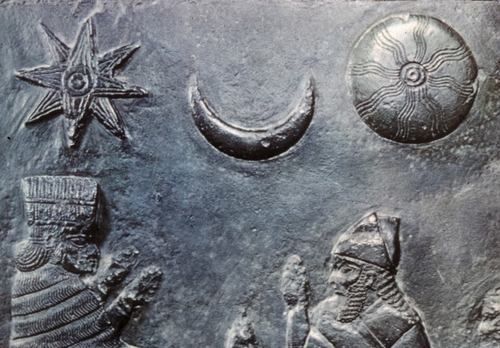
Ishtar and her eight-pointed Star, with the Moon god Sin and the Sun god Shamash – relief from ancient Mesopotamia
“The Crescent was a favourite amulet among many peoples of Western Asia, and it represented to them the strength and protection of the waxing and not the waning moon” – Amulets and Superstitions, E A Wallis Budge, page 213.
WLC: “Sin worship was also prevalent in Arabia in the days of Muhammad. Consequently, Islam venerates the crescent to this day. Many religions with Babylonian roots venerate the crescent (i.e. Roman Catholicism, Hinduism, Buddhism, etc.).” In the Book of Jeremiah, mention is made of cakes baked for the worship of the Queen of Heaven – Jeremiah 44:18-19. Various commentaries state that these cakes were crescent shaped to represent the Moon.

A Roman Crescent Moon amulet made from silver
As the Hebrew word saharonim is not associated with the New Moon or month, similarly, the Hebrew word yerach [H3391, H3393, H3394] is never used to signify a New Moon. It is used for an observable Moon that is either waxing to a Full Moon, is a Full Moon or waning after one. The word is translated as the moon 28 times and 13 times as a month.
Psalm 104:19
English Standard Version
‘He made the moon [H3394 – yareach: Moon] to mark the seasons [H4150 – Moed, Mowadim: appointed time, place, meeting]; the sun knows its time for setting [H3996 – mabow’: sunset, entrance, entering, a coming in].’
An informative article includes an enlightening and revealing passage regarding the biblical distinction between the New Moon and the Full Moon.
Kings David and Solomon Chronological, Historical and Archaeological Evidence, Gerard Gertoux, 2015 – emphasis & bold mine:
“… the accurate dating in 1 Kings 6:37-38 proves that the report writer was an eyewitness because thanks to the development of calendar systems used in Palestine it is possible to date some biblical events. At the early 2nd millennium BCE there were only two major systems of dating: 1) the Mesopotamian calendar of Babylonian origin based on a lunar cycle beginning at the 1st moon crescent with the 12 months named and 2) the Egyptian civil calendar with 12 anonymous months of 30 days alongside a lunar calendar starting at the full moon.”
Both these methods rely on beginning the new month on false interpretations of a New Moon; neither of which are supported scripturally.
Gertoux: “The absence of a temple with its priesthood forced the Israelites to use calendars where they were staying. It is thus possible to date their wanderings through various calendars they used (according to the biblical text, the Israelites stayed in Egypt for 215 years from 1748 to 1533 [rather 240 years from 1687 to 1446 BCE] and in Canaan after that date. The first temple was completed in 997 BCE [rather 959 BCE] and destroyed in 587 BCE. The Israelites deported into Babylon for 50 years returned to build the temple which was functional from 517 BCE and calendar months have been translated through their Babylonian equivalent).
[The] Babylonian calendar was gradually established in the whole western Orient. The city of Alalakh, for example, adopted it about 1500 BCE. This calendar was also used in Palestine but the name of the months [were] Canaanite at that time… The Canaanite calendar was used in Phoenicia up to the 6 century BCE . After the fall of Babylon, Jews of Judea adopted the Babylonian calendar, however their former religious calendar with its anonymous months was always favoured. The names of Babylonian months were used to reflect the rank of Jewish months: In the 4th year of King Darius, the word of Yahweh was addressed to Zechariah on the 4th [day] of the 9th month, in Kislev (Zechariah 7:1). This system of Babylonian origin used the names of Aramaic months…
The biblical text uses the two words yeraḥ and hodeš to designate lunar months. The word hodeš, used to designate the new moon, comes from hadaš “new” (as in the name Carthage, Kart-hadešt “new city”) and means “renewal“, hence its meaning “new [moon]”. The word yeraḥ “month” comes from the word yeraḥ “moon” and can be translated as “lunation“. The word “full moon” (Proverbs 7:20) is kese or lebanah “the white one” (Isaiah 30:26).”
Isaiah 30:26
English Standard Version
‘Moreover, the light [H216 – ‘owr: illumination, lighting from H215: shine, luminous, to become lighted up] of the moon [H3842 – Ibanah: white from H3835 – laban: to be white, to make white, to become white] will be as the light of the sun [H2535 – Chammah: heat from 2525: hot, warm], and the light of the sun will be sevenfold, as the light of seven days…’
Gertoux: “Both words hodeš and yeraḥ used in the sense of “months” are not synonymous since Canaanite inscriptions have been found with the words hodeš yeraḥ ethanim which can be translated as: new lunation of Ethanim [seventh month (Tishri)] (1 King 8:2). If the two words were synonymous the translation would be: month of month of Ethanim! This semantic nuance is important because in a lunar calendar beginning on the new moon, the two words “new [moon]” and “lunation” to designate a month may agree, but in a calendar starting at the full moon, lunation is the only appropriate word.”
This is telling in that the New Moon and Full Moon are two different moons and damming for those who teach that the New Moon and Full Moon are one and the same.
Gertoux: “Archaeology shows that the Jews of Judea used only the word hodeš “new [moon]” to designate month, whereas that the Jews of Egypt used only the word yeraḥ “lunation”. We read, for example, on the ostracon of Arad n°7 (c. -600): to the 10th [month], the 1st of the month to the 6th of the month. Upon entering Canaan, the Israelites used the Canaanite calendar, the 1st (anonymous) month of their calendar becoming Abib. The Canaanites used the word yeraḥ referring to “month”, that could be ambiguous for the Israelites because this term designated also a “month” starting at the full moon as in Egypt (the Jews of Elephantine have continued using yeraḥ). The term hodeš “month” starting at the 1st moon crescent (as in Syria) was prevailing in Palestine from 1000 BCE.”
It is safe to say, that during the reign of King David from 1010 to 970 BCE, the calendar being used was based on the New Moon hodes as the first day of the new month and not yerah, the Full Moon.
Gertoux: “Placing months according to chronology, we obtain the following changes in biblical calendars: Archaeology has confirmed this chronological sequence since the word yerah appears for the last time in the Gezer calendar dated around 950 BCE [during the reign of King Solomon from 970 to 930 BCE] and the name of Canaanite months disappeared in Palestine at that time.
The “Canaanite” dating in 1 Kings 6:1 is therefore in full agreement with the construction of the temple in the early 10th century BCE [from 966 to 959 BCE]. If the scribe who wrote the Book of Kings had done it from an oral tradition after the Babylonian exile he would have used Babylonian months instead of Canaanite months. In addition the word yeraḥ was used at this time by the Jews in Egypt instead of hodeš in Judea. If the Pentateuch was written about 900 BCE instead of 1500 BCE (as most German biblical scholars teach), the scribes of that time would not have used the word yeraḥ.”
1 Kings 6:37-38
English Standard Version
‘In the fourth year [of Solomon’s reign in 966 BCE] the foundation of the house of the Lord was laid, in the month [H3391 – yerach: Full Moon] of Ziv [Iyar, 2nd month April/May]. And in the eleventh year [959 BCE], in the month [H3391 – yerach] of Bul [Chesvan, October/November] which is the eighth month [H2320 – chodesh: New Moon], the house was finished in all its parts, and according to all its specifications. He was seven years in building it.’
The third and final method for calculating a New Moon is from the conjunction, when the Moon is entirely dark between the end and beginning of a new Lunar month. Unfortunately this is not as straight forward as it would seem, for the Bible does not expressly state a method, which leaves it open for numerous interpretations of when a New Moon begins after its conjunction.
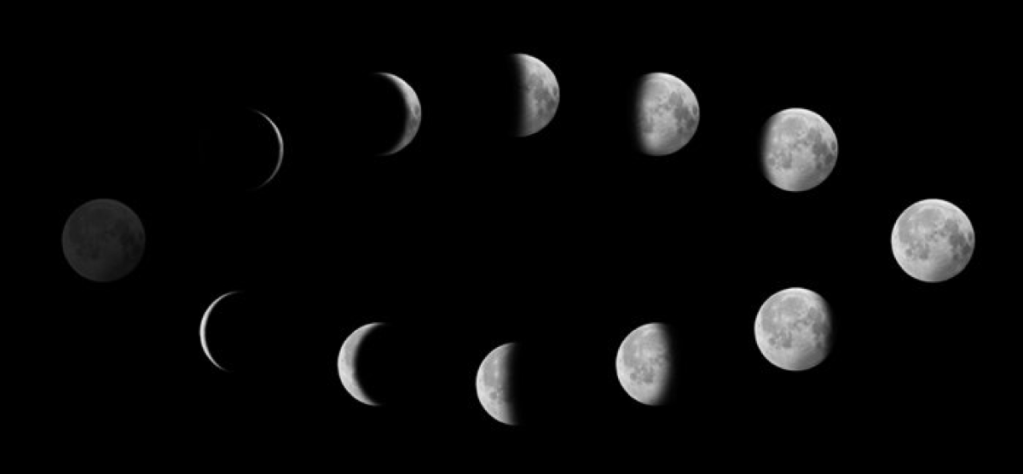
One option includes advocating the day of conjunction as the New Moon day and thus the first day of the month. The main issue with this method is that the New Moon occurs before the last month has finished. That is, on the same day as the last day of the previous month. As the Moon entering conjunction with the Sun and being completely dark is logically the end of its monthly lunar phase, it follows that the next day as it begins a new revolution to become illuminated is its first, new monthly cycle. Taking place after dawn at sunrise.
A second option proposed is to use the day after the conjunction, though only if the first visible crescent is sighted that same evening. Thus the visible crescent would herald a work day following after a Sabbath occurring on the 29th* of the month. The exception would be if the visible first crescent Moon was not seen that evening and so that that day would become the 30th and the following day would be the 1st day and New Moon. At first sight – pun not intended – this appears a reasonable method. According to WLC there are two key issues to be aware when using this method to calculate the New Moon.
“Using this method, it is impossible to consistently unite the world in beginning the Feasts in the same 24-hour period. Only by reckoning the day after conjunction as New Moon Day can everyone on Earth be united in observing the New Moons, Sabbaths, and annual Feasts. Those who adhere to this method cannot know for certain if it is New Moon Day until the day is almost over because they must wait to see if the crescent moon will be visible that evening after sunset.
This is clearly a problem, especially when considering the Feast of Trumpets (which coincides with New Moon Day in the Seventh Month), and the tremendous importance of offering the prescribed sacrifices precisely on New Moon Day, at the beginning of each month (Numbers 28:11-15). The priests surely knew when New Moon Day came. They did not have to wait until the day was almost over to find out if they had offered sacrifices on the correct day. A signal that is retroactive is not truly a signal.”
A further option advocated by some, is to measure from the first sunset after the conjunction. This is done by those who subscribe to a day beginning at sunset, though this is not supported scripturally and is a tradition stemming from Babylon.
Yet another method of calculation is to choose the day after the waning crescent Moon can no longer be seen before sunrise. It is based on the premise that the disappearance of the moon indicates that the conjunction will take place later that day, thus making the following day the New Moon Day. WLC elaborates: “Conjunction day is the day the sun rises without the moon being seen first. The following day would then be New Moon Day, as it would be the first new day after Conjunction. If the waning crescent can be seen on the morning of the last Sabbath (the 29th day of the lunar month), then it will be a 30-day month. If the waning crescent cannot be seen on the morning of the last Sabbath, it will be a 29-day month… this method… is not reliable and cannot be used to consistently and accurately identify the day of Conjunction… [for by] using the proposed method… [the] New Moon Day [can sometimes] be declared one day late.”
The final method and overall most viable in calculating the New Moon, is based on the fact that the moon begins to illuminate immediately after the conjunction. Though it cannot be seen – until the sun sets as the moon is obscured by the greater light of the sun – it has undeniably begun a new revolution or cycle of illumination. The first day at sunrise after the conjunction takes place is the most plausible beginning of the new month. A compelling reason in support of this method is that the Eternal’s command to observe His Holy days at their appointed times could not be truly obeyed except through using the first sunrise (the beginning of a day) after the conjunction.
It means for instance, that a weekly Sabbath could be kept by the whole world on a specified day and not over several days. Using this method uniquely unites the entire globe at the same time on one twenty-four hour solar revolution. As an example, using the first visible crescent for reckoning the New Moon does not consistently unite the world in beginning Feasts, Holy Days, Sabbaths and New Moons in the same twenty-four hour day. WLC aptly state: “Scripture commands us to observe the Sabbath, not a Sabbath. Does it then make sense that there would be multiple Sabbaths in the same week? Does it make sense for different locals to celebrate the Sabbath 48 hours apart? Only by reckoning the day after conjunction as New Moon Day can everyone on Earth consistently observe one Sabbath Day.”
In essence, a unique dateline is established each month, rather similar to the International Dateline devised in 1884 by the International Meridian Conference in Washington DC. Only this dateline is a revolving dateline as opposed to a stationery one and is the real dateline if mankind were still to be using the Lunar-Solar calendar of antiquity. In testimony of its scriptural foundation, no one would begin a New Moon Day more than twenty-four hours after the actual conjunction. Everyone around the Earth would experience their New Moon within the same day period, with the last geographic region on Earth to begin their New Moon within twenty-four hours of the first.

WLC: “This is an ideal representation of the Lunar Month when reckoning by the first visible crescent and the Dawn after Conjunction. Because the Moon can achieve the perfect Quarter, Full, and Conjunction phases at any time during a 24-hour period, and since most (if not all) programs/calendars use a midnight to midnight reckoning of a date, you will sometimes see the perfect phases shown a day earlier or a day later, making them not always line up exactly. When reckoning by the first visible crescent, there is actually more variance (from month to month) than what is shown in the depiction above because there are several variables involved in determining the earliest visibility of the moon. The Dawn [sunrise] after Conjunction method establishes a much more consistent pattern of phases.”
Ezekiel Chapter forty-six, verse one, establishes three different types of days, with New Moon days, Sabbath days and Work days. These are delineated in nature and are recognisable when logically reckoning the sunrise after conjunction as the commencement of the New Moon. The New Moon is preceded by darkness during the conjunction; Work days are preceded by the illuminated phases of the Moon; and the Sabbath Days are preceded by the quarter phases. Using this method allows for consistently identifying the Sabbaths by the moon’s appearance more easily and practically – as shown in the chart above. The crescent moon will often be visible to the naked eye on the New Moon Day during the evening before the first day of the work week, but not always.
Historical support for using the day after the conjunction as the New Moon day is provided by WLC – emphasis mine.
‘A record of the Christian transition to [a] pagan [calendar] has been preserved in… One of the oldest dated Christian sepulchral inscriptions… discovered in Rome [referring] to dies Veneris (day of Venus) [Friday]. What sets this particular inscription apart is that it lists both the Julian date and the luni-solar date. Dated A.D. 269, it states:
“In the consulship of Claudius and Paternus, on the Nones of November, on the day of Venus, and on the 24th day of the lunar month, Leuces placed (this memorial) to her very dear daughter Severa, and to Thy Holy Spirit. She died (at the age) of 55 years, and 11 months (and) 10 days. (E Dichl, Inscriptiones Latinæ Christianæ Veteres, Volume 2, page 193, #3391. See also, J B de Rossi, Inscriptiones Christianæ Urbis Romæ, Volume 1, part 1, page 18, #11).”
‘The “Nones” of November is November 5 which fell that year on the day of Venus, Friday. In that lunation, this corresponded with the 24th day of the lunar month, or “Second Day” on the Biblical week. Examining the dates here with astronomy software, we find that New Moon Day (the first day of the lunar month) was reckoned as the day after conjunction.’
Further historical weight is lent by a contemporary of the Messiah, the Jewish philosopher, Philo of Alexandria (circa 20 BCE to 50 CE). It would be remarkable if he was not aware of: a. the calendrical calculation of the New Moon, Sabbath and Feast Days; and b. if there were rival methods or not. Philo does discuss the calendar, placing emphasis on when the Sun illuminates the Moon, as the beginning of a new month. He confirms that the first day of the New Moon follows the conjunction, with a month being reckoned from conjunction to conjunction. Philo also acknowledges the logical clear configurations of the Moon’s waxing half at the end of the first week and waning half at the end of the third week, as achieved by a conjunction New Moon as opposed to a visible crescent Moon calculation.
“Following the order which we have adopted, we proceed to speak of the third festival, that of the new moon. First of all, because it is the beginning of the month, and the beginning, whether of number or of time, is honorable. Secondly, because at this time there is nothing in the whole of heaven destitute of light. Thirdly, because at that period the more powerful and important body gives a portion of necessary assistance to the less important and weaker body; for, at the time of the new moon, the sun begins to illuminate the moon with a light which is visible to the outward senses, and then she displays her own beauty to the beholders…” – Philo, Special Laws II, Section XXVI (140-142), emphasis mine.
“The third (festival) is that which comes after the conjunction, which happens on the day of the new moon in each month” – Philo, Special Laws II, Section XI (41).
“This is the New Moon, or beginning of the lunar month, namely the period between one conjunction and the next, the length of which has been accurately calculated in the astronomical schools” – Philo, Special Laws II, Section XXVI (140).
“Again, the periodical changes of the moon, take place according to the number seven… And the changes which the moon works in the air, it perfects chiefly in accordance with its own configurations on each seventh day… all mortal things… drawing their more divine nature from the heaven, are moved in a manner which tends to their preservation in accordance with this number seven… Accordingly, on the seventh day, Elohim caused to rest from all his works which he had made” – Philo, Allegorical Interpretation, 1, Section IV (8-9), Section VI (16).
“…there is one principle of reason by which the moon waxes and wanes in equal intervals, both as it increases and diminishes in illumination… because it receives the perfect shapes in periods of seven days – the half-moon in the first seven day period after its conjunction with the sun, full moon in the second; and when it makes its return again, the first is to half-moon, then it ceases at its conjunction with the sun” – Philo, Special Laws I, (178).
“And this feast is begun on the fifteenth day of the month, in the middle of the month, on the day on which the moon is full of light, in consequence on the providence of Elohim taking care that there shall be no darkness on that day” – Philo, Special Laws II, The Fifth Festival, Section XXVIII (155).

WLC: “You will need to check the time of Conjunction for your specific area. Note: When reckoning the day after conjunction as New Moon Day, the moon will [become] full on the 14th or 15th of the month.”
By following the correct cycle of the Moon as the only arbitrator of when a seven day Sabbath falls as per scripture, then the weekly Sabbaths will continuously fall upon the 8th, 15th, 22nd, and 29th* days of each lunar month – regardless of whether it is a twenty-nine or thirty day month.

Every seventh day Sabbath identified in Scripture is consistently counted from the New Moon, falling upon these preordained days. No other verses define the Sabbath as falling on any dates other than the 8th, 15th, 22nd and 29th of each lunar cycle month – refer: Exodus 16:1, 23; 19:1; 40:2, 17, Leviticus 8:33-35; 9:1; 14:9-10; 23:11, 15-16, Numbers 33:3, Joshua 5:10-12, 2 Chronicles 7:8-10; 29:17, Esther 9:1, 15, 17-19, Luke 1:59; 2:21, John 5:1, 9-10; 7:22-23; 19:31, Acts 7:8.
Creator’s Calendar: ‘… which day was [the] Sabbath in the battle of Jericho? The battle took place over a seven day time period. Therefore, one of those days had to be a Sabbath or was it? Although it is not contained in the King James Version Bible, the book of Jasher has a very clear historical answer.
It is recorded in Jasher 88:14, 17 “And it was in the second month, on the first day of the month, that YHVH said to Joshua, Rise up, behold I have given Jericho into thy hand with all the people thereof; and all your fighting men shall go round the city, once each day, thus shall you do for six days. And on the seventh day they went round the city seven times, and the priests blew upon trumpets.”
Here we have a clear answer that the battle began on the first day of the month, New Moon day. It ended upon the seventh day of the month. This makes the following day, the eighth day, the Sabbath. This cannot be answered on a Roman Gregorian calendar.’
It takes 27 days, 7 hours, and 43 minutes for the Moon to complete one full orbit around Earth. This is called the sidereal month and is measured by our Moon’s position relative to distant fixed stars. However, it takes the Moon on average 29 days, 12 hours, 44 minutes and 3 seconds or 29.530588 days to complete one cycle of phases – from new Moon to new Moon. This is called the synodic month. The difference between the sidereal and synodic months occurs as the Moon moves around Earth, for the Earth also moves around the Sun. The Moon must travel a little farther in its path to make up for the added distance and complete the phase cycle.
Recall, the Enoch (solar) Calendar is based on months of thirty days, as was the Egyptian calendar, where they added five days to align with a 365 day solar year. There is biblical precedent for a thirty day month and a 360 day year. In the book of Genesis during the Flood we learn that the months were thirty days long – Genesis 7:11, 24; 8:3-5. In the antediluvian age, a year was 360 days and perhaps it has been as a consequence of the flood cataclysm that the Moon no longer orbits the Earth in 28 days or that its cycle of phases is not complete in exactly 30 days.
But with that said, it was during the life of King Hezekiah who ruled the Kingdom of Judah from 720 BCE to 691 BCE, when a miraculous event took place – 2 Kings 20:1-11. Hezekiah prayed earnestly to the Eternal for mercy when gravely ill and near death. The Almighty answered his prayer with an extension of fifteen years on his life, though not before Hezekiah asked for a sign of God’s promise. The Eternal then caused the shadow of the Sun as shown on a sundial (the steps of Ahaz), to go ten degrees backward.
An online comment states before mechanical clocks, sundials encompassed 360 degrees with each hour equivalent to 30 degrees. So that ten degrees represented a time shift of approximately 20 minutes. “This extraordinary occurrence highlights the power and sovereignty of God over time and the natural order. Based on this understanding of time and its significance, we can explore an intriguing notion. If we calculate 360 degrees multiplied by 20 minutes and then [divide] by 60 minutes per hour and 24 hours per day, we get 5 days. This is why we have 365 days in our modern calendar. It appears that God, in His divine wisdom, accounted for this time discrepancy to align the natural world with the cycles He ordained.”
While they are correct that the dial face is segmented into 360 degrees, the gnomon – the part that stands up off the face of the sundial – actually marks hour lines at 15 degree intervals. That said, they are correct in the addition of five days to the calendar.

“Looking ahead to the words of Jesus in Matthew, where He spoke of the end days being like the days of Noah, we may contemplate the potential return to a 360-day calendar” – Matthew 24:37. “Just as the days of Noah were marked by unique events and divine intervention, the end days could witness a similar transformation of time.”
This is an astute observation, as it is consistent with the promise for the restoration of all things in Acts 3:21. The Book of Revelation reveals a time frame for the Eternal’s two witnesses to prophesy in His name for 42 months or three and a half years – Revelation 11:2-3. It then measures the same period as 1,260 days. This equals 42 months of 30 days duration.
As an aside, the numeric relevance of the number “forty-two”, has interesting permutations. These are discussed in the articles: 42; The Truly Big Questions; Thoth; and The Pyramid Perplexity.
Even more interesting is the fact that a mathematical formula proves a 30 day month was once a reality. Lost Age Secrets: “Within ancient Egyptian astronomy, there exist complex mythological stories suggesting that in a far distant era, the Earth possessed an ideal 360 day year. And that also the Moon possessed an exacting 30 day Synodic month. Such cosmic harmony was however broken at some point, leading to a great reconfiguration. Concerning the Earth year specifically, the ancient Egyptians developed a mythological tale to account for an increase of five extra days: each new day being the birth of a new god (Osiris, Isis, Seth, Nephthys, Horus the Elder).
Now what is intriguing about ancient Egyptian astronomy is that they wilfully ’embedded’ the ideal period of 360 days per year into the actual observed year of just under 365.25 days. The first 360 days were thought to constitute the ‘true year’. The additional time that followed of about 5.25 days was held to be ‘outside’ of the real Earth year, being referred to as ‘The Days Upon the Year’. Indeed, this extra time period was considered to be a dangerous time, as it was also referred to by the ancient Egyptians as ‘The Days of the Demons’.
In order to prove the Earth once had 360 days per year at a time when the Moon simultaneously had a 30 day month, something very special is required. The principle or law would have to be mathematical in its expression. And one would expect it also to be simple and elegant. Now such a principle does indeed exist, and it is very much in line with a certain well accepted astronomical law today: The Harmonic Law of Johannes Kepler.
During his lifetime Johannes Kepler (1571 – 1630 AD) discovered a simple mathematical connection between the time taken for a planet to orbit the Sun (Orbital Period) and the mean distance of the planet from the Sun (known as the Semi-Major Axis).
To an exceptional level of precision it is clearly confirmed that when the Earth had a 360 day year the Moon simultaneously had a 30 day month. Now the relationship as described is an inverse one. When the Earth suffers an increase in its orbital period, the moon suffers a decrease in its own.”
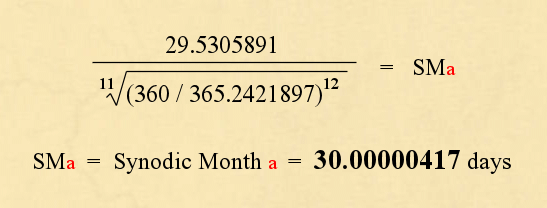
“Now it is important to stress that the mathematical equation here is no mere artificial equation. It captures a true governing principle. The Earth and Moon are bound by this law and physically operate in accordance with it. A real change to the Earth tropical year will cause a real change to the Moon month in line with the mathematics of this equation. In the face of this Law, the mythological stories behind ancient Egyptian astronomy that spoke of a once ideal Earth-Moon system, are validated.”
One writer proposes historical proof for the change in the length of a month occurring in the very century the thirteenth king of Judah, Hezekiah lived.
Yahushua ben Moshe EliYahu: ‘It is… well documented in many historical texts. That in… the “8th century BC”, there was a major change in the calendars… many different and unrelated cultures worldwide, including but not limited’ to: Chinese, Aztec, Greek, Babylonian, Egyptian, early Roman and ‘many others. Before this change, all of these different widely scattered cultures, [are] recorded as using a 360 day, 12 months per year, 30 days per month calendar. Then… in the 8th century, these cultures who all used a solar only yearly calendar, had too many days in their year!
They suddenly had 5 days extra… All of these cultures made up myths and stories about how the “gods” battled and the moon lost and the sun won… so the sun gained an extra 5 days… They all discarded their old 360 day calendars, as they followed the solar year… in all of these cultures, a 30 day month was written as: normal, whole, complete, good, full, lucky, and so on. The months with 29 days were recorded as: sick, incomplete, hollow, defective, lacking, unlucky, deficient, and more.’
EliYahu continues: ‘… how much time was… 10 degrees… [while] fifteen degrees (15°) on a sun dial is equal to one hour… that would mean the shadow moved backwards two thirds of an hour. As 10 is two thirds of 15. And if 15 degrees (15°) is equal to one hour, that would mean 10 degrees (10°) is… two thirds of an hour, which is 40 minutes.
[The Eternal’s] Calendar is both the Sun and the Moon. It makes no mention of the moon… as such was the case in Joshua 10:12 speaking of [Joshua’s] Long Day when the Sun and Moon both stood still… The moon never changed its course, it just continued on its daily orbit as it always had. It can easily be seen… that this would have altered the relationship of time between the sun and moons orbit by 40 minutes. However, although it has only changed once, each and every day since that time, the 40 minute alteration is still evident.’
‘… before this time in [Hezekiah’s] life, and all the way back to the creation of [Adam], there were always 30 days in every month. But when [Yahweh] returned the sun backwards ten degrees as [a sign for Hezekiah], this caused an alteration of time between the relationship of the sun and the moon… This… caused the 29 day month to be born, which occurs about six times a year. In turn, the shortened 29 day month, also causes the 13th month to be born approximately every three years. The 13th month is needed for keeping the alignment of the feast days with the correct seasons.’
‘… for the shadow of the sundial to return backwards 10 degrees… this must be the sun’s position moving and not the earth rotating backwards. If both the sun and moon moved, or earth rotated backwards… Then there would be no change in the months. If both time pieces, sun and moon, both moved backwards together then there would be no change in their relationship, only the length of that day would be 40 minutes longer. As was the case in [Joshua’s] long day, the sun and moon both stood still, their relationship between each other did not change.
For the 10 degrees to make a change, it could only have been the sun moving backwards. The moon must have stayed its original course. This is the only way that it could have changed the relationship between the sun and the moon, which in turn changed the length of the total phases, from one new moon to the next new moon, which controls the length of the months. And if both sun and moon didn’t change/move, but the earth “rotated” backwards, this also could not explain a change in the months either. As the relationship between sun and moon would still be unchanged. Just someone viewing them from earth would have seen them move backwards, and again it would have only made that day 10 degrees/40 [minutes] longer. But it wouldn’t have changed the months, as the moons phases and times would still have been the same. Since the moon is only dependent upon the sun for the timing of its phases, and not earth.’
EliYahu provides the math in substantiating the requirement for an intercalary month every three years.
40 minutes per day times 30 days = 1200 minutes difference per month: (40 x 30 = 1200)
1200 minutes per month times 12 months = 14400 minutes difference per year: (1200 x 12 = 14400)
14400 times 3 years = 43200 minutes difference in three years: (14400 X 3 = 43200)
43200 minutes divided by 60 = 720 hours lost in three years time: (43200 ÷ 60 = 720)
720 hours divided by 24 hours in a day = 30 Days – AKA the 13th month that occurs every three years: (720 ÷ 24 = 30)
The Holy Days and Festivals were a sign with the seventh day Sabbath – an agreed clause within the Old Covenant – between the Eternal and Israel. In the next article we shall investigate whether they have remained signs in the inter-covenantal period which has been interpreted by virtually all Christians as the New Covenant.
Ezekiel 20:12-13
English Standard Version
‘Moreover, I gave them my Sabbaths, as a sign [H226 – ‘owth: ‘a distinguishing mark, remembrance, miracle, proof, monument, signal, beacon’] between me and them, that they might know that I am the Lord who sanctifies them. But the house of Israel rebelled against me in the wilderness. They did not walk in my statutes [H2708 – chuqqah: ‘ordinance, custom’] but rejected my rules [H4941 – mishpat: ‘judgements, laws, decrees’], by which, if a person does them, he shall live; and my Sabbaths they greatly profaned’ – refer Ezekiel 20:19-20, Psalm 65:8.
1 Chronicles 23:30-31
Living Bible
‘Each morning and evening they stood before the Lord to sing thanks and praise to him. They assisted in the special sacrifices of burnt offerings, the Sabbath sacrifices, the new moon celebrations, and at all the festivals. There were always as many Levites present as were required for the occasion.’
The Eternal’s chosen people were not good at following His instructions. Nor are they any better today.
Psalm 74:9
New English Translation
‘We do not see any signs of God’s presence; there are no longer any prophets, and we have no one to tell us how long this will last.’
A universal subterfuge taught by nearly all Christians – as at the Council of Laodicea – is that the seventh day Sabbath, incorrectly equated with Saturday, was changed to Sunday.
“Christians shall not Judaize and be idle on Saturday, but shall work on that day; but the Lord’s Day they shall especially honor, and, as being Christians, shall, if possible, do no work on that day. If however, they are found Judaizing, they shall be shut out from Christ” – Council of Laodicea, Canon 29, 363-364 CE: refer article: The Seven Churches – A Message for the Church of God in the Latter Days.
According to Kerrie French, it was Karl J von Hefele, a Catholic bishop, writing in his History of the Councils of the Church from the Original Documents, who recorded ‘that the word “Saturday” (dies Saturni) does not exist either in the Greek or Latin text. Rather, the word “Saturday” was supplied in the English translation as a replacement term for the word Sabbato, meaning Sabbath. Here is the original Latin text:
“Quod non oportet Christianos Judaizere et otiare in Sabbato, sed operari in eodem die. Preferentes autem in veneratione Dominicum Diem si vacre voluerint, ut Christiani hoc faciat; quod si reperti fuerint Judaizere Anathema sint a Christo.”
Therefore the fact of the matter is, that at the time the Julian calendar was being introduced and enforced on early believers; no one confused the word Sabbato with dies Saturni. Everyone at that time recognised these to be ‘unique names for two separate days, as found on two distinctly different calendar systems.’
French: ‘It is only as this fact of history has been forgotten as it was purged from the records, that Saturday has been assumed to be the seventh-day Sabbath of Scripture, and partly because it was adopted by the Jews in conformity to Rome’s demands. Couple with this the promotion of the entire Roman calendar system throughout the world, and we can see why “All the World has followed…” into a fraudulent pagan worship system. How crafty was this!’
Thus the pagan planetary week was a counterfeit of the true biblical week instituted by the Creator in the beginning of Earth’s history. It employed the ancient pagan ‘venerable day of the Sun’ which was esteemed by the heathen above the other six days because it was regarded as sacred; the chief of the planetary deities. Just as the true Sabbath is inseparably linked with the biblical seven day week; the imposter Sabbath of pagan origin was embedded in a weekly cycle. Added to Sunday, was its secret twin, the false Sabbath, hidden in Saturn’s Day. The two counterfeit planetary deities – the Sun and Saturn – were permanently linked together in perpetual deceit. Saturn means: ‘the hidden god, the god of hidden counsels, the concealer of secrets’ and ‘the hidden one’ – refer Chapter XXII Alpha & Omega.
The deception has included all the world as the Apostle John predicted, for not only the Jews, but all Sabbatarians: including the Seventh Day Adventists; the Churches of God; and the Seventh Day Baptists who have unwittingly embraced the deception of the fourth kingdom outlined in Daniel 2:40. Sunday keepers have swallowed the grand deception whole, while Saturday observers have at least sought after a seventh day; being one step closer to the Eternal’s original sanctified day of worship. But… both days are built upon the false Roman devised continuous weekly cycle. Saturday is undeniably the seventh day of a week, yet it is not the true seventh day Sabbath described in God’s word.
“The (early) Hebrews employed lunar seven-day weeks, which ended with special observances on the seventh day, but none the less were tied to the moon’s course” – Rest Days, Hutton Webster, pages 254-255.
“The weeks do not continue in a regular cycle regardless of the moon. Each month has four weeks… beginning with the New Moon. I have no doubt that this was the old Hebrew system” – Babylonian Menologies and the Semitic Calendars, Stephen Langdon, page 89.
“The Sabbath depending, in Israel’s nomadic period, upon the observation of the phases of the moon, it could not, accordingly be a fixed day (fixed to the week that cycles without end)” – Jewish Encyclopedia, Sabbath.
“Most theologians and some scholars assume that mainstream Jewish society, at the time of Jesus… was practicing a fixed seven-day week which was the same as the modern fixed seven-day week. This is extremely doubtful. The change, from a lunar to a fixed week, was brought about by the power and influence of Rome. As long as the Nazarenes held power in Jerusalem, all Roman practices and customs, including that of the consecutive week, were held at bay” – Shawui Sabbath: Ancient Sabbath Observance, The Nazarenes of Mount Carmel, David Clark, 1999-2006.
The preceding quotations support the ancient Israelites using a Lunar based calendar and the fact that the true seventh day Sabbath was intrinsically linked to and its calculation solely based upon, the phases of the Moon.
Incredibly, the Eternal was so filled with wrathful indignation towards the transgressions of the inhabitants of Jerusalem at the time of their captivity, He caused them to forget their understanding in observing His Sabbaths.
Lamentations 2:6
Contemporary English Version
‘He shattered his temple like a hut in a garden; he completely wiped out his meeting place, and did away with festivals and Sabbaths in the city of Zion.’
Closing words from Eviator Zerubavel.
“The invention of the continuous week was therefore one of the most significant breakthroughs in human beings’ attempts to break away from being prisoners of nature (and from under [the Eternal’s] law) and create a social world of their own” – The Seven Day Circle: The History and Meaning of the Week, Eviator Zerubavel, New York: The Free Press, 1985, page 11.
Post Scriptum
This article will be viewed by some readers as overly technical and perhaps even redundant. This writer confesses, the subject matter is rather specialist and has been principally aimed at those readers who have a Sabbatarian background. Aside from religious Jews who observe the Sabbath and Holy Days, the target audience is a small number of Christian believers who still remember the Old Covenant Sabbath and an even smaller quantity who keep the annual festivals and Holy days. Yet it is a sincere hope that the information presented will be of value to all and lead readers to question an area of their life which would not normally come under any scrutiny and much less be axiomatic of a significant deception of profound ramifications.
Addendum I
Following is an investigation into the original lunar calendar and its subsequent fading into disuse when replaced by a fixed seven day calendar cycle. This writer is indebted in particular to John Keyser for his thorough research presented in the informative article: From Sabbath to Saturday: The Story of the Jewish Rest Day – emphasis mine.
Keyser: The Sabbath “… was celebrated at intervals of seven days, corresponding with changes in the moon’s phases, and was identical in character with the four days in each month, i.e. 7th, 14th, 21st, and 28th…” – Encyclopedia Biblica, The MacMillan Company, 1899, page 4,180.
Before we proceed, it is important to clarify that even though the weekly Sabbath in a lunar calculated month falls on every 8th, 15th, 22nd and 29th day; the listing of the 7th, 14th, 21st and 28th days in the preceding and any subsequent quotes is still applicable from the perspective of a lunar calculated cycle of seven days.
Recall a day begins at sunrise and not at sunset or at midnight. For instance, the 15th day of a lunar month which is a full moon day, begins at sunrise and ends twenty-four hours later at sunrise which heralds the 16th day. The full moon would never fall on the 16th day of a month, for it would either be on the 15th day or on the 14th day. Hence why a Full moon is never 15/16 but rather 14/15. The full moon could be on the night time period of the 14th day, prior to sunrise which begins the 15th day. Even so, the partial day of the 14th would not be the weekly Sabbath or the first day of Unleavened Bread for example; but the whole day of the 15th would remain the weekly Sabbath or first Holy day of Unleavened Bread.
It was in 1869 among cuneiform tablets in the archives of the British Museum in London when ‘a curious religious calendar of the Assyrians [was unearthed], in which every month is divided into four weeks, and the seventh days or Sabbaths, are marked out as days on which no work should be undertaken.’ Six years later Sir Henry Rawlinson published the calendar in his collection of cuneiform inscriptions.
Hutton Webster describes the calendar as a “… transcript of a much more ancient Babylonian original, possibly belonging to the age of Hammurabi [b. 1912 BCE, d. 1852 BCE], which had been made by order of Asshurbanipal [who ruled from 669 to 631 BCE] and placed in his royal library at Nineveh” – refer Chapter XX Will the Real Assyria Stand Up: Asshur & Russia. “The calendar, which is complete for the thirteenth or intercalary month, called Elul II, and for Markheshwan, the eighth month of the Babylonian year, takes up the thirty days in succession and indicates the deity to which each day is sacred and what sacrifices or precautionary measures are necessary for each day.
All the days are styled favourable, an expression which must indicate a pious hope, not a fact, since the words ud-khul-gal or umu limnu (“the evil day”) are particularly applied to the seventh, fourteenth, twenty-first, and twenty-eighth days… With regard to the reasons which dictate the choice of the seventh, fourteenth, twenty-first, and twenty-eighth days… It has been held… that the “evil days” were selected as corresponding to the moon’s successive changes; hence that the seventh day marks the close of the earliest form of the seven-day week, a week bound up with the lunar phases” – Rest Days: A Study in Early Law and Morality, New York: The MacMillan Company, 1916, Pages 223-224.
S Langdon mentions the Ashurbanipal calendar: “Asurbanipal in the seventh century promulgated a calendar with a definite scheme of a seven-day week, a regulation of the month by which all men were to rest on days 7, 14, 19, 21, 28. The old menology [an ‘ecclesiastical calendar of festivals’] of Nisan made the two days of the dark of the moon, 29, 30, rest-days, so that each lunar month had 9 rest-days, on which neither the sick could be cured nor a man in difficulty consult a prophet; none might travel and fasting was enforced” – Babylonian Menologies and the Semitic Calendars, London: Oxford University Press, 1935, Pages 86-87).
Hutton Webster adds: “A similar association with the moon’s course, is set forth in the case of a seven-day period in a text which specifically indicates the seventh, fourteenth, twenty-first, and twenty-eighth days as those of Sin, the moon god. Another text, connects several days of the month with the moon’s course in the following order: first day, new moon; seventh day, moon as kidney (half moon); fifteenth day, full moon… in the fifth tablet of the Babylonian Epic of Creation, a work which in its original form is traced to the close of the third millennium B.C., it is told how the god Marduk, having created and set in order the heavenly bodies, then placed the moon in the sky to make known the days and divide the month with her phases. Although this interesting production, in its present mutilated state, mentions only the seventh and fourteenth days, we are entitled to believe that the original text also referred to the twenty-first and twenty-eighth days of the month” – Rest Days: A Study in Early Law and Morality, pages 228-229.
Keyser: ‘A lexicographical tablet from the library of the Assyrian king [Ashurbanipal] gives the names attached to several days of the Babylonian month; and among these is the designation shabattum, applied to the fifteenth day (of the lunar month). Still more recently a similar use of shabattum has been found in a text which contains an account of the moon’s course during the month. Reference is here made to the first appearance of the new moon, its ash-grey light until about the seventh day thereafter, its opposition with the sun on the fourteenth day, its aspects on the twenty-first, twenty-eighth, and twenty-ninth days, and finally its disappearance on the [thirtieth] day, being the time of conjunction with the sun. In this description, which for minuteness recalls the Polynesian naming of the nights from successive aspects of the moon, the fifteenth day again appears as shabattum (ibid., pages 238-239).
The remarkable historical record for a lunar calendar is further documented by Webster: “The choice of the fifteenth day as the shabbatum was obviously determined by the length of the Babylonian month, which in the earlier period was regularly taken at thirty days duration. We have seen, however, that, where lunar reckonings are employed and the month begins at sunset with the visible new moon, the fourteenth day more commonly coincides with the full of the moon. Shabattum being the technical expression for the fifteenth day as the time of full moon, it is only reasonable to conclude that, if not the name, at any rate the observances belonging to this day would be often transferred to the fourteenth of the month, or to any other day on which the moon became full… And if for practical purposes the fourteenth day might be a Shabattum, it is not difficult to assume that this was also the case with the days (seventh, twenty-first, and twenty-eighth, perhaps, also, the nineteenth), which marked other characteristic stages of the lunation. In the developed Babylonian cult all these were “evil days,” when the gods must be propitiated and conciliated. In the primitive faith of Semitic peoples they were occasions observed with superstitious concern as times of fasting, cessation of activity, and other forms of abstinence’ (ibid., pages 240-241).
The above reasoning highlights the inaccuracy of a month beginning at sunset instead of at sunrise and in beginning the new month on any day other than the day after the conjunction. Thus there is no requirement to transfer the Sabbath to the fourteenth day or any biblical precedent to do so.
Keyser: ‘According to M. Jastrow, there is a passage in the Pentateuch (the first five books of the Old Testament) which was in dispute several centuries before the Messiah concerning its meaning. In the 23rd chapter of Leviticus the word “Sabbath” appears to be used in a sense precisely the same as that of the Babylonian Shabattum, referring to the fifteenth day of the month. In this passage it is directed that on “the morrow after the Sabbath” the sheaf of the first-fruits of the harvest is to be brought to the priest, who shall wave it before Yehovah God and then count fifty days from “the morrow after the Sabbath” to the commencement of the Feast of Weeks or Pentecost. Professor Jastrow clearly shows that the word “Sabbath” is used in Leviticus 23, not in its later sense of a seventh day of rest, but as a survival of the old designation of the Sabbath as the full-moon day… Jastrow concludes by saying, “The two references in Leviticus stand out as solitary signposts of an abandoned road” (“The Day After the Sabbath,” American Journal of Semitic Languages and Literatures, 1914, xxx, 104).’
The observation of the nineteenth day of the month is explained by James Hastings in the Encyclopedia of Religion and Ethics: “The Babylonian… seven-day week… is the week with which we are so well acquainted… this [included] the 7th, 14th, 21st, and 28th [rest] days of every month. Of special interest in connection with the seven-day week is the 19th of the month, which was a “week of weeks” from the first day of the preceding month.”
John Keyser quotes from an article entitled, Creation Weekly Sabbath: “In Exodus 16:1-30 [the Lord] brought Israel into the Wilderness of Sin (which means “Moon”) to teach them the set-time ordinance of the Weekly Sabbath. The keeping of the Sabbath was a test to prove Israel’s obedience to Yahweh’s… instructions. They entered the Wilderness of Sin on the second month and the fifteenth day that they left Egypt. Counting six days… the Sabbath fell on the 21st day of the month. (Lunar weekly Sabbaths fall on the 7th, 14th, 21st, and 28th days of the month).” ‘The author’s arithmetic not withstanding, if you count seven days from the 15th you will arrive at the 22nd – not the 21st… Since he mentions that the weekly Sabbaths fall on the 7th, 14th, 21st and 28th days of the month, it seems evident that he is going by lunar observations. The miscounting of the days may be intentional to make the Exodus 16 account fit the author’s own personal theory.’
Keyser continues: ‘… [beginning] on the 15th day of the month, [the Lord] God provided food for all the Israelites. Then, on the seventh day after the 15th, He did not provide any manna – thereby showing that this day (the 22nd day of the month) was a Sabbath’ – refer Appendix VII: Moses, the Exodus & the Red Sea Crossing – Fabrication or Fact? ‘Obviously, if the 15th was seven days before the 22nd, it too was a Sabbath Day … [the Lord] God was revealing His weekly Sabbath cycle for the Israelites. If the 15th and the 22nd were Sabbath days, so too were the 8th and the 29th days of the month… What significance do these dates have? … God was showing the Israelites that His Sabbath days were to fall on the days of the month corresponding to the moon’s phases, thus revealing that the weekly Sabbaths were to be observed using the same calendar or reckoning… to determine the annual Sabbaths or feast days.’
Keyser explains the transition from a lunar to a solar calendar in ancient Egypt. His argument includes the introduction of a lunar calendar, the Sabbath and Holy Days through the intervention and example of initially Abraham and then later by Joseph.
Keyser: ‘All evidence points to the fact that the Egyptians maintained a lunar calendar all through the Middle Kingdom (the time of the Israelite presence in Egypt). When the Israelites left Egypt in a mass exodus at the end of the… 13th [dynasty] of the Middle Kingdom, they were met by large numbers (the records indicate 240,000) of Amalekites that were heading for Egypt to fill the power vacuum left by the collapse of the ruling [dynasty (Chapter XXIX Esau: The Thirteenth Tribe)]. These Amalekites, known to… historians as the Hyksos, brought with them into Egypt a new calendar. There is a gloss (a note of comment or explanation) found on a manuscript of Timaeus (a Greek historian of Tauromenium, now Taormina, Sicily; circa 356-260 B.C.) which states “that the Egyption calendar of a 360-day solar year was introduced into Egypt by the Hyksos, following the fall of the Middle Kingdom.”
Keyser: ‘In 1200 B.C. the Egyptian calendar was reformed to the Sothic calendar, in which the year started when they could see a new moon right after the star Sirius. The Egyptians were the first to replace the lunar calendar with a calendar based on the solar year. They measured the solar year as 365 days, divided into twelve months of thirty days each, with five extra days at the end.’
While Egypt and other nations changed to solar computed calendars, the ancient Israelites continued to use a lunar based calendar. Hutton Webster confirms, “the Hebrews employed lunar seven-day weeks, perhaps for centuries preceding the Exile; weeks, that is, which ended with special observances on the seventh day but none the less were tied to the moon’s course” – Rest Days, page 254… “in the pre-Exilic period all work and trade ceased on the New Moon, as on the Sabbath” and “the months of the year were lunar, and began with the New Moon (hodesh, which came to mean “month”). During the era of the Kings the new moon was observed by a two-day festival (I Sam. 20:24-27)” – The Universal Jewish Encyclopedia, article: Calendar, page 631.
The new moon festival was “considered an exceptional solemnity as early as the time of Saul. The twentieth chapter of the First Book of Samuel records a conversation between David and Jonathan in which the former says, “Behold, tomorrow is the new moon, and I should not fail to sit at meat with the king.” It appears from this chapter that the first two days of the month were marked by feasts at which all members of the household were expected to be present, unless prevented by some ceremonial uncleanness. The occasion was also observed by compulsory abstinence from all servile work” – Rest Days, page 249.
Keyser: ‘In I Samuel 20 the narrative continues with David saying “But let me go that I may hide in the field until the third day at evening” (verse 5). Then, in verses 24-27, we read – So David hid in the field. And when the new moon had come, the king sat down to eat the feast. Now the king sat on his seat, as at other times, on a seat by the wall. And Jonathan arose, and Abner sat by Saul’s side, but David’s place was empty. Nevertheless Saul did not say anything that day, for he thought, “Something has happened to him; he is unclean, surely he is unclean.” And it happened the next day, the second day of the month, that David’s place was empty. And Saul said to Jonathan his son, “Why has the son of Jesse not come to eat, either yesterday or today?”
Keeping Yahweh’s Appointments by Jonathan Brown explains: “Saul notices David’s [absence] again on the second of the chodesh. This shows the length of this special “new moon” gathering at the king’s table to be two days in a row… The events… culminate in Jonathan shooting arrows as planned on the third day (counting from the day before the chodesh)… Saul doesn’t ask again the next day why David didn’t come… We can safely assume then that because there were two days in which David was expected, that particular month was 30 days in length. We can also assume that both those days were not normal “work days” by the very existence of the feast.”
The division of each lunar month into four weeks of seven days always left the one to two so-called epagomenal or intercalary days; which bridged the gap between the fourth Sabbath and the first day after the New Moon, when the weekly division began again with the first work day. For the New Moon was distinct from the Sabbath, just as the Sabbath day was from a work day. Recall Ezekiel 46:1, ESV: “… The gate of the inner court that faces east shall be shut on the six working days, but on the Sabbath day it shall be opened, and on the day of the new moon it shall be opened.”
Brown: “So, with this story of David we can begin to understand how ‘feasting’ is attached to the chodesh or ‘new moon.’ Everyone just sort of went ‘on hold’ and enjoyed the [food and drink]… The sighting of the crescent moon then ended it because that was the day wherein the counting of the new month and week began again” – Pages 57-58.
Additional information from the Encyclopedia Biblica, 1899:
‘The New Moon and the Sabbaths alike called men to the sanctuary to do sacrifice… Isaiah 1:12-17, Isaiah 56:1-7, and Ezekiel 20:10-20. Hosea takes… for granted that in captivity the Sabbath will be suspended along with the other feasts, because in [his] day a feast implied a sanctuary. The Sabbath is a Mark of Separation or division from the heathen… the New Moon was celebrated two days… [with] the dark side of the moon… [being] 1 or 2 days, i.e. intercalary days.)’ – The MacMillan Company, page 4177.
“… the subdivision of the month was into weeks… the week representing approximately a fourth. This quadripartite division of the month into weeks was suggested by the phases of the moon. The mode of reckoning among the Israelites was by dividing the first 28 days of each month into 4 weeks, i.e. 7th, 14th, 21st, and 28th day and by making the first week of the new month always begin with the new moon” – Page 5290.
Continuing: “The four quarters of the moon supply an obvious division of the month… it is most significant that in the older parts of the Hebrew scriptures the new moon and the Sabbath are almost invariably mentioned together. The (Lunar) month is beyond question an old sacred division of time common to all the Semites; even the Arabs, who received the week at quite a late period from the Syrians, greeted the New Moon with religious acclamations. Thus this must have been an old Semitic usage, for the word which properly means “to greet the new moon” (ahalla) is… etymologically connected with the Hebrew words used by any festal joy. Among the Hebrews… the joy at the New Moon became the type of religious festivity in general.
Nor are other traces wanting of the connection of sacrificial occasions, i.e., religious feasts with the phases of the moon among the Semites. That the full moon as well as the new moon had a religious significance among the ancient Hebrews seems to follow from the fact that when the great agricultural feasts were fixed to set days, the Full Moon was chosen. In olden times these feast-days appear to have been Sabbaths… there seems to be in I Samuel 20:27, compared with verses 18 and 24, an indication that in old times the feast of the New Moon lasted two days… It appears from Judith 8:6 that even in later times there were two days at the New Moon on which it was improper to fast. We cannot tell (exactly) when the Sabbath became disassociated from the month” – Pages 4178-4179.
The key point is the fact that the New Moon and weekly Sabbath were inextricably linked; as were the Holy day festivals of Unleavened Bread, Trumpets, Atonement and the Feast of Tabernacles with the New Moon and Full Moon in their respective months of Abib and Tishri.
Article Shawui Sabbath: Ancient Sabbath Observance, explains: “[Christ]… observed a Sabbath, but this Sabbath was neither Saturday nor Sunday. The Nazarene Sabbath was a lunar Sabbath observed on the seventh, fourteenth, twenty-first and twenty-eighth day of the lunar month. This was standard practice among the Beni-Aumen Nazarene Order and most of the other orthodox Jewish sects of the time… Lunar Sabbath observance is an ancient Semitic custom concurrent and ante-dating the time [of Christ]… [and] it is a mistake to assume the ancient followers of [Jesus]… kept the modern week consisting of Sunday, Monday, Tuesday, Wednesday, Thursday, Friday and Saturday. They did not…
Most scholars agree that the modern concept of the week began in the first century and was made popular by Rome, although there is not unanimous agreement on this point. All seven sects, including the Nazarenes and Osseaens, observed it, although not always on the same day. The Ben-Zadok Order appears to have observed the Sabbath on a fixed week irrespective of the lunar cycle, whereas the Beni-Aumen observed the Sabbath according to the lunar quarters.
After the fourth lunar week of the month ends on the 28th, the next day or two is a dark moon day which is not part of any lunar week. This may seem odd to one used to using the modern fixed week, but to the ancients it made perfect sense to pause and prepare themselves before entering and beginning a new month and a new cycle of weeks.”
In Advanced Astronomy in Bible Texts, by James Dwyer, he confirms: “… the early Christian descriptions of a weekly cycle (containing periodic single days) are very clear, and this information (coupled with evidence provided by the measurable lunar/solar phenomena) strongly indicates that early christians were practicing a lunar-based calendar” – Page 42. In a different article, A New Look At the Christian Sabbath, Dwyer says, “… it now seems almost certain that some additional definitions of the early Sabbath Cycle are missing from the modern tradition of the seven-day week. Essentially, the modern week – as a continuous cycle of seven days – does not seem to equate to the definition of the week as it was used during the early christian era.”
Importantly, Dwyer adds: “… this new research looks at the Sabbath calendar – as it would have been known to a mainstream Jew living in the second temple era – and it finds the Sabbath to have been a rather sophisticated interface with the lunar-solar system. In this earlier time, the Sabbath Cycle – surprisingly – was defined by the phases of the moon, and – even more surprising than this – the Sabbath Cycle also revolved into precise alignment with the annual circuit.”
In the second century after Christ, evidence of the Jews still observing the Sabbath according to a lunar cycle is recorded by ‘Clement of Alexandria (circa 150 CE to 215 CE): “(Peter) inferred thus: ‘Neither worship as the Jews… (for) if the moon is not visible, they do not hold the Sabbath, which is called the first; nor do they hold the New Moon, nor the feast of Unleavened Bread, nor the feast, nor the Great Day.” – The Stromata, or Miscellanies, chapter 5. Further, “in periods of seven days the moon undergoes its changes. In the first week she becomes half moon; in the second, full moon; and in the third, in her wane, again half moon; and in the fourth she disappears” – Chapter 16.
Yet it was in the period of time following Clement, when a gradual divorcing of the Sabbath day from a lunar cycle began to become prevalent. Keyser admits it radically changed the Christian concept of the Sabbath. “This intimate connection, between the week and the month was soon dissolved. It is certain that the week soon followed a development of its own, and it became the custom – without paying any regard to the days of the month (i.e. the lunar month)… so that the New Moon no longer coincided with the first day of the week” – Encyclopedia Biblica, The MacMillan Company, 1899, page 5290. Further: “The introduction… of the custom of celebrating the Sabbath every 7th day, irrespective of the relationship of the day to the moon’s phases, led to a complete separation from the ancient view of the Sabbath…” – Page 4179.
Keyser: “The (lunar)… calendar was used by all the original disciples of Yeshua… This original Nazarene lunar-solar calendar was supplanted by a Roman “planetary week” and calendar in 135 C.E. – when the “Bishops of the Circumcision” (i.e. legitimate Nazarene successors to Yeshua) were displaced from Jerusalem. This began a three hundred year controversy concerning the true calendar and correct Sabbath: This controversy arose after the exodus of the bishops of the circumcision and has continued until our time” (Epiphanius, HE4, 6, 4). “The groundwork for this supplanting of the true calendar”, suggests the ancient historian Iranaeus, “began in Rome with a Bishop Sixtus” (c.a. 116-c.a.126)” – Shawui Calendar: Ancient Shawui Observance.
‘According to Iranaeus, Sixtus was the first to celebrate a Sunday Easter in Rome instead of the traditional Nisan 15 (full moon) date on the lunar calendar. This change from the lunisolar to a fixed solar calendar occurred in Rome during the repressive measures which were enacted against all Jewish customs and practices, including the lunar calendar, during the reign of Emperor Hadrian. With the fall of the Nazarene headquarters… at Jerusalem, this new Roman calendar quickly spread throughout ‘Christendom.’ This new calendar not only replaced yearly festival dates such as Passover, but it also revamped the concept of the week and its seventh day.’
“… the early Christians had at first adopted the Jewish (lunar) seven-day week with its numbered weekdays, but by the close of the third century A.D. this began to give way to the planetary week; and in the fourth and fifth centuries the pagan designations became generally accepted in the western half of Christendom. The use of the planetary names by Christians attests to the growing influence of astrological speculations introduced by converts from paganism” – Rest Days: A Study in Early Law and Morality. Hutton Webster, New York: The MacMillan Company, 1916, page 220.
Keyser adds ‘that the oldest dated Christian inscription to employ a planetary designation belongs to the year 269 A.D. (Inscriptiones Christianae urbis Romae, ed. De Rossi, 1861, i, No. 1).’
“But what of Gentile Christians? Did this early break-off of true Nazarene… also observe a Sabbath cycle? Early historical records clearly confirm that very early Gentile Christians also kept the same Sabbath Calendar as the… Nazarenes. This practice was first changed by [Pope] Sixtus [I] in 126 A.D. and later officially changed by a royal Roman decree from the emperor Constantine. Observance of the Sabbath day was made illegal and observance of a “Sunday” of a fixed week was made mandatory for all except farmers. Previous to this time the Roman Saturday was the first day of the Roman week. The veneration of the Sun in the second century A.D. began to pressure Roman culture to change the first day of their week from Saturday to Sunday. (Had the Jews been observing this same Roman calendar at this early date, as some maintain, then their seventh day Sabbath would have been on Friday which was the traditional seventh day of this Roman calendar during the first century A.D.)” – Shawui Sabbath: Ancient Sabbath Observance.
“With the development of the importance of the Sabbath as a day of consecration and the emphasis laid upon the significant number seven, the week became more and more divorced from its lunar connection…” – Universal Jewish Encyclopedia, Volume 10, Article “Week,” 1943, page 482 – and so “the establishment of a periodic week ending in a Sabbath observed every seventh day was doubtless responsible for the gradual obsolescence of the New Moon festival as a period of general abstinence, since with continuous weeks the new-moon day and the Sabbath Day would from time to time coincide” – Rest Days, Hutton Webster, page 255.
“… in the Diaspora the New Moon came to occupy a secondary position in contrast to the Sabbath; the prohibition against work and the carrying on of commerce was lifted, and the New Moon, although still celebrated by means of increased offerings, soon was reduced to the rank of a minor half holiday. Its importance was confined to the fact that it remained of great value and necessity for the fixing of the festivals” – Universal Jewish Encyclopedia, Volume 8, Article “New Moon”, page 171.
The issue grew wider for Christians so that in the early centuries, the correct date for the Passover was also thrown into confusion. Keyser says ‘this is made clear by the early 5th century church historian Socrates Scholasticus (born circa 379 A.D. in Constantinople) in his Ecclesiastical History –
‘… In Asia Minor most people kept the fourteenth day of the moon, disregarding the Sabbath: yet they never separated from those who did otherwise, until Victor, bishop of Rome [from 189 to 199 CE], influenced by too ardent a zeal, fulminated a sentence of excommunication against the Quartodecimans in Asia. Wherefore also Irenaeus, bishop of Lyons in France, severely censured Victor by letter for his immoderate heat; telling him that although the ancients differed in their celebration of Easter (Passover), they did not desist from intercommunion. Also that Polycarp, bishop of Smyrna [b. 69 CE, d. 155 CE], who afterwards suffered martyrdom under Gordian, continued to communicate with Anicetus bishop of Rome, although he himself, according to the usage of his native Smyrna, kept Easter on the fourteenth day of the moon, as Eusebius attests in the fifth book of his Ecclesiastical History. While therefore some in Asia Minor observed the day above-mentioned, others in the East kept that feast on the Sabbath indeed, but differed as regards the month.
The former (those in Asia Minor) thought the Jews should be followed, though they were not exact: the latter kept Easter (Passover) after the equinox, refusing to celebrate with the Jews; “for,” said they, “it ought to be celebrated when the sun is in Aries, in the month called Xanthicus by the Antiochians, and April by the Romans.” In this practice, they averred, they conformed not to the modern Jews, who are mistaken in almost everything, but to the ancients, and to Josephus according to what he has written in the third book of his Jewish Antiquities. Thus these people were at issue among themselves. But all the other Christians in the Western parts, and as far as the ocean itself, are found to have celebrated Easter after the equinox, from a very ancient tradition (book 5, chapter 22).’
“Based upon the Eastern practice, it was believed that the then Jews were not in complete adherence with more ancient Jewish practices” – A New Look at the Christian Sabbath, James Dwyer. This is a telling statement, for these Jews were not the same as the ancient tribe of Judah – Chapter XXIX Esau: The Thirteenth Tribe; and Chapter XXX Judah & Benjamin – the Regal Tribes.
The evidence for a lunar based calendar prior to the transition towards a fixed week solar calendar is surely undeniable.
Speaking about the Sabbath prior to the Diaspora, Hutton Webster clarifies regarding its link with the planet Saturn – refer Chapter XXII Alpha & Omega. “… an old and still common theory derives the Sabbath institution from the worship of Saturn after which planet the first day of the astrological week received its designation. The theory is untenable for more than one reason. In the first place the Hebrews did not name their weekdays after the planets, but indicated them by ordinal numbers. In the second place Saturn’s day began the planetary week, while the Jewish Sabbath was regarded as the last day of the seven, a suitable position for a rest day. And in the third place neither the Hebrews nor any other Oriental people ever worshipped the planet Saturn as a god and observed his day as a festival” – Rest Days, page 243.
During the Diaspora, the influence of Zoroastrianism and the Roman planetary week “… led Jewish rabbis to call Saturn Shabbti, “the star of the Sabbath,” … it was not until the first century of our era, when the planetary week had become an established institution, that the Jewish Sabbath seems always to have corresponded to Saturn’s day” – ibid., page 24.
“The association of the Sabbath Day with Saturday, was probably one reason why Saturn, a planet in Babylonian astrological schemes regarded as beneficent rather than malefic, should have come to assume in late classical times the role of an unlucky star (sidus tristissimum, stella iniquissima)… Dio Cassius [Roman historian, circa 155 CE to 230 CE]… speaks of the Jews having dedicated to their God the day called the day of Saturn, ‘on which, among many other most peculiar actions, they undertake no serious occupation’… Tacitus (Historiae, V, 4) [thought] that the Jewish Sabbath may be an observance in honour of Saturn…” – ibid., pages 244-245.
Addendum II
Elaine Vornholt and Laura Lee Vornholt-Jones present an excellent series of articles on Saturn, the hidden god; and its association not with the original biblical Sabbath, but rather its counterfeit otherwise known as, Saturday. The following quotations are reproduced from their articles: The Hidden God; Origins of Saturn; and Saturday in Scripture.
Constant readers will be aware of the discussion on Saturn – in Chapter XXII Alpha & Omega – and its role as a second, primeval sun in our Solar System as a larger, brown dwarf star.
‘As the head of the Catholic Church… [the Pope]… By his assumption of power in inheriting the keys of Janus and Cybele… is the sole legitimate head of the Babylonian mysteries.’
In ancient Rome, Janus was the god of beginnings, gates, transitions, time, duality, doorways, passages, frames, and endings – refer article: Belphegor. The month of January is named after Janus. He is depicted as having two faces – looking to the past and the future. Janus as the two-headed god, is known as he ‘who had lived in two worlds’ and is considered an incarnation of the patriarch Noah.
In like manner, Janus is equated with the fish-god, Dagon. It is of note that Dagon of the Philistines (and the Babylonians), wore a mitre, the self same as the two-horned mitre worn by the Pope – refer article: The Ark of God; and Chapter XXII Alpha & Omega.

Cybele is the Latin name of the goddess known to the Greeks as Rhea – the wife of the Titan, Cronus (of whom there will be more to discuss) – and mother of the Olympian gods. Cybele is the goddess of nature, fertility (worshipped in orgiastic rites) and of fortifications; who was venerated in Rome as the Great Mother of the Gods – refer article: Asherah.
She bore a key like Janus, which opened the gates of the invisible world. Encyclopaedia: ‘In Greek mythology Cybele holds the key to Earth, shutting her up in winter and opening her again in the spring. Similarly, Janus opens the door of the sky and releases the dawn.‘

‘Cybele is frequently depicted in the company of lions as they are emblematic of her power and dominion over the wild and nature. The lions represent strength, courage and Cybele’s role as a guardian of the natural world.’

Vatican City Coat of Arms
It was about 378 CE that the Pope fell heir to the keys that were symbols of these two well known pagan divinities of Rome. They were falsified as being the keys given to the Apostle Peter, though in reality they were a legacy of Simon Magus – Appendix VIII: When the Creator came to dwell with His Creation.

A bird’s eye view (on the left) of Saint Peter’s Basilica (forming a cross) with Saint Peter’s Square forming the handle of a key.
Vornholt and Vornholt-Jones: ‘The very name of this amalgamated system of religion as given in the Bible is “Mystery Babylon.” Saturn and Mystery are both Chaldean words, and they are correlative terms. As Mystery signifies the Hidden system, so Saturn signifies the Hidden god. To those who were initiated the god was revealed; to all else he was hidden. Now, the name Saturn in Chaldee is pronounced Satūr; but… consists only of four letters, thus – Stūr. This name contains exactly the Apocalyptic number 666:
S = 60
T = 400
U = 6
R = 200
666
‘… the Pope is the legitimate representative of Saturn… But still further it turns out… that the original name of Rome itself was Saturnia, “the city of Saturn.” This is vouched alike by Ovid, by Pliny, and by Aurelius Victor. Thus, then, the Pope… is the only legitimate representative of the original Saturn at this day in existence, and he reigns in the very city of the seven hills where the Roman Saturn formerly reigned; and, from his residence in which, the whole of Italy was “long after called by his name,” being commonly named “the Saturnian land.”
‘As “Saturn” to the Romans, he was “Kronos/Chronos” to the Greeks. To the Egyptians, he was alternately “Khons” and “Osiris.” The Babylonians named him “Ninus” while to the Assyrians he was Bel, Bal or Belus. The Phoenicians, Carthaginians and Canaanites referred to Saturn as Baal or Baalim… Saturn in its varied forms thus became the “hidden god”; the “god of hidden counsels”; the “concealer of secrets,” and “the hidden one.”
As god of the harvest, he was typically represented as holding a scythe. Kronos/Saturn was the god of time as well and as such he was also frequently shown holding babies. Saturn’s chief holiday was Saturnalia. In December, the path of the sun stands still on the southern sky for five days. Ancient priests told the superstitious people that the sun was dying and must be propitiated with costly sacrifices. Saturn, as the god of time, was implored to continue time. The people were thus compelled to offer the things most precious to them, their children, in order to prolong time. Saturn, god of time and god of the harvest, reaped his harvest of souls in the burned bodies of these young children.
In mythology, Kronos ate his own children. Therefore, the proper sacrifice with which to appease Kronos would, of course, be children. While indications are that this was not a daily ritual, it certainly occurred at times of national peril such as famine or war. The victims were generally heavily veiled (to prevent the parents from seeing when it was their child’s turn) and loud music with drums was played to drown out any screams that may be heard. Carthage in particular was infamous for child sacrifice. Special ceremonies during extreme crisis saw up to 200 children of the most affluent and powerful families slain and tossed into the burning pyre.
On the modern calendar, December 21 is the winter solstice, or shortest day of the year in the Northern Hemisphere. However, on the early Julian calendar, the winter solstice fell on December 25. The Romans called this Brumalia from the Latin word bruma, for short. On December 25 was held the feast of Sol Invictus, after which the days again begin to lengthen. The later Romans referred to this day as the “birthday of the Invincible Sun” or dies natalis Solis Invicti.
Saturnalia immediately preceded Brumalia and it was a time of riotous merry-making. Even the imagery of Father Christmas/Santa Claus bears a striking resemblance to Saturn: an old man, with a long beard, surrounded by children. The imagery of Saturn: an evil, child-sacrifice demanding old man, carries on in modern society in two more guises. Every December, Saturn, the god of time, reappears as “Old Father Time.” The child-victim is Baby New Year.’
‘A… chilling representation of Father Time with Baby New Year can be found in this illustration [above] from the 19th century. Father Time/Saturn, as the god of Time, is standing in front of a large clock, holding his scythe. The old years, 1886-1888, are passing away as full-grown bodies wrapped in burial shrouds. The New Year, 1889, is coming in as a young child. While the picture is quite dark, light from the fire is lighting the little boy while on either side are swirls of smoke from the burning fire at his feet (below the view of the picture.) Notice that the new years still to come, 1890-1892, are portrayed as child sacrifice victims, all of whom are heavily veiled. All of the grotesque elements of this hideous god are contained in this one “innocent” illustration.
The other way in which Saturn’s imagery exists in modern society is as the Grim Reaper. The Grim Reaper is typically seen only around Halloween. He is widely understood as a symbol of death itself. Very few, if any, in modern society have recognized in either the Grim Reaper or Old Father Time the pagan connection to the cruelest, most evil of all the gods. However, an ancient would immediately recognize both as being none other than Saturn because the emblems which identified Saturn are the same which identify Old Father time and the Grim Reaper…’ refer article: DEATH: A Dead End or a New Beginning?

‘Saturn appears in scripture as Moloch/Molech/Milcom: the evil, child-sacrifice demanding, “abomination of the children of Ammon” – refer articles: Na’amah; and Belphegor. ‘The first reference to God’s people worshipping Saturn appears in Exodus 32: the apostasy at Mount Sinai with the golden calf’ – refer article: The Ark of God. ‘Most people have been unaware that this apostasy was actually the worship of Saturn, but references to that appear in Amos 5:26 and Acts 7:43.’
Constant readers may recall the incredible link between this consequential being of immense power and influence and the number of names and titles associated with him. Thus, the hidden god, Saturn is also known in scripture as Heylel or Lucifer; Ba’al or Beelzebub; and was the Serpent in the Garden of Eden. The original father who offered a gift from a tree. This monumental re-enactment is celebrated slavishly every December 25… with Father Christmas; gift giving; and the Christmas tree.
In extra-biblical sources, the hidden god is referred to as the storm god, Baal Hadad whose symbol is the Bull. Another symbol for him is lightening, which has precedent in the Bible – Luke 10:18. While the most profound and revealing identification for this spiritual entity is as the former archangel, Samael – Chapter XXII Alpha & Omega.
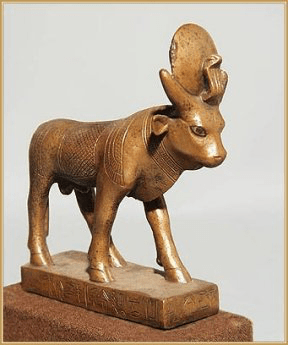
The Egyptian bull calf, Apis, represents the hidden god, Saturn. Notice the solar disc between its horns, which symbolise the Crescent Moon.
The Egyptian god Apis was a highly revered ancient god of fertility, death and the underworld. The name Apis however, is Greek for he was called Hap, Hep or Hapi in Egypt.
‘Aaron’s statement in Exodus 32:5 is very revealing: “And when Aaron saw it, he built an altar before it; and Aaron made proclamation, and said, Tomorrow is a feast to the Lord.” Having left Egypt only a few months before, the people had not forgotten Egyptian worship or calendation. Why the next day? Why did Aaron call the people to worship on that particular day? “Prayer to the planets on their respective days was a part of the worship of the heavenly bodies.” A continuous weekly cycle is not necessary to assign one day in the week to a particular god. Aaron was calling the people to come worship Saturn on Saturn’s day.
This is an important point. Israel’s religious apostasies were repeatedly over Saturn. A god was worshipped on his day, and when Aaron told the Children of Israel, “Tomorrow is a feast to the Lord” he was not referring to YHWH, the Great I AM that had created them and delivered them from Egyptain bondage. Rather, he was referring to Saturn…
The truth is that worship on the seventh-day of a pagan calendar does not direct one’s worship to the Creator. When one worships on Saturday, he is showing allegiance to the god of that day, the cruelest, most blood-thirsty of all the gods, Saturn.’
Addendum III
In light of the reality of a once 30 day month… ancient civilisations actually incorporated a ceremonial calendar which while not perfectly aligned with an astronomical lunar-solar calendar; it provided an easier cyclical system to calculate and live by. For it was composed of 28 day months and 13 month years, totalling 364 days.
Calendar Truth:
‘The 13-month, 28-day alternative has been in use on this planet for more than 6000 years. In prehistoric India and China, and throughout South America it was the standard time-keeping system. The Essenes, Egyptians, Polynesians, Maya, Inca, Lakota, and Cherokee used a 13-month, 28-day calendar. The Celtic knowledge of the Druids is based on the Tree Calendar, also a 13-month, 28-day calendar. Today many cultures are still using their traditional 13-month calendar system.’
Whispers of Wisdom Within:
“The moon doesn’t move in clean, human-friendly cycles, and… [the] 1.5-day drift adds up fast. The ancients ‘knew’ this too, which is exactly why most civilizations eventually developed ‘lunisolar calendars’ rather than purely lunar ones. The fascinating part is that cultures like the Babylonians, Egyptians, Hebrews, and even the Maya all wrestled with this same issue. Each found unique ways to reconcile lunar motion with solar consistency, intercalary months, leap days, Metonic cycles, and more.
And here’s where it gets interesting: the ’13-month calendar’ some mystics refer… wasn’t meant as an astronomical precision tool, it was symbolic. It reflected a worldview where ‘harmony’ with nature mattered more than numeric accuracy. Think of it as a spiritual or archetypal calendar, not a scientific one, a rhythm of life, not a clock. So in a sense, they’re both right: the physics doesn’t support it, but the ‘philosophy’ behind it was about remembering that time was once lived through ‘observation’, not algorithms.’
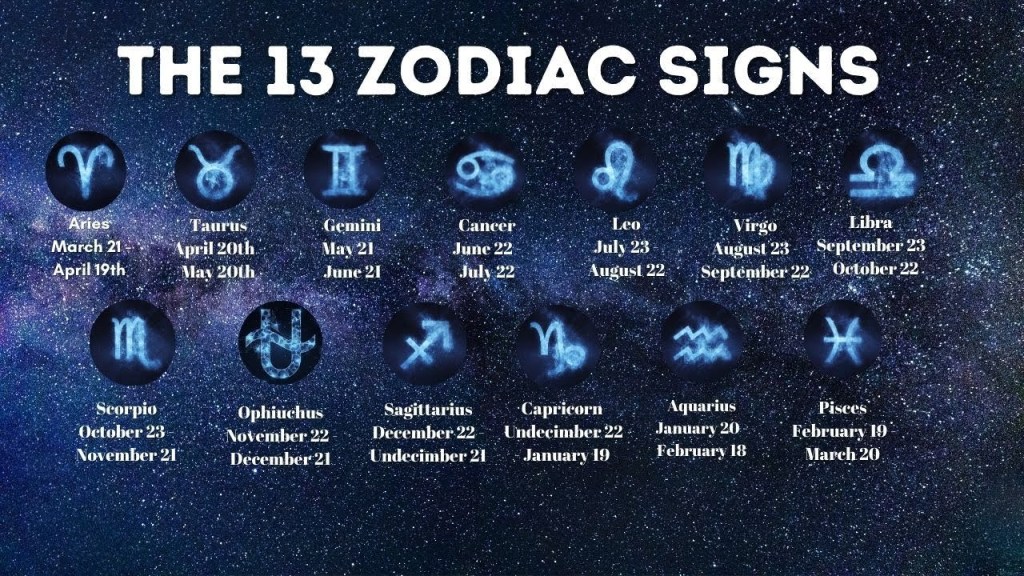
Online Encyclopaedia:
‘The International Fixed Calendar was a proposed reform of the Gregorian calendar designed by [British railway worker] Moses B. Cotsworth, first presented in 1902. The International Fixed Calendar divides the year into 13 months of 28 days each. A type of perennial calendar, every date is fixed to the same weekday every year. An extra day, called “Year Day,” is added at the end of the year, making it 365 days in total.’
Calendar Truth:
‘It is important for us to remember that during the first half of the 20th century, a vigorous and well-organized calendar reform movement flourished. In the United States alone, over one hundred industries adopted a 13-month, 28-day perpetual calendar. Kodak used one until 1989.’
© Orion Gold 2023 – All rights reserved. Permission to copy, use or distribute, if acknowledgement of the original authorship is attributed to orion-gold.com






 The Lightkeeper