The Great Reset & the Fourth Industrial Revolution

What does the great reset really mean for civilisation? Is it a portend of a dark future as some claim? “If only it were just a conspiracy”, as some state; or is it an innocuous plan for practical and beneficial changes for the majority of humankind? Is it to be embraced or feared? Regardless, there is a level of skepticism towards the Great Reset, for it was launched during the Covid-19 pandemic; itself shrouded in suspicious anomalies.

The philosophy originated from the World Economic Forum and is the brain child of Klaus Schwab, founder and Executive Chairman. It is interesting to note that the name Klaus is a German name stemming from Nikolaus – English, Nicholas – and means ‘victory of the people.’ His last name Schwab is indicative of a German or Ashkenazi Jew from the region of Swabia in southern Germany. Numerologist Eida Goodman says the name Schwab, ‘inspires expressivity, aspiration and devotion.’ Yes, but to what?

The WEF website contains an article entitled: Now is the time for a ‘great reset’, June 3, 2020. Available at:

https://www.weforum.org/agenda/2020/06/now-is-the-time-for-a-great-reset/

There follows in their own words the reasoning behind a reset in the wake of Covid-19 – emphasis theirs, bold mine.

“… the world must act jointly and swiftly to revamp all aspects of our societies and economies, from education to social contracts and working conditions. Every country, from the United States to China, must participate, and every industry, from oil and gas to tech, must be transformed. In short, we need a “Great Reset” of capitalism. There are many reasons to pursue a Great Reset, but the most urgent is COVID-19. 

According to the Financial Times, global government debt has already reached its highest level in peacetime. Moreover, unemployment is skyrocketing in many countries: in the US, for example, one in four workers have filed for unemployment since mid-March, with new weekly claims far above historic highs… And frustrations over social ills like rising inequality – US billionaires’ combined wealth has increased during the crisis – are intensifying. 

Left unaddressed, these crises, together with COVID-19, will deepen and leave the world even less sustainable, less equal, and more fragile. Incremental measures and ad hoc fixes will not suffice to prevent this scenario. We must build entirely new foundations for our economic and social systems. That will require stronger and more effective governments, though this does not imply an ideological push for bigger ones. 

The Great Reset agenda would have three main components. 

The first would steer the market toward fairer outcomes. To this end, governments should improve coordination (for example, in tax, regulatory, and fiscal policy), upgrade trade arrangements, and create the conditions for a “stakeholder economy.” At a time of diminishing tax bases and soaring public debt, governments have a powerful incentive to pursue such action. Moreover, governments should implement long-overdue reforms that promote more equitable outcomes. Depending on the country, these may include changes to wealth taxes, the withdrawal of fossil-fuel subsidies, and new rules governing intellectual property, trade, and competition. 

The second component of a Great Reset agenda would ensure that investments advance shared goals, such as equality and sustainability. Rather than using… funds, as well as investments from private entities and pension funds, to fill cracks in the old system, we should use them to create a new one that is more resilient, equitable, and sustainable in the long run. This means, for example, building “green” urban infrastructure and creating incentives for industries to improve their track record on environmental, social, and governance (ESG) metrics. 

The third and final priority of a Great Reset agenda is to harness the innovations of the Fourth Industrial Revolution to support the public good, especially by addressing health and social challenges. During the COVID-19 crisis, companies, universities, and others have joined forces to develop diagnostics, therapeutics, and possible vaccines; establish testing centers; create mechanisms for tracing infections; and deliver telemedicine. Imagine what could be possible if similar concerted efforts were made in every sector.

The COVID-19 crisis is affecting every facet of people’s lives in every corner of the world. But tragedy need not be its only legacy. On the contrary, the pandemic represents a rare but narrow window of opportunity to reflect, reimagine, and reset our world to create a healthier, more equitable, and more prosperous future.”
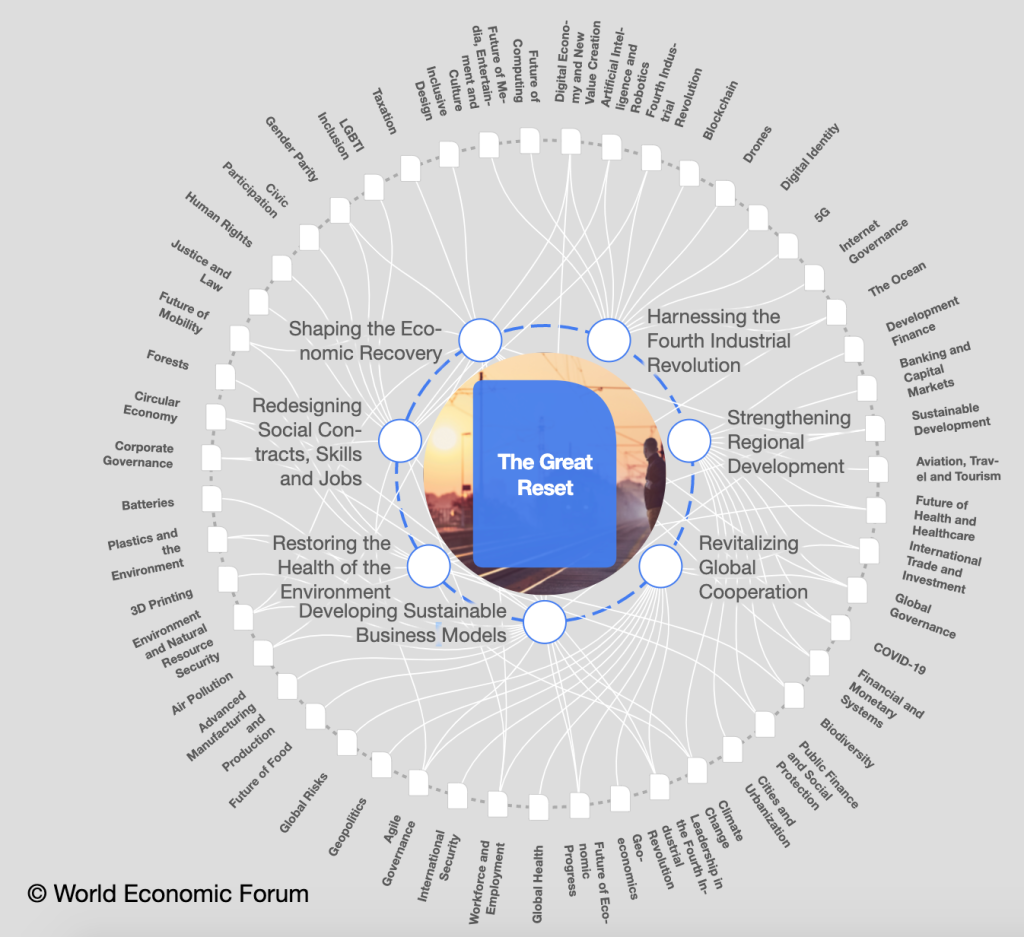
The Great Reset Transformation Map 

On the surface it all sounds positive, doesn’t it? Though there are some concepts or words included that one should be wary of perhaps. They are in bold. The most stated principle is the one of equality… for the masses. While this appears a noble principle when considering the widespread poverty endured throughout Asia, Africa and Latin America, it is equally alarming for those who are prosperous and live in North America, Europe and the far East. These citizens would not welcome a system which makes them more equal

The Fourth Industrial Revolution was a term ‘first introduced by a team of scientists developing a high-tech strategy for the German government.’ Klaus Schwab introduced the phrase to a wider audience in a 2015 article published by Foreign Affairs. It can be abbreviated to 4-IR or Industry 4.0 and describes rapid technological advancement during the twenty-first century, driven by artificial intelligence, advanced robotics and gene editing, producing a profound change in industrial capitalism. 

In the process blurring the lines between the physical, biological and digital worlds. Where a reliance on smart technology with machine to machine communication (M2M); and the Internet of things (IoT); means increased automation with less need for the intervention of humans in global production, supply networks, manufacturing and industry.
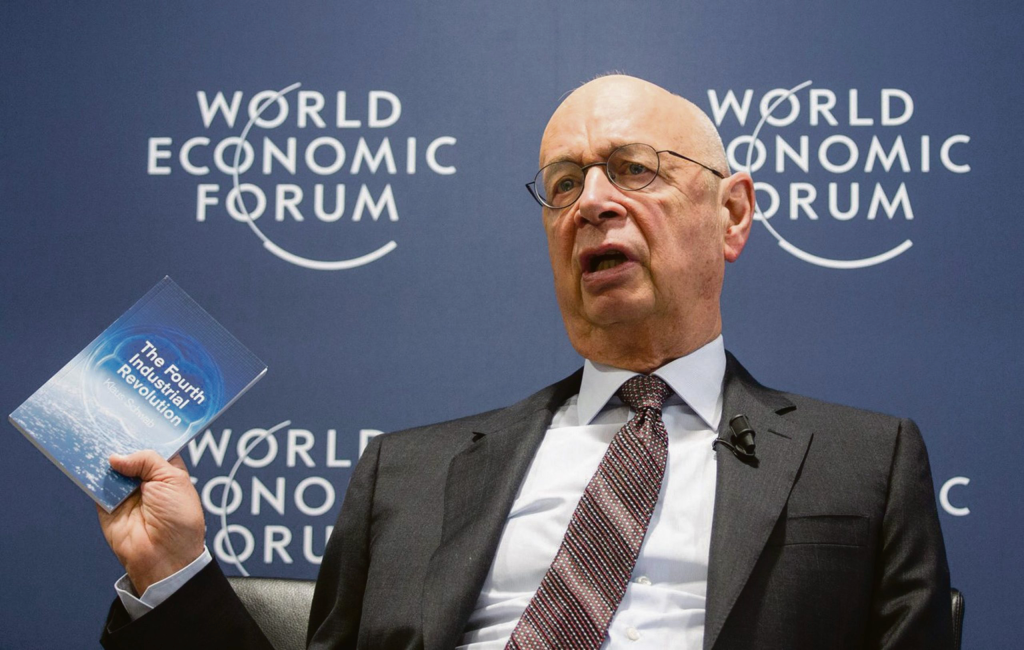
Klaus Schwab and the 280 page book: The Fourth Industrial Revolution

Regarding the 4-IR the WEF states: “The Fourth Industrial Revolution represents a fundamental change in the way we live, work and relate to one another. It is a new chapter in human development, enabled by extraordinary technology advances commensurate with those of the first, second and third industrial revolutions. The speed, breadth and depth of this revolution is forcing us to rethink how countries develop, how organisations create value and even what it means to be human.” 

It would be well to look at both sides of how the Great Reset has been received. Firstly, from those who support the proposal as a benevolent initiative. An article compiled by BBC Reporters: Olga Robinson, Shayan Sardarizadeh, Jack Goodman, Christopher Giles and Hugo Williams, a year after the announcement by the WEF, entitled: 

What is the Great Reset – and how did it get hijacked by conspiracy theories? June 24, 2021 – emphasis mine: 

“A vague set of proposals from an influential organisation has been transformed by online conspiracy theorists into a powerful viral rallying cry… Believers spin dark tales about an authoritarian socialist world government run by powerful capitalists and politicians… Like many popular conspiracy theories, this one starts with a grain of fact. 

In June 2020, the Prince of Wales and the head of the annual Davos summit launched an initiative calling for the pandemic to be seen as a chance for what they called a Great Reset of the global economy – refer article: The Life & Death of Charles III. A flashy launch video interspersed images of a world in chaos – a dead killer whale, a hurricane, a kangaroo caught in a fire – with a speech by Prince Charles. “We have an incredible opportunity to create entirely new sustainable industries,” the prince said. “The time to act is now.” 

But the plan is light on specific detail… the scope is huge – covering technology, climate change, the future of work, international security and other themes – and… it’s difficult to see precisely what the Great Reset might mean in practice. This lack of clarity, combined with the plan being launched by an influential organisation, provided fertile ground for conspiracy theories to grow. 

The proposals, along with the WEF itself, face legitimate criticism from a variety of sources. Conservative political figures and media outlets accuse the organisation of pushing for environmental policies that would hurt the economy. There are questions about whether unelected individuals like Mr Schwab should have the power to lobby so prominently for ideas that could potentially transform the global economy. The Davos meeting is certainly filled with powerful people who have a huge influence on world events. There are also concerns about the impact of technology on civil liberties and jobs. 

But the real energy online is not about legitimate political questions – discussions about fossil fuels and income equality – but in the shape of wild and unsubstantiated claims. The term “Great Reset” has received more than eight million interactions on Facebook and been shared almost two million times on Twitter since the initiative was launched, according to BBC Monitoring research. 

Among the most popular posts are baseless statements that the Great Reset is a strategic part of a grand conspiracy by the global elite, who somehow planned and managed the Covid-19 pandemic. In this narrative, lockdown restrictions were introduced not to curb the spread of the virus, but to deliberately bring about economic collapse and a socialist world government, albeit run for the benefit of powerful capitalists. The nebulousness of this conspiracy theory means it has found followers among anti-vaccine activists, anti-lockdown campaigners, new-age healers, and those on the far right and far left. 

Melanie Smith, head of analysis at Graphika, who researches online movements and disinformation, says… In the hands of a diverse group of online activists, the Great Reset has been transformed – from a call to encourage people to think about a sustainable future, to a sinister plot against humanity. 

On 15 November, the phrase started trending on Twitter when a video went viral showing Canadian prime Minister Justin Trudeau at a UN meeting in September, saying the pandemic provided an opportunity for a “reset”. It’s unclear whether he was referring to the WEF plan. But some claimed his speech was proof that global leaders were using the pandemic as a pretext to introduce a range of socialist and environmental policies. 

Most of the narratives being promoted around the Great Reset are not new. Experts say similar ideas about the emergence of a totalitarian world government have been circulating since the 1960s under the umbrella term the New World order, which itself borrows ideas from conspiracy theories of the 18th century.”

This may be right, though it it does not negate a conspiracy of a planned totalitarian regime being true.

“In a video from January, the WEF acknowledged that the messaging around the Great Reset didn’t quite go to plan. “Hands up, this kind of slogan hasn’t gone down well,” a voiceover says. In response to questions about whether the discussion had been hijacked by conspiracists, the WEF said in a statement: ‘Conspiracy theories replace reason with fantasy. They are a noisy but peripheral part of the public sphere.’
An alternative representation of Schwab’s plans was offered by American academic and scholar, Michael Rectenwald. ‘… adapted from a talk delivered at Hillsdale College, on November 7, 2021, during a Center for Constructive Alternatives conference on “The Great Reset.”

What is the Great Reset? was published in American Scholars, Volume 50, Issue 12, December 2021 – emphasis mine. It is worth reading and so reproduced in its entirety.

“Is the Great Reset a conspiracy theory imagining a vast left-wing plot to establish a totalitarian one-world government? No. Despite the fact that some people may have spun conspiracy theories based on it – with some reason, as we will see – the Great Reset is real. 

Indeed, just last year, Klaus Schwab, founder and executive chairman of the World Economic Forum (WEF) – a famous organization made up of the world’s political, economic, and cultural elites that meets annually in Davos, Switzerland – and Thierry Malleret, co-founder and main author of the Monthly Barometer, published a book called COVID-19: The Great Reset. In the book, they define the Great Reset as a means of addressing the “weaknesses of capitalism” that were purportedly exposed by the COVID pandemic. 

But the idea of the Great Reset goes back much further. It can be traced at least as far back as the inception of the WEF, originally founded as the European Management Forum, in 1971. In that same year, Schwab, an engineer and economist by training, published his first book, Modern Enterprise Management in Mechanical Engineering. It was in this book that Schwab first introduced the concept he would later call “stakeholder capitalism,” arguing “that the management of a modern enterprise must serve not only shareholders but all stakeholders to achieve long-term growth and prosperity.” Schwab and the WEF have promoted the idea of stakeholder capitalism ever since. They can take credit for the stakeholder and public-private partnership rhetoric and policies embraced by governments, corporations, non-governmental organizations, and international governance bodies worldwide. 

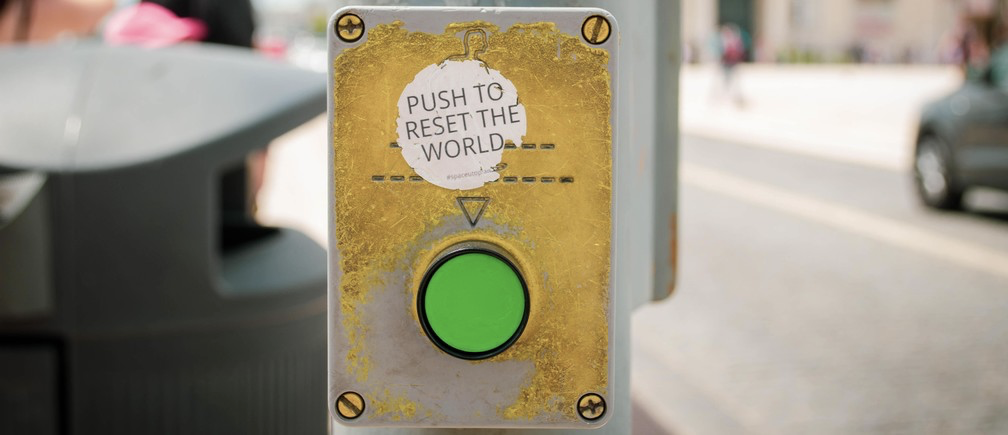
The specific phrase “Great Reset” came into general circulation over a decade ago, with the publication of a 2010 book, The Great Reset, by American urban studies scholar Richard Florida. Written in the aftermath of the 2008 financial crisis, Florida’s book argued that the 2008 economic crash was the latest in a series of Great Resets – including the Long Depression of the 1870s and the Great Depression of the 1930s – which he defined as periods of paradigm-shifting systemic innovation. Four years after Florida’s book was published, at the 2014 annual meeting of the WEF, Schwab declared: “What we want to do in Davos this year . . . is to push the reset button” – and subsequently the image of a reset button would appear on the WEF’s website.”
“In 2018 and 2019, the WEF organized two events that became the primary inspiration for the current Great Reset project… In May 2018, the WEF collaborated with the Johns Hopkins Center for Health Security to conduct “CLADE X,” a simulation of a national pandemic response. Specifically, the exercise simulated the outbreak of a novel strain of a human parainfluenza virus, with genetic elements of the Nipah virus, called CLADE X. The simulation ended with a news report stating that in the face of CLADE X, without effective vaccines, “experts tell us that we could eventually see 30 to 40 million deaths in the U.S. and more than 900 million around the world – twelve percent of the global population.” Clearly, preparation for a global pandemic was in order. 

In October 2019, the WEF collaborated with Johns Hopkins and the Bill & Melinda Gates Foundation on another pandemic exercise, “Event 201,” which simulated an international response to the outbreak of a novel coronavirus. This was two months before the COVID outbreak in China became news and five months before the World Health Organization declared it a pandemic, and it closely resembled the future COVID scenario, including incorporating the idea of asymptomatic spread” – refer article: The WHO… will own my body?

“The CLADE X and Event 201 simulations anticipated almost every eventuality of the actual COVID crisis, most notably the responses by governments, health agencies, the media, tech companies, and elements of the public. The responses and their effects included worldwide lockdowns, the collapse of businesses and industries, the adoption of biometric surveillance technologies, an emphasis on social media censorship to combat “misinformation,” the flooding of social and legacy media with “authoritative sources,” widespread riots, and mass unemployment

In addition to being promoted as a response to COVID, the Great Reset is promoted as a response to climate change” – refer article: Climate Change & Global Warming – Looming Crisis or a New Equilibrium? “In 2017, the WEF published a paper entitled, “We Need to Reset the Global Operating System to Achieve the [United Nations Sustainable Development Goals].” 

On June 13, 2019, the WEF signed a Memorandum of Understanding with the United Nations to form a partnership to advance the “UN 2030 Agenda for Sustainable Development.” Shortly after that, the WEF published the “United Nations-World Economic Forum Strategic Partnership Framework for the 2030 Agenda,” promising to help finance the UN’s climate change agenda and committing the WEF to help the UN “meet the needs of the Fourth Industrial Revolution,” including providing assets and expertise for “digital governance.” 

In June 2020, at its 50th annual meeting, the WEF announced the Great Reset’s official launch, and a month later Schwab and Malleret published their book on COVID and the Great Reset. The book declared that COVID represents an “opportunity [that] can be seized”; that “we should take advantage of this unprecedented opportunity to reimagine our world”; that “the moment must be seized to take advantage of this unique window of opportunity”; and that “(f)or those fortunate enough to find themselves in industries ‘naturally’ resilient to the pandemic” – think here of Big Tech companies like Apple, [Microsoft], Google, Facebook, and Amazon“the crisis was not only more bearable, but even a source of profitable opportunities at a time of distress for the majority.” 

The Great Reset aims to usher in a bewildering economic amalgam – Schwab’s stakeholder capitalism – which I have called “corporate socialism” and Italian philosopher Giorgio Agamben has called “communist capitalism.” In brief, stakeholder capitalism involves the behavioral modification of corporations to benefit not shareholders, but stakeholders – individuals and groups that stand to benefit or lose from corporate behavior. Stakeholder capitalism requires not only corporate responses to pandemics and ecological issues such as climate change, “but also rethinking (corporations’) commitments to already-vulnerable communities within their ecosystems.” This is the “social justice” aspect of the Great Reset. To comply with that, governments, banks, and asset managers use the Environmental, Social, and Governance (ESG) index to squeeze non-woke corporations and businesses out of the market. The ESG index is essentially a social credit score that is used to drive ownership and control of production away from the non-woke or non-compliant. 

One of the WEF’s many powerful “strategic partners,” BlackRock, Inc., the world’s largest asset manager, is solidly behind the stakeholder model. In a 2021 letter to CEOs, BlackRock CEO Larry Fink declared that “climate risk is investment risk,” and “the creation of sustainable index investments has enabled a massive acceleration of capital towards companies better prepared to address climate risk.” The COVID pandemic, Fink wrote, accelerated the flow of funds toward sustainable investments: 

‘We have long believed that our clients, as shareholders in your company, will benefit if you can create enduring, sustainable value for all of your stakeholders… As more and more investors choose to tilt their investments towards sustainability-focused companies, the tectonic shift we are seeing will accelerate further. And because this will have such a dramatic impact on how capital is allocated, every management team and board will need to consider how this will impact their company’s stock.’

“Fink’s letter is more than a report to CEOs. It is an implicit threat: be woke or else. 

In their recent book on the Great Reset, Schwab and Malleret pit “stakeholder capitalism” against “neoliberalism,” defining the latter as “a corpus of ideas and policies… favouring competition over solidarity, creative destruction over government intervention, and economic growth over social welfare.” In other words, “neoliberalism” refers to the free enterprise system. In opposing that system, stakeholder capitalism entails corporate cooperation with the state and vastly increased government intervention in the economy. 

Proponents of the Great Reset hold “neoliberalism” responsible for our economic woes. But in truth, the governmental favoring of industries and players within industries – what used to be known as corporatism or economic fascism – has been the real source of what Schwab and his allies at the WEF decry. 

While approved corporations are not necessarily monopolies, the tendency of the Great Reset is toward monopolization – vesting as much control over production and distribution in as few favored corporations as possible, while eliminating industries and producers deemed non-essential or inimical. Another way of describing the goal of the Great Reset is “capitalism with Chinese characteristics” – a two-tiered economy, with profitable monopolies and the state on top and socialism for the majority below. 

Several decades ago, as China’s growing reliance on the for-profit sectors of its economy could no longer be credibly denied by the Chinese Communist Party (CCP), its leadership approved the slogan “socialism with Chinese characteristics” to describe its economic system. Formulated by Deng Xiaoping, the phrase was meant to rationalize the CCP’s allowance of for-profit development under a socialist political system. The CCP considered the privatization of the Chinese economy to be a temporary phase – lasting as long as 100 years if necessary – on the way to a communist society. Party leaders maintain that this approach has been necessary in China because socialism was introduced too early there, when China was a backward agrarian country. China needed a capitalist booster shot. 

Stripped of its socialist ideological pretensions, the Chinese system amounts to a socialist or communist state increasingly funded by capitalist economic development. The difference between the former Soviet Union and contemporary China is that when it became obvious that a socialist economy had failed, the former gave up its socialist economic pretenses, while the latter has not. 

The Great Reset represents the development of the Chinese system in the West, but in reverse. Whereas the Chinese political class began with a socialist political system and then introduced privately held for-profit production, the West began with capitalism and is now implementing a Chinese-style political system. This Chinese-style system includes vastly increased state intervention in the economy, on the one hand, and on the other, the kind of authoritarian measures that the Chinese government uses to control its population. 

Schwab and Malleret write that if “the past five centuries in Europe and America” have taught us anything, it is that “acute crises contribute to boosting the power of the state. It’s always been the case and there is no reason it should be different with the COVID-19 pandemic.”

The draconian lockdown measures employed by Western governments managed to accomplish goals of which corporate socialists in the WEF could only dream – above all, the destruction of small businesses, eliminating competitors for corporate monopolists favored by the state. In the U.S. alone, according to the Foundation for Economic Education, millions of small businesses closed their doors due to the lockdowns. Yelp data indicates that 60 percent of those closures are now permanent. Meanwhile companies like Amazon, Apple, Facebook, and Google enjoyed record gains. 

Other developments that advance the Great Reset agenda have included unfettered immigration, travel restrictions for otherwise legal border crossing, the Federal Reserve’s unrestrained printing of money and the subsequent inflation, increased taxation, increased dependence on the state, broken supply chains, the restrictions and job losses due to vaccine mandates, and the prospect of personal carbon allowances. 

Such policies reflect the “fairness” aspect of the Great Reset – fairness requires lowering the economic status of people in wealthier nations like the U.S. relative to that of people in poorer regions of the world. One of the functions of woke ideology is to make the majority in developed countries feel guilty about their wealth, which the elites aim to reset downwards – except, one notices, for the elites themselves, who need to be rich in order to fly in their private jets to Davos each year. 

The Great Reset’s corporate stakeholder model overlaps with its governance and geopolitical model: states and favored corporations are combined in public-private partnerships and together have control of governance. This corporate-state hybrid is largely unaccountable to the constituents of national governments. 

Governance is not only increasingly privatized, but also and more importantly, corporations are deputized as major additions to governments and intergovernmental bodies. The state is thereby extended, enhanced, and augmented by the addition of enormous corporate assets. As such, corporations become what I have called “governmentalities” – otherwise private organizations wielded as state apparatuses, with no obligation to answer to pesky voters. Since these corporations are multinational, the state essentially becomes globalist, whether or not a one-world government is ever formalized. 

As if the economic and governmental resets were not dramatic enough, the technological reset reads like a dystopian science fiction novel. It is based on the Fourth Industrial Revolution – or 4-IR for short. The first, second, and third industrial revolutions were the mechanical, electrical, and digital revolutions. The 4-IR marks the convergence of existing and emerging fields, including Big Data, artificial intelligence, machine learning, quantum computing, genetics, nanotechnology, and robotics… 

There is nothing original about this. Transhumanists and Singularitarians (prophets of technological singularity) such as Ray Kurzweil forecasted these and other revolutionary developments long ago. What’s different about the globalists’ vision of 4-IR is the attempt to harness it to the ends of the Great Reset. 

If already existing 4-IR developments are any indication of the future, then the claim that it will contribute to human happiness is false. These developments include Internet algorithms that feed users prescribed news and advertisements and down rank or exclude banned content; algorithms that censor social media content and consign “dangerous” individuals and organizations to digital gulags; “keyword warrants” based on search engine inputs; apps that track and trace COVID violations and report offenders to the police; robot police with scanners to identify and round up the unvaccinated and other dissidents; and smart cities where residents are digital entities to be monitored, surveilled, and recorded, and where data on their every move is collected, collated, stored, and attached to a digital identity and a social credit score. 

In short, 4-IR technologies subject human beings to a kind of technological management that makes surveillance by the NSA look like child’s play. Schwab goes so far as to cheer developments that aim to connect human brains directly to the cloud for the sake of “data mining” our thoughts and memories. If successful, this would constitute a technological mastery over decision-making that would threaten human autonomy and undermine free will. 

The 4-IR seeks to accelerate the merging of humans and machines, resulting in a world in which all information, including genetic information, is shared, and every action, thought, and motivation is known, predicted, and possibly precluded. Unless taken out of the hands of corporate-socialist technocrats, the 4-IR will eventually lead to a virtual and inescapable prison of body and mind. 

In terms of the social order, the Great Reset promises inclusion in a shared destiny. But the subordination of so-called “netizens” implies economic and political disenfranchisement, a hyper-vigilance over self and others, and social isolation – or what Hannah Arendt called “organized loneliness” – on a global scale. This organized loneliness is already manifest in lockdowns, masking, social distancing, and the social exclusion of the unvaccinated. The title of the Ad Council’s March 2020 public service announcement – “Alone Together” – perfectly captures this sense of organized loneliness. 

In my recent book, Google Archipelago, I argued that leftist authoritarianism is the political ideology and modus operandi of what I call Big Digital, which is on the leading edge of a nascent world system. Big Digital is the communications, ideological, and technological arm of an emerging corporate-socialist totalitarianism. The Great Reset is the name that has since been given to the project of establishing this world system. 

Just as Schwab and the WEF predicted, the COVID crisis has accelerated the Great Reset. Monopolistic corporations have consolidated their grip on the economy from above, while socialism continues to advance for the rest of us below. In partnership with Big Digital, Big Pharma, the mainstream media, national and international health agencies, and compliant populations, hitherto democratic Western states – think especially of Australia, New Zealand, and Austria – are being transformed into totalitarian regimes modeled after China. 

But let me end on a note of hope. Because the goals of the Great Reset depend on the obliteration not only of free markets, but of individual liberty and free will, it is, perhaps ironically, unsustainable. Like earlier attempts at totalitarianism, the Great Reset is doomed to ultimate failure. That doesn’t mean, however, that it won’t, again like those earlier attempts, leave a lot of destruction in its wake­ – which is all the more reason to oppose it now and with all our might.” 
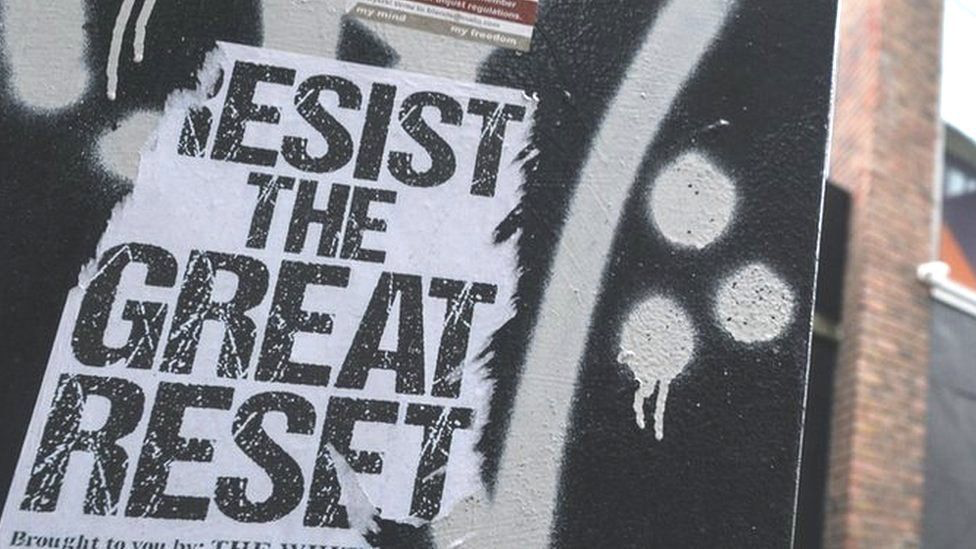
It is sincerely wished with all this writer’s heart that they could concur with Michael Rectenwalds’s conclusion. Not that we should not fight with all our might, but that the Great Reset is doomed to failure. As unpalatable as it may be for many, a certain book with a rather dusty cover because not many people open it, let alone understand what it reveals, had something to say a long time ago about the time we are entering.

“At that time… there shall be a time of trouble, such as never has been since there was a nation till that time… shut up the words and seal the book, until the time of the end. Many shall run to and fro, and knowledge shall increase… [the great reset] causes all, both small and great, both rich and poor, both free and slave, to be marked on the right hand or the forehead, so that no one can buy or sell unless [they have] the mark…”

The agenda of the New World Order has been accelerated by the Great Reset proposed by the World Economic Forum in 2020. Perhaps even by the year 2030 or earlier, the world as we know it will fade and a new world based on a combination of George Orwell’s 1984 and Aldous Huxley’s Brave New World will be landing.
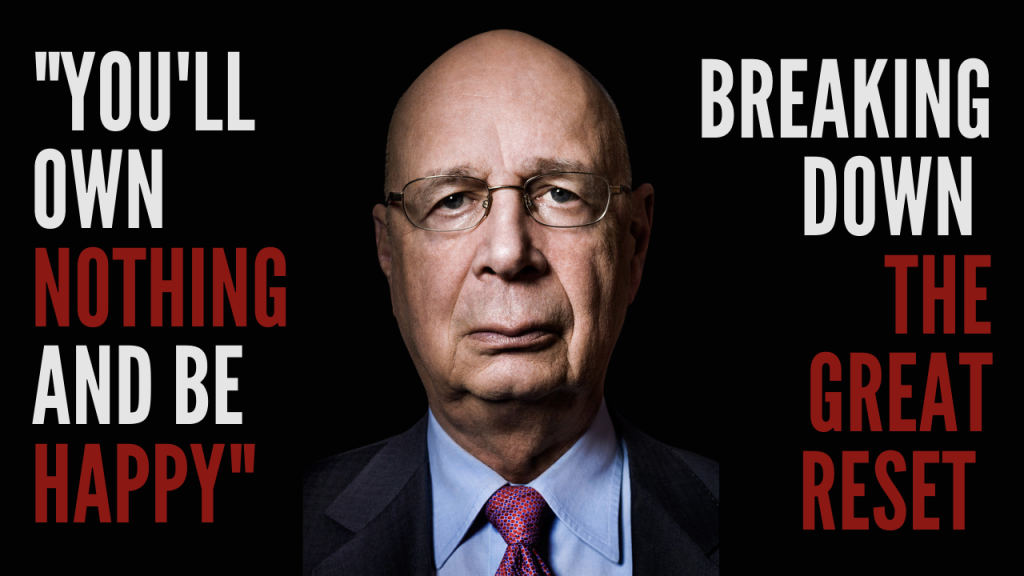
A society based on the communist model as implemented in the state of China, is undeniably planned for the West. A socialist creed of reducing the masses to an equivalency of non-ownership of any major assets and a stripping of the freedom for personal choice; the possessions you own; the goods you purchase; the job you perform; the car you drive; where you can travel; and the things you do.

Much like George Orwell’s prophetic warning in the 1945 novella, Animal Farm – the herd of humanity is being corralled into pens, where like farm animals:

All people are equal, but some people are more equal than others.

A three point plan is underway, designed to implement life-changing reversals of personal rights and freedoms. 

It includes Surveillance, Finance and Scoring.

Humans are tracked via CCTV, the internet, mobile phones and smart watches. A future step is a micro-chip device either worn or implanted in the human body. Not only a tracking device, but a digital library of everything we choose to buy and do.

Our financial footprint is monitored via internet online banking. Planned, is a global, centralised digital currency which is not just easily tracked but controlled.

A social credit scoring system is established in China and other nations are partially scored via a credit rating. The next step will be to implement a comprehensive scoring system based on every action in our day-to-day lives; whether it be the items we purchase; how efficiently we work; how cooperative we are with colleagues; how we treat shop staff or strangers; and how well we drive.

The impact of a life lived this way is immeasurable and intolerable. Ultimately, society will be told what to believe and what not to believe, what not to do and what to do and when to do it. 

Will the world let this happen right before their very eyes? It would be a bitter indictment indeed on a society which has become pampered and selfish, lacking the unified moral fibre and fortitude to fight an evil which is steadily engulfing their civilisation.

The same ignored and ridiculed book powerfully warns:

Where there is no vision, the people perish, for we live in an important time. It is now time for you to wake up.

“Better never means better for everyone. It always means worse, for some.”

Margaret Atwood, The Handmaid’s Tale

© Orion Gold 2023 – All rights reserved. Permission to copy, use or distribute, if acknowledgement of the original authorship is attributed to orion-gold.com
2050

The following is an answer reproduced from Quora, to the question: Which countries will be major world powers in 2050?

This is a fascinating question.

In many ways, it is more of a curiosity to know how the geopolitical order will look not just in 2050 but in 2100, or even 2250…

In thinking about this question seriously, it seemed delving into the past was required to discern the future more knowledgeably. A study of the powers of the past, both small and great, highlighted a couple of salient points.

Firstly, while some countries – as either regional or great powers – wax and wane, there are those nations which have remained relatively constant as world powers over the past five hundred years.

Secondly, even though a nation may have a large population, economic clout or a formidable military, they are not necessarily a threat to world peace. They may have the form or substance of a power but it does not necessarily translate towards affecting the world’s stability or order.

A people or national identity which has a proclivity towards policies of imperialism, militarism and is prepared to use their weaponry to achieve their aims on the other hand, is surely to be considered a (major) power.

It is primarily from this perspective that this article will focus with regard to potential major world powers in 2050 and beyond.

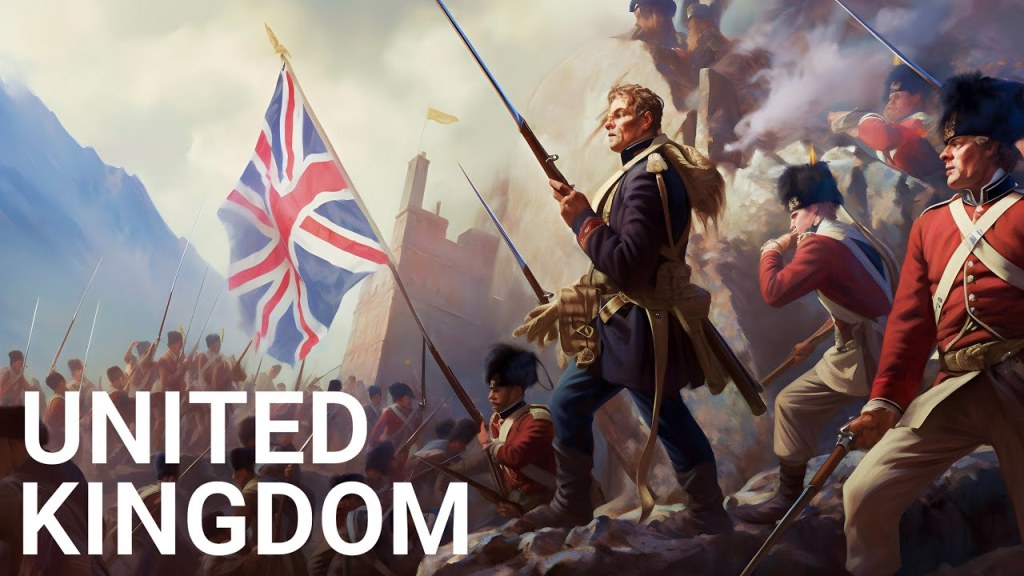
Historically, it has taken many decades or centuries even, for a nation’s status to change. For instance, the United Kingdom has transitioned from the world’s dominant power in 1820 to a (global?) regional power in 2022.

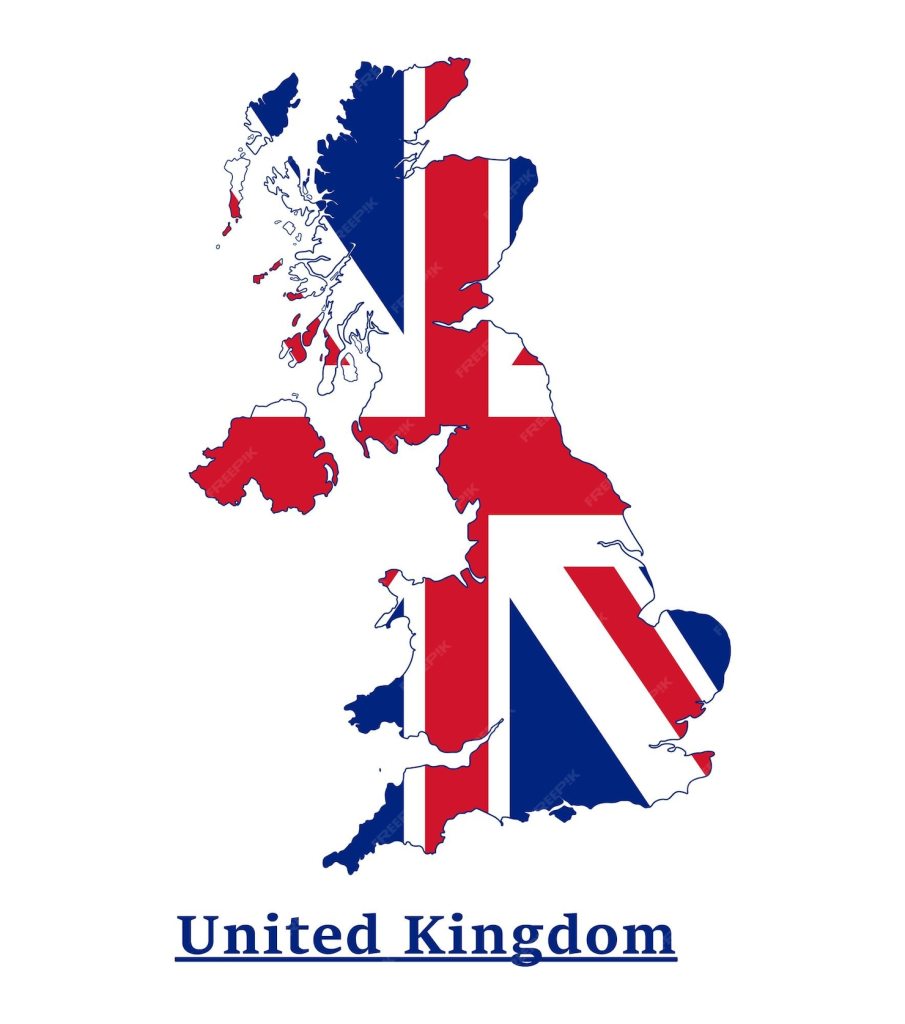
What is partially surprising – reflecting its very gradual decline over two hundred years – is that Great Britain (and Northern Ireland) has slipped from the world’s third largest economy in 1820, to only the sixth largest in 2019.

We now live in an interconnected world which is far more precarious; one that seems to be close to a tipping point at any given moment financially and economically. It is impossible to calculate how quickly circumstances could change globally, let alone for individual nations.

A further factor, is how quickly nations can adapt to a fast paced changing world in the 21st Century and how much investment they spend on the cutting edge technologies that will have an immeasurable influence on the pecking order of the major world powers in the future. Three of these immensely important sectors include AI development, DNA and genetic research and Space exploration. The winners of these contests, will likely surge ahead of their rivals – refer article: The Great Reset & the Fourth Industrial Revolution.

Before concentrating on the prime powerful players in the world, past and present, let’s look initially at the minor (or lesser) powers of the past and today.

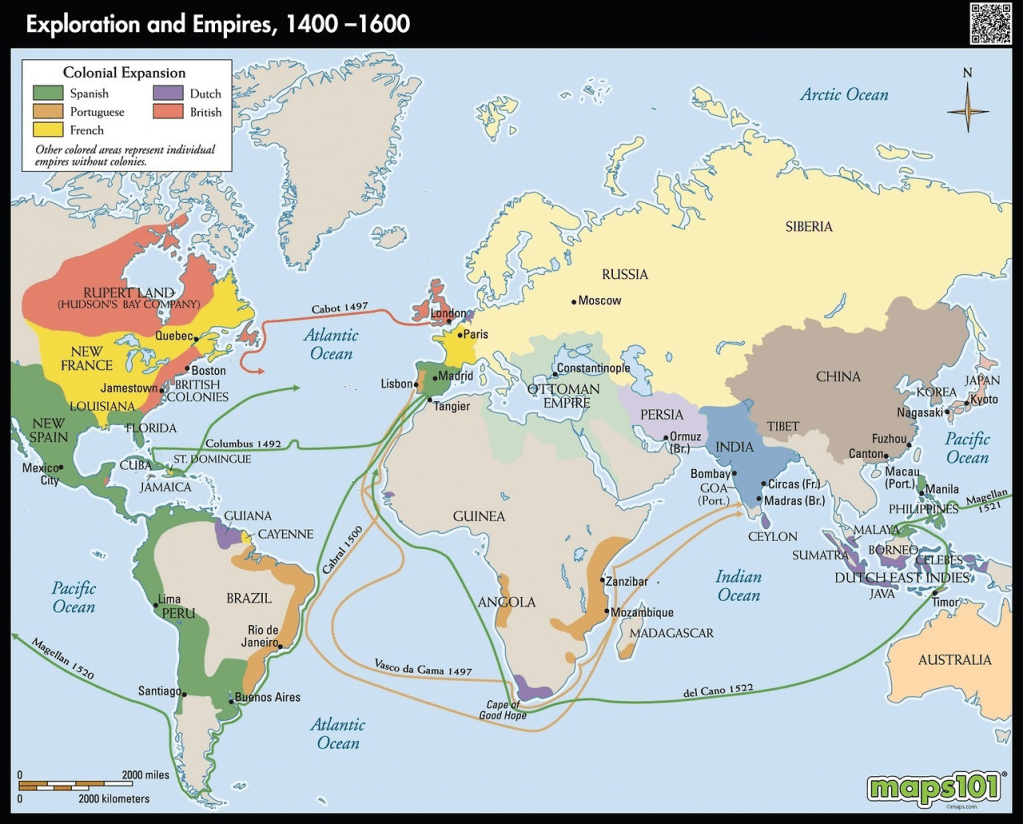
Both Portugal (1400s) and the Netherlands (1600s) are examples of minor powers who followed a different trajectory. Whereas the Netherlands still retains wealth and investment derived from its trading empire; Portugal does not reflect the wealth it once had stemming from its colonial empire. One would not consider them powers today. Similarly with the nation of Austria, which through its network of monarchy descended from the Hapsburg royal family throughput Europe and particularly in Spain and the Low Countries, created an extensive empire wielding considerable influence. Even with the dissipation of most of the European Monarchies, Austria has retained a measure of wealth much like the Netherlands, yet with a parallel loss of status in power.

Spain (1500s), France (1700s) and Great Britain (1800s) are examples of once being major powers, who combined trade with an expansionist colonial policy. To protect their claims and possessions it necessitated becoming naval and military powers, as was the case with the Netherlands. Each still retains economic wealth, with the United Kingdom and France having descended into lesser regional powers.

Colonial Asia

It is unlikely either could become major powers again, outside of the European Union at least. Nor have the French or English employed an overtly imperialistic policy since. Each during their mutual ascendancies, grew colonial empires, endeavouring to out do one another. As old rivals, both have settled into a grudgingly accepted stalemate draw.

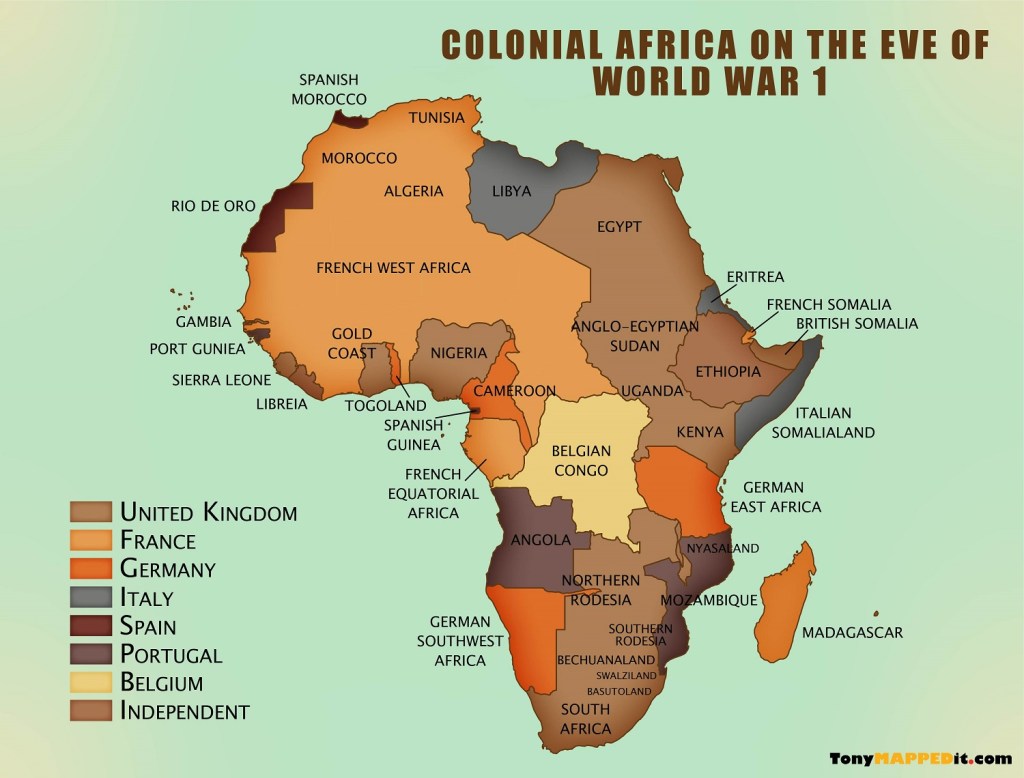
A nation which does not fit into a power stereotype is Italy. It is a relatively young nation, created in 1861, though it did pursue a colonial expansion principally in Africa and briefly exhibited an imperialist motivation while under Mussolini’s rule. Yet, Italy’s national character does not appear to be predominantly thus focused and as a regional power, sits somewhere between Spain and France.

Today, there are a handful of nations which are regional powers that weren’t in the past. It would seem that each will grow in strength and stature; though it remains to be seen, which will become major powers.

Those nations include Brazil, Mexico, Indonesia, Iran, Pakistan, in part Turkey and perhaps the Koreas. The interesting exception in the list is Turkey, which was a major power in the past, in the guise of the Ottoman Empire.

There is a coded book which mentions these seven peoples (eight nations) – in fact all the peoples of the world either directly or indirectly – in both an historical and a modern context. Like the saying: ‘the truth is stranger than fiction’, their futures can be determined. Credence in this coded book is ridiculed by many, for they do not understand it. Besides, any acknowledgement that its words are true would then lead to admitting one who is superior, had authored and inspired it. So from here on, it is not just canny insight alone, but an accurate interpretation of its message, unforeseen prior to now – refer The Noachian Legacy.

Brazil will stand to become a major economic power on the world stage, and all the Latino-Hispano nations of the Americas, led by the regional power Mexico, will align with Brazil in an economic trading bloc.

In large part to offset the dominance of the United States of America. Though Brazil will reach major power status, it will be primarily as an economic giant and not entirely in a military sense. Saying that, both Brazil and Mexico will increase their military capability in accord with their growing economic stature and one day will not be reticent in using them.

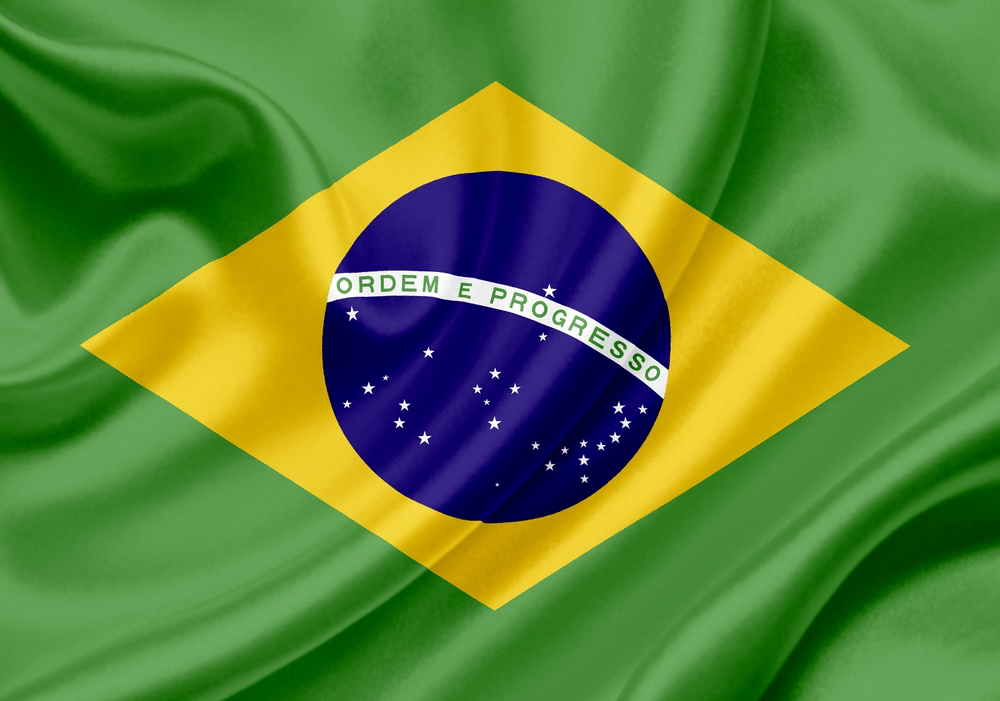
Brazilian Flag

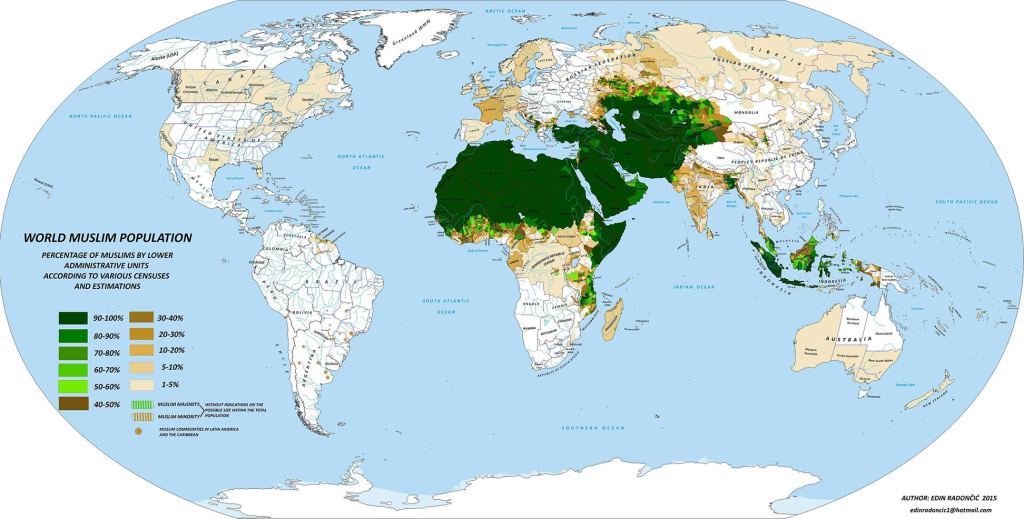
Indonesia, Iran, Pakistan and Turkey all have something in common and that is their Muslim faith. At a certain point, the dominant Islamic nations will amalgamate into a unified body with a single voice and purpose. Egypt also may have a prominent role, with the aforementioned four nations. How many other Arab peoples and Islamic nations, such as Bangladesh are part of this confederacy is not clear, though it will be a formidable military bloc and a series of wars will rage involving their alliance – refer article: Four Kings & One Queen. Again, it is not clear who the leader will be, though politically, the three countries comprising Turkey, Iran and Pakistan are clearly the dominant nucleus of nations. Turkey superficially seems to be the main contender, when considering its imperialistic role in the past and in possessing the strongest and fastest growing economy amongst the Muslim nations, aside from Indonesia.

The indication is that like any artificial joining, for instance the coterminous Yugoslavia and Czechoslovakia, or separation, such as East Germany and West Germany and North Vietnam and South Vietnam; eventually, no matter how unlikely, it will be undone. A reunified and far stronger Korea would be a fascinating scenario, added to the complex relationship currently amongst the northeastern Asian nations. Worryingly, it appears that a united Korea in the future could favour a Chinese inspired political model and focus on policy, as opposed to a Japanese one. This would indicate that any future support for reunification, is lead by China and or Russia and not from the United States.

Just before we turn to the major powers of the past and today, there is one nation, which is always forgotten. In fact, it was only in one person’s comments, though there may be more mentions as not every answer has been read. Ironically, this nation’s original name in the Hebrew language means: forgotten. Yet this nation is in the top ten nations of the world for largest economy by GDP. It is a unique country and the only one in the world which has the following combination of factors: for not only does it have vast resources on a huge landmass; it most importantly, has the infrastructure and space to host a vast number of new immigrants, thereby exponentially increasing its population. As a result, this nation’s economic, political and military influence would expand, as the most important ally of the United States.

That nation is… Canada.

Canadian Flag

Whether it will become a major power or a considerably stronger regional power remains to be seen, though its closet parallel would be Brazil in this regard.

This leaves the historical major powers over the past five hundred years, depending on how one ranks them: China, Germany, India, Japan, Russia and the United States of America. A helpful article by Wendell Cox, highlights the points raised earlier regarding a large population or GDP and how it does not mean that particular nation wields global political, financial or military dominance. They can be a passive major power, or even dormant. What drives a nation to be an active major power is drawn from multiple variables – which makes this discussion interesting from an historical as well as a futuristic perspective. Also, a nation may become an active major power but only in a regional sense and not necessarily as a global presence.

500 Years of GDP: A tale of Two Countries, New Geography, Wendell Cox, 2015:

‘Over the 515 years from 1500 to 2015, the available data seems to suggest that the largest economy in the world [has] almost always been either China or the United States (for most years there is only incomplete data). In 1500, China was the largest economy in the world, followed closely by India, both with estimated GDP’s of approximately $100 billion. France was a distant third at approximately 18 billion… What is now the United Kingdom ranked 10th, at barely one quarter the output of France.

[The year 1700] was the only reported year between 1500 and 2015 that China or the United States did not lead the world. India had the strongest economy in 1700, closely followed by China. Throughout the entire period to the middle of the 20th century, China’s economy was larger than India’s by a relatively small margin. At the same time “the great powers” of the West were still well behind China and India…’

‘By 1820… India [in] second, [was] slightly more than one half that of China. The United Kingdom finally appears, in third-place with a GDP one sixth that of China… By 1890, the United States had emerged as the world’s largest economy, opening up an approximately five percent lead over China. India ranked third, followed by the United Kingdom [4th] and Japan [5th].

By 1930, the ascendancy of the United States was clear. China… still remained the second largest economy, but trailed the United States by approximately [two-thirds]. There was little difference between China and the next three largest economies, Germany [3rd], the United Kingdom [4th] and India [5th].’

The Flag of the United States of America

‘Half a century later, in 1980, the United States retained a similar lead, but now over second-ranked Japan. Germany was a close third… India ranked ninth, approximately 30 percent ahead of 10th ranked China. China’s ascendancy was obvious by 2010, reaching within 20 percent of the United States, which remained number one.

This had been a dramatic reversal, since China’s GDP had been little more than one tenth that of the United States only 30 years earlier (1980). India was also restored to a leadership position, ranking third. Japan was fourth and Germany was fifth.’

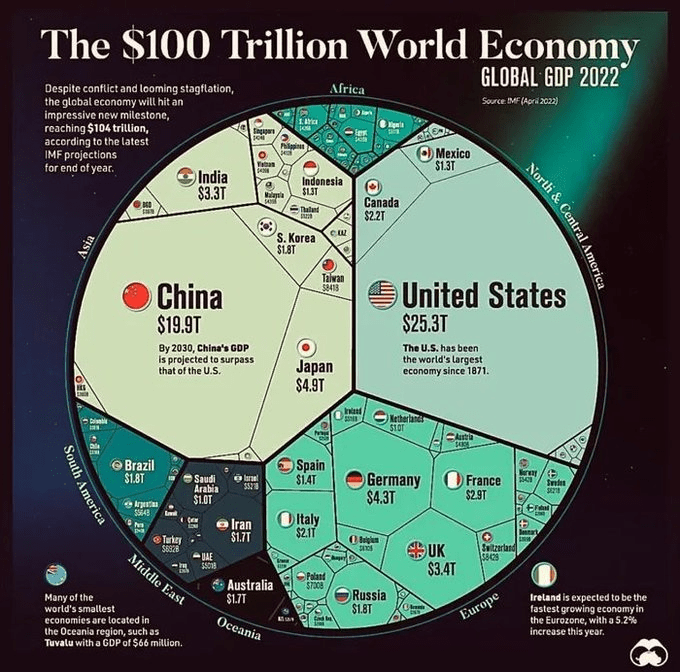
In 2019 these major powers according to GDP were ranked: 1. United States of America 2. China 3. Japan 4. Germany 5 India and 11. Russia.

In 2025, these same nations are ranked as: 1. United States of America (30.50 Trillion) 2. China (19.23 Trillion) 3. Germany (4.74 Trillion) 4. India (4.18 Trillion) 5 Japan (4.18 Trillion) and 11 Russia (2.07 Trillion).

‘It is notable that through much of their empire-colonial relationship between the United Kingdom and India, the colony had the larger GDP. This was the case from 1820 through 1900. This is principally due to the larger population of India. For example, in 1870, India’s GDP was one-third larger than that of the United Kingdom. In the same year, however, the UK GDP per capita was six times that of India.

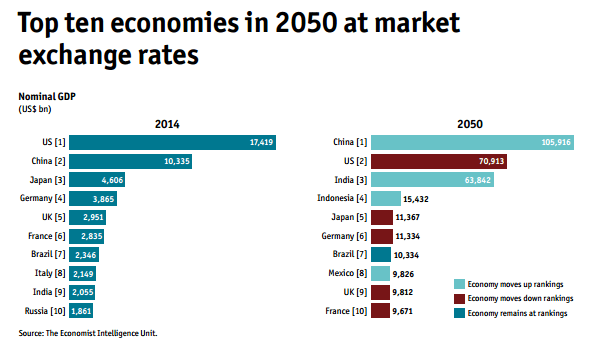
GDP projections produced for 2050, by… Price Waterhouse Coopers indicate that even more significant changes could be ahead. PWC expects China to have GDP of $61 trillion (US$2014). India is projected to be restored to its previous second place, at $42 trillion, just ahead of the United States ($41 trillion).

BRIICs members Indonesia [currently 17th] and Brazil [currently 10th] would be 4th and 5th, while BRIICs Russia would be 8th. Mexico [6th] and Japan [7th] would follow Brazil, with Nigeria [9th] and Germany [10th] rounding out the top ten. If PWC is right, the dominance of China and the United States might be supplanted by the historically dominant duo of China and India. Of course, no one knows for sure. Forecasting economics is even harder than forecasting population.’

The inclusion of Indonesia, Mexico, Russia and Nigeria in the top ten would come at the expense of the United Kingdom (6), France (7), Italy (8) and Canada (9) dropping out of the top ten largest economies in the world.

We learn some very salient points from this data.

First: Only China, India or the United States have ever been number one with regard to being the world’s biggest economy (GDP).

Second: It took nearly four hundred years [of a 500 year period], for a nation outside of Asia to catch up to China and India and then surpass them.

Third: China has fluctuated the most out of the major powers. It was marginally ahead of second place India for centuries, then in the 1800s gained a substantial lead and then by the 1900s was substantially behind India as well as other nations. Now, China has sensationally regained second spot.

Four: It is China which has witnessed the most dramatic economic reversal, being one-tenth the size of the United states in 1980 and within 30 years – a similar time frame we have now before us from 2022 to 2050 – moved from tenth to second in the world.

Five: The example comparing the former major power the United Kingdom and its former subservient colony India, exposes the active and dormant natures these powers respectively exhibited.

Six: Both Japan an island nation on the periphery of a continent the same as Great Britain and Germany, a young nation like Italy, have been major economic powers since the late 1800s and early 1900s and as with the United Kingdom, have shown a desire to follow an expansionist policy; creating military capability to match their economic prosperity and demonstrating the will to put it to use. They have all been active powers unlike the two major dormant powers, China and India. Some would argue credibly that China is now no longer dormant.

Seven: The predictions by PWC are enlightening and if correct, a circle is being completed with China and India regaining the lengthy historical positions of number one and two. Is the United States ascendancy on the wane, has it been an aberration of history. Will they dip forever, or only for a period, to resurface at number one again?

Eight: The key economic growth forecast, resulting in the improved standings for Indonesia, Brazil and Mexico, all corroborate what has been foretold. All three, have the wherewithal to achieve major power status and all will strengthen their military arsenals over ensuing decades (and centuries).

Nine: There is a glaring omission in the statistics, apart from the 2050 projection of Russia at number eight. Where has Russia been in this period? It has more often than not been in the top ten and in its guise as a modern empire – the Union of Soviet Socialist Republics – it was the second biggest economy in the world, consecutively from 1960 to 1985.

Ten: As only three nations have held number one and if the United States concedes to China, could another nation, a fourth nation, ever achieve number one spot and if so which one perchance?

Yes, a new nation will one day break into the club of three, exclusively held by China, India and the United States for the past five hundred years. Based on a number of observations and factors, that nation is… Russia.

Of course, many will smile at this and think this view simplistic and naive; based on inadequate information, limited knowledge and a shallow grasp of geo-economics and financial forecasts.

Russian Flag

The world has changed and the last century was very different from the four that preceded it. Was it far-fetched for China to move from tenth to second in the space of thirty years? No, it wasn’t. There is good cause to consider a similar scenario with Russia. It may not happen by 2050, but happen, it will.

This highlights important additional points, which tie Russia and Germany together.

While Japan experienced an imperialistic moment in history, much like Italy and Great Britain – which is remembered for its globe encircling empire that is undoubtedly the most famous in modern history, standing out in the annals of time, as does the Roman Empire of the past, which still impacts our civilisation – it is the militaristic nation of Germany, (whether one studies the two prime influences of the German people’s history: Austria in the south and Prussia in the north) with Russia, who possesses an even longer pedigree of imperialism, that are most likely to return to or further respectively, these inherent ambitions.

History is set to repeat itself.

At this point, Great Britain is not included in the rest of the discussion, for it has fallen from being a major power. The English people do not truly possess an imperialistic nature, nor the motive to maintain one; for the United Kingdom primarily pursued a defensive role in strategically maintaining an overseas empire built on colonialism for the purpose of trade.

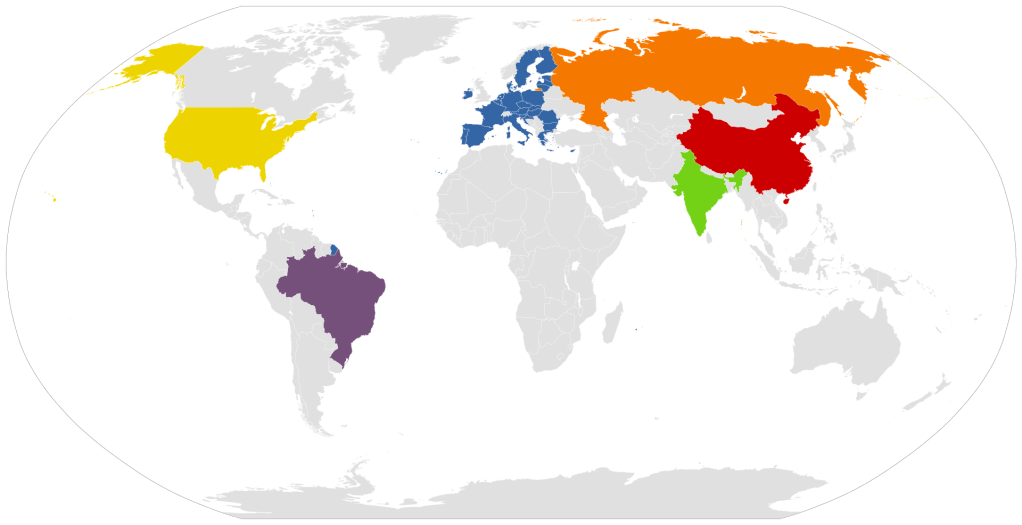
Map of the future predominant global economic-military powers

Comparing the six major powers today, both China and India if no longer dormant, remain relatively passive – particularly India. Saying that, both nations have the potential to become superpowers and this is very likely. Judging from modern history, it is a nation of formidable economic size which makes that quantum step from a major power to a super power.

For instance, Japan is a technological leader and economic giant. Some may think it could revert to a warlike footing, though this is not what is predicted; nor will Japan ever make the critical step to superpower status. It will likely remain a passive major power. In this regard, Germany as a major power, is similar to Japan. Two world wars revealed that Germany as a regional power took that next step to impact on a European regional scale; though it did not have the capability to extend itself beyond a certain parameter – a victim, of imperial overstretch. Of course, all that has changed now it is the economic driver of a new empire, currently called the European Union.

Flag of the European… German Union

Germany ultimately wields immense power. As a single nation, the leap to superpower status is beyond it. Not so with twenty-six nations in its close orbit and potentially many more to fall under its influence. For now, Germany is somewhere between a dormant and passive major power. In complete irony to the objective of “let’s contain and bind Germany in a unified Europe, so that it is shackled and unable to act aggressively ever again” – time will show it to be one of the worst decisions ever made in the history of our civilisation.

Russia’s ambitions in recapturing its lost satellite nations after the dissolving of the Soviet Union are palpable. Strategic buffer nations with vast natural resources such as Ukraine and Kazakstan are too valuable to ever relinquish permanent control; with Ukraine a case in point. All eyes have been glued on China for the past decade or two, though casting a wary eye on Russia would be more prudent.

It is Russia which was once a superpower and is not so far distantly removed in regaining that status. Its threat is real, not imagined and has not ever gone away. Russia is a constant active major power, with hundreds of years of successive imperialistic endeavours – the scourge of its neighbouring countries.

Russia – like the United States – has its proverbial ‘fingers in many pies’ with regard to geo-political interventions and associated intrigue. Admittedly, it was less overtly active between 1991 and 2014, though the signs of its stirring with the help of western provocation, are plain to see.

What lies ahead for these six major powers – with Japan as an exception, plausibly being reduced in stature and joined by the new and growing powers comprising Brazil, Mexico, Indonesia, Pakistan, Iran, Turkey and eventually a dramatic re-unification of Korea – is the transition to superpower status for China, India, a German led United States of Europe and the reinstatement of a resurrected Russian Empire. These four territories (GRIC) will eventually surpass the world’s only hyper power, the United States of America.

A potent symbol and reminder of America’s power – but for how much longer?

America is compellingly and utterly unique in all history, in the modern world and in our life times. No single nation has been so materially blessed or prosperous beyond belief. No country has so heavily influenced the rest of the whole world in its export of its culture through film, television, literature and music. Never, has a people so comprehensively dominated civilisation in its development of trade, information technology, media, telecommunications, popular culture, munitions, missiles and defence systems.

As an active superpower (and hyper power since 1991), the United States has undeniably built an empire unlike anything seen in the world, for though they do not have a mass of territorial conquests or colonies like the British Empire, their financial investment and diplomatic influence worldwide intertwines the global economy and its geo-political fabric like the roots of a tree that grow underground, wrapping themselves around everything in its path.

Yet, the United States of America reached its economic peak during the 1960s contributing approximately 40% of world GDP. Since then, it has decreased some 50% to approximately 20% or just over, in recent years. The United States took the mantle from the United Kingdom of world policeman and this is no coincidence; yet, as Great Britain suffered from imperial overstretch so too will America, with all its naval and military base presence worldwide coming at a huge cost – Chapter XXX Judah & Benjamin – the Regal Tribes. Eventually it will contract like all great empires have; experiencing an inevitable path of power shrinkage and the lessening of its global influence in every quarter; politically, militarily, economically and geographically – Chapter XXXIII Manasseh & Ephraim – the Birthright Tribes.

Its demise is predicted and it will be both swift and spectacular. A complete role reversal will occur involving its nemesis Russia, that will astound the world. Triggers for this will include other powers ‘ganging up’ on the United States, particularity from a trade stance. Historically, trade wars have led to military conflict. If such occurs, the United States will find itself out-numbered. There may even be a ‘third World War’ scenario. A NATO falling out could also go against the United States. Respect and confidence for the American dollar will continue to diminish and it will surely be replaced by another currency.

All this would impact the American domestic economy adversely; possibly leading to disenfranchised states seeking to secede from the Union; thereby fragmenting into individual states or groups of states as they seek their own independence from the federal government. Thus, seriously impacting America’s collective economic power, its global political influence and crucially, its military might.

In turn, this could be hastened in a Catch-22 by America’s increasing population; for the burgeoning, exponential growth rate of the Latino-Hispano demographic, coupled with the ever increasing African-American and Asian-American population, will lead to significant changes in American ideology, policy and purpose; shifting from the historic WASP dominance, further weakening America’s strength and resolve at home and abroad.

The result of America’s phenomenal prosperity, is a spoiled, arrogant and soulless nation that has well and truly begun its moral decline. For as author John Steinbeck said:

“If you want to destroy a nation, give it too much – make it greedy, miserable and sick.”

Coupled with this, the American civilisation’s eventual loss of wealth and riches will be when the majority of believers either cease to remember or honour the source of their opportunities, bounty and blessings; or when they are eventually outnumbered. For the United States, while not founded as a Christian or even a ‘religious’ nation, did provide through its Constitution, the freedom to worship in a manner that is entirely unique in the world.

When the United States finally arrives at its lowest ebb and becomes the Dis-united States of America; it’s wealth, purpose, resolve and pride in its own power will have dwindled to the point that it is a shadow of itself, a paper tiger. For many, this seems an impossibility or a state of affairs that would take centuries to achieve, but it would seem this may not be the case.

In tandem with America’s demise, will be the rise of the two preeminent European major powers, Russia and Germany. These two nations will form an alliance, that will reshape the global power structure and together the two superpowers will become the world’s hyper power, filling the vacuum left by the disintegrating United States.

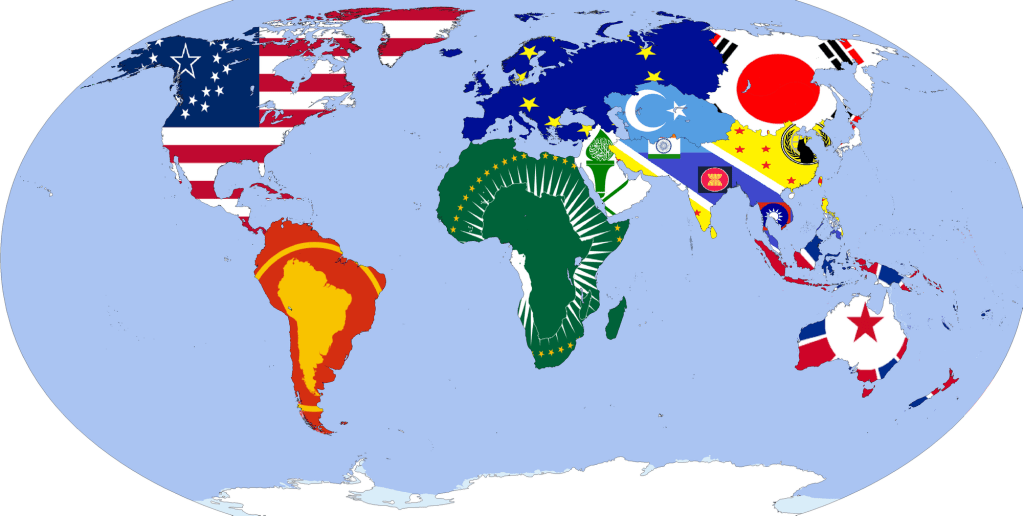
This imagined future world view rather accurately reflects the amalgamation of Russia and a German led Europe; as well as the portrayal of the geo-economic trading blocs of North America, Latin America, Africa, the complex Islamic sphere and the enlarged East Asian region.

It is to Russia that America will one day turn, cap in hand. The eventual outcome is not good, as the independent American polarities will be defeated by a coalition, constituting the northern alliance of Russia and Germany (Europe); in turn collaborating with a Brazilian and Mexican led Latin America.

In this new world order, the Islamic nations as discussed earlier, possibly led by a reincarnation of the Ottoman Turks, Turkey; will challenge the northern alliance hegemony. In a war that stages three major conflagrations, with the North winning the decisive third battle, the southern confederacy of Islam falls to the subjugation and occupation of Russia and a German led Europe. India too, a bystander – or ally of the southern confederacy – will also fall prey to Russian and German domination.

Aside from the intriguing date, the rendition of this world view prescribes the landsNorth Africa, the Middle East, as well as Indiawhich will ultimately fall into the hands of a Russian and German alliance. The artwork hinting of an ancient Roman resurrection coupled with Jewish hegemony is uncannily close to the mark.

At this point the Eastern hordes, comprising China and its allies, decide ‘enough is enough’ and face off against the northern alliance in the mother of all battles that is actually predicted by name. What happens next, is the subject for a different question and another time…

“There is nothing new in the world except the history you do not know.”

Harry S Truman

© Orion Gold 2022 – All rights reserved. Permission to copy, use or distribute, if acknowledgement of the original authorship is attributed to Orion Gold

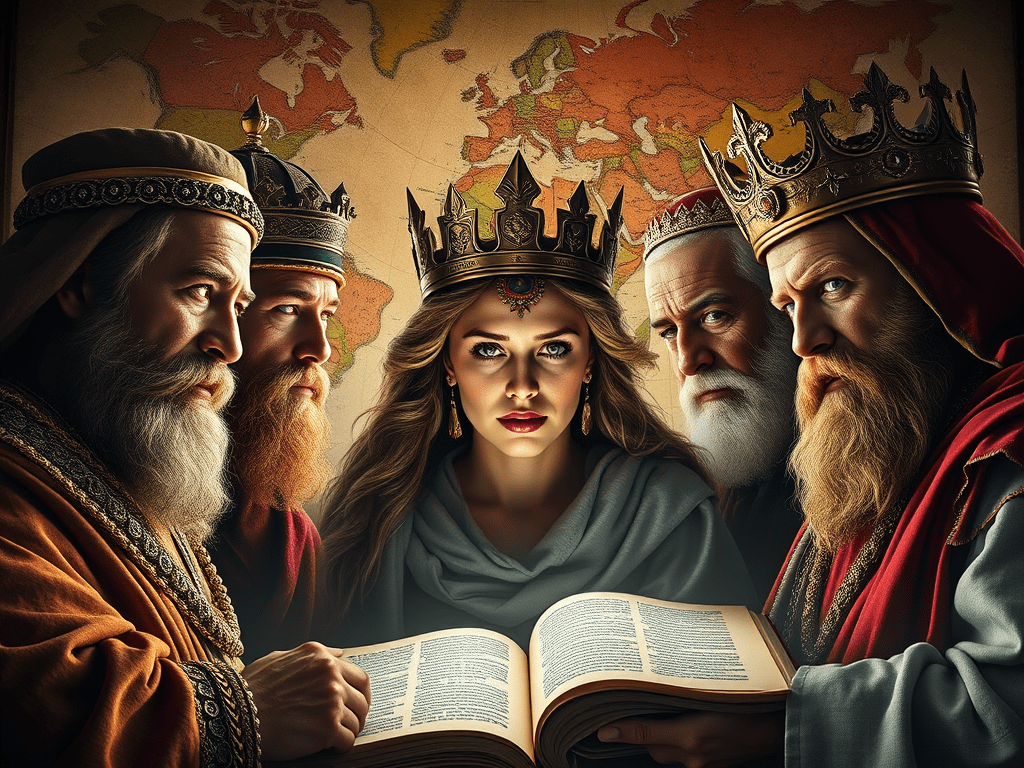
Four Kings & One Queen

Interest in the Kings of the North and of the South is well founded as the culmination of their prophetic roles signals the onset of the time of Jacob’s trouble and may well unravel a third of a millennia from now, near and a little beyond the horizon line of where the third century ends and the next begins.

Jeremiah 30:7

English Standard Version

‘Alas! That day is so great there is none like it; it is a time of distress for Jacob; yet he shall be saved out of it.’

The Book of Daniel chapter eleven contains the single longest prophecy in the Bible; whom biblical scholars believe chronicles principally the break up of the Greco-Macedonian Empire, before projecting into the future. The early part of the chapter references Greece or Javan – somewhat confusingly – as it is not the son of Japheth being described, but actually the Greco-Macedonian Empire and its confrontation with the existing, ruling Medo-Persian Empire ending in 331 BCE.

This writer is not convinced that it is towards the end of the chapter when a change in the players of north and south is revealed, but that it occurs earlier. Regardless, the King of the North and King of the South shift from a Mediterranean and Middle Eastern theatre of orientation, to an imminent global power struggle. 

While not stated as such in the Bible, there is of sorts, a King of the West. This nation is presently a behemoth on the world stage; yet has begun a gradual decline, as we enter the beginning of the end – refer Chapter XXXIII Manasseh & Ephraim – the Birthright Tribes. Within a sixty-five year period, the pride of its power will speedily decline, suddenly fail and with that, it cataclysmically falls.

Isaiah 7:8

English Standard Version

‘… And within sixty-five years Ephraim will be shattered from being a people.’

Its final demise will be spectacular, sudden, devastating and completed at the hands of the King of Assyria – Isaiah 7:17, Hosea 11:5. 

The United States does not play a role as the King of the North or the King of the South, though according to Bible prophecy, it will experience tragedy at the hands of the future King of the North (Article: Is America Babylon?)

The prevalent view amongst identity adherents and fundamentalist Christians has been that Asshur as ‘the instrument of God’s wrath’ in bringing true Israel to its knees in repentance past and future, is the nation of Germany and the Teuton peoples. Yet geography, history, migration, autosomal DNA, mtDNA and Y-DNA Haplogroups, reveal that the Germans are actually descended from Ishmael – refer Chapter XXVIII The True Identity & Origin of Germans & Austrians – Ishmael & Hagar

As the dominant nation from the descendants of Peleg – the son of Eber from Arphaxad a son of Shem – in Western Europe, centrally placed Germany is also the leading nation of all of Joktan’s descendants from Eber, who reside in Eastern Europe. In the future, a German led United States of Europe will ally itself with the real Assyrians – refer article: Is America Babylon? 

The prophet Balaam provides a future prophecy on these specific nations, including Kittim, a son of Javan descended from Japheth.

Numbers 24:24

English Standard Version

“But ships shall come from Kittim and shall afflict [H6031 – anah] Asshur and Eber; and he too shall come to utter destruction.”

It is in fact the Russians who descend from Asshur and are modern day Assyria – refer Chapter XX Will the Real Assyria Stand Up: Asshur & Russia. Russia is both the King of the North and the instrument of God’s wrath against true Israel and Judah. The Hebrew word for afflict, means: ‘to afflict, abase’ or ‘humble (one self).’

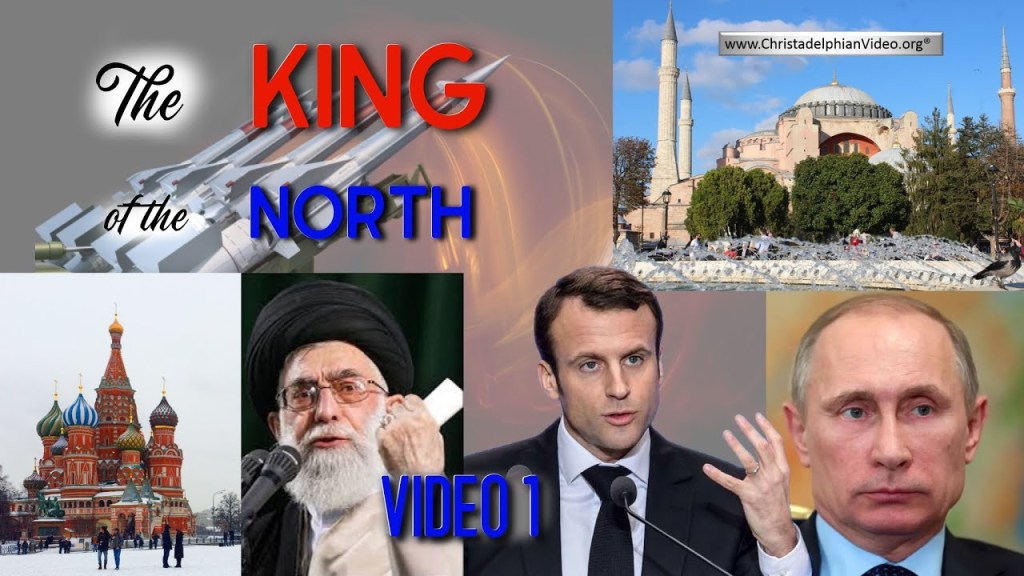
While Iran and France are not the future King of the North, it is insightful by the source of this montage to correctly include Russia, Moscow and its current president under the banner of the King of the North.

Zephaniah 2:13

English Standard Version

‘And he will stretch out his hand against the north and destroy Assyria, and he will make Nineveh [their capital] a desolation, a dry waste like the desert.’

Isaiah 10:5, 24-25

English Standard Version

5 ‘Woe to Assyria, the rod of my anger; the staff in their hands is my fury… 

24 Therefore thus says the Lord God of hosts: “O my people, who dwell in Zion, be not afraid of the Assyrians when they strike with the rod and lift up their staff against you as the Egyptians did. 25 For in a very little while my fury will come to an end, and my anger will be directed to their destruction.’

There are only two nations in the northern hemisphere which could at a certain point in the future, possess the military and economic wherewithal to inflict a captivity of this magnitude on the modern nations of Israel and Judah – not the modern state called Israel – Chapter XXX Judah & Benjamin – the Regal Tribes; and Chapter XXIX Esau: The Thirteenth Tribe. The nation of Germany is not in the north.

Amos 6:8-9, 11, 14

English Standard Version

‘… declares the Lord, the God of hosts: “I abhor the pride of Jacob and hate his strongholds, and I will deliver up the city and all that is in it.” … And if ten men remain in one house, they shall die… and the great house shall be struck down into fragments, and the little house into bits. “For behold, I will raise up against you a nation, O house of Israel,” declares the Lord, the God of hosts; “and they shall oppress you…”

The other contender nation China, already has its own predetermination as we will learn. The Assyrians are given their mission as Israel’s punisher from the Creator, though as they relish the role, their demise is also foretold. 

We then read further, about the King of the North in the book of Daniel. The whole of chapter eleven is worth reading, though for brevity the key verses include the following.

Daniel 11: 15, 18, 25, 29-31, 40, 42-44

English Standard Version

‘Then the king of the north shall come… Afterward he shall turn his face to the coastlands and shall capture many of them… And he shall stir up his power and his heart against the king of the south with a great army. And the king of the south shall wage war with an exceedingly great and mighty army, but he shall not stand, for plots shall be devised against him…’ 

The King of the North finds reason to attack the coastlands or isles which in the Bible are always associated with the far East. In this case, southeast Asia – Chapter VII Javan: Archipelago South East Asia & Polynesia; and Chapter IX Tarshish & Japan.

Isaiah 66:19, ESV: ‘… to Tarshish , Pul, and Lud, who draw the bow, to Tubal and Javan, to the coastlands far away, that have not heard my fame or seen my glory…’ Pul, is not a mis-translation of Put or Phut. It is a name of a king; a King of Asshur and a reference to Assyria. Russia then turns its attention to the King of the South and defeats them in their first encounter.

Daniel: ‘At the time appointed he shall return and come into the south, but it shall not be this time as it was before. For ships of Kittim shall come against him, and he shall be afraid and withdraw, and shall turn back and be enraged and take action against the holy covenant… and profane the temple and fortress, and shall take away the regular burnt offering. And they shall set up the abomination that makes desolate’ – Matthew 24:15.

The interlinear says: ‘For ships Chittim shall come…’ It does not include ‘of’ or ‘from’ in the Hebrew, though it is considered the inference is from more than of, Kittim. Sometimes translated unhelpfully, as ships from the west. Some have then mistakenly translated Kittim as being Cyprus or Italy; where they once dwelled. The people today descended from Kittim live in the Indonesian archipelago – refer Chapter VIII Kittim & Indonesia.

We learned earlier in Numbers 24:24, that ships from Kittim inflict a loss on Asshur and Eber – an alliance of Russia and a German led European Union respectively. 

At some point, Kittim is either part of those nations amalgamated as the King of the South, and Indonesia’s military and naval power is formidable enough to fight Russia and Europe, or more likely, the verse is a veiled reference to a naval cavalcade, of various confederate nations travelling from a base in Kittim. It is plausible that Indonesia could accommodate a military and naval presence within its strategically positioned islands in southeast Asian waters. This enlargement of the King of the South alliance creates a powerful navy, which wins a confrontation against the King of the North, scaring them into retreat.

Modern navies since the last century have considerably more impact in any escalation than in the past, as they not only provide an effective means of transporting soldiers and military hardware, they include the critical strike potency afforded through the combined use of aircraft carriers and their jet fighter aircraft – Article: 2050.

In wrathful response, the abomination of desolation is committed and marks the beginning of the great tribulation some thirty days later and a final three and one half year period; a prophetic 1260 days before the Son of Man returns – Daniel 9:27, 12:11, Matthew 24:21-22.

Daniel: ‘At the time of the end, the king of the south shall attack him, but the king of the north shall rush upon him like a whirlwind, with chariots and horsemen, and with many ships He shall stretch out his hand against the countries, and the land of Egypt [Mizra] shall not escape. He shall become ruler of the treasures of gold and of silver, and all the precious things of Egypt, and the Libyans [Phut] and the Cushites shall follow in his train. But news from the east and the north shall alarm him, and he shall go out with great fury to destroy and devote many to destruction.’

The King of the North clashes for a third time with the King of the South, who this time is the aggressor – bolstered by winning the second exchange – attacking Russia with its allies. Notice the King of the North is prepared with ‘many ships’ and wins the third and final conflagration. Mizra includes the Arab nations, led by Egypt, Phut is Pakistan and Cush is India – refer Chapter XIII India & Pakistan: Cush & Phut; and Chapter XIV Mizra: North Africa & Arabia. India though, is not aligned with the King of the South. Russia gains control of Arab assets, for instance oil reserves. The threat from the Northeast, is an East Asian alliance, led by China.

The dominance of Russian interest expands to include the Middle East, West Asia and South Asia. This has been the long term goal of Russia – not withstanding the failed attempt at securing a warm water port during the war in Afghanistan from 1979 to 1989 – and echoes the words of ‘Peter the Great… [who] advised his descendants to “approach as near as possible to Constantinople [Istanbul] and India [Cush]. Whoever governs there will be the true sovereign of the world. Consequently, excite continual wars, not only in Turkey [Elam], but in Persia [Iran, Lud]… Penetrate as far as the Persian Gulf [Iraq], advance as far as India” – Prisoners of Geography, Tim Marshall, 2016 & 2019, page 13.

Ezekiel 27:10

New English Translation

‘Men of Persia [Elam], Lud, and Put [Pakistan] were in your army, men of war. They hung shield and helmet on you; they gave you your splendor.’

Lud a son of Shem, is associated with Elam and Phut geographically and militarily a number of times in the Bible. All the verses which mention them are connected with warfare. It is not a surprise therefore to discover that Lud is the modern militaristic state of Iran – refer Chapter XVII Lud & Iran. Their relationship with Pakistan and Elam falls into place in the jig-saw of who comprises the King of the South; as Elam is the nation of Turkey – refer Chapter XVIII Elam & Turkey.

What is worth noting, from Ezekiel 27:10, is that Turkey, Iran and Pakistan are the heart and core of the future Islamic Alliance which is referred to in the Book of Daniel, as the King of the South. Peripheral players in this powerful confederacy, may well include other major Islamic nations of Egypt, Pathros from Mizra; Bangladesh, Havilah from Cush; and Indonesia, Kittim from Javan.

There are a handful of contender nations for leader of the Muslim world: population wise, Bangladesh and Indonesia; diplomatically wise as in gaining pan-Arab support, Egypt; militarily, Pakistan and critically, ideologically wise, Iran. The last two would appear favourites and Iran has the edge maybe, in religious zealotry and militancy compared with Pakistan. 

On the fringes because of its ostensibly more western footing is Turkey. How it would fit into an Islamic alliance is not as clear cut, unless economic clout is considered foremost. Potential leader cannot be ruled out particularly as its economy – 19th biggest GDP in the world – though marginally behind Indonesia at 16th and Saudi Arabia at 18th, is growing to soon make it the dominant nation of the South.

Turkey is included in the Next Eleven countries that are projected to dominate the global economy in the middle of the twenty-first century. Other N-11 nations coincidentally, include Bangladesh, Egypt, Indonesia, Iran and Pakistan. Most of the group’s total gross domestic product derives from Mexico, Indonesia, South Korea and yes, Turkey. These Islamic nations are the fastest growing major economies of the next generation along with the burgeoning economies of the BRIC nations, comprising Brazil, India, China and forebodingly, Russia.

India is discussed in the Bible and has a vital role to play as the Queen of the South; a powerful counterpoint to the King of the South.

Matthew 12:42

Amplified Bible

‘The Queen of the South (Sheba) [Sheba and Dedan descended from Cush] will stand up [as a witness] at the judgment against this [last] generation, and will condemn it because she came from the ends of the earth to listen to the wisdom of Solomon; and now, something greater than Solomon is here [the Messiah].’

The term Queen of the South is a tantalising clue as it confirms the status of India on the world stage, while at the same time excluding it from the future union of Islamic nations incorporating the King of the South: Turkey, Iran, Pakistan, Egypt and their allies Indonesia and Bangladesh.

An alliance led by China, is predicted in the Book of Revelation.

Revelation 16:12

English Standard Version

‘The sixth angel poured out his bowl on the great river Euphrates, and its water was dried up, to prepare the way for the kings from the east.’

The Kings from the East comprise China, North Korea or sensationally, a united Korea and much of continental southeast Asia, including Vietnam, Myanmar and Thailand. At this juncture, after the King of the North has conclusively and systematically defeated the King of the South; the Queen of the South; and having previously dispatching the King of the West; China decides to impede Russia’s rush towards total global dominion.

Revelation 16:16

English Standard Version

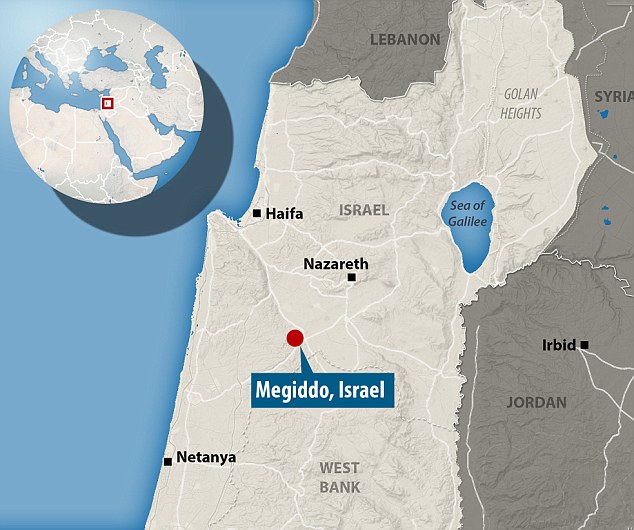
‘And they assembled them at the place that in Hebrew is called Armageddon [G7171 meaning: ‘the hill or city of Megiddo’ derived from G4023: ‘to surround, encompass, take possession, sieze’ and G2022: ‘to pour upon’].’

The forces of the Russian King of the North square up against the combined Chinese led Asian Kings of the East on the plains below (adjacent to) Megiddo.

China comprises three of Japheth’s sons – refer Chapter X China: Magog, Tubal & Meshech. Magog, Tubal and Meshech dwell in the North and in the East – Daniel 11:44, Revelation 16:12. Magog is described in Ezekiel chapters thirty-eight, thirty-nine and in Revelation 20:1–10. Only one nation in the world could be the correct match.

Gog is a future ruler of Magog – quite literally, a de-magog-ue.

Definition of a demagogue: ‘a person, especially an orator or political leader, who gains power and popularity by arousing the emotions, passions, and prejudices of the people.’

This leader is suspiciously reminiscent of the Nephilim – Articles: Nephilim & Elioud Giants I & II.

There are in fact two wars predicted, involving Magog:

1. Towards the end of the Great tribulation at the battle of Armageddon, Magog with the Kings of the East, faces off against the King of the North.

2. At the end of a millennial period of peace, Magog and its allies attack, not the present day state of Israel (or the Jews), but rather true Israel descended from the sons of Jacob – Chapter XXIX Esau: The Thirteenth Tribe; and Chapter XXX Judah & Benjamin – the Regal Tribes.

‘The phrase, “The Yellow Peril,” was first introduced into public print by Emperor William of Germany in 1895. In making a cartoon, representing the dangers likely to arise from the nations of the East against the West, the Emperor named the picture, ‘The Yellow Peril’ – The Yellow Peril, or the Orient vs. the Occident as viewed by modern statesmen and ancient prophets, 1911, Greenberry George Rupert (1847-1922).

The Statue in Nebuchadnezzar’s dream has been discussed previously, with the Medes of Madai, represented by the Turko-Mongols of Central Asia and the Persians of Elam, represented by Turkey, being the chest and arms of silver.

The head of gold is synonymous with the Babylonian Chaldean Empire from the descendants of Abraham’s brother Nahor, represented by Italy.

The torso and thighs of bronze equate to the Greco-Macedonian Empire, the descendants of Abraham’s nephew Lot (Moab and Ammon), represented by France – Chapter XXV Italy: Nahor & the Chaldeans; and Chapter XXVI The French & Swiss: Moab, Ammon & Haran.

Each descending metal is less valuable, though more robust than the one previous to it.

In Daniel 2:33, 40 NET, it says:

Its legs were of iron… Then there will be a fourth kingdom, one strong like iron. Just like iron breaks in pieces and shatters everything, and as iron breaks in pieces all these metals, so it will break in pieces and crush the others.’

The legs of iron, are much stronger than the bronze of the Greco-Macedonians, yet not as culturally sophisticated or resplendent. It would be unusually conspicuous if the Assyrians were missing from the statue, as other major European powers are included as we have investigated.

The two legs represent the division of the Roman Empire. One leg of iron is the Western Roman Empire centred in Rome and represents the descendants of Ishmael: Germany – Chapter XXVIII The True Identity & Origin of Germans & Austrians – Ishmael & Hagar.

The other leg is the Eastern Roman Empire of Byzantium and this leg represents the descendants of Asshur: Russia – Chapter XX Will the Real Assyria Stand Up: Asshur & Russia.

Edited excerpt from an answer to questions asked on Quora: What is the meaning of Daniel chapter 11? and What does the Bible mean about “Queen of the South”?

© Orion Gold 2021 – All rights reserved. Permission to copy, use or distribute, if acknowledgement of the original authorship is attributed to orion-gold.com