Is America Babylon?

This is a pertinent question, as support for this teaching has gained increased acceptance amongst open minded Christians. 

Feed the Hunger:

‘The prophetic community is somewhat divided over whether or not America is the “Babylon the Great” mentioned in Revelation 17-18.’

So that interpretations vary with some commentators identifying Babylon as ancient Rome and thus by extension, the Universal Church for example; while others teach Babylon represents a modern power such as the United States of America.

Regardless, Babylon the Great in the Book of Revelation is depicted as a powerful and dominating entity responsible for idolatry, moral corruption and luring nations into rebellion and sin against God.

What is key, is what does the Bible actually state rather than relying on the perceptions of biblical scholars and descriptions by teachers; who may have arrived – through over zealous enthusiasm for end time prophecy fulfilment – at perhaps an incorrect conclusion.

It is as crucial to understand whether Babylon is at once a city, a state, a country, a group of nations or is a system. If the latter, is it political and or religious? 

Similarly, is the (first) Beast of Revelation, a man or a spirit entity (an antichrist); or is it a system? Likewise, who or what is the second Beast; a national state or an individual called the false prophet? And, is one of these beasts, Babylon? 

The books of Revelation and Daniel are the focus of this discussion and therein will lie the answer. 

While constant readers will be aware of this writer’s findings and conclusions in previous articles, a fresh investigation is perhaps warranted in bringing further insight (of which can be confirmed has been the result). 

A summary of present understanding – new readers please lend patience and withhold judgement until the end – is that the first Beast is the angel of the Abyss known as Abaddon in Hebrew and Apollyon in Greek – meaning (place of) destruction (or doom) and the destroyer respectively.

This being was originally Azazel, one of the chief Watchers who descended to the earthly plane to corrupt the Eternal’s creation.

The Beast is subservient to the Dragon (the Adversary) and when loosed from the bottomless pit (an endless void) as the Antichrist, seeks to enslave and ultimately destroy humankind – Chapter XXI The Incredible Identity, Origin and Destiny of Nimrod; and Chapter XXII Alpha & Omega.

Which thematically leads to the second Beast, who sets a constraining mark on humanity to worship the first Beast. This second Beast enforces a belief system that is at once contrary to the true religion espoused by Christ – refer article: The Seven Churches – A Message for the Church of God in the Latter Days – and a continuation of the Babylonian Mystery Religion promulgated by the Nephilim tyrant Nimrod. The second Beast is a supernatural entity and scripture indicates its identity as a re-incarnation of Nimrod himself – Chapter XXI The Incredible Identity, Origin & Destiny of Nimrod

The question surrounding Babylon is understood by many to represent a continuation of this self same mystery religion. Where this writer differs from other commentators is that they teach ‘Babylon’ is centred in Rome, the Vatican and wholly within Catholicism; while it is this writer’s understanding that ‘Babylon’ includes all of Rome’s apostate (protestant) daughters. For Christianity is a false religion inspired by and based upon the theology of Paul and not the Way as preached by the apostles who followed the teachings of Christ – refer article: The Pauline Paradox.

The fact that northern (and central) Italy is populated principally by people of Chaldean descent is no coincidence, for they are the biological inheritors of the Chaldean lineage descending from Abraham’s elder brother Nahor – refer Chapter XXV Italy: Nahor & the Chaldeans; and Chapter XXIII Aram & Tyre: Spain, Portugal & Brazil.

Thus the same mystery religion of the Chaldean Babylonians is realised in Vatican City and the Universal Church – this is true.

Where does this leave the United States of America? Some propound it is the second beast while recognising Rome, the Vatican and the Papacy as the first beast. For others, Babylon is being fulfilled entirely by America. An important part of their reasoning is how could a hyper power of such magnitude be omitted from the scriptures. And they are right, so they seek to identify America in the Book of Revelation. Yet ironically, the United States is mentioned in Revelation – as it is throughout the Old Testament. Unless one understands the true identity of America, interpretation of prophetic scripture is easily skewed into misinterpretation.

This dichotomy is widespread as Tim LaHaye (American Baptist minister) acknowledges:

“One of the hardest things for American prophecy students to accept is that the United States is not clearly mentioned in Bible prophecy, yet our nation is the only superpower in the world today.”

Where Are The Chinese People In God’s Word?, Tom Hobson, 2017: 

‘God’s word may speak more specifically about China than it does about America [no, not true]. The closest such verse I can find is Ezekiel 30:5, which mentions the “Land of the Covenant,” which sounds like the modern Israeli name in Hebrew for the “United States” (Artzoth-ha-Berith, “The Lands of the Covenant”) [yes, true].’

Constant readers will be cognisant of America’s real identity as the descendants of Jacob’s son Joseph, through his sons Ephraim and the half tribe of West Manasseh. For the tribe of Manasseh split into two, with the half tribe of East Manasseh becoming the nation of Canada – Chapter XXXIII Manasseh & Ephraim – the Birthright Tribes. 
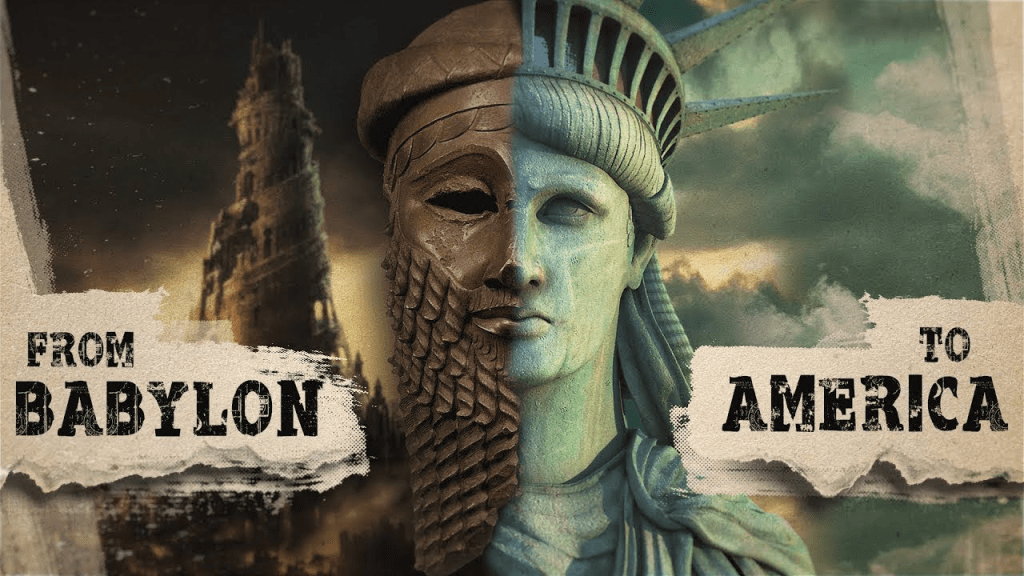
Part of our investigation will necessitate understanding what Babylon meant historically, as well as its derivation from Babel and its infamous tower campaigned and built by none other than Nimrod – refer article: The Pyramid Perplexity.  

Book of Daniel

Prior to exploring Babylon and specifically the Book of Revelation, it is to its companion book in the Old Testament we turn, the prophetic Book of Daniel; to discover what we can learn in assisting to comprehend the mysterious revelation given to the Apostle John directly by Jesus Christ.  

Ancient Babylon

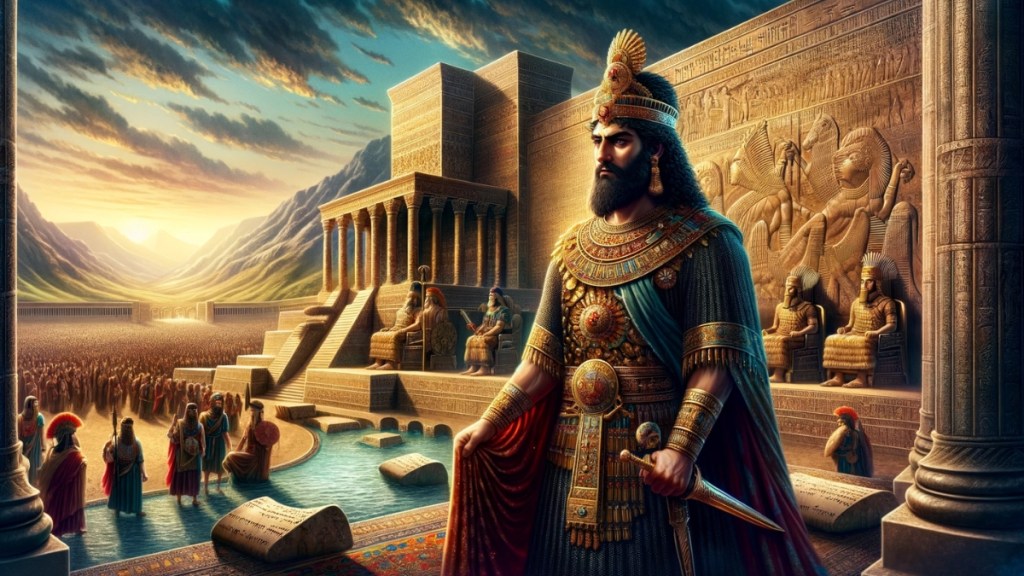
Daniel was of royal birth and descended from the tribe of Judah and as a young man was selected with three others to be retained in the court of the Chaldean King Nebuchadnezzar II (King of Babylon) – Daniel 1:3. Daniel was blessed by the Eternal and like Joseph was a seer of dreams and visions (Article: Seventh Son of a Seventh Son) – Daniel 1:17, Genesis 37:5-11; 40: 5-23; 41:15-32 (English Standard Version throughout unless stated otherwise).

In the second chapter of Daniel we learn that Nebuchadnezzar was troubled and sleep deprived from a vivid reoccurring dream. He challenged his wise men (magicians and sorcerers) to not just interpret the dream but to reveal his dream to him. They were aghast and declared no one in the world could do what he asked. 

Daniel learned of the king’s challenge and requested an audience with King Nebuchadnezzar. He also beseeched mercy from the Eternal “concerning this mystery, so that Daniel and his companions might not be destroyed with the rest of the wise men of Babylon. Then the mystery was revealed to Daniel in a vision of the night.”

Nebuchadnezzar’s dream was of a great statue and Daniel reveals this as well as three pertinent facts.

First, the head of gold symbolised Nebuchadnezzar himself and the Chaldean Empire; second, there would be identifiable kingdoms following his own; and three, the Kingdom of God would ultimately supplant the kingdoms of men with Christ’s return – Daniel 2:44. 

The following understanding on the successive kingdoms is universally agreed, though their modern identities and the final interpretation on the two (yet individual) legs is this writer’s.  

Four Kings & One Queen

‘The Statue in Nebuchadnezzar’s dream has been discussed previously, with the Medes of Madai… [ancestors of] the Turko-Mongols of Central Asia and the Persians of Elam… [ancestors of the Turks], being the chest and arms of silver.

The head of gold is synonymous with the Babylonian Chaldean Empire from the descendants of Abraham’s brother Nahor… [and the ancestors of the Italians] – Chapter XXV Italy: Nahor & the Chaldeans.’

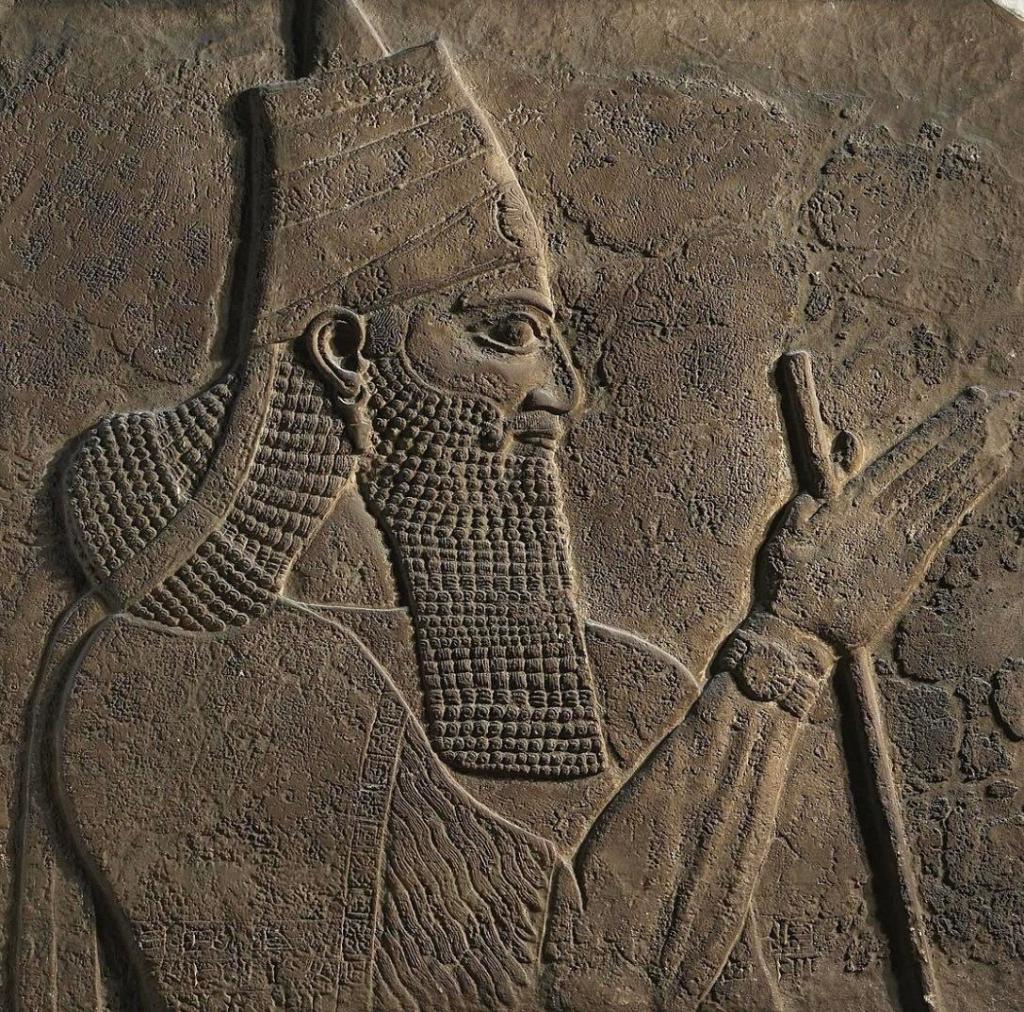
The fall of Babylon in 539 BCE at the hands of Cyrus the Great, king of the Medes and Persians 

‘The torso and thighs of bronze equate to the Greco-Macedonian Empire, the descendants of Abraham’s nephew Lot (Moab and Ammon)… [and ancestors of the French] – Chapter XXVI The French & Swiss: Moab, Ammon & Haran

Each descending metal is less valuable, though more robust than the one previous to it.’

‘In Daniel 2:33, 40 NET, it says: 

“Its legs were of iron… Then there will be a fourth kingdom, one strong like iron. Just like iron breaks in pieces and shatters everything, and as iron breaks in pieces all these metals, so it will break in pieces and crush the others.”

‘The legs of iron, are much stronger than the bronze of the Greco-Macedonians, yet not as culturally sophisticated or resplendent.

It would be unusually conspicuous if the Assyrians were missing from the statue, as other major European powers are included as we have investigated. 

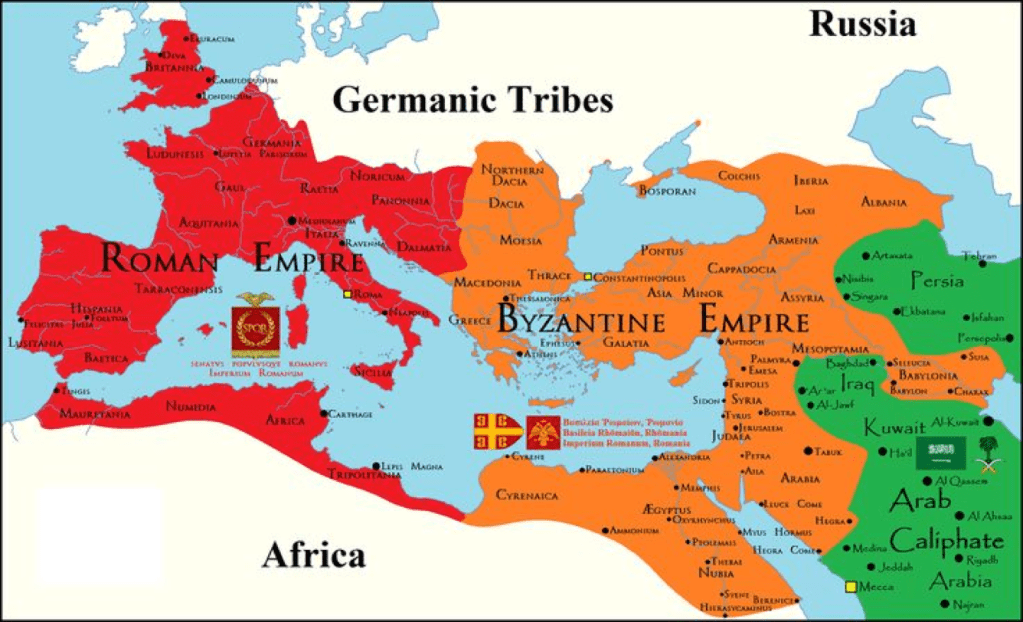
The two legs represent the division of the Roman Empire. One leg of iron is the Western Roman Empire centred in Rome and represents the descendants of Ishmael… [the ancestor of the Germans] Chapter XXVIII The True Identity & Origin of Germans & Austrians – Ishmael & Hagar.

The other leg is the Eastern Roman Empire of Byzantium and this leg represents the descendants of Asshur… [the ancestor of the Russians] – Chapter XX Will the Real Assyria Stand Up: Asshur & Russia.’

It is worth noting two important points in the a. anthropomorphic symbolism for worldly kingdoms in Daniel chapter two and whether this is replicated in Revelation or not and b. how the legs and hence the (future) feet represent gentile kingdoms and not those of Israel (the sons of Jacob not to be confused with the state of Israel – Chapter XXIX Esau: The Thirteenth Tribe). 

In other words, not the United States or the United Kingdom as many propose – observe diagram of statue above for example. While these nations may have been successors to Rome and Byzantium from an imperial (global power and influence) perspective; they have not necessarily been the inheritors of the Babylonian Mystery Religion. This is an important aspect regarding whether America is included in the Revelation of Christ to John or not. Whereas German states were the nucleus of the Holy Roman Empire for a thousand years (from 800 to 1806).

It is also pivotal in appreciating which powers will be the focus of attention in the latter days. For they are Russia (one foot and five toes) with a resurrected ‘Soviet’ empire; and a German (the other foot and five toes) led ‘United States of Europe’ – refer article: Four Kings & One Queen.

In chapter three, King Nebuchadnezzar in his arrogance erects an ‘image’ of gold, a statue some ninety feet high and presumably of himself (or the statue of his dream) – Daniel 3:1. 

Either way, the king required everyone to bow down and worship it (an ante-type in likeness of the future Beast – Revelation 13:12-15) or die in a fiery furnace – Daniel 3:5-6.

It is no surprise then, that in chapter four, the Eternal strikes Nebuchadnezzar with a mental breakdown (psychosis), whereby he becomes like a ‘beast’ living with animals and eating grass for seven years – Daniel 4:32-33. The result was a miraculous turnaround when his madness was removed and Nebuchadnezzar was converted, becoming a servant of the Eternal – Daniel 4:34-35, 37.

The next key dream vision (prophecy) is in Daniel chapter seven. 

2 ‘Daniel declared, “I saw in my vision by night, and behold, the four winds of heaven were stirring up the great sea*. 3 And four great beasts [living animals] came up out of the sea, different from one another. 

4 The first was like a lion and had eagles’ wings. Then as I looked its wings were plucked off, and it was lifted up from the ground and made to stand on two feet like a man, and the mind of a man was given to it.’

The lion^ with eagles** wings – like the head of gold – represents the Chaldean’s regality and ostensibly does not (literally or figuratively) symbolise the United Kingdom^ (Judah) or America** (Joseph).

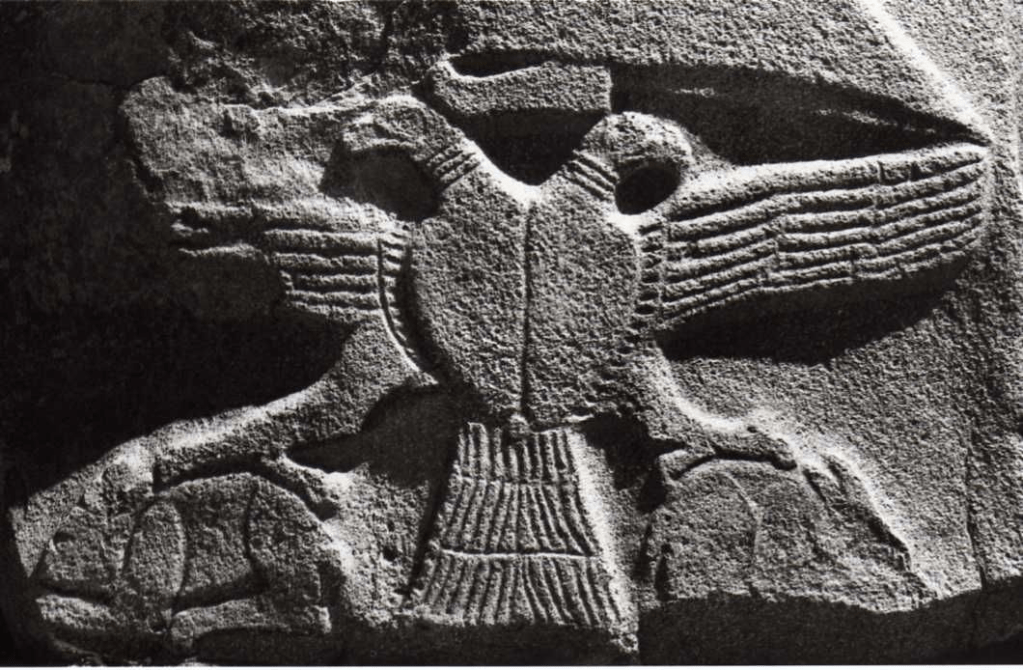
Amazingly, the symbol of a lion with eagles wings is prevalent throughout modern day Italy – refer Chapter XXV Italy: Nahor & the Chaldeans. 

5 ‘And behold, another beast, a second one, like a bear. It was raised up on one side. It had three ribs in its mouth between its teeth; and it was told, ‘Arise, devour much flesh.’ 

The bear in this instance – seemingly not Russia (Assyria) – symbolises the raw strength of the Medo-Persian Empire.

Bear and Eagle: Tom Lovorn, Th.D:

‘The bear was reared up on one side to indicate that Persia would be the stronger nation, eventually absorbing the Medes into one empire.’

The three ribs signify the defeated kingdoms in Persia’s rise to world power: Babylon, Egypt and either Lydia (probably) or Assyria (possibly). Persia ‘devoured much flesh’, in that its geographic size was immense.

The Achaemenid (Achaemenian) Empire was the largest that the ancient world had seen. The kingdom covered a total area of approximately 2.1 million square miles. Only later eclipsed by the Mongol Empire and following that, by the British Empire.

6 ‘After this I looked, and behold, another, like a leopard, with four wings of a bird on its back. And the beast had four heads, and dominion was given to it.’

The leopard also has wings like the lion. The four wings are deemed to represent the speed with which the Greco-Macedonian empire travelled and fought. The four heads were fulfilled by the division of the empire following Alexander’s death among four of his generals – Chapter XXVI The French & Swiss: Moab, Ammon & Haran. 

7 ‘After this I saw in the night visions, and behold, a fourth beast, terrifying and dreadful and exceedingly strong. It had great iron teeth [Job 41:14]; it devoured and broke in pieces and stamped what was left with its feet [Job 41:10, 25].

It was different from all the beasts that were before it, and it had ten horns. 8 I considered the horns, and behold, there came up among them another horn, a little one, before which three of the first horns were plucked up by the roots. And behold, in this horn were eyes like the eyes of a man, and a mouth speaking great things.’ 

Aurel Gheorghe describes the common yet problematic and limiting explanation for the little horn and the three horns plucked by the roots. 

“There is little agreement among Bible scholars who the little horn is or who the three horns of Daniel 7 are. (In the Bible horns represent powers or kings). 

However, the explanation that makes the most sense (in my opinion) is that the little horn is papal power while the three little horns are the Heruli (493 AD), the Vandals, (534 AD), and, the Ostrogoths (538 AD). 

Vandals, Ostrogoths and Heruli were tribes [who] opposed the rise of the papal power and were completely destroyed by the Roman armies. In 538 AD after the defeat of the Ostrogoths, Justinian decreed that the bishop of Rome is the head of all the churches.”

The horns and particularly the little horn is given human attributes of a mouth and eyes. Thus the horns appear to be rulers emanating from the fourth beast. We will discover in Revelation a theme of seven heads; whereby a mysterious eighth head is included from nowhere. This would seem to correlate with the ten horns losing three to make way for the transplanting of an eighth horn.

17 ‘These four great beasts are four kings who shall arise out of the earth.* 18 But the saints of the Most High shall receive the kingdom and possess the kingdom forever, forever and ever.’

This verse says the beasts are kings (whether human or otherwise) and not just kingdoms or nations. As the Greek word for king is different for that for kingdom. 

19 “Then I desired to know the truth about the fourth beast, which was different from all the rest, exceedingly terrifying, with its teeth of iron [like the lower legs of ancient Rome (modern day Germany)] and claws of bronze [like the upper legs of ancient Greece (modern day France)], and which devoured and broke in pieces and stamped what was left with its feet,

20 and about the ten horns that were on its head, and the other horn that came up and before which three of them fell, the horn that had eyes and a mouth that spoke great things, and that seemed greater than its companions.’

The fourth beast is not recognisable amongst the known animals of the Earth, though it may well be a frightening creature such as a dragon-like dinosaur or xenomorph. 

21 ‘As I looked, this horn made war with the saints and prevailed over them, 22 until the Ancient of Days came, and judgment was given for the saints of the Most High, and the time came when the saints possessed the kingdom.’

The little horn is clearly defined as a future ruler, with biblical scholars jumping the gun identifying it as the papacy. 

23 “Thus he said: ‘As for the fourth beast, there shall be a fourth kingdom on earth, which shall be different from all the kingdoms [continuation or rather an evolution of the (Holy) Roman Empire], and it shall devour the whole earth, and trample it down, and break it to pieces.’ 

The beasts are allegedly kings yet verse twenty-three says the fourth beast is actually a kingdom. It appears to lead into the final kingdom before Christ’s return when viewed alongside John’s details in Revelation. 

Online Encyclopaedia:

‘The Holy Roman Empire fell on August 6, 1806, when the last emperor, Francis II [a Hapsburg], abdicated in response to Napoleon’s rise to power and the formation of the Confederation of the Rhine, which included many German states that had previously been part of the empire. This dissolution marked the end of a political entity that had existed for over a thousand years, weakened by wars and internal divisions.’ 

Thus the dissolving of the Holy Roman Empire may only be an interruption and as Adolf Hitler wished to proclaim a thousand year Reich of German hegemony, a future ruler will in some form, resurrect the Holy Roman Empire and its dominion will pave the way for the little horn and ensuing enslavement and destruction. The Book of Revelation provides the important details on who this little horn is.

24 ‘As for the ten horns, out of this kingdom ten kings shall arise, and another shall arise after them; he shall be different from the former ones, and shall put down three kings’ – recall the three ribs in the mouth of the bear.

In this verse the horns are kings which in turn supports the identification of the fourth beast – on which the ten horns are attached – as not a king but a kingdom (or system). 

25 ‘He shall speak words against the Most High, and shall wear out the saints of the Most High, and shall think to change the times and the law; and they shall be given into his hand for a time, times, and half a time’ – refer article: The Calendar Conspiracy.

The preceding verse lends weight to a (supernatural) future fulfilment for the eleventh ‘little’ horn. Many commentators regarding the Gregorian Calendar teach the first half of the verse has been fulfilled, though it is tied in to the promised three and one half year tribulation on the world as described by John in Revelation and foretold by Christ – Matthew 24:21. 

26 ‘But the court shall sit in judgment, and his dominion shall be taken away, to be consumed and destroyed to the end. 27 And the kingdom [of God] and the dominion and the greatness of the kingdoms under the whole heaven shall be given to the people of the saints of the Most High; his kingdom shall be an everlasting kingdom [Matthew 6:33], and all dominions shall serve and obey him.’

These beasts are clearly animals which represent kingdoms (or empires). The fourth beast is marked out as different, just as a dragon is in comparison with a lion, a bear or a leopard. In the same way its horns are apparently human rulers, the eleventh little horn is seemingly supernatural.

Chapter eight of Daniel is enlightening as it supports and adds to our conclusions thus far. Daniel sensationally predicts the overthrow of the Medo-Persian Empire by Alexander the Great, the swiftness of his army’s tactical manoeuvres and the breakup of his empire amongst four generals upon his death. 

20 ‘As for the ram that you saw with the two horns, these are the kings of Media and Persia. 

5 As I was considering, behold, a male goat came from the west across the face of the whole earth, without touching the ground. And the goat had a conspicuous horn between his eyes.’

21 ‘And the goat is the king of Greece. And the great horn between his eyes is the first king. 22 As for the horn that was broken, in place of which four others arose, four kingdoms shall arise from his nation, but not with his power.’

Chapter eight discusses the mysterious ‘little’ horn. 

9 ‘Out of one of them came a little horn, which grew exceedingly great toward the south, toward the east, and toward the glorious land* [formerly Judea, currently the state of Israel].

10 It grew great, even to the host of heaven. And some of the host and some of the stars [angels] it threw down to the ground and trampled on them. 11 It became great, even as great as the Prince of the host [Christ]. And the regular burnt offering was taken away from him, and the place of his sanctuary was overthrown’ – Abomination of Desolation (Matthew 24:15).

12 ‘And a host will be given over to it [Revelation 9: 3-11*] together with the regular burnt offering because of transgression, and it will throw truth to the ground, and it will act and prosper.’

This passage confirms a number of salient points. 

The little horn is a spirit entity and challenges the Son of God for supremacy of the Earth. This drama was prefigured and enacted in the Holy day observance of Atonement by the Israelites. Leviticus chapter sixteen provides the name of this entity as Azazel. None other than the leader* of the Abyss and future Antichrist. 

He was represented by a goat no less as was Christ. The goat foreshadowing Christ was sacrificed as a sin offering, while the second goat was led into the desert wilderness, symbolic of the spiritual void in which Azazel dwells. This goat was ultimately led over a cliff (representing the bottomless pit) to fall to its death. As the defeat of Azazel’s challenge to Christ’s authority to rule the World will ultimately fail and lead to his death (Revelation 19:20) – Chapter XXI The Incredible Identity, Origin & Destiny of Nimrod. 

Azazel will rule from Jerusalem for this is indicated in Revelation and he will commit an act of desecration regarding Christ’s sacrifice and status as the true Son of God. 

An interesting side note is that the little horn in verse nine is described as issuing from one of the four horns (leaders) of the Greco-Macedonian Empire. The ancestors of this empire are the sons of Lot: Moab and Ammon, whom today comprise the French nation. 

Curiously in the eleventh chapter of Daniel we learn that the future King of the North when he sweeps into the ‘glorious land’*, ‘tens of thousands’ will die, but two peoples are spared from his warpath wrath: the Edomites (Israel) and Moab and Ammon (France).

While the state of Israel is understandable for the antichrist chooses to reign from there, the protecting of France is perplexing in light of the Russian connection with the King of the North and the German connection with ‘Rome’ and the Chaldeans of the Vatican – Article: Four Kings & One Queen.

23 ‘And at the latter end of their kingdom, when the transgressors have reached their limit, a king of bold face, one who understands riddles, shall arise. 24 His power shall be great – but not by his own power; and he shall cause fearful destruction and shall succeed in what he does, and destroy mighty men and the people who are the saints’ – refer Chapter XXXIV Dan: The Invisible Tribe

25 ‘By his cunning he shall make deceit prosper under his hand, and in his own mind he shall become great. Without warning he shall destroy many. And he shall even rise up against the Prince of princes [Christ], and he shall be broken – but by no human hand.’  

The Book of Revelation reveals this being receives its power from the Dragon, the foremost adversary of the Eternal (Revelation 13:2, 4) – Article: Asherah.

While commentators almost unanimously subscribe to much of the chapter referring to the clashes which would take place in mainly the Levant and Egypt amongst the four factions of the divided Greco-Macedonian Empire, it is plausible this is not the case and that Daniel chapter eleven predominantly predicts the conflict between a future King of the South and the King of the North. 

Four Kings & One Queen

“Daniel 11: 15, 18, 25

English Standard Version

‘Then the king of the north shall come… Afterward he shall turn his face to the coastlands and shall capture many of them… [in verses twenty to twenty-four we are introduced to a new and final human leader (king) of the North] And he shall stir up his power and his heart against the king of the south with a great army. And the king of the south shall wage war with an exceedingly great and mighty army, but he shall not stand, for plots shall be devised against him…’

The King of the North finds reason to attack the coastlands (or isles) which in the Bible are invariably associated with the far East. In this case, Southeast Asia – [Chapter V Gomer: Continental South East Asia]; Chapter VII Javan: Archipelago South East Asia & Polynesia; Chapter VIII Kittim & Indonesia; and Chapter IX Tarshish & Japan

Isaiah 66:19, ESV:

‘… to Tarshish , Pul, and Lud, who draw the bow, to Tubal and Javan, to the coastlands far away, that have not heard my fame or seen my glory…’

Pul, is not a mis-translation for Put or Phut. It is a name of a king; a King of Asshur and a reference to Assyria. Russia then turns its attention to the King of the South and defeats them in their first encounter.”

Daniel 11:29-45

29 ‘At the time appointed he [a new king – the Antichrist] shall return and come into the south, but it shall not be this time as it was before. 30 For ships of Kittim [or from Kittim (Indonesia)] shall come against him, and he shall be afraid and withdraw, and shall turn back and be enraged and take action against the holy covenant. He shall turn back and pay attention to those who forsake the holy covenant. 31 Forces from him shall appear and profane the temple and fortress, and shall take away the regular burnt offering. And they shall set up the abomination that makes desolate’ – Matthew 24:15, 2 Thessalonians 2:3-6. 

“The interlinear states:

‘For ships Chittim shall come…’

It does not include ‘of’ or ‘from’ in the Hebrew, though it is considered by this writer that the inference is from rather than, of Kittim.

Sometimes translated unhelpfully, as ships from the west. Some have then mistakenly translated Kittim as being Cyprus or Italy; where Kittim once dwelled. The people descended from Kittim today live in the Indonesian archipelago – refer Chapter** VIII Kittim & Indonesia.”

We learned in a previous chapter** – in Numbers 24:24 – that ships from Kittim inflict a loss on Asshur and Eber – “an alliance of Russia and a German led European Union respectively.”

32 ‘He shall seduce with flattery those who violate the covenant, but the people who know their God shall stand firm and take action’ – 2 Thessalonians 2:7-12.

While the author of 2 Thessalonians – not Paul and probably the prophet Silas, who was once a dedicated supporter of Paul, before switching allegiance and loyalty to Peter (Article: The Pauline Paradox) – is writing about the false prophet the second beast, his attributes are in tandem with the Antichrist; for the two of them are a committed double act – Chapter XXI The Incredible Identity, Origin & Destiny of Nimrod. 

33 ‘And the wise among the people shall make many understand, though for some days they shall stumble by sword and flame, by captivity and plunder. 34 When they stumble, they shall receive a little help. And many shall join themselves to them with flattery, 35 and some of the wise shall stumble, so that they may be refined, purified, and made white, until the time of the end, for it still awaits the appointed time’ – Daniel 12:1-4, 9-10. 

Christ’s message to the true church at the end of this age: 

’For you say, “I am rich, I have prospered, and I need nothing,” not realizing that you are wretched, pitiable, poor, blind, and naked. I counsel you to buy from me gold refined by fire, so that you may be rich, and white garments so that you may clothe yourself and the shame of your nakedness may not be seen, and salve to anoint your eyes, so that you may see’ – Revelation 3:17-18. 

“Behold, I am coming like a thief! Blessed is the one who stays awake, keeping his garments on, that he may not go about naked and be seen exposed!” – Revelation 16:15

Daniel: 36 ‘And the king shall do as he wills.

He shall exalt himself and magnify himself above every god, and shall speak astonishing things against the God of gods.

He shall prosper till the indignation is accomplished; for what is decreed shall be done. 37 He shall pay no attention to the gods of his fathers, or to the one beloved by women. He shall not pay attention to any other god, for he shall magnify himself above all.

38 He shall honor the god of fortresses [the god of war Baal-hadad, the storm god – aka Samael^] instead of these. A god whom his fathers did not know he shall honor with gold and silver, with precious stones and costly gifts.

39 He shall deal with the strongest fortresses with the help of a foreign god.^ Those who acknowledge him he shall load with honor. He shall make them rulers over many and shall divide the land for a price.’

40 ‘At the time of the end, the king of the south shall attack him, but the king of the north shall rush upon him like a whirlwind, with chariots and horsemen, and with many ships. And he shall come into countries and shall overflow and pass through. 41 He shall come into the glorious land. And tens of thousands shall fall, but these shall be delivered out of his hand: Edom [state of Israel] and Moab [France] and the main part of the Ammonites [Northern France, Paris]. 

42 He shall stretch out his hand against the countries, and the land of Egypt shall not escape. 43 He shall become ruler of the treasures of gold and of silver, and all the precious things of Egypt [Middle East], and the Libyans [Pakistan] and the Cushites [India] shall follow in his train. 

44 But news from the east and the north [Chinese Confederacy] shall alarm him, and he shall go out with great fury to destroy and devote many to destruction’ – Revelation 16:12.

45 ‘And he shall pitch his palatial tents between the sea and the glorious holy mountain. Yet he shall come to his end, with none to help him’ – Article: Four Kings & One Queen.
What is open to question for some is the identity of the King of the North either prior to or culminating with the Antichrist’s reign – still, this writer remains fully persuaded in the belief it is Russia – yet what is strikingly clear as we progress, is the extreme nature of the persecutory violence and hateful tyranny which will be enforced on Earth’s inhabitants. Spearheaded by the False Prophet through the mark of the Beast and worship of the Antichrist.

Book of Revelation
We turn our attention now to the Book of Revelation, seeking to survey the key verses which will help in decoding and clarifying the identity of the Beast, the False Prophet and specifically Babylon the Great.

It is noteworthy that there are three integral members comprising the ‘opposition team’ – the Dragon, the Antichrist and the False Prophet – who campaign tirelessly and relentlessly in rebellion against the ‘home team’, constituting the Eternal, His Son and the archangel Michael. 

Recall in Daniel chapter seven, the fourth beast (of four) is frightening and terrible – like a dragon. This beast has ten horns, with the addition of a little horn representing the Antichrist. This eleventh horn has ‘eyes like the eyes of a man, and a mouth speaking great things.’ 

Support for the two beasts in Revelation chapter thirteen being spiritual entities in contrast with the Book of Daniel – which focusses on the beasts (or animals) as physical kingdoms – stems from a curious description of Christ. 

‘And between the throne and the four living creatures and among the elders I saw a Lamb standing, as though it had been slain, with seven horns and with seven eyes, which are the seven spirits of God sent out into all the earth’ – Revelation 5:6.  

Christ is the Lamb (Revelation 13:8; 21:22-23, 1 Peter 1:19-20) and the seven spirits work on his behalf – refer article: The Seven Churches – A Message for the Church of God in the Latter Days.* 

No one would expect a lamb to have seven horns, just the nubs beginning for two horns. This verse clearly shows that horn’s are typology for sentient beings; whether human rulers like Alexander the Great or a spirit being in the case of the Antichrist. The Son of God is revealed elsewhere as looking human with white hair and eyes aflame – burning so brightly they are actually blue* (Revelation 1:13-14, Daniel 7:9). 

Thus the symbolism of an innocent lamb is reflective of Christ’s role as the mediator between God the Father and humankind. Not a description of what he actually looks like.

This is a key in recognising the nature of the two Beasts in chapter thirteen. 

The prevalence of ram and goat (of Mendes, Baphomet) imagery in the occult worship of spirits is an interesting correlation and or coincidence. 
Revelation clearly delineates between human rulers and spiritual rulers. In chapter six there are seven seals. The first four opened by the Lamb himself are known as the Four Horsemen of the Apocalypse – false religion, war, famine and pestilence. These are angelic beings and not literal human horsemen. 

‘Then the kings of the earth and the great ones and the generals and the rich and the powerful, and everyone, slave and free, hid themselves in the caves and among the rocks of the mountains, calling to the mountains and rocks, “Fall on us and hide us from the face of him who is seated on the throne, and from the wrath of the Lamb…” – Revelation 6:15-17. 

In Revelation chapter nine, angelic beings (Revelation 9:1, 13) sweep across the Earth delivering destruction, riding locusts which look like horses decked out for battle, each with a lions head and the sting of a scorpion. Their number is two hundred million – Revelation 9:16. Various commentators incorrectly associate this reference with the Kings of the East in Revelation 16:12 and the immense population of China – Chapter X China: Magog, Tubal & Meshech

Revelation chapter seven discusses the 144,000 sealed saints who will be protected at the time of the end in contrast with the majority of the world who will accept the mark of the Beast. An understanding of the identity of the so-called ‘lost tribes of Israel’ means the omission of the tribe of Dan and the listing of Manasseh and Joseph, instead of Ephraim can be explained –  Chapter XXXIV Dan: The Invisible Tribe. 

As touched upon, the tribe of Manasseh during the division of the promised land split into two. The half tribe of East Manasseh east of the River Jordan are the ancestors of principally British and Irish Canadians. Whereas the half tribe of West Manasseh remained with Ephraim on the west side of the Jordan river and include the ancestors of British and Irish immigrants (amongst others) in America – refer Chapter XXXIII Manasseh & Ephraim – the Birthright Tribes

In the Bible, the half tribe of East Manasseh is called: Manasseh, Gilead and Machir. Whereas the combined tribes of Ephraim and West Manasseh are called: Joseph, Ephraim or Samaria. 

Thus it is profoundly vital to appreciate that the United States of America is mentioned in a number of Old Testament (prophetic) scriptures – particularly the Book of Hosea – aside from clearly being included in the Book of Revelation. 

The two witnesses are the subject of chapter eleven.   

‘When the two witnesses have finished their testimony, the beast that comes up from the Abyss will wage war with them, and will overpower and kill them. Their bodies will lie in the street of the great cityfiguratively called Sodom and Egypt – where their Lord was also crucified [Jerusalem]’ –  Revelation 11:7-8, BSB.

This beast is the same being who is king over the angelic army of two hundred million. ‘They have as king over them the angel [Azazel] of the bottomless pit. His name in Hebrew is Abaddon, and in Greek he is called Apollyon’ – Revelation 9:11.

The Dragon

Chapter twelve of Revelation discusses the true body of Christ (a church), the little flock (Luke 12:32). This small church is described as a woman – Revelation 12:17. The woman is persecuted by a great red Dragon (the Adversary) who is described as having seven heads, with crowns on each of them and with ten horns – Revelation 12:3. 
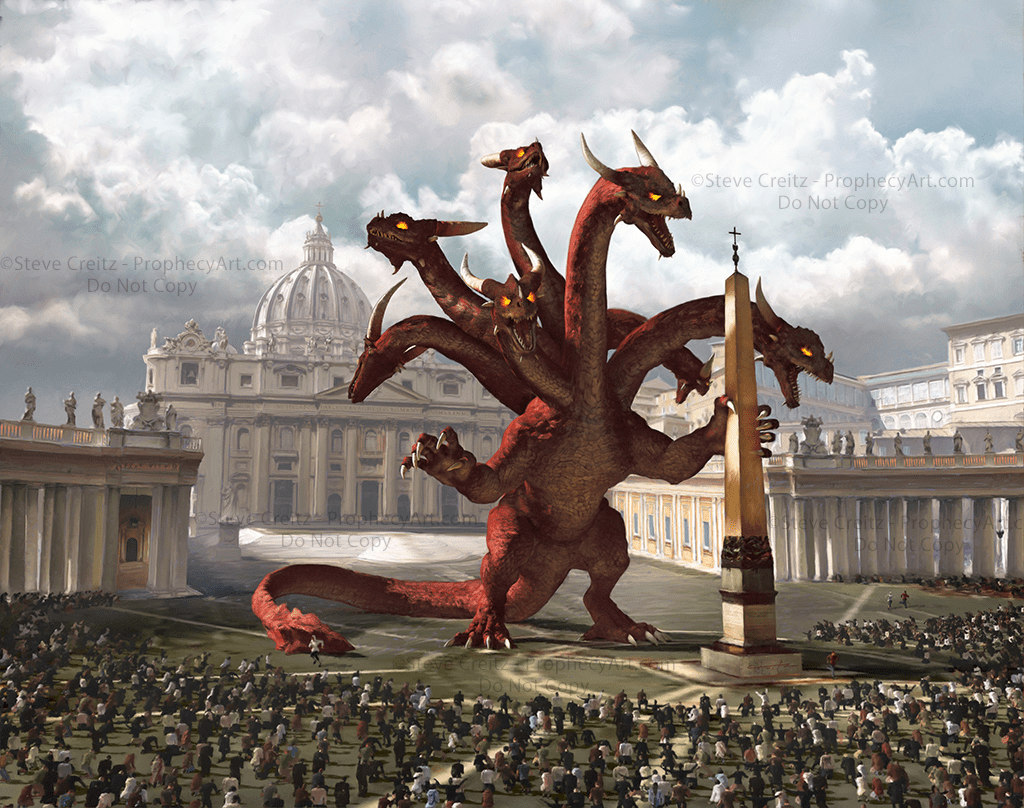
Of note, unlike the beasts of Daniel, the Dragon is identified as an individual: ‘… that ancient serpent, who is called the devil and Satan, the deceiver of the whole world…’ who fights against Michael in Heaven. 

We then learn in the following chapter that the first Beast possesses seven heads and ten horns as well, but this time the crowns are on the horns instead. What this means is unclear, though a shift is apparent from kingdoms (head) possessing power to kings (horn). 

Revelation chapter thirteen in likeness with Daniel chapter two (four beasts), describes two beasts. Are these two beasts world ruling empires, kingdoms, churches, systems, human beings, spiritual beings, all (none) of the above? 

First Beast

1 ‘And I saw a beast rising out of the sea, with ten horns and seven heads, with ten diadems [crowns] on its horns and blasphemous names on its heads.’

The Beast rendered above has ten heads instead of seven. Even so, it depicts the reality of the Beast appearing as from out of nowhere and the frightening repercussions resulting from its sudden presence on the Earth.  

The descriptions says the Beast rises out of the sea, though we just read in chapter eleven where it says: ‘… the beast that rises from the bottomless pit…’ Constant readers will be aware that the sea can be a euphemism for space or the spirit realm. In this instance it perhaps indicates the supernatural Antichrist being loosed from a spiritual  prison, either originating beneath the sea or not.  

Remember, the fourth (dragon) beast in Daniel originally had ten horns before an eleventh sprouted, while Nebuchadnezzar’s statue had ten toes. If the horns are rulers (kings) over ten territories, what do the seven heads signify? The next chapter answers this question. 

‘This calls for a mind with wisdom: the seven heads are seven mountains… they are also seven kings… And the ten horns that you saw are ten kings…’ Revelation 17:9-10, 12. 

Christ confirms that the ten horns are kings (at the time of the end), whereas the seven heads in biblical eschatology are believed to be successive empires. Borrowing from Revelation seventeen, commentators have claimed the seven heads are the seven hills of Rome. Yet just as pointedly, Jerusalem is also situated on seven hills.  

AI suggests: ‘The seven heads of the beast in Revelation 13 serve as a multifaceted symbol, representing both historical and spiritual elements of power, authority, and opposition to divine rule.’ 

The scriptures discuss mountains and they can be linked with the celestial government and abode of the Eternal. Regarding the one known as Lucifer: 

You said in your heart, ‘I will ascend to heaven; above the stars [angels] of God. I will set my throne on high; I will sit on the mount of assembly in the far reaches of the north; I will ascend above the heights of the clouds; I will make myself like the Most High’ – Isaiah 14:13-14. 

Similarly, regarding the Adversary: 

‘… I placed you… on the holy mountain of God; in the midst of the stones of fire you walked… you were filled with violence in your midst, and you sinned; so I cast you as a profane thing from the mountain of God, and I destroyed you, O guardian cherub…’ – Ezekiel 28:14, 16. 

Mountains in the Bible also represent places where Heaven and the Earth meet – the spiritual realm touching upon the physical dimensions and inevitably encounters between God (or spirits) with humanity. These meetings are associated with significant events, such as receiving divine revelation or making covenants. None better demonstrated by the descent of the fallen Watcher angels on Mount Bashan and their extraordinary covenant to stand united in corrupting humankind; or Moses ascending Mount Sinai in the momentous receiving of the Law from the Eternal. 

Mountains (kingdoms) can be destroyed – Zechariah 4:7. 

‘And in the days of those kings the God of heaven will set up a kingdom that shall never be destroyed, nor shall the kingdom be left to another people. It shall break in pieces all these kingdoms and bring them to an end, and it shall stand forever, just as you saw that a stone was cut from a mountain by no human hand, and that it broke in pieces the iron, the bronze, the clay, the silver, and the gold’ – Daniel 2:44-45. 

‘It shall come to pass in the latter days that the mountain of the house of the Lord shall be established as the highest of the mountains, and shall be lifted up above the hills; and all the nations shall flow to it…’ Isaiah 2:2.
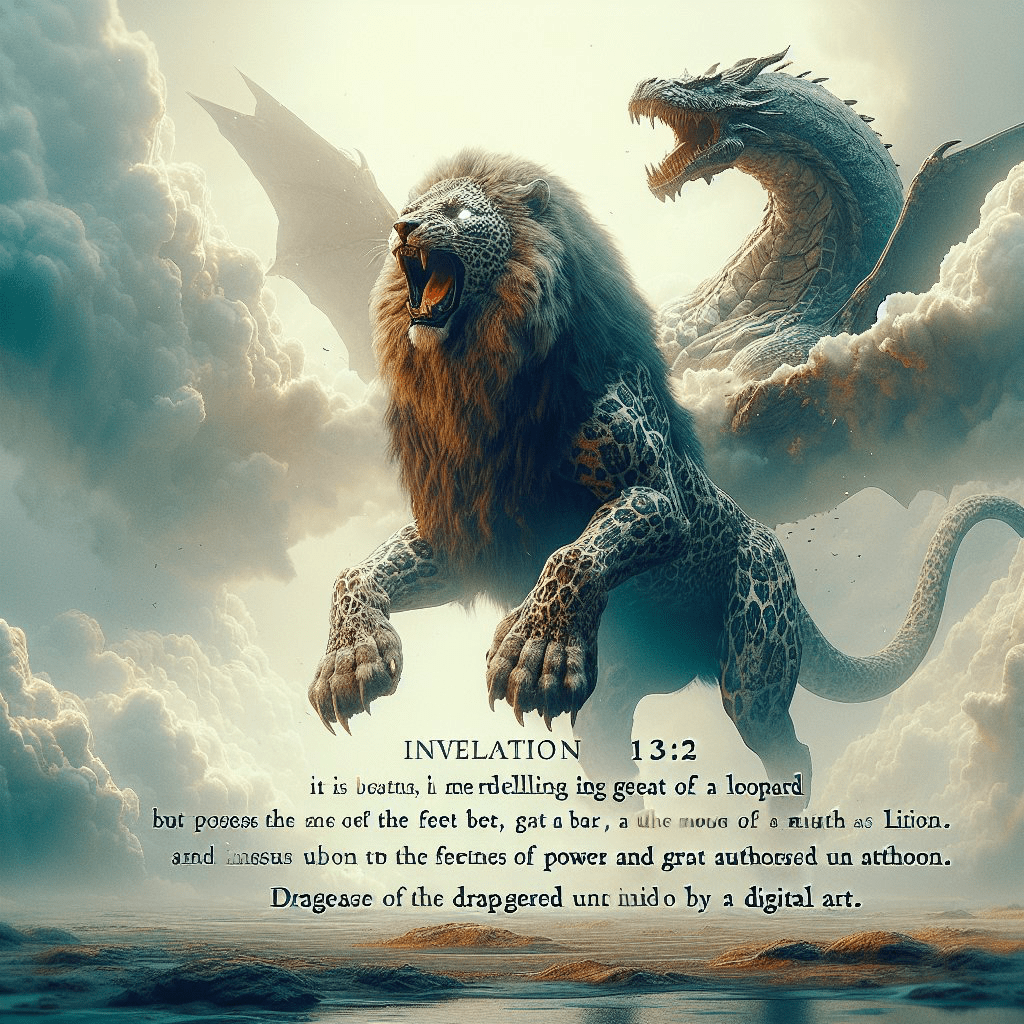
Revelation: 2 ‘And the beast that I saw was like a leopard; its feet were like a bears, and its mouth was like a lions mouth. And to it the dragon gave his power and his throne and great authority. 

This creature is not the Dragon – with seven heads and ten horns – yet displays qualities similar to the Greek (French), Persian (Turkish) and Chaldean (Italian) empires – spirit, supremacy and stature.

Scripture Speaks:

‘This beast possessed qualities of three animals… The kingdom the beast rules and represents seems to reflect his personal qualities. “The fact that the leopard of Greece, the bear of Medo-Persia, and the lion of old Babylon (Daniel 7) are all seen in this Beast, shows how all-inclusive… will be his character; he sums up all the brilliancy (Greece), all of the massive ponderousness of power (Persia), all of the absolute autocratic royal dominion (Babylon), that the Gentiles have ever known.”

This aspect may be referenced in Daniel, where it states: 

“I looked then because of the sound of the great words that the horn was speaking. And as I looked, the beast was killed, and its body destroyed and given over to be burned with fire. As for the rest of the beasts [the lion, bear and leopard], their dominion was taken away, but their lives were prolonged for a season and a time” – Daniel 7:11-12.

The likeness with the same number of heads and horns indicates the Beast is aligned with the Dragon’s purpose in influencing the same seven kingdoms and ten kings, apart from receiving its authority from the Dragon.
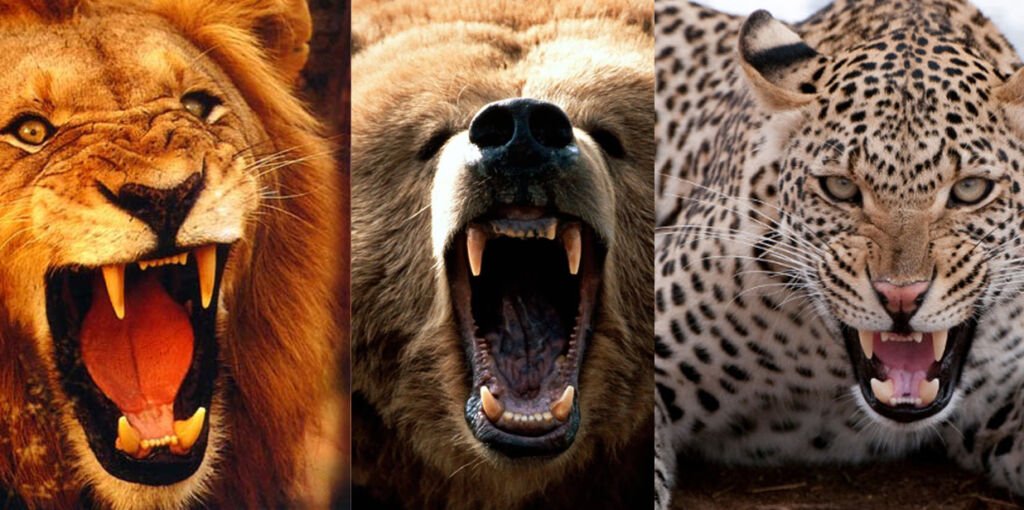
It is worth mentioning that a prevalent view amongst biblical scholars and researchers is the belief the leopard, bear and lion are separate nations and in turn – if also combined with the same animals in the Book of Daniel – must represent modern powers. Even though the beast appears to be a single creature in the form of a leopard, with the paws of a bear and the head of a lion; verse two does say beasts in the plural.

This mish mash of animal symbolism appears to have merit, yet does not align smoothly with the entirety of the Book of Daniel. Unless of course, these animals really are future kingdoms and nothing to do with Daniel chapter seven. Thereby, the animals representing kingdoms in Daniel chapter seven may not correlate with the statue image in Daniel chapter two at all.

A convincing case for this scenario is presented in an article by Thomas Taylor; Daniel’s Lion, Bear, & Leopard are modern-day countries, 2015 – capitalisation & emphasis his:

‘If it were true that Daniel 7 is ancient Babylon, ancient Media/Persia, and ancient Greece, then it is nothing more than a repeat of Daniel 2… But this is not true. They are separate because Daniel 2 deals primarily with an image of ancient nations, but the symbolic animals of Daniel 7 are dealing with modern times…

Daniel 7:1-6 describes the rising of the lion, bear, and leopard. Next, in verses 7, 8, the Kingdom of the Antichrist is described. Therefore, the lion, bear, and leopard kingdoms must still exist during the reign of the Antichrist. This is what makes us look at modern nations to be considered rather than ancient Babylon, ancient Media/Persia, and ancient Greece.

Notice the lion, bear, and leopard “shall arise”. Daniel is under the Babylonian king when he had this vision. Therefore, this proves that the first beast mentioned is NOT ancient Babylon, because it was already risen and at the height of its power during Daniel’s time. In Daniel 2, when he spoke of the image with the head of gold, arms of silver, mid-section of brass, legs of iron, and feet of iron and clay, he clearly says the golden head is the current kingdom of Babylon. But Daniel 7:17 says all the kingdoms are yet in the future relative to Daniel’s time.

When you count the heads of Daniel’s beasts you get 7 (1 – lion, 1- bear, 4 – leopard, 1 – dreadful beast). Revelation 13 shows the same 7 heads. There are seven heads yet one beast. This one beast has all of these kingdoms, the lion, bear, and leopard, within it in the end times. Revelation primarily deals with the time of Christ’s Second Coming and these beasts are, therefore, all present at Christ’s Second Coming, unlike ancient Babylon, ancient Media/Persia, and ancient Greece.’

For interest sake, ideas proposed include, the lion (Revelation 13) representing England and the plucked wings of an eagle (Daniel 7) being the United States of America. According to Dr Gene Kim, the lion’s mouth is “the English language since it can be considered the universal language, given that many countries speak it.”

The bear is universally accepted as Russia.

Thomas Taylor:

‘Russia is well known for its ability to devour much flesh as leaders like Lenin and Stalin killed several million people. The bear is raised up on one side with three ribs in its mouth. These three ribs may be the nations the final end-time Russia will conquer in an attempt to gain back former Soviet republics that it once held, such as Ukraine and two unknown others. So we can predict that Russia is on the move to take two more former Soviet republics…’

It is the leopard which stirs the most diverse opinion. Gene Kim concludes the “Leopard represents America because it is a multi-racial country. The leopard has three colors representing races, a white belly, yellow skin, and black spots.’

Just as convincingly, the leopard with multiple spots could symbolise the European Union and the leopard’s four heads the leading nations comprising: Germany, France, Italy and Spain. While Germany’s symbol is an eagle, Thomas Taylor considers the leopard in this instance the symbol for Germany.

Taylor:

‘The leopard… has four heads. So there must be four distinct kingdoms within this one kingdom. It also says it has the wings of a fowl. Therefore, another kingdom is associated with it. Germany seems to fit best as being the leopard because of their ferociousness at war like a leopard on the hunt. Interestingly, Germany has a modern tank… called the Leopard.
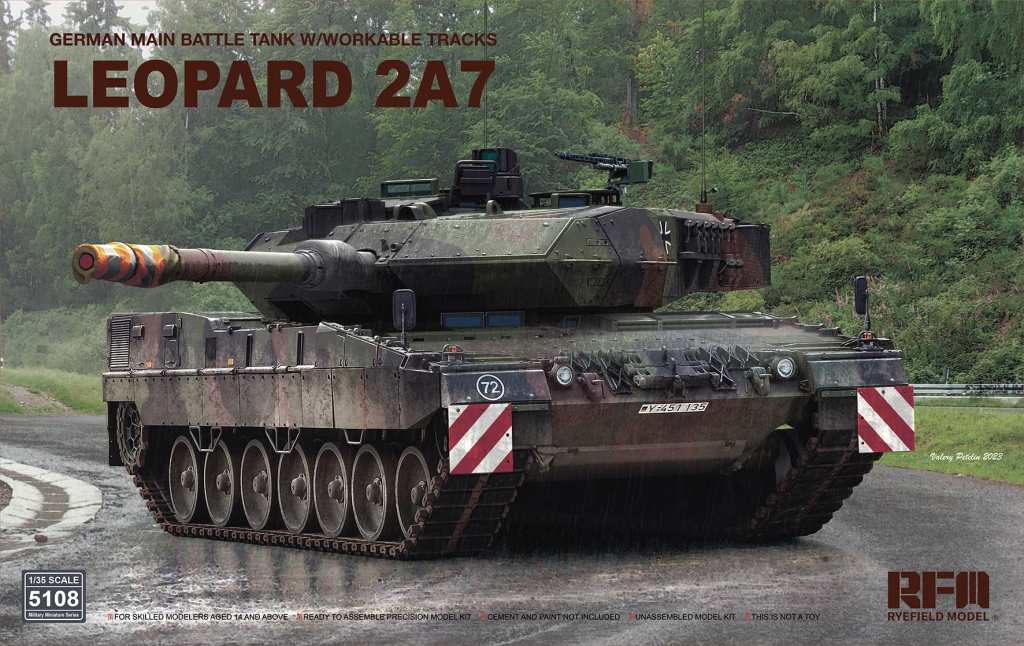
The four heads are the four reichs (German for “empires”) of Germany.

The First Reich was the Holy Roman Empire first ruled by a Frankish king Charlemagne (800 – 1806).

The Second Reich was the German Empire under Otto Van Bismark (1870 – 1919).

The Third Reich was Adolf Hitler’s rule (1933 – 1945).

The Fourth Reich seems to be the European Union (1958 – present), an entity almost entirely held up and controlled by Germany and France.

The Germans have a strong alliance with the French as the key players of the European Union. France’s national symbol is a rooster, hence the wings of the foul prophecy is fulfilled when these two nations come together. All of the reichs were/are attempting to unite Europe under one government and religion. They are attempting to recreate the original Holy Roman Empire which held so much power for over 1,000 years.’

Yet an alternative view is that the leopard is in fact China.

The Four Beasts of the End-Times, Mark A Becker, 2021 – emphasis mine:

‘… this is the most difficult beast to identify. Most would think that if this beast was China, that she would be represented by the dragon. One would surely think that would be the case, but the dragon has already been assigned to Satan…

The leopard is… cunning, swift, and [a] stealth hunter. China has been very cunning on the geopolitical stage. At home, as is so well documented, no nation has ever surveilled their own people as the Chinese Communists have – stealthily lurking at a distance, as a leopard hunts its prey.

Most fascinating… is China’s push for a global government and… tracking of all citizens of the world. Something I would never have dreamed would happen, as I always thought they may be the last to lean into globalism, yet here we are.

Her stealth and rapid rise in economic power have been, as one might say, “Accomplished under the radar, yet in plain sight.” The United States, in particular, has played an active role in China’s rise in economic wealth and power as they import China’s goods at an astronomical rate.

Militarily, China has swiftly used those economic resources to fund her capabilities to unheard-of heights, as she has become a preeminent military threat to the world and a major supplier of arms.

The rise in technological advances – whether from within or without through stolen intellectual properties and trade secrets – is mind-blowing, probably surpassing even the United States.

When it comes to Daniel’s description of the leopard having “four wings of a fowl,” one can’t help but notice the rate of speed her ascension to dominance has had on the world stage in such a remarkably short time. These four “wings” could also indicate China’s expansion in all four directions of her sphere of influence.

As far as the “four heads,” there may be an alliance coming in the near future… though, the “four heads” could very well be in China herself – as one of the 10 kings – being split up into four smaller kingdoms [Magog (Gog), Meshech and Tubal] within her borders, all under the leadership of the one king [Rosh]. The population of China is unsurpassed and could very well need four separate “governors” in four separate regions within the nation of China to help delegate the orders from the supreme leader – or king – of China’s regional global kingdom’ [refer Chapter X China: Magog, Tubal & Meshech].

This writer would add, the leopard was a significant symbol in ancient Egypt. The leopard represented strength and power and was associated with royalty and the divine. It was used in rituals and as a garment for priests and kings, symbolizing their authority and connection with the gods.

In this case following the theme presented, the leopard could represent Islam and by extension, the King of the South. Thus the four heads would represent an Islamic confederation led by Turkey, Iran and Pakistan with Egypt. If so, then the bear could well be Russia – the King of the North – with the lion representative – not of England or America but rather – of Rome and with it the Vatican, each indicative of the Chaldean legacy and hence modern Babylon (refer article: Four Kings & One Queen).

The Leopard-like Beast of Revelation 13, Part I & II, Kym Jones – emphasis theirs:

“This… beast is described as having ‘the mouth of a lion’. Just as… a winged lion with the head of a man… representative of ancient Babylon… was the first of the four beasts which Daniel saw in vision described as being ‘like a lion, and had eagles wings… and made stand upon the feet as a man, and a man’s heart was given to it.’ (Daniel 7: 4)

… we find King Nebuchadnezzar commanding all within his kingdom to fall down and worship the golden image which he had set up, under pain of death (Daniel 3: 4-6). This is representative of the ‘little horn’ of Daniel 7: 20, 25, which had ‘a mouth that spake very great things’, and who ‘shall speak great words against the most High’.

Thus this aspect of the… beast of Revelation 13 having ‘the mouth of a lion’ clearly represents the papacy, which is ‘lifted up’ and ‘exalted’… for it sets itself up in the seat of Caesar as Pontifex Maximus – the ‘bridge builder’ between heaven and earth.

… the third kingdom of Daniel chapter 2  is depicted… as Greece, and Daniel chapter 8 declares that the rough goat which is described in that chapter is this very same power, then it is Greece which we turn to as we attempt to understand precisely why this… beast is described as being like a Leopard

To say that the… beast of Revelation 13 has the body of a Leopard is actually a misnomer, for a literal translation of the text is that it ‘was like a leopard’ (NKJV). If it was ‘like a leopard’ – then the chief characteristic of the Papacy is that as it is very much like Greece in some respects, then its ‘likeness’ to Greece constitutes the foundation of Catholic faith.”

If we momentarily reconsider the beast as not an entity but an amalgamation of kingdoms (empires), it is likely that the creature symbolism in Revelation thirteen is a logical continuation of the same animals introduced in Daniel chapter seven.

Thus the Chaldean rule (head of a Lion) in Babylon was continued within the Holy Roman Empire in Central Europe (comprising many German states) and headquartered in Rome – the mouth of the Lion fulfilled by the Holy See of the Vatican (Chapter XXV Italy: Nahor & the Chaldeans).

Holy Roman Empire 1359

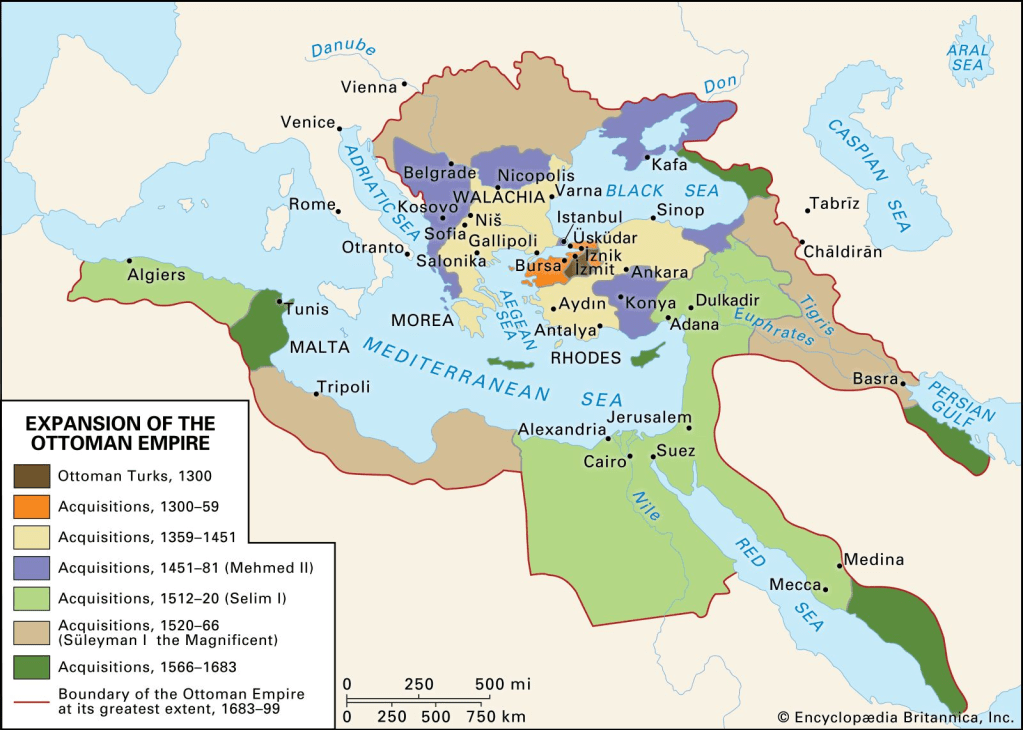
In like manner, the Medo-Persian Empire was resurrected by the Elamite descendants of the Turks during the Ottoman Empire – stretching very nearly to the steps of Vienna. The Bear’s four paws a reflection of the four quarters of the compass (north, south, east and west) in which the Ottoman empire spread throughout Eastern Europe and the Middle East – refer Jeremiah 49:36 (Chapter XVIII Elam & Turkey).
The Greco-Macedonian Empire comprising the children of Lot (Moab and Ammon) was later in evidence during the formation of the French nation by the Franks who were the early embodiment of the future Holy Roman Empire led by Charlemagne. Napoleon Bonaparte an eerie incarnation of Alexander the Great in his designs for a French Empire which like the Leopard stealthily took over Western Europe in counter balance to the Ottoman Empire in the East – refer Jeremiah 48:9, 29 (Chapter XXVI The French & Swiss: Moab, Ammon & Haran).

Revelation: 3 ‘One of its heads seemed to have a mortal wound, but its mortal wound was healed, and the whole earth marveled as they followed the beast. 4 And they worshiped the dragon, for he had given his authority to the beast, and they worshiped the beast, saying, “Who is like the beast, and who can fight against it?” 

Taylor:

‘The fall of the Berlin wall [in 1989] united East and West Germany into one nation again (and incidentally created modern-day Russia [in 1991]). This resurrection of Germany was prophesied in Revelation as the head that had the mortal wound but lived. 

Rev 13:3 KJV And I saw one of his heads as it were wounded to death; and his deadly wound was healed: and all the world wondered after the beast. 

Germany was mortally wounded as a nation and… thought to never recover after WWII… [after its division into] East and West Germany. But… [Germany re-uniting created] the New World Order.’

A question remains over what a mortal wound would mean for the Antichrist. With regard to how it is viewed by scholars who advocate the Beast is the Papacy, End Times Prophecy explain: 

“The Papacy received a ‘mortal wound’ in 1798 when the French army marched into Rome and captured the pope and the Papacy lost it’s control and power. But then in 1929 Mussolini granted state power back to the Vatican and the deadly wound began to heal.’

An alternative view is presented by Revelation Logic – emphasis mine: 

‘Note that Revelation 13:3 remarks that the composite beast has one head that appears to have been slain, but the fatal wound was healed. Later, this fatal wound is referenced in Revelation 13:12-15, where it indicates that the beast shall be killed (suffer a fatal wound) and then be brought back to life. This “death and resurrection” is certainly reminiscent of the work of Christ, which itself happens to be referenced in this chapter (Revelation 13:8).

In Daniel 7:11, we read that the fourth beast of Daniel’s vision… was slain, and yet in  Daniel 7:23-24 we read that ten kings will arise from it, and the “little horn” (Antichrist) shall arise among them. We may thus say that the fourth kingdom itself has, in this sense, attained a new life, or resurrection. 

In Revelation 13:12, we read about how the False Prophet will lead people to worship the beast. In this context, the word beast refers to the individual Antichrist who is given authority as Satan’s final king (Revelation 13:2), and who persecutes the saints for 42 months (Revelation 13:5, 7) [Article: 42]. He is also described as having a fatal wound from a sword (Revelation 13:12, 14), and yet he was returned to life as one of the “great signs” performed by the False Prophet (Revelation 13:15). 

In this sense, the future Antichrist himself will appear to have a death and resurrection, as appropriate for a counterfeit Christ.’

5 ‘And the beast was given a mouth uttering haughty and blasphemous words, and it was allowed to exercise authority for forty-two months. 6 It opened its mouth to utter blasphemies against God, blaspheming his name and his dwelling, that is, those who dwell in heaven.’

The Beast like the antichrist little horn has a mouth and uses it to blaspheme – Daniel 7:25. It could be inferred that the Beast is an entity, as opposed to a kingdom or power – as evidenced in the Book of Daniel, where the lion, the bear, the leopard and the fourth beast do not speak – by virtue of having either eyes or in this case a mouth.  

7 ‘Also it was allowed to make war on the saints and to conquer them. And authority was given it over every tribe and people and language and nation, 8 and all who dwell on earth will worship it, everyone whose name has not been written from the foundation of the world in the book of life of the Lamb who was slain.’ 

Worship of an individual whether a god or a demagogue is easier to comprehend and accept than the worship of a state, system or a church. Therefore subscribing to the idea the first Beast is the Vatican and Catholicism is problematic. That said, the Beast like the Dragon clearly leads and influences seven kingdoms and ten kings.

Second Beast 

11 ‘Then I saw another beast rising out of the earth. It had two horns like a lamb and it spoke like a dragon.’

12 ‘It exercises all the authority of the first beast in its presence, and makes the earth and its inhabitants worship the first beast, whose mortal wound was healed.’ 

The second Beast does not arise from the sea like the first Beast, but from the Earth. Is this a veiled clue to the fact that the second Beast is not an angel but rather of Nephilim origin? The disembodied spirits of Nephilim are tied to the Earth as demons, of whom Nimrod is an arch-demon – Article: Nephilim & Elioud Giants I & II. For the second Beast does not have seven heads and ten horns. 

This Beast masquerades as a Christ like lamb yet is really a devouring satanic dragon like creature. A wolf in sheep’s clothing – Matthew 7:15. The second Beast speaks and thus provides difficulty for those who ascribe a national identity such as the United States. The second Beast is in fact identified as the False Prophet in Revelation 16:13, 19:20; 20:10.
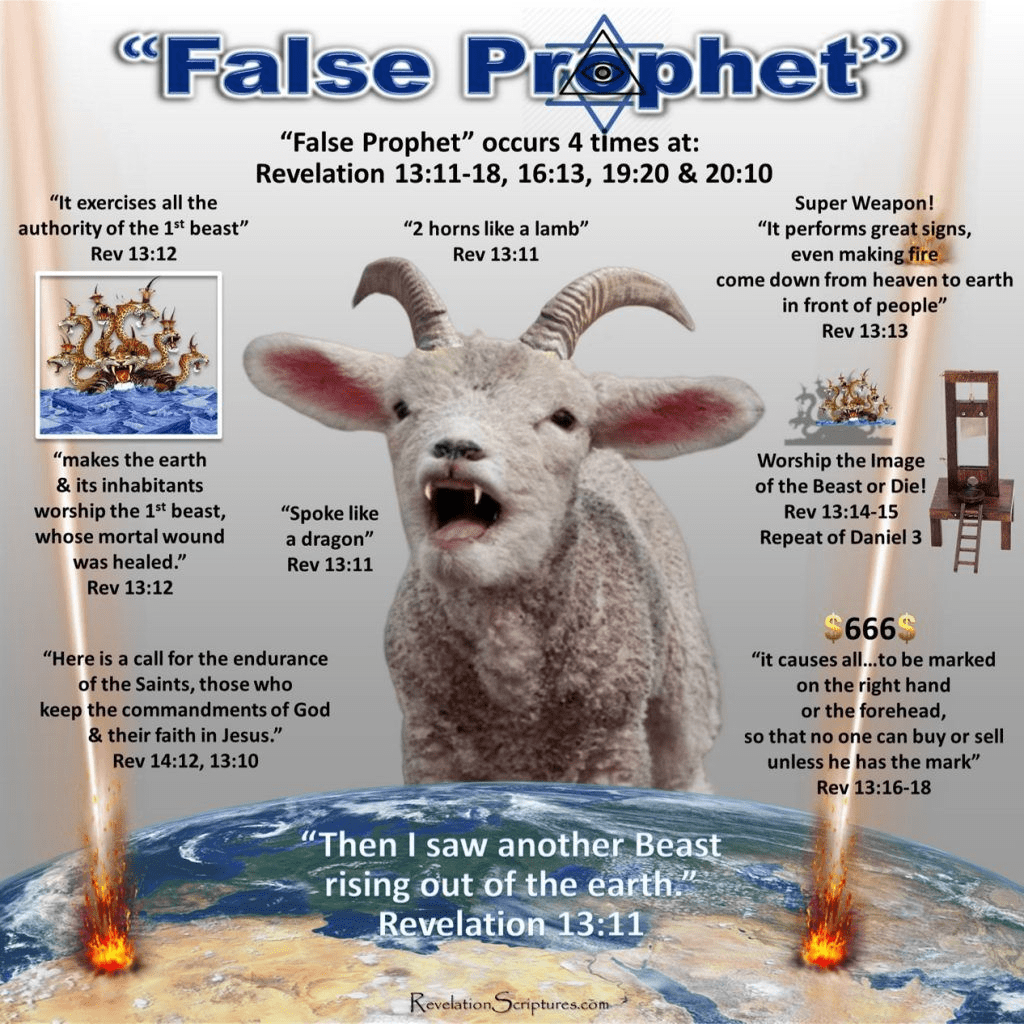
13 ‘It performs great signs, even making fire come down from heaven to earth in front of people, 14 and by the signs that it is allowed to work in the presence of the beast it deceives those who dwell on earth, telling them to make an image for the beast that was wounded by the sword and yet lived. 15 And it was allowed to give breath to the image of the beast, so that the image of the beast might even speak and might cause those who would not worship the image of the beast to be slain.’ 

The working of the false prophet:

‘Let no one deceive you in any way… The coming of the lawless one is by the activity of Satan with all power and false signs and wonders, and with all wicked deception…’ – 2 Thessalonians 2:3, 9-10. 

The false prophet performs spectacular miracles in like manner to the two witnesses: 

‘And if anyone would harm them, fire pours from their mouth and consumes their foes… They have the power to shut the sky, that no rain may fall during the days of their prophesying, and they have power over the waters to turn them into blood and to strike the earth with every kind of plague, as often as they desire’ – Revelation 11:5-6.

Just as the evil magicians of Pharaoh Neferhotep I challenged Moses and Aaron prior to the Exodus – Exodus 7:10-12, 2 Timothy 3:8.

Verses thirteen to fifteen read like Mary Shelley’s Frankenstein. One could say a third character is introduced, a mini-me of the first Beast. This is confirmed four times in Revelation: 

“If anyone worships the beast and its image [1] and receives a mark on his forehead or on his hand, he also will drink the wine of God’s wrath, poured full strength into the cup of his anger, and he will be tormented with fire and sulfur…And the smoke of their torment goes up forever and ever, and they have no rest, day or night, these worshipers of the beast and its image [2], and whoever receives the mark of its name.” – Revelation 14:9-10 (Revelation 16:2; [3] 19:20 [4]).

The author of Colossians (not Paul – refer article: The Pauline Paradox) relates a different and even more profound example of an image. 

‘[Christ] is the image of the invisible God, the firstborn of all creation. And he is the head of the body, the church…’ – Colossians 1:15, 18. 

Revelation: 16 ‘Also it causes all, both small and great, both rich and poor, both free and slave, to be marked on the right hand or the forehead, 17 so that no one can buy or sell unless he has the mark, that is, the name of the beast or the number of its name. 18 This calls for wisdom: let the one who has understanding calculate the number of the beast, for it is the number of a man, and his number is 666.’ 

The constant reader will be aware of the discussion on the mark of the Beast in a number of articles. The key aspect is that the Greek word for man (G444, anthropos) can be used for an angel. For whatever reason, translators have not followed (or understood) the context of Chapter thirteen in using the word man. 

Therefore a full understanding on the mysterious number originating from an evil angelic being may remain out of reach for the time being. It might only be towards the end of this age, when the saints may well understand its exact interpretation.

 In chapter fourteen verse eight we read about Babylon for the first time. 

Another angel, a second, followed, saying, “Fallen, fallen is Babylon the great, she who made all nations drink the wine of the passion of her sexual immorality.” 

While there is an argument that sexual immorality applies in a context of false religious worship (and belief) – mentioned as a problem in earlier eras of the true church – there was two thousand years ago during the time of Revelation’s writing, temple prostitutes. Refer article: The Seven Churches – A Message for the Church of God in the Latter Days. 

‘But I have a few things against you: you have some there who hold the teaching of Balaam, who taught Balak to put a stumbling block before the sons of Israel, so that they might eat food sacrificed to idols and practice sexual immorality’ – Article: Belphegor.

‘But I have this against you, that you tolerate that woman Jezebel, who calls herself a prophetess and is teaching and seducing my servants to practice sexual immorality and to eat food sacrificed to idols. I gave her time to repent, but she refuses to repent of her sexual immorality’ – Revelation 2:14, 20-21.

In this context, one could be persuaded that Babylon is a continuation of the Chaldean mysteries, which originated with Nimrod and are preserved by the Vatican in Rome. This verse does not call Babylon a city, wherein chapter eighteen of Revelation does. If such is the case, then ascribing the United States to Babylon would be inaccurate.  
In Chapter sixteen verse ten, the Beast is unarguably an individual, who rules its own kingdom: 

‘The fifth angel poured out his bowl on the throne of the beast, and its kingdom was plunged into darkness…’

Credence that the Antichrist is linked with the King of the North, is the amassing of the Kings of the East in verse twelve prior to the Battle of Armageddon in verse sixteen – Daniel 11:44. 

18 ‘And there were flashes of lightning, rumblings, peals of thunder, and a great earthquake such as there had never been since man was on the earth, so great was that earthquake.

19 The great city [1] was split into three parts, and the cities [2] of the nations fell, and God remembered Babylon the great [3], to make her drain the cup of the wine of the fury of his wrath. 20 And every island fled away, and no mountains were to be found.’

The question is, is this Jerusalem, the great city (like sodom) in chapter eleven or another great city, Babylon (Revelation 18:10). As the great city is seemingly distanced from Babylon the Great by the cities of the nations, it is possible the first great city is Jerusalem. Coincidently, the old city of Jerusalem is currently split into four parts and ‘three’ religions: Christian, Jewish, Muslim and Armenian. 

In support of the city in question being Babylon, for Jerusalem was clearly defined in Revelation chapter eleven, G G Rupert held the following conclusion: 

‘Drawing a line north and south, east of Italy, you have on one hand the dragon power: on the other hand, Western Europe, or the beast power. Hence we cannot look to the old world for the territory of the third power. We must look to the new world, across the ocean in the far West… 

In the language of Bishop Berkeley:-

“Westward the course of empires takes its way; 

The first four acts already passed; 

The fifth shall close the drama of the day. 

God’s noblest offspring is the last.”

‘… Babylon is represented as being divided into three parts. But the question is, Where are these divisions? We answer, They exist in the three great divisions of the world powers as symbolized by the three great divisions just considered, – Greek Catholicism as it exists in the dragon territory; Roman Catholicism as it exists in the beast territory, or the Western Empire of Rome; apostate Protestantism as it exists in the territory of the two-horned beast, or North America.’

The division of Europe into east and west with the dominant nations of each, Russia and Germany respectively, aligns with the two lower legs and feet of Nebuchadnezzar’s statue. The addition of North America, while it is not revealed on the statue in Daniel or in the beasts of Revelation, warrants consideration in being a component of Babylon at the least.

The reason for this is that Babylon derives from the Tower of Babel and the tower was the endeavour by Nimrod – no less (Article: The Pyramid Perplexity) – to challenge and thwart God’s plan for humanity by taking a different route… the one offered by the Adversary, the Dragon. That is, to merge the spiritual and physical in an unholy alliance (marriage) as revealed by the feet of iron and clay on Nebuchadnezzar’s statue – Daniel 2:43. An attempt to revisit the antediluvian age of Angels, Nephilim and Giants – Chapter XXII Alpha & Omega.

It is significant that America was founded on the ideal of a New World Order – Article: The Establishment: Who are they… What do they want?

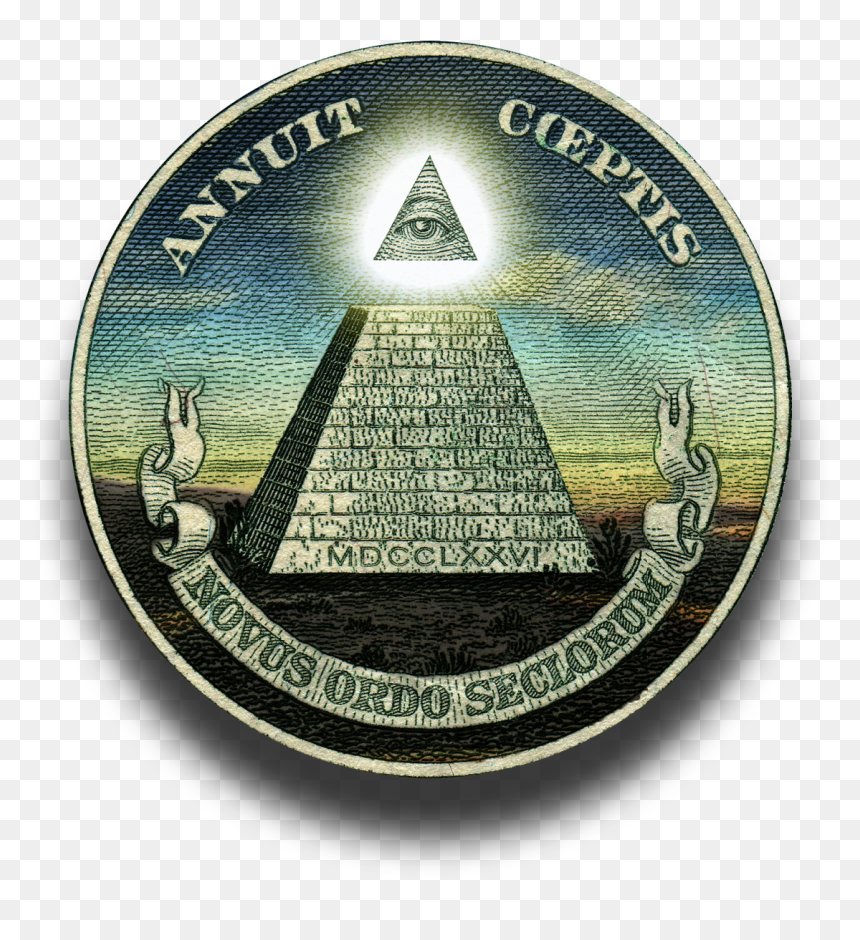
America’s mottoes on the reverse of the Great Seal being Novus ordo seclorum, meaning ‘New order of the ages’; and the equally ominous Annuit coeptis, translating as ‘He has favored our undertakings’ or ‘Providence favors our undertakings.’

The ‘he’ is accepted as God, though the question is which god? – refer article: 33. As the all seeing eye is shrouded in a burst (or blaze) of light, former archangel Samael (aka Lucifer) the light bringer, is prime candidate. 
Thus America’s connection with Babylon or rather Babel is through Nimrod seeking to bring the world together in rebellion against the Eternal. It was serious to the extent that the Lord came down to Babel to put an end to humankind’s united efforts (Genesis 11:5) – Chapter XXI The Incredible Identity, Origin & Destiny of Nimrod

Should the second Beast, the False Prophet be Nimrod himself, then his using the Beast’s mark to bind the inhabitants of the world to one cause under a single government is not a coincidence and while it finds it seeds in the tower of Babel, it fruition may well be accomplished from the shoulders of America. Regardless, the endeavour will be to raise up Babylon (the Great) to eclipse the original rebellion of Babel in leading the world’s inhabitants diabolically astray.

Constant readers will have joined the dots, for this amazing correlation is symbolically epitomised on the reverse of America’s Great Seal with the powerful imagery of a pyramid (and its emblazoned capstone), reminiscent of the Great Pyramid (minus capstone) which is stunningly… the ‘lost’ and yet actual Tower of Babel – refer article: The Pyramid Perplexity. 
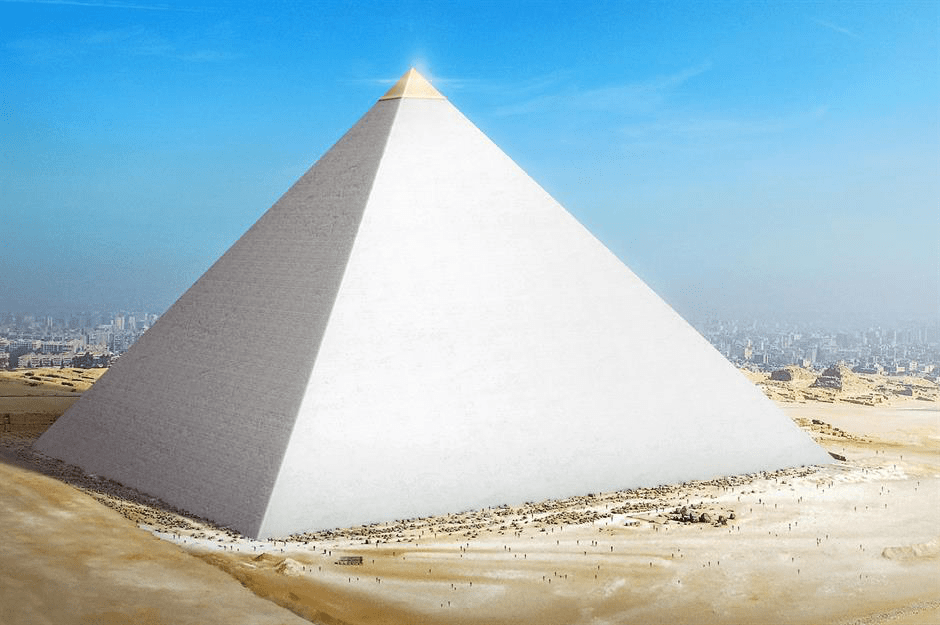
There is a connecting line between the Tower of Babel (which was not destroyed – Genesis 11:8), Babylon, Egypt, The Great Pyramid, the Great Seal and the founding of the United States of America. 

The story of Joseph ruling in Egypt; the Israelite’s enslavement; and their exodus from under the shadow of the Great Pyramid; is shrouded in dark and foreboding irony when viewed with the knowledge that America today was founded by and principally peopled from descendants of Joseph’s sons, Ephraim and Manasseh – Chapter XXXIII Manasseh & Ephraim – the Birthright Tribes.

America’s contribution and participation in a Babylonian system would seem a given in light of this connection. We will now study the crucial chapters seventeen and eighteen in Revelation to understand if,

a. such is the case;

or b. as more advocates are proposing, the United States is wholly Babylon;

c. whether Babylon is specifically represented by Nebuchadnezzar’s statue and the one leg denoting German hegemony;

incorporating d. the Vatican and Rome (the physical and literal descendants of the Chaldeans);

or e. another interpretation entirely. 
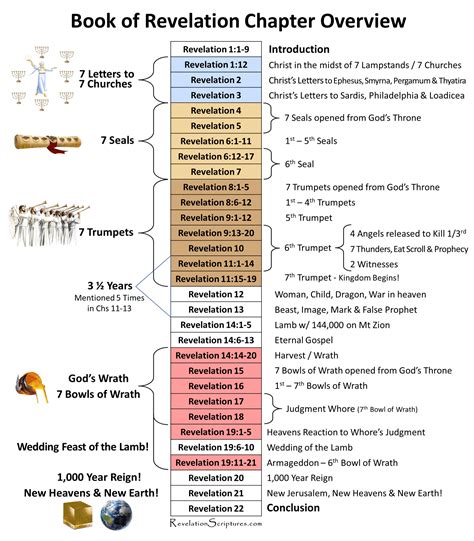
Scarlet Beast

1 ‘Then one of the seven angels who had the seven bowls came and said to me, “Come, I will show you the judgment of the great prostitute who is seated on many waters, 2 with whom the kings of the earth have committed sexual immorality, and with the wine of whose sexual immorality the dwellers on earth have become drunk.” 

In this context, the great prostitute is the Universal Church with sexual immorality representing the central tenets of Catholicism, which are nowhere to be found in the books a. written by Paul; b. not written by Paul yet credited to him; c. authored by other imposters in the New Testament; or d. in the the Old Testament and therefore are tantamount to idolatry – Articles: The Seven Churches – A Message for the Church of God in the Latter Days; and The Pauline Paradox.

3 ‘And he carried me away in the Spirit into a wilderness, and I saw a woman sitting on a scarlet beast that was full of blasphemous names, and it had seven heads and ten horns. 4 The woman was arrayed in purple and scarlet, and adorned with gold and jewels and pearls, holding in her hand a golden cup full of abominations and the impurities of her sexual immorality.’ 

There are valuable pieces of the end time puzzle here and in the remainder of the chapter in that a new beast is not introduced but the first Beast is presented with its seven heads, ten horns and additionally, the colour of scarlet. The woman is dressed in scarlet, which links her not only to the Beast which she rides (though does not control), but to the Great ‘Red’ Dragon. It is notable that cardinals (the highest ranking priests beneath the Pope) of the Catholic Church wear scarlet – while Bishops wear purple. 

This woman is resplendent with wealth and the intoxicating elixir of false doctrine and heresy. So much so, she acts as royalty, represented by the colour purple.

The use of the word abomination is significant in relation to who she is riding (the Antichrist) and the Abomination (of Desolation) which he commits in claiming to be Christ/God whilst in Jerusalem – Daniel 8:13, Matthew 24:15.

Additionally, this woman who symbolises the great false church is in stark antithesis to the other woman, the true church – who flees to the wilderness as recorded in Revelation chapter twelve.

5 ‘And on her forehead was written a name of mystery: 

Babylon the great, mother of prostitutes and of earth’s abominations.” 

The Identity of Babylon the Great in the Book of Revelation, Adam Robinson: 

‘By calling the woman Babylon, John relates her to two of the most infamous cities in the Old Testament… The first city to which the Old Testament gives prominence is Babylon (בבל/Βαβυλών), who rebelled against God’s command to fill the earth (Genesis 1:28; 9:1, 7; 11:1–9).

Babylon is also the name of one of the worst anti-God cities in the Old Testament due to her destruction of Jerusalem, the temple, and her other atrocities (2 Kings 25:1–10; Jeremiah 50:14, 24, 29; 51:11, 24, 49). 

By relating the Prostitute to two of the most infamous cities in the Old Testament, the interpreting angel is clarifying that the woman… is opposed to both God and his people. Further, by identifying the Prostitute with the two Babylons of the Old Testament, the book of Revelation suggests she has a history that is intertwined with them.’

6 ‘And I saw the woman, drunk with the blood of the saints, the blood of the martyrs of Jesus.’ When I saw her, I marveled greatly.’ 

The woman is the great prostitute and the mother of all her daughters who have likewise prostituted themselves. These being all forms of Protestantism; whether mainline or not and whether non-denominational or not. As the great prostitute is the Universal Church it is the self-same church that finds itself guilty of a litany of persecution and death stretching for centuries. The Earth’s prime abomination is that this woman has led the western world away from the truth of the Way as taught by Jesus and the apostles. 

7 ‘But the angel said to me, “Why do you marvel? I will tell you the mystery of the woman, and of the beast with seven heads and ten horns that carries her. 8 The beast that you saw was, and is not, and is about to rise from the bottomless pit and go to destruction. And the dwellers on earth whose names have not been written in the book of life from the foundation of the world will marvel to see the beast, because it was and is not and is to come.”

The Beast is Azazel who for all intent and purpose has disappeared (was) as if dead (is not), to be ‘resurrected’ by being released (about to rise) from the bottomless pit – Jude 6, Revelation 9:11. Though in all probability it is a reference to the Beast sustaining an actual mortal wound, its death and subsequent resurrection. It may tie in with the mysterious image of the Beast brought to life by the False Prophet and worshipped by the world.

This of itself is a curious scenario, for this was part of the function of the Tower of Babel orchestrated by Nimrod, in seeking to bridge the gap between the physical and spiritual dimensions through resurrection and rebirth – Chapter XXI The Incredible Identity, Origin & Destiny of Nimrod; and article: The Pyramid Perplexity. 

9 “This calls for a mind with wisdom: the seven heads are seven mountains on which the woman is seated; 10 they are also seven kings, five of whom have fallen, one is, the other has not yet come, and when he does come he must remain only a little while. 11 As for the beast that was and is not, it is an eighth but it belongs to the seven, and it goes to destruction.”

The woman is representative of the Roman Catholic Church – and preceding that incarnation, the Babylonian Mystery Religion – so it is she who will have presided over six kingdoms with one more to arise. The seventh then gives way to an eighth (or 7b) ruled directly by the Antichrist.

12 “And the ten horns that you saw are ten kings who have not yet received royal power, but they are to receive authority as kings for one hour, together with the beast. 13 These are of one mind, and they hand over their power and authority to the beast. 14 They will make war on the Lamb, and the Lamb will conquer them, for he is Lord of lords and King of kings, and those with him are called and chosen and faithful.” 

As the seven kingdoms appear successive, the ten kings in contrast are concurrent. It is also noteworthy that they rule with (and for) the Beast and so are classed as the eighth kingdom from this perspective but in actuality are the seventh. The eighth is closely related to the seventh chronologically and in ideology.

This eighth kingdom rules during the three and one half year tribulation. A short time as intimated by one hour – Revelation 17:10. The exact time frame used to denote Babylon’s judgement – Revelation 18:10.

These ten kings are divided it would seem geographically, five and five, as well as being an unnatural mixture if they are represented by the two feet and ten toes composed of iron and clay. 

15 ‘And the angel said to me, “The waters that you saw, where the prostitute is seated, are peoples and multitudes and nations and languages. 16 And the ten horns that you saw, they and the beast will hate the prostitute. They will make her desolate and naked, and devour her flesh and burn her up with fire, 17 for God has put it into their hearts to carry out his purpose by being of one mind and handing over their royal power to the beast, until the words of God are fulfilled. 18 And the woman that you saw is the great city that has dominion over the kings of the earth.”

The Vatican City State is an independent country where the Pope is both spiritual and administrative head of the smallest country in the world. In this instance, the great city appears without many other contenders to be the Vatican. For Vatican City and the Papacy has wielded immense power over temporal kings.

In other articles we have discussed the spirit which rules the false church as being the fallen angel Lilith, alluded to albeit cryptically in the Old Testament – Article: Lilith. She has been known by a host of names including Isis, Semiramis and Ishtar, where the word (celebration) Easter derives. Lilith is also linked with the Greek goddess Europa and the Roman goddess Libertas – from whom the Statue of Liberty is inspired.
Judging by verse sixteen, shockingly, the Papacy will come to an end and the dissolution of the Catholic Church will be enforced, to make way for the Antichrist’s rule. In tandem with this the False Prophet ensures the globe (or the western world at least), worships the Beast, a new god and with it… a New Religion.  

Babylon the Great

Revelation chapter eighteen graphically and specifically describes Babylon and its spectacular downfall. It is important to remember the context of the chapter and the seventeen chapters which have preceded the eighteenth. 

1 ‘After this I saw another angel coming down from heaven, having great authority, and the earth was made bright with his glory. 2 And he called out with a mighty voice, 

Fallen, fallen is Babylon the great!

She has become a dwelling place for demons, a haunt for every unclean spirit, a haunt for every unclean bird, a haunt for every unclean and detestable beast.’

Lilith is associated with demons, unclean spirits, unclean birds and detestable beasts, so Babylon being described as ‘she’ is not an odd coincidence – Article: Lilith.

3 ‘For all nations have drunk the wine of the passion of her sexual immorality, and the kings of the earth have committed immorality with her, and the merchants of the earth have grown rich from the power of her luxurious living.” 

4 Then I heard another voice from heaven saying, 

“Come out of her, my people, lest you take part in her sins, lest you share in her plagues; 5 for her sins are heaped high as heaven, and God has remembered her iniquities. 6 Pay her back as she herself has paid back others, and repay her double for her deeds; mix a double portion for her in the cup she mixed.

7 As she glorified herself and lived in luxury, so give her a like measure of torment and mourning, since in her heart she says, ‘I sit as a queen, I am no widow, and mourning I shall never see.’ 8 For this reason her plagues will come in a single day, death and mourning and famine, and she will be burned up with fire; for mighty is the Lord God who has judged her.” 

For the Israelites – whether spiritual or perhaps even physical – to come out of Babylon would infer Babylon is not a city, a state or one country. Yet, an interesting coincidence is the use of double portion; as the name Ephraim means: ‘Doubly Fruitful, Two-fold Increase.’ Perhaps the United States is punished twofold in measure in recompense for being doubly blessed.

Babylon is a queen, which is female* and corresponds with “the woman that you saw is the great city that has dominion over the kings of the earth.” Linking again with false Christianity, which is in reality all of it (99.9%). 

9 ‘And the kings of the earth, who committed sexual immorality and lived in luxury with her, will weep and wail over her when they see the smoke of her burning. 10 They will stand far off, in fear of her torment, and say, “Alas! Alas! You great city, you mighty city, Babylon! For in a single hour your judgment has come” [Revelation 17:12].

11 And the merchants of the earth weep and mourn for her, since no one buys their cargo anymore, 12 cargo of gold, silver, jewels, pearls, fine linen, purple cloth, silk, scarlet cloth, all kinds of scented wood, all kinds of articles of ivory, all kinds of articles of costly wood, bronze, iron and marble, 13 cinnamon, spice, incense, myrrh, frankincense, wine, oil, fine flour, wheat, cattle and sheep, horses and chariots, and slaves [human trafficking*], that is, human souls [this does not bode well* for the future].

14 “The fruit for which your soul longed has gone from you, and all your delicacies and your splendors are lost to you, never to be found again!” 15 The merchants of these wares, who gained wealth from her, will stand far off, in fear of her torment, weeping and mourning aloud, 16 “Alas, alas, for the great city that was clothed in fine linen, in purple and scarlet, adorned with gold, with jewels, and with pearls!

17 For in a single hour all this wealth has been laid waste.” And all shipmasters and seafaring men, sailors and all whose trade is on the sea, stood far off 18 and cried out as they saw the smoke of her burning,

“What city was like the great city?”

R A Coombes takes stock in the fact that the ‘city of Babylon, New York features a tall water tower that ship captains use to navigate directly into the harbor channel. They come within view of Babylon before turning west to head into the ports of New York City.’

Babylon was founded in 1872 by immigrant Jews. Their idea of a little joke perhaps. New York harbour is dwarfed by Los Angeles and it in turn is not as busy as Rotterdam, Antwerp and Hamburg in Europe. Commentators have latched onto the idea of a deep water port and then proceeded to synchronise it with New York, without thought of consideration that European ports are bigger and busier. 
19 ‘And they threw dust on their heads as they wept and mourned, crying out, “Alas, alas, for the great city where all who had ships at sea grew rich by her wealth! For in a single hour she has been laid waste.’

What is revealing in this passage is how economic wealth is clearly derived from global trading. Easily ruling out Vatican City as being singularly Babylon on one hand. On the other, those who trade with Babylon stand afar off across oceans and witness Babylon’s demise from a distance; thus ruling out Babylon – not as an influential global economic and religious system but – as a geographic entity beyond a certain delineated area.

Even so, this understanding can be added to the fact that Babylon is not just one country either.  

Viewing the world today from an economic perspective, the United States is an obvious – as it is the glue which binds the present global economy – yet incorrect choice.

What pundits forget or do not recognise – as they expect Christ’s imminent return without fully understanding Bible prophecy (due to not comprehending the biblical identity of modern nations) – is that Babylon the Great is a future enterprise taking centre stage in a vastly different world.

In this future time frame the United States is a diminished power. 

‘Ephraim mixes himself with the peoples; Ephraim is a cake not turned [burned black on one side, pale on the other – revealing the increasing ethnic mixture which will irrevocably alter America’s population demographic]. Strangers devour his strength, and he knows it not; gray hairs are sprinkled upon him, and he knows it not’ – Hosea 7:8-9. 

‘Ephraim has become like a silly dove. He cannot decide where to go. The Israelites ask Egypt to help them. Then they decide to ask Assyria [Russia] instead’ – Hosea 7:11, EEB.

The surprise for some is that Russia will be one of two powers which replace the United States – Article: Four Kings & One Queen.

The other will be a surprise for most and that is a powerful German Empire – a ‘United States of Europe – who will ally with a rejuvenated Russian Empire – Chapter XX Will the Real Assyria Stand Up: Asshur & Russia; and Chapter XXVIII The True Identity & Origin of Germans & Austrians – Ishmael & Hagar.
The other equally forgotten aspect not realised by biblical prophecy enthusiasts is that the chapters preceding chapter eighteen have either directly or indirectly emphasised the religious arm of Babylon above any civil or economic aspect.

20 ‘Rejoice over her, O heaven, and you saints and apostles and prophets, for God has given judgment for you against her!” 21 Then a mighty angel took up a stone like a great millstone and threw it into the sea, saying, 

“So will Babylon the great city be thrown down with violence, and will be found no more; 22 and the sound of harpists and musicians, of flute players and trumpeters, will be heard in you no more, and a craftsman of any craft will be found in you no more, and the sound of the mill will be heard in you no more, 23 and the light of a lamp will shine in you no more, and the voice of bridegroom and bride will be heard in you no more, for your merchants were the great ones of the earth, and all nations were deceived by your sorcery.

24 And in her was found the blood of prophets and of saints, and of all who have been slain on earth.” 

Destruction of Babylon

Two essential points addressed in this passage is that firstly, there have only ever been twelve apostles; all living during the first era of the true church – Article: The Seven Churches – A Message for the Church of God in the Latter Days. This tells the reader that Babylon has existed for far longer than the United States of America has. 

Secondly and very importantly – apart from witch hunts – the United States has not systematically killed people who did not believe the central tenets of the Universal Church. Rather the opposite, where religious freedom and protestantism (even though in the main 99.9% false) is tolerated without fear of reprisal or death. This is perhaps the biggest nail in the coffin for the idea that America is Babylon the Great.

The Church of Rome – and before it, the early Roman Caesars – have been killing christians for a long time. While the high born in England hunt foxes, the popes have made killing humans their blood sport. The history of the Vatican is one dripping in the shed blood of innocent lives – Revelation 2:10, 13, 22.

While the Spanish Inquisition is the most well known and lasted from 1478 to 1834; other forms of the Inquisition existed before and after this period. The horror of this is not just the tragic loss of life but the horrendous suffering which was endured by those souls tortured. 

What does all this mean?

Well, Babylon the Great is a system, a religious control mechanism which subverted early christianity and its current home is with the literal and physical descendants of ancient Babylon when under Chaldean dominion and their most (in)famous king: Nebuchadnezzar II.

If Babylon was merely a city today then it would be Rome. The addition of the religious legacy stemming from Nimrod is found in the Vatican within Rome – a city within a city. As the prophecies in Revelation are about a future Babylon’s greatness and subsequent demise, it is not about America today. 

The thrust of all the imagery and symbolism in the books of Daniel and Revelation is a chronicling of the successive stages of the Babylonian legacy inherited from the Chaldeans (1), to the Persians (2), the Greeks (3), the Romans (4), Byzantium (5), the European Union (6) and whatever follows – a combination of Western Europe and Eastern Europeans (7); a resurrection (or evolution) of the Holy Roman Empire, to be subsumed under the Antichrist (8) which lasts but only a short while – Revelation 17:10. 

All the major European (Shem) descended players have been included in preserving the Babylonian mysteries: 1. Italy (Nahor); 2. Turkey (Elam); 3. France (Moab and Ammon); 4 Germany (Ishmael); 5. Russia (Asshur).

We have deduced the seventh kingdom (head of the Beast) correlates with the ten horns on the fourth beast in Daniel and the ten toes of Nebuchadnezzar’s statue; while the eighth kingdom is represented by the (eleventh) little horn. 

It is important to understand that when John recorded ‘five have fallen one is and one is to come’, it was not from the context of his own time. Thinking Rome was number six, scholars have subsequently sought to find two empires preceding the Chaldeans and make them one and two, invariably Egypt and Assyria. This is incorrect as Nebuchadnezzar’s statue begins with the Chaldeans for the reason that they are number one.

Added to this is not recognising the two arms of Rome (in this case lower legs) were not just two different geopolitical units but an ethnic ‘Roman’ division between a fading power in the West (Ishmael-Prussia-Germany) and a rising power in the East (Asshur-Rus-Russia). 

Thus this prophecy was written for our time when the two lower legs of iron, Byzantium and Rome (including the Holy Roman Empire) had faded from the pages of history and their successor states, the Soviet Union and the European Union came into focus. The European Union appears to be the fledgling number six. The defunct Soviet Union is clearly not, though watch this space as the former Russian Empire is slowly restored – articles 2050; Four Kings & One Queen; and Ophir & Ukraine

This is not a fabricated concept on this writer’s part as enumerated by Steven Anderson: 

‘There is a principle stated in Daniel 12:8-10 that the referents of certain eschatological prophecies cannot be understood before the stage begins to be set for the fulfillment of those prophecies. Thus, while the identification of Babylon the Great should be obvious at the present time, it would have been impossible to make this identification before the United States became the dominant power in the world. Today, the identification of Babylon the Great is clear, due to the way in which the United States of America is aligning with Revelation 17-18. 

The main reason why this interpretation has not yet gained wide acceptance in the church is due to a commitment to eschatological agnosticism on the part of most Bible scholars and pastors. It is hoped that the arguments made in this treatise will help refocus the church’s attention on the literal interpretation of Bible prophecy.’

Yet unbeknown to Anderson and perhaps a perspective not considered – due to the endemic myopia (Revelation 3:17-18) afflicting Christians on eschatological chronology in stubbornly viewing Christ’s return just around the corner – is the fact that a future power will fulfil the scriptures regarding Babylon in a more comprehensive manner than America appears to do so now. 

As noted, the Book of Revelation discusses at length a false religious system (in its doctrine and worship) which exhibits global economic dominance. The United States has economic dominance today but does not have the religious pedigree wielded by the Vatican and the Pope – or specifically, possessed by the coming Antichrist.  

And where did the Papacy receive its power? 

“In 330 A. D. Constantine removed his capital from Rome to Constantinople. The ancient city was left to the papal power and the pope occupied in Rome a throne higher than any occupied by the Caesars. Constantine laid the foundation of the papacy; but it remained for Justinian to complete the edifice in 533 A.D., by declaring that memorable decree which constituted the pope the head of all the churches” – S N Haskell, Seer of Patmos, 1905, page 229.

“The Popes filled the place of the vacant emperors at Rome, inheriting their power, prestige and titles from Paganism. Constantine left all to the Bishop of Rome… The Papacy is but the ghost of the deceased Roman Empire, sitting crowned upon it’s grave…” – Stanley’s HISTORY, page 40, as quoted in Charlene R Fortsch, Daniel: Understanding the Dreams and Visions, page 105.

Anderson describes the United States of America, yet inevitably the exact same sentiments will be palpably applicable in describing a future Europe, led by an indomitable Germany:

‘The United States of America [Europe] is no insignificant entity. It is the prime player in today’s world… The United States [of Europe] differs in its greatness and scope of action from the great powers of the past; its power and luxury are on a different order of magnitude… Never before has one nation been able to stamp its own image upon the whole world. With its tangled tentacles extending into every sphere of life in every corner of the globe, the United States [of Europe] is shaping the world of the end times – politically, economically, culturally, and spiritually.’ 

American Eagle

“The United States is and remains the one indispensable nation. That has been true for the century passed and it will be true for the century to come” – President Barack Obama, May 28, 2014. 

This is somewhat insightful of the 44th president of the United States, for America will certainly remain the globe’s leader during the 21st Century. It is what lays beyond which is of more interest, with the 22nd century belonging to China and the following centuries after that to Germany and Russia respectively. 

Therefore, it is Western Europe and a revived Holy Roman Empire which is the physical inheritor and spiritual successor of Babylon’s legacy, not the United States. The Italians, particularly from Northern and Central Italy are the descendants of the Chaldeans (from Abraham’s brother Nahor); whereas the Germans are the descendants of the (western) Romans from Jacob’s uncle, Ishmael. 

A number of commentators erroneously ascribe chapters fifty and fifty-one of the Book of Jeremiah to America; though even a cursory reading of each one – beginning in the first verse of chapter fifty no less – reveals they are discussing the Chaldeans and no Israelite tribe, let alone Ephraim or Manasseh. There is considerable irony in this mistake, as the Chaldeans ruled Babylon at the time Jeremiah wrote the book; with Judah’s defeat and many of its people taken captive. 

German Eagle

Family rivalry and jealousy is a key component in what has occurred in Europe in recent centuries and for what will happen again in the future – Genesis 16:11-12. Ishmael smarted at being rejected as the firstborn and his whole endeavour through the millennia has been to dominate – as the Hittites and the Romans in the past and in the future as the successor to an American (Israelite) power vacuum… creating a United States of Europe. 

A description and aim not unique to this writer, for former German Chancellor Gerhard Schröder (1998-2005) remarked: “… we cannot have a common currency zone without a common fiscal, economic and social policy… We will have to give up national sovereignty” – Brian Rohan reported, ‘Former German leader calls for United States of Europe’, Reuters.com, September 4, 2011.

Twice in recorded history, Ishmael and Asshur possessed empires adjacent to one another. Once as the Hittites and Assyrians…

… and again as Rome and Byzantium.

The Bible reveals it will occur a third time before the end of our age. The threat of a revival in German aggression, supported by Russia is real – Chapter XXVIII The True identity of Germans & Austrians – Ishmael & Hagar.
Map of Europe in 1914 – a prophetic glimpse into our near future, whereby history will repeat itself in the centuries which follow – articles: Four Kings & One Queen; and 2050.

An alliance between Moscow and Berlin is not so far-fetched as evidenced in the seminal work by Jewish German journalist and writer, Friedrich Tete Harens Tetens (1899-1976): Germany Plots with the Kremlin, 1953.

Excerpt: An Open Letter to President Eisenhower

Mr PRESIDENT:

While the free world is busy organizing its strength in the struggle against the Soviet bloc, Germany’s geo-political master minds have quietly sharpened the weapons from their time-tested arsenal of Realpolitik. They have mapped out a bold plan aimed at undoing our military victories. They hope to achieve this goal by a treacherous sellout of Europe to Moscow, a scheme that would entail economic and political disaster for the United States.

We have not learned our lessons from the past. Twice within a generation we went to war in order to stop German aggression. Each time we gained military victory, only to throw it away by making Germany strong again as a “bulwark against the East”. That policy has always backfired against its architects. This was proven in 1922 at Rapallo, and in 1939 in the Moscow-Berlin Pact.

After World War I, the United States put Germany back on her feet with generous political concessions and huge loans. But shortly thereafter the German industrialists, politicians and generals turned toward Moscow and made their economic, political and military deals against the West.

If the Germans have their way it will happen again. If events take that course, then the United States will indeed be faced with the greatest disaster in her history. All of our planning since 1945 will have turned out to be the preparation which hastens our economic and political suicide.

With this thought in mind, and as a warning to the nation, I bring this book with its documentation to your special attention.

Respectfully yours,

T. H. TETENS

Cooperstown, N. Y.,

February, 1953.

Telegram from Hitler to Stalin on August 20, 1939:

‘Herr Stalin, Moscow.

1) I sincerely welcome the signing of the new German-Soviet Commercial Agreement as the first step in the reordering of German-Soviet relations.


2) The conclusion of a nonaggression pact with the Soviet Union means to me the establishment of a long-range German policy. Germany thereby resumes a political course that was beneficial to both states during by-gone centuries. The Government of the Reich is therefore resolved in such case to act entirely consistent with such a far-reaching change…’

Stalin replied the following day and two days later on August 23, the non-aggression pact between Germany and the Soviet Union was signed. Later to be reneged upon by Hitler when Germany foolishly attacked Russia on June 22, 1941.

“There is a wing of the German industrialists, and some of the officers, who believe an alliance with Russia and agrarian eastern Europe against the West (is more promising). In any case the concept seems uniform that Germany play off East against West and ally itself with one against the other in the interests of German dominance in Europe” – Howard K Smith, Chief European Correspondent for CBS.

Tetens: ‘… we must follow the only… course open to us: That is, the United States should remain in Germany as an occupying power [there are currently 35,188 American troops in Germany, the highest number in Europe and the second highest in the world after Japan (53,246)] until there is clear proof that a new generation of Germans can be trusted [unlikely] or until we have made the other European powers so strong that they can prevent the resurgence of aggressive German militarism without our help [even more improbable].’

Russian Eagle

The Assyrians have historically been everyone’s rival – Isaiah 10:5, Micah 5:6. Admittedly, Babylon has been associated with gentile nations and peoples descended from Arphaxad; but specifically not from Jacob’s descendants. In fact, Judah was defeated by the Chaldeans and a sizeable number were taken captive to Babylon. 

It would certainly run against the biblical narrative to say America is Babylon and would require a very persuasive argument to prove it beyond all shadow of a doubt. It is this writer’s belief that it cannot be done – not without misquoting scripture. It is therefore understandable why scholars are divided on the question and for now, it remains open for debate.

Aside from Babylon, it doesn’t end well for the first beast, the Antichrist (Azazel) or the second beast, the False Prophet (Nimrod).

‘And I saw the beast and the kings of the earth with their armies gathered to make war against [the Lamb]… and against his army. And the beast was captured, and with it the false prophet who in its presence had done the signs by which he deceived those who had received the mark of the beast and those who worshiped its image. These two were thrown alive into the lake of fire that burns with sulfur. And the rest were slain by the sword… of him who was sitting on the horse…’ – Revelation 19:19-21. 

… for I am a father to Israel, and Ephraim is my firstborn… I have heard Ephraim grieving… Is Ephraim my dear son? Is he my darling child? For as often as I speak against him, I do remember him still. Therefore my heart yearns for him; I will surely have mercy on him, declares the Lord.

Jeremiah 31:9, 18, 20

“In truth, there was only one christian and he died on the cross.”

Friedrich Nietzsche

“You will find more saints are interested in antichrist than Christ.”

Frank Gaebelein

“Man prefers to believe what he prefers to be true.”

Francis Bacon

© Orion Gold 2025 – All rights reserved. Permission to copy, use or distribute, if acknowledgement of the original authorship is attributed to orion-gold.com
Ophir & Ukraine

With events occurring rapidly in Eastern Europe and the world watching with bated breath, it is timely that Chapter XXIV Arphaxad & Joktan: Balts, Slavs & the Balkans has just been posted. The vast array of peoples of European or western descent, those of Western Eurasia if you will – which is beginning to sound like George Orwell’s 1984 with three superstates ruling the world – excepting Russia, Turkey, Portugal and Spain descend from Shem’s son, Arphaxad.

It is worth noting that George Orwell by sound insight rather than biblical acumen, called it very close to how events will play out as we lurch then speed towards the end of this age. His three powers were: 1. Oceania which included all of North and South America, Australia, New Zealand, the southern third of Africa and the British Isles; of which is the main location for the novel and its new name is Airstrip One 2. Eurasia which covered all of Europe and Russia and 3. Eastasia which included China, Japan, the Koreas and South East Asia. The remaining region comprising the bulk of Africa, the Middle East and Southwest Asia is disputed and fought over by the three superstates.

Please refer to the article Four Kings & One Queen for more detail, though briefly: the Bible predicts that eventually Russia as the King of the North, will align with a German led Europe – and without the United Kingdom. A China led Asia is referred to as the Kings of the East in the Bible and will spell the final chapters of our current history, when they finally confront the King of the North at a battle prophesied with the name of Armageddon.

The only slight discrepancy in Orwell’s geopolitical structure is that the nations of Celtic-Saxon-Viking descent will be left in the cold as the (non-biblical though appropriate moniker) King of the West. The nations of Central and South America will align as an economic and political unit according to Bible prophecy – and not as allies of the United States or Canada. Though difficult to envision now, the future for the British descended peoples is bleak, as the Bible predicts that the United States and a considerably stronger Canada will one day fall out. Coupled with this, they will both turn against what is left of a dissolved United Kingdom, namely England. The final pieces of these nations downfall is that – as will happen within Australia, New Zealand and South Africa – the effects of mass immigration into the United States and Canada will affect the stability of these nations, the political unity and consequently their economic dominance.

This will lead to a lessening of their literal military might but also their confidence in using it. The coup de grace is that it is very conceivable that with rapidly changing economic and political conditions, sections of the fifty states of America will form new geopolitical entities that while remaining powerful, will lose their collective standing and influence, as will definitely occur in the United Kingdom – refer article: 2050. For Scotland will seek and gain independence and Northern Ireland will eventually leave the Union and form a federated Ireland with the Republic. It is not clear whether Wales which with England, constitutes the Kingdom of England will stay or leave. Judging by events, history and prophecy it appears Wales may become independent in the future.

Some will be thinking, how will America ever fall with their military might, backed up by the world’s premier arsenal of military technology and nuclear warheads. Briefly, the main powers of the world – by deciding who enters and who doesn’t join the ‘nuclear club’ – have been able to maintain their control of the masses that bit more effectively by keeping the world firmly under the mushroom-like umbrella of an ominous nuclear threat of mass destruction that is not as dangerous as governments would have you believe – refer article: Nuclear Nefariousness.

Nuclear weapons not withstanding; the current situation in Ukraine is not as potentially deadly as one would surmise. From a geopolitical and biblical perspective it is the ominous rumblings of “no good will come of this”. It is the continuation of the dominoes – by design – systematically being placed in the overall scheme of those in the highest authority who seek to continually strengthen their control and power – Article: The Establishment: Who are they… What do they want?

The land of Ophir is mentioned a number of times in the Bible and a few times is actually a lot; as most of the two hundred countries in the world are not mentioned specifically outside of the genealogical table of nations in Genesis chapter ten and I Chronicles chapter one. Would a nation comparable to Ukraine’s size be omitted from the Bible discourse? Ophir was a son of Joktan, who was the great grandson of Arphaxad, the third son of Shem.

1 Kings 22:48

English Standard Version

‘Jehoshaphat made ships of Tarshish to go to Ophir for gold, but they did not go, for the ships were wrecked at Ezion-geber.’

1 kings 10.11

English Standard Version

‘Moreover, the fleet of Hiram [King of Tyre], which brought gold from Ophir [H211 – ‘Owphiyr: ‘gold region in the east’], brought from Ophir a very great amount of almug [H484 – ‘almuggiym: a tree from Lebanon (sandalwood?)] wood* and precious stones.’

Job 28:16

English Standard Version

‘It cannot be valued in the gold of Ophir, in precious onyx or sapphire.’

Psalm 45:9

English Standard Version

 ‘… daughters of kings are among your ladies of honor; at your right hand stands the queen in gold of Ophir.’

Isaiah 13:12

English Standard Version

‘I will make people more rare than fine gold, and mankind than the gold of Ophir.’

Ophir is mentioned in a number of verses throughout the Old Testament and always in context of its gold and mineral wealth. One would expect this nation to standout amongst Joktan’s descendants today, just by sheer size of either resources and or, its economy. The meaning of Ophir is contradictory as it can mean, ‘exhausted, depleted’ and ‘reducing to ashes’ – ‘which is what remains when all useful energy is extracted from a fuel’ – or conversely: ‘rich, abundance’ a ‘mark of wealth’ or a ‘coast of riches’ according to Abarim Publications.

Glenn Webb – emphasis & bold mine:

‘Excerpt from Peresopnytsia Gospel (Matthew 19:1) (1556) where the word ukrainy (оукраины) corresponds to ‘coasts’ (KJV Bible) or ‘region’ (NIV Bible). [The] Ukrainian symbol is a trident and has a coastline to its south.’

Rare Gold Nuggets – emphasis mine: 

‘Gold mining is still a young and growing industry in Ukraine. As with many regions in the world with a turbulent political history, the economic development in the mining industry has been limited… Ukraine holds large reserves of gold in several regions… some suggestions that there is as much as 3,000 tons of gold to be found all around Ukraine…’

This is the equivalent of 2,722 tonnes and would place Ukraine 5th in countries with the largest gold mine reserves, behind Australia at number one with 10,000 tonnes; Russia with 5,300 tonnes; South Africa with 3,200 tonnes; and the United States with 3,000 tonnes. The value of 2,722 tonnes of gold is a staggering USD $209,005,228,637.00.

‘… there are more than two hundred locations around Ukraine that gold is known to be found. The potential for gold… is amazingly vast… These are huge expectations for a huge country.’

A Short History of the Ukrainian Tryzub, Gary Sohayda, January 2022 – emphasis mine:

‘A trident with a crossed central prong was… confirmed in 1918 as the emblem of the Ukrainian Black Sea Fleet. In 1939, the Diet of Carpatho-Ukraine, the short-lived independent Ukrainian state that emerged from Czecho-Slovakia, adopted the trident with a cross as its official coat of arms. Finally, in 1992, following the restoration of Ukraine’s independence the previous year, Ukraine’s Parliament adopted the trident as the chief element in its coat of arms. The trident is today shown on Ukraine’s monetary emissions (coins as well as some bank notes or their watermark) and on its postage stamps.’

The Trident is a potent symbol of the god of the sea and water, Neptune and Poseidon. A link to Ophir’s strategic importance for gold via its position in ancient mercantile trade routes – once located in Sumer near the Persian Gulf, then later during the United Kingdom of Israel and the reign of King Solomon, on the southern coast of the Arabian Peninsula. Today, Ukraine represents a vital ‘warm water port’ for itself and Russia and hence, the obvious importance of the Crimea.

The trident is a weapon, whether for spear fishing or as a pole arm. The significance as a weapon of Neptune is the fact that it symbolises his control over the seas. Though its wider application is that the three prongs reflect his mastery over the three principalities of heaven, earth and hell. Neptune’s power does not stop there, for it is also linked with birth, life and death; mind, body and spirit; and the past, present and future – Article: DEATH: A Dead End or a New beginning?

Ukraine is Ophir, the eleventh son of Joktan. All the conflicting definitions for Ophir’s name are strangely specific and accurate about Ukraine and parallel the rather schizophrenic history and destiny of Ukraine as an unhappy and unwilling junior partner of Russia. The verb even means ‘to desire or draw near’ exactly typifying the relationship which Little Russia has with Great Russia. 

For the largest Russian diaspora in the world are the 8,334,100 Russian people living in Ukraine (2001 Census). To complicate matters, a third of the Ukrainian population in the eastern part of the country identify as Russian, speaking Russian. Other Ukrainians also speak Russian and higher percentages of Russians live in the western and central regions of the nation, as well as in the industrialised city centres. The total population of Ukraine is 38,911,001 people – the seventh highest in Europe.

Ukraine is the 4th biggest mineral producer in the world, behind South Africa in first place, Russia and Australia. Ukraine has up to $510 billion in iron ore reserves alone. Apart from the presence of many mineral reserves, Ukraine is best known for its productive mining sector. There are over three hundred mining facilities actively operating across Ukraine. As an aside, both South Africa and Australia were foreordained to be rich in natural resources and consequently mineral powers – Chapter XXXII Issachar, Zebulun, Asher & Naphtali the Antipodean Tribes

Ukrainian man and woman

Europe’s second largest country, is a land of vast fertile agricultural plains and large pockets of heavy industry in the east. Ukraine is known as the ‘breadbasket’ of Europe and is amongst the top three exporters of grain in the world. It has some of the most fertile land on earth with rich black soil called chernozem – literally, ‘black dirt.’ 

This soil produces considerable agricultural yields due to its high moisture storage capacity and levels of humus; with more than seventy percent of the country comprising prime agricultural land. Parts of Russia and the United States of America also have rich soils with high organic content called mollisols. It is estimated that Ukraine can feed at least half a billion people. 

Its main crops include corn, soybeans, rye, oats, beets and barley. With Russia, Ukraine supplies a quarter of the world’s wheat and half of its sunflower products. Ukraine is the fourth largest producer of potatoes in the world.

‘The following export product groups represent the highest dollar value in Ukrainian global shipments during 2021…

  1. Iron, steel: US$13.1 billion
  2. Cereals: $11.8 billion 
  3. Ores, slag, ash: $7 billion 
  4. Animal/vegetable fats, oils, waxes: $6.9 billion
  5. Electrical machinery, equipment: $3.2 billion 
  6. Machinery including computers: $2.1 billion 
  7. Oil seeds: $2.1 billion 
  8. Wood: $1.9 billion*
  9. Food industry waste, animal fodder: $1.7 billion 
  10. Articles of iron or steel: $1.2 billion 

Iron and steel was the fastest grower among the top 10 export categories, up by 70.8% from 2020 to 2021. In second place for improving export sales was cereals via a 25.8% gain led by higher international sales of corn, wheat and barley.’

The word Ukraine literally means, on the outskirts and from a Russian imperial perspective, that has been true. Ukraine has been ‘the borderland’ for much of its existence, enduring its role as a convergence point between the East and the West; partly including territory once occupied by the Scythian and Sarmatian peoples. Ukraine and Russia share common historical origins, especially in the East; whereas the west of the country has closer ties with its European neighbours and particularly Poland.

Early Germanic tribes from Jutland and surrounding environs migrated and in time some of them would filter down towards western Ukraine, including the mighty Goths who would control a vast swathe of Ukraine for a couple of centuries. Following this, Ukraine was home to some of the earliest Slav states – descendants of the earlier Sarmatians – and notably, the grand principality of Kiev in the tenth and eleventh centuries made it a focus of East Slavic cultural development. 

The Cossack Hetmanate republic emerged in central Ukraine in the seventeenth century. The region only gained more permanent borders during the Soviet era and independence as a sovereign nation wasn’t achieved until 1991, upon the collapse of the Soviet Union. Ukraine is a unitary republic governed under a semi-presidential system which has been moving increasingly towards strengthening ties with the rest of Europe, until the 2022 invasion by Russia. 

Flag of Ukraine

Referring to the modern state as The Ukraine is incorrect both grammatically and politically, says ‘Oksana Kyzyma of the embassy of Ukraine in London. “Ukraine is both the conventional short and long name of the country.” The use of the article relates to the time before independence in 1991, when Ukraine was a republic of the Soviet Union. After the collapse of the Soviet Union, Ukrainians probably decided that the article denigrated their country (by identifying it as part of Russia) and abolished ‘the’ while speaking English… As well as being a form of linguistic independence in Europe, it is also hugely symbolic for Ukrainians.’ 

Ukraine Is the Most Important Country for the European Union… Ivan Dikov, 2019: 

‘Which is the most important “outside’ country for the European Union at the present moment and for the foreseeable future… It’s Ukraine. The reason… Ukraine is the largest country that has the realistic potential, the desire, and a wide range of prerequisites to become a member state of the European Union… Of course, that is a very long shot: Ukraine hasn’t even been recognized as an official EU candidate country yet, and it’s not even sure when it will be, or even that it ever will be… [yet it’s] population seemingly has the desire to do so, and, what’s ever more important, whose society wishes to change correspondingly in the process. 

… Ukraine is what Poland was among the countries that joined the EU in the three “Eastern Enlargements” in the decade between 2004 and 2013… the great thing about the European Union is that it is a Union of “losers”: countries which either built empires to see them crashing down, or which were otherwise crushed, mauled, or severely threatened by empires… Ukraine… is quite big but not too big, so that… the Union as a whole… will be able to “swallow” its accession with relative ease. If or when Ukraine becomes a member of the EU, it would naturally assume a spot among the Big Six – which are now about to become the Big Five… (Germany, France, Italy, Spain, Poland)… while this is still a very long shot, and Britain’s departure (which itself was a long shot for a while) is regrettable, but such a set up would bring a better East – West balance inside the EU… It would be very shrewd of the entire European Union to take notice of that fact.’

Any movement by Ukraine towards the European Union have been stopped in its tracks at time of writing; with Russian forces entering the Ukraine on February 24, 2022, with a build up of Russian troops in the Crimea beginning on the formidable date of 22.02.2022. Events today were created centuries ago. Between 1772 and 1795, the Russian Empire and Hapsburg Austria as a result of the Partitions of Poland each had control of the territory which comprises modern day Ukraine for a hundred years or more. The Russian Revolution led to the Ukraine’s own civil war and then war with the Soviet Union from 1917 to 1921. In 1922, one hundred years ago, the Ukrainian Soviet Socialist Republic was established. Leap ahead to 1954 and new Soviet leader Khrushchev who succeeded Stalin; himself a Ukrainian, transferred Crimea to Ukraine to mark the 300th anniversary of the Russian-Ukraine Union. When the Soviet Union dissolved in 1991, Crimea became independent. 

Late 2013 President Viktor Yanukovych, suspended preparations for the implementation of an association agreement with the European Union. This decision resulted in months of mass protests. The Ukrainian parliament impeached Yanukovych on 22 February 2014. During the 22nd and 23rd February – exactly eight years previously – the Russo-Ukrainian War began with Russian forces entering Crimea. It was not an invasion as such since Russia had a naval base in Sevastopol. A referendum in the largely ethnic Russian autonomous region of Crimea was held and with a ninety-five percent majority mandate, Crimea was de facto annexed by Russia in March 2014.

The Crimean Peninsula has key strategic importance as the Black Sea region is pivotal to Russia, for it is the only gateway to the Mediterranean, Africa and beyond. Access is vital for shipping, oil and gas pipelines, as well as for military operations. Russia could and would, never give up this most important warm water sea gate. 

It was during the Crimean War between 1853 to 1856 that a coalition comprising Britain, France and Turkey won Crimea from Russia. Russia’s mistrust of the West is reasonable and the threat of Ukraine joining the European Union and or Nato with possible foreign military presence on Russia’s border, led to its preemptive strike on Ukraine, to topple a puppet regime with links to and support from, the West. 

Ukraine is very unstable with its ‘debt-to-GDP ratio [doubling] and close to 60% of the people [living] below the poverty line. Its industries are crumbling, and pensions/social welfare have been deeply slashed. Neo-Nazi groups are on the rise, and 80% of young people are desperate to leave the country’ now with no end in sight.

Ukraine is very unstable with its ‘debt-to-GDP ratio [doubling] and close to 60% of the people [living] below the poverty line. Its industries are crumbling, and pensions/social welfare have been deeply slashed. Neo-Nazi groups are on the rise, and 80% of young people are desperate to leave the country’ now with no end in sight.

And so like its name Ophir, Ukraine is at once a nation ‘exhausted, depleted’ and is being ‘[reduced] to ashes’ – yet Ukraine remains a nation potentially ‘rich, [with] abundance’ having a ‘mark of wealth’ and a ‘coast of riches.’

Edited excerpt from Chapter XXIV – Arphaxad & Joktan: Balts, Slavs & the Balkans

© Orion Gold 2020-2022 – All rights reserved. Permission to copy, use or distribute, if acknowledgement of the original authorship is attributed to orion-gold.com
Arphaxad & Joktan: Balts, Slavs & the Balkans

Chapter XXIV

Shem’s third son is Arphaxad. He is a mysterious figure in the shadow of his four brothers. Unlike Elam, Asshur and Lud, who all had singular, distinct nations descend from them, Arphaxad – in the vein of his younger brother Aram – is the progenitor of the most nations in the world from a diversity perspective (following Canaan) and the second highest in sheer number (after Canaan) – refer Chapter XII Canaan & Africa. He is not though, the direct ancestor of one nation; but is the indirect ancestor of a great number. By elimination, it is now obvious that the remaining European peoples in Europe and the New World, descend from Arphaxad.

To add to Arphaxad’s enigmatic aura, the meaning of his name is baffling. Two proposed are boundary of the Chaldeans and stronghold of the Chaldees. The Chaldeans did descend from Arphaxad, but seemingly quite a few generations later; as the Hebrew word which Chaldee is derived from is Chesed or Kesed, a son of Nahor – Abraham’s brother.

A H Sayce confirms the difficulty in defining Arphaxad – The Races of the Old Testament, 1891, page 64:

‘In the tenth chapter of Genesis Arphaxad is the brother of Aram. He is placed next to Asshur with whom therefore he would have been in geographical contact. Now Arphaxad is written in the original Hebrew Arpha-Chesed, the Arpha of Chesed. What Arpha means is doubtful. Professor Schrader connects it with the Arabic urfak and accordingly renders the name the territory of Chesed. Up to the present no light has been cast on the word by the Assyrian texts.’

Abarim Publications – emphasis & bold mine:

‘… In Greek this name is spelled… Arphaxad… The name Arpachshad is probably extremely old and from a language that’s long since gone. And thus the original meaning of this name is unclear. BDB Theological Dictionary suggests that it is a combination of ‘rp (not in Hebrew but in cognate languages) meaning extent, border

The name Arpachshad is difficult to interpret. Since both (a-r-p) and (k-sh-d) do not exist in Hebrew, we should look for a possible combination of smaller words: The Hebrew word is used once, as a contraction of the word (the Nile; Amos 8:8), which in turn may be derived from (‘or), light

It may even be a contraction of (‘arar), curse. Or (‘ara), pluck or gather, with derivative (‘ari), lion… (pak) means flask or vial, from the root (pkk), an unused root that probably means trickle… (puk) denotes a black powder that was used as eye make-up (Jeremiah 4:30, 2 Kings 9:30)… (ke) means as if, but never occurs as a particle. For the sake of brevity (Arpachshad is already an unusually long name)… may be a contraction of (peh), mouth, or (poh), a particle denoting here or hither… (shed) is usually translated with demon, or the object of child sacrifice (Deuteronomy 32:17). (shod) means havoc… (shad) means breast, bosom.

Whatever the name Arpachshad may mean, the meaning is deeply hidden.’

Abarim Publications have helpfully broken the name down to its component parts. Highlighted are those that most closely resemble in this writer’s view, Arphaxad’s name – Or-pak-shad, meaning for example: ‘life from within the heart.Light gives life and warmth, while the breast (heart) is connected with the closeness of an embrace, intimacy and the source of strong emotional feelings, to cherish and hold dear as if within a flask. Was Arphaxad light hearted or did he have a warm heart? He certainly did, if he took young Canaan into his family and raised him as his own – refer Chapter XI Ham Aequator

Previously, when studying Canaan we looked at the fact his people did not migrate all the way to the African continent like their cousins from Cush, Phut and Mizra. They stopped in the high value real estate land that became known as the Land of Canaan. Canaan’s people may have been so familiar with Arphaxad’s family, that they felt comfortable dwelling near them. For it was Arphaxad’s descendants who founded both Akkadia and Sumer – in the Land of Shinar located later in southern Mesopotamia – northeast of Canaan (refer article: The Pyramid Perplexity).

The Book of Jubilees chapter eight, describes something more sinister: 

1 ‘… in the beginning thereof Arpachshad took to himself a wife and her name was Rasu’eja, the daughter of Susan, the daughter of Elam, and she bare him a son… and he called his name Kainam. 2 And the son grew, and his father taught him writing, and he went to seek for himself a place where he might seize for himself a city. 3 And he found a writing which former (generations) had carved on the rock, and he read what was thereon, and he transcribed it and sinned owing to it; for it contained the teaching of the Watchers in accordance with which they used to observe the omens of the sun and moon and stars in all the signs of heaven‘ (Astrology – refer article: Monoliths of the Nephilim). 4 ‘And he wrote it down and said nothing regarding it; for he was afraid to speak to Noah about it lest he should be angry with him on account of it. 

5 And… he took to himself a wife, and her name was Melka, the daughter of Madai, the son of Japheth, and… he begat a son, and called his name Shelah; for he said: ‘Truly I have been sent.’ 6… and Shelah grew up and took to himself a wife, and her name was Mu’ak, the daughter of Kesed, his father’s brother… 7 And she bare him a son… thereof, and he called his name Eber: and he took unto himself a wife, and her name was ‘Azurad, the daughter of Nebrod [Nimrod]… 

8 And… she bare him son, and he called his name Peleg; for in the days when he was born the children of Noah began to divide the earth amongst themselves: for this reason he called his name Peleg. 9 And they divided it secretly amongst themselves, and told it to Noah.’

We have addressed Kainam’s birth and his inclusion in Arphaxad’s family; who was born from the incest between Ham’s wife Na’eltama’uk and Noah – Chapter XI Ham Aequator. For Canaan to have found inscriptions regarding Watchers while seeking a city, he would have had to have been in the coastal strip later called Canaan. We have discussed the plague of Nephilim in this area and their base at Mount Hermon – refer Chapter XXII Alpha & Omega; and Chapter XXXIV Dan: The Invisible Tribe.

The genealogy details have undeniably been tampered with as we have previously discovered. We know this for two reasons as: a. the line of Arphaxad would not have been dramatically diluted by the line of Canaan so quickly following the Flood and b. it is unlikely Arphaxad’s grandson Eber, would have taken Nephilim offspring for a wife. Or, the possibility remains that Eber may have had more than one wife and Azurad was a second wife. The prime line of descent would not have been contaminated so early on in the genealogy of Arphaxad’s family tree with Nephilim DNA. Though that was surely the Watchers’ plan.

The agenda by whoever has written these verses or whomever has edited them, has been to cast aspersion on the line that produced the promised seed of the Messiah, who would ultimately defeat the Serpent’s seed – Genesis 3:15. Verse 1 is impossible and verses 5-7 highly unlikely. Shelah’s wife from Kesed, is fabricated, or it was a different Kesed to the one born to Abraham’s brother, Nahor. Kesed is not included as a sixth son of Shem. Maybe he was another son from Arphaxad not listed because no known nation has proceeded from him – Genesis 10:11. There is an interesting similarity between Nimrod’s daughter Azur-ad and Assur, as it can be spelled without the h – refer Chapter XX Will the Real Assyria Stand Up: Asshur & Russia; and Chapter XXI The Incredible Identity, Origin and Destiny of Nimrod.

The Book of Jasher chapter seven, lists three sons for Arphaxad, whereas the Bible concentrates on the eldest, Shelah:

16 … and the sons of Arpachshad were Shela-c-h, Anar and Ashcol.

Genesis 11:10-13

English Standard Version

‘These are the generations of Shem. When Shem was 100 years old, he fathered Arpachshad two years after the flood. And Shem lived after he fathered Arpachshad 500 years and had other sons and daughters. When Arpachshad had lived 35 years, he fathered Shelah. And Arpachshad lived after he fathered Shelah 403 years and had other sons and daughters.’ 

We learn that Arphaxad had other sons and daughters. Added to the account in the Book of Jubilees, these additional sons and brothers comprised those peoples who would establish the early cities in the lower Mesopotamian delta region. Akkadia, a legacy from the name Arphaxad in the northwest and Sumer, derived from the name Shem in the southeast. The descendants of Arphaxad’s great grandsons Peleg and Joktan, constituted the dominant peoples of Akkadia and Sumer respectively. 

The ageing process changed after the Flood, in that Noah and his sons lives were shorter than if the antediluvian atmosphere and climatic conditions had remained (containing a higher Carbon dioxide to Oxygen ratio) – refer article: The Younger Dryas Stadial: Ending of the Earth… Beginning of the World; and Chapter I Noah Antecessor Nulla. Whether DNA manipulation was involved is conjecture, though cannot be dismissed. The ages after the Flood were still yet impressive and beyond our comprehension. They did not settle into what we know today until approximately beginning with Abraham, who lived to one hundred and seventy-five years of age and his grandson Joseph who lived to one hundred and ten.

Reading Genesis 10:10-13 based on an unconventional chronology – and a sexagesimal interpretation of the rounded numbers in the biblical account (refer Article: Na’amah) – would read as the following:

‘These are the generations of Shem. When Shem was 1,120 years old, he fathered Arpachshad 120 years after the flood. And Shem lived after he fathered Arpachshad 5,000 years and had other sons and daughters. When Arpachshad had lived 1,070 years, he fathered Shelah. And Arpachshad lived after he fathered Shelah 4,030 years and had other sons and daughters.’ 

Thus the corresponding adjusted dates mean Arphaxad was born circa 10,717 BCE, his son Shelah in 9647 BCE, his son Eber in 8747 BCE and his son Peleg in 7727 BCE. Nimrod was born circa 8700 BCE and the Tower of Babel, with the confounding of the single language into many and all the peoples dispersing from the Middle East occurred between approximately 6755 to 6232 BCE – Article: The Pyramid Perplexity. It was circa 4000 BCE or earlier that Sumerian civilisation suddenly appears fully formed with extensive records. 

Staggeringly, Noah lived until 7337 BCE. Shem died in 5717 BCE and Arphaxad died in 5617 BCE. Abraham’s father Terah, was born 4077 BCE. We have read how Terah may have worked for Nimrod. Nimrod if still alive would have been about 5,700 years old. Quite possible, as he was not only a first generation Nephilim, but could possibly have lived this long as a full human being, for Arphaxad lived for 5,100 years. It wasn’t until 1977 BCE that Abraham was born and so accounts of Abraham fleeing from Nimrod or slaying him are not reliable.

Abarim Publications explain Arphaxad’s son Shelah’s name, with two interpretations.

‘There are two completely different Hebrew names in the Bible that are commonly both translated with Shelah. But they’re spelled different and they mean different things. We’ll call them Shelah I and Shelah II:

The name Shelah I… Meaning Missionary, Emissary From the verb (shalah), to send. The only Shelah I (probably more properly pronounced as Shelach) of the Bible is a son of Arpachshad, son of Shem… (Genesis 10:24). This Shelah was an ancestor of Christ and is mentioned by Luke (Luke 3:35). The prophet Nehemiah makes mention of a Pool of Shelah in Jerusalem (3:15), which refers to Shiloah or Siloam in Greek. The verb (shalah) means to send; to send whatever from messengers to arrows. It may even be used to describe a plant’s offshoots or branches. Noun (shelah) refers to some kind of weapon, apparently a kind of missile. Plural noun (shilluhim) means a send-off; a sending away or parting gift. Noun (mishlah) describes an outstretching of one’s hand (i.e. an undertaking, or referring to the place where the letting go takes place)…the name Shelah may mean Sent Out, Branch or Javelin.

The name Shelah II… Meaning Extracted… Prosperity, Request, Petition… From the verb (shala), to extract or de-employ. From the verb (sha’al), to ask or request… Shelah, a son of Judah with the unnamed daughter of Shua (Genesis 38:5). This Shelah became the progenitor of the Shelanites (Numbers 26:20). The town of Shiloh… The verb (shalal) means to extract, mostly in the sense of to plunder. Adjective (sholal) means barefoot. Noun (shilya) means afterbirth. Perhaps a second verb (shala) means to be at rest and prosper… Nouns (shalu) and (shalwa) mean prosperity. Adjectives (sheli) and (shalew) mean quiet, private or prosperous.

The name Shelah means all of the above, but would probably be interpreted to mean either Prosperity or Booty. Jones’ Dictionary of Old Testament Proper Names disagrees with all these obvious similarities, and takes the name Shelah to… meaning request or petition [such as by Prayer]…’

Shelah’s son was Eber, with Abarim Publications saying the following – emphasis & bold mine:

‘The name Eber: Meaning The Region Beyond, One From Beyond, He Who Passed Over, From the verb (‘abar), to pass over [and also ‘to cross over’]. There are five Ebers mentioned in the Bible: The father of Peleg… (Genesis 10:24). A Gadite chief (1 Chronicles 5:13). A son of Elpaal of Benjamin (1 Chronicles 8:12). A son of Shashak of Benjamin (1 Chronicles 8:22). The chief of the Levitical family of Amok when Joiakim was high priest in post-exilic Israel (Nehemiah 12:20).

The first Eber marks an important point in the Biblical genealogies, as of Shem it was said that he was the father of ‘all the children of Eber’. And in the days of Peleg, the son of Eber, ‘the earth was divided’ (Genesis 10:25). The sons of Joktan, Peleg’s brother, are the last mentioned Shemite generation before the tower of Babel was built. Peleg became the ancestor of Abraham, who was the first to be called Hebrew, a word that is highly similar to the name Eber. The name Eber comes from the verb (abar) meaning to pass through: The important verb (‘abar) means to pass or cross over (a river, border, obstacle or terrain). The derived noun (‘eber) describes what or where you end up when you do the verb: the other side or region beyond.’

It is interesting to note that in Genesis chapter ten, before any of Shem’s sons are listed, Shem is listed first, as the father of all the children of Eber. It is from Eber that the term Hebrew derives and refers principally to the the sons of Jacob, who became known as Hebrews. We will learn later that etymologically derived words from Eber are located in Europe and help trace some of the sons of Jacob.

The Origin of the Nations, Herman Hoeh, 1957 – emphasis mine: 

‘Notice Arphaxad first. He is a son of Shem. He is mentioned in Genesis 10:22 and I Chronicles 1:24. Arphaxad had a grandson named Eber. The name Eber mens a “migrant,” one who comes from the “region beyond.” The sons of Eber are properly known as “Hebrews” – and there are about 400 million of them on earth today! Yet almost no one really knows who the sons of Eber – the Hebrews – are at this time!

Eber had two sons reckoned to him. It was in their day, about 100 [4,000] years after the flood, that God “divided the earth” as an inheritance for the different family groups (Genesis 10:25 and Deuteronomy 32:8). From Peleg, one of these two sons, came Abraham. God promised Abraham that his descendants would be as numerous as the dust of the ground. The Jews are certainly not as numerous as the dust. Only a tiny fraction of Abraham’s descendants are known as Jews today!’ – refer Chapter XXIX Esau: The Thirteenth Tribe ‘Where are the others?’

Eber’s second son Joktan, or possibly Peleg’s twin due to phrasing, represents a major division within Arphaxad’s line and today is represented by those nations we label Eastern Europe. Joktan had an impressive thirteen sons who are listed in Genesis and 1 Chronicles. The peoples of Eastern Europe fall into three main categories; those more closely related to the Russians of Asshur in north eastern Europe; those with an affinity with Austrians in central Europe; and those peoples similar to southern Italians. As there are more than thirteen nations in Eastern Europe, we will endeavour to identify thirteen lines of lineal descent and isolate any variations as evidenced by Haplogroups and autosomal DNA. 

Genesis 10:25-30

English Standard Version

‘To Eber were born two sons: the name of the one [H259 – ‘echad: the other, another. Not word used for first] was Peleg, for in his days the earth was divided, and his brothers [H251 – ‘ach: half-brother] name was Joktan.’

It is possible that Peleg and Joktan were half brothers with different mothers. 

‘Joktan fathered Almodad, Sheleph, Hazarmaveth, Jerah, Hadoram, Uzal, Diklah, Obal, Abimael, Sheba, Ophir, Havilah, and Jobab; all these were the sons of Joktan. 

The territory in which they lived extended from Mesha in the direction of Sephar to the hill country of the east [the Arabian Peninsula].’

Notice, a Sheba and a Havilah. The same names we have already seen for sons of Cush; the northern Indians of India and the nation of Bangladesh respectively – refer Chapter XIII India & Pakistan: Cush & Phut. There is an Uz-al, similar to the Uz of Aram in Italy – refer Chapter XXIII Aram & Tyre: Spain, Portugal & Brazil. The four names in bold or italics are the sons mentioned in the Bible outside of Genesis ten and I Chronicles one. It is probable that these four are the biggest or most prominent brothers, as the Bible tends to give air time to the most influential or well known nations in any family group – particularly, from an interaction with the sons of Jacob perspective. Ophir was once famously renowned for its wealth from trade in the ancient world. The youngest son, Jobab, is a family name replicated in Edom’s descendants – Chapter XXIX Esau: The Thirteenth Tribe

A detailed Map of the ancient Middle East showing the locations of Shem’s descendants; notice Joktan’s region and specifically the land of Ophir.

The children of Joktan before migrating to the Arabian Peninsula, originally dwelt to the east of Arphaxad’s other children who had descended from Peleg. Anciently, Sumer was southeast of Akkadia and today, Joktan lives to the east of Peleg’s descendants. Both peoples descended from Arphaxad and both originally spoke Sumerian. Scholars have proposed that Akkadia, or Babylon spoke Chaldee which was a branch of Aramaic. Chaldee was introduced later, with the arrival of the Chaldean ruling elite. Prior to that, the primeval language of Babylon and for all the Land of Shinar was Sumerian; a language with no certain affinity to any other known language – Chapter XVIII – Elam & Turkey

A number of researchers have either thought that the reference to the east, coupled with so many sons indicates that Joktan must be China; or that other references in the Bible stating Arabia and Ishmael are a link to the Arabic world. Both are incorrect summations as we have already seen regarding the identities for China and the Arab related peoples – refer Chapter X China: Magog, Tubal & Meshech; and Chapter XIV Mizra: North Africa & Arabia.

Abarim Publications – emphasis & bold mine:

‘The name Joktan, meaning: He Will Be Small from the verb (qaton), to be small.

Joktan is a son of the famous Eber, his brother being Peleg, the forefather of Abraham (Genesis 10:25). The name Joktan is the active form of the verb (qaton) meaning to be small or insignificant: Adjectives (qatan) and (qaton) mean small, young or insignificant. Noun (qeton) refers to the little finger.

For a meaning of the name Joktan, NOBSE Study Bible Name List reads He Will Be Made Small. A name of similar meaning is Paul.’

Hitchcock’s Bible Names dictionary says for Joktan: ‘small dispute’ or ‘contention’ and ‘disgust.’ There must be no small irony in the name, as the peoples descended from Joktan are far from small in number. It could be argued that they are not as big a presence on the world stage as other nations. In this, the name is probably indicative of the peoples descended from Joktan. Historically, the Slavs – argued as deriving from Slaves – Balts and the Balkans have been trodden underfoot by the bigger aggressor nations to their east, west and south: Russia, Germany and Turkey.

For simplicity the twenty-two modern nations of Finland, Estonia, Latvia, Lithuania, Belarus, Ukraine, Poland, Czech Republic, Slovakia, Hungary, Moldova, Romania, Bulgaria, Greece, Albania and the peoples of the former Yugoslavia North Macedonia, Slovenia, Croatia, Bosnia-Herzegovina, Serbia, Montenegro and Kosovo – broadly comprise Joktans descendants today.

What has to be remembered is that according to the Bible and the Book of Jasher, Arphaxad had other sons, Anar and Ashcol and thus the surplus of nations – exceeding the number thirteen – could be more closely related to these sons and not necessarily from Joktan specifically. Using a genetic measure could resolve the conundrum, in that subtracting the seven nations of the former Yugoslavia, excepting Slovenia, North Macedonia and Kosovo, as well as Finland, Estonia, Latvia and Lithuania for reasons which will become apparent would leave thirteen nations. North Macedonia has strong ethnic and geo-political ties with Bulgaria and leans towards Joktan; while Kosovo is comprised of 92.93% Albanians and could count as one with Albania. Hence twenty-one nations less the thirteen peoples from Joktan leaves the four Baltic nations and the four remaining Balkan nations. All these countries singularly have smaller populations of ten million people or less – the exceptions being Ukraine, Poland and Romania – with the smallest being Montenegro with 628,272 people.

We will gradually refine the possibilities as we progress and a clearer picture will come into focus.

Genesis 25:17-18

English Standard Version

17 ‘(These are the years of the life of Ishmael: 137 years. He breathed his last and died, and was gathered to his people.) 18 They settled from Havilah to Shur [to be raised, wall, fort, bull], which is opposite Egypt in the direction of Assyria. He settled over against [in hostility towards] all his kinsmen.

This verse has prominent clues to where Ishmael is living today, which we will look into further in Chapter XXVIII The True Identity & Origin of Germany & Austria – Ishmael & Hagar. The Havilah mentioned in this verse, is not the Havilah of Bangladesh descended from Cush. In 1 Samuel 15:7, Havilah is mentioned in connection with Esau’s grandson, Amalek. Another major clue, that will become clearer later in our study. 

Havilah is associated with gold – Genesis 2:11-14. In Chapter XIII India & Pakistan: Cush & Phut, Havilah from Cush was considered as being referred to in this passage about Eden. Researchers, myself included, do not normally link Havilah with Joktan’s son of the same name. Yet the reference to gold is a clue of key importance. Bangladesh is not known for gold deposits. A handful of eastern European nations are. It would seem then, that this Havilah described with Cush and critically Assyria, is actually the son of Joktan and not the son of Cush.

Gold is also a theme for two of the other three sons of Joktan mentioned in scripture. Of the twenty-two nations possibly associated with Joktan, four stand out in their current gold mining production or alternatively have large potential reserves. Due to the geography described in these two verses – relating to Ishmael, Shur and Asshur the Russians – Havilah, the twelfth son of Joktan equates with the modern nation of Poland. The definition of Havilah is detailed in the section on Cush and Phut. Briefly, it means ‘tremble’ or ‘languish.’ The history of Poland has been severe, with both the Germans and Russians, especially cruel. Poland has certainly been left to languish, which means: ‘to be or become weak or feeble; droop; fade, suffer hardship and distress.’ The population of Poland is 38,165,251 people.

Rare Gold Nuggets – emphasis mine:

‘The potential for undiscovered gold deposits to be found in Poland is still there, even though the country has been mined for centuries. The many deposits that are out there are signs of just how impressive the natural resources of this unique country truly are.’

Polish man and woman

Poland has the 21st largest economy in the world, with a 2019 GDP of $595.86 billion – and the leading economy of the sons of Joktan. Heavy industry, iron and steel production, machinery manufacturing, shipbuilding and coal mining, are all vital components of Poland’s economy. ‘Poland’s business friendly climate and sound macroeconomic policies allowed it to be the only EU country to avoid recession in the aftermath of the 2008 financial crisis.’

Ezekiel 27:18-21

Complete Jewish Bible

‘Because you [Tyre-Brazil] were so wealthy, with such a variety of valuable merchandise, Dammesek [Spain] traded wine from Helbon and white wool* with you. V’dan [Dan or Eden] and Yavan [Greeks… H3120 – Yavan & H3196 – yayin: wine, winebibbers, banqueting, intoxication] from Uzal [H235 – ‘azal: to go away, to disappear, be gone (spent), fail, to go to and fro, gad about] traded ironwork, cassia^ and aromatic cane for your goods. D’dan [Dedan (Abraham & Keturah)] traded with you for riding gear. Arabia [Abraham & Keturah’s sons] and all the princes of K’dar [Ishmael] were your customers; for your goods they traded lambs, rams and goats.’

Most translations are not faithful to the interlinear translation. The CJB renders it accurately. Uzal – the sixth son of Joktan – is usually not even named, but translated for instance, as merely ‘traversing back and forth’ in the New King James Version. 

The name Javan is interesting and has a double meaning as we have seen previously with Javan in the Book of Daniel. It is the only biblical identity used for Javan from Japheth and the modern territory of Greece. For example, we saw clearly that Cush and Ethiopia are not used this way in scripture – refer Chapter XIII India & Pakistan: Cush & Phut. This verse is not clear in which Javan is intended. Clues point to both. The word for Javan has a root word and this word means wine. Greeks today drink more wine, with thirty-five percent compared to beer, at five percent.

The phrasing is a clever clue to Uzal’s identity as it is like saying: ‘Greece from Greece.’ The reference to ‘going to and fro’ in a trading context is indicative of modern Greece, which is synonymous with shipping and its most important industry, worth some $21.9 billion in 2018. Ancient Uzal is the modern day nation of Greece. Indonesia, a nation from Javan and his son’s descendants the Kittim on the other hand, is the world’s leading cinnamon producer, with 43% of the total world production in 2014. Cinnamon can be made from the cassia^ plant. 

Yechezkel 27:19

Orthodox Jewish Bible

‘Vedan also and Yavan (Greece) provided for your wares with fine yarn*; wrought iron, cassia, and cane, were among thy merchandise.’

Greek man and woman

The OJB has translated Uzal as its identifying sign. This is valuable information, as Greece is ranked 18th in the world for wool production; while it is number one in Eastern Europe. Greece is 11th in the world for Cotton production and 7th in worldwide exports. The modern state of Greece should not be confused with the same people as the Classical or Hellenistic Greeks. 

This is a good example of a people settling millennia later in a territory which still retains the original name. In fact, Greece before the ancient European Greeks, was originally the Greece from Javan, the son of Japheth – Chapter VII Javan: Archipelago South East Asia & Polynesia. The population of Greece is 9,945,471 people.

Rare Gold Nuggets – emphasis mine:

‘Greece is a country that has good potential when it comes to finding gold. Many experts believe that Greece contains some very large gold reserves, many of which are virtually untapped. With that being said, Greek gold production is currently only producing a scant few thousand kilograms of gold per year.’

Ezekiel 27:21-24

English Standard Version

‘Arabia [Abraham & Keturah] and all the princes of Kedar [Ishmael] were your favored dealers in lambs, rams, and goats; in these they did business with you [Tyre-Brazil]. The traders of Sheba [1] and Raamah [India] traded with you; they exchanged for your wares the best of all kinds of spices and all precious stones and gold. Haran, Canneh, Eden, traders of Sheba [2], Asshur [Russia], and Chilmad traded with you. In your market these traded with you in choice garments, in clothes of blue and embroidered work, and in carpets of colored material, bound with cords and made secure.’

The traders of Sheba in verse 23 are different from the ‘traders of Sheba’ in verse 22. The first are the Northern Indians; the second descend from Joktan.

Psalm 72:10, 15

English Standard Version

‘May the kings of Tarshish [Japan] and of the coastlands [East Asia and South East Asia] render him tribute; may the kings of Sheba [India H7614] and Seba [Sri Lanka H5434] bring gifts! Long may he live; may gold of Sheba [H7614] be given to him…’ 

Similarly in these verses, two different Shebas are stated, even though it is the same Hebrew word for the exact same name, yet remaining distinct from the other name of Seba using a different Hebrew word. 

Rare Gold Nuggets – emphasis mine:

‘Romania is home to the largest gold deposit in continental Europe. Romania is one of the poorer countries in Europe, but from a view of the resources available for mining it is actually one of the richest. There are a large variety of minerals that are commercially mined here. The potential for gold mining in Romania is strong and the history of mining in the country is extensive.’

Sheba – the tenth son descended from Joktan – is Romania. Like the Greeks, the Romanians have inherited the name from the ancient Romans; though they are not the Romans. 

Romanian man and woman

Similarly, the Magyars in Hungary are not Huns, they simply have the appellation of the former peoples, by that name: the Turks – refer Chapter XVIII Elam & Turkey; and Chapter IV Central Asia – Madai & the Medes. The population of Romania is 18,915,140 people.

1 Kings 22:48

English Standard Version

‘Jehoshaphat made ships of Tarshish to go to Ophir for gold, but they did not go, for the ships were wrecked at Ezion-geber.’

1 kings 10.11

English Standard Version

‘Moreover, the fleet of Hiram [King of Tyre], which brought gold from Ophir [H211 – ‘Owphiyr: ‘gold region in the east’], brought from Ophir a very great amount of almug [H484 – ‘almuggiym: a tree from Lebanon (sandalwood?)] wood* and precious stones.’

Job 28:16

English Standard Version

‘It cannot be valued in the gold of Ophir, in precious onyx or sapphire.’

Psalm 45:9

English Standard Version

 ‘… daughters of kings are among your ladies of honor; at your right hand stands the queen in gold of Ophir.’

Isaiah 13:12

English Standard Version

‘I will make people more rare than fine gold, and mankind than the gold of Ophir.’

Ophir is mentioned in a number of verses throughout the Old Testament and always in context of its gold and mineral wealth. One would expect this nation to standout amongst Joktan’s descendants today, just by sheer size of either resources and or, its economy. The meaning of Ophir is contradictory as it can mean, ‘exhausted, depleted’ and ‘reducing to ashes’ – ‘which is what remains when all useful energy is extracted from a fuel’ – or conversely: ‘rich, abundance’ a ‘mark of wealth’ or a ‘coast of riches’ according to Abarim Publications.

Glenn Webb – emphasis & bold mine:

‘Excerpt from Peresopnytsia Gospel (Matthew 19:1) (1556) where the word ukrainy (оукраины) corresponds to ‘coasts’ (KJV Bible) or ‘region’ (NIV Bible). [The] Ukrainian symbol is a trident and has a coastline to its south.’

Rare Gold Nuggets – emphasis mine: 

‘Gold mining is still a young and growing industry in Ukraine. As with many regions in the world with a turbulent political history, the economic development in the mining industry has been limited… Ukraine holds large reserves of gold in several regions… some suggestions that there is as much as 3,000 tons of gold to be found all around Ukraine…’

This is the equivalent of 2,722 tonnes and would place Ukraine 5th in countries with the largest gold mine reserves, behind Australia at number one with 10,000 tonnes; Russia with 5,300 tonnes; South Africa with 3,200 tonnes; and the United States with 3,000 tonnes. The value of 2,722 tonnes of gold is a staggering USD $209,005,228,637.00.

‘… there are more than two hundred locations around Ukraine that gold is known to be found. The potential for gold… is amazingly vast… These are huge expectations for a huge country.’

A Short History of the Ukrainian Tryzub, Gary Sohayda, January 2022 – emphasis mine:

‘A trident with a crossed central prong was… confirmed in 1918 as the emblem of the Ukrainian Black Sea Fleet. In 1939, the Diet of Carpatho-Ukraine, the short-lived independent Ukrainian state that emerged from Czecho-Slovakia, adopted the trident with a cross as its official coat of arms. Finally, in 1992, following the restoration of Ukraine’s independence the previous year, Ukraine’s Parliament adopted the trident as the chief element in its coat of arms. The trident is today shown on Ukraine’s monetary emissions (coins as well as some bank notes or their watermark) and on its postage stamps.’

The Trident is a potent symbol of the god of the sea and water, Neptune and Poseidon. A link to Ophir’s strategic importance for gold via its position in ancient mercantile trade routes – once located in Sumer near the Persian Gulf, then later during the United Kingdom of Israel and the reign of King Solomon, on the southern coast of the Arabian Peninsula. Today, Ukraine represents a vital ‘warm water port’ for itself and Russia and hence, the obvious importance of the Crimea.

The trident is a weapon, whether for spear fishing or as a pole arm. The significance as a weapon of Neptune is the fact that it symbolises his control over the seas. Though its wider application is that the three prongs reflect his mastery over the three principalities of heaven, earth and hell. Neptune’s power does not stop there, for it is also linked with birth, life and death; mind, body and spirit; and the past, present and future – Article: DEATH: A Dead End or a New beginning?

Ukraine is Ophir, the eleventh son of Joktan. All the conflicting definitions for Ophir’s name are strangely specific and accurate about Ukraine and parallel the rather schizophrenic history and destiny of Ukraine as an unhappy and unwilling junior partner of Russia. The verb even means ‘to desire or draw near’ exactly typifying the relationship which Little Russia has with Great Russia. 

For the largest Russian diaspora in the world are the 8,334,100 Russian people living in Ukraine (2001 Census). To complicate matters, a third of the Ukrainian population in the eastern part of the country identify as Russian, speaking Russian. Other Ukrainians also speak Russian and higher percentages of Russians live in the western and central regions of the nation, as well as in the industrialised city centres. The total population of Ukraine is 38,911,001 people – the seventh highest in Europe.

Ukraine is the 4th biggest mineral producer in the world, behind South Africa in first place, Russia and Australia. Ukraine has up to $510 billion in iron ore reserves alone. Apart from the presence of many mineral reserves, Ukraine is best known for its productive mining sector. There are over three hundred mining facilities actively operating across Ukraine. As an aside, both South Africa and Australia were foreordained to be rich in natural resources and consequently mineral powers – Chapter XXXII Issachar, Zebulun, Asher & Naphtali the Antipodean Tribes

Ukrainian man and woman

Europe’s second largest country, is a land of vast fertile agricultural plains and large pockets of heavy industry in the east. Ukraine is known as the ‘breadbasket’ of Europe and is amongst the top three exporters of grain in the world. It has some of the most fertile land on earth with rich black soil called chernozem – literally, ‘black dirt.’ 

This soil produces considerable agricultural yields due to its high moisture storage capacity and levels of humus; with more than seventy percent of the country comprising prime agricultural land. Parts of Russia and the United States of America also have rich soils with high organic content called mollisols. It is estimated that Ukraine can feed at least half a billion people. 

Its main crops include corn, soybeans, rye, oats, beets and barley. With Russia, Ukraine supplies a quarter of the world’s wheat and half of its sunflower products. Ukraine is the fourth largest producer of potatoes in the world.

‘The following export product groups represent the highest dollar value in Ukrainian global shipments during 2021…

  1. Iron, steel: US$13.1 billion
  2. Cereals: $11.8 billion 
  3. Ores, slag, ash: $7 billion 
  4. Animal/vegetable fats, oils, waxes: $6.9 billion
  5. Electrical machinery, equipment: $3.2 billion 
  6. Machinery including computers: $2.1 billion 
  7. Oil seeds: $2.1 billion 
  8. Wood: $1.9 billion*
  9. Food industry waste, animal fodder: $1.7 billion 
  10. Articles of iron or steel: $1.2 billion 

Iron and steel was the fastest grower among the top 10 export categories, up by 70.8% from 2020 to 2021. In second place for improving export sales was cereals via a 25.8% gain led by higher international sales of corn, wheat and barley.’

The word Ukraine literally means, on the outskirts and from a Russian imperial perspective, that has been true. Ukraine has been ‘the borderland’ for much of its existence, enduring its role as a convergence point between the East and the West; partly including territory once occupied by the Scythian and Sarmatian peoples. Ukraine and Russia share common historical origins, especially in the East; whereas the west of the country has closer ties with its European neighbours and particularly Poland.

Early Germanic tribes from Jutland and surrounding environs migrated and in time some of them would filter down towards western Ukraine, including the mighty Goths who would control a vast swathe of Ukraine for a couple of centuries. Following this, Ukraine was home to some of the earliest Slav states – descendants of the earlier Sarmatians – and notably, the grand principality of Kiev in the tenth and eleventh centuries made it a focus of East Slavic cultural development. 

The Cossack Hetmanate republic emerged in central Ukraine in the seventeenth century. The region only gained more permanent borders during the Soviet era and independence as a sovereign nation wasn’t achieved until 1991, upon the collapse of the Soviet Union. Ukraine is a unitary republic governed under a semi-presidential system which has been moving increasingly towards strengthening ties with the rest of Europe, until the 2022 invasion by Russia. 

Flags of Ukraine and Greece

Referring to the modern state as The Ukraine is incorrect both grammatically and politically, says ‘Oksana Kyzyma of the embassy of Ukraine in London. “Ukraine is both the conventional short and long name of the country.” The use of the article relates to the time before independence in 1991, when Ukraine was a republic of the Soviet Union. After the collapse of the Soviet Union, Ukrainians probably decided that the article denigrated their country (by identifying it as part of Russia) and abolished ‘the’ while speaking English… As well as being a form of linguistic independence in Europe, it is also hugely symbolic for Ukrainians.’ 

Ukraine Is the Most Important Country for the European Union… Ivan Dikov, 2019: 

‘Which is the most important “outside’ country for the European Union at the present moment and for the foreseeable future… It’s Ukraine. The reason… Ukraine is the largest country that has the realistic potential, the desire, and a wide range of prerequisites to become a member state of the European Union… Of course, that is a very long shot: Ukraine hasn’t even been recognized as an official EU candidate country yet, and it’s not even sure when it will be, or even that it ever will be… [yet it’s] population seemingly has the desire to do so, and, what’s ever more important, whose society wishes to change correspondingly in the process. 

… Ukraine is what Poland was among the countries that joined the EU in the three “Eastern Enlargements” in the decade between 2004 and 2013… the great thing about the European Union is that it is a Union of “losers”: countries which either built empires to see them crashing down, or which were otherwise crushed, mauled, or severely threatened by empires… Ukraine… is quite big but not too big, so that… the Union as a whole… will be able to “swallow” its accession with relative ease. If or when Ukraine becomes a member of the EU, it would naturally assume a spot among the Big Six – which are now about to become the Big Five… (Germany, France, Italy, Spain, Poland)… while this is still a very long shot, and Britain’s departure (which itself was a long shot for a while) is regrettable, but such a set up would bring a better East – West balance inside the EU… It would be very shrewd of the entire European Union to take notice of that fact.’

Any movement by Ukraine towards the European Union have been stopped in its tracks at time of writing; with Russian forces entering the Ukraine on February 24, 2022, with a build up of Russian troops in the Crimea beginning on the formidable date of 22.02.2022. Events today were created centuries ago. Between 1772 and 1795, the Russian Empire and Hapsburg Austria as a result of the Partitions of Poland each had control of the territory which comprises modern day Ukraine for a hundred years or more. The Russian Revolution led to the Ukraine’s own civil war and then war with the Soviet Union from 1917 to 1921. In 1922, one hundred years ago, the Ukrainian Soviet Socialist Republic was established. Leap ahead to 1954 and new Soviet leader Khrushchev who succeeded Stalin; himself a Ukrainian, transferred Crimea to Ukraine to mark the 300th anniversary of the Russian-Ukraine Union. When the Soviet Union dissolved in 1991, Crimea became independent.

Late 2013 President Viktor Yanukovych, suspended preparations for the implementation of an association agreement with the European Union. This decision resulted in months of mass protests. The Ukrainian parliament impeached Yanukovych on 22 February 2014. During the 22nd and 23rd February – exactly eight years previously – the Russo-Ukrainian War began with Russian forces entering Crimea. It was not an invasion as such since Russia had a naval base in Sevastopol. A referendum in the largely ethnic Russian autonomous region of Crimea was held and with a ninety-five percent majority mandate, Crimea was de facto annexed by Russia in March 2014.

The Crimean Peninsula has key strategic importance as the Black Sea region is pivotal to Russia, for it is the only gateway to the Mediterranean, Africa and beyond. Access is vital for shipping, oil and gas pipelines, as well as for military operations. Russia could and would, never give up this most important warm water sea gate. 

It was during the Crimean War between 1853 to 1856 that a coalition comprising Britain, France and Turkey won Crimea from Russia. Russia’s mistrust of the West is reasonable and the threat of Ukraine joining the European Union and or Nato with possible foreign military presence on Russia’s border, led to its preemptive strike on Ukraine, to topple a puppet regime with links to and support from, the West. 

Ukraine is very unstable with its ‘debt-to-GDP ratio [doubling] and close to 60% of the people [living] below the poverty line. Its industries are crumbling, and pensions/social welfare have been deeply slashed. Neo-Nazi groups are on the rise, and 80% of young people are desperate to leave the country’ now with no end in sight.

Ukraine is very unstable with its ‘debt-to-GDP ratio [doubling] and close to 60% of the people [living] below the poverty line. Its industries are crumbling, and pensions/social welfare have been deeply slashed. Neo-Nazi groups are on the rise, and 80% of young people are desperate to leave the country’ now with no end in sight.

And so like its name Ophir, Ukraine is at once a nation ‘exhausted, depleted’ and is being ‘[reduced] to ashes’ – yet remains a nation potentially ‘rich, [with] abundance’ having a ‘mark of wealth’ and a ‘coast of riches.’

One nation we have not discussed, whom enigmatically may or may not descend from Joktan, is Finland – refer Chapter XXVII Abraham & Keturah – Benelux & Scandinavia. We will investigate the Finns further, though will include them with Joktan for the time being, for they still share a common descent from Arphaxad. Finland is ranked number 10 in the top ten technologically advanced nations, one behind China at nine. According to the Global Innovation Index, Finland ranks number six in the world. Recall Singapore is number five and South Korea tenth in the world. Finland is famously renowned as the creator of Nokia which ‘ruled the communication industry, for over a dozen years.’ Finland is proficient in high-tech projects and exhibits medical prowess. Finland’s core areas of focus are in biosciences, energy and environmental sciences. 

Finnish man and woman

The division between Eber’s sons Joktan and Peleg is supported not just by geography, language and culture but chiefly, genetically. A major Haplogroup of the paternal Y-chromosome tree is the extensive R1, which is represented by two principle lineages: R1a and R1b. More than half the men of European descent belong to R1b. 

Haplogroup R1a, is primarily found in central Asia, southern Asia (both through admixture) and as a defining marker Haplogroup of the Slavic speaking male populations in Eastern Europe. 

The Y-DNA map of West Eurasia shows the principle Haplogroup division for Europe into, not just a north-south or east-west split but into quarters. Thus for north western Europe the predominant Haplogroups include I1 (and N1c1 from Japheth admixture); for western Europe, R1b (and I2a2); for eastern Europe R1a; and for south eastern Europe, I2a1.

What is important to stress is to understand that the defining Y-DNA marker Haplogroup for Joktan’s male descendants is R1a. Haplogroup I2a1 though frequent in the Balkan region, is an older lineage and those men who carry I2a1 are distantly related but not the same as the males with R1a – refer article: Y-DNA Adam & mtDNA Eve: The Genesis and Evolution of Homo sapiens. Similarly, the Balkan men who carry J2, J1 and E1b1b lineages are reflecting mutations from a Hamitic (or Canaanite) line of descent such as from Phut, Mizra and Canaan respectively.

Below, are listed the leading mtDNA maternal Haplogroups – showing the diversity yet interconnectedness of the peoples of eastern Europe descending from Joktan’s thirteen sons, at least – stretching from Finland in the North to Greece in the South. Data for Moldova, Montenegro and Kosovo not included. Following, is a comparison of the four principle nations outlined from the scriptures, plus Finland, as well as the other nations of eastern Europe in approximate geographical order, descending from the northwest to the southeast.

Finland: H [36.3%] – U5 [20.7] – W [9.6%] – HV0+V [7.3%] – 

J [5.9%] – K [4.5%] – I [4.2%] – T2 [2.4%] 

Ukraine: H [39%] – U5 [9.8%] – T2 [8.4%] – J [8.1%] – U4 [5.8%] – 

K [4.9%] – HV0+V [4.3%] – HV [3.5%]

Poland: H [43.9%] – U5 [10.1%] – J [7.9%] – T2 [6.9%] – U4 [5.2%] – 

HV0+V [4.9%] – K [4%] – W [3.6%] 

Romania: H [37.2%] – J [10.5%] – K [7.9%] – U5 [7.2%] – T2 [5.1%] – 

HV0+V [4%] – W [3.9%] – T1 [3.5%] 

Greece: H [40.5%] – J [9.5%] – T2 [6.6%] – U5 [5.2%] – K [5.1%] – 

X [4.2%] – U3 [3.8%] – T1 [3.5%] – HV [2.7%] 

Estonia:      H [45.8%] – J [10.7%] – T2 [7.6%] – U5 [ 13.3%] –

U4 [5.7%] – W [3%] 

Latvia:        H [42%] – U5 [10%] – U4 [8.7%] – T2 [6.3%] –

J [6%] – I [4.6%] 

Lithuania:  H [45.3%] – U5 [11.4%] – T2 [7%] – J 6.4%] –

U4 [3.8%] 

Belarus:      H [39.1%] – U5 [9.1%] – J [8.9%] – U [6.6%] –

HV0+V [6%] – T2 [5.1%] 

Czech R:     H [40.2%] – J [10%] – U5 [9.7%] – T2 [7.7%] –

T1 [4%] – K [3.4%] 

Slovakia:     H [43%] – U5 [ 11.1%] – J [9.6%] – T2 [8.1%] –

U4 [5.5%] – K [3.8%] 

Hungary:    H [39.2%] – J [10.1%] – T2 [8.7%] – U5 [7.4%] –

K [6.8%] – W [5.2%] 

Slovenia:     H [44.4%] – J [9.8%] – U5 [9%] – T2 [6.4%] –

K [5.3%] – HV0+V [4.8%] 

Croatia:       H [41.1%] – U5 [10.3%] – J [9.7%] – T2 [5.8%] –

HV0+V [5.1%] – K [5.1%] 

Serbia:         H [41%] – U5 [9.4%] – J [6.8%] – U4 [6.8%] –

HV0+V [5.1%] – K [4.3%] 

Bosnia/H:   H [45.8%] – U5 [8.8%] – J [8.3%] – U4 [4.9%] –

K [4.9%] – HV0+V [4.7%] 

Macedonia: H [45%] – U5 [8%] – J [7.5%] – K [5%] –

HV0+V [4.5%] – T1 [4.5%]

Bulgaria:      H [41.9%] – J [7.7%] – U5 [6.9%] – K [5.8%] –

T2 [4.7%] – T1 [4.7%] 

Albania:       H [47.9%] – J [7.1%] – U5 [6.4%] – T2 [5.5%] –

K [5.2%] – T1 [4.3%] 

Placing the data in a relative geographic order does not show specific relatedness; though PCA graphs do confirm the geographic clusters as being indicative of who is most closely related to whom in eastern Europe. The Finns are unique, yet in turn are the most related to the Baltic nations, who are then related to the Poles, Belorussians and Ukrainians – and by extension, the Russians. The Czechs and Slovaks are next genetically related with a gap between them and the Slovenians, Hungarians, Croats and Moldavians. Further in genetic distance are the Serbians and Bosnians and then Romanians, Bulgarians and Macedonians. Unsurprisingly, the most distantly related from the Finns, are the Albanians and Greeks. Finland stands out as an outlier; even so, they are not related to Scandinavia – comprising Sweden, Denmark and Norway – even though counted a Nordic nation like Iceland. 

                           H    HVO+V   J       T2     U4    U5      K      W

Finland           36         7           6        2         1      21       5      10

Romania         37         4         11         5         3       7       8       4

Belarus            39        6           9         5        3        9       2       4

Ukraine           39        4           8         8        6      10       5       3

Hungary          39        5         10         9        3        7       7       5

Czech R.          40        3         10         8        2      10       3       1

Croatia             41        5         10         6        2       10       5      3

Serbia               41        5           7         2        7         9       4      3

Greece              41        2         10         7        3         6       5       1

Latvia               42        3          6          6        9      10       2       4

Bulgaria           42        4          8          5        4        7       6       3

Slovakia           43        3        10          8        6       11       4       2

Poland             44        5          8           7        5       10      4       4

Slovenia          44         5        10           6        3        9      5       2

Lithuania        45         5          6           7        4       11      2       2

Macedonia     45         5          8           4        2        8      5       4

Estonia            46         2        11           8        6      13      2       3

Bosnia & H.    46         5         8           4        5        9      5        3

Albania            48        3          7           6        3        6      5        3

Haplogroup H is the most frequent mtDNA found in Europe and based on an ascending percentage for this Haplogroup, places Finland as one bookend, with the lowest percentage and Albania as the other, with the highest. Not a big surprise, yet what is, is the fact that the groupings do not match geographic location or the PCA relationships. Finland stands out with its disproportionately high levels of U5 and W. The Baltic nations also possess relatively higher percentages for Haplogroup U5.

Spain:      H [44.1%] – J [6.6%] – T2 [6.4%] – K [6.3%] – U [1.8%] –

HV [0.7%] 

Ukraine: H 39%] – J [8.1] – K [4.9%] – HV [3.5%] – T2 [2.4%] –

U [0.6%] 

Russia:    H [41.2%] – J [7.8%] – T2 [6.5%] – K [3.7%] – U [2.2%] –

HV [1.8%] 

Turkey:   H [30.8%] – J [8.9%] – U [6.3%] – K [5.6%] – HV [4.8%] –

T2 [4.3%]

Iran:        H [16.9%] – J [13.8%] – U [11.8%] – HV [7.4%] – K [7.3%] –

T2 [4.9%]

As one heads west, the most prevalent Western Eurasian mtDNA Haplogroup H, essentially increases in the prominent nations descended from Shem, studied to date. Haplogroup T2 also increases, whereas Haplogroups J, U and HV decrease. In contrast with younger Haplogroup T, Haplogroup U is one of the oldest and most diverse of the European Haplogroups.

                        H         HV    HV0+V      J        T2         U        U5       K

Brazil             44          2                         11 

Portugal        44       0.1           5             7         6           3          7         6

Spain             44       0.7           8            7          6           2         8         6

Poland          44           1           5             8         7        1.4        10        4

Russia           41           2           4            8          7           2        10        4

Greece           41          3         1.8          10          7          3          5         5

Ukraine        39          4            4            8          8      0.6        10         5

Romania      37          2            4           11          5           2          7        8

Finland         36                        7            6          2       0.8        21        5

Turkey          31           5        0.7            9          4           6         3         6

Iran               17           7        0.6           14          5         12         3         7

With the exception of Poland, the descendants of Joktan are entirely sandwiched between Asshur at one end and Elam and Lud on the other. A few of Arphaxad’s children from Joktan have much in common with the Russians when comparing mtDNA Haplogroups. With the six already highlighted, the additional five nations reflect the changing Haplogroups from north to south and east to west. Supporting the contention that the descendants from Arphaxad’s great grandson Joktan, share strong similarity with one of their four uncles. Their offspring equate to cousins. There is no denying that northern Europe, as represented by Poland and Ukraine for instance, are strikingly similar with the Russians. A shared maternal ancestor at some point is feasible for the Russians, Ukrainians and Belorussians. 

Eupedia – emphasis & bold mine:

‘99% [of Y-DNA Haplogroup] R1a people belong to subclades of R1a1a1 (R1a-M417), which is divided in the following subclades:

R1a-Z645 makes up the majority of R1a individuals from Central Europe to South Asia. R1a-Z283 [R1a1a1b1] is the main Central & East European branch. R1a-M458 [R1a1a1b1a1], primarily a [western] Slavic subclade, with maximum frequencies in Poland, the Czech Republic, Slovakia, but is also fairly common in southeast Ukraine and northwest Russia. Its subclade R1a-L260 [R1a1a1b1a1a] is clearly West Slavic, with a peak of frequency in Poland, the Czech Republic and Slovakia, and radiating at lower frequencies into East Germany, East Austria, Slovenia and Hungary.

R1a-Z280 [R1a1a1b1a2] is also an Balto-Slavic marker, found all over central and Eastern Europe (except in the Balkans), with a western limit running from East Germany to Switzerland and Northeast Italy. It can be divided in many clusters: East Slavic, Baltic, Pomeranian, Polish, Carpathian, East-Alpine, Czechoslovak, and so on. Its subclade R1a-L365 is a Pomeranian cluster found also in southern Poland.’

‘In terms of observable haplogroups, Greece and Albania are quite alike. Although geographically close to Sweden and Norway, Finland looks genetically very different, having more similarities with places like Estonia and Lithuania. Bulgaria and Romania are extraordinarily similar to one another. The haplogroup compositions of the Czech Republic, Austria, and Hungary aren’t exactly identical, but very comparable. Greeces genetic makeup has a lot in common with Turkey’s. Genetically speaking, Latvia, Lithuania, and Estonia are extremely similar.

The Balkans is likely the most genetically varied area of Europe. Haplogroup N3 [N1] is observable all over Eastern Europe, but it’s practically nonexistent in Western Europe. Haplogroup R1a is one of the most predominant haplogroups in Nordic regions and Eastern Europe. While in Western Europe the most prevalent haplogroup is clearly R1b. 

The farther north you go in Europe, the harder it is to detect Haplogroup J1 (Jewish, Arabic). There is now strong evidence that both R1a and R1b people contributed to the diffusion of the A111T mutation of the SLC24A5, which explains approximately 35% of skin tone difference between Europeans and Africans, and most variations within South Asia’ – refer Chapter XVI Shem Occidentalis

‘The distribution pattern of the A111T allele (rs1426654) of matches almost perfectly the spread of Indo-European R1a and R1b lineages around Europe [derived from Shem], the Middle East [from Shem through admixture^], Central Asia^ and South Asia^. R1a populations have an equally high incidence of this allele as R1b populations. On the other hand, the A111T mutation was absent from the 24,000[?] -year-old R* sample from Siberia, and is absent from most modern R2 populations^ in Southeast India and Southeast Asia. Consequently, it can be safely assumed that the mutation arose among the R1* lineage during the late Upper Paleolithic, probably some time between 20,000 and 13,000 years ago [or more likely between circa 8000 to 7000 BCE according to an unconventional chronology].

the genes for blue eyes were already present among Europeans belonging to Y-haplogroup I. The genes for blond hair are more strongly correlated with the distribution of haplogroup R1a, but those for red hair have not been found in Western or Central Europe before the Bronze Age [beginning circa 2500 to 2000 BCE], and appear to have been spread primarily by R1b people.

Nowadays, high frequencies of R1a are found in Poland (57.5% of the population), Ukraine (40 to 65%), European Russia (45 to 65%), Belarus (51%), Slovakia (42%), Latvia (40%), Lithuania (38%), the Czech Republic (34%), Hungary (32%), Norway (27%), Austria (26%), Croatia (24%), north-east Germany (24%) Sweden (19%), and Romania (18%).’

‘Haplogroup N1c is found chiefly in north-eastern Europe, particularly in Finland (61%), Lapland (53%), Estonia (34%), Latvia (38%), Lithuania (42%) and northern Russia (30%), and to a lower extent also in central Russia (15%), Belarus (10%), eastern Ukraine (9%), Sweden (7%), Poland (4%) and Turkey (4%). 

N1c represents the western extent of haplogroup N, which is found all over the Far East (China, Korea, Japan), Mongolia and Siberia, especially among Uralic speakers of northern Siberia.

Haplogroup I1 is the most common type of haplogroup I in northern Europe. It is found mostly in Scandinavia and Finland, where it typically [represents] over 35% of the Y chromosomes. Associated with the Norse ethnicity, I1 is found in all places invaded by ancient Germanic tribes and the Vikings. After the core of ancient Germanic civilisation in Scandinavia, the highest frequencies of I1 are observed in other Germanic-speaking regions, such as Germany, Austria, the Low Countries, England and the Scottish Lowlands, which all have between 10% and 20% of I1 lineages.

Haplogroup I2 is the most common paternal lineage in former Yugoslavia, Romania, Bulgaria and Sardinia, and a major lineage in most Slavic countries. Its maximum frequencies are observed in Bosnia (55%, including 71% in Bosnian Croats), Sardinia (39.5%), Croatia (38%), Serbia (33%), Montenegro (31%), Romania (28%), Moldova (24%), Macedonia (24%), Slovenia (22%), Bulgaria (22%), Belarus (18.5%), Hungary (18%), Slovakia (17.5%), Ukraine (13.5%), and Albania (13.5%). It is found at a frequency of 5 to 10% in Germanic countries.’

The principal Y-DNA Haplogroups for Eastern Europe fall into five major categories which are either N1c1, R1a, I2a1, E1b1b or J2. Haplogroup N through admixture is indicative of northern inhabitants; similarly for E1b1b and J2 in southern Europe; with R1a and I2a1 sitting in-between them on an east-west axis. Higher percentages of the N1c1 group are found mainly in the Balts and the same for the I1 group which is found mainly in the northern Slavs. The I2a1 and E1b1b groups are predominantly associated with southern Slavs and J2 in Greece. Levels of R1a are typically stronger in western Slavs. As far as a neat split thirteen ways to indicate the thirteen sons of Joktan, the data could be manipulated a number of ways for the desired outcome. Remember too, that of these paternal Haplogroups, only R1a, I1 and I2a1 descend from Shem and it is R1a which is the defining marker Haplogroup for males in Eastern Europe (and Russia). While I2a1 is an older ancestral line related to – though clearly prior to – R1a mutations.

What is interesting is that if one takes a Cold War map of Europe prior to 1991, there were thirteen nations exactly in Eastern Europe. With the exception of Finland, one which was not part of the Soviet Union, Greece; five which were part of the Soviet Union, Estonia, Latvia, Lithuania, Belarus and Ukraine; and seven which had Communist regimes under the heel of Moscow: Poland, Czechoslovakia, Hungary, Romania, Bulgaria, Albania and Yugoslavia (with multiple states). The twenty-one peoples – 22 nations – have been grouped as it struck this writer and thirteen sub-groups appear plausible: one for N1c1, six for R1a, three for I2a1, two for E1b1b and one for J2.

Though this is in regard to predominant paternal Haplogroups, for it is only R1a which is the defining marker Haplogroup for northern and southern Slavic peoples. I2a1 is a secondary European Haplogroup; whereas E1b1b and J2 are Canaanite and Hamitic mutations from ancient admixture and N1c1 is a similar non-European group resulting from intermixing with an East Asian line descending from Japheth.

Finland: N1c1 [61.5%] – I1 [28%] – R1a [5%] – R1b [3.5%] – 

I2a2 [0.5%] – E1b1b [0.5%] 

Estonia: N1c1 [34%] – R1a [32%] – I1 [15%] – R1b [8%] – 

T1a [3.5%] – I2a1 [3%] – E1b1b [2.5%] – J2 [1%]  –

I2a2 [0.5%] – Q [0.5%] 

Latvia: R1a [40%] – N1c1 [38%] – R1b [12%] – I1 [6%] – 

I2a1 [1%] – I2a2 [1%] – E1b1b [0.5%] – J2 [0.5%] –

T1a [0.5%] – Q [0.5%]

Lithuania: N1c1 [42%] – R1a [38%] – I1 [6%] – I2a1 [6%] –

R1b [5%] – I2a2 [1%] – E1b1b [1%] – T1a [0.5%] – Q [0.5%] 

The consensus is that the Finns and Estonians are more similar as per a PCA graph, though the Y-DNA Haplogroups show Estonia and Lithuania are actually more closely related. All three Baltic nations obviously form one group and three divisions within it, with Latvia and Lithuania closer together and Estonia closer to Finland. Recall that when comparing mtDNA Haplogroups, it was Finland which is closer to Latvia, then followed by Lithuania and lastly, Estonia.

Many – this writer included – have assumed Finland as a Nordic and not a Scandinavian country, and not having been under the umbrella but merely the shade of the Soviet Union’s Iron Curtain, was a truly Western European Nation. In fact, biblical identity adherents have nearly always postulated that Finland is one of the twelve sons of Jacob, namely the tribe of Issachar. 

It was realised early during this writer’s study that Finland was not a lost tribe of Israel. It has taken considerably longer to identify the Finns more accurately. It was thought for a prolonged period that they were in fact a son of Abraham, descending from his wife Keturah. Identity adherents could have remonstrated against current arguments, twenty-five years ago perhaps. Genetic and Haplogroup studies of the past twenty years prove beyond a shadow of doubt, that Finland is neither descended from Isaac or Abraham.

Though the enigma of the Finns does not end there. Recall we mentioned that Arphaxad had other sons, including Anar and Ashcol as well as daughters. With mtDNA Haplogroup U5, the Finns stand out from the rest of Arphaxad’s children with considerably higher levels. So it is with the Y-DNA Haplogroups N1c1 and I1, where the percentage levels are extraordinarily high in Finland compared to either their Scandinavian or Baltic nation neighbours.

Abraham had a second wife after his first wife Sarah died. Her name was Keturah and she gave Abraham six sons. Her lineage is not provided in the Bible, though Haplogroups of certain nations in Europe strongly indicate that Keturah was from Arphaxad’s line but not from one of Abraham’s brothers, that is, from Peleg or even directly from Joktan’s line. This means Keturah was not from Arphaxad’s son Shelah, but someone related to Shelah; someone such as one of his brothers: Anar or Ashcol. 

We will return to this discussion again in Chapter XXVII Abraham & Keturah – Benelux & Scandinavia. The main point to consider is that the Finns are unique genetically; including their language group Finno-Ugric, which they share with Hungary. In fact, Hungarian has roots all the way back to Sumer, which supports the notion that descendants of Arphaxad at one time, peopled Sumer and northern neighbouring Akkad – Chapter XVI Shem Occidentalis; and Chapter XVIII Elam & Turkey.

                              N1c1    R1a     I1     R1b    I2a1   I2a2    J2    E1b1b

Finland                  62         5      28       4                  0.5                0.5

Estonia                  34      32       15       8         3       0.5        1          3

Lithuania              42       38        6       5         6           1                    1

Latvia                    38      40        6     12         1            1    0.5      0.5            

The table comparing Finland and the Baltic states with the nations which exhibit very high percentages of the N1c1 Haplogroup; confirming the uniqueness of Finland and the closeness of the Baltic nations with one another. Even so, R1a is the true paternal lineage for the three Baltic nations. Whereas for Finland it is I1, with the more prevalent N1c1 being an infusion from intermixing. Latvia is included in this group as the difference between N1c1 and R1a is marginal. They also share a complete lack of Haplogroup G2a – an older line from Shem than I and R1a – which is indicative of southern Europe, Anatolia and especially the Caucasus.

Khazaria, Kevin Alan Brook – emphasis mine:

‘Swedish Population Substructure Revealed by Genome-Wide Single Nucleotide Polymorphism Data, multiple authors, 2011:

The autosomal DNA genomes of 1,525 Swedes were autosomally compared to 280 Finns (from both Eastern Finland and Western Finland) along with Germans, Brits, and Russians.’

“… the Finns seem to be an exception to this rule: they do not appear genetically very close to the Swedes although they are geographically nearby. However, the Finns tend to show inflated genetic distances relative to [all] the [other] European populations in general, not only relative to the Swedes… Northern Swedes and Eastern Finns exhibited longer genetic distances than their geographic location would imply… Of the Swedes, Norrland and Svealand individuals were closest to Finns, and the Finns who had closest affinity to the Swedes were mainly Swedish-speaking Ostrobothnians (SSOB). 

Interestingly, the neighboring Swedish and Finnish provinces in the north, Norrbotten (NBO) and Northern Ostrobothnia (NOB), did not appear very close in the MDS plot; instead, Norrbotten seemed to show closer affinity to Western Finland… The principal component analysis clearly separated the Finnish regions and Eastern and Western counties from the Swedish as well as the Finnish regions and counties from each other. Geneland showed three clusters, roughly corresponding to Sweden, Eastern Finland and Western Finland.”

‘MtDNA diversity revealed that Lithuanians are close to both Slavic (Indo-European)and Finno-Ugric speaking populations of Northern and Eastern Europe. Y-chromosome SNP haplogroup analysis showed Lithuanians to be closest to Latvians and Estonians’ 

Belarus: R1a [51%] – I2a1 [17.5%] – N1c1 [10%] – R1b [5.5%] –

I1 [5.5%] – E1b1b [4%] – J2 [2.5%] – G2a [1.5%] – I2a2 [1%] –

J1 [1%] 

Ukraine: R1a [44%] – I2a1 [20.5%] – R1b [8%] – E1b1b [6.5%] –

N1c1 [5.5%] – I1 [4.5%] – J2 [4.5%] – G2a [3%] – T1a [1%] –

I2a2 [0.5%] – J1 [0.5%] – Q [0.5%] 

Moldova: R1a [30.5%] – I2a1 [21%] – R1b [16%] – E1b1b [13%] –

I1 [5%] – J2 [4%] – J1 [4%] – I2a2 [3%] – N1c1 [1.5%] – G2a [1%] –

T1a [1%] 

Poland: R1a [57.5%] – R1b [12.5%] – I1 [ 8.5%] – I2a1 [5.5%] –

N1c1 [4%] – E1b1b [3.5%] – J2 [2.5%] – I2a2 [2%] – G2a [1.5%] –

T1a [0.5%] – Q [0.5%]

Czech R: R1a [33%] – R1b [28%] – I2a1 – [8.5%] – I1 [7.5%] –

E1b1b [6.5%] – G2a [5%] – J2 [4%] – I2a2 [3%] – N1c1 [2.5%] –

J1 [1%] – T1a [0.5%]

Slovakia: R1a [41.5%] – I2a1 [16%] – R1b [14.5%] – I1 [6.5%] –

E1b1b [6.5%] – G2a [4%] – N1c1 [3%] – J2 [2%]  – I2a2 [1.5%] –

J1 [1%] – T1a [0.5%] – Q [0.5%]

Slovenia: R1a [38%] – I2a1 [20.5%] – R1b [18%] – I1 [9%] –

E1b1b [5%] – J2 [2.5%] – I2a2 [1.5%] – G2a [1.5%] – T1a [1%] 

Hungary: R1a [29.5] – R1b [18.5] – I2a1 [16%] – I1 [8.5%] –

E1b1b [8%] – J2 [6.5%] – G2a [3.5%] – J1 [3%] – I2a2 [2%] –

N1c1 [0.5%] 

The second group of countries dominated by the R1a Haplogroup, primarily comprise the western and eastern Slavs. The maternal mtDNA showed a close alignment between the Czechs and Slovaks, whereas the paternal Y-DNA Haplogroups reveal a wider variation; with the Slovaks having more in common with Slovenia and the Czechs with Hungary. Overall on a PCA graph, the Czechs and Slovaks are genetically closer; while the Hungarians are closer with Slovenians. Conversely from the mtDNA data, Belarus and Ukraine are not quite as similar, with Ukraine showing a similarity with Slovakia. Overall, Ukraine is relatively speaking, equally most related with Poles, Belorussians and Russians.

Poland is at the far northwest region of Joktan’s children and carries the highest percentage of R1a. The Poles and Czechs have each had territory which has intermingled with Germany, before, during and after German and Prussian expansion. The Magyars of Hungary have been closely associated with the Austrians – a descendant of Peleg – during the Hapsburg ruled Austro-Hungarian Empire.

One researcher states that the Hungarian language of Magyar is utterly unique in the world and is actually the closest to ancient Sumerian. As mentioned, the sons of Joktan settled in lower Mesopotamia and became known as Sumerians; while their cousins from Peleg, were known as Akkadians. 

                         R1a     I2a1    R1b       I1      N1c1   I2a2   E1b1b    J2

Poland              58         6        13         9         4          2         4          3

Belarus             51        18         6          6       10          1         4          3

Ukraine            44       21          8         5         6       0.5         7          5

Slovakia           42       16         15         7         3        1.5         7          2

Slovenia           38       21         18        9                   1.5         5          3

Czech R.           33        9         28        8         3           3         7          4

Moldova           31       21         16        5       1.5           3       13          4

Hungary          30       16         19        9      0.5           2         8          7

For the Baltic nations and Finland, the principal Y-DNA Haplogroups are N1c1, R1a and I1. All reflective of their positions as northern as well as eastern European nations. As we travel from north to south the Haplogroup N1c1 markedly decreases; whereas E1b1b and J2 increase. The impact of the mixed Huns and Turks is evident in this admixture, which left the Baltic nations untouched. Heading east and south it is Haplogroup R1a which dominates, while travelling west, R1b expectedly increases. 

The principal Y-DNA Haplogroups for the central Slavic speaking peoples include R1a, I2a1 and R1b. Notice from the previous group the omission of the northern Haplogroups of N1c1 and I1. Haplogroup R1a – reflective of eastern European males – is prominent as is the older I2a1, which is indicative of eastern Europe and particularly south eastern Europe. Polish men exhibit the highest levels of R1a and the Czechs the highest percentage of R1b in Eastern Europe. 

Khazaria, Kevin Alan Brook – emphasis & bold mine

Paleo-Balkan and Slavic Contributions to the Genetic Pool of Moldavians: Insights from the Y Chromosome, multiple authors, 2013 – emphasis & bold mine:  

This study included 125 Y-DNA samples from Moldavian males from the villages of Karahasani and Sofia and they were compared to other European populations including 54 Romanians living in eastern Romania and 53 Ukrainians living in eastern Moldova.’ 

“… In Moldavians, 19 Y chromosome haplogroups were identified, the most common being I-M423 (20.8%), R-M17* (17.6%), R[1a1a1b1a1]-M458 (12.8%), E-v13 (8.8%), R[1b]-M269* and R-M412* (both 7.2%). In Romanians, 14 haplogroups were found including I-M423 (40.7%), R-M17* (16.7%), R-M405 (7.4%), E-v13 and R-M412* (both 5.6%). In Ukrainians, 13 haplogroups were identified including R-M17 (34.0%), I-M423 (20.8%), R-M269* (9.4%), N-M178, R-M458 and R-M73 (each 5.7%). Our results show that a significant majority of the Moldavian paternal gene pool belongs to eastern/central European and Balkan/eastern Mediterranean Y lineages. Phylogenetic and AMOVA analyses based on Y-STR loci also revealed that Moldavians are close to both eastern/central European and Balkan-Carpathian populations [particularly Croatian men].”

“All Slovenian samples group together with Hungarians, Czechs, and some Croatians (‘Central-Eastern European’ cluster) as also suggested by the PCA… Analysis of the UPGMA tree based on the Fst matrix shows all Slovenian individuals clustering together with Hungarians, Czechs, Croatians, Ukrainians, and Belarusians… Y chromosome diversity splits into two major haplogroups R1b and R1a with the latter suggesting a genetic contribution from the steppe. Slovenian individuals are more closely related to Northern [Austrian] and Eastern European [Hungary] populations than Southern European populations even though they are geographically closer.”

Croatia: I2a1 [37%] – R1a [24%] – E1b1b [10%] – R1b [8.5%] –

J2 [6%] – I1 [5.5%] – G2a [2.5%] – I2a2 [1%] – J1 [1%] – Q [1%] –

N1c [0.5%] – T1a [0.5%]

Bosnia & Herzegovina: I2a1 [50.5% ] – R1a [18%] – E1b1b [11.5%] – 

J2 [5.5%] – I1 [4.5%] – R1b [3.5%] – G2a [1.5%] – J1 [1%] –

N1c [1%] – T1a [0.5%] – Q [0.5%] 

Serbia: I2a1 [34%] – R1a [18%] – E1b1b [15%] – J2 [9%] –

I1 [8%] – R1b [6%] – G2a [2.5%] – N1c [2.5%] – J1 [1%] – Q [1%] –

I2a2 [0.5%] – T1a [0.5%]

Montenegro: I2a1 [29.5%] – E1b1b [27%] – R1b [9.5%] – J2 [9%] – 

R1a [7.5%] – I1 [6%] – G2a [2.5%] – Q [2%] – I2a2 [1.5%] –

N1c [1.5%] – J1 [0.5%] 

Macedonia: I2a1 [23%] – E1b1b [21.5%] – J2 [14%] – R1a [13.5%] – 

R1b [12.5%] – G2a [4%] – I1 [3%] – J1 [2%] – I2a2 [1.5%] – T1a [1.5] –

Q [0.5%] – N1c [0.5%] 

Romania: I2a1  [28%] – R1a [18%] – R1b [15.5%] – E1b1b [14%] – 

J2 [13.5%] – I1 – [3.5%] –  G2a [3%] – I2a2 [2.5%] – N1c [1.5%] –

J1 [1%] – T1a [1%] – Q [0.5%]

The third group possessing higher percentages of the older (intermediate) I2a1 Haplogroup, consists of nations in south eastern Europe. Distinct groupings are visible from former Yugoslavian states. Some researchers have compared Romania and Bulgaria as being similar, yet they both stand out as quite distinct from other eastern European or south eastern European nations. Bulgaria is equally distant from Macedonia and Romania on the PCA graph. 

The principle Y-DNA Haplogroups for these six nations are I2a1, R1a and E1b1b. The higher levels of E1b1b and J2 are reminiscent of say Portugal or Turkey respectively. By far the highest percentage of I2a1 is found in Bosnia Herzegovina.

                                  I2a1    R1a    E1b1b     J2     R1b      I1     I2a2     N1c

Bosnia & H.              51        18         12          6        4         5                      1

Croatia                      37        24         10         6        9          6         1       0.5

Serbia                        34        18         15         9        6          8     0.5          3

Montenegro             30         8         27         9       10         6      1.5        1.5

Romania                   28       18         14        14       16         4         3        1.5

Macedonia               23        14         22        14      13         3      1.5        0.5

It could be argued that these nations and particularly the Balkan states remaining after the implosion of the former Yugoslavia are like Finland, descendants of Arphaxad through his sons Anar and Ashcol; with Haplogroup I the common denominator.

Khazaria, Kevin Alan Brook – emphasis & bold mine:

‘I2a (I-P37.2), [the] most common haplogroup, found among 29.2% of Serbian Serbs and 30.9% of Bosnian-Herzegovinian Serbs. It peaks in the Herzegovina region. Other Slavic peoples also carry I2a. Geneticists believe that I2a ultimately originated in the Balkans about 10,000 years ago… 720 Croatian males had their Y-DNA examined… and compared with thousands of samples from different European ethnicities. 

Many different haplogroups were found among the Croats, yet 3 haplogroups stood out as particularly distinctive: I2a1b-M423 (found in over 30% of the Croatian samples and the most indigenous to the region), R1a1a1b1a*-M558 (found in 19% of the Croats…) and E1b1b1a1b1a-V13 (found in about 9% of the Croats…) This Y chromosomal study compares Croats with Slovenians, Serbs, Macedonian Slavs, Macedonian Greeks, Albanians, Poles… [and] reports that among 108 studied mainland Croatians their frequencies are 15.7% belonging to R1b-M173 [and] 34.3% to R1a-M17…’

Kosovo: E1b1b [47.5%] – R1b [21%] – J2 [16.5%] – I1 [5.5%] – 

R1a [4.5%]  – I2a1 [2.5%]

Bulgaria: E1b1b [23.5%] – I2a1 [20%] – R1a [17%] –

R1b [11%] – J2 [11%] – G2a [5%] – I1 [4%] – J1 [3%] –

I2a2 [2%]  – T1a [1.5%] – Q [0.5%] – N1c [0.5%]

Albania: E1b1b [27.5%] – J2 [19.5%] – R1b [16%] –

I2a1 [12%] – R1a [9%] – I1 [2%] – J1 [2%] – I2a2 [1.5%] –

G2a [1.5%] – T1a [1%] 

Greece: J2 [23%] – E1b1b [21%] – R1b [15.5%] –

R1a [11.5%] – I2a1 [9.5%] – G2a [6.3%] – T1a [4.5%] –

I1 [3.5%] – J1 [3%] – I2a2 [1.5%] 

The final grouping driven by high percentages of E1b1b and J2 includes Kosovo, which emerged out of the ruins of the fragmented Yugoslavia. Most have always assumed Greece is a western nation and like Finland, it was not under Soviet domination. Yet, its Haplogroups show that it belongs where it is located, with its fellow brothers, the sons of Joktan. With that said, the Greeks reveal considerable diversity from admixture amongst the mainland and island populations. Additionally, they are genetically similar with not just Albanians but also southern Italians and Jews. We will investigate this further in the following chapter. For we will confirm there is more than one branch or family in the Bible with the name Uz – refer Chapter XXIII Aram & Tyre: Spain, Portugal & Brazil; and Chapter XXIX Esau: The Thirteenth Tribe.

                           E1b1b    J2     R1b     I2a1     R1a     I1    I2a2      N1c

Kosovo                 48        17       21          3                5                    

Albania                28        20      16        12          9        2       1.5      

Bulgaria               24        11       11        20        17        4          2      0.5

Greece                  21         23      16        10        12        4       1.5

The predominant Y-DNA Haplogroups for these four most south easterly European nations are E1b1b and J2 from admixture with Canaan and Ham respectively and a little surprisingly, R1b. Though this has likely been influenced by males of Turkish descent – refer Chapter XVIII Elam & Turkey. For the first time R1a drops out of the top three. Haplogroup I2a1 is still relatively prominent, as the neighbouring nations to the north west. Bulgaria with the closeness between Haplogroups E1b1b and I2a1 could be included in the preceding group; as Greece is included here, rather than a separate group of one with J2. Its dominant J2 Haplogroup places it near J2 dominated Turkey, 24%; and Iran, 23%.

Bulgarian Autosomal DNA lends weight to its inclusion with Romania and the Balkan states. Greece with Albania and Kosovo has a strong presence of R1b and thus like Turkey, their true paternal lineage is possibly R1b when one discounts E1b1b and J2 from admixture. The alternative is that R1a as with Iran is probably the definitive paternal marker Haplogroup and R1b is a sign of heavy intermixing.

Kosovo possesses the highest percentage of E1b1b. The PCA graph earlier confirms two points. First, the wide diverseness of the Eastern Europeans stretching from the Baltic to the extremity of the Balkans and yet also, within this sizeable region and its numerous nations, are the thirteen sons of Joktan. All showing their interrelatedness through primarily Haplogroup R1a. Whereas I1 and I2a1 are reflective of Arphaxad and not necessarily of Joktan.

As we progress through the descendants of Shem, we will find the levels of R1b vary, though gradually increase. We will keep a record of the levels for the two main R1b sub-Haplogroups for a number of the nations we will study. R-M269 stretches across Europe, with levels increasing as one heads westwards. R-U106 covers western Europe eastwards with its epicentre in Central Europe.

Turkey:    R-M269   14%   –  R-U106   0.4%

Russia:     R-M269   21%   –  R-U106   5.4%

Slovenia  R-M269   17%    –  R-U106      4%

Czech       R-M269  28%    –  R-U106    14% 

Poland     R-M269  23%    –  R-U106      8% 

Ukraine   R-M269  25%    –  R-U106      9%

The addition of the Slavic speaking nations with Turkey and Russia highlights the progression of R1b from east to west as well as south to north. Slovenia is the most southern country of the four represented yet also the most westerly. Its R-M269 level is closer to Turkey, though its R-U106 percentage is closer to Russia. Like the other three, R1a is the prime male Haplogroup and as with Ukraine, Haplogroup I2a1 is second. Ukraine has a R-M269 level similar to Russia, though its R-U106 percentage is higher. Poland is similar with Ukraine, whereas the Czechs stand out with higher levels of R-M269 and R-U106. 

How much of this has been influenced by their border changes with Germany and mixing of peoples is undetermined. Like Poland, the Czech Republic has Haplogroup R1a first and R1b second instead of I2a1. The Czech Republic has less R1a than the other three Slav nations and conversely, more R1b than any other nation descending from Joktan; with Poland possessing the highest levels of R1a of all of Joktan’s descendants. 

Other Eastern European nations percentage of R-M269 include the following:

Bulgaria   R-M269   10.5%

Croatia     R-M269   12.4%

Romania  R-M269   13.0%

Greece      R-M269   13.5%

Moldova   R-M269   14.6%

Albania     R-M269   18.2%

Our evolving table from the previous chapter, compared the nations from Aram with Asshur, Elam and Lud. We will add the select nations discussed in the scriptures and descended from either Arphaxad or via his great grandson, Joktan.

                       J        J1      J2     E1b1b    G      R1a     R1b      R1    

Georgia       43      16       27         2        30        9        10       19 

Armenia      33      11       22        6         12         5        30      35  

Turkey         33       9       24       11         11         8        16       24

Iran              32       9       23         7        10       16        10       26

Greece         26       3       23       21          6       12        16       28

Romania     15        1       14        14          3       18        16       34

Portugal      13        3       10       14          7       1.5       56       58

Brazil           10                 10       11          5          4       54       58

Spain           10     1.5         8         7          3         2       69        71     

Ukraine        5     0.5     4.5          7          3       44         8       52

Poland          3                   3          4          2       58       13        71

Russia           3                   3         3           1       46         6       52

Finland                                      0.5                      5         4         9

Georgia continues as one bookend with the highest Haplogroup J2, J1 and G2a percentages. Finland is now the opposite bookend, with no Haplogroup J and the lowest R1 levels. Poland exhibits the highest percentage of R1a from Russia, while Greece has more E1b1b than Portugal. Spain’s total R1 is equalled by Poland, though in opposite percentages for R1a and R1b. A clear example of the European R1a and R1b Y-DNA divide between the descendants of Aram and Peleg in western Europe and Asshur and Joktan in Eastern Europe. The diverseness of Joktan’s descendants is shown by their slotting in between Elam, Lud and Aram; as well as between Aram and Asshur.

Focussing on the key Y-DNA Haplogroups associated with the majority of the European nations, Haplogroups R1a, R1b, I1 and I2 segment Europe roughly into quarters. Haplogroup R1b is dominant in the West; R1a in the East; I1 and I2a2 in the North and west; with I2a1 in the South and east. Added to this, is N1c1 from admixture with Japheth, prevalent in northern Europe and in counter balance to Haplogroups J2 and J1 from Ham, which are more common in southern Europe.

                     R1a      R1b       I1     I2a1      I2a2    N1c

Portugal      1.5         56         2      1.5           5          

Spain              2         69      1.5         5           1

Brazil              4         54                  [9]            

Finland          5           4       28                   0.5      62

Turkey            8         16         1         4        0.5        4  

Greece          12         16         4       10         1.5      

Iran               16         10                 0.5                      1           

Romania      18         16         4       28           3        2

Ukraine        44          8         5        21       0.5         6

Russia           46          6         5        11                    23

Poland          58         13        9          6          2         4

The comparison table shifts in emphasis when northern European Y-DNA Haplogroups comprising the old Haplogroups of I1 and I2a2 with the ancient Haplogroup G2a (all from Shem) are compared. The paternal Y-DNA diversity within Joktan’s children is repeated. Ukraine and Poland bear closer similarity with Russia from Asshur; and Greece and Romania aligning with Turkey from Elam and Iran from Lud, albeit distantly. Romania and Ukraine possess significantly higher levels in I2a1 and Poland in Haplogroup R1a. Finland has a seismic difference with all the other peoples, with its high level of I1 and very high percentage in N1c1. 

The patterns discerned thus far are substantiated in the comparison tables of major Y-DNA Haplogroups. R1b noticeably increases from east to west. Russia aside from Finland, has the lowest levels and Spain the highest. Haplogroup R1a visibly does the opposite, so that the lowest levels are exhibited in Portugal and Spain, with the highest in Poland, followed by Russia. 

The typically northern Haplogroup of N1c1 is virtually non-existent in southern Europe, with Finland and Russia aside from the Baltic nations, having the highest percentages. Haplogroups more commonly associated with peoples from Canaan and Ham – in North Africa, the Middle East and West Asia – of E1b1b, J1 and J2 are more prevalent in southern Europe, decreasing northwards. For example, excluding Georgia, Greece has the highest percentage of E1b1b, whereas Finland and Russia the lowest.

Finally, gauging by Haplogroup R1a percentages over 30% for instance, there are eleven prominent nations. Locating thirteen ethnic lines as individual countries is clearly a pitfall. Groupings of related ethnic lines according to autosomal DNA, contained in the regional split between the Southern region of the Balkans and the Northern area east of the Baltic, results in the following:

Greece, Albania (Kosovo) [1], North Macedonia, Bulgaria [2], Romania, Moldova [3], Bosnia [4], Serbia (Montenegro) [5], Croatia [6], Slovenia, Hungary [7]

Slovakia, Czech [8], Ukraine [9], Poland [10], Belorussia [11], Lithuania, Latvia [12], Estonia (Finland) [13].

The next chapter focuses on Joktan’s elder brother Peleg and specifically his descendants through Abraham’s brother, Nahor.

Trust in the Lord with all your heart, and do not lean on your own understanding. In all your ways acknowledge him, and he will make straight your paths.

Proverbs 3:5-6 English Standard Version

“Wrong does not cease to be wrong because the majority share in it.”

Leo Tolstoy 1828-1910

© Orion Gold 2021 – All rights reserved. Permission to copy, use or distribute, if acknowledgement of the original authorship is attributed to orion-gold.com
Will the Real Assyria Stand Up: Asshur & Russia

Chapter XX

The second son born to Shem was called Asshur. The land where Asshur dwelt, became known as Assyria and it is this word which is used in the Bible. Historians also use the word Assyria to refer to the ancient peoples of Asshur and their ruling dynasties. There are today a Middle Eastern people known as Assyrians, though these are decidedly not a residue of the once mighty Assyrian Empire as we shall discover.

Asshur is mentioned repeatedly throughout the Old Testament. Its relationship with the sons of Jacob was tempestuous at best and catastrophic at worst. The vying for centre stage and influence has been waged between the two most prominent sons of Shem, Asshur and Arphaxad from the beginning and continues to the present day.

As disclosed when discussing Madai* (refer Chapter IV Central Asia – Madai & the Medes) and his relationship with Elam – the modern nation of Turkey (Chapter XVIII Elam & Turkey) – Asshur is the ancestor of the peoples of Russia.

We have read previously in Zephaniah 9:13, which reveals Asshur was to ultimately live in the North, where other nations of the North are located, such as Magog and Togarmah – Northeastern China and the two Koreas – refer Chapter VI Togarmah & the Koreas; and Chapter X China: Magog, Tubal & Meshech.

Most biblical identity aficionados are familiar with Asshur and his prominence in the Bible. They with secular Assyriologists, share a fascination for all things Assyrian, yet do not truly understand which modern people they actually have a  passion for. Nor are they aware of the considerably greater threat posed by Asshur as Russia, compared to the commonly held yet erroneous belief within the biblical identity community that Germany is Assyria. One wonders if the fascination is more with Germany than it is for Asshur.

It would be flippant to say Russia backwards spells Aissur. Though in essence this highlights exactly how many identities are deduced from nonsensical assumptions and wrongful interpretations in etymology and heraldic symbolism for example; often lacking a thorough line of reasoning and convincing evidence.

Russia is a land of superlatives; a country stretching over a vast expanse nearly twice the size of the territory of Canada, the world’s second largest nation. Extending across the whole of northern Asia and the eastern third of Europe; spanning eleven time zones; incorporating deserts and semiarid steppes; to deep forests and Artic tundra. Russia contains Europe’s longest river the Volga, its largest lake, Ladoga and the world’s deepest lake, Baikal

The first modern state in Russia was founded in 862 CE by King Rurik of the Rus, who was made the ruler of Novgorod. The Rus King Oleg, later conquered the city of Kiev and started the kingdom of the Kievan Rus in 882. 

During the tenth and eleventh centuries the Kievan Rus grew to become a powerful empire, reaching peaks under Vladimir the Great in 980 and Yaroslav I the Wise in 1015. In 1237, the Mongols led by Batu Khan, overran the region and scattered the Kievan Rus. 

In its wake, the Grand Duchy of Moscow under Ivan III in 1462 rose to power and became the head of the Eastern Roman Empire, driving out the Mongols in 1480. Ivan IV (or the Terrible), crowned himself the first Tsar of Russia in 1547 and began the exponential expansion of Russian lands. The title Tsar etymologically denotes a name derived from Caesar and the Russians called their empire the Third Rome. We will discover this is more than a coincidence. In 1613, Mikhail Romanov established the Roman-ov dynasty – enduring until 1917. Under the rule of Tsar Peter the Great from 1689 to 1725, the Russian empire continued its incredible expansion – Article: Four Kings & One Queen

It became a major power and the capital was moved again, by Peter the Great from Moscow to St. Petersburg in 1713. As the Russians have repeatedly moved their capitals from Novgorod, Kiev, St Petersburg – also called Leningrad – and Moscow; the Assyrians exhibited the same proclivity transferring their capitals from Ashur, Calah and Nineveh respectively.

Moscow – the modern incarnation of the ancient Assyrian capital, Nineveh

In 1762, Tsar Peter III was assassinated and his wife Catherine II – of German descent – assumed the crown. She ruled for thirty-four years in what would be called the Golden Age of the Russian Empire. In 1812, Napoleon unsuccessfully invaded Russia. During the nineteenth century, the influence of Russian culture was at its height. Musicians and writers such as Dostoyevsky, Tchaikovsky and Tolstoy became famous throughout the world. 

In 1853 the Crimean War began, which Russia eventually lost, against an alliance comprising France, the Ottoman Empire (Turkey), Britain and Sardinia. In 1867, Russia sensationally sold Alaska to the United States of America for $7.2 million dollars. In 1897, the Social Democratic Party was established. It would later split into the Bolshevik and Menshevik parties. In 1904, Russia went to war against Japan in Manchuria and decisively lost. 

In 1917 Vladimir Lenin – who was half Tatar* – led the Bolshevik Party in revolution overthrowing the Tsar. Civil war broke out in 1918 and eventually the communist Soviet Union was born in 1922. After Lenin died in 1924, Joseph Stalin – who was half Georgian (Chapter XVII Lud & Iran) – seized power. Under Stalin, approximately 20 to 40 million people ultimately died, in famines; concentration camps; and executions in the great purge beginning in 1934.

During World War II, Russia initially allied with the Germans; however the Germans invaded Russia in 1941. In 1942, the Russian army defeated the German army at the Battle of Stalingrad. This was the major turning point in World War II. From 1949, an arms race developed between Russia and the United States of America and the Cold War ensued for decades. Though in reality, has never ended.

In 1985, Mikhail Gorbachev was elected General Secretary. He instituted freedom of speech and openness of the government (Glasnost) as well as a restructuring of the economy (Perestroika). After the historic fall of the Berlin Wall in 1989, the dissolution of the Soviet Union shortly there after occurred in December 1991. The preeminent empire constituting a union of the Soviet Socialist Republics, (or the Soviet Union) – U.S.S.R – became a single independent country, now called the Russian Federation. 

The Cathedral of the Resurrection of Christ – commonly known as the Church of the Saviour on Spilled Blood – is illuminated at night in St. Petersburg, Russia.

The Origin of the Nations, Herman Hoeh, 1957 – capitalisation his, emphasis mine:

‘The children of Abraham called Asshurim received that name as a result of migrating to the land of Assyria or Asshur. We shall know where the Asshurim are if we first locate the modern day descendants of Assyria or Asshur.’

This would appear to be a reasonable line of reasoning, yet Abraham and Keturah’s children did not live anywhere near Asshur originally. We have seen replication of names already with children from Japaheth, Ham and Shem. The duplication shows a different people with the same name and may mean an amalgamation or it may not. In this instance we will learn it is the latter. Yet from a strict geographical sense, Hoeh is not far off.

Hoeh: ‘Asshur means “strong” or “powerful”. Asshur was a brother of Arphaxad (Genesis 10:22). The Assyrians – who came from Asshur – settled along the Tigris River around the city of Nineveh (Genesis 10:11). None of the sons of Asshur are mentioned in the Bible, but history gives us several of their names. Some of the sons of Asshur are these: Kharmen, or Germanni – meaning men of war; Khatti; Akkadians; Almani, or Halmani; and Kassites, or Cossaei. (For these names see any article on “Assyria”, or these separate names, in Biblical encyclopaedias).’

The Germani, Khatti, Akkadians and Kassites are not Assyrian names at all, but rather neighbours from different ancestors in different eras.


‘Where are these tribes today? They are no longer in ancient Assyria! Where did they go? The entire tenth chapter of Isaiah pictures the power that Asshur – the Assyrians – shall wield in these latter days. But where shall we look for them? First of all the Assyrians were driven from their land shortly after their fall in 610 B.C. Pliny, the Roman historian of the time of Christ, says the “Assyrians were north of the Crimea in Russia” (NATURAL HISTORY, book IV, section xii). About 300 years later Jerome writes that “Asshur is also joined with the tribes invading Western Europe ALONG THE RHINE” (Letter CXXIII, section 16, from NICENE AND POST-NICENE FATHERS).

So the Assyrians migrated to Central Europe! Notice the tribes coming into Central Europe – into Germany and Austria: the Khatti (the ancient name for Hessians – see ENCYCLOPAEDIA BRITANICA article “Germany”): the Quadians (Latin for the Akkadians); the Germanni from which the word German” comes today; the Chauci (the Cossaei of ancient Assyria); and the Allemani (the Latin name for the ancient Alman tribe of Assyria ). CERTAINLY HERE ARE THE TRIBES OF ASSYRIA! Germany is Assyria in prophecy! The North Germans, basically, are therefore the sons of Asshurim of Keturah. The remainder of the Germans and Austrians are the descendants of the ancient Assyrians or Asshur.’

Peoples migrated and their names did not always travel with them. The original Khatti are linked with Italy, whether there is an association with the name Hessian or not – Chapter XXV Italy: Nahor & the Chaldeans]. The Germanni dwelt throughout much of Western Europe and beyond, with most of their numbers represented by the Saxon tribes which invaded Britain – Chapter XXX Judah & Benjamin – the Regal Tribes; and Chapter XXXIII Manasseh & Ephraim – the Birthright Tribes. The Asshurim though settling adjacent to Germany, are not in Germany today – Chapter XXVII Abraham & Keturah – Benelux & Scandinavia.

Asshur did not travel into western Europe as a Germanic tribe – Chapter XXVIII The True Identity & Origin of Germany & Austria – Ishmael & Hagar. They are an eastern European people; genetically, culturally and geographically linked to the Slavic speaking peoples.

Hoeh: ‘The ancient Assyrians deified their ancestor Asshur. In the Indo-Germanic language the name Asshur was spelled Athur (ENCYCLOPAEDIA BRITANICA article “Mesopotamia”, section Persians). And when the Assyrians are next found in Central Europe they are still worshipping Athur as Thur or Thor! And we still commemorate Asshur by the name Thursday – Asshur’s day! The name Asshur or Athur is still preserved among the Thuringian Germans’ – Article: The Life & Death of Charles III.

The word Thursday for the fifth day of the week actually derives from the planet Jupiter, also known as Jove and the god Zeus. As reflected in the Sicilian, Jovi; the French, Jeudi; Spainsh, Jueves; Uropi, Zusdia; Scots, Fuirsday; Finnish, Torstai; and the Scandinavian, Torsdag meaning ‘Thor’s day’ – Article: The Calendar Conspiracy.

The Races of the Old Testament, A H Sayce, 1891, pages 59-60, 136-137 – emphasis mine:

‘Asshur, or Assyria… belonged both in race and language to the Semitic stock [incorrect]. The features of the Assyrian, as portrayed upon his monuments, are of a typical Semitic cast, and his mental and moral characteristics were those of the Semitic race. The country of Assyria took its name from the old capital Assur, or Asshur, now represented by the mounds of Kalah Sherghat, a little to the north of the junction of the Tigris with the Lower Zab. The founders of the city of Asshur and the kingdom of Assyria had moved northward from Babylonia. The Semitic language of Babylonia differed from that of Assyria only as the dialect of Middlesex differs from that of Oxfordshire. 

It was from Babylonia that the Assyrians had brought their religion, their customs, their art of writing, their science, and their traditions. Their gods were the gods of Babylonia, with the sole exception of the supreme Assur. They built their houses of brick in a land of stone and raised their temples and palaces on lofty platforms, because this had been necessary in the alluvial plain of Babylonia, where stone did not exist and protection had to be sought from the floods of winter. It was the ambition of those Assyrian kings who aimed at empire to be crowned in Babylon. Only so could their right to dominion out side the boundaries of Assyria itself be recognised and made legitimate. To become king of Babylon and the adopted child of the Babylonian Bel [Baal] was to the Assyrian monarch what coronation in Rome [in the Vatican] was to the mediaeval [Germanic] prince. 

the [Assyrian’s]… favourite occupations were commerce and war. But the Assyrian remained to the last merely a conquering caste. His superiority, physical and mental, to the older population of the country had made his first invasion of it irresistible, and the iron discipline and political organisation which he subsequently maintained enabled him to preserve his power. He has been called the Roman of the East, and in many respects the comparison is just. Like the Roman he had a genius for organising and administering, for making and obeying laws, and for submitting to the restraints of an inexorable discipline. The armies of Assyria swept all before them, and the conception of a centralised empire was first formed and realised by the Assyrian kings.’

The Assyrians had the advantage of a larger population, considerable intellect, with the ability to control their people as a organised militaristic unit. Some would offer the same could be said about the Germans. The difference being that Germany possesses these tendencies sporadically, whereas Russia exhibits them continually. We will learn that the Russians do actually have a connection with the Romans; specifically the later empire of the East and that it can be no surprise that Asshur was foremost in having a centralised, totalitarian and militaristic society purposed to build empires. The history of Asshur and Russia is replete with examples of their parallel empirical behavioural endeavours. 

Before continuing with an article about Assyria, it would be beneficial to list the main Assyrian Kings during the period we will study the most closely. There are multiple king lists which differ prior to Ashur-dan I. He began his reign in 1178 BCE and the king lists are identical in their contents from this date. Ashur-dan I was a king of the Middle Assyrian Empire. The epoch we will be most interested, is the Neo-Assyrian era from 912 to 609 BCE. This line of Assyrian kings ended with the defeat of Assyria’s final king Ashur-uballit II by the combined efforts, of the Neo-Babylonian Empire with the Median Empire in 609 BCE.

The Adaside dynasty:

Shalmaneser IV:      783 – 773 BCE – son of Adad-nirari III

Ashur-dan III:          773 – 755 BCE – son of Adad-nirari III

Ashur-nirari V:         755 – 745 BCE – son of Adad-nirari III

The Pre-Sargonid kings:

Tiglath-Pileser III: 745 – 727 BCE – claimed to be the son of Adad-nirari III,

though actually a General who usurped the throne from Ashur-nirari V

Shalmaneser V:        727 – 722 BCE – son of Tiglath-Pileser III

Sargonid dynasty kings:

Sargon II:            722 – 705 BCE – claimed to be the son of Tiglath-Pileser III

and usurped the throne from his (brother?) Shalmaneser V

Sennacherib:             705 – 681 BCE – son of Sargon II

Esarhaddon:               681 – 669 BCE – son of Sennacherib

Ashurbanipal:             669 – 631 BCE – son of Esarhaddon

Ashur-etil-ilani:        631 – 627 BCE – son of Ashurbanipal

Sinsharishkun:           627 – 612 BCE – son of Ashurbanipal 

Sin-shumu-lishir:   626 BCE – General of Ashur-etil-ilani who rebelled against

Sinsharishkun, attempting to claim the throne for himself

Ashur-uballit II:  612 – 609 BCE – unclear relationship, possibly the son of Sinsharishkun 

The following article primarily about Germany – linking it erroneously with Assyria – contains valuable material regarding the identity of Germany – refer Chapter XXVIII The True Identity & Origin of Germany & Austria – Ishmael & Hagar. Conversely, there are sections of interest worth highlighting with regard to the identity of Assyria.

The History of Germany, Stephen Flurry, 1997 – capitalisation his, emphasis mine:

‘For several years now… we have taught that modern-day Germany descended from the people the Bible refers to as the Assyrians. In this article, we will prove this fact from the Bible and other historical sources. 

As Noah’s family multiplied exceedingly, many migrated… to a plain in the land of Shinar… (modern-day Iraq). Genesis 10 gives only the briefest account of this occurrence, mainly by just listing the lineages of Noah’s sons, Shem, Ham and Japheth. But God does draw special attention to Nimrod… Nimrod’s name means “he rebelled” – against God, that is. Nimrod established the kingdom of Babylon. Babylon means confusion, which is what happened when God confounded their language at the tower of Babel. Aside from Nimrod, Genesis 10 also draws special attention to Asshur. “Out of that land went forth Asshur, and builded Nineveh, and the city Rehoboth, and Calah.” (Genesis 10:11). 

As the margin suggests, a better translation of this verse would reveal that Asshur and Nimrod went out of the land of Shinar to build Nineveh and other cities. There is strong evidence to indicate that Asshur worked with Nimrod, probably in the military field, and helped to build Babel and Nineveh, as well as other cities.’

We will study Nimrod in depth in the next chapter – Chapter XXI The Incredible Identity, Origin & Destiny of Nimrod. According to an unconventional chronology (note firstly, lifetimes were extended prior to the flood and secondly after the flood up until Abraham), Arphaxad was born circa 10,717 BCE; thus Asshur as the second son of Shem would have been born before Arphaxad, in circa 10,750 BCE. Nimrod was apparently the second generation after the flood, though we will consider that he was actually the third generation and born sometime later, in approximately 8700 BCE.

The Tower of Babel instigated by Nimrod, ended about 6755 BCE – refer article: The Pyramid Perplexity. The descent from the Ark’s original resting place by early families to the Indus Valley; building a civilisation there; and then migrating to Egypt, Anatolia and Mesopotamia would likely mean that the cities built in Shinar and later Assyria would have taken place circa 8000 BCE – refer Chapter I Noah Antecessor Nulla

Flurry: ‘Now notice verse 22: “The children of Shem; Elam, and Asshur, and Arphaxad, and Lud, and Aram.” Notice that Arphaxad is listed in this verse as the third son of Shem. Now read Genesis 11:10: “These are the generations of Shem: Shem was an hundred years old, and begat Arphaxad two years after the flood.” Neither of Shem’s first two sons, Elam or Asshur, are mentioned! 

That’s because they were rejected as the heirs of Shem’s inheritance. If they were working alongside Nimrod, you can see why Shem (and God) rejected them! Asshur parted with his father and raised up the Assyrian Empire.’

There is debate over whether Arphaxad was born or conceived two years after the flood. According to the following four verses, Shem’s son Arphaxad would have been born on the Ark: Genesis 5:32, Genesis 7:11, Genesis 11:10 and Genesis 8:13. However, according to Genesis 8:15-19 and Genesis 9:18-19, no children left the Ark. A way to resolve this mathematical conundrum is to say the wording applies to conception rather than birth. This would be the only way to fit the three sons of Elam, Asshur and Arphaxad in a very busy two year period for Shem’s wife, Sedequedelabab.

If on the other hand, the sexagesimal Sumerian counting system is correctly applied as per an unconventional chronology – and not the mis-leading edited interpretation in Genesis – then Arphaxad was actually born 120 years after the flood.

Flurry: ‘Notice what the historian Josephus recorded concerning Asshur: “Shem, the third son of Noah, had five sons… Ashur lived at the city of Nineveh; and named his subjects Assyrians, WHO BECAME THE MOST FORTUNATE NATION; BEYOND OTHERS.” (Antiquities, I, vi, 4). Assyria quickly became the most prosperous, powerful nation of the day. 

… in Genesis 14:1-2: “And it came to pass in the days of Amraphel king of Shinar, Arioch king of Ellasar, Chedorlaomer king of Elam, and Tidal KING OF NATIONS; That these made war…” These four kings in verse 1 were allied as a gigantic Assyrian empire, as Josephus points out: “At this time, when the Assyrians had the dominion over Asia, the people of Sodom were in a flourishing condition… the Assyrians made war upon them; and, dividing their army into four parts, fought against them. Now every part of the army had its own commander; and when the battle was joined, the Assyrians were conquerors; and imposed tribute on the kings of the Sodomites, who submitted to this slavery twelve years… but on the thirteenth year they rebelled, and then the army of the Assyrians came upon them, under their commanders, Amraphel, Arioch, Chedorlaomer, and Tidal. These kings had laid waste all Syria, and overthrown the offspring of the giants.” (Antiquities, I, ix, 1). 

… Lange’s Commentary says, “According to Ktesias and others, the Assyrians were the first to establish a world-dominion.” (volume 1, page 403). The last king listed in Genesis 14:1 is Tidal, the “king of nations”. He ruled in the region of Asia Minor. The word Tidal comes from a Hebrew word which means “to fear, make afraid, dreadful and terrible.” For centuries, Assyria caused many nations GREAT FEAR! These four Assyrian generals [kings] came to make war with the kings in Canaan because of their rebellion (GENESIS 14:4). The Assyrians routed the people of Canaan, including the cities of Sodom and Gomorrah. Genesis 14:17 says that Abram also killed the four [one] top leaders of the Assyrian Empire, mentioned in verse 1. It was a complete rout! The power of Assyria was smashed in one night! Think about how the course of history was changed at this point.’ 

We have learned in the preceding chapter regarding Chedorlaomer, how this was a period of Elamite ascendancy and that these were four Kings of separate city-states, not four Generals of one state – refer Chapter XIX Chedorlaomer & the War of Nine Kings. Flurry has made some very big assumptions – the first based on the dubious historian, Josephus – not supported by the biblical account. Though he may be forgiven for ascribing Assyria to Tidal and Arioch, the Bible clearly states the king of Elam, Asshur’s elder brother and the king of Shinar which included Akkad and Sumer and their main capital cities Babylon and Uruk. These peoples were descended from Asshur’s younger brother Arphaxad – Chapter XXIV Arphaxad & Joktan: Balts, Slavs & the Balkans; Chapter XXV Italy: Nahor & the Chaldeans

Assyria was a region at this time in northern Mesopotamia; it had no jurisdiction over southern Mesopotamia which incorporated the Land of Shinar – Akkadia and Sumer – or Elam to the far southeast. Josephus states the kings had ‘laid waste all Syria’. The Gutim, Hurrian, Mitanni and Chatti states were predominantly Syrian or Aramaean regions – allied with peoples from Haran and Nahor – to the North and west of Shinar and Assyria. We also discovered that only Arioch of Ellasar (or Larsa) a giant, possibly died in the raid. Genesis 14:17 reveals Abraham defeated Chedorlaomer’s forces during his night time ambush attack; not who died in the confrontation. The Assyrians were neither involved or decimated; nor was the course of history changed for Assyria at this time.

Flurry: ‘James McCabe, author of History of the World, says the Assyrians were a “fierce, treacherous race, delighting in the dangers of the chase and in war. The Assyrian troops were notably among the most formidable of ancient warriors… They never kept faith when it was to their interest to break treaties, and were regarded with suspicion by their neighbors in consequence of this characteristic… In organization and equipment of their troops, and in their system of attack and defence and their method of reducing fortified places, the Assyrians manifested a superiority to the nations by which they were surrounded.” (volume 1, pages 155, 160). 

Dr. Herman Hoeh wrote, “Ancient Assyria was the greatest war-making power in all history” (January 1963, Plain Truth, “Germany in Prophecy!”). 

‘James Hastings wrote, “The Assyrians of historic times were more robust, warlike, ‘fierce’, than the mild industrial Babylonians. This may have been due to the influence of climate and incessant warfare; but it may indicate a different race… The whole organization of the State was essentially military.” (Dictionary of the Bible, article “Assyria and Babylonia”).’

This is a correct observation as the cultured Babylonians were as different from the warlike Assyrians as the modern day Italians are compared to the Russians – Chapter XXV Italy: Nahor & the Chaldeans.

Flurry: ‘Leonard Catrell in Anvil of Civilization, wrote: “In all the annals of human conquest, it is difficult to find any people more dedicated to bloodshed and slaughter than the Assyrians. Their ferocity and cruelty have few parallels save in modern times.” (It’s interesting that Catrell can only compare their ferocity with those “in modern times.” By far, the Germans have been more dedicated to bloodshed than any other nation in this century.)’

The unfortunate reality as borne out by the figures of the dead, is that Russian rule has been more fierce than the Germans; responsible for the deaths of many, many millions more. Comparisons have been made between Hitler’s and Stalin’s regimes by historians, with Stalin clearly the more diabolical, terrorising and blood-thirsty – with tens of millions dead in comparison with Hitler’s millions.

Flurry: ‘C. Leonard Woolley described what these people looked like in his book, The Sumerians: “In the Zagros hills and across the plain to the Tigris, there lived a… fair-haired… people akin to the Guti (Goths) who… remained in what was afterwards Assyria.” (page 5). 

Here is what Dr. Herman Hoeh wrote in “Germany in Prophecy!”: “When the ancient Greek writers wanted to distinguish the Assyrians from the Arameans or Syrians, the Greeks called the Assyrians, ‘Leucosyri’ – meaning ‘whites’ or ‘blonds’ as distinct from the very brunette Syrians” (Plain Truth, January 1963, page17). 

By the time of Christ, the Roman naturalist Pliny the Elder recorded that the Assyrians were now dwelling north of the Black sea (Natural History, IV, 12, page 183). By this time, they had moved north. Much was written about the early German tribes which poured into Europe during the first and second centuries A.D., thanks in large part to the writings of the Roman historian Tacitus, who lived at that time. Among the most significant of these early German tribes are the Chatti… Chatti means “to break down by violence; to make afraid or terrify.” The ancestors of this German tribe, before migrating, lived mostly in Asia Minor, and were called the Assyrian Chatti. 

Many of these early German tribes were in constant conflict with the Roman Empire which is why the Romans collectively labeled them Germani, meaning “war men”. These early tribes migrated into Central Europe, as historians verify. The Romans labeled all of them “war men”. But from where did they come? Smith’s Classical Dictionary answers: “There can be NO DOUBT that they (the Assyrians)… migrated into Europe from the Caucasus and the countries around the Black and Caspian seas.” (article “Germania”, page 361).’

Modern Germany has inherited the name ‘Germany’. The Germans do not call themselves by that name. They are known by different names in different languages. They call themselves Deutsch, far removed from the word German. The quote from Smith’s Classical Dictionary does not include the ‘Assyrians’, this has been added as an assumption. We will study the Chatti or Hatti in detail, as there are two different nations, a former and a later peoples, who were known by that name.

Flurry: ‘Some have argued that the Assyrian people spoke a Semitic language, not Indo-Germanic, and therefore the Germans could not be the descendants of the ancient Assyrians. Yet there is a passage in the Bible which clearly reveals how and why most of the ancient Assyrians acquired a new and different language. In the days of Nimrod, a tower was constructed at Babel which was to be the capital city of a world-ruling dictatorship, under which, God’s truth would have been completely stamped out. Concerning the rebellious people of Nimrod’s day, God said, “Behold, the people is one, and they have all one language; and this they begin to do: and now nothing will be restrained from them, which they have imagined to do.”(GENESIS 11:6). 

To keep civilization from progressing to a point of self-destruction so soon, God had to “confound their language” (v.7). This miraculous intervention by God was the origin of differing languages. This was when most of the Assyrians acquired the Indo-Germanic tongue and other related languages. Dr. Herman Hoeh wrote in his article, “Germany in Prophecy!”: “European scholars have thoroughly studied the language of the land of Hatti – the ancestors of the Hessians. They found it to be an Indo-Germanic tongue – numerous words of which were akin to Old High German!… The language of the Hatti was the language of the West Assyrians… Scholars admit that for centuries the language of the people who inhabited Assyria was not merely Semitic.” (Plain Truth, January 1963, page 27).’

The later Hatti are associated with the Germans and the link with High German we will explore. These Hatti became known as Hittites and were linked with Assyria, living to their west in ancient Anatolia. These Hatti (or Hittites) were a distinct, separate people allied with Assyria. A similar relationship has existed in more recent history, which we will cover. The language of the Hatti, was not ‘the language of the West Assyrian,’ in that the Hatti were not Assyrian. This is a stretch, as is saying the Assyrians went from a Semitic language to an Indo-Germanic one at the time of Peleg. We do not know this. While those scholars who profess ‘Semitic’ speaking Asshur could not be the ancestor of the Indo-Germanic speaking Germans are entirely correct. 

Flurry: ‘On the banks of the Mosel River in western Germany, just six miles from the Luxembourg border, sits the ancient German city of Trier. The Romans claim to be the founders of this ancient city. But German tradition, and even the name of the city, suggests otherwise. 

“On the Rotes Haus (Red House) beside the Steipe, there is a text in Latin boasting that Trier, or Treves, is older than Rome, thirteen hundred years older in fact. That is when Trebeta, son of Semiramis, is said to have founded the town.” That’s what it says in the opening paragraph of the Trier Colorphoto Guide to the Town. Josef K.L. Bihl writes in his German textbook, In deutschen Landen, “Trier was founded by Trebeta, a son of the famous Assyrian King Ninus” (page 69). The biblical name for Ninus is Nimrod

Semiramis was married to Nimrod, the founder of Babylon (Genesis 10:8-10)… Genesis 10:11 says that Asshur and his descendants went out of Babylon and constructed the Assyrian capital – Nineveh. But as the margin correctly indicates, it was Nimrod who led Asshur out of Babylon and who actually supervised the construction project in Nineveh. Early on, the Bible indicates a close alliance between Nimrod and Asshur.’

Two important points from Stephen Flurry’s comments. If Ninus is Nimrod and Ninus is an Assyrian king, how does this square with Nimrod supposedly being a descendant of Cush? Secondly, if Nimrod led Asshur himself or Asshur’s people out of Babylon in the land of Shinar to build Nineveh, the future main city and capital of Assyria, how does this equate with Nimrod being a son of Cush?

Was a descendant of Cush really ruling Shinar; comprising the descendants of Arphaxad, as well as the region of Asshur? Was Nimrod actually even descended from Ham’s son Cush? We shall return to these very important questions in the following chapter. For the shocking truth is that Nimrod was a descendant of Asshur through his father Kish (and mother Semiramis).

According to Abarim Publications, Asshur in Hebrew means: ‘level plain, step, happy, just.’ Derived from the verb asher, ‘to go (straight) on’, or yasher, ‘to be level, straight up, just.’

Abarim – emphasis mine:

‘There are two men and one empire called Asshur (=Assyria) in the Bible, and the names of all of these probably derive from the similarly named primary deity of Assyria. Asshur, Assyria and the Assyrians are not to be confused with:

  • The name Aram, the country directly north of Israel, which in Greek times became known by its present name of Syria. Its capital has been Damascus since ancient times. Even though Syria and Assyria are different countries, the Greeks called them both [the same], which isn’t all that strange since several cities and regions in Assyria are known by names that contain Aram; see for instance the names Aram-naharaim and Paddan-aram.
  • The quite different name Ashhur, belonging to the head [leader] of Tekoa (1 Chronicles 2:24)
  • The quite similar name Asher, which belonged to the eighth son of Jacob and second of Zilpah (Genesis 30:13)’ – Chapter XXXII Issachar, Zebulun, Asher & Naphtali – the Antipodean Tribes.
  • ‘The Asshurim, who were a people descending from Abraham and Keturah (Genesis 25:3)’ – Chapter XXVII Abraham & Keturah – Benelux & Scandinavia.

‘The lesser known man named Asshur is mentioned in the genealogy of Judah (1 Chronicles 2:24), and has no further role in the Bible. The other man named Asshur was a son of Shem… (Genesis 10:22), and, on the Biblical stage, from him sprang the people called the Assyrians, who lived in Assyria, which in the Bible is known simply as Asshur. Its capital city Nineveh was built by Nimrod, according to the Bible (Genesis 10:11).

In the demographical record, the country Assyria started out as a small settlement named Assur, “built on a sandstone cliff on the west of the Tigris about 35 kilometers north of its confluence with the lower Zab River” (says The Oxford Companion to the Bible). It became an empire in the 19th century BC, but soon dwindled, reemerged in the 14th century during which it even took control over Babylon to its south, but quickly faded again.

Under Tiglath-pileser I (1115-1076 BC) the empire experienced brief and extensive success, but succumbed to the invasion of the Arameans. In 935 BC Assyria began to reconquer its territories lost to Aram, which brought them in range of Canaan, and also created the formidable Neo-Assyrian empire that we hear so much about in the Bible.

The foundations of the Neo-Assyrian empire were laid by king Ashurnasirpal II (884-859 BC), who [re]built the city of Calah, which is also known as Nimrud (in the Bible personified as Nimrod), and expanded the (up to then marginal) town of Nineveh. Ashurnasirpal’s son Shalmaneser III (859-824 BC) fought at the battle of Qarqar (853 BC), which entailed a clash between the Assyrian imperial army and a coalition of eleven states headed by king Hadadezer of Damascus, and which included the Arameans… and Israel under king Ahab. 

The Bible omits this battle and we know about it from the Kurkh monoliths, which were found in 1861 in Iraq. These monoliths contain the only (possible) reference to Israel in Assyrian and Babylonian records. At Qarqar the progression of the Assyrian empire was checked and in the years that followed its power diminished.

In 745 BC, a revolt in Calah led to the assumption of the Assyrian throne by the vigorous Tiglath-pileser III… who spent his career in conflict intervention all over the broader region. Even king Ahaz of Judah called upon the intervention of this imperial sheriff, when he found his kingdom besieged by kings Rezin of Aram and Pekah of Israel (2 Kings 16:7). He embellished his request with a gift made of silver and gold from the temple of YHWH, and Tiglath-pileser responded by capturing Damascus, exiling its people to Kir and executing Rezin (2 Kings 16:9). Still, the Chronicler wryly asserts that Tiglath-pileser’s assistance didn’t help Ahaz all that much (2 Chronicles 28:21). As part of the same campaign, Tiglath-pileser also invaded the land of Naphtali in the north of Israel and apparently also the territories of Reuben, Gad and Manasseh on the east (1 Chronicles 5:6, 5:26), and deported* the people in what became known as the First Deportation (1 Kings 15:29). King Pekah of Israel was murdered and succeeded by Hoshea, son of Elah, who was made to pay an annual tribute to the king of Assyria.

After six years of paying taxes to Assyria, king Hoshea figured he could get away from it by allying Israel with Egypt. Tiglath-pileser’s son Shalmaneser V (727-722) didn’t think so, marched on Samaria, besieged it for three years and finally captured it. He imprisoned Hoshea and deported the city’s population (2 Kings 17:4-6). His successor was the usurper Sargon II (722-705 BC), who is mentioned only once in the Bible, in Isaiah 20:1 in reference to the battle of Ashdod. But it was he who deported the rest of Israel in what is known as the Second Deportation. This action effectively ended the northern kingdom of Israel and virtually wiped out the tribes other than Judah [with Benjamin] and the two nationally absorbed tribes of Levi and Simeon.

Sargon’s son Sennacherib (705-681 BC) sacked Babylon, deported its population and besieged Jerusalem in the fourteenth year of the reign of king Hezekiah (2 Kings 18:13). King Hezekiah initially bought him off with a tribute of 300 talents of silver and 30 talents of gold (2 Kings 18:14) but Sennacherib wanted Jerusalem’s submission. He sent Rabshakeh and a division of his army to negotiate Jerusalem’s peaceful surrender but king Hezekiah wouldn’t budge (18:36). Hezekiah sent his chief of staff Eliakim to the prophet Isaiah, who told him that the Lord had said that Jerusalem would not fall to the Assyrians (19:7, 19:20). When Rabshakeh went to report Hezekiah’s refusal to surrender to Sennacherib, he found his king engaged in battle with the army of Libnah and realized that the heat was off Jerusalem (19:8). Then one night the Lord decimated the Assyrian army by undisclosed means, and Sennacherib went home. He was killed by his sons Adrammelech and Sharezer in the temple of the god Nisroch, and his son Esarhaddon became king in his place (681-669 BC).

King Esarhaddon died of an illness and was succeeded by the great Ashurbanipal (669-627 BC), who expanded the Assyrian empire to its record size. In the Bible he’s mentioned only as the king who brought people from outside to Samaria (Ezra 4:10). After his death his empire succumbed to civil war and was left without central reign. Finally, a man named Sin-shar-ishkun (approximately 623-612) took the throne, but within a decade the empire was invaded by a coalition of Medes and Babylonians, who captured the central provinces. 

The last king of Assyria was Ashur-uballit II (612-609), who ruled in Haran, in the empire’s remaining western territories. He had support from Egypt but lost his lands to the Babylonians. The Assyrian empire and its vibrant culture remained forgotten until archeologists of the modern age revived it. The name Asshur is highly similar to the Hebrew name Asher but is spelled with a waw before the resh… [the] verb (‘ashar) covers a decisive progression or a setting right, and is often applied to describe happiness and prosperity…’

We learn of two sons born to Asshur in the Book of Jasher 7:16

And the sons of Ashar were Mirus and Mokil

In Isaiah 66:19 ESV, we read the verse in connection with Tarshish, Lud, Tubal and Javan. Pul is mentioned and commentators sometimes define Pul as Phut or Put. 

‘… and I will set a sign among them. And from them I will send survivors to the nations, to Tarshish [Japan], Pul [H6322 – Puwl: distinguishing], and Lud [Iran], who draw the bow, to Tubal [Southeastern Coastland China] and Javan [Archipelago South East Asia], to the coastlands [Gomer and Continental SE Asia] far away, that have not heard my fame or seen my glory. And they shall declare my glory among the nations.’

In 2 Kings 15:19 ESV, we learn:

Pul the king of Assyria came against the land, and Menahem gave Pul a thousand talents of silver, that he might help him to confirm his hold on the royal power.

1 Chronicles 5:26

English Standard Version

‘So the God of Israel stirred up the spirit of Pul king of Assyria, the spirit of Tiglath-pileser [745-727 BCE] king of Assyria, and he took them into exile*, namely, the Reubenites, the Gadites, and the half-tribe of Manasseh, and brought them to Halah, Habor, Hara, and the river Gozan, to this day [at time of writing].’

Pul is not Phut, but rather a king of Assyria; either Tiglath-pileser III himself, or a successor. Isaiah could well be referring to a future ruler. The most obvious explanation is the spirit or mind of Tiglath-pileser III was moved to take Israel captive. In Hebrew, Pul means: ‘distinctive, discerner’ or ‘darkling.’ From the verb palal, ‘to distinguish’ or ‘discern.’

Related names via the verb are amazingly, Amraphel the alternate name we discovered for Hammurabi – former ally and turned enemy of Chedorlaomer of Elam – and also the Nephilim, which we will discuss in the chapter following Nimrod – refer Chapter XIX Chedorlaomer & the War of Nine Kings; and Chapter XXII Alpha & Omega

Abarim Publications – emphasis mine:

‘The name Pul is assigned to one human male and one country:

  • Pul the man is the same as Tiglath-pileser III, king of Assyria. 
  • Pul the country is mentioned by the prophet Isaiah… Since the other lands that Isaiah lists are all well known, commentators nowadays believe that this otherwise unmentioned Pul is the same as the better known Put. This obviously remains conjecture.

It’s been a long surviving mystery where the name Pul might have come from. In Context of Scripture (2002), William W. Hallo submits: “Today we know that Tiglath-pileser III was Pul, though there is still some discussion among Assyriologists concerning the etymology and use of the name Pul”. Barry J. Beitzel writes in Biblica – The Bible Atlas (2007): “For centuries it was assumed that Pul and Tiglath-pileser III of Assyria were separate kings, as implied by the account in 2 Kings. It is now known that “Pul” is a diminutive form of Tiglath-pil…eser, presumably from the middle portion of the name from where it may have been associated in folk etymology. Pul or Pulu is a well-known Assyrian name, meaning “limestone” (or block of limestone)”.

‘There aren’t many ways to write Pul in Hebrew, but it appears that his name was really Pulu… also associated to the words for Wonderful, Judge and Gloom. NOBSE Study Bible Name List appears to go with the old tradition and reads Strong.’

In Ezekiel 27:23 ESV, we see Assyria linked in trade with Tyre (Aram), other Western European nations and the Medes (Madai-Central Asia): 

‘Haran, Canneh, Eden, traders of Sheba, Asshur [Russia], and Chilmad traded with you.’

Abarim Publications: 

‘The name Chilmad occurs only once in the Bible, namely in Ezekiel 27:23, where it is listed among the many nations that traded with Tyre. Unlike most of the other names of this list, it’s not clear where Chilmad might have been located. Some scholars… have proposed that Chilmad isn’t really a name but simply means “all Media”… Since it’s not clear where Chilmad might have been it’s also not clear from which language this name comes, let alone what it might have meant. It’s not even certain that Chilmad is really a name, or was ever intended as one. Ancient Hebrew scribes often transliterated foreign names into barely recognizable forms, often to make a point or pun.

… we surmise that our “name” may have originated as a compressed version of, “all measure” or “all sorts”, in the vein of the similar phrase, “all wealth”, (Ezekiel 27:12 and 27:18), and the phrases, “all spices”, and, “all stones” (both 27:22). The first part of our “name” looks like the noun (kol), meaning all or the whole… And the second part of our name looks like it has to do with the name for Media, namely from the verb (madad), to measure… It’s unclear what the name Chilmad means, but among a Hebrew audience there might have been a creative few who heard Of All Sorts or In Every Measure or even All Disease.’

In Psalm 83:4-8 ESV, we read of a past alliance or at least a list of the principle adversaries against Jacob’s sons, including Asshur’s powerful military involvement or presence. We will return to this passage when we have studied all the identities listed. All the identities apart from Assyria, are usually identified as being in the Middle East or the Islamic world, which is not correct. 

4 ‘They say, “Come, let us wipe them out as a nation; let the name of Israel be remembered no more!” 5 For they conspire with one accord; against you they make a covenant – 6 the tents of Edom and the Ishmaelites, Moab* and the Hagrites, 7 Gebal and Ammon* and Amalek, Philistia with the inhabitants of Tyre; 8 Asshur also has joined them; they are the strong arm [for] the children of Lot*…’

Isaiah 31:5-9

English Standard Version

5 ‘Like birds hovering, so the Lord of hosts will protect Jerusalem; he will protect and deliver it; he will spare and rescue it.” 6 Turn to him from whom people have deeply revolted, O children of Israel. 7 For in that day everyone shall cast away his idols of silver and his idols of gold, which your hands have sinfully made for you. 8 “And the Assyrian shall fall by a sword, not of man; and a sword, not of man, shall devour him; and he shall flee from the sword, and his young men shall be put to forced labor. 9 His rock shall pass away in terror, and his officers desert the standard in panic,” declares the Lord, whose fire is in Zion, and whose furnace is in Jerusalem.’

This event occurred in part, when Sennacherib’s army was decimated prior to their planned attack circa 701 BCE on Jerusalem, the capital of the Kingdom of Judah – comprising the tribes of Judah and Benjamin, with Simeon and Levi. It is principally revealing a future event, as the young men of Asshur were not taken as slaves in Sennacherib’s defeat.

Isaiah 30:31

English Standard Version

‘The Assyrians will be terror-stricken at the voice of the Lord, when he strikes with his rod.’

The Assyrians are used to being the Rod of the Creator’s anger, not at the end of it.

Isaiah 10:4-8, 11-16, 24-27

New Century Version

4 ‘… God Will Punish Assyria. 5 God says, “How terrible it will be for the king of Assyria. I use him like a rod to show my anger; in anger I use Assyria like a club [rod]. 6 I send [Assyria] to fight against a nation that is separated from God. I am angry with those people, so I command Assyria to fight against them, to take their wealth from them, to trample them down like dirt in the streets. 

7 But Assyria’s king doesn’t understand that I am using him; he doesn’t know he is a tool for me. He only wants to destroy other people and to defeat many nations. 8 The king of Assyria says to himself, ‘All of my commanders are like kings… 11 As I defeated Samaria and her idols, I will also defeat Jerusalem and her idols’.”

12 When the Lord finishes doing what he planned to Mount Zion and Jerusalem, he will punish Assyria. The king of Assyria is very proud, and his pride has made him do these evil things, so God will punish him. 13 The king of Assyria says this: “By my own power I have done these things; by my wisdom I have defeated many nations. I have taken their wealth, and, like a mighty one’ – refer Chapter XXI The Incredible Identity, Origin & Destiny of Nimrod – ‘I have taken their people…

Not one raised a hand or opened its mouth to stop me.” 15 An ax is not better than the person who swings it. A saw is not better than the one who uses it. A stick cannot control the person who picks it up. A club cannot pick up the person! 16 So the Lord God All-Powerful will send a terrible disease upon Assyria’s soldiers. The strength of Assyria will be burned up like a fire burning until everything is gone.

24 This is what the Lord God All-Powerful says: “My people living in Jerusalem, don’t be afraid of the Assyrians, who beat you with a rod and raise a stick against you, as Egypt did. 25 After a short time my anger against you will stop, and then I will turn my anger to destroying them.” 26 Then the Lord All-Powerful will beat the Assyrians with a whip as he defeated Midian at the rock of Oreb. He will raise his stick over the waters as he did in Egypt. 27 Then the troubles that Assyria puts on you will be removed, and the load they make you carry will be taken away…’

Matthew 12:41

English Standard Version

‘The men of Nineveh [capital of Assyria, equating to Moscow today] will rise up at the judgment with this generation and condemn it, for they repented at the preaching of Jonah…’

The Church of Jesus Christ of latter-day Saints – emphasis mine:

‘In 721 B.C. Assyria swept out of the north, captured the Northern Kingdom of Israel, and took the ten tribes into captivity. From there they became lost to history. Assyria, named from the god Ashur (highest in the pantheon of Assyrian gods), was located in the Mesopotamian plain. It was bordered on the west by the Syrian desert [of the Aramaeans], on the south by Babylonia [capital of the Chaldeans], and on the north and east by the Persian [Elam] and Urarthian hills [of Lud]. This area today is primarily the nation of Iraq.

“[The Assyrians (modern Russia)] took their common language and their arts from Sumeria [Joktan (modern Eastern Europe)], but modified them later into an almost undistinguishable similarity to the language and arts of Babylonia [Peleg (modern Western Europe)]. Their circumstances, however, forbade them to indulge in the effeminate ease of Babylon; from beginning to end they were a race of warriors, mighty in muscle and courage, abounding in proud hair and beard, standing straight, stern and solid on their monuments, and bestriding with tremendous feet the east-Mediterranean world. Their history is one of kings and slaves, wars and conquests, bloody victories and sudden defeat.” (Will Durant, Our Oriental Heritage, The Story of Civilization, 1:266.)

“Assyria’s ascent as a formidable power in the Near East was due in large measure to strong kings who increased her borders and subjected other nations as tributaries. Assyria first became an independent nation between 1813 and 1781 B.C. under Shamshi-Adad. Under [their] kings Assyria reached its greatest apex of power, controlling the area that included not only Assyria but also Babylonia, Armenia, Media, Judea, Syria, Phoenicia, Sumeria, Elam, and Egypt. This empire “was without doubt the most extensive administrative organization yet seen in the Mediterranean or Near Eastern world; only Hammurabi and Thutmose III had approached it, and Persia alone would equal it before the coming of Alexander” (Durant, Our Oriental Heritage, 1:270).

‘The most vital part of the Assyrian government was its army. Warfare was a science to the leaders of Assyria… cavalry [was] introduced by Ashurnasirpal to aid the infantry and chariots, [as were] sappers, armor made from iron, siege machines, and battering rams [which] were all developed or perfected by the Assyrians. Strategy and tactics were also well understood by the Assyrian officers. But it was not just Assyrian effectiveness in warfare that struck terror to the hearts of the Near Eastern world. They were savage and brutal as well. 

“A captured city was usually plundered and burnt to the ground, and its site was deliberately denuded by killing its trees. The loyalty of the troops was secured by dividing a large part of the spoils among them; their bravery was ensured by the general rule of the Near East that all captives in war might be enslaved or slain. Soldiers were rewarded for every severed head they brought in from the field, so that the aftermath of a victory generally witnessed the wholesale decapitation of fallen foes. 

Most often the prisoners, who would have consumed much food in a long campaign, and would have constituted a danger and nuisance in the rear, were dispatched after the battle; they knelt with their backs to their captors, who beat their heads in with clubs, or cut them off with cutlasses. Scribes stood by to count the number of prisoners taken and killed by each soldier, and apportioned the booty accordingly; the king, if time permitted, presided at the slaughter. The nobles among the defeated were given more special treatment: their ears, noses, hands and feet were sliced off, or they were thrown from high towers, or they and their children were beheaded, or flayed alive, or roasted over a slow fire…

In all departments of Assyrian life we meet with a patriarchal sternness natural to a people that lived by conquest, and in every sense on the border of barbarism. Just as the Romans took thousands of prisoners into lifelong slavery after their victories, and dragged others to the Circus Maximus to be torn to pieces by starving animals, so the Assyrians seemed to find satisfaction – or a necessary tutelage for their sons – in torturing captives, blinding children before the eyes of their parents, flaying men alive, roasting them in kilns, chaining them in cages for the amusement of the populace, and then sending the survivors off to execution. Ashurnasirpal [II] tells how “all the chiefs who had revolted I flayed, with their skins I covered the pillar, some in the midst I walled up, others on stakes I impaled, still others I arranged around the pillar on stakes… As for the chieftains and royal officers who had rebelled, I cut off their members.’

Ashurbanipal boasts that “I burned three thousand captives with fire, I left not a single one among them alive to serve as a hostage.” Another of his inscriptions reads: “These warriors who had sinned against Ashur and had plotted evil against me… from their hostile mouths have I torn their tongues, and I have compassed their destruction. As for the others who remained alive, I offered them as a funerary sacrifice… their lacerated members have I given unto the dogs, the swine, the wolves… By accomplishing these deeds I have rejoiced the heart of the great gods.”

Statue of Ashurbanipal in San Francisco

Another monarch instructs his artisans to engrave upon the bricks these claims on the admiration of posterity: “My war chariots crush men and beasts… The monuments which I erect are made of human corpses from which I have cut the head and limbs. I cut off the hands of all those whom I capture alive.” Reliefs at Nineveh show men being impaled or flayed, or having their tongues torn out; one shows a king gouging out the eyes of prisoners with a lance while he holds their heads conveniently in place with a cord passed through their lips.” (Durant, Our Oriental Heritage, 1:271, 275–76.)’

This is brutal behaviour in the extreme – even in warfare – and is indicative of one stand out peoples of West Eurasian origin… none other than the Russians. The analogy with the Romans is uncanny for its exactitude, as we shall discover. Only the Germans can bear any reasonable European comparison with the Russians for violence and as we shall learn, the comparison with Rome is also applicable.

‘Under the reign of Tiglath-pileser II[I], Assyria began consolidating its power in the western part of the empire. Around 738 B.C. he demanded and received tribute from Damascus, the capital of Syria, and Samaria, the capital of Israel (2 Kings 15:19-20). But four years later, the two… states rebelled, and once again Tiglath-pileser moved in. Damascus was conquered, as was part of the territory of the Northern Kingdom, and the people were carried off into captivity (2 Kings 15:29). It seems to have been Tiglath-pileser who originated large-scale deportations of conquered peoples. By deporting a conquered people en masse to a foreign land, Tiglath-pileser hoped to break their unity and destroy their national identity. The practice of large deportations continued under Shalmaneser [V] and later Sargon II, successors to Tiglath-pileser [III] who also played an important role in the history of the Northern Kingdom of Israel.’

Reproduced almost in its entirety below, is the entry for Assyria by Britannica. The casual reader may skim or skip ahead; though readers with a special interest in Asshur and Assyria, may find much value if they have not read the information previously – emphasis mine.

‘Strictly speaking, the use of the name “Assyria” for the period before the latter half of the 2nd millennium BCE is anachronistic; Assyria – as against the city-state of Ashur – did not become an independent state until about 1400 BCE. In contrast to southern Mesopotamia… written sources in Assyria do not begin until very late, shortly before Ur III [Neo-Sumerian Empire 2100 BCE]. In the early 2nd millennium the main cities of this region were Ashur (160 miles north-northwest of modern Baghdad), the capital (synonymous with the city god and national divinity)… [and] Nineveh, lying opposite modern Mosul… In Assyria, inscriptions were composed in Akkadian from the beginning. Under Ur III, Ashur was a provincial capital. The inhabitants of southern Mesopotamia called Assyria Shubir in Sumerian and Subartu in Akkadian; these names may point to a Subarean population that was related to the Hurrians.

The Assyrian dialect of Akkadian found in the beginning of the 2nd millennium differs strongly from the dialect of Babylonia. These two versions of the Akkadian language continue into the 1st millennium. In contrast to the kings of southern Mesopotamia, the rulers of Ashur styled themselves not king but partly issiakum, the Akkadian equivalent of the Sumerian word ensi, partly ruba’um, or “great one.” Unfortunately, the rulers cannot be synchronized precisely with the kings of southern Mesopotamia before Shamshi-Adad I.

Aside from the generally scarce reports on projected construction, there is at present no information about the city of Ashur and its surroundings. There exists, however, unexpectedly rewarding source material from the trading colonies of Ashur in Anatolia. The texts come mainly from Kanesh (modern Kultepe, near Kayseri, in Turkey) and from Hattusa (modern Bogazkoy, Turkey), the later Hittite capital. In the 19th century BCE three generations of Assyrian merchants engaged in a lively commodity trade (especially in textiles and metal) between the homeland and Anatolia, also taking part profitably in internal Anatolian trade. Clearly these forays by Assyrian merchants led to some transplanting of Mesopotamian culture into Anatolia. Thus the Anatolians adopted cuneiform writing and used the Assyrian language.

From about 1813 to about 1781 [rather 1910-1878 BCE] Assyria was ruled by Shamshi-Adad I… Shamshi-Adad’s father – an Amorite [Aramaean], to judge by the name – had ruled near Mari. The son, not being of Assyrian origin, ascended the throne of Assyria as a foreigner and on a detour, as it were, after having spent some time as an exile in Babylonia. He had his two sons rule as viceroys, in Ekallatum on the Tigris and in Mari, respectively, until the older of the two, Ishme-Dagan [I], succeeded his father on the throne. Through the archive of correspondence in the palace at Mari, scholars are particularly well informed about Shamshi-Adad’s reign and many aspects of his personality. Shamshi-Adad’s state had a common border for some time with… Babylonia… Soon after Shamshi-Adad’s death, Mari broke away, regaining its independence under an Amorite dynasty that had been living there for generations; in the end, Hammurabi [1894-1852 BCE] conquered and destroyed Mari. After Ishme-Dagan’s death [1857-1837 BCE], Assyrian history is lost sight of for more than 100 years.

Very little can be said about northern Assyria during the 2nd millennium BCE. Information on the old capital, Ashur, located in the south of the country, is somewhat more plentiful. The old lists of kings suggest that the same dynasty ruled continuously over Ashur from about 1600. All the names of the kings are given, but little else is known about Ashur before 1420. 

Almost all the princes had Akkadian names, and it can be assumed that their sphere of influence was rather small. Although Assyria belonged to the kingdom of the Mitanni [Hurrians] for a long time, it seems that Ashur retained a certain autonomy. Located close to the boundary with Babylonia, it played that empire off against Mitanni whenever possible. Puzur-Ashur III concluded a border treaty with Babylonia about 1480, as did Ashur-bel-nisheshu about 1405. Ashur-nadin-ahhe II (c. 1392 – c. 1383) was even able to obtain support from Egypt, which sent him a consignment of gold. 

Ashur-uballit I (c. 1354 – c. 1318) was at first subject to King Tushratta of Mitanni. After 1340, however, he attacked Tushratta, presumably together with Suppiluliumas I of the Hittites. Taking away from Mitanni parts of northeastern Mesopotamia, Ashur-uballiṭ now called himself “Great King” and socialized with the king of Egypt on equal terms, arousing the indignation of the king of Babylonia. Ashur-uballiṭ was the first to name Assyria the Land of Ashur, because the old name, Subartu, was often used in a derogatory sense in Babylonia. He ordered his short inscriptions to be partly written in the Babylonian dialect rather than the Assyrian, since this was considered refined

Marrying his daughter to a Babylonian, he intervened there energetically when Kassite nobles murdered his grandson. Future generations came to consider [Ashur-uballit I] rightfully as the real founder of the Assyrian empire. His son Enlil-nirari (c. 1326 – c. 1318) also fought against Babylonia. Arik-den-ili (c. 1308 – c. 1297) turned westward, where he encountered Semitic tribes of the so-called Akhlamu group.

Still greater successes were achieved by Adad-nirari I (c. 1295 – c. 1264). Defeating the Kassite king Nazimaruttash, he forced him to retreat. After that he defeated the kings of Mitanni, first Shattuara I, then Wasashatta. This enabled him for a time to incorporate all Mesopotamia into his empire as a province, although in later struggles he lost large parts to the Hittites. Adad-nirari’s inscriptions were more elaborate than those of his predecessors and were written in the Babylonian dialect. In them he declares that he feels called to these wars by the gods, a statement that was to be repeated by other kings after him. Assuming the old title of great king, he called himself “King of All.” He enlarged the temple and the palace in Ashur and also developed the fortifications there, particularly at the banks of the Tigris River. He worked on large building projects in the provinces.

His son Shalmaneser I (Shulmanu-asharidu; c. 1263 – c. 1234) attacked Uruatru (later called Urartu)’ – refer Chapter XVII Lud & Iran – ‘in southern Armenia, which had allegedly broken away. Shattuara II of Hanigalbat, however, put him into a difficult situation, cutting his forces off from their water supplies. With courage born of despair, the Assyrians fought themselves free. They then set about reducing what was left of the Mitanni kingdom into an Assyrian province. The king claimed to have blinded 14,400 enemies in one eye – psychological warfare of a similar kind was used more and more as time went by. The Hittites tried in vain to save Hanigalbat. Together with the Babylonians they fought a commercial war against Ashur for many years. Like his father, Shalmaneser was a great builder. At the juncture of the Tigris and Great Zab rivers, he founded a strategically situated second capital, Kalakh (biblical Calah; modern Nimrud).

His son was Tukulti-Ninurta (c. 1233 – c. 1197), the Ninus of Greek legends. Gifted but extravagant, he made his nation a great power. He carried off thousands of Hittites from eastern Anatolia. He fought particularly hard against Babylonia, deporting Kashtiliash IV to Assyria. When the Babylonians rebelled again, he plundered the temples in Babylon, an act regarded as a sacrilege, even in Assyria. The relationship between the king and his capital deteriorated steadily. For this reason the king began to build a new city, Kar-Tukulti-Ninurta, on the other side of the Tigris River. Ultimately, even his sons rebelled against him and laid siege to him in his city; in the end he was murdered. His victorious wars against Babylonia were glorified in an epic poem, but his empire broke up soon after his death. Assyrian power declined for a time, while that of Babylonia rose. Assyria had suffered under the oppression of both the Hurrians and the Mitanni kingdom. Its struggle for liberation and the bitter wars that followed had much to do with its development into a military power. 

In his capital of Ashur, the king depended on the citizen class and the priesthood, as well as on the landed nobility that furnished him with the war-chariot troops. The breeding of horses was carried on intensively; remnants of elaborate directions for their training are extant’ – refer Chapter XVIII Elam & Turkey. ‘After a period of decline following Tukulti-Ninurta I, Assyria was consolidated and stabilized under Ashur-dan I [1178-1133 BCE] and Ashur-resh-ishi I (c. 1133 – c. 1116). Several times forced to fight against Babylonia, the latter was even able to defend himself against an attack by Nebuchadrezzar I. According to the inscriptions, most of his building efforts were in Nineveh, rather than in the old capital of Ashur. His son Tiglath-pileser I (Tukulti-apil-Esharra; (c. 1115 – c. 1077) raised the power of Assyria to new heights. 

First he turned against a large army of the Mushki that had entered into southern Armenia from Anatolia, defeating them decisively. After this, he forced the small Hurrian states of southern Armenia to pay him tribute. Trained in mountain warfare themselves and helped by capable pioneers, the Assyrians were now able to advance far into the mountain regions’ – refer Chapter XXVI The French & Swiss: Moab, Ammon & Haran. ‘Their main enemies were the Aramaeans… whose many small states often combined against the Assyrians’ – refer Chapter XXIII Aram & Tyre: Spain, Portugal & Brazil.

‘Tiglath-pileser I also went to Syria and even reached the Mediterranean, where he took a sea voyage. After 1100 these campaigns led to conflicts with Babylonia. Tiglath-pileser conquered northern Babylonia and plundered Babylon, without decisively defeating Marduk-nadin-ahhe. In his own country the king paid particular attention to agriculture and fruit growing, improved the administrative system, and developed more thorough methods of training scribes.

Three of his sons reigned after Tiglath-pileser, including Ashur-bel-kala (c. 1074 – c. 1057). Like his father, he fought in southern Armenia and against the Aramaeans with Babylonia as his ally. Disintegration of the empire could not be delayed, however. The grandson of Tiglath-pileser, Ashurnasirpal I (c. 1050 – c. 1032), was sickly and unable to do more than defend Assyria proper against his enemies. Fragments of three of his prayers to Ishtar are preserved; among them is a penitential prayer in which he wonders about the cause of so much adversity. Referring to his many good deeds but admitting his guilt at the same time, he asks for forgiveness and health. According to the king, part of his guilt lay in neglecting to teach his subjects the fear of god. After him, little is known for 100 years.

State and society during the time of Tiglath-pileser were not essentially different from those of the 13th century. Collections of laws, drafts, and edicts of the court exist that go back as far as the 14th century BCE. Presumably, most of these remained in effect. One tablet defining the marriage laws shows that the social position of women in Assyria was lower than in Babylonia or Israel or among the Hittites. A man was allowed to send away his wife at his own pleasure with or without divorce money. In the case of adultery, he was permitted to kill or maim her. Outside her house the woman was forced to observe many restrictions, such as the wearing of a veil. It is not clear whether these regulations carried the weight of law, but they seem to have represented a reaction against practices that were more favourable to women. 

Two somewhat older marriage contracts, for example, granted equal rights to both partners, even in divorce. The women of the king’s harem were subject to severe punishment, including beating, maiming, and death, along with those who guarded and looked after them. The penal laws of the time were generally more severe in Assyria than in other countries… The death penalty was not uncommon. In less serious cases the penalty was forced labour after flogging. In certain cases there was trial by ordeal. One tablet treats the subject of landed property rights. Offences against the established boundary lines called for extremely severe punishment. A creditor was allowed to force his debtor to work for him, but he could not sell him.

The greater part of Assyrian literature was either taken over from Babylonia or written by the Assyrians in the Babylonian dialect, who modeled their works on Babylonian originals. The Assyrian dialect was used in legal documents, court and temple rituals, and collections of recipes – as, for example, in directions for making perfumes. A new art form was the picture tale: a continuing series of pictures carved on square stelae of stone. The pictures, showing war or hunting scenes, begin at the top of the stela and run down around it, with inscriptions under the pictures explaining them. These and the finely cut seals show that the fine arts of Assyria were beginning to surpass those of Babylonia. Architecture and other forms of the monumental arts also began a further development, such as the double temple with its two towers (ziggurat). Colourful enameled tiles were used to decorate the facades.

The most important factor in the history of Mesopotamia in the 10th century was the continuing threat from the Aramaean[s]. Again and again, the kings of both Babylonia and Assyria were forced to repel their invasions. Even though the Aramaeans were not able to gain a foothold in the main cities, there are evidences of them in many rural areas. Ashur-dan II (934-912) succeeded in suppressing the Aramaeans and the mountain people, in this way stabilizing the Assyrian boundaries. He reintroduced the use of the Assyrian dialect in his written records.

Adad-nirari II (c. 911-891) left detailed accounts of his wars and his efforts to improve agriculture. He led six campaigns against Aramaean intruders from northern Arabia. In two campaigns against Babylonia he forced Shamash-mudammiq (c. 930–904) to surrender extensive territories. Shamash-mudammiq was murdered, and a treaty with his successor, Nabu-shum-ukin (c. 904–888), secured peace for many years. Tukulti-Ninurta II (c. 890–884), the son of Adad-nirari II, preferred Nineveh to Ashur. He fought campaigns in southern Armenia. He was portrayed on stelae in blue and yellow enamel in the late Hittite style, showing him under a winged sun – a theme adopted from Egyptian art. 

His son Ashurnasirpal II (883-859) continued the policy of conquest and expansion. He left a detailed account of his campaigns, which were impressive in their cruelty. Defeated enemies were impaled, flayed, or beheaded in great numbers. Mass deportations, however, were found to serve the interests of the growing empire better than terror. Through the systematic exchange of native populations, conquered regions were denationalized. The result was a submissive, mixed population in which the Aramaean element became the majority. This provided the labour force for the various public works in the metropolitan centres of the Assyrian empire. Ashurnasirpal II rebuilt Kalakh, founded by Shalmaneser I, and made it his capital. Ashur remained the centre of the worship of the god Ashur – in whose name all the wars of conquest were fought. A third capital was Nineveh.’

Remember the Russians have moved their capitals from Novgorod, Kiev, St Petersburg (Leningrad) and Moscow.

‘Ashurnasirpal II was the first to use cavalry units to any large extent in addition to infantry and war-chariot troops. He also was the first to employ heavy, mobile battering rams and wall breakers in his sieges. The campaigns of Ashurnasirpal II led him mainly to southern Armenia and Mesopotamia. 

After a series of heavy wars, he incorporated Mesopotamia as far as the Euphrates River. A campaign to Syria encountered little resistance. There was no great war against Babylonia. Ashurnasirpal, like other Assyrian kings, may have been moved by religion not to destroy Babylonia, which had almost the same gods as Assyria. Both empires must have profited from mutual trade and cultural exchange. The Babylonians, under the energetic Nabu-apla-iddina (c. 887-855) attacked the Aramaeans in southern Mesopotamia… Ashurnasirpal, so brutal in his wars, was able to inspire architects, structural engineers, and artists and sculptors to heights never before achieved. He built and enlarged temples and palaces in several cities. His most impressive monument was his own palace in Kalakh, covering a space of 269,000 square feet (25,000 square metres). Hundreds of large limestone slabs were used in murals in the staterooms and living quarters.’

Recall Pul or Pulu, is a well-known Assyrian name, which includes the meaning ‘limestone’ or ‘block of limestone.’

‘Most of the scenes were done in relief, but painted murals also have been found. Most of them depict mythological themes and symbolic fertility rites, with the king participating. Brutal war pictures were aimed to discourage enemies. The chief god of Kalakh was Ninurta, a god of war and the hunt. The tower of the temple dedicated to Ninurta also served as an astronomical observaotory. Kalakh soon became the cultural centre of the empire. Ashurnasirpal claimed to have entertained 69,574 guests at the opening ceremonies of his palace.

The son and successor of Ashurnasirpal was Shalmaneser III (858-824). His father’s equal in both brutality and energy, he was less realistic in his undertakings. His inscriptions, in a peculiar blend of Assyrian and Babylonian, record his considerable achievements but are not always able to conceal his failures. His campaigns were directed mostly against Syria. While he was able to conquer northern Syria and make it a province, in the south he could only weaken the strong state of Damascus [of the Aramaeans] and was unable, even after several wars, to eliminate it. In 841 he laid unsuccessful siege to Damascus.

Also in 841 King Jehu of Israel was forced to pay tribute. In his invasion of Cilicia, Shalmaneser had only partial success. The same was true of the kingdom of Urartu in Armenia, from which, however, the troops returned with immense quantities of lumber and building stone. The king and, in later years, the general Dayyan-Ashur went several times to western Iran, where they found such states as Mannai in northwestern Iran and, farther away in the southeast, the Persians. They also encountered the Medes during these wars. Horse tribute was collected’ – refer Chapter IV Central Asia – Madai & the Medes; and Chapter XVIII Elam & Turkey.

‘In Babylonia, Marduk-zakir-shumi I ascended the throne about the year 855. His brother Marduk-bel-usati rebelled against him, and in 851 the king was forced to ask Shalmaneser for help. Shalmaneser was only too happy to oblige; when the usurper had been finally eliminated (850), Shalmaneser went to southern Babylonia, which at that time was almost completely dominated by Aramaeans. There he encountered, among others, the Chaldeans, mentioned for the first time in 878 BCE, who were to play a leading role in the history of later times; Shalmaneser made them tributaries.

During his long reign he built temples, palaces, and fortifications in Assyria as well as in the other capitals of his provinces. His artists created many statues and stelae. Among the best known is the Black Obelisk, which includes a picture of Jehu of Israel paying tribute. In the last four years of the reign of Shalmaneser, the crown prince Ashur-da’in-apla led a rebellion. The old king appointed his younger son Shamshi-Adad as the new crown prince. Forced to flee to Babylonia, Shamshi-Adad V (823-811) finally managed to regain the kingship with the help of Marduk-zakir-shumi I under humiliating conditions. As king he campaigned with varying success in southern Armenia and Azerbaijan, later turning against Babylonia. He won several battles against the Babylonian kings Marduk-balassu-iqbi and Baba-aha-iddina (about 818-12) and pushed through to Chaldea. Babylonia remained independent, however.

Shamshi-Adad V died while Adad-nirari III (810-783) was still a minor. His Babylonian mother, Sammu-ramat, took over the regency, governing with great energy until 806. The Greeks, who called her Semiramis, credited her with legendary accomplishments, but historically little is known about her. Adad-nirari later led several campaigns against the Medes and also against Syria and Palestine. In 804 he reached Gaza, but Damascus [later the capital of the Aramaeans] proved invincible. He also fought in Babylonia, helping to restore order in the north. Shalmaneser IV (c. 783-773) fought against Urartu [of Lud], then at the height of its power under King Argishti (c. 780-755). He successfully defended eastern Mesopotamia against attacks from Armenia. On the other hand, he lost most of Syria after a campaign against Damascus in 773. The reign of Ashur-dan III (772-755) was shadowed by rebellions and by epidemics of plague. Of Ashur-nirari V (754-746) little is known.

In Assyria the feudal structure of society remained largely unchanged. Many of the conquered lands were combined to form large provinces. The governors of these provinces sometimes acquired considerable independence, particularly under the weaker monarchs after Adad-nirari III. Some of them even composed their own inscriptions. The influx of displaced peoples into the cities of Assyria created large metropolitan centres. The spoils of war, together with an expanding trade, favoured the development of a well-to-do commercial class. The dense population of the cities gave rise to social tensions that only the strong kings were able to contain. 

A number of the former capitals of the conquered lands remained important as capitals of provinces. There was much new building. A standing occupational force was needed in the provinces, and these troops grew steadily in proportion to the total military forces. There are no records on the training of officers or on military logistics. The civil service also expanded, the largest administrative body being the royal court, with thousands of functionaries and craftsmen in the several residential cities.

The cultural decline about the year 1000 was overcome during the reigns of Ashurnasirpal II and Shalmaneser III. The arts in particular experienced a tremendous resurgence. Literary works continued to be written in Assyrian and were seldom of great importance. The literature that had been taken over from Babylonia was further developed with new writings, although one can rarely distinguish between works written in Assyria and works written in Babylonia. In religion, the official cults of Ashur and Ninurta continued, while the religion of the common people went its separate way.

For no other period of Assyrian history is there an abundance of sources comparable to those available for the interval from roughly 745 to 640. Aside from the large number of royal inscriptions, about 2,400 letters, most of them more or less fragmentary, have been published. Usually the senders and recipients of these letters are the king and high government officials. Among them are reports from royal agents about foreign affairs and letters about cultic matters. Treaties, oracles, queries to the sun god about political matters, and prayers of or for kings contain a great deal of additional information. Last but certainly not least are paintings and wall reliefs, which are often very informative.

The decline of Assyrian power after 780 was notable; Syria and considerable lands in the north were lost. A military coup deposed King Ashur-nirari V and raised a general to the throne. Under the name of Tiglath-pileser III (745-727), he brought the empire to its greatest expanse. He reduced the size of the provinces in order to break the partial independence of the governors. He also invalidated the tax privileges of cities such as Ashur and Harran in order to distribute the tax load more evenly over the entire realm. Military equipment was improved substantially. In 746 he went to Babylonia to aid Nabu-nasir (747-734) in his fight against Aramaean tribes. Tiglath-pileser defeated the Aramaeans and then made visits to the large cities of Babylonia. There he tried to secure the support of the priesthood by patronizing their building projects. Babylonia retained its independence.

His next undertaking was to check Urartu [modern day Persians]. His campaigns in Azerbaijan were designed to drive a wedge between Urartu [Lud] and the Medes [Madai]. In 743 he went to Syria, defeating there an army of Urartu. The Syrian city of Arpad, which had formed an alliance with Urartu, did not surrender so easily. It took Tiglath-pileser three years of siege to conquer Arpad, whereupon he massacred the inhabitants and destroyed the city. In 738 a new coalition formed against Assyria under the leadership of Sam’al (modern Zincirli) in northern Syria. It was defeated, and all the princes from Damascus to eastern Anatolia were forced to pay tribute. Another campaign in 735, this time directed against Urartu itself, was only partly successful. 

In 734 Tiglath-pileser invaded southern Syria and the Philistine territories in Palestine, going as far as the Egyptian border. Damascus and Israel tried to organize resistance against him, seeking to bring Judah into their alliance. Ahaz of Judah, however, asked Tiglath-pileser for help. In 733 Tiglath-pileser devastated Israel and forced it to surrender large territories. In 732 he advanced upon Damascus, first devastating the gardens outside the city and then conquering the capital and killing the king, whom he replaced with a governor. The queen of southern Arabia, Samsil, was now obliged to pay tribute, being permitted in return to use the harbour of the city of Gaza, which was in Assyrian hands.

The death of King Nabonassar of Babylonia caused a chaotic situation to develop there, and the Aramaean Ukin-zer crowned himself king. In 731 Tiglath-pileser fought and beat him and his allies, but he did not capture Ukin-zer until 729. This time he did not appoint a new king for Babylonia but assumed the crown himself under the name Pulu (Pul in the Hebrew Bible). In his old age he abstained from further campaigning, devoting himself to the improvement of his capital, Kalakh. He rebuilt the palace of Shalmaneser III, filled it with treasures from his wars, and decorated the walls with bas-reliefs. The latter were almost all of warlike character, as if designed to intimidate the onlooker with their presentation of gruesome executions. These pictorial narratives on slabs, sometimes painted, have also been found in Syria, at the sites of several provincial capitals of ancient Assyria.

Tiglath-pileser was succeeded by his son Shalmaneser V (726-722), who continued the policy of his father. As king of Babylonia, he called himself Ululai. Almost nothing is known about his enterprises, since his successor destroyed all his inscriptions. The Hebrew Bible relates that he marched against Hoshea of Israel in 724 after Hoshea had rebelled. He was probably assassinated during the long siege of Samaria. His successor maintained that the god Ashur had withdrawn his support of Shalmaneser V for acts of disrespect.

It was probably a younger brother of Shalmaneser who ascended the throne of Assyria in 721. Assuming the old name of Sharru-kin (Sargon in the Bible), meaning “Legitimate King,” he assured himself of the support of the priesthood and the merchant class by restoring privileges they had lost, particularly the tax exemptions of the great temples. The change of sovereign in Assyria triggered another crisis in Babylonia. 

An Aramaean prince from the south, Marduk-apal-iddina II (the biblical Merodach-Baladan), seized power in Babylon in 721 and was able to retain it until 710 with the help of Humbanigash I of Elam. A first attempt by Sargon to recover Babylonia miscarried when Elam defeated him in 721. During the same year the protracted siege of Samaria was brought to a close. The Samarian upper class was deported, and Israel became an Assyrian province. Samaria was repopulated with Syrians [Aramaeans] and Babylonians [Chaldeans]. Judah remained independent by paying tribute. In 720 Sargon squelched a rebellion in Syria that had been supported by Egypt. Then he defeated both Hanunu of Gaza and an Egyptian army near the Egyptian border. In 717 and 716 he campaigned in northern Syria, making the hitherto independent state of Carchemish one of his provinces. He also went to Cilicia in an effort to prevent further encroachments of the Phrygians under King Midas (Assyrian: Mita).

In order to protect his ally, the state of Mannai, in Azerbaijan, Sargon embarked on a campaign in Iran in 719 and incorporated parts of Media as provinces of his empire; however, in 716 another war became necessary. At the same time, he was busy preparing a major attack against Urartu. Under the leadership of the crown prince Sennacherib, armies of agents infiltrated Urartu, which was also threatened from the north by the Cimmerians. 

Many of their messages and reports have been preserved. The longest inscription ever composed by the Assyrians about a year’s enterprise (430 very long lines) is dedicated to this Urartu campaign of 714. Phrased in the style of a first report to the god Ashur, it is interspersed with stirring descriptions of natural scenery. The strong points of Urartu must have been well fortified. Sargon tried to avoid them by going through the province of Mannai and attacking the Median principalities on the eastern side of Lake Urmia. In the meantime, hoping to surprise the Assyrian troops, Rusa of Urartu had closed the narrow pass lying between Lake Urmia and Sahand Mount. Sargon, anticipating this, led a small band of cavalry in a surprise charge that developed into a great victory for the Assyrians’ – refer Chapter XVII Lud & Iran. ‘Rusa fled and died. The Assyrians pushed forward, destroying all the cities, fortifications, and even irrigation works of Urartu. They did not conquer Tushpa (the capital) but took possession of the mountain city of Musasir. The spoils were immense. The following years saw only small campaigns in Media and eastern Anatolia and against Ashdod, in Palestine. King Midas of Phrygia and some cities on Cyprus were quite ready to pay tribute.

Sargon was now free to settle accounts with Marduk-apal-iddina of Babylonia. Abandoned by his ally Shutruk-Nahhunte II of Elam, Marduk-apal-iddina found it best to flee, first to his native land on the Persian Gulf and later to Elam. Because the Aramaean prince had made himself very unpopular with his subjects, Sargon was hailed as the liberator of Babylonia. He complied with the wishes of the priesthood and at the same time put down the Aramaean nobility. He was satisfied with the modest title of governor of Babylonia.

At first Sargon resided in Kalakh, but he then decided to found an entirely new capital north of Nineveh. He called the city Dur-Sharrukin – “Sargons-burg” (modern Khorsabad, Iraq). Reminiscent of a certain Peter the Great, who moved his capital from Moscow to St Petersburg in 1713!

He erected his palace on a high terrace in the northeastern part of the city. The temples of the main gods, smaller in size, were built within the palatial rectangle, which was surrounded by a special wall. This arrangement enabled Sargon to supervise the priests better than had been possible in the old, large temple complexes. One consequence of this design was that the figure of the king pushed the gods somewhat into the background, thereby gaining in importance. Desiring that his palace match the vastness of his empire, Sargon planned it in monumental dimensions. Stone reliefs of two winged bulls with human heads flanked the entrance; they were much larger than anything comparable built before. 

The walls were decorated with long rows of bas-reliefs showing scenes of war and festive processions. A comparison with a well-executed stela of the Babylonian king Marduk-apal-iddina shows that the fine arts of Assyria had far surpassed those of Babylonia. Sargon never completed his capital, though from 713 to 705 BCE tens of thousands of labourers and hundreds of artisans worked on the great city. Yet, with the exception of some magnificent buildings for public officials, only a few durable edifices were completed in the residential section. In 705, in a campaign in northwestern Iran, Sargon was ambushed and killed. His corpse remained unburied, to be devoured by birds of prey. 

Sargon’s son Sennacherib, who had quarreled with his father, was inclined to believe with the priests that his death was a punishment from the neglected gods of the ancient capitals. Sennacherib (Assyrian: Sin-ahhe-eriba; 704-681) was well prepared for his position as sovereign. With him Assyria acquired an exceptionally clever and gifted, though often extravagant, ruler. His father, interestingly enough, is not mentioned in any of his many inscriptions. He left the new city of Dur-Sharrukin at once and resided in Ashur for a few years, until in 701 he made Nineveh his capital.

Sennacherib had considerable difficulties with Babylonia. In 703 Marduk-apal-iddina again crowned himself king with the aid of Elam, proceeding at once to ally himself with other enemies of Assyria. After nine months he was forced to withdraw when Sennacherib defeated a coalition army consisting of Babylonians, Aramaeans, and Elamites. The new puppet king of Babylonia was Bel-ibni (702–700), who had been raised in Assyria.

In 702 Sennacherib launched a raid into western Iran. In 701 there followed his most famous campaign, against Syria and Palestine, with the purpose of gaining control over the main road from Syria to Egypt in preparation for later campaigns against Egypt itself. When Sennacherib’s army approached, Sidon immediately expelled its ruler, Luli, who was hostile to Assyria. The other allies either surrendered or were defeated. An Egyptian army was defeated at Eltekeh in Judah. Sennacherib laid siege to Jersualem, and the king of Judah, Hezekiah, was called upon to surrender, but he did not comply. 

An Assyrian officer tried to incite the people of Jerusalem against Hezekiah, but his efforts failed. In view of the difficulty of surrounding a mountain stronghold such as Jerusalem, and of the minor importance of this town for the main purpose of the campaign, Sennacherib cut short the attack and left Palestine with his army, which according to the Hebrew Bible (2 Kings 19:35) had been decimated by an epidemic. The number of Assyrian dead is reported to have risen to 185,000. Nevertheless, Hezekiah is reported to have paid tribute to Sennacherib on at least one occasion.

Bel-ibni of Babylonia seceded from the union with Assyria in 700. Sennacherib moved quickly, defeating Bel-ibni and replacing him with Sennacherib’s oldest son, Ashur-nadin-shumi. The next few years were relatively peaceful. Sennacherib used this time to prepare a decisive attack against Elam, which time and again had supported Babylonian rebellions. The overland route to Elam had been cut off and fortified by the Elamites. Sennacherib had ships built in Syria and at Nineveh. The ships from Syria were moved on rollers from the Euphrates to the Tigris. The fleet sailed downstream and was quite successful in the lagoons of the Persian Gulf and along the southern coastline of Elam. The Elamites launched a counteroffensive by land, occupying Babylonia and putting a man of their choice on the throne. Not until 693 were the Assyrians again able to fight their way through to the north. Finally, in 689, Sennacherib had his revenge. Babylon was conquered and completely destroyed, the temples plundered and leveled. The waters of the Arakhtu Canal were diverted over the ruins, and the inner city remained almost totally uninhabited for eight years. 

Even many Assyrians were indignant at this, believing that the Babylonian god Marduk must be grievously offended at the destruction of his temple and the carrying off of his image. Marduk was also an Assyrian deity, to whom many Assyrians turned in time [of] need. A political-theological propaganda campaign was launched to explain to the people that what had taken place was in accord with the wish of most of the gods. 

A story was written in which Marduk, because of a transgression, was captured and brought before a tribunal. Only a part of the commentary to this botched piece of literature is extant. Even the great poem of the creation of the world, the Enuma relish, was altered: the god Marduk was replaced by the god Ashur. Sennacherib’s boundless energies brought no gain to his empire, however, and probably weakened it. The tenacity of this king can be seen in his building projects; for example, when Nineveh needed water for irrigation, Sennacherib had his engineers divert the waters of a tributary of the Great Zab River. The canal had to cross a valley at Jerwan. An aqueduct was constructed, consisting of about two million blocks of limestone, with five huge, pointed archways over the brook in the valley. The bed of the canal on the aqueduct was sealed with cement containing magnesium. Parts of this aqueduct are still standing today. Sennacherib wrote of these and other technological accomplishments in minute detail, with illustrations.

Sennacherib built a huge palace in Nineveh, adorned with reliefs, some of them depicting the transport of colossal bull statues by water and by land. Many of the rooms were decorated with pictorial narratives in bas-relief telling of war and of building activities. Considerable advances can be noted in artistic execution, particularly in the portrayal of landscapes and animals. Outstanding are the depictions of the battles in the lagoons, the life in the military camps, and the deportations. In 681 BCE there was a rebellion. Sennacherib was assassinated by one or two of his sons in the temple of the god Ninurta at Kalakh. This god, along with the god Marduk, had been badly treated by Sennacherib, and the event was widely regarded as punishment of divine origin.

Ignoring the claims of his older brothers, an imperial council appointed Esarhaddon (Ashur-aha-iddina; 680-669) as Sennacherib’s successor. The choice is all the more difficult to explain in that Esarhaddon, unlike his father, was friendly toward the Babylonians. It can be assumed that his energetic and designing mother, Zakutu (Naqia), who came from Syria or Judah, used all her influence on his behalf to override the national party of Assyria. The theory that he was a partner in plotting the murder of his father is rather improbable; at any rate, he was able to procure the loyalty of his father’s army. His brothers had to flee to Urartu. In his inscriptions, Esarhaddon always mentions both his father and grandfather.

Defining the destruction of Babylon explicitly as punishment by the god Marduk, the new king soon ordered the reconstruction of the city. He referred to himself only as governor of Babylonia and through his policies obtained the support of the cities of Babylonia. At the beginning of his reign the Aramaean tribes were still allied with Elam against him, but Urtaku of Elam (675-664) signed a peace treaty and freed him for campaigning elsewhere. In 679 he stationed a garrison at the Egyptian border, because Egypt, under the Ethiopian king Taharqa, was planning to intervene in Syria. 

He put down with great severity a rebellion of the combined forces of Sidon, Tyre, and other Syrian cities. The time was ripe to attack Egypt, which was suffering under the rule of the Ethiopians [descended from Cush] and was by no means a united country. Esarhaddon’s first attempt in 674-673 miscarried. In 671 BCE, however, his forces took Memphis, the Egyptian capital. Assyrian consultants were assigned to assist the princes of the 22 provinces, their main duty being the collection of tribute.

Occasional threats came from the mountainous border regions of eastern Anatolia and Iran. Pushed forward by the Scythians, the Cimmerians in northern Iran and Transcaucasia tried to gain a foothold in Syria and western Iran. Esarhaddon allied himself with the Scythian king Partatua by giving him one of his daughters in marriage. In so doing he checked the movement of the Cimmerians. Nevertheless, the apprehensions of Esarhaddon can be seen in his many offerings, supplications, and requests to the sun god’ – Article: Monoliths of the Nephilim. ‘These were concerned less with his own enterprises than with the plans of enemies and vassals and the reliability of civil servants. The priestesses of Ishtar had to reassure Esarhaddon constantly by calling out to him, “Do not be afraid.” Previous kings, as far as is known, had never needed this kind of encouragement.

At home Esarhaddon was faced with serious difficulties from factions in the court. His oldest son had died early. The national party suspected his second son, Shamash-shum-ukin, of being too friendly with the Babylonians; he may also have been considered unequal to the task of kingship. His third son, Ashurbanipal, was given the succession in 672, Shamash-shum-ukin remaining crown prince of Babylonia. This arrangement caused much dissension, and some farsighted civil servants warned of disastrous effects. Nevertheless, the Assyrian nobles, priests, and city leaders were sworn to just such an adjustment of the royal line; even the vassal princes had to take very detailed oaths of allegiance to Ashurbanipal, with many curses against perjurers.

Another matter of deep concern for Esarhaddon was his failing health. He regarded eclipses of the moon as particularly alarming omens, and, in order to prevent a fatal illness from striking him at these times, he had substitute kings chosen who ruled during the three eclipses that occurred during his 12-year reign. The replacement kings died or were put to death after their brief term of office. During his off-terms Esarhaddon called himself “Mister Peasant.” This practice implied that the gods could not distinguish between the real king and a false one – quite contrary to the usual assumptions of the religion. Esarhaddon enlarged and improved the temples in both Assyria and Babylonia. He also constructed a palace in Kalakh, using many of the picture slabs of Tiglath-pileser III. The works that remain are not on the level of those of either his predecessors or of Ashurbanipal. He died while on an expedition to put down a revolt in Egypt.

Although the death of his father occurred far from home, Ashurbanipal assumed the kingship as planned. He may have owed his fortunes to the intercession of his grandmother Zakutu, who had recognized his superior capacities. He tells of his diversified education by the priests and his training in armour-making as well as in other military arts. He may have been the only king in Assyria with a scholarly background. As crown prince he also had studied the administration of the vast empire. The record notes that the gods granted him a record harvest during the first year of his reign. There were also good crops in subsequent years. During these first years he also was successful in foreign policy, and his relationship with his brother in Babylonia was good.

In 668 he put down a rebellion in Egypt and drove out King Taharqa, but in 664 the nephew of Taharqa, Tanutamon, gathered forces for a new rebellion. Ashurbanipal went to Egypt, pursuing the Ethiopian prince far into the south. His decisive victory moved Tyre and other parts of the empire to resume regular payments of tribute. Ashurbanipal installed Psamtik (Greek: Psammetichos) as prince over the Egyptian region of Sais. In 656 Psamtik dislodged the Assyrian garrisons with the aid of Carian and Ionian mercenaries, making Egypt again independent. Ashurbanipal did not attempt to reconquer it. A former ally of Assyria, Gyges of Lydia, had aided Psamtik in his rebellion. In return, Assyria did not help Gyges when he was attacked by the Cimmerians. Gyges lost his throne and his life. His son Ardys decided that the payment of tribute to Assyria was a lesser evil than conquest by the Cimmerians.

Graver difficulties loomed in southern Babylonia, which was attacked by Elam in 664. Another attack came in 653, whereupon Ashurbanipal sent a large army that decisively defeated the Elamites. Their king was killed, and some of the Elamite states were encouraged to secede. Elam was no longer strong enough to assume an active part on the international scene. This victory had serious consequences for Babylonia. Shamash-shum-ukin had grown weary of being patronized by his domineering brother. He formed a secret alliance in 656 with the Iranians, Elamites, Aramaeans, Arabs, and Egyptians, directed against Ashurbanipal. The withdrawal of defeated Elam from this alliance was probably the reason for a premature attack by Shamash-shum-ukin at the end of the year 652, without waiting for the promised assistance from Egypt. 

Ashurbanipal, taken by surprise, soon pulled his troops together. The Babylonian army was defeated, and Shamash-shum-ukin was surrounded in his fortified city of Babylon. His allies were not able to hold their own against the Assyrians. Reinforcements of Arabian camel troops also were defeated. The city of Babylon was under siege for three years. It fell in 648 amid scenes of horrible carnage, Shamash-shum-ukin dying in his burning palace. After 648 the Assyrians made a few punitive attacks on the Arabs, breaking the forward thrust of the Arab tribes for a long time to come.

The main objective of the Assyrians, however, was a final settlement of their relations with Elam. The refusal of Elam in 647 to extradite an Aramaean prince was used as pretext for a new attack that drove deep into its territory. The assault on the solidly fortified capital of Susa followed, probably in 646. The Assyrians destroyed the city, including its temples and palaces. Vast spoils were taken. As usual, the upper classes of the land were exiled to Assyria and other parts of the empire, and Elam became an Assyrian province. Assyria had now extended its domain to southwestern Iran. Cyrus I of Persia sent tribute and hostages to Nineveh, hoping perhaps to secure protection for his borders with Media. Little is known about the last years of Ashurbanipal’s reign.

Ashurbanipal left more inscriptions than any of his predecessors. His campaigns were not always recorded in chronological order but clustered in groups according to their purpose. The accounts were highly subjective. One of his most remarkable accomplishments was the founding of the great palace library in Nineveh (modern Kuyunjik), which is today one of the most important sources for the study of ancient Mesopotamia. The king himself supervised its construction. Important works were kept in more than one copy, some intended for the king’s personal use. The work of arranging and cataloging drew upon the experience of centuries in the management of collections in huge temple archives such as the one in Ashur. In his inscriptions Ashurbanipal tells of becoming an enthusiastic hunter of big game, acquiring a taste for it during a fight with marauding lions. In his palace at Nineveh the long rows of hunting scenes show what a masterful artist can accomplish in bas-relief; with these reliefs Assyrian art reached its peak. In the series depicting his wars, particularly the wars fought in Elam, the scenes are overloaded with human figures. Those portraying the battles with the Arabian camel troops are magnificent in execution.

One reason for the durability of the Assyrian empire was the practice of deporting large numbers of people from conquered areas and resettling others in their place. This kept many of the conquered nationalities from regaining their power. Equally important was the installation in conquered areas of a highly developed civil service under the leadership of trained officers. The highest ranking civil servant carried the title of tartan, a Hurrian word. The tartans also represented the king during his absence. In descending rank were the palace overseer, the main cupbearer, the palace administrator, and the governor of Assyria. The generals often held high official positions, particularly in the provinces. The civil service numbered about 100,000, many of them former inhabitants of subjugated provinces. Prisoners became slaves but were later often freed.

No laws are known for the empire, although documents point to the existence of rules and standards for justice. Those who broke contracts were subject to severe penalties, even in cases of minor importance: the sacrifice of a son or the eating of a pound of wool and drinking of a great deal of water afterward, which led to a painful death. The position of women was inferior, except for the queen and some priestesses. 

As yet there are no detailed studies of the economic situation during this period. The landed nobility still played an important role, in conjunction with the merchants in the cities. The large increase in the supply of precious metals – received as tribute or taken as spoils – did not disrupt economic stability in many regions. Stimulated by the patronage of the kings and the great temples, the arts and crafts flourished during this period. The policy of resettling Aramaeans and other conquered peoples in Assyria brought many talented artists and artisans into Assyrian cities, where they introduced new styles and techniques. High-ranking provincial civil servants, who were often very powerful, saw to it that the provincial capitals also benefited from this economic and cultural growth.

Harran became the most important city in the western part of the empire; in the neighbouring settlement of Huzirina (modern Sultantepe, in northern Syria), the remains of an important library have been discovered. Very few Aramaic texts from this period have been found; the climate of Mesopotamia is not conducive to the preservation of the papyrus and parchment on which these texts were written. There is no evidence that a literary tradition existed in any of the other languages spoken within the borders of the Assyrian empire at this time, except in peripheral areas of Syria and Palestine.

Culturally and economically, Babylonia lagged behind Assyria in this period. The wars with Assyria – particularly the catastrophic defeats of 689 and 648 – together with many smaller tribal wars disrupted trade and agricultural production. The great Babylonian temples fared best during this period, since they continued to enjoy the patronage of the Assyrian monarchs. Only a few documents from the temples have been preserved, however. There is evidence that the scribal schools continued to operate, and “Sumerian” inscriptions were even composed for Shamash-shum-ukin. In comparison with the Assyrian developments, the pictorial arts were neglected, and Babylonian artists may have found work in Assyria.

During this period people began to use the names of ancestors as a kind of family name; this increase in family consciousness is probably an indication that the number of old families was growing smaller. By this time the process of “Aramaicization” had reached even the oldest cities of Babylonia and Assyria. Apparently this era was not very fruitful for literature either in Babylonia or in Assyria. In Assyria numerous royal inscriptions, some as long as 1,300 lines, were among the most important texts; some of them were diverse in content and well composed. Most of the hymns and prayers were written in the traditional style. Many oracles, often of unusual content, were proclaimed in the Assyrian dialect, most often by the priestesses of the goddess Ishtar of Arbela. In Assyria as in Babylonia, the beginnings of a real historical literature are observed; most of the authors have remained anonymous up to the present.

The many gods of the tradition were worshiped in Babylonia and Assyria in large and small temples, as in earlier times. Very detailed rituals regulated the sacrifices, and the interpretations of the ritual performances in the cultic commentaries were rather different and sometimes very strange. On some of the temple towers (ziggurats), astronomical observatories were installed. The earliest of these may have been the observatory of the Ninurta temple at Kalakh in Assyria, which dates back to the 9th century BCE; it was destroyed with the city in 612. The most important observatory in Babylonia from about 580 was situated on the ziggurat Etemenanki, a temple of Marduk in Babylon. In Assyria the observation of the Sun, Moon, and stars had already reached a rather high level; the periodic recurrence of eclipses was established. After 600, astronomical observation and calculations developed steadily, and they reached their high point after 500, when Babylonian and Greek astronomers began their fruitful collaboration. Incomplete astronomical diaries, beginning in 652 and covering some 600 years, have been preserved. Few historical sources remain for the last 30 years of the Assyrian empire. There are no extant inscriptions of Ashurbanipal after 640 BCE, and the few surviving inscriptions of his successors contain only vague allusions to political matters. In Babylonia the silence is almost total until 625 BCE, when the chronicles resume. The rapid downfall of the Assyrian empire was formerly attributed to military defeat, although it was never clear how the Medes and the Babylonians alone could have accomplished this.’

Part of the answer is that the Scythians were an ally of the Medes and Chaldeans and involved in the overthrow of Assyria.

‘More recent work has established that after 635 a civil war occurred, weakening the empire so that it could no longer stand up against a foreign enemy. Ashurbanipal had twin sons. Ashur-etel-ilani was appointed successor to the throne, but his twin brother Sin-shar-ishkun did not recognize him. The fight between them and their supporters forced the old king to withdraw to Harran, in 632 at the latest, perhaps ruling from there over the western part of the empire until his death in 627. Ashur-etel-ilani governed in Assyria from about 633, but a general, Sin-shum-lisher, soon rebelled against him and proclaimed himself counter-king. Some years later (629?) Sin-shar-ishkun finally succeeded in obtaining the kingship. In Babylonian documents dates can be found for all three kings. To add to the confusion, until 626 there are also dates of Ashurbanipal and a king named Kandalanu. 

In 626 the Chaldean Nabopolassar (Nabu-apal-uṣur) revolted from Urek and occupied Babylon. There were several changes in government. King Ashur-etel-ilani was forced to withdraw to the west, where he died sometime after 625. About the year 626 the Scythians laid waste to Syria and Palestine. In 625 the Medes became united under Cyaxares and began to conquer the Iranian provinces of Assyria. One chronicle relates of wars between Sin-shar-ishkun and Nabopolassar in Babylonia in 625-623. It was not long until the Assyrians were driven out of Babylonia. In 616 the Medes struck against Nineveh, but, according to the Greek historian Herodotus, were driven back by the Scythians. In 615, however, the Medes conquered Arrapkha (Kirkuk), and in 614 they took the old capital of Ashur, looting and destroying the city. Now Cyaxares and Nabopolassar made an alliance for the purpose of dividing Assyria. In 612 Kalakh and Nineveh succumbed to the superior strength of the allies. The revenge taken on the Assyrians was terrible: 200 years later Xenophon found the country still sparsely populated.

Sin-shar-ishkun, king of Assyria, found death in his burning palace. The commander of the Assyrian army in the west crowned himself king in the city of Harran, assuming the name of the founder of the empire, Ashur-uballiṭ II (611–609 BCE). Ashur-uballiṭ had to face both the Babylonians and the Medes. They conquered Harran in 610, without, however, destroying the city completely. In 609 the remaining Assyrian troops had to capitulate. With this event Assyria disappeared from history. The great empires that succeeded it learned a great deal from the hated Assyrians, both in the arts and in the organization of their states.’

The double headed eagle, an ancient symbol of Assyria and their allies the Hittites – above. Most famously associated with the Byzantine Empire – below. 

Czar Ivan III ruled from 1462 to 1505 and instituted the black double-headed** eagle as an official emblem of the Russian state; for he was eager to create a link between Byzantium and Russia (which is more than a random coincidence). It featured as a design motif in the regalia of the Russian Imperial Court until the fall of the monarchy in 1917. 

In 1992 the Russian Federation restored it to the state coat of arms. In Russia, the double-headed eagle was accompanied by another national symbol: a horseman slaying a serpent with a spear, portrayed on a shield. The horseman is a symbol of Russia’s capital, Moscow and usually represents St George the Victorious. Notice the small saltire in the tail feathers, reminiscent of Scotland’s State flag. It is worthy to note that the horseman slaying a dragon (serpent) is in eerie similitude with the tribe of Dan, who are described as a serpent who bites a horse’s heels, bringing down its rider – Genesis 49:17. There is considerably more to learn about the tribe of Dan – Chapter XXXIV Dan: The Invisible Tribe.

The coat of arms has changed throughout history, with the eagle changing from gold to black and then back to its current gold; as well as losing and gaining the crowns over the heads. Currently, each head is topped with another crown floating between them, which once more symbolizes unity. In its talons, the eagle holds an orb and a sceptre – symbols of power and authority. The current interpretation of the coat of arms is quite similar to those used in the Russian Empire. After the monarchy was overthrown in 1917, the eagle became white; then the Bolsheviks gave the bird a rest for about 70 years, replacing it with the communist hammer and sickle.

Prior to Asshur’s re-appearance from the embryonic Rus and long after their demise as the Assyrian Empire, the descendants of Asshur held another lengthy period of preeminence on the world stage as the rulers of the early period of the Eastern Roman Empire. A fascinating connection between the Byzantine Empire and Russia, is the use of the term Tzar and Czar (or Csar) for their kings and the etymological link with C-ae-sar, the rulers of the Roman empire. 

The family name of Romanov in Russia derived from the word Roman. The Russian alphabet remarkably resembles the Greek alphabet and its letters used by Byzantium. Russia’s state religion is Eastern Orthodox Christianity, the most similar to yet still distinct from, Roman Catholicism. Assyria also had a parallel system of worship to ancient Babylon, substituting their god Assur for the Babylonian Marduk – refer Chapter XXV Italy: Nahor & the Chaldeans. 

Marduk is thought to be derived from amar-Utu, the ‘immortal son of Utu’ or ‘the bull calf of the sun god Utu’ – refer article: The Calendar Conspiracy, Addendum II. The double-headed** Sumerian sun god had the epithet Bel from Baal, meaning Lord. Marduk was also known as the storm god – Chapter XV The Philistines: Latino & Hispano America. More than coincidently, Nimrod also, was revered as the god, Marduk.

Salient points are that Marduk is associated with the planet Jupiter, also important in the Roman pantheon of gods. Marduk is often depicted as a man and his predominant symbol is a serpentine dragon. Marduk ascended to great power after being chosen to lead the Annunaki gods during a cosmic civil war… the primeval angelic rebellion – refer Samael: Chapter XXII Alpa & Omega. As an aside, Marduk was the god revered by the great Nebuchadnezzar II of Chaldea-Babylon.

Shamash was the Sumerian sun god, though Assur was also represented as the solar disc that appears frequently in Assyrian iconography. Typically, the symbol of Assur was a winged disc with horns (symbol for the crescent Moon) and rippling rays either side a circle or wheel, suspended from wings, enclosing a warrior drawing a bow to discharge an arrow. A comment online states: ‘An Assyrian standard… has the disc mounted on a bull’s head with horns. The upper part of the disc is occupied by a warrior, whose head, part of his bow, and the point of his arrow protrude from the circle. The rippling water rays are V-shaped, and two bulls, treading river-like rays, occupy the divisions thus formed. There are also two heads^ – a lion’s and a man’s – with gaping mouths (refer article: Belphegor), which may symbolize tempests, the destroying power of the sun, or the sources of the Tigris and Euphrates.’

Jastrow regards the winged disc as “the purer and more genuine symbol of Ashur as a solar deity”.  He calls it “a sun disc with protruding rays”, and says: “To this symbol the warrior with the bow and arrow was added – a despiritualization that reflects the martial spirit of the Assyrian empire.” Notice the depiction of Assur with an eagles^ head – refer Cherubim, article: The Ark of God; and article: Thoth.

In the past, Assyria kindled an allied relationship with the Hittites to their west in Anatolia, later eclipsing them. Millennia onwards, Asshur replicated the relationship, as the Eastern Roman Empire which evolved from and later shaded the western leg of the Roman Empire – the original founding Romans – refer Chapter XXVIII The True Identity & Origin of Germany & Austria – Ishmael & Hagar. Russia in modern times has maintained a covert relationship with these present day Hittites. Who financed in part, the 1917 Revolution and lent support after the collapse of the Soviet Union in 1991. In return, Russia has provided military technology to the similarly warlike modern day Hittites. 

The Byzantine Empire was the continuation of the Roman Empire in its eastern provinces, when its capital was Constantinople – formerly Byzantium, now Istanbul. It survived the fragmentation and fall of the Western Roman Empire in the fifth century CE and continued to exist for an additional thousand years until it fell to the Ottoman Empire in 1453. During most of its existence, the empire was the most powerful economic, cultural and military presence in Europe.

We learned with ancient Elam how its power faded, with its people migrating and re-appearing as the Persians. Their original home and the people who remained dwelling there are called Elam by historians, even though they were not originally Elamites – Chapter XVIII Elam & Turkey.  

Similarly, portions of Asshur migrated northwards during the middle of the first millennium CE. Gradually leaving their name Byzantium behind as evidence and re-surfacing as the early Rus. The Russian peoples progressively grew more powerful as the subsequent waves of migrants arrived, leaving Byzantium successively weaker.

The name Byzantine Empire, is a term created after the end of the realm, as its citizens continued to refer to their empire simply as the Roman Empire and to themselves as Romans. Though the Roman state continued and its traditions were maintained, historians confirm the difference in distinguishing Byzantium from its predecessor the empire of Rome. For it was centred in Constantinople not Rome and oriented towards Greek rather than Latin culture; characterised by Eastern Orthodox Christianity as opposed to Roman Catholicism.

Several events occurring from the fourth to sixth centuries mark the period of transition during which the Roman Empire’s Greek East and Latin West diverged. Constantine I – whom in more than passing, we have mentioned regarding the Council of Nicaea and the Arian controversy – ruling from 306 to 337 CE sought to unify the empire – Articles: Arius, Alexander & Athanasius; and The Seven Churches – A Message for the Church of God in the Latter Days. He established Constantinople as the new capital in 330 CE – again, an Asshurite proclivity – while legalising Christianity, giving it imperial preference. Under Theodosius I from 379 to 395, Christianity officially became the formal state religion. In the reign of Heraclius during 610 to 641, the Empire’s military and administration were restructured; as was the adoption of Greek for official use – replacing Latin.

The West had suffered heavily from the instability of the third century CE and the distinction between the Hellenised East and the Latinised West persisted; becoming increasingly important in later centuries, leading to a gradual estrangement of the two Roman worlds. An early instance of the partition of the Empire occurred in 293 when Emperor Diocletian created a new administrative system, the tetrarchy, to guarantee security in all endangered regions of the Empire. He associated himself with a co-emperor, Augustus and each co-emperor then adopted a young colleague given the title of Caesar to share in their rule and eventually to succeed the senior emperor. The tetrarchy was short-lived, collapsing in 313 with Constantine I reuniting the two administrative divisions of the Empire as the sole Augustus.

Theodosius I was the last Emperor to rule both the Eastern and Western halves of the Empire. In 391 and 392 he issued a series of edicts banning pagan religion. Pagan festivals and sacrifices were banned, as was access to all pagan temples and places of worship. The last Olympic Games are believed to have been held in 393 CE. In 395, Theodosius I bequeathed the imperial office jointly to his sons: Arcadius in the East and Honorius in the West, effectively dividing Imperial administration. During the fifth century the Eastern empire was spared the difficulties faced by the West. It had a more established urban culture and greater financial resources, allowing it to placate invaders with tribute or pay foreign mercenaries. 

For instance, to fend off the Huns, Theodosius had to pay an enormous annual tribute to Attila. After the fall of Attila, the Eastern Empire enjoyed a period of peace, while the Western Empire continued to deteriorate due to the expanding migration and invasions of the Germanic barbarians. The West’s demise is dated at 476 CE, when the Germanic Eastern Roman Foederati General Odoacer, deposed the Western Emperor Romulus Augustulus.

Previously, we investigated the statue in Nebuchadnezzar’s dream and the correlation of the Medes with the Turko-Mongol peoples (refer Chapter IV Central Asia – Madai & the Medes), as well as the Persians with Turkey (refer Chapter XVIII Elam & Turkey), as both representing the chest and two arms of Silver. In Daniel 2:33, 40-43 NET, it says:

33 ‘Its legs were of iron; its feet were partly of iron and partly of clay. Then there will be a fourth kingdom, one strong like iron. Just like iron breaks in pieces and shatters everything, and as iron breaks in pieces all these metals, so it will break in pieces and crush the others. 41 In that you were seeing feet and toes partly of wet clay and partly of iron, so this will be a divided kingdom. Some of the strength of iron will be in it, for you saw iron mixed with wet clay. 42 In that the toes of the feet were partly of iron and partly of clay, the latter stages of this kingdom will be partly strong and partly fragile. 43 And in that you saw iron mixed with wet clay, so people will be mixed with one another without adhering to one another, just as iron does not mix with clay’ – refer articles: Four Kings & One Queen; and 2050.

It would be highly unusual to miss out the Assyrians, from the statue, as other major European powers are included as we shall discover. The two legs represent the division of the Roman Empire – as the two arms reflect the dual nature of the Medo-Persian Empire. One leg was the Eastern Roman Empire, Byzantium and this leg incorporated the descendants of Asshur – the modern Russians. We will study the identity of the other leg in a subsequent chapter. Some commentators believe the ten toes, represent a grouping of nations yet to occur, or ten rulers administering regions of the earth; even proposing a divisional split of nations from Western and Eastern Europe. The legs are of iron, being much stronger than the silver of the Medes and Persians, yet not as culturally sophisticated or resplendent. 

Only the toes are stated as iron and clay, a mix that cannot fully meld or last. Judging from Daniel chapter seven, the possibility exists that the mixing could be between flesh and spirit; humans and Nephilim; or between humankind and angelic kind. This would be a formidable mix, though ultimately flawed in any capacity to endure. The days of Noah are to be repeated in the latter days and so this scenario, is worthy of consideration – refer Chapter XXI The Incredible Identity, Origin and Destiny of Nimrod; and articles: Nephilim & Elioud Giants I & II.

The genesis of Rome and its end are split into different periods, dependant on which stage of its civilisation is being referred to. Rome was officially founded circa 753 BCE, though it earliest incarnation was much earlier. Two brothers and demigods – Romulus and Remus – are credited with founding Rome and it was allegedly ruled by seven kings during the Roman Kingdom until 509 BCE. It was then that the monarchy was replaced with elected magistrates and is known as the Roman Republic, lasting until 27 BCE with the establishment of the Roman Empire by Octavius, appointing himself Augustus – the first emperor. The empire divided in 395 CE, with the Western branch ending when it fell in 476 CE and the Eastern branch’s demise not until 1453. 

Arithmetically, it would seem that one leg is longer than the other in that the Roman Empire lasted from 27 BCE to 476 CE. Whereas the Byzantine Empire lasted from 395 to 1453 CE. If we compare the period of the Roman Republic and Empire from 509 BCE to 476 CE, it is 985 years. Similarly, if we consider the Byzantine Empire beginning when the Western fell from 476 to 1453 CE, it results in 977 years. The legs would appear to actually match. Rome began its conquest of Greece at the Battle of Corinth in 146 BCE – the same year Rome defeated Carthage. 

Daniel 7:7, 17-28

New English Translation 

7 ‘After these things, as I was watching in the night visions a fourth beast appearedone dreadful, terrible, and very strong. It had two large rows of iron teeth. It devoured and crushed, and anything that was left it trampled with its feet. It was different from all the beasts [kingdoms and empires] that came before it, and it had ten horns. 17 These large beasts, which are four in number, represent four kings who will arise from the earth. 18 The holy ones of the Most High will receive the kingdom and will take possession of the kingdom forever and ever.

19 Then I wanted to know the meaning of the fourth beast… 20 I also wanted to know the meaning of the ten horns on its head, and of that other horn that came up and before which three others fell. This was the horn that had eyes and a mouth speaking arrogant things, whose appearance was more formidable than the others. 21 While I was watching, that horn began to wage war against the holy ones and was defeating them, 22 until the Ancient of Days arrived and judgment was rendered in favor of the holy ones of the Most High. Then the time came for the holy ones to take possession of the kingdom.

23 This is what he told me: “The fourth beast means that there will be a fourth kingdom on earth that will differ from all the other kingdoms. It will devour all the earth and will trample and crush it. 24 The ten horns mean that ten kings will arise from that kingdom. Another king will arise after them, but he will be different from the earlier ones. He will humiliate three kings. 25 He will speak words against the Most High. He will harass the holy ones of the Most High continually. His intention will be to change times established by law. The holy ones will be delivered into his hand for a time, times, and half a time. 

26 But the court will convene, and his ruling authority will be removed – destroyed and abolished forever! 27 Then the kingdom, authority, and greatness of the kingdoms under the whole heaven will be delivered to the people of the holy ones of the Most High. His kingdom is an eternal kingdom; all authorities will serve him and obey him.” 28 This is the conclusion of the matter. As for me, Daniel, my thoughts troubled me greatly, and the color drained from my face. But I kept the matter to myself.’

Note the impact this prophecy had on Daniel, the righteous man who recorded it – Ezekiel 14:14. It is truly astounding and terrifying in its implications and in its eventual future reality. The ‘changing times by law’ has been interpreted by some biblical scholars as already occurring with manipulations of the calendar, so as to make it difficult for worshipers in observing the true sabbath and holy days. We will study what the possible ramifications mean, in an additional article: The Calendar Conspiracy

Each empire lasted a longer period of time than its predecessor. The fourth empire endured considerably longer than the first three, in fact longer than all of them combined. Each empire included territory greater in size than its predecessor. It is thought by most biblical prophecy scholars that the fourth empire is a system that still exists today, or is a continuance of the Holy Roman empire as exhibited through the last millennia and a half by the supremacy of the Church at Rome; a type of modern Babylon – for this Church has had influential control over the governments of Europe and the crowning of its kings. 

The ten horns are viewed as successive rulers of the ‘Roman system’ with the little horn a future ruler. We will study this subject further in the following chapter – also refer article: Is America Babylon? The fourth beast is certainly not like the ones preceding it, such as the bear (or ram) of Medo-Persia. The fourth beast is likened more to a Tyrannosaurus rex (or a Xenomorph), something Daniel was not familiar with, yet inspired genuine horror and dread. 

If we are dealing with a supernatural intruder, the ‘little horn’ may try to actually alter or revise time scales in the latter day events, so as to thwart the Son of Man’s return. The little horn equates to the Son of Perdition and the Man of Lawlessness – 2 Thessalonians 2:3. This entity fulfils the role of the false prophet, the second beast who worships the first beast – Revelation 13:11-18. We will discuss this relationship in more depth in the next chapter. 

2 Thessalonians 2:3-13

New Century Version

3 ‘Do not let anyone fool you in any way. That day of the Lord will not come until the turning away from God happens and the Man of Evil, who is on his way to hell, appears. 4 He will be against and put himself above any so-called god or anything that people worship. And that Man of Evil will even go into God’s Temple and sit there and say that he is God.

5 I told you when I was with you that all this would happen. Do you not remember? 6 And now you know what is stopping that Man of Evil so he will appear at the right time. 7 The secret power of evil is already working in the world, but there is one who is stopping that power. And he will continue to stop it until he is taken out of the way. 

8 Then that Man of Evil will appear, and the Lord Jesus will kill him with the breath that comes from his mouth and will destroy him with the glory of his coming. 9 The Man of Evil will come by the power of Satan. He will have great power, and he will do many different false miracles, signs, and wonders. 10 He will use every kind of evil to trick those who are lost. They will die, because they refused to love the truth. (If they loved the truth, they would be saved.) 11 For this reason God sends them something powerful that leads them away from the truth so they will believe a lie. 12 So all those will be judged guilty who did not believe the truth, but enjoyed doing evil.

13 Brothers and sisters, whom the Lord loves, God chose you from the beginning to be saved. So we must always thank God for you. You are saved by the Spirit that makes you holy and by your faith in the truth.’

The term ‘holy one’ can refer to righteous angels as in Daniel 4:13, 17 and 23; the Creator as in Isaiah 6:3; as well as including true believers in the latter days.

1 Thessalonians 3:13

New International Version

‘May he strengthen your hearts so that you will be blameless and holy in the presence of our God and Father when our Lord Jesus comes with all his holy ones.’

English Standard Version

so that he may establish your hearts blameless in holiness before our God and Father, at the coming of our Lord Jesus with all his saints [G40 – hagios: saint, holy one].’

2 Thessalonians 1:10

New American Bible

‘… when he comes to be glorified among his holy ones [G40 – hagios] and to be marveled at on that day among all who have believed, for our testimony to you was believed.’

1 Peter 1:15-16

New English Translation

‘… but, like the Holy One who called you, become holy yourselves in all of your conduct, for it is written, “You shall be holy, because I am holy”.’

The migration of people – the descendants of Asshur travelling in a long arc from Asia Minor to Scandinavia – as the Eastern Roman Empire weakened and disintegrated saw them eventually surface as the Rus Grand Principality of Kiev beginning in 882 and which lasted until 1239. Led by Rurik, the Rus Vikings ruled the northern Slavs from Novgorod – a region between present day St Petersburg and Moscow. Kiev was captured – according to legend – by Askold and Dir, two Rus boyars of high nobility.

The settlement was on the main north-south trade route which was used by the Vikings to reach the rich markets of Constantinople; therefore conquering Kiev meant controlling trade. They were soon dispossessed by a Rus prince by the name of Oleg, a kinsman of Rurik who then moved the capital to Kiev from Novgorod. By the eleventh century the word Rus was associated with the Principality of Kiev, while the term Varangian was common as a term for Scandinavians traveling the river routes. 

The Rus are considered to have originated on the Roslagen or Rus-law seashore of Uppland. This is not universally accepted, though Ros-lagen adapted into Slavic easily becomes Rus. An alternative option for naming the Rus, is that it may originate in the Proto-Finnic word for Swedish Scandinavians Ruotsi – a possible Finnic origin for Rurik’s name. This name may have been used by the Rus for themselves, or alternatively by the eastern Slavs who would soon be subjects of the Rus. Ruotsi is derived from ruskea, meaning light brown which is related to the old Russian rusi, for brown. Hence the name Rus and a Slavic word rusy – referring to hair colour ranging from dark ash-blond to light-brown – cognate with ryzhy, used for red-haired.

The two main theories for the Russian’s origins are the Normanist, which places the Rus ancestrally as Northern Vikings trading and raiding on the river routes between the Baltic and the Black Seas from the eighth to eleventh centuries and the anti-Normanist explanation, which places their origins as being autochthonous (meaning: ‘indigenous rather than descended from migrants or colonists’) with the region of the Carpathian Mountains.

There is merit to both theories which can be reconciled by the Assyrian descended peoples travelling from western Asia Minor to the Carpathian Mountains and then onwards to Scandinavia. The Russian Y-DNA Haplogroups are similar with northern Slavic speaking peoples as well as the Finno-Ugric peoples of the Baltic. There is some minor influence evidenced from Scandinavia and vice-versa. In the words of F Donald Logan: ‘… in 839, the Rus were Swedes; in 1043 the Rus were Slavs.’

The Primary Chronicle is a Slavonic language narrative account of Rus history, compiled from a wide range of sources in Kiev at the start of the thirteenth century. Coincidently, the chronicle includes the texts of a series of Rus-Byzantine Treaties from 911, 945 and 971. The Rus-Byzantine Treaties give a valuable insight into the names of the Rus. Of the fourteen Rus signatories to the Treaty in 907, all had Norse names, though by the Rus-Byzantine Treaty in 945, some signatories of the Rus had Slavic names while the vast majority still retained Norse names. 

Other possible origins for the name Rus include the three early emperors of the Urartian Empire in the Caucasus – enemies and neighbours north of Assyria – from the eighth to sixth centuries BCE. Their names being Rusa I (735-714 BCE), Rusa II and Rusa III, documented in cuneiform monuments – refer Chapter XVII Lud & Iran.

The ancient Sarmatian tribe of the Roxolani, from the Ossetic, ruhs meaning ‘light’; the Russian rusyje volosy, meaning ‘light-brown hair’ or Dahl’s dictionary definition of rus, meaning: ‘world, universe’, or literally ‘white world, white light.’

From the Old Slavic name that meant ‘river-people’, tribes of fishermen and ploughmen settled near and navigated the rivers Dnieper, Don, Dniester and Western Dvina. The rus root is preserved in the modern Slavic and Russian words ruslo for ‘river-bed’ and rusalka, for ‘water sprite’. From one of two rivers in the Ukraine near Kiev and Pereyaslav, Ros and Rusna, whose names are derived from a postulated Slavic term for water, akin to rosa for dew.

Lastly, a postulated proto-Slavic word for bear, cognate with Greek arctos and Latin ursus – refer Ursa Minor and the North Pole Star, article: The Pyramid Perplexity. This is interesting as we hear of Russia described, as the Russian Bear. 

A look at an atlas shows the outline of Russia – and particularly the old Soviet union – and its likeness to a bear. Its head and mouth pointing westwards and its tail and hind paw eastwards.

The Russias were all the lands of the Rus, incorporating the principalities and states which had existed from the ninth century onwards. 

A Japanese map from 1900.

Ivan Vasilyevich (or the Terrible), ruled from 1547 to 1584; spending a great deal of his reign fighting the Livonian Wars in an effort to conquer Old Livonia and North Estonia. With the expectation of expanding his new empire westwards; the forces of Sweden, Lithuania and Poland were able to check Ivan. Ivan IV, known as Grozny the Terrible, was the first Czar of all the Russias and was a descendant of Theodora, a daughter of Sartaq Khan of the Golden Horde – refer Chapter XVII Elam & Turkey.

The descendants of Rurik of Novgorod who had ruled the Rus from the late ninth century, had their rule ended in the early seventeenth century; by an interregnum period of civil war following the murder of Czar Dimitri I and then his successor being deposed by the Seven Boyars, or nobles. These same nobles invited Sigismund III of Poland-Lithuania to Moscow in 1610; electing his son, Wladyislaw as Czar. But, Wladyislaw was unable to take up the position due to his father’s opposition and so the Czarate continued to fight within itself for three years without a Czar to rule Russia at all. This was known by later generations as the Times of Troubles.

A prominent family called the Romanovs, formed Russia’s second dynasty. The most famous being Mikhail Romanov who was descended from a mysterious Boyar – privileged landowner from high ranking feudal nobility – Andrei Ivanovich Kobyla. During the reign of Ivan IV, Koblya’s descendants via his son Feodor, became known as the Yakovlev family. A grandchild from one of them, Roman Yurievich Zakharyin-Yuriev, assumed the formation of a clan name, by adapting his first name into Romanov or Romanoff – essentially meaning the clan or descendants of Roman. Roman’s daughter, Anastasia Zakharyina, became the wife of Ivan IV in 1547; bringing the family great wealth and influence. 

Following the expulsion of the Poles in 1612, the crown was offered to several Rurik and Gedimin princes whilst a number of pretenders also sought to claim the throne. In the end, the son of the highly respected Filaret Romanov was asked – the sixteen year old Mikhail Romanov I, who ruled from 1613 to 1645 – and the nephew of Czar Feodor I. Once he had been persuaded to accept by his mother Kseniya Ivanovna Shestova, he pursued a policy of emphasising family ties with the Ruriks. 

Mikhail made sure that he sought the advice of the Assembly of the Land on important issues, thereby ensuring that the populace loved him and the nobility respected him. Mikhail (or Michael) Romanov ended the wars against Sweden and Poland-Lithunia, allowing the return of his father from exile. Filaret Romanov then assumed the administrative duties of Czar, without the trappings of power. Michael’s role was ceremonial until his father’s death in 1633. The direct line of Romanov rulers died out with Elizabeth Petrovna, the daughter of Peter the Great. She had ruled from 1741 to 1762; although the direct male line had already ended with the death of Peter II in 1730. A period of crisis followed her death until a suitable candidate was sought amongst various distant relatives. In the end, a grandson of Peter I was found in the German House of Holstein-Gottorp, a branch of the House of Oldenburg. 

Peter III (or Karl Peter Ulrich), was the son from a marriage between Grand Duchess Anne, daughter of Peter I and Duke Charles-Frederick of Holstein-Gottorp. Acclaimed as a Romanov, the fact remains he began the line of Holstein-Gottorp-Romanov which ruled Russia until 1917. As the Duke of Holstein-Gottorp he had an extra degree of interest in the affairs of Germany – too much for some elements of the Russian nobility. Peter III planned an attack on Denmark in order to restore areas of Schleswig to his duchy, and thereby withdrawing Russian troops from the Seven Years War. 

In Europe, the Seven Years War was fought between an alliance constituting France, Russia, Sweden, Austria and Saxony, against Prussia, Hanover and Great Britain between 1756 and 1763. The war had international interest, particularly as Britain and France were fighting one another for domination of North America and India. As such, it had been originally referred to as the first world war.

The plot to depose Peter III was led by his own wife. He was transported to captivity at Ropsha, where he died after only six months on the throne in mysterious circumstances. Catherine Yekaterina became Czarina and is known in history, as Catherine II and the Great, ruling from 1762 until 1796. Catherine cast a long shadow over neighbouring lands during her reign. Beginning in 1762, she tightened Russian control of Livonia and Estonia. In 1764, she created the imperial province of Novorossiya or New Russia along the central northern area of the Black Sea coast – which is now part of Ukraine. The province was a merging of several military districts and the Cossack Hetmanate in order to improve and increase Russian control of the region as part of the ongoing process of impinging on the Ottoman Empire. 

In 1767, all of Alania fell under the Russian Empire’s rule as part of Catherine’s thrust southwards through the Caucasus Mountains to remove territories from Turkey’s influence. During 1768 till 1774, the First Russo-Turkish War was part of Catherine’s desire to secure the conquest of territory on Russia’s southern borders. The most serious revolt during Catherines’s reign was the Ural Cossack rebellion of 1773 to 1775. Two battles fought back to back over four days at Kazan, eventually defeated the rebels. The Second Russo-Turkish War occurred between 1787 and 1792, with Russia gaining from Turkish losses.

From 1791, Russia operated an area known as the Pale of Settlement. Initially it was small, but increased greatly from 1793 and the Second Partition of the former Polish-Lithuanian Commonwealth. By the mid-nineteenth century it incorporated a substantial territory comprising modern Belarus – eastern Poland at the time – eastern Latvia, Lithuania, the province of Bessarabia – modern Moldova – and western Ukraine. Having formerly been citizens of the defunct commonwealth, the Jewish population of the Pale were restricted from moving eastwards into Russia. Catherine II died in 1796 after an eventful reign that greatly solidified and strengthened the Russian Empire. Her son Paul I reigned briefly from 1796 to 1801; cut short when he was killed in a palace coup.

The threads of Russia’s ties with Germany remained entwined when the Bolshevik government seized control in 1917 – refer Chapter XXIX Esau: The Thirteenth Tribe. The new government, far from stable, badly handled what remained of Russia’s First World War effort, holding out for a beneficial peace agreement with Germany. Instead, Russia was forced to accept the harsh terms of the Brest-Litovsk treaty. As a result of that as well as too many reforms in too short a period, Russia lost control over many of its outlying states and provinces. Principally those which had been handed over to Germany under the terms of the treaty, Bessarabia, such as Byelorussia, Estonia, Finland, Latvia, Lithuania, Moldavia, Russina Poland, Western Ukraine, the Crimea, the industrial Donetz basin and the Don. It took the collapse of Imperial Germany and three long years of civil war before the Russian empire could be reborn under Soviet control. 

The former Soviet Union at the height of its power and territory, which in reality was a modern day Empire and reflective of the dictatorial and militaristic martial based civilisation of the mighty Assyrian Empires of the past.

Modern claims of sovereignty over the Russias included Grand Duke Vladimir Cyrillovich Romanov to be the rightful heir to Czar Nicholas II, which was not disputed. 

Czar Nicholas II

However, since his death in 1992 the divided branches of the House of Holstein-Gottorp-Romanov each put forward their own claimant as heir to the throne of the Russias. Prince Nicholas Romanovich is recognised by most of the family, bearing direct descent from the uncrowned successor to Nicholas II, Grand Duke Michael Alexandrovich. Meanwhile, Grand Duchess Maria Vladimirovna, the daughter of Grand Duke Vladimir, upholds her claim because her father issued a controversial decree recognising her as his successor. 

Left: Kaiser Wilhelm II of Germany (left) with Nicholas II (right) in 1905. 

Nicholas is wearing a German Army uniform, while Wilhelm wears that of a Russian hussar regiment. 

Right: Tsar Nicholas II (left) and King George V of Britain (right) in Berlin, 1913

Nicholas married Princess Alexandra of Hesse-Darmstadt less than a month after he became Tsar at the age of twenty-six in 1894. Alexandra was a grand daughter of Queen Victoria. Meanwhile Nicholas was first cousin to King George V of England – of which he bore an uncanny resemblance – and second cousin to Kaiser Wilhelm II of Germany.

The most infamous claim in succession for the Russian throne was by Anna Anderson the supposed daughter Anastasia (later disproved genetically), of Czar Nicholas who had been able to escape, when her father, mother, brother and sisters had all been shot and their bodies amateurishly cremated. Even so, her claim as a pretender to any throne was redundant while a valid male heir lived.

Modern Russia is a federal, semi-presidential republic founded in 1991 in the wake of the dissolution of the Soviet Union. ‘Despite bearing the resemblance of a democratic state in terms of its offices and elections, it always manages to convey the impression that old habits die hard in terms of its tendencies towards strong centralist control.’ 

The map above shows the extent of the Soviet Union’s geo-political power and reach after World War II until 1991.  

The apt term Iron Curtain was coined by Winston Churchill. The map is also significant as it shows the split between Western Europe and Eastern Europe – with the exceptions of Finland and Greece which should be orange and East Germany, blue – which we will discover is the family division of one of Shem’s sons – not including Iran, Turkey, Russia, Spain and Portugal.

Russia lays at the heart of the CIS – the Commonwealth of Independent States – a voluntary organisation of republics that had once formed part of the original Soviet empire. Its creation had been principally masterminded by Boris Yeltsin the president of the Russian republic. The clever ploy had been carried out behind the back of Mikhail Gorbachev; leaving him with no other choice than to announce the dissolution of the Soviet state. 

Most of the Russian population is concentrated in the western European portion of the country, especially in the fertile region surrounding Moscow. Moscow and St Petersburg – formerly Leningrad – are the two most important cultural and financial centres in Russia and are among the most picturesque cities in the world. 

Russians are also populous in Asia; beginning in the seventeenth century and particularly pronounced throughout much of the twentieth century, a steady flow of ethnic Russians and Russian speaking peoples migrated eastward into Siberia, where cities such as Vladivostok and Irkutsk flourish today. 

Russia is a multinational state with over one hundred and ninety ethnic groups within its twenty-two republics; all with unique languages and cultures. The population is 144,156,010 people of which eighty-one percent are ethnic or Slavic Russian. It is the most populous country in Europe and the ninth most populous country in the world. Russia’s population density stands at only nine inhabitants per square kilometre, or twenty-three per square mile. Russia has one of the oldest populations in the world, with an average age of 40.3 years and a projected population by 2030 of 139,599,000 people. 

The Russian economy can be fragile at times, though still ranks as one of the world’s biggest economies by nominal GDP. Russia is the world’s eleventh largest economy, with a GDP of $1.70 trillion as of 2019, 1.3% higher than in 2018. Russia has moved toward a more market-based economy over the three decades since the collapse of the Soviet Union, though government ownership of and intervention in business, is still common. As a leading exporter of oil and gas, as well as other minerals and metals, Russia’s economy is highly sensitive to swings in world commodity prices. 

Austrian statesman Klemens Furst von Metternich aptly noted: “Russia is never as strong as she appears, and never as weak as she appears.”

As one of the world’s largest producers of gas and oil derived from its considerable mineral and oil reserves, Russia does not refrain from using its power in this area as an economic weapon. Russia is an energy superpower. The country has the world’s largest natural gas reserves, the second largest coal reserves and the eighth largest oil reserves. Russia is the world’s leading natural gas exporter – which gives it immense control over much of Europe – and the second largest oil exporter. Added to these impressive statistics, Russia is the fourth largest electricity producer and the ninth largest renewable energy producer in the world. Russia was the first country to develop civilian nuclear power and to construct the world’s first nuclear power plant. In 2019, nuclear energy generated twenty percent of the country’s electricity.

It is prophesied in the scriptures how Russia will be catapulted to the top of world hegemony – refer articles: 2050; and Four Kings & One Queen. A part of that process will be investing in the infrastructure required to tap into the immense wealth of resources in the Arctic Ocean – something the United States appears reticent. In 2014, President Putin ‘for the first time added the Arctic region as a sphere of Russian influence in its official foreign policy doctrine’ – Prisoners of Geography, Tim Marshall, 2016 & 2019, page 282.

And for good reason: ‘In 2008 the United States Geological Survey estimated that 1,670 trillion cubic feet of natural gas, 44 billion barrels of natural gas liquids and 90 billion barrels of oil are in the Arctic, with the vast majority of it offshore. As more territory becomes accessible, extra reserves of the gold, zinc, nickel and iron already found in part of the Arctic may be discovered’ – Tim Marshall, pages 277-278.

Marshall, page 19: ‘Energy as political power will be deployed time and again in the coming years, and the concept of “ethnic Russians” will be used to justify whatever moves Russia makes.’

Russia’s land offers a massive source of crops and its Chernozemie region in Central Russia makes it one of the major bread basket nations of the world with China, Brazil, Canada and the United States. This region is renowned for its rich soil known as Black Earth. The soil contains a high humus percentage and other soil enriching nutrients such as ammonia and phosphorous. It is also deep and its clay like qualities give it water retaining properties. This makes the area an agricultural powerhouse for Russia. Main crops include grains, particularly wheat and sunflowers, corn, soy beans, peas, rapeseed and barley. 

Of the top ten Countries with the most natural resources, Russia is ranked number five in the world; behind India at four and ahead of Brazil at six. Also, Russia is positioned at number two behind South Africa for the world’s top five mineral producing powers. Russia’s total estimated natural resources are worth $75 trillion. The country boasts the biggest mining industry in the world, which is a driving force in its national economy; producing substantial volumes of mineral fuels, industrial minerals, and metals. Russia is a leading producer of aluminum, arsenic, cement, copper, magnesium metal, as well as compounds like nitrogen, palladium, silicon, and vanadium. The nation is the second-largest exporter of rare earth minerals and accounts for up to 20% of nickel and cobalt production in the world and 7% of global iron ore and coal exports.

Of the top ten technological nations in the world, Russia is at number six, ahead of the United Kingdom at seven and behind Germany at five. Russia led the space race with space exploration and moon landings. It is a leading producer and inventor of weapons technology and defence systems; being a major exporter of its equipment worldwide.

The richness of resources has not translated into an easy life for most of the country’s people; much of Russia’s history has been a grim tale of the very wealthy and powerful few, ruling over the great mass of their poor and powerless compatriots. An uncompromising parallel with the ancient Assyrians and their martial driven society and warlike persona. Despite such weighty problems, Russia shows potential promise of re-gaining its superpower* status. 

‘The following export product groups represent the highest dollar value in Russian global shipments during 2021.

  1. Mineral fuels including oil: US$211.5 billion 
  2. Gems, precious metals: $31.6 billion 
  3. Iron, steel: $28.9 billion 
  4. Fertilizers: $12.5 billion 
  5. Wood: $11.7 billion 
  6. Machinery including computers: $10.7 billion 
  7. Cereals: $9.1 billion 
  8. Aluminum: $8.8 billion 
  9. Ores, slag, ash: $7.4 billion 
  10. Plastics, plastic articles: $6.2 billion 


Iron and steel was the fastest grower among the top 10 export categories, up by 80.4% from 2020 to 2021. In second place for improving export sales were international sales of Russian fertilizers via a 78.5% gain. Russia’s shipments of ores, slag and ash posted the third-fastest gain in value up by 71.2%. The sole decliner among Russia’s top 10 export categories was cereals thanks to its -2.2% drop year over year.’

Russia is listed at number five in the world for countries with the largest gold reserves. Russia possesses 2,295.4 tonnes which equates to 22.0% of foreign reserves. ‘The Russian Central Bank has been one of the largest buyers of gold for the past seven years and overtook China in 2018’ who is now sixth. ‘In 2017, Russia bought 224 tonnes of bullion in an effort to diversify away from the U.S. dollar, as its relationship with the West has grown chilly since the annexation of the Crimean Peninsula in mid-2014. To raise the cash for these purchases, Russia sold a huge percentage of its U.S. Treasuries.’

As of 2017, the Russian military comprised over one million active duty personnel, the fifth largest in the world. It is mandatory for all male citizens aged between 18 and 27 to be drafted for a year of service in Armed Forces – a distant residue of the militaristic mindset of Assyria. Russia’s tank force is the biggest in the world, while its surface navy and air force are among the largest. The country has a huge and fully indigenous arms industry producing most of its own military equipment with only a few types of weapons imported. It has been one of the world’s top supplier of arms since 2001, accounting for about thirty percent of worldwide weapons sales; while exporting weapons to about eighty countries. Russia is the third biggest exporter of arms behind the United States and China. 

The state flag of the Union of Soviet Socialist Republics – USSR – from 1922 to 1991 

Above: The Russian Naval ensign adopted in 1712 and designed by Czar Peter I, between 1692 and 1712, after proposing eight different designs. Inspiration taken from the Scottish Saltire of the same colours in reverse. 

Below: The current flag of the Russian Federation

Online Encyclopaedia – emphasis mine:

‘The Russian Federation has been suggested as a potential candidate for resuming superpower* status in the 21st century… while others have made the assertion that it is already a superpower. 

In his 2005 publication entitled Russia in the 21st Century: The Prodigal Superpower, Steven Rosefielde, a professor of economics at University of North Carolina… predicted that Russia would… augur another arms race… Rosefielde noted that such an end would come with tremendous sacrifice to global security and the Russian people’s freedom.

Matthew Fleischer of the Los Angeles Times contends that Russia will not become a superpower unless climate change eats away at the permafrost that covers, as of March 2014, two-thirds of the country’s landmass. The absence of this permafrost would reveal immense stores of oil, natural gas, and precious minerals, as well as potential farmland, which would allow Russia to “become the world’s bread basket – and control the planet’s food supply.”

… in December 2013, Russian president Vladimir Putin denied any Russian aspiration to be a superpower. He was quoted saying: “We do not aspire to be called some kind of superpower, understanding that as a claim to world or regional hegemony. We do not infringe on anyone’s interests, we do not force our patronage on anyone, or try to teach anyone how to live [a dig aimed at the United States].”

Forbes writer Jonathan Adelman… summarized the arguments against Russia’s superpower potential… “Russia has a trade profile of a Third World country [for now], a GNP the size of Canada which is less than 15 percent of the United States GDP, no soft power, Silicon Valley, Hollywood, Wall Street or highly rated universities.” Former political journalist Peter Brown wrote that Russia “would like to reclaim the superpower status it held for nearly 40 years after World War II,” but in the 21st century “may lack the combination of economic and military power” to do so. He said that “Russia won’t be a superpower anytime soon,” [agreed] citing Russia’s shrinking population, high levels of poverty and poor public health. In 2011, British historian and professor Niall Ferguson… suggested that Russia is on its way to “global irrelevance”.

The world’s economic pundits and other experts may have written Russia off, predicting its near future decline; though the scriptures paint a different picture for the destiny of the King of the North. A century or two, can change the fortunes of a nation considerably, particularly after a major conflagration such as a Third World War – refer articles: 2050; and Four Kings & One Queen.

Prisoners of Geography, Tim Marshall, 2016 & 2019, page 7: ‘Russia, like all great powers, is thinking in terms of the next 100 years and understands that in that time anything can happen.’

Encyclopaedia: ‘Russia has, however, shown a slight population growth since 2012, partly due to immigration. The number of Chinese in… Russia’s Far East has been growing.’

Marshall, page 11: ‘China may well eventually control parts of Siberia in the long-term future’ – in fulfilment of the Genesis 9:27 prophecy – ‘but this would be through Russia’s declining birth rate and Chinese immigration moving north. The empty depopulating spaces of Russia’s Far East are… likely to come under Chinese cultural, and eventually political, control.’

An important aspect of the Russian mentally and a palpable trait of the ancient Assyrians was insightfully and eloquently opined by Winston Churchill in 1939 and embellished seven years later:

“It is a riddle wrapped in a mystery inside an enigma, but perhaps there is a key. That key is Russian national interest… I am convinced that there is nothing they admire so much as strength, and there is nothing for which they have less respect than for weakness, especially military weakness.”

In Chapter XVII Lud & Iran and Chapter XVIII Elam & Turkey, we studied the two sons of Shem who have the most in common with regard to their mtDNA maternal and Y-DNA paternal Haplogroups. The Persian Iranians with the Turks, exhibit varying admixture with the neighbouring Arab related peoples and or, a shared past history with the Turko-Mongol peoples. Underlying these factors though, is the fact their autosomal DNA bears a closer resemblance. In contrast, comparing them with the Russians, it soon becomes obvious there is a marked difference between the latter and the former two peoples. 

What we will discover as we progress through each of Shem’s five sons, is that some are more closely related to certain brothers than others. We will also find, especially towards the end, how similar cousins can be to each other compared to their own siblings. It is quite common for cousins to be drawn to each other and get along better with one another than with their own brothers and sisters. Haplogroups can reflect these relationship dynamics. 

Russian men

Asshur shares Haplogroups and autosomal DNA predominantly with Eastern Europe, partially with Northern Europe and negligibly with Southern Europe and Western Europe. Contrastingly, Aram shares Haplogroups split between Western Europe and Southern Europe, with little commonalty with either Northern or Eastern Europe.

The remaining son of Shem, Arphaxad sits in the middle of these two geographically and bridges the gap between them genetically. 

Russian women

Of all the peoples investigated thus far, either descended from Japheth and his seven sons; Ham and his three sons (Canaan and his six sons); or Shem’s two out of five sons, who have exhibited black or brown hair and brown eyes regardless of skin tones and eye tints; it is the Russians from Asshur, who are the first peoples on our identity journey, who possess a marked increase in fair hair and blue eyes.

The mtDNA Haplogroups for Russians in descending order. 

H [41.2%] – U5 [ 10.4%] – J [7.8%] – T2 [6.5%] – HVO+V [4.2%] – 

U4 [3.9%] – K [3.7%] – T1 [2.7%] – U [2.2%] – I [2%] – HV [1.8%] – 

W [1.8%] – U2 [ 1.4%] – X [1.3%] – U3 [1.1%] – L [0.2%] 

The main maternal Haplogroups shared with Turkey and Iran include H, U, J and T2. Haplogroup H is the most frequent Haplogroup throughout West Eurasia; J is a major European Haplogroup and T, a more recent European Haplogroup. It is Haplogroup U5, where there is a more pronounced difference between Russia and the West Asian nations descended from Elam and Lud. As Turkey exhibits a significantly higher percentage of Haplogroup H than Iran, so does Russia compared with Turkey.

Russia:  H [41.2%] – U5 [10.4%] – J [7.8%] – T2 [6.5%] – K [3.7%] –

HV [1.8%] 

Turkey: H [30.8%] – J [8.9%] – U [6.3%] – K [5.6%] – HV [4.8%] – T2 [4.3%]

Iran:      H [16.9%] – J [13.8%] – U [11.8%] – HV [7.4%] – K [7.3%] –

T2 [4.9%]

The three Haplogroups which Iran and Turkey share higher levels, which Russia also possesses but in lower percentages include K, U and HV. Haplogroup K is higher in distinctive groups such as the Basque and the Ashkenazi Jew and found in Central Asia and North Africa. 

In contrast with Haplogroup T, Haplogroup U is one of the oldest and most diverse of the European Haplogroups. Haplogroup HV is the ancestral group to both H and V, with H dominating European lineages.

                       H       HV      J       T2      U      U5      K

Russia          41        2         8        7        2       10       4

Turkey         31        5          9       4        6         3       6

Iran              17        7        14        5      12         3       7

Iran and Turkey – who are similar genetically – share dominancy in Haplogroup H, followed by J, U and K, with T2 and U5 rarer. So it is interesting that for Russians the main Haplogroups following H, are U5, J and T2, with K and U rarer. Thus all three nations share H and J as overall predominant, yet after that the frequency is opposite in that Russians exhibit more of maternal Haplogroups U5 and T2.

Russia ostensibly, has more in common albeit distantly, with Turkey than Iran. We will learn that Russia in fact, has more commonality with the Northern Slavic and Baltic nations. Recall the first and fourth points in the introduction. Peoples today invariably live next to those peoples they are most related to – with a few notable exceptions and Haplogroups provide the evidence that this hypothesis is a valid one.

Khazaria, Russian Genetics: Abstracts and Summaries, Kevin Alan Brook – emphasis & bold mine:

‘Russians are the dominant ethnicity in Russia today. The Russian language belongs to the East Slavic family and is related to Ukrainian and Belarusian. The Russian people, too, are closely related to their Belarusian and Ukrainian neighbors, and also fairly close to Poles and Slovenians… We can genetically divide the Russian people into two* main types: Northern Russians and Southern Russians.’

Mitochondrial DNA variability in Poles and Russians, Annals of Human Genetics 66, multiple authors, 2002, pages 261-283. Excerpts from the summary:

“The main mitochondrial haplogroup of the Polish and Russian sequences is group H, which is the most frequent haplogroup in Europe and also common in the Near East. Haplogroup H comprises the majority of the Russian (42.3%) and Polish (45.2%) samples… The node designated as HV* is highly important in mtDNA phylogeny because two of the most frequent haplogroups in Europe, H and pre-V, descend from it. The haplogroup HV*, rare in European populations, was identified in Polish and Russian samples with low frequency (1% and 2%, respectively)…

Haplogroup J sequences in Poles and Russians are characterized by similar frequencies of 7.8% and 8%, respectively… Haplogroup U and K sequences, which are defined by a variant-12308HinfI, were found in 19.5% of the Polish mtDNAs and in 20.0% of the Russian mtDNAs.”

“The distribution of the subgroup U5a and U5b frequencies in Poles and Russians is approximately equal, with the U5a subgroup prevailing over U5b – 5.3% and 3.4% in Poles, and 7.5% and 3% in Russians. U4 (with CR motif 16356-195) is the next relatively frequent subgroup in the populations studied, being found at a frequency of 5% in Poles and 3.5% in Russians.”

Mitochondrial DNA variation in Russian populations… Genetika 38:11, multiple authors, 2002, pages 1532-1538. Excerpts from the abstract, translated into English:

“Mitochondrial DNA (mtDNA) polymorphism was examined in three Russian populations from the European part of Russia (Stavropol krai, Orel oblast, and Saratov oblast). This analysis showed that mitochondrial gene pool of Russians was represented by the mtDNA types belonging to haplogroups H, V, HV*, J, T, U, K, I, W, and X. A mongoloid admixture (1.5%) was revealed in the form of mtDNA types of macrohaplogroup M. Comparative analysis of the mtDNA haplogroup frequency distribution patterns in six Russian populations from the European part of Russia indicated the absence of substantial genetic differences between them. However, in Russian populations from the southern and central regions the frequency of haplogroup V (average frequency 8%) was higher than in the populations from more northern regions…”

The macrohaplogroup U structure in Russians, Human Genetics 53:4, multiple authors, 2017, pages 498-503. Abstract:

“The structure and diversity of mitochondrial DNA (mtDNA) macrohaplogroup U lineages in Russians from Eastern Europe are studied on the basis of analysis of variation of nucleotide sequences of complete mitochondrial genomes. In total, 132 mitochondrial genomes belonging to haplogroups U1, U2e, U3, U4, U5, U7, U8a, and K are characterized. 

Results of phylogeographic analysis show that the mitochondrial gene pool of Russians contains mtDNA haplotypes belonging to subhaplogroups that are characteristic only of Russians and other Eastern Slavs (13.7%), Slavs in general (11.4%), Slavs and Germans* (17.4%), and Slavs, Germans, and Baltic Finns (9.8%). 

Results of molecular dating show that ages of mtDNA subhaplogroups to which Russian mtDNA haplotypes belong vary in a wide range, from 600 to 17000 years. However, molecular dating results for Slavic and Slavic-Germanic* mtDNA subhaplogroups demonstrate that their formation mainly occurred in the Bronze and Iron Ages (1000 to 5000 years ago). Only some instances (for subhaplogroups U5b1a1 and U5b1e1a) are characterized by a good agreement between molecular dating results and the chronology of Slavic ethnic history based on historical and archaeological data.”

Genetic studies show that modern Russians are closest to Belarussians, Poles, Slovaks, Czechs, Balts and Ukrainians. In an interesting twist, the Ethnographer Zelenin, affirms ‘that Russians overall are more similar to Belarusians and to Ukrainians than southern Russians* are to northern Russians.’ 

A study found that ‘the genetic distances from the Russians to the European language groups indicate that the gene pool of present-day Russians bears the influence of Slavic, Baltic, Finno-Ugric and, to a lesser extent, Germanic groups, as well as Iranian and Turkic groups.’ 

These findings ‘uphold the traditionally held genetic differentiation between Northern and Southern Russians, with the decisive ethnic element being the Finno-Ugric one, more important in the north, the southern population having substantial – generally unacknowledged in historical debates about Russian ethnogenesis – Germanic influence.’

The Russians as Asshur are a bridge genetically amongst the sons of Shem and this will be affirmed; becoming more apparent when we study his brothers, Aram and Arphaxad. Aram and the western half of Arphaxad are both similar, as Lud and Elam are to each other. 

Asshur stands between the two pairings, leaning towards the eastern half of Arphaxad’s descendants. The reason and evidence for these relationships will be supported once Arphaxad’s descendants through Joktan’s mtDNA and Y-DNA Haplogroups are studied – Chapter XXIV Arphaxad & Joktan: Balts, Slavs & the Balkans

In reiteration of point one in the introduction, peoples today are living next to those people they are most related to. Even though Russians have had interaction and inter-marrying with Germanic and Finno-ugric peoples, as well as Turks and Iranians, their dominant association in shared migration, history, culture and language has been with fellow Slavic speaking peoples.

What historians and geneticists have not understood is that the Russians (or the Rus), did not originate in the Carpathian Mountains nor from Uppland in Scandinavia. These were merely settlements along their northwestern route from the lands of Byzantium, and anciently before that in upper Mesopotamia. 

The northward dwelling Russian men, have similarity with the Finno-Ugric peoples in that they have similarly high levels of Y-DNA Haplogroup N1c1 admixture from the line of Japheth. The southward male Russian inhabitants display higher levels of I2a1 in common with southeastern Slavic speaking Europeans. Russians possess these two male lineages, as does Arphaxad, with geneticists and ethnologists seeking to explain these paternal Haplogroups as deriving from mixing alone. 

This may be accurate for N1c1, but not for I2a1. The reason being that I2a1 is an older ancestral Haplogroup from which descendants possessing R1a are related. The two Y-DNA Haplogroup maps of Europe show that the R1a Haplogroup is indigenous to not only Russians but also much of Eastern Europe, particularly northeastern Europe. Each may have had an influence on the other, for Ukraine, Belarus and Poland have high levels of R1a like Russia. Lithuania, Latvia, Estonia and Finland have high levels of N1c1, like a sizeable minority of Russian men.

The paternal Haplogroups for Russians match the northern Slavic and Baltic peoples they reside next too. Likewise, the nation of Germany’s regional Haplogroup spread match their neighbours. That is, the people with which they are related to in West Central Europe. When we study the Slavs of Eastern Europe and then the Germanic, Scandinavian, Celtic and Latin peoples of Western Europe, it will be self-evident why Russia identifies with Asshur and why Germany cannot be Assyria.

Similarly, the peoples of the Middle East called Assyrians – who are either Arab or Kurdish extraction – are descended from principally Ham and Mizra (or partially from Shem via Lud) and cannot be from Asshur.

Four of the five sons of Shem all live on the periphery of Europe, surrounding where Arphaxad’s descendants dwell. Asshur, Elam and Lud – Russia, Turkey and Iran – live in Eastern Europe and West Asia. We will find that the sons of Aram dwell in peripheral locations within and without Europe – Chapter XV The Philistines: Latino & Hispano America; and Chapter XXIII Aram & Tyre: Spain, Portugal & Brazil

As a guide it is worth mentioning as we delve into the European peoples more fully that broadly speaking, their principle Y-DNA Haplogroups of R1a, R1b, I1 and I2a1 signify approximately the four quarters of Europe. Haplogroup R1b is dominant in the West; R1a in the East; I1 in the North; with I2a1 in the South (and east). Added to this, is N1c1 originating from Japheth prevalent in northern Europe and in counter balance Haplogroup J2 (with J1 and E1b1b) from Ham, found more commonly in southern Europe. 

Khazaria, Russian Genetics: Abstracts and Summaries, Kevin Alan Brook – emphasis & bold mine:

‘The Y-DNA (paternal) haplogroup R1a and its offshoots are very common among Russian men. Some specific subgroups of R1a [M420] found among ethnic Russians in the “Russia-Slavic DNA Project” include R1a1 [M459], R1a1a [M17], R1a1a1g, and R1a1a1g2. The “Russia-Slavic DNA Project” includes men who have the sub-types R1b1a2 and R1b1a2a1a1b… [and] the sub-types I2a and I2a2. The Y-DNA haplogroup N is also common among Russian men… N haplogroups are often signals of Finnic ancestry… N1c1 is a sub-type that’s found in Russia. E1b1b Y-DNA haplogroups (ultimately originating in northeastern Africa) are not very common among Russian men, but some do have them.’

Two Sources of the Russian Patrilineal Heritage in Their Eurasian Context, American Journal of Human Genetics 82:1, multiple authors, 2008, pages 236-250. Excerpts from the abstract:

“… In the present study of the variation of the Y chromosome pool of ethnic Russians, we show that the patrilineages within the pre-Ivan the Terrible historic borders of Russia have two main distinct sources. One of these antedates the linguistic split between West and East Slavonic-speaking people and is common for the two groups; the other is genetically highlighted by the pre-eminence of haplogroup (hg) [N] and is most parsimoniously explained by extensive assimilation of (or language change in) northeastern indigenous Finno-Ugric tribes. 

The distribution of all frequent Y chromosome haplogroups (which account for 95% of the Y chromosomal spectrum in Russians) follows a similar north-south clinal pattern among autosomal markers, apparent from synthetic maps.”

‘Excerpts from middle of the study: “We collected 1228 DNA samples from 14 regional Russian populations. All sampled individuals identified their four grandparents as ethnic Russians, with their mother tongue being Russian. The rural areas and small towns were chosen for sampling so that the influence of more recent migrations could be minimized. Only individuals with all four grandparents born in the local area were sampled… The 1228 Russian Y chromosomes analyzed, all except 20 (1.6%) fall into seven major haplogroups (E, G, I, J, K2, N, and R1) characteristic to West Eurasian populations. 

Eleven samples could be classified up to the root level of haplogroups F and K, and nine samples (0.7%) fell into haplogroups C, Q, and R2 that are specific to East and South Asian populations. At a higher level of molecular resolution, only eight subclades of these major West Eurasian Y chromosome haplogroups are presented with their average frequency greater than 1%, including R1a, [N1c1], [I1], R1b, [I2], J2, [N1b1], and [E1b1b]. Taken together, they account for 95% of the total Russian Y chromosomal pool. 

… Every second Russian Y chromosome belongs to haplogroup R1a… within the boundaries of Europe, R1a is characteristic for BaltoSlavonic populations, with two exceptions: southern Slavs [I2a1] and northern Russians [N1c1]. R1a frequency decreases in northeastern Russian populations down to 20% – 30%, in contrast to central-southern Russia, where its frequency is twice as high…

The second frequent among Russians is haplogroup [N1C1, formerly N3], which is a typical haplogroup for Altaic and Finno-Ugric populations of Siberia and northeastern Europe… within the Russian area, the frequency of [N1c1] decreases significantly from north (>35%) to south (<10%)… The third most frequent haplogroup in Russians is [I2a1], and its variation is also clinal… The remaining two haplogroups, J2 and [E1b1b, formerly E3b], exhibit spotty frequencies in Russians, expected for low-frequency haplogroups.”

Map above of R1a-Z282 (R1a1a1b1a) specific to Russian males

A 2008 paper, sampling 1,228 people in Russia who self-identified as ethnic Russians, found the following top four Y-DNA Haplogroups among the sample:

R1a: 19.8% to 62.7%, with an average of 46.7%

N1: 5.4% to 53.7%, with averages of 21.6% for all regions

(10% Central and South Russia)

I: 0% to 26.8%, with an average of 17.6% for all regions

(23.5% Central and South Russia)

R1b: 0% to 14%, with an average of 5.8%

Y-DNA Haplogroups listed for Russia, Turkey and Iran. The constant reader will recall the similarities between Turkey and Iran.

Russia: R1a [46%] – N1c [23%] – I2a1 [10.5%] – R1b [6%] – I1 [5%] – 

J2 [3%] – E1b1b [2.5%] – T1a [1.5%] – Q [1.5%] – G2a [1%] 

Russia:   R1a – N1c – I2a1 – R1b – I1 – J2 – E1b1b – T1a – Q – G2a 

Turkey:  J2 – R1b – G2a – E1b1b – J1 – R1a – I2a1 – N – L – T1a –

Q – O – I1 – R2 – H – C – I2a2 

Iran:       J2 – R1a – G2a – R1b – J1 – E1b1b – L – Q – T1a – N1c2 – I

From this comparison, we learn that Russia’s Y-DNA Haplogroups – though similar when comparing lineages descending from Shem: R1a, I2a1, R1b, I1 and G2a – stand out as different from those of Turkey and Iran in sequencing and percentages. Caused in part through admixture, though not wholly. We will learn that Asshur has a closer genetic relationship with his younger brother, Arphaxad. 

Viewing the table from the preceding chapters and adding Russia highlights the disparity between Russia and the other two peoples in those paternal Haplogroups more usually associated with North Africa, the Middle East and West Asia (as well as southern Europe from admixture), consisting of E1b1b, J1 and J2 from Ham – and in the Caucasus, G2a from Shem.

Whereas, Russia’s high frequency of R1a firmly places it in the Eastern European genetic sphere. The one small surprise is the low level of R1b in Russians (from admixture); though six percent is an average and levels can be comparable with Turkey and Iran in certain areas. What is more significant and shows Russia’s closer genetic ties with north and eastern Europeans is adding the percentages for R1b and R1a. Russia has 52% compared with 24% and 26% for Turkey and Iran respectively.

                       J1       J2     E1b1b      G      R1a      R1b

Iran                9        23         7          10       16        10

Turkey           9        24       11           11         8        16

Russia                        3         3            1       46          6

Selecting the key Haplogroups more closely associated with the majority of the European nations and particularly in the northern regions of Europe, reveals how Russia’s highest percentages position it with similarly related peoples in north eastern Europe – as will be discussed in later chapters – whilst highlighting how similar, yet distinct Turkey and Iran are compared with Europe as a whole.

For both Turkey and Iran in their male populations reveal heavy intermixing over many centuries – in part generated by their geographic positions – where half their Haplogroups have originated from Shem (R1a, R1b, G, I) and the other half have derived from admixture with Ham (J2, J1, E1b1b).  

                      R1a     R1b     I1     I2a1   I2a2     N1c

Russia           46        6        5        11                   23

Turkey            8       16        1         4       0.5        4  

Iran               16       10               0.5                      1           

The comparison table subtly shifts with the emphasis on northern European Y-DNA Haplogroups comprising the far older I1 and I2a1 from Shem and – resulting from admixture with Japheth – Haplogroup N1c1. Iran’s dominant paternal Haplogroups are J2 and R1a; Turkey’s comprise J2 and R1b; whereas Russia’s include R1a and N1c1. 

It is not surprising that Haplogroup I2a2 is negligible in Russia as this is found primarily in northwestern Europe, or that the R1b percentage is low, as this is predominantly a western European Haplogroup. 

As Haplogroup J2, followed by E1b1b and J1 seemingly distinguishes Turkey as a southern European nation at best and in reality a nation of the near east; Haplogroup R1a with N1c1, I2a1 and I1, identifies Russia as both an eastern and a northern European nation. That said, the original core paternal line for Turkish men descended from Elam is R1b, followed by G2a. The other paternal Haplogroup lineages are evidence of intermixing and intermarriage.  

Continuing the Y-DNA comparison table comprising Iran, Turkey and their related neighbours, with the addition of the Russians.

                       J        J1      J2     E1b1b      G      R1a     R1b      R1    

Georgia       43      16       27         2          30        9        10       19 

Iran              32       9       23         7          10       16        10       26

Armenia      33      11       22         6          12         5        30      35  

Turkey         33       9       24         11         11         8        16       24 

Russia            3                  3          3            1       46         6       52

As Georgia bookends one end with the highest Haplogroup J percentages and lowest R1; Russia bookends the other with the lowest Haplogroup J levels and contrastingly the highest R1 groups. Georgia possesses the highest level of J2 as well as its core male Haplogroup G2a; while Russia has the highest percentage of its core male Haplogroup R1a and secondly N1c1 from intermixing with males from Japheth.

The next two chapters concentrate on firstly, Nimrod from the Book of Genesis and his link with Asshur… in more ways than one. And Secondly, the Earth’s physical and spiritual history preceding Nimrod and how it arrived at the circumstances which allowed Nimrod to take centre stage in the post global Flood cataclysm world.

Chapter twenty-three will resume with Shem’s fifth and youngest son, Aram; whom we have discussed in part in Chapter XV The Philistines: Latino & Hispano America.

For those readers interested in all things Assyrian or Russian, there is an excellent two volume historical novel that brings the ancient world of Assyria colourfully alive, called The Assyrian by Nicholas Guild (1987) and its sequel The Blood Star (1989).

If a wise man has a controversy with a foolish and arrogant man, The foolish man ignores logic and fairness and only rages or laughs… there is no peace… or agreement.

Proverbs 29:9 Amplified Bible

“… we must bear in mind that the cause of learning has often been promoted by scholars who are prepared to take a risk and expose their brain-waves to the pitiless criticisms of others.”

F F Bruce 1910-1990

“All truth passes through three stages. First, it is ridiculed. Second, it is violently opposed. Third, it is accepted as being self-evident.”

Arthur Schopenhauer

© Orion Gold 2021 – All rights reserved. Permission to copy, use or distribute, if acknowledgement of the original authorship is attributed to orion-gold.com
Four Kings & One Queen

Interest in the Kings of the North and of the South is well founded as the culmination of their prophetic roles signals the onset of the time of Jacob’s trouble and may well unravel a third of a millennia from now, near and a little beyond the horizon line of where the third century ends and the next begins.

Jeremiah 30:7

English Standard Version

‘Alas! That day is so great there is none like it; it is a time of distress for Jacob; yet he shall be saved out of it.’

The Book of Daniel chapter eleven contains the single longest prophecy in the Bible; whom biblical scholars believe chronicles principally the break up of the Greco-Macedonian Empire, before projecting into the future. The early part of the chapter references Greece or Javan – somewhat confusingly – as it is not the son of Japheth being described, but actually the Greco-Macedonian Empire and its confrontation with the existing, ruling Medo-Persian Empire ending in 331 BCE.

This writer is not convinced that it is towards the end of the chapter when a change in the players of north and south is revealed, but that it occurs earlier. Regardless, the King of the North and King of the South shift from a Mediterranean and Middle Eastern theatre of orientation, to an imminent global power struggle. 

While not stated as such in the Bible, there is of sorts, a King of the West. This nation is presently a behemoth on the world stage; yet has begun a gradual decline, as we enter the beginning of the end – refer Chapter XXXIII Manasseh & Ephraim – the Birthright Tribes. Within a sixty-five year period, the pride of its power will speedily decline, suddenly fail and with that, it cataclysmically falls.

Isaiah 7:8

English Standard Version

‘… And within sixty-five years Ephraim will be shattered from being a people.’

Its final demise will be spectacular, sudden, devastating and completed at the hands of the King of Assyria – Isaiah 7:17, Hosea 11:5. 

The United States does not play a role as the King of the North or the King of the South, though according to Bible prophecy, it will experience tragedy at the hands of the future King of the North (Article: Is America Babylon?)

The prevalent view amongst identity adherents and fundamentalist Christians has been that Asshur as ‘the instrument of God’s wrath’ in bringing true Israel to its knees in repentance past and future, is the nation of Germany and the Teuton peoples. Yet geography, history, migration, autosomal DNA, mtDNA and Y-DNA Haplogroups, reveal that the Germans are actually descended from Ishmael – refer Chapter XXVIII The True Identity & Origin of Germans & Austrians – Ishmael & Hagar

As the dominant nation from the descendants of Peleg – the son of Eber from Arphaxad a son of Shem – in Western Europe, centrally placed Germany is also the leading nation of all of Joktan’s descendants from Eber, who reside in Eastern Europe. In the future, a German led United States of Europe will ally itself with the real Assyrians – refer article: Is America Babylon? 

The prophet Balaam provides a future prophecy on these specific nations, including Kittim, a son of Javan descended from Japheth.

Numbers 24:24

English Standard Version

“But ships shall come from Kittim and shall afflict [H6031 – anah] Asshur and Eber; and he too shall come to utter destruction.”

It is in fact the Russians who descend from Asshur and are modern day Assyria – refer Chapter XX Will the Real Assyria Stand Up: Asshur & Russia. Russia is both the King of the North and the instrument of God’s wrath against true Israel and Judah. The Hebrew word for afflict, means: ‘to afflict, abase’ or ‘humble (one self).’

While Iran and France are not the future King of the North, it is insightful by the source of this montage to correctly include Russia, Moscow and its current president under the banner of the King of the North.

Zephaniah 2:13

English Standard Version

‘And he will stretch out his hand against the north and destroy Assyria, and he will make Nineveh [their capital] a desolation, a dry waste like the desert.’

Isaiah 10:5, 24-25

English Standard Version

5 ‘Woe to Assyria, the rod of my anger; the staff in their hands is my fury… 

24 Therefore thus says the Lord God of hosts: “O my people, who dwell in Zion, be not afraid of the Assyrians when they strike with the rod and lift up their staff against you as the Egyptians did. 25 For in a very little while my fury will come to an end, and my anger will be directed to their destruction.’

There are only two nations in the northern hemisphere which could at a certain point in the future, possess the military and economic wherewithal to inflict a captivity of this magnitude on the modern nations of Israel and Judah – not the modern state called Israel – Chapter XXX Judah & Benjamin – the Regal Tribes; and Chapter XXIX Esau: The Thirteenth Tribe. The nation of Germany is not in the north.

Amos 6:8-9, 11, 14

English Standard Version

‘… declares the Lord, the God of hosts: “I abhor the pride of Jacob and hate his strongholds, and I will deliver up the city and all that is in it.” … And if ten men remain in one house, they shall die… and the great house shall be struck down into fragments, and the little house into bits. “For behold, I will raise up against you a nation, O house of Israel,” declares the Lord, the God of hosts; “and they shall oppress you…”

The other contender nation China, already has its own predetermination as we will learn. The Assyrians are given their mission as Israel’s punisher from the Creator, though as they relish the role, their demise is also foretold. 

We then read further, about the King of the North in the book of Daniel. The whole of chapter eleven is worth reading, though for brevity the key verses include the following.

Daniel 11: 15, 18, 25, 29-31, 40, 42-44

English Standard Version

‘Then the king of the north shall come… Afterward he shall turn his face to the coastlands and shall capture many of them… And he shall stir up his power and his heart against the king of the south with a great army. And the king of the south shall wage war with an exceedingly great and mighty army, but he shall not stand, for plots shall be devised against him…’ 

The King of the North finds reason to attack the coastlands or isles which in the Bible are always associated with the far East. In this case, southeast Asia – Chapter VII Javan: Archipelago South East Asia & Polynesia; and Chapter IX Tarshish & Japan.

Isaiah 66:19, ESV: ‘… to Tarshish , Pul, and Lud, who draw the bow, to Tubal and Javan, to the coastlands far away, that have not heard my fame or seen my glory…’ Pul, is not a mis-translation of Put or Phut. It is a name of a king; a King of Asshur and a reference to Assyria. Russia then turns its attention to the King of the South and defeats them in their first encounter.

Daniel: ‘At the time appointed he shall return and come into the south, but it shall not be this time as it was before. For ships of Kittim shall come against him, and he shall be afraid and withdraw, and shall turn back and be enraged and take action against the holy covenant… and profane the temple and fortress, and shall take away the regular burnt offering. And they shall set up the abomination that makes desolate’ – Matthew 24:15.

The interlinear says: ‘For ships Chittim shall come…’ It does not include ‘of’ or ‘from’ in the Hebrew, though it is considered the inference is from more than of, Kittim. Sometimes translated unhelpfully, as ships from the west. Some have then mistakenly translated Kittim as being Cyprus or Italy; where they once dwelled. The people today descended from Kittim live in the Indonesian archipelago – refer Chapter VIII Kittim & Indonesia.

We learned earlier in Numbers 24:24, that ships from Kittim inflict a loss on Asshur and Eber – an alliance of Russia and a German led European Union respectively. 

At some point, Kittim is either part of those nations amalgamated as the King of the South, and Indonesia’s military and naval power is formidable enough to fight Russia and Europe, or more likely, the verse is a veiled reference to a naval cavalcade, of various confederate nations travelling from a base in Kittim. It is plausible that Indonesia could accommodate a military and naval presence within its strategically positioned islands in southeast Asian waters. This enlargement of the King of the South alliance creates a powerful navy, which wins a confrontation against the King of the North, scaring them into retreat.

Modern navies since the last century have considerably more impact in any escalation than in the past, as they not only provide an effective means of transporting soldiers and military hardware, they include the critical strike potency afforded through the combined use of aircraft carriers and their jet fighter aircraft – Article: 2050.

In wrathful response, the abomination of desolation is committed and marks the beginning of the great tribulation some thirty days later and a final three and one half year period; a prophetic 1260 days before the Son of Man returns – Daniel 9:27, 12:11, Matthew 24:21-22.

Daniel: ‘At the time of the end, the king of the south shall attack him, but the king of the north shall rush upon him like a whirlwind, with chariots and horsemen, and with many ships He shall stretch out his hand against the countries, and the land of Egypt [Mizra] shall not escape. He shall become ruler of the treasures of gold and of silver, and all the precious things of Egypt, and the Libyans [Phut] and the Cushites shall follow in his train. But news from the east and the north shall alarm him, and he shall go out with great fury to destroy and devote many to destruction.’

The King of the North clashes for a third time with the King of the South, who this time is the aggressor – bolstered by winning the second exchange – attacking Russia with its allies. Notice the King of the North is prepared with ‘many ships’ and wins the third and final conflagration. Mizra includes the Arab nations, led by Egypt, Phut is Pakistan and Cush is India – refer Chapter XIII India & Pakistan: Cush & Phut; and Chapter XIV Mizra: North Africa & Arabia. India though, is not aligned with the King of the South. Russia gains control of Arab assets, for instance oil reserves. The threat from the Northeast, is an East Asian alliance, led by China.

The dominance of Russian interest expands to include the Middle East, West Asia and South Asia. This has been the long term goal of Russia – not withstanding the failed attempt at securing a warm water port during the war in Afghanistan from 1979 to 1989 – and echoes the words of ‘Peter the Great… [who] advised his descendants to “approach as near as possible to Constantinople [Istanbul] and India [Cush]. Whoever governs there will be the true sovereign of the world. Consequently, excite continual wars, not only in Turkey [Elam], but in Persia [Iran, Lud]… Penetrate as far as the Persian Gulf [Iraq], advance as far as India” – Prisoners of Geography, Tim Marshall, 2016 & 2019, page 13.

Ezekiel 27:10

New English Translation

‘Men of Persia [Elam], Lud, and Put [Pakistan] were in your army, men of war. They hung shield and helmet on you; they gave you your splendor.’

Lud a son of Shem, is associated with Elam and Phut geographically and militarily a number of times in the Bible. All the verses which mention them are connected with warfare. It is not a surprise therefore to discover that Lud is the modern militaristic state of Iran – refer Chapter XVII Lud & Iran. Their relationship with Pakistan and Elam falls into place in the jig-saw of who comprises the King of the South; as Elam is the nation of Turkey – refer Chapter XVIII Elam & Turkey.

What is worth noting, from Ezekiel 27:10, is that Turkey, Iran and Pakistan are the heart and core of the future Islamic Alliance which is referred to in the Book of Daniel, as the King of the South. Peripheral players in this powerful confederacy, may well include other major Islamic nations of Egypt, Pathros from Mizra; Bangladesh, Havilah from Cush; and Indonesia, Kittim from Javan.

There are a handful of contender nations for leader of the Muslim world: population wise, Bangladesh and Indonesia; diplomatically wise as in gaining pan-Arab support, Egypt; militarily, Pakistan and critically, ideologically wise, Iran. The last two would appear favourites and Iran has the edge maybe, in religious zealotry and militancy compared with Pakistan. 

On the fringes because of its ostensibly more western footing is Turkey. How it would fit into an Islamic alliance is not as clear cut, unless economic clout is considered foremost. Potential leader cannot be ruled out particularly as its economy – 19th biggest GDP in the world – though marginally behind Indonesia at 16th and Saudi Arabia at 18th, is growing to soon make it the dominant nation of the South.

Turkey is included in the Next Eleven countries that are projected to dominate the global economy in the middle of the twenty-first century. Other N-11 nations coincidentally, include Bangladesh, Egypt, Indonesia, Iran and Pakistan. Most of the group’s total gross domestic product derives from Mexico, Indonesia, South Korea and yes, Turkey. These Islamic nations are the fastest growing major economies of the next generation along with the burgeoning economies of the BRIC nations, comprising Brazil, India, China and forebodingly, Russia.

India is discussed in the Bible and has a vital role to play as the Queen of the South; a powerful counterpoint to the King of the South.

Matthew 12:42

Amplified Bible

‘The Queen of the South (Sheba) [Sheba and Dedan descended from Cush] will stand up [as a witness] at the judgment against this [last] generation, and will condemn it because she came from the ends of the earth to listen to the wisdom of Solomon; and now, something greater than Solomon is here [the Messiah].’

The term Queen of the South is a tantalising clue as it confirms the status of India on the world stage, while at the same time excluding it from the future union of Islamic nations incorporating the King of the South: Turkey, Iran, Pakistan, Egypt and their allies Indonesia and Bangladesh.

An alliance led by China, is predicted in the Book of Revelation.

Revelation 16:12

English Standard Version

‘The sixth angel poured out his bowl on the great river Euphrates, and its water was dried up, to prepare the way for the kings from the east.’

The Kings from the East comprise China, North Korea or sensationally, a united Korea and much of continental southeast Asia, including Vietnam, Myanmar and Thailand. At this juncture, after the King of the North has conclusively and systematically defeated the King of the South; the Queen of the South; and having previously dispatching the King of the West; China decides to impede Russia’s rush towards total global dominion.

Revelation 16:16

English Standard Version

‘And they assembled them at the place that in Hebrew is called Armageddon [G7171 meaning: ‘the hill or city of Megiddo’ derived from G4023: ‘to surround, encompass, take possession, sieze’ and G2022: ‘to pour upon’].’

The forces of the Russian King of the North square up against the combined Chinese led Asian Kings of the East on the plains below (adjacent to) Megiddo.

China comprises three of Japheth’s sons – refer Chapter X China: Magog, Tubal & Meshech. Magog, Tubal and Meshech dwell in the North and in the East – Daniel 11:44, Revelation 16:12. Magog is described in Ezekiel chapters thirty-eight, thirty-nine and in Revelation 20:1–10. Only one nation in the world could be the correct match.

Gog is a future ruler of Magog – quite literally, a de-magog-ue.

Definition of a demagogue: ‘a person, especially an orator or political leader, who gains power and popularity by arousing the emotions, passions, and prejudices of the people.’

This leader is suspiciously reminiscent of the Nephilim – Articles: Nephilim & Elioud Giants I & II.

There are in fact two wars predicted, involving Magog:

1. Towards the end of the Great tribulation at the battle of Armageddon, Magog with the Kings of the East, faces off against the King of the North.

2. At the end of a millennial period of peace, Magog and its allies attack, not the present day state of Israel (or the Jews), but rather true Israel descended from the sons of Jacob – Chapter XXIX Esau: The Thirteenth Tribe; and Chapter XXX Judah & Benjamin – the Regal Tribes.

‘The phrase, “The Yellow Peril,” was first introduced into public print by Emperor William of Germany in 1895. In making a cartoon, representing the dangers likely to arise from the nations of the East against the West, the Emperor named the picture, ‘The Yellow Peril’ – The Yellow Peril, or the Orient vs. the Occident as viewed by modern statesmen and ancient prophets, 1911, Greenberry George Rupert (1847-1922).

The Statue in Nebuchadnezzar’s dream has been discussed previously, with the Medes of Madai, represented by the Turko-Mongols of Central Asia and the Persians of Elam, represented by Turkey, being the chest and arms of silver.

The head of gold is synonymous with the Babylonian Chaldean Empire from the descendants of Abraham’s brother Nahor, represented by Italy.

The torso and thighs of bronze equate to the Greco-Macedonian Empire, the descendants of Abraham’s nephew Lot (Moab and Ammon), represented by France – Chapter XXV Italy: Nahor & the Chaldeans; and Chapter XXVI The French & Swiss: Moab, Ammon & Haran.

Each descending metal is less valuable, though more robust than the one previous to it.

In Daniel 2:33, 40 NET, it says:

Its legs were of iron… Then there will be a fourth kingdom, one strong like iron. Just like iron breaks in pieces and shatters everything, and as iron breaks in pieces all these metals, so it will break in pieces and crush the others.’

The legs of iron, are much stronger than the bronze of the Greco-Macedonians, yet not as culturally sophisticated or resplendent. It would be unusually conspicuous if the Assyrians were missing from the statue, as other major European powers are included as we have investigated.

The two legs represent the division of the Roman Empire. One leg of iron is the Western Roman Empire centred in Rome and represents the descendants of Ishmael: Germany – Chapter XXVIII The True Identity & Origin of Germans & Austrians – Ishmael & Hagar.

The other leg is the Eastern Roman Empire of Byzantium and this leg represents the descendants of Asshur: Russia – Chapter XX Will the Real Assyria Stand Up: Asshur & Russia.

Edited excerpt from an answer to questions asked on Quora: What is the meaning of Daniel chapter 11? and What does the Bible mean about “Queen of the South”?

© Orion Gold 2021 – All rights reserved. Permission to copy, use or distribute, if acknowledgement of the original authorship is attributed to orion-gold.com
Central Asia – Madai & the Medes

Chapter IV

Japheth’s third son Madai, is mentioned more frequently in the Bible than most of his brothers. This is due to a close relationship with a certain cousin from Shem.
Herman Hoeh discusses Madai in his 1957 article, Origin of the Nations – capitalisation  his, emphasis mine:

‘Herodotus mentions that the “Matienians” from the land of Rosh were associated with the people of Meshech and Tubal! (Thalia, 94.) And Pliny the Roman natural historian speaks of the “Matiani” as moving into Russia through the Caucasus (BooK VI, section xviii of NATURAL HISTORY). Not all Russians are Great Russians and White Russians. Some are called “Little Russians”. They live – in the Ukraine and the eastern parts of Romania and Poland. They are often called Ukrainians or Ruthenians. There are about 50 million of them! Who are these people? The MEDES! The sons of Madai! Here is the proof!

In Genesis 10:2 we have Madai, the son of Japheth listed. Now check in an exhaustive concordance. You will find the original Hebrew word translated into English as “Mede” or “Median” is always Madai. Madai is the father of the Medes. The Medes used to be associated with the Persians. You will read about them especially in the book of Daniel. But by the time of Nehemiah the Persians were much more prominent. Today there are no Medes left in Persia [Iran]. The Medes are gone. Certainly a great branch of the human family could not suddenly vanish from the earth!

Indeed they did not. Throughout South Russia – in the Ukraine – four centuries before Christ the Medes were beginning to settle. Here is what the historian Herodotus wrote of these people: “They say that they are a colony of the Medes. How they can have been a colony of the Medes I cannot comprehend; but anything may happen in course of time” (Terpsichore, 9). Herodotus, like many moderns, was prone to believe that the people who inhabited Mesopotamia and the”Bible lands” must be living there today. But they are not. The Arabs have taken their place! The fact that the Medes are the Little Russians today is further amplified by Pliny in his NATURAL HISTORY, Book VI, section xi. He mentions “the river Don, where the inhabitants are… said to be descended from the Medes”!
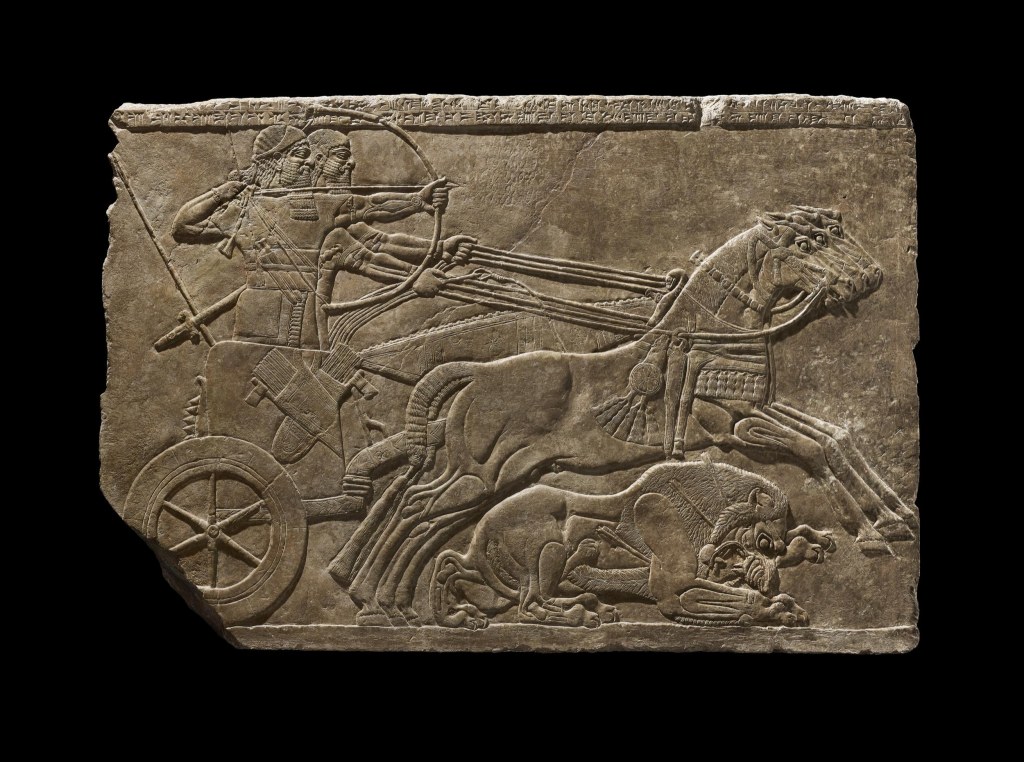
While Hoeh enthusiastically concludes the northeastern Slavic speaking nations, lead by Ukraine are descended from Madai, we will learn that the sons of Madai the Medes, are of an Asian line of descent – albeit with European admixture – and not living in eastern Europe – refer Chapter XXIV Arphaxad & Joktan: Balts, Slavs & the Balkans

The Races of the Old Testament, A H Sayce, 1891, page 45:

‘Madai are the Medes, the Mada of the Assyrians. We first hear of them in the cuneiform records under the name of Amada, about B.C. 840, when their country was invaded by the Assyrian monarch. They were at that time settled in the Kurdish mountains, considerably to the east of Lake Urumiyeh. Some fifty years later, however, we find them in Media Rhagiana, where they are called no longer Amada but Mada. It was from the latter form of the name that the Greeks took the familiar Mede.’

Amazing Bible Time Line – emphasis mine: 

‘According to the Book of Jubilees [10:35-36], [Madai] married the daughter of Shem and pleaded with the three brothers of his wife [Elam, Asshur and Arphaxad] to let him live on their land instead [of] occupying an area in Japheth’s land[!] They gave him a spot to dwell on with his family and it was later… named Media. The capital city of Media was Ecbatana [Ezra 6:2]… Media flourished in the trade industry and was… blessed in the field of agriculture. Its lands were fertile…’ 

Recall Genesis 9:27 in Chapter II Japheth Orientalium – the prediction of Japheth dwelling with Shem – where, Madai has intermingled with Shem in extraordinary fashion and has been blessed with fertile soil and mineral wealth in its modern location.

The Book of Jubilees 8:5 states that a daughter of Madai named Milcah [Aramaic: Melkâ] married Canaan, Ham’s youngest son.

The Book of Jasher 7:5 

And the children of Madai were

Achon, Zeelo, Chazoni and Lot

We will meet another, well-known Lot, later – refer Chapter XXVI The French & Swiss: Moab, Ammon & Haran.

A selection of verses – in chronological order – regarding the Medes of Media in the Bible and revealing their intricate relationship with not only Elam of Persia, but also Asshur of Assyria.

2 Kings 17.6

English Standard Version

‘[Shalmaneser V]… the king of Assyria captured Samaria, and he carried the Israelites away to Assyria and placed them in Halah, and on the Habor, the river of Gozan, and in the cities of the Medes.

This occurred during 721 to 718 BCE – 2 Kings 18:11. Media while a powerful people, found themselves in the shadow of the Babylonian Empire and subject to the Assyrian Empire. The Persian Cyrus or Darius the Great, became King of Persia in 559 BCE. His father was King Astyages of Media, against whom he rebelled and desiring to remove Media’s dominance over Persia, annexed Media to the Persian Empire in 549 BCE.

Cyrus was the first ruler of the Achaemenid Empire, which lasted for over two hundred years. The Medes though conquered, continued to be honoured in the new empire and were invariably referenced together with the Persians – Acts 2:9.

Isaiah 21:2

New Century Version

‘… Elam, attack the people! Media, surround the city and attack it! I will bring an end to the pain the city [of Babylon] causes.’ 

Cyrus conquered the Chaldean Empire in 539 BCE. This event was foretold long before by the prophets Isaiah (13:17) and Jeremiah (25:25; 51:11, 28) and it occurred one year before Cyrus/Darius issued the decree which allowed remnants of the Kingdom of Judah to return to Jerusalem – Ezra 1:1-4.

Daniel 5:28

English Standard Version

‘Peres, your kingdom [of the Chaldeans] is divided and given to the Medes and Persians.”

Daniel 5:31

New Century Version

‘So Darius the Mede became the new king when he was sixty-two years old.’

Cyrus ruled until 530 BCE. There were two interim kings and then Darius came to the throne of the Medes and Persians in 522 BCE, ruling until 486 BCE. Darius was not a son of Cyrus, being a Mede and not a Persian. 

Daniel 6:15

New Century Version

Then those men went as a group to the king. They said, “Remember, O king, the law of the Medes and Persians says that no law or command given by the king can be changed.”

Daniel 6:28

New Century Version

‘So Daniel was successful during the time Darius [the Mede] was king and [later] when Cyrus the Persian was king.’

Daniel had found favour and was a key figure in the Court of both kings for half a century or more. In 485 BCE Xerxes I, the son of Darius the Mede became king, ruling until 465 BC. His son Artaxerxes I or Ahasuerus, ascended to the throne, when his father was murdered, at the age of twenty-six in 465/464 BCE. This was the apex of the empire, inherited from his father and when we are introduced to the biblical character Esther.

The second chapter of the Book of Esther reveals Esther’s rags to riches story. She was part of the returned captives originally from the Kingdom of Judah in 458/457 BCE. Esther descended from the tribe of Benjamin and was beautiful in countenance and spirit – Esther 2:7. She was placed in the King’s palace… 

Esther 1:1-4

New Century Version

‘This is what happened during the time of King Xerxes, the king who ruled the one hundred twenty-seven states from India to Cush.’ 

Literally from present day India all the way west, to the nation in east Africa now known as Ethiopia.

‘In those days King Xerxes ruled from his capital city of Susa [or Susan]. In the third year of his rule [482 BCE], he gave a banquet for all his important men and royal officers. The army leaders from the countries of Persia and Media and the important men from all Xerxes’ empire were there. The banquet lasted one hundred eighty days. All during that time King Xerxes was showing off the great wealth of his kingdom and his own great riches and glory.’

Esther 2:16-18

English Standard Version

‘And when Esther was taken to King Ahasuerus, into his royal palace… in the seventh year of his reign [458/457 BCE], the king loved Esther more than all the women, and she won grace and favour in his sight more than all the virgins, so that he set the royal crown on her head and made her queen instead of Vashti.’ 

Esther 1:19

English Standard Version

‘If it please the king, let a royal order go out from him, and let it be written among the laws of the Persians and the Medes so that it may not be repealed, that Vashti is never again to come before King Ahasuerus. And let the king give her royal position to another who is better than she’ – Daniel 6:12.

‘Then the king gave a great feast for all his officials and servants; it was Esther’s feast. He also granted a remission of taxes to the provinces [including Jerusalem] and gave gifts with royal generosity.’

About a third of the references to the name Madai, including Media and the Medes in the Bible, occur in the Book of Esther. 

The Medo-Persian Empire contained 44% – about 50 million people – of the world’s population within its borders, according to Ehsan Yarshater in The Cambridge History of Iran – the highest such percentage for any empire in history.

To fully appreciate Madai’s identity, we will briefly touch upon Shem’s sons Elam and Asshur – with a selected identifying defining biblical verse for each – before returning in detail to each in their own chapters.

The modern day descendants of Elam or ancient Persia, are the Turks and the nation of Turkey – refer Chapter XVIII Elam & Turkey

Jeremiah 49:36

New English Translation

‘I will cause enemies to blow through Elam from every direction like the winds blowing in from the four quarters of heaven. I will scatter the people of Elam to the four winds. There will not be any nation where the refugees of Elam will not go.’

Footnote:

‘Or more simply, “I will bring enemies against Elam from every direction. / And I will scatter the people of Elam to the four winds.” Or more literally, “I will bring the four winds against Elam / from the four quarters of heaven./ I will scatter…” However, the winds are not to be understood literally here. God isn’t going to “blow the Elamites” out of Elam with natural forces. The winds must figuratively represent enemy forces that God will use to drive them out.’

We are provided an intriguing clue with regard to Elam’s location. It is vulnerable to attack from all sides: north, south, east and west. These are four points on a compass and represented by the direction of four winds, northerly, easterly and so forth. Turkey is literally at the crossroads of the Earth. It sits between the continents of Europe, Asia and the region of the Middle East geographically, politically and culturally – not quite a full member of any one.

Cyrus the Persian, the Elamite King, was known as:

‘The Great King, King of Kings, King of Anshan, King of Media, King of Babylon, King of Sumer and Akkad, King of the Four Corners of the World.’

Elam or Persia historically was geographically near Madai (or Media). Following points one, three and four in the introduction (primus verba), we should expect to find a European and Asian peoples not only in geographic proximity today but also connected through history, language and inter-marriage, revealed by their respective Haplogroups and autosomal DNA.

The reader is highly recommended to read Chapter XVIII Elam & Turkey in conjunction with this chapter.

Meanwhile, the modern day descendants of Asshur and Assyria, dwell in Russia – refer Chapter XX Will the Real Assyria Stand Up: Asshur & Russia.

Zephaniah 2:13

English Standard Version

‘And he will stretch out his hand against the north [H6828 – tsaphown: northward, northern, (direction of), north side, north wind] and destroy Assyria, and he will make Nineveh [the capital] a desolation, a dry waste like the desert.’

If one studies a world map, Russia is as far north as you can travel. There it is; exactly where the Bible says. The Assyrians historically used their neighbour Media, as a foot stool. We will find a similar relationship has continued into modern times.

One can hear those readers with more than a cursory knowledge, gasping incredulously. Edward Hine first proposed Germany was Assyria in the 1870s – with people influenced by its adversarial relationship with Great Britain in following decades – and the idea proceeded to cement firmly in people’s minds like reinforced steel concrete. When Edom was first linked with Turkey is not exactly clear; though the arguments used hang by tenuous threads for both identities, with genetics providing the knock out blow, as it shall be discovered.

Many will be thinking: then who are the Germans and where is Edom? We will look more closely at these two influential peoples in later chapters – including the intricate relationship between Madai and Elam – Chapter XVIII Elam & Turkey.

It would be very convenient if Madai and or Elam still lived in present day Iran… since Iranians call themselves Persian – but this does not mean they are Madai or Elam. Please refer to point number one and two in the introduction (primus verba).

The cumulative evidence leads to Madai being the Turko-Mongol peoples of the Central Asian Republics; including the Tartars of Russia and the Mongols in Mongolia – namely, Kazakhstan, Kyrgyzstan, Uzbekistan,Turkmenistan, partially Tajikistan and possibly including the Sami and Lapps of Russia, Finland and Scandinavia.

Madai from the verb madad, means: ‘measure, sufficient, enough’ or ‘judging’ and ‘as often as’, as well as ‘middle land’, and ‘out of the abundance of’. It could also be interpreted as: ‘My Measure[ment].’

For now, we will only introduce the relationship Madai has with Elam; detailing a comprehensive study later when we discuss Elam in Chapter XVIII Elam & Turkey. We will see support for the subservient relationship of Madai towards Asshur, present day Russia and the abundance Madai has been given in fulfilment of their name. If one looks at a map of the world, it is evident just how in the middle of the world, Madai truly is.

The five nations comprising Central Asia are former Soviet Republics, from the modern incarnation of the Assyrian Empire. They are referred to as ‘the stans’ – the Persian (Iranian) suffix meaning: land of.

The region historically connected the Silk Road, standing as the intersection for the movement of people, trade and philosophies between all parts of Asia and Europe. The population of the four principle nations is approximately 67 million people; not far off the Amerindian population of the Americas – Chapter III Tiras the Amerindian.

The people of Turkmenistan are known as Turkmen or Turkmen Turks.

Arlen Seitbatkal:

‘The word Turkmen stems from “Turk” and the intensifying suffix “men,” meaning true Turk. The word Trkmen is also mentioned in Mahmud al-Kashgari’s 11th-century dictionary, “Dīwān Lughāt al-Turk,” where it refers to an ethnic group and carries the meaning of Turk or Turkish person.’

Turkmen also live in Uzbekistan, Kazakstan, Iran and Afghanistan. They speak the Turkmen language; classified as part of the Eastern Oghuz branch of the Turkic languages – see map below. 

Examples of other Oghuz languages include Turkish and Azerbaijani. In the early Middle Ages, Turkmen originally called themselves Oghuz and then later as Turkmen.

Flag of Turkmenistan

Uzbekistan – the nation with the largest population of the four – mines 80 tons of gold yearly; 7th highest in the world. Uzbekistan’s copper deposits rank 10th in the world, its uranium deposits 12th and the country’s uranium production ranks 7th globally. The Uzbek national gas company, Uzbekneftegas ranks 11th in the world in natural gas production and the country has significant untapped reserves of oil and gas.

What’s in Name of Central Asian Nations, Aibarshyn Akhmetkali , 2025:

‘Scholars link the origin of the term Uzbek to the name of Uzbek Khan, the ruler of the Golden Horde in the 14th century. When the horde began to disintegrate, the nomadic tribes within his ulus began to call themselves Uzbeks.’

Arlen Seitbatkal:

“In the nomadic tradition, a strong leader has always been identified with the people. If someone had power and authority, people followed them, and their name became fixed after the group.”

Turkic influence in Central Asia during the first millennium CE brought Turkic culture and language to the lands now known as Kazakhstan.

Orexca:

‘Written sources of the 6th century register the term “Tyurk” which is pronounced as “Tutszyue” by the Chinese and as “Turk” by the Sogdians. Archeological studies of Turkic monuments make it possible to somehow compare “these” Turks with certain Turkic tribal associations. In the Sayano-Altai region they have identified certain archeological cultures which might well be likened to early Kyrgyz, early Kypchaks or early Oguzes.

In the course of not infrequent internecine wars, tribal discord, and struggles for power and pasture, a part of the Turkic tribes which inhabited the steppes and valleys of Kazakhstan moved southwards – to Central Asia (… Tyurgeshes, Karluks, Kypchaks, Uzbeks, Oguz, and Turkmens-Seldzhuks), to Asia Minor… [and] to the Caucasus (Turkmen and Seldzhuks)…

Starting from the 4th century up to the beginning of the 13th century, the territory of Kazakhstan was the seat of West-Turkic, Tyurgesh, Karluk Kaganates, of the state made by the Oguz, Karakhanides, Kimeks and Kypchaks. All of them successively replaced one another right up to the Mongol invasion.’

These states contributed to the spread of Islam and the development of urban culture.

Mongol influence occurred in the thirteenth century when Genghis Khan conquered the region (1219-1224), incorporating it into the vast Mongol territories – refer Chapter XVIII Elam & Turkey. The region then became part of the Golden Horde, a Mongol successor state.

Orexca: ‘After the invasion, [that is] in the beginning of the 13th century, uluses of the Mongol Empire of Zhuchi-Khan and Zhagatai were formed, which later gave birth to Ak-Orda, Mongolistan and finally to the Kazakh Khanate’ in about 1465.

The Kazakh Khanate was established by Jani Beg (Janibek) and Karay (Kerei) Khan. Various nomadic Uzbek tribes were unified under a single political entity and subsequently developed a distinct Kazakh identity.

Britannica:

‘[For these] separatist Uzbeks became known as Kazakh (“Independent” or “Vagabond”) Uzbeks, and over time a significant differentiation developed between them and the [non-separatist] Uzbeks in their respective ways of life: that of the Kazakh was more nomadic, that of the Uzbeks more sedentary.’

Online Encyclopaedia:

‘According to the latest research of population genetics, mainly of autosomal markers and Y-chromosome polymorphism, it is believed that during the 13th to 15th centuries that the Kazakh ethnicity emerged.’

The Kazakh Khanate reached its peak in the sixteenth century with a golden age under the leadership of Kasym Khan (1509-1518), who expanded its territory and influence.

Britannica: ‘… the Kazakhs were the masters of virtually the entire steppe region, reportedly able to bring 200,000 horsemen into the field and feared by all their neighbours. The prevailing view is that the rule of Kasym Khan marked the beginning of an independent Kazakh polity. Under his rule Kazakh power extended from what is now southeastern Kazakhstan to the Ural Mountains.’

The Kazakh Khanate conducted wars with neighbouring states; the Uzbek Khanate and the Tsardom of Moscow (1547-1721). In the early sixteenth century, the Kazakhs faced an increasing threat from first the Mongols and then from Russia which was expanding its borders to the East.

Kazakhstan became part of the Russian Empire in the eighteenth century. Its colonisation was accompanied by significant changes in the traditional lifestyle of the Kazakh people. Russia sought to actively develop land resources and introduce new administrative structures.

History Central:

‘The situation worsened after 1861 when Russian and Ukrainian peasants flowed into Kazakhstan after the freeing of the serfs and were given Kazakh lands. (This influx of Russians and Ukrainians was not limited to this period – it continued throughout the first seven decades of the [twentieth] century as well such that by 1979, there were more Russians than native Kazakhs in the region.)

Simmering resentments [following repeated revolts] led to a major rebellion in 1916′, sparked by the forced mobilisation of Kazakhs to the Russian front during World War I. ‘In suppressing the uprising, the Russians killed thousands. The Communist revolution the next year [in 1917] plunged Kazakhstan into civil war. Defeated, Kazakhstan became part of Russia as an autonomous entity, eventually attaining the status of one of the Soviet Union’s republics [Kazakh SSR in 1936].’

Britannica:

‘From 1927 the Soviet government pursued a vigorous policy of transforming the Kazakh nomads into a settled population and of colonizing the region with Russians and Ukrainians.’ This period in its history was marked by industrialisation, collectivisation of agriculture and cultural repression.

Britannica: ‘Despite their nomadic rural existence, the Kazakhs were the most literate and dynamic Indigenous people in Central Asia. But the collectivisation brutally imposed by the Soviet regime resulted in a shocking decrease in the Kazakh population: between 1926 and 1939 the number of Kazakhs in the Soviet Union fell by about one-fifth. More than 1,500,000 died during this period, the majority from starvation and related diseases, others as a result of violence. Thousands of Kazakhs fled to China, but fewer than one-fourth survived the journey; about 300,000 fled to Uzbekistan and 44,000 to Turkmenistan.’

In 1991 after the collapse of the Soviet Union, Kazakhstan became an independent country and a member of the Commonwealth of Independent States (with Russia); under the leadership of the first President Nursultan Nazarbayev. The new state began to implement economic reforms and political changes aimed at integrating into the international community.

History Central:

‘Non-Muslim ethnic minorities departed Kazakhstan in large numbers from the mid-1990s through the mid-2000s and a national program has repatriated about a million ethnic Kazakhs (from Uzbekistan, Tajikistan, Mongolia, and the Xinjiang region of China) back to Kazakhstan. As a result of this shift, the ethnic Kazakh share of the population now exceeds two-thirds.’

This checkered history replicates the intertwined historical relationship between the descendants of Asshur (Assyria) and Madai (the Medes); the ancestors of the Russians and Central Asians respectively.

Coat of Arms of Kazakhstan – inscription: QAZAQSTAN

Today, the transcontinental Republic of Kazakhstan, the nation with the biggest land area of the four within Central Asia, has an additional smaller portion west of the Ural Mountains in Eastern Europe. It is the world’s largest landlocked country and the 9th largest country in the world, with an area of 1,052,100 square miles. Kazakhstan is the dominant nation of Central Asia economically, generating 60% of the region’s GDP, mainly through its oil and gas industries. It also possesses vast mineral resources.

The Kazakh language is a member of the Turkic language family, with Uzbek, Kyrgyz, Tatar, Uyghur, modern Turkish, Azeri, Turkmen and numerous other languages spoken in Eastern Europe, as well as Central and Eastern Asia. 

Arlen Seitbatkal:

“In the works of academician Abduali Kaidarov and professor Telkozha Januzakov, it is explained that the word ‘qazaq’ can be associated both with ‘qas saq’ (true Sakas) and with the combination of the words ‘qaz’ (goose) and ‘aq’ (white). But most researchers agree that the concepts of yerkin (free) and batyr (warrior) are at the core. The people who broke away from Khan Abulkhair called themselves free, i.e. qazaq.”

CountryPopulation (2025*)Area (km²)GDP (nominal*)
 Kazakhstan20,963,9562,724,900$304.67 billion
 Kyrgyzstan7,347,316199,900$20.16 billion
 Uzbekistan37,386,036447,400$137.48 billion
Turkmenistan7,678,550488,100$72.12 billion
Total73,375,858

Kazakhstan has the 2nd largest uranium, chromium, lead, and zinc reserves; the 3rd largest manganese reserves; the 5th largest copper reserves; and ranks in the top ten in the world for coal, iron, and gold. It is also an exporter of diamonds. 

Flag of Kazakhstan

Most significantly for its economic future, Kazakhstan has the 11th largest proven reserves of both petroleum and natural gas in the world. There are three refineries in the country and not being capable of processing the total crude output, much of it is exported to Russia.

Russian Proton launch vehicle with the Granat high-energy astrophysics observatory, prior to launch on December 1, 1989, from the Baikonur Cosmodrome, Kazakhstan.

Kazakhstan, while part of the Soviet Union was instrumental in the Russian Space Program; providing the launch sites for CCCP rockets.

Astana, the capital of Kazakhstan since 1997 and renamed from Aqmola in 1998

The Tatars are a collective of Turkic-speaking groups – nearly 7 million people – living in the Russian Federation. The Chinese referred to these nomadic tribes as Ta-Ta or Da-Da – meaning dirty or barbarian. During the early thirteenth century, Ghenghis Khan united the nomadic tribes then living in Mongolia. One of his grandsons Batu Khan, led the Mongol invasion of Eastern Europe – refer Chapter XVIII Elam & Turkey.

Tatar man

Web source: 

‘The… Tatars were conquered by imperial Russian forces during the reign of Tsar Ivan IV in 1552… When the Russian Empire collapsed in 1917, the Tatars… formed their own home-land, the Idil-Ural State. The Soviet government… instead formed the Bashkir Autonomous Republic (Bashkortostan) and the Tatar Autonomous Soviet Socialist Republic (Tatarstan) on the same soil. When the Soviet government took over these regions, it redrew the boundaries and gave neighboring Russian provinces the best lands. By changing the boundaries, about 75 percent of the Tatar population found itself living outside the borders of Tatarstan.

Tatar culture was… affected… through the policy of Russification, where the Russian language and culture were legally forced on the Tatars and other ethnic groups… Tatars, of whom about 26 percent live in Tatarstan… is about the size of Ireland or Portugal. 

About 15 percent of all Tatars live in Bashkortostan, another ethnic homeland in the Russian Federation that lies just east of Tatarstan. There are also smaller Tatar populations in Kazakstan, Kyrgyzstan, Tajikistan, Turkmenistan… In 922, the Tatars’ predecessors, the Bulgars, converted to Islam, and the old Turkic script was replaced by the Arabic alphabet. 

A famous old Tatar… proverb is Tuzga yazmagannï soiläme, which means, roughly, “If it’s not written on salt, it’s wrong to even mention it.” The proverb refers to the ancient method of keeping records on plaques made of wood and salt, and commends the practicality of keeping written records.’

Recall ‘the Law of the Medes and Persians’, where a proclamation stood fast and could not be altered as discussed in the Books of Esther and Daniel.

Top 14 Tribes of Ancient Central Asia, Mahesh Shant – emphasis & bold mine:

‘Before the Turks entered the arena of history the Awars occupied the regions which later came under the sway of the Turks. After the destructions of the Huns, Syan Pi took over Manchuria, Mongolia and some parts of China. One of the dynasties descended from them, the To-Ba dynasty, was founded in 315 A. D. and continued till the 5th Century. This Hunnish tribe lived in the areas near Lake Baikal… and north of the Gobi desert [Mongolia].

At first the Chinese name for the Awar tribe was Ju-Jun but it was later (in 451 A. D.) changed to JvanJvan by the To-Ba Emperor Tai-Hu-Ti (425-452 A.D.)…

She Lun, a powerful chieftain, who conquered the Kao She tribe and, consolidating his military strength, took the title of Kagan (Khan). The king­dom of the She Lun, which spread from Korea to the Altai, included a part of China as well as a section of the trade route of Central Asia. The Awars relations with the Chinese were not unlike those of their Hunnish ancestors. At times they plundered the border regions of China, at others they gave military aid to the Chinese Emperor. The Turks put an end to the military might of the Awars in 546 A. D.’

Of interest is the remarkable coincidence of the To-Ba dynasty – who were related to descendants from Madai (just as the Huns were from Elam) – should take on the name of their long distant uncle, Japheth’s fourth son, Javan (Jvan-Jvan).

Shant: ‘The Selzuks were a nomadic people inhabiting the regions north of the Sir Darya [Syr Darya River]. They were also known as Turkmans and the region once inhabited by them now forms part of the Soviet Socialist Republic. A branch of the Aguz, they spread in the course of their wanderings to the northern banks of the Sir Darya.

The Guz or Aguz [Oghuz] Turks were divided into three branches – Kipchiaks, Kankalis and Karluks. The Selzuk dynasty, which ruled over Central Asia and Iran for a long time, was descended from the Kipchiaks, and the Turks of modern Turkey are descended from the Osmanali branch of this tribe.

The similarity in language points to the Uzbeks, Turkmans, Khirgiz and Kazaks having sprung alike from Turkish stock.

They can be divided into three parts:

(i) The Northern Turks – the Yakuts of Siberia,

(ii) The Eastern Turks – the Sinkiang Turks, Uzbeks, Kazaks are Kufa Tatars

(iii) The Western Turks – Osman Ali, Azerbaijanians and Turkmans.

A branch of the Turks left its original homeland in the Altai mountains and advanced into Turkestan, driving out or absorbing the Scythian and Sogdhian tribes inhabiting these regions. Among these Turks were the Selzuks and the Chingiz Mongols.

The Sulzuks acquired that name from Selzuk Turk their first Muslim Chief, although they were equally well-known as Turkmans. The Western Turks, of whom Turkmans were the majority, brought Asia Minor and Armenia under their control, while another branch of the Western Turks, the Osmani Turks, brought about the downfall of the Byzantine Empire, made Constantinople their capital in the 15th century and later extended their rule over Eastern Europe.’

The entwined relationship between Madai (Mongols) and Elam (Turks) – the Medes and Persians of old – has endured through the cyclic phases of their history. The label Turk, used interchangeably for Uzbeks, Kazakhs and Turkmen of Central Asia as well as for the Turkish in Asia Minor – Chapter XVIII Elam & Turkey.

Facts and Details, People of Central Asia:

‘The people of Central Asia are basically divided into two types: the traditional nomads and semi-nomads (Kazakhs, Kyrgyz, Mongols and Turkmen) and the settled people (the Uzbeks and Tajiks). According [to] DNA studies, Tajiks, Uzbeks and Turkmen have retained their “ethnic purity.”

There has traditionally been a lot of intermarriage between the ethnic groups of Central Asia. Uzbeks and Tajiks have traditionally been difficult to distinguish from one another. The same is true with Kyrgyz and Kazakhs. Up until the 20th century… [the Uzbeks and Tajiks] were regarded as essentially the same people except that Uzbeks spoke a Turkish language and the Tajiks spoke a Persian language.

Tajiks are… distinguished from other Central [Asians] by their traditional Islamic-Iranian culture [and ethnicity]. Uzbeks consider themselves the [dominant] people of Central Asia by virtue of their numbers and their historic links to… Genghis Khan. Other ethnic groups in Central Asia dispute this claim.

Kazakhs and Kyrgyz are close relatives. They look similar, have many similar customs and speak similar languages. Many believe they are [essentially] the same people with Kazakhs traditionally residing in the steppes and Kyrgyz living in the mountains. The Kyrgyz, however, have a longer and more coherent history than the Kazakhs. Clan and regional ties have historically been more important than ethnic identity.

Central Asia is a meeting point of Turkic, Persian and Mongol cultures.’

The Analysis of the Genetic Structure of the Kazakh Population as estimated from mitochondrial Dnapolymorphism, Scientific Centre of Obstetrics, Genecology and Perinatology, Galina Berezina, Gulnara Svyatova & Zhanar Makhmutova, 2011:

‘The most closely related populations are the Kazakhs and Uighurs, they are accompanied by the Uzbeks and the nation(s) of the southern Altai on one level. The Kyrgyz and Bashkir [Tatar] nations formed an independent taxonomic group in this cluster. The contribution of [European] and [Asian] components in the formation of the anthropological type of the Kazakhs was proved… by Ismagulov (1970) on the basis of a comprehensive study of paleoantropological and craniological materials.’

The land of Kazakhstan has been a place of interaction comprising many ethnic layers during a historically long period. Mongolian tribes, Turkic-speaking populations from Siberia and Altai, Indo-Iranians from the Near East, as well as Slavs from Eastern Europe took part in the formation of the Kazakhs. Thus, it is possible to explain a high level of genetic variability of mtDNA, with a complicated ethnic history.

Khazaria, Kazakh Genetics: Abstracts and Summaries, Kevin Alan Brook – emphasis mine:

‘Kazakhs (Qazaqs, Kazaks) are a Turkic-speaking people living in several modern countries including (but not limited to) Kazakhstan, China, and Mongolia. They are approximately 70% [Asian] and 30% [European] and this admixture explains why some Kazakhs have light European physical features in contrast to the majority who have black hair, brown eyes, and epicanthic eyefolds. 

The Kazakhstan DNA Project‘s Y-chromosome records show that among its male members are the Y-DNA haplogroups C3, C3*, C3c, G… O2, Q1a3, E1b1b1, N1c1, R1a1, R1b1b1, R2, J2a1, J2a, and J2.’

The paternal Haplogroups in bold are indicative of lineages from Japheth; with the ancient C Haplogroup the defining marker for descendants from Madai.

Brook: ‘C3 [C2] (M217, P44) is not only common among Kazakhs but also frequent in Mongolia [and the Kyrgyz].

The analysis shows that Western Europe… and Eastern Europe… mtDNA lineages exist in the Kazakhs population. A high genetic diversity was observed in the Kazakhs population (h=0.996). “We have studied the relation between East Eurasian and West Eurasian lines in the gene pool of the Kazakhs using the data on polymorphism HVSI of mtDNA (frequencies of haplogroups). It was found out that the main contribution of East Eurasian lines (55% of the total gene pool) to the modern gene pool of mtDNA of the Kazakhs make haplogroups D, C, G and Z (36.2%), A and F (6.9%) and other haplogroups of Asian origin (11.9%) [B].’ 

The complexity of the Kazakh genetic make up is due to their Haplogroups being split between Asian (64-70%) and European lineages (30-35%); with their European genealogy being split further, between western (41%) and eastern European (55%) gene pools.  

Brook: ‘West Eurasian lines (41% of the total gene pool) in the Kazakh gene pool are most frequently represented by the haplogroups H (14.1%), K (2.6%), J (3.6%), T (5.5%), U5 (3%) and others (12.2%).” We found that more than 64% of mtDNA lineages belong to Asian-specific haplogroups (M, C, Z, D, G, A, B, F, N9). Supercluster M was found with most high frequency (45%).’ 

Japheth’s son Tiras possesses the mtDNA Haplogroups in common with Madai: C, D, A and B – refer Chapter III Tiras the Amerindian. Haplogroups C and D derive from super sub-Haplogroup M, itself from L3 while Haplogroup A derives from super sub-Haplogroup N and B from super sub-Haplogroup R.

Brook: ‘Western-Eurasian specific haplogroups were observed in 35% (H, V, HV, J, T, U1, U2, U4, U5, U7, K, W, X)… the lineage of Hg U7, typical for all Levant, including Iran, was revealed in Kazakhs… East Asian hgs – A, B, F, N9 – make up about 18% in Kasakhs, like in all Central Asian populations, Altaics, Tuvinians and Bashkirs…

While those Kazak people who reside in China are mostly [Asian], just like Kazakhs in Kazakhstan, this study showed that 30.2% of their ancestry is western Eurasian. “In this study, we also find that all Turkic and Mongolic groups possess a common set of maternal haplogroups (C, D, G2a, H)…*

Kyrgyz (Kirghiz, Kirgiz) are a Turkic-speaking people living mostly in Kyrgyzstan but also in neighboring Uzbekistan, Tajikistan, Afghanistan, and China. They are descended from multiple different ancient peoples. Mongoloid (East Eurasian) ancestry represents between half and two-thirds of Kyrgyz ancestry. 

Kyrgyz living in Tajikistan and western areas of Kyrgyzstan have less Mongoloid ancestry and more Caucasoid ancestry than other Kyrgyz. Central and South Asian ancestry is the next most important element representing about one-fourth. West Eurasian (including European) represents about one-eighth. Ancestry from West Asia [Arab, Persian] is not significant in any Kyrgyz person and many have none of it.

The Kirgiz DNA-Project’s Y-chromosome records show that among its male members who are Kyrgyz from Kyrgyzstan are the Y-DNA haplogroups C-M217 (C3) [C2], I-M253 (I1), J-M172 [J2], N-M232, O-P201, R-M198 (R1a1a), R-M269 (R1b1a2), and R-M343 (R1b1a1). R1a1 (and its subtypes) is also found among Kazakhs, eastern Siberians, South Asians, East Slavs, and West Slavs.’

‘This study of Y-DNA includes Kyrgyz samples as well as samples from other Central Asian peoples like Tajiks, Uzbeks, and Karakalpaks, plus many other populations from elsewhere. M17 [R1a1] is suggested to be “a diagnostic Indo-Iranian marker”… [resulting from admixture with European lineages]. “The exceptionally high frequencies** [63%] of this marker in the Kyrgyz, Tajik/Khojant, and Ishkashim populations are likely to be due to drift, as these populations are less diverse, and are characterized by relatively small numbers of individuals living in isolated mountain valleys.”

The most prevalent mtDNA Haplogroups for the Kyrgyz, in order are: D, H and C.* D, C and G are indicative of Asian ancestry and H is reflective of European admixture in the maternal line. The main Y-DNA paternal Haplogroups for the men from half of the seven million Kyrgyz are in descending percentage order: 

R1a [63.5%] – C2 [13.5%] – O [5.8%] – K [1.9%] – O2 [1.9%] – N1c1 [1.9%] – 

P [1.9%] – R1b [1.9%] – I1 [1.9%] – J2 [1.9%]

The Haplogroups, R1a, R1b and I1 are indicative of European admixture. The Haplogroups C2, K, O2 and N1c1, are the main Asian lineages for the Kyrgyz men, with C2 the principle defining Asian paternal Haplogroup. The very high frequency of R1a** is somewhat of an anomaly and reveals considerable admixture. For R1a is mainly associated with either the Eastern European peoples of Slavic descent; from eastern Siberia; or from mixed Indian ancestry in northern India. 

J2 is typically a west Asian Haplogroup and particularly associated with Turkey, Iran and Pakistan. R1b is the main identifying Haplogroup for western European men and Haplogroup I1 originates with northwestern Europeans. What is important, is that Haplogroups C, K, N and O are key Asian Y-DNA Haplogroups. 

The main Amerindian mtDNA Haplogroups – in order – are A, B, C and D. The Kyrgyz and the Kazakhs have the same Haplogroups, though with different variations and percentages. Similarly, the American Indian has Y-DNA Haplogroups Q and C, of which they share C with the Kyrgyz and both C2 and Q1a3 with the Kazakhs.

Kazakhstan Soldiers

The following prevalent Asian mtDNA Haplogroups are found in the Kazakh population of nearly twenty million people: D, C, G, Z, followed by A, F and also B and N9. The supercluster M is found with the highest frequency of 45%. The main European mtDNA Haplogroups include, H at 14%, K, J, T and U5. These two sets are very similar to the Kyrgyz people.

The main Y-DNA Haplogroups include:

C2 [40%] – K [10%] – O2 [8%] – J2 [8%] – R1a [7%] – N1c1 [7%] –

R1b [6%] – P – [3.3%] – Q1a3 [2%] – R2 [1%] – I1 [1%] 

This is where they differ, with the Kazakh’s showing less European admixture as shown by the predominant and distinct C, K and O Asian Haplogroups. It also highlights how principle admixture has passed from the maternal^ line, with Madai males taking Elamite wives, or in other words, Turko-Mongol males marrying primarily Turkish women. J2 is the most prevalent Y-DNA Haplogroup of Turkish men with R1b and a lesser extent R1a and so the Kazakh and Kyrgyz males possessing the same is not a coincidence.

Decoding a Highly Mixed Kazakh Genome, multiple authors, 2020 – emphasis mine: 

‘We present the whole genome sequence and thorough genetic variant and admixture analysis of a Central Asian, Kazakh MJS. We found several SNVs associated with drug toxicity, metabolism, diseases, phenotypic features and identified recent and ancient admixtures. Both PCA and phylogenetic analyses confirm closer MJS and other Kazakh similarity to modern East Asians than Europeans and showed the overall closest genetic affinities are with other Central Asian populations, namely, Kalmyk, Uzbek and Kyrgyz. All populations with significant similarity to MJS genome could be backed up by historic migration events involving the Kazakh population and the major fraction of genomic variation could be attributed to fairly recent admixture with geographically close populations.

However, MJS’s mitochondrial^ DNA [maternal] haplogroup is of European [Turkish] or Near Eastern (West Asian) [Iranian] ancestry. It corresponds to the heterozygous SNPs associated with European phenotypic features and confirmed by admixture f3 statistics and all other Kazakh autosomal data showed very similar ancestral compositions to MJS’s. This highly heterozygous and admixed Kazakh genome provides insights into complex admixtures and can serve as a reference for mapping complex heterogeneity in Central Asian populations.’

The males from the total eight million Tajiks exhibit these main Y-DNA Haplogroups:

R1a [44.7%] – J2 [18.4%] – R2 [7.9%] – C2 [2.6%] 

Tajikistan shows only a slim oriental link with their near neighbours and could have either mixed heavily or more likely, have more in common paternally with their southern Asian neighbours in Afghanistan and Pakistan – refer Chapter XIII India & Pakistan: Cush & Phut

The males from the six million people of Turkmenistan carry the following Y-DNA Haplogroups: 

R1b [37%] – J2 [17%] – K [13%] – P [10%] – R1a [7%] – R2 [3%]

The Haplogroup R2a (M124) is typically associated with the southern Asian men of particularly India with 10%; Pakistan with 8%; Western Asia; plus the Central Asian nations. 

The Turkmen on the other hand show strong admixture with the Turks (and related peoples) as revealed by their R1b and to a lesser extent J2 Haplogroup levels. The K and P Haplogroups are indicative of their Oriental ancestry. Haplogroup P derives from K and Q descends from P. Even though Y-DNA Haplogroups P and Q can be associated with Europeans in trace quantities due to admixture, they are sourced originally from and consistently found in, Asiatics .

Kazakh Women

The Y-DNA Haplogroups for the men of half of the thirty million plus people in Uzbekistan: 

R1a [25.1%] – J2 [13.4%] – C2 [11.5%] – R1b [9.8%] – K [6.8%] –

P [5.5%] – O2 [4.1%] – R2 [2.2%] – I1 [2.2%] – N1c1 [1.4%]

Uzbekistan like the smaller Kyrgyzstan and Turkmenistan has obviously mixed with a people not descended from Japheth but rather from Shem, though not as heavily and thus retains more of their core Oriental Haplogroups such as C, K and O. Their R1a, J2 and R1b Haplogroups again link them as we will learn, with primarily Turkey.

Uzbek man

Seen together, their respective Y-DNA Haplogroups appear as the following: 

Tajikistan:           R1a – J2 – R2 – C2 

Turkmenistan:   R1b – J2 – K – P – R1a – R2

Kyrgyzstan:         R1a – C2 – O – K – O2 – J2 – N1c1 – P – R1b – I1 

Uzbekistan:         R1a – J2 – C2 – R1b – K – P – O2 – R2 – I1 – N1c1

Kazakhstan:        C2 – K – O2 – J2 – R1a – N1c1 – P – R1b – Q1a3 – R2 – I1

On the one hand they are all similar and on the other, there are differences highlighting the extent of the admixture experienced by Madai with principally Elam. Kazakhstan, the furthest north remains the closest to its genetic Asian roots. It is the nations of Kyrgyzstan and Uzbekistan tucked underneath Kazakhstan to the south who are more mixed and it is Kyrgyzstan further east which remains purer than Uzbekistan in its core Asian Haplogroups. 

Meanwhile it should be no surprise that the nation the most southwards – Turkmenistan which is the closest to Turkey – exhibits the most genetic influence with higher frequencies in Haplogroups J2 and R1b. Tajikistan is the most distant and has more in common with southern Asia than it does with Central or East Asia. Of the two bigger populated nations, Uzbekistan reveals intermarriage levels similar to the others and only Kazakhstan is the nation that has mixed the least, thus retaining a truer Central Asian identity

Turkmen woman

Within the Haplogroup sequencing, Kazakhstan and Kyrgyzstan are more eastern in orientation, while Turkmenistan the most western oriented. Turkmenistan is geographically, linguistically and culturally more connected to Turkey – Chapter XVIII Elam & Turkey. Uzbekistan bridges the gap between the other three. 

The Haplogroups C2, O2 and major sub-Haplogroups K and P are all indicative of these nations descending from Japheth and their close genetic relationship with northern and eastern Asians. 

A comparison table below for the principle Y-DNA defining marker Haplogroups for the North American Indian and Central Asian men.

         C   O  K  P  Q

NA Amerindian     6                                  77

Kazakhstan           40        8      10       3      2

Kyrgyzstan            14         8       2        2

Uzbekistan            12         4       7        6    

Turkmenistan                           13      10

What does this table tell us? Noah would have carried Y-DNA Haplogroup A, which later mutated to C, D and F in his descendants descending principally from his eldest son Japheth. Japheth in carrying the proto-type C (and F) Haplogroup, gave his sons the mutations which would eventually derive into C, D, K, N, O1, O2 and Q.

Coincidentally totalling seven principle Y-DNA Haplogroups and thereby equaling the same number of sons descending from Japheth. Overall, the predominant oriental Haplogroups for Central Asia chronologically being C, followed by K, P and finally O. 

It is Haplogroup C2 which is the defining marker Haplogroup for the male descendants of Japheth’s third born son Madai.

Tiras the Amerindian likely received Haplogroup C from admixture rather than inheriting it; thus proving interaction with either Madai or perhaps other sons of Japheth in the distant past. Some Native Indian tribes possess none and others varying levels of Haplogroup C.

More importantly, what we do know is that Japheth passed on the mutation which would eventually form Haplogroup Q. In this, the descendants of Tiras stand out with their relatively recent and unique Y-DNA Haplogroup marker. For other Asian peoples only carry Q in small quantities. Those European men who carry it, also possess it in small percentages, signifying admixture. 

The table from Decoding a Highly Mixed Kazakh Genome, shows the genetic markers in comparing Asian populations. AM = America, CA = Central Asia, EA = East Asia, EUR = Europe, NA = North Asia, OC = Oceania, SA = South Asia, SEA = Southeast Asia and WA = West Asia. 

Interestingly as expected, Tajikistan is not represented. The closeness between Kazakhstan and Kyrgyzstan is confirmed as it is between Uzbekistan and Turkmenistan following their westernisation and particularly Turkmenistan’s proximity to West Asia – Turkey and Iran. Both Tiras the Amerindian, and more so Madai in Central and North Asia, have experienced varying degrees of admixture as evidenced by the table. 

We will confirm that Japheth’s remaining five sons are all grouped in the bottom right hand corner of the table, incorporated within East Asia and Southeast Asia.

These findings correlate to what we should expect to find if the Turko-Mongol peoples are descended from Madai… an Asian people descended from Japheth, which have absorbed European DNA from Shem’s line at different times in their history. The variety of admixture may be accounted for by the following: 

  1. A historical alliance with the children of Elam in ancient Persia, and the intermarriage between the two peoples over a number of centuries. 
  1. The Assyrian* removal of captive Israelites to Media. There may have been relationships formed between the two peoples – with possibly the subsequent original introduction of the R1a* Y-DNA Haplogroup. 
  1. The Medes were in a unique position of migrating across the vast Asiatic continent, yet they did not remain and become far removed from their original homeland. The circuitous route via East Asia and Mongolia, meant the bulk of Madai ultimately returned to the middle of the world, merely settling a little northwards from their ancestral home in ancient Persia, now modern Iran – refer Chapter XVIII Elam & Turkey.

This central position meant they were also exposed to travellers travelling east and west and therefore the recipients of the resultant impact on their racial diversity and identity. Only the surface has been scratched regarding Madai; their place in the world; and their historical impact. We will revisit Madai, when we study Elam – Chapter XVIII Elam & Turkey.

Chapter five discusses two of the three sons of Gomer. A surprise for a number of researchers will be the fact that the descendants from Gomer are not located in Europe. A further revelation is that the third born son of Gomer, did not dwell near his brothers and this geographic patten is replicated today.

Words come again and again to our ears, but we never hear enough, nor can we ever really see all we want to see.

Ecclesiastes 1:8 New Century Version

“… being wrong can be dangerous, but being right, when society regards the majority’s falsehood as truth, could be fatal.” 

Thomas Szasz

© Orion Gold 2020 – All rights reserved. Permission to copy, use or distribute, if acknowledgement of the original authorship is attributed to orion-gold.com