
Chapter II
Japheth is the eldest son of Noah and we learn important aspects about him in Genesis 9:27, English Standard Version:
“May God enlarge [H6601 – pathah] Japheth, and let him dwell [H7931 – shakan] in the tents [H168 – ‘ohel] of Shem…”

Israel a History of – emphasis theirs:
‘The word “enlarge” is an unusual translation of the Hebrew word Pathah. Pathah is not the word normally used for “enlarge”, and in this instance, “enlarge” does not signify a geographical enlargement. Rachab would be the word used to convey a geographical enlargement. Instead, Pathah typically is translated as “entice”, or “persuade”. It is derived from the Hebrew word Pathach, which means “to make open”. However, this verse is the only instance in the Bible where the form Pathah occurs, and it has been agreed upon by linguists and scholars to be translated as “enlarge.”
The Hebrew word Pathah means: ‘to entice, deceive, persuade or seduce.’ The wider application includes: ‘to be spacious, open, be wide.’ The King James Version principally translates the word as entice, ten times; deceive, eight times; and enlarge, only once.
The New English Translation:
May God enlarge Japheth’s territory and numbers! May he live in the tents of Shem…
Footnotes:
‘The words “territory and numbers” are supplied in the translation for clarity. There is a wordplay (paronomasia) on the name Japheth. The verb (yaft, “may he enlarge”) sounds like the name (yefet, “Japheth”). The name itself suggested the idea. The blessing for Japheth extends beyond the son to the descendants. Their numbers and their territories will be enlarged, so much so that they will share in Shem’s territories… it is not clear what it would mean for Japheth to live in Shem’s tents… there is no reason in this context to expect Japheth to be blessed at the expense of Shem and occupy his territory… it would make more sense for it to mean that Japheth would participate in the blessings of Shem, but that is not clear for this phrase.’
The root of Yepheth or Japheth is pathah, ‘to make wide.’ Thus the verse could read: ‘May God enlarge enlarged and let him dwell…’

Abarim Publications explain Japheth’s meaning in Hebrew as: ‘formless expansion, enlarged, magnified, may he expand.’ It derives from the verb pata, ‘to grow bigger…’ and ‘appears to describe the process of slowly but surely growing wider… Jones’ Dictionary of Old Testament Proper Names proposes Enlargement [and the] NOBSE Study Bible Name List reads Wide Spreading.’
The Hebrew word for dwell is shakan, meaning: ‘to settle down, abide, reside, establish’ – the idea of lodging. The KJV uses the word dwell the most: ninety-two times.
The word for tents is ‘ohel, translated as: tabernacles, 198 times; tents, 141 times; and dwelling, two times.
A selection of Bible translations state the verse as follows:
Amplified Bible: ‘May God enlarge [the land of] Japheth…’
Easy to read version: ‘May God give more land to Japheth…’
International Standard Version: ‘May God make room for Japheth…’
The Message: ‘God prosper Japheth, living spaciously in the tents of Shem.’
New Life Version: ‘May God make Japheth great…’
The Voice: ‘May God make plenty of room for Japheth’s family and give them homes among Shem’s tents.’
This writer’s preference for best describing the intent, is the Good News Translation:
“May God cause Japheth to increase! May his descendants live with the people of Shem!”
As pathah is used in a unique context in this verse, it is difficult not to ascribe a geographical aspect to its intention – as it is associated with the second part of the verse – in dwelling within Shem. It would seem that the word is conveying more than just an enlargement and hinting at the method of that growth, through some form of deception or stealth.
This verse references Japheth’s posterity enlarging in population and though not intimating geography specifically it is indirectly, as Japheth is to encroach on Shem’s descendant’s territories via immigration. Japheth is increasing in prosperity – giving them the opportunity to share the economic benefits afforded – by dwelling in the prosperous nations descended from Shem – refer Chapter X China: Magog, Tubal & Meshech.
Thus Genesis 9:27 is a remarkable prophecy, as it succinctly describes Japheth’s descendants accurately, in our very age. They are enlarging within the borders of Shem’s descendants at a phenomenal rate. So much so, that the demographic status of certain nations is changing rapidly before our very eyes. We will look at figures to support this trend when we study Shem and certain of his son’s descendants.

Noah’s eldest son Japheth, represents the vast array of peoples of eastern and oriental descent; the Asiatics of Central, Eastern and South East Asia; Polynesia; as well as the Indigenous Amerindians of the Americas.
A number of people interested in the biblical identity of nations have been led astray in accepting the T and O map identification for Noah’s sons Japheth, Ham and Shem. The first printed version of Isidore’s Etymologiae is shown below.

The map identifies Cham or Ham, partially correctly as the peoples of Africa; Sem or Shem, incorrectly as Asia; and Iafeth or Japheth again incorrectly, as Europe. ‘In the seventh century, archbishop Isidore of Seville wrote his noted encyclopaedic-historical work, in which he [traced] the origins of most of the nations of Europe back to Japheth. Scholars in almost every European nation continued to [incorrectly] repeat and develop Isidore of Seville’s assertion of descent from Noah through Japheth into the nineteenth century.’
The far reaching consequence of this inaccurate scholarship has for example, resulted in the confusion exhibited on the map below.
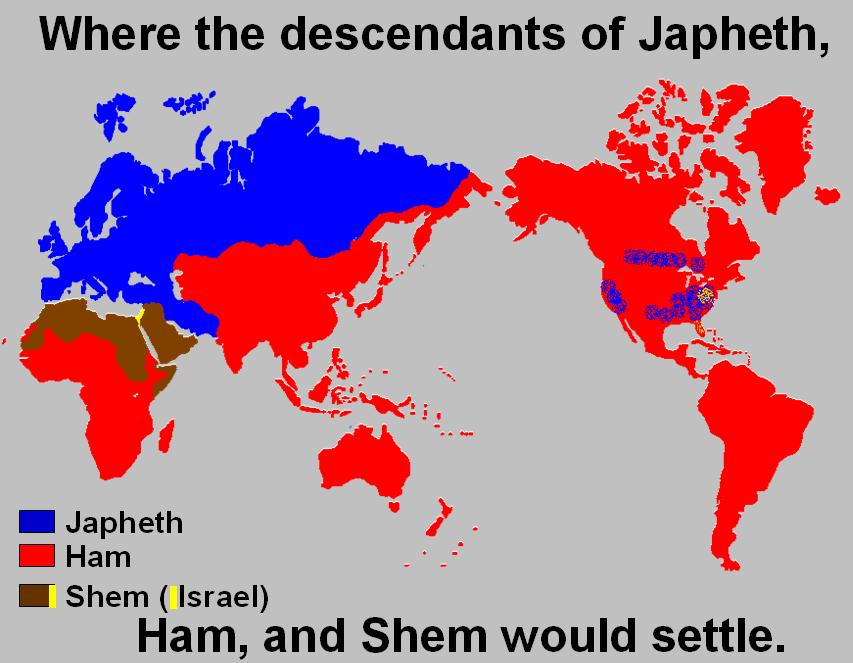
Where would one start? For the map is wrong on numerous levels.
Shem is blue, with the exception of South West Asia. While Iran is part of Shem (in the main), Pakistan is not and is Hamitic.
The brown in Africa is not from Shem and rather a mix of Canaan and Ham. The brown in the Middle East is Ham and not Shem, though the yellow is from Shem.
The red in Africa is not Hamitic, but rather Canaanite.
The red of the Americas is a mix of primarily Japheth (indigenous) and Shem from colonial migration.
While the red of Central Asia, East Asia and South East Asia is from Japheth; the red of South Asia represents Ham and the red of Australasia is mainly Japheth and partially Ham.
If one were to entertain that the map above was correct, can the reader appreciate the disparity in geographic areas. An anomaly which does not parallel the division of the planet after the deluge amongst Noah’s ostensibly three sons (actually four) and sixteen grandsons (really twenty-one) – Genesis 10:1-32.

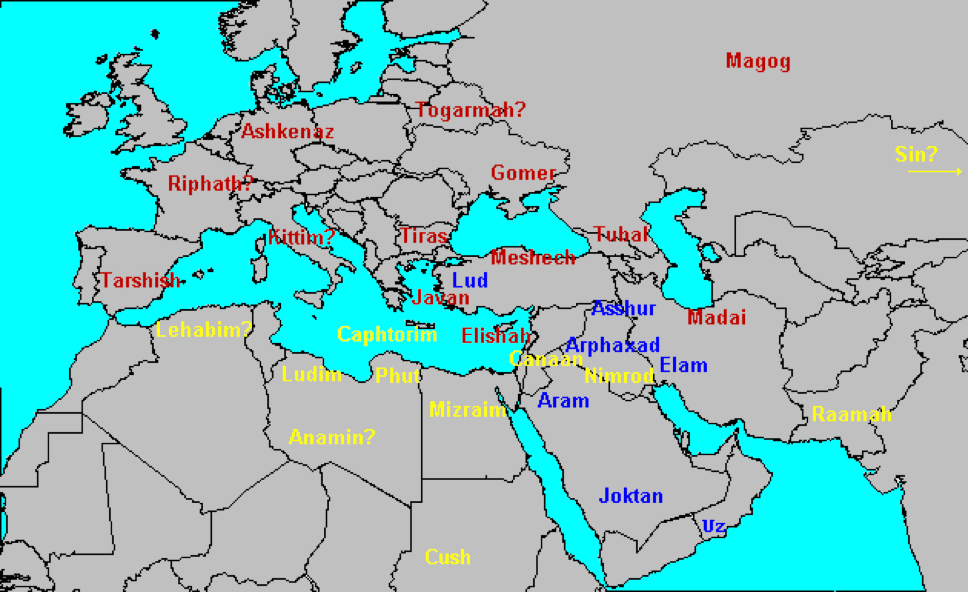
The map above is a closer interpretation of the truth. Even so, Shem does not extend into the Middle East (above Africa); and Africa is partially descended from Ham and principally from Canaan – refer Chapter XI Ham Aequator; and Chapter XII Canaan & Africa.
The Book of Jubilees provides information on the early settlement – after the flood cataclysm – of Southern Europe, West Asia, the Middle East and North Africa.
Book of Jubilees chapter eight:
10 ‘And it came to pass… that they divided the earth into three parts, for Shem and Ham and Japheth, according to the inheritance of each…
11 And [Noah] called his sons, and they drew nigh to him, they and their children, and he divided the earth into the lots, which his three sons were to take in possession, and they reached forth their hands, and took the writing out of the bosom of Noah, their father…
25 And for Japheth came forth the third portion beyond the river Tina to the north of the outflow of its waters, and it extends north-easterly to the whole region of Gog, and to all the country east thereof. 26 And it extends northerly to the north, and it extends to the mountains of Qelt towards the north, and towards the sea of Ma’uk, and it goes forth to the east of Gadir [Iberia] as far as the region of the waters of the sea.
27 And it extends until it approaches the west of Fara and it returns towards ‘Aferag, and it extends easterly to the waters of the sea of Me’at. 28 And it extends to the region of the river Tina in a north-easterly direction until it approaches the boundary of its waters towards the mountain Rafa, and it turns round towards the north.
29 This is the land which came forth for Japheth and his sons as the portion of his inheritance which he should possess for himself and his sons, for their generations forever [as in a very long time]; five great islands* [in the Mediterranean Sea], and a great land in the north [Central Asia].
30 But it is cold, and the land of Ham is hot [North Africa and the land of Canaan], and the land of Shem [Mesopotamia and Arabia] is neither hot nor cold, but it is of blended cold and heat.’

The sons of Japheth and particularly those descended from his son Javan – Elishah, Tarshish, Kittim and Dodan – migrated to the Mediterranean Sea and dwelt on the major islands* of Cyprus, Crete (and Rhodes), Sicily, Sardinia and Corsica. Today, these same peoples dwell on the great island chains comprising Japan; the Philippines; Malaysia (and Singapore); Indonesia; and Polynesia – including related peoples in Micronesia, Melanesia, Taiwan, Australia and New Zealand.

Of course, Japheth had the same DNA as his brothers and resembled them. Even so, the Y-DNA Haplogroup mutations indicative of Japheth’s descendants found their source in their paternal ancestor Japheth, inherited from his father Noah.
It was his wife ‘Adataneses, who carried the distinctive mitochondrial DNA possessed by the Asiatic peoples today – refer Chapter XXII Alpha & Omega; and article: Y-DNA Adam & mtDNA Eve: The Genesis & Evolution of Homo sapiens.
In the antediluvian age there were three principle bloodlines as discussed in Chapter I Noah Antecessor Nulla. One descending from Cain (Genesis 4:1); another from Abel’s ‘replacement’, Seth (Genesis 4:25; 5:3); and the third being the people who came into existence in what the Bible calls the Sixth Day, or rather the sixth epoch of creation – Genesis 1:26-31. For it was not a literal day – Chapter XXII Alpha & Omega.
Biblically and historically, the people of Day Six dwelt on the Earth before Adam and Eve (Genesis 2:7), who were created on Day Eight if you will; and it was with these inhabitants east of Eden where Cain settled, built a city and ruled over them – Genesis 4:16-17.
Scientifically, the people of Day Six are closely related to the modern human, Homo sapiens of the eighth epoch and they equate to Neanderthal man – refer articles: Homo neanderthalensis I, II, II & IV.
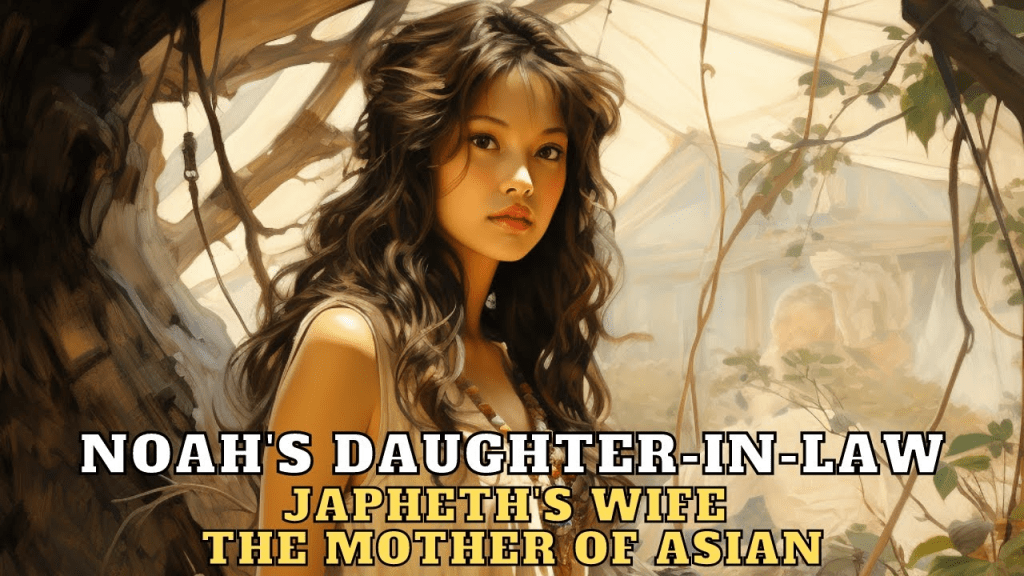
It was from this third – and chronologically first – bloodline whom Japheth’s wife ‘Adataneses (below) descended.

This explains why on one hand, many people possess genetic material of Neanderthal origin in small percentages. More importantly on the other hand, it reveals why it is people in East Asia who can exhibit high percentages of Neanderthal DNA – Articles: Homo neanderthalensis I, II, III & IV.
The principal mtDNA (mitochondria) maternal Haplogroups associated with Japheth’s descendants include:

Haplogroup A – found in Indigenous Americans (1) as well as Asians.
Haplogroup B – one of the primary East Asian lineages as well as one of five mitochondrial lineages identified among Indigenous Americans (2).
Haplogroup C – a descendant of super Haplogroup M, one of the two major lineages – with Haplogroup N – that derive from L3 – refer Chapter I Noah Antecessor Nulla. It is currently found in northeast Asia and it is also considered one of the founding lineages of the Indigenous American (3) population.
Haplogroup D – the principal East Asian lineage. Notable subgroups include D4, which is prevalent amongst Central Asian peoples; and D1, which is one of the five Haplogroups represented among Indigenous Americans (4).
Haplogroup E – located throughout the isles in Southeast Asia.
Haplogroup F – one of the primary mitochondrial lineages in East and Southeast Asia. Its greatest frequency and sequence diversity is found among coastal Asian populations.
Haplogroup K – certain lineages are found in Central Asia.
Haplogroup L3 – a daughter of mitochondrial Eve. Asian and European Haplogroups trace their ancestry to L3.
Haplogroup M – members were among the first humans to apparently migrate east along the southern coasts of Asia.
Haplogroup R – ancient and complex; today its members can be found all over the world, including Central and South Asia.
Haplogroup X – distributed worldwide with a subgroup X2, one of the founding lineages of Indigenous Americans (5).
Haplogroup Y – associated with Siberian populations. Also found in the Japanese, Koreans and certain Southeast Asian populations.
Haplogroup Z – located throughout Asia, with higher levels exhibited in Tibet and Siberia and lower levels in Japan. A subgroup Z1, is also found among the Finnish Saami, who have both European and Asian ancestry.
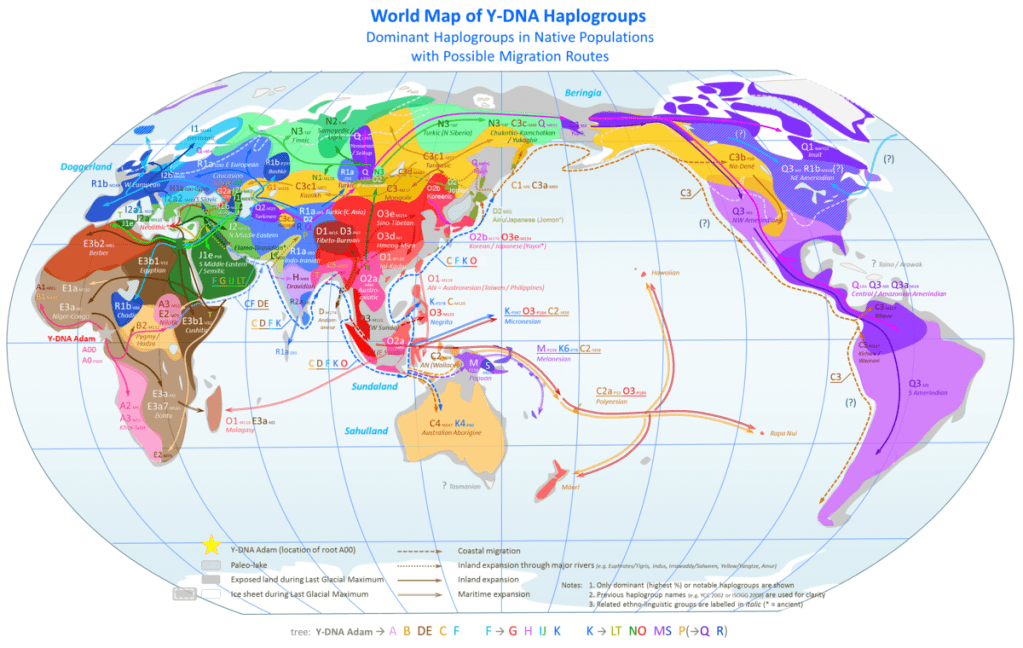
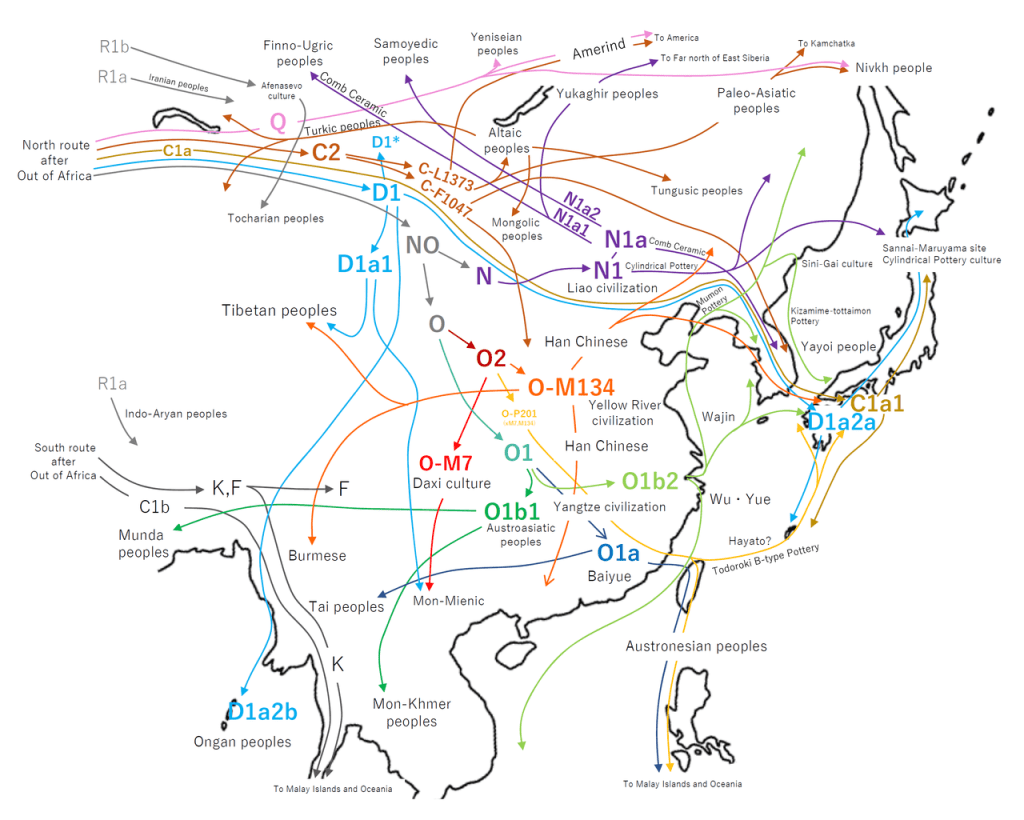
The global distribution of Y-DNA (Y sex chromosome) paternal Haplogroups associated with Japheth’s descendants are summarised in Retina, Fifth Edition, 2013:
‘Clade C [is] found in Central Asia, South Asia, and East Asia. C1 [C1a1] lineage is found exclusively in Japan. C2 [C1b3a] is found in New Guinea, Melanesia, and Polynesia. C3 lineage is … [found] in Southeast [and] Central Asia… [as well as] northern Asia, the Americas and Central Europe. C4 [C1b3b] appears to be restricted among aboriginal Australians and is dominant in that population. C5 [C1b1a1] has a significant presence in India.
Haplogroup D appears in Central Asia [D1a1b], Southeast Asia [D1], and in Japan, showing the highest frequencies in Tibet [D1a1a] and Japan [D1a2a] (50% and 35%, respectively).
Haplogroup K is the ancestral haplogroup of major groups L to R, but, in addition, also includes the minor K and K1 to K5 [K2] haplogroups, which are present at low frequencies in dispersed geographic regions all around the world, [including South East Asia].
The Y-DNA haplogroup N has a wide distribution, primarily in northern Eurasia…
Lineage O [M175] represents nearly 60% of chromosomes in East Asia. The O3 [O2a1 – M122] haplogroup has the highest frequency, being absent outside East Asia. The O1 [O1a – M119] and O2 [O1b – M268] haplogroups appear in Malaysia, Vietnam, Indonesia, South China, Japan, and Korea.
Haplogroup Q is found in Asia, the Americas, Europe, and the Middle East… its sub-clades, [groups Q1a3a1, Q1a3a2 and Q1a3a3 are] exclusively associated with the Native Americans.’
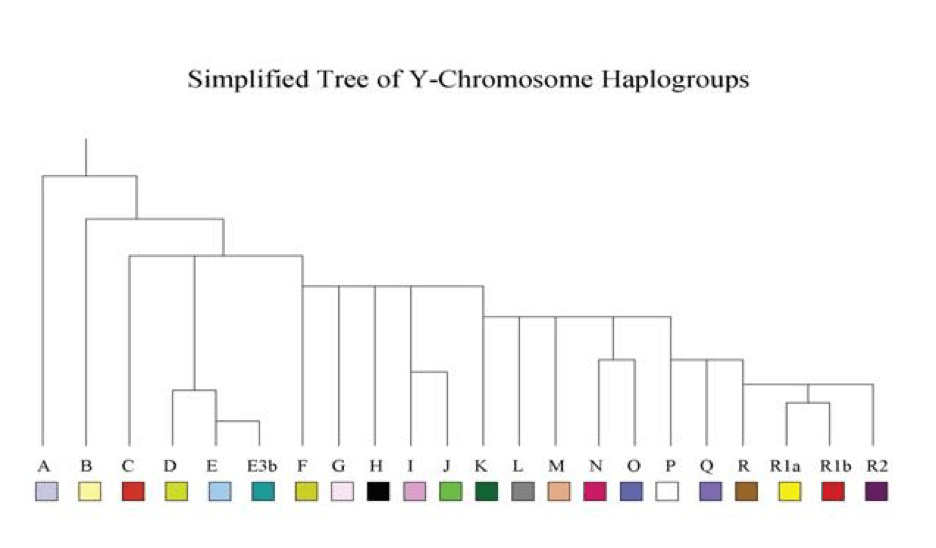
It is interesting to note concerning mtDNA Haplogroups, that some of the ones highly indicative of Japheth’s descendants are considerably older in the phylogenetic tree and not shared with Ham or Shem’s descendants, such as C, Z, D and E. Similarly, more recent mutations – though still not the newest – are also unique to his sons, such as Haplogroups A, Y and B.

With regard to Y-DNA Haplogroups, early original Haplogroups unique to Japheth’s descendants prior to admixture, include C and to a large degree, D. More recent Haplogroups, include K, N and Q and between these is the Haplogroup most commonly associated with Japheth’s male descendants, Haplogroup O-M175.
While some may consider it just a synchronism of happenstance that the name Jap-heth and the nation Jap-an share the same first syllable; for others, it is a remarkable connection that transcends time and language beyond a mere coincidence.
Chapter Three concentrates on Tiras, the seventh and youngest son of Japheth.
And the man said to me, “Son of man, look with your eyes, and hear with your ears, and set your heart upon all that I shall show you, for you were brought here in order that I might show it to you…”
Ezekiel 40:4 English Standard Version
“No great discovery was ever made without a bold guess.”
“If I have ever made any valuable discoveries, it has been due more to patient attention, than to any other talent.”
Isaac Newton 1643 – 1727
© Orion Gold 2020 – All rights reserved. Permission to copy, use or distribute, if acknowledgement of the original authorship is attributed to orion-gold.com
 The Lightkeeper