Arphaxad & Joktan: Balts, Slavs & the Balkans

Chapter XXIV

Shem’s third son is Arphaxad. He is a mysterious figure in the shadow of his four brothers. Unlike Elam, Asshur and Lud, who all had singular, distinct nations descend from them, Arphaxad – in the vein of his younger brother Aram – is the progenitor of the most nations in the world from a diversity perspective (following Canaan) and the second highest in sheer number (after Canaan) – refer Chapter XII Canaan & Africa. He is not though, the direct ancestor of one nation; but is the indirect ancestor of a great number. By elimination, it is now obvious that the remaining European peoples in Europe and the New World, descend from Arphaxad.

To add to Arphaxad’s enigmatic aura, the meaning of his name is baffling. Two proposed are boundary of the Chaldeans and stronghold of the Chaldees. The Chaldeans did descend from Arphaxad, but seemingly quite a few generations later; as the Hebrew word which Chaldee is derived from is Chesed or Kesed, a son of Nahor – Abraham’s brother.

A H Sayce confirms the difficulty in defining Arphaxad – The Races of the Old Testament, 1891, page 64:

‘In the tenth chapter of Genesis Arphaxad is the brother of Aram. He is placed next to Asshur with whom therefore he would have been in geographical contact. Now Arphaxad is written in the original Hebrew Arpha-Chesed, the Arpha of Chesed. What Arpha means is doubtful. Professor Schrader connects it with the Arabic urfak and accordingly renders the name the territory of Chesed. Up to the present no light has been cast on the word by the Assyrian texts.’

Abarim Publications – emphasis & bold mine:

‘… In Greek this name is spelled… Arphaxad… The name Arpachshad is probably extremely old and from a language that’s long since gone. And thus the original meaning of this name is unclear. BDB Theological Dictionary suggests that it is a combination of ‘rp (not in Hebrew but in cognate languages) meaning extent, border

The name Arpachshad is difficult to interpret. Since both (a-r-p) and (k-sh-d) do not exist in Hebrew, we should look for a possible combination of smaller words: The Hebrew word is used once, as a contraction of the word (the Nile; Amos 8:8), which in turn may be derived from (‘or), light

It may even be a contraction of (‘arar), curse. Or (‘ara), pluck or gather, with derivative (‘ari), lion… (pak) means flask or vial, from the root (pkk), an unused root that probably means trickle… (puk) denotes a black powder that was used as eye make-up (Jeremiah 4:30, 2 Kings 9:30)… (ke) means as if, but never occurs as a particle. For the sake of brevity (Arpachshad is already an unusually long name)… may be a contraction of (peh), mouth, or (poh), a particle denoting here or hither… (shed) is usually translated with demon, or the object of child sacrifice (Deuteronomy 32:17). (shod) means havoc… (shad) means breast, bosom.

Whatever the name Arpachshad may mean, the meaning is deeply hidden.’

Abarim Publications have helpfully broken the name down to its component parts. Highlighted are those that most closely resemble in this writer’s view, Arphaxad’s name – Or-pak-shad, meaning for example: ‘life from within the heart.Light gives life and warmth, while the breast (heart) is connected with the closeness of an embrace, intimacy and the source of strong emotional feelings, to cherish and hold dear as if within a flask. Was Arphaxad light hearted or did he have a warm heart? He certainly did, if he took young Canaan into his family and raised him as his own – refer Chapter XI Ham Aequator

Previously, when studying Canaan we looked at the fact his people did not migrate all the way to the African continent like their cousins from Cush, Phut and Mizra. They stopped in the high value real estate land that became known as the Land of Canaan. Canaan’s people may have been so familiar with Arphaxad’s family, that they felt comfortable dwelling near them. For it was Arphaxad’s descendants who founded both Akkadia and Sumer – in the Land of Shinar located later in southern Mesopotamia – northeast of Canaan (refer article: The Pyramid Perplexity).

The Book of Jubilees chapter eight, describes something more sinister: 

1 ‘… in the beginning thereof Arpachshad took to himself a wife and her name was Rasu’eja, the daughter of Susan, the daughter of Elam, and she bare him a son… and he called his name Kainam. 2 And the son grew, and his father taught him writing, and he went to seek for himself a place where he might seize for himself a city. 3 And he found a writing which former (generations) had carved on the rock, and he read what was thereon, and he transcribed it and sinned owing to it; for it contained the teaching of the Watchers in accordance with which they used to observe the omens of the sun and moon and stars in all the signs of heaven‘ (Astrology – refer article: Monoliths of the Nephilim). 4 ‘And he wrote it down and said nothing regarding it; for he was afraid to speak to Noah about it lest he should be angry with him on account of it. 

5 And… he took to himself a wife, and her name was Melka, the daughter of Madai, the son of Japheth, and… he begat a son, and called his name Shelah; for he said: ‘Truly I have been sent.’ 6… and Shelah grew up and took to himself a wife, and her name was Mu’ak, the daughter of Kesed, his father’s brother… 7 And she bare him a son… thereof, and he called his name Eber: and he took unto himself a wife, and her name was ‘Azurad, the daughter of Nebrod [Nimrod]… 

8 And… she bare him son, and he called his name Peleg; for in the days when he was born the children of Noah began to divide the earth amongst themselves: for this reason he called his name Peleg. 9 And they divided it secretly amongst themselves, and told it to Noah.’

We have addressed Kainam’s birth and his inclusion in Arphaxad’s family; who was born from the incest between Ham’s wife Na’eltama’uk and Noah – Chapter XI Ham Aequator. For Canaan to have found inscriptions regarding Watchers while seeking a city, he would have had to have been in the coastal strip later called Canaan. We have discussed the plague of Nephilim in this area and their base at Mount Hermon – refer Chapter XXII Alpha & Omega; and Chapter XXXIV Dan: The Invisible Tribe.

The genealogy details have undeniably been tampered with as we have previously discovered. We know this for two reasons as: a. the line of Arphaxad would not have been dramatically diluted by the line of Canaan so quickly following the Flood and b. it is unlikely Arphaxad’s grandson Eber, would have taken Nephilim offspring for a wife. Or, the possibility remains that Eber may have had more than one wife and Azurad was a second wife. The prime line of descent would not have been contaminated so early on in the genealogy of Arphaxad’s family tree with Nephilim DNA. Though that was surely the Watchers’ plan.

The agenda by whoever has written these verses or whomever has edited them, has been to cast aspersion on the line that produced the promised seed of the Messiah, who would ultimately defeat the Serpent’s seed – Genesis 3:15. Verse 1 is impossible and verses 5-7 highly unlikely. Shelah’s wife from Kesed, is fabricated, or it was a different Kesed to the one born to Abraham’s brother, Nahor. Kesed is not included as a sixth son of Shem. Maybe he was another son from Arphaxad not listed because no known nation has proceeded from him – Genesis 10:11. There is an interesting similarity between Nimrod’s daughter Azur-ad and Assur, as it can be spelled without the h – refer Chapter XX Will the Real Assyria Stand Up: Asshur & Russia; and Chapter XXI The Incredible Identity, Origin and Destiny of Nimrod.

The Book of Jasher chapter seven, lists three sons for Arphaxad, whereas the Bible concentrates on the eldest, Shelah:

16 … and the sons of Arpachshad were Shela-c-h, Anar and Ashcol.

Genesis 11:10-13

English Standard Version

‘These are the generations of Shem. When Shem was 100 years old, he fathered Arpachshad two years after the flood. And Shem lived after he fathered Arpachshad 500 years and had other sons and daughters. When Arpachshad had lived 35 years, he fathered Shelah. And Arpachshad lived after he fathered Shelah 403 years and had other sons and daughters.’ 

We learn that Arphaxad had other sons and daughters. Added to the account in the Book of Jubilees, these additional sons and brothers comprised those peoples who would establish the early cities in the lower Mesopotamian delta region. Akkadia, a legacy from the name Arphaxad in the northwest and Sumer, derived from the name Shem in the southeast. The descendants of Arphaxad’s great grandsons Peleg and Joktan, constituted the dominant peoples of Akkadia and Sumer respectively. 

The ageing process changed after the Flood, in that Noah and his sons lives were shorter than if the antediluvian atmosphere and climatic conditions had remained (containing a higher Carbon dioxide to Oxygen ratio) – refer article: The Younger Dryas Stadial: Ending of the Earth… Beginning of the World; and Chapter I Noah Antecessor Nulla. Whether DNA manipulation was involved is conjecture, though cannot be dismissed. The ages after the Flood were still yet impressive and beyond our comprehension. They did not settle into what we know today until approximately beginning with Abraham, who lived to one hundred and seventy-five years of age and his grandson Joseph who lived to one hundred and ten.

Reading Genesis 10:10-13 based on an unconventional chronology – and a sexagesimal interpretation of the rounded numbers in the biblical account (refer Article: Na’amah) – would read as the following:

‘These are the generations of Shem. When Shem was 1,120 years old, he fathered Arpachshad 120 years after the flood. And Shem lived after he fathered Arpachshad 5,000 years and had other sons and daughters. When Arpachshad had lived 1,070 years, he fathered Shelah. And Arpachshad lived after he fathered Shelah 4,030 years and had other sons and daughters.’ 

Thus the corresponding adjusted dates mean Arphaxad was born circa 10,717 BCE, his son Shelah in 9647 BCE, his son Eber in 8747 BCE and his son Peleg in 7727 BCE. Nimrod was born circa 8700 BCE and the Tower of Babel, with the confounding of the single language into many and all the peoples dispersing from the Middle East occurred between approximately 6755 to 6232 BCE – Article: The Pyramid Perplexity. It was circa 4000 BCE or earlier that Sumerian civilisation suddenly appears fully formed with extensive records. 

Staggeringly, Noah lived until 7337 BCE. Shem died in 5717 BCE and Arphaxad died in 5617 BCE. Abraham’s father Terah, was born 4077 BCE. We have read how Terah may have worked for Nimrod. Nimrod if still alive would have been about 5,700 years old. Quite possible, as he was not only a first generation Nephilim, but could possibly have lived this long as a full human being, for Arphaxad lived for 5,100 years. It wasn’t until 1977 BCE that Abraham was born and so accounts of Abraham fleeing from Nimrod or slaying him are not reliable.

Abarim Publications explain Arphaxad’s son Shelah’s name, with two interpretations.

‘There are two completely different Hebrew names in the Bible that are commonly both translated with Shelah. But they’re spelled different and they mean different things. We’ll call them Shelah I and Shelah II:

The name Shelah I… Meaning Missionary, Emissary From the verb (shalah), to send. The only Shelah I (probably more properly pronounced as Shelach) of the Bible is a son of Arpachshad, son of Shem… (Genesis 10:24). This Shelah was an ancestor of Christ and is mentioned by Luke (Luke 3:35). The prophet Nehemiah makes mention of a Pool of Shelah in Jerusalem (3:15), which refers to Shiloah or Siloam in Greek. The verb (shalah) means to send; to send whatever from messengers to arrows. It may even be used to describe a plant’s offshoots or branches. Noun (shelah) refers to some kind of weapon, apparently a kind of missile. Plural noun (shilluhim) means a send-off; a sending away or parting gift. Noun (mishlah) describes an outstretching of one’s hand (i.e. an undertaking, or referring to the place where the letting go takes place)…the name Shelah may mean Sent Out, Branch or Javelin.

The name Shelah II… Meaning Extracted… Prosperity, Request, Petition… From the verb (shala), to extract or de-employ. From the verb (sha’al), to ask or request… Shelah, a son of Judah with the unnamed daughter of Shua (Genesis 38:5). This Shelah became the progenitor of the Shelanites (Numbers 26:20). The town of Shiloh… The verb (shalal) means to extract, mostly in the sense of to plunder. Adjective (sholal) means barefoot. Noun (shilya) means afterbirth. Perhaps a second verb (shala) means to be at rest and prosper… Nouns (shalu) and (shalwa) mean prosperity. Adjectives (sheli) and (shalew) mean quiet, private or prosperous.

The name Shelah means all of the above, but would probably be interpreted to mean either Prosperity or Booty. Jones’ Dictionary of Old Testament Proper Names disagrees with all these obvious similarities, and takes the name Shelah to… meaning request or petition [such as by Prayer]…’

Shelah’s son was Eber, with Abarim Publications saying the following – emphasis & bold mine:

‘The name Eber: Meaning The Region Beyond, One From Beyond, He Who Passed Over, From the verb (‘abar), to pass over [and also ‘to cross over’]. There are five Ebers mentioned in the Bible: The father of Peleg… (Genesis 10:24). A Gadite chief (1 Chronicles 5:13). A son of Elpaal of Benjamin (1 Chronicles 8:12). A son of Shashak of Benjamin (1 Chronicles 8:22). The chief of the Levitical family of Amok when Joiakim was high priest in post-exilic Israel (Nehemiah 12:20).

The first Eber marks an important point in the Biblical genealogies, as of Shem it was said that he was the father of ‘all the children of Eber’. And in the days of Peleg, the son of Eber, ‘the earth was divided’ (Genesis 10:25). The sons of Joktan, Peleg’s brother, are the last mentioned Shemite generation before the tower of Babel was built. Peleg became the ancestor of Abraham, who was the first to be called Hebrew, a word that is highly similar to the name Eber. The name Eber comes from the verb (abar) meaning to pass through: The important verb (‘abar) means to pass or cross over (a river, border, obstacle or terrain). The derived noun (‘eber) describes what or where you end up when you do the verb: the other side or region beyond.’

It is interesting to note that in Genesis chapter ten, before any of Shem’s sons are listed, Shem is listed first, as the father of all the children of Eber. It is from Eber that the term Hebrew derives and refers principally to the the sons of Jacob, who became known as Hebrews. We will learn later that etymologically derived words from Eber are located in Europe and help trace some of the sons of Jacob.

The Origin of the Nations, Herman Hoeh, 1957 – emphasis mine: 

‘Notice Arphaxad first. He is a son of Shem. He is mentioned in Genesis 10:22 and I Chronicles 1:24. Arphaxad had a grandson named Eber. The name Eber mens a “migrant,” one who comes from the “region beyond.” The sons of Eber are properly known as “Hebrews” – and there are about 400 million of them on earth today! Yet almost no one really knows who the sons of Eber – the Hebrews – are at this time!

Eber had two sons reckoned to him. It was in their day, about 100 [4,000] years after the flood, that God “divided the earth” as an inheritance for the different family groups (Genesis 10:25 and Deuteronomy 32:8). From Peleg, one of these two sons, came Abraham. God promised Abraham that his descendants would be as numerous as the dust of the ground. The Jews are certainly not as numerous as the dust. Only a tiny fraction of Abraham’s descendants are known as Jews today!’ – refer Chapter XXIX Esau: The Thirteenth Tribe ‘Where are the others?’

Eber’s second son Joktan, or possibly Peleg’s twin due to phrasing, represents a major division within Arphaxad’s line and today is represented by those nations we label Eastern Europe. Joktan had an impressive thirteen sons who are listed in Genesis and 1 Chronicles. The peoples of Eastern Europe fall into three main categories; those more closely related to the Russians of Asshur in north eastern Europe; those with an affinity with Austrians in central Europe; and those peoples similar to southern Italians. As there are more than thirteen nations in Eastern Europe, we will endeavour to identify thirteen lines of lineal descent and isolate any variations as evidenced by Haplogroups and autosomal DNA. 

Genesis 10:25-30

English Standard Version

‘To Eber were born two sons: the name of the one [H259 – ‘echad: the other, another. Not word used for first] was Peleg, for in his days the earth was divided, and his brothers [H251 – ‘ach: half-brother] name was Joktan.’

It is possible that Peleg and Joktan were half brothers with different mothers. 

‘Joktan fathered Almodad, Sheleph, Hazarmaveth, Jerah, Hadoram, Uzal, Diklah, Obal, Abimael, Sheba, Ophir, Havilah, and Jobab; all these were the sons of Joktan. 

The territory in which they lived extended from Mesha in the direction of Sephar to the hill country of the east [the Arabian Peninsula].’

Notice, a Sheba and a Havilah. The same names we have already seen for sons of Cush; the northern Indians of India and the nation of Bangladesh respectively – refer Chapter XIII India & Pakistan: Cush & Phut. There is an Uz-al, similar to the Uz of Aram in Italy – refer Chapter XXIII Aram & Tyre: Spain, Portugal & Brazil. The four names in bold or italics are the sons mentioned in the Bible outside of Genesis ten and I Chronicles one. It is probable that these four are the biggest or most prominent brothers, as the Bible tends to give air time to the most influential or well known nations in any family group – particularly, from an interaction with the sons of Jacob perspective. Ophir was once famously renowned for its wealth from trade in the ancient world. The youngest son, Jobab, is a family name replicated in Edom’s descendants – Chapter XXIX Esau: The Thirteenth Tribe

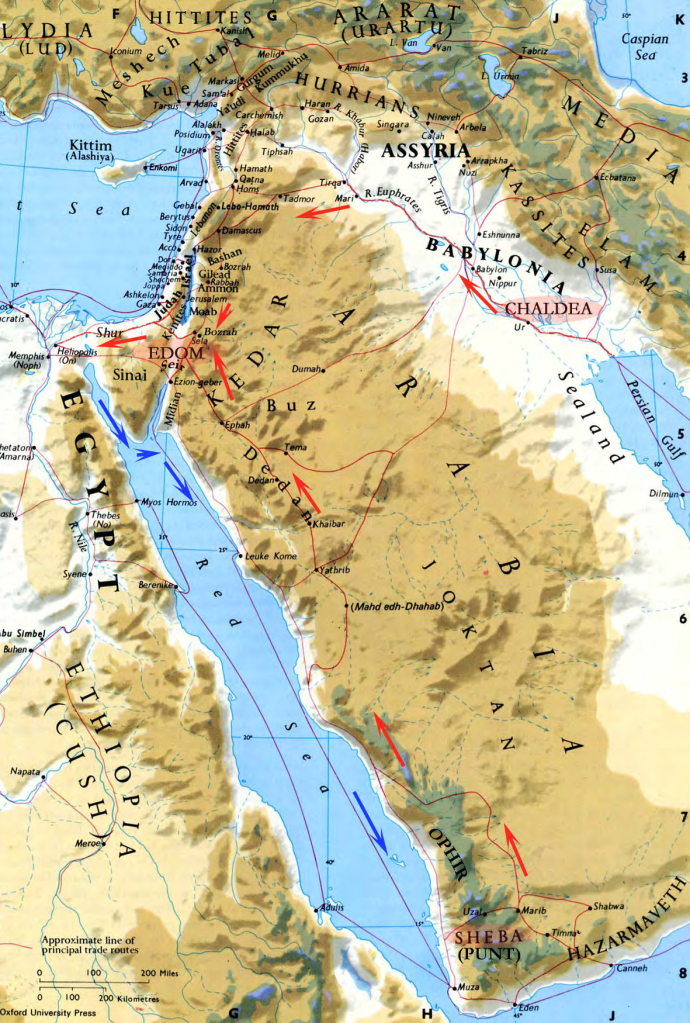
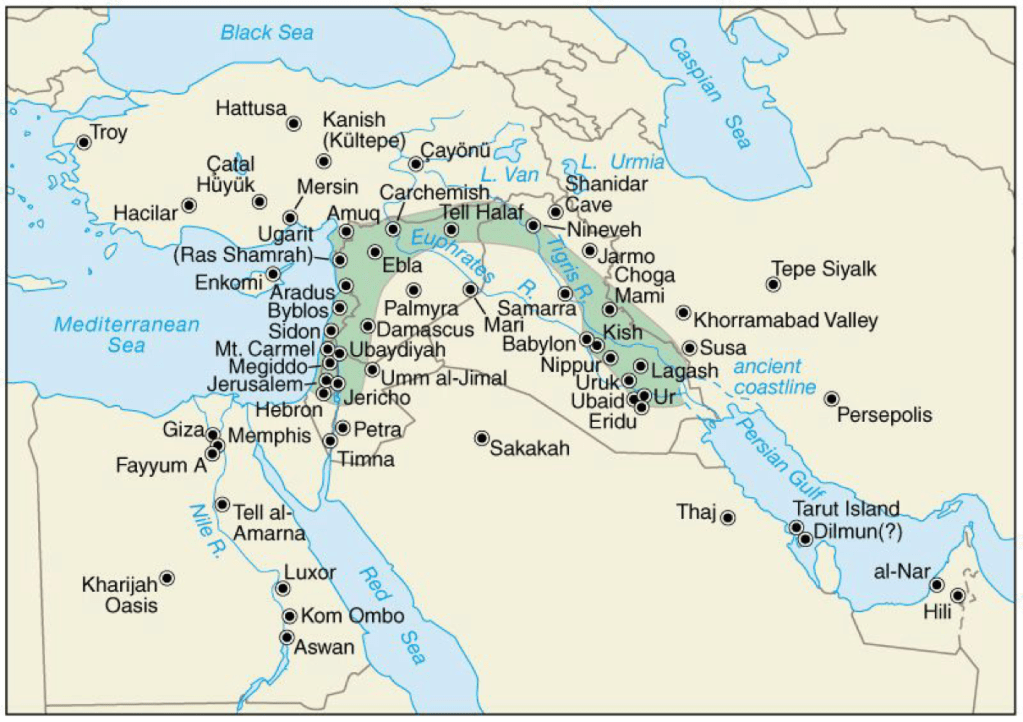
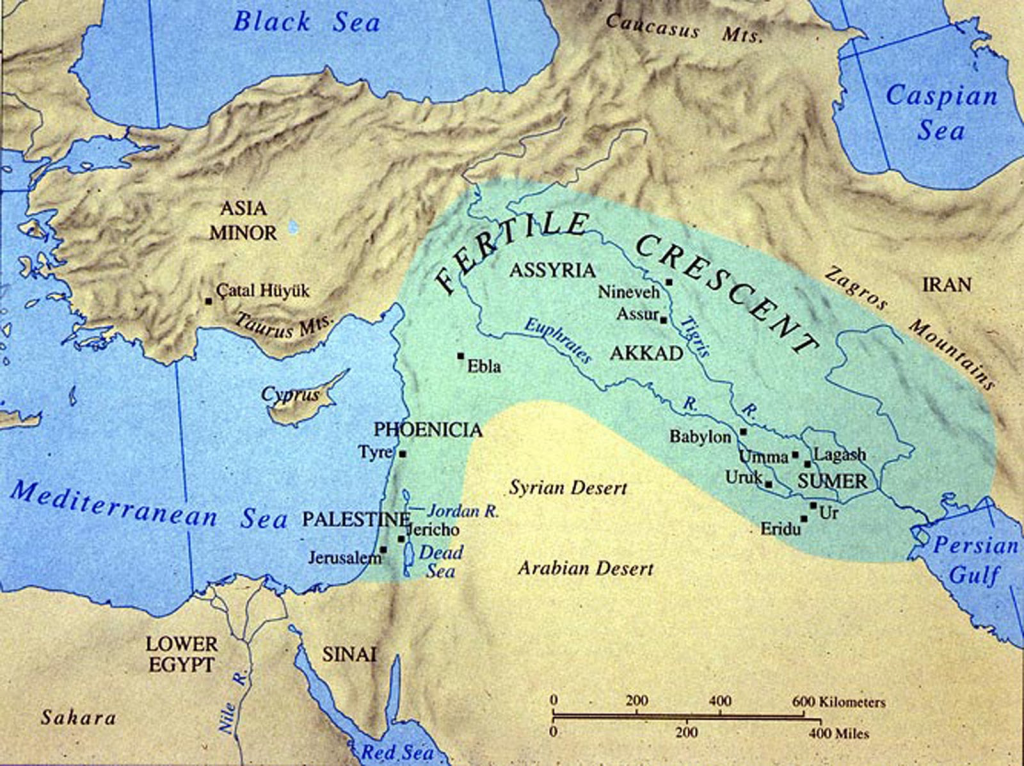
A detailed Map of the ancient Middle East showing the locations of Shem’s descendants; notice Joktan’s region and specifically the land of Ophir.

The children of Joktan before migrating to the Arabian Peninsula, originally dwelt to the east of Arphaxad’s other children who had descended from Peleg. Anciently, Sumer was southeast of Akkadia and today, Joktan lives to the east of Peleg’s descendants. Both peoples descended from Arphaxad and both originally spoke Sumerian. Scholars have proposed that Akkadia, or Babylon spoke Chaldee which was a branch of Aramaic. Chaldee was introduced later, with the arrival of the Chaldean ruling elite. Prior to that, the primeval language of Babylon and for all the Land of Shinar was Sumerian; a language with no certain affinity to any other known language – Chapter XVIII – Elam & Turkey

A number of researchers have either thought that the reference to the east, coupled with so many sons indicates that Joktan must be China; or that other references in the Bible stating Arabia and Ishmael are a link to the Arabic world. Both are incorrect summations as we have already seen regarding the identities for China and the Arab related peoples – refer Chapter X China: Magog, Tubal & Meshech; and Chapter XIV Mizra: North Africa & Arabia.

Abarim Publications – emphasis & bold mine:

‘The name Joktan, meaning: He Will Be Small from the verb (qaton), to be small.

Joktan is a son of the famous Eber, his brother being Peleg, the forefather of Abraham (Genesis 10:25). The name Joktan is the active form of the verb (qaton) meaning to be small or insignificant: Adjectives (qatan) and (qaton) mean small, young or insignificant. Noun (qeton) refers to the little finger.

For a meaning of the name Joktan, NOBSE Study Bible Name List reads He Will Be Made Small. A name of similar meaning is Paul.’

Hitchcock’s Bible Names dictionary says for Joktan: ‘small dispute’ or ‘contention’ and ‘disgust.’ There must be no small irony in the name, as the peoples descended from Joktan are far from small in number. It could be argued that they are not as big a presence on the world stage as other nations. In this, the name is probably indicative of the peoples descended from Joktan. Historically, the Slavs – argued as deriving from Slaves – Balts and the Balkans have been trodden underfoot by the bigger aggressor nations to their east, west and south: Russia, Germany and Turkey.

For simplicity the twenty-two modern nations of Finland, Estonia, Latvia, Lithuania, Belarus, Ukraine, Poland, Czech Republic, Slovakia, Hungary, Moldova, Romania, Bulgaria, Greece, Albania and the peoples of the former Yugoslavia North Macedonia, Slovenia, Croatia, Bosnia-Herzegovina, Serbia, Montenegro and Kosovo – broadly comprise Joktans descendants today.

What has to be remembered is that according to the Bible and the Book of Jasher, Arphaxad had other sons, Anar and Ashcol and thus the surplus of nations – exceeding the number thirteen – could be more closely related to these sons and not necessarily from Joktan specifically. Using a genetic measure could resolve the conundrum, in that subtracting the seven nations of the former Yugoslavia, excepting Slovenia, North Macedonia and Kosovo, as well as Finland, Estonia, Latvia and Lithuania for reasons which will become apparent would leave thirteen nations. North Macedonia has strong ethnic and geo-political ties with Bulgaria and leans towards Joktan; while Kosovo is comprised of 92.93% Albanians and could count as one with Albania. Hence twenty-one nations less the thirteen peoples from Joktan leaves the four Baltic nations and the four remaining Balkan nations. All these countries singularly have smaller populations of ten million people or less – the exceptions being Ukraine, Poland and Romania – with the smallest being Montenegro with 628,272 people.

We will gradually refine the possibilities as we progress and a clearer picture will come into focus.

Genesis 25:17-18

English Standard Version

17 ‘(These are the years of the life of Ishmael: 137 years. He breathed his last and died, and was gathered to his people.) 18 They settled from Havilah to Shur [to be raised, wall, fort, bull], which is opposite Egypt in the direction of Assyria. He settled over against [in hostility towards] all his kinsmen.

This verse has prominent clues to where Ishmael is living today, which we will look into further in Chapter XXVIII The True Identity & Origin of Germany & Austria – Ishmael & Hagar. The Havilah mentioned in this verse, is not the Havilah of Bangladesh descended from Cush. In 1 Samuel 15:7, Havilah is mentioned in connection with Esau’s grandson, Amalek. Another major clue, that will become clearer later in our study. 

Havilah is associated with gold – Genesis 2:11-14. In Chapter XIII India & Pakistan: Cush & Phut, Havilah from Cush was considered as being referred to in this passage about Eden. Researchers, myself included, do not normally link Havilah with Joktan’s son of the same name. Yet the reference to gold is a clue of key importance. Bangladesh is not known for gold deposits. A handful of eastern European nations are. It would seem then, that this Havilah described with Cush and critically Assyria, is actually the son of Joktan and not the son of Cush.

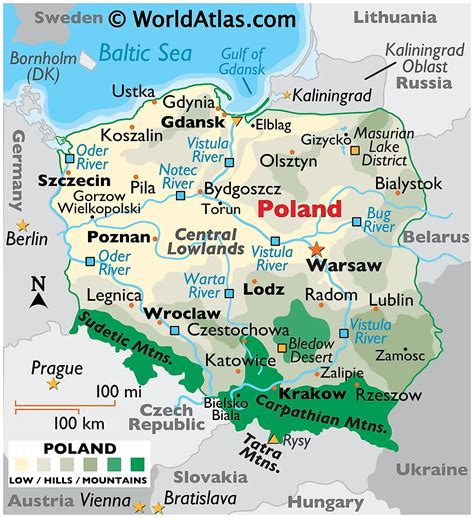
Gold is also a theme for two of the other three sons of Joktan mentioned in scripture. Of the twenty-two nations possibly associated with Joktan, four stand out in their current gold mining production or alternatively have large potential reserves. Due to the geography described in these two verses – relating to Ishmael, Shur and Asshur the Russians – Havilah, the twelfth son of Joktan equates with the modern nation of Poland. The definition of Havilah is detailed in the section on Cush and Phut. Briefly, it means ‘tremble’ or ‘languish.’ The history of Poland has been severe, with both the Germans and Russians, especially cruel. Poland has certainly been left to languish, which means: ‘to be or become weak or feeble; droop; fade, suffer hardship and distress.’ The population of Poland is 38,165,251 people.
Rare Gold Nuggets – emphasis mine:

‘The potential for undiscovered gold deposits to be found in Poland is still there, even though the country has been mined for centuries. The many deposits that are out there are signs of just how impressive the natural resources of this unique country truly are.’
Polish man and woman

Poland has the 21st largest economy in the world, with a 2019 GDP of $595.86 billion – and the leading economy of the sons of Joktan. Heavy industry, iron and steel production, machinery manufacturing, shipbuilding and coal mining, are all vital components of Poland’s economy. ‘Poland’s business friendly climate and sound macroeconomic policies allowed it to be the only EU country to avoid recession in the aftermath of the 2008 financial crisis.’
Ezekiel 27:18-21

Complete Jewish Bible

‘Because you [Tyre-Brazil] were so wealthy, with such a variety of valuable merchandise, Dammesek [Spain] traded wine from Helbon and white wool* with you. V’dan [Dan or Eden] and Yavan [Greeks… H3120 – Yavan & H3196 – yayin: wine, winebibbers, banqueting, intoxication] from Uzal [H235 – ‘azal: to go away, to disappear, be gone (spent), fail, to go to and fro, gad about] traded ironwork, cassia^ and aromatic cane for your goods. D’dan [Dedan (Abraham & Keturah)] traded with you for riding gear. Arabia [Abraham & Keturah’s sons] and all the princes of K’dar [Ishmael] were your customers; for your goods they traded lambs, rams and goats.’

Most translations are not faithful to the interlinear translation. The CJB renders it accurately. Uzal – the sixth son of Joktan – is usually not even named, but translated for instance, as merely ‘traversing back and forth’ in the New King James Version. 

The name Javan is interesting and has a double meaning as we have seen previously with Javan in the Book of Daniel. It is the only biblical identity used for Javan from Japheth and the modern territory of Greece. For example, we saw clearly that Cush and Ethiopia are not used this way in scripture – refer Chapter XIII India & Pakistan: Cush & Phut. This verse is not clear in which Javan is intended. Clues point to both. The word for Javan has a root word and this word means wine. Greeks today drink more wine, with thirty-five percent compared to beer, at five percent.

The phrasing is a clever clue to Uzal’s identity as it is like saying: ‘Greece from Greece.’ The reference to ‘going to and fro’ in a trading context is indicative of modern Greece, which is synonymous with shipping and its most important industry, worth some $21.9 billion in 2018. Ancient Uzal is the modern day nation of Greece. Indonesia, a nation from Javan and his son’s descendants the Kittim on the other hand, is the world’s leading cinnamon producer, with 43% of the total world production in 2014. Cinnamon can be made from the cassia^ plant. 

Yechezkel 27:19

Orthodox Jewish Bible

‘Vedan also and Yavan (Greece) provided for your wares with fine yarn*; wrought iron, cassia, and cane, were among thy merchandise.’
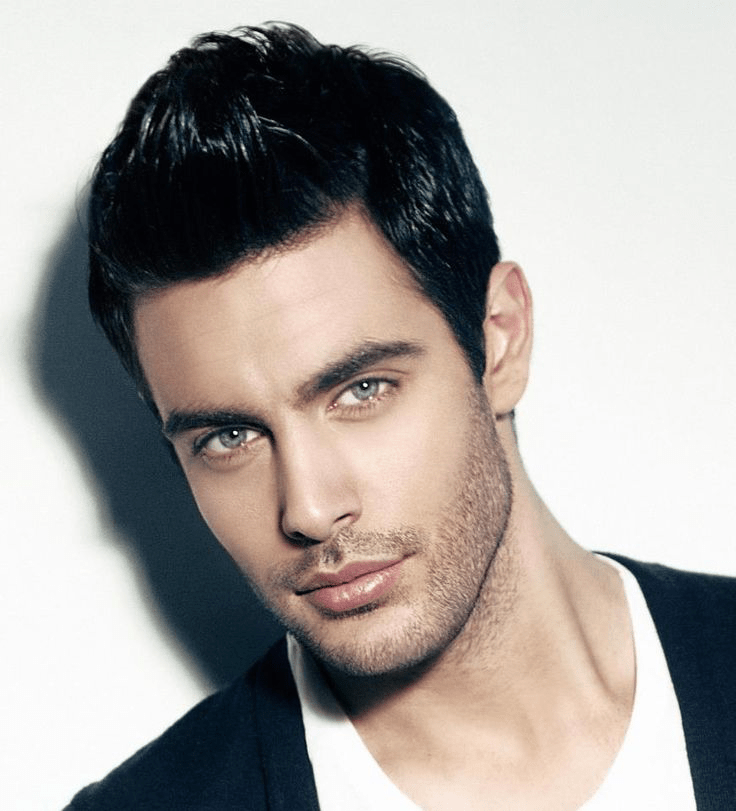
Greek man and woman

The OJB has translated Uzal as its identifying sign. This is valuable information, as Greece is ranked 18th in the world for wool production; while it is number one in Eastern Europe. Greece is 11th in the world for Cotton production and 7th in worldwide exports. The modern state of Greece should not be confused with the same people as the Classical or Hellenistic Greeks. 

This is a good example of a people settling millennia later in a territory which still retains the original name. In fact, Greece before the ancient European Greeks, was originally the Greece from Javan, the son of Japheth – Chapter VII Javan: Archipelago South East Asia & Polynesia. The population of Greece is 9,945,471 people.

Rare Gold Nuggets – emphasis mine:

‘Greece is a country that has good potential when it comes to finding gold. Many experts believe that Greece contains some very large gold reserves, many of which are virtually untapped. With that being said, Greek gold production is currently only producing a scant few thousand kilograms of gold per year.’
Ezekiel 27:21-24

English Standard Version

‘Arabia [Abraham & Keturah] and all the princes of Kedar [Ishmael] were your favored dealers in lambs, rams, and goats; in these they did business with you [Tyre-Brazil]. The traders of Sheba [1] and Raamah [India] traded with you; they exchanged for your wares the best of all kinds of spices and all precious stones and gold. Haran, Canneh, Eden, traders of Sheba [2], Asshur [Russia], and Chilmad traded with you. In your market these traded with you in choice garments, in clothes of blue and embroidered work, and in carpets of colored material, bound with cords and made secure.’

The traders of Sheba in verse 23 are different from the ‘traders of Sheba’ in verse 22. The first are the Northern Indians; the second descend from Joktan.

Psalm 72:10, 15

English Standard Version

‘May the kings of Tarshish [Japan] and of the coastlands [East Asia and South East Asia] render him tribute; may the kings of Sheba [India H7614] and Seba [Sri Lanka H5434] bring gifts! Long may he live; may gold of Sheba [H7614] be given to him…’ 

Similarly in these verses, two different Shebas are stated, even though it is the same Hebrew word for the exact same name, yet remaining distinct from the other name of Seba using a different Hebrew word. 

Rare Gold Nuggets – emphasis mine:

‘Romania is home to the largest gold deposit in continental Europe. Romania is one of the poorer countries in Europe, but from a view of the resources available for mining it is actually one of the richest. There are a large variety of minerals that are commercially mined here. The potential for gold mining in Romania is strong and the history of mining in the country is extensive.’

Sheba – the tenth son descended from Joktan – is Romania. Like the Greeks, the Romanians have inherited the name from the ancient Romans; though they are not the Romans. 

Romanian man and woman

Similarly, the Magyars in Hungary are not Huns, they simply have the appellation of the former peoples, by that name: the Turks – refer Chapter XVIII Elam & Turkey; and Chapter IV Central Asia – Madai & the Medes. The population of Romania is 18,915,140 people.

1 Kings 22:48

English Standard Version

‘Jehoshaphat made ships of Tarshish to go to Ophir for gold, but they did not go, for the ships were wrecked at Ezion-geber.’

1 kings 10.11

English Standard Version

‘Moreover, the fleet of Hiram [King of Tyre], which brought gold from Ophir [H211 – ‘Owphiyr: ‘gold region in the east’], brought from Ophir a very great amount of almug [H484 – ‘almuggiym: a tree from Lebanon (sandalwood?)] wood* and precious stones.’

Job 28:16

English Standard Version

‘It cannot be valued in the gold of Ophir, in precious onyx or sapphire.’

Psalm 45:9

English Standard Version

 ‘… daughters of kings are among your ladies of honor; at your right hand stands the queen in gold of Ophir.’

Isaiah 13:12

English Standard Version

‘I will make people more rare than fine gold, and mankind than the gold of Ophir.’
Ophir is mentioned in a number of verses throughout the Old Testament and always in context of its gold and mineral wealth. One would expect this nation to standout amongst Joktan’s descendants today, just by sheer size of either resources and or, its economy. The meaning of Ophir is contradictory as it can mean, ‘exhausted, depleted’ and ‘reducing to ashes’ – ‘which is what remains when all useful energy is extracted from a fuel’ – or conversely: ‘rich, abundance’ a ‘mark of wealth’ or a ‘coast of riches’ according to Abarim Publications.

Glenn Webb – emphasis & bold mine:

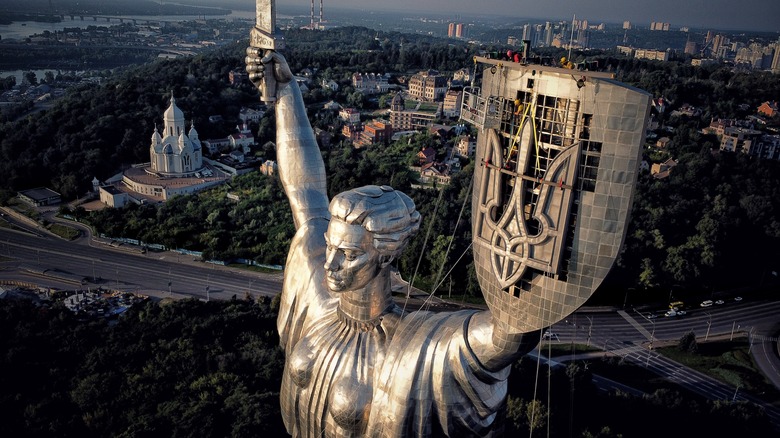
‘Excerpt from Peresopnytsia Gospel (Matthew 19:1) (1556) where the word ukrainy (оукраины) corresponds to ‘coasts’ (KJV Bible) or ‘region’ (NIV Bible). [The] Ukrainian symbol is a trident and has a coastline to its south.’

Rare Gold Nuggets – emphasis mine: 

‘Gold mining is still a young and growing industry in Ukraine. As with many regions in the world with a turbulent political history, the economic development in the mining industry has been limited… Ukraine holds large reserves of gold in several regions… some suggestions that there is as much as 3,000 tons of gold to be found all around Ukraine…’

This is the equivalent of 2,722 tonnes and would place Ukraine 5th in countries with the largest gold mine reserves, behind Australia at number one with 10,000 tonnes; Russia with 5,300 tonnes; South Africa with 3,200 tonnes; and the United States with 3,000 tonnes. The value of 2,722 tonnes of gold is a staggering USD $209,005,228,637.00.

‘… there are more than two hundred locations around Ukraine that gold is known to be found. The potential for gold… is amazingly vast… These are huge expectations for a huge country.’

A Short History of the Ukrainian Tryzub, Gary Sohayda, January 2022 – emphasis mine:

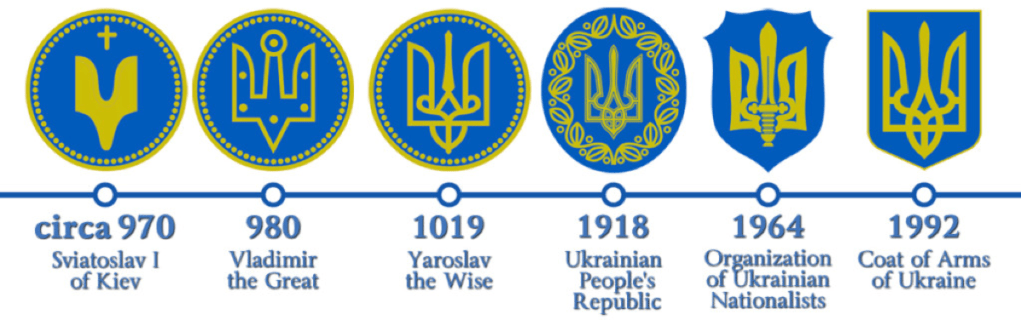
‘A trident with a crossed central prong was… confirmed in 1918 as the emblem of the Ukrainian Black Sea Fleet. In 1939, the Diet of Carpatho-Ukraine, the short-lived independent Ukrainian state that emerged from Czecho-Slovakia, adopted the trident with a cross as its official coat of arms. Finally, in 1992, following the restoration of Ukraine’s independence the previous year, Ukraine’s Parliament adopted the trident as the chief element in its coat of arms. The trident is today shown on Ukraine’s monetary emissions (coins as well as some bank notes or their watermark) and on its postage stamps.’

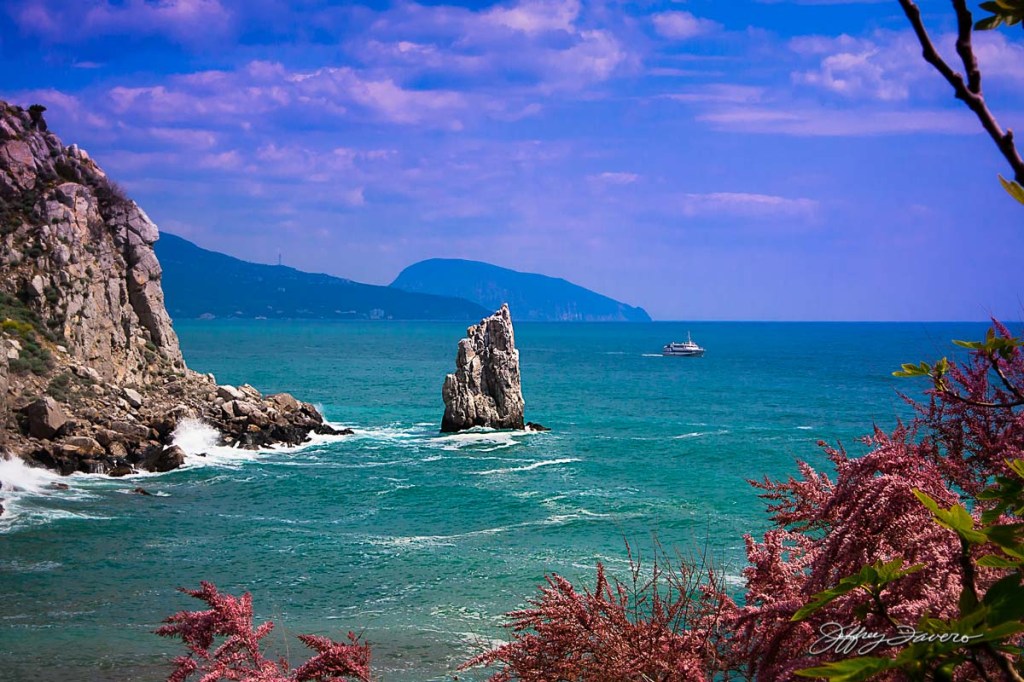
The Trident is a potent symbol of the god of the sea and water, Neptune and Poseidon. A link to Ophir’s strategic importance for gold via its position in ancient mercantile trade routes – once located in Sumer near the Persian Gulf, then later during the United Kingdom of Israel and the reign of King Solomon, on the southern coast of the Arabian Peninsula. Today, Ukraine represents a vital ‘warm water port’ for itself and Russia and hence, the obvious importance of the Crimea.

The trident is a weapon, whether for spear fishing or as a pole arm. The significance as a weapon of Neptune is the fact that it symbolises his control over the seas. Though its wider application is that the three prongs reflect his mastery over the three principalities of heaven, earth and hell. Neptune’s power does not stop there, for it is also linked with birth, life and death; mind, body and spirit; and the past, present and future – Article: DEATH: A Dead End or a New beginning?

Ukraine is Ophir, the eleventh son of Joktan. All the conflicting definitions for Ophir’s name are strangely specific and accurate about Ukraine and parallel the rather schizophrenic history and destiny of Ukraine as an unhappy and unwilling junior partner of Russia. The verb even means ‘to desire or draw near’ exactly typifying the relationship which Little Russia has with Great Russia. 
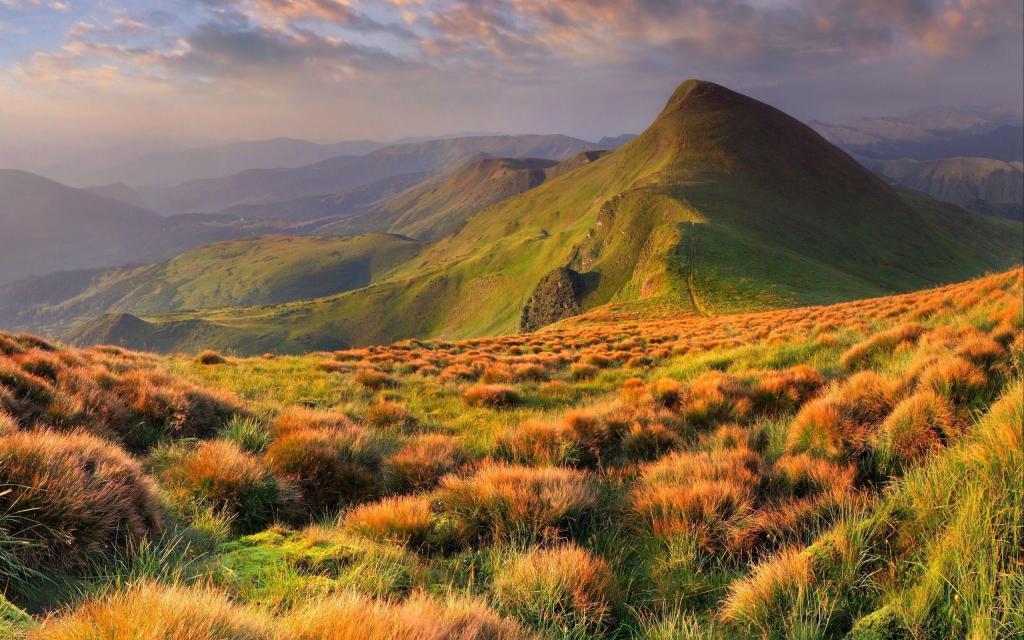
For the largest Russian diaspora in the world are the 8,334,100 Russian people living in Ukraine (2001 Census). To complicate matters, a third of the Ukrainian population in the eastern part of the country identify as Russian, speaking Russian. Other Ukrainians also speak Russian and higher percentages of Russians live in the western and central regions of the nation, as well as in the industrialised city centres. The total population of Ukraine is 38,911,001 people – the seventh highest in Europe.

Ukraine is the 4th biggest mineral producer in the world, behind South Africa in first place, Russia and Australia. Ukraine has up to $510 billion in iron ore reserves alone. Apart from the presence of many mineral reserves, Ukraine is best known for its productive mining sector. There are over three hundred mining facilities actively operating across Ukraine. As an aside, both South Africa and Australia were foreordained to be rich in natural resources and consequently mineral powers – Chapter XXXII Issachar, Zebulun, Asher & Naphtali the Antipodean Tribes

Ukrainian man and woman

Europe’s second largest country, is a land of vast fertile agricultural plains and large pockets of heavy industry in the east. Ukraine is known as the ‘breadbasket’ of Europe and is amongst the top three exporters of grain in the world. It has some of the most fertile land on earth with rich black soil called chernozem – literally, ‘black dirt.’ 
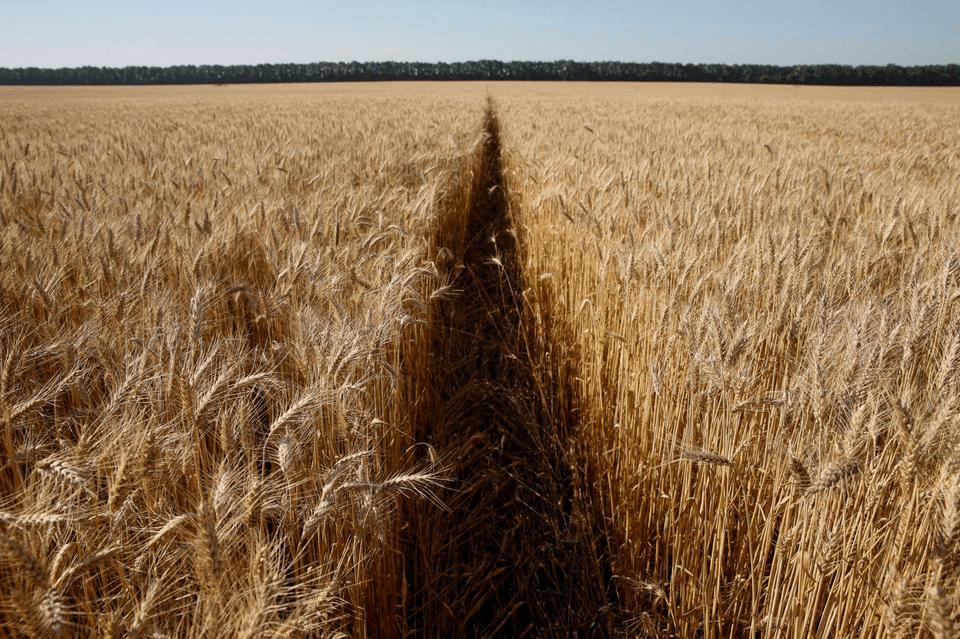
This soil produces considerable agricultural yields due to its high moisture storage capacity and levels of humus; with more than seventy percent of the country comprising prime agricultural land. Parts of Russia and the United States of America also have rich soils with high organic content called mollisols. It is estimated that Ukraine can feed at least half a billion people. 

Its main crops include corn, soybeans, rye, oats, beets and barley. With Russia, Ukraine supplies a quarter of the world’s wheat and half of its sunflower products. Ukraine is the fourth largest producer of potatoes in the world.

‘The following export product groups represent the highest dollar value in Ukrainian global shipments during 2021…

  1. Iron, steel: US$13.1 billion
  2. Cereals: $11.8 billion 
  3. Ores, slag, ash: $7 billion 
  4. Animal/vegetable fats, oils, waxes: $6.9 billion
  5. Electrical machinery, equipment: $3.2 billion 
  6. Machinery including computers: $2.1 billion 
  7. Oil seeds: $2.1 billion 
  8. Wood: $1.9 billion*
  9. Food industry waste, animal fodder: $1.7 billion 
  10. Articles of iron or steel: $1.2 billion 

Iron and steel was the fastest grower among the top 10 export categories, up by 70.8% from 2020 to 2021. In second place for improving export sales was cereals via a 25.8% gain led by higher international sales of corn, wheat and barley.’

The word Ukraine literally means, on the outskirts and from a Russian imperial perspective, that has been true. Ukraine has been ‘the borderland’ for much of its existence, enduring its role as a convergence point between the East and the West; partly including territory once occupied by the Scythian and Sarmatian peoples. Ukraine and Russia share common historical origins, especially in the East; whereas the west of the country has closer ties with its European neighbours and particularly Poland.

Early Germanic tribes from Jutland and surrounding environs migrated and in time some of them would filter down towards western Ukraine, including the mighty Goths who would control a vast swathe of Ukraine for a couple of centuries. Following this, Ukraine was home to some of the earliest Slav states – descendants of the earlier Sarmatians – and notably, the grand principality of Kiev in the tenth and eleventh centuries made it a focus of East Slavic cultural development. 

The Cossack Hetmanate republic emerged in central Ukraine in the seventeenth century. The region only gained more permanent borders during the Soviet era and independence as a sovereign nation wasn’t achieved until 1991, upon the collapse of the Soviet Union. Ukraine is a unitary republic governed under a semi-presidential system which has been moving increasingly towards strengthening ties with the rest of Europe, until the 2022 invasion by Russia. 

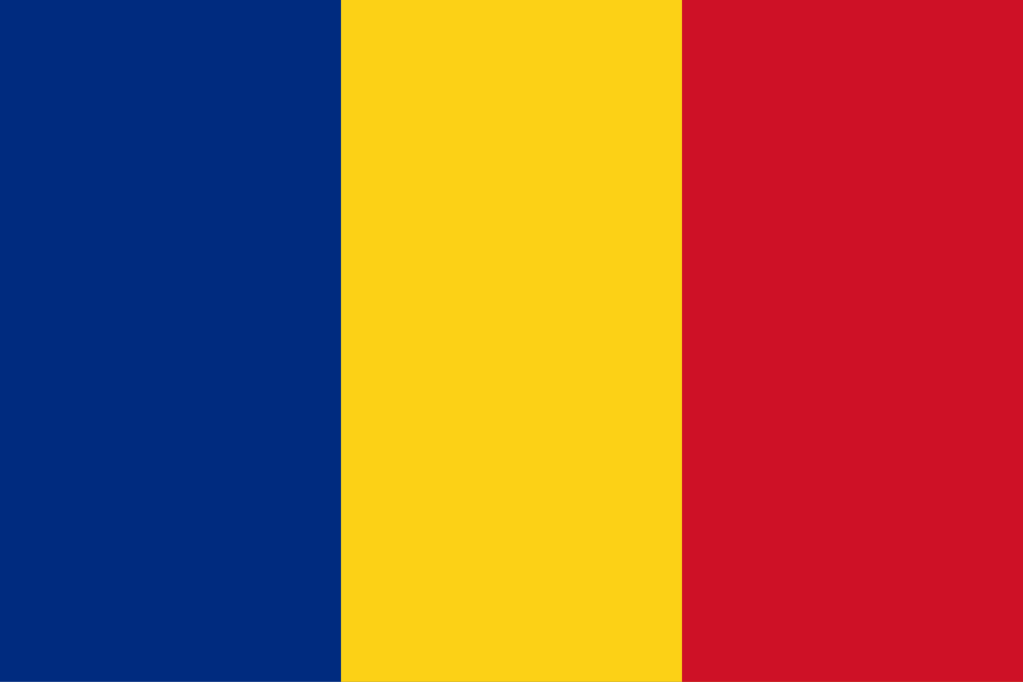
Flags of Ukraine and Greece

Referring to the modern state as The Ukraine is incorrect both grammatically and politically, says ‘Oksana Kyzyma of the embassy of Ukraine in London. “Ukraine is both the conventional short and long name of the country.” The use of the article relates to the time before independence in 1991, when Ukraine was a republic of the Soviet Union. After the collapse of the Soviet Union, Ukrainians probably decided that the article denigrated their country (by identifying it as part of Russia) and abolished ‘the’ while speaking English… As well as being a form of linguistic independence in Europe, it is also hugely symbolic for Ukrainians.’ 

Ukraine Is the Most Important Country for the European Union… Ivan Dikov, 2019: 

‘Which is the most important “outside’ country for the European Union at the present moment and for the foreseeable future… It’s Ukraine. The reason… Ukraine is the largest country that has the realistic potential, the desire, and a wide range of prerequisites to become a member state of the European Union… Of course, that is a very long shot: Ukraine hasn’t even been recognized as an official EU candidate country yet, and it’s not even sure when it will be, or even that it ever will be… [yet it’s] population seemingly has the desire to do so, and, what’s ever more important, whose society wishes to change correspondingly in the process. 

… Ukraine is what Poland was among the countries that joined the EU in the three “Eastern Enlargements” in the decade between 2004 and 2013… the great thing about the European Union is that it is a Union of “losers”: countries which either built empires to see them crashing down, or which were otherwise crushed, mauled, or severely threatened by empires… Ukraine… is quite big but not too big, so that… the Union as a whole… will be able to “swallow” its accession with relative ease. If or when Ukraine becomes a member of the EU, it would naturally assume a spot among the Big Six – which are now about to become the Big Five… (Germany, France, Italy, Spain, Poland)… while this is still a very long shot, and Britain’s departure (which itself was a long shot for a while) is regrettable, but such a set up would bring a better East – West balance inside the EU… It would be very shrewd of the entire European Union to take notice of that fact.’
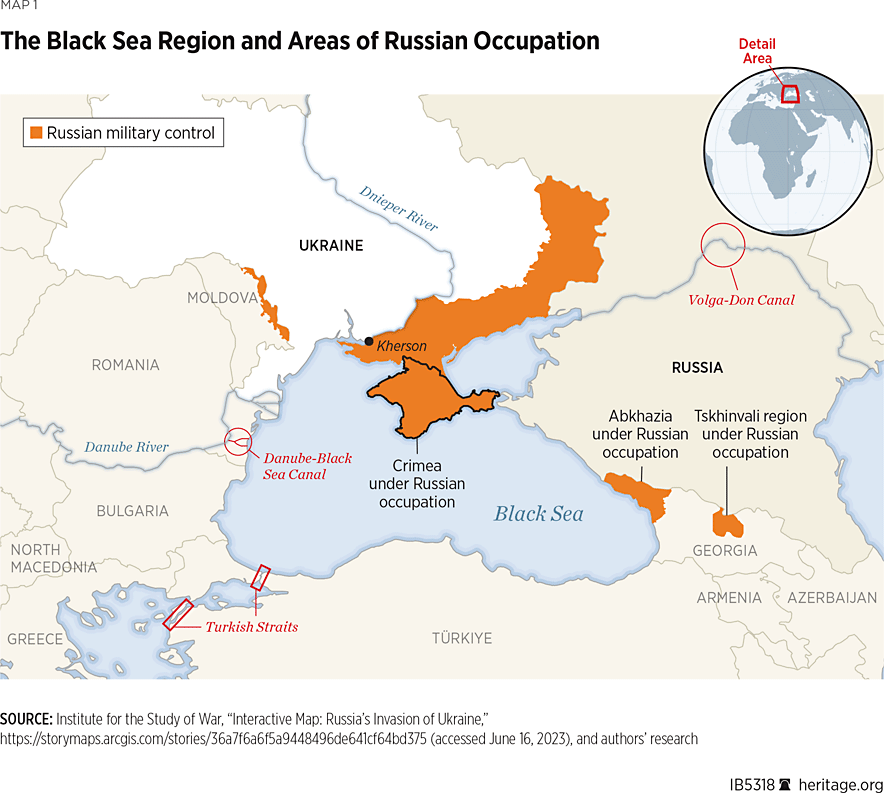
Any movement by Ukraine towards the European Union have been stopped in its tracks at time of writing; with Russian forces entering the Ukraine on February 24, 2022, with a build up of Russian troops in the Crimea beginning on the formidable date of 22.02.2022. Events today were created centuries ago. Between 1772 and 1795, the Russian Empire and Hapsburg Austria as a result of the Partitions of Poland each had control of the territory which comprises modern day Ukraine for a hundred years or more. The Russian Revolution led to the Ukraine’s own civil war and then war with the Soviet Union from 1917 to 1921. In 1922, one hundred years ago, the Ukrainian Soviet Socialist Republic was established. Leap ahead to 1954 and new Soviet leader Khrushchev who succeeded Stalin; himself a Ukrainian, transferred Crimea to Ukraine to mark the 300th anniversary of the Russian-Ukraine Union. When the Soviet Union dissolved in 1991, Crimea became independent.
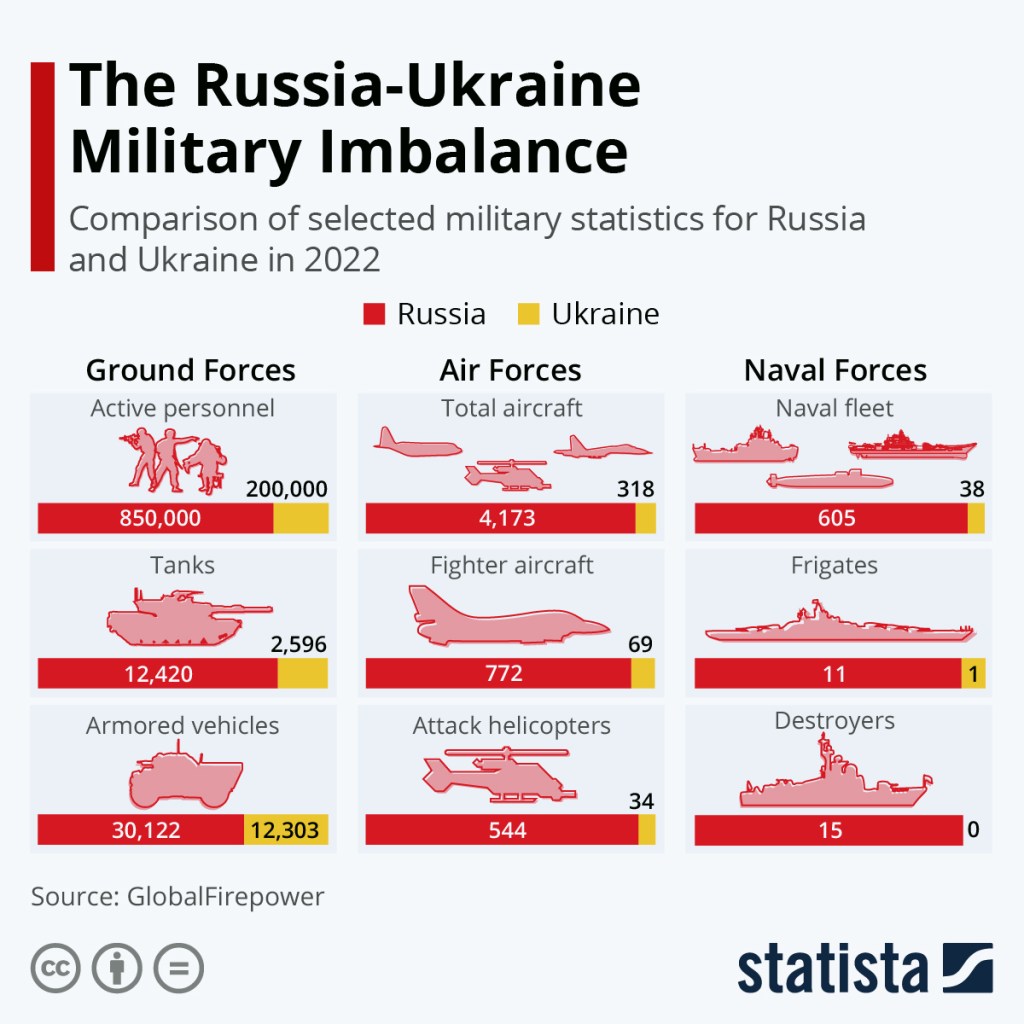
Late 2013 President Viktor Yanukovych, suspended preparations for the implementation of an association agreement with the European Union. This decision resulted in months of mass protests. The Ukrainian parliament impeached Yanukovych on 22 February 2014. During the 22nd and 23rd February – exactly eight years previously – the Russo-Ukrainian War began with Russian forces entering Crimea. It was not an invasion as such since Russia had a naval base in Sevastopol. A referendum in the largely ethnic Russian autonomous region of Crimea was held and with a ninety-five percent majority mandate, Crimea was de facto annexed by Russia in March 2014.

The Crimean Peninsula has key strategic importance as the Black Sea region is pivotal to Russia, for it is the only gateway to the Mediterranean, Africa and beyond. Access is vital for shipping, oil and gas pipelines, as well as for military operations. Russia could and would, never give up this most important warm water sea gate. 

It was during the Crimean War between 1853 to 1856 that a coalition comprising Britain, France and Turkey won Crimea from Russia. Russia’s mistrust of the West is reasonable and the threat of Ukraine joining the European Union and or Nato with possible foreign military presence on Russia’s border, led to its preemptive strike on Ukraine, to topple a puppet regime with links to and support from, the West. 

Ukraine is very unstable with its ‘debt-to-GDP ratio [doubling] and close to 60% of the people [living] below the poverty line. Its industries are crumbling, and pensions/social welfare have been deeply slashed. Neo-Nazi groups are on the rise, and 80% of young people are desperate to leave the country’ now with no end in sight.

Ukraine is very unstable with its ‘debt-to-GDP ratio [doubling] and close to 60% of the people [living] below the poverty line. Its industries are crumbling, and pensions/social welfare have been deeply slashed. Neo-Nazi groups are on the rise, and 80% of young people are desperate to leave the country’ now with no end in sight.

And so like its name Ophir, Ukraine is at once a nation ‘exhausted, depleted’ and is being ‘[reduced] to ashes’ – yet remains a nation potentially ‘rich, [with] abundance’ having a ‘mark of wealth’ and a ‘coast of riches.’

One nation we have not discussed, whom enigmatically may or may not descend from Joktan, is Finland – refer Chapter XXVII Abraham & Keturah – Benelux & Scandinavia. We will investigate the Finns further, though will include them with Joktan for the time being, for they still share a common descent from Arphaxad. Finland is ranked number 10 in the top ten technologically advanced nations, one behind China at nine. According to the Global Innovation Index, Finland ranks number six in the world. Recall Singapore is number five and South Korea tenth in the world. Finland is famously renowned as the creator of Nokia which ‘ruled the communication industry, for over a dozen years.’ Finland is proficient in high-tech projects and exhibits medical prowess. Finland’s core areas of focus are in biosciences, energy and environmental sciences. 
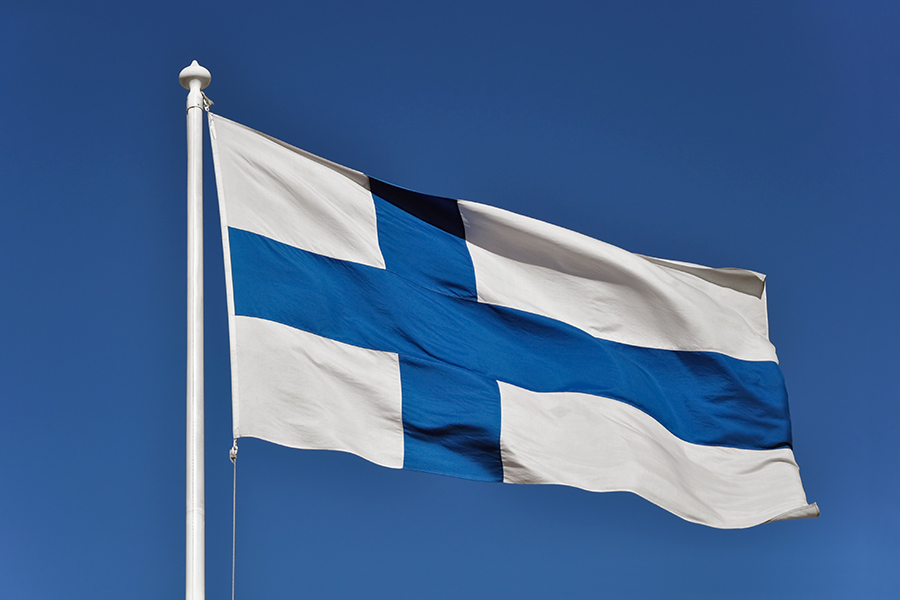
Finnish man and woman

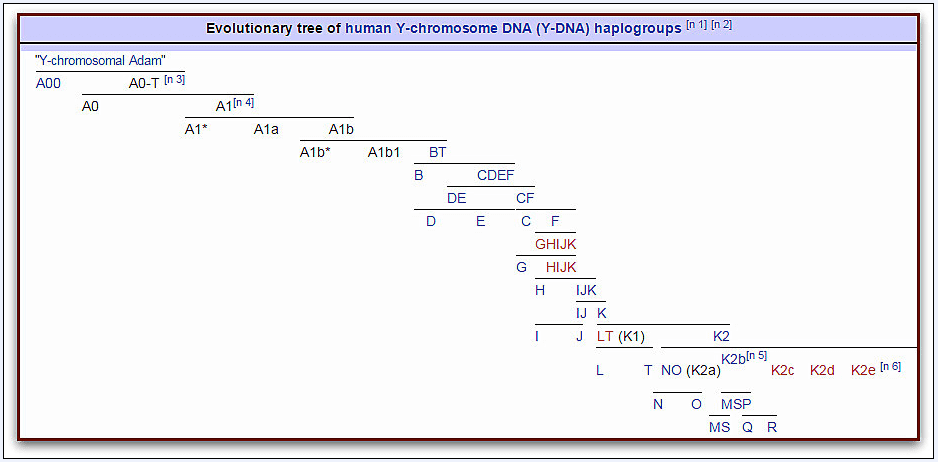
The division between Eber’s sons Joktan and Peleg is supported not just by geography, language and culture but chiefly, genetically. A major Haplogroup of the paternal Y-chromosome tree is the extensive R1, which is represented by two principle lineages: R1a and R1b. More than half the men of European descent belong to R1b. 
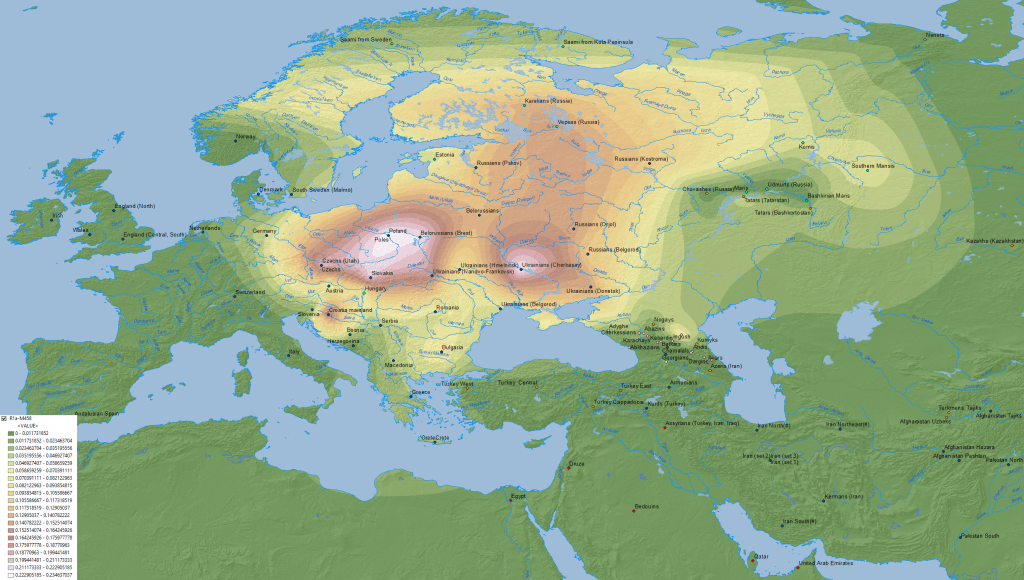
Haplogroup R1a, is primarily found in central Asia, southern Asia (both through admixture) and as a defining marker Haplogroup of the Slavic speaking male populations in Eastern Europe. 

The Y-DNA map of West Eurasia shows the principle Haplogroup division for Europe into, not just a north-south or east-west split but into quarters. Thus for north western Europe the predominant Haplogroups include I1 (and N1c1 from Japheth admixture); for western Europe, R1b (and I2a2); for eastern Europe R1a; and for south eastern Europe, I2a1.

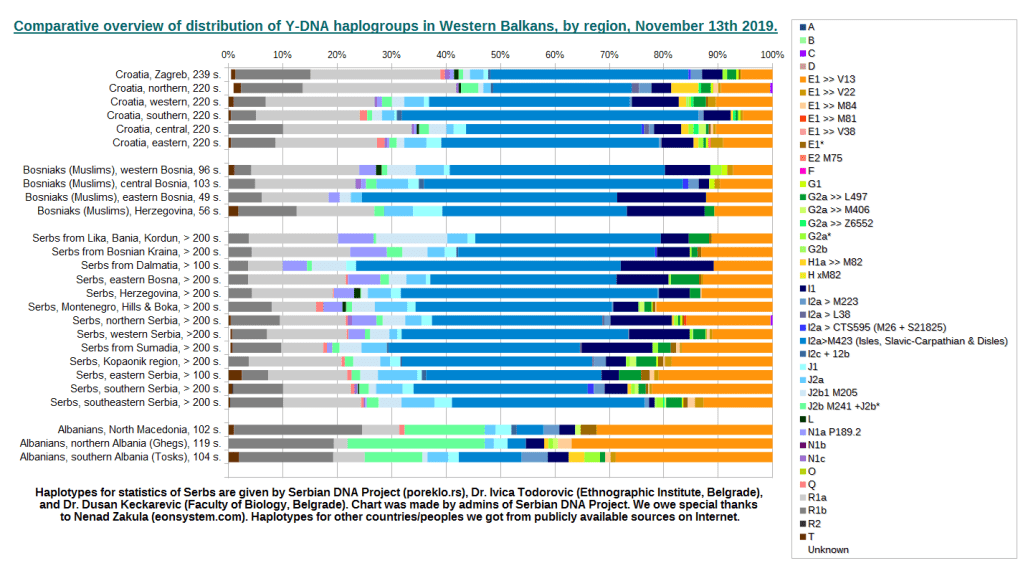
What is important to stress is to understand that the defining Y-DNA marker Haplogroup for Joktan’s male descendants is R1a. Haplogroup I2a1 though frequent in the Balkan region, is an older lineage and those men who carry I2a1 are distantly related but not the same as the males with R1a – refer article: Y-DNA Adam & mtDNA Eve: The Genesis and Evolution of Homo sapiens. Similarly, the Balkan men who carry J2, J1 and E1b1b lineages are reflecting mutations from a Hamitic (or Canaanite) line of descent such as from Phut, Mizra and Canaan respectively.

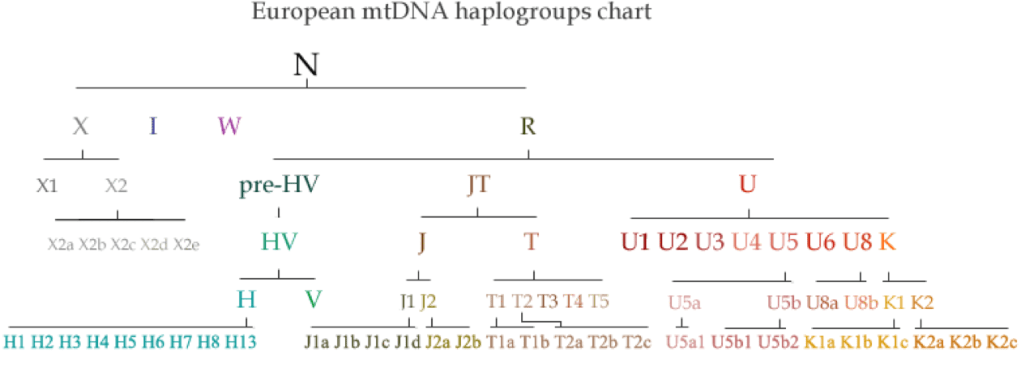
Below, are listed the leading mtDNA maternal Haplogroups – showing the diversity yet interconnectedness of the peoples of eastern Europe descending from Joktan’s thirteen sons, at least – stretching from Finland in the North to Greece in the South. Data for Moldova, Montenegro and Kosovo not included. Following, is a comparison of the four principle nations outlined from the scriptures, plus Finland, as well as the other nations of eastern Europe in approximate geographical order, descending from the northwest to the southeast.

Finland: H [36.3%] – U5 [20.7] – W [9.6%] – HV0+V [7.3%] – 

J [5.9%] – K [4.5%] – I [4.2%] – T2 [2.4%] 

Ukraine: H [39%] – U5 [9.8%] – T2 [8.4%] – J [8.1%] – U4 [5.8%] – 

K [4.9%] – HV0+V [4.3%] – HV [3.5%]

Poland: H [43.9%] – U5 [10.1%] – J [7.9%] – T2 [6.9%] – U4 [5.2%] – 

HV0+V [4.9%] – K [4%] – W [3.6%] 

Romania: H [37.2%] – J [10.5%] – K [7.9%] – U5 [7.2%] – T2 [5.1%] – 

HV0+V [4%] – W [3.9%] – T1 [3.5%] 

Greece: H [40.5%] – J [9.5%] – T2 [6.6%] – U5 [5.2%] – K [5.1%] – 

X [4.2%] – U3 [3.8%] – T1 [3.5%] – HV [2.7%] 
Estonia:      H [45.8%] – J [10.7%] – T2 [7.6%] – U5 [ 13.3%] –

U4 [5.7%] – W [3%] 

Latvia:        H [42%] – U5 [10%] – U4 [8.7%] – T2 [6.3%] –

J [6%] – I [4.6%] 

Lithuania:  H [45.3%] – U5 [11.4%] – T2 [7%] – J 6.4%] –

U4 [3.8%] 

Belarus:      H [39.1%] – U5 [9.1%] – J [8.9%] – U [6.6%] –

HV0+V [6%] – T2 [5.1%] 

Czech R:     H [40.2%] – J [10%] – U5 [9.7%] – T2 [7.7%] –

T1 [4%] – K [3.4%] 

Slovakia:     H [43%] – U5 [ 11.1%] – J [9.6%] – T2 [8.1%] –

U4 [5.5%] – K [3.8%] 

Hungary:    H [39.2%] – J [10.1%] – T2 [8.7%] – U5 [7.4%] –

K [6.8%] – W [5.2%] 

Slovenia:     H [44.4%] – J [9.8%] – U5 [9%] – T2 [6.4%] –

K [5.3%] – HV0+V [4.8%] 

Croatia:       H [41.1%] – U5 [10.3%] – J [9.7%] – T2 [5.8%] –

HV0+V [5.1%] – K [5.1%] 

Serbia:         H [41%] – U5 [9.4%] – J [6.8%] – U4 [6.8%] –

HV0+V [5.1%] – K [4.3%] 

Bosnia/H:   H [45.8%] – U5 [8.8%] – J [8.3%] – U4 [4.9%] –

K [4.9%] – HV0+V [4.7%] 

Macedonia: H [45%] – U5 [8%] – J [7.5%] – K [5%] –

HV0+V [4.5%] – T1 [4.5%]

Bulgaria:      H [41.9%] – J [7.7%] – U5 [6.9%] – K [5.8%] –

T2 [4.7%] – T1 [4.7%] 

Albania:       H [47.9%] – J [7.1%] – U5 [6.4%] – T2 [5.5%] –

K [5.2%] – T1 [4.3%] 

Placing the data in a relative geographic order does not show specific relatedness; though PCA graphs do confirm the geographic clusters as being indicative of who is most closely related to whom in eastern Europe. The Finns are unique, yet in turn are the most related to the Baltic nations, who are then related to the Poles, Belorussians and Ukrainians – and by extension, the Russians. The Czechs and Slovaks are next genetically related with a gap between them and the Slovenians, Hungarians, Croats and Moldavians. Further in genetic distance are the Serbians and Bosnians and then Romanians, Bulgarians and Macedonians. Unsurprisingly, the most distantly related from the Finns, are the Albanians and Greeks. Finland stands out as an outlier; even so, they are not related to Scandinavia – comprising Sweden, Denmark and Norway – even though counted a Nordic nation like Iceland. 

                           H    HVO+V   J       T2     U4    U5      K      W

Finland           36         7           6        2         1      21       5      10

Romania         37         4         11         5         3       7       8       4

Belarus            39        6           9         5        3        9       2       4

Ukraine           39        4           8         8        6      10       5       3

Hungary          39        5         10         9        3        7       7       5

Czech R.          40        3         10         8        2      10       3       1

Croatia             41        5         10         6        2       10       5      3

Serbia               41        5           7         2        7         9       4      3

Greece              41        2         10         7        3         6       5       1

Latvia               42        3          6          6        9      10       2       4

Bulgaria           42        4          8          5        4        7       6       3

Slovakia           43        3        10          8        6       11       4       2

Poland             44        5          8           7        5       10      4       4

Slovenia          44         5        10           6        3        9      5       2

Lithuania        45         5          6           7        4       11      2       2

Macedonia     45         5          8           4        2        8      5       4

Estonia            46         2        11           8        6      13      2       3

Bosnia & H.    46         5         8           4        5        9      5        3

Albania            48        3          7           6        3        6      5        3

Haplogroup H is the most frequent mtDNA found in Europe and based on an ascending percentage for this Haplogroup, places Finland as one bookend, with the lowest percentage and Albania as the other, with the highest. Not a big surprise, yet what is, is the fact that the groupings do not match geographic location or the PCA relationships. Finland stands out with its disproportionately high levels of U5 and W. The Baltic nations also possess relatively higher percentages for Haplogroup U5.

Spain:      H [44.1%] – J [6.6%] – T2 [6.4%] – K [6.3%] – U [1.8%] –

HV [0.7%] 

Ukraine: H 39%] – J [8.1] – K [4.9%] – HV [3.5%] – T2 [2.4%] –

U [0.6%] 

Russia:    H [41.2%] – J [7.8%] – T2 [6.5%] – K [3.7%] – U [2.2%] –

HV [1.8%] 

Turkey:   H [30.8%] – J [8.9%] – U [6.3%] – K [5.6%] – HV [4.8%] –

T2 [4.3%]

Iran:        H [16.9%] – J [13.8%] – U [11.8%] – HV [7.4%] – K [7.3%] –

T2 [4.9%]

As one heads west, the most prevalent Western Eurasian mtDNA Haplogroup H, essentially increases in the prominent nations descended from Shem, studied to date. Haplogroup T2 also increases, whereas Haplogroups J, U and HV decrease. In contrast with younger Haplogroup T, Haplogroup U is one of the oldest and most diverse of the European Haplogroups.

                        H         HV    HV0+V      J        T2         U        U5       K

Brazil             44          2                         11 

Portugal        44       0.1           5             7         6           3          7         6

Spain             44       0.7           8            7          6           2         8         6

Poland          44           1           5             8         7        1.4        10        4

Russia           41           2           4            8          7           2        10        4

Greece           41          3         1.8          10          7          3          5         5

Ukraine        39          4            4            8          8      0.6        10         5

Romania      37          2            4           11          5           2          7        8

Finland         36                        7            6          2       0.8        21        5

Turkey          31           5        0.7            9          4           6         3         6

Iran               17           7        0.6           14          5         12         3         7

With the exception of Poland, the descendants of Joktan are entirely sandwiched between Asshur at one end and Elam and Lud on the other. A few of Arphaxad’s children from Joktan have much in common with the Russians when comparing mtDNA Haplogroups. With the six already highlighted, the additional five nations reflect the changing Haplogroups from north to south and east to west. Supporting the contention that the descendants from Arphaxad’s great grandson Joktan, share strong similarity with one of their four uncles. Their offspring equate to cousins. There is no denying that northern Europe, as represented by Poland and Ukraine for instance, are strikingly similar with the Russians. A shared maternal ancestor at some point is feasible for the Russians, Ukrainians and Belorussians. 

Eupedia – emphasis & bold mine:

‘99% [of Y-DNA Haplogroup] R1a people belong to subclades of R1a1a1 (R1a-M417), which is divided in the following subclades:

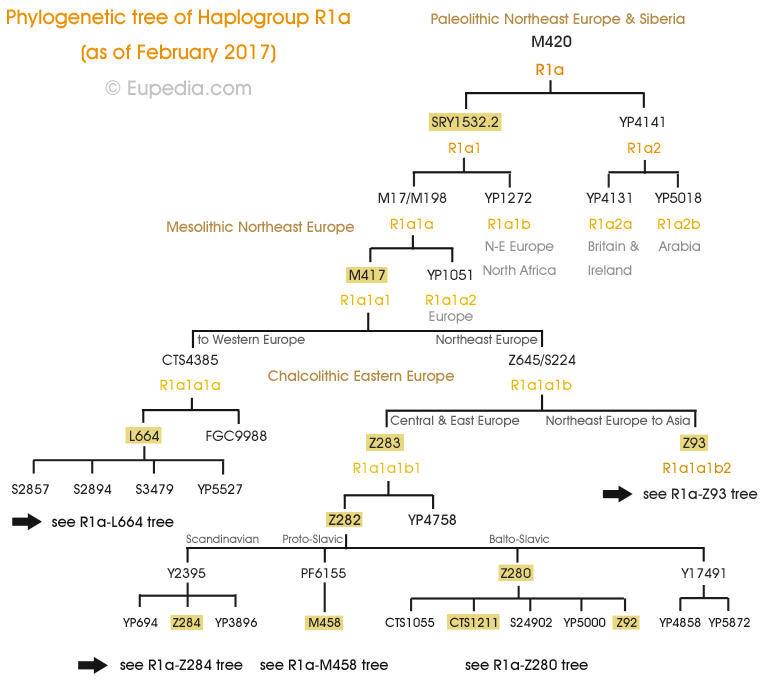
R1a-Z645 makes up the majority of R1a individuals from Central Europe to South Asia. R1a-Z283 [R1a1a1b1] is the main Central & East European branch. R1a-M458 [R1a1a1b1a1], primarily a [western] Slavic subclade, with maximum frequencies in Poland, the Czech Republic, Slovakia, but is also fairly common in southeast Ukraine and northwest Russia. Its subclade R1a-L260 [R1a1a1b1a1a] is clearly West Slavic, with a peak of frequency in Poland, the Czech Republic and Slovakia, and radiating at lower frequencies into East Germany, East Austria, Slovenia and Hungary.

R1a-Z280 [R1a1a1b1a2] is also an Balto-Slavic marker, found all over central and Eastern Europe (except in the Balkans), with a western limit running from East Germany to Switzerland and Northeast Italy. It can be divided in many clusters: East Slavic, Baltic, Pomeranian, Polish, Carpathian, East-Alpine, Czechoslovak, and so on. Its subclade R1a-L365 is a Pomeranian cluster found also in southern Poland.’
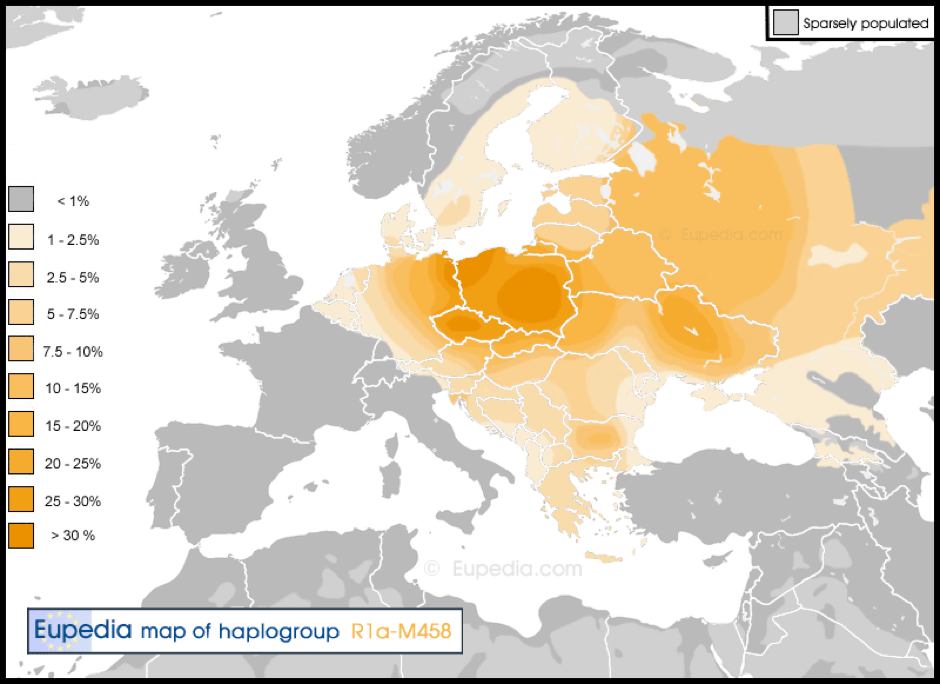
‘In terms of observable haplogroups, Greece and Albania are quite alike. Although geographically close to Sweden and Norway, Finland looks genetically very different, having more similarities with places like Estonia and Lithuania. Bulgaria and Romania are extraordinarily similar to one another. The haplogroup compositions of the Czech Republic, Austria, and Hungary aren’t exactly identical, but very comparable. Greeces genetic makeup has a lot in common with Turkey’s. Genetically speaking, Latvia, Lithuania, and Estonia are extremely similar.

The Balkans is likely the most genetically varied area of Europe. Haplogroup N3 [N1] is observable all over Eastern Europe, but it’s practically nonexistent in Western Europe. Haplogroup R1a is one of the most predominant haplogroups in Nordic regions and Eastern Europe. While in Western Europe the most prevalent haplogroup is clearly R1b. 

The farther north you go in Europe, the harder it is to detect Haplogroup J1 (Jewish, Arabic). There is now strong evidence that both R1a and R1b people contributed to the diffusion of the A111T mutation of the SLC24A5, which explains approximately 35% of skin tone difference between Europeans and Africans, and most variations within South Asia’ – refer Chapter XVI Shem Occidentalis

‘The distribution pattern of the A111T allele (rs1426654) of matches almost perfectly the spread of Indo-European R1a and R1b lineages around Europe [derived from Shem], the Middle East [from Shem through admixture^], Central Asia^ and South Asia^. R1a populations have an equally high incidence of this allele as R1b populations. On the other hand, the A111T mutation was absent from the 24,000[?] -year-old R* sample from Siberia, and is absent from most modern R2 populations^ in Southeast India and Southeast Asia. Consequently, it can be safely assumed that the mutation arose among the R1* lineage during the late Upper Paleolithic, probably some time between 20,000 and 13,000 years ago [or more likely between circa 8000 to 7000 BCE according to an unconventional chronology].

the genes for blue eyes were already present among Europeans belonging to Y-haplogroup I. The genes for blond hair are more strongly correlated with the distribution of haplogroup R1a, but those for red hair have not been found in Western or Central Europe before the Bronze Age [beginning circa 2500 to 2000 BCE], and appear to have been spread primarily by R1b people.

Nowadays, high frequencies of R1a are found in Poland (57.5% of the population), Ukraine (40 to 65%), European Russia (45 to 65%), Belarus (51%), Slovakia (42%), Latvia (40%), Lithuania (38%), the Czech Republic (34%), Hungary (32%), Norway (27%), Austria (26%), Croatia (24%), north-east Germany (24%) Sweden (19%), and Romania (18%).’

‘Haplogroup N1c is found chiefly in north-eastern Europe, particularly in Finland (61%), Lapland (53%), Estonia (34%), Latvia (38%), Lithuania (42%) and northern Russia (30%), and to a lower extent also in central Russia (15%), Belarus (10%), eastern Ukraine (9%), Sweden (7%), Poland (4%) and Turkey (4%). 

N1c represents the western extent of haplogroup N, which is found all over the Far East (China, Korea, Japan), Mongolia and Siberia, especially among Uralic speakers of northern Siberia.

Haplogroup I1 is the most common type of haplogroup I in northern Europe. It is found mostly in Scandinavia and Finland, where it typically [represents] over 35% of the Y chromosomes. Associated with the Norse ethnicity, I1 is found in all places invaded by ancient Germanic tribes and the Vikings. After the core of ancient Germanic civilisation in Scandinavia, the highest frequencies of I1 are observed in other Germanic-speaking regions, such as Germany, Austria, the Low Countries, England and the Scottish Lowlands, which all have between 10% and 20% of I1 lineages.

Haplogroup I2 is the most common paternal lineage in former Yugoslavia, Romania, Bulgaria and Sardinia, and a major lineage in most Slavic countries. Its maximum frequencies are observed in Bosnia (55%, including 71% in Bosnian Croats), Sardinia (39.5%), Croatia (38%), Serbia (33%), Montenegro (31%), Romania (28%), Moldova (24%), Macedonia (24%), Slovenia (22%), Bulgaria (22%), Belarus (18.5%), Hungary (18%), Slovakia (17.5%), Ukraine (13.5%), and Albania (13.5%). It is found at a frequency of 5 to 10% in Germanic countries.’

The principal Y-DNA Haplogroups for Eastern Europe fall into five major categories which are either N1c1, R1a, I2a1, E1b1b or J2. Haplogroup N through admixture is indicative of northern inhabitants; similarly for E1b1b and J2 in southern Europe; with R1a and I2a1 sitting in-between them on an east-west axis. Higher percentages of the N1c1 group are found mainly in the Balts and the same for the I1 group which is found mainly in the northern Slavs. The I2a1 and E1b1b groups are predominantly associated with southern Slavs and J2 in Greece. Levels of R1a are typically stronger in western Slavs. As far as a neat split thirteen ways to indicate the thirteen sons of Joktan, the data could be manipulated a number of ways for the desired outcome. Remember too, that of these paternal Haplogroups, only R1a, I1 and I2a1 descend from Shem and it is R1a which is the defining marker Haplogroup for males in Eastern Europe (and Russia). While I2a1 is an older ancestral line related to – though clearly prior to – R1a mutations.

What is interesting is that if one takes a Cold War map of Europe prior to 1991, there were thirteen nations exactly in Eastern Europe. With the exception of Finland, one which was not part of the Soviet Union, Greece; five which were part of the Soviet Union, Estonia, Latvia, Lithuania, Belarus and Ukraine; and seven which had Communist regimes under the heel of Moscow: Poland, Czechoslovakia, Hungary, Romania, Bulgaria, Albania and Yugoslavia (with multiple states). The twenty-one peoples – 22 nations – have been grouped as it struck this writer and thirteen sub-groups appear plausible: one for N1c1, six for R1a, three for I2a1, two for E1b1b and one for J2.

Though this is in regard to predominant paternal Haplogroups, for it is only R1a which is the defining marker Haplogroup for northern and southern Slavic peoples. I2a1 is a secondary European Haplogroup; whereas E1b1b and J2 are Canaanite and Hamitic mutations from ancient admixture and N1c1 is a similar non-European group resulting from intermixing with an East Asian line descending from Japheth.

Finland: N1c1 [61.5%] – I1 [28%] – R1a [5%] – R1b [3.5%] – 

I2a2 [0.5%] – E1b1b [0.5%] 

Estonia: N1c1 [34%] – R1a [32%] – I1 [15%] – R1b [8%] – 

T1a [3.5%] – I2a1 [3%] – E1b1b [2.5%] – J2 [1%]  –

I2a2 [0.5%] – Q [0.5%] 

Latvia: R1a [40%] – N1c1 [38%] – R1b [12%] – I1 [6%] – 

I2a1 [1%] – I2a2 [1%] – E1b1b [0.5%] – J2 [0.5%] –

T1a [0.5%] – Q [0.5%]

Lithuania: N1c1 [42%] – R1a [38%] – I1 [6%] – I2a1 [6%] –

R1b [5%] – I2a2 [1%] – E1b1b [1%] – T1a [0.5%] – Q [0.5%] 

The consensus is that the Finns and Estonians are more similar as per a PCA graph, though the Y-DNA Haplogroups show Estonia and Lithuania are actually more closely related. All three Baltic nations obviously form one group and three divisions within it, with Latvia and Lithuania closer together and Estonia closer to Finland. Recall that when comparing mtDNA Haplogroups, it was Finland which is closer to Latvia, then followed by Lithuania and lastly, Estonia.

Many – this writer included – have assumed Finland as a Nordic and not a Scandinavian country, and not having been under the umbrella but merely the shade of the Soviet Union’s Iron Curtain, was a truly Western European Nation. In fact, biblical identity adherents have nearly always postulated that Finland is one of the twelve sons of Jacob, namely the tribe of Issachar. 

It was realised early during this writer’s study that Finland was not a lost tribe of Israel. It has taken considerably longer to identify the Finns more accurately. It was thought for a prolonged period that they were in fact a son of Abraham, descending from his wife Keturah. Identity adherents could have remonstrated against current arguments, twenty-five years ago perhaps. Genetic and Haplogroup studies of the past twenty years prove beyond a shadow of doubt, that Finland is neither descended from Isaac or Abraham.

Though the enigma of the Finns does not end there. Recall we mentioned that Arphaxad had other sons, including Anar and Ashcol as well as daughters. With mtDNA Haplogroup U5, the Finns stand out from the rest of Arphaxad’s children with considerably higher levels. So it is with the Y-DNA Haplogroups N1c1 and I1, where the percentage levels are extraordinarily high in Finland compared to either their Scandinavian or Baltic nation neighbours.

Abraham had a second wife after his first wife Sarah died. Her name was Keturah and she gave Abraham six sons. Her lineage is not provided in the Bible, though Haplogroups of certain nations in Europe strongly indicate that Keturah was from Arphaxad’s line but not from one of Abraham’s brothers, that is, from Peleg or even directly from Joktan’s line. This means Keturah was not from Arphaxad’s son Shelah, but someone related to Shelah; someone such as one of his brothers: Anar or Ashcol. 

We will return to this discussion again in Chapter XXVII Abraham & Keturah – Benelux & Scandinavia. The main point to consider is that the Finns are unique genetically; including their language group Finno-Ugric, which they share with Hungary. In fact, Hungarian has roots all the way back to Sumer, which supports the notion that descendants of Arphaxad at one time, peopled Sumer and northern neighbouring Akkad – Chapter XVI Shem Occidentalis; and Chapter XVIII Elam & Turkey.

                              N1c1    R1a     I1     R1b    I2a1   I2a2    J2    E1b1b

Finland                  62         5      28       4                  0.5                0.5

Estonia                  34      32       15       8         3       0.5        1          3

Lithuania              42       38        6       5         6           1                    1

Latvia                    38      40        6     12         1            1    0.5      0.5            

The table comparing Finland and the Baltic states with the nations which exhibit very high percentages of the N1c1 Haplogroup; confirming the uniqueness of Finland and the closeness of the Baltic nations with one another. Even so, R1a is the true paternal lineage for the three Baltic nations. Whereas for Finland it is I1, with the more prevalent N1c1 being an infusion from intermixing. Latvia is included in this group as the difference between N1c1 and R1a is marginal. They also share a complete lack of Haplogroup G2a – an older line from Shem than I and R1a – which is indicative of southern Europe, Anatolia and especially the Caucasus.

Khazaria, Kevin Alan Brook – emphasis mine:

‘Swedish Population Substructure Revealed by Genome-Wide Single Nucleotide Polymorphism Data, multiple authors, 2011:

The autosomal DNA genomes of 1,525 Swedes were autosomally compared to 280 Finns (from both Eastern Finland and Western Finland) along with Germans, Brits, and Russians.’

“… the Finns seem to be an exception to this rule: they do not appear genetically very close to the Swedes although they are geographically nearby. However, the Finns tend to show inflated genetic distances relative to [all] the [other] European populations in general, not only relative to the Swedes… Northern Swedes and Eastern Finns exhibited longer genetic distances than their geographic location would imply… Of the Swedes, Norrland and Svealand individuals were closest to Finns, and the Finns who had closest affinity to the Swedes were mainly Swedish-speaking Ostrobothnians (SSOB). 

Interestingly, the neighboring Swedish and Finnish provinces in the north, Norrbotten (NBO) and Northern Ostrobothnia (NOB), did not appear very close in the MDS plot; instead, Norrbotten seemed to show closer affinity to Western Finland… The principal component analysis clearly separated the Finnish regions and Eastern and Western counties from the Swedish as well as the Finnish regions and counties from each other. Geneland showed three clusters, roughly corresponding to Sweden, Eastern Finland and Western Finland.”

‘MtDNA diversity revealed that Lithuanians are close to both Slavic (Indo-European)and Finno-Ugric speaking populations of Northern and Eastern Europe. Y-chromosome SNP haplogroup analysis showed Lithuanians to be closest to Latvians and Estonians’ 

Belarus: R1a [51%] – I2a1 [17.5%] – N1c1 [10%] – R1b [5.5%] –

I1 [5.5%] – E1b1b [4%] – J2 [2.5%] – G2a [1.5%] – I2a2 [1%] –

J1 [1%] 

Ukraine: R1a [44%] – I2a1 [20.5%] – R1b [8%] – E1b1b [6.5%] –

N1c1 [5.5%] – I1 [4.5%] – J2 [4.5%] – G2a [3%] – T1a [1%] –

I2a2 [0.5%] – J1 [0.5%] – Q [0.5%] 

Moldova: R1a [30.5%] – I2a1 [21%] – R1b [16%] – E1b1b [13%] –

I1 [5%] – J2 [4%] – J1 [4%] – I2a2 [3%] – N1c1 [1.5%] – G2a [1%] –

T1a [1%] 

Poland: R1a [57.5%] – R1b [12.5%] – I1 [ 8.5%] – I2a1 [5.5%] –

N1c1 [4%] – E1b1b [3.5%] – J2 [2.5%] – I2a2 [2%] – G2a [1.5%] –

T1a [0.5%] – Q [0.5%]

Czech R: R1a [33%] – R1b [28%] – I2a1 – [8.5%] – I1 [7.5%] –

E1b1b [6.5%] – G2a [5%] – J2 [4%] – I2a2 [3%] – N1c1 [2.5%] –

J1 [1%] – T1a [0.5%]

Slovakia: R1a [41.5%] – I2a1 [16%] – R1b [14.5%] – I1 [6.5%] –

E1b1b [6.5%] – G2a [4%] – N1c1 [3%] – J2 [2%]  – I2a2 [1.5%] –

J1 [1%] – T1a [0.5%] – Q [0.5%]

Slovenia: R1a [38%] – I2a1 [20.5%] – R1b [18%] – I1 [9%] –

E1b1b [5%] – J2 [2.5%] – I2a2 [1.5%] – G2a [1.5%] – T1a [1%] 

Hungary: R1a [29.5] – R1b [18.5] – I2a1 [16%] – I1 [8.5%] –

E1b1b [8%] – J2 [6.5%] – G2a [3.5%] – J1 [3%] – I2a2 [2%] –

N1c1 [0.5%] 

The second group of countries dominated by the R1a Haplogroup, primarily comprise the western and eastern Slavs. The maternal mtDNA showed a close alignment between the Czechs and Slovaks, whereas the paternal Y-DNA Haplogroups reveal a wider variation; with the Slovaks having more in common with Slovenia and the Czechs with Hungary. Overall on a PCA graph, the Czechs and Slovaks are genetically closer; while the Hungarians are closer with Slovenians. Conversely from the mtDNA data, Belarus and Ukraine are not quite as similar, with Ukraine showing a similarity with Slovakia. Overall, Ukraine is relatively speaking, equally most related with Poles, Belorussians and Russians.

Poland is at the far northwest region of Joktan’s children and carries the highest percentage of R1a. The Poles and Czechs have each had territory which has intermingled with Germany, before, during and after German and Prussian expansion. The Magyars of Hungary have been closely associated with the Austrians – a descendant of Peleg – during the Hapsburg ruled Austro-Hungarian Empire.

One researcher states that the Hungarian language of Magyar is utterly unique in the world and is actually the closest to ancient Sumerian. As mentioned, the sons of Joktan settled in lower Mesopotamia and became known as Sumerians; while their cousins from Peleg, were known as Akkadians. 

                         R1a     I2a1    R1b       I1      N1c1   I2a2   E1b1b    J2

Poland              58         6        13         9         4          2         4          3

Belarus             51        18         6          6       10          1         4          3

Ukraine            44       21          8         5         6       0.5         7          5

Slovakia           42       16         15         7         3        1.5         7          2

Slovenia           38       21         18        9                   1.5         5          3

Czech R.           33        9         28        8         3           3         7          4

Moldova           31       21         16        5       1.5           3       13          4

Hungary          30       16         19        9      0.5           2         8          7

For the Baltic nations and Finland, the principal Y-DNA Haplogroups are N1c1, R1a and I1. All reflective of their positions as northern as well as eastern European nations. As we travel from north to south the Haplogroup N1c1 markedly decreases; whereas E1b1b and J2 increase. The impact of the mixed Huns and Turks is evident in this admixture, which left the Baltic nations untouched. Heading east and south it is Haplogroup R1a which dominates, while travelling west, R1b expectedly increases. 

The principal Y-DNA Haplogroups for the central Slavic speaking peoples include R1a, I2a1 and R1b. Notice from the previous group the omission of the northern Haplogroups of N1c1 and I1. Haplogroup R1a – reflective of eastern European males – is prominent as is the older I2a1, which is indicative of eastern Europe and particularly south eastern Europe. Polish men exhibit the highest levels of R1a and the Czechs the highest percentage of R1b in Eastern Europe. 

Khazaria, Kevin Alan Brook – emphasis & bold mine

Paleo-Balkan and Slavic Contributions to the Genetic Pool of Moldavians: Insights from the Y Chromosome, multiple authors, 2013 – emphasis & bold mine:  

This study included 125 Y-DNA samples from Moldavian males from the villages of Karahasani and Sofia and they were compared to other European populations including 54 Romanians living in eastern Romania and 53 Ukrainians living in eastern Moldova.’ 

“… In Moldavians, 19 Y chromosome haplogroups were identified, the most common being I-M423 (20.8%), R-M17* (17.6%), R[1a1a1b1a1]-M458 (12.8%), E-v13 (8.8%), R[1b]-M269* and R-M412* (both 7.2%). In Romanians, 14 haplogroups were found including I-M423 (40.7%), R-M17* (16.7%), R-M405 (7.4%), E-v13 and R-M412* (both 5.6%). In Ukrainians, 13 haplogroups were identified including R-M17 (34.0%), I-M423 (20.8%), R-M269* (9.4%), N-M178, R-M458 and R-M73 (each 5.7%). Our results show that a significant majority of the Moldavian paternal gene pool belongs to eastern/central European and Balkan/eastern Mediterranean Y lineages. Phylogenetic and AMOVA analyses based on Y-STR loci also revealed that Moldavians are close to both eastern/central European and Balkan-Carpathian populations [particularly Croatian men].”

“All Slovenian samples group together with Hungarians, Czechs, and some Croatians (‘Central-Eastern European’ cluster) as also suggested by the PCA… Analysis of the UPGMA tree based on the Fst matrix shows all Slovenian individuals clustering together with Hungarians, Czechs, Croatians, Ukrainians, and Belarusians… Y chromosome diversity splits into two major haplogroups R1b and R1a with the latter suggesting a genetic contribution from the steppe. Slovenian individuals are more closely related to Northern [Austrian] and Eastern European [Hungary] populations than Southern European populations even though they are geographically closer.”

Croatia: I2a1 [37%] – R1a [24%] – E1b1b [10%] – R1b [8.5%] –

J2 [6%] – I1 [5.5%] – G2a [2.5%] – I2a2 [1%] – J1 [1%] – Q [1%] –

N1c [0.5%] – T1a [0.5%]

Bosnia & Herzegovina: I2a1 [50.5% ] – R1a [18%] – E1b1b [11.5%] – 

J2 [5.5%] – I1 [4.5%] – R1b [3.5%] – G2a [1.5%] – J1 [1%] –

N1c [1%] – T1a [0.5%] – Q [0.5%] 

Serbia: I2a1 [34%] – R1a [18%] – E1b1b [15%] – J2 [9%] –

I1 [8%] – R1b [6%] – G2a [2.5%] – N1c [2.5%] – J1 [1%] – Q [1%] –

I2a2 [0.5%] – T1a [0.5%]

Montenegro: I2a1 [29.5%] – E1b1b [27%] – R1b [9.5%] – J2 [9%] – 

R1a [7.5%] – I1 [6%] – G2a [2.5%] – Q [2%] – I2a2 [1.5%] –

N1c [1.5%] – J1 [0.5%] 

Macedonia: I2a1 [23%] – E1b1b [21.5%] – J2 [14%] – R1a [13.5%] – 

R1b [12.5%] – G2a [4%] – I1 [3%] – J1 [2%] – I2a2 [1.5%] – T1a [1.5] –

Q [0.5%] – N1c [0.5%] 

Romania: I2a1  [28%] – R1a [18%] – R1b [15.5%] – E1b1b [14%] – 

J2 [13.5%] – I1 – [3.5%] –  G2a [3%] – I2a2 [2.5%] – N1c [1.5%] –

J1 [1%] – T1a [1%] – Q [0.5%]
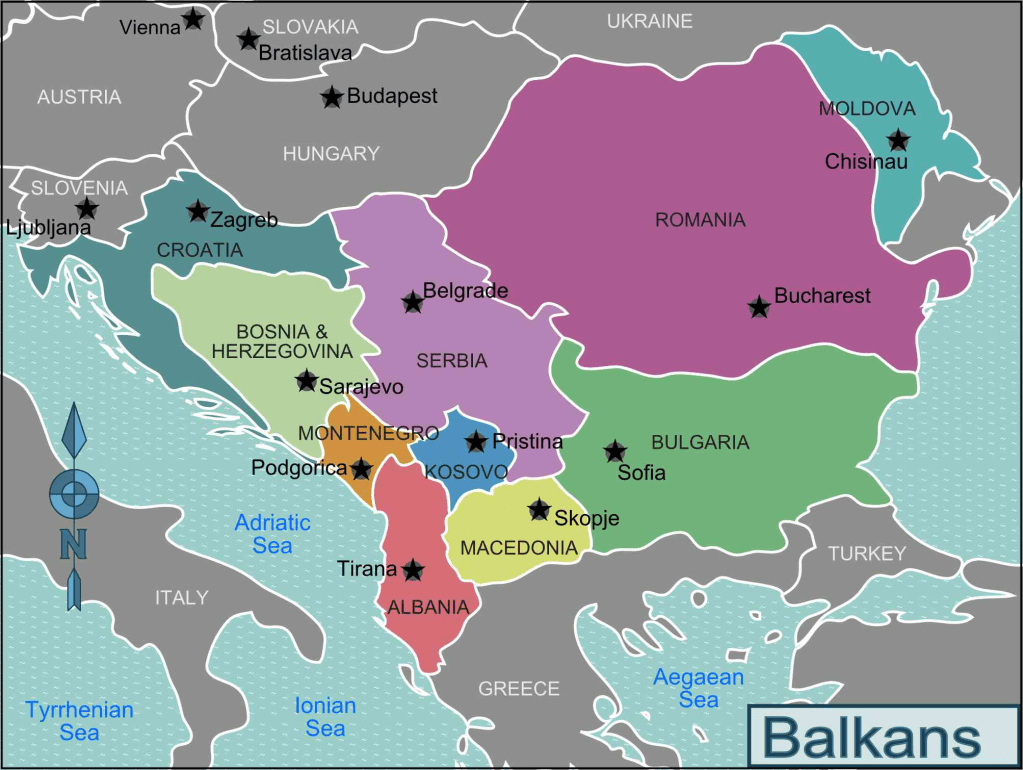
The third group possessing higher percentages of the older (intermediate) I2a1 Haplogroup, consists of nations in south eastern Europe. Distinct groupings are visible from former Yugoslavian states. Some researchers have compared Romania and Bulgaria as being similar, yet they both stand out as quite distinct from other eastern European or south eastern European nations. Bulgaria is equally distant from Macedonia and Romania on the PCA graph. 

The principle Y-DNA Haplogroups for these six nations are I2a1, R1a and E1b1b. The higher levels of E1b1b and J2 are reminiscent of say Portugal or Turkey respectively. By far the highest percentage of I2a1 is found in Bosnia Herzegovina.

                                  I2a1    R1a    E1b1b     J2     R1b      I1     I2a2     N1c

Bosnia & H.              51        18         12          6        4         5                      1

Croatia                      37        24         10         6        9          6         1       0.5

Serbia                        34        18         15         9        6          8     0.5          3

Montenegro             30         8         27         9       10         6      1.5        1.5

Romania                   28       18         14        14       16         4         3        1.5

Macedonia               23        14         22        14      13         3      1.5        0.5

It could be argued that these nations and particularly the Balkan states remaining after the implosion of the former Yugoslavia are like Finland, descendants of Arphaxad through his sons Anar and Ashcol; with Haplogroup I the common denominator.

Khazaria, Kevin Alan Brook – emphasis & bold mine:

‘I2a (I-P37.2), [the] most common haplogroup, found among 29.2% of Serbian Serbs and 30.9% of Bosnian-Herzegovinian Serbs. It peaks in the Herzegovina region. Other Slavic peoples also carry I2a. Geneticists believe that I2a ultimately originated in the Balkans about 10,000 years ago… 720 Croatian males had their Y-DNA examined… and compared with thousands of samples from different European ethnicities. 

Many different haplogroups were found among the Croats, yet 3 haplogroups stood out as particularly distinctive: I2a1b-M423 (found in over 30% of the Croatian samples and the most indigenous to the region), R1a1a1b1a*-M558 (found in 19% of the Croats…) and E1b1b1a1b1a-V13 (found in about 9% of the Croats…) This Y chromosomal study compares Croats with Slovenians, Serbs, Macedonian Slavs, Macedonian Greeks, Albanians, Poles… [and] reports that among 108 studied mainland Croatians their frequencies are 15.7% belonging to R1b-M173 [and] 34.3% to R1a-M17…’

Kosovo: E1b1b [47.5%] – R1b [21%] – J2 [16.5%] – I1 [5.5%] – 

R1a [4.5%]  – I2a1 [2.5%]

Bulgaria: E1b1b [23.5%] – I2a1 [20%] – R1a [17%] –

R1b [11%] – J2 [11%] – G2a [5%] – I1 [4%] – J1 [3%] –

I2a2 [2%]  – T1a [1.5%] – Q [0.5%] – N1c [0.5%]

Albania: E1b1b [27.5%] – J2 [19.5%] – R1b [16%] –

I2a1 [12%] – R1a [9%] – I1 [2%] – J1 [2%] – I2a2 [1.5%] –

G2a [1.5%] – T1a [1%] 

Greece: J2 [23%] – E1b1b [21%] – R1b [15.5%] –

R1a [11.5%] – I2a1 [9.5%] – G2a [6.3%] – T1a [4.5%] –

I1 [3.5%] – J1 [3%] – I2a2 [1.5%] 

The final grouping driven by high percentages of E1b1b and J2 includes Kosovo, which emerged out of the ruins of the fragmented Yugoslavia. Most have always assumed Greece is a western nation and like Finland, it was not under Soviet domination. Yet, its Haplogroups show that it belongs where it is located, with its fellow brothers, the sons of Joktan. With that said, the Greeks reveal considerable diversity from admixture amongst the mainland and island populations. Additionally, they are genetically similar with not just Albanians but also southern Italians and Jews. We will investigate this further in the following chapter. For we will confirm there is more than one branch or family in the Bible with the name Uz – refer Chapter XXIII Aram & Tyre: Spain, Portugal & Brazil; and Chapter XXIX Esau: The Thirteenth Tribe.

                           E1b1b    J2     R1b     I2a1     R1a     I1    I2a2      N1c

Kosovo                 48        17       21          3                5                    

Albania                28        20      16        12          9        2       1.5      

Bulgaria               24        11       11        20        17        4          2      0.5

Greece                  21         23      16        10        12        4       1.5

The predominant Y-DNA Haplogroups for these four most south easterly European nations are E1b1b and J2 from admixture with Canaan and Ham respectively and a little surprisingly, R1b. Though this has likely been influenced by males of Turkish descent – refer Chapter XVIII Elam & Turkey. For the first time R1a drops out of the top three. Haplogroup I2a1 is still relatively prominent, as the neighbouring nations to the north west. Bulgaria with the closeness between Haplogroups E1b1b and I2a1 could be included in the preceding group; as Greece is included here, rather than a separate group of one with J2. Its dominant J2 Haplogroup places it near J2 dominated Turkey, 24%; and Iran, 23%.

Bulgarian Autosomal DNA lends weight to its inclusion with Romania and the Balkan states. Greece with Albania and Kosovo has a strong presence of R1b and thus like Turkey, their true paternal lineage is possibly R1b when one discounts E1b1b and J2 from admixture. The alternative is that R1a as with Iran is probably the definitive paternal marker Haplogroup and R1b is a sign of heavy intermixing.

Kosovo possesses the highest percentage of E1b1b. The PCA graph earlier confirms two points. First, the wide diverseness of the Eastern Europeans stretching from the Baltic to the extremity of the Balkans and yet also, within this sizeable region and its numerous nations, are the thirteen sons of Joktan. All showing their interrelatedness through primarily Haplogroup R1a. Whereas I1 and I2a1 are reflective of Arphaxad and not necessarily of Joktan.

As we progress through the descendants of Shem, we will find the levels of R1b vary, though gradually increase. We will keep a record of the levels for the two main R1b sub-Haplogroups for a number of the nations we will study. R-M269 stretches across Europe, with levels increasing as one heads westwards. R-U106 covers western Europe eastwards with its epicentre in Central Europe.

Turkey:    R-M269   14%   –  R-U106   0.4%

Russia:     R-M269   21%   –  R-U106   5.4%

Slovenia  R-M269   17%    –  R-U106      4%

Czech       R-M269  28%    –  R-U106    14% 

Poland     R-M269  23%    –  R-U106      8% 

Ukraine   R-M269  25%    –  R-U106      9%

The addition of the Slavic speaking nations with Turkey and Russia highlights the progression of R1b from east to west as well as south to north. Slovenia is the most southern country of the four represented yet also the most westerly. Its R-M269 level is closer to Turkey, though its R-U106 percentage is closer to Russia. Like the other three, R1a is the prime male Haplogroup and as with Ukraine, Haplogroup I2a1 is second. Ukraine has a R-M269 level similar to Russia, though its R-U106 percentage is higher. Poland is similar with Ukraine, whereas the Czechs stand out with higher levels of R-M269 and R-U106. 
How much of this has been influenced by their border changes with Germany and mixing of peoples is undetermined. Like Poland, the Czech Republic has Haplogroup R1a first and R1b second instead of I2a1. The Czech Republic has less R1a than the other three Slav nations and conversely, more R1b than any other nation descending from Joktan; with Poland possessing the highest levels of R1a of all of Joktan’s descendants. 

Other Eastern European nations percentage of R-M269 include the following:

Bulgaria   R-M269   10.5%

Croatia     R-M269   12.4%

Romania  R-M269   13.0%

Greece      R-M269   13.5%

Moldova   R-M269   14.6%

Albania     R-M269   18.2%

Our evolving table from the previous chapter, compared the nations from Aram with Asshur, Elam and Lud. We will add the select nations discussed in the scriptures and descended from either Arphaxad or via his great grandson, Joktan.

                       J        J1      J2     E1b1b    G      R1a     R1b      R1    

Georgia       43      16       27         2        30        9        10       19 

Armenia      33      11       22        6         12         5        30      35  

Turkey         33       9       24       11         11         8        16       24

Iran              32       9       23         7        10       16        10       26

Greece         26       3       23       21          6       12        16       28

Romania     15        1       14        14          3       18        16       34

Portugal      13        3       10       14          7       1.5       56       58

Brazil           10                 10       11          5          4       54       58

Spain           10     1.5         8         7          3         2       69        71     

Ukraine        5     0.5     4.5          7          3       44         8       52

Poland          3                   3          4          2       58       13        71

Russia           3                   3         3           1       46         6       52

Finland                                      0.5                      5         4         9

Georgia continues as one bookend with the highest Haplogroup J2, J1 and G2a percentages. Finland is now the opposite bookend, with no Haplogroup J and the lowest R1 levels. Poland exhibits the highest percentage of R1a from Russia, while Greece has more E1b1b than Portugal. Spain’s total R1 is equalled by Poland, though in opposite percentages for R1a and R1b. A clear example of the European R1a and R1b Y-DNA divide between the descendants of Aram and Peleg in western Europe and Asshur and Joktan in Eastern Europe. The diverseness of Joktan’s descendants is shown by their slotting in between Elam, Lud and Aram; as well as between Aram and Asshur.

Focussing on the key Y-DNA Haplogroups associated with the majority of the European nations, Haplogroups R1a, R1b, I1 and I2 segment Europe roughly into quarters. Haplogroup R1b is dominant in the West; R1a in the East; I1 and I2a2 in the North and west; with I2a1 in the South and east. Added to this, is N1c1 from admixture with Japheth, prevalent in northern Europe and in counter balance to Haplogroups J2 and J1 from Ham, which are more common in southern Europe.

                     R1a      R1b       I1     I2a1      I2a2    N1c

Portugal      1.5         56         2      1.5           5          

Spain              2         69      1.5         5           1

Brazil              4         54                  [9]            

Finland          5           4       28                   0.5      62

Turkey            8         16         1         4        0.5        4  

Greece          12         16         4       10         1.5      

Iran               16         10                 0.5                      1           

Romania      18         16         4       28           3        2

Ukraine        44          8         5        21       0.5         6

Russia           46          6         5        11                    23

Poland          58         13        9          6          2         4

The comparison table shifts in emphasis when northern European Y-DNA Haplogroups comprising the old Haplogroups of I1 and I2a2 with the ancient Haplogroup G2a (all from Shem) are compared. The paternal Y-DNA diversity within Joktan’s children is repeated. Ukraine and Poland bear closer similarity with Russia from Asshur; and Greece and Romania aligning with Turkey from Elam and Iran from Lud, albeit distantly. Romania and Ukraine possess significantly higher levels in I2a1 and Poland in Haplogroup R1a. Finland has a seismic difference with all the other peoples, with its high level of I1 and very high percentage in N1c1. 

The patterns discerned thus far are substantiated in the comparison tables of major Y-DNA Haplogroups. R1b noticeably increases from east to west. Russia aside from Finland, has the lowest levels and Spain the highest. Haplogroup R1a visibly does the opposite, so that the lowest levels are exhibited in Portugal and Spain, with the highest in Poland, followed by Russia. 

The typically northern Haplogroup of N1c1 is virtually non-existent in southern Europe, with Finland and Russia aside from the Baltic nations, having the highest percentages. Haplogroups more commonly associated with peoples from Canaan and Ham – in North Africa, the Middle East and West Asia – of E1b1b, J1 and J2 are more prevalent in southern Europe, decreasing northwards. For example, excluding Georgia, Greece has the highest percentage of E1b1b, whereas Finland and Russia the lowest.

Finally, gauging by Haplogroup R1a percentages over 30% for instance, there are eleven prominent nations. Locating thirteen ethnic lines as individual countries is clearly a pitfall. Groupings of related ethnic lines according to autosomal DNA, contained in the regional split between the Southern region of the Balkans and the Northern area east of the Baltic, results in the following:
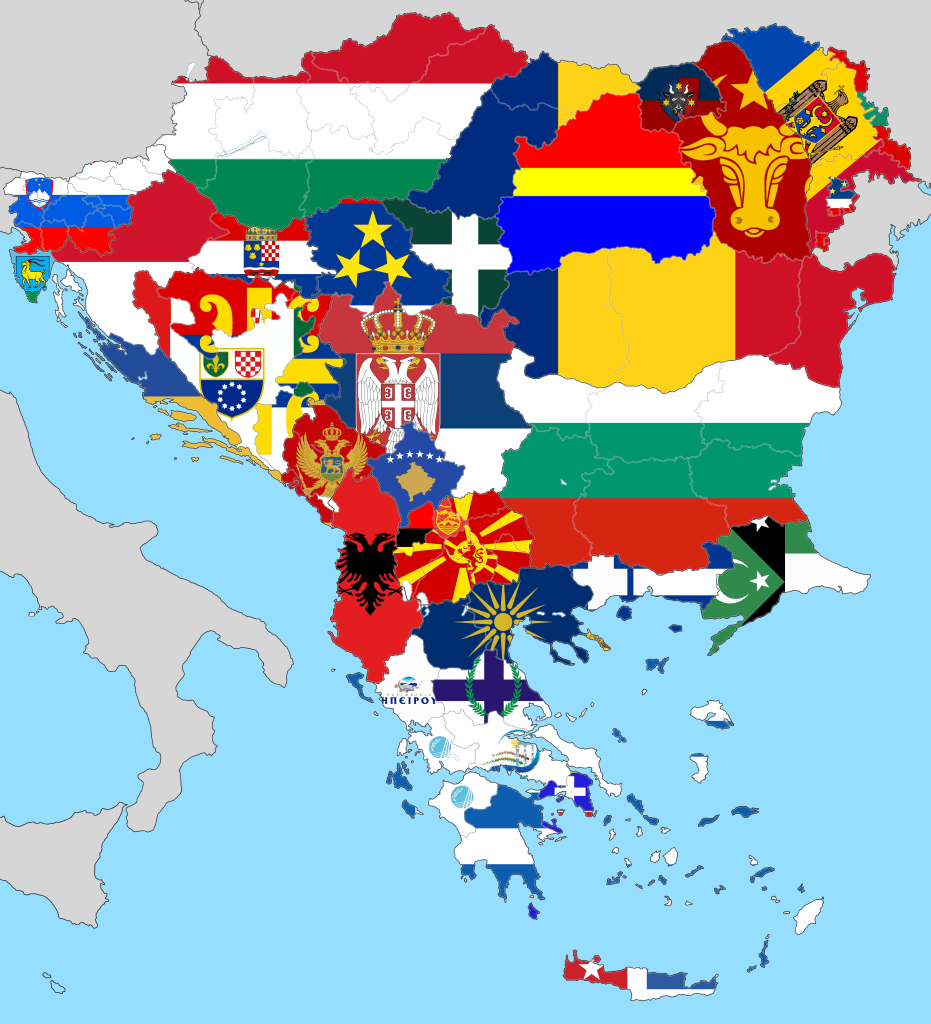
Greece, Albania (Kosovo) [1], North Macedonia, Bulgaria [2], Romania, Moldova [3], Bosnia [4], Serbia (Montenegro) [5], Croatia [6], Slovenia, Hungary [7]

Slovakia, Czech [8], Ukraine [9], Poland [10], Belorussia [11], Lithuania, Latvia [12], Estonia (Finland) [13].

The next chapter focuses on Joktan’s elder brother Peleg and specifically his descendants through Abraham’s brother, Nahor.

Trust in the Lord with all your heart, and do not lean on your own understanding. In all your ways acknowledge him, and he will make straight your paths.

Proverbs 3:5-6 English Standard Version

“Wrong does not cease to be wrong because the majority share in it.”

Leo Tolstoy 1828-1910

© Orion Gold 2021 – All rights reserved. Permission to copy, use or distribute, if acknowledgement of the original authorship is attributed to orion-gold.com

Chedorlaomer & the War of Nine Kings

Chapter XIX

The earliest known historical figure connected with Elam, is Enmebaragsei, the penultimate king of the first Dynasty of Kish who reigned over much of Sumer, possibly as late as circa 2615 to 2600 BCE. The Sumerian King List says he reigned nine hundred years. A more realistic 15 years is probable when dividing by 60, based on the Sumerian sexagesimal system according to an unconventional chronology. Enmebaragesi is a key figure as he bridges the divide between myth and history. He is the earliest ruler to be evidenced directly from archaeology. Four inscriptions have been found with his name. En is an honorary title and not part of his original name. Me means crown; bara means ruler; and si means to fill.

Enmebaragsei fought a successful campaign against Elam, capturing Uruk, confiscating their weapons and imposing his kingship – he “who made the land of Elam submit.” He preceded the Old Elamite period dated to circa 2600 to 1500 BCE, broadly incorporating three main dynasties beginning from approximately the end of his reign. They were the combined Awan I and II era, circa 2600 to 2300 BCE and 2300 to 1930 BCE consecutively; the Shimashki (or Simaski) era, circa 1955 to 1840 BCE; and the Sukkalmah era, circa 1840 to 1500 BCE. It is the end of the 1st dynasty and the beginning of the 2nd with which we are primarily interested.

The Awan (or Avan) II dynasty was contemporary with the Mesopotamian emperor Sargon I or the Great of Akkad, reigning from 2224 to 2169 BCE. He defeated the 12th Awan king, Luh-Ishshan – who reigned circa 2194 to 2169 BCE – subjugating Susa. Historical sources concerning Elam now become more frequent, as the Mesopotamians had developed an interest in resources, such as wood, stone and metal from the Iranian plateau; thereby encouraging more frequent military excursions to the region. 

Though the foreign Guti Dynasty (refer Chapter XXIII Aram & Tyre: Spain, Portugal & Brazil) had been ruling in Sumer since 2088 BCE, it was in 2039 BCE that Akkad fell to the Gutians and with it, the final and 11th king of the Dynasty of Akkad – Shu-Dural (or Shu-Tural). The Gutium spoke an agglutinative language isolate like Sumer and Elam – refer Chapter XXIV Arphaxad & Joktan: Balts, Slavs & the Balkans; and Chapter XVIII Elam & Turkey. The Gutians ruled Sumer and Elam until 1991 BCE. The last king of nineteen, Tirigan, reigned for only 40 days, when Utu-hengal reigning from 1995 to 1988 BCE of the 5th Dynasty of Uruk defeated him – ending the Gutian Dynasty. 

Now, Utu-Hengal was the father of Ur-Namma the 1st King of the Ur III Dynasty from 1988 to 1970 BCE and he in turn, was the father of King Shulgi who reigned from 1970 to 1924 BCE. 

These names are mentioned as there is considerably more to say about Ur-Namma as we progress, who was concurrent with King Kutik-Inshushinak of Elam the next to last king before Chedorlaomer; as well as Shulgi, the 2nd King of Ur, who was a contemporary of the Elamite King Chedorlaomer, as well as the Patriarch Abraham.

Elam declared independence under the supposedly last and 17th Awan king, Kutik-Inshushinak (or Puzur-Insusinak) who reigned from 1980 to 1955 BCE, throwing off the Akkadian language and promoting the Linear Elamite script in the process. Kutik-Inshushinak conquered the future principal Elamite cities of Susa and Anshan. The Shimashki dynasty arose at the tail end of the Awan Dynasties, with an unnamed king from 1955 to 1930 BCE, so that there was a crossover of some twenty-five years. Elam endured a continual threat of attacks from the Sumerians and the Gutians. The Elamite empire state of Shimashki at this time extended into northern Iran and as far as the Caspian Sea. 

A century later in 1882 BCE, the Elamites allied with the city of Susa and led by their king Kindattu (or Kindadu) – ruler from 1892 to 1872 BCE – the 10th king of the Shimashki Dynasty, sacked Ur in Sumer with the first Akkadian King of Isin (or Issn), Ishbi-Erra from 1895 to 1862 BCE; and defeated the 5th and final king of the Ur III Dynasty, the great grandson of Shulgi: Ibbi-Suen, who reigned twenty-four years beginning in 1906 BCE.

The succeeding Sukkalmah dynasty lasting from 1840 to 1500 BCE, is so named after the ‘Great or Grand regents’, the title borne by Elamite rulers. It was also called the Epartid dynasty after the name of its founder Eparti II – also known as Ebarti (or Ebarat) who reigned from circa 1840 to 1820 BCE – and was concurrent with both the Old Assyrian Empire and the Old Babylon period in Mesopotamia. Eparti II was a contemporary of Iddin-Dagan and his reign from 1842 to 1822 BCE; the grandson of Ishbi-Erra and 3rd King of the Isin Dynasty in Akkad – marrying his daughter. 

A ruler named Silhaha – (or Shilkhakha), ruling from 1820 to 1800 BCE – who described himself as ‘the chosen son of Ebarti’ is also credited as the founder of the dynasty. Ebarti II appears as the founder of the dynasty according to building inscriptions, but later kings refer to the second ruler Silhaha, Eparti’s son, in their filiation claims. Possibly, Silhaha won out over a brother; as there was an Eparti III before Shilhaha. Both their names as the founding members of the Sukkalmah Dynasty, have been found on the Gunagi silver vessels, inscribed in the Linear Elamite script. The Gunagi vessels were discovered only recently in 2004.

Notable Eparti dynasty rulers in Elam during this time include the 12th king Siruk-tuh (or Shirukduh), circa 1660 to 1640 BCE, who entered various military coalitions to contain the power of the southern Mesopotamian states; 14th ruler and a son of Siruk-tuh, Siwe-Palar-hupak, circa 1615 to 1595 BCE, who for some time was the most powerful ruler in the region, respectfully addressed as ‘Father’ by Mesopotamian kings such as Zimri-Lim of Mari.

The 16th king, Kutir-Nahhunte I (or Kedor-nakhunta), circa 1560 to 1530 BCE, exacted revenge and plundered the temples of southern Mesopotamia, as the North was under the control of the Old Assyrian Empire. In fact, Kutir-Nahhunte dealt so serious a defeat to the Babylonians that the event was remembered nearly one thousand years later in an inscription of the Assyrian king Ashurbanipal, when he conquered Susa in 660 BCE. 

Trade between the Indus Valley Civilisation and the cities of Mesopotamia and Elam have been deduced from numerous Indus artefacts; particularly in excavations in Susa, showing the origination of the post-diluvian society in the east and the subsequent migration west to the plains of Mesopotamia – refer Chapter I Noah Antecessor Nulla. Objects made with shell species that are characteristic of the Indus coast, such as Trubinella Pyrum and Fasciolaria Trapezium, have been found in the archaeological sites of Mesopotamia and Susa dated circa 2500 to 2000 BCE. Carnelian beads from the Indus were found in Susa in the tell of the citadel excavation. Exchanges seem to have waned after 1900 BCE, with the eventual demise of the Indus valley civilisation. 

It is to this backdrop that we read of an extraordinary account in Genesis chapter fourteen. For a biblical account, it is remarkably detailed and it comprises two parts. A war between a confederacy of Southern Mesopotamian kings against vassal Canaanite kings to the southwest, which we will now look at and an amazing rescue operation of Lot by his uncle, the patriarch Abraham which we will study later in Chapter XXVII Abraham & Keturah – Benelux & Scandinavia.

Genesis 14:1-11

English Standard Version

‘In the days of [1] Amraphel king of Shinar, [2] Arioch king of Ellasar, [3] Chedorlaomer king of Elam, and [4] Tidal king of Goiim [or Nations], 2 these kings made war with 

Bera king of Sodom, Birsha king of Gomorrah, Shinab king of Admah, Shemeber king of Zeboiim, and the king of Bela (that is, Zoar). 

3 And all these joined forces in the Valley of Siddim (that is, the Salt Sea) [north of the present day Dead Sea]. 

Twelve years [from 1907 to 1895 BCE] they had served Chedorlaomer, but in the thirteenth year they rebelled [1907-1895 BCE]. 

5 In the fourteenth year [1894 BCE] Chedorlaomer and the kings who were with him came and defeated the Rephaim in Ashteroth-karnaim, the Zuzim in Ham, the Emim in Shaveh-kiriathaim, 

6 and the Horites in their hill country of Seir as far as El-paran on the border of the wilderness. 7 Then they turned back and came to En-mishpat (that is, Kadesh) and defeated all the country of the Amalekites, and also the Amorites who were dwelling in Hazazon-tamar.

8 Then the king of Sodom, the king of Gomorrah, the king of Admah, the king of Zeboiim, and the king of Bela (that is, Zoar) went out, and they joined battle in the Valley of Siddim 9 with [1] Chedorlaomer king of Elam, [2] Tidal king of Goiim, [3] Amraphel king of Shinar, and [4] Arioch king of Ellasar, four kings against five. 10 Now the Valley of Siddim was full of bitumen pits, and as the kings of Sodom and Gomorrah fled, some fell into them, and the rest fled to the hill country [of Seir]. 

11 So the enemy took all the possessions of Sodom and Gomorrah, and all their provisions, and went their way.’

The five kings of the Plain, happen to represent the exact same five cities that the angels of the Lord came to destroy, sixteen years later and in the process, dramatically rescue Abraham’s nephew Lot, for the second time in his life. The references to the Repha-im, Zuz-im and Em-im are all clans of Nephilim offspring. In fact, the Horites and Amalekites are also included with these mysterious tribes. We will discuss these peoples in depth, in Chapter XXII Alpha & Omega and in Chapter XXIX Esau: The thirteenth Tribe.

Though Chedorlaomer I of Elam is listed third – he is placed first in verse nine – Chedorlaomer is the leader of the northern confederacy. The only king not stated is that of Bela or Zoar. This city and its people were the only one of the five which were not destroyed by the Creator’s wrath during the time of Lot. The time frame is particularly critical, as this battle would need to have taken place between Abraham’s birth in 1977 BCE and his death in 1802 BCE. This would align with the end of the Awan II Dynasty and the beginning of the Shimashki.

Head of Chedorlaomer (and no, it is not Tom Hanks): Height 34.3 cm in Arsenical Copper from Iran, circa 2000 BCE. 

The Metropolitan Museum of Art, 1947

Hitchcock’s Bible Names Dictionary defines the name Chedorlaomer as: a roundness of a sheaf; Smith’s Bible Dictionary as: a handful of sheaves. The full name Chedorlaomer, is not known outside the Bible, although the name is genuinely Elamite. It is composed of two elements, which do appear separately in Elamite sources. ‘Laomer’ is apparently a divine name whose Elamite form is Lagamar. ‘Chedor’ is derived from the Elamite Katir (or Kutir), meaning ‘servant’. We have seen its use in the name of the 16th Sukkalmah Dynasty King Kutir-Nahhunte. The name could also mean ‘servant of the god Lagamar’.

Easton’s Bible Dictionary – emphasis & bold mine: 

‘Many centuries before the age of Abraham, Canaan and even the Sinaitic peninsula had been conquered by Babylonian kings, and in the time of Abraham himself Babylonia was ruled by a dynasty which claimed sovereignty over Syria and Palestine. The most famous king of the dynasty was Khammu-rabi‘ (or Hammurabi), ‘who united Babylonia under one rule, and made Babylon its capital. When he ascended the throne’ – in 1894 BCE an unconventional chronology – ‘the country was under the suzerainty of the Elamites, and was divided into two kingdoms, that of Babylon (the Biblical Shinar) and that of Larsa (the Biblical Ellasar). 

The king of Larsa was Eri-Aku (“the servant of the moon-god”), the son of an Elamite prince, Kudur-Mabug’ or Durmah-ilani, ‘who is entitled “the father of the land of the Amorites.” A recently discovered tablet enumerates among the enemies of Khammu-rabi, Kudur-Lagamar (“the servant of the goddess Lagamar”) or Chedorlaomer, Eri-Aku or Arioch, and Tudkhula or Tidal. Khammu-rabi, whose name is also read Ammi-rapaltuor [for] Amraphel by some scholars, succeeded in overcoming Eri-Aku and driving the Elamites out of Babylonia.’

After the Valley of Siddim campaign, Hammurabi – or Amraphel, King of Shinar and – King of Babylon, ironically chose to go against his three former allies and circa 1893 BCE, he too rebelled. As we progress, we will possess significant support for the confirmation of the four Northern kings identities as real historical figures, as well as a credible time frame for the events recorded. It is proposed that Hammurabi was born in 1912 BCE according to an unconventional chronology and ascended the Babylonian throne in 1894 BCE, at the age of 18; following the abdication of the 5th king of the Amorite Dynasty, his father Sin-Muballit, who ruled for nineteen years from 1913 BCE. 

There is fevered debate over when Hammurabi of Babylon lived. This is convenient for scholars, in that it neatly throws a spanner in the works for conclusively supporting the accuracy of the biblical account. Hammurabi is a colourful and influential king in ancient history and thus for detractors, it is problematic to have such a clear sign of the authenticity of the biblical record; which in turn underpins the veracity of the existence of Abraham and his nephew Lot, whom both fathered peoples who have become prominent 21st century nations.

An informative paper: Abraham and Chedorlaomer Chronological, Historical and Archaeological Evidence by Gérard Gertoux; provides comprehensive research in presenting the evidence for Chedorlaomer’s identity and his place as a legitimate historical king. Where we firstly and slightly disagree, is in the chronology by sixty years; for he has presumably, dated the Exodus in the early sixteenth century, circa 1507 BCE as opposed to the middle of the fifteenth century in 1446 BCE. Secondly, he has adopted the most recent academic opinion regarding the time frame for Hammurabi’s rule; some 200 to 150 years later than proposed hereAppendix IV: An Unconventional Chronology. He states, emphasis & bold mine:

‘The only way to assess the veracity (historical truth) of this event is by determining its exact chronology (“the backbone of history”). Foremost one should know that until now Babylonian chronology, which is the best known, has not been yet fixed since Oppert (1863) made the start of the reign of Hammurabi in 2394 BCE, Thureau-Dangin (1927) lowered this date to 2003 BCE and Gasche proposed (1998) lowering it again to 1696 BCE. Hammurabi has rejuvenated about 700 years during the 20th century!

When T.G. Pinches (1856-1934), lecturer in Assyriology at University College, London and at the University of Liverpool, published the Spartoli tablets he made a link between the biblical names: Amraphel, Arioch, Chedorlaomer and Tidal (Genesis 14:1) and Hammurabi, Eri-e-Aku, Kudur-lahgamal and Tudḫula. Unfortunately this deduction has three major errors: 1) Hammurabi (1697-1654) reigned three centuries after the events, 2) his name is very different from that of Amraphel and 3) the reading “laḫ” of the sign KU [for Chedorlaomer] is not documented.’ 

These three reasons are flimsy at best and are really no more than excuses. The dating conflict regarding Hammurabi’s timeline, means it has to be reconciled with other documents to understand when he truly lived. As we will find that Hammurabi was indeed a contemporary of Chedorlaomer, Arioch and Tidal, it is fitting to parallel his timeline with them. This then resolves the dates for Hammurabi’s life.

Some scholars have made the connecting link between the names Hammurabi and Amraphel. That aside, it is not unusual for people and places to have more than one name. Amraphel may have been his given name. As he was only eighteen when he ascended the Babylonian throne after Sin-Muballit and then ruled for a lengthy forty-two years. A new name may have been chosen as monarchs have done up until our recent history. The Bible possibly records his name as Amraphel as he had just ascended the throne and was in his very first year of his reign. An accurate record, no less than his being subsequently known after his exploits as Hammurabi and recorded as such in future histories.

Etymology shows the lah is actually part of Chedorlaomer’s name, though regardless, the Kudur-…gamal is still strong evidence for the correlation with his identity. Gertoux mixes Akkadian and Elamite together, to show the kudur is Akkadian and la(h)gamal is Elamite. The Akkadian actually says: kudur-lagamar and the Elamite says: kutir-lagamol. The Greek Septuagint refers to him as Chodol-logomor and it is synonymous with the aforementioned as well as the Hebrew name: Kdorla’omer.

Gérard Gertoux – emphasis & bold mine:

Ku-du7-[ur-La-ga-mar] (line 13) reigned 36 years (line 14) over Akkad as king of Awan I (Elam). King List WB 444 (Weld-Blundell Prism) dated c. 1800 B.C. Ashmolean Museum, Oxford (number: AN1923.44).

Kudur-Lagamar’s name is located in a part of the prism which is unfortunately very damaged but three important data have been preserved: [1] a mighty king of Elam at the end of the 3rd millennium BCE, [2] whose name was Kudu[-], [3] died without a successor.

A chronological reconstruction based on synchronisms shows that among the dynasties from Sumerian lists the third and last Elamite king of the Awan I dynasty was Kudur-Lagamar.’

‘The three Elamite kings of the dynasty of Awan I (Puzur-Insusinak [Kutik-Insusinak 1980-1955 BCE], [-]-lu [1955-1930 BCE], Kudur-Lagamar [1929-1893 BCE]) were regarded as genuine kings of Akkad in parallel with the Sumerian kings of the dynasty of Ur III (Ur-Nammu, Sulgi). Besides they used Akkadian in their writings, in place of Elamite, and they quoted Mesopotamian gods rather than their Elamite divinities.’

The Northern kings listed in Genesis fourteen verse one could be geographical in orientation, as Larsa is south of Babylon and Elam is south of Ellasar. Some researchers believe Tidal, King of Nations refers to a very northwesterly position and the peoples of Hatti, or later the Hittites in Anatolia. This would not fit with the cluster of powers in lower Mesopotamia. Nor would assigning all four kings as Assyrian kings as at least one researcher has proposed. This writer considers the Gutians – to the direct north of Elam and northeast of Shinar – as the fourth power in the alliance. We will look at the Gutium in more detail when we study Shem’s fifth son Aram in Chapter XXIII Aram & Tyre: Spain, Portugal & Brazil. 

The three main regions for Shem’s children in Mesopotamia were the city-states of Assyria, then the Land of Shinar and thirdly, Elam. As we have learned, the land of Shinar was split into north and south – refer Chapter XVI Shem Occidentalis. The North was known as Akkad – Akkadia or Accadia – and in time as Babylonia after its main city Babel; while the South was understood as Sumer. These two regions within Shinar, were the combined offspring of Shem’s son Arphaxad** – Chapter XXIV Arphaxad & Joktan: Balts, Slavs & the Balkans

Arphaxad had two great grandsons, Peleg and Joktan. These two sons of Eber were the forefathers of a major split in the family line which we will study – and are confirmed in the Y-DNA super sub-Haplogroup split of R1 into the predominantly eastern R1a and western R1b. As an aside, the four remaining sons of Shem, while encompassing the earlier Haplogroups of G, I1 and I2 are principally identified by the paternal marker Haplogroups R1a and R1b.

There is good reason to acknowledge Peleg’s descendants comprised the northern territory of Akkad and Joktan’s children were located in Sumer. This would explain why two separate, yet closely related cultures arose though still under the banner of the Land of Shinar. Today, the same scenario has occurred with two distinct, yet adjacent regions of eastern and western nations within Europe – yet all descended from Arphaxad.**

In the British Museum there are artefacts mentioning three of the four northern kings at the Battle of the Valley of Siddim. The first two accounts record Chedorlaomer leading a rebellion with Tidal and Arioch’s son Dursrilani, a co-regent perhaps, against the king of Shinar at Babel circa 1929 to 1909 BCE, prior to the Valley of Siddim battle in 1894 BCE. The unnamed king of Shinar then strikes back. This king would have been from the Amorite Dynasty, the same as Hammurabi, the 6th king. The two possible kings are the 4th king, Apil-Sin who reigned from 1930 to 1913 BCE or the 5th king, Sin-Muballit* from 1913 to 1894 BCE. Each are viable as Apil-Sin is Hammurabi’s grandfather and Sin-Muballit, his father. A clear and reasonable motive for Hammurabi’s later actions against Chedorlaomer, suddenly becomes apparent: revenge.

The first artefact is British Museum #BM 35404 – sp II.987, which says: 

“The property and the possessions of Babylon, small and great, in their faithful counsel to Chedorlaomer [Ku-der-lah-ga-mal], king of the land of Elam”… I am a King, the son of a king… the son of a daughter of the king who on the throne of dominion have sat… Dur-sir-ilani the son of Arioch [Eri-ekua] who with the spoil of the throne of dominion sat, and with the sword was killed.”

The second artefact is British Museum #BM 34062 – sp.158 & SPII.962 and states that Chedorlaomer the king of the Elamites, turned against the king of Shinar and attacked his cities at Babil and Borsippa:

“The enemy, the Elamite, multiplied evils against Bel [Baal] and Babil [Babel] which he planned evil against… there he set his mind on destroying the temple… the enemy, the Elamite, took its goods… He decreed it’s destruction… he showed his dislike for and barred the people of Bel of Ezida… the road to Sumer. Who is this Chedorlaomer [Ku-der-lah-ga-mal], the maker of this evil? He has also gathered the Unman-Manda, and the people of Bel he has ruined… the Elamite caused his yoke to be directed down to Borsippa. He set his face against and he traversed also the road of darkness, the road to Mesku. This wicked man the Elamite, destroyed its palace, the princes he subdued with the sword, and from all the temples he carried off their goods as spoils of war, and he took them back to Elam.”

Notice Babylon is referred to as its original name of Babel – its name inherited prior to the Tower of Babel incident – Article: The Pyramid Perplexity. Chedorlaomer was a formidable opponent, a ‘wicked man’ who had subdued a future threat in Babylon and with it, their king – either Hammurabi’s father or grandfather – before amalgamating the states into a powerful coalition. 

Abraham and Chedorlaomer Chronological, Historical and Archaeological Evidence, Gérard Gertoux:

‘The Spartoli tablets (c. 650 BCE) describe [the] famous attack of Babylonia by a coalition of evil kings named Kudur-KUKUmal, [ku.ku means: carrying no mercy] king of Elam, Tudhula, king of Gutium, and Eri-Aku [king of Larsa]. This coalition of kings (Sumer, Larsa, Gutium) united under Kutur-Lagamar is quite likely, because all these kings were vassals or allies of the king of Elam (and Akkad) at that time, moreover, they came from neighbouring regions. Chedorlaomer’s route and the description of his actions show that this king came to this region near Egypt in order to maintain control over this new land trade route. 

This ambitious project had to have worried Amenemhat I (1975-1946) because southern Canaan was a big source of supply. In order to protect Egypt, Amenemhat I built the “Walls of the Ruler”. One can notice that the area of Sodom is called Sutu(m) in execration texts (then Moab after 1800 BCE)’ Moab as a son of Lot, lived where Lot had previously dwelt. 

Gertoux: ‘Thus the kings of Sumer [Ur] were oppressed on two occasions: once by Kudu [Lagamar in 1909 BCE]* king of Awan, and once by Kindadu [in 1882 BCE], king of Simaski. These two kings of Elam left a bad unforgettable memory in Sumerian annals. After the destruction of Ur the kings of Elam were blackened because they were charged with all misfortunes that occurred in the land of Sumer.’

The Pharaoh mentioned by Gertoux, Amenemhat I – who reigned from 1677 to 1647 BCE – was actually a Pharaoh while Joseph and the other sons of Jacob were dwelling in Goshen, the Nile delta region in Lower Egypt – some three hundred years after Gertoux’s orthodox, though inaccurate dating – Appendix IV: An Unconventional Chronology; and Appendix VII: Moses, the Exodus & the Red Sea Crossing – Fabrication or Fact? The wall he built was to the east of the delta region, to protect the eastern Egyptian frontier from the inhabitants of the Sinai Peninsula. As relations with the Israelites were still favourable at this time, it would seem a benevolent act and not an insidious one to contain the prospering sons of Jacob within Egypt’s boundary; though this cannot be ruled out as a partial motive. 

There is only one possible Pharaoh who ruled between 1929 BCE – the ascension of Chedorlaomer to the Elamite throne – and 1907 BCE, the first year of enforced tribute of the Transjordan City-States, who would have been concerned with the growing strength of Chedorlaomer. 

The 3rd Pharaoh of the 1st Dynasty Djer, was the the son of Hor-Aha. Prominent during Djer’s reign was his grandmother, Queen Neithhotep. Cemetery evidence confirms that she lived during the reign of Hor-Aha and succeeded him into Djer’s rule. Neithoptep had been the wife of the 1st Pharaoh, Narmer also known as Menes. The First Dynasty of Egypt is incorrectly dated as beginning circa 3100 BCE. We will return to the dating and accurate sequencing of the Egyptian dynasties in an unconventional chronology.

Djer ruled Lower and Upper Egypt beginning 1922 BCE for fifty-four years until 1868 BCE. What is interesting about this Pharaoh is that it was Djer, who met Abraham and Sarah in 1902 BCE, during the 20th year of his reign while there was a famine in Canaan. We will return to this story in Genesis chapter twelve, when we study Abraham in Chapter XXVII Abraham & Keturah – Benelux & Scandinavia

The third artifact is British Museum #BM 35496 – sp III.2. A new King of Shinar, namely Hammurabi – or Amraphel – counter-attacks Dursirilani, Tidal and Chedorlaomer:

“Samas [Babylonian sun god] the illuminator of… Merodach [chief Babylonian god]… the rulers who were not nourishing… he caused to be slain. Dur-sir-ilani, the son of Arioch [Eri-ekua]… his goods he carried off to the waters of Babylon and back to the temple of Esaggil… his son, with the weapon of his hands, like a lamb he was slaughtered… the child he cut off… Tidal [Tu-ud-hul-amar] son of Gazza… his goods he carried off to the waters of Babylon and to the temple of Esaggil… 

His son, with the weapon of his hands, fell upon him… of his dominion, before the temple of Annunit… Elam, the city of Ahhe to the land of Rabbatu, he spoiled in ruins, he set the fortress of Akkad, the whole of Borsippa…ended Chedorlaomer [Ku-der-lah-ga-mal], his son, and with the steel sword he pierced his heart… his enemy. He took the will of these kings, the lords of sin… their rebellions… who the chief of the gods, Merodach, brought his anger against.”

It entailed a series of battles over a number of years imposed by the king of Shinar, violently slaughtering the other three kings and their families and in the process… ending three separate dynasties in a bloodbath of destruction. The artefacts confirm the names of Dursirilani, Tidal, and Chedorlaomer. Possibly, Arioch was the one casualty amongst the Mesopotamian kings during Abraham’s night time raid and this is why his son Dursirilani is listed as king of Ellasar (or Larsa), at the time of Hammurabi’s betrayal and revenge. Alternatively, Dursirilani may have been a co-regent with his father Arioch.

It was shortly after the Battle of the Valley of Siddim, when Hammurabi rebelled and slaughtered his – once allies now – enemies, beginning in 1893 BCE. 

It may now explain why Amraphel is listed first in the Genesis account. Ultimately, he killed his three rivals; each powerful rulers in southern Mesopotamia. As the king of Babylon and Akkad, Amraphel added the kingship of Sumer while subjugating both the lands of Elam and the Guti.

Regarding Chedorlaomer, the International Standard Bible Encyclopaedia, on British Museum Sp. II 987 and Sp. III, 2, records: 

‘… refers to the bond of heaven extended to the four regions, and the fame which Merodach set for the Elamites in Babylon, the city of his glory. So the gods, in their faithful or everlasting counsel, decreed to Kudur-lahgumal, king of Elam their favor. He came down, and performed what was good to them, and exercised dominion in Babylon, the city of Kar-Dunias (Babylonia). When in power, however, he acted in a way which did not please the Babylonians… [between 1929 and 1894 BCE].

The less perfect fragment (Sp. III, 2) contains, near the beginning, the word hammu, and if this be, as Professor F. Hommel has suggested, part of the name Hammurabi (Amraphel), it would in all probability place the identification of Kudur-lahgumal with Chedorlaomer beyond a doubt.’

This would cement an already compelling argument for the veracity of the king of Shinar’s identity as Hammurabi, who as Amraphel, was a contemporary of and briefly allied with Chedorlaomer, when he ascended the throne in 1894 BCE. Amraphel then in turn, rebelled against Chedorlaomer, killing him in 1893 BCE for the humiliation perpetrated against probably his father, Sin-Muballit or possibly his grandfather, Apil-Sin.

King Hammurabi

Hammurabi and the Babylonian Empire, Dr Joshua J Mark, 2018 – emphasis mine:

‘Hammurabi (also known as Khammurabi and Ammurapi… assumed the throne… and expanded the kingdom to conquer all of ancient Mesopotamia. The kingdom of Babylon comprised only the cities of Babylon, Kish, Sippar, and Borsippa when Hammurabi came to the throne but, through a succession of military campaigns, careful alliances made and broken when necessary, and political manoeuvres, he held the entire region under Babylonian control by [his death].

According to his own inscriptions, letters and administrative documents from his reign, he sought to improve the lives of those who lived under his rule. He is best known in the modern day for his law code which, although not the earliest code of laws, came to serve as a model for other cultures and is thought to have influenced the laws set down by Hebrew scribes, including those from the biblical Book of Exodus.

The fifth king of the dynasty, Sin-Muballit… successfully completed many public works projects but was unable to expand the kingdom or compete with the rival city of Larsa to the south. Larsa was the most lucrative trade center on the Persian Gulf and the profits from this trade enriched the city and encouraged expansion so that most of the cities of the south were under Larsa’s control. Sin-Muballit [1913-1894 BCE] led a force against Larsa but was defeated by their king Rim Sin I [1924-1865 BCE]. At this point it is uncertain what exactly happened, but it seems that Sin-Muballit was compelled to abdicate in favor of his son Hammurabi. Whether Rim Sin I thought Hammurabi would be less of a threat to Larsa is also unknown but, if so, he would be proven wrong. 

The historian Durant writes: “At the outset of [Babylonian history] stands the powerful figure of Hammurabi, conqueror and lawgiver through a reign of forty-three years. Primeval seals and inscriptions transmit him to us partially – a youth full of fire and genius, a very whirlwind in battle [akin to Alexander the Great], who crushes all rebels, cuts his enemies into pieces, marches over inaccessible mountains, and never loses an engagement. Under him the petty warring states of the lower valley were forced into unity and peace, and disciplined into order and security by an historic code of laws.”

‘The alliances [Hammurabi] made with other states would repeatedly be broken when the king found it necessary to do so but, as rulers continued to enter into pacts with Hammurabi, it does not seem to have occurred to any of them that he would do the same to them as he had previously to others. A technique he seems to have used first in this engagement would become his preferred method in others when circumstances allowed: the damming up of water sources to the city to withhold them from the enemy until surrender or, possibly, withholding the waters through a dam and then releasing them to flood the city before then mounting an attack.’

In 1866 BCE, the undefeated Hammurabi turned against Rim-Sin I because he had refused to support Hammurabi in his ongoing war against Elam, despite pledging troops. Hammurabi with extra troops from Mari, attacked Mashkan-shapir located on the northern edge of Rim-Sin’s realm. Hammurabi’s forces reached Larsa with alacrity and after a six-month siege the city of Larsa fell. Rim-Sin I escaped from the city but was soon found, taken prisoner and died thereafter in 1865 BCE. Rim-Sin I was the 14th and last king of the Larsa Dynasty which had begun in 2128 BCE.

In 1864 BCE, Hammurabi defeated a coalition that stood against him comprising Elam, the Guti and the Marhashi kingdom in Iran. The following year, he defeated Zimri-Lim the King of Mari, an Amorite kingdom northwest of Babylon and his former ally. Hammurabi not only broke his alliance with Zimri-Lim but also for the first and only time, completely destroyed Mari rather than conquering it. Hammurabi would subdue cities, absorb them into his kingdom, repair and improve them. Scholars have debated his reasons and believe Mari’s great wealth posed a threat and was too close in proximity to Babylon’s designs on being the greatest city in Mesopotamia. 

After Mari’s destruction, Hammurabi marched on Asshur, took control of the extent of Assyria and then Eshunna; so that by 1857 BCE – five years before his death at age sixty – he ruled all of Mesopotamia.

Joshua Mark: ‘A popular title applied to Hammurabi in his lifetime was bani matim, ‘builder of the land’, because of the many building projects and canals he ordered constructed throughout the region. Documents from the time attest to the efficacy of Hammurabi’s rule and his sincere desire to improve the lives of the people of Mesopotamia… letters and administrative works… such as directives for the building of canals, food distribution, beautification and building projects, and legal issues…

His law code is not the first such code in history (though it is often called so) but is certainly the most famous from antiquity prior to the code set down in the biblical books. The Code of Ur-Nammu… which originated with either Ur-Nammu or his son Shulgi of Ur, is the oldest code of laws in the world. Unlike the earlier Code of Ur-Nammu, which imposed fines or penalties of land, Hammurabi’s code epitomized the principle known as Lex Talionis, the law of retributive justice, in which punishment corresponds directly to the crime, better known as the concept of ‘an eye for an eye and a tooth for a tooth’, made famous from the later law code of the Old Testament… 

By [1857 BCE]… Hammurabi was old and sick. In the last years of his life his son, Samsu-Iluna’ who ruled from 1852 to 1815 BCE, ‘had already taken over the responsibilities of the throne and assumed full reign by’ 1851 BCE. ‘The conquest of Eshnunna had removed a barrier to the east that had buffered the region against incursions by people such as the Hittites and Kassites. Once that barrier was gone, and news of the great king weakening spread, the eastern tribes prepared their armies to invade. 

The vast kingdom Hammurabi had built during his lifetime began to fall apart within a year of his death, and those cities that had been part of vassal states secured their borders and announced their autonomy. None of Hammurabi’s successors could put the kingdom back together again, and first the Hittites… then the Kassites invaded. The Hittites sacked Babylon and the Kassites inhabited and re-named it. The Elamites, who had been so completely defeated by Hammurabi decades before, invaded and carried off the stele of Hammurabi’s Law Code which was discovered at the Elamite city of Susa in 1902 CE.’

Gérard Gertoux summary:

‘Kedor-Lagomer corresponds to Kudur-Lagarma which is an Akkadian transcription of Kutir-Lagamal “bearer (servant) of Lagamal”. According to the biblical text (Genesis 10:10), Shinar was a region south of Mesopotamia composed of at least three major cities: Babylon (Babel), Uruk (Erech) and Aggad (Akkad). In time the name Babylon came to mean the whole of Babylonia (Daniel 1:2). During the period [1988-1894 BCE] the two main actors in the Mesopotamian world were the kings of Ur III and the kings of [late] Awan I [/II and early Shimashki]. 

The power of these two empires [Sumer and Elam] depended on trade and therefore control of trade routes. They earned money through vassal kings who levied customs duties on traders passing through their territories and had to pay to their “emperors” for ensuring their security (by means of military force). Kudur-Lagamar probably wanted to create a new major trade route from Susa to Egypt. The route taken by Abraham and that one followed by Chedorlaomer are in agreement with the major communication routes of the time.

In this context, the capture of the goddess Nanaya [in 1909 BCE] served to justify the westward expansionist projects of Kudur-Lagamar. Indeed, change in titulatures confirm his new role of “king of Akkad”. The complete titulature of the kings of Awan I, as the one of Puzur-Insusinak, was as follows: governor (ENSI) of Susa, viceroy (GIR.NITA) of Elam and king (LUGAL) of Awan. 

Abram…at that time… lived in Ur… he must have learned that Chedorlaomer had confiscated the statue of the goddess Nanaya [Inana or Ishtar]. [As the Assyrian king] Ashurbanipal refers exactly [circa 660 BC] to Ku-du[r-Lagamar], king of Awan I, in Sumerian royal lists and as the Spartoli tablets describe the attack of Babylonia by the king of Elam named Kudur-KUKUmal, this king of Elam must have been Chedorlaomer

Prior to [1909 BCE] relationships with the kings of Elam remained cordial… From this date Kutur-Lagamar behaves as “King of Akkad” and, in the same way as Sargon of Akkad, he chose to open a new trade route to the west as far as Egypt. Titulary of Ur… kings changed… [from] King of Sumer and Akkad… [to] King of the 4 corners (of Universe) [an indicative title of the later Mede and Persian (Elamite) empire], indicating that Akkad was no longer under full control of the king of Ur… 

[In summation]: King Kudur-Lagamar [reigning from 1929 to 1893 BCE] alias Chedorlaomer, actually existed since he was the third and last king of Awan I, the only Elamite dynasty mentioned in Sumerian lists. His two main actions that have passed to posterity were the capture of Uruk’s goddess (Nanaya) and [the] looting of the city of Sodom.’

The timing of two years – as deduced from Gertoux’s chronology – prior to the beginning of the tribute being exacted on the Canaanite cities in 1907 BCE, means King Chedorlaomer of Elam with his allies, Tudhula, king of the Gutium, and Eri-Aku king of Larsa, would have fought both the kings of Babylon [Akkad] and Sumer [Uruk] to gain control of the land of Shinar. This was twenty years after Chedorlaomer came to the throne of Elam and thus gave him ample time to consolidate his power, build his military capability and win or subjugate the necessary allies. 

This means, we now know which king he fought against in Babel; it would have been Hammurabi’s father, Sin-Muballit who reigned from 1913 to 1894 BCE – the 5th king of the Amorite Babylonian Dynasty – and in Ur, King Shu-Suen ruler from 1915 to 1906 BCE; the grandson of Shulgi, the son of Ur-Nammu, the founder of the Ur III Dynasty. This explains the abdication of Sin-Muballit in favour of his son, Hammurabi who was probably chosen by Chedorlaomer as a puppet king. A role that the young Amraphel spectacularly did not follow.

Hasting’s Dictionary of the Bible, C H W Johns & James Hastings, 1909:

‘Arioch king of Ellasar was allied with Chedorlaomer in the campaign against the kings of the plain (Genesis 14:1). He has been identified with Rim-sin, king of Larsa, and consequently Ellasar is thought to be for al-Larsa, the city of Larsa. Larsa, modern Senkereh in Lower Babylonia on the east bank of the Euphrates, was celebrated for its temple and worship of the sun-god Shamash’ – Article: Monoliths of the Nephilim.

The meaning of Ellasar is very close to the meaning of Nimrod, who we will study in detail – Chapter XXI The Incredible Identity, Origin & Destiny of Nimrod. Ellasar in Hebrew means ‘rebellious God’ or ‘onto rebellion’ from the word ‘el, meaning God; or denoting motion toward and the verb sarar, ‘to be rebellious’ or ‘stubborn’, though more in attitude rather than revolt.

The city of Ellasar, is believed by most scholars to be the same city identified as Larsa. Some place it far north where the Hurrians dwelt, though this would not fit with the cluster of the remaining three cities in southern Mesopotamia. Larsa is credibly located southeast of the very ancient city of Erech or Uruk – from which Iraq derives its name – and northwest of Ur, where Abraham’s family originated – Chapter XXV Italy: Nahor & the Chaldeans

Tudhula of the Gutium is reputed to have ruled approximately from 1909 to either 1893 or possibly 1864 BCE. Support for these dates, is that Tidal may have come to power due to Chedorlaomer’s politicking and thus as one of his allies, would have assisted in the defeat of Babylon and Ur in 1909 BCE. Plus, Tidal if still king, would have died when Hammurabi defeated his coalition with Elam in 1864 BCE – or more likely earlier in 1893 BCE as discussed.

International Standard Bible Encyclopedia – emphasis mine:

‘ERI-AKU er-i-a-koo’, e-ri-a-ku’: This is the probable Sumerian reading of the well-known Babylonian name written with the characters for “servant” (Sem wardu or ardu) and the group standing for the Moon-god Sin^ (written En-zu = Zu-en), otherwise Aku, the whole meaning “servant of the Moon-god.” This ruler, who was king of Larsa [Ellasa], is generally identified with the Arioch of Genesis 14:9. Eri-Aku belonged to an Elamite family which held the throne of Larsa, a state which, in common with Babylonia itself, acknowledged the suzerainty of Elam… it may be noted, that the expression adda, “father,” probably means simply “administrator”.’

Gérard Gertoux: ‘The Akkadian name Warad-Sin, king (LUGAL) of Larsa, is written Eri-Aku (e-ri-a-ku) which is a transcription of the Sumerian name IR-AGA “servant of the lunar disc” translated into Akkadian as (u)-ar-du-a-gu… Warad-Agu, an equivalent of Warad-Sin “servant of the Moon^ (god)”.’

What is interesting here, is that Rim-Sin I was the final king of the Larsa Dynasty from 1924 BCE to 1865 BCE and he is identified with Arioch of Ellasar (or Eri-Aku of Larsa). Yet Gertoux says Warad-Sin is also Eri-Aku, or Arioch. In the king lists, Warad-Sin was the brother of Rim-Sin I and supposedly ruled for twelve years prior to his brother from 1936 BCE to 1924 BCE and as a co-regency with his father, Kudur-Marbuk. Arioch, may then be a family name, a title, or even a descriptive name.

For we learn more about Eri-Aku in the Targum of Palestine account of Genesis 14:9, in that Eri-Aku was a giant. He was called Arioch due to his great height. Arioch is derived from Arik which means ‘tall among the giants’. Even compared to other giants, Arioch was impressive and intimidating. This is an interesting piece of information, as the Northern confederacy fought against Nephilim descended Elioud giants before literally turning around to subdue the five Canaanite kings. 

Picking up the story from Genesis Six Giants, emphasis mine:

‘Of course, no ancient records exist that tell us how many giants served under Chedorlaomer. He may have had only Arioch, or that towering king plus a few others, or he may have had many such men in his service. In any event, the results of their opening battle with the Jordanian giants clearly show that he commanded a far superior force. Sweeping down the valley, his army quickly laid siege to Ashteroth Karnaim.

This chief city of the Rephaim lay in the district of Bashan,’ – refer Chapter XXII Alpha & Omega; and Chapter XXXIV Dan: The Invisible Tribe – ‘about six miles northwest of Edrei. These giants worshipped Astarte, the goddess of the crested^ moon’ – refer article: Lilith. 

‘They were greatly decimated. Continuing along what the ancients called the King’s Highway, a trade route that ran the entire length of the Trans-jordanian plateau to the Gulf of Aqabah, Chedorlaomer and his confederate kings next fell upon the enormous Zamzummim people at Ham. Some archaeologists identify this city with modern Ham, which is located in eastern Gilead, about four miles south of Irbid. 

After this, the kings from Elam and Mesopotamia attacked and cut off the terrible Emim giants at nearby Shaveh Kiriathaim. These people, described as “great and many and tall,” occupied the land that the Moabites later took. Sodom and Gomorrah, at the [northern] tip of the Salt Sea, stood next in line. They quickly got ready to defend themselves, expecting the worst. But to their amazement the invaders passed them by. Pressing on southward into the rough mountain range of Seir, Chedorlaomer waged war instead against the giant Horites.’

The land of Canaan was infested with Nephilim descended Elioud and was literally the land of the giants. In verse seven of Genesis chapter fourteen, just after the Horites are mentioned, we read about the defeated Amalekites. This reveals that the Amalekites existed before Esau had a future grandson called Amalek, some one hundred and twenty years later. Esau was to marry into and live with the Nephilim related Horites. The Amalekites of the Bible are identifiable in secular sources under a different name, which we will study. The link in Genesis fourteen between the Horites and Amalek and then Esau marrying into the Horites and naming a grandson Amalek is not only not a coincidence, but rather quite significant – refer Chapter XXIX Esau: The Thirteenth Tribe; and article: Na’amah. The Amalekites were also Elioud and related to the giant Horites.

Genesis 6 Giants: ‘He also conquered the Negev to eliminate any threat from that quarter. Having thus neutralized all the countryround, he finally turned his attention upon the rebellious Sodom and Gomorrah and their neighbors. Giving up whatever security their fortified walls afforded them, “the king of Sodom and the king of Gomorrah and the king of Admah and the king of Zeboiim and the king of Bela (that is, Zoar) came out,” notes Moses; “and they arrayed for battle against them in the valley of Siddim, against Chedorlaomer king of Elam and Tidal king of Goiim and Amraphel king of Shinar and Arioch king of Ellasar – four kings against five”.’

Regarding these ‘Canaanites’, the Book of Jasher 10:25-27, states:

‘And four men from the family of Ham went to the land of the plain; these are the names of the four men, Sodom, Gomorrah, Admah and Zeboyim. And these men built themselves four cities in the land of the plain, and they called the names of their cities after their own names. And they and their children and all belonging to them dwelt in those cities, and they were fruitful and multiplied greatly and dwelt peaceably.’

Recall, the original inhabitants of Canaan unsurprisingly, were the peoples descended from Canaan – the son of Ham – refer Chapter XII Canaan & Africa. The Nephilim arrived after the Canaanites and dwelt amongst them. The Book of Jasher claims Nimrod was the king of Shinar. We have learned that Hammurabi is undoubtedly the king in question. Nearly 5,000 years elapsed since Nimrod and the Tower of Babel incident and though longevity was on his side, it would be unlikely he was still living at this time. Such a powerful figure such as he was, he would have been still ruling and making his presence known if alive. His inferred demise points to when the Tower was ‘destroyed’ – refer Chapter XXI The Incredible Identity, Origin & Destiny of Nimrod.

Genesis 6 Giants: ‘This bold strategy to meet the invaders in the open field was decided by the surrounding treacherous terrain. Many slime pits, dug to obtain pitch or mortar for building, transversed the area. While most English translations simply describe the Valley of Siddim as being “full of slime pits,” the force of the original Hebrew language, according to Speiser, conveys to the reader a picture of “one bitumen pit after another.” The locals were most familiar with the locations of these pits. The invaders were not. 

They were also accustomed to the foul-smelling, boiling waters on whose surface floated lumps of asphalt or bitumen the size of bulls. The enemy, they hoped, would be at least a little disconcerted by the unfamiliar terrain and terrible odor and afraid of falling into the boiling waters. But the pits failed to deter the invaders. Indeed, they soon turned them to their own advantage. In the resulting warfare, many in the defenders’ ranks saw death. Alarmed by the way the battle was progressing against them, the five local kings and their armies panicked and attempted to flee the field. The slime pits, however, made retreat difficult. In the confusion, two of the fleeing kings – and presumedly many men with them – fell into the tar pits. Those who escaped fled into the mountains.

For a time some scholars disbelieved this Genesis story, labeling it a fiction. But evidence dug up by archaeologists in recent years verifies that in Abraham’s time a great destruction came upon the very places mentioned in Chedorlaomer’s invasion. 

Dr. Nelson Glueck, whose work in this area extended from 1932 until 1947, when it was halted by the Israeli-Arab disturbances, reports that the highly developed civilization which flourished here during the Middle Bronze I period (c. 2100-1900 B.C.) came to an abrupt and savage end [in 1894 BCE]. 

This well-known archaeologist found that not only the cities mentioned in Genesis but also many villages – beginning with Ashtaroth-Karnaim and proceeding south through Transjordan and the Negev to Kadesh Barnea in the Sinai – were systematically gutted. “From southern Syria to central Sinai, their fury raged,” he writes. “A punitive expedition developed into an orgy of annihilation. I found that every village in their path had been plundered and left in ruins, and the countryside laid waste. The population had been wiped out or led away into captivity. For hundreds of years thereafter, the entire area was like an abandoned cemetery, hideously unkept, with all its monuments shattered and strewn in pieces on the ground”.’

Flying Serpents and Dragons, R A Boulay, 1997 & 1999, Page 148:

‘The power of the invading kings, numbered as 800,000 according to the Haggadah, must have been overwhelming indeed, for they not only crushed these fortified cities but they never were rebuilt and the land [of the northern tip of the Dead Sea] remained unoccupied for a thousand years.’ 

Some will repeatedly take an opposing view and there will always be those who do not see what is in plain sight. Yet we have substantial verification documenting as historically authentic, the biblical account recording a devastating war.

The four northern kings were real personages and led the ancient coalition comprising city-states located in Elam, Akkad, Sumer and Aram. Acadia represented by descendants of Peleg and Sumer by those from Joktan – brothers and great grandsons from Shem’s son Arphaxad, collectively known as the land of Shinar – and with Elam and Aram, they exacted terrible revenge for disobedience by the southern kings of Ham and the Nephilim descended Elioud giants.

The modus operandi consisting of devastating destruction rings true, for we have learned how both Chedorlaomer and Hammurabi were uncompromising in their style of warfare. Possibly, a further reason why Amraphel is listed first, even while still a youngster; with his blitzkrieg style, he likely made a sizeable impression and perhaps shared the lead in the ensuing carnage; the obliteration of the opposition forces; and the desolation of their land.

“Look,” says the Teacher, “I have discovered this by adding one thing to another to find out the explanation…”

Ecclesiastes 7:27 Christian Standard Bible

“I would rather be in minority and be right, than in the majority and wrong.”

Jodi Picoult 

© Orion Gold 2020 – All rights reserved. Permission to copy, use or distribute, if acknowledgement of the original authorship is attributed to orion-gold.com
Shem Occidentalis

Chapter XVI

Noah’s third son is Shem. His descendants are prominent in the Bible and influential in the history of civilisation. His descendants – from all his five sons – are the European, western peoples of the Earth located in Europe, West Asia and the New World of the Americas as well as in Australia, New Zealand and South Africa. They include a diverse range of peoples from fair skin, blue eyes and blond hair, to olive skin, brown eyes and black hair. 

Shem in Hebrew, means: ‘name’ or ‘renown’ from the noun shem.

Abarim Publications – emphasis mine:

‘Shem became the ancestor of Abraham and thus Jesus (Luke 3.36)… Shem… lent his name to the language group that Hebrew is part of: Semitic. The name Shem is equal to the word (shem), which itself means “name”:

The name Shem means Name, Fame or Reputation, or even Identity or Personality… we’re pretty sure that Shem wasn’t named after his own fame or prowess but rather after the Name of the Creator, which in turn reflected all of his deeds…

For a meaning of the name Shem, NOBSE Study Bible Name List reads… Renown. Jones’ Dictionary of Old Testament Proper Names… adds Celebrated, Distinguished.’

We will look at additional definitions and ramifications for Shem’s name when we study Nimrod in Chapter XXI The Incredible Identity, Origin & Destiny of Nimrod. Shem is mentioned in the genealogical lists in Genesis Ten and 1 Chronicles One with his brothers. We have investigated the incident involving Noah, Ham and Canaan – refer Chapter XI Ham Aequator. Shem with Japheth, acted honourably in dealing with the aftermath and his reward is recounted in Genesis 9:26, Expanded Bible:

Genesis 9:26

Expanded Bible

‘Noah also said, “May the Lord, the God of Shem, be praised [or blessed]! May Canaan be Shem’s slave.”

Notice, Shem wasn’t being praised or his name, but rather the Creator. There is a clue here that Shem may have been similar to Noah, Enoch and Abel before them, in being a member of a priestly line and a servant of the Creator.

Some teach that Shem is the same person as the priest of the most High God, Melchizedek, whom Abraham paid tithes to and partook of bread and wine. In the Book of Jasher it says in chapter sixteen, verses 11-12:

11 ‘And Adonizedek king of Jerusalem, the same was Shem [of renown], went out with his men to meet Abram and his people, with bread and wine, and they remained together in the valley of Melech‘ – refer articles: Na’amah; and Belphegor. 12 ‘And Adonizedek blessed Abram, and Abram gave him a tenth from all that he had brought from the spoil of his enemies, for Adonizedek was a priest before God.’

Using Usher’s widely accepted biblical chronology, this would be possible. Combining science (worldwide geological flood evidence is missing for circa 4000-2500 BCE) and an accurate chronology (an unconventional chronology based on the Sumerian sexagesimal base 60 system) for the Old Testament epoch following the Flood – and prior to Genesis chapter twelve – it would be impossible for Shem and Abraham to meet, as Shem died in 5717 BCE and Abraham was born in 1977 BCE. That aside, Melchizedek is a unique personality and not to be mistaken for Shem or even Christ as some propose. We will look at Nimrod’s kingdom later, though for now it is interesting to note that his territory was the ‘land of Shinar’ – Chapter XXI The Incredible Identity, Origin & Destiny of Nimrod.

Shinar is mentioned outside of the Nimrod account recorded in Genesis Ten and Eleven.

Joshua 7:20-21

English Standard Version

20 ‘And Achan answered Joshua, “Truly I have sinned against the Lord God of Israel, and this is what I did: 21 when I saw among the spoil a beautiful cloak from Shinar, and 200 shekels of silver, and a bar of gold weighing 50 shekels, then I coveted them and took them. And see, they are hidden in the earth inside my tent, with the silver underneath.”

Isaiah 11:11

English Standard Version

11 ‘In that day the Lord will extend his hand yet a second time to recover the remnant that remains of his people, from Assyria [Asshur (Russia)], from Egypt [Mizra – Arabs (of the Middle East and North Africa)], from Pathros [nation of Egypt], from Cush [India], from Elam [Turkey], from Shinar [Europe], from Hamath [Nigeria], and from the coastlands of the sea [East Asia and South East Asia].’

Zechariah 5:10-11

English Standard Version

10 ‘Then I said to the angel who talked with me, “Where are they taking the basket?” 11 He said to me, “To the land of Shinar, to build a house for it. And when this is prepared, they will set the basket down there on its base.”

What is the Land of Shinar and Where is it Located? Petros Koutoupis, 2007 – emphasis & bold mine:

‘Genesis 10:10 And the beginning of his kingdom was Babel [Babylon], and Erech, and Accad, and Calneh, in the land of Shinar. Genesis 10:11 Out of that land went forth Asshur [Nimrod], and built Nineveh [capital], and Rehoboth-ir, and Kalaḥ, Genesis 10:12 and Resen between Nineveh and Kalaḥ – the same is the great city. 

In the past, many have argued… about the true location of the land of Shinar… among a majority of scholars in the same field, [I] have identified this to mean the land of Sumer. While the Sumerians themselves called their land ki-en-gir (“place of the civilized lords”), the name Sumer is derived from the Akkadian Shumer [Shem]. 

Shinar is simply a Hebrew corruption of the Akkadian word. It literally translates to “country of two rivers” which could only mean the Tigris and Euphrates when taking into account the cities mentioned above. 

Erech/Uruk, Akkad/Agade, and Babylon existed nowhere else but the land of Shinar. In times past, early rulers used to differentiate the lands between Sumer and Akkad when boasting of their achievements, making the one the southern kingdom (Sumer) and the other the northern kingdom (Akkad). 

Collectively this had evolved to one piece of land between the two rivers. Further evidence of its location, outside of Genesis 10:10-11 comes to us from the Book of Daniel: 

1:1 In the third year of the reign of Jehoiakim king of Judah came Nebuchadnezzar king of Babylon unto Jerusalem, and besieged it. 1:2 And the Lord gave Jehoiakim king of Judah into his hand, with part of the vessels of the house of God; and he carried them into the land of Shinar to the house of his god, and the vessels he brought into the treasure-house of his god. 

Nebuchadnezzar [II], a Neo-Babylonian king to whom Jerusalem fell [during 607-587 BCE] under which also resulted in the Jewish Exile, was said to have come from the land of Shinar or Chaldea.

Erech has been identified with the Mesopotamian city of Uruk (Sumerian Unug); the home and kingdom of Gilgamesh. Akkad has been identified with Agade, the capital of the Akkadian Empire. Babel was the native name of the city the Greeks called Babylon, which literatally translates [as] “gate of god”, corresponding to the Akkadian Bab-ili. As for the location of Calneh, modern day scholars have located this to be Nippur (modern day Niffer), which is situated in the marshes of [the] east bank of the Euphrates; roughly 60 miles southeast of Babylon.’

Assyria derived from Asshur, was situated to the north of Akkad and not counted as the land of Shinar. The land of Shinar incorporated Akkad and Sumer, with Babylon formerly Babel, to the south of Akkad; located approximately in the middle of the two regions. Thus the cities of Accad and Babylon were northwards in Akkad and Calneh or Nippur and Erech further south in Sumer. ‘Sumer’ and the Sumerians derive from the name Shem, while the Akkad[ian] origin is unclear. The term Chaldea[n] is believed to have derived from Shem’s son Arphaxad. Akkad is possibly linked to Arphaxad as well. 

The early geography involved descendants from three of the sons of Shem in close proximity after the Tower of Babel, so that in the north of the fertile crescent there was located Asshur, below them, Arphaxad and beneath them, Elam. Aram or Syria and Lud or Lydia, were not so clearly defined. Lud has been identified more with Ham’s children, particularly Mizra and may have been located originally south of Shinar. Lud is invisible until he appears in Anatolia in Western Asia Minor – refer Chapter XIV Mizra: North Africa & Arabia; and Chapter XVII Lud & Iran. The same applies to Aram until he appears north of Assyria and to the East of Lud. This layout will come into clearer focus, once we uncover the five identities of the sons of Shem. 

The Races of the Old Testament, A H Sayce, 1891, pages 60-61 – emphasis mine:

‘… But Babylonia had not always been in Semitic hands. Its earliest population belonged to another race, and the language which they spoke was agglutinative… it was the pre-Semitic population, and not the Semitic intruders, to whom the origin of Chaldaean culture and civilisation were due. It was this population who were the inventors of the pictorial characters which developed into the cuneiform syllabary, they were the first to write on tablets of clay, they founded the great cities and temples of the country, and initiated the art and science, the literature and law, the systems of government and religion which the Semitic Babylonians afterwards inherited. Babylonia was divided into the two provinces of Accad in the north and Sumer… in the south; Accad was the first to fall under Semitic influence and domination, and it was here that the first Semitic empire that of Sargon of Accad took its rise.’

Turkey (or Elam) is not considered by all biblical historians as a line of Shem but invariably from Japheth. The interaction of Elam with Madai – descended from Japheth – accounts for some of the confusion. The pictorial characters are the cursive script of Elam and evidenced today by modern Turkish. Recall in the previous chapter we touched upon the link between Turkish and Sumerian. Agglutinative is defined as: ‘pertaining to or noting a language, as Turkish, characterized by agglutination.’ It includes ‘the act or process of uniting by glue or other tenacious substance, the state of being thus united; adhesion of parts, that which is united; a mass or group cemented together.’

In linguistics: ‘a process of word formation in which morphemes, each having one relatively constant shape, are combined without fusion or morphophonemic change, and in which each grammatical category is typically represented by a single morpheme in the resulting word, especially such a process involving the addition of one or more affixes to a base, as in Turkish, in which ev means “house,” ev-den means “from a house,” and ev-ler-den means “from houses.”

Though descended from Shem, Elam as Turkey, has its feet planted firmly in the two worlds of Japheth and Ham, as evidenced by its link with the Central Asians; a Turko-Mongol language; and the non-European religion of Islam – refer Chapter IV Central Asia – Madai & the Medes; and Chapter XVIII Elam & Turkey. In time, Elam moved eastwards from Sumer – adjacent to the Persian Gulf, into modern day Iran – and hence the gradual lessening of their influence on the descendants of Arphaxad who moved southwards from Akkadia into Sumer – refer Chapter XXIV Arphaxad & Joktan: Balts, Slavs & the Balkans.

Two other nations which have agglutinating languages, causing dispute regarding their language families are the Korean and Japonic languages. An understandable coincidence, as we have learned in Chapter six and nine, that both Korea descending from Gomer and Japan from Javan, migrated in a different pattern to their brothers in South East Asia. Thus, their languages are not readily linked to not-so-related close neighbours China, or more closely related, yet geographically distant relatives in the southeast of Asia – Chapter VI Togarmah & the Koreas; and Chapter IX Tarshish & Japan.

Book of Jubilees 7:13-18

‘And Ham knew that his father had cursed his younger son, and he was displeased that he had cursed his son and he parted from his father, he and his sons with him, Cush [Indians] and Mizraim [Arabs] and Put [Pakistan] and Canaan [Africans]. And he built for himself a city and called its name after the name of his wife Na’elatama’uk. And Japheth saw it, and became envious of his brother, and he too built for himself a city, and he called its name after the name of his wife ‘Adataneses.

And Shem dwelt with his father Noah, and he built a city close to his father on the mountain, and he too called its name after the name of his wife Sedeqetelebab. And behold these three cities are near Mount Lubar; Sedeqetelebab fronting the mountain on its east; and Na’eltama’uk on the south; ‘Adatan’eses towards the west. And these are the sons of Shem: Elam, and Asshur, and Arpachshad…’

This account relates to the period after the flood, or shortly after the incident with Noah – Chapter XI Ham Aequator. If Noah stayed close to the Kashmir area, then the locations for Ham’s and Japheth’s children equate with their travelling along the Indus River and populating this region in southwest Asia. Japheth and Ham continued to the far west; Shem migrating behind them both. Japheth’s descendants eventually dwelling in the Aegean and Anatolia; Ham’s descendants living in Canaan, Egypt and North Africa; while Shem’s descendants settled in Mesopotamia.

Shem’s descendants migrating westward and displacing the children of Japheth and Ham would answer two questions. Why the sons of Ham migrated into North Africa, though the children of Canaan lingered in the coastal strip of the East Mediterranean – because the land was rich in natural resources and beautiful, being the best real estate in the area – rather than continuing southward with Cush, Phut and Mizra. And, Why the sons of Japheth moved northward into Asia Minor and west into Greece and its islands. Javan or ‘Greece’ – the island peoples – left their family names throughout the area until the present day – refer Chapter II Japheth Orientalium.

It would explain why the area is now known as Sumer, as Shem’s descendants have left a more recent and indelible imprint. Remember, the time frame is considerably longer ago than typically credited by historians or biblical scholars. Some time well after 10,837 BCE, though still prior to Nimrod circa 6755 BCE. Then we are introduced to Nimrod and the emphasis of the names for the areas of Assyria named after Asshur, Akkad named after Arphaxad and Sumer after Shem; even though his first born Elam, may have been originally first, his memory has been erased or blurred due to his migration further southeast – possibly directly after the Tower of Babel – as well as the important fact of lower Mesopotamia being inhabited by additional children of Arphaxad – for Arphaxad had numerous descendants – refer Chapter XXIV Arphaxad & Joktan: Balts, Slavs & the Balkans

The Book of Jubilees provides additional details regarding Shem’s territory – the central middle eastern region – which was sandwiched between Japheth to the north and Ham to the south. It is referenced against the Garden of Eden, which we will return to when we study Eden – Chapter XXII Alpha & Omega.

Book of Jubilees 8:10-18, 21

8:10 ‘And it came to pass… that they divided the earth into three parts, for Shem and Ham and Japheth, according to the inheritance of each… 11 And he called his sons, and they drew nigh to him, they and their children, and he divided the earth into the lots, which his three sons were to take in possession, and they reached forth their hands, and took the writing out of the bosom of Noah, their father.

12 And there came forth on the writing as Shem’s lot the middle of the earth which he should take as an inheritance for himself and for his sons… from the middle of the mountain range of Rafa, from the mouth of the water from the river Tina, and his portion goes towards the west through the midst of this river, and it extends till it reaches the water of the abysses, out of which this river goes forth and pours its waters into the sea Me’at, and this river flows into the great sea. And all that is towards the north is Japheth’s, and all that is towards the south belongs to Shem. 13 And it extends till it reaches Karaso… which looks towards the south. 14 And his portion extends along the great sea, and it extends in a straight line till it reaches… the Egyptian Sea… and it extends to the west to ‘Afra, and it extends till it reaches the waters of the river Gihon, and to the south of the waters of Gihon, to the banks of this river. 

21 And he knew that a blessed portion and a blessing had come to Shem and his sons unto the generations… the whole land of Eden and the whole land of the Red Sea… the land of Bashan, and all the land of Lebanon and the islands of Kaftur, and all the mountains of Sanir and ‘Amana, and the mountains of Asshur in the north, and all the land of Elam, Asshur, and Babel, and Susan [the eventual capital of Elam] and Ma’edai [Madai], and all the mountains of Ararat [Turkey], and all the region beyond the sea, which is beyond the mountains of Asshur towards the north, a blessed and spacious land, and all that is in it is very good [the whole of Mesopotamia and Anatolia].’

Abarim Publications – emphasis mine:

‘Shinar Meaning: From the root (s’r), which expresses intense negative emotion and the experience of violence. From the root (na’ar), to growl, shake or be young. From (1) the verb (shanan), to be sharp, and (2) the noun (‘ir), city. Scholars generally assume that Shinar is the Hebrew interpretation of what is commonly referred to as Sumer. 

Jones’ Dictionary of Old Testament Proper Names derives [shinar] from (sh’r): (se’ar) means hair… the… verb (sa’ar)… literally mean[s] to be hairy… but in fact is solely used to mean to be afraid… Noun (sa’r) means horror. Verb (sa’ar) means to sweep or whirl away… in relation to a storm wind. 

Verb (she’ar)… to break, tear through or split… nouns (sha’ar), gate, and (sho’er), gatekeeper… The core idea of root (sh’r) is to split open, to break through. Thus, for a meaning of the name Shinar, Jones reads Casting Out, or Scattering In All Manner Of Ways…’

Online Encyclopaedia – emphasis mine: 

‘The name Sin’ar occurs eight times in the Hebrew Bible… This location of Shinar is evident from its description as encompassing both Babel/Babylon (in northern Babylonia) and Erech/Uruk (in southern Babylonia). In the Book of Genesis… Verse 11:2 states that Shinar enclosed the plain that became the site of the Tower of Babel after the Great Flood. [The Book of] Jubilees 9:3 allots Shinar (or, in the Ethiopic text, Sadna Sena`or) to Ashur… Jubilees 10:20 states that the Tower of Babel was built with bitumen from the sea of Shinar. David Rohl theorized that the Tower was actually located in Eridu*, which was once located on the Persian Gulf, where there are ruins of a massive, ancient ziggurat worked from bitumen.’

Alan Alford comments on Sumer – emphasis mine:

‘The discovery of ancient Sumer is an exciting story, which begins in the nineteenth century… Spurred on by Biblical clues, the accounts of earlier travellers and by local folklore, archaeologists such as the Paris-born Englishman Sir Austen Henry Layard indeed found their fame and fortune. It was a Frenchman who made the first important discovery. In 1843, Paul Emile Botta uncovered fantastic temples, palaces and a ziggurat (step-pyramid) at a site identified as Dur-Sharru-Kin, the eighth century BC capital of Sargon II, king of Assyria. Botta will always be remembered as the discoverer of the Assyrian civilization.

Whilst archaeologists such as Botta and Layard continued to seek and explore new sites such as Nimrud and Nineveh, scholars such as Sir Henry Rawlinson and Jules Oppert began to shed light on the numerous clay tablets which the digs had uncovered. It soon became apparent that the ancient Mesopotamians were diligent record keepers, preserving information in a cuneiform script, inscribed on clay tablets. In 1835, Rawlinson had carefully copied a vital trilingual inscription on a stone slab found at Behistun in Persia; in 1846, he deciphered the script and its languages, one of which was Akkadian, common to the Assyrians and the Babylonians, who had inherited the Near East after the collapse of Sumer c. 2000 BC.

Sir Henry Rawlinson’s timing was fortuitous. A few years later, Sir Austen Henry Layard began to excavate the mounds of the ancient Assyrian capital Nineveh, 250 miles north of modern-day Baghdad. As well as fantastic temples and palaces, he discovered in 1850 the library of Ashurbanipal [Assyrian King, from 669 to 631 BCE], containing a collection of 30,000 clay tablets. As more and more tablets were translated, the archaeologists became increasingly excited by the independent confirmation of Biblical rulers and cities.

One inscription, listing the achievements of an earlier ruler, Sargon I, claimed that he was the “King of Akkad, King of Kish”, and that he had defeated in battle the cities of “Uruk, Ur and Lagash”. Scholars were amazed to find that this Sargon had preceded his later namesake by nearly two thousand years, taking the Mesopotamian civilization back to at least 2400 BC. This was just the beginning of a series of tremendous finds which turned back the clock on the beginning of civilization and enriched the museums of Europe and America with some of their prize exhibits. At this time, Sumer did not exist in the history books – it is only with hindsight that we now recognize it as the Biblical “Shinar”.

Further south, the hot and dusty wasteland of Uruk yielded the world’s first ever ziggurat, dedicated to the Goddess Inanna, as well as examples of some of the earliest inscribed writing. The best preserved ziggurat in the whole of Mesopotamia was found at Ur, the birthplace of the Old Testament patriarch Abraham. The partly restored ruins of that ziggurat still dominate the landscape today at the modern town of Muqayyar, 186 miles south-east of Baghdad. It was at Eridu, however, almost 200 miles south-east of Baghdad that the earliest Sumerian city was found. The city of Eridu is [today] an abandoned, windswept wilderness, dominated by the ruins of Ur-Nammu’s* ziggurat’ – Chapter XIX Chedorlaomer & the War of Nine Kings.

With all that said, it is important to understand that it will be discovered later on in our journey that the original and first Shinar was located in a different geographical position to the one it became synonymous with in lower Mesopotamia – refer article: The Pyramid Perplexity.

The subjects of albinism, Noah, his son Shem and the introduction of white skin were addressed in Chapter I Noah Antecessor Nulla; as well as discussing melanin variation which causes the darkness and lightness of skin, hair and eyes in Chapter XII Canaan & Africa.

Blond hair is linked to the carriers of Y-DNA Haplogroup R1a; blue eyes with Haplogroup I1; and Red hair with Haplogroup R1b. The argument for antediluvian humans possessing a light shade of brown skin is incontrovertible and the introduction of all other shades which are evident in South Asians, East Asians, Arabs, Latinos and Europeans through Noah, his sons and their wives is the only scenario that fits the 11,000 to 19,000 years ago timeline, provided by scientists – and supported by an unconventional chronology.

Due to lengthened ages in the antediluvian age, Noah was born nearly 19,000 years ago and his sons about 14,000 years ago; with Noah’s grandsons beginning to be born approximately 13,000 years ago – Article: The Younger Dryas Stadial: Ending of the Earth… Beginning of the World. The exact time frame when the explosion of Haplogroup mutations is thought to have occurred.  

Real History explains the scientific process of where and how white skin originates – capitalisation theirs, emphasis & bold mine:

‘Gene copies, however, are not always healthy. When the copies of a gene differ from each other, as through deleterious mutation or failure: Then in this heterozygous condition, we call the two parts “Alleles” and the undamaged or un-mutated allele is dominant, and the organism’s appearance and function is normal. The damaged “other” allele has no noticeable effect on the organism’s appearance, and is called the “Recessive” allele.

When BOTH alleles of a gene become recessive, then the gene cannot complete its assignment. As an example: many Black people have alleles of their “P” gene which are heterozygous and they look normal in every way: (The “P” gene controls the production of Melanin in the skin for protection from the Sun).’ 

‘But if TWO of these people with heterozygous alleles in their “P” gene [reproduce], then one or more, of their children will be an Albino. If two Albinos mate, there is only damaged or recessive “P” genes to inherit; therefore ALL of their children will be White.’ 

‘The trait for curly hair (which is the [norm] for humans) follows the same rules, two damaged or recessive allele’s of the “TCHH” gene [results in] straight hair. Same for the genes which control eye color and hair color: (Blonde and Red hair is recessive, as is Blue, Green, and Gray eyes).’

‘Washington Post: Friday, May 1, 2009, Study Finds Africans More Genetically Diverse Than Other Populations:

“Africans are more genetically diverse than the inhabitants of the rest of the world combined, according to a sweeping study that carried researchers into remote regions to sample the bloodlines of more than 100 distinct populations. So says Sarah Tishkoff, a University of Pennsylvania geneticist who led the international research team. The report was published in the journal Science Express.”

‘Spencer Wells, [Genetic Anthropologist, on the first Great Migrations] page 39 The Journey of Man: A genetic Odyssey 

“… Genetic data corroborates the mitochondrial results, placing the root of the human family tree – our most recent common ancestor – [from Africans]… Consistent with this result, all of the genetic data shows the greatest number of polymorphisms in [Africans] – there is simply far more variation in that continent than anywhere else. You are more likely to sample extremely divergent genetic lineages within a single African village than you are in whole of the rest of the world. 

The majority of the genetic polymorphisms found in our species are found uniquely in Africans – Europeans, Asians and Native Americans carry only a small sample of the extraordinary diversity that can be found in any African village.”

‘The question was asked: If Europeans are Albinos, then how is it that they still make [white children]? [The] confusion is due to believing [the] definition of [an] Albino. In order to confuse pigmented people, [Europeans]… try to say that ONLY type 1 (OCA1) [Chromosome 11] Albinos exist.’

‘They say: “Though we have White Skin, we DON’T have White Hair and Red eyes. We also have good vision and can TAN, so that proves that we are NOT Albinos… Type “1” Albinos are [those] with White hair, White Skin, Red Eyes, and poor eyesight. There are “8” (so far discovered) types of Albinism, with type 2 (OCA2) [Chromosome 15] being by far the MOST COMMON!’

‘The phenotype typical of type 2 Albinism (OCA2) is “TANNABLE WHITE SKIN, BLONDE to BROWN HAIR, and BLUE, GREEN, GRAY, or BROWN EYES” – sound familiar? And how is it that type 2 (OCA2) Albinos can still make type 1 (OCA1) Albinos? Simple, normal everyday European Albinism is caused by mutation of the “P” (OCA2) gene. Whereas type 1 (OCA1) Albinism is caused by a mutation of the tyrosinase gene. These genes are at different locations of the cell Chromosome, therefore one mutation does not exclude the other. Consequently type 2 Albinos producing type 1 Albinos is not unusual in the least. And just like in Blacks with Albinism, future generations are dependent only on the… partner’s mutations or lack of mutations.’

“It is my conviction that a white skin is not natural to man, and that by nature he has either a black or brown skin like our forefathers… and that the white man was never originally created by nature; and that, therefore, there is no race of white people.” From… Metaphysics of Sexual Love by Arthur Schopenhauer.’

Genetics Out of Africa, Dr. Orville Boyd Jenkins:

“Recently a major molecular cause of this change in skin color has been discovered in Europeans. Specifically, the gene SLC24A5 turns out to be critical for the production of melanin, the predominant dark pigment of the skin and hair… 100 percent of Europeans have a mutation in SLC24A5 that impairs the function of the protein… Asians share the fully functional version of SLC24A5, but have acquired mutations in other genes that result in lighter skin, while retaining black hair (Francis Collins, The Language of Life (NY: Harper, 2010), page 150).”

Keith Cheng from Penn State College of Medicine reported that one amino acid difference in the gene SLC24A5 is a key contributor to the skin color difference between Europeans and West Africans. This is undoubtedly where the Irish get their light skin from. “The mutation in SLC24A5 changes just one building block in the protein, and contributes about a third of the visually striking differences in skin tone between peoples of African and European ancestry,” he said.’

The study by professor of pathology Keith Cheng, was published in the Genetics Journal, 2005. Cheng worked together with Victor Canfield, assistant professor of pharmacology, studying DNA sequence differences across the globe. Segments of genetic code have a mutation located closely on the same SLC24A5 chromosome and are often inherited together. Specifically the mutation is called A111T and is found in every one of European ancestry.

A111T is also found in peoples of the Middle East and the Indian subcontinent, though not in high numbers in Africans. Researchers discovered that all individuals from the Middle East, North Africa, East Africa and Southern India who carry the A111T mutation share a common ‘fingerprint’ or ‘traces of the ancestral genetic code’ in the corresponding chromosomal region; which indicates that all existing instances of this mutation originated from the same person. That same person would be ancestor zero: Noah. Cheng unwittingly confirms: “This means that Middle Easterners and South Indians, which includes most inhabitants of India, Pakistan, and Bangladesh, share significant ancestry” – refer Chapter XIII India & Pakistan: Cush & Phut.

Apparently, the mutated segment of DNA was itself created from a combination of two other mutated segments which are commonly found in Eastern Asians. Cheng comments: “The coincidence of this interesting form of evidence of shared ancestry of East Asians with Europeans, within this tiny chromosomal region, is exciting… the combining of segments occurred after the ancestors of East Asians [descended from Japheth] and Europeans [descendants of Shem] split geographically [genetically] more than 50,000 [14,000] years ago; the A111T mutation occurred afterward” in Noah’s sixteen grandsons.

Differences in skin colour affect skin cancer rates. For instance, Europeans have ten to twenty times more instances of melanoma than Africans; yet despite having lighter skin as well, East Asians have the same lower melanoma rates as Africans. The reason for this difference could only be explained once the gene mutations for both groups are found.

It is proposed that it is linked to the fact that the original two lines of humankind before Noah’s sons (Homo sapiens sapiens) were the Neanderthal line created on Day Six; and the Adamic line (Homo sapiens) created on Day Eight – refer Chapter XXII Alpha & Omega; and articles: Homo neanderthalensis I, II, III & IV. These antediluvian lines are replicated today with modifications, respectively to the oriental peoples descended from Japheth and the section of equatorial peoples descended from Ham’s wife, Na’eltama’uk (and Noah) through their son, Canaan – refer Chapter XI Ham Aequator.

‘The study above mentions the term “Nonsyndromic”: A “Syndrome” is a set of signs and symptoms that appear together and characterize a disease or medical condition. Therefore “Nonsyndromic” means something that is not associated with other signs and symptoms. This comes into play because Europeans typically deny their Albinism by claiming that “REAL” Albinos have bad eyesight! 

This study makes clear that is not the case: Note that this study was [conducted] by Asians. Just like SLC24A5 is a gene denoting Albinism, so too is SLC45A2, an Albino gene. What is the official name of the MC1R gene? The official name of this gene is “melanocortin 1 receptor (alpha melanocyte stimulating hormone receptor).”

What is the normal function of the MC1R gene? The MC1R gene provides instructions for making a protein called the melanocortin 1 receptor. This receptor plays an important role in normal pigmentation. The receptor is primarily located on the surface of melanocytes, which are specialized cells that produce a pigment called melanin. Melanin is the substance that gives skin, hair, and eyes their color. Melanin is also found in the light-sensitive tissue at the back of the eye (the retina), where it plays a role in normal vision.

Melanocytes make two forms of melanin, eumelanin and pheomelanin. The relative amounts of these two pigments help determine the color of a person’s hair and skin. People who produce mostly eumelanin tend to have brown or black hair and dark skin that tans easily. Eumelanin also protects skin from damage caused by ultraviolet (UV) radiation in sunlight. People who produce mostly pheomelanin tend to have red or blond hair, freckles, and light-colored skin that tans poorly. Because pheomelanin does not protect skin from UV radiation, people with more pheomelanin have an increased risk of skin damage caused by sun exposure.

The melanocortin 1 receptor controls which type of melanin is produced by melanocytes. When the receptor is activated, it triggers a series of chemical reactions inside melanocytes that stimulate these cells to make eumelanin. If the receptor is not activated or is blocked, melanocytes make pheomelanin instead of eumelanin.

Common variations (polymorphisms) in the MC1R gene are associated with normal differences in skin and hair color. Certain genetic variations are most common in people with red hair, fair skin, freckles, and an increased sensitivity to sun exposure. These MC1R polymorphisms reduce the ability of the melanocortin 1 receptor to stimulate eumelanin production, causing melanocytes to make mostly pheomelanin. Although MC1R is a key gene in normal human pigmentation, researchers believe that the effects of other genes also contribute to a person’s hair and skin coloring. The melanocortin 1 receptor is also active in cells other than melanocytes, including cells involved in the body’s immune and inflammatory responses. The receptor’s function in these cells is unknown.

The MC1R gene belongs to a family of genes called GPCR (G protein-coupled receptors). A gene family is a group of genes that share important characteristics. Classifying individual genes into families helps researchers describe how genes are related to each other. Many genetic changes in the MC1R gene increase the risk of developing skin cancer, including a common, serious form of skin cancer that begins in melanocytes (melanoma). Alterations in the MC1R gene disrupt the ability of the melanocortin 1 receptor to trigger eumelanin production in melanocytes.

Because eumelanin normally protects skin from the harmful effects of UV radiation, a lack of this pigment leaves fair skin more vulnerable to damage from sun exposure. Skin damage caused by UV radiation from the sun is a major risk factor for developing melanoma and other forms of skin cancer.

Studies suggest that variations in the MC1R gene may also increase the risk of developing melanoma in the absence of UV radiation-related skin damage. In these cases, melanomas can occur in people of dark or light skin coloring. These cancers are often associated with mutations in additional genes related to melanoma risk, such as the BRAF and CDKN2A genes. Researchers are working to explain the complex relationship among MC1R variations, other genetic and environmental factors, and melanoma risk.’

Online source: “[The top four] places in the world where… [Europeans] refuse to accept the fact that they have physical disadvantages as regards the Sun [are] Israel, Australia, New Zealand [and] California… In these places they inhabit beaches as if they were Black or Brown people. The results are often disastrous.’ Since this comment, the state of Israel has been passed by Australia, moving into second and New Zealand has leapt into first, regarding the highest rates of skin cancer in the world.

‘Certain genetic changes in the MC1R gene modify the appearance of people with oculocutaneous albinism type 2. This form of albinism, which is caused by mutations in the OCA2 gene, is characterized by fair hair, light-colored eyes, creamy white skin, and vision problems. People with genetic changes in both the OCA2 and MC1R genes have many of the usual features of oculocutaneous albinism type 2; however, they typically have red hair instead of the usual yellow, blond, or light brown hair seen with this condition.’

Wiki: ‘Sodium/potassium/calcium exchanger 5 (NCKX5), also known as solute carrier family 24 member 5 (SLC24A5), is a protein that in humans is encoded by the SLC24A5 gene that has a major influence on natural skin colour variation. The NCKX5 protein is a member of the potassium-dependent sodium/calcium exchanger family. Sequence variation in the SLC24A5 gene, particularly a non-synonymous SNP changing the amino acid at position 111 in NCKX5 from alanine to threonine, has been associated with differences in skin pigmentation.’

‘The SLC24A5 gene’s derived threonine or Ala111Thr allele (rs1426654[3]) has been shown to be a major factor in the light skin tone of Europeans compared to Africans, and is believed to represent as much as 25–40% of the average skin tone difference between Europeans and West Africans. It has been the subject of recent selection in Western Eurasia, and is fixed in European populations.

The SLC24A5 gene, in humans, is located on the long (q) arm of chromosome 15 on position 21.1, from base pair 46,200,461 to base pair 46,221,881. NCKX5 is 43 kDa protein that is partially localized to the trans-Golgi network in melanocytes. Removal of the NCKX5 protein disrupts melanogenesis in human and mouse melanocytes, causing a significant reduction in melanin pigment production. Site-directed mutagenesis corresponding to a non-synonymous single nucleotide polymorphism in SLC24A5 alters a residue in NCKX5 (A111T) that is important for NCKX5 sodium-calcium exchanger activity. SLC24A5 appears to have played a key role in the evolution of light skin in humans of European ancestry… The Penn State team [calculated] that the gene, known as slc24a5, is responsible for about one-third of the pigment loss that made black skin white. A few other as-yet-unidentified mutated genes apparently account for the rest…’

This removes any doubt that Homo sapiens, from the line of Seth, the third son of Adam and Eve were darker skinned. Science has confirmed that white skin is a mutation – the SLC24A5 gene on Chromosome 15 – of a darker skinned human. Science dating of this event aligns with the birth of Shem and the genetic bottleneck at the time of the Flood. Eve as mitochondrial Eve would have been mtDNA Haplogroup L0 at least. Adam as Y-DNA Adam, would have been Y-DNA Haplogroup A. Both these Haplogroups are Haplogroups found in sub-Saharan Black African peoples – refer Chapter XII Canaan & Africa.

‘The gene’s function in pigmentation was discovered in zebrafish as a result of the positional cloning of the gene responsible for the “golden” variety of this common pet store fish. Evidence in the International HapMap Project database of genetic variation in human populations showed that Europeans, represented by the “CEU” population, had two primary alleles differing by only one nucleotide, changing the 111th amino acid from alanine to threonine, abbreviated “A111T”.

The derived threonine allele (Ala111Thr; also known as A111T or Thr111) represented 98.7 to 100% of the alleles in European samples, while the ancestral or alanine form was found in 93 to 100% of samples of Sub-Saharan Africans, East Asians and Indigenous Americans. The variation is a SNP polymorphism rs1426654, which had been previously shown to be second among 3011 tabulated SNPs ranked as ancestry-informative markers. This single change in SLC24A5 explains between 25 and 38% of the difference in skin melanin index between peoples of West African vs. European Ancestry.

Furthermore, the European mutation is associated with the largest region of diminished genetic variation in the CEU HapMap population, suggesting the possibility that the A111T mutation may be the subject of the single largest degree of selection in human populations of European ancestry. It is theorised that selection for the derived allele is based on the need for sunlight to produce the essential nutrient vitamin D. In northerly latitudes, where there is less sun, greater requirement for body coverage due to colder climate, and frequently, diets poor in vitamin D, making lighter skin more suitable for survival. Tests for this variation have obvious application to forensic science. 

It has been estimated that the threonine allele became predominant among Europeans 11,000 [circa 9,000 to 10,000 BCE and the birth of Shem’s sons: Elam, Asshur, Arphaxad, Lud and Aram] to [circa 17,000 BCE and the birth of Noah] 19,000 years ago.

After providing all manner of scientific data to prove European Albinism: We now turn to the common sense approach to proving European Albinism… todays White Europeans… are clearly loath to admit that they are [technically] Albinos. So to hide this truth, they utilize all manner of “Double-Speak”: that is defining Albinism, but turning aside all inference to themselves. They say things like: OCA2 is rare in Europe, but more common in AfricaALL White Europeans are ALREADY OCA2, so to hide that; they only count as Albino, those of their number who have genetic vision problems because of their OCA2 Albinism: (Another lie they tell is that ALL Albinos have vision problems). So for a better understanding, [let’s] DEFINE OCA2. OCA2 stands for Oculocutaneous Albinism type II.

“OCA” stands for Oculocutaneous Albinism. The “OC” stands for “Oculocutaneous” Definition of OCULOCUTANEOUS: relating to or affecting both the eyes and the skin – oculocutaneous albinism – Definition of ALBINISM: the condition of an albino. Full Definition of ALBINO: an organism exhibiting deficient pigmentation; especially: a human being that is congenitally deficient in pigment and usually has a milky or translucent skin, white or colorless hair, and eyes with pink or blue iris and deep-red pupil (In short, Albino means WHITE or WHITE like – from the Latin albus “white”).

These are the symptoms of OCA2. Genetics Home Reference

“The OCA2 gene (formerly called the P gene) provides instructions for making a protein called the P protein. This protein is located in melanocytes, which are specialized cells that produce a pigment called melanin. Melanin is the substance that gives skin, hair, and eyes their color. Melanin is also found in the light-sensitive tissue at the back of the eye (the retina), where it plays a role in normal vision.”

NOAH: National Organization for Albinism and Hypopigmentation. Striking coincidence, or is it? And an intriguing irony that this is the acronym, for Noah… who is patently Ancestor Zero. 

“A common myth is that people with albinism have red eyes. Although lighting conditions can allow the blood vessels at the back of the eye to be seen, which can cause the eyes to look reddish or violet, most people with albinism have blue eyes, and some have hazel or brown eyes. There are different types of albinism and the amount of pigment in the eyes varies; however, vision problems are associated with albinism.”

‘Did you notice in the “Genetics Home Reference” definition where it said that “The OCA2 gene was formerly called the P gene”? Now why would White people RENAME a gene after a disease?

THE HUMAN BODY DOES NOT “NORMALLY” COME WITH DISEASE! So why did [Europeans] RENAME the “P” gene, and give it the name of a DISEASE? They did that when they found out that the MUTATED form of the “P” gene was “NORMAL” in THEM! OCA2 “IS” the “MUTATED” FORM of the “P” gene. To put it plainly… A normal Black person’s gene would be called a “P” gene. And only the MUTATED form found in Europeans and African Albinos, would be called the OCA2 gene. Since ALL Europeans have the OCA2 gene, therefore they are all Albinos. And of course it’s rare in Africa, most Africans are NOT Albinos.

So then, if the OCA2 gene is a “Normal” human gene, then BLACKS MUST HAVE A “OCA-2” (Albinism gene) too? Logically then: if “OCA2” means “Oculocutaneous Albinism type 2” – HOW CAN BLACK PEOPLE HAVE THIS GENE AND NOT BE WHITE?… Of course Black People DO NOT have a OCA2 Gene, they have a “P” gene. When the “P” gene is healthy, Black people make Black people. But when the “P” gene has “Mutated” and is no longer healthy, It CAN cause Black people to produce WHITE people (Albinos).

How can two people with normal pigmentation (Black people) produce a child with albinism? That is because these parents – like one out of every 75 people – are carriers for albinism. A carrier is someone who has one functional gene and one abnormal gene. (We all have two copies of all genes). Because the functional gene overrides the abnormal gene, these people do not have albinism themselves. However, they are still able to pass the abnormal gene on to their child. If the other parent is also a carrier for the same type of albinism, the offspring has a 25% chance of having albinism, a 50% chance of being a carrier, and a 25% chance of having two “normal” genes.

In Herodotus’s “History of the Persian Wars” of the dozens of peoples that he describes in the book; he chooses to describe only three peoples by racial type. The Colchians… whom he describes as “black-skinned and have woolly hair”. And the Budini of Gelonus (east-central Ukraine), whom he describes as (they have all deep blue eyes, and bright red hair). The Roman historian Cornelius Tacitus (56-118 A.D.) said this about them: 

“For my own part, I agree with those who think that the tribes of Germany are free from all taint of intermarriages with foreign nations, and that they appear as a distinct, unmixed race, like none but themselves. Hence, too, the same physical peculiarities throughout so vast a population. All have fierce blue eyes, red hair, huge frames, fit only for a sudden exertion. They are less able to bear laborious work. Heat and thirst they cannot in the least endure; to cold and hunger their climate and their soil inure them.”

‘From those passages we know for sure what White Europeans looked like when they first invaded Europe – they were Pure Albinos. But today, they rarely have the RED HAIR and BLUE EYES of their ancestors – What Happened?’

We will learn that the Germanic tribes in Germany were peoples who were predominantly fair and blue eyed and they still are today. It doesn’t account for all the White people in Europe with brunette hair and brown eyes. Thus the assertion that the blue eyed, red haired people are disappearing is not true in this background context, of ‘all white people were red haired and blue eyed.’ What is true, is that those nations which are predominately fair and blue eyed are being ‘watered down’ so-to-speak through intermarriage and inter-mixing. Thus the following is relevant in that context.

‘THIS HAPPENED! “Since the turn of the century, people born with blue eyes in the United States have dramatically decreased, with only about 10 percent having blue eyes today.

According to Mark Grant, an epidemiologist from Loyola University in Chicago. During the turn of the last century, the percentage of people with blue eyes stood at 57.4% for those born between 1899 through 1905; and 33.8% for those born between 1936 through 1951. According to Grant, in a study titled “Cohort effects in a genetically determined trait: eye color among US whites.” This decrease in the occurrence of blue eyes is due to many factors, with the majority pointing to the increase in brown-eyed immigrants, mainly Hispanics and Asians, as well as heightened interracial relationships: as the other determinant, (when a normal Black person and a European make a baby, the baby GAINS varied ability to make MELANIN). Blue eyes, next to green, are the rarest eye color in the world, as people of countries in Asia and Africa possess brown eyes.”

‘Are there three Races? As the evidence indicates… [Europeans have]… taught… that there [are] THREE RACES: The Black Race. The White Race. The [Asiatic] type Race. This was just to give themselves an undeserved place of importance in the Human hierarchy. Following the evidence, it becomes clear that there are indeed THREE RACES, but their types are different: [1] Blacks with “Negroid” features, produce Albinos with Negroid features. [2] Blacks with “Caucasian” features, produce Albinos with Caucasian features. And [3] Blacks with “Mongol” features produce Albinos with Mongol features… there is the one Black Human Race. Then there are TWO sub-races: The Albino Race – which encompasses Whites/Albinos of EVERY Phenotype. (Europeans insist that they are the only “True” Whites: but as is clear from the evidence, they are in no way unique). And then there is the “MULATTO” Races: which are MIXTURES of all the above, in varying QUANTITIES… [including] the Middle East, North Africa, and Latin American: as well as Asia…’

A rather abrupt expression of the no less undeniable reality, that the oldest genes – as expressed by paternal Y-DNA Haplogroup A – pre-flood, are the ancestor genes (and Haplogroup) which mutated through Noah’s sons and grandsons into the variety of races or ethnicities we observe today. Thus the original mtDNA L and Y-DNA A Haplogroups were passed from Noah and Ham’s wife Na’eltama’uk, to Canaan.

Future mutations of the founding Haplogroup A, would have been passed via Ham to each of his own three sons. Each son receiving a unique sequence, yet there are some Haplogroups common to each or all. Japheth received a unique set which diversified amongst his seven sons, as did Shem for his five sons. The fact there are crossover Haplogroups between Japheth, Ham and Shem’s grandson’s descendants, proves their family link and supports the scientific understanding of genetic mutations as evidenced by Haplogroup expansions and admixture.

For example, let’s take R1a and R1b. Both are European marker Haplogroups, for western and eastern Europe respectively. Yet, many Indian males in India also carry R1a. Geneticists debate the origin of R1a: is it West Eurasian and therefore European; or Central Eurasian and South Asian in origin? Which line came from who? The answer is that it is Shem’s line who carried the Y-DNA R Haplogroup with any subsequent evidence in Ham’s line (R1a, R2) originating from admixture. Therefore, Indians and Eastern Europeans are related, just not as closely as scientists believe. They are not both Aryan, as the Indian peoples are Hamitic. Not brothers per se, but more accurately, cousins – refer Chapter XIII India & Pakistan: Cush & Phut

The principal mtDNA maternal Haplogroups associated with Shem’s descendants via his wife, Sedeqetelebab include:

Haplogroup H – is the most frequently found Haplogroup throughout West Eurasia, with a uniform distribution throughout Europe.

Haplogroup HV – is the ancestral Haplogroup to H and V, which dominates the western European lineages today. About seventy-five percent of the western European population descends from this Haplogroup.

Haplogroup I – is widespread throughout Europe, although at relatively low levels occurring at about two percent. 

Haplogroup J – is one of the four major specific European Haplogroups.

Haplogroup K – spread throughout Europe. Certain lineages are also found in Central Asia and Northern Africa. It is known for its presence in distinct population groups, such as the prehistoric Basques and the Ashkenazi Jews.

Haplogroup N – is one of the two major lineages from which non-African Haplogroups descend. Today, members of this Haplogroup are found in many continents around the world.

Haplogroup T – is a relatively young European Haplogroup.

Haplogroup U – is one of Europe’s oldest and most diverse Haplogroups. About 10 to 11% of Europeans and Americans of European descent belong to this Haplogroup.

Haplogroup V – a European Haplogroup with links to Iberia [Spain], which spread east and north.

Haplogroup W – is found throughout Europe, deriving from super Haplogroup N.

Sedeqetelebab

The global distribution of Y-DNA paternal Haplogroups associated with Shem’s descendants are summarised in Retina, Fifth Edition, 2013:

‘The highest frequencies of haplogroup G appear in the Caucasus region; however it also shows significant frequencies in the Mediterranean areas and the Middle East.

Haplogroup I [I1, I2a1 and I2a2] is a clear European haplogroup; it is one of the most frequent haplogroups among northwestern European populations. 

The extensive haplogroup R, which is mainly represented by two lineages – R1a and R1b. The members of R1b are… the most common Y haplogroup in Europe. More than half of men of European descent belong to R1b. Haplogroup R1a is currently found in central and western Asia, India, and in Slavic populations of Eastern Europe.’

A PCA graph below highlighting the descendants of Shem and their genetic proximity with one another. 

We will now turn our attention to Shem’s five sons and their offspring; beginning with the elusive descendants from Lud.

And whatever you do, in word or deed, do everything in the name of the Lord Jesus, giving thanks to God the Father through him.

Colossians 3:17 English Standard Version

Sir Isaac Newton was asked how he discovered the law of gravity. He replied:

“By thinking about it all the time.”

“He who thinks half-heartedly will not believe in God; but he who really thinks has to believe in God.”

Isaac Newton 1643 – 1727

© Orion Gold 2020 – All rights reserved. Permission to copy, use or distribute, if acknowledgement of the original authorship is attributed to orion-gold.com