
There is a misconception that humans are omnivores – even biologists erroneously use the term – and that we are supposed to eat a balanced diet of meat and plants. In contrast, the American Dieticians Association states:
“Most of mankind, for most of human history, has lived on vegetarian or near-vegetarian diets.”
Even though most people eat meat, humans don’t have the capacity to do so. Check and then compare your own teeth, jaw and digestive system – last one might be a bit difficult literally, but many good diagrams will suffice – with other species. We are anatomically designed to be herbivores and to live on a mainly meat free diet.

Thus, we are literally ‘meat-eating herbivores’ and that makes humans unique in nature.
Although humankind can eat meat, our bodies have not adapted to it raw. Our stomach acid isn’t strong enough to destroy the pathogens in meat. We still have to cook it or cure it for it to be edible and consumed safely. Even then, humans are eating flesh that has already begun to decompose and decay as soon as an animal is slaughtered. The reality is of eating bacterial contaminated ‘rotting meat’ and hiding this fact by cooking it and or, adding spices.
Even in the animal kingdom, a predator such as the lion will only eat the nutrient rich organs soon after a kill, like the heart and liver. It will not touch the flesh and leaves this for the scavengers such as hyaenas and vultures. Yet extraordinarily, humans also eat dead, flesh.
The adage is true: You are what you Eat
There are two main issues with eating too much meat and dairy products.
1. As it contains so much protein and fat, it leads to obesity. Animal products provide more energy [carbohydrates and fats] than people were designed to handle and so any excess is stored as fat in our bodies.
2. Statistics bear out that chronic ailments and cancers stem from a diet that is heavily meat and dairy based. Of course, animal products of-an-by themselves are not solely to blame, as also included are the antibiotics and growth hormones given to factory farmed animals.
For those still reluctant to believe humans are herbivores and not omnivores, a book by A D Andrews written in 1970 and published by the American Hygiene Society, entitled; Fit Food for Men, enumerates the following:
1. Meat-eaters have claws; herbivores have no claws – humans have no claws.
2. Meat-eaters have no skin pores and perspire through the tongue; herbivores perspire through skin pores – humans perspire through skin pores.
3. Meat-eaters have sharp front teeth for tearing, with no fat molar teeth for grinding; herbivores have no sharp front teeth, but flat rear molars for grinding – humans have no sharp front teeth, but flat rear molars for grinding.
4. Meat-eaters have an intestinal tract that is only three times their body length so that rapidly decaying meat can pass through quickly; herbivores have an intestinal tract 10 to 12 times their body length – humans also have an intestinal tract 10 to 12 times their body length.
5. Meat-eaters have strong hydrochloric acid in their stomach to digest highly fibrous meat; herbivores have stomach acid that is 20 times weaker than that of a meat-eater – humans have stomach acid that is 20 times weaker than a meat-eater.
6. Meat-eaters have few salivary glands in their mouth; herbivores possess well-developed salivary glands, which are necessary to pre-digest grains and fruits – humans possess well-developed salivary glands.
7. Meat-eaters have acidic saliva with no ptyalin [an enzyme]; herbivores have alkaline saliva with ptyalin to pre-digest grains – humans also have alkaline saliva with ptyalin.
An example outside of the digestive system, is that mammalian carnivores do not have seminal vesicles, as they produce seminal plasma directly in the prostate gland. ‘The seminal vesicles are a pair of two convoluted tubular glands that lie behind the urinary bladder of… male mammals.’ They secrete fluid that contributes up to 60% of semen that passes from a human male during ejaculation. Needless to say, they are only found in herbivores… including humans.
For those who may be interested in looking good, feeling good, living happier and probably longer – as well as helping the environment, for the knock on effects of this choice are positive for our atmosphere, soil, animal welfare and humanities physical and mental health – a very readable and motivational book with easy scientific data to ‘digest’ is Eating Animals by Jonathan Safran Foer, published by Hamish Hamilton of Penguin Books, 2009.
And remember, people who say one needs animal protein to build muscle are not correct. The biggest land based mammals on the planet are all herbivores which only obtain their protein from plants, such as gorillas and elephants.
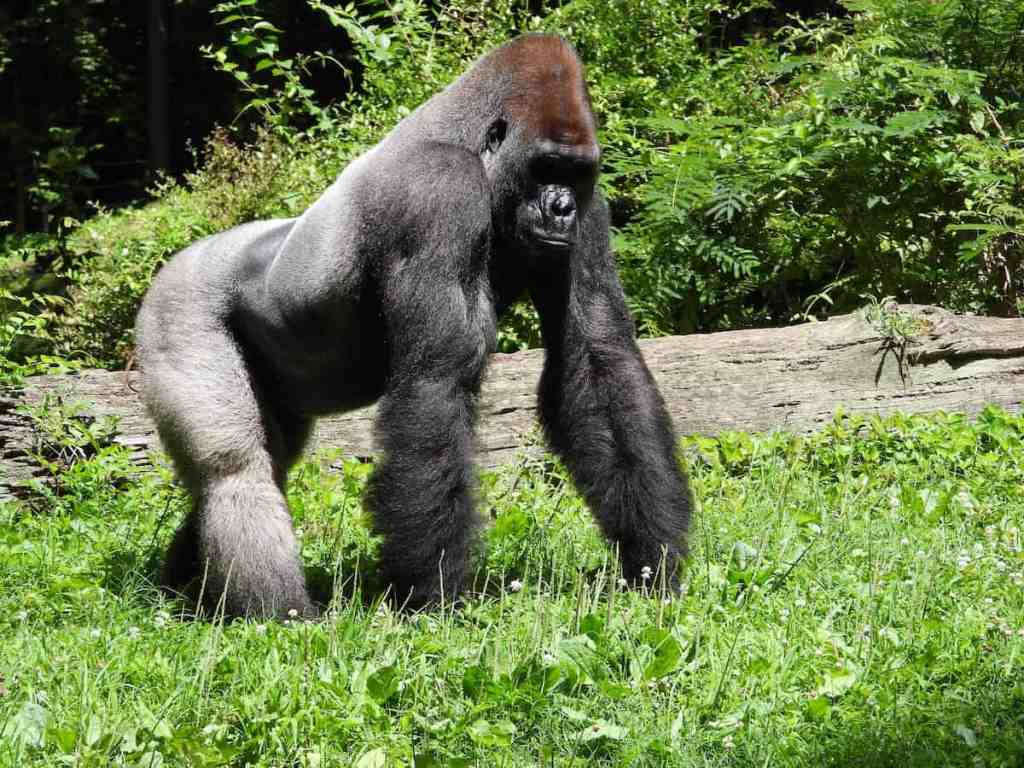
The oceans are excluded as yes, even though whales – who are carnivores – are bigger, as the water can hold their massive weight; there are hardly any examples of herbivore species of fish or mammals in the sea.
Finally, the vitamin B12 question can be categorised under the ‘Big Lie’ technique. The term was first coined by Adolf Hitler in 1925, in his book Mein Kampf. Tell a big lie over and over until it becomes a fact that no one questions.
The B12 claim is scaremongering at its worst, or best depending on one’s view. A blind created and maintained by pharmaceutical conglomerates; so that you take their supplements – which do more harm than good. And, the Meat and Dairy Boards, who also have an enormous invested financial interest in the developed world populace’s consumption of meat, milk, cheese, butter and eggs.
Contrary to popular opinion, vitamin B12 is found outside of farm animals intestinal tracts, which have been given to them in the first place. For those still concerned about B12 levels or sources, certain mushrooms, beans, tea leaves, vegetables and seaweeds contain trace elements of B12; including the Shiitake Mushroom, Broccoli, Asparagus and Tempe from fermented Soybeans.
The best source of plant sourced vitamin B12 is dried purple laver. ‘Consumption of approximately 4g of dried purple laver (Vitamin B12 content: 77.6 μg /100 g dry weight) supplies the RDA [advised requirement] of 2.4 μg [of B12 per] day.’ From: Vitamin B12 containing Food Sources for Vegetarians, published by the National Library of Medicine, multiple authors, 2014.
Traditionally, Laver seaweed has been harvested in Scotland, Wales and Ireland to make laverbread, and it is also cultivated as Nori in Japan – where it is added to Sushi – as well as in Hawaii and the Philippines as a sea vegetable.
According to the Bible, humankind who descended from Adam before the flood, were agriculturists, horticulturists and farmers – Genesis 2:9, 16; 4:2-4; 6:21; 7:2. The animals raised were clean animals, intended only for sacrificial purposes – Genesis 8:20.
After the flood, a change was ordained in that meat was sanctified, though it had to be clean animals and to be eaten in conjunction with the sacrificial system – Genesis 9:2-4; Leviticus 11:1-47; Deuteronomy 13:3-20.
A case in point is when Abraham was visited by the Lord and two angels. He gave them a meal that included meat and dairy. Though it was in the context of a special occasion – Genesis 18:6-8.
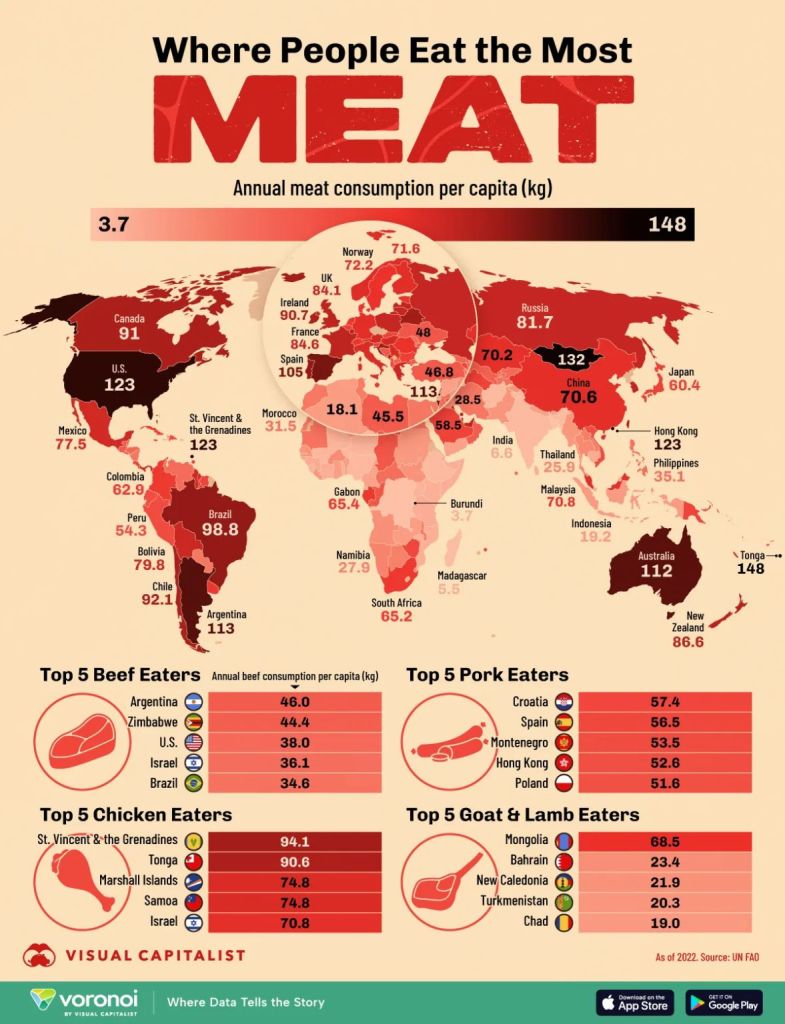
In the Book of Daniel, we read of an account that supports that eating meat was for special occasions or during the Holy Day festivals seven times a year. It was not intended for rich meat difficult to digest, to be eaten every day.
‘But Daniel made up his mind not to eat the food [H6598 – pathbag: meat, portion of meat] and wine given to them by the king. He asked the superintendent for permission to eat other things instead. Now as it happened, God had given the superintendent a special appreciation for Daniel and sympathy for his predicament. But he was alarmed by Daniel’s suggestion.
“I’m afraid you will become pale and thin compared with the other youths your age,” he said, “and then the king will behead me for neglecting my responsibilities.”
Daniel talked it over with the steward who was appointed by the superintendent to look after Daniel, Hananiah, Mishael, and Azariah, and suggested a ten-day diet of only vegetables and water; then, at the end of this trial period the steward could see how they looked in comparison with the other fellows who ate the king’s rich food [‘delicacy, meat’] and decide whether or not to let them continue their diet.
The steward finally agreed to the test. Well, at the end of the ten days, Daniel and his three friends looked healthier and better nourished than the youths who had been eating the food supplied by the king! So after that the steward fed them only vegetables and water, without the rich foods and wines!’ – Daniel 1:8-16 Living Bible.
It would seem that eating fish which is far easier to digest, with more nutrients and protein than meat was acceptable in Christ’s day; as he called Peter, Andrew, James and John who were all Fishermen – Matthew 4:18, 21. Christ also performed the miracle of the loaves and fishes – Mark 6:48-44.
That said, both the Apostle Peter and James the half-brother of Christ are on record in being adherents of a plant based diet – refer article: The Pauline Paradox.
Based on an edited excerpt in answer to questions on Quora:
What are the benefits of a plant-based diet? and Is eating meat good for you?
“Throughout the whole earth I am giving you as food every seed-bearing plant and every tree with seed-bearing fruit.”
Genesis 1:29 Complete Jewish Bible
“Better to eat vegetables with people you love than to eat the finest meat where there is hate.”
Proverbs 15:17 Good News Translation
© Orion Gold 2022 – All rights reserved. Permission to copy, use or distribute, if acknowledgement of the original authorship is attributed to Orion Gold
Addendum I
An important health factor to add to eating less meat is that of the type of meat one chooses to imbibe.
The Creator gave ancient Israel dietary guidelines. This would appear to be for very good reason. Some animals just weren’t meant for human consumption. Certain sea creatures which are scavengers, filled with noxious bacteria and which let’s face it, look just like big bugs; such as prawns, shrimp, crayfish and lobster, as if these two points were not enough of a deterrent in eating them, then often cause people to develop painful stomach aches after their consumption.
Likewise, the pig is an animal that uncannily possesses the flesh anatomy rather akin to a human. This is why the heart of a pig is the best candidate for transplanting to humans. While under a microscope, pig cells can be observed to be teeming with unpleasant and harmful microbes. In eating them, one is not just imbibing toxic bacteria, but it is the next thing to human cannibalism.
The eating of human flesh regularly is known to make the eater over time, crazy. As if they weren’t already to even try. People may wonder why some people are not always rational. One aspect not considered, is a diet which consumes a lot of pork, ham and bacon. This may well be a little understood factor, which science may well corroborate in the future.
Apparently, according to those who abhorrently know, pork is the closest meat in flavour and taste to human flesh and while cooked pork smells like human flesh; conversely, incinerated human flesh has a similar aroma to pork.
It was more than a coincidence that George Orwell chose the pig as the leading animal in his landmark novella Animal Farm, for they are one of the most highly intelligent species on the Earth – one wonders why? For information on the shocking origin of the domesticated pig, refer Chapter XXII Alpha & Omega.
Leviticus 11:1-8
New Century Version
The Lord said to Moses and Aaron, “Tell the Israelites this: These are the land animals you may eat: You may eat any animal that has split hoofs completely divided and that chews the cud.’ “Some animals only chew the cud or only have split hoofs, and you must not eat them…”
“Now the pig has a split hoof that is completely divided, but it does not chew the cud; it is unclean for you [because it is not a true herbivore, but rather an omnivore]. You must not eat the meat from these animals or even touch their dead bodies; they are unclean for you.”
An original excerpt transferred from Chapter XXXI Reuben, Simeon, Levi & Gad – the Celtic Tribes
Addendum II
The hidden evolutionary relationship between pigs and primates revealed by genome-wide study of transposable elements, John Hewitt, 2015:
‘In the past, geneticists focused primarily on the evolution of genes in order to trace the relationships between species. More recently, genetic elements called SINEs (short interspersed elements) have emerged as a much better way to trace mammalian phylogeny…
In humans, the most familiar and abundant SINE is the Alu transposable element. Originally derived from a small cytoplasmic signal recognition conglomerate known as the 7SL RNA, Alu inserts have since propagated themselves to generate an extended family over a million strong representing 11% of our entire genome.
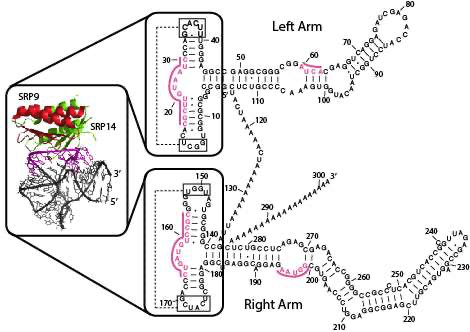
Secondary structure of ALU RNAs
A recent paper published in the bioRxiv now suggests that another species – the pig – has a unique family of SINEs whose evolution has closely paralleled ours. In the pig genetics business, the preferred classification term for the family is ‘suidae’. Suidae PRE elements have been known since their original discovery back in 1987.
The upshot of… [the] work… is that the ‘genomic performance of PRE-1 in terms of 7SL RNA-derived SINEs seemed convincing enough to classify the suidae into a family mainly inhabited by primates’.
It has not escaped our attention that many readers… may have availed themselves of our previous coverage of the human hybrid origins theory… With that in mind, I talked the creator of the hybrid origins theory, Eugene McCarthy, to get his take on this new research.
He had this to say:
“People have been congratulating me on this SINE study as if it somehow proved the hybrid theory of human origins. True, it does show that pigs are more closely related to primates than has generally been thought, which in turn suggests that a hybrid cross between pig and chimpanzee is more feasible than many have supposed. But to establish whether we’re actually descendants of an ancient cross between pig and chimpanzee, will require a detailed search of the human genome, not just a study of SINEs.”
Addendum III
Human-Pig Hybrid Created in the Lab, National Geographic, Erin Blakemore, 2023 – Emphasis mine
‘In a remarkable – if likely controversial – feat, scientists announced that they have created the first successful human-animal hybrids. The project proves that human cells can be introduced into a non-human organism, survive, and even grow inside a host animal, in this case, pigs.
This biomedical advance has long been a dream and a quandary for scientists hoping to address a critical shortage of donor organs. What if, rather than relying on a generous donor, you could grow a custom organ inside an animal instead?
That’s now one step closer to reality, an international team of researchers led by the Salk Institute reports in the journal Cell. The team created what’s known scientifically as a chimera: an organism that contains cells from two different species.
In the past, human-animal chimeras have been beyond reach. Such experiments are currently ineligible for public funding in the United States (so far, the Salk team has relied on private donors for the chimera project). Public opinion, too, has hampered the creation of organisms that are part human, part animal.
There are two ways to make a chimera. The first is to introduce the organs of one animal into another – a risky proposition, because the host’s immune system may cause the organ to be rejected. The other method is to begin at the embryonic level, introducing one animal’s cells into the embryo of another and letting them grow together into a hybrid.
It sounds weird, but it’s an ingenious way to eventually solve a number of vexing biological problems with lab-grown organs. When scientists discovered stem cells, the master cells that can produce any kind of body tissue, they seemed to contain infinite scientific promise. But convincing those cells to grow into the right kinds of tissues and organs is difficult… [yet] pigs have a notable similarity to humans. Though they take less time to gestate, their organs look a lot like ours.
Not that these similarities made the task any easier. The team discovered that, in order to introduce human cells into the pigs without killing them, they had to get the timing just right. When those just-right human cells were injected into the pig embryos, the embryos survived. Then they were put into adult pigs, which carried the embryos for between three and four weeks before they were removed and analysed.’
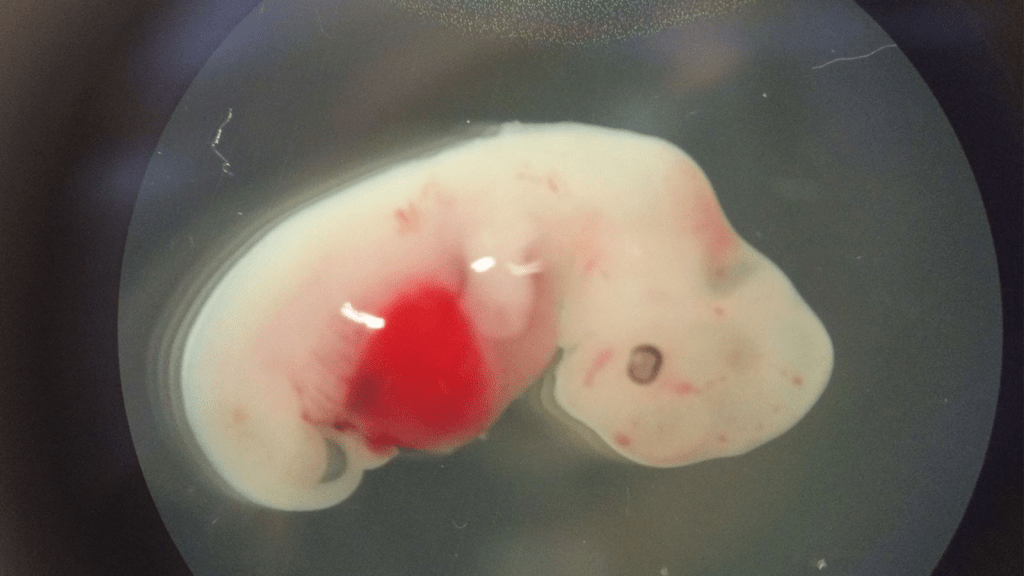
This pig embryo was injected with human cells early in its development and grew to be four weeks old.
‘In all, the team created 186 later-stage chimeric embryos that survived, says Wu, and “we estimate (each had) about one in 100,000 human cells.” That’s a low percentage – and it could present a problem for the method in the long run, says Ke-Cheng, a stem cell expert at the University of North Carolina at Chapel Hill and North Carolina State University.
The human tissue appears to slow the growth of the embryo, notes Cheng, and organs grown from such embryos as they develop now would likely be rejected by humans, since they would contain so much pig tissue. The next big step, says Cheng, is to figure out whether it’s possible to increase the number of human cells the embryos can tolerate. The current method is a start, but it still isn’t clear if that hurdle can be overcome.
Belmonte agrees, noting that it could take years to use the process to create functioning human organs. The technique could be put to use much sooner as a way to study human embryo development and understand disease. And those real-time insights could be just as valuable as the ability to grow an organ. Even at this early stage, Cheng calls the work a breakthrough: “There are other steps to take,” he concedes. “But it’s intriguing. Very intriguing.”

