
Of all the unexplained mysteries on various websites, it is Jack the Ripper which appears the most frequently. On the Top Tens website where readers can vote up to ten mysteries which cumulatively results in their ranking, Jack the Ripper is at position number three out of a total of seventy-three unexplained mysteries. Another list: The 6 Most Mysterious Unsolved Murders of All Time, places Jack the Ripper squarely at number one.
Hundreds of nonfiction books have been written, dozens of novels and multiple television series and films. With Ripperology a bona fide discipline specialising in research and theories behind the murders. There is clearly huge interest in the 137 year unsolved crime.
This could be in large part due to the fact the murderer went on such a viciously violent killing spree in such a short compacted space of time during the autumn of 1888, yet seemed to suddenly stop and disappear into thin air. It is this aspect of the case which may well be the biggest clue, not so much to who Jack was, but in certainly eliminating who he was not.

Beginning with London during the era encapsulated in the article, Who was Jack the Ripper, Ignacio Peyro, October 29, 2018 – emphasis mine:
‘At the end of the 19th century a foreign traveller only had to spend a day sightseeing in London to feel stirred by England’s power. But all was not well with London. Joseph Conrad’s 1899 novel, Heart of Darkness, describes London as ”one of the dark places of the earth.” To the theatregoers and shoppers thronging the well-lit, opulent streets of the West End, this description might have seemed out of place, but just three miles to the east, in the neighbourhood of Whitechapel, disease, alcoholism, and poverty ravaged the lives of thousands of souls. It was a place that was, as the Diocese of London reported, “as unexplored as Timbuktu.”
The mystery of Jack the Ripper seemingly began on August 31, 1888, when the body of a dead woman was found in a Whitechapel street. Her throat had been cut and her abdomen gouged open. Three months later, when what became known as the ‘Autumn of Terror’ had ended, four more women had undergone the same grisly fate.
Above all, the Ripper case laid bare an uncomfortable irony: at the heart of a city that prided itself on spreading Pax Britannica around the world, a murderer walked free – and none of the authorities could stop him. When the murders abruptly ceased in November 1888, the mystery only deepened and grew… Jack the Ripper has become arguably the most infamous and mythologised serial killer.’
Jack the Ripper’s alleged first victim was discovered in the early morning hours of August 31. She was 43 year old Mary Ann Nichols. The next victim was 47 year old Annie Chapman, discovered on September 8 shortly before 6 am in a yard. Her injuries were similar to Nichols’s, but she was missing some of her internal organs. On September 30, two more lives were taken on the same night. They were 45 year old Elizabeth Stride and 46 year old Catherine Eddowes.

From left to right: Mary Ann Nichols, Elizabeth Stride, Annie Chapman and Catherine Eddowes.
Allegedly the last known victim was 25 year old Mary Jane Kelly on November 9, 1888. Her body was discovered brutally mutilated in a lodging house.

Mary Jane Kelly
What is noteworthy about these dates is that they were nights where the Moon was less that a quarter in its phase. For the Full Moon in September was on the 20th day and in November the 18th of the month. Thus the Ripper chose relatively moonless nights in which to entice these women from off a street to somewhere secluded.
What these women had in common was that they were all active or former prostitutes; all lower class; all lived no more than a quarter mile from each other; and their deaths occurred after pub closing time. Added to this is the puzzling fact ‘no one ever heard a single scream or cry for help, unusual for such a densely populated neighbourhood’ and none of the bodies showed evidence of any struggle leading to defence wounds on their arms or hands.
One wonders if the killer used a drug to render the women unconscious. If this were the case, then in 1888 this could likely be someone who had medical knowledge. Where this is relevant is that coupled with this is the fact that the removal of certain organs from at least three of the victims reveals a degree of surgical knowledge on the killer’s part. Noteworthy as well, is that Jack the Ripper as the name suggests, killed the women with a knife, but what shocked the police and public alike was his savage stabbing and desecration of the dead women.
The highly pertinent piece of information is that there was ‘one solid, reported sighting of the killer… on the early morning of September 8, 1888, when a woman saw Annie Chapman, accompanied by a ‘foreigner’ of medium height, wrapped in a dark cloak. They are believed to have met just after 5:30 a.m., and her body was found half an hour later. Like all of his other victims, there were no signs of resistance, and no one heard her cry out.’
Years ago when investigating this subject this writer was staggered when first learning of this crucial piece of information. This means Jack the Ripper was either not a European, or as we will learn was of European descent though not an Englishman. Also critical, is the fact he was of medium height. This information would rule out every single English suspect put forward in this case by investigators. Thus we will not spend time on the large number of British persons of interest – except for two foreigners who stand out.
Nearly all letters sent to the police were deemed hoaxes. The name Jack the Ripper originated from an early letter which divides opinion – known as the “Dear Boss” letter. The later “From Hell” letter is considered in a more careful light regarding its authenticity and was received by George Lusk. Lusk of the Whitechapel Vigilance Committee received a box in the mail which contained a letter and half a human kidney. Peyro adds: ‘Dr. Thomas Horrocks Openshaw of the London Pathological Museum examined the organ and identified it as a portion of a human left kidney. The news caused a sensation in the press: for it was discovered upon examination that Catherine Eddowes (found on September 30) had had her left kidney removed.’
The murders were brutally shocking even by todays standards. The women had their throats cut from one side to the other, their abdominal cavity sliced fully open and the stomach and genitals repeatedly stabbed; with at least three of the women having internal organs removed and one having their face mutilated beyond all recognition. Tragically, Mary Kelly was disembowelled with almost all her organs removed, with her uterus, kidneys and one breast placed beneath her head. The remaining organs and other breast were left on the bedside table, except her heart which chillingly was not recovered at the crime scene.
What seems to have escaped investigators attention is not just the fact that the Ripper suddenly vanishes after a blood drenched ten weeks, with four murders incredibly occurring within a five week period; but unbelievably he hit the ground running as if he had killed before and was comfortable with the act. Then he seemingly changed his modus operandi from the fourth to fifth killing, with the violence escalating enormously. Even so, his first murder belies a practiced killer, though perhaps one who had not accosted victims from public thoroughfares before.
This is a massive clue, surely? If Jack the Ripper was a foreigner, then his sudden appearance as an accomplished killer, then disappearing into thin air would be entirely logical. The fact the police could not make anything stick on any local suspect due to lack of solid evidence even if there was a seeming motive, is testimony that this line of reasoning cannot be ruled out of question.
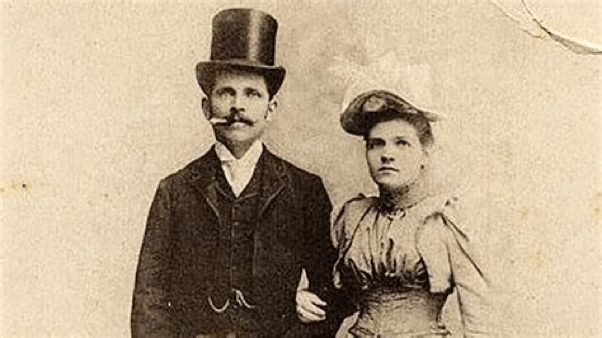
A suspect of note was a Dutchman named Hendrik de Jong (above). He was a sailor working as a steward on a ship regularly crossing from Rotterdam to London. Hendrik had a history of violence having bludgeoned two women to death in Belgium in 1898 and was suspected of murdering and burying two ex-wives in 1893 though without a conviction. In 1898 he apparently fled to the United States and vanished. Newspapers reported ‘blood-stained surgical instruments were found among his possessions.’ Former Cardiff University lecturer Dr Bondeson ‘scoured Dutch newspapers from the time and found de Jong visited prostitutes and was a “pathological liar without conscience… [and] had the killer instinct to execute a murder and to get away scot-free.” When a Dutch police inspector brought Hendrik de Jong’s portrait to Whitechapel, residents recognised him.
In 2006, BBC History magazine readers selected Jack the Ripper as the worst Briton in history. This is highly ironic if Jack the Ripper wasn’t even British. Researchers not very astutely, suspect Jack the Ripper was single and suffered from insomnia – because he kept night hours. Most historians think Jack the Ripper was probably between twenty-five to thirty-five years old when he committed the murders in Whitechapel. This is interesting, for the prime suspect we will now investigate, would have been twenty-seven years old in the Autumn of 1888.
H H Holmes
The most infamous serial killer in American history, was H H Holmes. The name is an alias, though it is the name in which he is the most recognised. Born Herman Webster Mudgett on May 16, 1861, in Gilmanton, New Hampshire and into an affluent family, Herman enjoyed a privileged childhood. He was the third born child of Levi Horton Mudgett and Theodate Page Price, both descended from the first English settlers in the area. Herman was unusually intelligent from an early age and as an adolescent he attended Phillips Exeter Academy before graduating high school with honours from Gilmanton Academy when he was 16.
An online Encyclopaedia:
‘Holmes’ parents were both devout Methodists. His father was from a farming family, and at times he worked as a farmer, trader and house painter. He was also reportedly a heavy drinker who cruelly mistreated his family. Holmes also faced bullying by classmates due to his outstanding academic capabilities. In one incident he was forced to stand in front of a human skeleton and put the skeleton’s hands on his face in an effort to frighten him. Initially terrified, Holmes later discovered the experience to be intriguing and claimed that it helped him overcome his worries. Holmes subsequently developed an obsession with death as a result of the encounter, and later took up the pastime of dissecting animals’ – Article: DEATH: A Dead End or a New Beginning?
Accounts indicate that he may have been responsible for the death of a friend. On July 4, 1878 Mudgett married Clara Lovering. They had one son, Robert Lovering Mudgett – born February 3, 1880; died November 3, 1956. Herman enrolled at the University of Vermont from 1879 to 1880 but was dissatisfied and left. In 1882, Mudgett entered the University of Michigan’s Department of Medicine and Surgery, passing his exams and graduating in 1884 – at the age of twenty-three.
Encyclopaedia: ‘While enrolled, he worked in the anatomy lab under Professor William James Herdman, then the chief anatomy instructor, and the two were said to have been engaged in facilitating graverobbing to supply medical cadavers. Holmes had apprenticed in New Hampshire under Nahum Wight, a noted advocate of human dissection. Years later, when Holmes was suspected of murder and claimed to be nothing but an insurance fraudster, he admitted to using cadavers to defraud life insurance companies several times in college.’

Thus was the start of Herman Mudgett’s proclivity towards a life of crime beginning with fraud and forgery, which would later include con-artist scams, bigamous illegal marriages, debt, horse theft, abduction and murder. Herman possibly fuelled his fascination for the macabre by using cadavers for experiments. Housemates recalled that Mudgett was physically violent with his wife Clara and before his graduation, she moved back to New Hampshire.
After graduating from the University of Michigan in 1884, Herman worked various odd jobs before abandoning his wife and young son.
Encyclopaedia: ‘… [Herman] moved to Mooers, New York, [and] a rumor spread that [he] had been seen with a little boy who later disappeared. [Herman] claimed the boy went back to his home in Massachusetts. No investigation took place and [Mudgett] quickly left town. He later traveled to Philadelphia and was hired as a keeper at Norristown State Hospital but quit after a few days. He then took a position at a drugstore in Philadelphia, but while he was working there a boy died after taking medicine that was purchased at the store. [Herman] denied any involvement in the child’s death and immediately left the city. Before moving to Chicago [at the age of 25], he changed his name to “Henry Howard Holmes” to avoid the possibility of being exposed by victims of his previous scams.’
Now using his infamous moniker, Dr Henry Howard Holmes – presumably inspired by English detective Sherlock Holmes, the literary creation of author Sir Arthur Conan Doyle. Holmes arrived in Chicago in August 1886, where he came across a drugstore at the northwest corner of South Wallace Avenue and West 63rd Street in Englewood.
Encyclopaedia: ‘The drugstore’s owner, Elizabeth Holton, gave Holmes a job; he proved to be a hardworking employee, eventually buying the store. Contrary to several accounts Holmes did not kill Dr. E. S. Holton. Holmes purchased an empty lot across the street, where construction began in 1887 for a two-story mixed-use building, with apartments on the second floor and retail spaces, including a new drugstore, on the first. When Holmes declined to pay the architects or the steel company, Aetna Iron and Steel, they took him to court [crucially] in 1888. In 1892, he added a third floor, telling investors and suppliers he intended to use it as a hotel during the upcoming World’s Columbian Exposition [in nearby Jackson Park].
In late-1886, while still legally married to Clara, Holmes married 24-year-old Myrta Belknap in Minneapolis, Minnesota. He filed for divorce from Clara a few weeks after marrying Myrta, alleging infidelity on her part. The claims could not be proven and the suit went nowhere. Surviving paperwork indicated that Clara probably was never even informed of the suit. In any case, the divorce was never finalized: it was dismissed on June 4, 1891, on the grounds of “want of prosecution.” Holmes had one daughter with Myrta, Lucy Theodate Holmes (July 4, 1889 – December 29, 1956), who was born in the Englewood neighborhood of Chicago. Holmes lived with Myrta and Lucy in Wilmette, Illinois, and spent most of his time in Chicago tending to business.’

‘VIEW OF THE WORLD’S FAIR HOTEL… ALSO KNOWN AS THE ‘MURDER CASTLE,’ ON W. 63RD STREET IN CHICAGO, ILLINOIS, MID-1890S. THE STRUCTURE WAS DESIGNED BY SERIAL MURDERER HERMAN WEBSTER MUDGETT, BETTER KNOWN BY HIS ALIAS H.H. HOLMES.’
There are two aspects of Holmes’s life which arguably were probably sensationalised. One was the number of victims he actually killed and the other was the extent his property on West 63rd Street was used for luring victims to torture and murder. In the interest of impartiality, let’s address both sides of each issue.
Firstly, the property which became known as the Murder Castle: It is claimed that the mixed residential/retail building was specially constructed as an ‘elaborate house of horrors, the lair of a bloodthirsty maniac.’ The cunning killer kept hiring and firing builders and architects so nobody knew the full design but himself.
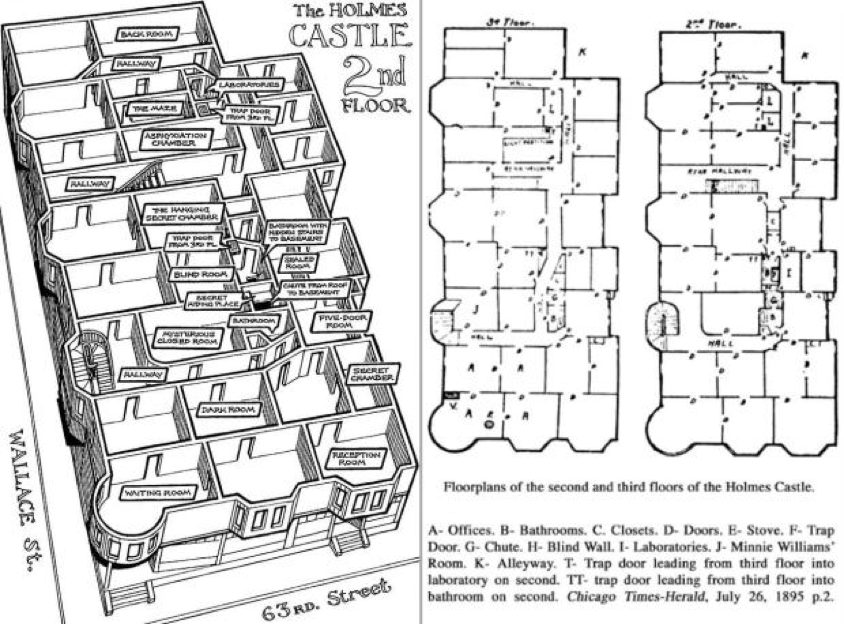
Purportedly, the upper floors contained Holmes’ living quarters and many small rooms where he tortured and killed his victims. The purpose-built property was replete with secret passageways, stairways leading to nowhere, fake walls with 51 doorways that opened to brick walls, peepholes, trapdoors, windowless-soundproof torture rooms and furnaces. Thus the building was a nightmarish maze of hidden passages and death rooms, specially designed for ambushing, torturing, killing and disposing of bodies. For according to the Crime Museum, an intricate system of greased body-sized chutes and elevators enabled Holmes to transport his victims bodies to the building’s basement, which was apparently equipped with a dissecting table, surgical equipment, a medieval-style stretching rack for torture and a crematory with a human sized kiln.

Alleged methods of death included Holmes boiling a man in oil as well as poisoning wealthy women in order to seize their fortunes. Other claims include ‘a secret hanging chamber, blowtorches hidden in walls to engulf victims in fireballs’ as they slept, rooms which were ‘sealed air-tight with gas jets hooked up to a tank in the basement that could quickly fill the air with poison as Holmes watched them struggle and choke. All the rooms were wired to an alarm system which rang a buzzer in his private apartments if they opened the doors – meaning he knew if anyone was trying to flee.’
A hidden sealed vault was used to trap victims and then it was filled with slowly pouring acid. Erik Larson, author of The Devil in the White City, 2004, added in 2017: “One room was essentially a vault, in which he dispatched at least one victim. She left a perfectly etched footprint on the inside of the door which suggested, according to the Chicago Fire Department at the time, that Holmes may have spilled acid into the room underneath the door. In her terror she tried to force the door open by placing her foot against it.” Another room which contained no doors could only be accessed through a trap door in the ceiling, where he would leave victims to starve.
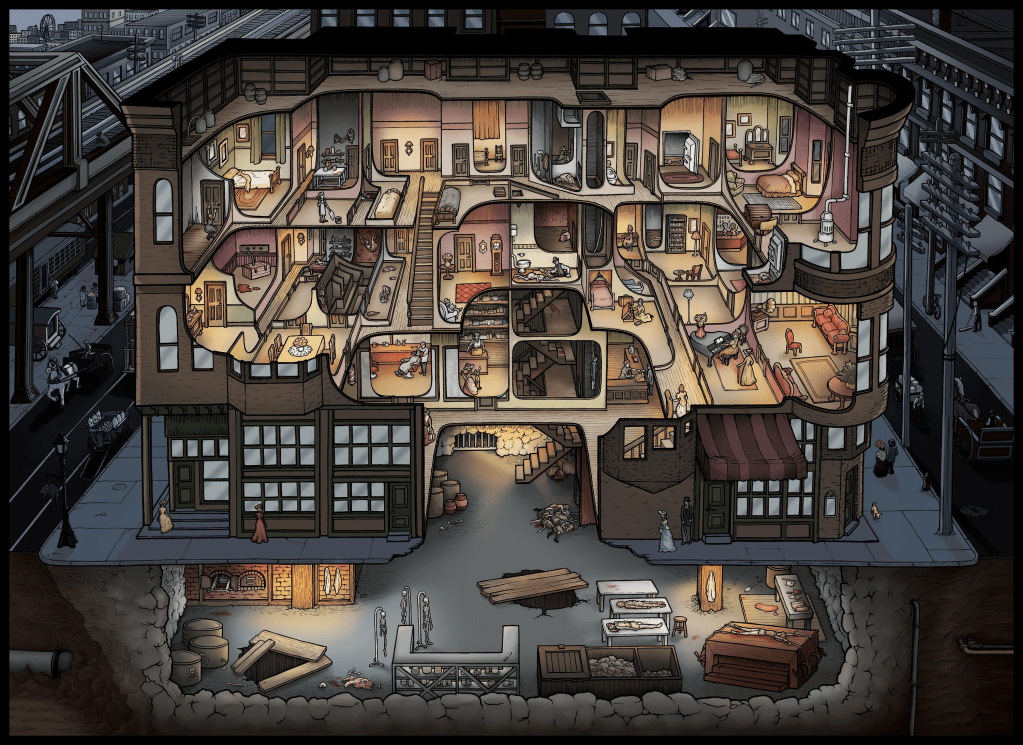
It has also been claimed that Holmes and an assistant, stripped the flesh off the bodies, dissecting them and crafting the leftover bones into skeleton models; selling them to medical institutions and on the black market, along with organs and other body parts. The decaying corpses and parts he couldn’t sell were incinerated in the basement’s oven, dissolved in vats of acid or buried in quicklime pits.
With all this mind, once guests had checked in they had little chance of escaping from the labyrinth-like castle and Holmes was free to pick them off at his leisure. ‘Many of his victims had travelled from out of town for the 1893 Chicago World’s Fair, making them the perfect targets. If anyone came asking about them he could just say they had checked out and left.’
Whether any of this is accurate or conjecture is open to question. If any aspects of the above is true, then Holmes’ actions were beyond horrific even by todays standards. Perhaps the names he became known as, were founded: “The Beast of Chicago”, “The Torture Doctor” and the “Devil in the White City.”
Encyclopaedia:
‘Although he did have a history of selling stolen cadavers to medical schools, Holmes had acquired these wares through graverobbing rather than murder. Likewise, there is no evidence that Holmes ever murdered Exposition-goers on the premises. The [hyperbolic yellow journalism of the period] labeled the building as Holmes’ “Murder Castle”… [yet] none of these sensationalised claims were true. In reality, the third-floor hotel was moderately sized, largely unremarkable and uncompleted due to Holmes’ disputes with the builders. It did contain some hidden rooms, but they were used for hiding furniture Holmes bought on credit and did not intend to pay for.
In his confession Holmes usual murder method was by suffocation of his victims including: an overdose of chloroform; overexposure to lighting gas fumes; trapped in an airless vault to give some examples. Holmes also claimed to have used starvation and burning victims alive in his “castle”. Besides his infamous “Murder Castle”, Holmes also owned a one-story factory which he claimed was to be used for glass bending. It is unclear if the factory furnace was ever used for this purpose; it was speculated to have been used to destroy incriminating evidence of Holmes’s crimes.’

The answer to the exact purpose of the Murder Castle lays in the fact that when police on numerous occasions searched Holmes property, they did not find evidence for the sensationalist claims. While ‘one hundred’ rooms, the multiple methods of disposing of bodies and the over elaborate network of secret passage were exaggerated, it does not negate those victims whether lured to the property or not who did lose their lives in a grisly manner. The question of how many people lost their lives to Henry Howard Holmes is also enveloped in controversy, for it ranges between nine deaths to upwards of two hundred.
Author Adam Selzer in H.H. Holmes: The True History of the White City Devil, states: “[And], like all the best tall tales, it sprang from a kernel of truth.” The facts according to Selzer: ‘Though sensationalised reports suggest that Holmes killed upward of 200 people, Selzer could only confirm nine actual victims. Far from being strangers drawn into a house of horrors, the deceased were actually individuals Holmes befriended (or romanced) before murdering them as part of his money-making schemes. And, while historical and contemporary accounts alike tend to characterize the so-called Murder Castle as a hotel, its first and second floors actually housed shops and long-term rentals, respectively. “When he added a third floor onto his building in 1892, he told people it was going to be a hotel space, but it was never finished or furnished or open to the public,” Selzer added. “The whole idea was just a vehicle [in swindling] suppliers and investors and insurers.”
Regarding Holmes, Selzer adds:
‘Just killing several people isn’t necessarily enough for most definitions [of a serial killer]. More often, it has to be a series of similar crimes, committed over a period of time, usually more to satisfy a psychological urge on the killer’s part than any more practical motive.” He added: “The murders we can connect [Holmes] to generally had a clear motive: someone knew too much, or was getting in his way, and couldn’t be trusted. The murders weren’t simply for love of bloodshed but a necessary part of furthering his swindling operations and protecting his lifestyle.’
Selzer has his view, yet Holmes’ tendency towards evil by torturing and killing people whether they were known to him or not and if there was motive or not, does not detract from a man who was clearly a psychopath. While Psychopaths and sociopaths both suffer from ASPD, psychopaths are more premeditated in their thinking; able to control their emotions more effectively, such as rage; are charming; and fit into normal society more successfully than a sociopath. Holmes was able to seduce and swindle women, much like the notorious yet charming Ted Bundy. Holmes mastered the ‘habit of getting engaged to a woman, only for his fiancée to suddenly “disappear.” Other victims were lured to the Murder Castle through Holmes’s pharmacy by the offer of employment.
A description of Holmes:
‘Debonair and preternaturally charismatic, Holmes nevertheless elicited lingering unease among many he encountered. Still, his charm was substantial, enabling him to pull off financial schemes and, for a time, get away with murder. (“Almost without exception, [his victims appeared] to have had two things in common: beauty and money,” according to Harper’s. “They lost both.”)
Holmes even wed for a [fourth] time, marrying Georgina Yoke [his fourth and final wife] in 1894 without attracting undue suspicion.’ Holmes married Georgiana Yoke on January 17, 1894, in Denver, Colorado, while still married to both Clara and Myrta.
‘As employee C.E. Davis later recalled, “Holmes used to tell me he had a lawyer paid to keep him out of trouble, but it always seemed to me that it was the courteous, audacious rascality of the fellow that pulled him through… He was the only man in the United States that could do what he did.”

Holmes was forced to leave Chicago after the World’s Fair in July 1894. Insurance companies were pressing to prosecute him for arson. He reappeared in ‘Fort Worth, where he had inherited property from the Williams sisters, at the intersection of modern-day Commerce Street and 2nd Street. Here, he once again attempted to build an incomplete structure without paying his suppliers and contractors.’ It was at this time that Holmes was ‘arrested and briefly jailed for the first time, on the charge of selling mortgaged goods in St. Louis, Missouri.’
He was promptly bailed out, but not before he had confided in fellow inmate, notorious train robber and Wild West outlaw Marion Hedgepeth, who was serving a twenty-five year sentence. While in prison, Hedgepeth knew Holmes as his alias H M Howard. According to the National Police Journal: Holmes explained he had “devised a scheme for swindling an insurance company of $10,000. He promised Hedgepeth that, if he would recommend him a lawyer suitable for such an enterprise, he should have $500 [commission] promised him.”
Holmes had originally concocted a plan to claim from an insurance company $10,000 by taking out a policy on himself and faking his death. The lawyer Hedgepeth directed Holmes to meet was a young St. Louis attorney named Jeptha Howe. Howe thought Holmes’ scheme was a brilliant idea and agreed to play a part. Though Holmes’ plan to fake his own death failed, as the insurance company became suspicious and refused to pay. Holmes did not press the claim; but instead concocted a similar plan with a trusted associate named Benjamin Freelon Pitezel. Pitezel agreed to fake his death for his wife to collect $10,000 from a life insurance company and split with Holmes and Howe. ‘But Holmes never [ever] paid up; as payback, Hedgepeth [later] shared the information with the police.’ This was the beginning of Holmes falling increasingly under police suspicion.
Pitezel was a carpenter who joined Holmes’ construction of his hotel in November 1889. He had been working in the Chemical Bank building on Dearborn Street, where he and Holmes first met and the two became close friends. Thirty-eight year old Pitezel had a criminal past and was exhibiting a coal bin he had invented in the same building. He became a trusted acquaintance and so Holmes retained Pitezel in his employment. Benjamin Pitezel was married to Carrie Alice Canning of Galva, Illinois and they had five children. Pitezel was Holmes’ relied upon right hand man for several criminal schemes, but the full extent of what he knew about Holmes’ dark habits remain unclear. A district attorney would later say: “Pitezel was [Holmes’] tool […] his creature.” (1.5.30) Pitezel one could say, was Holmes’ one mistake with his victims. Holmes became too close with Benjamin, allowing him to enter his personal realm and undoubtedly learning some of his secrets. It was this relationship with Pitezel which lead to Holmes’ demise.
The scheme was to take place in Philadelphia with Pitezel as B F Perry an inventor who would die and be disfigured in a lab explosion. Instead of procuring an appropriate cadaver as planned, Holmes used his former business partner Benjamin as part of his insurance fraud scam instead. Holmes killed Pitezel on September 4, 1894. He knocked him unconscious with chloroform and set his body on fire with benzene.
Encyclopaedia:
‘In his confession, Holmes implied Pitezel was still alive after he used the chloroform on him, before he set him on fire. However, forensic evidence presented at Holmes’s later trial showed chloroform had been administered after Pitezel’s death, a fact of which the insurance company was unaware, presumably to stage a suicide to exonerate Holmes should he be charged with murder. Holmes collected the insurance payout on the basis of the genuine Pitezel corpse. Holmes then went on to manipulate Pitezel’s unsuspecting wife, Carrie… Canning, into allowing three of her five children to be placed in his custody.
The three children who were placed under Holmes’ care were: 13-year-old Alice Pitezel, 9-year-old Nellie Pitezel and 7-year-old Howard Robert Pitezel. Holmes and the three Pitezel children traveled throughout the northern United States and into Canada. Simultaneously, he escorted Carrie along a parallel route, all the while using various aliases and lying to Carrie concerning her husband’s death by claiming Pitezel was hiding in London [interesting choice] as well as lying to her about the true whereabouts of her three missing children. In Detroit, just before entering Canada, they were only separated by a few blocks.
Holmes kept the three children just out of reach of their mother in what was essentially a cruel game of cat and mouse. On a number of occasions, Holmes actually stashed the two in separate lodgings located just a few streets away from each other. “It was a game for Holmes,” wrote Larson: “… He possessed them all and revelled in his possession.” Pitezel became a household name in the national search for his three missing children.
A Philadelphia police detective Frank Geyer was assigned to investigate Holmes and find the three missing children. Audaciously, Holmes was staying at a different location with his current wife Georgiana Yoke, who was unaware of the whole affair. Holmes later confessed to murdering Alice and Nellie on October 25, 1894. Given the absence of visible injuries, the coroner theorised that Holmes forced the sisters into a large trunk, locked them inside and drilled a hole in the lid, putting one end of a hose through the hole and attaching the other end to a gas line, asphyxiating the girls. Holmes then buried their nude bodies in the cellar of his rental house at 16 St Vincent Street in Toronto.
It was Geyer who found the decomposed bodies of the two dead Pitezel girls in July 1895. Detective Geyer wrote: “The deeper we dug, the more horrible the odor became, and when we reached the depth of three feet, we discovered what appeared to be the bone of the forearm of a human being.”
Geyer then travelled to Indianapolis where Holmes had rented a cottage. Holmes had visited a local pharmacy to purchase drugs he would use to kill Howard Pitezel on October 10, 1894. Holmes also went to a repair shop to sharpen knives he used to chop up the body before he burned it. Howard’s teeth and pieces of bone were discovered amongst his charred ruins in the Cottage’s chimney.
‘Holmes’ murder spree finally ended [after several weeks of outrunning authorities] when he was arrested in Boston on November 17, 1894, after being tracked there from Philadelphia by the private Pinkerton National Detective Agency. He was held on an outstanding warrant for horse theft [and fraud] in Texas because the authorities had become more suspicious at this point and Holmes appeared poised to flee the country in the company of his unsuspecting [fourth] wife.’
While the authorities eventually identified Howard as Holmes, they did not catch on soon enough to stop his final murders of the Pitezel family. They thought at first that Holmes was simply a ‘prolific and gifted swindler,’ as Stephan Benzkofer of the Chicago Tribune reported – but they soon uncovered evidence linking Holmes to the murder of Benjamin Pitezel. For the police initially had little evidence with which to convict Holmes, apart from the outstanding warrant for stealing a horse in Texas. Holmes was scared of being sent back to Texas where the punishment would be “rough and ready” and so he confessed to the insurance scam, but not the murder of Pitezel.
Holmes claimed to have gotten a body from a doctor in New York who shipped it to Philadelphia, where he was living at the time, using his medical knowledge to fit the body in a trunk. Holmes nearly got away with this version of events, but an Inspector on the case recalled when the body was first discovered, that it was in full rigor mortis, meaning the person had died recently. The Inspector asked Holmes what technique he had learned to stiffen a body again after rigor mortis had been broken. Of course Holmes had no answer and the game was quickly up.
‘[Beginning] in July 1895, following the discovery of Alice and Nellie’s bodies, Chicago police and reporters began investigating Holmes’s building in Englewood, now locally referred to as the “Castle”. Though many sensational claims were made, no evidence was found which could have convicted Holmes in Chicago, as there was only very circumstantial physical evidence of the “Castle” victims. A piece of human bone possibly from Julia Conner; remains of a child-possibly Pearl Conner; a burned gold watch chain and burned dress buttons apparently belonging to Minnie Williams; a tuft of human female hair found in a chimney flue. Thus Holmes would be tried for the murder of Petzel in Philadelphia which had the clearest case for murder.’
Holmes was put on trial for the murder of Benjamin Pitezel, even though it was evident Holmes had also murdered the three missing Pitezel children. A Philadelphia grand jury found Holmes guilty of Benjamin’s murder on September 12, 1895 and he was given the death sentence.
Following his conviction, Holmes was paid $7,500 – about $215,000 today – by Hearst Newspapers to provide a confession of his crimes. Holmes gave contradictory accounts and in so doing discredited the story he had agreed to tell. It is because of his contradicting lies, that not much is known about Holmes’s childhood, for he even manipulated information on his census forms.
Holmes initially confessed to twenty-seven murders in Chicago, Indianapolis, and Toronto, as well as six attempted murders between 1891 and 1894. Is this number factual or the tip of a bigger iceberg? Certain researchers claim that Holmes may have confessed to twenty-seven murders, though not all can be proved and he may have only killed nine to fourteen victims. Was Holmes a serial killer, a mass murderer, neither or both?
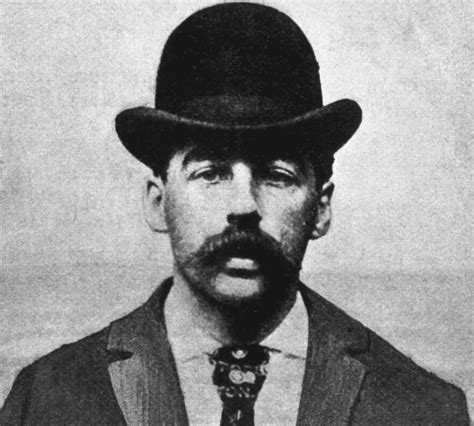
While writing in prison, Holmes mentioned how drastically his facial appearance had changed during his imprisonment, turning into a satanic image of the devil. He also grew a beard while in custody. Holmes appealed his case but unsurprisingly lost. An example of Holme’s duplicitous words in his memoir, where he said on one hand in describing himself as, “but a very ordinary man, even below the average in physical strength and mental ability.. [to] have planned and executed the stupendous amount of wrongdoing that has been attributed to me would have been wholly beyond my power.” Holmes was intentionally lying about his intellectual capacity.

In contradiction, Holmes also chillingly stated at the time:
“I was born with the very devil in me, I could not help the fact that I was a murderer, no more than the poet can help the inspiration to song, nor the ambition of an intellectual man to be great. The inclination to murder came to me as naturally as the inspiration to do right comes to the majority of persons. I was born with the Evil One standing as my sponsor beside the bed where I was ushered into the world, and he has been with me since.”

Eight months after his conviction Holmes was executed by hanging in front of a crowd at Philadelphia’s Moyamensing Prison on May 7, 1896. Before his execution and ‘until the moment of his death, Holmes remained calm and amiable, showing very few signs of fear, anxiety, or depression.’ Witnesses said he ‘maintained his cool to the very end, even telling the executioner not to rush.’ Despite this, he had requested for his pine coffin to be cement filled and buried ten feet deep, which was granted. Ironically, Holmes had a ‘terrible fear’ grave robbers would steal his body and use it for dissection.
When Holmes was hung, the fall did not break his neck. His body twitched repeatedly in a slow death until he was finally strangled and pronounced dead over fifteen minutes later. ‘Upon his execution, Holmes’s body was interred in an unmarked grave at Holy Cross Cemetery, a Catholic cemetery in the Philadelphia Western suburb of Yeadon, Pennsylvania.

A later photograph of the derelict Murder Castle in 1938
Holmes’ Englewood property was damaged by a fire in August 1895. Witnesses reported seeing two men entering the back of the building at nine o’clock in the evening. Half an hour later, they were seen exiting the building and running away. There were several explosions and the castle went up in flames. ‘Investigators found a half-empty gas can underneath the back steps of the building. The building survived the fire and remained in use until it was torn down in 1938. The site is currently occupied by the Englewood branch of the United States Postal Service.’
‘On New Year’s Eve 1909, Hedgepeth, who had been pardoned for informing on Holmes, was shot and killed by Police Officer Edward Jaburek during a hold-up at a Chicago bar. On March 7, 1914, the Chicago Tribune reported that, with the death of Patrick Quinlan, the former caretaker of the “Castle”, “the mysteries of Holmes’s castle” would remain unexplained. Quinlan had committed suicide by taking strychnine. His body was found in his bedroom with a note that read: “I couldn’t sleep.” Quinlan’s surviving relatives claimed he had been “haunted” for several months and was suffering from hallucinations.
In 2017, during allegations Holmes had escaped execution, Holmes’ body was exhumed for testing led by Janet Monge of the University of Pennsylvania Museum of Archaeology and Anthropology. Due to his coffin being encased in concrete, his body was found to not have decomposed normally. His clothes were almost perfectly preserved and his moustache was found to be intact. The body was positively identified by his teeth as being that of Holmes. He was then reburied.’
The exact number or identity of Holmes’ victims will forever be unknown, though there are a number of people who were either certain (4), presumed (5) or suspected (11) victims of his. Benjamin Pitezel and three of his children are certainly confirmed. Other people unfortunate enough to come into Holmes’ life include the following. Three have already been mentioned briefly in passing.
Holmes had a mistress, thirty-one year old Julia Smythe and involved her in his business interests. She was the wife of Dr Laurence Icilius “Ned” Conner, who had moved into the Castle and worked at the jewellery counter in Holmes’ pharmacy. Connor found out about their relationship, quit his job and moved away; leaving his five year old daughter Pearl Connor behind. Julia acquired custody of Pearl and remained at the hotel, continuing her relationship with Holmes. Both Julia and Pearl disappeared on Christmas Eve in 1891 [1, 2].
Holmes initially claimed to acquaintances that Julia had left unexpectedly to visit her dying sister, but then changed his story and said that she had fled to her former husband. Later still, Holmes claimed that Julia had actually died during an abortion. ‘Despite his medical background, Holmes was unlikely to be experienced in carrying out abortions, and mortality from such a procedure was high at that time.’ Holmes is alleged to have poisoned Pearl, to hide the circumstances of her mother’s death. A partial skeleton, possibly of a child around Pearl’s age, was found when excavating Holmes’ cellar in the basement.
Julia’s body was never found, though ‘around that time, according to Larson’s Devil in the White City, Holmes paid a local man to remove the skin from the corpse of an unusually tall woman (Julia stood nearly six feet tall) and articulate her skeleton for sale to a medical school. No visible clues to the deceased’s identity remained. Pearl’s father was a key witness at Holmes’ trial in Chicago.’
Emeline Cigrand at age twenty-three, began working in Holmes’ building in May 1892. Emeline worked for him for about six months. Holmes had reportedly hired Cigrand as his secretary because she was connected to a doctor who peddled a “vaccine” that allegedly cured alcoholism. ‘Those who saw Cigrand in the weeks before her disappearance noted that she appeared to have lost interest in Holmes and their relationship [whom he purportedly proposed to]. Cigrand was last seen in December 1892. Her parents were informed that she had left to marry a man named “Robert Phelps”.
Authorities hypothesised that she had gotten pregnant by Holmes, possibly being a victim of another failed abortion that Holmes tried to cover up.’ Her body was never found, though the police believed they had come upon her hair and bones. ‘One account claims that an eyewitness saw Holmes and his janitor haul out a big trunk the day after her disappearance’ [3].
Early in 1893, twenty-four year old one-time actress, Wilhelmina “Minnie” Williams moved to Chicago. Holmes had claimed to have met her in an employment office, though he may have actually met her in Boston several years earlier while he was going by the alias Harry Gordon. Holmes offered her a job at the hotel as his personal stenographer*, which she accepted. Holmes was able to persuade Minnie to transfer the deed to her property in Fort Worth, Texas, to a man named Alexander Bond – which was another alias of Holmes – swindling her out of her inheritance. Williams transferred the deed in April 1893, with Holmes serving as the notary. Holmes later signed the deed over to Pitezel, giving him the alias Benton T Lyman.
The following month, Holmes and Minnie, presenting themselves as husband and his third wife, rented an apartment in Chicago’s Lincoln Park. Minnie’s younger sister, Anna “Nannie” Williams who was eighteen, came to visit and on July 5, 1893, she wrote her aunt how she planned to accompany ‘Brother Harry’ to Europe. She signed off with the message: “Brother Harry says you need never trouble any more about me, financially or otherwise. He and sister will see to me. I hope our hard days are over.”
Like Emeline Cigrand, Minnie had a personal and business relationship with Holmes when she disappeared. ‘Neither Minnie nor Nannie were ever seen alive again and Holmes would subsequently use Minnie’s name in future scams.’ The bodies of Minnie and Nannie were never found either [4, 5]. The rumour was Holmes had likely sold the cadavers to medical schools. When searching Holmes’ hotel, authorities recovered Minnie’s burnt gold watch chain, burned dress buttons and Nannie’s garter buckle in one of the furnaces.
Although there is a lengthy list of potential victims Holmes may have murdered, these nine victims have been plausibly agreed by researchers and investigators and attributed to the serial killer’s killing spree. Other strongly suspected victims include the following eleven unfortunate souls.
‘A 68-year-old creditor of Holmes named John DeBrueil died of apoplexy on April 17, 1891, in the “Castle” drugstore. DuBreuil collapsed and died shortly after Holmes poured a “black liquid” down his throat, according to a witness. Foul play was not suspected; in 1895, it was determined that DuBrueil’s life had been insured, and that Holmes had profited from his death.
In 1891, Emily Van Tassel disappeared after working at Holmes’ drugstore; Holmes spoke of her in his confession. In 1897, Tassel’s name was cited in a list of suspected victims and Tassel’s mother believed she was a possible victim.
“Dr. Russler” had an office in the “Castle” and went missing in 1892; Holmes mentioned killing Russler in his confession. Kitty Kelly, a stenographer* for Holmes, also went missing in 1892. John Davis of Greenville, Pennsylvania, went to visit the 1893 World’s Fair and vanished. In 1920, he was declared legally dead. Harry Walker of Greensburg, Indiana, went missing in November 1893. He was alleged to have insured his life to Holmes for $20,000 and wrote to friends that he was working for Holmes in Chicago. Holmes and Pitezel took George Thomas out to a Mississippi swamp on the Tombigbee River in June 1894, killed him, and disposed of the body.
Holmes confessed to the murder to his second wife [Myrta Belknap]. Milford Cole of Baltimore, Maryland, disappeared after receiving a telegram from Holmes to come to Chicago in July 1894. An additional possible victim was Lucy Burbank; her bankbook was found with human hair in a chimney flue at the “Castle” in 1895. Allegedly in his confession Holmes claimed to have killed two persons in Lake County, Illinois [in the 1890s] which was confirmed years later when the remains of an unknown man and an unknown woman were found on a farm in 1919 – twenty-three years after his execution.’
A list entitled, The World’s Most Famous Serial Killers And Murderers, included the fifteen most notorious serial killers on record. At number two was Jack the Ripper and at number eleven was H H Holmes. It is worth noting that one non-fiction book of the many written about Holmes is entitled, H H Holmes – The life of the American Ripper by Hourly History and Marc Zeale, 2018. Interesting they should label Holmes the ‘American Ripper’, yet have chosen to argue against any association with the original Ripper. Additionally, popular pulp fiction horror writer Richard Laymon intriguingly incorporated the idea that Jack the Ripper fled London for the United States after his last murder, in his 1993 novel, Savage: From Whitechapel to the Wild West on the Track of Jack the Ripper.
Case Against
The case against Jack the Ripper being the same man as H H Holmes, can be summed up in one word: circumstantial. Thus those who oppose the hypothesis feel vindicated in their position. This writer would counter with two points. First, circumstantial is defined as: ‘relating to or derived from circumstances’ and ‘of the nature of a circumstance or minor detail; nonessential; secondary.’
It means ‘containing information, especially about a crime, that makes you think something is true but does not completely prove it’ as well as, ‘pointing indirectly toward’s guilt but not conclusively…’
So, while any evidence accrued may be considered circumstantial, it still indicates a measure of guilt. In other words, where there is smoke there is fire. Therefore, if there is enough nonessential even secondary evidence amassed would this not constitute the most rational and reasonable answer to a mystery. A puzzle such as the identity of Jack the Ripper? We have already encountered Occam’s razor earlier, yet on this subject, it seems the majority of investigators are reticent in accepting a link between Jack and Holmes.
The second point which should be raised with those who oppose an association between the Ripper and the Beast of Chicago, is that this discussion is not a criminal investigation going to court, requiring a conviction, a sentencing and a punishment. This is a cold case, you could say of an unknown identity to be unravelled as comprehensively as possible; thereby providing the most logical and likely answer to an enigmatic riddle. For nearly all the names put forward in 137 years have been palpably incorrect. Only one candidate – which may not fill all the missing pieces of the jig-saw puzzle – provides more pieces than any other possibility. Thus giving a picture of greater detail than ever observed before. While it may not be deemed proof enough, it correlates in finer hue H H Holmes as Jack the Ripper than any other proposed perpetrator.
One person unconvinced states: “The Ripper sketch may have been good enough to snag a warrant [at least that is admitted], but none of the other evidence would have been enough to keep Holmes in police custody for longer than a few minutes. There is no smoking gun, no hard proof to tie him with any of the Ripper murders.” We are not trying to put him in retrospective custody but establish a link. Perhaps common sense and embracing the grey rather than only accepting a black or white explanation is required in this investigation.
There are three letters which stand out from the hundreds received by the police during the Ripper murders. The case against, says the three letters are hoaxes. We shall turn our attention to them shortly. The case against, does not answer Holmes’ missing time in 1888; dismisses his name in a ship log as a common name anyway; and even though he “roamed about the world” for victims, his statement should be ignored because he was a proven liar.
The prime argument used by the case against, is that apart from Holmes and Jack being in two separate continents, they appear just too different in their profiles regarding personality, motivation and modus operandi. We will look at both men carefully and compare each with the four main profile types used for serial killers and in what motivates them.
The case against, says H H Holmes was ‘driven by nothing grander or more outlandish than a basic greed for money. He regarded himself as a cunning entrepreneur, and killed in order to collect on life insurance and further his material success.’ Undoubtedly, this was the case for Holmes; but could it be short-sighted to think a man who was so comfortable in a Dr Jekyll-like killing in everyday life for ‘practicable’ reasons, could not have gained this confidence from a Mr Hyde-like monstrous murdering double life.
It is also claimed ‘there’s no evidence he was driven by a lust for murder for its own sake.’ This might have some truth for the years 1891 through 1894, though with the twenty credible victims we studied, some may have been murdered because Holmes was driven by a blood lust, such as the Pitezel children; Minnie Williams’ sister; and the unidentified couple in Lake County, Illinois.
After graduating from University, estranged from his first wife Clara and while travelling, Holmes had another life from 1885 to 1890. His lust for murder in this period would have been pleasure driven. Only later did it then combine with the necessity of killing those he was scamming, to cover his tracks. Just because the killer in Whitechapel murdered with almost reckless abandon, does not negate the perpetrator being H H Holmes.
The case against think themselves clever in portraying H H Holmes like Robert Louis Stevenson’s character Doctor Jekyll and his alter ego, Mr Hyde as Jack the Ripper. In that Holmes is the gentlemanly Jekyll and Jack is the monster which is Hyde. So that this seemingly wide dichotomy in character precludes any chance of them being one and the same person.
They state: ‘Jack the Ripper… was seemingly motivated by nothing other than pathological blood lust. He gained nothing from slaughtering those women except some twisted emotional satisfaction. It’s very hard to believe that someone as coldly rational and committed as HH Holmes would take time out from his burgeoning career as a con artist to sail halfway across the world and commit a string of messy murders in a city he didn’t even know.’
An additional comment remarks: ‘Jack the Ripper was very different. He slaughtered the poor, helpless, penniless women of the East End. There was no greed there, except a greed for death. While we’ll never know what made the Ripper kill, it seems reasonable to assume it was a deep-seated, irrational, emotional craving that he needed to satisfy. HH Holmes was a con man who was willing to kill, but he was not irrational.’
A couple of important points are the assumption that Jack the Ripper was irrational and that H H Holmes was rational in comparison. When in fact the Ripper’s actions and movements were rationally methodical. Whereas Holmes’ whole life was a progression of irrationality, moving from one place to another and from one person to the next. Holmes was clearly sick, yet hid behind a mask of conformity and the Ripper was outwardly sane while committing atrocious crimes of evil. The other point is that if Holmes sailed to Britain, it was not ‘halfway across the world’. Nor has the commentator thought about what may have led to Holmes going walk about in late 1888, which we will consider later. They have also not thought like a killer would.
H H Holmes was still in the early stages of building his future Murder Castle where he could eventually kill in private and at leisure. This was a thought out plan of his, for it was too dangerous to randomly and violently kill openly on the streets of his own neighbourhood. Holmes had to travel if he wanted to do that. As he was married to Myrta Belknap at the time and his business responsibilities with the Pharmacy were increasing, it was now or never; if his intention was to go on a violent rampage and killing spree somewhere overseas. Unlike in Chicago or even in the United States, local authorities in England would either be non-plussed or not be able to easily track him, extradite him, or convict him once he returned to America.
It was actually a dastardly plan and if Holmes was the Ripper, it reveals how insanely sane he was and a serial killer of the highest order.
There is a final point for the case against, though it is one this writer has noticed and until this point has not come across anywhere else. That is the fact that Holmes and his second wife Myrta had a baby daughter Lucy, who was born July 4, 1889. The final murder attributed to Jack the Ripper was Mary Kelly on November 9, 1888. Simple math shows either Lucy was not Holmes’ daughter, or Holmes was not Jack the Ripper. Quite a nail in the proverbial coffin for the case against, perhaps?
The alternative explanation is that H H Holmes as Jack the Ripper only killed four women and not five. Thus the deaths of Elizabeth Stride and Catherine Eddowes on September 30, 1888 within an hour of each other, gave Holmes the requisite time to travel across on a transatlantic liner in about six days and arrive from New York to Chicago to impregnate Myrta approximately October 10 or shortly thereafter, some 38 weeks before Lucy’s birth.
We will investigate this line of reasoning further for there are a number of serious anomalies surrounding Jack the Ripper’s supposed fifth and final victim… leading to questioning exactly who was his first victim in the East End of London in 1888.
Case For
In 2017, American Ripper – an eight-part History Channel series – investigated the belief that Holmes and Jack were indeed one and the same person. It was presented by American lawyer Jeff Mudgett and ex-CIA analyst Amaryllis Fox. Jeff Mudgett sensationally believes that his great-great-grandpa Holmes, was Jack the Ripper and came to this conclusion based on Holmes’ personal diaries, which he had inherited.

Jeff Mudgett
Returning to Jack the Ripper’s victims will be enlightening regarding the viability of H H Holmes being in London at the same time. For there is not only a question mark on Jack the Ripper’s final murder, but also on who actually was his first victim. Over the course of 1888 to 1891 there were fourteen attacks or murders on women in London. Hence they are all presented here as alleged victims of Jack the Ripper, not just the canonical five agreed by most experts.
Looking at them chronologically shows that the ones in early 1888 and following 1888 could not possibly be the work of Jack the Ripper. In fact, we will discover that the window for his killings is narrow indeed and fits into a two month period over the summer and early autumn of 1888.
What is notable, is if Jack was not local and indeed a foreigner such as Holmes; he had done his homework meticulously, knowing London’s Whitechapel was the best place to anonymously perform a killing spree and then flee into oblivion.
The first victim of fourteen was Annie Millwood who on February 25, 1888 was stabbed in the lower torso and legs. She survived only to die a month later of unrelated natural causes. Ada Wilson was stabbed twice in the throat during a robbery gone wrong on March 28, 1888 and survived. On April 3, 1888, forty-five year old Emma Elizabeth Smith was assaulted and robbed by two or three men and survived, but later died in hospital.
Now skipping ahead to after the death of Mary Jane Kelly, the next victim was Annie Farmer who on November 21, 1888, was ‘lightly cut in the throat’ by a ‘man who ran away.’ Annie survived and the police were sceptical about her story. Following her was Rose Mylett, age 26 and on December 20, 1888 was a possible suicide by accidental hanging according to the police. Of note was the death of Alice Mckenzie, age 40 on July 17, 1889. A Ripper style copycat killing is possible as the cuts to the body were not as deep and performed with a shorter blade. The last two murders included the Pinchin Street Torso on September 10, 1889 and Frances Coles on February 13, 1891 who was not murdered in a Ripper style killing. This leaves six deaths, including the canonical five acknowledged as Jack the Ripper’s and one other which preceded them.
Encyclopaedia:
‘On Tuesday 7 August, following a Monday bank holiday, [39* year old] prostitute Martha Tabram was murdered at about 2:30 am. Her body was found at George Yard Buildings, George Yard, Whitechapel, shortly before 5:00 a.m. She had been stabbed 39* times about her neck, torso and genitals with a short blade. With one possible exception, all her wounds had been inflicted by a right-handed individual.
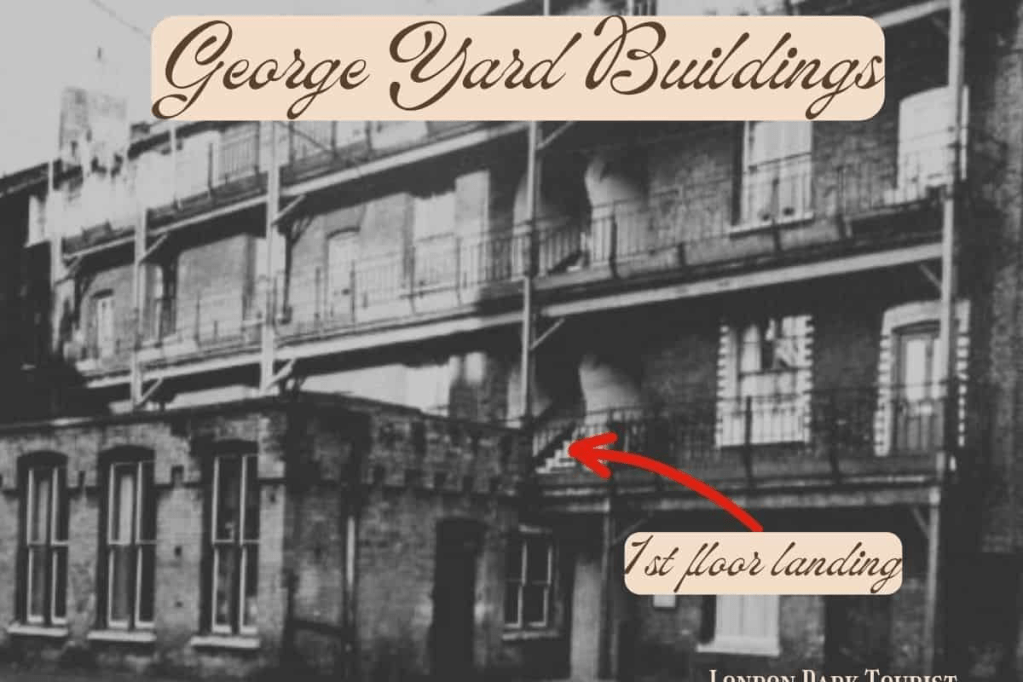
On the basis of statements from a fellow prostitute, and PC Thomas Barrett who was patrolling nearby, Inspector Reid put soldiers at the Tower of London and Wellington barracks on an identification parade, but without positive results. Police did not connect Tabram’s murder with the earlier murder of Emma Smith, but they did connect her death with later murders. Most experts do not connect Tabram’s murder with the others attributed to the Ripper, because she had been repeatedly stabbed, whereas later victims typically suffered slash wounds and abdominal mutilations. However, a connection cannot be ruled out.’
This writer proposes that Martha Tabram (below) was the true first victim of Jack the Ripper and not Mary Ann Nichols twenty-four days later.

The death of Martha fits the Ripper profile, as he avoided a Full Moon; chose a prostitute aged 39, which is close to the next four women who ranged between 44 and 47 years of age; and Martha lived in the vicinity of the other female victims. While it has not been possible thus far to confirm definitively that Holmes was right handed, it appears he was. Jack the Ripper on the other hand, is believed to have been ambidextrous according to the precision of left handed and right handed cuts on the victims bodies. Significantly, Holmes was 5’ 7” (170 cm) tall. In the 1880s this fell in the range of the average height for a European man. Recall the one witness account, which said Jack the Ripper was of ‘medium height.’

The MO for this murder does not seem out of place with the subsequent murder of Mary Nichols. An evolution is reasonable here, in that the first murder may have been rushed and Jack might have been nervous. In fact it would appear that Jack chose his first victim Martha too close to where he was staying. So much so, he got spooked and found his second victim Mary much father away. It was only then that he gained confidence for his next three killings in a. finding them nearer to his accommodation but not as close as Martha had been and b. having the bravado and time to remove organs – except the fourth victim Elizabeth Stride where he was likely disturbed.

Second victim Mary Ann “Poly” Nichols was 44 at the time of her death on Friday August 31, 1888. She too was found outside, in a gateway entrance of Bucks Row between a boarding school and a neighbourhood of cottages. The Coroner stated that, ‘he believed Nichols had been facing her attacker when he had held his hand across her mouth before cutting her throat. Death would have been instantaneous, and all her abdominal injuries, which would have taken less than five minutes to perform, were made by the murderer after she was dead. Llewellyn was able to determine this fact because wounds inflicted to an individual’s body after death do not result in blood spattering and may not result in an extensive amount of blood loss from the body.’
The third victim and not the second, was forty-seven year old Annie Chapman eight days later on Saturday September 8, 1888. She was found at 29 Hanbury Street, with the same abdominal cuts and stabbing wounds, but with her uterus and sections of her bladder and vagina missing. The short turn-around from Jack’s second killing tells us he had felt more comfortable with how Mary’s attack had gone and was eager to strike again. He was on a high from his success and probably fuelled even more by his intention to take an organ this time for the express purpose of cannibalism.
‘At the inquest into Chapman’s murder, Elizabeth Long described having seen Chapman standing outside 29 Hanbury Street at about 5:30 a.m. in the company of a dark-haired man wearing a brown deer-stalker hat and dark overcoat, and of a “shabby-genteel” appearance’ – this accurately describes Holmes’ usual appearance. ‘According to this eyewitness, the man had asked Chapman, “Will you?” to which Chapman had replied, “Yes.”‘
The fact Jack did not offend again until twenty-two days later means he was relishing his third successful kill and organ trophies. There may have only been four murders committed by Jack and not five if he had not been likely disturbed during his attack on forty-five year old Elizabeth Stride Sunday September 30, 1888. She was found dead in Dutfield’s Yard from a cut throat yet displaying no signs of mutilation. Police were on the scene within the hour when forty-six year old Catherine Eddowes died. Police ascertained the Ripper struck twice in less than half an hour. In killing again immediately, it is apparent that Jack was not to be thwarted in his desire for more organs. His desecration of Catherine’s body belied his obvious anger.
After killing her, Jack had disfigured her face greatly and some of her intestines were draped over her right shoulder and a different piece was deliberately laid on the ground. ‘The lobe and auricle of the right ear were cut obliquely through.’ The Coroner recorded:
‘The death was immediate and the mutilations were inflicted after death… There would not be much blood on the murderer. The cut was made by someone on the right side of the body, kneeling below the middle of the body… The peritoneal lining was cut through on the left side and the left kidney carefully taken out and removed… I believe the perpetrator of the act must have had considerable knowledge of the position of the organs in the abdominal cavity and the way of removing them. The parts removed would be of no use for any professional purpose. It required a great deal of knowledge to have removed the kidney and to know where it was placed. Such a knowledge might be possessed by one in the habit of cutting up animals. I think the perpetrator of this act had sufficient time… It would take at least five minutes… I believe it was the act of one person.’
Remember this information as it is pertinent.

While an escalation in the violence perpetrated against Catherine was evident and understandable from the murders of Martha, Mary, Annie and Elizabeth before her; the quantum leap in the barbarity inflicted on Mary Jane Kelly is puzzling.
Aside from the logistic difficulty discussed of ascribing the murder to H H Holmes as Jack (the conception of Lucy Holmes in early to mid October 1888), there are a few facts which do not align with Jack the Ripper being guilty for Mary’s death either, even if he wasn’t Holmes.
The first anomaly in MO, is Mary Kelly was twenty-five when she died. The first four women had ranged in age from thirty-nine to forty-seven. The second, is the fact that Mary Kelly was not lured by an attacker outside on the streets like the previous four, but completely contrary to the Ripper’s MO, in her home. She was likely startled and murdered while still in bed. The third issue, is that Mary was not just cut open, stabbed and mutilated by a street slasher in a matter of minutes like the previous four women, but she was eviscerated and obliterated to the point of being unrecognisable. To this day, ‘the crime scene photos of the aftermath remain a disturbing image.’ The killer as discussed earlier, had ample time behind closed doors in systematically arranging her internal organs about her body.
‘Investigator Amaryllis Fox puts it, the initial Ripper murders may represent Holmes’ “adolescence as a killer”, when he was still honing his style, inspiring him to take the next logical step and create his own killing environment: the Chicago Murder Castle.’ But Holmes was already building his Murder Castle, a plan probably in his mind for a long time. The ‘huge escalation from the previous Ripper killings, both in terms of context and ferocity’ may seem like a logical evolution in MO for some, though this writer is not convinced.
The fourth point of note is the pattern exhibited in when the Ripper chose his five victims. The killing of Mary Kelly, breaks the pattern. Martha was killed on August 7th on a dark night; then well after the other side of the Full Moon, Jack killed Mary Nichols on August 31. He waits a week, killing Annie well before the Full Moon and almost exactly a month after Martha on September 8. Jack then waits again almost the exact amount of days, twenty-two – instead of twenty-four the first time – and kills Elizabeth. She should have been the final victim, though disturbed and uncontrollably seeking a trophy organ to probably eat, Jack killed Catherine as well. This occurred on September 30, almost an exact month again since the death of Mary Nichols. The pattern here is no fluke. So why did the Ripper wait five weeks until allegedly killing Mary Kelly on November 9? We have established that if the Ripper was Holmes, he was long gone since early October. If Jack the Ripper was not H H Holmes, the question remains.
The fifth enigma is the pattern again of where the Ripper killed. A study of the two maps of Whitechapel shows where the Ripper likely lodged and the mistake he makes with killing his first victim Martha too near to his accommodation. He over compensates a little with his second murder of Mary Nichols, though when we see where the third, fourth and fifth women died there is logic displayed. The last four victims create a diamond shape around Martha. It doesn’t take long to observe that Mary Kelly’s location does not fit the pattern at all.

The contention is that Mary Kelly was not the fifth or even sixth victim of Jack the Ripper. As there were multiple killers in the Whitechapel area during 1888 to 1891, enough time had elapsed for the newspapers to divulge a plethora of details, allowing an albeit very evil and cunning individual to commit a horrific copycat killing and literally taking her heart with them. Regardless, the Ripper’s ‘legacy remains unmatched in the annals of true crime, with historians and researchers still trying to make sense of the mess he made over a century ago.’
Researchers have tried to find a motive for the Jack the Ripper murders aside from a deep-seated hatred of women. One is that of killing in a brutal fashion to conceal his real motive of obtaining internal organs. Yet the fact the Ripper did not take body parts until his third victim Annie and only two uteruses, part of a bladder and half a kidney in total does not reconcile with this proposed agenda. Even so, ‘Coroner Wynne Baxter, who examined Chapman, stated that the organs were the motive for the murders.’
‘Supposedly, the coroner was aware that an American was in town and that he had asked to purchase uteruses at the hefty price of 20 pounds each. Based on this theory, the mutilations and butchery of the victims were simply a smokescreen to hide the fact that Jack wanted organs. In other words, the American may not have purchased the organs had he known they came from innocent victims. Did Holmes somehow know that an American was in the market for uteruses?’
According to Douglas Barr: “The medical schools had outright refused this American… It was common knowledge throughout the medical community of London at the time that an American had made this highly unusual 20-pound offer, and the coroner at the Annie Chapman inquest knew it, and brought it up as the probable motive for the then-current Whitechapel murders of 1888” ‘The British Medical Journal responded by saying that the highly reputable doctor from the United States who had requested the uteruses had left England 18 months prior to the Ripper slaying. Some people suspected Dr. Francis Tumblety. However, he was by no means “reputable.” Most considered him a charlatan and quack, and later, he called himself an Indian herb doctor. However, he had a collection of uteruses. Could those have included the ones from the Ripper victims?’
‘… there’s the particularly damning image of Jack the Ripper created by a forensic sketch artist’ commissioned by Mudgett and Fox, ‘based on… 13 different witness testimonies from 1888’ who had seen the Ripper victims with men just before they died. ‘This sketch bears such a striking resemblance to H H Holmes that Mudgett believes it would be grounds for a warrant if the suspect was still alive today.’ Remember, Mudgett is a practicing attorney and the artist knew he was drawing Jack the Ripper but knew nothing about H H Holmes.
It is easy for the case against, to dismiss Jack and Holmes as the same man due to the superficial disparity in their modus operandi. Dig deeper and the similarities outweigh the differences. We have touched upon the reason why Holmes as Jack was able to kill with relative abandon, thus the different MO of the two is not a conclusive objection. We have witnessed the methodicalness of the Ripper in both his movements and victim selections. He was no less so in his attacks. ‘London’s police officers walked a very strict beat and had to be at a certain point at a certain time each shift. Jack seemed to know exactly when and where to strike when the officer was nowhere near.’ Then he calmly and carefully found, subdued and mutilated his victims in a quick and efficient manner.
Jack may have used chloroform on his victims. Holmes is on record for repeatedly using chloroform. As the Ripper is thought to have wielded medical and or surgical expertise, this would include pharmaceutical knowledge. It might have been a factor in the ease with which the Ripper manoeuvred his victims; laid their bodies down on the ground; and either silently throttled the women or cut their throats. Perhaps part of the reason the Ripper didn’t alert anyone within earshot to what was going on. Less blood seepage once the victim was dead, meant easier slashing of the abdomen and subsequent mutilation and organ removal. H H Holmes ‘took a similarly logical approach to his known victims. Let’s also remember he was a qualified doctor, adept at dissection and organ removal – who had studied in the anatomy lab of the University of Michigan’s department of Medicine and Surgery – something the university features on its website.’
We touched upon the fact that H H Holmes was a psychopath and not a sociopath. Tangent with this is that serial killers fall into two broad categories, organised or disorganised. Two modern examples include Ted Bundy who began as an organised killer, yet his alcohol addiction led to him becoming disorganised towards the end and Jeffrey Dahmer who superficially appeared a disorganised killer, actually exhibited a majority of organised traits. Needless to say, H H Holmes typified an organised killer, as did Jack the Ripper. Within these boundaries, serial killers can be categorised into four main types:
a. Visionary; b. Mission-orientated; c. Hedonistic; and d. Power and control.
The Visionary serial killer ‘believes that a person or entity is commanding him to kill.’ They are most likely suffering from psychosis and usually act as a disorganised killer. They select random targets, lack planning and make little or no effort to cover up crimes. An example would be Peter Sutcliffe the Yorkshire Ripper, who allegedly had schizophrenia, hearing voices commanding him to kill.
The Mission-orientated serial killer ‘kills in order to “rid” society of a certain group.’ These killers believe they are doing society a favour and are organised, planning their crimes. They do not suffer from psychosis and unlike the Visionary killer, are ‘not out of touch with reality’, deciding to kill from their own accord. They kill quickly and efficiently often with a gun, avoiding close contact with victims.
The Hedonistic serial killer ‘commits his acts for his own personal pleasure. For example, rape, torture or money.’ The Hedonistic killer can be subdivided into three subcategories, labelled Lust, Thrill and Comfort. The Lust serial killer rapes, tortures and mutilates because it gives them sexual gratification. They fantasise about violence and can find it difficult to control their impulses. The Lust killer prefers close contact and will use their hands or a knife instead of a gun.
This Interests Me, The Four Types of Serial Killers:
‘Lust killers can fantasize about committing these crimes for years before they pick up the courage to commit their first murder. In many cases, this violent fantasy will dominate their thoughts to the point that it becomes a deep-seated psychological need. Once a lust killer commits his first murder, this “part of him” can take over his life. As time goes on, he might require more stimulation in order to relive the “highs” of his first couple of kills. As a result, the time between each murder may continue to get shorter and shorter as he struggles to control his impulses. Lust killers will sometimes take trophies from their victims in order to remind themselves of their crimes. They can also return to the crime scene in order to relive the murder. Or worse… mutilate the body and engage in necrophilia. It is important to note that these crimes do not have to involve sexual intercourse. For example, the killer might not rape his victim because it is the murder itself that gives him sexual gratification. He may “get off” on torturing his victim and mutilating their body. As a result, intercourse with the victim may be a completely unnecessary act from his perspective.’
The Thrill serial killer feeds from the response they receive from their victims. Hunting their victim or experiencing their terror gives them an adrenaline rush and their suffering excites them. They often have feelings of inadequacy, yet feel powerful when dominating. Once a Thrill killer has murdered their victim they lose interest in the body and there will unlikely be signs of mutilation after they have perished.
A Comfort serial killer ‘is someone who kills for money or other material gains. For example, they might murder their spouse in order to receive an insurance payout.’ They often use poison; avoid contact; can wait a long time between murders, because they are a means to an end; and won’t necessarily take pleasure in the kill.
The Power and control serial killer, seeks to gain control over his victims, dominating them. Taking away their lives gives them a feeling of empowerment. It is one of the more common type of serial killer. They have feelings of inadequacy, are afraid of rejection and may have been abused as children. These killers are calm, meticulous, patient and organised.
‘Although they may sexually assault their victims, this is not done for sexual pleasure. Unlike Lust killers, the “Power/control” killer uses sexual assault as a tool to exert power and control over their victims. Even after the act of murder is done, the “Power/control” killer may continue to “control” his victim. For example, he might return to the body and mutilate it further. He might also engage in necrophilia. The act of keeping souvenirs that remind them of their victims is also common. For example, the killer could take photographs of his victims or keep pieces of their jewelry. A souvenir allows the killer to relive the crime and fantasize about it. It also acts as a badge or token. In other words, it represents a life that they took.’
Comparing these profiles, expert profilers admit serial killers can exhibit over lapping tendencies. There is a strong correlation between the Hedonistic Lust serial killer and Jack the Ripper. The same category would also define H H Holmes, particularly if there is truth to his later exploits performed in the Murder Castle. It is interesting to note that the related Hedonistic category, the Comfort serial killer resonates strongly with many of Holmes’ murder schemes for money. Likewise, an overlap of sorts with the Power/controlling serial killer is feasible for both men. Yet, it is hard to gauge whether sexual violence was part of Holmes’ MO or not. As well as how much he was driven by sexual arousal or not. Regardless, what is not questionable, is that both Jack and Holmes shared as their foremost motivation, the lust inspired from the planning of a kill and the resulting ecstasy achieved from the actual act of the murder.
Holmes’ zodiac sign was Taurus. A list compiled by This Interests Me, revealed of the worst serial killers in American history – some sixty-one individuals, born between 1900 and 2000 – the star sign having the most killers with nine, was Pisces and the one with the least was Taurus with three. Taurus was sixth equal with Cancer, Libra and Aquarius. Of the serial killers who have been the Taurus sign, no famous or well known names were included. Thus Holmes is in a minority astrological profile, though matched against the worst 161 serial killers worldwide for the same birth years on the Chinese calendar, he is in a majority. For his birth year was the Rooster and the rooster is third equal with the Dog with sixteen killers. The Dragon (unsurprisingly) having the most with twenty names and the Pig second on eighteen. The second lowest is the Monkey with nine and the lowest, the Ox with eight killers.
An area of further interest is three critical letters which may have been penned by the Ripper, aka Holmes. If the Ripper was Holmes – who was only in London for nearly two months – would he have had the inclination to write letters? On the other hand, as he was on vacation so-to-speak, it may have been a welcome distraction. If so, which letter or letters did he write?
The first letter of note is called the Dear Boss letter. Mudgett and Fox during the course of their investigation met with ‘John Harris, a professor of linguistics, who analysed the letter and confirmed “the language doesn’t identify as a British writer”, pointing to conspicuous American-isms dotted throughout the message.’
This is quite a coincidence, even if the American in question wasn’t Holmes, it supports what we have learned; that Jack was essentially a foreigner and not English (or British).
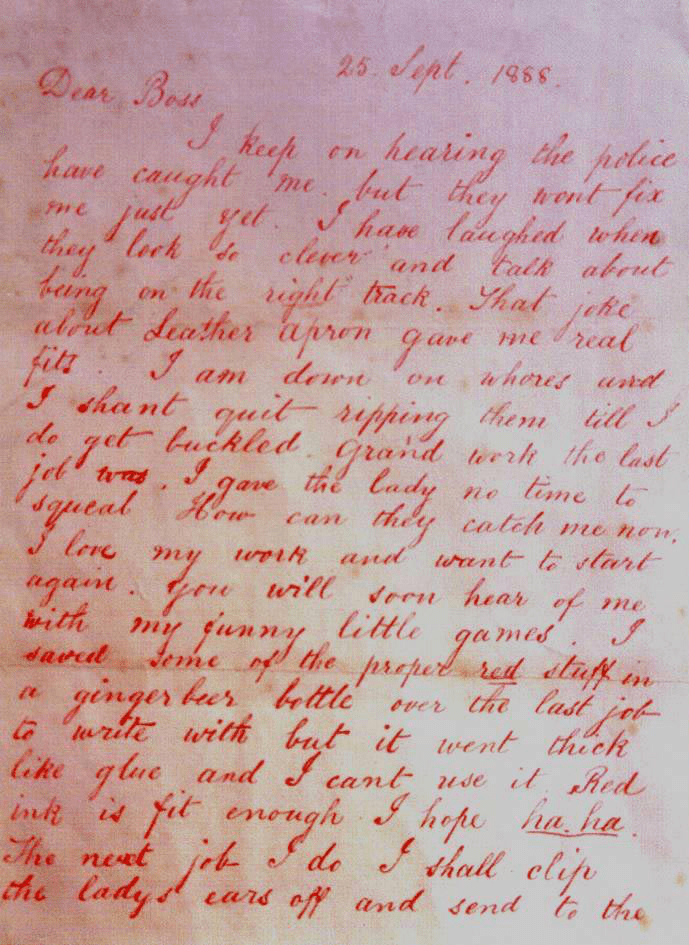
Most experts of the case dismiss these letters as hoaxes. A case in point is famous contemporary crime novelist, Patricia Cornwell. She is convinced Walter Sickert was Jack the Ripper. ‘Cornwell’s prime evidence regards scientific analysis of stationery used by Sickert, the same of which was used by the Ripper to send letters to the police. The best-selling author’s research has found that three Sickert letters and two Ripper ones came from a paper run of just 24 sheets.’ Yet if the so-called Ripper letters are hoaxed then all this proves is that Sickert wrote three hoax letters too. This is credible for ‘British impressionist painter Walter Sickert painted and drew nudes of brutalised women and was known to take a keen interest in the crimes of the shadowy figure who stalked the foggy alleyways of Whitechapel in 1888…’ What does not help Cornwell’s case is the fact that Sickert was in Britain for only three of the killings and away in France for the others.
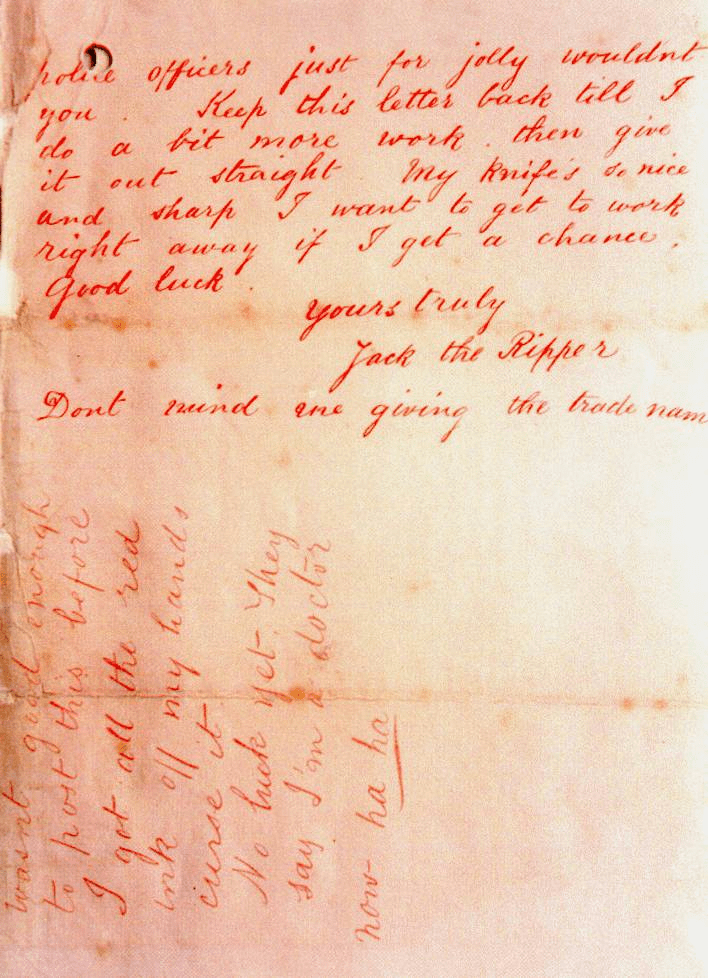
Encyclopaedia:
‘The “Dear Boss” letter was a message allegedly written by the notorious unidentified Victorian serial killer known as Jack the Ripper. Addressed to the Central News Agency of London and dated 25 September 1888, the letter was postmarked and received by the Central News Agency on 27 September. The letter itself was forwarded to Scotland Yard on 29 September’ – delayed, because it was perceived as a joke. ‘Although many dispute its authenticity, the “Dear Boss” letter is regarded as the first piece of correspondence signed by one Jack the Ripper, ultimately resulting in the unidentified killer being known by this name. The “Dear Boss” letter was written in red ink, was two pages long and contains several spelling and punctuation errors. The overall motivation of the author was evidently to mock investigative efforts and to allude to future murders. The letter itself reads:
Dear Boss,
I keep on hearing the police have caught me but they wont fix me just yet. I have laughed when they look so clever and talk about being on the right track. That joke about Leather Apron gave me real fits. I am down on whores and I shant quit ripping them till I do get buckled. Grand work the last job was. I gave the lady no time to squeal. How can they catch me now. I love my work and want to start again. You will soon hear of me with my funny little games. I saved some of the proper red stuff in a ginger beer bottle over the last job to write with but it went thick like glue and I cant use it. Red ink is fit enough I hope ha. ha. The next job I do I shall clip the ladys ears off and send to the police officers just for jolly wouldn’t you. Keep this letter back till I do a bit more work, then give it out straight. My knife’s so nice and sharp I want to get to work right away if I get a chance. Good Luck.
Yours truly
Jack the Ripper
Dont mind me giving the trade name
PS Wasnt good enough to post this before I got all the red ink off my hands curse it. No luck yet. They say I’m a doctor now. ha ha
The salient points are, the letter writer seems intent on making sure his alias is known as Jack the Ripper. Up till this time, he had been referred to as: ‘the Whitechapel Murderer’ or ‘Leather Apron’. ‘The grotesque mutilation upon Nichols and later victims was generally described as involving their bodies having been “ripped up” and residents spoke of their worries of a “ripper” or “high rip” gang.’ It was only after September 27, 1888 that the killer was known as Jack the Ripper. He boasts of his third murder (not second), who was Annie Chapman. It was her corpse that he took organs for the first time, and it would seem perhaps, her blood as well. The chilling sentence is the one regarding cutting ears, for the killer did in fact cut part of the ear of his fifth and final victim, Catherine Eddowes. How would a hoaxer know this? This letter was written seventeen days after the murder of Annie and five days before the killer murdered Elizabeth and Catherine. Eerily, the letter was forwarded to the police the day before their deaths.
While not an expert in calligraphy or psychology, but what stood out was a. the almost forced impression of coming across as a jovial Cockney, contrasted with b. the neat and precise handwriting. Handwriting which for exhibits the artistry and neatness noticeable amongst schooled Americans. Perhaps more time is spent teaching on writing nicely and neatly in American schools, or they are just more gifted at hand writing. Regardless, there is something off about the letter. Not that it is a hoax, but perhaps it really was written by the killer.
‘Like many documents related to the Ripper case, the “Dear Boss” letter disappeared from the police files shortly after the investigation into the murders had ended. The letter may have been kept as a souvenir by one of the investigating officers. In November 1987, the letter was returned anonymously to the Metropolitan Police, whereupon Scotland Yard recalled all documents relating to the Whitechapel Murders from the Public Record Office…’
The second letter of interest, which a forensic linguist analysis in 2018 supports was written by the same person as the Dear Boss letter is the Saucy Jack postcard. For instance, a perusal of each communication reveals clear similarity in a number of letters; such as the letter f and letter r.

The card was postmarked October 1, the day after the fourth and fifth murders.

‘Postmarked and received on 1 October 1888, the postcard mentions that the two victims killed on 30 September were killed very close to one another, stating: “double event this time”. Some authors have argued that the letter was sent before the murders were publicised, making it unlikely that a hoaxer would have such knowledge of the crime, but the letter was postmarked more than 24 hours after the killings took place, long after many details were known by journalists and residents of the area. The text of the postcard reads:
I was not codding dear old Boss when I gave you the tip, you’ll hear about Saucy Jacky’s work tomorrow double event this time number one squealed a bit couldn’t finish straight off. Had not time to get ears off for police thanks for keeping last letter back till I got to work again. Jack the Ripper
Even though less is written than in the Dear Boss letter, There are a number of salient points. If the card is to be trusted, the author has genuinely committed the double murder. It is obviously very fresh in his mind and though the postmark is the next day, as anyone knows who has written a letter or postcard, the chances of mailing it immediately after writing are low. Invariably, it is posted hours later or the next day. The fact the writer of the postcard is acting like it is breaking news validates its authenticity does it not?
We have confirmation that the killer was disturbed during Elizabeth Stride’s murder, or did not have an easy time of it. The author of the card also provides an explanation as to why he did not send Catherine Eddowes’ ear to the police. Though we know he partially clipped one. The Saucy Jack postcard also went missing in the years after the murders and has never been recovered.
The third letter is known as the From Hell letter. It was postmarked October 15, 1888. While this falls outside of the reinterpreted time frame for Jack the Ripper’s murders if he was in fact H H Holmes, we will consider its authenticity nonetheless.

From hell
Mr Lusk, Sor
I send you half the Kidne I took from one women prasarved it for you tother piece I fried and ate it was very nise. I may send you the bloody knif that took it out if you only wate a whil longer
signed
Catch me when you can Mishter Lusk
‘An examination of the kidney revealed the individual from whom the organ originated had suffered from Bright’s disease’ and that the left kidney was from a sickly alcoholic woman who had died within the past three weeks. The letter itself reveals a lower literacy level than the other two letters and tellingly, markedly different handwriting. Further information showing the letter to be likely a hoax and not from the real killer includes:
‘A contemporary police lead found that shopkeeper Emily Marsh had encountered a visitor at her shop, located in London’s Mile End Road, with an odd, unsettling manner in both his appearance and speech. The visitor asked Marsh for the address of Mr. Lusk, which he wrote in a personal notebook, before abruptly leaving. He was described as a slim man wearing a long black overcoat at about six feet in height who spoke with a distinct Irish accent, his face featuring a dark beard and mustache. While the event took place the day before Lusk received the “From Hell” message and occurred in the area in which it is considered to have been postmarked, the fact that Lusk received so many letters during this time suggests that the suspicious individual may have been another crank.
Forensic handwriting expert Michelle Dresbold, working for the History Channel documentary series Mystery Quest… argued that the letter is genuine based on the peculiar characteristics of the handwriting… Based on linguistic clues (including the use of the particular spelling of the word “prasarved” for “preserved”), Dresbold felt that the letter showed strong evidence that the writer was either Irish or of Irish extraction… the author may have had an Irish background but also… that he may have had Cockney mannerisms.’
From this we learn that the letter writer was probably the same man in the shop. This man was slim, tall and with a beard. He does not fit the profile for Holmes.
An area which is summarily dismissed by the case against, yet has to be taken seriously is the missing time of H H Holmes. Holmes was an enterprising businessman who regularly left a ‘constant paper trail of financial transactions, promissory notes, legal problems, and lawsuits in the United States.’ Making it remarkably easy to track his movements. Oddly, his trail falls silent after July 1888 until early 1889, as Mudgett and Fox discovered. Extraordinarily, during the exact period of the Ripper murders, Holmes seems to have vanished from the United States.
We know already that Holmes declined to pay the architects or the steel company, Aetna Iron and Steel for their work to date on the Englewood property. It was in 1888 they took him to court. Holmes thus had reason if needed to disappear for a while. Ship records dug up by Mudgett and Fox discovered details confirming that someone called H Holmes was a passenger on a ship travelling from Britain to the United States after the final Ripper murder. Of course, now with a reinterpreted time line, it would be fascinating to learn if a H Holmes took passage from Britain to America in early October, 1888. Holmes proclaimed: “I roamed about the world seeking whom I can destroy.”
Jeff Mudgett claims Holmes’ diaries indicate he was in London in 1888, the year of the Ripper murders. Mudgett told The Mirror newspaper that ‘Scotland Yard had visited the US amid rumours the killer was an American doctor, after Mary Kelly’s viciously mutilated body was discovered in her East End home.’ Mudgett continues: “I don’t know why Scotland Yard aborted this search then. I think they knew it was an American doctor. I think he committed his crimes, booked a trip home and they followed him back here. I don’t know why they stopped, it could have been money. If they had stuck with their investigation, if they had followed with the evidence, they may have stopped the Murder Castle being built at all.”
There are other potential American links to Jack the Ripper which go beyond H H Holmes. A number of experts believe that Jack the Ripper could have been another identity, known as “Servant Girl Annihilator”, otherwise called the ‘Austin Axe Murderer’. This ‘Midnight Assassin’ murdered eight people in Austin, Texas in 1884 and 1885. The murders are still unsolved. While it is beyond the scope of this article to delve into this line of reasoning, it would be interesting to study if any connection between this killer and H H Holmes could be established.
A television documentary, Meet the Markles, produced for Channel Four UK, revealed the former Suits star has a distant relation to H H Holmes. The claim was made by Holmes’s great-great-grandson, Jeff Mudgett, who discovered that he and Markle are eighth cousins. ‘When asked about his connection to Markle, and their shared connection to Holmes – and, possibly, Jack the Ripper – Mudgett replied:
“We did a study with the FBI and CIA and Scotland Yard regarding handwriting analysis. It turns out [H H Holmes] was Jack the Ripper. This means Meghan is related to Jack the Ripper. I don’t think the Queen knows. I am not proud he is my ancestor. Meghan won’t be either.”
Finally, unrelated to proving the case for Jack and Holmes being the same person, though perhaps of interest for some readers, is the suggestion that Holmes might have chosen on purpose to be Jack the Ripper in the year 1888. Or, in a somewhat more sinister vein, the year 1888 may have chosen him?

While numbers determining the influences on ones life divides opinion, it cannot be denied that either the following information is an extraordinary coincidence; or Holmes himself, was a practitioner of numerology.
Briefly, numerology takes account of a person’s birthdate, day, month and year as well as their name. The letters of the alphabet are ascribed a numerical value, so that a=1, b=2 and so forth up to nine. Thus the first set of nine are letters a through to i, the next set are j to r and the last set, s to z, which is worth eight as there are only twenty-six letters. There are also what are called master numbers, which are double digits such as 11, or 22. These can be brought down to their base number, so that 11 equals 1 + 1 or 2 and 22, is 2 + 2 or 4. As a master number, they are powerful numbers which resonate with an intense frequency. More is required of an individual which can either be fulfilled in a positive manner or take someone down a darker, baser path. There are also Karmic numbers: 10, 13, 14, 16 and 19, which present different specific learning opportunities.
Taking Holmes birth name, Herman Webster Mudgett produces a surprising result. Adding the numbers of Herman results in the number 32 and 3 + 2 = 5. Webster equals 29 or 11, a master number and Mudgett equals 27 or 9. We will not dissect every number, just those of interest. In this case the master number eleven. Master numbers indicate an ‘opportunity for learning and integrating spiritual information’, particularly the number eleven. For the number eleven represents a ‘spiritual messenger’ This learning is derived through tests, trials and stressful circumstances and if fulfilling the master number potential, one is operating with ‘spiritual, philosophical, universal and metaphysical principles.’ The converse – if one is focusing on the ego, selfishness and the material – one is confined to a specific base number vibration instead.
The Complete Idiot’s Guide to Numerology, Kay Lagerquist & Lisa Lenard, 2004:
‘… if you have a master number, you’ve made a kind of contract… to help humankind in this lifetime…’ While a person can change their name, taking on the qualities of the new name, they still retain the attributes of their original birth name. It distinctly appears Herman Mudgett did not live up to his master number 11 and chose a baser path. ‘The 11/2 walks a fine line between greatness and self-destruction… and can be given over to fear and phobias or soar to the heights of the enlightened.’
Even so, the most interesting facet of Herman’s name is what his three names add up to: 32 + 29 + 27 = 88. This total is called your Destiny number, the second of five core numbers, which include, Life Path, Soul, Personality and Maturity numbers. The master numbers run from 11 to 99, though after the number 33, they are rare. The number 8 is also a rare number to begin with in numerology when relating to peoples names. For example, the number 9 is the only number represented by just two letters, i and r. Even so these letters are common in the English language, whereas the letters represented by the number 8 are h, q and z. The letter h is fairly common but q and z are not. Therefore, Herman had both a unique and rare Destiny number.
The number eight in numerology relates to personal power and excellence. ‘If it has anything to do with money, chances are it has something to do with the 8.’ Isn’t that the truth. Herman was obsessed with personal power and money. The number eight is the number of wealth and abundance and was ‘born to be the boss.’ Their strengths are leadership, organisation, dedication to work and the ‘unusual ability to overcome obstacles.’ Eights need goals and a plan to direct their energies and they are not adverse in taking financial risks. The challenge for the eight is ‘resist the drive to live for money and to be consumed by the acquisition of wealth.’ Lagerquist and Lenard add, in perverted irony when considering Holmes: ‘With a number 8 Destiny Number, your mission in life is to gain mastery of self. Your purpose is to achieve and succeed, using your skill at business and organisation.’
Regarding the 88/7 master number they continue: ‘The demand here is for self-mastery for control of the power of thought and emotion. This number is learning about the right use of material resources.’ Clearly, Holmes or rather Mudgett failed to live up to his potential. His true self may have been working at times as a seven, for 8 + 8 = 16, which is 1 + 6 or 7. A coincidence is that Mudgett was born May 16, where 16 is 1 + 6 or 7; and Holmes died on May 7.
True Numerology shares the following regarding master number 88 and base number 7 and similarly there is upsetting irony when considering Holmes:
‘… Master Number 88 builds upon a solid foundation and structure. Similarly, they are also extremely disciplined and know how to take an opportunity and make the best out of it. Likewise, they are also very hard working… Master Number 88 reduces to Number 7. Number 7, as we know, is the most spiritual number in numerology. Therefore, those with Master Number 88… may be driven to succeed in business and career, but the motivation behind it is always a spiritual, higher purpose. Because Master Number 88 is an upgraded version of Master Number 44, it has double the discipline, double the structure, and double the stability. Although it may sound like nothing could go wrong with this scenario, the amplified energies of Master Number 44 within 88 can translate to extreme inflexibility, defensiveness, and fear-driven lack of movement.
People born into Master Number 88’s energy may have a tendency to be paralyzed by fear of what could go wrong… once they do start and get the ball rolling, they are highly likely to achieve success as these people are very good at taking an opportunity and making the best out of it. The energies of 44 and 88 are quite the opposite from Number 7, which Master Number 88 reduces to. Number 7 has a tendency to be distracted, get caught into conflict due to the fact that they are an odd number, become too idealistic, and do not enjoy socializing.’
We do not know if Herman Mudgett chose a pseudonym that was inspired by his first name Herman; by the fictional detective Sherlock Holmes; for another reason entirely; or perhaps by the dark entities guiding him. It is an amazing circumstance that Mudgett should choose the distinctive name Henry Howard Holmes. This is where it becomes fascinating for the name Henry adds up to 34, which breaks down to the number 7.
The middle name Howard adds up to 33/6 a master number connected with healing or the opposite if abused; while Holmes adds up to 27, which is 2 + 7 or 9. His three names added together is 94 and this breaks down to Karmic number 13 and base number 4, which is half of 8. The number 13/4 is Holmes’ alternative Destiny number and coincidentally has energies in common with eight. It is interesting irony that Holmes inflicted himself with this Karmic number, for it is about being honourable, disciplined and fulfilling commitments.
The most striking element in connection with Herman Mudgett’s new name was the fact that his three initials HHH equalled 888. In so doing it formed an eerie synchronicity with the fateful year and the grisly murders, 1888.

Numerology Nation says regarding the Angel number triple eight:
‘… angel number 888… is strongly associated with power and influence and when you see it, you should know that the great potential within… is about to be unleashed. The 888 meaning… is that we all have a mighty power deep within us and the ability to impact the world in a big way – you can influence many… it’s time to develop a new way of thinking… [and] take every possible chance to make your dreams come true and that giving up is not an option. It shows that it’s time to reinvent yourself.’
The number 8 also represents the infinity symbol, which means that there are infinite possibilities to explore for someone with eights in their life. According to professional medium Megan Michaela Firester – aka Mystic Michaela – the number eight represents energy that is limitless and “the forces of the universe are always flowing through and around you.” She says eight serves as a reminder that “the forces you open yourself up to with mindful attention will envelop you in their flow.” It would seem to this writer that H H Holmes certainly did that.
In 2015, a film adaptation of The Devil in the White City, starring Leonardo DiCaprio and to be directed by Martin Scorsese, was set to begin filming but strangely never got under way. Then in 2019, Scorsese and DiCaprio were to be executive producers in a television version to have been released by Paramount TV and Hulu, but strangely again, the idea is apparently no longer progressing.
An original excerpt transferred from the article: The Top Ten Unexplained Mysteries of all Time.
© Orion Gold 2025 – All rights reserved. Permission to copy, use or distribute, if acknowledgement of the original authorship is attributed to orion-gold.com
 The Lightkeeper