
Prior to the increasing popularity of the history defining findings at Gobekli Tepe and aside from the enduring obsession with the perfection of the Pyramids at Giza, it is Stonehenge – located on Salisbury Plain in Wiltshire, England, eight miles north of the cathedral city of Salisbury – that is one of the most famous prehistoric landmarks in the world; perhaps capturing the fascination of people more than any other. Yet even so, this arcane monument remains one of the most mysterious.
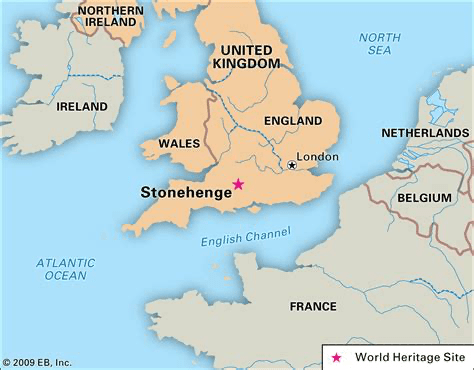
The impressive feat of Stonehenge’s erection is incorrectly attributed to primitive man some five thousand years ago. While Stonehenge may not be as old as Gobekli Tepe or perhaps even the Great Pyramid (Article: The Pyramid Perplexity), its erection predates 3000 BCE by millennia. The size of the intricate set of stones belie a construction by the mysterious giants of the early epoch following the Younger Dryas event – refer articles: Nephilim & Elioud Giants I & II. The name of the monument may derive from the Saxon stan-hengen, which means ‘stone hanging’ or the more sinister ‘gallows’.
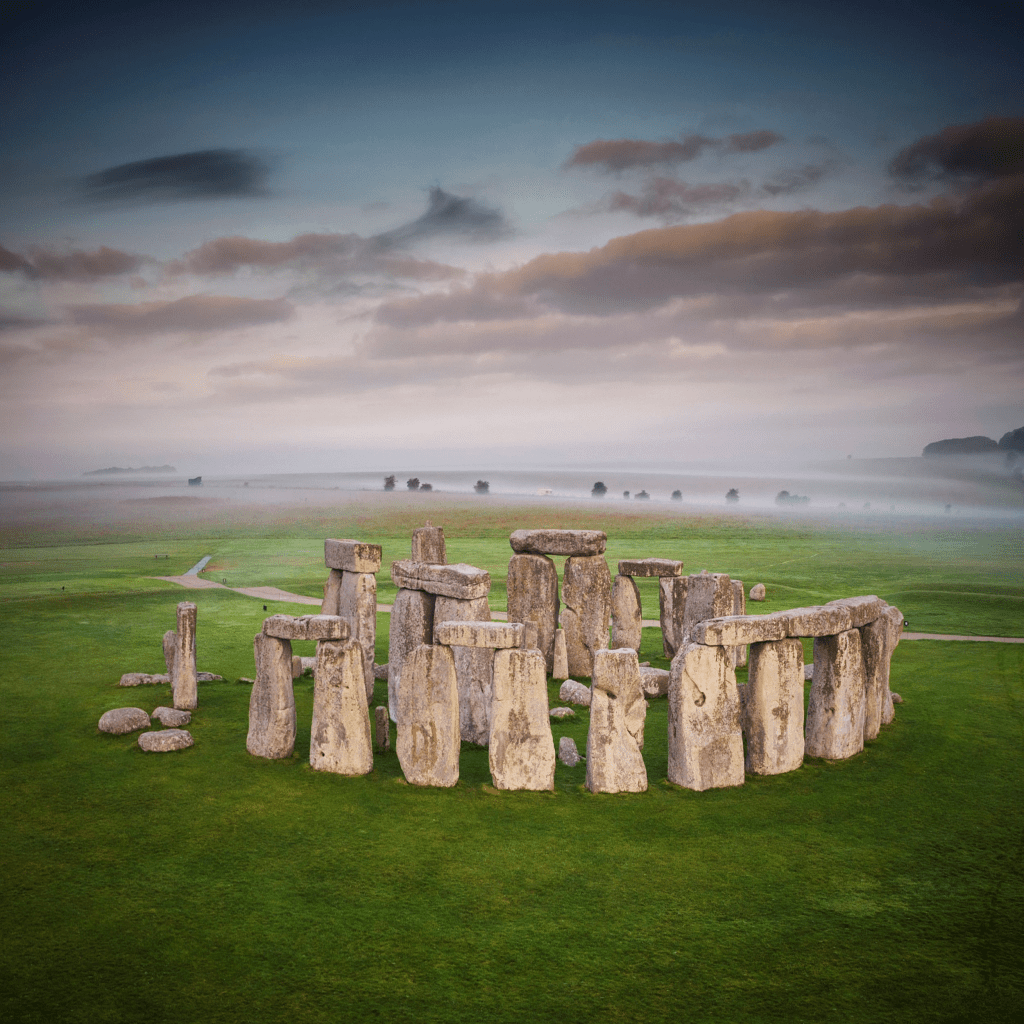
As Ancient Code note: ‘Not a single archaeologist has successfully explained how it was built. Interestingly, the how isn’t perhaps as mysterious as the why. Countless theories have tried explaining the real purpose of Stonehenge, yet experts have still failed to agree on one. Was Stonehenge an Astronomical observatory? Was it a religious temple? Was it [a] burial site? We still do not know.’ Of these options and if we follow the clues of the Cochno Stone, the Inga Stone and of Gobekli Tepe, then the first one is the most likely or foremost to consider – refer article: Monoliths of the Nephilim.

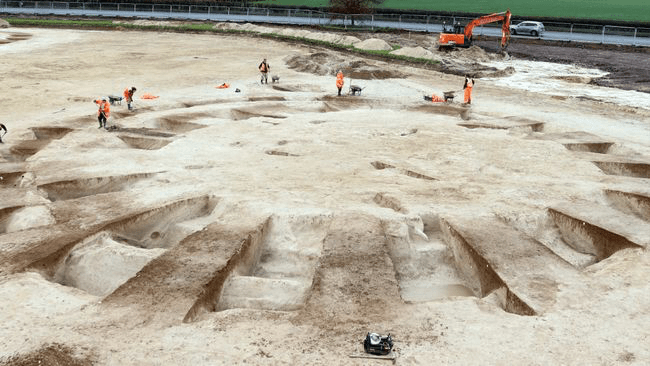
Graves have not been found at Stonehenge though a cemetery of Bronze Age burial mounds (above and below) has been unearthed less than ten miles distant. Live Science, June 15, 2023: ‘The cemetery includes more than 20 circular mounds, known as barrows, built between 2400 B.C. and 1500 B.C. on a chalk hillside near Harnham on the outskirts of Salisbury in southwest England. Other than the site’s proximity to Stonehenge, there’s no evidence that the cemetery was connected with the famous monument. One of the barrows was originally enclosed by an oval-shaped ditch that was replaced in prehistory with a nearly circular ditch. That suggests this barrow might have been built before the others, during the Neolithic period, which ended around 2400 B.C.; a mass grave near its center held the skeletal remains of adults and children…’
Whoever built Stonehenge, they were particular in the stones they chose. When restoration work was conducted in 1958, a rocky core was removed and kept as a souvenir. Robert Phillips was a representative of the drilling company assisting in the restoration of Stonehenge. He took the cylindrical core when it was drilled from one of Stonehenge’s pillars – coincidently, Stone 58.* Phillips later emigrated to the United States, taking the core with him. Due to Stonehenge’s protected status, it is not possible to extract samples from the stones any longer. Some sixty years later, the core was returned, providing ‘researchers the opportunity to perform unprecedented geochemical analyses of a Stonehenge pillar…’

The final stone is put in place during the restoration of Stonehenge on July 9, 1958,* with the giant lintel laid across the top of upright megaliths 57 and 58*
The results showed that the standing stones or sarsens – sandstone remnants of eroded Tertiary beds found in south-central England – were comprised of rock ‘containing sediments formed when the dinosaurs walked the Earth’.
According to an unconventional chronology, this would be far more recently than sixty-five million years ago. Similarly, other grains of rock in the pillar would date far later than the 1.6 billion years ascribed to them. English heritage: “Sarsens were erected in two concentric arrangements – an inner horseshoe and an outer circle – and the bluestones were set up between them in a double arc.”

Mindy Weisberger: ‘When the scientists peered through a microscope at thin slices of sarsen rock from Stone 58, they were surprised to discover that the stone was 99.7% quartz. A quartz “cement” held fine-to-medium quartz grains and formed “an interlocking mosaic of crystals”. That made the rock more durable, and it may have been why the builders chose that type of rock for their massive monument thousands of years ago.’ Author David Nash, a professor of physical geography at the University of Brighton in England: “These cements are incredibly strong. I’ve wondered if the builders of Stonehenge could tell something about the stone properties, and not only chose the closest, biggest boulders, but also the ones that were most likely to stand the test of time.”
Surely the condition of the Stonehenge stone slabs is a clue to their great antiquity; considerably older in construction than four to five thousand years ago. The error has been made in equating Stonehenge as just another stone circle. The construction of which is typically dated to beginning in 3000 BCE. What seems to have passed researchers attention is that Stonehenge is not just another stone circle and if it is the first, it set a precedent long before other cultures began following suit. The same scenario has occurred with the Pyramids of Giza setting a standard which granted was copied, but only millennia later and with workmanship incomparable to the originals.
English Heritage: ‘From the 1880s, various stones had been propped up with timber poles, but concern for the safety of visitors grew when an outer sarsen upright and its lintel fell in 1900. The then owner, Sir Edmund Antrobus, with the help of the Society of Antiquaries, organised the re-erection of the leaning tallest trilithon in 1901. This was the start of a sequence of campaigns to conserve and restore Stonehenge – the last stones were consolidated in 1964.’

It is interesting to note how English Heritage describe the site with such salient points as: ‘Stonehenge is the world’s best-known ancient stone circle… Built around the same time as the Great Pyramid in Egypt… the finished monument of massive and finely dressed sarsen stone was unlike anything ever seen across Europe. It is a powerful memorial… of… a time of transformations when landscape was being monumentalised in completely new ways…’ We will return to the significance of the circle formation.
This writer concurs with Stonehenge being unique and unlike anything else in Europe, because it was a monument from a far earlier millennia than is readily acknowledged. But perhaps still not within the earliest after the great flood. Mere mortals did not conceive or oversee the construction of either edifices. By English Heritage’s own admission, Stonehenge is utterly unique and a monument seemingly out of time and context in our world. A dating of only circa 2500 BCE is more incredulous than the accomplishments of the site itself.
‘The significance of Stonehenge itself can be summarised as follows:
- Stonehenge is the most architecturally sophisticated and only surviving lintelled stone circle in the world.
- The earliest stage of the monument is one of the largest cremations cemeteries known in Neolithic Britain.
- The stones were brought from long distances – the [igneous] bluestones from the Preseli Hills, over 150 miles (250km) away [in South Wales], and the [Cenozoic silcrete] sarsens from West Woods, 15 miles (25km) north of Stonehenge on the edge of the Marlborough Downs.
- The stones were dressed using sophisticated techniques and erected using precisely interlocking joints, unseen at any other prehistoric monument.’

An interlocking sarsen slab forming a circle
These points stand alone as vital clues to Stonehenge’s almost otherworldly design, but by putting them all together, is one not compelled to consider the possibly, that this monument was not formed by human hands alone, if at all? Even comparing the ancient decrepit Stonehenge with the modern complete Stonehenge II, there is no comparison. Stonehenge II ‘is a concrete sculpture in the Texas Hill Country, US, built in homage to the original… monument. Stonehenge II was conceived by Al Shepperd and built with the help of his friend and neighbor, Doug Hill. Originally located on FM 1340 west of Hunt, Texas, Stonehenge II now resides on the campus of the Hill Country Arts Foundation in Ingram, Texas.’

According to the signage at the site: ‘Stonehenge II is not a replica; it is about 2/3 the size of the original’ – so much for “everything being bigger in Texas” – ‘and it is not oriented to the sun, as is the original. Rather, it is Hill’s impression, in steel and concrete, of the nearly 5,000 year old circle of stones on the Salisbury Plain.’

Aside from Stonehenge II, there is a a full scale replica of Stonehenge in Maryhill, Washington. It was built by another Hill, this time Samuel Hill, who had visited the ancient monument during the war, and ‘was told it was used for human sacrifice by the Druids.’ Samuel Hill connected this story with the appalling loss of life during the Great War, building the replica as a reminder of those sacrifices and the “incredible folly” of war. It was dedicated in 1918 to Maryhill residents who had died in World War I.

In Sweden, there is as ancient megalithic structure shaped like a ship. It seems to have a similar geometry with Stonehenge, with one scientist saying it may have been used as an astronomical calendar.

There is a curious Stonehenge like structure located in Armenia, called Carahunge (or Karahunj). It is deemed a sophisticated astronomical observatory and oddly has beings with elongated heads and almond shaped eyes depicted on some of its rocks (above)… Other parts of the world also contain sites built on the principle of Stonehenge; such as Russia, the Sahara Desert, the Amazon, underneath Lake Michigan, Australia and even Stonehenge 2.0, about two kilometres from Stonehenge. Researchers discovered a massive stone arrangement of approximately ninety pieces of megalithic blocks of stone. The stones were discovered one metre beneath the surface and are around 4.5 metres in height.
English Heritage: ‘The earliest structures known in the immediate area are four or five pits, three of which appear to have held large pine ‘totem-pole like’ posts erected in the Mesolithic period [within 200m of Stonehenge’s future location], between 8500 and 7000 BC. It is not known how these posts relate to the later monument of Stonehenge.’ It is proposed that the true age of Stonehenge is within this time frame. Thus after Layer III of Gobekli Tepe, coinciding with Layer II and avoiding any conflict with the relationship of the posts in a non-different time.
During this age, most of the rest of southern England was largely covered in woodland, so that the ‘chalk downland in the area of Stonehenge may have been an unusually open landscape.’ Explaining why it was chosen as the site for an early monument complex. The ‘complex included the causewayed enclosure at Robin Hood’s Ball, two cursus monuments or rectangular earthworks (the Greater, or Stonehenge, and Lesser Cursus), and several long barrows…’
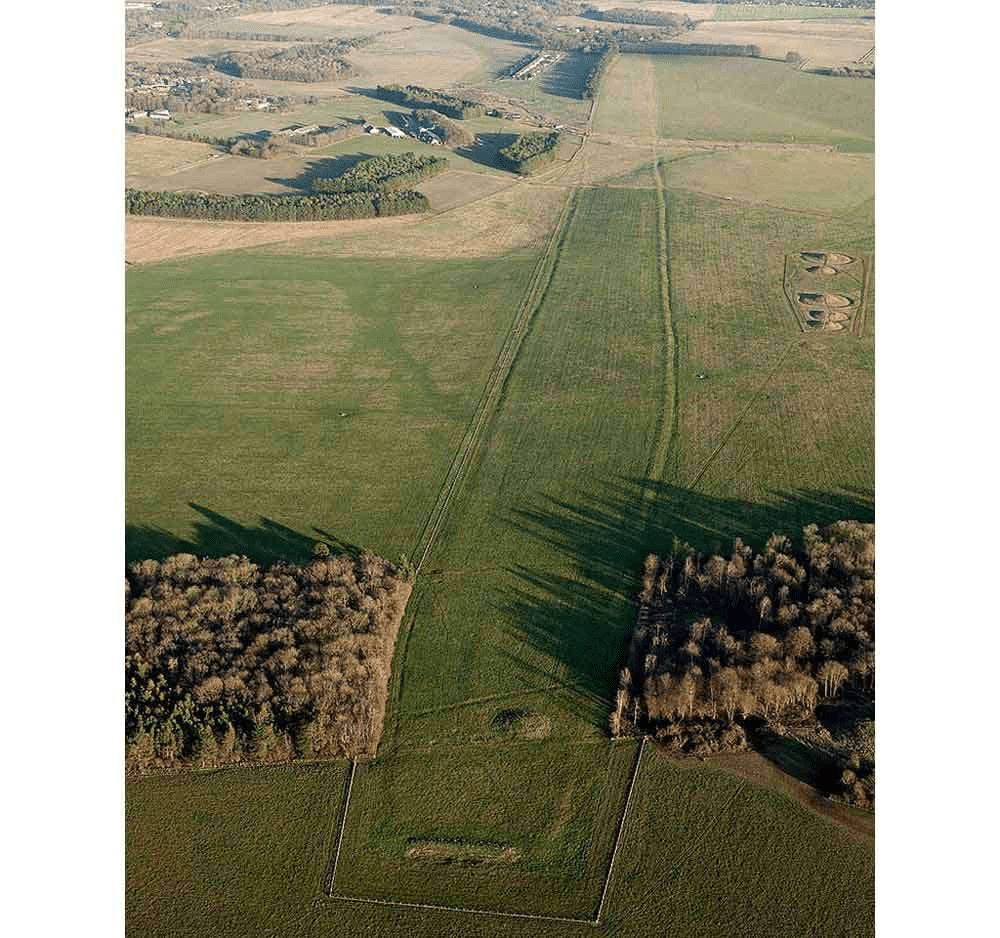
The Greater, or Stonehenge, Cursus, a huge rectangular earthwork enclosure 1.7 miles long, seen from the air in 2000

The Normanton Down Barrows lie on the crest of a low ridge just to the south of Stonehenge. Excavation of these early Bronze Age barrows has produced several rich finds, including beads and other personal ornaments.
Stonehenge today is incomplete, with many of its original sarsens and bluestones having been broken up and taken away during Britain’s Roman and medieval periods. It was not until between 1874 to 1877 that Flinders Petrie made the first accurate plan of the stones and the first official archaeological excavation was conducted in 1901 by William Gowland.

Stonehenge is thought to have been built in six stages. Britannica describe the enormous size of the individual monoliths:
‘They were then arranged inside the circle in a horseshoe-shaped setting of five tall trilithons (paired uprights with a lintel) – the central and largest of which is known as the giant trilithon – surrounded by 30 uprights linked by curved lintels to form a circle. The stones appear to have been laid out systematically in units and subunits of the long foot; the circumference of the sarsen circle is 300 long feet. The lintels, weighing some 7 tons each, are held on top of the uprights by mortise-and-tenon (dovetail) joints, and the ends of the curved lintels of the sarsen circle fit together with tongue-and-groove joints. All the joints were created using hammer stones, presumably in imitation of woodwork. Most of the sarsen uprights weigh about 25 tons and are about 18 feet (5.5 metres) high. The uprights of the giant trilithon, however, were 29 feet (9 metres) and 32 feet (10 metres) high, weighing more than 45 tons.
Only one of the giant trilithon’s uprights still stands, reaching a height above ground of about 23 feet (7 metres). Only six lintels (out of a total of 230) sit in place on the sarsen circle, with two more lying on the ground. Three of the five sarsen trilithon lintels are in place, with the other two on the ground. Four of the uprights from the sarsen circle are absent, and one is much shorter than the others. Although it is possible that the sarsen circle was never completed, the existence of a hole for an absent sarsen suggests that this stone and others were reused as construction materials for Roman buildings and medieval churches in the vicinity.’

‘Most of the surviving 45 original bluestones of Stonehenge are of spotted dolerite (also called diabase) from southwest Wales, specifically the Preseli Mountains. Other stones of rhyolite, rhyolitic tuff, volcanic ash, and dolerite are believed to be from the same region. A source for one of the rhyolites, however, was identified in 2011 as Pont Saeson, north of the Preselis. The Altar Stone (a toppled upright so called because it looked to the 17th-century architect Inigo Jones like an altar at the centre of the monument) and another two sandstone monoliths likely came from the Brecon Beacons, a cluster of mountains about 60 miles (100 km) east of the Preseli range. The bluestones weigh up to 4 tons each, and the taller ones are over 6 feet (2 metres) high. Most of them are unworked natural pillars.’
An important clue in the distinctiveness of Stonehenge is the fact that the ‘vast majority of Neolithic stone monuments throughout Western Europe were built less than 2km to 3km away from their stone quarries. So Stonehenge is a major exception to this rule, as its bluestones were dragged around 290km. This makes it unique for prehistoric Europe’, according to Mike Parker Pearson. He also makes the following claim: ‘I led the team of researchers that discovered that Stonehenge was most likely to have been originally built in Pembrokeshire, Wales, before it was taken apart and transported some 180 miles to Wiltshire, England. It may sound like an impossible task without modern technology, but it wouldn’t have been the first time prehistoric Europeans managed to move a monument.’ If such is the case, for the bluestones at least, this only reinforces the extraordinary capabilities of the designers and builders of Stonehenge.
Latest findings reveal that the Altar Stone was brought to the site from much further away than South Wales.
Mystery of Stonehenge deepens after ‘jaw-dropping’ discovery, David Keys, August 14, 2024:
‘Remarkable new scientific research at Stonehenge has revealed an extraordinary new mystery. Mineralogical tests on the massive six-tonne stone at the heart of the monument show that this central rock, known as the altar stone, was brought to Stonehenge from the far north of Scotland. The altar stone is arguably the most ritually important stone in Stonehenge, because it is the rock that marks the intersection of the prehistoric temple’s two most important celestial alignments – the winter solstice sunrise to summer solstice sunset alignment, and the summer solstice sunrise to winter solstice sunset alignment.
… moving a rock from northern mainland Scotland or Orkney would have involved a journey of well over 500 miles. The discovery has huge implications, and is likely to transform archaeologists’ perceptions around key aspects of life in prehistoric Britain. Dragging a six-tonne rock across mountains, hills, valleys and at least 30 rivers for well over 500 miles (in practice probably at least 700 miles) would have taken several years to accomplish – so it seems relatively unlikely that the rock was brought over land from northern Scotland to Wiltshire. It’s far more probable that it was brought by sea, a journey that would have taken just a few months. What’s more, the stone would almost certainly have been accompanied on its journey by a large team of mariners, priests and others – so it’s conceivable that it proceeded south as part of a substantial flotilla.
The North Sea is often far from calm, so the craft would have needed to deal with some relatively choppy waters, and of course the flotilla’s navigators would have needed to have prior knowledge of the coastline of at least eastern Britain. It’s likely, therefore, that the flotilla proceeded south, hugging Britain’s east coast for some 700 miles, and then turned west into the Thames estuary, along the Thames and part of the Kennet until Newbury or possibly Hungerford, where the rock would have been unloaded and then dragged (on a sledge or on rollers) for at least 30 miles to its final destination, Stonehenge.
But why did the… builders of Stonehenge want a northern Scottish (or Orkney) rock as the symbolic centre of their spectacular southern British stone temple? At present there is no way of knowing for certain the answer to that question. However, it is possible that the concept of stone circles was first developed in Orkney – and that somehow the builders of Stonehenge were aware of that. It is therefore conceivable that they wanted to ensure that the central feature of their new monument came from Orkney. Indeed, it is possible that the six-tonne rock had been chosen specifically for its religious significance – and that it had formed part of a major stone circle in Orkney.
No doubt, archaeologists will be investigating that possibility – not least because the great rock brought well over 500 miles to Stonehenge is roughly the same size and shape as some of those used in the construction of stone circles in Orkney. So perhaps the builders of Stonehenge were deliberately paying homage to what they might have perceived to be their great temple’s ideological/theological ancestor. It also suggests that the builders of Stonehenge viewed their great monument as a composite temple made up of components from across a much wider geographical and ideological landscape, symbolically and perhaps even spiritually incorporating several different parts of Britain (certainly including Wales and mainland Scotland or Orkney [with England]).
… it was a British geologist at Curtin University who did the crucial research, pinpointing a northern Scottish/Orkney origin for Stonehenge’s central stone. They identified the stone’s mineralogical fingerprint (and crucially, the geological ages of that fingerprint – ranging from around 3 billion to around 460 million years), which showed that the closest match by far was the extreme north of Scotland (including Orkney). “It’s been a two-year voyage of discovery for me and my colleagues. We collated more than 500 ages for the minerals within the altar stone, and it was those ages which, when correlated, gave us the crucial chronological fingerprint which revealed the northern Scottish origin of the rock,” said Anthony Clarke, the British geologist who carried out the crucial research at Curtin.’
The total number of sarsen stones that were needed for the completed site totalled eighty-two; comprising ten trilithon uprights; five trilithon lintels; thirty circle uprights; thirty circle lintels; four Station Stones; and three Slaughter Stones. Approximately eighty bluestones were required, of which sixty uprights formed the bluestone circle. Six bluestones were found to have distinctive shapes, with grooves and holes cut into them. Today there are 83 stones remaining at the Stonehenge site and 43 bluestones.

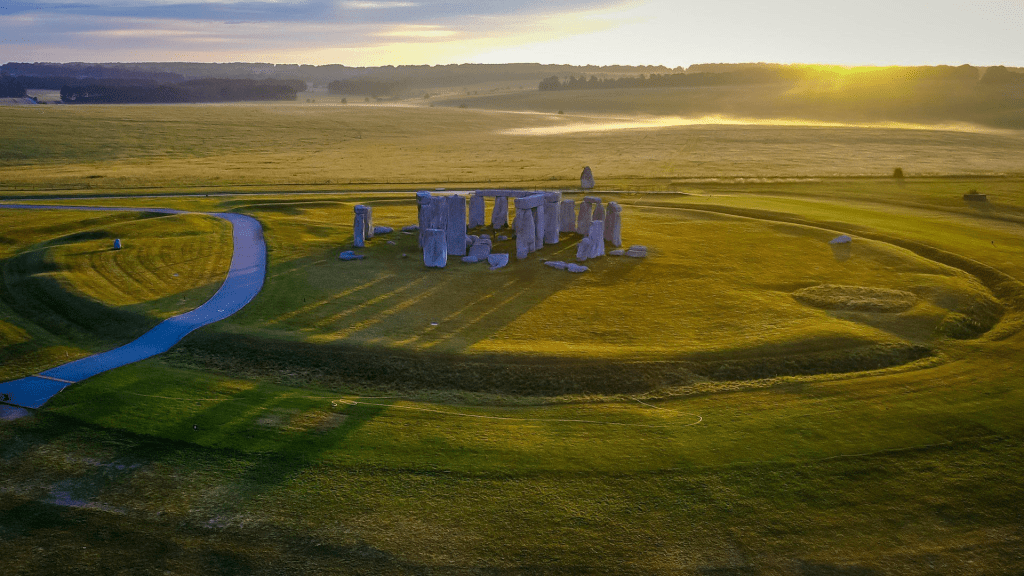
Stonehenge as the world’s most famous stone circle, is visited by more than a million people each year. ‘It stands as an icon for all that is mysterious and awe-inspiring about humanity’s prehistoric past.’ For over a century, people have gathered at the monument to celebrate the longest day of the year and watch the sun rise over the stone ruins on the summer solstice in June (above). The gathering was banned in 1985 after violent clashes with police, though was resumed in 2000 and draws more than 30,000 people.
People from all over the world attend, including ‘New Agers, neo-pagans, Wiccans and sun-watchers.’ Modern Druidic societies claim Stonehenge as their own temple, even though the identification of Stonehenge with the original Druid Order is unsubstantiated. The first notable society, the Ancient Order of Druids was formed in 1781. In recent years the number of Druidic and Neo-Pagan groups ‘has risen in tandem with the decline in conventional religious belief.’

We have a more accurate idea on when Stonehenge was begun and an evolving understanding on who was responsible for Stonehenge as well as the other megalithic sites around the globe – Article: Monoliths of the Nephilim. This leaves the most enigmatic question: Why was Stonehenge built?
English Heritage: ‘Stonehenge has perhaps been the focus of more theories about its origin and purpose than any other prehistoric monument. Today, the interpretation which is most generally accepted is that of a prehistoric temple aligned with the movements of the sun. It is the most striking example… [of] places to honour… ancestors and mark important moments in the calendar. At the centre of this belief system was the sun, with the solstice alignments enshrined within the fabric of the monument.’
This is a superficial answer at best, skimming only the surface. For an ancient race of mixed human and angelic genealogy were constructing monuments of not just great size and scale, but of intricate and complex design. It behooves us to question our interpretation of the purpose for not just Stonehenge, but every arcane site. A starting point in answering the enigma of Stonehenge is an article by Tia Ghose, where she lists seven reasons why Stonehenge may have been built.
There is some overlap with a few of them and applying Occam’s razor may just assist in eliminating the incorrect propositions. The area surrounding Stonehenge may have become a sacred hunting ground [1]. Archaeological evidence points to an auroch migration route thousands of years before the first stones were raised.
Ghose adds: ‘A site just a mile away from the Wiltshire… megaliths contains evidence of human occupation… including thousands of auroch bones, flint tools and evidence of burning.’ Tellingly, ‘the Stonehenge site itself bears evidence of construction as far back as 8,500 to 10,000 years ago… This archaeological evidence hints that the site was originally an ancient hunting and feasting site, and perhaps the megaliths were raised to memorialize the meaty bounty.’ While ‘hunting and feasting’ likely took place at Stonehenge, the building of a monument to immortalise that fact seems unlikely.
A similar though just as unlikely reason for Stonehenge put forward, is that its ‘construction may have been about more than primeval barbecue cookouts’ and that they ‘were erected to celebrate peace and unity.’ According to Mike Parker Pearson of University College London Institute of Archaeology:
“Stonehenge itself was a massive undertaking, requiring the labor of thousands to move stones from as far away as west Wales, shaping them and erecting them. Just the work itself, requiring everything literally to pull together, would have been an act of unification.” There is no doubting the extent of the collaborative effort required in constructing Stonehenge, but its purpose as a unity monument [2] or a symbol of a glorified team building exercise, remains unconvincing.
A third reason proposed for Stonehenge is that it was a healing site [3]. This is based on archaeologists Geoffrey Wainwright and Timothy Darvill, who in 2008 reported that a significant number of skeletons recovered from Stonehenge bore signs of illness and injury. Credence to this theory stems from finding that many of the bluestones had chip marks, highlighting people had taken chips away with them, perhaps as ‘talismans for protective or healing purposes.’ Though, people may have simply taken them as souvenirs in superstition of an auspicious site.
Stonehenge may have been a place for burial, but not just for anyone but an elite cemetery [4]. Remains which were deemed unimportant and reburied were re-exhumed by British researchers, comprising more than fifty thousand cremated bone fragments and representing sixty-three separate individuals including men, women and children from Stonehenge. Archaeologists found a mace head and a bowl possibly used to burn incense; suggesting the buried people in the graves were possibly religious or political elite. Though people were buried in the vicinity of Stonehenge, it does not stand as a viable reason for its construction.
An intriguing aspect of Stonehenge, is that of its acoustic qualities producing an illusory soundscape [5]. The theory proposed by Steven Waller, an archaeoacoustics researcher is that Stonehenge’s circular construction was created to mimic a sound illusion. For instance, if two pipers played bagpipes in a field, a listener would notice a strange effect, for in certain areas, the sound waves from the dual pipes would cancel each other out, creating quiet spots. In this case, it is the stone slabs which create a similar effect, on any sounds originating from the centre of the circle, instead of competing sound waves, blocking noise. Thus the megaliths might have been designed to augment the area’s natural sound cancellation; using the boulders to selectively block sound.
According to Waller, prehistoric circles are traditionally known as “piper stones.” Legend associates Stonehenge with pipers and tells of magic pipers who led maidens to the field and then turned them into stones. A study confirmed that the circle would have caused cavernous sound reverberations similar to those in a modern day cathedral or concert hall. Not everyone who has studied the acoustics of Stonehenge, subscribes to the belief there is any evidence ancient people designed the circle of stones with sound as its primary function.
A similar theory, after researchers had the ‘rare chance to thwack the giant megaliths’ postulates that the dolerites and sarsens at Stonehenge produce ‘unique, subtly different sounds similar to hollow wooden or metallic giant bells’ [6]. Therefore, as the sounds would have carried over a long distance, the monument may have once been an ancient ‘communication system’ or a ‘Stone Age church bell.’ The use of rocks to create music is not new. Numerous ‘cultures have employed lithophones – essentially giant Flintstones-like xylophones that produce unique sounds.’ As with the illusory soundscape, it seems likely that this musical quality is either an interesting byproduct of its construction or a secondary function of Stonehenge at best.
The final purpose proposed for Stonehenge is the one which not only makes sense, but also follows the pattern of the Cochno Stone, the Inga Stone and Gobekli Tepe. Until a better explanation is presented, the use of Stonehenge as an astronomical calendar and celestial observatory [7] is the most plausible and practical. It does not necessarily follow that the ancients observed the winter solstice in December, yet an avenue near Stonehenge – connecting the monument with the nearby River Aven – is aligned with the mid-winter solstice sunset and archaeological evidence ‘suggests that pigs were slaughtered during December and January – possibly for a mid-winter feast.’ Though this might be a later rite and not an early original ritual.

As the site also faces the sunrise during the mid-summer solstice in June, a connection with the Sun’s movements was obviously intended and planned by its designers and builders. Stonehenge’s alignment with the Sun and probable use for observing the Moon as well, may mean it had a role in working out the planting and farming seasons. When looking toward the sunrise, the entrance in the northeast points over a big pillar leaning at an angle, called the Heel Stone. Looking the other way, it points to the midwinter sunset.
In 1963, American astronomer Gerald Hawkins proposed that Stonehenge was constructed as a ‘computer’ to predict lunar and solar eclipses. Other scientists have attributed astronomical capabilities to the monument. As with Gobekli Tepe and other sites, most of these speculations have been intriguingly, rejected by experts.
In Gods of the New Millennium, 1997, Alan F Alford addresses the astronomical nature of Stonehenge:
‘On Salisbury Plain in Wiltshire, England, 80 miles south-west of London, stands [a] calendrical computing machine… made of stone… the most famous prehistoric monument in the whole of Europe… Centuries of study have been unable to solve the mystery of who built Stonehenge and why, but modern science has been able to lift the veil on many of its secrets. It is now generally accepted that, from its beginning, Stonehenge was an astronomical observatory, aligned exactly to the midsummer solstice.
Following extensive surveys of the site, archaeologists believe that the layout of the monument has been changed several times during its history. The earliest phase was a circular area, known as a “henge” more than 300 feet in diameter, with a ditch and a raised bank around its circumference. One of the most exciting features of Stonehenge occurred during this earliest phase. Four Station Stones, positioned on the edge of the circle so as to form a rectangle, marked out a sophisticated set of alignments to a 19-year cycle of the Moon! Possibly contemporary with the first phase is a series of 56 mysterious holes, which were made in a circle just inside the bank.
One of the most intriguing mysteries of Stonehenge is why these holes, known as Aubrey Holes after their seventeenth century discoverer John Aubrey, were filled in immediately after they were dug. The initial henge was left basically unaltered for 300 years, but then underwent a series of dramatic changes… 80 bluestones, each weighing 4 tons, were transported across a distance of 250 miles from Wales, and placed in a double circle of “Q and R holes” inside the henge. The introduction of these stones literally made the site a “stone henge” for the first time.
However, it is not clear whether the bluestone circles were ever completed, because… the builders adopted a radical new design. The bluestones were removed, and substituted by huge sandstone boulders, known as “sarsen” stones. These stones, weighing 40 to 50 tons each, were somehow transported over a river and steep gradients, from the Marlborough Downs, 12 miles to the north. They were then erected to form the Sarsen Circle, comprising 30 uprights, joined across the top by lintels. These lintels were carefully cut in a curved form to create a continuous ring when assembled, and stability was ensured by linking them to the uprights using the mortise and tendon joint which is familiar to carpenters.
When the Sarsen Circle was completed, the builders turned their attention to the construction of a giant causeway, known as the Avenue, which extended from the circle’s entrance as far as the River Avon two miles away. No-one has ever explained why such a long causeway was required. A 35-ton stone, known as the Heel Stone, was probably erected at this time. This stone, standing 16 feet high, and buried 4 feet into the ground, was erected 100 feet away from the circle, opposite its entrance, in order to create an axis which pointed to sunrise at the time of the summer solstice.
There then followed a 400 year hiatus, at the end of which, for some unknown reason, the builders decided to bring even bigger stones onto the site. Five pairs of enormous sarsen stones, joined across the top by lintels, were erected inside the Sarsen Circle, in the shape of a horseshoe. These 13-feet high trilithons, for which the site is most famous… remain in excellent condition today. It is believed that, around this time, the site was given a new axis, to realign it with the summer solstice. This involved the erection of a two-stone sight-line just outside the henge, and the shifting of the Heel Stone slightly to the east so as not to interfere with the new sight-line.
A short time later… the bluestones were reintroduced to Stonehenge. One, the 16-feet high Altar Stone, was set upright in the centre of the complex, directly on its axis with the midsummer solstice. Two concentric circles of bluestones were then erected between the Sarsen Circle and the trilithons. Finally… 19 bluestones were set up to form a horseshoe inside the trilithons. After this flurry of activity, all went quiet for around 500 years, followed by a minor addition of the so-called “Y… holes”. Then the site was abandoned.
Stonehenge is an unusual site in the sense that it is the astronomers rather than the archaeologists who have led the research from the beginning. As early as 1740, William Stukeley discovered that the central axis of the site from the Altar Stone through the Heel Stone and the Avenue pointed to the position of sunrise at the summer solstice. This alignment was confirmed unequivocally by Sir Norman Lockyer in 1901. The debate then shifted to other possible astronomical alignments, particularly since the site had many other features which could not be accounted for. In 1963, it was suggested that the site could have been used for observing and predicting the equinoxes as well as the solstices.
Then in 1964, Cecil Newham stunned the academic world with his proposal that Stonehenge was also used as a lunar observatory, based on the rectangle formed by the four Station Stones. His findings were confirmed by Professor Gerald Hawkins in various studies between 1963-65 using computer analysis, Hawkins proved that Stonehenge was not only aligned to certain key points in the cycle of the Moon, but also designed to predict lunar eclipses. These conclusions were simply too much for the scientific establishment, because lunar cycles are far more complex than solar cycles, and it was unthinkable that Neolithic people could have had such an advanced knowledge of astronomy’ – Article: The Calendar Conspiracy.
This would be an entirely valid argument and conclusion if Stonehenge had been designed by ‘Neolithic’ peoples but, if built earlier in the Neolithic era – yet after the construction of Gobekli Tepe (and perhaps prior to the Great Pyramid) – this would fit the time frame, the mind set and capabilities of the formidable race of Nephilim and Elioud giants who while ranging over the whole Earth, were constructing megalithic structures following the Flood cataclysm. Giants dwelling in the British Isles is well documented – refer Chapter XXXI Reuben, Simeon, Levi & Gad – the Celtic Tribes.
Alford: ‘Alexander Them published the most comprehensive survey of the site in the mid 1960s, which confirmed both lunar and solar functions for Stonehenge from its very beginning; it was clear, he said, that the site was in a unique location, for nowhere else would the lines formed by the rectangle of Station Stones point exactly to the eight key points of lunar observation. If the site had been positioned only a few miles further north or south, this geometrical relationship would not have worked.
When Sir Fred Hoyle concurred with these findings in the late 1960s, the lunar theory suddenly became respectable. Hoyle declared Stonehenge to be not just an observatory but also a predictor of astronomical events; he felt that the builders of Stonehenge might have come to the British Isles from the outside, purposely looking for this rectangular alignment… just as the modern astronomer often searches far from home for places to build his telescopes.’
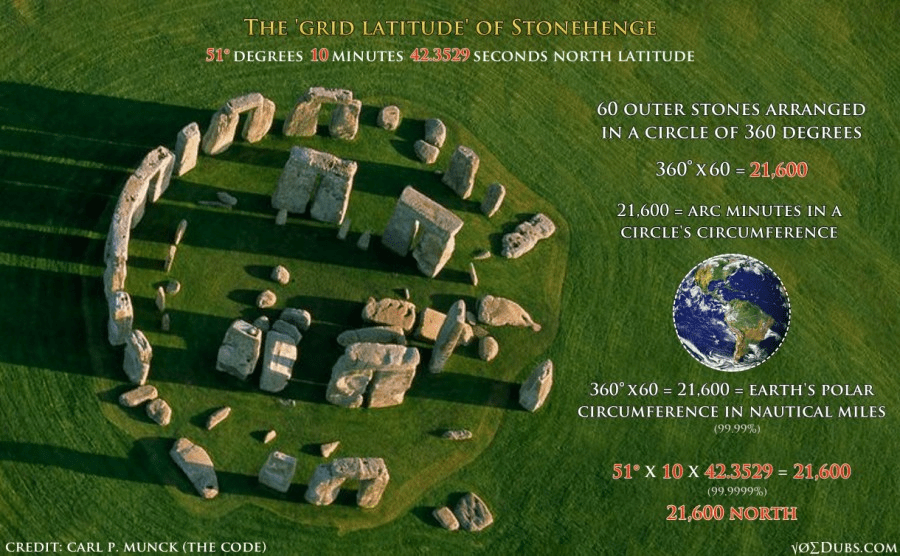
‘The indisputable conclusion is that whoever designed Stonehenge must have known in advance the precise length of the solar year and the cycle of the Moon. Even more impressively, these ancient astronomers had the skill to identify a unique location for the measurement of the Moon’s 19-year cycle! Many reference books today are still, understandably, reluctant to cite the full evidence on Stonehenge, for conventional history simply cannot explain the advanced technology of the people who came here [thousands of] years ago.’

In endeavouring to understand Stonehenge, it is worth looking at a completely different topic, yet at the same time oddly related. And that subject is crop circles. Notice the word circle. Two of the most famous and important megalithic monuments in the world, Stonehenge and Gobekli Tepe are arranged in circular shapes – refer Gobekli Tepe, article: Monoliths of the Nephilim. This cannot be mere happenstance. Our very home, which teems with life is described as a sphere in the scriptures.
Isaiah 40:22, describes the relationship of the Creator with the blue-green orb we call Earth. “… the one who sits above the circle of the earth…” – Evangelical Heritage Version. The Expanded Version says: “God sits on his throne above the circle of the earth…” While The Message Bible describes it simply and more graphically as: “God sits high above the round ball of earth…”
A link exists between the roundness of the Earth and the cycle of life. The essence of life, an ovum, is a circular sphere. Call it the ‘circle of life’ if you will. Associated with this are astronomical observations and calculations of planetary bodies within the cosmos, whether it be the Sun, the Earth or the Moon. All are integral to life on this planet. Symbols, whether used as as good or for evil, such as the swastika; a cross; or the Ashoka Chakra; each represent a spinning motion which turns the shape into a circle and symbolises life, birth, regeneration and infinity. And life equals energy.

The Ouroboros snake is an image of a serpent (or dragon) eating its own tail. This symbolises its ‘continual devouring of itself and being reborn from itself’ as well, as the ‘unity of all things, material and spiritual, which never disappear but perpetually change form in an eternal cycle of destruction and re-creation.’ It is the ‘oldest allegorical symbol in alchemy’ and represents the ‘concept of eternity and endless return like the sun.’
The Ouroboros snake represents the Serpent in the Garden of Eden and so in turn is the founder and inspiration for the Brotherhood of the Snake, which interestingly ties in with the Atlantis city-state designed as a series of concentric circles – Chapter XXII Alpha & Omega; and article: Monoliths of the Nephilim.

The Richat Structure located in Mauritania, North Africa, has led some to believe that the naturally formed structure is in fact the residue of Atlantis – Article: Antartica: Secrets of the Lost Continent of Atlantis.

We see this pattern of concentric circles repeated in Gobekli Tepe, Stonehenge and yes, in various crop circles. A crop circle by definition is ‘an area of standing crops [such as wheat, barley or canola] which has been flattened in the form of a circle or more complex pattern. No general cause of crop circles has been identified although various natural and unorthodox explanations have been put forward; many are known to have been hoaxes.’
This topic is controversial and many people are dubiously sceptical. As with much unexplained phenomena, some causes are certainly entirely human inspired, or not so inspired as the case may be. Yet there is always a percentage of instances which remain in the realm of the inexplicable.
Perhaps some do not wish to contemplate what it might mean if extraterrestrial or invisible entities are using laser type technology to image intricate patterns on crops, presumably in the small hours of the night. But, what if the genuine crop circles are of just such an origin. What then?

As more crop circles are reported in the South of England than anywhere else in the world; with most crop circles created in Wiltshire – where Stonehenge is (coincidently) located – than in any other county; and as the original Stonehenge from above looked like, well… a crop circle, it is worth investigating the link.

Live Science, Stephanie Pappas: ‘The first report of a crop-related mystery now linked to crop circles was a woodcut chapbook, or small book containing ballads and poems and tracts, called “The Mowing Devil,” dating back to 1678. According to Oxford Reference, this chapbook tells the tale of a cheap farmer who refused to pay a laborer to cut his oats. Overnight, the devil did the job instead, “cutting them in round circles.”
Right from the reported beginning of this phenomena, a supernatural explanation is cited. It is not the intention to delve into whether occupants of UFOs are responsible or not for the formation of crop circles. This writer has addressed the subject of who are inside UFOs in other articles and may concentrate on UFOs specifically in a future article – refer article: Potentates & Principalities: What they want… Who they are; and Chapter XXII Alpha & Omega. What is the primary concern, is what the non-human crop circle formations signify and what if any correlation they may have with Stonehenge.
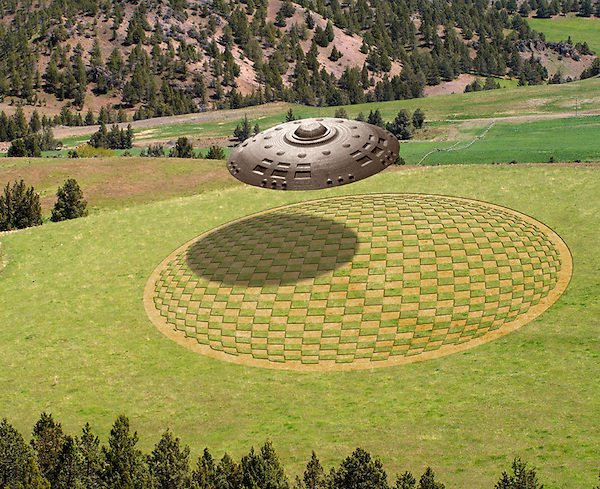
Britannica: ‘Beginning in the late 1970s, simple crop circles began to appear regularly in the fields of Wiltshire, Oxfordshire, Somerset, and Gloucestershire in southern England [but it was in the late 1980s that the phenomenon exploded – coinciding with the beginning of the Age of Aquarius (1990)]. They were made at night, and over the years they became more complex, growing into large patterns of geometric forms hundreds of feet across.’
The crop circles are invariably centred around highly charged electromagnetic ley lines – mystical seams of spiritual energy that intersect at sacred sites like Avebury and Stonehenge – refer Ley Lines, article: The Pyramid Perplexity.
‘Some people who studied crop circles were convinced that their intricacy and the fact that the plants seemed to be bent but not broken precluded a human creator, which meant that they were being produced either by some unknown natural phenomenon or by extraterrestrials.’ The elaborate designs surely suggest an advanced civilisation.
Dylan Thomas is a co-founder of the Atlas Obscura: A Compendium of the World’s Wonders, Curiosities, and Esoterica. In an article entitled, “Crop Circles” Reveal an Ancient Burial Site a Thousand Years Older Than Stonehenge, in 2009 it says:
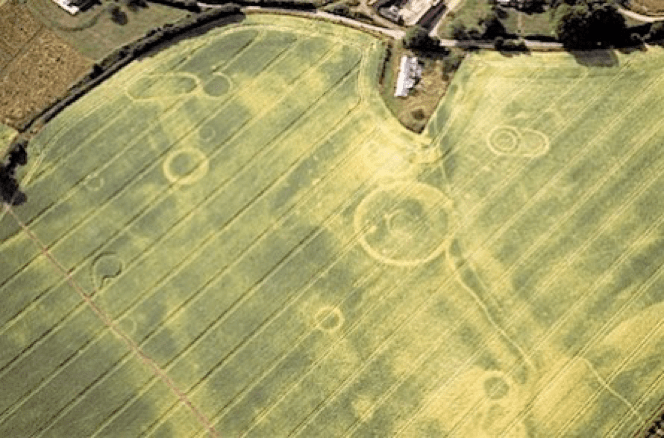
‘… there is… another set of “crop circles,” [above] made… by the gravesites of prehistoric man… National Geographic “… older than nearby Stonehenge, the site includes the remains of wooden temples and two massive… tombs that are among “Britain’s first architecture,” according to archaeologist Helen Wickstead, leader of the Damerham Archaeology Project. Discovered during a routine aerial survey by English Heritage, the U.K. government’s historic-preservation agency, the “crop circles” are the results of buried archaeological structures interfering with plant growth”.’ While these images below the surface of the landscape are not crop circles per se, it is of note that they are circular.
England’s Crop Circle Controversy, August 21, 2021, Daniel Stables:
‘Although these mysterious formations have appeared worldwide, south-west England is the unlikely world capital of crop circles, baffling locals and farmers alike.’
One can only wonder regarding why the pre-occupation with the southwest of England. It is worth reminding the constant reader of the significance of this region in England – particularly Glastonbury in the county of Somerset – as once being the home and at that time, of a little known son of an unknown Judean carpenter whose name was Jesus (Yeshua) – refer Appendix VIII: When the Creator came to dwell with His Creation.
Stables: ‘The intricacy and size of the formations, coupled with the fact that they would appear overnight, seemingly out of nowhere, baffled locals and farmers alike. In 1996, a crop circle appeared opposite Stonehenge depicting a mathematical fractal called a Julia set – a similar formation that emerged on Milk Hill in 2001 was one of the largest ever, stretching 900ft’, comprising a script of Hebrew-like letters.

Benjamin Radford: ‘On Sunday, July 7, 1996, what has been called “one of the most complex and spectacular crop circle designs ever seen” appeared in England. It is unique in crop circle history for several reasons, including the fact that it appeared not far from the mysterious and world-famous Stonehenge monument in the English countryside – and that it allegedly appeared during daylight in less than an hour. The circle became one of the most famous and important crop circles in history and has been claimed to be one of the best cases for crop circles.
Indeed… [noted] researcher Colin Andrews expressed the sentiments of many when he said at several public conferences … “If these Julia Sets can be proven to be made by humans, then we can all pack our bags and go home.“
‘The circumstances surrounding its appearance are, at first glance, straightforward and impressive enough: A pilot flew over the field opposite Stonehenge late one afternoon and saw a normal, undisturbed field below; on his return flight less than an hour later, the pilot was stunned to see the spectacular 600-foot fractal crop circle below in that very same field. Soon word of the circle’s discovery spread, and it made international news. Yet there exists no photographs or video of it being made; it seemingly spontaneously appeared in minutes. The validity of this crop circle rests almost entirely on eyewitness testimony and a timeline of events suggesting that the crop circle must have appeared in between the two flights, approximately twenty to forty-five minutes apart.’
A Julia set is a ‘set of complex numbers which do not converge to any limit when a given mapping is repeatedly applied to them. In some cases the result is a connected fractal set.’ It is named after the French mathematician Gaston Julia who investigated their properties in 1915 and culminated in his famous paper in 1918: Mémoire sur l’itération des fonctions rationnelles. It is also known as the Fibonacci sequence, the Golden Ratio or the Golden Spiral.
Bitesize: ‘These mysterious numbers and shapes are all connected to each other. If you look closely, they can be found in the most unexpected of places, creating beautiful and pleasing patterns [such as in art, architecture and biology]. Put simply, the Fibonacci sequence is a series of numbers which begins with 1 and 1.
From there, you add the previous two numbers in the sequence together, to get the next number. This is a type of recursive sequence. So 1+1=2, 1+2=3, 2+3=5, and so on. This gives you a sequence that looks like 1, 1, 2, 3, 5, 8, 13, 21, 34, 55 etc. But what makes this sequence so special and interesting?
… Fibonacci numbers can be found in the natural world all around us. Most flowers, for example, will have a number of petals which correspond with the Fibonacci sequence. Irises have three petals whereas wild roses and buttercups have five petals. That is of course, until a petal falls off. No wonder rare four leaf clovers are seen as lucky! If you cut into a piece of fruit, you’re likely to find a Fibonacci number there as well, in how the sections of seeds are arranged. Bananas have three sections whilst apples have five.
The Fibonacci sequence even plays a role in the subtle spirals you can see in the seed head of a sunflower. This is because of something known as the Golden Ratio, the Golden Section or the Greek letter Phi. If you take a number in the sequence above 5, and divided it by the previous number, you will get an answer very close to 1.618. The larger the numbers, the closer you get to 1.618. The Golden Ratio is an irrational number, and so cannot be written as a fraction.
Take the sunflower. To be as efficient as possible, its seeds need to be closely packed together without overlapping. Now, if it simply grew seeds in a straight line in one direction, that would leave loads of empty space on the flower head. The best way of minimising wasted space is for the seeds to grow in spirals, with each seed growing at a slight angle away from the previous one. If the degree of turn was a fraction, like 1/4, that doesn’t help matters much because after four turns the seed pattern would be right back at the start again. There would be four lines of seeds, but that’s not much better than one when trying to cover a circular area. The perfect degree of turn needs to be an irrational number, which can’t be easily approximated by a fraction, and the answer is the Golden Ratio.
Another way of thinking about the Golden Ratio is as a spiral. This spiral gets wider by a factor of 1.618 every time it makes a quarter turn (90°). Drawing a perfect Golden Spiral is pretty tricky to do by hand, but just like with the Golden Ratio, you can get a close approximation with the Fibonacci Spiral. This is created by drawing an arc through a series of squares which correspond to the Fibonacci numbers, so 1², 1², 2², 3² etc.’

‘You might have seen these spirals superimposed over famous pieces of artwork, as experts try and explain why we find them so aesthetically pleasing. Often, the spiral draws in our eye so that the focus of the artwork is found in the centre of the spiral. Examples can be found in the works of Leonardo da Vinci and Salvador Dali. Fibonacci didn’t actually discover the sequence himself. Born Leonardo Bonacci in 12th-Century Pisa, Italy, the mathematician travelled extensively around North Africa. There, he learnt how the Hindu-Arabic numerals of 0-9 could be used to complete calculations more easily than the Roman numerals still in use across much of Europe.
Fibonacci explained his findings in a book called Liber Abaci, published in 1202, which had a section devoted to the intriguing sequence which would be named after him hundreds of years later. Indian poets and musicians had already been aware of the Fibonacci sequence for centuries though, having spotted its implications for rhythm and different combinations of long and short beats.
Mozart made use of the Golden Ratio when writing a number of his piano sonatas. A sonata can be divided into two separate sections, known as the exposition (where the theme is introduced) and the development and recapitulation (where the theme is developed and repeated). In Mozart’s sonatas, the number of bars of music in the latter section divided by the former is approximately 1.618, the Golden Ratio.
There’s even a style of poetry inspired by the Fibonacci sequence, known as Fib Poetry. Every line of the poem must contain the exact number of syllables that correspond with the Fibonacci sequence. So a six line poem would have syllable line counts of 1, 1, 2, 3, 5 and 8.’
Whomever hurriedly stencilled the Fibonacci spiral adjacent to Stonehenge was sharing their understanding of a simple sequence, yet complex structure replicated throughout nature as well as in human’s creative endeavours. Were they showing they were our equals in the least, or more likely, our superiors? Why did they break protocol and draw it in broad daylight instead of under cover of night? Is it a message of some kind or merely a simple statement of fact? Have we only scratched the surface? Is there more to the Fibonacci sequence than meets the eye? Would a deeper understanding assist scientific advancement?
Daniel Stables: ‘A 2008 formation near the Iron Age hill fort of Barbury Castle required decoding by an astrophysicist, who concluded that it was a geometric representation of the first 10 digits of pi.
The phenomenon peaked in the 1990s and early 2000s, but continues today; an average of 30 crop circles appear each year in the UK, around 80% of them in Wiltshire.’ There have been 380 crop circles recorded in the county since 2005. ‘Formations reported in 2021 have included a hexagonal pattern overlaid with spirals in Avebury, and a pattern of concentric “bubbles” in Tidworth Down. Crop circle season usually begins at the end of May, with the first ripening of the barley, and ends by September when the harvesting of the crops cuts away the circle canvasses.
Reports of cameras suddenly breaking and car engines turning themselves on in the vicinity of crop circles are common. “I’ve seen several orbs of light,” said [Monique] Klinkenbergh [crop circle researcher]. “I once saw a UFO; not a classic flying saucer, but a strange object hanging stationary in the air and eventually flying away with enormous speed. According to locals, these lights and strange objects have been witnessed for centuries.”
Regarding hoaxers, “Some of the formations are so intricate and so big that I can’t see two people doing them,” said Tim Carson, a farmer in the Wiltshire village of Alton Barnes. “Some of them are 300m long and they go over the brow of a hill. How would you know the other person’s doing the same thing you are?” Carson is more qualified than most to comment, having seen hundreds of crop circles appear in his fields – ravaging thousands of pounds worth of crops in the process. It all began in 1990, when a famous formation known as the Eastfield Pictogram appeared overnight in one of Carson’s fields. It caught the attention of the world’s press, and a photograph of the crop circle [below] was even used as cover art by Led Zeppelin.’

Some hoaxers have claimed to be behind the crop circles, but the intricacy and size of the formations continues to baffle many people
“Within days we had thousands of people turning up,” Carson said. “We charged people a pound a time, had keyrings and T-shirts made. It became probably our most profitable quarter of an acre ever. Some of the circles are mysterious, without doubt,” he said. “Sometimes the crops appear woven, lying one way and another on top of each other. That would take hours and hours to do by hand.” In a different article, Monique Klinkenbergh is quoted as saying she thought the reason for Wiltshire’s record number of crop circles was linked to the numerous ancient sites in the county. “The county is so famous for those sites of heritage, and I believe the crop circles are attracted to those places.”
Some of at the more notable examples of crop circles near Stonehenge include the following.
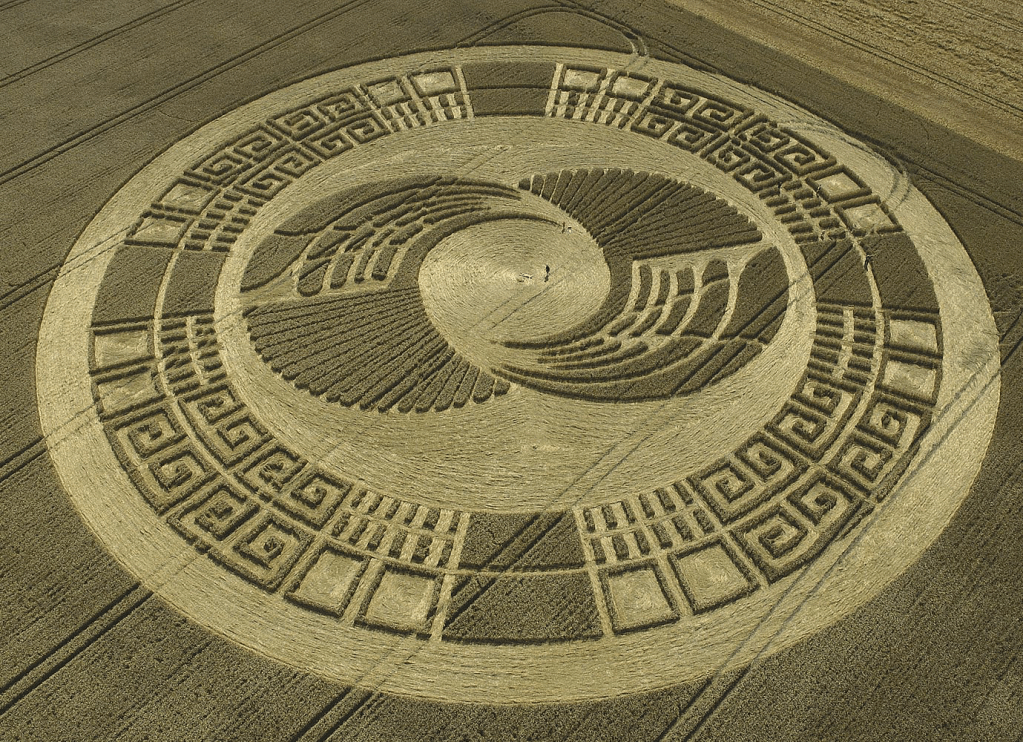
Silbury Hill, Wiltshire, 2005

Woodborough Hill, Wiltshire, 2009

Near Amesbury, Wiltshire, 2013
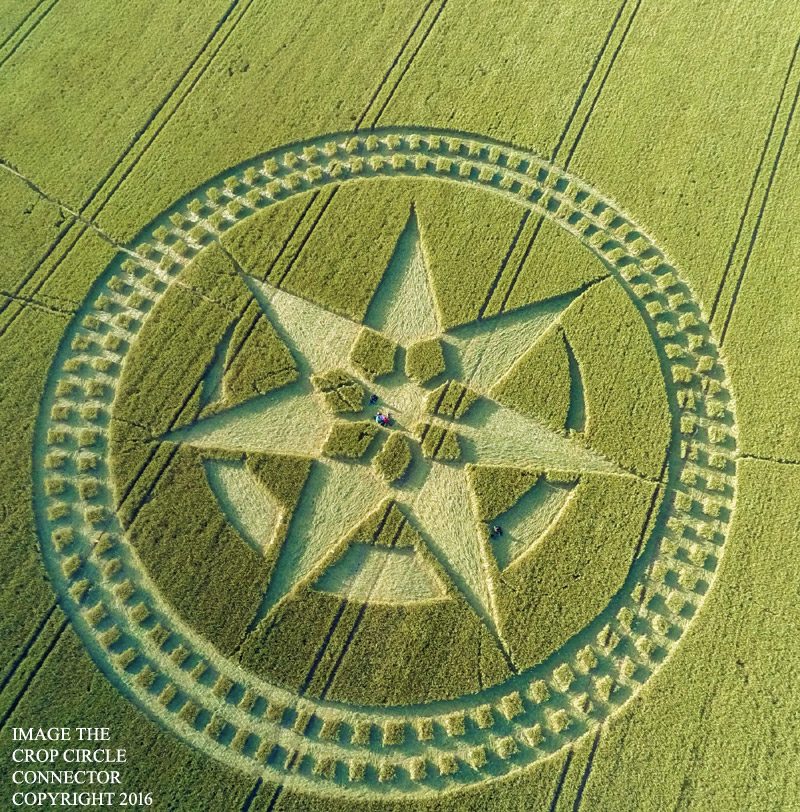
Near Amesbury, Wiltshire, 2016

Coneybury Hill, Wiltshire, 2018
Observing the series of crop circles, it can’t be helped being in awe of their intricacy and aesthetic appeal. Their circular commonality could be representative of planets, stars or constellations perhaps?
Another giant crop circle appeared next to Stonehenge in 2018 just before the Summer Solstice. Matthew Williams ‘captured the stunning formation, near Amesbury, Wiltshire, about a mile next to the world heritage site. The 180 ft formation [below] contains five spokes and five off-set petal-like shapes, as well as Aztec-style patterns.’ The 47-year-old crop circle expert said: “I think it’s quite timely that it appeared in the area right before the Solstice. To me, it kind of looks like a combination lock – but the flowers obviously represent the passage of time and the changing of the seasons. It’s very unusual to see offset shapes in these geometric designs, so that’s why I think this is a special formation.”

All these crop formations comprise and include circles; they are all located near Stonehenge and from a birds eye view, could easily have their inspiration from the ancient monument. Could the answer to the purpose of crop circles, be to point mankind to a practical process? Similarly, Stonehenge may have an overriding practical function rather than merely a ceremonial one. Recall, the shape of a circle symbolises life and life equals energy. Interestingly, an Italian inventor believes crop circles are models for generating free energy.
Ancient Code: ‘In 1991… “Crop Circles: Harbingers of World Change” by Alick Bartholomew… explored the idea that some crop circles could be messages from non-human intelligence… beyond this physical world. In the book, an English historian and psychic, Isabelle Kingston, suggested that crop circles… reveal a molecular structure or blueprint for a new form of energy that would one day be unraveled by scientists. One Italian inventor, Umberto Baudo, believes crop circles may be meant to impart secrets of new technology and free energy to humanity.
In 2008, Umberto Baudo decided to use crop circles as… a blueprint for a mechanism that he believed could deliver a source of free energy, similar to the ultimate goals of Nikola Tesla… among the hundreds of images found, he chose the formations he believes represent authentic energy generating systems. He demonstrates that those formations can operate like the gears of a machine.’
“SINCE 2008 I REALIZED THAT IT IS ABSOLUTELY POSSIBLE TO GENERATE FREE ENERGY TO ALL OF THE PLANET, AND INSTEAD OF HAVING TO PAY LARGE AMOUNTS OF MONEY TO HAVE IN EXCHANGE [FOR] A SMALL AMOUNT OF ENERGY.”
‘In Baudo’s first experiments, he attempted to create magnetic motors. The prototypes were arrays of circles based on crop circle formations. His work progressed from magnetic systems to systems using centrifugal force and tested using computer simulations. The simulations allowed him to find out what happens when the shapes are rotated at high speed, generating energy both with and without the variables of gravity and counterweight mechanisms: magnets, springs, and chains.
Baudo believes extraterrestrials chose to communicate with crop circles for a reason.’
“IT’S IMPORTANT TO UNDERSTAND THAT THE CROP CIRCLES ARE THE MAXIMUM EXPRESSION OF A MESSAGE BECAUSE THROUGH AN IMAGE YOU CAN COMMUNICATE MUCH MORE THAN WITH WORDS WITHOUT ANY DOUBT,” HE EXPLAINS. “… ESPECIALLY IF THE MESSAGE [IS ADDRESSED] TO SOMEONE THAT DOES NOT SPEAK OUR LANGUAGE.”
‘The inventor found that the rotating systems could whirl around an “eccentric core,” shapes he recognizes in many crop circle formations. Spinning around this core, the circular shapes generate momentum.
… Baudo is convinced that crop circles are meant as examples of using centrifugal force and that he has decoded their meaning. With modifications, including the addition of a spring, he says he has created perfect models that continue to build momentum even after the engine is turned off. All thanks to centrifugal force…’
“AFTER SOME YEARS STUDYING AND RESEARCHING, ALWAYS WITH THESE IMAGES IN MY MIND, FINALLY I THINK I’VE FOUND THE KEY TO UNDERSTAND THE [MAIN] PART OF THESE CROP CIRCLES. THE MAIN KEY TO UNDERSTAND IT IS FUNDAMENTALLY ONE: THE CENTRIFUGAL FORCE. JUST LIKE THAT!”
‘The circular gears rotate until the spring slowly reaches full extension.’
“THE SPEED WILL INCREASE, ALWAYS IN A CONSTANT WAY, UNTIL THE SPRING ACHIEVES ITS MAXIMUM. IN THAT MOMENT [IT] WILL STABILIZE.”
‘… he believes that these systems can work against the first principle of thermodynamics, that states the total energy of an isolated system is constant. Instead, the engine he simulates continues to accelerate, while the “eccentric core” of the disc appears distorted into an oval shape.
What happened to Umberto Baudo’s designs? If he had been successful, surely we would know about it, right? Yet delivering a source of free energy to the world would most likely be met with incredible resistance in a world where economies revolve around monetized methods of energy delivery. Finding a source of unlimited free energy would change the global economy, freeing people from the need to labor endlessly to pay energy bills. Are beings with higher intelligence trying to tip the odds in the common person’s favor, allowing us to finally have such technology distributed to everyone worldwide?’
An alternative method of generating free energy for the masses certainly wouldn’t sit well or be tolerated by the controlling Establishment and its oppressive aims – refer article: The Establishment: Who are they… What do they want? That aside, Baudo’s interpretation of crop circles is original and thought provoking. His explanation may be part of the equation and he has hit upon one important component.
Alick Bartholomew, who says genuine ‘crop circles could be messages from non-human intelligence… beyond this physical world’ is close. The entities responsible from a physical perspective could be seen as alien or extraterrestrial, though in reality, are dark demonic beings originating from spiritual dimensions – refer article: Potentates & Principalities: What they want… Who they are.
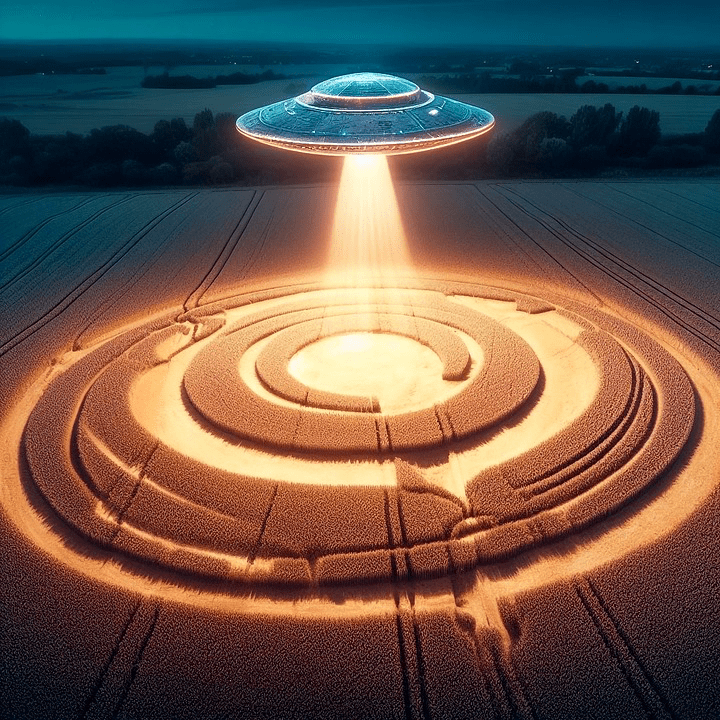
Crop circles are undoubtedly a form of communication. But what message if any is being said? Are they giving advice or delivering a warning? Are they pointing to a change in technology, or perhaps to other changes for humanity? One can’t help thinking that solving the enigma of crop circles may answer the primary function of Stonehenge and conversely, understanding Stonehenge may solve the cryptic puzzle of crop circles. Apart from paranormal explanations… earth energies and gravitational forces are offered as solutions. Yet, how could these alone account for the intelligent design of crop circle patterns?
Some researchers believe the circle formations are warnings about ‘climate change, nuclear war and similar existential threats.’ Do crop circles have an astronomical association or are they a calendrical calculation? Thus, do they catalogue in some way mankind’s evolution, a coming transformation or some other significant event? Matthew Williams said the 2018 crop circle near Amesbury marked ‘the passage of time’ and some researchers wonder if the authors of bonafide crop circles are in fact time travellers.
One source states: ‘These future beings are said to be behind the crop circle phenomenon, which are theorized to be a way of navigating between parallel time streams like someone leaving marks in tree bark, warnings and portents of future events, or even the secrets of time travel and parallel dimensions.’
What significance is there to the proliferation of crop circles since the late 1980s and peaking around the year 2000. Are crop circles hidden messages based on highly advanced mathematical equations and sacred geometry, and if so, are the messages really intended for humankind or actually between the makers of the crop circles themselves? Crop circles could be a signature, calling card or sigil (‘a pictorial symbol, seal or signet used in ritualistic magic and supposed to have supernatural power’) left by its creator.
Another source offers crop circles as representing an ‘esoteric form of communication’, akin to a ‘secret demonic language.’ A commentator noted, ‘most of these signs can only be seen from the air… Who is the Prince of the Power of the Air[?]’ – refer Chapter XXII Alpha & Omega.
Ephesians 2:2, RSV: “… following the course of this world, following the prince of the power of the air, the spirit that is now at work in the sons of disobedience.”
If crop circles are simply a communication between the beings drawing them, then we will probably never decipher the formations. If not, then they must be for humankind to ultimately decode, even retrospectively. Or perhaps with Stonehenge, they are a marker of a specific date or event from the past to be understood; or set in the future to be solved. Recall, Sir Fred Hoyle declared Stonehenge to be not just an observatory but also a predictor of astronomical events.

English Heritage: ‘Stonehenge is an icon of the past and a powerful image of ancient achievement. It has been the subject of many paintings and poems and featured in books, music and films… it is not simply a record of the past – it remains vibrant and compelling as an enduring place of belief and meaning that… inspires visitors and communities today.’
A final thought – as if Stonehenge, the ultimate crop circle wasn’t enough – there is a Stonehenge twin on the planet Mars.

Ancient Code, December 26, 2023:
Meet ‘Marshenge’, a mysterious rock formation that has been spotted on the surface of the red planet. The mysterious formation rests on a mound that rises from the ground and clearly seems to be surrounded by a ditch. I think we can agree that it is very unlikely that what we are seeing here is the result of Pareidolia‘ – “the illusory perception of meaningful patterns or images of familiar things in random or amorphous data.”
‘But is it possible that we are looking at an ancient monument on Mars? This mysterious rock formation clearly resembles the well-known Stonehenge in Britain and is very unlikely to be the result of Mars’ Mother Nature. People who have looked at the image and compared it to an aerial view of Stonehenge believe that these two have certain similarities that cannot be overlooked.’
Suggestions and contributions from readers regarding Stonehenge are welcome as we endeavour to unlock the riddle of Stonehenge, seeking enlightenment on not only its present past but also its forgotten future.
So early in the morning Jacob took the stone that he had put under his head and set it up for a pillar and poured oil on the top of it.
Genesis 28:18 English Standard Version
… Take twelve stones from here out of the midst of the Jordan, from the very place where the priests’ feet stood firmly, and bring them over with you and lay them down…
Joshua 4:3 English Standard Version
“Every age has the Stonehenge it deserves – or desires.”
Jacquetta Hawkes
“Anyone who has lived through an English winter can see the point of building Stonehenge to make the Sun come back.”
Alison Jolly
An original excerpt transferred from the article Monoliths of the Nephilim.
© Orion Gold 2024 – All rights reserved. Permission to copy, use or distribute, if acknowledgement of the original authorship is attributed to orion-gold.com
 The Lightkeeper