
In an astonishing arc of irony, Asherah is the least understood spirit entity in all the written word.
Coupled with this, she is not spoken of by name at all within Christianity; whether in Christian dogma or during church sermons from the pulpit. It would seem – for indirectly and unbeknown to christian believers – she is discussed under a different name, far more often than anyone else in the scriptures aside from the Father and the Son.
Have you guessed who it is?
In the very beginning, the Creator dwelt alone, with nothing but His inspired thoughts and neoteric ideas.
At a certain defining moment in the history of everything, the Ancient of Days purposed to translate his thoughts into a living sentient being like Himself and it was then that he thought and so it was that Wisdom was created, a separate entity and an image of his own mind.
At another momentous moment, the Creator spoke and the result was an additional extraordinary being, the Word.
And so the Creator had translated His own wise thoughts and profound words into companions with which to expand His creation. What is not clear, is that from a biblical – New Testament – perspective, the narrative points to the Word being the first of the two; while from extra biblical sources – and the Old Testament – it was actually Wisdom.
As we proceed, the answer may well become apparent, though for now it will remain perhaps a potential theological debate.
In Proverbs chapter eight we learn of a being who is not the Word or Logos, but introduced as the Wisdom of the Eternal. As the Word is the utterance and articulation of the Creator’s mind and thinking, Wisdom is the reasoning and motivation of the Eternal. As the Word is the verbal expression of the Ancient of Day’s will, which became a formed entity; Wisdom is the Almighty’s expression of his feelings, which also became a distinct entity, different and separate from the Word.
Adding to the perplexing puzzle of this mysterious, shadowy, hidden figure is that they are female.
The Greek word for wisdom, meaning ‘clear’ or ‘clarity’ is the beautiful feminine name, Sophia.
Proverbs 9:1
English Standard Version
‘Wisdom has built her house; she has hewn her seven pillars.’
Proverbs 8:1-3, 22-31
English Standard Version
‘Does not wisdom call? Does not understanding raise her voice? 2 On the heights beside the way, at the crossroads she takes her stand; 3 beside the gates in front of the town, at the entrance of the portals she cries aloud…’
22 “The Lord possessed [H7069 – qanat: acquire, create] me at the beginning [‘first in time, order or rank’] of his work [journey, path], the first of his acts of old.
23 Ages ago [H5769 – olam: everlasting] I was set [H5258 – nacak: to install] up, at the first [H7218 – ro’sh: head], before [H6924 – qedem: aforetime] the beginning of the earth.
24 When there were no depths I was brought forth, when there were no springs abounding with water. 25 Before the mountains had been shaped, before the hills, I was brought forth, 26 before he had made the earth with its fields, or the first of the dust of the world. 27 When he established the heavens, I was there; when he drew a circle on the face of the deep, 28 when he made firm the skies above, when he established the fountains of the deep, 29 when he assigned to the sea its limit, so that the waters might not transgress his command, when he marked out the foundations of the earth,
30 then I was beside [H681 – ‘etsel: ‘against, close, contiguous to’] him, like a masterworkman [H525 – ‘amown], and I was daily his delight [enjoyment], rejoicing before him always, 31 rejoicing in his inhabited world and delighting in the children of man.”
The word set in verse twenty-three translates as: ‘pour out, cover, melteth’ and ‘molten.’ It means: ‘to pour out, especially a libation [a pouring out of wine or other liquid in honour of a deity], or to cast (metal)’ and ‘to anoint a king.’
Similarly, the word for ages ago can be translated as: ‘old, perpetual, evermore, time, ancient, always’ and ‘long.’ It means: from ‘antiquity, long duration, long time (past), ancient time, indefinite or unending future, eternity’ and ‘continuous existence.’ The connotation is from the ‘beginning of the world and without end.’
The word for first continues the theme of being first and is the exact Hebrew word used for Gog, the chief prince of Meshech and Tubal – refer Chapter X China: Magog, Tubal & Meshech.
Its meanings include, ‘chief, top, beginning, principal, top (of a mountain), height (of stars), choicest’ and ‘best.’
The word for before also strongly impresses the vast age of Wisdom. It is translated as: ‘east, old, eastward, ancient, east side, east part, ancient time’ and ‘eternal.’ It means: the ‘past, anciently, from of old, the front, that which is before, earliest time.’ The connection with the east is that of the beginning of a new day, with the rising of the sun.
The wording for master workman is enlightening as it means: ‘one brought up’ as ‘in the sense of training.’ A skilled ‘artificer [inventor, craftsperson, clever in devising ways of making things]’ and ‘architect.’
Remember this verse as we will return to the significance of its meaning.
Proverbs 8:22-23, 30-31
New Century Version
“I, wisdom, was with the Lord when he began his work, long before he made anything else. I was created in the very beginning, even before the world began. I was like a child by his side. I was delighted every day, enjoying his presence all the time, enjoying the whole world, and delighted with all its people.”
The Voice
“The Eternal created me; it happened when His work was beginning, one of His first acts long ago. Before time He established me, before the earth saw its first sunrise. All this time I was close beside Him, a master craftsman. Every day I was His delightful companion, celebrating every minute in His presence, Elated by the world He was making and all its fine creatures; I was especially pleased with humanity.”
There can be no doubt, that these verses are describing a being of very great age, though still with a beginning as part of the original spiritual creation. It is mindful of the Word and his great age, yet he too had a beginning – Colossians 1:15-17 (refer article: Arius, Alexander & Athanasius).
Even so, this passage divides opinion. Is it merely an inventive, colourful description of the Eternal’s mind and His own attribute of wisdom; or is it a cryptic revealing of a consort and companion for the Eternal, a queen of heaven and a mother goddess – her original loyal role, from before the beginning of the physical Creation.
It is appreciated for many this is astounding, yet we will discover that this might just be the best kept secret in the history of the Universe.
If so, why?
There is a passage in the Gospel of Luke where the Messiah is castigating the Scribes and Pharisees, the equivalent of our influential lawyers, civil servants and religious heads today. The Son of Man is squarely laying the blame at the feet of those responsible for the death of all the righteous prophets from the first one Abel to the present. The officials responsible are an amalgamation of the lines of Edom and Cain – refer Chapter XXIX Esau: The Thirteenth Tribe.
Their guilt-ridden blood by association, will be required in recompense for the innocent blood spilled of the holy prophets. Christ focused on his current generation as it was this one, which would murder the most important prophet of all, Himself.
In a unique New Testament context, the Messiah reveals the Wisdom of God.
Luke 11:47-51
English Standard Version
‘Woe to you! For you build the tombs of the prophets whom your fathers killed. So you are witnesses and you consent to the deeds of your fathers, for they killed them, and you build their tombs.
Therefore also the Wisdom [G4678 – sophia] of God said, ‘I will send them prophets and apostles, some of whom they will kill and persecute,’ so that the blood of all the prophets, shed from the foundation of the world, may be charged against this generation, from the blood of Abel to the blood of Zechariah, who perished between the altar and the sanctuary. Yes, I tell you, it will be required of this generation.’

The Great Red Dragon, Ancient Serpent, the Devil, Satan the Adversary and deceiver of the whole world… though this is not who you think it is.
In the Bible, there is a being who has feminine attributes and initially it is easy to incorrectly reconcile these with the former archangel Samael. When in actuality they are the characteristics of Satan.
Author Travis Yates confronts this profound hypothesis in Lucifer Revisited: She’s Not Who You Think He Is! – 2012.
Yates assigns the abundant female clues to Lucifer, whom we have previously learned is in reality, Samael – Chapter XXII Alpha & Omega.
Remember from his perspective, Lucifer is Satan. Prepare now to be shocked as we discover not only the truth about Satan’s gender, but also the mysterious Asherah; investigating in depth her clandestine role and unravelling her concealed identity as the Adversary.
Page 96 – emphasis & bold mine throughout:
‘… Satan… was the one who “beguiled” or tricked Eve… the Book of Enoch states it was actually one of the fallen angels who “led Eve astray”, one of the original angels… who rebelled with Lucifer; Gadreel… [Book of Enoch 69:6, And the third was named Gadreel: he it is who showed the children of men all the blows of death, and he led astray Eve…]. Satan… deceived Eve, but it was Gadreel who “sexually” assaulted her. It took Satan’s beautiful voice, music and smooth words to… [cause] Eve to become so “hot” with desire emotionally and sexually; it was easy to seduce her mentally.’
Noted already, is the held belief that the serpent in the garden was Lilith, working together with Satan in seducing Eve – Article: Lilith.
Gadreel is proposed here by Yates, as an accomplice with Satan. Neither is correct, for we have established by degree that it was Samael who took on the role of the serpent, seducing Eve verbally and sexually. As we have ascertained that Samael and Satan are two different personages, it has to be one or the other.
As we will continue to provide evidence that it was the male impregnation of Eve which led to the conception and birth of a son with Samael called Cain; this then will effectively rule out Satan as a father in more ways than one. Though Satan is the Old Serpent and the Devil, this does not change the fact that Samael was the one who presented himself in the Garden of Eden, presumably at the behest of Satan, as a serpent and who in turn is the one cursed with his seed in Genesis 3:15.
Samael is the devilish father and progenitor of Cain’s seed, who has been at war with Eve’s seed since her second and third sons, Abel and Seth.
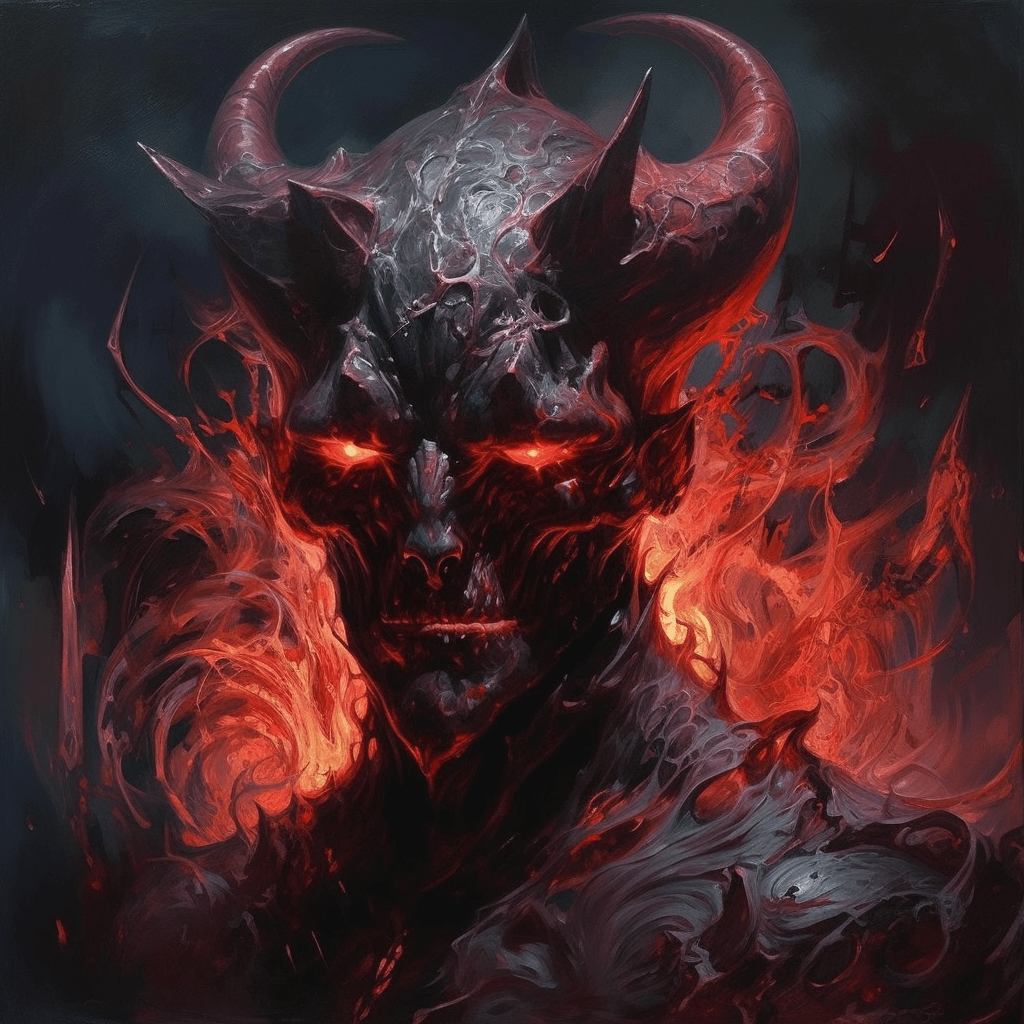
Samael
Pages 114-115:
‘Satan is also known by another name; Samael [rather, they are two different entities]. Samael is known as the “chief of satans”, the “angel of death”, the “prince of demons”… the “Blind Dragon” and the “venom of God”… He is known to have twelve wings and is the angel of death, he kills men with a drop of poison. So it is no wonder that he took the form of the serpent, it also spits or bites and kills with venomous poison… another name for Samael is “the hidden one.”
As well, the nature of Cain is well known as a murderer, full of jealousy and envy. Sounds just like Lucifer’s characteristics…
What most people don’t realise is the intent of seducing Eve was twofold: first to get her to sin against God, second to corrupt her offspring; just like [angels] did with the other women of men later on.’
Satan is also the hidden or occult one and her being invisible and obscure is a recurrent theme. Samael is linked to the planet Saturn which means hidden. Interestingly, the seventh day incorrectly ascribed to the Sabbath, is called Saturn’s day or Saturday – Articles: The Calendar Conspiracy; and The Sabbath Secrecy.
Pages 116-117:
‘The Books of Adam and Eve talk a lot about the physical changes their bodies went through after leaving the Garden… being thirsty, needing to eat food, feeling sick after eating, growing tired, feeling cold and how fire burnt their skin… prior to leaving their bodies were more of a spiritual nature, such as the angels… The name Cain means “gotten or acquired.”
Cain was a wanderer on the earth like we read about Satan in the Book of Job – Genesis 4:14. The Apostle John says Cain was of ‘that wicked or evil one’, his father Samael – 1 John 3:12.
Pages 118-119:
‘The story of Samael’s castration is part of a larger story… Bacharach, ‘Emeq haMelekh, 121b: And he [the blind Dragon] is castrated so that he cannot beget, lest [his offspring] annihilate the world. (Patai 81:458).
… she’s known as the “Queen of Heaven”… throughout history there has been a plethora of “Goddesses”…goddesses throughout history have demonstrated or known to illuminate a bright light.’
Was castration a punishment, for seducing Eve? Or is it a euphemism for Samael’s diminished standing in the Eternal’s presence?
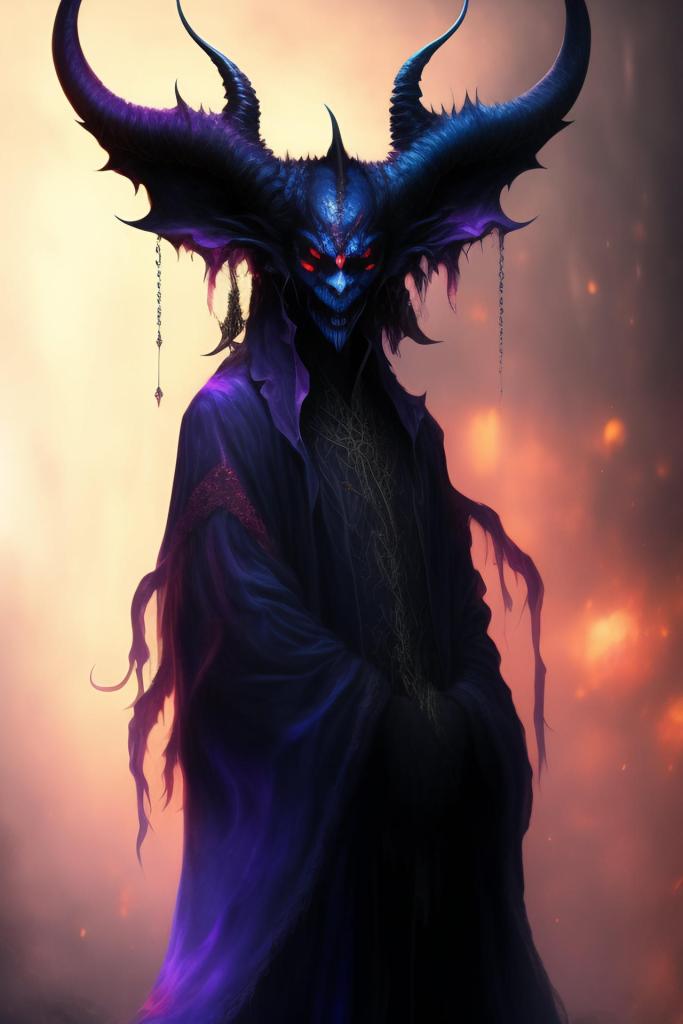
Samael
Yates discusses the feminine attributes of Satan which are listed and paraphrased.
Pages 121, 125-126:
- Suspicious by nature
- Fighting for control, wants to be the Boss
- Vain
- Ruthless with her greatest weapon… her Tongue
- Plays mind games and loves petty power
- Uses seduction and Sex as a weapon
- Vengeful and vicious Enemy
- Beautiful
‘What… would… convince a [host of heaven, a third of the angels] to defy God and leave with her?’
- She was someone of great authority, having a high position and held in high esteem, as chief Cherub.
- She was the most beautiful of all angels and everyone envied her beauty
- She was an expert manipulator
- She was the mother of the angels
- She was God’s favourite and the wife of God
The first seven points are reflective of either sex who are vying for power through manipulation and is unfair to portray as wholly female. Point eight and the second list of characteristics from two to five are very much attributes of a woman. Such as the female described in Ezekiel chapter Twenty-eight, the mis-named king of Tyre. Yet, they are not indicative for Samael the lucifer (light bringer), described in Isaiah chapter fourteen.
Yates:
‘It‘s not the position that gives her power, it‘s the relationship; ties that aren‘t just spiritual, they‘re also emotional, physical and bound by blood.’
This is a penetrating and insightful statement from Yates. It conveys the immense sway and power held by a Mother over her brood and perhaps explains for the first time, just how Satan could lead one-third of the holy angels to turn away from their Father.
Pages 198-199:
Second Book of Adam and Eve:
‘… then God sent his Word unto Adam, saying, “O Adam, that figure is the one [Samael] that promised thee the Godhead, and majesty; he is not favourably disposed towards thee; but shows himself to thee at one time in the form of [1] a woman; another moment, in the likeness of [2] an angel; on another occasions, in the similitude of [3] a serpent; and at another time, in the semblance of [4] a god; but he does all that only to destroy thy soul.
3:4 Then Satan [Samael], the hater of all good, when he saw Adam thus alone, fasting and praying, appeared unto him in the form of a beautiful woman, who came and stood before him…
4:1-6
Then God ordered Satan [Samael] to show himself to Adam in plainly, in his own hideous form [a transformed Seraphim, now Serpent]. 2 But when Adam saw him, he feared, and trembled at the sight of him. 3 And God said to Adam, “Look at this devil, and at his hideous look, and know that he it is who made thee fall from brightness into darkness, from peace and rest to toil and misery.
4 And look, O Adam, at him, who said of himself that he is God!
Can God be black? Would God take the form of a woman?
Is there any one stronger than God? And can He be overpowered? 5 “See, then, O Adam, and behold him bound in thy presence, in the air, unable to flee away! Therefore, I say unto thee, be not afraid of him; henceforth take care, and beware of him, in whatever he may do to thee.”
6 Then God drove Satan [Samael] away from before Adam…’
As indicative of spirit beings, Samael can take on different chimeras, including that of a woman. Yet, Samael is not a woman, a female or femininely inclined. Samael can assume the role of a woman and may impersonate the form of his own Mother. Satan on the other hand is female and can easily take on a masculine role, such as when transformed as an angel of light – 2 Corinthians 11:14.
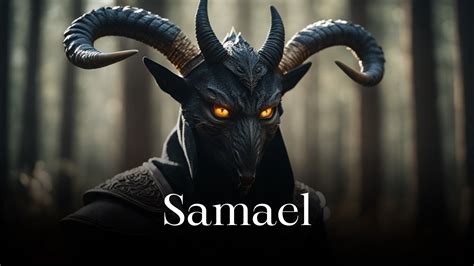
Invariably Samael is depicted as a blackened entity as shown by the four images reproduced.
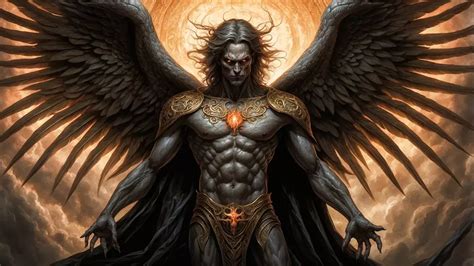
Former Archangel Samael
The Ancient of Days clearly reveals that He is not a female or of black colouring. Thus, the being manifesting to Adam was not the Almighty. The Eternal is angered by the thought of Satan. The issue is not one of her being female or black, it’s that it was a reminder of Asherah, which wasn’t welcome. For the truth is, Asherah is female and is the original Wisdom who was previously the Most High’s companion. Separated, divorced, she became His Nemesis.
We have read scripture (Daniel and Revelation) showing the Ancient of Days and the Son of Man are white like snow – refer Chapter I Noah Antecessor Nulla; and article: The Ark of God.
The Creator is not disparaging being black or being a woman. It would seem to this writer that the Ancient of Days deliberately created a companion opposite to Himself, in sex and colour. It was obviously what He was attracted to. The story of Solomon who was white and the Queen of Sheba who was black, is a type of the original celestial love story, regrettably gone sour – refer Chapter XIII India & Pakistan: Cush & Phut.
Pages 211-213:
‘There are numerous Biblical references to the “Queen of heaven”… Ashtoreth*, an idol of the Philistines, Zidonians and Phoenicians… Astarte*, a Semetic goddess of fertility and sexual love… Isis, Diana [of Ephesus], and Tammuz… Ishtar [Easter*], Aphrodite, Venus [the Morning Star] and Mary, the mother of Jesus, the Blessed Virgin.’
Most of these goddesses names and titles are attributable to Lilith, some perhaps with Asherah; while others could be interchangeable.
Yates:
‘A new Age writer, China Galland, a practicing Buddhist… wrote a book entitled “Longing For Darkness”. Galland explores the commonality between the Virgin Mary and other Pagan goddesses. “… St. Ignatius gave his sword to the Black Madonna of Montserrat in Spain… and founded the Jesuit Order…”
It is believed by some that Mary has already begun being transformed into the Black Madonna which is prevalent in many religions today…
Kali, the death-dealer and life-giver, the end and beginning of time’ – Samael is likened to Kronos, ‘Father Time’ – (refer article: The Calendar Conspiracy) …
‘Kali is dark and female…
Some say she is black because black is the colour in which all distinctions are dissolved, others say she is black because she is eternal night.’
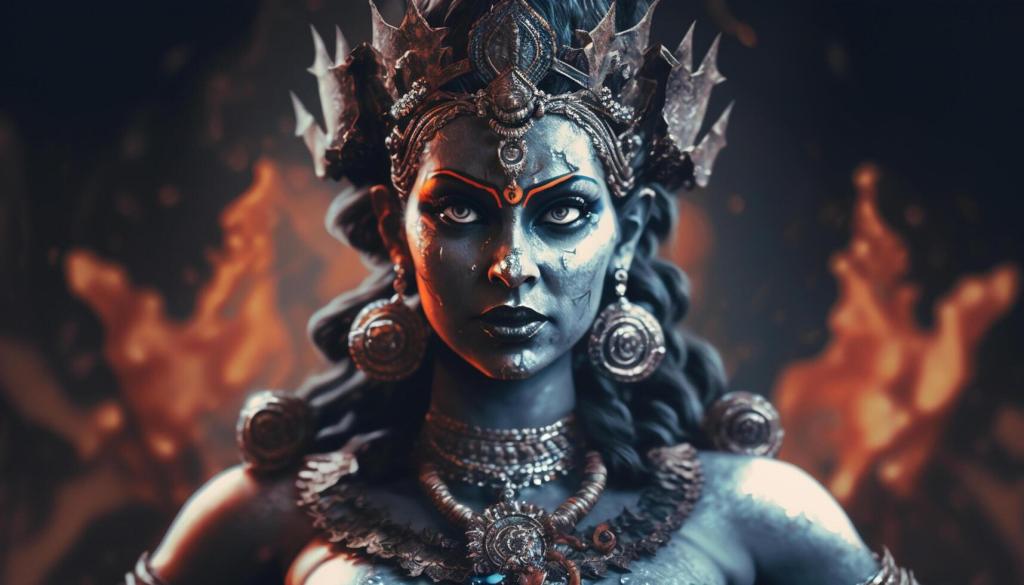
Hindu Goddess Kali
Yates:
‘There is obviously something more to this “black” that I haven‘t figured out yet.
The fact God emphatically points out that He isn‘t and would never be black or present Himself as a woman is important.
It may be a blackness reference to “emptiness” or something of that nature. I’m just not sure yet. But I do find it interesting that a “Black Madonna” is appearing who some claim will “heal the rifts of materialism and racism” seems all too close to being or “telling” its timeliness of now.’

Travis Yates has grappled with the same conundrum this writer faced.
Who is black and female?
It is Samael’s Mother, Asherah.
Again, the Father is not castigating these characteristics, rather, He is reinforcing that He is not to be confused with the Black Goddess who is the Queen of Heaven. It may well include a reference to a ‘black heart’, but significantly, it implies a black skin and countenance; this is what identifies Asherah.
And who is Asherah? She is none other than the Adversary, Satan the Devil.
In Alien World Order, 2017, Len Kasten on page twenty-one, describes the early Reptilian angels from the Draco Constellation – emphasis & bold mine:
“Empires and Kingdoms rose and fell. But in time, one race of reptilian people surfaced as the dominant people of the [Green World] planet. They were known as the NEKH [most powerful of the Kheb species], or fearsome ‘Black Ones.’
Through the victories of the Black Warriors and the political manipulations of the Black Kings, the world of the reptiles was eventually united under one King and one Kingdom [of the Dracos, (Dragons, Serpents, Reptiles)]” – refer article: Principalities & Potentates: What they want… Who they are.

The Black Madonna and Child above – The Indian Goddess Kali below

Online Encyclopaedia:
‘Kali… also called Kalika, is a major goddess in Hinduism, primarily associated with time, death and destruction. Kali is also connected with transcendental knowledge and is the first of the ten Mahavidyas, a group of goddesses who provide liberating knowledge. Of the numerous Hindu goddesses, Kali is held as the most famous. Kali is chiefly worshipped as the Divine Mother, Mother of the Universe, and Divine feminine energy.’
The following verse shows how translations can shade meaning. We will see more blatant examples of this as we investigate Asherah more fully.
1 Samuel 4:8
English Standard Version
‘Woe to us! Who can deliver us from the power of these mighty [H117 – ‘addiyr: majestic ones, of waters of (the) sea] gods?
These are the gods who struck [smite, strike, slay and slaughter] the Egyptians with every sort of plague in the wilderness.’
One commentator suggests this verse should read:
‘Woe unto us! Who shall deliver us out of the hand of this mighty Sea Goddess, the Goddess that smote the Egyptians with all the plagues in the wilderness.’
Edited excerpt from Chapter XXII Alpha & Omega:
‘Ezekiel 28:1-19, English Standard Version
A Lament over the King of Tyre
11 ‘Moreover, the word of the Lord came to me: 12 “Son of man, raise a lamentation [H7015 – qiynah: dirge, elegy] over the king [royal (one)] of Tyre, and say [H559 –‘amar: speak, utter] to [them], Thus says the Lord God:
“You were the signet [or seal] of perfection, full of wisdom [Proverbs 8:22-31] and perfect in beauty.
13 You were in Eden, the garden of God; every precious stone was your covering, sardius [ruby, carnelian, garnet], topaz, and diamond, beryl, onyx, and jasper, sapphire, emerald, and carbuncle; and crafted in gold were your settings and your engravings. [Original Hebrew says: ‘the workmanship (H4399) of your tabrets or tambourines (H8596) and your pipes (H5345)’]
On the day that you were created they were prepared. 14 You were an anointed [H4473 – mimshach: ‘outspread (with outstretched wings)’, root H4886: ‘consecrate’] guardian [H5526 – cakak: defend, cover, protector, join together] cherub [‘flanking God’s throne’].
I placed you; you were on the holy mountain of God; in the midst of the stones of fire you walked [planets of the Solar System].
15 You were blameless in your ways from the day you were created, till unrighteousness [H5766 – avel: violent deeds of injustice] was found in you. 16 In the abundance of your trade you were filled with violence [H2555 – chamac: injustice] in your midst, and you sinned [H2398 – chata: ‘miss the way or path of right’];
so I cast you [threw you] as a profane^ [H2490 – chalal: polluted] thing [disgraced] from the mountain of God, and I destroyed [H6 – ‘abad: exterminate] you, O guardian [anointed] cherub, from the midst of the stones of fire [“no more strolling among the gems of fire for you!”].
17 Your heart was proud because of your beauty [H3308 – yophiy]; you corrupted [H7843 – shchath: to spoil, ruin] your wisdom for the sake of your splendor [brightness, shining]. I cast you to the ground; I exposed you before kings, to feast their eyes on you. 18 By the multitude of your iniquities, in the unrighteousness of your trade you profaned your sanctuaries; so I brought fire out from your midst; it consumed [destroyed] you, and I turned you to ashes on the earth in the sight of all who saw you [cast into a lake of fire]. 19 All who know you among the peoples are appalled [astonished, desolate, devastated] at you; you have come to a dreadful [terror, calamity, destruction] end and shall be no more forever” – Revelation 20:2, 7, 10.
The salient points for the King of Tyre and they are numerous, include:
they are perfect; full of wisdom; extraordinarily beautiful; trusted in the Garden of Eden; bedecked with jewels; arrayed in gold; an anointed guardian cherub by the Eternal’s throne; held the highest position of authority in the Almighty’s government;
became unrighteous; turned violent; were thrown out of God’s sanctuary and cast to the ground, meaning the physical plane; their headquarters on Earth (Tiamat) was destroyed; they became proud because of how beautiful they were; their wisdom became secondary to their outward splendour; and they will be consumed by eternal fire when this Earth is destroyed.
The King of Tyre like the Prince of Tyre, is wise and became full of pride. Yet unusually, considerable extra detail is provided for the ‘King’ of Tyre. Why split them into a prince and king if they are the same person? Chapter Twenty-Eight in Ezekiel is speaking of two very different personalities, though commentators read it as describing just one being, while then equating them with the same personality as described in Isaiah chapter Fourteen. In support of being one person, is how a prince can either inherit or usurp the position of a king. Yet the fact remains that
a. a prince is distinct and separate from a king and
b. a king is of higher rank than a prince.
The telling point about the King of Tyre, is the first which happens to be the most profound in its permutations. The Prince of Tyre has a prophecy or prediction against them; whereas the King of Tyre is given a lament. The word for lament also means a dirge or elegy.
Lament: ‘to feel or express sorrow or regret for’, ‘to mourn for or over deeply’, ‘a formal expression of sorrow or mourning, especially in verse or song; an elegy or dirge.’
Elegy: ‘a mournful, melancholy, or plaintive poem, especially a funeral song or a lament for the dead’.
Dirge: ‘a funeral song or tune, or one expressing mourning in commemoration of the dead’.
What do all three words have in common? They are expressions for
a. mourning and sorrow and
b. in commemoration of someone who is already, ‘dead.’ Not only are they dead, they are lamented.
We will learn that the King of Tyre is not yet dead, but that it is the death of the relationship being lamented by the Almighty. One does not lament someone unless they hold extreme value to the one mourning. Who could such a being be, who has turned against the Eternal yet is still worthy of remembrance by Him in memorial?
The very next point made is nearly as weighty as the first, for in verse twelve, it is not necessarily a king being addressed, but it is someone royal, someone of prestige. This personage could be feminine. Clues of the such are that they are described as a perfect creation, possessing perfect beauty – absolute beauty of face and form – every precious gem, including diamonds, sapphires, emeralds, ruby and gold was their covering, they were an anointed Cherub or protector of the Creator’s very throne, an integral member of the Celestial Assembly; but then condemned for their unjust actions and their pride over their beauty, swapping righteous wisdom for self-glorification of their own splendour and thus cast out from the mountain of God. A process akin to spontaneous combustion, means they will be destroyed, being stunningly terminated and reduced to ashes forever.
Penetrating deeper into these words and phrases, we can confirm that there is a distinct femaleness flowing from them. This entity is the sum of female beauty, rather than of masculine handsomeness – to the point of perfection, in that the Creator was proud of His work – and they are clothed in extensive jewellery and gold, walking or strutting their splendour for all to see. Precious gems and stones are adored by woman the world over. What woman does not like jewellery or ever has enough? It could be argued the same can be said of an effeminate or trans-sexual male; or, these verses really are describing a female being.
The text could just as accurately be rendered the Queen of Tyre.
We will study further regarding the question of a Queen of Heaven; a Goddess in the spirit realm, who was created as a companion for the Ancient of Days.’
Edited excerpt from the article The Ark of God:
‘Most Bible translations say king; only a couple use the correct contextual, ‘ruler. In the Hebrew, the word ‘him’ is not there and has been added in English translations, only misleading further regarding the true identity of this ‘ruler of Tyre.’ For the Hebrew word if it were included in the original, would be H1931 hu or hi, meaning either ‘he, she’ or ‘it’ depending on the context.’
As this king is actually a queen, ‘the difficulty is that the Hebrew word used, melek (H4428) is masculine… It stems from the same root word which can mean king or queen (H4427 – melek), literally, “to become queen or king.” The Hebrew does not have a specific word for queen, for it only recognises a queen as not a ruler in her own right, but as subsidiary to a king. Thus, there is the the feminine of melek, in malkah (H4436) which is used invariably for a queen regent or wife of a king. For example Queen Vashti, the wife of Artaxerxes I (or Ahasuerus) – Esther 1:9 (Chapter IV Central Asia – Madai & the Medes).
Alternatively, shegal (H7694) for a queen consort (Psalm 45:9, Daniel 5:2-3), which simply means a ‘wife’ of the first rank, as distinguished from mere concubines and gebirah (H1377 for a lady or queen mother – for example Tahpenes, wife of Pharaoh Hadad, 1 Kings 11:19 (1 Kings 2:19). McClintock and Strong: ‘Gebirdh… is expressive of authority; it means “powerful” or “mistress,” being the feminine of gebir, “master,” or “lord.” The feminine is to be understood by its relation to the masculine, which is not applied to kingly power or to kings, but to general authority and dominion.’
The one exception is the Queen of Sheba who visited King Solomon. She very obviously a female, was accorded the Hebrew word malkah – 1 Kings 10:1 (refer Chapter XIII India & Pakistan: Cush & Phut). Otherwise there has been in Hebrew, a bias in the assumption a ruler was male and therefore a king and so in the case of typing this ruler against that of Tyre, the identity of Wisdom the once closest companion of the Ancient of Days turned His greatest Adversary (Job 1:6-12), has remained conveniently hidden for millennia…’
‘Like the resplendent personage in Isaiah chapter fourteen who fell from Heaven, the King of Tyre is similarly spectacular and cast out from the Eternal’s presence. The plot thickens and provides significant food for thought. The Hebrew word for violence in verse sixteen means: ‘cruelty, wrong, false, damage, oppressor’ and ‘unjust gain’ – Violence ‘done against’ others and ‘violent [in] dealing’ with others.
The word profane translates as: ‘pollute, defile, break, wounded’ and ‘slay.’ It can also mean ‘piped’. It means: ‘to desecrate’ or ‘pollute oneself sexually and ‘to violate the honour of’ or ‘dishonour’ or ‘violate (a covenant).’ Further important clues, are a sexual connotation, where it can mean ‘prostitute.’ Did this creature betray the Eternal and was that betrayal sexual? Also, the Hebrew word for violence can mean to ‘wound (fatally), bore through’ and ‘pierce.’ This implies a serious injury in the least and at the worst, death.
Additionally, Ezekiel refers to musical proficiency, in playing ‘the flute or pipe’ a ‘player on instruments.’ This being was given the gift of musical talent so they could share joy with the Eternal – Article: Na’amah.
Recall, we discussed a similar reference to Nimrod in the previous chapter. Interestingly, though some translations mention Satan, it is actually the Prince of the Power of the Air or the One who rules those in the air, who is described in Ephesians 2:2, BSB: as “… the ruler of the power of the air [waves]… the spirit who is now at work…” This being is none other than the Lord of the Fliers or Lord of those who Fly. His title, as revealed in the New Testament is Beelzebub (Old Testament: Baal); while his personal name is perhaps a surprise for many, for it is the light bringer (Lucifer)… Samael.
The word for destroyed is past tense and leaves little to the imagination. It is translated as: ‘perish, lose, fail, utterly, broken, undone’ and ‘void’. It also means: ’cause to vanish, go astray, die, be exterminated, be lost, to give up (as lost), to blot out, do away with, put to death (of divine judgement).’ The connotation is, ‘have no way to flee, to wander away’ or ‘lose oneself.’
There can be no doubt that this being has either died, or has a death sentence against them that makes them as good as dead. The Hebrew word for corrupted in verse seventeen can be translated as: ‘destroy, mar, waster’ and ‘battered.’ The word means: ‘go to ruin, decay, to be marred, be injured, be ruined, be rotted, to spoil, ruin, to pervert, corrupt (morally).’
The verses in this passage about the ‘king’ of Tyre are referring to someone else entirely. They are separate from the verses describing the Prince of Tyre. Each are also distinct from those contained in Isaiah. Aside from the connections through covering and shining; the clues reveal that this being is not Samael; but rather a creature of great Wisdom who betrayed the Creator and very possibly, has been seriously wounded. For this being, it has been about distancing themselves from the Eternal and following their own path or Way of Wisdom.
We will investigate further, this mysterious and enigmatic being of perfection and wisdom.
Samael, ‘a’ satan but not ‘the’ Satan, is not described as perfect or beautiful. Rather, as the Watcher Samyaza, he desired the beauty and allure of human women on Earth.
The one incorrectly called Lucifer (in Latin), but rather Heylel in the Hebrew – the ‘shining one, light bearer’ and ‘morning star’ – is not the same personage as the King of Tyre in Ezekiel chapter Twenty-Eight.
It would explain the persistent belief in which Satan’s identity and the mysterious ‘Lucifer’ are not the same person. If such is the case, then Samael as Heylel, fell from Heaven after saying in his heart that he would exalt himself above all other angels, sit in the Assembly of Celestial government, ruling as the Most High himself. This being like Satan, seeks to rule in the place of the Creator and topple the hierarchy of Heaven. For Samael, it is all about a thirst and lust for Power. This in turn raises the vital question – for clues suggest it is a legitimate one – of whether all the forces of evil are united, or torn apart by factions.
The war for control of the spiritual realm, described in Revelation chapter Twelve has not happened (not according to our perception of time at least); it is yet future. Once it takes place and the Archangel Michael defeats the Dragon, the Adversary is cast out literally and once for all. This time, to begin the final countdown of end time events on Earth.’

In Job Chapter forty-one we learn of Leviathan. Commonly described as a Sea Monster. The creature described here, whether land or sea based, is clearly a fire-breathing Dragon. As dragons are mentioned in the Bible, originating from the Seraphim order of beings, including serpents, it is worth reading this chapter in full. Particularly, if one is a Game of Thrones, Lord of the Rings or Dungeons & Dragons aficionado.
Job 41:1-34
New Century Version
“Can you catch Leviathan [H3882 – livyathan] on a fishhook or tie its tongue down with a rope? 2 Can you put a cord through its nose or a hook in its jaw? 3 Will it keep begging you for mercy and speak to you with gentle words? 4 Will it make an agreement with you and let you take it as your slave for life?
5 Can you make a pet of Leviathan as you would a bird or put it on a leash for your girls?
6 Will traders try to bargain with you for it? Will they divide it up among the merchants? 7 Can you stick darts all over its skin or fill its head with fishing spears?
8 If you put one hand on it, you will never forget the battle, and you will never do it again!
9 There is no hope of defeating it; just seeing it overwhelms people.
10 No one is brave enough to make it angry, so who would be able to stand up against me? 11 No one has ever given me anything that I must pay back, because everything under the sky belongs to me.”
The almighty made the (almost) indestructible Leviathan. The Eternal then reminds Job, how much more powerful the Lord is than the awe inspiring creature he created.
12 “I will speak about Leviathan’s arms and legs, its great strength and well-formed body.
13 No one can tear off its outer hide or poke through its double armor.
14 No one can force open its great jaws; they are filled with frightening teeth. 15 It has rows of shields on its back that are tightly sealed together [like scales (or plates)]. 16 Each shield is so close to the next one that no air can go between them. 17 They are joined strongly to one another; they hold on to each other and cannot be separated.
18 When it snorts, flashes of light are thrown out, and its eyes look like the light at dawn.
19 Flames blaze from its mouth; sparks of fire shoot out.
20 Smoke pours out of its nose, as if coming from a large pot over a hot fire. 21 Its breath sets coals on fire, and flames come out of its mouth.“
The word leviathan can mean ‘mourning.’ The creature itself is described as a ‘sea monster’ or ‘dragon.’ Strong’s says it is a ‘large aquatic animal’ that is a ‘fire breathing animal and not a ‘crocodile.’ This ‘great sea dragon may have an explosive producing mechanism to enable it to be a real fire breathing dragon.’ From the root H3867, lavah meaning ‘joined’ a ‘wreathed animal’ like a ‘snake’ and ‘figuratively, the constellation of the dragon [Draco].’ The Morning Star Venus, appears to rise out of the eastern sea at dawn prior to resurrecting the Sun and is also equated as a sea monster.
22 “There is great strength in its neck. People are afraid and run away. 23 The folds of its skin are tightly joined; they are set and cannot be moved. 24 Its chest is as hard as a rock, even as hard as a grinding stone. 25 The powerful fear its terrible looks and draw back in fear as it moves. 26 The sword that hits it does not hurt it, nor the arrows, darts, and spears. 27 It treats iron as if it were straw and bronze metal as if it were rotten wood. 28 It does not run away from arrows; stones from slings are like chaff to it. 29 Clubs feel like pieces of straw to it, and it laughs when they shake a spear at it. 30 The underside of its body is like broken pieces of pottery. It leaves a trail in the mud like a threshing board. 31 It makes the deep sea bubble like a boiling pot; it stirs up the sea like a pot of oil. 32 When it swims, it leaves a shining path in the water that makes the sea look as if it had white hair [a wake].
33 Nothing else on earth is equal to it; it is a creature without fear. 34 It looks down on all those who are too proud [Queen] over all proud creatures.”
As discussed, the word for king is melek (H4428 and root H4427), which can be translated as royal or more tellingly, as a queen.
The Leviathan is a sea monster, linked to a Goddess who has no equal and is over all those who are proud. This is the same being described in Ezekiel chapter Twenty-Eight. Asherah as the Queen of Heaven, the Mother Goddess of all Living would also be the original Mother of Dragons.

True World History Humanity’s Saga, Stewart A Swerdlow, 2014, page 28:
‘In China… [there are] plaques describing the birth of China from a Reptilian Yellow Dragon King. The First Dynasty was the offspring of this Reptilian king; who was considered a very “Holy Being” – refer Chapter X China: Magog, Tubal & Meshech.
Flying Serpents and Dragons, R A Boulay, 1997 & 1999, Pages 12, 15, 21, 51-52 – emphasis mine:
‘…in the west we have created god in our image and not the other way around [an insightful and true statement].
Many… world [civilisations] take pride in the fact that they were descended from “dragons” or “flying serpents.” … the… [Chinese] Yih King, claims that the first humans were formed by the ancient [dragon] goddess Nu Kua… Early Chinese emperors boasted of being descendants of this… dragon goddess…
Dragons have permeated world consciousness to the extent that they can be found in the mythology and literature of all world [civilisations]. A catalogue of all the appearances of dragons in the [cultures of the world]… would be an enormous task in itself. In many places it is a substratum to historical traditions.
In England, for example, there are over 70 towns and villages which have dragons in their folklore… [in] the [Jewish Talmud]… Pictures of all planets are permissible except that of the Sun and Moon, and that of the Dragon. There is a common thread that runs through… stories of flying serpents with a fiery breath.
They were:
Winged [and had] ability to fly
[Upright on legs]
Had a flaming breath
Coexisted with man
Obsession with gems
[Co-creators of] man
Held secret to immortality
Lived underground
Fought each other in the sky
Reptilian origin
In Ezekiel Chapter sixteen, we read an enlightening passage about the Creator’s Bride.
As with the Kings of Tyre and Babylon, the descriptions are dual or intertwined. It is obvious that this chapter is speaking primarily of an original wife, not the later wife as portrayed by the people of ancient Israel.
In verse eight, the Creator clearly loved his bride, Wisdom.
Ezekiel 16:6-22, 30-34, 38, 44-45
English Standard Version
The Lord’s Faithless Bride
6 “And when I passed by you and saw you wallowing in your blood, I said to you in your blood, ‘Live!’ I said to you in your blood, ‘Live!’ 7 I made you flourish like a plant of the field.
And you grew up and became tall and arrived at full adornment. Your breasts were formed, and your hair had grown; yet you were naked and bare.
8 “When I passed by you again and saw you, behold, you were at the age for love, and I spread the corner of my garment over you and covered your nakedness [sexual relationship]; I made my vow [engaged] to you and entered into a covenant [betrothed] with you, declares the Lord God, and you became mine [marriage].
9 Then I bathed you with water and washed off your blood from you and anointed you with oil [Holy Spirit]. 10 I clothed you also with embroidered cloth and shod you with fine leather. I wrapped you in fine linen and covered you with silk. 11 And I adorned you with ornaments and put bracelets on your wrists and a chain on your neck. 12 And I put a ring on your nose and earrings in your ears and a beautiful crown on your head.
13 Thus you were adorned with gold and silver, and your clothing was of fine linen and silk and embroidered cloth. You ate fine flour and honey and oil [refer article: The Manna Mystery]. You grew exceedingly beautiful and advanced to royalty. 14 And your renown went forth among the [angelic] nations because of your beauty, for it was perfect [Ezekiel 28:11], through the splendor [Ezekiel 28:17] that I had bestowed on you [Ezekiel 28:13], declares the Lord God.
15 “But you trusted in your beauty [Ezekiel 28:17] and played the whore because of your renown and lavished your whorings on any passerby; your beauty became his. 16 You took some of your garments and made for yourself colorful shrines, and on them plyed the whore.
The like has never been, nor ever shall be.
17 You also took your beautiful jewels of my gold and of my silver [Ezekiel 28:13], which I had given you, and made for yourself images of men, and with them played the whore. 18 And you took your embroidered garments to cover them, and set my oil and my incense before them. 19 Also my bread that I gave you – I fed you with fine flour and oil and honey – you set before them for a pleasing aroma; and so it was, declares the Lord God.
20 And you took your sons and your daughters, whom you had borne to me, and these you sacrificed to them to be devoured.
Were your whorings so small a matter 21 that you slaughtered my children and delivered them up as an offering by fire to them? 22 And in all your abominations and your whorings you did not remember the days of your youth, when you were naked and bare, wallowing in your blood” – Proverbs 8:22-30.
30 “How sick is your heart,
declares the Lord God, because you did all these things, the deeds of a brazen prostitute, 31 building your vaulted chamber at the head of every street, and making your lofty place in every square. Yet you were not like a prostitute, because you scorned payment.
32 Adulterous wife, who receives strangers instead of her husband!
33 Men give gifts to all prostitutes, but you gave your gifts to all your lovers, bribing them to come to you from every side with your whorings. 34 So you were different from other women in your whorings. No one solicited you to play the whore, and you gave payment, while no payment was given to you; therefore you were different. 38 And I will judge you as women who commit adultery and shed blood are judged, and bring upon you the blood of wrath and jealousy.
44 “Behold, everyone who uses proverbs will use this proverb about you:
‘Like mother [Asherah], like daughter [Lilith].’ 45 You are the daughter [Lilith] of your mother [Asherah], who loathed her husband [the Ancient of Days] and her children [the angels]…’
The preceding verses are extraordinary in their implications. They have been there all along, yet why has this astonishing revelation not been expounded on. The Bible, the Creator’s plan, Christianity, Satanism, Paganism, the Duality exhibited in nature and just about everything obscure – which has been darkened in the Occult and clouded within Esotericism – cloaked in mystery, has new meaning once this light of understanding is cast amongst the shadows. So that we see the Creator and Asherah as they truly are: male and female, husband and wife, co-creators of all that is living and alive.
The worship of the Goddess Asherah, who was linked with ritual temple prostitution and fertility rites was endemic in the land of Canaan and a serious heresy practised by the descendants of Jacob.
The resident Nephilim and Elioud giants would obviously favour and encourage, worship of their spiritual Mother.
A commentator online remarks:
‘In Ashtoreth’s worship services, male worshipers (committed sodomy) with priests and priestesses of the goddess. The priests and male prostitutes, who were consecrated to her cult were called qadesh, qedishim or sodomites. (In addition, physical relations)… between male and male worshipers and male and female worshipers was viewed as an offering to the goddess’ – Article: Belphegor.
The Creator’s anger is stirred up as no other, when Asherah is involved or mentioned.
Could this be because of their shared, intimate history. Nothing gets under the skin, like a failed relationship turned ugly. It would seem readily plausible when connecting the love story turned to vengeance, revealed in Proverbs chapter eight and Ezekiel chapter sixteen. It mirrors many relationships which become sour; reflecting the paradoxical love and hate from the flip side of the same coin. The love affair between King Solomon and the Queen of Sheba is a fascinating parallel, in light of Asherah also being dark.
The personal name of Wisdom is Asherah, from the verb yasher meaning: ‘to be straight’ or ‘level’ and ‘progression.’ The adjective yasher, means: ‘right’ or ‘upright.’ The nouns ‘esher, ‘ashar and ‘osher mean: ‘happiness’ or ‘blessedness’ and ‘prosperity’ and the noun te’ashur, refers to a kind of tree.
The root word is H833,‘ashar and means; ‘to go straight, advance, to set right.’ It can be no surprise that not only has Asherah’s name been almost blotted out in the scriptures as if all memory of her is trying to be expunged; but also due to its righteous meaning, why her name has been dropped from use and replaced with the Adversary’s title, Satan.

The Tree of Life
Originally, Asherah was ordained a righteous path as a Tree of Life. At some point she changed, following an unrighteous path which led to her becoming the Tree of Knowledge of Good and Evil. It is symbolically this tree which her son Samael partook and later enticed Eve, tricking her to do the same.
This tree is associated with the physical creation and with sex.
Asherah committed adultery with her spiritual creation which had sprung from her; heinously betraying the Eternal who had created her as His companion.
Under the Almighty’s instruction, Moses forbade the worship of Asherah – Exodus 34:13.
Deuteronomy 16:21
English Standard Version
“You shall not plant [H5193 – nata’: fasten, establish, fix] any tree [H6086 – ets: wood, timber, staff, plank, stick] as an Asherah [H842: grove (for idol worship)] beside the altar of the Lord your God that you shall make.”

Asherah poles – limbless tree trunks planted in or raised off the ground – were built as symbolic sacred trees. Sometimes the trunk was carved into a symbolic representation of the goddess.
They are particularly sinister.
The name Asherah appears forty times in the Bible, though it is routinely translated as grove, sometimes as trees or even Astarte, the Canaanite goddess of ‘fortune and happiness’, a consort of Baal – otherwise known as Ishtar from which the word Easter derives.
Ishtar is in reality the goddess Lilith, the daughter of Asherah.

The carved trees, meant the places of Asherah worship were commonly called groves and so the words Asherah and grove became synonymous.
It is worth noting that Asherah became Satan and Baal was originally Samael. A dual application is rendered later in the period during Israelite history, when Asherah signified the ‘moon goddess’ and was customarily presented as a consort of Baal, the ‘sun-god’ – Judges 3:7; 10:6, 1 Samuel 7:4; 12:10.
The Moon goddess being none other than Lilith, also known as ‘Black Moon Lilith’ and her twin, Apollos (Azazel), the ‘god of the sun.’

Astarte, worshipped by the Phoenicians, is one and the same as Ashteroth. She was worshipped throughout Syria, Canaan and by the Philistines – 1 Samuel 31:10. Both words are etymologically linked with Ishtar of the Assyrians. In fact, the first city Chedorlaomer and his allies defeated in the War of the Nine Kings was Ashteroth-karnaim, the city of the Rephaim, the leading post-flood clan of the Nephilim – Genesis 14:5 (refer Chapter XIX Chedorlaomer & the War of Nine Kings).
The Vulgate in Latin provides lucus or nemus, a grove or a wood. From the Vulgate, the King James version persistently uses grove or groves instead of Asherah’s name. Therefore, non-scholarly English language readers of the Bible would not have read about the identity of Asherah for more than four hundred years.

The groves stated in the Bible include the following produce: grapevines, pomegranates, walnuts, myrtles and willows.
Micah 5:14
English Standard Version
‘… and I will root out your Asherah images from among you and destroy your cities.’
This verse in Micah, is in the same chapter which reveals Nimrod was descended from Asshur and not from Cush – refer Chapter XXI The Incredible Identity, Origin & Destiny of Nimrod.
Nimrod – or a kindred spirit of Nimrod – will be instrumental as the False Prophet in popularising the worship of Asherah, the Queen of Heaven. Just as Nimrod is believed to have promulgated Mother worship and the Mystery Babylonian religion; it cannot be a coincidence both subjects are in the same chapter, a few verses apart.

The obelisk (or menhir) is the outward public name and monument for an Asherah pole and can be found continuously all over the world.
In the Book of Second Kings we read about King Josiah of Judah and his massive cleansing of the kingdom; ridding it of its pagan artefacts, idols and temples rife with Asherah worship, which had begun as soon as Joshua had passed away – Judges 2:8-13 (Article: The Ark of God). Josiah re-instituted the true worship of the Eternal, the God who David, Joshua, Moses, Joseph, Jacob, Isaac and Abraham had obeyed.
2 Kings 23:1-25
English Standard Version
‘Then the king [righteous Josiah]… went up to the house of the Lord, and with him all the men of Judah and all the inhabitants of Jerusalem and the priests and the prophets, all the people, both small and great.
And he read in their hearing all the words of the Book of the Covenant that had been found in the house of the Lord.
And the king stood by the pillar and made a covenant before the Lord, to walk after the Lord and to keep his commandments and his testimonies and his statutes with all his heart and all his soul, to perform the words of this covenant that were written in this book. And all the people joined in the covenant.
And the king commanded Hilkiah the high priest and the priests of the second order and the keepers of the threshold to bring out of the temple of the Lord all the vessels made for Baal [Samael], for Asherah [Satan], and for all the host of heaven [astrology and demonolatry^]… And he deposed the priests whom the kings of Judah had ordained to make offerings in the high places at the cities of Judah and around Jerusalem; those also who burned incense to Baal, to the sun [Azazel] and the moon [Lilith] and the constellations and all the host^ of the heavens.
And he brought out the Asherah from the house of the Lord, outside Jerusalem, to the brook Kidron, andburned it at the brook Kidron andbeat it to dust and cast the dust of it upon the graves of the common people. And he broke down the houses of the male cult prostitutes who were in the house of the Lord, where the women wove hangings for the Asherah.
And he defiled Topheth, which is in the Valley of the Son of Hinnom, that no one might burn his son or his daughter as an offering to Molech.
And he removed the horses that the kings of Judah had dedicated to the sun… And the king defiled the high places that were east of Jerusalem, to the south of the mount of corruption, which Solomon the king of Israel had built for Ashtoreth the abomination of the Sidonians, and for Chemosh the abomination of Moab, and for Milcom the abomination of the Ammonites’ – Articles: Belphegor; and Seventh Son of a Seventh Son.
‘And he broke in pieces the pillars and cut down the Asherim [plural] and filled their places with the bones of men. Moreover, the altar at Bethel, the high place erected by Jeroboam the son of Nebat, who made Israel to sin, that altar with the high place he pulled down and burned, reducing it to dust. He also burned the Asherah.
Moreover, Josiah put away the mediums and the necromancers and the household gods and the idols and all the abominations that were seen in the land of Judah and in Jerusalem, that he might establish the words of the law that were written in the book that Hilkiah the priest found in the house of the Lord.
Before him there was no king like him, who turned to the Lord with all his heart and with all his soul and with all his might, according to all the Law of Moses, nor did any like him arise after him.’
2 Chronicles 15:16
English Standard Version
‘Even Maacah, his mother, King Asa removed from being queen mother because she had made a detestable image for Asherah. Asa cut down her image, crushed it, and burned it at the brook Kidron.’
In 2 Kings 18:4, ESV: “[righteous King Hezekiah] removed the high places and broke the pillars and cut down the Asherah. And he broke in pieces the bronze serpent [Samael] that Moses had made, for until those days the people of Israel had made offerings to it (it was called Nehushtan).”
Asherah stood side by side with the ‘bronze serpent’, Hebrew word Nehushtan, ‘he who knows all.’
Gideon a judge of Israel, also destroyed an alter to Baal and its companion Asherah – Judges 6:25-32.
2 Kings 21:1-16
English Standard Version
‘Manasseh was twelve years old when he began to reign, and he reigned fifty-five years in Jerusalem. His mother’s name was Hephzibah. And he did what was evil in the sight of the Lord, according to the despicable practices of the nations whom the Lord drove out before the people of Israel.
For he rebuilt the high places that Hezekiah his father had destroyed, and he erected altars for Baal and made an Asherah, as Ahab* king of Israel had done, and worshiped all the host of heaven and served them…’
1 Kings 16:30-33
English Standard Version
‘And Ahab* the son of Omri did evil in the sight of the Lord, more than all who were before him. And as if it had been a light thing for him to walk in the sins of Jeroboam the son of Nebat, he took for his wife Jezebel the daughter of Ethbaal king of the Sidonians, and went and served Baal and worshiped him. He erected an altar for Baal in the house of Baal, which he built in Samaria.
And Ahab made an Asherah.
Ahab [and his wife Jezebel*] did more to provoke the Lord, the God of Israel, to anger than all the kings of Israel who were before him.”
1 Kings 18:19
English Standard Version
“Now therefore send and gather all Israel to me at Mount Carmel, and the 450 prophets of Baal and the 400 prophets of Asherah, who eat at Jezebel’s table.”
2 Kings:
‘And he built altars for all the host of heaven in the two courts of the house of the Lord. And he burned his son as an offering and used fortune-telling and omens and dealt with mediums and with necromancers. He did much evil in the sight of the Lord, provoking him to anger.
And the carved image of Asherah that he had made he set in the house of which the Lord said to David and to Solomon his son, “In this house, and in Jerusalem, which I have chosen out of all the tribes of Israel, I will put my name forever.”
KJV: ‘… a graven image of the grove that he had made in the house…’
TLB: ‘… a shameful Asherah idol in the temple…’
MSG: ‘… the carved image of the sex goddess Asherah in the Temple of God…’
‘… and Manasseh led them astray to do more evil than the nations had done whom the Lord destroyed before the people of Israel. And the Lord said by his servants the prophets, “Because Manasseh king of Judah has committed these abominations and has done things more evil than all that the Amorites did… And I will stretch over Jerusalem the measuring line of Samaria, and the plumb line of the house of Ahab, and I will wipe Jerusalem as one wipes a dish, wiping it and turning it upside down. Moreover, Manasseh shed very much innocent blood, till he had filled Jerusalem from one end to another, besides the sin that he made Judah to sin so that they did what was evil in the sight of the Lord.’
Jeremiah 7:16-18
English Standard Version
“As for you, do not pray for this people, or lift up a cry or prayer for them, and do not intercede with me, for I will not hear you. Do you not see what they are doing in the cities of Judah and in the streets of Jerusalem?
The children gather wood, the fathers kindle fire, and the women knead dough, to make cakes [cake, (mince pies)] for the queen [H4446 – moleketh] of heaven [Asherah]…”
Jeremiah 44:15-25
English Standard Version
‘Then all the men who knew that their wives had made offerings to other gods, and all the women who stood by… 16 “As for the word that you have spoken to us in the name of the Lord, we will not listen to you.
17 But we will do everything that we have vowed, make offerings to the queen of heaven and pour out drink offerings to her…
For then we had plenty of food, and prospered, and saw no disaster. 18 But since we left off making offerings to the queen of heaven and pouring out drink offerings to her, we have lacked everything and have been consumed by the sword and by famine.”
19 And the women said, “When we made offerings to the queen of heaven and poured out drink offerings to her, was it without our husbands’ approval that we made cakes for her bearing her image and poured out drink offerings to her?”
25 Thus says the Lord of hosts, the God of Israel: You and your wives have declared with your mouths, and have fulfilled it with your hands, saying, ‘We will surely perform our vows that we have made, to make offerings to the queen of heaven and to pour out drink offerings to her.’
Then confirm your vows and perform your vows!’
This passage corroborates a number of archaeological excavations where altar spaces were found in Hebrew homes. The household idols variously referred to in the Bible may also be linked to the hundreds of female pillar-base figurines which have been discovered in ancient Israel and confirmed in William Dever’s book, Did God Have a Wife?
It also shows archaeological evidence for multiple shrines and temples in honour of Asherah, within ancient Israel and Judah.
The temple site at Arad, has two massebot or standing stones representing the presence of deities. Formerly Yahweh and Asherah and later, Asherah and Baal are the strong candidates. Asherah was the wife of YHWH, the Eternal before she became the consort of her son, Samael. “The only goddess whose name is well attested in the Hebrew Bible (or in ancient Israel generally) is Asherah.”

An Asherah idol excavated at Hazor
Jeremiah 2:20
New Century Version
“Long ago you refused to obey me as an ox breaks its yoke. You broke the ropes I used to hold you and said, ‘I will not serve you!’ In fact, on every high hill and under every green tree [H7488 – ra’anan: fresh, verdant, luxuriant] you lay down [H6808 – tsa’ah: wander, wanderer, stoop, bend] as a prostitute.”
The Bible frequently and graphically associates goddess worship with prostitution. Fertility sex rites typically revolved around women of power and influence, such as Maacah, King Asa’s mother.
Ugaritic amulets show a miniature ‘tree of life’ growing out of Asherah’s belly.
Asherah and the Tree of Life, Lauren Raine, 2017 – emphasis mine:
‘For many years I’ve made “tree of life” images. I’m not sure where I got the image from originally.
In early lithographs there was always a woman within the tree form, or the Tree was a backdrop to everything else in the painting… and later I started making sculptural torsos, the Mother within the Tree.
Asherah is sometimes referred to as the wife of Yahweh, whose name became something that could not be uttered, only represented as “the Lord”. The Asherah poles, and eventually the name of Asherah, were banned from worship as Judaism became [was] monotheistic and [re]established the sole deity as male.
Interestingly, with the early advent of Gnostic Christianity, Asherah is perhaps re-born in the form of Sophia [Wisdom], the feminine face of deity, often called the”mother” or sometimes “wife”of Yaweh.
The emblem for Sophia was often a [white] dove.’

A relief from the palace of Assyrian king Ashurnasirpal II (884-859 BCE) showing an Asherah Tree with male figures holding anointing oils.
Wisdom’s personal name is Asherah. Asherah is (was) the Queen of Heaven, once the Ancient of Day’s consort and wife.
She forsook the Most High, looked to herself and focused on her creation. As an unfaithful wife, a whore, she darkened herself, figuratively and literally.
In the scriptures, trees are analogous with spiritual beings. Samael sought to have Eve imbibe from his Mother, the fruit from the Tree of Knowledge of Good and Evil. Her Way, the path of physicality, gratification and selfishness was symbolised in becoming a carnal sexual being in contrast to and in conflict with what the Almighty intended; that of the Tree of Life, His Way, the path of spirituality, character and selflessness, symbolised in remaining a pure spirit and at one with the Eternal Creator.

Anciently, Asherah was worshipped as a tree.
That tree is the same tree which millions upon millions of people every year remember, the same queen of heaven with another name, Mary. The shiny adornments and sparkly baubles of the Christmas tree, with presents scattered underneath are enticing and appear innocent to the uninitiated. The reality is that it represents the Tree of Asherah and choosing her path opposed to the Most High and the Tree of Life represented by His Son, the Word. This re-enactment every year, of humanities decision to forsake the Creator and rely on the Devil must indeed be galling and bitter (like wormwood) for the Creator. It is one of the greatest hoaxes, conspiracies and ironies in the history of western civilisation.
Christmas is a Lie, The Christmas Tree – capitalisation theirs, emphasis & bold mine:
‘There is a lot more going on “spiritually” with “the Tree” than most people know. And the annual ritual of erecting one in your home synchronized with the panoply of “solstice rituals” serves a very important function within the SUN WORSHIP system. Ritual “Trees” do not come alone. They come with “spirits”. The head of demons, was a “spirit” known as “Azazel” (“spirit” of “the wilderness”). Thus why “the tree” is ritualistically “brought into the home”. The solstice tree ritual is possibly one of the oldest rituals on earth. It is the beginning point, for the Genesis story in the Bible. In fact, Genesis was actually written to serve as a “rebuttal” to it.
“The tree” comes with a “serpent”. In almost all traditions of SUN WORSHIP, both the tree and the serpent, are described together. The serpent ranges from a variety of local breeds, such as the Egyptian Cobra, to completely mythological, such as the “feathered serpent” of the Mayas, or the “rainbow serpent” of the aborigines [Articles: Thoth; and The Pyramid Perplexity].
But there’s always the “serpent”, with “the Tree”. That is why Moses wrote what he did in Genesis 3… When Moses described the “Tree of Knowledge of Good & Evil”, he was describing what is known in the SUN WORSHIP tradition, as the “tree of enlightenment”, or as was the case in Egypt, the “tree of Life”, or the “paradise tree”. Moses reversed the values in the Egyptian tradition, by placing the label of the “tree of life” with “God” and what he “says”. And instead of the serpent bringing “enlightenment”, it brought “deception” and “death”.
One of the first things a neophyte pagan will do, is go pray to a “tree”… Because, spiritually and symbolically, it is a conduit for energy from the “under-world”. “Trees” (themselves) are also the oldest form of idolatry on earth, and play a “central” role in symbolism and ritual, in traditions of “self-deification”. When Christmas”dissidents” charge”Christmas trees” are “idols”. That would be correct. They are. In fact, they are the world’s first “idols”. They were known as”spirit-trees”. Isaiah 57:5 Enflaming yourselves with idols under every green tree… But “the tree” was more than the earliest form of idolatry, it evolved into the actual staging area, for the idols themselves. It was the location for the “idols”, which were placed underneath it. The practice is duplicated today, precisely as it was, thousands of years ago.
There are myriad upon myriad of “fictions”. Most of these “fictions” were simply concocted, as “propaganda”. One such tale is that Martin Luther instituted the “Christmas tree”. That is an intentional bold faced lie. It is told to “seduce” Protestants into the practice, using deception. There is no basis for it in real “history”. The fraudulent pictures of Luther and his “Christmas tree” were fabricated by Masons in Philadelphia, Pennsylvania, in the 1800s to promote the practice among “Protestants” (who refused to do it). They picked up the propaganda from counter-reformation Lutherans, in Germany. There was no truth to it. But that didn’t stop “Apollo-gists” from making frequent use of the deception.
Your “Christmas Tree” really did come, directly from “Satan’s Tree” in the Garden of Eden, straight to your living room, for your children to “play with.”
Deuteronomy 7:26 ‘And you shall not bring an abominable thing into your house and become devoted to destruction like it. You shall utterly detest and abhor it, for it is devoted to destruction’ – English Standard Version.
Jeremiah 10:1-4
English Standard Version
‘Hear the word that the Lord speaks to you, O house of Israel. 2 Thus says the Lord: “Learn not the way of the nations [or heathen], nor be dismayed at the signs of the heavens because the nations are dismayed at them, 3 for the customs of the peoples are vanity. A tree from the forest is cut down and worked with an axe by the hands of a craftsman.
4 They decorate it with silver and gold; they fasten it with hammer and nails so that it cannot move.’

‘Opponents who deny the verses about the Christmas tree in Jeremiah chapter ten use three main arguments:
A. They give a modern date for the invention for “Christmas trees” and show “Jeremiah 10” was written long before that. Thus demonstrating a reference to it in Jeremiah, would be a “logistical” impossibility. Therefore it has nothing to do with “Christmas trees”.
B. They cite the fact that in the text, “Idols” are mentioned. Therefore the “tree” is being “cut down” in order to “carve idols”. They claim the nails and “fasteners” refer to a very large wooden idol, that was made from the tree, and thus needs to be “stabilized” in place (from falling over), because it is so “large”. Therefore it has nothing to do with “Christmas trees”. The text is about “idolatry” only.
C. They show that “Christians” invented “Christmas trees”, and as such, it is a “Christian” practice, therefore “Christmas trees” are not “heathen”, and is not referenced by the prohibition against the “way of the heathen”.
- … the modern “date” of the “Christmas tree” ritual, is not “relevant” in dismissing the “prohibition”, as being applicable against it. (Or in potentially having the ritual described in ancient texts, prior to it’s appropriation) [The origin of the ‘modern’ Christmas tree is rooted in present day Germany. “In 1419, a guild in Freiburg put up a tree decorated with apples… wafers, tinsel and gingerbread… plays that were performed to celebrate the feast day of Adam and Eve, which fell on Christmas Eve, a tree of knowledge was represented by an evergreen fir with apples tied to its branches.”]
- The “idols” are “graven” and “molten” indicating they are pressed/molded/made from materials, other than “wood” from the “tree”. In Hebrew, the artificer (v.14) is called “a refiner” [that is a worker of metals] but included the “firing” of clay pottery (or clay figurines). (The “tree” is serving another function, completely aside from the production of the associated “idols”) The tree is only cut with an “ax”. No further mention of wood-working of the tree is cited. (Only that it is “beautified” and “fixed”) not “shaped” or “carved”.
- Tree ritual preceded both Christianity and Judaism. There is nothing “in” either Christianity or Judaism that involves “Tree ritual”, commands it, or provides a positive example of it, to be emulated. It is a “foreign” (Gentile) practice and concept.
When we look at what is actually known about the period in which Jeremiah was prophesying, we discover that the explanations given by “counter-reformationist” ministers do not match the facts. The “idols” were not huge “wooden” idols that needed “stabilizing”.They were “small idols” (figurines) placed “under the green tree” (precisely as is done today) and in fact, about the same size.What the archaeology of the period actually shows, is that Jeremiah was very much talking about “Trees” and “idols” (both) because (just as in our custom today), it was their “custom” to place the “idols” under the “tree”. And the “tree” was (separately) “beautified”, precisely as Jeremiah describes.’
Asherah: God’s Forgotten Wife, Anya Leonard, 2018 – emphasis mine:
‘Those raised in the Judeo-Christian tradition may be surprised to learn that the god we were told was singularly sacred once had a wife. How do we know? Asherah figures prominently as the wife of El – the supreme god – in a treasure trove of cuneiform texts found in the second millennium port city of Ugarit (in today’s Northern Syria).
For perhaps hundreds [or thousands] of years before Abraham migrated to what would become known as Israel, Asherah was revered as Athirat, Earth Mother and Fertility Goddess.
Upon entering the region, the ancient Israelites soon adopted her and gave her the Hebrew equivalent name of Asherah. The Ugarit excavation of 1928 put Asherah, the goddess, on the map again, after having lost her place for thousands of years. But who was Asherah to the ancient Israelites? And why is she often found paired with Yahweh, the Hebrew god?
Historians and archaeologists have pieced together Asherah’s narrative and found large chunks of it interwoven in the artifacts from the region and in the scriptures of the Hebrew Bible itself. Evidence suggests that Asherah was observed in ancient Israel and Judah as early as the 12th century BC, to a few decades before the fall of the southern kingdom of Judah (587-588 BC), a time known as the pre-exilic period.’

‘As much as the ruling elite tried to inhibit Asherah and Yahweh’s “marriage,” their union appears solidified in an ancient blessing seen with some regularity at a number of excavation sites in the region.
The inscription reads: “I have blessed you by Yahweh… and his Asherah.”
Not only was this engraving found in the 9th-8th century BC Israelite caravanserai, Kuntillet Ajrud, the same text was found in a number of sites thought to be Yahweh sanctuaries, such as in Samaria, Jerusalem, Teman, and in the Biblical kingdom of Judah, at the ancient burial site of Khirbet el-Qom, dating to 750 BC.’
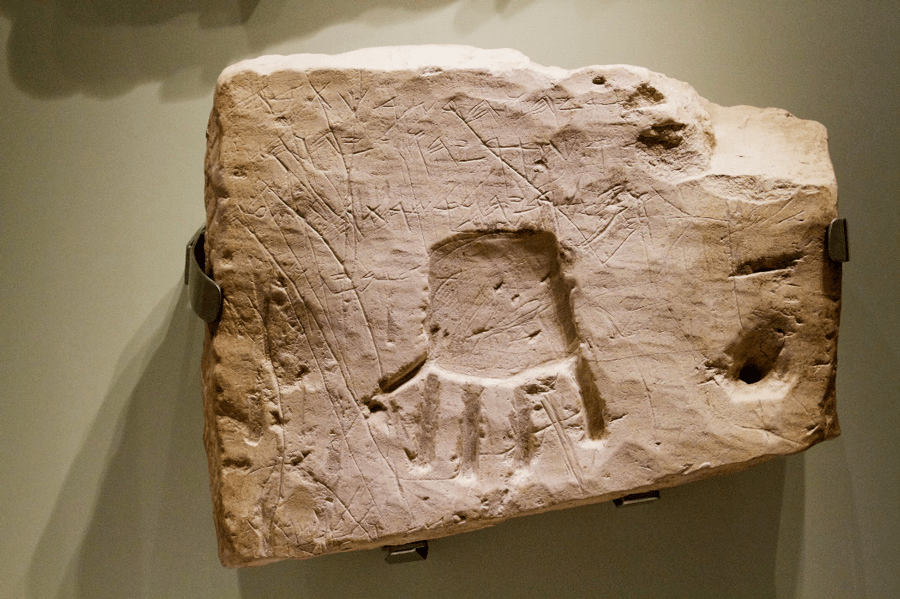
Yahweh and his Asherah: burial inscription from Khirbet El Qom (above)
‘In fact, this phrase “Yahweh and his Asherah” was so quotidian that it actually appears in the Hebrew Bible itself. The cryptic blessing is in an early rendition of Deuteronomy 33:2-3, when Asherah’s influence had not yet been fully subordinated.
The full hymn reads: “YHWH came from Sinai and shone forth… at his right hand his own Asherah.”
Susan Ackerman:
‘Asherah, along with Astarte [Lilith] and Anath [?], was one of the three great goddesses of the Canaanite pantheon. In Canaanite religion her primary role was that of mother goddess. In mythological texts from the Late Bronze Age (c. 1550–1200 B.C.E) city-state of Ugarit, she is called “the creatress of the gods”; her consort at Ugarit, the god El, is called “creator.”
El is also referred to as father and patriarch at Ugarit, as Asherah, likewise, is called mother.
Their children form the pantheon of the gods [archangels], who are said to number seventy; a Hittite myth similarly mentions the seventy-seven and eighty-eight children of Asherah.’
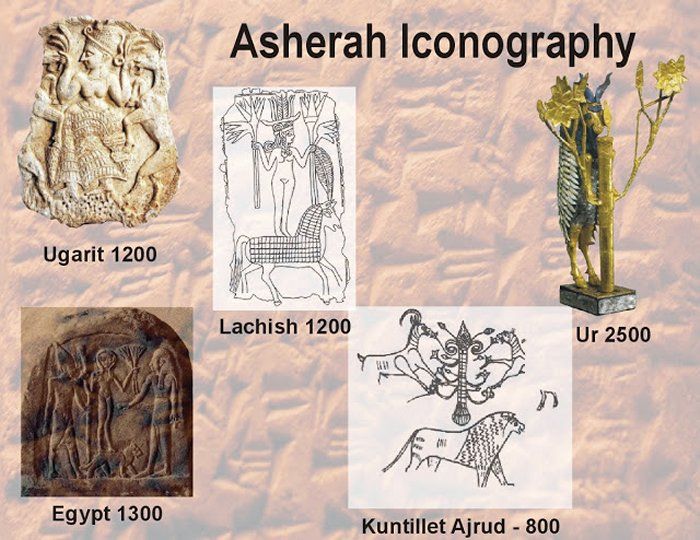
‘On occasion in Ugaritic myth, Asherah performs the maternal role of wet nurse. Ugaritic and other Canaanite materials further associate Asherah with lions (indicating power) [“… Your adversary the devil prowls around like a roaring lion, seeking someone to devour” – 1 Peter 5:8], serpents (representing immortality or healing), and sacred trees (signifying fertility).
Thus Asherah’s children at Ugarit can be called her “pride of lions”; the goddess is called “lady of the serpent” in second-millennium B.C.E. inscriptions from the Sinai; the late-thirteenth-century B.C.E. Lachish ewer dedicated to Asherah is decorated with images of sacred trees.
The Canaanite association of Asherah with sacred trees is also found in Israelite tradition. For example, one of the Canaanite epithets of Asherah, elat, “goddess,” is etymologically identical to the Hebrew word for the terebinth tree (ela). Another word for “terebinth” (alla) and two words for “oak” (elon and allon) are also closely related.’
Anya Leonard:
‘However, as the book religion solidified, Asherah became increasingly marginalized in the scriptures to the point of being reduced to her cult object – the stylized tree or wooden pole which became known as asherah or asherim.
Trees were revered as symbols of life and nourishment in arid regions and so became associated with Asherah and her cult.
Many scholars believe that Asherah’s tree functioned in the Garden of Eden parable.’

The World Tree has achieved mythical status throughout cultures all around the globe. Nearly all depictions of the World Tree have a great serpent residing at its base, being a custodian of forbidden knowledge.
Anya Leonard:
‘The ruling elite propagandized against goddess worship by integrating the story of the fall of mankind to the tree which was clearly associated with Asherah. Whereas Asherah’s influence was restrained in the official religion, her presence loomed large in the rural communities, most often in the form of figurines which are prolific in the region.
Even while idolatry is reviled in the Hebrew Bible, ample archaeological evidence suggests that those living outside the metropolis idolized statuary and cult objects as part of their religion, leading one scholar to opine: “Folk religion can be defined as everything that those who wrote the Bible condemned.” Asherah is represented many times in various forms scattered throughout the region.
But the most abundant of these are her pillar figurines which were popular from the 10th through the 7th centuries BC.
The term “images of Asherah” is often used in the Hebrew Bible and it is thought that these pillar figurines are what the writers of the bible had in mind.
Because the breasts^ are exaggerated with the hands supporting them, they are thought to symbolize the nurturing aspect of the mother goddess. Predominantly, the pillar figurines were found in private homes, suggesting their domesticity. In a world beset by hardship and drought, likely a concern for fecundity was what attracted the rural Israelites and Judeans to thegoddess Asherah, whom they associated with abundance.*
While there are voluminous artifacts identified as Asherah in the region, there are still pieces missing from the puzzle.
Was Asherah Yahweh’s wife, as many scholars now contend?
Was her worship confined to folk religion only, or was her influence felt in the book religion of the Hebrew Bible as well?
Indeed, unearthing a goddess who has been buried for close to two millennia has its distinct disadvantages.
Yet increasingly, Asherah’s influence in the region is becoming recognized by archaeologists and historians alike, with the expectation of further scrutiny and scholarship to come in this area.’
The feminine nurturing mother role of Asherah as the Queen of Heaven and Mother Goddess are without question. It is interesting to note that the Ancient of Days is also revealed in the Hebrew scriptures with a nurturing^ aspect, which has been hidden from Bible readers within English translations.
Genesis 17:1
English Standard Version
‘When Abram was ninety-nine years old the Lord appeared to Abram and said to him, “I am God Almighty [H7706 – Shadday: most powerful]; walk before me, and be blameless…’
Jerusalem Prayer Team, Hebrew Word of the Day, The Almighty, El Shaddai – emphasis mine:
‘Hebrew nouns have genders. Every noun is pre-determined to be either masculine or feminine. The sound of the noun usually discloses its gender. Feminine nouns normally end with the sound ‘ah’ or with ‘…et.’ So you can tell that ‘To-rah’… for example, [is] feminine… ‘Ki-ne-ret’ (Sea of Galilee) [is] also feminine…
Rule: all body [parts] that come in pairs (or more than 2) are feminine nouns. Hands, ears, legs, shins, fingers, teeth and more are all feminine nouns. All, except for one pair – breasts! Breasts, the most feminine pair organ in the human body happens to be a masculine noun.
Ask my why it is so. Thanks for asking this very good question. The answer is: because! Truly, I don’t know the answer and I don’t know anyone who has an educated, intelligent answer for it. This is an internal Hebrew paradox. Perhaps something with a very deep meaning [that] extends far beyond the boundaries of our limited I.Q.
El Shaddai [presents] the same unexplained challenge! Shaddai in Hebrew is the word for breasts.^ Every English Bible translates El Shaddai as The Almighty. The Almighty is a great name for God but it has nothing to do with El Shaddai. It was superimposed on innocent Bible [readers] and that’s it!
El Shaddai appears 12 times in the Bible. 10 in the Old Testament and twice in the New Testament.
If you check carefully the first three references to El Shaddai in the Bible you’ll be more than surprised. The [fourth] verse below [Genesis 49:25] is even more amazing. These are the three cases when God speaks in first person. Each verse is about fertility and the name Shaddai is stressed. Here is how El Shaddai is connected with fruitfulness:
‘May God Almighty (El Shaddai) bless you and make you fruitful and increase your numbers…’ Genesis 28:3
‘I am God Almighty (El Shaddai): be fruitful and increase in number’ Genesis 35:11
‘By the Almighty (El Shaddai) who will bless you with blessings of heaven above, blessings of the deep that lies beneath, blessings of the breasts (shadayim) [H7699 – shad: bosom] and of the womb (racham)’ Genesis 49:25
‘Yes, we all know God as the Father.
Is it possible that we overlooked [an] extra dimension of nourishing, motherly manifestation?
One more point to ponder upon: whereas shaddai, breasts, (the letters: Sheen, Dalet, Yood) represent human’s and other mammals nourishment, the rest of God’s creatures are nourished from the field. Guess how we spell field in Hebrew… Field is ‘sa-de’ and it is spelled with Sheen, Dalet and Hey. Almost identical to the word breast. If you take the last letter of each word (the only difference between the two), Yood and Hey, you get God’s more [well] known Name: ‘Yah.’ And if you still feel this is all just coincidence, you are welcome to resort to the safe translation: The Almighty.’
His Name is One, Jeff A Benner, 2003 – emphasis mine:
‘The Hebrew word (shaddai) also has the meaning of a “teat.” Just as the goat provides nourishment to its kids through the milk, God nourishes his children through his milk and provides all the necessities of life. This imagery can be seen in the following passage:
“And I will come down to snatch them (Israel) from the hand of the Egyptians and to bring them up from that land to a good and wide land to a land flowing with milk and honey.” Exodus 3:8
The word (teat) is often coupled with the word (mighty, strong) creating the phrase (el shaddai) literally meaning the “mighty teat,” hence we can see the translator’s reluctance to literally translate this phrase in this manner and instead using the more sanitized “God Almighty.”
The idea of God being characterized as having teats [nipples like a man] does not sit well in our Western culture. We are familiar with identifying with God as a father, but not as a mother.
The Hebrew word for mother is (em)… in the ancient pictographic script. The ox head meaning “strength” combined with the picture for”water” forms the word meaning “strong water.” Animal’s hides were placed in a pot of boiling water. As the hide boiled, a thick sticky substance formed at the surface of the water and was removed and used as glue, a binding liquid or “strong water.”
The mother of the family is the “one who binds the family together.” God can be seen as the “glue” that holds the whole universe together.
This is more than a figurative statement but also very scientific. All matter is composed of atoms, which consist of protons with a positive charge and electrons with a negative charge. The protons are packed together in the nucleus, the center of the atom, while the electrons orbit the nucleus.
Since each proton has a positive charge, each proton should repel the others causing the protons to fly apart, but for some unknown reason, they do not.
This phenomenon is called “nucleic bonding.” God literally “binds” the entire universe together.
[The Bible] states that man was created as male and female and also that man was created in the image of God. God has the characteristics of both male and female and these characteristics were put in man, the male characteristics were placed in men while the feminine characteristics were placed in women. When a man and a woman come together, they unite these characteristics as one, now a perfect representation of God.’
Or… could it be that the male qualities originate from one greater God, the Father – and the female qualities are from one lesser god, Asherah (2 Corinthians 4:4, Matthew 4:9-10)?
Thus the two sexes comprising male and female in humans are not some form of a schizophrenic divine split from one God; but rather a mirroring of the two ancient gods from antiquity – the Eternal One and for want of a better word, the Demiurge – who each created and fashioned the spiritual and physical realms respectively as espoused in gnosticism.
Abarim Publications – emphasis mine:
‘… the noun (shed)… describes a mythological creature, namely the Mesopotamian sedu, a kind of protecting spirit depicted as a winged bull [a Cherub], in essence not unlike the more familiar genius and daemon. Slightly more surprising, a third identically spelled noun, (shad), describes the mammalian breast, whether human or animal. This noun is assumed to stem from an unused verb (shadeh), meaning to moisten… breast, bosom, used both in erotic scenes and the practical usage of feeding babies.
A relation with the name Shaddai is not unthinkable, as this is the name by which God initiates the covenant of which Jesus is the final fulfillment… Paul compares introduction to the basics of the gospel with feeding milk to infants (1 Corinthians 3:1-2).’
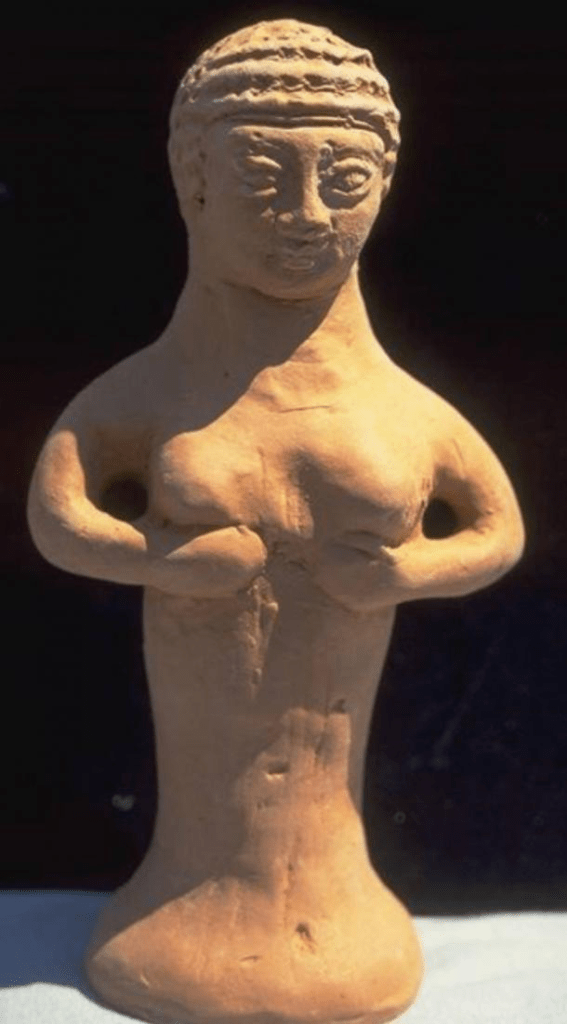
A small votive statue of the Mother Goddess – notice where Asherah has placed her hands, directing attention towards the life giving and nurturing breasts: symbolising her status as the goddess of fertility
Asherah is known by numerous names and as: the Goddess of Motherhood and Fertility, Mother of Angels, Mother of the Gods, Supreme Goddess, Life Mother, Lady of the Divine, Great Mother and Lady of the Sea.
Asherah’s kind is not clear, for is she from the Seraphim order, as Satan the Dragon would intimate; or is she from the Cherubim order as the anointed and covering Cherub in Ezekiel chapter twenty-eight?
The Hebrew word kruwb (H3742) while translated as Cherub, means an angelic being, either as a ‘guardian of Eden’ or ‘flanking God’s throne.’ Both these definitions fit Asherah as she was side by side with the Creator in his Holy Mountain, the celestial Eden (Ezekiel 28:14) – refer article: The Eden Enigma.
The answer may lay in both, in that Asherah is deemed a pre-existential being – a shadowy figure from before the creation and the beginning of time. Asherah is Primordial in that as Wisdom, she was the first creation of the Ancient of Days.
Yet the possibility exists she was co-equal with the Word – refer article: Thoth.
If one relies on John 1:1-3, Colossians 1:15-16, Hebrews 1:2 and Revelation 3:14 then it appears Christ was both first and pre-eminent.
The issue with this understanding is that firstly, Colossians is of dubious origin with an unknown author – refer article: The Pauline Paradox.**
Second, the first verse of John chapter one regarding the Word, has been translated into English incorrectly and there is doubt surrounding the veracity of the following two verses which conflict with Proverbs chapter eight – refer article: Arius, Alexander & Athanasius.
Third, the fourteenth verse in Revelation chapter three is the opening salutation of the Word to the seventh church (and final era) – Article: The Seven Churches – a Message for the Church of God in the Latter Days.
It reveals his pre-eminence as both a created being and foremost in God’s spiritual creation. Not that he was literally first. A role Christ has filled after the vacuum created by the rebellion of the Adversary.
Fourthly, the author of Hebrews – not Paul** and likely Apollos – appears in verse two of chapter one to endorse the sentiments of John. But in each instance, the use of ‘the’ beginning for the Word is not as accurate as ‘a’ beginning… one which followed an earlier beginning with Wisdom.
Tellingly, verse nine reveals this contextual interpretation to be more accurate, for Apollos states:
“… I am your God and I have blessed you. I have chosen you to be greater than others who are with you.”
The Eternal selected the Word for his role as mediator between Himself and humankind and in the process elevated him above his ‘fellow companions.’
Who might they have been?
Was Christ formerly an archangel (1 Thessalonians 4:16) and were his brothers the likes of Michael, Gabriel, Raphael and therefore even Samael; the other light bringer and chief Morning Star mentioned in scripture (Isaiah 14:12, Revelation 22:16) – Chapter XXII Alpha & Omega.
Asherah possibly had a vast number of children; the possibilities are endless.
It goes without saying that Asherah must have been beautiful beyond compare. She may have had hair white as snow, like the Eternal (and the Word) and against her dark skin, she would have exuded incredible sexual appeal, becoming the object of great desire for many in the angelic realm. So much so that this inordinate amount of attention led her to consider relations with her admiring offspring; thereby departing from the monogamous relationship with her Creator.
As the first of the Eternal’s creation, Asherah would have undoubtedly wielded immense power and influence. Her participation in the creation of myriad spiritual offspring established her status as the revered Mother of all creation prior to her metamorphosis to sexual siren and temptress.
Readers interested in further discussion regarding Asherah during the primordial age when she both ruled and was synonymous with the ancient planet Tiamat – and its demise, destruction and rebirth as our own Earth – please refer Chapter XXII Alpha & Omega.
An attributed quote by Asherah to the Archangel Michael:
“Everyone fails at who they are supposed to be, Michael. The measure of a person, be it a human, an angel, a god, or demon, is how well they succeed at being who they are.”

In Akkadian sources, Asherah is known as Ashratu, in Hittite as Asherdu and in Ugaritic as Athirat.
Legend says ‘Asherah settled within a Garden that is said to be the Nexus of all life and creation itself, becoming its very source while having equal share in ruling all of creation as well.’ As stated, many scholars believe that Asherah’s tree functioned in the Garden of Eden; integrating the story of the fall of mankind to her tree. And though they have invariably assigned the incorrect tree, they have understood that this could mean that Asherah herself is a Tree (of Knowledge of Good and Evil) given form.
Asherah became the Nemesis of the Ancient of Days, an opponent – the Satan.
There was a Greek goddess named Nemesis, which means, ‘to give what is due.’
‘It originally meant the distributor of fortune, neither good nor bad, simply in due proportion to each according to what was deserved.’* Not necessarily one and the same with Asherah, though they do share characteristics, aside from both being female. Nemesis is known as the winged balancer of life, the daughter of justice and the dark-faced goddess. She is the goddess of vengeance and divine retribution, ironically, against those who succumb to pride and arrogance and is often depicted with a sword and scales.
‘As the “Goddess of Rhamnous”, Nemesis was honoured in an archaic sanctuary in the isolated district of [Rhamnousia] in northeastern Attica. There she was a daughter of Oceanus [a link with watery Tiamat and the sea dwelling Leviathan], the primeval river-ocean that encircles the world.
Nemesis had a crown of stags [a link with Artemis (and thus Lilith)] and her cult may have originated at Smyrna.’ One of the seven churches – refer article: The Seven Churches – A Message for the Church of God in the Latter Days.
Observations on the Woman of Revelation 17 – Is the Harlot the Catholic Church? David Reagan – emphasis mine:
‘Particularly appalling in modern history has been the increasing emphasis given to the worship of Mary.
This gross idolatry was accentuated in 1978 by the selection of a Polish Pope, John Paul II. That’s because the adoration of Mary has long been a central focus of Polish Catholicism… Catholics will deny that they worship Mary. They argue, instead, that they simply give her the honor that she deserves. But, again, their actions speak louder than their words, and in this case, official words are sufficient to establish the point.’
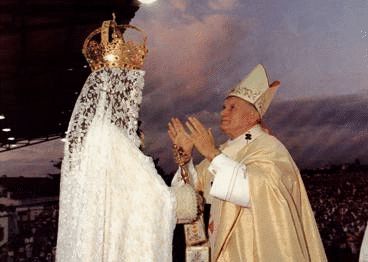
Pope John Paul II (1978-2005) worshipping a statue of Mary
Reagan:
‘Consider, for example, the following statement taken from an official Catholic publication:
Mary is co-redemptrix of the human race… because with Christ she ransomed mankind from the power of Satan. Jesus redeemed us with the blood of His body, Mary with the agonies of her heart… The church and the saints greet her thus:
“You, O Mary, together with Jesus Christ, redeemed us… God has ordained that no grace will be granted to us except through Mary…
No one will be saved or obtain mercy except through you, O Heavenly Lady…
No one will enter heaven without passing through Mary [Asherah] as one would pass through a door…
O Mary, our salvation is in your hands.”
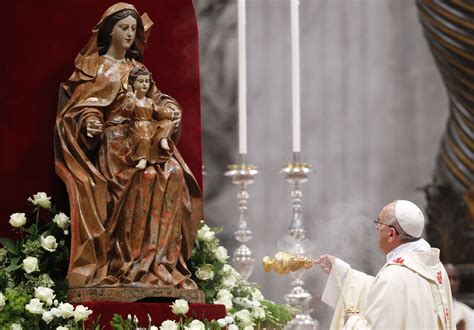
Pope Francis (2013-2025) committing idolatry at the feet of Mother Mary
Reagan:
‘This is blasphemy of the worst sort. It is the ancient Babylonian mystery religion parading in new clothes, worshiping Mary [Satan] as the “Queen of Heaven.”
Granted, Asherah succumbed to her own vanity, becoming consumed with pride in the process. Her son Samael meanwhile aimed to be the brightest and most powerful among the angelic realm; to ascend wherein no creature had ever dreamt about reaching. Samael’s treachery exceeded that of his Mother, in that he aimed to be the new Most High. He was rapacious and full of ingratitude. His plan, to overthrow the Ancient of Days from His throne in Heaven.
Samael wished to destroy faith in the true Creator from within the hearts of angels and later humans. Samael like Satan, seeks to corrupt everyone, everything and to rule over all. He too turned evil, spiteful and poisonous like his mother Asherah. How much of this was due to his Mother’s influence may remain unanswered.
Indeed, Samael makes Satan look less evil by comparison.
In the very beginning, the Ancient of Days loved Asherah and appointed her as head of all their angelic children. Asherah failed due to her desire to be equal with Him and separate herself from Him. As one who worshipped the Most High, she wanted to become not one with the Ancient of Days, but as one with Him.
Samael like his Mother, brings sorrow, loss, defamation and shame to the Creator and to His abode. Samael appeared to neither respect Asherah nor fear the Eternal One. Yet, neither was he wholly evil. Samael is thus, somewhat complex, fiendishly steering humanity down his dark path. For he possesses the goodness of his Father and the darkness of his Mother.
The name Baphomet is a (composite) occult figure who was allegedly worshiped by the Templar Knights. Many since have equated Baphomet with Lucifer who is really Samael; and with Satan, who is actually Asherah.

Adept Initiates – capitalisation theirs, emphasis mine:
“The Atbash Cipher is a Hebrew code which substitutes the first letter of the alphabet for the last, the second letter for the second to last, and so on.
When the Hebrew letters spelling Baphomet are applied to the Atbash Cipher it generates the Greek word “Sophia”.
The word “Sophia” in Hebrew is שופיא, and the Atbash form is בפעמת or “baf’omet”.
If one writes the word Baphomet in Hebrew* (remember Hebrew letters read from right to left),* and you apply the Atbash Cipher, Schonfield revealed the following:
The word BAPHOMET *(Bet Pe Vav Mem Taf)* with the Atbash Cipher *(Shin Vav Pe Yud Alef)* spells SOPHIA.
Although written in Hebrew it reads as the Greek word “Sophia” again, meaning wisdom. The most noteworthy translation of Baphomet comes from a Masonic source “Craft Symbolism in the Gnostic Mass” which says, “An interesting point about Baphomet is that the Greek translation of this name breaks down into the words bafe (BAPhE – baptism) and metis (METIS – wisdom): Baptism of Wisdom.”
What is pertinent is that recorded in the scriptures is an ancient being who existed at the beginning with the Eternal One. This entity was not the one known as the Word in John 1:1, but rather as Wisdom… and she was female.
Gnostics teach of a demigod, a lesser god if you will, a Goddess who was responsible for maintaining the material universe. She also cultivated the ego and a sense of separateness coupled with the evolution of the flesh, rather than the spirit.
This is in contrast with the Christ consciousness of oneness, which seeks to refine and elevate the spirit back to its source. This demigod called the Demiurge (Rex Mundi: ‘ruler of the world’) sought to turn away from the Creator and towards the material universe.
The word Demiurge derives from the Latin, demiurgos, a common noun meaning:
‘craftsman, artisan, producer’ and ‘creator.’
Recall, these meanings are strikingly similar to those revealed in Proverbs 8:30 – where Wisdom is described as a master workman, which by definition means:
‘a skilled artificer, inventor, craftsperson, clever in devising ways of making things, architect.‘
The Demiurge is ‘said to bring order out of substance by imitating an unchanging and eternal model.’ A being who existed alongside ‘another remote and unknowable supreme being’ who embodied goodness; while she is the originator of evil.
The Demiurge (or Queen of Heaven) was (is) a supernatural ‘creator’ – or rather manipulator and architect – of the (physical) Universe, while subordinate to the Eternal of the spirit realm.
According to the Gnostics, the Demiurge was the agent employed by the Supreme Being to create the material universe and humankind. Plato believed the Demiurge created other, ‘lower’ gods who, in turn, created humanity.
This is supported in Genesis 1:26, where its says: Then the gods said, “Let us make man in our image, after our likeness…”
Powerful Archons support the Demiurge, the most prominent of which is their chief: Yaldabaoth (also known as Yaltabaoth or Ialdabaoth).
Yaldabaoth has other names: Saklas, meaning ‘fool’; Nebro, meaning ‘rebel’; and revealingly, Samael meaning: ‘Blind God’ or ‘God of the Blind’ in Hebrew.
The etymology of the name Yaldabaoth is complex and without a definitive meaning. Though a number of speculative theories have been advanced.
The first etymology proposed was in 1575 by Francois Feuardent translating it from Hebrew to mean in Latin: a patribus genitus, literally, ‘the child of fathers.’
A theory proposed by Jacques Matter in 1828 identified the name as ‘child of darkness… an element of chaos.’
Adolf Hilgenfeld in 1884 based on Matter’s interpretation, proposed: ‘child of chaos.’
This analysis was convincingly deconstructed by Jewish historian of religion Gershom Scholem in 1974, who argued that based on the earliest textual data, which termed Yaldabaoth “the King of Chaos”, he was the progenitor of chaos, not its progeny.
Scholem’s theory rendered the name as Yald’ Abaoth. Yald’ translated as ‘begetter’, not ‘child’ and Abaoth being a term attested as Sabaoth, one of the names of God in the Bible with a number of variants in the Old Testament.
Thus he rendered Yald’ Abaoth as ‘begetter of Sabaoth (armies)’.
Scholem’s conclusion echoed that of Robert M Grant in 1957; who proposed that Ialdabaoth was derived from Yah(weh) El(ohei)-Sabaoth, “Yahweh, God of Hosts (Armies).”
Matthew Black objected to Scholem’s idea, on the confusing grounds that Sabaoth is the name of one of Yaldabaoth’s sons in certain Gnostic texts. Instead he suggested the second noun to mean ‘shame’. Which is cognate with boset, a term used to replace the name Ba’al no less.
The same Baal of the Old Testament, who is Lucifer in Isaiah chapter fourteen and none other than the former Archangel, Samael.
Thus Black proposed: ‘son of shame/Ba’al.’
In 1967, Alfred Adam offered: ‘bringing forth’.
He believed the name’s second part to derive from ‘fatherhood’ and hence meant ‘the bringing forth of the power of generation.’
Encyclopaedia:
‘Yaldabaoth… is first mentioned in “The Cosmos, Chaos, and the Underworld” as one… to come “into being to rule over chaos and the underworld”. He comes from heaven, and it is said his “face flashed with fire and his appearance was defiled with blood”.
Yaldabaoth is frequently called “the Lion-faced”, leontoeides, and is said to have the body of a serpent’ – Genesis 3:1, 1 Peter 5:8.
Yaldabaoth [Samael] is the son of Sophia [Asherah], the personification of wisdom according to Gnosticism, with whom he contends.
From his mother he received the powers of light, but he used them for evil.
Sophia rules the Ogdoas [a supercelestial eighth region beyond the seven heavens^], the Demiurge rules the Hebdomas.’
Hebdomas in Gnosticism refers to a governing entity associated with the Demiurge (rather Yaldabaoth), representing a class of existence below the Great Archon (Asherah). It signifies a divine assembly of seven rulers and is linked to the concept of the seven heavens^ in Gnostic cosmology.
Encyclopaedia:
‘In the act of creation… Yaldabaoth breathed the soul into the first man, Adam… [and] Sophia instilled in him the divine spark of the spirit. After matter, Yaldabaoth produced the serpent spirit (Ophiomorphos), which is the origin of all evil.
The light being Sophia caused the fall of man through the serpent [Samael]… By eating the forbidden fruit…’
The Demiurge was later associated with the planet Saturn, which as discussed means ‘hidden’. And Asherah has certainly been hidden from view. She has remained secretly in the shadow of her son Samael. So much so that Yaldabaoth is almost unanimously mistaken as the Demiurge, just as Lucifer is wholly mistaken for Satan.
A similar parallel relationship is mirrored in the epic Star Wars movie franchise by director George Lucas where we are introduced to Darth Vader, the leader of the evil Galactic Empire. What the viewer is not aware of until only later in the second film (episode five of the nine film series) is that Darth Vader serves another.
Darth Vader aka Anakin Skywalker
This person is revealed in stages and unlike Darth Vader who began as good, they choose to follow evil.
Sheev Palpatine’s back story is as a Senator of the planet Naboo. While posing as a charming politician and trust worthy leader, he secretly advances his own Sith agenda.
The Sith, an ancient order of dark side Force-wielders are known for their use of hate, deception and violence to gain power. Their goal to destroy the order of the Jedi Knights who use the Force for good.
Palpatine becomes Supreme Chancellor of the Galactic Republic through manipulating events and using ensuing crises to gain emergency powers. This ultimately leads to the fall of the Galactic Republic and the rise of the Galactic Empire of which Palpatine becomes its emperor. In this guise, Palpatine as a dark lord of Sith becomes Darth Sidious.
It is he who plays on the hurt of the young Jedi Knight Anakin Skywalker, transforming him through a gradual cunning emotional process using fear and loss into the Sith Lord Darth Vader.
Emperor Palpatine aka Darth Sidious
Darth Sidious is an archetypal symbol of evil and manipulation. His character embodies themes of power, betrayal and the dark side of ambition, all the while maintaining a dual identity.
Just as Samael (the light bringer) is in the limelight as the frontman – like Darth Vader – it is the Empress Asherah who is cloaked in the shadows, all the while wielding ultimate power as does Darth Sidious.
One writer proposes that some schools of thought say ‘Satan was a rebellious Archon who rebelled against Saturn the original leader of the archons (planets), the great architect of the matrix, who was ignorant of a higher power, whereas Satan wasn’t and overthrew Saturn the way Zeus overthrew Cronus, whose symbol is the scythe, [a] symbol associated with Saturn, and the astrological symbol for Saturn.’
Continuing:
‘… to my mind, Satan isn’t Saturn, perhaps Satan hijacked Saturns following and power over the material 3D universe, who portrays himself as God or Yahweh when he is in fact not, for he cannot create ex nihilo… however they are both related, being lesser “gods” who cultivate the current of chaos, the current of the ego and the flesh, which like the [qliphoth] of kabala, are husks which contain the sparks of light, the goodness and souls which originate from the logos, the word, the Divine spark’ – Article: Principalities & Potentates: What they want… Who they are.
Alternatively, the truth may reside in the fact that Samael (Lucifer), sought to overthrow his mother, Asherah the Adversary – who is Satan – and therefore it is Samael who now equates with Saturn – refer article: The Calendar Controversy.
It is agreed with the writer, where ‘Satan’ (actually Asherah) and ‘Saturn’ (in turn Samael), are “related, lesser gods”.
Encyclopaedia:
‘According to Marcion, the title God was given to the Demiurge, who was to be sharply distinguished from the higher Good God. The former was díkaios, severely just, the latter agathós, or loving-kind; the former was the God of the Old Testament [perhaps in truth represented by Samael], the latter the true God of the New Testament.
Christ, in reality, is the Son of the Good God. The true believer in Christ entered into God’s kingdom; the unbeliever remained forever the slave of the Demiurge.’
A rather frightening yet fascinating insight into the very mind and nature of the supreme-like being Asherah the Adversary – on first reading, though perhaps it is actually describing Samael instead – is provided by Hidden Mysteries, quoting from Cosmic Voyage by Courtney Brown – capitalisation theirs, emphasis mine.
‘… COSMIC VOYAGE, by Mr. Courtney M. Brown, Ph.D… deals with the authors’ personal experiments with remote viewing… From my own perspective, remote viewing [RV] operates through the subspace body of a human being who is able to tap-in to the universal psionic field. Since the psionic field is the very foundation of all space-time-material reality, the so-called “master program” of the universe, it is not necessarily bound by the limits of space, time and matter. Like a bio-chemical radio transceiver, some individuals – for better or for worse – have the ability to “tune-in” to and “surf” the universal consciousness, the “flowline”, or the Akasha memory matrix, to specific places in space and time. One of the “targets”… was the Grey aliens’ collective mind.
He noticed, at one point, an unusual “subspace” being that seemed to be directing the activities of the Greys he was observing… He came to what he sensed was the central governing center of the subspace beings’ activity, and in the center of this there was another area where a “council of 10” very high-level subspace beings congregated. These were apparently the governing principalities who were engaged running the whole operation. The security here was absolutely incredible.
Then he perceived the SUPREME LEADER of this council of 10 subspace entities… and at about this point Courtney Brown was jerked back into his body, so to speak. He sensed that this leader had detected the presence of his subspace body, and had followed this RV “intruder” back to his physical source. Brown… felt a deep, dark “cloud” enter the room and it stayed there for about half a minute scrutinizing the scene. It left, apparently seeing [Brown and his trainer] as “small frys” who were not worth wasting its time on.
Before Brown’s expulsion from the command center however, he was able to perceive for a brief moment what this being was really like…
it was an extremely powerful being, but with a twisted personality that was full of darkness.
Apparently this being had come into conflict with another Force which it saw as its enemy. Brown sensed in this being a severe self-esteem problem, in spite of its incredible power, and because of this it had a consuming desire to be worshipped by others.
Brown was confused when he sensed that the subspace beings and in turn the Reptilians/Greys were COMMANDED by this leader to engage in self-indulgent and destructive activities. This being wanted his servants to use self-indulgent rewards or fear to maintain the absolute hierarchical command structure within its empire…
Brown also got the impression that it was FEAR and PRIDE – its perceived NEED to be worshipped – that kept this being from negotiating with its ancient enemy, and that this being was utterly desperate to maintain its very survival or existence (strange for a seemingly immortal subspace being) and chose to resort to rebellion and terrorism in a desperate attempt to take control of the situation. Brown received a strong impression that this being was the ultimate universal terrorist!!!
Apparently because of its all-consuming ego this being would NEVER humble itself before its “enemy.”
An original excerpt transferred from Chapter XXII Alpha & Omega
© Orion Gold 2021 – All rights reserved. Permission to copy, use or distribute, if acknowledgement of the original authorship is attributed to orion-gold.com
 The Lightkeeper